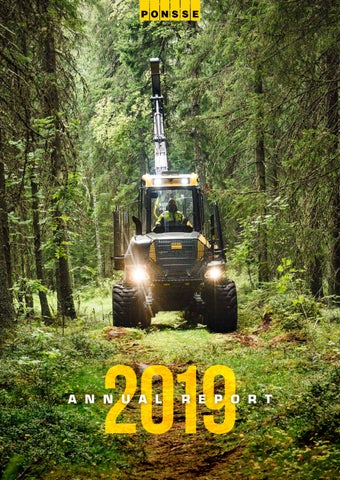
2019
A N N U A L
R E P O R T
PONSSE ANNUAL REPORT 2019
1
Photo: Jukka Gröndahl
PONSSE IN BRIEF Ponsse Plc is a company specialising in the sales, manufacture, servicing and technology of cut-to-length method forest machines and is driven by genuine interest in its customers and their business. Ponsse develops and manufactures sustainable and innovative harvesting solutions based on customers’ needs. The company was established by forest machine entrepreneur Einari Vidgrén in 1970, and it has been a leader in timber harvesting solutions based on the cut-to-length method ever since. With experience from over 15,000 cut-to-length forest machines, this family-owned company is today one of the world’s leading manufacturers of forest machines. The sales and service network covers 40 countries and the share of exports is 78.2 per cent of net sales. Ponsse is headquartered in Vieremä, Finland. The company’s shares are quoted on the NASDAQ OMX Nordic List. This year, Ponsse celebrates its 50th anniversary!
CONTENT NET SALES, MEUR
667.4
EMPLOYEES
1,761
SHARE OF EXPORTS, %
2 6 8
78.2
10 12 14 18 20 22 24 25
2
PONSSE ANNUAL REPORT 2019
Ponsse in Brief Mission, Vision and Values Review by the Chairman of the Board and the President and CEO Market Review Events in 2019 A Pioneer in Sustainable Forestry The Future of Forestry Lies in the Cut-To-Length Method PONSSE Maintenance Services – Supporting the Customer Board of Directors Management Team Area Directors and Subsidiary Managing Directors
CORPORATE SOCIAL RESPONSIBILITY 26 33 37 40
Corporate Social Responsibility (CSR) at Ponsse Social Responsibility Environmental Responsibility Financial Responsibility
FINANCIAL STATEMENTS 2019 49 Financial Statements Content
PONSSE ANNUAL REPORT 2019
3
PONSSE’S YEAR 2019 The divided year featured both new records and uncertainties. Overall markets for environmentally friendly cut-to-length method forest machines broke a new record, totalling 4,500 machines. Demand for our forest machines was record-high at the beginning of the year, evening out towards the year-end. Our new factory proved its efficiency and quality-producing abilities, and we manufactured both the 14,000th and the 15,000th PONSSE forest machines during the year. Harvesting solutions and technologies in line with sustainable development steer our operations more strongly than ever before.
4
PONSSE ANNUAL REPORT 2019
PONSSE ANNUAL REPORT 2019
5
MISSION We will succeed together with our customers and partners through innovative harvesting solutions based on sustainable development. Ponsse ensures a high-quality customer service by focusing on harvesting solutions based on the cut-to-length method. It seeks solutions openly and innovatively together with its customers, while continuously reaching for something new and better. There can be no compromises over the high level of quality and reliability of products and services, under any circumstances.
VALUES Determinedly on the way paved by Einari Vidgrén, the company’s founder, since 1970. CUSTOMER ORIENTATION • A genuine interest towards the customer • Knowing the customer’s business • Availability and rapid response times • A readiness to serve and support the customer • Flat organisation
”
“Practice is the best teacher. And the best specialists are machine operators. It is worthwhile paying close attention to what they say and to keep their words well in mind.” (Einari Vidgrén, 1943–2010, the Founder of Ponsse)
VISION We are the preferred partner in our industry. We are continuously and at an ever higher intensity working hard to develop Ponsse in order to become the leader in the field of forest machines based on the cut-tolength method. Continuous development and advancement are what make Ponsse the most desirable partner in its field. That is why Ponsse’s products and services are selected again and again, from one generation to the next.
Ponsse is driven by genuine interest in customers and their business operations. Ponsse knows its customers personally, allowing it to identify their needs. The flat organisational structure ensures that decision-makers are located close to customers.
INTEGRITY • Ethical operations and high morals • Reliability • Keeping our promises • Openness
”
“If you want to succeed in this business, you need to have honest and trustworthy relationships in both directions. Dishonesty takes you nowhere.”
Ponsse’s operations are based on honesty, ethics and high morals. Ponsse is reliable, as are its employees. Ponsse keeps its promises, and does not give any empty promises to its customers, stakeholders or colleagues. The customer is never left alone. All activities are characterised by openness.
PONSSE SPIRIT • Constructive humility and a tenacious work ethic • Entrepreneurship and the will to succeed • Decision-making capacity • Refusing to compromise in achieving goals 6
PONSSE ANNUAL REPORT 2019
• Assuming responsibility • Friendliness and fair play • Listening to personnel and good communication • Helping co-workers and taking others into consideration
”
“As we’re all part of the same company, everyone can call me Einari.”
During decades, Ponsse and its employees have built their own unique culture and spirit, following Einari Vidgrén’s ideas. The Ponsse spirit signifies friendliness and fair play. Ponsse serves its customers reliably and works hard without being overly serious. Every Ponsse employee is entrepreneurial and willing to succeed. Everyone assumes and bears responsibility for the success of the company. That is why Ponsse makes no compromises over achieving its goals. Therefore, Ponsse employees have the capacity to make decisions and are humble and tenacious when it comes to work.
INNOVATION • Continuous improvement of products, services and processes • Initiative and broad-mindedness • Chance for change
”
Einari Vidgrén’s definition of the very first PONSSE harvester head in 1986: “Let’s make it ourselves!” It must grapple a tree like a bear, and the log must pass through with a good speed.”
Ponsse is continuously improving its products, services and processes. There must be initiative and broad-mindedness in R&D. This secures the company’s competitiveness. Ponsse employees are broad-minded and believe in what they do. The search for new ideas is not limited to the company’s business field only but, regardless of the business area, Ponsse wants to actively learn from the best operators and apply what it has learned to its industry. That is why Ponsse sees that changes offer opportunities for development and advancement. PONSSE ANNUAL REPORT 2019
7
REVIEW BY THE CHAIRMAN OF THE BOARD AND THE PRESIDENT AND CEO In 2019, the total cut-to-length forest machine market rose to an all-time high. Over the past few years, demand for forest machines has grown very strongly and the entire forest machine industry has had the chance to enjoy the growing volumes. During 2019, we also experienced a change in demand and our order intakes as the uncertainties in the world economy, together with the forest damage in Central Europe, impacted our customers’ investment behaviour.
D
espite the challenging year, Ponsse did well, and we achieved a more than 10 per cent profitability and a cash flow of EUR 43 million, which can be considered good in light of the circumstances. We were able to continue our growth and produced a record number of new PONSSE forest machines at our modernised Vieremä factory. For the first time in our history, we managed to surpass a thousand-machine milestone twice within a year, and delivered both machine number 14,000 and machine number 15,000 to our customers in 2019. Sustainable development and responsibility play a key role in our success. We develop our products and services to support and enable the worldwide realisation of the principles of a forest industry that is as sustainable as possible. We see the rapid advancement of technology and sustainable development as big trends. Both of these trends also have an impact on one another and, on the other hand, enable Ponsse’s long-term success.
In line with our vision, we want to be the preferred partner in our line of business. Into this vision, we have incorporated our aim of becoming a carbon neutral company in the long term. This represents a significant goal for us. Our future solutions will support this goal in terms of both our products and operations. The task is not an easy one, but we are taking up the challenge. Since 2010, we have invested around EUR 120 million in product development and around EUR 215 million in fixed assets. The continuous development of the company’s operations is essential to us. Our global distribution and maintenance network is developing rapidly. We are developing the organisation and operating methods of our distribution network, and aiming to expand efficiently to new areas. The daily work of the Ponsse network’s sales and service is keeping our customers
8
PONSSE ANNUAL REPORT 2019
happy and ensuring our long-term success. At the same time, we are making significant investments in our manufacturing network, to maintain as good a pace of development in our productivity and ability to produce quality products as possible. Our investments in product technology and product development have increased every year. Rapid technological development and digitalisation, in particular, open up new opportunities to develop products and services. We are doing our part to ensure that sustainable harvesting solutions and related technologies continue their development. The management of our company is strongly based on values, with a clear focus on the future. The values based on our history
– customer orientation, integrity, innovativeness and the Ponsse spirit – are genuinely important to us at Ponsse, and they inform our day-to-day operations. At the same time, we are continuously investing in the development of functions that take the natural environment, our personnel and the economic environment into account.
Juha Vidgrén Chairman of the Board
Based in Vieremä, we are focusing and will continue to focus on the sale, maintenance, manufacture and product development of cut-to-length forest machines. Our customers and committed personnel will enable our success in the future as well.
Juho Nummela President and CEO
PONSSE ANNUAL REPORT 2019
9
MARKET REVIEW
2019 was a mixed year for Ponsse. During the first half of the year, demand for PONSSE forest machines was very high and our order intake was greater than ever before. The forest machine market calmed clearly as the year progressed and returned to its normal level towards the end of it.
A
lthough the forest industry is used to even rapid market changes, the period under review was exceptionally challenging for our customers in a number of our market areas. The damage caused by bark beetles in Central Europe changed the world’s timber flows and the price of pulp dropped during the second half of the year, contributing to the general uncertainty in the harvesting market. The mild winter also made the harvesting of wood challenging in several areas, in addition to which labour disputes hindered the operations of harvesting entrepreneurs in Finland. I’d like to extend my special thanks for the past year to Ponsse North America Inc., our subsidiary in the US. It was able to develop its operations in various areas and respond well to the service needs of our local customers, for example, in southern parts of the US that were ravaged by storms. Timberforest, our retailer in Brazil, reached a new record in harvester head sales. The expert and highly ambitious company has increased sales of PONSSE harvester heads exceptionally fast in its operating area and proven to be completely worthy of its customers’ trust. Despite the uncertainties, the total forest machine market grew in Finland and Sweden, among other places. Sweden regained its former position as the world’s largest cut-to-length forest machine market, leaving Russia behind. The Russian market remained on a good level, but the growth was more moderate than in previous years. According to our estimates, the total cut-to-length forest machine market was larger than ever before, consisting of roughly 4,500 machines sold during 2019. The increased sales volume is indicative of not only the forest industry’s good situation, but a change in harvesting methods. The cut-to-length harvesting method is being adopted to an increasing degree nearly everywhere in the world. The growth is driven by the method’s environmental friendliness combined with the greater efficiency and better ergonomics of the cut-tolength method’s forest machines. Environmental perspectives provide a direction for the entire industry. It is interesting to see how the renewable wood raw material is being developed into sustainable materials, from textiles to packaging that can replace plastic. The role that cutto-length forest machines play in this chain is the efficient gathering of the wood raw material in such a way that the damage to the remaining trees, soil and the harvested wood is as minimal as possible. The features of the machines must also meet the increasing thinning needs, and the technology must facilitate the operator’s work in increasingly versatile ways. The robust market situation during 2019 also resulted in
10
PONSSE ANNUAL REPORT 2019
challenges in the availability of components. Given that we began the serial production of numerous new products at the same time, our production situation was challenging at times. The most important of the new products were the new PONSSE Active Crane loader, the PONSSE Cobra harvester and the PONSSE Bison forwarder, in which we utilised a lot of the technology used in PONSSE Scorpion. Equipped with CVT and active suspension, the Bison is an exceedingly efficient machine. In the development of forwarders, it now represents what more than a thousand manufactured PONSSE Scorpions represent in harvesters. The new factory, started up in the autumn of 2018, demonstrated its flexibility and efficiency in challenging circumstances, and we were mostly able to deliver machine orders to our customers according to the promised schedule. The professional skills of our employees and their commitment to our customer-driven operations had the greatest impact on our success, and for this I wish to extend my special thanks to all Ponsse employees! Our delivery times, protracted due to the heated market situation, shortened as the order intake levelled off, and in the second half of the year, we got close to our normal delivery times. Last year was exceptional in that our production was able to celebrate a thousandth machine produced not once but twice: during the first half of the year, we delivered the 14,000th PONSSE forest machine to a customer, and in November, the 15,000th PONSSE forest machine marked the start of our anniversary year. The new factory is operating efficiently and the investments in our ability to manufacture quality are now visible in our products and can be heard in the feedback provided by our customers. This is also largely due to the fact that the volume of testing and quality inspections was increased considerably in the new factory. We can, for example, now inspect the structures we manufacture with 3D scanning, which ensures the flawlessness of each structure. In 2020, we will continue to invest in the development of our service network. New service centres are under construction in Joensuu, Finland, and in Tomsk, Russia. This is what customer cooperation means in practice. Solutions that are genuinely needed in the routine work of entrepreneurs and operators. Half a century of making forest machines has included both varying market situations and technical challenges. What is common to the whole industry, however, is a strong team spirit and long-term confidence in the future. Our industry’s renewable raw material will continue to be harvested with continuously developing forest machines
and the ecological cut-to-length method. The year 2020 marks the 50th year of Ponsse operations. It has always been the most important thing for us at Ponsse to listen to our customers and respond to their needs rapidly. We could not have achieved this growth and development alone. The best support has been provided by our customers, and we have had the chance to engage in good cooperation with numerous stakeholders. Our journey from a village workshop to the world’s most advanced forest machine factory has been long, and not without its difficulties. The best reward of all is the chance to see our customers and employees benefiting from the investments made.
Jarmo Vidgrén Sales and Marketing Director
PONSSE ANNUAL REPORT 2019
11
EVENTS IN 2019 Ponsse Machines Ireland Ltd celebrated the grand opening of a new unit.
Mammu Kaario, vice chairman of Ponsse’s Board of Directors, received the award.
Ponsse is the most reputable company in Finland for the second year in succession.
The 14,000th PONSSE forest machine was made in Vieremä.
30 Jan
Ponsse delivered the 14,000th forest machine made in Vieremä. PONSSE Elephant King, delivered to UPM in Uruguay, also celebrated Ponsse’s successful factory expansion.
21 May
1 Feb
Ponsse’s new service centre in Mikkeli opened its doors and celebrates 30 years of maintenance services in Mikkeli.
3 July
8 May
9 Aug 5 Sep
Ponsse Machines Ireland Ltd, Ponsse’s subsidiary in Ireland, celebrated the grand opening of a new unit. During the event, new managing director Patrick Murphy took over operations in Ireland.
17 May
Ponsse opened a service centre in Sandviken, its sixth in Sweden.
Merited forestry professionals were rewarded in Vieremä. Carrying on the life’s work of Einari Vidgrén, the Einari Vidgrén Foundation gave out a total of EUR 230,200 in awards. Ponsse celebrated the completion of Dino in 1969. The load-carrying forwarder was the result of Einari Vidgrén’s vision. Interexport d.o.o. started as Ponsse’s new retailer in Croatia, Slovenia and Serbia.
The grand opening of the new training and service centre of OOO Ponsse, Ponsse’s subsidiary in Russia, was celebrated in St. Petersburg. The new training centre is OOO Ponsse’s flagship, featuring the best training equipment and expertise in the industry.
18 Sep
A new managing director was appointed for Ponsse AS, Ponsse’s subsidiary in Norway. Sigurd Skotte, the company’s managing director since 2011, transferred to Ponsse Plc, working in the development of international sales, and Carl-Henrik Hammar, managing director of Ponsse’s Swedish subsidiary, was appointed managing director of Ponsse AS. He will also continue in his position as managing director of Ponsse AB.
29 Oct
Ponsse is the most reputable company in Finland for the second year in succession. In the survey, Ponsse was the only company given an excellent grade.
6 Nov 26 Nov
Savon Yrittäjät association gave the regional Entrepreneur of the Year award to Ponsse Plc.
Ponsse was chosen as the best medium-sized enterprise listed on the Nasdaq Helsinki stock exchange. In the private investors’ choice competition, smallscale investors cast their vote for Finland’s most reliable and attractive listed companies. Mammu Kaario, vice chairman of Ponsse’s Board of Directors, received the award.
19 Dec
The 1,000th PONSSE Scorpion harvester manufactured in Vieremä was delivered to Koneurakointi Kylliäinen Oy.
1 Nov
The 15,000th PONSSE forest machine was completed at Ponsse’s factory in Vieremä and delivered to Lespromindustria in Tomsk, Russia.
The grand opening of the new training and service centre of OOO Ponsse in St. Petersburg.
The 15,000th PONSSE forest machine delivered to Lespromindustria in Tomsk, Russia.
12
PONSSE ANNUAL REPORT 2019
Koneurakointi Kylliäinen Oy and the 1,000th PONSSE Scorpion harvester.
PONSSE ANNUAL REPORT 2019
13
A PIONEER IN SUSTAINABLE FORESTRY Ponsse aims to be its industry’s preferred partner. This is why we want to be the technological leader of the environmentally friendly cut-to-length method by developing innovative products and services in line with sustainable development. All our development work is based on our goal of becoming a carbon neutral company, and our future product solutions will support this goal.
P
onsse has made increasing investments – up to EUR 120 million since 2010 – in the research and development of new products and its existing range of machines. This is a significant sum invested in the development work of continuously more advanced wood harvesting technology. In 2019, we started the serial production of an exceptional number of new products. As a result of long-term development work, we commenced the production of the PONSSE Bison Active Frame forwarder, the advanced solutions of which are exceptional in the forwarder markets. The stepless CVT combined with the Active Frame active suspension allows for a higher driving speed and considerably reduces the strain on the operator’s body. For our largest forwarder models, PONSSE Elephant and Elephant King, we introduced a PONSSE K121 loader with superior torque and lifting power. Its reach and controllability facilitate load handling under demanding conditions. The markets’ reception of the PONSSE Cobra harvester, designed for varying harvesting needs and conditions, was also excellent. Fuel economy and the adaptability of machines are becoming increasingly important. In many locations, harvesting conditions are increasingly difficult, and the efficiency and economy of the harvesting work carries great weight with regard to the work’s profitability. Our product development is always guided primarily by the needs of machine operators and the need to ensure their safety. The efficient facilitation of operator work, the minimisation
of environmental impact, improving the energy efficiency of machines and providing increasingly better services with the help of digital solutions provide a clear direction for the design of our product and service range. With regard to our future and development, it is vital for us to be involved in the rapidly evolving technology in line with sustainable development goals. FACILITATING OPERATOR WORK
A forest machine must be the best possible working environment for its operator – the needs of machine operators and their safety are requirements we cannot compromise on under any circumstances. In addition to increasing the productivity of an operator’s work, the aim is to enable the best possible quality of mechanical forestry. To support these objectives, we are designing more and more facilitating features for forest machines that monitor the progress of the harvesting work and the environmental conditions, thereby supporting the operator in making decisions that enhance the harvesting work. These facilitating features help reduce the strain experienced by the operator and allow for the operator’s better level of alertness. Several wood harvesting markets are experiencing a shortage of skilled machine operators and advanced solutions supporting operator work are one way by which to tackle this challenge. Sophisticated harvesting technology does not mean more complex work phases. Rather, it is first and foremost
”
The markets’ reception of the PONSSE Cobra harvester, designed for varying harvesting needs and conditions, was excellent.
14
PONSSE ANNUAL REPORT 2019
PONSSE ANNUAL REPORT 2019
15
A PIONEER IN SUSTAINABLE FORESTRY
about user-friendliness. The training of operators becomes easier and can be supported through digital learning methods and work monitoring. The PONSSE Active Crane loader control, in which the machine’s automation allows the operator of a forwarder to control the whole movement of a grapple instead of individual functions, is a good example of a solution facilitating operator work. The number of work phases carried out by the operator is reduced and the work becomes simpler and more efficient. MINIMISING ENVIRONMENTAL IMPACT
Our goal of achieving carbon neutrality in the long range also informs the direction in which our product models are developed. Forest machine technology has been developed in a manner that accounts for environmental aspects since the 1980s. The quality requirements of forest companies and forest owners have always served as an efficient driver of this development. Nowadays, the consideration of environmental issues is an unquestionable starting point in the design of machines and features, and harvesting entrepreneurs and forest machine operators themselves are in the front lines in promoting responsible harvesting. We operate as part of a sustainable forest economy and ensure that our customers are able to meet even the highest responsibility standards in terms of both work quality and environmental impact. As part of responsible development work, we have been able to minimise the footprint left by forest machines on soils with poor carrying capacity. Ponsse solutions in reducing the bur-
den on soil include the even weight distribution of machines, a ten-wheel forwarder and the long wheelbases of forwarders. Reducing the size of the machines in the short-distance hauling of wood is not a solution for challenges involving carrying capacity. The machine’s sufficient carrying capacity eliminates the need to drive the same trail back and forth numerous times. A more efficient way to minimise loads on the soil is to ensure that the machine’s surface pressure is low, its weight is evenly distributed and that the right track and tyre solutions are used. In the design and manufacturing of the machines, we pay special attention to our choices of materials. Forest machines operate in extreme conditions, and the durability and long service life of the materials and structures play a crucial role in the machines’ service life. The materials should be recyclable as far as possible and their manufacturing must take account of the environmental burden. We have studied the environmental impact of PONSSE forest machines with a life cycle analysis which accounts for a machine’s entire life cycle, from the production of its components all the way up to the recycling subsequent to the machine’s service life. ENERGY EFFICIENCY AS A DRIVER OF DEVELOPMENT
We reduce the energy consumption and operating costs of forest machines within the framework of our Boost & Save programme. The idea is to develop the product range’s productivity and economy through all available channels in design, training and after sales services. The continuously developing engine technology also supports work in line with fuel econ-
omy, alongside the stricter emission requirements imposed on engines. In 2019, PONSSE forest machines delivered in the EU started to use Stage V engines. Stage V is a European emission standard. The new Mercedes-Benz Stage V emission engines feature the latest engine technology, and are an excellent solution for forest machines that require productivity, reliability and fuel economy while at the same time being environmentally friendly. The new engines are modern, low-emission engines with particulate mass (PM) and nitrogen oxide (NOx) emission levels that are considerably lower than those of Stage III and Stage IV emission ratings. In addition to control of the particulate mass (PM), Stage V emission engines also control the number of particles (PN) by means of a particulate filter (DPF). PONSSE Manager is a modern forest machine monitoring and data transfer system that forest machine entrepreneurs can use to see their machines’ location, productivity figures and fuel consumption, for example. With PONSSE Manager, entrepreneurs can improve the efficiency of their business and enhance productivity, thanks to real-time field operations monitoring. The comprehensive data-based solution also enables the development of new solutions that produce added value for customers. The rapid development of technology and digitalisation, in particular, constantly offer new opportunities to develop products and services. We are doing our part to ensure that sustainable harvesting solutions and related technologies continue their development.
”
The quality requirements of forest companies and forest owners have always served as an efficient driver of this development.
”
We operate as part of a sustainable forest economy and ensure that our customers are able to meet even the highest responsibility standards in terms of both work quality and environmental impact.
16
PONSSE ANNUAL REPORT 2019
PONSSE ANNUAL REPORT 2019
17
THE FUTURE OF FORESTRY LIES IN THE CUT-TO-LENGTH METHOD A MANAGED FOREST GROWS BETTER
Two-thirds of the world’s mechanical wood harvesting today is carried out with forest machines based on the cut-to-length (CTL) method. In the EU area, the CTL method’s share of all harvesting, both mechanical and manual, already stands at more than 70 per cent. Elsewhere in the world, too, almost all new forest industry projects are established on the basis of solutions in which each stem is optimised according to the needs of the wood user. In the CTL method, trees are cut into assortments that fit their purpose of use in the forest. This enables the wood’s high productivity and an efficient logistics chain. An assortment refers to the logs cut from a single stem for a variety of purposes, such as sawmill, plywood and small logs, pulp log and wood used in the production of bioenergy. RECOVERING A VALUABLE RAW MATERIAL
In the cut-to-length method, wood is harvested directly for the needs of the end customer and the valuable raw material is used efficiently. The harvester’s automation optimises each stem in a fraction of a second in such a way that the stem’s conversion value is as high as possible. The harvester measures the stem’s base and compares the dimensions to stored tree species data and the stems it has cut in the forest before. Based on the comparison, the harvester’s measuring device forms a precise prediction of the length and thickness of the entire stem at one-centimetre intervals. The harvester performs the value calculation for each tree and tree species, estimating how many stems are required to fulfil the order of the wood’s end user and what the stems should be like in terms of their quality and dimensions. Based on the needs calculations and stem measurement, the harvester calculates the volume and value of the assortments provided by each stem. At the same time, it determines the best possible way to cut the stem. Despite their modern features, the information systems of cut-to-length forest machines are very easy to use. The operator does not need any special IT skills, because the machine’s information systems work in the background, supporting the operator’s work. This allows the operator to focus on the relevant–productive wood harvesting which accounts for the environmental aspects. INCREASING THE VALUE OF A FOREST THROUGH MECHANICAL FOREST MANAGEMENT
In contrast to other mechanical wood harvesting methods, the cut-to-length method enables responsible and high-quality forestry with the help of selective thinning. A well-executed thinning maintains a forest’s vitality and increases the amount of carbon dioxide it sequesters. The growth rate and quality of trees naturally also impact the profitability of the forest economy. Thinning carried out at the right time accelerates a forest’s growth and improves the quality of the growing trees preventing them, among other
18
PONSSE ANNUAL REPORT 2019
things, from growing too narrow and keeping the crowns sufficiently big and vital. A forest’s vitality significantly reduces the risk of snow, storm, insect and fire damage. Thinning carried out according to good forest management practices reduces root system competition and increases the availability of nutrients and water. The increased amount of light, on the other hand, strengthens the needles and leaves. The “green gold” of a managed forest grows faster and is of a higher quality. MULTIPLE HARVESTING OPTIONS
In cut-to-length harvesting, the individual handling of trees allows for the flexible application of different thinning models. The crane of a harvester based on the agile cut-to-length method can reach a height of up to 11 metres. Thanks to cranes
with a long reach and compact harvester heads, the machines can be used in selective thinning, in which an overly dense stand is thinned and the best trees are left to grow in accordance with forest management recommendations. The flexible cut-to-length harvesting method also allows for what is referred to as continuous cover forestry. In continuous cover forestry, trees are cultivated continuously and an area’s trees are never felled all at once. In traditional forestry, a forest in the Nordic conditions is thinned twice during its 80-year growth period. During the first thinning, the trees are roughly 30 to 40 years old, and the end product is usually just pulp or energy wood. In continuous cover forestry, the wood is harvested more frequently, every 15 to 20 years, and the aim is for all of the harvested trees to have grown into log-size trees.
”
The cut-to-length method enables responsible and high-quality forestry with the help of selective thinning. A well-executed thinning maintains a forest’s vitality and increases the amount of carbon dioxide it sequesters.
PONSSE ANNUAL REPORT 2019
19
PONSSE MAINTENANCE SERVICES – SUPPORTING THE CUSTOMER
Ponsse has a global maintenance network with 200 service centres and more than 500 service vehicles. The aim of the extensive service network is to bring services close to the customer. The daily efforts of Ponsse’s maintenance services keep our customers happy, ensuring our long-term success. The net sales of Ponsse’s maintenance services increase annually as the number of machines grows and the range of services evolves.
E
ven the best forest machines require maintenance for reliable and productive operation from one logging site to the next. As PONSSE forest machines operate in a wide variety of environments, their maintenance services must always meet local needs and suit our customers’ business and harvesting conditions. Effective maintenance services also play an important role in the profitable and fuel-efficient maintenance of machines. Furthermore, the machines being easy to maintain and service is a key focus area in our product development. The ease of daily maintenance and the time spent on maintenance are key factors in the efficiency of operations for forest machine companies. The maintenance network of Ponsse with its 200 service centres is located in areas that are central for the business and logistics of our customers. In addition to maintenance facilities, the service centres stock spare parts locally and operate service vehicles that provide field maintenance, guaranteeing the shortest possible turnaround times for maintenance. The field maintenance, repair workshop and spare parts ser20
PONSSE ANNUAL REPORT 2019
vices are supplemented by the maintenance guidance service, a hotline that helps customers with questions and troubleshooting concerning daily maintenance. The maintenance guidance service redirects service requests to field maintenance or the local maintenance service centre if necessary. We also provide operator guidance that helps customers with the operation and automation of their machines. TOWARDS MORE COMPREHENSIVE SERVICE AGREEMENTS
PONSSE Active Care service agreements are one solution to varying customer needs: these agreements are tailored to the customer’s needs, operating environment and business. Service agreements allow the maintenance of forest machines to be outsourced to professionals, leaving the customer to focus on their core business. PONSSE Active Care service agreements are based on Basic and Complete maintenance, with optional predictive maintenance operations and additional services, such as washing the machine. New forest machines may include the PONSSE
Active Care+ option in their service agreement, which extends the warranty of every main component on the machine to 6,000 operating hours or three years. Service agreements make machine maintenance costs predictable for the duration of the agreement. Forest machines are always a big investment for their owners, and their productivity is determined by their effective operating hours. The main objective for PONSSE maintenance services is to keep customer machines running in the forest, bringing in an effective and profitable harvest. Customers can relax when they leave their machines at an authorised PONSSE maintenance shop. The machine will be serviced by trained PONSSE technicians, and only original high-quality parts, lubricants and filters will be used. In addition, all maintenance tasks will be documented in the machine’s maintenance history, increasing its resale value. With all maintenance operations relegated to the authorised PONSSE maintenance service network, customers can often avoid expensive investments in facilities and special tools, for example. The maintenance service centre provides a complete package, because all parts, services and the latest know-how are found in the same place. The customer receives a fully serviced machine and can get it back to productive work quickly. In addition to service agreements, the sales of supplies for PONSSE forest machines have been growing in recent years. This group of products comprises carefully selected high-quality materials, accessories and tools for forestry professionals, which are tested thoroughly in real conditions before they are accepted in the selection. These items are designed specifically for use in the daily operations and maintenance of forest machines, and they meet the quality requirements of the forest machines. The idea is to have the forest machine operate flawlessly in all conditions for the full maintenance interval. The selection has been updated to better accommodate sustainable development and circular economy thinking. For example, machines can be serviced with biodegradable PONSSE hydraulic oil and lubricating grease.
growing areas of our maintenance services is the development of digital services, used in spare part orders, for example. Good examples of well-received service applications that are based on the needs of our customers are the PONSSE Service mobile application and the PONSSE Ponsse Parts Online service. The PONSSE Service application allows customers to browse the selection of PONSSE maintenance services, and PONSSE Parts Online enables customers to immediately order spare parts anytime. AUDITS MEASURE EFFICIENCY AND SAFETY
We monitor the quality of our maintenance service operations by regularly auditing the service centres operated by us, our retailers, and contracted maintenance providers. In 2011, we launched the Effective and Safe Workshop (ESW) audits, a maintenance service development and auditing system. To date, 423 audits have been carried out within the Ponsse service network, with 47 per cent of the service centres in the network audited. The focus of these audits is to identify the strengths and development needs of local maintenance operations. The objective is to improve customer service, make the working environment safer and more effective, and increase operational profitability. The audits also introduce the requirements of the ISO 9001 and ISO 14001 quality and environmental certificates into daily maintenance operations. The service centre evaluation consists of 28 areas, ranging from tools, service vehicles, spare parts stock, and service selection to personnel training. In recent years, safety and environmental aspects have become important targets for audits. The audits are a practical measure that serves long-term service network development, and they have proven their worth in standardising the different locations and their service selection.
SERVICE QUALITY IS A SUCCESS FACTOR
High-quality maintenance services are an important competitive advantage for Ponsse when customers select their machines. The best customer experience is a happy customers who succeeds in their business using PONSSE machines and services. Developing the selection of maintenance services in all areas – from network and service coverage to professional skills – is key for our own success. In 2019, we opened new maintenance service centres in Mikkeli (Finland), Sandviken (Sweden) and Saint Petersburg (Russia, in conjunction with the new training centre). The service facilities in Saint Petersburg are designed specifically for the maintenance training needs of our Russian maintenance service network and customers. In 2020, our fiftieth anniversary year, we will invest in new service centres in Joensuu (Finland) and Tomsk (Russia). The core of our maintenance services consists of professional maintenance, good availability of spare parts, and applications that support the business of our customers. One of the fastest PONSSE ANNUAL REPORT 2019
21
BOARD OF DIRECTORS end of June each year. The period of office of the Board members ends at the next Annual General Meeting. The Board selects a chairperson for the period of office from among its members.
The Board was selected by the Annual General Meeting on 3 April 2019. SELECTING BOARD MEMBERS
According to the Articles of Association, the Ponsse Plc Board consists of at least five and at most eight members. The Board members are selected by the Annual General Meeting which – according to the Articles of Association – must be held by the
BOARD MEETINGS
C H A IR M A N O F T H E B O A R D
D E P U T Y C H A IR M A N O F T H E B O A R D
JUHA VIDGRÉN, B. 1970
MAMMU KAARIO, B. 1963
• Master of Pedagogy • Ponsse Plc, Board Member since 2000 • Shareholding in Ponsse Plc on 31 December 2019: 6,207,000 shares
• Board professional • Master of Law, MBA • Ponsse Plc, Board Member since 2010 • Shareholding in Ponsse Plc on 31 December 2019: 4,500 shares • Independent of the company and major shareholders
Work experience • Ponsse Plc, Deputy to the CEO 2003 • Ponsse Plc, Public Relations Manager 2000–2003 • Ponsse Plc, Press Officer 1998–2000 Other key positions of trust • Einari Vidgrén Foundation, Chairman of the Board • Einari Vidgrén Oy, Board Member • Suomen Filmiteollisuus (SF) Oy, Board Member • Vieremän Kylänraitti Association, Chairman of the Board • Vieremän Oriyhdistys Association, Chairman of the Board
JuhaPONSSE VidgrénANNUAL REPORT 2019 22
During the year under review, the Board convened nine times. The Board members actively participated in the meetings – the attendance rate was 88.9 %.
Work experience • Partnera Oy, Managing Director 2016–2017 • Korona Invest Oy, Investment Manager 2011–2016 • Unicus Oy, Partner 2006–2011 • Conventum Corporate Finance Oy, Director 1998–2005 • Prospectus Oy, Director 1994–1998 • Kansallis-Osake-Pankki, Specialist 1988–1994 Other key positions of trust • Aspo Oyj, Deputy Chairman of the Board • CapMan Oyj, Deputy Chairman of the Board • Lapti Oy, Board Member • Makai Holding Oy, Chairman of the Board • Nordic ID Oyj, Board Member • PerusTerveys Suomi Oy, Chairman of the Board • Robit Oyj, Deputy Chairman of the Board • Sibelius-Akatemian tukisäätiö ry, Board Member • SstatzZ Oy, Board Member • Urhea-halli Oy, Board Member
Mammu Kaario
Matti Kylävainio
BOARD MEMBERS JANNE VIDGRÉN, B. 1968
MATTI KYLÄVAINIO, B. 1974
• Keitele Group, Director of sawmill operations • M.Sc. (Econ.) • Ponsse Plc, Board Member since 2016 • Independent of the company and major shareholders
• Commercial College Graduate • Ponsse Plc, Board Member since 2013 • Shareholding in Ponsse Plc on 31 December 2019: 3,691,742 shares
Work experience • Keitele Forest Oy, Director of sawmill operations 2014– • Keitele Forest Oy, Sales Director 2006–2014 • Keitele Forest Oy, Export Manager 1999–2006
Work experience • Ponsse Plc, Area Director 2007–2017 • Ponsse Plc, Area Export Manager 2001–2007 • Ponsse Plc, Marketing Manager 1994–2001
Other key positions of trust • Keitele Forest Oy, Board Member
JUKKA VIDGRÉN, B. 1983
JUHA VANHAINEN, B. 1961
• Uros Oy, CEO • Master’s degree in engineering (process technology) • Ponsse Plc, Board Member since 2018 • Independent of the company and major shareholders Work experience • Apetit Oyj, President and CEO 2015–2019 • Stora Enso Oyj, Country Director and Board Member 2007–2015 • Stora Enso Oyj, Managerial positions 1990–2007 • Kemi Oy, engineer 1988–1990
• Mutant Koala Pictures Oy, Managing Director • Bachelor of Culture and Arts • Ponsse Plc, Board Member since 2011 • Shareholding in Ponsse Plc on 31 December 2019: 3,764,778 shares Work experience • Mutant Koala Pictures, Entrepreneur since 2004 Other key positions of trust • Einari Vidgrén Foundation, Board Member • Suomen Filmiteollisuus SF, Chairman of the Board
Other key positions of trust • Wihuri Group, Board Member
Juha Vanhainen
Janne Vidgrén
Jukka Vidgrén PONSSE ANNUAL REPORT 2019
23
MANAGEMENT TEAM
AREA DIRECTORS AND SUBSIDIARY MANAGING DIRECTORS
JUHO NUMMELA, B. 1977
TAPIO MERTANEN, B. 1965
• Chairman of the Management Team • Dr. Tech. • President and CEO • Member of the Management Team since 2 January 2005 • Joined Ponsse in 2002 • Previous main positions: Ponsse Plc, Factory Director 2006–2008, Ponsse Plc, Quality and IT Director 2005–2006 • Shareholding in Ponsse Plc on 31 December 2019: 58,995 shares
• Technician (technical college), MTD • Global Service Director • Member of the Management Team since 3 May 2010 • Joined Ponsse in 1994 • Previous main positions: Ponsse Plc, Distribution Development Director 2007–2010, Ponsse Plc, Service Director 2004–2007, Ponsse Plc, After Sales Manager 1997–2004, Ponsse Plc, Parts Manager 1995–1997 • Shareholding in Ponsse Plc on 31 December 2019: 1,200 shares
Jarmo Vidgrén
Fernando Campos
Gary Glendinning
Carl-Henrik Hammar Jussi Hentunen
Jyri Kylä-Kaila
Risto Kääriäinen
Jaakko Laurila
Eero Lukkarinen
Marko Mattila
Tuomo Moilanen
Patrick Murphy
Clément Puybaret
Dean Robson
Pekka Ruuskanen
Tarmo Saks
Sigurd Skotte
Janne Tarvainen
Martin Toledo
JARMO VIDGRÉN, B. 1975
• Commercial College Graduate in Marketing • Group Sales and Marketing Director and Deputy to the CEO • Member of the Management Team since 22 October 2001 • Joined Ponsse in 1997 • Previous main positions: Ponsse Plc, Vice President responsible for the North-European business area 2007–2008, Ponsse Plc, Sales Director, Finland 2004–2008, Ponsse Plc, Area Sales Manager 2001–2004, Ponsse AB, Warranty Handler and Area Sales Manager, used machines 1999–2001 • Shareholding in Ponsse Plc on 31 December 2019: 3,684,263 shares PETRI HÄRKÖNEN, B. 1969
• M.Sc. (Tech.) • CFO • Member of the Management Team since 1 October 2009 • Joined Ponsse in 2009 • Previous main positions: Suunto Oy, Director, Operations and Quality 2007–2009 • Shareholding in Ponsse Plc on 31 December 2019: 7,670 shares JUHA INBERG, B. 1973
• Dr. Tech. • Director, Technology and R&D • Member of the Management Team since 1 January 2009 • Joined Ponsse in 2003 • Previous main positions: Ponsse Plc, R&D Engineer 2003–2006, Engineering Manager 2006–2008 • Shareholding in Ponsse Plc on 31 December 2019: 12,796 shares
24
PONSSE ANNUAL REPORT 2019
PAULA OKSMAN, B. 1959
• MA • Director of Human Resources and Ponsse Academy • Member of the Management Team since 1 August 2005 • Joined Ponsse in 2005 • Previous main positions: Genencor International Oy, Manager of Human Resources 1996–2005 University of Jyväskylä, Continuing Education Centre, Head of Training Division 1987–1996 • Shareholding in Ponsse Plc on 31 December 2019: 6,436 shares TOMMI VÄÄNÄNEN, B. 1973
• B. Eng. • Director, supply chain • Member of the Management Team since 1 October 2013 • Joined Ponsse in 2013 • Previous main positions: Metso Corporation, Metso Automation, Director, Analyzers Product Group 2010–2013, Director, Kajaani Operations 2006–2010 • Shareholding in Ponsse Plc on 31 December 2019: 6,416 shares
JARMO VIDGRÉN, B. 1975
JYRI KYLÄ-KAILA, B. 1979
CLÉMENT PUYBARET, B. 1980
• Sales and Marketing Director, Deputy to the CEO • Joined Ponsse in 1997
• Managing Director, Epec Oy since 1 January 2019
• Managing Director, Ponssé S.A.S • Joined Ponsse in 2006
RISTO KÄÄRIÄINEN, B. 1971
DEAN ROBSON, B. 1987
• Managing Director, Ponsse China (Beihai Ponsse Trading Co. Ltd) • Area Director, Japan • Joined Ponsse in 2007
• Managing Director, Ponsse UK Ltd. • Joined Ponsse in 2004
FERNANDO CAMPOS, B. 1982
• Managing Director, Ponsse Latin America Ltd. • Area Director, Brazil • Joined Ponsse in 2006
JAAKKO LAURILA, B. 1970 GARY GLENDINNING, B. 1970
• Managing Director, Ponsse Machines Ireland Ltd until 23 April 2019 • Area Director, Bulgaria, Croatia, Hungary, Italy, Romania, Serbia and Slovenia • Joined Ponsse in 1997
• Managing Director, OOO Ponsse • Area Director, Russia and Belarus • Joined Ponsse in 2002 EERO LUKKARINEN, B. 1965
• Area Director, North American Dealers • Joined Ponsse in 2012
PEKKA RUUSKANEN, B. 1968
• Managing Director, Ponsse North America Inc. • Joined Ponsse in 1998 TARMO SAKS, B. 1975
• Area Director, Baltic countries, Poland, Slovakia and the Czech Republic since 1 January 2019 SIGURD SKOTTE, B. 1962
CARL-HENRIK HAMMAR, B. 1974
MARKO MATTILA, B. 1973
• Managing Director, Ponsse AB • Managing Director, Ponsse AS since 1 October 2019 • Joined Ponsse in 2015
• Director, Ponsse retail network • Joined Ponsse in 2007
• Managing Director, Ponsse AS until 30 September 2019 • Joined Ponsse in 2011
TUOMO MOILANEN, B. 1965
JANNE TARVAINEN, B. 1968
• Area Director, Austria and Germany • Joined Ponsse in 2011
• Area Director, Australia, New Zealand, South Africa, Spain, Portugal • Joined Ponsse in 2017
JUSSI HENTUNEN, B. 1983
• Area Director, Baltic countries, Poland, Slovakia and the Czech Republic until 1 February 2019 • Director, Used Machines Global Business • Joined Ponsse in 2006
PATRICK MURPHY, B. 1989
• Managing Director, Ponsse Machines Ireland Ltd since 24 April 2019 • Joined Ponsse in 2019
MARTIN TOLEDO, B. 1971
• Managing Director, Ponsse Uruguay Ltd. • Area Director, Argentina and Chile • Joined Ponsse in 2005 PONSSE ANNUAL REPORT 2019
25
CORPORATE SOCIAL RESPONSIBILITY (CSR) AT PONSSE PONSSE sees corporate social responsibility as a continuum, underlying its value-based operations in which sustainable development plays an important role.
26
PONSSE ANNUAL REPORT 2019
PONSSE ANNUAL REPORT 2019
27
CORPORATE SOCIAL RESPONSIBILITY (CSR) AT PONSSE Corporate responsibility is central to the values, strategy and good governance of Ponsse Plc. The aim of this responsibility review is to describe our responsibility principles and practices, and to report on our operations in a transparent manner. The responsibility review includes information, besides that which is required for financial reporting. FOUNDATION BUILT ON VALUES
Ponsse sees corporate social responsibility as a continuum, underlying its value-based operations in which sustainable development plays an important role. Our company has a strong value base that has steered Ponsse employees throughout the history of our company to perform honest work, to respect people and cooperation, and to promote a desire to develop our operations and community. The perspectives of sustainable development have brought forward innovative solutions in our products, services and operations that conserve natural resources. Ponsse operating principles have also always included the supporting of the local community through far-sighted management, investments in operations and facilities, and the offering of jobs and opportunities for cooperation. Based on these values, our responsibility efforts and objectives specifically emphasise • fair and ethical operating methods, • support for personal well-being and life-long learning, • environmentally conscious and innovative operations and R&D that conserve natural resources, as well as • sustainable business and financial management, and support for the continuity of our stakeholders. RESPONSIBILITY WORK AT PONSSE
The framework of our responsibility efforts comes from national and international laws and regulations, as well as employer obligations and commitments. We actively monitor the changes in the requirements in our operating areas and participate in the development work. We see change as an opportunity and as part of continuous improvement. Through
”
Working responsibly is the duty of every Ponsse employee.
28
PONSSE ANNUAL REPORT 2019
PRODUCT & SERVICE
PERSONNEL
OPERATION AND COLLABORATION
• R&D expenses MEUR 19 • Gross investments in fixes assets MEUR 29
• Average number of employees in the Group: 1 761 of whom 60% in Finland and 40% in other countries • Average employment duration 7.3 yrs • Voluntary turnover 5.1% • Incentive programme coverage 100%
• Active operation in 40 countries • 200 service centres around the world • 72% of suppliers are Finnish • 78% of turnover generated outside Finland
SUSTAINABLE FORESTRY
LIFE CYCLE MANAGEMENT
NATURAL RESOURCES
Cut-to-length method (CTL) Based on the cut-to-length method, the PONSSE forest machines utilise every tree as effectively as possible.
Benefits of service agreements • Longer maintenance cycles • Fewer maintenance products • Less waste from maintenance • Waste management and recycling at Ponsse or authorised PONSSE service
• We pay special attention to the energy efficiency of our premises and we prefer renewable energies. • Water in our production is circulated in a closed system and is reused several times. • Material efficiency is improved with thorough planning and good logistics. • The minimisation, proper processing and recycling of waste is essential in all our activities.
Minimising terrain damage The eight-wheeled harvesters and ten-wheeled forwarders for soft terrain have low surface pressure. Fuel consumption Continuous development to reduce fuel consumption.
Environmentally friendly service products and spare parts • Recycling – Budget Parts • Remanufacturing – Reman Parts • Older models – Classic Parts • Biodegradable oils • Digital services 24/7
STAKEHOLDERS
FINANCIAL DATA
NET SALES
PROFITABILITY
MEUR 667
• Operating result MEUR 67 equalling 10% of net sales
CASH FLOW FROM BUSINESS OPERATIONS
• Equity ratio 55% • Net gearing ratio 14%
MEUR 43
SOLVENCY
• Personnel: salaries MEUR 93 • Owners: dividends MEUR 22 • Suppliers: purchases MEUR 374 • Customers: investments in R&D and fixed assets MEUR 48 • Society: paid taxes, customs, duties and payroll taxes MEUR 48
PONSSE ANNUAL REPORT 2019
29
CORPORATE SOCIAL RESPONSIBILITY (CSR) AT PONSSE
responsibility reporting, we seek to improve our operations and the transparency of our objectives. At the group level, our responsibility work is guided by our Code of Conduct, approved by the Board of Directors in late 2016. Our Code of Conduct has guidelines for the following: legality, human and labour rights, equality, health and safety, the environment, integrity, prevention of money laundering, fair competition, company assets and feedback. The purpose of the Code of Conduct is to develop our operations and ensure uniform operating principles and practices at the group level. Code of Conduct online training throughout the Ponsse Group has been among the most important development tasks in our recent responsibility efforts. We are also preparing for the adaptation of the WhistleB whistleblowing system during the first half of 2020. In 2019, the focus of our One Ponsse work was on developing safe practices and implementing safety work. The One Ponsse practices will apply to all employees and companies in the group. The development of the One Ponsse practices started in 2017 with a training programme for all supervisors and it has been extended with training programmes covering all employees. One Ponsse will also be a central part of the development of our responsible operating methods and the training of our ethical principles. The focus areas of social responsibility, environmental responsibility and financial responsibility, including their objectives and components, are all described in the Ponsse responsibility model. Ponsse's management is committed to developing and leading responsibility together with our personnel and partners. It has always been important
for Ponsse to act according to the company's values and with responsibility. We want to be a reliable partner for all the parties we work with, and we develop our operations accordingly. We began our target-orientated responsibility work and reporting in 2016. In 2019, we won first prize in the Reputation&Trust Awards assessing listed companies in Finland. DIRECTING RESPONSIBILITY WORK
Our stakeholders include customers, personnel, partners, owners, the authorities, financial institutions, communities, societies and media. The expectations of these stakeholders have influenced our choice of focus areas for responsibility, development targets and communication decisions. Through cooperation with our stakeholders, we seek an improved understanding of their expectations and grasp of the responsibility of PONSSE products, services and operations. In addition to meeting the expectations of our stakeholders, our responsibility efforts have identified responsibility related to laws and standards, as well as ethical and moral responsibility. Our aim is to improve our responsibility equally on each of these three levels. Ponsse maintains strong, long-term relationships with its customers and partners. We engage in active and open interaction with our stakeholders, driven by honesty and our objective of continuous improvement in products, services and operations. Knowing our customers personally is of particular importance to us, as it allows us to develop in the right direction. In our operations, we also strive to consider the
families and stakeholders of our customers. We want to be a visible part of the community wherever Ponsse offices are located, and we include local actors when choosing our partners for cooperation. We do our part to create regional well-being by acting as a responsible employer and practicing profitable, sustainable and environmentally conscious business. We respect the special characteristics of local cultures and our operations are in line with our Code of Conduct in all the companies in the group. RESPONSIBILITY AS PART OF STRATEGIC MANAGEMENT
MEETING STAKEHOLDER EXPECTATIONS CUSTOMERS
PERSONNEL
PARTNERS *
OWNERS
SOCIETY AUTHORITIES
COMMUNITY
MEDIA
ETHICAL AND MORAL RESPONSIBILITY
Securing customer success
Investments in skills, well-being at work and the work climate
Developing partners and cooperation
Responsible business based on values
Responsible corporate citizenship
Participation in local community development
Active and open communication
RESPONSIBILITY TOWARDS STAKEHOLDERS
Operations driven by customer needs
Reliable and equal employer
Long-term partnerships
Sustainable growth and performance
Transparency and long-term business
Support for the well-being of the local community
Fair and prompt communication
RESPONSIBILITY BASED ON LAWS AND STANDARDS
Respecting our obligations for products and service contracts
Adhering to our obligations as an employer
Observing contracts and obligations
Profitable business
Complying with laws and regulations
Following local laws and regulations
Following stock market legislation in our communication
* Partners include: suppliers, R&D subcontractors, educational institutions, retailers, authorised service partners and financial institutions.
30
PONSSE ANNUAL REPORT 2019
At Ponsse, responsibility and sustainable development are linked firmly to strategic management. Our responsibility work is guided by general management practices and systems. Responsibility targets and development needs are assessed annually as part of the company's strategy process. In 2019, we discovered shortcomings in the induction of the Code of Conduct for the PONSSE network, which led to the development of our Code of Conduct induction. It is essential for the acceptability and continuity of our operations that our practices reflect our Code of Conduct to our employees, business partners, customers and other stakeholders. We are also increasingly directing our product development solutions towards the development of environmentally friendly product and service solutions. We are proud of the attitude of our staff and network towards promoting responsibility. This enhances the importance of responsibility as part of the company’s strategic operations.
The Ponsse Group consists of the parent company Ponsse Plc and its Finnish subsidiary Epec Oy, as well as the subsidiaries in Sweden, Norway, Russia, France, the United Kingdom, Ireland, the United States, Brazil, Uruguay and China. The foreign subsidiaries act as local dealerships for the service and sales of forest machines. Epec Oy is an independent technology company that develops, manufactures and produces products and services related to machine control. The company’s head office and main functions are located in Finland, in the municipality of Vieremä. Vieremä is home to the company's forest machine factory and the majority of R&D. In addition, the company support functions, such as financial administration, human resources management, IT management, quality control, communications and product lines are mainly located in Vieremä. R&D is also located in Kajaani, Seinäjoki and Tampere. The company has a central spare parts warehouse in Iisalmi that serves the service centres in Finland, the company’s international retailers and the company's own foreign subsidiaries. The company's factory in Vieremä is where all PONSSE forest machines and harvester heads are manufactured, from the main components to assembly. These main components include forest machine frame structures, cabins, cranes and loaders. Finnish suppliers make up 72 per cent of the company's supplier base. The company exercises no significant sourcing from so-called low-cost countries. In addition to Finland, the most technologically challenging and expensive components are sourced from Germany and Sweden, among other countries.
BUSINESS MODEL
Ponsse Plc specialises in the sale, production, maintenance and technology of cut-to-length method forest machines, and is driven by a genuine interest in its customers and their business operations. Ponsse develops and manufactures sustainable and innovative harvesting solutions based on customer needs.
T RENDS, RISKS AND OPPORT UNI T IES
As part of defining responsibility, we have identified trends and their related risks and opportunities in our business environment. Among the trends affecting the management of responsibility, the sensitivity to change of the global business PONSSE ANNUAL REPORT 2019
31
CORPORATE SOCIAL RESPONSIBILITY (CSR) AT PONSSE
environment, digitalisation and the rise in the importance of corporate responsibility and sustainable development have become pronounced in particular. Ponsse understands responsibility work as something that enables and facilitates our business. This thinking receives material support from our products and services, which contribute to the use of renewable timber. Ponsse products use the raw material as efficiently as possible, minimise logging damage and other environmental impacts, and enable machine forestry. PONSSE forest machines are based on cut-to-length logging which in itself is an environmentally friendly way in which to harvest wood. As the business environment starts to change more quickly, knowing the global customer network and operating cultures, listening to customer needs and maintaining relationships will become increasingly important. In a global business environment, keeping up with laws, rules and regulations at both the national and local level is challenging. These factors create pressure to guarantee sufficient resources and experts, and for information to be distributed throughout the organisation effectively and comprehensively. We have assigned responsibility for the monitoring of our operational environment, laws and regulations to the different functions of our organisation, and we bring in external specialists, when necessary. We have identified the risk of not identifying the expectations of the stakeholders or changes in the business environment in time. Our substantial investments in our sales and service network, closeness to the customer and the identification of customer needs in different markets are both strengths and business advantages for us. In 2019, we discovered that our Code of Conduct issued for our network was not exhaustive. We respect any special features of local cultures, while we require all members of our network to comply with Ponsse Group’s guidelines. An adult calendar published by a PONSSE retailer raised attention in Finland and Sweden at the end of 2019. The calendar was
PONSSE AS PART OF SUSTAINABLE FORESTRY
considered to damage the work carried out to attract women to the forest industry. This attention gave a push to significant positive development to implement our Code of Conduct, and we will continue this active development. Ponsse wants to support an atmosphere of equality in the industry and in the Ponsse Group. Digitalisation has made information and services increasingly electronic. For forest machines, digitalisation means automated functions that support the work of the operator and improved efficiency for the operations of timber harvesting companies. Forest machines are now able to send information about faults and service notes anywhere on the globe. However, there are very different people and areas around the world, and the opportunity to use a digital service remains low in some of our market areas. The digital world has also brought with it an ever-greater information security risk, which must be taken into account when business, customer and personal data are handled in electronic services. Risks related to digitalisation have been identified, and they are managed from the point of view of information, operations, products and services. The growing importance of corporate responsibility and sustainable development has also increased the awareness and expectations of customers and other stakeholders. The PONSSE forest machines have been developed with environmental values in mind, and the increased demands for developing environmentally friendly products, together with customer needs, have given a clear direction to our product development. Our customers are also well aware of the environmental aspects of harvesting and machine maintenance. We have identified a significant risk in this area, namely how to ensure uniform responsibility methods in a global working work community and partner network. To control the risk, we use group-level, function-specific and local instructions and auditing tools. Even though criteria are becoming ever stricter, most service centres have been able to increase their quality levels in our internal audits by
means of investments, training and operational changes. As part of our responsibility work, we strive to more efficiently invest in reaching a uniform operating culture and our objectives. We have worked towards these goals also with our One Ponsse operational culture, one of the central goals of which is adherence to common practices and acceptance of responsibility. Despite the new challenges, as well as the failures, increasing the transparency and target-orientation of responsible operations is a great opportunity for us, as we are able to develop together with the entire network.
THE PONSSE RESPONSIBILITY MODEL
M AN AGEMEN T AND M AN AGEMEN T SYS T EMS
SOCIAL RESPONSIBILITY
The management of Ponsse Plc is based on current legislation, Ponsse's articles of association and the policies set by the company's administrative bodies. The company complies with the rules of Nasdaq Helsinki Ltd (“the stock exchange rules”), including the Corporate Governance Code for Finnish listed companies approved by the Securities Market Association (“Corporate Governance 2015”). Ponsse’s corporate governance principles are guided by the Corporate Governance Code. The company also complies with the regulations and guidelines issued by the Financial Supervisory Authority. The objective of management systems is to standardise our operations at the group level and ensure the continuous improvement of the company. We use international standards in our internal audits, including quality management (ISO 9001), environmental management (ISO 14000), occupational health and safety (OHSAS 18001/ISO 45001) and accounting. Ponsse Plc is ISO 9001 and ISO 14001 certified. The company has not adopted a responsibility management standard, but, instead, steer our operations according to our values, sustainable development perspectives and the EU corporate social responsibility reporting requirements. Each subsidiary is responsible for implementing the standards specific to their country and following them with the support of the group's quality function. In 2019, the ISO 45001 Occupational Health and Safety Standard was issued to Ponsse. As part of our development work, we will ensure that the targets we have set for responsible management will be included in the current audit systems and practices.
Ponsse defines responsibility as the responsibility of the company and individuals for the social, environmental and financial effects of their actions, communication and decisions. These effects have an impact on stakeholders, society, nature and the success of the company. Responsibility is a targetorientated activity and a part of our everyday operations, decision-making and management. It crosses organisational boundaries, including our most significant partners, who participate in the production and delivery of our products and services to customers.
At Ponsse, social responsibility is our responsibility for products and services, personnel, and honest and ethical operations and communication. The Ponsse values, Code of Conduct and other internal instructions lay out our commitment to following laws and regulations, respecting human rights and labour rights, and observing fair trade and competition. These social responsibility principles must be respected and followed by every Ponsse employee in their own work. The same requirement is placed on our partners who participate in the production of our products and services. Failure to implement the responsibility programme has been identified as the most significant risk to social responsibility, as this would prevent us from achieving the uniform operating culture, group-level practices and partner network practices that are our goal. We have not fully avoided the realisation of this risk. Several measures are underway in the company to develop a more cohesive operating culture. RESPEC T ING HUM AN RIGH T S AND COMBAT ING CORRUP T ION AND BRIBERY
Our company has a strong and traditional value base that steers Ponsse employees to perform honest work, to respect people and cooperation, and to promote a desire to develop our operations and community. Furthermore, the operations of the company are guided by national and international laws and regulations, employer obligations and commitments, and the Code of Conduct. Our Code of Conduct obligates us to honour and follow the principles stipulated in the Universal Declaration of Human Rights of the United Nations. We do not condone the use of child labour or other forms of forced labour. We support the freedom of association, and every employee has the right to belong to a trade union and participate in co-determination at their workplace. We do not discriminate against our employees
”
We do our part to create regional well-being by acting as a responsible employer and practicing profitable, sustainable and environmentally conscious business.
32
PONSSE ANNUAL REPORT 2019
PONSSE ANNUAL REPORT 2019
33
CORPORATE SOCIAL RESPONSIBILITY (CSR) AT PONSSE
or applicants based on gender, nationality, religion, race, age, disability, sexual orientation, political opinion, trade union membership or social or ethnic origin. We seek to build a workplace that is desirable for all of our employees, where they will be treated with equal respect and dignity. We also seek to promote a culture of equal opportunity and diversity. We do not condone any form of harassment or workplace bullying. We are committed to combating corruption in all its forms, including extortion and bribery. We do not use bribes or other unlawful payments, nor do we authorise these payments to gain or maintain business. We do not offer or accept favours, gifts or benefits that could reasonably be expected to affect decision-making at our company, or which exceed the limits of normal entertainment expenses. No cases of corruption were found in 2019.
The purpose of the Code of Conduct is to develop our operations and ensure uniform operating principles and practices on the group level. In accordance with our new instructions, every new Ponsse employee will be inducted in the Code of Conduct. Managers and supervisors play an important role in guaranteeing a uniform operating culture, and they are responsible for making sure that every Ponsse employee knows their responsibilities and acts according to our shared rules. Working responsibly is the duty of every Ponsse employee. We aim to identify potential risks and manage them. Currently, we have not identified any risks related to human rights violations or our efforts against corruption and bribery. Every new subcontractor commits to the terms of the Ponsse Supplier Code of Conduct. It gives them a framework
THE PONSSE RESPONSIBILITY MODEL
SOCIAL
PRODUCT AND SERVICE
PERSONNEL
Goal: Responsibility for the quality, ethical compliance and safety of products and services. Responsibility for the health and safety of customers.
Goal: Developing and safe place to work. Responsible, healthy and competent employees.
Areas: • Quality • Safety • Ethics • Customer satisfaction
Areas: • Human and employee rights • Occupational well-being and competence • Safety • Equality, fairness and diversity
OPERATION AND COLLABORATION Goal: We act and communicate honestly, ethically and communally. Areas: • Ethical practices • Responsibility of partners • Communication and collaboration
to follow with regard to laws, human rights, child labour, forced labour, freedom of association, discrimination, terms of employment, health and safety, the environment, bribery and corruption, money laundering, and fair competition. For their part, these prevent human rights violations, bribery and corruption. RESPONSIBLE PRODUC T S AND SERV ICES
Customer satisfaction and the quality of our products and services have a strong influence on our operations. We wish to make the best forest machines in the world that will support the profitability of our customers' business, as well as the health and safety of their staff. Attention is also given to safety and the correct ways of working in our marketing, training and customer service. For our products, we select materials that can withstand heavy long-term use, and we seek to find innovative and responsible solutions in the development of our products and services. In our services, we have particularly invested in the safety of the maintenance service process, the skills of our personnel and the tools we use. We take responsibility for the maintenance service event and the necessary tools on behalf of our customer. We actively monitor the changes in requirements and react quickly to R&D needs, according to customer needs.
As part of our development work, we wish to improve our understanding of the expectations of customers and society for the responsibility of products and services, and we seek innovative solutions that support our responsibility targets. HE ALT H Y, EQUAL AND SK ILLED PERSONNEL
Ponsse has always emphasised the importance and appreciation of its personnel since the founding of the company. The input and role of every employee is an important part of our whole. We want our employees to be safe and healthy and feel that they have a meaningful job in which they want to continuously improve their performance. As an employer, we want to be even more determined than before to make sure that we respect international human rights and labour rights in all our operations, and that we offer equal opportunities for job applicants, professional development, trade union membership and the selection of the members of the organisation's administrative bodies. Our principle is to select the best and most suitable person for the position. We do not discriminate against applicants on the basis of age, gender, ethnicity, family structure, religion or any other personal matter. Ponsse also values equality in communication. We aim to communicate openly and transparently, as every Ponsse
KEY FIGURES
The social responsibility key figures and ratios reflect the development and status of Ponsse personnel. AVERAGE WORKFORCE
PERSONNEL BY REGION 2019
ENVIRONMENT
CIRCLE OF TREE
FINANCE
SUSTAINABLE FORESTRY
LIFE-CYCLE MANAGEMENT
NATURAL RESOURCES
Goal: Innovative products supporting sustainable forestry and the preservation of nature.
Goal: Services supporting the environmentally sustainable use of our products.
Goal: We operate in a uniform, environmentally sustainable manner, utilise state-of-the- art technology and save natural resources.
Areas: • CTL method • Environmental burden • Environmental communication
Areas: • Environmental management • Energy efficiency • Water consumption • Emissions • Waste
COMPANY FINANCES
MANAGEMENT
STAKEHOLDERS
Goal: Balanced and sustainable company finances.
Goal: Reliable, developing financial management.
Goal: Supporting stakeholders’ continuity.
Areas: • Cash flow from business operations • Profitability • Solvency
34
Areas: • Service network • Processes • Competence • Product and service range
PONSSE ANNUAL REPORT 2019
Areas: • Proactive financial management • Sustainable financing solutions • Investments and risk management
Areas: • Customers • Personnel • Owners • Suppliers • Society
2,000 North and South America 24% Russia and Asia 8% Central Europe and Southern Europe 4% Northern Europe 64%
1,500 1,000 500 0 2015
PERSONNEL BY FUNCTION 2019
2016
2017
2018
2019
GENDER RATIO 2019
Support functions 9% Sales, marketing and maintenance 49% R&D 9%
Women 12% Men 88%
Supply chain 33%
PONSSE ANNUAL REPORT 2019
35
CORPORATE SOCIAL RESPONSIBILITY (CSR) AT PONSSE
ONE PONSSE TRAINING N = 1,473 Ponsse employees 67% follow the One Ponsse principles 24% understand One Ponsse, but are not sure what it means for their job 7% have heard of One Ponsse, but are not sure what it is about > 1% have not heard of One Ponsse
employee must follow the same working principles, and the equal treatment of all employees is an absolute requirement for a good and constructive atmosphere of cooperation. We continued the training and communication of the One Ponsse operational and management principles in 2019. The development of our safety culture became a special focus area. The One Ponsse principles are the following: • Customers are at the heart of it all • Cooperation and taking responsibility • Agile execution and transparency • Common practices • Open and proactive communication (communications aimed at understanding) One Ponsse is a way of working that concerns every Ponsse employee with the customer as the starting point. In accordance with One Ponsse, we bear responsibility for what we do and for our common goals, without any organisational boundaries. Communication in the organisation is open and active, and we work with respect for each other and our common practices. This is visible to our customers as first-rate service and a rapid response to customer needs. Our human resources management is based on active cooperation and interaction, value-based management and decision-making, care for well-being at work, consistent remuneration and rewards, as well as the continuous improvement of skills. We define both operational targets and development targets at the company level from functions all the way to personal goals. We monitor and support their progress, for example, through performance appraisals and everyday management situations. We develop the skills of Ponsse personnel in various ways, according to the requirements and taking note of their personal wishes. As part of our responsibility work, we improve the systematic quality, monitoring and transparency of the development of skills and well-being at work at the group level. We also carry out regular personnel satisfaction surveys every other year in all of our companies. In late 2019, we also began conducting monitoring on a shorter term to survey personnel satisfaction several times annually. A full 100 per cent of our personnel are included in performance reward systems. At Ponsse, we make continuous investments
36
PONSSE ANNUAL REPORT 2019
”
Our responsibility work is aimed at ensuring that everyone feels that they work in the same company with the same principles and objectives.
in training our staff, customers and network, as well as developing our training. Occupational safety and health is important for every Ponsse employee. The monitoring and development of occupational safety and health at Ponsse have been done as both a general effort and according to the requirements of different functions and local units. Ponsse employees are encouraged to be active in the development of safety and health, as well as to take responsibility for following common ways of working. Through responsibility work, we seek to develop a common safety programme that combines the best practices in order to improve and harmonise safety and health activities and transparency throughout the whole group. Our objective for safety and health is to reduce occupational accidents and for Ponsse to become fully accident-free at the group level. The main occupational safety and health indicator for the company is LTIF, Lost-Time Injury Frequency. LTIF means the number accidents for every one million working hours that have caused at least one day of absence. In 2019, LTIF was 19 for the factory and maintenance functions in Finland. LTIF was 19 in 2018, 21 in 2017 and 25 in 2016. The year 2018 was the first time that we measured LTIF in our subsidiaries. The Ponsse global service businesses network had an LTIF of 16.1, and the group had an LTIF of 26.8. Epec Oy had an LTIF of 0.0 in 2019. In 2019, Ponsse had a total of 56 (42) accidents resulting in sick leave with the following distribution: • 33 (20) lasted fewer than three days • 23 (22) lasted more than three days The majority of the injuries were minor. In 2019, there were no occupational accidents at Ponsse that resulted in serious injury or death. Safety observations help to improve occupational safety by taking action on discrepancies. This has reduced accidents, such as eye and finger injuries. In 2019, 731 safety observations were made in Finland. The figure was 653 in 2018. We have achieved this result thanks to our continuous improvement programme aimed at reducing accidents. At Ponsse, safety observations can be made through a separate application. Every Ponsse employee can use the mobile application to take a picture of the problem they have
discovered and send notice to have it corrected. The focus areas for occupational safety and health in 2019 were • identification and management of risks to occupational safety and health • instruction, tracking and maintenance of safe actions • processing safety-related matters in the line organisations • ensuring safety-related expertise. HONES T Y AND COOPER AT ION
The honesty, ethical nature and communality of operations and communication are important principles for Ponsse. They are also goals that come from our values. Our Code of Conduct sets the conditions and targets for honest business, trade, cooperation with stakeholders and the equal treatment of people. The internationality that has resulted from the growth and expansion of the company has introduced new challenges in the form of cultural and operating environment differences, as well as varying distances. We want to acknowledge the diversity of cultures, while requiring our whole network to comply with the Code of Conduct of the Ponsse Group. Our responsibility work is aimed at reinforcing our common foundation, finding new ways of working and communicating, and ensuring that everyone feels like they are working in the same company with the same principles and objectives. We can achieve these results with common, ethical ways of working, based on our values, competence, communication and cooperation.
ENVIRONMENTAL RESPONSIBILITY
At Ponsse, the management of environmental responsibility is based on the objectives defined in the Code of Conduct, where we commit to abide by environmental legislation and practices that conserve and maintain the environment. We also use an ISO 14001 environmental management system. Our environmental responsibility is guided by sustainable development targets for the conservative use of natural resources. In particular, we take these perspectives into account in our R&D, services and production. Our common environmental objectives also influence our investments, where we give priority to environmentally sustainable products and services. We have identified environmental damage related to products and service businesses as the most significant risk for environmental responsibility. With active customer feedback and business environment monitoring playing an important role, our R&D is constantly looking to prevent environmental damage from our products. In addition, every customer is trained extensively in the use of their machine, which will prevent the occurrence of problems and accidents proactively. The focus areas of our responsibility work are supporting sustainable forestry, managing the product life cycle and the sustainable use of natural resources. Environmental management is implemented as part of our strategy process, where we have defined our environmental requirements and targets.
PONSSE PULSE SURVEY = ENPS DECEMBER 2019
Promoters 53% Passives 32% Critics 15%
”
November eNPS index at Ponsse +37. (On the scale of -100...+100)
eNPS is a recommendation index: it measures how likely the employees are to recommend their employee to others. The scale of the replies is 0–10. The respondents are divided into three categories 0–6 = critics 7–8 = passives 9–10 = promoters
Interpretation according to Ilmarinen Mutual Pension Insurance Company: 0–20 Good More than 20 Excellent More than 40 Top result
PONSSE ANNUAL REPORT 2019
37
CORPORATE SOCIAL RESPONSIBILITY (CSR) AT PONSSE
ENV IRONMEN TAL IMPAC T S OF PRODUC T S
ENV IRONMEN TAL IMPAC T S OF T HE SUPPLY CH AIN
KEY FIGURES AND RATIOS
The environmental impacts of our products are mostly related to their in-use emissions and the consumption of liquids and spare parts. The long life cycle and high recyclability of our products support the environmental objectives of sustainable development. Technical improvements have enabled, among other things, longer maintenance intervals for forest machines, reduced oil use and emissions into the environment, and the use of biodegradable hydraulic oils in our products. During 2019, Ponsse conducted its first ever life cycle assessment (LCA) in accordance with the ISO 14040 standard. The assessment covered the PONSSE Ergo harvester. On the basis of the results, we can identify and verify the environmental impact of our products generated during manufacturing and operations, and direct our development activities towards areas significant for the environment. The LCA ranges from the supplier network all the way to the end of the lifecycle. The LCA will be integrated as a fixed part of Ponsse’s environmental responsibility toolkit. Our soil-saving machine range, which includes eightwheel harvesters and forwarders, as well as ten-wheel forwarders, account for more than 90 percent of our machine sales. Refurbished used machines and parts are one result of us achieving our sustainable development objectives. Nearly all components of a forest machine can be replaced or refurbished. In 2019, we established a recycling centre in the Iisalmi service centre, and we have been refurbishing spare parts in our Reman Parts function already for 10 years. In addition, our high rate of in-house production also enables us to make parts for refurbished machines and spare part production. Our new machine range features lower fuel consumption and a longer product and component service life. We specialise in the manufacturing of cut-to-length forest machines. Compared to other mechanised harvesting methods, for example, the tree-length method, the CTL method has better productivity and is more environmentally friendly. The CTL method fuel consumption per cubic metre of timber is also considerably lower than that of the tree-length method, as fewer and lighter machines are used. With the CTL method, nutrient-rich leaves, needles, branches and crown are left in the forest. This will help ensure adequate nutrients for the remaining trees and new seedlings, which is particularly important if the soil itself lacks nutrients. In sites with a sensitive soil, the harvester will also leave a trail of branches for the forwarder to drive on. This will help reduce damage to the terrain. In the CTL method, the timber can be taken directly to further processing, reducing the need for logistics. We have improved the fuel economy of our products and it is being implemented through our Boost & Save programme. One measure of the programme has been to improve the hydraulic flow in machines, which helps reduce fuel consumption. More than 90 percent of the materials used in our machines can be recycled.
The major environmental impacts of the supply chain come from production. The environmental impacts of production result from the use of energy and natural resources, VOC (volatile organic compound) emissions from surface treatment, the handling and storage of chemicals, and the emissions from product testing. The use of water is not a major environmental concern due to our manufacturing method. Water is used to wash machines during product testing and to wash items during surface treatment. In surface treatment, we use the same water multiple times to minimise consumption. By monitoring figures, we have identified the factors that influence the consumption of electricity to be production volumes, production equipment operating hours and the number of personnel. The greatest environmental impacts of purchasing and logistics are due to emissions from transport. We manage the environmental impacts of transport by minimising distances, scheduling deliveries and developing better packaging solutions. We replace our transport equipment regularly. Our vehicles have a life cycle of about five years. The primary objective for purchasing and logistics is the efficient use and cycling of storage, which affect energy consumption through, for example, space requirements. We also aim to minimise packaging waste and to recycle and reuse effectively. Ponsse has delegated its producer responsibility for packaging to the producer organisations of the packaging industry. The cost-effective producer responsibility system funded by private enterprises ensures that only a fraction of total packaging usability is left unexploited. The annual rate is only a few percentage points. In facility maintenance, we consider environmental values in our investments and invest in optimal building automation control, energy-efficient and water-conserving solutions, renewable energy, and predictive equipment maintenance. We purchase electricity produced by renewable means for our factory. In addition, all Ponsse offices in Finland use energy produced from renewable sources. We have also begun to install smart motion-activated LED lighting during renovations and in new buildings. The multi-year effort to replace fluorescent lamps with LED lamps was completed in 2019. Currently, the entire production lighting in Vieremä is implemented with long-lasting and energy-efficient LED lights, which also clearly improve working comfort. This covers 5% of our total energy consumption. In 2017, we installed solar panels on the factory roof for our own energy production. They generate an estimated 169,000 kWh annually, which is equal to the annual
The key figures and ratios for environmental responsibility concern the environmental aspects of Ponsse manufacturing and the operation of the Vieremä factory in 2017–2019.
38
PONSSE ANNUAL REPORT 2019
”
The long life cycle and high recyclability of our products support our environmental objectives.
USE OF NATURAL RESOURCES AND WASTE
Measuring point (Production, Vieremä)
2017
2018
2019
Energy consumption
11,633
12,601
14,092
Electricity (MWh)
6,714
7,228
7,869
District heat (MWh)
4,024
4,388
5,205
925
985
1,019
LPG (MWh) Total water consumption (m )
11,140
10,473
18,121
Emissions, VOC (kg)
14,081
14,149
12,697
Total amount of waste (t)
1,343
1,549
1,732
544
589
638
3
Personnel (Vieremä) WASTE RECYCLING, VIEREMÄ 2019
ENERGY CONSUMPTION 2019 (MWH)
Recycled paper and cardboard 8% Energy waste 50%
Electricity 56%
Mixed waste 4%
District heat 37% LPG 7%
Recycled metal 28% Hazardous waste 8% Others 2%
TOTAL ENERGY CONSUMPTION (MWH)
TOTAL WATER CONSUMPTION (M3)
14,000
18,000
12,000
15,000
10,000
12,000
8,000
9,000
6,000
6,000
4,000
3,000
2,000 0
2017
2018
2019
0
TOTAL AMOUNT OF WASTE (T)
2017
2018
2019
EMISSIONS, VOC (KG) 15,000
1800 1,500
10,000
1,200 900 600
5,000
300 0
2017
2018
2019
0
2017
2018
2019
PONSSE ANNUAL REPORT 2019
39
CORPORATE SOCIAL RESPONSIBILITY (CSR) AT PONSSE
consumption of some 100 flats. The roof of the new factory area was roofed with bitumen felt that neutralises harmful atmospheric emissions from traffic and manufacturing, improving air quality. The roofing makes for cooler air on the roof, which is utilised in ventilation to reduce energy consumption. We continue to develop and select solutions that will improve our energy efficiency and reduce the use of natural resources. ENV IRONMEN TAL IMPAC T S OF SERV ICES
The objective of Ponsse service businesses is to guarantee a functional, productive and long-lasting machine for customers, so that they can focus on their core business. The environmental aspect here is to minimise the environmental impacts related to machine use and maintenance, and to maximise its service life. The choice of parts and maintenance products also makes a difference for the machine's lifetime environmental impact. With regard to spare parts, remanufactured parts and products (Reman Parts), used budget parts and classic parts for end-of-life products support the long service life and material efficiency of products. The major environmental impacts of service businesses are related to machine maintenance events and products, maintenance waste handling, service personnel and customer travel, and the transportation of machines. The most significant impacts in a service event are the water used to wash the machine and the hazardous waste that is produced. The Ponsse service network uses a common operating model for waste handling and common service facility requirements, including retailers and service business partners. Maintenance agreements offer customers improved machine reliability, predictable maintenance and retention of machine value. Our R&D has enabled longer maintenance intervals for machines, which has allowed us to reduce the consumption of oil and other liquids, as well as the consumption of fuel in transport. When Ponsse services a machine, we take responsibility for the appropriate handling of the waste on behalf of the customer. Maintenance agreements, together with digital 24/7 services and customer support, have cut down on needless logistics. We monitor the performance of our entire service business network through audits to ensure continuous and parallel improvement. We aim to upgrade the service business audits to include our environmental targets in the coming years, so that we can improve the responsibility of our services and operations even further. We have begun the process of engaging trusted and responsible partners. The most notable risk for service businesses is unexpected environmental damage from machines. We uphold our high level of quality with internal measurements, common operating instructions, training and internal audits. One of the most noteworthy common responsibility practices has been the Ponsse audit system, Effective and Safe Workshop (ESW),
40
PONSSE ANNUAL REPORT 2019
which includes both in-house and contract partner services. A total of 423 audits have been completed so far, 81 of which took place in 2019. ENV IRONMEN TAL IMPAC T MONI TORING
At the Vieremä factory, Ponsse is currently monitoring water consumption, VOC emissions and the total amount of waste, among other things. In 2018, monitoring was expanded to the service business network and our functions abroad with the monitoring of the group's total energy consumption and water consumption. The company started group-wide monitoring of energy consumption in 2017. In 2019, the total energy consumption of the company was 24.15 GWh (22.7 GWh in 2018), and the different functions consumed the following amounts: Vieremä factory ......................................................... 14.2 GWh Service business network............................................. 8.8 GWh Epec Oy........................................................................ 1.1 GWh TOTAL ENERGY CONSUMP T ION
The total energy consumption of the group was 24.3 GWh in 2019. Energy consumption increased both at the factory and in the service business network due to the growth in the number of personnel and machines. The total energy consumption includes building electricity use, heating energy and cooling energy. This metric does not include fuel for transport. Electricity and heating had the following shares of total energy consumption: electricity.................................................................. 12.91 GWh heating...................................................................... 11.24 GWh
the long-term development of operations and the building of a strong financial position to secure continuity will be emphasised in decision-making. In practice, the objective of the company is to grow in a profitable manner while producing a positive cash flow. This will secure absolute solvency, good financial standing and liquidity for the company. To ensure operational development and continuity, Ponsse is continuously making major investments in R&D, the supply chain and the service business network in Finland and abroad. RELI A BLE AND PROGRESSI V E FIN ANCI AL M AN AGEMEN T
Throughout its history, Ponsse has had a personal and family ownership, and the management of the company has clearly promoted its values. Our financial management emphasises a predictive and active approach with the aim of improving the company’s ability to react to changes in the economic situation by using analyses, scenarios and situational awareness to aid decision-making. Sustainable financing solutions are used as part of the company's responsible financial management to ensure that the necessary investments can be made and that we can adapt to any economical fluctuation that is directly related to our business. We make our investments for the long term and the related risk management is included in the decision-making. SUPPORT FOR S TAK EHOLDER CON T INUI T Y
One basic function of responsible financial development and management is to ensure that the company will be able to meet its obligations to its key stakeholders. The main obligations of the company are to remunerate our personnel, pay dividends to our owners, pay suppliers for goods and services, pay social taxes, and keep our customer promises. TAX POLICY AND TAX FOOTPRINT
TOTAL WAT ER CONSUMP T ION
The total water consumption of the group was 32,172.7 m3 in 2019. The total water consumption consisted of the following: Vieremä.......................................................................19,809 m3 Service business network......................................... 11,611.7 m3 Epec Oy............................................................................752 m3 FINANCIAL RESPONSIBILITY
At Ponsse, financial responsibility refers to the balanced and sustainable development of finances that takes into account stakeholders and environmental aspects. Ponsse values highly a good balance of operational growth, profitability and cash flow from business operations. Ponsse strives to be a responsible corporate citizen and that is why we wish to promote open taxation policy. BAL ANCED AND SUS TAIN A BLE COMPAN Y FIN ANCES
We aim to grow responsibly. For Ponsse, this means that
TA X POLICY
Ponsse aims to be a responsible corporate citizen consistent with its values. The company also wants to be a trendsetter of the forest machine industry in the promotion of open tax policies. Ponsse’s tax policy describes the company’s main principles regarding taxation, which are based on its values and Code of Conduct. The tax policy is the responsibility of Ponsse’s CFO and it is approved by the company’s Board of Directors.
• Ponsse reports and releases its fiscal information in accordance with valid legislation and the transparency goals of the company’s own tax policy. • At Ponsse, the objective of tax management is predictable and effective taxation with high morals. COMPLI ANCE W I T H T HE TA X POLICY AND OPENNESS OF TA X AT ION
The tax policy applies to all Ponsse employees whose work involves Ponsse’s business operations and particularly the related taxation matters. Ponsse also requires the company's external advisers to comply with its tax policy in instances where the reporting and other tasks related to taxes have been outsourced. Ponsse works in close cooperation with the Large Taxpayers' Office. The goal is open anticipatory cooperation with the Tax Administration. S T RUC T URE OF BUSINESS
Ponsse’s business is always conducted in a commercial purpose, and the company has been structured in accordance with the business. The parent company’s operations cover product development, sourcing, production, logistics, sales, maintenance services and Group management. Ponsse’s subsidiaries outside Finland operate as local sales companies and provide maintenance services. The Finnish subsidiary Epec designs and manufactures control systems which it sells to the parent company and external customers. All of the subsidiaries are in the direct ownership of the parent company.
”
Ponsse aims to be a responsible corporate citizen consistent with its values.
M AIN PRINCIPLES REGARDING TA X AT ION
Ponsse complies with valid tax laws and regulations in all countries where the company has operations. • Ponsse complies with the OECD’s Transfer Pricing Guidelines and reviews the market basis of the Group’s internal pricing at regular intervals. • Ponsse is committed to paying the respective statutory taxes without delay wherever it operates and results are produced.
PONSSE ANNUAL REPORT 2019
41
CORPORATE SOCIAL RESPONSIBILITY (CSR) AT PONSSE
KEY FIGURES
TAX FOOTPRINT
The key figures and ratios of the company are based on the above indicators for responsible and balanced financial development. PROFITABILITY
NET SALES (EUR 1,000)
PAID TAXES IN TOTAL (EUR 1,000) 25,000
80,000
12.0
700,000
20,000
70,000
11.5
600,000
15,000
2018
60,000
11.0
500,000
10.5
10,000
2019
50,000 40,000
10.0
30,000
9.5
20,000
9.0
200,000
10,000
8.5
100,000
0
8.0
0
2017
2018
2019
Operating result (EUR 1,000)
400,000
5,000
300,000
Finland
2017
2018
2019
Other countries
The paid taxes include income taxes, payroll taxes, customs duties, property taxes and other levies.
as % of turnover
NET GEARING %
EQUITY RATIO, %
PAID TAXES IN TOTAL 2019 (EUR 1,000)
60
20 15
40
10 20
5 0
0 2017
2018
2019
R&D EXPENDITURE (EUR 1,000)
2017
2018
2019
Income tax 14,932
Income tax 11,927
Property tax 450
Property tax 445
Employer's contributions 17,323
Employer's contributions 15,912
Customs duties 15,601
Customs duties 11,036
Other levies 130
Other levies 316
RETURN ON CAPITAL EMPLOYED (ROCE), % 35
20,000
2019
30
16,000
25
12,000
20
8,000
15 10
4,000 0
PAID TAXES IN TOTAL 2018 (EUR 1,000)
2017
2018
2019
0
NET SALES BY REGION 2019
(EUR 1,000)
FINLAND
OTHER COUNTRIES
TOTAL
FINLAND
OTHER COUNTRIES
TOTAL
TURNOVER
556,266*
374,816*
667,402**
488,855*
364,629*
612,435**
65,432*
7,939*
66,574**
52,029*
6,228*
58,257**
1,065
699
1,764
998
694
1,692
CORPORATION TAX
12,241
2,691
14,932
9,776
2,151
11,927
PROPERTY TAXES
245
205
450
238
208
445
11,486
5,836
17,323
10,434
5,478
15,912
51
15,549
15,601
44
13,295
13,339
3
127
130
3
252
255
24,027
24,409
48,436
20,494
21,384
41,879
EARNINGS BEFORE TAXES
5
PERSONNEL 2017
2018
2019
PAYROLL TAXES
Northern Europe 38% Central Europe and Southern Europe 20% Russia and Asia 18% North and South America 24%
2018
CUSTOMS DUTIES OTHER LEVIES PAID TAXES IN TOTAL
*) Unconsolidated **) Consolidated
42
PONSSE ANNUAL REPORT 2019
PONSSE ANNUAL REPORT 2019
43
CORPORATE SOCIAL RESPONSIBILITY (CSR) AT PONSSE
RESPONSIBILITY DEVELOPMENT
Ponsse has identified the targets for the development of responsibility in its materiality assessment. The assessment was used to analyse the focus areas of our responsibility model and the subsequent targets in relation to the expectations of the stakeholders and relevance for business. The action plan will be tracked and updated annually as part of our strategy work. Our objectives will be specified further during the planning of
the new strategic period. For our development tasks, we have selected targets that we can use to create a shared understanding and operating culture of responsibility at Ponsse Group and to integrate responsibility into our management system. A significant portion of the current development work concerns tools that build or measure responsibility and enable common ways of working.
ACTION PLAN FOR THIS STRATEGIC PERIOD FOCUS AREA: OBJECTIVE
MEASURES
TARGET
PERSONNEL:
• Communicate and implement the responsibility model throughout the entire group
1. A common responsibility programme for the group
We are a progressive and safe place to work
• Analyse safety and health management and start to create a common model • Define a feedback channel and deploy it on the group level
HONESTY AND COOPERATION: We act and communicate honestly, ethically and communally
• Start Ethical Operating Principle training • Define the responsibility survey for stakeholders and include it in the staff survey • Define and start the implementation of the responsibility communication plan and materials
2. A systematic safety and health programme for the group 3. A single channel in use for responsibility feedback
1. Ponsse employees commit to the Code of Conduct 2. Ponsse responsibility work meets stakeholder expectations 3. Functional responsibility communication 4. Responsibility targets included in audits
• Responsibility criteria that include audits
Our supply chain and customer service act responsibly
• Increase the number of engaged suppliers annually • Begin engaging sales and service business partners
SUSTAINABLE FORESTRY: IInnovative products supporting sustainable forestry and the preservation of nature LIFE CYCLE MANAGEMENT: Services supporting the environmentally sustainable use of our products
NATURAL RESOURCES: Environmental awareness and practices as part of everyday work
COMPANY FINANCES: Balanced and sustainable company finances
44
PONSSE ANNUAL REPORT 2019
• Increase customer awareness of CTL and grow the market for CTL • Identify and describe the environmental impacts of products, update objectives and indicators
1. A responsible supply chain 2. Responsible and uniform customer service
1. Further the use of the CTL method 2. Reduce the environmental impacts of products
• Define the environmental programme and start its implementation
1. The group has an environmental programme for the service businesses
• Increase the number of maintenance agreements
2. Grow the sale of maintenance services that support the environmentally sustainable use of our products
• Commit our functions and subsidiaries to common objectives
1. Commitment to environmental targets
• Find new solutions to conserve natural resources, to minimise waste and for recycling • Cash flow min. EBITDA • EBIT ≥ 12%
2. Minimise the use of natural resources and the production of waste
1. Secure a balanced and sustainable financial position for the company in the long term
• Recycling of capital ≥ 2
PONSSE ANNUAL REPORT 2019
45
FINANCIAL STATEMENTS Ponsse Plc’s financial statements 2019 include Board of Director’s report, consolidated financial statements (IFRS) and parent company’s financial statements (FAS).
46
PONSSE ANNUAL REPORT 2019
PONSSE ANNUAL REPORT 2019
47
INFORMATION FOR SHAREHOLDERS Ponsse Plc’s Annual General Meeting for 2020 will be held on Wednesday 1 April 2020 at the company’s registered office at Ponssentie 22, FI-74200 Vieremä, Finland, commencing at 11:00 a.m. Finnish time. ELIGIBILITY TO ATTEND
To be eligible to attend the AGM, shareholders must be registered by 20 March 2020 in the company’s share register maintained by Euroclear Finland Oy. Shareholders who hold shares under their own names are automatically registered in the company’s share register. A shareholder with nominee registration can be temporarily added to the company’s share register. This must be done by 10 a.m. Finnish time on 27 March 2020 for the purpose of attending the AGM. Holders of nominee-registered shares are advised to acquire instructions from their administrator regarding registration in the share register, the issuance of powers of attorney and registration for the AGM in good time. REGISTRATION
Shareholders wishing to attend the AGM should notify the company of their intention to do so by 4 p.m. Finnish time on Sunday 22 March 2020, either by writing to Ponsse Plc, Share Register, FI-74200 Vieremä, Finland, by calling +358 (0)20 768 800, by sending a fax +358 20 768 8690, or by contacting the company online at www.ponsse.com/agm. Written notifications must arrive before the above-mentioned deadline. Please submit any powers of attorney accompanying the advance registration.
CONTENTS
The interim reports will be published in Finnish and English on the Ponsse website at www.ponsse.com.
50 Board of Directors’ report
ORDERING FINANCIAL PUBLICATIONS
56 Financial indicators
This Annual Report is available in Finnish and English. You may order Annual Reports from the following address: Ponsse Plc Ponssentie 22 FI-74200 Vieremä, Finland Tel. +358 (0)20 768 800 Fax +358 (0)20 768 8690 E-mail: corporate.communications@ponsse.com The Annual Report will also be available online at www.ponsse.com. INVESTOR RELATIONS
Ponsse maintains a silent period, which begins at the end of each reporting quarter and ends at the publication of the result for the quarter or financial period in question. During the silent period, Ponsse does not comment on the company’s financial situation, the market or the outlook. During the period, Ponsse’s top management does not meet representatives of capital markets or financial media or comment on matters concerning the company’s financial situation or the general outlook. Should you have any questions regarding Ponsse’s business operations, please consult the following people:
55 The most important exchange rates 57 Per-share data 58 Formulae for financial indicators Consolidated financial statements (IFRS) 60
Consolidated statement of comprehensive income
61
Consolidated statement of financial position
62
Consolidated statement of cash flows
63
Consolidated statement of changes in equity
64
Notes to the consolidated financial statements
Parent company’s financial statements (FAS) 96
Parent company´s profit and loss account
97
Parent company´s balance sheet
98
Parent company´s cash flow statement
99
Notes to the parent company’s accounts
DIVIDEND
Ponsse Plc’s Board of Directors will propose to the AGM that a dividend of EUR 0,85 per share be paid for 2019. The dividend shall be paid to all shareholders who are listed in the share register maintained by Euroclear Finland Oy as a company shareholder on the record date, 3 April 2020. The dividend shall be paid on 14 April 2020. SHARE REGISTER
Ponsse Plc’s shares and shareholders are listed in the shareholder register maintained by Euroclear Finland Oy. Shareholders are requested to report any change of address and other matters related to their shareholding to the book-entry securities register in which they have a book-entry securities account. FINANCIAL REPORTS IN 2020
In addition to the financial statements and the Annual Report for 2019, Ponsse Plc will issue three interim reports. Interim reports for the financial period 2020 will be published as follows: - January–March 21 April 2020 - January–June 11 August 2020 - January–September 20 October 2020
48
PONSSE ANNUAL REPORT 2019
Juho Nummela President and CEO Tel. +358 (0)40 049 5690 E-mail: juho.nummela@ponsse.com
110 Share capital and shares 114 Board of Directors’ proposal for the disposal of profit 115 Auditor’s report
Petri Härkönen CFO Tel. +358 (0)50 409 8362 E-mail: petri.harkonen@ponsse.com INVESTMENT ANALYSES
The following companies, among others, follow Ponsse as an investment object: Carnegie Investment Bank AB, Finland Branch Inderes Oy Nordea Bank Finland Plc Pohjola Bank Plc Ponsse’s consolidated financial statements have been prepared in accordance with the International Financial Reporting Standards, IFRS. The financial statements of the parent company have been prepared in accordance with the Finnish Accounting Standards, FAS, which the company conformed with prior to the 2005 financial period. The notes constitute an essential part of the financial statements. A sum of single figures may differ from the totals presented in the financial statements, as all figures have been rounded. PONSSE ANNUAL REPORT 2019
49
BOARD OF DIRECTORS’ REPORT FOR THE PERIOD JANUARY–31 DECEMBER 2019
The subsidiaries included in the Ponsse Group are Ponsse AB, Sweden; Ponsse AS, Norway; Ponssé S.A.S., France; Ponsse
Annual General Meeting was held in Vieremä, Finland 3 April 2019. The AGM approved the parent company financial statements and the consolidated financial statements, and members of the Board of Directors and the President and CEO were discharged from liability for the 2018 financial period. The AGM decided to pay a dividend of EUR 0.80 per share for 2018 (dividends totaling EUR 22,400,000). The dividend payment record date was 5 April 2019, and the dividends were paid on 12 April 2019. Annual General Meeting authorised the Board of Directors to decide on the acquisition of treasury shares so that shares can be acquired in one or several instalments to a maximum
of 250,000 shares. The maximum amount corresponds to approximately 0.89 per cent of the company’s total shares and votes. The shares will be acquired in public trading organised by Nasdaq Helsinki (“the Stock Exchange”). Furthermore, they will be acquired and paid according to the rules of the Stock Exchange and Euroclear Finland Ltd. The Board may, pursuant to the authorisation, only decide upon the acquisition of the treasury shares using the company’s unrestricted shareholders’ equity. The authorisation is required for supporting the company’s growth strategy in the company’s potential mergers and acquisitions or other arrangements. In addition, shares can be distributed to the company’s current shareholders, used for increasing shareholders’ ownership value by invalidating shares after their acquisition or used in personnel incentive systems. The authorisation includes the right of the Board to decide upon all other terms and conditions in the acquisition of treasury shares. The authorisation is valid until the next Annual General Meeting; however, no later than 30 June 2020. The previous authorisations are cancelled. The AGM authorised the Board of Directors to decide on the assignment of treasury shares held by the company in one or more tranches for payment or without payment so that a maximum of 250,000 shares will be issued on the basis of the authorisation. The maximum amount corresponds to approximately 0.89 per cent of the company’s total shares and votes. The authorisation includes the right of the Board to decide upon all other terms and conditions of the share issue. Thus, the authorisation includes the right to organise a directed issue
OPERATING RESULT, MEUR
OPERATING RESULT, % OF NET SALES
INTEREST-BEARING LIABILITIES, MEUR
GENERAL
STATEMENT OF FINANCIAL POSITION AND FINANCING
Ponsse Group recorded net sales amounting to EUR 667.4 million (in 2018, EUR 612.4 million) and an operating result of EUR 67.3 (61.7) million for the period. Result before taxes was EUR 66.6 (56.3) million. Earnings per share were EUR 1.86 (EUR 1.56).
ACTIVITIES
NET SALES
Consolidated net sales for the period under review amounted to EUR 667.4 (612.4) million, which is 9.0 per cent more than in the comparison period. International business operations accounted for 78.2 (77.6) per cent of net sales. Net sales were regionally distributed as follows: Northern Europe 38.0 (37.6) per cent, Central and Southern Europe 19.7 (20.0) per cent, Russia and Asia 17.6 (22.5) per cent, North and South America 24.0 (19.2) per cent and other countries 0.7 (0.7) per cent. PROFIT PERFORMANCE
The operating result amounted to EUR 67.3 (61.7) million. The operating result equalled 10.1 (10.1) per cent of net sales for the period under review. Consolidated return on capital employed (ROCE) stood at 23.5 (22.6) per cent. Staff costs for the period totalled EUR 92.7 (85.3) million. Other operating expenses stood at EUR 57.6 (55.2) million. The net total of financial income and expenses amounted to EUR -1.0 (-5.3) million. Exchange rate gains and losses with a net effect of EUR 0.4 (-4.0) million were recognised under financial items for the period. Result for the period under review totalled EUR 52.0 (43.7) million. Diluted and undiluted earnings per share (EPS) came to EUR 1.86 (1.56).
At the end of the period under review, the total consolidated statements of financial position amounted to EUR 426.8 (379.1) million. Inventories stood at EUR 153.2 (126.6) million. Trade receivables totalled EUR 47.2 (43.4) million, while liquid assets stood at EUR 48.7 (51.1) million. Group shareholders’ equity stood at EUR 232.1 (200.2) million and parent company shareholders’ equity (FAS) at EUR 208.0 (180.1) million. The amount of interest-bearing liabilities was EUR 81.7 (69.6) million. The company has used 13 per cent of its credit facility limit. The parent company’s net receivables from other Group companies stood at EUR 98.0 (76.7) million. The parent company’s receivables from subsidiaries mainly consisted of trade receivables. Consolidated net liabilities totalled EUR 32.9 (18.4) million, and the debt-equity ratio (net gearing) was 14.2 (9.2) per cent. The equity ratio stood at 54.8 (54.0) percent at the end of the period under review. Cash flow from operating activities amounted to EUR 42.9 (59.2) million. Cash flow from investment activities came to EUR -28.2 (-32.2) million. ORDER INTAKE AND ORDER BOOKS
Order intake for the period totalled EUR 642.2 (785.7) million, while period-end order books were valued at EUR 256.8 (294.9) million. DISTRIBUTION NETWORK
NET SALES, MEUR
50
UK Ltd, the United Kingdom; Ponsse Machines Ireland Ltd, Ireland, Ponsse North America, Inc., the United States; Ponsse Latin America Ltda, Brazil; Ponsse Uruguay S.A., Uruguay; OOO Ponsse, Russia; Ponsse Asia-Pacific Ltd, Hong Kong; Ponsse China Ltd, China and Epec Oy, Finland. The Group includes also the property company Ponsse Centre, Russia. Sunit Oy, Finland, is an associate in which Ponsse Plc has a holding of 34 per cent. R&D AND CAPITAL EXPENDITURE
Group’s R&D expenses during the period under review totalled EUR 19.3 (17.5) million, of which EUR 7.7 (6.1) million was capitalised. Capital expenditure totalled EUR 28.6 (32.9) million. It consisted in addition to capitalised R&D expenses of investments in buildings and ordinary maintenance and replacement investments for machinery and equipment. ANNUAL GENERAL MEETING
90
700
70
14
600
60
12
500
50
10
400
40
8
50
300
30
6
40
200
20
4
100
10
2
0
0
0
15
16
17
18
PONSSE ANNUAL REPORT 2019
19
15
16
17
18
19
80 70 60
30 20 10 15
16
17
18
19
0
15
16
17
18
19
PONSSE ANNUAL REPORT 2019
51
NOTES TO THE CONSOLIDATED FINANCIAL STATEMENTS
in deviation of the shareholders’ subscription rights under the provisions prescribed by law. The authorisation is used in supporting the Company’s growth strategy in the Company’s potential corporate acquisitions or other arrangements. In addition, the shares can be issued to the Company’s current shareholders, sold through public trading or used in personnel incentive systems. A directed share issue may only be free of charge if there is a particularly weighty economic reason for this considering the company, taking into account the interests of the company and all of its shareholders. The authorisation is valid until the next Annual General Meeting; however, no later than 30 June 2020. The previous authorisations are cancelled. Annual General Meeting authorised the Board of Directors to decide on a directed share issue and to issue special rights entitling to shares as referred to in Section 10(1) of the Finnish Limited Liability Companies Act, in one or more tranches, for payment or without a payment. Based on the authorisation, a maximum of 200,000 shares can be issued, which is approximately 0.7 per cent of the current total number of shares in the company. Shares can be issued as part of the company’s share-based incentive plans. The Board of Directors will decide on all the terms and conditions for the granting of special rights entitling to shares in the share issue. Based on the authorisation, a derogation from the pre-emptive subscription right of shareholders (targeted share issue) may be granted for the special rights entitling to shares. A directed issue may only be free of charge if there is a particularly weighty economic reason for this considering the company, taking into account the interests of the company
NOTES TO THE CONSOLIDATED FINANCIAL STATEMENTS
and all of its shareholders. The authorisation is valid until the next Annual General Meeting, however no later than 30 June 2020. BOARD OF DIRECTORS AND THE COMPANY’S AUDITORS
Juha Vidgrén acted as Chairman of the Board and Mammu Kaario as Vice Chairman of the Board. Members of the Board were Matti Kylävainio, Juha Vanhainen, Janne Vidgrén and Jukka Vidgrén. The Board of Directors did not establish any committees or commissions from among its members. The Board of Directors convened nine times during the period under review. The attendance rate was 88.9 percent. During the period under review, auditing firm PricewaterhouseCoopers Oy acted as the company auditor with Juha Toppinen, Authorised Public Accountant, as the principal auditor. MANAGEMENT
The following persons were members of the Management Team: Juho Nummela, President and CEO, acting as the chairman; Petri Härkönen, CFO; Juha Inberg, Technology and R&D Director; Tapio Mertanen, Service Director; Paula Oksman, HR Director; Tommi Väänänen, Director of Delivery Chain Process and Jarmo Vidgrén, Deputy CEO, Sales and Marketing Director. The company management has regular management liability insurance. The area director organisation of sales is led by Jarmo Vidgrén, the Group’s sales and marketing director, and Tapio Mertanen, service director. Area directors report to Marko Mattila, Ponsse retail network manager. Managing directors
52
PERSONNEL
The Group had an average staff of 1,761 (1,635) during the period and employed 1,764 (1,692) people at period-end. SHARE PERFORMANCE
The company’s registered share capital consists of 28,000,000 shares. The trading volume of Ponsse Plc shares for 1 January – 31 December 2019 totalled 1,774,066, accounting for 6.3 per cent of the total number of shares. Share turnover amounted to EUR 50.2 million, with the period’s lowest and highest
60
300
40
50
250
35
40
200
30
150
20
20
100
15
10
50
0
0
15
16
17
18
PONSSE ANNUAL REPORT 2019
19
30 25
10 5 15
16
17
18
share prices amounting to EUR 24.80 and EUR 31.95, respectively. At the end of the period, shares closed at EUR 31.00, and market capitalisation totalled EUR 868.0 million. At the end of the period under review, the company held 227 treasury shares. QUALITY, ENVIRONMENT AND OCCUPATIONAL HEALTH AND SAFETY
Ponsse is committed to observing the ISO 9001 quality standard, the ISO 14001 environmental system standard and the ISO 45001 safety and health standard, the first two of which are certified. The aim of the management systems based on international standards is to standardise operations at the Group level and to ensure a continuous development. Lloyd’s Register Quality Assurance conducted an audit of the ISO 9001:2015 quality system and the ISO 14001:2015 environmental system and as a new the ISO 45001 safety and health standard during the period under review. Implementation of the principles of sustainable development and responsible leadership are guided by the management systems based on the company’s quality, environmental and occupational safety and health standards. At Ponsse, sustainable development means taking the economic, social and ecological points of view and the principles related to them equally into account in the company’s operations. According to the point of view of ecological sustainability we want to avoid and minimise the negative impacts of our products, services, operations and decisions on biodiversity, the ecosystem and sufficiency of natural resources. At Ponsse, defining the environmental impact of production, services and products
GROSS CAPITAL EXPENDITURE, MEUR
ORDER BOOKS, MEUR
EQUITY RATIO, %
of subsidiaries and Marko Mattila report to Jarmo Vidgrén, Ponsse Plc’s sales and marketing director. The geographical distribution and the responsible persons are presented below: Northern Europe: Jani Liukkonen (Finland), Carl-Henrik Hammar (Sweden and Denmark, Norway starting from 1 October 2019), Tarmo Saks (the Baltic countries) and Sigurd Skotte (Norway until 30 September 2019), Central and Southern Europe: Tuomo Moilanen (Germany and Austria), Clément Puybaret (France), Janne Tarvainen (Spain and Portugal), Dean Robson (the United Kingdom), Patrick Murphy (Ireland), Gary Glendinning (Hungary, Romania, Slovenia, Croatia and Serbia) and Tarmo Saks (Poland, Czech Republic and Slovakia). Russia and Asia: Jaakko Laurila (Russia and Belarus), Janne Tarvainen (Australia and South Africa) and Risto Kääriäinen (China and Japan), North and South America: Pekka Ruuskanen (the United States), Eero Lukkarinen (Canada), Fernando Campos (Brazil) and Martin Toledo (Uruguay, Chile and Argentina).
19
0
15
16
17
18
19
R&D EXPENDITURE, MEUR
20 18 16 14 12 10 8 6 4 2 0
15
16
17
18
19
PONSSE ANNUAL REPORT 2019
53
NOTES TO THE CONSOLIDATED FINANCIAL STATEMENTS
life cycle is based on ISO 14040 life cycle assessment standard. Our investments in minimising the fuel consumption and emissions of our products and surface damage of trees and in our maintenance services processes also influence the sustainability of the operations of our customers. According to the point of view of social sustainability, we ensure occupational well-being and safety and equal treatment and support employment and the development of professional human resources. The point of view of economical sustainability is related to profitability, cash flow from business operations and growth and ensures the company’s economic performance in the long term. This brings stability and continuity to the local community and the society in the whole of our global field of operations. At Ponsse, operating methods and production processes are developed with both internal and external audits. The company’s audit system has been a key tool in promoting the development during 2019. During the period under review, internal audits assessing the procedures and working environment of services were deepened in the company’s service business network. The aim of the quality audits of services is to ensure efficient and safe procedures in the entire PONSSE service network. During the period under review, there has been invested in the management of the subsidiaries’ strategy and leading principles, taking advantage of the earlier developed assessment model. Production processes are continuously developed in accordance with the operating model of continuous improvement. The company’s quality assurance system emphasises the importance of prevention. During the period under review, great focus was put on a procedure development model internal to the company, which is based on principles of Ponsse Production System.
NOTES TO THE CONSOLIDATED FINANCIAL STATEMENTS
GOVERNANCE
In its decision-making and administration, the company observes the Finnish Limited Liability Companies Act, other regulations governing publicly listed companies and the company’s Articles of Association. The company’s Board of Directors has adopted the Code of Governance that complies with the Finnish Corporate Governance Code approved by the Board of the Securities Market Association. The purpose of the code is to ensure that the company is professionally managed and that its business principles and practices are of a high ethical and professional standard. The Code of Governance is available on Ponsse’s website in the Investors section. RISK MANAGEMENT
Risk management is based on the company’s values, as well as strategic and financial objectives. Risk management aims to support the achievement of the objectives specified in the company’s strategy, as well as to ensure the financial development of the company and the continuity of its business. Furthermore, risk management aims to identify, assess and monitor business-related risks which may influence the achievement of the company’s strategic and financial goals or the continuity of its business. Decisions on the necessary measures to anticipate risks and react to observed risks are made on the basis of this information. Risk management is a part of regular daily business, and it is also included in the management system. Risk management is controlled by the risk management policy approved by the Board. A risk is any event that may prevent the company from reaching its objectives or that threatens the continuity of business. On the other hand, a risk may also be a positive event,
AVERAGE NUMBER OF EMPLOYEES
SHORT-TERM RISK MANAGEMENT
The insecurity in the world economy may result in a decline in the demand for forest machines. The uncertainty may be increased by the volatility of developing countries’ foreign exchange markets. The geopolitical situation, in particular, will increase the uncertainty through financial market operations and sanctions. Changes taking place in the fiscal and customs legislation in countries to which Ponsse exports may hamper the company’s export trade or its profitability. The strong onward of a coronavirus in China can result in closing down of production plants and the risk is that it can, among other things, have impact on availability for certain electronic components. The risks in the supplier network may cause problems in material availability.
1600
800
1400
700
1200
600
1000
500
800
400
600
300
400
200
200
100
0
0 15
54
16
17
18
PONSSE ANNUAL REPORT 2019
19
The company has no important events after the conclusion of the period under review. OUTLOOK FOR THE FUTURE
The Group’s euro-denominated operating profit is expected to be on a par with 2019 in 2020.
SEK
Closing exchange rate 31 Dec 2019 10.44680
Average exchange rate 2019 10.55718
Closing exchange rate 31 Dec 2018 10.25480
Average exchange rate 2018 10.25906
NOK
9.86380
9.85238
9.94830
9.64322
GBP
0.85080
0.87730
0.89453
0.88605
USD
1.12340
1.12142
1.14500
1.18085
BRL
4.51570
4.41949
4.44400
4.30128
RUB
69.95630
72.79492
79.71530
73.80350
CNY
7.82050
7.69337
7.87510
7.81476
RETURN ON EQUITY, % (ROE) & RETURN ON CAPITAL EMPLOYED, % (ROCE) 50
900
EVENTS AFTER THE PERIOD
THE MOST IMPORTANT EXCHANGE RATES
MARKET CAPITALISATION, MEUR
1800
The parent company monitors the changes in the Group’s internal and external trade receivables and the associated risk of impairment. The key objective of the company’s financial risk management policy is to manage liquidity, interest and currency risks. The company ensures its liquidity through credit limit facilities agreed with a number of financial institutions. The effect of adverse changes in interest rates is minimised by utilising credit linked to different reference rates and by concluding interest rate swaps. The effects of currency rate fluctuations are mitigated through derivative contracts.
in which case the risk is treated as an opportunity. Each risk is assessed on the basis of its impact and probability. Methods of risk management include avoiding, mitigating and transferring risks. Risks can also be managed by controlling and minimising their impact.
ROE ROCE
40 30 20 10 0 15
16
17
18
19
15
16
17
18
19
PONSSE ANNUAL REPORT 2019
55
NOTES TO THE CONSOLIDATED FINANCIAL STATEMENTS
NOTES TO THE CONSOLIDATED FINANCIAL STATEMENTS
FINANCIAL INDICATORS
PER-SHARE DATA 1 IFRS 2019
IFRS 2018
IFRS 2017
Extent of operations Net sales (EUR 1,000)
Earnings per share (EPS), EUR 667,402
612,435
576,553
9.0
6.2
11.4
R&D expenditure, total (EUR 1,000)
19,282
17,472
of which capitalised (EUR 1,000)
7,656
6,074
2.9 28,567
Change, %
as % of net sales Gross capital expenditure (EUR 1,000) as % of net sales Average number of employees Net sales/employee (EUR 1,000) Order stock, EUR million
as % of net sales Result before taxes (EUR 1,000) as % of net sales
1.60
7.15
6.32
0.80
0.75
14,784
Dividend per share adjusted for share issues, EUR
0.85
1
0.80
0.75
4,699
Dividend per earnings, %
45.8 1
51.3
46.8
2.9
2.6
Effective dividend yield, %
2.7
3.2
2.8
32,916
37,836
Price/earnings ratio (P/E)
16.7
15.9
16.5
24.80
23.85
20.85
4.3
5.4
6.6
1,761
1,635
1,508
379
375
382
256.8
294.9
124.6
67,302
61,717
67,432
10.1
10.1
11.7
66,574
56,324
57,792 10.0 44,771
as % of net sales
7.8
7.1
7.8
Return on equity, % (ROE)
24.1
23.2
27.4
Return on capital employed, % (ROCE)
23.5
22.6
26.4
Current ratio
1.9
1.8
1.8
Equity ratio, %
54.8
54.0
51.9
Financing and financial position
1
Share performance Lowest trading price Highest trading price
31.95
32.35
27.80
Closing price
31.00
24.75
26.38
Average price
9.2
28.48
28.79
24.20
Market capitalisation, EUR million
868.0
693.0
738.6
Dividends paid, EUR million
23.8 1
Shares traded Shares traded, %
22.4
21.0
1,774,066
2,327,277
2,513,292
6.3
8.3
9.0
Weighted average number of shares during the period, adjusted for share issues
28,000,000
28,000,000
28,000,000
Number of shares on the closing date, adjusted for share issues
28,000,000
28,000,000
28,000,000
The company’s Board of Directors proposes to the Annual General Meeting that a dividend of EUR 0.85 per share shall be paid for the year 2019.
1
14.2
9.2
14.4
Interest-bearing liabilities (EUR 1,000)
81,682
69,571
68,241
Non-interest-bearing liabilities (EUR 1,000)
113,000
109,337
100,085
PONSSE ANNUAL REPORT 2019
1.56
8.29
43,699
56
1.86 0.85 1
10.0
Net gearing, %
IFRS 2017
Equity per share, EUR
52,010
Result for the period (EUR 1,000)
IFRS 2018
Nominal dividend per share, EUR
Profitability Operating result (EUR 1,000)
IFRS 2019
PONSSE ANNUAL REPORT 2019
57
NOTES TO THE CONSOLIDATED FINANCIAL STATEMENTS
NOTES TO THE CONSOLIDATED FINANCIAL STATEMENTS
FORMULAE FOR FINANCIAL INDICATORS The Group has applied ESMA’s (the European Securities and Markets Authority) new Guidelines on Alternative Performance Measures, which entered into effect on 3 July 2016. =
Net result for the period Shareholders’ equity + minority interest (average during the year)
x 100
=
Result before taxes + financial expenses Shareholders’ equity + interest-bearing financial liabilities (average during the year)
x 100
In addition to the consolidated financial statements produced in compliance with IFRS, Ponsse Plc is presenting alternative performance measures to describe the financial development of its business operations and to provide a comparable overall view of the company’s profitability, solvency and liquidity, as well as to provide additional information for analysing its result and capital structure.
=
Shareholders’ equity + minority interest Balance sheet total – advance payments received
x 100
The alternative performance measures should not be reviewed separately or in lieu of the figures presented in the audited IFRScompliant financial statements.
=
Interest-bearing financial liabilities – cash and cash equivalents Shareholders’ equity
=
Average of the number of personnel at the end of each month. The calculation has been adjusted for part-time employees.
EARNINGS PER SHARE (EPS)
=
Net result for the period – minority interest Average number of shares during the accounting period, adjusted for share issues
EQUITY PER SHARE
=
Shareholders’ equity Number of shares at closing of the accounts, adjusted for share issues
DIVIDEND PER SHARE, ADJUSTED FOR SHARE ISSUES
=
Dividend per share Adjustment factors for share issues after the financial period
DIVIDEND PER EARNINGS, %
=
Dividend per share Earnings per share
x 100
EFFECTIVE DIVIDEND YIELD, %
=
Dividend per share, adjusted for share issues Last trading price for the period, adjusted for share
x 100
PRICE/EARNINGS RATIO (P/E)
=
Last trading price for the period, adjusted for share issues Earnings per share
MARKET CAPITALISATION
=
Number of shares at end of the financial year multiplied by the closing price on the last trading day of the financial year adjusted for share issues.
SHARES TRADED, %
=
Shares traded during the financial period Average number of shares during the period
RETURN ON EQUITY, % (ROE)
RETURN ON CAPITAL EMPLOYED, % (ROCE)
EQUITY RATIO, %
The alternative performance measures have not been audited. NET GEARING, %
AVERAGE NUMBER OF PERSONNEL DURING THE FINANCIAL YEAR
58
PONSSE ANNUAL REPORT 2019
x 100
x 100
PONSSE ANNUAL REPORT 2019
59
CONSOLIDATED STATEMENT OF COMPREHENSIVE INCOME (EUR 1,000) Net sales Other operating income Change in inventories of finished goods and work in progress Raw materials and services Expenditure on employment-related benefits Depreciation and amortisation Other operating expenses Operating result Financial income Financial expenses Share of results of associated companies Result before taxes Income taxes Net result for the period
Note1 1 2
5, 29 4 3 7 8
9
CONSOLIDATED STATEMENT OF FINANCIAL POSITION 2019 667,402 3,046 15,718 -447,390 -92,693 -21,219 -57,563 67,302 15,179 -16,211 305 66,574 -14,564 52,010
2018 612,435 2,768 -1,508 -395,660 -85,289 -15,836 -55,193 61,717 14,480 -19,797 -77 56,324 -12,625 43,699
2,373
-318
Total comprehensive income for the financial period
54,383
43,381
1
The note refers to the Notes to the Accounts on pages 64–95.
2019
2018
Tangible assets
11
118,507
108,818
Goodwill
12
3,794
3,800
12
32,213
26,298
14, 27
370
103
ASSETS Non-current assets
Intangible assets Other financial assets Investments in associated companies
13
849
545
Receivables
15
1,196
2,447
Deferred tax assets
16
Total non-current assets
10 10
1.86 1.86
1.56 1.56
3,844
3,242
160,773
145,252
Current assets Inventories
17
153,158
126,628
18, 27
63,817
54,654
351
1,423
19, 27
48,704
51,105
Total current assets
266,030
233,811
TOTAL ASSETS
426,803
379,063
7,000
7,000
-2
0
5,399
3,027
Trade receivables and other receivables
Other items included in total comprehensive result: Translation differences related to foreign units
Earnings per share calculated from the result belonging to parent company shareholders: undiluted earnings per share (EUR), result for the period earnings per share (EUR) adjusted for dilution, result for the period
Note1
(EUR 1,000)
Income tax receivables Cash and cash equivalents
SHAREHOLDERS’ EQUITY AND LIABILITIES Shareholders' equity
20
Share capital Treasury shares Translation differences Other reserves
3,460
3,462
Retained earnings
216,264
186,667
Equity owned by parent company shareholders
232,121
200,155
16
1,407
1,295
24, 27
48,030
45,651
27
23
43
49,460
46,990
24, 27
33,652
23,920
25
105,099
101,773
3,021
808
Non-current liabilities Deferred tax liabilities Interest-bearing liabilities Other liabilities Total non-current liabilities Current liabilities Interest-bearing liabilities Trade creditors and other liabilities Income tax liabilities
3,450
5,418
Total current liabilities
Provisions
145,221
131,919
TOTAL SHAREHOLDERS’ EQUITY AND LIABILITIES
426,803
379,063
1
60
PONSSE ANNUAL REPORT 2019
23
The note refers to the Notes to the Accounts on pages 64–95.
PONSSE ANNUAL REPORT 2019
61
CONSOLIDATED STATEMENT OF CASH FLOWS (EUR 1,000)
CONSOLIDATED STATEMENT OF CHANGES IN EQUITY Note1
2019
2018
52,010
43,699
1,032
5,317
-305
77
Equity owned by parent company shareholders
Cash flows from operating activities: Net result for the period Adjustments: Financial income and expenses
7, 8
Share of the result of associated companies
(EUR 1,000)
Note
Shareholders' equity, 1 Jan 2019
Share capital
Share premium account and other Translation reserves differences
Treasury shares
Retained earings
Shareholders’ equity total
186,667
200,155
7,000
3,462
3,027
0
Depreciation and amortisation
4
21,219
15,836
Translation differences
0
0
2,373
0
0
2,373
Income taxes
9
14,564
12,625
Result for the period
0
0
0,0
0
52,010
52,010
-790
-3,127
87,730
74,427
Total comprehensive income for the period
0
0
2,373
0
52,010
54,383
Share based incentive plan
0
-2
0
0
-13
-15
0
0
0
0
-22,400
-22,400
0
0
0
-2
0
-2
Other adjustments Cash flow before changes in working capital
Dividend distribution
Change in working capital:
22
Change in trade receivables and other receivables
-7,828
-1,545
Acquisition of treasury shares
Change in inventories
-24,187
-6,089
Direct entries to retained earnings
0
0
0
0
0
0
Shareholders' equity, 31 Dec 2019
7,000
3,460
5,400
-2
216,264
232,121
7,000
2,452
-183
-346
167,923
176,846
Change in trade creditors and other liabilities
2,398
8,642
Change in provisions for liabilities and charges
-1,968
-351
Interest received
301
244
Shareholders' equity, 1 Jan 2018
Interest paid
-765
-770
Adjustment for previous periods *)
0
-29
3,528
0
-3,525
-26
7,000
2,423
3,345
-346
164,398
176,819
-882
-2,458
Shareholders' equity, 1 Jan 2018
Income taxes paid
-11,944
-12,866
Translation differences
0
0
-318
0
0
-318
Net cash flows from operating activities (A)
42,854
59,232
Result for the period
0
0
0
0
43,699
43,699
Total comprehensive income for the period
0
0
-318
0
43,699
43,381
Share based incentive plan
0
1,039
0
439
-439
1,039
0
0
0
0
-20,975
-20,975
0
0
0
-93
0
-93
Other financial items
Cash flows used in investing activities: Investments in tangible and intangible assets Proceeds from sale of tangible and intangible assets Net cash flows used in investing activities (B)
-28,567
-32,916
322
675
-28,245
Dividend distribution Acquisition of treasury shares
-32,240
Cash flows from financing activities: Acquisition of treasury shares
0
-93
Withdrawal of current loans
7,166
1,845
Repayment of non-current loans
0
-450
-2,402
33
832
670
-22,400
-20,975
Net cash flows from financing activities(C)
-16,803
-18,970
Change in cash and cash equivalents (A+B+C)
-2,194
8,022
Cash and cash equivalents 1 Jan
51,105
42,596
-208
488
48,704
51,105
Cash outflow for leases Increase in non-current receivables Dividends paid
20
Impact of changes in exchange rates Cash and cash equivalents 31 Dec 1
19
22
Direct entries to retained earnings
0
0
0
0
-16
-16
Shareholders' equity, 31 Dec 2018
7,000
3,462
3,027
0
186,667
200,155
*) As a result of the new consolidation system, the company is now able to present, from the beginning of the financial year 2018, all exchange rate differences on equity in the translation difference. Exchange differences for previously accrued retained earnings are presented within the profits. The change has no effect on previously reported key figures. 1
The note refers to the Notes to the Accounts on pages 64–95.
The note refers to the Notes to the Accounts on pages 64–95.
*) Enabled by the new consolidation programme, the company changed over to presenting the exchange rate effects included in the cash flow statement in a way that allows unrealised exchange rate effects to be eliminated in the cash flow statement more accurately. As a result, previously reported cash flows have been adjusted to allow comparability. The previously reported cash flow from business operations was EUR 61.3 million in the 2018 financial statements. This change had no impact on the presentation of the total cash flow, as it only affected the presentation of the relationship between different cash flows as well as exchange rate effects in terms of the change in cash and cash equivalents. 62
PONSSE ANNUAL REPORT 2019
PONSSE ANNUAL REPORT 2019
63
NOTES TO THE CONSOLIDATED FINANCIAL STATEMENTS BASIC INFORMATION ON THE GROUP
Ponsse Group is a sales, maintenance and technology company committed to creating success for its customers, and determined to secure its position as a global leader in the field of environmentally friendly cut-to-length forest machines. The Ponsse Group includes the parent company Ponsse Plc as well as the wholly-owned subsidiaries Ponsse AB in Sweden, Ponsse AS in Norway, Ponssé S.A.S. in France, Ponsse UK Ltd. in Great Britain, Ponsse Machines Ltd. in Ireland, Ponsse North America Inc. in the United States, Ponsse Latin America in Brazil, OOO Ponsse in Russia, Ponsse AsiaPacific Ltd in Hong Kong, Ponsse China Ltd in China, Ponsse Uruguay S.A. in Uruguay and Epec Oy in Finland. As of the financial period 2014, the Group includes the property companies Ponsse Centre in Russia. Furthermore, the Group includes Sunit Oy in Kajaani, which is Ponsse Plc’s associate with a holding of 34 per cent. The Group’s parent company is Ponsse Plc, a Finnish public limited company established in accordance with Finnish legislation. Ponsse Plc’s shares are listed on the NASDAQ OMX Nordic List. The parent company is headquartered in Vieremä and its registered address is Ponssentie 22, FI-74200 Vieremä. Copies of the consolidated financial statements are available on the Internet at www.ponsse.com and can be requested from the Group’s head office at Ponssentie 22, FI-74200 Vieremä. Ponsse Plc’s Board of Directors approved the disclosure of these financial statements at its meeting on 17 February 2020. According to the Finnish Companies Act, shareholders have the option to approve or reject the financial statements at a General Meeting of Shareholders to be held after the disclosure. The General Meeting of Shareholders may also amend the financial statements.
ACCOUNTING POLICIES
The consolidated financial statements have been prepared in compliance with the International Financial Reporting Standards (IFRS), observing the IAS and IFRS standards as well as SIC and IFRIC interpretations valid on 31 December 2019. In the Finnish Accounting Act and regulations enacted by virtue of the Act, International Financial Reporting Standards refer to the standards approved for use in the
64
PONSSE ANNUAL REPORT 2019
European Union in accordance with the procedure specified in the EU regulation (EC) No 1606/2002. The notes to the financial statements are also in compliance with Finnish legislation concerning accounting and corporate law. This legislation complements the IFRS regulations. The information in the consolidated financial statements is presented in thousands of euro and is based on original acquisition costs, with the exception of financial assets and liabilities as well as derivative contracts that are measured at fair value. The financial statements have been presented in accordance with the profit and loss account by type of expense. The consolidated financial statements have been prepared in compliance with the same accounting principles as in 2018 apart from the following new standards, interpretations and amendments to existing standards valid as of 1 January 2019. The Group has adopted following standards and standard amendments in the beginning of year 2019. Figures from 2017 to 2018 have not been adjusted retrospectively. • IFRS 16 Leases (applicable to financial periods beginning on or after 1 January 2019). IFRS 16 was published in January 2016. As a result of this, nearly all leases will be recognised on the balance sheet, since operational leases and financing leases are no longer separated. In accordance with the new standard, an asset item (the right to use a leased asset) and a financial liability regarding payment of leases is recognised. The only exceptions are shortterm leases and leases regarding asset items of low value. There will not be any significant changes to the accounting methods applied by lessors. The accounting principles are described in section Leases, page 67. The standard mainly had effect on accounting methods of the Group’s operational leases. Following the introduction of IFRS 16, the Group has changed the accounting policies it applies. The Group has opted for simplified application of the new rules and recognised the impact accumulated due to the introduction of the new standard on 1 January 2019. This was described in Note 11. The amount of liabilities to be recognised in the balance sheet with the adoption of the IFRS 16 Standard was approximately EUR 3.5 million. The IFRS 16 Standard did not have any material impact on the Group’s operating profit. The Standard has been taken into use on its required deployment date 1 January 2019. The new rules were applied in the Group as of 1 January 2019 in such a way that asset items are recog-
nised at fair value to reflect the lease liabilities at the time of adopting the standard. • IFRIC 23 Uncertainty over Income Tax Treatments adds to the requirements in IAS 12 Income Taxes by specifying how to reflect the effects of uncertainty in accounting for income taxes when it is unclear how tax law applies to a particular transaction or circumstance, or it is unclear whether a taxation authority will accept an entity’s tax treatment (applicable 1 January 2019). The amendment did not have any material impact on the consolidated financial statements. • Amendment to IFRS 9 Financial Instruments (applicable 1 January 2019). By applying Prepayment Features with Negative Compensation (amendment to IFRS 9), particular financial assets – with prepayment features that may result in reasonable negative compensation for the early termination of the contract – are eligible to be measured at amortised cost or at fair value through other comprehensive income, instead of at fair value through profit or loss. The amendment did not have any material impact on the consolidated financial statements. • Annual improvements 2015–2017 contains amendments to IFRS 3 Business Combinations, IFRS 11 Joint Arrangements, IAS 12 Income Taxes and IAS 23 Borrowing Costs (applicable 1 January 2019). The amendment did not have any material impact on the consolidated financial statements.
ACCOUNTING PRINCIPLES CONCERNING THE CONSOLIDATED FINANCIAL STATEMENTS
C O N S O L ID AT I O N P R IN C IP L E S Su b s i d i ar i e s
The consolidated financial statements include the parent company Ponsse Plc and all of its subsidiaries. Subsidiaries are entities in which the Group exercises control. A position of control arises when the Group, by being an investor, is exposed, or has rights, to variable returns from its involvement with the investee and has the ability to affect those returns through its power over the investee. Intra-Group shareholdings have been eliminated using the acquisition method. The consideration paid and the identifiable assets and obtained liabilities of the acquiree are measured at fair value at the time of acquisition. Acquisition-related ex-
penses, excluding expenses arising from the issuance of debt or equity securities, are recorded as an expense. The consideration paid does not include business operations processed separately from the acquisition. Their effect has been recognised in connection with the acquisition through profit or loss. Processing of the goodwill arising from subsidiary acquisitions is described in part “Goodwill”. Acquired subsidiaries are included in the consolidated financial statements as of the date the Group acquired a position of control, and divested subsidiaries are included until the date the Group’s control is discontinued. All intra-Group business transactions, receivables, liabilities, unrealised gains and internal profit distributions are eliminated during the preparation of the consolidated financial statements. Unrealised losses are not eliminated if they are caused by impairment. In connection with an acquisition that takes place in phases, the previous interest is measured at fair value and the arising profit or loss is recognised through profit or loss. When the Group loses control of a subsidiary, the remaining investment is measured at fair value on the date when control was lost, and the resulting difference is recognised through profit or loss. As s o c i a t e s
Associates are entities in which the Group exercises significant power. Significant power mainly arises when the Group holds more than 20 per cent of the voting rights in an entity or the Group otherwise has significant power but no position of control. Associates are consolidated using the equity method. If the Group’s share of an associate’s loss exceeds the book value of the investment, the investment is recognised in the balance sheet at zero value and loss exceeding the book value is not consolidated unless the Group is committed to the fulfilment of the associate’s obligations. An investment in an associate includes the goodwill arising from its acquisition. A share of associate profits corresponding to the Group’s share of holding is presented as a separate item after operating profit. S E G M E N T R E P O R T IN G
The operating segments are reported in a way, which is consistent with the internal management reporting used by the Group Management Team in operational decision-making. F O R E I G N C U R R E N C Y T R A N S L AT I O N
The figures indicating the earnings and financial position of Group entities are measured in the currency of each unit’s
PONSSE ANNUAL REPORT 2019
65
NOTES TO THE CONSOLIDATED FINANCIAL STATEMENTS
primary operating environment (“functional currency”). The consolidated financial statements are presented in euro, which is the operating and presentation currency of the Group’s parent company. Tr a n s ac t i o n s d e n o mi na t e d i n a f o r e i g n c ur r e n cy
Transactions denominated in a foreign currency have been converted into the functional currency at the exchange rate valid on the transaction date. In practice, the applicable exchange rate is often a near estimate of the rate valid on the transaction date. Monetary items in a foreign currency have been converted into the functional currency at the exchange rates valid on the closing date of the reporting period. Nonmonetary items in a foreign currency are measured at the exchange rates valid on the transaction date. Gains and losses originating from business transactions in a foreign currency and the conversion of monetary items are recognised through profit or loss. Exchange rate gains and losses from operations, as well as exchange rate gains and losses on foreign currency loans, are included in financial income and expenses. Co nve r s i o n o f t h e f i na n c i a l s t a t e me n t s o f f o r e i g n Gr o u p c o mpa n i e s
The income and expense items in the comprehensive profit and loss accounts of non-Finnish consolidated companies have been converted into euro at the average exchange rate of the accounting period, and their balance sheets have been converted at the exchange rate quoted on the closing date of the accounting period. The different exchange rates applicable to the conversion of profit on the profit and loss account and balance sheet result in a translation difference recognised in shareholders’ equity. This change is recognised under other comprehensive profit/loss items. Translation differences arising from the elimination of the acquisition cost of foreign subsidiaries, as well as translation differences in equity items accumulated after the acquisition, are recognised under other comprehensive profit/loss items. When a subsidiary is divested in full or in part, accumulated translation differences are recognised through profit or loss as part of the sales gain or loss. TA N G IB L E A S S E T S
Tangible assets are recognised at acquisition cost less accumulated depreciation and impairment losses. Expenses incurred from the direct acquisition of tangible assets are included in the acquisition. The acquisition cost of
66
PONSSE ANNUAL REPORT 2019
NOTES TO THE CONSOLIDATED FINANCIAL STATEMENTS
a self-manufactured asset item includes material expenses, direct expenses incurred for employee benefits and other direct expenses incurred for the completion of the tangible assets for the intended use. If tangible assets consist of several parts whose estimated useful lives differ, each part is treated as a separate item. In such a case, all replacement costs are activated and any remaining book value in connection with replacement is derecognised. In any other cases, costs arising at a later date are included in the book value of tangible assets only if it is likely that the future economic benefits related to the item will benefit the Group and the item’s acquisition cost can be reliably defined. Other repair and maintenance costs are recognised through profit or loss as they are realised. Asset items are depreciated by the straight-line method over their estimated useful life. Depreciation is not booked on land areas. Estimated useful lives are the following: Buildings Machinery and equipment
20 years 5 to 10 years
The residual value, useful life and the depreciation method of asset items are reviewed at least upon each closing of the accounts and adjusted, if necessary, to reflect any changes in the expected economic benefit. Depreciation and amortisation begins when the asset item is ready for use, i.e. when it is in such a location and condition that it can function in the manner intended by management. Depreciation on tangible assets will be discontinued when the item is classified as available for sale in accordance with standard IFRS 5 Non-current Assets Held for Sale and Discontinued Operations. Sales gains and losses arising from the decommissioning and transfer of tangible assets is recognised through profit or loss and presented under other operating income and expenses. The sales gain is defined as the difference between the selling price and residual acquisition cost. P U B L I C S U B S ID IE S
Public subsidies, such as government grants associated with the acquisition of tangible assets, are recognised as deductions in the book values of tangible assets when it is reasonably certain that the subsidies will be received and the Group fulfils the preconditions for receiving such subsidies. The subsidies will be recognised as income during the useful life of the asset items. Any subsidies covering already realised expenses
are recognised through profit or loss for the accounting period during which the right to obtain the subsidy arises. Such subsidies are presented in other operating income. IN TA N G IB L E A S S E T S
The amortisation periods for intangible assets are the following: Capitalised development expenditure 3 to 10 years Patents 5 years Computer software 5 years Other intangible assets 5 to 10 years
Go o d w i l l
Goodwill arising from business combinations is recognised at the amount by which the consideration paid, share of noncontrolling interest holders of the acquiree and previous holding combined exceed the fair value of the acquired net assets. No amortisation is booked on goodwill but it is tested annually for impairment. For this purpose, goodwill is allocated to cash-generating units. Goodwill is recognised at original cost deducted by impairment. R&D ex p e nd i t ur e
Research costs are recognised as expenses through profit or loss. Development costs arising from the design of new or more advanced products are capitalised as intangible assets in the balance sheet starting from the time the product is technically feasible, it can be utilised commercially, and future economic benefit is expected from the product. Capitalised development expenditure consists of the costs of materials, labour and testing arising directly from the preparation of an asset for its intended use. Development costs previously recognised as expenses will not be subsequently capitalised. Amortisation is booked on an item starting from the time it is ready for use. An item that is not yet ready for use is tested annually for impairment. After initial recognition, capitalised development expenditure is measured at original cost less accumulated amortisation and impairment. The useful life of capitalised development expenditure is from three to ten years, during which the capitalised expenditure will be recognised as expenses by straight-line amortisation.
The residual value, useful life and depreciation and amortisation method of asset items are reviewed at least upon each the closing of accounts and adjusted, if necessary, to reflect any changes in the expected economic benefit. Depreciation and amortisation of intangible assets begins when the asset item is ready for use, i.e. when it is in such a location and condition that it can function in the manner intended by management. The recording of depreciation and amortisation is discontinued when an intangible asset item is classified as held for sale (or included in a group of assignable items classified as held for sale) in accordance with IFRS 5 Non-current Assets Held for Sale and Discontinued Operations. IN V E N T O R IE S
Inventories are valued at acquisition cost or a lower net realisable value. The Average Cost method is used as a basis for calculating the value of materials and supplies in stock. The acquisition cost of finished and unfinished products comprises raw materials, direct expenses due to work performed, other direct expenses, and the appropriate proportion of the variable and fixed overheads of manufacturing at the normal utilised capacity. The inventory of second-hand machines is valued at acquisition cost or a lower probable net realisable value. Net realisable value refers to an estimated sales price available through normal business operations less the estimated costs of finishing the product and the costs of sale. LEASE CONTRACTS
O t he r i n t a ng i b l e a s s e t s
An intangible asset item is only recognised in the balance sheet at original cost if its acquisition cost can be reliably determined and it is probable that the expected economic benefit from the item will be to the Group’s advantage. Intangible assets with a limited useful life are recognised as expenses through profit or loss by straight-line amortisation over their known or estimated useful life. The Group does not have any intangible assets with an unlimited useful life.
Gr o u p a s l e s s e e
As explained above, the Group has changed the accounting policies applied to the lease contracts it has concluded as a lessee. IFRS 16 – Leases was introduced from 1 January 2019, but the comparable information for the 2018 financial period was left unadjusted in the manner permitted by the particular transition regulations of the standard. The new principles and impact of the change are explained in Note 11.
PONSSE ANNUAL REPORT 2019
67
NOTES TO THE CONSOLIDATED FINANCIAL STATEMENTS
As a result of the new IFRS 16 – Leases, the Group recognised non-cancellable leases on the balance sheet. The Group made use of an easement allowed in the standard according to which short-term leases of assets with minor value do not need to be recognised on the balance sheet. For non-fixedterm leases, the Group only recognises on the balance sheet leases with a term of notice longer than 12 months that do not include a significant cancellation clause. A simplified method has been used for the transition, and the comparison figures from the year preceding the transition have not been adjusted. Until 31 December 2018 Leases on tangible assets in which the Group has a significant part of the risks and benefits characteristic of ownership are categorised as finance lease contracts. Asset items acquired under finance lease contracts are recognised in the balance sheet at the fair value of the leased item at the start of the lease period or at a lower present value of minimum rents. Asset items acquired under finance lease contracts are depreciated over the useful life of the item or the lease period, whichever is shorter. Leasing rents payable are divided into financing cost and reduction of debt over the lease period so that the interest rate on the debt remaining in each financial period is equal. Lease obligations are included in financial liabilities. Lease contracts in which the risks and benefits characteristic of ownership remain with the lessor are treated as other lease contracts. Leases payable on the basis of other lease contracts are recognised as expenses through profit or loss in equal instalments over the lease period.
which refers to the lowest level of unit that is mainly independent of other units and whose cash flows can be separated from other cash flows. The recoverable amount equals the fair value of an asset deducted by costs arising from its sale, or value in use if this is higher. Value in use refers to estimated future net cash flows available from the asset or the cash-generating unit discounted to present value. The applicable discount rate is a rate determined before tax that reflects the market opinion on the time value of money and the specific risks associated with the asset. An impairment loss is recognised when the book value of an asset exceeds its recoverable amount. Impairment losses are immediately recognised through profit or loss. If an impairment loss is attributable to a cash-generating unit, it is first allocated to reduce the goodwill attributable to the cashgenerating unit and then to reduce other asset items within the unit on a pro rata basis. In connection with the recognition of an impairment loss, the useful life of the asset subject to depreciation or amortisation is reassessed. Impairment losses on assets other than goodwill will be reversed if there is a change in the estimates used for determining the recoverable amount from the asset. However, any impairment loss reversal may not exceed the amount that would be the book value of the asset item if the impairment loss were not recognised. Impairment losses recognised on goodwill are not to be reversed under any circumstances. E M P L OY E E B E N E F I T S
Gr o u p a s l e s s o r
Leases where the Group has not substantially transferred the risks and benefits of ownership of the asset to the lessee are included in tangible assets or inventories on the balance sheet. Lease income is recognised through profit or loss in equal instalments over the lease period. IM PA IR M E N T S T O TA N G IB L E A N D IN TA N G IB L E A S S E T S
On each closing date of a reporting period, the Group estimates whether there is evidence that the value of an asset may have been impaired. If there is such evidence, the amount recoverable from the asset will be estimated. Furthermore, the recoverable amount will be estimated annually for the following assets regardless of whether there is evidence of impairment: goodwill and unfinished intangible assets. The need for impairment is reviewed at the level of cash-generating units,
68
PONSSE ANNUAL REPORT 2019
Pe n s i o n l i a b i l i t i e s
The Group’s pension schemes are defined contribution plans. Under defined contribution plans, the Group makes fixed payments to a separate entity. Contributions paid to defined contribution pension plans are recognised through profit or loss during the financial period to which the charge applies. Pension cover for the personnel of the Group’s Finnish companies is arranged through statutory pension insurance policies with external pension insurance companies. Foreign Group companies have arranged pensions for their personnel in accordance with local legislation. Shar e ba s e d i n c e n t i ve p l a n
The Group has valid an incentive scheme for the Group’s key employees, from which the plan was paid partly in the com-
NOTES TO THE CONSOLIDATED FINANCIAL STATEMENTS
pany’s shares and partly in cash. The rewards granted under the scheme are measured at fair value at the time of granting them and recognised as an expense on a pro rata basis during the restriction period by 12 December 2021. The effect of the scheme on profit is disclosed in expenditure on employmentrelated benefits and the effects of the share based incentive plan are explained in more detail in note 21. PROVISIONS
A provision is recognised when the Group has a legal or factual obligation based on a previous event, the realisation of a payment obligation is probable and the amount of the obligation can be reliably estimated. The amount of the provisions is measured on each closing date and modified according to the best estimate at the time of assessment. Changes in provisions are recognised in the income statement at the same amount as the initial recognition of the provision. A guarantee provision is recognised upon the sale of a product subject to a guarantee condition. The amount of guarantee provision is based on empirical data on actual guarantee costs. TA X B A S E D O N T H E TA X A B L E IN C O M E F O R T H E P E R I O D A N D D E F E R R E D TA X
Tax expenses comprise tax based on the taxable income for the financial period and deferred tax. Taxes are recognised through profit and loss, except if they are directly related to items recognised in equity or comprehensive profit and loss account. In such a case, the tax is also recognised under these items. The tax based on the taxable income for the period is calculated on the basis of taxable income in accordance with the tax rate valid in each country. Deferred taxes are calculated on temporary differences between book value and the tax base. However, no deferred tax will be recognised if the tax arises from the original recognition of an asset or liability in accounting, when it is not a question of a business combination and the recognition of such an asset or liability does not affect the profit in accounting or taxable income at the time the transaction is realised. Deferred tax is recognised in the case of investments in subsidiaries or associated companies, except if the Group is able to determine the time the temporary difference was eliminated and the extent to which the difference will probably not be eliminated during the foreseeable future. The most substantial temporary differences arise from the
depreciation of tangible assets, as well as adjustments at fair value upon acquisitions. Deferred tax is calculated at tax rates enacted by the closing date of the reporting period which have in practice been approved by the closing date of the reporting period. Deferred tax receivables are recognised up to the probable amount of taxable income in the future against which the temporary difference can be utilised. The conditions for recognising a deferred tax liability are estimated in this respect on each closing date of a reporting period. The Group deducts deferred tax receivables and liabilities from each other only in the case that the Group has a legally enforceable right to set off tax receivables and tax liabilities based on the taxable income for the period against each other and the deferred tax receivables and liabilities are related to income taxes levied by the same tax recipient, either from the same taxpayer or different taxpayers, who intend either to set off the tax receivables and liabilities based on the taxable income for the period against each other, or to realise the receivable and pay the liabilities simultaneously in each such future period during which a significant amount of deferred tax liabilities are expected to be paid or a significant amount of deferred tax receivables are expected to be utilised. RE VENUE RECOGNITION
Revenue can be recognised over time or at a specific point in time, with the transfer of control being the key criterion. Five-step guideline on recognised revenue: • Contracts with customers are itemized. • Separate contractual obligations are itemized. • The contractual transaction price is defined. • The transaction price is allocated to separate performance obligations. • Revenue is recognised when each performance obligation has been met. The most significant part of the Group’s net sales comes from machine sales where revenue is recognised at a specific point in time when control transfers to the customer in accordance with agreement terms. With regard to maintenance services, control transfers over time. However, a significant part of the Group’s maintenance services comprises short-term services. Revenue from long-term maintenance agreements is recognised over time so that the revenue corresponds with the
PONSSE ANNUAL REPORT 2019
69
NOTES TO THE CONSOLIDATED FINANCIAL STATEMENTS
maintenance services carried out by the Group. Agreements may include discounts and other than cash remuneration, i.e. trade-in machines. Discounts are allocated as items adjusting net sales to the period to which sales gains are allocated, and other than cash remuneration is recognised at fair value.
Impa i r me n t o f f i na n c i a l a s s e t s
ACCOUNTING POLICIES REQUIRING CONSIDERATION BY
T R A D E R E C E I VA B L E S
With regard to a decline in the value of financial assets, an expected credit loss model is applied.
MANAGEMENT AND CRUCIAL FACTORS OF
In t e r e s t- b e ar i ng l i a b i l i t i e s
Estimates and assumptions regarding the future have to be made during the preparation of the financial statements, and the outcome may differ from the estimates and assumptions. Furthermore, the application of accounting policies requires consideration.
On the date of the financial statements, the Group recognises a credit loss on receivables for which no payment will probably be received according to its best judgement. The Group applies the simplified procedure specified in IFRS 9 on recognising expected credit losses, where the expected credit losses are recognised for all trade receivables and contract-based assets for their whole period of validity. To determine the expected credit losses, the trade receivables from each customer were grouped on the basis of the probability of credit risk and lateness of payment. The credit loss risk is deemed to have increased significantly if the payment is more than 30 days overdue. A customer-specific assessment of the expected credit loss is made on that basis. The sold machine serving as security is taken into account when determining the credit loss. The estimates are based on systematic and continuous review of receivables as part of credit risk control. The assessment of credit risks is based on previously realised credit losses, amount and structure of the receivables and short-term financial events and conditions.
F IN A N C I A L A S S E T S A N D IN T E R E S T- B E A R IN G L I A B IL I T IE S
Financial liabilities are classified as assets to be recognised at fair value through profit or loss or to be recognised as amortised cost. Ponsse Group recognises derivative instruments at fair value through profit or loss. Loans from financial institutions, finance leasing liabilities, accounts payable and other liabilities are recognised as amortised cost. Financial liabilities are classified as short-term liabilities unless the Group has the unconditional right to postpone the payment of the liabilities by at least 12 months from the end of the reporting period. The principles for determining the fair values of all financial assets and liabilities are presented in Note 27.
Fi na n c i a l a s s e t s
D E R I VAT I V E C O N T R A C T S A N D H E D G E A C C O U N T IN G
The Group’s financial assets are classified as assets to be recognised at fair value through profit or loss or to be recognised as amortised cost. The classification is based on the purpose of acquiring financial assets and in connection with the original acquisition. Financial asset items are classified as Financial assets at fair value through profit or loss if they are acquired for trading purposes or if they are categorised as assets to be recognised at fair value through profit or loss upon initial recognition. Ponsse Group has classified investments and derivatives to be recognised at fair value through profit or loss. The derivatives are included in current assets and liabilities. Financial asset items are classified as assets to be recognised as amortised cost if both of the following conditions are met: a) financial asset items are held pursuant to a business model aimed at holding financial assets for the purpose of collecting cash flows based on an agreement and b) the terms of contract for an item belonging to financial assets stipulates for cash flows that will be implemented at specific points in time and that solely involve the payment of capital and the remaining interest on such capital. Ponsse Group has classified trade receivables, other receivables and cash as financial assets to be classified as assets to be recognised as amortised cost. In terms of their nature, the financial assets recognised as amortised cost are included in current or non-current assets in the balance sheet – to non-current assets if they are due to mature after more than 12 months.
Ponsse Group does not apply hedge accounting pursuant to the IFRS 9 Standard. Derivatives are forward contracts and interest rate swaps that are recognised at fair value through profit or loss. The fair value of the derivatives is recognised in other current assets and liabilities.
Re n t a l i n c o me
Rental income is recognised in equal instalments over the rental period. Di v i d e n d s
Dividend income is recognised once the dividend becomes vested.
70
PONSSE ANNUAL REPORT 2019
NOTES TO THE CONSOLIDATED FINANCIAL STATEMENTS
S H A R E H O L D E R S’ E Q U I T Y
Share capital is presented as the nominal value of ordinary shares. Expenses associated with the issuance or purchase of equity instruments are presented as an equity reduction item. The dividend distribution to shareholders proposed by the Board of Directors is recognised as a deduction of shareholders´equity in the period during which the general meeting of shareholders has approved the dividend. O P E R AT IN G P R O F I T
The standard IAS 1 Presentation of Financial Statements does not define the concept of operating profit. The Group has defined it as follows: operating profit is the net amount created by adding other operating income to net sales, subtracting purchase costs adjusted by change in inventories of finished and unfinished products and costs of manufacture for own use, and subtracting costs of employee benefits, depreciation and amortisation, any impairment losses and other operating expenses. All profit and loss items other than the above are presented below operating profit. Exchange rate differences are recognised in financial items.
UNCERTAINTY ASSOCIATED WITH ESTIMATES
M A N A G E M E N T C O N S ID E R AT I O N C O N N E C T E D W I T H A C C O U N T IN G P O L I C IE S A N D T H E IR A D O P T I O N
Group management utilises their best judgement when making decisions regarding accounting policies and their adoption. This refers to those cases in particular where the valid IFRS standards offer several alternative booking, recognition or presentation methods. U N C E R TA IN T IE S C O N N E C T E D W I T H E S T IM AT E S
Estimates made when compiling the financial statements are based on the management’s best views on the closing date of the reporting period. The estimates are based on previous experience and assumptions about the future that are deemed the most likely on the balance sheet date. These are connected to, for example, the expected development of the Group’s financial operating environment regarding the sales and the level of expenditure. The Group regularly monitors the realisation of estimates and assumptions, as well as changes in the underlying factors, together with the business unit by utilising several internal and external sources of information. Any changes in the estimates and assumptions are recognised in the financial period during which the estimates and assumptions are adjusted, and in all subsequent financial periods. The essential assumptions concerning the future and crucial factors of uncertainty associated with the estimates on the closing date of the reporting period that will impose a significant risk of substantial changes in the book values of assets and liabilities during the next financial period are given below. Group management has deemed these the most important sectors in the financial statements because the compilation principles connected with these issues are the most complex from the Group’s viewpoint, and their adoption requires using the most major estimates and assumptions when, for example, evaluating asset items. Furthermore, the potential impacts of the assumptions and estimates used in these sectors of the financial statements are deemed the greatest.
IN V E N T O R IE S
On the date of the financial statements, the Group recognises impairment losses according to its best judgement, particularly with regard to trade-in machines. The assessment takes into account the age structure of the trade-in machine stock and the likely selling prices. GUARANTEE PROVISION
The guarantee provision is based on realised guarantee expenses. The guarantee period granted for the products is 12 months or 2,000 hours, and defects in the products observed during the guarantee period are repaired at the company’s cost. The guarantee provision is based on failure history recorded in the previous years. C A P I TA L I S AT I O N O F R& D E X P E N D I T U R E
On the date of the financial statements, the Group assesses whether the new product is technically feasible, whether it can be commercially utilised and whether future economic benefits will be received from the product, which makes it possible to capitalise development expenditure arising from the design of new or advanced products on the balance sheet as intangible assets.
PONSSE ANNUAL REPORT 2019
71
NOTES TO THE CONSOLIDATED FINANCIAL STATEMENTS
NOTES TO THE CONSOLIDATED FINANCIAL STATEMENTS
1. OPERATING SEGMENTS AND REVENUE FROM CONTRACTS WITH CUSTOMERS
IN C O M E TA X E S
Preparing the consolidated financial statements requires the Group to estimate its income taxes separately for each subsidiary. The estimates take into account the tax position and the effect of temporary differences due to different tax and accounting practices, such as allocation of income and provisions for expenses. Deferred tax assets and liabilities are recognised as the result of the differences. The possibilities of utilising a deferred tax asset are estimated and adjusted to the extent that the possibility of utilisation is unlikely. IM PA IR M E N T T E S T IN G
The Group carries out annual impairment testing of goodwill and unfinished intangible assets, and evidence of impairment is evaluated as presented above in the accounting policies. Recoverable amounts from cash-generating units are determined as calculations based on value in use. The preparation of these calculations requires the use of estimates.
APPLICATION OF NEW AND AMENDED IFRS STANDARDS
IASB has published new or revised standards and interpretations, presented below, that the Group has not yet applied. The Group will adopt these standards and interpretations starting on the effective date of the standard or interpretation or, if the effective date is not the first day of a financial period, starting at the beginning of the next financial period. The amendments do not expect to have any material impact on the consolidated financial statements. - Definition of Materiality – amendments to IAS 1 Presentation of Financial Statements and IAS 8 Accounting Policies, Changes in Accounting Estimates and Errors and the resulting amendments to other standards (to be applied as of 1 January 2020). •
72
The consistent use of the definition of materiality throughout the Group in IFRS standards and in the financial reporting framework;
PONSSE ANNUAL REPORT 2019
• •
clarifies the explanation of the definition of materiality; and includes some guidelines in IAS 1 concerning irrelevant information.
The amendment does not have any material impact on the consolidated financial statements. - Change in Conceptual Framework for Financial Reporting (to be applied from 1 January 2020). IASB has published a revised Conceptual Framework that was immediately used in the decisions made when issuing standards. The main changes are as follows: • Emphasis on stewardship of the company is increased as the goal of financial reporting • Prudence is reintroduced as a factor of neutrality • The reporting entity is defined; it can be a juridical unit or its part • The definitions of assets and liabilities are reformed • The recognition threshold based on probability is omitted, and instructions for exclusion from the balance sheet are supplemented • Instructions regarding different measurement bases are supplemented; and • It is stated that profit or loss is the primary measure of performance, and that the income and expenses recognised in other comprehensive income items should in principle be transferred to be recognised through profit and loss when it increases the significance of financial statements or improves truthful presentation. No changes are made to any of the current standards. However, companies using the framework when determining the accounting policies applicable to transactions, events and circumstances that are otherwise not covered in the standards must apply the revised framework from 1 January 2020. These companies must consider whether the accounting policies they apply are still appropriate according to the revised framework.
The Group has four operating segments based on a geographical division of regions. The operating segments are based on reporting used by the Group Management Team in operational decision-making. The net sales of the reported operating segments are mainly generated by sales of forest machines and maintenance services. Reported segments do not depart from operating segments. The Group Management Team assesses the performance of the operating segments on the basis of operating result (EBIT). Income from each segment is allocated in accordance with the location of the customer. Unallocated income contains sales to areas outside segments, such as South Africa or Australia. The income items include items that can be allocated to the segment on reasonable grounds. Income items allocated to a segment are based on the normal production degree. T H E G R O U P ’ S R E P O R T E D S E G M E N T S A R E :
Northern Europe Central and Southern Europe Russia and Asia North and South America Pricing between segments is based on fair market price.
OPERATING SEGMENTS 2019
Northern Europe
Central and Southern Europe
Russia and Asia
North and South America
Net sales of the segment
442,513
133,319
118,526
163,733
858,090
Revenues between segments
-188,974
-1,874
-1,277
-3,287
-195,412
253,539
131,445
117,248
160,445
667,402
10,611
19,124
17,001
21,421
68,156
Operating result
10,611
19,124
17,001
21,421
67,302
Depreciation and amortisation
18,209
665
807
1,538
21,219
Other financial assets
Unallocated sales Net sales from external customers Operating result of the segment
Total
4,724
Unallocated items
-855
PONSSE ANNUAL REPORT 2019
73
NOTES TO THE CONSOLIDATED FINANCIAL STATEMENTS
NOTES TO THE CONSOLIDATED FINANCIAL STATEMENTS
OPERATING SEGMENTS 2018
2. OTHER OPERATING INCOME
(1,000 EUR)
(EUR 1,000)
Northern Europe
Central and Southern Europe
Russia and Asia
North and South America
Total
Net sales of the segment
412,823
124,372
138,875
120,470
796,540
Revenues between segments
-182,726
-1,963
-1,207
-2,702
-188,598
Unallocated sales Net sales from external customers Operating result of the segment
4,493 230,097
122,409
137,668
117,768
612,435
10,068
18,054
25,454
12,276
65,851
Unallocated items Operating result Depreciation and amortisation
-4,134 10,068 13,440
18,054 560
25,454
12,276
472
1,365
61,717 15,836
RECONCILIATIONS
(EUR 1,000)
2019
2018
858,090
796,540
Net sales Net sales of the reporting segments
4,724
4,493
Elimination of income between segments
Income from all other segments
-195,412
-188,598
Group's net sales, total
667,402
612,435
Result of the reporting segments
68,156
65,851
Result of all other segments
-1,102
-4,301
247
167
67,301
61,717
%
2019
2018
Export share of net sales
78.2
77.6
2019
2018
2019
2018
Rental income
375
213
Sales profits on tangible assets
322
675
Public subsidies
850
525
Recycling income
310
276
Other
1,189
1,080
Total
3,046
2,768
3. OTHER OPERATING EXPENSES
(1,000 EUR)
2019
2018
Voluntary employee expenses
4,831
4,459
Travel expenses
5,163
5,025
Operating and maintenance expenses
9,887
9,115
Shipping and handling expenses
9,345
8,470
Rent expenses
1,703
3,172
Marketing and representation expenses
7,220
8,158
Administrative expenses
11,114
9,298
R&D expenditure
2,053
2,535
Other expense items
6,247
4,961
57,563
55,193
Total
Operating result
Items not allocated to any segment Group's operating result, total NET SALES BY INTERNATIONAL BUSINESS OPERATIONS
NET SALES BY CONTRACT TYPE
(EUR 1,000) Machine sales
541,094
493,992
Service
126,308
118,443
Total
667,402
612,435
74
PONSSE ANNUAL REPORT 2019
PONSSE ANNUAL REPORT 2019
75
NOTES TO THE CONSOLIDATED FINANCIAL STATEMENTS
NOTES TO THE CONSOLIDATED FINANCIAL STATEMENTS
5. EXPENDITURE ON EMPLOYMENT-RELATED BENEFITS
3.1. AUDITOR’S REMUNERATIONS
(EUR 1,000)
2018
Wages and salaries
74,358
69,021
Pension expenditure – defined contribution plans
10,136
9,517
2018
(EUR 1,000)
118
119
PwC Auditor's remunerations
2019
2019
Certificates and statements
2
2
Share plan
1,013
356
Tax advice
6
11
Other social security costs
7,186
6,395
21
90
Total
92,693
85,289
147
221
Other remunerations
Above-mentioned other remunerations than auditor’s remunerations paid to PricewaterhouseCoopers Oy amounted to EUR 17 thousand (EUR 87 thousand in 2018).
Average number of staff during the financial period
2019
2018
Employees
1,061
999
Other organisations
Total
Clerical workers Auditor's remunerations
33
35
Certificates and statements
4
4
Tax advice
14
13
37
29
87
81
(EUR 1,000)
302
R&D expenditure recorded as a cost item in the consolidated statement of comprehensive income
234
2019
2018
4,112
3,809
Intangible assets Capitalised development expenditure Patents
296
79
Intangible rights
267
281
Other intangible assets
951
642
5,627
4,811
Total
Buildings
6,100
3,507
Machinery and equipment
9,492
7,518
15,592
Total
(EUR 1,000) Dividend income from financial assets available for sale
21,219
PONSSE ANNUAL REPORT 2019
2018
15,738
15,207
2019
2018
3
2
301
244
Exchange rate gains
Interest income from loans and receivables
11,669
10,349
Change in the fair value of derivative instruments
2,855
3,631
351
254
15,179
14,480
2019
2018
Other financial income Total
(EUR 1,000) Interest expenses for financial loans
748
762
10,010
12,548
11,025
Exchange rate losses Change in the fair value of derivative instruments
4,169
5,518
15,836
Other financial expenses
1,283
969
16,211
19,797
Total
76
2019
8. FINANCIAL EXPENSES
Tangible assets
Total
6. R&D EXPENDITURE
7. FINANCIAL INCOME
4. DEPRECIATION, AMORTISATION AND IMPAIRMENT
(EUR 1,000)
636 1,635
Information on management’s employment-related benefits is presented in Note 29, Related party transactions.
Other remunerations
Total
699 1,760
PONSSE ANNUAL REPORT 2019
77
NOTES TO THE CONSOLIDATED FINANCIAL STATEMENTS
NOTES TO THE CONSOLIDATED FINANCIAL STATEMENTS
9. INCOME TAXES
(EUR 1,000) Tax based on the taxable income for the period Taxes from previous financial periods Deferred taxes Total
11. TANGIBLE ASSETS
2019
2018
14,976
11,809
78
48
-490
768
14,564
12,625
Reconciliation of tax expenses in the consolidated statement of comprehensive income and taxes calculated at the Group’s domestic tax rate (2019: 20.0%, 2018: 20.0%) (EUR 1.000)
2019
2018
(EUR 1,000) Acquisition cost 1 Jan 2019 Additions on transition to IFRS 16 Adjusted acquisition cost 1 Jan 2019 Increase
Land and water
Machinery and Buildings equipment
Prepayments and unfinished acquisitions
Total
3,412
83,726
92,724
8,898
188,760
0
3,056
485
0
3,541
3,412
86,782
93,209
8,898
192,301
191
13,576
14,606
8,829
37,202
Decrease
0
0
-910
-15,405
-16,316
Exchange rate difference
69
731
-8
135
927
3,672
101,089
106,896
2,457
214,114
Acquisition cost 31 Dec 2019
Result before taxes
66,574
56,324
Tax calculated using the domestic tax rate
13,315
11,265
Effect of the different tax rates used in foreign subsidiaries
93
322
Accumulated depreciation and impairment 1 Jan 2019
0
-27,817
-52,125
0
-79,942
Tax-exempt income
0
-53
Depreciation and amortisation
0
-6,100
-9,492
0
-15,592
Non-deductible expenses
506
780
Accumulated depreciation on decrease and transfers
0
0
517
0
517
Tax reliefs and supports
-201
-175
Exchange rate difference
0
-84
-507
0
-591
Accumulated depreciation and impairment 31 Dec 2019
0
-34,001
-61,606
0
-95,607
Use of tax losses not recorded previously
0
0
815
770
Booked deferred tax assets/liabilites
0
-64
Book value 1 Jan 2019
3,412
58,965
41,084
8,898
112,360
Taxes for previous financial periods
78
48
Book value 31 Dec 2019
3,672
67,088
45,290
2,457
118,507
Machinery and Buildings equipment
Prepayments and unfinished acquisitions
Total
Unbooked deferred tax assets
Other items Taxes in the consolidated statement of comprehensive income
-41
-267
14,564
12,625
Land and water
10. EARNINGS PER SHARE
Acquisition cost 1 Jan 2018
Undiluted earnings per share are calculated by dividing the result for the financial period belonging to the parent company’s shareholders by the weighted average of shares outstanding during the financial period.
Increase
60,743
-36
-1,868
-35,667
-37,574
107
157
-74
208
43,699
Acquisition cost 31 Dec 2018
Weighted average number of shares during the financial period (1,000 pcs)
28,000
27,970
Accumulated depreciation and impairment 1 Jan 2018
1.86
1.56
PONSSE ANNUAL REPORT 2019
165,751
19,325
-2
52,010
78
25,317
24,545
18
Result for the financial period belonging to parent company shareholders
In the calculation of earnings per share adjusted for dilution, the weighted average number of shares includes the diluting effect of the conversion of all potential ordinary shares. In year 2019, the Group’s share-based incentive scheme did not produce a diluting effect, which means that the earnings per share adjusted for dilution equal the undiluted earnings per share.
70,199
16,584
Transfers between items
2018
Undiluted earnings per share (EUR/share)
67,138
289
Decrease
2019
(EUR 1,000)
3,096
Exchange rate difference
11
-68
-309
-3
-368
3,412
83,726
92,724
8,898
188,760
0
-24,323
-45,974
0
-70,297
Depreciation and amortisation
0
-3,507
-7,518
0
-11,025
Accumulated depreciation on decrease and transfers
0
0
1,227
0
1,227
Exchange rate difference
0
13
140
0
153
Accumulated depreciation and impairment 31 Dec 2018
0
-27,817
-52,125
0
-79,942
Book value 1 Jan 2018
3,096
42,816
24,225
25,317
95,454
Book value 31 Dec 2018
3,412
55,909
40,599
8,898
108,818
PONSSE ANNUAL REPORT 2019
79
NOTES TO THE CONSOLIDATED FINANCIAL STATEMENTS
NOTES TO THE CONSOLIDATED FINANCIAL STATEMENTS
LEASES
Amounts recognised in the balance sheet (1,000 EUR) Right-of-use assets
Leases
Finance lease
2019
Change
1 Jan 2019
Change
2018
Buildings
5,573
1,266
4,307
3,056
1,251
Machinery and equipment
1,363
109
1,254
485
769
Total
6,937
1,375
5,562
3,541
2,020
Lease liabilities
Lease liabilities 2019
Change
1 Jan 2019
Change
2018
Non-current
4,491
813
3,678
2,320
1,358
Current
2,296
555
1,741
1,249
492
Total
6,787
1,368
5,419
3,569
1,850
Finance lease liabilities
Amounts recognised in the statement of profit or loss (1,000 EUR)
2019
Depreciation charge of right-of-use assets Buildings Machinery and equipment Total
1,706 237 1,942
Interest expense Expense relating to leases oflow-value assets or short-term leases
Financial lease contracts (1,000 EUR) 31 Dec 2018 Acquisition cost Accumulated depreciation Book value
Buildings 2,008 -757 1,251
12. INTANGIBLE ASSETS Development expenditure
Patent costs
Intangible rights
Other intangible assets
Prepayments and unfinished acquisitions
Total
29,226 7,074 0 0 36,301
1,772 155 0 0 1,927
2,989 312 0 0 3,300
8,895 3,160 0 0 12,055
9,844 10,115 0 -9,275 10,685
52,726 20,817 0 -9,275 64,268
Accumulated depreciation and impairment 1 Jan 2019 Depreciation and amortisation Accumulated depreciation on decrease and transfers Exchange rate difference Accumulated depreciation and impairment 31 Dec 2019
-17,420 -4,112 0 0 -21,532
-838 -296 0 0 -1,134
-2,278 -267 0 0 -2,546
-5,893 -951 0 0 -6,843
0 0 0 0 0
-26,429 -5,626 0 0 -32,055
Book value 1 Jan 2019 Book value 31 Dec 2019
11,807 14,769
934 793
710 755
3,002 5,211
9,844 10,684
26,297 32,212
Development expenditure
Patent costs
Intangible rights
Other intangible assets
Prepayments and unfinished acquisitions
Total
Acquisition cost 1 Jan 2018 Increase Transfers between items Decrease Acquisition cost 31 Dec 2018
26,001 3,177 48 0 29,226
910 862 0 0 1,772
2,700 280 13 -6 2,989
7,011 1,872 12 0 8,895
7,955 8,531 -56 -6,586 9,844
44,577 14,722 18 -6,591 52,726
Accumulated depreciation and impairment 1 Jan 2018 Depreciation and amortisation Accumulated depreciation on decrease and transfers Exchange rate difference Accumulated depreciation and impairment 31 Dec 2018
-13,611 -3,809 0 0 -17,420
-759 -79 0 0 -838
-1,983 -281 0 -14 -2,278
-5,248 -642 -3 0 -5,893
0 0 0 0 0
-21,601 -4,811 -3 -14 -26,429
Book value 1 Jan 2018 Book value 31 Dec 2018
12,390 11,807
151 934
717 710
1,763 3,002
7,955 9,844
22,976 26,297
(EUR 1,000) Acquisition cost 1 Jan 2019 Increase Transfers between items Decrease Acquisition cost 31 Dec 2019
20 1,182
Expense relating to variable lease payments not included in lease liabilities
521
(1,000 EUR)
2019
The total cash outflow for leases
3,665
The Group made use of an easement allowed in the standard according to which short-term leases of assets with minor value do not need to be recognised on the balance sheet. For non-fixed-term leases, the Group only recognises on the balance sheet leases with a term of notice longer than 12 months that do not include a significant cancellation clause. The rents are discounted using the internal interest rate of the lease contract. If this rate of interest cannot be easily determined, which is often the case in the Group’s lease contracts, the interest rate of the lessee’s additional credit is used. This refers to the interest rate which the lessee concerned would have to pay when borrowing for an equivalent period and with equivalent guarantees the money required to acquire an asset with a value equivalent to that of the right-of-use asset in a similar economic environment. The weighted average of the interest rate of the lessee’s additional loan applicable to lease contract liabilities on 1 January 2020 was 1.0%. In the previous year, the group only recognized lease assets and liabilities in relation to that were classified as ‘finance leases’ under IAS 17 Leases. The assets were presented in property, plant and equipment and the liabilities as part of the group’s borrowings.
Total 3,161 -1,140 2,020
Machinery and equipment 1,153 -384 769
Intangible rights include computer software licence fees, among others. Other intangible assets include fees for computer software tailored for the Group, among others. Prepayments and unfinished acquisitions include R&D expenditure, patent application expenses and computer software acquisition costs. Allocation of goodwill (1,000 EUR)
2019
2018
3,440
3,440
354
361
3,794
3,800
Goodwill is allocated to the following cash-generating units: Northern Europe segment: Epec Oy Northern Europe segment: Business in Norrbotten region, Sweden Total 80
PONSSE ANNUAL REPORT 2019
PONSSE ANNUAL REPORT 2019
81
NOTES TO THE CONSOLIDATED FINANCIAL STATEMENTS
NOTES TO THE CONSOLIDATED FINANCIAL STATEMENTS
IM PA IR M E N T T E S T IN G
For impairment testing, the recoverable amounts have been determined on the basis of value in use. The cash flow forecast is based on three-year forecasts approved by management. The applicable discount rate before tax is 12.5%. The discount rate before tax is determined on the basis of weighted average cost of capital (WACC). Cash flows following the forecast period approved by management have been estimated by extrapolating with a steady growth factor of 1% in the units. The growth factor applied does not exceed long-term realised growth of the sectors in question. T H E E S S E N T I A L VA R I A B L E S U S E D F O R T H E C A L C U L AT I O N O F VA L U E IN U S E A R E T H E F O L L O W IN G :
1. Budgeted EBITDA – Determined on the basis of forecast EBITDA for the next three years. The value of the variable is based on realised development. 2. Forecast residual value – Determined on the basis of the last budgeted year 2022 and a steady growth factor of 1%. The residual value is not expected to change essentially as continuous product development and anticipated intensification of competition are considered. 3. Discount rate – Determined on the basis of the weighted average cost of capital (WACC) method representing the total cost of equity and liabilities taking into account any specific risks associated with the assets and the sector of business.
15. RECEIVABLES (NON-CURRENT)
2019
(EUR 1,000)
2018
Trade receivables
28
7
Loan receivables
56
103
Other receivables
1,020
2,172
Accrued income
92
165
1,196
2,447
31 Dec 2018
Recognised through profit or loss
31 Dec 2019
Total
Receivables do not have any significant credit risk concentrations. 16. DEFERRED TAX RECEIVABLES AND LIABILITIES
(EUR 1,000) Changes in deferred taxes during 2019: Deferred tax assets:
S E N S I T I V I T Y A N A LY S I S F O R IM PA IR M E N T T E S T IN G
Inventories
2,049
472
2,521
It is the management’s opinion that no reasonably estimated change in any essential variable would result in the recoverable amounts falling below their book value.
Fixed assets
0
0
0
1,003
-125
878
190
255
445
3,242
602
3,844
31 Dec 2018
Recognised through profit or loss
31 Dec 2019
Confirmed losses in taxation Other items
13. INVESTMENTS IN ASSOCIATED COMPANIES
Total
(EUR 1,000)
2019
2018
At beginning of financial period
545
714
Adjustment for previous periods
50
-33
Deferred tax liabilities:
Dividens received
-51
-60
Inventories
0
0
0
Share of the result of the financial period
305
-77
Fixed assets
1,295
112
1,407
At end of financial period
849
545
Other items
0
0
0
1,295
112
1,407
31 Dec 2017
Recognised through profit or loss
31 Dec 2018
Inventories
2,161
-113
2,049
Fixed assets
0
0
0
1,240
-237
1,003
136
54
190
3,538
-296
3,242
31 Dec 2017
Recognised through profit or loss
31 Dec 2018
Inventories
0
0
0
Fixed assets
823
472
1,295
Other items
0
0
0
823
472
1,295
Total Information concerning the Group’s associated company, its assets, liabilities, net sales and result: (EUR 1,000)
Changes in deferred taxes during 2018: 2019
2018 Deferred tax assets:
Associated company Sunit Oy, Kajaani, Finland Assets
3,538
2,125
Confirmed losses in taxation
Liabilities
1,040
435
Net sales
5,399
3,285
Other items
Result
897
-226
Total
Share of ownership
34%
34% Deferred tax liabilities:
Sunit Oy specialises in telematics and manufactures vehicle computers. 14. OTHER FINANCIAL ASSETS
(EUR 1,000)
Other shares and holdings
Acquisition cost 31 Dec 2018
103
Increase
350
Decrease
-84
Acquisition cost 31 Dec 2019
369
Other financial assets mainly contain unquoted shares in enterprises serving the company’s operations. They are measured at acquisition cost because their fair values are not reliably available. 82
PONSSE ANNUAL REPORT 2019
Total
No deferred tax has been recognised through shareholders’ equity, A deferred tax asset of EUR 0.9 million has been recognised for confirmed losses EUR 22.6 million (27.6 in 2018) associated with the Group’s foreign subsidiaries. The confirmed losses mentioned have no maturity time. PONSSE ANNUAL REPORT 2019
83
NOTES TO THE CONSOLIDATED FINANCIAL STATEMENTS
NOTES TO THE CONSOLIDATED FINANCIAL STATEMENTS
Deduction through profit and loss for the loss associated with trade receivables:
17. INVENTORIES
2019
(EUR 1,000)
2018
(1,000 EUR)
2019
2018
592
233
Raw materials and consumables
89,544
78,481
Change in the deduction for the expected loss associated with trade receivables
Work in progress
15,374
10,042
Final credit losses
202
174
-86
-173
708
234
2019
2018
Finished products/goods
21,386
16,725
Cancelled final credit losses
Other inventories
26,855
21,380
Total
153,158
126,628
Total
19. CASH AND CASH EQUIVALENTS
EUR 3.0 million was recognised as an expense item, which was used to reduce the book value of inventories to correspond to the net realisable value (EUR 2.4 million in 2018). 18. TRADE RECEIVABLES AND OTHER RECEIVABLES (CURRENT)
2019
2018
Trade receivables
47,171
43,379
Accrued income
3,509
2,955
Other receivables
12,946
8,123
63,626
54,457
189
197
63,815
54,654
(EUR 1,000)
Derivative contracts held for trading Total
Definition established of/for expected credit losses is described in Note 26. The fair value of receivables is presented in Note 27. Trade receivables by age and items recognised as a credit loss (1,000 EUR)
2019
Nonmatured
Matured Less than 30 days
Gross book value of trade receivables
33,053
9,825
Matured 30–90 days
Matured 91–180 days
Matured 181–360 days
Matured More than 360 days
Total
3,171
781
756
859
48,446
-417
-859
-1,276 47,170
Deductible item concerning expected loss Net book value of trade receivables
33,053
9,825
3,171
781
339
0
2018
Nonmatured
Matured Less than 30 days
Matured 30–90 days
Matured 91–180 days
Matured 181–360 days
Matured More than 360 days
Total
Gross book value of trade receivables
28,348
10,892
2,034
1,023
337
1,429
44,063
Deductible item concerning expected loss Net book value of trade receivables
84
(EUR 1,000) Cash in hand and at banks
48,704
51,105
Total
48,704
51,105
20. NOTES ON SHAREHOLDERS’ EQUITY
The following table is a presentation of the effects of changes in the numbers of shares and equity. Number of shares (1,000 pcs )
Share capital (EUR 1,000)
Other reserves (EUR 1,000)
Treasury shares (EUR 1,000)
28,000
7,000
3,462
0
-2
-2
7,000
3,460
-2
31 Dec 2018 Matching share plan 31 Dec 2019
0 28,000
The maximum number of shares is 48 million (48 million in 2018). The nominal value of each share is EUR 0.25, and the Group’s maximum share capital is EUR 12 million (EUR 12 million in 2018). The number of shares outstanding is 28 million (28 million in 2018). All issued shares have been paid in full. All shares are of the same series and each share entitles its holder to one vote at shareholders’ meetings and gives an equal right to dividends. Ponsse Plc has no outstanding convertible notes or bonds with warrants. The company has a share based incentive plan for the key employees. The Ponsse Plc Board of Directors is not currently authorised to increase the share capital or issue convertible notes or bonds with warrants. The Ponsse Plc Board of Directors is authorised by AGM to decide upon the acquisition of the treasury shares using the company’s unrestricted shareholders’ equity and to decide on the assignment of treasury shares. Below are descriptions of the equity reserves: T R E A S U R Y S H A R E S
The company holds 227 treasury shares. T R A N S L AT I O N D IF F E R E N C E S
The translation differences reserve comprises translation differences arising from the translation of financial statements of foreign units. O T H E R R E S E R V E S
28,348
PONSSE ANNUAL REPORT 2019
10,892
2,034
1,023
337
-684
-684
745
43,379
Other reserves comprises increase for the issue of the treasury shares related to the share based incentive plan. D I V ID E N D S
In 2019, a dividend of EUR 0.80 was paid per share, for a total of EUR 22.4 million (in 2018, EUR 0.75 per share, for a total of EUR 21.0 million). The Board of Directors has proposed after the closing date of the reporting period that a dividend of EUR 0.85 per share shall be paid, i.e. a total of EUR 23.8 million.
PONSSE ANNUAL REPORT 2019
85
NOTES TO THE CONSOLIDATED FINANCIAL STATEMENTS
NOTES TO THE CONSOLIDATED FINANCIAL STATEMENTS
24. INTEREST-BEARING LIABILITIES
21. SHARE-BASED PAYMENT PLANS
(EUR 1,000)
During the financial period 2018, the Group launched a new incentive scheme for the Group’s key employees.
22. PENSION LIABILITIES
The Group did not have any pension obligations. 23. PROVISIONS
(EUR 1,000)
Guarantee provision
31 Dec 2018
5,418
Increase
500
Decrease
-2,469
31 Dec 2019
3,450
G U A R A N T E E P R O V I S I O N
Products are given a 12 month / 2,000 hour guarantee. Any faults or errors found in machines during the guarantee period will be repaired at the company’s own expense according to the conditions of guarantee. Guarantee provisions at the end of 2018 amounted to EUR 3,450 thousand (EUR 5,418 thousand in 2018). The guarantee provision is based on failure history recorded in the previous years. The guarantee provisions are expected to be used during the next year.
Loans from financial institutions
39,952
39,748
Other liabilities
3,587
4,545
Lease liabilities
4,491
1,358
48,030
45,651
Loans from financial institutions
10,398
2,470
Other liabilities
20,958
20,958
Lease liabilities
2,296
492
33,652
23,920
Total Current interest-bearing liabilities
Total
The fair values for commitments is presented in Note 28. The fair values for liabilities is presented in Note 27. The Group has both floating rate and fixed rate non-collaretal bank loans. EUR 32,682 thousand of all liabilities have a fixed interest rate (EUR 28,239 thousand in 2018). Other loans EUR 49,000 thousand (EUR 41,333 thousand in 2018) have a variable interest rate. Due dates and reconciliation of lease liabilities (EUR 1,000) Lease liabilities – total amount of minimum rents Within less than twelve months Within one to five years After more than five years Total
2019
2018
2,147 4,409 389 6,946
513 989 510 2,012
Lease liabilities – present value of minimum rents Within less than twelve months Within one to five years After more than five years Total
2,296 4,126 364 6,787
492 896 462 1,850
159
163
6,946
2,012
Financial expenses to be accrued in the future Total lease liabilities
PONSSE ANNUAL REPORT 2019
2018
Non-current interest-bearing liabilities
The prerequisite for participating in the plan was that a key employee acquire the Company´s shares up to the number determined by the Board of Directors. Furthermore, receipt of reward was tied to the validity of the key employee’s employment or service upon reward payment. The reward from the plan was paid partly in the company’s shares and partly in cash in December 2018. The cash proportion will cover taxes and tax-related costs arising from the reward to the key employee. Shares given as reward may not be transferred during the restriction period ending on 12 December 2021. If a key employee´s employment or service ends during the restriction period, the key employee will be obliged to return the shares given as reward, fully or partly, to the company, without compensation. Through the free rights issue 13 December 2018 to the Group’s key employees who have acquired shares was transferred as a bonus 36,349 treasury shares acquired by the company. The fair value of share based incentives has been EUR 1,040 thousand at grant date. The expenses of the share-based bonus scheme during the restriction period from 13 December 2018 to 12 December 2021 were totalled EUR 2,999 thousand, which is recognised as other receivables in balance sheet and as an expense for the restriction period on an accrual basis. During the financial period EUR 1,013 thousand (EUR 79 thousand in 2018) was recognised as an expense of the share-based bonus scheme.
86
2019
PONSSE ANNUAL REPORT 2019
87
NOTES TO THE CONSOLIDATED FINANCIAL STATEMENTS
NOTES TO THE CONSOLIDATED FINANCIAL STATEMENTS
25. TRADE CREDITORS AND OTHER LIABILITIES
(EUR 1,000) Trade creditors (other financial liabilities) Advances received Advance invoicing Other liabilities Accruals and deferred income Accrued staff expenses Interest accruals Liabilities based on sales contracts Other accruals and deferred income Derivative contracts held for trading Total
(EUR 1,000)
2019
2019 72,498 3,448 0 5,967
2018 64,120 8,643 821 5,164
Change in EUR exchange rate
Strengthening
GBP
3%
-44
4%
65
1%
-7
1%
7
17,969 39 2,749 4,636 815
17,042 40 3,207 2,925 619
BRL
5%
1,244
5%
-1,307
9%
1,571
13%
-2,348
RUB
4%
-143
10%
349
7%
-39
8%
46
108,120
102,581
26. MANAGEMENT OF FINANCING RISKS
The Group is exposed to several financing risks in its normal course of business. The objective of the Group’s risk management is to minimise the adverse effects of changes in the financial markets on the Group’s earnings. The primary types of financing risks are foreign exchange risk and interest rate risk. The Group uses forward exchange agreements, foreign currency loans and interest rate swaps for risk management. The Group operates internationally and is therefore exposed to transaction risks arising from different foreign exchange positions, as well as risks arising from the conversion of investments in different currencies to the parent company’s operating currency. The most important currencies for the Group are the United States dollar (USD), the Swedish krona (SEK), the pound sterling (GBP), the Brazilian real (BRL) and Russian rouble (RUB), of which USD, SEK and GBP are hedged according to Group’s hedging policy. Foreign exchange risks arise from commercial transactions, monetary balance sheet items and net investments in foreign subsidiaries. The equity of the Group subsidiaries is EUR 42.4 million (EUR 37.3 million in 2018), including a dividend of EUR 4.9 million (EUR 1.8 million in 2018) paid to the parent company. The Group processes foreign currency denominated receivables and liabilities at net amounts for hedging purposes, and hedges them with forward exchange agreements. Hedging transactions are carried out in accordance with written risk management principles approved by Group management. Hedge accounting in accordance with IFRS 9 is not applied to these items (Notes 7 and 8). The following table is a presentation of the strengthening or weakening of the euro against the United States dollar, the Swedish krona, the pound sterling, Brasilian real and Russian rouble, with all other factors remaining unchanged. The total net position of the aforementioned currencies is -18.2 million euros (-18.2 million euros in 2018).The change percentages reflect average volatility during the previous 12 months. The sensitivity analysis is based on foreign currency assets and liabilities on the balance sheet date. The sensitivity analysis also takes into consideration the effects of currency derivatives, which off-set the effects of exchange rate changes. The changes would mainly have been caused by exchange rate changes in foreign currency trade receivables and liabilities.
88
PONSSE ANNUAL REPORT 2019
2018 Weakening
Strengthening
Weakening
Effect on result after taxes USD
3%
-101
2%
85
4%
-72
5%
95
SEK
3%
-67
3%
63
2%
-12
4%
26
IN T E R E S T R AT E R I S K
The Group’s short-term money market investments expose its cash flow to interest rate risk but the overall effect is not significant. The Group’s income and operational cash flows are mainly independent of market interest rate fluctuations. The Group is mainly exposed to interest rate risk associated with the non-current loan portfolio. The Group hedges the interest rate risk associated with future cash flows by interest rate swaps. The degree of hedging is about 75 per cent of all floating rate loans. Sensitivity analysis for floating interest loans: (1,000 EUR) Change percentage Effect on result after taxes
+1% -392
-0,5% 196
C R E D I T R I S K
The Group’s policy defines creditworthiness requirements for customers, investment transactions and counterparties to derivatives, as well as investment principles. The Group does not have any significant concentrations of credit risk on receivables because its customer base is wide and geographically diversified. The Group aims at cautious and secured credit granting. As a rule, the sold machine is guarantee for trade receivables until the purchase price has been paid. The Group’s maximum credit risk corresponds to the book value of financial assets at period-end. Trade receivables are presented by age in Note 18. The Group applies the IFRS 9 simplified approach to measuring expected credit losses, according to probable credit losses are recognised from trade receivables over 30 days overdued and over EUR 10 thousand. To determine the credit loss, the overdue trade receivables are grouped based on payment delay, probability of payment default and secure of the trade receivable. The credit loss risk is deemed to have increased significantly if the payment is more than 30 days overdue. A customer-specific assessment of the expected credit loss is made on that basis. The sold machine serving as security is taken into account when determining the credit loss. L I Q U ID I T Y R I S K
The Group aims to continuously estimate and monitor the amount of financing required for business operations in order to maintain sufficient liquid assets for financing the operations and repaying any loans falling due. Group management has not identified significant liquidity risk concentrations in financial assets or sources of financing. The availability and flexibility of financing is ensured through credit facilities and other financial instruments, as well as through co-operation with several banks. The amount of unused credit facilities on 31 December 2019 was EUR 70.0 million, which equals 87 per cent of the total credit facilities (2018, EUR 38.0 million, 95 per cent). The credit limit facilities mainly mature for renewal every three years. The Group has available an EUR 50 million corporate paper programme, of which EUR 20 million has been taken out. In addition, the group has in use bank account limits worth 3 million euros during the financial period. The average maturity of the bank loans was 2.0 years (2018, 3.6 years) on 31 December 2019.
PONSSE ANNUAL REPORT 2019
89
NOTES TO THE CONSOLIDATED FINANCIAL STATEMENTS
NOTES TO THE CONSOLIDATED FINANCIAL STATEMENTS
The following is a presentation of a contractual maturity analysis regarding financial liabilities. The figures are non-discounted and include both interest payments and repayment of capital. Balance sheet value
Cash flow*
Within less than one year
Within one to five years
After more than five years
Bank loans
50,350
51,721
10,881
40,839
0
Other liabilities
24,545
24,725
21,089
3,636
0
Lease liabilities
6,787
6,946
2,147
4,409
389
31 Dec 2019 (EUR 1,000)
107,305
107,305
107,305
Derivative contract liabilities
Trade creditors and other liabilities
815
815
815
Off-balance sheet liabilities **
0
8,879
8,879
Balance sheet value
Cash flow*
Within less than one year
Within one to five years
After more than five years
Bank loans
42,218
43,709
2,937
40,772
0
Other liabilities
25,503
24,721
21,090
3,631
0
Lease liabilities
1,850
2,012
513
989
510
(EUR 1,000) Interest-bearing liabilities
2019
2018
81,682
69,571
Interest-bearing receivables
-56
-103
Cash and cash equivalents
-48,704
-51,105
Net liabilities
32,923
18,363
Total shareholders' equity
232,121
200,155
14.2%
9.2%
Net gearing (1,000 EUR)
31 Dec 2018 (EUR 1,000)
Trade creditors and other liabilities
101,962
101,962
101,962
Derivative contract liabilities
619
619
619
Off-balance sheet liabilities **
0
7,946
7,946
* Contractual cash flow from contracts cleared in gross values ** Maximum cash flow based on off-balance sheet agreements, not taking into account the probability of the payment being realised. Detailed information in Note 28. C A P I TA L M A N A G E M E N T
The purpose of the Group’s capital management is to support business through an optimum capital structure by ensuring normal operating conditions and to increase shareholder value with the aim of providing the best possible return. An optimum capital structure also ensures smaller capital costs. The capital structure can be affected through e.g. dividend distribution. The Group can change and adjust the dividends paid to shareholders or the amount of capital returned to them or the number of new issued shares or decide on selling assets held for sale in order to reduce liabilities. The Group’s interest-bearing net liabilities at the end of 2019 were EUR 32.9 million (31 Dec 2018: EUR 18.4 million) and net gearing was 14.2 per cent (31 Dec 2018: 9.2 per cent). For calculating net gearing, interest-bearing net financial liabilities were divided by the amount of equity. Net liabilities include interest-bearing liabilities deducted by interest-bearing receivables and liquid assets.
90
PONSSE ANNUAL REPORT 2019
Financing liabilities
Other assets Cash and cash Liquid equivalents investments
Loans
Leases
Sub total
Net liabilities 1 Jan 2018
-66,414
-1,827
-68,241
42,596
Cash flows
-1,401
-22
-1,423
10,834
9,411
-2,325
-2,232
Acquisition – financial leasing and operative leases Exchange rate adjustments
93
Net liabilities 1 Jan 2019
-67,722
Cash flows
-7,166
Acquisition – leases -7
-1,850
-69,571
-3,569
-3,569
-5,419
-73,141
51,105 -2,194
2,402
-4,765
-3,772
-3,772
2
-5
Other changes Net liabilities 31 Dec 2019
0
0 -67,722
Addition in lease liabilities on transition to IFRS 16
Exchange rate adjustments
-25,483
0 93
Other changes Net liabilities 31 Dec 2018
162
Total
51,105
-6,787
-81,682
-59 -18,363
-3,569 103
-21,932 -6,959 -3,772
-207
0 -74,895
-59 103
48,704
-212 -48
-48
56
-32,923
PONSSE ANNUAL REPORT 2019
91
NOTES TO THE CONSOLIDATED FINANCIAL STATEMENTS
NOTES TO THE CONSOLIDATED FINANCIAL STATEMENTS
The Group’s items measured at fair value only include derivative instruments. These instruments belong to level 2 in the fair value hierarchy. The nominal values of forward agreements were EUR 25.5 million in 2019 and EUR 31.8 million in 2018.
27. FINANCIAL INSTRUMENTS BY GROUPS AND FAIR VALUES
(EUR 1,000) 31 Dec 2019 Assets at fair value through profit or loss
Assets at original amortised cost
Total
Available-for-sale financial assets
369
0
369
Derivative instruments
189
0
189
Balance sheet assets
Trade receivables and other receivables (excluding prepayments)
0
47,199
47,199
Cash and cash equivalents
0
48,704
48,704
558
95,902
96,461
Liabilities at fair value through profit or loss
Liabilities at original amortised cost
Total
0
50,350
50,350
0
6,787
6,787
815
0
815
Total
Balance sheet liabilities Loans (excluding lease liabilities) Lease liabilities Derivative instruments Trade creditors and other liabilities (excluding statutory obligations) Total
0
72,498
72,498
815
129,635
130,450
The Group’s items measured at fair value includes available-for-sale financial assets and derivative instruments.
28. COMMITMENTS
The available-for-sale financial assets belong to level 3 and derivative instruments belong to level 2 in the fair value hierarchy. 31 Dec 2018 Balance sheet assets
Assets at fair value through profit or loss
Availablefor-sale
Total
Available-for-sale financial assets
103
103
Derivative instruments
197
197
Trade receivables and other receivables (excluding prepayments)
43,387
Cash and cash equivalents Total
300
Balance sheet liabilities
Liabilities at fair value through profit or loss
Loans (excluding finance lease liabilities) Finance lease liabilities Derivative instruments Total
92
619
PONSSE ANNUAL REPORT 2019
43,387
51,105
51,105
94,492
94,792
Contingent liabilities
2019
2018
Guarantees given on behalf of others
20
20
Repurchase commitments
0
0
8,700
7,839
(EUR 1,000)
Responsibility of checking the VAT deductions made on real property investments, returns responsibility Other commitments Total
159
87
8,879
7,946
Minimum rents due based on other non-cancellable leases: (EUR 1,000)
2019
2018
Within one year
851
1,737
Liabilities at original amortised cost
Total
Within one to five years
0
1,817
42,218
42,218
After more than five years
0
0
1,850
1,850
Total
851
3,554
619
Trade creditors and other liabilities (excluding statutory obligations)
The following price quotations, assumptions and valuation models have been used for the determination of fair values for financial assets and liabilities presented in the table: - The book values of current financial assets and liabilities can be considered to correspond to their fair values. - Unquoted equity investments are measured at acquisition cost as they cannot be measured at fair value throug profit and loss. If there are indications, that the fair value of the investments is significantly less than the acquisition cost, the impairment loss of available-for-sale shares is recognised through profit and loss. The original book value of receivables corresponds to their fair value. - The fair values of forward exchange agreements are determined using the market prices for agreements of similar duration on the balance sheet date. The fair values of interest rate swaps have been determined using the method of present value of future cash flows, supported by market interest rates and other market information on the balance sheet date. - The fair values of interest-bearing liabilities have been calculated by discounting the cash flows associated with each liability at the market interest rate on the balance sheet date. - Lease liabilities are recognised at the effect of changes in accounting policies.
619 64,120
64,120
108,188
108,808
The comparability of figures is affected by IFRS 16, which was introduced on 1 January 2019. Its impact is presented in Note 11.
PONSSE ANNUAL REPORT 2019
93
NOTES TO THE CONSOLIDATED FINANCIAL STATEMENTS
NOTES TO THE CONSOLIDATED FINANCIAL STATEMENTS
Management's employment-related benefits
29. RELATED PARTY TRANSACTIONS
The Group’s related parties include the parent company, subsidiaries and associates. Related parties also include the members of the Board of Directors and members of the management team, including the President and CEO. The Group’s parent and subsidiary relationships are the following: Name and domicile
Group and parent company share of shares and votes, %
Parent company Ponsse Plc, Vieremä, Finland Ponsse AB, Västerås, Sweden
100.00
Ponsse AS, Kongsvinger, Norway
100.00
Ponssé S.A.S., Gondreville, France
100.00
Ponsse UK Ltd., Annan, United Kingdom
100.00
Ponsse Machines Ireland Ltd., Ireland
100.00
Ponsse North America, Inc., Rhinelander, United States
100.00
Ponsse Latin America Indústria de Máquinas Florestais Ltda, Mogi das Cruzes, Brazil
100.00
OOO Ponsse, St. Petersburg, Russia
100.00
Ponsse Centre, St. Petersburg, Russia (owned by OOO Ponsse)
100.00
Epec Oy, Seinäjoki, Finland
100.00
Ponsse Asia-Pacific Ltd., Hong Kong
100.00
Ponsse China Ltd., Beihai, China (owned by Ponsse Asia-Pacific Ltd.)
100.00
Ponsse Uruguay S.A., Paysandú, Uruguay
100.00
A list of associated companies is presented in Note 17. The Group has no joint ventures.
(EUR 1,000)
2019
2018
Salaries and other short-term employment-related benefits
4,212
3,811
Benefits paid upon termination of employment
0
0
Pension liabilities, statutory and voluntary pension security
1,271
809
Total
5,483
4,620
2019
2018
Salaries and other short-term employment-related benefits
822
620
Pension liabilities, statutory and voluntary pension security
415
222
1,238
842
Kaario Mammu
45
44
Kylävainio Matti
38
37
Saksman Ossi
0
9
Salaries and bonuses (EUR 1,000) President and CEO
Total Compensation of the members of the Board of Directors
Vanhainen Juha
38
29
Vidgrén Janne
38
37
Vidgrén Juha
48
48
Vidgrén Jukka
38
37
Total
245
241
The President and CEO is included in the performance-based bonus scheme. The bonus is based on a performance target approved by the Board of Directors. The President and CEO’s period of notice is six months if service is terminated by the company, or six months if service is terminated by the President and CEO. The terms and conditions of the President and CEO’s employment are defined in writing in a service contract approved by the Board of Directors. No loans have been granted to management. 30. EVENTS AFTER THE CLOSING DATE OF THE REPORTING PERIOD
The company has no important events after the conclusion of the period under review.
94
PONSSE ANNUAL REPORT 2019
PONSSE ANNUAL REPORT 2019
95
PARENT COMPANY’S PROFIT AND LOSS ACCOUNT (EUR 1,000) Net sales
PARENT COMPANY’S BALANCE SHEET Note1
2019
2018
2
531,523
466,585
7,795
417
Intangible assets
13
31,175
25,025
Tangible assets
13
83,996
85,295
14
(EUR 1,000)
3
1,657
2,228
Raw materials and services
4
-373,328
-321,076
Financial assets
5, 6, 7
-58,840
-53,939
Total non-current assets
8
-15,293
-12,329
Other operating expenses
-35,154
-33,773
Operating result
58,359
48,113
4,458
911
62,817
49,024
0
0
62,817
49,024
Financial income and expenses
10
Result before extraordinary items Extraordinary items Result after extraordinary items Appropriations
11
-801
-2,729
Direct taxes
12
-11,688
-9,150
50,329
37,145
Net result for the period
2018
ASSETS
Other operating income
Depreciation, amortisation and impairment
2019
Non-current assets
Increase (+)/decrease (-) in inventories of finished goods and work in progress
Staff costs
Note1
11,782
11,516
126,953
121,837
Current assets Inventories
15
88,442
68,334
Non-current receivables
16
9,677
11,704
Current receivables
16
113,482
91,787
38,283
41,979
Total current assets
249,884
213,804
TOTAL ASSETS
376,837
335,640
7,000
7,000
841
841
Cash in hand and at banks
LIABILITIES 1
The note refers to the Notes to the Accounts on pages 99–109.
Shareholders’ equity
17, 18
Share capital Revaluation reserve Other reserves
3,460
3,462
Retained earnings
146,343
131,614
Net result for the period
50,329
37,145
Total shareholders' equity
207,973
180,062
Appropriations
19
4,588
3,787
Provisions for liabilities and charges
20
3,560
5,529
Non-current creditors
21
42,587
43,545
Current creditors
22
Creditors 118,129
102,717
Total creditors
160,716
146,262
TOTAL LIABILITIES
376,837
335,640
1
96
PONSSE ANNUAL REPORT 2019
The note refers to the Notes to the Accounts on pages 99–109.
PONSSE ANNUAL REPORT 2019
97
PARENT COMPANY’S CASH FLOW STATEMENT
NOTES TO THE PARENT COMPANY’S ACCOUNTS
2019
2018
Operating result
58,359
48,113
Depreciation, amortisation and impairment
15,293
12,329
Change in provisions
-2,280
-530
Other adjustments
704
-130
72,076
59,782
(EUR 1,000) Cash flows from operating activities:
Cash flow before changes in working capital Change in working capital: Increase (-)/decrease (+) in current non-interest-bearing receivables
-22,965
10,848
Increase (-)/decrease (+) in inventories
-20,108
-10,633
6,388
1,662
35,391
61,660
943
1,279
Increase (+)/decrease (-) in current non-interest-bearing liabilities Cash flow from operations before financial items and income taxes Interest received Interest paid
-595
-630
Dividends received
4,906
1,810
Other financial items
-738
-2,263
Income taxes paid
-9,150
-10,446
Net cash flows from operating activities (A)
30,758
51,410
-20,410
-26,385
Cash flows used in investing activities: Investments in tangible and intangible assets Proceeds from sale of tangible and intangible assets
112
417
-20,298
-25,967
Acquisition of treasury shares
0
-92
Sales of treasury shares
0
0
Increase (+)/decrease (-) in current loans
8,000
1,550
Increase (+)/decrease (-) in non-current loans
-958
-958
Net cash flows used in investing activities (B) Cash flows from financing activities:
Increase (-)/decrease (+) in non-current receivables
1,202
1,346
-22,400
-20,976
Net cash flows from financing activities (C)
-14,156
-19,130
Increase (+)/decrease (-) in liquid assets (A+B+C)
-3,695
6,313
Dividends paid and other distribution of profit
1. ACCOUNTING POLICIES
Ponsse Plc’s financial statements have been prepared in accordance with the Finnish Accounting Standards (FAS). The information in the financial statements is given in thousands of euro and is based on original acquisition costs unless otherwise stated in the accounting policies. The financial statements have been presented in accordance with the profit and loss account by type of expense. NON-CURRENT ASSE TS
Non-current assets are recognised in the balance sheet at immediate cost less planned depreciation and amortisation. Planned depreciation and amortisation has been calculated on a straight-line basis over the useful life of the assets. Depreciation and amortisation has been calculated starting from the month during which the asset was taken into use. The depreciation and amortisation periods are: R&D expenses 3 to 10 years Intangible rights 5 years Other intangible assets 5 years Buildings and structures 20 years Machinery and equipment 5 to 10 years IN V E N T O R IE S
Inventories are valued at acquisition cost or a lower probable net realisable value. The Weighted Average Cost method is used as a basis for calculating the value of materials and supplies in stock. The acquisition cost of finished and unfinished products comprises raw materials, direct expenses due to work performed, other direct expenses, and the appropriate proportion of the variable and fixed overheads of manufacturing at the normal utilised capacity. The inventory of second-hand machines is valued at acquisition cost or a lower probable net realisable value. Net realisable value refers to an estimated sales price available through normal business operations less the estimated costs of finishing the product and the costs of sale. GUARANTEE PROVISION
Cash and cash equivalents on 1 Jan
41,979
35,665
Cash and cash equivalents on 31 Dec
38,283
41,979
Probable guarantee expenses in respect of products delivered are booked under provisions for liabilities and charges.
L E A S IN G E X P E N S E S
Leasing payments have been recognised as expenses. R& D E X P E N D I T U R E
Development costs that fulfil the capitalisation requirements of Chapter 5, Section 8 of the Accounting Act have been booked under intangible assets in the balance sheet and are subject to amortisation. Research costs are recognised directly as annual expenses. PENSIONS
Statutory pension cover for Group employees has been arranged through pension insurance companies and there are no outstanding pension liabilities. Pension insurance contributions have been allocated to match the wages and salaries booked on an accrual basis in the annual accounts. D E R I VAT I V E S
Derivatives of the parent company include currency derivatives and interest rate swaps. The fair values of the currency derivatives are capitalised and the change of fair values is recognised through profit or loss for the financial period. The fair values of interest rate swaps are presented in notes to the off-balance sheet. IN C O M E TA X E S
Income taxes have been recognised according to Finnish tax legislation. FOREIGN CURRENCY ITEMS
Business transactions in a foreign currency are recognised at the exchange rate on the transaction date, while receivables and liabilities in the balance sheet are converted at the exchange rate on the balance sheet date. Exchange rate differences arising from the measurement of balance sheet items are booked under financial items in the profit and loss account. C O M PA R A B IL I T Y W I T H T H E P R E V I O U S Y E A R
The data for the financial year 1 January to 31 December 2019 is comparable with the previous year.
RECOGNITION OF SALES
Sales are recognised upon the delivery of performance. Items such as indirect taxes and discounts granted have been deducted from the sales revenue before calculating net sales. Exchange rate differences in sales are recognised in financial items.
98
PONSSE ANNUAL REPORT 2019
PONSSE ANNUAL REPORT 2019
99
NOTES TO THE PARENT COMPANY’S ACCOUNTS
NOTES TO THE PARENT COMPANY’S ACCOUNTS
2. NET SALES BY MARKET AREA
(EUR 1,000)
6. STAFF COSTS
2019
2018
2019
2018
48,548
44,568
Northern Europe
221,631
Southern and Central Europe
104,128
87,881
Pension costs
8,123
7,699
Russia and Asia
98,082
106,630
Other social security costs
2,169
1,672
North and South America
103,020
77,113
Total
58,840
53,939
4,662
4,372
531,523
466,585
2019
2018
Other countries Total
190,588
(EUR 1,000) Salaries and bonuses
7. MANAGEMENT SALARIES AND REMUNERATIONS
(EUR 1,000) 3. OTHER OPERATING INCOME
President and CEO
822
620
(EUR 1,000)
2019
2018
Members of the Board of Directors
285
324
Sales profits on tangible assets
112
417
Total
1,107
943
2019
2018
Public subsidies
672
452
Other
873
1,358
8. DEPRECIATION AND VALUE ADJUSTMENTS
Total
1,657
2,228
(EUR 1,000)
4. RAW MATERIALS AND SERVICES
(EUR 1,000)
2019 376,493
321,783
Increase (-)/decrease (+) in inventories
-12,232
-10,215
9,067
9,508
373,328
321,076
persons
2019
2018
Employees
531
487
5. AVERAGE NUMBER OF STAFF
Clerical workers
410
377
Total
941
864
100 PONSSE ANNUAL REPORT 2019
12,329 12,329
2019
2018
45 2 0 10 57
45 2 5 79 130
9. AUDITOR'S REMUNERATIONS
Purchases during the financial period
Total
15,293 15,293
2018
Raw materials and consumables
External services
Depreciation according to plan Total
(EUR 1,000) Authorised Public Accountants PricewaterhouseCoopers Oy Auditor's remunerations Certificates and statements Tax advice Other remunerations Total
PONSSE ANNUAL REPORT 2019 101
NOTES TO THE PARENT COMPANY’S ACCOUNTS
NOTES TO THE PARENT COMPANY’S ACCOUNTS
10. FINANCIAL INCOME AND EXPENSES
(EUR 1,000)
13. INTANGIBLE AND TANGIBLE ASSETS
2019
2018
Divident income From Group companies
4,855
1,750
From associated companies
51
60
From others
0
0
4,906
1,810
Divident income, total Interest income and other financial income From Group companies
898
1,246
Change in the fair value of derivative instruments
2,855
3,631
From others
7,696
8,396
Interest income and other financial income, total
11,449
13,272
Financial income, total
16,355
15,081
0
0
0
0
Change in the fair value of derivative instruments
4,138
5,448
To others Interest expenses and other financial expenses, total
7,759 11,897
Financial expenses, total Financial income and expenses, total
Value adjustments of financial securities
2,039
10,180
9,412
48,669
6,845
155
205
3,144
9,969
20,319
0
0
0
0
-9,074
-9,074
Increase Decrease
0
0
0
0
0
0
Acquisition cost 31 Dec 2019
Transfers between items
32,145
1,893
2,244
13,325
10,306
59,913
Accumulated depreciation on 1 Jan 2019
-14,588
-819
-1,532
-6,705
0
-23,644
Accumulated depreciation on decrease and transfers
0
0
0
0
0
-294
-181
-922
0
-5,094
Accumulated depreciation on 31 Dec 2019
-18,285
-1,113
-1,714
-7,627
0
-28,739
Book value 31 Dec 2019
13,860
780
531
5,698
10,306
31,175
Book value 31 Dec 2018
10,712
919
507
3,476
9,412
25,025
8,722 14,170
(EUR 1,000) Tangible assets 2019
Land and water
Buildings and structures
Machinery and equipment
Other tangible assets
Prepayments and unfinished acquisitions
Total
11,897
14,170
Acquisition cost 1 Jan 2019
1,479
68,394
72,479
110
7,599
150,061
Increase
0
8,393
6,291
49
8,104
22,837
4,458
911
Decrease
0
0
0
0
-13,938
-13,938
45
-714
Acquisition cost 31 Dec 2019 Accumulated depreciation on 1 Jan 2019
2019
2018
Difference between depreciations according to plan and depreciations in taxation
-801
-2,729
12. INCOME TAX
2019
2018
Income tax on extraordinary items
0
0
Income taxes from actual operation
11,688
9,150
0
0
11,688
9,150
Total
Total
1,738
0
(EUR 1,000)
Change in deferred tax asset
Prepayments and unfinished acquisitions
-3,697
11. APPROPRIATIONS
(EUR 1,000)
Other intangible assets
25,300
Acquisition cost 1 Jan 2019
Transfers between items The item "Financial income and expenses" includes exchange rate profit/loss (net)
Patent costs
Intangible rights
Development costs
Depreciation for the accounting period
Interest expenses and other financial expenses To Group companies
(EUR 1,000) Intangible assets 2019
0
0
0
0
0
0
1,479
76,787
78,770
159
1,765
158,960
0
-24,747
-40,860
0
0
-65,607
Accumulated depreciation on decrease and transfers
0
0
0
0
0
0
Depreciation for the accounting period
0
-3,659
-6,539
0
0
-10,199
Accumulated depreciation on 31 Dec 2019
0
-28,407
-47,399
0
0
-75,805
0
841
0
0
0
841
Book value 31 Dec 2019
Revaluations
1,479
49,221
31,371
159
1,765
83,996
Book value 31 Dec 2018
1,479
44,488
31,619
110
7,599
85,295
Book value of operating machinery and equipment 31 Dec 2019
28,807
31 Dec 2018
28,402
A revaluation of EUR 841 thousand was made on 31 August 1994 of the parent company’s business premises at Vieremä. Depreciation has not been applied to the revaluation. The revaluation was made on the basis of legislation then in effect because the likely sales price of the premises is permanently and substantially higher than the acquisition cost.
102 PONSSE ANNUAL REPORT 2019
PONSSE ANNUAL REPORT 2019 103
NOTES TO THE PARENT COMPANY’S ACCOUNTS
NOTES TO THE PARENT COMPANY’S ACCOUNTS
14. FINANCIAL ASSETS
15. INVENTORIES
(EUR 1,000)
(EUR 1,000) Financial assets 2019
Shares in Group companies
Shares in associated companies
Shares, other
Receivables from Group companies
Receivables, other
Total
Acquisition cost 1 Jan 2019
17,302
335
90
0
0
17,726
Increase
0
0
350
0
0
350
Decrease
0
0
0
0
0
0
Acquisition cost 31 Dec 2019
17,302
335
440
0
0
18,076
Accumulated write-downs 1 Jan 2019
-6,210
0
0
0
0
-6,210
Decrease
0
0
-84
0
0
-84
Write-downs
0
0
0
0
0
0
Revaluations
0
0
0
0
0
0
11,092
335
356
0
0
11,782
Book value 31 Dec 2019 Book value 31 Dec 2018
11,092
335
90
0
0
11,516
2019
2018
Raw materials and consumables
60,306
51,936
Work in progress
14,948
9,155
Finished products/goods
3,868
1,741
Other inventories
9,239
5,502
Prepayments Total
81
0
88,442
68,334
2019
2018
8,933
10,135
0
0
16. RECEIVABLES
(EUR 1,000) Non-current receivables Receivables from Group companies Loan receivables Loan receivables Other receivables
743
1,569
9,677
11,704
11,937
15,218
93,062
70,902
6,991
3,468
371
221
Income tax receivables
0
953
Derivative contracts
189
197
Non-current receivables, total Group companies Name and domicile
Company’s share of ownership %
Ponsse AB, Västerås, Sweden
100.00
Ponsse AS, Kongsvinger, Norway
100.00
Ponssé S.A.S., Gondreville, France
100.00
Ponsse UK Ltd., Annan, United Kingdom
100.00
Ponsse Machines Ireland Ltd., Ireland
100.00
Ponsse North America, Inc., Rhinelander, United States
100.00
Ponsse Latin America Indústria de Máquinas Florestais Ltda, Mogi das Cruzes, Brazil
100.00
OOO Ponsse, St. Petersburg, Russia
100.00
Ponsse Centre, St. Petersburg, Russia (owned by OOO Ponsse)
100.00
Epec Oy, Seinäjoki, Finland
100.00
Ponsse Asia-Pacific Ltd., Hong Kong
100.00
Ponsse China Ltd., Beihai, China (owned by Ponsse Asia-Pacific Ltd.)
100.00
Ponsse Uruguay S.A., Paysandú, Uruguay
100.00
All Group companies were consolidated in the parent company’s financial statements.
Current receivables Trade receivables Receivables from Group companies Trade receivables Other receivables Accrued income Grants receivable
Other accrued income
933
828
Other accrued income, total
1,492
2,199
Current receivables, total
113,482
91,787
Receivables, total
123,159
103,491
Associates Name and domicile Sunit Oy, Kajaani, Finland
Company’s share of ownership % 34.00
The associate was consolidated in the parent company’s financial statements.
104 PONSSE ANNUAL REPORT 2019
PONSSE ANNUAL REPORT 2019 105
NOTES TO THE PARENT COMPANY’S ACCOUNTS
NOTES TO THE PARENT COMPANY’S ACCOUNTS
17. SHAREHOLDERS' EQUITY
18. DISTRIBUTABLE FUNDS
(EUR 1,000) Equity employed
2019
2018
(EUR 1,000) Retained earnings
2019 146,343
2018 131,614
Share capital on 1 Jan
7,000
7,000
Result for the period
50,329
37,145
0
0
7,000
7,000
0
0
0
0
0
0
841
841
0
0
841
841
7,841
7,841
3,462
3,462
-2
0
3,460
3,462
168,759
152,681
-2
-91
Scrip issue Share capital on 31 Dec Share premium account on 1 Jan Scrip issue Share premium account on 31 Dec Revaluation reserve 1 Jan Revaluation of non-current assets, change Revaluation reserve 31 Dec Equity employed, total Shareholders' surplus Other reserves 1 Jan Share based incentive scheme, change Other reserves 31 Dec Retained earnings on 1 Jan Purchase of treasury shares
-13
0
Dividend distribution
Share based incentive scheme, change
-22,400
-20,976
Retained earnings on 31 Dec
146,343
131,614
Result for the period Shareholders' surplus, total Total shareholders' equity
50,329
37,145
200,132
172,221
207,973
180,062
Capitalised R&D expenses
-22,770
-18,886
Total
173,902
149,873
Capitalised R&D expenses are deducted from the distributable funds as of 1 January 2016. A revaluation of EUR 841 thousand made on 31 August 1994 of the parent company’s business premises at Vieremä has been retrospectively transfered from retained earnings to the revaluation reserve. Ponsse Plc’s registered share capital on 31 December 2019 was EUR 7,000,000 divided into 28,000,000 shares each having a nominal value of EUR 0.25. All shares are of the same series and each share entitles its holder to one vote at shareholder meetings and gives an equal right to a dividend. Ponsse Plc’s Board of Directors decided 11 June 2018 to establish a new long-term incentive scheme for the Group’s key employees. In December 2018, bonuses from the scheme were paid partly in the form of company’s shares and partly in cash. The monetary component covers taxes and tax-like fees arising from the bonuses to key employees. Shares given as a bonuses may not be transferred during the restriction period ending on 12 December 2021. The prerequisite for participating in the scheme was that a key employee acquires the company’s shares up to the number decided on by the Board of Directors. Ponsse Plc has no outstanding convertible notes or bonds with warrants. The parent company holds 227 treasury shares. The Ponsse Plc Board of Directors is not currently authorised to increase the company’s share capital, or issue convertible notes or bonds with warrants. 19. ACCUMULATED APPROPRIATIONS (EUR 1,000) Depreciation difference
2018 3,787
20. PROVISIONS FOR LIABILITIES AND CHARGES
(EUR 1,000)
2019
2018
Guarantee provision
3,560
5,529
Other compulsory provisions Total
106 PONSSE ANNUAL REPORT 2019
2019 4,588
0
0
3,560
5,529
PONSSE ANNUAL REPORT 2019 107
NOTES TO THE PARENT COMPANY’S ACCOUNTS
NOTES TO THE PARENT COMPANY’S ACCOUNTS
21. NON-CURRENT CREDITORS
(EUR 1,000) Loans from financial institutions Pension loans Other loans Non-current creditors, total
23. PLEDGES GIVEN, CONTINGENT AND OTHER LIABILITIES
2019
2018
39,000
39,000
0
0
3,587
4,545
42,587
43,545
(EUR 1,000)
2019
2018
455
464
23.1 Pledges given for own debt Company has not issued any written security for the external liablities. 23.2 Leasing commitments Leasing payments payable under leasing agreements
Debts falling due in more than five years
Leasing payments payable during the next financial period
Loans from financial institutions
0
0
Leasing payments payable thereafter
260
411
Pension loans
0
0
Leasing payments payable under leasing agreements, total
715
875
275
274
Other loans
0
0
Total
0
0
23.3 Contingent liabilities on behalf of Group companies Guarantees given on behalf of companies within the Group
22. CURRENT CREDITORS
(EUR 1,000) Loans from financial institutions Pension loans Other loans Advances received Trade creditors
2019
2018
10,000
2,000
0
0
20,958
20,958
363
60
65,243
58,763
The parent company has issued a written security for the external liabilities of its six subsidiaries. 23.4 Pension liabilities
2019
2018
1,552
1,168
Pension cover for the personnel of the company is arranged with external pension insurance company. 23.5 Other contingent liabilities
Liabilities to Group companies Advances received
Guarantees given on behalf of others 0
0
Intra-Group trade creditors
3,971
3,112
Other intra-Group liabilities
0
0
Accruals and deferred income
0
0
3,971
3,112
Liabilities to Group companies, total Advance invoicing
0
391
Advance invoicing to Group companies
0
1,236
Other liabilities
1,377
2,369
11,554
9,861
Interest accruals
39
40
Income tax liability
1,585
0
0
0
Accruals and deferred income in respect of inventories Other accruals and deferred income Accruals and deferred income, total Current creditors, total
108 PONSSE ANNUAL REPORT 2019
Other contingent liabilities, total
3,040
3,927
16,218
13,828
118,129
102,717
786
552
8,859
7,926
11,197
9,646
The company is responsible for checking the VAT deductions made on real property investments if the taxable usage of the real property is diminished during the auditing period. The maximum amount of the liability is EUR 8,700,116 (EUR 7,839,378) and the last auditing year is 2029 (2028), and this is included in above-mentioned Other liabilities section. 23.6 Derivative liabilities
2019
2018
Forward exchange agreements Fair value Value of underlying asset
Accruals and deferred income Accrued staff expenses
Repurchase commitments Other commitments
77
142
25,486
31,775
Interest rate derivatives Fair value Value of underlying asset
-702
-564
29,000
31,000
Derivative contracts are used solely to hedge against foreign exchange and interest rate risks.
PONSSE ANNUAL REPORT 2019 109
SHARE CAPITAL AND SHARES Ponsse Plc’s share capital is EUR 7,000,000 divided into 28,000,000 shares. The nominal value of each share is EUR 0.25. All shares are of the same series and each share entitles its holder to one vote at shareholders’ meetings and gives an equal right to dividends. Ponsse Plc has no outstanding convertible notes or bonds with warrants. TREASURY SHARES
The parent company holds 227 treasury shares. Annual General Meeting authorised the Board of Directors to decide on the acquisition of treasury shares so that shares can be acquired in one or several instalments to a maximum of 250,000 shares. The maximum amount corresponds to approximately 0.89 per cent of the company’s total shares and votes. The shares will be acquired in public trading organised by Nasdaq Helsinki (“the Stock Exchange”). Furthermore, they will be acquired and paid according to the rules of the Stock Exchange and Euroclear Finland Ltd. The Board may, pursuant to the authorisation, only decide upon the acquisition of the treasury shares using the company’s unrestricted shareholders’ equity. The authorisation is required for supporting the company’s growth strategy in the company’s potential mergers and acquisitions or other arrangements. In addition, shares can be distributed to the company’s current shareholders, used for increasing shareholders’ ownership value by invalidating shares after their acquisition or used in personnel incentive systems. The authorisation includes the right of the Board to decide upon all other terms and conditions in the acquisition of treasury shares. The authorisation is valid until the next Annual General Meeting; however, no later than 30 June 2020. The previous authorisations are cancelled. The AGM authorised the Board of Directors to decide on the assignment of treasury shares held by the company in one or more tranches for payment or without payment so that a maximum of 250,000 shares will be issued on the basis of the authorisation. The maximum amount corresponds to approxi-
mately 0.89 per cent of the company’s total shares and votes. The authorisation includes the right of the Board to decide upon all other terms and conditions of the share issue. Thus, the authorisation includes the right to organise a directed issue in deviation of the shareholders’ subscription rights under the provisions prescribed by law. The authorisation is used in supporting the Company’s growth strategy in the Company’s potential corporate acquisitions or other arrangements. In addition, the shares can be issued to the Company’s current shareholders, sold through public trading or used in personnel incentive systems. A directed share issue may only be free of charge if there is a particularly weighty economic reason for this considering the company, taking into account the interests of the company and all of its shareholders. The authorisation is valid until the next Annual General Meeting; however, no later than 30 June 2020. The previous authorisations are cancelled. Annual General Meeting authorised the Board of Directors to decide on a directed share issue and to issue special rights entitling to shares as referred to in Section 10(1) of the Finnish Limited Liability Companies Act, in one or more tranches, for payment or without a payment. Based on the authorisation, a maximum of 200,000 shares can be issued, which is approximately 0.7 per cent of the current total number of shares in the company. Shares can be issued as part of the company’s share-based incentive plans. The Board of Directors will decide on all the terms and conditions for the granting of special rights entitling to shares in the share issue. Based on the authorisation, a derogation from the pre-emptive subscription right of shareholders (targeted share issue) may be granted for the special rights entitling to shares. A directed issue may only be free of charge if there is a particularly weighty economic reason for this considering the company, taking into account the interests of the company and all of its shareholders. The authorisation is valid until the next Annual General Meeting, however no later than 30 June 2020.
SHARE TURNOVER 1 JANUARY–31 DECEMBER 2019
Highest, EUR
Weighted average share price, EUR
Closing price, EUR
Market capitalisation, EUR
Number of shares
Relative turnover, %
24.80
28.20
26.87
27.40
767,200,000
28,000,000
0.36
135,514
27.00
29.15
28.00
27.80
778,400,000
28,000,000
0.48
99,723
27.20
29.50
28.43
29.10
814,800,000
28,000,000
0.36
4,471,922
149,255
28.75
31.10
29.96
30.00
840,000,000
28,000,000
0.53
3,692,070
127,343
28.00
30.30
28.99
29.35
821,800,000
28,000,000
0.45
6
2,676,452
88,511
28.30
31.80
30.24
31.80
890,400,000
28,000,000
0.32
7
2,566,549
85,006
28.35
31.95
30.19
28.40
795,200,000
28,000,000
0.30
8
4,684,278
168,396
26.75
28.95
29.94
27.50
770,000,000
28,000,000
0.60
9
1,614,397
57,866
27.25
28.35
27.90
28.10
786,800,000
28,000,000
0.21
10
3,354,484
117,738
27.35
30.15
28.51
27.95
782,600,000
28,000,000
0.42
11
11,970,869
444,776
25.20
28.30
26.92
27.50
770,000,000
28,000,000
1.59
5,846,929
200,262
27.55
31.25
29.19
31.00
868,000,000
28,000,000
0.72
50,186,055 1,774,066
24.80
31.95
28.48
31.00
868,000,000 28,000,000
6.34
Turnover value, EUR
Turnover, number of shares
Lowest, EUR
1
2,678,527
99,676
2
3,794,024
3
2,835,555
4 5
Month
12 2019
RELATIVE SHARE TURNOVER BY MONTH IN 2019
WEIGHTED AVERAGE SHARE PRICE BY MONTH IN 2019
% 1,8
€ 32
1,6 31
1,4 1,2
30
1,0
29
0,8
28
0,6
INCREASES IN SHARE CAPITAL 1994–2019
0,4
Nominal value EUR
Number of Increase in share new shares capital EUR
New share capital EUR
Subscription period
Method of increase
31 August 1994
Scrip issue
0.84
1,300,000
1,093,221.52
2,489,181.31
9–22 March 1995
Scrip issue
0.84
148,000
124,459.07
2,613,640.38
9–22 March 1995
Rights issue targeted at the general public
0.84
392,000
329,648.34
2,943,288.71
16 March 2000
Split 1:2
0.42
-
0.00
2,943,288.71
16 March 2000
Scrip issue
0.50
-
556,711.29
3,500,000.00
29 November 2004
Scrip issue
0.50
7,000,000
3,500,000.00
7,000,000.00
29 March 2006
Split 1:2
0.25
-
0.00
7,000,000.00
27
0,2 0
26 1 2 month
3
4
5
6
7
8
9
10
11
12
1 2 month
3
4
5
6
7
8
9
10
11
12
A U T H O R I S AT I O N T O IN C R E A S E S H A R E C A P I TA L
At the end of the financial year, the company’s Board of Directors did not have any valid authorisation to increase the share capital or to issue convertible bonds or bonds with warrants.
110 PONSSE ANNUAL REPORT 2019
PONSSE ANNUAL REPORT 2019 111
SHARE CAPITAL AND SHARES
SHARE CAPITAL AND SHARES
SHAREHOLDER PROFILE ON 31 DECEMBER 2019
Enterprises Financial institutions and insurance companies
SHAREHOLDERS ON 31 DEC 2019
Shares, pcs
Percentage of shares and votes, %
Shares of nomineeregistered, pcs
Shares of nomineeregistered, %
Votes, pcs
Percentage of votes, %
666,085
2.379
0
0
666,085
2.379
1,900,251
6.787
1,031,989
3.686
2,932,240
10.472
790,881
2.825
0
0
790,881
2.825
22,536,269
80.487
0
0
22,536,269
80.487
Non-profit organisations
573,925
2.050
0
0
573,925
2.050
Foreign holding
429,462
1.534
71,138
0.254
500,600
1.788
26,896,873
96.060
1,103,127
3.940
28,000,000
100.000
Public sector entities Households
Total
ANALYSIS OF SHAREHOLDERS ON 31 DECEMBER 2019
Number of shareholders
Percentage of shareholders, %
Shares, total, pcs
Percentage of shares and votes, %
1–100
7,611
55.502
318,679
1.138
101–500
4,067
29.658
1,057,547
3.777
501–1,000
1,012
7.380
788,743
2.817
1,001–5,000
835
6.089
1,799,231
6.426
5,001–10,000
92
0.671
677,451
2.419
10,001–50,000
76
0.554
1,487,393
5.312
50,001–100,000
6
0.044
365,028
1.304
100,001–500,000
8
0.058
2,643,321
9.440
over 500,000
6
0.044
18,862,607
67.366
13,713
100.000
28,000,000
100.000
Shares per shareholder
Total
No.
Name
Number of shares
Percentage of shares
Percentage of votes
1
Vidgrén Juha Einari
6,207,000
22.17
22.17
2
Vidgrén Jukka Tuomas
3,764,778
13.45
13.45
3
Vidgrén Janne
3,691,742
13.18
13.18
4
Vidgrén Jarmo
3,684,263
13.16
13.16
5
Nordea Nordic Small Cap mutual fund
955,708
3.41
3.41
6
Nordea Bank ABP
559,116
2.00
2.00
7
Skandinaviska Enskilda Banken Ab (Publ), Helsinki
454,800
1.62
1.62
8
Odin Norden
398,855
1.42
1.42
9
Ilmarinen Mutual Pension Insurance Company
392,666
1.40
1.40
10
Varma Mutual Pension Insurance Company
389,000
1.39
1.39
11
Einari Vidgrén Foundation
388,000
1.39
1.39
12
Evli Suomi Pienyhtiöt mutual fund
279,000
1.00
1.00
13
Aktia Capital mutual fund
218,000
0.78
0.78
14
SEB Finland Small Cap
123,000
0.44
0.44
15
Säästöpankki Kotimaa mutual fund
79,392
0.28
0.28
16
Kirkon Eläkerahasto
67,000
0.24
0.24
17
Nummela Juho Aleksi
58,995
0.21
0.21
18
Danske Invest Suomen Pienyhtiöt mutual fund
55,000
0.20
0.20
19
Rinta-Jouppi Jarmo Aulis
53,500
0.19
0.19
20
Randelin Mari
51,141
0.18
0.18
21
Relander Pär-Gustaf
48,000
0.17
0.17
22
Clearsrtream Banking S.A.
47,940
0.17
0.17
23
KPY Sijoitus Oy
41,727
0.15
0.15
24
Vidgrén Kalle Samuel
40,800
0.15
0.15
25
Vidgrén Henri Eemil
38,084
0.14
0.14
26
Nordea Pro Finland mutual fund
37,510
0.13
0.13
27
Apotrade Consulting Oy
35,000
0.13
0.13
28
Aro Erkki Arvi Juhani
32,845
0.12
0.12
29
Relander Annette Louise
32,000
0.11
0.11
30
Pietarinen Oiva Untamo Other shareholders Total
31,432
0.11
0.11
5,743,706
20.51
20.51
28,000,000
100.00
100.00
At year-end 2019, Ponsse Plc had 13,713 shareholders (on 31 December 2018: 12,761). M A N A G E M E N T H O L D IN G S
Members of the Board of Directors, President and CEO, companies under their control and their underage children held a total of 13,727,290 Ponsse Plc shares on 31 December 2019, corresponding to 49.0 per cent of shares and votes in the company.
112 PONSSE ANNUAL REPORT 2019
PONSSE ANNUAL REPORT 2019 113
BOARD OF DIRECTORS’ PROPOSAL FOR THE DISPOSAL OF PROFIT
AUDITOR’S REPORT (Translation of the Finnish Original) T O T H E A N N U A L G E N E R A L M E E T IN G O F P O N S S E OYJ
No material changes have taken place in the company’s financial standing after the end of the financial year. When making its proposal regarding dividends, the Board of Directors has taken into account the impact of distribution of dividends on the Group’s solvency as prescribed in Chapter 13, section 2 of the Companies Act. The parent company’s distributable funds total EUR 173,902,350.53, of which the net result for the period amounted to EUR 50,328,577.10. The company’s Board of Directors proposes that the Annual General Meeting authorise a dividend of EUR 0.85 per share for 2019 totalling to EUR 23,800,000.00. EUR 150,102,350.53 shall be retained in the parent company’s non-restricted equity.
REPORT ON THE AUDIT OF THE FINANCIAL STATEMENTS OPINION
In our opinion • the consolidated financial statements give a true and fair view of the group’s financial position and financial performance and cash flows in accordance with International Financial Reporting Standards (IFRS) as adopted by the EU • the financial statements give a true and fair view of the parent company’s financial performance and financial position in accordance with the laws and regulations governing the preparation of the financial statements in Finland and comply with statutory requirements. Our opinion is consistent with the additional report to the Board of Directors. W H AT W E H AV E A U D I T E D
We have audited the financial statements of Ponsse Oyj (business identity code 0934209-0) for the year ended 31 December 2019. The financial statements comprise: • the consolidated statement of financial position, consolidated statement of comprehensive income, consolidated statement of changes in equity, consolidated statement of cash flows and notes to the consolidated financial statements, including a summary of significant accounting policies • the parent company’s balance sheet, parent company’s profit and loss account, parent company’s cash flow statement and notes to the parent company’s accounts.
Vieremä, 17 February 2020
Juha Vidgrén
Mammu Kaario BASIS FOR OPINION
Matti Kylävainio
Juha Vanhainen
We conducted our audit in accordance with good auditing practice in Finland. Our responsibilities under good auditing practice are further described in the Auditor’s Responsibilities for the Audit of the Financial Statements section of our report. We believe that the audit evidence we have obtained is sufficient and appropriate to provide a basis for our opinion.
Janne Vidgrén
Juho Nummela President and CEO
114 PONSSE ANNUAL REPORT 2019
Jukka Vidgrén
IN D E P E N D E N C E
We are independent of the parent company and of the group companies in accordance with the ethical requirements that are applicable in Finland and are relevant to our audit, and we have fulfilled our other ethical responsibilities in accordance with these requirements. To the best of our knowledge and belief, the non-audit services that we have provided to the parent company and to the group companies are in accordance with the applicable law and regulations in Finland and we have not provided non-audit services that are prohibited under Article 5(1) of Regulation (EU) No 537/2014. The non-audit services that we have provided are disclosed in note 3.1. to the Financial Statements.
PONSSE ANNUAL REPORT 2019 115
AUDITOR’S REPORT
AUDITOR’S REPORT
OUR AUDIT APPROACH
Overall group materiality
€ 3.3 million (previous year € 2.8 million)
How we determined it
5% of profit before tax
Rationale for the materiality benchmark applied
We chose result before taxes as the benchmark for determining materiality, as we understand that it is the measure most commonly used by readers of the financial statements when assessing the performance of the group. Furthermore, result before taxes is a generally accepted benchmark. We chose 5%, which is within the range of acceptable quantitative materiality thresholds in auditing standards.
O V E R V IE W
Materiality
Group scoping
Key audit matters
• Overall group materiality: € 3.3 million, which represents 5% of profit before tax • Audit scope: The scope of the audit in subsidiaries was determined based on the significance of the subsidiaries and risks, in order to obtain reasonable assurance on whether the consolidated financial statements as a whole are free from material misstatement arising from fraud or error. The scope of the audit in the subsidiaries varied, depending on the size of the subsidiary and risk assessment relating to it, from specified audit procedures to analytical procedures performed at group level. • Recognition of revenue from machine sales • Valuation of inventories – trade-in machines and inventory of materials and supplies • Parent company’s net investment in subsidiaries
As part of designing our audit, we determined materiality and assessed the risks of material misstatement in the financial statements. In particular, we considered where management made subjective judgements; for example, in respect of significant accounting estimates that involved making assumptions and considering future events that are inherently uncertain.
H O W W E TA IL O R E D O U R G R O U P A U D I T S C O P E
We tailored the scope of our audit, taking into account the structure of the group, the accounting processes and controls, and the industry in which the group operates. We determined the type of work that needed to be performed at group companies by either the group engagement team, or local PwC network firms operating under our instruction. An audit of component financial information or specified audit procedures was performed in those group companies that we regarded as significant because of their economic significance or special nature. These audits covered most of the group’s net sales, assets and liabilities. For other group companies, certain specified procedures or analytical procedures were performed.
M AT E R I A L I T Y
KEY AUDIT MATTERS
The scope of our audit was influenced by our application of materiality. An audit is designed to obtain reasonable assurance whether the financial statements are free from material misstatement. Misstatements may arise due to fraud or error. They are considered material if individually or in aggregate, they could reasonably be expected to influence the economic decisions of users taken on the basis of the financial statements.
Key audit matters are those matters that, in our professional judgment, were of most significance in our audit of the financial statements of the current period. These matters were addressed in the context of our audit of the financial statements as a whole, and in forming our opinion thereon, and we do not provide a separate opinion on these matters.
Based on our professional judgement, we determined certain quantitative thresholds for materiality, including the overall group materiality for the consolidated financial statements as set out in the table below. These, together with qualitative considerations, helped us to determine the scope of our audit and the nature, timing and extent of our audit procedures and to evaluate the effect of misstatements on the financial statements as a whole.
116 PONSSE ANNUAL REPORT 2019
As in all of our audits, we also addressed the risk of management override of internal controls, including among other matters consideration of whether there was evidence of bias that represented a risk of material misstatement due to fraud.
PONSSE ANNUAL REPORT 2019 117
AUDITOR’S REPORT
AUDITOR’S REPORT
KEY AUDIT MATTER IN THE AUDIT OF THE GROUP
HOW OUR AUDIT ADDRESSED THE KEY AUDIT MATTER
R E C O G N I T I O N O F R E V E N U E F R O M M A C H IN E S A L E S
As part of our audit procedures, we updated our understanding of the processes and controls related to the appropriate timing of revenue recognition and performed substantive audit procedures on net sales.
See Accounting principles concerning the consolidated financial statements – “Revenue recognition”, note 1 “Operating segments and revenue from contracts with customers” The Group’s net sales consist of machine sales and sales of maintenance services. Due to differences in the nature of the revenue streams, we assessed the related risks to be at different levels. Based on our judgment, our audit focused on revenue recognition from machine sales, while the risk of incorrect recognition of revenue from sales of maintenance services is lower. Revenue from machine sales is recognized at a specific point in time when control transfers to the customer in accordance with agreement terms. Our audit was focused around the recognition of revenue in the correct financial year, in order to cover the risk of recognizing the revenue either too early or too late.
VA L U AT I O N O F IN V E N T O R IE S – T R A D E - IN M A C H IN E S A N D IN V E N T O R Y O F M AT E R I A L S A N D S U P P L IE S
See Accounting principles concerning the consolidated financial statements – Inventories, the note on management judgments relating to inventories, and note 17 on inventories. Of the total balance of inventories (ca. € 153 million), approximately € 116 million consist of materials and supplies as well as other inventories. Our audit was focused around the risk that the inventories of trade-in machines and materials and supplies would not be measured at the lower of cost or net realizable value. The valuation of trade-in machines, in particular, is subject to management’s estimates regarding net realizable value, as described in the notes on management judgment. Due to the significance of the inventories of tradein machines and materials and supplies as individual balance sheet items, as well as management judgment involved in the measurement of those items, the valuation of these balance sheet items is regarded as a key audit matter.
118 PONSSE ANNUAL REPORT 2019
Our substantive procedures included: • testing of sales transactions recognized within proximity of the year-end • testing the sales transactions recognized during the year • testing of credit notes issued during the period and after the period end • testing balance sheet items related to net sales • testing of manual journal entries related to net sales
Our audit procedures relating to the inventories of trade-in machines and materials and supplies consisted primarily of the following: We updated our understanding over the policies and procedures relating to the obsolescence model applied by the company. We compared the values of trade-in machines sold to the realized resale prices, to assess the accuracy and reasonableness of the remeasurement process used by management. We also analyzed the reasonableness of the measurement and the development of the value of the inventory of tradein machines as a whole at the level of the group, as well as at the level of subsidiaries. We reviewed the turnover of the trade-in machines inventory by machine to evaluate whether a slow turnover is an indication of a potential need to recognize an additional allowance for obsolete inventory.
KEY AUDIT MATTER IN THE AUDIT OF THE PARENT COMPANY
T H E PA R E N T C O M PA N Y ’ S N E T IN V E S T M E N T IN S U B S I D I A R IE S
See parent company notes 14 (”Financial assets”), 16 (”Receivables”), and 22 (”Current creditors”) The parent company’ equity investments in subsidiaries amount to ca. € 11 million, it has current and non-current receivables from subsidiaries amounting to ca. € 102 million, and its current liabilities owed to subsidiaries are ca. € 4 million. Accordingly, the amount of net investment is approximately € 109 million.
HOW OUR AUDIT ADDRESSED THE KEY AUDIT MATTER
To evaluate the measurement of the net investment, we assessed the budgets made by the company’s management for the subsidiaries, as well as the future prospects and the estimated development of performance over a longer term. We also evaluated the ability of the subsidiaries to continue as a going concern, to determine whether there is doubt on any individual subsidiary’s ability to continue as a going concern, to the extent that receivables from that subsidiary should be regarded as having no value at the balance sheet date.
Our audit of the net investment was focused around the risk that the value of the equity investments would be permanently reduced, or that the current and non-current receivables would be impaired. If the investments or receivables were impaired, such impairment should be recognized as an expense in the parent company’s financial statements, and the expense would have a direct effect on distributable funds. As a result of the above, the parent company’s net investment in subsidiaries is a key audit matter. There are no significant risks of material misstatement referred to in Article 10(2c) of Regulation (EU) No 537/2014 with respect to the consolidated financial statements or the parent company financial statements.
For the inventory of materials and supplies, we selected a sample of inventory items and traced their inventory value to purchase invoices. We analyzed the reasonableness of obsolescence write-downs recognized in the financial year.
PONSSE ANNUAL REPORT 2019 119
AUDITOR’S REPORT
RESPONSIBILITIES OF THE BOARD OF DIRECTORS AND THE MANAGING DIRECTOR FOR THE FINANCIAL STATEMENTS
The Board of Directors and the Managing Director are responsible for the preparation of consolidated financial statements that give a true and fair view in accordance with International Financial Reporting Standards (IFRS) as adopted by the EU, and of financial statements that give a true and fair view in accordance with the laws and regulations governing the preparation of financial statements in Finland and comply with statutory requirements. The Board of Directors and the Managing Director are also responsible for such internal control as they determine is necessary to enable the preparation of financial statements that are free from material misstatement, whether due to fraud or error. In preparing the financial statements, the Board of Directors and the Managing Director are responsible for assessing the parent company’s and the group’s ability to continue as a going concern, disclosing, as applicable, matters relating to going concern and using the going concern basis of accounting. The financial statements are prepared using the going concern basis of accounting unless there is an intention to liquidate the parent company or the group or to cease operations, or there is no realistic alternative but to do so.
AUDITOR’S REPORT
We communicate with those charged with governance regarding, among other matters, the planned scope and timing of the audit and significant audit findings, including any significant deficiencies in internal control that we identify during our audit. We also provide those charged with governance with a statement that we have complied with relevant ethical requirements regarding independence, and to communicate with them all relationships and other matters that may reasonably be thought to bear on our independence, and where applicable, related safeguards. From the matters communicated with those charged with governance, we determine those matters that were of most significance in the audit of the financial statements of the current period and are therefore the key audit matters. We describe these matters in our auditor’s report unless law or regulation precludes public disclosure about the matter or when, in extremely rare circumstances, we determine that a matter should not be communicated in our report because the adverse consequences of doing so would reasonably be expected to outweigh the public interest benefits of such communication.
OTHER REPORTING REQUIREMENTS AUDITOR’S RESPONSIBILITIES FOR THE AUDIT OF THE FINANCIAL STATEMENTS
Our objectives are to obtain reasonable assurance about whether the financial statements as a whole are free from material misstatement, whether due to fraud or error, and to issue an auditor’s report that includes our opinion. Reasonable assurance is a high level of assurance, but is not a guarantee that an audit conducted in accordance with good auditing practice will always detect a material misstatement when it exists. Misstatements can arise from fraud or error and are considered material if, individually or in the aggregate, they could reasonably be expected to influence the economic decisions of users taken on the basis of these financial statements. As part of an audit in accordance with good auditing practice, we exercise professional judgment and maintain professional skepticism throughout the audit. We also: • Identify and assess the risks of material misstatement of the financial statements, whether due to fraud or error, design and perform audit procedures responsive to those risks, and obtain audit evidence that is sufficient and appropriate to provide a basis for our opinion. The risk of not detecting a material misstatement resulting from fraud is higher than for one resulting from error, as fraud may involve collusion, forgery, intentional omissions, misrepresentations, or the override of internal control. • Obtain an understanding of internal control relevant to the audit in order to design audit procedures that are appropriate in the circumstances, but not for the purpose of expressing an opinion on the effectiveness of the parent company’s or the group’s internal control. • Evaluate the appropriateness of accounting policies used and the reasonableness of accounting estimates and related disclosures made by management. • Conclude on the appropriateness of the Board of Directors’ and the Managing Director’s use of the going concern basis of accounting and based on the audit evidence obtained, whether a material uncertainty exists related to events or conditions that may cast significant doubt on the parent company’s or the group’s ability to continue as a going concern. If we conclude that a material uncertainty exists, we are required to draw attention in our auditor’s report to the related disclosures in the financial statements or, if such disclosures are inadequate, to modify our opinion. Our conclusions are based on the audit evidence obtained up to the date of our auditor’s report. However, future events or conditions may cause the parent company or the group to cease to continue as a going concern. • Evaluate the overall presentation, structure and content of the financial statements, including the disclosures, and whether the financial statements represent the underlying transactions and events so that the financial statements give a true and fair view. • Obtain sufficient appropriate audit evidence regarding the financial information of the entities or business activities within the group to express an opinion on the consolidated financial statements. We are responsible for the direction, supervision and performance of the group audit. We remain solely responsible for our audit opinion.
APPOINTMENT
We were first appointed as auditors by the annual general meeting on 31 March 2010. Our appointment represents a total period of uninterrupted engagement of 10 years. OTHER INFORMATION
The Board of Directors and the Managing Director are responsible for the other information. The other information comprises the report of the Board of Directors and the information included in the Annual Report, but does not include the financial statements and our auditor’s report thereon. The Annual Report is expected to be made available to us during 13th of March 2020. Our opinion on the financial statements does not cover the other information. In connection with our audit of the financial statements, our responsibility is to read the other information and, in doing so, consider whether the other information is materially inconsistent with the financial statements or our knowledge obtained in the audit, or otherwise appears to be materially misstated. With respect to the report of the Board of Directors, our responsibility also includes considering whether the report of the Board of Directors has been prepared in accordance with the applicable laws and regulations.
In our opinion • the information in the report of the Board of Directors is consistent with the information in the financial statements • the report of the Board of Directors has been prepared in accordance with the applicable laws and regulations. If, based on the work we have performed, we conclude that there is a material misstatement of the other information, we are required to report that fact. We have nothing to report in this regard. Vieremä 11 March 2020
PricewaterhouseCoopers Oy Authorised Public Accountants Juha Toppinen Authorised Public Accountant (KHT)
120 PONSSE ANNUAL REPORT 2019
PONSSE ANNUAL REPORT 2019 121
CONTACTS RUSSIA, ASIA PASIFIC AND SOUTH AFRICA
Production PONSSE PLC
Ponssentie 22 FI-74200 Vieremä FINLAND Tel. +358 20 768 800 Fax +358 20 768 8690 www.ponsse.com
EPEC OY (INFORMATION SYSTEMS)
Tiedekatu 6 FI-60100 Seinäjoki FINLAND Tel. +358 20 760 8111 Fax +358 20 760 8110 www.epec.fi
NORTHERN EUROPE PONSSE PLC
PONSSE AB
KONEKESKO EESTI AS
UAB KONEKESKO LIETUVA
Ponssentie 22 FI-74200 Vieremä FINLAND Tel. +358 20 768 800 Fax + 358 20 768 8690 www.ponsse.com
Västsura Lisjövägen 40 735 91 Surahammar SWEDEN Tel. +46 220 399 00 Fax +46 220 399 01
Põrguvälja tee 3A Pildiküla, Rae Vald 75308 Harjumaa ESTONIA Tel. +372 6059 100 Fax +372 6059 101 www.konekesko.com/ee
Molėtų g. 13 Didžiosios Riešės k. LT-14262 Vilnius LITHUANIA Tel./Fax +370 5 2477400 www.konekesko.com/lt
EPEC OY
PONSSE AS
Tiedekatu 6 PL 194 FI-60100 Seinäjoki FINLAND Tel. +358 20 760 8111 Fax +358 20 760 8110 www.epec.fi
Klettavegen 7 2211 Kongsvinger NORWAY Tel. +47 628 888 70 Fax +47 628 888 78
SIA KONEKESKO LATVIJA
Tiraines iela 15 1058 Riga LATVIA Tel. +371 6706 4300 Fax +371 6706 4301 www.konekesko.com/lv
PONSSÉ S.A.S.
FOREST POWER KFT.
TOIMIL GARCÍA, S.L.
ZAC Croix Saint Nicolas 14 Rue de Lorraine 54840 Gondreville FRANCE Tel. +33 3 83 65 12 00 Fax +33 3 83 65 12 01
Majori u. 16/1. 8372 Cserszegtomaj HUNGARY Tel. +36 83 540 279 Fax +36 83 540 280 www.forestpower.hu
36512 Prado Lalin Pontevedra SPAIN Tel. +34 986 794 044 Fax +34 986 794 047 www.toimilgruas.com
PONSSE UK LTD.
KRENEK FOREST SERVICE S.R.O
4 Annan Business Park Annan Dumfriesshire, DG12 6TZ UNITED KINGDOM Tel. +44 1461 207 510 Fax +44 1461 207 511
Nový Nemojov 122 54461 Nemojov CZECH REPUBLIC Tel. +420 499 429 677 Fax +420 499 429 676 www.krenekfs.cz
WAHLERS FORSTTECHNIK GMBH & CO.KG
PONSSE MACHINES IRELAND LTD
PML POLAND
122 PONSSE ANNUAL REPORT 2019
OOO VOLOGDASCAN
SHINGU SHOKO, LTD.
Pervomaiskaja 114 Republic of Komi 167000 Syktyvkar RUSSIA Tel. +7 8212 28 84 80 www.lps.komi.ru
Gagarina 83A, 160002 Vologda RUSSIA Tel. +7 8172 53 35 35 www.ponsse35.ru
2-1-1 Inaho, Otaru Hokkaido 047-0032 JAPAN Tel. +81 0134 24 1315 Fax +81 0134 22 6862 www.shingu-shoko.co.jp
Landwehrstr. 4 D-97215 Uffenheim GERMANY Tel. +49 9848 97 9990 Fax +49 9848 97 99919 www.wahlers-forsttechnik.de ASCENDUM MAQUINÁS
Rua do Brasil, no 27 Apartado 2094 2695-535 S. João da Talha PORTUGAL Tel. +351 21 9946500 Fax +351 21 9946538 www.ascendummaquinas.pt
(Beihai Ponsse Trading Co. Ltd.) 1 Gangwan Road Hepu Industry Park 536100 Hepu, Beihai Guangxi CHINA Tel. +86 779 720 1872 Fax. +86 779 720 0432 DMI SERVICE
Voronezhskaja 129 680042 Khabarovsk RUSSIA Tel. +7 4212 35 81 44 www.dmi-dv.com OOO KOSTROMA-SERVIS-PONSSE
Industrialnaya 34B Kostroma, 156019 RUSSIA Tel. +7 930 091 29 07 www.ksponsse.ru
CENTRAL AND SOUTHERN EUROPE
Cappakeel, Emo, Portlaoise, Co. Laois, R32 NN28 IRELAND
OOO LESPROMSERVIS
Ponsse street, 4, Ter. southern part of the industrial zone Gorelovo 188508 Lomonosov district RUSSIA Tel. +7 812 777 12 11 Fax +7 812 777 12 18 russia@ponsse.com PONSSE CHINA LTD.
Sales and service network
Profesjonalne Maszyny Lesne Sprzedaz i Serwis Sp. z o.o. Osiedle złote łąki 9/24 62-811 Kościelna Wieś POLAND Tel. +48 6259 99 733 Fax +48 6259 99 733 www.proml.pl
OOO PONSSE
FOREST POWER – SC. IF CONST S.R.L
Bd. Victoriei nr. 54 550024 Sibiu ROMANIA Tel. +40 741 110096 Fax +40 269 247719 FLEXIM SPOL: S.R.O.
Lucatin 263 976 61 Lucatin SLOVAKIA Tel. 00421 4187185 www.flexim.sk INTEREXPORT D.O.O.
Potok pri Komendi 121218 Komenda Slovenia Tel. +386 183 44 400
OOO PARTS SERVIS OOO ”PKF ”GIDROSERVIS”
Shosse Kosmonavtov 312 614065 Perm RUSSIA Tel. +7 (922) 314 00 01 www.gidroservis.pro OOO NORD-WEST KOM
Suuoyarvskoye Shosse 55 Republic of Karelia 185013 Petrozavodsk RUSSIA Tel. +7 8142 72 26 05 www.nordwestkom.ru
628242 Russia Tyumen region, Khanty-Mansi Autonomous Okrug-Yugra, Sovetskii district, Sovetskii, Yuzhnaya Promyshlennaya Zona RUSSIA Tel. +7 922 211 07 07 www.ps-urfo.ru
P.O. Box 59, Farm 12 District rd. D369 Lions River 3260, KZN SOUTH AFRICA Tel. +27 33 815 9573 www.greenprojects.biz RANDALLS EQUIPMENT CO. (VIC) PTY. LTD.
OOO REMTECHNICA
Michurina 6 662549 Lesosibirsk RUSSIA Tel. +7 39145 4 16 51 www.rem-technika.ru
8 Wallace Avenue Point Cook VIC 3030 Victoria AUSTRALIA Tel. +61 03 9369 8988 www.randalls.com.au
ODO UDARNIK
Prospect Frunze 17-A 210010 Vitebsk REPUBLIC OF BELARUS Tel./Fax +375 212 36 35 83 www.vitudarnik.by
GREEN PROJECTS
OOO ZEPPELIN RUSSLAND
Sofijskaya St., 6 192236, Saint-Petersburg RUSSIA Tel. +7 812 335 11 10 Fax +7 812 268 84 82 www.zeppelin.ru
NORTH AND SOUTH AMERICA PONSSE LATIN AMERICA LTD.
CHADWICK-BAROSS INC.
Rua Joaquim Nabuco 115 – Vila Nancy Mogi das Cruzes – SP CEP 08735-120 São Paulo BRAZIL Tel. +55 11 4795 4600
160 Warren Avenue Westbrook, ME 04092 USA Tel. +1 800 698 4838 Fax +1 207 942 4838 www.chadwick-baross.com A.L.P.A. EQUIPMENT LTD.
PONSSE NORTH AMERICA, INC.
4400 International Lane P.O. Box 578 Rhinelander Wisconsin 54501 USA Tel. +1 715 369 4833 Fax +1 715 369 4838 PONSSE URUGUAY S.A.
Ruta 90 No 3102 Paysandú URUGUAY Tel. +598 4724-3800
258 Drapeau St P.O. BOX 2532 Balmoral, N.B. E8E 2W7 CANADA Tel. +1 506 826 2717 Fax +1 506 826 2753 www.alpaequipment.com
READYQUIP SALES AND SERVICE LTD.
TIMBER FOREST
Av. Juscelino K. de Oliveira 3545, Cid. Industrial, CEP 81270-200 Curitiba BRAZIL Tel. +55 41 3317 1414 www.timberforest.com.br
3088 Riverside Drive P.O. Box 2140 Timmins, ON P4N 7X8 CANADA Tel. +1 705 268 7600 Fax +1 705 268 7691 www.readyquip.com
SOTREQ S.A FC-VENTAS Y SERVICIOS LTDA LTC PC B’
O’Higgins Ruta 5 Sur Km 410 Chillan Viejo CHILE www.fcventas.cl
HYDROMEC INC.
MAQUINARIAS GEIER
2921, boul. Wallberg Dolbeau-Mistassini Quebec, G8L 1L6 CANADA Tel. +1 418 276 5831 Fax +1 418 276 8166 www.hydromec.ca
Sarmiento 166 Eldorado – Misiones ARGENTINA Tel. +54 3751 41-1442
Av. Ápio Cardoso, 850 Contagem CEP 32371-615 BRAZIL Tel. +55 31 3359 6000 www.sotreq.com.br/pt-br KLEIS EQUIPMENT LLC / SELKIRK
217 South Albany Road, Selkirk, NY 12158 Tel. (518) 618-3855 www.kleisequipment.com
PONSSE ANNUAL REPORT 2019 123
PONSSE PLC Ponssentie 22, 74200 Vieremä FINLAND Tel. +358 20 768 800 | Fax +358 20 768 8690 www.ponsse.com
A logger’s best friend www.ponsse.com
124 PONSSE ANNUAL REPORT 2019