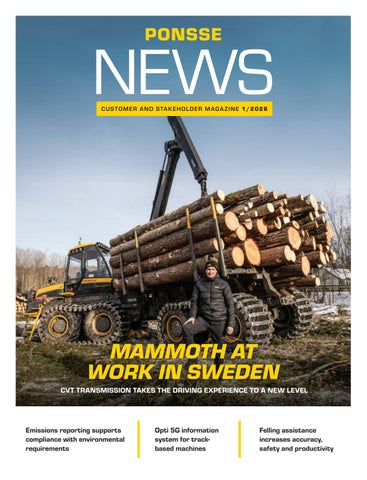
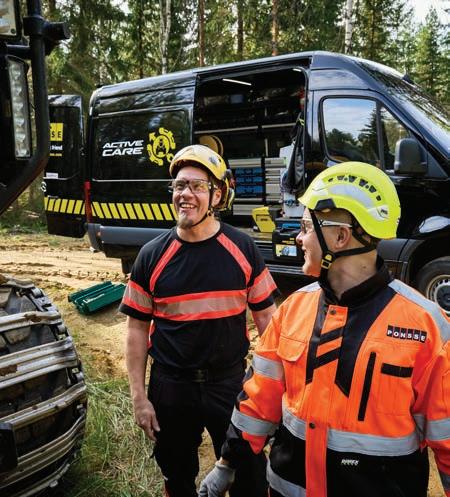
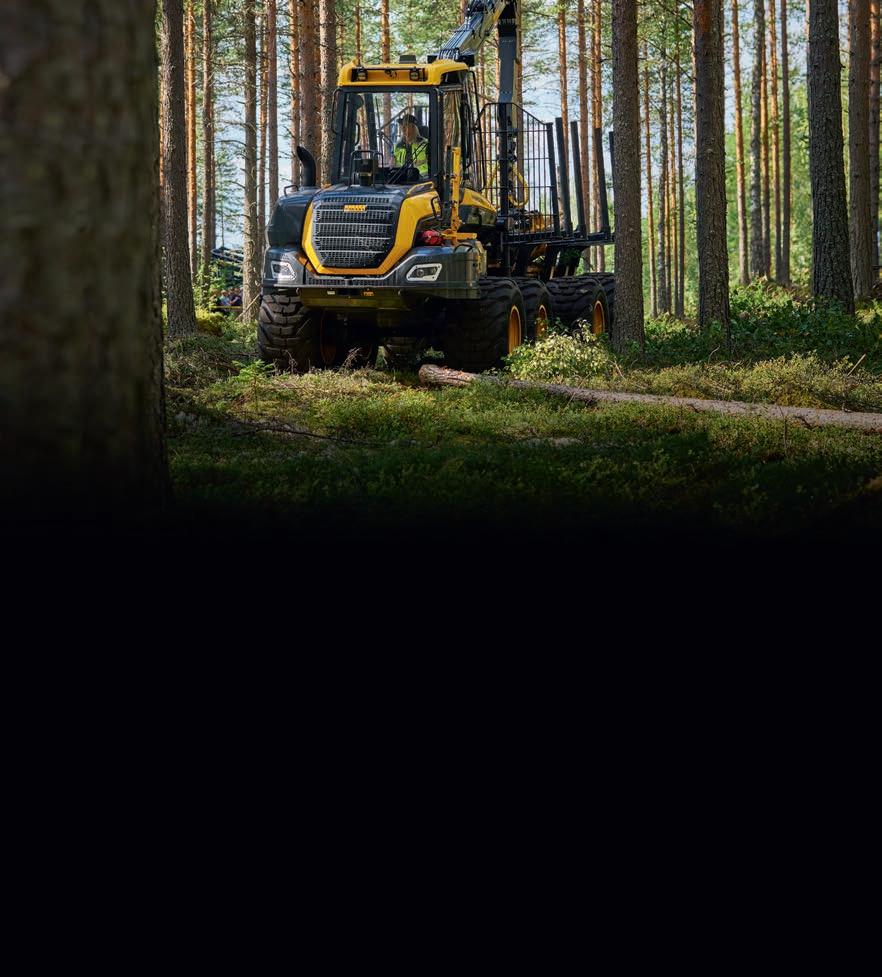
CVT TRANSMISSION TAKES THE DRIVING EXPERIENCE TO A NEW LEVEL
Emissions reporting supports compliance with environmental requirements
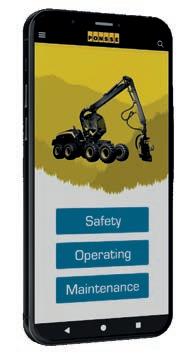
Opti 5G information system for trackbased machines
Felling assistance increases accuracy, safety and productivity
PONSSE NEWS
CUSTOMER AND STAKEHOLDER MAGAZINE 1/2026
PUBLISHER
Ponsse Plc
Ponssentie 22, 74200 Vieremä, Finland
EDITOR-OF-CHIEF
Marika Ryytty
EDITORS & CONTENT
Ponsse Plc
ISSN 2489-9488 (printed)
ISSN 2489-9496 (online)
EDITORIAL STAFF
Juho Nummela, Marika Ryytty, Mari Komulainen, Jarmo Vidgren, Marko Mattila, Markus Haapamäki
LAYOUT
Luova Työmaa
COVER PHOTO
Ponsse Plc
ILLUSTRATIONS (PONSSE KIDS)
Ponsse Plc
PRINT
Painotalo Seiska
PAPER
Covers: Galerie Art Silk 150 g/m2, Inner pages: Galerie Art Matt 100g/m2.
ADDRESS SOURCE
Mailing list of Ponsse News and customer register
PONSSE MOMENT 18 OUACHITA BIOMASS
strong player in the forestry sector in Louisiana
Ponsse Plc’s customer and stakeholder magazine
Ponsse News is published twice a year.
Feedback, subscriptions and changes of address by email to ponssenews@ponsse.com. The magazine is free of charge.
COURAGE TO BUILD THE FUTURE
Last year was special for us in many ways. The anniversary year was a reminder of where it all started more than 55 years ago – with a bold idea, expertise and perseverance. At the same time, it showed that Ponsse’s story is very much alive: by working together and by trusting one another, we can overcome boundaries we would never even dream of on our own.
The past year has also confirmed that the world around us is characterised by uncertainty. The markets fluctuate and our customers’ day-to-day lives are changing ever faster. Nevertheless, or perhaps precisely because of this, we look to the future with determination. Courage does not mean belittling risks, but the ability to make long-term decisions even when the short-term outlook is blurry.
Again this year, we will systematically invest in our maintenance services, products, technology and production. The Vieremä factory expansion is progressing, which will help us improve the efficiency and safety of our production and our ability to meet future demand. Reliable products and services, as well as new solutions, such as systems that assist the operator and data-based digital services, arise from long-term development work, the understanding of customer needs and the use of rapidly developing technology. This allows us to deliver more value to our customers and make their work safer, more productive and more predictable.
But the most important thing is still the people. Technology evolves, but without skilled employees, it will not turn into benefits for our customers, innovations that make everyday life easier or reliable services. That is why we are investing strongly in increasing competence this year too: training, learning new things, making sure that every Ponsse employee can succeed and develop in their own work. At the same time, we will strengthen leadership – simple, human actions that build trust and ensure everyone feels part of our shared direction.
Ponsse’s strength has always been its ability to spot opportunities where others find challenges. The world increasingly needs more sustainable logging, more accurate data, smart systems and reliable equipment, as well as excellent maintenance services. Our customers expect us to continuously develop, react quickly and to be by their side – not just as a supplier, but as a partner. That is where we excel.
I would like to thank everyone – customers, partners and Ponsse personnel –who, with their expertise and hard work, help take Ponsse’s story forward. Thanks to you, we can look to the future – and build something new together.
Great events in the forestry sector will be leaving their mark on this year too, across different parts of the world. It is always great to meet customers and partners face-to-face. See you at fair events!
Juho Nummela President and CEO Ponsse Plc
PONSSE MANAGER PRO
TAKES PRODUCTIVE AND EFFICIENT HARVESTING TO A NEW LEVEL
Ponsse is continuously developing its digital solutions and providing customers with increasingly precise tools to support productive and sustainable harvesting.
The Ponsse Manager system collects and integrates data from connected forest machines and provides tangible benefits for contractors, forest machine operators and office employees alike. There are two service packages: the free Ponsse Manager Standard and the fee-based, more comprehensive Ponsse Manager Pro. Ponsse Manager Pro is designed for harvesting professionals who need a deeper understanding of their site activities and better visibility into day-to-day operations. It helps to improve work productivity and efficiency, monitor and reduce fuel consumption, meet environmental requirements and achieve business goals.
MAP TOOLS PAINT A FULLER PICTURE OF LOGGING SITES
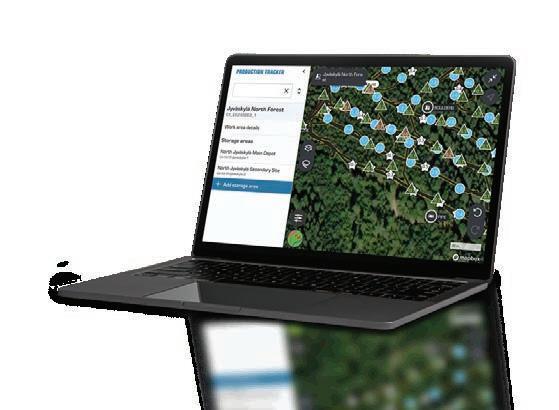
One of the key new features in Manager Pro is the Map Tools. Its map view displays both the harvester’s route and production by species, volumes, and assortments. The forwarder operator can immediately see where the stems awaiting transport are located and which stems have already been taken to the landing site. In winter conditions, the benefits become even more pronounced –snowfall can cover the logs even between
One of the key new features in Manager Pro is the Map Tools. Its map view displays both the harvester’s route and production by assortments.
shifts, making it harder to identify tree species and locate stems. Thanks to the Map Tools, the correct assortments and volumes can be located quickly, and the work progresses efficiently and on schedule.
With the Map Tools’ Lasso tool, the forwarder operator can plan their work more precisely by drawing the desired area on the map and seeing which assortments are present and in what quantities. The operator can move the production to the landing area directly on the map, speeding up the work and improving the planning of pickups. Office staff and supervisors gain a clear view of the harvesting worksites, which makes it easier to monitor progress and enables logistics optimisation, improving collaboration, visibility, efficiency and decision-making.
In the forest, the harvester operator may encounter locations that need to be marked
SUBSCRIBE TO MANAGER PRO – AND TAKE ADVANTAGE OF A THREE - MONTH FREE TRIAL!
New Manager Pro subscribers can now explore all its features for three months completely free of charge. The trial involves no commitment or obligation, but instead offers an excellent opportunity to see for yourself how Manager Pro can enhance your work in many ways.
https://manager2.ponsse.com
seamlessly on the site, regardless of the brand of forwarder in use. While a Ponsse harvester is required for data collection, any forwarder can be connected to the system, including subcontractors’ machines. This enables logging sites to use their entire fleet through one unified view and ensures that everyone is on the same map, both literally and figuratively.
Mikko Kovanen, Account Director, Veljekset Hokkanen Oy
EMISSIONS REPORTING FOR FOREST MACHINES SUPPORTS COMPLIANCE WITH ENVIRONMENTAL REQUIREMENTS
With the Manager Pro service package, Ponsse became the first forest machine manufacturer in the world to introduce an Emissions Report feature, which calculates and shows the atmospheric CO2 emissions of harvesters and forwarders on the machine, site and forest company level for a given period.
We are very pleased with the Emissions Reporting tool, as it enables us to calcu late our carbon footprint, among other capabilities. We have found that the infor mation obtained through the tool on, for example, fuel consumption is very accu rate. We have cross‑checked the figures afterwards and found that the data holds up very well. The Map Tools make working and data collection easier. They show,
The monitoring of site-specific emissions helps to reduce fuel consumption, which effectively supports the meeting of both environmental requirements and business goals. Emissions reporting also helps to identify which machines are best suited for different logging sites. Emissions can be examined from different perspectives – from individual machines to company level, by working method or across selected time periods.
cubic metre by cubic metre, what has been harvested in each area and which assortments are present on the site. It is highly useful that both the operator and office staff can see the progress of the logging site by stand and by assortment. We also appreciate the fact that Mana ger Pro works on any device with a web browser and an internet connection.
POWER, STABILITY AND ABOVE
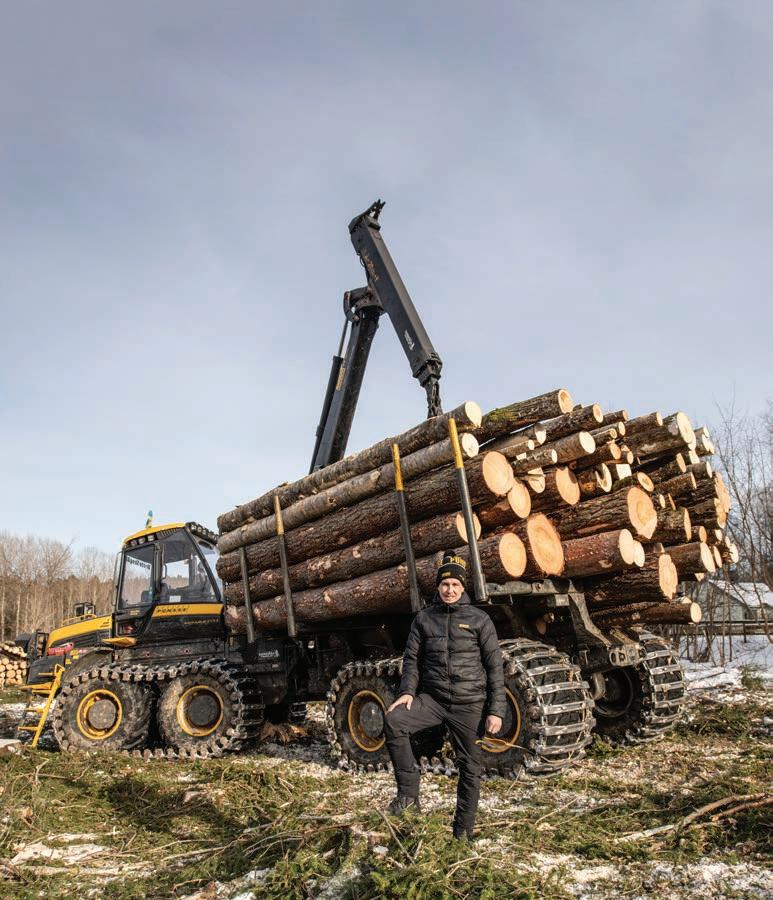
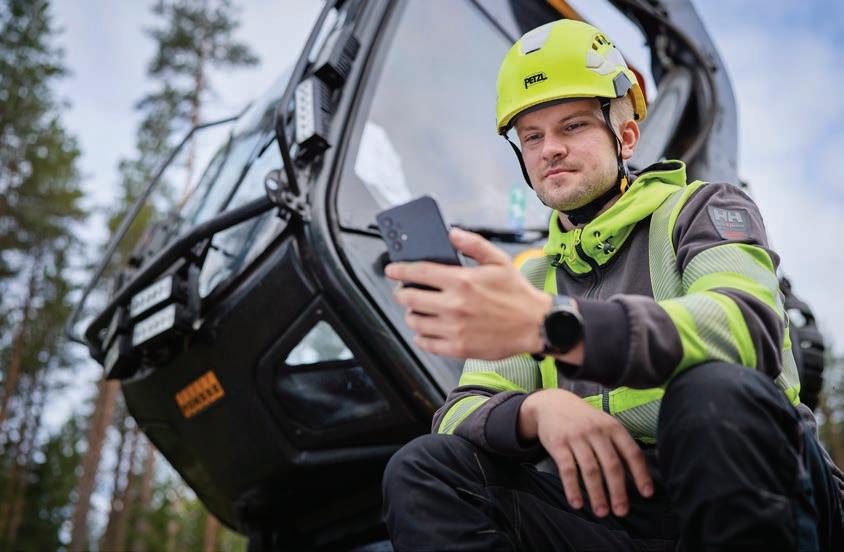
“It’s simply brilliant,” says forwarder operator Alexander Hjalmarsson as he fills the load area of his Ponsse Mammoth. He is particularly impressed by the smooth and quiet CVT transmission and the seat that turns with the operator. He also appreciates the impressive load
t’s a beautiful winter’s day as Bröta Skog AB is carrying out final felling in Kagghamrain Sörmland, between Södertälje and Nynäshamn. Much of the forest consists of hefty trees, and the load area of Alexander’s Mammoth fills quickly as he takes on spruce, pine and aspen.
At the time of our visit, Alexander had been operating the machine for two years. Previously, he operated a Ponsse Elephant King.
“Yes, it’s true: the load capacity increased by five tonnes,” Alexander says, clearly
He was already accustomed to a spacious cabin and a powerful loader, but beyond the tonne load capacity, there are two features he particularly appreciates: the stepless CVT transmission and the swivelling seat.
“The transmission feels very stable and makes the cabin much quieter. And the seat is absolutely brilliant. I put my feet on the footplate, and the whole seat follows the movements of the grapple. “Visibility improves, and your body – especially your neck – is spared,”
The machine is easier to operate thanks to a small accelerator pedal on the footplate, and the forward–reverse control is managed using a button on left panel of the seat. The swivelling seat can be switched off if needed, but Alexander has never had any reason to do
ABOVE ALL, JOY OF WORK
so. The seat, the control handles and the cabin suspension also earn high marks from him.
“This machine has the same loader as the previous one. It’s strong, has great reach and, above all, is pleasant to use.”
Alexander’s Mammoth was one of the first to enter the market. In his experience, the machine has been stable both in its construction and in its performance.
“It has just kept on rolling. And if anything unexpected happens, we know the service technicians will arrive quickly and do everything they can to get us back to work as soon as possible.”
He glances at the hour meter with a smile –it now reads 3,800 hours.
Alexander also appreciates Ponsse’s motto, “a logger’s best friend”.
“It also means a great deal to us as operators that the salesperson is genuinely interested in our work and comes out to greet us in the forest.”
MAMMOTH CARRIES EVEN BETTER THAN ITS PREDECESSOR
When it came time to replace the machine, Alexander was initially a little doubtful about its size. The doubt, however, faded quickly.
“It combines size, power, agility and ergonomics. The long wheelbase and long bogie provide excellent stability, while the CVT transmission takes the driving experience to an entirely new level. The difference is especially noticeable in certain spots, such as roadside landings, where you can pick up the pace a little.”
The same features that make the forwarder stable and smooth to drive also improve its carrying capacity and reduce terrain damage – surprisingly much for a machine of its size. According to Alexander, the Mammoth carries even better than its predecessor.
At the end of each shift, Alexander goes through the machine’s lubrication points and carries out a general inspection. In his view, the Mammoth is a very reliable partner.
“I had the same impression of the Elephant King. It was really safe and comfortable to drive. The Mammoth makes work even more fun. I enjoy working with the machine immensely. It feels as if I’ve upgraded – in every way.”
THE FOREST TOOK A LONGER STEM
Alexander’s interest in forest machines stems partly from his childhood: his father serviced forest machines and his grandfather operated them. His interest led him to study natural resources, and he has stayed on that path ever since. Over the course of his career, he has mostly operated Ponsse machines – and has no intention of switching.
He also enjoys his work at Bröta Skog.
“Things are well-organised here, the machinery is in good condition and everything runs smoothly. That makes it easier and more fun to do a good job.”
Alexander usually comes in to collect the
timber after Jimmy Johansson has finished. Jimmy owns Bröta Skog jointly with his brother Joakim Thor Allstrin and Stefan Everlid. Jimmy has been in the forest since he was young: his father and uncle ran timber trucks. Although he trained as an electrician, the forest ultimately won out.
“I’m quite a social person, but I appreciate the peace of the forest. Here you’re free to be on your own. Now it would feel strange to have a job where you have to deal with people all the time.”
PONSSE FELT GENUINELY INTERESTED
In the early days of the company, the machines were bought used, but these days they purchase new ones.
“We want to produce, not spend our time repairing. Of course, you still have to do it, but not on the same scale.”
Their first Ponsse machine was a Wisent thinning forwarder.
Despite its large size, the Ponsse Mammoth is agile in off‑road conditions. A strong loader is the Mammoth’s strength in both loading and unloading.
“With the Mammoth, we achieved a clear increase in production, and when that is combined with lower fuel consumption per cubic meter, the impact on the economy is positive.”
“We liked both the machine and the company. The people felt close and genuinely interested in us, not just when the deal was signed.”
Jimmy praises Ponsse’s people as downto-earth, easy to approach and genuinely passionate about forest machines.
“When you can go golfing even with the senior management, it says a lot. This is not the case in many large companies. I’m sure it creates mutual added value.”
The Ponsse Mammoth was also chosen because Alexander likes working with large loads.
“We saw the perfect combination of capacity and ergonomics in the Mammoth. And, admittedly, the appeal of a brand-new machine played a part as well.”
Jimmy’s philosophy is that it’s better for a machine to be slightly oversized than undersized.
“Many say that large forwarders require long driving distances to be profitable. I disagree. In final felling, a large forwarder is never worse than a small one – not even on short distances.”
A large machine also consumes less fuel
per cubic metre. According to Jimmy, worries about larger machines causing more extensive terrain damage are unfounded – the differences are minor and can even favour the larger machine.
“It all depends on the whole.”
IT’S THE OUTCOME THAT COUNTS
From an economic and production perspective, it’s the overall outcome that matters.
“With the Mammoth, we achieved a clear increase in production, and when that is combined with lower fuel consumption per cubic meter, the impact on the economy is positive. The machine is, of course, more expensive to purchase, and the final result will only become clear in the post-calculation.”
The goal of the company’s three owners is to keep operations running, ensure employee well-being, deliver high-quality work and keep the company’s finances in good shape.
“We’ve been fortunate to attract highly skilled operators – and we take good care of them. It’s great that the machines now run on a single shift. It’s better for both the people and the machines.”
Founded: 2002
Location: Bröta, between Södertälje and Nynäshamn, Sörmland
Operating area:
Thinning: mainly within a radius of 70 km
Final felling: within a radius of around 170 km
Owners: Jimmy Johansson, Joakim Thor Allstrin and Stefan Everlid
Machinery: Three machine chains: in thinning, the Ponsse Scorpion and Ponsse Elk; in final felling, the stems are collected by the Ponsse Mammoth
Customers: Sandåsa Timber AB (final felling), Skogssällskapet (thinning), Holmen AB (final felling)
BRÖTA SKOG AB, GRÖDINGE
22,000TH PONSSE FOREST MACHINE
DELIVERED TO IRELAND
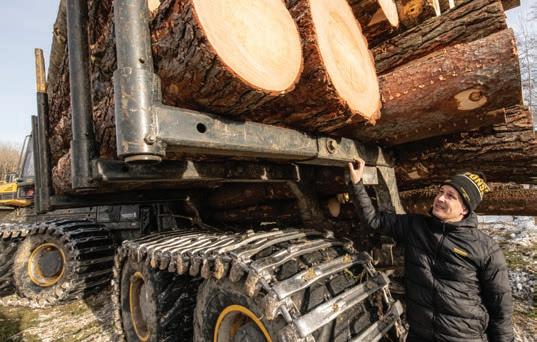
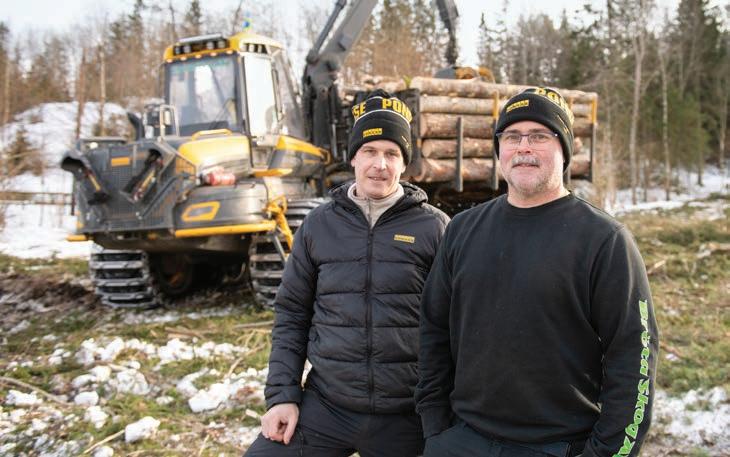
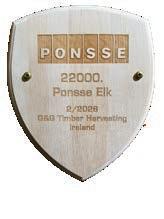
Ponsse celebrated a significant milestone as the 22,000th forest machine manufactured at the company’s Vieremä factory is delivered to Irish customer G&G Timber Harvesting. The milestone machine is a Ponsse Elk forwarder, valued for its agility, productivity and suitability for a wide variety of forestry work.
T“his is a significant milestone in our cooperation with G&G Timber Harvesting. Along with the Ponsse Elk, a Ponsse Scorpion Giant harvester, which is one of our flagship models is also being delivered in the same shipment to complement their fleet. We thank the G&G Timber Harvesting team for their trust and wish them safe operations in Ireland’s forests,” says Ville Mansikkamäki, Vice President, Europe, Ponsse.
G&G TIMBER HARVESTING – A FAMILY ROOTED FORESTRY BUSINESS
G&G Timber Harvesting, established in 2009 by brothers Greg and Garrett Cuddy in Camross, County Laois, operates at the foot of the Slieve Bloom mountains. The company has since grown to include another brother, David, Greg’s son Greg Jr, and their cousin Pakie. With six of the seven Cuddy brothers working in forestry, the business represents a strong multigenerational commitment to the industry.
Their first experience with Ponsse came in 2020 with the purchase of two pre owned machines; a Gazelle and a Beaver. Over time, their fleet expanded to include two harvesters and two forwarders, representing different brands of machines. In September 2025, the company upgraded one of their forwarders to a Ponsse Buffalo with Active Cabin, which quickly impressed them with its operator comfort, power and productivity. This encouraged them to continue modernizing their fleet with a Scorpion Giant harvester and the milestone Elk forwarder.
During a demo arranged by Ponsse Ireland, Greg Cuddy highlighted the Scorpion Giant’s powerful crane, industry leading cabin visibility, harvester head performance and even its “cool design”. The Elk was selected for its reliable performance across diverse terrain and the additional comfort provided by the Active Cabin solution.
WORKING ACROSS DIVERSE AND DEMANDING ENVIRONMENTS
G&G Timber Harvesting operates in a wide range of conditions, including steep slopes, flat bogs and sensitive habitats, serving both private clients and the state owned forestry
sector. According to the company, their recent investment in Ponsse machines is driven by:
• Trust in the Ponsse brand
• Confidence in the service and support provided by Ponsse Ireland
• Strong alignment with Ponsse’s business partnership approach
Ponsse looks forward to supporting G&G Timber Harvesting in the years ahead and continuing a long and mutually beneficial partnership.
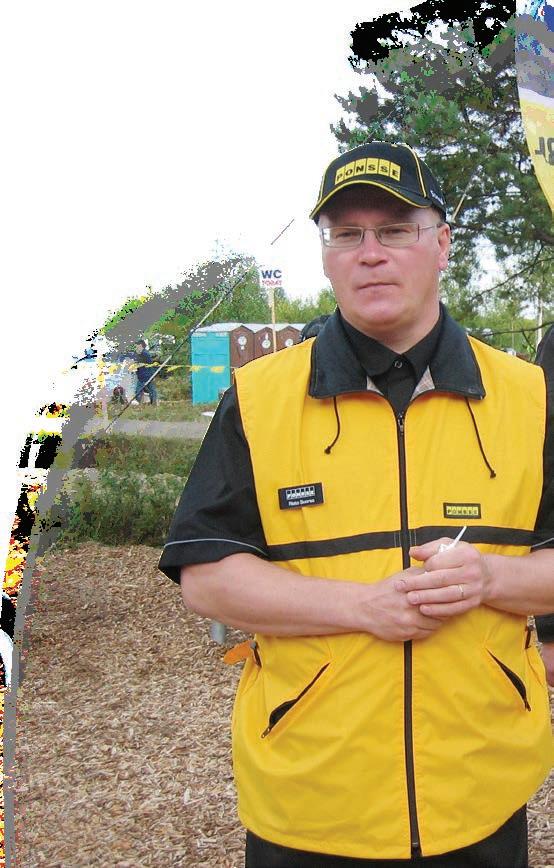
WELL‑ROUNDED RISTO SUORSA HEADS INTO RETIREMENT
“RATHER THAN BEING A PUSHY SALES ‑ MAN, I WAS AN ATTENTIVE LISTENER.”
Risto Suorsa is perhaps best known as a machine salesman in Eastern Finland and Upper Savonia, but he originally joined Ponsse in 1992 to work in documentation. From there, his work led him through production planning and the order centre to sales. Over the decades, the company has grown, the production method has shifted from cells to an assembly line, and forest machines have advanced to an entirely different level compared with the early 1990s.
Risto Suorsa comes from the village of Marttisenjärvi in the northern part of Vieremä. Suorsa had wanted to stay in his home region, even though, for example, as the salesman for Eastern Finland, the commute was 120 kilometres one way, and his annual mileage exceeded 100,000 kilometres.
“In 1982, I was hired by Rautaruukki in Otanmäki, which manufactured railway carriages. I completed Rautaruukki’s own vocational school and stayed on to work at the company. One morning shift, when I was tired and the conveyor roller on the plate cutting machine caught the sleeve of my overalls, I realised this wasn’t what I wanted to be doing for the rest of my life. I took study leave and trained as a mechanical engineering technician in Kajaani while continuing to work. After finishing my studies, I returned to Rautaruukki in 1989, only for the work to end in 1990 when the Soviet Union collapsed and exports of railway carriages stopped,” Suorsa says.
Suorsa came to Iisalmi for an entrepreneurship course. After the course, Ponsse engineer Jouko Kelppe recruited him into documentation in 1992. At that time, Ponsse had 120 employees, whereas today the Group employs 2,200 people. Back then, documentation involved producing spare parts and service manuals in ten languages, compared with 26 languages today.
“The HS10 harvester was the first one I produced the manuals for. The old manuals served as the basis, and I gathered the information for the new machine from product development. It took a few months. Then the
With new customers, the key was the good availability of our maintenance services and spare parts –those sealed the deal, not me.
was moved onto an assembly line, although it was much shorter than the one used today. In 2001, the engines changed from Caterpillar, Valmet and Perkins to Mercedes-Benz. Up to 1996, the engines in use had been Perkins and Valmet. Around half of the machines were exported.
“I worked extensively with foreign dealers, who were always interested in the machines’ equipment and completion schedules. Einari Vidgren, on the other hand, was always interested in how many orders the factory was receiving. In the difficult years of the 1990s, he would come in every morning and ask, ‘Have any orders come in?’ If there were, he would say, ‘It’s beginning to look better’. Einari was quite a powerful builder of team spirit.”
“HOW
ABOUT BECOMING A SALESMAN?”
In 2002, Einari Vidgren asked Suorsa one day to join him on a test logging site. Suorsa had the feeling that Einari wanted to discuss something, and he was right: Einari suggested that he join the sales team in Eastern Finland.
“Well, I couldn’t exactly say no. My home was in Siilinjärvi, my office 120 kilometres away in Joensuu, and my sales area covered
was an attentive listener. Many customers grew familiar and were loyal to the brand, but you can never take any deal for granted. With new customers, the key was the good availability of our maintenance services and spare parts – those sealed the deal, not me. In price negotiations, there is not much leeway, and the most important thing is to get the price of the used machine right.”
While working as a salesman, Risto would deliver the most urgent spare parts shipments directly to customers alongside his sales work. Risto has been fully committed to Ponsse throughout his career, and has shown flexibility whenever required.
At the turn of the 2020s, Suorsa took up a sales role back in his home region in Upper Savonia and Kainuu. His yearly mileage fell by half.
FISHING, TRAVELLING AND VINTAGE CARS
Suorsa is an avid hunter and fisherman. In retirement, there will be more time for these hobbies. Right after retiring, a fishing trip to Sweden awaits, followed a couple of months later by one to the Arctic Ocean in Norway.
He has a motorhome and a few vintage cars in his garage. His wife is also newly retired, so now is the time to travel together.
“I have renovated Volvos and Saabs. My Volvo 940 is a 1994 model, the Saab 900 a 1987 model, and the Volvo 240 a 1987 model. They rack up a few thousand kilometres every summer.”
His years at Ponsse have also included all sorts of trips, such as to trade fairs or seminar trips. Brazil, Uruguay or Argentina are places he would hardly have travelled to otherwise.
“I have been able to do all sorts of things at Ponsse, and not once have I minded getting up for work in the morning. My thanks go to our customers for this journey,” Suorsa sums up.
Risto’s career reflects the true spirit of Ponsse. He has taken on each task with real drive and has never backed away from a challenge. That kind of life’s work simply isn’t possible if you are keeping an eye on the clock. When he needed to improve his language skills, he travelled to Ponsse’s site in Scotland at his own expense so he could learn quickly. Trust with customers was built through genuine caring. Even in the toughest recession years, when machine sales stalled, Risto kept visiting customers, calling them and checking in. He raised the bar for customer service to an exceptionally high level throughout the company.
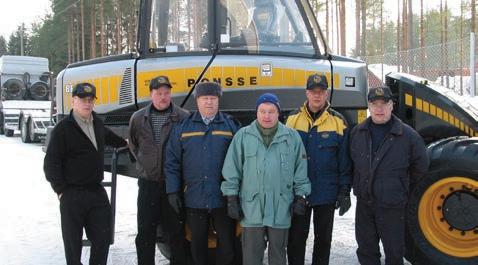
Ponsse marks the completion of every 1,000th forest machine with a celebration. The 3,000th Ponsse forest machine, a Ponsse Beaver harvester, was delivered to Risto’s customer Kone Korpi Oy.
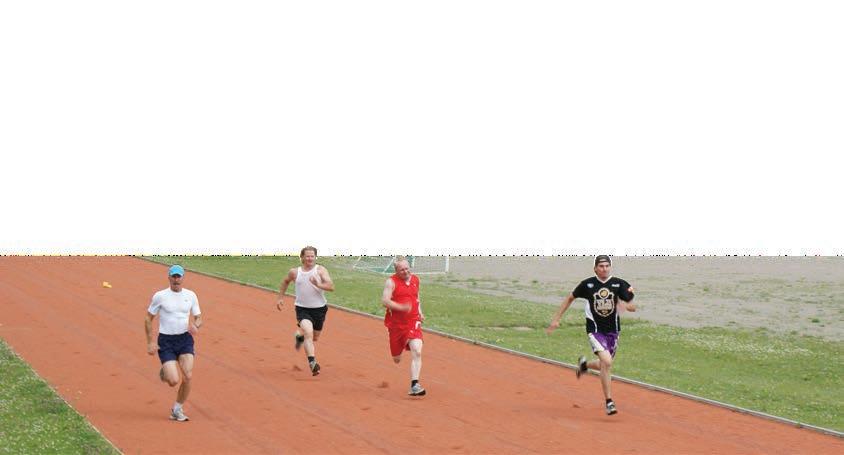
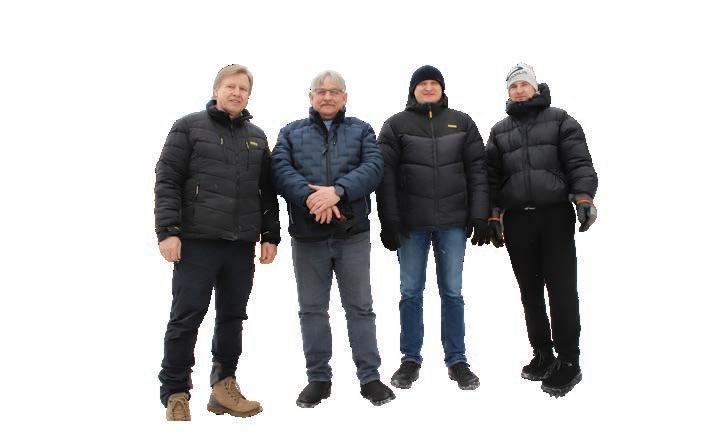
Risto is also a sportsman. The photo shows him competing in the 2010 athletics event held for Ponsse and its customers. From the left: Pasi Mikkonen, Juha Vidgren, Risto and Juha Matti Mikander.
A SERVICE AGREEMENT IS NOW TAKEN FOR EVERY SECOND NEW MACHINE
A SERVICE AGREEMENT BRINGS SECURITY, SAVINGS, AND ANTICIPATES COSTS
The popularity of Service Agreements has grown rapidly in the 2020s. Today, about half of all new Ponsse buyers want a Service Agreement for their machine. In addition, Service Agreements are increasingly made for used forest machines as well. A Service Agreement brings peace of mind, savings, helps keep the machine in good condition, and allows cost forecasting.
AService Agreement is an excellent invention and a win-win agreement where everyone benefits: the forest machine operator, the owner, and Ponsse’s service network. For the operator, it means a reliable machine; for the owner, predictable expenses and clear savings compared to paying for each service separately. The Service Agreement also improves planning in Ponsse’s service network, which is reflected to the customer as better service.
“The core of the Service Agreement consists of the machine’s maintenance schedule. If the agreement is taken for a new machine, the first warranty service is performed at 200 hours. After that, regular service intervals begin. Depending on the machine’s workload and operating conditions, engine oil and filters are changed either at 900 or 600 hours. In addition, major Complete services are done every 1800 hours. Regular services and our skilled technicians ensure that the machine only stops for planned maintenance—not unexpected repairs. A continuous service history also increases the machine’s resale value,” says Service Solutions Manager Eveliina Pölkki.
“A Service Agreement can be tailored to the customer’s needs. In addition to the basic
Service Agreement, a customer may agree on additional services such as Dafo fire suppression system inspection, battery and wiper blade replacement or windshield washer fluid refilling. Additional services also vary by country depending on operational needs.”
EXTENDED COVER, MAINTENANCE CALL, FRAME AND CRANE CARE
A valid Service Agreement also enables additional cover for new machines. The traditional comprehensive extended cover is valid
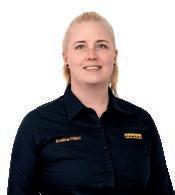
Service Solutions Manager Eveliina Pölkki has worked at Ponsse for nearly 19 years.
for three years or 6000 hours, covering parts and labor. In addition, customers with a Service Agreement automatically receive Ponsse Frame & Crane Care frame protection, which covers the machine’s structural components and is valid up to 10,000 hours. Frame & Crane Care covers machine’s main frames such as front and rear frame, middle pivot, crane base, main, lifting and luffing boom and pillar frames. And also in Scorpions’ slewing ring bearing.
In 2024, the Ponsse Maintenance Call service was launched in Finland. It supports advanced service planning by automatically sending hour data to the nearest PONSSE service center. The service center contacts the customer 200 hours before the scheduled maintenance. During the call, a suitable service time, service content, and possible additional work needs are agreed upon. Once the needs are identified, the service center reserves sufficient time, personnel, and necessary spare parts and materials. This service aims to improve forecasting, reduce unnecessary visits, and save time and unnecessary driving, which is reflected, for example, in lower fuel costs. This minimizes unnecessary machine downtime and maximizes machine availability.
LOGGERS CUP AND EINARI CUP DELIVERED
SPEED, EMOTION, AND TRUE TOURNAMENT SPIRIT
Loggers Cup and Einari Cup once again brought together ice hockey enthusiasts to show how a fastpaced, communal, and good spirited game unites Ponsses employees, customers, and partners. In Timrå, Sweden, the Loggers Cup champion was decided in a thrilling Finland–Sweden final, while in Kuopio, Finland, the Einari Cup offered its familiar dose of lively tournament atmosphere.
SWEDEN CLAIMED THE LOGGERS CUP TITLE AFTER A SHOOTOUT
The Loggers Cup gathered Ponsse people and customers for the third time at the SCA Arena in Timrå, Sweden. The tournament featured the reigning champion Buffalo from Finland and the Swedish teams Mammoth and Scorpion.
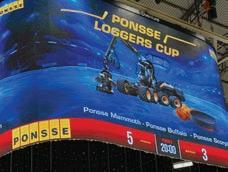
The final showcased a classic Finland–Sweden showdown between Buffalo and Scorpion. Buffalo came back from a two goal deficit to take the lead, but Scorpion caught up and ultimately secured the championship in a shootout with a final score of 5–3. Captain Ola Sandström lifted the Loggers Cup trophy for the first time in Swedish colors.
EINARI CUP ONCE AGAIN DELIVERED CHEERFUL TOURNAMENT HOCKEY
The traditional Einari Cup brought Ponsse customers, partners, and employees to the Niirala Monttu rink to test their skills in ice hockey.
This year, an alumni team also joined the event, consisting of players over 50 who had participated in the Einari Cup in the past –promising both nostalgia and strong competitive spirit. Alumni teams PAZ and S15 opened the tournament with a balanced and nostalgia filled game, which S15 ultimately won 4–2.
In the final, the energetic teams Fox and Beaver faced off. Fox dominated the game from start to finish and capitalized efficiently on their chances, earning a convincing 6–2 victory and the tournament championship.
USED MACHINES MOVE FROM COUNTRY TO COUNTRY
Estonian brothers Harri and Mikk Lepistik were working as forest machine operators when their employer, Wermo AS, purchased its first forest machines from Einari Vidgren in 1990. In 2002, the Lepistik brothers founded their own company, Diksoonia, which today harvests approximately 150,000 cubic metres of timber annually with eight machines and a team of 17 employees.
Harri, Algis, and Martin Lepistik from the Estonian forest machine contractor
Diksoonia OÜ recently purchased a Ponsse Beaver that was just two years old and had logged 1,674 operating hours from Petteri Mella, Regional Sales Manager for Southern Finland at Ponsse.
The machine had originally been working in Sweden, but the Lepistiks found it online on the Mascus marketplace. Although the machine was for sale through Ponsse Sweden, it was transferred to Finland, where the Lepistiks ultimately purchased it.
“The lightweight harvester will mainly be used in state owned forests. According to the contract, a machine working in state forests can be no more than six years old, so with this one we can operate until the end of the contract period. The machine is equipped with an H5
harvester head and will be used for thinning on soft terrain. We also have larger machines, such as the Ponsse Buffalo and Ponsse Ergo, for firmer ground and final fellings,” explains Hariton “Harri” Lepistik.
Diksoonia operates four harvesters and four forwarders, seven of which are Ponsse machines and one from another manufacturer. Some machines have been purchased new, others used. Buying used machines from Finland is attractive, as lightly used machines come with a warranty and there are also savings to be made on value added tax.
In final fellings, Diksoonia usually operates larger machines in two shifts, while older machines are used in single shift operations for thinning. Approximately 30 percent of their harvesting sites are thinnings, while 70 percent are final fellings.
A DOZEN USED MACHINES FROM FINLAND TO ESTONIA
Petteri Mella worked in Estonia for a couple of years in the 1990s for the forest company Enso Gutzeit (now Stora Enso), where he first became acquainted with the Lepistik brothers. Today, in addition to his Southern Finland sales area, Mella sells used forest machines from Finland to international customers.
“We’ve purchased at least 12 used machines from Finland from Petteri. A relationship of trust has developed between us,” Lepistik says.
Maintenance services are provided by the Ponsse dealer Baltic Agro Machinery in Tartu, located approximately 100 kilometres from Diksoonia’s main base.
Estonian forest contractor Harri Lepistik, his son Martin, and his nephew Algis collected a Ponsse Beaver from Finland with around 1,700 operating hours. Over the past two decades, the Lepistiks have purchased approximately a dozen used forest machines from Ponsse sales representative Petteri Mella in Southern Finland.
A two year old Beaver with 1,700 operating hours had pre viously been in operation in Swe den. The lightly used machine is in excellent condition.
THE OPENING OF A NEW SERVICE CENTRE WAS CELEBRATED IN LOPPI, FINLAND
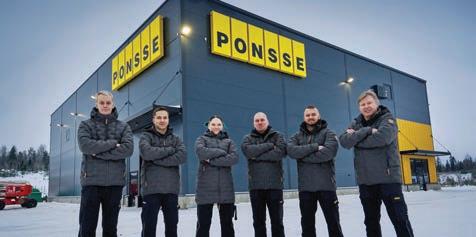
The bright, frosty weather and the school winter holiday week drew many people to explore the new service centre. Cheerful conversation filled the maintenance hall, creating a vibrant atmosphere.
The new service hall features two work bays, modern equipment required for servicing heavy machinery, and a separate washing bay. In addition to the extensive spare parts selection, the centre also includes a Ponsse
Collection shop. The number of employees has increased by two totalling to six forest machine maintenance and sales professionals now work permanently in Loppi.
“With the new premises, Ponsse’s service network in southern Finland is now significantly stronger overall, with shorter service distances. In addition to the Loppi service centre, customers in the region are served by the Tampere service centre, which has expanded
its spare parts range, as well as by the contractual service partners Konehuolto P. Kula Oy and Sasuco Oy,” says Jani Liukkonen, Country Manager for Finland.
“Ponsse will continue the strong and systematic development of Finland’s most extensive service network, as well as its servce and spare parts services. We manufacture the world’s best forest machines, and we also want to provide our customers and machines with world-class maintenance and spare parts services from morning to night,” Liukkonen sums up.
PONSSE OFFERS ITS CUSTOMERS
THE MOST COMPREHENSIVE SERVICE NETWORK IN THE COUNTRY
• A total of 26 locations currently serve customers in Finland
• There are 15 service centres and 11 contractual service partners.
• A total of around 200 forest machine professionals work within the network.
• A total of 40 maintenance vehicles operate across the network, serving our customers directly at their logging sites.
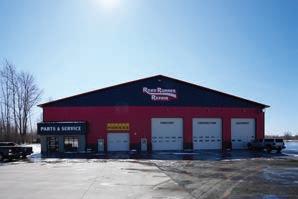
PONSSE CELEBRATES 10 YEARS OF CO ‑ OPERATION WITH ROAD RUNNER REPAIR
Road Runner Repair, founded by Aaron Vizer, is a trusted provider of service and repair services for forestry and earthmoving machinery in Cadott, Wisconsin, USA.
Road Runner Repair began in 2011, when Aaron decided after a 13-year career as a field service technician to start his own business. What started with a single service truck quickly grew into a full-scale operation. Needing a workspace of his own, Aaron built a two-bay repair shop at his home in Boyd, Wisconsin. A commitment to customer service, strong technical expertise, and solid business skills helped Road Runner Repair earn the trust of forestry
contractors and construction professionals across the region.
“The year 2026 is a milestone year for Road Runner Repair: we have 15 years in business, five years at our Cadott location, and ten years of cooperation with Ponsse,” says Aaron Vizer. “Our long-term partnership with Ponsse has been an important part of our journey and our ability to support customers with reliable, professional service. We are proud of what we have achieved together.”
Read the whole story: news.ponsse.com/en
The opening of the Loppi service center was celebrated on February 20, 2026.
OUACHITA
A STRONG PLAYER IN THE FOREST INDUSTRY IN LOUISIANA
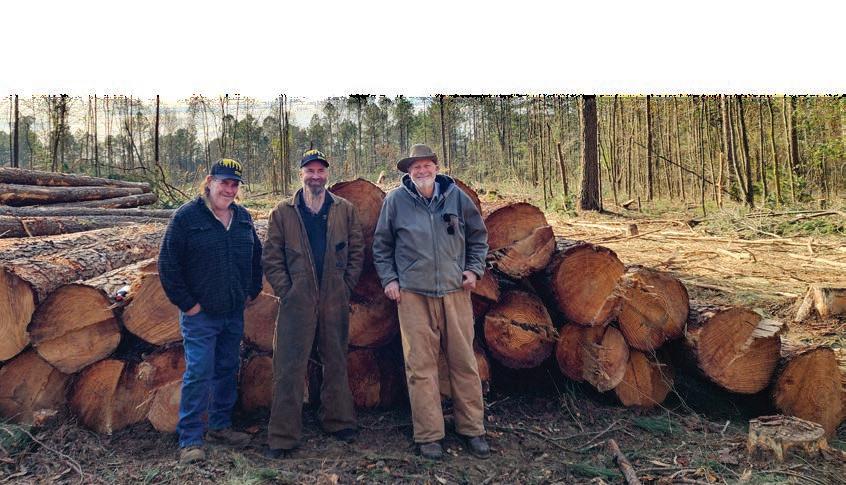
In the small village of Lillie, Louisiana, Ouachita Biomass has built its success on people, expertise and Ponsse equipment.
Owner Joel Garland explains that their operation is unusual: the company manages the entire chain itself, from harvesting to sawing and pallet production. “Operators are the key to our success. Without these gentlemen, we wouldn’t succeed,” he says.
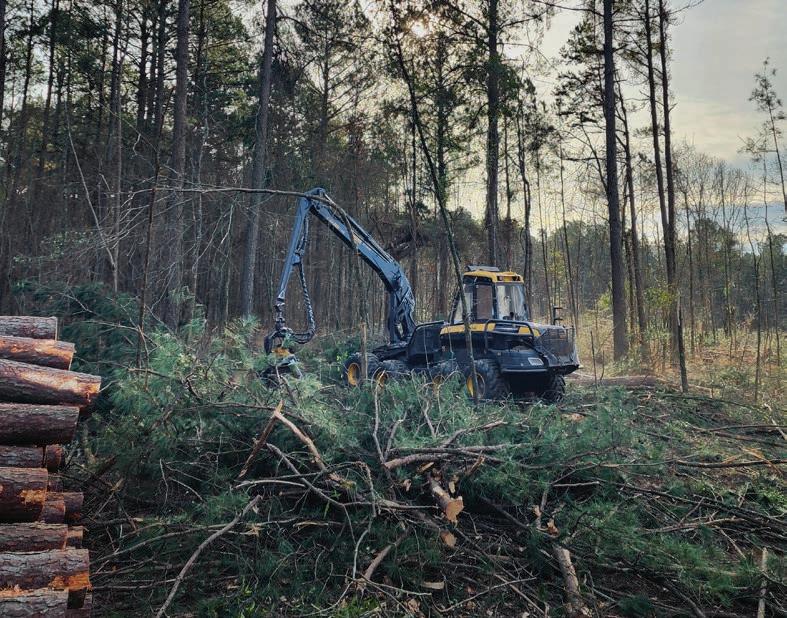
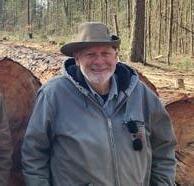
Sammy Denton – an experienced professional’s perspective on Ergo Ergo operator Sammy Denton has been working with Ponsse machines for six and a half years, and his experience is evident. He started in his current role six months ago and has quickly learned to make full use of the Ergo. He says the H8 harvester works exceptionally well with big trees.
Sammy has worked in the forest machine industry for 26 years and has switched from the traditional full-stem method to the cut-to-length method. “The cut-to-length method is good
for the environment. The residue stays in the forest, and the site remains tidy,” he says.
He also has only good things to say about maintenance: “You give them a call, and they guide you. Spare parts have always been available – I’ve only had to wait once in six and a half years.”
Larry Hembree – from truck driver to Buffalo operator
Larry Hembree, who operates the Buffalo forwarder, is the newest addition to the team. With six weeks of experience behind him, he says he’s really enjoying the work: “It’s not a truck!” he says with a laugh. His good friendship with Sammy makes the days even more enjoyable – out in the forest, he says, “the atmosphere is great, and the work doesn’t feel like work”.
”The cut to length method is crucial for our pallet production,” says the owner Joel Garland.
He highlights the practicality of the machines as well, noting that the small oven and fridge have felt like everyday luxuries for both of them.
MANAGING THE WHOLE CHAIN
Owner Joel Garland explains the company’s operating philosophy: they harvest the trees themselves from the forest, saw them at their own sawmill, and manufacture the pallets at their factory. Everything is sold directly to the customer. This allows them to control quality and keep the production chain efficient.
Ponsse’s machines play an important role in their process:
“The cut-to-length method is crucial for our
pallet production.”
According to Joel, Ponsse’s service and the salesperson Andres have been key – help has always come promptly, and customers have been satisfied with the machines, although “the industry is, by nature, a tough business”.
WHY PONSSE?
The decision came about surprisingly naturally: Joel searched online for cut-to-length machines, and the final choice was made at Sammy’s suggestion. “There’s your best salesman,” Joel jokes, referring to Sammy’s recommendations. Sammy admits: “I sold it – I convinced him to go for it.”
Another factor was their past experience
with challenging wood raw material delivered to the mill by suppliers. “Poor-quality timber hits a small sawmill owner hard. I thought that if we went into the forest ourselves and felled our own trees, we would manage.”
Ouachita Biomass is an example of a company that brings together experience, the right tools and a strong sense of community. Sammy and Larry’s professional expertise, Ponsse’s machines and Joel’s strategic approach make the company a sustainable player even in challenging markets.
“Employees are the key to our success,” Joel sums up – and it’s not hard to see why.
SAMUEL VIDGREN APPOINTED VICE PRESIDENT FOR NORTH AMERICA, AND JOHN HOLMES RESPONSIBLE FOR THE USA DEALER NETWORK
Samuel Vidgren has been appointed Vice president for North America. He is responsible for implementing Ponsse’s strategy in the North American region and for developing sales and service operations.
John Holmes’ role is to develop and grow Ponsse’s sales and service in the region through strategic dealer partnerships. His work includes close cooper ation with U.S. dealers, providing training and support, and sharing information aimed at driving growth in machine sales and service and ensuring an excellent customer experience.
“Employees are the key to our success,” Joel sums up – and it’s not hard to see why.
Samuel Vidgren and John Holmes >
TWO CHILEAN CUSTOMER STORIES
SHAPED BY THE FIRST PONSSE MACHINE IN THE COUNTRY
In forestry, not every career is defined by a title, some are defined by the machines behind them. For Freddy Rebolledo and Lorenzo Cid, two Chilean professionals who started as operators and later became business leaders, their first contact with Ponsse marked more than a technological milestone. It defined their technical mindset, their work values, and their path forward.
Their stories are different, but they share a common foundation: learning from the machine, growing through technical discipline, and building companies on reliability, maintenance culture, and respect for the craft.
LEARNING FROM THE MACHINE
Freddy began his career in 1991 as a forest machine operator, trained entirely in the field cab, workshop, and real-time troubleshooting. Ten years later, he was invited to become a partner in a new service operation using Ponsse used machines to support large forestry contracts. The shift would take him from operator to entrepreneur.
The Ponsse machine they worked with were among the first to arrive in Chile. They
were not new, but they became a technical school. Through strong internal mechanical training and disciplined preventive maintenance, Freddy and his team developed deep knowledge of every system and component. Those machines operated for nearly a decade across multiple harvesting and thinning sites, reaching exceptional lifetime figures, often exceeding 35,000 to 40,000 operating hours.
The key was not luck, it was culture. Operators and mechanics studied the machines,
performed major repairs in-house, and built a maintenance-driven mindset. Years later, when Freddy became general manager, he carried that same field-based logic into leadership: close to operations, data-driven, and grounded in technical reality.
TURNING A STOPPED MACHINE INTO AN OPPORTUNITY
Lorenzo’s path began in 1986 as a forwarder operator. In the early 1990s, when Ponsse machines were introduced into his operation, he noticed a harvester with around 18,000 hours standing idle due to minor faults. Instead of avoiding it, he asked to take it on as a personal challenge.
With a strong interest in mechanics, he diagnosed issues, corrected details, and
When Freddy became CEO, he led using the same logic he had learned at the machine: staying close to day to day operations, relying on data, and recognising technical realities.
The experience reinforced Lorenzo’s perception of Ponsse: reliable technology that adapts to different harvesting conditions and produces results when backed by the right technical expertise and support.
brought the machine back into production. Soon after, he received factory-level training from a Ponsse specialist knowledge that helped extend the machine’s productive life by roughly 8,000 additional hours with solid availability.
That experience shaped his long-term view of the brand: reliable technology, adaptable to different harvesting conditions, and built to perform when supported by proper technical knowledge.
Later, when harvesting operations were outsourced, Lorenzo became part of the worker group that formed a new service company. He is now a partner in two forestry service businesses operating mixed fleets and continues to value Ponsse for its standards, seriousness, and regional support capability.
FROM EQUIPMENT VALUES TO COMPANY
VALUES
Both stories reflect the same pattern: machine discipline becomes business discipline. Robustness. Method. Preventive maintenance. Continuous improvement. Respect for procedure. These were not only machine requirements, but they also became management principles.
Freddy emphasizes that one early success factor was maximizing fully paid used machines before investing in new fleets reducing financial pressure while building operational strength. Lorenzo highlights technical curiosity and responsibility as the driver for growth.
CONTINUING THE JOURNEY WITH PONSSE
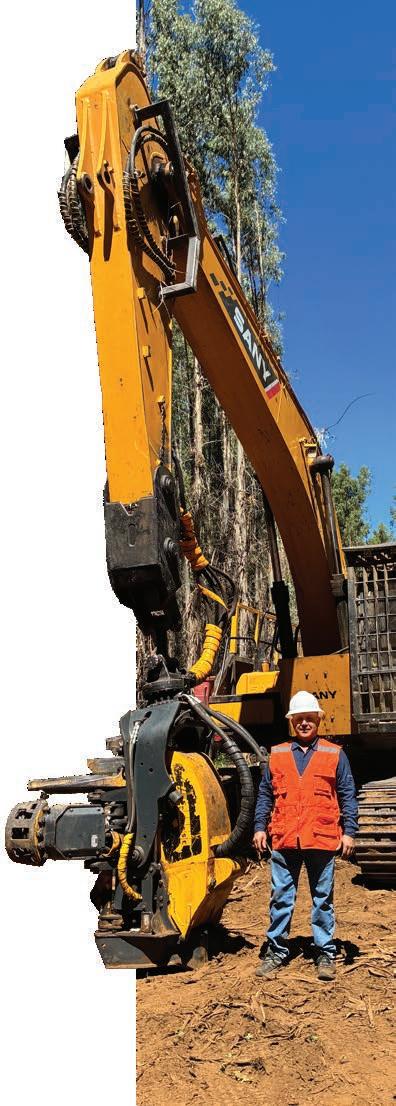
Today, both Freddy and Lorenzo are at the helm of their companies, Mecharv S.A. and SERFOC LTDA., and remain active Ponsse customers, continuing to trust the brand in their current operations. Freddy has an H8HD HH360 harvesting head mounted on a Doosan excavator and will soon expand his fleet with two Bear and two Elephant King for a new eucalyptus harvesting project on steep slopes. Lorenzo also runs an H8HD HH360 mounted on a Sany excavator.
For both, the present confirms what their stories have already shown: long-term confidence built on performance, technical support, and a machine philosophy they learned early on and still rely on today.
Freddy and Lorenzo share a message for young operators: see your work as a longterm path, not just a job. Learn the machine deeply, contribute improvements, and act with responsibility and creativity. Because sometimes a career does not begin with a promotion. It begins with a machine and the decision to truly understand it.
TWO DECADES OF EXPERTISE AND INNOVATION IN FORESTRY
Founded on 27 July 1999, LDF Rožnov a.s. has grown into a respected and versatile provider of comprehensive forestry services across the Czech Republic and throughout the European Union. For more than 25 years, the company has built its reputation on professionalism, technology, and a commitment to supporting healthy and sustainable forest management.
From our earliest days, we have focused on a wide portfolio of services: forest cultivation; logging and timber transport; timber trading; and firewood sales. Equally important is our specialist consultancy, offering support and asset management solutions for all forest owners – small private owners and large organisations alike. Our goal has always been clear: to provide services that are reliable, efficient, and environmentally responsible,” says Head of the Harvester Technology Department, Roman Petřík.
LONG TERM PARTNERSHIPS BASED ON TRUST
The main client of LDF Rožnov a.s. is Lesy České republiky, s.p., but they also serve the needs of many other private and municipal
forest owners. Strong customer relationships have been a foundation of the company’s stability and long-term success.
A TRUSTWORTHY PARTNERSHIP WITH PONSSE SINCE 2008
“A major milestone in our development came in 2008, when we decided to strengthen our operations with new forestry technology. After carefully comparing the largest manufacturers, we chose Ponsse – a decision driven by the brand’s reputation for machine quality, strong service capabilities, and the availability of spare parts. Our first investments were the PONSSE Ergo harvester and the PONSSE Buffalo forwarder,” Petřík elaborates.
LDF Rožnov a.s. has since continuously expanded and modernised its fleet. From
2008 to today, they have purchased a total of 16 Ponsse machines across all types and size categories, allowing them to adapt to a wide variety of forestry environments.
“In 2026, we began cooperating with Service Zrak s.r.o., Ponsse’s new service partner. The closer travel distance and the staff’s extensive multi brand repair experience have significantly increased service efficiency and reduced machine downtime – key factors in maintaining high productivity.”
MODERN LOGGING EQUIPMENT FOR FORESTRY NEEDS
Today, LDF Rožnov a.s. operates four harvester couples tailored for different terrains and customer requirements: two PONSSE Beavers + Gazelle; a PONSSE Ergo + Buffa-
lo; and a PONSSE Bear + Elephant. Beyond standard harvesting operations, we specialise in special condition work and responding to extraordinary forestry situations.
SPECIAL EQUIPMENT FOR SPECIAL CONDITIONS
To respond to the bark beetle calamity and associated sanitation felling, all harvesters are equipped with debarking rollers, enabling immediate and effective onsite bark beetle elimination. For challenging terrain and non-standard demands:
• We use a Clambunk system for long wood extraction
• Our medium-sized machines (Ergo + Buffalo) operate with special tracks for difficult ground conditions
• For steep-slope operations, our large machines (Bear + Elephant) are equipped with Herzog traction winches to ensure safe and controlled work, even in demanding environments.
ADAPTING TO A CHANGING CLIMATE
The Czech forestry and timber sector is currently experiencing one of the most complex periods in its modern history. Climate change, prolonged drought, and the devastating bark beetle outbreak have put unprecedented pressure on forest ecosystems. Economic uncertainties add another dimension to these challenges.
One thing is clear: the future of forestry will not look like the past. Forest managers must adapt to shifting ecological conditions, changing forest structures, and new customer requirements. At LDF Rožnov a.s., we see these challenges not as obstacles but as drivers of innovation.
LOOKING AHEAD WITH CONFIDENCE
“We firmly believe that with our experi-
ence, people, and investment in technology, LDF Rožnov a.s. is ready for the future. By embracing modern forestry methods and maintaining our commitment to sustainability and customer service, we will continue to grow as a stable, reliable, and successful company – no matter what changes lie ahead,” says Vice Chairman of the Board of Directors, Luděk Szórád.
PONSSE STRENGTHENS ITS SERVICES IN THE CZECH REPUBLIC
Ponsse is reinforcing its customer support in the Czech Republic through a new partnership with Service Zrak s.r.o., a well established service company with over two decades of experience in machinery maintenance.
According to Jakub Hacura, Country Manager, Czech Republic, the selection of this new partner was driven by technical competence, consistently positive customer feedback, and the company’s strategic location in the eastern part of the Czech Republic. “This cooperation is part of the long term development plan for Ponsse’s service network in the
Czech Republic. By developing our network, we want to support our customers even better in the future,” says Jakub Hacura.
Service Zrak s.r.o. employs 11 highly skilled service technicians and brings extensive expertise to its service operations. With long standing experience in maintaining Manitou loaders and Hitachi excavators, the company offers a strong foundation for supporting forest machine customers across the country. Their deep know how in mechanics, hydraulics and electronics ensures reliable, high quality support in the region.
Ponsse forest machines are designed to perform in even the most diverse forest conditions. Watch the customer story
A THIRD GENERATION LOWBED TRUCK DRIVER ENJOYS WORKING AT PONSSE
Roope Hoffren works at Ponsse as a lowbed truck driver. He has been with the company for just over a year, but transporting machines in Finland and working with heavy vehicles has been familiar territory for him for much longer—going back generations.
Roope is a third generation lowbed truck driver. His maternal grandfather earned his living on the road and eventually retired from a career as a lowbed truck driver. Roope’s father also worked at Ponsse in the same role, meaning that lowbed truck transport has long been a part of everyday life for the family.
“I grew up watching what the job involves. That’s how the industry became familiar to me,” Hoffren says.
Before joining Ponsse, Roope gained experience as a heavy vehicle driver. He also spent his year of compulsory military service working in transport and logistics roles. In addition, he has worked on a farm and completed a qualification as an agricultural entrepreneur.
WORKDAYS VARY IN LENGTH
A lowbed truck driver’s workdays often start early. In the morning, the task may be to deliver a new or used machine to a customer, and the return trip takes place once the job is done.
“You can’t always know in advance how long the day will be. Sometimes you’re on
customers from south to north. Each route is planned on a case by case basis. As a lowbed truck driver, Roope has become familiar with roads across the entire country, from Hanko in the south all the way to Pokka in Kittilä, Lapland.
“The shortest route isn’t always the best one. Weather and conditions have a big impact on which route makes the most sense. You try to avoid the smallest roads, but sometimes you have to use them especially when delivering a machine directly into the forest.”
EXPERIENCE HELPS ON THE ROAD
Lowbed truck transport requires careful consideration of many factors, such as load width, bridge clearances, and road conditions.
“At first, driving under bridges felt nerve racking, and I double checked many times to make sure there was enough clearance. Professional transport maps show bridge heights, but the knowledge of more experienced drivers is often extremely helpful.”
At Ponsse, there are six full time lowbed truck drivers and one substitute. Many of
incredibly well, and you learn a lot from them. They’ve driven these roads since before there were maps on mobile phones.”
Everyday work also includes the development and renewal of equipment. Roope recently received a new Scania truck, which can be combined with a wider and longer semi trailer lowbed truck than before. The vehicle has already accumulated around 10,000 kilometres.
A GOOD PLACE TO WORK
Roope joined Ponsse after expressing his interest in a lowbed truck driver position to Antti Jokela, Supervisor of Ponsse Delivery Center. When a position became available, Roope seized the opportunity. He had considered the move earlier as well, but staff turnover among drivers at Ponsse is low.
After just over a year, the decision feels right.
“This is a good place to work. The industry was already familiar to me through my father, so it felt easy to come here.”
PONSSE
LAUNCHES
THE NEXT GENERATION OPTI 5G INFORMATION SYSTEM
FOR TRACK BASED MACHINES
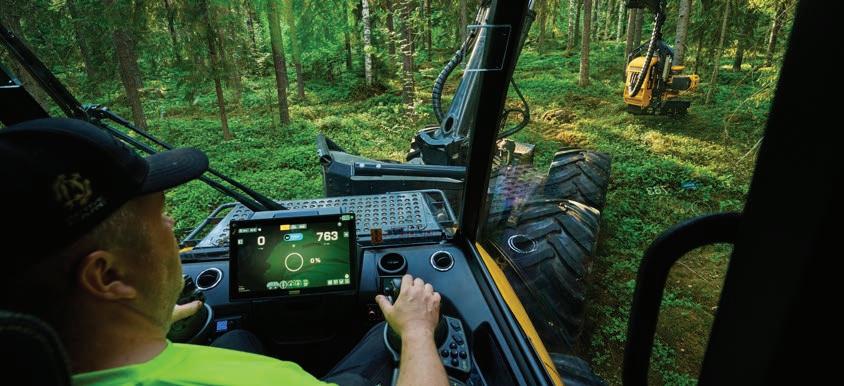
Ponsse continuously develops solutions that improve the work of forest machine operators and is now introducing the next-generation Opti 5G information system also for track based machines. The system is specifically designed to enhance productivity, ease of use, and data management in demanding conditions.
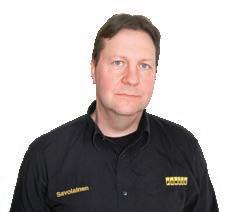
“Opti 5G brings all key harvesting functions together into one clear interface, reducing the need for separate systems and improving daily work efficiency. The system includes, among others, cutting control, automatic cutting, calibration, data management, and reporting – all in one system,” says Markku Savolainen, Product Manager, Harvester Heads, Ponsse Plc.
The new system improves logging optimization, machine control, and operator confidence. The customizable My View display allows quick setting adjustments without interruption, and the active map view enhances safety and situational awareness, Savolainen adds.
Opti 5G produces accurate, real-time data on machine performance, working time, production, and fuel consumption. Thanks to standardized StanForD 2010 data, the system is compatible with international harvesting systems and can be expanded with additional applications. Designed for global use, Opti 5G supports multiple languages and units of measurement. The system also allows marking tree specific data, such as decay or insect damage observations, for reporting purposes.
Usability has been significantly improved: fast response time, clear menus, and three main logical views (work, planning, and machine) support smooth operation. The experience is complemented by the new Opti 8X display, offering excellent visibility and high touch precision even in demanding conditions.
Opti 5G forms a strong foundation for future innovations and is now available as standard equipment for all harvester heads installed on tracked machines.
The new system improves logging optimization, machine control, and operator confidence.
Markku Savolainen Product Manager, Harvester Heads
OPTI FELLING ASSIST SOLUTION TO ENHANCE
PRECISION, SAFETY AND PRODUCTIVITY IN HARVESTING
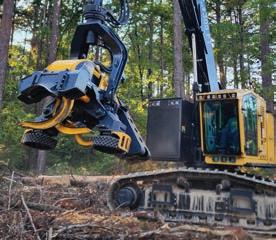
Ponsse introduces the world’s first felling assistant developed by a forest machine manufacturer. The new OptiFellingAssist enhances harvesting quality and supports operators with intelligent, productivity boosting assistance features. The new solution enables precise and productive felling cuts, reduces equipment wear, and increases safety.
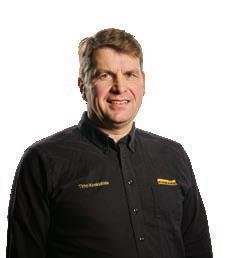
“OptiFellingAssist makes the operator’s work easier and more efficient while improving the quality of the work. It supports successful fellings in every situation. The result is increased safety, reduced saw bar and chain wear, a more durable boom, and increased productivity with less stress. OptiFellingAssist helps the operator in pre-tensioning for the felling cut, which prevents the saw bar from getting pinched and enables safer tree felling,” describes Timo Koskiahde, Product Manager, Information Systems, Ponsse Plc.
“It is also good to note that the OptiFellingAssist solution improves work safety and optimizes working time. The forest machine operator can focus on productive work when saw bars and chains do not need to be replaced as often,” Timo Koskiahde adds.
ASSISTIVE FEED TRACKING
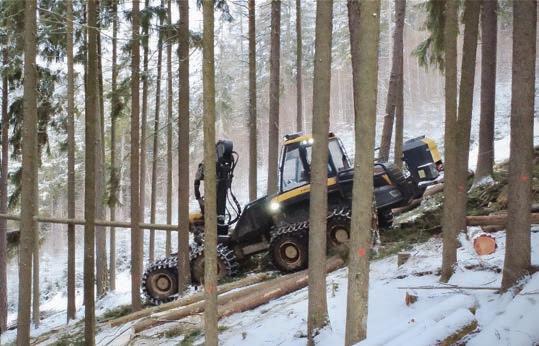
OptiFellingAssist assists with the vertical movement of the harvester crane according to feeding. This is especially useful in deep snow conditions where the harvester head must be fed to the felling height through the snow cover.
ASSISTIVE PRE TENSIONING
The system performs the pretensioning after gripping the tree to be felled, allowing the operator to proceed directly to the sawing phase. Combined with lifting during the felling cut, this ensures a complete cut-through and a high quality result.
TECHNICAL REQUIREMENTS AND AVAILABILITY
OptiFellingAssist works together with PONSSE Active Crane and PONSSE Opti 5G 3.3 software or newer. The feature is available as an optional add-on for new PONSSE machines.
OptiFellingAssist makes the operator’s work easier and more efficient while improving the quality of the work.
Timo Koskiahde Product Manager, Information System
OF INTERNATIONAL EXPANSION
During its first 30 years, Ponsse took steps towards international expansion, learning valuable lessons along the way while keeping its focus firmly on the future.
In 1994–1995, Ponsse established subsidiaries in Västerås, Sweden; Neath in North Wales, United Kingdom; Gondreville in north-eastern France; and Atlanta, Georgia, in the United States.
In the first couple of years in the United States, it became clear that Ponsse’s best chances of success were in the northern Great Lakes area. In August 1997, the subsidiary relocated to Rhinelander, Wisconsin, where a maintenance and spare parts operation was already up and running.
At the end of the millennium, Ponsse took carefully considered steps internationally, establishing a marketing company in Kongsvinger, Norway, in 1998, as well as a new site in Sabres, in the plantation forestry region of southern France. Operations in the United Kingdom were moved from Wales to Beattock in Scotland.
In the United States, a site was established in West Monroe, Louisiana, followed by another in Grand Rapids, Minnesota, the following year.
As Ponsse expanded internationally, the popularity of its forest machines kept growing, and a 2,500 m² extension to the Vieremä factory was completed in late 1997. The new facility housed machining centres, welding stations and an automated paint shop. In May 1999, the company celebrated the completion of a 6,000 m² extension to its production facilities.
AT THE TURN OF THE MILLENNIUM
Around the world, the approaching turn of the millennium caused concern, with both the media and the public painting Y2K scenarios of collapsing information systems. Ponsse’s business operations were largely dependent on information technology. Ponsse addressed the issue well in advance, ensuring that its forest machines’ information systems would continue to operate normally after the turn of the millennium.
In 1999, the United States Customs Service imposed USD 3.35 million (FIM 18 million) in penalty duties on Ponsse for an incorrect customs classification of its machines. Between
1995 and 1998, machines had been exported to the United States under the duty-free classification “forest machinery”. According to Customs, the correct classification for forwarders should have been “motor vehicles for the transport of goods”, a designation many felt applied more appropriately to lorries. After reviewing the case, Ponsse deemed it best to pay the customs duties together with the penalty charges.
Poor sales in 1999 brought further concern for the founder, Einari Vidgrén, as Ponsse
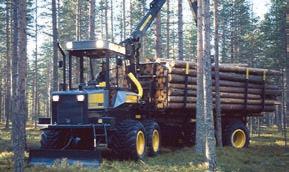
The robust Ponsse Buffalo S 16 was introduced in 1997.
The expansion of the Vieremä factory in 1997
carried out the first temporary layoffs in its history. “It was the most unfortunate moment in all of Ponsse’s history, having to lay people off, but we couldn’t just have people walking around with nothing to do,” he said.
There was an oversupply on the market, and some newspapers wrote that Ponsse had itself to blame, arguing that the company had not learned how to engage in export trade. Compared with its competitors, Ponsse had entered the export markets relatively late, but it proceeded in a considered and cautious manner, selling forest machines only in regions where it could ensure maintenance and spare parts services.
Encouraging developments towards the end of 1999 included the opening of the Swedish subsidiary’s first service point in Surahammar and the establishment of a third service centre in France, located in Peyrat-Le-Château in central France.
As Einari put it: “When you venture into the wider world, you soon find it has its own twists and turns.”
*The years 1994–1995 were discussed in the 55th anniversary issue of Ponsse News.
Source: Arttu Käyhkö, Ponsse – 50 years of the world’s best forest machines, 2020
PONSSE 30 YEARS AGO
ON THE CREST OF THE DATA WAVE
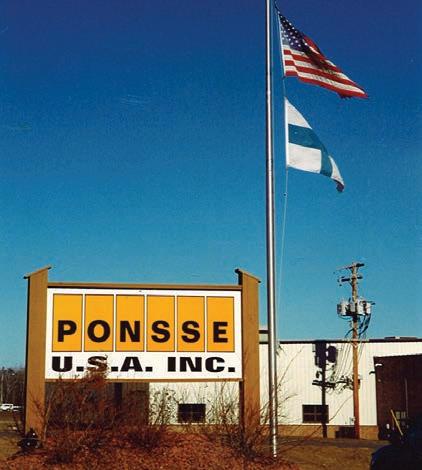
In 1997 the subsidiary in the USA relocated to Rhinelander, Wisconsin.
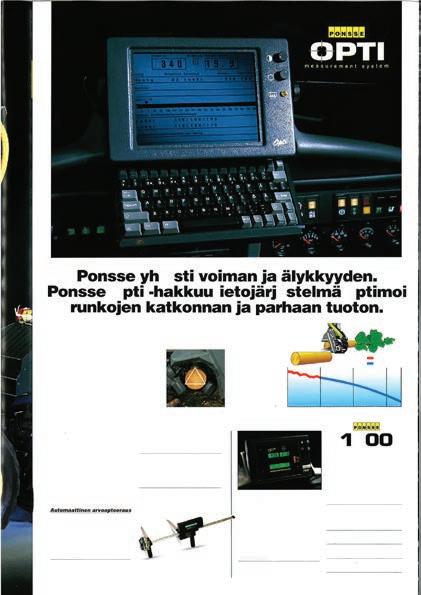
In the mid-1990s, Ponsse harvesters could be equipped with either the Ponsse OPTI or the Ponsse 1000 measuring device. At that time, OPTI was a highly advanced information system that measured stems with millimetre accuracy, creating a mathematical model of each stem, predicting its behaviour and allocating it into different assortments before cutting.
OPTI could be programmed with four tree species, and its memory could store 32 assortments, ranging from pulpwood to saw logs and from spruce veneer logs to birch for plywood. OPTI was equipped with automatic bucking optimisation, but the harvester operator could also perform the bucking manually if desired. OPTI also featured control and calibration measurements, a cabin printer, real-time two-way data communication and automatic colour marking for different tree species.
The Ponsse 1000 measuring device was implemented using semiconductor technology. Its technical features included a modular
design, automatic colour marking and stump treatment. In the Ponsse 1000, stem measurement was based on triangulation, with volume measurement being continuous and carried out in increments of at least 10 centimetres. The registers could hold four tree species, four log sorts per species and four pulp types per species. The preselection included length calibration with an accuracy of one per mille per species, while the Ponsse 1000 controlled all the harvester head functions. The measuring device was supplied with the harvester’s cabin printer, and electronic calipers used for calibration were available as an accessory.
In 1997, Ponsse was the first to offer internet data transfer as standard on all its harvesters. The internet connection made it possible to monitor production almost in real time for the first time for the timber procurement chain.
Source: Arttu Käyhkö, Ponsse –50 years of the world’s best forest machines, 2020