Do Leaseholders Need to Serve Notice on Their Own Freeholder for Loft Conversions?
BEN MACKIE
p20
Party Wall Works: How Security for Expenses Can Keep You Covered
PETER HILLYARD
p24
The Failure of The Agreed Surveyor role: Section 10(1)(a) of the Party Wall etc. Act 1996
BEN MACKIE
p30
P&T Leading Lights: Illuminating the Future of Natural Light Practice
DAN TAPSCOTT
p32
The Party Wall etc. Act 1996 –EQ or Emotional Intelligence Relevant Or Not?
MARK DUCKWORTH
p36
From the Vaults: Rights & Remedies
STEPHEN BICKFORD SMITH
p43
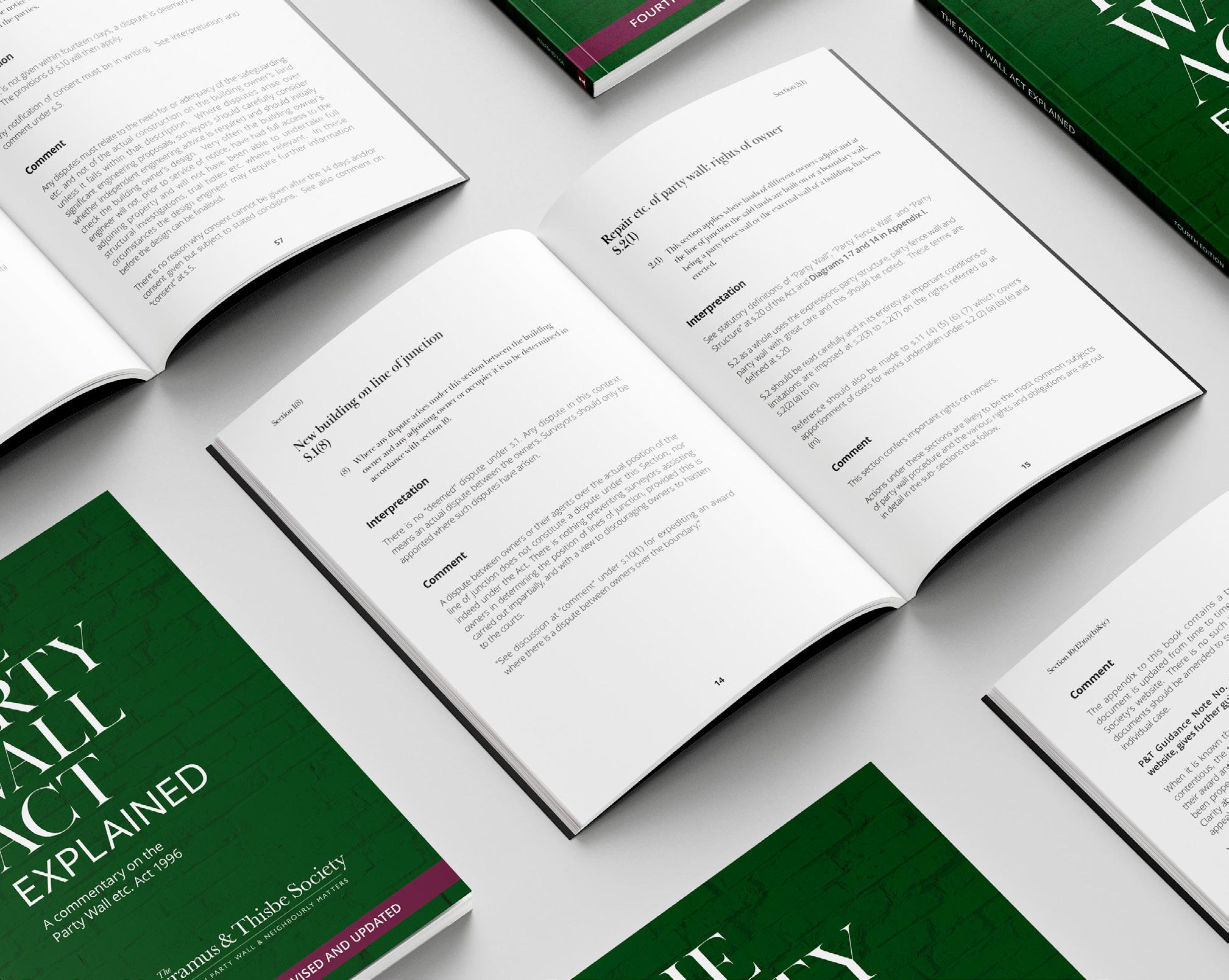
The Party Wall Act Explained
BUY YOUR COPY TODAY!
p44
With Thanks
John Lytton, 5th Earl of Lytton
MICHAEL COOPER
PRESS RELEASE
Introducing ‘P&T Leading Lights’: A New Networking Forum for the Rights to Light Industry
The Pyramus & Thisbe Society is pleased to announce the launch of P&T Leading Lights, a new networking group created to support, connect, and inspire professionals working in the field of natural light.
Rights to Light and Daylight & Sunlight Amenity are important neighbourly considerations for developers and those neighbouring development. These areas of practice will already be familiar to many members of the Pyramus & Thisbe Society, which has broadened its remit beyond Party Wall matters to encompass a wider range of Neighbourly Matters. Natural light is therefore a logical and necessary area for the Society to develop further.
P&T Leading Lights will also bring Light Knights into the forum, adding an established community of professionals focused on Rights to Light and Daylight & Sunlight Amenity. Established by Rapleys in 2022, Light Knights has hosted regular specialist events for professionals within the Rights to Light space. Through P&T Leading Lights, Light Knights will now benefit from a wider professional network and broader range of industry topics and discussions.
P&T Leading Lights aims to appeal not only to existing practitioners but also to the wider profession — including solicitors, insurers, designers, architects, software engineers, and other interested parties. The group also intends to provide a collaborative, nurturing environment for those entering the profession, offering peertopeer support towards qualification and beyond.
The forum is built around three core aims:
• Connection — bringing together surveyors, solicitors, insurers, architects, and related professionals working with natural light issues.
• Development — offering talks, workshops, and practical sessions to strengthen technical understanding and professional judgement.
• Community — creating a supportive environment where members can discuss challenges, exchange ideas, learn, and build lasting networks.
The P&T Leading Lights launch event will be held in The Tokenhouse, Moorgate, London EC2R 6DA from 6pm on Wednesday 1 July 2026, where Society members and industry professionals are invited to attend and learn more. As well as sharing details of the initiative and upcoming events, Dan Tapscott of Daytona Consult Ltd shall be providing his introductory talk: “Shedding Light on Light”.
Speaking about the initiative, Pyramus & Thisbe Society Chairman Michael Cooper said: “The Pyramus & Thisbe Society has championed best practice in Party Wall administration since 1974. Founded following the landmark Chancery Division case Gyle-Thompson v Wall Street, we’ve grown into a national organisation with regional branches across the UK. Our members range from students to leading experts. While Party Wall administration remains our core focus, many members also specialise in wider Neighbourly Matters including boundary disputes and Rights to Light. We support all members, from graduates to seasoned practitioners, in maintaining CPD and high professional standards. We’re now expanding our programme to include Rights to Light CPD, open to members and non-members alike.”
Pyramus & Thisbe Society Fellow, experienced practitioner and Light Knights founder, Dan Tapscott of Daytona Consult Ltd shall be playing a lead role: “This initiative is something P&T have asked me about doing over the years. When approached more recently, the timing and platform seemed right to make this a real success, adding value to Society members and to the wider industry.”
Head of Neighbourly Matters at Rapleys Natasha Bray said “We are delighted that Light Knights is joining forces with the new P&T Leading Lights forum. Bringing the two together creates a valuable opportunity for collaboration and for deeper discussion on key issues shaping the Neighbourly Matters market for members.”
Tickets for the event are £20 for members and £40 for non-members and can be obtained from Events - The Pyramus & Thisbe Society
info@pyramusandthisbesociety.org
Welcome to the Summer Edition Natasha Demirbag
WELCOME TO THE SUMMER ISSUE OF P&T Whispers. We have an exceptional lineup of articles featuring insights, legal breakdowns, and practical guidance for party wall practitioners.
We kick off this issue with a warm welcome from our new National Chair, Michael Cooper and we also look back at the insights and collaborative discussions from last year’s national conference in Irene F. Moore’s Review National Conference 2025
Key Highlights in This Issue
Our contributors dive deep into the technicalities and evolving interpretations of the Party Wall etc. Act 1996, addressing both long-standing procedural hurdles and modern practical applications:
▶ Appointments & Resistance: Nicholas Brown explores the friction points in surveyor selection in When Resistance Meets Appointment, while His Honor Edward Bailey provides invaluable legal clarity on the Continuing Appointment of Surveyors.
▶ Leasehold & Loft Conversions: Ben Mackie tackles a critical question facing residential developments in Do Leaseholders Need to Serve Notice on Their Own Freeholder for Loft Conversions?
▶ Financial & Procedural Safeguards: Peter Hillyard breaks down vital risk management strategies in Party Wall Works: How Security for Expenses Can Keep You Covered. Meanwhile, Ben Mackie returns with a critical analysis of procedural shortcomings in The Failure of The Agreed Surveyor role: Section 10(1)(a) of the Party Wall etc. Act 1996.
▶ Natural Light Practice & the Human Element:
Moving beyond just party walls, Dan Tapscott shines a spotlight on environmental design in P&T Leading Lights: Illuminating the Future of Natural Light Practice.
▶ Mark Duckworth then asks us to look at the human side of dispute resolution in The Party Wall etc. Act 1996 –EQ or Emotional Intelligence Relevant Or Not?
Looking Back and Moving Forward
In our retrospective segment, From the Vaults, Stephen Bickford-Smith’s article from 2003 examines the fundamental Rights & Remedies that continue to shape modern party wall case law.
Finally, don’t miss the opportunity to grab your copy of our definitive guide, The Party Wall Act Explained, advertised on page 43. We close this issue with a note of gratitude and special thanks from the Society to John Lytton, 5th Earl of Lytton.
As aways new articles for Whispers are always appreciated from all members and don’t forget to follow us on LinkedIn too. Enjoy the issue!
IT IS AN ABSOLUTE HONOUR TO BE THE second chair of the new society and it’s a hard task to follow on from such a superb previous chair in Fareed Fetto. It is certainly worth mentioning that not only did Fareed see in the change from a club to a society he also took the new society forward with the society now focused on all neighbourly matters, not just party walls. We have expanded the horizon and this new chapter will hopefully see us as a very prominent organisation in this field. Thank you Fareed.
As a chair I want to be able to support you, the members, and to do that I would like hear from you as to what you want from it. I’m always open to hear new ideas and I’m grateful to all volunteers who offer up time on the regional committees, working parties, or offer to provide CPD. If you want to be involved please let me know and I’m sure we can all benefit from any help offered.
My role as chair, as I see it, is to listen to you the members, there is never such a thing as a bad idea (of course some are better than others), but please don’t feel afraid to offer up any suggestions of what the society can do for you. The committees are all volunteers , as am I, so we can only offer up so much, but we are there for you and will do our best.
I have my own agenda, of course. I want to bring professionalism back in to our sector as there are too many issues and problems. I want us all to work together to find a solution to some of those. I have, as many of you know, very close links with the RICS, currently co- chairing the Boundaries and party wall committee and I am working hard to get the RICS to recognise and help with some of the areas of concern. I would dearly love the Pyramus and Thisbe Society to be at the forefront of any positive changes and I will try my best to have the two organisations working more closely together to achieve that aim.
Before university I worked as an architectural technician and I joined the P&T circa 1989. I then took my building surveying degree at Southbank polytechnic and graduated from it as a University. Post
university I moved to Manchester briefly in 1996/7 where I was a founding member and helped set up the North West Branch of the Society, then a club, in 1997 before moving back to my roots in Kent. Since then I have been a member of both London and Kent branches.
I have visited many other local clubs presenting talks and I currently lecture at five universities including Liverpool (remotely) , Kent, Westminster, Oxford and Reading. That said, I run my own one man business and dedicate most of my time to that. Over the next 4 years I’m hoping to encourage the society to engage more with the universities and I would be keen to try to set up some early learning from our pool of experts here in the society, and for us to give back to the next generation of surveyors. I hope the society will help with this aim to demonstrate why we are now entitled to be called a learned society.
My vision it is easily found on google, if you search for what a learned society is – ‘A learned society is a non-profit membership organization dedicated to advancing a specific academic field, profession, or subject, acting as a hub for researchers, academics, and professionals to share knowledge, set standards, and foster collaboration, often through publications, events, and advocacy, promoting education, research, and professional development.’ So to conclude that is my vision for us ‘the Pyramus and Thisbe Society’.
Michael Cooper BSc (Hons) FRICS FPTS michael@cooperscbs.com
Review National Conference 2025
Irene Moore
HE PYRAMUS AND THISBE SOCIETY
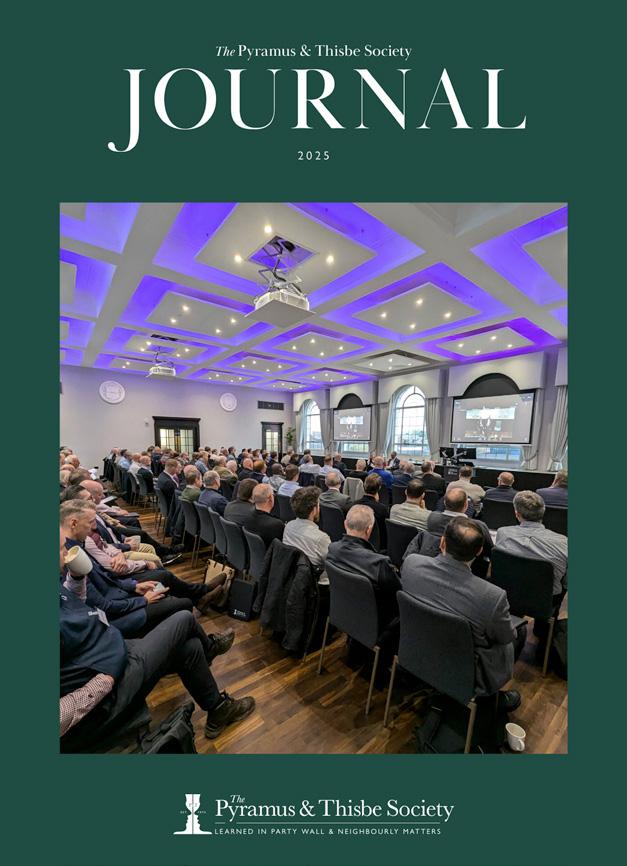
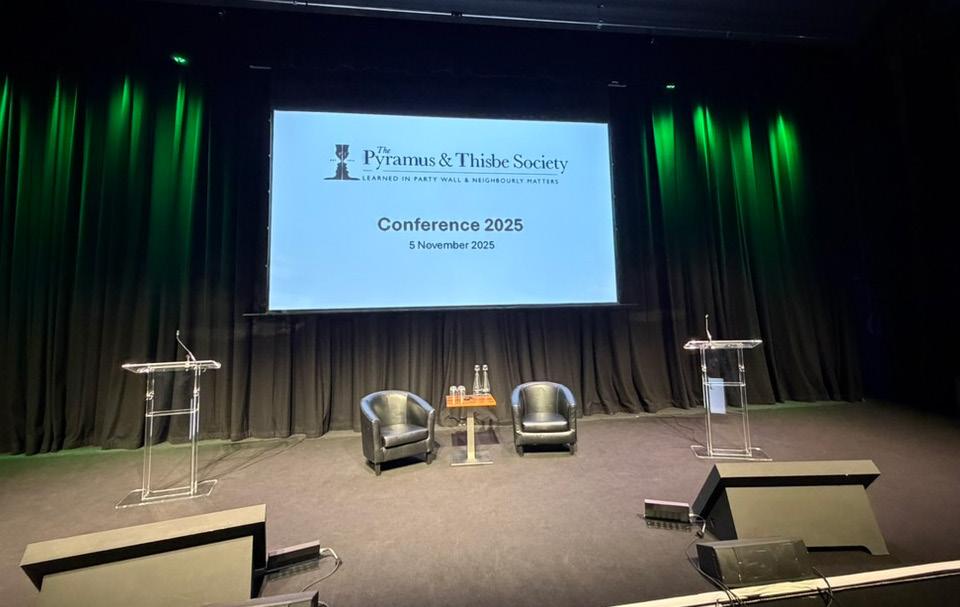
TNational Conference 2025, held on 5th November at The Mermaid in London, was a highly successful and well attended event that brought together technical expertise, legal insight, and practical experience from across the profession. The programme reflected a clear understanding that party wall practice is as much about judgement and people as it is about legislation and construction detail.
The conference opened with a welcome and introduction by Hannah Boyd, setting the tone for a day that was both informative and engaging. This was followed by a detailed and technically focused presentation by Jeff Griggs on monitoring and deep excavations, addressing movement issues associated with complex works and reinforcing the importance of careful assessment and control in an increasingly excavation driven urban environment.
Rob Millard then provided a contractor’s perspective on the party wall process, offering valuable insight into how surveyors’ decisions are experienced and implemented on site. This session served as a useful reminder of the importance of clear, practical awards and realistic expectations when works move from paper to construction.
Mark Duckworth’s presentation on emotional intelligence in party wall matters was particularly well received. It acknowledged the reality that while the Party Wall etc. Act is precise and measured, the disputes it governs often involve anxiety, frustration, and strained neighbourly relations. The emphasis on communication and emotional awareness resonated strongly with practitioners who regularly navigate these challenges.
Before lunch, a lively and thoughtful debate took place on whether Section 1 of the Act can be used to raise an external wall on the line of junction. Matthew Briggs and Michael Cooper explored differing interpretations and access considerations, encouraging robust professional discussion and demonstrating that the Act continues to generate meaningful debate even among experienced surveyors.
The late morning session on the Party Wall Act Explained & Society Matters on the Green Book was delivered by Natasha Demirbag and Fareed Fetto. This provided delegates with a clear grounding in best practice guidance while
reinforcing the Society’s role in maintaining professional standards. Following lunch, James Beat delivered a comprehensive legal update, ensuring delegates were fully informed of recent developments and emerging legal considerations affecting party wall practice. This was followed by a session on building a Successful Society, presented by Holly Harris, Anne Lorenzato, and Hannah Boyd, which highlighted the importance of engagement, governance, inclusion and professional development within the Society.
The afternoon continued with a presentation on the Party Wall Mediation Scheme and alternative dispute resolution options by HH Edward Bailey. This session reflected the growing emphasis on proportionate dispute resolution and the benefits of avoiding unnecessary escalation where possible.
The conference concluded with a judicial perspective on topical issues, delivered by HHJ Nicholas Parfitt. This session was particularly valuable, offering delegates insight into how party wall matters are viewed from the bench and reinforcing the importance of clarity, reasonableness, and procedural discipline in professional practice.
In summary, the conference was successful because it was balanced, practical, and firmly rooted in real experience. The quality of speakers, the breadth of topics, and the thoughtful structure of the programme ensured that delegates left better informed, professionally refreshed, and reassured that sound judgement and clear communication remain central to effective party wall surveying.
Irene Moore LLB (Hons) FPTS imoore@fareedfetto.co.uk
For details on the 2026 event click here
The Mermaid London, 2 Puddle Dock, London EC4V 3DB
The National Conference 2025 Programme
09:30 Welcome and Introduction Hannah Boyd
09:35 Monitoring & Deep Excavations and Associated Movement Issues Jeff Griggs
10:05 Contractors Perspective On Party Wall Process Rob Millard
10:35 Emotional Intelligence In Party Wall Matters Mark Duckworth
11:15 Break
11:45
Motion: Can Section 1 Be Used To Raise An External Wall Of A Building Matthew Briggs on The Line of Junction? A debate over access rights. Michael Cooper
12:30 The Party Wall Act Explained (Green Book)
Natasha Demirbag And Society Matters Fareed Fetto
12:45 Lunch
14:00 Legal Update James Beat
14:30 A Successful Society Holly Harris Anne Lorenzato Hannah Boyd
15:00 Party Wall Mediation Scheme and ADR Options HH Edward Bailey
15:40 Break
16:10 A Judicial Perspective On Topical Issues HHJ Nicholas Parfitt
17:00 Close Fareed Fetto
Hannah Boyd
When Resistance Meets Appointment: Why A Surveyor Who Considers That They Should Declare Themselves Incapable Of Acting, Should Do So At The Earliest Reasonable Opportunity
Nicholas Brown
AS SURVEYORS, WE OFTEN FIND ourselves in the middle of disputes where diplomacy, technical knowledge and professional judgement are all tested. When appointed as an agreed surveyor under the Party Wall etc. Act 1996, that role becomes even more delicate. We’re asked to act independently, impartially and fairly for both parties , a quasi-judicial responsibility that demands trust on both sides.
But what happens when that trust is missing from the very start? When, almost immediately after appointment, both owners begin questioning your impartiality, your decisions or even your basic competence? In those moments, the wisest course is often to step back early and formally declare yourself incapable of acting.
This isn’t a failure of professionalism, quite the opposite. It’s an acknowledgment that to continue under those conditions would risk compromising your independence and, ultimately, the integrity of the process itself.
Under Sections 10(3) and 10(5) of the Party Wall etc. Act 1996, a surveyor who “becomes or deems themselves incapable of acting” may withdraw from the appointment. The Act imposes no conditions on this right. It exists because Parliament recognised that circumstances sometimes arise where a surveyor cannot, in good faith, continue to fulfil their quasi-arbitral role.
The Act’s language is important , “deems themself incapable.” It places the decision entirely with the surveyor. No other party or surveyor has the authority to question that judgement. This statutory protection allows us to maintain our independence and ensures that we only act where we can genuinely be impartial.
The case of Mills v Savage, decided by HHJ Bailey at Central London County Court, sheds invaluable light on this principle. Though not binding on other courts, it remains one of the most cited authorities on surveyors’ rights to declare incapacity under the Act.
The background was a particularly bitter dispute between neighbours, the Mills and the Sells. Following the service of party wall notices in 2014, relations quickly deteriorated. Even the professionals were drawn into the conflict: the Mills’ first surveyor, Mr Hopkins, declared himself incapable of acting, as did the first third surveyor, Mr Dawson. What followed was a legal challenge over whether those surveyors were entitled to withdraw for their own reasons, or whether their declarations needed justification.
HHJ Bailey ruled decisively. He held that a surveyor is fully entitled to declare themselves incapable of acting “for whatever reason they think fit.” The decision is entirely theirs, and it is “no business of the other appointed or selected surveyors to police that declaration.” In other words, no scrutiny is required, and no explanation needs to be given.
The court emphasised three key points. First, the statutory right itself is unconditional .The Act provides no limitation on a surveyor’s ability to withdraw. Second, the role of a party wall surveyor is quasi-judicial: they must act in accordance with natural justice, which demands impartiality at all times. And third, if a surveyor feels unable to maintain that impartiality, whether due to conflict of interest, professional discomfort or sustained resistance from one or both owners – they are duty-bound to step aside.
This decision reinforced that the Act protects the independence of surveyors, recognising that in some circumstances continuing would undermine both fairness and confidence in the process. Every surveyor wants to help resolve disputes, not become part of them. But professionalism sometimes means knowing when to walk away. Declaring yourself incapable of acting isn’t shirking responsibility; it’s fulfilling it. By stepping aside early, you allow a fresh appointment to be made and preserve the credibility of the process. More importantly, you uphold the values that underpin our profession, independence, impartiality and respect for the trust that owners place in us.
Mills v Savage stands as a clear reminder that the law is on your side when you make that decision. It’s not just your right to withdraw when your impartiality is under fire, arguably it’s your duty.
Nicholas Brown BSc (Hons) FRICS MFPWS MCIArb nick@ashridgesurveyors.co.uk
Continuing Appointment of Surveyors
His Honor Edward Bailey
1 The dispute resolution process of the Party Wall etc Act 1996 requires the building owner and adjoining owner in dispute or in deemed dispute either (a) to concur in the appoint of one surveyor, or (b) each to appoint a surveyor with the two surveyors so appointed then to select a third surveyor. For how long do such appointments last? Does the surveyors tribunal so appointed and selected (i) make the required award and then become functus officio unable to make any further or even an addendum award; (ii) continue to act in respect of all disputes arising in respect of the initiating notice which resulted in their appointment; (iii) continue throughout the party wall process between the appointing owners until all the building owner’s works are completed.
2 Historical note The position under the London Building Act 1894 is clear. The answer is (ii) above, with s 91(1) providing
“ … where a difference arises between a building owner and adjoining owner in respect of any matter arising with reference to any work to which any notice given under this Part of this Act relates … and such one surveyor or three surveyors or any two of them shall settle any matter from time to time during the continuance of any work to which the notice relates in dispute between such building and adjoining owner…”.
The surveyor’s or surveyors’ jurisdiction extends to any matter in dispute which may arise from time to time during the work to which a party structure notice or a counter notice or excavation notice relates. This wording was followed in s 117(1) of the London Building Act 19301, and into the London Building Act (Amendment) Act 1939, s 55(i) providing:
“(i) The agreed surveyor or as the case may be the three surveyors or any two of them shall settle by award any matter which before the commencement of any work to which a notice under this part of this Act2 relates or from time to time during the continuance of such work may be in dispute between the building owner and the adjoining owner;”
There is (reasonable) clarity. The authority of the surveyors tribunal extends to any matter in dispute arising from work executed under a party structure notice, counter notice or excavation notice and continues throughout the continuance of such work. In other words, once the owners have appointed the surveyor tribunal they give that tribunal authority to settle disputes by way of award right the way through to the completion of the work in respect of which the initiating notice has been served. The only uncertainty, at least for the author, is in respect of a counter notice served in response to a party structure notice. It would be logical for disputes under both these notices to be resolved by the same surveyors tribunal, and this is the common approach of party wall surveyors. But this is not what the Act said and the point could be argued. It follows that should it ever become necessary to serve another notice a new surveyor tribunal has to be appointed, although there is no statutory bar to the new tribunal have the same membership as the original tribunal.
3 The 1996 Act. In opening the debate on the Bill in the House of Lords Lord Lytton said:
“The aims of the Bill are to extend the tried and tested provisions of the London Building Acts to England and Wales. It rests upon a principle of voluntary agreement between parties wherever possible; it provides for notice to be given where works are proposed3; … there is provision for the resolution of disputes other than by going to law; … There have been inevitable changes to adapt local legislation to national purposes. There has been a need to rectify an awkward legal precedent to do with party walls used by only one owner, and it sets out to remedy an anomaly relating to differential treatment of floor structures. Finally, there are improved failsafe mechanisms with the Bill. Otherwise, it is very much as the 1930 and 1939 Acts are at present.”
The noble Lord then proceeded to comment on the individual clauses in the Bill. In respect of Clause 10 Lord Lytton recommended the appointment of an agreed surveyor, explained owner appointments and third surveyor nomination, and explained that the surveyors were to
produce an agreement or award. Lord Lytton explained that “normally a party wall surveyor or third surveyor cannot be removed, but the Bill provides for instances where surveyors are unwilling or unable to act. The duty of party wall surveyors is quasi-arbitral. Once appointed they have a duty to act properly in the interests of both parties as statutory surveyors, which is a most important safeguard.”4 Lord Lytton then concludes his comments on clause 10 with observations as to fees, (“no licence to charge excessive fees”) and safeguards where an owner neglects to appoint a surveyor.
4 There is no suggestion in Lords Lytton’s commentary on clause 10, or in any other part of the debate on the Bill’s second reading, or in committee5, that the appointment of surveyors is concluded on any other basis than that set out in the 1939 Act.
5 The stated intention of the framers of the 1996 Act was to ensure that it was more clearly drawn than the previous legislation to make the text intelligible to the modern reader. The appointment of surveyors in s 10(1) is in relation to any dispute arising or deemed to have arisen between the owners “in respect of any matter connected with any work to which this Act relates”. The next subsections deal with appointment, refusal to act, death or deemed incapacity, and refusal to act effectively. For present purposes the important sub-sections are (10) (11) (14) and (15):
“(10) The agreed surveyor or as the case may be the three surveyors or any two of them shall settle by award any matter –(a) which is connected with any work to which this Act relates, and (b) which is in dispute between the building owner and the adjoining owner.
(11) Either of the parties or either of the surveyors appointed by the parties may call upon the third surveyor selected in pursuance of this section to determine the disputed matters and he shall make the necessary award. …
(14) Where the surveyors appointed by the parties make an award the surveyors shall serve it forthwith on the parties.
(15) Where an award is made by the third surveyor –(a) he shall, after payment of the costs of the award, serve it forthwith on the parties or their appointed surveyors; and
(b) if it is served on their appointed surveyors, they shall serve it forthwith on the parties.”
6 The problem to be faced is that s 10(1) does not repeat the wording of the 1939 Act (and the previous statutes) which provides for the surveyors appointed to settle any matter .. “which from time to time during the continuance of such work may be in dispute…”. The absence of these words from the 1996 Act might suggest that parliament decided to change the law and require reappointment for each and every dispute that may arise during the continuance of the work. There is no doubt that this was not intended, but that does not mean that the 1939 Act wording can be simply imported into the 1996 Act. The court has to interpret the 1996 Act in accordance with the accepted canons of construction, and considerations as to the ‘intention of Parliament’ cannot overrule the express wording of a statute.
7 Concern has been expressed in party wall circles that there are two decisions of HHJ Parfitt which suggest that as soon as an appointment is made the surveyors’ tribunal making the award are functus officio and each and every following dispute has be determined by new appointments. Both of these decisions are problematic. It is a great shame that transcripts have been circulated among party wall surveyors, and concerns expressed about having to re-appoint a new surveyors tribunal after every award. In K Group Holdings v Saidco6 there is just a single paragraph in a short ex tempore judgment, where only one side was represented and the Judgment does not record the relevant facts. The paragraph reads:
[22] It is said that once that dispute arising from the notices that led to the 2009 award was determined, then the jurisdiction of those existing surveyors came to an end and I agree with that on the facts of this case. I think the 2009 award dealt with that which was required to be dealt with as a result of the notices served and the deemed dispute that arose. The appointed surveyors had exhausted their jurisdiction by the award that was made at least so far as concerned the alleged dispute the purported subject of the November 2020 award, not least because there was no building owner or, perhaps, adjoining owner (apart from Mr Pharoan) under the 2009 award who would have been relevant to the purported award in November 2020.
It is far from certain that Judge Parfitt is intending to suggest in this paragraph that a new surveyors tribunal has to be appointed after each and every particular dispute has been resolved by award. In a party wall context the 2009 and 2020 awards are separated by a considerable distance in time, and the comment “I agree with that on the facts of this case” suggests that this was not meant to be a statement of principle.
8 In Fernando v London Borough of Newham7 only one side was present in court, as in K Group Holdings. It
appears from the terms of the Amended Order that Judge Parfitt decided later to amend the original Order under the slip rule8 by adding a seven paragraph Annex to explain the reasons for making the Order. Accordingly there is no judgment as such; all we have is the Annex. Neither the background nor the chronology are set out. Where dates are given there are evident discrepancies, and although there is reference to “further awards” the Annex to the amended Order does not disclose by whom and when they were made, let alone what these awards said.
9 At all events, perhaps because of their nature and listing pressures on Judge Parfitt, neither case resulted in a reasoned judgment which clearly considers the matter and determines the issue of successive awards by the same surveyors tribunal. That does not mean that the functus officio argument is a bad one (although the writer considers that it is); just that there is no reasoned decision on the matter in the county court, let alone the Court of Appeal.
10 It is suggested that successive awards can indeed be made by the same surveyors tribunal provided that the disputes resolved all arise in respect of works authorised on the same initiating notice. This is based on the following:
i. the previous legislation and the fact that Lord Lytton introduced the Bill to Parliament on the basis that the 1996 Act sought merely to (a) extend existing party wall law throughout England and Wales (whereas previously the law was in a Private Act and extended only to the inner London boroughs, and (b) bring the wording of the earlier legislation up to date;
ii. The need to have the surveyors tribunal reappointed for each and every dispute which arises in the course of the works arising on the same initiating notice is extremely inconvenient, and contrary to the spirit of the Act. Indeed, it could be unnecessarily costly to the owners if the same surveyors were not reappointed because the new surveyors would have to get up to speed with a matter with which the original surveyors were already appraised;
iii. s 10(10) refers to the surveyors settling by award any matter etc. whereas if the surveyors where there for each particular dispute the wording would be “the matter”;
iv. s 10(11) refers to the third surveyor to determine ”the disputed matters” but if the third surveyor dealing with one dispute at a time it would be “the disputed matter”;
v. s 10(14) refers to the surveyors making “an award” rather than “the award”;
vi. s 10(15) refers to the third surveyor making “an award” rather than “the award”.
11 There can be no doubt that the practicalities are overwhelmingly in favour of surveyors having a continuing appointment throughout all the works carried out in respect of any individual initiating notice, (or two such notices where eg a party structure notice and an excavation and construction notice are served together) and the surveyors’ profession as a whole has been proceeding on this basis since the 1996 Act came into force, no-one thinking for a moment that the 1996 Act changed the existing law. As it is good practice for any surveyor’s appointment letter to refer to the initiating notice in respect of which the appointment is made, there would seem to be no particular reason why the letter should not be so drafted as to ensure that the surveyor is appointed (or selected) in respect of each and every dispute arising out of the works consequent upon the specified initiating notice.
His Honor Edward Bailey clams.tcc@gmail.com
1 Save that “any matter arising with reference to any work” in 1894 becomes “any matter connected with any work” in 1930.
2 “this part of the Act” refers to the part covering party wall matters.
3 Hansard : Party Wall Bill House of Lords Vol 568, 31 January 1996, columns 1536-1537
4 Hansard : Party Wall Bill House of Lords Vol 568, 31 January 1996, column 1538
5 Hansard : Party Wall Bill House of Lords Vol 572, 22 May 1996, column 931, 943
6 Central London County Court (19 July 2021) HHJ Parfitt.
7 Mayors & City of London Court (17 June 2024) HHJ Parfitt.
8 CPR O.40 r.12.
Do Leaseholders Need to Serve Notice on Their Own Freeholder for Loft Conversions?
Ben Mackie
THE APPLICATION OF THE PARTY WALL etc. Act 1996 to leasehold loft conversions is frequently misunderstood. A recurring assertion is that a leaseholder must serve notice on their own freeholder before undertaking such works. This article challenges that position and argues that, in most cases, no notice is required. It examines the statutory framework, the meaning of a “party wall” and “adjoining owner,” and the practical operation of the Act. It concludes that the relationship between leaseholder and freeholder falls outside the intended scope of the legislation, and that a licence to alter remains the appropriate mechanism for regulating such works.
Introduction
The Party Wall etc. Act 1996 is often invoked as a catch-all procedural safeguard whenever structural works are proposed. In leasehold contexts, this has led to an increasingly common but questionable practice: requiring leaseholders to serve party wall notices on their own freeholders when carrying out loft conversions.
At first glance, this may appear cautious, even prudent. However, a closer analysis reveals that it rests on a fundamental misunderstanding of the Act’s purpose and language. The legislation was designed to regulate the relationship between neighbouring owners, not to impose additional layers of control within a single building held under divided legal interests.
This distinction is not merely academic. It goes to the heart of whether the statutory regime is engaged at all.
Literature Review
A review of the leading texts on party wall law reinforces the conclusion that the Act was never intended to apply to the relationship between leaseholders and their own freeholders in the context of internal works such as loft conversions.
Authoritative works including The Law and Practice of Party Walls (3rd Edition) by Nicholas Isaac KC, The Party Wall Act Explained (4th Edition) by the Pyramus & Thisbe Society, Party Walls Law and Practice (4th Edition) by Bickford-Smith, The Party Wall etc. Act 1996: Explanatory Booklet published by the Ministry of Housing, and Party Wall Legislation and Procedure (6th Edition) by the RICS all provide detailed explanations of the Act’s operation.
Across these texts, two consistent features emerge.
First, the diagrams and illustrations used to explain party walls invariably depict walls separating distinct adjoining properties, typically between neighbouring houses or between different buildings. None of these authoritative sources illustrate or contemplate a “sub-divided” party wall existing within a single structure as between leaseholder and freeholder. The visual and conceptual treatment of party
walls is always grounded in physical adjacency between separate premises, not layered legal interests within the same demise.
Second, in defining the concept of the “adjoining owner,” these texts consistently refer to neighbouring ownership in the ordinary sense. There is no suggestion that a freeholder, in relation to their leaseholder, falls within that category simply by virtue of holding a superior interest in the same building.
Perhaps most tellingly, none of these leading works, whether practitioner texts, institutional guidance or government publications make any reference to a requirement for a leaseholder to serve notice on their own freeholder when exercising rights under section 2 of the Act. Given the level of detail in these publications, such an omission is significant. If such a requirement existed, it would reasonably be expected to feature prominently in the literature. Its absence strongly suggests that the proposition has no foundation in established law or practice.
The Absence of a Party Wall
The starting point must be whether there is a “party wall” within the meaning of the Act. In the context of a loft conversion undertaken by a leaseholder, this is rarely the case.
The works are typically confined to the upper parts of the building - roof structures, dormers, and internal alterations. There is no wall dividing separate premises in the sense contemplated by the legislation. The existence of different legal interests in the same physical structure does not, without more, create a party wall. The Act is concerned with walls that physically separate ownerships, not with abstract divisions of title layered within the same space.
To treat any wall subject to dual interests as a party wall would be to expand the Act far beyond its intended reach.
The “Plaster and Brickwork” Fallacy
One of the more persistent arguments in favour of applying the Act in these circumstances is the notion that ownership of a wall is split between leaseholder and freeholder, often described as the leaseholder owning the plaster and the freeholder owning the structural wall behind.
While superficially appealing, this analysis is ultimately unconvincing. It reduces the concept of a party wall to a technical dissection of materials, rather than a functional assessment of how a wall operates between premises. The Act is not concerned with microscopic ownership distinctions but with the existence of a shared boundary between separate occupiers.
Moreover, the argument struggles in practical terms. Many loft spaces do not contain plastered walls at all. If the applicability of the Act depends on the presence of a plaster finish, it becomes inherently unstable and arbitrary.
The reality is that this line of reasoning attempts to retrofit the statutory definition to a situation it was never designed to address.
Testing the Logic: Detached and Semi-Detached Analogies
The weaknesses of the “shared ownership” argument become clearer when applied to other scenarios.
Consider a leaseholder occupying a flat within a detached building. The freeholder retains an interest in the structure, just as in any leasehold arrangement. Yet it would be an extraordinary proposition to suggest that internal works require service of a party wall notice on the freeholder simply because of this shared legal interest. The Act has never been interpreted in this way.
Extending the logic further leads to equally problematic conclusions. If shared ownership alone were sufficient, then walls in semi-detached houses, for example the flank, front and rear walls would routinely fall within the Act even where they are not treated as party walls in practice. It is generally accepted that a semi-detached house will have one party wall which is shared with the neighbouring house.
These examples demonstrate that the presence of multiple interests in a structure is not the test. The Act requires something more: a genuine division between adjoining premises.
The Freeholder Is Not an Adjoining Owner
A central concept in the Act is that of the “adjoining owner.” It is this status that triggers the requirement for notice and the associated procedural rights.
A freeholder, in relation to their leaseholder, does not comfortably fit within this definition. Their interest is reversionary and overarching, not adjoining. They do not occupy neighbouring land, nor do they own a separate structure physically adjacent to the works. Instead, they hold a superior interest in the same building. To characterise the freeholder as an adjoining owner is to stretch the statutory language beyond its natural meaning. The Act is concerned with relationships between neighbours, not with hierarchical ownership structures within a single property.
The Practical Redundancy of a Party Wall Award
Even if one assumes that the Act applies, it is necessary to consider what a party wall award would achieve in this context. The answer is, in practical terms, very little.
The machinery of the Party Wall etc. Act 1996 is designed to regulate the consequences of works to a party wall as between neighbouring owners—principally where one
owner’s works may cause damage, inconvenience, or risk to the adjoining owner’s side of that wall. The focus is therefore narrow and specific: it is concerned with the interface between two properties, and the effects of works at that interface.
That framework does not translate to the relationship between a leaseholder and their own freeholder. A freeholder is not concerned merely with the condition of one side of a wall; their interest extends to the entirety of the structure. A loft conversion engages with the building as a whole; its roof, structural integrity, and load distribution, not simply with any one wall, whether characterised as a party wall or otherwise.
In that light, it becomes apparent that a party wall award is ill-suited to the task. Its provisions are inherently limited in scope. Clauses regulating working methods, vibration, or sequencing of works are directed at mitigating impact across a shared wall between neighbours. They do not, and cannot, address the broader structural and contractual concerns that arise for a freeholder. The suggestion that such a regime could meaningfully protect the freeholder’s interest is therefore misplaced.
Indeed, it borders on the absurd to suggest that the freeholder’s position is safeguarded by a statutory process that is, at its core, concerned with the relationship between adjacent owners in respect of a wall they share. An adjoining owner is affected in a defined and limited way: by what happens to that wall. A freeholder, by contrast, is affected by the loft conversion in its entirety. The scale and nature of that interest are fundamentally different, and the Act is simply not designed to engage with it.
The result is that any award in this context risks becoming an exercise in form rather than substance, procedurally elaborate but ultimately incapable of addressing the matters that actually concern the freeholder.
Licence to Alter as the Proper Mechanism
The appropriate framework for regulating a leaseholder’s loft conversion lies not in the Party Wall Act, but in the lease itself. A licence to alter provides a bespoke mechanism through which the freeholder can review, condition, and approve the proposed works.
Unlike a party wall award, a licence to alter is directly concerned with the integrity of the building and the contractual relationship between the parties. It allows for tailored conditions, ongoing oversight, and clear allocation of responsibility.
Insisting that such a licence be conditional upon the service of a party wall notice or the making of an award introduces unnecessary duplication. It increases cost without delivering corresponding benefit and risks shifting the process away from genuine protection toward procedural formalism.
Costs, Reasonableness, and Practice
Where a freeholder nevertheless insists upon a party wall process, questions of reasonableness and cost inevitably arise.
The decision in Amir-Siddique v Kowaliw [2018] highlights an important principle: where a party insists on a course of action that is not strictly required, it may be appropriate for that party to bear the associated costs. The conduct of the parties matters. A freeholder withholding a licence to alter until a party structure notice is served, and then dissenting to that notice, could be seen to be acting unreasonably, especially where it is known that the award will be redundant.
Applied in this context, if a freeholder requires a party wall award despite its doubtful applicability, it is difficult to justify passing the financial burden onto the leaseholder. To do so risks encouraging practices driven less by necessity than by fee generation, raising broader concerns about proportionality and professional conduct.
Conclusion
The Party Wall etc. Act 1996 was enacted to regulate disputes between neighbouring owners where works affect shared or adjoining structures. It was not intended to govern the internal relationship between a leaseholder and their own freeholder within a single building.
In the case of a loft conversion carried out within a leaseholder’s demise, there is no true party wall, no adjoining owner in the statutory sense, and no meaningful role for a party wall award. The conceptual arguments advanced in favour of applying the Act, particularly those based on artificial divisions of ownership, do not withstand scrutiny when tested against the language, purpose, and practical operation of the legislation.
The proper mechanism for protecting the freeholder’s interests is the licence to alter, not the imposition of an unnecessary statutory process. To conclude otherwise is to extend the Act beyond its intended scope and to introduce complexity where none is required.
Ben Mackie BSc (MPTS) ben@tpwc.com
Peter Hillyard
What is “Security for Expenses”?
(Section
12 of the Act)
Security for expenses (‘SfE’) is essentially a financial safeguard. It is a sum of money set aside to cover potential costs or losses an adjoining owner might suffer due to the proposed works. Think of it like a safety deposit. The money is typically held by a third party and can be used if the building owner fails to fulfil their obligations – for example, if they start the work but, say, go bankrupt before fixing the neighbour’s damages, the neighbour can draw on this security fund to cover repairs.
The concept recognises that construction work can sometimes go wrong or be left incomplete, potentially leaving the adjoining owner out of pocket. By obtaining security up front, the adjoining owner has peace of mind that funds will be available to fix any damage or complete any work that the building owner is supposed to do on their property. It’s a protective measure, not guaranteed to be requested in every case, but available when the risk justifies it.
When and Why Can Security for Expenses be Requested?
(Assessing the Need)
Adjoining Owner’s Right to Request
Under Section 12(1) of the Act, an adjoining owner may serve notice on the building owner requiring SfE before the work starts This is a right, not an obligation – meaning the adjoining owner decides if they feel security is necessary. In practice, adjoining owners typically request security when the planned works are substantial enough to pose a real risk of significant damage or costs.
The Reasoning
Essentially, an adjoining owner asks for security when they perceive a non-trivial risk of financial loss if things don’t go as planned. For instance, if a project is large and expensive, they may worry “What if you, the building owner, run out of money mid-project? Will my property be left damaged with no recourse?” Security answers that by reserving money ahead of time.
Building Owner’s Right to Request (Less Common)
Interestingly, Section 12(2) also allows the building owner to request security from the adjoining owner in certain situations.
This could occur if the adjoining owner demands some extra work to be done for their benefit, for which they are responsible for the cost. For example, if the neighbour says, “I’d like you to thicken the party wall or include special features for me as part of your project,” and that will cost the building owner more money initially, the building owner can
ask the neighbour to provide security for the neighbour’s share of those costs.
How is Security for Expenses Requested and Decided?
Initial Request by Notice
The adjoining owner must formally serve a notice on the building owner to invoke SfE (this can be included as part of their dissent response or as a separate notice). This notice should state that security is required and ideally suggest an amount or at least indicate the concern.
Agreeing on an Amount
After a security request, the first step is negotiation. The building owner and adjoining owner may try to agree on a reasonable sum between themselves. For example, they might both acknowledge that £10,000 is enough to cover worst-case damages for a given project. If an agreement is reached, they will typically document how that money will be held and the conditions for release. The amount will vary widely with the project. Simple jobs often involve no security at all. For big projects like basement excavations in London, security amounts can be significant – commonly in the hundreds of thousands of pounds. The amounts can’t be too low (or it’s pointless), but also not exorbitantly high such that it unnecessarily ties up the building owner’s funds.
Surveyors’ Determination
If the owners cannot agree on the amount or terms of security, the matter is handed to the party wall surveyors under Section 10. In other words, it becomes part of the dispute that the surveyors resolve in the Award. The appointed surveyor(s) will then determine:
▶ Whether security is indeed warranted (in most cases if one side asks, surveyors tend to allow it unless it’s clearly unjustified).
▶ The amount of security to be provided.
▶ The form (cash deposit is common).
▶ Who will hold it.
▶ Conditions for release – typically, the money is returned to the building owner once the works are completed satisfactorily and any damage made good, minus any justified deductions for repairs.
Timing
Security must be requested before works commence. You cannot typically ask for security halfway through a project. The idea is it’s agreed (or awarded by surveyors) as a precondition to work starting. Often the Award will state “Work shall not commence until the building owner has provided security of £X in the following manner…”.
What Costs Can Security for Expenses Cover?
Historically, surveyors tended to set security amounts to cover scenarios where the building owner might not finish a job that affects the neighbour’s property. For example, if part of the neighbour’s wall had to be taken down during construction, security would ensure funds to rebuild it if the building owner walked away. The old practice (pre-2011) as noted in the Green Book was that security could only be asked for if the building owner was going to exercise rights over the adjoining owner’s property (like entering their land or doing work to their side). So if a job was entirely on the building owner’s own land (like digging just on your side, or building a wall on your land up to the line), the thinking was that the adjoining owner couldn’t seek security.
Expanded Scope – Kaye v Lawrence
The case Kaye v Lawrence changed this understanding around 2011. The court decided that SfE can be requested for any works covered by the Act, even if those works are on the building owner’s land, as long as they carry risk to the neighbour. This effectively overrode the traditional limitation. Now, what matters is whether the works might cause the neighbour to incur expense or loss, not strictly where the work is taking place.
Costs it Covers
In plain terms, security is there to cover “any loss or damage arising from the works carried out under the Act”.
How Security for Expenses is Held and Released
Stakeholder Account
Once an amount is determined, the building owner will hand over that money to a stakeholder. The key is both parties trust the stakeholder to only release the money under agreed conditions.
During the Works
The security just sits untouched typically while works are ongoing. It’s not to be used for the works themselves; it’s there as an emergency fund. The building owner continues to fund and carry out their project as normal, knowing they can’t access that chunk of money until completion (which can impact their cash flow, one reason building owners sometimes resent security requests).
Triggering a Payout
If the adjoining owner suffers a loss covered by the security (say, cracks appear and the building owner doesn’t promptly fix them), the adjoining owner can approach the surveyor(s) or stakeholder to claim against the security. Usually, the Award will outline this procedure. For example, it may say
that the surveyors can authorise using the security money to pay a contractor to make good damage if the building owner fails to do so within a certain time. In any case, it would be an evidence-based process: showing quotes or invoices for repair, etc., to justify dipping into the fund.
Release of Funds
If the project completes and no issues remain, the security is returned to the building owner (often with a formal confirmation from surveyors that they are satisfied the risk has passed). It could also be partially returned if only a part was used. The timing of release can vary – some awards say the security is held until the end of the making good period (often there’s a few months after completion where minor defects might still manifest). Others may specify a fixed period after work completion. The building owner will be eager to get it back as soon as possible, whereas the adjoining owner will want to ensure all is truly well.
Conclusion: The Role of Security for Expenses in Party Wall Matters
SfE is a powerful tool under the Party Wall etc. Act 1996 that adds a layer of financial security to an adjoining owner. It exemplifies the Act’s spirit of balancing interests – enabling the building owner’s project while ensuring the neighbour isn’t left vulnerable to costs.
Not every project will involve security, but when it does, it often means the works are substantial. For building owners, understanding this mechanism is crucial for project planning; for adjoining owners, it’s a form of reassurance when faced with potentially disruptive works.
Both should view it not as an adversarial weapon but as a form of mutual protection – it ultimately benefits both, because if it facilitates trust, the project can proceed more smoothly. With clear communication and fair assessment, SfE can be handled in a way that safeguards property without unnecessarily hindering development.
In the end, like much of the Party Wall Act, it’s about striking that fair balance so neighbours can remain neighbours, not adversaries, once the dust of construction settles
Peter Hillyard ph@dosandco.com
North-East & North-West Branches
Announcing
for the third National Conference of Where The Bridgewater Hall, Manchester
The Failure of The Agreed Surveyor role: Section 10(1)(a) of the Party Wall etc. Act 1996
Ben Mackie
THIS PAPER DISCUSSES HOW AND WHY THE AGREED SURVEYOR ROLE, SECTION 10(1)(A) OF THE Party Wall etc. Act 1996, has failed. The Act has its flaws but is perfectly fine; it is those who administer it who contribute to the failure of this unique and impartial role. Those who administer the Act stand to benefit financially if there are more appointments. For the collective party wall community, it is far more lucrative if disputes are resolved by two surveyors, as opposed to one ‘agreed’ surveyor. There is the false perception that having a dispute resolved by two surveyors is more sensible than relying on just one; however, of 66 party wall appeals from 2002, not one of them related to an agreed surveyor award. Of course, there may be times when a dispute is best resolved by party-appointed surveyors, but that must be after the agreed surveyor route is considered and found to be inappropriate. Too often, this consideration is overlooked, and disputes are needlessly resolved by party-appointed surveyors, ensuring the building owner pays more. There are many simple steps that can be taken by surveyors administering the Act, from serving more informative notice packages to banning pre-dispute appointment letters. The problem with any recommendation is that a surveyor may understandably be reluctant to bring about changes that can adversely affect their profitability. It is the fault of party wall surveyors as guardians of the Party Wall Act that the role of the agreed surveyor has been an abject failure. This paper will explain why they are at fault, why they are loath to change the status quo, and lastly, for the ethical surveyors out there, how they can put the special role of ‘agreed surveyor’ on the pedestal it deserves.
Introduction
The Party Wall etc. Act 1996 offers a choice of dispute resolution options under the following sections:
▶ 10(1)(a) both parties shall concur in the appointment of one surveyor (in this section referred to as an ‘agreed surveyor’).
▶ 10(1)(b) each party shall appoint a surveyor and the two surveyors so appointed shall forthwith select a third surveyor (all of whom are in this section referred to as ‘the three surveyors’).
The failure of the agreed surveyor role results from the low uptake of Section 10(1)(a) appointments. This matters because the building owner and, in some cases, the adjoining owner are faced with higher costs, and the process becomes more acrimonious.
The intention of 10(1)(a) is best summarised by the following two quotes:
It was the government’s intention that an agreed surveyor should be used whenever possible.1
Clause 10 deals with the resolution of disputes. In this particular instance both parties can agree on the appointment of one surveyor. That is a step to be recommended most strongly, particularly for householders carrying out small works.2
In practice, 10(1)(a) appointments are much less common than intended. The adjoining owner therefore has options with regard to appointing a surveyor. While the parties can concur in the appointment of a single surveyor, this is unusual and normally the next subsection is followed.3 Far more common is the three-surveyor tribunal provided for under section 10(1)(b).4
It is vital to establish the ways in which surveyors are
guilty of reducing the likelihood of a Section 10(1)(a) appointment, and to highlight the incentives that encourage this behaviour.
When giving initial advice, surveyors discuss what notices are required and how the party wall process works. Very few surveyors mention the fact that their neighbour can pick a surveyor and the building owner can proceed with the neighbour’s surveyor. There is no business sense in making a client aware of the fact that party wall matters can proceed without the surveyor giving the initial advice. It is normal for businesses to wish to maximise revenue, and this encourages client retention, even where it is not in the client’s best interests.
One of the first things many surveyors do is to obtain a ‘pre-dispute’ signed letter of appointment. Now their client is trapped, as under Section 10(2) of the Act, the appointment cannot be rescinded, and the surveyor will have to deem themself incapable of acting to facilitate an agreed surveyor appointment. What is more, any appointment under Section 10(1)(a) and 10(1)(b) only comes about where a dispute arises or is deemed to have arisen, which encourages the bad practice of surveyors being appointed prior to there being a dispute. If action is undertaken on the basis that there is a dispute when there is not, it may very well increase the likelihood of there being a dispute, while, at the very least, it reduces the likelihood of a dispute being settled by a surveyor under Section 10(1)(a).
By having that letter of appointment signed at the earliest opportunity, the surveyor has secured the job, reduced the client’s freedom of choice as the appointment cannot be rescinded, and ensured that their surveying practice generates more income.
The first formal paperwork generated by a surveyor should not be a letter of appointment — rather, it should be the party wall notice package. Only when a notice has been served and an adjoining owner dissents or does not respond does a dispute arise that requires resolution under Section 10, after which the letter of appointment must be
obtained.
Most notice acknowledgment forms have the option for the adjoining owner to either concur in the appointment of the building owner’s surveyor as the agreed surveyor under section 10(1)(a), or appoint their own surveyor under Section 10(1)(b) forming the three-surveyor tribunal. There is no option for the adjoining owner to offer their own surveyor as an agreed surveyor. By blocking off the latter option, the building owner’s surveyor keeps their involvement in the process and ensures they earn a fee. This reduces the uptake of Section 10(1)(a) appointments and increases revenue for party wall surveyors.
On sending out notice packages, there are often covering letters asking the adjoining owner to get in touch to discuss the works. The building owner’s surveyor receives a phone call from the adjoining owner seeking advice. Like a salesperson, the surveyor is securing the job. They do not mind whether the adjoining owner accepts them as the agreed surveyor or appoints their own surveyor (for extra protection). Either way, so long as they do not consent, the surveyor is in the money.
It is not only notice packages that discourage Section 10(1)(a) appointments. There are surveyors who send unsolicited letters to adjoining owners encouraging a dispute. They do this by using software that identifies anyone who has made a planning application and then sending letters out offering their services. The building owner often learns that a surveyor has been appointed before they have even had a chance to serve a notice. Understandably the agreed surveyor route is now closed off, as the building owner would not wish to proceed with the unethical surveyor.
Additionally, on receipt of a notice package, the adjoining owner may call a party wall surveyor for advice. This phone call is an opportunity for that surveyor to take on a lucrative appointment, and human nature is such that the surveyor would be unlikely to recommend proceeding with the building owner’s surveyor as the agreed surveyor, nor would they advise on any course of action that may push away the potential new work. Instead, they will reassure the adjoining owner, allay their fears regarding costs (‘don’t worry, the building owner will pay!’), and talk about the value they can add by being appointed on behalf of the adjoining owner.
The Perception Problem
Party wall surveyors have created issues that contribute directly to the low uptake of the agreed surveyor route. They have done this by:
▶ Stating that party-appointed surveyors must act impartially.
▶ Arguing that ‘two heads are better than one’.
▶ Stating that the building owner surveyor will pay the adjoining owner’s surveyor’s reasonable costs.
The impartiality myth
To be impartial is to treat both parties to the dispute equally. This is, without doubt, necessary where you have an agreed surveyor, or a third surveyor. Where two parties give the responsibility to one surveyor to settle a dispute, it is only right that this surveyor handles both parties fairly.
There are, however, many examples of party-appointed surveyors not acting impartially:
▶ Third surveyor referral: There is no known example of a building owner’s surveyor making a referral in favour of the adjoining owner, while the adjoining owner defends the building owner. In theory, an impartial surveyor, treating both parties equally and ‘acting for the wall’, should be willing to make a referral against their own appointing owner.
▶ Section 11(11): There is no known example of a surveyor, acting on behalf of an adjoining owner, rejecting a Section 11(11) payment as being too low.
▶ Indeed, there are no known examples of a building owner’s surveyor challenging an adjoining owner who is asking for a smaller payment under 11(11). The truth is, if the building owner offers £3,000 for a wall and the adjoining owner’s surveyor thinks it is valued at £2,000, the £3,000 will still be taken.
▶ Security for expenses: The same rationale is used for security as it is for Section 11(11). The building owner’s surveyor will try to lower the amount to be held in escrow, while the adjoining owner will try to increase it. They will not argue conversely. The surveyors, as is their duty, will come to an agreement, sometimes easily, but it remains that they will argue in favour of their respective appointing owners.
▶ Access rights: There are no known examples of an adjoining owner’s surveyor arguing that the amount of access required is too little. The adjoining owner’s surveyor will instead argue that the duration of access is shortened, and the extent of access lessened. They are putting their appointing owner first, and this is perfectly acceptable, but it is not impartial.
Surveyors Are Primarily Responsible To Their Own Appointing Owners
From Section 11(11) payments to security for expenses requests, third surveyor referrals and access rights, surveyors rightly argue on behalf of their appointing owners. This is good, and how the Act is intended to work. The Act requires surveyors to act effectively and does not refer to impartiality once. A good surveyor will take heed of Dr Chynoweth, who stated in 2001:
Party-appointed surveyors are primarily responsible to their own appointing owners. Unlike the agreed surveyor and the third surveyor they do not therefore appear, as individuals, to be subject to an obligation to act impartially
between the parties.5
Surveyors will have different agendas. A building owner surveyor may want to get an award agreed quickly, cheaply, and with favourable Section 11(11) payments and access rights. The adjoining owner’s surveyor will act effectively, not by treating both parties equally, but to counter the pressure coming from the building owner. There will be friction, and while the surveyors can navigate the party wall process by acting effectively, they are not treating both parties equally, rather they are prioritising their respective appointing owners.
Evidence That The ‘Two Heads Are Better Than One’ Argument Fails Miserably
In 2024, Matthew Hearsum conducted some research which at the time of writing has not been published. It is in its early stages, but he has recorded 66 party wall appeals since 2002, of which 0 per cent were agreed surveyor appeals and 100 per cent involved party-appointed surveyors. It is difficult to argue that two heads are better than one when there are no agreed surveyor appeals. The public are being duped into a false sense of security, and surely, if they were aware of this statistic, they would feel safer with the impartial agreed surveyor.
There may be times when two surveyors are better than one, for example where the parties to the dispute are litigious and particularly unneighbourly. In this case individual representation may be welcomed, as each side will have a surveyor who can forward their cause while also keeping them in check. A party-appointed surveyor should be able to articulate their appointing owner’s concerns, but they must also ensure they are acting effectively in accordance with Sections 10(6) and 10(7), acting within their jurisdiction.
The Party Wall Act does not require a surveyor to hold a degree or to have any qualifications. This can lead to wholly unsuitable people taking on party wall work. It should also be noted, however, that those that hold qualifications often find themselves in hot water, and many of the worst cases regarding surveyor’s behaviour involve high-profile members of the community.
Cases that detail poor behaviour from some of the most ‘respected’ names in the party wall community include Walsh v PSB Management Ltd, 6 Property Supply and Development Ltd v Verity,7 Evans v Paterson8 and Ash v Trimnell-Ritchard.9 Between them, these cases contain highprofile names where communication has been lacking and legal jurisdictions overstepped. Not one of these cases involves an ‘agreed’ surveyor.
The Building Owner Surveyor Will Pay The Adjoining Owner’s Surveyor’s Reasonable Costs
This perception gives the adjoining owner a sense of security. Relaxed in the knowledge that the building owner will cover everything, the adjoining owner is free to appoint a surveyor, with no motivation to share their surveyor and no obligation to give a reason. The status quo is such that there is very little accountability.
Accountability was at the forefront of the decision by HH Edward Bailey in the case of Amir-Siddique v Kowaliw.10 Here, HH Bailey found that the adjoining owner had the right to appoint their own surveyor, and not to share that surveyor as an agreed surveyor. The building owner only had to cover the adjoining owner’s surveyor’s fee, but not the building owner’s surveyor’s fee, which had to be settled by the adjoining owner. The behaviour of the adjoining owner was found to be unreasonable because of the refusal to allow the surveyor chosen by them to act as the agreed surveyor.
In the 2018 case, Judge Bailey stated:
In light of the fact that the unreasonable behaviour of the adjoining owner has caused the building owner to incur the wholly unnecessary cost of the building owner’s surveyor’s fee, I consider that it is just to allow the appeal so that the
adjoining owner is liable to pay the building owner’s surveyor’s fee.11
This case is compelling, as it begs the question: what is the threshold whereby it becomes unreasonable for an adjoining owner to exercise their right to a Section 10(1)(b) appointment at cost to the building owner?
Whatever the answer, the adjoining owner should not take it for granted that the appointment of a surveyor under 10(1) (b) — which is a rejection of the 10(1)(a) agreed surveyor route — is to be paid for by the building owner. Complacency has come about due to the poor administration of the Act by party wall surveyors who rarely question or deviate from the norm, ie the building owner pays.
It should also be noted that where appointments are made under Section 10(1)(b), the surveyors are expected to apportion costs. The adjoining owner is often not warned that costs may be awarded against them, for instance in a third surveyor referral.
Increasing Section 10(1)(A) Appointments
The agreed surveyor role is unique. If put on a pedestal and highlighted to the public, they would make more use of it. The role is special because it is unquestionably impartial. It is a cost-effective way of proceeding and less adversarial. It
puts the appointing owners at the centre of the dispute resolution process, instead of the surveyors. There are no known court appeals of agreed surveyor awards and the building owner can reasonably be expected to cover costs.
Agreed surveyor appointments can be increased if the public are made aware of the benefits of this special role and if surveyors consider following some recommendations.
Recommendations
The changing of notice acknowledgment forms whereby the adjoining owner can indicate whether they are happy to have their chosen surveyor as the agreed surveyor would be a great step towards encouraging dispute resolution by way of an agreed surveyor.
Only obtaining a letter of appointment when a dispute arises would ensure that the agreed surveyor route is kept open, increasing the likelihood of having the dispute resolved by an agreed surveyor — the safest option when there have been no known appeals of an agreed surveyor award.
The building owner must be made aware that a 10(1)(a) appointment can be with the adjoining owner’s surveyor, not just the surveyor who has served notice. It is vital that the parties to a dispute under Section 10 of the Act are encouraged to have the matter resolved in a cost-effective manner. Lack of knowledge acts as a fee generator to party wall surveyors, who make assumptions to their advantage.
A surveyor, when advising adjoining owners on how to respond to a notice, must merely inform them of their options and must not tell them which option to choose. Informing parties of their rights must be done in a factual manner, without steering the recipient of the advice towards a feegenerating dispute.
The issue is that if party wall surveyors adopt these recommendations, revenue will fall across the board. The party wall community does not have the collective will to undertake actions that will result in lower fees. A rational business will seek to increase revenue, not actively reduce it.
Professional bodies can encourage best practice but tend
1 Frame, A. M. (2010), The Third Surveyor, Faculty of Party Wall Surveyors, Rye.
to fall short when it comes to compelling their members to act ethically. After all, their members are paying them to increase their revenue by having letters after their names to gain public trust. It would not be beneficial to belong to a professional body where membership requires a surveyor to reduce their revenue by acting ethically. Instead, those surveyors wishing to act ethically can shine a light on poor practice, safe in the knowledge that while revenue may initially fall, it will likely increase again, as the public value integrity over thoughtless profiteering.
Conclusion
The agreed surveyor role has failed due to low uptake, perpetuated by the practices and incentives of party wall surveyors. By prioritising profit over transparency, surveyors have neglected their duty to promote the impartial and costeffective resolution of disputes.
Ethical surveyors must champion the agreed surveyor role, ensuring it becomes the primary method of dispute resolution envisioned by the Act. With greater public awareness and professional integrity, the agreed surveyor role can achieve the success it was always intended to have
First published in The Journal of Building Survey, Appraisial & Valuation. Volume 14. Number 1.
2 Lord Lytton on 31st January 1996, in introducing the Party Wall Act Bill to the House of Lords.
3 Bickford-Smith, S., Nicholls, D. and Smith, A. (2017), Party Walls Law and Practice, 4th edn, LexisNexis, Bristol.
4 Isaac, N. (2014), The Law and Practice of Party Walls, Property Publishing, Moseley.
5 Chynoweth, P. (2001), ‘Impartiality in the Party Wall Surveyor’, Construction Law Journal, Vol. 17, No. 2, pp. 127–137.
6 Boundaries, ‘Walsh v PSB Management Ltd and others 4 October 2022’, available at https://www.boundariesbook.co.uk/ walsh-v-psb-management-ltd-and-others4-october-2022/ (accessed 16th March, 2025).
7 Boundaries, ‘Property Supply and Development Ltd v Verity (2015)’, available at (accessed 16th March, 2025).
8 Boundaries, ‘Evans v Paterson 17 November 2021’, available at https://www.boundariesbook.co.uk/wp-content/ uploads/2022/01/Evans-v-Paterson17.11.21-HHJ-Backhouse.pdf (accessed 16th March, 2025).
9 Boundaries, ‘Ash v Trimnell-Ritchard 19 November 2020’, available at https://www.boundariesbook.co.uk/ash-vtrimnell-ritchard-19-november-2020/ (accessed 16th March, 2025).
10 Boundaries, ‘Amir-Siddique v Kowaliw (18th May 2018)’, available at https://www.boundariesbook.co.uk/wp-content/uploads/2018/06/Amir-Siddique-vKowaliw-18th-May-2018-HHJ-Bailey.pdf (accessed 16th March, 2025).
11 Ibid.
Ben Mackie BSc (MPTS) ben@tpwc.com
P&T Leading Lights: Illuminating the Future of Natural Light Practice
Dan Tapscott
FOR DECADES, THE PYRAMUS & THISBE
Club has been the natural home for Party Wall practitioners — a closeknit community built on shared experience, technical rigour, and professional camaraderie. As the Club evolved into the Society, its remit expanded to cover the wider suite of Neighbourly Matters, including Rights to Light, Daylight & Sunlight, Access Arrangements and Boundary Matters. These disciplines don’t sit in isolation — they overlap, influence one another, and shape the built environment in ways that demand shared understanding.
The launch of P&T Leading Lights is the first major initiative under this expanded umbrella. It is a clear step into the natural light industry — an area of practice that sits alongside planning, quality design, sustainability, and neighbourly relations, yet has never had a dedicated forum within the Society. As the press release notes, the initiative has been created to “support, connect, and inspire professionals working in the field of natural light”.
The inaugural event will take place on 1 July 2026 at The Tokenhouse in Moorgate, London, where members and industry colleagues will gather to hear more about the initiative and attend Dan Tapscott’s introductory talk,
“Shedding Light on Light”.
Why Leading Lights, and Why Now?
The Society’s decision to broaden its remit is not window dressing — it is a response to the realities of modern development. Projects are becoming more complex, more vertical, and more constrained. Neighbourly considerations that once sat at the margins of a scheme are now central to its viability. Natural light is one of the most significant of these considerations.
Above all, P&T Leading Lights gives members a dedicated forum for clarity, collaboration, and confident decisionmaking in natural light matters.
1 Urban Development Is Intensifying
Densification, rooftop extensions, and upward development are now routine. With that comes heightened sensitivity around overshadowing, daylight loss, and amenity impacts. Developers, neighbours, and local authorities are all grappling with the consequences. Practitioners need to advise proactively and with confidence. The technical assessments underpinning these issues — from Waldram
analysis to climatebased daylight modelling — are nuanced and the industry needs a forum capable of interrogating these tools and providing practical advice to clients and neighbours.
2 Climate Change Is Reshaping Design Priorities
Heatwaves are no longer rare events. As temperatures rise, the industry needs to ask questions such as: If we have a Right to Light, will we one day need a Right to Shade? Balancing daylight access with overheating risk is becoming a central design challenge. The tension between admitting light and controlling solar gain is no longer academic — it is a matter of public health, sustainability, and planning policy. The shift towards climatebased metrics, adaptive comfort modelling, and dynamic façade strategies underscores the need for crossdisciplinary dialogue.
3 The Profession Needs Clarity, Consistency, And Community
Rights to Light remains a private law matter that is often misunderstood. Daylight & Sunlight, meanwhile, is a planning tool that suffers from inconsistent interpretation and application. Both areas would benefit from shared language, shared learning, and shared standards. P&T Leading Lights is designed to provide exactly that — a structured environment in which practitioners can interrogate guidance, explore case law, and debate emerging methodologies.
Introducing Dan Tapscott
P&T Leading Lights is being led by Dan Tapscott, Fellow of the Society, founder of Light Knights, and a longstanding practitioner specialising in Rights to Light and Daylight & Sunlight Amenity. Dan is a Director of Daytona Consult Ltd, specialists in Neighbourly Matters, and has delivered seminars, training, and thought leadership across the industry for many years.
In the press release, Dan notes, “This initiative is something P&T have asked me about doing over the years. When approached more recently, the timing and platform seemed right to make this a real success, adding value to Society members and to the wider industry.”
Dan’s recent Daytona Pit Stop articles have explored themes such as innovation in the industry, the future of Rights to Light, the potential emergence of a “Right to Shade”, and the misunderstood nature of Daylight & Sunlight in planning — all of which illustrate the breadth and technical depth of the subject matter and point to the direction of thinking behind P&T Leading Lights to deliver quality and thought provoking debate.
Dan is also pleased that Light Knights, the networking group he founded when at Rapleys LLP, has agreed to merge with P&T Leading Lights going forward — bringing
an established community into the new initiative and ensuring continuity for existing members.
The P&T Leading Lights Committee
To ensure the initiative has structure, momentum, and relevance, a P&T Leading Lights Committee has been formed. Its purpose is to:
▶ Identify suitable topics for future events;
▶ Coordinate speakers, workshops, and technical sessions;
▶ Ensure a balanced programme across Rights to Light and Daylight & Sunlight themes;
▶ Support earlycareer professionals entering the field; and
▶ Maintain alignment with the Society’s broader aims.
The Committee draws upon representatives from across the profession including surveyors, solicitors, insurers and software designers — ensuring that the programme reflects the range of disciplines involved in the natural light industry. This multidisciplinary composition is deliberate: natural light issues sit at the heart of law, planning, design, modelling, and risk management.
This structure gives P&T Leading Lights longevity. It ensures the initiative is not a oneoff event, but a sustained, evolving programme of learning and collaboration.
The intention is to run three to four events per year on a range of topics accessible to anyone with an interest in natural light — from those entering the profession to longstanding practitioners and those in key supporting roles. Future themes will include panel talks, APC events, case law updates, climatebased daylight modelling, emerging planning policy, software developments, the interface between daylight, overheating, and sustainability plus many more.
Dan Tapscott
BSc(Hons) MRICS FPTS dan@daytonaconsult.com
For further information, queries and topic suggestions, please do not hesitate to drop Dan Tapscott a line at: dan@daytonaconsult.com And don’t forget to follow the LinkedIn page for news and upcoming events at P&T Leading Lights - Networking Forum | LinkedIn
The Party Wall etc. Act 1996 – EQ
or Emotional Intelligence Relevant Or Not?
Mark Duckworth
A IM: To communicate how, by utilising skills based upon EQ, Party Wall Surveyors can significantly enhance their capabilities, their reputations and level of professional judgement when administering the Party wall etc. Act 1996. Moreover, to communicate how the understanding and application of EQ can provide a disproportionate increase in value conferred to appointing owners i.e. by preventing disputes or, where they do occur, how they may be resolved in a more adroit manner, ultimately contributing to maintaining a better quality of relationship between neighbours, post project.
First things first – when advising or appointed to administer the Act, to who or what do we confer benefit and value to?
i. The wall?
ii. Our appointing owners?
iii. Ourselves as appointed surveyors?
iv. All of the above? If so, in what proportion?
What is or should be our starting premise? Before I set out my thesis, establishing immutable points of agreement
would be a good place to begin. As practitioners of this noble profession, a foundational prerequisite should surely be a sound understanding of construction and a clear grasp of the Party Wall etc. Act itself, with, ideally, an encyclopaedic knowledge of related case law to boot. That said, we are for the most part, surveyors and not lawyers. On these points, it is common to believe that skill and knowledge gained through experience and, of course, P&T membership plus regular webinars, will suffice. Namely, with these qualities you are well on your way - along with being adept at sidestepping the emotional vortex that can be created between adjoining and building owners.
My contention is that while the above view will enable a surveyor to be proficient, without the knowledge and development of soft skills, we run the high risk of leaving at least some value and benefit out of the equation. Namely, there is the potential within the administration of the legal precepts and procedures to provide significant benefits to people, i.e. far more than perhaps we currently do.
Next Level Effectiveness As A Party Wall Surveyor Anybody?
As an example, I refer to the ability to accurately ‘read the room’ and understand the prevailing dynamics within a given situation, and then truly empower and enable appointing owners to not only avoid e.g. litigation, discord, cost and stress, but through skilful application of knowledge and personal skills, instead become a significant part of the solution. This can help to avoid emotional injuries that can easily arise during build projects as well as contribute to the positive neighbourly relationship following a given project.
I Am Not Sure About This Mark, Where Are You Coming From?
At the crux lies the basis upon which all human beings are wired as outlined in neuroscience, particularly from recent research and advances in brain scanning techniques. What’s this got to do with party wall surveying? In a word, lots!
To illustrate this, we all know how far back the origins of the Act go and how the enhanced development of people living cheek by jowl in towns and cities gave rise to the need for a basic set of procedures to avoid property disputes becoming legion. In other words, the need for such a mechanism over centuries points to an intrinsic set of reasons that transcend time, fashion and technology or even enhancements to the Act, including case law. People are driven by feelings, not always first by cognition. We are predisposed to have different emotional responses firing off in the brain depending on whether the person is a building owner or an adjoining owner, based on essential biological drives that we all share. It is this supreme example of natural law that we as surveyors can either pay lip service to, avoid all together, or understand and apply our skill to, thus making a
step change in how our appointing owners experience the process, especially as we have statutory authority.
Abraham Maslow famously outlined in his hierarchy of needs pyramid that we all need a safe, warm and secure place to belong. We Brits refer to it as our home being ‘our castle’. Therefore, when we perceive or experience a possible threat to this place called ‘home’, a neurological response is evoked based on ‘fight -flight’, namely the survival instinct to protect our unique safe space and investment is immediate. Welcome to the world of the Adjoining Owner, who will, as an almost racing certainty, react with varying degrees of concern or anxiety, at the sight of a formal declaration that it is not proposed to underpin/safeguard or strengthen their foundations. By comparison, we all know how Building Owners can be weary of an adjoining owners’ intentions as well as actions. ‘How much do they want for security for expenses?! I’m not exactly building the hanging gardens of Babylon’.
“But I am a surveyor not a social worker. I am there to determine the time and the manner and get paid, not nurse people’s feelings, after all, this is a legal process not a therapy session!”
Yes, the administration of the Act is fundamentally using your skill and knowledge of the intricacies of the Act plus understanding of construction and buildings, but I maintain in order to take things to the next level of offering outstanding service and creating enhanced word of mouth marketing – listen up!
Some key concepts and how to’s (taken from aspects of neurological research and well used psychological understanding):
i. Whenever a threat to our personal safety emerges, or to our family, those close to us or indeed our home, the brain is designed to instantly (nanoseconds), trigger the limbic system. Among other neurotransmitters, this releases adrenaline and cortisol but moreover tends to shut down the prefrontal cortex (reasoning) part of our brain. Essentially, the former readies the person for a defence/attack response i.e. not ideal precursors to a dispute and which causes people to remain incredibly wary and often therefore defensive. The latter meanwhile is the part of our brain that is capable of rational thought, reflection and balanced consideration, i.e. using logic, facts and a more balanced perception. The activation of the limbic brain tends to shut down the prefrontal cortex functions temporarily, at least until
Limbic Brain
such time as the chemicals have subsided/anxieties have been assuaged. It can be brought ‘back online’ after a pause or with appropriate active listening that really can assuage such concerns with e.g. an appropriate empathic response and clear communication. This point is best summed up with the quote that ‘ people do not care what you know, until they know that you care’. For most people, receiving a possibly badly worded party wall notice out of the blue referring to e.g. ‘not safeguarding our foundations’, is enough to trigger the limbic brain to one degree or another. Active listening along with non-verbal empathy is invariably powerful, in this regard albeit there is a balance to be struck as in all things.
ii. A useful therapeutic model which illustrates the differing positions, e.g. between a building owner and an adjoining owner, is something called Transactional Analysis (TA). It is characterised, in very general terms, with people being in one of three modes. These are firstly represented by a capital P which is completely encircled. It denotes a person in what could be called a ‘bully attack’ mode, whereby assertiveness has given way and crossed a line into aggression and domineering, i.e. without too much consideration for the situation of others. E.g. where people fail to regard the Party Wall Act and or disregard an original boundary position. The middle position is referred to as A for adult and is illustrated with a broken circular line encasing the letter A. This refers to a person who is able to listen to and accommodate requests from others, while also and where necessary, asserting their own rights in a sensible and relational way. The significance of the broken line around the letter A,
Modes that people adopt
represents their willingness to take in another’s view, while also, where necessary, maintaining a boundary whereby they may make requests and not demands, i.e. in a ‘healthy adult’ manner. Lastly, the bottom continuous circle encapsulates the letter C, referring to child mode. This is the person who is less able to assert their rights and to speak up for themselves. They are more inclined to simply acquiesce particularly to someone in parent mode. This can result in passive aggressive behaviour, i.e. when someone suddenly flips from child mode to parent mode, usually because of pent-up feelings that have not been articulated when first or subsequently experienced from a more immediate and controlled expression of what they really think feel about a proposed e.g. scheme of works. This is sometimes characterised by an Adjoining owner seemingly being sweetness and light and, on the surface, making compliant gestures, but then suddenly refusing to speak to the BO, as a form of avoidance and then dissenting to a notice or notices.
Please note that this model can be equally applied to how party wall surveyors address or conduct themselves with each other. I include real life examples: E.g.
“You have not made an auspicious start so it’s important that we are all clear from the outset. Any more concerns and I shall simply stand down.”
“You seem preoccupied about everyone else’s fees. This does not endear me to carrying on helping you!”
These two examples are clearly examples of ‘parent –child’ mode where one surveyor is talking down to the other as opposed to showing more respect.
By contrast, an example of ‘Adult – Adult’ mode may be something along the lines of:
“ I thought to pick the phone up – as I acknowledge that we are not yet agreed with these enclosure costs, but I do think that we could make some progress if we can hear each other talk, as opposed to trying to do it by email, would you be up for that?”
Arguably, although there is and should be room for difference of views and opinions, it is how we engage that makes the difference, namely one of the qualities of emotional intelligence is exercising self-control and mutual respect.
An example of e.g. ‘Child to Parent mode, may read something like this:
“That’s always been the boundary position as far as I know, but you seem to have point, I’m not going to worry about it, so yes carry on”.
As above, people acting in ‘child mode’ may also demonstrate avoidance characteristics, even when the evidence would support their position. This situation can and is often accentuated, where a more dominant neighbour seeks to disregard the facts as well as the legitimate rights of the other neighbour. This is way we should judge each case on its merits and be equipped with the skills of assertiveness as well as diplomacy.
iii. In view of these illustrations of behaviour and interpersonal dynamics, there is much that a party wall surveyor can do, e.g. in dealing with both building owners and adjoining owners. E.g. encouraging a building owner to invest in the ‘bank account of neighbourly goodwill’, which I always say, pays particularly good dividends. Also avoiding the use of ‘You’ statements as distinct from ‘I’ statements. The former, when used between respective owners, due to their very differing perspectives, or even between the building owner’s surveyor and an adjoining owner’s surveyor, can make a very significant difference. E.g. seeking to facilitate mutual understanding and agreement, as opposed to enhancing already polarised views and positions. This simple but effective approach is an example of another key set of tools for the savvy and effective Party Wall Surveyor, namely understanding and applying the principals of ‘adaptive communication’ as distinct from non- adaptive modes, behaviours and communication styles. E.g. blame is highly non adaptive (which says I refuse to change and grow) whereas taking personal responsibility and owning an issue is a clear form of adaptive communication such as ‘I got that wrong and I want to reach out and put things right’.
iv. What about real-life examples? When acting for a building owner, where there has been no prior communication concerning a proposed project, we write a pre-notice letter. This lets the adjoining owner know that something is on its way, explaining rights and responsibilities, together with options. If for example, the adjoining owner is keen to maintain good and cordial relations, we explain the importance of a schedule of condition and, moreover, that if they do initially consent, should damage occur during the project resulting from notifiable works, they retain the ability to utilise section 10 to resolve the matter. This empowers them to consent to a notice with confidence, i.e. with the ability to remain neighbourly, while being reassured of the protection that the act affords them, should it be needed.
v. What other examples can you cite? We encourage architects to ensure that the drawings e.g. regarding line of Junction’s in relation to boundary positions and propose features is sufficiently clear. E.g. badly drawn plans may unnecessarily set Hares running, i.e. the limbic brain, causing people to default to appointing a surveyor, some of who, of course are only too willing to take advantage of the situation and get their letter of appointment signed almost immediately.
Related Thoughts
We all know that once appointed from a valid notice that has been dissented to, that we have considerable legal jurisdiction based upon our statutory role. So, having got to
this point, where is our focus? Do we see ourselves primarily as people appointed to administrate the Act for the resolution of a deemed dispute or do, we also consider what is at stake for the appointing owner and how we have the ability and authority to manage their respective and differing viewpoints?
From neuroscience, we know that as long as people live cheek by jowl, regardless of socio-economic background, there will always be a propensity for disagreement, conflict and disputes when it comes to proposed building work on or near to another’s property. This fundamental tension between the building owner (who inevitably focuses on the finished project), while the adjoining owner will always have concerns for the protection of their own building, is inevitable. This inevitability is based upon how we are wired. By understanding these dynamics, it puts the party wall surveyor in a position of helping both parties and not only helping to avoid clogging up the court system, but ideally being able to maintain a healthy neighbourly relationship, following the particular project.
By communicating as effectively as possible to both a Building owner and Adjoining Owner (as well as between appointed surveyors) who will invariably have greatly differing viewpoints and (emotional) considerations, we therefore have a great opportunity to assist. E.g. where an AO is reassured and given clear limits of what we can and cannot do, this can halt a lot of defensive posturing causing unnecessary additional time and expense to the BO. Bearing in mind that usually resources such as time and money are tight for most BO’s and by applying the skills and knowledge, if this results in less time, money and stress, because of how we have skilfully and adroitly managed the process, then that should in my view be given the consideration it deserves.
In conclusion, it is the manner of approach we adopt in each situation, using personal skills, that invariably makes the difference, and not solely how well we know the legals and construction details. By adding E.Q. in a judicious manner, it can I believe increase our levels of effectiveness and professionalism. It will also perhaps reshape how we answer the questions posed at the start of this article.
Mark Duckworth MRAC MPTS C.BUILD E FCABE CSRT AssocRICS mark.duckworth@martinandmortimer.co.uk
1
Rights and Remedies
Stephen Bickford Smith
The profession of Party Wall surveyor is always a minority interest. Few chat-up lines can come with a guaranteed 100% failure rate, but “Actually I’m a Party Wall surveyor” must come close. Second only, possibly, to admitting to being a materials handling engineer or an actuary. Even chartered accountants can adopt a piratical swagger after the Enron scandal. Oil wells, financial wrongdoing, missing millions, indictments by grand juries. Images arise of Dallas - J R Ewing and vast sun baked ranches complete with glistening blue swimming pool behind a house the size of a small palace. Diamonds are still a girl’s best friend, and the man who makes the millions disappear into the Chairman’s pocket must surely it is assumed have kept a little for himself.
2 I read in Farmers Weekly that one student answered a question on farm economics with the words Farming is a fragmented industry. Farmers are small and thinly spread Members of the P & T may feel this also holds good for them even if they are not happy about being described in terms suitable for a jar of Marmite. They would probably be happier with another headline from the same number Power-packed worker and accurate too.
Unfortunately, this refers to a tractor with a GPS guidance system, which allows the driver to put his feet up whilst the tractor steers itself. Members of the P & T would certainly not rely on others to do the work they should be doing themselves.
3 My aim in this talk is to explore the rights and remedies available under and in connection with the Act. The Act says what is to happen in the ideal world, typically as follows:
1. Notice setting out what work under s.2 is proposed.
2. Deemed dissent
3. Appointment of Surveyors
4. Award
5. Payment of fees
6. Work carried out in accordance with Award
4 But when it comes to what happens when this intended sequence of events goes awry, the Act has little or nothing to say. True, there are references in s.16 to a criminal penalty for obstruction of a right of entry and in
s.17 to recovery of sums due under the Act as a civil debt. Confusingly, this last reference is not as might be thought to a civil action in the county court, but to a procedure in the magistrates court, not a venue most would associate with debt recovery Neither section is used much or probably at all, so even where the Act purports to give remedies in particular situations where it is not complied with, no use is made of them. Nor, equally, does the Act deal with such crucial matters as enforcement of awards, or calculation of compensation under s.7.
5 What I want to do is to examine three aspects of this question.
1. How the Act co-exists with common law
2. How the Act has been interpreted by the courts.
3. What remedies are available when it is not complied with.
Coexistence With Common Law
6 Some Acts do of course prescribe in detail what is to happen if certain events occur, for example in the Criminal Law. But there is no obligation or need to do so, because of the existence of common law, the dark matter of the legal universe. Three points are relevant to understanding how the common law applies to the Act
7 Firstly, common law co-exists with Acts of Parliament. By common law I include here not only the law as administered by the historic common law courts but also Equity, which until 1873 was a totally separate system of law administered by the Court of Chancery. It dealt mainly with wills and trusts, and was notoriously slow. But it alone until 1852 could grant injunctions to support legal rights whereas the common law courts could only award damages. Both systems still coexist, but are administered in the same courts, with the rules of equity prevailing in case of conflict. For present purposes what matter is that judges rather than Act of Parliament developed both systems, and apply except where contrary provision is made in an Act.
8 Secondly, common law establishes many principles and grants many remedies, which are wholly or partly unregulated by statute. But in applying common law judges cannot at least in theory ignore the words of an Act,
though they can get pretty close. For example, Parliament legislated that contracts for the sale of land had to be evidenced in writing to be legally enforceable. But the courts held that if the contract had been partly performed it would be unfair to allow the point to be taken-the doctrine of Part Performance, which kept many generations of lawyers busy between 1677 and 1989, when it was abolished by the Law of Property (Miscellaneous Provisions) Act 1989, s.2.
9 But thirdly, the courts when applying common law are bound by precedent. They must follow previous decisions of courts higher than them in the legal hierarchy. For example, a county court must apply a relevant Court of Appeal decision, and the Court of Appeal must follow the House of Lords. Needless to say, the doctrine of precedent is far from watertight. Cases can be distinguished if the circumstances were different, or the relevant words may be argued to be not really part of the essential rationale of the decision (obiter dicta). Or there may be a conflict between two or earlier decisions. Or there is the “bring on the men in white coats” argument that the judge(s) in the earlier case simply failed to have regard to a point, which must have produced a different result if considered (per incuriam) Finally, there is the argument that the judges in the court who decided the previous case should be in an old peoples home, because there is in fact no discernable reasoning at all-See Harper v NCB [1974] 2 All ER 441, where Lord Denning happily ignored an inconvenient decision of the House of Lords. But in principle the doctrine applies, and as much to decided cases on the interpretation of acts of Parliament as to anything else. So a decision on (say) the 1894 London Building Act can still be relevant to questions under the Act, where the same basic wording is used.
10 Hence it is vital to approach the Act on the basis that firstly whilst the courts will give effect to its wording, it is interpreted in the light of binding precedent established in the courts. Secondly, the answer to the question “what happens when the Act is not complied with?” is to be found not in the Act itself by in the common law.
How Is The Act Interpreted?
11 How, therefore, does common law and precedent cast light on how the Act is to be interpreted?
12 Three key basic rules are laid down in Gyle-Thompson v Wall Street (Properties) Ltd [1974] 1 All ER 295:
a. The procedures laid down by the Act must be strictly observed
b. The powers of the building owner as to work on party walls are strictly defined in what is now s.2
c. If the Act has not been complied with, any
purported award resulting from the flawed procedure is a nullity. It does not have to be challenged by way of appeal, but can simply be ignored by the other party, and enforcement resisted. See also Woodhouse v Consolidated Property Corporation [1993] 1 EGLR 174. In that case an argument that the issue of an award by the Third Surveyor created an estoppel failed because the Third Surveyor was held to have acted ultra vires.
13 Two further points are established by Louis v Sadiq [1997] 1 EGLR 136
d. The Adjoining Owner’s common law rights are supplanted when the Act is invoked. But the Building owner is liable for any nuisance arising from encroachment or physical damage to the Adjoining Owner’s land unless and until the Act is operated.
e. The Act does not authorise retrospective awards.
14 Other decisions which have practical importance are those on the form and content of notices: Hobbs Hart & Co v Grover [1899] 1 Ch 11. Lehmann v Herman [1993] 1 EGLR 172. and Frances Holland School v Wassef [2001] 2 EGLR 88. The points to note are
1. The Notice under s.3 or s.6 must give details of the proposed works which are clear and intelligible, so as to enable the Adjoining Owner to serve a counter-notice.
2. The s.3/s.6 notice must be served by all co-owners.
3. In order for an ex-parte award to be valid, s.10 (3) must be strictly complied with and the relevant ground accurately stated in the award.
Thus the Act generally has been interpreted on a restrictive basis, because it authorises interference with property rights. Only if the requirements and procedures are carefully followed will the interference be lawful. This would not be affected by the Human Rights Act 1998, which guarantees protection of property—See Schedule 1, First Protocol, Article 1.
15
Rights And Remedies
16 I would like to consider these under the following four headings
1. Actions on the Award
2. Injunctions
3. Damages
4. Compensation under the Act
Actions on the Award
17 In an action on the award the court is being asked to enforce the award of the surveyors. The Act gives the surveyors no power to do this. The remedies available include specific performance, damages, injunction, declaration, and recovery of money. Specific performance is a remedy ordering the defaulting party to comply with the terms of the award. Generally the courts are reluctant to grant this remedy except in straightforward cases, for example to compel the transfer of land in accordance with a sale contract. See Co-operative Insurance v Argyll Stores (Holdings) [1997] 3 All ER 297. The reasoning is that to enforce compliance would involve numerous possible applications to commit the wrongdoer for contempt of court. However, the court is readier to order specific performance if the aim of the order is to require the persons subject to it to produce a given result, rather than carry on a business for example. In Selby v Whitbread & Co [1917] 1 KB 736 McCardie J held that an order for specific performance could be granted if the work was specified clearly and in detail, and if the complaining party could not be adequately compensated in damages. In the light of the surprising decision in Marchant v Capital and Counties plc [1983] 2 EGLR 156, that an award may impose future liability to maintain a party wall, it is likely that any enforcement of such a liability will be by claim for specific performance.
18 Damages are more likely to be awarded in the case of minor breaches, usually calculated by reference to the diminution in value of the complaining party’s property arising from the breach of the award. The court may give judgment for any sum awarded to be paid by the award itself, and appropriate declarations about the rights of the parties, for example that the award is valid and binding.
19 The court will seek to uphold the validity of the award, and not interpret it too technically. Where parts of it are invalid, the other parts will be upheld.
Injunctions
20 Turning secondly to injunctions, work to party walls separating buildings without the agreement of the adjoining owner may at common law and apart from the 1996 Act, involve both trespass and nuisance. Unless and until the Act is invoked the building owner has only his common law rights. See Louis v Sadiq. Usually under s38 of the Law of Property Act 1925 party walls are deemed to be divided vertically, with each owner having a right of support from the other half. Work to the wall will therefore as we have seen almost always be tortuous unless the 1996 Act is correctly operated
21 Once an invasion of the landowner’s rights is established, he should be entitled to prompt and effective protection from the courts. This should include, on principle:
1. Damages for the illegal encroachment on his land
2. An order by way of prohibitory injunction preventing the wrongdoer from persisting in his illegal activities.
3. An order by way of mandatory injunction requiring the wrongdoer to undo the consequences of his actions, where the victim cannot do so himself because the illegal activities did not take place on land within his control. For example, removal of a building obstructing a right.
It is obvious that unless injunctive relief is granted the owner has little effective remedy. Hence the issue of injunctions really lies at the heart of the security of property.
22 How far in fact do the Courts actually deliver on this? Review of the recent cases shows a mixed picture. The general trend outside the strict confines of the Act is a growing and arguably unfortunate tendency for the courts to backtrack on the strict protection of property rights, when it comes to the crucial issue of the grant of injunctions, i.e. the last 2 of the remedies identified above. On the other hand, there are still occasional cases where strictness has prevailed, usually where the court felt either sympathy for or antipathy to one of the parties.
23 Injunctions could historically only be granted by the Court of Chancery. This Court operated a system of Justice, known as Equity, concerned mainly with wills and trusts totally separate from the other Courts, It would however also in some circumstances grant injunctions to protect legal rights, meaning thereby rights administered by the
Courts of Common Law, which were separate from the Court of Chancery. These decided cases via jury trial, and had no power to grant any remedy but an award of damages In Chancery, there was no automatic right to an injunction in aid of legal rights.
24 Three limitations in particular applied to the remedy by way of injunction. (The right to grant injunctions has of course now been extended to all civil courts, but the principles remain the same.)
25 Firstly, in Chancery the Claimant had to show that damages would not be an adequate remedy. He had to show that he would suffer irreparable injury if the Lord Chancellor did not stop the Defendant’s mischief.
26 Secondly, a further ground for refusing an injunction was (and is) is delay by the Claimant in asserting his rights, where this would make the grant of an injunction unjust. The relevant points are the length of the delay and the nature of the acts done during the interval, which might affect either party and cause a balance of justice or injustice on taking the one course or the other-See Sir Barnes Peacock in Lindsay Petroleum Co. v Hurd (1874) LR 5PC 221.
27 A third restriction on injunctions was that even where a court would normally grant an injunction it has power not to do so but award damages instead. Just as the Common Law Courts could not grant injunctions. Neither could the Court of Chancery award damages. But in 1858 came the Chancery Amendment Act, sometimes called “Lord Cairns’ Act” which reversed that position. It allowed damages to be granted in addition to or in substitution for an injunction. The Act has been repealed but its principles have been preserved by other legislation. The Act itself does not say when damages may be awarded and how they should be calculated. But debate around these issues has been prolonged and vigorous, as we shall see in a moment. It is however now clear that where the court refuses an injunction and gives damages instead, the effect is to extinguish the Claimant’s rights. He cannot bring a fresh action for the same wrong. And damages under the Act are therefore to be assessed on that basis. See the recent summary in Amec Developments Ltd v Jury’s Hotel Management (UK) Ltd [2001] 1 EGLR 81 where damages of £375,000 were awarded for breach of a restrictive covenant by building a hotel partly in the wrong place, and with a larger footprint in consequence.
28
So in typical situations how does the court actually operate? Dealing first with the most blatant interference with the peaceful possession of property, trespass to land; the rule to which I referred that an injunction will only be granted if the Claimant will suffer injury, which cannot be compensated in damages, would suggest that an injunction would be refused if the Plaintiff will suffer little or no injury. This indeed is the approach, which was adopted, in earlier cases. In Llandudno U D C v Woods [1899] 2 Ch 705 an injunction to prevent a clergyman preaching on the foreshore was refused. He delivered sermons as part of what he described as an anti-Ritualistic propaganda in North Wales. He seems not to have made much impact. Cozens-Hardy J did not see why those who wanted to listen to the Defendant should be deprived of this innocent pleasure. He said of the suggestion that an injunction should be granted:
“This is a formidable legal weapon and ought to be reserved for less trivial occasions”
29 The absence of any significant injury has also been held to be a ground for denying an injunction in many recent cases. In Gooden v Ketley [1996] EGCS 47 the Court of Appeal held it had been wrong to grant a mandatory injunction to remove a manhole, drains and a wall which were part of the wrongdoer’s development of 3 blocks of flats. In reaching its decision the court applied the tests for refusing an injunction laid down in Shelfer v City of London Electric Light Co [1895] 1 Ch 287.
30 Shelfer was a case involving nuisance by extreme noise and vibration. The court in fact granted an injunction, but took the opportunity to state when it might decide to grant damages in place of an injunction under Lord Cairns’ Act. Four tests were set out: It was held that under Lord Cairns’ Act an injunction might be refused if:
▶ The injury to the Plaintiff’s rights was small
▶ The injury was capable of being estimated in money
▶ It could be compensated by a small money payment
▶ It would be oppressive to grant an injunction.
31 The Court of Appeal in Shelfer was at pains to point out that these were the minimum conditions before damages would be awarded in place of an injunction. The Defendant might still be faced with an injunction even if the four tests were satisfied, if he had hurried up his work or acted with reckless disregard of the Plaintiff’s rights. Lord Cairns’ Act, said Lindley LJ, had not turned the court into “a tribunal for legalizing wrongful acts”. The jurisdiction should only be exercised in “very exceptional circumstances”. Lindley L J gave as examples of these:” trivial and occasional nuisances; cases in which the Plaintiff has shown he only wants money; vexatious and oppressive cases; and cases where the Plaintiff has so conducted himself as to render it unjust to give him more than pecuniary relief.” The exceptional nature of the jurisdiction to award damages under the Act underlies Pugh v Howells (1984) 48 P & CR 298. This case emphasised that compliance with the requirements was necessary but not always sufficient to justify damages in lieu of an injunction.
32 The principles are clearly not limited to cases of nuisance. They have been applied to trespass, and breaches of restrictive covenants, and are evidently relevant in most cases where a claim for injunctive relief is sought to be countered by an argument that damages should be awarded instead. They were given a further extensive airing in Jaggard v Sawyer [1995] 2 All ER 189. In that case the court of appeal upheld a decision to grant damages in lieu of an injunction for breach of a restrictive covenant by building a house, applying the principles. The building of the house had no real impact on the Claimants’ land. On oppression,
the members of the court stressed the delay by the Claimants in starting proceedings, and the fact that the Defendants had not acted in blatant and calculated disregard of the Claimants’ rights.
33 In the party wall context these principles have been applied recently in Daniells v Mendonca 78 P&CR 401 The Defendant constructed a rear extension which encroached on the Plaintiff’s dividing wall slightly, by 1.5 inches over 12 feet and which was badly constructed. It lacked a fire check and the Claimant’s wall was not strong enough to support the weight. The roof was badly detailed. The Defendant had sneaked on with the work while the Claimant was on holiday. The Court of Appeal upheld the award of a mandatory injunction, and also prohibited the Defendant from carrying out work except in accordance with the London Building Act (Amendment) Act 1939. It was held that the Claimant could not be adequately compensated in damages having regard to the nuisance, fire danger, and risk of structural damage. Nor was it oppressive to grant an injunction in the circumstances of the case.
34 There is however a line of cases which holds that at least where there is no dispute about the Claimant’s title an injunction will be issued even in the proved absence of injury. This is the line now followed by the courts, at least up to a point. In Patel v WH Smith (Eziot) Ltd [1987] 1 WLR 853 Balcombe L J said:
“It seems to me that … prima facie a landowner whose title is not in issue, is entitled to an injunction to restrain trespass on his land whether or not the trespass harms him”.
35 Thus oversailing by tower cranes was prohibited even where there is evidently no injury to the Claimant -Anchor Brewhouse v Berkley House (Docklands Developments) Ltd [1987] 2 EGLR 173. Both these decisions were referred to in Jaggard v Sawyer [1995] 2 All ER 189, by Lord Bingham. He pointed out that in Patel it was recognised that an injunction might be refused in exceptional circumstances. He criticised some of the reasoning in Anchor Brewhouse. Millett LJ went further, and expressly disapproved that decision as fallacious. The judge (Scott J) had reasoned that the court had no power to award damages for future trespasses. Millett LJ, whilst not disagreeing with the theory, said that the practical result of refusing an injunction was indistinguishable.
36 It seems clear that Patel and Anchor Brewhouse are not reliable as authorities following Jaggard v Sawyer. The same seems to be true of Harrow London Borough Council v Donohue [1995] 1 EGLR 256 in which the Court of Appeal had allowed an appeal against a refusal to grant an injunction requiring removal of a building constructed partly on the Plaintiff’s land, applying the Shelfer principles. This
case predates Jaggard v Sawyer but was not cited in it.
37 However, in the case of a clear trespass, and certainly one which substantially damages the Claimant the court will almost certainly grant an injunction provided the Plaintiff does not stand by whilst the Defendant incurs substantial expenditure on the Claimant’s land. This seems to be the consequence of Gafford v Graham considered below. The problems facing landowners should not be exaggerated. The court is extremely unlikely to let the Defendant get away with any substantial permanent encroachment, or even a temporary one which is more than minimal. Das v Linden Mews Ltd [2002] 2 EGLR 76 suggests that the nature of the claim may be relevant on deciding whether to grant an injunction. But it is incumbent on the landowner to act promptly, if he is to avoid the risk of his case being weakened by an argument to the effect that the Defendant has incurred expense or otherwise acted in a way which would not have occurred had the Plaintiff acted more promptly. Failure by the Plaintiff to apply for an interim injunction will not result in his case being struck out (Oxy Electric v Zainuddin [1991] 1 WLR 115), but it can be highly relevant on oppression-See Snell and Prideaux Ltd v Dutton Mirrors Ltd [1995] 1 EGLR 259
38 There is now however a strong signal that the courts are shifting away from a strict application of the Shelfer principles and may be more ready to refuse an injunction. In Gafford v Graham 77 P & CR 73 the Defendant constructed a riding school in flagrant breach of a restrictive covenant. The Claimant offered to settle the whole dispute for a sum of money, and when that was refused started proceedings but did not seek an interim injunction. The damage to the Plaintiff was substantial, so that the first and third Shelfer principles did not apply. The court nevertheless refused an injunction. Nourse L J said:
“As a general rule, someone who, with the knowledge that he has clearly enforceable rights and the ability to enforce them stands by whilst a permanent and substantial structure is unlawfully erected, ought not to be granted an injunction to have it pulled down”.
39 Applying this to the party wall context, Claimants who do not seek interim injunctions whilst buildings go up will be left with claims to damages only. The goalposts have shifted in favour of Defendants. Party wall works carried out unlawfully, without compliance with the 1996 Act are likely to be injunctible at least where there is substantial injury, as in Daniells v Mendonca. Again, however, delay may prevent an injunction being granted. There is therefore some temptation for the bold and rich to ignore the Act. The adjoining owner may have to seek an interim injunction to be sure of keeping his rights, but, at the same time, this requires expense, and the risk inherent in the undertaking in damages.
Damages
40 Turning thirdly to damages, I have already discussed the principles applied where the court refuses an injunction. Ordinary damages are assessed by reference to the Claimant’s loss. The normal but not universal rule is to consider the diminution in the value of the Claimant’s land by reason of the wrongdoing. But in Louis v Sadiq the Claimant recovered interest costs incurred on borrowings, which they would otherwise have covered from the sale of their house, which fell through because of the unresolved dispute, and the extra costs of building a new house in Guadaloupe, which they had had to postpone, plus substantial general damages. In some cases the cost of curing the damage may be awarded, as in Minscombe Properties v McAlpine [1986] 2 EGLR 15. The test is what method of assessment reflects the Claimant’s loss.
Compensation under the Act
41 Turning finally to compensation under the Act, it must be remembered that the surveyors have no power to make any award in favour of persons such as occupiers who are not party to an award, in their capacity as owners. Beneficiaries under family trusts may find, therefore that they have to go to court to recover for their own loss.
42 The first point is how s 11(6) relates to s.7 (1) and 7(2). This provision appears to be little or never used, and certainly never commented on. The best view is that it adds nothing to the other provisions.
43 T he provisions of s.7 give rise essentially to two questions.
1. What loss is covered?
2. Whether it is the surveyors or the court that can award compensation
44 B oth issues are very problematic. On the first, questions arise on:
a. Are the 2 provisions to be read together so that s.7 (2) is limited to unnecessary inconvenience?
a. Is compensation awarded for effect of the finished result, under s7 (2), or for the carrying out of the works, or both?
a. Is compensation limited under (a) to matters, which would be legally actionable, or would it cover e.g. loss of a view?
45 The answer to the first question seems fairly clearly to be no. The provisions derive from separately drafted provisions in earlier Acts. s. 7(2) was intended to reverse the rule in Adams v Marylebone Borough Council [1907] 2 KB 822 that there was no general right of compensation.
46 On the last 2 points, my view would be that all measurable physical and economic damage is recoverable, related to the carrying out and finished result of the works. Physical damage would include any alteration rendering the property less valuable, just as in Blue Circle v MOD [1998] 3 All ER 385 radioactive contamination was held to create damage to property.
47 F inally, on jurisdiction, obviously the right of compensation as opposed to a claim for damages only arises where work is being done under the Act. Subject to this, the better view seems to be that the surveyors have exclusive jurisdiction. Based on the admittedly rather limited foundation of an obiter dictum of Vaughan Williams LJ in Adams v Marylebone Borough Council at p 832. This decision was of course only considering s.7(1), and the question whether the surveyors could award compensation for unnecessary inconvenience. The suggestion to the contrary by Fletcher Moulton LJ seems to be best interpreted as limited to cases where the work is totally unauthorised.
48 In any event, nothing suggests that s 7(2) claims are not to be dealt with by the surveyors.
Conclusion
49 The Act requires some legal knowledge to understand how it works, and there are difficult points still unresolved.
First published in Whispers 8 Autumn 2003
With Thanks
John Lytton, 5th Earl of Lytton
THE PYRAMUS AND THISBE SOCIETY
has moved from a club to a learned society and it is with great thanks to John Lytton one of the members of the society that we exist at all. John successfully took
The Party Wall etc Act 1996 through its readings in the house of lords turning what was the London Building Acts amendment Act 1939 part VI into a national Act designed to provide owners of land and buildings with rights and obligations to other owners in the proximity of boundaries at the same time it provides a framework for a disciplined approach to exercising those rights and avoids conflicts between owners at a later time.
This year marks the 30th Anniversary of the new Act and the society would like to thank John and congratulate him on his retirement from the House of lords
John invited Michael Cooper FRICS The current national chair to his retirement event at the House of Lords as the societies’ representative and John Lytton, Michael Cooper and Nicholas Maclean President of the RICS can be see in the attached photograph at that event
John Lytton pictured left is a descendant of the poet
and adventurer Lord Byron (born 1788) via his daughter Ada Lovelace (born 1815), who was arguably the world’s first computer programmer.
After spending thirteen years at the Inland Revenue Valuation Office and some additional years with surveying firms Permutt Brown & Co. and Cubitt & West, he set up the practice of John Lytton & Co., Chartered Surveyors, in January 1988.
Succeeding his father in the earldom in 1985, he was deprived of a seat in the House of Lords upon the passing of the House of Lords Act 1999. However, on 11 May 2011 Lord Lytton won a hereditary peer by-election being reintroduced to the Lords, where he sat as a crossbencher.
Elected a Fellow of the Royal Institution of Chartered Surveyors (FRICS) in 1987 and Hon. FBEng in 1997, Lord Lytton is a Patron of the Chartered Association of Building Engineers.
The Society wishes to express a great Thank you to John Lytton who remains a faithful member and fellow of the society.
Michael Cooper National Chairperson
Editorial
Management Board
We always welcome suggestions / new ideas for content and are always delighted to receive articles for publication. Please send any articles and photos to any member of the editorial team above Details of regional officers can be found on the website.
Whispers is published by The Pyramus and Thisbe Society exclusively for its members by Pongo & Matelot (info@pongoandmatelot.co.uk). All information correct at time of going to press. All rights reserved. Articles may not be reproduced without written permission from the author. While every care is taken in compiling the content, neither the publisher nor The Pyramus and Thisbe Society assumes responsibility for effects arising from this publication. The opinions and subjects discussed in this publication are for editorial purposes only. No Members nor the Fellowship of The Pyramus and Thisbe Society accepts liability for any direct or consequential loss arising from the use of this document or its contents. The opinions expressed in this journal are not necessarily the views held throughout The Pyramus and Thisbe Society.