Trident House Development Ltd v Mohammed Yousaf [2025] EWHC 344 (Ch)
HENRY WOODLEY
p10
Assessing Compensation Under s7(2)
Party Wall etc Act 1996: Common Law or Statutory Code?
HIS HONOR EDWARD BAILEY
p15
Deconstructing the Act: What Shall We Do?
VINCE RIMMER
p18
Cost of Repairs v Diminution in Value in s 7(2) Compensation Cases
HIS HONOR EDWARD BAILEY
p24 From The Vaults
CHRISTOPER SKELT
p30
Answers! Patience’s Christmas Crossword
Welcome to the Autumn Edition
Natasha Demirbag
WELCOME TO THE AUTUMN ISSUE OF Whispers. It’s been a while since we published the last magazine and I have been holding on to some of these fantastic articles since the beginning of the year, so thought it was about time to get them published.We have two articles from His Honor Edward Bailey, a case summary from Henry Woodley and articles
from Vince Rimmer and Tony Guerguis. Plus the all important answers to the Christmas 2024 crossword! I want to take this opportunity to remind everyone how important it is that we all contribute to the Society, as it would not exist without its members. Please encourage new contacts to join and existing members are always needed to get involved. There is much work to be done and shared, and new articles for Whispers are always welcome and don’t forget to follow us on LinkedIn too.
I wish I’d known when I took the chair! It’s taken most of my term to grasp what’s required. In no particular order: keeping the vision alive, communicating, maintaining the Board as a connected team, joining working groups, handling admin matters, conducting meetings (AGMs etc.), visiting Branches when possible, guarding the Society’s reputation, and— just in case it goes to my head—taking knocks, getting up, and starting again!
WHAT YOU MAY NOT KNOW ABOUT ME
Oh, how I would like to leave this blank! I am a private person, slow to make friends, good at keeping them. I play the piano (my style, of course) and drums (ditto). Life and nature fascinate me - where we come from and where we are going; this is balanced with a lively sense of humour -at least I think so!
DIVERSITY AND INCLUSION OFFICER
HOLLY HARRIS
// MEMBER SINCE 2012
P&T RESPONSIBILITIES
My role as Diversity & Inclusion Officer came about after leading the D&I initiative and working party. This initiative started back in 2019 and evolved into a refreshing and exciting movement whilst we transitioned to a Learned Society. I work closely with the Education Officer to encourage a wide range of CPDs and events so that there are opportunities for all members to make the most of our membership.
WHAT YOU MAY NOT KNOW ABOUT ME
In my earlier years in the industry, I suffered with severe and, pretty debilitating, anxiety. After working through with Cognitive Behavioural Therapy I have overcome these challenges. It has meant that I am incredibly passionate about ensuring those with different circumstances which could include medical conditions, disabilities, juggling parental or caring responsibilities or even logistical challenges still feel valued members of the Society and are able to not only contribute but thrive.
EDUCATION OFFICER
ANNE LORENZATO
// MEMBER SINCE 20 13
P&T RESPONSIBILITIES
ffetto@fareedfetto.co.uk
hollyharris@ansteyhorne.
I became the P&T Education Officer after suggesting that the Society dedicate a year to education. Anyone working in the built environment is bound to come upon the Act at some point, but they may not know where to seek advice. My key tasks are to make those outside the Society aware of the knowledge and skills offered by members and to further the knowledge and skills of those within the Society. Offering support to new practitioners and sharing the knowledge of seasoned professionals are critical to learning within the Society
WHAT YOU MAY NOT KNOW ABOUT ME
I have been a building surveyor for over 35 years and still think it is the best job ever. Seeing buildings transformed and reused is very rewarding. In my current role, I am regularly trying to fit MRI scanners in to listed buildings, merging new technology into historic building, but they don’t fit through the front door!
FINANCE OFFICER
JOHNNY CALLARD
// MEMBER SINCE 2012
P&T RESPONSIBILITIES
As Finance Officer for the Society, my responsibility is to oversee the management of our financial affairs, ensuring transparency, accountability, and good governance. This includes preparing budgets, monitoring income and expenditure, and reporting regularly to the Board and membership on the Society’s financial position. I also work closely with the wider committee to support initiatives such as CPD events, branch activities, and membership development, ensuring that funds are used responsibly and sustainably to further the aims of the Society. My role is not only about numbers, but about safeguarding the Society’s resources so that we can continue to grow, provide value to our members, and uphold the professional standards we represent.
WHAT YOU MAY NOT KNOW ABOUT ME
I am a qualified swimming teacher and coach. I used to moonlight as a swimming teacher after surveying during the day!
anne.lorenzato@hdwe.co.uk
jonny@ttsurveyors.com
IT/WEBSITE OFFICER.
HANNAH BOYD
// MEMBER SINCE 2014
P&T RESPONSIBILITIES
As Website Officer my role is to work with our web developer to ensure the website is running smoothly, and updated accordingly.
WHAT YOU MAY NOT KNOW ABOUT ME
Before I moved into Building Surveying, I started my career working in a Local Authority Planning Department. Too much bureaucracy and local politics soon put me off!
MEMBERSHIP OFFICER
RYAN HANNIBAL-LAW
// MEMBER SINCE 20 17
P&T RESPONSIBILITIES
As Membership Officer of the Pyramus and Thisbe Society, I work closely with a dedicated and committed team of individuals forming the Membership Group. Our primary responsibilities include handling new membership applications, managing changes to membership designations and levels within the Society, and ensuring that applications are processed in accordance with our governing protocols. The Membership Group meets regularly to review applications, address complaints, and oversee disciplinary matters.
WHAT YOU MAY NOT KNOW ABOUT ME
Some things you may not be aware of: I am dyslexic, which has shaped my approach to work and communication. I spent 10 years as a bricklayer, which gave me an appreciation for craftsmanship and building structures. I am also proud to be from the Black Country, in the West Midlands. I once drove to the shop and forgot to take my shoes with me. Luckily, I managed to find some in the car!
ryan@barnsleybate.co.uk
PUBLICATIONS OFFICER
NATASHA DEMIRBAG
// MEMBER SINCE 20 0 2
P&T RESPONSIBILITIES
As publications officer, I am responsible for producing the annual Journal for the society and also the society’s magazine for members, Whispers. If you would like to include an article or photos in Whispers then please contact me. The P&T guidance notes and law library working groups also fall within my remit and more recently I have also been dealing with social media for the society, particularly on LinkedIn.
WHAT YOU MAY NOT KNOW ABOUT ME
As a keen musician, you can see me playing in various concerts in London and the home counties, including the various bandstands across London during the summer months playing with South London Concert Band.
SOCIETY SECRETARY
MATTHEW BRIGGS
// MEMBER SINCE 20 13
P&T RESPONSIBILITIES
As secretary my main role is to keep the rest of the board in order during our regular meetings. The team are really passionate about the society and their individual disciplines, which requires a lot of reining in as our in-person quarterly meetings used to overrun the allotted 2 hours. That said, our monthly virtual meetings are kept at a strict 30 minutes.
WHAT YOU MAY NOT KNOW ABOUT ME
Our youngest had an intolerance to cows’ milk as a baby but was okay with more expensive goats milk! I bought an ice cream maker so he didn’t have to miss out and years later I still make a green mint-choc-chip and a mean rum-coffee-raisin.
natasha@natashademirbag
hannah.boyd@ murraybirrell.co.uk .com
matt@apws.ukcom
Legal Spotlight
Trident House Development Ltd v Mohammed Yousaf [2025]
Henry Woodley
EWHC 344 (Ch)
THE HIGH COURT HAS HANDED down a fascinating judgment blending property development, access rights, and evidential discipline in delay claims.
The Background
Trident owned a property in Bradford earmarked for conversion into flats. Part of the structure, an unsafe wall abutting a car park owned by Mr Yousaf, needed demolition and rebuilding. Mr Yousaf objected, refused access, and even erected scaffolding and a wall that obstructed the works. He later admitted trespass and nuisance.
Trident sued for
• Damages for project delay; and
• An Access Order under the Access to Neighbouring Land Act 1992 to complete the works.
The
Judgment
• The damages claim failed — Trident couldn’t show clear evidence that Yousaf’s actions caused measurable delay to the project.
• The Access Order succeeded — rebuilding the unsafe wall was “renewal” work under the 1992 Act, and the inclusion of new windows.
• The balance of convenience strongly favoured access, the safety, regeneration, and practical necessity outweighed Yousaf’s objections.
Key Takeaways
• Causation matters: even proven obstruction won’t yield damages without clear delay evidence.
• Access Orders work: “renewal” or “preservation” works qualify even with minor incidental improvements. Evidence is king: weak or speculative expert reports on valuation or delay carry little weight.
In short
This case shows how a well-framed access order can unlock a stalled development, but also how vital it is to back up delay claims with solid, contemporaneous proof.
To read the full case click here
Henry Woodley BSc(Hons) MRICS MCIArb FPTS henrywoodley@ansteyhorne.co.uk
The NATIONAL CONFERENCE 2025
5 November 2025
WHERE
The Mermaid London. 2 Puddle Dock. London EC4V 3DB
SPEAKERS INCLUDE
HHJ Parfitt, HH Edward Bailey, Hannah Boyd, Holly Harris, Michael Cooper, Anne Lorenzato, Fareed Fetto, James Beat, Natasha Demirbag, Rob Millard…
Members and NON-MEMBERS welcome. Cost £275.
Five hours CPD
Refreshments and lunch included
Networking
Learn more about the Society and its members
DON’T DELAY BOOK TODAY!
Assessing Compensation Under S7(2) Party Wall etc Act 1996: Common Law or Statutory Code?
His Honor Edward Bailey
1 The Party Wall etc. Act 1996 extended to the whole of England Wales the party wall legislative regime previously enjoyed only by owners and occupiers of properties in Inner London under the Metropolitan Building Act 1885 and the London Building Acts of 1894, 1930 and 1939. (Only land in which any of the four Inns of Court have an interest is excepted.) That the purpose of the 1996 Act was to extend the existing (private) London legislation to the country as a whole, and did not introduce a new statutory scheme, was made clear by the Earl of Lytton both when he introduced the Party Wall Bill to the House of Lords on 31 January 1996, and in debate, see Hansard (HL Debates) 22 May 1996, col 931: “The intention remains, as always, that the Bill will follow as closely as possible the London Building Acts which are its role model and the precedents and practice which have been established for Inner London over a long period of time.” It follows that the various decisions of the courts under the earlier legislation remain relevant today.
2 Under the earlier legislation the courts had, on a number of occasions, made the point that the “London Building Acts” (which include the Metropolitan Building Act 1855) had the effect of replacing the common law rights of building owners and adjoining owners and occupiers with the party wall scheme provided by statute. The earliest reported authority in this connection was the decision of Jessel MR in Standard Bank of British America v Stokes (1878) 9 Ch D 68. Although this was a judgment of the Master of the Rolls, who would normally be sitting in the Court of Appeal, Jessel MR was in fact sitting as a Judge of the Chancery Division. The Learned Judge said, at 73, when considering the rights of a building owner:
“The Plaintiffs allege, and the Defendant denies, that, according to the true construction of the Metropolitan Buildings Act 1855, whatever the rights at common law may have been, such right no longer exists, and that is the view I myself take of the Act”.
The question whether the common law rights of adjoining owners when the party wall statute is engaged are replaced by the parties’ statutory rights was considered by McCardie J. in Selby v Whitbread & Co [1917] 1 KB 736 who held “… the 1894 Act is not an addition to but in substitution for the common law with respect to matters which fall within the Act.” McCardie J’s decision in this regard was expressly approved by Evans LJ in Louis v Sadiq (1996) 74 P&CR 325 CA.
3 That the party wall legislation replaces (or “supplants and substitutes”) the owners’ common law rights in relation to building work which engages the statute has been reiterated by the courts since the coming into
force of the 1996 Act on many occasions; a recent example is Kaye v Lawrence [2010] EWHC 2678 (TCC). Ramsey J at [61] stated “... the common law rights are supplanted and substituted by the provisions of the Act and that this applies as much to sections 6(1) and 6(2) as it does to section 6(3) or any other provisions of the 1996 Act.” Ramsey J also made the point that s 6(10) 1996 Act expressly preserves the common law rights of an adjoining owner or occupier in respect of “injury” arising under excavation and construction works carried out under that section by a building owner contrasting “injury” in this context with “loss and damage” under s 7(2) 1996 Act.
4 By virtue of s 7(2) 1996 Act a building owner must compensate any adjoining owner and any adjoining occupier for “any loss or damage which may result to any of them by reason of any work executed in pursuance of this Act”. There are two initial points to stress. The first is that the wording of s 7(2) makes plain that it is the building owner who is liable to pay compensation even though the loss or damage may have been caused by the building owner’s contractor. The fact that the contractor will in all probability have been an independent contractor offers the building owner no defence, (and questions of ‘non-delegable’ duties in nuisance do not arise). For the purposes of s 7(2) the contractor is, statutorily, the servant or agent of the building owner.
5 The second initial point is that the statutory wording “which may result … by reason of any work executed in pursuance of this Act” is wide enough to cover not just the effect of the work itself, but also the manner in which the work is done. So where the adjoining owner complains that the attitude and demeanour of those carrying out the work caused loss and damage, that may be as capable of founding a claim for compensation as loss and damage caused by the actual works themselves.
6 Assuming that the party wall surveyor is satisfied that the adjoining owner has, or may have, suffered loss or damage by reason of next door’s party wall works, how should the surveyor approach the determination of whether there has been loss or damage, and carry out any necessary assessment of the compensation payable by the building owner? Put another way, given that the 1996 Act supplants and substitutes the owners’ common law rights with their statutory rights the question arises how should “loss or damage” be assessed.
7 In Lea Valley Developments Limited v Thomas William Derbyshire [2017] EWHC 1353 (TCC) the Deputy Judge (Adrian Williamson QC) noted that there was no authority as to the proper construction of the subsection and stated:
[34] “In these circumstances, the claimant submits that the common law principles which apply to the assessment of damages for torts to land should apply under the subsection. The Respondent, by contrast submits that the Act provides a comprehensive statutory code, and that common law principles are not relevant”.
The learned Deputy Judge preferred the claimant’s submissions, stating at [35] that “if parliament had intended that the expression “loss or damage” should have some different meaning from that generally understood, it would no doubt have said so”.
8 It may be objected that there is no single generally understood meaning of “loss or damage” in the law. The principles of assessment of a party’s damages may depend on the legal context of the claim in question. But in the Lea Valley Developments Ltd case the Deputy Judge was faced with the two uneasy alternatives, see above, offered by counsel. Whatever the merit of the Respondent’s submission that the Act provides a “comprehensive statutory code”, as opposed to the more usual “supplants and substitutes” description of the effect of the statutory provision, it is quite evident that the Act does not offer a comprehensive code for the assessment of compensation under s 7(2). Indeed, it offers no code at all. On what basis then, it might be asked, is the submission made that common law principles have no relevance?
9 In the Lea Valley Developments Ltd case the works of excavation carried out by the building owner caused so much damage to the adjoining owner’s block of flats that it was agreed between the parties (at least agreed “in principle”, see para [8] of the judgment) that this block had been so badly damaged by the works that it could not be economically repaired but had to be demolished and rebuilt. The essential issue between the parties was whether the compensation payable by the building owner should be assessed by reference to the diminution in value of the adjoining owner’s land and building or on the basis of costs of reinstatement, the latter being likely to result in a very much larger amount of compensation. It follows that the Judge did not have to consider individual items of specific compensation, where analysis of the common law might be required, but rather the broad question of principle whether the basis of compensation should be diminution in value or cost of reinstatement. The Judge was simply faced with competing claims for a declaration: by the building owner that compensation should be assessed by reference to the diminution in value of the adjoining owner’s property and by the adjoining owner that compensation should be assessed by reference to the
cost of reinstatement.
10 In the event the Deputy Judge, at [36], noted that damages under common law had to be “reasonable”, and what was reasonable in any particular case was highly fact sensitive.
[37] “… In particular, there is a large range of factors which may be relevant, depending upon the facts, to determine whether reinstatement or diminution in value is the appropriate approach to damages. There is certainly no rule which prohibits the award of damages on either basis or which requires an award on one basis or the other in every case”.
Accordingly the Deputy Judge refused to grant either of the declarations sought by the parties, and they were thus no further forward in their dispute!
11 The decision in Lea Valley Developments Limited v Thomas William Derbyshire was considered by the Court of Appeal in Robert Taylor v Peter Jones and anor [2024] EWCA Civ 170. In giving the only judgment, Nugee LJ quoted the deputy judge’s judgment at [34] and [35] and stated, at [47] “… I am inclined to agree with Mr Williamson, although I do not think we need to decide the point finally in the present appeal”. Nugee LJ was wise not to decide the point, let alone finally. There are likely to be a number of factual situations where a straightforward application of the principles of assessment of damages for torts to land will not fit the statutory wording, but that on a proper interpretation a claim for compensation does arise under the 1996 Act.
12 I would suggest that the proper approach to the matter is on the basis that s 7(2) compensation should, within the confines of the 1996 Act, be assessed by reference to those principles of the common law which are relevant to the situation in which the respective owners find themselves. This will usually involve the torts of trespass and nuisance, but (occasionally) negligence and harassment will be relevant. Even then, the relevant common law principles will not limited to these torts where the circumstances require it. It is however important to keep in mind that whatever common law principles are invoked these must be applied to an assessment of compensation by reference to the words of the statute. This is how I (would like to) read the deputy judge’s summary of the submissions of claimant’s counsel (I have not seen the skeleton arguments) which he then prefers. And insofar as it is important to maintain a “comprehensive statutory code” the code becomes comprehensive with the importing of such common law principles as may be required. In whatever
way an assessment of s 7(2) compensation is approached, the provisions of s 7(2) itself must not be lost sight of; the wording of the statute sits very uneasily with a straight application of the principles relating to “torts to land”, as apparently suggested by counsel for the claimant.
13 To take a single (but important) example of the problems that arise where a s 7(2) assessment is undertaken solely by reference to the common law: compensation for loss of amenity. This will regularly be an important element in an adjoining owner or occupier’s claim for compensation. The building owner has carried out his party wall works in such a manner and or at such time as to cause unnecessary inconvenience to the adjoining owner and or adjoining occupiers. This would, of course, constitute a breach of s 7(1) 1996 Act and compensation would be payable. Under the common law, damages for loss of amenity will usually arise as a claim in nuisance, a tort which is pre-eminently a “tort to land”, to which the Deputy Judge made reference in Lea Valley Developments Limited see para [34] quoted above.
1 We are concerned here with Private Nuisance where an individual landowner’s property rights are infringed. Private Nuisance is to be contrasted with Public Nuisance where a defendant commits an act that endangers the life, health, property, or comfort of the public generally, or obstructs one or more members of the public in their exercise or enjoyment of rights common to all. 14
The Scope of Common Law Nuisance. The tort of nuisance1 protects the claimant’s enjoyment of rights over his land and is only actionable where the defendant’s actions interfere with that right. Only a person with a legal interest in the land may sue, Hunter v Canary Wharf Ltd [1997] AC 655. That the harm from which the law protects a claimant is the diminution in the utility and amenity value of the claimant’s land, as opposed to the personal discomfort of the persons who are occupying that land was neatly explained by Professor Newark in an article written in 1949, quoted by Lord Leggatt in Fearn v Board of Trustees of the Tate Gallery [2023] UKSC 4:
“… the interest of the plaintiff which is invaded is not the interest of bodily security but the interest of liberty to exercise rights over land in the amplest manner. A sulphurous chimney in a residential area is not a nuisance because it makes householders cough and splutter but because it prevents them taking their ease in their gardens.”
15 The assessment of a loss of amenity claim in nuisance is therefore directed to the amenity value of the land and not to the impact on individual occupiers. It follows that the appropriate quantum of damages is not affected by the number of occupiers on that land. In Hunter v Canary Wharf the Lords made this quite plain, see Lord Lloyd at [1997] AC 655, at 696 and Lord Hoffman at [1997] AC 655 at 706-707:
“But inconvenience, annoyance or even illness suffered by persons on land as a result of smells or dust are not damage consequential upon the injury to the land.
It is rather the other way about: the injury to the amenity of the land consists in the fact that the persons on it are liable to suffer inconvenience, annoyance or illness.
It follows that damages for nuisance recoverable by the possessor or occupier may be affected by the size, commodiousness and value of his property but cannot be increased merely because more people are in occupation and therefore suffer greater collective discomfort. If more than one person has an interest in the property, the damages will have to be divided among them. If there are joint owners, they will be jointly entitled to the damages. If there is a reversioner and the nuisance has caused damage of a permanent character which affects the reversion, he will be entitled to damages according to his interest. But the damages cannot be increased by the fact that the interests in the land are divided; still les according to the number of persons residing on the premises.”
16 This is then the position in nuisance: only one pot of damages to be shared between those with a legal interest in the land with the emphasis in assessing quantum on the loss of amenity to the land, not the loss of amenity suffered by the individual owners or occupiers with legal interests in the land. These principles simply cannot be carried over directly into a s 7(2) compensation claim. For the 1996 Act requires the building owner to compensate “any adjoining owner and any adjoining occupier for any loss or damage which may result to any of them by reason of any work executed in pursuance of the Act”. This wording flies directly in the face of a “one pot of damages assessed by reference to the land not its occupation, to be shared only by people with a legal interest in the land” approach to assessment of damages. Under the 1996 Act each owner and each occupier has their own individual claim. It follows that “the common law principles which apply to the assessment of damages for torts to land” cannot be carried over into claims for compensation for loss of amenity under s 7(2). The claims for s 7(2) statutory compensation must be assessed by reference to each individual owner or occupier bringing a claim. There is no need for each claimant to be awarded the same level of compensation, for each owner and each occupier may suffer differing levels of loss of amenity from the same actions of the building owner. And on the wording of the statute there is no need for an occupier claimant to demonstrate a legal interest in the adjoining property (as would be required for a claim in tort) although in practice the overwhelming likelihood is that an occupier, properly defined, will have a legal interest of some sort, whether tenancy or licence.
17 But while a simple importation of “the common law principles which apply to the assessment of damages for
torts to land” cannot meet all the clear demands of statutory compensation under s 7(2) 1996 Act, the need for reference to common law principles is surely necessitated by the absence of any comprehensive code in the statute. The alternative would be the development of judge-made principles peculiar to party wall claims quite independent of the common law. For there to be such a development of principles that did not align with existing common law principles would sit uncomfortably indeed with parliament’s use of the phrase “loss or damage”, as the Deputy Judge pointed out in the Lea Valley Developments case.
1 8 The conclusion for which this author contends is that when a party wall surveyor determines compensation due to an adjoining owner or occupier under s 7(2) 1996 Act, that determination should be seen as an assessment of statutory compensation under a statutory code using common law principles where necessary, not an assessment of common law damages outside the statutory code. To the extent that the Deputy Judge’s comments might suggest otherwise, they should be ignored.
19 As a post script I would observe that in any case where the adjoining owner suffers an “injury” arising out of works of excavation, such a claim must be pursued under the common law (by an action under CPR Part 7) given the express preservation of that right by s 6(10) 1996 Act. Such a claim could not arise within the context of a s 7(2) assessment of statutory compensation. It should also follow that the fact that the 1996 Act preserves common law claims for injury resulting from work carried out under s 6 of the Act, but makes no such preservation for claims arising out of work carried out under sections 1 and 3 of the Act, common law personal injury and discomfort claims may only be brought in respect of s 6 claims. Such claims arising out of s 1 or s 3 works would have to be pursued under s 7(2) of the Act. Given the wide wording of that sub-section there would appear to be no good reason why appropriate awards of compensation cannot be made in appropriate cases (which thankfully are very rare indeed).
His Honor Edward Bailey clams.tcc@gmail.com
Deconstructing The Act: What Shall We Do?
Vince Rimmer
THE ACT CONTAINS 8,674 WORDS. 77 OF these are the word “shall”. But what does it actually mean?
In some sections/sub-sections the “shall” is merely confirming something and could be replaced with a word like does/is (for example section 2(2) A Building Owner shall have the following rights - ….).
Ignoring that use, “shall” is utilised to state a mandatory requirement or obligation; and could be replaced with “must”. There are such obligations on the Building Owner and Adjoining Owner, but also on the Surveyors.
Before delving further, it is also important to appreciate that the Act includes the word “may” 49 times. But the term “may” is merely permissive and could be replaced
with “can”. This particularly features in section 15 which provides the various approved forms of service of documents, but does not exclude alternatives (except for the restrictions on electronic service).
Essentially where the Act says one “may”, then you can do that, but you are not obliged to; and where it states one “shall” - then you have no choice but to do what is asked. It is a critical distinction.
Another important phrase is the proviso “subject to”. Essentially another mandatory requirement, triggered by a certain action. Some, but not all, of the section 2 rights for Party Structure works are subject to making good under section 2(3), or other obligations.
So - What shall we do? (yes that was in the title, if you haven’t given up on this article yet)
The Building Owner shall:
Serve Notice on the Adjoining Owner of their intention to construct a new Party Wall/Party Fence Wall on the Line of Junction, describing the Wall – s1(2)
If the Adjoining Owner consents, and the works proceed - Build the new Party Wall/Party Fence Wall half on the land or each owner, or as otherwise agreed – s1(3)(a)
Pay the appropriate proportion of construction costs of the new Party Wall/Party Fence Wall divided by the owners depending upon use, from time to time – s1(3)(b)
Serve Notice on the Adjoining Owner of their intention to construct a new Wall on the Line of Junction, wholly on the Building Owner’s land, describing the Wall – s1(5)
Pay the full construction costs of the new Wall on the Line of Junction, wholly on the Building Owner’s land, and compensate for any damage caused to the
Adjoining Owner’s property – s1(7)
Serve a Party Structure Notice on the Adjoining Owner of their intention to carry out works covered by section 2, stating the Building Owners details, nature and particulars of the proposed work, and proposed commencement date (plus additional information if ‘special foundations’ are proposed) – s3(2)
Comply with a Counter Notice, unless it would be injurious, cause unnecessary inconvenience, or cause unnecessary delay to the works – s4(3) Underpin or otherwise strengthen or safeguard the Adjoining Owner’s foundations, where required by the Adjoining Owner, when carrying out section 6 works – s6(3)
Serve Notice on the Adjoining Owner of their intention to carry out section 6 works, including plans and sections showing the site and depth of excavation and location of any building or structure to be erected – s6(5) & s6(6)
Provide as built plan and section drawings of the completed section 6 works to the Adjoining Owner, if requested – s6(9)
Not cause unnecessary inconvenience to any Adjoining Owner or to any Adjoining
Occupier in carrying out works under the Act – s7(1)
Compensate any Adjoining Owner or any Adjoining Occupier for any loss or damage caused in carrying out works under the Act – s7(2)
Secure and protect the Adjoining Owner’s property where this is laid open by the
Building Owner’s works under the Act – s7(3)
Comply with statutes and not deviate from the plans sections and particulars agreed or determined by Award, unless further agreed or Awarded – s7(5) Appoint a Surveyor in writing, where a dispute (or deemed dispute) arises – s10(1) & s10(2)
Pay for the works (unless otherwise stated in section 11) - s11(1)
Pay the appropriate proportion of construction costs of the new Party Wall/Party Fence Wall divided by the owners depending upon use, from time to time as per s1(3)(b) - s11(2)
Pay the appropriate proportion of construction costs of underpinning/raising/thickening the Party Wall or mentioned structures under s2(2)(a), or repair/replace a defective Party Structure under s2(2) (b); divided by the owners depending upon use and responsibility for defect – s11(4) & s11(5) Pay the Adjoining Owner a fair allowance for disturbance and inconvenience in laying open their premises when replacing a Party Structure under s2(2)(e) – s11(6) Pay the Adjoining Owner for any additional costs incurred in their later works due to the Building Owner’s special foundations – s11(10)
Give security as agreed or determined by Award –s12(1) (this section does not explicitly say shall, but it is inferred)
Serve on the Adjoining Owner an Account, for any payment required, showing the particulars and expenses of the work and any deductions – s13(1)
The Adjoining Owner shall:
Pay the appropriate proportion of construction costs of the new Party Wall/Party
Fence Wall divided by the owners depending upon use, from time to time – s1(3) (b)
If serving a Counter Notice (upon receipt of a Party Structure Notice), specify their requested works including plans, sections and particulars – s4(2)
Appoint a Surveyor in writing, where a dispute (or deemed dispute) arises – s10(1) & s10(2)
Pay the appropriate proportion of construction costs of the new Party Wall/Party Fence Wall divided by the owners depending upon use, from time to time as per s1(3)(b) - s11(2)
Pay the appropriate proportion of construction costs of underpinning/raising/thickening the Party Wall or mentioned structures under s2(2)(a), or repair/ replace a defective Party Structure under s2(2)(b); divided by the owners depending upon use and responsibility for defect – s11(4) & s11(5) Pay to the Building Owner the appropriate proportion of construction costs of requiring the Building Owner in reducing a Party Wall to maintain its height to exceed two metres in height or the height currently enclosed upon – s11(7) Pay for works requested by the Adjoining Owner within a Counter Notice –s11(9)
Pay to the Building Owner for making use of their earlier work – s11(11)
Give security as agreed or determined by Award –s12(2) (this section does not explicitly say shall, but it is inferred)
Pay in accordance with the Account, or Award determining the required payment – s14(1)
The Surveyor(s) shall:
Select a Third Surveyor in writing immediately upon being appointed s10(1)(b) & s10(2)
Select a replacement Third Surveyor in writing immediately, if the selected Third Surveyor cannot act s10(9)
Make (an) Award(s) to determine the disputed matters – s10(10)
Serve an Award on the Owners immediately once made – s10(14)
Serve a Third Surveyor’s Award on the Owners immediately after its costs are paid – s10(15)
The
Third Surveyor shall:
Make (an) Award(s) to determine the disputed matters – s10(10)
Make an Award when a dispute is referred to them –s10(11)
Serve a Third Surveyor’s Award on the Surveyors or Owners immediately after its costs are paid – s10(15)
Surveyors acting in their role must be mindful of their own statutory obligations, but should also be advising their appointing owner of requirements that they must adhere to.
Cost Of Repairs v Diminution In Value in S 7(2) Compensation Cases
His Honor Edward Bailey
1
THE BACKGROUND: THAT THE PARTY WALL legislation replaces (or “supplants and substitutes”) the owners’ common law rights in relation to building work which engages the statute has been reiterated by the courts on many occasions in a number of cases under the predecessor legislation to the 1996 Act, see eg McCardie J. in Selby v Whitbread & Co [1917] 1 KB 736 and Evans LJ in Louis v Sadiq (1996) 74 P&CR 325 CA. An affirmation that this is the position under the 1996 Act may be found in Kaye v Lawrence [2010] EWHC 2678 (TCC). Ramsey J at [61] stated “... the common law rights are supplanted and substituted by the provisions of the Act and that this applies as much to sections 6(1) and 6(2) as it does to section 6(3) or any other provisions of the 1996 Act.”
2
HOW DOES THIS PRINCIPLE APPLY TO S 7(2) 1996 Act under which a building owner must compensate any adjoining owner and any adjoining occupier for “any loss or damage which may result to any of them by reason of any work executed in pursuance of this Act”? Where the party wall surveyor is satisfied that the adjoining owner has, or may have, suffered loss or damage by reason of next door’s party wall works, how should the surveyor carry out a proper assessment of the compensation payable by the building owner. Put another way, given that the 1996 Act supplants and substitutes the owners’ common law rights with their statutory rights, the question arises how should “loss or damage” be assessed.
3
IN LEA VALLEY DEVELOPMENTS LIMITED V Thomas William Derbyshire [2017] EWHC 1353 (TCC) the Deputy Judge (Adrian Williamson QC) noted that there was no authority as to the proper construction of the subsection and stated:
[34] “In these circumstances, the claimant submits that the common law principles which apply to the assessment of damages for torts to land should apply under the subsection. The Respondent, by contrast submits that the Act provides a comprehensive statutory code, and that common law principles are not relevant”.
T he learned Deputy Judge preferred the claimant’s submissions, stating at [35] that “if parliament had intended that the expression “loss or damage” should have some different meaning from that generally understood, it would no doubt have said so”.
1 See “Assessing compensation under s 7(2) Party Wall etc. Act 1996: common law or statutory code” also to be found in Whispers
4
THIS IS NOT THE PLACE TO EXPRESS |reservations as to the appropriateness of this simple statement, a choice between two competing submissions where the Respondent’s suggestion was unsustainable. That is for another article.1 For the present it is sufficient to state that where there is damage to property belonging to the adjoining owner, whether buildings or chattels, the proper approach to assessment under s 7(2) is by reference to the common law principles applying in tort.
5
THE BASIC PRINCIPLE FOR ASSESSMENT OF damages in tort is that the damages payable by the tortfeasor must be such as to put the claimant in the position he would have been in but for the commission of the tort, a species of ‘restitution’, see eg Livingstone v Rawyards Coal Co (1880) 5 App Cas 25 at 39 per Lord Blackburn. It is commonly accepted that restitution involves compensating the claimant for his loss by awarding him the value of his property if destroyed or the diminution in value of his property where the damage is short of destruction.
6
IT IS IMPORTANT TO NOTE THAT THE correct jurisprudential analysis of a claim for diminution in value is that it is a claim for “general damages”, see eg Coles v Hetherton [2013] EWCA Civ 1704 at [28]. The award of general damages is in the discretion of the court. The comparison is with a claim for “special damages” ie damages awarded on proof of specific loss calculated in an arithmetically recognisable manner. The nature of a claim for restitutionary damages in tort remains one of general damages even where the quantum awarded is measured by reference to the reasonable cost of repair as proved by reference to invoices, expert assessment, etc, ie the usual way of proving special damage. This is important. General Damages are “at large”, ie in the discretion of the court. This enables a judge to award what, in the actual circumstances, he/she considers to be justice as between the parties. Special damages are either proved or not.
7
DAMAGE TO CHATTELS: THE PROPER MEASURE of loss for the assessment of s 7(2) compensation is the diminution in value that the chattel has suffered. That loss is suffered immediately upon the chattel sustaining the damage. If the chattel can be economically repaired the reasonable cost of repair is treated as demonstrating the diminution in value, but the claimant is not obliged to repair the chattel to recover his loss. Furthermore, because the loss is sustained on the damage occurring, events occurring after the infliction of the damage (eg subsequent destruction of the chattel, or an ability to have the repairs done at less than cost or even for nothing) will not prevent the claimant
recovering the diminution in value of the chattel caused by the tort. This is perhaps counter-intuitive, but it is logical! (It is not unknown for judges to find ingenious ways to avoid injustice in this context.)
8
DAMAGE TO BUILDINGS (= DAMAGE TO ‘land’): The assessment follows the same general principles as those applying to damage to chattels. However the application of the rules must reflect the different character of land and fixtures to land (incl. buildings). In theory at least land, as opposed to most chattels, is unique. Accordingly a claimant will usually recover the cost of repair or reinstatement even where the cost of repair or reinstatement exceeds a valuer’s assessment of the diminution in value of the land; indeed where, as is usual, the value of the land is in the buildings on it, a claimant will recover the cost of reinstatement even where this exceeds the value of the building. (Considering the various ways land may be valued is outside the scope of this article.)
9
THE PROPOSED OR ACTUAL EXPENDITURE must however be reasonable, ie not out of (all) proportion to the diminution in value of the land. In Lodge Holes Colliery Co Ltd v Wednesbury Corporation [1908] CA 323 the workings of the colliery caused the Corporation’s road to sink so as to become unusable. The corporation spent a great deal of money restoring the road to its previous position and condition, but it could have constructed a perfectly reasonable road for appreciably less. The Court of Appeal held that the Corporation could only recover the lower amount. If repair or reinstatement involves precise and meticulous restoration that will not increase the utility of the property, the additional cost involved will not be awarded absent good reason, see Ward v Cannock Chase DC [1986] Ch 546. A Grade I or even Grade 2 listed building will usually require perfect reinstatement.
10
A CLAIMANT MUST EITHER HAVE CARRIED out repair or reinstatement of his building by the time of trial, or be able to rebut any suggestion by the defendant that he has no intention of carrying out the works on which his claim for damages is predicated, in order to recover the cost of the works, Hole & Son (Sayers Common) v Harrisons of Thurnscoe [1973] 1 Lloyd’s Rep 345. Claims for repair of chattels meet the same requirement. If the claimant wishes to recover a repair or reinstatement cost which exceeds the diminution in value of the relevant chattel he must either have completed the repair by the date of trial, or be able to persuade the court that he will carry out the repair. (Absent good reason for there being no repair, the average judge is likely to be rather sceptical. So should a party wall surveyor making a s7(2) award).
11
IN ADDITION TO COST OF REPAIR THE owner of a damaged building may also recover any further loss he may suffer through not being able to use the building, eg renting it out, or the loss of profits resulting from being unable to manufacture his products, etc.
12
BETTERMENT: THE PARTY WALL SURVEYOR may find himself facing the argument that a proposed assessment of compensation will result in ‘betterment’ ie the adjoining owner ending up with property worth more than it was before the damage caused by the building owner. On the face of it such a result constitutes a breach of the common law rule that the defendant is to be put back to the position he would have been in but for the commission of the tort.
13
AN INSTRUCTIVE CASE OF THE ISSUE OF betterment in a party wall context is Taylor v Jones; Taylor v Spriggs [2024] EWCA Civ 170. This case may well be known to the reader. How unusual the facts are will be better known to surveyors than to the author, a lawyer. Mr Taylor was unfortunate. He built an extension in the garden to his property at 9 St George’s Terrace W1, leaving an area of open space between his new extension and the back wall of his garden to form a new low level garden up against a party wall with both Mr Jones (5 St George’s Mews W1) and Mr Spriggs (6 St George’s Mews W1). It was known that some underpinning to the wall would be required. However, no-one knew that this wall, albeit standing quite happily for many years (much of the Mews had been converted to residential use in the 1930s with a garage undergoing residential conversion in 1976), was in a perilous condition (“on a hair trigger”). This was because (i) of a serious horizontal crack along the line of an old dpc, and (ii) voids having developed between the floor slabs of both 5 and 6 due to soil desiccation.
14
IN THE EVENT WHILE MR TAYLOR’S WORK was responsible for a drop in the wall of a mere 2mm, this drop caused a fall of 40mm to the building at 5 and 6 St George’s Mews with, unsurprisingly, somewhat more serious consequences than would have flowed from a 2mm drop. In the county court the primary issue before HHJ Backhouse was whether Mr Taylor was liable for the full extent of the subsidence, and its consequent repair, or for some lesser amount. The learned judge held that Mr Taylor was responsible for the cost of a full repair, a total bill of over £381,000.
15
MR TAYLOR WENT TO THE COURT OF Appeal complaining that no allowance had been made for ‘betterment’, ie the fact that once all the repairs had been completed Messrs Jones and Spriggs would
be left with buildings in a better condition than they had been in before Mr Taylor started work, in particular because the dpc crack had been repaired and the voids filled in.
16
IN THE COURT OF APPEAL THERE WAS A discussion of the law of betterment and the wellknown case of Harbutts Plasticine Ltd v Wayne Tank and Pump Co Ltd [1970] 1 QB 447. This was in fact a destruction case, not a damaged building case, but the essence of the decision was relevant; Harbutts Plasticine Ltd were entitled to the cost of a new factory even though its completed value exceeded the value of the old factory.
17
THE PROPER APPROACH TO THE QUESTION of betterment was considered by the CA in Sartex Quilts & Textiles Ltd v Endurance Corporate Capital Ltd [2020] EWCA Civ 308. The only judgment In Sartex was given by Leggat LJ who considered the principles at some length at [90]-[98] of his judgment. These principles were helpfully summarised by Nugee LJ in Taylor v Jones at [61]. There are three classes of case:
• Where the claimant has a choice and chooses to carry out improvements not needed for reinstatement;
• Where the claimant does not have a choice in carrying out improvements but derives a money benefit from an improvement;
• Where the claimant does not have choice in carrying out improvements but derives a non-money benefit from an improvement.
In (i) the additional cost of the chosen improvement(s) is not part of the reinstatement and is not recoverable.
In (ii) the claimant can recover the cost of the improvements, but he must give credit for his money benefits. (The standard example is British Westinghouse Electric & Manufacturing Co Ltd v Underground Electric Railways Co of London Ltd [1912] AC 673 where the railway company had no option but to buy new turbines, but as these were more efficient than the old turbines being replaced it had to give credit for the resulting electricity savings.
In (iii) the claimant does not have to give any credit for the betterment as any such deduction “would be unjust, as it force the claimant to pay for an advantage which it has not chosen and which makes it no better off in money terms”. [60].
18
HOWEVER, IN TAYLOR V JONES THE CA were concerned about something not addressed in the court below. Namely that the remedial works carried out by Jones and Spriggs covered work which,
although recommended by their expert advisers, was not in fact needed to repair the “relevant damage” ie the damage caused by the party wall works. This concerned the filling in of the voids under the floor slabs. Albeit that it was very sensible to fill in these voids for the long term security of the building, the slabs had not themselves been damaged by Mr Taylor’s works and so the court held that these void-filling works could not be charged to Mr Taylor’s damages account. Equally, underpinning parts of the wall not actually damaged by Mr Taylor’s work could not be included in the compensation awarded against him even though the evidence was that no engineer would approve a scheme that did not include this void-filling work on health and safety grounds, and no contractor would be likely to agree to carry out the work without such underpinning.
19
ALL LEGALLY LOGICAL, ALTHOUGH MESSRS Jones and Spriggs could feel aggrieved given that if Mr Taylor had not caused the damage he caused in the first place the underlying defects may have remained unknown for many years to come. On the other hand the defects may have manifested themselves within a very short time after the conclusion of Mr Taylor’s work.
20
ACCORDINGLY, A PARTY WALL SURVEYOR faced with a similar situation needs to ask whether the work that now needs to be done for the purpose of the award has to be done in order to repair the relevant damage, that is the damage actually caused by the building owner’s works.
His Honor Edward Bailey clams.tcc@gmail.com
Your Time Is Up: Party Wall Surveyors A nd The Post-Award Illusion
Tony Guerguis
HAVING CONSIDERED RECENT
judgments by HH Judge Parfitt in the context of the Party Wall etc. Act 1996, I wrote to an Adjoining Owner’s (AO’s) surveyor who had advised that damage had arisen to his appointing owner’s house due to works carried out by the Building Owner (BO), my appointing owner. I diligently cited chapter and verse from relevant case law to explain that we, the original surveyors, were now likely about as useful as a chocolate teapot in dealing with this new dispute. I even suggested a way forward (I’m generous like that). His retort?
“I note your points below although I don’t see how you square this with the award clause 4[c].”
Curious, I thumbed through the Award and there it was:
“4 c) Where required by the Act, make good all damage to the Adjoining Owners’ property occasioned by the works in materials to match the existing fabric and finishes, to the reasonable satisfaction of the two Surveyors, such making good to be executed upon completion of the works, or at any earlier time deemed appropriate by the two Surveyors. If so required by the Adjoining Owners, make payment in lieu of carrying out the work to make the damage good, such sum to be agreed between the Owner or in the event of a dispute determined by the two Surveyors.”
Let’s remind ourselves a little about the key judgement.
Enter: Judge Parfitt, Stage Left K Group Holdings Inc & Another v Saidco International SA & Others (2021)
While you are free to read the case in full (perhaps with a strong cup of tea), the most relevant bit comes from paragraph 22:
“Once that dispute arising from the notices that led to the 2009 award was determined, then the jurisdiction of those existing surveyors came to an end… The appointed surveyors had exhausted their jurisdiction by the award that was made.”
Translation: once you’ve wrapped up the original dispute and served your Award, it’s time to hang up your hat — unless you’re reappointed.
Whilst this is only a County Court judgement and does not carry precedent, it must be seen as persuasive and until such time as someone appeals this point at a higher court, this is what reasonably minded Surveyors should base their work upon.
In summary, new disputes = new appointments. You can’t
simply latch onto your Award and claim everlasting jurisdiction.
I believe the most efficient method of adjusting our paperwork to ensure compliance with this new school of thought centres on two documents: the letter of appointment and the award.
The Letter of Appointment
Typically, this will read (for a BO):
“We hereby authorise ……………. of …………. to sign, issue, serve, receive and respond to all notices under the Party Wall etc. Act 1996 Act (“the Act”) relating to the works currently proposed at ……………………………..
In the event of a dispute arising within the meaning of the Act, we hereby appoint the said ……………. as our surveyor in accordance with section 10 of the Act.
We further authorise ……….. to make all requests and appointments under the Act on our behalf which may be necessary to expedite the progress of the matter.”
Without amendment, this authority ends at the point the award is signed. If it is the intention of the appointing owner for the surveyor to continue to deal with any subsequent disputes arising from the notifiable works which are the subject of an award, then that intention needs to be documented. For the 2nd and 3rd paragraphs, I suggest (amendments in bold):
“In the event of a dispute arising within the meaning of the Act, we hereby appoint the said ……………. as our surveyor in accordance with section 10 of the Act. In the case of any further disputes arising after service of an award, we authorise ……………… to continue to act on our behalf to settle further disputes arising under section 10 of the Act.
We further authorise ……….. to make all requests and appointments under the Act on our behalf which may be necessary to expedite the progress of this matter and any matter following further disputes arising relating to works, the subject of an award.”
The letter of appointment now includes authority to act in further disputes, down the line, arising from the awarded works.
The appointing owner does not have to sign it, and Surveyors should prepare a standard blurb advising the decision in the case above and explaining that dealing with damage arising or other issues relating to the awarded works cannot be handled by you unless a further appointment is made or the new version of a LoA above is used. They can then choose what to do.
The Award
We have enough to deal with without having to rewrite entire awards to suit the possibility of new surveyor/s being appointed to deal with further disputes or the same surveyor/s being retained.
I propose a new clause be included in the preambles, perhaps after clause (iii) which reads:
“ (iii) References to ‘the surveyors’ in this document is a reference to the duly appointed and/or selected surveyors as the case may be, and, where the Act and the context permits, may be a reference to one, two or three of them.”
and suggest:
“(iv) If surveyors’ appointments under the Act expressly authorise them to continue to act to settle further disputes arising out of the works (e.g. damage arising), their authority continues. If their authority does not expressly extend to dealing with further disputes, it is considered that their authority to act ends at the point that this award is signed and served. In this latter case, the appointing owner would be required to appoint a new surveyor to settle any further dispute under the Act.”
Short, sweet and easily inserted into award templates.
Final Thoughts
Judge Parfitt’s rulings might not have set the legal world ablaze, but they’ve certainly warmed up a few surveyors’ inboxes. The moral of the story? Don’t assume you’re the lead actor in the sequel unless someone’s handed you a new script (and a new appointment).
With a few small changes to our paperwork, we can stay compliant, avoid jurisdictional cliff edges, and spare ourselves the awkwardness of explaining to a judge why we thought we had authority when, legally speaking, we were already off the stage.
Onward!
Tony Guerguis MRICS MPTS tony@gtlouis.co.uk
The Schedule of ConditionA Party Wall Surveyor’s Best Friend?
Christoper Skelt
THERE ARE SOME VERY LARGE construction sites in London and indeed across the country which are at various stages in their execution. A lot of the larger developments are on sites which affect a large number of adjoining owners which could be residential, commercial, retail or even subterranean interests like the underground. A lot of the sites are choosing to excavate several basements to maximise the size of the development where they might be confined or restricted above ground. With the predicted movement within and beneath the surrounding properties there is a real need to ensure that clear and accurate records of these potentially delicate and fragile structures are put in place before works commence. There are many factors which influence how a schedule of condition is undertaken and why. This article explains the procedure and the thought processes which you should go through to produce a schedule of condition and uses a recent instruction as an example.
The party wall process is usually triggered by the
service of a notice and the appointment of the surveyors. Aside from the selection of a third surveyor and confirmation of fees being met, a schedule of condition of the adjoining building(s) is usually next on the party wall surveyors’ shopping list.
In the world of party walls, a schedule of condition in my experience is seen as many things. For a graduate, it is a chance to get out of the office and gain hands on experience; for a surveyor or senior surveyor it becomes more of a chore; and for some at associate and director level it almost seems to become a punishment! I truly believe the schedule of condition to be one of the most important processes, if not the most important, which a party wall surveyor is tasked to carry out. Whether compiling the schedule on behalf of the building owner (BO), or checking it on behalf of the adjoining owner (AO), there is a responsibility for the surveyors to agree a document which can be relied on when required. This article is intended to be either a reference point for trainee surveyors setting out on their first schedule, or a useful tool for experienced practitioners who have a
duty of care to their clients, or rather appointing owners, to guide and train their surveyors to produce an accurate and reliable record.
The extent and limitations of any schedule depend on many factors ranging from the nature of the proposed works, the extent of the notifiable works and the condition or status of the adjoining property. The variety of party wall work can mean that in any given week we could be scheduling a whole church, a Grade II* 60 million pound private house, a 20 storey office tower, an underground tunnel or a little old lady’s rickety brick boundary wall at the end of her garden. From experience, I can tell you that none of these structures should be viewed as any less significant or important.
We undertake a schedule to record the condition of the property before works commence, which safeguards both the BO’s and the AO’s interests. The accuracy of the document will also protect surveyors when they become entangled with claims for damage from the AOs. The schedule of condition is a snapshot in time. It is not intended to be a building survey i.e. there is no need to
identify why the water is entering the roof and to diagnose a suitable repair, we just need to record the extent of the water ingress, whether it is recent, and then, as part of the external survey, pay greater attention to the roof covering and flashings in that location to pick up any existing damage/defects.
Equally, before work commences, and noting that there are existing cracks, we are looking to record their location, length, direction, pattern, thickness and any live plaster adjacent. To understand the reason why cracking is present is of course useful. However, the remedy and the extent of repair, which may be the responsibility of the BO, only comes at the end of the works when damage has been caused. With the best will in the world, there will come a time when you will receive a call informing you of damage which you will need to inspect, compare to the original schedule of condition and judge if it was existing, existing which has worsened, or new damage.
I have produced a chart (over page) setting out the key issues which I consider should be kept in mind during the various stages of any appointment which covers the
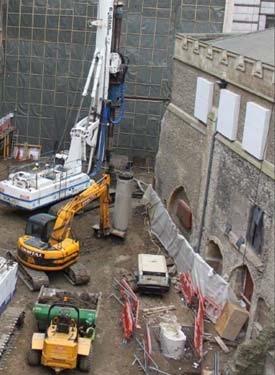
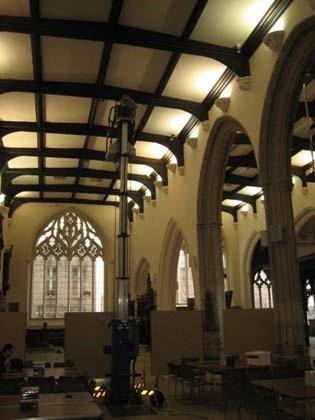
L EFT: Photograph of St Helen’s church after demolition of the neighbouring building and during piling, with the location of the window boxes shown in white. RIGHT: Photograph of mobile working platform taken during the survey with camera mounted on tripod on the access platform
preparation, appearance, content and limitations of the schedule as well as other factors which might arise. This is not intended to be a ‘yes’ or ‘no’ flow chart, but more of a brainstorming exercise. Some issues might be applicable, others not, but the idea is to think about the reason why the schedule is being prepared and to ask the right questions. It is all too common for an inexperienced surveyor to be sent out to prepare a schedule having no idea as to the extent of the planned works, let alone the notifiable works or their likely impact on the neighbouring properties. Obviously, understanding this will come with experience, but a little thought at the beginning could prevent disputes further down the line and in extreme situations prevent a surveyor scheduling the wrong building altogether. (Yes, this has happened!)
To help put some of the points into context, I have provided below extracts from a recent schedule of mine as an example.
We are acting for the developer of a large central London site. The proposed works are the demolition and redevelopment of the
site which immediately adjoins an ancient and prestigious church in the City of London (St Helen’s Bishopsgate) considered vulnerable to the works proposed. The notifiable works include piling for several basements within metres of the Church’s rear wall, easily within the 3 metre & 6 metre criteria of section 6 of the Act, as well as cutting away where previously enclosing upon the church and therefore involving section 2 provisions.
A short meeting on site at the church revealed an internal solid plastered and painted stone wall with integral monuments and numerous hairline cracks. There are extremely delicate stained glass windows at high level, of immense importance to the church and which overlook the site. The ceiling is double height with a mezzanine floor to one end and the conditions for flash photography are very poor and would diminish the ability to record the fine cracks evident to the walls and ceiling.
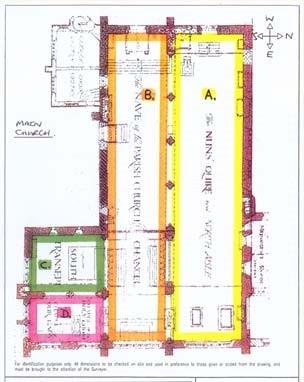
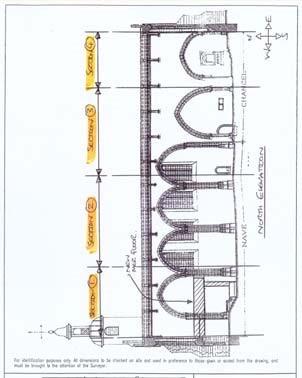
A decision was made early on to schedule the whole of the church utilising the mobile access platform which the church own and store on site for maintenance purposes. A health and safety briefing was provided by the church staff and we were then free to use and operate the
LEFT : example of church floor plan broken into areas. RIGHT: Area B broken into manageable sections which was governed by the reach of the platform.)
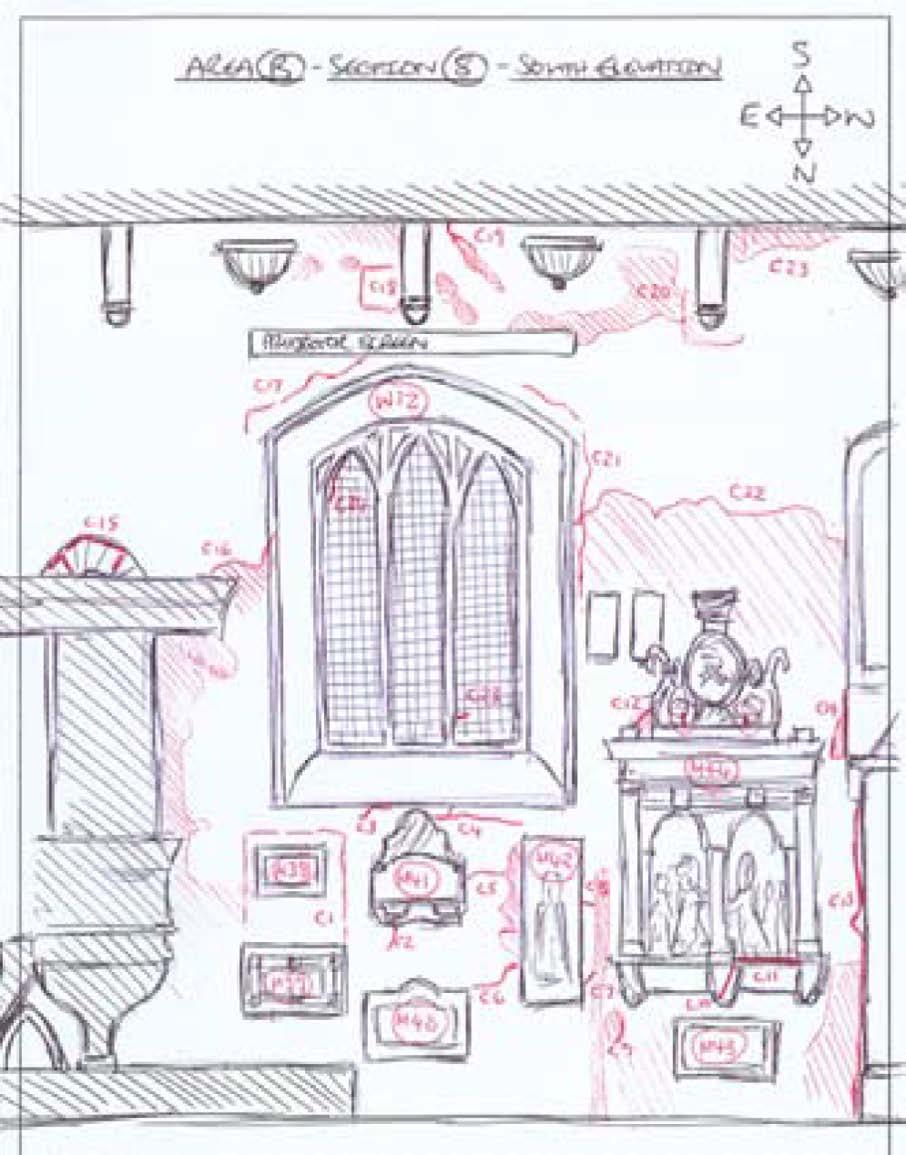
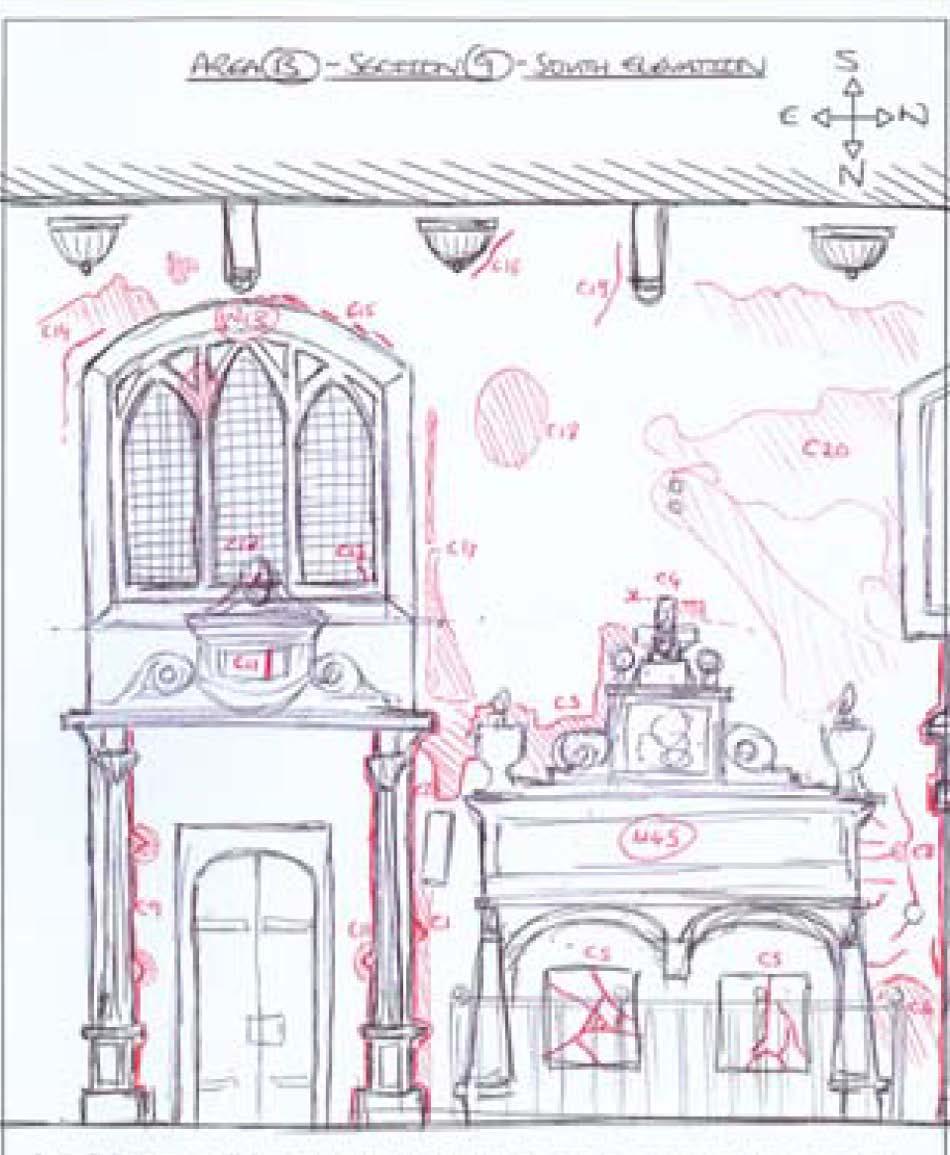
equipment freely. This allowed accuracy and greater efficiency than the use of binoculars but also allowed closer and more detailed photographs to be taken. The schedule was dictated and included real time sketches of the walls and ceiling which were broken first into areas and then more manageable smaller sections. These were cross referenced to relate to historic record drawings sourced from the church and, together with the descriptive text and photographs, comprised the schedule.
Special attention was paid to the flank wall of the church where the BO’s property was to be removed and especially to the fragile stained glass windows. These were flagged up to the BO and additional measures during the works were adopted. These were in the form of ply boxing being placed externally with lighting fixed on its internal face to form a light box. This therefore protected the glass, but also retained the appearance of the windows without burdening the church in terms of light loss during the works.
The schedule was undertaken with the assistance of a colleague to prepare and move the access platform as well as the photographic equipment. I would sketch the next panel and record the defects at low level in preparation to hand over to him to record the next high level section. This worked well by allowing a rhythm to develop and ultimately produced a very detailed and accurate schedule of condition, whilst also providing valuable training and guidance to a surveyor not used to large complex buildings.
The schedule was compiled over a couple of weeks, due to the mixed use ministry activities within the church preventing access at particular times. This shows why following a clear plan and breaking a schedule down into manageable chunks is necessary. This also ensures the document is clear and well-structured to allow the surveyor checking it to do so easily. In this case we had some time before the works commenced, and we agreed the schedule should be completed in full and then handed over for checking in its entirety. Very few comments were received bearing in mind its size and detail.
A typical scenario for any job (albeit a hypothetical example) would be when during demolition works a call is received from the BO (i.e. your appointing owner) or the adjoining owner’s surveyor, to advise that a large crack has been noticed to one of the ancient monuments within the church and that they are concerned that the works have
caused it. If such a complaint is made I will arrange for an inspection of the alleged damage, and armed with the schedule I discover that there is indeed a large crack to the base of the monument (labelled M44 on my sketch 30) and the description within the schedule reads “To the base of monument 44 to the central curved capital detail there is a large fracture through this extending from 1mm at its base up to almost 3mm where it meets with the plinth to the main monument itself. This has been labelled as crack No.10 on the attached drawing.” With this level of detail I can be satisfied that the crack is indeed existing and unchanged in appearance and size. The AO, who is usually peering over your shoulder at this stage, is now suitably impressed by the accuracy of the work and is fully reassured that he is in safe hands.
It is very common for owners/occupiers of adjoining properties suddenly to notice cracking or damage to their properties, which has in fact always been there, when building works commence and noise and vibration occur. Even though the owners/occupiers would have received a copy of the agreed party wall award with the schedule appended, they may still believe that all damage is new. I have, and still do, take the time to point out some of the more serious or obvious cracks or damage present to the AO or occupiers before leaving the property. A brief summary is given of my findings so that this type of scenario might hopefully be avoided. Nine times out of ten their response is “well I never noticed that before”.
Notably with this particular job works are underway and there has been a recent query concerning one of the arches which would normally be considered to be remote from the works and would not have been scheduled. In this instance, because of the importance of St Helen’s church and the extent of the works, we had scheduled the whole building. As it happened, we managed to locate the defect following receipt of an emailed photograph and could easily confirm its existence photographically and descriptively, but it was also illustrated on our sketch. This saved time and put minds at rest.
There are times when there will be damage and our job will be to record it and then liaise with the AO and their surveyor to determine the remedy appropriate to the situation. In most cases involving minor cosmetic damage, this is dealt with on completion of the works. In this instance, a contribution towards the cost of redecorating a particular wall or, if considered necessary,
L EFT: Example of sketch attached as reference material (Section 8 within Area B) with monument, window and crack references added and cross referenced within the body of the schedule) RIGH T: Further example of sketch attached as reference material (Section 9 within Area B) with monument, window and crack references added and cross referenced within the body of the schedule)
the room will be calculated and awarded by the surveyors in lieu of making good. This is usually the preferred course of action for the AO and his surveyor, especially when dealing with residential adjoining owners, where tensions usually run high. In my view it is better for all concerned that the matter is not prolonged by asking the contractors to go in and undertake the making good works.
The topic of damage and remedy is not usually as clear cut as I have suggested. Factors such as “betterment” spring to mind in terms of repairing more than what would be reasonably expected, a subject which would probably require its own chapter. However, I shall conclude by saying that in terms of St Helen’s church, the decision process which I followed and the level of detail and accuracy which was adopted perfectly balanced the needs of both the BO and AO and it is balance and impartiality which follows the spirit of the Act. During my many years recording and compiling schedules of condition there seem to be few surveyors out there who are capable of producing an accurate and suitably detailed
schedule of condition which strikes a balance between both owners’ needs, and which all of us have to rely on. I really do hope the reading of this article positively helps them with the structure, content and future presentation of schedules.
Christopher Skelt BSc FRICS MPTS c.skelt@point2.co.uk
First published in Whispers 26 Summer 2014
Answers! Patience’s Christmas Crossword
ACROSS
1 Always required, never requested, says Minting (8).
4 Great for one’s affairs! (6)
8 Got to wait, mate (10)
9 Good old Ed’ (4)
11 The rarest of replies (7)
14 Be it _____ by the Queen’s most Excellent Majesty… (7)
16 (f) and (j), oooh matron! (6)
17 Notice complies with this subsection if __ __ . (2, 2) (Don’t misspell this one!)
18 With the advice and consent of the Lords Spiritual and Temporal, and ________ (7)
19 Appears before 6 Down (2)
21 Prosecute your diligence with it (3)
22 By such of the parties
23 Applies to a Bomber and a Crop wall (5)
26 Time of the (5)
28 Is the (middle class) person so ____ (8)
30 In right of his (5)
31 Level 3 on the (8, 5)
DOWN
1 A right at 12(a), you say? (7)
2 Are we still using this stuff (following the 2016 Order)? (5)
3 Must (5)
5 Sells stolen goods (5)
6 Have you appeared? (5)
7 Not again! (4)
10 They want alternative what!? (12)
12 Satha & Bengelloun Zahr argued over it (5)
13 S.2(7)(b) the parapet must be _____ (6) but… 29 ____ not exist before. (3)
15 Where Jesus arose, these arise.
20 Entry?! Only in the rear, surely (8)
22 The Act affords them (6)
24 Appears in the Act, and now on email signatures too! (3)