JOURNAL
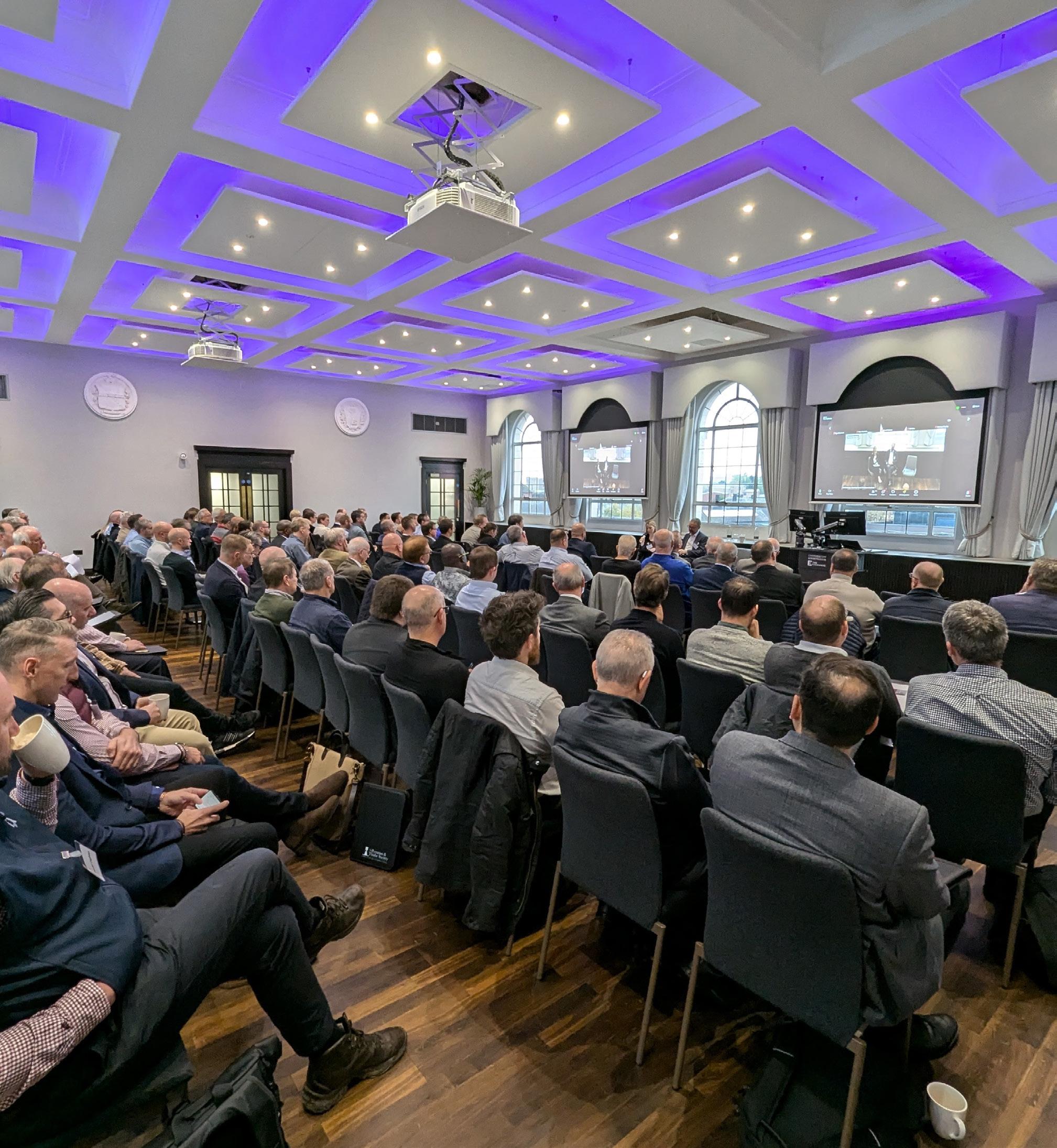
THIS EDITION OF THE P&T JOURNAL brings together a wide range of articles, and reflections relating to the continuing good practice of party wall work. As the Society continues to grow on the foundation of expert knowledge and a vast knowledge base of common experience, we are privileged to be in a position to share all this with others, notably, members of the public. I hope you find this issue both interesting and useful, whether you are a seasoned practitioner or a person encountering the Act for the first time.
Welcome again!
You are particularly welcome if you are a member of the public, a person about to carry out work to your premises, someone who has received a notice under the Party Wall etc. Act 1996, a developer, or someone in a difficult situation arising because of trespass, or other neighbour building misdemeanours related to the Act.
Get in touch with us! We are here to help, to listen to your predicament and to offer advice based on over fifty years of accumulated experience and knowledge.
On the other hand, perhaps you are a person who is simply curious about the Act, its working and any associated aspects, such as scaffolding access on your land, shared rights of way, party walls, of course, and any other affiliated aspects of building construction.
We are an enthusiastic and dynamic diverse and unified body with the same interest in mind: To be the best party wall practitioners possible, and the best first-aid stop for any query or problem you may be facing concerning the Act.
Accolades or Complaints
We thank you, those who have contacted us and received a satisfactory response. I am aware of quite a number of expressions of gratitude from people who have called our helpline and have left better informed and encouraged.
Difficult to report, but, from time to time we have received complaints concerning party wall surveyors falling -let us say- a little short of our expectations and the standards we all expect of them. I would like you to be aware that, in the unlikely event that such a surveyor should be a member of our Society, we would very much wish to hear of your complaint and hopefully ameliorate the situation. Our members abide by a protocol which appears in the ‘About’ page on our website.
Find out more about us click here or our LinkedIn page
Once again, I would like to congratulate and thank the Journal production team, who devote not only to the Journal but to other key Society publications guided by their very able Publications Officer. We are grateful for their hard work and the results it has produced.
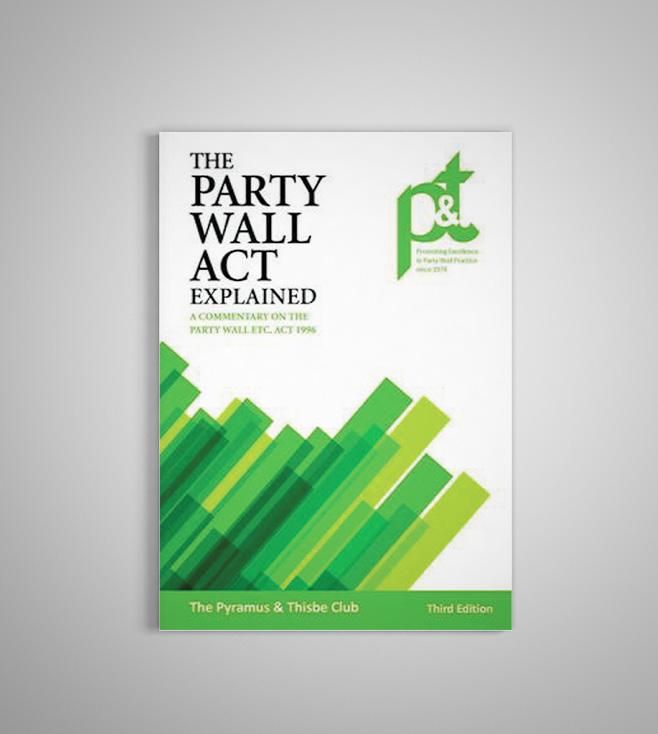
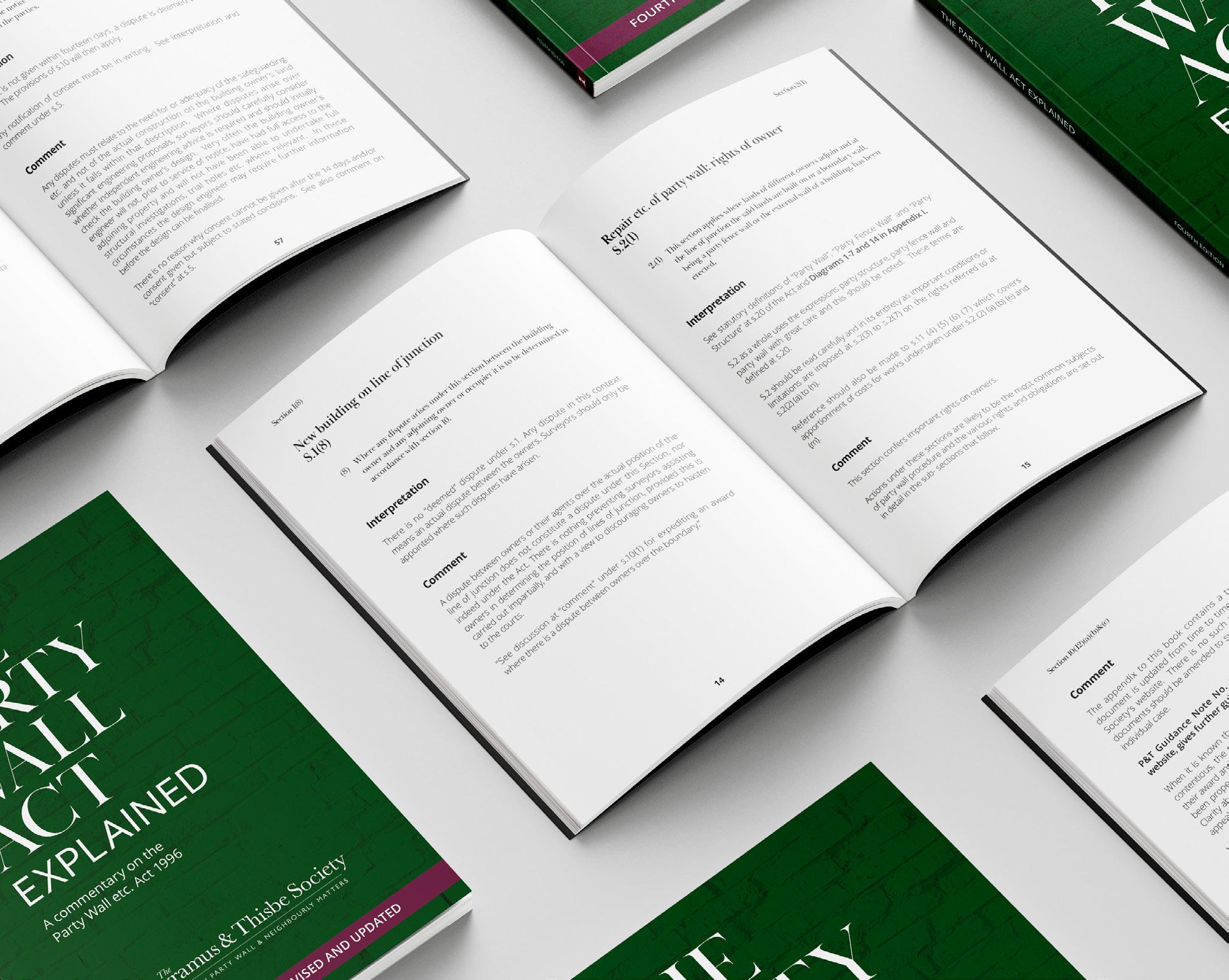
A significant highlight of the period was the publication of ‘The Party Wall Act Explained’, affectionally known by members of the Society as “The Green Book”, being the result of the hard work of a Society working group and the kind and valued advice of the other eminent experts consulted.
The book, being a guide both for members and nonmembers alike, was practically re-written; it contains considered explanations and reflections of some of the leading legal and surveyor brains in the party wall world. I encourage you to obtain a copy, whether you are one of those who needs more understanding of the Act, or whether you are a seasoned practitioner in party wall matters. The book, which is only available in hard copy, may be ordered Click here
I would like to end with a note of huge gratitude to each member of the Society. Whatever level of membership, we all share an interest by our investment in the Act and love of our Society, the building of which is a continuing and developing process which we all share with our usual ‘humble pride’.
Looking ahead, we continue to advance by strengthening our role as the leading voice in party wall practice: maintaining and raising standards in all aspects of the profession and conducting ourselves whereby the public continues to perceive us as a trusted source of knowledge, theoretical and practical, delivered without partiality.
I am genuinely thankful to be part of a Society made up of some of the finest people one could hope to meet, and I look forward to what we will achieve together in the months and years ahead.
Fareed N Fetto FPTS CEng MIStructE CBuildE MCABE MFPWS AaPS
National
Chairperson
The Pyramus & Thisbe
February
2025
Society











T HERE ARE SEVERAL LEVELS OF MEMBERSHIP OF THE SOCIETY DESIGNED TO BE INCLUSIVE FOR ALL persons who have an interest in the Party Wall etc. Act 1996 and a desire to further their understanding and know best practice. The levels of membership are:
Student
An Individual engaged in study of a recognised professional construction qualification.
Associate
All new applicants to the Pyramus & Thisbe Society required to complete a minimum probationary period of two years after joining (the date of joining the Pyramus & Thisbe Club if relevant), before applying for promotion to become a Member, subject to meeting the relevant criteria.
Member
a) Previous members of the Pyramus & Thisbe Club with two years membership at the transition, entitled to use the post nominal MPTS.
b) An Associate who has made a successful application to be a Member of the Pyramus & Thisbe Society, and who is entitled to use the post nominals MPTS
c) Fellows of the Society who have relinquished their Fellowship status, entitled to use the post nominal MPTS
Affiliate
Individuals involved in the administration Party Wall etc. Act 1996 other than as appointed or selected surveyors, such as lawyers and engineers.
Fellow
a) Members of the Pyramus & Thisbe Club with two years membership at the transition and who are involved at branch level as Chairman, Secretary or Education Officer or, in the case of the London Branch only, a member of the committee. Entitled to use the post nominal FPTS
b) Individuals who have been Members of the Society for at least two years and are preferably, but not necessarily professionally qualified members of a construction industry recognised organisation e.g.: the RICS, RIBA, IStructE, and who have been involved in the Society as a Member at local or national level and making a positive contribution to the Society. Entitled to use the post nominal FPTS
Individuals who have demonstrated exceptional commitment to the Society. Entitled to use the post nominal FPTS (Hon).
Retired
Individuals who were previously Members or Fellows of the Club or Society, who retire from practice and wish to continue their membership and contribution to the Society. Retired Members and Fellows members are entitled to use the post nominals MPTS (Ret) and FPTS (Ret).
Chairperson’s Report to the Fellowship Annual General Meeting February 2025
WHEN I SAY I FEEL BOTH HUMBLED and honoured to be looking forward to standing before you for the third time, I truly mean it. Other emotions kick in: those of accountability (if it goes wrong it’s my fault! It was my watch!) and those of discerning and meeting your expectations. The weight of responsibility and of our common drive to maintain the Society as the Learned Society in what we profess have both increased over the years. This is not a bad thing at all. The greater the challenge, the greater our response.
The annual Fellowship meeting is a good opportunity to review where we have been, what we have done, how it is now, and where we are going. To help me (us?) understand this better, I have recruited the “Five Ws and an H”:
Who
▶ How we see ourselves,
▶ How the profession sees us and
▶ How the public sees us.
What
▶ That is easy: we are a Learned
▶ Society.
▶ Yes, but what does that mean?
[For ‘Society’] I looked up my Shorter Oxford Dictionary and found under definition III:1 “A number of persons associated together by some common interests or purpose, united by a common vow, holding the same belief or opinion, following the same trade or profession etc;”
Highlights from the definition of ‘Learned’ include the inference of being learned because another learned person deems you so, also, of connection characterisation and manifestation of profound knowledge of the subject (my transliteration).
(Extracted from my 2024 Journal foreword)
Why.To:
▶ Learn
▶ Master (or at least be competent)
▶ Teach in-house
▶ Inform and enlighten out-of-house
▶ Join with others seeking and achieving a high standard of professionalism, being associated with them and following their example as models of good sensible and proper practitioners.
▶ Jealously protect and promote good, honourable and professionally courteous practice.
▶ Have a strong voice in the development of the profession, at large and with persons involved in the legislation / legal aspects of the profession.
▶ Liaise with other associated or similar professional organisations for better understanding and accommodation of our respective services.
Where
▶ Nationwide, of course.
How
▶ Commitment!
There is much to analyse and discuss from the points raised above, and I have not listed all that was on my mind. I leave those thoughts for further discussion and consideration.
Yesterday, Today and…Thank you!
Marker to Marker
The line of vision between two marker buoys is a straight one and a tried and tested practical form of marine navigation. How do I know if I am sailing in a straight line? I look back to the marker buoy I have just left, and look ahead to the marker buoy I am aiming for. Consistently. To look forward effectively and efficiently, I have to keep looking back to stay on track -an interesting proposition.
At the last Fellowship meeting we watched as three significant Management Board members stepped down; ones who had devoted decades to the Society and who formed part of the group who originated the vision.
The retirees were very active members of the management board. Their absence was acutely felt and the board, for a while, having lost some of the wind in its sails, took a little time to start navigating again.
We were grateful that not all the ‘greats’ left last year, but sad to note that another two significant members will be stepping down this time.
To those who have left, we say:
“We miss you and appreciate all you have done to have brought us to this point” and to those leaving we say:
“Thank you for helping and supporting us over the past year. Your contribution has been very concrete and very much appreciated.”
We say “Thank you” to those who have dedicated and continue to dedicate themselves to the Society whether on centre or backstage. You are truly much appreciated. It is reassuring to know that we may still call upon the retirees upon need. For your additional information, Stuart will be remaining on the Board in an ex-officio role. So there will still be some grey and silver on the Management Board. Do not begrudge them (the silver hairs!): I remember when I thought I knew it all at 30!
You will no doubt note from the agenda for the AGM that we are proposing a new position on the Management Board, that of a Diversity and Inclusion Officer. We feel this to be a pertinent development for the Board and hope you will agree to the position with your vote in favour.
In addition, hats off and much gratitude to Ada and her team, an ever present source of encouragement and much valued help and support.
So, in the here and now, and if you prove kind enough to vote in the nominees the Board has proposed, we will have a group of nine members, of whom seven will be well below 60! We do hope you will vote them in.
The nominees have written short statements of introduction included in this report pack. In the meantime, I would like to let you know that, having been warmly welcomed among members of the Board, they have sat and communicated with us for a few months. Not only have they been welcome guests but they have both contributed valued opinions and demonstrated ample capability of taking on the roles we hope you will vote them into.
and the Future (points to consider / agree-disagree with / to discuss at the meeting)
The following is part of my personal wish list for the Society in the coming year:
▶ The Society continues to set and raise the standard in Party Wall and Associated Matters
▶ Expansion into Associated Matters
▶ Lead rather than applaud AI developments
▶ Slight (or, if it were left to me, big) shift from overlegalism into good practitioner professionalism
▶ Promotion or at least information about the Mediation Scheme
▶ Website development tailored to changing needs and trends (a continuation)
▶ Social media stronger presence (linked with above)
▶ Media Officer (linked with website, social media and Society Spokesperson)
▶ Ways and means to achieve a stronger member commitment in serving the Society
▶ More support promotion and encouragement for Branches, learning from Branches,
▶ Review the Constitution and other protocols -details to follow
▶ Stronger presence and voice against bad practice and fraud
▶ And much more besides….
Officers’ Reports
With this report, you will find reports from the other officers, from which we can see tangible and effective progress:
▶ Secretary’s Report
Matthew has provided a useful concise and informative roundup of the events of 2024 with style. It seemed to me that every item on the report was a highlight. We are still going through a transition period, and it is hoped that by the next meeting there will be further significant highlights to report.
▶ Education
If we were pressed to encapsulate our vision in one word, I should have thought that would be the word “Education” – educating ourselves, educating others. Here are certain highlights which struck me from the Education Officer’s report:
▶ CPD events increasing in number, enthusiasm and energy,
▶ Regional and National Conferences – big hits in 2024.
▶ Ready access to recordings on Spotify
▶ Vision: Objectives for the year ahead.
Gratitude and appreciation to Stuart for bringing us to this point.
▶ Publications
This goes hand in hand with Education as it is an effective way to spread knowledge and to promote the Society. I saw the following in lights:
▶ The Annual Journal -an innovation and a successful publication
▶ Whispers, a valued periodical, an original -what would the P&T be without it?
▶ Guidance Notes – diligently on course
▶ The Law Library -a treasure of precedential information
▶ The Green Book, out in the Spring, thanks to a diligent and dedicated team but especially to one Michael Kemp whose investment and energy in the project has been immeasurable.
▶ Vision.
Gratitude to David for doing all the heavy lifting to bring us to this point.
▶ Finance
Ah, but can we afford it?! Just one highlight:
▶ “I am pleased to report that the Society is in a healthy financial position”
▶ Website
There is no escaping the fact that the website has been troublesome in the past, while it is great relief and pleasure to note the upbeat Website Officer’s tone. Together with the valued help of Ada, the website has hopefully now been pushed out of the mud and cleaned up for a better future. The synchronisation between Find a Surveyor and the member database should make a significant difference, while the main highlight I derived form the report was:
▶ The encouragement of Branches to develop and keep up to date and constantly enhance their individual pages.
The website is a very powerful tool forming a basis for development and enhancement keeping maintaining and raising the level of awareness of the Society in the ether world. I would emphasise the encouragement for Branches to take up the baton, and soon!
▶ Membership
Similarly, it is acknowledged that there has been a drop in membership, but, as mentioned in the report, this has not caught us by surprise. The transition from a Club to a Society is somewhat radical and I have no doubt that as the Society develops it will become more attractive to new and seasoned practitioners alike. Highlights include:
▶ An easier way of filing cpd returns
▶ Addressing difficult points (complaints, transfer of memberships, and such like).
To my mind, the reports make very good reading and provide encouragement for the future. I would mention that there is a great deal of activity and work continuing behind the scenes with some interesting ideas which will be presented in due course. Your comments will always be appreciated.
Officers who have completed their first year on the Management Board are to be truly congratulated and thanked for the way in which they have occupied their positions and for the contribution they are making to the Society, with equal regard to those who are staying the course.
According to my stock-taking, I would say that the Society is proving a success, thanks to the dedication of every contributing member. I believe you would agree with my wish to thank the Management Board members, past, and present, notably those who at this meeting mark their first year. In addition, but to no lesser a degree, I repeat thanks to every member who has devoted time and effort to the Society, and I would like to thank you for joining us to build and expand the Society. Looking back at the buoy we have left, I would not wish to close this report without giving honour to the founders of the then Pyramus & Thisbe Club, and the visionaries who have caused it to flourish into an amazing Pyramus & Thisbe Society. Thanks and respect rendered.
Fareed N Fetto FPTS CEng MIStructE
CBuildE MCABE MFPWS AaPS
National Chairperson
The Pyramus & Thisbe Society
February 2025
Secretary’s Report to the Fellowship Annual General Meeting February 2025

2024 began with changes to the Management Board:
▶ Graham North stood down as Finance Officer and Jonny Callard took over the role.
▶ Derek Bates stood down as Membership Officer and Ryan Hannibal-Law took over the role.
▶ Andrew Schofield stood down as Secretary and yours truly took over the role.
2024 was the Golden Anniversary for the Society née club, and the Management Board were encouraging branches to celebrate the 50 years. The London branch held a celebration in September with Graham North as speaker. There was a very good turnout including some past members and many faces – sober and not so sober.
2024 was also national conference year for the Pyramus & Thisbe Society. The event was held in November and hosted by the East and West Midlands branches in Birmingham. This collaboration led to an excellent, sellout event with many on-line attendees.
2025 is looking like a bumper year for events as well with a branch conference already planned for East Anglia as well as a National Conference to be held in London. As a Learned Society we encourage other branches to up their CPD offering and we are there to assist in financing and resources to spread the message of best-practice nationwide.
But before we get ahead of ourselves…
One of the first (and not uncontroversial) decisions of the newly configured Management Board was to remove the requirement to attend 1 hour of CPD in person. This was to reflect remote working practices that have become the norm over the last few years, but mainly with a view to catering for members in branches outside London which cover broad areas and where sometimes travel to attend meetings is restrictive. We all agree that attendance in person is encouraged and agreed in principle to members inviting a colleague, etc. along to a CPD talk for free if they were curious about joining the society.
To reach a broader audience, the society also began recording further podcasts in the spring of 2024 and more recently. These have now been uploaded to Spotify, where the P&T Society has its own account, and we recommend that Fellows encourage members to listen. There are currently 4 episodes with 4 more to upload shortly and more to follow.
2024 was also a year where the Chairman and Michael Kemp undertook a tour of the regions to discuss amendments to the Green Book whose fourth edition is imminent. Michael’s input is never taken for granted and he is a connection between all the branches and a valued asset to the to Society, and Honorary Fellow. In respect of the Green Book, the Membership Board have given a ‘Vote
of Thanks’ to be passed to Michael Kemp, Martin O’Shea and the Chairman for all their hard work on this matter.
The Chairman has regularly reported to the Management Board of his visits to the branches with suggestions, etc. and will be continuing this open approach by meeting with the branch chairs prior to the AGM on 27th February. We encourage all branch chairs to arrive a little early, to do take advantage of this important forum.
It has not all been good news...
On a number of occasions this year the Society has reiterated its stance of not being a forum for advertising, whether that be book endorsements, solicitor services or pushing-back on requests to use Whispers for such purposes.
We have also had to take a stand against rogue operators advertising themselves as members, with the help of legal affiliates, whom members of the Management Board also met with to discuss concerns relating to their standing in the society.
Many may also not appreciate the efforts Ada Elliott and the IT & Website Officer put into solving issues raised by members. Examples include issues with payments and access to the website by Honorary Fellows along with repercussions of staffing issues from those the boffins that run the website. A lot of work goes on in the background and as the public face of the society this is all work deeply appreciated by the Management Board and users alike.
Finally, I bookend this report with changes to the Management Board…
As Education Officer, Stuart Birrell was on a mission to promote the Society to universities before he was ready to take a step back. This is now progressed with Michael Cooper & Jeremy Price and so Stuart is in a position where he feels he can hand over the reins. This means that we will a change in Management Board for 2025 with:
▶ Anne Lorenzato as the new Education Officer where Stuart Birrell is stepping back, although he will continue as an ex-officio member.
▶ Natasha Demirbag as the new Publications Officer where David Moon is stepping down.
▶ Holly Harris in the new role of Inclusivity Officer
We welcome these new Fellows who have agreed to give up their personal time to assist and promote the Society.
Matt Briggs BEng (Hons) PGDIP FPTS
Secretary
The Pyramus & Thisbe Society
February 2025


JONNY CALLARD
Finance Officer’s Report to the Fellowship Annual General Meeting February 2025
IAM PLEASED TO REPORT THAT THE SOCIETY IS in a healthy financial position. We have made the decision to raise the yearly subscription from £110 to £120 for full members and from £50 to £60 for affiliate members. This is after a long period of maintaining the previous annual subscription levels. We consider the increase modest and still extremely good value for our members.
We are planning another London based conference in Autumn 2025 and now other branches are starting to hold regional conferences. This is excellent progress, and we will continue to provide financial support and subsidies if necessary.
As previously mentioned, the Society is in a healthy financial position and we will continue to explore avenues to support branches financially with initiatives for learning and expanding their reach.
We will continue to welcome suggestions and please always feel free to contact me if you have ideas or comments to assist continuing our momentum.
I have been Finance Officer of the Pyramus & Thisbe Society for 12 months having taken over the role from Graham North. It is a privilege to continue to act in this role, and I look forward to the next12 months.
Jonny
Callard
FPTS MRICS Finance Officer
The Pyramus & Thisbe Society February 2025


RYAN J HANNIBAL-LAW
Membership Officer’s Report to the Fellowship Annual Meeting February 2025
THE MEMBERSHIP GROUP FOR THE YEAR 2024 comprised myself as Chair, alongside the following esteemed colleagues:
▶ David Bowden
▶ Adam Linard
▶ Stephen Mealings
▶ Derek Bate
I would like to extend my sincere appreciation for the unwavering support and contributions of each member of the group. Since the last report, we have experienced two departures from the group, prompting us to actively seek new members who can bring their expertise and insights to our efforts.
As of 31st December 2024, the Society currently boasts 942 members, under the following designations:
likely to include prevailing economic conditions and the requirement for contributions to Continuing Professional Development (CPD).
Continuing Professional Development (CPD) remains a cornerstone of our Society and is essential for upholding our commitment to excellence in neighbourly matters. In an effort to adopt a more accessible and inclusive approach, the Society has reviewed the requirements for ‘face-to-face’ CPD, now incorporating online meetings.
Throughout the past year, we have also received a number of complaints concerning certain members. These grievances, lodged by both members and property owners, have been diligently assessed to ensure that only issues pertinent to membership protocol are addressed, rather than general disputes. In alignment with the ethos of our learned society, we have generally issued recommendations in less critical cases to help prevent future concerns. However, in more serious instances, disciplinary measures have been enacted, including demotion of membership status and/or an increase in CPD obligations.
Fellows: 9
This year has marked my inaugural term as Membership Officer, presenting both gratifying and challenging experiences. The Society, particularly within the membership section, continues to evolve, and we rely profoundly on the feedback and engagement of our members to inform and shape our initiatives.
Regarding membership dynamics, it is noteworthy that our membership levels have encountered a slight decline since the transition from the Club to the Society. This trend was anticipated, and we remain confident that the core membership will not only be sustained but will also flourish and expand in the coming years. The underlying factors for this modest decline are
The Society has also processed several applications from members seeking to upgrade their status from Associate Membership to Member, and from Member to Fellow. Regrettably, we have been unable to advance a number of applications due to the applicants’ failure to provide the requisite supporting documentation. This highlights the necessity for enhanced communication regarding the prerequisites for membership status transitions, prompting a potential review of the wording and direction of our membership protocols.
I am grateful for the opportunity to serve as Membership Officer and look forward to continuing our efforts to enhance the Society’s membership experience.
Ryan J Hannibal-Law MRICS FPTS
Membership Officer
The Pyramus & Thisbe Society February 2025

Education Officer’s Report to the Fellowship Annual General Meeting February 2025
THIS REPORT TO THE FELLOWSHIP OF THE Society sets out the current status and progress in matters relating to education. It should be noted that this will be my final report as Education Officer as I will be standing down at the AGM.
Objectives
In broad terms the objectives are split into the following:
▶ Presentation
▶ Recording of presentation and podcasts
▶ National Conferences
▶ Regional Conferences
▶ Engagement with Further Education
▶ Engagement with other organisations
Presentations
Presentation frequency has been maintained following the dramatic increase in 2023/24 and most branches are holding sufficient CPD events to allow their members to comply with the membership requirements.
We do get observations / complaints from various members throughout the country regarding the timing and venues of CPD events. Whilst at National level we do not interfere with the branch’s organisation of such events, by holding events at the same venue at the same time every time does inevitably lead to some members being excluded.
Whilst there is no compunction to follow London’s lead, they have been dealing with this over the last few years. What happened was:
They addressed feedback and concerns from members, and then ran a consultation as to what events they would like to put on, where they would like them put on and what time of day.
Whilst it is not possible to keep everybody happy, as a result of the consultation currently London put on the following:
▶ CPD as presentations are split between breakfast meetings, lunch meetings (not with a sit down meal) and evening meetings.
▶ In addition they hold more formal lunchtime meetings (with a sit down meal) with a CPD element 3 or 4 times a year including the AGM.
▶ Ad-hoc extra events (such as the 50th anniversary of the Club).
Accordingly, as far as they are able, they have catered for everybody, and London currently offers over 800 places at CPD’s throughout the year.
As mentioned previously we are not suggesting that you follow this process, but all branches need to consider breaking things up a little bit, providing they can get sufficient numbers to support the events. It is important that we attract a new generation of Surveyors and as many of those practising party wall matters as we are able. If you need any advice and help on this, please contact my successor.
Regarding speakers we haven’t yet put together a list of people prepared to speak but this will be something that will be revisited next year. The Society has moved on with time and we need speakers from all branches to make themselves available to speak in adjacent branches. A circular will be sent out regarding this.
As mentioned last year if branches are having trouble finding speakers, if they could indicate subjects they would like discussed the Society will attempt to assist.
We constantly reconsider the matter of virtual presentations, it is something that each branch needs to consider individually rather than have a national policy on the subject. In principle there is no reason why this shouldn’t be arranged but it is the belief of the P&T Board that personal interaction between members is important. It would be a great shame if these were offered to the detriment of ‘in person’ events, but it would allow people who struggle to attend presentations either for personal or geographical reasons.
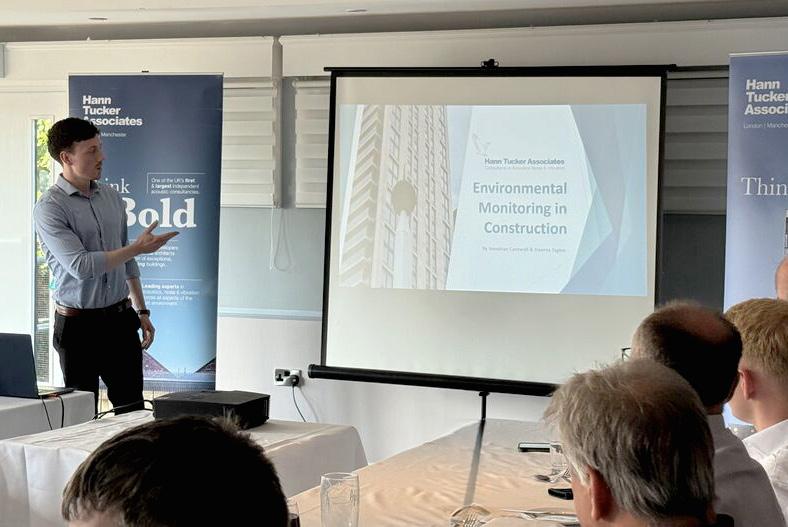
This has proceeded on a hit and miss basis. There are recordings of some London Branch CPD seminars available for purchase on the website, as well as the 2023 National Conference, and a couple more should be available shortly. However, the problem of producing good quality recordings without employing professionals has been ongoing.
Over the last year London has honed the production of these. A Spotify account has now been set up to host these, and 4no. episodes recorded in spring 2024 are now available to listen to. A further 4no episodes were recorded in November last year and will be available shortly. The original vodcasts recorded in 2021-2022 are still available to view on the website, via YouTube.
Further podcasts are planned for 2025, and we would welcome contributions from regional branches.
As before this has been a London initiative and I don’t believe any of the other branches have considered or attempted it. London branch would be happy to help with the logistics and give the benefits of their experience should anybody wish to contribute.
In the formation of the imminent new Green Book a few matters came to light where interpretation of the Act
would differ from region to region (the current Act is a development of the previous Act and the London Building Act and it is very London centric). So it may be good to get some podcasts on the differing experiences from different regions perhaps this is something we can discuss nationally. As an example, London is founded primarily upon clay or gravel and therefore Notices of Adjacent Excavation are formulated accordingly. How does this alter when you are on bedrock! Coordination between the branches would be appreciated to put together something along these lines.
Our second National Conference was held in Birmingham, hosted by East and West Midlands in November 2024. The organisers were concerned about filling the spaces and were conservative in the size of the venue. In the event it sold out weeks in advance and the organiser subsequently sold virtual access to the Conference. The ‘live’ audience was made up by members of many branches as well as those local to Birmingham. The conference was well received and very successful.
The next National Conference will be held in London, on 5th November 2025. The matter of virtual attendance / recording is being considered at present.
All Branches have been asked to register an interest in hosting the 2026 Conference and we await the response.
The intention, providing that the branches are keen to get involved, is that every other year it will be held in London and in the intervening years in one of the other branches. If anyone is interested in assisting in the organisation of the Conferences, please contact us and we will put you in touch with the relevant people. It is envisaged that organising Committees will be drawn nationally and not confined to the hosting branch / branches.
In addition to the National Conference regional Conferences are planned. The Cambridge, Norfolk, Suffolk and Essex branches are planning a regional Conference in March next year, details to follow. Other regional events will no doubt be planned throughout the year and the Society encourages this.
London Branch are planning a smaller ‘mini-conference’ on 15th May 2025, which will aim to cover the more periphery subject matters often associated with party wall matters.
After a couple of years of inaction this is moving forward however Universities have a mixed reaction to our offers to help. On a positive note we recently heard that in Severnside, their approach to invite students to P&T events has resulted in Dan Tapscott being asked to give a lecture at the University. If anybody is interested, wants to do this or has an opportunity the Society can help with slides and other information.
It is intended to expand this to educational establishments/providers generally, to include all levels of education.
Our reengagement with the RICS is proceeding reasonably well given the limitations of the RICS. Members are on the committee dealing with the revised practice / guidance notes being updated and our offer of assistance with complaints remains open. However the RICS’s general problems in dealing with complaints against members continues.
On a more positive note, the editorial committee of Modus (the RICS’ external publication) contacted London branch Chair Hannah Boyd and Secretary Jack Norton regarding an article on the P&T which went into the November edition and was very positive in terms of Society.
Objectives for 2024 / 2025 were listed as following:
▶ Run a successful Conference in East / West Midlands in 2024 – Successfully completed in November, very good response a well received and attended conference.
▶ Work with London branch to start organisation of Conference in 2025 – In progress, venue to be booked shortly.
▶ Continue to develop the infrastructure and expertise to enable presentations to be recorded and subsequently uploaded to the website – We have still struggled to record presentations without professional help there are some recordings available but it is quite an expensive exercise. Podcasts have been recorded and are available.
▶ Continue to work and get these presentations on the website – It was not practical to put them on the website due to the size of the files but alternative arrangements are in place.
▶ Continue engagement with other organisations such as ICE and RIBA – This has stalled we really need P&T members who are members of these organisations to ‘get us through the door’.
▶ Continue to liaise with RICS regarding recognition of our expertise – We have continued to work with the RICS to further the status of the Society, this is an ongoing matter.
▶ Complete engagement with Universities – Initial engagement has been completed results are mixed we will continue to explore possibilities.
▶ Run a successful Conference in London 2025.
▶ Receive expressions of interest to run a Conference outside London in 2026 and work with successful Branch(es) to commence organisation of 2026 events.
▶ Continue to explore possibilities of recording presentations and providing virtual presentations.
▶ Continue to produce Podcasts, hopefully including some on matters outside London.
▶ Continue engagement with other organisations such ICE, RIBA.
▶ Continue to liaise with RICS regarding recognition of our expertise.
▶ Continue engagement with universities.
Stuart Birrell FRICS FPTS
Former Education Officer
The Pyramus & Thisbe Society February 2025


HANNAH BOYD
IT & Website Officer’s Report to the Fellowship Annual General Meeting February 2025
OVER THE PAST YEAR WE HAVE CONTINUED to iron out some of the technical glitches with the website, and maintain the performance of the existing functions. Last year we engaged an external consultant to review and report on some of the recurring problems, and he spent some time working directly with our website developers to resolve these. Ada has dealt with the vast majority of day to day queries, and I am very grateful for her time, support and patience.
Work is ongoing behind the scenes to make changes to Find A Surveyor functionality and how it links to the main CRM database, and we are also reviewing the membership sign up and upgrade processes.
The website Branch pages are still under-utilised, and I would encourage Branch Officers to update these as regularly as possible. This is an opportunity for individual Branches to promote themselves and their events – a useful tool for potential new members. If anyone requires assistance, or would like some further guidance, please do get in touch, I will be happy to help.
All P&T events from all regions are now being promoted on LinkedIn, and over the next year we are hoping to engage an external Social Media Manager to build our presence online.
Please do get in touch with any constructive feedback you may have.
Hannah Boyd MRICS FPTS
IT/Website Officer
The Pyramus & Thisbe Society February 2025



DAVID MOON
Publication Officer’s Report to the Fellowship Annual February 2025

IWILL STAND DOWN AS PUBLICATIONS
Officer at the AGM. Natasha Demirbag has been nominated to take over the role. I very much hope that the fellowship will ratify Natasha’s nomination which has the full support of the management board. Natasha has been a member of the Whispers editorial panel for several years and has been editor in chief for the last three years, overseeing production of Whispers and The Journal. This report to the fellowship of the Society sets out the current status of the Society’s publications projects and proposed developments during the coming year.
The Society’s publications comprise the following;
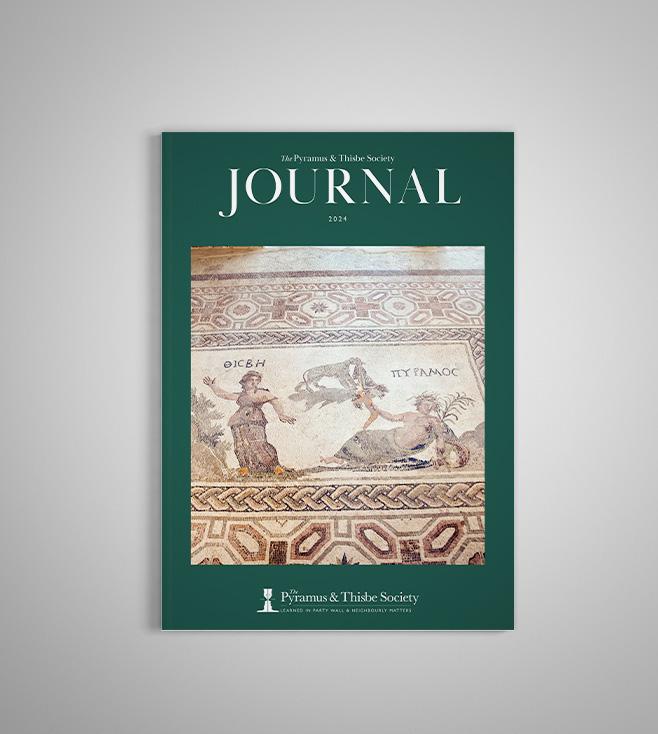
▶ Learned Society Journal,
▶ Magazine (Whispers),
▶ Guidance Notes,
▶ Law Library,
▶ Society Archive
▶ The Green Book,
▶ The White Book,
▶ Other Publications Projects.
Whispers and the Learned Society Journal
Whispers continues to serve as the Society’s magazine and appears on the members’ section of the P&T website. The Journal presents the public face of the Society as a record of the Society’s proceedings and is published annually. It appears on the public access section of the website. The editorial panel for both publications is chaired by Natasha Demirbag. Other members of the panel are; Shirley Waldron, Angela Gregson, Irene Moore, Allan Ssesanga, Nick Brown, Tony Guerguis and Mike Clark. Issue 53 of Whispers is the latest edition available on the Society website. The second edition of The Journal was published in the autumn of 2024, following the Society’s AGM. The editors aim to produce three issues of Whispers and a Journal annually.
Guidance Notes
The working party is chaired by Geoffrey Adams. Other members are; Trevor Hultquist, Darren Frias-Robles, James Beat, Philip Hurst and Ashley Patience. Good progress has been made during the current session. The majority of existing Guidance Notes have been reviewed and brought up to date. A new GN on the assessment of damage has been added. It is expected that the review will be completed during the first quarter of 2025. The revised Guidance Notes are added to the website as they are completed.
The working party is chaired by Tony Fieldhouse.
The surveying members are; Shirley Waldron, Aiden Cosgrave and Alistair Gill with Victoria Woolf and Howard Smith serving as the legal commentators. The working party has produced a format for the library which will include a link to the judgement in each case together with informed commentary from the surveying and legal panel members.
Following Holly Harris standing down to focus on diversity and inclusiveness initiatives for the Society, Irene Moore and Allan Ssesanga have taken charge of the Society’s archives.
The Green Book working party is chaired by Fareed Fetto. Other members of the working party are; Martin O’Shea, Mike Clark, Rob French, James Beat, Stuart Cobbold, Michael Kemp and Irene Moore. The WP has completed its review. An agreed text was produced before Christmas and is now undergoing final proofreading before being sent to the printers. The new, fourth edition is expected to be available in the spring. The board of management is considering whether the Green Book should be offered in digital form as well as hard copy. The Board’s recommendation will be made to the fellowship when the book reaches publication stage.
A decision was made by the management board not to produce the White Book in hard copy for 2023/24 and subsequent years. The production and postage costs were considered prohibitive.
The P&T Society has been invited to assist with the preparation of a guidance note for surveyors practising in Ireland under the Land and Conveyancing Law Reform Act 2009. The working party of David Moon, Stuart Birrell and Michael Cooper met the SCSI panel for the first time via video link on 3rd November 2022. Further meetings followed. The P&T panel issued a summary of initial recommendations in August 2023. A further review is imminent following redrafting of the text by SCSI.
In closing my report, I offer my thanks to the management board and members of the working parties for their support and good fellowship during my term of office.
David Moon FPTS(Hon) Former Publications Officer
The Pyramus & Thisbe Society January 2025

Conference 20 24
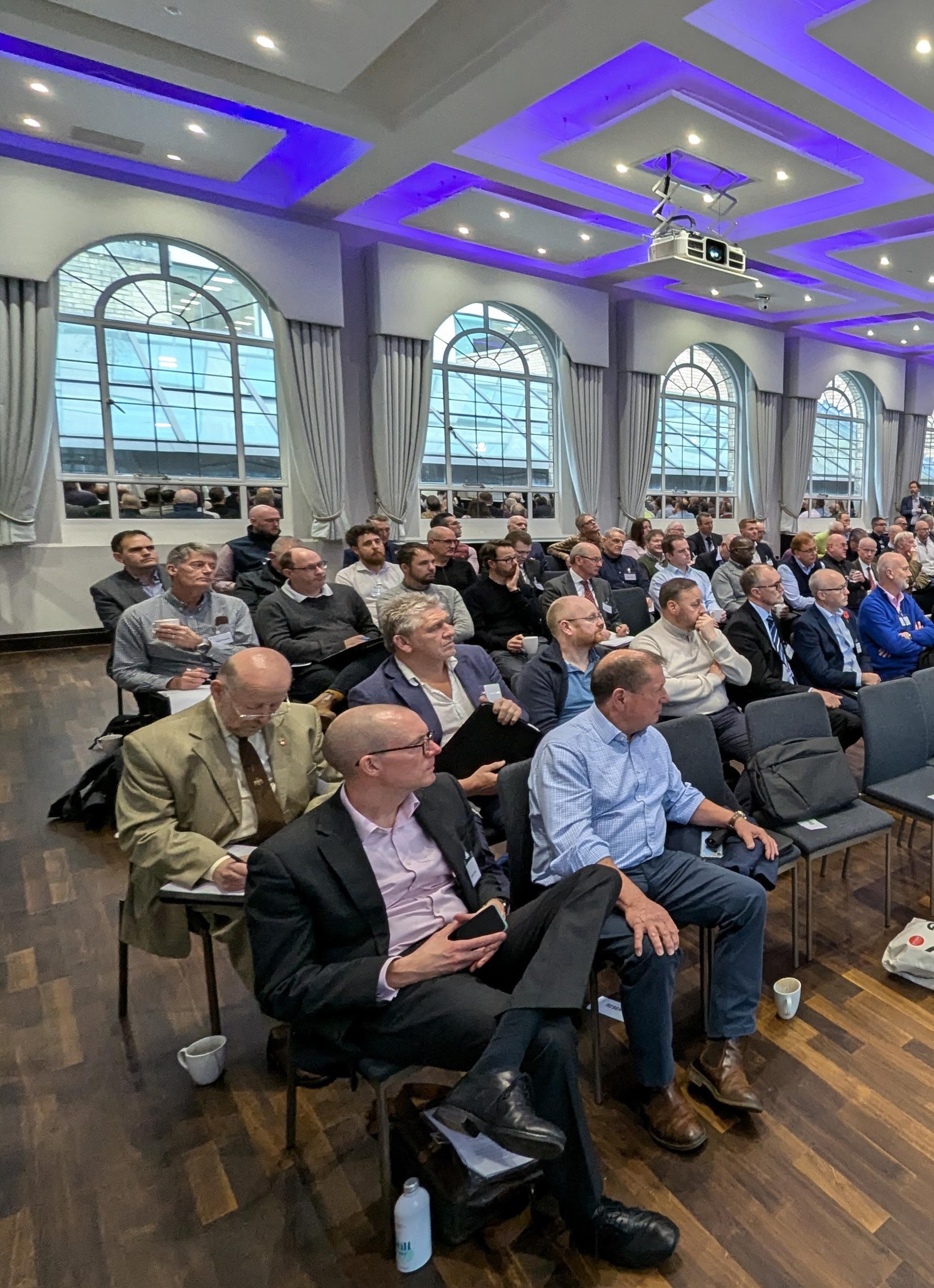
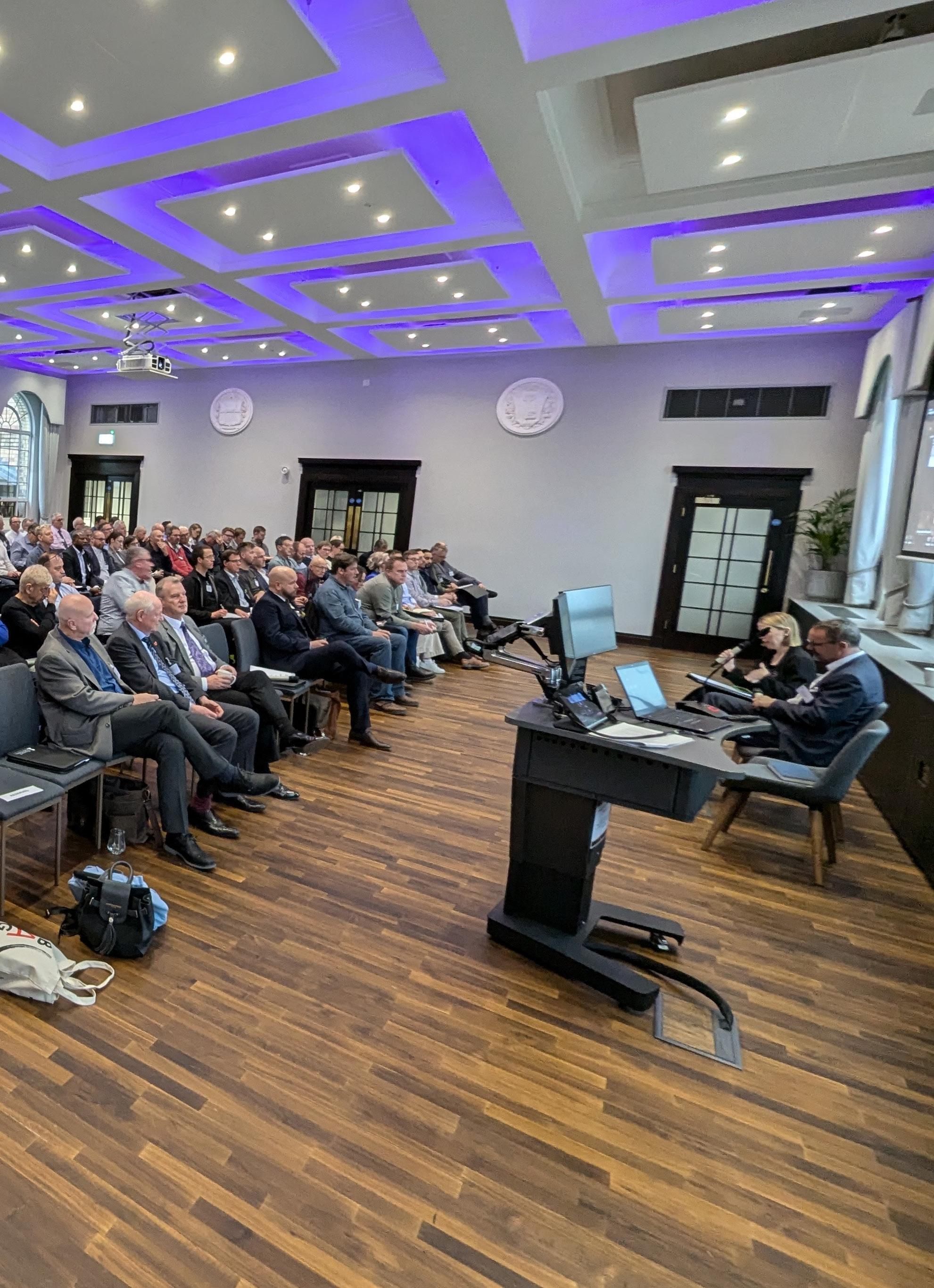
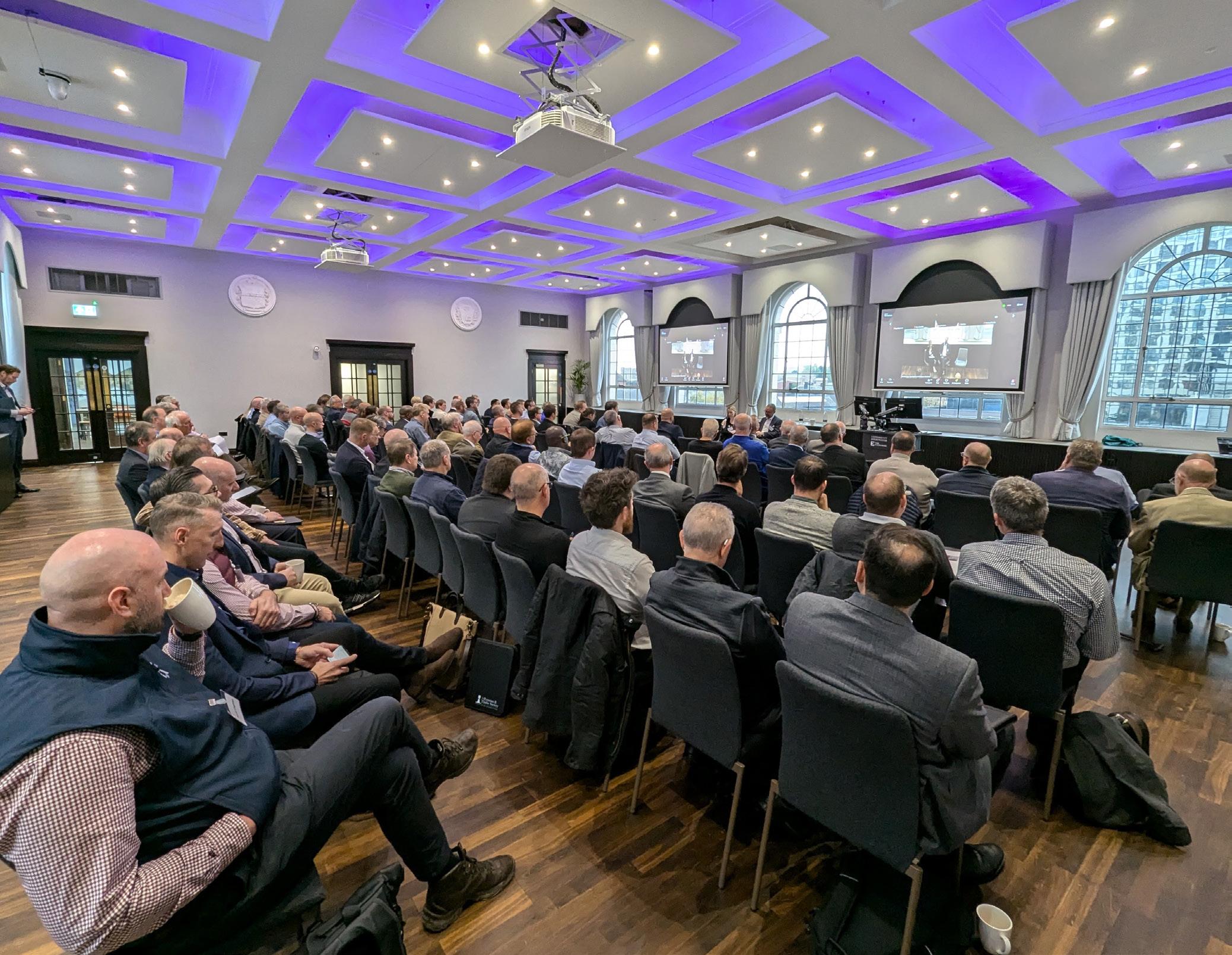
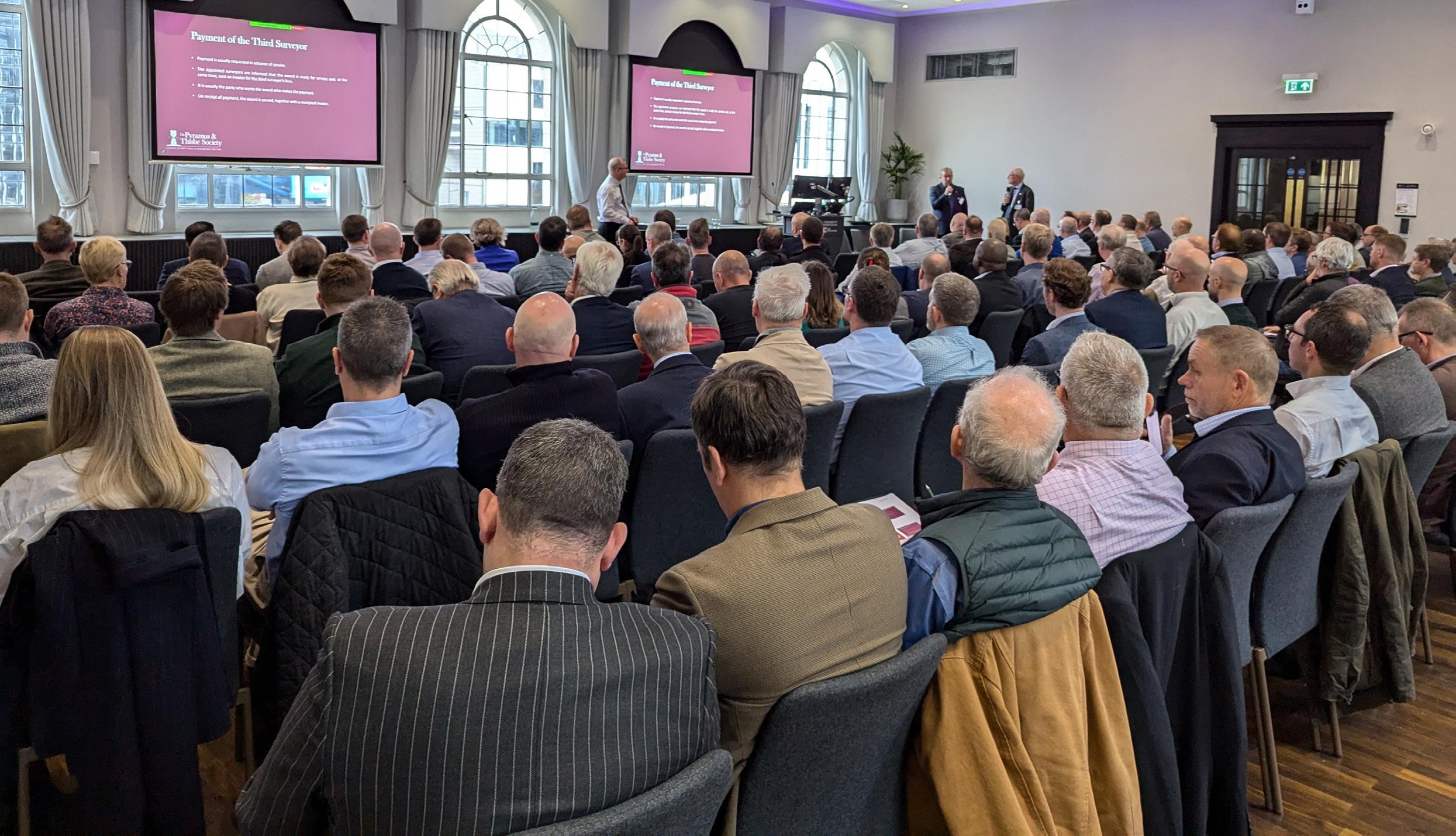
THE P&T SOCIETY’S FIRST NATIONAL Conference outside London hosted by East and West Midland Branches was held at The Exchange in Birmingham on 6th November 2024 The venue was deliberately chosen to provide capacity for 120 delegates attending on the day and because the venue, operated by Birmingham University, provided in house facility for virtual attendance for delegates. The organising committee consisting of the two Branch Chairs, Mike Boast and myself, assisted by James Beat and Graham Thompson, received mixed messages in regard to the possible attendance of delegates travelling to Birmingham. It transpired that the venue could likely have been filled twice over and this should be taken as encouragement for other branches considering organising the National Conference in future.
The format of having each presentation followed by a short break appeared, judging by the questions put the presenters, to assist the delegates in remaining focused during the day and the delicious but alcohol free buffet lunch did not result in too
much snoring in the afternoon sessions!
As we all know as members of the P&T Society and practicing surveyors accepting instructions under Section 10 of the Act; every day is a school day and with open minds there is always capacity to learn from each other, both how to and perhaps more importantly, how not to! The conference gave an excellent opportunity to learn from other members, to hear legal opinion and legal updates, to put faces to names and exchange views and experiences; all in good company in an excellent venue.
Thank you to all that assisted and attended both in person and virtually. Long may the opportunity for the exchange of opinions within the Society lead to excellence in the practice of appointed surveyors
Derek G Bate MRICS MCABE FPTS(Hon)
MFPWS
West Midlands Branch Chair The Pyramus & Thisbe Society




R E V I E W of the 2024-2025
W E ENDED 2024 WITH AN excellent National Conference jointlyhosted by the East Midlands and West Midlands Branches. Amongst the speakers was Nigel Lassetter who gave a really interesting talk giving examples on interrupting easements under the Act followed by discussions by Nick Isaac KC and his colleague Katie Gray from Tanfield Chambers who politely disagreed but made it clear that if surveyors can resolve issues amicably, they’d rather it didn’t land on their desks.
There were also some big cases discussed there.
Our National Chair Fareed Fetto really wanted the AGM to not be just a formality, but an opportunity for the fellows to give their thoughts on improvements they would like to see in the Society.
These ideas formed the basis of the National Board’s agenda – so much so that we supplemented out quarterly in-person meetings with monthly interim on-line meetings: communication is up and we have seen a huge push on social media – remember to like-and-subscribe.
Toward the end of 2024 we also recorded some Podcasts including one with our affiliate member Doug Rhodes of Trowers and Hamlin talking about the Building Safety Act. You can find this and others on Spotify.
2025 began with the AGM where we bid farewell to David Moon and sort-of bid farewell to Stuart Birrell (he stayed on as an ex-offico member) and welcomed Anne Lorenzato as national Education Officer and Natasha Demirbag as Publications Officer. Holly Harris also joined as Diversity and Inclusion Officer.
During the summer the fourth edition of the Green Book was published with its official launch in September at the Royal Society . This was thanks to the hard work of the working group comprising Fareed Fetto, Martin O’Shea, and in particular Michael Kemp with his tour of the branches (I was at the West Midlands stop).
Matt Briggs BEng (Hons) PGDIP FPTS
Secretary
The Pyramus & Thisbe Society February 2025

Cecily Crampin and Edward Blakeney
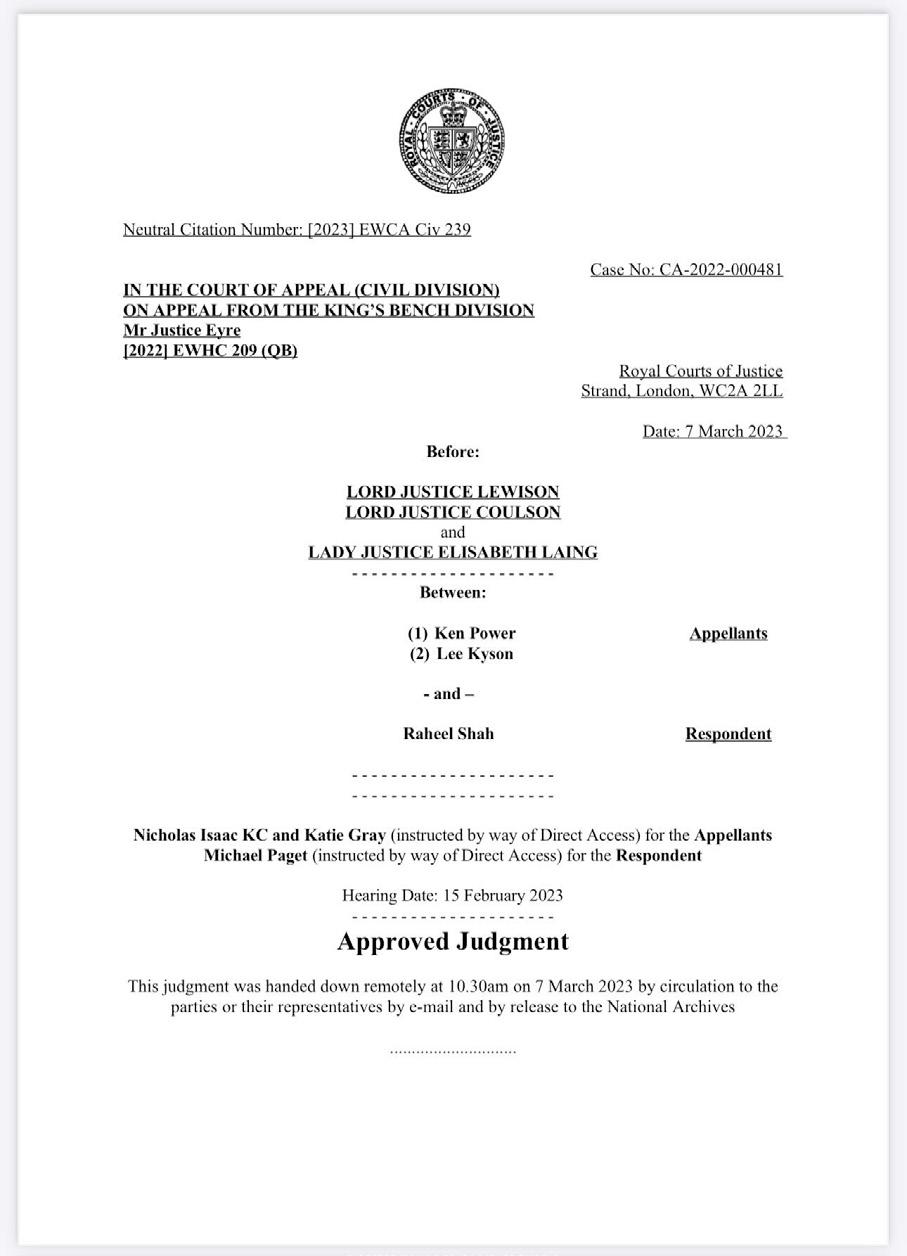
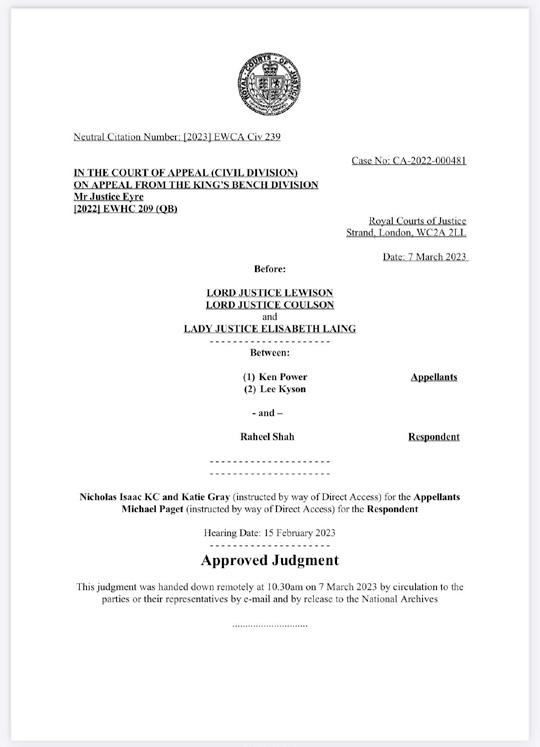
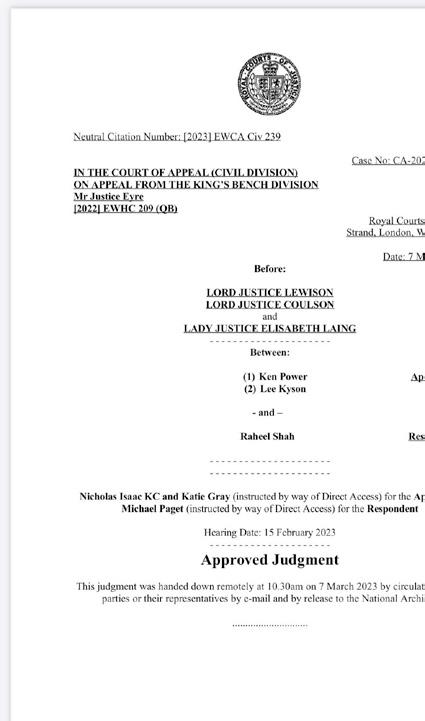
[2023] EWCA Civ 239; [2023] 1 WLR 2830, Lord Justice Lewison said the following at paragraph … it is the service of the party structure notice that causes the substitution of rights under the Act for common law rights. The service of such a notice gives a building owner the statutory rights laid down in the Act. activated, superseded the common law both as regards the building owner and the adjoining owner. a party structure notice has not been served, the adjoining owner’s common law rights remain intact.” added]
2 To what extent is that an accurate statement of the law? On one reading, it could be given an incredibly broad
meaning – a party’s common law rights are displaced once a notice under the Party Wall etc. is served. On another reading, it could be construed more narrowly – a party’s common insofar as the Act expressly does so or by necessary implication.
his article considers that question, and in doing so we hope to provide further clarity about what rights building owners and adjacent owners have when the Act is invoked, whether statutory or common law, and the extent to which the common law still has a role even when rights granted by the Act are in play.
The Act in outline
4 Those reading this article are likely to be very familiar with the Act already. However, it is worth identifying some of the key provisions to help lay the groundwork for the rest of the article.
5 T he Act deals with three types of works near the boundary, dividing them by sections: s.1, s.2, and s.6. In each case, there is a requirement on the building owner to serve notice on the adjoining owner for works caught by the section. The Act also expressly makes any dispute, or deemed dispute (for s.2 and s.6 works, where the adjoining owner does not consent to the works), resolvable via the s.10 mechanism.
6 S.1 works involve the building of a new wall over the boundary that would otherwise be a trespass if done without consent from your neighbour. S.1 gives a notice procedure to get that consent, and if the neighbour does not consent then the wall must be built on the builder’s side of the boundary (though the wall’s necessary foundations and footings can be built across the boundary).
7 S.2 is called “Repair etc of party wall rights of owner” and applies where, at the line of junction, the lands are built on (party wall), or there is a party fence wall (garden wall across the boundary) or the external wall of a building. S.2 then gives the building owner rights and sets those out in list form.
8 Finally, there are s.6 works. These are works on the building owner’s land rather than works to a party wall or party fence wall. S.6 applies when a building owner proposes to excavate close to a building on the adjoining owner’s land. There’s the 3m rule and the 6m rule, which are best demonstrated by diagrams found in some of the practitioner texts.
9 T he Act also provides the parties with particular benefits: s.7 contains a scheme for the payment of compensation to the adjoining owner, s.8 sets out the rights of access enjoyed by the building owner over the adjoining owner’s land, and s.10 provides a binding dispute resolution process that is decided by surveyor(s) appointed by the parties and is far simpler (and cheaper) than litigation (albeit there is an automatic right of appeal to the County Court so long as it is done within 14 days of the award being served on the appealing party).
10 We wanted to begin by saying something about the way in which we currently see the courts approaching the interpretation of the Act.
11 It has been common for advocates to argue in court, and the court at times to commend, that the Act has as its purpose keeping disputes out of court, with the dispute resolution process via surveyors under the Act being cheaper and quicker.
12 That is not an approach which is currently favoured,
however (if it ever was). It does not reflect the purpose set out in the Preamble to the Act. It is not a route to an interpretation of the Act which allows it to be used beyond the express wording.
13 Thus in Power v Shah, supra, the recent case arising out of an adjoining owner’s attempt to invoke the Act’s dispute resolution process where the building owner had not served a party wall notice for his works (because he said the Act did not apply), the Court of Appeal dealt with an argument for the applicability of the s.10 dispute resolution process because “proceedings in court are potentially more costly …” (paragraph 100). The answer that came from the Court of Appeal was that the adjoining owner retains his common law rights in relation to works done by the building owner, pointing out the converse point that “it would be a far-reaching (and unheralded) change in the law if an adjoining owner could unilaterally remove a citizen’s right of access to the courts, simply by appointing a surveyor (who need not have any qualifications); all the more so in a case where there is a dispute about whether the works fall within the various descriptions of work in the 1996 Act…” (paragraph 99).
14 The Act is not, therefore, a panacea for all neighbour disputes about works on one side. It is limited in its scope and application and must be invoked in accordance with its provisions; it does not apply simply because it has utility.
15 It was when discussing the effect of invoking the Act that Lord Justice Lewison made the comment referred to at the opening of this article – where invoked, the Act supersedes parties’ common law rights.
16 That is correct, but only to an extent, and care is needed. Once a party wall notice is served, it does not follow that all common law rights and considerations depart to be replaced with the statutory scheme to the exclusion of all else. Nor does the statutory scheme support development at all cost, for example where development might have been resisted under the common law.
17 It is this nuance that we explore below.
Are party wall notices mandatory?
18 B efore considering the extent to which the Act displaces common law rights when the Act is invoked, there is a prior question to be answered – do parties need to invoke the Act at all? In other words, do parties need to serve party wall notices?
19 This is something we have seen discussed a number of times, including at the Pyramus & Thisbe society. The conventional view appears to be that such notices are mandatory.
20 An argument to that effect certainly seems to flow from the language of the Act – s.1(2) states that the building owner “shall, at least one month before he intends the building work to start, serve on any adjoining owner
a notice”; s.3(1) states that “[b]efore exercising any right conferred on him by section 2 a building owner shall serve on any adjoining owner a notice”; and s.6(5) states that “the building owner shall, at least one month before beginning to excavate, or excavate for and erect a building or structure, serve on the adjoining owner a notice”. The use of ‘shall’ suggests a mandatory requirement.
21 But the blanket suggestion that party wall notices are mandatory carries with it a risk of overlooking the simple reality that where notices are not served, a party’s common law rights continue. Indeed, that was the very outcome in Power v Shah – no notice was served, but the Court of Appeal expressly disavowed one party being able to unilaterally remove another party’s access to the Courts by appointing a surveyor. If party wall notices were ‘mandatory’ in the traditional sense of the word, such that they had to be served whenever the Act applies, then presumably the outcome in Power v Shah would have been different. Instead, if a party’s common law rights are retained even if the Act prima facie applied, it indicates that those notices are not mandatory in that sense.
22 It seems to us, therefore, that the correct position is that party wall notices are mandatory where a party wishes to invoke the Act. If, however, a party does not wish to invoke the Act (because, for example, they think the Act does not apply or because they simply do not wish to engage with the Act), then party wall notices are not mandatory. Whilst it may be the case that such notices could/ should have been served, that does not mean that a failure to serve such a notice invalidates the works or that the works can only proceed once a notice is in place. And if an adjoining owner considers that a party wall notice should have been served, they will be left to rely on their common law causes of action.
23 Turning to our first example of when the Act supersedes common law rights, the most straightforward starting point involves the footings of the party wall. The situation we are considering here is where there is a wall at or across the boundary which has footings on the development land.
24 This situation is picked up squarely by s.2(2)(g) of the Act. The building owner is given a statutory right, subject to the service of a s.3 notice and the s.10 dispute resolution process, “to cut away from a party wall, party fence wall, external wall or boundary wall any footing or any projecting chimney breast, jamb or flue, or other projection on or over the land of the building owner in order to erect, raise or underpin any such wall or for any other purpose”.
25 The right granted is subject to “making good all damage occasioned by the work to the adjoining premises or to their internal furnishings and decorations”.
26 Likewise, if the issue isn’t footings, but an overhanging part of a wall, then the building owner will have a right under s.2(2)(h) to cut away or demolish those parts to the extent necessary to cut away or demolish the parts to enable a vertical wall to be erected against that wall, subject to the same requirement of making good.
27 Thus, it appears that the Act gives a solution to the issue of what to do as a building owner if you want to remove footings or projections on your neighbour’s boundary wall or a wall sitting across the boundary.
28 There is something odd, however. If the footings are wholly on the building owner’s side of the boundary, why does he need the Act to give him a right to remove them?
29 S.2 is not worded in the same way and ss.1, 3 and 6 which, as above, use mandatory language with respect to the service of certain notices. S.2(1) tells you when s.2 applies: when there is a wall or floor separating buildings or parts of buildings in separate ownership, or there is a wall across the boundary line.
30 One then gets to s.2(2). This does not say that if the building owner wants to do work of the kind listed in s.2(2) they “shall” serve notice. Rather, it says “A building owner shall have the following rights”. It is then in s.3(1) that the Act requires the service of a party structure notice on the adjoining owner before “exercising any right conferred on him by section 2”.
31 The natural reading is that you only need to serve a s.3 notice if you want to take advantage of one of the s.2 rights. This will not be the case if all the work is done to your own property and you don’t need to go onto your neighbour’s land. On that basis, a building owner could choose not to serve a s.3 notice, even though cutting away a footing or a chimney breast is one of the types of work listed in s.2(2).
32 I n Keane v Group One Investments Limited [2018] EWCA Civ 3139 at paragraph 2, Hickinbottom LJ said that if the statutory procedure is not followed, the common law rights and obligations of the parties continue to apply (that’s the inverse of the comment in Power v Shah that the effect of a proper invocation of the Act is that the common law rights cease to apply). In other words, a party’s common law rights are not automatically superseded where the Act can apply, but instead are only superseded to the extent necessary. Hence, in Kaye v Lawrence [2011] 1 WLR 1948, Ramsey J stated that “when the provisions of the relevant Act are operated, the common law rights are “supplanted” or “substituted” by the rights under the Act in relation to matters dealt with under the Act” [emphasis added]. The Judgment in Keane also suggests that you only have to serve a s.3 notice if you want to take advantage of the rights in s.2.
33 However, there is an argument the other way. It
depends on a very old case, Standard Bank of British South America v Stokes (1878) 9 ChD 68. There, Sir George Jessel MR said that the rights set out in the Metropolitan Building Act 1855, one of the ancestors of the Act, completely replaced the common law rights of the owner of a wall: “whatever the rights at common law might have been, such right no longer exists”. He said the rights given by the 1855 Act were given to replace common law rights, not supplement them. In part the reason was that the purpose of the 1855 Act was to avoid interference with party structures without notice to the adjoining owner as the other person interested.
34 This goes beyond what is said in Power v Shah it seems to us. It is saying that the 1855 Act replaces common law rights whether or not invoked, so that the building owner must serve a s.2 notice, and an adjoining owner sue for breach of statutory duty if he does not. It is arguable that the same analysis ought to be applied to s.2 of the 1996 Act.
35 However, that does not seem to be the tenor of the Power v Shah decision although the Court of Appeal, like the High Court, did not decide whether the building owner was in fact doing works which could fall under s.2. In Power v Shah, the Court of Appeal noted that in Standard Bank, a notice had been served, though there had been no award prior to the works. As the Court of Appeal said at paragraph 67, “Jessel MR was not concerned with a case in which no such notice had ever been served”.
36 It thus seems to us that a building owner does not need to serve a s.3 notice to do s.2 works if he could do them without trespass or nuisance, for example if they are works only to his own land which do not risk (actionably) his neighbour’s land. His common law rights remain intact and otherwise unaffected by the Act.
37 There is another oddity about s.2 granting the building owner rights. The language of s.2 is that the building owner has the right to do the works within the section. Does that mean the party wall surveyors could not make an award saying that the works could not be done, even if there was no way of doing the works the building owner wanted to do without, for example, the wall in question being almost certain to collapse?
38 If the adjoining owner had an easement of support for the wall or his part of it, then s.9 would suggest the answer is ‘No’: “Nothing in this Act shall (a) authorise any interference with an easement of light or other easements in or relating to a party wall”. That incidentally is already a way in which the Act does not usurp common law rights.
39 What if the adjoining owner did not have an easement? Does the adjoining owner lose any right he has to say the works would be a nuisance and hence should not be done?
40 S.7(1) says that “A building owner shall not exercise any right conferred on him by this Act in such a manner or at such a time as to cause unnecessary inconvenience to any adjoining owner or to any adjoining occupier”. That has been said in Gray v Elite Town Management [2016] EWCA Civ 1318 at paragraph 39 to relate to “the manner in which works are to be carried out once a specific design has been approved” not the design, or the doing of the works. It does not seem to be an answer to this question.
41 S.7(2) requires the payment of compensation for any loss or damage which may result by reason of any work executed in pursuance of the Act. Moreover, for certain of the s.2(2) works, as with s.2(2)(g) and (h) for example, the right to do the works is subject to making good all damage. Do those provisions mean that dangerous works otherwise within a s.2 right can be the subject of an award saying the works cannot be done?
42 One route to prevent works which would lead to very high value compensation or making good costs is the s.12 security provision which, under s.12(1), allows the adjoining owner “requiring the building owner before he begins any work in the exercise of the rights conferred by [the] Act to give such security as may be agreed between the owners or in the event of dispute determined in accordance with section 10”. The wording suggests that once the level of security has been determined, the building owner cannot begin work, in compliance with the Act, before giving that security. If the risk of the works is high it may be that the security would be so high as to make the giving of security unlikely, so that works can be stopped that way.
43 Under s.7(5)(a), any works executed in pursuance of the Act shall comply with statutory requirements. If statutory provisions such as Building Regulations cannot be complied with due to the risks to the adjoining owner’s property, that does seem a route by which works can be prevented within the Act.
44 Otherwise, though, it seems to us that the use of the word “right” does suggest that the works must be permitted.
45 The point does not appear straight-forward, however. Does that mean that surveyors appointed under s.10 of the Act can authorise what would otherwise be a nuisance and oust a party’s common law rights (or convert those rights into monetary compensation), and does it mean that those surveyors could authorise poor design practices?
46 Both of those scenarios pose conceptual difficulties, especially in light of what was said in paragraph 99 of Power v Shah about ousting a party’s rights to the Courts. Further, Courts are not generally willing to allow parties to buy their way out of legal wrongs and put a price on their rights and obligations. It
seems likely that an appeal would be needed to resolve the situation – it is not difficult to envisage a Court determining that an Award permitting a nuisance is either impermissible as a matter of principle, or that such an Award would need to be remade to avoid any nuisance on the facts.
47 We now turn to another scenario. What if the building owner discovers that a pipe carrying water for example to the adjoining owner’s building runs across the building owner’s land?
48 The building owner wants to excavate where the pipe runs (and within the s.6 distances). He serves a s.6 notice on the adjoining owner. Can the surveyors agree an award that permits the removal and replacement of the pipe elsewhere?
49 The first question is whether the adjoining owner has an easement to run water, or gas, or whatever it is, through the pipe.
50 S.9 expressly prevents the Act from interfering with easements, but not all easements. It says: “Nothing in this Act shall authorise any interference with an easement of light or other easements in or relating to a party wall”. It is odd perhaps that there is no express saving for easements which might affect excavation.
51 S.6(10) has a savings clause: “Nothing in this section shall relieve the building owner from any liability to which he would otherwise be subject for injury to any adjoining owner or any adjoining occupier by reason of work executed by him”.
52 The language seems a little odd, and not quite apposite, but that seems likely to mean that if the excavation would involve a substantial interference with the easement of the adjoining owner, that liability at common law would remain notwithstanding the service of a s.6 notice, and other compliance with the Act. This could well prevent excavations that the building owner wishes to carry out.
53 That accords with what was said in Keane, supra, as well as the more limited reading of Power v Shah referred to at paragraph 2 above. If Power v Shah is instead given the expansive interpretation, that would conflict with our interpretation of s.6(10) of the Act.
54 As the case law currently stands, a solution which rerouted the pipe elsewhere across the building owner’s land would not suffice, because as owner of the servient tenement for the easement he has no right unilaterally to extinguish it over one area, the current location of the pipe, and move it to another.
55 That’s the principle confirmed in Greenwich NHS Trust v London & Quadrant Housing Association [1998] 1 WLR 1749, affirmed in Heslop v Bishton [2009] EWHC 607 (Ch) and Kettel v Bloomfield [2012] EWHC 1422 (Ch), unless the easement expressly allows variation. In this
respect too, therefore, the common law principles have not been ousted or enhanced by rights granted under the Act.
56 S.8 of the Act gives rights of entry to the building owner (and servants and agents) to “enter and remain on any land or premises for the purpose of executing any work in pursuance of this Act”. That is a potentially very wide right, which might involve significant interference for the adjoining owner over a long period, if development works are of long duration.
57 The right of entry is however limited to the purpose of executing any work in pursuance of the Act. It does not allow the right of entry for the development works as a whole.
58 Nor does it appear that it allows entry in so far as exercise would be in such a manner as to cause unnecessary inconvenience to any adjoining owner or occupier, under s.7(1).
59 To what extent does the right of entry, or any other part of the Act, allow works to be done to the adjoining owner’s land?
60 It seems to us that s.8 is not a right to do work to the adjoining owner’s land if that work is not already “work in pursuance of this Act”. For s.8 to apply, one must already have identified the work in pursuance of the Act. S.8 does not legitimate a new range of work. Thus, s.8 seems to permit access to the adjoining owner’s land to demolish the wall across the boundary and rebuild it for example, since that is an Act right.
61 There are specific provisions in the Act which allow work on the adjoining owner’s land, and to buildings or walls constructed on it, even though the adjoining owner does not consent. Those provisions give the building owner rights he likely would not otherwise have.
62 Thus s.1(6) permits the building owner building a new wall on his own land but at the boundary placing such footings and foundations as are necessary for the construction of the wall onto the adjoining owner’s land, even though the adjoining owner does not consent.
63 Likewise, s.6(3) of the Act allows the building owner at his own expense to “underpin or otherwise strengthen or safeguard the foundations of the building or structure of the adjoining owner so far as may be necessary”. That gives a right to the building owner to go onto the adjoining owner’s land and do works to it.
64 Similarly, s.2 allows works to the adjoining owner’s land, for example to the part of a party structure which is on the adjoining owner’s land when that structure is demolished and rebuilt under s.2(2)(b).
65 To that extent, therefore, the Act grants additional

rights to building owners and permits what would otherwise have been common law wrongs (primarily trespass). The Act has therefore superseded the adjoining owner’s common law rights to that extent.
66 But this is not a total usurpation of a party’s common law rights. For what the Act does not allow is work on the adjoining owner’s land which, outside the Act, would be a trespass where the Act gives no express right to do such work. In those circumstances, a party’s common law rights remain unaffected, and they could take whatever action they considered appropriate in the normal way.
Do rights under the Act and common law rights co-exist?
67 The foregoing feeds into a debate we have had on a number of occasions – if a party has a remedy under the Act (for example, a right to compensation under s.7(2) of the Act), does that exclude the other common law rights that would otherwise have been available?
68 One view is that the Act would displace the common law in this way. That is the natural meaning to be given to the authorities that talk of the common law rights being supplanted.
69 This reasoning relies, to some degree, on the argument that works causing loss that have not been carried out in accordance with the strict terms of the Award are nevertheless works carried out under the Act – that argument is required because s.7(2) of the Act is only engaged where there have been works “executed in pursuance of this Act”, and s.7(2) has to be engaged if it is to exclude common law causes of action.
70 T hat construction of s.7(2) is supported by the Judgment of HHJ Bailey in Davis v Trustees of 2 Mulberry Walk (Unreported, Central London County Court, 26 January 2012). But it might need to be reviewed following the Judgment in Power v Shah since Power v Shah suggests a stricter understanding of when works are executed in pursuance of the Act. Works which are not in compliance with a party wall award would not be works in pursuance of the Act because they are not works that have followed the party wall process properly. In that case, the common law would be left to provide a remedy.
71 The other view is that there would be no such exclusion for the simple reason that there is no need/ basis for the Act to do so. Where the Act expressly permits what would otherwise have been a trespass (for
example, where footings are permitted to cross the boundary line), then necessarily the common law position has been altered. Where, however, a party has suffered an actionable wrong as a result of something that was not permitted by the Act, there seems to be no reason why the Act would limit that party to pursuing a remedy via a specific route. If each affords the innocent party appropriate relief, why can they not be pursued in tandem or why can the innocent party not choose which route they prefer?
72 This view would not see Power v Shah as changing the law in this respect. Whilst Lewison LJ did talk of common law rights being superseded, there was no discussion of the extent to which those rights were superseded, and the Judgment need not (and should not) be read as supporting a wholesale replacement of common law rights with statutory rights. Such a change in a parties’ legal rights would be significant. Instead, it would be better to read Lewison LJ’s Judgment as referring to the Act superseding common law rights only to the extent necessary as per Kaye
73 T he other difficulty with reading Power v Shah as requiring strict compliance with the terms of an award if works are to be ‘in pursuance of’ the Act is that this could artificially limit the remedies available under s.7(2) and s.10. Would awards need to expressly envisage the possibility of works going wrong/ loss being caused to allow compensation to be granted if that possibility came to pass? That seems an unlikely construction of the Act, and a construction that retains the ability to obtain any appropriate remedy where it is available, whether under statute or common law, is preferable.
74 Even where the Act does apply and (to the extent necessary, whatever that extent may be) has excluded common law rights, that does not mean that the common law is gone and forgotten.
75 That is demonstrated by the recent Court of Appeal decision in Taylor v Jones [2024] EWCA Civ 170. There, the Court was concerned with questions of causation and compensation, for even where s.7(2) of the Act applies, it does not explain how compensation is to be calculated.
76 The Court of Appeal held that there was no reason to depart from the common law quantification
of compensation, and it therefore calculated the appropriate figure using common law principles by analogy. This is another example of the Act and common law working together.
77 It could be said that this decision leads support to the view that remedies under the Act do not automatically displace all common law rights; if the remedy is calculated in the same way as common law causes of action, why would there need to be an exclusion of all common law rights?
78 Lastly, we turn to awards made under s.10 of the Act. The short point here is that, in our view, s.10 does not give the surveyors jurisdiction to allow by award acts on the adjoining owner’s land which are not expressly permitted by the Act.
79 S.10(1) allows the surveyors to settle by award any matter which is connected with any work to which the Act relates and which is in dispute. That is not a jurisdiction which allows the surveyors to give the building owner rights he is not given expressly by the Act. The surveyors are given a dispute resolution jurisdiction. They are not given a power to permit acts by the building owner simply on the basis they are convenient, or even necessary, to ensure that development works are done.
80 In that sense, the adjoining owner’s common law rights are not replaced by the Act. Common law rights and principles continue to inform works under the Act because, save where the Act expressly permits access or works to the adjoining owner’s land, the adjoining owner can still complain of trespass.
Conclusion
81 It is clear that the Act does displace the common law. That is the effect of years of judicial decisions and the decision in Power v Shah But it is not the case that where the Act could apply the common law is automatically excluded, nor is it the case that where the Act does apply the common law is excluded in all respects. A more nuanced view is required when considering if, and if so the extent to which, the common law is actually displaced by the Act.
First published in Whispers 53. 2024

His Honor Edward Bailey
1
THE BACKGROUND: THAT THE PARTY WALL legislation replaces (or “supplants and substitutes”) the owners’ common law rights in relation to building work which engages the statute has been reiterated by the courts on many occasions in a number of cases under the predecessor legislation to the 1996 Act, see eg McCardie J. in Selby v Whitbread & Co [1917] 1 KB 736 and Evans LJ in Louis v Sadiq (1996) 74 P&CR 325 CA. An affirmation that this is the position under the 1996 Act may be found in Kaye v Lawrence [2010] EWHC 2678 (TCC). Ramsey J at [61] stated “... the common law rights are supplanted and substituted by the provisions of the Act and that this applies as much to sections 6(1) and 6(2) as it does to section 6(3) or any other provisions of the 1996 Act.”
2
HOW DOES THIS PRINCIPLE APPLY TO S 7(2) 1996 Act under which a building owner must compensate any adjoining owner and any adjoining occupier for “any loss or damage which may result to any of them by reason of any work executed in pursuance of this Act”? Where the party wall surveyor is satisfied that the adjoining owner has, or may have, suffered loss or damage by reason of next door’s party wall works, how should the surveyor carry out a proper assessment of the compensation payable by the building owner. Put another way, given that the 1996 Act supplants and substitutes the owners’ common law rights with their statutory rights, the question arises how should “loss or damage” be assessed.
3
IN LEA VALLEY DEVELOPMENTS LIMITED V Thomas William Derbyshire [2017] EWHC 1353 (TCC) the Deputy Judge (Adrian Williamson QC) noted that there was no authority as to the proper construction of the subsection and stated:
[34] “In these circumstances, the claimant submits that the common law principles which apply to the assessment of damages for torts to land should apply under the subsection. The Respondent, by contrast submits that the Act provides a comprehensive statutory code, and that common law principles are not relevant”.
T he learned Deputy Judge preferred the claimant’s submissions, stating at [35] that “if parliament had intended that the expression “loss or damage” should have some different meaning from that generally understood, it would no doubt have said so”.
1 See “Assessing compensation under s 7(2) Party Wall etc. Act 1996: common law or statutory code” also to be found in Whispers
4
THIS IS NOT THE PLACE TO EXPRESS | reservations as to the appropriateness of this simple statement, a choice between two competing submissions where the Respondent’s suggestion was unsustainable. That is for another article.1 For the present it is sufficient to state that where there is damage to property belonging to the adjoining owner, whether buildings or chattels, the proper approach to assessment under s 7(2) is by reference to the common law principles applying in tort.
5
THE BASIC PRINCIPLE FOR ASSESSMENT OF damages in tort is that the damages payable by the tortfeasor must be such as to put the claimant in the position he would have been in but for the commission of the tort, a species of ‘restitution’, see eg Livingstone v Rawyards Coal Co (1880) 5 App Cas 25 at 39 per Lord Blackburn. It is commonly accepted that restitution involves compensating the claimant for his loss by awarding him the value of his property if destroyed or the diminution in value of his property where the damage is short of destruction.
6
IT IS IMPORTANT TO NOTE THAT THE correct jurisprudential analysis of a claim for diminution in value is that it is a claim for “general damages”, see eg Coles v Hetherton [2013] EWCA Civ 1704 at [28]. The award of general damages is in the discretion of the court. The comparison is with a claim for “special damages” ie damages awarded on proof of specific loss calculated in an arithmetically recognisable manner. The nature of a claim for restitutionary damages in tort remains one of general damages even where the quantum awarded is measured by reference to the reasonable cost of repair as proved by reference to invoices, expert assessment, etc, ie the usual way of proving special damage. This is important. General Damages are “at large”, ie in the discretion of the court. This enables a judge to award what, in the actual circumstances, he/she considers to be justice as between the parties. Special damages are either proved or not.
7
DAMAGE TO CHATTELS: THE PROPER MEASURE of loss for the assessment of s 7(2) compensation is the diminution in value that the chattel has suffered. That loss is suffered immediately upon the chattel sustaining the damage. If the chattel can be economically repaired the reasonable cost of repair is treated as demonstrating the diminution in value, but the claimant is not obliged to repair the chattel to recover his loss. Furthermore, because the loss is sustained on the damage occurring, events occurring after the infliction of the damage (eg subsequent destruction of the chattel, or an ability to have the repairs done at less than cost or even for nothing) will not prevent the claimant
recovering the diminution in value of the chattel caused by the tort. This is perhaps counter-intuitive, but it is logical! (It is not unknown for judges to find ingenious ways to avoid injustice in this context.)
8
DAMAGE TO BUILDINGS (= DAMAGE TO ‘land’): The assessment follows the same general principles as those applying to damage to chattels. However the application of the rules must reflect the different character of land and fixtures to land (incl. buildings). In theory at least land, as opposed to most chattels, is unique. Accordingly a claimant will usually recover the cost of repair or reinstatement even where the cost of repair or reinstatement exceeds a valuer’s assessment of the diminution in value of the land; indeed where, as is usual, the value of the land is in the buildings on it, a claimant will recover the cost of reinstatement even where this exceeds the value of the building. (Considering the various ways land may be valued is outside the scope of this article.)
9
THE PROPOSED OR ACTUAL EXPENDITURE must however be reasonable, ie not out of (all) proportion to the diminution in value of the land. In Lodge Holes Colliery Co Ltd v Wednesbury Corporation [1908] CA 323 the workings of the colliery caused the Corporation’s road to sink so as to become unusable. The corporation spent a great deal of money restoring the road to its previous position and condition, but it could have constructed a perfectly reasonable road for appreciably less. The Court of Appeal held that the Corporation could only recover the lower amount. If repair or reinstatement involves precise and meticulous restoration that will not increase the utility of the property, the additional cost involved will not be awarded absent good reason, see Ward v Cannock Chase DC [1986] Ch 546. A Grade I or even Grade 2 listed building will usually require perfect reinstatement.
10
A CLAIMANT MUST EITHER HAVE CARRIED out repair or reinstatement of his building by the time of trial, or be able to rebut any suggestion by the defendant that he has no intention of carrying out the works on which his claim for damages is predicated, in order to recover the cost of the works, Hole & Son (Sayers Common) v Harrisons of Thurnscoe [1973] 1 Lloyd’s Rep 345. Claims for repair of chattels meet the same requirement. If the claimant wishes to recover a repair or reinstatement cost which exceeds the diminution in value of the relevant chattel he must either have completed the repair by the date of trial, or be able to persuade the court that he will carry out the repair. (Absent good reason for there being no repair, the average judge is likely to be rather sceptical. So should a party wall surveyor making a s7(2) award).
11
IN ADDITION TO COST OF REPAIR THE owner of a damaged building may also recover any further loss he may suffer through not being able to use the building, eg renting it out, or the loss of profits resulting from being unable to manufacture his products, etc.
12
BETTERMENT: THE PARTY WALL SURVEYOR may find himself facing the argument that a proposed assessment of compensation will result in ‘betterment’ ie the adjoining owner ending up with property worth more than it was before the damage caused by the building owner. On the face of it such a result constitutes a breach of the common law rule that the defendant is to be put back to the position he would have been in but for the commission of the tort.
13
AN INSTRUCTIVE CASE OF THE ISSUE OF betterment in a party wall context is Taylor v Jones; Taylor v Spriggs [2024] EWCA Civ 170. This case may well be known to the reader. How unusual the facts are will be better known to surveyors than to the author, a lawyer. Mr Taylor was unfortunate. He built an extension in the garden to his property at 9 St George’s Terrace W1, leaving an area of open space between his new extension and the back wall of his garden to form a new low level garden up against a party wall with both Mr Jones (5 St George’s Mews W1) and Mr Spriggs (6 St George’s Mews W1). It was known that some underpinning to the wall would be required. However, no-one knew that this wall, albeit standing quite happily for many years (much of the Mews had been converted to residential use in the 1930s with a garage undergoing residential conversion in 1976), was in a perilous condition (“on a hair trigger”). This was because (i) of a serious horizontal crack along the line of an old dpc, and (ii) voids having developed between the floor slabs of both 5 and 6 due to soil desiccation.
14
IN THE EVENT WHILE MR TAYLOR’S WORK was responsible for a drop in the wall of a mere 2mm, this drop caused a fall of 40mm to the building at 5 and 6 St George’s Mews with, unsurprisingly, somewhat more serious consequences than would have flowed from a 2mm drop. In the county court the primary issue before HHJ Backhouse was whether Mr Taylor was liable for the full extent of the subsidence, and its consequent repair, or for some lesser amount. The learned judge held that Mr Taylor was responsible for the cost of a full repair, a total bill of over £381,000.
15
MR TAYLOR WENT TO THE COURT OF Appeal complaining that no allowance had been made for ‘betterment’, ie the fact that once all the repairs had been completed Messrs Jones and Spriggs would be left with buildings in a better condition than they had been in before Mr Taylor started work, in particular because the dpc crack had been repaired and the voids filled in.
16
IN THE COURT OF APPEAL THERE WAS A discussion of the law of betterment and the wellknown case of Harbutts Plasticine Ltd v Wayne Tank and Pump Co Ltd [1970] 1 QB 447. This was in fact a destruction case, not a damaged building case, but the essence of the decision was relevant; Harbutts Plasticine Ltd were entitled to the cost of a new factory even though its completed value exceeded the value of the old factory.
17
THE PROPER APPROACH TO THE QUESTION of betterment was considered by the CA in Sartex Quilts & Textiles Ltd v Endurance Corporate Capital Ltd [2020] EWCA Civ 308. The only judgment In Sartex was given by Leggat LJ who considered the principles at some length at [90]-[98] of his judgment. These principles were helpfully summarised by Nugee LJ in Taylor v Jones at [61]. There are three classes of case:
▶ Where the claimant has a choice and chooses to carry out improvements not needed for reinstatement;
▶ Where the claimant does not have a choice in carrying out improvements but derives a money benefit from an improvement;
▶ Where the claimant does not have choice in carrying out improvements but derives a non-money benefit from an improvement.
In (i) the additional cost of the chosen improvement(s) is not part of the reinstatement and is not recoverable.
I n (ii) the claimant can recover the cost of the improvements, but he must give credit for his money benefits. (The standard example is British Westinghouse Electric & Manufacturing Co Ltd v Underground Electric Railways Co of London Ltd [1912] AC 673 where the railway company had no option but to buy new turbines, but as these were more efficient than the old turbines being replaced it had to give credit for the resulting electricity savings.
In (iii) the claimant does not have to give any credit for the betterment as any such deduction “would be unjust, as it force the claimant to pay for an advantage which it has not chosen and which makes it no better off in money terms”. [60].
HOWEVER, IN TAYLOR V JONES THE CA were concerned about something not addressed in the court below. Namely that the remedial works carried out by Jones and Spriggs covered work which, although recommended by their expert advisers, was not in fact needed to repair the “relevant damage” ie the damage caused by the party wall works. This concerned the filling in of the voids under the floor slabs. Albeit that it was very sensible to fill in these voids for the long term security of the building, the slabs had not themselves been damaged by Mr Taylor’s works and so the court held that these voidfilling works could not be charged to Mr Taylor’s damages account. Equally, underpinning parts of the wall not actually damaged by Mr Taylor’s work could not be included in the compensation awarded against him even though the evidence was that no engineer would approve a scheme that did not include this void-filling work on health and safety grounds, and no contractor would be likely to agree to carry out the work without such underpinning.
19 ALL LEGALLY LOGICAL, ALTHOUGH MESSRS Jones and Spriggs could feel aggrieved given that if Mr Taylor had not caused the damage he caused in the first place the underlying defects may have remained unknown for many years to come. On the other hand the defects may have manifested themselves within a very short time after the conclusion of Mr Taylor’s work.
20
ACCORDINGLY, A PARTY WALL SURVEYOR faced with a similar situation needs to ask whether the work that now needs to be done for the purpose of the award has to be done in order to repair the relevant damage, that is the damage actually caused by the building owner’s works.


His Honor Edward Bailey
First published in Whispers 54. 2025
RESERVED MATTERS ARE NOTHING NEW.
As surveyors, we are regularly asked to allow for certain matters to be “reserved” within Awards.
This typically allows the commencement of certain activities, while deferring the provision and approval of other information until such time as it becomes available. I am no different, and from time to time, may also agree to or suggest that matters be reserved within an Award. There are however right ways and wrong ways for addressing such matters.
There are various reasons why it may seem appropriate to reserve matters within an Award. Construction programmes are quite often not geared up to cater for Party Wall matters, with adequate provisions for addressing them not factored into the programme. In the vast majority of instances, certain contractor information and input will be required in order to fully consider the matters in dispute under the Act. If you’re lucky, you may find that prior to entering into contract a contractor has been issued with a letter of intent, or has a pre-contract service agreement, creating (one would hope) a willingness on their part for early engagement with the Party Wall process. Often however, this won’t be the case, with certain elements of the information required in order to fully consider and address Party Wall matters not becoming available until some time after the building contract has been entered into (which is typically only a very short time prior to commencement of works on-site).
Unfortunately, what often transpires is that as soon as
a project gets the green light (i.e. upon planning consent being granted), a Building Owner wants to start work yesterday. Regardless of whether any tender process ran in conjunction with planning matters, upon procurement of a contractor, there is an eagerness to start works at the earliest opportunity. Whilst this is understandable, and often driven by costs, it does pose an issue when it comes to Party Wall matters. Initial site set-up and lead-in periods may or may not be sufficient to bridge the gap in programme and timings required from a Party Wall perspective. And as I am sure most will attest, obtaining the necessary information from a design team is not always plain sailing.
In order to manage expectations, and ensure any Building Owner is aware of the timescales and programme risks associated with the addressing of Party Wall matters, it is key to set out the timescales for information requirements and provision pre-commencement of the works, so that where possible, this can be factored into the programme. All too often however, the making of such allowances within the programme is rarely implemented. This can ultimately lead to discussions over contractual liabilities for delays stemming from Party Wall matters before works have even begun on-site. The poor old Party Wall surveyor (get the violins out!) may well find themselves on the opposite end of pointed fingers in such a scenario, despite having been fighting a losing battle from the outset. It may be possible to mitigate the impact of such finger pointing with a simple recommendation at the outset that the Building Owner
considers incorporating timescales for information provision within the programme and also the construction contract, and thereby earning a grateful pat on the back instead should matters end up getting slugged out in the contractual trenches.
So step in the reserved matter! A seemingly harmless and pragmatic solution to all your problems. A means of kicking the proverbial can down the road, often allowing an Award to be made in good time, and receiving the plaudits of the Building Owner as a result. A sensibly drafted reserved matters clause within an Award will also set out timescales for the provision of any outstanding information prior to the commencement of the relevant works, so that there is no expectation of proceeding as soon as that information has been provided (which in reality, may not be possible depending upon the adequacy of that information, and responsiveness of the appointed surveyors amongst other things).
But! And of course, there is a “but” (or else I wouldn’t be writing this article), the surveyors should be wary that when doing so, they are appropriately carrying out their duties under their statutory appointments. Typically, a reserved matter requires the prior review and approval of certain information by the appointed surveyors subsequent to the making of an Award. With the making and service of an Award however, Section 10(17) of the Act provides both owners with the right to appeal such an Award should they see fit. Taking certain matters outside of the parameters of an Award however, potentially denies an owner the opportunity to appeal those matters, should they so desire.
To put this another way: say for example a matter reserved within an Award related to a contractor’s methodology for certain works. Were the appointed surveyors to subsequently approve a method statement for those works, what would be the Adjoining Owner’s recourse should they feel that the approval of the same was inappropriate? If such approval wasn’t granted by way of service of a further Award, then an owner’s right to appeal that decision in accordance with S10(17) has essentially been taken away from them.
S10(1) of the Act also sets out that the surveyors’ authority to settle disputes between the owners is by way of the making of an Award. Thus, proceeding in such a fashion (i.e. not by way of an Award) is beyond the jurisdiction of the surveyors, and therefore potentially ultra vires. Were a Building Owner to proceed in the belief that such matters had been “discharged”, they are at risk of acting in breach of their statutory obligations and all that comes with that (i.e. possible recourse of the Adjoining Owner to seek injunctive relief).
Notwithstanding the above, I can’t imagine too many out there would thank me for suggesting that wherever a matter is reserved within an Award, that a further Award must automatically follow in each and every instance. Doing so would likely have both cost and time implications for the Building Owner.
The important thing here, in my view, is ensuring that the owners are involved in the process. What I mean by this, and notwithstanding that the matters are already in dispute between the parties (or what would be the need for an Award in the first place), is that the owners should be consulted when considering reserving matters within an Award. The Building Owner should be made aware of the potential requirement for further Awards should the surveyors proceed on this basis, so that they are able to weigh this up against the potential programme benefits that this may bring about. On the other side, and perhaps more importantly, the Adjoining Owner should be provided with the information pertaining to the reserved matter once this becomes available. If this is acceptable to an Adjoining Owner (with or without the input and advices of their appointed surveyor), then this is no longer in dispute, and as such not a matter requiring settlement by way of a further Award.
Essentially, the surveyors should not be acting as judge, jury and executioner, and cutting the owners out of the Party Wall equation by denying them their right to appeal a determination relating to disputed matters. One should also be mindful of the fact that where matters are agreed outside the parameters of an Award (unless agreed directly between the parties), it could also be argued that the owners aren’t bound to adhere to any such matters agreed between the surveyors.
So, what’s the (reserved) matter with all of this then I hear you ask? Well, potentially very little. Providing you take note of the provisions of the Act, consult the owners if considering to reserve matters within an Award, ensure a reserved matter is actually in dispute before proceeding to further Awards, and make sure that where settling a disputed reserved matter this is determined by way of an Award (thereby affording the owners the right to appeal should they wish). And in a “help me to you help you” kind of way, if engaged at an early enough stage, it wouldn’t hurt to run through programme and procurement intentions with a Building Owner and the implications of and upon Party Wall matters, such that a proactive rather than reactive approach can be adopted, with no requirement for reserved matters in the first place.

Aidan Smyth MPTS BSc(Hons) aidan.smyth@gia.uk.com
Assessing Compensation Under S7(2) Party Wall etc Act 1996: Common Law or Statutory Code?
His Honor Edward Bailey

The Party Wall etc. Act 1996 extended to the whole of England Wales the party wall legislative regime previously enjoyed only by owners and occupiers of properties in Inner London under the Metropolitan Building Act 1885 and the London Building Acts of 1894, 1930 and 1939. (Only land in which any of the four Inns of Court have an interest is excepted.) That the purpose of the 1996 Act was to extend the existing (private) London legislation to the country as a whole, and did not introduce a new statutory scheme, was made clear by the Earl of Lytton both when he introduced the Party Wall Bill to the House of Lords on 31 January 1996, and in debate, see Hansard (HL Debates) 22 May 1996, col 931: “The intention remains, as always, that the Bill will follow as closely as possible the London Building Acts which are its role model and the precedents and practice which have been established for Inner London over a long period of time.” It follows that the various decisions of the courts under the earlier legislation remain relevant today.
Under the earlier legislation the courts had, on a number of occasions, made the point that the “London Building Acts” (which include the Metropolitan Building Act 1855) had the effect of replacing the common law rights of building owners and adjoining owners and occupiers with the party wall scheme provided by statute. The earliest reported authority in this connection was the decision of Jessel MR in Standard Bank of British America v Stokes (1878) 9 Ch D 68. Although this was a judgment of the Master of the Rolls, who would normally be sitting in the Court of Appeal, Jessel MR was in fact sitting as a Judge of the Chancery Division. The Learned Judge said, at 73, when considering the rights of a building owner:
“The Plaintiffs allege, and the Defendant denies, that, according to the true construction of the Metropolitan Buildings Act 1855, whatever the rights at common law may have been, such right no longer exists, and that is the view I myself take of the Act”.
The question whether the common law rights of adjoining owners when the party wall statute is engaged are replaced by the parties’ statutory rights was considered by McCardie J. in Selby v Whitbread & Co [1917] 1 KB 736 who held “… the 1894 Act is not an addition to but in substitution for the common law with respect to matters which fall within the Act.” McCardie J’s decision in this regard was expressly approved by Evans LJ in Louis v Sadiq (1996) 74 P&CR 325 CA.
That the party wall legislation replaces (or “supplants and substitutes”) the owners’ common law rights in relation to building work which engages the statute has been reiterated by the courts since the coming into force of the 1996 Act on many occasions; a recent example is Kaye v Lawrence [2010] EWHC 2678 (TCC). Ramsey J at [61] stated “... the common law rights are supplanted and substituted by the provisions of the Act and that this applies as much to
sections 6(1) and 6(2) as it does to section 6(3) or any other provisions of the 1996 Act.” Ramsey J also made the point that s 6(10) 1996 Act expressly preserves the common law rights of an adjoining owner or occupier in respect of “injury” arising under excavation and construction works carried out under that section by a building owner contrasting “injury” in this context with “loss and damage” under s 7(2) 1996 Act.
By virtue of s 7(2) 1996 Act a building owner must compensate any adjoining owner and any adjoining occupier for “any loss or damage which may result to any of them by reason of any work executed in pursuance of this Act”. There are two initial points to stress. The first is that the wording of s 7(2) makes plain that it is the building owner who is liable to pay compensation even though the loss or damage may have been caused by the building owner’s contractor. The fact that the contractor will in all probability have been an independent contractor offers the building owner no defence, (and questions of ‘non-delegable’ duties in nuisance do not arise). For the purposes of s 7(2) the contractor is, statutorily, the servant or agent of the building owner.
The second initial point is that the statutory wording “which may result … by reason of any work executed in pursuance of this Act” is wide enough to cover not just the effect of the work itself, but also the manner in which the work is done. So where the adjoining owner complains that the attitude and demeanour of those carrying out the work caused loss and damage, that may be as capable of founding a claim for compensation as loss and damage caused by the actual works themselves.
Assuming that the party wall surveyor is satisfied that the adjoining owner has, or may have, suffered loss or damage by reason of next door’s party wall works, how should the surveyor approach the determination of whether there has been loss or damage, and carry out any necessary assessment of the compensation payable by the building owner? Put another way, given that the 1996 Act supplants and substitutes the owners’ common law rights with their statutory rights the question arises how should “loss or damage” be assessed.
In Lea Valley Developments Limited v Thomas William Derbyshire [2017] EWHC 1353 (TCC) the Deputy Judge (Adrian Williamson QC) noted that there was no authority as to the proper construction of the subsection and stated:
[34] “In these circumstances, the claimant submits that the common law principles which apply to the assessment of damages for torts to land should apply under the subsection. The Respondent, by contrast submits that the Act provides a comprehensive statutory code, and that common law principles are not relevant”.
The learned Deputy Judge preferred the claimant’s submissions, stating at [35] that “if parliament had intended that the expression “loss or damage” should have some different meaning from that generally understood, it would no doubt have said so”.
It may be objected that there is no single generally understood meaning of “loss or damage” in the law. The principles of assessment of a party’s damages may depend on the legal context of the claim in question. But in the Lea Valley Developments Ltd case the Deputy Judge was faced with the two uneasy alternatives, see above, offered by counsel. Whatever the merit of the Respondent’s submission that the Act provides a “comprehensive statutory code”, as opposed to the more usual “supplants and substitutes” description of the effect of the statutory provision, it is quite evident that the Act does not offer a comprehensive code for the assessment of compensation under s 7(2). Indeed, it offers no code at all. On what basis then, it might be asked, is the submission made that common law principles have no relevance?
In the Lea Valley Developments Ltd case the works of excavation carried out by the building owner caused so much damage to the adjoining owner’s block of flats that it was agreed between the parties (at least agreed “in principle”, see para [8] of the judgment) that this block had been so badly damaged by the works that it could not be economically repaired but had to be demolished and rebuilt. The essential issue between the parties was whether the compensation payable by the building owner should be assessed by reference to the diminution in value of the adjoining owner’s land and building or on the basis of costs of reinstatement, the latter being likely to result in a very much larger amount of compensation. It follows that the Judge did not have to consider individual items of specific compensation, where analysis of the common law might be required, but rather the broad question of principle whether the basis of compensation should be diminution in value or cost of reinstatement. The Judge was simply faced with competing claims for a declaration: by the building owner that compensation should be assessed by reference to the diminution in value of the adjoining owner’s property and by the adjoining owner that compensation should be assessed by reference to the cost of reinstatement.
In the event the Deputy Judge, at [36], noted that damages under common law had to be “reasonable”, and what was reasonable in any particular case was highly fact sensitive.
[37] “… In particular, there is a large range of factors which may be relevant, depending upon the facts, to determine whether reinstatement or diminution in value is the appropriate
approach to damages. There is certainly no rule which prohibits the award of damages on either basis or which requires an award on one basis or the other in every case”.
Accordingly the Deputy Judge refused to grant either of the declarations sought by the parties, and they were thus no further forward in their dispute!
The decision in Lea Valley Developments Limited v Thomas William Derbyshire was considered by the Court of Appeal in Robert Taylor v Peter Jones and anor [2024] EWCA Civ 170. In giving the only judgment, Nugee LJ quoted the deputy judge’s judgment at [34] and [35] and stated, at [47] “… I am inclined to agree with Mr Williamson, although I do not think we need to decide the point finally in the present appeal”. Nugee LJ was wise not to decide the point, let alone finally. There are likely to be a number of factual situations where a straightforward application of the principles of assessment of damages for torts to land will not fit the statutory wording, but that on a proper interpretation a claim for compensation does arise under the 1996 Act.
I would suggest that the proper approach to the matter is on the basis that s 7(2) compensation should, within the confines of the 1996 Act, be assessed by reference to those principles of the common law which are relevant to the situation in which the respective owners find themselves. This will usually involve the torts of trespass and nuisance, but (occasionally) negligence and harassment will be relevant. Even then, the relevant common law principles will not limited to these torts where the circumstances require it. It is however important to keep in mind that whatever common law principles are invoked these must be applied to an assessment of compensation by reference to the words of the statute. This is how I (would like to) read the deputy judge’s summary of the submissions of claimant’s counsel (I have not seen the skeleton arguments) which he then prefers. And insofar as it is important to maintain a “comprehensive statutory code” the code becomes comprehensive with the importing of such common law principles as may be required. In whatever way an assessment of s 7(2) compensation is approached, the provisions of s 7(2) itself must not be lost sight of; the wording of the statute sits very uneasily with a straight application of the principles relating to “torts to land”, as apparently suggested by counsel for the claimant.
To take a single (but important) example of the problems that arise where a s 7(2) assessment is undertaken solely by reference to the common law: compensation for loss of amenity. This will regularly be an important element in an adjoining owner or occupier’s claim for compensation. The building owner has carried out his party wall works in such a manner and or at such time as to

cause unnecessary inconvenience to the adjoining owner and or adjoining occupiers. This would, of course, constitute a breach of s 7(1) 1996 Act and compensation would be payable. Under the common law, damages for loss of amenity will usually arise as a claim in nuisance, a tort which is preeminently a “tort to land”, to which the Deputy Judge made reference in Lea Valley Developments Limited see para [34] quoted above.
The Scope of Common Law Nuisance. The tort of nuisance1 protects the claimant’s enjoyment of rights over his land and is only actionable where the defendant’s actions interfere with that right. Only a person with a legal interest in the land may sue, Hunter v Canary Wharf Ltd [1997] AC 655. That the harm from which the law protects a claimant is the diminution in the utility and amenity value of the claimant’s land, as opposed to the personal discomfort of the persons who are occupying that land was neatly
1 We are concerned here with Private Nuisance where an individual landowner’s property rights are infringed. Private Nuisance is to be contrasted with Public Nuisance where a defendant commits an act that endangers the life, health, property, or comfort of the public generally, or obstructs one or more members of the public in their exercise or enjoyment of rights common to all.
explained by Professor Newark in an article written in 1949, quoted by Lord Leggatt in Fearn v Board of Trustees of the Tate Gallery [2023] UKSC 4:
“… the interest of the plaintiff which is invaded is not the interest of bodily security but the interest of liberty to exercise rights over land in the amplest manner. A sulphurous chimney in a residential area is not a nuisance because it makes householders cough and splutter but because it prevents them taking their ease in their gardens.”
The assessment of a loss of amenity claim in nuisance is therefore directed to the amenity value of the land and not to the impact on individual occupiers. It follows that the appropriate quantum of damages is not affected by the number of occupiers on that land. In Hunter v Canary Wharf the Lords made this quite plain, see Lord Lloyd at [1997] AC 655, at 696 and Lord Hoffman at [1997] AC 655 at 706-707:
“But inconvenience, annoyance or even illness suffered by persons on land as a result of smells or dust are not damage consequential upon the injury to the land. It is rather the other way about: the injury to the amenity of the land consists in the fact that the persons on it are liable to suffer inconvenience, annoyance or illness.
It follows that damages for nuisance recoverable by the possessor or occupier may be affected by the size, commodiousness and value of his property but cannot be increased merely because more people are in occupation and therefore suffer greater collective discomfort. If more than one person has an interest in the property, the damages will have to be divided among them. If there are joint owners, they will be jointly entitled to the damages. If there is a reversioner and the nuisance has caused damage of a permanent character which affects the reversion, he will be entitled to damages according to his interest. But the damages cannot be increased by the fact that the interests in the land are divided; still les according to the number of persons residing on the premises.”
This is then the position in nuisance: only one pot of damages to be shared between those with a legal interest in the land with the emphasis in assessing quantum on the loss of amenity to the land, not the loss of amenity suffered by the individual owners or occupiers with legal interests in the land. These principles simply cannot be carried over directly into a s 7(2) compensation claim. For the 1996 Act requires the building owner to compensate “any adjoining owner and any adjoining occupier for any loss or damage which may result to any of them by reason of any work executed in pursuance of the Act”. This wording flies directly in the face of a “one pot of damages assessed by reference to the land not its occupation, to be shared only by people with a legal interest in the land” approach to assessment of damages. Under the 1996 Act each owner and each occupier has their own individual claim. It follows that “the common law principles which apply to the assessment of damages for torts to land” cannot be carried over into claims for compensation for loss of amenity under s 7(2). The claims for s 7(2) statutory compensation must be assessed by reference to each individual owner or occupier bringing a claim. There is no need for each claimant to be awarded the same level of compensation, for each owner and each occupier may suffer differing levels of loss of amenity from the same actions of the building owner. And on the wording of the statute there is no need for an occupier claimant to demonstrate a legal interest in the adjoining property (as would be required for a claim in tort) although in practice the overwhelming likelihood is that an occupier, properly defined, will have a legal interest of some sort, whether tenancy or licence.
But while a simple importation of “the common law principles which apply to the assessment of damages for torts to land” cannot meet all the clear demands of statutory compensation under s 7(2) 1996 Act, the need for reference to common law principles is surely necessitated by the
absence of any comprehensive code in the statute. The alternative would be the development of judge-made principles peculiar to party wall claims quite independent of the common law. For there to be such a development of principles that did not align with existing common law principles would sit uncomfortably indeed with parliament’s use of the phrase “loss or damage”, as the Deputy Judge pointed out in the Lea Valley Developments case.
The conclusion for which this author contends is that when a party wall surveyor determines compensation due to an adjoining owner or occupier under s 7(2) 1996 Act, that determination should be seen as an assessment of statutory compensation under a statutory code using common law principles where necessary, not an assessment of common law damages outside the statutory code. To the extent that the Deputy Judge’s comments might suggest otherwise, they should be ignored.
As a post script I would observe that in any case where the adjoining owner suffers an “injury” arising out of works of excavation, such a claim must be pursued under the common law (by an action under CPR Part 7) given the express preservation of that right by s 6(10) 1996 Act. Such a claim could not arise within the context of a s 7(2) assessment of statutory compensation. It should also follow that the fact that the 1996 Act preserves common law claims for injury resulting from work carried out under s 6 of the Act, but makes no such preservation for claims arising out of work carried out under sections 1 and 3 of the Act, common law personal injury and discomfort claims may only be brought in respect of s 6 claims. Such claims arising out of s 1 or s 3 works would have to be pursued under s 7(2) of the Act. Given the wide wording of that sub-section there would appear to be no good reason why appropriate awards of compensation cannot be made in appropriate cases (which thankfully are very rare indeed).


Visit the Pyramus & Thisbe LinkedIn page and click on the ‘notification bell’ to keep informed. Click
Anthony Fieldhouse
Panorama Road, Sandbanks, Poole – see Kaye v Lawrence
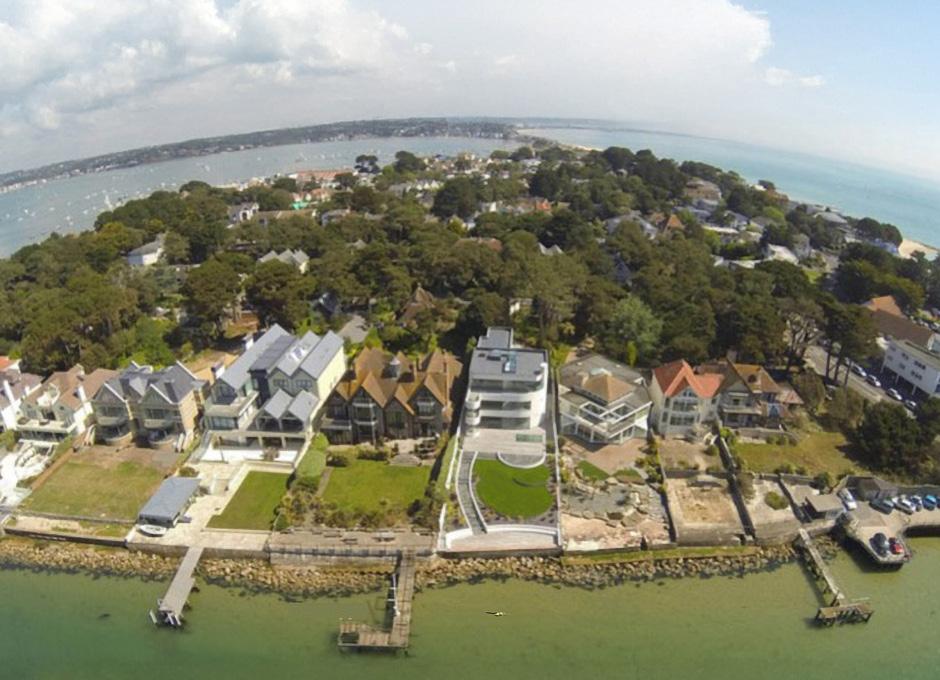
ABRIEF RUNDOWN OF THE MAIN PARTY
wall cases we are all supposed to know about – but can’t quite remember This article is extracted from the talk I gave to the P&T Club last October at The Counting House. It is simply a list of a small number of party wall cases. The aim is to assist you when you come across similar situations, and to provide you with an answer to that irritating question “Where does it say that?”
The cases are in date order, from earliest to latest. I highlight only one notable feature of each case. This means that in some cases, this will not be the main reported result of the case. I should make it clear that I am a building surveyor, not a lawyer. I mugged up on these cases for my own use and have distilled them into what I hope are easily memorable bits.
1. Where one owner subsequently makes use of a party wall previously erected by the adjoining owner and is obliged under the Act to pay a due proportion of the cost to the adjoining owner, they must pay it to the present adjoining owner, not to the previous owner who erected the wall. Mason v Fulham Corporation [1910]
2. A building owner cannot escape their obligations in a party wall award by selling all or part of their property. Selby v Whitbread [1917]
3. Surveyors are in a quasi-judicial position … the steps laid down in the Act should be scrupulously followed throughout and short cuts are not desirable. Gyle-Thompson v Wall Street [1974]
4. Party wall notices have to be served by or on behalf of ALL owners of a property. Lehmann v Herman [1993]
5. An adjoining owner can claim damages for the common law nuisance, represented by building work which was carried out before a party wall notice was served. Louis v Sadiq [1996]
6. The project architect can act as building owner’s surveyor without there being an automatic conflict of interest. Loost v Kremer [1997]
7. If a building owner without serving notice under the Act, does notifiable work which appears to cause damage to an adjoining owner’s property, the building owner can expect that a court would take a robust approach to causation.
Roadrunner Properties v Dean [2004]
8. Appeals under section 10 (17) of the Act should be
made under Part 52 of the Civil Procedure Rules (CPR). Zissis v Lukomski [2006]
9. Underpinning requires a notice under s.2(2)(a) only. An s.6 notice is not needed in addition. Manu v Euroview Estates [2008]
10. A PW award can be binding in respect of matters before and after the serving of notice. Rodrigues v Sokal [2008]
11. Where damage has occurred, surveyors have jurisdiction to make an award under the Act even where the initial notice has been consented to.
Onigbanjo v Pearson [2008]
12. Legal costs can be included in an award, provided they were incurred in furtherance of the award.
Reeves v Blake [2009]
13. Access to adjoining land. A s.6(1) notice for excavation within 3m of an adjoining owner’s building is “work in pursuance of the Act” and therefore access to adjoining land is permitted under s.8(1). Kaye v Lawrence [2011]
14. An adjoining owner’s veto for “special foundations” might be avoided by the inclusion of mass concrete under a reinforced concrete party wall (a ‘Bailey Rail’) Chaturachinda v Fairholme [2015]
15. It is ‘ultra vires’ to include a clause in an award that requires the building owner to ‘make good’ where the notice served is under section 6 only. Lea Valley Developments v Derbyshire [2017]
16. A structure, for example, a loft dormer, can be ordered to be removed if the BO fails to serve a notice.
Ormiston-Kilsby v Fattahi [2019]


Anthony Fieldhouse BSc MRCIS ACIArb FFPWS
First published in Whispers 49. 2022
Nicholas Isaac
EACH YEAR IN ENGLAND AND WALES MANY thousand party wall awards are made under the Party Wall etc Act 1996 (“the Act”); a few hundred such awards are appealed under section 10(17) of the Act, and maybe a hundred or so of those make it to a final hearing. Very few of the decisions in those cases are published, or even reduced to writing, and those decisions are in any event not binding on judges in future cases. So how can you, whether as a member of the public, or even as a party wall surveyor, decide whether it would be a good idea to appeal a particular award you have just been presented with?
In this article I aim to help you make a sensible and informed decision.
An appeal under the Act is a piece of contentious litigation – in other words it is a legal fight with a winner and a loser. The general, albeit not universal, rule in litigation is that the loser pays the winner’s costs. Armed with this knowledge, the typical litigant thinks “Well, that is okay, I am going to win my appeal, so the other side will have to pay my costs”. For that litigant I have three pieces of advice.
First, no matter how good you think your chances of success are – indeed no matter how good your legal advisers think your chances of success are – they are no higher than 70%. This is because all litigation carries with it a risk of failure, always at least 30%. This takes account of human factors – an unpredictable judge or a brilliant advocate for the other side – as well as legal, factual and evidential risks –a legal argument you did not foresee or did not know about, a cost of repair actually incurred by the other side you knew nothing about, or a document you weren’t aware existed. Be very, very wary of any legal adviser who tells you the chances of success are higher than 70%, as this is advice which very, very few competent legal advisers would give.
Secondly, even assuming you win your appeal completely and obtain an order that the losing side pays your costs of the appeal, this does not mean that they will in fact pay you all of those costs. Litigation costs are subject to what is called “assessment”, which means that either the judge who hears the appeal, or another judge at a later date, will look in greater or lesser detail at the costs you have incurred, and will decide the extent to which it is reasonable for the other side to pay each of the sums claimed. As a rule of thumb, a successful litigant will recover about two-thirds of the costs
he has actually paid out for the litigation.
Thirdly, and although appeals under the Act are less expensive than many other areas of litigation, they are very far from cheap. Over the past few years I have dealt with very many appeals under the Act, and although the costs incurred have ranged very widely, from around £15,000 at the very low end, to perhaps £300,000 at the upper end, the vast majority of party wall appeals (where solicitors and counsel are instructed) result in each party incurring between £50,000 and £100,000 in legal costs. So, assuming your appeal is successful, and applying the rule of thumb mentioned above, it will have cost you between about £16,500 and £33,000 to win your appeal.
For many people, and no matter how wrong or galling the award they are faced with may be, it will often be more sensible to grin and bear that award, rather than commit to potentially spending tens of thousands of pounds challenging it.
Party wall appeals have to be brought within 14 days of the award in question being served on you. If an appeal is not issued within that time-limit, your chance to appeal has been lost. It is therefore absolutely essential that you both obtain advice and actually complete an Appellant’s notice in form N161, and file it at court, together with the appropriate court fee, currently £140, at your local County Court, before that period expires.
You are unlikely to be best placed to decide whether an appeal has legal and factual merits. A sufficiently knowledgeable and experienced solicitors or barrister –surprisingly rare where party walls are concerned – should be able to do a quick review of the award and perhaps a few other documents, and give you a good idea about whether your case is worth taking forward. That advice will not be free, but it will almost certainly be a good investment, even if the advice is not to pursue an appeal. Above all, act quickly, as time is short.
Completing an Appellant’s notice is largely form-filling, albeit the N161 form is not really designed for appeals from party wall awards, and so it does require some careful thought to complete correctly.
The parties to the appeal, the Appellant and Respondent, are always the building owner and the adjoining owner. The

surveyors should not be made Respondents to the appeal, except in truly exceptional circumstances which I do not need to cover in this article. The decision being appealed is the award, of whatever date.
Permission is not required to bring a party wall appeal.
The most important part of the form, however, is the “grounds of appeal” section, which should appear on a separate sheet, or sheets, of paper. The grounds of appeal are, in essence, an explanation of what is wrong with the award being appealed, and why. The grounds do not have to go into great detail – they are more of a summary of the key points which can then be fleshed out in the skeleton argument in support of the appeal (of which more below). A ground of appeal can be put very simply, e.g. “The surveyors were wrong to award £x by way of compensation. It should have been a much greater sum because…”.
I would strongly recommend that Appellants also apply, in section 10 of the form, for an order staying the appeal for 4-6 weeks after issue “to allow the parties to seek to negotiate a settlement of the appeal”. The issue of an appeal is often seen as an aggressively litigious act, when in fact the Appellant is merely seeking to protect his position. Asking for a stay of the appeal – effectively asking the court to put the appeal on hold for a while – allows everyone time to reflect and to see whether the parties can agree matters between them. Once an appeal is issued, both the Appellant and the Respondent are potentially liable in costs. That potential liability tends to concentrate minds and encourage settlement, but settlement is far more likely before everyone
has spent a fortune on legal costs.
If you believe that evidence will be required to prove the basis for your appeal – for example the surveyors have determined that a certain level of damage to your property has been caused by the building owner’s works, but you are convinced the damage is actually much more extensive and expensive to repair – it is preferable to note, again in section 10 of the form, that you would like the appeal to proceed by way of re-hearing. In the “Evidence in support” box which follows, you should explain that factual and/or expert evidence will be required to make out your grounds of appeal. It is not necessary to provide a skeleton argument with the Appellant’s notice, although it is supposed to be provided within 14 days of issue. In practice it is relatively rare for a skeleton argument to accompany the Appellant’s notice in a party wall case. Far more important is to ensure that the appeal is issued in time.
In order to ensure that the 14-day time limit is met, it may be necessary to deliver the Appellant’s notice to the court and obtain a receipt for the same. Make sure that the cheque to cover issue costs is for the correct amount, as the Court will reject proceedings accompanied by the incorrect payment, and this can potentially mean you miss the appeal period.
Different County Courts deal with party wall appeals in different ways. Some will make an order giving directions – a timetable of steps which the parties have to take before the final hearing – shortly after issue of the appeal. Others
will simply list the matter for a final appeal hearing, assuming that the appeal is to proceed by way of review rather than rehearing. In either case, and if you have not done so before, now is the time to seek legal advice, both as to the merits of your appeal, and as to how best to comply with the court’s directions.
A skeleton argument must, at least in order to comply strictly with the Court rules, be filed in support of your appeal within 14 days of issuing it. A skeleton argument is something of a misnomer because its purpose is really to put flesh on the bones of the appeal apparent from the grounds of appeal. In the skeleton argument you must set out, in writing, the detailed facts and law upon which you rely in support of your grounds of appeal. It is often easiest to do this in sections which match the individual grounds of appeal.
The difference between an appeal by way of rehearing, as opposed to an appeal by way of review is primarily that in an appeal by way of rehearing, the decision being appealed is largely ignored, and the Court concentrates on the new evidence before it, rather than restricting itself to the material which was before the surveyors who made the award being appealed. In an appeal by way of review, the Court concentrates on whether the surveyors were right to make the decision they did on the evidence which was before them at the time.
Where the appeal proceeds by way of review, the Court only really needs to ensure that the materials which its sees are those which were before the surveyors who made the decision. Consequently, directions are likely to be limited to disclosure of those documents, and the preparation of a trial bundle.
However, where the appeal proceeds by way of rehearing, the directions are more or less identical to those given for any normal civil trial. First, the parties are required to disclose any relevant documents in their possession or control. Secondly, the parties exchange witness statements of fact – these are usually reasonably limited in party wall cases, but may well be necessary, for example, to speak to the impact upon an adjoining owner caused by the damage to his property. Thirdly, experts will often need to be appointed by each party, and must meet to produce a joint statement of agreed and non-agreed issues, and to each produce a report.
Experts in party wall cases are usually surveyors, but, where appropriate, may be structural engineers, or specialist decorators, or whatever expert is best-placed to give the necessary and appropriate evidence. Finally, directions will call for one of the parties, usually the Appellant, to prepare appeal bundles for the final hearing – this should be done cooperatively with the Respondent, and the general rule is that if either party wants a document to be included, it should be included in that bundle.
Appeal hearings do not happen quickly. On average it is around 12 months between issue of an appeal and its final
hearing, although the normal range is probably 9-15 months. Appeal hearing are rarely less than a day, and are most commonly 2-3 days’ long.
Where the appeal is by way of review, the Appellant makes his submissions, the Respondent responds, and the Appellant replies to any legal points raised by the Respondent.
Where the appeal is by way of rehearing, the Appellant will usually “open” the case, by taking the judge through the key documents in the bundle, before witnesses of fact, and then expert witnesses are called on behalf of each party. Finally, the parties each make closing submissions.
Depending on the complexity of the case and the time available, the judge may give judgment on the spot (“ex tempore”), but more commonly he will “reserve” judgment, which means that he will go away and produce a written judgment. A reserved judgment is usually provided to the parties and their lawyers in draft form before being formally “handed down” in court. How quickly one receives a reserved judgment depends on the judge and his other commitments, but most are provided in 36 weeks.
Where a judgment is given on the day, the question of costs will usually also be decided immediately after judgment is given. Where judgment is reserved, this will normally be dealt with either by agreement, or written submissions. Only if the question of costs is particularly difficult will the Court consider or permit a further hearing to determine costs to take place.
Appeal in party wall cases are not to be commenced lightly. They are serious and potentially very costly pieces of litigation. Very often I have advised clients, who entirely justifiably feel wronged, not to bother appealing an award, simply because it will be more costly for them to bring a successful appeal than to lump the existing award.
Of course, there may nonetheless be very sound reasons for an appeal – commercial reasons, or reasons based on principle, or simply tactical reasons – but make sure you know what those reasons are before commencement. An unsuccessful appeal can be far worse than a bad award.

Adjoining owner and adjoining occupier respectively mean any owner and any occupier of land buildings storeys or rooms adjoining those of the building owner and for the purposes only of section 6 within the distances specified in that section
The term occupier is not defined in the Act but will include anyone living or working on the property, whether for a few weeks or longer. They could be a shorthold tenant, licensee or even a trespasser. An adjoining occupier has no estate in law.
The building owner shall compensate any adjoining owner and any adjoining occupier for any loss or damage which may result to any of them by reason of any work executed in pursuance of this Act.
For work to be executed in pursuance of the Act notice must be served.
An adjoining occupier does not have recourse to the dispute resolution process in section 10 to enforce compensation under section 7(2). Any claim would be for breach of statutory duty.
The scope of section 7(2) is very wide including claims for:
▶ Alternative accommodation
▶ Storage/removal costs
▶ Loss of earnings
▶ Loss of amenity
▶ An adjoining owner must take steps to mitigate their loss
Where the building owner builds a wall wholly on his own land in accordance with subsection (4) or (5) he shall do so at his own expense and shall compensate any adjoining owner and any adjoining occupier for any damage to his property occasioned by-
(a) the building of the wall;
(b) the placing of any footings or foundations placed in accordance with subsection (6)
Where the adjoining premises are laid open in exercise of the right mentioned in section 2(2)e a fair allowance in respect of disturbance and inconvenience shall be paid by the building owner to the adjoining owner or occupier
If –
(a) an occupier of land or premises refuses to permit a person to do anything which he is entitled to do with regard to the land or premises under Section 8(1) or (5); and
(b) the occupier knows or has reasonable cause to believe that the person is so entitled, the occupier is guilty of an offence.
An adjoining owner may not frustrate a statutory right of access.
An adjoining occupier has right to compensation and notice of entry
An adjoining occupier has no right to be heard in the preparation of an award.
An adjoining occupier refuses access they are guilty of a criminal offence under subsection (1) and (2) are liable on summary conviction to a fine of an amount not exceeding level 3 on the standard scale.
First published in Whispers 50. 2022
MEMBERSHIP OFFICER
Ryan J Hannibal-Law ryan@barnsleybate.co.uk
Derek Bate derek@barnsleybate.co.uk
David Bowden david@ubs-uk.com
Adam Linard adam.linard@2110consult.com
Stephen Mealings stephenmealings@ansteyhorne.co.uk
IT OFFICER
Hannah Boyd hannahboyd@ansteyhorne.co.uk
CHAIRPERSON
Holly Harris holly.harris@knightfrank.com
Hannah Boyd hannahboyd@ansteyhorne.co.uk
Fareed Fetto fareed@fettomoore.co.uk
Anne Lorenzato anne.lorenzato@grosvenor.com
Louis Maycock lmaycock@tftconsultants.com
Irene Moore irene@fettomoore.co.uk
Alan Ssesanga allan.ssesanga@eb7.co.uk
Victoria Woolf victoria.woolf@osborneclarke.com
Branch Resources Working Group
CHAIRPERSONS
Anne Lorenzato anne.lorenzato@grosvenor.com
Jonny Callard jonny@ttsurveyors.com
MEMBERS
Michael Ashton michael.ashton@cambsurveyors.co.uk
Jonny Callard jonny@ttsurveyors.com
Jeff Griggs jeff.griggs@award-associates.co.uk
Michael Kemp kempm56@gmail.com
Suzanne Leo suzanne.leo@delvapatmanredler.co.uk
Vince Rimmer vince@popvisory.co.uk
Publications
PUBLICATIONS OFFICER
Natasha Demirbag natasha@natashademirbag.com
CHAIRPERSON / EDITOR
Natasha Demirbag natasha@natashademirbag.com
Nick Brown nick@ashridgesurveyors.co.uk
Michael Clark m.clark@clark-consulting.co.uk
Angela Gregson angela.gregson@roydswithyking.com
Irene Moore irene@fettomoore.co.uk
Allan Ssesanga allan.ssesanga@eb7.co.uk
Tony Guerguis tony@gtlouis.co.uk
Shirley Waldron shirley.waldron@delvapatmanredler. co.uk
CHAIRPERSON
Anthony Fieldhouse info@afsurvey.co.uk
Aiden Cosgrave aidan.cosgrave@delvapatmanredler. co.uk
Alastair Gill
alastairgill@gillsurveying.com
Howard Smith hsmith@radcliffechambers.com
Shirley Waldron shirley.waldron@delvapatmanredler. co.uk
Victoria Woolf victoria.woolf@osborneclarke.com
CHAIRPERSON
Fareed Fetto fareed@fettomoore.co.uk
Michael Kemp
Martin O’Shea martin@martinoshea.co.uk
CHAIRPERSON
Geoffrey Adams geoffreyadams@ansteyhorne.co.uk
James Beat jamesbeat@lincolnandrowe.com
Natasha Demirbag natasha@natashademirbag.com
Darren Frias-Robles darren@whitefoxgroup.co.uk
Trevor Hultquist trevor@thasurveyors.com
Philip Hurst phurst@hurstpm.co.uk
David Moon
Ashley Patience ashley.patience@delvapatmanredler. co.uk
CHAIR PERSON
Dean Sibley 01954 250302 dsibley@angliasurveyors.com
SECRETARY
Jeff Griggs 01954 454709 jeff.griggs@award-associates.co.uk
EDUCATION
Michael Ashton 07398 926957 michael.ashton@cambsurveyors.co.uk
COMMITTEE MEMBERS
Phil Ward 01223 504645 philipward@argyledesign.co.uk
Simon Wright 01223 968171 simon.wright@partywallscamb.co.uk
Devon & Cornwall
CHAIR PERSON
Dennis Venn 01752 261811 dvenn@vickeryholman.com
SECRETARY
Peter Croft 01392 455155 pc@croftsurveyors.co.uk
East Midlands
CHAIR PERSON
Michael Boast 07786 973199 mboast@smitherspurslow.com
SECRETARY
James Beat 07498 211509
jamesbeat@lincolnandrowe.com
Essex
CHAIR PERSON
James Thacker 07769 248459 james.thacker@arcadis.com
SECRETARY
Tony Fisk 07887 680725 churleysurveys@aol.com
Kent
CHAIRPERSON
Steven Way 020 8295 1200 steve@collier-stevens.co.uk
SECRETARY
Decia Roberts 07801 868332 droberts@playleandpartners.co.uk
CHAIR PERSON
Jonny Callard 07540 726101 jonny@ttsurveyors.com
SECRETARY
Jack Norton 07802 855482 jack.norton@schofieldsurveyors.co.uk
COMMITTEE MEMBERS
Hannah Boyd 020 7499 6317 hannah.boyd@murraybirrell.co.uk
Tom Hopkins 07500 554355 thopkins@martinarnold.co.uk
Irene Moore 07983 809556 irene@fettomoore.co.uk
Graham North 020 8744 2374 grahamnorth@ansteyhorne.co.uk
Victoria Wolf 020 7305 5692 victoria.woolf@shoosmiths.com
North East
CHAIR PERSON
Stephen Nesbitt 0191 265 6040 s.nesbitt@csnconsulting.co.uk
SECRETARY
Richard Maddison 01765 634717 rjm@maddisonjamesassociates.co.uk
Norfolk
CHAIR PERSON
Henry Woodley 020 7065 2770 henrywoodley@ansteyhorne.co.uk
North West
CHAIR PERSON
Vince Rimmer 01772 382909 vince@popvisory.co.uk
SECRETARY
Greg Bird 0161 672 5100 greg.bird@gia.uk.com
EDUCATION OFFICER
Suzanne Leo 0151 242 0982 suzanne.leo@delvapatmanredler. co.uk
COMMITTEE MEMBERS
Philip Allen 0151 331 8973 philip.allen@aecom.com
Robin Ainsworth 0161 789 4194 ainsworthSSL@btinternet.com
CHAIR PERSON
Mike Lewis 01458 841341 aardmanassoc@gmail.com
SECRETARY
Daniel Tapscott 0370 777 6292 dan.tapscott@rapleys.com
CHAIR PERSON
Roland Gilbertson 01473 221222 thinkbiznes@gmail.com
SECERATARY
Damian Lockley 01787 477559 damian@oswick.co.uk
EDUCATION
Jason Griffiths 01603 717090 jason.griffiths@purple-property.com
CHAIR PERSON
Harry Everest 07816 842148 harry@everestsurveying.co.uk
SECRETARY
Marian Dyer marian@fdsurveyors.co.uk
CHAIR PERSON
Geoffrey Adams 020 7065 2770 geoffreyadams@ansteyhorne.co.uk
SECRETARY
Kevin Sloane 01243 774764 sussex@partywalls.org.uk
CHAIR PERSON / SECRETARY
Guy Compson 07545 696109 guy@guycompsonsurveying.co.uk
EDUCATION OFFICER
William Minting 07879 492674 will@willminting.co.uk
CHAIR PERSON
Darren Frias-Robles 01202 660167 darren@whitefoxgroup.co.uk
CHAIR PERSON
Derek Bate 0121 378 0100 derek@barnsleybate.co.uk
SECRETARY
Graham Thompson 0121 706 4326 gthompson@wltsurveyors.co.uk
EDUCATION
Ryan J Hannibal-Law 0121 378 0100 ryan@barnsleybate.co.uk
The Pyramus and Thisbe Society Journal is published by The Pyramus and Thisbe Society exclusively for its members by Pongo & Matelot (info@pongoandmatelot.co.uk). All information correct at time of going to press. All rights reserved. Articles may not be reproduced without written permission from the author. While every care is taken in compiling the content, neither the publisher nor The Pyramus and Thisbe Society assumes responsibility for effects arising from this publication. The opinions and subjects discussed in this publication are for editorial purposes only. No Members nor the Fellowship of The Pyramus and Thisbe Society accepts liability for any direct or consequential loss arising from the use of this document or its contents. The opinions expressed in this journal are not necessarily the views held throughout The Pyramus and Thisbe Society.
Publisher and creative direction
info@pongoandmatelot.co.uk pongoandmatelotstudio