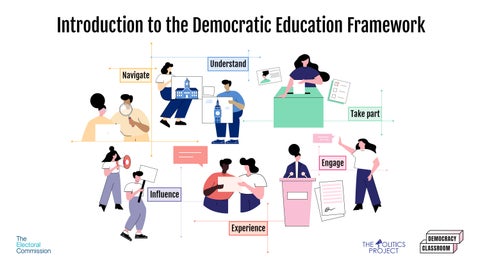
Introduction to the Democratic Education Framework Understand Understand
Navigate Navigate
Take part Take part
Engage Engage Influence Influence Experience Experience
About the Framework
2
What is the Democratic Education Framework? The Democratic Education Framework helps educators and youth practitioners understand, assess and strengthen the democratic education they provide to children and young people aged 5-25. It gives educators and youth practitioners practical tools to strengthen impartial democratic education that equips young people with an understanding of how democracy works, why it matters, why their voice counts and how they can take part. The Framework brings together six strands which, collectively, provide a broad picture of high-quality democratic education. It is not a prescribed curriculum or a checklist, but a flexible tool that helps educators to reflect on their existing practice, identify areas for development, and strengthen their provision.
The Democratic Education Framework is designed to support impartial democratic education. It does not favour particular political views, parties, candidates, policies or outcomes, or seek to influence how young people vote. Its purpose is to help young people develop the knowledge, skills and confidence to consider different perspectives, think critically and make up their own minds. The Framework supports schools, colleges and youth settings in England and Northern Ireland, with plans to extend it to Scotland and Wales in future. It has been developed with more than 100 partners and practitioners across England and Northern Ireland to ensure it reflects current curriculum contexts and can be applied flexibly within the different education systems.
About the Framework
3
Why the Framework matters We know that young people care about the issues affecting their lives, but many aren’t confident about how democracy works, how decisions are made, or how they can influence change. Educators and youth practitioners want to help, but have competing priorities and limited time. The Democratic Education Framework was created to respond to these challenges.
The Electoral Commission found that 16-17 year olds are the least likely group to be on the register. At the same time, young people themselves say they want more support. 78% of young people surveyed thought that children and young people should learn more about politics in school or college (The Electoral Commission, 2026).
Young people want to hear from their teachers and other trusted adults. In a recent survey of young people, 55% said teachers and lecturers were among the people they most wanted to hear from on the issues that matter to them (Jack Petchey Foundation, Are you Listening?, 2026).
The Framework gives educators and youth practitioners practical guidance, resources and training to help them build young people’s knowledge, confidence and skills. It brings together the views of young people and the latest evidence, expertise and practice from across the sector into one shared approach to impartial democratic education.
With the UK government planning to extend the right to vote to 16 and 17 year olds, young people will need impartial education that gives them the knowledge, skills and confidence to engage in robust and respectful debate and make their own informed choices when they vote for the first time. Young people are much less likely to participate in elections than older generations.
At its heart, it’s about helping every young person feel informed, empowered and ready to play their part in democracy.
“ Education is the best way to empower and encourage others to become engaged and have their say” David, aged 15
About democratic education What is democratic education? Democratic education encompasses the different ways young people learn about democracy, experience democratic values and processes, and develop the knowledge and skills to participate. It includes both what young people are taught and the opportunities they have to experience and practise democracy in schools, colleges, youth settings and communities. It may be part of a curriculum, delivered primarily through Citizenship Education in England or Learning for Life and Work (LLW) in Northern Ireland, or take place through wider activities and experiences. The term therefore extends beyond a single subject, programme or setting.
4
What does effective democratic education look like? Effective democratic education is impartial, inclusive, skills-based, knowledge-rich, participatory and engaging.
Young people should have opportunities to learn about democracy, experience it, participate in it and influence decisions that affect their lives.
It equips young people with an understanding of the people, institutions, rights and responsibilities that shape democracy at a local, national and international level. But democratic education goes beyond facts and systems. It should foster critical thinking and a sense of agency, helping young people see the relevance of politics and democracy to their own lives. When done well, it not only informs but motivates – building the confidence, curiosity and critical literacy young people need to participate in democratic life now and in the future.
Democratic education should be taught impartially, enabling young people to explore a range of relevant perspectives and viewpoints without promoting a particular political position or outcome. This means presenting different views fairly and equipping young people with the knowledge and critical thinking skills to make up their own minds.
Opportunities for young people to experience democracy matter: having their voices heard, engaging with decision makers, voting, and taking action on the issues that matter to them.
About democratic education Why does democratic education matter in schools and colleges? Schools and colleges have a unique role to play in ensuring that every young person has the opportunity to learn about and experience democracy, regardless of their background. Good democratic education can enrich learning across schools and colleges. It can encourage young people to be curious about the world around them, explore different perspectives in an impartial and balanced way and develop skills including critical thinking, literacy and oracy. It can also help build a positive democratic culture, where young people have their voice heard and understand that their views and actions can make a difference. Democratic education is already an important part of the role schools and colleges play in preparing young people for adult life, further study, employment and active participation in their communities.
England In England, democracy is one of the Fundamental British Values that schools and colleges are expected to actively promote, and democratic education is a fundamental part of the statutory Citizenship curriculum at Key Stages 3 and 4. Its role is set to grow further, with Citizenship being strengthened in secondary schools and introduced into the national curriculum at primary level from 2028. Civic engagement is highlighted as one of the five key focus areas of the new Enrichment Framework. There are also key opportunities to deliver democratic education through established programmes such as the Oracy Framework and Rights Respecting Schools programmes. Northern Ireland The Northern Ireland Curriculum already provides opportunities to explore citizenship, participation and decision-making through areas such as Learning for Life and Work (LLW) - Local and Global Citizenship. Proposed curriculum reforms place an increased emphasis on democratic education through Personal, Social, Civic and Careers (PSCC) education.
5
Why does democratic education matter in the youth sector? Youth work has always played an important role in helping young people develop their voice, agency and ability to shape the world around them. Democratic education connects closely with the principles of youth voice, participation and social action, and is reflected in the National Youth Work Curriculum in England and Youth Work: A Model for Effective Practice in Northern Ireland. Youth practitioners also occupy a unique position as trusted adults who can create spaces for young people to explore difficult issues, ask questions, encounter different perspectives and take action on the things they care about. At a time when young people are navigating misinformation, disinformation and increasing polarisation, these spaces are more important than ever. Democratic education can help young people make sense of the world around them and develop the confidence to participate in shaping its future.
The Democratic Education Framework Each strand describes the knowledge, skills, confidence and experiences that democratic education helps young people develop. The key areas are designed to support educators and youth practitioners in planning, reviewing and strengthening their provision; they are not a prescribed curriculum or checklist. Each strand includes a series of delivery pathways written by expert teachers and youth practitioners. These offer practical advice and resources for working with a range of age groups and settings. For further inspiration, we have included case studies showcasing activities and programmes that support each strand.
The Framework at a glance: Navigate: issues, media and information Understand: democratic structures and Institutions Take part: elections and voting Engage: politicians and decision makers Experience: democratic culture and youth voice Influence: campaigning and social action
6
Navigate
7
Issues, media and information
Young people will build skills to find, understand and question news and information. They’ll learn how to spot misinformation and think critically about what they see and hear.
Key topics: • Social and political issues
To participate confidently in a democracy, young people need to be able to navigate an increasingly complex information landscape and make informed decisions about the issues they care about.
• Misinformation, disinformation and fact checking
The Navigate strand helps young people find, understand and evaluate information about the world. Covering news, social media and other online and offline sources, it supports them to consider different perspectives and evidence, recognise bias, and identify misinformation and disinformation.
• Social media and algorithms
By exploring social and political issues, young people can build the knowledge to form their own views and participate meaningfully in democratic life. This strand can be delivered through lessons and workshops. In addition, you can also engage young people through activities like school papers, social media take overs and journalism groups or clubs.
• News sources, media and bias
Curriculum links: England: Citizenship, English, Computing, Personal, Social, Health and Economics (PSHE), British Values and Spiritual, Moral, Social and Cultural education (SMSC). Northern Ireland: Learning for Life and Work (Local and Global Citizenship), English, Digital Technology, The World Around Us (WAU), Personal Development and Mutual Understanding (PDMU).
Understand
8
Democratic structures and institutions
Young people will learn how decisions are made in the UK, at all levels of government, and how laws are created. This will help them understand how the system works and where power sits. To take part in democracy, young people need to understand how it works: where power sits, how decisions are made and how those decisions affect their lives and communities. The Understand strand explores how democracy has developed over time and how government operates at local, regional, devolved and national levels. It introduces young people to the institutions where decisions are made and power is exercised, electoral and democratic processes, and the ways laws and policies are created. By learning about and visiting parliaments, councils and other public institutions, young people can see democracy in practice. Importantly, they can understand how to have a say in the decisions that affect them and learn more about the people who represent them.
This strand can be delivered through lessons and workshops. You can also engage young people through visits to parliaments, town halls and other public institutions; by taking part in or observing committee hearings or select committee sessions; or by holding a mock committee or council hearing in the classroom.
Key topics: • The history and development of democracy • L ocal, regional, devolved and UK government • Electoral systems and democratic processes • How laws and policies are made
Curriculum links: England: Citizenship, History, Personal, Social, Health and Economics (PSHE), British Values and Spiritual, Moral, Social and Cultural education (SMSC). Northern Ireland: Learning for Life and Work (Local and Global Citizenship), History, The World Around Us (WAU), Personal Development and Mutual Understanding (PDMU).
Take part
9
Elections and voting
Young people will understand why voting matters and how elections work, so they feel confident taking part and making up their own minds about who to vote for. This includes knowing how to register and the different ways they can vote. Voting is one of the most direct ways people can take part in democracy and have a say in who represents them. As legislation to extend voting rights to 16 and 17-year-olds progresses through UK Parliament, it is increasingly important that young people feel informed, confident and prepared to participate. The Take Part strand helps young people understand why voting matters, who can vote, and how elections and representation work. It introduces them to political parties, candidates and campaigns, and supports them to form their own informed views about who to vote for. It also gives young people the practical knowledge they need to register and vote, so that when election day comes, they feel confident and comfortable using the voting |methods available to them.
This strand can be delivered through lessons and workshops. You can also engage young people through Welcome to Your Vote Week, the Electoral Commission’s annual engagement week. Young people can experience elections through mock and parallel elections, take part in voter registration drives and build their confidence through polling station walk-throughs.
Key topics: • Why voting matters • R epresentation and who can vote • Political parties, candidates, manifestos and election campaigns • How voting and elections work
Curriculum links: England: Citizenship, English, Computing, Personal, Social, Health and Economics (PSHE), British Values and Spiritual, Moral, Social and Cultural education (SMSC). Northern Ireland: Learning for Life and Work (Local and Global Citizenship), English, Digital Technology, The World Around Us (WAU), Personal Development and Mutual Understanding (PDMU).
Engage
10
Politicians and decision makers
Young people will find out who represents them and how they make decisions that affect their lives. They’ll learn how to contact decision makers, share their views and get involved in shaping decisions.
Key topics:
Engaging directly with politicians can help young people understand the people who hold power. At its best, it creates opportunities for meaningful conversations that build mutual trust and understanding.
• How representation works and who represents you
The Engage strand helps young people find out who represents them and learn about their roles and responsibilities. It helps young people understand how politicians make complex decisions, balance competing needs and priorities, and decide how to use limited resources, exploring the trade offs involved and how decisions can affect different people and communities. It shows them how to contact their representatives and, through discussions, visits, hustings, consultations and petitions, make their voices heard, influence decisions and hold those in power to account through robust and respectful debate. This strand can be delivered through lessons and workshops. You can also engage young people through visits and engagements with politicians and decision makers, including hustings during elections.
• Roles and responsibilities of elected representatives and decision makers
• Petitions, consultations and democratic participation • Contacting decision makers and holding representatives to account
Curriculum links: England: Citizenship, English, History, Personal, Social, Health and Economics (PSHE), Religious Education, British Values and Spiritual, Moral, Social and Cultural education (SMSC). Northern Ireland: Learning for Life and Work (Local and Global Citizenship), Personal Development and Mutual Understanding (PDMU), The World Around Us (WAU), and Shared Education.
Experience
11
Democratic culture and youth voice
Young people will share their opinions, listen to others and take part in discussions and decisionmaking. They will build confidence in speaking up and discussing issues that matter to them and their community. Young people learn about democracy not only through what they are taught, but also by experiencing it in practice. Meaningful opportunities to share their views robustly and respectfully, listen to others and contribute to decisions help them recognise that their voices matter and develop the skills to take part. The Experience strand helps young people explore democratic rights, values and responsibilities. It builds their confidence and oracy skills through dialogue, discussion and debate. By working with others and contributing to collective decisions in their schools, colleges, youth groups and communities, young people can experience what it means to be part of a democratic culture.
This strand can be delivered through lessons and workshops. Democratic culture should also be embedded within the decision-making structures of the school, college or youth organisation. This can include school, college or youth councils, youth steering groups and student unions. Young people can have their say through participatory budgeting programmes and youth citizens’ assemblies. They can also build their skills through debating clubs.
Key topics: • Democratic rights, values and responsibilities • Dialogue, deliberation and robust and respectful debate • Youth voice, representation, and leadership • Collective and participatory decision-making
Curriculum links: England: Citizenship, English, History, Personal, Social, Health and Economics (PSHE), Religious Education, British Values and Spiritual, Moral, Social and Cultural education (SMSC) and Youth Voice. Northern Ireland: Learning for Life and Work (Local and Global Citizenship), English, Religious Education, Personal Development and Mutual Understanding (PDMU), The World Around Us (WAU), The Arts and Drama, and Shared Education.
Influence
12
Campaigning and social action
Young people will learn how to stand up for causes they care about and make a difference. They can explore how change happens and how to take action. In a democracy, young people should be able to use their voices and have an impact on the issues that matter to them and their communities. Understanding how change happens and how they can influence it helps them build the confidence and agency needed to take action. The Influence strand helps young people identify the issues they care about and consider the different ways they can make a difference. It supports them to plan campaigns and social action projects, participate in active citizenship, and develop the skills and knowledge needed to create change. This strand can be delivered through lessons and workshops and lends itself particularly well to experiential learning through social action projects, active citizenship projects and campaigns in schools, colleges or communities. It can also be supported through extracurricular clubs, particularly those focused on specific issues, such as the environment.
Key topics: • Local, national and international issues and causes • How change happens and the role of changemakers • Campaign methods and routes to influence • Planning and delivering campaigns and social action
Curriculum links: England: Citizenship, English, History, Geography, Computing, , Art and Design, Personal, Social, Health and Economics (PSHE), British Values and Spiritual, Moral, Social and Cultural education (SMSC). Northern Ireland: Learning for Life and Work (Local and Global Citizenship), English, History, Geography, Personal Development and Mutual Understanding (PDMU), The World Around Us (WAU), and The Arts and Drama.
Acknowledgements The Democratic Education Framework was created by the Electoral Commission and The Politics Project. It was developed in partnership with over 100 organisations and individuals from across the education, youth and democratic engagement sectors in England and Northern Ireland. The Electoral Commission is the independent body that oversees elections and regulates political finance in the UK. It provides trusted and politically impartial information, resources and training to support democratic participation. The Politics Project is a non-partisan democratic education organisation that specialises in supporting young people to use their voices, supporting schools, youth organisations, young people and politicians to learn about and engage with politics and democracy.
13
Contributors Academic advisory panel Dr Anwen Elias Aberystwyth University
Thomas Loughran University of Lancaster
Professor Tony Gallagher Queen’s University Belfast
Professor Andy Mycock University of Leeds
Professor James Sloam Royal Holloway, University of London
Dr Chris Pich University of Nottingham
Dr Gianfranco Polizzi University of Birmingham Dr Hans Svennevig University College London Dr Jan Eichhorn University of Edinburgh
Dr Christine Hübner University of Sheffield Dr James Weinberg University of Sheffield Dr Carole Pugh York St John University
Acknowledgements Education advisory panel Liz Moorse Association for Citizenship Teaching Eddie Playfair Association of Colleges Zubeda Limbada ConnectFutures Helen McStravick Department for Education Lizzie Jones National Literacy Trust Natalie Corbett Northern Ireland Youth Forum Geoff Wells Oak National Academy Matteo Bergamini Shout Out UK
14
Youth sector panel Amanda Gurruhaga Shout Out UK Andrea Hartley Skating Panda Tom Varley Skills Builder Becky Gittins Smart School Councils Fran Jeens UK Parliament Education Tim Judge Voice 21 Ashley Hodges Young Citizens
Sharon Long Partnership for Young London Stuart Dunne Youth Focus North West Derin Adebiyi Duke of Edinburgh Sanam Mehta Girlguiding Rebecca Deegan I Have A Voice Esther Horner-Aird National Youth Agency Tim Aldcroft Newham Youth Empowerment Service
Arón Hughes Northern Ireland Youth Forum Alan Bennett Scouts Abiee Harrell Scouts Laura Cunliffe Hall UK Youth Jamie Masraff Youth Zone
Acknowledgements
15
The Democratic Education Forum in Northern Ireland Angel Eyes NI Belfast YMCA
Northern Ireland Assembly Education Service
CCEA
Northern Ireland Commissioner for Children and Young People (NICCY)
Children in Northern Ireland
Northern Ireland Human Rights Commission (NIHRC)
Children’s Law Centre
Northern Ireland Office (NIO)
Community Relations in Schools
Northern Ireland Youth Forum (NIYF)
Department for the Economy
Politics in Action
Department of Education
Queen’s University Belfast
Disability Action NI
Radius Housing Participatory Budget Programme
Education Authority (EA)
SistersIN
Guide Dogs NI
South West College
Hume Foundation
St Mary’s University College Belfast
Integrated Education Fund (IEF)
Stranmillis University College
Irish Electoral Commission
UK Parliament Education and Engagement Service
Just2easy
Ulster University
Migrant Democracy Project
University of Edinburgh
MindWise
VOYPIC
NI Youth Assembly
Young Farmers’ Clubs of Ulster (YFCU)
Acknowledgements
16
Pathways developed by expert educators
Additional contributors
Rebecca Andrews Further education consultant
James Christie Primary education consultant
Abi Wharton Peter Symonds College
Samed Karadal The Bridge Academy
Ellesia Hanna Youth and education consultant
Fiona Payne Education consultant
The framework was also developed with input from the Electoral Commission’s Youth Voice Network and partners from across the Democracy Classroom Network. Finally we would like to thank Akeera, Amelia, Arun, Eashan, Janine, Keon, M, Madeleine, Niamh, Pola, Soumil, Yusuf from The Politics Project Youth Steering Group.
Website review by Melissa Morgan Learning Experience Designer Katie McQuade Programme Lead: History and Politics James Christie Primary education consultant
The Democratic Education Framework is hosted on Democracy Classroom, your one-stop shop for free, expert resources to engage young people in democracy.
Democracy Classroom includes resources developed with and by the Electoral Commission, alongside materials from external organisations and individuals. These resources reflect a range of perspectives and approaches and are intended to extend learning, encourage discussion and support different educational contexts. The inclusion of any resource does not constitute an endorsement, and the views expressed in individual resources do not necessarily reflect those of the Electoral Commission. Content on the Democratic Education Framework pages has been developed and reviewed with a focus on accuracy and impartiality, with the Electoral Commission providing quality assurance across the framework. Content elsewhere on the site has been reviewed and quality assured by The Politics Project.