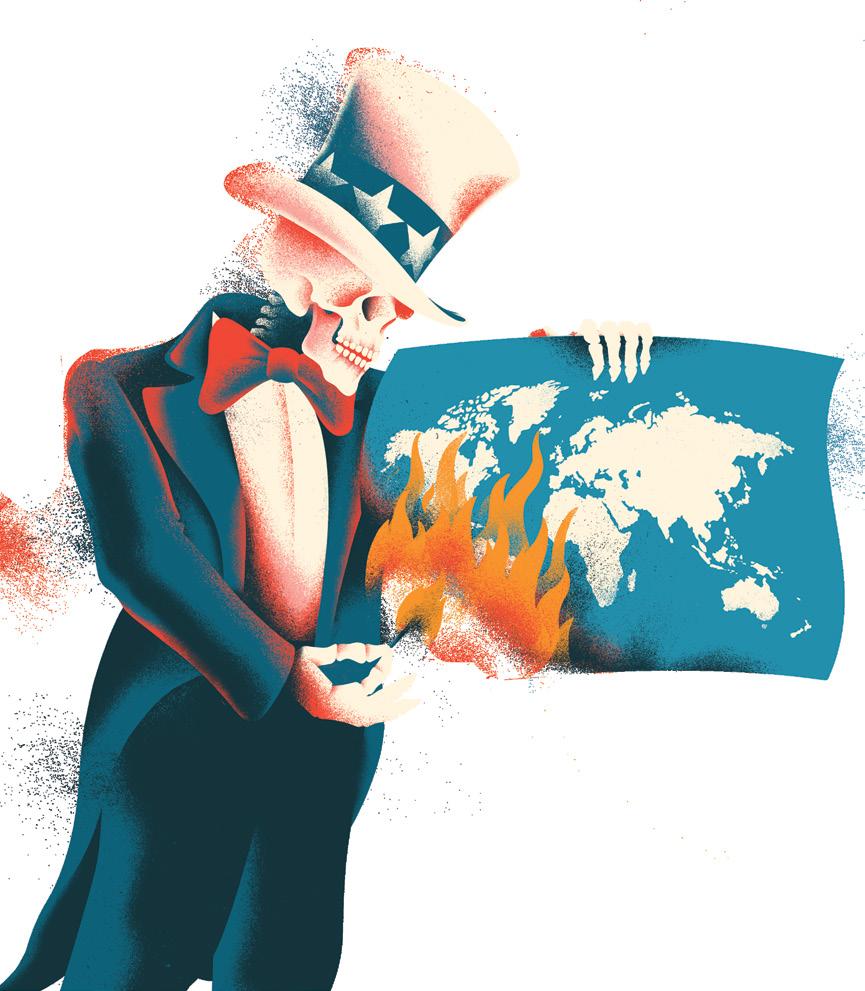
Panama, Alberta: Canada and the return of U.S. hemispheric imperialism
Jon Milton / 13
Most-favoured nation on a hill
Stuart Trew / 18
Years of lead in the Silicon Valley
Paris Marx / 21
The soldier, the banker, the oil tanker
Nick Gottlieb / 23
Centrespread / 26
The climate policy winter
Hadrian Mertins-Kirkwood / 28
The Gaza world order
Nashwa Lina Khan / 30
Middling powers
Jasmine Ramze Rezaee / 32
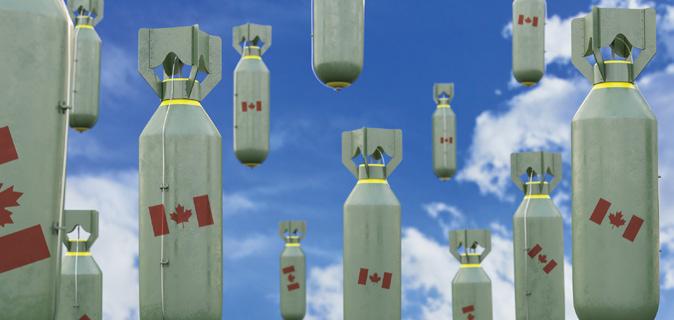
A branch plant for bombs
Kelsey Gallagher / 34
Up Front
Alberta’s threat to Medicare
Andrew Longhurst / 6
Oil execs are war profiteering
Hadrian Mertins-Kirkwood / 8
Precarious work runs rampant in Nova Scotia
Christine Saulnier, Daniel Cerdas-Sandí, Rebecca Casey, and Rachel Brickner / 10
Universities and colleges are an economic powerhouse
Ryan Romard / 11
Let’s keep airports public
Peggy Nash / 12
Viewpoints
Canada’s passive, idealistic trade plan
Stuart Trew / 36
Omatsu Files:
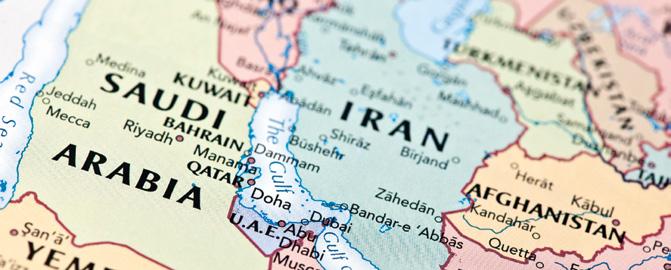
History will judge Canada’s stance on the Middle East
Changiz M. Varzi / 37
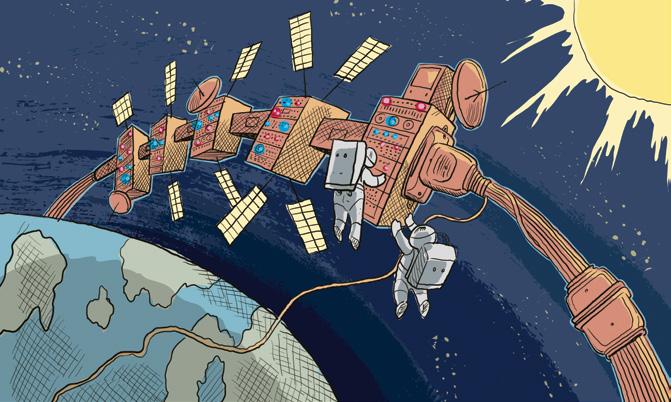
Data centres in space
Benjamin Segobaetso / 38
Growth economics are past their best before date
Mike Nickerson / 41
Closing journalism schools will worsen the decline of local news
David Macdonald / 42
Books
The rise of the ultra-rich necessitates a wealth tax
Linda McQuaig and Neil Brooks / 45
Austerity’s impact in Manitoba
Jesse Hajer, Ian Hudson, Jennifer Keith / 48
Adult education: A vital part of the education continuum
Nicholas Chasowy / 50
Founded in 1980, the Canadian Centre for Policy Alternatives (CCPA) is a registered charitable research institute and Canada’s leading source of progressive policy ideas. The CCPA began publishing the Monitor magazine in 1994 to share and promote its progressive research and ideas. The Monitor is published four times a year. The print version is mailed to all supporters who give $60 or more a year to the CCPA.
You can gift the Monitor to a friend or family member, view previous issues, and read more free, timely content at www.policyalternatives.ca
The opinions expressed in the Monitor are those of the authors and do not necessarily reflect the views of the CCPA.
ISSN 1198-497X
Canada Post Publication 40009942
Co-editors: Trish Hennessy and Jon Milton
Senior Designer: Tim Scarth
Layout: Susan Purtell
How to contact the CCPA
Letters to the editor monitor@policyalternatives.ca
CCPA National
141 Laurier Avenue W., Suite 501 Ottawa ON K1P 5J3 613-563-1341 1-844-563-1341
ccpa@policyalternatives.ca
CCPA BC ccpabc@policyalternatives.ca
CCPA Manitoba 204-927-3200
ccpamb@policyalternatives.ca
CCPA Nova Scotia 902-943-1513
ccpans@policyalternatives.ca
Monitor Huddle 1 / From the editor 2 / From the director 3 / Letters 4
CCPA in the spotlight 5 / Get to know the CCPA 43 / CCPA donor profile 44
The good news page by Elaine Hughes 52
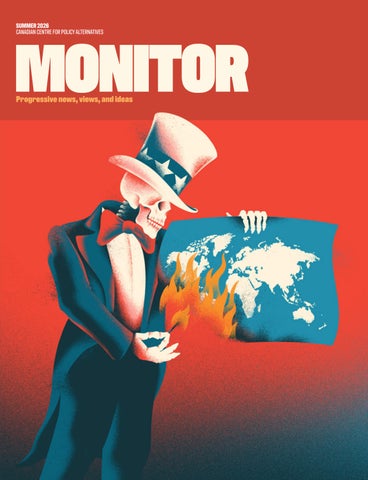
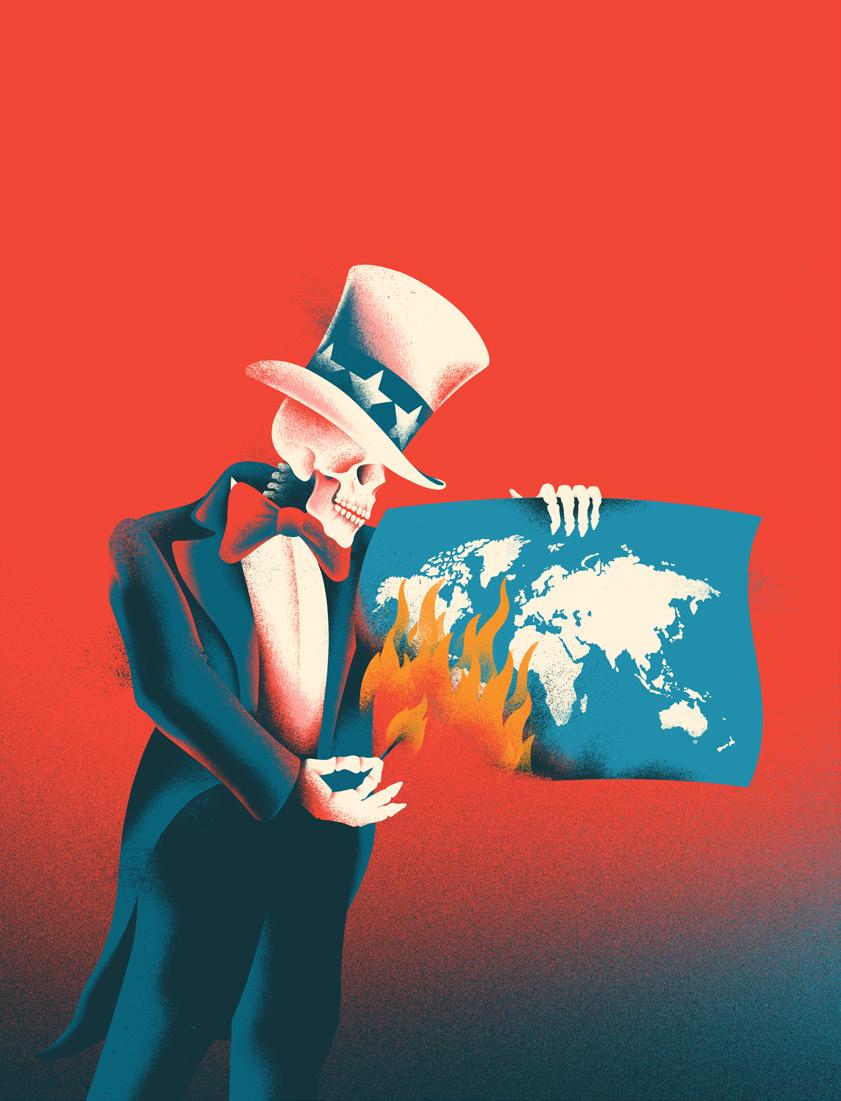
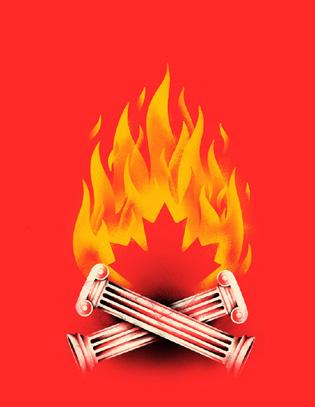
Cover illustration by Sébastien Thibault
Based in Matane, Quebec, Sébastien Thibault creates illustrations that provide ironic or surrealist visions of political subjects or current news.
Centrespread design Joss Maclennan, illustration by Sébastien Thibault
Joss Maclennan is the creative director of Joss Maclennan Design. She combines a passion for clear, simple language with a strong visual sense. Her background is mainly in design, but includes painting, drawing and illustration as well. Decades of experience help her find the central message and the way to convey it.
CCPA Ontario ccpaon@policyalternatives.ca
CCPA Saskatchewan ccpa@policyalternatives.ca
We loved hosting you at our April Monitor Huddle! Join us in July!
Ann Douglas
We hope you can join us for our next Monitor Huddle—on July 10, 2026 at 2 pm ET. We’ll have guest speakers who contributed to the July Monitor, which focuses on the shifting world order—and what that means for Canada.
Thank you for your continued support. We are living through a tumultuous time and the only way to get through it is together.
P.S. Know someone else who might like to be part of an upcoming Huddle? Please encourage them to subscribe to the print edition of the Monitor.
Ann Douglas is the author of 26 non-fiction books including, most recently, Navigating The Messy Middle: A Fiercely Honest and Wildly Encouraging Guide for Midlife Women. She is also a long-time fan of, and occasional contributor to, The Monitor Ann and her husband Neil live in the Ottawa Valley, where she is hard at work on her first novel.
Join the Monitor Huddle community
Do you love reading the Monitor?
Join us for a live chat about what you’ve read!
Host Ann Douglas will facilitate a warm and engaging conversation with key contributors to the Monitor and, of course, Canadian Centre for Policy Alternatives (CCPA) experts.
Sign up now to reserve your spot for our next chat!
When: July 10, 2026 at 2 pm ET
Where: www.policyalternatives.ca/huddle
FROM THE EDITOR
By Jon Milton
A time of monsters
The world order we have known all our lives is gone, and it is time to stop pretending otherwise. What will replace it?
“We are in the midst of a rupture, not a transition.”
Speaking in Davos before an assembled audience of billionaires, corporate leaders and elected officials, Mark Carney made a speech that reverberated around the world.
“Great powers,” Carney said, “have begun using economic integration as weapons, tariffs as leverage, financial infrastructure as coercion, supply chains as vulnerabilities to be exploited.” This was creating a “world of fortresses” as competition between great powers breaks down the integrated neoliberal order that has metastasized since the end of the Second World War, and gone global with the collapse of the Soviet Union.
Many are still working on the assumption that the order can be saved. Those people, Carney said, are “living in a lie.” The old order— the liberal world order we have known for all of our lives—is dead.
A few weeks later, another (different) diagnosis of the death of the world order grabbed headlines
when U.S. Secretary of State Marco Rubio, a member of the U.S. regime’s inner circle, spoke to the Munich Security Conference. Rubio, like Carney, spoke of the post-1945 order as being on its deathbed.
But rather than eulogizing the liberal world order, Rubio celebrated its passing. “In 1945, for the first time since the age of Columbus,” Rubio said, “[Western civilization] was contracting.” He rhapsodized about how that period saw the “great Western empires” fall to “anti-colonial uprisings that would transform the world and drape the red hammer and sickle across vast swaths of the map for years to come.”
No more, he said, would the countries of “the West” operate a “global welfare state” and “atone for the purported sins” of empires past. Now, the “abstractions of international law” will no longer shackle the great powers, who will take up the mantle of their conquering forebears and recolonize the earth. For an avatar of the American Empire such as Marco Rubio to speak of the post-1945 period as one of contraction and decline is, of course, lunacy. The year 1945 was when the United States swaggered onto the world stage as hegemon, after the Soviet Union and Allied
powers succeeded in defeating the fascist plague at enormous cost to human lives and the infrastructure that reproduces it. Out of those ruins, the United States emerged as the dominant imperial power, a power that only grew after the collapse of the socialist bloc and the end of the Cold War.
The United States used its power, during that period, to plunder and dominate. Immediately after the war, it began an unbroken campaign of overthrowing governments that attempted to assert sovereignty over their own resources—at times placing whole continents under the thumb of U.S.-backed military dictatorships. It sponsored genocides, provoked civil wars and state collapse, and plundered the resources of the Global South. But it did so while at least pretending to follow international law, and sharing in some of the spoils with the junior partners in Europe and the domestic working class.
Those days are over. The managers of empire, driven insane by fascist ideology and broken by the heightened contradictions of imperial liberalism, have abandoned the international order that put them at the pinnacle of world power. In its place, they seek to replace it with a regime of technofascism—a regime that they are testing and honing on subjugated populations like Palestinians, and have every intention of bringing home to roost.
The managers of empire have abandoned international order; replaced with technofascism
Such a future is not inevitable, but defeating it will require struggle and sacrifice. It will also require a program for social transformation significantly more profound than preserving some version of the international liberal order among the “middle powers.”
The contours of the struggle ahead are taking shape more clearly every day. The old order is, indeed, gone. What comes next is up to us.
FROM THE DIRECTOR
By Erika Shaker
Medicare is under attack
Together, we must fight to protect it
When I think about what makes Canada special, one of the first things that comes to mind is our free universal public health care.
Public health care is what makes us who we are. It’s the clearest expression of the shared belief that we all do better when we take care of each other.
In the 1960s, ordinary people stood up to powerful interests and fought for a health care system based on need, not ability to pay. At the time, my grandfather was a doctor who lived on a farm in rural Ontario.
When Tommy Douglas first proposed universal health care, my grandfather had doubts. He worried about government control. He valued his independence. He worried about the impact on his patients. But after Medicare became law, something changed.
He saw elderly patients walk into his clinic without fear. He watched families get the treatment they needed without choosing between health care and groceries. He became one of Medicare’s fiercest defenders, pushing to expand care for older generations.
Universal health care became part of our national identity, a
reflection of our values of compassion and equal access for all. It’s a value we’re proud of and know we must build on.
Right now, that value is under attack from American-style privatization.
In December 2025, Alberta became the first province in Canada to allow two-tier health care. Bill 11 lets doctors work simultaneously in the public system and a private-pay market. This policy change violates the Canada Health Act.
And Alberta isn’t alone. Creeping privatization is happening across the country—just more quietly. The Canadian Centre for Policy Alternatives (CCPA) needs your help to expose the truth and fight for our universal public health system.
At the CCPA, we are holding governments of all political stripes to account. We shine a light on dangerous policy choices. We show the evidence that exposes where these changes lead. Our experts break down complex policy into clear facts that help people act and choose a different path. And we can only do this work because of support from driven, passionate people like you.
Thank you for donating to the CCPA. If you can, please consider a summertime donation to support our efforts to protect universal public health care.
Here’s the truth: it only takes one province to rip apart our social
contract on public health care. No one voted for this. No premier campaigned on privatizing Medicare. But it’s happening anyway—by stealth, in the shadows, while we’re distracted.
And it’s happening at the worst possible time—just as we’re trying to assert our independence from U.S. pressure. These policies open the door for U.S. control over Canada’s public health care system, starting with U.S. private insurance companies.
We need to act now. That’s why the CCPA has created a new health policy desk, led by Senior Researcher Andrew Longhurst. Our research gives health care workers, unions, and community organizations the tools they need to fight back. It gives journalists the facts they need to tell the accurate story. It gives you the information you need to hold your government accountable.
Today, you can support this vital work—tracking government actions, exposing privatization, and protecting the health care system we all rely on.
Tommy Douglas proved that when we work together to look after each other, we can build something extraordinary. He faced fierce opposition. People were told it couldn’t be done. But Tommy Douglas’ vision prevailed when he introduced the first Medicare in Saskatchewan— and we are better for it.
The CCPA has created a new health policy desk—to protect Medicare
Within 10 years, the federal government stepped in to ensure every province followed Saskatchewan’s lead. My grandfather witnessed Medicare become a social promise, a vow that in Canada, your health matters more than your economic status.
This is our Tommy Douglas moment. The stakes have never been higher.
Thank you for investing in research and public education to support the kind of country we want to be.
Erika
Shaker
is the CCPA national office director.
YOUR LETTERS
We love to hear from our Monitor community.
Please send your letter to the editor (250 words or less) to monitor@policyalternatives.ca
Spring 2026 Monitor
I receive the Monitor regularly. I am a very old guy, living quite a comfortable life, after a well-paying job, a good pension, investments of my savings, and a rather austere lifestyle of my own choosing. I see myself as a strong socialist, but am I?
Almost everyone, even the underprivileged and the poor, would vote without thinking about those magic words “freedom” and “democracy”. I have come to define “freedom” as competition, the freedom to compete, where the stronger always win and the weaker always lose. So, you might say, the results of freedom are billionaires and hungry children.
Equality? As in our present economic system.
“Democracy”: the last example I can think of, was the end of the Vietnam War, when open anti-war opinion forced the U.S. government to withdraw. Truly, the people ruled.
John Boulter Ottawa, ON
I liked, very much, the article by Mohini Athia. However, I know a lot of Canadians don’t like the build up of the military. I, for once, think it is the only way to go with those criminals below the 49th parallel, particularly ICE running rampant. They could decide to cross into Canada.
Mary Lou McKee
Kincardine,
ON
Re. Solidarity Philanthropy
As someone who has volunteered and worked in the non-profit sector for many years as a funder and a grant recipient, Martina Ulrich’s article is timely for capturing the dynamics of the scene. There is, however, one part of the grantor-recipient relationship that is rarely touched on: the accountability and responsibility of the funder to help the recipient be successful. Project evaluations should include how competent the funder has been. Ostensibly the funder and the recipient agency are committed to the same social values. Then each must be assessed for how well they work together to make the project a success.
Michael Clague Vancouver, B.C.
Re. Taxes as a harvest festival
Bravo Mohini Athia! You have pointed out something that all of us who benefit from living in this country should realize.
We have stability, safety, health and social services, dependable transportation, banking systems, access to our daily needs. Sure there are a lot of problems that need fixing, but on the whole we can go about our lives , our jobs, our many activities with ease and consistency, knowing that our society provides a way of life that is secure and reliable. Our tax dollars enable the government to give us that stability. Big corporations and their ultra rich CEOs don’t seem to appreciate the support they get from the stable
and reliable infrastructures that they depend upon and which enables them to make such big profits. They go to such great lengths to avoid taxes without so much as a single thought about how tax dollars are supporting them. They would hardly notice a one to five per cent tax, which would give more support and services to those who badly need it. Paying their taxes would be a polite thank you to the system that sustains them.
Mohini is right, we need a different conversation and attitude about taxes.
Judy Cookey Dartmouth, NS
Re. Publicly owned grocery stores
Surprisingly, the article omits co-operatives, an omission I couldn’t let pass being a member of a highly successful co-op myself—Calgary Co-op.
Calgary Co-op operates 22 food stores, 39 gas stations, 30 wine, spirits and beer stores, 24 pharmacies, 4 home health care centres and 10 cannabis stores.
It has over 400,000 members, employs 3,500 local residents and sells over 2,400 local products from over 300 local producers. It does $1.5 billion a year in business competing in the public marketplace. Unlike government-run grocery stores, it requires no taxpayer subsidy.
The article presents the U.S. military’s commissaries as an example of the benefits of government-owned grocery stores, claiming they offer savings of 23.7 per cent compared to commercial grocers. The article fails to mention that this is only possible because the U.S. government pays for labour, rent/real estate, distribution costs and other overheads.
Any government funding for groceries should go to those who need it.
Bill Longstaff Calgary AB
CCPA IN THE SPOTLIGHT
By the numbers: January 1 to March 30, 2026
“The CCPA continues to move the needle on the key policy issues of our time—inequality and affordability, sustainable communities and a just transition, as well as investments in the public infrastructure and social programs that leave no one behind.”
—Erika Shaker, CCPA National Office director
3,859
That’s how many times the Canadian Centre for Policy Alternatives (CCPA) was mentioned in the media during the first quarter of 2026. That’s 26 per cent more than the previous quarter!
750+
That’s how many articles and interviews with CCPA experts were featured on CBC/Radio-Canada platforms in the first quarter.
300+
That’s how many articles by the Canadian Press that featured CCPA experts in the first quarter.
250+
That’s how many TV interviews CCPA experts did on CTV and CP24 in the first quarter.
219
That’s how many media mentions B.C.-based Senior Researcher Andrew Longhurst earned in his first quarter working with the CCPA as lead of our new Health Policy Desk. Andrew had the third-highest number of media mentions among our experts. He wrote 11 analytical pieces for policyalternatives. ca during this time period. An impressive start!
198
That’s how many mentions Saskatchewan-based CCPA Senior Researcher Simon Enoch garnered during the first quarter of 2026. That’s a 350 per cent increase over last year! Simon’s research on AI data centres has attracted media attention across Canada.
Top 10 publications attracting media interest, first quarter 2026
Check them out on policyalternatives.ca
1. Living the High Life: A recordbreaking year for CEO pay in Canada, by David Macdonald
2. B.C. budget’s hidden austerity and tax increases put fiscal burden on low-income households, by Marc Lee and Andrew Longhurst
3. The Last Mile: Child Care Expansion before the five-year deadline, by David Macdonald
4. 2025 report card on child and family poverty for Nova Scotia: No Real Progress, by Lesley Frank, Ruby Harrington, Christine Saulnier
5. Two reports on health care policy: The End of Medicare? Alberta opens the door to U.S. health care and Fact Check: Alberta’s new two-tiered system is not European care, by Andrew Longhurst
6. Growing and Deepening Child Poverty in Saskatchewan, by Simon Enoch
7. So You’re Getting a Data Centre! Here’s what to know, by Simon Enoch
8. Budget Cuts Are About to Wreck Canada’s Immigration System, by David Macdonald
9. The Ontario Budget Neglects Core Provincial Responsibilities, by Ricardo Tranjan and Andrew Longhurst
10. Manitoba Budget 2026, by Niall Harney and Molly McCracken
What’s popping on @policyalternatives social media channels?
#1 post in the first quarter of 2026: CEOs are living the high life
Facebook: 44K followers
LinkedIn: 19.6K followers
Instagram: 13.3K followers
Bluesky: 9.4 followers
We are reaching more people!
We grew 19,620 more social media followers in the first quarter of 2026.
Are you not following the CCPA on social media? Find us @policyalternatives
UP FRONT
Alberta’s threat to Medicare
Andrew Longhurst / 6
Oil execs are war profiteering
Hadrian Mertins-Kirkwood / 8
Precarious work runs rampant in Nova Scotia
Christine Saulnier, Daniel Cerdas-Sandí, Rebecca Casey, and Rachel Brickner / 10
Universities and colleges are an economic powerhouse
Ryan Romard / 11
Let’s keep airports public
Peggy Nash / 12
Andrew Longhurst
Alberta’s threat to Medicare
The Alberta government appears to be swayed by the private insurance industry—and this powerful lobby has a large financial stake in a two-tier health care system. While, so far, the Canadian private insurance industry appears only to be involved in the development of Alberta’s new two-tier legislation, Bill 11 opens the door for foreign private health insurers, including from the U.S.
Back in December, the Alberta government passed most sections of Bill 11 (the Health Statutes Amendment Act), which allows physicians and for-profit facilities to charge patients for medically necessary health care already covered under the Canada Health Act. (The sections related to “dual physician practice” which allow two-tier medicine have not yet been proclaimed.) Legislating two-tier health care is a first in Canada.
The CCPA report The end of medicare? explained that Bill 11 expands the private health insurance market for medically necessary care, which until now, has never existed in the country because it is not permitted under the Canada Health Act. And it is still not: Alberta has passed legislation that contravenes this federal legislation.
There are many risks associated with private health insurance for medically necessary health care, especially from foreign providers, including the U.S. private health insurance industry. Here are five things to know.
The insurance industry has direct involvement in developing Alberta’s two-tier health care legislation
In its January 2026 pre-budget submission to the Alberta government, the Canadian life and health insurance lobby association revealed its involvement in the implementation of Bill 11:
“Our industry appreciates that the Alberta government considers life and health insurers as a key partner in the healthcare system, as demonstrated through the introduction of Bill 11 “supporting a world-class health care system”. We appreciate the opportunity to help facilitate a smooth transition for Albertans through our inclusion in the technical implementation of certain aspects of the changes.”
The Alberta government has offered no public information about a technical implementation committee and the composition of any committee within government. This key section from the insurance lobby’s submission suggests that the Alberta government has only invited the industry into the very process that will determine its profits.
In industry publications, the insurance industry has expressed excitement about increased profit-making opportunities. In a November 2025 article, the industry publication stated that “[b]y enabling patients to pay privately for procedures or use supplemental insurance to bypass public wait times, the plan could open the door to new coverage options, higher demand for private benefits, and a fundamental shift in how insurers price and design health plans across the province.”
Provincial governments are responsible for regulating the insurance industry and the products they sell. This apparent regulatory capture by industry should concern not only Albertans, but all Canadians who care about transparency and distance between government and industries that they are supposed to be regulating.
What is the extent of the involvement of private insurers in Alberta’s health care reforms? Did the industry draft the legislation? Has the U.S. private health insurance industry been involved?
These are all important questions for which Canadians deserve answers.
The Canadian and U.S. health insurance industry is overwhelmingly for-profit
The cozy relationship between the Alberta government and the insurance industry is of significant concern
because this industry is overwhelmingly dominated by large for-profit corporations that appear closely involved in the creation of a new private health insurance market for medically necessary care that is already publicly covered.
For the industry, Bill 11 is—as an industry publication states—an opportunity to “significantly reshape the province’s health insurance market” by selling insurance products for medically necessary care.
Industry statistics show that the existing Canadian private health insurance market is worth $53 billion. All but eight of the 85 insurers are for-profit. As The Breach has reported, 63 per cent of the total life and health insurance market in Canada is controlled by three corporations: Manulife, Canada Life, and Sun Life.
But the creation of a two-tier health care system in Alberta is fundamentally about the expansion into a previously non-commodified part of the health care system—the public insurance plan. In industry terms, the $34 billion in provincial health care spending is a market opportunity—dollars that could flow through private health insurers, rather than through the public plan.
In Alberta—like every province—the industry understands publicly insured health care as the largest untapped market. That’s why the interest in Alberta’s two-tier health care reforms are unlikely to remain limited to Canadian insurance companies.
In a recent CCPA webinar, David Himmelstein and Steffie Woolhandler, leading scholars on the U.S. health care industry, commented that U.S. private health insurers are looking for new markets and many are already active in South America. They noted that Americans are “tapped out” and increasingly unable to pay rising premiums (more on this below).
There is no doubt that Canada is an untapped market and the U.S. health insurance industry is hungry for new profit-taking opportunities. As global consulting giant McKinsey & Company notes in a recent analysis, profit levels are at “historic lows across [payer] markets”. In other words, insurers are
looking for new opportunities to grow profits and are likely to “reallocate resources to growing market segments.”
UnitedHealth Group (16 per cent), Elevance Health (12 per cent), and CVS (Aetna) were the top three U.S. private health insurers by market share. UnitedHealth was found to have used “aggressive tactics to collect payment-boosting diagnoses for its [U.S.] Medicare [members],” a U.S. Senate committee investigating the corporation’s practices said. In his report, Senator Chuck Grassley said that “my investigation has shown UnitedHealth Group appears to be gaming the system and abusing the risk adjustment process to turn a steep profit.”
Indeed, the U.S. private health care industry is one of the most profitable industries in the country. UnitedHealth Group and CVS (Aetna) are in the top five of highest revenue companies. One estimate puts the profits of the top seven publicly traded insurance companies at $71 billion in 2024. This is one of the reasons that the United States far outspends other high-income countries on health care as a share of GDP.
For these corporations, Canada could be that next goldrush if Alberta’s two-tier reforms proceed, and if the federal government fails to intervene and uphold the Canada Health Act.
The entrance of U.S. private health insurers would upend single-payer health care
Although we often refer to Canada’s public health care system—or “medicare”—it is actually a collection of 10 provincial and three territorial health insurance plans. Across the country, when you access public health care services, you are relying on your public provincial health insurance plan.
The entrance of Canadian private health insurers—and especially U.S. insurers—would upend public health care as we know it. If the Alberta government is successful in the privatization of health care financing, rather than relying on our single-payer insurance system that has existed for decades—the reason for our much more cost-efficient system compared to the U.S.—we would see the development of a multi-payer system with private health insurers. The involvement of private health insurers means much higher administrative costs and, of course, profit-taking—a requirement that does not currently exist in our public, single-payer model.
The movement of the U.S. private health insurance industry into Canada via Alberta would be devastating for patients—and it would make it very difficult to force these companies out of Canada, once entrenched, due to our international trade agreements.
Most of us have had little direct experience dealing with private health insurers other than extended health plans, and it’s important to understand what’s at stake.
The U.S. private health insurance industry is the leading cause of America’s cost of living crisis
Recent polling shows that Canadian residents rank the rising cost of living as their top concern. What if we added private health insurance premiums, co-payments, and other out-of-pocket expenses to the mix? The costs to Canadians would be significant and near impossible to contain, if we allow an unrestricted private health insurance market based on Alberta’s reforms.
The U.S. health care statistics are sobering:
• In 2026, just under half of adults say it is difficult to afford health care costs and 30 per cent say a family member had problems affording health care in the past year.
• In 2026, more than one-third of adults skipped or postponed getting necessary care because of the cost. Three in four uninsured adults under age 65 went without needed care due to cost.
• The average American pays more than $17,000 for health care annually, which does not include insurance premiums that they and their employers pay, as well as co-payments, deductibles, and the taxes that fund Medicare, Medicaid, and other public programs.
• The average annual cost for employer-sponsored family insurance premiums was nearly $27,000 in 2025, with workers paying $6,850 from their paycheques. The family premium increased 26 per cent over the last five years.
• Even among those with health insurance, almost four in 10 insured adults under age 65 worry about affording monthly insurance premiums.
• In 2022, 41 per cent of adults had debt from medical or dental bills, including debts owed to collections agencies, credit cards, family and friends, banks,
and other lenders. Black and Hispanic, women, parents, low-income people, and uninsured people were disproportionately affected by medical debt.
• An estimated 100 million Americans owe $220 billion in medical debt.
• As many as two-thirds (66.5 per cent) who file for bankruptcy cite medical bills as the primary cause—a proportion that has remained largely unchanged, despite efforts to overhaul the private health insurance market under the Affordable Care Act.
The
federal government needs
to
The entrance of Canadian private health insurers would upend public health care as we know it
intervene before it’s too late So far, the federal government has not taken a public position on Alberta’s Bill 11 and Bill 29—the latter of which encourages two-tier diagnostic testing. On March 16, the Canadian Health Coalition and provincial health coalitions organized a “Day of Action” to break the silence on Alberta’s two-tier health care and call on the federal government to enforce the Canada Health Act. Some members of the federal Liberal caucus spoke out against Bill 11 in response to the Day of Action, including Vancouver MP Hedy Fry. She said, “there is no doubt that Alberta’s Bill 11 absolutely contravenes the Canada Health Act.” While it is positive to hear from individual members of the federal Liberal government, so far, the Health Minister Marjorie Michel has not taken a position—nor has the prime minister. Canadian insurance corporations are already preparing to sell products in this new private health insurance market. How long will it take before U.S. insurers enter the market as well? Once employer plans and individuals begin to purchase products, it will become increasingly difficult to put the brakes on this new insurance market—even if it directly contravenes the Canada Health Act. Time is of the essence. The federal government needs to decide if it stands for Canadian medicare or if it believes that private insurers should call the shots.
Andrew Longhurst is a senior researcher with the CCPA.
Hadrian Mertins-Kirkwood
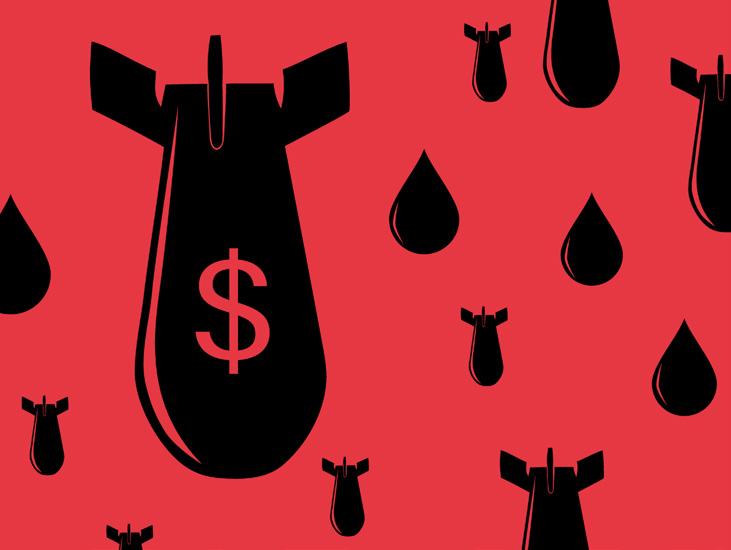
Oil execs are war profiteering
It’s time for an oil and gas windfall tax
The oil industry in Canada made $6 billion in the first month of the war in Iran—three times more than it made in the month before the war started.
It is a textbook case of war profiteering. The cost of producing oil in Canada did not go up, nor did the industry get any more efficient or productive. It is simply raking in the proceeds of a global oil supply shock triggered by U.S. and Israeli aggression in the Middle East.
At this rate, the industry will pocket $90 billion in profits over the next year, with much of it flowing to American shareholders.
Where is that money coming from? Over the next year, Canadians are on track to spend an extra $12 billion on gasoline alone, not to mention increased costs for home heating, groceries and other goods that depend on oil.
In other words, skyrocketing oil prices do not create profits out of thin air. They redistribute money away from consumers and businesses and into the pockets of oil companies.
The public will receive some benefits from the oil price shock due to increased royalty and tax payments. The Government of Alberta, in particular, has completely reversed its fiscal outlook for 2026. But the oil industry is still capturing the majority of these war-driven proceeds while consumers pay more.
The best option is a swift end to the war and the humanitarian crisis it has caused. The next best option is a windfall tax on oil industry war profiteering.
There is a recent precedent for this idea. In 2022, the federal government implemented a 15 per cent tax on the
pandemic-era windfall profits of the financial sector. If the same tax was applied to the oil industry retroactive to March 1, it would raise $600 million immediately and as much as $9 billion over the next year.
But history offers a bolder model. In 1940, the federal government introduced a 75 per cent excess profits tax. It was explicitly intended to limit war profiteering and strengthen public spending.
If a similar approach was taken today, it could generate an extra $46 billion in public revenues over the next year—on top of regular royalties and taxes. In this scenario, the oil industry would still make $44 billion in profits. That’s hardly punitive.
There are many things the federal government could do with an extra $46 billion that would be more productive
than lining the pockets of oil industry shareholders. But the best approach would be to invest these proceeds in reducing our dependence on oil and, thus, our vulnerability to future oil shocks.
For example, $46 billion could build enough electric vehicle charging stations to meet decades of demand. Or it could make public transit free across the country for five to 10 years. Or it could pay for enough free electric heat pumps to replace every home heating oil and low-efficiency gas furnace in the country.
Measures like these reduce structural demand for fuels, reducing long-term costs for consumers in a way that knee-jerk cuts to gas taxes do not.
Alternatively, $46 billion could drive significant economic diversification through investments in future-oriented industries, such as clean-tech
manufacturing. Ironically, very high oil prices weaken the long-term outlook of the oil industry, as countries around the world accelerate their efforts to get off fossil fuels entirely. Doubling down on oil production now is the worst thing Canada could do.
For Canada’s oil regions, the current windfall could very well be the industry’s final boom.
Better not waste it.
Hadrian Mertins-Kirkwood is a senior researcher with the CCPA.
Christine Saulnier, Daniel Cerdas-Sandí, Rebecca Casey, and Rachel Brickner
Precarious work runs rampant in Nova Scotia
One in three workers in the province are in precarious jobs
Anew report on Nova Scotia’s labour market finds that precarious employment is widespread and leaves many workers just one setback away from deeper insecurity.
The report shows that 30.4 per cent of paid employees—approximately 131,000 workers—are in precarious jobs, with low wages, limited protection and job instability. About 43 per cent of employees show at least two signs of precariousness, leaving many workers on the edge of precarity, and at risk of deeper insecurity if their job conditions worsen.
Too many workers in Nova Scotia are working hard without the stability they need to make ends meet.
This is not a marginal issue. Precarity is a defining feature of our labour market.
The study uses two complementary tools: an Employment Precarity Index based on Statistics Canada’s 2024
Labour Force Survey, and, for the first time, a 2025 survey of workers across Nova Scotia conducted by Angus Reid, which captures the day-to-day experiences such as unpredictable schedules, on-call demands, and fear of losing work.
Key findings include:
• Precarious work is especially common among young workers, part-time employees, and those in temporary roles, with more than half of workers aged 20-24 in precarious jobs.
• Unionized workers are significantly less likely to experience precarious employment, with better access to permanent jobs, benefits, pensions, and paid sick leave.
• A sharp divide exists between public and private sector jobs, reflecting differences in union coverage and job protections.
• Many workers face barriers to basic labour protections due to gaps in coverage, weak standards, and a complaint-driven enforcement system.
• Precarious work is especially concentrated in accommodation and food services and retail trade, the two industries with the highest precarity rates in the index. Together, they represent about one in five employees in Nova Scotia.
The report concludes that Nova Scotia’s high levels of precarious employment are not inevitable, but the result of policy choices.
Weak labour standards and limited enforcement leave too many workers unprotected. When workers are afraid to speak up or risk losing hours, the system is not working.
The report is part of the CCPA Nova Scotia’s Advancing Decent Work series and outlines a comprehensive set of policy recommendations to improve job quality across the province.
Recommendations include:
• Raising wages and establishing a clear path toward a living wage.
• Strengthening rules on scheduling, on-call work, and last-minute shift changes.
• Expanding access to paid sick leave, vacation, and basic benefits.
• Closing gaps in protections for temporary, casual, and platform workers.
• Proactive labour standards enforcement focused on high-risk sectors.
• Supporting unionization and collective bargaining.
• Embedding job quality standards in regional economic development and public procurement.
Precarious work is a policy choice and it can be changed by policy. With stronger standards, better enforcement, and support for workers’ voices, Nova Scotia can build an economy where decent work is the norm, not the exception.
This first-of-its-kind survey of workers in Nova Scotia helps explain the growing number of labour disruptions by low-wage, insecure workers including in long-term care, universities and housing support.
What’s especially concerning is that even this data likely underestimates the scale of the problem. After decades of employers pushing for flexibility, too many workers are left without benefits, without stable schedules, and unsure whether they can pay their bills.
Christine Saulnier is director of the CCPA-Nova Scotia. Daniel Cerdas-Sandí is a researcher at the CCPA-Nova Scotia. Rebecca Casey is a sociology professor at Acadia University. Rachel Brickner is a politics professor at Acadia University.
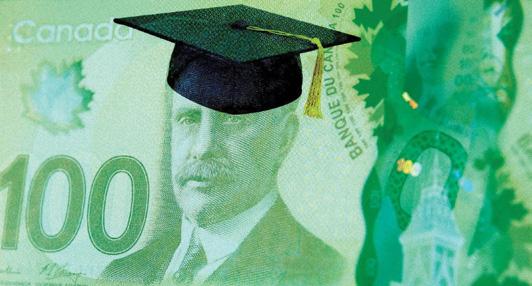
Universities and colleges are an economic powerhouse
After decades of chronic underfunding, the post-secondary education system is in crisis but, confoundingly, the federal and provincial governments are doing shockingly little about it.
Most post-secondary education institutions are struggling after the loss of international students, who, for years, have paid significantly higher tuition fees to help compensate for provincial government funding shortfalls.
With continued underfunding, layoffs are becoming more common in the sector—and jobs that were once among the most secure in the country are becoming more precarious.
Young people are actively encouraged to go to university or college in order to compete in a challenging job market, but the government itself doesn’t treat the sector as though it has value. Nothing could be further from the truth.
The post-secondary education system is actually more powerful at driving economic growth than many key sectors, even mining or the oil sands.
But here’s the difference: Whenever either of those sectors are in economic trouble, governments come rushing to their rescue. Why not do the same for universities and colleges—especially since government policy decisions are responsible for the sector’s struggles.
Last year, universities and colleges’ economic output was worth $61 billion—considerably more than all oil sands extraction ($49 billion), and almost twice as much as mining or transportation manufacturing (at $33 billion each).
The ongoing threats to the stability of post-secondary education directly
endangers the livelihoods of hundreds of thousands of people employed in the sector and, ultimately, those enrolled in university or college programs. And this can hurt entire communities.
Ask any university or college town: The post-secondary education system is an important job creator. Universities and colleges employ twice more than the transport manufacturing industry, nearly four times more than the oil and gas extraction industry, and almost six times more than in the mining industry.
University and college workers are a large workforce and, as such, create significant economic demand. In 2024, university and college workers’ compensation contributed 2.3 per cent of Canada’s total pay pie. That’s an even bigger contribution to the economy than the oil and gas industry’s workers’ pay (1.7 per cent). These wages have a direct impact on economic growth—especially in university and college towns, where workers spend their money locally, supporting small businesses, the local arts and culture. This should give institutions pause when looking at layoffs.
It is, further, another argument for why increased reliance by institutions on precariously employed and lower-paid contract workers as a cost-saving strategy not only exacerbates inequality across the sector—it makes bad local business sense because those workers have less money to spend in their community.
University and college procurement—the stuff needed to keep those institutions running—creates demand in other industries.
In 2022, the most recent year of available data, universities and colleges spent $16.5 billion on purchases from other industries, including $1.4 billion on gasoline, $1 billion on repair construction services, $895 million on building services like landscaping, $560 million on electricity, $481 million on IT services, and $388 million on prepared meals.
In addition to educating generations of workers and citizens, universities and colleges themselves produce vital knowledge. In 2023, over $18 billion was spent on research and development activities in Canada’s post-secondary education sector. Despite only making up about two per cent of Canada’s economy, the post-secondary education sector represents over 34 per cent of all research and development—much higher than Canada’s peer countries and, any way you look at it, returning to us an outsized bang for the buck.
The post-secondary education industry is an economic powerhouse. Particularly during this time of global instability, governments can’t let this vital industry atrophy.
Ryan Romard is a researcher at the Canadian Centre for Policy Alternatives (CCPA).
Peggy Nash
Let’s keep airports public
The federal government is considering privatizing Canada’s airports, in part to help finance a new sovereign wealth fund. Both ideas deserve a closer, critical look. Taken together, they risk turning public assets into vehicles for private profit, while offering Canadians little in return..
If the idea of a sovereign wealth fund is new to Canadians, Norway provides a clear example. Thirty years ago, it began investing oil revenues into a national fund designed to benefit its citizens directly. This fund now has $2.2 trillion US—the equivalent of over $300,000 US for each Norwegian—and is the largest of its kind in the world. Canada has managed its petro wealth differently. Provinces control natural resources and have largely used oil revenues to lower taxes and reduce deficits. Meanwhile, the federal government supports the oil and gas sector through funding, tax breaks and financing worth tens of billions of dollars.
Now Ottawa proposes a “sovereign wealth fund” financed not by public resource profits, but by $25 billion in public debt—money backed by Canadians. This is not a vehicle to build shared public wealth; it socializes risk while privatizing gains.
That brings us to airports. One proposal is to sell these public assets to private investors and funnel the profits into the new fund. But that would mean taking a revenuegenerating public asset and turning it into a one-time cash infusion, and then reinvesting that money in an untested project. This is not a formula for enriching Canadians.
Canadians already own their airports. Through Transport Canada, 26 airports are publicly owned and managed by private, not-for-profit local airport authorities. They are essential services that connect communities and support Canada’s economy.
Privatization would change their purpose, from a public service for Canadians to a profit-maximizing opportunity for private investors. When the United Kingdom privatized its airports in 1987, the result was higher costs for travellers. Airports are natural monopolies; travellers have limited alternatives, and private operators can charge accordingly.
Workers also bear the impact. Privatization often brings in layers of subcontracting, with each company taking a share of profits. Existing contracts and collective agreements can be weakened or cancelled as companies seek lower costs, typically resulting in lower pay and reduced protections for workers.
Proponents argue privatization shifts costs to the private sector and encourages investment. But airport profitability is not guaranteed. During the COVID-19 pandemic, air travel collapsed and revenues fell sharply. As essential infrastructure, airports still required support, meaning the public ultimately bears the risk even when the ownership is private.
The deeper risk is the loss of public control. Public assets are often sold too cheaply. The Ontario government’s sale of Highway 407 is a stark example. Built with public money, it was leased for $3.1 billion in 1999. Today, it generates about $2 billion annually in tolls for its private owners. What was once a public asset now delivers ongoing private profit at public expense.
Canada should not repeat that mistake with airports. Once sold, public assets are costly to reclaim. Private owners can raise fees, reduce services or make decisions based on profit rather than public need, including in smaller communities, where air access is vital.
If the goal is to invest in infrastructure, Canada does not need to sell what it already owns. As a sovereign country, Canada’s federal government can finance infrastructure directly, at a lower cost, due to its ability to tax. A better approach would be to reinvest in public assets and reconsider subsidies to the oil and gas sector.
Selling airports to pay for a debt-financed “sovereign wealth fund” is not nation building. It is a transfer of public wealth into private hands. Airports are essential infrastructure. They should remain public, accountable and focused on serving Canadians, not private investors.
Peggy Nash is the executive director of the Canadian Centre for Policy Alternatives.
Panama, Alberta
Canada and the return of U.S. hemispheric imperialism
Jon Milton
“Nobody’s independent in the modern world,” says one of the men leading Alberta’s independence movement.
Speaking to CTV, Jeff Rath was, at that moment, dodging a question about his level of coordination with the U.S. government. He rattled off a series of theories about how “communist Ottawa” was in league with “communist China” to keep Albertans as “resource slaves.”
Rath—legal counsel for the Alberta Prosperity Project (APP) and something of an unofficial spokesperson for the Alberta separatist movement—has made no secret of his affinity for the U.S. government during the ongoing campaign to launch a separation referendum in Canada’s richest province. He has, however, attempted to keep the identity and content of his meetings with them under wraps.
Some of the meetings have allegedly taken place in sensitive compartmented information facilities (SCIF), soundproof and highly secure rooms behind multiple complex locks where electronic devices like cell phones are not permitted. SCIFs are typically reserved for high-level classified meetings.
Those meetings, if you believe Rath, have covered a wide range of topics, including converting an independent Alberta to U.S. currency and border arrangements. U.S. officials have not confirmed any of the details of their meetings, but some regime officials, like Treasury Secretary Scott Bessant, have voiced support for Alberta secession.
“We are exchanging information with senior officials in the U.S. state department,” he said. “We have an agreement with the people that we’re meeting with, that we aren’t disclosing the identities of the people that we’re meeting with.”
“The Americans see it within their national interest,” Rath said elsewhere, “both under the Monroe
Doctrine [...] and their new National Security Strategy, to support Alberta independence.” The Americans, he says, support “freeing” Alberta’s oil fields.
Tropical Americanism
When the U.S. government kidnapped Venezuela’s president and his wife from their home in the middle of the night on January 3, the State Department posted an image online of Donald Trump emblazoned with the words “This is OUR hemisphere.” In a celebratory press conference, Trump announced that the operation was an application of the “Donroe document,” and that “American dominance in the Western Hemisphere will never be questioned again.”
What Trump called the “Donroe [doctrine],” the more serious figures in his regime’s inner circle refer to as the “Trump Corollary” to the Monroe Doctrine, an American foreign policy principle first outlined by President James Monroe in 1823. Monroe’s principle was that the United States would use its military might to “defend” the hemisphere against European empires, such as the British, French, and Spanish, who were, at the time, carving up much of the world into colonies and fighting to preserve existing
colonies in the Americas. The Monroe Doctrine stated that the U.S. would be the “protector” of the Americas from European powers. At the time, the announcement was met with cautious optimism in the rest of the hemisphere, particularly among the recently independent states of South America. El Libertador himself, Simon Bolivar, expressed gratitude, as did the leaders of newly independent Colombia and Argentina as well as Mexico.
Before long, it became clear that the “protection” that the United States was offering was the protection of a mafia boss. Within 20 years, the United States had gone to war with Mexico and stolen half of its territory—nearly all of what is now the Southwestern U.S., from Texas to California—as part of its grand designs of “manifest destiny.” The U.S. army conquered and territorialized Puerto Rico and Cuba in the Caribbean, as well as Hawaii and the Philippines in the Pacific.
Southern slave aristocrats like William Walker imagined a slave empire stretching all the way through the Caribbean and central America. Walker led a government-backed battalion of U.S. settlers in an ultimately failed 1856 attempt to conquer Nicaragua and use it as a beachhead to take the entire region. “Tropical America,” he wrote, is the “natural seat of empire” for U.S. slavery.
Imperial secession
The “protection” the United States was offering was the protection of a mafia boss
Panama—at the time a province of Colombia, not an independent country—was a particularly successful example of U.S. imperial strategy in the region at the turn of the 20th century. Ever since Vasco Núñez de Balboa crossed the isthmus and “discovered” the Pacific ocean in 1513, the area had been of interest to the great powers because of its status as the narrowest point between the Atlantic and Pacific oceans. While the conquistadors dreamed of building a canal,
Spain’s King Philip II prohibited it, believing that if God wanted the oceans joined then He would have built a river.
That changed when Latin America’s independence revolutions marched victoriously across the continent. They sought U.S. financing for the construction of a railroad across the 75-kilometer strip of land, and opened to a French conglomerate for the construction of a canal. Hundreds of workers died for every kilometer of canal dug through the swamps and mountains—mostly imported Chinese and Black Caribbean workers, dead of disease or worked to death by their U.S. and European overseers.
When the French venture went bankrupt, the U.S.—which had already been “providing security” to the remote and rebellious province via a defence treaty with Colombia—made a novel proposal: it would take over the canal project in exchange for permanent sovereignty over the canal, which would become a U.S. territory subject to U.S. law. When the Colombian government refused, the U.S. began financing and arming a separatist movement in the Colombian province.
Members of the secessionist movement, such as Manuel Amador Guerrero, who would go on to be Panama’s first president, toured the United States and held secret meetings with U.S. government officials, where they raised significant funds and received guidance directly from arch-imperialist U.S. President Teddy Roosevelt. Those secessionists unilaterally declared
Panama to be an independent country in 1903, doing so in violation of Colombian law and holding no vote on the question.
The United States provided diplomatic recognition to the newly independent country immediately. It also sent a large Navy battalion to defend it against the Colombian government—alongside a team of engineers to start planning the canal.
In exchange for this backing, the leaders of the new state signed an agreement with the United States granting it what Colombia had previously refused—sovereignty over the future Panama Canal. The canal itself, as well as eight kilometers in each direction, would be governed as a U.S. territory, separating Panama in two with a border fence and armed U.S. soldiers.
The Canal Zone, as it was called, was an apartheid system modelled on the U.S. Jim Crow south. It divided residents into white “gold roll” workers and mostly Black “silver roll” workers, who lived in substandard housing. It had a number of bizarre moralistic bylaws, such as one outlining that only married couples could occupy homes, while unmarried people lived in shared housing. White and Black workers entered the Canal Zone through separate doors, had access to separate food systems, and lived with vastly different access to resources.
The U.S. fully controlled the Canal Zone until 1979, despite regular protests from Panamanians, who were sometimes killed by U.S. soldiers for crimes such as raising the Panamanian flag. After decades of popular pressure, in 1979 the U.S. agreed to jointly administer the Zone with Panama until 1999, when the country finally recovered sovereignty over the area after nearly
Signing petition for Alberta separatism Photo CP
100 years. Recently, U.S. regime officials, including President Donald Trump, have publicly mused about taking it back.
Monroe’s favourite child
Over the course of the 20th century, the United States applied the Monroe Doctrine to systematically destroy democratic governments everywhere in the region. Monroe’s hand stretched over the “banana wars” of the early 1900s, in which the U.S. Marine Corps engaged in dozens of “small wars” against independent-minded governments in Central America and the Caribbean, and onto the U.S.-imposed military dictatorships on the entire South American continent in the 1960s and 70s. Its grip tightened at the School of the Americas (hosted in Panama), where U.S. military officers trained legions of Latin American soldiers in the art of torture, assassination, and repression of dissent. Monroe’s fingerprints covered the “Operation Condor” transnational assassination program, and the U.S.-sponsored genocide against Maya Indigenous Peoples in Central America in the 1980s. The Monroe Doctrine has, since its inception, served as justification for brutal U.S. domination over Latin America.
Along the way, the Monroe doctrine was adapted by new and more aggressive leaders. Theodore Roosevelt’s “Roosevelt Corollary” justified limitless U.S. military involvement as an “international police power” in the hemisphere, launching military interventions against countries for crimes like failure to pay debts to European banks or engaging in land reform. The 1980s “Reagan Doctrine” elaborated on U.S. strategy, advocating for arming and supporting far-right terrorist groups in order to destabilize left-wing and socialist governments, with the most famous example being Nicaragua’s Contras.
Canada has long been something of an exception to U.S. domineering in the Americas. After an
initial period of uncertainty—U.S. presidents in the early days of the republic did imagine annexing Canada, and famously lost the War of 1812 trying to remove British sovereignty over the territory—the U.S. recognized Canadian sovereignty in 1871 with the Treaty of Washington, and annexationist claims mostly fell to the wayside. Canada sheltered under the umbrella of British power and developed itself as a junior partner of the expanding U.S. empire.
Successive Canadian governments worked towards greater integration with the United States, as well as coordination on extracting resources for the U.S. market, both from within Canada and, later, via Canadian mining companies operating in Latin America. Canada acted as a hemispheric partner in the Cold War and (with some notable exceptions, such as diplomatic support of post-revolutionary Cuba) supported U.S. efforts to suppress democratic, anti-colonial, and socialist movements in the hemisphere that threatened the profits of U.S. and Canadian investors. Canada integrated with the U.S. imperial machine, rather than being targeted by it.
That bargain is collapsing under the “Trump Corollary” to the Monroe Doctrine. Initially outlined in a Foreign Policy article titled “The Trump Doctrine”, by right-wing ideologue Michael Anton in 2019, the corollary was fleshed out and became policy with a document titled National Security Strategy of
the United States of America, which the Office of the President released in November 2025. The document, likely also written by Anton, outlines a number of principals for Trumpera foreign policy, guided by explicit ethnic chauvinism and a strategy of using military threats to achieve foreign policy goals. In practice, it has meant engaging in unprovoked attacks against Venezuela, illegal blockades of Cuba, and open threats against countries with left-wing leadership like Mexico and Colombia.
The Trump corollary, to the extent it has been elaborated, is a plan for complete dominance of the Western hemisphere, including Canada and Greenland, both of which have grown of interest to U.S. capital and the U.S. security state as a result of climate change and growing imperial competition with Russia and China. U.S. security planners are already drawing up fanciful plans for militarizing the North with missile defence programs like the “Golden Dome,” and U.S. capital is hungrily eyeing the critical minerals that are increasingly accessible as Arctic ice recedes.
Those environmental changes are also turning the Northwest Passage into an increasingly important shipping corridor. While it’s a long way from being the Panama Canal, the Northwest Passage is seeing significant growth in ship traffic—up nearly 80 per cent between 2013 and 2022, and likely to grow faster due to plans to increase Northern industrial and military activity.
Canada has been an exception to U.S. domineering in the Americas
The Canadian government views the Northwest Passage as a Canadian territorial waterway. The U.S. does not recognize Canadian sovereignty over the passage, and believes it constitutes international waters.
The Trump corollary also explicitly rejects the idea that countries in the hemisphere should be allowed to do business with non-U.S. partners. “We want other nations to see [the U.S.] as their first partner of choice,” the National Security Strategy
reads, but “we will (through various means) discourage their collaboration with others.” It tasks U.S. embassies with being “aware of major business opportunities in their country, especially major government contracts,” and states that “the terms of our agreements, especially with those countries that depend on us most and therefore over which we have the most leverage, must be sole-source contracts for our companies.”
Stars and stripes over the oil sands
Jeff Rath’s claims about China controlling Alberta oil are obviously absurd, and only the most foolish of rubes actually believes them. As are his claims about Ottawa putting the brakes on extraction. Alberta’s oil production has climbed steadily over the past decade, from 2.9 million barrels per day when Justin Trudeau took office in 2015 to 4.1 million in 2025— scrapping Canada’s climate commitments in the process.
And while it’s true that Alberta’s oil industry is under the thumb of foreign interests, those interests aren’t Chinese—they are overwhelmingly U.S. interests. A 2020 study by Environmental Defence estimated 70 per cent of oil sands production is foreign owned, and 52 per cent of the total is owned by U.S. capital, compared to only 5.2 per cent Chinese ownership.
If we look at the “big four” companies in the patch—which account for the vast majority of total production—we find that the companies, despite having headquarters in Canada, are majority-owned by U.S. investors, with an average of 60 per cent U.S. ownership and 27 per cent Canadian. Those companies only paid a miserly 14.3 per cent of their profits in taxes. During the post-pandemic oil boom, this all meant approximately $58 billion in profits left Alberta to U.S. investors, according to a 2025 report by Canadians for Tax Fairness and the Alberta Federation of Labour.
All this happened without a concurrent employment boom, because the increases in production largely occurred in well-established sites and accelerated through automation. The big four made $3.14 in profit for every dollar they paid to workers in the post-pandemic boom, compared to $0.92 during the 2011-14 boom.
This is why so many Albertans have a sensation— one helping drive secessionist sentiment—that the oil industry never recovered from the 2014 price collapse: because employment never did. Even today, though the U.S.-dominated oil industry is more profitable than ever and produces more barrels of oil to match. None of this is the result of Ottawa’s environmental policy, of course. Rather, it is the result of U.S.-owned companies looking to squeeze every drop of profit that they can out of Alberta’s resources and shipping them across the 49th parallel.
Rath, for his part, claims the unnamed U.S. officials he met have promised to immediately recognize an independent Alberta if they succeed in their secession
referendum. He also says they promised him a $500 billion loan during the transition period.
Ballots and bombings
In March 2026, the far-right leaders of 17 countries in the western hemisphere met at one of Donald Trump’s Florida golf resorts to announce the new military coalition, which they called the Shield of the Americas.
These leaders, aligned with the Trump administration, announced their fealty to the U.S. and their plan to allow the U.S. military unlimited access to their territory for strikes against cartels and drug gangs. The U.S. regime apparatchik administering the project is former Homeland Security chief Kristi Noem, who had just finished leading the invasion and occupation of Minneapolis by federal troops with Immigration and Customs Enforcement (ICE).
This takes place in the context of increasingly aggressive U.S. military action across the hemisphere, where Operation Southern Spear has seen the bombing of (alleged) drug boats in international waters, bombing of farms with (alleged) drug labs, and targeted killings of (alleged) gang members. The U.S. has justified these actions by designating various drug cartels as terrorist organizations.
The Trump Corollary is, in practice, a merger of the War on Drugs with the War on Terror, and one that uses both as a thin facade to cover attacks on countries in the hemisphere which don’t toe the line. Reality, under the Trump Corollary, is irrelevant—just like there was no flood of fentanyl pouring over the Canadian border into the U.S., the “Cartel de los Soles” that Venezuelan President Nicolás Maduro supposedly led does not actually exist.
Meanwhile, the U.S. government has also been openly meddling in elections across the hemisphere as well to ensure far-right parties take power. Trump promised a US$40 billion bailout to Argentina if they voted for the far-right party, and the U.S. intervened directly to prevent the election of a left-wing government in Honduras after Trump issued a presidential pardon to former far-right Honduran president Juan Orlando Hernández, who was convicted of major drug trafficking.
Will they intervene to support Alberta’s far-right secessionist movement? If you listen to Jeff Rath, they already are.
Jon Milton is co-editor of the Monitor.
Stuart Trew
Most-favoured nation on a hill
Surviving the new U.S. trade exceptionalism
Ayear and a half into his grotesque second presidency, Donald Trump’s uncontrolled demolition of international economic and foreign relations continues apace. To Make America Great Again (MAGA), Trump and crew have sown widespread chaos. Everyone is a potential enemy, including, and perhaps especially, the American people.
Trump’s actions can seem bafflingly contradictory. Blockade the Strait of Hormuz after demanding Iran open it. Saddle American automakers with a 25 per cent tariff on cars and parts crossing the Canadian and Mexican border but let South Korean, Japanese and European vehicles into the country at 15 per cent. Demand free-market
policies in low-income countries receiving foreign aid while taxing those countries’ exports to the United States.
These policies are nonsensical and harm U.S. and foreign interests. But they do follow a twisted logic: America wins when other countries lose. Secretary of War Pete Hegseth flaunts his military adventurism as an act of raw U.S. power even as it fails in Iran. The president seems to relish the use of tariffs as a weapon for coercing decisions out of allies and adversaries alike even as it alienates growing parts of his MAGA base.
The political scientist Stephen Walt, writing in Foreign Affairs in March, coined the term “predatory hegemon” to describe this zero-sum, take-what-you-want
approach to trade and foreign relations. American exceptionalism without the benevolent mask. Walt predicts this will trigger a blowback against the United States at some point. We probably can’t wait that long.
Do what I say, not what I do Trump’s MAGA trade water carriers are doing their best to surround the new U.S. exceptionalism in a fog of theoretical rationality. The system is broken, and they are going to fix it. Also writing in Foreign Affairs this year, Trump’s former United States Trade Representative (USTR) Robert Lighthizer describes America as the victim of an abuse of global trade rules that has drained US$27 trillion from the United States through persistent trade deficits.
Everyone was breaking the rules except the United States, Lighthizer argues, ignoring the long-standing controversy over America’s vast agricultural subsidy and export dumping regime that depresses farm prices around the world. He bemoans the flexibility in the World Trade Organization agreements for developing and least-developed countries to not fully apply some of the rules, to protect themselves from subsidized U.S. commodities, for example.
Trump’s NAFTA renegotiator-in-chief proposes a new trading order, built and led by the United States, in which the priority is balanced trade. Stray into surplus and face tariffs in participating countries. China, Russia, Iran and North Korea are not invited to the club. “This system would stop the flow of wealth to Washington’s rivals and would put pressure on the beggar-thy-neighbor industrial policies of its allies,” Lighthizer writes. “Balanced trade would allow governments to adopt practices designed to create high-paying jobs without forcing other countries to pay for them.”
We should distinguish between industrial policies that intentionally or indirectly destroy jobs in other countries and measures nations deem important for their economic development. Lighthizer is right to want effective ways for countries to respond to surges in imports that replace, rather than fairly compete with, domestic products and services. The problem for Lighthizer and his protégé, current USTR Jamieson Greer, who similarly spoke about the rigged rules-based trading order at the World Economic Forum this year, is that Trumpian trade policy is beggar-thy-neighbour to the core.
For Trump, American workers win when Canadian or Mexican or European workers lose their jobs. The president and his underlings are not sending hidden messages or playing the tough dealmaker when they say Canada should not be making automobiles, steel, kitchen cabinets or other wood products. The Trump administration isn’t angling for concessions from Canada in exchange for normal, tariff-free trade. They are out for our jobs.
This hypocrisy in U.S. rationalizations for Trump’s trade disruptions will interfere with American plans to create a parallel, non-China-focused supply chain for “critical minerals.” The term refers to trace metals and sometimes even abundant stuff like aluminum that the U.S. needs to blow people up (missiles), produce renewable energy products like wind turbines (which Trump doesn’t want), and compete with China on emerging technologies, including artificial intelligence. Mining for anything is dirty work and companies only do it if they know they can make a profit. That is easier said than done. China cornered the market on rare earths and other “critical” mineral production, including refining and upgrading into high-value goods like magnets, because it understood these things would never be available in significant and cheap enough
quantities unless it stepped in with political guidance, subsidies, and a high tolerance for environmental sacrifice zones and dangerous working conditions. It will not be easy to recreate these conditions outside of China, nor should we be eager to try when the end goal is more war. Planned price floors and buyer’s clubs for key minerals could drive up prices, making North American manufacturing even less competitive and “allied” nations even more beholden to U.S. interests.
Canada has not joined Trump’s fledgling Pax Silica club for harmonizing investment screening and supply chain security measures in the semiconductor and critical mineral industries. The government is reportedly bundling that move with the expected July 2026 CUSMA renewal decision and negotiations.
We cannot, with any dignity, move in this direction following Canadian mining and energy firm Sherritt’s exit from Cuba. Sherritt was an important source of jobs and investment in Cuba, and supplied Canada with nickel and cobalt that is refined in Alberta into critical elements of our aerospace industry. The federal government could, and should, have done far more to support Canadian interests in Cuba and, critically, the Cuban people as Trump and Secretary of State Marco Rubio intensified sanctions.
In late April, Prime Minister Mark Carney told CBC News many of the countries that have signed “reciprocal” trade deals with the Trump administration have buyer’s remorse. It’s not hard to see why. The United Kingdom, for example, agreed to double (as a share of GDP) the amount its public health institutions spend on brand-name medication over the next decade—billions of public sector dollars spent to subsidize Big Pharma profits in the misplaced (or disingenuous) hope this will lower drug prices in the United States.
Trump calls this “most favoured nation” (MFN) drug pricing, a term normally used for a foundational principle of the world trading order. MFN means that any benefit (like a lower tariff) applied to one country’s goods must be applied to all others. Before the WTO’s last ministerial conference in Cameroon this year, the U.S. cabled its intention to kill that version of MFN in favour of an unabashedly coercive vision of global trade rules. Do what we want, and we may lower, but not remove, barriers to your exports to the United States.
Canadian dependence
This U.S. orientation may change under a future Democratic government, if we get to that point, but it might not change much. The Democratic Congress saved Canada from driving up conventional and biologic drug prices through the NAFTA renegotiation, as Democrats objected to intellectual property rights changes the Trudeau government had foolishly agreed to in those talks. But Biden also maintained Trump’s high tariffs on Chinese imports as leverage and his trade
representative, Katherine Tai, had every intention of using the CUSMA review to extract concessions out of Canada and Mexico.
This bilateral orientation presents a number of obvious challenges for Canada, and less-than-obvious pathways out of the mire.
For decades, by design, Canada has been an appendage of U.S. power in the world. Militarily and security-wise, the two nations are technologically and strategically aligned through institutions such as NORAD, NATO and the Five Eyes network of white, Anglo-Saxon former British colonies. Our manufacturers of industrial components and consumer products depend on U.S. consumers, and most of our energy, mineral and agricultural output heads south, often to be imported back into Canada as value-added goods.
This dependency on the U.S creates significant vulnerabilities, as the Canadian left warned in debates over economic policy in the 1960s and ’70s, and especially during the free trade debates of the 1980s. At a trade policy roundtable at the University of Ottawa shortly after the U.S. announced 25 per cent fentanyl- and border security-related
tariffs on all Canadian and Mexican imports, the head of a liberal U.S. think-tank confidently told the room it was a power play. Trump believed Canada and Mexico would fold quickly, setting an example for the rest of the world.
That is not how things played out. The Canadian government initially responded relatively strongly, with dollar-for-dollar retaliation against Trump’s tariffs. Former prime minister Justin Trudeau condemned the illegal tariffs and attempted to rally other world governments into a united opposition. China retaliated as well. Europe, Japan, South Korea and several smaller economies buckled out of fear and under pressure from export industries, weakening Canada’s modest pushback.
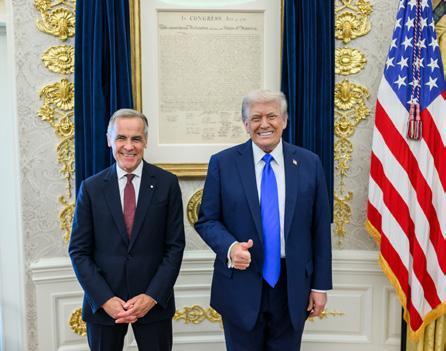
Trudeau’s replacement, Mark Carney, rebranded, removed many retaliatory measures and tried to play nice with Washington, eventually ditching a carefully developed digital services tax covering untaxed business-to-business online services. Mexico took a similar tack. By sitting back and waiting for a positive conversation to happen, both countries learned the hard way what zero-sum trade policy looks
If the U.S. threat is existential, diversification promises hollow, and global rule-making at a standstill, where does that leave us? Is Canada doomed?
Of course not. Threats to manufacturing, including lumber and automotive production, need to be addressed beyond the support of important low- and zero-interest loans. Higher tariffs may be needed on some goods.
Apart from that, we need more federal-provincial coordination, more public-private conversations (including with unions), and more public sector workers acting like this is the emergency it really is. Prime Minister Carney’s 15 per cent cuts across all departments, regulatory holidays for mining megaprojects, and plans to sell off critical public infrastructure like airports to the highest foreign bidder are dead-ends from a hubristic but fading neoliberal heyday.
Rather than driving domestic restructuring, as it has since the original Canada-U.S. Free Trade Agreement, Canadian trade policy should be made supportive of building resilient domestic economies at home and abroad. That means being tolerant of foreign economic development strategies that sometimes favour local jobs and supportive of democratic choices that may indirectly harm Canadian investors. Labour protections should be more strictly upheld and investor-state dispute settlement—corporate courts for foreign investors—abandoned completely.
Stuart Trew is the director of the CCPA’s Trade and Investment Research Project.
Years of lead in the Silicon Valley
In November 2019, time was up for Evo Morales. After election results started coming in, the Organization of American States questioned the validity of the results, casting his lead into doubt. Those questions enabled the Bolivian military to force him from power, even though later analysis—including from major U.S. media—confirmed the OAS analysis had been “flawed.”
Bolivia’s left-wing president was overthrown based on a lie and the political right kicked off a massive wave of repression. After the coup, questions swirled about why Morales had been forced from office. One answer in particular caught a lot of people’s attention: that the United States wanted access to the country’s vast lithium reserves, which would be necessary to power the electric vehicles (EVs) and battery storage that were key to the energy transition.
Eventually, a Twitter user put that charge to Tesla CEO Elon Musk. If anyone was to benefit from such a move, it would be him. His response didn’t help quell the questions. “We will coup whoever we want!” Musk replied in July 2020. “Deal with it.”
It was nothing new for Musk to make brash statements, but his response today looks like an early indication of where the industry was going. This was before his acquisition of Twitter, his open championing of Donald Trump, and unapologetic embrace of extreme right-wing politics. But his response also signalled something else.
For years, Silicon Valley had framed itself as the home of a progressive libertarianism. It was not like the old guard companies, it claimed, and wouldn’t replicate the social harms that accompanied
their business models in pursuit of maximizing profits at any cost. That narrative helped buy tech companies goodwill as they grew in size and expanded globally, but it also masked the expansionist—even imperial—project they were undertaking, one which Musk’s tweet cast a new light on just as the mask was starting to come off.
The imperial project of U.S. tech
As far as the public was concerned, the internet was framed around a series of libertarian notions.
John Perry Barlow, one of the co-founders of Electronic Frontier Foundation, said as much in a 1996 manifesto that shaped internet politics for decades to follow. “Governments of the Industrial World, you weary giants of flesh and steel, I come from Cyberspace, the new home of Mind,” he wrote. “You are not welcome among us. You have no sovereignty where we gather.”
Barlow wanted the internet to be akin to a virtual hippie commune, and he felt that meant governments had to be kept far away. But by casting government as the enemy, he left the door open to another powerful societal force to shape the course of the internet’s development: corporations. Barlow’s framing, which came to define much digital rights activism, conflicted with the way many in government saw the potential the internet offered to maintain the power of the United States.
In 1989, several years before the effort to privatize the internet would kick into high gear, then Senator Al Gore was pushing a bill that would direct more money into funding high-performance computing technologies. He was interested in the field, but he saw another benefit
to spurring innovation in the sector. “The nation which most completely assimilates high-performance computing into its economy will very likely emerge as the dominant intellectual, economic, and technological force in the next century,” he told his fellow senators when introducing his bill.
As far as Gore was concerned, the advancement and adoption of those technologies would not just be a form of modernization or serve to boost the economy, it would also assure the continuation of U.S. power. He may have been a champion for the “internet superhighway,” but he also saw how a global expansion of the network that would facilitate the entry of U.S. companies into countries around the world would be in the interest of the U.S. government.
As countries became dependent on the products and services of U.S. tech companies, it wasn’t just the companies themselves that prospered. Their profits flowed back to the United States and the U.S. government gained leverage over those countries; leverage it began to openly flaunt once Donald Trump returned to office. The imperial nature of the project Washington and Silicon Valley had been collaborating on for decades was revealed for all to see, and the tech billionaires behind it shifted their rhetoric to reflect it.
Silicon Valley’s right-wing turn
There was a day when at least some Silicon Valley executives believed in the “don’t be evil” slogans they championed, but their commitment to any notion of social good eroded with every additional billion added to their net worths. Today, Elon Musk openly promotes white
supremacy as tech companies fall over themselves to sign massive contracts with the Pentagon. If you listen to Palantir CEO Alex Karp, that’s all in service of defending Western civilization and, more specifically, the dominant role of the United States.
In a 22-point manifesto posted to the company’s X account on April 18, Karp argued that Silicon Valley “owes a moral debt” to the United States and needs to defend not just its power, but to build weapons to help its military. Western pluralism, in his view, was a fatal mistake, as some cultures had simply “proven middling, and worse, regressive and harmful.” There was no point in trying to put them on the same level as the West.
Rather than trying to push the government away, Karp and his new alliance of openly right-wing billionaires were explicitly championing the essential nature of the alliance between Silicon Valley and the Trump administration. It’s a political bet as much as it is a statement of how the politics of the tech industry have shifted.
Under the Biden administration, Silicon Valley felt its first sustained threat of domestic regulation as branches of the government brought lawsuits against the tech companies for anti-competitive actions and broader social harms that have arisen from their products. That was one reason they openly embraced the political right, but it was far from the only one.
The reality is that right-wing politics has long had a foothold in Silicon Valley; its adherents were simply operating out of the public spotlight during the era the industry was trying to present itself as a more progressive force. But there’s also the question of power—now that tech companies are some of the most influential companies in the world, they want to defend their power and market share. They rightfully see aligning with right-wing political movements as the best way to achieve it.
As the global power of the United States is threatened, so, too, is their global market share. If the U.S. government can’t push other countries around, it’s easier for those countries to crack down on U.S. tech companies or even get rid of them. More still, as Chinese tech companies become more globally competitive, U.S. tech executives need the United States to contain China to protect their bottom line.
The new political orientation of Silicon Valley is a far cry from Barlow’s declaration three decades ago, but it’s a more honest description of the relationship that has long existed between the tech industry and the U.S. government. It may have taken different faces in different moments, but the global expansion of the tech industry has always been part of the U.S. imperial project.
The need for digital sovereignty
The U.S. empire has long depended not simply on military might, but also economic coercion to maintain its
global dominance. Unlike the European colonial powers that preceded it, the United States has engaged in less direct colonization of overseas territories; instead, it mastered the use of economic dependence to keep countries in line.
For a long time, that power was used primarily against the Global South; its Western peers in places like Europe or Canada were able to prosper from the system it built and even become exploiters of their own. But Trump’s return to office in 2025 corresponded with a shift in how the United States deployed that power. Seeing its geopolitical advantage in jeopardy, it became much more willing to deploy economic coercion against its supposed friends as much as its foes, and technological dependence has emerged as a key aspect of its leverage.
Countries like Canada are waking up to that new reality. In recent months, Prime Minister Mark Carney has begun regularly speaking out against the changing U.S. role in the world. But his action is not living up to his rhetoric—certainly not on the digital front. Work on a sovereign cloud hasn’t moved beyond the talking stage, the government hasn’t joined European allies in considering how to wean public functions off Microsoft and other U.S. services, all while it pushes companies to become more dependent on U.S.-based generative AI tools that offer dubious promise.
Concern about the influence of the United States is nothing new in Canadian politics. Left-wing activists have long criticized the country as little more than a vassal of the United States, especially since the original North American Free Trade Agreement. But defending Canada’s sovereignty in the 21st century will require much more than increased military spending and trade diversification. It requires the government to get serious about digital sovereignty.
Until Canada gets off U.S. tech platforms and services, the government, major companies, and even much of the modern military hardware the government is procuring from the United States is in jeopardy. The U.S. government can request Canadian data stored in the servers of U.S. cloud companies, it has weaponized our use of those services to expand its surveillance apparatus, and it can even suspend access to any of those services at a moment’s notice.
The libertarian framing of the internet as a place of freedom and expression was a potent mask for a project U.S. lawmakers always understood was imperial in nature: to defend its government’s power and geopolitical position. Now it has countries around the world exactly where it wants them. They have to choose: will they act quickly to take back that power, or accept the subservient position the United States has designed for them?
Paris Marx is the host of the Tech Won’t Save Us podcast. His next book Hyperscale: The Ambition and Excess of Big Tech’s Data Empires comes out in October 2026.
Nick Gottlieb
The soldier, the banker, the oil tanker
Fossil fuels and dollar-dominated financial architecture underpin the U.S. empire. Dismantling them will bring it down.
In 2019, the Governor of the Bank of England told an audience of central bankers and technocrats in Jackson Hole, Wyoming that “we need to change the game.” The international financial system, he argued, must move away from its dependence on the U.S. dollar—the dollar’s status as a global “reserve currency.”
Dollar hegemony is everywhere in global financial architecture. The U.S. dollar is used for 74 to 96 per cent of trade outside the Eurozone; the majority of governments’ foreign exchange reserves are
denoted in U.S. dollars; and the majority of cross-border banking claims and liabilities are U.S. dollar based. The U.S. Federal Reserve assessed the U.S. dollar as accounting for nearly 70 per cent of international currency usage in 2024, nearly three times the level of the next currency, the Euro. The dollar, in other words, is the lynchpin of both global trade and the global financial system.
Today, the former banker who gave that speech is prime minister of one of the largest oil-producing countries in the world: Canada.
Mark Carney is still giving speeches about the changing world order and the end of American hegemony, but his actions tell a different story.
Canada under Carney has shown itself firmly committed to the maintenance of a fossil-fueled global economy maintained by U.S. power, a project that both relies on and reinforces the monetary system once decried.
U.S. military power, U.S. dollar hegemony, and global fossil fuel demand are interdependent and mutually reinforcing. If one falls, so do the others.
An empire that runs on oil
To understand this interdependent relationship, we need to understand how U.S. dollar hegemony and the global oil economy co-developed over the course of the 19th and 20th centuries.
The story begins with Britain’s industrial revolution, the first in the world, often understood as a domestic phenomenon, but the rise of coal-fired manufacturing is only part of the story. The most impactful transformation of the period didn’t occur within Britain’s borders, but beyond them: coal-fired steam ships granted the British navy a new-found military dominance that it used to build a “fossil empire,” imposing exploitative trade relationships on China, Egypt, and much of the rest of the world. Coal allowed Britain to construct a dynamic domestic capitalism that systematically fed off the global periphery.
In the early 20th century, militaries started shifting to oil, produced predominantly in the U.S., because of its higher energy density and its lower labour requirements. Britain converted its navy in the lead-up to World War I, which facilitated a military advantage but created a
structural dependence on the U.S., whose oil industry expanded rapidly.
After the war, U.S. oil suppliers were left overproducing for a small civilian market. The oil industry found its solution by colluding with auto manufacturers to impose car dependence on U.S. society, laying the groundwork for the fossil fuel society that the United States would spend the rest of the century exporting.
Imposing fossil-fueled mass consumerism and securing global oil flows went hand in hand over the ensuing decades. The U.S. remained the largest oil producer until the 1960s (a mantle seized again in 2018), but already in the 1920s and 30s, U.S. firms were developing oil infrastructure in West Asia. By the 1930s, just seven western companies—five of them U.S.-based—controlled virtually all the oil in the region.
By the 1940s, one country stood out: Saudi Arabia, whose oil resources were under the control of a subsidiary of John D. Rockefeller’s Standard Oil. Recognizing Saudi Arabia’s importance, in 1945, U.S. President Franklin Delano Roosevelt established the longstanding
“special relationship” we know all too well today.
Intervention in the region during this period focused almost entirely on control over oil. The very first CIA-supported coup took place in Syria in 1949 as a response to the country’s refusal of a Saudi pipeline on its territory. In 1953, when Iranian Prime Minister Mohammad Mossadegh nationalized Iran’s oil, the CIA ousted him and installed a vicious dictatorship that ruled until the 1979 Islamic Revolution.
The invisible hand of the petrodollar
At the end of World War II, oil was central to military might, but it wasn’t yet the lynchpin of global economic activity. The Marshall Plan, the United States’ post-war reconstruction program for Europe, helped entrench fossil fuels as the basis of an increasingly interconnected global economy and established the beginnings of the modern financial system built on oil and the U.S. dollar.
Over 10 per cent of Marshall Plan financing went to buying oil, which European countries purchased almost exclusively from U.S. firms in West Asia. This program was explicitly designed to make western Europe dependent on U.S.-controlled oil.
Oil use rose rapidly in the 1950s, particularly in the U.S. sphere of influence. The “Green Revolution” (the widespread adoption of industrial agriculture) accelerated the rise of fossil fuel use and tied agriculture to fossil fuels, creating an existential vulnerability for fuel importing countries.
In 1973, the outlines of our fiscal and monetary order crystallized during the events following the Ramadan/Yom Kippur War. Saudi Arabia imposed an oil embargo in response to U.S. backing of Israel, which spurred what was (until recently) the largest global energy crisis in history. To end the crisis, President Richard Nixon negotiated an agreement: Saudi Arabia would
sell oil only in U.S. dollars, cementing what is known today as the “petrodollar system” and situating the U.S. dollar securely at the centre of the global oil trade.
Until recently, virtually all oil transactions were conducted in U.S. dollars. Over the last decade, a variety of factors, including the overuse of unilateral sanctions by the U.S., has allowed other currencies to edge in, but the dollar still accounts for about 80 per cent of oil transactions.
The petrodollar system, broadly defined by the sale of oil in U.S. dollars and the reinvestment of Gulf oil profits in U.S.-produced arms and U.S. debt, replaced the post-WWII global currency regime, which pegged the U.S. dollar to gold, with a new regime that retained the dollar as its centrepiece, but moved, in some sense, from gold convertibility to oil convertibility.
Since the end of the Cold War, the U.S. has used control over oil and U.S. dollars—the former secured by violence and alliances with reactionary regimes, the latter through international institutions, regulations, and financial infrastructures—to dominate the world. From Iraq in the 1990s, where U.S. sanctions killed millions, to Cuba today, control over dollars and oil has proven to be a weapon more powerful than any conventional arsenal.
If global trade moved away from the dollar, the U.S. would lose not just this weapon, but also the “exorbitant privilege” that its reserve status grants, including its ability to borrow indefinitely—what modern monetary theorists call “monetary sovereignty.”
Decarbonization and de-dollarization
Over the last decade, some have suggested that we are undergoing the beginnings of de-dollarization, but critics point out that in concrete terms, non-dollar trade has made little headway. What these critics miss, though, is the link between dollar hegemony and the most dramatic development of recent years: the increasingly rapid deployment of renewable energy. Oil importing countries are obliged to use the dollar and to retain deep U.S. dollar reserves because of their structural dependence on oil. The energy transition holds the potential to eliminate this obligation, and with it, to destabilize the entire system of dollar seigniorage.
This dynamic is playing out in real time in Cuba today. Trump’s illegal oil blockade—a blockade Carney has refused to challenge—has been starving the Cuban people. Emergency deliveries of solar panels and battery systems sent by China are mitigating the harm and keeping the ventilators running in hospitals. But they’re doing something much more transformative, too: they are laying the groundwork for a Cuba that is no longer dependent on oil and, as a result, is less subject to the whims of the United States.
Dollar hegemony, U.S. military power, and global oil reliance are mutually reinforcing and dependent. Canada’s desire to pump the tar sands dry, which could
take hundreds of years at current production rates, requires the country to fight like hell to maintain oil dependence—and, with it, U.S. power and dollar hegemony, because without the latter two, oil demand will rapidly decline. Carney’s past calls for a more resilient, multi-currency global financial system conflict with his present insistence on expanding oil and gas production, whether we understand that as his genuine vision for Canadian development or simply as a commitment to the interests of finance capital.
Much to the U.S. and Canada’s chagrin, the energy transition and its destruction of oil demand has been supercharged by the war on Iran. In the Philippines, a public sector pension fund launched an unprecedented financing program for rooftop solar. In India, liquefied petroleum cookstoves are being replaced en masse with induction cooktops. In the UK, the government just passed a Future Homes Standard that requires new builds to use heat pumps and generate their own electricity.
As far as the energy transition goes, the weeks after the US and Israel launched their war were “weeks where decades happen,” as V. I. Lenin once said.
Which leaves Canada at a crossroads. We can throw our weight behind the U.S. quest for “energy dominance” in a desperate and unavoidably violent bid to maintain share prices for a dying industry, as Carney’s energy secretary Tim Hodgson recently assured a U.S. audience we would. This path requires that Canada endorse U.S. adventurism; it requires that Canada fight to shackle developing countries with out-of-date infrastructure; and it requires that, when push comes to shove, Carney will be standing behind Trump as he commits crime after crime.
Or we can choose the path of international cooperation, rejecting the United States’ new world order and winding down our fossil fuel production in line with a “fair share” approach to climate mitigation.
This doesn’t mean giving up on Canadian prosperity. Instead, it means reckoning seriously with the bifurcation that stands before us: we either move, globally, to a renewable future free from fossil fuel dependence, dollar hegemony, and U.S. domination, or we follow the U.S. path of reckless escalation to its terrifying endpoint: nuclear conflagration.
The choice seems obvious.
Nick Gottlieb is a writer and a doctoral candidate at Simon Fraser University. He is the author of the newsletter Sacred Headwaters.
“ For decades, countries like Canada prospered under what we called the rules-based international order. We knew the story of the international rules-based order was partially false, that the strongest would exempt themselves when convenient, that trade rules were enforced asymmetrically. This fiction was useful, and American hegemony, in particular, helped provide public goods, open sea lanes, a stable financial system, collective security and support for frameworks for resolving disputes.”
—Prime Minister Mark Carney, January 20, 2026 Canadian Centre for Policy
Since the end of the Second World War, America has largely been viewed as the glue that helped foster greater international stability and cooperation, including liberal democracy.
Those days are for the history books now, as U.S. President Donald Trump casually tosses a match at the world.
But, as Prime Minister Mark Carney has acknowledged,
part of the story about international order was never true. The U.S. played a role in selling the fiction while also ignoring the rules when it didn’t fit its agenda.
A HISTORY OF WAR
The U.S. has existed for 250 years. Of that time, it has been at war for approximately 230 years.
According to a conservative accounting by the Congressional Research Service in 2022, the U.S. has engaged in 469 military interventions over the course of its history. 251 of them have taken place since 1991.
The U.S. has been involved in overthrowing more than 100 governments since 1947—over one per year on average since the end of WWII.
Punitive U.S. sanctions have targeted over a third of all nations in the world. Research suggests that Western (primarily U.S.) sanctions are responsible for 38 million deaths since 1970.
The U.S. spent nearly $1 trillion on its military in 2025—that’s nearly triple the next largest spender, China, which spent $336 billion. The U.S. spends nearly as much as the rest of the top 10 combined.
Hadrian Mertins-Kirkwood
The climate policy winter
Global climate action in a deep freeze as the planet heats up
Like the weather, climate policy is seasonal.
For Canada, the last climate policy winter ended in 2015. In that year’s federal budget—the final gasp of the Harper era—”climate change” and similar terms appeared only 17 times, counting mentions of the following terms in the main document of each federal budget: climate change, emission, carbon (excluding “carbon capture”), net-zero, clean energy and renewable. Then a new government was elected and the Paris Agreement was signed, and a new springtime of climate enthusiasm blossomed in Canada and around the world.
The 2016 federal budget, the first of the Trudeau era, mentioned climate 123 times. By 2021, climate action was a centrepiece of the federal agenda and climate-related terms had skyrocketed to 449 mentions. Climate action was finally enjoying its time in the summer sun.
Unfortunately, summer does not last forever, and 2021 would prove to be the pinnacle of federal climate policy enthusiasm before a chilly autumn took hold. By the 2024 budget—Trudeau’s last—the number of climate mentions had fallen to 235. In Mark Carney’s first budget, released in fall 2025, climate-related terms appeared only 194 times.
Keyword searches are, of course, a crude measure of action. They tell us only what governments are talking about, not what they are actually doing. And, indeed, many of the climate-related mentions in the most recent federal budget involved the weakening or cancellation of the very climate policies that previous budgets had created.
Consumer carbon pricing, an electric vehicle sales mandate and a cap on oil sector emissions are all among the recent casualties— once-vibrant leaves shaken off by an indifferent tree and carried down to the frosty earth where they wither and die.
For Canadian climate policy, it is winter once again. And we are not alone.
Climate politics are prone to spilling over national borders. To our south, the gutting of U.S. climate policy over the past year has been truly catastrophic, ushering in a climate policy deep freeze that may take decades to recover from. Not content with the mere cancellation of programs, the U.S. administration attacked the very foundations of climate science while entrenching the political and economic power of the fossil fuel industry.
Even in Europe, where the Gulf Stream usually moderates highs and lows, it is starting to feel unusually chilly. Over the past two years, the EU has rolled back or weakened a wide variety of climate measures, from green spending goals to constraints on corporate polluters to deforestation rules. Far-right, anti-climate political parties are ascendant across the continent, shifting the political window away from environmental action.
As for the international process that produced the groundbreaking Paris Agreement in 2015? It, too, enjoyed a fruitful summer before a recent cold snap. After finally naming fossil fuels as the root cause of climate change in 2023, the UNFCCC process retreated, scrubbing all mention of coal, oil or gas from its latest joint declaration. More than 1,500 fossil fuel lobbyists participated in the process.
The backdrop to this climate policy winter is, of course, the raging heat of climate change itself.
Unlike the weather, the climate crisis is not seasonal. It is unfolding in only one direction—a relentless forward march toward an unlivable planet. Global average temperatures now exceed 1.5 degrees Celsius above pre-industrial levels. Without fundamental changes to the global energy system, we are on track for three or four degrees of warming by the end of this century.
The consequences are predictably dire. Extreme weather events driven by climate change are costing Canadians billions of dollars in direct damages every year. When indirect impacts are included, such as lost productivity due to extreme heat or the health effects of wildfire smoke, the costs of climate change for Canada are in the tens of billions of dollars per year.
As temperatures keep rising, those costs are expected to increase exponentially. By mid-century, we are on track for $100 billion per year in damages, according to estimates from the Canadian Climate Institute. By the end of the century, the climate bill could be half a trillion dollars per year.
It’s a similar story around the world. While estimates vary widely, global GDP losses of at least five per cent are likely under three degrees of warming. Losses of up to 30 per cent are possible, depending on how poorly we adapt.
These are just numbers—and speculative ones, at that—but they are an important proxy. Behind every
dollar lost to climate change is a cancelled soccer game, a drought-stricken field, a collapsed bridge, a displaced community. Climate change makes all of our existing problems worse and piles on new ones.
And yet, despite the political backsliding on climate policy in many countries, including in Canada, it is not winter everywhere. Indeed, in many parts of the world, global climate action is flowering. And it is starting to make a difference.
Look no further than China, which is often erroneously held as a climate bogeyman. While the country still burns coal, as critics point out, China is also the world’s largest investor in clean technology. The country is installing more solar power than the rest of the world combined, for example. More than half the vehicles sold in the country are now electric. And it is paying dividends. Chinese oil demand has peaked, and greenhouse gas emissions are starting to fall.
Other emerging economies are following suit. Pakistan is producing so much solar power that demand for natural gas imports is falling—much to the chagrin of Canada’s liquefied natural gas (LNG) industry. Ethiopia banned the import of internal combustion engine vehicles because electric vehicles are so much cheaper than importing oil. Colombia is actively phasing out its production of oil and gas.
Indeed, Colombia is now leading a new international effort, alongside the Netherlands, to phase out fossil fuels globally. At a conference in Santa Marta in April, dozens of governments fed up with the capture of the UNFCCC process began charting an alternative, collective path away from coal, oil and gas dependence.
Canada didn’t sign on to the Santa Marta declaration. We are still in our climate policy winter. But despite the chill on climate action here and in peer countries, the continued global momentum on clean energy, clean technology and falling fossil fuel demand—often in unexpected places—should give us pause.
In times of great turmoil, Canadian politics tends to reach for the familiar, and there is an alluring familiarity to oil and gas. As we confront this latest breakdown of the international order, politicians and citizens alike are seeking refuge in the status quo.
But even though climate politics may be seasonal, climate change, and the necessity of climate action, is not. The countries that understand this best—the countries that see the current geopolitical crisis as an impetus for doing things differently—are not only insulating themselves from the rising costs of climate change. They are also setting themselves up for energy independence and economic prosperity in the century to come.
It’s time for Canada to come out of the cold.
Hadrian Mertins-Kirkwood is a Senior Researcher at the CCPA.
Nashwa Lina Khan
The Gaza world order
Israel’s ongoing genocide is the fascists’ blueprint for the world they seek to construct
Gaza has long been a warning of a new world order, now it is a blueprint—a testing ground, genocide laboratory, space of exception. The smaller of the two Palestinian territories has exposed how the limits of permissible bloodshed are tested, refined, and exported into broader global practice.
What has unfolded in Gaza over almost three years is a humanitarian catastrophe, a rupture that exposes the limits of the liberal international order, including Canada’s role within it. Institutions tasked with upholding international law have failed to act in any meaningful way, revealing a system that operates selectively.
In her 2015 work Freedom Is a Constant Struggle, the inimitable Angela Davis drew connections between the U.S. Black liberation movement and Palestine, tracing how struggles against state violence are linked across geography. In 2025, reflecting on the current moment, Davis returned to the thread she laid years earlier: “Palestine is really the center of the world.”
The scale of violence is staggering, but so too is its visibility—a genocide witnessed in real time on our phones and televisions has forced a confrontation not only with the brutality itself, but with the conditions that make it possible.
As Jewish Voice for Peace wrote following October 7, 2023, “[r]eality is shaped by when you start the clock.” What appears as sudden to some is the continuation of a much longer violent structure. In The Hundred Years’ War on Palestine, Rashid Khalidi lays out the century-long project of dispossession. What feels unprecedented today is not only the scale of Israel’s violence, but the clarity with which its underlying logic is laid bare. Gaza makes plain that the “rules-based order” is enforced unevenly and shaped by imperial power. Gaza is where the institutions of that “order” have most visibly failed in their stated mandate to prevent mass atrocity and protect humanity.
The result is not the breakdown of the system, but its selective operation. What Gaza suggests is not the collapse of a rules-based order but the limits of a world order that was never actually universal. Canada’s response demonstrates that extreme violence can proceed without consequence when the perpetrators align with the interests of empire. Diplomatic cover, continued military support, and the absence of enforceable sanctions have created an environment in which accountability appears optional even in the face of unprecedented global protest.
In Canada alone, pro-Palestinian demonstrations have taken place in at least two dozen cities and towns since October 2023, with sustained mobilizations in larger cities—over 1,000 protests in Montreal alone. These actions span both major urban centres and smaller cities, and signal a significant level of public opposition that has yet to meaningfully shift Canadian policy.
Gaza is not only a site of unprecedented human devastation, it is where the limits of permissible violence are being actively expanded every day that the genocide continues. What is normalized in Gaza proceeds to travel beyond Gaza, and growing ranks of subjugated populations can be subjected to extreme forms of violence without consequence.
We witness this with sanctions regimes in places like Cuba and Iran, where U.S.-led economic strangulation and political isolation operate not as temporary measures but as enduring tools of imperial governance. We see it in the expansion of surveillance technologies and military systems developed and tested in Gaza normalized elsewhere, marketed and integrated into global security infrastructure. We see it in the language of security itself, which increasingly justifies collective punishment and the erosion of civilian protections.
This governing logic normalizes state violence and diminishes international law. Gustavo Petro, president of Colombia, described Gaza as “the rehearsal of the future” at a UN climate summit, warning that mass displacement and militarized violence will shape how wealthy nations respond to climate migration. Gaza is not only a catastrophe in the present but a preview of how global inequality will be enforced in an era of ecological crisis.
This raises urgent questions for countries like Canada, which has long positioned itself as a defender of human rights and multilateral norms, despite material relationships that contradict the narrative. Despite a 2024 parliamentary motion imposing limits on certain military exports to Israel, Canada continues to maintain procurement and military relationships with Israeli arms and security companies, some of which explicitly market their products as “battle-tested” on Palestinians. These relationships are enabled by loopholes in Canada’s arms export regime, including one that allows the transfer of Canadian-made military goods and
components through third countries, particularly the United States, to countries such as Israel that would otherwise be banned under Canada’s export rules.
This pattern is not unique to Gaza. Canada’s arms exports to Saudi Arabia during the war in Yemen similarly sit in tension with our nation’s carefully cultivated peacekeeping reputation—a contradiction already exposed since at least the 1993 “Somalia Affair,” where gangs of white supremacist soldiers led a culture of violence so entrenched inside Canada’s “humanitarian mission” that the government fully disbanded the Canadian Airborne Regiment. Such violence stems from ongoing settler colonial practices within Canada itself, and points to a broader disjuncture between stated commitments to human rights and the material realities of Canadian foreign policy.
Canadian-made military goods continue to move through global supply chains connected to the genocide in Palestine. This is not simply policy inconsistency, it reflects a deeper entanglement that Gaza makes visible. Understanding Gaza in this way shifts the analysis—it is not only a humanitarian crisis, but a place where new forms of governance, control, and violence are refined and normalized. The question is not whether these practices will appear elsewhere but how they seemingly exist everywhere.
We are witnessing the emergence of a more openly authoritarian and fascistic world order. It is an evident shift toward more overtly coercive forms of governance, in which the distinction between civilian and combatant is blurred, and where entire populations can be rendered disposable under the logic of security. The selective application of international law, the expansion of militarized governance, and the normalization of large-scale civilian harm is the program of the future. These patterns will not be isolated events, they are the template.
If Gaza is a warning, the question is whether we will recognize it as such. What it reveals is not only the fragility of the existing order, but the terms on which a new one may be taking shape: a world in which states deploy violence more openly, accountability is increasingly conditional, and the language of human rights persists even as its guarantees recede. The Gaza model is now being reproduced in Southern Lebanon—entire villages and worlds reduced to rubble, the destruction of civilian infrastructure, devastation with a scale and repetition that recalls the patterns in Gaza. What once appeared exceptional reveals itself as a method.
To understand Gaza, then, is not only to witness atrocity, but to recognize a blueprint that is already shaping the terms of the world to come.
Nashwa Lina Khan is an interdisciplinary scholar, writer, and curator whose work engages culture, political critique, media, and liberation movements. She is the host of the Habibti Please.
Jasmine Ramze Rezaee
Middling powers
If
the rules
are collapsing, what will Canada stand for?
At the World Economic Forum in Davos earlier this year, Prime Minister Mark Carney offered a sobering diagnosis of the world Canada now faces. The rules-based international order that structured global politics for decades is weakening. Canada benefitted enormously from that system, he acknowledged, but it may no longer be able to rely on it.
If the old order is fading, Carney argued, Canada must adapt. The country should behave more like a true “middle power:” diversify its economic partnerships, deepen ties with countries beyond the
traditional Western bloc, and prepare for a world shaped less by shared rules and more by great-power rivalry.
Few observers would dispute the diagnosis. The norms that once constrained the use of force have eroded for years, perhaps even decades. International law is applied selectively. Multilateral institutions struggle to restrain the actions of powerful states. The geopolitical landscape is increasingly shaped by raw economic and military power.
Trump’s return to the White House—and the renewed suggestion that Canada’s sovereignty itself
could be negotiable—helps explain the urgency of Carney’s warning. But acknowledging the erosion of the rules, or even admitting that those rules were always unevenly applied, raises a deeper question: what does Canada actually do in such a world?
The U.S.-Israeli attack on Iran has provided the first real test.
Carney has acknowledged that the strikes appear inconsistent with international law governing the use of force. Yet he has stopped short of condemning them. His initial statement avoided any call for diplomacy and only shifted tone
after criticism rose from within his own party. Speaking to reporters in Australia on March 4, he also refused to rule out Canadian military participation should the conflict widen.
The message should concern us. Canada recognizes that the rules are being broken, yet it is not prepared to defend them. Instead of appealing to principle, the government appears to be accepting “the world as it is, not as we wish it to be”—Carney’s own lamentation in Davos.
But there is something deeply contradictory about this position.
Economically, Carney argues that Canada must diversify to reduce dependence on the United States and build stronger ties with other partners. Politically and militarily, however, his response to crises like Iran suggests the opposite instinct: remain closely aligned with Washington and its allies, avoid confrontation, and hope that proximity to power continues to provide protection.
In other words, Canada is attempting to exit dependence economically while doubling down on it politically. That strategy cannot hold for long.
If the rules-based order is fracturing, the Western hierarchy that once gave Canada a measure of stability will erode with it. In a world governed increasingly by power rather than law, quiet alignment will not guarantee protection.
Expanding trade partnerships may reduce economic vulnerability in theory, but it does little to change the underlying geopolitical reality: Canada remains geographically adjacent to the most powerful military actor in the world. If international norms no longer restrain that power, we become especially vulnerable to its whims.
Playing small in the hope that stronger states will leave us alone is not a strategy. At best, it is a gamble. Yet this appears to be the underlying logic currently guiding Ottawa’s approach. Carney continues to reassure Washington by signalling stronger NATO commitments and refraining from outright criticism, hoping that cooperation will preserve Canada’s security within the Western alliance system.
Perhaps the calculation is that the current moment is temporary—that the turbulence of the Trump era will pass and that the familiar order will reassert itself. If Canada keeps its head down and avoids confrontation, maybe the storm will blow over. But this is a risky calculation.
If the world is indeed entering a more unstable period of great-power rivalry, then the strategy of quiet accommodation may prove not only ineffective but dangerous. Compliance has rarely purchased lasting security for less powerful countries. More often, it invites further pressure.
There is another path available to Canada—one that is both principled and more strategically coherent.
Canada is trying
to exit dependence economically while doubling down on it politically
Ethics, at its most basic level, is about the relationship between what is and what ought to be. It is the framework through which societies judge existing behaviour against standards of justice, law, and legitimacy. Without that distinction, there is no basis for critique, no possibility of accountability, and no reason to expect better conduct in the future.
International law operates on ethical principles that underpin legal norms. It is not effective because it is always obeyed; it is effective because it establishes standards against which power can be judged and, at times, constrained. When those standards are abandoned entirely, the only remaining currency in international politics is brute force. And for middle powers like Canada, that is a dangerous development.
Canada has, at critical moments in the past, chosen to defend principle even under intense pressure. In 2003, Ottawa refused to join the invasion of Iraq despite pressure from Washington. That decision did not isolate Canada from the world. On the contrary, it strengthened Canada’s credibility as a country willing to act according to its own judgment and in compliance with international law.
Multilateral institutions were never designed to eliminate power from global politics. They were designed to constrain it and create predictable rules that even powerful states would feel a responsibility to adhere to. For middle powers, these institutions are part of the infrastructure of our security, and they are worth defending.
Prime Minister Carney now faces a test of what middle-power leadership actually means. If Canada believes in the value of international law and multilateral cooperation, that commitment must shape its foreign policy as much as its economic strategy. In a world increasingly governed by raw power, defending those rules is not only a matter of ethics and legal norms but of self-preservation.
Jasmine Ramze Rezaee lives in Toronto and writes about Canadian politics and social policy. Views expressed here are her own.
Kelsey Gallagher
A branch plant for bombs
Canada’s Defence Industrial Strategy aims for diversification, but has no roadmap
Canada’s February 2026 Defence Industrial Strategy (DIS) frames defence production as central to Canadian security. It emerges amid U.S. pressure on NATO allies to increase military spending, and responds to growing doubts about American reliability as a security partner.
Alongside multi-billion-dollar investments in the Canadian defence industry, the strategy seeks to diversify arms sales away from the U.S. while pushing for a 50 per cent increase in Canadian arms exports overall.
Yet, given the deep integration of the North American defence industrial base and increasingly inward-looking global markets, the DIS will likely accelerate arms sales southbound while further entrenching reliance on the U.S. market, raising questions about strategic
autonomy and downstream human rights risks.
Defence Industrial Strategy
To date, analysis of the DIS has focused on its objective to diversify military procurement away from the United States. Approximately 70 per cent of Canadian Armed Forces kit is sourced from U.S. suppliers, and the DIS aims to enable Canadian manufacturers to capture a greater share of domestic contracts.
The strategy also seeks to diversify Canadian arms exports away from contracts with the U.S. Department of War.
Most of Canada’s arms exports are towards the United States. The Canadian Association of Defence and Security Industries (CADSI), which represents the Canadian defence industry, estimates these exports have been worth $4 billion in recent years. Approximately
two-thirds of Canadian arms transfers in peak years are for the U.S. government.
This is not new. Historically, Canada’s defence industry has been part of a broader North American defence industrial base. With some notable exceptions, in terms of volume, most of the military technologies that Canada exports are components for American-made systems, from the M1 Abrams main battle tank to the F-35 Joint Strike Fighter to 155 mm artillery shells.
The federal government has institutionally supported this integration for decades. The Canadian Commercial Corporation, for example, brokers and facilitates contracting with the U.S. for Canadian defence sales exceeding US$350,000. The relationship is further entrenched by corporate ownership, with half of Canada’s 10 largest defence firms being subsidiaries of U.S.
companies whose production decisions are shaped by American strategic and commercial priorities.
Given strains in the U.S.-Canada relationship, the federal government has interpreted this dependence as a liability. A defence industry so enmeshed with a single partner leaves Canada with limited room to manoeuvre if that partnership deteriorates. The DIS seeks to diversify export partners and strengthen Canadian military production. Whether diversification is achievable, however, depends on the availability of credible alternative markets.
Moving toward Europe
The strategy prioritizes strengthening defence-industrial relationships with allies, particularly the European Union, including through the establishment of a defence partnership to secure Canada’s participation in Security Action for Europe (SAFE).
Adopted in 2025, SAFE is a financial instrument designed to expand Europe’s integrated defence industrial base under the broader Readiness 2030 initiative. Under SAFE, the European Commission will raise up to €150 billion and disburse those funds to member states as long-term loans for joint defence procurement and industrial investment.
According to Global Affairs Canada, European states already accounted for 31.5 per cent of all non-U.S. arms exports, or $789.4 million, in 2024. That Europe is already one of Canada’s most significant alternative markets makes the structural barriers to expanding sales there all the more consequential.
The limits of diversification
Despite the emphasis on European defence agreements and funding for export promotion, the DIS has yet to provide a path to diversification, given current economic and industrial constraints.
The European market, one of the most obvious destinations for Canadian military goods outside the U.S., is not an open one. The same conversations taking place in Ottawa about strategic autonomy and defence production are occurring across European capitals, and Canada’s participation in SAFE or other instruments does not guarantee a corresponding increase in arms transfers.
As per Canada’s negotiations to join SAFE, Canadian firms bidding on SAFE-funded procurement contracts may supply up to 80 per cent Canadian content under each agreement, meaning that at least 20 per cent of component value must originate in SAFE member states. While this has been lauded as a win for Canadian industry, as the cap for other countries outside of SAFE remains at 35 per cent, it poses a significant challenge for Canada, whose defence production consists overwhelmingly of components destined for American systems rather than complete weapon systems drawing on foreign-sourced parts. Canadian
firms are, by and large, producers of components, not assemblers of them.
Further complicating matters is the requirement that Canadian firms must not be controlled by third countries to win SAFE procurement bids.
For U.S.-owned subsidiaries that make up half of Canada’s largest defence firms, this creates a grey area. Participation in SAFE-funded contracts is possible, but contingent on obtaining national security waivers from EU member states on a case-by-case basis. These hurdles are likely to deter many firms from pursuing SAFE contracts when alternatives—namely subcontracts on major U.S. military programs—do not impose the same regulatory burden.
The path of least resistance
Under these conditions, the strategy’s target of a 50 per cent increase in Canadian arms sales is more likely to reinforce existing trade patterns than forge new ones. The integration of the North American defence industrial base, combined with barriers to international markets, keeps the path of least resistance pointing south. Similar dynamics exist in other target markets, for example, Japan and the Republic of Korea, which have also prioritized domestic production and export in pursuit of strategic autonomy.
This matters for two reasons:
First, the DIS seeks to diversify Canadian defence relationships, interpreting current overdependence on the U.S. market as a security concern. Given that existing dynamics will likely deepen reliance on the U.S., particularly given a projected 50 per cent increase in arms exports, this should raise concerns for Canadian sovereignty and security. In effect, the DIS may produce the opposite of its intended outcome.
Second, increasing arms transfers to the U.S. Department of War carry demonstrable downstream human rights risks in light of an increasingly belligerent U.S. foreign policy. Canadian military goods are already being used in U.S. airstrike operations in the Caribbean that legal monitors describe as extrajudicial killings. Moreover, the U.S. acts as a conduit through which Canadian technologies are transferred to countries with poor human rights records, including Israel.
The projected increase in defence production and export, with the U.S. as the likely primary market, exposes Canada to potential complicity in serious violations of international law. These risks are not hypothetical, and Canada’s binding obligations to prevent problematic arms transfers are unambiguous. The DIS is likely to reinforce dependency on the U.S., whose reliability can no longer be assumed. More broadly, the assumption that increased arms exports will necessarily enhance Canadian resilience and security warrants serious scrutiny.
Kelsey Gallagher is a senior researcher with Project Ploughshares.
Stuart Trew
Canada’s passive, idealistic trade plan
Ayear into Mark Carney’s prime ministership, much is being made of his apparent foreign policy shift from the Trudeau government. Business groups welcome what they see as an abandonment of values-based for interest-based foreign relations.
“We actively take on the world as it is, not wait around for a world we wish to be,” the prime minister told an elite audience at the World Economic Forum in Davos, Switzerland in January. The insinuation is that the previous guys were naive idealists while he is finally getting things done.
The case for this version of reality is wildly overstated. In fact, there is barely any gap between the old and new Liberal governments on foreign affairs or trade policy. Both avoid, rather than take on, the world as it is. Both do so to shore up corporate interests abroad.
For example, none of Canada’s current trade and investment negotiations, almost all of which were launched by the Trudeau government, are expected to significantly expand Canadian trade. They will, however, buttress thuggish regimes in Ecuador and the United Arab Emirates (UAE), shield polluting extractive projects from democratic oversight, and undermine democratic industrial strategies, including in Canada.
In Ecuador, the autocratic U.S. puppet regime of President Daniel Noboa has been ruling by military decree for nearly two years. Human rights violations in the country are widespread and systematic. They include brutal state repression and the criminalization of dissent, notably affecting Indigenous
Peoples opposed to Canadian mining operations.
The Trudeau government was aware of Noboa’s antidemocratic tendencies when Canadian trade negotiators referred to the Ecuadorian president as a “like-minded” leader committed to “inclusive” trade. This lackadaisical view of human rights and democracy has carried into the new Carney government.
A June 2025 letter to the prime minister from Canadian unions and human rights organizations, urging the government to consult with Ecuadorian Indigenous groups and mining-impacted communities before proceeding with the free trade deal, went unanswered.
Carney received a similar letter this year urging him not to pursue a free trade deal with the UAE while they are funding armed conflict and fuelling human rights violations in Africa, including the devastating conflict in Sudan. While the government acknowledged these concerns in a summary of consultations on the free trade deal, it is moving ahead with negotiations anyway.
If there were notable economic gains from these deals, the government’s case would seem more realistic. But there are not. Canada’s negotiations with the Mercosur bloc (Brazil, Argentina, Paraguay, Bolivia and Uruguay), another “inclusive” Trudeau-era project that Trade Minister Maninder Sidhu wants to fast-track this year, will be an own goal if they succeed.
Canadian and Mercosur-area grain and meat farmers compete on world markets for the same products, with the latter enjoying a clear cost advantage. The trade deal could easily lead to more
deforestation in Brazil, as farmers take advantage of market opening in Canada to burn trees to raise more cattle—a big reason European farmers opposed the EU-Mercosur free trade deal.
Canada’s promotional materials for the Mercosur negotiations look forward to lowering the trade bloc’s double-digit import tariffs on automobile parts and chemicals, but the dynamic is the same as for agricultural trade. Why would Brazilian vehicle manufacturers substitute more expensive Canadian parts for what they are using now?
They won’t. It is more likely Brazilian and Argentine industrial and agricultural imports to Canada will grow more than Canadian exports the other way, as in past deals with similar-sized economies.
Canada’s trade deficit with Japan in 2025 was nearly double what it was in 2019, the year the Comprehensive and Progressive Agreement for Trans-Pacific Partnership (CPTPP) came into force. Our trade deficit with CPTPP member Vietnam tripled over the same period. Canada’s trade deficit with South Korea has more than doubled over the life of the 2014 free trade deal.
The Carney government’s trade diversification strategy does the opposite of taking the world as it is. It ignores both the limited potential of these agreements to foster economic development and their harmful effects on the achievement of human rights and sustainable economic development in Canada and the Global South.
Stuart Trew is the director of the CCPA’s Trade and Investment Research Project. A version of this article first appeared on the McLeod Group website.
Changiz M. Varzi
History will judge Canada’s stance on the Middle East
The war that the U.S. and Israel launched against Iran on February 28 has once again put Prime Minister Mark Carney and his foreign affairs team to the test. Having previously refused to take any meaningful action against the ongoing genocide in Gaza, Carney has again declined to stand on what many see as the right side of history.
On the first day of the war, as news broke of a U.S. and Israeli attack on a school in the southern Iranian city of Minab that killed more than 150 students, Carney did not condemn the assault. Instead, in an official statement, he said: “Canada supports the United States acting to prevent Iran from obtaining a nuclear weapon.”
This position came despite U.S. President Donald Trump’s and his Department of War’s assertion in June 2025 that all of Iran’s nuclear facilities had been destroyed. Moreover, the International Atomic Energy Agency has never confirmed that Iran was seeking to acquire nuclear weapons.
In the days that followed, while visiting East Asia and Australia, Carney reiterated, “We will stand by our allies.” His criticism of the war, when it came, was muted and limited to concerns about the U.S. lack of consultation with allies and international institutions.
Carney’s support for the U.S.-Israeli colonial war comes at a time when public opinion in Canada is moving in the opposite direction. A Leger poll in March found that nearly six in 10 Canadians (58 per cent) oppose the U.S. and Israeli bombing of Iran, while only 25 per cent support it.
When a majority of Canadians oppose this war, the question is whether Carney and his government will listen to the people or continue to support a U.S. president who has repeatedly expressed interest in annexing Canada and annihilating Iranian civilization. Israeli Prime Minister Benjamin Netanyahu, America’s partner in this war, is also wanted by the International Criminal Court.
Carney’s record is not encouraging, as the experience of Gaza and the West Bank suggests that Canada’s political leadership has consistently ignored public demands.
Over two years of Israel’s genocide in Gaza, human rights groups and anti-war activists repeatedly called on the federal government to halt all direct and indirect military support for Israel.
On March 11, the Arms Embargo Now Coalition condemned the Liberal government after the House of Commons voted down Bill C-233 that would have closed a major loophole allowing Canadian military exports to reach Israel.
Calling the vote a “litmus test,” Rachel Small, a spokesperson for the Arms Embargo Now campaign, said the Carney government had an opportunity to align arms exports with international law and human rights, but “instead chose to align itself with Trump…fueling Israel’s wars.”
Now, once again, Carney and his administration are standing
with whom they call their “allies” instead of their own people. The “ally” Carney invokes most often is Donald Trump, who launched a tariff war against Canada and repeatedly referred to the Canadian prime ministers as his “governor.”
Given this, Canadians may reasonably ask what Carney’s response would be if Trump’s threats against Canada turn into action.
Carney has, so far, supported U.S. actions in Iran, including the assassination of its political and military leadership. He also called the U.S. kidnapping of Venezuela’s Nicolas Maduro “good news”. And on Cuba, he has remained silent about the U.S. fuel blockade, despite its role in sparking a humanitarian crisis on the island.
What image of Canada is he projecting globally by affirming colonial wars and genocides?
Carney and his team should not forget that history will judge the events unfolding today. Just as we now judge the genocide during World War II and the silence of those who failed to act.
Standing on the right side of history is not always easy. But it is what many Canadians expect from their government.
And Canada would not be alone. Spain has already demonstrated that it is possible to oppose U.S. colonial policies. France did not allow Israel to use its airspace to transport American weapons to be used in the war against Iran.
These examples show that, at a time of growing danger in global politics, alternatives exist. The Carney government can choose to take a clear stance, rather than supporting the actions that have brought widespread destruction. Condemning those who started a war that has killed thousands of civilians and devastated infrastructure in Iran, Lebanon and Gaza should not be too much to ask.
Changiz M. Varzi is a journalist and photographer covering the direct and indirect impact of conflicts around the world.
Benjamin Segobaetso
Data centres in space
What could go wrong? Plenty
The publicly articulated proposal associated with Elon Musk’s ambitions to deploy large-scale orbital data centres—potentially numbering one million satellite constellations—signal a shift in how the low earth orbit (LEO) is being imagined, occupied, and governed. While framed as an efficiency-enhancing response to earth data limitations and energy constraints, the scale, and infrastructural ownership centrality of such orbital data centres raise profound governance, ethical, and legal concerns.
This analysis contends that mega-scale orbital data infrastructures proposed by Musk risk producing foreseeable and cumulative harms, such as technological determinism, de facto appropriation of orbital space, pre-emptive governance capture, and functional sovereignty exercised through technological dominance.
These dynamics challenge the foundational principles of the 1967 Outer Space Treaty (OST), undermine equitable access to the orbital commons, and accelerate the emergence of an orbital Anthropocene characterized by irreversible environmental and governance capture.
Orbital infrastructure as a governance problem
The low earth orbit has historically been treated as a lightly occupied and legally neutral domain.
Existing international space governance frameworks—most notably the Outer Space Treaty and
its companion instruments—were not designed to address mega-scale, permanent commercial infrastructures capable of exercising functional control over orbital regions. Their reactive posture towards unfolding outer space developments produces systemic failures.
The existing governance frameworks presume limited congestion, periodic use, and the absence of commercial control over specific orbital regimes. However, recent proposals to deploy orbital data centres represent a departure from these underlying assumptions.
Unlike traditional communications, navigation, or earth-observation satellites—which are generally mission-specific, replaceable, and functionally flexible—orbital data centres would be different. They would act more like permanent structures in space rather than temporary tools. In this respect, orbital data centres resemble critical infrastructure on earth, such as power grid systems, blurring the line between space activity and infrastructural governance.
This infrastructural character introduces governance challenges that existing space treaties are poorly equipped to address. Permanent orbital data centres would carry a form of functional control over orbital pathways, and logistical access that exceeds the regulatory logic of non-appropriation as traditionally understood.
While no formal sovereignty claim would be asserted, the cumulative
effect of long-term physical presence, operational importance, and market dominance risks producing de facto appropriation through technological occupation. Such dynamics raise concerns about equitable access, intergenerational justice, and the erosion of outer space as a shared global commons.
As with terrestrial digital platforms, early movers in orbital data infrastructure may constrain future regulatory options and shift political debates from whether such infrastructures should exist to how they should be accommodated.
From an ethical and governance perspective, orbital data centres, therefore, represent not merely a technological innovation, but a structural transformation of the LEO into a governed, and increasingly privatized environment.
Taken together, these developments suggest that orbital data centres proposed by Musk should be understood as a governance problem rather than a narrow technical or commercial proposal. Their emergence exposes a regulatory gap at the intersection of space law, digital governance, and critical infrastructure oversight—one that demands anticipatory, precautionary, and norm-setting responses before functional sovereignty becomes entrenched through technological dominance.
Technological determinism and governance capture
In parallel, Musk’s proposed large-scale orbital data centres raise significant ethical concerns
when examined through the lens of technological determinism.
Technological determinism, in its strong form, suggests that technological development follows an autonomous, unavoidable trajectory that shapes social, political, and legal structures, often relegating governance to a reactive function. The ethical risk, therefore, is not only environmental or regulatory; it is structural.
These proposed mega-scale orbital data centres risk framing space-based infrastructural expansion as inevitable rather than politically contestable. When infrastructure is deployed at planetary scale—particularly when integrated with AI, cloud computing, and potentially sensitive systems—it can produce what scholars call path dependency.
Once established, these systems become: too economically embedded to reverse, too globally integrated to easily regulate and too strategically valuable to politically dismantle. This creates a narrative of technological necessity, marginalizing democratic deliberation about whether such systems should exist in the first place.
Another ethical concern is that democratic oversight becomes secondary to technological momentum.
Although the 1967 Outer Space Treaty prohibits national appropriation of interplanetary systems, the proposal for permanent technological occupation can functionally approximate territorial control. In this case, governance capture through technological determinism could be reinforced if regulatory bodies have to adapt to accommodate the infrastructure.
This will also set a precedent whereby licensing frameworks evolve around commercial, finished projects that are very difficult to reverse.
The move also renders political debate to shift from “should this exist?” to “how do we manage it?”, which is a classic example of governance reacting to infrastructure rather than shaping it. Therefore, the law becomes adaptive to power rather than guiding it.
Another ethical concern regarding governance capture through technological determinism also arising from Musk’s proposal relates to the potential to marginalize alternative development pathways. This narrows the imaginative horizon.
Orbital data centres could normalize a future in which space is primarily a commercial computing environment, where access is mediated through proprietary platforms and orbital regimes are structured around private logistical needs.
This could potentially reduce space governance to efficiency management rather than justice-based stewardship. Alternative models, such as commons-based governance, multilateral infrastructure sharing, or ecological limits could also become politically marginalized.
Musk’s orbital data centres are framed as solutions to terrestrial energy and data bottlenecks. However, these centres risk reinforcing the assumption that technological expansion is the appropriate response to socio-economic constraints.
Instead of questioning energy consumption models, data growth trajectories and AI expansion paradigms, the response becomes “build more infrastructure.”
The imperative of anticipatory ethics
The ethical stakes of mega-scale orbital infrastructure must be explained or highlighted before deployment, because once embedded in low earth orbit (LEO), such
systems create structural, legal, and political realities that are extraordinarily difficult to reverse. The moment of decision is therefore not technical. It is normative, because permanent constellations effectively structure who can access orbital shells, what pathways remain viable, and what collision risks future entrants must assume.
When infrastructure occupies key altitudes and tendencies of hierarchy, it produces de facto exclusivity without formal sovereignty. Although Article II of the Outer Space Treaty prohibits national appropriation, it does not clearly regulate appropriation through technological saturation.
This gap is ethically consequential.
If governance frameworks do not address this based on forecasts, deployment decisions risk becoming decided on before those affected know about it, leaving them with no option but to accept it (fait accompli), normalizing infrastructural dominance as a market outcome rather than a collective decision about a shared domain.
The implicit assumption that technological capability confers moral or governance legitimacy has to be challenged. Discussing the stakes before deployment preserves democratic agency. It ensures that orbital governance remains a site of collective deliberation rather than an after the event (post hoc) adjustment.
The ethical response to the proposed orbital data centres is not prohibition, but anticipatory governance, embedding sustainability thresholds, cumulative debris caps, transparency mandates, and intergenerational impact assessments into licensing regimes before approval is achieved.
Anticipatory ethics, in this case, would require cumulative environmental risk modelling prior to constellation approval, and multilateral orbital sustainability standards. It would also require limits on
concentration of orbital computational infrastructure and institutional mechanisms to represent future interests.
Without such measures, mega-scale orbital infrastructure, as proposed by Musk, risks transforming a legally shared domain into a functionally class-based one.
Concluding reflection
The stakes are not simply technical; they are legal in character. They concern whether outer space remains governed as a shared domain under principles of non-appropriation and peaceful use, or whether it evolves into an elitist infrastructure environment shaped by technological might and market speed.
Straightening out these stakes prior to deployment preserves the possibility of legitimate, inclusive, and sustainable outer space governance. After deployment, the ethical debate risks becoming merely historical commentary on decisions that have already hardened into irreversible orbital realities.
Debates about equity, sustainability, intergenerational justice, and the integrity of the orbital commons may survive rhetorically, but their practical leverage diminishes as infrastructures harden into functional realities.
Anticipatory governance is therefore not an optional refinement; it is a progressive necessity. If outer space is to remain a genuinely global commons rather than a class-based technological frontier, the moment for principled intervention is not after entrenchment, but before irreversibility.
Benjamin Segobaetso is a recent Ph.D. graduate in the Ethics and Public Affairs program at Carleton University. Benjamin’s current research dissertation examines the unfolding ethical implications of outer space developments in relation to the moon and various planets’ industrialization as well as related strategic security issues.
Mike Nickerson
Growth economics are past their best before date
Conflict over natural resources; unequal access to what is available; climate change, and other pollution issues indicate that a new approach is in order. Unfortunately, like fish in water, our leaders find it hard to imagine any way of living outside the growth paradigm. How might we see beyond the water to secure our children’s world?
To start, what if we were to stop making products for single use, to go out of style, or to break after minimal service? Earth would be better able to provide for everyone. Solar panels, electric cars, heat pumps, and the like can help with the climate crisis, but they are all firmly rooted in the growth economy. They require extensive mining, manufacturing, distribution and, eventually, disposal. Renewable energy will be very helpful in decades ahead, but it cannot provide for the successive doubling of activity required by the growth paradigm.
Our economic foundation needs to be re-imagined.
A good start would be to look more clearly at how we measure human activity. Growth is measured by GDP, which is a sum total of all activity for which money is exchanged. Education and food production are mixed together with expenses resulting from car crashes and natural disasters. Clearly a flawed metric for guiding society.
We would do better to adopt a Genuine Progress Index (GPI). A GPI would start by differentiating between positive expenditures and regrettable ones. GPI would
also measure matters of social and environmental concern.
Our value system is further compromised by what Andrew Welch calls the value crisis. GDP, standard of living, and stock prices are all measured in numbers. Numbers can grow endlessly without ever reaching “enough”. By giving numeric measures dominance, we use math, instead of reality, to form policy and pursue numeric “success” toward infinity and, inevitably, collapse.
Outside the box of growth-based economics are life-based activities. Before over-productive industrial machinery required citizens to become consumers, we sought fulfillment by relating with each other, learning things, appreciating the world, playing sports and music, making art, and the like.
The more time one spends gaining satisfaction from living, the less time or interest one has for material consumption.
To assist the mental leap to a lifebased system, we identify life-based activities as “fun”. Providing that having fun does no harm, we can encapsulate the necessary goal of transformation as “More Fun, Less
Stuff”. While it seems glib to some, think of this meme as a passcode to open awareness of a life-based order.
The meme identifies a world view that reduces environmental impacts, diminishes material need so that more equitable sharing is possible, reduces the cost of living, and makes life satisfaction both a primary goal and an advantage.
As for the substances that maintain our bodies, the eight-minute video CACOR “To Be Alive and Well; It’s Easier Than You Think” shows how these can be reliably sourced by integrating with naturally occurring cycles. Carbon, water and oxygen from the air make up most of our bodies. The rest can be cycled through local soil.
“More Fun, Less Stuff” is short, friendly, easy to remember, and easy to share. It not only clarifies the direction we need to move in, it provides a reference for recognizing how widespread is the interest in change.
Our economic foundation needs to be re-imagined
Visualizing a life-based system is difficult after decades lived in the growth system. Young adults, however, look at the world with new eyes. A large portion of consequential discoveries were made by young people. Some, like Edison and Einstein, spent the rest of their lives expanding on original inspirations.
Some of today’s young, informed by “More Fun, Less Stuff” and the “To Be Alive and Well” video, will invent effective ways to build a life-based world. Share this and get them thinking.
Mike Nickerson is executive director of The Sustainability Project, www. sustainwellbeing.net.
David Macdonald
Closing journalism schools will worsen the decline of local news
Langara College in Vancouver is considering pausing its journalism program, and faculty believe this is the beginning of the end.
It’s the latest in a long list of such closures: Over 40 journalism programs have been suspended or shuttered in Canada since 2020, according to the Durham Chronicle.
These cuts in training and education are happening at the same time that local news in Canada is collapsing and millions of Canadians are living with little or no local journalism coverage. Together, the disappearance of local newsrooms and of the programs that train journalists are threatening democratic life in Canada.
The collapse of local news in Canada is not itself news. My research shows nearly 2.5 million Canadians live in areas with only one or no local news outlets, and the collapse of the funding model is to blame.
Since the rise of the internet, the advertising dollars that once supported local news have migrated to social media and search companies.
Similarly, the funding model for post-secondary journalism programs has faltered. As those universities and colleges came to rely on high international student tuition—because provincial governments failed to ensure that funding kept up with rising costs or they actively cut it—they became dependent on a single, and uncertain, source of income.
When the federal government drastically cut the number of international student visas in 2024, university and college budgets began to run dry.
Journalism training programs are essential to maintain. They produce the local reporters, editors and writers whose work informs Canadians about their government and society.
Closing journalism schools during a local news crisis deepens democratic decline. And pivoting training programs away from journalism and toward communications, as Langara College has said it may do, risks supplanting the public-service mission of journalism with the market-driven priorities of public relations.
Without trusted local journalism, community oversight diminishes and misinformation spreads more easily online. Statistics Canada says nearly half of Canadians find it difficult to distinguish between true and false news. This will only worsen.
Experts warn this is already becoming a serious threat to Canadian democracy and stability.
The Toronto suburb of Vaughan already shows us what the future without journalism looks like. It is among the cities in Canada with the most news deprivation. It houses a third of a million people, and yet has only one print outlet.
In the place of local reporters who would once have broken stories about gaps in protections for new home buyers due to faulty building codes, it’s now left to Vaughn’s local residents to pen outraged posts on Facebook. This shows how the lack of consistent, dedicated, professional news coverage allows developers and special interests to influence municipal policy with minimal oversight.
Reversing this trend is essential to preserve Canadian democracy and stability.
David Macdonald is a senior economist with the Canadian Centre for Policy Alternatives
YOUR CCPA Get to know Andrew Longhurst
POSITION: SENIOR RESEARCHER AND POLITICAL ECONOMIST WHERE YOU LIVE: ROBERTS CREEK, B.C., ON THE SUNSHINE COAST YEARS WITH THE CCPA: <1
What drew you to the CCPA?
I’ve been a big fan of the CCPA since high school! In the summer between my undergraduate and graduate studies, I had the opportunity and privilege of working for the CCPA as the inaugural Rosenbluth Intern in Policy Research. It was a great experience and I had my first CCPA publication published on precarious temp agency work. Since then, I have been a frequent contributor as a research associate, publishing commentaries and reports on health policy issues across the country. I’m drawn to the CCPA for the people, the bold ideas, and the hope that the CCPA offers in these times.
You’re heading up the CCPA’s new health policy desk and you bring a lot of experience to this role. Tell us about that. I’m absolutely thrilled to have launched this new health policy desk. As a long-time research associate, I have been working on health policy issues for over a decade. Prior to joining the CCPA, I also served in senior research and policy roles in large health care unions and the B.C. Ministry of Health. Over the last decade, I’ve published over 40 reports and commentaries. I’m also finishing up my PhD at Simon Fraser University. It’s fair to say that I live and breathe health policy!
What’s your biggest concern about Canada’s public health care right now? Right now, my biggest concern is Alberta’s introduction of a two-tier system that opens the door for a private health insurance market for services covered under the Canada Health Act. I grew up in the United States and I’ve seen first-hand how expensive and corrosive a greeddriven system can be. We need to prevent a two-tier system from being established and exported across the country. Primary care is also unavailable for millions across the country. We need to dramatically and quickly redesign how we deliver primary care (think community health centres) before corporations dominate.
When you’re not at work, how do you decompress? I’m a film geek and I especially love international
cinema. Film has this amazing ability to transport you to a different time and place. We live on the Sunshine Coast in B.C., and during the warmer months you’ll find me swimming in the ocean. There’s nothing more refreshing!
What are you reading these days?
I’m a big fan of Brett Christophers’ work. Right now I’m reading Rentier Capitalism: Who Owns the Economy and Who Pays for It?
What gives you hope? We fought for and won public health care a generation ago. It wasn’t easy. And it remains Canada’s greatest achievement. I have hope that future generations—including my two young kids—will have public health care there when they need it.
Meet Tina Anderson, Qualicum Beach, B.C.
A CCPA donor of 19 years
Tell us about someone who was a big influence on you. I was lucky to have Morris and Pat Anderson as my parents, and to follow in their footsteps of activism in the labour and peace movements, the women’s movement, and a multitude of social justice organizations. My parents were adamant that their kids know about what was happening in the world, how the world and its political and social structures functioned, and how important it was to be active and a part of building the best world for the majority of the world’s population. Growing up around the fishermen’s union, COPE, the peace movement, and community activists and leaders—like Homer Stevens, Eunice Parker, Ben Swankey, Johnnie Rankin, George Hewison, Sean Griffin, and sooooo many others—I learned important history about working people that has never left me. As well as how critical it was to become an activist myself.
What is it that drew you to including the CCPA in your will? I’ve been a supporter and contributor to the CCPA all of my adult life. The research and work of the CCPA reflects and articulates the values and beliefs I hold dearly, every day. As I don’t have children of my own, and care immensely about the futures that ALL the world’s children will experience, I know
that the CCPA needs every dollar possible to carry on the good work you do to make that future as bright as possible. I poured a lot of time and dedication into a 40-year career of teaching little people, and very much want my hard-earned money to do “good” in the world, presently and after I’m gone. It was an easy decision to include the CCPA in my will!
What has the CCPA done lately that’s made you feel proud to be a supporter? It isn’t a matter of one thing the CCPA has done recently—it’s the ongoing, dedicated, well-researched, well-presented work that the organization has done since its founding that makes me proud to be a supporter.
Tell us about someone you find inspiring. Oh, there are many!!! I’m thrilled that Avi Lewis has won
his leadership bid in the federal NDP, and almost everything he’s campaigned on, speaks about, and identifies as his vision for Canadians and working people around the globe. I’ve been inspired by the work, commitment, honesty, integrity, and advocacy of David Suzuki all my life. I’m incredibly inspired by the very articulate, courageous and outspoken young activists around the globe, like Greta Thunberg and others, who understand what’s happening on this planet, and are ready and willing to do whatever it takes to fight for a better world and a better future. I never cease to be inspired and forever grateful to the journalists, and the whistleblowers, and the day-to-day activists in unions and peace and social justice organizations who dedicate their lives to making their neighbours’ lives better! These are the real heroes of our time, and deserve an ocean of our appreciation!
What is your hope for the future?
My hope for the future is simple, and it’s remained unaltered for more than 50 years. I want today’s children and future generations to be able to live on this earth in peace, harmony, and embraced by socially just decision-making, where all their basic needs are met, and each one of us is able to achieve our full potential!
A life insurance gift is a charitable donation that you can arrange now to help the CCPA in the future. Making a life insurance gift is not just for the wealthy or the elderly. It’s a legacy gift that makes a special impact. To ask about how you can leave a gift of life insurance to the CCPA, or to let us know you have already arranged it, please call or write Katie Loftus, Development Officer (National Office), at 613-563-1341 ext. 318 (toll free: 1-844-563-1341) or katie@policyalternatives.ca.
Linda McQuaig and Neil Brooks
The rise of the ultra-rich necessitates a wealth tax
CANCELLING BILLIONAIRES BEFORE THEY CANCEL US
LINDA MCQUAIG AND
NEIL BROOKS
Dundurn Press, January 2026
The protestors who occupied Wall Street in the fall of 2011 managed to draw public attention to the long-ignored problem of the huge accumulation of money at the top. As they boisterously camped out in a Wall Street park, their rallying cry against “the top 1 percent” quickly entered the popular lexicon and remains in common usage today. Yet this iconic phrase has become wholly inadequate—indeed almost quaint—in describing the surreal way wealth is now distributed in our society.
Before we begin the task of describing today’s wildly extreme inequality, let’s just quickly note its centrality to our lives, and yet how almost invisible it is. The amount of wealth we possess as individuals determines a great deal about our lives: how well or badly we live, what options and opportunities we have, what doors are closed or open to us, etc. Yet despite its enormous impact on our lives, public debate rarely touches directly on the
issue of how unequally wealth is dispersed.
There’s an implicit acknowledgement that today’s wealth distribution is unfair. Certainly, politicians like to portray themselves as championing ordinary working people, not the rich. Even politicians who relentlessly promote the interests of the rich routinely pretend otherwise, attacking “the elite” and cloaking themselves in the mantle of “populism.” Yet politicians, including those who boast that they represent working people, rarely advocate policies that would do anything to spread the wealth more broadly, to share it even a little with the people they claim to represent.
This omission is curious, given that redistributing wealth—even by a small amount—could greatly improve the lives of millions and millions of ordinary people and also enable us to invest heavily in key societal goals. There was a much more equal distribution of income and wealth in the four decades
after the Great Depression, and it produced tremendous economic growth and is often referred to as “the Golden Age of capitalism.” It’s striking, then, that the subject of wealth redistribution is barely discussed or even mentioned in mainstream debate today.
Politicians who relentlessly promote the interests of the rich pretend otherwise, attacking “the elite” and cloaking themselves in the mantle of “populism”
We know little about the concentration of wealth. As citizens, we have only a vague, sketchy idea of how truly lopsided Canada’s wealth distribution is. Surprisingly, almost no official statistics are kept about how much money there is at the very top. Today, governments routinely track virtually every aspect of the economy. Yet they steer clear of tracking anything about wealth above the top 1 percent, thereby preventing us from knowing what’s going on way, way up there, where wealth is accumulating far more rapidly than anywhere else. This exception is striking; it means there is no official information available, or even recorded anywhere, about a vast swath of our economy. What we know about the massive holdings of the ultra-wealthy comes not from government, but from unofficial assessments by business journals (particularly Forbes magazine), private banks, and academic researchers.
Without official data, the cavernous gap between rich and poor largely disappears as a problem to be addressed. Rather, it becomes simply a gigantic, unmovable backdrop to our lives. The satirical publication The Onion captured this bizarre situation well by describing the gap between rich and poor as “the Eighth Wonder of the World…a tremendous, millennia-old expanse that fills us with both wonder and
There are now about 120 billionaires in Canada. While the growth of their fortunes has been less dramatic than in the U.S., it has been relentless. And it has come at the expense of all other Canadians.
Even more interesting has been the growth in the sheer volume of their wealth. In 1987, the 140 billionaires had a total net wealth of US$295 billion. Today’s 3,028 billionaires have a total net wealth of US$16.1 trillion. The wealth of billionaires has increased, accounting for inflation, by nineteen times (or by 1,900%).
However, this spectacular growth over thirty-eight years actually fails to capture the extent to which wealth growth has speeded up in the last five years.
In 2020, at the start of the pandemic, Jeff Bezos was the only centi-billionaire (someone with more than US$100 billion). Five years later, by the beginning of 2025, there were fifteen centi-billionaires. Four of these centi-billionaires are now worth more than US$200 billion. Elon Musk now ranks as, by far, the world’s richest individual with US$843.5 billion. If Musk’s wealth continues to grow at its current pace, he will become the world’s first trillionaire, possibly within a year or two. Within a decade, nine others are expected to join him in the ranks of a trillionaire class.
humility…the most colossal and enduring of mankind’s creations.”
To provide a thumbnail sketch of today’s colossal gap between rich and poor, we could start by noting that the bottom half of humanity, some four billion people, barely own anything at all. These four billion people live mostly in wretched poverty, even though the world is constantly generating new wealth—including a great deal of wealth that these four billion people help create through their work—but virtually none of it trickles down to them. Instead, newly-created wealth is suctioned up by those higher up the ladder, particularly by those much higher up the ladder. So, for instance, those who make up the global top 1 percent of wealth-holders have managed to capture about half of all the new wealth created between 2012 to 2023. In the last few years of that period, they’ve managed to capture a still larger share: almost two-thirds of all new wealth.
But focusing on what’s been happening to this top 1 percent fails to convey the truly stunning scope and pace of recent wealth concentration. If we consider the top 1 percent as the “treeline” on a mountain, then the real story of the phenomenal wealth growth in the last few decades has taken place almost completely above the treeline, and the higher above the treeline we go, the bigger and faster the wealth has accumulated.
Back in 1987, Forbes, the leading U.S. business magazine, did the first serious global inventory of extreme wealth-holders, producing a list of 140 billionaires. Since then, Forbes has produced an annual list that just keeps growing. By 2025, its global list had grown to 3,028 billionaires. Hence, over that thirty-eight-year period, the number of billionaires has increased, accounting for inflation, by ten times.
So, at the very top, a sliver of humanity known as billionaires—3,028 of them, with a few trillionaires in sight—live in indescribable splendour, controlling more than $16.1 trillion in wealth. And they are taking over an ever-larger share of the world’s wealth at an astonishing pace. Indeed, we are on a dizzying trajectory where this ultra-tiny group could, within a few decades, capture most of the new wealth created in the world. An odd situation for us to simply accept as an unmovable backdrop to our lives.
Among Canadians, it’s common to think of the rise of billionaires as largely an American phenomenon. But that isn’t the case.
There are now about 120 billionaires in Canada. While the growth of their fortunes has been less dramatic than in the U.S., it has been relentless. And it has come at the expense of all other Canadians. According to the Global Wealth Report produced by the investment bank Credit Suisse, the wealthiest 1 percent of Canadians—those with net assets above $6 million—increased their share of total Canadian wealth significantly between 2010 and 2019 from almost 18 percent to almost 26 percent. Credit Suisse found that, over that time period, the share of wealth owned by every other income group in Canada declined.
In Canada, as in the U.S., the most incredible wealth growth happened above the treeline, in the upper reaches of the top 1 percent. In the two decades between 1999 and 2018, the number of Canadian billionaires (measured in Canadian dollars) more than quadrupled from 23 to 100, and their combined total wealth increased by almost five times, from $72 billion to $339 billion. (This growth rate was actually slightly faster than the growth rate in the number and wealth of the billionaires in the United States.) Furthermore, as in the U.S., the growth in the number of Canadian
billionaires and their wealth significantly speeded up in the past five years.
So, the bad news is that wealth inequality is worsening with each passing day, as a number of spectacularly wealthy people pull ever farther ahead of all other Canadians. Furthermore—and this is not widely appreciated—the members of this ultra-privileged elite are able to largely avoid paying income taxes. While Canadians at almost every income level pay a substantial portion of their incomes in tax, billionaires do not. The income tax is not an effective tool for taxing them.
The good news is that a wealth tax, which would be effective at taxing the ultra-wealthy, has been developed by some of the world’s brightest economic minds, including renowned economists Thomas
political enablers overplay their hand.
Before we go any farther, let’s be clear: a wealth tax would apply only to the extremely rich. In the version we propose for Canada, the tax would only touch an individual with net assets above $25 million. Anybody with net assets of $25 million is truly wealthy, not merely at the upper end of the middle class. We’re talking about the top 0.1 percent, which is the top onetenth of the top 1 percent. Those paying the tax would be members of an extremely exclusive club. Your chances of ever belonging are, sadly, almost nil.
Yet, even though this privileged group represents merely a microscopic slice of the country’s total population, it holds immense wealth. As a result, the amount collected through a wealth tax would be massive: in the range of $40 billion a year. That revenue would enable us to pay for a wide range of benefits, social supports, climate measures, and public infrastructure improvements that could transform the lives of millions
Of course, the rich would threaten to leave. Indeed, their threat to depart is regarded as the ace up their sleeves. Any suggestion that
we need a wealth tax is immediately rejected on the grounds that the super-rich will leave and take their wealth with them. But not so fast. Here’s an important but little-known fact: Canada has an exit tax.
Anyone is free to depart. But, if they have significant wealth holdings, they will face a hefty exit tax on the way out. Here’s how that works: A person can accumulate wealth (typically in the form of corporate shares) and pay no tax as that wealth grows. However, the Canadian Income Tax Act stipulates that the person is obliged to pay tax whenever they cash in any of those shares, or when they die—or leave the country
This significant requirement, which is also part of American tax law, is always left out of discussions about a wealth tax. It shouldn’t be. The ace-up-the-sleeves of the wealthy turns out to be really more of a joker.
Ultimately, a wealth tax would take a modest chunk out of the grotesquely large fortunes that Canada’s super-rich have amassed for themselves during the most unequal era in world history, and use that money to create a better-functioning democracy, with a more hopeful, well-nourished and empowered citizenry.
Eds. Jesse Hajer, Ian Hudson, Jennifer Keith
Austerity’s impact in Manitoba
PUBLIC SERVICE IN TOUGH TIMES: WORKING UNDER AUSTERITY IN MANITOBA EDS.
JESSE HAJER, IAN HUDSON, JENNIFER KEITH
University Manitoba Press, 2025
In 2016 the Progressive Conservatives came to power in Manitoba.
The PCs and soon-to-be premier Brian Pallister campaigned on a platform to reduce taxes, and restoring a closer balance between revenues and spending. In the lead-up to the 2016 election, Pallister softened earlier calls for expenditure cuts, but once elected, the PCs rapidly eliminated the budget deficit through a combination of expenditure cuts and restraint.
The book documents the impact of the PC expenditure decisions on both workers funded by the provincial government and Manitobans who rely on public services. It examines twenty different areas of public service, from the environment, to labour, to health. In each of the areas, data was collected on funding, staffing levels, and surveys of public sector workers, allowing them to speak to their personal experiences of work under austerity.
The PCs took a four-pronged approach to reshaping the provincial government in favour of high-income earners and the wealthy. The first, predictably, was to cut or contain spending. The second offered tax cuts and the third was privatization and the contracting out of public services. The PC approach should more accurately be called shrinking the public sector rather than balancing the budget, since these two pillars of its budget plan increased the deficit. The final pillar was what could be called “industrial austerity”, attacks on workers and organized labour, reducing workplace protections and making it harder to form and maintain unions.
In each of the three fiscal years following the 2016 election, the government underspent its budget, and the provincial deficit rapidly contracted from $932 million in 2015/16 to a $9 million surplus in 2018/19, according to the auditor general (the government disputed this). After winning another election in 2019/20, the PCs ran a $5 million surplus. As a proportion of gross domestic product (GDP) provincial government spending was 24.4 per cent in 2016/17, dropping a full percentage point—the equivalent of $734 million in spending—within two years.
The onset of the COVID-19 pandemic temporarily derailed plans for fiscal balance and further tax cuts. Although the PCs initially used the pandemic as an opportunity to pursue deep cuts to the broader public sector, popular backlash, including from the business sector, eventually led the party to relent and commit to
significant spending for COVID19 relief, more in line with the approach of other provinces. The government ran a historically unprecedented deficit of $2.124 billion in 2020/21, and another $704 million deficit in 2021/22. However, as soon as the pandemic ended, the province ran a $373 million surplus in 2022/23, thanks to inflationary revenue windfalls, federal transfers, and spending increases below the rate of inflation.
The surpluses came despite the PCs following through with their campaign promise to cut the PST, reducing the rate to seven per cent in 2019, at an estimated annual loss of $237 million. The other big tax cut during the PC tenure was refunding 25 per cent of the education property tax at a cost of nearly $250 million in 2021/22, with the rebate increasing to 50 per cent and estimated to cost $453 million in 2023/24.
The ability to run surpluses while offering deficit increasing tax reductions was dependent on large cuts to the civil service. Over the 2016-19 period, civil service wages were frozen, and the civil service was reduced by 16 per cent, resulting in the loss of over 2,000 workers. By March 2021, Pallister had reduced the civil service work force by more than 600 additional workers, reducing the size of the civil service by 27 per cent in population-adjusted terms, over a six-year period.
This retrenchment was facilitated by the engagement of for-profit multinational business consulting and accounting firms, including PwC and KPMG, who were embedded in the public service to
advise on how to reduce expenditures and downsize government. They were more effective at the latter than the former. For example, the cost of a contracted-out IT overhaul at the Crown Manitoba Public Insurance nearly tripled and ended up $190 million over budget. Workers provided other examples of costly contracting out that ended up jeopardizing value for money spent and public safety, in areas such as highway maintenance, wildfire suppression and air ambulance services.
Manitoba’s long-standing advantage in lower unemployment rates compared to the rest of Canada disappeared by 2018. With the exception of the pandemic hit in 2020, between 2018 and 2022 the gap between Canada and Manitoba was well below pre2016 levels. The gap between Canada’s higher average hourly real wage and Manitoba’s also increased by 52 per cent between 2016 and 2022. While the labour (versus capital and self-employment) income share of the economy fell both in Manitoba and Canada in 2021 compared to 2015, the loss was 27 per cent greater in Manitoba. Manitoba, a province with traditionally lower inequality, also saw income inequality worsen since 2015, both in absolute terms and relative to Canada as a whole.
Over 2,000 workers shared their experiences under the PC regime in Manitoba. The results were as consistent as they were depressing. A significant majority of workers (75 per cent) listed increased workloads, with 71 per cent noting staffing shortages. Just over a quarter of workers noted work in their area had been privatized or contracted out. Other negative impacts included over 85 per cent of respondents indicating that working conditions, job satisfaction, employee mental health, recruitment and retention, and worker safety had worsened.
Workers across sectors spoke of feeling undervalued and overwhelmed. One early learning and child care worker commented,
“No raises for years, continually feeling like this essential work with children is at the bottom of the rung of important work in our society. Staffing shortages have made things so stressful, so challenging to provide a high level of quality for very vulnerable citizens. It was really hard to see so many amazing educators slowly leave the field, and now I’m one of them. I just had nothing left to give.”
Workers also noted several negative system impacts. Seventy-seven per cent indicated that quality of service had been reduced. Examples include Crown attorneys with “hundreds of files without being able to properly prosecute them”; Department of Health workers describing a “department wide backlog of work, resulting in longer wait time for services and programs being implemented... Manitoba residents having to wait up to six months for a health card”; and a respiratory therapist noting that “with increased patient load, care has significantly reduced, and you can’t spend the appropriate attention with patients.”
The PC government used the language of fiscal responsibility between 2016 and 2022, but its actions were far more about shrinking the public sector and redistributing wealth. The results were costly: compromised public services including health care, education, and other social programs; increased inequities in access to these services; and reduced capacity of the provincial government to promote Manitoba’s collective social and economic interests. For public sector workers, these cuts created a vicious cycle of understaffing, burnout, and attrition, leading to despair. The negative impacts should serve as a cautionary tale.
Nicholas Chasowy
Adult education: A vital part of the education continuum
THE TRANSFORMATIVE POWER OF ADULT EDUCATION
JIM SILVER
Fernwood Publishing, 2026
In The Transformative Power of Adult Education, Jim Silver offers a careful and sustained examination of adult basic education in Manitoba, drawing on decades of research, policy analysis, and community engagement across a range of contexts. The central argument is clear, and it carries weight. Adult basic education holds a critical place within the broader educational landscape, yet it continues to be treated as a marginal part of the system.
Silver avoids the usual tendency to reduce adult learning pathways to individual choices or shortcomings. Instead, he places adult basic education within a broader social, historical, and economic context. Structural inequalities rooted in colonialism, poverty, racism, and systemic exclusion are not treated as background factors. They are presented as forces that shape access to education over time. This
shift matters. It moves the conversation away from deficit and toward structure, and in doing so, reframes both the purpose and the necessity of adult basic education. It also reminds the reader that adult basic education does not exist in isolation. It is shaped by the same social conditions that determine who is well served by traditional systems and who is left to find a different path later in life.
A major contribution of the book is how it defines transformation. Employment outcomes and credential attainment still matter, and Silver does not dismiss them. But he makes it clear they are not enough on their own. Transformation, as he describes it, also includes the rebuilding of confidence, the development of agency, and the ability to participate more fully in community life. These outcomes are harder to measure, but they are not secondary. In many cases, they are what make the more visible outcomes possible in the first place. A learner who has regained a sense of stability, self-worth, and belonging is far better positioned to persist in a program, pursue further training, or enter the workforce with confidence. Silver’s broader definition of success is one of the book’s most persuasive features.
This perspective is especially important when considering Indigenous learners. Silver emphasizes the role of culturally grounded, community-based programming that affirms identity, language, and lived experience. In communities where the effects of colonial systems remain deeply felt,
adult basic education can become a point of re-entry into learning. These spaces are not simply remedial. They are relational. They are often where trust in education begins to take shape again. The book does not overstate this point, but it makes a strong case for the role adult basic education can play within broader efforts toward reconciliation, particularly where long-term engagement is required. That argument is persuasive because it is rooted in the realities of learners’ lives rather than in abstract policy language. Reconciliation, in this context, is not just a matter of acknowledgement. It requires sustained investment in forms of education that are responsive, respectful, and grounded in community.
The discussion becomes sharper when it turns to funding and policy priorities. Silver outlines the gap between K to 12 education, post-secondary institutions, and adult basic education, and he treats that gap as more than a budget issue. It reflects how value is assigned across the system. Adult learners, many of whom face the most significant barriers, receive the least investment.
The effects of this imbalance show up in predictable ways. Programs operate under constraint while expectations continue to grow. Supports that are widely understood to matter, such as child care, transportation, and culturally relevant programming, are often treated as secondary. In practice, much of the system relies on the extra effort of educators and
administrators to fill those gaps. Over time, that approach is not sustainable, either for programs or for the people working within them. It also creates a situation in which success depends too heavily on local ingenuity and personal commitment rather than on a stable and adequately supported system. Silver is particularly effective when drawing out this tension. The issue is not that adult basic education lacks effective models. It is that these models are too often expected to operate without the resources needed to sustain them.
The book also raises important questions about how success is measured. When evaluation frameworks focus on short-term outcomes, they miss the longer trajectories that shape many adult learners’ experiences. Progress is often uneven. It can be slow, and it is frequently influenced by factors outside the classroom. Silver suggests that a more realistic understanding of impact would take these conditions into account, rather than forcing adult basic education into models designed for other parts of the system. This is an important intervention, particularly in policy environments that favour simple metrics and quick returns. Adult education rarely fits those timelines neatly, and the book is at its strongest when it resists those simplifications.
None of this is presented as inevitable. Silver outlines a different way of thinking about adult basic education, one that is more responsive, more grounded in community, and better supported. That includes programming that is flexible, attentive to learners’ lived realities, and built on relationships that develop over time. It also requires a level of stability in staffing and funding that allows programs to function as intended. Many of these elements already exist in practice, though often in spite of existing structures rather than because of them. That point gives the book an important balance. It is critical,
without becoming cynical, and it offers a vision of improvement that is realistic rather than utopian.
One of the strengths of the book is its accessibility. It is grounded in research, but the writing is clear and direct. It does not rely on overly technical language, which makes it easier to engage a broader audience. For practitioners, much of this will feel familiar. These are not new ideas. What the book does well is bring them together into a single, coherent argument that is difficult to dismiss. That synthesis matters. It gives readers language they can use in policy discussions, funding conversations, and broader public advocacy around the value of adult basic education.
The timing of the book also matters. Current education discussions tend to focus heavily on labour market outcomes and economic competitiveness. Those concerns are not misplaced, but
they are not the full picture. Adult education sits at the intersection of economic participation, social stability, and community well-being. Treating it as a secondary system limits what can be achieved across all three. Silver’s analysis makes a strong case that adult basic education should not be understood as a peripheral or compensatory form of schooling, but as a vital part of the broader educational continuum. It is a vital part of the educational continuum, particularly for those whose needs have not been met elsewhere. That is one reason the book feels so timely. It speaks directly to current debates while also challenging the narrow terms in which those debates are often framed.
Nicholas Chasowy is the education director at Urban Circle Training Centre in Winnipeg and president of the Adult Secondary Education Council.
Jim Silver
THE GOOD NEWS PAGE
Compiled by Elaine Hughes
Irish and Iraqi artists build bonds through music
The eight-piece ensemble, Macalla, is connecting musicians from Londonderry’s North West Folk Collective with artists from Iraq’s Mshakht Collective. Their cross-cultural collaboration has been three years in the making and featured prominently at one of the UK’s largest international folk and world music festivals. Performing at Celtic Connections in Glasgow, the group showcased traditional instruments that have survived displacement, colonization and war.
BBC News, January 26, 2026
Breathtaking scale of China’s wind and solar buildout
Last year, China installed more than half of all wind and solar added globally, installing solar panels at a rate of roughly 100 every second. The massive buildout is happening across the country, from crowded eastern cities increasingly topped with rooftop solar panels to remote western deserts where colossal wind farms sprawl across the landscape.
Yale Environment 360, January 16, 2026
Uganda reintroduces rhinos into a protected area
Ugandan wildlife authorities have reintroduced rhinos into a remote protected area where they were once poached into extinction for their horn products. Studies indicate that rhino horn products sold through illegal markets can fetch prices higher than that for gold. Associated Press, March 25, 2026
Fish are flooding back into Toronto’s Don River
Toronto’s Don River, which flows towards Lake Ontario, was once so polluted with waste, garbage and chemicals that it caught on fire and was pronounced ‘dead’ in 1969. However, in 2025, the Toronto and Region Conservation Authority (TRCA) found more than 20 fish species in its waters.
Human Progress, February 12, 2026
Oldest known whale recording could unlock mysteries of the ocean
A recently discovered haunting whale song on decades-old recording audio equipment could open up a new understanding of how the huge animals communicate. Peter Tyack, a marine bioacoustician and emeritus research scholar at Woods Hole, noted that the ocean of the late 1940s was much quieter than the ocean of today.
The Associated Press, March 17, 2026
A milestone for Project Cheetah
India’s Kuno National Park confirmed the birth of Gamini’s fourth cub on March 3, 2026, marking another milestone for Project Cheetah to restore the cheetah to its grasslands. The birth brings the country’s total cheetah population to 39.
Time of India, March 3, 2026
Summit charts the path for Northern food solutions
Attendees at an Ottawa gathering shared experiences and solutions aimed at strengthening Northern food security and advancing Indigenous-led food sovereignty. Complementing this work was the March 27, 2026 announcement of $1.75 million, delivered by the Canadian Northern Economic Development Agency, for five projects that will strengthen food security
across the Northwest Territories, empowering communities with the tools they need to grow, process and prepare local foods.
Finance YAHOO, March 27, 2026
Plastic turned into vinegar?
Researchers at the University of Waterloo have discovered a way to use sunlight (photocatalysis) to turn plastic waste into acetic acid—the main ingredient of vinegar. “Our goal was to solve the plastic pollution challenge by converting microplastic waste into high-value products using sunlight,” said Dr. Yimin Wu, a professor of mechanical and mechatronics engineering at the University of Waterloo.
GOOD NEWS NETWORK, March 9, 2026
High-tech shirt enables deaf to feel the music
Thanks to a pilot program to bring the SoundShirt to opera lovers, the opera can be more inclusive for deaf and hard of hearing audience members at the Lyric Opera of Chicago. The shirt is a device worn as a jacket that’s equipped with 16 haptic actuators that transmit sound from the stage into pulses, vibrations, and other sensations. Goodgoodgood.com, February 17, 2026
A Nordic nation is the world’s happiest country
According to the latest edition of the World Happiness Report, the three happiest countries in the world are Finland, Iceland, and Denmark. John F. Helliwell, professor emeritus of economics at the University of British Columbia and a founding editor of the World Happiness Report, stated that Finland’s deep commitment to cooperation helps explain its staying power at the top of the ranking.
CNN, March 19, 2026
At $60, gifting the people in your life with an annual subscription to the Monitor is a win-win— we make gifting easy and you help to enlighten loved ones while supporting the CCPA. Gift the Monitor here: policyalternatives.ca/givethemonitor or contact Letisha Toop at 1-844-563-1341 x319 or monitor@policyalternatives.ca
“Be careful. When a democracy is sick, fascism comes to its bedside, but it is not to inquire about its health.”