
“The flames flared up very quickly and, before I knew it, the right-hand side of my body was on fire.”

“The flames flared up very quickly and, before I knew it, the right-hand side of my body was on fire.”
and violence on another level




We all hate the scourge of domestic violence and the devastation it causes so many primary and secondary victims And cops, of course, are at the forefront of the battle against serious spousal and other domestic abuse
The incidents they respond to are tough to deal with and certainly unpleasant to talk about down the track .
But, for this issue, two members agreed to tell us about a case they investigated a few years ago. For both of them, it was the worst example of domestic violence they had ever uncovered.
And the victim, to her great credit, agreed to speak to the Police Journal, too She hoped her voice would lend support to other victims and help inform police We have, of course, protected her identity
Some of the saddest news we got last year was the diagnosis of one of our former members with motor neurone disease Owing to a special relationship he has with the Police Credit Union, his story appears in our Banking section
With the state election on our doorstep, Police Association president Mark Carroll has made certain expectations very clear to parliamentarians, as he explains on page 8
And, in a new section called My previous life , we ask cops what their occupations were before they took on policing – and why they made the switch.
Brett Williams
brettwilliams@pj asn au
Publisher: Police Association of South Australia Level 2, 27 Carrington St, Adelaide SA 5000 T (08) 8212 3055 F (08) 8212 2002 www.pasa.asn.au Editor: Brett Williams (08) 8212 3055 Design: Sam Kleidon 0417 839 300
Advertising: Police Association of South Australia (08) 8212 3055 Printing: Finsbury Green (08) 8234 8000
The Police Journal is published by the Police Association of South Australia, 27 Carrington St, Adelaide, SA 5000, (ABN 73 802 822 770). Contents of the Police Journal are subject to copyright. Reproduction in whole or in part without written permission of the Police Association of South Australia is prohibited. Opinions expressed are not necessarily those of the editor. The Police Association accepts no responsibility for statements made by advertisers. Editorial contributions should be sent to the editor (brettwilliams@pj.asn.au).
One police officer who worked on this domestic violence case described it as “absolutely the worst one” she had ever investigated



















Allan Cannon Vice-President

Metro North Branch
Port Adelaide Kim Williams (chair)
Elizabeth Nathan Long
Henley Beach
Holden Hill
Gawler

P: (08) 8212 3055 (all hours)
F: (08) 8212 2002
Membership enquiries: (08) 8112 7988



Matthew Kluzek
Nigel Savage
David Savage
Golden Grove Stuart Smith
Parks Sonia Giacomelli
Salisbury Taryn Trevelion
Northern Prosecution Tim Pfeiffer
Northern Traffic Michael Tuohy
Country North Branch
Ceduna Chris Lovell
Coober Pedy Glenn Batty
Kadina Ric Schild
Nuriootpa Jeffrey Ellbourn
Peterborough Nathan Paskett
Port Augusta
Peter Hore
Port Lincoln Mark Heading
Port Pirie
Gavin Mildrum
Whyalla Les Johnston
Crime Command Branch
Fraud Jamie Dolan (chair)
Major Crime Rob Beattie
Adelaide Alex Grimaldi
DOCIB Melaina Sponheimer
Forensic Services Adam Gates
Holden Hill
Narelle Smith
Intelligence Support Kevin Hunt
Port Adelaide Scott Mitchell
South Coast Sasha Lisle
Sturt Brad Scott
Metro South Branch
Adelaide Paul Blenkiron
Adelaide David Zauch
Norwood Rebecca Phillis
South Coast Andrew Bradley
South Coast Phillip Jeffery
Southern Prosecution Andrew Heffernan
Southern Traffic Peter Tellam
Sturt David Handberg
Country South Branch
Mount Gambier Andy McClean (chair)
Adelaide Hills Joe McDonald
Berri John Gardner
Millicent Nicholas Patterson
Murray Bridge Stephen Angove
Naracoorte Grant Baker
Renmark James Bentley
Operations Support Branch
Dog Ops Bryan Whitehorn (chair)
Police Academy Paul Manns
Police Academy Rhett Vormelker
Band Andrew Ey
Comcen Brenton Kirk
Firearms Brett Carpenter
HR Kerry Rouse
HR Paul Agnew
Mounted Ops Melanie Whittemore
State Tac/ Mark Buckingham Op Mandrake
Traffic David Kuchenmeister
Transit Richard Hern
ATSI Branch Shane Bloomfield (chair) (no delegates)
Women’s Branch Mardi Ludgate (chair) (no delegates)
Officers Branch Les Buckley
COHSWAC Bernadette Zimmermann
Housing Bernadette Zimmermann
Leave Bank Bernadette Zimmermann
Legacy Sam Strange
Police Dependants Tom Scheffler Fund
Superannuation Bernadette Zimmermann Tom Scheffler
SOGII Matthew Karger

The upcoming March state election looms as one of the most significant in recent memory Accordingly, the Police Association has specific expectations of the parliamentarians of the next four years
I have written to all party leaders and other key politicians to inform them of those expectations.
The Weatherill government has committed to reaching this year’s target of 4,713 full-time equivalent sworn police officers
This was in response to the Recruit 313 campaign, which the association ran in 2016 It held the government to account on its promise to recruit 313 new police officers by mid-2018.
The association expects this minimum number to be maintained with constant recruiting to cover natural attrition.
The overall number of specialist traffic police has fallen over the last decade as SAPOL has continued to review its traffic policing structures
Meanwhile, carnage and death on our roads is a problem as challenging as ever
The association seeks a commitment from the next government to closely monitor the number of traffic police and, if necessary, add to their numbers, with a view to reducing the number of fatalities and serious injuries on our roads
It should also extend to the formula in the 2016 EB which stipulates that SA police officers’ salaries remain at a minimum 60 per cent midpoint (compared to other states).
The association expects the government not to undertake a referral of its industrial relations power to the federal government, as has happened in some other states.
Sworn police officers and their employer are subject to the provisions of the Fair Work Act 1994 This enterprise bargaining framework must continue
It should also extend to the formula in the 2016 EB which stipulates that SA police officers’ salaries remain at a minimum 60 per cent midpoint (compared to other states).
We also expect the next government to ensure no loss of existing conditions from the current agreement.
The association has been a vocal supporter of government legislation which introduced part-day public holidays on Christmas Day and New Year’s Eve
We have sought a commitment from all parties that this will continue and, in fact, be enshrined in the Police Officers Award.
The association sought negotiations with the elected party in respect of superannuation These negotiations include amendments to the Police Superannuation Act 1990 to reflect the additional earnings of officers from shift work
We have also requested an increase in employer super for longer periods of service, and support in lobbying the federal government to ensure the preservation age is not lifted beyond 60
The emergence of second- and thirdtier privatized police services in places like the UK has come to compromise public safety.
The result is “community support officers”, dressed up to look like cops who, unsurprisingly, deliver second-rate law enforcement outcomes
The association is strongly opposed to this practice, and so should be any government which leads this state, now and into the future
Police complaints and the Police Disciplinary Tribunal
There has been ill-informed commentary about the police complaints system and the Police Disciplinary Tribunal
The association is a strong supporter of the PDT, and we will lobby to ensure any government maintains it
Commissioner Against Corruption Act 2012
Corruption agencies should not focus on police discipline matters, yet the broad definition of corruption in the act results in this situation occurring far too often.
The definition of corruption which previously existed under the SAPOL Anti-Corruption Branch Ministerial Directions would provide far greater focus for the ICAC
Terrorism and shoot-to-kill powers
I highlighted in my address at our 2017 annual conference that we would not support shoot-to-kill laws until police officers are given full criminal and civil immunity from recriminations.
This includes the officer in question having his or her identity protected
We have long voiced our frustration over SAPOL’s management of claims and we seek a government commitment to pass legislation to counter this.
The association supports a national unexplained-wealth regime allowing courts to confiscate the proceeds of crime without having to establish a predicate offence linking the holder to these proceeds
A national, unifying scheme on unexplained wealth would enable a comprehensive response to the activities of organized crime syndicates with operations that scan multiple jurisdictions
We would support such a scheme
Few, if any, experts refute the contention that police are more vulnerable than most in the context of mental health
We have long voiced our frustration over SAPOL’s management of claims and we seek a government commitment to pass legislation to counter this
We also seek a government commitment of $500,000 per year for four years to introduce a fully integrated peer support programme in SAPOL .
NSW police have introduced a new load-bearing vest which incorporates level 2 ballistic-rated panels and level 2 stab resistance
Officers in that state can also wear this equipment with or without the armour and incorporate multiple ways to carry various accoutrements
This cutting-edge equipment is manufactured in Australia, and we will seek a commitment from government to fund sufficient quantities of the ILAV for SAPOL .
Two cops persevered for months to bring justice to a reluctant domestic violence victim.

And they remember the offending as the worst they had ever investigated.
By Brett Williams

It was little wonder that Daisy was prepared to inflict an agonizing death on herself with methylated spirit and a cigarette lighter She could endure no more domestic brutality Desperate, soulless and without hope, she had suffered more than a decade of violence – at the hands of her insane partner.
Vehan (not his real name) had habitually whipped, slapped, punched and kicked her. He had spat in her face, left her tied her up for days at a time, and urinated on her head and face – and not allowed her to bathe afterward
His inhumanity had even extended to starving her and, on one occasion, forcing her to swallow a radioactive capsule from a smoke detector And, in the greatest threat to her life, he had pulled a gun on her and fired By design or bad aim, he just missed her head
His barbarous acts had left Daisy (not her real name) with injuries as severe as burns, a broken nose, and facial bruising and swelling which left her unrecognizable.
With all sense of purpose gone, and the will to live beaten out of her, going up in flames seemed, in her confused mind, her only escape
“I could not live another day with this pain and torture,” she later told Senior Constable First Class Viv Pitman
So, during yet another round of torment one evening back in 2015, she made her move She had wound up in the ground-floor laundry of the two-storey inner-suburban apartment she and Vehan shared with their two young children.
He was not only brandishing a handgun but had also grabbed a bottle of methylated spirit, which he started to splash onto Daisy It seeped into the jacket she was wearing, and her hair
But, as Vehan had thrust the bottle toward her, she had hit out at his hand and seen that some of the methylated spirit had splashed onto him too
Daisy then grabbed the bottom of her jacket with one hand and, with the other, flicked the cigarette lighter to “set myself on fire”.
“The flames flared up very quickly and, before I knew it, the right-hand side of my body was on fire,” she later explained in a witness statement
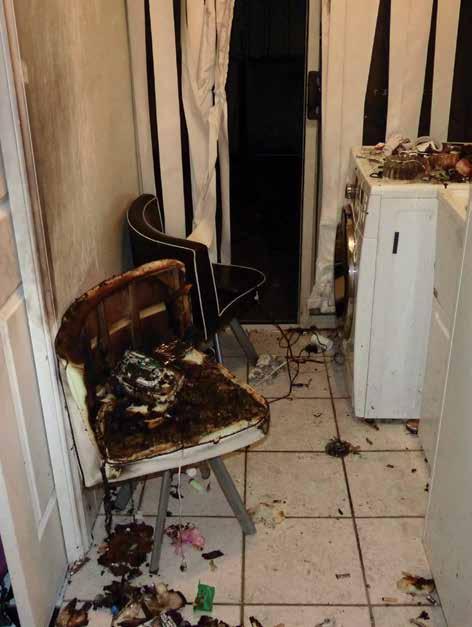
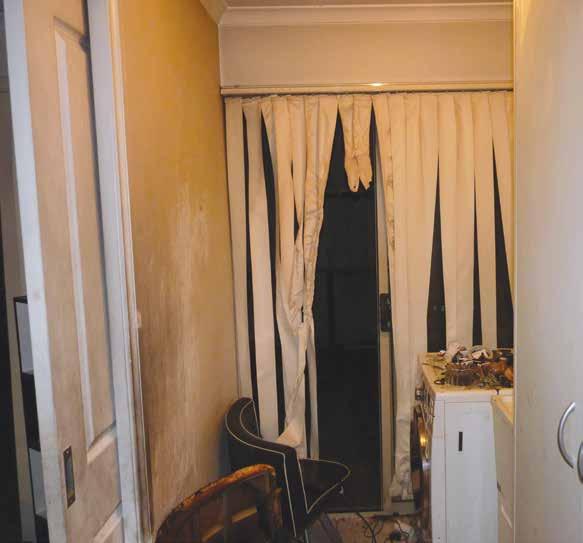
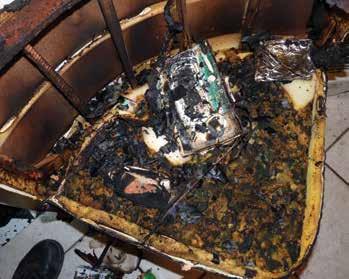
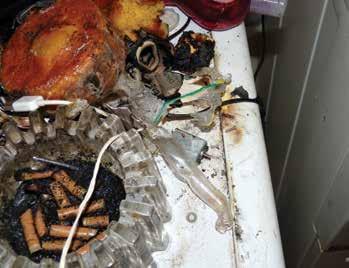
Left: Fire-damaged vertical blinds in the laundry; top: burnt remains of a chair on which an unidentified object had burnt; above: burnt remains of glassware, chemical containers and electronic items.
“As (Vehan) leaned in towards me, he went up in fire as well. The fire set up on his arm first and then spread very quickly over the rest of his body
“Flames were coming up above his head He looked like the top half of his body was covered in flames ”
In the chaotic moments that followed, Daisy ripped her jacket off, charged outside and hosed herself down And, in an act of mercy – which Vehan had never afforded Daisy – she hosed him down as well.
Police patrols and fire and ambulance crews were soon on the scene, as were Holden Hill CIB detectives Mark Young and Luke Townsend Inside the apartment, they could see the obvious fire and water damage, particularly in the laundry
But nothing about the scene indicated any connection with domestic violence What the detectives had good reason to believe at the outset was that they were looking at a small-scale meth lab.
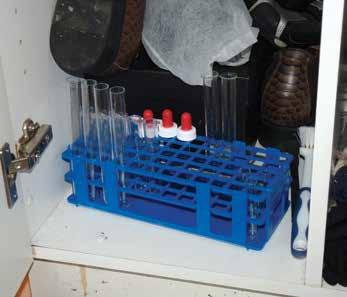
They spotted meth pipes, butane burners and various chemicals, and noticed an “irritating” chemical-like smell throughout the apartment
“So, we then realized that we weren’t dealing with a meth lab anymore, we were dealing with domestic violence.”
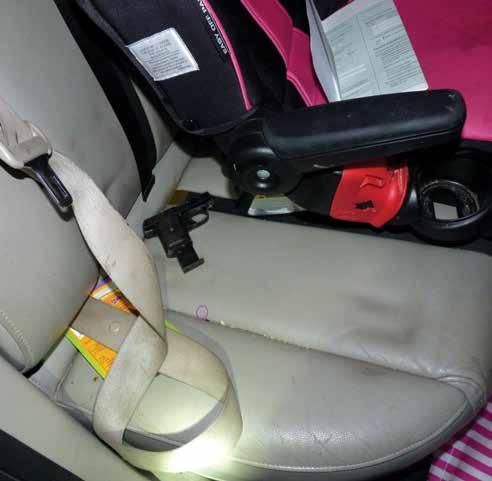
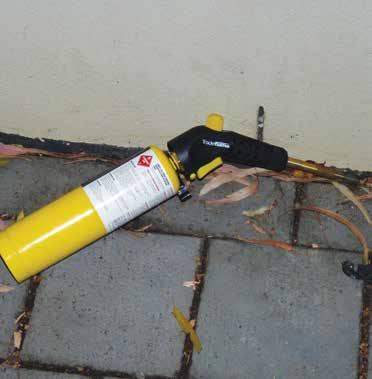
Top left: The gun located in situ under the child seat top; right: a gas blowtorch outside the laundry door; above: glass vials and unidentified chemicals in a cupboard.
In the laundry were circuit boards and a laptop computer and, in the backyard, sat portable gas cylinders, one with a blowtorch attachment
Young and Townsend rightly treated the scene as a potential hazard and called for an expert assessment Members of the Drug Investigation Branch responded and examined the apartment but determined that it was not a cook house.
But police continued to investigate the fire and found, among other things, a handgun under a child’s seat in Daisy’s car
It would not emerge until the next day, however, that it was extreme domestic violence which had led to the near fatal blaze
At the hospital in which Daisy and Vehan were receiving treatment for their burns, a nurse had picked up on some critical information.
“She said (Daisy) had told her basically what had happened,” Young says, “that there was a domestic violence incident where she had set fire to methylated spirits





“So, we then realized that we weren’t dealing with a meth lab anymore, we were dealing with domestic violence We just had no idea about the extent of it.
“And, at that point, we were well aware that (Daisy) didn’t want to talk about it, and so we knew the sensitivity we needed to treat her with “So, we got Viv Pitman onboard to start working with DV services and building up some rapport and trust with her ”
So Pitman – then attached to Holden Hill Family Violence Investigation Section – started with a visit to the hospital, where she saw Daisy for the first time And to get close enough to talk to her, she had to suit up so as not to put Daisy at risk of infection.
Pitman found her covered in burns, withdrawn and unwilling to
say anything about what had led to the fire Daisy seemed concerned not to say anything that might contradict what Vehan had said, or was yet to say, about the incident.
Indeed, she repeatedly asked Pitman what Vehan had had to say. Says Pitman: “We were trying to ease our way into that by saying: ‘Well, look, he’s still unconscious; he’s still in theatre This is why we’ve come to see you ’ But she didn’t want to speak to police She almost hated us
“You got the impression that she was a person who was captive for a time, not seeing many people She was almost child-like, as if saying: ‘Am I allowed to talk? I don’t know what I’m allowed to say. ’
“We spent a substantial amount of time there (at the hospital) but it was all one way. It was her saying: ‘I’m not going to say anything until
Top left and above centre: Burns to Daisy’s hand and arm as a result of the fire; top right: burns to her face, neck and shoulder; above left and right: blisters caused by the burns.
(Vehan) wakes up ’ That was the answer we kept getting for pretty much everything ”
The fear-struck Daisy might have chosen silence, but the investigating officers well understood the need to protect her. So, within a few days, they had her moved to a different hospital, well away from Vehan
Pitman then set out to talk to Daisy a second time when she noticed lines etched into the skin of her forearm She had seen them on her previous visit but not realized that they formed a word Daisy, who had become slightly more open, told her it was Vehan’s name and that she had herself done the etching. But she was still not ready to give an account of the fire or the preceding years’ atrocities against her.
“You got the impression that she was a person who was captive for a time, not seeing many people. She was almost child-like, as if saying:
‘Am I allowed to talk? I don’t know what I’m allowed to say.’ ”

Neither was Vehan prepared to explain what had happened
Seven days after the fire, Young and Brevet Sergeant Paula Dunworth called on him at the now former Royal Adelaide Hospital.
Bandages covered just about all of him as he lay in bed, but Young could see his face and read its expressions
“I’m not sure cocky is the word,” he says, “but he didn’t seem to care that he was about to be charged with offences
“He was emotionless and didn’t make much comment In fact, virtually no comment It was almost like, behind the veil, he felt confident, as if saying to himself: ‘Oh, this isn’t going to go anywhere I’ll be out ’ ”
But Young was determined to bring about the opposite: to get Vehan remanded in custody. He understood that it was a question of the safety of Daisy and her children; and it had
started to look as if Vehan was set to score his release
“We did have a very strong idea about how much fear Daisy was in,” he explains. “We needed to be able to protect her.
“Plus, there was some history. He had some charges that were dropped some years beforehand: threatening to kill her with a firearm ”
So Young arrested him for a range of serious firearm offences associated with the gun police found in Daisy’s car
There was also a charge of trafficking in a controlled drug That was based on drugs police found in the apartment on the night of the fire. So Vehan wound up remanded in custody.
“Then,” Young recalls, “we at least knew that (Daisy) was safe, and that he wasn’t going to be a risk to the community ”
In addition to the arrest, Young issued Vehan with a police interim intervention order.
“The fear we had was that it would mean nothing to him and that if he wanted to inflict further harm or kill her, he would,” Young says “That’s why we put in the effort to get him remanded, and to remain remanded ”
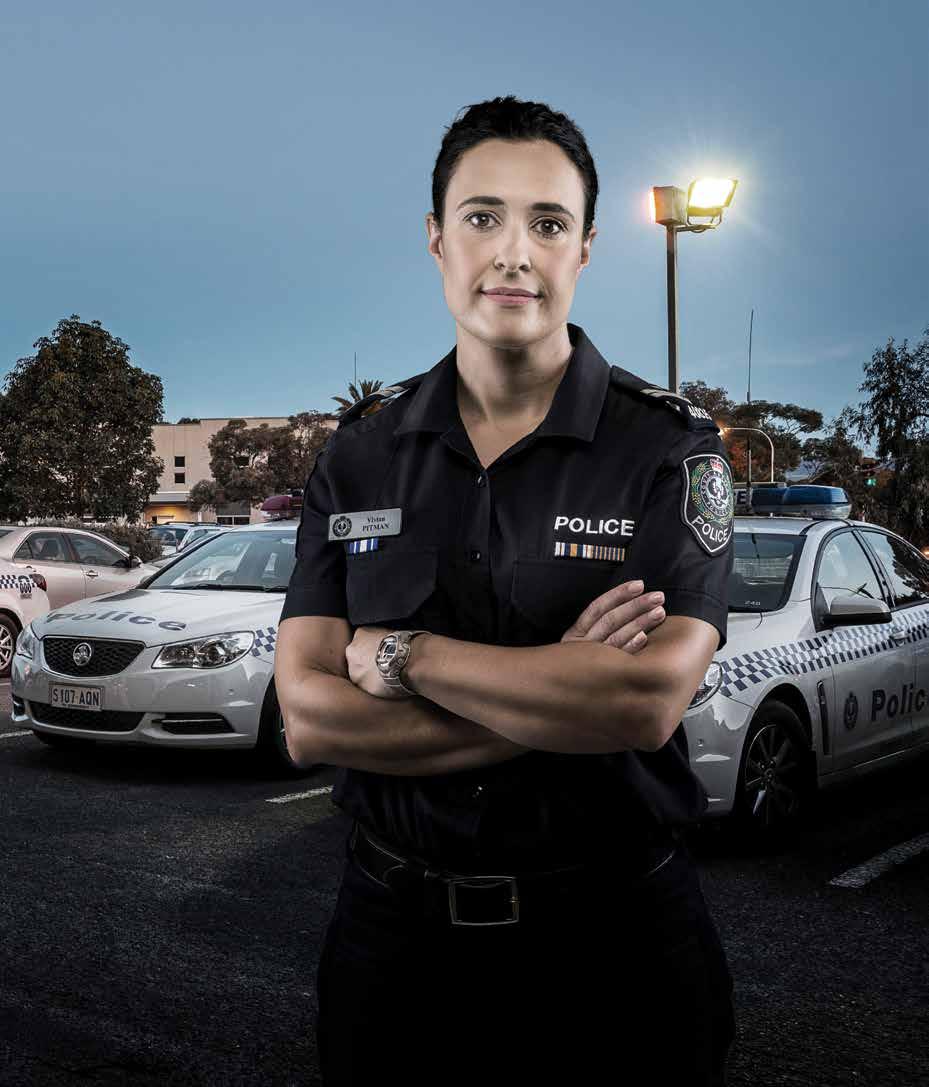
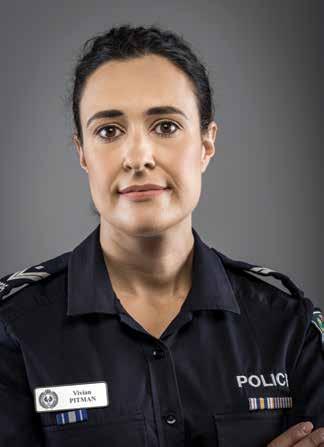
Above left and right: Detective Brevet Sergeant Mark Young who charged the offender and Senior Constable First Class Viv Pitman who took a 38-page statement from the victim.
The task for Pitman demanded a strong effort as well: to establish a rapport with Daisy and ultimately win her trust
“He (Vehan) had programmed her mind not to trust anybody,” she says, “and to believe that everything he said was right. ”
But, in the end, that indoctrination failed After two months, Daisy got word to Pitman that she was ready to make a full statement
The breakthrough led to six days of intensive conversation and statement-taking at the shelter in which Daisy had stayed since the fire
Pitman never expected to hear of acts as vile as those Vehan had committed. She would later describe the case as “absolutely the worst one” she had ever investigated. In her police experience of 20 years, it was “on another level of torture and violence”
It emerged that Daisy had met and begun a friendship with Vehan when she was just 16 But, not until five years later did the two become a couple and, even by then, Vehan had revealed almost nothing about himself
The first time Daisy saw his propensity for violence was in 2006, when he threw and smashed his mobile phone against a wall.
One form of intimidation he came to use was to polish bullets in front of her. He would often hand one to her and say: “This is your life ”
Possibly his worst act of violence came in 2008, when he became enraged over an advertisement he thought Daisy had failed to place on eBay She was, at the time, close to giving birth to the couple’s first child
Vehan punched her in the face so savagely that her head snapped back with enough force to leave a dent in the wall behind her She tried but failed to escape as Vehan took her into their laundry. There, he handcuffed her to a towel rail and pointed a gun at his unborn child.
Says Daisy: “He asked me who should go first, me or the baby. ”
Vehan indeed fired the gun toward Daisy, and after that came a second shot which he fired right behind where he stood Daisy survived, but only because the first shot had just missed her head
She managed to free herself from the cuffs and run to a neighbour’s house for help And, the next day, she wisely reported the sickening assault to police
Vehan went on the run but soon contacted Daisy by phone. He wanted to see her and so issued a bizarre set of instructions. She was to travel out to Port Wakefield Road, meet a woman there and get into her car
Daisy did as Vehan instructed At the meeting spot, she saw what she thought was a woman turn up in a car She got in and realized that it was no woman It was Vehan
Wearing makeup and hair extensions, he had dressed himself in women’s clothes
The disguise was, in his mind, a way to avoid capture by police after the shooting
He ordered Daisy to stop speaking to the police and said: “If I wanted to kill you, I would have killed you. ” Daisy managed to leave the rendezvous without taking another bashing. But on Anzac Day, 2008, Vehan moved on her again
Armed and uninvited, he turned up at her mother’s home, where she was staying He forced his way in and demanded that she pack a bag and leave with him
Says Daisy: “He yelled at my mum, saying: ‘She’s coming with me ’ He had the gun, so I wasn’t going to (defy him). I just wanted to protect my mum. ”
So Daisy got into the car Vehan had arrived in and could see 20-odd bullets in a plastic bag in the centre console Vehan then took off with her, headed for Melbourne
Two days later, at a Frankston service station, Victorian police pounced “That was like a movie,” Daisy recalls “They just came in from everywhere They dropped him to the ground and then grabbed me away from him ”
The officers arrested Vehan, who wound up extradited back to South Australia, charged over the shooting incident and remanded in custody in Yatala Labour Prison.
Just after that, Daisy gave birth to her daughter, Trina (not her real name) Vehan got to see the child as a two-week-old, in jail, after his family had pressured Daisy to take her there
But, rather than express his gratitude to Daisy for visiting him, Vehan spat in her face She was, at the time, holding little Trina And, during the visit, he kept demanding that she “fix this”, by which he meant his incarceration and the charges against him.
It was not long before Vehan scored his release on home detention. But, after only a few weeks, he cut off his tracking bracelet and again went on the run Six months later, he reappeared and had his sister lure Daisy to her place
“When I arrived at her house, I saw (Vehan) there,” she later told Viv Pitman “I was shocked and terrified at the same time
“(He) was forcing me to drop the charges He told me that I needed to go into a police station and say … that I made it all up ”
The charge of threatening to kill never proceeded against Vehan, who continued to threaten and intimidate Daisy. Out of fear, she resumed her relationship with him and gave birth to their second child, Creighton (not his real name)
“Straight after that, he laughed and goes: ‘This is how you work the system. If I didn’t cut my throat, I would’ve been in jail. And now that I’m diagnosed with paranoid schizophrenia, I can do anything to you and get away with it.’ ”
In late 2009, Vehan attempted suicide and wound up diagnosed with paranoid schizophrenia A community treatment order kept him confined for 28 days Then came his release, but his character had remained unchanged
Says Daisy: “Straight after that (diagnosis), he laughed and goes: ‘This is how you work the system If I didn’t cut my throat, I would’ve been in jail And now that I’m diagnosed with paranoid schizophrenia, I can do anything to you and get away with it.’ ”
In her witness statement, Daisy explained how Vehan kept “antagonizing” her by “constantly telling me that he (had) control of me”
“I had to keep the kids quiet all the time,” she said “He always ignored the kids If I ever was to go out, I would take the kids to my mum’s house ”
Daisy also described an extraordinary “series of events and constant abuse” which began in 2014 It was after she, Vehan and the children had moved into their inner-suburban apartment.
The first “event” was around the time of the Royal Adelaide Show It had angered Vehan when Daisy disagreed with him about taking the children there
She was for it but he was against The discussion ended after he gave her “three massive slaps” across her face, with enough force to leave it stinging long afterward
It then became his practice to approach and slap her head or face at any time – without reason.
“That, really, was like the start of hell,” Daisy recalls.
In November 2014, Vehan wrongly suspected that Daisy had a sexual interest in one of his friends His suspicion led to another brutal assault
“The force of the slap was so hard that the bridge of my nose snapped, and the bone pierced through my skin,” she said in her witness statement
“I started to bleed all over my face I remember holding my nose tightly and pushing it back in place. ”
Not until three days later did Vehan take Daisy to a suburban medical centre, where he forced her to lie about how her nose had broken
Later that month, after she left out details of a visit to her mother’s place, he accused her of lying to him His claim was baseless, but it brought on another round of torture
For three days, he kept her handcuffed, denied her food and made her beg to use the toilet At one point, he forced her to sit on a couch with her wrists and ankles bound and poured methylated spirit over her crotch
She soon felt the agony of a burning sensation and pleaded with him to uncuff her and allow her to wash and change clothes. His response was to pour more methylated spirit over her crotch
At another point over the three days, Vehan corralled Daisy in the laundry There, he poured a line of methylated spirit on the tiled floor, right in front of her bare feet, and ignited it with a cigarette lighter
Flames rose to waist height as Daisy screamed for help and gasped for air. She managed to escape through a sliding door and into the backyard, with her ankle burning and her tights on fire.
After she patted the flames out with her bare hands, Vehan forced her back into the laundry and made her kneel in front of him He spat in her face and urinated over her head
“It made me disgusted, humiliated and ashamed,” she explained “I was begging for him to allow me to go and have a shower, or at least change my clothes, but he refused…”
And the torture continued up in the bedroom. There, he tied Daisy up again, whipped her with a ruler-length whip and, then, shoved a pillow over her head
She visualized movies in which she had seen murder victims shot through pillows And, now, she feared that Vehan was about to kill her in exactly that way She screamed; he ripped the pillow away, but there was no execution
The three-day ordeal only ended after Daisy freed herself from the straps with which Vehan had bound her. As the torture had played out, he had struck her repeatedly to the head and, at times, used thumb cuffs which dug deep into her skin
“It made me disgusted, humiliated and ashamed. I was begging for him to allow me to go and have a shower, or at least change my clothes, but he refused…”
She would see no end to the horror until the night of her suicide attempt and the apartment fire. But that was still more than three months away. Many more beatings, some near fatal, were still to come
There was a trip to Melbourne where, in a hotel room, Vehan produced a handgun Wrongly suspecting Daisy of plotting against him with one of his friends, he pressed the weapon up against her head
Of course, she had not plotted anything but, to save herself, said that she had
Later, during that same trip, Vehan whacked Daisy in the head with the handgun and threatened to force her into paid sex with other men. He wanted cannabis as the payment and advertised the deal on a website
“There was a bottle of vodka in the room,” Daisy said “I started taking big mouthfuls of it from the bottle I felt demoralized and shamed ”
As was likely to happen, Daisy resorted to self-harm With a pair of tweezers, she slashed her left wrist until it bled, and Vehan called off the sex work .
With all she had been through to that point, and with Vehan endlessly threatening to kill her and their children, Daisy lost the will to live
“I thought that, if he was going to kill me and dump my body, police would see my arm and know who (was) responsible.”
His constant beatings had numbed her both physically and mentally.
Ultimately, she came to practise more self-harm. One day in the laundry, as Vehan ranted about killing their children, she slashed the side of her neck around five times with a blade
As she bled, Vehan offered not first aid but rather a solid blow to her head with his open hand And, again, he pulled out a handgun, this time a revolver, and sat cleaning it in front of her.
Among other attacks, one took place in the carport, where Vehan repeatedly kicked and punched Daisy in the style of a kickboxer And, one day in the kitchen, she took a kidney punch which left her barely able to walk
But it was when he tied a necktie around her throat after cuffing her wrists and ankles that he almost killed her Over her head he poured methylated spirit which trickled down into her eyes and face
She choked, lost consciousness and later woke to the sight of Vehan resuscitating her.
One other evening, he continually zapped her with a stun gun and followed up with punches to her face He only stopped when he split open her eyebrow The attack left her face bruised, swollen and unrecognizable
“The only thing that hurt was looking at, and not recognizing, yourself after,” she says Vehan came to use drugs as weapons, too, when he forced Daisy to take not only his antipsychotic medication but also ice.
Then came his last life-threatening assault on Daisy before the fire. It took place in the laundry, where he was demanding that she tell him certain truths, about which she had no idea
After she failed to make the admissions he sought, Vehan produced a small round capsule inside a case He told Daisy it was radioactive and threw it forcefully into her mouth
“It landed right at the back of my throat,” she said “It was lodged that far back that I could not bring it back up, so I drank some water from a glass in the laundry…”
Daisy swallowed the capsule but, as Vehan knew, it had come from a smoke detector and was indeed radioactive In a panic, he forced Daisy into one attempt after another to bring it back up
She vomited several times, particularly after he turned on a garden hose which he had told her to stick in her mouth However, neither that method nor a range of others worked, and Daisy wound up in hospital.
There, she received medication designed to help her pass the capsule, but it remained in her body. Fortunate for her was that its low level of radiation was, according to medical opinion, unlikely to cause her harm
In any case, her suicide attempt was now imminent On an April evening in 2015, Vehan had launched into another of his rants, accusing Daisy of hiding things from him
He found a mobile number Trina had written on a piece of paper. The number belonged to the mother of one of her school friends, as Daisy explained.
Vehan, however, refused to believe it and ordered Daisy to sit on the
kitchen floor while he spoke to Trina and Creighton upstairs.
Not knowing what he was doing with them left Daisy paralysed with fear It was then that she took a piece of broken glass and etched Vehan’s name into the skin of her forearm
“I thought that, if he was going to kill me and dump my body, police would see my arm and know who (was) responsible,” she said
Vehan carried on his talk with the children for around an hour, as Daisy remained isolated from them. But, at one point, she heard Trina crying and took her a glass of water.
Says Daisy: “She looked confused and said that (Vehan) was calling her a liar… I was so scared for her and what he could do to her ”
After the talk was over and Daisy had put the children to bed, Vehan accused her of corrupting Trina with pornography Repulsed by the accusation, and feeling intensely vulnerable, Daisy went to change her clothes
“I had a feeling that my life was going to end that night,” she said. “So I thought that, if I was going to die, I would want to die in nice clothes. ”
Vehan then stepped into a walk-in robe and stepped back out holding the same gun he had threatened Daisy with in Melbourne He thrust a towel over her head and again threatened to shoot her
But rather than follow through, he took the towel off her head and thrust it back on several times, as he continued to repeat the threat
Eventually, he demanded that Daisy bring Trina to their bedroom. And, against an angry, gun-toting Vehan, Daisy was defenceless. She collected the sleeping Trina
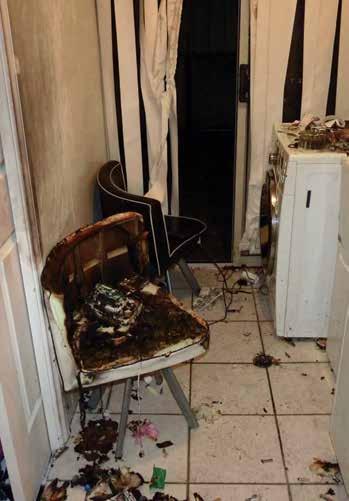
“I’ll never forget that. That was like the worst best day of my life.” Above left: The laundry initially suspected to be a meth lab; above right: Senior Constable First Class Viv Pitman.
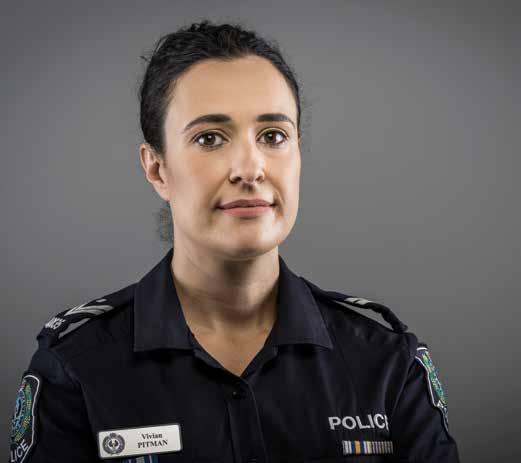
After Viv Pitman had drawn on all her expertise to elicit the whole story from Daisy, she ended up with a witness statement of 38 pages
“And we only just touched on a few instances (of violence),” she says “I’m sure there were a lot more instances
“She didn’t even know that she was a DV victim She didn’t see that until her first few sessions with the DV workers
“And when I stopped for breaks from taking the statement, she made comments like: ‘Now that I’m saying all this to you, I can see the domestic violence. ’
“But I hadn’t had a domestic violence case where such an extent of things had happened to one person over such a long time
“When I first got the statement, it took me and my sergeant and another team member a while to go through and discuss it paragraph by paragraph
“By the time we got to the end of the statement, we were looking at something like 25 major indictable offences. ”
and brought her back to the master bedroom, where she tucked her into bed
Vehan, still holding the gun, started another rant, saying that he would not have “a slut as a daughter” Daisy begged him not to hurt Trina and convinced him to go downstairs to “have a cigarette and think about it”
And downstairs in the laundry that night was where Daisy, soaked in methylated spirit, set herself on fire. “I’ll never forget that,” she says. “That was like the worst best day of my life ”
“By providing the statement and getting all the counselling from the DV workers, she was putting two and two together ”
Over the two weeks in which Pitman went about her statement-taking, she kept Mark Young informed of the emerging details Naturally, it became increasingly clear to him just how serious the offending was against Daisy
And, later, after he had read the entire statement, he described it as “38 pages of horrendous things”.
“I’d had a number of DV cases before,” he says, “so I’d experienced these things in smaller portions with different jobs
Among those offences were threatening to kill, false imprisonment, aggravated assault with a weapon, and threats relating to a person involved in judicial proceedings
Says Young: “Once we’d worked out what further charges we could lay, I went to Yatala Labour Prison where we took him out of custody
“Detective Brevet Sergeant Tim Kirtland and I rearrested him and then charged him again at the City Watch House with a raft of domestic violence offences. ”
Vehan admitted to all the offences the police alleged. But, by reason of mental incapacity, he never had to enter a plea or face a trial

Instead of time in prison, the court committed him to a minimum of 15 years and six months’ detention in forensic mental-health facility James Nash House He will remain there until at least 2033
“It was the best outcome to have defence agree to the facts,” Young says “That way we didn’t have to prove everything beyond a reasonable doubt
“And we didn’t have to put (Daisy) through the trauma of a trial Nor did we have to run the risk of losing some of the offences we charged.
“And he (Vehan) has to stay inside until he’s deemed fit to return to the community ”
Of course, Daisy is now free from the barbarity of her past but, in her future, she sees little if any promise She lives with her mother and children, has had no success in relationships with men, and has no friends
When a man’s mannerisms or gestures bear the slightest similarity to those of Vehan, she “freaks out”
“I’ll be scared forever, that’s my problem,” she says. “It’s just that I’m supposed to be free from him and I’m not, and I don’t think I’ll ever be. ”
“The toughest challenge was just simply compiling enough of a brief of evidence for such a large number of offences.”
Detective Brevet Sergeant Mark Young and Senior Constable First Class Viv Pitman have forgotten nothing about their investigation into the abuse of Daisy. It was one of those cases about which cops say: “What you see, you cannot ‘unsee’. ”
And it was always unlikely that the mind of either officer would be clear of thoughts about the investigation after hours
It most often came to Pitman when she took her 45-minute drive home from work and picked her children up along the way She would think of Trina and Creighton living in an environment filled with brutality
“I do remember getting home with my kids and just hugging them, and going: ‘Right, you kids are loved,’ ” she says. “And there might have been a few times when I took them to the shops and bought them some things. ”
Young still thinks about the case, although less so now than at the time of the investigation He still remembers the first time he met Daisy, when he perceived her as “broken” and “fragile” but, at the same time, strong
And he reflects on the scale – and duration – of the violence she suffered as “extraordinary”
“It was relatively early in my investigational experience from the CIB perspective,” he recalls. “And it allowed me to realize how important our job is from a victim perspective.
“We had a victim who had gone through such extraordinary circumstances and was willing to accept help So, it was a pleasure to be able to do everything that we’d been trained to do and have that accepted by the victim
“The toughest challenge was just simply compiling enough of a brief of evidence for such a large number of offences ”
The investigation did not leave Young feeling hatred for Vehan Rather, he remembers the emotionless way in which Vehan responded to him in hospital and, for Young, the feeling was – and is – mutual.
For Pitman, the feeling is hatred. “But,” she says, “it’s one of those once-in-a-lifetime investigations I don’t think I’m ever going to (come across one like that) again ” PJ
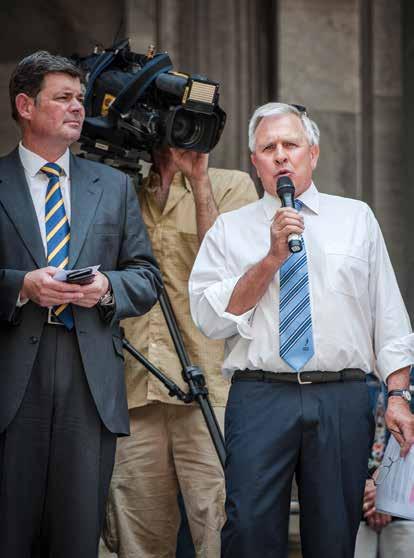

“I took it as a privilege to be on the street with rank-and-file police officers marching on Parliament House back in 2015,” Australian Conservatives MLC Robert Brokenshire says.
“We fought to get entitlements restored for officers injured protecting the SA community. Together, we were victorious and, today, I continue to back police on the issues of staffing, resourcing and equipment.
“Getting out and talking to police at ground level helped me understand the demands of their work, and I’ll keep protecting their interests and their families’ interests in Parliament.”

Vote 1 for Robert Brokenshire in the Upper House where he’ll fight for the best outcomes for SA police officers.

Authorised by Robert Brokenshire, Parliament House, Adelaide
L Letters Letters to the editor can be sent by:
Regular mail Police Journal, PO Box 6032, Halifax St, Adelaide SA 5000
Email editor@pasa asn au Fax (08) 8212 2002
Internal dispatch Police Journal 168
Course 19 held its annual reunion on November 19, 2017, 50 years since its members walked in through the gates of Fort Largs
Among the course members who attended were Jim Anderson, Darryl Crossman, John Cusack, Michael Geesing, Trevor Hentschke, Neville Lienert, Jack Lyytikainen, Kevin Matthews, Malcolm Millikan, John Morrison, John O’Dea, Darryl Young and me
Some members, because of ill health or the distance they live from Adelaide (interstate, overseas), couldn’t make it to the reunion
The course had lost two more of its original 39 members in 2017. That makes a total of nine who have died.
We paused to afford the departed a minute’s respect, which brought to mind how quickly the past 50 years seemed to have passed
The passing of our coursemates reaffirmed the need to make the most of the coming years in the company of lifelong friends
A weekend at Port Vincent in April is now in the planning, and the next reunion luncheon will be held in November
Kevin Carslake Senior Constable (ret)
Members of the South Australia Police Sports Federation received significant recognition at a recent awards presentation.
Detective Senior Sergeant First Class Narelle Smith (Sturt Crime Management) won the 2016 Sports Administrator of the Year award

Narelle has a long history of service to football as a player and coach in the SAWFL and SANFL She also served as assistant coach of the Melbourne Football Club women’s team in 2014, ’15 and ’16
South Coast patrol sergeant Jason Phillips, who holds the title of 2016 Senior Men’s World Kumite (fighting) Champion won Sports Person of the Year.
The award for Sports Team of the Year went to the SA Police bowling team, which had taken out the national sides title in an eight-day national bowling competition in Adelaide
The award of life membership of the SAPSF went to Sergeant Annette Gilbert, who has held the positions of committee member, secretary and president, which she still holds
The achievements of all the award-winners were outstanding and each deserves hearty congratulations
Paul Manns Publicity Officer
SA Police Sports Federation
Owing to a Supreme Court decision, the Police Association no longer uses the GLI beneficiary forms. Existing forms held at the association have been destroyed.
Now, in the case of the death of a member, the GLI benefit (currently $300,000) will be paid to his or her estate
Accordingly, the association’s strong advice is that you ensure that your estate is well-administered This is best achieved by having a valid will
Tindall Gask Bentley Lawyers provides a free legal advice service to Police Association members and their families, and retired members To make an appointment to receive free preliminary legal advice covering all areas of law, particularly families and wills, members should contact the Police Association (08 8212 3055)
Bernadette Zimmermann Assistant Secretary, Police Association

During the last couple of months, I have taken a number of calls from members asking if they will be receiving an increase in their pay as a result of the police-specific interjurisdictional salary adjustment as provided in clause 8 and schedule 1 . 2 of the 2016 Enterprise Agreement.
This is the adjustment made to members’ salaries from the beginning of the first full pay period on or after 1 January 2018
The purpose of the January salary adjustment is to ensure that our members’ wages do not slip behind those in other police jurisdictions across Australia when we are coming to the end of one agreement and about to commence negotiations for a new one.
Generally, some three to four years have elapsed from the time salary increases were first negotiated in the expiring agreement to when new rates will be negotiated in the new agreement
It is useful to remember that during the term of our agreement, other states and territories have negotiated new agreements This has an impact on the outcome of the January 1 salary adjustment for South Australian officers at the time the calculation is applied.
For example, since the commencement of SAPOL’s EA2016: • NSW and Victoria have struck new agreements
• WA has an “agreement in principle” – members currently voting on the terms of the agreement
• Tasmania has commenced negotiations after expiration of current agreement.
• NT currently undertaking vote after going through conciliation.
• QLD is still operating within its current agreement which expires 30 June 2019
By having a midpoint calculation such as the 1 January 2018 adjustment, members do not have to wait excessive periods before they receive wage increases to catch up to other jurisdictions which have already signed off new agreements and accompanying wage rises. It was important for the association to secure a salary adjustment of this nature prior to negotiating a new agreement
How does it work?
The agreed methodology involves a number of steps and obviously involves a mathematical equation Put simply, a series of tables is compiled showing the minimum and maximum salary for each rank in all Australian jurisdictions . These are ordered from highest to lowest salary across the ranks . South Australia is not included in this part of the calculation
If
you didn’t get a pay rise, it means you are already earning above interstate comparative wages using the 60% midpoint calculation between the 3rd and 4th rankings. This is not bad news.
From there, in each table, the 4th ranked salary is subtracted from the 3rd ranked salary and multiplied by 0 6 (It is worth noting that the calculation is made using a 60% (0.6) formula . A true midpoint would be 50% (0. 5), however, the association secured the increased percentage in the 2016 round of enterprise bargaining negotiations to further improve the salaries of its members )
That sum is then added to the 4th ranked salary and the result becomes the “product” which in turn is applied to the corresponding SAPOL salary (as listed in schedule 1 1 SAPOL EA2016)
Unlike general salary increases as provided in EA2016 which reflected a 2 . 5% increase across the board for three consecutive years, the answer here is not going to be the same for everyone
Pay rises will be applied to those members whose rank/increment has fallen behind in relation to comparative salaries in other jurisdictions using the 60% midpoint calculation
If you didn’t get a pay rise, it means you are already earning above interstate comparative wages using the 60% midpoint calculation between the 3rd and 4th rankings. This is not bad news.
Register now to gain exclusive access to information about: Mental Health
Financial Health
Relationship/Family Health
Career Health

Dr Rod Pearce
Our physical movement is largely under voluntary control We plan and perform movements by means of the brain sending a signal through a network or nerves to the muscles and stimulating them to move.
The network of nerves (neurones) that control movement (motor activity) start in the brain, run through the base of the skull along the spinal cord and then out to the muscles
Motor neurone disease (MND) specifically affects these “muscle” nerves (motor neurones)
The name MND applies to the group of diseases in which the motor neurones undergo degeneration and die
What is so unusual about MND is that it specifically affects muscle nerves but almost completely spares other nerves (sensory and autonomic).
This means a person can feel things normally Muscles like the heart which are “involuntary” muscles are not affected because they run through a different network (autonomic)
With MND, the motor nerves will, for no known reason, slowly stop working over two to three years, leaving the sufferer paralysed So paralysed that he or she cannot breathe, swallow or eat
In 90 per cent of cases, there is no family history of MND, but there are many theories as to its cause. Among them are:
• Exposure to environmental toxins and chemicals
… even patients in latter stages of the disease might still have the same intelligence, memory
and personality. With other nerves unaffected, the mismatch of function becomes apparent and makes the disease a challenge for the individual and community.
• Infection by viral agents
• Immune mediated damage
• Premature ageing of motor neurones
• Genetic susceptibility.
But these are only theories and speculation, apart from the one in 10 which is caused by genetic defects . Essentially, we do not know who is going to get MND, nor do we know the age at which anyone will get it
Of the more than 2,000 people who have MND in Australia, 60 per cent are male and most people are younger than 65 (58%)
Each day in Australia, two people are diagnosed with the disease For reasons that remain unclear, 787 people died of MND in 2013, compared with 592 people in 2001 .
When motor neurones die, it causes muscle weakness and shrinking (atrophy) throughout the body Both the upper motor neurones (in the brain) and the lower motor neurones (in the spinal cord) can die, so the brain cannot send information or instructions to the muscles
Without any electrical stimulation the muscles are unable to function, gradually weaken and waste away Eventually, the ability of the brain to start and control voluntary movement is lost.
However, even patients in latter stages of the disease might still have the same intelligence, memory and personality With other nerves unaffected, the mismatch of function becomes apparent and makes the disease a challenge for the individual and community
The sufferer lives in a body in which he or she can see, smell, hear, touch and think as before
Pain is a common factor and painkilling medication needs to be given, often by continuous infusions. Too many pain-killers make breathing harder and the situation worse
Skin care is critical as pressure sores increase the pain Nutrition declines while shortness of breath (dyspnea) increases. And the inability to breathe brings about anxiety and depression associated with restlessness and agitation. Terminal restlessness is the name given to agitation which is usually associated with a reduced level of consciousness A person might appear unconscious, restless and unsettled
There might be disorientation, anxiety, fidgeting and the person might look scared or distressed It can happen now and again or all the time
Usually, it will become difficult to communicate as the person with MND approaches the end of life. But, even if someone is unresponsive, every attempt should be made to maintain communication.
MND might present as weakness or non-specific tiredness There is no single diagnostic test for the disease
Diagnosis is based on features in the clinical history and examination, usually accompanied by electrophysiological tests These include electromyography (EMG) – which measures muscle response or electrical activity in response to a nerve’s stimulation of the muscle – and nerve conduction studies.
Multiple tests (such as MRI) will be done mainly to exclude other treatable diseases The difficulty confirming a diagnosis is the reason it usually takes one to two years to confirm a person has MND
MND remains a medical and community challenge because it is a progressive, terminal neurological disease It can strike anyone and there is no known cure and no effective treatment
See Rex honoured as he fights MND, page 28
Motoring
Jim Barnett

Model Ford Escape SUV
Price $28,490 - $47,490 (plus on-road costs)
Engines 1 5-litre (110 or 134kW) turbo petrol, 2 0-litre (178kW) turbo petrol or 2 0-litre (132kW) turbo diesel
Transmission Six-speed manual (Ambiente only), six-speed paddle-shift auto, FWD or AWD.
Cargo Space 406 - 1,603 litres .
Fuel Economy Between 5 . 5 (Diesel) and 8 .6 (2 .0 petrol) litres/100km.
Safety Seven airbags, five-star ANCAP, optional $1,300 safety pack .

Model Kia Sorento Si, Sport, SLi and GT
Pricing $42,990 - $58,990
Engines 3 5-litre (206kW) V6 or 2 2-litre (147kW 441Nm) diesel
Transmission Eight-speed automatic with FWD (petrol) or AWD (Diesel)
Seating Seven in three rows
Cargo 142 litres (all seats in use) – 1,662-litres (front seats in use).
Towing capacity 2,000Kg (braked).
Fuel Economy Between 7. 2 (diesel) and 10 litres (V6 petrol) per 100km .
Warranty Seven-year with road-side assistance and capped servicing .
The updated seven-seat Kia Sorento SUV makes an immediate statement in terms of comfort and spaciousness It is the ideal family cruiser And, given its standard features, excellent driveability and factory backing, Base Si is good value for money
FUNCTION
The superseded Sorento won a stack of awards but Kia didn’t rest on its laurels . The upgraded 2018 Sorento,
Ford Escape is smart-looking, roomy, comfortable and well-priced Yet this mid-size SUV – which also comes with a choice of three turbo-charged engines – is not all that common on the road
Ford has dropped its Kluga nameplate and returned to the better-known Escape badge for its mid SUV line-up. Escape Ambiente 1.5-litre turbo-petrol FWD (the only manual variant) starts at $28,490. Add a six-speed paddle-shifter auto for $1,500 or AWD/auto for $4,500
Standard fare includes Ford’s slick SYNC-3 infotainment system with eightinch colour touch screen, Apple CarPlay, Android Auto and satellite navigation
Dual-zone climate-control and DAB+ radio with USB inputs and Bluetooth streaming also feature, as does pushbutton start, reverse camera, rear parking sensors and electric park brake. Mid-spec Trend auto comes in FWD with the 1. 5-litre turbo petrol or in AWD with the more powerful 2 .0-litre turbo petrol or turbo diesel engine. Top-spec Titanium AWD comes with either 2 0-litre engine
A worthy option on Trend and Titanium is a $1,300 suite of collisionavoidance and driver-assistance technologies These include lanedeparture warning, lane-keeping assistance, auto high beam, autonomous emergency braking (up to 50km/h), adaptive cruise control and blind-spot warning
Escape delivers comfortable, roomy seating for five and a deep cargo bay with emergency spare wheel under the floor
The dash is modern, comprehensive and well laid out, although some might think it a bit fussy-looking.
Rear seats provide a 60/40 split-fold design with reclining seat backs and a fold-down centre armrest
On the road, Trend auto diesel AWD is quite a surprise Even though at idle it’s a little noisy outside, good noise suppression makes it extremely quiet inside
Around town, it’s a breeze to drive and delivers good levels of comfort and visibility. On the highway, stacks of torque (400Nm) make for easy overtaking, hill-climbing, towing (1,800kg braked) and great fuel efficiency
released in October last year, boasts more efficient petrol and diesel engines and a larger body, which equates to more interior space.
Safety and comfort enhancements, and the inclusion of Kia’s own eightspeed automatic transmission, feature across all variants
Entry Si starts at $42,990 with a revamped 3 5-litre V6 petrol engine driving the front wheels through the eight-speed auto It sits on 17-inch alloy wheels and has LED daytime running lights, roof rails, a shark-fin antenna and tailgate lip spoiler
The interior is vast with three rows of comfortable seats Centre-row seats can be configured to 40-20-40 or 60-40 and can slide forward and recline. Third-row seats fold flat into the cargo floor and are generous enough for adults for short trips

No reason to be uncommon
Dual-zone climate-control air conditioning has air vents servicing all seat rows
A new eight-inch colour touch screen with DAB+ digital radio, reverse camera and satellite navigation with traffic info is standard. Between the gauges, a TFT screen displays trip computer, tyre pressure and digital speed readout
The deep cargo bay can swallow a stack of gear with various seating configurations making this extremely flexible A full-size alloy spare wheel sits under the vehicle
Three 12-volt and two USB charging sockets feature along with Apple CarPlay, Android Auto, Bluetooth and voice control.
Base Si picks up safety features including autonomous braking, forward-collision alert, lane-keeping
Slick cornering and good ride comfort along with very little road noise make for a pleasant driving experience
Drivers will appreciate the reach- and rake-adjustable steering and seat-height adjuster which provide the best possible seating position
In addition to the excellent infotainment system, a screen between the gauges provides two trip computers and digital speed readout. Those seeking performance over economy might consider the powerful 2 0-litre 178kW turbo petrol
assistance, driver-attention monitor and adaptive cruise control
Sorento V6 is a very smooth and comfortable vehicle to drive. The lusty V6 delivers exceptional power when required and the smooth eight-speed auto is superb
There are four driving modes: Comfort, Eco, Sport and Smart Each affects the way the throttle, transmission and electric power steering function Sorento has good ride qualities It is quiet inside and corners confidently Si can be optioned with a fuelefficient 2 2-litre four-cylinder turbo diesel for around $2,500 more. This high-torque engine is a bargain given that it includes a fully automatic AWD system.
Paul Modra, Executive Manager –Member Value and Distribution, Police Credit Union
Retired senior constable first class and long-time Police Credit Union member Rex Adams could not believe it when told he had motor neurone disease He copped the diagnosis a year ago this month, along with the facts about what would happen to his body
Footy fans had seen the effects of the incurable illness on former Melbourne Football Club coach Neale Daniher after it struck him in 2013.
The warning to Rex was that his muscles would degenerate, and he would lose his ability to swallow, eat and drink And six months later, he found himself in exactly that condition
To keep his body nourished, and him ultimately alive, he wound up with a feeding tube inserted permanently into his abdomen
Since then, he has never taken food or drink by mouth, nor will he ever again. The deterioration of his throat muscles simply prevents him from swallowing.
Talking is now difficult for Rex, and likely to become impossible And the
MND has robbed his body of considerable muscle mass, so walking and general movement is far harder for him
“I’ve tried not to think about it too much and to just keep a positive attitude and engaged with my family and friends,” he says “My friends have been a wonderful support to me and my family
“We’ve all tried to remain as positive as possible and have sought as much information as possible about the disease and available treatments.
“We’ve attended seminars in both Sydney and Melbourne during last year and several information sessions locally ”
As a long-time Rotarian, Rex has remained committed to the cause closest to his heart: revegetation and tree-planting He has led the Rotary Club of Walkerville revegetation initiative, in conjunction with local schools, for more than two decades
As Rotary’s environmental project officer, Rex has co-ordinated the propagation of more than 6,500 native trees and the planting of more than 2,500 in areas ravaged by fire
“I’ve
worked closely with Rex, and his passion for the environment is second to none and, following his recent diagnosis of MND, he has made us want to raise awareness and give back.”
In 2006, Rex approached Police Credit Union which was itself undertaking some tree-planting as part of an environmental strategy it had initiated
Later, at a Police Credit Union staff conference, he delivered a moving address about revegetation work Rotary had undertaken in response to the fatal Black Tuesday bushfires.
Ultimately, Rex invited Police Credit Union to partner with the Rotary Club of Walkerville in its environmental efforts.
“The partnership is now in its 12th year,” Police Credit Union CEO Costa Anastasiou says “During this time, the Police Credit Union, in partnership with Rotary, has propagated over 30,000 trees
“(These trees) have been planted throughout South Australia, most recently in areas damaged by the Sampson Flat and Pinery bushfires ”
As a mark of its high regard for Rex, Police Credit Union invited him to join its Plant the Seed committee as the inaugural member representative.
He took up the role and remains a member of the now expanded Community,
The Police Association of South Australia needs your change- of-address details
If you have moved, in either the recent or distant past, please let the association know your new address Its office does not receive notification of changed addresses by any other means
The association will need your new address, full name, ID number, telephone numbers (home, work and/or mobile)
Members can e-mail these details to the association on pasa@pasa asn au or send them by letter through dispatch (168)
Environment, Employee Engagement & Diversity (CEEED) committee
“I’ve worked closely with Rex, and his passion for the environment is second to none,” CEEED committee chair Annie Rafferty says “And, following his recent diagnosis of MND, he has made us want to raise awareness and give back ”
After Rex broke the crushing news of his MND diagnosis to the CEEED committee, its members agreed to try to raise some money for MND South Australia.
Then came the idea – inspired by the Big Freeze at the G involving Neale Daniher – to stage an ice-bucket challenge
The CEEED committee persuaded Police Credit Union staff to submit to a drenching Rex got to upend a bucket of iced water over three of us at Police Credit Union, just ahead of the 2017 AFL grand final weekend Along with other fundraisers, the challenge brought in almost $2,500 for MND South Australia.
A week later, Rex wound up with the Police Credit Union Community & Environment Award named after him. It became the Rex Adams Community & Environment Award
The tribute was in recognition of the service Rex had given the community as a police officer, a Rotarian and a Town of Walkerville councillor
“The renaming of the award was absolutely mind-blowing and unexpected,” Rex says “And I was very honoured to be involved with the ice-bucket challenge. ”
See No answers yet for MND, page 25
“The renaming of the award was absolutely mind-blowing and unexpected and I was very honoured to be involved with the ice-bucket challenge.”
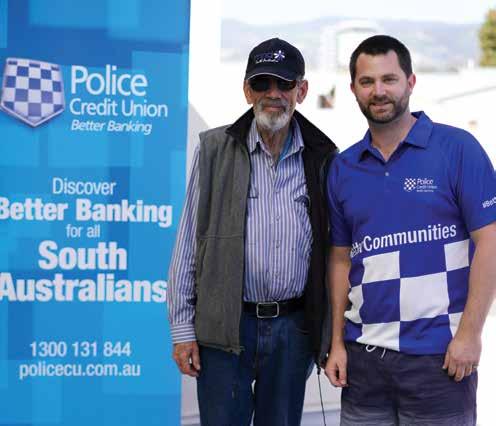
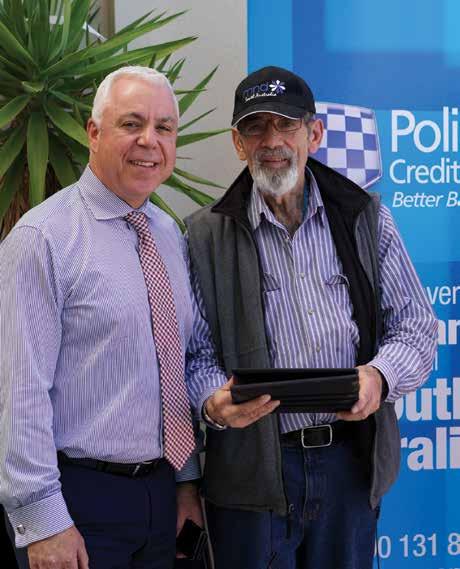
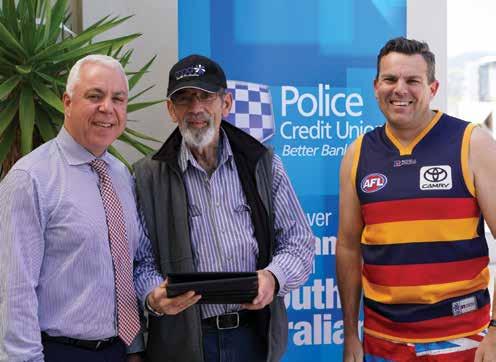
Top: Rex with Police Credit Union personal banker Glenn Lewis, who undertook the ice bucket challenge; right: Rex with Police Credit Union CEO Costa Anastasiou and Paul Modra, who also took on the ice bucket challenge.
Got a comment about a story you’ve read? Do you have strong views on a police issue?
Is there someone you want to acknowledge? Know of an upcoming social or sports event? Whatever the subject, put it in a letter to the editor
Leading Adelaide law firm, Tindall Gask Bentley is the preferred legal service provider of the Police Association, offering 30 minutes of free initial advice and a 10% fee discount.

To arrange a preliminary in-person or phone appointment contact PASA on (08) 8212 3055
• Motor accident injury compensation
• Workers compensation
& DIVORCE
• Public liability
• Superannuation claims (TPD)
Matrimonial, De Facto & Same Sex Relationships
• Children’s Issues
• Child Support matters
• Property Settlements
• “Pre Nuptial” style Agreements


BUSINESS & PROPERTY
• General business advice
• Real estate & property advice
• Business transactions
• Commercial disputes & dispute resolution


WILLS & ESTATES
• Wills & Testamentary Trusts
• Enduring Powers of Attorney
• Advance Care Directive
• Advice to executors of deceased estates
• Obtaining Grants of Probate
• Estate disputes


Rosemary Caruso Michael Arras
L Legal
Samuel Joyce, Senior Associate, Tindall Gask Bentley Lawyers
In recent times, a practice has developed inside SA Police of senior officers directing members to swear affidavits for the purpose of internal investigations.
What has been occurring is that after an incident occurs in which a PD185 is to be raised, senior officers are purporting to issue lawful orders directing members to swear affidavits about the event
We are aware that members are often quite concerned about this We agree with that concern Such a direction fundamentally misunderstands what an affidavit is
An affidavit is not a statement It is the written form of sworn oral testimony It is an ancient method of providing evidence in court. It is a court document. It is sworn evidence for the purpose of a court proceeding.
The difference between an affidavit and a statement is that an affidavit is made under oath or affirmation and a statement is not The mere signing of a document does not constitute an oath or affirmation
Historically, courts could not receive evidence unless the witness swore an oath These days, the requirement to swear an oath remains, but there are some circumstances in which the court will not require a witness to be sworn. Failing to tell the truth in an affidavit exposes the deponent to prosecution for perjury, which is one of the most
serious offences on the criminal calendar Failing to tell the truth in a statement does not
The oath or affirmation is a solemn promise to tell the truth . It binds a person’s conscience.
The law depends upon the solemnity attaching to the taking of the oath or affirmation to impress upon the minds of witnesses the importance of telling the truth in the witness box and, indeed, the crucial importance of telling the truth in the witness box by comparison with other, everyday occasions on which the sanction and solemnity of the oath are not invoked
The very words of the affidavit, “sworn” in the jurat and the opening words “make oath and say as follows”, reinforce the solemnity of the occasion when a person so swears.
What is required is that the party who speaks the oath appreciates that he or she is being asked to make an oath that the contents of an affidavit are true to the best of his or her knowledge and belief
The difference between a signed statement and an affidavit is demonstrated by the use of each document in a court
A signed statement is not evidence of its content. Its content is hearsay and inadmissible unless one of the exceptions to the hearsay rule (most commonly an admission against interest) applies
If members are directed to provide an affidavit other than for use in court proceedings we suggest you politely decline to do so until you have sought advice from the Police Association.
On the other hand, an affidavit is admissible precisely because it is evidence that has been taken under oath made before a person authorized by the court to administer an oath.
The content of an affidavit is evidence and is treated as if the person making the affidavit has said the words aloud in court
Once it is appreciated that affidavits are court documents, the inappropriateness in providing them outside of a court process is plain
Statutory declarations were invented precisely because a need was identified to have a mechanism whereby persons could make a solemn promise that the contents of a statement were true outside of the strict context of court proceedings, and affidavits were inappropriate for that purpose.
Members are not entitled to administer the oath required to make an affidavit unless they are a “proclaimed member of the police force” and have formally been appointed to take declarations and attest the execution of instruments under part 5 of the Oaths Act 1936
If a member is not a “proclaimed member of the police force” then he or she is not entitled to administer an oath to a dependant for the purposes of swearing an affidavit.
Given the above, it is our view that members should not be swearing affidavits except for the purposes of evidence to be given in court proceedings
It is also our view that there is at best significant doubt over whether a direction given to swear an affidavit that is not to be used for the purposes of evidence in court proceedings is a lawful order
Andrea Camilleri Mantle, $29 99
On what should be a quiet Sunday morning, Inspector Montalbano is called to a murder scene on the Sicilian coast
A man has discovered his father dead in his Vigàtan beach house. His body slumped on the dining-room floor, his morning coffee spilt across the table, and a single gunshot wound at the base of his skull
First appearances point to the son having the most to gain from his father’s untimely death, a notion his sister can’t help but reinforce
But when Montalbano delves deeper into the case, and learns of the dishonourable life the victim led, it soon becomes clear half of Vigàta has a motive for his murder and this won’t be as simple as the inspector had hoped

For your chance to win one of the books or an in-season pass to one of thes films (courtesy of Wallis Cinemas) featured in this edition, send your name, location, phone number and despatch code, along with the book and/or film of your choice to giveaways@pj.asn.au
Lynda La Plante Allen & Unwin, $32 99
Minutes before a deadly tube station blast, Detective Constable Jane Tennison spots the bomber. Too traumatized to identify him, she is nevertheless a key witness.
As they battle to unmask the terrorists, the police are determined nothing will disrupt their annual Good Friday dinner dance
Hundreds of detectives and their partners will be there – Tennison among them
And, then, Tennison’s memory returns . Now, not only can she identify the bomber, but she is in real and present danger from the IRA .
In a nail-biting race against time, Tennison must convince her senior officers to believe her before London is engulfed in another bloodbath


Twentieth Man
Tony Jones Allen & Unwin, $32 .99

Andrew Gross
Pan Macmillan Australia, $29 99
Kurt Nordstrum leaves behind the safety of his life in Oslo to join the Allied troops
Having spent the last few months mourning the tragic death of his fiancée, he’s been searching everywhere for distraction.
When he learns of a top-secret operation to interfere with the Nazis’ plans, it’s everything he’s been looking for, and he immediately steps up to the challenge
What he doesn’t know is that the mission he has signed up to is about to become more dangerous than he could ever have imagined.
Kurt must infiltrate then destroy the most heavily guarded Nazi shipment It’s seemingly impossible, but worth everything: the fate of Europe hangs in the balance
In September 1972, journalist Anna Rosen takes an early-morning phone call from her boss at the ABC telling her about two bombings in Sydney’s busy CBD
Rosen has no doubt which group is responsible for the carnage. She has been investigating the role of alleged war criminals in the globally active Ustasha movement.
High in the Austrian Alps, Marin Katich is one of 20 would-be revolutionaries who slip stealthily over the border into Yugoslavia on a mission planned and funded in Australia
Rosen and Katich were lovers at university but his sudden and mysterious disappearance brought their relationship to an abrupt end Now, the Sydney bombings will draw their lives back together
With Croatian extremists under suspicion and a power struggle erupting between ASIO and the federal police, Attorney-General Lionel Murphy personally directs a raid on the security agency.
Events suddenly reach a trigger point with the impending arrival of the Yugoslav prime minister
Fredrick T Olsson
Hachette Australia, $29 99
A father’s search. A daughter in danger. A terrifying secret.
It was 4:10 on the afternoon of December
3 Everything was darkness and ink, and the snow falling turned to water
Through it ran Sara Sandberg, the girl who was about to die and, somewhere in the cold, lead-grey hell that was Stockholm was a man who called himself her father.
In her rucksack, she had a warning for him
Now whether he would receive it or not was all down to her.

A Wrinkle in Time Season commences March 29
Tasmina Perry
Hachette Australia, $29 99
To Jem Chapman, it’s the chance of a lifetime
An invitation to join a group in an exclusive Hamptons house-share. Who could say no? But when she discovers what happened last summer, Jem can’t help but feel a chill
A young woman was found drowned in the house’s pool The housemates said Alice was troubled She’d been drinking She couldn’t swim
As Jem gets to know her glamourous new housemates, she realizes each has something to hide What really happened last summer? And who would go to any lengths to keep a person quiet?

After the disappearance of her scientist father, Dr Alex Murry (Chris Pine), three peculiar beings send Meg Murry (Storm Reid), her brother, Charles Wallace (Deric McCabe), and her friend to space in order to find him
Meg and Charles have been without him for five years, ever since he discovered a new planet and used the concept known as a tesseract to travel there
Three mysterious astral travellers –Mrs Whatsit (Reese Witherspoon), Mrs Who and Mrs Which – guide the children who brave a dangerous journey to a planet that possesses all the evil in the universe.
Peter Rabbit
Season commences
March 22
Feature adaptation of Beatrix Potter’s classic tale of a rebellious rabbit trying to sneak into a farmer’s vegetable garden
Peter’s feud with Mr McGregor (Domhnall Gleeson) escalates to greater heights than ever before as they rival for the affections of the warm-hearted animal lover (Rose Byrne) who lives next door

James Corden voices the character of Peter with Margot Robbie, Elizabeth Debicki, and Daisy Ridley performing the voice roles of the triplets, Flopsy, Mopsy, and Cottontail.

Tomb Raider Season commences March 15
Lara Croft (Alicia Vikander), the fiercely independent daughter of a missing adventurer, must push herself beyond her limits when she finds herself on the island where her father disappeared

Hoping to solve the mystery of his disappearance, she embarks on a perilous journey to his last-known destination – a fabled tomb on a mythical island that might be somewhere off the coast of Japan
The stakes couldn’t be higher as Croft must rely on her sharp mind, blind faith and stubborn spirit to venture into the unknown
When the creator of a virtual reality world called the Oasis dies, he releases a video in which he challenges all Oasis users to find his Easter egg, which will give the finder his fortune
Teenager Wade Watts (Tye Sheridan) finds the first clue and starts a race for the egg. But he finds himself beset by players willing to kill to take this ultimate prize
The race is on, and if Wade’s going to survive, he’ll have to win – and confront the real world he’s always been so desperate to escape







Each vintage, the Sauvignon Blanc grapes are the first to ripen in the vineyard. The scarecrow is still used as an effective deterrent to the local grape-loving birds and has also lent its name to this famous Sauvignon Blanc
The nose offers vibrant aromas of lemon sherbet, pawpaw and kiwi fruit The palate is crisp and refreshing with notes of gooseberries, tropical fruits and lime
Try this Sauvignon Blanc with grilled Moreton Bay bug tails with a fresh garden salad and lime and black pepper aioli
The Undercover Shiraz is named in recognition of McLaren Vale’s history of supplying other regions with its finest red grapes
Known as the mid-palate of Australia, McLaren Vale fruit is well regarded for its ability to improve the quality and richness of wines from other regions.
The nose offers complex aromas of plums and dark berries with notes of dark chocolate and cocoa beans
The palate is medium-bodied with notes of plums, spice, black olives and cloves, followed by a velvety finish.
Try this wine with venison loin dry-rubbed with juniper berry and lavender served on braised cabbage with a blueberry and red-wine glaze
The nose offers aromas of strawberries, cherries and red liquorice The palate is medium-bodied and bright with notes of brambleberries and briarberries, complemented by linear acidity
Try this GSM with crispy pork belly with a black vinegar, pomegranate and star anise glaze served with wild rice, Asian mushrooms and Chinese broccoli


Private function rooms available Free entry into weekly meat tray
THE POLICE ASSOCIATION TOGETHER WITH ROMEO’S FOODLAND & IGA CELEBRATE SEVEN YEARS OF SUPPORT FOR PASA MEMBERS.
expenses




Thousands of members have been making use of the card since the association struck this special arrangement with the Romeo’s retail group (Foodland and IGA) back in 2012.


To request a card, or if you haven’t received your 2018 card, log on to the Police Association website and visit the Romeos page of the Members Buying Guide under Member Services.
Browse through the list of more than 40 other suppliers offering association members special discounts.
The association continues to pursue special arrangements with retailers, so it makes good financial sense to check the guide frequently.





For the full version of The Last Shift, go to PASAweb at www.pasa.asn.au
Bob Adey
Geoff Carson
Glen Crowther
John Davey
Howard Davies
Peter Hill
Sharon Hill
Brian Hocking
Brenton Jones
Bryan Mitchell
Michael Oleksyn
Mark Ryan
Mark Spence
Matt Thomson
Carolyn Walton
Forensic Response Section
30 years’ service Last day: 03.10.17
Comments…
“I thank the association for all its work obtaining the best pay and conditions for all its members
“I hope all the new SAPOL members recognize how important it is to be a member of the Police Association ”

Major Crime Investigation Section
42 years’ service Last day: 26 10 17
Comments…
“I thank the Police Association for its work on injured members’ rights and the mental-health problem as I believe this has been overlooked for too many years.
“Having been an operational member for my entire career I have worked with some extremely good policemen and policewomen and that camaraderie is what I’ll miss
“I have had an interesting time which included seeing, investigating and witnessing the best and worst of human behaviour
“The job has changed so much in the last 42 years that I hardly recognize it from when I stepped into the fort all those years ago.
“So, at 58, I’m off. The very best to those who continue to serve ”
Senior Constable 1C
Peter Hill
Holden Hill Police Station
43 years’ service Last day: 01 .11 .17
Comments…
“Thanks for your continued support to members
“I thank all persons I have worked with over the past 43 years I have a lot of good memories from Port Adelaide, ORG, Para Hills, Golden Grove and Holden Hill ”

Limestone Coast Crime Scene
39 years’ service Last day: 19 11 17
Comments…
“Since walking through the gates of the academy in 1978, most of my service has been in the country area of South Australia – the last 21-odd years in Mount Gambier
“I thank the police family (including the Police Association) and the community of Mount Gambier for the support given to me and my family over the past three to four years
“My wife and I have decided to check out the area on the other side of the fence and travel. I wish you all the best ”
Superintendent Howard Davies
Western Adelaide LSA
45 years’ service Last day: 01 .12 .17
Comments…
“The 45-year SAPOL journey has ended and a new one is on the horizon
“Thanks to the Police Association for its endeavours in ensuring solid pay and work conditions for its members ”
Western Adelaide Volume Crime Team
12 years’ service Last day: 03.12 .17
Comments…
“I moved to South Australia from Queensland as a 21-year-old chasing my childhood dream to become a police officer I will be forever grateful of the opportunity to achieve this The amazing memories and experiences have played a significant part in me becoming a person I am, and I will forever reflect on that with pride.
“I particularly thank those who played a role in my development as a detective over my career, particularly Damian Minchenberg and Doc Bray who are exceptional leaders with an ability to manage both objectives and people
“I also thank Detective Brevet Sergeant Kevin Tait for teaching me what it looks like to be a dedicated and thorough detective Without question, no one does it as well as Taity, the best detective our organization has to offer.
“Policing has an expiration date. The daily exposure to trauma,
negativity and conflict can only occur so long before it either becomes part of who we are as people or changes the way in which we behave as normal people.
“We willingly sign up for this and I applaud each member for their service regardless of how long it is
“Society is changing The ideal of being superhumans, not being impacted by what we do is no longer an acceptable notion We owe it to ourselves and each other to be courageous enough to embrace vulnerability
“The wealth of experience and knowledge we all gain from the diverse and complex nature of this occupation actually makes us highly valued.
“I won two amazing opportunities very quickly and was fortunate to have choice in my next direction
“I genuinely wish all of you the very best for your careers, whether you are at the beginning or towards the end It is the best job in the world and it is the people from the bottom up that make it that way ”
Golden Grove Police Station
43 years’ service Last day: 05 12 17
Comments…
“I particularly thank association vice-president Allan Cannon and committee member Michael Kent for their willingness to find mutually agreeable solutions to every issue we encountered
“I wish every member all the best for the future, in particular the foot soldiers who carry the weight of public expectation for very little, if any, recognition ”
Murray Bridge Police Station
43 years’ service Last day: 15.12 .17
Comments…
“Thank you, Police Association, for everything you’ve done to improve conditions for police ”
Geoff Carson
Riverland Detectives
39 years’ service Last day: 20 12 17
Comments…
“I thank all the staff at the association for all their efforts up front and behind the lines to maintain our wages and conditions
“I have enjoyed keeping it real throughout my service and thank everyone I have worked with, both sworn and unsworn ”
Western Adelaide Local Service Area
43 years’ service Last day: 31.10.17
Comments…
“I have nothing but praise for the work association members have carried out on our behalf over the past 43 years
“I thank all of you for your dedication, particularly the manner in which the ongoing stream of wage negotiations with the government and SAPOL has been conducted
“I really enjoyed my time in SAPOL . The work and the people. It was a rewarding and positive experience. I hope that newer members can find the enjoyment in it that I did ”
Traffic Intelligence and Planning Section
37 years’ service Last day: 24.12 .17
Comments…
“Would I do it all over again? Most definitely I need to mention my wife of more than 37 years and my two children who put up with a lot when I was away from home for long periods
“I thank all my fellow Course 4/84 members
“There are plenty of memories to take away from this journey that is policing, some good and rewarding and some better left in the dark corners.
“There are a number of activities that I am sure will consume many a day and night like caravanning, travelling, fishing, gardening and playing golf and probably in that order
“Thanks to the Police Association for all its efforts over the years Thanks to everyone and thanks to SAPOL for the journey ”
Elizabeth LSA
40 years’ service Last day: 16.01 .18
Comments…
“I started as a reserve cadet (yes, there was a rank below police dog and cadet) and retire as a senior sergeant first class Well done me
“To those I have met throughout my 40-and-a-half-year journey I thank you for your support, camaraderie and friendship It is much appreciated
“For those still in SAPOL, please remember to pat yourself on the back when you know you did your best, especially when no one else notices.
“I leave SAPOL content, happy and proud and wish the same for you all ”
Senior Constable
Sharon Hill
Holden Hill Police Station
24 years’ service Last day: 03.01 .18
Comments…
“I thank the Police Association for all its support, both to me personally, especially after my serious vehicle accident in 1997, and for continually working for better conditions for the wider SAPOL community You are a credit to our members
“I also thank all those I have worked with over the past 24 years You are a great bunch of people and I have been pleased to be associated with you.
“I wish each of you every success in life, wherever that may take you. Seize each opportunity and run with it ”

Glen Crowther
LEB Intelligence
31 years’ service Last day: 25 01 18
Comments…
“I thank all the people with whom I have had the pleasure to serve over the last 31-plus years It has been a privilege to serve with such dedicated people
“I thank my family for their support through the good and not-sogood times. But now is a new era and new experiences to look forward to.
“Thank you everyone for your support and friendship throughout my career Keep fighting the good fight ”

Port Adelaide Patrols
43 years’ service Last day: 17 01 18
Comments…
“I convey my gratitude to the association for all the efforts and hard work over my 43 years as a member.
“I have enjoyed my time and achieved my goals with SAPOL . I thank all the members I have worked with in SAPOL
“I especially thank the people of Port Adelaide/Western Adelaide LSA past and present who I had the privilege to work with for the past 40 years
“I have been a Port Adelaide lad from my cadet days at Rosewater through Birkenhead and now at PAPS. Goodbye and good luck to you all. ”
From page 23
Of the 36 pay points recorded in schedule 1 1 EA2016 from cadet to commander ranks, 13 will receive a pay rise of sorts. The increases range from $1 to $181 per annum.
Of the 13 non-banded pay points, all ranks will receive a pay rise ranging from $86 to $130 per annum
Points to remember about the increase:
• Includes ranks from cadet, probationary constable, constable, senior constable, senior constable first class, sergeant, senior sergeant, inspector, chief inspector, superintendent, chief superintendent, commander.
• Includes non-banded ranks from senior constable, sergeant, community constable, senior community constable, unrestricted community constable
• The calculation is based on a mutually agreed methodology, that is, SAPOL members be ranked between third and fourth highest salary across the ranks
• The positioning between third and fourth highest salary is at 60% (up from 50%)
• Single-step ranks (cadet, chief inspector, chief superintendent and commander) are also calculated via the agreed methodology for these ranks
• Where no wage increase is recorded, salary is already above interstate comparative wages using the agreed methodology
• EA2016 provided very good returns for association members right through to its expiration in May 2018 as compared to interstate jurisdictions
From page 31
In R v Marijancevic and R v Borg (No 1), the Supreme Court of Victoria uncovered an endemic practice in Victoria Police of failure to actually swear affidavits that were being presented to the court. Police would sign the affidavits, but not swear them.
One senior police officer gave evidence to the effect that most police in that state “do not view the swearing component as an important part of the process” and that he had “never seen a police member swear an affidavit”
In each case, the Supreme Court held that the warrants obtained as a result of the unsworn affidavits had been illegally obtained and was exasperated by the cavalier attitude of the police towards affidavits.
In Marijancevic, it upheld the trial judge’s ruling that all the evidence obtained as a result of the signed, but unsworn, affidavits should be excluded The distinction between an affidavit and a statement is not a polite legal nicety Affidavits matter
If members are directed to provide an affidavit other than for use in court proceedings we suggest you politely decline to do so until you have sought advice from the Police Association. The solution is to politely suggest that the investigator give you an order that you are to provide a statement and that you are to tell the truth in it
You can then indicate at the commencement of the statement that the statement is not voluntarily given, that it is given under direction to tell the truth and non-compliance with that direction will expose you to civil penalty, including termination
This caveat is important so that it is clear to everyone who might read the statement that it is not voluntarily given and that it is therefore a statement that is not admissible in criminal proceedings as an admission against interest.
Tindall Gask Bentley Lawyers provides free initial advice through a legal advisory service to Police Association members and their families, and retired members. To make an appointment, members should contact the association (8212 3055).
Fenwick Function Centre December 15, 2017
1. Lauren McDonald, Allison Pullen, Emma Nisbet and Amber Tanner
2. Cheryl Drill, Nick Arbon, Sarah Drill and Margie Arbon
3. Brock Knott and Nicoll Godwin
4. Tor and Kseniya Butler
5. Justin Spratt and April Demery
6. Geoff, Tierney and Laura Ellens
7. Sarah and Adam Day
8. Matthew Winkler and Kim Nutter
9. Matthew Heuer and Anna Vogelzang
10. All members of the course
11. Joe Curzi, Kat Gogos and Kate Wilson
12. Rylee O’Grady and Richard Paynter




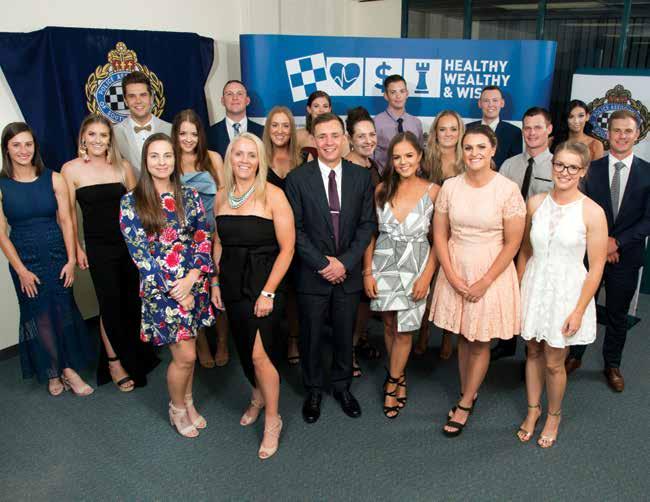





Fenwick Function Centre December 22, 2017
1. All members of the course
2. Elissa Ienco and Sarah Votino
3. Andrew Butler and Jessica Luff
4. Michael Ciaramella and Lauren Gentilcore
5. Kelly and Peter Smyth
6. Bianca Tangredi and Mark Spagnoletti
7. Nathan and Paige Wellstead
8. Mandy Whale and Tom Bedding
9. Lisa, Emily, Dane and Benny Hansen
10. Jayme Kempster and Rebecca Paczek
11. Stephen Fleming and Leia Mitchell
12. Leah and Hayden Tinney
dinners are sponsored by
and
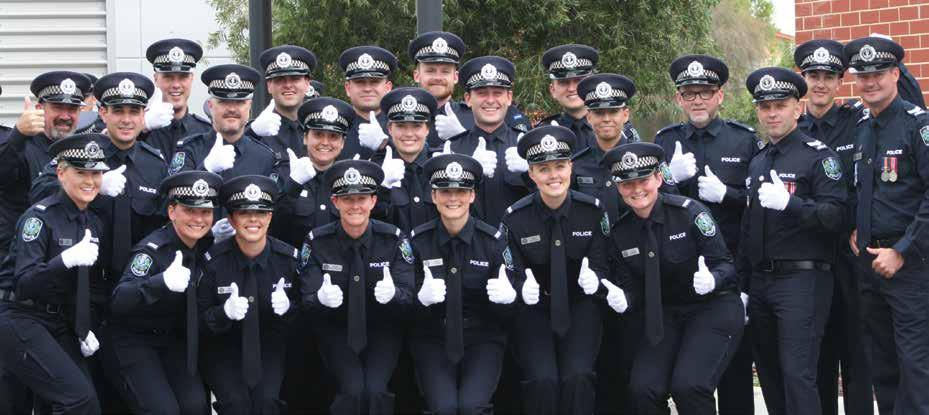
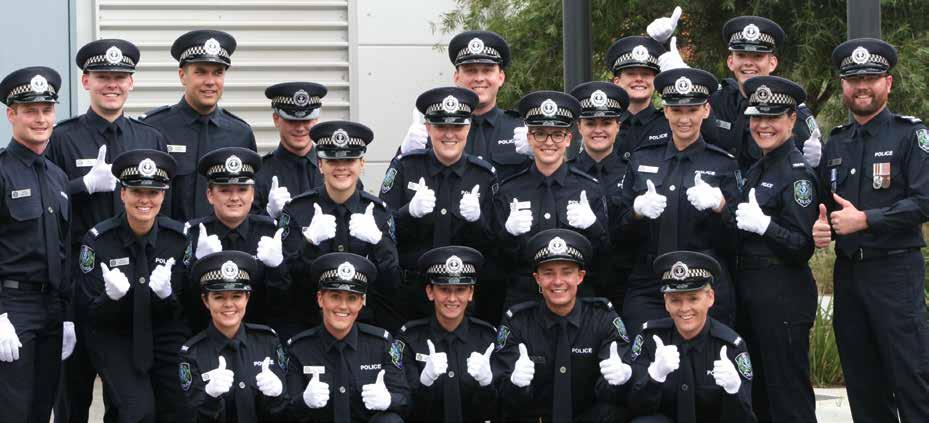
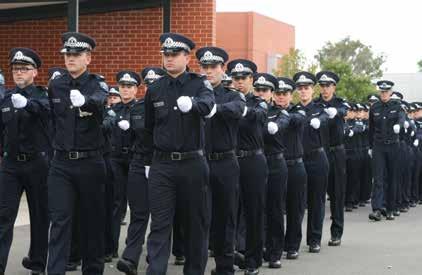
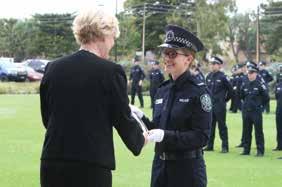
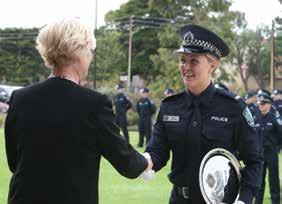
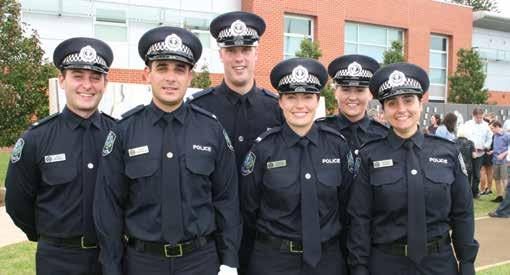
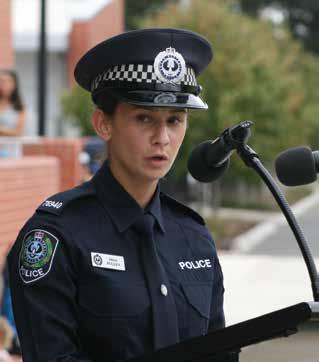
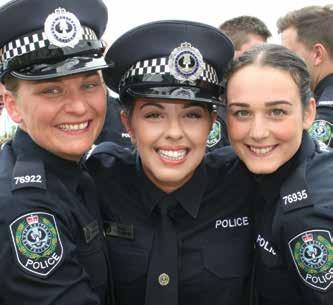
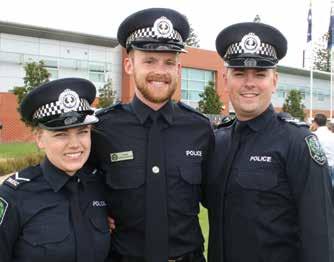
2.
As careers go pre-policing, hers was likely one of the most desirable, all because it involved the great game – footy.
Before joining SAPOL I was working at a safety store, selling industrial and small-scale safety products. I also worked as a sports trainer for AFL clubs North Melbourne, Fremantle and Greater Western Sydney and, for six years, with North Adelaide Football Club The work involved massage, strapping, injury management, on-field response to injuries and running water
LISA McMURTRIE (Road Policing Section)
For AFL games, I arrived three hours before the game to participate in stretcher drills and set up snacks, ice bags, water and Gatorade, trainers’ on-field bags and massage areas. When the players arrived, the trainers got started with massage, strapping and assisting with on-field warm-ups My passion for football was always the reason for me to keep on doing it
I loved being a sports trainer because of the thrill that, if something happened, you had to spring to action and render first aid to an injured player. I dealt with players who were unconscious or concussed when I reached them and once drove a player to hospital with bone sticking out of his finger There was the possibility for somebody to be injured at any time.
My work as a sports trainer was a large part of the reason I joined SAPOL. But I had never really considered policing until speaking with a friend about my work as a sports trainer He was a cadet and suggested I look into policing, which I did I wanted to help people in need and be that person who arrives to provide assistance or resolve a situation
Probably the most difficult thing about joining SAPOL was picking up police-officer intuition. Until you’ve faced the situations police officers are faced with on a regular basis, it’s hard to know what to do and say There’s such a variety of jobs that police attend, so you need to be able to adapt to the situation and respond accordingly
I still work on a regular basis for Greater Western Sydney whenever they play in Adelaide. And I worked for them when they played against the Adelaide Crows in the first round of the finals last year I love football as a whole, and having the opportunity to run around the oval during these games in front of 50,000 fans is great fun
“I dealt with players who were unconscious or concussed when I reached them and once drove a player to hospital with bone sticking out of his finger.”
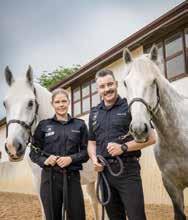
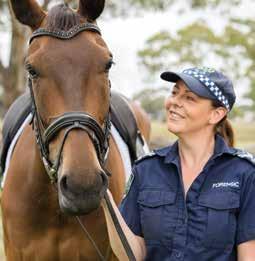

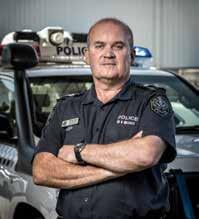

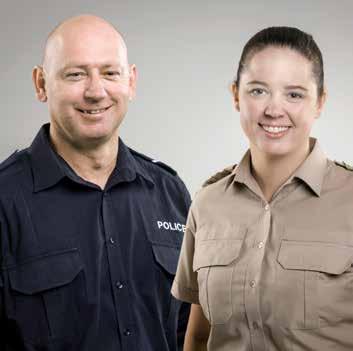





Up to 50% off the RRP of wines from Vine 2 You and free delivery to the Police Club 15% discount on dry cleaning at Karl Chehade

5% discount at Romeos Foodland and Romeos IGA stores in SA
Up to 28% off the retail price of RM Williams men’s and women’s boots

Discounts on movie tickets at Wallis Cinemas