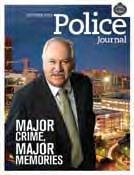
Bound for Boston



MALIBU 5 Star Ancap, Bluetooth, Cruisel, 2.4L Engine Rear Park Assist, Reverse Camera, Alloys, Smartphone App Integration Colour Touch Screen, Push Button Start.

or platinum-advantage.com.au

features Contents
10 Bound for Boston
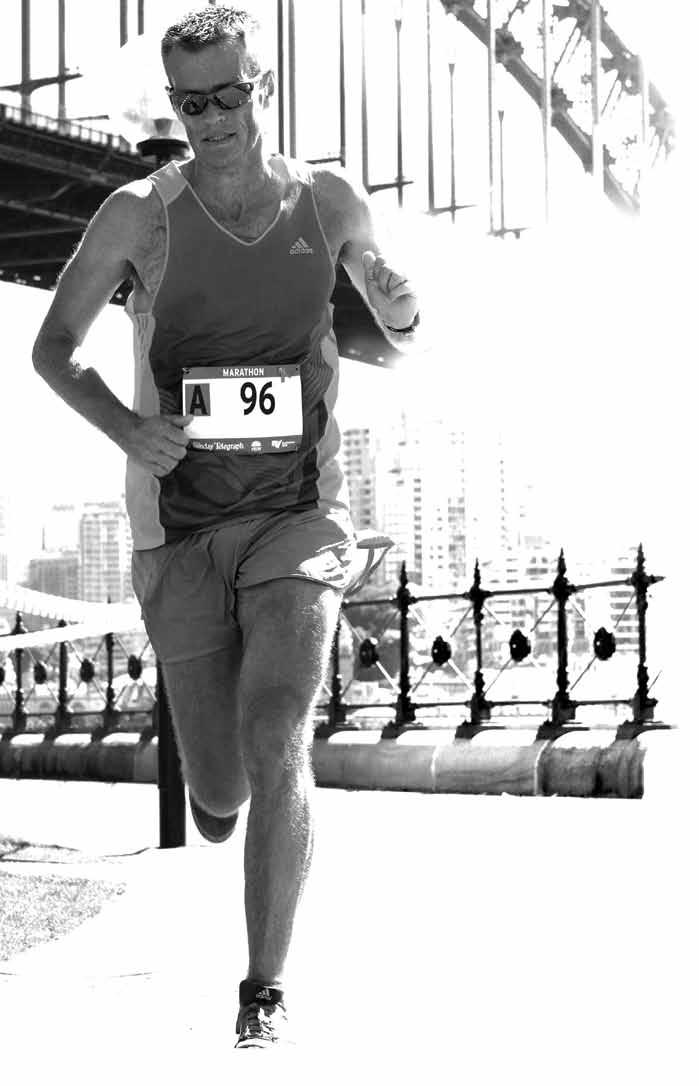
It will be the first running of the Boston Marathon since the bombings, but Jon Fuller has qualified and cannot wait to get there.
reGuLars
16 Police Association annual conference
With the state’s most influential political leaders in the room, at the same time, this was anything but a tiresome talkfest.
25 Editor’s work acknowledged again
“Riveting stories” was how the judges at the Publishers Australia Excellence Awards described Brett Williams’ 2013 features.



Brett Williams Editor (08) 8212 3055

Dr Rod Pearce Health Writer
Publisher: Police Association of south Australia (08) 8212 3055
Advertising: Police Association of south Australia (08) 8212 3055

Jim Barnett Motoring Reviewer
Design: sam k leidon 0417 839 300
Printing: lane Print group (08) 8179 9900
t he Police Journal is published by the Police Association of south Australia, 27 carrington st , Adelaide, sA 5 000, (AB n 73 802 822 770). c ontents of the Police Journal are subject to copyright. Reproduction in whole or in part without written permission of the Police Association of south Australia is prohibited. o pinions expressed are not necessarily those of the editor. t he Police Association accepts no responsibility for statements made by advertisers. Editorial contributions should be sent to the editor ( brettwilliams@pj.asn.au).
Police Association of South Australia
Committee
trevor Milne DEPU t y PREsIDEn t Allan cannon VIc E- PR EsIDEnt
ContaCt Details
Level 2, 27 Carrington St, Adelaide SA 5000 P: (08) 8212 3055 (all hours) F: (08) 8212 2002
Membership enquiries: (08) 8112 7988
David Reynolds
Jim tappin
Mitch Manning samantha strange chris Walkley

Mark carroll PR EsIDEn t 0417 876 732
deLeGates
METRO NORTh BR ANCh
Elizabeth glenn Pink
Henley Beach Matthew k luzek
Holden Hill ....................... nigel savage gawler David savage golden grove simon nappa
Parks sonia giacomelli
salisbury.......................... taryn trevelion
nor thern Prosecution t im Pfeiffer
COuNTRy NORTh BR ANCh
Port Lincoln .................... Lloyd Parker (chair)
ceduna Anthony taylor
coober Pedy Jeff Page
tom scheffler s Ec RE tA Ry 0 417 817 075
kadina Ric schild nuriootpa Michael casey
Peterborough Andrew Dredge
Port Augusta ................... Peter Hore
Port Pirie gavin Mildrum
Whyalla Wayne Davison
CRiME COMMAND BR ANCh
Elizabeth......................... Kym Wilson (chair)
Major crime campbell Hill
Adelaide Dac t homas
DocIB Jamie Dolan
Forensic services Adam gates
Fraud Rhett Vormelker
Holden Hill narelle smith
Intelligence support kevin Hunt
Port Adelaide Robert Beattie
south coast Jason tank
sturt ................................. Brad scott
METRO SOuTh BR ANCh
Sturt ................................. Michael Quinton (chair)
Adelaide .......................... k im Williams
netley Mark Williams
nor wood Ralph Rogerson
south coast Peter clifton
south coast.................... Russell stone
southern traffic Peter tellam
southern Prosecution Andrew Heffernan
Daryl Mundy
Julian snowden

Michael kent
staff

iNDuSTRiAL organizer
Bernadette Zimmermann
grievance of ficer Matthew karger
FiNANCE
Wendy ke llett
COuNTRy SOuTh BR ANCh
Mount Gambier ............. Andy McClean (chair)
Adelaide Hills Joe McDonald
Berri .................................. John gardner
Millicent nick Patterson
Murray Bridge kym cocks
naracoorte grant Baker
Renmark........................... Dan schatto
OPERATiONS SuPPORT BR ANCh
Dog Ops ......................... Bryan Whitehorn (chair)
Police Academy .............. Francis toner
Ac B george Blocki
Police Band neil conaghty
ExECuTiVE SECRETARiES
Anne Hehner, Jan Welsby, sarah stephens
comcen Athalie Edman
Firearms Jon kemplay-Hill
HR David Wardrop
Mounted .......................... ke lly-Anne taylor-Wilson
stA R operations A llan Dalgleish
traffic David kuchenmeister transit Michael tomney
WOMENS BR ANCh
Jodie Cole (chair) (no delegates)
ATSi BR ANCh
Robert Agius (chair) (no delegates)
OFFiCERS BR ANCh Alex Zimmermann
MEDiA AND COMMuNiCATiONS
nicholas Damiani
RECEPTiON
she lley Furbow
rePresentatiVes
coHsWAc Bernadette Zimmermann superannuation Bernadette Zimmermann
David Reynolds
Housing ........................... tom scheffler leave Bank tom scheffler legacy Allan cannon
POLiCE JOuRNAL Editor
Brett Williams
President
Mark Carroll

Beware the spread of second- and third-tier policing
POLiCE
Association members are quite adept at critical analysis, a skill i am sure they will use in the lead-up to the March state election. I expect that they will question each major political party’s vision for policing in south Australia. More to the point, they will take account of promises – or any lack of promises – on funding.
Policing in the United k ingdom and the United states is in a sad, indeed dangerous, state of free fall. Budget cuts, financial crises, civilianization and privatization have brought about the loss of swathes of police numbers. of particular concern in the U k has been the rise in the practice of second- and third-tier policing.
Many Police Association members understand that the U k has had a long and proud system of policing. It was considered to be at the forefront of police practice in the Western world; and its systems and processes were exported to other countries. t his is no longer the case.
the conservative government has battered Uk policing into something different – but not better.
one regrettable feature is the rise in appointments of police and crime commissioners to run U k forces. t he occupiers of these questionable positions have the power to dismiss chief constables and afford them no right of review, a concept widely abhorred for its very real potential to allow corruption to flourish.
An unprecedented rise in the number (thousands) of community support officers has occurred in the last decade. t hese non-sworn employees dress up to look like police but have the capacity for little more than directing tourists.
t heir employment has taken precedence over that of sworn police officers simply because it is cheaper.
But the sad reality is that employing community support officers deskills the police occupation. t h is kind of employment might save a dollar on wages but it delivers second-rate law-enforcement outcomes.
community support officers were not too useful during the U k riots. But how could they be?
Even more farcical is the l i ncolnshire Police. It is currently recruiting police-support volunteers, volunteer special constables, volunteer cadets, and volunteer police community support officers.
Actual sworn police-officer recruitment is closed and there are no transferee opportunities for police officers.
And, for provision of operational services and business support, the l i ncolnshire Police Authority has contracted private security firm g 4 s t h is firm signed a £200 million contract in February 2012 to build and staff, for 10 years, a police station.
Among the police functions contracted out are:
• custody services.
• criminal justice.
• Firearms licensing.
• t he crime-management bureau.
• Ict
• HR services.
• HR learning and development.
• Finance and procurement.
• support services.
t his is a cancer which will undoubtedly spread. And private contracts for the delivery of public-safety services are not always kept.
As highlighted in the Police Federation of England and Wales Police magazine in May 2013, the “privatisation juggernaut” had the brakes applied when, “on the eve of the o l ympics, g 4 s announced its inability to meet the terms of its £284 million contract with the government to provide 10,400 security staff for the o l ympic g a mes in london, requiring some 3,500 members of the armed forces to stand in.”
Described as the “g4 s fiasco”, it underscored how private companies can default on their contracts, creating a situation in which the public sector has to bail them out.
critics of the privatization of police services in England and Wales highlight police accountability and the need for independence rather than profit.
o n e cannot outsource accountability; and there is no evidence that the private sector is more efficient than the public sector. Privatization is all about dismantling conditions and cutting costs.
t h e Australian private-security industry has visited the U k to investigate the outsourcing of police functions. And the Queensland government of campbell newman looks the likely candidate to embrace the practice.
this kind of employment might save a dollar on wages but it delivers second-rate law-enforcement outcomes.
t h e n ew man government is transitioning large chunks of the Queensland Police to the Public s a fety Business Agency. no longer the responsibilities of Queensland Police are such functions as central exhibits, recruiting,
human resources, radio and electronics, constable development, professional development and recruit training.
Many more fields and functions have undergone transition. o n e might well ask how long it will be before these services are transitioned from the Public safety Business Agency to the private sector. What has happened in the U k , and is now taking hold in Queensland, is about ideology. Expansion of the private sector into the delivery of public services is seen through the prism of austerity.
At the Police Association annual conference in october, I urged both Premier Jay Weatherill and o pposition leader steven Marshall not to fall for the trap of providing second-rate law-enforcement outcomes to the south Australian community. History has shown that it always ends up costing more. the sAPol experience in the early 2000s was that economic rationalism drove police numbers, along with service delivery, backwards. t hat should be recent enough to remind political decision-makers of the folly of these types of business models in public-safety agencies.
FESTiVE - SE ASON SuPPORT
Hundreds of Police Association members will, as usual, be rostered to work on c h ristmas Day, n ew ye ar’s Eve, n ew ye ar’s Day and throughout the festive season.
What they sacrifice, in order to live up to their commitment to duty, is precious time with their families and friends during one of the most special periods of the year.
And, on the front line of policing, they will have to deal with alcohol-fuelled violence, out-of-control revellers, irresponsible road-users and much more. t hey need, and deserve, the full support of the society they protect and serve. I urge all members of the community to deliver that support in abundance. And I wish all association members, their families and Police Journal readers a safe, joyous festive season and a prosperous new year.
Bound for Boston
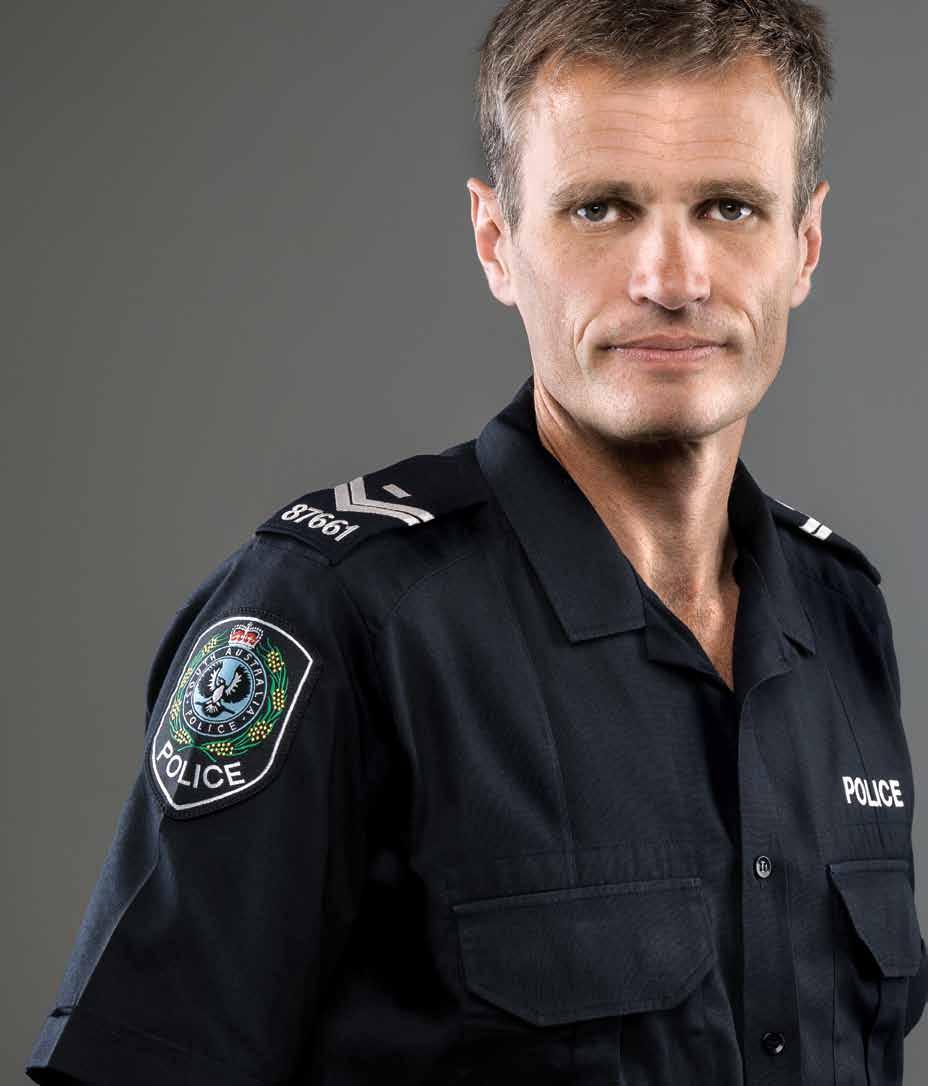
Marathon-running helped him survive the worst tragedies of his life. Now, Jon Fuller is set to close the book on another sad family saga – in the US –and run the first post-bombings Boston Marathon.

By Brett Williams

SENiOR Constable First Class Jon Fuller has
an addiction. He has broken it a couple of times but become re-addicted in little more than the blink of an eye. such is the power his popular but gruelling sport of marathon-running holds over its devotees.
Fuller concedes that he is, at the very least, a “marathon nerd” who loves to get pumped up watching youtube clips of the Boston Marathon.
But he is one of those sports-obsessed types who end up advantaged rather than ravaged by their addictions. the 41-year-old is, after all, super-fit and does enjoy good health as a direct result of his commitment to running.
And the capacity of marathon training to distract the runner from his or her other, possibly troubling, thoughts is another benefit. It has helped Fuller get through some overwhelming tragedies.
t h ere were the murders of his aunt and cousin in caringbah, new south Wales, in 2002. And, for Fuller and
his wife, Belinda, there was the most crushing ordeal of their lives – the death of their 12-day-old daughter, Amelia, in 2007 (Amelia’s12Aprildays, Police Journal, February 2010).
After suffering severe brain damage at birth, she had to spend her first days of life confined to the Flinders Medical centre neonatal unit. Fuller travelled there every day to be by his beloved firstborn’s side with Belinda – after he had gone for a run each morning.
t hat helped him “clear” his head and cope with the knowledge of Amelia’s unchangeable destiny. And, in the case of his relatives’ murders, Fuller found that running helped him release “negative energy”.
“I kept going and going,” he told the Police Journal in 2010. “And, when I came back, I didn’t feel 100 per cent, but I felt a lot better.”
Fuller might also have felt better competing, as he did, in the Barossa Half Marathon some weeks after Amelia had died. But when, for the third time, he ran past a young girl cheering her dad on from the sidelines, he cracked.
“I had a complete emotional breakdown,” he explained back in 2010. “I walked off to the side and just completely broke down.”
It was then that Fuller made his first vow never to run a marathon again. But it lasted only until the next day, when he visited Amelia’s grave. t here, he pledged to run a marathon in every state and territory of Australia and, in the process, raise money for sIDs and k ids.
A few months later, in August 2007, he competed in the Adelaide Marathon, in which he came 49th in three hours and 19 minutes. And, over the next two years, Fuller ran marathons in Victoria, tasmania and new south Wales.
When he last spoke to the Police Journal, he intended to – and later did –compete in the Ac t ( 2010), n or thern territory (2010), Western Australia (2011) and Queensland (2012). He won the unofficially staged canberra Marathon, came second in Alice s p rings and, despite a foot injury (plantar fasciitis), finished fifth in the Perth Marathon.
But, at the 21km mark of the g o ld c oast event, Fuller started to go into a bodily meltdown. “It was hot and I was just completely drained of everything,” he says. “I just fell apart. I was walking sideways. I couldn’t run. I was cramping.”
Fuller came to a complete stop and remained stationary for around a minute, before somehow battling his way across the finish line in 81st place. After he got there, he ripped off his shirt and exclaimed: “that’s it! I’m never going do this shit again! I quit!”
But, instantly, the intuitive Belinda, who told her husband not to be stupid, could see beyond the emotion of his rash declaration. she knew it could never endure. And she was right: after Fuller returned from a “light run” the very next day, he told her: “I can’t quit.”
“Because,” he says, “I love running. t hat’s what I do. And, by the end of that week, I was on the phone and looking on the internet for which marathon I could run again. I’m addicted to it.”
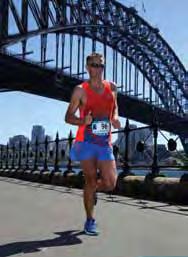
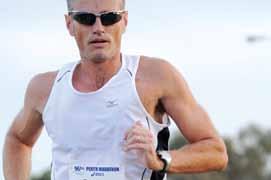
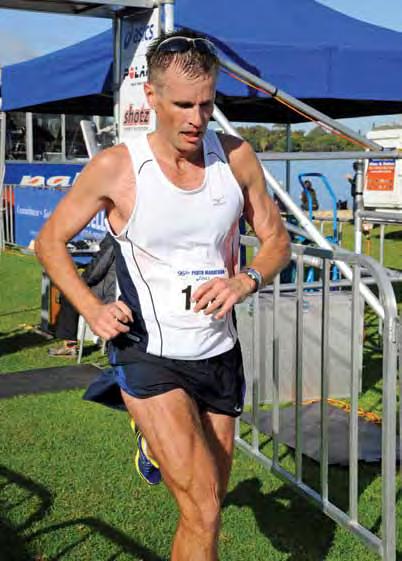
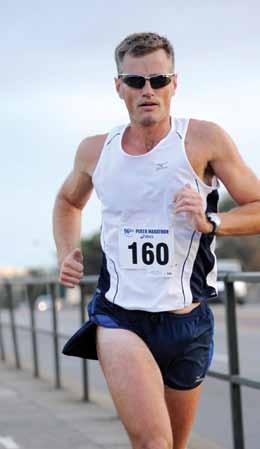
Above: Running the sydney Marathon in september and, right , competing in the Perth Marathon in 2011.
He said simply:
“I don’t want to die like that little boy.”
so Fuller has remained committed to his sport this year, with solid performances in the Barossa and s y dney marathons in May and s e ptember respectively. But, during his April preparation for the Barossa race, news broke of the deadly Boston Marathon bombings in the Us two home-made bombs, one only half a block from the finish line, had exploded around 12 seconds apart among race spectators on Boylston st just before 3pm. the April 15 blast left three dead, including eightyear-old Martin Richard, and more than 260 injured. Brothers tam erlan and Dzhokhar ts arnaev emerged as suspects in not only the bombing but also the murder of MI t campus police officer sean collier three days later.
Fuller could never have glossed over the horror of the crimes, not as a father-of-three, a front-line police officer and a marathon man. He felt deeply for the collier family and sympathized with his injured fellow runners.
But the greatest impact on Fuller was the response of his son l u cas, then just four years old. t h e
youngster, who had seen news coverage of the bombings, did not want to watch his father run in any more marathons. He said simply: “I don’t want to die like that little boy.”
l ater, however, lucas saw t V coverage of the arrest of Dzhokhar tsarnaev, and Fuller made sure he understood that the police had “caught the bad guy”. t he relieved lucas told his dad that, if that was the case, “I can watch you run again”.
so Fuller went ahead and competed in the Barossa Marathon which, unknown to many, is a qualifying race for the Boston Marathon. And, with his time of two hours, 47 minutes, Fuller qualified for entry to the world-famous event in 2014.
He started to think about whether he should register and, a week later, raised the idea with Belinda. “I said: ‘What would you think if I said I want to run Boston?’ ” he remembers.
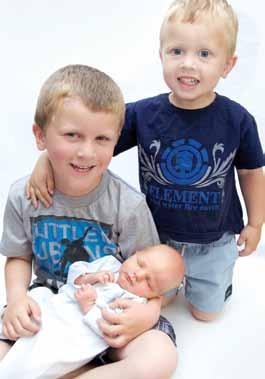
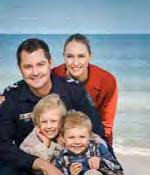
t he Fuller boys, lucas, Ethan and baby William
Belinda answered instantly: “As long as you don’t get blown up.” Fuller assured her that he was serious about taking part, and she gave the plan her blessing. He went ahead and registered and, on september 11, received a notice of acceptance.
“ t his is a once-in-a-lifetime opportunity,” he says of his coveted place on the list of runners. “I can’t get it wrong.”
Fuller had only 11 days to absorb his good news before competing in the s ydney Marathon and crossing the finish line in 38th place.
And his training regime has this year been as rigorous as ever. Despite his commitments as a fulltime, shift-working police officer, he had run about 4,000km by the end of october.
“I quite often finish night shift and run 24km before I go to bed,” he explains. “It’s hard work, but you have to do it. I don’t sleep much. I’m just not designed that way, I suppose.”
t his month, the training will intensify as Fuller begins a punishing elite-athlete training programme.
“s o me weeks I’ll be running up to 175km,” he says. “ t he most I’ll get up to in one day is 39km; and,
ThE BOSTON MARAThON
• t he Boston Marathon is one of the six World Marathon Majors events, along with the Berlin, london, n ew york, chicago and tok yo marathons.
• With more than 1,100 media representatives from over 250 outlets given credentials annually, the Boston Marathon is second only to the super Bowl for on-site media coverage.
• It is held on the Patriots’ Day holiday, the third Monday of April.
• t he course passes Fenway Park, home of the Boston Red sox, about a kilometre from the finish line. A Red s ox home game is timed so that spectators, on leaving the stadium, can cheer the runners on in their final mile.
• to enter the race a runner must meet or exceed a set qualifying time in an approved and certified marathon.
• t he first modern olympic games (1896) served as the inspiration for the marathon.
• John J McDermott, from new york, won the first Boston Marathon on April 19, 1897, in two hours, 55 minutes and 10 seconds – out of a field of 15 men.
• o w ing to U s involvement in World War I, a 10-man military relay was held in place of the marathon in 1918.
• t h e race was lengthened to its current 26.2-mile distance in 1924 to conform to the olympic standard.
• the first woman to run the marathon was Roberta “Bobbi” gibb in 1966.
• Women were officially permitted to run the marathon in 1972.
• s c andal erupted in 1980, when Rosie Ruiz claimed victory in the women’s category over canadian Jacqueline g a reau. It emerged later that Ruiz had entered the race just after ke nmore square –about a mile from the finish. gareau was awarded the title a week after the race.
• John A ke lley, who ran the first of his 61 Boston marathons in 1928, ran his last in 1992 at the age of 84.
11 or 12 times a week, I’ll be running at my peak. t his will be for 18 weeks.
“ s ome times I’ll just go out and run at one pace. o t her times, I’ll have to specifically do certain speeds for certain distances, so I have to be full-on focused.”
When he works day shift, Fuller will drive only part of the way to work at christies Beach patrol base and run the rest. After knock-off, he will run back to the car and drive the rest of the way home.
n o thing will ease the strain of his gruelling preparation, not even the picturesque wine country south of Adelaide, where Fuller will most often train. And, as always, he will train alone. “(I’m an) only child,” he says, “so it doesn’t bother me.”
Awaiting Fuller and his fellow competitors is the famous Heartbreak Hill, the last of the four newton hills on the Boston Marathon course. It confronts runners at the 32km mark and rises 27 metres over a distance of 600 metres.
t he great challenge of the hills is that runners have to take them on at the 26km mark, where the first one awaits. Fuller, to be sure he can conquer all
of them, plans to build extra strength into his legs through weight training.
His motivation to compete in Boston comes from a range of sources. Among them are the lost limbs and other physical and mental injuries his fellow runners suffered in the bombings.
“Runners are, collectively, a club,” he explains, “even though you don’t know (all of) them. It’s a bit like police – we’re a family.”
But also driving Fuller is the need to restore marathon running from the damage, real or perceived, the attack caused it.
“I want to get my sport back,” he insists. of course, on race day, he aims to apply himself with more grit and attitude than he has taken into any other marathon. But he also remains mindful of how his eldest boy, lucas, interpreted the killing of eight-yearold Martin Richard.
so his ultimate objective is to “show my kids not to be afraid”.
“there was the moment we were living, and that was it.”
AMELiA NEVER FORGOTTEN
still in his thoughts, and his heart, as he loses himself in the hypnotic, stride-by-stride rhythm of 24km training runs, is his precious late daughter, Amelia. Fuller thinks of her every day. His memory of her 12 days of life never fades.
“We’ve got photos of the kids along a wall at home,” he says, “so every day I walk in the front door she’s there looking at me.”
Her tragic plight began before she was born: her head had become impacted in her mother’s pelvis. “We went into theatre and they couldn’t get her out,” Belinda told the Police Journal in 2010.
“she was wedged in, and they couldn’t pull her out against the contractions. t hey were worried about breaking her neck, or really hurting her.”
s o , to bring Amelia into the world, doctors performed a caesarean section. But, from the moment of her 1:06am birth on April 4, 2007, she was colourless and not breathing.
t he medical team rushed her to intensive care, but a paediatrician told Belinda he did not expect Amelia to “survive the hour”. that prognosis, however, proved wrong: after around two hours, a neonatal team got her breathing by herself. then, around 5:30am, the Fullers went to see Amelia in the IcU she had suffered liver failure and trauma to some of her other organs and was haemorrhaging. Her little tube-filled body was black and blue with bruising but, ultimately, she had suffered severe brain damage.
Fuller used his sport to help him cope with the trauma he faced as a parent. He ran each morning before returning to the hospital to be with Amelia.
But, at 6am on Easter saturday, a passing netley patrol spotted him sitting on a fence just along from sturt police station. In tears, he had simply conked out after his emotions had boiled over. t he patrol pulled up alongside him.
“one of the poor guys had only graduated three days before, so I hadn’t even met him,” he told the Police Journal in 2010.
“ t he other guy was really good. I’d actually rung him the night before to tell him to tell everyone what was going on.”
t hat officer sat with Fuller for 15 minutes, gave him support and made sure that he was okay before leaving him.
Resigned to the fact that Amelia was not going to survive, the Fullers took her home to live out the last five days of her life. t hey crammed as much living as possible into those days, taking Amelia to the beach, out to dinner, visiting relatives and simply walking the dog.
“But there was never a future,” Belinda said back in 2010. “ t here was the moment we were living, and that was it.”
t he heartbreaking end, which Belinda knew to be coming, began in the evening of April 15. And that night, Amelia lay between her parents in their bed

suffering long periods of breathlessness. she clung to life all through the early hours of the next morning.
“We were telling her to go, that it was okay,” Belinda said. “I was telling her that it was okay to stop breathing. And, each time she stopped breathing, we looked at the clock, thinking: ‘ t his is it.’ ”
But Amelia fought on until just after 9am, on April 16, when she finally died. Fuller remembers losing her as the worst experience of his life.
In the six-and-a-half years since then, however, time has relieved much of his emotional pain. “And I think that’s partly my make-up, too,” he explains. “ you just get on with it. you’ve got to.”
In 2008, Belinda gave birth to lucas, who Fuller considered a “gift from Amelia”. two years later came Ethan and, just last month, the Fullers welcomed their fourth child, William.
on the seventh anniversary of Amelia’s death, Fuller will be in Boston with only days to go before the marathon. He will think of the morning he lost his daughter, but the far harder anniversary for him to endure is that of her birth.
“Because,” he says, “we would have been celebrating with her.”
AT FAThER’S GRAVESiDE
Jon Fuller will not return to Australia after the Boston Marathon until he visits the Riverside national cemetery in california. t here, he intends to leave photos of his children on a grave and, then, pause and walk away.
In that grave lie the remains of his father, Frank –whom he never knew. Until he was 17, British-born Fuller had believed that he was the son of another man, Vic. And, after the truth of his real father finally emerged, he was angry that no one had revealed it to him earlier.
Among the details he came to discover was that his married mother, lillian, had had a romance with a Us serviceman attached to a British air base. Fuller was the product of that romance, but his father had a family back in the Us, to which he eventually returned. so Frank and lillian never pursued a relationship, and their son never got to meet his father. Fuller came to believe that Vic was his father, whom his mother divorced when her son was just one year old.
When he was seven, Fuller immigrated to Australia with his mother, who now had a second husband, Doug. But Frank was not entirely out of the picture. When Fuller was around 11 years old, he received gifts from him, such as Us football merchandise.
His father, who had communicated with his son as “Uncle Frank”, died a few years later. Fuller, then 16, saw the intense distress with which his mother responded to the death but never suspected the real reason for her reaction.
Around a year later, Doug revealed to Fuller, entirely by accident, that Frank was indeed his father. And the secrecy, once exposed, became the cause of some “stand-up blues” between Fuller and his mother.
After the health of his daughter, Amelia, became such a critical issue in 2007, Fuller thought about the relevance, if any, of his family medical history. It occurred to him that he knew nothing of such history on his father’s side.
that served as motivation for him to find out more about his father and Us relatives. And, with some research, Fuller discovered that he had a half-sister, an aunt and a cousin.
“I don’t know where she (my half-sister) is,” he says. “I don’t know her married name; and she would be much older than me. s h e may be dead. Who knows? His (Frank’s) family admit I exist but refuse to tell me anything.
“t hey’re basically saying: ‘ you prove who you are,’ because my half-sister had a bad car accident in
which her husband got killed. I don’t know the full circumstances and I never will. But she got a multi-million-dollar payout.”
Fuller suspects his relatives fear that he aims to make a claim on his halfsister’s money. His cousin, whom he found through a dog club she belongs to in Phoenix, Arizona, proved just as unwilling to co-operate.
In an e-mail exchange with her, Fuller identified himself as her cousin. “ ye ah, I know who this is,” she wrote. When he asked her if she knew anything which could help him connect with other relatives, her response was a blunt “no.”
After that exchange, Fuller considered his enquiries at an end. “I tried and it failed, and I’m not going to dwell on it,” he insists. “ t hat’s not going to achieve anything, so why do it?
“It would’ve been great, though. I would’ve been going over there to see them now (in April).
“At my father’s grave, I’m just going to sit there and say: ‘okay, I’ve been here.’ I’ll put some photos of the kids there and walk away. It’s not some big crusade to find my life, because I’ve got my life.” PJ
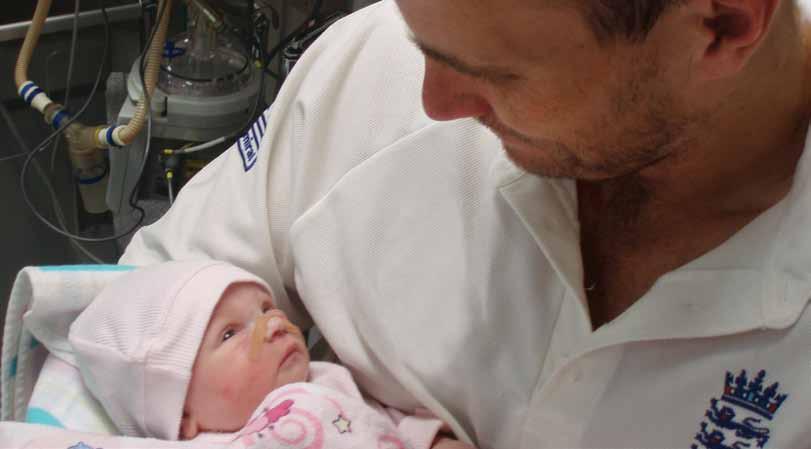
With baby Amelia in 2007
Running the Perth Marathon
P O L i C E
A S SOC i AT i O N A NN u AL
C O NFERENCE
State political leaders raised key issues at the Police Association annual conference – IT equipment, cumbersome legislation and mandatory sentencing.

nick Damiani reports on exactly what they and a range of other speakers revealed.
Police Association president Mark carroll


Promise of tablets for police
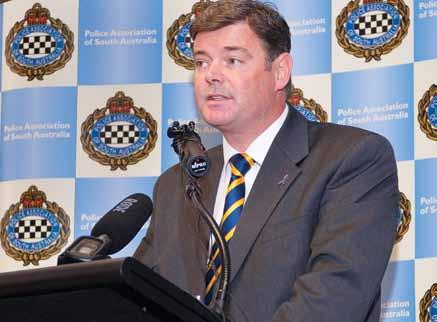
P R EM i ER Jay Weatherill (above right) opened the Police Association annual conference with some key announcements, including that of the rollout of tablet computers to police officers to improve productivity and increase numbers on the beat.
In an address to association delegates, Premier Weatherill said s A P o l would trial 350 tablets in the Elizabeth lsA over 12 months, allowing officers to capture, retrieve and submit information on location rather than back at the station.
He also announced that the government would introduce legislation to make it mandatory for any offender charged with assaulting a police officer to undertake a blood test for infectious diseases. t his would be in cases in which the officer was exposed to the offender’s blood or bodily fluids.
Police Association president Mark carroll said the association had lobbied intensely for this legislation.
“there were approximately 120 incidents in the past 12 months involving police officers being spat on,” he said.
“When, in the course of duty, officers are spat on, bitten or otherwise assaulted in a way involving an exchange of bodily fluids, it is essential that officers have access to blood samples from the assailant that may be tested.
“In this way, treatment for any illness or disease so communicated can be the subject of early diagnosis and medical intervention.
“ t he association is hopeful this new legislation will receive bi-partisan support. Being spat on, bitten or bled over is repugnant.
“And it is sensible to have procedures in place to identify diseases the officer may have been infected with to begin appropriate treatment as soon as possible.”
Premier Weatherill told delegates there was still much to be achieved for police.
“We must be clear-eyed about the challenges we face, but we must also be positive about our ability to respond to them and about our strengths as a state,” he said.
“We will continue to put forward policies that will make our community safer and where both the police and the public are winners.”
“We must be clear-eyed about the challenges we face, but be positive about our ability to respond to them.”
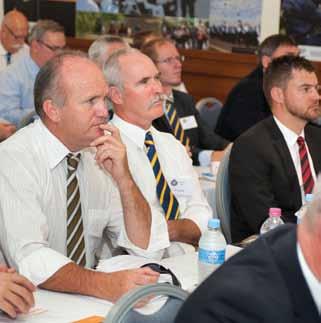
Delegates listen to Premier Weatherill’s address
Too much complex legislation
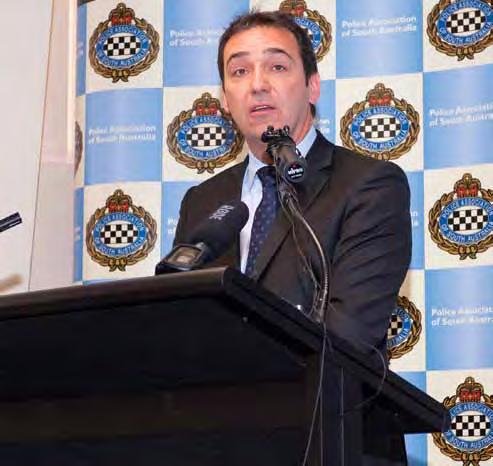
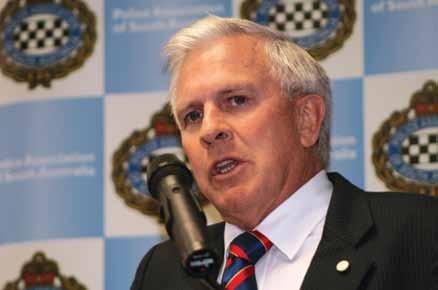
STATE opposition leader steven Marshall (left) addressed delegates on day one of the annual conference.
Mr Marshall, who had addressed a Police Association industry forum luncheon last May, began with some reflection on the history of sA Po l. H e indicated that s A P o l had come a long way from the early days of modest facilities and pay.
“clearly they didn’t have Mark carroll negotiating on their behalf back then,” he quipped.
Mr Marshall said several l abor promises from the 2010 election campaign had not been delivered. He said these included a promised 300 new recruits, 100 handheld computers, 150 portable fingerprint scanners and 20 additional automated numberplate recognition cameras.
Mr Marshall also told delegates the state liberal party had recently held a police “round table” featuring 15 police officers from a variety of commands.
“It was a positive conversation, discussing the many challenges you face and the pressures of having to do more with less,” he said.
“It highlighted the countless promises made by the government regarding sA Pol’s computer systems, yet our systems continue to lag well behind best-practice here in Australia.”
“…our systems continue to lag well behind best-practice here in Australia.”
Mr Marshall also said the round table uncovered too much complex legislation which made law enforcement harder.
“( t his) makes it difficult to sometimes even identify what is an offence,” he said.
Mr Marshall told delegates he wanted less paperwork for police officers and that part of that was endeavouring to put an end to drug offenders receiving access to unlimited drug-diversion services.
“I’m pretty sure when most of you decided to become a police officer, you didn’t think you were signing up for a job filling out forms on a daily basis,” he said.
“Unlimited access to drug-diversion services does three things: it ties up police in pointless paperwork, it ties up resources for genuine rehabilitation, and it encourages serial offenders to avoid sentencing.
“I advise today that, if elected next March, we will change the access to the drug-diversion programme. offenders will be limited (so as) to participate a maximum of two times.”
Mandatory sentencing to protect police
FAMiLy First Mlc Robert Brokenshire (above) addressed delegates and took questions on day two of the Police Association annual conference, with his mandatory sentencing bill a key feature of the discussion.
Mr Brokenshire explained that south Australia had a precedent on mandatory minimum sentencing with murder and drink-driving.
“I think (the majority of people) want minimum mandatory sentencing for serious assaults (on police),” he said.
Mr Brokenshire’s bill proposes four years’ minimum mandatory sentencing for attempted murder of a police officer, one year for intentionally causing serious harm, and six months for recklessly causing serious harm.
“If we can get this (bill) through, I think we’ll start to make a real difference to your protection and to the attitudes of these (criminals),” he told the conference.
“let’s send a message that the parliament and the state will not tolerate increases in assaults on police.”
Mr Brokenshire also revealed further changes to
suspended sentencing legislation for which he is campaigning.
“I want it to read that, in relation to serious and organized-crime offences, there is a clause for an aggravated offence against police,” he said.
“And I’ve been told there is a good chance of getting that through. Why should people who cause serious harm to police receive suspended sentences?”
Mr Brokenshire went on to heap praise on the commitment of Police Association delegates, committee members and staff.
“ to p ut that extraordinary effort in for your colleagues (as a delegate) – I commend you all for that and encourage you to continue it,” he said.
“ t h ere are few organizations in the state that have the respect of the parliament, the community and the media as the Police Association of sA
“It’s an incredibly professional organization. From the president down to the secretary and all the staff, I encourage you to continue that professionalism.”



Above: Delegates listen to speakers on day one
Facebookers a resource for police
PuBLiC
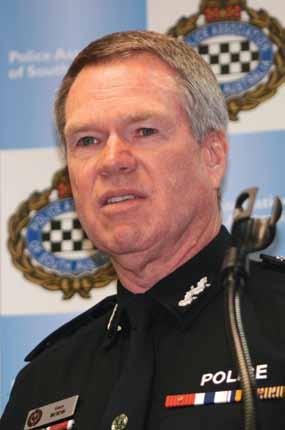
engagement and technological advances are leading priorities for s A police, according to c omm issioner g ary Burns (below), who addressed the conference on day two.
He explained that a closer relationship with the community would bring about better outcomes for police and the general public.
c omm issioner Burns also said social media appeared to be one of the significant platforms to achieve this.
“We’ve put a lot of effort into improving our social media engagement in the last 12 months,” he explained.
“ t here are a lot of opportunities to take pressure off front-line police by engaging in social media.
“We now have a large number of Facebook followers which gives us an opportunity to present the facts to the public and rectify incorrect information
which the public may have received and also (it) allows us to seek their assistance for matters such as missing persons.
“ t h e numbers of people accessing Facebook and twitter and passing it on to friends are quite significant and (on the whole) very supportive of police.”
commissioner Burns also cited incidents which showed how social media could save police resources.
“For example, we put information of a six-year-old missing child in the Adelaide Hills on Facebook which went viral, and comments by the public resulted in us finding that child within an hour,” he said.
“ t h at would normally have resulted in significant use of police resources like patrols and helicopters.
“ t h is gives the public the opportunity to be involved in policing, and they are getting satisfaction from helping police.”
c ommi ssioner Burns also shed light on the iPad trial being undertaken in the Elizabeth lsA.
“I’ve been pushing for this for some time,” he explained.
“ t h e way I see it eventually going, is when you graduate from the academy you are given an iPad and/or a mobile phone for both business and personal use. t his could even eliminate the need for desktop computers and hard-line (phones) in many cases.
“the aim is to do on the (mobile) tablet what you would normally do on the desktop (in the station).”
c ommi ssioner Burns said technological solutions like these could further free up police resources.

Awarded for highlighting safety issue
POLiCE
Association president Mark carroll announced k a ngaroo Island sergeant Robert scurrah as the winner of the 2013 step Up safety award on day one of the conference.
In concert with its delegates, the association launched the step-Up safety campaign to encourage members to exercise their right to a safe workplace and submit hazard incident reports whenever they were exposed to, or identified a danger in, the workplace.
throughout the year, the association encouraged its members to nominate their colleagues for the award. nominations followed and were all carefully considered.
s g t s c urrah tenaciously raised the issue of the substantial risk caused to members who were required to engage in driver testing in remote areas.
He submitted hazard incident reports in different country locations to highlight the dangers and, then, took it upon himself to review the relevant legislation which prompted a new general order addressing these safety concerns.
After the submission of s g t s c urrah’s report, discussions continued between DP t I and sA Po l with the view that officers would no longer be required to conduct aged-driver testing.
senior constable Richard Hern was runner-up to sgt scurrah and won special acknowledgement from the association.
snr const Hern was nominated as a result of his action regarding a serious sewage leak and its associated odour reported in various sections of the transit s e rvices Branch office. t h is made the office an unacceptable working environment, causing workers substantial discomfort.
Hazard incident reports had been submitted from 2005 regarding the issue. After inaction by the owners of the building, a default notice was issued to the officer-in-charge of tr ansit services Branch.
t hrough c onst Hern’s action, multiple meetings were conducted between various departments and private enterprise, bringing about further investigation.
Feedback from members and delegates revealed that many officers felt reluctant to report workplace hazards. s o me felt powerless to do anything about them, while others feared that speaking out would negatively impact on their careers.
By running the s t ep Up campaign each year, the association has attempted to address a workplace reluctance to speak out about workplace hazards. t h e association now hopes to see the campaign result in an increase in the number of hazard reports police submit.
Writing therapeutic for former detective
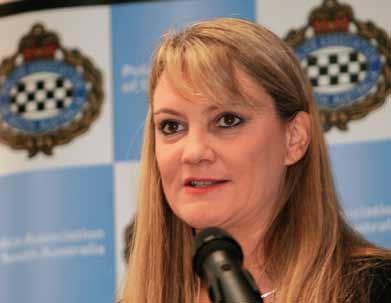
AuThOR
and former nsW police officer
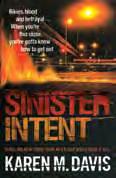
k a ren Davis (above) was a popular speaker at the Police Association of s outh Australia annual conference in october. she regaled delegates with stories from her debut book, sinister Intent the inspiration for the book came from Ms Davis’s career as an undercover detective.
Ms Davis, who retired from the ns W Police F orce in 2007, is currently recovering from posttraumatic stress disorder and is attempting to raise awareness of the mental illness, especially among police officers. she explained that mental illness is often misunderstood.
“I didn’t tell anyone at work (about my P t s D) because I was embarrassed and ashamed,” Ms Davis said.
“one day I had a bad episode at work, and told a very close friend. she said to me: ‘just snap out of it.’ I can tell you now, when you’re having a panic attack that doesn’t help.
“It made me feel like a failure and that I couldn’t talk to anyone. so I kept it to myself.”
Ms Davis eventually sought professional help and was diagnosed with P tsD
“I loved my job more than anything, and it was the hardest decision to leave,” she lamented. “With two young kids and a marriage I had to make the choice.”
o n the advice of her mother, Ms Davis aided her recovery by putting pen to paper about her most pertinent thoughts, many of which had been repressed from her time in the police force.
“ t hat’s how (the book) started,” she said.
“What I couldn’t get my head around was things
I’d done in the first six or seven years in the job were the ones coming back to bite me 15 years later. At the time I supressed it and didn’t deal with it.
“years ago, I wouldn’t have been able to stand here and talk about it. I would have been too emotional and embarrassed. Writing a book has actually (helped me) talk about it.”
Ms Davis said there were many things she enjoyed putting on paper.
“the majority of my time in the police was fantastic,” she said.
“I started remembering all the funny things. I started writing about them (too) which reminded me that it wasn’t all bad. My mother, who has passed away now, showed it to her agent (with the view) of turning it into a fiction (novel).”
After several years of rewriting and editing, Ms Davis finally landed a deal and her book was published.
“It’s very much a fictional story but close to the truth,” she said. “It’s about a young police officer called lexi Rogers, and I’ve been asked numerous times if I’m lexi. I’m not lexi – I describe her (in the novel) as being gorgeous so I can’t say I’m lexi.
“I wanted to write it as real as possible but still entertaining.
“For people who aren’t police I wanted to make them realize that we’re human and we get affected by things we see as well.”
Ms Davis also attended the Police Association conference dinner and felt immediately at home.
“Police are the same everywhere, aren’t they?” she asked. “I felt like I knew everybody. It’s like a family wherever you go.”
Police as vulnerable as most on social media
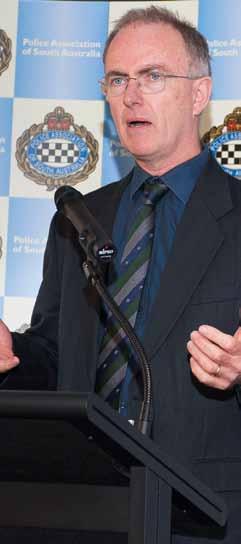
FLiNDERS
University professor Andrew goldsmith (left) delivered his presentation Police and social Media on day one of the conference.
He explained how social media can affect both on- and off-duty police, many of whom he knew to use internet searches and social media to their advantage. t hey did this, he said, by targeting criminals who left trails of their activities on social media.
“ t h ere is this culture among young people of confessing and disclosing everything on social media,” he said. “It’s not something you can easily expunge.”
Professor go ldsmith stressed that this could be a double-edged sword for police, and that a social-media policy was important for police and organizations alike.
He warned conference delegates that exposing too much information about themselves online could leave them vulnerable to embarrassment, character assassination or, worse, criminal activity.
“ t h ere are several recent stories about police officers which show what can happen when they post photos or comments of themselves, or disclose who their friends are, through (social media),” he warned.
“In policing, unlike many other careers, your character is in question so often. Part of your professional identity is your ability to stand up and give credible evidence.
“(What you put online) can come back to haunt you later on.”
Professor g ol dsmith also discussed how Facebook is breaking down the division between home and work.
“Facebook is set up to favour (its creator). t he default (setting) is: everything (you put on there) goes out,” he said.
“Most people do very little to (adjust) their privacy settings. We should be having a lot more debates about this, instead of just meekly rolling over and accepting whatever privacy settings are given to us.
“ t he challenge (with a social-media policy) is to give people appreciation and foresight about what might happen down the line.”
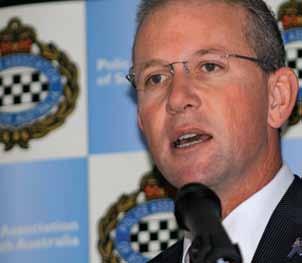
Wrong to short-change police
Qu E ENSLAND
Police Union
president Ian l e avers (above) was a keynote speaker on day one of the annual conference. He outlined his union’s strong concern for police operating under the conservative majority government of Queensland premier campbell newman.
Mr l e avers feared the parliamentary monopolization would come with drastic effects for police and public servants, especially when privatization and what he deemed “draconian” industrial relations laws were taken into account.
“In Queensland, they change legislation overnight,” he exclaimed, referring to the state’s single-house parliament.
“When it comes to pay and conditions, they’re going to sell (Queensland) out. t he sad reality is it’s going to bite people before they wake up and realize.”
Mr leavers went on to address the conference on privatization. “It’s all about: ‘can it be done cheaper privately and, if so, do it,’ ” he said.
“We intend to have a campaign: ‘It’s time to back our front-line fighting crime.’ t he rationale is you can’t short-change police and law and order, or it will cost lives. But that’s what they’re about to do in Queensland.
“( t h ey want) to take away a lot of policing functions and hand them over to public servants, or private (enterprise).”
Mr leavers told the conference delegates they should be wary of what this kind of governance could do to police.

Loyal association servants acknowledged
“the sad reality is it’s going to bite people before they wake up and realize.”
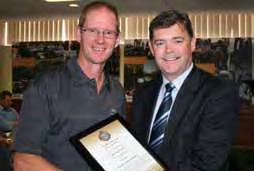
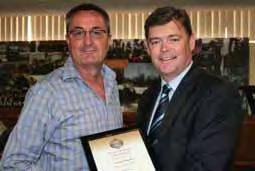
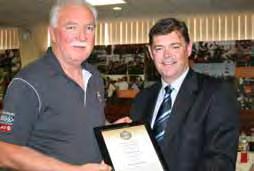
Six
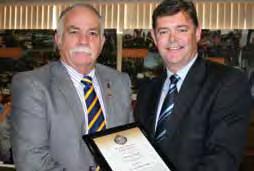
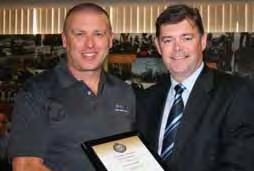
Police Association delegates and one committee member received coveted service awards at the close of the conference. Association president Mark carroll presented the 10-year service award and badge to:
• Deputy President trevor Milne (Forensic services).
• sgt Andrew Heffernan ( licensing criminal Justice).
• snr sgt 1c t im Pfeiffer (Holden Hill criminal Justice).
• sgt Ralph Rogerson (Adelaide).
• sgt lloyd Parker (Port lincoln).
• Detective sgt gavin Mildrum (Port Pirie cIB).
Berri senior constable first class John g a rdner received the six-year service award.
In an acceptance speech, trevor Milne told conference delegates his award was a great honour, and encouraged those present to continue their service to the association.
“My first involvement with the association started in 1986 when I was in Whyalla as a proxy delegate,” he said.
“ t h at started my interest in the association. It’s important to understand the role delegates play. Without delegates, there wouldn’t be an association.”
Before closing the conference, Mark carroll made special mention of Mr Milne’s recent election as deputy president and new committee members Mitch Manning, Julian snowden and sam strange.
He also acknowledged former association deputy president Bernadette Zimmermann for her appointment as organizer and tom scheffler for his recent election as secretary.
Mr carroll said delegates were the cornerstone of the association. “All delegates play such a crucial role in the smooth running of the association and are often the first port of call for many of our members,” he said.
“ t hey are the foundation upon which the association is built, and these awards recognize that fact.
“on behalf of the association committee of management, I congratulate the award-winners, but I extend a thank you to all delegates. t heir work and commitment to the association is held in the highest regard.” PJ
From top: Police Association president Mark carroll presents awards to trevor Milne, Andrew Heffernan, t im Pfeiffer, Ralph Rogerson and lloyd Parker.
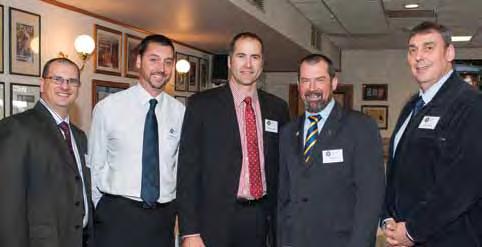

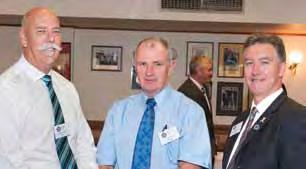
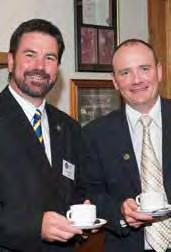


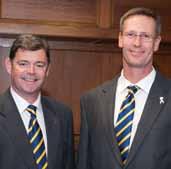







1 Delegates Anthony taylor and Wayne Davison and Andrew Jacobs
2 Delegates simon nappa and glenn Pink
3 Emmet lynch ( new Zealand Police Association), delegate neil conaghty and Police Association committee member Michael kent
4 shadow Police Minister Dan van Holst Pellekaan and Police Association secretary tom scheffler
5 Merv lockhart (WA Police Union), Jug Price ( new Zealand Police Association) and stephen McDonald (Police Association of nsW )
6 Police Association president Mark carroll with Dan van Holst Pellekaan
7 Mark carroll and Premier Jay Weatherill
8 committee member chris Walkley and delegate Adam gates
9 De legates Dac t homas and kevin Hunt with tom scheffler
10 Delegates John gardner and Andrew Heffernan
11 Delegates Peter schulze and Andrew Heffernan
12 Delegates Adam gates, Michael Quinton, Mark Williams and Jamie Dolan
13 state opposition leader steven Marshall and Mark carroll
Delegates David Kuchenmeister, Martin Borgas and Andrew Dredge, Police Association vice-president Allan Cannon and delegate David Savage

EDItoR ’s WoR k AcknoW lEDgED AgAIn
By Nick Damiani
POLiCE Journal editor and features-writer
Brett Williams has won outstanding recognition at the Publishers Australia Excellence Awards for the third successive year.
At a gala dinner at the sydney Hilton Hotel last month, Brett was announced as not only a finalist in the Single Article of the year category, but also runner-up for Journalist of the year in the businessto-business category.
His high placing in the latter award has ranked Brett as one of the top two (B2B) magazine journalists in Australia.
t h ose of Brett’s stories which the judges considered for Journalist of the year were Forced to shoot ( Police Journal, February 2013), letting go ( Police Journal, February 2013) and triple murder, sisters’ grief ( Police Journal, August 2013).
Making Brett a finalist for single Article of the year was also triple Murder, sisters’ grief. His fellow finalists in this category were journalists from cleo, Marie claire, Encore, the AustralianWomen’sWeekly and Australian geographic
Humbled by the recognition he received, Brett said it was all about the Police Association and its members, to whom the Police Journal belongs.
“I just hope that the members, whose stories I get to tell, perceive any success I have as a reflection on them, on their journal and on their union,” he said. “It’s just a privilege for me to be able to serve them with whatever expertise I have as a writer and editor.

“I couldn’t be more grateful to the members, and crime victims such as s u e Mahoney and christine Mitchell ( triple murder, sisters’ grief) who give me their trust. t hat trust is in and of itself a great compliment.”
Police Association president Mark carroll said he was delighted that Brett had followed up his success of previous years with more recognition from his peers.
“Brett just keeps backing up, year after year, with outstanding, industry-acclaimed work,” he said.
“t he Police Journal would not be what it is without Brett. He puts an incredible amount of time and effort into what is truly an elite publication.
“I also get constant feedback from members about how adept his interviewing style is. some topics are difficult to interview police about, but Brett is a true professional in this regard.”
Brett won the Excellence Award for single Article of the year in 2011 for his cover story Uncovering the children’s horror ( Police Journal, August 2011). In 2012 he was a finalist for Journalist of the year in the B2B category. PJ
Letters
Extended leases no impact on OHSW
I would like to clarify the information presented in Q&A ( Police Journal, october 2013), regarding lease terms.
leases were only extended on high-use general-duty and unmarked Holden c ommodore vehicles from 60,000kms to 80,000 or 90,000kms, depending on kilometres travelled per month.
t he length of the lease terms remains at a maximum of three years for these vehicles. t his has not changed. Regarding safety and integrity, Holden warrant commodores to 100,000km or three years.
Holden c ommodore vehicles operated by police are serviced every 10,000kms. t he manufacture specification for these vehicles requires service at 15,000kms.
All vehicles engaged in urgent-duty driving are required to undergo safety inspections as soon as practicable.
sA Pol has a number of other operational vehicles (mainly cage and 4WD) on 80,000km or 100,000km terms. lease terms for cage cars and 4WDs have not changed.
Extending the mileage within the lease time on “average” will result in delaying replacement by an additional six months (the average lease term is 27 months).
traffic operation Escorts utilize outlanders which are replaced at 80,000kms.
Be assured that these changes do not impact on the health, safety, welfare of members of sA Pol yours faithfully
Gary T Burns commissioner of Police
Excellent venue and service
on behalf of all those who attended the Police c lub on s aturday night I thank Bronwyn and the staff for the excellent venue and service offered to us.
It is a real pleasure to attend a function such as ours when the service is impeccable and courteous. Many commented to me about the superb quality of the meals for which I also commend the chefs.
I will certainly let everyone I know that the Police club should be the venue of choice for functions. on a personal note, I thank Bronwyn for making my job so much easier on the night.
k ind regards
Mark
Stewart-Jones
senior Intelligence Analyst Investigation support Branch
Association effort outstanding
We thank the Police Association most sincerely for its ongoing support of novita children’s services.
Its hosting of the Police Association Melbourne cup luncheon is genuinely appreciated by novita.
t h e efforts of the association team were outstanding and resulted in another very enjoyable and successful event.
We are delighted to be able to share with you that the event raised over $5,000 to assist novita in providing vital therapy and support to more than 2,000 kids and young people throughout south Australia and beyond.
We value our relationship with the association and look forward to continuing to work with its team in the future.
your s sincerely
Glenn Rappensberg chief Executive novita children’s services
Two memorable reunions
My wife and I recently travelled to Adelaide from Bargara, Queensland (where we now live) to attend the 40th reunion of c o urse 112. It was a great day.
o f the original 30 members of the course, 19 attended with their partners together with some course lecturers. the organizing committee (Maxine l atter, Pam Reichelt, gayle Raven, Pat Eady and Malcolm sweatman) did a wonderful job contacting members. It wasn’t an easy task.
one course member, ke ith Walker, had suffered a serious accident just a few weeks before the reunion but was allowed out of hospital, in a wheelchair, to attend for two hours. I understand he is now in rehabilitation and progressing well.
I was privileged to attend another reunion organized by geoff Parker and his wife, Irene. t h ey had visited us in Queensland and, when they heard we would be in Adelaide for the course 112 reunion, geoff suggested he try to get a few members of tec hnical s er vices Division together.
Well, he did a fantastic job. He held the reunion at his home in early november and about 50 members and partners attended. It was a memorable day.
My thanks go to those who attended both these reunions and everyone involved in organizing them.
Driving back to Queensland, I said to my wife that I might have been retired 16 years but I still feel proud to have been a police officer.
Rod hall
Do you support the state government’s trial of iPads for police officers?
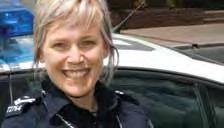


SC1C Courtney Jaensch
Major crash Investigation
yes. While I believe that the money could be spent on providing other means of support and resources to sA Pol , I think any additional resource provided to patrol officers especially is positive.
How useful and time-saving they are may depend on the type of software and applications installed on the iPad.
Hopefully they result in time-saving and less double-up work, as a lot of back-at-base paperwork may be replaced by the iPad functions, allowing patrols to remain on the road and visible to the public.
Also, it is good to see sA Pol keeping up with trends in modern technology.
Constable Ben Netherclift
transit services Branch
ye s I do. We’re often riding public transport or conducting foot patrols at interchanges and railway stations. so the ability to have ancillary reports and other information at our fingertips will enable police to be far more thorough with bona fides. And being able to view offender photographs at the time will be invaluable.
compliance with 74D, accessing public transport timetables, photographing evidence in situ, using mapping applications and having up-to-date weather information are just a few of the other benefits iPads could bring about.
like all things, there are always going to be a few cons but I think in this instance they will be vastly outweighed by the pros.
Detective Acting Snr Sgt Shaun O’Rielley
Holden Hill cIB
t h e introduction of iPads for general patrols and detectives will ensure we are able to retrieve information in a much more timely manner.
Having to be reliant on c omms during a busy period can cause delays in receiving vital information.
s ociety has an expectation that s A P o l is an organization that is current and professional. We need to be able to respond to the community in a manner that demonstrates our technological ability to stay current.
to be able to perform functions in the field that normally required either returning to an office or someone else doing it for us, would see an increase in our productivity by being able to resolve issues at that instant.
Letters
Grateful for condolences
Many present and retired police officers attended my husband retired assistant commissioner Bruce gamble’s funeral on n ovember 1. t hey included course 25 members and those he had worked with over the years.
I am sorry I didn’t get to speak to all of them personally but things were pretty overwhelming. Bruce retired in 1993, after 38 years in the job. He was breeding Murray g r ey cattle and c l ydesdale horses on our small farm before and on retirement. He also spent 12 years on Mt Barker
council until a heart attack in 2011. some of the mates he made in the job go back to the days at stirling and Marree 50-odd years, so I thank all for their attendance, cards and phone calls. t hey were all very much appreciated. Anne Gamble and Family
From top: sc1c courtney Jaensch, c onstable Ben netherclift, Detective Acting snr sgt shaun o’Rielley

industriaL
Nick Damiani
Dire need for modern IT
POLiCE
work demands up-to-the-minute technological support but sAPol computer systems seem not to be cutting it.
t h e s A P o l 2 012-13 annual report, tabled in parliament last october, highlighted that still in use were 41 so-called legacy computer applications, some up to 30 years old.
“ t hese transactional systems are called ‘legacy’ due to their use of long superseded technologies,” the report read.
t he report also noted that the systems were at growing risk of failure and struggling to support expanding databases.
Police Association president Mark carroll said last month that the systems impeded police in their work.
“the systems are technically limited, lack integration and waste time,” he said.
change, however, is on the horizon.
sA Po l has invested in a commercial software package, known as the niche Record Management s y stem, for the management of operational police records.
stage 1 of the new system – relating to custody management – has been launched and will be incrementally rolled out to all metropolitan lsA cell complexes by christmas 2013.
It will support the enforcement of the serious and organised crime (control) Act by June 2014.
t h e second stage – to replace the legacy computer systems – will cost between $30 million and $40 million.
this stage will provide modern computer systems which will allow information associated with individuals to be entered once, collated, retrieved and analysed more effectively than does the current non-integrated legacy computer systems.
Funding for the second stage has not yet been provided.
Mr c a rroll highlighted specific examples of how the legacy applications frustrate police and keep them off the road for unreasonably long periods.
“ t he arrest of an individual highlights a common example
of the drawbacks of the old legacy applications,” he said.
“An individual’s details are taken down by the police officer at the scene. t he arrested individual is then taken to the charge counter at police cells where another raft of personal details are repeated in numerous applications across the process of charging, holding and bailing of an individual as well as during the collection of fingerprints and D n A
“In routine police matters, like DUI and reckless driving, the legacy applications require many different points of data entry in different applications.
“these can include recording the arrest, impounding the vehicle, storing a record of the police interview, recording the storage of the vehicle, lodging a blood sample to support a DUI charge, recording a defect and licence checks.
“the legacy applications do not generally duplicate information into other systems so input and retrieval is a time-consuming process.”
“ t h e legacy applications do not generally duplicate information into other systems so input and retrieval is a timeconsuming process.
“ t h ey are also outdated
systems that don’t adequately alert for keystroke and other minor clerical errors, making the process even more onerous down the line, and keeping officers off the beat for longer.”
Mr c a rroll said the provision of information technology was a challenge for all governments.
“that’s why it makes no sense for state governments and police forces to act in isolation,” he said.
“Far too many taxpayer dollars are wasted every year by state forces doing their own thing.
“Whoever forms the next state government needs to take a lead role nationally in seeking federal government investment in computer systems and databases that make states borderless when it comes to the fight against criminal activity.
“ t he next generation of I t systems needs to be able to interface with national databases so that, Australia-wide, police will have access to the same real-time data – which might well save a life.”
t he issue of better crime-fighting technology for cops was raised by Premier Jay Weatherill at the Police Association annual conference in october.
He announced that sAPol would issue 350 tablet computers to officers in the Elizabeth lsA as part of a $1.7 million trial to enable officers to capture, retrieve and submit information on location, instead of returning to the station.
Police c o mmissioner g a ry Burns told the conference he supported the trial and hoped it would be a success.
“ t he way I see it eventually going, is when you graduate from the academy you are given an iPad and/or a mobile phone for both business and personal use,” he said.
“ t his could even eliminate the need for desktop computers and hard-line (phones) in many cases. the aim is to do on the (mobile) tablet what you would normally do on the desktop (in the station).”
MANDATORy SENTENCiNG
t h e Police Association continues to support Family First M lc R obert Brokenshire’s minimum mandatory sentencing bill, introduced to parliament last september.
the bill proposes four years’ mandatory minimum sentencing for attempted murder of a police officer, one year for intentionally causing serious harm, and six months for recklessly causing serious harm.
Mr Brokenshire, speaking at the 2013 Police Association conference, expressed concern at what he deemed a “cultural change” in modern attitudes toward assaults on both police and civilians.
“let’s send a message that the parliament and the state will not tolerate increases in assaults on police.”
Association president Mark c a rroll said the community probably underestimates the level of violence that officers confront – every day.
“I'm sure they would also regard assaults on police as totally unacceptable,” he said.
“Police are the only people that have no choice in going into (dangerous) situations. We need to remember that as legislators. Police deserve ultimate protection.”
“I’ve been on police patrols (as an onlooker) on several occasions and have seen young people totally dismissive of the police uniform,” he said.
“Police are the only people that have no choice in going into (dangerous) situations. We need to remember that as legislators. Police deserve ultimate protection.
“If we can’t send a message to the community that you don’t go around assaulting police officers, how are we going to turn around the general attitude (of society) toward assaults?
“I think it has to start with police.”
Mr Brokenshire said there was an immediate decrease in assaults on police after similar laws were introduced in Western Australia.
He also explained that s o uth Australia had a precedent on mandatory minimum sentencing.
“We (already) have minimum mandatory sentencing with murder and drink-driving,” he said.
Police Associ At ion patrol bag
Black, multi-compartmental, semi-rigid bag designed specifically for patrol work. Fits in patrol car’s rear footwell or can be strapped around front passenger seat. 52cm x 24cm x 26cm
“And those assaults can range from a push or shove by a nightclub drunk to the fatal shooting of an officer intervening in domestic violence.
“As a community, we need to understand how dangerous and how confronting this part of the job is for police and support them accordingly.”
Mr carroll said the association had worked closely with Mr Brokenshire over the past several years to develop the bill.
“We are also currently in discussions with the government in relation to their support or otherwise of the bill,” he said.
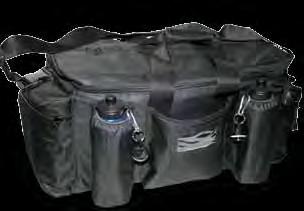
To purchase a bag, call Shelley at the Police Association on 8212 3055 $65

Dr Rod Pearce
Disease a risk on OS holidays
Even polio still presents a threat in some parts of the world
iT’Sgreat to spend your annual leave in an exotic overseas location and recuperate from the rigours of police work. But, when travelling abroad, you do need to guard against infection, particularly of the bowel.
It comes from contaminated food or drinks, is common, and results in diarrhoea. t he usual source of the contamination is human faeces which has polluted the water supply.
If not vaccinated against hepatitis A, young Australian travellers might end up with the disease, which will give them a week of vomiting and terrible diarrhoea. For lifetime protection you need two vaccinations around six months apart. typhoid is another diarrhoea illness contracted in a similar way (contaminated food or drinks). Vaccinations for this disease are only good for three years so regular travellers need to update. other infections are best avoided by good hygiene. And remember that infections get into your gut by mouth (saliva) and from your hands and food or drink. so be careful who you kiss, wash your hands, and take food or drink which is clean – not contaminated by infected water.
local water is unsafe to drink in most of south East Asia. When visiting there, drink bottled water. And understand that local restaurants, food vendors and street hawkers will be using tap water. Do not use tap water to clean your teeth or wash your food. Do not open your mouth in the shower or a pool. Avoid eating pre-prepared fruit or salad, drinking pre-opened beverages, and ice cubes in your drinks.
Use hand-sanitizers before eating or drinking and after using toilets or handling goods (including money) in markets and shops, and shaking hands.
Use a straw. Avoid applying your mouth to bottles and cans. check the seal on your water-bottle.
s t udies have shown the cause of “watery” diarrhoea to be bacteria such as E. coli, campylobacter, salmonella and shigella. the condition is treated with rehydration and, if persistent, an antibiotic.
c holera is rare, life-threatening and occurs in outbreaks. t h e relevant vaccination is not much more than 50 per cent effective, so hygiene is always necessary. typhoid vaccinations do not guarantee protection either, but they are better than cholera (80 per cent effective).
Hepatitis A effectiveness can be measured with blood tests and, once you have measurable protective levels – either through getting hepatitis or effective vaccination – you at least know you are protected.
Any Australian travelling overseas should make sure his or her routine vaccinations are up to date. We hope to eradicate polio from the world but, because of poor uptake of the vaccinations in some countries, it remains a risk.
Measles still comes to Australia (Adelaide, november 2013) so you need your protection here and overseas because of sporadic outbreaks.
in 2014. It provides wider coverage than the present three-in-one and will protect Australians travelling to other countries where different flu strains abound. HIV and Hep c are serious diseases which vaccines do not cover. Malaria also needs to be taken into account in respect of travel but there are hopes of the Bill and Melinda gates Foundation coming up with vaccines for these three conditions soon.
s pe cialized vaccinations include Japanese encephalitis, Q fever, yellow fever, rabies, tick-borne encephalitis, and tuberculosis. Because the vaccinations vary in their effectiveness, the risk of catching the infections depends on where, how and for how long you travel. It is best to consult your doctor.
sometimes a vaccination is more about moving between certain countries and the risk of passing on a disease rather than your personal risk of severe illness (yellow fever) or death.
Most travellers’ infections are not fatal … they are also, in most circumstances, avoidable.
Influenza vaccines are updated in Australia every 12 months but they are different for the northern hemisphere winter. new influenza vaccines are made every six months to take into account the influenza seasons in each hemisphere and the changing virus.
We do not yet have a flu vaccine that does not need to be updated every season, but we could have a fourin-one (quadrivalent) influenza vaccine in Australia
An estimated 22 million cases of typhoid fever occur each year and cause an estimated 200,000 deaths.
Humans are the only source of these bacteria. n o animal or environmental reservoirs have been identified, and this confirms that food and water contaminated with human faeces is reasonably common. Most travellers’ infections are not fatal but they are unpleasant, upsetting, and inconvenient. t hey are also, in most circumstances, avoidable. getting vaccinations up to date lowers the risk of contracting serious diseases. Updating vaccines for typhoid and influenza must happen frequently, but the best way to stay disease-free during holidays is to take care with food and water, where you go and what you do.

motorinG
Jim Barnett
The ultimate in flexibility
More interior space, seating for up to seven people, and an enormous cargo area
ChOiCE
abounds in the people-mover market: multi-seat vans, 4x4s, large and medium sUVs and an increasing number of compact wagons. t he new k ia Rondo, itself a compact wagon, offers more than just seven seats.
DESiGN
Rondo’s cab-forward design pushes the windscreen forward, creating a shorter bonnet and more interior space. Up to seven people can sit in three rows of individual seats. t hi s configuration offers the ultimate in flexibility.
second-row seats can recline, slide forward or fold flat with the cargo floor. two third-row seats, only suited to kids, drop flat into the cargo floor. cargo space ranges from generous to enormous.
VALuE FOR MONE y
t hree petrol models (si, sli and Platinum) are priced from $29,990 to $38,990. t h ese feature a 2.0-litre (122kW) petrol engine coupled with a six-speed automatic transmission.
two 1.7-litre (100kW) diesel models (si and sli spec) feature the same auto transmission and are priced at $32,490 and $36,490 respectively.
A multi-adjustable driver’s seat features, as does a reach- and rake-adjustable steering wheel with function buttons for audio, trip computer, cruise, phone and selectable powersteering assistance.

SAFET y
All Rondo models are equipped with:
• six airbags.
• Rear parking sensors.
• Reversing camera.
• Daytime lED running lamps.
• Antilock brakes.
• traction and stability control systems.
• Hill-start control.
Every seat has a three-point seatbelt and heightadjustable headrest.
ON ThE ROAD
t he 2.0-litre petrol engine produces sufficient power and torque for any task and works well with the smooth six-speed auto. At high revs the engine sounds a little harsh but generally goes about its business with little fuss.
transmission paddle shifters (fitted on sli and Platinum) are an overkill given that Rondo is likely to be a suburban family hack.
STATS
the diesel engine would be the pick given its impressive 320 nm of torque between 1,750rpm and 2,500rpm. It also produces fewer emissions and offers better fuel economy than petrol variants (6.4 litres/100km versus 7.9 litres/100km).
VERDiCT
Rondo is a smart-looking, wellequipped compact people-mover. It is good to drive, has greater flexibility than some and has the advantage of a five-year warranty.

Price premium justifiable?
undoubtedly an efficient performer with battery replacement cost covered
D E SPiTE
Australians’ slow take-up of hybrid vehicles Honda and to yota continue to release new models. And the new Honda compact Jazz Hybrid is now the cheapest petrol/electric car on offer.
DESiGN
Jazz Hybrid looks and drives in essentially the same way as the other eight Jazz models. It is a compact four-door hatch and has a bigger-than-expected interior owing to its short bonnet.
Honda claims its interior can swallow items like surfboards and mountain bikes with its multiadjustable seating arrangements. It is a functional small car with a smart dash layout and plenty of storage areas but it misses out on a lidded console bin.

VALuE FOR MONE y
standard equipment includes:
• climate-control air conditioning.
• cruise control.
• Reach- and rake-adjustable steering.
• A driver’s-seat height-adjuster.
• A multi-function display with a trip computer.
• Four-speaker audio system with Bluetooth and iPod connectivity.
• Auto engine stop/start.
t h is most expensive of the Jazz line-up sells for $22,990 trumping toyota’s Prius c by $1,000. But the tiny Prius lays claim to a bigger engine with better economy and fewer emissions.
SAFET y
Jazz Hybrid features:
• six airbags.
• Antilock brakes with brake assist.
• Five headrests.
• Five three-point seat belts.
• A security alarm.
• Vehicle stability and traction-control systems. t he compact 40-litre fuel tank sits under the front seats for additional rear seat space and safety.
ON ThE ROAD
Jazz Hybrid is a light, easy car to drive. It offers good performance in most situations although the petrol engine can be noisy in the higher rev range.
Driven sedately it can provide excellent economy and quiet operation. It is a functional car which offers good visibility, and it feels much bigger than its actual size. While it is no sports car, it delivers on ride and handling.
STATS
Jazz Hybrid features a 1.3-litre so Hc 65kW petrol engine mated to a small 10kW electric motor. Drive is to the front wheels through a cV t automatic transmission. Honda claims combined fuel economy of 4.5 litres/100km with emissions of 107g/km. A Police Journal test drive in the suburbs achieved a credible 4.9 litres/100km.
t h ose concerned about battery replacement cost can rest easy: it is covered by an eight-year unlimited-kilometre warranty.
VERDiCT
Jazz Hybrid is undoubtedly an efficient performer which offers fuel-saving technology. t he remaining question is whether the savings are enough to justify its price premium.
Platinum Advantage Members Bring along a friend or workmate who becomes a PCU member on the day and YOUR LUNCH IS ON US!
Pay Day Lunch Series 2014
Police Credit Union, The Police Association of South Australia and The Police Club invite you to a lunch with Rodney Fox
Famous shark attack survivor and film-maker
Join your workmates for an informal talk by a true South Australian legend as he tells his story from famous attack to his love of sharks today.
DETAILS YOU NEED TO KNOW
When: 12 – 1:30pm Wednesday 19 February 2014 What: Special $20 Burger & drink. Choice of beef or chicken burger, salad, chips and a soft drink*
Where: The Police Club – 27 Carrington St, Adelaide



Police Credit Union in excellent shape: 2013 annual report
Costa Anastasiou Chief Executive Officer, Police Credit Union
An edited version of the CEO’s speech to the Police Association annual conference
yOuR forefathers were the visionary pioneers who founded our successful organization some 43 years ago, armed with little more than a shoebox in hand, a ledger book and a fierce determination to seek social progress through an enhanced and specialized financial services provider. today, your credit union boasts a customer base in the order of 43,000, combined assets of over $850 million and shareholders’ reserves in excess of $56 million. your credit union remains in excellent shape. t he results for the period of review reflect a solid and balanced year of performance, with successes across all measures of business strategy.
ThE FiNANCiAL ENViRONMENT
Economic conditions throughout the period of review were difficult and are characterized as persistently uncertain and fragile. global markets gained some renewed traction, displaying improved stability and cautious optimism.
A less volatile Europe and a bolstered Us economy appear to have stimulated confidence back into equity markets, reflecting an improved medium-term business earnings outlook.
European sovereign debt issues are being better managed and austerity measures appear to be achieving the necessary fiscal containment. Asian markets have shown continuing resilience and stability with improving growth prospects, underpinned in part by a rising middle-class. on the domestic front, we continue to experience persistent low levels of consumer and business sentiment, moderate growth, subdued credit markets, stable but weaker employment conditions and relatively low inflation.
given the underlying subdued credit conditions, and coupled with a cautious consumer, the RBA “stimulatory” rate cuts were largely pocketed by consumers in the form of increased savings or debt reduction rather than increased spending.
In addition, the calling of a federal election in February 2013 resulted in an extended hiatus of business investment decisions and activity. these factors, in an already cautious environment, served to exacerbate already difficult operating conditions.
ThE REGuLATORy ENViRONMENT
your credit union is regulated in the same way as publicly listed and mutual banks because we are all authorized deposit-taking institutions (ADIs). t his means that, like all Australian banks, we meet the same strict, legally-enforceable standards under the BankingAct and are subject to strict oversight by the Australian Prudential Regulation Authority (APRA).
APRA’s strict rules on safety and capital apply to all ADIs to the same high standards. t his also means that your deposits are backed by the Australian government under the permanent government guarantee scheme for deposits up to $250,000.
Ou R VALu E S , STRATEGy AND F u T u R E DEVELOPMENT
We remain steadfast in our commitment to an enduring set of core values, incorporating superior service, honesty, integrity and financial prudence; and we remain passionate in delivering on our core purpose statement to improve our members’ lives by providing outstanding value and service that enables them to achieve their financial aspirations. the achievement of sustainable, innovative growth
remains at the forefront of our planning direction to ensure that we achieve the scale of business required to mitigate the impact of declining interest margins, and a scope of business that ensures continued relevance and connection to members.
o u r vision is to be the credit union that best understands and fulfils the financial aspirations of members and our people. In recognizing the strength of our brand, one of the strongest of any mutual in sA and nt, we are well positioned to leverage growth opportunities as we embark on our mission to be a market leader in providing innovative and competitive financial products and services to members.
t he 2013-16 planning period ahead is forecast as a period of moderately improving economic conditions, with expectations of a gradual restoration of a normalized operating environment.
strong capital buffers coupled with resilient and proven risk-management practices will remain in place and monitored with heightened awareness, to ensure that the impact of any future economic shocks continue to be managed effectively.
OuR PERFORMANCE FOR ThE PERiOD
Profit after tax for the year totalled $2.8 million, contributing a 5.4 per cent increase in shareholders’ equity to $56.3 million, and underpinning a record capital adequacy ratio of 15.69 per cent for the period to June 30, 2013. other performance highlights for the period under review include:
• total group assets increased by 4.5 per cent to $702 million.
• Increase in loan advances by 5.7 per cent to $593 million.
• Increase in total deposits by 4.5 per cent to $621 million.


Free Legal Service for Police Association Members, Their Families & Retired Members.
Leading Adelaide law firm, Tindall Gask Bentley is the preferred legal service provider of the Police Association, offering 30 minutes of free initial advice and a 10% fee discount
To arrange a preliminary in-person or phone appointment contact PASA on (08) 8212 3055.


Have you or a family member been injured in a car accident?
Tindall Gask Bentley acts in more motor vehicle accident claims that any other law firm in SA. Gary Allison & Richard Yates can provide free preliminary legal advice on your entitlements to compensation. They can also help with Workers Compensation, public liability & medical negligence claims.
Family Law
Matrimonial, De Facto & Same Sex Relationships
• Children’s Issues
• Child Support matters
• Property Settlements
• “Pre Nuptial” style Agreements
Appointments with Wendy Barry (Accredited Family Law Specialist) & Dina Paspaliaris.
Commercial Law
• General business advice
• Real estate & property advice
• Business transactions
• Commercial disputes & dispute resolution
Appointments with Giles Kahl & Michael Arras.
Wills & Estates
• Wills & Testamentary Trusts
• Enduring Powers of Attorney
• Enduring Guardians
• Advice to executors of deceased estates
• Obtaining Grants of Probate
• Estate disputes
Appointments with Michael Arras & Rosemary Caruso.


The fifty-fifty property settlement a myth
Jane Miller Partner, Tindall Gask Bentley Lawyers
Equality does not necessarily result in equity to the parties in a divorce
Wh E N considering how to calculate a property settlement after divorce, the assumption that a fifty-fifty split is fair is an urban myth.
People facing a property settlement at the end of a marriage or de facto relationship often assume that it is fair that each party to the relationship receive 50 per cent of the assets, debts and superannuation.
In fact, people facing divorce sometimes enter into negotiations with their ex relying upon this assumption or, worse still, might even lock themselves into a property settlement for a fifty-fifty split without ever discovering their true entitlements.
the Family law Act sets out the legal framework for calculating a divorce settlement. However, nowhere in the act is there a presumption of a 50 per cent split to each party of the relationship.
What’s more, the Family c o urt has routinely acknowledged in its judgments that equality does not necessarily result in equity to the parties. In other words, an equal division of the matrimonial assets is not necessarily fair. so the assumption that a fifty-fifty split is fair is in fact an urban myth.
calculating a divorce settlement under the Family law Act is far more intricate than most people would realize. It involves a detailed consideration of the relevant law, as well as the precedents which have been set by the Family court over almost 40 years.
A lawyer who specializes in family law must stay up to date with how the court calculates divorce settlements.
First, the assets and the debts of the relationship must be correctly identified and valued. t h is can be complex if there are businesses involved, self-managed superannuation funds, family trusts or deceit or non-disclosure by one party.
However, for most people, undertaking the calculation using these four steps will result in one person receiving more of the assets than the other.
second, consideration must be given to the contributions made by each party to achieve and maintain those assets. For example, did one party own more assets at the start of the relationship than the other, or receive lump sums during the relationship such as inheritances or personal injury payouts?
As the Family c ourt said in the case of Ferraro in 1993: “t he court must evaluate the contributions in each individual case … against an evolving social and legislative background.”
t hird, the calculation must take into account the future needs of each person. t hings like earning capacities, primary care of the children, and health considerations will impact on the calculation.
For example, as the court said in its 1995 judgment in clauson: “… it has long been recognized that, in most cases, the most valuable ‘asset’ which a party can take out of the marriage is a substantial, reliable income earning capacity.”
calculating a divorce settlement under the Family law Act is far more intricate than most people would realize.
Finally, under the act, the calculation must arrive at a point which is “just and equitable” in all of the circumstances. In other words, the final division of the assets must be fair to both parties taking into account the first three considerations.
A comprehensive examination of these factors might result in a settlement of fifty-fifty as per the urban myth. However, for most people, undertaking the calculation using these four steps will result in one person receiving more of the assets than the other. For these people, fifty-fifty is not fair. to u nderstand how these four steps apply in your own divorce settlement calculation, and to make sure you don’t settle for less than what is fair, it is important to get good advice as early as possible. Before starting to negotiate with your ex, make the investment of speaking to a family law expert about your situation. Armed with the right advice about the strengths and weaknesses of your case, you can then negotiate with your ex with confidence that the outcome will be fair.
t indall gask Bentley l awyers provides free initial advice through a legal advisory service to Police Association members and their families, and retired members. to make an appointment, members should contact the association (8212 3055 ).
Unholy Trinity
Authors Denis Ryan and Peter Hoysted
Publisher Allen & Unwin RRP $29.99
Detective Denis Ryan tried desperately to bring a paedophile priest to justice but was blocked by not only the c a tholic c h urch but also the Victoria Police.
Monsignor John Day, arguably Australia’s most prolific paedophile, died in 1978. His victims were counted in the hundreds. t he church knew of his criminal activity.
Day’s offences were committed with the knowledge and protection of a senior member of the Victoria Police and Mildura’s clerk of the courts. these three men were the “unholy trinity”.
t he influence of the church, both in the Victoria Police and the office of public prosecutions, was strong. But Ryan was a respected cop and, one by one, Day’s victims began to confide in him.
With a dozen or more signed statements, Ryan soon had sufficient evidence to lay charges. only then did his nightmare begin.
The Curiosity
Author stephen k iernan
Publisher Hodder & stoughton
RRP $29.99
A haunting love story, a scientific marvel brought to life, and a searing social commentary of today’s America.
Maverick scientific genius Erastus carthage has developed a technique to bring frozen simple-celled animals back to life. And when his Arctic research vessel discovers a body encased in an iceberg, he seizes the chance to apply his pioneering process to a human being.
t he man car thage’s lab awakens from death is Jeremiah Rice, a Massachusetts judge, who was born in 1868 and fell overboard in 1906.
Jeremiah is an instant celebrity –chased by paparazzi, vilified by the religious right, and overwhelmed by a society he sees as brilliant and diverse but also vulgar and violent.
As his only ally, biologist kate Philo attempts to protect him from financial and political exploitation, and the two fall in love. Meanwhile, Jeremiah’s time on Earth is slipping away.
Doctor Sleep
Author stephen k ing
Publisher H&s Fiction RRP $32.99
stephen k ing returns to the characters and territory of the shining What happened to Danny torrance after his terrible experience in the o verlook Hotel? Doctor sleep picks up the story of the now middle-aged Dan, working at a hospice in n e w Hampshire, and the special 12-yearold girl he must save from t h e tr ue knot, a tribe of murderous paranormals.
It looks harmless but, as Dan knows, and tween Abra stone learns, t h e true k not is quasi-immortal, living off the “steam” which children with the “shining” produce when they are slowly tortured to death.
Haunted by the inhabitants of the o verlook Hotel, Dan has been drifting for decades. t hen he meets the evanescent Abra stone, and it is her spectacular gift, the brightest shining ever seen, that reignites Dan’s own demons.
Circle to Circle
Author shirley Hardy-Rix and Brian Rix
Publisher High Horse Books RRP $32.95
After now former Police Association (Victoria) president Brian Rix retired, he put his journalist wife, shirley, on the back of his motorcycle and headed off for a ride.
For the next 16 months the pair rode more than 83,000kms through 32 countries on five continents, with side trips to Antarctica and the galapagos Islands.
t hey rode from the bottom of south America to the very top of north America, and over the Andes, sometimes more than 5,000 metres high.
Brian and s h irley also rode through deserts, the tropics and up to Alaska. t h ey had a catastrophic breakdown in the heart of bear country and suffered altitude sickness.
t h e motorcycle never made it to Antarctica but they did – and they went from the Antarctic c i rcle to the Arctic circle… and then a bit more.
Heist
Author Robert schofield
Publisher Allen & Unwin RRP $29.99
kalgoorlie gold and murderous bikers are just the beginning for gareth Ford. left for dead in the desert, framed as the inside man in a bullion robbery at the remote mine site where he works, and fearing that his daughter and exwife have been abducted from their Perth home, Ford must cross 1,000 miles of wilderness to find his family.
He forms a fragile alliance with Doc and Banjo, a pair of fugitive bikers, and kavanagh, a cop from the gold stealing Detection Unit who’s found herself shut out of the case.
As this unlikely team sets out across the outback, it is pursued by cops, mercenaries and bikers, each group with its own agenda of preventing Ford from reaching Perth and uncovering a conspiracy that spreads through the upper strata of Western Australian life.
A Darkness Descending
Author christobel kent
Publisher Atlantic RRP $29.99
t he dark heart of modern Italy…
When niccolò Rosselli, the driven, charismatic leader of a Florentine political movement, collapses at a rally, his young party immediately comes under threat.
And when it emerges that his longtime partner, Flavia, has disappeared, leaving behind not only a devastated husband but their newborn son, the political becomes dangerously personal – and sandro cellini is drafted in to investigate.
t h e trail leads to a tired seaside town and a modest hotel, where Flavia chose to end her life. But ce llini isn’t satisfied. Why would one so young and with so much to live for, walk away from all she loves?
As he digs into Flavia’s secret world, s andro uncovers the hidden life of a woman consumed with private passions and a deadly, dark obsession.
Win a booK! For your chance to win one of these books, send your name, location, phone number and despatch code, along with the book of your choice to competitions@pj.asn.au

MEMBERSHIP INCLUDES
* Invitations to two Winestate magazine tastings each year (valued at $100)
* 12-month subscription to Winestate magazine (valued at $60)
* Minimum of three tasting events at the Police Club each year
* Free glass of house wine with every meal purchased at the Police Club
* Entry to annual wine raffle
* Discounts on quality wine
To join visit www.pasa.asn.au and click on the Police Wine Club banner or call the Police Association on (08) 8212 3055

Serangoon Road
SRP $39.95 4 discs
Running time 534 mins
serangoonRoad is a fast-paced detective drama series set against the exotic, tumultuous backdrop of 1960s singapore.
t he series tells the story of Australianborn sam callaghan (Don Hany), whose childhood was spent in WWII’s Japanese internment camps and who returned to fight in the Malayan Emergency. He is a man deeply scarred by both these experiences.
When his neighbour Patricia (Joan chen) asks him to help keep her recentlymurdered husband’s private detective agency afloat, s a m is enticed into an unpredictable, dangerous world full of chinese secret society gangs and political power play.



Miss Fisher’s Murder Mysteries Series 2
SRP $29.95 4 discs
Running time 316 mins
t h e second series of Miss Fisher’s Murder Mysteries builds on the meticulously constructed world of series one as it follows the independent, glamorous and unflappable leading lady detective Phryne Fisher (Essie Davis).
t h is lush take on the traditional crime drama explores the fascinating and varied subcultures of 1920s, between-the-wars Melbourne.
From the shadowy lanes of the city to the halls of academia, from high-class brothels to the world of haute couture, Phryne defends the innocent and juggles admirers with her usual panache, all the while keeping up her delicious dance around Detective Jack Robinson.
New Tricks Series 1-10
Box set
SRP $199.95 26 discs
Running time 4,720 mins
After a hostage rescue goes wrong, superintendent sandra Pullman is put in charge of unsolved crimes. With little resources and no back-up she decides to recruit three ex-policemen.
However, times have changed, unlike her new recruits. Jack Halford is yet to get over the loss of his wife, Brian lane is over-obsessed and overmedicated, and gerry standing is not quite the ladies’ man he used to be. they might have the experience but it’s not like the old days. not only are they chasing criminals, but they are having to deal with a new police force which does not always appreciate their old-style policing.
Redfern Now Series 2
SRP $27.95 2 discs
Running time 338 mins
n e stled in the heart of Australia's most glamorous city is Australia's most infamous suburb. It's an urban slum, Aboriginal icon, centre of black struggle and pride – or real estate goldmine, depending on your point of view.
Redfern now challenges you to think again. A kaleidoscopic drama that explores this inner-city suburb and the people who inhabit it. o ver six episodes, Redfern now: series 2 continues to explore the impact of extraordinary events in ordinary lives. t he first drama series written, directed and produced by indigenous Australians, Redfern now has been both critically and commercially acclaimed.
Win a DVD! For your chance to win one of these DVDs, send your name, location, phone number and despatch code, along with your choice of DVD, to competitions@pj.asn.au



Heartbeat Series 13
SRP $39.95 7 discs
Running time 1,200 mins
t his series brings about the marriage of sgt Merton and pharmacist Jenny latimer, with Pc steve crane tackling a wide range of cases while putting his role as community liaison officer into practice.
Pc Bellamy plays the waiting game with gina, Vernon comes to terms with life with and without his fortune, and the series reaches a dramatic climax when a bitter custody battle ends in tragedy.
American Hustle
Season commences December 12
A fictional film set in the alluring world of one of the most stunning scandals to rock the Us, American Hustle tells the story of brilliant con man Irving Rosenfeld (christian Bale) who, along with his equally cunning and seductive British partner sydney Prosser (Amy Adams), is forced to work for a wild FBI agent Richie DiMaso (Bradley cooper).
DiMaso pushes them into a world of Jersey powerbrokers and mafia which is as dangerous as it is enchanting.
Jeremy Renner is carmine Polito, the passionate, volatile, n ew Jersey political operator caught between the con-artists and Feds.
Irving’s unpredictable wife Rosalyn (Jennifer lawrence) could be the one to pull the thread that brings the entire world crashing down.
l i ke David o Russell’s previous films, American Hustle defies genre, hinging on raw emotion, and life-anddeath stakes.
The Book Thief
Season commences January 9
Based on the beloved international bestselling book, the Book thief tells the story of l iesel (s ophie n e lisse, Monsieur lazhar), an extraordinary and courageous young girl sent to live with foster parents (Academy Award winner ge offrey Rush and Academy Award nominee Emily Watson) in World War II germany.
s h e learns to read with encouragement from her new family and Max (Ben s c hnetzer), a Jewish refugee who they are hiding under the stairs.
For l i esel and Max, the power of words and imagination becomes the only escape from the tumultuous events happening around them. the Book thief is a life-affirming story of survival and of the resilience of the human spirit.
The Wolf of Wall Street Season commences January 23
Martin s c orsese re-teams with l e onardo Di c a prio in the Wolf of Wall street, an adaptation of Jordan Belfort’s memoir.
Belfort (Dicaprio) is a long Island penny stockbroker who served 20 months in prison for refusing to cooperate in a massive 1990s securities fraud case that involved widespread corruption on Wall street and in the corporate banking world, including mob infiltration.
other the Wolf of Wall street stars include Matthew Mcconaughey, Jonah Hill, Jon Favreau and Jean Dujardin.
Win a moV ie pass! For your chance to win an inseason pass to one of these films, courtesy of Palace Nova Eastend Cinemas, send your name, location, phone number and despatch code, along with your choice of film, to competitions@pj.asn.au
• Increase in loans funded to $149 million, comprising $126 million in home loans and $23 million in personal loans and credit cards (some 65 per cent of these loans are provided to police).
• Record customer satisfaction rating of 92.5 per cent (well above the 78.9 per cent average of the major banks).
• Reducing our carbon footprint by 7.4 per cent.
• Member value increased to a record high $268 per member, an increase of 27 per cent.
• staff satisfaction or engagement rating at a new record high of 89.66 per cent.
key to the future success of Police credit Union is our capacity to sustain and deliver excellence in our customer service proposition. t he importance of this customer service based approach cannot be underestimated in the context of succeeding in an intensely competitive market.
several key projects were implemented, including a new digital platform, efficiency upgrades to our internal banking systems and further strategic innovation-based projects are scheduled for the coming year, including a mobile banking smart app.
We have continued to improve our systems, platforms, processes and infrastructure on numerous fronts, including the ongoing branch renovation programme, all of which will improve engagement with our members.
During the period we successfully negotiated a new arrangement with Allianz Insurance, ensuring that our members are able to continue to have access to quality and competitively priced insurance products to protect their assets well into the future.
yo ur credit union is well equipped to withstand economic uncertainty based on the high level of importance we place on maintaining strong risk and compliance frameworks. our holistic management of risk and implementation of best-practice risk-management systems continues to drive strength, stability and, most importantly, security of depositors’ funds.
As part of our ongoing commitment to conducting ourselves as a socially responsible organization, we contributed over $0.322 million in community-based initiatives during the period – again exceeding our planned commitment.
Actively participating in the communities in which we operate, remains a critically important and nonnegotiable strategic goal. We continue to sponsor many worthwhile programmes in policing, nursing and the wider community and, in particular, the vast majority of this community investment is directly linked to the broader police family, including the Police Association of sA
t he achievements and successes presented in the 2013 annual report are a result of the combined and collective efforts of our wonderful people. I am indeed
privileged to have a team with such enormous and diverse talent.
t he fabric that underpins our success is not just about our strong work ethic, our diligence, our passion for success, our commitment to outstanding customer service, our loyalty, integrity, honesty and professionalism. It is indeed about the way we treat each other - with compassion, care and mutual respect.
t h ese endearing qualities, coupled with our successes and achievements, define the great organization we are today and reflect the values that Police credit Union stands for, both now and for the future.
on behalf of the board, management team and all staff, I thank you, our members, friends and partners for your ongoing support, trust and confidence that you place in us every day.
t hank you also for your ambassadorship and testimony which enables our business to continue to grow, serve and prosper and, in doing so, continue to propagate the fine legacy created 43 years ago by your forefathers.
We promise you that, in 2014 and beyond, we are committed to remaining member-focused in our engagement with you, the police family, to fulfil your financial goals and aspirations.


2011 Richard Hamilton Shiraz
McLaren Vale, SA RRP $19.95 www.leconfieldwines.com
t he Richard Hamilton s hir az is regularly recommended in Winestate magazine’s top 40 Best Buys section. t his wine is a classic Mc laren Vale shiraz of consistent quality far higher than its $19.95 price point.
t he shiraz vines are managed to produce low-yielding, intense fruit. this is a very stylish, mediumbodied s h iraz showing soft tannins, lovely sweet fruit and good length with hints of pepper and plum flavours. 94 points “James halliday Australian Wine Companion 2014”:
“strong, full colour, the cool vintage provided benefits to those who kept disease at bay; these spicy, dark berry aromas and flavours are normally restricted to cool regions. t hey work really well in the dark chocolate and blackberry fruit of this bargainbasement wine.”
2011 Leconfield
C oonawarra
Cabernet Sauvignon
McLaren Vale, SA RRP $33.50 www.leconfieldwines.com
l e confield’s flagship wine is a classic c oonawarra cabernet sauvignon – wines renowned for their depth of fruit flavour, complexity, elegance and extraordinary length in the cellaring performance. A consistent awardwinner, each new release is eagerly anticipated by its loyal fan base.
Paul Foster, The Wine Society: “Elegant and beautifully fruited, this is an exciting and aristocratic red that clearly declares ‘I’m cabernet, and coonawarra.’
“Plummy blackcurrant fruit drives a long, deep palate with an ease that is the secret of its drinkability, and though there’s plenty of tannin, and unmistakable oak, those tannins are ripe and fine and the wood is well integrated.
“It’s a bit-more-than-mid-weight wine of perfect balance that might well make a Bordeaux producer weep in wonder and envy. sydney Hamilton planted the le confield Vineyard in 1974 and it’s from these original vines that the fruit for this wine came.”


Syn Cuvée Blanc
McLaren Vale, SA RRP $17.50 www.leconfieldwines.com
sy n cu vée Blanc is the perfect drink for c hristmas parties and new year celebrations. A serious wine with a sense of humour, syn has a strong following in its own right.
t he wines represent the synergy between l ec onfield’s c o onawarra and Mc l aren Vale vineyards. Wines for the enjoyment of life. A great-looking and even better-tasting sparkling wine well below the price point at which you expect such a great wine to be placed.
Enjoy this wine as an aperitif or at any time of the day when a few bubbles will augment the joy of life. Money Magazine (May 2012):
“ t h is surprise packet from leconfield and Richard Hamilton shows what clever winemaking can do to transform grapes grown in places you wouldn’t normally associate with sparkling wine.
“It’s made from c h ardonnay and Pinot noir grown in Mc laren Vale and picked early. t h is nonvintage bubbly is clean, fresh and vibrant with intense yeasty characters, supple creamy texture and a soft lingering finish. Uncomplicated, easy-drinking and easy on the pocket.”









Selection *offer only available with this order form *prices inclusive of GST






• $5 TEDs
• $5 West End Draft pints • $5 Coronas

• $5 glasses of tomich hill Wines, including Sparkling, Sav Blanc & Shiraz
Purchase any product throughout the week to enter the meat tray raffle – drawn on Fridays at 7pm

The Last Shift
FR ANK ABBOTT (1)
STEVE hARDiNG (2)
MA x RuTSChACK (3)
PAuL GRE AThEAD (4)
AL AN E VANS
PE TER LuKOSiuS (5)
DARROL QuiNLAN (6)
ROD hARVE y (7)
SiMON hOLT (8)

SNR CONST 1C FRANK ABBOTT
intelligence Analysis
38 years’ service
Last day: 15.07.13
Comments…
“I thank all present and past association office-holders for their efforts and achievements in gaining the best pay and work conditions for members.”
“I also say thanks, farewell and good luck for the future to all my past colleagues with whom I have had the good fortune to work. I miss being one of you.”
SERGEANT STEVE hARDiNG
Mannum
38 years’ service
Last day: 26.07.13
Comments…
“I thank all those members, past and present, whom I met and worked with during my 38 years of service. t hey were fine people doing a wonderful job under difficult conditions.”
“It was indeed an honour to spend my working life in the job.”
BREVET SGT MA x RuTSChACK
Murray Bridge CiB
43 years’ service
Last day: 05.09.13
Comments…
“After 43 years of service it is well and truly time to enjoy the better things in life.”
SNR CONST ALAN EVANS
Salisbury
19 months’ service
Last day: 16.10.13
Comments…
“ t h ough my career with s A P o l has been brief I will return to the U k with fond memories of my time in s o uth Australia and I thank my colleagues for their support, encouragement and friendship.”
“I can only praise the professionalism of my colleagues at s alisbury, particularly the officers of team four, and wish them all the best with their future careers.”
SNR CONST 1C
PETER LuKOSiuS
City Watch house
45 years’ service
Last day: 16.10.13
Comments…
“After nearly 45-and-a-half years’ service, I take with me some great memories. I thank all the members I had the pleasure of working with.”



CONST
DARROL QuiNLAN
City Watch house
40 years’ service
Last day: 16.10.13
Comments…
“Best wishes to all my friends and colleagues (sA Pol and public servants) with whom I have had the pleasure of working over the last 41 years.”
“It has been a journey to remember, and thanks for the memories.”
BREVET SGT ROD hARVE y
Far North Criminal Justice
38 years’ service
Last day: 01.11.13
Comments…
“I leave with fond memories, having worked with and met some great people along the way.”
“ t h anks to my wife and family for their support throughout my career. Also thanks to everyone who supported my family during times of illness.”
“ t hanks to c ommissioner Burns for supporting my long-service-leave application.”
“ t h anks to the Police Association for its ongoing commitment to improve pay and conditions for all members.”
SNR CONST 1C SiMON hOLT
Sturt LSA
28 years’ service
Last day: 08.11.13
Comments…
“I have met many colleagues and friends and, although I will miss them, I will not say the same about the work and shifts.”
“ t h anks to the Police Association for its support in looking after our conditions and wages.”
“It’s time to spend time for myself and my family as life is short.”
Detective Chief Insp Paul Greathead
Commissioners Support Branch
44 years’ service
Last day: 11.10.13
Comments…
“What a journey! And how lucky I was to spend my career working with such professional, dedicated and committed men and women, both sworn and non-sworn.”
“Would I do it all again? of course I would, and in a heart-beat.”
“on June 21, 1972, along with fellow course members, including our current commissioner, gary Burns, I graduated from Fort largs.”
“For almost 24 years I had the privilege of working with many sworn and nonsworn men and women in the criminal Investigation Branch.”
“t his included nine years as a handson front-line metropolitan and country detective and 12 years as an officer-incharge (manager) of three metropolitan lsA cIBs.”
“I thank the past and present commissioners, deputy commissioners and all other members of the senior executive group for striving to ensure that s A P o l continues to meet the unknown challenges of the future.”
“I sincerely thank the past and present executive committee, delegates and staff of the Police Association for the most competent, professional, dedicated and committed assistance they have always provided me and my staff, as well as all members of s A P o l , over a long and sustained period.”
“I wish the association all the very best for the future in continuing to protect members’ interests, rights and benefits in our everchanging world of policing. the association should be rightfully proud of the results it has achieved for members over the years.”
Top left: greathead (far left) on graduation day in 1972 with course mates trevor Haskell, Ray Foster, gary Burns, Wayne t hompson and Bruce Faerhmann; Above: As a senior sergeant first class at sturt Police centre in 1990s; Left: greathead (far left) instructing on a training course at Fort l args in the 1980s.
Course 2/2013 Graduates’ Dinner
Fenwick Function Centre Friday, October 11, 2013

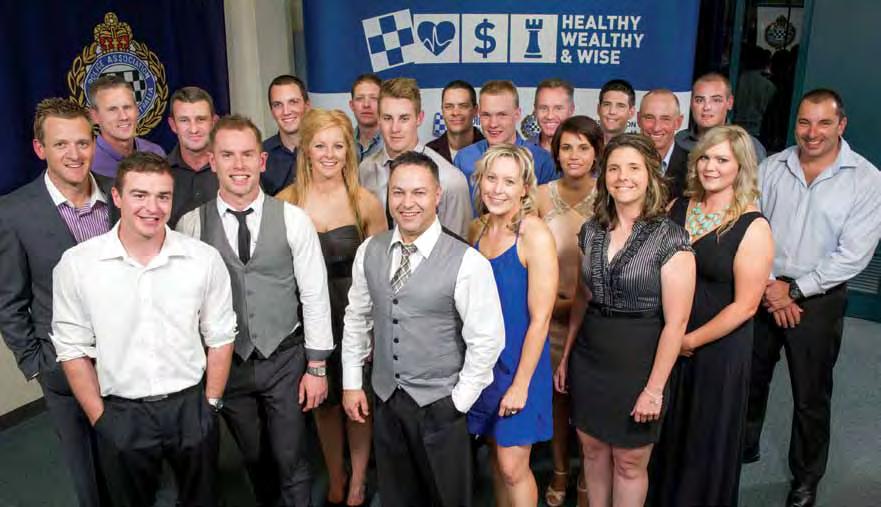
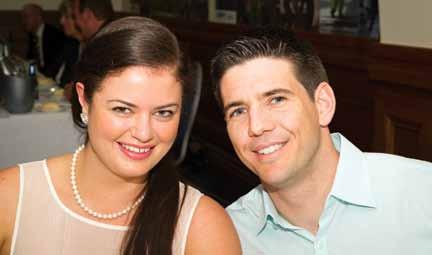
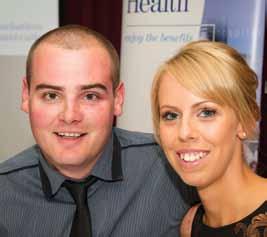
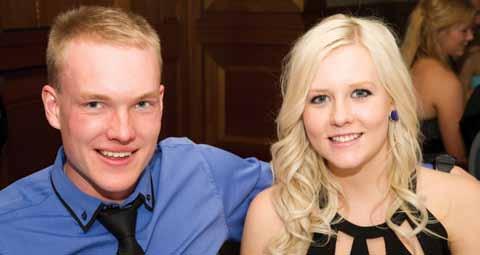
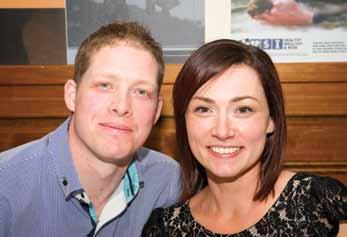
Heroes
GeorGe
Ga sioroWsK i Sergeant
Eastern Adelaide Traffic
Achievers in sport, art, business and medicine all make it onto his list, along with some he admires for their triumphs over adversity.
My late father, Feliks. He was a soldier in a Polish cavalry regiment during World War II and was caught by the Russians but escaped and went back into battle. one time he came under fire during a river-crossing. His horse was hit and he had to swim to shore. Despite all that history, he was very level headed, always cheerful and nothing upset him.
Former miners Brant Webb and Todd Russell. Just being trapped underground for nearly two weeks, as they were in that Beaconsfield gold mine, and surviving was such an amazing story. they never knew whether they would actually be found and rescued. the mental impact on them would have been incredible. It was such a great, never-give-up story.
Former Moto GP world champion Mick Doohan. He won five consecutive 500cc world championships, which was outstanding. I met him when I was a speedie working at the classic Adelaide rally. I was about to have a photo taken with him when his mobile rang. He answered it saying: “I’m busy. call me back in 10 minutes.” not just a champion but also a great bloke.

The late Fred hollows. I just admire how much impact his work had around the world, restoring people’s eyesight. And he certainly would have done it tough in those Eritrean communities. It was just incredible, and he will certainly be remembered for changing so many people’s lives. He was a saint, a lifesaver, and the Fred Hollows Foundation now continues the legacy.
The late Rodney Dangerfield. I love his comedy. He really made me laugh. He was the king of the one-liners and he had that strong new york accent, which made for great comedy in his movies and stand-up work. He also helped discover and inspire many comedians who are around today. one of them was Jim carrey, who paid tribute to Dangerfield when he died.

The late Cliff young. I couldn’t believe it when he won the inaugural sydney to Melbourne Ultra-marathon in 1983 at age 61. no one ever rated him at the beginning. He had that shuffle and, on tV, he looked like death on two legs. But he ended up winning by 10 hours. Even more amazing was that he gave his prize money away to the other runners.
Sir Richard Branson. I find his life achievements fascinating. He’s gone from selling mail-order records in his younger years to now setting up space tourism. He lives life to the fullest, both through is business ventures and his adventure activities. His autobiography is a great read and very inspiring. He’s only in his mid-60s and certainly getting value out of life.
Sir Anthony hopkins. He is just such a consummate professional, a brilliant actor in all of his movies. He plays his roles so well and with such realism that it’s easy to forget that he’s acting. I think his role as Hannibal lecter in silence of the lambs is still probably his best. He just makes it all so believable, and he’s got a string of awards.