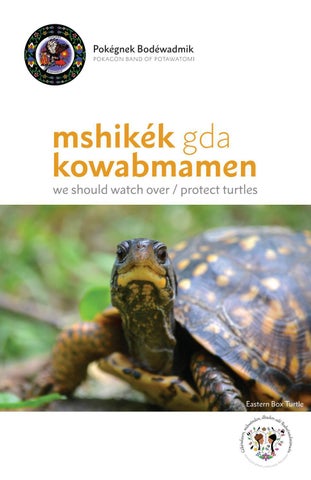
mshikék gda kowabmamen
we should watch over / protect turtles
Eastern Box Turtle
ka
go
ra
po
m
Gëkéndasen, mi k
mim éwad wën odw
bade den, d n odë B wén
nb
and
l a n g ua g
ep
ro
g
Turtle Shell Key
There are 13 full moons each year and the kenak (turtle shell) represents the 13-month calendar. Starting with ktthė mko gizes (big bear moon [bear pictured]) and spiraling around the shell ending with bbon gizes (winter moon [snowflake pictured]).
1
ktthė mko gizes
Big bear moon
late Dec–early Jan
2
mko gizes
Bear moon
late Jan–early Feb
3
nmébné gizes
Trout moon
late Feb–early Mar
4
zisbakwtoké gizes
Maple sugar moon
late Mar–early April
5
zagbëgon gizes
Leaves sprouting moon
late April–early May
6
e’démen gizes
Strawberry moon
late May–early June
7
aptë nib gizes
Half summer moon
late June–early July
8
minké gizes
Blueberry picking moon
late July–early Aug
9
wzawbogya gizes
Leaves turning moon
late Aug–early Sept
10 bnakwi gizes
Falling Leaves moon
late Sept–early Oct
11 mtegwagké gizes
Forest moon
late Oct–early Nov
12 giwsé gizes
Hunting moon
late Nov–early Dec
13 bbon gizes
Winter moon
late Dec–early Jan
bodéwadmi kedwenen
Potawatomi words kenak turtle shell
Shkezh / shkezhik claw / claws
bastéké s/he is sitting in the sun
kat / kadén leg / legs
Wzëwanêk tail
bastékéwêk they are sitting in the sun
Zet / zedén foot / feet
Pronunciation Guide é as in apple | ë as in umbrella | ė as in elephant | e as in igloo | ê as in book | a as in octopus | i as in eagle | th sounds like j | tth sounds like ch
zisbakwtoké gizes maple sugar moon
people are making sugar turtles have awoken and are eating/looking for mates
bbon gizes
people are telling their stories
winter moon
turtles are preparing to sleep/sleeping
Moon Cycle
e’démen gizes strawberry moon
bgesawé she is laying eggs bgesawéwêk they are laying eggs
minké gizes
blueberry picking moon
baby turtles are emerging people are picking berries
wzawbogya gizes leaves turning moon
giwsé gizes
hunting moon
turtles are getting ready for winter
people are deer hunting
Importance of Turtles Turtles are important animals for conservation, because they live a long time and are a good indicator of long-term environmental stability. Unfortunately many turtle populations are declining for multiple reasons, including over-harvest for food and medicine, predators that eat turtle eggs from their nests, habitat loss, and road mortality. Turtle populations take a long time to recover because they live so long and will only begin to recover after we stop the factors that caused them to decline.
azhowsé zhi myéwêk H/s is walking across the road. azhokné gda bgetthdabanawak gi mshikéyêk You guys should take the turtles to the other side of the road.
Turtles of the Great Lakes region
Mkenak
Mshiké
musk turtle
snapping turtle
Mskwakés painted turtle
Boskedo
eastern box turtle
Importance of Turtles
Mshiké, or the turtle, is a very important figure in our
culture. In the flood story the turtle sacrificed himself by allowing Nanabozho to place the dirt on his back to grow the land, plants and trees, thus creating “Turtle Island.” It is important we remember these things and pass them on to future generations to make sure that turtle gets the respect he deserves. As well as being an important clan, mshiké is also part of the water clan system. The responsibilities that the turtle clan hold are to mediate situations and to teach the young ones. They mediate by intervening in altercations to better resolve the situation. Their responsibility to the youth involves teaching how to care for the earth and how to hold yourself with respect.
This booklet prepared by
Pokagon Band Department of Natural Resources and Department of Language & Culture Contributors Artwork Kyle Malott, turtle island illustration Jen Marcussen Photos Jen Goellnitz [Eastern Box turtle on front cover CC BY-NC], Wes Hicks [night sky center spread background Unsplash], Bruce Hallman [Snapping turtle pg. 6 CC BY 2.0 USFWS], Greg Schechter [Eastern Painted turtle pg. 6 CC BY 2.0], Dakota L. [Musk turtle pg. 6 CC BY-SA 3.0], Jim Lynch, NPS [Eastern Box turtle pg. 6 CC BY-SA 2.0], Donna Yarbrough [Snapping turtle background pg. 6 Unsplash], Jen Goellnitz [Snapping turtle pg. 6 CC BY-NC 2.0] This booklet and plush turtle were partially funded by a United States Fish and Wildlife Service Tribal Wildlife Grant.