POINT UNIVERSITY: INNOVATING FOR THE FUTURE
Strategic Plan 2025-30
Point University’s five-year rolling strategic plan builds on more than 85 years of Christian higher education, recognizing the significant changes required in transitioning from a small Bible college to an innovative and accredited Christian university. Throughout the plan, the institutional mission, strategic priorities and values serve as the overarching guidelines, bringing clarity and focus to the University as it moves into a new era of innovation and impact.
The mission of Point University is the core driver of the strategic plan. The plan also leverages five pillar priorities, including: spiritual, intellectual, social, physical and professional development, with a foundation priority for finances that supports the completion of the initiatives within each pillar. Ultimately, the Point University mission outlines the purpose for the existence of the institution and the reason why we must accomplish these strategic initiatives. Each of our pillar priorities will be outlined in more detail in this document. Point will continue to innovate and evaluate strategic partnerships and the Elevate program to create a financially sustainable model and continue to have maximum impact on students and their communities.
To grow in faith in Jesus Christ, develop a Christian worldview, live by Christian virtues and serve others individually and as an institution.
To equip students to think analytically and critically, communicate effectively, and demonstrate competence in their studies.
To provide resources to support social development, including mental health services and extracurricular opportunities.
To support sound infrastructure (facilities, technology and human resources) to support the institutional mission.
To equip students with the practical knowledge and skills necessary to pursue a chosen vocation.
FINANCIAL FOUNDATION
Securing the financial resources essential to support the present and future mission and strategic plan for the University.
The mission of Point University is to educate students for Christ-centered service and leadership throughout the world.
ABOUT POINT UNIVERSITY
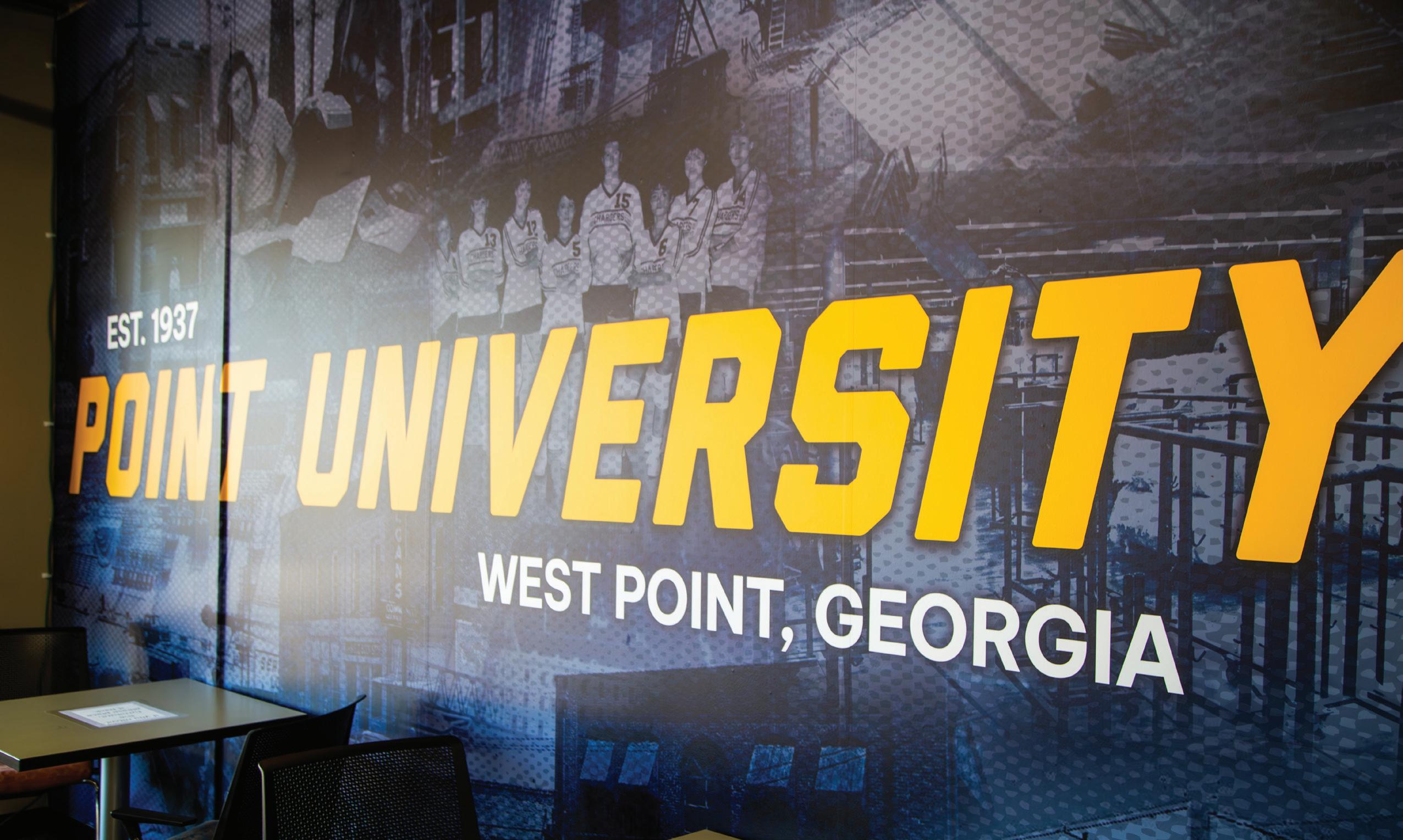
Founded in 1937, Point University is an accredited, nonprofit, Christian university based in West Point, Georgia. At Point, our Christian faith grounds our mission and informs how we operate. We are equipping the next generation to take their faith into the marketplace in new and culturally-relevant ways — erasing the lines between who they are and what they do. We want students to see their life and their mission as one and the same.
For more than 85 years, we have had a bold vision to make college a possibility for all types of learners. Founded as Atlanta Christian College, we have grown from an institution focused solely on training ministers and missionaries into a Christian liberal arts University that serves all types of students. Our Christian faith remains at the heart of the Point experience.
As we have grown, Point has also adapted, offering programs that prepare students for new and emerging careers. In 2012, we embraced a new name, Point University, and a new location in West Point, Georgia, to better serve a growing and diverse student body.
We are focused on creating educational opportunities for a variety of learners, with programs available in many formats, while helping students integrate their career goals with their faith.
SPIRITUAL
Our vision is that every student, regardless of their background or story, takes steps toward Jesus, develops Jesus-like character, and discovers the purpose for their life.
Ensure a vibrant student experience that enhances Point’s dedication to spiritual formation through the integration of the gospel, the fostering of community, academic excellence and personal development in order to equip students to lead and serve with integrity and purpose in a diverse, dynamic world.
a. Recognizing that our student population is diverse when it comes to their spiritual maturity, we will integrate spiritual formation into every aspect of student life.
b. Recognizing that our success as an institution is dependent on support and partnership between the University and the local church, stronger bridges will be built with churches in the Southeast and around the country, in collaboration with College of Biblical Studies and Ministry and Advancement Office.
c. Transformation happens in community. Community builds trust, and trust opens doors to faith conversations. Students will experience intentional, Christ-centered community through events at the Feast House, in Formation Groups, in affinity groups and in community-building activities across the campus.
d. Transformation happens in corporate worship. Students will take steps toward Jesus and discover their purpose through weekly, student-led worship experiences and monthly, community-wide chapel services.
e. Transformation happens through the reading of scripture. Students, through worship experiences, discipleship opportunities and retreats, will learn how to engage with Scripture in a way that is formative and relevant to their everyday lives.
f. Transformation happens when we pray. Students will be given guided prayers and opportunities for personal and corporate prayer.
g. Spiritual development will be measured through a spiritual formation survey that is disseminated before and after each academic year.
By year five:
a. 50% of residential student population is attending at least one key spiritual formation event (Tuesday night community-building or Sunday night worship experience).
b. 50% of residential student population is attending key community-building events on campus.
c. 50% of residential students are participating in Formation Groups.
d. Average of 100 students are attending fall and spring retreats.
e. Average of 60 students are participating in student-led worship and devotion on Tuesday nights.
f. 250 students each year are participating in in a spiritual practice (Formation Group, scripture reading, prayer, corporate worship) outside of a Tuesday night event.
g. 50% of students say they have adopted at least one new spiritual practice into their lives.
h. 75% of students report that they have experienced spiritual growth over the course of the academic year.
i. 100% of interns and student leaders say they have grown spiritually – “taken steps toward Jesus” – over the course of the academic year.
Our vision is to support student success and offer a Christ-centered liberal arts education that prepares students for their lives and careers. We will regularly evaluate current program offerings to maintain relevance and quality.
Improve awareness of our academic programs and the successes of our alumni, stressing awareness of related careers and ongoing graduate studies.
a. Ongoing reinforcement of the value of an education will be developed, shared and reinforced to our students over the next two years.
b. College and departmental participation in recruitment will increase each year.
Improve student retention and success through collaborative efforts across the University.
c. Students will engage in four or more high-impact practices.
d. Point University will maintain and improve upon recent retention and success wins, including the growth of student support services for residential and online (including Elevate) students.
e. Key student success metrics will be made available to help drive decisions via a dashboard.
Manage and refine programs to boost enrollment and maintain costeffectiveness within a diverse, balanced portfolio.
a. Point University will engage in routine academic program reviews with a goal to improve student success and balance faculty and staff needs.
b. Point University will construct and manage a diverse portfolio of modern academic programs that reflects public need and student demand.
c. Course offerings will be reviewed to ensure the success of Point University students and to increase revenue via external partnerships.
In alignment with the institution’s Christ-centered mission, the general education curricula will be refined/revised to prepare students to thrive in their lives and careers.
a. All common curricula of the institution will be examined, with the goal of improving student success and in alignment with institutional pillars.
b. The general education curriculum will be refined in an ongoing fashion to ensure that Point University students receive an excellent foundational education and are positioned for success in our academic programs.
Advocate and promote the spiritual and mental well-being of students through educational resources and partnership with the Spiritual Formation Office.
SOCIAL
Our vision is to field competitive athletic programs, fine arts programs, and other extracurricular activities to help students engage with each other and their community outside of the classroom.
a. Support and encourage students to participate in monthly chapel services and small groups.
b. Contract with a mental health and wellness entity that provides mental health counseling and access to medical care.
c. Increase access to in-person counseling services for residential students.
d. Housing and Residence Life will conduct educational programming that fosters healthy living and learning twice per semester.
Promote student retention and engagement through events, first-year experience activities, and fine arts that encourage holistic development while on campus.
a. Increase student participation in intramural sports by 25%.
b. Provide monthly activities in the student activities center (Hub) that foster camaraderie.
c. Create a dining services committee comprised of students, faculty, and staff that meets bimonthly.
d. Make safety and security workshops available to students two times per semester.
e. Weekly student engagement opportunities that foster holistic growth: Monday Matters, Coffee and Conversations, small groups, etc.
f. Maintain 70% residential retention in year one and increase by 2% each year after.
g. Increase online student retention by offering more opportunities for engagement inside and outside the classroom.
Continue to strive for competitive excellence in the Southern States Athletic Conference and Appalachian Athletic Conference by finishing in the upper half of each conference and qualifying for conference championships.
a. Remain an NAIA Champions of Character gold institution.
b. Annually qualify for two NAIA championships.
c. Maintain a student athlete cumulative GPA of 3.0.
Our vision is to provide a healthy and vibrant living environment for students that will educate and empower students to engage in transformative community, to invest heavily in technology and related resources to enhance the learning experience, and to develop our human resources to become a premier workplace environment.
Develop the staffing, facilities and technology infrastructure that effectively support educational and residential experiences for students.
Facilities:
a. Complete a master plan for facilities, including athletic fields and facilities.
b. Set standards for administrative and residential facility conditions.
c. Assess facility conditions against standards.
d. Develop multi-year plans for facility improvements needed, including financial estimates.
Technology:
a. Develop an IT strategic plan for supplying needed technology support, including multi-year plan/budgeting.
b. Classrooms will be updated on a rotating annual basis, or as needed.
Staffing and Human Resources:
a. Improve process for recruiting and retaining needed faculty and staff.
b. Invest in a system to manage payroll, human resources, etc., to create an onboarding process.
c. Assess and adjust total compensation to support recruitment and retention of faculty and staff.
By year one:
Conduct HR satisfaction survey, assess facility conditions, develop salary benchmarking,
By year two:
Set facility standards, develop HR strategic plan based on survey and benchmarking, and develop IT strategic plan, plan improvements and means for funding (facilities, IT, employees).
By year three:
Create a master plan
By year five:
Develop infrastructure support that enhances the living, learning and working environment.
Our vision is to provide students with mentors, career counseling, academic support and other professional development opportunities to ensure that all graduates are equipped for a professional environment of their choosing.
Expand the reach of the Elevate program.
a. Increase the number of partners by 15% year over year.
b. Diversify industries partnering with the University by expanding sales reach.
c. Increase retention rate in Elevate program and thereby increase graduation rates year over year in the program.
d. Increase effective student support and efficient customer service to partners.
e. Align with Skyhawk Career Services to provide data relevant to Elevate student success — debt load reduction, job placements, and other key metrics
By year five:
Increase the number of Elevate partners and the level of satisfaction with student and partner support.
Expand the Credit for Prior Learning Program.
a. Implement additional credit for prior learning opportunities for all students.
b. Track the number of students who obtain credit for prior learning at the start and end of the academic year to increase enrollment year over year.
c. Year over year growth of 10% for students participating in the credit for prior learning program.
d. Establish additional faculty members who can assess credit for prior learning and match student learning objectives.
e. Recruit/hire additional career services/credit for prior learning personnel who can partner with organizations to source ways for obtaining additional credit.
By year five:
See a sharp increase in the number of students who gained academic credit for work experience.
Enhance student learning and career readiness through various learning modalities.
a. Conduct three career-oriented workshops each semester for online and residential students.
b. Conduct an annual career fair with various industries to provide students with experiential learning and employment opportunities.
c. Provide faculty with three career resources that align with curriculum objectives to enhance student learning and career readiness through various modalities.
By year five:
Have multiple avenues for students to engage in career readiness.
FINANCIAL FOUNDATION
Our vision is the ongoing commitment to sustainability and responsible handling of financial resources and assets as core requirements for an effective and influential Christian university.
Create a thriving, not just surviving, institution, where we reach financial strength to support the operations of the University.
Advancement and Fundraising:
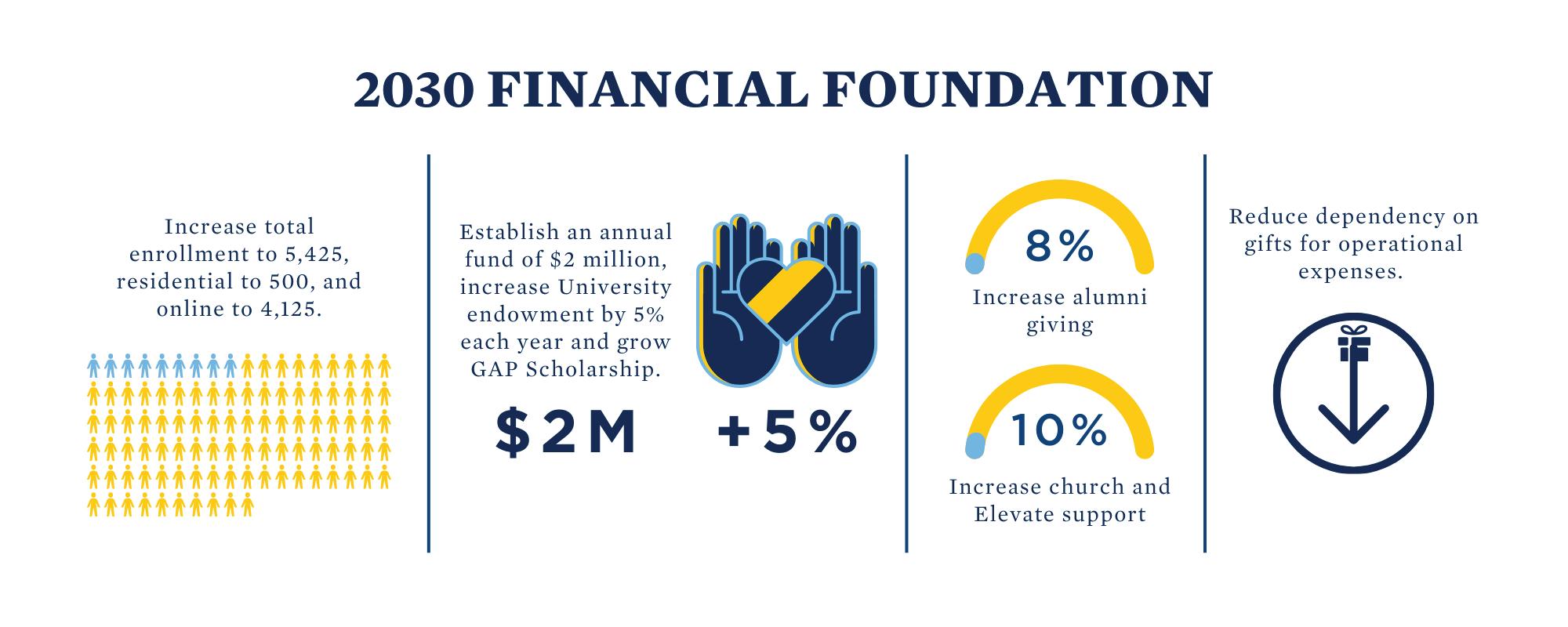
a. Reduce dependency on major gifts for operational expenses.
b. Establish an annual fund of $2 million to meet the operational needs of the institution.
c. Increase alumni giving to 8% by 2030; increase church support (subscription and church giving) by 10% by 2030.
d. Establish capital campaign for scholarships, building needs and endowment.
e. Grow GAP Scholarship program per proforma.
Enrollment and Retention:
a. Increase total enrollment to 5,425.
b. Increase residential enrollment to 500.
• Intentional strategies created to increase nonathlete population (additional majors, programs, etc.).
• Intensive effort to recruit ministry majors in partnership with CIY efforts.
• Increased effort to move students from dual enrollment to residential or online programs.
c. Increase online enrollment to 4,125.
• Increase Elevate and GAP student engagement/growth.
• Increase enrollment and marketing investment in the non-Elevate online student population.
Finance:
a. Implement zero-based budgeting, manage energy conservation, and increase partnerships with organizations like GICA to experience cost savings.
b. Establish guidelines for additional policies needed to support decision-making to strengthen the financial base.
c. Increase University endowment by 5% each year.