BRIDGE WHIDBEY
SKIN SCREENING: Despite the oft-gray skies of
the Pacific Northwest, the risk of developing melanoma skin cancer is higher for Washingtonians than the national average. In Island County, that risk is even greater. According to the Environmental Protection Agency, Island County has one of the top 10 rates of new melanoma diagnoses among counties nationwide. Page 4
FOR WHIDBEY ISLAND’S OVER-50 CROWD
JULY • 2016
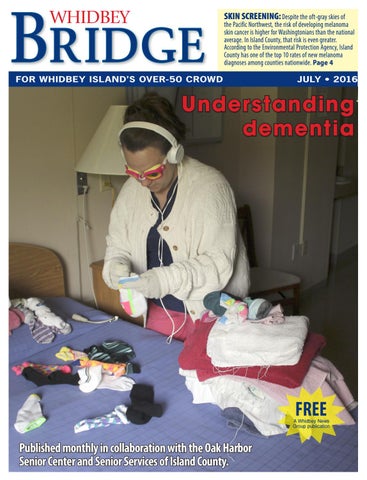
Understanding dementia
FREE
A Whidbey News Group publication
Published monthly in collaboration with the Oak Harbor Senior Center and Senior Services of Island County.
Page 2
WHIDBEY BRIDGE
July • 2016
Skin cancer screening vital for island residents
By KATE DANIEL
kdaniel@whidbeynewsgroup.com
Despite the oft-gray skies of the Pacific Northwest, the risk of developing melanoma skin cancer is higher for Washingtonians than the national average. In Island County, that risk is even greater. According to the Environmental Protection Agency, Island County has one of the top 10 rates of new melanoma diagnoses among counties nationwide. From 2001-2005, Washington state had the 16th highest rate of deaths caused by melanoma in the U.S.; about 175 Washingtonians die of melanoma annually. Reese Bliek, a physician assistant at Family
Dermatology, said he believes the high risk of skin cancer among Island County residents may be in part due to the high population of older adults, many of whom failed to use proper sun protection measures in their younger years. Bliek said about 75 percent of Family Dermatology’s patients are age 65 or older, and most require treatment for damage done to their skin 30-40 years prior. Of the most common conditions affecting older adults are actinic keratosis and various types of skin cancer, such as squamous cell and basal cell cancers. Psoriasis and eczema are also common. Much of the time these conditions are treatable,
VOLUNTEER SPOTLIGHT JUNE 2016
N A M E & R O L E O R V O LU N T E E R
Lucy Hansen
POSIT
ION
:
Senior Services Community Thrift Store Women’s Clothing
Ruth Royal
Senior Services Community Thrift Store Men’s Clothing and Jewelry
Susan Perry
South Whidbey Senior Center Receptionist
with treatment being more effective with early detection. Bliek will offer free skin screenings at 1 p.m., Wednesday, July 27, at the Coupeville HUB for Seniors, located at the Coupeville United Methodist Church. Bliek has given a handful of skin care presentations at the HUB throughout the past year and, in the past, has handed out vouchers for office visits at Family Dermatology. This is the first time he will provide onsite screenings at the HUB. Bliek advises people to check in with a dermatologist at least once a year. Annual visits are covered by most insurance plans, he said, though some patients with significant damage are advised to visit more frequently. At the HUB screenings, he’ll see attendees one at a time and examine skin conditions from the waist up. Glenda Cantrell, resource coordinator at the HUB, said she is sure the prevalence of skin issues is
Photo by Kate Daniel
A nurse assists Reese Bliek, physician assistant, in stiching up a patient after surgically removing a cancerous segment of skin. “huge” among seniors. She visits Bliek every three months, and said there’s something new to tend to just about every time. As for skin cancer and damage prevention, Bliek said sun protection is essential. Regularly applying sun screen and wearing protective clothing can help to stave off the effect of harm-
Protecting skin from the sun is one of the most important things you can do for your health. Unfortunately, many people fail to take sufficient measures year-round, but especially in summer when skin exposure tends to be at its peak. Men can be particularly neglectful. Indeed, fewer
than 15 percent of men use sunscreen regularly when outside for more than an hour, according to the Center for Disease Control. With so many choices, finding sunscreen that works best for your lifestyle and properly applying it can be confusing. Luckily, some brands are helping simplify selection. Some brands
Pete Little
Nancy Bolin
Nutrition Program – Master Trainer for Chronic Disease Self-Management Program (CDSMP)
Tom Verd
Meals on Wheels Driver
Eleanor Powers
CamBey Apartments – Gardener Extraordinaire, Common Area Decorator
Becky Westley Lora Mitchell
Medical Transportation Driver
Margie Wicher
Time Together Adult Day Volunteer
Leilani Gonzales
Time Together Adult Day Volunteer
Thank You All For Your Hard Work & Dedication!
color, variations from one area to another or having shades of blue, red, white or tan, brown or black; D is for diameter — melanomas are usually greater than 6mm, about the size of a pencil eraser; and E is for evolving, a mole or skin lesion that appears different from the others or is changing in color, shape or size.
Are you applying your sunscreen properly?
South Whidbey Senior Center Gardener
Volunteer Services, Creating data base
ful UV rays. Bliek also recommends self-checking or having a partner check for changes in moles and skin. When examining moles, Bliek and the American Academy of Dermatology recommend using the ABCDE system: A is for asymmetry; B is for an irregular, scalloped or poorly defined border; C is for
now segment sunscreens according to the activity and environment in which they will be used. Read labels for application instructions and to determine whether a given product is right for you, and consider these quick tips for maximum skin protection: n Broad-spectrum sunscreens contain both UVA and UVB protection. Select one with an SPF of at least 30 and apply evenly 15 to 30 minutes before going outdoors. One ounce is the right quantity to cover the whole body. Don’t forget ears, back of neck, hands, tops of feet and top of the head, if exposed. Reapply every two hours and after
Deliveri
swimming, sweating and towel drying. n Going swimming? Use sunscreen engineered for water resistance. Whatever sunscreen you opt for, don’t forget to reapply after exiting the water. n If you’re playing a sport where you need to keep hands grease-free, use an alcohol-based gel that dries quickly. If you sweat a lot while working out or simply going about your day, avoid sunscreen running into your eyes with a solid stick formula. n In the woods? Pack lightly by beating burn and bite with a sunscreen that’s also an insect repellent. (StatePoint)
ng Your Real Estate Dreams
South Whidbey Senior Center
14594 SR 525 Langley, WA 360-321-1600
MONDAY THRU FRIDAY 8:30 A.M. to 4:00 P.M.
Check out our Activities Calendar in the summer issue of The Guide available July 1st for classes and events in the month of July. Join us on one of our Senior Trips this Summer!
PAM MOCK
Text/cell: 360.661.7314 pam@cbwhidbey.com
CATHY WILSON
Text/cell: 206.718.8159 homes@twinfirs.com
~ Team Power ~
EQUAL HOUSING
OPPORTUNITY
Combined 20+ Years Experience
July • 2016
WHIDBEY BRIDGE
Page 3
Freeland resident provides chemical wake-up call By EVAN THOMPSON South Whidbey Record
Elise Miller doesn’t want people to be alarmed by her work. Rather, she hopes increased awareness and giving people the ability to make informed decisions will be the first step in addressing the issue. Miller, a 53-yearold Freeland resident, is director of the Collaborative on Health and the Environment, a leading global forum for dialogue on environmental health sciences. Through an international partnership, the nonprofit organization is also committed to facilitating initiatives to address issues such as chemical toxins found in everyday life. It does so by sharing scientific research about the links between environmental factors, including socio-economic status and gene-environment interactions, fostering collaboration among constituencies to increase, broadening understanding about the root causes and facilitating effective actions to prevent exposures that could contribute to diseases and disabilities. Certain health problems can occur because of everyday exposure to harmful chemicals. For example, of the 80,000 chemicals people are exposed to, only 15 have been tested for harmful effects, she said. Chemicals in flame retardants, plastic water bottles, food, lead and other heavy metals have been found as being negative to human health. The result of repeated exposure can lead to problems in early childhood
development and later in life. “We haven’t given any corporation permission to put these toxins in our bodies and they haven’t been tested for human health,” Miller said. “All of these combined bombard us everyday and we haven’t tested them thoroughly.” Miller said that scientific studies over the last 25 years show that exposures to even small amounts of chemicals, as finite as parts per billion, during fetal development or early childhood can trigger learning disabilities, autism, cancer, infertility and Alzheimer’s Disease. “There’s a real range of what they call fetal-origin of adult disease,” Miller said. “All of us right now have chemicals in our bodies that did not exist about 70 or 80 years ago.” The origins of the chemical craze began in World War II at the start of the petrochemical industry. Scientists were developing synthetic chemicals that made life easier and more efficient. They did not, however, consider the implications of the chemicals they used. After years of unchecked development, the chemicals became ingrained in everyday life. “We didn’t think about the long-term consequences, and they weren’t tested for health effects,” Miller said. Thousands of chemicals were put on the market over the years, hundreds of which people carry in their bodies today. Miller became inundated with these facts during her time
Photo by Evan Thompson
Elise Miller, a 53-year-old Freeland resident, is director of the Collaborative on Health and the Environment, a leading global forum for dialogue on environmental health sciences. with Commonweal, a health and environmental research institute, while serving as director of its Jenifer Altman Foundation in 1993. Miller left the foundation in 1998, which was around the same time she moved to Whidbey Island from the Bay Area. She founded the national Institute for Children’s Environmental Health and served a variety of roles where she was awarded a Children’s Environmental Health Champion Award in 2008 by the Environmental Protection Agency. Her organization later merged with the Collaborative on Health and the Environment and Commonweal. Miller’s scope of work increased to all new heights as a result of the partnership. The organization has members in all 50 states as well as 87 countries. “The children’s work I had been doing was
really integrated into this bigger picture of looking across the lifespan at exposures from conception to death,” Miller said. “It’s a much broader scale. But we try to translate the science into stronger public health policies so it protects us from these exposures.” The health advocate works at both community and governmental levels. She gives congressional briefing testimonies and has also been published in the San Francisco Medicine, the official journal of the San Francisco Medical Society. Her article revolved around the first 1,000 days of life and the steps necessary to protect children in their development and have healthy lives. Michael Lerner, president of Commonweal and co-founder of the Collaborative on Health and the Environment, spoke highly of Miller’s
impacts around the globe. “Her leadership of the Collaborative on Health and the Environment is remarkable,” Lerner said in an email. “Elise manages this global partnership of over 5,000 scientists, health advocates, environmental health advocates and concerned global citizens with great skill and distinction.” All of the current knowledge begs the question: What can be done? Miller said the first and most important step is awareness. Through eBook’s like “A Story of Health,” science is translated into case-based storytelling and easily digestible bits. The collaborative also published a pocket guide “Healthy Aging and the Environment,” which helps readers understand how multiple environmental factors influence the risk of disease and disability across the lifespan. becoming aware,
people can avoid chemicals that would normally go unchecked in a daily routine and age using a healthier lifestyle. “We want to make it usable and accessible for communities,” Miller said. “It’s not just toxic exposure; it also looks at nutrition and looks at socio-economic and psycho-social issues.” Miller said that while it’s almost impossible to be completely void of allowing unwanted chemicals to enter the body, there are several ways to avoid them. Making healthier market choices, such as buying organic foods and reducing plastic usage, are methods of improvement. “I don’t want people to freak out,” Miller said. “When I first started doing this work, it can be very depressing.” “But, I think awareness is the first step and then you do the best you can.”
JULY 2016 • VOL. 1, NO. 6
WHIDBEY
BRIDGE
WHIDBEY BRIDGE STAFF Executive Editor & Publisher............................KEVEN R. GRAVES Associate Publisher.................................... KIMBERLLY WINJUM Editor.................................................................MEGAN HANSEN Staff Reporters.........................KATE DANIEL, EVAN THOMPSON Admin..................................... HEATHER SCHMIDT, JILL LIGHTY
Assistant Advertising Manager.......................... TERI MENDIOLA Ad Sales. PHIL DUBOIS, NORA DURAND, CHARNITA GOODLINE Creative Artists....... JEN MILLER , MICHELLE WOLFENSPARGER, NICK ROUSER Circulation ............DIANE SMOTHERS, LYNETTE SAMPOGNARO
WHIDBEY BRIDGE IS FREE OF CHARGE. COPIES ARE AVAILABLE AT THE OAK HARBOR SENIOR CENTER, SENIOR SERVICES OF ISLAND COUNTY, SENIOR THRIFT AND NUMEROUS OTHER LOCATIONS ACROSS WHIDBEY ISLAND PO Box 1200 | 107 S Main St, Suite E101, Coupeville, WA 98239 360-675-6611 | Fax 360-679-2695 Copyright © 2016, Sound Publishing
READER INFORMATION: ADMINISTRATIVE: The Bridge is a monthly publication of Sound Publishing, and is a member of the Washington Newspaper Publishers Association, the National Newspaper Association and Suburban Newspapers of America. Advertising rates are available at the Whidbey News Group office. While The Bridge endeavors to accept only reliable advertisements, it shall not be responsible to the public for advertisements nor are the views expressed in those advertisements necessarily those of The Bridge. The right to decline or discontinue any ad without explanation is reserved. DEADLINES: Display Ads – Contact the office for deadlines.
Page 4
WHIDBEY BRIDGE
July • 2016
Tour gives glimpse into struggles of dementia By KATE DANIEL
kdaniel@whidbeynewsgroup.com
Put on a white sweater. Fold the towels. Fill a glass half-full of water and drink it. Write a three-sentence letter to your family and seal it in an envelope. Set the table. Easy, right? It may be difficult to comprehend how an assignment to complete five such simple tasks could set a group of otherwise capable people’s minds spinning, garnering feelings of frustration, helplessness, depression and bewilderment as, one after another, each failed to recall, let alone successfully complete, all five tasks within a sixminute period. Even more difficult to comprehend is that this level of impairment is a day-to-day reality for many sufferers of dementia. Several participants last month took part in a Virtual Dementia Tour at Careage of Whidbey in order to better understand this reality and to learn to better care for those who live it. The tour, a product of Second Wind Dreams, was created based on the research of P.K. Belville, geriatrics specialist and founder of the nonprofit organization. Proceeds from the tour benefit the organization’s
Photo by Kate Daniel
Gina Preston-Coffman, a nursing assistant certified at Careage of Whidbey, was one of several employees to take part in the Virtual Dementia Tour at the facility. The tour is designed to simulate the experience of demential in order to give participants a greater understanding of sufferers’ day-to-day challenges and feelings.
mission to help elders living in long-term care to fulfill their dreams, dreams like reuniting with long-lost loved ones or reliving enjoyable past experiences. Tracy Kirby, social services director at Careage of Whidbey, said she had the idea to do a tour at the facility in part so that she and the staff could foster a more positive and trusting relationship with the community. Careage is the only skilled long-term nursing facility on Whidbey. All Careage employees were asked to participate
in the training. “Sensitivity training is something it’s easy to get desensitized to in this industry,” she said. Kirby explained that it doesn’t mean healthcare workers don’t care, but that it can be easy to forget, and difficult to truly understand, the profound effect certain conditions have on patients. “I think this is amazing,” she said of the tour, adding that even those who have had dementia and sensitivity training can learn a lot from the experience. According to the
Alzheimer’s Association, dementia is a general term used to describe a range of symptoms associated with a decline in mental ability severe enough to interfere with daily life and impair a person’s ability to perform routine activities. According to Duke Medicine, one in three seniors over the age of 70 experience some form of memory loss, though not all memory loss is classified as dementia. Between 60 and 80 percent of dementia cases are attributed to Alzheimer’s disease,
according to the association. The second-most common type is vascular dementia, which often occurs after a stroke. As a preliminary measure, participants filled out a form indicating their perception of the impact of dementia on an individual. The form included questions regarding topics like how much a dementia patient suffers, how difficult if is for them to complete routine tasks, and how often it is appropriate for a person with dementia to act inappropriately. Another question asked how often
dementia patients receive the care they need. Facilitators placed spikes in participants’ shoes to simulate neuropathy, headphones with chaotic noise to simulate hearing impairment, goggles to simulate visual impairment and gloves with taped-together fingers to simulate arthritis. After a brief wait, participants were led one at a time into a dimly lighted room and instructed to complete five tasks. No talking was permitted as a supervisor timed and observed each participant, taking note of their behavior and success, or lack thereof, in completing the tasks. Afterward, participants were led out of the room to a group debriefing session with a psychologist. Discussing the experience, many expressed feeling helpless, defeated, and depleted in their sense of self-worth. Each also answered a second questionaire, which contained many of the same preliminary questions. This time, however, many said they answered differently. Eventually, Careage of Whidbey administrator Sean O’Neill said he would like to open the tour to the community, allowing more people to broaden their perspective and strengthen their compassion.
Enjoy the Sounds of Summer! Don’t let hearing loss prevent you from enjoying life. Dr. Kristine Jarrell can help you rediscover the pleasures of hearing. Call today for a FREE hearing screening!
360-678-1423
Voted Whidbey Island’s most trusted Audiologist three years in a row!
www.CoupevilleHearing.com
WH I
EW EY N S GR DB
THE
P OU
107 S. Main St. A102 • Coupeville, WA 98239 Locally Owned & Operated
BEST OF
WHIDBEY READERS CHOICE AWARDS
DR. KRISTINE JARRELL © 2016 Starkey Inc. All Rights Reserved. 6/16 46159-16
Board-Certified Audiologist
July • 2016
WHIDBEY BRIDGE
Page 5
Senior Services provides ‘one-stop shop’ for older residents By EVAN THOMPSON South Whidbey Record
The prospect of not having Island County Senior Services available to the community is one that almost seems unfathomable to Executive Director Cheryn Weiser. That’s because it’s easy to forget the scope of work Senior Services provides in an easily accessible format. And with approximately 40 percent of Island County residents who are expected to be over the age of 55 for the next 25 years, it’s one that shouldn’t fall on deaf ears (is that in bad taste?). A “one-stop shop” for a plethora of activities and services, Senior Services encompasses a large scope of work across all of Whidbey Island. Its major programs include Meals on Wheels, adult day care, family caregiver support and case management, while it also utilizes 315 volunteers who fulfill roles such as medical transportation, respite and other various errands.
“It is a bundle of synergetic services that support one another for seniors of all ages,” Weiser said. From a birds-eye view, Senior Services provides for two major aspects of retired life. For the more lively of senior citizens, there’s the 450-plus classes, trips and educational activities that enrich the lives of those who participate. Those activities include clogging or hiking classes held at the Bayview Senior Center and around Whidbey. Though less exciting, the other important aspect is facilitating easily accessible ways of acquiring medicare, how to acquire supplemental insurance through its Senior Health Insurance Benefits Assistance Program. “Very often people state that they’ve saved somewhere between $500 and $300,000 a year by talking with these people,” Weiser said. Long-term care, nutritional, housing and health needs are also covered within Senior Services scope of work. Through seven differ-
Photo by Evan Thompson
Cheryn Weiser is executive director of Island County Senior Services. ent locations on Whidbey Island, Senior Services provided 33,070 on-site meals, while it also delivered 43,186 meals to homes. Food choices include egg salad sandwiches, chicken, reuben sandwiches, taco soup, lasagna and an ample number of other items. “Just about anything that comes up if you’re a senior,” Weiser said. “If you’re a senior and you want to know about the resources available to you, our family caregiver assistance sup-
port is the place to go.” Volunteers are a large component of Senior Services. For example, medical volunteers drove a total of 91,716 miles in 2015, which is the equivalent of traveling to the Statue of Liberty in New York City 15 times back and forth. They also provided a total of 37,885 hours of support. Weiser said more volun-
teers are always needed, and that those interested should contact Pat Weekley at 360-678-4886. Misconceptions about Senior Services often arise, Weiser said. Though it is labeled after its home county, Senior Services is not affiliated with Island County government. Rather, it is a non-profit corporation and United Way agency. It acquires most of its revenue through grants — around 55 percent — while contributions, fundraising and program services encompass around 35 percent. Senior Services’ thrift store in Freeland also provides around 10 to 12 percent of revenue. Senior Services has been around since 1972. Despite its long-serving status, the non-profit still struggles to acquire funding. “It’s always a challenge because our government funding has remained flat or decreased over the last 10
years,” Weiser said. “We’ve tried to figure out how to keep all of this going in light of the fact that 40 percent of the Island County population will be over the age of 55 for the next 25 years.” “We sort of think of ourselves as the best kept secret,” she added. For its future plans, Weiser said Senior Services hopes to expand its adult day care program. Administrators also plan to updates its strategic plan for the years moving forward in the fall. “The big challenge is to keep all the balls rolling,” Weiser said. “I think trying to hold together this bundle of services and be able to serve the increased need that’s going on is the challenge right now.” “I think we’re excellent. Our primary funding source reviews each of our programs every year and we continue to surpass expectations,” she added.
FOR YOUR CONVENIENCE! WH I
“local people serving local people”
THE
P OU
EW EY N S GR DB
BEST OF
WHIDBEY READERS CHOICE AWARDS
Celebrating 75 years of serving Skagit and Island Counties OAK HARBOR
ESCROW DEPT. 360-679-5055 TITLE DEPT. 360-675-2246 • Toll Free 800-829-5263 PATTY FAKKEMA, ISLAND OPERATIONS MGR 1080 NE 7th Avenue, Oak Harbor
FREELAND
ESCROW DEPT. 360-331-4838 • Fax: 360-331-4837 CHRISTA CANELL, BRANCH MANAGER/LPO Christa@Ltco.com 5595 Harbor Avenue, Ste. C, Freeland
www.LTCO.com
STAY ON WHIDBEY ISLAND FOR YOUR CATARACT SURGERY At Island Eye Care we have improved the cataract surgery experience with the introduction of Laser Assisted Cataract Surgery and a “Dropless” post-surgical regimen!
Dr. Robert
We are pleased to offer Laser Assisted Johnson, MD Cataract Surgery using the FDA approved LenSx® laser. The LenSx® laser brings a new level of customization to cataract surgery, allowing Dr. Johnson to tailor each procedure specifically to your eyes. NO DROPS after cataract surgery! Dropless - is a formulation of antibiotics and anti-inflammatory medication which is administered in the back of the eye at the end of cataract surgery. This approach eliminates the need for post operative drops in most patients. There is no need for you to leave Whidbey Island for the best cataract surgery options! Call today for an appointment with Dr. Johnson to discuss how a personalized approach can improve your cataract surgery experience!
OAK HARBOR
231 SE Barrington Dr, Suite 208
360.240.2020
FREELAND
1804 Scott Rd, Suite106
360.321.6662
Page 6
WHIDBEY BRIDGE
Early intervention key to preventing COPD Only a few years ago, about one third of the population had not heard of Chronic Obstructive Pulmonary Disease (COPD), despite its status as one of the leading causes of death in the United States. Now, nearly a decade later, awareness of COPD is on the rise. Because one key to managing COPD is early intervention, the more people are familiar with the symptoms, the greater the chances for earlier diagnosis and starting a treatment plan to help improve quality of life. COPD is a serious respiratory disease that over time makes it increasingly difficult to breathe. In people with COPD, airways — tubes that carry air in and out of the lungs — become partially blocked. When severe, COPD can make the most basic of activities, such as taking a walk, doing light housework or even washing and dressing oneself, a challenge. Increased awareness of COPD is an important part of early detection and treatment efforts, as more than 15 million people are currently diagnosed with the disease in the United States and it is estimated that millions more have it without realizing. About half of both pri-
mary care physicians and nurse practitioners cite the challenge of patients not fully disclosing symptoms as a barrier to diagnosis. Many people suffering from the signs of COPD — such as shortness of breath, chronic cough and wheezing — often chalk them up to seasonal allergies, the common cold or simply consequences of growing older. Onein-seven American adults know someone suffering from the symptoms. The National Heart, Lung and Blood Institute (NHLBI), part of the National Institutes of Health, encourages anyone at risk to become familiar with COPD and talk to a health care provider as soon as possible. Early detection and intervention can greatly help improve outcomes. Despite being the third leading cause of death, COPD, also known as emphysema or chronic bronchitis, is by no means a death sentence. While at present there is no cure, a variety of treatment options exist that can lead to an improved quality of life. For more information and resources, visit COPD.nhlbi.nih.gov, NHLBI’s COPD Learn More Breathe Better program. (Family Features)
July • 2016
Keep your brain healthy, sharp The brain is the body’s most complex organ. It’s also the most important one. That’s why keeping it healthy is critical, especially as you age. Every day, scientists are discovering how closely our minds and bodies are connected. As it turns out, the things that you do to keep your body and heart healthy may also be good for your brain. Incorporate these eight healthy habits and activities into your daily life to help you optimize brain health and stay sharp in the years ahead.
some fats such as olive oil, may lower some risks to your brain. Try eating a healthy, low-fat, low-cholesterol diet with lots of vitamin-rich fruits and vegetables, as well as whole grains such as oatmeal and brown rice.
Get Moving
Physical activity is good for your health at every age. Studies show being active is associated with a lower risk of brain issues. Whether it’s nightly walks, playing with the grandkids or taking your favorite yoga class, find an activity that meets your needs and gets your heart pumping for at least 30 minutes every day.
Know Your Blood Pressure
High blood pressure can have serious effects on your brain health. If your blood pressure is high, get it under control. It may help reduce some risks to your brain.
Eat to Thrive
The antioxidants in nutrient-dense foods like berries, broccoli and legumes, including
Drink Moderately
PROPANE
1.09
$
9
Gallon*
*500+ Gal. Delivered Price subject to change
WE SELL TANKS!
How the body handles alcohol can change with age. Some older adults can feel “high” without increasing the amount of alcohol they drink. This can make them more likely to become confused or have accidents. So limit the amount of alcohol you drink — or don’t drink it at all.
Get a Good Night’s Sleep
Poor sleep, or inadequate sleep, due to issues such as insomnia or sleep apnea, doesn’t just leave you feeling tired. It can have serious physical effects and can impact memory and thinking, too. Get comfy and go to bed. Seven to eight hours is a good night’s rest.
Discover a New Talent
When you learn new things, you engage your brain. Try something you haven’t done before — learning French,
ballroom dancing or carpentry, for example. Challenging your brain on a regular basis is fun and beneficial.
Stay Connected
Science has shown that regular engagement in social activities can help reduce some risks to your brain. Stay connected and invite family or friends over for a healthy meal, go on a hike together or just hang out.
Talk to Your Doctor
As you age, some changes in brain function, including shortterm memory, happen more frequently than when you were younger. If you have questions or are concerned, ask your doctor at your next appointment. For more tips on keeping your brain healthy and thriving, visit BrainHealth.gov (Family Features)
Island Brokers Realty Property Management is the most experienced independent property management company serving Oak Harbor and Island County since 1978. This is management you can trust and count on. We work for our clients, and with our tenants.
CALL FOR OTHER QUANTITY PRICING
Call us today to work with you!
Special Pricing For Commercial Customers
Neighborhood & Group Deliveries • Guaranteed Price Plans
380 SE Barrington Dr.
Oak Harbor 360-675-2235
1690 Main St., Ste. 103
Freeland
360-331-8424
Locally Owned & Operated Best Propane Value in the NW
1-800-929-5243
Visit us @ www.apppropane.com
360-679-1591
info@IslandBrokersRealty.com Cornerstone Professional Building | 144 NE Ernst Street, Suite B | Oak Harbor
July • 2016
WHIDBEY BRIDGE
BAYVIEW SENIOR CENTER EVENTS Buddies for Buddies” Café — “What Brings You Vitality?” with Ron Roesler: 2-4 p.m., Tuesday, July 5 Getting Ready for Medicare: 1 p.m., Thursday, July 28, Free. No Pre-registration required. South Whidbey Senior Center, Langley Bingo: 6:30–9:30 p.m. Wednesdays, July 6 thru 27
CLASSES Advanced Tai Chi: 8:45–9:45 a.m., Tuesdays, July 5 to Sept. 27 Beginning Tai Chi: 10-11 a.m., Tuesdays, July 5 thru Sept. 27 Tai Chi in the Afternoon: Mondays, July 11 thru Sept. 26 (no class on July 4) 50 Plus Yoga: 4:45-6 p.m., Tuesdays, July 5 thru Sept. 27 4:45-6 p.m., Thursdays, July 7 thru Sept. 29 6:15-7:30 p.m., Thursdays, July 7 thru July 28 Foot Clinic: 9 a.m. to 3 p.m. by appointment, Tuesdays, July 5 thru July 26 Meditation for Everyone: 4:15-5:15 p.m., Wednesdays, July 6 thru July 27
Page 7
Events & Activities Senior Striders: 9-11 a.m., Thursdays, July 7 thru July 28 Beginning Line Dance: 9-10 a.m., Wednesdays, July 6 thru July 27 Line Dance – Improver/Intermediate: 10-11:30 a.m., Wednesdays, July 6 thru July 27 TuneIn-TuneUp with the Ukulele: 10:30-11:30 a.m., Tuesdays, July 5 thru July 26 Painting with Deon Matzen: 1-4 p.m., Wednesdays, July 6, thru 27 and 1-4 p.m., Fridays, July 1 thru 29
TRIPS Collette Travel Presentation, Southern Charm (March, 2017) and Discover Croatia, Slovenia, and the Adriatic Coast (May, 2017): 1:30-3:30 p.m., Tuesday, July 19 High Tea at Debbie Macomber’s Victorian Rose Tea Room: 8 a.m. thru 6:30 p.m., Saturday, July 9 Tulalip Casino: Wednesday, 9 a.m. thru 4:30 p.m., July 12 Sequim Lavender Fest: 7:30 a.m. to 5:15 p.m., Friday, July 15 Tillicum Village Excursion-Blake Island: 8 a.m. to 6:30 p.m., Saturday, July 30
Senior Services July menu nnn FRIDAY, JULY 1
MONDAY, JULY 18
Salmon Caesar Salad
Tuna Salad w/Croutons
TUESDAY, JULY 5
TUESDAY, JULY 19
Salad Bar w/ variety of vegetables
Salad Bar w/Variety of Vegetables
WEDNESDAY, JULY 6
WEDNESDAY, JULY 20
Southwest Chicken Salad.
Chicken Strip Basket
THURSDAY, JULY 7 Chef’s Choice
All activities begin at 1 p.m. at the Coupeville United Methodist Church on Main Street. Lunch is served every Wednesday at noon. Contact Glenda Cantrell, 360-720-2955 or Glenda@islandseniorservices.org
WEDNESDAY, JULY 6 1 p.m., Bingo Information & Assistance will be available 11:30 a.m. to 1:30 p.m.
THURSDAY, JULY 7 1 p.m., Falls and Injury Prevention, SAIL Exercise Class, led by Mary Waters.
WEDNESDAY, JULY 13 1 p.m., Beginning phone and computer help for seniors, John Githens, will help seniors with your new phone or
computer. Question and answers.
MONDAYS 9 a.m., Quilting 9:30 a.m., Wii Bowling 11:30 a.m., LUNCH 12:30 p.m., Ping Pong 1 p.m., Art with Dottie 3 p.m., Clogging 5 p.m., Tai Chi
1 p.m., MAC SIG class (2nd Tues.) 2 p.m., Vision Impaired Support Group (4th Tues.) 6 p.m., Pinochle 7 p.m., Stamp Club (2nd & 4th Tuesdays)
WEDNESDAYS 9 a.m., Lapidary 10 a.m., Mahjongg 11:30 a.m., LUNCH 12:30 p.m., Party Bridge 12:30 p.m., Ping Pong 2 p.m., Caregiver Support
MONDAY, JULY 25
MONDAY, JULY 11
Chicken Marsala
Brats w/Sauerkraut
TUESDAY, JULY 26
1 p.m., Ownership and care of senior’s companion animals. WAIF, will speak on seniors caring for and loving their pets.
TUESDAY, JULY 12
Best Reuben Sandwich
Cobb Salad
WEDNESDAY, JULY 27
THURSDAY, JULY 21
WEDNESDAY, JULY 13
1 p.m., Falls and Injury Prevention, SAIL Exercise Class, led by Mary Waters
French Dip w/Au Jus
Beef Stroganoff w/ Mushrooms
WEDNESDAY, JULY 27 1 p.m., Skin Screening. Reese Bliek from Family Dermatology will do skin screenings on site. Please wear comfortable clothing. First come, first served. (Read a story about this event on page 2.)
Group (4th Wed.)
THURSDAYS 8:30 a.m., Yoga 10 a.m., Creative Writing 12 p.m., Bingo 12:30 p.m., Cribbage 1 p.m., SVC History Class 2 p.m., Caregiver Support Group (3rd Thurs.) 7 p.m., Wire Wrap
FRIDAYS
9 a.m., Tai Chi 11:30 a.m., LUNCH 12:30 p.m., Pinochle 1 p.m., Line Dance 6:30 p.m., Old Time Fiddlers (1st Fri.) 7 p.m., Country Dance (2nd Fri.)
SATURDAYS Ping Pong Billiards Pinochle
9 a.m., Quilting
THURSDAY, JULY 14 Chef’s Choice
THURSDAY, JULY 28 Chef’s Choice
FRIDAY, JULY 29
FRIDAY, JULY 15 Oven Fried Chicken
Vegetable Lasagna
The Nutrition Program depends on 133 volunteers who drive for Meals on Wheels or assist in the dining rooms and kitchens. For volunteer information, call 360-321-1600.
J. Johnson Insurance, llc Ken’s Corner Plaza, 11042 SR 525 Ste 112, Clinton, WA
360-341-1848 • • • •
Health & Life Insurance Individual & Family Plans-Direct or Exchange Medicare Plans Group Plans for Small Business
Jim Johnson
Naomi DeMartini
jjins@whidbey.com
jjinsure@whidbey.com
Independent Agent/Broker
Independent Agent
Let us help you plan for the decisions you’ll need to make
TUESDAYS 8:30 a.m., Yoga 9 a.m., Lapidary 11 a.m., Mexican Train 11:30 a.m., Chess 12 p.m., Line Dance 12-4 p.m., SHIBA Counseling 1 p.m., Knitting Circle
Seafood Fettuccini
Spinach Ravioli w/ Marinara
WEDNESDAY, JULY 20
OAK HARBOR SENIOR CENTER
Tablet and Smartphone Class, 1:30 p.m. for tablets, 3 p.m. for smart phones, Wednesday, July 13. Early registration is required. Please let us know what device you are working with and specific questions you may have. Cost is $10.
Chef’s Choice
FRIDAY, JULY 22
FRIDAY, JULY 8
COUPEVILLE HUB
THURSDAY, JULY 21
Pre-arranging Benefits: Burley Funeral Chapel 30 SE Ely Street Oak Harbor, WA 98277 360-675-3192 www.burleyfuneralchapel.com
• It takes the burden off your loved ones • It allows you to put your house in order • You can select every aspect of your funeral now and guard against inflation • Provide peace of mind, knowing you are not making anyone responsible for your last wishes • You plan together, not alone • No emotional overspending
Call today for more information.
Visser Funeral Home 432 3rd Street Langley, WA 98260 360-221-6600 www.visserfuneralhome.com
Page 8
WHIDBEY BRIDGE
Creative ways to use summer ingredients
How foods can help heal common ailments When you’re not feeling well, conventional wisdom says you should reach for over-the-counter or prescription remedies. But many experts point out that foods have healing properties that can be complementary in helping to treat common ailments and prevent illness. “The concept of using food as medicine isn’t a new one; however, the evolution of society and science has moved us further from this concept,” says Grand Master Nan Lu, OMD, one of the country’s foremost teachers and practitioners of traditional Chinese medicine. “In my view, we are missing some of the most powerful and supportive steps we can take to remain well and prevent disease and illness.” Lu says the teachings of TCM can help patients deal with the root cause of their problems, rather than just eliminate the symptoms. While complex, he is offering a few quick insights into the subject of food as medicine. n Nutritionists today base their work on the physical and chemical properties of food alone, but
July • 2016
In summer, the abundance of fresh ingredients can be overwhelming, especially if you’re used to using the same old recipes. Make more of the fresh produce available to you at the grocer, farmers market and even your own garden, by thinking creatively. To help, the summer food experts at Betty Crocker are offering some great ideas for using fresh, seasonal produce.
this is just half the picture. “There are many immaterial things contained within food as well,” says Lu, who cites Qi, or vital energy, as a key aspect of food you can’t see. n The “right” foods won’t necessarily protect your health by virtue of their properties alone. Good organ function is also necessary for your body to process and digest what you eat. However, foods can help restore balance to an ailing organ system. n Listen to your body, not cultural beliefs about what is good or bad for you. n You may have heard of the adage, “You are what you eat.” Lu says to also consider the phrase, “You are what you think,” and avoid a steady diet of negative emotions, which you then must digest and process. Your thoughts impact your body and health, he says. n The next time your stomach is upset, consider reaching for something natural. Ginger can be eaten or used topically to deal with stomach discomfort, reduce inflammation and even lower pain from arthritis. (StatePoint)
Take advantage of fresh summer tomatoes with recipes like caprese salad and bruschetta.
1. Save the best berbread, bruschetta is a Favorite desserts that out the hassle of tradiries for later. Berry season is far too short. Make it last longer by freezing berries for the cooler months. Choose fruit at peak freshness, and then store it in highquality freezer bags that seal tightly, removing as much excess air — fruit’s worst enemy — as possible before freezing. Label bags with the freeze date and remember: a full freezer is more efficient, so stock up!
2. Take advantage of fresh tomatoes.
Carnival • Entertainment • Country Fair 819 Camano Ave • Langley • www.whidbeyislandfair.com
If you have more fresh tomatoes than you know what to do with, consider these creative uses: n Caprese Salad. Layer sliced tomatoes, fresh mozzarella slices and basil. Drizzle with olive oil and a good balsamic vinegar. Sprinkle with salt and serve. n Bruschetta. Served on small slices of toasted
perfect appetizer for any dinner party. n No-Cook Pasta Sauce. Marinara sauce can be too heavy for summer, but a raw sauce showcasing fresh tomatoes is perfect. Try rigatoni and tomatoes for a great introduction.
call for freshly picked strawberries, raspberries and blueberries include classics like fresh strawberry pie, but also inventive creations like brownies and berries dessert pizza and blueberry cheesecake bars.
Managing the bounty of garden-fresh zucchini is always a challenge, so think beyond the main course. You can make the most out of the humble summer squash with baked treats like pineapple zucchini bread, zucchini bars and chocolate zucchini snack cake.
bers doesn’t mean you need to spend days canning. For a tasty shortcut, layer cucumber slices, onions and carrots in a glass container. Mix with sugar, vinegar, salt and dill weed. Cover and refrigerate for at least 24 hours, but no longer than two weeks.
4. Bake with fresh berries.
6. Make berries last with freezer jam.
5. Make pickles 3. Add a touch of easy. sweetness to zucPreserving the sumchini. mer bounty of cucum-
Baking with fresh berries is one of the highlights of summertime.
Freezer jam is a smart way to hold on to summer’s fresh berries with-
tional jam. Try this recipe for strawberry freezer jam: Mash 4 cups strawberries, until slightly chunky, to make 2 cups. Mix with 4 cups sugar in large bowl. Let stand at room temperature 10 minutes, stirring occasionally. Mix 3/4 cup water and one package powdered fruit pectin in 1-quart saucepan. Heat to boiling, stirring constantly. Boil and stir one minute. Pour hot pectin mixture over strawberry mixture; stir constantly three minutes. Immediately spoon mixture into freezer containers, leaving 1/2-inch headspace. Wipe rims of containers; seal. Let stand at room temperature about 24 hours or until set. Store in freezer up to six months. Thaw and stir before serving. (StatePoint)
WH I
FAMILY DERMATOLOGY CO
THE
P OU
EW EY N S GR DB
“Voted Best Dermatology Clinic 2015”
BEST OF
WHIDBEY READERS CHOICE AWARDS
Robert Mizen
Reese Bliek
MSN, ARNP
MPAS, PA
Ron Wheeland MD
Charles Frosolone MD
Mary Kay Graves RN, FNP
Voted Best Dermatology Provider 2015
Please call to make an appointment at 360-682-5024 205 S Main Street, Bldg B, Coupeville
275 SE Cabot Drive, Suite A3, Oak Harbor
www.familydermco.com
1804 Scott Road, Suite 106, Freeland