SEATTLE WEEKLY • MAY 22 — 28, 2013
3
Tall From Amazonia Tales South Lake Union
transformed: welcome
change or another
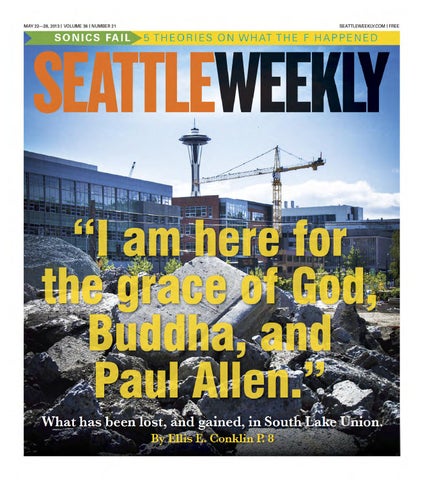
Even as South Lake Union becomes a shiny tech hub, vestiges of Old Seattle still peek through.
stab at Seattle’s soul?
SEATTLE WEEKLY • MAY 22 — 28, 2013
O
8
BY ELLIS E. CONKLIN
n a flawless late-April afternoon, Amos Rollman is busy as usual in the Cascade Playfield pea patch, watering and tending to the vegetables. Much of the crop will go to the nearby food bank at Immanuel Lutheran Church, a historic landmark built in 1907, where these days the homeless and other displaced desperados come for a meal, shower, or cheap clothes wash. “This is completely organic. We do biointensive agriculture here,” boasts Rollman, the pea patch’s Gunga Din. Dressed in brown shorts and a paint-stained purple T-shirt, Rollman points out his permaculture bed, brimming bright with irises and roses, blueberry bushes and daffodils. A sparrow splashes down in a bird bath, and the happy gardener, a longtime park volunteer, bids his feathered friend hello. Stroking his reddish-brown beard with rutty hands, he raves, “People from all over come here to see this. You are now in the heart of the neighborhood. “So you see, not everything around here is about Amazon.” For 20 years Rollman has called Cascade home, and as he can attest, the times they are a-changin’ in this scruffy slice of South Lake Union as billionaires and bureaucrats see their grand designs take flight: a virtually brand new city where the architecture reaches skyward and the denizens write code.
P H OTO G R A P H Y
B Y
P E T E R
KOVA L
going to be an even greater cash cow.” A walking tour of South Lake Union is a must for anyone who wonders just how much of Seattle’s past has been or may be bulldozed away as the last vestiges of a once-blue-collar neighborhood yield to explosive new development. Everywhere one looks is “a little pastiche of what once was,” as Washington Trust’s Moore puts it. The neighborhood is steeped in a maze of varying architectural styles: row houses from the early 1900s; Deco and Brutalist structures; mid-century commercial buildings, like the old brick Supply Laundry and Troy Laundry buildings of the 1920s; the ornate St. Spiridon Russian Orthodox Cathedral, which hosted an estimated 6,000 Russian emigrants who poured into South Lake Union during the Russian Revolution; the Grandview Apartments, one of Cascade’s first apartment buildings. Lea, though not pleased with the overall plans to make the neighborhood denser, says Vulcan has been “very sensitive to historical preservation, and we’ve built a good relationship with them. They know that Cascade is a brand.”
The once-derelict neighborhood now bustles with tech workers and stylish eateries.
“This will be one of the most startling developments this city has ever seen.” But some degree of loss in inevitable. Standing near the old Boren Investment Company Warehouse at 334 Boren Ave.—one of South Lake Union’s 14 city landmarks (another 34 structures are considered landmark-eligible)— Moore says developers plan to keep the brick façade, which he applauds. “But look inside. We also consider that part of the historic character of the building.” Moore realizes that not everything old should necessarily be preserved and given landmark status. “But we do think that just keeping the brick façade is not enough as far as preserving the history of this neighborhood.”
O
nationally renowned demographer, says it was inevitable that our notion of “downtown,” which began at Pioneer Square, would steadily migrate northward. “It was inescapable, but if you are going to have density, it might as well be near the center of the city, which puts less pressure on outlying areas,” he says. “There’s no doubt that when you have gentrification, some businesses will not survive. But you can’t tell the tide not to come in.”
As architect David Yuan said in 2007 when Amazon announced plans to move to the neighborhood: “South Lake Union is now a legitimate business address.” The terms locals employ for the new breed of worker bees who’ve buzzed into Amazonia, as many have come to refer to South Lake Union’s unrelenting facelift, are as varied as the fruits and vegetables that Amos Rollman lovingly nurtures.
Along with Badge People, the Nerd Herd is popular at the moment—that, and the more derisive Am-Holes. And for those not partial to Amazonia, Allen Town or Vulcan Land works just fine to convey the feeling of culture clash and nagging resentment over the invasion that has brought an estimated 6,500 new residents—almost all of them employed at Amazon, the Gates Founda-
SEATTLE WEEKLY • MAY 22 — 28, 2013
n May 6, after eight years of planning and dozens of public hearings, the Seattle City Council gave its final blessing, in a unanimous 9-0 vote, to a plan to radically reshape the 340 acres between Lake Union and Denny Way, about one-third of it owned by Vulcan. As part of the city’s 2004 Comprehensive Plan, this massive parcel of land was designated an “urban center.” Before long, three 400-foot residential towers will crowd the sky along Denny. Two dozen 24-story towers will rise along Fairview and Dexter, and three 160-foot complexes will sprout like steel beanstalks on Mercer—adding to the already monstrous Mercer Mess. Over the next 20 years, says city planner Jim Holmes, 12,000 new living spaces will be added to the neighborhood, plus some 22,000 jobs. “It’s the most substantial level of growth of any neighborhood in Seattle,” he says. Or, as councilmember Jean Godden, whose husband worked in South Lake Union writing advertisements during the Mad Men 1960s, marvels, “This will be one of the most startling developments this city has ever seen.” Retired UW professor Robert Morrill, a
» CONTINUED ON PAGE 12 11