R O
O
T
E D
AT
I N
C
R
I E S
I D E
L I
E N
O TI
C E
N
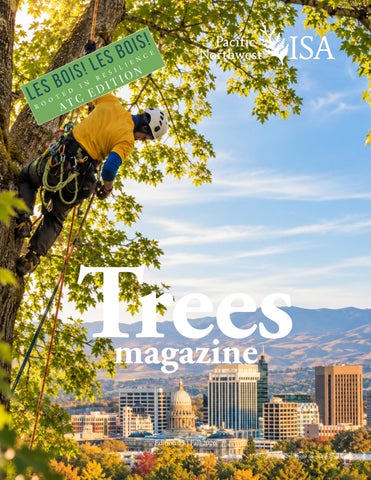
Trees magazine Edition 25 | Fall 2026 photo: Roger Barnett & Chat GPT
TREES EDITORIAL COMMITTEE Josh Petter, Editor Urban Forest Planner City of Burien Jamie Bails Stream Habitat & Forestry Biologist Sara Barron Assistant Professor of Teaching, University of British Columbia Katie Hogan Principal Consultant Cascara Tree Consulting, LLC Sylvain Martel Superintendent, Urban Forestry , City of New Westminster Brandon Namm Principal Consultant Laurelin Tree Consulting, LLC James Pasley Permit Comliance Arborist, City of Tacoma Taiwo Quadri Oregon Department of Forestry Emma Stammer Executive Director of Trees Idaho
FROM THE EDITOR Every year, I look forward to seeing how urban forestry and arboriculture take shape in communities across the Pacific Northwest and how that work comes to life at the Annual Training Conference. This year’s conference in Boise is especially meaningful because so many of the presenters are also contributors to this issue of Trees Magazine, sharing their expertise and experiences with our broader chapter community. Unfortunately, I won’t be joining you in Boise this year. I have a pretty good excuse though—I’ll be celebrating my brother’s wedding. While I’m sad to miss the conference, I’m excited to see this issue come together, and even more excited to see it in print. We typically publish Trees Magazine online, so having a physical edition feels particularly special. There’s something rewarding about being able to hold the stories, insights, and knowledge of our members in your hands. As always, this publication is only possible because of the willingness of members like you to share your experiences and expertise. If you’ve ever considered writing an article, I’d encourage you to reach out. We’re always looking for new voices and perspectives that reflect the incredible work happening across our chapter. Contact us directly at editor@pnwisa.org if you’d like to submit an idea.
Lalieth White Arborist & Landscape Horticulturist, University of British Columbia
We’re also looking for members interested in joining the editorial committee. Whether you’d like to help shape future issues, support authors, or simply become more involved with the chapter, we’d love to hear from you.
Tristan Fields Graphic Designer
Thank you to everyone who contributed to this issue, and to all of our members who continue to make this publication and our chapter such a valuable resource. I hope you enjoy this special edition of Trees Magazine.
© 2026 PNW-ISA
Josh Petter
1 | TREES Magazine
CONTENTS ATC Conference Program
3
Growing Resilience: Protecting Urban Trees in a Changing Climate
Connecting the Dots: Looking at Canopy Resilience Through Different Lenses 15
5
The Importance of Communication and Culture in Tree Work 17
Key Performance Indicators & Performance Tracking in a Tree Care Operations 7 Managing More Than Trees
8
Are Dynamic Cables the Best Option
9
The Most Abundant Animals in Arboriculture
11
Building Your Project Management Toolbox for Urban Forest Stewardship
14
Artificial Intelligence and the Future of Urban Forestry
19
Can They Coexist? Navigating the Trade-off Between Hillsboro’s AI Database Centers and Urban Forest Retention 21 Get in on the Spirit of Competition
23
Tree Climbing Competitions
25
PNW-ISA Events
28
FAVORITE From the Editorial Committee’s “Favorite Trees” Series – Featuring Katie Hogan The Bristlecone Pine, or Pinus longaeva, is aptly named for its extraordinary lifespan. My first time seeing one was during a month-long research trip in Yosemite National Park, where our professor made a point of taking our group of 30 students to admire the Ancient Bristlecone Pines in the White Mountains, a sprawling highelevation mountain range separating California and Nevada. My first encounter with these ancient pines felt awe-inspiring, as though simply standing near them could impart knowledge and wisdom. Their hardy, windswept form is a direct reflection of their survival instincts, honed over thousands of years as they quietly witnessed the rise and fall of empires. The famous Prometheus tree is estimated to have lived for nearly 5,000 years, making it the oldest known living organism on Earth. My favorite characteristics of these ancient pines are the deep purple hue of their newly formed cones and the rich terracotta orange color of their trunks. I highly recommend making a point to camp beneath the stars among these ancient natural wonders.
photo: Katie Hogan
FALL 2026 | 2
ATC Conference Program
LES BOIS! LES ANNUAL TRAINING CONFE CONFERENCE PROGRAM SUNDAY
September 27 1 – 5 pm
MONDAY
September 28 8 am – 6 pm
TREE ACADEMY y Resilience in Practice: Stewarding Urban Trees and Forests for a Changing Climate y Pruning Fruit Trees: General Techniques to Assuage Trepidation and Have Fun y Basic Tree Identification and Tree Tour at Idaho Botanical Garden
FIELD DAY Climbing and Rigging in Compromised Trees — Decompaction of Urban Soils Using Pneumatic Tools — Tree Diagnostic — Structural Pruning: A Trees Perspective — Tree Risk Walk - Learning Defects that increase likelihood of failure — Chainsaw Maintenance — Electrical Hazards — In Perfect Balance : Rigging for Perfect Crane Picks
WELCOME RECEPTION & EXHIBITOR NETWORKING (Appetizers & Drinks)
TUESDAY
September 29 7 am – 8:30 pm
CONFERENCE PROGRAM 7:00 am – 8:15 am: Breakfast 8:15 am – 8:30 am: Land Acknowledgement, Sho-Pai Tribes 8:30 am – 9:15 am: Keynote Address, Vicki Christiansen 9:30 am – 10:30 am: Session 1 10:45 am – 11:45 am: Session 2 11:45 am – 12:45 pm: Lunch 1:00 pm – 2:00 pm: Session 3 2:15 pm – 3:15 pm: Session 4 3:30 pm – 4:30 pm: Session 5 4:45 pm – 5:45 pm: Annual General Meeting 6:30 pm – 8:30 pm: ATC Reception Dinner (Annual Chapter Awards & Tree Fund Silent Auction)
WEDNESDAY
September 30 7:30 am – 12:45 pm
CONFERENCE PROGRAM 7:30 am –9:00 am: Breakfast 8:30 am – 9:30 am: Optional: DEI-Centered Breakfast 9:30 am – 10:30 am: Session 1 10:45 am – 11:45 am: Session 2 11:45 am – 12:45 pm: Lunch: Grab & Go Boxed Lunches
3 | TREES Magazine
SERENCE BOIS! 2026
CONFERENCE SESSIONS TUESDAY
September 29 9:30 am – 4:30 pm
& WEDNESDAY
September 30 9:30 am – 11:45 pm
CONFERENCE SESSIONS
(See the QR CODE for dates & times) y Are Dynamic Cables the Best Solution to ProvidingTree Support? – pg 9, Connor McDermott-Grossman, Allen Taylor y How Diseases Hitch a Ride: Insects as Tree Pathogen Vectors – pg 11, Sierra Laverty y Mentorship is the Magic - How to Support Your Staff Effectively – Nicole Dunbar y Designing a Municipal Street Tree Maintenance Program – Daniel Gleason y Plant Growth Regulators as a Tree Preservation Tool – Miranda Williams, Jackson Chandler y Artificial Intelligence for Smart Urban Forests – pg 19, Ian Scott y From Climber to Consultant: Navigating Change, Identity, and a Renewed Love for Trees – Eric Gowins y Project Management for Community Tree Planting Events – pg 13, Robin Hastings y Collaboration in Action: Success Stories from Municipal and Private Arborist Teams – Jennifer Killian, Malcom Anderson y Tree Resiliency in a Changing World – pg 5, Patrick Anderson y Plant Health Care From the Ground Up: Building Practical, Regional Programs That Last – Alex Best, Joshua Goode y KPIs & Performance Tracking in a Tree Care Operation – pg 7, Kaustubh Deo y Growing & Sustaining Local Impact – Lance Davisson, Emma Stammer y Recognizing Common Fungal Pathogens and Understanding How They Can Affect Your Work in the Tree – Andrea Fisher y Throwline Blues: Learning from Other Arborist’s Pain – Marc Otto y Connecting the Dots: Looking at Canopy Resilience Though Different Lenses – pg 15, Drue Epping y The Importance of Communication and Culture in Tree Work – pg 17, Eric Reevesman y EAB Management in Portland – Anya Moucha y Mock Deposition – Chris Rippey, Jason Culter y From Research to Practice: Tree Selection and Landscape Design for Maximum Stormwater Benefits – Philip Bennett, Dr. Asia Dowtin y The Root of the Problem with Urban Trees – James Pasley, Jennifer Killian y Beyond the Clipboard: Empowering Arborists with AI and LiDAR Integration – Ian Hanou y Advancement in Arboriculture: Growing From a Job to a Career – Nolan Sigurdson y Borers Aren’t Boring: Biology and Management of Common Insect Borers – Sierra Laverty, Alison Herrell y Modern Canopy Access: Applying Multi-Rope Techniques in Arboriculture – David Western, Ellis Kenady y Is “Good” Tree Work Profitable? – Austin Wienecke y Volunteering within PNW-ISA, Behind the Curtains – Robin Hastings, Alison Herrell y Trees and Construction: Creating a Regional Species Construction Tolerance list for the Pacific Northwest – Sarah Low, Shauna Willett FALL 2026 | 4
Growing Resilience: Protecting Urban Trees in a Changing Climate
GROWING RESILIENCE: PROTECTING URBAN TREES IN A CHANGING CLIMATE
Urban
and peri-urban trees, especially large-mature trees and those with the potential to be large-mature trees, offer a host of ecosystem services that make our cities and residencies more livable. With increased urbanization and increased frequency of weather extremes (e.g., heatwaves, storm intensity, etc.) large-mature trees will become increasingly more important to the health of our landscapes. However, the same issues these trees will help mediate also pose a huge risk to their longterm health and survival. Predictions show an increase in annual average temperatures over the next several decades. For many areas of the United States and Canada the impact of climate changes will affect regional tree species suitability. Hanberry (2024) notes that the greatest impact of tree species loss will come in the eastern US. The worst-case scenario is in Alabama
1. The Spiral of Tree Decline describes how Predisposing, Inciting, and Contributing Factors lead to eventual tree death over time.
where up to 51 native tree species may be negatively affected, and species diversity as a whole may be reduced by changing climate. In contrast, parts of the Western U.S. and Canada may experience a gain of tree species as eastern tree species naturally begin moving west and north. Canada is predicted to naturally gain 13 tree species from the southeastern U.S.
By Patrick Anderson, Director of Research and Arborologists, Rainbow Ecoscience
5 | TREES Magazine
In the face of these changes urban/ peri-urban trees face increased pressures from climate change, which is expected to intensify over the next five decades. Trees in these environments are already exposed
to a host of predisposing factors including, compacted, droughty soils with increased amounts of salt and heavy metals. Cities are already hotter than surrounding areas due to the “urban heat island effect,” and rising temperatures will compound this stress. This includes hotter & dryer summers with warmer & wetter winters, which can disrupt tree and arthropod phenology, thus increasing tree susceptibility to pests/diseases. We are already seeing evidence of this as the range of Southern pine beetle has moved from the southeastern US into New England. More frequent
and building plant resilience for current existing trees so they can continue to provide ecosystem services.
2. Compacted dry soil urban soil.
and intense droughts are a threat to many species. Conversely, increased precipitation events cause flooding, which can damage root systems and increase prevalence of root rot pathogens. Tree managers have several options to combat this existential threat to our trees. The first option, plan for the future urban forest. The USDA and several non-profit organizations have created resources on what trees may be suitable in projected future climates. As new tree plantings are planned, selecting climate adapted trees will be crucial to the future urban forest. The second option is to focus on preserving
Developing a plan for building tree resilience can be put into a threepart framework. First, address any current damaging pest or disease population affecting the tree. This may include treatments to manage inciting pests/ diseases like cell damaging scale insects (e.g., oystershell scale) or defoliating caterpillars (e.g., tussock moth). Second, promote plant defense through holistic methods of proper irrigation, soil nutrient management, root collar excavation, and proper mulching. This may also include the application of tree defenseinducing agents. These inducing agents encompass everything from application of products high in carbohydrates (e.g., sucrose) to phosphite based products and tree growth regulators (e.g., products containing the active ingredient paclobutrazol). 3. Example of tree treated with
inducing agent (Paclobutrazol) on right compared to untreated on the left Third, comprehensive soil/ site remediation to include soil decompaction with air-tools, incorporation of organic material (e.g., compost, biochar), and proper mulching. This will help to rebuild soils which mimic the forest environment and encourage plant growth by promoting microbes and mycorrhizae. As climate pressures increase, the success of urban and periurban forests will depend on both forward-thinking species selection and proactive care for the trees already present in the landscape. By combining climateadapted planting with practices that promote plant resilience, improve soils, manage pests, and strengthen tree defenses, tree managers can help large-mature trees remain healthy assets of the landscape. These efforts will be essential to preserve current ecosystem services and overall livability that urban forests provide for our communities.
References Hanberry, B. B. (2024). Tree species distributions in the United States and Canada under climate from 20,000 years ago to year 2100. Trees, Forests and People, 17, 100612. https://doi.org/10.1016/j. tfp.2024.100612
3. Example of tree treated with inducing agent (Paclobutrazol) on right compared to untreated on the left
FALL 2026 | 6
Key Performance Indicators & Performance Tracking in a Tree Care Operations
KEY PERFORMANCE INDICATORS (KPIS) & PERFORMANCE TRACKING IN A TREE CARE OPERATIONS If
you’re a business owner, you will likely check your bank account daily. It doesn’t matter if you’re a one- or 50-person operation – the business owner’s anxiety of running out of cash reigns supreme.
by Kaustubh Deo, Owner of Blooma Tree Experts
Kaustubh Deo speaking about KPI selection and tracking at a conference in California.
A handful of Blooma Tree’s fleet & equipment set up at a larger job site.
No real caption for this one, just a cool pic
7 | TREES Magazine
But, by the time you run out of cash, it’s far too late to do anything about it. Cash in the bank account is what we call a “trailing” indicator of business performance. Net profit is also a trailing indicator – by the time you see the result, it’s too late to do anything about it. As tree care business owners, we need to track “leading” indicators – datapoints that tell us if something is wrong, but more importantly, gives us enough time to fix it. For example, many business owners have a gut sense for how many weeks of backlog they have, which helps them determine if they need to push harder on marketing. But do you actually measure that leading indicator? Do you review it every week? I come from the finance industry, private equity (PE) to be exact. PE is bad at a lot of things. PE investors chronically undervalue the importance of culture. They undervalue the importance of taking care of employees and clients even if this impacts financial results in the short run. They often overvalue financial and short-term thinking to the detriment of long-term outcomes. However, when I left PE to pursue small business entrepreneurship, I didn’t want to throw out the baby with the bathwater. PE is very
good at running highly disciplined businesses. PE-backed companies have clear reporting metrics, strong forecasting practices, and best-in-class financial controls. In the tree care world, unless you own one of the large national companies, you likely don’t have that kind of financial & operating discipline in-house. My goal with my presentation at the Annual Training Conference is to share what I know about financial & operating discipline with my fellow small business owners. This talk is for you if you have felt the stress of whether you’ll have enough work for yourself (or your team) in the upcoming winter. This talk is for you if you’ve woken up anxious at night wondering if the cash in your bank account will be able to cover next week’s payroll and your next chipper payment. While I can’t solve your business problems for you, I can help you develop internal tools that point to where the problem is. Measuring performance is the first step in managing it. More specifically, I will walk through how to identify trailing versus leading indicators. I will discuss what leading indicators we track at Blooma Tree, the 25-person tree care company I own in Seattle. And I will discuss how to use leading indicators to make proactive decisions in your business. I want to equip you with the information you need to make proactive decisions. It doesn’t make the work any easier or harder – but it will lower the uncertainty and anxiety of being a business owner.
Managing More Than Trees
MANAGING MORE THAN
TREES I used to think my job was just managing trees. Eventually, and through some hard lessons, I realized a big part of my job was managing relationships. Relationships with the public, with coworkers, across departments, and perhaps most importantly, with the private contractors who shared responsibility for the same urban forest and supported the work we did every day.
When I first became an urban forester, I assumed the most important tools I had were obvious things like good specifications, solid contracts, and a robust technical background. I also believed earning the respect of contractors meant having all the answers. I wasn’t entirely wrong; those things absolutely matter. Technical knowledge establishes expectations, protects valuable public resources, and helps ensure quality work is completed safely. But after more than a decade of working alongside private arborists, I realized something else. The best outcomes don’t always happen because of a perfectly written specification, rather, they happened because of the relationships behind it. I thought earning the respect of contractors meant having all the answers and never letting anyone see me hesitate or fail. I wanted to know every standard, every specification, be able to recite code backwards, and every policy inside and out. I believed confidence came from always being right. Experience taught me something different. Trust wasn’t built because I had all the answers, because I was (and still am) learning every day. More so, it was built through hundreds of small decisions like listening to feedback,
applying standards consistently, admitting when a process could be improved, and treating every contractor with fairness and respect.
One example came from something that happened with some regularity, emergency tree response. During storm events, we used a simple text notification system to dispatch work to arborists on our approved contractor list. Because these situations required an immediate response, the work was generally assigned to the first contractor who could respond with a crew. The system worked well until one contractor pointed out that another company had two employees receiving the emergency text notifications, effectively giving them twice the opportunity to claim the work. It wasn’t something I had considered, but they were right. We changed the system so each company had a single designated contact. It was a small adjustment, but it communicated something much larger. If a process could be made simpler or fairer, we were willing to improve it. More importantly, they trusted me enough to bring the concern to me instead of simply accepting it. Not every decision was as easy or straightforward. On another project, a contractor began work without the required traffic control permit. The permit process was cumbersome, and I understood the frustration. Stopping the work delayed the project and certainly didn’t make me popular with the crew. But public safety couldn’t be optional simply because we were working on a city project. I learned that earning long-term trust sometimes meant making unpopular
by Jennifer Killian Urban Forestry Specialist, Oregon State University
decisions in the short term. The same standards we expected everyone else to follow had to apply to us as well. I also worked with public works to streamline the permit approval process for arborists on our approved contractor list. I learned that earning this long-term trust sometimes means making unpopular decisions in the short term. Over time, I realized the professionals I trusted most weren’t defined by speed or price. The ones I trusted most were the ones who communicated openly, raised concerns before they became problems, and cared as much about doing the right thing as completing the job. Some would even walk away from work if they believed it wasn’t in the best interest of the tree or the client. Looking back, I realize I was never just managing trees. I was helping build the relationships that allowed people from different backgrounds, organizations, and perspectives to care for them together. Healthy urban forests depend on sound science, thoughtful planning, and technical expertise. But they also depend on something less visible, trust. Like the trees we care for, trust isn’t grown overnight. It grows through consistency, fairness, and the countless small decisions we make every day. FALL 2026 | 8
Are Dynamic Cables the Best Option
ARE DYNAMIC CABLES THE BEST OPTION? Last year I inspected a dynamic cable in a coast redwood (Sequoia sempervirens) that had been installed an unknown number of years earlier. There was no extra slack available to expand the line, but even if there had been, it wouldn’t have mattered. The cable was so severely embedded in the stem that adjustment was no longer possible. The owner had no idea the system required maintenance, and now I had to tell him that the cable was creating a significant defect rather than reducing risk. That inspection prompted a question we couldn’t shake: Are dynamic cables always the best solution? By Allen Taylor Conservation Tree Care, President and Connor McDermottGrossman – Tree Solutions, Inc, Senior Arborist
Dynamic cables are made of UV-resistant synthetic rope and are used to reduce peak loads on stems or branches while still allowing movement. Static cables are typically made of steel wire and generally require drilling through the stems during installation. Compared with static systems, dynamic cables require fewer tools, less time, and less expertise to install. Not surprisingly, their use has expanded considerably. While dynamic cables offer many benefits, they, like all support systems, are not maintenance-free. In our work throughout the Pacific Northwest, we routinely encounter dynamic cables that are over-tensioned, undersized, improperly installed, or long past their intended service life. Many lack installation records, making it difficult to determine when replacement is necessary. Some have become embedded in the bark, or worse, completely enveloped by the trunk. Others are long past the end of their service life and threatening to break during the next windstorm. Ironically, systems installed to reduce risk can harm tree health, amplify risk, and create new management challenges when maintenance is neglected. This does not mean dynamic cables should
9 | TREES Magazine
be abandoned. In some situations, they are the best option available. Dynamic systems allow continued movement of supported stems, can reduce peak loading, and require less invasive installation than static cables or bracing rods. They can be especially valuable when structural defects occur in locations where static cabling systems are impractical. Ironically, the damage caused by drilling through a stem to install a static cable is also what dramatically reduces the potential for future girdling damage. Because the cable passes through the stem rather than around it, the system cannot girdle the tree as the stem expands. Lowprofile hardware sits against the bark on the outside of the stem and, similar to bracing rods, will become enveloped over time. Dynamic cables, on the other hand, are typically passed around the stem, and a lack of maintenance can eventually result in significant trunk damage or girdling. Dynamic cables should be selected deliberately, not automatically. Before prescribing a support system, arborists should ask several questions. Can pruning achieve the objective? Can the owner realistically commit to the required inspection, adjustment, and eventual replacement? Would static cabling or bracing provide a more durable or appropriate solution? Is active static support necessary to reduce the likelihood of failure? Are there opportunities to reduce risk through target management or improvements to tree vigor? The American National Standards Institute (ANSI) A300 standard¹ and the International Society of Arboriculture’s Best Management Practices: Tree Support Systems² provide guidance on cabling installation, but much of that guidance is general and leaves out many alternative options. The European Tree Cabling/Bracing Standard³ takes
a broader approach, asking whether a support system is the appropriate solution in the first place and providing detailed guidance on a wider range of support options. The European standard goes so far as to require that static systems be installed in the “static zone.” Have you even heard of the “static zone”? If not, maybe you should check out the European standard. It’s free and, unlike ANSI A300, isn’t buried behind a required account login. Cabling is only one tool within a much larger risk management toolbox. Pruning, cabling, bracing rods, guy lines, target management, and improvements to tree health can all reduce risk while preserving tree benefits. Even within cabling there are many different options encompassing bracing, steel cables, the various brands of dynamic cables, and many others. The challenge for arborists is determining which approach best fits the specific tree, site, and client. As our industry continues to advance, the conversation should move beyond the binary choice of cabling or not cabling and toward selecting the most appropriate risk management strategy. The best solution is not necessarily the newest, easiest, or most commonly prescribed. It is the solution that balances risk reduction, tree preservation, long-term maintenance requirements, and the biological needs of the tree. Dynamic cables remain an important tool in modern arboriculture. They are often the right solution, but not always. The better question is no longer “Should I install a dynamic cable?” Instead, it is “What combination of treatments best manages risk while preserving the biology, structure, and future of this tree?” When arborists begin with that question, dynamic cables become one option within a much broader, and more thoughtful, approach to tree risk management. FALL 2026 | 10
The Most Abundant Animals in Arboriculture
The Most Abundant A (It’s Not Squirrels)
By Sierra Laverty, Assistant Professor & Horticulture Educator, University of Idaho Extension
To most people, trees and other plants
fade into the background of everyday life. The term “plant awareness disparity” describes how the layperson ignores the flora that surrounds them—until a storm drops a branch on their roof or weeds poke up through their sidewalk. Animals, by contrast, are much more charismatic, unless you’re a microscopic worm. Numerous as they are, most people have never heard of the most abundant animal on Earth. I’d bet that most arborists couldn’t tell you much about them either. Let me introduce, the nematode. A MICROSCOPIC WHAT? Nematodes are microscopic roundworms whose diet depends on their species. Some nematodes “suck out the innards of fungal hyphae”1, some are mammalian or insect parasites, some feed on plants, and some hunt bacteria and algae. They inhabit nearly every environment on Earth and are found in “arid deserts and at the bottoms of lakes and rivers, in the waters of hot springs and in polar seas”2. And yet we know very little about their diversity, especially in both natural and urban ecosystems. Researchers have identified some 25,000 species of nematodes. Compared to 1.2 million recorded insects, this doesn’t seem like much when nematodes are found virtually everywhere. THEIR ROLE AS PLANTPARASITES Although plant-parasitic nematodes are herbivorous animals, they are typically studied alongside fungi, bacteria, and other plant pathogens of their size. Symptoms of nematode damage on plants can look very similar to common diseases and abiotic issues: wilt, stunting, chlorosis (yellowing), and necrosis (death).
11 | TREES Magazine
Root-knot nematodes, for example, secrete chemicals from their glands that make root cells swell up, eventually creating galls that limit the flow of water and nutrients to the plant. Apples, boxwoods, gingkos, junipers, oaks, and even cacti can succumb to root-knot nematode invasion. Most plant-parasitic nematodes feed belowground on roots, but one nematode has made a name for itself as an aboveground parasite of trees: the pine wilt nematode (Bursaphelenchus xylophilus). Pine wilt nematodes can kill susceptible pines—including Scots, Austrian, and mugo pine—far more rapidly than most tree pests. As they feed, they poke holes around the tree’s resin ducts, causing resin to leak and create air bubbles in the water uptake system of the tree. Imagine trying to suck water through a straw with an increasing number of holes. Without water, the canopy soon fades and the top may die back, eventually resulting in the tree’s demise.3 But how did the nematode get there in the first place? Pine wilt nematodes have a unique method of getting around. They hitch a ride in the respiratory system of pine sawyer beetles (Monochamus ssp.) and are vectored (spread) to the tree when the beetles feed on healthy pine twigs. Heat and drought can accelerate wilt symptoms. The pine sawyer beetle prefers to lay eggs on stressed or dying trees, so it’s a win-win for the Uber driver. Although pine wilt nematode is thought to be native to the Southeastern United States, it has been making its way westward since the 1970s. The nematode has been confirmed in Oregon, Idaho, and British Columbia.
Animals in Arboriculture CREATURES WORTH YOUR ATTENTION Nematodes may not be your favorite animal, but as arborists we likely encounter them every day. Nathan Cobb, the father of nematology wrote that “on the feet of birds and insects the eggs, larvae, and adults of certain nematodes are carried to the tops of the tallest trees. The sour sap issuing from the wounds of a tree, often many feet above the ground, not infrequently contains nematodes that are specific to the wounds of that particular tree.” What are they doing up in the canopy? Most are free-living nematodes eating organic matter or fungi. Some may help control tree pests. And a few, like the pine wilt nematode, are killing trees. These strange little animals are absolutely worth studying. Their diversity, abundance, and ecological roles in urban forests are only beginning to be understood. — Interested in learning more? Join us at the PNW-ISA Annual Training Conference in Boise this September, where we’ll explore how insects spread nematodes and other tree pathogens— and what arborists can do to recognize and manage these hidden threats. Cobb, N. A. 1914. Nematology. Washington, DC: U.S. Department of Agriculture. 1
Gilbert, G. S., and Parker, I. M. 2023. The Evolutionary Ecology of Plant Disease. Oxford, UK: Oxford University Press. 2
American Phytopathological Society (APS). n.d. Pine Wilt. APS Education Center. 3
photo: Stephen Ausmus image: Root-knot nematode
FALL 2026 | 12
photos: Robin Hastings
13 | TREES Magazine
Building Your Project Management Toolbox for Urban Forest Stewardship
BUILDING YOUR PROJECT MANAGEMENT TOOLBOX FOR URBAN FOREST STEWARDSHIP by Robin Hastings
I can remember the first moment when I was inspired
by a tree. It was when I saw the little green shoot of a newly sprouted English oak, long after I had forgotten about the acorn that I had planted there 6 months before. It was my first experience of the small burst of inspiration, joy, perhaps magic, that trees have such a unique way of conjuring within us. With the growing recognition of the importance of trees in our landscape butting up against the increasing pressures that they face, how do we give a voice to an organism that isn’t able to speak up for itself? One answer, as it seems to me, is to try and inspire that voice in the community.
and challenges – spoiler – we unfortunately can’t control the weather! While not a primary focus, we’ll also touch on how Artificial Intelligence (AI) can be used to help with the process. In this session you will gain access to digital templates that you can download and customize for your own events. For example; •
An overall event plan
•
Charts for organizing timelines
•
Work breakdown structure template
•
Event checklists
One way to turn inspiration into action is through community planting events. Successful events rarely happen by accident. Anyone who has coordinated a volunteer planting day knows that good intentions aren’t enough.
My aim is that this talk will give you a clear sense of how to prepare community events to ensure a rewarding experience for participants, with minimal stress. While we’ll focus on community tree planting as the case study, the skills and tools are transferable to other projects and can be used in any organization.
Urban forest stewardship, or community planting events, is a sometimes overlooked aspect of arboriculture, but can often be the most impactful, and rewarding. Working with an enthusiastic and excited group of volunteers, doing something that they haven’t done before and stepping back at the end of the day to admire the hard work is a worthy payoff.
Reducing stress during the organization phase and going into an event knowing that you’re prepared will help you to manage impromptu issues that can arise on the day, but also have some fun. Successful planting events do more than plant trees; they build community ownership, create advocates for the urban forest, and inspire future stewardship.
I’ve learned that a successful planting event depends on a practical project management mindset: getting clear on the goal, defining who is responsible for what, lining up resources, watching the schedule and budget, communicating early, and staying ready to adjust when conditions change. Project management is distinct from general management because it focuses on temporary endeavors with clear start and end points.
Whether you’re brand new to project management, or if you’ve planned volunteer events before, I’m confident that you’ll gain useful knowledge and inspiration from Project Management for Community Tree Planting Events, and from the ATC 2026 I look forward to meeting you in Boise. Les Bois! Les Bois!
In my presentation, we’ll cover the main tenets of project management, including factors specific to a community tree planting event. I’ll introduce useful tools that can help to organize and manage workloads, and we’ll have an opportunity to talk and ask questions among the group to learn and get inspiration from others’ experiences, including risks FALL 2026 | 14
Connecting the Dots: Looking at Canopy Resilience Through Different Lenses
by Drue Epping
Connecting the Do
Looking at Canopy Resilie It has been an exciting and challenging
few years for urban and community forestry. The historic Inflation Reduction Act (IRA) investment, passed in 2022 and distributed beginning in 2023, provided more than $1.5 billion for the U.S. Forest Service Urban and Community Forestry Program. This unprecedented funding unlocked significant new capacity and program development for nonprofits, Tribes, and local governments across the country. These investments helped elevate urban forestry as a form of critical green infrastructure and strengthened recognition of the role trees play in community development, workforce development, public health, climate resilience, and quality of life. At the same time, the concept of “tree equity” gained national visibility as communities sought to direct investments to neighborhoods with the greatest need and the fewest environmental benefits. Federal agencies relied on tools such as the Climate and Economic Justice Screening Tool, and other disadvantagedcommunity screening frameworks developed through the Justice40 Initiative to help target investments under IRA-funded programs. Most Urban 15 | TREES Magazine
and Community Forestry IRA funding was awarded beginning in 2023 through competitive grants and state allocations, with many states subsequently subawarding funds to Tribes, municipalities, and nonprofit organizations. This direction from the federal government shifted significantly in January 2025 when Executive Orders 14151 and 14173 directed federal agencies to eliminate DEI-related mandates, preferences, and evaluation criteria in federal programs and grantmaking. Agencies were instructed to remove DEI requirements and certain equity-related initiatives where permitted by law. As a result, many recipients of IRA funding faced considerable uncertainty about how to proceed. Some organizations experienced project reviews, scope modifications, delays, or changing compliance expectations. Others became hesitant to advance hiring, contracting, or project implementation activities due to concerns about evolving federal guidance and the long-term stability of funding commitments. For many grantees, this uncertainty slowed implementation and made it difficult to maintain the momentum created by the original investments.
ots:
ence Though Different Lenses At the same time, IRA funding was always intended as a large but finite investment rather than a permanent funding source. As the urban forestry community looks ahead, it is increasingly important for local governments and their partners to identify additional and sustainable longterm funding strategies that do not rely on federal and urban forestry specific grants. The future of urban forestry will depend on our ability to integrate trees and green infrastructure into broader community priorities and funding mechanisms. My presentation at the Annual Training Conference will explore the question: How can we align urban forestry with other municipal priorities to unlock new funding opportunities? We’ll discuss strategies for sustaining local tree funds, accessing state funding programs, and connecting urban forestry initiatives to priorities already receiving community and political support. By framing urban forestry through the lenses of stormwater management, climate resilience, disaster preparedness, economic development, public health, and community well-being, we can build more durable funding partnerships and create lasting, meaningful change in our communities.
Sources USDA Forest Service. Announcing Urban and Community Forestry Funding (2023). [fs.usda.gov] American Forests. Unprecedented Urban Forest Funding Made Law Through Historic Climate Bill (2023). [paulweiss.com] Executive Order 14151, Ending Radical and Wasteful Government DEI Programs and Preferencing (January 20, 2025). [fs.usda.gov] USDA Forest Service. Inflation Reduction Act Urban & Community Forestry Notice of Funding Opportunity (2023). [grantsmiths. com] USDA Forest Service IRA UCF Grant Portal and Award Information. [justice.gov]
FALL 2026 | 16
The Importance of Communication and Culture in Tree Work
THE IMPORTANCE O AND CULTURE IN TRE I am an ISA Certified Arborist and have
by Eric Reevesman
been in the arboricultural industry for almost five years. I have worked in line clearance, residential tree care, and municipal arboriculture. I am currently one of the climbing arborists with the City of Olympia Parks Department where I help maintain over 2,500 inventoried street trees and all the trees in parks and city-owned land. I am also a graduate from Sacramento State University where I majored in Communication Studies with a concentration in Organizational Communications.
In college, I explored my interest in cultural development. This led me to realize the importance an organization’s communication style and the impact company culture have on its employees. Throughout my career, especially since transitioning back to trades from office work, I have noticed that there is a
17 | TREES Magazine
lack of awareness about the impact an organization’s culture can and will have on its workforce. In some cases, there is even a lack of understanding of what a positive workplace culture looks like. Since getting started in tree work, I have either had firsthand experiences or have knowledge of previous events at every company I have worked for that highlight the negative effects of a poor workplace culture. I am also aware that many people in this industry believe the misconception that prioritizing the importance of a positive workplace culture and taking care of their employees will have a negative impact on productivity and their bottom line. The idea for doing this article and presentation is to disprove the above misconception and discuss how having a positive workplace culture can make your organization more successful. In doing
OF COMMUNICATION EE WORK so, I hope to help others understand various forms of both verbal and nonverbal communication and the impact that they will have on the company’s culture. Individual crews often develop subcultures that can differ from the main office. Because of this, bringing in and keeping the right people also plays a huge role in developing and maintaining a positive workplace culture. Thinking about how someone will complement the current staff and the pre-existing culture is important. Basing the decision to hire or promote someone solely on a person’s ability in the tree or on the ground can have negative impacts on the company. Although someone’s ability to do the job successfully is undoubtedly important, a good crew member or leader will also positively enhance the workplace culture and make an existing sub-culture more in line with the ideals of the organization. Even if they can do the task well, a
bad crew member or leader can ruin a positive culture and create a sub-culture that is drastically different than the ideals of the organization. This can lead to many negative impacts that include but are not limited to high turnover, declining performance, absenteeism, and disengaged workforce. Although work is about getting the job done, it is paramount in this industry that we do so safely. Also, most of us want to enjoy where we work and those we work with. These factors contribute to the established culture of an organization. In my presentation, I will discuss the importance of culture in a lens that is focused on the tree care industry. This class is meant to be helpful for everyone in the workforce from senior leadership to a brand-new grounds person because just like safety, everyone contributes to the culture of the organization.
FALL 2026 | 18
Artificial Intelligence and the Future of Urban Forestry
Artificial Intelligence and For decades, the standard for urban forest
Ian Scott is an ISA Board Certified Master Arborist (PN-5408BUM) and an ASCA Registered Consulting Arborist based in Seattle, WA
management was a snapshot in time. We conducted tree inventories that were often laborintensive, required a contingent of arborists, and yielded data that was satisfactory for a few years but steadily declined in value. Urban forests had to be managed looking through this rear-view mirror, relying on data collected every five to ten years at best. Now, extreme weather and pressures on the urban forest are affecting trees more quickly, and our management practices must evolve to keep pace. Leveraging new technologies offers you, as an arborist, an opportunity for empowerment. Imagine being able to update your entire tree inventory data not once a decade, but biannually. Ground-based LiDAR techniques can do just that, capturing precise, actionable data on every tree with unmatched speed and accuracy. This technology creates what we call a “digital twin” of our urban forest—a digital rendering of our trees that provides objective data to decide on a tree’s current health, growth, and structural status. This massive amount of data is analyzed with Artificial Intelligence (A.I.) and Machine Learning (ML). As arborists and urban forestry professionals, we stand at the threshold of a new paradigm. What does diameter at standard height mean when we can ask AI for the diameter at any height? And why not redefine tree health and condition based on leaf area, leaf area index, and leaf area density? We can repackage these measurements into weighted formulas that effectively summarize a tree’s vitality. As objective as we can be with our eyes and hands, they can’t match the objectivity of lidar-captured data. These tools are rapidly becoming essential resources that allow us to move from static maps to dynamic, 4D “Smart Tree Inventories.” The digital twin has data-collection standards so precise and objective that repeated scans can also describe any tree’s changes over time. This shift in technique does not mean we are replacing the arborist’s eye; rather, we are sharpening it. Fundamental A.I.
19 | TREES Magazine
technologies, including Large Language Models (LLMs) and machine learning algorithms, are providing us with the tools to analyze vast datasets in seconds. Whether it’s identifying early signs of tree decline, mapping canopy cover for tree equity, or assessing tree care needs, A.I. allows us to focus our professional expertise where it matters most: on the right tree, at the right time. When we integrate A.I. into our workflow, we aren’t just adopting new software; we are adopting a more systematic and consistent strategy for tree management. Additionally, Smart Tree Inventories enable us to communicate the value of our work more effectively to stakeholders. It is one thing to tell a city council member that trees provide benefits; it is another to present them with a data-driven report that quantifies tree health, measurable risks, and the specific impact of trees on urban cooling, all backed by precise, objective data. Of course, the power of A.I. comes with responsibilities. A significant part of our professional growth involves understanding the risks and assumptions inherent in these services. A.I. can suggest, but the professional arborist must conclude. Understanding the “why” and “how” behind these technologies is vital to maintaining the high standards of our profession. This transition isn’t about letting the machines take the lead; it’s about ensuring that we, the stewards of these forests, have the most advanced tools to do our jobs more effectively. By deploying A.I. as a tool within our practice, we can advocate for better policies, be more effective with our management, and help guide us toward sustainable urban forests for the generations that follow us. As we look toward the future, the integration of these tools is set to become the hallmark of an effective urban forestry program. I invite you to join the conversation when I present on this topic at the PNW-ISA conference in Boise, 2026. This article was drafted with assistance from Google Gemini, Grammarly Pro, and Chapter Member (human) editorial feedback
the Future of Urban Forestry
FALL 2026 | 20
Can They Coexist? Navigating the Trade-off Between Hillsboro’s AI Database Centers and Urban Forest Retention
As big tech corporations rapidly finance digital infrastructure
by Quadri O. Taiwo Community Forester and Inventory Intern, City of Hillsboro, OR
expansion in Hillsboro, Oregon, and throughout the Pacific Northwest, municipal foresters and local advocates are fighting to protect urban canopies. The City of Hillsboro has become a major data center hub due to several factors: its proximity to a strong tech market, the availability of affordable land, access to renewable energy sources, highbandwidth fiberoptic networks, and a naturally temperate climate. Data centers have the potential to generate property tax revenue, provide hundreds of low-cost construction jobs, and create a few permanent technical and security positions that support the local economy once construction is complete. Artificial intelligence (AI) data centers require massive footprints for concrete server halls, electrical substations, and cooling infrastructure (Siddik et al., 2024; De Vries-Gao, 2026). There are currently 35 data centers in the region, and their expansion often targets forested or semi-rural land near urban growth boundaries, leading to significant environmental friction. Hillsboro forests are vital for mitigating heat islands and preserving biodiversity. •
Land Clearing: Large-scale tree removal destroys mature tree canopies and ecosystems that take decades to replace, while retaining narrow tree strands that are susceptible to pests, diseases, and other land-use development pressures. Recently, a formal report from Langan Arborist indicates that the CoreSite Data Center plans to cut down 101 mature native Oregon white oaks (Quercus garryana).
•
Heat Island Amplification: Replacing forested areas with large concrete buildings and expansive asphalt parking lots increases surface temperatures and heightens public health risks. These risks include heat exhaustion among construction workers during the building phase and longterm heat-related illnesses among nearby residents after completion.
•
High Resource Consumption: Data centers consume vast amounts of electricity and water, straining local ecosystems already impacted by climate change (Akinade et al., 2026; Amanambu et al., 2026). For example, Hillsboro’s 2025 data show data centers used only 112 million gallons (3%), compared to 3,129 million gallons (97%) for all other industries, a seemingly unalarming share.
WHY PACIFIC NORTHWEST URBAN FORESTS MATTER?
Climate resilience is central to advocacy surrounding preservation of trees. Urban forests function as natural air conditioners that provide a critical defense against the region’s intensifying summer heatwaves (Yuan et al., 2026). Stormwater management is equally important, as tree roots absorb heavy rainfall, prevent 21 | TREES Magazine
Can Th Navig Trade-o Hillsbo Center Forest
hey Coexist? gating the off Between oro's AI Data TO ACTION: ADVOCACY rs and Urban CALL STRATEGIES AND SOLUTIONS t Retention.
erosion, and alleviate pressure on municipal drainage systems. Mature trees such as Douglas-firs and western red cedars sequester carbon efficiently locking away atmospheric carbon dioxide—a benefit that underscores the importance of species selection when replacement is regulated by local cities (Rao et al., 2014). Beyond climate regulation, advocates emphasize improvements to air quality and public health, as tree canopies filter harmful particulate matter and deliver mental and physical health benefits, including better birth outcomes for nearby communities (Donovan et al., 2025). Together, these arguments form a compelling, multifaceted case for retaining urban forests as vital infrastructure for environmental sustainability and human well-being.
To balance technological economic growth with healthy urban and community forests, municipal foresters, policymakers, and residents should push for specific reforms:
Ongoing construction at the Aligned Data Center in Hillsboro, OR has included minimal replacement of the removed trees with young saplings.
•
Land Use Zoning Reform: Demand land use code amendments that restrict data centers to enterprise zones or existing industrial brownfields rather than allowing them to clear greenbelts or forested zones near residential land.
•
Proactive Urban Forest Ordinance Amendments: Push for tree policies that require developers to refine AI data center designs to preserve mature trees rather than clear-cut forests (Makido et al., 2019). Inconsistent designs should be grounds for disapproval. It is worth noting that the Hillsboro Urban Forestry Department is currently working to amend its regulations.
•
Stringent Tree Replacement Ratios: Require data center developers to plant 3x trees than they remove if cutting is unavoidable, along with long-term maintenance funding. This could include cash in lieu of planting, which would allow the municipality to carry out the work after subdivision construction is completed.
•
Infrastructure Innovation, Industry Standards, and Certifications: Pressure tech companies to utilize multi-story data center designs to minimize their physical footprint on the ground.
•
Multi-Stakeholder Partnerships: Intercity agencies, departments, and community members should work together through coordinated planning, shared resources, and consistent communication.
photo: emma stammer
FALL 2026 | 22
Get in on the Spirit of Competition
Get in on the Spi Grace and David are Seattle arborists who
by Grace Ditch and David Western
participate regularly at Pacific Northwest (PNW) tree climbing competitions and want to get others stoked to do the same! David has volunteered at 10 plus competitions and Grace has competed in four PNW competitions and volunteered several times including the International Tree Climbing Competition (TCC).
Each competition consists of five preliminary events: Ascent Event, Throwline, Work Climb, Aerial Rescue, and Belayed Speed Climb. Each event simulates specific elements of an arborist’s climb, gamifying and assigning points to the arborist’s ability to complete challenges safely, efficiently, and with style. The climbers with the most accumulated points at the end of the preliminary events move on to the Master’s challenge where they complete a climb from start to finish and are scored on all elements of the climb, including line installation, movement, limb-walking skills, and more! Climbers of all skill levels should consider competing in the regional competitions throughout the PNW in the spring and summer. The regional competitions are designed to be friendly for beginners. The Chapter Championship that precedes the Annual Training Conference is designed to be more challenging. Competing is an excellent way to network with other climbers and gain exposure to new climbing styles and gear setups. Competition climbing challenges you to move and think differently than you would in a work setting, uniquely contributing to your overall skillset. Competitions reinforce safe work practices, rescue preparedness, and camaraderie among climbers in our region. They are also a great place
23 | TREES Magazine
to share ideas and get feedback on your climbing from experienced climbers and judges. Your first competition might be a little intimidating, but the atmosphere is fun and supportive, especially of firsttime competitors. Another plus is the opportunity to climb stunning trees in local parks. Grace’s tips for first-time competitors! •
Read the rule book! Pay special attention to the score sheet for each event.
•
Watch YouTube videos breaking down each event. There is even a dedicated podcast called “The Smooth Saw” by climber Jeff Inman.
•
Fill out the gear check form and inspect your gear before you arrive for gear check.
•
Do a little practice if you can.
Don’t forget to have fun and ask questions! Volunteering for a climbing competition is a great way to give back to your community and make connections. Meeting likeminded arborists within your region can expose you to fresh climbing techniques, new ideas for tree care, and broaden what can feel like the small world of arboriculture. While most of the action happens aloft on the day of competition, the whole show runs smoothly thanks to the work of volunteers. From finding a park and recruiting volunteers, to setting up each event — many hands are needed before any competitor can ring a bell. While a few volunteer positions require climbing experience and prior aerial rescue training, most do not and can be done with limited training and guidance. Volunteer positions include judging
irit of Competition events, working as a ground or aerial technician, timing climbers, or collecting score cards throughout the day. One of the more overlooked volunteer opportunities is set up the day prior to competition. During this time, volunteers work together to inspect and prune selected trees before installing tape, bells, or equipment the event may require. Volunteering on the setup day often allows for the most handson learning moments and greatest opportunity to climb with like-minded folks. Take this time to get an up-close look at how others move through a tree as they prepare the park for competition and practice your climbing skills outside of a work environment!
When Saturday rolls around, it’s all hands-on deck to get competitors through the preliminary stations as safe and efficient as possible. The best thing about competition volunteers is the diversity of those who choose to participate — you can often find past competitors side by side with first time volunteers, and longtime judges mentoring future competitors. Volunteering can give you an in-depth look at how a competition is run, help you connect with passionate arborists, and perhaps encourage you to prepare for your first time in a competitor’s shirt. Consider volunteering or competing no matter your experience level!
photo: Roger Barnett
Fall 2026 | 24
Tree Climbing Competitions
TREE CLIMBING COMPETITIONS 2026
CONGRATULATIONS TO: SOUTHERN OREGON WINNERS Women 1. Kate Miller, 2. Emily Hay, 3. Kameron Christenson Mens 1. Charles Lystrup, 2. Noel Rodriguez, 3. Malcolm Anderson
WILLAMETTE REGIONAL WINNERS Women 1. Aneesa Winn, 2. Kameron Christenson Mens 1. Noel Rodriguez, 2. Charles Lystrup, 3. Malcolm Anderson
BRITISH COLUMBIA REGIONAL WINNERS
Chapter Championship September 26-27, 2026 at Julia Davis Park, Boise, ID
Women 1. Aneesa Winn, 2. Asumi Komastu Mens 1. Charles Lystrup, 2. Malcolm Anderson, 3. Callum Crowley
PUGET SOUND REGIONAL WINNERS Women 1. Aneesa Winn, 2.Ellen Odmark, Grace Ditch Mens 1. Lawrence Schultz, 2. Charles Lystrup, 3. Malcolm Anderson
25 | TREES Magazine
Boise
TCC SPONSORS
QUERCUS GARRYANA LEVEL Bartlett Tree Experts
Arbsession.com Davey ACER MACROPHYLLUM LEVEL Teragan & Associates, Inc EVENT SPONSORS Work Climb Peak Tree Care Aerial Rescue Mountain View Tree Care Throwline ChipDrop ALNUS RUBRA LEVEL Oregon Tree Care MonkeyBeaver Saddles Urban Arbor Care Chandler Tree Care TRAILER SPONSOR Vermeer Mountain West SPONSOR FOR EVERY REGIONAL EVENT Cal-Line Equipment. photo: Roger Barnett
Fall 2026 | 26
27 | TREES Magazine
PNW-ISA Events
PNW -ISA
EVENTS
BRITISH COLUMBIA
Thursday, October 15, 2026 Common Fungi Affecting PNWTrees & Coastal BC Trees & The Importance to Tree Risk Assessment Location: Surrey, British Columbia Friday, October 16, 2026 Common Fungi Affecting PNWTrees & Coastal BC Trees & The Importance to Tree Risk Assessment Location: Surrey, British Columbia Friday, October 23, 2026 Managing Trees & Vegetation on Puget Sound Shorelines Location: Olympia, Washington Wednesday, October 28, 2026 PNW-ISA Tree Risk Assessment Qualification Workshop Version 3 - Waitlist Only Location: Surrey, BC Tuesday, November 3, 2026 PNW-ISA Tree Risk Assessment Qualification Workshop Version 3 - Waitlist Only Location: Victoria, BC Wednesday, January 13, 2027 PNW-ISA Tree Risk Assessment Qualification Workshop Version 3 Location: Victoria, BC Wednesday, March 17, 2027 PNW-ISA Tree Risk Assessment Qualification Workshop Version 3 - Waitlist Only Location: Surrey, BC Friday, May 28, 2027 Advanced Tree Risk Assessment Techniques Workshop 3 Location: Surrey, BC
WASHINGTON
Wednesday, November 4, 2026 PNW-ISA Tree Risk Assessment Qualification Workshop 3.0 - Waitlist Only Location: Seattle, Washington Frisday, November 13, 2026 Observing Trees - Common Decay Issues, Visual Tree Assessment, Communicating Tree Issues Location: Seattle, Washington Wenesday, February 24, 2027 PNW-ISA Tree Risk Assessment Qualification Workshop Version 3 Location: Seattle, Washington
IDAHO PNW-ISA Annual Training Conference Les Bois! Les Bois! Location: Boise, Idaho Thursday, June 3, 2027 Tree and Plant Appraisal Qualification (TPAQ) Location: Garden City,Idaho
OREGON Wednesday, October 21, 2026 PNW-ISA Tree Risk Assessment Qualification Workshop 3.0 Location: Oregon City, Oregon Tuesday, October 27, 2026 Wildfire Risk Reduction Qualification (WRRQ) for Arborists Location: Portland, Oregon Thursday, November 5, 2026 Tree and Plant Appraisal Qualification (TPAQ) Location: Oregon City, Oregon Wednesday, November 18, 2026 PNW-ISA Tree Risk Assessment Qualification Workshop Version 3 Location: Redmond, Oregon Wednesday, December 2, 2026 PNW-ISA Tree Risk Assessment Qualification Workshop Version 3 Location: Oregon City, Oregon Friday, December 11, 2026 Report Writing & Trees and the Law-Oregon Workshop Location: Oregon City, Oregon Tuesday, March 30, 2027 PNW-ISA Tree Risk Assessment Qualification Workshop Version 3 Location: Central Point, Oregon Monday, April 12, 2027 PNW-ISA Tree Risk Assessment Qualification Workshop Version 3 Location: Eugene, Oregon
FALL 2026 | 28
photo: Roger Barnett