BOOST YOUR VACUUM PACKAGING EFFICIENCY
OCT2026 packworld.com
66
AI Packs Stand Out on Shelves, but Score Lower on Trust 36
Deoleo Hits Its 2030 rPET Goal Four Years Early 44
How Kenvue Predicts Its Packaging’s Fate Before the Line Ever Runs 54
AIGENERATED DESIGN
Cover_1026_AI-Design_DigitalEdition.indd 1
HYBRID HUMAN/AI DESIGN
HUMANCREATED DESIGN
Skincare Brand Ends Picker Guesswork on 60-Plus SKUs 60
Scented Cartons Let Shoppers Sample Icy Hot’s New Varieties Right in the Aisle
9/23/26 14:12
Our Solution Is Always the Perfect Fit Because It’s Built for You. Solve your toughest secondary packaging challenges with our automated solutions
Scan for quick video and discover more.
Your Global Leader in End-ofLine Packaging Automation Case Packing Experts for Bags, Pouches & Other Challenging Products. Vision Guided Robotics | Case-Tray Packing | Turnkey Solutions blueprintautomation.com
Untitled-1 2
9/17/26 10:25
Untitled-1 2
9/17/26 10:24
2 PW OCT2026
VOL33 66
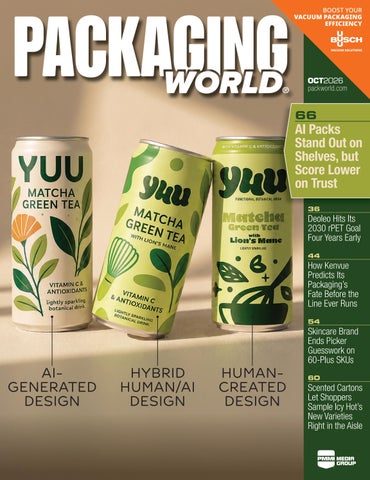
Like the YUU green tea cans on the cover, here again we see the same pack design rendered three ways, by AI alone, by a designer alone, and by a designer refining AI concepts. Shoppers were never told which was which, and still ranked them differently on trust, appeal, and price.
NO6
DEPARTMENTS COLUMNS
5 Lead Off 22 The Big Picture 24 Futurists’ Viewpoint 28 Design Impact 80 Professional Perspective
8
28
NEWS/EVENTS
6 News 14 Quotables
FEATURES 36 Olive Oil Multinational Deoleo Tackles Circular Packaging From rPET and mono-material formats to a blue glass bottle designed to protect product quality, Deoleo is reworking packaging across its global portfolio.
44 Kenvue Profiler Brings Packaging Circularity Into Development The company’s Sustainable Innovation Profiler gives Kenvue packaging teams real-time data to weigh recycled content, material efficiency, recyclability, and other design tradeoffs.
54 PACKAGING FOR E-COMM Skincare Brand Right-sizes Transport Packaging Across a 60-SKU Line Orders from professional acne treatment brand Face Reality can combine a 30-mL serum with a 473-mL treatment-room bottle, and everything in between, in the same case. Working with a fulfillment provider, Face Reality removed the packaging guesswork and replaced subjective, picker-selected cases and bubble wrap with repeatable dimensioning software and paper-based void fill.
60 Icy Hot’s Scratch-and-Sniff Carton Solves a Shelf Problem Brand owner Opella encapsulated its actual product fragrance oil and mixed it into a standard spot varnish on its products’ carton. That means no sticker application on otherwise recyclable paperboard, no new packaging equipment, and no more shoppers tearing open glued-end cartons to smell the new fragrances inside.
66 COVER STORY Consumers Weigh In on AI-Generated Packaging Graphics T&T Design Group puts human, AI, and hybrid package design to the test, uncovering a complicated relationship between visual standout, trust, perceived value, and purchase intent.
72 Portion Packaging Brings Big Efficiencies A nine-lane pouch machine system cranks out Miguel’s delicious green and red salsas far more efficiently than having in-store personnel fill cups manually.
INTERVIEW
16 First Person
80
PRODUCTS
76 Technology ADVERTISING
79 Advertiser Index
EDITORIAL ADVISORY BOARD Jan Brücklmeier Technical Application Group Packaging Technology Expert, Nestlé M. Shawn French Director – Innovation & Packaging Engineering (Beverage), Danone North America Patrick Keenan R&D Packaging Engineer, General Mills/Annie’s Organic Snacks Tim Lehman Sr. Engineering Manager, Supply Chain, GOJO Industries, makers of Purell Mike Marcinkowski Director of R&D Material Science, Packaging & Sustainability – Nature’s Vault/Fresh Loop Shannon Moore Director Global R&D Packaging Sustainability, Kellanova Andrew Seys Senior Director, Global Operational Excellence, Spectrum Brands David Smith, PhD Principal, David S. Smith & Associates Brian Stepowany Packaging R&D, Senior Manager, B&G Foods, Inc.
To subscribe to Packaging World, scan the QR code or visit pwgo.to/9999
Packaging World® (ISSN # 1073-7367) is a registered trademark of PMMI, The Association for Packaging and Processing Technologies. Packaging World® is published in February, April, June, August, September, and October by PMMI with its publishing office, PMMI Media Group, located at 500 W. Madison, Suite 1000, Chicago, IL 60661; 312.222.1010. Periodicals postage paid at Chicago, IL, and additional mailing offices. Copyright 2026 by PMMI. All rights reserved. Materials in this publication must not be reproduced in any form without written permission of the publisher. To subscribe or manage your subscription to Packaging World®, visit pwgo.to/9999. POSTMASTER; Send address changes to Packaging World®, 500 W. Madison, Suite 1000, Chicago, IL 60661. PRINTED IN USA by Quad. The opinions expressed in articles are those of the authors and not necessarily those of PMMI. Comments, questions and letters to the editor are welcome and can be sent to: editors@packworld.com. Mailing List: We make a portion of our mailing list available to reputable firms. If you would prefer that we don’t include your name, please write us at the Chicago, IL address.
Contents_1026.indd 2
9/22/26 12:20 PM
TL J
Untitled-1 2
9/17/26 10:23
4 PW OCT2026
Follow us
www.packworld.com
CONTENT Matt Reynolds Chief Editor Anne Marie Mohan Senior Editor Sean Riley Senior News Director Casey Flanagan Associate Editor Tracey Labovitz Editorial Operations Coordinator Kim Overstreet Director of Content Pat Reynolds, Sterling Anthony, Eric F. Greenberg Contributing Editors David Bacho Creative Director
ADVERTISING Reggie Lawrence Vice President, Sales rlawrence@pmmimediagroup.com Lara Krieger Senior Manager, Print Operations lkrieger@pmmimediagroup.com Janet Fabiano Financial Services Manager jfabiano@pmmimediagroup.com
PMMI MEDIA GROUP David Newcorn President Elizabeth Kachoris Vice President, Digital Jen Krepelka Senior Director, Digital Media Amber Miller Director of Marketing Joan Jacinto Director, Ad Tech and Search Angie Szerlong Director of Industry Strategy Joseph Angel Founding Partner and Executive Vice President, Industry Outreach, PMMI Questions about your subscription or wish to renew? Contact circulation@pmmimediagroup.com.
PMMI Media Group 500 W. Madison, Suite 1000, Chicago, IL 60661 Web: www.pmmimediagroup.com PMMI The Association for Packaging and Processing Technologies 12930 Worldgate Dr., Suite 200, Herndon, VA 20170 Phone: 571/612-3200 • Fax: 703/243-8556 • Web: www.pmmi.org
Masthead_1026.indd 4
9/21/26 6:37 PM
5
LEAD OFF
A Label’s New Jobs I spent a week last month in Chicago following nothing but labels. First, it was the AWA/AIPIA smart labeling seminar, then a few days walking Loupe Americas, the show many of us still call Labelexpo. Here were my three main takeaways. First, a common barrier to RFID adoption moved, and it’s no longer cost. I went in assuming cost was still what kept intelligent labels, RFID specifically, out of center-store CPG and FMCG packaging, but several people corrected me. Beontag’s Gino Olivato said tag costs are down roughly 300-fold since 1999. And Avery Dennison’s Jason Rambler says tag cost is no longer the barrier, even on something as low-margin as a pack of crayons. What still costs real money is the richer sensing technology, like Bluetooth low energy (BLE) tags that do more than just identify. And on low-margin items, that added capability usually can’t pay for itself. Stephen Statler of ambientChat.ai called IoT’s long adolescence “the internet of expensive things,” tongue firmly in cheek. But that era is ending, and what replaces it is an organizational hurdle. Brands have to get packaging, IT, supply chain, and legal all pointed in the same direction before they scale smart labels. Avery Dennison’s answer on the floor was AD Fusion, roll stock with RFID inlays already inserted, removing the capital investment converters previously needed just to quote the work. Rambler said that for a brand asking its printer about RFID, “the answer is no longer ‘no.’” That sounds minor, but it’s a sea change. Second, RFID deployment applications still sit outside the center store, but they offer lessons that translate to FMCG. Gwen Volpe, senior director of medication technology programs at pharma manufacturer Fresenius Kabi, was a rare brand-side voice on a smart labeling panel otherwise full of suppliers. Her company tagged only 25 products out of a wide portfolio with roughly half a billion doses a year, and selecting the right products for the capability was very intentional. Fresenius Kabi ships in vials and IV bags, and Volpe’s team found that validating inlays against water wasn’t enough. They tested against actual formulations, in actual containers, before and after manufacture. Any brand putting RFID on liquid- or metal-containing packaging will meet the same physics. I figured the main case for the investment was inventory convenience, but again I was corrected. With 220-plus active drug shortages in the U.S., she wants visibility early enough to act. And AI is making action possible. “I have AI and data and I can use it for something meaningful,” she said. McLeod Williamson at Tageos sketched out what comes next for consumer goods. Dualfrequency inlays now carry UHF for inventory and NFC for consumer engagement in one tag. In wine and spirits, for example, where he says counterfeit rates in some non-U.S. markets run 60 to 70%, that second frequency handles authentication and engagement simultaneously. Nutraceuticals and OTC are next, he expects. Passive tags can now sense temperature, humidity, or strain, which should interest anyone shipping something perishable. Third, sustainability stopped being a label claim and started being an engineering spec. On the floor, “recyclable” turned out to mean at least four different things. Mactac’s new dairy film stays on the bottle through grinding and blends into reclaimed HDPE below a contamination threshold. UPM’s ProCycle line does the opposite, separating and washing off clean. Innovia and Taghleef are both building polyolefin shrink sleeves light enough to float away from PET at the MRF. Plus, the floatable polyolefin replaces PET-G which used to be a standard with shrink. But it would travel with the rigid PET substate, contaminating clean PET bales downstream. Functionally, the tech helps dairy and other light-sensitive product brands moving from opaque HDPE to clear PET who still need fullcoverage from light. And Brook & Whittle, not even exhibiting, won the show’s sustainability award for a fourth route—a light-blocking coating on crystallizable PET (again, not PET-G). Two on-shelf packages anchored sustainability’s impact in real examples. Henkel’s Le Chat detergent in France uses on-demand, spot metallization, printing metallic finish only where the design calls for it rather than laminating and trimming a full web of foil. And Elementary ColdPressed Dog Food adopted a cuboid pouch that eliminates headspace and cuts material roughly 30%, a decision driven explicitly by EPR fees calculated on packaging weight and volume. The label used to be where you put the brand. It’s becoming where you put the compliance, the data, and increasingly, the intelligence. That same real estate, often fought over by multiple stakeholders, is doing considerably more work for all of them. PW
mreynolds@pmmimediagroup.com
LeadOff_1026.indd 5
9/22/26 4:18 PM
6 PW OCT2026
NEWS
Limited-run Heinz Adjustable-flow Lid Uses Rotating Core, Standard Polyethylene Kraft Heinz recently introduced the Heinz Love Lid, a consumer-adjustable closure that lets users dial the ketchup flow rate through three settings labeled Like, Love, and Crazy Love. It arrives as a limited-run grillingseason activation rather than a change to Heinz’s standard closure, but the mechanism itself is a real functional addition to a bottle format the company has otherwise left alone.
In answers provided to Packaging World, a representative from the company detailed the mechanical and material decisions behind the closure. The lid is a two-part closure built around a patented mechanism. According to the company, it has a smaller inner aperture, and as the dial is rotated, an internal core rises to progressively increase the flow. That approach varies effective orifice restriction through vertical travel of a core rather than by rotating a series of fixed openings into alignment, which is the more common arrangement in adjustable dispensing closures. Materially, the closure is conventional. A representative from the company told Packaging World that the Love Lid is made from the same type of polypropylene used in Heinz’s traditional lids, and that its recyclability is unchanged from the standard closure. That answer is notable given that multi-part closures frequently introduce recyclability complications when a mechanism requires a second resin or an elastomeric or metal component. “The Heinz bottle was left completely intact for this lid innovation, and the Heinz Love Lid works on any [existing] 20-oz Heinz bottle,” the representative says. Because the neck finish is unchanged, the lid functions as a consumer-applied retrofit rather than a line-applied closure: users remove the original lid, remove the induction seal film, thread on the Love Lid, set the dial, and squeeze. Kraft Heinz says the Love Lid was developed in partnership with Beta Design Office and Wieden+Kennedy London.
News_1026.indd 6
E-comm-only launch The Love Lid is not sold on its own and is not reaching physical retail shelves. It is available for a limited time only as a bundle containing one bottle of Heinz Tomato Ketchup, one Love Lid, and a printed guide suggesting settings for different foods. Kraft Heinz directs U.S. buyers to TheLoveLid.com, which redirects to a Walmart.com product listing. Walmart was not named in the announcement, but a representative from the company confirmed to Packaging World that the Love Lid is available exclusively through Walmart.com in the U.S. In the U.K., it is sold through HeinzToHome. co.uk. Kraft Heinz did not characterize the arrangement with Walmart beyond the exclusivity itself. The channel decision carries packaging implications of its own. An e-commerce-exclusive bundle has to survive parcel shipping rather than pallet-to-shelf distribution, which puts the secondary pack, not the closure, under the most mechanical stress. A glass-free, PET-bottle bundle helps, but the outer carton still has to protect a filled 20-oz bottle and a separate loose closure through single-parcel handling. Kraft Heinz has not detailed how the bundle carton was designed or tested. Bundling the closure with a bottle it is known to fit also removes a variable. Because the lid is consumer-applied and depends on a matching neck finish, pairing it with a specific 20-oz bottle avoids the fitment questions that would come with selling the closure as a standalone accessory.
Positioning Kraft Heinz frames the closure as a response to how differently consumers use the product. “We all experience love differently and our fans’ connection to ketchup is no exception. People have deeply personal rituals around how much ketchup they squeeze, and we celebrate every one of them,” says Nina Patel, vice president, Global Heinz at the Kraft Heinz Company. The company describes the Love Lid as a continuation of recent bottle and closure work, following the Heinz Dipper, and as part of an effort to give consumers more ways to personalize dispensing. For brand owners weighing similar adjustable-dispensing projects, the Heinz approach is worth noting for what it leaves alone. By holding the resin, the neck finish, the bottle, and the recyclability profile constant, and by keeping the closure out of the filling line entirely, Kraft Heinz added a mechanical function without opening up a package qualification, a line change, or an end-of-life question. What it took on instead is an e-commerce fulfillment and secondary packaging problem, and a limited window in which to prove consumer demand. —Matt Reynolds
9/21/26 8:32 PM
| MX01USA |
Smart. Modular. Cabinet-free. The MX-System advantage.
Have you taken a serious look at your electrical cabinets lately? Sure, they protect your equipment and have been there right alongside your machines since, well, forever. Maybe you take them for granted, like they just have to be there. They don’t. Our new MX-System has changed automation and controls system design forever. This flexible, space-saving, and intelligent automation hardware platform can completely replace conventional control cabinets and literally transform your machines. Seriously. With pluggable modules for all main areas of automation and control such as the controller, I/O, drives, relays and system modules, the MX-System opens up exciting new possibilities for machine builders, system integrators, and end users alike. Sorry, electrical cabinets, but we think it’s time to retire.
Scan to go cabinet-free and send your enclosures on a permanent vacation!
Untitled-2 2
9/22/26 06:49
8 PW OCT2026
NEWS
Elementary Dog Food Adopts Cuboid Pouch Design A bag of Elementary Cold-Pressed Dog Food, found at HP’s booth at Loupe Americas in Chicago last month, carries a package format that won Highest Achievement with two Gold awards from the Flexible Packaging Association earlier this year. The format, called Pouch3 Cuboid, is made by pouch converter Sun Centre USA. FPA’s citation describes it as headspace-free and box-shaped, using up to 30% less material than a flatbottom or stand-up pouch of equivalent volume, built from recyclable LDPE in a single-web structure and customizable with different closures. It first won recognition on a coffee application for Lake Michigan Coffee Company and EDC Coffee; the Elementary bag is another, separate use of the same design. Brent Holloway, HP’s category manager for flexible packaging and the 200K digital press, gave a presentation
at the show touching on packaging-ratio and headspace reduction as a cost lever for brands. Asked afterward about the Elementary pouch specifically, Holloway said the substrate was printed on an HP Indigo digital press, and that just about everything else about the application matches the original award-winning design. The only notable difference is the brand owner. Holloway pointed to extended producer responsibility (EPR) fees as the reason the format is spreading to new brands. Several U.S. states now charge producers based on the weight or volume of the packaging they put into the market, so a format using less material and no wasted headspace lowers that fee directly, on top of any savings in material and shipping costs. Sun Centre’s own framing, from a LinkedIn post by company president Jim Pease, makes the same case in stronger terms. He contrasts the format with stand-up and flat-bottom pouches, both designed decades ago, and calls Pouch3 “eco-modulation in practice,” crediting Elementary’s manufacturer with choosing 100% LDPE and the cuboid format to cut material and landfill waste. —Matt Reynolds
Henkel’s Le Chat Adopts On-demand Metallization A new label for Le Chat, a Henkel Consumer Brands detergent line sold in France, was spied at Loupe Americas in Chicago last month, made with an on-demand metallization technology called EcoLeaf that’s already reaching real store shelves. Metallic finishes are common on labels because they boost shelf appearance, but they’re typically applied with cold foil, a separately manufactured metallized polyester film that has to be shipped to the printer and trimmed to match the label’s design, leaving behind a large amount of leftover waste. EcoLeaf solves that problem differently. Instead of transferring foil across an entire web, it spot-prints a chemistry-activated binder only where the metallic effect is needed, using flexo, screen, or digital inkjet, ahead of the main print run. The material then passes through a unit where loose metal flake circulates over a drum; the flake sticks only where the binder was printed, through a dry, hydrophobic reaction, leaving no foil substrate and no offcut waste. The metallic layer can also be overprinted with additional colors rather than staying a single fixed tone. Converter All4Labels built a commercial line around the technology, called StarShine, part of its push into fully digital label production and marketed under a campaign called “The Flow.” Henkel has applied StarShine across several home and personal care lines beyond Le Chat, including hair care products, as part of an effort to move existing brands toward more sustainable versions of themselves. The Flow campaign also includes demonstration designs
News_1026.indd 8
for other categories, such as wine and spirits, that remain concept work rather than confirmed in-market products. StarShine labels are designed to wash off cleanly during PET, HDPE, and polypropylene bottle recycling, meeting RecyClass’s protocol for labels and adhesives on PET bottles, including a test for whether printed inks bleed into the wash water. All4Labels’ own materials put the technology’s emissions reduction at up to 80% compared with traditional metallic foils, with less waste and setup time, fewer hazardous chemicals, and lower solvent content than gravure printing. Production currently runs across sites in Italy, Germany, the U.K., Romania, and France. —Matt Reynolds
9/21/26 8:32 PM
Untitled-2 2
9/22/26 06:51
10 PW OCT2026
NEWS
Mondele z Shifts 115 Cookie Products From PET to Paper Trays Mondele-z International has completed the replacement of rigid PET trays with FSC-certified paper trays across its flagship European cookie range, extending paper packaging across a large portion of its biscuit portfolio. Explains Olivier Kintzig, biscuits packaging director, Europe, at Mondele-z International, “Replacing rigid plastic with paper across 115 products, eight brands, and 25 European markets in a matter of months required rethinking every layer of our packaging, from tray design to logistics. The result speaks for itself: approximately 2,200 tons of virgin plastic per year, representing approximately 80% reduction. As packaging professionals, this is exactly the kind of bold, systemic change we exist to deliver.” The conversion includes products sold under LU, Milka, Granola, Cadbury, Marabou, Chips Ahoy!, Lacta, and Freia. In the U.K., Cadbury Crunchy Melts, Cadbury Chocolate Chip Cookie, and LU Petit Cookie are among the products moving to the new trays. Mondele-z says the initiative covers approximately 28,000 tons of cookies produced annually and is the largest packaging sustainability project undertaken in its European bakery category. The project follows several other efforts by Mondele-z to introduce paper-based packaging. In late 2024, the company began using recyclable SmartShift AD 1 2026 - w Bleeds 1.pdf 1 9/21/2026 3:45:07 PM
paper for secondary packaging from Saica Group for selected LU biscuit lines produced in France. Mondele-z said the FSC-certified structure would eliminate 177 metric tons of virgin plastic annually across France, Belgium, and the U.K. and reduce plastic use by 63% for the affected lines. The following year, in Australia, Mondele-z replaced the metal bottom on its Cadbury Drinking Chocolate composite can with a paper bottom. The Sonoco EnviroCan incorporates more than 60% recycled cardboard and is designed for recycling through Australian curbside systems. In 2025, Mondele-z also tested paper packaging for Cadbury Heroes in the U.K., launching a 300,000-pack trial at Tesco stores. Developed with DS Smith, the paper tubs include a QR code inside the lid inviting consumers to provide feedback to help inform future packaging decisions. The paper tray conversion is part of a broader Mondele-z program to evolve plastic trays across its bakery category. It also supports the company’s goal of reducing virgin rigid plastic globally by 25% by 2030 compared with a 2020 baseline. —Anne Marie Mohan
Get your Shift together. C
M
Y
Continuous motion, positive control— the SmartShift divider.
CM
MY
morrison-chs.com CY
CMY
K
News_1026.indd 10
9/21/26 8:32 PM
Untitled-2 2
9/22/26 06:51
SOLUTIONS FOR THE BEVERAGE INDUSTRY
12 PW OCT2026
NEWS
Six CPG Giants Join Forces on Paper-based Flexible Packaging
Packaging Engineers, Project Managers, Integrators, and Technicians for the Beverage Industry. We have the bestin-class knowledge for both packaging equipment and production processes.
WE DELIVER Proven engineering, project management, process expertise, and experienced technician support to maximize our clients’ operational performance from concept to commissioning. Engineering & Line Design Project Management Equipment & Technical Support Operations Support & Training Equipment Install & Relocation Lab Services & Testing
© andre - stock.adobe.com
WE ARE
With paperization continuing to gain attention as an alternative to plastic packaging, six of the world’s largest consumer goods companies are joining forces to tackle one of its tougher applications: flexible packaging. Colgate-Palmolive, Mars, Nestlé, PepsiCo, Procter & Gamble, and Unilever are founding members of the new PaperFlex Consortium. The group is being convened by the Ellen MacArthur Foundation (EMF) and powered by (RE)SET, an organization that works with companies and public-sector groups on environmental strategy and implementation and has experience running collaborative R&D consortia. Explains Sander Defruyt, strategy lead for plastics at the Ellen MacArthur Foundation, “Responsible paper-based flexible packaging solutions don’t yet exist at the performance, scale, and cost required. This consortium signals strong demand for them and real ambition from six consumer goods companies to help scale them. We’re inviting other FMCG companies, innovators, suppliers, and investors to get involved now. The faster we develop such solutions, the sooner they reach the markets that need them most.” The PaperFlex Consortium will focus on markets where flexible plastic packaging is widely used and where collection and recycling systems are limited. Members aim to develop paper-based alternatives that can be recycled as collection systems improve while also being biodegradable if they unintentionally end up in the environment. Over the next few years, members plan to shape, fund, and conduct collaborative trials involving biodegradable coatings and other technologies. Work will also address product protection, shelf life, consumer usability, and the ability of paper-based materials to perform on manufacturing lines. Each member will continue to make its own packaging decisions independently. The consortium builds on an EMF report published earlier this year on paper-based flexible packaging in markets with high leakage rates (see pwgo.to/9272). The report identifies responsibly designed paper alternatives as one part of a broader approach to small-format flexible plastic waste and establishes six design criteria covering responsible sourcing and production, technical and economic performance, consumer needs, local recyclability, chemical safety and persistent plastic pollution, and compatibility with a broader, socially inclusive circular economy strategy. Commenting on PaperFlex, Allison Lin, global VP of healthy planet and chief circularity officer at Mars, says, “The consortium challenges the traditional mindset of innovating on our own, demonstrating that partnership—structured with legal oversight, clear guardrails on permissible topics, and an independent third-party convenor—can accelerate the development of more sustainable packaging in ways that no single company could achieve alone.” —Anne Marie Mohan
ALTAMIRABREW.COM News_1026.indd 12
9/21/26 8:33 PM
Untitled-2 2
9/22/26 06:52
14 PW OCT2026
QUOTABLES
“Most plastics are designed to be stable, which is exactly what makes them difficult to remove or recycle. We’ve shown that it’s possible to create a material that behaves very differently—one that can transform into vapor at relatively low temperatures before naturally rebuilding itself into the same polymer. This isn’t a replacement for conventional plastics, and it’s certainly not a solution to the global plastic waste problem. But it does introduce a new concept that could inspire an entirely new generation of circular materials.” –Peter Roth, chemical engineer at the University of Surrey, as quoted in an article from Yahoo! News, “A New Kind of Plastic Vaporizes When Heated And Then Reassembles Itself”
“Adoption of new consumption habits is often framed as something wholly dependent on consumers changing their behavior. Our findings point to a different path that can drive change much faster: design. We’ve seen that when systems are designed to be visible and convenient and environments are optimized to shift the community norm, participation becomes the easy choice, and circular systems can begin to scale.” –Kate Daly, managing partner at Closed Loop Partners and head of the Closed Loop Center for the Circular Economy, in a press release on a new Closed Loop report, “Designing for behavior change across U.S. cities”
“What makes packaging particularly powerful is that it’s something consumers can physically engage with. Rather than simply seeing a campaign, they’re actually part of it. In our case, the can becomes part of the matchday ritual, creating a small but rewarding moment when it reveals that it’s perfectly chilled and ready to enjoy.” –Vinicius Sales, global design leader for PepsiCo, in an article from Packaging Europe, “The inside story of Pepsi’s new colour-changing can”
“Connected packaging creates commercial value only with maintained information and dependable scanning. Packaging teams need one accountable process for identifier creation and artwork approval. Line verification and record updates complete operating governance. Repeat use follows proven checkout performance and product-specific governance in place of a QR image placed on artwork.” –Nandini Roy Choudhury, principal analyst for packaging at Future Market Insights, in a research announcement, “On-Pack QR Codes & Digital Product Passport Market Size to Reach USD 13.9 Billion by 2036”
Quotables_1026.indd 14
9/22/26 9:52 AM
Smarter Packaging Starts Here Connected Line Performance for Packaging MULTIVAC Line Control connects your entire processing and packaging operation into one intelligent system. Monitor performance, streamline production, reduce downtime, and gain real-time visibility across your line—all through a single, intuitive interface designed to maximize efficiency and throughput. Explore what’s possible and see our solutions in action at Pack Expo 2026 in Chicago!
Scan to learn about MLC Capabilities
Untitled-2 2
9/22/26 06:52
16 PW OCT2026
FIRST PERSON
Flexible Film Recycling Demands a System-wide Fix A new report from the Alliance to End Plastic Waste examines the technical, economic, and infrastructure barriers limiting flexible film recycling and the partnerships needed to overcome them. By Anne Marie Mohan, Senior Editor One major challenge stems from the multilayer structures comFlexible packaging now accounts for roughly half of all plastic packagmonly used in flexible packaging. “The number one issue is that it is ing globally, driven by growth in e-commerce, convenience foods, and made of a wide range of materials, hence its structures are complex, lightweight packaging formats. Yet despite its functional and environand that makes recycling more difficult for flexibles,” Goenka explains. mental advantages, flexible film remains one of the packaging indusEconomics present another barrier. Because flexible films are lighttry’s most difficult materials to collect, sort, and recycle at scale. weight, they are more difficult and expensive to collect, transport, and The Alliance to End Plastic Waste believes solving that challenge process economically within existing recycling systems. will require far more than incremental improvements Operationally, films also create problems inside to existing recycling systems. Through its U.S. Flexibles materials recovery facilities (MRFs). “This is a material Program and a recently released report, “The Challenges that sticks to other waste, it clogs equipment, and as and Solutions for Flexible Plastic Packaging Waste,” a result, when you are operating facilities with a lot of the organization is outlining a system-level strategy flexibles, you have a lot of downtime and maintenance designed to improve flexible film recycling through issues,” Goenka says. coordinated action across the packaging value chain. Despite those challenges, the Alliance argues in its Central to that effort, the Alliance’s U.S. Flexibles report that scalable solutions are achievable through Program is part of a broader thematic initiative opertargeted interventions across collection, sorting, recyating across the U.S., Canada, and Europe, with projcling, and end-market development. ects shaped by recycling initiatives and pilot programs already underway in multiple regions. “This is basically a program that’s designed for action,” says Pranav Goenka, chief advisor, global proOne notable aspect of the Alliance’s strategy is that gram development at the Alliance to End Plastic Waste. it begins not with collection infrastructure or packag“We are looking to implement solutions around some ing design, but with end markets. According to Goenka, of the gaps we see in relation to flexibles, whether it’s the organization’s first step is understanding where related to design, whether it’s related to collection, sortdemand for recycled flexible materials already exists ing, or recycling, or end markets.” Pranav Goenka, chief advisor, and what specifications recyclers and converters must The Alliance’s approach draws on years of pilot proj- global program development, meet to supply those applications. “It’s about underects and on-the-ground recycling initiatives around the Alliance to End Plastic Waste standing where these end markets exist and what will world, along with lessons learned about what works and be required in terms of quality and cost,” he says. what doesn’t when attempting to scale flexible film recycling systems. The report emphasizes that recycling systems cannot scale without strong and stable demand for recycled content. That includes understanding the performance requirements of applications such as blown film, injection molding, and food-contact packaging. “By understandFlexible packaging offers several sustainability advantages coming these applications, it leads us to the second step, which is being very pared with many rigid alternatives. Its lightweight structure can reduce targeted about designing our projects to close gaps across the value transportation emissions and improve material efficiency, while its barchain,” Goenka says. rier properties can extend shelf life and reduce food waste. Those same The report identifies multiple weak points that continue to limit flexperformance benefits, however, can make flexible materials more difible film recycling in North America, including inconsistent collection ficult to recycle at scale.
Why end markets come first
What makes flexible film so challenging?
FP_AllianceToEndPlasticWaste.indd 16
9/21/26 6:45 PM
Untitled-2 2
9/22/26 06:53
Reliable Vertical Conveying
Small Footprint. Low Maintenance. High Efficiency. Move cases, trays, bottles, or cans seamlessly. Ryson Spiral Conveyors deliver faster, more reliable vertical transport than traditional lifts, using a fraction of the floor space. The advantages: - Custom-built in the USA - Completely modular for easy installation and flexibility to modify in the field - Minimal downtime - Low energy consumption and Space-saving Ryson also stocks a full inventory of spare parts and support every system with a dedicated service team. For bulk material handling, we offer a complete line of Bucket Elevators. Ry f
18 PW OCT2026
FIRST PERSON
A framework from the Alliance to End Plastic Waste’s report illustrates the interconnected technical, economic, policy, and end-market challenges limiting flexible film recycling, along with the system-level interventions needed to address them. systems, contamination issues, limited sorting capabilities, insufficient recycling infrastructure, and uncertain end-market demand. It also points to fragmented policy frameworks and limited access to curbside collection for films and flexibles as barriers slowing broader adoption and investment. To address those barriers, the Alliance’s framework focuses on three interconnected elements: market mapping, demonstration projects, and replication.
Prove locally to scale nationally The organization’s emphasis on demonstration projects comes from the idea that recycling systems must be proven locally before they can scale nationally. “We are demonstrating it from a system viability end-to-end point of view in a local city or a local community because that’s when you start to instill trust in the system,” Goenka says. The report notes that many flexible packaging recycling initiatives have struggled because improvements were made in isolation rather than across the entire system. A new collection stream, for example, may fail if downstream sorting or end-market infrastructure cannot support it. The Alliance instead advocates coordinated interventions across the full value chain. “If we follow these three steps, in our view, it’ll get to the heart of the issue around what we face in the U.S. today around gaps in infrastructure, gaps in access, gaps in supply chain connectivity, and above all instilling more trust in the system,” Goenka says. The organization also sees collaboration as essential. The U.S. Flexibles Program works with producer responsibility organizations, recyclers, brands, municipalities, and other industry groups to identify where each stakeholder can contribute. Says Goenka, “I would say over the last year I have seen much more coordinated and complementary actions happening on the ground.”
www.ryson.com (757) 898-1530 A MEMBER OF THE INTERROLL GROUP
FP_AllianceToEndPlasticWaste.indd 18
9/21/26 6:45 PM
CLEAN FASTER. PRODUCE MORE.
Introducing ULMA’s Washdown Vertical Packaging Platform Protect Food Safety IP66-rated 360º washdown design built for aggressive sanitation environments
Maximize Uptime Fast cleaning, ergonomic changeovers, and simplified operation
Reduce Operating Costs Lower air consumption and energy use
Explore Washdown Packaging Solutions
© 2026 Harpak-ULMA Packaging, LLC, 85 Independence Drive, Taunton, MA 02780 USA
Untitled-2 2
9/22/26 06:53
20 PW OCT2026
The role of advanced sorting technologies Advanced sorting technologies are another major focus of the Alliance’s work. The report highlights the growing role of AI-enabled object recognition, digital watermarking, and dedicated plastics recovery facilities in improving flexible packaging sorting and recyclate quality. Conventional technologies such as near-infrared (NIR) sorting can already identify many plastics streams. The next step, according to Goenka, is giving recyclers more detailed information about the materials moving through the system. “These technologies sometimes are able to detect but sometimes are not able to quantify, for example, the number of polymers that exist in a packaging structure or the additives that are included in that packaging material,” he says. Digital watermarking is one example of the newer technologies being explored to improve sorting accuracy and material identification. The technology embeds an invisible code into packaging that can carry information about a product’s composition and properties. When scanned in a sorting facility, the code can help recyclers identify materials more precisely and direct them into appropriate recycling streams. The Alliance has supported digital watermarking initiatives through projects such as HolyGrail 2.0 in Europe, which validated the technology in industrial sorting environments. AI-enabled object recognition and digital watermarking are often discussed together, though Goenka says the technologies serve different purposes within the recycling chain. “If you are on the collection side trying to ensure that you’re improving contamination levels, then
FP_AllianceToEndPlasticWaste.indd 20
FIRST PERSON
©Philip - stock.adobe.com
Bales of mixed flexible plastics illustrate one of the central challenges facing film recycling today: complex material streams that require improved collection, sorting, and end-market infrastructure to scale recycling in the U.S. probably AI sorting or object recognition is actually well used there,” he says. “But when it is about using it at a secondary sorting facility to understand melt flow indexes and what type of applications materials will go into, digital watermarks is actually a much better application.” Ultimately, the goal is not simply better sorting efficiency, but higher-quality recyclate capable of meeting demanding end-market specifications.
9/21/26 6:46 PM
21
Global projects inform local strategies Although the U.S. Flexibles Program focuses on North American challenges, the Alliance is leveraging lessons from projects underway in Europe and other regions. In Europe, where extended producer responsibility (EPR) systems are more established and recycled-content mandates are expanding, the focus has shifted toward improving recyclate quality and validating higher-value applications. One example is the Alliance-supported COtooCLEAN project in the U.K. with recycling technology company Nextek. The demonstration unit uses supercritical CO2 to remove contamination from polyethylene film without water, with the goal of producing recyclate suitable for higher-value applications. The Alliance is also evaluating sorting and recycling pathways for polypropylene films in Belgium, including dissolution, de-inking, and decontamination technologies. The projects are intended to evaluate how recycled PP can move through the recycling stream and ultimately be incorporated into biaxially oriented polypropylene (BOPP) applications for both food and non-food packaging. Explains Goenka, “This is really about validating from collection all the way to end-use incorporation into BOPP.” The broader goal is to develop repeatable models that can eventually be adapted to local market conditions elsewhere. The report emphasizes that scaling flexible film recycling will likely require regional approaches tailored to local infrastructure, policy environments, and end-market demand rather than a single universal solution.
Brands play a critical role The report repeatedly emphasizes that brands and retailers will ultimately determine whether flexible film recycling systems can scale. Without long-term demand commitments for recycled content, the report argues, infrastructure investment and technology deployment will remain limited. According to Goenka, brand owners and retailers have become more directly involved in flexible packaging recycling efforts through pilot projects, design-for-recycling initiatives, recycled-content commitments, and investments intended to strengthen end markets for recycled film. The Alliance sees those long-term commitments as critical to creating enough demand to support new recycling infrastructure and technology investments. The report also points to policy mechanisms such as EPR programs, recycled-content mandates, and investment incentives as important enablers for scaling flexible packaging recycling infrastructure in the U.S. Emerging state-level legislation in California, Colorado, New Jersey, and other states is expected to increase pressure on brands and recyclers to improve recovery rates and expand recycled-content use. Still, the Alliance argues that policy alone will not solve the challenge. The report repeatedly emphasizes that flexible film recycling will require coordination across the full packaging value chain, from brands and municipalities to recyclers, technology providers, and producer responsibility organizations. That collaborative approach, according to both the report and Goenka, will be critical if flexible film recycling is to scale beyond isolated pilot projects and into broader commercial systems. PW
FP_AllianceToEndPlasticWaste.indd 21
9/21/26 6:46 PM
22 PW OCT2026
THE BIG PICTURE
By Sterling Anthony, CPP, Contributing Editor
Bracing for UPF Litigation On December 2, 2025, the San Francisco City Attorney brought an ultra-processed foods (UPF) lawsuit, the first brought by a government body. The defendants are CocaCola, PepsiCo, General Mills, Kellogg, Post, Nestlé, Kraft Heinz, Conagra, Mondele-z, and Mars. Even though the lawsuit is in its early stages, it prompts two considerations—whether other municipalities or states will sue, and whether other companies will be named as defendants. Both considerations should be regarded as affirmative, necessitating defense and proactive strategies. The lawsuit was brought under California’s Unfair Competition Law and public nuisance statute. The former is cited in support of allegations of unfair and deceptive marketing methods. The latter is cited in support of allegations of a burden on the city, i.e., UPFs are linked to health-care costs for chronic conditions, such as obesity, diabetes, and cancer. The legal theory of the San Francisco lawsuit differs from that of UPF lawsuits that have been brought by individual citizens, which are under the theory of product liability/personal injury. There, it needs to be proven that the product was defective; the defect caused the injury; the product had been used as intended or as reasonably foreseen; and there are measurable damages that can be awarded. The difference in legal theory aside, a company’s defense strategy must attack causation. A defendant predictably will argue that there is no scientific proof that the alleged UPF is the lone, direct cause of an illness. The argument will be that causation is multifactorial, involving, for example, genetics, lifestyle, and overall caloric consumption. Various product liability and personal injury lawsuits have been dismissed or otherwise defeated because causation was not convincingly established. The San Francisco case will have to overcome that legal hurdle. A defense strategy should cite that there is no legal definition for UPF. If a lawsuit is brought, say, after the issuance of a definition, a defendant can argue that the definition is arbitrary or give a convincing reason why the definition should not apply to its products. In the interim, regarding lawsuits brought by a municipality or by a state, a defendant can argue that its products comply with federal regulations, which preempt lower regulations. Another component of a defense strategy should be to debunk any analogy to Big Tobacco. The analogy is that “hyper-palatable” UPFs are formulated to be addictive, much the way that tobacco products were formulated to be addictive. A plausible counter, therefore, is to argue, scientifically, that the human response to fat, salt, and sugar is not like an addiction to nicotine.
BigPicture_1026.indd 22
While the preceding discussions are useful in the wake of a filing, the advantages of avoiding lawsuits are considerable. Lawsuits involve time and expenses, in addition to the potential for negative publicity. It behooves a food company to devise a proactive strategy, to reduce exposure, and to increase readiness. Being proactive is part of risk management. It does not require a company to concede that its practices are deceptive and unethical. It does, however, require a willingness to objectively audit its practices, mindful of how those practices might be cited against the company in lawsuits. Marketing audits should evaluate health-related claims, such as those made in online and print media, in addition to those made on the packaging and on the labeling. Has the company been loose with its health-related claims? A general rule is that the more artificial colors, additives, emulsifiers, and heavy amounts of salt, sugar, and fats a product contains, the greater the potential exposure to allegations of deceptive claims. An additional focus should be applied when the product is marketed to children who are described in lawsuits as vulnerable. As a result of a marketing audit, the company should revamp its claims, as needed, without unduly decreasing the product’s marketability. Formulation audits should be tasked with the removal and/or replacement of ingredients that either have come under scrutiny by regulators and by advocates or have the AI-generated potential of coming under such scrutiny. The list of controversial ingredients is growing, the clearest example is Red Dye No. 3. Innovative reformulation can counter allegations of public nuisance and a failure to warn, both cited in the San Francisco lawsuit. A company’s proactive strategy should recognize other stakeholders and devise ways of cooperation. Memberships in trade organizations and encouraging their aggressive lobbying are important. On a related note, a UPF lawsuit can be brought against members of a food company’s supply chain, including retailers. It’s wise to keep the retail industry apprised of the food company’s proactive strategy and to explore opportunities in advancement of mutual interests. Defense and proactive strategies related to the UPF debate in general, and specifically its lawsuits, involve such disciplines as marketing, product formulation, processing, legal, and, yes, packaging. It’s packaging that makes processed foods (ultra or not) possible. Food packaging is heavily regulated. It’s not being advocated herein that packaging professionals should have the knowledge expected of lawyers. But packaging professionals still should understand that lawyers must rely on the expertise of others in building a defense. Packaging professionals need to know how lawsuits are triggered and defended, to be able to fulfill their role in legal proceedings. PW
9/22/26 12:08 PM
Untitled-2 2
9/22/26 06:54
24 PW OCT2026
FUTURISTS’ VIEWPOINT
By Todd Bukowski, PTIS, LLC
Data and Integrated Systems Are Driving Change Twenty years ago this month, Walmart introduced its Packaging Scorecard at the Clinton Global Initiative, with a goal of reducing packaging across its supply chain by 5% by 2013. While some brand owners had made individual packages on select “halo” brands more sustainable, Walmart was among the first with enough scale to drive system-wide packaging change.
The Scorecard also signaled how important packaging data would become. Suppliers were no longer being asked only to improve a package. They had to provide information that could be measured, compared, and used to guide decisions across an enormous supply chain. The industry was only beginning to understand where that shift would lead. In the physical world, recycling, composting, and reuse systems must be aligned so materials can be collected and returned to productive use. Common standards must help companies, consumers, recyclers, and regulators work from a consistent framework. In the digital world, systems must exchange packaging data seamlessly, helping the entire value chain streamline workflows, reduce duplication, and respond to regulatory and business requirements. The original Walmart Packaging Scorecard asked suppliers to report against the “7 R’s”: Remove, Reduce, Reuse, Recycle, Renew, Revenue, and Read, with “Read” referring to consumer education. At the time, many of us thought that was a lot of information to provide. The industry was not structured to collect, maintain, or share it efficiently.
PTIS_FuturistsViewpoint_1026.indd 24
Today, the demand for packaging data has expanded dramatically. Extended producer responsibility (EPR) laws in a growing number of U.S. states and Canadian provinces require detailed information about packaging placed on the market. California is also asking brand owners to reduce plastic packaging, move toward more reusable systems, and demonstrate progress. In Europe, the Packaging and Packaging Waste Regulation is creating additional reporting expectations, while future Digital Product Passport requirements are likely to add another layer. The required data is also becoming more granular. Brand owners and retailers may need information on individual components, material types, weights, color, clarity, composition, separability, format, recycled content, and whether inputs are bio-based or fossilbased. These attributes can affect recyclability classifications, regulatory status, environmental AI-generated assessments, and EPR fees. This information must be accurate, traceable, and auditable. For brands managing hundreds or thousands of packaging specifications, this is no longer simply a reporting exercise. It is an enterprise data management challenge. Packaging data management is therefore moving beyond spreadsheets and disconnected calculators toward software platforms built around a common data foundation.
The future is an integrated platform To get more clarity on the future of data management and integration, I spoke with Prashant Jagtap, President and CEO of packaging software provider Trayak. Jagtap explains, “The appropriate response is not a collection of disconnected calculators. It is an integrated sustainability platform built on a common packaging data foundation. The same Sustainability BOM (bill of materials incorporating material type, packaging format, component weight, manufacturing process, end of life attributes, etc.) can support streamlined LCAs, recyclability assessments, EPR reporting and fee forecasting, PPWR readiness, and future product disclosure requirements.” The common data foundation is the key. When environmental
9/21/26 8:16 PM
RELIABLE. EFFICIENT. EASY TO USE.
Learn More
Hitachi Industrial Equipment & Solutions America Hitachi Industrial Equipment Systems Co., Ltd. mc.hitachi-iesa.com
Untitled-2 2
866-583-0048
Marking.Info@hitachi-iesa.com
9/22/26 06:55
26 PW OCT2026
FUTURISTS’ VIEWPOINT
calculations, recyclability assessments, regulatory reporting, and financial forecasting are handled in separate systems, brand owners often enter and maintain the same information multiple times. This creates extra work and increases the risk of inconsistent results. When these capabilities share a common data structure, a change to one component can flow through environmental calculations, recyclability results, compliance assessments, and cost forecasts. CPGs can evaluate the broader effects of a decision without recreating the same package in multiple tools. The result is a more reliable single source of truth that can support package development, sustainability, regulatory affairs, procurement, finance, suppliers, and other partners across the value chain. Jagtap says “Trayak has been building and expanding their EcoImpact platform toward this vision.” EcoImpact is an example of an integrated software tool that is able to grab data from multiple sources, such as packaging specifications, sales data, and procurement data. Many of these “single source of truth” tools allow brand owners to do “what if” scenarios along with financial modeling to understand both the sustainability and economic impact of a packaging decision.
AI extends packaging data’s value Artificial intelligence can make these tools more powerful by extracting information from specifications, mapping materials to
classifications, identifying missing attributes, detecting anomalies, and modeling scenarios across large numbers of SKUs. These capabilities can reduce manual work, identify data gaps earlier, compare alternatives more efficiently, and assess design or material changes across a portfolio. However, AI does not replace data governance. Regulatory and business decisions still require transparent methodologies, controlled workflows, version histories, evidence management, and clear responsibility for data quality. AI will provide the greatest value within a well-managed system built on reliable packaging data. The industry has changed significantly since the Walmart Packaging Scorecard, but its underlying vision remains relevant: better information can lead to better packaging decisions. What has changed is the scale and complexity of the challenge. Sustainable packaging increasingly requires design, sustainability, regulation, finance, suppliers, producer responsibility organizations, and recovery systems to work from shared data. Over the next decade, the ability to collect, govern, exchange, and apply that data will become a core industry capability. Brand owners that leverage an integrated packaging data foundation will be better positioned to meet regulatory requirements, evaluate tradeoffs, improve decision-making, and develop more holistic solutions across the packaging value chain. PW
PTIS, LLC is a leading business and technology management company focused on Creating Value Through Packaging©.
Perfect Labeling Solutions Dispense labels up to 1,500 inches per minute
Accommodates various label sizes .625” W x .5” L & 7.1” W x 10” L
Advanced Saftey Features
Capable of printing in 203, 305 or 600 dpi print resolution
including Safe Torque OO (IEC 51508 SIL 3)
for ... E-Commerce Warehousing 3rd Party Logistics
Visit us here, by scanning the QR code
PTIS_FuturistsViewpoint_1026.indd 26
ctmlabelingsystems.com
9/21/26 8:16 PM
NEIT ER Packaging & processing equipment, ready in as little as 48 hours.
INSPECTION AND TESTING EQUIPMENT
CARTONING, MULTIPACKING, & CASE PACKING
BAGGING, POUCHING & WRAPPING EQUIPMENT
FILLING, CAPPING & CLOSING EQUIPMENT
PROCESSING EQUIPMENT
COMPLETELY INTEGRATED LINES
Packaging and Processing Machinery in as little as 48 hours.
Untitled-2 2
9/22/26 06:55
28 PW OCT2026
DESIGN IMPACT
‘Beautiful Vandalism’ Gives Sparkling Coffee a Disruptive Identity By Anne Marie Mohan, Senior Editor An Elizabethan cat in a ruff is not an obvious way to sell a can of coffee. Yet the unexpected portrait helps define a new sparkling coffee line, where classical imagery, street-art graphics, and torn-paper effects signal that what’s inside is also a departure from the usual coffee experience. Founded in 2025, India-based Black Poetry spent its first year building an identity around premium, artisanal coffee, offering specialty coffee beans and ground coffee for home brewing. In August 2026, it expanded into ready-to-drink beverages with three carbonated, no-milk coffees: Classic Twisted, Orange Spike, and Chocolate Fused, each in a 185-mL slim can.
Building a different kind of coffee
While sparkling coffee remains a small category in India, Black Poetry saw an opening between traditional hot coffee and the cold beverages consumers already reach for in the country’s warm climate. “A no-milk or vegan coffee is already the go-to choice for a large and growing segment of regular caffeine consumers,” says Goel. “In a largely tropical country like India, hot coffee isn’t always what you reach for. Sometimes you simply want your caffeine chilled, refreshing, and sparkling.” Goel sees a broad potential audience. It could be “a student looking for a quick pick-me-up, a corporate professional between meetings, or a homemaker taking a break in the middle of a busy day,” he says. Consumer preferences for lighter drinks also influenced the decision to leave out dairy. Goel says Black Poetry has seen palates shift toward less sugary, lighter, and cleaner flavors rather than heavy, creamy drinks. Removing milk kept the ingredient list relatively simple, reduced the need for preservatives, and helped the company achieve a longer shelf life. Developing the product still took several months of trial and error. Black Poetry experimented with different beans to find the coffee profile it wanted, tested flavors and sweetness levels, and worked through the added processing considerations that come with combining pasteurization and carbonation while retaining the character of cold brew. “We also deliberately kept the carbonation gentle, so the drink feels light and refreshing rather than overly fizzy,” Goel says. “Sparkling, not bubbly.” The company also worked through what Black Poetry’s three sparkling coffee varieties use a shared visual structure while giving Goel describes as “the whole gamut of flavors” each can its own character through portraiture, color, and illustration. before settling on three launch varieties designed to cover distinctly different preferences. Classic Twisted is Moving into RTD meant reaching a broader, younger audience aimed at coffee drinkers who want a straightforward coffee profile. with a product outside familiar coffee conventions. That made the Orange Spike adds a subtle citrus note, and Chocolate Fused brings package essential for explaining sparkling coffee while giving the new together chocolate with hints of vanilla and hazelnut for a richer line a personality distinct from Black Poetry’s existing products. flavor. All three are intentionally low in sweetness. “We realized that a product as unconventional as sparkling The 185-mL can was chosen with the caffeine occasion in mind. coffee needed branding that was equally disruptive,” says Black According to Goel, it provides roughly the caffeine hit of a single Poetry founder Rahul Goel. “The packaging had to break away from espresso in a portion that feels appropriate for one sitting. traditional coffee cues, feel accessible rather than overtly luxurious, Where the product belongs at retail is less straightforward. Black and immediately communicate that this was something out of the Poetry does not see it as an energy drink because of its lower caffeine ordinary.”
DI_BlackPoetry.indd 28
9/21/26 7:59 PM
Multi-Conveyor
www.multi-conveyor.com Untitled-2 2
9/22/26 06:56
30 PW OCT2026
DESIGN IMPACT
A pack built around disruption Open approached the can as more than a surface for arranging branding and required information. With a product consumers might be seeing for the first time, the package needed to introduce the brand idea on its own. “When you treat packaging as media, the first design question becomes: What is the one thing people should notice, remember, and recognize again?” says Radhika Dhuru, executive creative director at Open Strategy & Design. “The pack has to carry the brand idea on its own. It cannot depend on advertising, celebrity, context, or a campaign to explain what the brand stands for.” Black Poetry presents its sparkling coffees in both product and serving contexts, In the case of Black Poetry, that idea reinforcing the line’s positioning as a chilled coffee alternative for different occasions. became “Beautiful Vandalism,” a design concept built around altering something familiar to give it a different content, yet its lack of milk and its carbonation also separate it from meaning. Open drew inspiration from détournement, the practice of conventional canned lattes and flavored RTD coffees. ”Sparkling coffee reworking existing images or messages to create new meanings, and made with real coffee is still a very small category in India,” Goel says, from artists such as Jean-Michel Basquiat and Keith Haring, whose “so ideally, it deserves a shelf space of its own.” work incorporates intervention, graffiti, and appropriation. That lack of an established category language gave Open Strategy “The juxtaposition of the familiar and the new was the very & Design both a challenge and an opportunity when Black Poetry foundation of everything, right from the product itself,” says Dhuru. brought the consultancy in to develop the positioning, visual identity, The design begins with what Open calls the “Revered” layer, where packaging, and communication system for the line.
DI_BlackPoetry.indd 30
9/21/26 7:59 PM
Untitled-1 2
9/23/26 10:32 AM
32 PW OCT2026
DESIGN IMPACT
classical portraiture occupies the upper portion of the package and evokes the craft and seriousness traditionally associated with coffee. A ragged, torn-paper edge then slices horizontally through the portrait, creating the “Rupture.” Below it, the same subject continues in the “Rebellious” layer through illustration, graffiti, marker-like drawing, and street-art textures. The tear is more than a decorative divide. Open designed it as the visual equivalent of carbonation breaking through still coffee, making the product proposition visible without literally illustrating bubbles or carbonation. The portraits also give each SKU a distinct personality within the same visual system. Classic Twisted features a woman, Chocolate Fused a man, and Orange Spike a cat in elaborate period dress. The feline subject adds a note of humor to the otherwise formal portraiture, helping the range feel irreverent rather than simply premium.
We chose to break the cultural codes around coffee rather than the basic codes that help someone understand what they are buying. “The cat was important because it stopped the classical world from becoming too polite,” Dhuru says. Its pose, lighting, costume, and composition follow the same conventions as the human portraits, but the subject introduces an unexpected absurdity. That contrast is especially useful for Orange Spike, whose flavor profile is lighter and more playful than the richer Chocolate Fused. Dhuru describes the cat’s “slightly absurd formality” as a way to heighten the tension between the refined portrait above and the street-art treatment below.
Keeping the unfamiliar understandable
For all the disruption in the imagery, Open deliberately kept the information hierarchy much more conventional. “Sparkling Coffee” appears prominently near the top, while a clean white band at the base provides a consistent place for the flavor name, product descriptor, and claims, including “No Milk,” calorie information, and “Low in Sugar.” “We chose to break the cultural codes around coffee rather than the basic codes that help someone understand what they are buying,” explains Dhuru. That division gives different elements of the pack different jobs. The portraits, tearing, and graffiti carry the brand attitude, while the functional information tells shoppers what the unfamiliar product actually is. The structure extends around the full circumference of the can. Rather than treating the torn edge as a front-panel graphic, Open continued it around the package so the relationship between the classical upper section and vandalized lower section remains visible from multiple angles. On the back, required copy and nutrition information are organized into defined areas while the tear continues through the design. Black Poetry uses imported cans decorated with digitally
DI_BlackPoetry.indd 32
9/21/26 8:00 PM
A al
33
Lifestyle imagery extends the packaging’s irreverent personality beyond the shelf, positioning the slim cans as portable, contemporary coffee choices. printed shrink sleeves rather than direct can printing. The sleeves are made from 40-micron PETG and allow full-circumference artwork across all three variants. The drinks are filled and packed in Bangalore by Black Poetry partner Mahaveer Inc.
One design system, three distinct personalities Open wanted the three cans to read immediately as a family without falling back on the common approach of repeating the same
image in different colors. “We built recognition through architecture and variation through character,” says Dhuru. Within the shared design system, each flavor gets its own portrait, background atmosphere, color accents, illustration style, and density of graphic intervention. Classic Twisted is brighter and more expressive, Orange Spike uses a warmer palette and more graphic treatment around the cat, and Chocolate Fused moves into a darker, richer visual world. “The important point was that variation could happen inside a fixed grammar,” Dhuru says. “We did not need to repeat one image three times in different colors. Each flavor could develop its own personality while the range remained recognizable at a glance.” Open also studied chiller shelves in major supermarkets to see how beverage packages compete in dense retail environments. Using basic eye-tracking principles, the team considered what shoppers see first, what holds their attention from a distance, and which elements remain recognizable when packages are repeated across a shelf. The research reinforced the decision to use the large portrait as a focal point while retaining the dark palette, typography, and crafted visual language associated with premium coffee. The torn transition and vandalized artwork could then provide the disruption. “For a new format, the pack has to earn curiosity without creating confusion,” Dhuru says. “We wanted someone to register that this was coffee, recognize that it was behaving differently, and then understand what was inside the can within a few seconds.” PW
F LEX IBILIT Y A single Columbia palletizer can handle all of these products and more with ease.
LEARN MORE W W W. PA L L E T I Z I N G . C O M / 8 0 0 6 2 8 4 0 6 5
DI_BlackPoetry.indd 33
9/21/26 8:00 PM
Untitled-2 2
9/22/26 06:57
Untitled-2 2
9/22/26 06:58
36 PW OCT2026
Olive Oil Multinational Deoleo Tackles Circular Packaging From rPET and mono-material formats to a blue glass bottle designed to protect product quality, Deoleo is reworking packaging across its global portfolio.
By Anne Marie Mohan, Senior Editor Global olive oil producer Deoleo is working to make its packaging more sustainable while preserving the quality of the product inside. That constraint is common across food packaging, but it is especially critical for olive oil, which can be affected by light, heat, and time. Any change in material, structure, or weight still has to protect the oil throughout its shelf life. That requirement shapes packaging development across a company that sells its products in roughly 70 countries and has around 650 employees. Deoleo’s portfolio includes nearly 30 brands across olive oil, olives, sauces, and vinegars. In the U.S., its primary brands are Bertolli and Carapelli, with Spanish brand Carbonell also sold in South Florida. Jose Bonache Aparisi, global corporate communications director for Deoleo, describes the company’s broader sustainability strategy around three pillars. Growing Together focuses on working with farmers and mills on environmental, social, and agricultural practices. Blending With Love centers on maintaining the quality of the olive oil and developing blends for different markets and consumers. Caring for You includes consumer education around olive oil and the Mediterranean diet. A responsible-business component addresses how Deoleo carries out the strategy and embeds ESG practices throughout the company. Those sustainability priorities carry into packaging development, where circular-economy criteria guide decisions on new formats and materials.
A circular-economy filter for packaging Deoleo evaluates new packaging through a circular-economy framework that begins at the earliest stages of development. According to Daniele Pucci, global R&D packaging manager at Deoleo, the team
Deoleo.indd 36
Bertolli is among Deoleo’s primary U.S. olive oil brands, alongside Carapelli, with Carbonell also sold in select markets including South Florida. looks at whether a package can be collected, sorted, and recycled in the market where it will be sold. It also considers material reduction, recycled content, opportunities to simplify structures through mono-material design, and protection of the product throughout its lifecycle. Those considerations can work against one another. A structure that uses less material, for example, still has to provide the necessary strength and barrier properties. Recycled material has to meet quality and food-safety requirements. A package designed for recycling also has to work within the collection and processing infrastructure available in a particular country. “The R&D job can be quite complex because we always have to find the right balance among sustainability, functionality, consumer experience, and food protection,” explains Pucci. To evaluate those tradeoffs, Deoleo uses equipment in its own plants along with external laboratories and experts to conduct migration analysis, performance testing, and mechanical stress testing on new materials and package designs. Deoleo’s 2025 sustainability results provide a measure of its progress toward its circular economy goals. The company reports that 79.2% of its SKUs are now recyclable, up from a 70% baseline in 2023 and ahead of its 75% goal for 2025. Its current target is for 100% of its packaged SKUs to meet EU recyclability standards by 2030. Deoleo also reports a cumulative 11.4% reduction in its use of primary plastic compared with a 2020 baseline, exceeding its 7.5% goal for 2025. Its 2030 target calls for a 15% reduction.
9/21/26 6:50 PM
Untitled-2 2
9/22/26 06:59
38 PW OCT2026
Blue glass challenges a familiar category cue One recent packaging project addresses sustainability by focusing on product protection. Deoleo worked with the University of Perugia in Italy to study how light affects olive oil and how different bottle colors protect the product. The research led the company to introduce a blue glass bottle for its Carapelli brand in Italy in 2025. According to Deoleo, the study found that blue glass provided better protection from light than the darker green glass traditionally associated with olive oil. “Chlorophyll absorbs the blue wavelength. If you use blue glass, the chlorophyll can be preserved, and there is less oxidation in the extra virgin olive oil,” Pucci explains. Changing from green to blue glass, however, means Deoleo must educate consumers. Olive oil is a category with strong visual conventions, and green and dark-colored bottles are familiar signals on the shelf. “When you’re in a supermarket in Italy or France and you see this blue bottle for the first time, it’s surprising because it’s something new,” says Aparisi. “So we need to explain to consumers why it’s blue.” Deoleo is starting with Carapelli and watching consumer reaction, with the possibility of eventually extending the blue bottle to other brands.
Mono-material work targets difficult formats Deoleo’s transition from multi-material to mono-material packaging is still underway, with closures, spray containers, and flexible packages among the formats receiving particular attention. But simplifying
Deoleo.indd 38
Deoleo introduced Carapelli’s blue-glass bottle after research with the University of Perugia found the color offered greater protection from light than traditional green glass. a package for recycling can be difficult when each layer or component performs a specific function. “With all of these multi-material, multi-component packaging designs, product protection is critical,” says Pucci. “It’s a must-have.” Closures offer one opportunity for material simplification. Some PET
9/21/26 6:51 PM
Untitled-2 2
9/22/26 06:59
40 PW OCT2026
bottles use a high-density polyethylene cap with a low-density polyethylene pourer, while others combine polypropylene and LDPE. Deoleo is studying prototype single-piece, mono-material closures, taking cues from the integrated design approach used in tethered caps to reduce the number of materials and components in the closure. Spray packaging is another area Deoleo is trying to simplify. Some of the company’s spray packages currently combine an aluminum outer container with an internal multilayer, multicomponent pouch. Deoleo is evaluating alternatives that would pair a PET container with a mono-material plastic pouch to simplify the structure and make it more compatible with existing recycling streams. Flexible formats are another focus. Sachets, Doypacks, and spouted bags in Deoleo’s portfolio currently rely on multilayer structures to provide the necessary product protection. These formats remain among the technically challenging SKUs Deoleo still needs to address as it works toward its 100% recyclability goal. For now, the existing structures continue to serve an important functional role. “Today’s single-component plastic alternatives cannot provide the same barrier performance,” Pucci says. “We are confident optimization will be achieved in the future, but we are not at that point yet, so we have to keep working on it.”
Designing across markets adds another layer A package developed for a global portfolio also has to contend with recycling infrastructures and regulatory requirements that vary by market. Deoleo’s regulatory department works with R&D, procurement, marketing, and commercial teams, along with industry associations and outside experts, to track those requirements. Pucci cites California’s SB 343, Europe’s Packaging and Packaging Waste Regulation, EPR requirements, and EU recyclability criteria among the issues Deoleo is following. “Our process is to map all the requirements, and our goal is to develop the most globally compliant packaging solution possible,” he says. “However, we are fully aware that some local requirements cannot always be fully harmonized.” When necessary, Deoleo will create additional packaging variants to meet individual market requirements. Pucci says that comes after the company first tries to reduce complexity and develop a structure that can work across as many markets as possible. But Deoleo’s approach extends beyond meeting current market requirements. “We always want to go one step ahead,” Aparisi says. “Regulation is the minimum for us.”
rPET reaches its 2030 goal early Recycled PET represents one of Deoleo’s more advanced circularpackaging initiatives. In 2025, the company reached 40% rPET in its PET packaging, achieving a goal originally set for 2030. The company Bertolli’s Dress & Drizz is progressively extending the use of rPET to other product lines, bottle is made with including seed oils. How quickly that expansion can happen depends 100% rPET, reflecting partly on the availability of food-grade PCR resin in individual mar- Deoleo’s effort to kets. Resin quality and the recycling technology used to produce it expand recycled affect package performance as well. Cost adds another variable. content across its In 2025, Deoleo reported that the additional operating cost of packaging portfolio. using rPET rather than virgin PET exceeded €925,000 (around US$1 million). Pucci says market conditions changed in 2026, with the price gap between recycled and virgin PET narrowing or, in some cases, partly reversing as crude oil, energy, and transportation costs affected virgin resin prices. Even when the economics work, rPET requires additional technical evaluation. Deoleo repeats barrier-performance and migration testing on recycled PET rather than relying on results from
Deoleo.indd 40
9/21/26 6:51 PM
WATCH VIDEO
DESIGNED FOR MORE UPTIME AND LESS INTERVENTION SMARTER THERMAL TRANSFER PRINTING FOR FLEXIBLE PACKAGING The Kortho TT-Series brings intelligent control and simplified operation to thermal transfer overprinting. With up to 1,800 meters of ribbon capacity, SmartForce™ ribbon and printhead control, and 100% electric operation, the TTSeries helps reduce changeovers, maintain consistent print quality, and keep packaging lines running efficiently.
LONGER RIBBON. FEWER CHANGEOVERS.
INTELLIGENT PRINT CONTROL
SIMPLIFIED LINE INTEGRATION
Up to 1,800 meters of ribbon capacity extends production between changes, reducing operator intervention and helping maximize uptime.
SmartForce™ technology continuously manages ribbon tension and printhead pressure for consistent, reliable printing throughout production.
100% electric operation, an integrated HMI, and flexible connectivity simplify installation, operation, and integration with packaging equipment.
PRINT LONGER. INTERVENE LESS. KEEP PRODUCTION MOVING. CONTACT US TODAY AT IDT@PROMACHBUILT.COM IDT@ProMachBuilt.com | Fort Worth, TX | 817-626-7779 | IDTechnology.com
PM_IDT_Kortho-TTO_Full Page Ad_.indd 1 Untitled-2 2
© 2026 ProMach Inc.
9/10/26 11:12 AM 9/22/26 07:00
42 PW OCT2026
the virgin material. Appearance can also present a hurdle. “Recycled PET can have a natural grayish tint or darker tone that is not always well received by consumers, who expect greater transparency, especially in seed-oil products,” Pucci says. Deoleo views the use of recycled material through a longer-term business lens that includes its environmental targets, regulatory requirements, consumer expectations, and supply-chain flexibility. Increasing recycled content can also reduce dependence on virgin feedstock.
QR codes add a digital layer of traceability Beyond its work to increase recycled content, Deoleo is also using the package as a way to give consumers greater visibility into the product and its origin. QR codes on its packaging provide access to information that would be difficult to fit on a physical label. “Depending on the market and the product, consumers can access information about product origin and sourcing details,” Pucci says. “We consider traceability the first purpose, and then there are sustainability initiatives, nutritional information, frequently asked questions, and so on.” Deoleo uses blockchain technology to support that traceability. According to Aparisi, each QR code on individual olive oil bottles is unique and connects consumers with information tied to the product’s varieties and origin. Farmers working with Deoleo provide information that’s uploaded to the cloud and made available through the QR code. The digital connection also allows Deoleo to update information over time rather than relying solely on a fixed label. For some consumers, Aparisi says, the traceability can make the connection especially personal. “Some consumers can see, ‘This is olive oil from my village,’ or something like that,” he explains. “So the reaction from some consumers is very interesting.”
Engineering models help take material out Material reduction is another focus for Deoleo. The company is exploring advanced engineering tools to reduce material use without compromising package strength. Working with a specialized external laboratory in Spain, Deoleo is using advanced engineering models to analyze the mechanical stresses a container encounters throughout
946
m
QR codes on Bertolli and Carapelli bottles connect consumers with product-origin and traceability information, extending what Deoleo can communicate beyond the physical label. the supply chain. The models can be used to redesign a container and identify opportunities to remove material while maintaining strength, safety, and functionality. “I believe this technology is the future, maybe enhanced by selflearning AI tools,” Pucci says. “It has significant potential to improve the sustainability of our packaging by reducing material use and environmental impact while maintaining the high standards consumers expect from our products.” The work fits with the company’s broader primary-plastic reduction program and offers another route to sustainability when changing materials isn’t the most practical answer. Beyond these engineering tools, Pucci expects recyclable structures, recycled materials, further lightweighting, and connected packaging to continue playing a role. No single packaging solution will be the answer across every application. “For olive oil, the main challenge will be finding packaging that combines sustainability with the strong protection needed to preserve product quality throughout the entire lifecycle,” he says. “So multilayer, multi-component packaging is the real challenge for the future.” PW
x
k
I
G
V www
k
m/
/
g
Deoleo.indd 42
9/21/26 6:51 PM
Time to Lighten the Load?
Repetitive, heavy lifting can hurt. We can help. TM
Douglas FormX Plunge Case & Tray Formers dramatically reduce operator injury risk by accommodating full pallets, eliminating the manual loading of large, awkward blanks while freeing time for additional tasks. Adding brains to the brawn, smart features include automated adjustment of misaligned or warped blanks, intuitive set-up/changeover, machine learned motion optimization, and a whole stack of features designed to simplify your success. Ready to lighten your load? Let’s talk. We’re Listening.
FormX
®
eliminates the manual loading of large, awkward blanks for safer and more productive operation.
Case & Tray Packing • Shrink Wrapping • Cartoning/Sleeving/Multipacking • Variety Packing & More
Ready to leave the heavy lifting to us? See FormX and our full line of simply remarkable packaging solutions at Douglas-machine.com. Alexandria, MN USA l 320.763.6587 l info@douglas-machine.com
DOUGLAS PW Plunge Former bleed 9-26 Final.indd 1 Untitled-2 2
9/11/26 9:14 AM 9/22/26 07:01
44 PW OCT2026
Kenvue Profiler Brings Packaging Circularity Into Development The company’s Sustainable Innovation Profiler gives Kenvue packaging teams real-time data to weigh recycled content, material efficiency, recyclability, and other design tradeoffs.
By Anne Marie Mohan, Senior Editor Packaging sustainability rarely hinges on a single design attribute. A package can use more recycled content but create problems for recycling. A lighter structure can save material but compromise product protection. And a recyclable alternative may fail to deliver the performance consumers expect. For Kenvue, those are not abstract sustainability questions. They are product-development decisions that need to be made while there is still time to change the package. The scale of those decisions is considerable. Kenvue is the consumer health company behind brands that include Aveeno, Band-Aid Brand, Johnson’s, Listerine, Neutrogena, Nicorette (excluding the U.S.), Tylenol, and Zyrtec. It reports $15.1 billion in annual net sales and has approximately 22,000 employees, 27 owned and oper- Kenvue’s Sustainable Innovation Profiler helps product and packaging teams evaluate ated manufacturing sites, and a presence in more environmental performance across four metrics, including Packaging Circularity. The than 165 countries. Its portfolio spans self-care, company has made an abridged version of the methodology behind the tool publicly skin health and beauty, and essential health. available for others to review and apply. Across that range of products, formats, and markets, one of Kenvue’s challenges has been creating a common way of the packaging circularity metrics.” for teams to evaluate sustainability choices around products and packProduct carbon footprint, although already captured among the aging. The Sustainable Innovation Profiler was developed to address that environmental impacts considered through LCA, was also pulled out need and support Kenvue’s Healthy Lives Mission commitment that, by as a separate metric. The larger objective was to bring several types of 2030, 75% of new product development will demonstrate improved enviinformation together in a way that could guide developers toward materonmental performance using scientific principles. In 2025, the company rials and design choices likely to improve environmental performance. integrated the patent-pending Profiler into its Human-Centered InnovaThere was another issue Kenvue wanted to solve: getting people to tion process and has trained more than 600 product developers to use it. actually use the tool. Price says many team members had experienced difficulty driving adoption when sustainability tools sat apart from the systems developers use every day. “One of the things we really struggled with in other organizations When Kenvue began developing the Profiler in early 2024, lifecycle is uptake and making it really easy for people to use within the orgaassessment (LCA) was an obvious part of the discussion, but the team nization,” he says. Kenvue worked closely with product developers and did not want LCA to stand alone. packaging engineers to fine-tune the Profiler to the users’ needs. “We sat down and said, how do we define what is a sustainable The result is a system tied to Kenvue’s existing formulation and product?” says Oliver Price, R&D global head of product resiliency and packaging information rather than a separate application that requires sustainability at Kenvue. LCA needed to be part of the answer, he says, teams to re-enter specifications. “They don’t have to take packaging but so did “green chemistry approaches for the formula and also some
Beyond a traditional LCA tool
Kenvue.indd 44
9/21/26 7:00 PM
Untitled-2 2
9/22/26 07:01
46 PW OCT2026
specification data or formulation data and put it into another system,” Price says. Developers can select different materials and components and see the impact in real time. Price explains that the tool is designed to make sustainability tradeoffs visible as developers work through different material and component options. “A bit like an Amazon cart, you can go in and select and suddenly you can see the impact of those choices,” he explains. That real-time capability is central to what distinguishes the Profiler from a traditional product-by-product assessment. The methodology describes it as a comparative, screening-level decision-support tool rather than a system for producing ISO-compliant LCA or product carbon footprint studies. The Profiler is designed to put environmental data in front of developers earlier in the process and at much greater scale than a formal verified assessment, which can require considerable time, resources, and cost. Although the Profiler is designed for rapid, large-scale assessment, Kenvue has also subjected the methodology to outside review and limited assurance. Independent firm ERM CVS assessed the methodology’s alignment with relevant external standards, while the company’s 2025 Healthy Lives Mission Report says the full methodology, approximately 200 pages, also underwent scientific review by experts at Yale University.
Four metrics, with packaging getting its own deep dive The Profiler evaluates products across four metrics: Product Environmental Footprint, Product Carbon Footprint, Green Chemistry, and Packaging Circularity. The Product Environmental Footprint considers 16 environmental impact categories across the product life cycle, including water use, land use, resource consumption, and ecotoxicity. Product Carbon Footprint isolates greenhouse gas emissions. Green Chemistry evaluates such factors as aquatic environmental impact, renewable origin, and ingredients facing emerging scientific concern. Packaging Circularity focuses specifically on the design and material choices that influence circularity. In order for Kenvue to classify an innovation as having improved environmental performance, it must improve in at least one of the four metrics without regressing in another compared with a baseline product. Packaging Circularity itself combines four criteria: post-consumer recycled content, material efficiency, recycle readiness, and recyclability disruptors.
Kenvue’s Sustainable Innovation Profiler methodology outlines the four metrics used to assess product sustainability. To qualify as an improvement, a product must improve in one or more metrics without regressing in another. Price describes the first three criteria, saying, “Let’s reduce and make it as efficient as possible. So using less, let’s make it so you get rewarded when you move away from virgin materials. And recyclability is something that is desirable as well.” The fourth criterion captures “the things we really don’t want to see,” he says—or packaging features that can interfere with recycling. Within the weighted score, PCR content, material efficiency, and recycle readiness each carry an assigned weight. Material efficiency looks at packaging weight per product dose. Recycle read-
Kenvue.indd 46
9/21/26 7:01 PM
Packaging SolutionS Built For What’S next
wrapper series Less Downtime. Better Quality. Smarter Operation.
FROM FOOD TO PHARMA... Performance you can count on!
LEARN MORE ABOUT THE NEW ALPHA WRAPPER X SERIES
425-483-9090 formostfuji.com sales@formostfuji.com
Untitled-2 2
9/22/26 07:02
48 PW OCT2026
iness measures the proportion of the package designed for recyclability. Recyclability disruptors work differently. They are not simply another weighted factor. The methodology treats them as an override. A designated disruptor can send the Packaging Circularity rating directly to “Very Poor,” regardless of performance in the other three criteria. Examples include the use of finishing processes such as pearlization or metallization, as well as materials such as PVC or ABS. That does not necessarily stop a project. When the dial turns red, Price says, “there needs to be a discussion with the project teams.” At that point, teams can weigh the packaging issue against the consumer benefit versus many other risks the project might be facing. In that sense, the Profiler is less about automatically choosing one package over another than about making the tradeoff impossible to miss.
Creating a defensible comparison Because the tool measures improvement relative to another product, choosing the correct baseline is critical. Kenvue’s methodology specifies that the baseline should be the product being directly replaced or most cannibalized by the innovation and must offer the same primary consumer benefit. Price calls baseline selection one of the tensions within the process. Kenvue has built training and support around it, including a group of sustainability champions across packaging and formulation. In most projects, the comparison is relatively clear because marketing and financial planning have already identified the product most
likely to be displaced by the new launch. A genuinely new format is more difficult. In those instances, Kenvue may identify a suitable comparison elsewhere in the same product category or elsewhere in its portfolio. And when no reasonable comparator exists, Kenvue has added a non-comparative capability designed to flag environmental hotspots and potentially problematic material choices.
The data powering the Profiler The relatively simple output developers see depends on a much more complex collection of environmental and materials data. “Underpinning the Sustainable Innovation Profiler is an amazing data set,” Price says. “That database is really powerful, and we spend a lot of time curating it.” Much of the underlying information comes from ecoinvent, a lifecycle inventory database, and SPICE, a cosmetics sustainability initiative. When a new material does not align with an existing data set, Kenvue uses a governance process with its materials organization and external experts to identify an appropriate proxy. For packaging specifically, the Profiler combines composition data with internal information such as Kenvue’s list of Recyclability Disruptors. Packaging inputs can include component weights, PCR content, and recyclability status. The methodology also calls for regular reviews, automated data synchronization, and defined triggers for updates as scientific information, supplier data, and regulatory requirements evolve.
Compact, fenceless system with 360° vision
80+ Years of Custom-Engineered Automation Solutions Custom Robotic Automation
Tailored solutions integrating FANUC robotics to improve productivity, safety, and performance.
Stretch Wrapping
Automated solutions that consistently and securely prepare palletized loads for transport.
Conveyor & Material Handling
Integrated solutions that move, accumulate, and position products throughout the automation process.
Complete Systems & Lifecycle Support
We fully support you from concept and engineering through installation, training, and service. Follow Us On Social Media
Kenvue.indd 48
System with Robotic Tier Forming, Full Layer Palletizing, Stretch Wrapping, and Robotic Labeling
Visit KES-USA.COM to view our Family of automation products
9/21/26 7:01 PM
49
Listerine makes the impact visible Listerine offers a straightforward example of how the Profiler can quantify a packaging decision. Kenvue introduced bottles made with 100% PCR plastic across Asia Pacific, Europe, the Middle East, Africa, and Latin America, while North American bottles use 50% PCR. The company reports that the changes eliminate more than 7,000 metric tons of virgin plastic annually. Listerine also changed the label adhesive to a wash-off version designed to release during the recycling process, improving the quality of recovered PET. “The packaging engineers were able to model that within the tool and see the impact straight away,” says Kenvue Senior Director Global Sustainability Christopher Hillman. “Having that data at hand really helps make informed decisions on what we’re doing and why we’re doing it through the innovation process.” For Le Petit Marseillais Peach and Nectarine Shower Gel, the Profiler assessed changes to the bottle. Packaging developers increased PCR content from 30% to 99.87% and improved material efficiency. That resulted in a 19-point Packaging Circularity gain, earning the project a “Good” rating. Other packaging changes across the portfolio follow similar principles. Aveeno rolled out 100% PCR
For Le Petit Marseillais Peach and Nectarine Shower Gel, packaging developers increased PCR content in the bottle from 30% to 99.87% and improved material efficiency, earning a ‘Good’ Packaging Circularity rating. bottles for adult lotion and body wash globally, removing approximately 300 metric tons of virgin plastic annually. The brand also launched an all-plastic lotion pump in Europe, the Middle East, and Africa, removing the metal component that had hindered recyclability. Meanwhile, in Europe and Canada, Nicorette moved secondary packaging for its 2-mg coated lozenge from a plastic blister pack and box to a recyclable paper carton and box, reducing total plastic use by 85%. The redesign has since been expanded to additional lozenge sizes.
When consumer needs pull in another direction The Profiler becomes more interesting when the sustainability choice is not so straightforward. Hillman points to Neutrogena Hair Restore Strength + Purity Shampoo as an example. Its pump contained a metal spring that reduced packaging circularity, but the prod-
s ision
Kenvue.indd 49
9/21/26 7:01 PM
RELIABILITY IN MOTION.
50 PW OCT2026
Neutrogena Hair Restore Strength + Purity Shampoo illustrates the tradeoffs the Profiler is designed to identify. Formula changes improved its environmental footprint and Green Chemistry score, but a metal spring in the pump resulted in a ‘Very Poor’ Packaging Circularity rating. Mat Top Systems
Table Top Systems
Accumulation
Flexible, Quick-Ship Conveyor Solutions Through Our Nationwide Network of Distributors
uct formulation and consumer experience required the performance the pump provided. “It needs to have a pump, and it needs to work,” he says. Kenvue knew there were more sustainable alternatives, but if they did not evacuate the product correctly or meet the consumer need, they were not viable. More broadly, Hillman says, packaging choices can also be constrained by functional requirements such as oxygen or UV barriers. Kenvue’s 2025 Healthy Lives Mission Report shows how that decision registered in the Profiler. The shampoo improved the Product Environmental Footprint by 37%, reduced the Product Carbon Footprint by 6%, and improved Green Chemistry by nine points. But the metal spring negatively affected Packaging Circularity, resulting in a “Very Poor” rating and preventing the product from qualifying as an overall environmental improvement. Price sees value in making results such as this visible. The decision, he says, can then be “proactively and openly taken.” Instead of being handled in a vacuum or reliant on the project team, the tradeoff becomes part of a systematic governance process. That also gives Kenvue information beyond the individual project. “That’s the beauty of having it systematically deployed now within the organization,” Price says. “Individual projects get to see things, but then the programs can see where our real hotspots are.” Recyclable pumps are one such hotspot; another is flexible packaging. Hillman says Kenvue continues to look for opportunities to transition flexible structures toward mono-material formats. But the question is whether those alternatives still provide the necessary barriers and how the packaging will actually be managed at end of life. “And that varies depending on which country you’re in,” he notes. For a company selling products in more than 165 countries, those regional differences add another layer to what might otherwise appear to be a simple packaging-material decision.
Refill is coming
www.modularconveyor.com
Kenvue.indd 50
Other packaging strategies remain outside the Profiler’s current scope, including reuse and refill, even though Kenvue already has brands pursuing those formats. Le Petit Marseillais, for example, introduced Doypack refills for shower gel in 2025. Kenvue says each refill uses at least 50% less plastic than a standard bottle. Since the launch, the brand has sold more than 1.5 million Doypacks. Hillman says the current exclusion was based on development priorities rather than a fundamental technical obstacle. The company initially focused on its largest packaging formats and the areas where the most innovation was moving through its pipeline. “There isn’t a technical reason for why we haven’t included reuse and refill in there,” he says. “That’s part of our roadmap as we move forward in the evolution of the tool.” Adds Price, “We have the method ready to go. It’s just finding the time with all the other builds that we want to put in.” Engineered products, including categories such as wound care and feminine care, are also planned additions. Kenvue’s public methodology describes a three-year roadmap for bringing currently out-of-scope product types into the Profiler.
9/21/26 7:02 PM
, O
-
Reliable and easy-to-use, the Eriez X8 Metal Detector protects your products and your reputation from dangerous metal contamination.
Eriez. Always the Right Choice. The X8 offers the industry’s largest touchscreen interface, easy setup, and automatic reporting all built around a standard, high-pressure washdown design.
GLOBAL LEADER IN SEPARATION TECHNOLOGIES +1-814 -8 35 - 6 0 0 0 • w w w.e riez .c o m
Untitled-2 2
9/22/26 07:02
52 PW OCT2026
Bringing EPR into the design conversation The packaging module itself is also likely to evolve as regulation and societal expectations change. Price says Kenvue is interested in strengthening the way minimization is addressed. Material efficiency already rewards reductions in packaging weight per dose, but the company is looking at whether more explicit minimization rules should be added. The bigger opportunity may come from connecting environmental data with the financial consequences of packaging regulation. Because the Profiler already centralizes structured packaging information, Price says Kenvue could potentially build market-specific extended producer responsibility fee structures into the system so teams could see the potential cost of their packaging choices at the point of design. That capability could become increasingly valuable as EPR expands. “Today there isn’t a harmonized approach for extended producer responsibility,” Hillman says. In the U.S., for example, states are adopting different criteria, while requirements also vary among countries. Building those rules into the Profiler could give packaging engineers greater visibility into how the same design may be treated from one market to another.
Making the Profiler public Beyond using the Profiler internally, Kenvue has published an abridged version of the methodology behind it. The public document lays out the four metrics, baseline-selection principles, packaging circularity weighting, data governance, and external assurance approach. Price says the decision reflects Kenvue’s broader commitment to having the method externally reviewed and being transparent about how it measures improvement. “We felt that it was really important as part of that journey to share with other stakeholders, peers, and others around what we’ve been doing,” he says. External key opinion leaders also reviewed the method during development. The public version may be particularly useful to companies that do not have deep in-house LCA expertise. As Price notes, “not every small company has LCA practitioners.” But the larger lesson may be the structure surrounding the meth-
Kenvue.indd 52
Nicorette replaced its previous plastic secondary pack with a recyclable paper carton, reducing plastic use by 85% while also addressing material use, carbon reduction, and potential EPR considerations. odology. Kenvue has tied sustainability data to existing product information, embedded it in a development stage gate, trained the people using it, established governance for questionable results, and created a way to see recurring technical problems across the portfolio. The Profiler does not remove the tradeoffs that come with sustainable package design. Pumps still need to dispense. Flexible structures still need to protect products. Recycling systems still vary by market. Increasingly, EPR rules do too. What the system changes is when and how those issues become visible. Rather than discovering the environmental consequence after a package has been finalized, Kenvue is putting it in front of developers while they are still choosing the materials, components, and formats that determine it. PW
9/21/26 7:02 PM
Untitled-2 2
9/22/26 07:03
54 PW OCT2026
Skincare Brand Right-sizes Transport Packaging Across a 60-SKU Line Orders from professional acne treatment brand Face Reality can combine a 30-mL serum with a 473-mL treatment-room bottle, and everything in between, in the same case. Working with a fulfillment provider, Face Reality removed the packaging guesswork and replaced subjective, picker-selected cases and bubble wrap with repeatable dimensioning software and paper-based void fill. By Matt Reynolds, Chief Editor An 8% l-mandelic serum from Face Reality ships in a 1-oz tube. A sal-C toner for a professional treatment room ships in a 473-mL (16-oz) bottle. A clear skin peel comes in a dark glass jar. All three can travel in the same case to the same customer, which means one case and one packing method have to protect items that differ by quite a bit, both in volume and weight. That range exists because of who Face Reality sells to. The brand distributes through licensed skincare professionals rather than through retail, so a single order can carry both the large-format products an esthetician uses in a treatment room and the smaller products that esthetician’s client takes home. And every order is different, bespoke to the practitioner. That’s why the acne brand spent the past several years
Face Reality sells through licensed skincare professionals rather than retail, so a single order can stock a treatment room and supply an esthetician’s clients at the same time. working on a problem that had less to do with how its bottles and tubes look on a shelf, and more to do with what happens to them after they leave the building. Kate Kollerer, chief operations and technology officer at Face Reality, has spent that time rethinking where the burden of protection actually sits.
Two businesses, one catalog
Cases and cartons are selected by the dimensioning system and staged with barcode-labeled positions before picking begins, removing the packer’s discretion over box size.
RightSize_FaceReality.indd 54
The professional channel, made up of estheticians, dermatologists, and med spas, is why the catalog runs well over 60 SKUs, split between products the consumer uses at home and the larger-format “backbar” products a professional works with in a treatment room. It also gives the company two fundamentally different order profiles. Professionals stock their shelves through conventional B2B replenishment, sometimes in full case packs, sometimes palletized. But Face Reality also supports drop shipping, where a professional places an order that ships directly to their client.
9/21/26 7:51 PM
55
flip-cap toner and, as of this year, the brand’s first spray format. Very few SKUs carry a folding carton at all. “Most products will be in a tube or in a bottle, and we’re able to work with our product development and our quality teams to make sure that we’re fully [OTC] compliant, but without a whole lot of unnecessary secondary packaging,” Kollerer says. The same discipline applies to products that don’t exist yet. “We have a pretty strong bias to stay within the types of packaging that we’re already leveraging, because we have a lot of data on them,” she says. Reusing a proven tube or bottle buys visual cohesiveness on a treatment room shelf, but it also buys known transit behavior. When the spray was still an idea, the brand was already asking its fulfillment partners a blunt question: “I’m not investing in something that will fundamentally break your processes, am I?”
The overpacking trap
Bestsellers are shown here, but volumes among the 60-plus SKUs range from a 30-mL serum to a 473-mL backbar bottle, and mixed orders routinely combine both. “We have a very wide range of orders that vary from one to two items to orders that literally need to get palletized,” Kollerer says. Finding a fulfillment partner who could handle both was a gating requirement, and it is what led the company to ALOM, the Fremont, Calif.-based supply chain services provider.
Packaging design stays close to home Kollerer does not use the standard tier vocabulary of packaging. “I think of packaging not just as primary or secondary, but I also think about it on the shipment side of the house,” she says. Like a lot of companies in its category, Face Reality does not run its own packaging operation. Filling and primary packaging sit with longstanding co-man/co-pack partners. But the specification work stays inside the brand, and Kollerer is emphatic that it is not a downstream activity. “Packaging is not an afterthought. It’s really part of our product development cycle,” she says. The company completed a full line redesign about three years ago, and it carries both OTC and cosmetic products, which puts regulatory constraints directly into the design conversation. Packaging choices at Face Reality are also constrained by how much the finished product can sell for, which is unusual in prestige skincare. What the brand pays a contract manufacturer for a tube or bottle feeds directly into the shelf price, and the company has deliberately capped how high that price can go. “One of the things that really sets us apart is the idea of accessibility,” Kollerer says. “We know acne affects everyone, not just specific socioeconomic brackets or certain budgets.” That ceiling limits how far the brand can move toward heavier glass, thicker walls, or added components. The result is a primary packaging program that is deliberately restrained. The line is dropper-free. It leans on pumps, airless tubes, a
RightSize_FaceReality.indd 55
None of that discipline solves the size problem. It arguably exacerbates it, because a catalog of bare tubes and bottles with minimal secondary packaging, going through what works like the e-comm channel, is a catalog of items that have to be protected somewhere else. “When you’re packing small-scale products that are less than an ounce in the same case with large-format products that may come in a very heavy bottle, with packaging glass containers, that’s not an easy thing to fix,” Kollerer says. “The natural thing is to overpackage and overprotect, and that becomes really wasteful and quite expensive in the long run.” But in effect, that’s where the operation had landed prior to working with ALOM. Fragile items went into bubble wrap. Mixed orders sometimes went into an inner carton, which then went into an outer case. Packaging ran larger than the contents required. The mechanism driving it was not carelessness. It was discretion and a tendency to err toward overprotection. “Prior to this, it was driven by the picker,” says Fiona Lowbridge, chief commercial officer at ALOM. “You’ve got somebody that’s trying to do the right thing for the right reasons, which everybody is. And then they’re grabbing extra dunnage or they’re putting extra product. They’re making their own decisions to protect the product, but those are subjective.”
Moving the decision upstream The fix was to stop treating carton and case selection as something that happens at the pack station. ALOM ran a dimensional exercise across the catalog, measuring and cubing every item. Order history then told the system what it actually needed to accommodate. They considered, among other metrics, average units per order, the highest-velocity items, and configurations that recur. That analysis produced a working set of four to six box configurations. Now, the order profile, not the picker, determines the shipper. “The system is making that determination once it knows what the order is and the order size, and that will dictate then before the product even gets out to the picker,” Lowbridge says. The box is identified, staged, and barcode-labeled before picking begins, so the picker works into a carton that has already been chosen for the order. Eliminating subjective discretion did something beyond right-sizing, she adds. It made the program measurable and repeatable. With a
9/21/26 7:52 PM
56 PW OCT2026
comb structure as it leaves the dispenser, paired with a tissue interleaf that faces the container so the honeycomb does not mar it. A packer can wrap and separate items of very different weights inside a single box, and the kraft is curbside recyclable. “We have to have a solution that’s going to keep that separate within the same box, but not ship air, because we don’t want to be doing that either,” Lowbridge says.
What changed
A Ranpak dispenser expands die-cut kraft into a honeycomb structure with a tissue interleaf, replacing bubble wrap and, in many orders, an inner carton. known case for a known order profile, damage data becomes a test of the algorithm rather than a test of who packed that day. The void fill changed at the same time. Bubble wrap gave way to Ranpak’s Geami WrapPak, a die-cut kraft that expands into a honey-
RightSize_FaceReality.indd 56
Face Reality is careful about attributing improvement to any single initiative, and Kollerer prefers to talk about the changes she can point to directly. Cases were downsized and matched to the order profile, two packaging components were eliminated by the switch to the honeycomb wrap, product is co-packed into a single shipper rather than nested in an inner carton, and fewer orders are being split across multiple cases. The framing she applies is the one packaging engineers will recognize from their own capital requests. “Sustainability improvements are most meaningful when they work both operationally and financially,” she says. “If you do one at the expense of the other, you’re probably creating another problem instead of solving for both.” Cutting packaging did not mean entirely giving up nicely branded shippers. New professional partners receive a welcome box printed on both faces—white outside, slate blue inside—and filled with paper shred rather than the honeycomb wrap that carries the rest of the net-
9/21/26 7:52 PM
Hellos enhanced by CNG. CNG barrier films keep food fresh and dogs happy.
Visit us at PACK EXPO Booth # N-4948 to learn more about our specialty films.
Solutions Materialized. Life Enhanced. We don’t make dog food. But our specialty films keep dog food so fresh, every time you open the door you will be greeted with a face full of fur. Because we know life is built of layers — moments we smile, laugh, learn and grow. And our team works every day to make those moments last as long as possible.
ENHANCING LIVES FOR A BETTER WORLD | CNGINC.COM
CONSUMER GOODS | CONVERTER FILMS | FOOD PACKAGING | HEALTHCARE | INDUSTRIAL Untitled-2 2
9/22/26 07:05
58 PW OCT2026
work. It is a deliberate exception, and one where Kollerer concedes there is some waste. Replenishment orders, which carry the bulk of the volume, ship in an unbranded case closed with branded tape. “It creates a little bit of that personalized experience to our brand without slapping our logo on every side,” she says. Lot-level traceability is a separate requirement the packing operation has to meet. Products carry a barcode, lot information, and expiration dating where applicable, and the brand needs lot-level tieback from a specific unit to a specific order. ALOM manages that systematically, tracking by lot, batch, or serial number so that a hypothetical recall can be narrowed rather than run wholesale.
New professional partners receive a fully branded mailer printed inside and out—an intentional exception to a shipping program otherwise built around unbranded boxes with branded tape.
The takeaway Kollerer’s advice to brand owners approaching the same inflection point is to spec for the company they are becoming, not the one they are. “Sometimes it makes a lot of sense to invest upfront to make sure that you’re not reworking your packaging and rebranding every other year,” she says. “In the professional space, consistency really matters.” And she rejects the framing that puts any of this behind the curtain.
“I really don’t think of supply chain as a solely behind-the-scenes consideration,” she says. “It’s really core to our customer experience and to our company’s ability to grow and scale.” “Operations should create confidence, not complexity.” PW
THE LATEST SERPA INNOVATION:
INTEGRATED CASE PACKER AND PALLETIZER
40% FOOTPRINT SAVINGS
RightSize_FaceReality.indd 58
9/21/26 7:52 PM
Untitled-2 2
9/22/26 07:06
60 PW OCT2026
Each of the three Revive & Recovery cartons carries a scented spot varnish, cued by a small “Scratch & Sniff” callout above the rollerball graphic.
Icy Hot’s Scratch-and-Sniff Carton Solves a Shelf Problem Brand owner Opella encapsulated its actual product fragrance oil and mixed it into a standard spot varnish on its products’ carton. That means no sticker application on otherwise recyclable paperboard, no new packaging equipment, and no more shoppers tearing open glued-end cartons to smell the new fragrances inside. By Matt Reynolds, Chief Editor Fragrance-forward products have a shelf problem when shoppers want to catch a whiff before they buy, but a sealed carton stands in the way. For brand owner Opella and its Icy Hot Revive & Recovery No-Mess Pain Relief, a new 2-oz, 8% menthol roll-on launched in three fragrances, an initial question for the packaging department was how shoppers might try to access the new smells. Meanwhile, the topical analgesics category carries a scent problem of its own. Consumers tend to think such products have a medicinal odor. That’s why Icy Hot is “addressing user needs around fragrance, especially in the pain space, and consumer sensitivity around not smelling like a medicine cabinet,” says Heidi Graham, packaging innovation lead at Opella, of the brief behind the launch. So three new fragrances were created to work alongside Icy Hot’s signature menthol, rather than to mask it. “It’s all about the formulation,” she says. In this unique set of circumstances, secondary packaging in carton form became a problem. When a product’s entire premise is that it doesn’t smell medicinal, a shopper deciding between three new scents has every reason to want to open the carton. “We have glued-end cartons, and so we wanted to avoid them destroying the carton to get at the product just to take a quick sniff and
IcyHot.indd 60
decide,” says Graham. “Our ambition is to help them with that decision without them having to tamper with the carton.” Every carton opened by a consumer at the shelf is a unit that can no longer be sold. Opella’s answer was scratch and sniff, a technique most shoppers last met on 1980s stickers. In intervening years, the concept has moved into laundry and home fragrance, usually embedded in film. Getting it onto an OTC pharma/personal care product carton was a different proposition. “We had to ask, ‘how do we integrate it into the carton in a seamless way?’” Graham says. “It was something we hadn’t done before, and it turns out it was new also for our converters.” It also wasn’t a one-off. “We’ve been looking at ways to bring different sensory elements to our products,” Graham says. “And this one’s fun because it’s at shelf that we get to bring another dimension of interest.”
Real fragrance, standard varnish “We decided to add the scratch and sniff kind of late in the game,” Graham says. That ruled out anything requiring new tooling, a new substrate, or a dedicated press pass, and compressed what she describes as a period of iteration into a very short window.
9/21/26 7:38 PM
Find the right adhesive dispensing system for your line.
Boost Speed for Maximum Throughput
Run More SKUs. Fast Changeovers Consistent Performance
Start Simple and Upgrade as You Grow
Bring Us Your Toughest Packaging Challenge. We Have the Solution.
Untitled-2 2
9/22/26 07:06
62 PW OCT2026
Glued-end cartons tear when opened. Shoppers wanting to sample the fragrance were destroying units that could no longer be sold.
IcyHot.indd 62
Opella brought in scent technology supplier Scentisphere and gave it an unusual starting point. “We took our actual fragrance oil from our fragrance house for each of the three SKUs and sent it to this company so that they could encapsulate it for us,” Graham says. In other words, what the consumer samples on a carton at shelf is the product’s own fragrance, not just an approximation built to imitate it. And application doesn’t require unusual or difficult printing steps. “They have this special technology that protects the oils so that you can then mix it into a standard varnish,” Graham says. “We were able to incorporate the three distinct fragrances in a standard carton printing process and just indicated the area where we wanted the scented varnish to go.” The result is a spot varnish laid over the printed graphics in a defined area on the carton face, in what Graham says is a conventional flexo operation with no color-count constraints. The varnish is clear and matte, and nothing on the pack telegraphs the feature except a small fruit icon and the words “Scratch & Sniff” above the rollerball graphic. “Really you couldn’t tell otherwise,” Graham says, “so you have to look at it and go up and smell.” Whether the scent survived the trip from fragrance house to encapsulation to varnish to carton was an open question until Opella put it in front of an internal focus group. “We did a scent test with folks in our Morristown office to see if they could marry up the product to the carton, and they did,” Graham says.
9/21/26 7:38 PM
63
SINGLE-PASS DIGITAL
CAPS, CLOSURES & LIDS
Opella did extensive consumer work on the three fragrances. It did none on the scratch-and-sniff feature itself. “Because we are using existing fragrance oils, we just wanted to make sure that it translated to the carton,” Graham says. “And we know that with just regular shelf engagement, if there is a fragrance-forward product, people want to smell it. So adding scratch and sniff was just a way for us to help them with their purchase decision.”
BEYOND OFFSET. ZERO PLATES. NO CHANGEOVER.
What they learned on press
Continuous-tone imagery and extended-gamut colour that dry offset cannot hold - inspected 100% inline. A new SKU is a file load, not a plate change.
The carton is printed, embossed, spot varnished (now with scent capsules), and die-cut at several converters in different regions across Icy Hot’s retail footprint. Asked whether the converters were skeptical of the new scratch-and-sniff process, Graham says they welcomed it with “very open arms... When they understood that they could just mix it in with the varnish, they quickly realized, ‘Oh, we got this, no problem.’”
Spot gloss picks out the rollerball graphic against the matte carton face. The scented varnish that carries the fragrance is clear and sits on the same printed panel.
2,000+
400+
CAPS PER MINUTE
4" LIDS PER MINUTE
EXTENDED GAMUT 100% INLINE INSPECTION SIX FUNCTIONS, ONE FOOTPRINT
THE EPS CLOSUREPRINT SYSTEM XD-108 single-pass print engine FEED
Production was where it got more complicated. The Icy Hot carton carries spot gloss and embossing on the logo, on the “Original” tag color bar beneath it, on the rollerball graphic, and across the angled color treatment at the base. “There were some things that we all had to learn as we ran it through actual production, because we didn’t know what we didn’t know,” Graham says. Sizing the scented area was one example of learning on the fly. Opella’s starting point was something close to the size or footprint of a conventional scratch-and-sniff sticker. “We had to learn how much scent area is important for it to really give the bloom that you want, and for it to last as long as you want it to,” Graham says. “As people shop it, you may get a few people engaging with the carton, and you want to have enough encapsulated spheres left [for several different shoppers before it’s ultimately purchased].” A patch that reads as generous on a single sniff
ORIENT
PRETREAT
six functions in one footprint PRINT + CURE
BLOW-OFF
SEND US YOUR CLOSURE. Free adhesion testing. We print your part and send it back with a report.
epsvt.com/caps-closures
IcyHot.indd 63
INSPECT
(800) 272-7764
9/21/26 7:39 PM
64 PW OCT2026
also has to survive weeks of new sniffs as consumers browse and move on to the next product. Opella leaned on Scentisphere for both the capsule loading and in deciding the appropriate coverage area, so the converters could adjust the varnish area in line.
Durability, recyclability, and shelf life The questions Graham fielded internally were the ones any packaging engineer would ask, starting with distribution. “That was a bit surprising, because you would anticipate with distribution testing that you would see some diminished fragrance because of breaking the capsules,” she says. “But it’s in a varnish that is very robust, and so the varnish helps to protect it, and you really do have to rub it to get the spheres to break.” “We’ve looked at it at each phase from the cartoning first—well, even all the way through the printing process, because we learned that when you emboss, you have to be careful not to put so much pressure on that you crush [the spheres],” Graham says. Vibration testing turned up no issue either. And when asked if equipment needed retrofitting, Graham answered, “Nope, we run it as is.” Mixed cases would be possible, but they are not the practice, and scent is not the reason. “We follow retailer preferences on inners, and so you’ll have a full ship case with an inner count that the retailer prefers, and then their distribution center is basically handling inner bundles, so they’re not really mixed,” Graham says. Shelf displays are the exception, and those are assembled in store. Nor does the board carry a barrier coating to contain fragrance, an issue for some scentforward products sold in paperboard. Here the primary package does that work. The roll-on is capped, and the only fragrance the shopper encounters in the aisle is the one they release themselves on the carton, via scratch and sniff.
We’ve been looking at ways to bring different sensory elements to our products. And this one’s fun because it’s at shelf that we get to bring another dimension of interest. Recyclability was the question her colleagues raised most, given Opella’s B Corp certification. “It’s just like any varnish, so it doesn’t affect recyclability in any way,” Graham says. The carton meets current Western Michigan University repulpability standards, a de facto recyclability test for board. Scent longevity mattered for a less obvious reason. Cartons are printed well ahead of filling, so a coating with a short life would mean managing expiry dates on printed inventory. “We have some samples with one of our partners that are over a year old, and it’s just like they just printed them,” Graham says, calling it a “surprisingly long-enduring technology.” Opella targets a twoyear minimum expiry on the product itself. Regulatory review, on an OTC pack where every panel is spoken for, turned out to be the smallest hurdle. “It’s essentially a cosmetic claim, if you could call it that. It’s a fragrance being emitted,” Graham says. “It’s not covering up anything, because the varnish is clear. It didn’t impede us in any way in terms of regulations.”
An existing platform, a new reason to pick it up The applicator itself is the one part of the pack that didn’t require any fresh attention. “We have a lot of rollerball SKUs that people love because it’s just so easy for application, so we just leveraged that existing platform,” Graham says. Fragrance oils are volatile and can be hard on a closure system, but the new formulation raised no compatibility issues in stability testing. That leaves the carton doing the work in the retail aisle. And, if Opella’s read on the category is correct, it’s doing something no one else in topical pain relief is doing. Graham says store checks turned up no comparable examples outside laundry and fragrance. “Being first in category, for sure, was something that we were celebrating.” The retailers’ case for avoiding shrink is as strong as the marketing one, and Graham says retail partners were on board for exactly that reason. A clear varnish that costs nothing extra to print, on a carton that runs on existing equipment, keeps saleable units on the shelf instead of in the damage bin. PW
IcyHot.indd 64
9/21/26 7:39 PM
Industry-Leading Warranty Fast Shipping & Short Lead Times
One Encoder. Endless Applications. P R O G R A M M A B L E M OT I O N F E E D B A C K F O R PA C K A G I N G . EPC’s programmable encoders give engineers the flexibility to configure motion feedback to their application, helping to simplify machine design, reduce inventory, and adapt to changing production needs.
®
36RT/H Accu-CoderPro H I G H R E S O LU T I O N & F U L LY P R O G R A M M A B L E
MORE PROGRAMMABLE OPTIONS FOR PACKAGING TRP Tru-TracPro™
With field or factory programmable resolution from 1-100,000 CPR, the 36RT/H allows for the flexibility to fine-tune encoder performance for applications requiring precise positioning, registration, synchronization and high speed control.
Programmable Linear Measurement
LP1 Accu-LaserPro™ Programmable Non-Contact Measurement
Program Your Performance • Resolution from 1-100,000 CPR • 40+ selectable waveform outputs • Programmable index location
25SP Accu-CoderPro® Programmable Shaft Encoder
• Commutation capability • Hollow bore and thru-bore options • Compact, easy-to-integrate design
58TP Accu-CoderPro® Programmable Thru-Bore Encoder
Programmability not enough? We offer custom engineering for a unique spec designed for your application.
Your responsive experts in motion control 1-800-366-5412 · 208-263-8541 | encoder.com
20260910_Pack_World_full_page.indd 1 Untitled-2 2
Explore programmable encoders for packaging
9/11/2026 12:02:38 PM 9/22/26 07:07
66 PW OCT2026
Consumers Weigh In on AI-Generated Packaging Graphics T&T Design Group puts human, AI, and hybrid package design to the test, uncovering a complicated relationship between visual standout, trust, perceived value, and purchase intent. By Anne Marie Mohan, Senior Editor Packaging designers have been experimenting In coffee, human-designed graphics came closest to the hybrid approach, particularly with AI-generated graphics, but a new T&T Design on clarity and trust, suggesting a stronger role for familiar category cues in more Group study suggests shoppers aren’t quite ready tradition-driven products. to embrace them on their own. While AI-generdrinks, vitamins, coffee, and frozen meals. ated package graphics were the most likely to catch a shopper’s eye, Each person saw three versions of the same product: one designed the study showed that consumers are not willing to pay as much for by a human, one generated by AI, and one created through a hybrid products featuring AI-generated graphics as they typically pay for comprocess in which designers refined AI-generated concepts. Product parable products. names, variants, and claims remained the same so T&T could isolate Across six product categories, graphics the effect of the graphic design.
developed through a hybrid human-AI process earned the highest scores for appeal, purchase intent, perceived premium quality, trust, and willingness to pay. The better-performing approach paired AI with a designer. Across six product categories, graphics developed through a hybrid human-AI process earned the highest scores for appeal, purchase intent, perceived premium quality, trust, and willingness to pay. The results show how consumers respond when generative AI moves from creative experimentation into package design. T&T’s “When Humans Meet Machines” study surveyed 3,600 verified category buyers, divided evenly between the U.S. and five European markets—Germany, France, Italy, Spain, and the Netherlands. Respondents evaluated front-of-pack graphics for snacks, skincare, functional
TT_AI_PkgDesignSurvey.indd 66
Consumers give hybrid graphics the edge The hybrid packs earned an overall appeal score of 5.36 on a sevenpoint scale, compared with 4.85 for human-only graphics and 4.42 for AI-only. Purchase intent followed the same order, at 3.78 for hybrid, 3.41 for human, and 3.12 for AI on a five-point scale. The difference became more pronounced when consumers were asked about price. They indicated a willingness to pay 7% above their typical category price for products in the hybrid packs. Human-designed graphics earned a 2.4% premium, while AI-only designs came in 1.8% below the usual category price. When respondents had to choose the pack they would be most likely to buy, 42% selected hybrid, 39% chose human-only, and 17% picked AI-only. Dr. Steen Tjarks, CEO of T&T Design Group, says the outcome was broadly what he expected. “When it receives a strong brief and good reference material, AI can generate impressive results very quickly,” he
9/21/26 7:27 PM
S • S ILL
L
CESS
•
• S U
STE LI
• I
S
• CO
LI
• BOTTL • SLO
SHO T
TIO COSTS I
S
S
CH
IT C
TO
LETI ST
C SE CO
Untitled-2 2
O
LI
CH I
TIO
9/22/26 07:08
68 PW OCT2026
says. “However, AI alone still struggles to deliver a fully resolved design through prompting alone. Human creativity, judgment, and craft remain essential for turning an interesting output into a distinctive and commercially effective piece of packaging.” That need for human judgment extends well beyond cleaning up an AI-generated image. Tjarks says T&T’s work typically starts with people shaping the brief, strategy, references, and creative direction. AI helps expand and accelerate exploration, then designers refine the concept, correct inconsistencies, establish hierarchy, and determine whether the result works for the brand, consumer, and production environment. Some of that contribution may be difficult to capture in a formal prompt. Tjarks gives the example of a brand manager sharing a single “golden nugget” during a meeting, perhaps a subtle ambition, concern, or insight that never appears in the written brief. Recognizing its importance and translating it into the work, he says, “can be the difference between a concept being rejected and one being selected for rollout.”
says Tjarks. Consumers may not consciously connect those details with AI, he adds, but they can still sense that something isn’t quite right. The difference was also apparent in how clearly consumers understood the packs. Ninety-two percent correctly identified the product type and variant on the human-designed packs, with hybrid close behind at 89%. Only 77% did so with the AI-only graphics. That suggests AI-only designs may not just feel less credible, they may also communicate the product less effectively.
AI wins the glance, then gives up ground On visual standout, AI-only graphics actually beat both alternatives. Their aver- Functional drinks were among the categories where hybrid graphics showed their strongest age score of 5.21 narrowly topped hybrid advantage, combining AI-driven visual freshness with the clarity and credibility added by at 5.09 and easily surpassed the 4.32 score human refinement. for human-only design. Tjarks also points to what he calls a “perceived-effort effect.” ConTjarks attributes some of that advantage to AI’s ability to quickly sumers may associate the time and craft invested by people with greater produce striking imagery, bold color contrasts, and unexpected visual authenticity and value, while viewing AI-generated work as faster and combinations. Its first attempts can be considerably more unconvenless costly to produce. That perception could help explain why consumtional than the choices a designer might make on their own. ers were less willing to pay for AI-only designs, even when those graphics But shoppers didn’t assign the same value to that boldness. Hybrid were more likely to catch their eye. If brands disclose how a design was scored 5.11 for perceived premium quality, followed by human-only at created, the effect could put AI-only graphics at an even greater disadvan4.58 and AI-only at 4.33. Trust scores showed an even wider gap. Hybrid tage, at least in the near term. Tjarks cautions that the effect would need reached 5.08 and human-only 4.94, while AI-only fell to 4.12. to be tested and could vary by category, market, and consumer group.
If brands disclose how a design was created, the effect could put AI-only graphics at an even greater disadvantage, at least in the near term.
Tjarks says a highly novel design can begin to feel “less refined, less credible, or even slightly cartoon-like.” Consumers are also seeing enough AI-generated imagery now that some of its visual characteristics may be becoming familiar, even when they can’t identify the source. That possibility is especially interesting because participants had no idea how any of the graphics were created. T&T did not identify the designs as human, AI, or hybrid during the research. Still, respondents reacted differently to them. “Small inconsistencies, overly polished imagery, generic visual choices, or unresolved details can make a design feel less intentional,”
TT_AI_PkgDesignSurvey.indd 68
Category and market shape the response Hybrid led across all six categories, but it didn’t win by the same margin everywhere. Its biggest advantage appeared in skincare, functional drinks, and vitamins. Human design came much closer in coffee and frozen meals, particularly on clarity and trust. Tjarks is careful about attributing those differences solely to the categories themselves. The designers who took part in the study were primarily food-packaging specialists, and they worked within a limited time frame of roughly one day. That experience may have given the human-only concepts an advantage in coffee and frozen meals. The other categories presented a different creative challenge. Skincare, functional beverages, and vitamins can demand a mix of efficacy, credibility, modernity, and restraint. Here, AI gave designers another way to quickly push beyond their first ideas and consider a wider range of visual directions.
9/21/26 7:28 PM
Packaging or Processing Project? Let Our Advisor Network Help You Deliver the Best Outcome. Project Capabilities: Capital Equipment Purchases & Improvements Facilities Build Out, Expansion & Management Innovative & Academic Research Projects Line Optimization & Troubleshooting Managing Contract Packaging & Manufacturing Package & Materials Development & Innovation • Curated, vetted consulting professionals • Hundreds of combined years of packaging and processing expertise • Experience ranging from Fortune 500 food, beverage, and pharma companies to small and medium-sized businesses
People Management & Organizational Development Scale-up & Commercialization Sustainability & Extended Producer Responsibility (EPR)
www.packworld.com/advisor-network AdvisorNetwork_FullPageHouseAd_v4_FINAL.indd Untitled-2 2 1
8/26/26 9/23/269:25 11:13 AM
70 PW OCT2026
ONE SOURCE. ONE SOLUTION.
Fully integrated systems built and supported by a single company. • Case Packers • Case Sealers • Case Erectors
www.fallasautomation.com
TT_AI_PkgDesignSurvey.indd 70
Skincare also showed a pronounced hybrid advantage, as packaging graphics in the category must balance modernity and visual appeal with cues of efficacy, trust, and premium quality. That makes category a useful consideration rather than a formula. “Brand heritage, audience, emotional sensitivity, regulatory requirements, and the purpose of the project can all change how much AI belongs in the process,” Tjarks explains. Geography made a difference too. U.S. respondents were more receptive to AI-only graphics than their European counterparts, giving them average appeal scores of 4.55 versus 4.28. Tjarks sees visual culture as one possible explanation, explaining that “the U.S. market tends to be more open to bold, expressive, and visually disruptive packaging”—particularly among challenger brands. The high-impact aesthetic AI commonly produces may therefore look less out of place to U.S. shoppers. European consumers may read that same treatment differently. Tjarks says they may see it as “excessive or insufficiently nuanced,” a distinction he cautions shouldn’t automatically be interpreted as greater resistance to AI itself.
A promising result, with more to prove For brand owners, the 7% willingness-to-pay result may be the most commercially intriguing number in the study, but Tjarks cautions against treating it as permission for an automatic 7% price increase. Instead, he views it as evidence that the hybrid designs created stronger perceived value and potentially more pricing power. At the same time, he says the right AI tools can reduce design costs and timelines by roughly 15% to 20% under the right circumstances, including savings in internal staff time and outside agency spending. Together, lower development costs and stronger perceived value could benefit brands financially, although the study did not test whether those gains would materialize in the marketplace. Consumers saw digital front-of-pack images on a neutral background; they did not encounter the packages on a crowded shelf or e-commerce page, and the research did not measure actual sales. Structural design, tactile features, and back-of-pack communication were outside its scope as well. Tjarks says future testing needs to move closer to real shopping behavior. “The logical next step would be to develop the concepts to a market-ready standard and conduct controlled retail or e-commerce tests,” he says. “Those could measure actual product choice, conversion, price elasticity, and repeat purchase. Survey measures such as stated purchase intent and willingnessto-pay are useful indicators but observed purchasing behavior would provide a much stronger commercial validation.” PW
9/21/26 7:28 PM
Untitled-2 2
9/22/26 07:09
72 PW OCT2026
Portion Packaging Brings Big Efficiencies A nine-lane pouch machine system cranks out Miguel’s delicious green and red salsas far more efficiently than having in-store personnel fill cups manually.
By Pat Reynolds, Contributing Editor Based in Corona, Calif., Miguel’s Junior now operates 23 restaurants in Southern California. Predictably enough, green and red salsas are as popular at Miguel’s as they are in any restaurant serving Mexican food. For the first 15 years of the company’s existence, these salsas were prepared at a central commissary and hot-filled into 7-lb pouches that went straight to the stores under refrigeration. There the salsas were manually dosed from the pouches into 1-oz plastic cups that were closed with snap-fit lids and served to customers. With each new store that opened, the shortcomings of this approach became increasingly apparent. Most obvious, of course, was that store personnel could be deployed far more effectively if they weren’t saddled with the task of manually filling and lidding salsa cups, sometimes as many as 3,000 per day per store. Javier Vasquez, president and CEO of the family-owned business, started looking into some kind of portion packaging solution. The search led eventually to the installation of a Winpak Phoenix nine-lane vertical form/fill/seal pouch packaging machine.
The 1-oz pouches are hot-filled at 540/min and then placed in an ice bath (above). Changing from one sauce to another can be done quickly (left), which will help the firm move into contract packaging in the future. The switch from cups to pouches has greatly streamlined operations. “We tried a few machines from other manufacturers, but they just didn’t work out,” says Vasquez. Running commercially since January of 2026, the nine-across system produces up to 540 1-oz pouches/min. “Two things that stood out about this machine are that it’s a high-capacity system and it’s easy to change from one sauce to another,” says Vasquez. “That’s
MiguelsJunior.indd 72
9/21/26 7:13 PM
Untitled-2 2
9/22/26 07:10
74 PW OCT2026
Hot filling and barrier film help provide the four-week refrigerated shelf life that the restaurant depends on. important to us because in the near future we want to begin contract manufacturing and packaging for other firms. Doing that would be very difficult if the machine were anything but high-capacity or if it was time-consuming or complicated to move to a different sauce.”
What hasn’t changed is the filling temperature of 190°F. This helps give the pouches the four-week shelf life they need to make it out to Miguel’s stores without needing to add any preservatives. “Hot-fill adds another layer of complexity to the process,” says Vasquez. “Winpak demonstrated that their machinery is routinely used in hot-fill applications, so that became another reason we selected them.” Upon discharge from the Winpak machine, the pouches drop into totes that operators dump into an ice bath. This lowers the temperature quickly and prevents overcooking. Chilled pouches exit the ice bath by way of an incline conveyor and drop into plastic crates that the firm’s store-door delivery system takes to all 23 restaurants. As was the case with the previous packaging format, the pouches are kept under refrigeration during transport and storage at the Watch a video restaurants. of Miguel’s The roll-fed packaging film used at Miguel’s, also supplied Junior’s salsa packaging line by Winpak, is a reverse-printed polyester laminated to an extruin action at sion of EVOH and linear low-density polyethylene. Described pwgo.to/9288 by Winpak as a high-barrier film, it includes a sealant layer that or by scanning provides good hot tack and high slip for machinability. the QR code. Vasquez says pouch clarity was essential because he and his team wanted the new presentation to be as similar as possible to what consumers were used to seeing in the past. One additional piece of information printed on the pouch during production is the lot and date code that gets printed by a Videojet inkjet printer integrated with the Winpak machine. PW
π STIC
ND GO
LABEL PRODUCTS IN STOC
ORDER B SAME DA
1-800-295-5510 MiguelsJunior.indd 74
uline.com
OR HIPPING
COMPLETE CATALOG
9/21/26 7:13 PM
Untitled-2 2
9/22/26 07:11
Visit the link below each item for more info.
76 PW OCT2026
TECHNOLOGY
Premade Pouch Filling and Sealing System
Automatic Tray Sealer Ossid’s Reepack ReeMaster 700 NextGen Automatic Tray Sealer combines servo-driven tray handling, tool-free changeovers, and support for sealing, MAP, and vacuum skin packaging in high-volume fresh food, red meat, and protein production.
Ossid, a ProMach brand pwgo.to/9281
WeighPack’s Swifty S-3600 Duplex is a dual-lane, servodriven system that packages up to 80 pouches per minute and features a straight-through machine layout that improves access for inspection, cleaning, maintenance, and product changeovers.
Weighpack Systems Inc., an ATS company pwgo.to/9284
Foam-in-place Packaging Solution Storopack’s FOAMplus Mini is a ready-to-use foam-in-place solution that expands within seconds to cushion and secure mid-weight to heavy products, requiring no dispensing equipment and activating with a press, mix, and pack process.
Printable Active Bluetooth Low Energy (BLE) Labels Avery Dennison’s AD Visi line tracks high-value and time-sensitive shipments from up to 100 meters using non-lithium printed batteries, with versions for real-time location tracking and tamper detection across parcels, pallets, and returnable items.
Avery Dennison pwgo.to/9287
Storopack pwgo.to/9277
Washdown Continuous Rotary Band Sealer OK Sealer’s updated Supersealer SB20TS adds a touchscreen control panel with recipe presets and alerts, while a stainless-steel IP65/IP69K-rated design supports reliable bag and pouch sealing in washdown environments.
OK Sealer pwgo.to/9276
Collaborative Robot Platform
Paper Cushioning System
Universal Robots’ Gen 7 robotics platform adds three g-Series cobots with AI-ready tool flanges, a controller with 40% more computing power in a 30% smaller footprint, and updated programming, sensing, safety, and connectivity capabilities for industrial AI applications.
Sealed Air’s ProPad Mini produces on-demand paper cushioning for e-commerce and fulfillment operations in a compact footprint, with flexible mounting options, adjustable pad lengths, and speeds of 120 ft. per minute or more.
Universal Robots, part of Teradyne Robotics pwgo.to/9286
Sealed Air Corporation pwgo.to/9285
Technology_1026.indd 76
9/22/26 11:50 AM
Untitled-2 2
9/22/26 07:11
Visit the link below each item for more info.
78 PW OCT2026
TECHNOLOGY
Fully Recyclable Mono-PP Pouch Siegwerk and Enplater collaborate to develop a high-barrier mono-material polypropylene pouch for food packaging that combines advanced ink and coating technologies with strong oxygenbarrier properties, high print quality, and full recyclability.
Siegwerk Enplater Group pwgo.to/9274
Hot Melt Applicator Nordson’s Blue Series II improves packaging line reliability and uptime through enhanced filtration, simplified maintenance, advanced adhesive modules, and redesigned control components that reduce downtime and material waste.
Nordson Packaging pwgo.to/9282
Molded Pulp Packaging Solution SPG’s EcoFlex uses modular recycled-fiber components to deliver custom protective packaging while removing traditional tooling costs, reducing lead times from several weeks to as little as one week, and providing a recyclable alternative to foam.
0
0
0
0
✔
Specialized Packaging Group (SPG) pwgo.to/9278 9/10/2026
Technology_1026.indd 78
9/22/26 11:51 AM
79
AD INDEX Search Packworld.com for additional information on any of the advertisers listed or visit their website directly ADVERTISER WEBSITE
PAGE
ADVERTISER WEBSITE
PAGE
Altamira LLC. www.altamirabrew.com
12
Intralox www.intralox.com
1
America Film & Machinery www.afmsleeves.com
75
IPG www.itape.com
62
Beckhoff Automation LLC www.beckhoff.com
7
Kaufman Engineered Systems www.kaufmanengsys.com
48
BELL-MARK www.bell-mark.com
37
Massman Companies www.massman.com
BestCode www.bestcode.co
5
Modular Conveyor Express www.modularconveyor.com
50
34, 35
BluePrint Automation (BPA) www.blueprintautomation.com
IFC
Morrison Container Handling Solutions www.morrison-chs.com
10
Brenton www.brentonengineering.com
17
Multi-Conveyor www.multi-conveyor.com
29
OFC, 64
MULTIVAC Group www.multivac.com/us
15
Busch Vacuum Solutions www.buschusa.com Charter Next Generation www.cnginc.com
57
Nercon Conveyor Systems www.nerconconveyors.com
38
Columbia Machine, Inc. www.palletizing.com
33
Niverplast NA Inc. www.niverplastna.com
31
CTM Labeling Systems www.ctmlabelingsystems.com
26
Nordson Corporation www.nordson.com
61
Douglas Machine Inc. www.douglas-machine.com
43
Pack Air, Inc.. www.packairinc.com
42
Eastey www.eastey.com
59
Pacteon Group www.pacteon.com
67
Econocorp, Inc. www.econocorp.com
11
PMMI Media Group www.pmmi.org
69, 71, 77
Encoder Products Company www.encoder.com
65
Pregis LLC www.pregis.com
13
Engineered Printing Solutions www.epsvt.com
63
Propack Processing & Packaging Systems Inc. www.propack.ca
45
Eriez www.eriez.com
51
Quality Pallet Company www.qualitypalletcompany.com
52
Fallas Automation, Inc. www.fallasautomation.com
70
R.A Jones www.rajones.com
40
FANUC America Corporation www.fanucamerica.com
73
Ryson International Inc. www.ryson.com
18
Flex Auto Industrial Corp. www.flexauto.com.tw
39
Schubert North America LLC www.schubert.group
21
Formost Fuji Corporation www.formostfuji.com
47
Serpa Packaging Solutions www.serpapackaging.com
58
Fortress Technology Inc. www.fortresstechnology.com
56
Shurtape Technologies, LLC www.shurtape.com
53
Frain Industries www.fraingroup.com
27
Sleeve Seal www.sleeveseal.com
49
Harpak-ULMA Packaging, LLC. www.harpak-ulma.com
19
SMC Corporation of America www.smcusa.com
30
Heat and Control, Inc. www.heatandcontrol.com
20
Specialty Equipment www.specialtyequipment.com
14
High Tek USA www.hightekusa.com
4
Squid Ink Manufacturing, Inc. www.squidink.com
23
Hitachi Industrial Equipment & Solutions America, LLC www.mc.hitachi-iesa.com
25
Triangle Package Machinery Co. www.trianglepackage.com
3
ID Technology www.idtechnology.com
41
Uline www.uline.com
74
Independent Can Co. www.independentcan.com
46
VDG (Van der Graaf) www.vandergraaf.com
OBC
INSITE Packaging Automation www.insitepackaging.com
IBC
Yamato Corporation www.yamatoamericas.com
32
Yaskawa America, Inc. www.yaskawa.com
9
Connect with a Leaders in Packaging supplier today!
www.packworld.com/leaders
AdIndex_1026.indd 79
9/22/26 09:36
80 PW OCT2026
PROFESSIONAL PERSPECTIVE
By Mike Ross, CPPL
Five Ways Leadership Can Navigate Corporate Change The years since the COVID-19 pandemic have brought major change to the packaging industry. Across sectors, key suppliers, converters, mold makers, and other partners have merged to become large global corporations. At the same time, end users and brand owners have experienced divestitures across products, brands, and even entire divisions. This level of change can create significant uncertainty and stress. It is important that packaging professionals understand how leadership can help smooth the transition toward the final destination. In this environment, leadership is not defined by a specific level or position in an organization; rather, it comes from the individuals and teams affected by change. Here are five practical ways to approach and navigate such change. 1. Emotional intelligence and empathy are key. Teams and individuals will understandably experience tension between logic and emotion during major organizational change. While a merger, acquisition, divestiture, or similar change may have strong strategic reasons behind it, the emotional impact can still be significant. As leaders, it is important first to acknowledge that the reactions of those affected will vary. Emotions may AI-generated alternate between denial, anger, bargaining, depression, and, ultimately, acceptance. Maintaining active engagement with individuals on the team is essential, including regularly monitoring morale and emotional well-being, both for others and yourself. Sharing your feelings and experiences can help the team find common ground and avoid feeling isolated. It is equally important not to frame change only in positive terms. While optimism can help explain the rationale for change, if it is too one-sided it may appear inauthentic and minimize people’s emotional stress. Communication, transparency, and acknowledgment of situational stress are fundamental to keeping people engaged and supporting their well-being. 2. Focus on what matters. On the logical side of the situation, keeping clear goals and objectives at the forefront can help provide a sense of purpose, value, and motivation. After all, being a packaging professional naturally comes with a sense of discovery and a desire to create. During organizational change, individuals naturally question their place in the organization or wonder whether their skills and
experience still matter. Clear goals, deliverables, and deadlines reinforce that people are valued and have an important contribution to make to the new organization. 3. Put your best foot forward. With significant change, especially in a merger, team composition will undoubtedly shift. Projects may be affected as people, along with their talent and experience, move into and out of different roles. This creates another level of stress, as individuals remain accountable for their deliverables even while the environment is still in flux. However, it also creates an opportunity to showcase talent, experience, motivation, and best practice. After all, new relationships are being formed. Being clear about what the team and its individuals bring to the situation in a positive way can quickly establish a sense of esprit de corps, a focus on goals and deliverables, and a continued sense of value and purpose. 4. Have a voice. As leaders, it is important to express both the concerns and the opportunities that emerge during times of change. The packaging function plays a critical role in product development, as packaging is often the first point of contact with the end user or consumer. It also conveys, transports, protects, and informs about the product within. It is therefore critical that packaging professionals highlight the requirements of the new organization, from team structure and physical capabilities, such as test labs or pilot plant capability, to ways of working and best practice. While budgets and staffing will be challenging in these situations, the packaging team is uniquely placed to comment on what the end state should be for the packaging function. This is where practicing leadership truly gains traction, as the organization moves toward its future reality. 5. Have courage. Times of significant change will likely remain part of the foreseeable future. Trust in your ability, experience, and value to the new organization. Stay focused, remain emotionally connected to yourself and your team, and look for ways to help create the reality you want to experience. In moments of uncertainty, leadership is shown not only by providing answers, but also by creating confidence, direction, and belief in what is possible. By leading with empathy, clarity, and courage, packaging professionals can help turn change from a source of disruption into a platform for growth, resilience, and shared success. PW
The author, Mike Ross, is Global R&D Packaging Lead at Unilever Food Solutions in Wageningen, The Netherlands. He is a member of IoPP’s Sustainable Packaging Technical Committee and an IoPP Certified Packaging Professional Lifetime. For more information on IoPP, visit iopp.org.
ProPerspective_1026.indd 80
9/21/26 8:05 PM
We just widened the gap.
How did we make the leading case erector even better? Simple. We made it faster, more efficient, and able to handle the widest size range in the business right out of the box. No added cost, no waiting. No pain, all gain. Add exclusive advantages like automatic case squaring, intuitive paramertized set-up, compact footprint and more, and it’s never been easier to put more distance between you and your competition. INSITE by Douglas. Next level simplicity & support for YOUR next level. Are you IN?
Ready to widen the gap? Connect with an application specialist today or visit INSITEpackaging.com/case-loader/ for complete details, helpful resources and a quick budgetary quote! Alexandria, MN USA • Tel: 320.762.7830 • email: InfoConnect@INSITEpackaging.com
Untitled-2 2
Simply Remarkable Automation. 9/22/26 07:12
Untitled-1 2
9/10/26 16:23