Untitled-2 2
9/19/26 17:09
PREMIUM GRADE BUILDING
THIRSTY FOR MORE INFORMATION? CALL FORREST MCNABB AT 801.415.6030 OR VISIT BIG-D.COM
PMMI - 09-03-26.indd 1 Untitled-1 2
8/31/2026 7:29:00 AM 8/31/26 09:37
1-800-848-8483
FOOD-GRADE
INDUSTRIAL
PRO
Dustpan Deep-Dish Design Easily capture debris and small amounts of liquid. Convertible handle allows use as handheld or lobby dustpan.
8 COLORS
Integrated brush-cleaning teeth easily removes debris from broom bristles
Light Sweep Frayed brush fiber excellent for sweeping fine material from smooth surfaces, vinyl, marble, and terrazzo floors.
Heavy Sweep Stiff brush fiber excellent for sweeping coarse material from rough surfaces, concrete, and blacktop.
Leading manufacturer of innovative cleaning tools for food and pharmaceutical manufacturing environments.
Rough Sweep Extra stiff brush fiber for sweeping heavy material from rough surfaces.
Untitled-1 2
Family Owned 9/11/26 11:48
OCTOBER 2026
CONTENTS 20
8
32 ON THE COVER
DEPARTMENTS
Executives Eye Lean Automation
6 From the Editor Manufacturers might be pushed toward more sustainable operations, even when it’s not the goal.
Food and beverage producers are taking a lean-automation approach, using network upgrades, advanced sensing, and modernized controls to create data foundations for future AI strategies.
30 New Product Solutions October’s New Product Solutions highlight:
FEATURES 14 Project Profile: Modern Process for a Cincinnati Favorite
Food Safety
Glier’s Goetta modernized a labor-intensive cooking and mixing process, gaining speed and consistency without sacrificing the character of its signature Cincinnati specialty.
Employee Safety Conveying Solutions
38 Packaging Technology A nine-lane pouch machine system cranks out Miguel’s delicious green and red salsas far more efficiently than having in-store store personnel fill cups manually.
COLUMN 40 When AI Actually Helps AI earns its place in manufacturing when it solves a real problem better than simpler alternatives.
2
PROFOOD WORLD
1026_Contents.indd 2
|
October 2026
|
20 Inside the Investigation: Lessons from the Largest Cyclospora Outbreak What the 2026 Cyclospora outbreak teaches food manufacturers about supplier verification, traceability, and responding under uncertainty.
CASE STUDIES 32 Highland Brewing Company Highland Brewing Company improves safety, reduces dry-hopping time, and supports production growth with a new hop cannon system and modern compressed air piping.
36 Ken’s Foods Seeking a more efficient packaging and palletizing operation, Ken’s Foods replaced a traditional cabinet-based controls architecture with on-machine automation.
profoodworld.com
9/17/26 15:24
Untitled-1 2
9/11/26 11:49
23-06-076v5 2.8 x 10.875_Layout 1 1/14/24 9:18 PM Page 3
ProFood World ISSN 2476-0676
CONTENT EDITOR-IN-CHIEF DERRICK TEAL dteal@pmmimediagroup.com ASSOCIATE EDITOR CASEY FLANAGAN cflanagan@pmmimediagroup.com EDITORIAL OPERATIONS COORDINATOR TRACEY LABOVITZ
WE HAVE THE SOLUTION!
DIRECTOR OF CONTENT KIM OVERSTREET CONTRIBUTING EDITORS GRANT GERKE, BRYAN GRIFFEN, PAT REYNOLDS CHRISTINE TERVO ART DIRECTOR KATHY TRAVIS CREATIVE DIRECTOR DAVID BACHO
ADVE R TI S I N G VICE PRESIDENT, SALES REGGIE LAWRENCE rlawrence@pmmimediagroup.com
Pneumatically conveyed materials heat up, releasing moisture that can cause sweating on storage surfaces.
SENIOR MANAGER, PRINT OPERATIONS LARA KRIEGER lkrieger@pmmimediagroup.com FINANCIAL SERVICES MANAGER JANET FABIANO jfabiano@pmmimediagroup.com
Xchanger has proven designs that will cool conveying air and eliminate the problem.
PMMI MEDIA GROUP PRESIDENT DAVID NEWCORN VICE PRESIDENT, DIGITAL ELIZABETH KACHORIS SENIOR DIRECTOR, DIGITAL MEDIA JEN KREPELKA DIRECTOR OF MARKETING AMBER MILLER DIRECTOR, AD TECH AND SEARCH JOAN JACINTO
Talk Directly with Design Engineers!
DIRECTOR OF INDUSTRY STRATEGY ANGIE SZERLONG FOUNDING PARTNER AND EXECUTIVE VICE PRESIDENT, INDUSTRY OUTREACH, PMMI JOSEPH ANGEL
n Over 25,000 Units n 75 Countries PMMI Media Group 500 W. Madison, Suite 1000, Chicago, IL 60661 Web: www.pmmimediagroup.com
n Customize to your
specs. n 10 Std. Models. n For Gases & Liquids
PMMI, The Association for Packaging and Processing Technologies 12930 Worldgate Drive, Suite 200, Herndon, VA 20170 Phone: 571/612-3200 • Fax: 703/243-8556 • Web: www.pmmi.org
CONNECT WITH US @ProFoodWorld
(952) 933-2559 info@xchanger.com 1026_Masthead.indd 4
4
www.linkedin.com/ showcase/profoodworld
@ProFoodWorld
PROFOOD WORLD | October 2026 | profoodworld.com
9/16/26 15:43
Untitled-1 2
9/11/26 13:54
FROM THE EDITOR DERRICK TEAL | EDITOR-IN-CHIEF
Might We Be Talking About Sustainability Again? Rising costs and uncertainty may be pushing manufacturers toward more sustainable operations, even when efficiency and ROI—not sustainability—are driving the decision.
M
anufacturing—and the world as a whole, I suppose—has been subjected to a lot of new talking points lately. AI, tariffs, war, and uncertainty have dominated the news cycle. Before those topics took over, sustainability was all the rage. Now, I wonder whether the ripple effects of today’s headlines may push companies to become more sustainable, even when sustainability isn’t the intent. People, planet, and profit are the three pillars of the Triple Bottom Line, a phrase coined by John Elkington. In my experience, companies tend to get hung up on the last one. That’s not necessarily because manufacturers are opposed to sustainability. I think most companies would prefer the most efficient systems available. The issue is often cost. When a system carries a higher upfront price, however sustainable, the decision ultimately comes down to immediately available funds and ROI. But when war, tariffs, and broader uncertainty increase the cost of the energy, water, materials, and systems that plants rely on every day, efficiency starts to look less like a sustainability initiative and more like a financial strategy. There are examples of this already. Louis Dreyfus Company plans to turn citrus effluent from its orange juice plant in Bebedouro, São Paulo state, Brazil, into energy. ProFood World also recently visited a dairy plant in Wisconsin where a water-remediation system turns wastewater into irrigation water for alfalfa that often feeds the same cattle supplying milk for the company’s products. (We’ll share more on that in the future.) None of this necessarily means these companies are setting out to build a circular economy. But efforts to reduce cost, improve efficiency, and control resources can still produce a sustainable byproduct. And as the cost of resources rises, sustainability may become harder to separate from good business.
EDITORIAL ADVISORY BOARD CHRISTINE BENSE CHIEF SUPPLY CHAIN OFFICER Turkey Hill JOHN HILKER INDEPENDENT FOOD AND BEVERAGE CONSULTANT VINCE NASTI SENIOR VP, OPERATIONS Frozen Assets Cold Storage TRAVIS POWELL ENGINEERING TEAM LEADER Schreiber JIM PRUNESTI SVP, ENGINEERING Conagra Brands SCOTT SPENCER CEO Quality Harvest Foods TONY VANDENOEVER PRINCIPAL CONSULTANT Waterfall Ventures DIANE WOLF INDEPENDENT FOOD AND BEVERAGE CONSULTANT BROOKE WYNN SENIOR DIRECTOR, SUSTAINABILITY Smithfield Foods
dteal@pmmimediagroup.com 6
PROFOOD WORLD | October 2026 | profoodworld.com
1026_From the Editor.indd 6
9/17/26 14:14
Untitled-1 2
9/11/26 11:49
TECH TODAY LEAN AUTOMATION GRANT GERKE | CONTRIBUTING EDITOR
IMAGE COURTESY OF SUSUMU YOSHIOKA/GETTY IMAGES
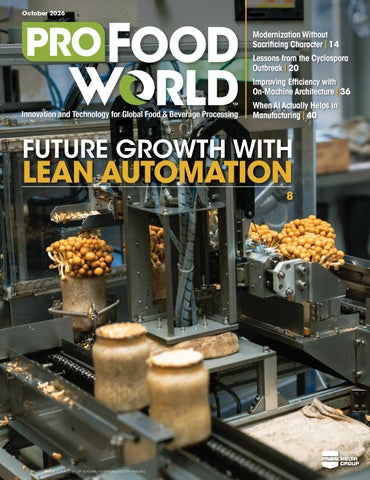
Food Executives Eye Future Growth with Lean Automation Food and beverage producers are taking a lean-automation approach, using network upgrades, advanced sensing, and modernized controls to create data foundations for future AI strategies.
N
ESTLÉ PLANS TO ELIMINATE 4,000 manufacturing and supply chain jobs—in addition to 12,000 white-collar positions—over the next two years. The reductions are expected to deliver approximately CHF 1 billion in annual savings by the end of 2026, while executives have said the company will direct investment toward growth priorities, including manufacturing capabilities. However, in its February 2026 full-year results call, Anna Manz, CFO of Nestlé, said overall capex would “normalize within the range of 4% to 5% of sales going forward,” below 4.8% in 2025.
8
PROFOOD WORLD
1026_TT-Automation.indd 8
|
October 2026
|
Food and beverage The takeaway: Food companies are focusing and beverage comon “lean automation” panies are focusing investments that on “lean automation” prioritize data investments that standardization prioritize data stanand lay the groundwork dardization and lay for AI-based strategies. the groundwork for AI-based strategies. The shift among industrial networking and food producers toward Industrial Ethernet infrastructure over the last decade is creating smaller-investment
profoodworld.com
9/17/26 15:22
Untitled-1 2
9/11/26 11:50
TECH TODAY LEAN AUTOMATION
The signals from all sensors are combined through an IO-Link master and transferred to the machine controller through PROFINET.
Industrial Edge platform. The data-sharing solution also includes Siemens’ Visual Inspection Cockpit app, which presents real-time data for process optimization and quality management and triggers alerts when deviations appear. The visual-inspection application combines traditional image processing IMAGE COURTESY IFM ELECTRONICS SRL with AI-based pattern recognition. The aim is to improve quality by automation opportunidetecting shape deviations, evaluatties, with strong ROI in ing baking color, detecting surface The common pattern is some cases. Food prodefects, and verifying the positioncessors are upgrading ing of decorations and toppings. “By selective modernization: industrial networks in leveraging existing equipment and upgrading critical controls legacy plants to move infrastructure wherever possible, the data to middleware bakery gained greater visibility into its and industrial networks, solutions, provide realoperations and established a foundatime line data, and suption for future optimization initiatives adding condition and port advanced sensing without requiring a major producenergy monitoring, improving tion-line redesign,” Clippinger says. investments. The edge architecture supports traceability, and creating a Automation a variety of industrial communicaand digital secure data layer that allows tion protocols, including OPC UA, transformation MQTT, Modbus TCP, EtherNet/IP, and new analytics and AI use In an early-2026 survey, PROFINET, and it is equipment agnostic. food manufacturers While this commercial bakery investcases to be scaled over time. ment could be categorized as a stepranked cost control first, while automation change improvement, Bauermeister, — Geoffrey Clippinger, Technical and capacity expansion a subsidiary of PROBAT and a manuAccount Manager with Siemens ranked third and fourth, facturer of chocolate and coffee millrespectively. Both autoing equipment, is offering customers mation and capacity expansion gained ground, with more diagnostic data and reduced commissioning higher weighted scores and more first-place votes time through IO-Link technology. Bauermeister and than the previous year. ifm electronics srl, an automation specialist based in Food manufacturers are asking for roadmaps with Germany, developed an IO-Link-based networking long-term digital strategies, says Geoffrey Clippinger, solution to enable data communication among senTechnical Account Manager with Siemens. “The comsors, actuators, and control systems. mon pattern is selective modernization: upgrading The architecture replaces traditional terminal critical controls and industrial networks, adding conwiring with direct connections between sensors and dition and energy monitoring, improving traceability, IO-Link modules. “By converting to IO-Link, we conand creating a secure data layer that allows new ananected the sensors directly to the IO-Link modules, lytics and AI use cases to be scaled over time.” thus avoiding wiring and installation errors,” explains Coppenrath & Wiese, a manufacturer of frozen Detlef Krüger, Team Lead Electrical Engineering baked goods and desserts, modernized its industrial at Bauermeister. “Thanks to the connectors, even network and adopted an edge-networking architecmechanics can now replace individual modules; ture to process production information at the equipthere’s no longer any need for a trained electrician.” ment level. The goal is to provide real-time data to This networking architecture allows food producoperators through HMIs and tablets via Siemens’ ers to retain existing analog sensors while adding
10
PROFOOD WORLD
1026_TT-Automation.indd 10
|
October 2026
|
profoodworld.com
9/17/26 15:22
Untitled-1 2
9/11/26 11:51
TECH TODAY LEAN AUTOMATION
real-time diagnostic data for middleware or enterprise databases. According to Bauermeister, the IO-Link solution eliminated wiring errors during installation and reduced assembly time by 20% to 25%. “Low-hanging fruit usually starts with visibility rather than wholesale replacement,” says Clippinger. “Plants can add non-invasive or minimally invasive sensing for energy, vibration, environmental conditions, or process status; connect stranded machine data through secure gateways.”
Advanced sensors for CIP applications Maintenance departments may not be adding personnel, but capex for advanced sensors and predictive strategies has made inroads. For years, the dairy and beverage segments have used “best-guess” or timed approaches for clean-in-place (CIP) applications, but data indicates strong ROI from replacing those approaches with optical and spectral sensors. The challenge in CIP cleaning is quantifying product concentrations in water and cleaning fluids. SATRON North America’s VO optical sensor uses an absorption-based optical measurement principle to detect turbidity and suspended solids. Phase transitions—from product to water or water to chem-
ical—can be registered directly in a programmable logic controller (PLC) through 4–20 mA or IO-Link. ROI can result when a PLC triggers valves as soon as a flush is complete, rather than waiting for a preprogrammed time to lapse. Another sensor attracting attention from manufacturers is Laminar’s spectral technology. Formerly H2OK Innovations, Laminar uses spectral sensors that shine UV, visible, and infrared light through pipes to analyze liquids, including product, rinse water, caustics, and sanitizers. A 2025 Laminar case study with a global beverage customer reported that the company reclaimed an average of about 25% of each process cycle and reduced water and chemical usage. According to Laminar, the customer realized $100,000 in ROI by reclaiming 50% of lost production uptime and reducing CIP cycles by 5% across three beverage production lines. “Food and beverage plants should connect automation decisions to quality, traceability, energy, and resource efficiency,” adds Clippinger. “Improvements in these areas can support throughput and resilience at the same time, which strengthens the business case for modernization.”
S
Let’s create.
w Solidaire Continuator Thin-Layer Paddle Dryer Continuous Pressure Cooker
We partner with you to develop custom process solutions, equipment, and systems.
www.bepex.com 1026_TT-Automation.indd 12
THERMASCREW Thermal Screw
RP Disintegrator Sanitary Hammer Mill
Pulvocron Air-Classifying Mill
Extrud-O-Mix Low-Pressure Extruder
9/17/26 15:22
p
Hig co
oker
IMAGE COURTESY IFM ELECTRONICS SRL
The stainless-steel rollers of the two-stage grinder.
Reducing wiring and commissioning for control panels Traditional hardwired control panels are complex, and updates can be costly because of downtime and limited internal automation and engineering staff. Rockwell Automation introduced its Single-Pair EtherNet/IP In-Cabinet solution in 2025 to simplify control-panel wiring, reduce commissioning time, and facilitate networking upgrades. Kelly Passineau, Product Manager for Single-Pair Ethernet at Rockwell Automation, described the solution as a gateway device that uses flat media cable and Single-Pair Ethernet (SPE) to reduce cabinet wiring. “We have this gateway, and it’s
capable of attaching 40 devices to a network,” said Passineau in a networking webinar in 2025. “This creates a network of flat media-connected devices inside a panel.” Real Pet Food Company adopted the networking solution when it replaced legacy PLC infrastructure for its chiller control panel. The EtherNet/IP system provides improved visibility into the chiller system’s motors and drives. The modernization also moved auxiliary functions—lighting and fan control—to a separate PLC, reducing complexity and risk. The SPE installation reduced production disruption through controlled shutdown windows for the chiller system, according to Jack Walsh, Electrical Reliability Engineer at Real Pet Food Company. “Moving away from hard wiring and utilizing ribbon cables means the downtime was minimal while the electrical panel was upgraded,” says Walsh. “It’s around 10–20 times faster than if all wires had to be upgraded, while also reducing panel space requirements.” The disciplines and technologies under the broad umbrella of automation are moving forward, helping food and beverage producers identify next steps for moving data and advancing data standardization and contextualization.
Sanitation is where
water systems
NSF-Certified Direct Contact Water Heater
prove themselves. High-volume sanitation demands continuous, reliable hot water.
ll
What happens when your hot water can’t keep up with demand? An NSF-certified direct contact water heater for sanitation consistency.
630-250-9222 | www.ellisludell.com
1026_TT-Automation.indd 13
9/17/26 15:22
PROJECT PROFILE GLIER’S GOETTA CASEY FLANAGAN |
ASSOCIATE EDITOR
A Modern Process for a
Cincinnati Favorite
IMAGES COURTESY OF GLIER’S GOETTA / MARK BYRON
Glier’s Goetta modernized a laborintensive cooking and mixing process, gaining speed and consistency without sacrificing the character of its signature Cincinnati specialty.
G
OETTA (GET-UH) MAY BE A RARE FIND beyond the Cincinnati region, but within it, the pork, beef, and oat specialty is a cultural institution. For evidence, look no further than Goettafest. Glier’s Goetta launched the annual celebration of the local delicacy in 2001, and it now draws between 200,000 and 250,000 people to the banks of the Ohio River in Covington, Ky., over eight days across two weekends. Live bands take the stage as attendees sample goetta served in dozens of different dishes. “It was my father’s idea to have a celebration of goetta and a way to show customers that there are different ways to consume it. If you use goetta as an ingredient rather than an end-product, maybe you’ll buy it more often,” says David Glier, Vice President and Owner of Glier’s Goetta. Glier joined the operation as a teenager and now represents its third generation. This sausage-adjacent food’s roots run deeper than the festival, though. Goetta descends from
14
PROFOOD WORLD
1026_PP-GliersGoetta.indd 14
|
October 2026
|
Grützwurst, or grain Goettafest has grown into a major regional sausage of northern event since its debut Germany, where usable in 2001. meat trim, broth, and grain were combined to stretch the results of an animal harvest. As German immigrants settled in various regions across the United States, they brought their local food traditions with them, and Cincinnati developed its own version. The defining Cincinnati preparation combines pork and beef with the broth created by cooking those meats and adds steel-cut oats to absorb the broth and its flavor. Similar meat-and-grain foods emerged elsewhere under names such as scrapple, hash, and mush, but goetta became distinctly associated with Cincinnati. Glier credits his grandfather with being the first to commercialize the product and says his company’s formulation later helped define the federal standard of identity for goetta.
profoodworld.com
9/16/26 15:28
Untitled-1 2
9/11/26 11:51
PROJECT PROFILE GLIER’S GOETTA
Modernizing production has helped Glier’s continue growing inside its historic Covington facility rather than moving to a new greenfield plant.
A unique product and a demanding process Unlike conventional sausage, goetta begins with cooked meat rather than relying on proteins extracted from raw meat to bind the product. Before the Mepaco systems, the process began much as it still does today: measured portions of pork and beef trim were placed in nets and simmered in large kettles of water for 30 minutes, cooking the meat while creating the broth used in the formulation. From there, however, the IMAGE COURTESY OF PROFOOD WORLD old process became considerably more Today, Glier’s makes about 10,000 to 13,000 lbs manual. The meat was removed and of goetta per day to serve a concentrated regional the broth was combined with steel-cut oats, which demand, operating out of the same building since absorbed its flavor as they hydrated in long tanks for 1969. About 95% of its goetta is sold within the about three hours. Interstate 275 loop around Cincinnati, though the The cooked meat was then ground and added to company also distributes to select nearby markets individual pots containing the hydrated broth-andacross neighboring states. Online retailer Cincinnati oat mixture. To mix the product together, employees Favorites offers shipping, so “people outside of stirred each pot with a large paddle resembling an Cincinnati are able to get a taste of home,” Glier says. aluminum oar. To help meet that demand, Glier’s automat“Every batch of goetta that we made had a guy ed a cooking and mixing process the company sitting with an oar, turning the goetta over and over once doubted could be mechanized. Two Mepaco and making sure that the oats didn’t sit on the botThermaBlend mixers with steam jackets and vacutom, that the meat was appropriately mixed with the ums ultimately allowed it to shorten production time, oats,” Glier explains. “It was a very manual process. improve consistency, and free workers from hard And honestly, we didn’t think we would ever be able physical labor without changing the recipe behind its to mechanize it.” signature product. It was repetitive, physically demanding work in a room that could exceed 90°F and required experience to achieve the consistency Glier’s wanted. “Our guys did a very good job of being consistent with the manual product, but new guys who weren’t accustomed wouldn’t make it as consistently, and that was where we would have customer complaints,” Glier says. Recognizing the importance of maintaining that consistency, “it was our veterans who were doing the most manual part of the process.” A business associate suggested the Glier’s team needed a steam-jacketed mixer for the job, and even had a machine ready in surplus, but it was too large for IMAGE COURTESY OF PROFOOD WORLD Glier’s weekly production at the time. The internal mixers and scrapers help keep goetta evenly blended Glier was also concerned that the new and prevent product from lingering against heated surfaces. machine might require recipe changes and
16
PROFOOD WORLD
1026_PP-GliersGoetta.indd 16
|
October 2026
|
profoodworld.com
9/16/26 15:28
SPONSORED CONTENT
SMART FACILITY SOLUTIONS F EATUR ED TO PI C
DESIGNING AND BUILDING COLD FACILITIES FOR AUTOMATION
Full-pallet storage with automated case picking adjacent to the refrigerated dock. (Loggy Media
I
n our last edition, we discussed the importance of early design. Part of that process should include determining the physical building design and technology requirements together so they can be coordinated rather than addressed separately. Those decisions ultimately shape not only the design, but also what—and how—the facility is constructed. For food and pharmaceutical facilities, those decisions must also account for strict environmental and operational requirements. According to Mark Livesay, vice president of automated warehousing, ESI Group, this means considering the requirements of automation and material-handling systems alongside the building’s structural, electrical, refrigeration, fire protection and thermal-envelope requirements. “This coordination helps identify conflicts and required modifications before construction, allowing the technology and the facility to function as an integrated system.” In cold facilities, the thermal envelope is the building enclosure—including insulated walls, roofs, floors, doors, vapor barriers and other components—that separates the temperature-controlled environment from the outside.
1026_ESI Insert-PFW.indd 1
Its purpose is to limit heat and moisture infiltration, allowing the refrigeration system to maintain the required temperature efficiently.
Automate with Purpose Automation doesn’t necessarily mean automating an entire facility. Once the operational objective is understood, owners can determine where targeted automation can provide the greatest benefit. Livesay says the areas that tend to benefit most are those involving repetitive, high-volume or highly predictable material movement—particularly storage and retrieval, pallet movement, conveying and sortation. In cold storage and freezer environments, automation can also reduce manual activity in demanding temperature conditions. Before determining how much to automate, owners should define the order profiles and volume thresholds the facility needs to handle. Those parameters can help determine where products should be broken down from case picking to piece picking and how much manual intervention may still make sense. The decision also comes down to investment. “It gets really expensive to automate case picking,” says
)
QUICK FACTS
30.2% of warehouse leaders identify inventory visibility as an operational pain point
46%
of warehouse managers say automation has significantly improved inventory control Cold-storage construction costs for an automation-ready facility range from
$240$350/ sq.ft.
9/10/26 4:03 PM
SPONSORED CONTENT
The goal isn’t to overbuild for technology that may never be needed, but to make strategic design decisions today that don’t unnecessarily limit future options for your cold-storage facility. —Mark Livesay, Vice President of Automated Warehousing, ESI Group
See ESI’s cold facility experience—scan the QR code to take a closer look inside. Four levels of automated case picking (Loggy Media
)
Livesay. In some operations, the productivity gains of full automation may not justify the cost, making a combination of automation and human labor a more practical solution. Facility managers don’t necessarily need to move more product—they need to move it more productively. “The goal can be to move the same volume more efficiently, consistently, and with less reliance on manual labor,” says Livesay. That may mean improving storage density, reducing unnecessary product movement or making better use of existing space and infrastructure. Ultimately, the design firm needs to understand what the facility is trying to accomplish and develop a design that supports those goals through construction.
Design Around the Facility’s Constraints A building’s existing conditions can significantly influence what automation is practical. Clear heights, floor capacity, structural systems, column spacing, available space, electrical capacity, refrigeration, fire protection and the thermal envelope can all affect how and where automation can be integrated. Understanding those limitations early allows technology to be selected and designed around the building rather than forcing the building to accommodate a system it wasn’t designed to support. Automation can improve the efficiency of a temperature-controlled facility by reducing unnecessary movement through conditioned spaces and limiting the amount of time doors are open. But automation can also affect the thermal envelope and refrigeration requirements. Equipment and new penetrations or interfaces may require modifications to the enclosure, while the heat generated by automation can
increase the refrigeration load. Those impacts need to be evaluated and addressed as part of the overall design. Because the building’s systems and thermal envelope must work together with the automation, an integrated design-build approach is well suited to these projects, allowing those elements to be coordinated from the outset. Viewing the facility as a single system rather than addressing the building envelope, refrigeration, electrical, fire protection and automation separately can help identify potential conflicts early and ensure the facility supports its operational goals.
Plan for Future Flexibility Cold-storage operators must balance operating costs, labor availability and productivity while protecting margins. As a result, more operators are turning to automation technologies such as Autonomous Mobile Robots (AMRs) and Automated Storage and Retrieval Systems (AS/RS) to address those pressures. The goal should be to automate where the greatest return on investment can be achieved, Livesay says. The other goal is to preserve flexibility for the future. Owners should consider not only current needs, but where the operation may be headed, including how available space, clear heights, structural capacity, utilities, refrigeration, electrical systems, fire protection and the thermal envelope can accommodate future changes. “The goal isn’t to overbuild for technology that may never be needed, but to make strategic design decisions today that don’t unnecessarily limit future options for your cold-storage facility,” says Livesay.
PARTNER WITH ESI GROUP MEET OUR TEAM:
BOOK A MEETING:
esigroupusa.com/events/
esigroupusa.com/contact-us/
1026_ESI Insert-PFW.indd 2
STAY CONNECTED:
9/10/26 4:03 PM
Kettles remain part of the modern process, cooking the meat before it is ground and moved into the ThermaBlend systems.
product, but these are fabulous machines.”
A faster, more consistent process IMAGE COURTESY OF PROFOOD WORLD
IMAGE COURTESY OF PROFOOD WORLD
Glier’s old process relied on long hydration tanks and hand-stirred pots like these, which have since been replaced in regular production.
didn’t want to gamble a week’s worth of production to find out. The company passed on the machine, but the idea stuck.
A used machine proves the concept Eventually, Glier’s found a Mepaco ThermaBlend steam-jacketed mixer/blender with a 700-lb capacity. It was a used model in rough shape, but Glier called the team at Mepaco for help with what amounted to a full rebuild. Unsure whether the system would work for goetta, Glier’s installed it in a location where it could be removed relatively easily. Instead, “it turned out that the recipe did not need to be adjusted at all, so we hit the ground running with that machine,” Glier says. The system proved successful enough that Glier’s purchased a second ThermaBlend, this time a 2,100-lb capacity system that it reserves for peak production times, while the first system covers regular operation. “As we’ve used the machines more, we’ve gotten more efficient with their use,” says Glier. “We’re working to figure out the most efficient way to produce the
The most immediate change after installing the ThermaBlend systems was speed. By replacing the roughly three-hour hydration and manual mixing portion of the old process, the systems significantly shortened production time. The ThermaBlend systems use mechanical mixing under vacuum to keep the meat and oats evenly distributed. Scrapers wipe the interior surface of the vessel as it operates, preventing product from remaining against the heated steel and burning. Glier says about 30 minutes of training is enough for an employee to become familiar with the system, and most are comfortable operating it within an afternoon. Recipe controls also make the process less dependent on operator experience. The system’s HMI provides access to programmed settings, with a select set of Glier’s most-used cooking recipes preloaded for operators. “It’s not a technically demanding machine. It’s very user-friendly,” Glier says. “We’re not demanding [recipe control expertise] from the individual operator. That’s set up.” The system also takes workers out of the hottest and most physically demanding part of the old operation, removing the need for Glier’s veteran employees to manually stir every batch. “Because we have these steam-jacketed blenders, all of that adverse environment and all of that labor is taken out of the process,” Glier says. Glier’s currently cleans the systems using a cleanout-of-place process. A safety grate can be lifted with the machine cover to provide greater access during sanitation, while remaining locked in place during production. Partial cleanup of the production area takes place throughout the day, followed by a more extensive end-of-day cleaning. The original setup is still available as backup, but with two ThermaBlend systems in place, Glier’s no longer expects to need them. “We can still operate the old way,” he says. “But then we have two of the machines now, so if one breaks, we’ll just use the other. Even at peak times, if
profoodworld.com
1026_PP-GliersGoetta.indd 17
|
October 2026
|
PROFOOD WORLD
17
9/16/26 15:29
PROJECT PROFILE GLIER’S GOETTA
this one went down during our peak operation, that would just be a little bit of overtime with the other machine.” The efficiency gains have also lightened pressure for shift expansion. Before installing the systems, Glier’s was considering a split shift or adding a second shift to keep pace with production. Installing the ThermaBlends “took that concern off the table entirely,” Glier says. “We’re so much faster in production.” They also helped Glier’s continue operating in its historic Covington plant, where a U-shaped production flow reflects the constraints of a building constructed around 1895. The company had seriously considered building a new facility as the manual process demanded more labor and space. “[The ThermaBlend systems] have allowed us to continue to use our existing facility and get more out of it,” Glier says. “When we thought it had to be manual, we were growing to the point that we needed more and more space to produce, and now we don’t.”
Following goetta through the new process Goetta production begins with meat trim arriving in combo bins, primarily from regional suppliers as it
1026_PP-GliersGoetta.indd 18
IMAGE COURTESY OF PROFOOD WORLD
Glier’s produces up to 13,000 lbs of goetta per day from its Covington, Ky., facility.
did before the process change. Glier’s buys in smaller quantities than many large processors, which sometimes allows the company to take excess lots that would be impractical for a much larger operation. Employees portion the raw materials into batches, precisely weighing equal amounts of pork and beef, and cook the meat in nets in the kettles from the original process. After cooking, the meat is removed from the cook water, which at this point is a rich broth from
9/16/26 15:29
the process. The meat is ground in a Rome Grinding Solutions grinder. The ground meat is added to the ThermaBlend system along with the broth, helping to restore moisture, yield, flavor, and texture. Water, steel-cut oats, fresh onions, peppers, and spices are then added for the final vacuum mixing step. “Using fresh onions is a big deal because they contain volatile oils that will escape in the air,” Glier says. “If you use dried or ground spices, you’re losing about half of the effect of what the fresh spice will bring you.” Finished goetta is discharged into mobile bins and transported to packaging. The 700-lb capacity ThermaBlend is placed directly next to the packaging line, while the larger machine is in the next room over alongside the kettles. The bins are automatically lifted into a hopper to fill chub packs. At the stuffer, the product is still hot. “We stuff at about 160 degrees,” Glier says, requiring employees to wear gloves as they handle it. Operators then manually clip the filled packages, a task that depends on rhythm and dexterity. The packaged goetta next passes through a water shower that begins cooling before the product enters a blast chiller. Glier says cooling takes about
1026_PP-GliersGoetta.indd 19
three hours, allowing some early production to be packed the same day, while other product remains in the chiller overnight. Product is cooled to below 40°F before final packing. Once cooled, employees remove the packages from racks and pack them by hand into 12-lb cases. Glier’s uses VistaTrac to manage inventory and maintain case-level traceability through production codes. Odd lots that don’t complete a case are redirected to the company’s onsite retail operation.
Preserving a Cincinnati tradition For Glier, modernization is ultimately a way to carry the family business forward, along with the regional tradition built around it. While the ThermaBlend systems changed how Glier’s makes goetta, they did not change the recipe behind the Cincinnati staple. The added efficiency is helping the family sustain goetta production for the consumers who built the market around it. “Cincinnati has just seized onto goetta, and they’ve made it what it is,” Glier says. “We didn’t do that. The people of Cincinnati did that. We’re grateful to them for building the business that we have, and we’re just trying to make sure that we pass that on.”
9/16/26 15:30
INSIDE THE INVESTIGATION CHRISTINE TERVO | CONTRIBUTING EDITOR
Inside the Investigation: Lessons From the Largest Cyclospora Outbreak What the 2026 Cyclospora outbreak teaches food manufacturers about supplier verification, traceability, and responding under uncertainty.
T
HE LARGEST CYCLOSPORA OUTBREAK in U.S. history is doing more than testing the nation’s public health system. It is also demonstrating how food manufacturers, suppliers, importers, and regulators must often make important decisions before every question has been answered. During a major outbreak investigation, epidemiology, traceback records, and supplier information may point investigators toward an implicated product long before they determine exactly how contamination occurred. Companies may therefore find themselves recalling products, communicating with customers, and working with regulators while a root-cause investigation is still unfolding. For food and beverage manufacturers, the outbreak carries lessons that extend well beyond fresh produce. It illustrates the importance of supplier verification, demonstrates the value of strong traceability systems, and reinforces why outbreak response plans must be built around making decisions under
uncertainty. It also reminds manufacturers that food safety depends on much more than testing finished products. Preventing contamination begins with suppliers and continues through every stage of the supply chain until food reaches consumers. As of late August, more than 17,000 laboratory-confirmed, domestically acquired Cyclospora infections had been reported nationwide since May. That total includes illnesses associated with the Taylor Farms de Mexico investigation as well as other clusters of cyclosporiasis that remain under review. The U.S. Food and Drug Administration (FDA) described the Taylor Farms outbreak as “significant and unprecedented compared to prior Cyclospora incidents.” Former FDA Deputy Commissioner for Food Policy and Response Frank Yiannas likewise characterized the event as unprecedented and called for an independent review, emphasizing that even one of the world’s safest food systems must continue improving as new lessons emerge.
From isolated illnesses to a nationwide investigation Like many foodborne illness investigations, the 2026 Cyclospora outbreak did not begin with a single obvious source. Instead, what initially
The outbreak illustrates why response plans must be built around making decisions under uncertainty. AI-GENERATED IMAGE
20
PROFOOD WORLD
F1-Cyclospora.indd 20
|
October 2026
|
profoodworld.com
9/18/26 10:50 AM
Your Partner in
Processing Line Solutions
Slice
Dice
Shred
Top & Tail
Peel
Cut
Little Gem Aspire™ Dicer
DiversaCut® Series
TranSlicer® Series
Now Even More
Cutting Solutions Rely on Urschel to provide even more cutting solutions by delivering Urschel and KRONEN. Whether you are a batch or high-yield processor, look to Urschel for complete resources to improve your line.
PL Series
Continuous, simple operation backed by the Urschel global network of sales and support. Explore complete processing solutions at urschel.com.
+
GS Slicer
TT450 Top & Tail ® DiversaCut, TranSlicer, Urschel, The Global Leader in Food Cutting Technology, and Urschel logo symbol are registered trademarks of Urschel Laboratories, Inc. U.S.A. ®KRONEN and Crown logo symbol are registered trademarks of KRONEN GmbH.
www.urschel.com
2602KU_CuttersFV_PFW.indd 1 Untitled-2 2
5/8/26 1:20 PM 9/18/26 10:59
INSIDE THE INVESTIGATION
Lessons From the Outbreak Key takeaways from the 2026 Cyclospora investigation
1
2
3
5
Evidence Beyond Testing
Implicated is Not Root Cause
Traceability Works Both Ways
Speed Is a Food Safety Control
Supplier Verification
Outbreak investigations do not always produce definitive lab confirmation. Decisions may rely on epidemiology, tracing, and the totality of evidence.
Identifying a product and supplier may protect consumers before investigators determine the exact contamination point or mechanism.
Investigators must determine where an implicated food came from and where else it went. Both directions are essential.
Faster access to accurate, interoperable records can shorten investigations and support more targeted recalls.
Prevention requires oversight beyond paperwork, including agricultural water, sanitation, employee hygiene, and growing conditions.
Practical lessons for regulators and industry
2026 Cyclospora Outbreak 6
7
8
9
10
Act Under Uncertainty
Case Counts Need Context
Layered Food Safety
Preparedness Strengthens Prevention
Risk Can Be Reduced, Not Eliminated
Companies may need to act before every question is answered and before a full rootcause determination is available.
State totals, national confirmed-case counts, and outbreak-specific counts can differ for legitimate reasons.
Preventive controls, monitoring, epidemiology, laboratory science, and traceability must operate together.
Plans should test record retrieval, regulatory communication, customer notification, and response under uncertainty.
Fresh produce carries inherent risk, so the goal is continued risk reduction, rapid detection, effective containment, and learning from each event.
appeared to be scattered cases of gastrointestinal illness gradually evolved into one of the largest and most complex investigations of its kind in the U.S. Epidemiologists with the Centers for Disease Control and Prevention (CDC), working alongside state and local public health agencies, began identifying common patterns among patients diagnosed with Cyclospora infection. As more interviews were completed and additional illnesses were reported, investigators found repeated exposure to meals containing iceberg lettuce. While epidemiologists focused on identifying illness patterns, the FDA pursued a parallel investigation through the food supply chain. Inspectors and investigators reviewed distribution records, supplier documentation, invoices, receiving records, and other materials to determine whether products consumed in different locations originated from a common source. Those efforts are coordinated through the FDA’s Coordinated Outbreak Response and Evaluation (CORE) Network, which was established in 2011. In 2024, those responsibilities became part of the Office of Coordinated Outbreak Response, Evaluation & Emergency Preparedness (CORE+EP) within the agen-
22
4
PROFOOD WORLD
F1-Cyclospora.indd 22
|
October 2026
|
cy’s Human Foods Program. The office works with the CDC as well as state, local, and international public health partners to evaluate outbreak signals, coordinate traceback investigations, support inspections, and assess evidence as it develops. Although each agency performs a different role, the objective remains the same: determine whether illnesses reported across multiple states can be connected to a common food source and, if so, identify that source quickly enough to protect consumers.
Earlier outbreaks provide perspective While unprecedented in size, the 2026 outbreak is not the first time Cyclospora has challenged regulators or the produce industry. In 2018, the CDC recorded what was then the largest increase in domestically acquired Cyclospora illnesses, documenting 2,299 laboratory-confirmed infections across 33 states. Several outbreaks were associated with fresh produce, although investigators could not identify a single source for many of the illnesses. The current investigation also has historical ties to Taylor Farms de Mexico. In 2013, a multistate Cyclospora outbreak resulted in 631 illnesses
profoodworld.com
9/18/26 11:07 AM
, O
-
Reliable metal detection even in challenging conductive products like meat, dairy, and cheese.
Eriez. Always the Right Choice. The simultaneous frequency technology of the X8-SF metal detector delivers superior sensitivity with easy operation and rugged washdown performance, making it ideal for demanding food processing environments.
GLOBAL LEADER IN SEPARATION TECHNOLOGIES +1- 814 - 8 35 - 6 0 0 0 • w w w.e riez .c o m
Untitled-1 2
9/11/26 11:53
INSIDE THE INVESTIGATION
How Cyclospora differs from bacterial foodborne pathogens n
n
n
n
It does not multiply in food. Unlike Unlike bacteria such as Salmonella or Listeria monocytogenes, Cyclospora requires time outside the human body before becoming infectious. Symptoms appear later. Illness often develops one to two weeks after exposure, making it more difficult for patients to remember exactly what they ate. Fresh produce is a common vehicle. Leafy greens, herbs, and berries are frequently consumed raw, eliminating a cooking step that might otherwise reduce pathogens. Laboratory tools continue to evolve. Molecular subtyping methods have improved but remain less developed than bacterial pathogens, increasing the importance of epidemiology and traceback investigations.
linked to more than one food source. Restaurantassociated illnesses in Iowa and Nebraska were traced to a salad mix supplied by Taylor Farms de Mexico, while illnesses in Texas were associated with fresh cilantro imported from Mexico. Taken together, those outbreaks illustrate that Cyclospora remains a recurring challenge rather than an isolated event.
Connecting the dots through traceability Identifying a common food among thousands of meals consumed across dozens of states rarely depends on laboratory testing alone. Instead, investigators assemble a picture over time using patient interviews, epidemiologic evidence, and supply chain records. During the Cyclospora investigation, that combination of information became increasingly important as more illnesses were reported and investigators looked for a common source.
Traceback identifies where the product came from Traceback investigations work backward through the supply chain. Investigators begin with restaurants, retailers, or institutions where patients ate and then work upstream through distributors, processors, and suppliers until they identify growers or production locations that multiple illness clusters have in common. Purchase orders, receiving records, bills of lading, shipping documents, lot information, and supplier 24
PROFOOD WORLD
F1-Cyclospora.indd 24
|
October 2026
|
records all help investigators determine whether products consumed in different states originated from the same source. As the investigation progressed, those records increasingly pointed to Taylor Farms de Mexico. Although traceback can establish where products moved through the supply chain, it doesn’t determine where contamination actually occurred. Instead, it narrows the investigation while inspectors continue collecting environmental samples, reviewing production practices, and evaluating other evidence that may explain how contamination entered the product. For manufacturers, traceback demonstrates why complete and accessible records remain one of the most valuable food safety tools available. During an investigation, regulators may request documentation covering multiple suppliers, facilities, and customers. Companies that can quickly retrieve accurate records not only support the investigation more effectively, but they also help regulators narrow the scope of affected product sooner.
Traceforward completes the picture Once investigators identify an implicated supplier, they reverse direction. Rather than looking upstream, they begin following product downstream to determine where it was distributed and who may have received it. Known as traceforward, this process allows investigators to identify retailers, restaurants, distributors, processors, and other customers that handled the product. That information helps companies notify customers, remove affected product from commerce, and avoid unnecessarily disrupting products that are not involved in the investigation. The Institute of Food Technologists (IFT) emphasized this point in its analysis of the outbreak, noting that effective traceability answers two equally important questions: Where did the product come from? Where did it go? A company that can answer only one of those questions has only part of the information needed during an outbreak investigation. For processors, this extends well beyond regulatory compliance. Enterprise resource planning (ERP) systems, warehouse management software, inventory records, supplier documentation, and shipping records all become critical once an investigation begins. The faster those systems produce complete information, the more quickly regulators can identify affected product and limit the size of a recall.
Supply chain visibility becomes an operational advantage The investigation also illustrates how much today’s food system depends on visibility across the supply chain. Modern food manufacturers rely on global sourcing networks that provide year-round access to ingredients
profoodworld.com
9/18/26 10:57 AM
Untitled-1 2
9/11/26 11:54
INSIDE THE INVESTIGATION
Supplier verification requires more than documentation
FSMA 204 at a glance The FDA’s Food Traceability Rule under Section 204 of the Food Safety Modernization Act establishes enhanced recordkeeping requirements for foods included on the Food Traceability List.
1
2
3
Maintaining specified key data elements for critical tracking events.
Preserving records that allow product movement to be reconstructed rapidly during an investigation.
Supporting faster traceback activities and more targeted recalls.
Although the FDA has proposed extending the compliance date from Jan. 20, 2026, to July 20, 2028, industry organizations such as the Institute of Food Technologists have encouraged manufacturers to continue strengthening traceability systems rather than delaying implementation. Faster access to accurate records can shorten investigations, reduce illnesses, and help limit the scope of recalls.
while allowing companies to diversify suppliers and manage costs. Products may pass through multiple growers, cooling facilities, packers, processors, distributors, and warehouses before arriving at a manufacturing plant or retail shelf. While those networks provide flexibility and efficiency, they also make it more difficult to determine where contamination originated when something goes wrong. Yiannas has frequently described food safety as a shared responsibility, noting that growers, processors, retailers, regulators, and consumers all contribute to reducing risk. No single organization controls every step of the supply chain, and no company can fully protect consumers without reliable information from the businesses around it. Yiannas has also referred to traceability and transparency as an “Achilles heel” within today’s food system because weaknesses in either area can slow an investigation and broaden a recall. The 2026 Cyclospora outbreak reinforces that point. Companies that know where ingredients originated, where products were shipped, and how quickly they can retrieve those records are in a stronger position to support regulators and protect customers. For food manufacturers, that means traceability should not be viewed solely as a regulatory obligation. It is also a business capability that can reduce uncertainty, improve customer communication, and limit operational disruption during a food safety event.
26
PROFOOD WORLD
F1-Cyclospora.indd 26
|
October 2026
|
The outbreak also underscores the importance of supplier verification, particularly for imported foods. Under the FDA’s Foreign Supplier Verification Program (FSVP), covered importers must conduct riskbased activities demonstrating that foreign suppliers produce food in a manner consistent with applicable U.S. food safety requirements. Those responsibilities extend beyond maintaining audit reports or supplier certifications. Companies are expected to evaluate foreseeable hazards, assess supplier performance, determine appropriate verification activities, document corrective actions when necessary, and maintain records supporting those decisions. For fresh produce, that evaluation begins well before products reach a processing facility. Agricultural water quality, worker hygiene, sanitation practices, environmental conditions, and harvesting procedures can all influence whether contamination enters the supply chain. Yiannas has argued that recurring summer Cyclospora outbreaks should no longer be accepted as seasonal events. Instead, he has encouraged both industry and regulators to focus on preventing contamination through better agricultural water management, stronger controls during growing and harvesting, more timely reporting, and closer coordination among federal and state agencies. For manufacturers, the practical question is whether supplier verification programs merely demonstrate compliance or whether they actively identify and reduce risk before contaminated ingredients arrive at the plant.
Traceability under FSMA The outbreak also arrives as food manufacturers continue preparing for implementation of the FDA’s Food Traceability Rule under Section 204 of the Food Safety Modernization Act (FSMA). The rule establishes additional recordkeeping requirements for foods included on the FDA’s Food Traceability List and requires covered entities to maintain key data elements associated with critical tracking events so regulators can reconstruct product movement more quickly during an investigation. Although the FDA proposed extending the compliance date from Jan. 20, 2026, to July 20, 2028, the public health objective has not changed. The Institute of Food Technologists has encouraged industry to use the additional time to strengthen traceability systems rather than postpone implementation, noting that every day saved during an investigation has the potential to reduce illnesses by identifying contaminated products sooner. Yiannas, who helped lead development of the
profoodworld.com
9/18/26 10:58 AM
Squash ferrous metal this season REMOVE UNWANTED METAL FROM VEGETABLES, GRAINS, NUTS AND SO MUCH MORE!
Our LTH (Large Tube Housing®) is a powerful magnetic separator that incorporates 3 inch diameter rare earth tubes into our proven Drawer-in-Housing configuration for optimum ferrous metal separation for difficult flowing products. LEARN MORE
HACCP International Certified and USDA AMS Accepted Equipment.
Industrial Magnetics Inc. imi@magnetics.com PHONE: 888.582.0821
Untitled-1 2
magnetics.com 9/11/26 11:54
INSIDE THE INVESTIGATION
Food Traceability Rule during his time at the FDA, has expressed similar concerns about delaying implementation. He has argued that stronger traceability shortens investigations, narrows recalls, and helps distinguish affected product from unaffected inventory more quickly. For manufacturers, the lesson extends well beyond regulatory compliance. Investments in interoperable records and rapid data retrieval can improve communication with regulators, reduce business disruption during an investigation, and help companies respond more confidently when critical decisions must be made before every question has been answered.
Surveillance shapes what investigators find The investigation also illustrates how disease surveillance influences public understanding of food safety. On Aug. 11, Acting FDA Commissioner Kyle Diamantas stated that the U.S. has “the safest food supply in the world.” While acknowledging that the U.S. food system is among the safest globally, Yiannas questioned whether such an absolute statement can be demonstrated conclusively. “There are simply too many variables,” Yiannas wrote in a public post, citing differences in surveillance systems, reporting practices, testing capabilities, population vulnerability, regulatory frameworks, and even the methods countries use to diagnose and attribute foodborne illnesses. Those differences matter because countries with sophisticated surveillance systems often identify illnesses that might go undetected elsewhere. Increased reporting, therefore, may reflect stronger public health infrastructure rather than weaker food safety performance. Conversely, lower reported illness rates do not necessarily indicate a safer food supply if surveillance systems identify fewer cases. For manufacturers, that distinction reinforces the importance of interpreting outbreak data carefully. Case counts alone rarely tell the complete story. Understanding how illnesses are identified, investigated, and reported provides a more accurate picture of both public health risk and regulatory response. Yiannas has also encouraged stronger coordination during major foodborne illness investigations, including consideration of a National Foodborne Outbreak Investigation Board modeled conceptually after the National Transportation Safety Board. Under that approach, significant outbreaks would receive independent reviews designed to identify systemic issues and recommend improvements that extend beyond the immediate response.
Lessons from the outbreak Although investigators continue working to identify the precise contamination mechanism, the 2026 Cyclospora investigation has already produced several practical lessons for manufacturers, importers, and suppliers. Companies must be prepared to act before every question is answered. The Taylor Farms de Mexico recall occurred before investigators identified the exact contamination mechanism and before laboratory testing confirmed Cyclospora in the implicated product. Instead, regulatory decisions relied on the totality of epidemiologic evidence, traceback findings, and distribution records. Manufacturers should expect that future investigations may require similar decisions under uncertainty. Traceability works in two directions. Companies must be able to identify both where ingredients originated
28
F1-Cyclospora.indd 28
PROFOOD WORLD
|
October 2026
|
profoodworld.com
9/16/26 15:34
and where finished products were distributed. Rapid access to supplier records and customer information helps investigators narrow affected products while reducing unnecessary disruption to unaffected inventory. Supplier verification begins long before ingredients reach the plant. Audits and certifications remain valuable, but they should be supported by programs that evaluate the hazards most likely to affect a particular commodity. For fresh produce, that includes agricultural water, employee hygiene, sanitation, and harvesting practices that influence contamination before products enter processing. Speed improves both public health and business continuity. The faster companies can retrieve supplier records and distribution information, the faster investigators can identify affected products and narrow the scope of recalls. Investments in interoperable systems and standardized records therefore support both regulatory compliance and operational resilience. Case counts require careful interpretation. National totals, state surveillance figures, and outbreak-specific case counts may all differ because they measure different aspects of an investigation. Manufacturers communicating with customers or business partners should understand those distinctions before citing outbreak statistics. Prevention and response are inseparable. Food safety programs often emphasize preventive controls, but the Cyclospora investigation demonstrates that surveillance, epidemiology, laboratory science, and traceability are equally important once an illness cluster emerges. Weakness in any one area can slow the entire response. Preparedness should be tested before an outbreak occurs. Manufacturers should periodically evaluate how quickly supplier documentation can be retrieved, who communicates with regulators, how customers will be notified, and whether traceability systems provide the information needed to support an investigation. Those exercises can expose weaknesses before a real event demands immediate action.
Looking ahead For manufacturers, perhaps the most important takeaway is that the effectiveness of a food safety system should not be measured solely by whether outbreaks occur. Fresh produce is grown in open environments where some hazards can’t be completely eliminated, particularly when products are consumed raw. The more meaningful measure is how effectively the system prevents contamination where possible, detects unusual illness patterns quickly, traces implicated products through the supply chain, and applies the lessons learned to reduce future risk. Throughout the investigation, Yiannas has emphasized that maintaining a strong food safety system requires continuous vigilance rather than assuming existing programs are sufficient. As he wrote, “Vigilance matters.” Prevention, detection, traceability, and response are not independent activities. Together, they form a continuous system that protects consumers while helping keep the U.S. food supply among the safest in the world. *This investigation remains ongoing. Information presented in this article reflects FDA and CDC updates available through Aug. 28, 2026. Case counts, traceback findings, inspection results, and regulatory actions may change as additional information becomes available.
profoodworld.com
F1-Cyclospora.indd 29
|
October 2026
|
PROFOOD WORLD
29
9/16/26 15:34
NEW PRODUCT SOLUTIONS
X-RAY COMBINATION SYSTEM Fortress Technology’s Icon integrates X-ray inspection, checkweighing, safety controls, and product rejection in an IP65-rated stainless-steel frame that’s less than 2.5 meters long. A single HMI controls inspection, weighing, product setup, and maintenance, while separate mechanisms handle foreign-material and weight rejects. The system detects contaminants including metal, glass, bone, and certain plastics and can verify item counts, fill levels, and missing components. Fortress Technology | fortresstechnology.com
FLEXIBLE SCREW CONVEYOR WITH TROUGH HOPPER Flexicon’s flexible screw conveyor features a low-profile trough hopper that receives material from multiple equipment discharge points and conveys free- and non-free-flowing bulk materials. Its U-shaped channel allows material to enter along the conveyor’s entire length, and a self-centering flexible screw—the only moving part in contact with the material—minimizes product degradation. A cleanout cap and quick-disconnect clamps simplify maintenance and product changeovers. Flexicon Corporation | flexicon.com
WELDLESS METAL CONVEYOR BELT Regal Rexnord’s Cambridge Cam-Grid Pro-Form Metal Belt is designed for spiral cooling, freezing, proofing, and heating applications. Its weldless construction eliminates welding during installation and repairs to reduce maintenance time, safety risks, and potential contamination. The belt is available with a flexible mesh overlay for delicate products and large cuts of meat or poultry, or a rods-only design that promotes airflow in cookers, proofers, and freezers. Regal Rexnord Corporation | regalrexnord.com
1026_NewProducts.indd 30
9/17/26 11:58
RIBBON BLENDER Munson’s HD-6-1/2-15 SS blends up to 500 cu. ft. of bulk solid materials with or without low or high percentages of liquids using a split doublehelical agitator that produces uniform batches in as little as five to 10 minutes. Heavy-duty welded stainless-steel construction allows the agitator blades to pass close to the vessel walls to reduce residual material waste after discharge, while a hinged lid with a safety-interlocked grate provides access for cleaning and inspection.
SAFETY FLOORING SLIPNOT’s stainless steel safety flooring features a high-friction, grit-free surface designed for wet, oily, and high-traffic areas such as ramps, stairs, catwalks, and washdown zones. The surface is bonded directly to stainless steel to resist peeling, flaking, and wear under repeated use and cleaning. It has earned NFSI High-Traction recertification, maintaining a wet static coefficient of friction of at least 0.80 and a wet dynamic coefficient of friction of 0.58 during testing.
Munson Machinery Co. | munsonmachinery.com
ENHANCED X-RAY INSPECTION SYSTEM
SLIPNOT | slipnot.com
Eagle’s RMI3/M is designed to strengthen food safety and maximize uptime for high-volume bulk meat and carton applications. The system combines an IP69-rated hygienic design with advanced X-ray inspection technology to detect contaminants including calcified bone, metal, glass, and stone. Its open conveyor design simplifies cleaning to minimize sanitation downtime, while image processing software performs inline quality inspections and reduces false rejects. Eagle Product Inspection | eaglepi.com
EXPERIENCE SMARTER BAG HANDLING. Your One-Stop-Shop for Automation | Filling | Unloading | Conditioning | Conveying | Storage & MORE! DRIVEN BY EXCELLENCE. 269.673.2125 | MaterialTransfer.com |
1026_NewProducts.indd 31
SCAN TO LEARN MORE:
9/17/26 11:58
CASE STUDY HIGHLAND BREWING COMPANY GRANT GERKE |
CONTRIBUTING EDITOR
Brewery Operations Extend Workforce and Improve Safety Highland Brewing Company improves safety, reduces dry-hopping time, and supports production growth with a new hop cannon system and modern compressed air piping.
T
HE CRAFT BREWERY INDUSTRY’S WILD RIDE in the U.S. continues in 2026. The number of U.S. craft brewers reached 9,578 in 2025, a 4% decline from 2024. Over the past decade, regional craft brewers have invested heavily in equipment, software, and automation. Today, however, many brewers are tightening their belts. Highland Brewing Company in Asheville, N.C., is the largest independent brewer in the Southeast and has produced craft beer since Oscar Wong established the company in 1994. Today, the brewery is focused on improving operating margins, continuously refining batch production, and expanding its product portfolio. “The biggest challenges in scaling product are always quality and consistency,” says Kevin Kellar, Cellar and Filtration Manager at Highland Brewery. “As companies scale, some things get easier to
IMAGE COURTESY OF HIGHLAND BREWERY
Highland Brewing Company continues to expand its product portfolio while focusing on operational efficiency. Gaelic Amber Ale was the brewery’s first beer, and the company now produces eight core product lines, along with seasonal and specialty offerings.
32
PROFOOD WORLD
1026_CS-Highland.indd 32
|
October 2026
|
produce more consistently, so you can make great strides in improving quality batch to batch.” Increasing production volumes and the introduction of new products have placed additional demands on Highland’s operations team. According to Kellar, the company has prioritized promoting employees from within while supplementing that growth with new talent. “Growth eventually leads to needing a larger and stronger team, with greater knowledge and capabilities,” Kellar says. “We have worked hard to grow and promote from within, but we also have brought on new talent with fresh perspectives over the years.” Fresh ideas have also shaped Highland’s equipment strategy. The company recently partnered with Cross Company, of Greensboro, N.C., a certified member of the Control System Integrators Association (CSIA), to develop a hop cannon that doses hops directly into fermenters from the plant floor. The system eliminates the need for operators to manually add hops from the top of fermentation vessels. “There are always new equipment challenges that come with growth. Either you evaluate new ways to make existing equipment stretch to your needs, or you look at expanding into new technologies or additional processing equipment,” Kellar says. Highland produces up to 1.55 million gallons of beer annually and introduces new recipes each year at its 40,000-sq-ft facility. The company built its reputation during the India Pale Ale (IPA) boom of the 2000s and typically uses between one and four pounds of dry hops per barrel, depending on the beer’s design and flavor profile. “Typically, we stick to around two pounds per barrel,” Kellar says. “Considering our tank and batch sizes can mean a charge of up to over 400 pounds of hops per batch.” Unlike traditional hopping methods that add hops during the boil, dry hopping introduces hops into the fermenter while the beer is fermenting or cooling before filtration. The challenge is safely adding hops
profoodworld.com
9/16/26 14:55
Untitled-1 2
9/16/26 13:20
CASE STUDY HIGHLAND BREWING COMPANY
hopping so that the pelletized hops more readily break apart and disperse into the beer.” The hop cannon injects hops into the beer while reducing oxygen ingress into the fermenter, helping improve shelf life and flavor stability. Large-diameter ball valves also provide smooth, uninterrupted passage for the hops during transfer. The process includes the following steps: • Clean, sanitize, and fully dry the cannon • Purge oxygen from the cannon vessel with CO2 • Connect the cannon to the fermenter • Manually load the cannon with the required hop charge IMAGE COURTESY OF HIGHLAND BREWERY • Purge the loaded hops with CO2 for 5 to 10 minutes Continuous improvement • Charge the cannon with extends beyond brewing high-pressure CO2 operations. Highland Brewing • Open the “shooting” valve to Company operates the secondpropel the hops into the top of largest solar array among the fermenter independent U.S. craft breweries, The modular Transair piping generating up to 324 kW DC system also reduces downtime under peak conditions. by making sanitation and maintenance easier for operators. “There is a high level of The hop cannon doses hops sanitation and quality control directly into fermenters from the points throughout the proplant floor, reducing cess, from the Quality Lab at dry-hopping time from as much Highland all the way to yeast as two hours to approximately additions in the brewhouse,” 30 minutes. Kellar says. “If there are gaps IMAGE COURTESY OF CROSS COMPANY in the process, or a lapse in to fermentation vessels that stand roughly 20 ft tall. cleaning and sanitation, the The previous process required operators to work process can be compromised, and a great deal of at height, according to Andrew Klosinski, Brewery time and work can be wasted.” Operations Director at Highland Brewing Company. The distinctive bitterness and aroma of hops “An articulated boom lift had to ascend more than remain central to craft beer’s appeal. Delivering them 20 feet to the top of a vessel, prepare the tank, and efficiently requires hoses and components capable of perform the dry hop,” Klosinski says. “This was a withstanding abrasion from pressurized material, eletwo-person job, with one in the boom lift and anothvated temperatures of approximately 120°F, high-pH er on the ground acting as a safety spotter, as well cleaning conditions, high pressure, and the vibration as assisting with the process.” generated when the hop cannon is fired. The new pressurized hop cannon uses a vessel Working with Cross Company, Highland Brewing built by Feldmeier Equipment of Syracuse, N.Y. Company implemented high-pressure tri-clamps and Connected to Highland’s Transair gas piping system, PTFE gaskets to reduce wear and friction within the the cannon uses compressed air and CO2 to transfer transfer system. hops from the plant floor directly into the fermenter. Highland’s modernization efforts demonstrate how What once required as much as two hours now takes targeted equipment investments can improve safety, approximately 30 minutes. increase operational efficiency, and support produc“Specialized pipes with a smooth 180-degree tion growth. bend lead into the top of our fermenting vessels and Says Keller, “Cross Company has allowed us to allow the hops to be transferred in without getting grow while achieving higher levels of sophistication in stuck,” Kellar says. “Hop suppliers have increasingly the brewery and has allowed us to have reliable equipdesigned their products around the process of dry ment that gives us a clean and safe environment.”
34
PROFOOD WORLD
1026_CS-Highland.indd 34
|
October 2026
|
profoodworld.com
9/16/26 14:55
Untitled-1 2
9/11/26 11:55
CASE STUDY KEN’S FOODS DERRICK TEAL |
EDITOR-IN-CHIEF
Ken’s Foods Simplifies End-Of-Line Operations with On-machine Architecture Seeking a more efficient packaging and palletizing operation, Ken’s Foods replaced a traditional cabinet-based controls architecture with on-machine automation.
W
HEN MODERNIZING end-of-line operations, new equipment often gets the attention. The bigger opportunity for Ken’s Foods was in the controls architecture supporting the line. As production demands increased, the company faced several operational constraints. Legacy equipment, limited production visibility, and conveyor layouts that restricted material flow reduced efficiency in packaging and palletizing. Ken’s Foods implemented an on-machine architecture built around Rockwell Automation PowerFlex 350 variable frequency drives (VFDs) mounted directly on production equipment to fix the issues. The design reduced wiring requirements, simplified maintenance, and improved visibility into line performance.
Bringing controls to the equipment The new architecture places drives where the work is performed. With the VFDs mounted on the conveyors, Ken’s Foods shortened cable runs. Additionally, there was a reduction in the engineering effort, while much of the traditional control cabinet infrastructure was eliminated. The system also streamlined installation and commissioning by requiring minimal configuration. The change also improved operational awareness. Maintenance and production teams now have remote access to real-time drive data, including current, voltage, and speed, allowing them to identify developing issues more quickly and improve end-ofline performance.
Lowering installation costs Another benefit to this architectural change is financial. “We estimate an overall cost savings of 17% compared to designing, building centralized panels, and wiring directly to local motor disconnects, I/O points, and motors,” says Kyle Richard, Vice President of Business Development for Elm Electrical, an electrical partner of Ken’s Foods. He notes that the on-machine VFDs also support a scalable safety system across a 130-drive palletizing line through a network-based architecture that reduces wiring and panel costs while allowing electronic stops to be placed where needed.
Building a standard for future projects
IMAGE COURTESY OF KEN’S FOODS/ROCKWELL AUTOMATION
Sometimes, redesigning the controls architecture is all that’s needed to have a more scalable platform.
36
PROFOOD WORLD
1026_CS2_Kens Foods.indd 36
|
October 2026
|
The results were significant enough that Ken’s Foods adopted the architecture as the standard for future pallet-conveying systems. “This approach helps us operate more efficiently as demand grows,” says Tony Stolo, Project Engineer at Ken’s Foods. “It takes up less space, installs faster and is easier to maintain. It also gives us flexibility to expand or reconfigure as our operations evolve.”
profoodworld.com
9/18/26 11:03 AM
NEIT ER Frain’s fleet of equipment, ready in as little as 48 hours, can help you launch, adapt, and scale, without the wait.
CUTTER, SLICER CHOPPER, PROCESSORS
TRI-BLENDERS
STAINLESS STEEL HAMMER MILLS
5 gal to 1500 gal kettles available JACKETED DOUBLE MOTION KETTLES
50 gal to 7500 gal tanks available DOUBLE RIBBON POWDER MIXERS
COMPLETE INLINE COOKER / COOLER POUCH PASTEURIZERS
STEEL JACKETED AND INSULATED PROCESS TANKS
FREEZER TUNNELS
Packaging and Processing Machinery in as little as 48 hours.
Untitled-1 2
9/11/26 11:56
PACKAGING TECHNOLOGY PAT REYNOLDS |
CONTRIBUTING EDITOR
Portion Packaging Brings Big Efficiencies A nine-lane pouch machine system cranks out Miguel’s delicious green and red salsas far more efficiently than having in-store store personnel fill cups manually.
B
Upon discharge from the Winpak machine, the pouches drop into totes that operators dump into an ice bath. This lowers the temperature quickly and prevents overcooking. Chilled pouches exit the ice bath via an incline conveyor and drop into plastic crates that the firm’s store-door delivery system takes to all 23 restaurants. The pouches are kept under refrigeration during transport and storage at the restaurants. The roll-fed packaging film used at Miguel’s, also supplied by Winpak, is a reverse-printed polyester laminated to an extrusion of EVOH and linear low-density polytheylene. Described by Winpak as a high-barrier film, it includes a sealant layer that provides good hot tack and high slip for machineability. Vasquez says pouch clarity was essential because he and his team wanted the new presentation to be as similar as possible to what consumers were used to seeing in the past. One additional piece of information printed on the pouch during production is the lot and date code that gets printed by a Videojet ink-jet printer integrated with the Winpak machine. IMAGE COURTESY OF MIGUEL’S JUNIOR/WINPAK
ASED IN CORONA, CALIF., Miguel’s Junior now operates 23 restaurants in Southern California. Predictably enough, green and red salsas are as popular at Miguel’s as they are in any restaurant serving Mexican food. For the first 15 years of the company’s existence, these salsas were prepared at a central commissary and hot filled into 7-lb pouches that went straight to the stores under refrigeration. There, the salsas were manually dosed from the pouches into 1-oz plastic cups that were closed with snap fit lids and served to customers. With each new store that opened, the shortcomings of this approach became increasingly apparent. Store personnel could be deployed far more effectively if they weren’t saddled with the task of manually filling and lidding salsa cups, sometimes as many as 3,000 per day per store. Javier Vasquez, President and CEO of the family-owned business, started looking into some kind of portion packaging solution. The search led eventually to the installation of a Winpak Phoenix nine-lane vertical form/fill/seal pouch packaging machine. Running commercially since January 2026, the nine-across system produces up to 540 1-oz pouches/ min. “Two things that stood out about this machine is that it’s a high-capacity system and it’s easy to change from one sauce to another,” says Vasquez. “That’s important to us because in the near future we want to begin contract manufacturing and packaging for other firms.” What hasn’t changed is the filling temperature of 190°F. This helps give the pouches the four-week shelf life they need to make it out to Miguel’s stores without adding preservatives. “Winpak demonstrated that their machinery is routinely used in hot-fill applications, so that became another reason we selected them,” says Vasquez.
The 1-oz pouches are hot-filled at 540/min and then placed in an ice bath.
38
PROFOOD WORLD | October 2026 | profoodworld.com
1026_PkgTech.indd 38
9/17/26 15:34
Untitled-1 2
9/11/26 11:56
ARTIFICIAL INTELLIGENCE BRYAN GRIFFEN | PRESIDENT, GRIFFEN EXECUTIVE SOLUTIONS LLC.
When AI Actually Helps Moving beyond the hype to solve real manufacturing problems: AI earns its place on the plant floor when it solves a real manufacturing problem better than simpler alternatives.
I
’VE BEEN IMPLEMENTING ARTIFICIAL INTELLIGENCE in manufacturing since the early 1990s. Back then, nobody was talking about ChatGPT, generative AI, or large language models (LLMs). We were using artificial neural networks (ANNs), fuzzy logic, expert systems, advanced process control, and other techniques to solve specific manufacturing problems. That’s why I find today’s conversation about AI in manufacturing both exciting and, occasionally, a little frustrating. AI didn’t suddenly arrive on the plant floor—it’s been here for decades. What’s changed is the accessibility of the technology, the amount of data available, and the emergence of new tools such as generative AI. Those developments are opening tremendous new possibilities. But they haven’t changed the most important question manufacturers should ask: What is the simplest technology that will reliably solve the problem? Sometimes the answer really is AI.
AI has been here all along Long before today’s generative AI boom, manufacturers were using advanced computational techniques to solve problems that were difficult to address through conventional control alone. ANNs could model complex relationships among process variables. Fuzzy logic could manage conditions that didn’t fit neatly into simple true-or-false rules. Expert systems captured knowledge and applied it to problems such as troubleshooting and production scheduling. Advanced process control and model predictive control (MPC) addressed interactions, constraints, and process dynamics that conventional control strategies struggled to manage. These weren’t theoretical exercises. They were tools selected to solve specific manufacturing problems. Over the years, I have used approaches ranging from fuzzy logic to control Brix in a sugar cooking process to expert systems for production scheduling, along with ANNs and MPC for more complex process-control applications. The technologies differed because the problems differed. Matching the technology to the problem also means recognizing when advanced technology isn’t needed. Conventional automation remains remarkably good at what it was designed to do. If a PID loop can reliably maintain a process variable, there’s little reason to replace it with a more complex AI solution. AI begins to earn its place when the problem itself becomes difficult enough to justify it.
The plant floor doesn’t need more artificial intelligence for the sake of having it. It needs useful intelligence applied to problems that matter. IMAGE COURTESY OF PARILOV/ADOBE STOCK
40
PROFOOD WORLD
1026_C1-AI Helps.indd 40
|
October 2026
|
profoodworld.com
pro
9/16/26 14:57
Bryan Griffen is the President of Griffen Executive Solutions LLC and the author of The Practical AI Partner. He was previously the Senior Director of Industry Services for PMMI, and he held a number of roles at Nestlé during his many years there. IMAGE COURTESY OF GRIFFEN EXECUTIVE SOLUTIONS
When complexity justifies AI One application I worked on involved closed-loop control of a large, multi-zone industrial dryer. The product needed to reach a specified final moisture level without exceeding limits on temperature exposure. That sounds straightforward until you consider what the control system actually had to manage. Incoming product moisture varied with environmental and growing conditions. Product moisture could only be measured offline and then entered into the system. The dryer was more than 100 ft long—creating considerable dwell time— and each drying zone interacted with the others because they were open to the surrounding atmosphere and to one another. Changes made in one part of the process could take considerable time before their effects became apparent elsewhere. In other words, we had multiple interacting variables, nonlinear relationships, significant process delays, changing incoming conditions, and an important product measurement that was not continuously available. This was exactly the kind of problem where an artificial neural network made sense. The ANN became part of the closed-loop control strategy, allowing the system to account for complex relationships among changing process conditions rather than simply reacting to individual measurements. The result was a stable drying process capable of maintaining consistent operation despite environmental changes and variation in the incoming product. The important lesson was not that an ANN could control a dryer. It was why we chose one. The manufacturing problem justified the technology.
Optimization where humans cannot chase every variable Some AI applications become valuable not because a process is impossible to control conventionally, but because there are too many interacting choices to optimize continuously.
profoodworld.com
1026_C1-AI Helps.indd 41
|
October 2026
|
PROFOOD WORLD
41
9/16/26 14:57
Hygienic Precision. Process Confidence. C g q
ARTIFICIAL INTELLIGENCE
Industrial refrigeration provides a good example. In another application, I worked with a refrigeration system containing 26 ammonia compressors serving four temperature headers. Refrigeration demand changed constantly based on environmental conditions, production requirements, and load from refrigerated storage. The challenge wasn’t simply maintaining temperature, it was meeting that changing demand while operating the compressor array efficiently. With 26 compressors, four headers, and constantly changing system demand, the optimization problem was highly dynamic. An ANN-based control strategy helped manage those changing conditions. The system stabilized the temperature headers while significantly reducing energy consumption. The project paid for itself in less than six months. That’s the kind of AI application that matters on the plant floor. It wasn’t interesting because an ANN was involved, it was interesting because the technology solved a difficult operational problem and produced a measurable financial return.
A different kind of AI
For over 90 years, Anderson-Negele has delivered hygienic instrumentaton trusted by food, beverage, and life sciences processors worldwide.
✓ Hygienic by design ✓ Built for compliance ✓ Engineered for reliability
Today’s generative AI and large language models bring a different capability to manufacturing. LLMs are particularly powerful at helping people work with large amounts of information. A modern manufacturing operation may contain years of historian data, maintenance records, quality information, production schedules, operator notes, alarm histories, MES records, and other operational knowledge. Finding useful relationships across all that information can require significant time and expertise. This is where generative AI becomes interesting. Imagine an operator or process engineer asking why a particular batch is taking longer than normal. Rather than manually searching trends, maintenance history, previous batches, and production records, an AI-enabled analytics system could help identify what is different about the current run, highlight unusual relationships, and point the user toward conditions worth investigating. The AI is not necessarily controlling the process. It is helping someone understand the process. That can be enormously valuable. An experienced operator may recognize relationships almost instinctively after years of working with a process. A newer operator may not. In this role, AI helps steer the operator rather than replace the operator.
Don’t use AI when you don’t need it
Explore Our New Website
The current enthusiasm surrounding AI creates a predictable temptation: Once an organization decides AI is strategically important, teams begin looking for places to use it. That’s backward. Instead, start with a manufacturing problem, and then choose the appropriate technology. Sometimes that will be an ANN, machine-learning model, optimization algorithm, or generative AI application. Other times it’ll be a PID loop, a better sensor, improved PLC logic, or simply presenting existing information more clearly to an operator. More sophistication doesn’t automatically mean better. The same caution applies when considering how much authority to give newer AI technologies. An LLM may be extremely useful for analyzing operating information, identifying possible relationships, and recom-
Faster navigation. Smarter search.
ANDERSON-NEGELE.COM 1026_C1-AI Helps.indd 42
42
PROFOOD WORLD
|
October 2026
|
profoodworld.com
9/16/26 14:57
mending areas for investigation. That doesn’t mean it should directly manipulate a critical process variable. Closed-loop process control requires predictable, bounded, and appropriately validated behavior. Established control technologies remain better suited to many of those applications.
The foundation still matters None of these technologies eliminate the fundamentals of good manufacturing. An advanced model cannot compensate for unreliable instrumentation, poorly calibrated sensors, inconsistent data structures, or missing process context. Nor can sophisticated analytics compensate for a workforce that doesn’t understand the underlying process well enough to recognize when a recommendation doesn’t make sense. AI doesn’t fix bad data, it learns from it. That makes the foundational work discussed throughout this series even more important. Connectivity, contextualized information, well-designed operator interfaces, reliable measurements, and disciplined operating practices create the environment in which advanced technologies can deliver value.
The human element remains equally important. Operators, engineers, maintenance technicians, and supervisors need to understand what the system is telling them, when to trust it, and when to question it. The goal isn’t to remove people from manufacturing decisions, it’s to give them better tools for making those decisions.
When AI actually helps Artificial intelligence will undoubtedly play a growing role in manufacturing. Better computing, richer data, improved algorithms, and generative AI are creating opportunities that would’ve been difficult to imagine when I began applying these technologies more than 30 years ago. But the fundamental principle has not changed. AI helps when it solves a problem better than the alternatives. It doesn’t help simply because it’s AI. The plant floor doesn’t need more artificial intelligence for the sake of having it. It needs useful intelligence applied to problems that matter. Sometimes that intelligence will come from the newest AI technology available—and sometimes the smartest solution will still be a well-tuned PID loop.
π FOOD SERVICE NECESSITIES ORDER B SAME DA
INGREDIENT BINS
SCOOPS
COMPLETE CATALOG
1026_C1-AI Helps.indd 43
OR HIPPING
SERVICE CARTS
1-800-295-5510
uline.com
9/16/26 14:58
AD INDEX COMPANY / WEBSITE
PAGE
Aerzen USA, Inc. www.aerzen.com Anderson-Negele www.anderson-negele.com Bepex www.bepex.com Big-D Construction www.big-d.com Busch Vacuum Solutions www.buschusa.com Clayton Industries, Inc. www.claytonindustries.com Coperion www.coperion.com EllisLudell www.ellisludell.com Eriez www.eriez.com ESI Group www.esigroupusa.com Flexicon Corporation www.flexicon.com Frain Industries www.fraingroup.com Graphite Metallizing Corp www.graphalloy.com Heat and Control, Inc. www.heatandcontrol.com Hydro-Thermal Corporation www.hydro-thermal.com Industrial Magnetics, Inc. www.magnetics.com Lubriplate Lubricants Company www.lubriplate.com Material Transfer & Storage www.materialtransfer.com Munson Machinery Co., Inc. www.munsonmachinery.com Perfex Corporation www.perfex.com PMMI www.pmmi.org Ross Mixers www.mixers.com SEW-EURODRIVE, Inc. www.seweurodrive.com ThermOmegaTech, Inc. www.thermomegatech.com Uline www.uline.com Urschel Laboratories, Inc. www.urschel.com VAC-U-MAX www.vac-u-max.com VDG (Van der Graaf) www.vandergraaf.com Vibra Screw Inc www.vibrascrew.com Wire Belt Company of America www.wirebelt.com Xchanger Inc. www.xchanger.com
41 42 12 IFC 28 29 25 13 23 16-17 5 37 30 18 19 27 35 31 7 1 39, IBC 9 OBC 11 43 21 33 Cover-1 3 15 4
ProFood World®(ISSN 2476-06760, USPS 22310) is a registered trademark of PMMI, The Association for Packaging and Processing Technologies. ProFood World® is published five times annually by PMMI with its publishing office, PMMI Media Group, located at 500 W. Madison, Suite 1000, Chicago, IL 60661. Periodical postage paid at Chicago, IL, and additional mailing offices. Copyright 2026 by PMMI. All rights reserved. Materials in this publication must not be reproduced in any form without written permission of the publisher. Applications for a free subscription may be made online at www.profoodworld.com. To subscribe or manage your subscription to ProFood World®, visit pfwgo.to/9998. Free digital edition available to qualified individuals. POSTMASTER: Send address corrections to: ProFood World®, 500 W. Madison, Suite 1000, Chicago, IL 60661. PRINTED IN USA by Quad. The opinions expressed in articles are those of the authors and not necessarily those of PMMI. Comments, questions and letters to the editor are welcome and can be sent to dteal@pmmimediagroup.com. We make a portion of our mailing list available to reputable firms. If you would prefer that we don’t include your name, please write us at the Chicago, IL address.
44
PROFOOD WORLD
1026_AdIndex-KT.indd 44
|
October 2026
�
|
0
0
0
0
�
9/10/2026
profoodworld.com
9/16/26 10:45
Untitled-1 2
9/11/26 11:57
Untitled-1 2
9/14/26 08:33