Visit us at
PACK EXPO
Booth S-4029
SEP2026 packworld.com
Robotics, AI, & Circularity Redraw the Packaging Map 52
Inside Henkel: Brand & Supplier Keep Each Other On Their Toes 60
Kraft Heinz Puts Invisible UV Tags on Beans and Ketchup 78
Robots Will Reach 95% of Packaging Lines by 2031 120
PRS: EPR Turns Recyclability Into a Legal Deadline 72 QUICK FACTS 174 TECHNOLOGY
Cover_0926_DigitalEdition.indd 1
8/30/26 15:32
Untitled-4 2
7/16/26 14:33
Future-proof operations. Better business outcomes. In a world full of challendes, we are the strategic lifecycle partner to our customers in the food industry.
Visit us in Chicago! Oct. 18–21 PACK EXPO – Booth S-3514
Learn more about our solutions for the food industry syntegon.com/food
260710_PMMI_Leaders_AD_8_375x10_875in_Print_RZ.indd 1 Untitled-1 2
10.07.26 18:03 7/30/26 10:05
2 PW SEP2026
VOL33
NO5
FEATURES 52 Both a Brand Owner & Adhesive Supplier, Henkel Designs for Recyclability
148 Coca-Cola Bottler Cuts Stretch Film Costs 20% with IoT Monitoring
Henkel’s consumer brands business and its adhesives business work with each other’s rivals every day. Yet that unusual arrangement inside one parent company is speeding up the redesign of recyclable packaging and packaging lines alike.
By putting sensors on every automatic stretch wrapper in its network, the bottler tracks more than 6 million loads a year, and has cut film costs 20%. Today, AI is being applied to the system to push the bottler’s savings even further.
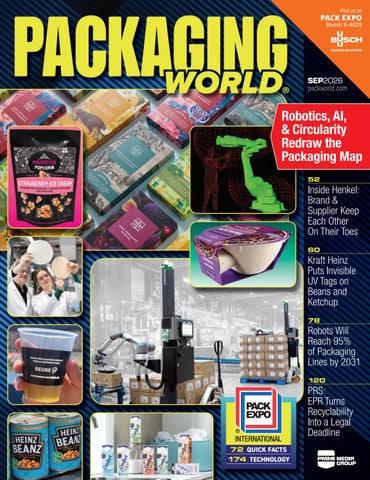
In the issue and on the cover: cobots palletizing coffee, invisible UV tags on Heinz Beanz, Henkel’s in-house recycling lab, reusable stadium cups, and packages redesigned for circularity.
60 Kraft Heinz Pilots UV Tags to Track Real-time Recycling
156 Cobot Palletizing Delivers Speed, Safety, Nine-month ROI at Coffee Co-packer
64
64 SMART PACKAGING Driscoll’s Gives a Billion Clamshells Unique IDs
In a U.K. pilot on Heinz Beanz and Heinz Ketchup packaging, Kraft Heinz is using ultra-violet tag technology to gather practical product lifecycle data.
The fresh berry juggernaut had more than two million consumer survey responses, but no way to act on any of them. Changing that now is item-level serialization via one unique QR code per clamshell, across four thousand growers and a billion packages. ROBOTICS IN PACKAGING 148
78 Mobile Robots Poised to Reshape Robotics in Packaging, Processing A new PMMI report forecasts the U.S. robotics market for packaging and processing will approach $800 million by 2031, with mobile robots expected to take the largest share.
72 PACK EXPO International 2026 Quick Facts Get oriented before you hit the show floor with this fast guide to the most essential destinations, sessions, resources, and events at PACK EXPO International 2026.
Contents_0926.indd 2
86 Packaging Robotics Technologies: New Products
Facing labor shortages and high-mix production demands, Cascade Coffee turns to cobot palletizing to automate end-of-line operations across multiple packaging lines.
164 From Window to Workflow: Prospector Redesigns Pouch for Scale As distribution expanded beyond regional retail into national grocery and hospitality channels, Prospector Popcorn replaced its windowed pouch with a metallized structure and macro photography, aligning graphics, materials, and operations for consistent shelf performance and shelf life.
170 Amid Energy-aisle Sameness, El Jefe Treats Cans as Collectibles In a category where most brands lean on big color blocking and sideways logos, co-founder Ryan Marsh bet that dense, tattoo-style illustration could stop shoppers mid-aisle. Getting that layered artwork onto aluminum meant hand-picking physical color swatches, formulating custom rose shades, and halving standard trapping to protect the fine linework.
120 PRS26: From EPR Rules to Recycling Reality Packaging World’s Packaging Recycling Summit examines how EPR legislation, MRF technology, recycled-content requirements, and package redesign are converging across the recycling system.
8/26/26 2:22 PM
MONOBLOCK SECONDARY PACKAGING SYSTEM SPACE, SPEED AND SIMPLICITY
Robotic carton forming, vision guided placement, integrated directional insertion with vision verification, integrated inter-layer placement to protect layers and robotic carton sealing.
Maximum operational efficiency: To maximize uptime and minimize interruptions, ability to handle various product sizes and quantities. Advanced technology and ease of use: RFID-coded parts, and AR/VR interfaces. Compact and modular design: Small footprint (7.5 meters in length), combining six operations into three modules. Automatic Carton Loading: Three-axis collaborative robot, designed in-house and optimized for compact spaces and variable loads.
Stop to our booth N-5146 to learn more about our S ECONDARY P ACKAGING E QUIPMENT S OLUTIONS
Untitled-11 2
7/31/26 10:48
4 PW SEP2026
DEPARTMENTS 12
packworld.com
COLUMNS
7 Lead Off 26 The Legal Side 28 The Big Picture 30 Ameripen Update 34 Scale Your Brand 38 Design Impact 184 Professional Perspective
FREE DOWNLOAD
Three Editors’ Top Picks from interpack 2026 pwgo.to/9265
NEWS/EVENTS
34
8 News 16 Quotables 180 Industry Watch INTERVIEW
20 First Person PRODUCTS
174 Technology
at PACK EXPO International
ADVERTISING
182 Advertiser Index
FREE DOWNLOAD
How Huge Brands Use Inclusive Package Design pwgo.to/9267
EDITORIAL ADVISORY BOARD Jan Brücklmeier Technical Application Group Packaging Technology Expert, Nestlé M. Shawn French Director – Innovation & Packaging Engineering (Beverage), Danone North America Patrick Keenan R&D Packaging Engineer, General Mills/Annie’s Organic Snacks Tim Lehman Sr. Engineering Manager, Supply Chain, GOJO Industries, makers of Purell Mike Marcinkowski Director of R&D Material Science, Packaging & Sustainability – Nature’s Vault/Fresh Loop Shannon Moore Director Global R&D Packaging Sustainability, Kellanova
FREE DOWNLOAD
Andrew Seys Senior Director, Global Operational Excellence, Spectrum Brands David Smith, PhD Principal, David S. Smith & Associates
Learnings from Walmart, Amazon, and Google at ISTA TransPack
Brian Stepowany Packaging R&D, Senior Manager, B&G Foods, Inc.
pwgo.to/9268
Connect with a Leaders in Packaging supplier today!
www.packworld.com/leaders
To subscribe to Packaging World, scan the QR code or visit pwgo.to/9999
Packaging World® (ISSN # 1073-7367) is a registered trademark of PMMI, The Association for Packaging and Processing Technologies. Packaging World® is published in February, April, June, August, September, and October by PMMI with its publishing office, PMMI Media Group, located at 500 W. Madison, Suite 1000, Chicago, IL 60661; 312.222.1010. Periodicals postage paid at Chicago, IL, and additional mailing offices. Copyright 2026 by PMMI. All rights reserved. Materials in this publication must not be reproduced in any form without written permission of the publisher. To subscribe or manage your subscription to Packaging World®, visit pwgo.to/9999. POSTMASTER; Send address changes to Packaging World®, 500 W. Madison, Suite 1000, Chicago, IL 60661. PRINTED IN USA by Quad. The opinions expressed in articles are those of the authors and not necessarily those of PMMI. Comments, questions and letters to the editor are welcome and can be sent to: editors@packworld.com. Mailing List: We make a portion of our mailing list available to reputable firms. If you would prefer that we don’t include your name, please write us at the Chicago, IL address.
Contents_0926.indd 4
8/26/26 2:22 PM
Untitled-3 2
8/23/26 09:21
6 PW SEP2026
Follow us
www.packworld.com
s
O
8 - 21 , 202
Vis
W
C
CONTENT Matt Reynolds Chief Editor Anne Marie Mohan Senior Editor Sean Riley Senior News Director Casey Flanagan Associate Editor Tracey Labovitz Editorial Operations Coordinator Kim Overstreet Director of Content Pat Reynolds, Sterling Anthony, Eric F. Greenberg Contributing Editors David Bacho Creative Director
ADVERTISING Reggie Lawrence Vice President, Sales rlawrence@pmmimediagroup.com Lara Krieger Senior Manager, Print Operations lkrieger@pmmimediagroup.com Janet Fabiano Financial Services Manager jfabiano@pmmimediagroup.com
PMMI MEDIA GROUP
:
100
David Newcorn President Elizabeth Kachoris Vice President, Digital Jen Krepelka Senior Director, Digital Media Amber Miller Director of Marketing Joan Jacinto Director, Ad Tech and Search Angie Szerlong Director of Industry Strategy Joseph Angel Founding Partner and Executive Vice President, Industry Outreach, PMMI Questions about your subscription or wish to renew? Contact circulation@pmmimediagroup.com.
l
l V v
.W
o
W
O
v o ic
PMMI Media Group 500 W. Madison, Suite 1000, Chicago, IL 60661 Web: www.pmmimediagroup.com PMMI The Association for Packaging and Processing Technologies 12930 Worldgate Dr., Suite 200, Herndon, VA 20170 Phone: 571/612-3200 • Fax: 703/243-8556 • Web: www.pmmi.org
o
o
850
lv
ov
8 :
Masthead_0926.indd 6
l , www
007 U .
.
8/24/26 3: 3 PM
7
LEAD OFF
Who Decides, and Why? Three decisions over the summer came from three very different kinds of authority, and all landed on the same questions. What counts as recyclable, who says so, and on what evidence? In July, a federal court in Portland, Ore., heard the first constitutional challenge to a state packaging Extended Producer Responsibility (EPR) law. That same week, a different federal court blocked enforcement of California’s SB 343, the truth in labeling law. Then in August, the U.S. Plastics Pact removed expanded polystyrene (EPS) transport packaging from its Problematic and Unnecessary Materials List. Only the last was a decision to take a rule away, so let’s start there. I went into the ‘Pact delisting EPS’ story a little skeptical. An EPS producer joined the Pact for the first time two years ago, and now EPS transport packaging comes off the list. There’s a cynical read available for anyone who wants one. But I don’t think that’s what happened. EPS producers are a tiny fraction of the Pact’s membership. And the number that qualified the format—a 31% recycling rate, from a Resource Recycling Systems survey commissioned by the EPS Industry Alliance—has been at or above 30% for years. Under the Pact’s own criteria, that figure alone takes a substrate off the problematic materials list. What changed underneath the number is more instructive. Recovered volume roughly doubled while demand for recycled EPS grew to absorb it. Collection and end markets scaled together, which is rare. Most of what we cover in this space is the opposite, where collection runs ahead of anyone willing to pay for the bales, and material piles up with nowhere to go. Crystal Bayliss, the Pact’s executive director, told me that this balance is “critical to success in a free market economy.” She hopes it’s a learning for others. Still, PS and EPS remain listed for foodservice, and California’s EPS foodservice ban is untouched. What came off is molded EPS protecting durable, fragile, and temperature-sensitive goods in transit. But it’s the first removal since the list was established in 2021. Five years, one subtraction—through some hoops, admittedly, via an abbreviated review the Pact had never used, requiring a workstream recommendation and Advisory Council sign-off but no Activator (member) vote. A voluntary framework with no enforcement authority updated itself based on evidence. Rules written into law often can’t manage to do that. Just ask Oregon. NAW v. Feldon is an argument about who decides. Nobody in that fight claims to be against recycling. The question is whether a private nonprofit can constitutionally set fees, classify materials, and audit producers—and whether distributors who don’t design the packaging they pay on belong in the obligated class at all. Oregon went first, and first drafts get litigated. Or ask California. The court that enjoined SB 343 found four central provisions likely unconstitutionally vague. Among them whether a material “routinely becomes feedstock,” a threshold the statute never defines. It also found the law’s likelier effect would be brands dropping recyclability claims altogether, increasing landfill volume and consumer confusion rather than reducing them. A law written to make “recyclable” mean something may have been too imprecise to enforce. Only one of these three rulebooks was built to change its mind, and it’s the voluntary one with no teeth. One more we’re watching is FDA’s proposed Generally Recognized as Safe (GRAS) rule, open for comment through Dec. 9, that would require brands to notify the agency when they conclude on their own that a substance—food-contact packaging included—is safe. Whether FDA even has that authority is already contested, and Congress may change the underlying law anyway. That leaves the practical problem of what to do, and when. John Hite of The Recycling Partnership says he’s hearing producers say they don’t want to do anything until the lawsuits shake out. He thinks that’s a mistake, and I think he’s right. Final resolution in Oregon could take three or four years, with appeals stretching toward 2030. PW Advisory Board member Mike Marcinkowski at Innovativ Holdings, both an unobligated supplier and a fee-paying brand owner, frames the mismatch by pointing out that development cycles run 18 to 36 months, as tooling is expected to serve a decade. So don’t wait for the court actions to end, at least not if recyclability and circularity are real goals and not just compliance hurdles. The Pact’s lesson holds regardless of who wins in Portland. Focus on what you can control. Build the demand side and create responsible end markets. PW
Keep Sensitive Operations Running with Dynamic %XƪHULQJ 6\VWHPV
mreynolds@pmmimediagroup.com
LeadOff_0926.indd 7
8/2 /26
:33 PM
8 PW SEP2026
NEWS
Mondele– z Chocolate Wrapper Uses 75% Chemically Recycled Plastic Mondele– z International is using chemical recycling to incorporate recycled plastic into another chocolate-bar wrapper. The latest application is a flexible film wrapper sourced from 75% recycled content for Marabou, a chocolate brand sold primarily in Europe. It follows Mondele– z’s early 2024 rollout of certified-circular BOPP for 500 million Cadbury Dairy Milk family blocks, or bars, in Australia, developed with Amcor and ExxonMobil’s Exxtend advanced recycling process. The Marabou project brings together companies across the circular packaging chain. Source One Plastics processes post-consumer mixed plastic waste into agglomerate suitable for chemical recycling. LyondellBasell (LYB) supplies the CirculenRevive PP resin, Taghleef Industries produces the BOPP base film, and Amcor converts the film into the finished wrapper for Mondele– z. Seventy-five percent of the wrapper is made using CirculenRevive polymers that carry 100% recycled content attributed through an ISCC PLUS-certified mass-balance approach. The 100% figure applies to the polymer, while 75% applies to the complete wrapper. The remaining 25% includes inks, adhesives, and other non-plastic elements that are not part of the certified polymer content.
For CirculenRevive made with feedstock from MoReTec, LYB’s proprietary catalytic chemical recycling process, the company estimates a carbon footprint at least 50% lower than fossil-based naphtha. Under the mass-balance system, recycled feedstock enters LYB’s production network alongside fossil-based feedstock, and the certified recycled share is allocated to designated polymer output. Because recycled-content attribution is managed through an ISCC PLUS-certified mass-balance approach, no claim is made that specific waste inputs are physically traced to specific polymer outputs, explains Stijn Effting, brand owner manager, LYB. That accounting system determines how recycled content is attributed to the wrapper. The physical process begins earlier, at Source One Plastics. Before chemical recycling, the mixed plastic waste undergoes advanced sorting and a highly efficient water-free pre-treatment process, Effting says. Source One removes metals, PVC, PET, polyamides, and other nontarget materials before agglomerating the remaining plastic. An LYB and 23 Oaks Investments joint venture, Source One opened its plant in February 2024 in Eicklingen, Germany, and can process 70,000 metric tons of difficult-to-recycle post-consumer plastic per year. Its dryprocessing method is designed to reduce energy consumption by up to 30% compared with conventional recycling technologies. Once sorted and agglomerated, the material is ready for chemical recycling, which converts it into feedstock for new polymer production. For mixed and flexible plastics that can be difficult to return to food-contact packaging through mechanical recycling, the process provides another route into high-quality applications. The recycled feedstock replaces some
News_0926.indd 8
fossil-based raw material used to produce new plastic. Food-packaging performance and safety remain central to the approach. LYB says CirculenRevive is produced to the same recipe and specifications as the corresponding virgin resin grade and carries the same technical and food-contact suitability information. The company did not provide details of migration testing conducted specifically for the Marabou wrapper. The chemically recycled material also gives hard-to-recycle waste another outlet and can reduce carbon emissions compared with virgin plastic. Effting says LYB lifecycle studies indicate that CirculenRevive made in Europe with third-party recycled feedstock can have a lower carbon footprint than fossil-based alternatives when end-of-life waste management is included. For CirculenRevive made with feedstock from MoReTec, LYB’s proprietary catalytic chemical recycling process, the company estimates a carbon footprint at least 50% lower than fossil-based naphtha. LYB currently obtains the pyrolysis oil used to produce CirculenRevive from third-party suppliers. Longer term, it plans to use feedstock from MoReTec-1, the first commercial-scale plant based on the company’s technology, to supply polymers for Marabou packaging. Now under construction in Wesseling, Germany, the plant is designed to produce 50,000 metric tons of feedstock annually, with production scheduled to ramp up in 2027. LYB anticipates that Source One will serve as a primary source of prepared plastic-waste feedstock. Packaging World reached out to Mondele– z for comments, but the company was unable to respond by press time. —Anne Marie Mohan
REGISTER TODAY! Interested in cutting-edge packaging and processing technology? Don’t miss PACK EXPO International 2026 to learn about the latest innovations in packaging and processing.
October 18-21, 2026 Chicago, Illinois, USA packexpointernational.com
8/2 /26
2:34 PM
Untitled-3 2
8/23/26 09:22
10 PW SEP2026
NEWS
Active Film Stick-pack Saves Supplement Brand In 2025, Austin, Texas-based Ozzi launched its powdered drink mix, designed to help consumers control nighttime cravings, in stick packs. But residual moisture inside the sealed packs soon created an odor problem serious enough to threaten the product and the young brand behind it. Ozzi’s Crave Crusher formula includes L-lysine butyrate, allulose, and konjac root. Moisture held by the allulose and konjac was causing the bond masking butyrate’s odor to break down within weeks. The product continued to perform as intended, but the smell was difficult for many consumers to overlook. “We issued a ton of refunds, and our reputation took a big hit,” says Ozzi founder Brandon Kuipers. “Thankfully, it still worked, so some customers continued to buy.” Even so, efficacy alone couldn’t overcome the odor problem. Ozzi’s customers wanted a product they could use discreetly, Kuipers explains, without opening a packet in an office and having others smell it from across the room. “As soon as we discovered that residual moisture was the problem, it was a do-or-die situation,” he says. “We either needed to reformulate and reduce product efficacy or find a way to remove moisture for the long term.” Ozzi first tried adding moisture absorption to the package gussets, but the tightly sealed individual sticks prevented that approach from having any effect. Desiccant and oxygen sachets added elsewhere in the packaging system also failed to resolve the problem. Kuipers eventually found ProAmpac’s patent-pending ProActive Intelligence Moisture Protect MP-1000 while using ChatGPT to search for a film that could control moisture inside a sealed stick pack. MP-1000 integrates Aptar Active Material Science’s 3-Phase Activ-Polymer technology into the sealant layer, where channels pull residual moisture away from the product and direct it to moisture-adsorbing particles seated within the film. Unlike absorption, which takes moisture into a material, adsorption holds moisture molecules on a surface. Capturing moisture from the package headspace helps prevent it from reacting with Ozzi’s ingredients and breaking down the bond that masks butyrate’s odor. Traditional barrier packaging primarily keeps outside moisture from
News_0926.indd 10
entering. MP-1000 retains that barrier protection, while its active material also captures incoming moisture before it reaches the package headspace, says Robert Flaherty, vice president of product development at ProAmpac. After identifying MP-1000 as a potential solution, Ozzi moved into product testing. “We received samples quickly that we self-sealed with powder and tested over 30 days before confirming our order,” Kuipers says. “Thankfully, even at day 100, there was no degradation.” The film was then substituted for Ozzi’s existing foil-based stick-pack material. No machine changes were required, and ProAmpac reports no difference in the quality of the finished packs. “The transition to MP-1000 was straightforward,” Kuipers says. “The only challenge was some initial timing delays during implementation, but once the material was available, it integrated smoothly into our existing stick-pack process.” Since the conversion, Ozzi reports a 75% reduction in customer complaints, a half-point increase in product reviews, and higher customer retention. Ozzi also removed the desiccant and oxygen sachets it had added while troubleshooting the problem. The change has also altered how Ozzi discusses butyrate’s inherent odor with consumers. “I’ve stopped mentioning the smell,” Kuipers says. “It’s still there for some sensitive users, but not enough to bother most. At this point, it’s a feature, not a bug. It’s our best ingredient and it’s what makes Ozzi so effective. Prior to MP, it was so rancid it had to be warned about all over.” Kuipers has since recommended the material to others dealing with similar moisture problems. “It’s worked well for us,” he says, “and it’s kept the product alive and our customers happy.” —Anne Marie Mohan
8/2 /26
2:3 PM
Untitled-3 2
8/23/26 09:23
12 PW SEP2026
NEWS
wGeV GA:w Z`GS
%GV Z
S 8,A& ZwZ` @Z Liquid Carton for Nordic Company Combines Recycled and Renewable PE ÆÆߦ ZƽœŒŖř G ßÆ Õ Œř ƽ œŒƠ œőœŗ
LIVE CHANGEOVER
DEMOS
06 254.327.0677 sales@fallasautomation.com
Orkla Home and Personal Care is rolling out a paperboard carton for liquid laundry and personal care products that replaces conventional fossil-based polyethylene coatings with a combination of recycled and renewable-content polymers. The D-PAK carton, supplied by Elopak and developed with Dow, uses 10% post-consumer circular PE and 90% bio-circular polymers attributed from biological waste and residue streams such as used cooking oil. The carton is built around a responsibly sourced paperboard core with thin polymer coatings on both sides for liquid protection and heat sealing. Unlike many aseptic beverage cartons, the standard D-PAK structure doesn’t include an aluminum barrier because most home and personal care products don’t need protection from light and oxygen for long ambient shelf life. An EVOH barrier is included within the polymer layer. Both polymer inputs are sourced through an ISCC PLUS-certified mass-balance system. That means recycled and bio-circular feedstocks enter a shared production system and are allocated to the carton through chain-of-custody accounting. Elopak says the approach doesn’t require the recycled or renewable material to be physically present in each individual carton, and the polymer specifications remain the same as those of conventional fossil-based PE. “The current 10% circular, 90% bio-circular mix reflects an initial formulation designed to balance the use of recycled content with reduced reliance on fossil-based feedstocks,” says Emilie Olderskog, global head of sustainability at Elopak. The bio-circular portion comes from waste and residues rather than crops grown specifically for polymer production. Elopak says the polymers are chemically identical to conventional PE, allowing the coating to maintain comparable moisture resistance, sealing performance, and compatibility with surfactantbased laundry products. Because the material performs like conventional PE, Orkla was able to make the change without modifying its existing converting or filling equipment. The finished carton is designed for established paper-based liquid packaging recycling streams. During pulping, the paperboard fibers are separated for recovery, while the polymer fraction is removed and handled through downstream processes. Elopak says the switch to recycled and renewable PE has not changed how the cartons are collected, sorted, or recycled. Elopak began packaging Orkla Home and Personal Care products in D-PAK cartons in 2020, first using the format for Klar liquid soap and laundry detergent refill packs. According to Elopak, the refills sold out in record time, and more than 1,000 consumers joined an online waitlist. Use of the carton has since grown across Orkla Home and Personal Care’s portfolio, and the new material blend is now standard for D-PAK packages sold under the Klar, OMO, and Comfort brands. As part of a 2026 Nordic redesign, Klar introduced three laundry detergents and three fabric softeners in D-PAK cartons at Normal, a Danish discount chain known for low-priced personal care, cleaning, household, and convenience products. The products are sold in Norway, Denmark, Finland, and Sweden, with the rollout marking the first introduction of both Klar and the D-PAK carton in Denmark. Packaging World asked Orkla for additional information on how it evaluated the new material mix and its plans for the format, but the company was unable to provide more details before publication. Elopak reports that the ratio of recycled and bio-circular material in the package may change over time. “Going forward, the exact proportions are expected to evolve as material availability, regulatory requirements and performance considerations develop,” Olderskog said. —Anne Marie Mohan
www.fallasautomation.com
News_0926.indd 12
8/2 /26
2:3 PM
Untitled-3 2
8/23/26 09:24
14 PW SEP2026
NEWS
Thermoform Recovery Rises as rPET Use Falls PET thermoform recovery in the U.S. and Canada reached a record 264 million lb in 2024, yet recycled PET use in new thermoforms moved in the opposite direction. That’s according to a new report from the National Association for PET Container Resources (NAPCOR) that found that more trays, cups, clamshells, and tubs are reaching recycling systems, but relatively little of that material is returning to the same type of packaging.
According to NAPCOR’s “2024 PET Thermoform Market Analysis,” thermoform converters purchased more than 2.05 billion lb of PET feedstock in 2024, with virgin resin accounting for 79% of the total. Meanwhile, the share of post-consumer recycled PET fell from 18% in 2023 to 12% in 2024. Lauren Laibach, NAPCOR’s director of data services, says the record recovery reflects both expanded collection and improved measurement. NAPCOR added cross-checks to its 2024 reclaimer survey to capture thermoform content that may have been missed in prior years. “It’s hard to quantify how much of the year-over-year increase from 2023 can be attributed to each cause, but both likely drove it,” she says. Most recovered thermoforms are processed with PET bottles rather than through dedicated streams. That gives them access to an established recycling system, but it also adds strain to facilities designed primarily for bottles. Shankar Prabhushankar, technical director at NAPCOR, says
News_0926.indd 14
thermoform content in curbside PET bales has surpassed levels many mechanical reclaimers prefer, adding that “there are very real limitations to how much economic pain mechanical reclaimers can withstand.” Part of that strain stems from the way thermoforms behave in recycling systems designed primarily for bottles. Their irregular shapes, lower intrinsic viscosity, different flake density, and tendency to generate fines and dust can increase yield losses. Look-alike packaging and aggressive adhesives add further complications. Together, these processing and economic challenges help explain why greater recovery has not translated into more thermoform-to-thermoform recycling. Market mix also played a role in the decline in recycled-content use. Food and foodservice packaging accounted for approximately 79% of reported thermoform sales in 2024, and those applications used less recycled content on average than non-food and non-medical thermoforms. According to Laibach, while the technology exists to decontaminate thermoform-derived rPET for food-contact use, the added sorting and processing needed to produce that material can make it too costly for broader adoption. Dedicated sorting also remains limited. Only a handful of U.S. MRFs produce thermoform-only bales, all on the West Coast. Dedicated postconsumer thermoforms represented less than 1% of feedstock purchases for new thermoforms in 2024. For brand owners, the findings point to two areas they can influence: package design and PCR sourcing. To improve recyclability, NAPCOR recommends using clear, monolayer PET along with labels, inks, and adhesives recognized by the Association of Plastic Recyclers. NAPCOR also advises companies to purchase rPET sourced from the U.S., Canada, and Mexico. Regional buying provides domestic reclaimers with the end-market demand needed to keep PET collection and processing economically viable. “Meeting recycled content goals with imported rPET undermines the health of the North American reclamation system,” Prabhushankar says. “Companies with circularity goals should recognize that, for their packaging to maintain its reputation for recyclability, they need to source PCR from the region, to close the demand loop that keeps the system functioning.” —Anne Marie Mohan
8/2 /26
2:3 PM
Untitled-1 2
8/24/26 10:27
16 PW SEP2026
QUOTABLES
“As the global beauty leader, our responsibility is to turn circular solutions into worldwide industry reality. Making refills the new norm requires a fundamental evolution across our entire value chain, from supply chain to product design to retailer partnerships and consumer engagement. Combined with our L’AcceleratOR programme, we are continuously identifying, piloting and scaling the breakthrough technologies that will define next-generation packaging materials and systems.” –Ezgi Barcenas, chief corporate responsibility officer at L’Oréal, from an article from Packaging Speaks Green, “#JoinTheRefillMovement: L’Oréal accelerates refillable beauty”
“The tussle in California among industry and environmental groups is an indication of the large stakes at hand. Even so, the tension in California is typical of early-stage EPR implementation, and not a sign of a fundamentally broken approach. California’s packaging EPR program is expected to take time before differences are settled. Let’s not forget that EPR is a paradigm shift in how waste is managed—the old way of government and taxpayers paying for whatever producers put into the marketplace has reached an end.” –Scott Cassel, CEO of the Product Stewardship Institute, in an article from Packaging Insights, “CalRecycle defends SB 54 amid opposing legal challenges”
“When Oceana started campaigning in 2020 for Amazon to reduce its dependence on single-use plastic packaging, the company did not report on its plastic footprint. Now, Amazon has removed plastic air pillows from its global fulfillment centers, decreased its plastic packaging by nearly a quarter, and reports annually on its plastic footprint. This demonstrates that it is possible for large, multinational corporations to move away from plastic packaging while still maintaining profitability.” –Dr. Dana Miller, senior director of strategic initiatives at Oceana, as quoted in an article from Resource Recycling, Inc., “Amazon plastic use flat despite shift to paper”
“We believe great design should be accessible to everyone. At our scale, that means creating something that works clearly and intuitively across thousands of individual items, so customers can find what matters, faster. We’ve built a system that does exactly that, bringing consistency, clarity, and a sense of discovery to every shelf.” –David Hartman, VP, creative for Walmart, in an article from Plastics Today, “Walmart refreshes Great Value brand design”
Quotables_0926.indd 16
8/2 /26
: 6 M
massman.com
Beginning to End-of-Line Packaging Machinery & Everything in Between. Untitled-3 2
8/23/26 09:25
We Unscramble Your Containers. New England Machinery builds Unscramblers, Cappers, Orienters, Scoop Feeders, Lidders, Retorquers, Pluggers, Pump Placers and more.
We Fill & Close Your Bottles. DTM Packaging builds the Purefil Filling Line, Conveyors, Accumulation Tables, In-Line Cappers, Puckers, Depuckers and more.
We Fill & Close Your Cans, Pails, Drums & Totes. Ideal Pase builds Net Weight Liquid Fillers, Drum Fillers, Volumetric Fillers, Lid Placers and Closers, Conveyors and more.
Untitled-3 2
8/23/26 09:27
We Bundle & Wrap Your Products. EDL builds Shrink Wrappers, Shrink Bundlers, Roll Wrappers, Automatic Flight Bar Wrappers, Forming Shoe Wrappers, Tray Formers & Loaders and more.
We Load and Seal Your Cartons. ADCO Manufacturing builds a broad line of Auto Load & Hand-Load Cartoners, Top Load Systems, Sleevers, Robotic Packaging, Tray Formers and more.
We Pack & Palletize Your Cases. Massman Automation builds Case Packers, Vertical Cartoners, Pouch Fillers, Palletizers, Case Erectors, Sealers, Tin Tie Machines, Pleated Filter Assemblies and more.
Visit Us In Booth: S-1730 Untitled-3 2
Scan here to register for FREE and be sure to add Massman Companies to your Pack Expo Planner
8/23/26 09:28
20 PW SEP2026
FIRST PERSON
New Standards Support the Scale-up of Reusable Packaging Amy Larkin, co-founder of non-profit PR3: The Global Alliance to Advance Reuse, discusses how new standards can provide the ‘rules of the road’ needed to build interoperable, economically viable reusable packaging systems. Packaging World:
Your career has included work in the arts, business, climate policy, and environmental advocacy. What experiences led you to focus on reusable packaging, and what prompted you and Claudette Juska [PR3 technical director] to co-found PR3 in 2019?
Amy Larkin: All of my work, almost my whole life, even when I was an arts producer, has been at the intersection of commerce, culture, and activism. You have to have them all, otherwise you don’t make big change. I was working from 2015 to 2018 or so on plastic-reduction strategies with a combination of NGOs and multinationals. Everybody had the same feeling: Reuse is the way to go. After many meetings, I realized this was not a new product. It was a new system. The only way you do that [create systems change] is by convening all the pieces of the system. I call myself a radical collaborator, because you’ll never learn more about what you’re working on than from people who disagree with you. The smartest thing I did was call my partner of the last seven years, Claudette Juska, who I knew from Greenpeace and who was also working on plastic reduction. Then she said, ‘The only way you do system change for this kind of initiative is through standards.’ The minute she said it, I understood.
What has PR3 been doing since 2019, and what signs indicate reusable packaging is beginning to move beyond individual pilot programs? Since we started in 2019, we’ve been kind of quiet. Not that quiet, but we’ve been doing the work, and now we have a lot to say, so we’re saying it. A year ago, the phone calls were, ‘It’s so hard,’ ‘It’s so hard,’ ‘It’s so
FP_0926.indd 20
Bold Reuse is among the reusable cup providers using PR3’s new reuse symbol, shown here on a cup at a stadium, where closedloop systems can simplify collection, return, and washing.
hard.’ It was hard. Now the phone calls are, ‘Come here,’ ‘Come see this ball game,’ ‘Come to this show.’ It doesn’t mean it’s no longer hard, but it [reuse] is moving.
What is the economic case for reuse? Where can brands, retailers, communities, or consumers realize savings, and who typically has to make the initial investment in the collection, washing, tracking, and transportation infrastructure? If you’re a Starbucks or McDonald’s, or the deli counter at your supermarket, it’s much easier than if you’re a consumer brand because you don’t have to refill the package. The big issue for consumer brands is that they already have co-packing facilities. They have to change their lines. It’s an investment, and they’ll probably have to build more co-packing facilities. I think as EPR comes in, that makes it much easier. The other thing is that the accounting is wrong. Without EPR, consumer brands don’t have to pay the cost of single-use throwaway disposal, either in landfill or pollution or anything else. If I’m a reuse service provider, including one going into a stadium, I have to pay for everything. Reuse is more expensive in the beginning. But once everything is in place and gets going, it’s going to be cheaper because you don’t have to keep buying single-use inventory.
8/2 /26
:3 PM
NEITHER SHOULD YOU. Packaging & processing equipment, ready in as little as 48 hours.
INSPECTION AND TESTING EQUIPMENT
CARTONING, MULTIPACKING, & CASE PACKING
BAGGING, POUCHING & WRAPPING EQUIPMENT
FILLING, CAPPING & CLOSING EQUIPMENT
PROCESSING EQUIPMENT
COMPLETELY INTEGRATED LINES
See us at PACK EXPO Chicago 2026 in Booth #N4939
Untitled-4 2
8/26/26
: 6 PM
22 PW SEP2026
FIRST PERSON
PR3’s new reuse symbol is designed to provide a consistent visual cue that a package is intended for reuse, helping consumers recognize and participate in reuse systems.
PR3’s standards are developed through a formal consensus process. How does that process work, and how do you reconcile the priorities of participants who may have very different interests? Our panel is 80-plus people, from multinationals to informal waste workers, reuse entrepreneurs, cities and countries, reuse service providers, scientists, health advocates, environmental justice advocates, and packaging producers. One of the really important things, if we want this to be adopted globally, is that the people who produce the packaging, who are going to buy the packaging, and who are going to use it need to know their voices have been represented. The standards have to be rigorous and secure and ensure confidence, while also allowing companies to make money.
or physically disabled. The System Operations & Performance standard is intended to ensure strong return rates—how to incentivize them, encourage them, and measure them. The Digital standard is set up around the two most common digital languages in the world, including GS1, which is basically what everyone uses at checkout. The Marking & Labeling standard is what you need to do to show that an item is reusable. Like all standards, they’re divided into what you ‘shall’ do and what you ‘should’ do.
Could you very briefly walk through the six parts of the PR3 standards framework and explain the role each one plays in creating a complete circular system? The standards are actually quite technical. The Washing standard adheres to the highest food code wherever you are. The Container Design standard prohibits the addition of the most hazardous chemicals in the world into the packaging, and it is very specific. The Collection Points need to be accessible for people who are visually
How are PR3’s standards different from other reuse guidelines, and what does that distinction mean for the companies and systems that will use them? Our parent organization is called Resolve. Resolve is an official standards body with the American National Standards Institute [ANSI], and we partner with the Standards Council of Canada [SCC]. The standards are officially American and Canadian, and we are in active negotiations with several other countries.
FOCKE PS AZ Family Portrait PMMI Packaging World 8_375 x 5_4375 04RZvek.indd 1 FP_0926.indd 22
11:37 8/211.08.26 /26 0:00 M
Untitled-3 2
8/23/26 09:34
24 PW SEP2026
FIRST PERSON
A lot of mostly NGOs will say, ‘We have standards for this,’ but they’re not standards like ISO standards. The standards we’ve written are meant to help the people who are creating the businesses and the systems, as well as consumers.
Read the full, unabridged interview at pwgo.to/9191
Why did PR3 determine that reuse needed a universal symbol, and what did you learn from the process of developing it? Several years ago, we thought a symbol for reuse was needed and should be included in our labeling standard. We spent a lot of time, energy, and money on a global initiative and got input from around the world. We brought in a rockstar jury, from the head of the Green Sports Alliance to a farm-to-closet entrepreneur, a supermodel, and a senior vice president of sustainability at Universal Music Group. We had artists and designers from corporations. It was an amazing jury. Then our panel chose the final design, and it’s really being embraced by reuse service providers and by media. There is something about a picture telling a thousand words. Where is PR3 beginning its certification work, and why did you choose that area first? We are just now beginning certification for the washing standard. We’re starting with washing because the most important thing to show consumers is that it [reusable packaging] is safe, clean, and sanitary. Then we’ll move into certifying other standards. Why have stadiums and other large, closed venues become such important starting points for reusable packaging systems? The beauty of stadiums and other large venues is that they provide enough volume for reuse service providers to make money. Once they have established a viable business, the city, surrounding areas, neighborhoods, and business improvement districts can bring reuse outside the venue because there is a foundation for a good business.
For CPGs interested in reuse but uncertain about the infrastructure, economics, or consumer participation, what should they be doing now? How can they avoid creating another small, disconnected system? I think they should start with their rivals, with their competitors. I would convene a meeting of my three biggest competitors and say, ‘Okay, for one area—the yogurt and cottage cheese area, for example—what can we do together, and where could we do it?’ They can always call us, and we can give them a sense of the different reuse service providers and reuse service-provider groups around the world. I’m looking for people who have the courage to say, ‘This is what Coke, Pepsi, and Unilever did with us. We’re going to do it.’ Once you make that decision, you do it. You still need the courage to say, ‘I’m going to spend a lot of time with the marketing people to get this right. I’m going to sit with the operations people to make it right.’ It takes mental attention and energy, but all the tools are there. —Anne Marie Mohan
FP_0926.indd 24
8/2 /26
:3 PM
Untitled-3 2
8/23/26 09:35
26 PW SEP2026
THE LEGAL SIDE
By Eric F. Greenberg, Attorney-at-law
10 Things You Should Know About Litigation Today we present a primer on the world of litigation. [1] TRUISMS: Let’s start with a few truisms about most lawsuits: * Litigation—court cases, lawsuits, suits (they all mean the same)— can involve private companies or people against one another, called civil litigation, or a government against a company or person, called criminal or regulatory litigation. * The one suing is the plaintiff, the one sued is the defendant. * Lawsuits can be time-consuming and distracting. Packaging businesses who sue a non-paying customer, for example, often are frustrated to discover how much time and attention it eats up, even if successful. * And, if you win, it’s not as satisfying as would be a punch in the opponent’s nose. Which I don’t recommend. [2] PLAN FOR THIS, GET THAT: It’s somewhat ironic that all a litigation lawyers’ strategic planning and information-gathering are made with an eye toward how things would play out at a trial, but trials are actually rather rare. Most cases—over 90%—get settled, meaning the parties agree to a result before a trial, or are thrown out before trial by the judge for being somehow insufficient. Practice pointer: A settlement is, by definition, “out of court,” so don’t say “settle out of court,” like they do on TV. [3] BEFORE TRIAL: Before a trial, which can be before a jury or just a judge, the key activities are either discovery (such as asking the other party or outside witnesses for written documents or a deposition, which is oral testimony under oath in answer to questions), or motions (for example, asking the judge to throw the case out for overall inadequacy under the law.) [4] ALL THOSE APPEALS! Most cases start in state or federal courts referred to as the trial court, and if you lose there, you can commonly appeal to the next highest, or appellate court, if you’ve got ‘grounds.’ Grounds might be, among others, that you think the trial judge kept out evidence they should not have, or explained the law incorrectly to the jury. If you lose again, you might have grounds to appeal to the highest court, usually called the Supreme Court. (Fun fact: New York State names its lowest court the “Supreme Court,” and its top court the Court of Appeals. No idea why.) [5] WHAT EXACTLY FOR? I recommend you always ask these two important questions about litigation you hear about: A. What is the legal basis of the claim? Did the defendant, for example, breach (break) a contract, act negligently (failed to use reasonable care) and cause someone harm; steal a trade secret; or violate a state or federal law? And: B. What remedy are they seeking? Usually money (often referred to as ‘damages’). So for example, a corrugated package fails to properly hold the heavy appliance it was packaged in, breaks and falls on a consumer’s foot, and the consumer sues the company that sold it
© chokniti stock.adobe.com
for negligence, claiming the company didn’t use reasonable care in designing or making the package, maybe because they didn’t adhere to the industry standards for the package. The injured person might seek lost wages since they had to miss work, medical bills, and their pain and suffering. When governments win cases, sometimes the remedy is a financial penalty, sometimes it’s an injunction (order) preventing the company from selling or making a product, sometimes it’s putting a person in jail. (More on injunctions later.) Sometimes NGOs sue federal agencies to force the agencies to make a decision, such as when an NGO sued to force FDA to decide whether to prohibit seven chemicals from being used in food as flavors. [6] CLASS IT UP: Money damages are also usually the remedy in so-called ‘class action’ lawsuits, in which a representative consumer sues a company on behalf of the ‘class’ of consumers similarly affected, and the remedy is sometimes a small dollar amount refund or discount to all the consumers. Examples include cases against companies whose package labels allegedly misled consumers because they claim their food product is ‘all natural,’ but in fact contain synthetic ingredients, or companies whose beverage label claims their product is loaded with “veggies” when it is mostly fruit juice. [7] INJUNCTIONS: As noted, sometimes the remedy sought in a case is an injunction, which is an order by the court for someone to stop doing something. An example is the closely watched Oregon lawsuit (more from PW at pwgo.to/9264) where the plaintiffs seek an order blocking the state’s EPR law as a violation of the state constitution. A similar case is pending in California against that state’s EPR law. [8] PRELIMINARY INJUNCTIONS: Sometimes, injunctions are temporary, as a judge determines based on an early, basic outline of the facts that the plaintiff has a good shot at winning, so the judge orders, essentially, keep everything as is while I figure this out. For example, in July, a federal judge issued a preliminary injunction that prevented California from enforcing its SB 343 (informally called ‘truth in labeling’) law that tried to impose criteria for when packages could feature chasing arrows or similar symbols. [9] STAY, JUST A LITTLE BIT LONGER: Sometimes, too, a case will be decided, by a judge’s ruling or a jury verdict, but the judge ‘stays’ the decision while the case gets appealed. They do this to minimize the damage in case the appeals court decides the decision was incorrect. [10] IN DEFENSE OF JUDGES: It’s a disservice to federal judges— but media reports do it all the time—to mention which President nominated the judge when discussing a decision the judge made. Doing that zooms right past the quite reasonable benefit of the doubt any judge should start with, and instead assumes that every judge is a corrupt lackey. Few are. PW
Eric Greenberg can be reached at greenberg@efg-law.com. Or visit his firm’s website at www.ericfgreenbergpc.com. INFORMATIONAL ONLY, NOT LEGAL ADVICE.
LegalSide_0926.indd 26
8/24/26 3: 0 PM
Untitled-3 2
8/23/26 09:35
28 PW SEP2026
THE BIG PICTURE
By Sterling Anthony, CPP, Contributing Editor
Eyeing ‘Ultra-processed’ The ultra-processed foods debate (which I previewed at pwgo.to/9258) will bring new federal regulations of a type and scope that’s yet to be determined. In the interim, brands need to anticipate what’s likely to come and to strategize accordingly. To begin, companies need to recognize the difference represented by the debate. Whereas there long has been a regulatory focus on nutritional labeling, the ultra-processed foods debate is about different disclosures, namely the levels of processing that foods undergo, along with certain targeted additives. The establishment of a legal definition of ultra-processed foods is a logical necessity. The Food and Drug Administration (FDA) and the United States Department of Agriculture (USDA) are collaborating in that effort. Companies, however, don’t need to wait for that definition to determine its applicability. Based on publicly available coverage of the debate, the definition likely will encompass most packaged foods. Individual companies, therefore, need to assume that they will be impacted. That leaves the question of, “how?” It’s a safe bet that the coming regulations will affect labeling. Placement is a key issue. If, for example, certain information is mandated for front-of-package placement, companies will need to decide how to best integrate it, while still leveraging the communication function of packaging. A greater challenge would be a front-of-pack placement mandate for a warning label. That’s because federal regulations for warning labels typically impose requirements regarding form and format. To be effective, warnings must be conspicuous—they need to stand out and be readily noticed. Since marketers don’t regard their products as harmful, having to call attention to a warning is daunting. It’s a solid possibility that the coming regulations will place restrictions on marketing practices, such as advertising, and particularly what’s aimed at children. When thinking of advertising, print and electronic quickly come to mind. But packaging not only is a medium for advertising, but also one that operates at the pointof-purchase. Companies that market foods targeting children need to access the degree to which the packaging might be attacked as exploitive. Here, too, package design and redesign will be impacted. Expect restrictions, and even outright bans, of various additives. Incidentally, some states are not waiting for federal regulations and are enacting their own, California being a prime example. Preservatives are particular category of additives that carry packaging-related ramifications. Protection is a key function of packaging, allowing for the extended safe quality of foods. Preservatives are used for the same purpose. The relationship between the two can be said to be inverse: a lesser reliance on preservatives places a greater reliance on packaging.
BigPicture_0926.indd 28
Under that scenario, barrier packaging—notably of the flexible variety—looms large. But there’s a catch-22. Flexible barrier packaging consists of various materials, bonded with various substances, and therefore, it is subject to criticisms regarding recyclability. There’s a different type of restriction than might be implemented by the coming regulations, related to the alleged “hyper-palatability” of some supposed ultra-processed foods. It can take the form of lowered allowed amounts of the big three: sugar, salt, and fats. Would it be an overreach, given that Nutritional Labeling already addresses those ingredients? That argument could be made. Nonetheless, there are at least two concerns that companies should bear in mind. One involves whether those ingredients will be assigned new, more prominent roles in labeling. The other involves the challenge of reformulating, using lowered amounts of those aforementioned ingredients while still providing desired palatability. It is not being alleged here that every conceivable fallout from the ultra-processed foods debate will have ©Aisyah - stock.adobe.com a direct connection with packaging. It is being alleged that there are direct connections with packaging that impact a company’s sales, market share, and profitability. It can’t be otherwise, given that food processing and food packaging are so intertwined. It further follows that a company’s responses to the ultraprocessed foods debate should assign the proper role to packaging professionals. Every company should stay abreast of the regulatory landscape, not only as presently composed but also of potential changes. Traditionally, aids have included trade associations, strategic partnerships, and external sources. More recently, AI has made the task easier, along with software that tracks patterns and predicts shifts. Fundamentally, every company should understand the federal rule-making process. Regulations don’t suddenly appear, but are preceded by a protocol, including announcements of proposed regulations and a period in which invested parties can provide inputs. Packaging, as a discipline, should be a standing member of any internal group tasked with anticipating what’s to come and strategizing responses to the ultra-processed foods debate. This should come naturally for packaging professionals because packaging is interdisciplinary. Other disciplines might include marketing, production, supply chain management, and, of course, legal. Regarding the legal discipline, legislation leads to regulation, which leads to litigation. There already have been individual and class-action suits regarding ultra-processed foods, and the pace looks like it’s accelerating. A company that finds itself a Defendant in a lawsuit should know how to assist its law team. More than that, a company should have such assistance at the ready, in advance of litigation. More in next month’s issue of Packaging World. PW
8/2 /26 2:38 PM
Untitled-3 2
8/23/26 09:36
30 PW SEP2026
AMERIPEN UPDATE
By Lynn Dyer, President of AMERIPEN
The PACK Act, and Why Local Voices Matter in a National Labeling Debate When a member of Congress walks through a packaging facility, the PACK Act stops being an acronym on a hearing agenda. It becomes a production line, a print specification, finished inventory, and a team responsible for getting accurate packaging to market. That is the perspective Congress needs now. In July, the House Energy and Commerce Subcommittee on Commerce, Manufacturing, and Trade held a hearing that included the Packaging and Claims Knowledge Act, or PACK Act (H.R. 6832). The bill would establish federal rules for recyclable, compostable, and reusable claims on consumer packaging. It would not require companies to make those claims. Voluntary claims would need to meet consistent federal requirements, including accredited thirdparty certification, which helps to reduce greenwashing. States and local governments would be preempted from enforcing different requirements. The hearing was important, but it will take more to advance the bill. Businesses, organizations, and individuals must now explain what inconsistent labeling requirements mean in practice.
recyclable, 53% check the label before throwing it away or recycling it. Eighty-two percent trust that the recycling information on a product label is accurate. If conflicting requirements lead companies to limit or remove on-packaging claims, consumers could lose the guidance they use and trust. A claim such as “recyclable” should convey the same fundamental information wherever a packaged product is purchased. Differing requirements can send inconsistent signals about how packaging should be managed after use, undermining confidence in both the claim and the recovery system.
A label change is rarely just a label change The Federal Trade Commission’s “Green Guides,” as they are often referred to, help companies understand how environmental claims may be used. But the guides do not preempt federal, state, or local laws and are not independently enforceable. As states pursue different approaches, companies selling products nationally may face different laws for the same package. For packaging professionals, the consequences are operational and financial. Changing a claim can require legal review, new artwork, updated specifications, revised printing plates or cylinders, new molds, supplier coordination, and inventory planning. A company may need state-specific packaging, separate inventory by destination, smaller and less efficient production runs, or the removal of a useful claim nationwide. Each of those changes carries costs, including legal and design fees, new tooling and production expenses, added warehousing and distribution, obsolete packaging inventory, and staff time across multiple departments. The financial impact can extend far beyond redesigning a label, affecting material selection, production planning, distribution, and consumer communication. Consumers also have a stake in this debate. A national survey by The Recycling Partnership found that 78% of U.S. consumers look at recycling information on a product or its label to help ensure an item ends up in the right place. When they’re unsure whether an item is
AmeripenUpdate_0926.indd 30
Policymakers touring packaging facilities can see firsthand how packaging claims affect production and operations.
National advocacy needs local evidence Associations and coalitions can explain the structure and intent of legislation. Companies and their employees make its impact tangible. A constituent can show a lawmaker what a policy decision means in that lawmaker’s district. A plant manager can explain how multiple rules affect production. A packaging engineer can describe the time required to change a specification. Employees can speak to the investments and jobs supported by their facility. Plant tours allow policymakers to see the packaging value chain in action. Select one package and walk the policymaker through its journey, from material sourcing and design to production, distribution, use, and recovery. Explain where an environmental claim enters the process, what supports it, and what must happen when a requirement changes.
8/2 /26
:46 PM
2QH SDUWQHU (YHU\ SDFNDJLQJ VROXWLRQ
$XWRPDWHG EDJJLQJ HTXLSPHQW OLTXLG ğOOHUV SDOOHWL]HUV URERWLFV DQG PDWHULDO KDQGOLQJ V\VWHPVŌGHVLJQHG WR VWUHDPOLQH RSHUDWLRQV ERRVW WKURXJKSXW DQG SRZHU \RXU OLQHłV SHUIRUPDQFH
+$9(5 %2(&.(5 JD LQIR#KDYHUERHFNHU FRP KWWSV JD KDYHUERHFNHU FRP
Untitled-3 2
8/23/26 09:37
32 PW SEP2026
AMERIPEN UPDATE
Then connect that example to a clear request: Support the PACK Act and a consistent national framework for recyclable, compostable, and reusable claims. National organizations can open the conversation. Constituent voices give lawmakers a reason to act.
The value chain must engage collectively No environmental claim is created or implemented by one department, or even one company. Material suppliers provide technical data. Converters translate specifications into packaging. Brands determine which claims appear on packaging. Retailers manage products across markets. Recyclers, composters, haulers, and municipalities understand whether materials can be collected and processed in practice. A credible claim depends on coordination across that entire system. The PACK Act reflects this reality by directing the FTC to consult with the Environmental Protection Agency and establish an advisory council that includes packaging material suppliers, consumer product manufacturers, and entities involved in collecting and managing discarded consumer packaging. That collaborative approach must also guide advocacy. Policymakers should hear from businesses of different sizes, material sectors, and positions across the value chain. They need examples
that demonstrate shared challenges while recognizing differences among packaging formats and recovery pathways.
This is the time to engage The PACK Act offers an opportunity to provide consumers with clearer information while giving businesses a consistent framework for communicating across state lines. It would also establish enforceable expectations for companies that voluntarily make recyclable, compostable, or reusable claims. But legislation does not advance on broad support alone. Lawmakers need to understand how the issue affects the people, employers, and communities they represent. Contact your members of Congress. Invite them and their district staff into your facilities. Share how differing requirements affect your operations and customers. Coordinate with suppliers and partners. Prepare your internal teams for the packaging policies taking shape. Consumers need clarity. Businesses need consistency. Lawmakers need evidence. The packaging industry is uniquely positioned to provide all three. Turn awareness into action. Visit ameripen.org/pack-act to learn more, contact your members of Congress, and add your organization’s voice to the coalition supporting a national framework for recyclable, compostable, and reusable packaging claims. PW
AMERIPEN represents the U.S. packaging value chain by providing policymakers with fact-based, material-neutral, scientific information.
ACHIEVE A PERFECT SEAL Prevent Leaks, Preserve Freshness, and Provide Tamper Evidence. The new Super Seal™ Pro Cap Sealer with advanced features for retail and e-commerce packaging. Chemical, Pharmaceutical, Food, Beverage, and Cosmetic.
Innovative People. Ensuring Your Sealing Success. +1.262.255.6070 / www.enerconind.com
AmeripenUpdate_0926.indd 32
8/2 /26
:46 PM
s
E
P
Untitled-3 2
8/23/26 09:40
34 PW SEP2026
SCALE YOUR BRAND
By Ken McGuire, Contributor
Aveda’s New Refill Launch Was Years in the Making Estée Lauder brand Aveda has adopted the AeroFlexx packaging platform for refills. This news has caused me to think about the work we put into that package in the early stages, and how some of the decisions we made then affected the platform’s future. Sustainability was certainly top of mind—we envisioned a package with >50% less plastic than a bottle. But sustainability alone does not create a market for a new packaging platform. The consumer experience must lead—which reminded me of a meeting I had with my Procter & Gamble boss, Mark Lund, at the beginning of the development. “Ken, what you are making looks and performs worse than a bottle—and it costs more. Figure out what this material can do for the consumer experience, because otherwise we don’t have a project.” That may have been the best management direction I received during my 28-year career at P&G. The comment from my boss Mark came about six months into the development of what would eventually become AeroFlexx. Mark and I had begun with an ambitious objective: to obsolete the conventional rigid bottle by using flexible film as the primary package substrate. We ultimately used air pressure in selected areas of the package to create tailored rigidity. Mark was right. At that stage, the package was an inferior and more expensive imitation of a bottle. It was not enough to prove that flexible film could stand upright, contain a product and survive distribution. To justify an entirely new format, we had to identify a benefit that a conventional bottle could not easily provide. Following that meeting, the team decided to integrate a one-way, self-sealing dispensing valve directly into the package structure. That decision fundamentally changed the consumer experience. The valve enabled one-handed, controlled dispensing, helped prevent leaks and spills, and eliminated the need for a separate cap or pump. At that point, the package bridged rigid and flexible formats, combining bottle-like control with the efficiency and squeezability of film. The decisions made before the technology left P&G did more than improve one package concept. They created the foundation for a platform that could later be adapted to industries, products, and applications we could not reasonably have anticipated from within a consumer packaged goods company. The first was refusing to treat the package as merely a flexible substitute for a rigid bottle. Had we optimized only for material reduction or cost, we might have created a lighter package with limited consumer appeal. By insisting on a differentiated dispensing experience, we created value that could translate across categories. The valve became a source of cross-industry versatility. That benefit received independent validation in 2026, when the AeroFlexx Pak became the first all-in-one liquid packaging solution to earn the Arthritis Foundation’s Ease of Use Certification.
ScaleYourBrand_0926.indd 34
The second important decision was to make rigidity a tailored feature rather than an inherent property of the entire package. Conventional bottles obtain their structure from rigid plastic and package geometry. In our approach, the AeroFlexx air frame used pressurized chambers in selected areas to create stiffness where needed while allowing other areas to remain flexible and squeezable. The architecture could maintain its form while adapting to different shapes, viscosities, and dispensing behaviors—one reason it could evolve into a platform rather than remain a single package design.
Early development prototypes show the AeroFlexx air frame, in which pressurized chambers create rigidity in selected areas of the package while other areas remain flexible enough to squeeze. The third decision was to address consumer experience and technical robustness at the same time. We had to determine how to maintain approximately 7 to 9 psi of internal pressure throughout the product’s shelf life. We also had to understand how to manufacture, vent and seal the package consistently, and ensure that it could survive both traditional distribution and the more demanding conditions of e-commerce. A package that delights consumers but cannot be produced reliably or survive distribution is not a commercial innovation. Solving these performance problems meant we handed off the beginnings of a manufacturable system, not merely an interesting prototype. In 2018, AeroFlexx was established and acquired the sole and exclusive rights from P&G to commercialize the technology globally, across all categories and with any partner, including P&G competitors. Since then, AeroFlexx has industrialized the platform, expanded the materials, added its own intellectual property, and made its first commercial deliveries in 2024. Advancements include an APRrecognized mono-material film structure, curbside-recyclability claims where plastic bottles are accepted, new package geometries and
8/2 /26
: 0 M
Untitled-3 2
8/23/26 09:40
36 PW SEP2026
Safer Safer Pet Pet Food Food Starts Starts with with Inspection Inspection You You Can Can Trust Trust
SCALE YOUR BRAND
dispensing approaches tailored to product rheology. These developments were enabled by a concept that was not locked into one product, shape, or category. Its value comes from combining the air frame and integrated valve in one adaptable format. I recently spoke with Kristen Lewis, VP of marketing at AeroFlexx, about the diversity of markets in which the technology is gaining traction. Aveda, for example, will become the first prestige beauty brand to commercialize AeroFlexx refill technology globally, with select products scheduled to debut in early 2027. The application shows why the early decisions mattered. A refill pouch may reduce material, but it can be difficult to handle, pour, and reseal. For a prestige brand, sustainability cannot come at the expense of quality or control. AeroFlexx combines refill efficiency with a structured, resealable form and controlled refilling. For Aveda, the refill is designed to use up to 70% less plastic than two 250-mL bottles, while premium finishes help protect brand presentation.
Major pet food manufacturers trust Wipotec inspection Major pet food manufacturers trust Wipotec inspection solutions to protect product safety and brand integrity solutions to protect product safety and brand integrity on high-speed production lines. on high-speed production lines. Our systems verify accurate weights, ensure packaging Our systems verify accurate weights, ensure packaging integrity, detect contaminants, support food safety integrity, detect contaminants, support food safety compliance, and reduce recalls through early defect compliance, and reduce recalls through early defect detection and automatic rejection. detection and automatic rejection.
VISIT AT PACK EXPO INTERNATIONAL VISIT AT PACK EXPO INTERNATIONAL OCTOBER 18-21, 2026, CHICAGO, ILLINOIS OCTOBER 18-21, 2026, CHICAGO, ILLINOIS SOUTH HALL: # S-3986 SOUTH HALL: # S-3986 WEST HALL: # W-27074 WEST HALL: # W-27074
Today’s commercial AeroFlexx Paks span a range of package geometries, graphics, and dispensing formats. Beyond Aveda, AeroFlexx has signed a multi-brand, multimillion-unit agreement with a large European CPG company. It is also advancing commercialization with a U.S. industrial manufacturing partner and working with a beverage company. Those four areas reflect both the category-neutral architecture of the original concept and AeroFlexx’s subsequent innovation. The broader lesson for packaging innovators is straightforward. Do not define success only by how well a new package replaces the current format. Design for a differentiated consumer benefit, solve the fundamental technical problems, and preserve enough flexibility for the technology to evolve. Mark’s direction forced us to confront that reality early. He was not asking us to make the prototype look a little better, reduce its cost slightly, or improve its performance incrementally. He was asking a more fundamental question: Why should this package exist? Our answer was to stop treating the concept as a flexible version of a bottle and determine what the structure could uniquely do for the consumer. That led to the two elements that define AeroFlexx today: the air frame and integrated valve. Years later, AeroFlexx’s progress across beauty, CPG, industrial products, and food and beverage provides a compelling answer to Mark’s challenge. The breakthrough was not a better bottle. It was a new packaging platform that addressed consumer tensions neither rigid bottles nor flexible pouches could solve alone. PW
www.wipotec.com/us www.wipotec.com/us ScaleYourBrand_0926.indd 36
8/2 /26
: 0 M
Untitled-3 2
8/23/26 09:41
38 PW SEP2026
DESIGN IMPACT
Equator Design reimagined The Fresh Market’s premium chocolate bars as a collectible ‘Chocolate Library,’ with each flavor treated like its own illustrated book cover while remaining part of a cohesive, giftable set designed to cross-merchandise with wine and cheese.
The Fresh Market Brings the Magic of its Store to the Shelf By Anne Marie Mohan, Senior Editor Walk into one of The Fresh Market’s stores, and the design brief writes itself. Florals at the entrance bloom into produce. Produce gives way to a butcher’s case of hand-cut kebobs and chicken roulades. The scent of fresh bread leads shoppers toward the bakery, and from there the store unfolds further into a candy island, a prepared-foods section, and an extensive whole-bean coffee selection. “We are taste first and experiential,” explains Michelle Beck, director of merchandising, private label, at The Fresh Market. “What makes us unique is the size of our store, the layouts of our store, and really how
we think about food and the journey we create for our guests.” Unfortunately, for years, its product packaging failed to carry that same sense of discovery into the aisle. The Fresh Market’s own-brand packaging was functional, but it had grown piece by piece over years and didn’t carry the sensorial conversation happening elsewhere in the store. As the retailer modernized nearly every other touchpoint of the brand, the gap between the in-store experience and the packaging became harder to ignore. To bring the store experience to its packaging, the Greensboro, N.C.-based specialty grocer embarked on a redesign of its private brand spanning more than 700 SKUs across three quality tiers, executed in partnership with U.K.-based Equator Design, not because something was broken, but because it could be better.
A refresh from a position of strength
The Fresh Market’s expansive whole-bean coffee section and in-store coffee station are central to the retailer’s sensory, discovery-driven shopping experience, an atmosphere the grocer sought to extend into its redesigned own-brand packaging.
DI_0926.indd 38
It was rising ambitions, not softening sales, that drove the decision to overhaul the packaging for The Fresh Market’s full portfolio of products. The grocer is in the middle of a broader brand evolution that has already touched the store environment, signage, and merchandising. Beck saw packaging as the final layer. “Because we are so experiential, our packaging plays a very large part in creating that atmosphere,” she says. “It’s crucial for us to stay ahead. Plus, we are at a time where we are beginning to aspire to attract a new guest. This rebrand of our packaging was the final touch to refresh who we were and who we were looking to attract.”
8/2 /26
2:2 PM
A LEADER IN PACKAGING SINCE 1944 LITHO-LAMINATED CORRUGATED PACKAGING
Consistent Print Quality On-Time Deliveries Reliable Run Speeds on Automated Equipment* 100% Recyclable Ships Competitively Nationwide Made in the USA
NEW DOUBLE-SIDED LITHO CAPABILITIES
*Real customer results showed over 100% improvement in line efficiency after transitioning to Accurate Box packaging solutions.
(973) 345-2000 | SALES@ACCURATEBOX.COM | ACCURATEBOX.COM
Untitled-3 2
8/23/26 09:42
40 PW SEP2026
RC20 Collaborative Palletizer. Palletizing for heavier loads.
DESIGN IMPACT
The brand had also worked itself into a strategic pendulum. Years earlier, The Fresh Market’s own brand had leaned into a “treasure-hunt” aesthetic, with packaging varying wildly from category to category. The variety created excitement, but it also made it harder for shoppers to immediately recognize what belonged to The Fresh Market. Concerns about brand recognition eventually pushed the team in the opposite direction, toward a highly uniform system that, in Beck’s words, “sucked every bit of personality out” of the range. “We were missing the story element, we were missing the things that make us special,” she says. “We were missing the 100%-satisfaction-guaranteed promise. Those things needed to come back, and they needed to tell the story of the product.” Restoring that story meant rethinking the entire private-label architecture from the ground up, across three distinct tiers.
Designing for three tiers, one brand world
The RC20 extends collaborative palletizing to heavier loads and higher throughput applications while maintaining a compact operational footprint. With payloads of up to 17 kg and throughput of up to 12 boxes per minute with double pick, the RC20 combines high performance and compact design. It helps manufacturers automate end-of-line palletizing in a safe, flexible, and scalable way.
Internally, The Fresh Market’s own-brand portfolio is organized into three tiers: Extraordinary Everyday, the workhorse “better” tier in good-better-best parlance; a Premium tier representing the brand’s “best” everyday SKUs; and an aspirational Uber Premium tier reserved for the most epicurean, highly curated items in the assortment. None of those labels appear on-pack; the tier system is a design and merchandising tool, not a consumer-facing claim. The design brief Equator received was demanding. Make the three tiers visually distinct enough that a shopper navigating the salsa aisle, comparing olive oils, or choosing between coffee blends understands the step-up from Extraordinary Everyday to Premium without reading a single line of copy, while keeping all three legibly part of one brand family across produce, dairy, grocery, bakery, deli, and seasonal limited-time offers.
Its unique safety concept supports side-byside operation with workers while helping avoid unnecessary stoppages. The intuitive RobotConfig software makes pallet pattern setup and operation fast and easy.
SEE YOU AT:
BOOTH S-2501
Visit showroom. flexlink.io to discover more!
DI_0926.indd 40
Deep burgundy tones, dramatic food photography, and restrained typography give The Fresh Market’s chef-inspired meal kits a more elevated, restaurant-quality feel aligned with the retailer’s Premium and aspirational Uber Premium positioning.
8/2 /26
2:2 PM
Untitled-3 2
8/23/26 09:43
42 PW SEP2026
The project began with a three-day immersion of the Equator team into The Fresh Market in Greensboro. Beck and her colleagues walked the agency through every section of the store, plied them with product samples, and put faces and stories to the SKUs. “I felt like I had The Fresh Market running through my veins,” recalls Glyn Robinson, senior creative director at Equator. “It made our job easy because we got to soak up the loveliness, the character, and the conversation. But when we reached the packaging, the conversation stopped. So our initial ambition was: How do we replicate the amazingness of The Fresh Market store and inject it into the packaging itself?”
Consistency with character The packaging design system Equator built treats the previous question of consistency or character as a false choice. A shared architecture supplies the backbone, built around a recurring conversation panel that tells a short story about each product, a consistent typographic system, and a signature sign-off, “Loved By Us,” that closes every pack. That structure gave the design team freedom to build much more expressive category personalities without losing cohesion across the broader portfolio. Inside that frame, each category and each tier flexes hard. Olive oil reads as olive oil. Cookies read as cookies. Premium red and dark green colors give the upper tier weight and richness, while lighter
DI_0926.indd 42
DESIGN IMPACT
Visit pwgo.to/9237 or scan the QR code to watch a video showcasing some of The Fresh Market’s package designs. pastels and brights animate the Extraordinary Everyday range so that a wall of canned tomatoes or beans pops in a continuous rainbow. “There’s nothing I love more than just lining up all the products and seeing a consistency that you recognize is obviously from The Fresh Market, yet each pack has been given its own individual bit of love and attention,” says Robinson. On select packs, hand-drawn illustrations serve as connective tissue. So do tactile substrates, the generous use of negative space on the Premium tier, and specialty finishings reserved for flagship products. What made the redesign especially unusual was how collaboratively it unfolded. Rather than disappearing for months and returning with finished concepts, Equator and The Fresh Market worked through the system together in weekly conversations, reviewing mood boards, positioning ideas, and evolving concepts in real time. The operational structure behind the project proved equally important. Beck and her marketing counterpart led most design decisions directly with Equator, while senior leadership gave the team broad autonomy to move quickly. The result was a remarkably streamlined process for a redesign of this scale.
8/2 /26
2:2 PM
Propack_MapleCoverUp.indd 2
8/2 /26 3:23 PM
44 PW SEP2026
DESIGN IMPACT
“We were so aligned on the approach with them that when they presented a concept, it was, boom, that one. Let’s move,” Beck says. The redesign began in 2023, and final artwork wrapped in September 2025, with hundreds of pieces of artwork moving through a surprisingly small decision-making group.
When the pack becomes the story Two designs in particular show just how far that system can stretch. The first is the redesign for The Fresh Market’s premium chocolate bars. In considering the design, Equator reframed the project entirely, reasoning that a bar of chocolate is a small gift to yourself and should be presented like one. The result is a five-bar collection in which each flavor gets its own boldly colored background and distinct illustration style. The fig bar is a deep, moody close-up of the fruit, almost photographic in its richness. The roasted almond bar takes a classical etching approach, with delicate crosshatched landscape figures that feel antique. The cranberry bar blazes with jewel-toned reds and purples. The thyme bar is awash in deep green botanicals, while the honeycomb bar shimmers with warm golden florals. Lined up together, the chocolate bars read as a library in the truest sense: a collection of individual volumes, each with its own cover and story, unified by format and the Loved By Us sign-off. The boxed set doubles as a giftable SKU that cross-merchandises naturally with wine and cheese.
Rather than applying a single visual treatment across the line, The Fresh Market and Equator Design gave each chocolate flavor its own distinct artistic identity, using illustration styles and color palettes tailored to the product while maintaining a cohesive premium architecture. “It was taking what could have been, ‘Yep, let’s redesign the chocolate bars, they look great, move on’ and turning it into something we were all incredibly proud of,” Robinson says. The Chocolate Library has since picked up top honors at the Vertex Awards, alongside several other packs in the program. Another example is the custom coffee cup. Coffee is one of the store’s signature categories, anchored by an in-store coffee station
F LEX IBILIT Y A single Columbia palletizer can handle all of these products and more with ease.
LEARN MORE W W W. PA L L E T I Z I N G . C O M / 8 0 0 6 2 8 4 0 6 5
DI_0926.indd 44
8/2 /26
2:2 PM
Untitled-3 2
8/23/26 09:48
46 PW SEP2026
DESIGN IMPACT
Designed as an extension of The Fresh Market’s experiential store atmosphere, the retailer’s redesigned coffee cup uses a whimsical illustration and hidden visual details to turn a simple grab-and-go cup into a storytelling vehicle for the brand. where shoppers can pour a fresh cup to take through the store or out the door. Where the previous disposable café-style cup was merely functional, the new design wraps the cup in a continuous storybook world rendered in black, white, and teal. Whimsical characters populate every inch, including a sailor riding an octopus, a man flying on a paper airplane delivering baguettes, and a surfboarding cat in sunglasses balancing a triangle of cheese on a plate on the tip of its tail. A charming storefront marked “Est. 1982” anchors the scene, surrounded by croissants, cyclists, and swooping organic shapes, with hidden details for repeat customers to discover. “We knew what we were doing, we knew we had the tone of voice, so let’s flex and have some fun,” Robinson says. “This is from The Fresh Market, but it’s a lovely café-culture, super-cool coffee cup that nobody else has had the guts to do.” The cup has become, in Beck’s words, “iconic,” a symbol of the personality shift the brand has been working toward.
Pink boxes and beautiful beans Two more categories show how far the design thinking reaches, from the bakery to the grocery aisle. In the bakery, Equator replaced the legacy white box with a blush-pink design that feels closer to a luxury gift box than a grocery store purchase. A debossed octagonal frame on the lid, a navy ribbon closure, and a gold foil seal that reads, “From Our Cakery” and “Expert Bakers,” give it the kind of quiet elegance that stops shoppers in their tracks. The redesign extended beyond the box itself into the merchandising experience. Mixed with clamshell packages across the bakery tables, the pink boxes create what Beck describes as a patchwork effect that makes the entire section feel more like a French patisserie than a traditional grocery bakery. When the boxes hit the store, Beck says, the impact was immediate. “We had one guest pick up five and tell our team, ‘These are so giftable, I’m just going to buy these and give them to people.’ We kept seeing that. We shifted the bakery into more of a patisserie experience, and shoppers caught on right away.”
DI_0926.indd 46
8/2 /26
2:22 PM
Untitled-3 2
8/23/26 09:48
48 PW SEP2026
DESIGN IMPACT Watch an interview with Michelle Beck of The Fresh Market and Glyn Robinson of Equator Design as they discuss how package design can become a powerful strategic asset. Visit pwgo.to/9238 or scan the QR.
In grocery, where shoppers expect canned beans and tomatoes to disappear into the shelf, the new designs refuse to. A soft lavender cannellini bean can, with “Organic” in flowing script and fresh bean pod illustrations, feels more like a farmers market find than a pantry staple. Across the range, vibrant pastels and saturated brights pull aisle traffic in a way the category rarely achieves. “Even a canned tomato looks good,” Beck says. “I walk into my pantry and just seeing this can brings me joy.” That emotional connection was intentional. The redesign was meant not only to create shelf impact at the point of purchase, but also to extend The Fresh Market experience into customers’ kitchens, pantries, refrigerators, and gift exchanges long after the shopping trip ended. “It’s the power of own-brand packaging these days,” Robinson says. “In the bad old days, private label was a second-choice purchase. Now own-brand packaging is the new superhero of the aisle, because you can speak in that very heartfelt and authentic way that some of the brands can’t anymore.”
Building on the momentum The rollout is now entering its final stages, with The Fresh Market estimating that 75% to 80% of the redesigned system has reached the shelf, with the remainder cycling through as legacy inventory clears. Early consumer response, measured anecdotally through floor staff and incremental basket build in giftable categories, has been strong.
Botanical illustrations, soft pastel backgrounds, and refined typography give The Fresh Market’s flavored tea cookie line a more artisanal, giftable feel while allowing each flavor to maintain its own distinct personality within the broader packaging system. The redesign has also expanded well beyond core grocery SKUs. Seasonal packaging has become its own recurring design occasion, with refreshed graphics rolling out across reusable bags and holiday programs. Beck says some seasonal reusable bags sold out almost immediately, with shoppers repurposing them as gift bags because the graphics felt too beautiful to discard. The refresh carries a lesson many own-brand retailers are still learning. The time to invest in design is when the brand is healthy enough to do it on its own terms. It is equally a reminder that an own-brand system need not merely unify a planogram but can carry the same emotional voice that defines the rest of the store. The partnership between The Fresh Market and Equator continues, growing into new SKUs and seasonal programs that stretch well beyond the original brief. For Beck, the experience redefined what a creative collaboration could be. “They nailed it,” she says. “They made us want to be better than we were, which I think was really the uniqueness of the partnership.” PW
DI_0926.indd 48
8/2 /26
2:22 PM
| MX01USA |
Smart. Modular. Cabinet-free. The MX-System advantage.
Have you taken a serious look at your electrical cabinets lately? Sure, they protect your equipment and have been there right alongside your machines since, well, forever. Maybe you take them for granted, like they just have to be there. 7KH\ GRQȆW 2XU QHZ 0; 6\VWHP KDV FKDQJHG DXWRPDWLRQ DQG FRQWUROV V\VWHP GHVLJQ IRUHYHU 7KLV H[LEOH space-saving, and intelligent automation hardware platform can completely replace conventional control cabinets and literally transform your machines. Seriously. With pluggable modules for all main areas of automation and control such as the controller, I/O, drives, UHOD\V DQG V\VWHP PRGXOHV WKH 0; 6\VWHP RSHQV XS H[FLWLQJ QHZ SRVVLELOLWLHV IRU PDFKLQH EXLOGHUV system integrators, and end users alike. Sorry, electrical cabinets, but we think it’s time to retire.
Scan to go cabinet-free and send your enclosures on a permanent vacation!
Untitled-3 2
8/23/26 09:49
EVO
Scan to explore EVO and see what Delkor has in store for PACK EXPO - Booth #N-5325.
Untitled-3 2
8/23/26 09:50
WHAT MAKES EVO A GAME CHANGER? Most Compact Vision-Based Case Packing Solution on the Market - Up to 280 Products/Min
Zero Downtime from Warped Blanks with Delkor’s Patented Corrugated Warp Correction Technology
All Shipper Styles, All Product Sizes
Full-line Changeover in Less than 6 Minutes
Rockwell Innovation Award Winner
See EVO in Action at PACK EXPO Lorem ipsum Booth #N-5325
Untitled-3 2
8/23/26 09:50
52 PW SEP2026
Both a Brand Owner & Adhesive Supplier, Henkel Designs for Recyclability Henkel’s consumer brands business and its adhesives business work with each other’s rivals every day. Yet that unusual arrangement inside one parent company is speeding up the redesign of recyclable packaging and packaging lines alike. Results range from a reworked toilet-rim-block-cleaner pack, to an in-house lab that stress-tests recyclability claims before regulators or retailers do, to hot-melt efficiency gains on the plant floor. By Matt Reynolds, Chief Editor
Packaging World visited the Henkel campus in May 2026, ahead of interpack. From left at Henkel’s Holthausen plant: Steffen Lesemann, head of OEM management for EIMEA at Henkel Adhesive Technologies; Matt Reynolds, Packaging World chief editor; and Johannes Holtmann, vertical start-up leader and deputy head of production for liquid detergents. The blue unit beside them is a Nordson ProBlue Flex melter.
Henkel.indd 52
On most days, Henkel Consumer Brands (HCB), the brand owner behind Persil, Purex, Snuggle, and Schwarzkopf among others, is willing to buy folding cartons or flexible packaging from converters running a rival supplier’s adhesives and coatings instead of Henkel’s own. On most days, in-house packaging supplier Henkel Adhesive Technologies (HAT) sells barrier coatings and hot-melt adhesives to those same converters, which supply many brand owners besides HCB. Neither side treats that as a problem. “We won’t win each and every innovation. That’s not how competition on a global scale works,” says Dr. Fabian Becker, head of design for sustainability at Henkel Adhesive Technologies, during an interview at Henkel’s Inspiration Center in Düsseldorf. “So I think therefore it’s also healthy for us that you guys [pointing to his Henkel Consumer Brands counterpart] are reaching out to others.” In effect, Henkel is its own customer—or at least its customer’s customer. HAT sells adhesives and coatings to the converters who print and laminate packaging; those converters sell finished packaging to brand owners, HCB among them. That’s the standard three-party relationship of material supplier, to converter, to brand owner that runs through the whole packaging industry. What’s unusual is that two corners of that triangle sit inside one company, giving HAT and HCB a pipeline of information arm’s-length competitors don’t share, even as both keep doing business with each other’s rivals. Over a series of paired interviews at Henkel’s Inspiration Center this spring—one HAT representative, one HCB representative at every table—those employees walked through how the arrangement plays out on real work. To name a few off the top, it resulted in a redesigned paperboard carton for a toilet-rim-block-cleaner, an in-house lab built to answer a hard recyclability question honestly even when the answer is ‘no,’ and a hot-melt changeover on multiple liquid detergent filling lines for Persil among other Henkel brands.
8/20/26 4: 4 PM
53
A built-in beta tester Carsten Bertram, head of packaging sustainability at Henkel Consumer Brands, describes the arrangement from the brand owner’s side. When HCB wanted to move a toilet-rim-block-cleaner product to a paper-based package with specific barrier requirements, he skipped the usual back-and-forth with converters proposing ideas one at a time. “We went straight to our experts from Henkel Adhesives and said, ‘we have that challenge, we have that idea, let’s prototype together,’” Bertram says. “That helped us a lot in the process to speed up the development, come up with something robust.” Becker calls the underlying program Design for Sustainability, which is an effort to get HAT’s materials scientists into packaging projects at the concept stage rather than after a converter has already locked in a structure. “The design in the end decides whether our product contributes or hinders circularity,” Becker says. “We can have an adhesive that is recycling compatible with PET, but if it’s used in a PE application…” The chemistry alone doesn’t determine the outcome; how and where it’s specified does. For Bertram, the payoff is having that expertise on staff instead of having to go find it. “That makes it so beautiful for us as a brand owner, to have the strongest possible partner in-house for new developments,” he says, pointing to Europe’s Packaging and Packaging Waste Regulation (PPWR) and to the growing set of U.S. state extended producer responsibility (EPR) laws as reasons recyclability has stopped being optional. “Sustainability and recyclability moved from, let’s say, a choice some years ago, a strategic choice to offer something to the consumers—now to a regulatory compliance requirement. And for us, it’s a competitive edge as a brand owner to have that expertise directly in-house.” That in-house expertise includes Henkel’s own paper recyclability lab, which validates whether a given adhesive, coating, or lamination undermines a package’s ability to be recycled. That goes for Henkel’s own packaging and, anonymously, for outside brand owners who seek the same information.
Before: a thermoformed PET blister backed by a paperboard card, sold as WC Frisch in Germany and Blue Star in Austria. Fiber left clinging to the plastic when consumers pull the two apart contaminates the paper recycling stream.
Henkel.indd 53
After: a folding carton at roughly 60% recycled fiber, barriercoated on the inside to hold the rim block’s fragrance without a plastic lamination. The opening perforation is stamped only partway through from the back, so the coated surface is never breached. None of this makes HAT and HCB exclusive to each other. HAT still sells to converters that supply Henkel’s consumer-brand competitors, and HCB would buy from a converter running a rival’s adhesive if it fit better. “There’s no competitive advantage for the Adhesive side to be the exclusive supplier,” says Martin Hilgenstock, senior manager, sustainable packaging, Europe at Henkel Adhesive Technologies. “Performance is the key criteria. They need to achieve their targets, they have their KPIs, we have ours. Therefore there’s, let’s say, no bias in that discussion.” Both sides describe it as a healthy tension—each keeps the other from getting comfortable—layered on a level of trust a siloed supplier relationship doesn’t allow.
From blister to carton A prime example of the model at work is a modest product with a stubborn packaging problem. It’s a toilet-rim-block that keeps toilet water clean and hygienic, and it’s sold across Europe under names including Bref and, in Austria, Blue Star. Marcel Daube, packaging manager, Europe, at Henkel Consumer Brands, oversees the category. Until recently, the product shipped in a thermoformed PET blister (pictured left), made from 98% recycled plastic, backed by a paperboard card. That format had a problem with no easy fix. “Even if [consumers] separate [the blister from the cardstock backing], we have the residues of fibers that remain on the blister, and this will contaminate the recycling
8/20/26 4: 4 PM
54 PW SEP2026
stream,” Daube says. Under PPWR, that construction is headed toward a non-recyclable classification by 2030. Consumer sentiment was moving the same direction on its own. “In Europe, one of the main drivers is the consumer saying, ‘I don’t want plastic anymore,’” Daube says. Henkel tested several formats, like flexible pouches in paper and standard plastic bags, before consumer research pointed to a folding paperboard carton as the clear preference. That created a new problem specific to this category. These rim blocks are scented, and a carton isn’t airtight the way a sealed blister is. “When you look at a carton box, it has open edges… so we have a lot of evaporation of the fragrance in logistics and also in the supermarket,” Hilgenstock says. HCB came to HAT and asked whether anything in Henkel’s adhesives and coatings portfolio could hold scent in. It was the first time Hilgenstock’s team had tested their barrier chemistry against fragrance specifically—previously it had been evaluated for moisture, grease, and oxygen. “At least 50% of the barrier function comes from the substrate that you apply it on,” Hilgenstock says, which meant the board supplier and the converter’s printing process had to be part of the conversation from the start, not brought in after the packaging structure was fixed.
Proving it, independently A recyclability claim is only as good as the test behind it, which is why Henkel built its own paper-packaging recyclability lab. Called the Henkel Packaging Recyclab, it was hatched inside the adhesives business three years ago and now runs in both Düsseldorf, which PW toured, and Shanghai. “We invested in this lab for speeding up and accelerating our innovation,” says Markus Pisanec, head of coatings and circularity at Henkel Packaging Adhesives, who manages the Recyclab. “We tested all our portfolio, what we offer… and can also have a direct overview about how we can contribute already in the sustainability part—and what is maybe not so good an influence for the paper itself, for the package.”
Sustainability begins at the design phase. If the box is leaving edges open, what’s the point in putting a barrier on it? That needs to be discussed right at the beginning. The team settled on an off-the-shelf barrier coating rather than a bespoke chemistry, applied to the inside of the board before printing, plus adhesive at the carton’s closing seams. Even the perforation that lets consumers open the carton was engineered around the barrier: it’s die-cut stamped only partway through from the back, so the coated surface stays continuous instead of being breached at the tear line. The board substrate supplier is MM Board & Paper, whose Topcolor Barrier Aroma technology coats the board to hold fragrance without a plastic lamination, while HAT adhesives seal open carton flaps sufficiently closed. MM produces the board at its plant in Frohnleiten, Austria. The carton itself runs roughly 60% recycled fiber, printed in six to seven colors via flexo. The converter’s name was withheld in this case. According to Henkel, the redesign cut plastic use in the package and, in an important bonus, significantly improved shelf and pallet density. “In the end, I can say I have one-third fewer trucks on the go that I need to [run],” Daube says. Henkel piloted the carton in Austria and the Netherlands, markets where it holds a leading share. The concern going in was whether shoppers who were used to seeing the product through a transparent PET blister thermoform would still find it on the shelf in a less familiar pack. “I really like the new carton. It’s super sustainable, and I was finding my product right away again [on the shelf],” Daube says, relaying feedback from in-market consumer interviews. Sales moved up, not down, and retailers pushed for the change rather than resisting it. The package went on to win a Deutscher Verpackungspreis (German Packaging Award). “Sustainability begins at the design phase,” Hilgenstock says, echoing Becker’s point about HAT’s broader program. “If the box is leaving edges open, what’s the point in putting a barrier on it? That needs to be discussed right at the beginning.”
Henkel.indd 54
Markus Pisanec, head of coatings and circularity at Henkel Packaging Adhesives, holds a paper-based pack of the kind the Packaging Recyclab tests. From 2030, packaging sold in Europe must be at least 70% recyclable. The lab evaluates adhesives, barrier coatings, heat seals, cold seals, and hot melts against the standardized methods that increasingly determine whether a package counts as recyclable in Europe. It works to the 4evergreen protocol hosted by CEPI, the Confederation of European Paper Industries, as well as a separate testing protocol used by cyclos-HTP, an independent institute in Aachen, Germany, that certifies recyclability for the industry. Which method PPWR will ultimately enshrine is still unsettled, and that gap is its own problem for anyone developing a package today. “Companies don’t know what to orient themselves toward,” says Dr. Nadine Höglsperger, head of the Recyclab, who sits on 4evergreen committees working the question. “If a methodology decides Europe-wide whether a package is allowed on the market, we should set it up as accurately as possible.” A sample is cut into 3-cm squares and weighed to represent the package’s actual mix of paper and adhesive. A detergent carton can run to 30 separate components, and the job is reducing 200 g of it to a representative 50g. Those pieces go into a pulper (“like a KitchenAid, or a Thermomix,” Pisanec says) with warm water for a timed cycle, then across a coarse screen and a fine one that separate recoverable fiber from material a mill couldn’t use. What the screens hold back sets a total screening score. A reject rate that reaches 20% zeroes that score— but a zero on the screening stage isn’t the verdict on the package. It’s the first of three inputs to it.
8/20/26 4: 4 PM
Untitled-3 2
8/23/26 09:51
56 PW SEP2026
After screening, the prepared pulp is formed and dried into a test sheet. Every judgment that follows, from visual impurities to stickiness, is made on this sheet. Two deductions come off that screening score. The recovered fiber is formed into a test sheet and examined for visual impurities—flecks of adhesive and metal fine enough to slip past both screens and turn up in finished paper. Separately, a filtration step measures the dissolved and colloidal substances (DCS) in the pulp water. Material that leaves the fiber altogether affects both how much fiber is actually recovered and how well a mill can reuse its process water. A barrier polymer like PVOH can do its job on the package and still cost points here. Subtract the visual impurities and the DCS score from the total screening score, and the result is the package’s recyclability score, on a scale that tops out at 100 and bottoms at -100. Anything below zero is not recyclable.
Recyclab staff hold finished test sheets to the light, checking the recovered paper for visual impurities and for “stickies,” or tacky polymer specks that can tear a paper web mid-run.
Henkel.indd 56
The same test sheet gets a second, separate evaluation for surface stickiness. Stickies, the colloquial name for polymers that soften around 130°C and leave tacky spots in the recovered sheet, are what tear a paper web and stop a mill mid-run. That’s why this check carries weight out of proportion to its simplicity. It’s a three-point scale on which the worst grade is disqualifying on its own, and it still leans partly on a trained technician’s judgment. That is exactly the kind of measurement point 4evergreen is working to tighten. The stakes attached to getting it right are looming. From Jan. 1, 2030, PPWR requires packaging sold in Europe to be at least 70% recyclable, and packaging that can’t go through the paper stream won’t be allowed on the market at all. Recyclab doesn’t only test Henkel’s own materials. Other brand owners send in packaging for evaluation, and the lab is walled off from the rest of Henkel on both sides of the house. Recyclab isn’t authorized to share a client’s results or samples with consumer brands or adhesives colleagues, only with the client itself. “It’s an ethical wall we have within the company, so we don’t see anything from that,” Bertram says. Robin Krug, chemical laboratory technician in the Recyclab at Henkel in Düsseldorf, says there’s a lot of value in running the tests in-house, because it takes a highly trained eye. “You need a lot of experience to interpret these dots”—the stray marks and particles and stickies on a test sheet that have to be judged as contamination or noise. Having chemists work next to the testing, rather than just receiving a pass/fail report from an outside lab, changes how fast HAT can adjust a formulation when a result comes back marginal.
Thirty degrees cooler on the filling lines The third proof point isn’t a package at all. A few minutes’ walk across the same Düsseldorf campus, Henkel’s Holthausen plant fills liquid detergents on multiple lines. Packaged there are heavy-duty laundry, hand dishwashing, softener, and hard-surface cleaners, all filled at high speed into HDPE and PET bottles running at least 65% and 100% recycled content, respectively. On the day of this visit, one line was collating two-packs of roughly 32-oz Persil bottles into cases, a Nordson applicator laying a single bead of hot melt across the bottom flaps as the erector formed each case around them. The adhesive in that melter was Technomelt Supra 079 Eco Cool, HAT’s new bio-based, lower-temperature hot melt. Holthausen was the first Henkel site anywhere to run it. This application originated on the adhesives side rather than with a brand-owner request, and it moved through a standing group neither Becker nor Bertram had a formal name for earlier. “We have an expert team with a regular exchange—what’s new on the adhesive side, what’s new on the HCB side,” says Steffen Lesemann, head of OEM management for EIMEA at Henkel Adhesive Technologies. The group runs to about six people, spanning R&D, engineering, and sustainability across Henkel Adhesive Technologies and Henkel Consumer Brands. “It’s a major competitive advantage; we can run these pilots in a real production environment, right next door.” The operating numbers are the kind that show up on a utility bill rather than a shelf. The line runs the new adhesive at about 130°C (266°F), down from roughly 160°C (320°F) for the conventional grade it replaced. Start-up after a weekend shutdown fell from about 35 minutes to 20. “The tack is better, so we need less adhesive,” Lesemann says. “Less stringing, less maintenance, less energy—that’s how we increase efficiency.”
8/20/26 4:
PM
92
98
PROCESSING AND PACKAGING SOLUTIONS
33
• • • • • • • •
17
Food processing systems On-machine and process area seasoning application Conveying and product handling Multihead/combination scale weighing and filling Snack bagmaking and case packing Metal detection and x-ray Check weighing and seal checking Controls and information systems
34 3 4
116 94
32 3 2
We are successful when you are successful. That’s why we apply creativity, engineering excellence, and determined perseverance to every project to help our customers get the performance their business demands—whether measured by flavor, efficiencies, sustainability, improvement, or innovation.
99 9 9
108 1 08 36 3 6 10
42 4 2
Helping you bring your best products to market.
~2~
Delivering Results. With Heat and Control, you have a partner
107 41
with the scale to support your success, the innovation to advance your operations, and a commitment to quality that will help you offer better products for consumers.
26 26
info@heatandcontrol.com | heatandcontrol.com
Fabcon Food Systems
LOOKING BACK. PRESSING FORWARD. ALWAYS INNOVATING.
Untitled-3 2
8/23/26 09:52
58 PW SEP2026
A Nordson applicator lays hot melt as the erector forms a case around two-packs of Persil at Henkel’s Holthausen plant (above). The melter runs Technomelt Supra 079 Eco Cool at about 130°C (266°F), 30°C (54°F) below the grade it replaced—with no change to melter, gun, nozzle, or hose. Below, formed cases queue off the erector. Running 30°C (54°F) cooler cut start-up after a weekend shutdown from about 35 minutes to 20.
applicators didn’t care. That compatibility gets validated in Nordson’s lab before a new adhesive reaches a live line. Case-opening force testing confirmed bond performance held one-to-one. There is a catch: the bio-based grade comes at a higher cost per kilogram, and certified renewable feedstocks are less readily available. Even moving between Henkel’s two divisions, the switch had to survive a business case with procurement, R&D, and engineering from both sides at the table. “And then in many, many, in most of the cases, we are even cheaper,” Lesemann says, once consumption, energy, and maintenance savings are counted against the higher unit price and line settings are dialed in correctly. But get those wrong, he notes, and the math reverses. The grade is also cyclos-HTP-certified and available globally, which Lesemann calls non-negotiable for a product meant to matter outside Henkel’s own walls. “If you would have just a local availability, no one would have interest in it.” Running its own chemistry in its own plant is partly a credibility exercise for a division that sells sustainability to other brand owners. “We make it, and we use it,” Lesemann says. Technomelt Supra 079 Eco Cool contains 79% bio-based content, with 49% derived directly from renewable sources and the remainder mass-balanced, all ISCC certified. Produced through a CO2-neutral manufacturing process, it delivers a 25% reduction in cradle-to-gate emissions compared with a conventional hot-melt adhesive. Those are the kinds of figures that look impressive in a sustainability report. What a report cannot show is where those numbers have already been validated: not in a laboratory and not on a product datasheet, but on Henkel’s own production line, running in a Henkel manufacturing plant under real operating conditions. Referenced above, mass balance means part of that bio-based share is chain-of-custody accounting rather than molecules in the drum, a distinction brand owners are increasingly asked to explain downstream.
What it means for other brands
The gains compound in places a packaging engineer would recognize and a sustainability report would miss. Running 30 degrees cooler slows wear on nozzles, guns, and heated hoses, and cuts the charring that clogs them. Maintenance windows shortened at both ends, says Johannes Holtmann, the plant’s vertical start-up leader and deputy head of production for liquid detergents. That means equipment cools to a safe working temperature faster, then comes back up faster. Peter Kohnke, electrical maintenance coordinator in the facility, volunteered the reduced burn risk before anyone asked. None of it required new hardware, so no special melter, no different gun, nozzle, or hose. The new hot melt’s viscosity is close enough to the outgoing grade that the
Henkel.indd 58
Henkel’s structure, as an adhesives supplier and a consumer brand owner under one roof, feeding a shared recyclability lab, isn’t something a typical CPG can replicate. But the underlying lesson travels. The recyclability decisions made late, after a package structure and its converter are locked in, are expensive to unwind. Hilgenstock and Becker describe the same failure mode from opposite sides of the business—a project 60% or 70% through development before anyone tests whether the finished package will actually recycle. “Then you’re losing weeks and months of development time,” Hilgenstock says. “So in order to be faster, you better work together along the value chain.” That’s pushing HAT to reach beyond Henkel’s own consumer brands. “We actively approach brands as well,” Hilgenstock says. “Beyond our own colleagues in consumer brands, we talk to other brands in other markets to understand: how can we help bring sustainability forward at the earliest possible point in the package development phase?” For a brand owner without Henkel’s structure (which is most of them), the transferable part isn’t the org chart, it’s the sequence. Get the adhesive and coating and substrate suppliers into the room while the package is still a sketch, and get a recyclability answer back before the structure hardens. Henkel can run that loop in a week because both parties work for the same company. Everyone else has to get it onto a schedule, which is the argument for scheduling it early. PW
8/20/26 4:
PM
Pain. Relief. Unplanned downtime hurts. We can help. After 60+ years in the packaging business, we understand how painful production disruptions can be. That’s why Douglas offers solutions that simplify your success. Simple design, simple operation, simple changeovers, simple maintenance. With better product handling techniques, fewer moving parts and systems designed to work together predictably, stoppages from misfeeds, inconsistent UWTIZHY ᠵ T\ QNSJ NRGFQFSHJX FSI RTWJ FWJ RNSNRN_JI PJJUNSL ^TZ TZY TK the red and in the green. Seeing red? Let’s talk. We’re Listening.
®
Explore CpONE and our full line of simply remarkable packaging solutions
Case & Tray Packing • Shrink Wrapping • Cartoning/Sleeving/Multipacking • Variety Packing & More
Ready to GO? See how Douglas solves common packaging challenges here: Douglas-machine.com/secondary-packaging-challenges/ and connect with an application specialist today!
Alexandria, MN USA l 320.763.6587 l info@douglas-machine.com
DOUGLAS PW ChallengesFxFINAL bleed 8-26.indd 1 Untitled-3 2
ɐ30 8/23/26 09:52
60 PW SEP2026
The UV Tag technology is materialagnostic, so it can be used on paper labels like those on Heinz Beanz, on plastic packaging like for Heinz Ketchup, and more materials and formats.
Kraft Heinz Pilots UV Tags to Track Real-time Recycling In a U.K. pilot on Heinz Beanz and Heinz Ketchup packaging, Kraft Heinz is using ultra-violet tag technology to gather practical product lifecycle data. By Casey Flanagan, Associate Editor Kraft Heinz is piloting Polytag’s UV Tag technology on select lines of Heinz Beanz and Heinz Ketchup in the U.K., gathering real-time insight into those packages’ post-consumer journeys. The Polytag Ecotrace program and the invisible UV tags behind it will help Kraft Heinz to capture data on whether packaging is truly being recycled, in what volumes, and through which waste streams, Polytag says. “With the help of Polytag’s UV Tag technology, this trial will help Kraft Heinz to access valuable product lifecycle data that will be instrumental in shaping a more sustainable future for plastic packaging,” says John Ryan, director of packaging for Kraft Heinz. “Transforming our Heinz squeezy ketchup bottles to become fully recyclable was a big milestone in our packaging journey. Improving how we track and trace its journey post-consumption is an important next step, and we’re excited by the possibilities this new partnership will unlock.”
cans and plastic) gives us richer system insights that could be applied to a broader portfolio in the future.” The pilot allows Kraft Heinz to look beyond theoretical sustainability and into its true impact. “Success isn’t proving our packaging is recyclable—it’s proving it actually gets recycled, understanding where it doesn’t, and using that data to optimize our portfolio,” Ryan explains. The company will evaluate three key areas as it runs the pilot: • Verified data, like when and where an item falls through the recycling loop, to identify flaws in the system. • Insight into consumer behavior, including how consumers are disposing of items, how they’re interpreting recycling instructions, and how much the label is influencing recycling rates. • System-level insights about recovery and reuse rates for various materials, and where gaps might exist in current infrastructure.
Pilot targets the gap between ‘recyclable’ and ‘truly recycled’
Turning data into action
Kraft Heinz chose Heinz Beanz and Heinz Ketchup as a starting point for this pilot as two of its best-selling products, both broadly distributed across the U.K. Following the initial deployment, the company plans to apply what it will have learned as it scales the technology across more product categories. “The volume at which [Heinz Beanz and Heinz Ketchup] are sold and consumed means we can get meaningful data, quickly,” Ryan tells Packaging World. “What’s more, testing different materials (i.e. metal
The insights made possible through the Ecotrace program help Kraft Heinz make sustainability decisions with confidence. “This intel is crucial to understanding where we should focus our efforts, whether that’s knowing which SKUs to prioritize or reevaluating how we communicate with customers,” Ryan says. “Knowledge is power, and the more we know, the more effective we can be.” This knowledge can also help Kraft Heinz as it navigates EU sustainability regulations like the Digital Product Passport and the Packaging
KraftHeinz_Polytag.indd 60
8/24/26 3:03 PM
Untitled-3 2
8/23/26 09:53
62 PW SEP2026
)/(;,%/( Ǖ 48,&.Ǖ6+,3 CONVEYOR SOLUTIONS
Mat Top Systems
and Packaging Waste Regulation. These regulations aim to cut back on packaging waste and improve transparency on sustainability metrics to support circularity. Real package lifecycle data can help companies like Kraft Heinz guide decision-making better than with modeled estimates. “By tracking and tracing our packaging’s lifecycle, we can make smarter, more informed decisions about where we invest. Credible data is the backbone for compliance, and we welcome the opportunity to engage with European institutions on this topic,” Ryan says.
How Polytag’s UV Tags work
Table Top Systems
Accumulation
SEE OUR LIVE DEMOS! PACK EXPO 2026 VISIT BOOTH S-2138
Activating packaging with Polytag’s UV Tag technology involves applying invisible, GS1aligned 2D data matrix codes to packaging during the printing process, then detecting those tags at participating recycling facilities across the U.K. Enabling this tracking at a large enough scale to provide valuable insights takes widespread participation, and Polytag has this covered with a network of 14 detection systems inside U.K. recycling centers. “Located on the plastic conveyor belts of some of the largest recycling centers, the detection systems are collecting never-before-seen data at the barcode level to prove recycling at scale. Our analysis indicates these 14 units are capturing data on 40% of the domestic curbside-collected recycled material,” explains Alice Rackley, CEO of Polytag. “This footprint is expanding as the Ecotrace program continues to grow, bolstered by investment from industry leaders aiming for nationwide transparency.” At the consumer level, these UV tags are entirely invisible without the right UV lights, meaning there is no need to change existing label artwork for products like those under Kraft Heinz’ pilot. But with proprietary scanning units inside material recovery facilities (MRFs), UV light triggers the tags’ fluorescence, and high-speed sensors scan the tags to capture the product’s Global Trade Item Number (GTIN). “This data is uploaded to a cloud-based dashboard in real-time, allowing brands to see exactly when and where their unique packaging formats are identified within the waste stream,” Rackley says. The tags are material-agnostic, applicable to both the plastic packaging of Heinz Ketchup and the paper labels of Heinz Beanz in Kraft Heinz’ case. This allows the brand to track multiple packaging formats and waste streams through a single program. “Whether the substrate is flexible plastic or paper, the detection remains consistent, allowing for a holistic view of how a brand’s entire portfolio moves through the recycling infrastructure,” Rackley says.
What similar brands can learn from this technology
ASK ABOUT OUR NATIONWIDE NETWORK OF DISTRIBUTORS
Beyond confirming that a package has reached a recycling facility, the system is designed to show brands like Kraft Heinz real-time data on disposal volumes, geographical hotspots, and recycling performance down to specific SKUs. This item-level visibility can help brands to report recycled material volumes, identify recycling gaps, and determine what to change in packaging design or consumer communication to close those gaps. “While the primary goal is currently measurement, you cannot manage what you cannot measure,” Rackley explains. “Early Ecotrace participants have seen a visibility gap close; we’ve identified that significant percentages of recyclable packaging successfully reach facilities but were previously untracked.” And while measurement is the focus today, this technology sets the stage for active recovery. “By identifying specific high-value polymers or food-grade plastics at the barcode level, it lays the groundwork for more sophisticated automated sorting that wasn’t possible with standard Near-Infrared technology,” Rackley says. Kraft Heinz’ participation also places the brand as part of a broader industry effort to build recycling transparency across the U.K. “For the first time, we’re able to collect barcode-level data at scale on the single-use plastics that U.K. households put into their recycling bins every day,” Rackley says. “Joining the Ecotrace program extends Kraft Heinz’ impact beyond its own brand, to supporting the circular economy across the whole of the nation.” PW
www.modularconveyor.com
KraftHeinz_Polytag.indd 62
8/24/26 3:03 PM
From Product Feeding to Final Packaging One Partner. One Complete Line.
IMA Flexible Packaging Hub is the one-stop supplier for complete flexible packaging solutions. Combining feeding and handling, weighing and counting, flow wrapping, vertical bagging, stand-up pouch and end-of-line technologies, we deliver fully integrated packaging lines for the food, pet food, pharma and wet wipes markets. Meet our experts at PACK EXPO 2026 and discover two complete packaging lines in action: a confectionery and bakery line featuring row removal, flow wrapping, multi-head weighing and stand-up pouch multipack packaging, and a food line combining continuous-motion vertical bagging with zipper technology and automated case packing. PACK EXPO 2026 CHICAGO, USA - 18-21 OCTOBER 2026 BOOTH S-1720 (South Building) imagroup.com
Untitled-3 2
8/23/26 09:54
64 PW SEP2026
SMART PACKAGING
Driscoll’s Gives a Billion Clamshells Unique IDs
Scan the QR code or visit pwgo.to/9244 for complete wrap-up coverage of GS1 Connect
The fresh berry juggernaut had more than two million consumer survey responses, but no way to act on any of them. Changing that now is item-level serialization via one unique QR code per clamshell, across four thousand growers and a billion packages. By Matt Reynolds, Chief Editor Herb Wong of Antares Vision Group quickly sorted the working relationship between he and his client Dana Biancardi of massive berry producing brand Driscoll’s. “She’s Batman,” said Wong, chief customer officer at Antares, speaking at GS1 Connect in Las Vegas this June. “I’m Robin.” The arrangement remains after about five years, the span of what they call one of the most ambitious serialization projects in fresh produce history. Biancardi, senior program manager at Driscoll’s, represents the business outcomes and operational reality. Wong handles the technical architecture, making it function at scale. Together they’ve put a unique, serialized identity on more than one billion clamshells of strawberries, raspberries, blackberries, and blueberries, including production throughput of more than 50 million serial numbers/month and a migration to fully GS1 Digital Link-compliant codes now underway. The project isn’t finished, but what they’ve built is already rewriting what is possible for a fresh produce brand trying to close the loop between the farm and the consumer.
Two million unactionable survey responses Driscoll’s sources from more than 4,000 independent growers across the U.S. and Mexico, and its berries move through thousands of retail locations globally. By its own estimate, the company receives more than two million consumer survey responses per year, but it couldn’t act on the direction those results gave. “Consumers say ‘we love your berries,’ but that information was useless, because you don’t know the variety, you don’t know where those berries came from,” said Wong. Produce Traceability Initiative (PTI) labels on the trays carried supply chain data, but once merchandisers broke them down at retail, that connection was gone. “So harvest date, there’s no way to track that,” said Biancardi. “Variety information, field conditions, the producing
Driscolls.indd 64
A Driscoll’s blueberry clamshell carrying two QR codes—one preprinted on the brand label, one applied at the farm. Together they’re central to a serialization program that has given more than a billion packages a unique, traceable identity. © 2026 GS1 US All Rights Reserved
area... we really have no way to link that info back to a product.” Without traceability to the source, quality problems couldn’t be attributed to specific farms, fields, or varieties. High-performing growing conditions couldn’t be isolated and replicated. The company was, to paraphrase Biancardi, flying blind by making important decisions from a minuscule amount of feedback. “We can’t know what we don’t know,” she said. “And we aren’t able to improve the things that are working well and stop the things that maybe aren’t working well.”
Give every clamshell an identity The idea was to give every individual clamshell a unique identifier (grounded in GS1 standards, but not yet Digital Link) linking it back to its specific variety, grower, harvest event, and field block. When a consumer scans the QR code and submits feedback, that response attaches to an
8/20/26 3:3 PM
THE POWER TO AUTOMATE WITHOUT COMPROMISE <RXU SURGXFWV IRUPDWV DQG ZRUNÀRZ DUH XQLTXH DQG \RXU DXWRPDWLRQ VKRXOG EH WRR 5<&+,*(5 GHOLYHUV PRGXODU FXVWRPL]DEOH VROXWLRQV WKDW LQWHJUDWH VHDPOHVVO\ DFURVV \RXU FDUWRQLQJ FDVH SDFNLQJ WUD\ SDFNLQJ DQG SDOOHWL]LQJ RSHUDWLRQV 2XU V\VWHPV HQKDQFH VSHHG DFFXUDF\ DQG OLQH LQWHOOLJHQFH JLYLQJ \RX WKH FRQ¿GHQFH WR SHUIRUP VKLIW DIWHU VKLIW $XWRPDWLRQ WKDW ¿WV \RXU OLQH QRW WKH RWKHU ZD\ DURXQG 6HH LW LQ DFWLRQ DW PACK EXPO International. 9LVLW XV DW Booth S-3674 WR GLVFRYHU KRZ 5<&+,*(5 FDQ KHOS RSWLPL]H \RXU SDFNDJLQJ OLQH ZLWK DXWRPDWLRQ WDLORUHG WR \RXU RSHUDWLRQ ZZZ U\FKLJHU FRP SDFN
Scan to learn how our solutions can streamline your end-of-line process Booth S-3674
Untitled-3 2
8/23/26 09:55
66 PW SEP2026
SMART PACKAGING
Antares Vision Group calls it the trade-off triangle: 99% scanning accuracy, subsecond throughput, and consumer-grade hardware. Those are three requirements that typically require picking two. The project delivered all three, finishing at 98.7% accuracy and a 0.55-second average scan time on Zebra devices. © 2026 GS1 US All Rights Reserved
actual clamshell, farm, or harvest date, not a generic survey database. Driscoll’s brought in Antares Vision Group, a global provider of supply chain traceability solutions for regulated industries, to take over a serialization project that had already been attempted and had stalled at 40% scan accuracy. The incoming team was presented with three requirements that, taken together, defined what Wong calls the trade-off triangle. The first requirement was 99% scanning accuracy across millions of items under active field conditions. The second was sub-second scan speed, as throughput could not slow the harvest. The third was compatibility with consumer-grade smartphones, given the cost constraints on hardware across thousands of farms. “If you want 99% accuracy and you want me to do it in less than a second, then give me the flexibility to get the best cameras or scanners,” said Wong. “If you let me pick the hardware, I can do that without budget constraints. But if you say you have a budget and you need me to hit 99%, and you can’t get better hardware—I can do that. But it’s going to be a slower scan.” This was one of those projects that required all three.
Marketing perceives a ‘pimple’ Before the field scanning could even begin, there was a packaging design hullabaloo. The QR code that each clamshell would carry had to be as large as possible for cameras to reliably detect it under variable field conditions. That included different lighting, different scan angles, dusty or dirty or wet surfaces, or a human harvester moving quickly through the field. The marketing team said “not so fast.” “They referred internally to the QR code as the ‘pimple,’ because they thought it ruined the look of the boxes,” said Wong. “They wanted to make it as small as possible. So while we were trying to make it big, they were coming back saying, ‘make it small, make it smaller.’” A minimum size was eventually negotiated that was about 1 mm smaller than Wong’s team wanted, probably a few mm larger than marketing did.
Driscolls.indd 66
The “pimple” is an amusing shorthand for a tension that shows up in plenty of serialization projects. The operational requirements of a traceability system and the brand requirements of a consumer-facing package are not always aligned, and neither side fully appreciates the other’s constraints until they are forced to resolve them together.
In the field The serialization architecture begins before a clamshell ever reaches a farm. Every package arrives from the label manufacturer with a unique QR code already applied. At each farm, dedicated QA personnel (referred to within the project as clam-scanners) tie that serial number to the ranch, date, field block, and variety, using stationary scanners or hand-held guns. “We tried to get Driscoll’s to classify the way they were going to scan, and we were told repeatedly, ‘they can do it any way they want and you’ll figure it out,’” said Wong. “We didn’t understand that until we started doing it. When you have so many variables, you don’t try to control everything. Certain things you need to let go and grow organically.” Added Biancardi, “We learned really quickly that there was no way growers would adopt this solution if it impacted their labor by any means. That was our ultimate challenge.” During peak harvest periods, getting the fruit into coolers fast is the priority. Scanning slows that down, and even if it’s a little bit of a drag, in high-volume windows, growers will skip it. Missed scans from dirty or wet QR codes (conditions in the field are not laboratory conditions) added variability. By generating reports that compared expected versus actual scan counts for each grower and making those reports visible, compliance improved on its own. “We found that if you compare the report of what they were supposed to harvest against the number of trays scanned, and you show that to the growers, magically the numbers get better,” said Wong. “Not everything required a complex technical solution. Some things just take care of themselves.”
8/20/26 3:36 PM
® The
STANDARD in
Engineered for speed, performance, and longevity. Backed by years of customer trust.
ECOSTITCH® improves Overal Equipment Effectiveness (OEE) and minimizes Total Cost of Ownership (TCO) by solving two of the industry’s core challenges: unplanned downtime and excessice adhesive consumption.
ELECTRIC TECHNOLOGY
COST SAVINGS
LESS DOWNTIME
All-electric operation requires no compressed air and delivers a service life up to 2 billion cycles for long-term reliability.
Reduce adhesive consumption by 40-70%, lower spare parts spending, and incorporate adhesive tracking to drive measurable cost savings
Eliminate dynamic seals to reduce failure points, minimize downtime, and lower spare parts requirements
Adhesive Dispensing & Quality Assurance Systems Valco Melton HQ: +1 513 874 6550 • info@valcomelton.com
Untitled-3 2
8/23/26 09:57
68 PW SEP2026
Driscoll’s is still evaluating whether a more formal incentive or accountability structure is warranted. The visibility itself has turned out to be valuable to growers, who can now see their own quality data in ways they couldn’t before.
The numbers The project now covers virtually all of Driscoll’s North American growers: • Over 1 billion clamshells serialized to date • More than 50 million serial numbers processed per month, sustained • 11,000+ Zebra hand-held and stationary scanning devices across 4,000+ farms in the U.S. and Mexico • 2.7 billion serial numbers expected annually by 2028 • Sub-second scan time—0.55 seconds average on Zebra devices • Final accuracy: 98.7% (against a 99% target) The project inherited a system that peaked at 40% accuracy. Antares Vision was asked to reach 99% and arrived at 98.7%. “Driscoll’s let us have the other three-tenths,” said Wong. “Thank you, Dana.” A hardware decision midway through changed the economics. Consumer smartphones, the original target, were designed for twoyear replacement cycles—a management burden across thousands of farms. A deal with Zebra switched the program to purpose-built industrial devices rated for as long as a decade of field use. “That was a game changer,” said Wong. “These devices can go from five to ten years. They stay in production a long time.”
SMART PACKAGING
What the data show “We’re in the early phases of the data. It’s a good start, but unfortunately it’s not enough to really make any key decisions off of just yet,” said Biancardi. “As we get growers to adopt this, we’re looking forward to being able to do bigger things with the data.” Driscoll’s hasn’t marketed the QR code to consumers—no campaign, no call to action. The roughly 5,000 linked responses since the consumer-facing component went live in late 2024 are entirely organic. “Consumers just being interested and wanting to scan the QR code [is already generating good responses],” said Biancardi. As sample sizes grow, the planned use cases include variety comparisons (which berries score highest in which markets), producing region analysis, and issue detection. Quality problems can now be isolated within days rather than weeks, stopping substandard product before it reaches more consumers.
GS1 standards as the architecture “We didn’t invent a system,” said Wong. “We built on a standard. That’s why it scales.” Global Trade Item Numbers (GTINs) as the foundation for serialization created a shared data language readable by any retailer, logistics provider, or regulator without custom integration. It also created the pathway to what Driscoll’s is now pursuing: GS1 Digital Link. The current system works inside Driscoll’s walls—consumer surveys come in, harvest data flows back, and the company has visibility it never had before. But the QR code is proprietary. Retailers can’t tap the data stream. A scan at point of sale doesn’t trigger supply chain data sharing.
With a proprietary QR code, a consumer scan flows only into Driscoll’s internal systems. GS1 Digital Link turns the same scan into a universal data carrier, accessible to warehouse, logistics, retail, and consumer touchpoints without custom integration. © 2026 GS1 US All Rights Reserved
Driscolls.indd 68
8/20/26 3:36 PM
FROM PINTOS IN POUCHES
TO POWDERS ON PALLETS
We Provide Primary, Secondary and End-of-Life Solutions Looking for a packaging partner that does it all? nVenia ĚĞůŝǀĞƌƐ ĨƵůůLJ ŝŶƚĞŐƌĂƚĞĚ ƐŽůƵƟŽŶƐ ĨƌŽŵ Įůů ƚŽ ƉĂůůĞƚ ĚĞƐŝŐŶĞĚ ďƵŝůƚ ĂŶĚ ƐƵƉƉŽƌƚĞĚ ŝŶ ŚŽƵƐĞ From CPG to /ŶĚƵƐƚƌŝĂů ĂƉƉůŝĐĂƟŽŶƐ ŽƵƌ ĞƋƵŝƉŵĞŶƚ ƉŽƌƞŽůŝŽ ŝŶĐůƵĚĞƐ ĨŽƌŵ Įůů Θ ƐĞĂů ŵĂĐŚŝŶĞƐ ďĂŐŐŝŶŐ ƐLJƐƚĞŵƐ ƐŚƌŝŶŬ ďƵŶĚůĞƌƐ ƌŽďŽƟĐ ƉĂůůĞƟnjĞƌƐ ĂŶĚ ŵŽƌĞ ĞŶŐŝŶĞĞƌĞĚ ƚŽ ƉĞƌĨŽƌŵ ĂŶĚ ďƵŝůƚ ƚŽ ůĂƐƚ zŽƵƌ ƉƌŽĚƵĐƚ KƵƌ ƐLJƐƚĞŵ KŶĞ ƐĞĂŵůĞƐƐ ƐŽůƵƟŽŶ
AGRICULTURE
PET FOOD
DAIRY
BAKERY & CONFECTION
BEVERAGE
FOOD
CHEMICAL/ MINERAL
SNACKS
BUILDING MATERIALS
ǁǁǁ ŶǀĞŶŝĂ ĐŽŵ
nVeniaPrintAd_PW_8.375x10.875_May_2025_r1.indd 1 Untitled-3 2
5/6/2025 9:06:12 AM 8/23/26 09:58
70 PW SEP2026
SMART PACKAGING
The QR code on a Driscoll’s clamshell connects every point in the journey, from the farm where it was harvested, to the store shelf, to a consumer’s taste-and-rate survey, to actionable quality data. The scan is the thread. © 2026 GS1 US All Rights Reserved
“Because some parts of this are still proprietary—because of the trade-off triangle, we couldn’t fully use a GS1-qualified Digital Link code—we took some shortcuts,” said Wong. “But now as we’re moving to GS1 Digital Link, this is going to open things up.”
The Digital Link pilot Driscoll’s is running a live GS1 Digital Link pilot with three major retail partners, names undisclosed at GS1 Connect. One has already confirmed it can read the code. The other two had yet to respond at the time of the GS1 Connect presentation. The code format changes, the label specs change, and the pimple problem resurfaces—Digital Link requires slightly more real estate than the existing proprietary QR. Wong’s team ran its first proof of concept with a borrowed craft cutter to produce test labels at precise sizes.
REGISTER TODAY! Interested in cutting-edge, smart packaging technology? Don’t miss PACK EXPO International 2026 to learn about the latest innovations and see them on full display.
October 18-21, 2026 Chicago, Illinois, USA packexpointernational.com
Driscolls.indd 70
“Dana and her team had to figure out how to peel the stickers—that was a real problem,” said Wong. “There were hundreds of these we were trying to peel. But through that we’ve gone through the first concept where we can now see how Digital Link can work in the field, how it can work across the ecosystem.” The minimum viable size has increased by 1 mm from the existing pimple. Marketing has been informed. “This gives you the ability to run coupon and loyalty programs based on an actual purchase versus someone going in the store and scanning a QR code to get cheaper berries,” said Wong. “There are things we haven’t fully discovered yet, but we’ll see.”
A blueprint for fresh produce “I’ve worked with a lot of different companies,” said Wong. “Driscoll’s is the most innovative, most courageous. Some of the things they’re trying to do, no other company has done.” And now, by building on GS1 standards rather than proprietary technology, the project has the potential to become a template. The Digital Link migration will complete the move from a powerful internal system to a universally readable one, enabling any supply chain partner to act on the same data that consumers and growers already can. For packaging pros, the project illustrates what the 2D barcode transition means in practice for perishables. It’s not just a compliance step for Sunrise 2027, but a structural change in what the package can carry and what the brand can learn from it. A clamshell is not a complex package (except in PET recycling circumstances, but that’s another subject). With a unique identifier and the right data architecture behind it, it becomes a connected object that can speak for itself when asked by the right interrogator. PW
8/20/26 3:36 PM
VISUALIZE MFLEX™ LABELING SYSTEMS IN MOTION Flexibility is an essential component of the MFlex™ concept. The modular design allows one design philosophy to be utilized for a wide range of applications by simply choosing the required modules from our extensive portfolio. Composed of a label applicator and integrated product handling solution, the MFlex™ precisely labels virtually any packaging shape and product type while providing an easy and flexible platform to control and maintain.
PRIMARY PACKAGING LABELING
PRECISE SYNCHRONIZATION CONTROL
ENGINEERED FOR MODULARITY
Pressure-sensitive labeling solutions for various primary packaging shapes and product types featuring top, bottom, c-wrap, front and back, and wrap labeling options.
Always in sync, thanks in part to the closedloop servro-control system that monitors and synchronizes all of the machine modules for line speed changes and stoppages.
Go from modular components to a complete configuration by selecting from multiple available pressure-sensitive labeling systems based on your packaging type.
SEE HOW THE MFLEX™ PRESSURE-SENSITIVE LABELING SYSTEM COMES TOGETHER EPILABELERS.COM/PRODUCTS/MFLEX-INMOTION-VISUALIZER
To find your local Sales & Service contact, scan QR code or visit: idtechnology.com/online-sales-and-service-directory EPI@ProMachBuilt.com | New Freedom, PA | 717-235-8345 | EPILabelers.com
PM_EPI_MFLEX-InMotion_Full Page Ad_073125.indd 1 Untitled-3 2
© 2025 ProMach Inc.
ɐ$0 8/23/26 09:56
72 PW SEP2026
QUICK FACTS packexpointernational.com
PACK EXPO International 2026 Quick Facts Get oriented before you hit the show floor with this fast guide to the most essential destinations, sessions, resources, and events at PACK EXPO International 2026.
SHOW HOURS
9:00 a.m.-5:00 p.m. Sunday-Tuesday 9:00 a.m.-3:00 p.m. Wednesday
October 18-21, 2026 Chicago, Illinois, USA
Must-See Pavilions With 2,600 exhibitors across 1.3 million net square feet, PACK EXPO International gives you four days to see live machinery, compare materials and containers, and explore solutions for more than 40 industries. Use the themed pavilions to focus your search and connect with the right suppliers. For more pavilion information and to find exhibitors within every pavilion, visit pwgo.to/9186.
The Food & Beverage Processing Zone
Find the show’s widest variety of food and beverage processing equipment yet in the Lakeside Upper Hall. Explore front-of-the-line technologies such as homogenizing, heat treating, forming and sizing, and coating, with solutions designed to improve efficiency, support system integration, and enhance safety.
The Logistics Pavilion
Head to the North Hall for targeted supply chain solutions spanning distribution, warehousing, transportation, material handling, docking, and inventory management. This pavilion gives you a clear look at how logistics innovation can lower costs, speed operations, and improve agility.
The Healthcare Packaging Pavilion
This “show within a show” in the West Hall is a key destination for life sciences companies. Discover innovations for pharmaceuticals, biologics, nutraceuticals, and medical devices, with technologies addressing the specialized safety, quality, and performance demands of healthcare products.
The Reusable Packaging Pavilion
Sponsored by the Reusable Packaging Association, this Lakeside Upper Hall destination showcases reusable transport packaging products, services, and systems. Explore solutions designed to reduce waste, lower costs, and improve material handling and supply chain efficiency.
PEI26_QuickFacts_11Grid.indd 72
The Containers and Materials Pavilion
Explore materials and containers that can refresh or differentiate your brand, improve shelf impact, add convenience or functionality, advance sustainability goals, and remain compatible with existing equipment. Located in the West Hall, the pavilion also houses the Showcase of Packaging Innovations®, sponsored by Smurfit Westrock, featuring award-nominated packages from around the world at Booth W-42004.
The PACKage Printing Pavilion
Discover digital printing, converting, and labeling solutions built for today’s production demands. This West Hall pavilion highlights technologies for customization, short runs, traceability, and variable data packaging.
The Confectionery Pavilion
Sponsored by the National Confectioners Association (NCA), the Confectionery Pavilion in the South Hall features technologies for aeration, batch refining, shaping, cluster production, and related processes. The Candy Bar Lounge, hosted by NCA and sponsored by Syntegon Packaging Technology, offers space to network, exchange ideas, and recharge at Booth S-2583.
8/2 /26 2:28 PM
This is Automtion Scalable, Flexible, & Future Ready Discover the future of packaging with B&R’s comprehensive automation solutions. At the forefront of innovation, B&R offers an unparalleled portfolio designed to meet the dynamic needs of the packaging industry. IJ Controls IJ HMIs IJ Integrated Mechatronics IJ Motion Control IJ Safety IJ Software
Meet us at Pack Expo Booth S-2451
br-automation.com B&R | A member of the ABB Group
Untitled-3 2
8/23/26 09:59
74 PW SEP2026
QUICK FACTS packexpointernational.com
The Association Partner Pavilion
Meet leading organizations from the PACK EXPO International Partner Program in one central North Hall location. This pavilion connects attendees with associations representing a wide range of packaging and processing sectors, along with the resources, market insights, and technical expertise they provide. For a full list of participating associations, visit pwgo.to/9187.
The Workforce Development Pavilion
Strengthen your current team and connect with the industry’s future workforce in this West Hall pavilion. Explore PMMI U training resources, learn about mechatronics and packaging programs from participating colleges and universities, and meet students interested in careers in packaging and processing.
Educational Opportunities Abound Your registration includes access to more than 150 free educational sessions at five destinations located directly on the show floor. Topics span AI, automation, robotics, food safety, processing, sustainability, Extended Producer Responsibility, 2D barcodes, workforce challenges, tariffs, supply chain, maintenance, and more.
SMB FastTrack Program Small and medium-sized businesses have a powerful new way to connect, learn, and grow at PACK EXPO International 2026 with SMB FastTrack. The program makes it easier to find the right suppliers offering special financing, discounts, and services to help SMBs adopt the latest packaging and processing technologies. Look for the SMB Friendly logo to identify those suppliers, as well as educational sessions.
Attendee Resource Center The Attendee Resource Center is an online gateway to tools that can help you maximize your time at the show. Download a justification letter template, watch explainer videos, and explore search and planning resources designed to connect you with relevant solutions. Use it to access My Show Planner and build a personalized list of exhibitors and sessions, schedule appointments in advance, and identify exhibitors displaying machinery or participating in the SMB FastTrack program. Find it at pwgo.to/9189.
Technology Excellence Awards: Your Vote Counts! The Technology Excellence Awards recognize innovative technologies that have not previously been shown at a PACK EXPO event. Registered attendees can vote through the mobile app or online for their favorite finalists in three categories: Food/Beverage, General Packaging and Processing, and Sustainability. Learn more about the finalists at pwgo.to/9190.
Choose from three Innovation Stages (North Hall, Booths N-4570, N-4580, and N-4585); the Food & Beverage Processing Innovation Stage (Lakeside Upper Hall, Booth LU-7764); Industry Speaks (North Hall, Booth N-4544); Sustainability Central, presented by Packaging World and sponsored by EFP, LLC (West Hall, Booth W-52060); and the Reusable Packaging Learning Center, sponsored by the Reusable Packaging Association (Lakeside Upper Hall, Booth LU-6645). Sessions are designed to deliver timely ideas, practical strategies, and examples attendees can apply to their own operations. Flip to p. 76 to scan QR codes and access the most up-to-date session listings for each stage.
PMMI U Workforce Development PMMI’s expert-led workshops provide practical skills you and your team can apply immediately, whether you are strengthening safety practices, developing in-house trainers, or improving field service performance. Learn more about each workshop and secure your spot at pwgo.to/9188. • Risk Assessment Workshop: Oct. 16-17 • Certified Trainer Workshop: Oct. 18-19 • Field Service Essentials: Oct. 20-21
PLAN AHEAD
with the PACK EXPO International Mobile App
PEI26_QuickFacts_11Grid.indd 74
Sponsored by ProMach, the free PACK EXPO International Mobile App is your key to navigating the show like a pro.
Packaging & Processing Women’s Leadership Network Breakfast The Packaging & Processing Women’s Leadership Network (PPWLN) works to recruit, retain, and advance women’s careers in packaging and processing. At PACK EXPO International, join the network’s breakfast for professional development, practical leadership insights, and meaningful industry connections. This year’s keynote speaker is Col. Nicole Malachowski, USAF (Ret.), the first female Thunderbird pilot (pictured). Drawing on her experience in a traditionally male-dominated field, Malachowski will discuss leadership and professional growth and share practical ideas to help you step up and stand out in your career. The free breakfast takes place Tuesday, Oct. 20, from 7:30 a.m. to 9:00 a.m. in West Building, Room W-375ab. Advance registration is required. Learn more and register at pwgo.to/9192. The PPWLN Breakfast is proudly sponsored by Gold Sponsors: Morrison Container Handling Solutions and ProMach, and their PowHER Women’s Resource Group. Silver Sponsors: BW Packaging, Dassault Systèmes, Duravant, Plexpack Corp., Ryson International Inc., and Septimatech Group, Inc. • Look up exhibitors, products, and educational sessions. • Create a personal agenda and access it anywhere. • Use turn-by-turn navigation with improved GPS-style directions. • Receive updates on demonstrations, giveaways, and other activities. • Join the PACK EXPO Scavenger Hunt for a chance to win $1,000.
8/2 /26 2:2 PM
Untitled-3 2
8/23/26 10:00
76 PW SEP2026
QUICK FACTS packexpointernational.com
TAP INTO EXPERT INSIGHTS
Scan these QR codes to view the educational sessions taking place during the show.
Innovation Stage Choose from three stages for free, 30-minute seminars on breakthrough technologies and techniques across a range of industry-specific solutions. Session topics include AI, autonomous mobile robots, flexible packaging, navigating Extended Producer Responsibility, and more.
Food & Beverage Processing Innovation Stage This stage highlights the latest developments in food and beverage processing, including insights on food safety, sustainability, and cleaning. Session topics include AI, high pressure processing, robotics, protein production, and more.
Industry Speaks Spanning multiple industry verticals, experts from the PACK EXPO Partner Program, universities, and CPGs like Amazon and Conagra Brands will tackle today’s hot topics and trends, including sustainability, remote access, supply chain solutions, augmented reality, and operational efficiency.
Sustainability Central Presented by Packaging World and sponsored by EFP, LLC, Sustainability Central offers a wide-ranging look at packaging sustainability and what it means for brands. Attendees will hear from experts at leading companies across a range of packaging sustainability topics and come away knowing how to make their own brands more sustainable.
Reusable Packaging Learning Center Sponsored by the Reusable Packaging Association, discover how a reusable packaging system can boost material-handling performance, cut operating costs, improve economics, and reduce environmental impacts across your supply chain.
PEI26_QuickFacts_11Grid.indd 76
8/2 /26 2:2 PM
Untitled-3 2
8/23/26 10:01
78 PW SEP2026
ROBOTICS IN PACKAGING
Mobile Robots Poised to Reshape Robotics in Packaging, Processing A new PMMI report forecasts the U.S. robotics market for packaging and processing will approach $800 million by 2031, with mobile robots expected to take the largest share. By Anne Marie Mohan, Senior Editor companies, packaging and processing machinery OEMs, system integrators, and robotics suppliers, with end-user respondents having at least some involvement in robotics purchasing decisions. Interact Analysis also conducted in-depth interviews with industry experts. The market-size figures cover revenue from robotics manufacturers and do not include robots built by packaging machine OEMs for their own equipment.
Mobile robots move toward the plant floor For now, industrial robots still dominate, accounting for 63% of U.S. robotics revenue in packaging and processing in 2025. Mobile robots, which include automated guided vehicles (AGVs) and autonomous mobile robots (AMRs), account for 32%, cobots 5%, and humanoids just 0.1%. That mix is expected to change quickly. “Mobile robots are set to become the most popular robot type in packaging and processing by 2031,” the report says. They are projected to account for 45% of total robotics revenue by then, while humanoids reach 5% and cobots remain at approximately 5%. Mobile robots have historically been used more heavily in warehouses, but their role is expanding onto the plant floor. Among end users currently deploying them, 52% use mobile robots for load-carry-
Robotics use in packaging and processing is expected to expand considerably over the next five years, but one finding in PMMI’s new “Robotics in Packaging & Processing 2026” report stands out. Mobile robots, still a relatively new presence on many CPG plant floors, are forecast to overtake industrial robots and become the industry’s largest robotics segment by revenue by 2031. The U.S. market overall is projected to grow from more than $440 million in 2025 to about $800 million in 2031, an average annual growth rate of 10.3%. Robotics adoption is expected to expand both in the number of users and in the level of deployment. Seventy-two percent of end users surveyed currently use robotics in some capacity, a figure expected to reach 95% by 2031, while 61% expect to increase robotics investment over the 12 months following the survey. PMMI Business Intelligence, a part of PMMI, The Association for Packaging and Processing Technologies, produced the report (see pwgo.to/ 9242) with market intelligence firm Interact Analysis. The research included an online survey of 173 qualified professionals from U.S.-based Source: “Robotics in Packaging & Processing 2026” report, PMMI, The Association for Packaging and Processing CPGs, contract packaging and manufacturing
Robots_PMMI_Report.indd 78
8/2 /26
: 8 PM
SM
C S M ION. W
IN .
S S.
Why Switch? + Cut costs and reduce errors with automated systems + Boost productivity and reliability with centralized control + Future-proof your production with built-in scalability
S
i ws
Untitled-3 2
i
l .co
o
8/23/26 10:01
80 PW SEP2026
Established robots still do much of the work Articulated robots remain the most widely used robot type among current robotics users, at 81%, followed by delta robots at 49%. Industrial robot use is concentrated in established packaging applications, led by pick-and-place, palletizing, and case erecting and packing. Cobots show a different pattern. Palletizing is their most common application, used by 69% of end users deploying cobots, followed by pick-andplace at 38% and case erecting and packing at 24%. The report links their use to lower-speed, spaceconstrained applications where ease of deployment and proximity to operators are important. “It comes down to what is the best tool for the job,” explained one integrator. “…there’s different kinds of robots because there’s different things they need to do.” Source: “Robotics in Packaging & Processing 2026” report, PMMI, The Association for Packaging and Processing Even as companies find uses for different types of robots, most have not yet deployed robotics broadly across their operations. Thirty-six percent of end users ing material transport and 35% for load-pulling. Only 9% use them for describe robotics deployment as limited, 21% report broad deployment, raw material handling or production, even though half of OEMs and and only 5% say it’s extensive. By 2031, broad deployment is projected integrators offering mobile robots have solutions for that application. to reach 38% and extensive deployment 19%. Future interest runs in the other direction as well, with end users looking at mobile robots to bring raw materials and packaging supplies to production lines. Mobile robots equipped with cobot arms also drew interest in applications such as loading, unloading, replenishment, and material handling between workstations. Several applications with limited use today drew particular interest Said one CPG respondent in the pharmaceutical industry, “We’re during the interviews. One is using robotic arms to load cartons, cups, starting to look more at… some projects that involve transport and trays, sleeves, lids, labels, and other packaging materials directly into material handling, whether it’s on a component level, bringing prodmachinery. ucts to the line or taking the finished goods away from the line.” Existing lines can make that difficult because human operators can Plant footprint, navigation, manipulation, and safety requirements move among workstations and compensate for layouts that were never still complicate deployment, however. designed for robotic replenishment. Greenfield projects offer more
New applications move closer to the packaging machine
5HRULHQWDWH <RXU 3URGXFWV ,Q :D\V <RX &DQ¶W ,PDJLQH 5HRULHQWDWH <RXU 3URGXFWV ,Q :D\V <RX &DQ¶W ,PDJLQH Sometimes Even Our Existing Lineup of Reorientation Devices -XVW :RQ¶W :RUN ZLWK D 'L䈲FXOW WR +DQGOH 3URGXFW 7KDW¶V :KHQ &XVWRP 6ROXWLRQV DUH 1HHGHG )LQG <RXU 1H[W 5HRULHQWDWLRQ 6ROXWLRQ DW ZZZ SDFNDLULQF FRP SURGXFWV "FDWHJRU\,'
6FDQ IRU 3URGXFWV
6HUYLQJ WKH (QWLUH 86 DQG &DQDGD
Robots_PMMI_Report.indd 80
8/2 /26
:
PM
Untitled-3 2
8/23/26 10:02
82 PW SEP2026
flexibility because lines can be designed around robotic loading from the start. Robotics may also move further upstream into processing, including ingredient handling, container loading, cleaning support, and material transfer between processing steps. Hygiene requirements and more complex equipment interfaces continue to make these applications harder to automate.
Productivity edges out labor as the main driver Labor shortages have long been associated with the business case for robotics, but end users put increasing throughput and productivity first among adoption drivers. Lowering costs follows closely, with improving quality and consistency next. OEMs and integrators placed more emphasis on labor shortages than their customers did. “While OEMs/Integrators rated labor shortages/labor availability as the top factor influencing customer adoption, End Users placed equal or greater emphasis on productivity, ROI/cost reduction, and quality/consistency, suggesting that robotics adoption decisions are driven by a broader business case than labor availability alone,” the report says. Once a company decides to pursue robotics, reliability takes precedence. Sixty-nine percent of end users rated reliability and uptime performance as very important when selecting an OEM or integrator. Service and support followed at 53%, while demonstrated ROI and payback, and ease of integration, each came in at 52%.
Cost can stop a project early High upfront cost remains the largest barrier for end users evaluating or implementing robotics. Integration with existing equipment or systems ranks second, followed by maintenance and service support concerns. Companies that aren’t considering robotics often give a more basic reason, saying the technology isn’t needed or there is no applicable use case. Capital expense can prevent a project from gaining approval, but once a compelling application has been identified, reliability, uptime, integration, and support become more important than purchase price. Integration can be especially challenging in brownfield plants, particularly for mobile robots. Existing layouts may include narrow paths, fixed equipment, legacy controls, mixed-vendor machinery, and traffic patterns built around people and forklifts. “Anybody can buy a robot, but there’s a lot that goes into the full integration that has to be understood and has to be done correctly,” said one CPG respondent.
Robots_PMMI_Report.indd 82
8/2 /26
:
PM
Untitled-3 2
8/23/26 10:02
84 PW SEP2026
Source: “Robotics in Packaging & Processing 2026” report, PMMI, The Association for Packaging and Processing
Results are positive, but skills gaps remain Companies that have installed robots report strong results in many of the areas that justified the investment. Eighty-eight percent said robotics had been somewhat or very successful at reducing repetitive tasks for employees, and more than 75% also reported success in productivity, process consistency, and waste or error reduction. The harder part often comes after installation. Internal technical skills gaps ranked as the most significant operational challenge, followed by operator training and readiness. Uptime and reliability, maintenance support, and service response also remain concerns. One integrator said weak maintenance knowledge can make it difficult for end users to keep robots running through changes or unexpected stops. That reliance on outside expertise is becoming more significant as deployments grow more complex. The report projects that use of system integrators for robotics integration will rise from 40% to 53% over the next 12 months. End users are asking suppliers for better maintenance support, stronger training, easier integration with legacy systems, clearer ROI and lifecycle-cost information, and improved spare-parts availability. “I believe more thorough training of robotic operations would allow for confidence in operating, which would directly contribute to increased uptime,” said one end user. The report puts much of the responsibility for closing those gaps on suppliers. “OEMs should treat customer training, documentation, service support, and post-installation knowledge transfer as core capabilities, rather than secondary support functions,” it says.
Integration and vision make robotics easier to deploy Improved integration ranks first among the technologies end users and suppliers say have changed robotics most during the past five years, cited by 64% of end users and 65% of OEMs and integrators. Intelligent vision follows at 60% and 67%, respectively, while increased operating speed was cited by 59% of end users and 44% of suppliers. Programming has become easier as well. Eighty-eight percent of OEM and integrator respondents said robotics programming continues to get easier, helped by more intuitive interfaces, drag-and-drop programming, simulation tools, and closer integration among robots, vision systems, and machine controls. AI ranked below integration, vision, and speed when respondents looked back over the past five years. The report expects its influence to increase in programming, troubleshooting, analytics, vision, changeovers, and applications with less predictable product presentation. PW
Robots_PMMI_Report.indd 84
See what PMMI’s editors found at A3’s Automate 2026 trade show and conference.
8/2 /26
:
PM
Untitled-3 2
8/23/26 10:03
86 PW SEP2026
ROBOTICS TECHNOLOGY On the following pages is a compilation of robotic packaging technologies organized by category. Visit the pwgo.to link with each item for more information. COLLABORATIVE ROBOTS
ABB Robotics Comau Dobot Robotics Fanuc America Kassow Robots
page
88 88 88 88 90
INDUSTRIAL ROBOTS
Epson Robots Kuka Mitsubishi Electric
90 90 90
INTEGRATED SYSTEMS: PRIMARY PACKAGING
Chef Robotics JLS Automation Proco Machinery PWR, ACMA
92 92 92 92
94 94 94 94 96 96 96 96 98 98 98 98 100 100
INTEGRATED SYSTEMS: PALLETIZING
beRobox Brenton, a ProMach brand Cama North America CODI Manufacturing Doig Corp. Doosan Robotics HuEvo
Robotics_Products_2026.indd 86
Igus NOVA Automation, with Kawasaki Robotics NuMove Robotics & Vision, KPI Solutions Plan IT Packaging Systems Torfresma Yaskawa America, Motoman Robotics Division
104 104 104 106 106 106
E-COMMERCE
Hai Robotics PAC Machinery, CMES Robotics, Fanuc
106 108
ROBOTS FOR PHARMA
INTEGRATED SYSTEMS: CASE PACKING/CARTONING
BluePrint Automation Bradman Lake Inc. CT Pack Douglas Machine Edson, a ProMach brand Fallas Automation Hamrick Packaging Systems Ixapack Global Krones Premier Tech Quest, a ProMach brand Schubert GmbH Sidel Wexxar Bel, a ProMach brand
INTEGRATED SYSTEMS: PALLETIZING
100 100 102 102 102 102 104
Steriline
108
END-OF-ARM TOOLING (EOAT)
Coval Festo Corp. Gimatic Piab Group Schmalz
108 108 110 110 110
CONTROLLERS/SOFTWARE
Jacobi Robotics, ABB Robotics Oxipital AI Robotiq Siemens Syntegon Trener Robotics Universal Robots, Scale AI Vention, Fanuc America
110 112 112 112 112 114 114 114
AUTONOMOUS MOBILE ROBOTS (AMRS)
Ati Motors Flexiv Maxolution, a SEW-Eurodrive company Mobile Industrial Robots (MiR) Omron Robotics Robotize, Nord Module ROEQ Stäubli Robotics
114 116 116 116 116 118 118 118
ROBOT SAFETY SYSTEMS
Sensory Robotics
118
8/2 /26
0: 2 M
Untitled-3 2
8/23/26 10:04
88 PW SEP2026
ROBOTICS TECHNOLOGY COLLABORATIVE ROBOTS
COLLABORATIVE ROBOTS
High-Speed Cobot Family
Lightweight Cobot Family
Combining cobot flexibility with industrial-grade performance, the PoWa family includes six payload classes from 7 to 30 kg, top speeds to 5.8 m/sec, an extended reach, and a high arm-load capacity. Designed for compact work cells, the robots support palletizing and other fast-cycle packaging tasks. Arm-side controls, no-code programming, third-party accessory compatibility, and the ABB OmniCore platform simplify deployment.
The MyCo family of six lightweight cobots features payloads from 3 to 15 kg and reaches from 590 to 1,300 mm. Designed for packaging, warehousing, and intralogistics, the robots offer six degrees of freedom, IP66 protection, advanced safety features, and precise motion. Intuitive programming, quick installation, and easy relocation support rapid deployment and reuse across changing production needs.
ABB Robotics pwgo.to/9121
Comau pwgo.to/9122
COLLABORATIVE ROBOTS
COLLABORATIVE ROBOTS
High-Speed, Heavy-Payload Cobot
Ultra-Lightweight Cobot
The CR 30H cobot combines a 30-kg payload with joint speeds to 300 deg/sec for high-speed palletizing and handling. HyperMove motion control adjusts acceleration to maintain speed, supporting rates to 10 pieces/min. Full-load vibration remains below 0.3 mm, while IP67 protection, fail-safe braking, one-hand drag-to-teach, and a 1-kHz control cycle support stable, rapid deployment.
The CRX-3iA cobot weighs 11 kg (24 lb), carries payloads to 3 kg, and offers a 692-mm reach for compact, high-mix automation. Designed for redeployment, it can be carried by one person and set up in minutes. Magnetic-base compatibility and automatic mounting-angle detection support floor, wall, or ceiling installation without manual orientation input, simplifying use in tight or temporary work areas.
Dobot Robotics pwgo.to/9123
Robotics_Products_2026.indd 88
Fanuc America pwgo.to/9124
8/2 /26
0: 3 M
Untitled-3 2
8/23/26 10:05
90 PW SEP2026
ROBOTICS TECHNOLOGY COLLABORATIVE ROBOTS
INDUSTRIAL ROBOTS
High-Payload, Long-Reach Cobots
High-Payload SCARA Robot
The KR 1240 and KR 1824 expand Kassow Robots’ 7-axis cobot portfolio with higher-payload and longer-reach options. The KR 1240 handles 40 kg with a 1,200-mm reach, while the KR 1824 carries 24 kg across 1,800 mm. Both offer increased joint torque and stiffness, faster wrist speeds, compact bases, IP55/IP56 protection, and repeatability of ±0.03/0.05 mm. Seven-axis motion supports maneuverability in confined work cells.
The LS50C SCARA robot combines a 50-kg payload and 1,000mm reach in a compact form factor for high-precision handling and packaging applications. SafeSense technology may reduce traditional guarding needs after risk assessment, while Epson RC+ software supports programming and setup. Optional vision guidance, parts feeding, conveyor tracking, and fieldbus integration simplify work cell development and commissioning.
Kassow Robots pwgo.to/9125
Epson Robots pwgo.to/9126
INDUSTRIAL ROBOTS
INDUSTRIAL ROBOTS
Medium-Payload Industrial Robot Family
Food-Grade and Washdown Robots
The new-generation KR Cybertech family adds 25- and 35-kg payload models without increasing footprint. Both mount on floors or walls at any angle and feature a redesigned central hand for greater rigidity, repeatability, path accuracy, and IP67 protection. The robots pair with the company’s KR C5 slim controller, iiQKA. OS2 operating system, and smartPLUG teach pendant in an integrated, AI-ready package.
Mitsubishi Electric’s RV-FR articulated and RH-FR SCARA robots are available in food-grade and chemical-resistant configurations for hygienic packaging and processing. Payloads range from 4 to 20 kg. Food-grade models use NSF-certified H1 grease and stainlesssteel mounting flanges, while washdown versions add protective coatings, seals, bellows, and stainless components for resistance to acids and alkalis.
Kuka pwgo.to/9127
Mitsubishi Electric pwgo.to/9128, pwgo.to/9129
Robotics_Products_2026.indd 90
8/2 /26
0: 3 M
Untitled-5 2
8/26/26
: 8 PM
92 PW SEP2026
ROBOTICS TECHNOLOGY INTEGRATED SYSTEMS: PRIMARY PACKAGING
INTEGRATED SYSTEMS: PRIMARY PACKAGING
Physical AI Produce Packing
Hygienic Robotic Loading System
Chef Robotics’ physical AI models automate produce packing by combining AI-guided piece-picking and weight-based scooping. Computer vision evaluates each item’s position, shape, and orientation, while tray tracking supports precise placement into clamshells, snack boxes, and meal trays. The robots handle irregular produce without pre-sorting, place multiple items per pack, and stack layers in deep trays.
The Kestrel hygienic robotic collate-and-load system handles uniform cylindrical foods such as meat snack sticks and straight sausages. High-speed centrifugal technology singulates bulk product onto a custom conveyor for precise alignment and robotic gang-picking. A hygienic delta robot loads products directly into thermoformer pockets or other primary packaging formats, reducing manual handling and product damage.
Chef Robotics pwgo.to/9130
JLS Automation pwgo.to/9131
INTEGRATED SYSTEMS: PRIMARY PACKAGING
INTEGRATED SYSTEMS: PRIMARY PACKAGING
Cobot Bottle Take-Out System
Integrated Snack Multipack System
Proco’s next-generation Robopik take-out system uses a cobot mounted beneath a shuttle-type blow-molding machine to remove containers from the mold and transfer them to an integrated tail detabber and optional deflasher. A wider scrap conveyor collects top and tail flash, while a mobile cobot cart improves mold access. Finished bottles can be conveyed to downstream leak testing, trimming, flame treatment, or packing.
The Smart Delta Wrap combines PWR delta robots, 2D vision, and an ACMA FP single flow wrapper in one system for snack multipacks. Vision identifies product position and orientation before vacuum grippers form packs of four to 12 items. A single HMI controls the robots, vision, and wrapper, while automatic rejection supports quality. Direct or decoupled layouts and up to two robot cells provide scalable capacity.
Proco Machinery pwgo.to/9132
PWR, ACMA pwgo.to/9133
Robotics_Products_2026.indd 92
8/2 /26
0: 3 M
Packaging Systems Built For What’s Next Flow Wrappers, Baggers & Complete Packaging Solutions Less Downtime. Better Quality. Smarter Operation.
FROM FOOD TO PHARMA...
BOOTH S-3566
425-483-9090 formostfuji.com sales@formostfuji.com
Untitled-3 2
8/23/26 10:06
94 PW SEP2026
ROBOTICS TECHNOLOGY INTEGRATED SYSTEMS: CASE PACKING/CARTONING
INTEGRATED SYSTEMS: CASE PACKING/CARTONING
AI-Guided Wraparound Case Packer
Dual-Robot Wraparound Case Packer
The Spider 300 Wraparound integrates case forming, robotic loading, and closing in one compact system for bags and other hard-to-handle products. BlueSight AI vision detects product position, front/back orientation, overlaps, and odd shapes without a vision tunnel, even in poor lighting. It supports horizontal or vertical pack patterns, wraparound and shelf-ready cases, and added delta robots for higher output.
The WR6X robotic wraparound case packer uses dual robotic arms to collate and pack products at high speed in a compact footprint. Each side operates independently, allowing simultaneous handling of multiple SKUs and shelf-ready formats. Low-level hoppers simplify replenishment, while separate case-management and sealing units support mixed-SKU production. Integrated labeling further reduces line space.
BluePrint Automation pwgo.to/9135
Bradman Lake Inc. pwgo.to/9136
INTEGRATED SYSTEMS: CASE PACKING/CARTONING
INTEGRATED SYSTEMS: CASE PACKING/CARTONING
All-in-One Robotic Cartoner
Vision-Guided Robotic Case Packer
The AOI combines carton forming, robotic product loading, and carton closing in one compact machine. A 2- or 3-axis robot with flexible vacuum heads handles up to 600 products/min with gentle placement. Single- or dual-infeed configurations support multipacks, display boxes, and trays, while hood or lid applicators provide flexible closing. FDA-compliant contact parts and a touchscreen support hygienic operation.
The TriVex DL robotic case packer combines 3D vision, delta robotics, and intelligent controls to pack bags, pouches, cartons, and irregular containers into cases or trays. The system adjusts in real time to product shape, orientation, and placement variability, supporting accurate high-speed loading, consistent throughput, and flexible operation as products and pack formats change.
CT Pack pwgo.to/9137
Robotics_Products_2026.indd 94
Douglas Machine pwgo.to/9138
8/2 /26
0: 3 M
Untitled-3 2
8/23/26 10:07
96 PW SEP2026
ROBOTICS TECHNOLOGY INTEGRATED SYSTEMS: CASE PACKING/CARTONING
INTEGRATED SYSTEMS: CASE PACKING/CARTONING
Robotic Infeed De-strapping System
Retail-Ready Robotic Case Packer
Edson’s robotic infeed de-strapping system pairs with Edson case packers to prepare stacked packaging materials for downstream processing. It confirms placement, cuts and removes straps in as little as 20 sec each, removes top dunnage and labels, justifies and orients stacks, and chips strap waste. A barcode scanner verifies loads, while fork truck, clamp truck, and AGV/LGV compatibility supports automated delivery.
The Adabot-LV robotic top-load case packer handles single- and multi-row retail-ready display cases, stand-up formats, and existing layflat shippers. Its patented robot design provides deep case reach while maintaining speed, and light-screen bag detection eliminates the need for a vision system. The stainless-steel machine has an 8 x 5-ft footprint, standard Allen-Bradley controls, and a 15-min changeover.
Edson, a ProMach brand pwgo.to/9139
Fallas Automation pwgo.to/9140
INTEGRATED SYSTEMS: CASE PACKING/CARTONING
INTEGRATED SYSTEMS: CASE PACKING/CARTONING
Large-Format Robotic Case Packer
Delta-Robot Case Packer
The CP15D-R robotic case packer handles large-format rigid containers, including 1- and 2.5-gal packages, using a Fanuc M-710iC/50H robot and custom EOAT. Vacuum and gripper options accommodate metal cans and HDPE containers with varying handles and caps. The system packs two-count cases at up to 13 cycles/min and larger formats at about 5 to 6 cases/min, with gentle, repeatable placement and low infeed heights.
Ixapack Global’s new-generation robotic case packer uses one or more delta robots for pick-and-place at speeds to 25 cases/min. Quick-change EOAT swaps in seconds, while a redesigned blank magazine improves loading ergonomics. A self-supporting chain protects cases during transfer, and a tracking gantry seals cases while moving them to an in-line or 90-deg discharge. An upgraded HMI and status lighting simplify operation.
Hamrick Packaging Systems pwgo.to/9141
Ixapack Global pwgo.to/9240
Robotics_Products_2026.indd 96
8/2 /26
0: 4 M
Untitled-3 2
8/23/26 10:08
98 PW SEP2026
ROBOTICS TECHNOLOGY INTEGRATED SYSTEMS: CASE PACKING/CARTONING
INTEGRATED SYSTEMS: CASE PACKING/CARTONING
Robotic Container Distribution System
Flexible Robotic Wraparound Case Packer
Said to be the first-ever use of robots for container distribution, the RoboBox SynFlow uses one or two tripod robots to direct glass and PET bottles or cans into three to nine packer lanes. It detects gaps and adjusts grouping in real time, handling up to 55,000 containers/hr with one robot or 105,000/hr with two. Precision grippers can orient labels, while the system can reduce the line footprint by about 10%.
The Chronos CPW Series wraparound case packer uses one to four robots to gently load doypacks, flowpacks, trays, cheese boxes, film-wrapped products, and other light- to medium-weight items. It handles up to 60 products/min per robot and 35 cases/min, with tool-free changeovers and flexible pack patterns. Inspection, checkweighing, labeling, orientation, stacking, and reject handling can be integrated in one frame.
Krones pwgo.to/9143
Premier Tech pwgo.to/9144
INTEGRATED SYSTEMS: CASE PACKING/CARTONING
INTEGRATED SYSTEMS: CASE PACKING/CARTONING
Flexible Case Packing, Palletizing
Next-Generation Top-Load System
Quest’s Flexible One system combines the QX250 robotic case packer and QB321 robotic palletizer for integrated end-of-line automation. The case packer accommodates multiple pouch sizes, case styles, pack patterns, and retail-ready formats, with EOAT stored inside the machine for fast changeovers. Recipe-driven controls let operators create, save, and modify pallet patterns through the HMI without mechanical changes.
A redesigned curved frame makes the new-generation TLM topload cartoner four times stiffer, supporting faster, more precise F4 SCARA robot motion within the same footprint. AI-supported path planning and twin-pick handling raise robot-arm performance by 20%, while self-optimizing vacuum pumps cut air use by about 30%. Detachable HMI tablets enable mobile monitoring, format changes, and maintenance.
Quest, a ProMach brand pwgo.to/9145
Schubert GmbH pwgo.to/9134
Robotics_Products_2026.indd 98
8/2 /26
0: 4 M
Untitled-3 2
8/23/26 10:08
100 PW SEP2026
ROBOTICS TECHNOLOGY INTEGRATED SYSTEMS: CASE PACKING/CARTONING
INTEGRATED SYSTEMS: CASE PACKING/CARTONING
Robotic Bottle Collating System
Auto-Adjusting Robotic Case Erector
Designed to feed lightweight, shaped bottles into case packers, the Cermex RoboSELEX uses two delta robots and shaped comb tooling to create precise bottle groups without accumulation. It runs at 80 to 320 bottles/min and handles case counts from 3x1 to 8x6. Changeovers take about 1 min for a new collation and 2.5 min for a different bottle, while 2D vision with AI analysis verifies each batch.
Built for frequent changeovers and varied case styles, the BEL625 robotic case erector uses a robotic arm and adaptive controls to form up to 30 cases/min. Automatic adjustment changes settings for different formats and materials, while consistent forming supports 99% machine efficiency. The system suits distribution, co-packing, and other operations seeking to reduce manual case forming and operator intervention.
Sidel pwgo.to/9146
INTEGRATED SYSTEMS: PALLETIZING
Wexxar Bel, a ProMach brand pwgo.to/9147
INTEGRATED SYSTEMS: PALLETIZING
Plug-and-Play Palletizer
Custom Palletizing/Wrapping Cell
The PALTZ.i50 plug-and-play palletizer handles payloads to 50 kg at speeds to 14 cycles/min. Designed for boxes, bags, pails, bottles, and multipick patterns, it uses a built-in blower vacuum for gripping. The compact unit installs in under an hour, rolls on casters without anchoring, and is configured through STACKiT software. Light curtains and zone muting support pallet changes.
A custom cell built by Brenton for a snack food manufacturer coordinates three robots and stretch wrapping on one turntable. The RS1000 forms trays, the RCB400 applies corner boards, and the RP1000 uses one EOAT to place cartons, layer sheets, and top and bottom trays. An Orion fully automatic stretch wrapper secures the load before transfer. The system runs at speeds to 70 cases/min and 15 pallets/hr.
beRobox pwgo.to/9148
Robotics_Products_2026.indd 100
Brenton, a ProMach brand pwgo.to/9149
8/2 /26
0: 4 M
Monoblock Fill-Finish Equipment
Chase-Logeman Corporation has spent over six decades at the forefront of monoblock-style filling and finishing innovation. Every machine is designed with one purpose: to provide our customers a competitive edge through precision-engineered, application-specific performance. For fill volumes from microliters to 125 mL and across a wide range of glass or plastic container configurations, Chase-Logeman’s expertise with bottles, tubes, and vials with plugs, crimp, or screw caps ensure products move seamlessly from fill-finish on to final processing. Chase-Logeman Corporation delivers the capabilities, consistency, and control modern manufacturers expect.
Contact us at:
Chase-Logeman Corporation 303 Friendship Drive Greensboro, NC 27409 336.665.0754 info@chaselogeman.com https://www.chaselogeman.com
Untitled-3 2
8/23/26 10:09
102 PW SEP2026
ROBOTICS TECHNOLOGY INTEGRATED SYSTEMS: PALLETIZING
INTEGRATED SYSTEMS: PALLETIZING
Cobot Material-Handling System
Gantry Palletizer Series
Cama’s collaborative palletizer automates repetitive materialhandling tasks such as loading carton blanks into case packer magazines or cups into filling machines. Vision and safety cameras verify materials, orientation, recipes, and packaging compliance. Available with new machines or as a retrofit, the compact system can handle cases weighing up to 15 kg and supports dual-bay operation without stopping production.
The Flex Stack gantry palletizer, developed by CODI Manufacturing with Festo mechatronics, handles loads to 44 or 66 lb, while the customizable Flex Stack Pro reaches 110 lb. Operating at 4 to 10 cases/min, the system supports palletizing, depalletizing, mixedproduct loads, and twin-pallet operation. Browser-based Festo software auto-generates pack patterns without programming and provides a rotatable 3D pallet view.
Cama North America pwgo.to/9150
CODI Manufacturing pwgo.to/9151
INTEGRATED SYSTEMS: PALLETIZING
INTEGRATED SYSTEMS: PALLETIZING
Off-the-Shelf Robotic Palletizer
AI-Powered Palletizing System
Doig has developed Pallet EZ as an off-the-shelf robotic palletizing solution powered by D:PLOY, an automated application deployment platform from OnRobot. Designed for same-day installation, Pallet EZ can be configured and running within hours without programming or outside integration. Operators can add new workpieces, change pallet layouts, and redeploy applications in minutes as production needs change.
Doosan Robotics’ PalletizHD+ integrates the robot, AI, and application controls through PalletizOS, its palletizing operating system. The system handles up to 11 cases/min and can move multiple boxes at once. SwiftMove AI optimizes robot paths for faster, more stable motion, while an intuitive interface generates stacking patterns from case and pallet data and supports remote diagnostics.
Doig Corp. pwgo.to/9152
Doosan Robotics pwgo.to/9153
Robotics_Products_2026.indd 102
8/2 /26
0: 4 M
Untitled-3 2
8/23/26 10:09
104 PW SEP2026
ROBOTICS TECHNOLOGY INTEGRATED SYSTEMS: PALLETIZING
INTEGRATED SYSTEMS: PALLETIZING
Vision-Guided Cobot Palletizer
20-kg Palletizing Cobot
The CP25OM cobot palletizer is built on the Omron TM25S cobot platform and handles payloads to 25 kg. Its modular architecture supports integration into new or existing end-of-line packaging systems. Advanced vision guides palletizing tasks, while industrial connectivity supports production data exchange and smart-factory integration. The system is designed to improve throughput and reduce manual lifting.
The Fairino FR20 palletizing cobot handles payloads to 20 kg and offers a 1,854-mm reach with six degrees of freedom. Its intelligent control system supports precise placement and stable stacking, while intuitive programming reduces setup time and enables quick changes between pallet patterns. Available through igus’ RBTX marketplace, it integrates with compatible grippers, cameras, sensors, software, and controls.
HuEvo pwgo.to/9154
igus pwgo.to/9155
INTEGRATED SYSTEMS: PALLETIZING
INTEGRATED SYSTEMS: PALLETIZING
Mobile Dual-Pallet Palletizing Cell
Mixed-SKU Beverage Order-Picking System
The IPC-25 interactive palletizing cell uses a Kawasaki RS025N robot to handle cases, pails, totes, bales, and bundles weighing up to 30 kg. It runs at up to 10 cycles/min, with multipick rates in the 20s, and reaches 1,700 mm for pallets to 84 in. Dual pallet stations support continuous operation, while NOVABuild software enables no-code pattern setup. Fork pockets allow the compact cell to move between lines.
Raptor is a vision-guided, dual-robot system that automates beverage order preparation by depalletizing donor loads into SKUspecific buffer lanes, then building retail-ready mixed-SKU pallets. Requiring about 2,500 sq ft, it handles closed cases, wrapped trays, cartons in trays, returnable shells, and multiple pallet formats. Separating depalletizing from palletizing helps sustain throughput and system uptime.
NOVA Automation, with Kawasaki Robotics pwgo.to/9156
NuMove Robotics, KPI Solutions pwgo.to/9157
Robotics_Products_2026.indd 104
8/2 /26
0:
M
MEET WHAT’S
NEXT
Flow beyond at Pack Expo International in Booth S-3971
Untitled-3 2
8/23/26 10:12
106 PW SEP2026
ROBOTICS TECHNOLOGY INTEGRATED SYSTEMS: PALLETIZING
INTEGRATED SYSTEMS: PALLETIZING
Compact AI-Guided Cobot Palletizer
Line-to-Line Cobot Palletizer
The PackMaster cobot palletizer combines vision guidance and AI-driven stacking algorithms in a compact system designed to fit existing packaging lines. It automates end-of-line palletizing while helping reduce manual lifting and repetitive strain. An operator-friendly interface and cobot-based design support flexible deployment, safe interaction, and scalable use across a range of manufacturing environments.
Ready to palletize after positioning on the line, the TRF Cobot handles boxes up to 26 lb at up to 9 cycles/min and stacks loads to 75 in. It can manage two SKUs at once and move between production lines as needs change. An intuitive interface creates palletizing recipes without programming, while the system automatically switches to cobot mode when an operator is nearby, allowing operation without fixed fencing.
Plan IT Packaging Systems pwgo.to/9158
Torfresma pwgo.to/9159
INTEGRATED SYSTEMS: PALLETIZING
E-COMMERCE
Mixed-SKU Robotic Palletizer
Upgraded Climbing ASRS
Combining Yaskawa GP180 robots with MujinOS motion planning and vision, the PackMaster builds sequenced mixed-SKU pallets at 400 to 600 cases/hr with one robot or 800 to 1,200/hr with two. MujinPack calculates pallet patterns from order data and rules, while vision verifies placement and layer integrity. Integrated stretch wrapping, collision avoidance, pallet handling, and conveyors create a complete end-of-line system.
The upgraded HaiPick Climb automated storage and picking system delivers totes to stations in under two minutes, supporting up to 4,000 deliveries/hr. Double-deep storage increases capacity to 45,000 totes in 10,764 sq ft. The system also handles cartons and eaches in original packaging, adds automated tray and detray processes, and supports inbound, outbound, mixed-format, and multiple picking workflows.
Yaskawa America, Motoman Robotics Division pwgo.to/9160
Hai Robotics pwgo.to/9161
Robotics_Products_2026.indd 106
8/2 /26
0:
M
Untitled-3 2
8/23/26 10:12
108 PW SEP2026
ROBOTICS TECHNOLOGY E-COMMERCE
ROBOTS FOR PHARMA
AI-Guided Pick-to-Pack System
Robotic Aseptic Filling Line
An AI-guided pick-to-pack system combines PAC Machinery’s Rollbag R3200XL automatic bagger and Fiberflex curbsiderecyclable paper mailers, CMES Robotics’ vision software, and a Fanuc cobot. It identifies and picks varied SKUs without custom tooling, then bags, prints, and applies shipping and barcode data. Tool-less changeovers let the bagger run paper or film mailers, supporting flexible fulfillment.
Configured for aseptic primary packaging, the RNFM22 handles nested vials from 6R to 50R and can also process prefilled syringes and cartridges. Three Stäubli robots provide zero glass-to-glass contact, while peristaltic or volumetric dosing and in-process weight control support flexibility. Tool-less stopper changeovers and vision inspection simplify operation. Output reaches 2,400 vials or 3,500 1-mL syringes/hr.
PAC Machinery, CMES Robotics, Fanuc pwgo.to/9162
Steriline pwgo.to/9163
END-OF-ARM TOOLING (EOAT)
END-OF-ARM TOOLING (EOAT)
Communicating Micro Vacuum Pumps
Hygienic Pneumatic Soft Gripper
The MPXS series micro vacuum pumps provide high-speed handling of airtight parts in robotic applications. Each unit measures 12.5 mm wide and weighs as little as 87 g, with vacuum to 85% and suction flow rates of 15 or 26 normal liters/min. Available as standalone units or banks of up to eight, the pumps include IOLink communication, onboard HMI, adjustable blow-off, and Air Saving Control for up to 90% energy savings.
The HPSX hygienic pneumatic soft gripper uses food-grade, metaldetectable silicone fingers to handle delicate or irregular products without damage. It supports multiple picks per second, loads to 0.5 kg (1.1 lb), and features acceleration to 15 g. Rated IP69K for washdown, it handles multiple shapes without tool changes and comes in three sizes and two-, three-, or four-finger versions with an ISO50 fitting for robotic EOAT.
Coval pwgo.to/9164
Festo Corp. pwgo.to/9165
Robotics_Products_2026.indd 108
8/2 /26
0:
M
Untitled-3 2
8/23/26 10:13
110 PW SEP2026
ROBOTICS TECHNOLOGY END-OF-ARM TOOLING (EOAT)
END-OF-ARM TOOLING (EOAT)
Automatic Pneumatic Tool Changer
Flexible-Fit EOAT Suction Cups
The PQC automatic pneumatic tool changer uses pneumatic actuation and a fast, contactless coupling to simplify programming and reduce wear. Offered in six sizes for payloads from 16 to 300 kg, its rigid structure supports stable use. A retention function secures the tool if compressed air is lost, while integrated sensors and pneumatic connections support monitoring and setup. Optional modules expand connectivity.
The BLFF 42 and 55 suction cups combine a rigid bellow with a soft, over-molded lip to grip heavy or delicate items while remaining stable under acceleration. Available in 42- and 55mm sizes and three hardness levels, the cups compress into a compact form that reduces load sway and supports faster handling. Recyclable TPE construction, multiple fittings, and optional filter or sense-valve modules support integration.
Gimatic pwgo.to/9166
Piab Group pwgo.to/9167
END-OF-ARM TOOLING (EOAT)
CONTROLLERS/SOFTWARE
Hygienic Modular Finger Gripper
AI Mixed-Case Palletizing Software
Built for delicate and irregular products, the mGrip finger gripper handles food and non-food items with configurable finger layouts. Its modular EOAT design supports circular or parallel gripping, loads to 10 kg, workpieces to 300 mm, and speeds to 120 picks/ min. FDA-compliant materials, IP69K protection, and a closed pneumatic circuit support washdown, while a smart controller adjusts grip strength and opening.
Jacobi Robotics’ OmniPalletizer AI software now integrates with ABB Robotics hardware and software to automate mixed-case palletizing from live, unsequenced case flows. It builds stable, rulecompliant pallets without upstream sequencing or facility redesign. Digital-twin simulation validates throughput and pallet quality using customer order history, while fleet-wide learning improves stacking over time.
Schmalz pwgo.to/9168
Jacobi Robotics, ABB Robotics pwgo.to/9169
Robotics_Products_2026.indd 110
8/2 /26
0:
M
Untitled-3 2
8/23/26 10:13
112 PW SEP2026
ROBOTICS TECHNOLOGY CONTROLLERS/SOFTWARE
CONTROLLERS/SOFTWARE
No-Code AI Vision Platform
AI Work Cell Integration Platform
Combining model management, no-code application building, and real-time analytics, V-CORTX supports inspection and vision-guided robotics in one AI vision platform. Users can deploy models without capturing or annotating images, build and revise workflows through drag-and-drop tools, and monitor throughput, defect trends, dimensional data, and yield. Changes can be tested without retraining or production downtime.
Robotiq’s IQ Platform uses AI to automate robotic work cell integration. It captures requirements from voice notes, files, and 3D site scans, coordinates project workflows, generates digital-twin models, and validates cycle times and performance before deployment. Initially available for palletizing, it applies standardized engineering rules and knowledge from prior installations to create repeatable work cell designs.
Oxipital AI pwgo.to/9170
Robotiq pwgo.to/9171
CONTROLLERS/SOFTWARE
CONTROLLERS/SOFTWARE
AI Vision for Robotic Picking
Intelligent Packaging Architecture
Siemens’ Simatic Robot Pick AI Pro pre-trained deep-learning vision software enables model-free 3D robot picking of unknown objects for single-piece fulfillment. It calculates six-degree-of-freedom gripping poses in milliseconds across varied shapes, sizes, and packaging, and works with adaptable vacuum multi-grippers. Integration with Siemens’ Totally Integrated Automation (TIA) Portal supports data exchange across the picking cell.
Linking packaging machines, data, and autonomous material supply, neXt is an integrated system architecture for Syntegon’s HFX flow wrapper and TRX top-load cartoner. AMRs deliver and load film reels or carton blanks, while AI-based quality controls and status monitoring support longer unattended runs. Unified interfaces and automated changeovers reduce downtime and operator intervention.
Siemens pwgo.to/9172
Syntegon pwgo.to/9173
Robotics_Products_2026.indd 112
8/2 /26
0: 6 M
Sometimes the signs are obvious. Sometimes they appear slowly. Excessive turnover, repetitive use injuries, quality issues and more. But make no mistake, if the signs are there, waiting to upgrade your packaging capabilities can be a major liability.
With a modular approach, ROI is maximized by adding equipment in phases, scaling quickly and easily as needed. No pain, all gain. And when you’re ready for fully-integrated customized systems, Douglas offers over 60 years of packaging leadership to guide the way.
Thankfully, leveling up doesn’t have to be all or nothing. ® INSITE specializes in helping you identify and eliminate your pain points with smart, simple modular automation.
ERECT
LOAD
SEAL
INSITE by Douglas. Next level simplicity & support for YOUR next level. Are you IN?
PALLETIZE
CUSTOM & FULLY INTEGRATED
Got a minute? Connect with an application specialist today or visit INSITEpackaging.com/modular-automation/ for complete details, helpful resources and a quick budgetary quote! Alexandria, MN USA • Tel: 320.762.7830 • email: InfoConnect@INSITEpackaging.com
INSITE Mod Auto PW 7-26 Fx.indd 1 Untitled-3 2
Simply Remarkable Automation.
ɐ30 8/23/26 10:14
114 PW SEP2026
ROBOTICS TECHNOLOGY CONTROLLERS/SOFTWARE
CONTROLLERS/SOFTWARE
Pre-Trained Robot Skills Platform
AI Model Training System
Replacing point-to-point programming with pre-trained robot skills, the Acteris platform lets users define and sequence tasks through natural language. Vision-based scene understanding supports part localization, motion adaptation, and collision avoidance, while simulation validates jobs before deployment. Dashboards track production, and compatibility with ABB, Universal Robots, and Fanuc supports multi-brand use.
Developed by Universal Robots and Scale AI, the UR AI Trainer uses a leader-follower setup to capture synchronized robot, vision, force, and torque data from human-guided demonstrations. Running on UR’s AI Accelerator, it creates structured datasets for training visionlanguage-action models on the same cobots used in production, helping teams move AI applications from lab development to factory deployment.
Trener Robotics pwgo.to/9185
Universal Robots, Scale AI pwgo.to/9174
CONTROLLERS/SOFTWARE
AUTONOMOUS MOBILE ROBOTS (AMRS)
AI-Driven Robot Deployment Platform
High-Capacity Autonomous Tugger
Extending Vention’s AI-driven hardware and software platform to Fanuc industrial and cobot models, a new partnership lets manufacturers design, program, simulate, deploy, and operate robotic systems from one digital environment. MachineMotion AI builds a real-time 3D workspace model and generates collision-free paths, while goal-driven programming replaces manual waypoint creation with defined start and end targets.
Built for heavy-duty material transport, the SHERPA 10K autonomous tugger tows loads up to 10,000 lb (4.6 tons). Its navigation system combines 3D LiDAR and camera data for accurate movement through industrial facilities, while in-place turning improves maneuverability in tight spaces. The design supports reliable operation and efficient load movement in demanding manufacturing and warehouse environments.
Vention, Fanuc America pwgo.to/9175
Ati Motors pwgo.to/9176
Robotics_Products_2026.indd 114
8/2 /26
0: 6 M
ENGINEERED TO INTEGRATE, NOT INTERRUPT
NITRODOSE® LN2 Dosing Global leaders in precise liquid nitrogen delivery, ensuring consistent package pressure and reduced oxygen levels at line speeds exceeding 2,000 CPM.
Since 1958
sales@vacuumbarrier.com • vacuumbarrier.com
Untitled-3 2
LEARN MORE
8/23/26 10:15
116 PW SEP2026
ROBOTICS TECHNOLOGY AUTONOMOUS MOBILE ROBOTS (AMRS)
AUTONOMOUS MOBILE ROBOTS (AMRS)
Adaptive-Robot Mobile Platform
Heavy-Duty Mobile Robot Platform
The FMR 300 AMR platform carries 300 kg and travels at speeds to 1.5 m/sec using laser SLAM navigation with ±5-mm positioning accuracy. Its compact chassis, suspension, collision detection, and optional 3D obstacle avoidance support dynamic environments. It integrates with Flexiv Rizon 4 and Rizon 10 adaptive robots, provides interfaces for vision and EOAT, and delivers up to 8 hr of battery life.
The Maxolution Mobile Robot Platform 1600 carries pallets and other loads up to 1,600 kg at speeds to 1.6 m/sec and handles grades to ±7%. Modular attachments support conveyor transfer, lifting, drive-under transport, and docking to ±4 mm. Optional MOVITRANS contactless charging reduces charging interruptions, while VDA 5050 support and standardized controls simplify fleet integration and expansion.
Flexiv pwgo.to/9177
Maxolution, a SEW-Eurodrive co. pwgo.to/9179
AUTONOMOUS MOBILE ROBOTS (AMRS)
AUTONOMOUS MOBILE ROBOTS (AMRS)
AMR-Integrated Palletizing System
Compact High-Payload AMRs
MiR AMRs integrate with beRobox’s PALTZ palletizing system and Universal Robots cobots to connect end-of-line palletizing with autonomous internal logistics. STACKiT AI Vision supports adaptive palletizing and depalletizing, while PolyScope X-based controls coordinate cobot handling and mobile pallet movement. The system links robotic load building with flexible transport throughout the plant.
The LD-150 and LD-300 (pictured) AMRs expand Omron’s LD Series with payloads of 150 and 300 kg in compact 500- and 580-mmwide footprints, respectively. Both travel at up to 2.1 m/sec, handle 5-deg ramps, and support wireless inductive charging in 30 min or less. Up to 360-deg safety scanner coverage, ISO 3691-4:2023 compliance, and Flow Core software allow for changing layouts and mixed-fleet operation alongside existing LD robots.
Mobile Industrial Robots (MiR) pwgo.to/9178
Omron Robotics pwgo.to/9180
Robotics_Products_2026.indd 116
8/2 /26
0: 6 M
Untitled-3 2 2024_WEIMA_DrainagePress_PMMI_Full.indd 1
8/23/26 10:16 4/29/2024 11:01:21 AM
118 PW SEP2026
ROBOTICS TECHNOLOGY AUTONOMOUS MOBILE ROBOTS (AMRS)
AUTONOMOUS MOBILE ROBOTS (AMRS)
Plug-and-Play AMR Transfer System
Auto-Adjusting AMR Top Roller
Designed for automated material transfer, the Robotize GoPal P35 AMR with Nord Modules’ Quick Mover 260 picks up, transports, and delivers loads up to 260 kg from conveyors, lifters, and workstations. The plug-and-play top module supports integration and scalable deployment, while the AMR navigates safely through production and warehouse areas to reduce manual handling and keep goods moving between process steps.
Built for automated transfers between conveyors at different heights, the TR125 Auto 250 top roller equips an MiR250 to move payloads up to 125 kg. Its 200-mm lift adjusts roller height from 600 to 800 mm, while position and cargo sensors support safe pickup and delivery. ROEQ Assist software creates missions and sets the robot footprint, and optional GuardCom enables wireless transfer coordination without Wi-Fi.
Robotize, Nord Modules pwgo.to/9181
ROEQ pwgo.to/9182
AUTONOMOUS MOBILE ROBOTS (AMRS)
ROBOT SAFETY SYSTEMS
Autonomous Counterbalance Forklift
3D Virtual Robot Safety
Combining autonomous pallet handling with a compact footprint, the FL1500 counterbalance forklift carries loads up to 1.5 tons and automates material flow in factories and warehouses. A new duplex mast lifts beyond 3 m for taller rack systems while retaining the compact design. Industrial-grade components, accessible service points, and modular construction support reliability and scalable deployment.
Using 3D time-of-flight cameras, proprietary software, and edge computing, the SR-1 virtual safety system monitors the space around industrial robots. When a person enters a configured zone, the robot slows or stops, then resumes automatically after the area clears. The UL 1740-certified, robot-agnostic system supports multiple robots and full-speed, full-payload operation without fixed fencing.
Stäubli Robotics pwgo.to/9183
Sensory Robotics pwgo.to/9184
Robotics_Products_2026.indd 118
8/2 /26
0: 6 M
Untitled-3 2
8/23/26 10:17
120 PW SEP2026
PRS26: From EPR Rules to Recycling Reality Packaging World’s Packaging Recycling Summit examines how EPR legislation, MRF technology, recycled-content requirements, and package redesign are converging across the recycling system. By Anne Marie Mohan, Senior Editor
EPR Shifts from Policy Discussion to Business Practice Packaging sustainability has become a systems challenge that extends well beyond the design phase. A recyclable structure can still fall through a screen at a materials recovery facility (MRF), contaminate another material stream, or reach a recycler with no end market waiting for it. Recycled-content mandates can create problems when brands can’t source resin that meets odor, taste, or performance requirements. A switch from plastic to paper can change what happens on the packaging line. As a result, decisions about materials and design increasingly reach into regulatory compliance, manufacturing, recycling infrastructure, and the consumer experience. These were among the challenges examined at the 2026 Packaging Recycling Summit, produced by Packaging World and held in June in Rosemont, Ill. Brand owners, retailers, recyclers, MRF operators, equipment experts, and others explored what it takes to move packaging from recyclable in theory to recoverable and usable in practice. EPR was a major part of the discussion, both as a new compliance responsibility for producers and as a source of funding that could improve collection, sorting, processing, and end markets. The sessions also showed how much of the work falls back on brands. That includes building the packaging data needed to manage EPR, testing whether difficult materials such as flexible film can move through the recycling system, finding PCR that meets product requirements, and redesigning packages so they can run on existing equipment and be accepted by consumers. What happens to a package at the end of its life increasingly depends on decisions brands make long before it reaches the recycling bin.
PRS26.indd 120
Extended producer responsibility has moved quickly from a policy discussion to a day-to-day business issue for packaging companies. Seven states now have packaging EPR laws, and several more are considering them. The challenge for producers is that the programs don’t follow one common model. Jason Bergquist, CEO, North America, RecycleMe, used the word “patchwork” to describe the U.S. landscape. “We’ve got seven states, seven different definitions of who a producer is, several different levels of scope, different approaches as far as whether it’s just business to consumer or business to business or business to business to consumer,” he explained. Reporting categories also vary. Oregon and Colorado use 65 coveredmaterial categories, while California uses 95 and requires producers to identify plastic components separately. The Circular Action Alliance (CAA) serves as the producer responsibility organization, or PRO, in six states, while Maine calls for a stewardship organization. Washington, Minnesota, and Maryland have begun aligning around a more common producer definition. John Hite, senior director of public policy and government affairs at The Recycling Partnership (TRP), pointed to producer definitions, material categories, and fee incentives as areas where differences between states are creating compliance tension.
TRP’s John Hite explains how EPR is bringing new compliance responsibilities for brands while directing producer funding toward recycling infrastructure, collection, and education.
8/22/26
2:24 PM
OPTIMIZE YOUR PACKAGING OPERATIONS WITH PRECISION CONVEYOR SOLUTIONS Seamlessly handles a wide range of package sizes and material. Automate product sorting, diverting, accumulation, and inspection. Efficient product orientation and spacing for primary and secondary packaging.
E-Commerce
Food Processing
Industrial Automation
Visit dornerconveyors.com to learn more. Or contact us at: conveyance@cmco.com 800-397-8664
Untitled-3 2
8/23/26 10:18
122 PW SEP2026
Packaging EPR is now law in seven states, but requirements vary widely in covered materials, B2B applicability, funding models, and implementation timelines.
Beyond the compliance requirements for producers, EPR also brings producer funding into the recycling infrastructure. Hite described five areas that influence recovery, beginning with packaging design and continuing through access, consumer participation, processing infrastructure, and end markets. “EPR is not a silver bullet,” Hite said, “but we see this policy layer into these different intervention points in the system.” In Oregon—the first U.S. state to implement a packaging EPR program—CAA has invested $25 million in MRFs, largely for automation, along with $2.4 million for contamination reduction. By the end of 2026, 97 RecycleOn collection centers are expected to be operating for materials that previously had limited collection capacity. “So EPR is starting to kick in,” Hite said. “It’s starting to have an effect.” Illinois is among the states watching those early programs. Christina Seibert, executive director of the Solid Waste Agency of Northern Cook County and president of the Product Stewardship Institute board, said the state can learn from the implementation and legal challenges
PRS26.indd 122
appearing elsewhere. “We want to have policy that is defensible, that is implementable, and that is operable from all the different levels of the chain,” she said. Seibert also wants brands to be directly involved. “When I call, I hope you answer and you show up and have a meeting with us,” she said. “What I want to hear is what are your real challenges.” Charlotte Ashcraft, senior manager of packaging and graphics development at Just Born Quality Confections, provided a glimpse into some of those challenges in practice (see “How Just Born Turned Packaging Data into an EPR Strategy” at pwgo.to/9231). Initially Ashcraft tried to absorb every state law and reporting requirement. With no dedicated EPR department, enterprise reporting system, or data team, the approach quickly became unmanageable. “I thought I could just learn all the rules and keep it all in my head,” Ashcraft said. “But it quickly became clear that wasn’t sustainable.” That realization shifted her approach. Instead of treating each state as a separate compliance problem, she began looking for the com-
8/22/26
2:24 PM
Untitled-3 2
8/23/26 10:18
124 PW SEP2026
mon thread across them. “All the regulations are different, but the underlying data is largely the same,” she said. “This meant reporting how much packaging we’re placing on each state’s market, broken down by material type and component, which required reliable packaging weight data at the component level.” Just Born didn’t have reliable component weights, so an intern spent a summer pulling components from the warehouse, logging them, and weighing them. “It sounds really monotonous, and it was, but it was arguably one of the most important parts of this entire process,” Ashcraft said. “If your inputs are wrong, your model doesn’t matter, your formulas don’t matter, your outputs are wrong, and so are your fees.” Ashcraft built an Excel model that combines packaging weight per case with estimated state sales volume. Where Just Born loses visibility after products reach customer distribution centers, the company allocates sales according to each state’s share of the U.S. population. The method isn’t exact, but it’s documented and repeatable. Retailer Ahold Delhaize USA faces a similar data requirement across a much larger private-label portfolio. Mike Roxas, packaging engineering manager, own brands, said the retailer needs to look beyond the main package when collecting information for reporting.
Charlotte Ashcraft of Just Born explained that EPR is less a policy problem than a packaging-data problem.
“Data is very important to us because we have a lot of SKUs, and we have to know where the packaging goes or what are our opportunities,” Roxas said. “And with that, you have to have accurate data to the component level, honestly.” A tray, for example, may also include a pad, film, and a label, each recorded separately. Because Ahold Delhaize is the retailer, it can combine those component weights with store and transaction-level sales volume. That information is becoming useful well beyond filing reports. At Just Born, Ashcraft can use the same data to estimate fees, evaluate lightweighting and material changes, identify higher-impact SKUs, and plan future packaging decisions. With EPR requirements continuing to develop across states, she has stopped waiting for every regulatory detail to be settled before moving forward. “The spreadsheet started as a reporting tool, changed into a forecasting tool, and now I’m using it as a planning tool,” Ashcraft said. “Once you understand your packaging data, you’re no longer reacting to EPR, you’re planning for it.”
PACK EXPO BOOTH
S-3856
CARTONERS
CASE PACKERS
PALLETIZERS
559.651.2339 SerpaPackaging.com PRS26.indd 124
8/22/26
2:2 PM
Untitled-3 2
8/23/26 10:19
126 PW SEP2026
OUR AUGERS
SUCK! Eliminate product drip. Improve seal quality. Reduce waste. Spee-Dee vacuum tooling helps keep powders INSIDE the package.
WATCH THE POWDER STOP.
MRF Sorting Puts Packaging Materials, Formats to the Test EPR can direct more money toward recycling infrastructure and give brands financial incentives to improve package design, but those policies ultimately depend on a physical system that has to collect, sort, process, and sell the material. At the Summit, MRF operators and recycling experts described how increasingly sophisticated sorting technologies are improving recovery, along with the physical and economic constraints those technologies can’t eliminate. To put those constraints in context, one discussion followed packaging through a modern MRF, beginning with what happens when mixed recyclables arrive at the facility. Understanding that path helps explain why design choices made upstream can affect whether a package is successfully recovered.
VACUUM OFF
VACUUM ON (l. to r.) Moderator Matt Reynolds of PW speaks with Van Dyk Recycling Solutions’ Mark Neitzey and WM’s Jim Marcinko about MRF sorting and recovery challenges.
LIVE DEMOS DAILY! 10 AM, 12 PM, 2 PM & 4 PM
BOOTH # S-1647
PRS26.indd 126
Jim Marcinko, recycling operations director at WM, described how incoming material arrives at a MRF mixed together in piles that can be the size of a house. Screens begin separating the mixed materials by size, shape, and density before optical sorters and other equipment identify and direct individual materials. By then, the MRF is dealing with decisions made well before the package reached the tipping floor, including how packaging is designed and how consumers interpret what is recyclable. “Residents are not usually trying to sneak contaminants into the recycling cart,” Marcinko said. “In many cases, they believe an item is recyclable or are unsure of where it belongs.” But before AI vision systems or near-infrared scanners can identify materials, the stream has to be spread out on a conveyor so individual items can be seen and separated. “It’s all about preparing 50 tons an hour of material to a single layer,” said Mark Neitzey, sales director at Van Dyk Recycling Solutions. “That takes a lot of space, capital, equipment, and technology.” Package characteristics determine how materials move through that process. Bottles and cans generally travel predictably because of their shape and density. Film behaves differently. “Film to us is probably the hardest to handle,” Marcinko explained. “It doesn’t
8/22/26 3:36 PM
%227+ 6 2&7 2&7
`œĘ ǯဓȂƁ œဓǯƁ ȂƁƴဓDŽŮဓǪǯDŽ ņȎĿȂƈDŽƷဓ ǯȎ Ʒ ƷƈƷ Űဓœ Ę ĿȂƨ ဓĘ ဓƈȂဓ Ɓ DŽȎƨņဠ
)HHO WKH IORZ
)LOO WKH IXWXUH ˁʸˇ ˊʸʼ˝ʻˇ ʹʼʿʿʸ˅ˆ ʶʴ˃˃ʸ˅ˆ ƈƷŮDŽȎ Ęп œƈŰƁȂǪĘĿƢဠĿDŽƴ Ҡ ဓဓЙ· Кဓ΄Έ·ဓ ΄ Untitled-3 2
8/23/26 10:20
128 PW SEP2026
Small-format packages can fall through MRF screens with broken glass and travel to glass recycling facilities, where new sorting solutions may help recover them before they are landfilled.
really have any weight. It likes to kind of float and go just about anywhere in the system.” Size creates other sorting problems. Small-format packages can fall through MRF screens with broken glass and travel to glass processors instead of reaching the container stream (see “The Billion-Package Problem: Small-Format Recycling Solutions Emerge” at pwgo.to/9232).
PRS26.indd 128
Long, narrow items such as tubes and toothbrushes may pass lengthwise through openings, a phenomenon called “spearing.” Sarah Pamplona Santos, senior project director for Closed Loop Partners, said even under optimistic assumptions, MRFs may see only about 5% of the small-format packaging placed on the market. Once those packages enter the glass stream, they become contaminants that glass processors must remove. Existing equipment may offer part of the solution. “Most of this equipment exists today,” said Scott DeFife, president of the Glass Packaging Institute. “It just hasn’t necessarily been deployed in this manner to look for these things.” Package design can help, but brands can’t always redesign their way around the physical constraints of the system. Estée Lauder Companies, for example, can’t simply make lipstick, mascara, and other beauty
8/22/26
2:2 PM
Four companies. One powerful end-of-line partner. Together at Pack Expo International.
EOL Packaging Experts brings together four globally established packaging machinery companies. See our machines in action at Pack Expo in booth N-5306.
Packers
Palletizers
Conveyors
Erectors
Tray/Shrink
Line Audit
EOL Group in the Americas standard-knapp.com 860-560-1736
Untitled-3 2
8/23/26 10:21
130 PW SEP2026
packs large enough to remain on a sorting screen without changing the package and consumer experience. Kenneth Laverdure, fellow, sustainability and material science at Estée Lauder Companies, described an 18-month trial with glass-recycling partners that was done to better understand how real-world packaging actually performs in recycling systems and to validate assumptions about recoverability using real facility data. The study compared nearly 100 real-world data points with recycler results. “We can only do that by partnering with the recyclers directly,” he said. Kenvue is bringing recovery information upstream into package development. The company is using Greyparrot’s Deepnest AI platform, a digital twin of real-world recovery systems, to examine how labels, pumps, and material choices may affect detection and recovery before prototypes are made. “Many packaging formats are recyclable technically by design,” said Gayatri Keskar, global packaging material science leader at Kenvue. “However, their actual recovery depends upon what happens in sorting facilities.”
Tom Szaky of TerraCycle argues that the economics of collection, processing, material value, and subsidies such as EPR ultimately determine what gets recycled. Recovery also depends on what happens after sorting. Neitzey described a Houston MRF that spent $4 million on a retrofit to handle film and flexible packaging. Three optical sorters can produce a film stream with less than 5% contamination. “And then my customer can’t find an end market for it,” Neitzey said. “So there’s been $4 million spent on a retrofit.” Tom Szaky, founder and CEO of TerraCycle, approached the same problem through economics. The cost of collecting and processing a material has to be weighed against its value and any subsidy, including EPR funding. When those economics don’t work, separating the material solves only part of the problem. Summing up what has to happen for the system to work, Marcinko said, “Whatever’s recyclable, it has to get collected, get processed, and go somewhere, because if it doesn’t go somewhere, then it’s not recycled.”
PRS26.indd 130
8/22/26
2:2 PM
What’s your challenge for 2027?
Booth S-3874
Untitled-3 2
8/23/26 10:23
132 PW SEP2026
Flexible Film Becomes the Test Case for EPR The MRF discussions made flexible film a particularly useful example of the challenge ahead. Film can be difficult to separate, expensive to clean, and hard to sell into stable end markets. California’s SB 54 EPR legislation is now adding a regulatory deadline to those technical and economic problems, pushing brands and other recycling stakeholders to determine whether a curbside recovery system for film can be built at scale. Patrick Keenan, sustainable packaging R&D at General Mills, said the industry has become more focused on California’s requirement that covered packaging be recyclable or compostable by 2032. “We need to demonstrate that film can be recyclable,” he said. Rather than wait for CAA to begin implementing its California program, brands began testing ways to move flexible film through the recycling system. General Mills is among the CPGs behind the U.S. Flexible Film Initiative, or USFFI, which is helping pay the added costs of moving MRF film to reprocessors and end markets. CalFFlex, led by TRP, is working on infrastructure and other system needs. The two efforts began separately but increasingly found themselves working on the same parts of the recycling chain. Teo Medellin, director, global corporate packaging sustainability at Procter & Gamble, said the work through USFFI and CalFFlex has given
PRS26.indd 132
(l. to r.) Moderator John Nygaard of Glenroy, Raj Bagaria of GDB Circular, Patrick Keenan of General Mills, and Teo Medellin of P&G discuss the challenges and opportunities in scaling flexible film recycling. the industry a defined path for bringing flexible film into California’s recycling system, where a year earlier it was still working out whether and how that could be done. USFFI reported moving about 1.5 million lb of California flexible film to end markets in roughly six months. Keenan put that against a state baseline of about 66 million to 70 million lb recycled annually, or a recycling rate of approximately 5%. The program pays MRFs to capture
8/22/26
2:26 PM
Untitled-3 2
8/23/26 10:24
134 PW SEP2026
Packaging World Forum, coming to Chicago June 16–17, 2027, builds on the Packaging Recycling Summit with a broader focus on the forces reshaping packaging, including EPR and regulatory compliance, operational agility, and retailer and e-commerce demands. The two-day event brings brand owners, retailers, converters, and regulators together to share practical solutions and real-world lessons. Learn more at pwforum.com.
incidental film that might otherwise be discarded and helps cover the added cost for reprocessors to clean and sort it. However, collection and sortation are only the first steps. Raj Bagaria, managing director of film recycler GDB Circular, described a stream that can include different polyethylene films, biaxially oriented polypropylene, multilayer structures, colors, fillers, labels, and other variations. Reclaimers have to separate that mix into usable material streams and produce recycled resin consistent enough for customers to use. Financial support is beginning to reach that part of the recycling chain as well. “The [EPR] fees that are being generated will help support this market,” Bagaria explained. Under California’s framework, those fees can help offset the cost of collecting, sorting, and processing film while supporting development of the markets needed to use the recovered material. Keenan said USFFI’s subsidies and CalFFlex’s infrastructure work are intended to help build enough volume and demand for the economics
to improve over time. “Eventually the system ideally stabilizes to a point where you no longer need to subsidize it, and it works in an efficient model,” he said. “But I suspect we’re years away from that, and we’ll need to leverage EPR to do that.” Separating film into usable streams still leaves the challenge of removing contamination that can limit the quality and potential uses of the recycled material. P&G is working with Lindner Washtech on FlexLoop, a solvent-extraction process designed to remove inks, adhesives, labels, odor, and other contaminants from recycled plastic (see “P&G Applies Cleaning Know-How to Recycling Innovation” at pwgo.to/9233). Medellin described FlexLoop as another type of wash line, with particular potential for films where contamination can limit later uses. The technology adds material quality to the collection, sorting, and endmarket work already underway. “Now we have a plan, and we need to execute,” Medellin said. “We need to demonstrate that we can make progress.”
Compact Dual Palletizing System
80 Years of Custom-Engineered Automation Solutions Custom Robotic Automation Tailored solutions integrating FANUC robotics to improve productivity, safety, and performance.
Stretch Wrapping Automated solutions that consistently and securely prepare palletized loads for transport.
Conveyor & Material Handling Integrated solutions that move, accumulate, and position products throughout the automation process.
Complete Systems & Lifecycle Support We fully support you from concept and engineering through installation, training, and service. Follow Us On Social Media
PRS26.indd 134
System with Automatic Tray Forming, Tray Packing, and Tray Palletizing Stations
Visit KES-USA.COM to view our Family of automation products
8/22/26
2:26 PM
Untitled-3 2
8/23/26 10:23
136 PW SEP2026
PCR Mandates Collide with Quality, Food-contact Constraints While flexible film presents one set of recycling challenges, rigid plastic packaging brings another. Separate from EPR, state recycledcontent mandates are increasing pressure on brands to source PCR that also meets performance, sensory, and food-safety requirements. New Jersey has put that issue higher on the agenda. Unlike earlier state mandates that focused heavily on beverage containers, its recycled-content law applies to a broader range of containers. Covered rigid plastic containers currently require an average of 10% PCR, rising to 20% in 2027. A temporary exemption for food packages is also scheduled to expire in 2027 unless extended, although plastic beverage containers are already subject to the law.
Rigid-plastic recycling depends on producing PCR that is consistent, clean, and suitable for new packaging, a challenge that becomes more difficult as brands face higher recycledcontent requirements. Molly Campbell, manager, packaging sustainability at The Campbell’s Company, said that broader scope has changed how the company approaches PCR. Moving a few products to high recycledcontent levels may not be enough to meet an aggregate target, so Campbell’s has had to look across categories and determine where PCR can make the greatest contribution. Food-contact applications narrow those choices. “There’s a long list of check boxes that we need to consider,” Campbell said. “My sensory team will not be happy with any changes in color, odor, or flavor. It’s a very stringent process between food safety and sensory and quality.” Ahold Delhaize USA paused a bottled-water PCR project after testing detected an unwanted taste. “The LNO [Letter of No Objection] is the first step, but we have to really test it because again,
PRS26.indd 136
8/22/26
2:4 PM
CUSTOMERS DON’T SEE YOUR PROCESS. THEY SEE THE LABEL. We engineer the line that gets it right every time. We’re product and process engineers who happen to build exceptional labelers and feeders for packaging solutions. That means we look at your whole line — not just the piece we’re quoting — and specify components that hold up where it counts.
Hygienic Washdown Labeler
Hygienic Washdown Feeder
HCP Friction Feeder
Print, Verify & Reject
Impresso Label Applicator
Washdown Roll to Sheet Feeder
Let’s look at your line.
Untitled-3 2
8/23/26 10:25
138 PW SEP2026
we’re also the customers of our products,” said Mike Roxas. “We don’t want that plastic smell and the plastic taste in our water.” Purification technologies could expand the options for polyolefin PCR. PureCycle licenses P&G’s dissolution technology for polypropylene, which removes odors, colors, additives, fillers, and other contaminants while leaving the polymer intact. PureCycle has received a foodcontact LNO from the U.S. FDA for its purified resin. Churchill Container provides one example of where that resin can go. The company wanted to produce food-contact souvenir cups with 100% PCR, but conventional recycled PP did not provide the consistency it needed (see “Purification Technology Brings Recycled PP to Stadium Souvenir Cups” at pwgo.to/9239). “We needed cleaner materials, more consistent materials, materials without odors and streaks, and higher melt flow options,” explained Erik Johnson, product director at Churchill. PureCycle adjusted the melt flow of its purified PP so Churchill can run the resin at 100%. Its Run It Back cups have been used in programs with the Cleveland Browns and the College Football Playoff National Championship, providing an example of recovered PP returning to a foodcontact application.
Erik Johnson of Churchill describes the technical and supply-chain work required to turn postconsumer PP into food-contact drinkware. Churchill’s 2026 College Football Playoff National Championship souvenir cup was made with 100% rPP produced through PureCycle’s physical dissolution recycling process.
*4 5)*4 :063 -*/&
063 40-65*0/
&KHLHM@SD #NSSKDMDBJR
1QDBHRHNM &MFHMDDQHMF ENQ .@WHLTL 6OSHLD
:5
4B@M SN -D@QM .NQD
PRS26.indd 138
8/22/26
2:26 PM
Untitled-3 2
8/23/26 10:25
140 PW SEP2026
! "#
Packaging Redesigns Meet Operational Reality The food-contact discussion showed how a material change can run into product-quality requirements. Other sessions at the Summit showed how a packaging redesign can reach much further, affecting equipment, handling, quality systems, distribution, and capital planning. That idea surfaced in a panel on paper packaging featuring Mars, Google, and Nestlé (see “Google, Mars & Nestlé Make Paper Packaging Work” at pwgo.to/9234). The three companies were working with very different formats—the Kind bar wrapper, consumer electronics packaging, and the Vital Proteins collagen canister, respectively—but each had to consider how a new material would behave beyond the design stage.
$$$% & %& '( ##(" ( '#) * + ,PRS26.indd 140
(l. to r.) Moderator Brent Lindberg of Fuseneo, Kerri Clark of Mars, Joey Giacomini of Google, and Eric Bell of Nestlé discuss how each moved packaging from plastic to paper while maintaining performance, manufacturability, and consumer acceptance. Mars began testing a paper wrapper for Kind in 2023 as part of its effort to move the package toward recyclability. The existing clear film allowed consumers to see the bar and its ingredients, an important feature for a brand whose tagline is “Ingredients you can see and pronounce.” Mars was concerned that consumers might see the loss of transparency as a drawback. Consumer testing showed otherwise. In a later Whole Foods trial, shoppers responded positively to the paper package despite its different look and feel. “More premium, more appealing, more durable is what the consumers fed back,” said Kerri Clark, VP of packaging R&D at Mars Inc. The other concern was whether the paper could run on Kind’s existing equipment. “We can’t idle all of our assets, and we have a pretty diverse manufacturing network with a lot of different line types and different ages,” Clark said. “So you’ve got to get it to work mostly within the base that you have.” Mars drew on earlier work with a strategic OEM to identify changes needed to form the paper without tearing it, improve seal quality, and prepare the package for distribution. A similar rethink, though in a very different product Mars switched its Kind bar paper category, came from Google. The company was already wrapper to improve recyclability about 94% plastic-free in its electronics packaging on while ensuring consumers would average in 2019, leaving a final 6% that included clo- accept the change and the material sure labels, product wraps, and shrink film. Removing could run on existing equipment. shrink film meant replacing functions such as tamper evidence and print protection through changes elsewhere in the packaging system. Shippers, coatings, pack-out procedures, and handling practices all came into play. The project changed how Google approached development. “Something we learned was we needed to get ops involved earlier,” said Joey Giacomini, packaging design manager at Google. “It’s something we do now.” The design group still develops concepts with a smaller team, he
8/22/26
2:2 PM
Untitled-3 2
8/23/26 10:27
142 PW SEP2026
said, but incorporates more frequent checkpoints with operations and automation teams before a concept advances too far. Vital Proteins faced an even larger operational change when it replaced its rigid plastic collagen tub with a paper canister. Nestlé Health Sciences was building new packaging lines as the package was being developed. Explained Eric Bell, principal packaging scientist at Nestlé Health Sciences, “Every single aspect of the packaging line gets impacted—the filler, all end-of-line automation, the quality systems, warehousing.” Handling became one of the harder lessons. Heavy paper canisters scuffed as they moved through equipment, sometimes before leaving the plant. Nestlé refined the varnish and reduced contact with the package, investing more heavily in automated handling. “Traditional conveyance is not acceptable,” Bell said. “Automation is our friend at the end of the day. The fewest manual touches that you have, the better.” The three projects point to a problem that also showed up in PMMI research.
Moving Vital Proteins from a plastic tub to a paper canister required Nestlé to rethink filling, handling, coatings, and distribution across the packaging operation.
PRS26.indd 142
Google redesigned its electronics packaging to eliminate plastic while maintaining product protection, manufacturability, and a premium consumer experience. Rebecca Marquez, director of custom research at PMMI, The Association for Packaging and Processing, presented survey data showing that 55% of CPG companies cited machinery as an obstacle to meeting sustainability goals in late 2025, up from 52% in 2022. “When OEMs are engaged too late, companies end up designing packaging that looks viable on paper but requires costly rework on the line,” Marquez said, underscoring that early collaboration is becoming a defining factor in whether sustainability-driven packaging changes succeed or stall.
8/22/26
2:2 PM
O ING O SS Eriez offers the broadest range of feeders in the world, and the experience needed to customise a reliable solution for your equipment.
Eriez. Always the Right Choice. Electromagnetic Vibratory Feeders from Eriez offer precise GSRXVSP SZIV QEXIVMEP ƽS[W MHIEP JSV GSRZI]MRK QEXIVMEPW feeding weigh scales, and metering ingredients.
GLOBAL LEADER IN SEPARATION TECHNOLOGIES +1-814 -8 35 - 6 0 0 0 • w w w.e riez .c o m
Untitled-3 2
8/23/26 10:27
144 PW SEP2026
Consumer Acceptance Still Defines Packaging Success Even when a new package can run on the line, survive distribution, and meet its recycling goals, the ultimate question is whether people will buy it and use it. Research presented at the Summit suggested that recyclability alone is unlikely to drive that decision. Lanie Shapiro, founder of TouchPoll Surveys, and Myles Cohen, founder of Circular Ventures, presented results from a national online survey of 650 primary household decision-makers (see “New Research, to be Revealed at PRS, Examines Recyclability, Purchase Intent” at pwgo.to/9235). Respondents force-ranked factors, including price and value, brand experience and preference, nutrition and ingredient information, expiration date, health claims, and packaging recyclability. Recyclability finished last across demographic groups. The finding doesn’t mean consumers are indifferent to packaging waste. It does suggest that brands can’t assume recyclability will outweigh the attributes people already use to choose products. Suzanne Shelton, senior partner at ERM Shelton Marketing & Communications Agency, made a similar point during the rigid-plastics discussion, noting that consumers are more likely to accept greener products when they also receive another benefit, such as better durability or ease of use.
PRS26.indd 144
Myles Cohen of Circular Ventures shares new consumer research that found that packaging recyclability ranked last among six purchase factors, regardless of demographic group. Several brand examples showed how those benefits can become part of the package redesign itself. As Gayatri Keskar, global packaging material science leader at Kenvue, explained, “First, at the human level, the packaging needs to remove friction and fit naturally in people’s lives, so packaging sustainability never feels like a compromise.” Kenvue’s recent projects apply that thinking in different ways. A redesigned Zyrtec carton replaced a plastic blister tray and paperboard backing with a 100% paperboard format, eliminating approximately 152,000 lb of plastic annually. The new graphics also make important product information easier to find and read (see “Kenvue Packs Purpose into Every Package” at pwgo.to/9236). Consumer research drove the Nicorette redesign in another direction. Some users of Nicorette nicotine replacement lozenges sold outside the U.S. said the distinctive package made them uncomfortable using the product in public. Kenvue developed a more discreet, gum-
8/22/26
2:2 PM
Scan to learn about MLC Capabilities
Smarter Packaging Starts Here Connected Line Performance for Packaging MULTIVAC Line Control connects your entire processing and packaging operation into one intelligent system. Monitor performance, streamline production, reduce downtime, and gain real-time visibility across your line—all through a single, intuitive interface designed to maximize efficiency and throughput. Explore what’s possible and see our solutions in action at Pack Expo 2026 in Chicago!
October 18 - 21, 2026 McCormick Place Chicago, Illinois Visit Booth S–4150
Untitled-1 2
8/24/26 08:58
146 PW SEP2026
Kenvue redesigned Nicorette’s package as a more discreet, paperbased pocket pack, while also cutting plastic use by 85%. like paper pocket pack that reduced plastic by 85% and the product’s total carbon footprint by 17% compared with the previous package. Kenvue’s OGX shampoo bottle addressed usability along with material choice. The company moved the bottle from colored PET to HDPE, incorporated 100% PCR, and designed it for recyclability. The new bottle requires 30% less squeezing force to dispense and evacuate the product. Changes to the product and packaging together reduced the total product carbon footprint by 16%. Consumer reaction can also send a packaging project back to development. Sambazon was close to launching its ready-to-eat açaí bowl in an off-the-shelf PP container when testing raised concerns about what consumers were supposed to do with the package after use and whether it was recyclable. Moving ahead with the format no longer fit the sustainability mission behind the brand. Sambazon stopped the launch and developed a custom package without virgin plastic, giving up its chance to be first to market and absorbing additional development costs. Travis Baumgardner, cofounder and chief customer officer at Sambazon, said the finished package later increased purchase intent and helped retailers meet sustainability targets. Since launch, he said, the format has avoided more than 1 million lb of plastic, equivalent to more than 21 million plastic bowls.
Sambazon halted a planned PP bowl after consumers questioned its recyclability, then developed a custom plant-fiber package aligned with the brand’s sustainability goals.
The experience changed how Sambazon approaches decisions beyond that one package. Said Baumgardner, “We learned that it’s got to be a values decision within our company and not just a brief.” That idea reaches beyond Sambazon. The brand examples throughout the Summit showed how decisions about recyclability, recycled content, materials, equipment, and recovery ultimately come together in the package a consumer buys and uses. Addressing those issues earlier gives packaging teams more room to find solutions that can work across the full system. PW
PRS26.indd 146
8/22/26
2:2 PM
OUR PLACE OR YOURS. SAME PARTNER EITHER WAY. BUILD YOUR PRODUCTION, ON YOUR TIMELINE. WE’LL MEET YOU WHERE YOU ARE AND GROW FROM THERE. We introduced Sanko single-serve machinery to North America in 1996. We run it, sell it, and service it better than anyone in the country. Co-pack with T.H.E.M. while you build. Own a Sanko line when you’re ready. Along the way, you’re backed by the same team, the same standards, and a partner who’s already seen what comes next.
BILLIONS PACKAGED ANNUALLY. DELIVERED SAFELY, EVERY TIME.
SEE HOW IT WORKS
THEM.net/PMMI
Untitled-1 2
8/24/26 09:00
148 PW SEP2026
Coca-Cola Bottler Cuts Stretch Film Costs 20% with IoT Monitoring By putting sensors on every automatic stretch wrapper in its network, the bottler tracks more than 6 million loads a year, and has cut film costs 20%. Today, AI is being applied to the system to push the bottler’s savings even further.
By Matt Reynolds, Chief Editor At a lot of packaging facilities, stretch wrapping operates mostly on the honor system. Settings get established, and operators adjust them leading to drift away from initial specs. As long as the machine is turning, few facilities track what’s actually being applied to each load. Excess film cost, inconsistent containment, and even the occasional down-load don’t tend to be attributed to a stretch wrap issue until long after the fact, if at all. Coca-Cola Consolidated has been working to change that for roughly a decade, deploying Atlantic Packaging’s Monitoring, Usage, Standardization, and Technology (MUST) stretch film management system across what is now 11 production facilities and more A line operator monitors product at a Coca-Cola Consolidated facility. MUST’s realthan 70 automatic wrappers. The results have been time data has helped operators and maintenance teams identify equipment issues significant, and the program has matured well past faster and with less wasted film. its initial installation. Now, with new hardware rolling out across the network and AI being applied to more than a decade’s an equipment swap; Atlantic is Wulftec’s largest North American disworth of pallet-level data, Coke Consolidated is pushing further. tributor but the system is not exclusive to any single platform. Sensors “It’s stretch wrap—it’s not a raw material that is high on anybody’s use cellular connectivity to send pallet-level data to Atlantic’s servers, radar,” says Melanie Sabella, who manages packaging and materials for where it is charted and returned to plant contacts as weekly reports Coca-Cola Consolidated. “But it costs a lot of money, and any way you with color-coded health scores by line and product type. can get a little tighter control on it pays off in the long run.” “We have been cautiously integrating AI into the MUST system for several years,” says Warren. AI tools now inform the daily health score messaging sent to plant contacts and Atlantic’s stretch application specialists, flagging which issues are driving low scores and what to do about them. The MUST system is now several generations in on both hardware The same data also supports predictive maintenance. Sabella says and software. Ward Warren of Atlantic Packaging describes the current her maintenance teams have already noticed they’re catching problems and newest rollout, featuring updated hardware across Coke Consoliearlier, spotting trends in wrapper performance data before they result dated’s facilities, as the necessary foundation for the software capabiliin failures or extended out-of-spec production runs. ties that follow. The hardware mounts on any automatic wrapper from “We can see when machine performance is beginning to deteriorate major OEMs including Wulftec, Lantech, and Orion without requiring
New capabilities on an established platform
Coke_AtlanticPkg.indd 148
8/2 /26 8:0 PM
Untitled-1 2
8/24/26 09:01
150 PW SEP2026
A mixed pallet of Coca-Cola Consolidated products receives stretch film. Different products require different wrap recipes, each maintained by MUST to its own benchmark. and perform root cause analysis,” Warren says. “This allows us to make adjustments or replace inexpensive wear items before they lead to big issues, costly parts replacement, and unplanned downtime.” Adds Sabella, “With AI moving as fast as it is, I would be shocked if they weren’t already looking at it. They’ve been well ahead of this game compared to other vendors out there. I can only imagine what they’re doing with the data now.” The underlying mechanics explain why the savings are real. Stretch film behaves like a rubber band. The further you stretch it, the stiffer it becomes, which means higher containment force on the load. The goal
Coke_AtlanticPkg.indd 150
is finding the pre-stretch percentage that delivers maximum containment from minimum material, and then holding it there. That improvement in pre-stretch also improves film yield (i.e., how much usable coverage a roll delivers) which is how the material savings actually compound. MUST makes that possible by detecting when the optimized settings drift, which happens gradually and invisibly without monitoring. The system tracks more than footage. In addition to ounces of film per load, it monitors tension level, which is a more nuanced measurement since a wrapper can be applying the right amount of film at degraded tension. That means containment force is compromised even when the film count looks normal. One specific problem MUST catches that’s otherwise nearly undetectable: pre-stretch percentage degrades over time as mechanical components wear. A wrapper can run normally in every visible sense while delivering measurably less containment force than it was calibrated for. And without data, those conditions can persist for weeks before anyone notices.
How it started The MUST system itself traces back to a challenge from Coca-Cola brand headquarters in Atlanta, where Atlantic’s technicians would optimize wrapper settings at a facility and return weeks later to find operators had adjusted them back. The customer asked its supplier to build something that preserves the optimized state after techs leave. Coke Consolidated came to the resulting system roughly a decade ago,
8/2 /26 8:0 PM
Untitled-1 2
8/24/26 09:02
152 PW SEP2026
already a film and equipment customer of Atlantic’s, and was among MUST’s earliest adopters. An initial installation at one plant convinced leadership, though it took about two years to build the internal case for a full network rollout. Hardware costs ran to $10,000 or less per plant, with no ongoing software service fee. “Not only were we able to find out that some conditions of our equipment needed help and that different plants were wrapping things different ways,” Sabella says, “but we could also get a handle on usage and why it was high or low in a certain plant.”
What the numbers show Across 70-plus wrappers tracking more than 6 million loads per year, the results at Coke Consolidated have been consistent: a 20% reduction in overall stretch film cost, 30% less film used, and variance of less than half an ounce from target application rates over the past five years. Film breaks sit at approximately 2%, against an industry average of around 5% on automatic wrappers. Across the company’s product mix of cans, small PET bottles, and 2-L formats spanning multiple Coca-Cola system brands, consistency matters. Beverage loads are prone to mid-pallet instability, and containment-force calibration varies by product type. Atlantic’s Packaging
Coke_AtlanticPkg.indd 152
A stretch-wrapped pallet moves through a Coca-Cola Consolidated distribution facility. Proper load containment at this stage—the product of calibrated wrap recipes maintained across more than 70 wrappers in 11 plants—is what separates a clean delivery from a down-load. Solution Center established the wrap recipes used across the network by simulating the vibration and braking events that most loads encounter in transit. That gave Coke Consolidated data-backed containment targets for each product type, rather than rules of thumb. “If a bottle hits the ground, we can’t sell it,” Sabella says of the stakes here. “Down-loads can be very, very expensive if you’re suffering from a lot of them. This is a huge preventer of that.” For any application where heavy liquids are palletized, Warren points to a specific vulnerability in beverage pallets that testing helped address: the middle. “Beverage loads in particular seem to often be weak in the middle of the pallet,” he says. “That’s where they want to shift, and everything above them wants to follow.” Wrap recipes for Coke Consolidated’s lines are calibrated to reinforce that zone, with containment-force targets set by product type.
8/2 /26 8:0 PM
pack | bundle | unitize | warehouse | transport
YOU DESIGNED, TESTED, PRODUCED. WE’LL PROTECT IT FROM HERE. Your focus is your product. What’s ours? Packaging solutions to protect your product during transit. Partnering with Signode means spending less time on packaging and more time perfecting your products.
BOOTH S-3100
Discover Signode and explore our portfolio of automation and transit packaging solutions.
signode.com
Untitled-1 2
8/24/26 09:03
154 PW SEP2026
Operations without friction Part of what has made the system viable at scale is how little it demands from plants. Atlantic’s team monitors the data and initiates contact when something is off, with a tiered alert structure: actionable emails for lower-priority issues, direct calls when a major setting change puts loads at risk. “You can give people all the data in the world, but if nobody’s looking at it, it doesn’t really matter,” Sabella says. “They have an entire team dedicated to watching your data and getting back to you if they see a problem. The onus isn’t on the plant.” The system also avoided IT friction. MUST’s cellular architecture is outbound only; Atlantic has no access back in. “My IT department had no problems because it was only out,” Sabella says. Stretch wrappers are often overlooked in preventive maintenance routines, Sabella notes. “As long as it’s going round and around and up and down, nobody really pays attention to it.” The MUST data changes that. “Now somebody calls and says, ‘Hey, something’s off. Go look at the stretch wrapper.’ We might have spent a month out of spec, using extra film. Now we might spend a week.”
Properly contained pallets stage in a Coca-Cola Consolidated warehouse awaiting shipment. A “down-load”—a pallet that topples in transit or in the warehouse—means product that cannot be sold, making load containment a direct cost issue. The pallet-level data also has a forensic application. When a down-load occurs somewhere in the distribution chain, Coke Consolidated can request a record of how that specific load was wrapped—what line, what time, whether the wrapper was in spec. Warren says the data can determine whether a down-load was a wrapping issue or something else entirely, such as a handling event in transit. That changes how damage claims get evaluated.
Sustainability as a byproduct The film savings have also enabled a sustainability upgrade. Coke Consolidated has begun a closed-loop stretch film recycling program with Atlantic and is introducing film with 18% postconsumer recycled content at select facilities. “We started recycling our stretch wrap with Atlantic a couple of years ago,” Sabella says. “It’s just the right thing to do.” The program’s value is partly in what it doesn’t require: no IT integration, no OT infrastructure changes, no dedicated analytics staff on the plant side. “We started this way before IT/OT stuff was huge and digitization was everywhere,” Sabella says. “This is the easy way to start getting your feet wet to seeing data that you couldn’t see yesterday.” Atlantic’s roadmap points toward expanding the platform beyond beverage and into other product categories. For Sabella, the longer-term opportunity is in combining MUST’s decade-plus dataset with the broader plant digitization now underway across Coke Consolidated’s facilities. “I think combining both of those things is going to be huge for us in the future,” she says. Asked what she’d tell a counterpart at another CPG considering a similar program, Sabella has this to offer. “I would advise anybody that is wrapping anything to do it. If nothing else, I can guarantee that their equipment will remain in better shape than it is today,” she says. PW
Coke_AtlanticPkg.indd 154
8/2 /26 8:02 PM
When it comes to unique solutions in single-use packaging, we’re crushing it.
Unleash the power of glass ampoules. Prescription • First Aid • Dental • Diagnostics • Veterinary • Cosmetics • Dermatology <NYM ^JFWX TK UWT[JS UJWKTWRFSHJ NS FRUTZQJ GFXJI HTSYWFHY ᠴQQNSL FSI UFHPFLNSL \JѣQQ MJQU IJ[JQTU F ZSNVZJ INXUJSXNSL X^XYJR KTW ^TZW KTWRZQFYNTSX \NYM F [FWNJY^ TK YNUX FSI NS F WFSLJ TK INKKJWJSY XN_JX FSI HTQTWX >TZW OTZWSJ^ YT XRFWYJW XNSLQJ ZXJ UFHPFLNSL GJLNSX MJWJ james-alexander.com • 908-362-9266
Untitled-12 2 5476_JA_GlassAmpoule Ad_Crushing It_PackagingWorld_8.375x10.875_9.11.24_Booth_PUB.indd 1
4
7/31/26 16:02 ɐ$0
156 PW SEP2026
Cobot Palletizing Delivers Speed, Safety, Nine-month ROI at Coffee Co-packer Facing labor shortages and high-mix production demands, Cascade Coffee turns to cobot palletizing to automate end-of-line operations across multiple packaging lines. By Anne Marie Mohan, Senior Editor Today Cascade operates six cobot palletizers on its retail production lines, delivering safety improvements, greater throughput, and an impressive ROI.
Manual palletizing creates labor, performance challenges Cascade Coffee produces a wide variety of coffee products for brand owners that rely on the company for roasting, grinding, flavoring, and packaging. The business model requires frequent product changeovers and constant adjustments on the packaging floor to accommodate 400 SKUs and many pallet patterns. Manual palletizing struggled to keep up with that pace. Workers lifted cartons from conveyors and stacked them by hand, a repetitive process that required bending, twisting, and constant motion. Following a successful pilot of a cobot palletizer for a new K-cup line, Cascade Labor availability added another layer of difficulty. acquired five more systems in quick succession. Turnover in palletizing roles exceeded 60%, creating constant recruiting and training cycles and forcing the company to freContract coffee roaster and co-packer Cascade Coffee runs a complex, quently rely on temporary labor to keep production moving. high-mix operation in the Seattle area, producing single-serve coffee Says Kane, “Every package that we put on the pallets was handcapsules, retail bags, and other formats for major global brands as well stacked, and finding people was difficult, especially during COVID.” as emerging specialty companies. Its business depends on flexibility and The challenge affected the entire production line. When palletizing speed across hundreds of SKUs and dozens of pallet configurations. fell behind, upstream equipment had to stop, reducing productivity For years the company handled palletizing the traditional way—by and increasing operational stress on the floor. In some cases, operators hand. As volumes increased and labor became harder to secure, the prohad to leave their primary stations to help stack cases, further disruptcess began to strain both operations and employees. To solve the probing production. lem, Cascade deployed collaborative robot palletizers from Robotiq, As the company prepared to install a new K-cup production line, installed with support from integration partner Olympus Controls. leadership began to rethink the end of the line. “We asked ourselves, According to company COO Ron Kane, quick success with the first if we were going to invest what ended up being millions of dollars into installation soon led Cascade to expand the technology across multiple this production line, we should probably consider why we were going to packaging lines. “We put in the cobotic palletizer as a test to see if it do what we’d always done, which was put a person at the end to palletwould solve the problem, and it solved the problem on day one,” he ize these little boxes,” Kane says. says. “We quickly wrote the check for the rest.”
CascadeCoffee.indd 156
8/2 /26 8:0 PM
WEIGHING • WRAPPING • BAGGING • CASE PACKING • END OF LINE • INSPECTION
VERTICAL ICAL FORM RM M FILL L SEAL AL
Running at Speeds (Up to)
s
The PLAN IT Packaging MarsRapid VFFS combines high-speed performance with the flexibility to package multiple products and SKUs all in one system. We work with your team to identify the right customization, optimize your
Watch a Live Demo At
LU-8535
process, and build a solution designed to grow with your business.
FLEXIBILITY
DURABILITY
VERSATILITY
CONNECTIVITY
Save up to 50 recipes for faster production.
Designed with hygienic stainless steel construction.
Adaptable for multiple free-flowing products.
Connects seamlessly with complete packaging solutions.
Contact us www.planitpackaging.com / 1-866-339-3407
Untitled-1 2
8/24/26 09:05
158 PW SEP2026
Finding a flexible palletizing solution Cascade explored several approaches before settling on Robotiq’s palletizing system. Conventional robotic palletizers were familiar to the team but came with drawbacks for the application. Large industrial systems typically require safety guarding, specialized programming expertise, and a significant footprint on the production floor. For a co-packing operation that frequently changes SKUs and pallet patterns, that lack of flexibility and the longer deployment timelines associated with traditional robotics were major concerns. The company also evaluated mechanical pallet-handling options, including pallet lifters and pneumatic systems, but those alternatives did not meet Cascade’s operational requirements or provide the adaptability needed for its high-mix production environment. Cobots offered a different approach. The Robotiq palletizing solution uses modular components built around cobots from Universal Robots that allow the system to operate safely near conveyors without extensive guarding. Its compact footprint also made it easier to integrate the palletizers into Cascade’s existing production lines. Because collaborative robots are designed for adaptability, they offered the level of flexibility Cascade needed for its high-mix production environment. The cobot palletizers allow operators to quickly modify pallet patterns through an intuitive interface and restart the system after interruptions without complex reprogramming. This ease of adjustment also simplifies training, enabling experienced operators to show new employees how to run the system in just a few minutes.
CascadeCoffee.indd 158
The cobot palletizers stack cases in consistent, programmed patterns, creating stable loads that reduce palletizing errors and rework compared with manual stacking. Cobot palletizing systems also incorporate design features that support efficient operation. In Cascade’s case, coordinated motion between the robot arm and a seventh axis helps reduce palletizing cycle time, enabling the cobot to keep pace with the company’s packaging lines. The system’s fixed-mast design provides rigidity and durability while requiring minimal maintenance. In addition, the palletizers can stack loads to heights of 108 in., allowing Cascade to maximize pallet density and improve transportation efficiency.
8/2 /26
: 6 PM
BUILT TO PERFORM. ENGINEERED TO LAST. For 52 years, Plexpack has delivered flexible packaging equipment solutions. From scalable starting points to complex precision-built systems, our commitment to performance, reliability, and service has earned the trust of manufacturers worldwide. Whether you’re sealing, shrinking, or bagging—our solutions are designed to deliver uncompromising results, day in and day out. Experience the Plexpack difference. plexpack.com 1-800-265-1775 See us at Pack Expo International, booth S-2004
Untitled-1 2
8/24/26 09:06
Reliable Vertical Conveying
160 PW SEP2026
From pilot to plant-wide deployment Cascade Coffee began its cobot palletizing journey with a single installation tied to the launch of a new K-cup production line. What started as a cautious test quickly became the proving ground for a broader automation strategy. Watch a video Installation moved quickly. Mechanical setup, software programming, of the Cascade Coffee cobot and operator training were completed in roughly three days. A Robotiq engisystem at neer was on-site to help guide the initial deployment and coach Cascade’s pwgo.to/9082 team through the process, ensuring the company could eventually manage programming and future applications independently. For Kane, the simplicity of the system was immediately apparent. “It was programmed very, very simply,” he says. “They were teaching our engineer and our mechanics the simplicity of the user interface and how you could design a pallet configuration on the fly.” Operators adapted quickly as well. The collaborative design allowed employees to work alongside the robot safely and understand its functions without specialized programming skills. Once employees saw how the robot responded to unexpected conditions, such as malformed boxes or conveyor interruptions, they became comfortable working near the system. The early support from Robotiq also helped Cascade’s team quickly gain confidence with the technology. “We stayed in touch with Robotiq and got some of the first applications they pushed out,” says Kane. “We put that in very quickly because Dennis [Stickles, director of engineering and IT] was confident he could deal with the software.” After the first system proved its value, Cascade quickly moved beyond the initial installation. Additional palletizers were soon added to the company’s retail bag lines, with several units deployed within a matter of weeks. Because the engineering team was already familiar with the system, subsequent deployments were even faster. In some cases, new palletizers were installed and running by the end of the first shift after delivery.
Automation delivers measurable results Small Footprint. Low Maintenance. High Efficiency. Move cases, trays, bottles, or cans seamlessly. Ryson Spiral Conveyors deliver faster, more reliable vertical transport than traditional lifts, XVLQJ D IUDFWLRQ RI WKH ˊRRU VSDFH The advantages: - Custom-built in the USA - Completely modular for easy installation and ˊH[LELOLW\ WR PRGLI\ LQ WKH ¯HOG - Minimal downtime - Low energy consumption and Space-saving Ryson also stocks a full inventory of spare parts and support every system with a dedicated service team. For bulk material handling, we offer a complete line of Bucket Elevators.
Visit us at Pack Expo 2026 Booth S-3920
Following installation of the cobot palletizers, Cascade’s end-of-line operations have been transformed. Production lines that once struggled with bottlenecks now run at significantly higher speeds. The slowest line palletizes roughly 2,500 cases per day, while the fastest reaches about 6,500, with plans to push output even higher. The system’s flexibility also fits the realities of co-manufacturing. “As a co-manufacturer for coffee, the speed with which we can switch on the fly between 400 individual SKUs and dozens of pallet configurations has been a real game-changer,” Kane says. Automation has improved the consistency of pallet stacks as well. With robotic palletizing, cases are stacked according to programmed patterns every time, eliminating many of the errors that previously required rework when they were stacked incorrectly. Employee safety and morale have also improved. Some operators are just glad their manual palletizing days are behind them. For others, the elimination of hand stacking meant they could advance into highly technical jobs that pay better, a phenomenon that’s been instrumental in increasing the wages at the facility. Employees who started on a temp basis as “end-liners” are now working as “mid-liners,” building their technical skills and earning more. The robots have even become part of the plant’s day-to-day culture. “The cobots have become part of the personality of the factory,” shares Kane. “One of the cobots actually gets a beard, a Santa hat, and eyes every Christmas and goes on our LinkedIn page.”
Financial gains exceed expectations Financially, the project delivered even stronger results than expected. Cascade initially projected a return on investment of less than two years for the first palletizer. After deployment, actual results came much faster—just nine months, according to Kane. Several factors drove the improved payback. Production volumes grew, uptime exceeded expectations, and the company was able to reduce its reliance on temporary labor for palletizing tasks. “In the three years we’ve had the robots, I can count on one hand the number of days that we’ve lost for any individual robot,” says Kane.
www.ryson.com (757) 898-1530
CascadeCoffee.indd 160
8/2 /26
: 6 PM
Untitled-1 2
8/24/26 09:06
162 PW SEP2026
Cascade does not need to schedule additional labor to account for potential stoppages. That reliability, combined with increased throughput on the packaging lines, beat the company’s original payback projections. The strong results also helped justify expanding the technology across the facility. After the first palletizer proved successful, Cascade quickly deployed additional units on its retail packaging lines. Once the team gained experience with the system, subsequent installations became routine and carried far less operational risk.
Building an automation culture With cobot palletizing handling repetitive stacking tasks, employees at the coffee co-packing facility have moved into more skilled roles while enjoying safer, less physically demanding work. The reliability of the systems helped eliminate a problem that had previously been common with manual palletizing: rework caused by incorrectly stacked cases or labeling errors. With robotic palletizing, cases are placed according to programmed patterns every time, reducing mistakes and ensuring pallets leave the facility correctly configured for distribution. Because the cobots operate consistently with minimal downtime,
CascadeCoffee.indd 162
Today cobot palletizing is embedded in Cascade Coffee’s operations and strategy. The company continues to explore additional robotics and automation opportunities, building on the success of its first deployments and evaluating solutions that could eventually automate palletizing on lines that are not currently compatible with the cobot systems, including club store packaging and heavier bag formats. For Kane, the biggest lesson extends beyond productivity metrics. Advising manufacturers considering automation, he says, “The thing that’s important is to make sure you don’t minimize the cultural impact it’s going to have on your factory, and you talk to folks before the cobots start to come in. It’s not a job elimination tool. It’s a tool to get rid of the one task that nobody wants to do that’s tough to hire for.” By focusing on safety, flexibility, and employee development, Cascade turned a difficult end-of-line operation into a reliable, automated process that supports both growth and workforce engagement. PW
8/2 /26
:
PM
Untitled-1 2
8/24/26 09:07
164 PW SEP2026
From Window to Workflow: Prospector Redesigns Pouch for Scale As distribution expanded beyond regional retail into national grocery and hospitality channels, Prospector Popcorn replaced its windowed pouch with a metallized structure and macro photography, aligning graphics, materials, and operations for consistent shelf performance and shelf life.
By Matt Reynolds, Chief Editor For years, Prospector Popcorn leaned into a familiar flexible packaging playbook: a stand-up pouch with a transparent window that showcased the product inside. For a handcrafted, gourmet offering that simply looks delicious, the approach made sense— especially for a young brand trying to build trust. But as distribution expanded beyond tightly controlled retail environments, that same window began to undermine the product it was meant to highlight. “Product settles,” says Adam Ingberman, director of digital marketing at Prospector. “These perfectly photogenic bags that were leaving our care… they got moved and so it settled.” As pouches moved through wider distribution and experienced all the attendant vibration, handling, and repeated merchandising, the freshest popcorn shifted in the pouch and ingredients and toppings smeared against the window. What started Prospector Popcorn’s redesign replaces a transparent window (left) with macro as a full, visually appealing presentation became product photography (right), while moving the flavor name to the center of the pouch inconsistent, sometimes sparse, and ultimately less for improved shelf visibility and consistency across distribution. appealing on shelf. At the same time, another issue emerged: flavor communication. “You give it to five different retailers on five different shelves, and at The ensuing package redesign eliminated the window entirely, times the flavors were getting blocked,” Ingberman says. replacing it with macro photography of the product. But this wasn’t With flavor names positioned low on the pack and the window stylized, studio-enhanced imagery typical of snack packaging. dominating the visual field, merchandising variability meant consum“We opened production bags that were otherwise heat sealed and ers often couldn’t distinguish between varieties. poured them out,” Ingberman says. “We selected from that batch, but The combined pressures of distribution reality and shelf inconsisthat was real product that was going to people and not limiting ourtency triggered what Ingberman describes as a “generational change” selves to only the best ones.” in packaging. The team established strict rules around authenticity. No digital
Replacing the window with controlled imagery
ProspectorPopcorn.indd 164
8/2 /26
:4 PM
Untitled-1 2
8/24/26 09:08
166 PW SEP2026
Enabled by digital printing, the 1.5-oz format extends the brand into grab-and-go channels such as cafés, c-stores, and hospitality, where smaller runs and channel-specific designs can be produced without the constraints of traditional platebased printing.
retouching was allowed, even at the expense of visual perfection. “If a piece had a break in it… and we thought it wasn’t suitable for the bag, we didn’t patch it in Photoshop, it was rejected,” he says. “No retouching.” That decision reinforced a key design principle. If the window was being removed, the replacement needed to preserve trust while delivering consistency. The new layout also corrected the flavor visibility issue. Flavor names moved from the bottom of the pouch to a central, dominant position. “You can see how the flavor name moved up to the middle of the pouch… that’s the biggest change,” Ingberman says. The result is a more controlled, repeatable shelf presence that no longer depends on if or how product settles inside the bag. The redesign also preserved one of the brand’s more recognizable elements: its hand-drawn graffiti. Originally created in-house, the illustration carries over to the new pack, but with a subtle shift in execution. With the window removed, the design is no longer constrained by rigid geometry, allowing the artwork to take on softer, more curved forms that better frame the updated layout.
From windowed EVOH to metallized barrier The visual redesign coincided with a structural change in the pouch itself. The previous package, produced before Prospector transitioned to digital printing, used a soft-touch PET laminated to a clear EVOH polyethylene structure. The EVOH layer provided barrier performance, while the transparent section enabled the window. By contrast, the new structure removes the window entirely and adopts a fully opaque, metallized lamination: • Reverse-printed PET outer web • Metallized PET (METPET) barrier layer • Adhesive lamination • Linear low-density polyethylene (LLDPE) sealant layer The metallized layer is sandwiched between the printed PET and the polyethylene, with adhesive lamination bonding the structure. This shift brings a more uniform barrier across the entire package. While the company initially questioned whether the window was compromising shelf life, Ingberman notes that in practice, the window wasn’t definitively the root cause. Still, the move to a metallized structure eliminates variability in barrier performance across the pack. The new pouches are produced by converter ePac using digital printing, a change from the previous analog process.
Digital printing enables SKU flexibility With roughly 30 production flavors and a steady cadence of seasonal and regional offerings, Prospector faced growing SKU complexity. Digital printing provided a way to manage that variability without the cost and lead time involved in machining bespoke metal printing plates. “It’s been helpful,” Ingberman says, particularly as the company introduces limited-time seasonal flavors like pumpkin spice or regionally tailored offerings such as banana pudding in the South. That flexibility also supported the introduction of a new 1.5-oz stand-up pouch, designed for grab-and-go channels such as convenience stores, cafés, and hospitality settings. While visually aligned with the 3.5-oz retail format, the smaller pack required its own design pass
ProspectorPopcorn.indd 166
to maintain readability and hierarchy at reduced scale. Not all flavors made the transition; in some cases, product format and mix-ins influenced whether a variety was suitable for the smaller size. The result is a more channel-specific packaging strategy, rather than a simple one-toone extension of the core lineup.
Matte finish and color control The new pouch also adopts a matte finish, a deliberate departure from gloss. Achieving the brand’s specific black tone became a focal point during development. “Our graphic designers were hyper-focused on our original Pantone black and felt they could achieve it with the matte,” Ingberman says, noting extensive iteration with ePac to dial in the color. “I learned a lot about the many forms of the color black,” he jokes. The matte surface not only supports color fidelity but also reduces glare under retail lighting, reinforcing the premium positioning.
Packaging operations: balancing automation and mission While the packaging itself evolved, Prospector’s production philosophy adds another layer to the story. As a nonprofit focused on creating employment opportunities for people with disabilities, the company approaches automation cautiously. “When we think about speeding the production line or automation, we’re always trying to strike a balance,” Ingberman says. The operation currently uses premade stand-up pouches supplied by ePac. These are filled using a system that includes a Powell Systems Integration (PSI) Model 106-NW net weigher, with pouches loaded into a magazine 100 at a time, and filled before heat sealing. The line includes a resealable zipper feature that’s heat sealed into the premade pouch structure before arriving at the facility. Final seals are applied after filling. Historically, much of the packing process has been manual. However, the company is in the process of bringing an automated bagger online.
8/2 /26
:4 PM
Untitled-1 2
8/24/26 09:09
168 PW SEP2026
“It didn’t require it… we could have continued with our handcrafted hand packing,” Ingberman says. “But… we’re just getting our automatic packer up and going.” Once fully operational, the system is expected to roughly double throughput, helping the company scale while redeploying labor to other tasks. Current production capacity is approximately 10,000 bags per week under normal operation, with higher surge capacity available. Finished goods are case-packed into corrugated in 12-count configurations for both 3.5-oz and 1.5-oz formats. Downstream automation, such as case erecting, packing, and palletizing, remains largely manual for now, though Ingberman acknowledges these as future opportunities. “We just recently shipped a large order and all we talked about was a shrink-wrap machine,” he says.
Designing for uncontrolled retail environments The redesign ultimately reflects a shift in mindset, away from designing for ideal presentation to designing for real-world conditions. In controlled environments, the window conveyed authenticity. At scale, it introduced variability. By removing it, Prospector traded spontaneity for consistency—
c
The 3.5-oz pouch anchors Prospector Popcorn’s core retail offering, with a matte-finish, digitally printed structure that supports rapid flavor iteration across a broad and frequently changing SKU set. then rebuilt authenticity through photography, messaging, and design. The new packaging system aligns graphics, materials, and operations around a single goal: ensuring the product looks as intended, regardless of how it moves through the supply chain. And in doing so, it demonstrates a broader lesson for packaging professionals—sometimes the most intuitive feature on a package isn’t the most resilient once it leaves the plant. By the way, that broader distribution the new package is meant to handle is already taking shape. Prospector Popcorn is now on shelves at retailers including Big Y, Wegmans, and ShopRite, while also expanding into hospitality channels through hotel partners such as Marriott and Hilton—many of which have made commitments to sourcing from socially responsible organizations. In those varied environments, where merchandising conditions can differ widely, the redesigned pouch reflects the company’s shift toward packaging that performs consistently beyond its point of origin. PW
.
y, and.
and giving m
?
ProspectorPopcorn.indd 168
8/2 /26
: 0 PM
DISCOVER THE ITALIAN PAVILION
AT
PROVEN MANUFACTURING. EVERY STEP. EXPERTLY ENGINEERED. Italian Pavilion: LU – 8420 ALIMEC AXTRA EASYSNAP TECHNOLOGY ELETTROMECCANICA BONATO ERRE ENNE GHEZZI E ANNONI IMETA INNOVA IPI L.M. MINIPAN NOVATEC OPTO ENGINEERING PANINI PIGO RICCIARELLI SARP SIR ROBOTICS TECHNOWRAPP TRIVI TT ITALY TURELLO UNITEC ZANCANER
Complete Automatic Lines for Cakes, Croissants, Cookies, Tarts and Pizza Lines alimec.com Bottling and Industrial Packaging Lines for Beverage, Food and Chemicals axtra.com Patented Single-Dose Packaging and Filling Systems easysnap.com Equipment for Static Elimination and Static Generation elettromeccanicabonato.it Automatic Feeding, Control, and Orientation Systems erre-enne.com Slitter-Rewinder for Adhesive Tapes gaweb.net Can Seamer Parts and Tooling imetasrl.com Robotics Automation and Software inn-group.it Aseptic Carton Packaging & Filling Machines ipi-srl.com Conveyors and Handling Solutions lmgroup.it Bakery Lines and Machines for Bread, Pizza, Cookies, Snacks minipan.com Forming Systems: Blank Fed or Roll Fed Machines and Molds novatec-italy.com Advanced Machine Vision Components: Optics, Cameras, Lighting, Software opto-e.com Steam Equipment: Food, Automotive: Boilers, Heaters, Sterilization Retorts, Kettles op-panini.it Freezers, Freeze Dryers, Dryers, Pitting, Fruit and Vegetable Processing Equipment pigo.it Complete Packaging Lines for Pasta and Dry Food Products ricciarellispa.it Thermal Processing Equipment for Food Applications and Pasta Processing Lines and Machines sarp.it Robotic Lines for Rolls Handling, Palletizing and Packaging sir-mo.it Automatic Stretch Wrapping Machines and Pallet Handling Systems technowrapp.com Industrial Bakery Lines and Machines: Sweet, Bread & Cake trivi.it/it Industrial Lines for Cake and Bakery ttitaly.com Filling, Mixing, Dosing, Processing, Packaging Lines/Machines turello.net Intelligent Technologies for Food & Non-Food: Vision Systems, Automation, and Robotics unitec-group.com Packaging, Converting and Warehouse Equipment zancaner.it
I T A L Y
P A P E R B O A R D
F O R M I N G
S Y S T E M S
®
MIXING
ITA-Pack-Expo-2026-AD-Final.indd 1 Untitled-1 2
FILLING
PACKAGING
ɐ30 8/24/26 09:09
170 PW SEP2026
Amid Energy-aisle Sameness, El Jefe Treats Cans as Collectibles In a category where most brands lean on big color blocking and sideways logos, co-founder Ryan Marsh bet that dense, tattoo-style illustration could stop shoppers mid-aisle. Getting that layered artwork onto aluminum meant hand-picking physical color swatches, formulating custom rose shades, and halving standard trapping to protect the fine linework. By Matt Reynolds, Chief Editor Since launching in 2024, El Jefe Energy has grown from an independent start-up into an international energy drink brand with distribution across the U.S., Canada, Mexico, Chile, Australia, and the U.K. Along the way, co-founder and CEO Ryan Marsh has treated packaging as a primary marketing vehicle, with every new flavor designed to stand apart in a crowded cooler door at retail or in convenience stores. For the brand’s Sinister Razz flavor, that meant an unusually ambitious can portraying a tattooed, sugar-skulled gentleman in a suit, rendered in fine linework and surrounded by deep red roses, all floating on a field of bright turquoise. “Sinister Razz started with one objective: create a can that people would instantly recognize from across the aisle,” Marsh says. That objective was shaped by what Marsh sees as a sameness problem in the energy set. “Most brands in our category aren’t actually black. What many of them have in common is that they follow the same design formula— large color blocking, simple graphics, or turning the word logo sideways and calling it innovation. We intentionally chose not to do any of that,” he says. “Instead, we created a package that feels like a piece of art, with detailed illustration and layered graphics. We wanted consumers to stop, pick up the can, and spend a few extra seconds looking at it.”
Physical swatches over screens Getting that artwork onto metal fell to Can-One USA, the New Hampshire-based U.S. division of global packaging manufacturer CanOne Berhad, which produces El Jefe’s two-piece aluminum cans. Rather
ElJefe.indd 170
El Jefe Energy’s Sinister Razz can, front and back. The five-color design layers turquoise, deep reds, and fine linework to stand apart from the energy category’s typical colorblocked look. than approving colors from a monitor, Marsh and his designer sat down with the Can-One USA team and physical swatches from the INX Color Catalog, the standardized color system from ink maker INX International Ink Co. “We sat down with our designer and the Can-One USA team using physical INX swatches rather than computer screens because I wanted to approve real colors on real material,” Marsh says. “We refined every important element until it matched the vision. The roses, turquoise, and background tones received the most attention because they define the El Jefe identity.” Aric Leighton, prepress and design lead at Can-One USA, says having the brand owner work from the same physical reference changes the entire approvals stage. “It makes it so much easier to discuss potential colors and the things we can achieve when both parties are able to look at the exact same color at the same time,” he says. “It cuts out a lot of the guesswork and back-and-forth that comes with trying to describe or approximate a color remotely.” That mattered because the two teams worked from opposite sides of the country. “When working with El Jefe’s designer, Chance, our team set up meetings to discuss artwork placement, trapping sizes on each design element, comparisons to other El Jefe cans, and, of course, INX colors,” Leighton says. “Because we were communicating throughout the process—and working from a shared, standardized color reference—we
8/2 /26
:33 PM
Untitled-1 2
8/24/26 09:10
172 PW SEP2026
were able to catch potential issues early instead of discovering them at a press check, which meant far fewer rounds of proofs and ship-backs than a traditional workflow would require.” “The standardized catalog reduced unnecessary back-and-forth because everyone was referencing the same physical colors instead of different monitors,” Marsh adds. “That let us focus on perfecting the design rather than debating color accuracy.”
Custom inks for the roses Not every color the brand wanted existed in the catalog. The roses, one of the defining elements of the brand identity, required custom ink formulations. “We ultimately developed multiple custom rose shades to achieve the richness and depth we wanted,” Marsh says. “We weren’t interested in getting close—we wanted it to be right.” For custom work, Can-One USA turns to the INX lab in Charlotte, N.C. “Our color requests are generally in hand in under two weeks, and we very rarely need to iterate,” Leighton says. “There’s no need to validate the color on metal separately, since the custom formulations are sent to us already drawn down on metal from the lab. “The biggest hurdle I’ve run into is when customers compare Pantone swatches printed on bright white paper to what’s achievable on a two-piece can—the substrate itself changes how a color reads,” he says. The lab’s drawdown samples reference the Pantone match, giving the plant a recorded standard it can hit consistently from run to run. “Watching the custom color process gave me an appreciation for the level of craftsmanship involved,” Marsh says. “Multiple test samples were reviewed until the finished colors accurately reflected the artwork we wanted on the final can.”
Five colors, tighter trapping The finished Sinister Razz can is a five-color design that leans on layering rather than color blocking, and the fine linework in the sugar-skull illustration pushed Can-One USA off its standard prepress parameters. “We worked directly with El Jefe’s designer to discuss things like trapping, or stay-away, on the fine linework. We normally use a standard line weight for this, but with El Jefe we knew the art needed finer attention to detail to really shine,” Leighton says. “We reduced the trapping by about half, and our press staff worked hard to make sure registration was perfect, even in that tighter area.”
Shelf impact that shows up in the numbers The can went on to win the seventh annual Colored by INX Can Design Contest this spring—recognition Marsh welcomes, but the brand measures the package’s success in more commercial terms. “We measure success by retailer excitement, repeat purchases, consumer engagement, organic social media posts, and sales velocity,” Marsh says. “When retailers ask for more shelf space and consumers start photographing the can, we know the packaging is working.” With distribution in six countries, color consistency has become a scaling concern. “Consumers should receive the same El Jefe experience whether they buy the product in the United States, Mexico, Canada, or any future market,” Marsh says. “Consistent color standards protect the brand as we continue expanding globally.” “Sinister Razz is now a go-to example when we’re talking to prospective customers about what’s possible on a two-piece can,” Leighton says. “It’s proof that with the INX Color Catalog, close collaboration with a brand’s designer, and attention to detail on things like trapping and registration, we can hit ambitious, vibrant color work at a level that used to seem out of reach for this substrate.” Marsh sees the same lesson from his brand owner side of the table. “The biggest lesson I learned is that exceptional packaging comes from collaboration. When the brand owner and manufacturer work together early in the process and both care about the finished product, the results are dramatically better,” he says. “The recognition validated our philosophy that investing in premium packaging is worthwhile,” Marsh concludes. “I hope it encourages other independent brands to think bigger, because outstanding packaging can absolutely compete with the largest companies in the world.” PW
ElJefe.indd 172
8/2 /26
:34 PM
Untitled-1 2
8/24/26 09:11
174 PW SEP2026
TECHNOLOGY packexpointernational.com See it at PACK EXPO International
Rotary Tray Filling System Spee-Dee’s High-speed, Ultra-hygienic Rotary Tray Filling System combines a dual-discharge multi-head weigher and filling system in a compact, open-frame design that simplifies sanitation and maintenance for fresh-cut produce and other loose-fill applications. Booth S-1647
Spee-Dee Packaging Machinery, Inc. pwgo.to/9256
See it at PACK EXPO International
Automatic Luxury Shrink Wrapper Garrido USA’s Advantage Machinery Automatic Luxury Shrink Wrapper creates custom-fit shrink packaging and distinctive factory-applied seals for high-end cosmetics, electronics, and collectibles to enhance presentation and help deter return fraud. Booth S-3800
Garrido USA pwgo.to/9246 See it at PACK EXPO International
HF/F/S Stand-up Pouch Packaging System ALLIEDFLEX features the compact HDG RBL-300, which produces up to 100 stand-up pouches per minute from pre-printed rollstock and accommodates reclosable applications and recyclable, compostable, and paper-based materials. Booth S-4731
ALLIEDFLEX Technologies and HDG pwgo.to/9249 See it at PACK EXPO International
Water Vapor Transmission Rate Tester Labthink’s C370H uses the gravimetric method to measure water vapor permeability of packaging films and containers, with automated temperature and humidity control, six test stations, and support for desiccant and water test methods. Booth N-4640
See it at PACK EXPO International
Rotary Capping System Aesus’ RCX Rotary Chuck Capper is a servo-driven system that applies and validates precise cap torque at speeds up to 110 bottles per minute, with tool-less changeovers, automatic rejection, and inspection for cap orientation and liner presence. Booth S-1656
Aesus Packaging Systems pwgo.to/9263
Labthink International, Inc. pwgo.to/9250 See it at PACK EXPO International
Case Packer Schubert’s Lightline Case Packer packs cartons into wrap-around cases at up to 60 cartons and 15 cases per minute, with automatic format changeovers, vertical or horizontal product handling, and a compact inline design for integration into existing lines. Booth S-3700
Schubert North America pwgo.to/9252
Technology_0926.indd 174
See it at PACK EXPO International
Updated Horizontal Flow Wrapper Campbell Wrapper’s upgraded Revolution features a new 45-deg chicane feed system, updated AllenBradley controls, integrated vision inspection, and a servo-driven cutting head for hermetically sealed, paper-film packaging applications. Booth S-1700
Campbell Wrapper Corporation pwgo.to/9248
8/2 /26
:2
M
Untitled-1 2
8/24/26 09:12
176 PW SEP2026
TECHNOLOGY packexpointernational.com See it at PACK EXPO International
Foldable Container Monoflo’s Foldable Stack Only (FSO) container combines the rigidity of a fixed-wall container with a collapsible design that works interchangeably in automated systems, providing a 4:1 storage ratio and reducing freight costs by up to 75%. Booth LU-6640
Monoflo International pwgo.to/9254
See it at PACK EXPO International See it at PACK EXPO International
Conveying and Sorting System D&F Equipment Sales’ conveying system uses a twostation sorter, 90-deg ARB transfers, and photo-eye detection to sort and merge tray packs and cases while maintaining package orientation, with an open design for improved cleanability. Booth LU-7207
D&F Equipment Sales, Inc. pwgo.to/9253
Technology_0926.indd 176
Planetary Servo Gear Units SEW-EURODRIVE’s PxG economy series planetary servo gear unit portfolio offers three performance classes, five sizes, peak torque ratings from 11 to 500 Nm, and a service life of more than 20,000 hours for industrial automation applications. Booth S-3783
SEW-EURODRIVE pwgo.to/9261
8/2 /26
:2
M
Packaging or Processing Project? Let Our Advisor Network Help You Deliver the Best Outcome. Project Capabilities: Capital Equipment Purchases & Improvements Facilities Build Out, Expansion & Management Innovative & Academic Research Projects Line Optimization & Troubleshooting Managing Contract Packaging & Manufacturing • Curated, vetted consulting professionals • Hundreds of combined years of packaging and processing expertise • Experience ranging from Fortune 500 food, beverage, and pharma companies to small and medium-sized businesses
Package & Materials Development & Innovation People Management & Organizational Development Scale-up & Commercialization Sustainability & Extended Producer Responsibility (EPR)
www.packworld.com/advisor-network AdvisorNetwork_FullPageHouseAd_v4_FINAL.indd 177
8/26/26
:28 M
178 PW SEP2026
TECHNOLOGY packexpointernational.com See it at PACK EXPO International
Flow Wrapper Bradman Lake’s FT-iFLEX Flow Wrapper combines intelligent iTRAK motion technology with a modular design to deliver precise product handling, automatic pitch adjustment, and rapid changeovers for high-mix packaging applications. Booth S-1742
Bradman Lake pwgo.to/9245
See it at PACK EXPO International See it at PACK EXPO International
Robotic Palletizing and Depalletizing Cell KUKA Robotics and system partner FOCUS Integration’s double-sided CUBE cell uses a KR IONTEC robot to palletize and depalletize loads, allowing completed pallets to be removed from one side while production continues on the other. Booth N-5530
KUKA Robotics and FOCUS Integration pwgo.to/9255
Vertical Packaging Platform Syntegon’s SVX produces up to 300 bags per minute, supports fast changeovers across multiple bag styles, including corner-seal bags, and features a compact footprint to improve packaging line productivity and flexibility. Booth S-3514
Syntegon pwgo.to/9247
π LABEL. PRINT. SHIP. LABEL PRODUCTS ALWA IN STOC N 15 LOCATIONS
ORDER B M FOR SAME DA SHIPPING
COMPLETE CATALOG
1-800-295-5510 uline.com
Technology_0926.indd 178
8/2 /26
:2
M
Untitled-1 2
8/24/26 09:13
180 PW SEP2026
INDUSTRY WATCH
Companies Tavoron makes its fifth acquisition since partnering with Fusion Capital Partners, acquiring automation distributor Fluidraulics. BW Packaging and Crown Packaging Corp. partner to deliver integrated packaging automation solutions across North America. Pregis acquires MP Global Packaging, a division of MP Global Products. Vert opens a 35,000-square-foot manufacturing facility in Colorado, powered by HP Indigo digital print technology. Packsize announces plans to acquire the packaging business of Panotec, an Italian manufacturer of high- and low-automation, right-sized packaging machines. TricorBraun opens a warehouse facility in Quebec to expand its distribution network in Canada. Techkon USA and Wikoff announce a strategic color measurement partnership. Metsä Board opens a packaging design studio in Milan to help brands develop and test fiber-based packaging solutions faster. PLAN IT Packaging expands into a new 40,000-square-foot facility in Mississauga, Ontario. Nercon Conveyor Systems marks 50 years of designing and manufacturing custom conveying solutions.
People Connor Carlin is named president of the Institute of Packaging Professionals (IoPP), succeeding Jane Chase, who retires after 30 years in the industry. Greg Saxon becomes chief executive officer of The Recycling Partnership, succeeding founder Keefe Harrison following a planned leadership transition. Ossid, a ProMach product brand, appoints Maurice Alva as regional sales manager for the Southeast and Mexico/Latin America. Orion, a ProMach product brand, names Paul Kalina director of sales. Momentium Packaging appoints Kevin Trepa as chief executive officer and Harrison Chien as chief commercial officer. Butler Automatic names Justin Kirkpatrick vice president of sales. Garrido USA hires Pat Hranka as business development manager and Jorge Arango as commercial operations associate. New Age Industrial promotes Tom Sharp to president of sales and marketing and Brock Miller to vice president of sales and marketing. Adherex Group appoints Michael Doerrer as chief executive officer. Change Parts names Parker Lacombe and Kris Hanson as regional sales managers. Aaron Peets is promoted to Mountain regional director of Beckhoff USA. Marks, the Brand Creation Platform within Propelis, hires Manolo Almagro as chief innovation officer. Aura Global appoints Keith Williams as director of software engineering. E Tech Group names Akshatha Shetty director of AI solutions. BMG appoints Will Nawar as chief financial officer, Don Dobler as director of operations, Collin Sullivan as vice president of global marketing and product strategy, Bob Brubaker as North American system sales manager, Barry Harris as vice president of global aftermarket parts and services, and Jason Foster as senior director of lean.
IW_0926.indd 180
8/24/26 3:06 PM
Untitled-1 2
8/24/26 09:13
182 PW SEP2026
AD INDEX
Search Packworld.com for additional information on any of the advertisers listed or visit their website directly ADVERTISER WEBSITE
PAGE
ADVERTISER WEBSITE
PAGE
Aagard www.aagard.com
161
Fallas Automation, Inc. www.fallasautomation.com
12
Accurate Box Company, Inc www.accuratebox.com
39
FANUC America Corporation www.fanucamerica.com
151
AGR International, Inc. www.agrintl.com
142
FLEX-AUTO INDUSTRIAL CORP www.flexauto.com.tw
172
All Packaging Machinery Corp. www.allpackagingmachinery.com
119
FlexLink Systems, Inc. www.flexlink.com
40
ALLIEDFLEX Technologies, Inc. www.alliedflex.com
109
FOCKE & CO www.focke.com
22
Altamira LLC www.altamirabrew.com
84
Formost Fuji Corporation www.formostfuji.com
93
Amcor Flexibles North America www.amcor.com
15
Fortress Technology Inc. www.fortresstechnology.com
162
American Film & Machinery www.afmsleeves.com
9
Frain Industries www.fraingroup.com
21
Anritsu www.anritsu.com
47
Haver & Boecker USA, Inc. www.ga.haverboecker.com
31
Archroma www.archroma.com
122
Heat and Control, Inc. www.heatandcontrol.com
57
B&R Industrial Automation Corp. www.br-automation.com
73
High Tek USA www.hightekusa.com
136
Beckhoff Automation LLC www.beckhoff.com
49
IMA Group www.ima.it
BELL-MARK www.bell-mark.com
41
Independent Can Company www.independentcan.com
130
Brenton www.brentonengineering.com
173
INSITE Packaging Automation www.insitepackaging.com
113
Busch Vacuum Solutions www.buschusa.com
16
Institute of Packaging Professionals (IoPP) www.iopp.org
91
Buskro Ltd. www.buskro.com
168
Integrated Packaging Machinery www.callipm.com
IFC
BW Packaging www.bwpackaging.com
33
IPG www.itape.com
144
Cama North America www.camagroup.com
3
Italian Trade Agency www.ice.it/en
169
Chase-Logeman Corporation www.chaselogeman.com
101
ITW Hartness www.hartness.com
123
Columbia Machine, Inc. www.palletizing.com
44
iXAPACK GLOBAL USA www.ixapack.com
25
CTM Labeling Systems www.ctmlabelingsystems.com
138
Ixon Inc. www.ixon.cloud
IBC
DASE-SING PACKAGING TECHNOLOGY CO., LTD www.dasesing.com
175
Jabil Packaging Solutions www.jabil.com
87
Delkor Systems, Inc. www.delkorsystems.com
50, 51
James Alexander Corporation www.james-alexander.com
155
Domino North America www.domino-na.com
35
JLS Automation www.jlsautomation.com
27
Doosan Robotics Americas www.doosanrobotics.com
29
Kaufman Engineered Systems www.kes-usa.com
134
Dorner Mfg. Corp. www.dornerconveyors.com
121
KHS AG www.khs.com
176
Douglas Machine Inc. www.douglas-machine.com
59
KRONES www.kronesusa.com
45
Eastey www.eastey.com
11
LEIBINGER www.leibinger-group.com
89
Econocorp, Inc. www.econocorp.com
83
Enercon Industries Corporation www.enerconind.com
32
EPI www.epilabelers.com
71
Eriez www.eriez.com
143
Ad Index 0926.indd 182
Massman Companies www.massman.com
63, 139
17, 18, 19
Material Transfer & Storage Inc. www.materialtransfer.com
132
Matthews Marking Systems www.matthewsmarking.com
79
METTLER TOLEDO www.mt.com
111
MFT Automation www.mftautomation.com
137
8/25/26 18:45
183
Connect with a Leaders in Packaging supplier today!
www.packworld.com/leaders
ADVERTISER WEBSITE
PAGE
ADVERTISER WEBSITE
PAGE
Modular Conveyor Express www.modularconveyor.com
62
Schneider Electric www.schneider-electric.us
135
Morrison Container Handling Solutions www.morrison-chs.com
150
Serpa Packaging Solutions www.serpapackaging.com
124
MULTIVAC Group www.multivac.com
145
Shurtape Technologies, LLC www.shurtape.com
77
Nercon Conveyor Systems www.nerconconveyors.com
7
Sidel www.sidel.com
46
Nita Labeling Systems www.nitalabeling.com
97
Signode www.signode.com
153
Niverplast NA Inc. www.niverplastna.com
95
SIKO Products, Inc. www.siko-global.com
14
Nordson Corporation www.nordson.com
55
Sleeve Seal www.sleeveseal.com
158
nVenia, a Duravant Company www.nvenia.com
69
SMC Corporation of America www.smcusa.com
42
OPTIMA Machinery USA Corporation www.optima-packaging.com
82
SOMIC Packaging, Inc. www.somic.us
133
Osgood Industries, LLC www.osgoodindustries.com
48
Span Tech, LLC www.spantechconveyors.com
141
PAC Machinery www.pacmachinery.com
128
Specialty Equipment www.specialtyequipment.com
180
Pack Air Inc. www.packairinc.com
80
Spee-Dee Packaging Machinery, Inc. www.spee-dee.com
126
PakTech www.paktech-opi.com
107
Squid Ink Manufacturing, Inc. www.squidink.com
13
PDC International Corporation www.pdc-corp.com
103
Standard-Knapp, Inc. www.standard-knapp.com
129
Plan IT Packaging Systems Inc. www.planitpackaging.com
157
Starview Packaging Machinery Inc. www.starviewpackaging.com
99
Plexpack Corp. www.plexpack.com
159
Syntegon Packaging Systems www.syntegon.com
1
Teledyne TapTone www.taptone.com
81
THEM/Sanko North America www.them.net
147
TNA North America, Inc. www.tnasolutions.com
23
PMI KYOTO www.pmikyoto.com PMMI www.pmmi.org
6 146, 177, 179, 181
Polypack, Inc. www.polypack.com
5
Pregis LLC www.pregis.com
131
Tripack LLC www.tripack.net
171
Printpack www.printpack.com
125
Uline www.uline.com
178
Propack Processing & Packaging Systems Inc. www.propack.ca
43
Universal Labeling Systems, Inc. www.universal1.com
152
Quadrel Labeling Systems www.quadrel.com
37
Vacuum Barrier Corporation www.vacuumbarrier.com
115
Quality Pallet Company www.qualitypalletcompany.com
10
Valco Melton www.valcomelton.com
67
R.A Jones www.rajones.com
154
VDG (Van der Graaf) www.vandergraaf.com
OBC
Rechner Electronics Ind., Inc. www.rechner.com
140
Viking Masek Packaging Technologies www.vikingmasek.com
105
Robatech USA Inc. www.robatechusa.com
163
Weber Packaging Solutions, Inc. www.weberpackaging.com
75
Rollem Intl. www.rollemusa.com
167
WEIGHTPACK, Inc. www.weightpack.com
127
Ronchi America, LLC www.ronchiamerica.com
149
WEIMA America www.weima.com
117
Rychiger www.rychiger.com
65
Wipotec www.wipotec.com
36
Ryson International Inc. www.ryson.com
160
Yamato Corporation www.yamatoamericas.com
24
Schmalz Inc. www.schmalz.com
85
Yaskawa America, Inc. www.yaskawa.com
61
Ad Index 0926.indd 183
8/25/26 18:45
184 PW SEP2026
PROFESSIONAL PERSPECTIVE
By Jane Chase, CPPL, Fellow
Carry On the Good Work As I retire as executive director of the Institute of Packaging Professionals (IoPP) after more than 40 years in packaging, I reflect on many areas: the industry’s continuing evolution, accomplishments, and much more—and I’m optimistic for packaging’s bright future. Along the way, my career has benefited from many mentors, and I’d like to return the favor. I leave these six tips to those new to packaging or who are early in their careers. 1. Know your worth. I have noticed new packaging professionals often hesitate to offer their perspectives on situations needing problem-solving. When encouraged to contribute, they say they are just starting out and don’t have much to offer. They might lack experience, but they need to understand their insights bring fresh perspective to those who may have been entrenched in approaching a problem in a certain way or who are looking for an obvious solution. Your voice is valuable. Speak up with confidence.
©Svitlana - stock.adobe.com
2. Broaden your skill set. Early-career packaging professionals are in a wonderful position to learn and gain exposure to a broad range of experiences. While they clearly should build their technical knowledge, they also need to look ahead to broaden their skill set and prepare for their next role. Understanding the roles of each function you interface with on projects makes you more effective, prepares you for promotions, and increases your value to your organization. Truly, luck occurs when opportunity meets preparation, so be prepared for your next role when the opportunity arises. 3. Always take on a challenge. Sometimes an opportunity will present itself, and your first thought might be that you aren’t prepared to accept the challenge. Challenges that feel too big often bring the most satisfaction and personal growth. Embrace the challenge. If you are offered such an opportunity, it means someone believes in your ability and wants to invest in your success. 4. Embrace setbacks. Unexpected occurrences are part of
anyone’s career trajectory—a project that doesn’t go as planned, being passed over for a promotion, navigating a corporate reorganization. It’s a cliché, but things happen for a reason, and setbacks are temporary. Projects that don’t go exactly as planned and present a technical hurdle may feel like a defeat at the time. But those projects make you dig deep and provide the opportunity to grow, technically and professionally. 5. Be a continual learner. Wherever you are in your career journey, your curiosity is a powerful asset. Always look to expand your knowledge base and business acumen. Make continual learning a mindset. 6. Build a network. I can’t emphasize enough the importance of building a professional and personal network. It’s easy early in your career to be extremely internally focused within your own organization. You need to establish relationships with your teams to accomplish the company’s goals and succeed in your role. But the earlier you focus on building an external network, the better for your career. Outside resources will provide you with an industry perspective
Conor Carlin succeeds this piece’s author, Jane Chase, as president of the Institute of Packaging Professionals. that elevates your value to your organization. If the first time you are reaching out to connect with someone is when you’re looking for a new position, you’re too late. Build relationships proactively so they’re available when you need them. The ultimate networking opportunity is mentoring. As you establish your network, strategically look for someone whose career you admire and want to emulate. Packaging professionals are generous people and, when asked, are more than willing to offer advice. Professional associations provide an opportunity to build an industry network. IoPP is the largest individual membership organization serving the packaging industry. It provides excellent opportunities to network with packaging professionals through attending chapter events and engaging with technical committees. PackChat and Mentor Match are wonderful tools to help build your career. As I retire, I wish the next generation a career as gratifying as mine has been as they continue the good work that is packaging. PW
The author, Jane Chase, is newly retired as the Executive Director of IoPP. She has more than 40 years in the packaging industry and 30-plus years in various leadership capacities with IoPP. In addition to being a Certified Packaging Professional Lifetime Member and an IoPP Fellow, she is a member of the PMMI Packaging & Processing Hall of Fame. For more information on IoPP and its career-building programs, visit iopp.org.
ProPerspective_0926.indd 184
8/28/26 13:17
Untitled-2 2
8/12/26 12:25
Untitled-1 2
8/7/26 10:34