



























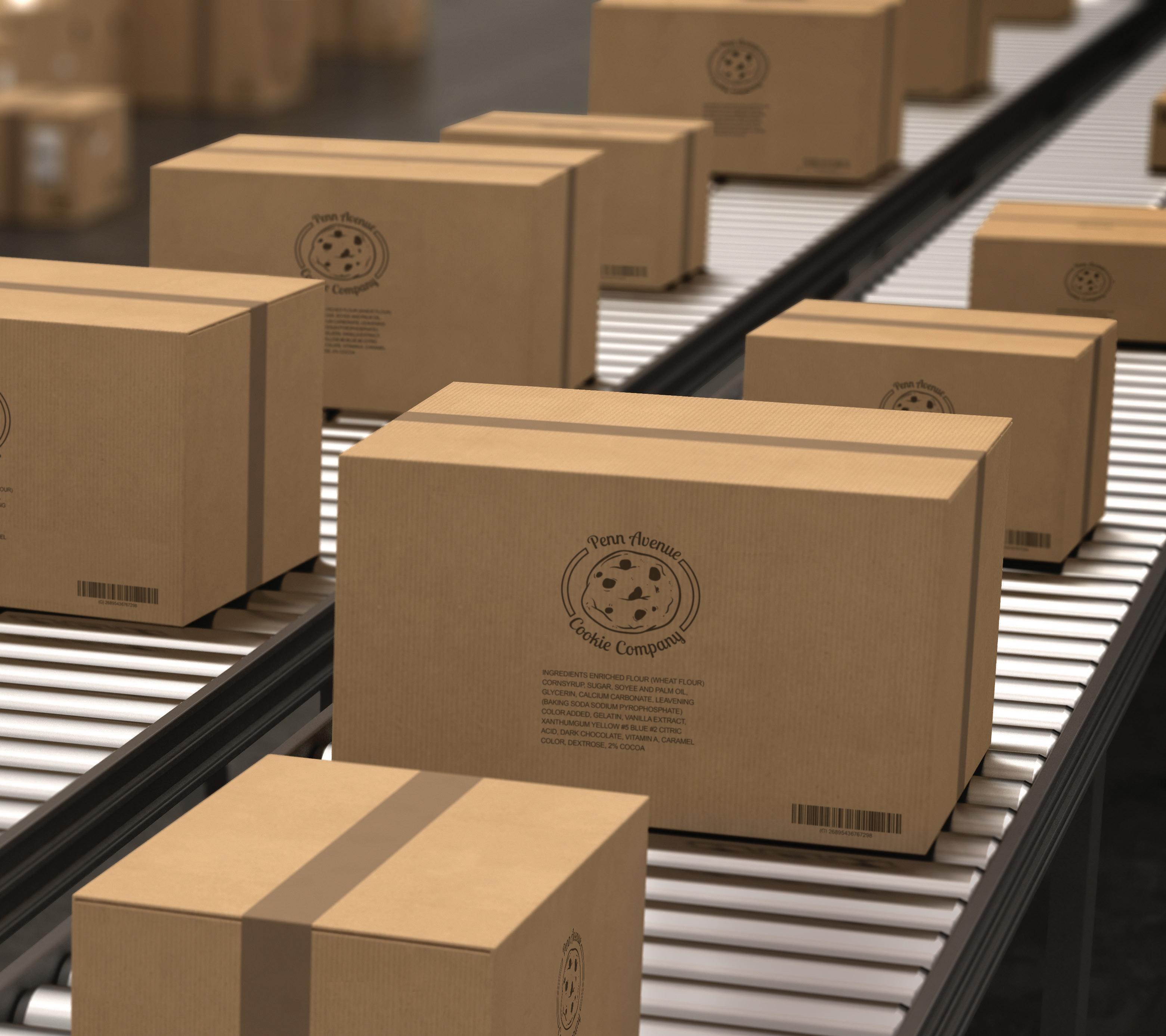
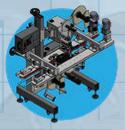
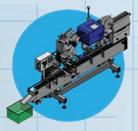
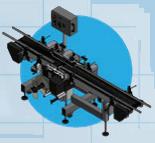
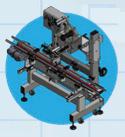
PW Creative Director Dave Bacho worked with AI to help illustrate the concept of layer-by-layer depalletizing in distribution centers, and the horizontal compression forces it imposes on cases that might not have been designed to withstand them.


PW Creative Director Dave Bacho worked with AI to help illustrate the concept of layer-by-layer depalletizing in distribution centers, and the horizontal compression forces it imposes on cases that might not have been designed to withstand them.
COLUMNS


32 COVER STORY
As Walmart DCs Automate, Package Developers Face New Forces, New Standards
The emergence of layer-by-layer robotic depalletizing in Walmart DCs is exposing a new failure mode, sustained horizontal (side-to-side) compression. This signals broader shifts in how cases and shelf-ready packaging must be designed, tested, and validated for automated distribution.
40 Paper Battery Pack Pioneer Evolves from D2C to Retail
With paperboard packs designed to ship, store, organize, and recycle what it describes as ‘the only zero-waste batteries on the planet,’ Better Battery Co. evolves its packaging system from D2C innovation into a retail-ready format.
48
Tilt Beauty Designs, Certi es Cosmetics Packaging for Real-world Hands
Built around the Arthritis Foundation’s Ease of Use Design Guides, Tilt Beauty reengineered cosmetic packaging for grip, torque, and control. The application shows how inclusive design can elevate usability, brand loyalty, and packaging performance.
52
SPC Impact 2026 Examines Packaging’s Path Forward
From EPR and exible lms to paper packaging and composting, the Sustainable Packaging Coalition’s SPC Impact 2026 event delved into how CPGs are turning sustainability goals into scalable systems.
Kimberly-Clark’s Kotex transitions from plastic lm polybags to recyclable cartons, introducing dual-panel opening, integrated windows, and premium nishes that are all engineered for improved in-home use and machinability with existing automation equipment.
68
Cleaning Chemical Producer Tackles Labor with Modular Palletizing
Faced with high labor turnover, tight oorspace, and nearly 900 SKUs, Nyco Products turns to modular cobot palletizing to stabilize end-of-line operations, improve throughput, and create a more sustainable workforce model.

Jan Brücklmeier Technical Application Group Packaging Technology Expert, Nestlé
M. Shawn French Director – Innovation & Packaging Engineering (Beverage), Danone North America
Patrick Keenan R&D Packaging Engineer, General Mills/Annie’s Organic Snacks
Tim Lehman Sr. Engineering Manager, Supply Chain, GOJO Industries, makers of Purell
Mike Marcinkowski Director of R&D Material Science, Packaging & Sustainability – Nature’s Vault/Fresh Loop
Shannon Moore Director Global R&D Packaging Sustainability, Kellanova
Andrew Seys Senior Director, Global Operational Excellence, Spectrum Brands
David Smith, PhD Principal, David S. Smith & Associates
Brian Stepowany Packaging R&D, Senior Manager, B&G Foods, Inc.
Matt Reynolds Chief Editor
Anne Marie Mohan Senior Editor
Sean Riley Senior News Director
Casey Flanagan Associate Editor
Tracey Labovitz Editorial Operations Coordinator
Kim Overstreet Director of Content
Pat Reynolds, Sterling Anthony, Eric F. Greenberg Contributing Editors
David Bacho Creative Director
Reggie Lawrence Vice President, Sales rlawrence@pmmimediagroup.com
Courtney Nichols Director, Client Success & Development cnichols@pmmimediagroup.com
Lara Krieger Senior Manager, Print Operations lkrieger@pmmimediagroup.com
Janet Fabiano Financial Services Manager jfabiano@pmmimediagroup.com
David Newcorn President
Elizabeth Kachoris Vice President, Digital
Jen Krepelka Senior Director, Digital Media
Amber Miller Director of Marketing
Joan Jacinto Director, Ad Tech and Search
Angie Szerlong Director of Industry Strategy
Joseph Angel Founding Partner and Executive Vice President, Industry Outreach, PMMI
Questions about your subscription or wish to renew? Contact circulation@pmmimediagroup.com.
PMMI Media Group
500 W. Madison, Suite 1000, Chicago, IL 60661 Web: www.pmmimediagroup.com
PMMI The Association for Packaging and Processing Technologies 12930 Worldgate Dr., Suite 200, Herndon, VA 20170
Phone: 571/612-3200 • Fax: 703/243-8556 • Web: www.pmmi.org

After four days and roughly a marathon’s worth of walking through Düsseldorf’s expansive Messe grounds during interpack last month, the individual product launches and booth demos started to blur together while the larger industry patterns became much clearer. This year, the trend is packaging being asked to do everything, all at once.
That tension surfaced repeatedly across the show floor, whether the conversation involved recyclable mono-material films, active packaging, barrier paper, compact automation cells, AI-enabled inspection systems, or 2D barcodes carrying unprecedented amounts of data. Suppliers across the industry are converging on how to add functionality, intelligence, sustainability, and flexibility without adding complexity, labor burden, energy consumption, or material weight. The trick is going to be optimizing packaging among competing demands that can be at odds with one another.
That balancing act appeared immediately in the industry’s accelerating move toward 2D barcodes and Sunrise 2027 initiatives. What once sounded like a straightforward upgrade from one-dimensional UPCs increasingly looks like a foundational infrastructure shift for packaging and supply chains. The challenge isn’t simply printing a QR code. It’s printing high-resolution, variable data reliably on fast-moving packaging lines while simultaneously supporting traceability, anticounterfeiting, retailer requirements, consumer engagement, and downstream recycling or EPR reporting systems. The package increasingly functions not only as a container, but as a data carrier.
At the same time, packaging materials are being pushed toward lighter weight, higher recyclability, lower carbon impact, and improved barrier performance—often simultaneously.
Three years ago at interpack, recyclable barrier paper still felt experimental. This year, it felt commercial. Fiber-based flexible packaging structures appeared across applications ranging from confectionery to powdered goods, often using thin barrier layers designed to preserve repulpability while still delivering meaningful oxygen and moisture protection.
That “do more with less” mindset extended into machinery. Suppliers emphasized reduced footprints, simplified changeovers, integrated functionality, and easier operation. Considering labor shortages, experience gaps, and brownfield space constraints, complexity is a liability. OEMs are increasingly designing around labor realities as much as production requirements.
Artificial intelligence followed a similar pattern. Contrary to my expectations, interpack didn’t feel overwhelmed by flashy AI branding. Instead, AI appeared quietly embedded in practical workflows. Inspection systems used machine learning to identify anomalies beyond traditional contaminant detection, while voice-enabled HMIs and OEE systems showed how AI is simplifying machine interaction itself. Most notably, AI appeared less as futuristic automation and more as infrastructure, just another invisible layer helping operators manage rising complexity.
That shift extended well beyond machinery. Discussions around packaging artwork and asset management, along with compliance verification, revealed how quickly packaging itself is becoming a regulatory and data-management challenge. As brands navigate growing layers of EPR, PPWR, recycled-content mandates, allergen disclosures, and region-specific labeling rules, packaging artwork increasingly functions as a compliance system as much as a branding tool.
The same was true for conversations around EPR reporting, chemical disclosure requirements, and material traceability. Packaging developers are being asked to manage sprawling ecosystems of regulatory and environmental compliance data tied to those packages. AI can help.
Sustainability remained omnipresent, though often in more operationally grounded forms than in previous years. European Packaging and Packaging Waste Regulation (PPWR) discussions loomed heavily over the show, but many conversations sounded familiar to U.S. audiences already navigating extended producer responsibility (EPR) laws state by state. Sustainability discussions also seemed to mature beyond single-solution thinking. Even compostability talks conceded that compostables won’t replace all packaging, but instead are targeted tools for specific applications such as food-soiled or difficult-to-recover formats.
Packaging is no longer being optimized for one variable at a time. It must be recyclable, lightweight, traceable, automation-friendly, durable, regulation-compliant, visually appealing, and increasingly intelligent—but still profitable.
The industry clearly understands that challenge. The question now is how successfully it can continue balancing all those competing, even mutually exclusive demands. PW


Row 7 is elevating shelf-stable vegetables with the launch of its Tinned Vegetables line, using packaging to position tins not as pantry backups, but as premium vehicles for flavor, preservation, and everyday meal inspiration. Says Row 7 COO Liz Mahler, “Our goal is to make exceptional flavor radically more accessible, not just for special occasions, but for the reality of a weeknight when you have no plan and 15 minutes. These tins close the gap between wanting to cook well and having the time to do it.”
Available since February in the produce aisle at Whole Foods Market locations across the Northeast and D2C nationwide, the line includes Badger Flame Beets, Sweet Prince Tomatoes, and Sweet Garleek. The launch reflects Row 7’s mission to rethink vegetables from seed to shelf.
Founded by chef Dan Barber, Row 7 built its reputation on breeding vegetables specifically for flavor, and that same commitment now shapes how those peak-season vegetables are preserved, packaged, and brought to consumers through shelf-stable tins. “Flavor doesn’t start in the kitchen, it starts with the seed,” says Barber, Row 7 co-founder and chef/co-owner of Blue Hill at Stone Barns, an acclaimed farm-to-table restaurant in New York’s Hudson Valley. “Most canned vegetables come from varieties bred for yield and logistics. Ours come from varieties bred for exceptional flavor.”
That flavor-first philosophy carried directly into Row 7’s packaging decisions. Rather than treating canning as a conventional preservation method, Barber says Row 7 approached tins as a format that could preserve and elevate the vegetables rather than simply store them. “We chose the tin because it serves as a powerful platform to lock in that peak flavor and intention without the mushy or metallic notes people usually associate with processed food,” he says. “It’s a culinary tool, not just a container.”
essential to the brand. First was color. Each tin shares the same palette as its corresponding fresh produce item. “We wanted that connection between the fresh vegetables and tins to feel immediate and intuitive,” he explains.
Row 7 also partnered with artist Leanne Shapton, whose watercolor illustrations have long served as a visual throughline across the company’s packaging. Creech collaborated with Shapton to adapt those vegetable watercolors for the tins while also developing a custom watercolor-style font that reinforces the artisanal feel that Barber says is core to the brand. Photography integrated into the sleeve design shows the vegetables in prepared dishes to show consumers how the ingredients can fit into an everyday meal, “not just sit on a shelf,” says Barber.
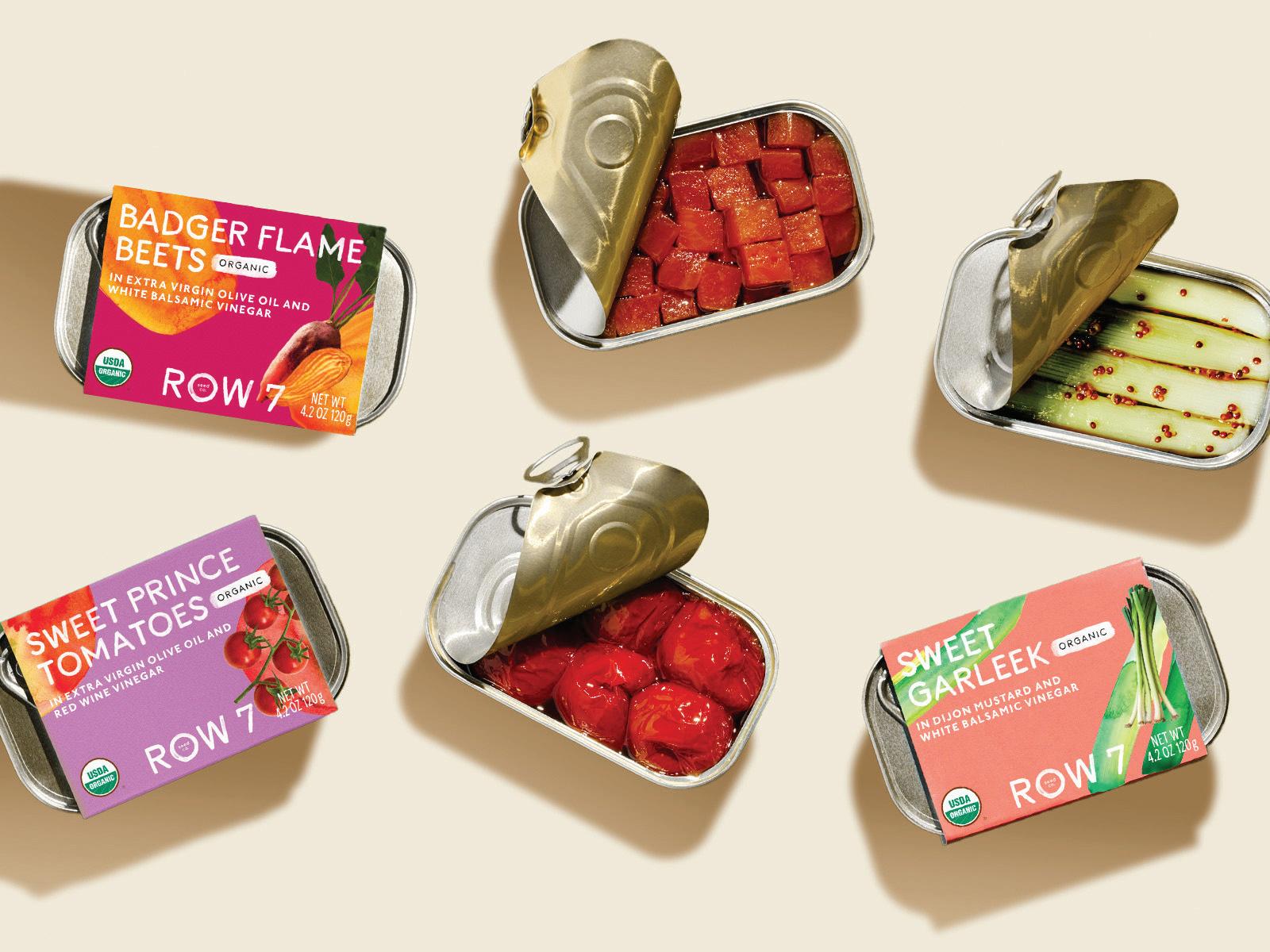
The 4.2-oz BPA-NI (bisphenol-A non-intent) tins provide a two-year shelf life and were selected both for cooking quality and retail placement strategy. Barber notes that the smaller footprint provides greater control over heat distribution, pressure, and final product quality, while also allowing the products to merchandize naturally alongside fresh produce rather than in the canned goods aisle. By positioning the tins in produce, Row 7 reinforces its message that these are vegetables that have been bred, harvested, and prepared with the same standards as fresh offerings.
Packaging design was equally intentional. For its secondary packaging, Row 7 used a paperboard sleeve that exposes part of the tin, allowing shoppers to immediately recognize the product’s unique format while still communicating the brand story.
Packaging graphics were developed with longtime creative partner Creech and were designed to visually connect with Row 7’s broader business, which also includes seed packets for home growers and fresh produce. The design was built around several priorities Barber says were
The bigger innovation lies in how Row 7 is reshaping expectations for the category itself. “When you reimagine the process, tins become a powerful platform,” says Barber. “They allow us to lock in flavor at the height of the harvest, cook with intention, and deliver vegetables that taste alive.”
Each tin is priced at $7.99. Row 7 positions the premium cost as a reflection of its investment in flavor-first seed breeding, organic farming, chef-led preparation, and high-quality ingredients that offer consumers what Barber sees as a ready-to-use culinary shortcut rather than a commodity canned vegetable.
Early signs suggest the strategy is resonating with consumers. Barber says the response “has been humbling,” with initial sales significantly outperforming expectations both online and at retail.
Though the debut includes only a small selection of products, Barber sees the line as the beginning of a broader transformation. “This is just the beginning,” he says. “We see a massive opportunity to expand the category.” —Anne Marie Mohan

Dove is transforming the haircare aisle into a curated visual experience with its new The Art of Repair Collection, a limitededition launch that blends advanced hair repair science with collectible, art-inspired packaging. Available exclusively at Walmart while supplies last, the collection includes shampoo, conditioner, and a serum powered by Dove’s Bio-Protein Care technology, formulated to help reverse visible signs of up to three years of accumulated hair damage. Featuring special-edition bottles adorned with works from Claude Monet, Mary Cassatt, and Vincent van Gogh, the collection merges efficacy with elevated visual storytelling.
celebrating art and self-expression in everyday routines.”
That vision is brought to life most clearly through the packaging. For the first time, Dove departed from its signature white bottles in favor of sleek black packaging made from 100% PCR. “The black bottles help elevate the collection and provide a strong backdrop, similar to a real gallery wall, for the artwork,” Barfoot says. Supporting Dove’s sustainability goals, the bottles also incorporate non-carbon black pigment, which improves recyclability by making them more detectable in recycling systems.
While the darker palette marks a dramatic shift, Dove retained key structural brand assets to preserve recognizability. The shampoo and conditioner bottles utilize Dove’s new bottle design introduced in 2025, complete with the brand’s embossed Dove logo. By pairing the limited-edition black finish with Dove’s familiar bottle architecture, Dove ensured shoppers would still immediately recognize the products as unmistakably part of its broader portfolio.

“This project was inspired by the craft of art restoration,” says Emily Barfoot, head of Dove U.S. Beauty & Wellbeing. “Just like a painting can show signs of wear over time, hair can experience damage that requires care and precision to restore.”
Barfoot says the concept emerged from Dove’s interest in the parallels between preserving masterpieces and repairing damaged hair. “We were fascinated by the way art conservators blend science and creativity to preserve a masterpiece without compromising its integrity,” she says. “That idea felt deeply connected to what Dove has always done through hair repair science—restoring strength and beauty with care—while
For the Silk Canvas Bi-Phase Serum + Oil, Dove employed a different packaging approach, using an existing bottle format from its portfolio and a reverse-label design that wraps around the back of the transparent package. This technique allows the Van Gogh-inspired artwork to show through the formula itself.
For the label system, Dove partnered with design agency JDO on the original creative and worked closely with printing partners to ensure premium execution. The collection features a custom Art of Repair range logo paired with a modern, architectural typeface that complements the historic artwork, creating a cohesive, curated aesthetic.
Beyond aesthetics, Dove’s packaging strategy was designed to balance shelf disruption with deeper storytelling. “We wanted to create something that would stand out on shelf at Walmart, but more importantly, feel intentional and rooted in a clear story,” Barfoot says.
Even with its gallery-inspired presentation, Dove remained focused on reinforcing product trust. “At the end of the day, performance and trust are what matter most to our consumers,” Barfoot says.
Early consumer response has been strong, with Barfoot citing positive social listening signals and enthusiastic reactions to the collection’s unique and elevated design.
Though the current launch is a limited edition, Monet, Cassatt, and van Gogh are only the beginning. Barfoot says Dove plans to introduce additional waves of “iconic and culturally celebrated artwork” throughout the year. —Anne Marie Mohan



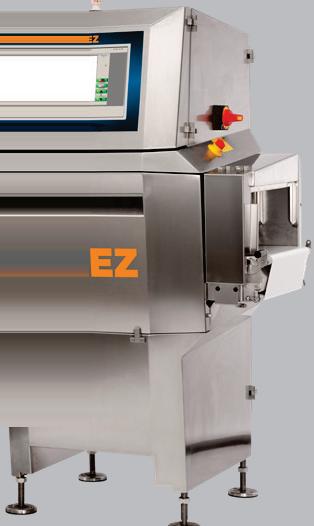
Detect contaminants, foreign objects, and product irregularities with the Eriez X-ray Inspection System. Designed to meet and exceed industry standards, our equipment sees what you can’t. Eriez. Always the Right Choice. High-definition image processing provides superior detection for incoming material feeds or packaged items, protecting your brand and prioritizing safety.




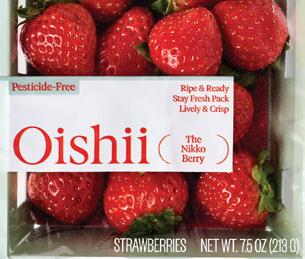
Oishii, a premium indoor-grown strawberry brand, is rethinking the traditional berry pack. The company launched its stay-fresh top-seal packaging for the Nikko Berry in a 7.5 oz. pack.
This new format moves beyond the conventional clear plastic clamshell with a hybrid paperboard-and-film structure designed to better align with both product and brand priorities.
At the core of the new format is a SBS paperboard tray from Aptar, paired with a lightweight, heat-sealed lidding film. The format also includes a plastic-based liner to manage moisture transmission. Oishii confirmed that the film provides barrier and controlled gas exchange properties, which is crucial for its “stay-fresh” claim.
The shift away from rigid plastic clamshells allows Oishii to reduce plastic material usage by 80%.
According to an Oishii spokesperson, graphics are printed directly onto both the tray and the top-seal film, eliminating the need for secondary labels or a separate belly band. Instead, the design uses strategic print and window placement to create the visual impression of a banded pack, preserving a recognizable brand cue without adding extra materials. The tray is printed on sheet-fed offset in 3 inks and black. The top seal film is printed with flexo printing in a 7-color extended gamut process.
The format was also engineered with retail performance in mind. The company says the pack offers a cleaner, more uniform shelf presence compared to bulky, hinged clamshells.
With the new packaging format, Oishii also introduced its first freshness guarantee. Printed directly onto the back of the tray, the program promises freshness for 10 days after harvest. Freshness information is coded with a harvest ID to enable traceability.
“Oishii uses an inkjet printer to place a harvest ID onto each tray which allows us to track the harvest date, farm unit, and farm operator for that particular tray,” an Oishii spokesperson said. “We ask consumers to upload a receipt so we can determine how long it’s been since the berries were harvested in order to qualify them for the Freshness Guarantee.”
The tray is also designed to protect fragile fruit with a fruit pad. Product protection was validated with stress testing including sending the package through the standard supply chain, different refrigeration levels, and monitoring shelf life.
To support the new format, the company implemented an ILPRA Speedy VG tray sealer, integrated with a conveyor system and a Videojet printer to create a streamlined, inline process from sealing through coding.
After installing the top-seal machine, integrating equipment described above, and adjusting packaging workflow and operator tasks, Oishii reports more than a 40% improvement in packaging labor efficiency for its Nikko Berry operations, along with greater consistency in pack quality.
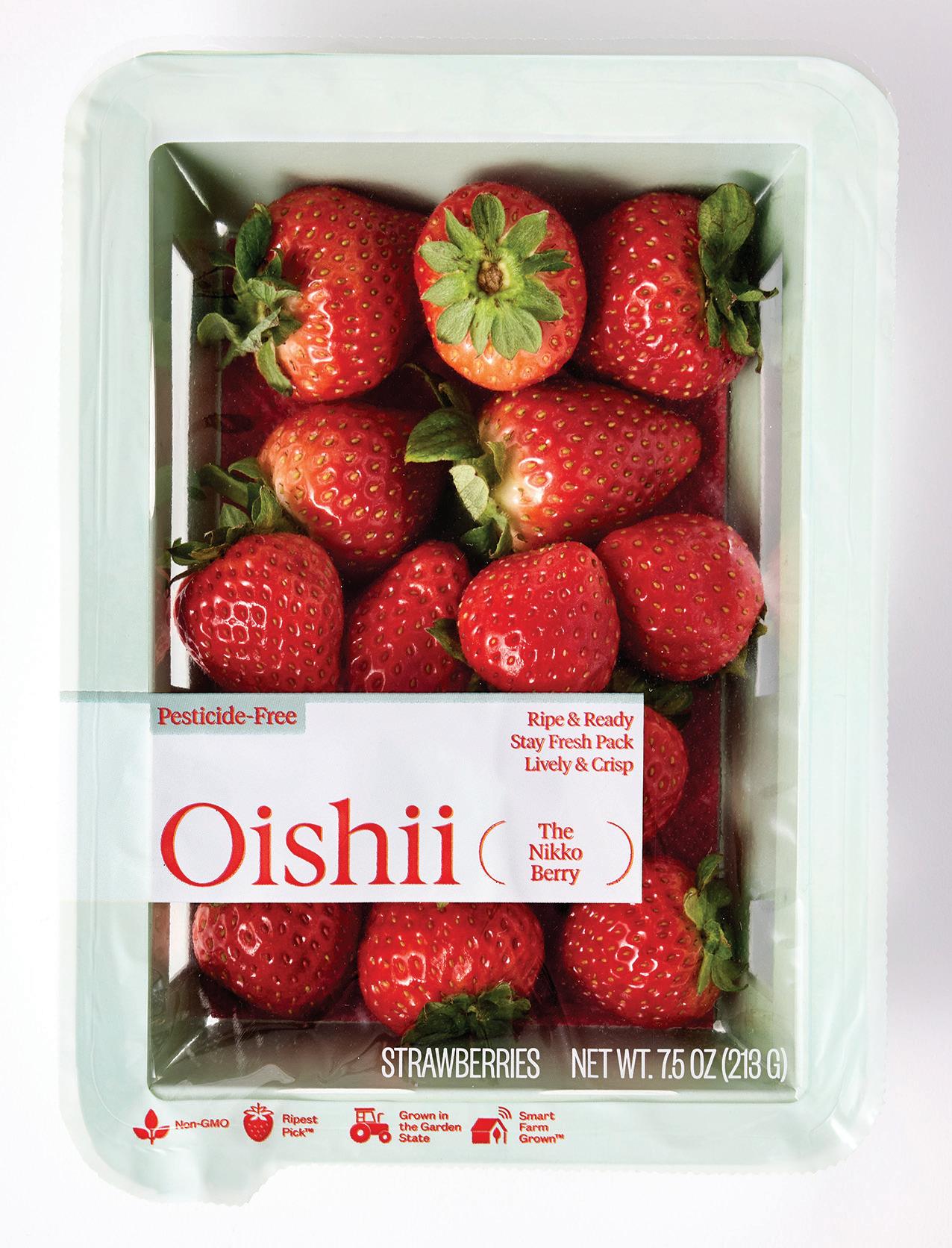
In addition to the 80% plastic reduction, an Oishii spokesperson said: The Nikko top seal pack extends the shelf life of strawberries, keeping them fresher for longer, hence also reducing food waste.”
The tray itself is recyclable, and the package has clear instructions printed on the tray to facilitate ease of recycling. Instructions tell the consumer to remove film and fruit pad, separate the tray’s interior liner, and discard all three. Recycle paper tray. There is also a recycle logo printed above the instructions.
“Sustainability is part of Oishii’s DNA,” an Oishii spokesperson said. “While some of our products require plastic packaging to protect our most fragile and premium berries, we had always planned packaging innovation to improve sustainability. We tested numerous different formats but landed on the Nikko topseal because of its ability to protect our berries and improve shelf life. With this new packaging, we continue to execute on our sustainability mission while we continue to find solutions for our other berry varietals.”
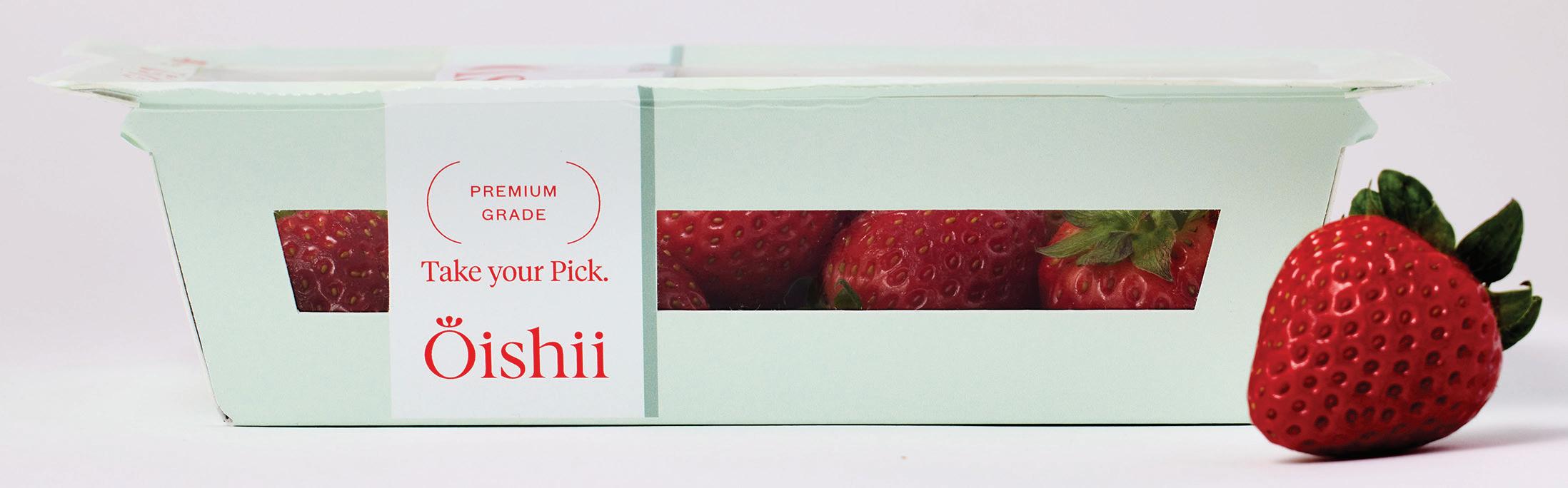
According to Oishii, retailers have appreciated the Nikko top seal and Freshness Guarantee because of the more sustainable format it offers. —Brianna Guntz

Vöslauer Mineralwasser, an Austrian mineral water brand, partnered with Amcor to introduce a redesigned tethered closure that the companies say prioritizes consumer comfort and recyclability alongside compliance.
“We appreciate that our customers have high standards and our commitment to quality is as evident in our packaging as it is in our mineral and flavored waters,” Mag. Yvonne Haider-Lenz of Vöslauer Mineralwasser says.
The new closure is designed with drinking comfort and sustainability in mind, they say. The Vöslauer design focuses on keeping the cap functionally out of consumers’ way once opened. The closure opens to a wide angle and clicks into place, preventing it from swinging back toward the consumer’s face when taking a sip. According to Amcor, the closure is also “intuitive and easy to open.”
The whole tethered function is designed below the shell of the closure. According to Graeme Hood, director, R&D, Amcor Global Rigid Packaging Solutions, two arms connect the tamper evident band to the closure shell. The two arms are connected to the cap and band by thin-film joints, allowing the closure to bend at the joints and work as a hinge.
Additionally, there is a protrusion that acts as an element to help open the closure by providing a pivot point. This allows the

closure to maintain its open position.
The closure underwent standard tethered durability testing. Hood says that all tests were in accordance with ISBT, CETIE & CEN test methods.
“The closure uses the same standard HDPE material as our existing single-piece closures,” Hood says. “To enable the tethered function, we redesigned the tamper-evident system and integrated it into the overall closure structure. This went through several design iterations to achieve optimal functionality and durability.”
A key enabler of the closure’s sustainability profile is its monomaterial construction, Hood says the closure uses high-density polyethylene (HDPE)—the same standard as existing single-piece closure—for both the cap and tether. Additionally, the tether isn’t a separate element and is fully integrated into the closure structure.
Keeping the closure on the bottle is mandatory for single-use bottles up to 3 liters under the EU Single-Use Plastics Directive.
By avoiding mixed materials in the closure, the design eliminates a common barrier to recycling, where incompatible polymers can complicate sorting and reprocessing streams.
“The closure is compatible with standard PET beverage recycling streams, where the appropriate collection and recycling infrastructure is in place,” Hood said.
This compatibility with standard PET recycling streams aligns





with an industry push for increased design for recyclability, the company says.
For Amcor, “appropriate collection and recycling infrastructure” means recovery facilities with the capability to separate the cap/ closure from the bottle, and send them down their appropriate resin streams.
This tethered cap closure isn’t the first time Vöslauer and Amcor have collaborated. Vöslauer also used Amcor’s Secure Flip sports cap to better align with sustainability commitments, the company says.
The Secure Flip sports cap features a non-detachable tamper-
evident band that is retained within the closure after opening. This helps eliminate alternative detachable tabs being discarded.
The new tethered closure design didn’t require any major changes to the filling line, according to Hood.
“As is typical for tethered closures, the capping chucks were adapted to suit the new closure geometry,” Hood says. “Other line adjustments that were made were primarily linked to overall closure lightweighting rather than the tethered function itself.”
The R&D director also says that there were no issues running the closures on customer lines; cap feeding/orientation remained smooth without tangling. He also says there were no issues with speed or reject rates.
For other beverage companies interested in transitioning to tethered caps, Hood advises that it’s possible to maintain operational efficiency while meeting sustainability requirements. He says Vöslauer Mineralwasser didn’t experience downstream labeling, conveying, or secondary packaging issues and was able to adopt the closure without changes to the bottle neck finish.
“It’s all about preparation, planning and validation up front,” Hood says. “From pilot tooling and molds, up to ramping up production with the customer.” —Brianna Guntz

In a recent webinar on its 2026 Global Packaging Predictions, Mintel warned that recycling is rapidly losing credibility with consumers, an alarming shift given how heavily brands have relied on recyclability claims and recycling-centered sustainability strategies for nearly a decade. The firm’s research suggests that as public faith in recycling erodes, companies that built packaging roadmaps around those promises face rising skepticism and pressure to prove broader environmental progress.
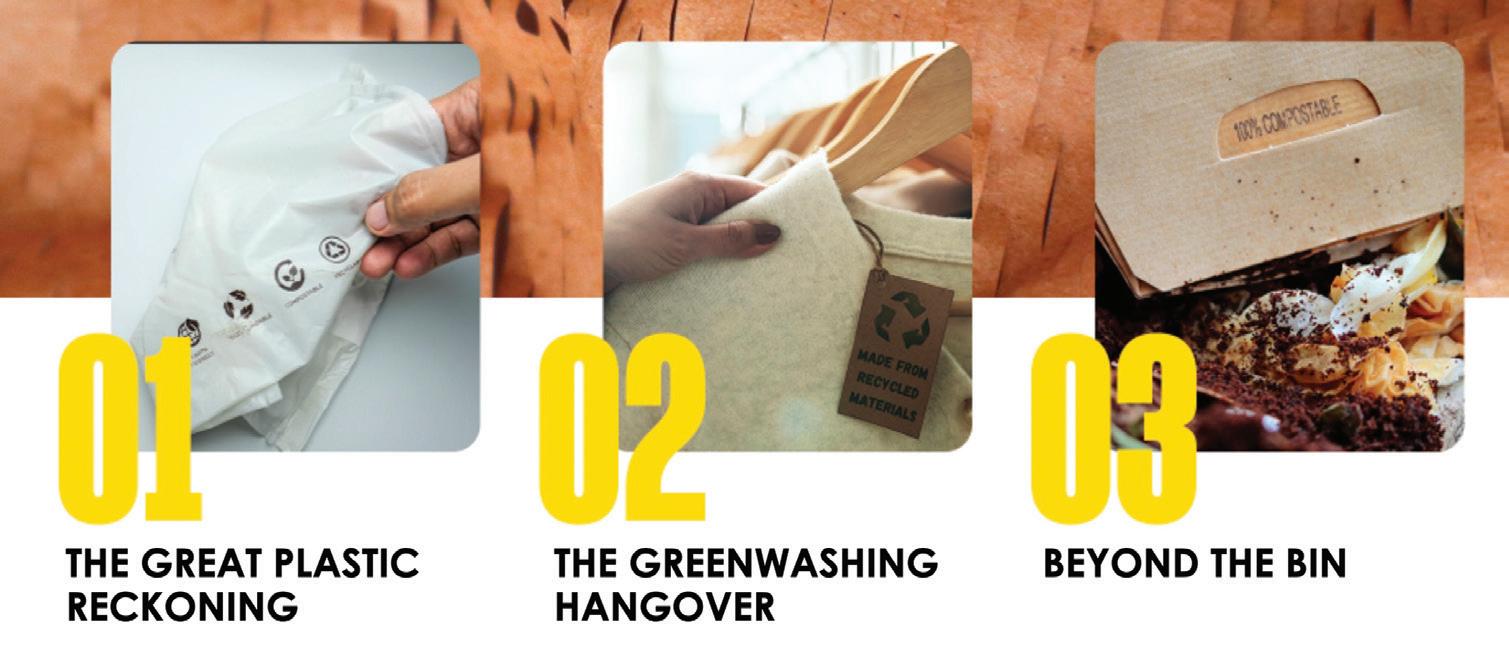
According to Lauren Ryder, associate principal of global packaging at Mintel, the packaging sector is entering what Mintel calls “The Great Plastic Reckoning,” as consumers increasingly question whether recyclable packaging is delivering on its promises. Ryder says consumers are now confronting the limits of that approach as they recognize that “most recyclable plastic isn’t actually recycled.”
Ryder added that years of recycling-focused messaging have outpaced actual infrastructure, creating growing skepticism. Mintel’s research shows consumers still care about environmental impact, but participation in recycling is slipping as confusion, inconvenience, and distrust mount.
That skepticism is feeding what Mintel describes as a “Greenwashing Hangover.” As the 2025 sustainability deadlines passed, many global brands fell short of public commitments around recyclability, recycled content, and virgin plastic reduction. Ryder explained that brands can no longer rely on broad environmental claims alone, saying that “consumers start to call out the disconnect between promise and performance.”
Mintel’s “Beyond the Bin” framework points brands toward a broader packaging strategy centered on reduction, reuse, and material simplicity. Rather than treating recyclability as the primary sustainability message, companies are being pushed to design out unnecessary waste, invest in refill systems, and communicate realistic environmental progress.
Regulation is also accelerating the shift. Europe’s Packaging and Packaging Waste Regulation, along with expanding state-level EPR laws in the U.S., is pushing brands toward compliance-driven redesign.
Ryder recommended that brands publicly share realistic, time-bound sustainability roadmaps rather than quietly scaling back commitments. She also pointed to greater investment in local collection systems, EPR programs, and retailer take-back initiatives as practical ways to reduce consumer confusion while improving recycling outcomes. Moving forward, packaging design will play a central role, with greater emphasis on mono-material structures, lightweighting, refill models, and clearer labeling tied to actual local recycling capabilities. Digital tools such as QR codes can further connect consumers to disposal instructions, reuse programs, and supply chain transparency.
Concluded Ryder, “At the end of the day, transparency is key.” —Anne Marie Mohan
With more than 100,000 machines installed worldwide, we've seen just about every packaging operation there is. That experience is built into every machine we make. Whatever your packaging operation looks like, Lantech has a solution for it. And we'll keep it running.

“The conversion of carbon emissions into innovative materials unlocks unprecedented avenues for increasingly desirable, high-performing, and sustainable packaging, paving the way for a new era of environmental footprint reduction for our industry and beyond.”
–Jacques Playe, SVP for global development packaging at L’Oréal Group, in an article from Packaging Insights, “L’Oréal and Dioxycle turn captured carbon into beauty packaging”
“The sharpest version of the story we have today is that there is less capacity domestically to turn curbside recycled PET into new packaging. That’s the problem we need to solve. Packaging has to be a big part of the solution if we want to stabilize this system.”
–Adam Gendell, director of material systems, The Recycling Partnership, in a TRP webinar titled, “From Crisis to Correction, How Industry Can Stabilize PET Recycling”
“Decision making will be faster, more accurate, and companies that fail to apply it [AI and machine learning] will face issues, considering how competitive the industry is. Packaging companies will become more scientific as automation leads to fewer jobs. This is not a matter of ‘kicking people out,’ but rather a transformation. We will see more AI experts for every area of the packaging industry.”
–René Chomsé, data scientist and IT consultant at Aicomp, in an article from Packaging Insights, “AIcomp Summit 2026 review: Human-centric AI, digitalization & compliance shape packaging future”
“America’s Plastic Makers applaud EPA for seeking comment on clarifying that pyrolysis technologies used for advanced recycling are not forms of incineration under the Clean Air Act. These advanced recycling technologies convert used plastic into valuable feedstocks to make new products, rather than combusting the plastic for energy purposes or landfilling it.”
–Ross Eisenberg, president of America’s Plastic Makers, in a statement from The American Chemical Council, “America’s Plastic Makers Applaud EPA’s Action on Advanced Recycling”

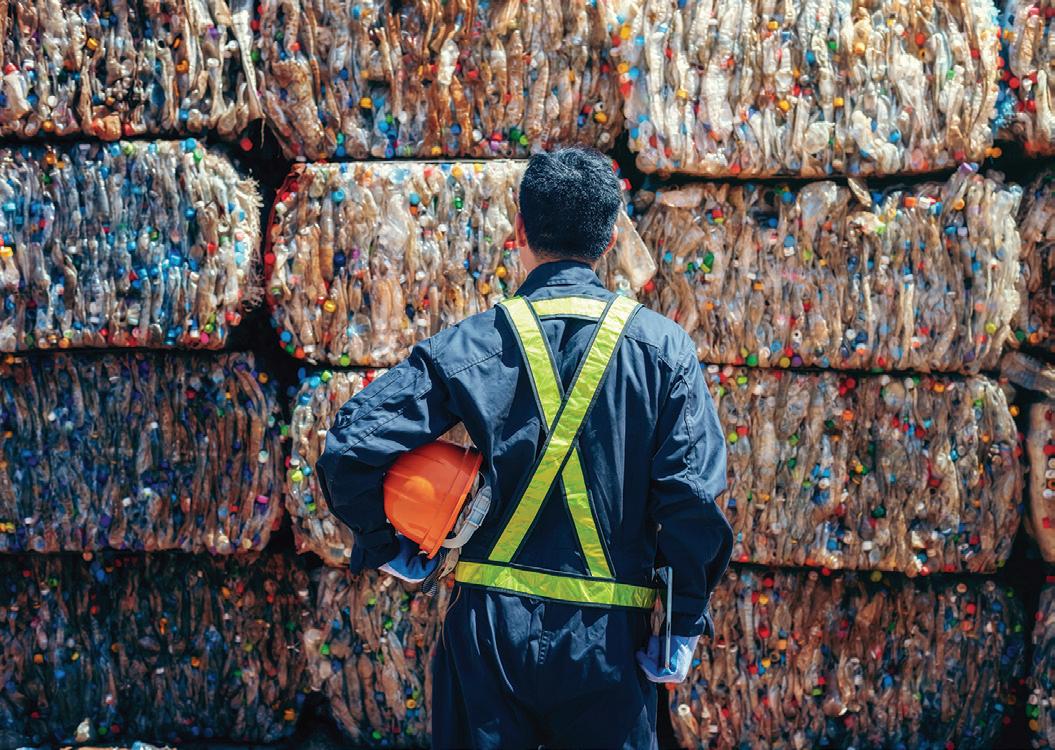
breaks down the key findings from the association’s annual PET Recycling Report, offering important context behind the 2024 data and the market forces shaping PET recovery in North America.
Last year’s results, from 2023 data, were record-setting, with a PET recycling rate of 32.5%. The 2024 data shows a decrease to around 30.2%. How should the industry interpret this shift?
Last year the main driver of the increased PET bottle recycling rate was a sharp reduction in bottles available for recycling. Due to the nature of the ratio of collected material to material available for recycling, it wasn’t so much a relative increase in collection that drove up that rate as it was the decrease in availability. We saw an inverse of that trend in 2024, where there were more bottles available for recovery, and collection held steady. So there’s a decrease in the recycling rate, but those fluctuations have less to do with sharp changes in collection performance and more to do with how many PET bottles were available on the market to be recycled.
One of the most striking findings in the report is that there was a 52% increase in PET thermoform recovery. What specific changes enabled that surge?
The nuance behind that number is important. The recycling system was built around bottles, and that was the primary feedstock for postconsumer PET. Since 2011, we’ve asked about estimated thermoform volumes in PET bottle bales, and we’ve refined those estimates over time as reclaimers gained better visibility through improved optical sortation and AI technologies.
These tools now allow reclaimers to more accurately account for thermoforms entering facilities. Changes in survey methodology and better measurement of thermoforms in curbside streams have led to a much better accounting of total thermoform content. So while the 52% increase looks dramatic, it more accurately reflects a gradual increase over time that we’re now measuring more precisely.
Our annual bale audits also support this, showing a steady increase in thermoform content over time rather than a sudden jump.
Do recyclers want thermoform material in PET bales?
Tolerance for thermoform material has grown because it’s increasingly part of the stream, whether desired or not. Reclaimers have adapted, but most facilities are still optimized for bottle recovery. Thermoforms tend to have higher yield losses for mechanical recyclers, so many reclaimers cap the amount of thermoforms they’re willing to accept in bales depending on their end market specifications. Thermoforms are not yet as efficient a feedstock as bottles, but that’s evolving as new recovery pathways, including depolymerization, continue to expand.
Rumpke Recycling announced last year that they’re taking thermoforms and sending them to Eastman for depolymerization. How does this impact recycling rates?
That’s a great example of how depolymerization can complement mechanical recycling. This is the first year of data capturing Eastman’s contribution to recovery volumes, and its ability to accept thermoforms—combined with Rumpke’s expanded access to thermoform recycling—demonstrates how depolymerization is expanding PET recycling access.
Eastman is also taking less desirable feedstocks like colored PET bottles and thermoforms, along with mechanical recycling byproducts, and recirculating them. That has improved overall system efficiency in 2024.

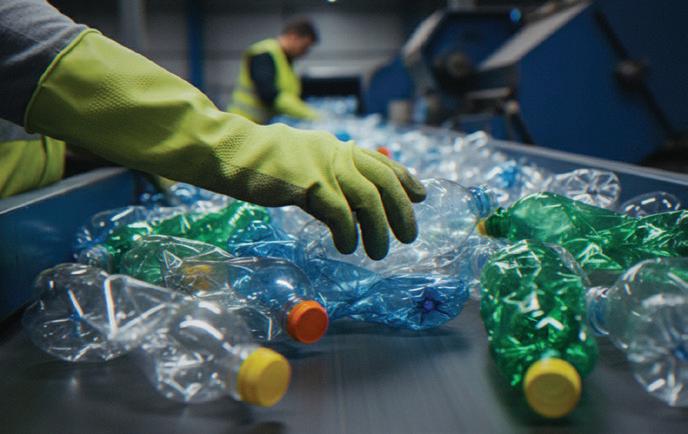
The report highlights improved reclamation efficiency, with recovered outputs rising to about 85% of incoming material. What’s driving those gains?
The primary driver is the greater recirculation of reclaimer byproducts that previously would have been yield losses. Materials like fines, purge, or lower-quality PET that mechanical reclaimers can’t use can now be processed through depolymerization technologies like Eastman’s. That improves total material utilization across the system.
What are the biggest factors affecting the challenging economics of North American reclaimers right now?
Softer demand for recycled PET is one major factor. Historically, supply was the primary constraint, but the market is now recalibrating after a period of rapid demand growth, which has shown signs of slowing down. The steady growth of rPET use in bottles flattened in 2024, indicating slowing momentum.
Another challenge is pricing pressure from virgin resin and lower-cost imported rPET. Imported recycled resin can meet minimum-content requirements while undercutting domestic recyclers, making it harder for North American reclaimers to compete. This has contributed to facility closures and growing concern across the industry.
Domestic recyclers need support to weather these immediate threats while longer-term policy solutions are developed. NAPCOR has developed a position statement on imported rPET to help address these challenges.
What policy developments could have the biggest impact on PET recycling rates over the next five years?
Deposit return systems consistently drive between 30% and 40% of total PET recovery, despite existing in only a limited number of states. We know these programs work, and states with deposit systems have much higher per-capita PET bottle collection rates.
Oregon stands out as a top-performing model, with broad product coverage and a 10-cent deposit. Expanding well-designed deposit systems would strongly support greater recovery.
Extended Producer Responsibility [EPR] is also gaining momentum and will likely play an important role as packaging EPR develops in the U.S.
Any final thoughts?
Recycled PET imports are a major challenge facing the industry right now, and we expect that pressure to intensify in 2025. Protecting domestic recycling infrastructure is critical to maintaining a truly circular economy in North America.
PET’s sustainability story depends on recycled content, energy efficiency, and lower emissions. If recycling increasingly depends on overseas imports, that undermines many of those sustainability benefits. Protecting domestic recyclers is essential to preserving PET’s long-term circularity. PW



Upgrade your existing line or create a custom conveyor system from the ground up.
Our modular components range from beams, chains and belts to guide rails, profiles, bends and drive units, as well as pre-assembled modules. We built them to handle everything from lightweight items to heavy cartons.
Whatever your product flow, FlexLink lets you shape it to match your layout and performance needs.
Online Store provides a complete range of tools to start planning including MyFlexLink and our Design Tool




By Eric F. Greenberg, Attorney-at-law
A lot of people have been talking lately about what we eat, driven largely by the so-called Make America Healthy Again (MAHA) movement. This has already led to product re-formulations and re-imagined labeling and marketing of foods (lots of folks touting their protein content, for example), and big changes in government-subsidized food programs.
But less-visible battlegrounds over food are those in new lawsuits. One’s in California, the other’s in Texas.
In the California case, the state alleges that big food companies are “using the deceitful tactics [they] inherited from the Big Tobacco industry to flood the market with harmful [ultraprocessed] products [which the plaintiffs allege are addictive, just like tobacco] and to aggressively sell those products to children.”
So, notice they’re not saying only that the foods can have adverse effects on health if you eat them, or that nutrition science has emerged that points to health problems if you eat too much of them, or that that’s just the way things appear to have worked out. Rather, they’re alleging something quite aggressive and striking: that food companies knowingly and intentionally “designed food to be addictive, they knew the addictive food they were engineering was making their customers sick, and they hid the truth from the public.”
Making policy by stigma, rather than changes in law or regulation or court order, is sometimes HHS Secretary Robert F. Kennedy, Jr.’s preferred approach (FDA is part of HHS.) It’s what he did with artificial dyes. He didn’t move to change any regulations, he just pressured companies to stop using the dyes. One thing’s for certain: This case is likely to bump along in litigation for many years, and even if it gets thrown out or settled quickly, its arguments will continue to be part of the public diet-and-health debate.
The other case is over a new Texas law that requires warnings about a list of 44 substances including synthetic dyes, preservatives, emulsifiers, surface-active agents, oils, and other additives. A key provision of the law requires a label warning about “the use of” any of the 44 ingredients, if the FDA “requires the ingredient to be named on a food label” of a human food. Among the listed substances is titanium dioxide, which is also used to make food packaging, so this law, in addition to requiring dramatic new label warnings, could result in the market disfavoring that, and perhaps other, packaging component substances.

California’s complaint alleges that the food makers’ actions violate California’s unfair competition law and also that they created a “public nuisance.” They are seeking, among other things, an injunction stopping “further deceptive marketing,” and money for consumer education on the health risks of ultraprocessed foods.
But, as noted below, these might not in fact be their true goals for the lawsuit.
For one thing, they might not win. Any case where a plaintiff is required to prove a defendant’s intent behind its actions, not just that it took those actions, is always a heavy lift. Sure, there’s general agreement that the healthfulness of American diets could be improved, but it’s another thing entirely to prove that it’s because food companies are intentionally doing harmful things to public health. The food companies deny this, and, incidentally, they will likely point out that there’s no generally accepted definition of what is and isn’t an ‘ultraprocessed’ food, so the case’s targets aren’t even that clear.
So it’s possible the California officials are not so much seeking the remedies their lawsuit lists but instead are just hoping that by filing this lawsuit, all manner of different popular foods are tarred with the stigma of being bad for you, leading consumers to avoid them.
Texas says the 44 substances are unsafe. But the required warning language is, um, odd. It would say: “WARNING: This product contains an ingredient that is not recommended for human consumption by the appropriate authority in Australia, Canada, the European Union, or the United Kingdom.”
It’s odd wording because the warning doesn’t mention the FDA, which, in fact, lawfully permits the use of those ingredients in the U.S. Oddity #2 is that the law also has a provision by which the Texas law would be preempted by federal law or regulation that is worded confusingly enough to puzzle most observers about when and to whom it would apply.
So, several trade organizations have sued the state of Texas seeking to have the new law declared unconstitutional because, for example, they allege the warning violates the companies’ First Amendment free speech rights by requiring them to make statements that are incorrect. They argue, among other things, that it’s not true that those foreign governments recommend against human consumption of all 44 of the substances, not to mention that the “listed ingredients have been used safely in American foods and beverages for decades.” They also assert that federal law preempts (overrides) the state labeling requirement.
It’s possible this case, too, is a stigma game for the Texas officials. In the meantime, a social media-worthy stigma might end up attaching to all 44 of those substances, which could lead companies to avoid using them and that, in turn again, might have been Texas’ goal in the first place, regardless of the validity of their safety arguments. PW

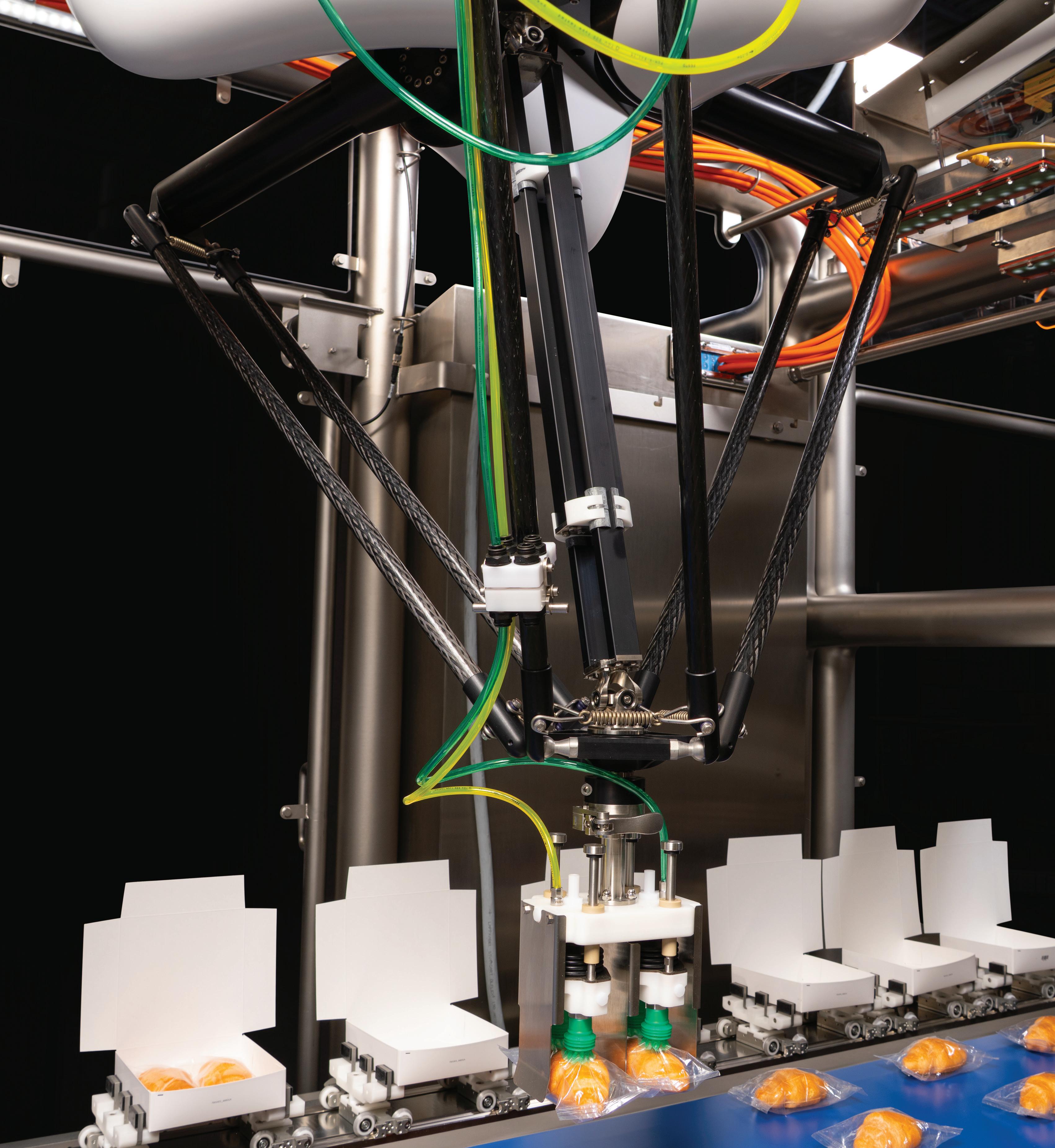
INTEGRATED, MONOBLOCK ROBOTIC CARTONER IN THE INDUSTRY’S SMALLEST FOOTPRINT




By Sterling Anthony, CPP, Contributing Editor
Surveys consistently show that most consumers don’t believe sustainability claims made by CPG companies. That’s dispiriting, given the decades that sustainability has been an overshadowing topic. The disconnect between sustainability claims and belief impacts packaging, for two related reasons.
Reason one is that consumers view packaging as a violator of sustainability principles. Complaints include singleuse, solid-waste generation, poor recyclability, and the predominance of plastics. Reason two is that consumers know that packaging is a medium for communicating sustainability claims. Consumers, suspecting bias, take the proverbial consider-the-source attitude.
CPG companies need to adopt a different mindset. A necessary step is to identify the mindset that, in various forms and to various degrees, has prevailed to this point. That mindset has been too conceding, and too often over-correcting, to the point of stretching credulity.
Forward-thinking companies regard packaging as a source of competitive advantage. Those companies have leveraged packaging in a variety of innovative ways. But sustainability persists as the exception, at least, judging by consumer perception. And as the saying goes: Perception is reality.
There are references that provide advice on how to make believable sustainability claims. The Federal Trade Commission, for example, publishes its Green Guides, requiring that claims not be deceptive and that they be supported by evidence. Then there are the third-party sources providing counsel on how to comply with regulatory requirements, supposedly, without sacrifice of corporate objectives. One might think that the available references and sources provide CPG companies with the wherewithal to devise believable sustainability claims. So why does belief remain elusive?
Without exaggeration, packaging is a linchpin of the massproduction, mass-marketing, and mass-distribution continuum, foundational to the quality-of-life in a developed society. CPG companies should not be cowered by attacks that overlook that fact, as if packaging is a scourge unleashed on humanity. The right mindset shields CPG companies from the wayward influences of definitions du jour and concepts du jour. That mindset, nonetheless, does not exempt CPG companies from environmental responsibility and stewardship, reflected in credible sustainability claims.
Another aspect of a right mindset is the acceptance of consumer contradictions and their constraints, without attacking consumers. Consumers want sustainable packaging, but don’t want to forsake performance. Consumers want sustainable packaging, but preferably not at a price premium. Consumers want sustainable packaging, as in recyclability, but recycling rates are paltry. The list goes on. Unreasonable? Maybe, or just the human tendency to want the best of all worlds.
The answer resides in the generality that characterizes regulatory requirements and the tools used for compliance. The generality affords considerable leeway. That’s not necessarily a bad thing, to the extent that it acknowledges the diversity across industries, member companies, and product categories. A one-size-fits-all approach would have its built-in limitations. Leeway should not be confused with freeway, a road taken for speed and expediency. The latter can produce sustainability claims that comply with regulations, guidelines, and advice, but, nonetheless, meet with consumer rejection.
In further illustration, a metric frequently used in support of sustainability claims is Life Cycle Assessment (LCA). It purports to measure the net environmental impact of packaging, cradle-to-grave. When extended beyond disposal to include recycling, the concept is called cradle-to-cradle. LCA can be applied to all types of packaging, including materials, components, and assemblies. With paper, metal, glass, and plastics each touting sustainability credentials via the same metric, it’s a certainty that each is emphasizing the favorable and ignoring the unfavorable. It’s not sinister: it’s the reality of competition. That’s of little consolation to consumers, desiring objective proof of sustainability claims. With consumer disbelief of sustainability claims remaining high,
The right mindset recognizes the value of using consumer research in crafting sustainability claims. It assists CPG companies in choosing among a glossary of terms. The term compostable, for example, might not sway consumers who don’t compost, lack local infrastructure, or lack the willingness to separate material for collection. As another example, citing that a material contains a given percent of recycled content might be more persuasive than citing that the material is recyclable?or viceversa. The point is that it’s better to know than to guess or to assume.
Adding to the right mindset is having the belief that consumers want to be believers; that is, consumers would prefer to believe that they are not being deceived. CPG companies can assist by educating consumers about packaging that might otherwise be misunderstood. As an example, what consumers might regard as oversized packaging can be explained as anti-theft, or otherwise functional. Such education can be provided on the packaging itself, either in text or QR code. Another conveyance can be the company’s website.
As much as anything else, the right mindset does not regard believable sustainability claims as a burdensome obligation but as a path to profits, achieved through increased sales and decreased costs. Regarding the latter, its utility notwithstanding, packaging is an expense. That fact needs to be kept in mind, because sustainability can yield cost reductions throughout the supply chain.
The potential benefits can’t be had with piecemeal, disjointed efforts. Top management must prioritize sustainability and integrate it into every competitive strategy. When believable sustainability claims result, packaging becomes benefactor and beneficiary. PW

C S M IN . S ION. W S.

Why Switch?
+ Cut costs and reduce errors with automated systems
+ Boost productivity and reliability with centralized control
+ Future-proof your production with built-in scalability


By Ken McGuire, Contributor
There is little doubt that e-commerce is reshaping how products are bought around the world, and that shift is having major implications for consumer packaging. Several forces are driving the change, but one stands above the rest: scale. In 2025, roughly 25% of holiday shopping took place online. Anyone reading this column is likely part of that trend, and in the United States Amazon remains its dominant engine. Although Amazon does not publish U.S. sales volume specifically, estimates place its U.S. sales above $400 billion and its share of the e-commerce market above 35%. That enormous volume is forcing companies of every size to rethink how products are designed, packaged, protected, and delivered. Packaging can no longer be treated as an afterthought once a product enters the e-commerce channel. It has become a strategic lever that affects cost, damage rates, consumer experience, and ultimately brand performance.
Before 2020, e-commerce sales were already growing quickly, but for many large consumer products companies they still represented only a small portion of total business. For companies like P&G, e-commerce was less than 5% of sales volume. Even though the e-commerce supply chain looked very different from the traditional brick-and-mortar system, those volumes were still low enough that many brands could manage the problem with workarounds rather than true redesign. Companies often paid retailers such as Amazon extra fees to help protect products during shipment by taping lids closed, bagging liquid packages, or adding other protective measures. Because those fees applied to only a small fraction of sales, they did not materially change the economics of the business. That is no longer true. Last year, major consumer products companies such as Estée Lauder, Clorox, and others reported e-commerce volumes above 20% of total sales. At that scale, temporary fixes become expensive habits. Companies now have to decide whether to design packaging that can survive the e-commerce supply chain, the brick-and-mortar supply chain, or ideally, both. That is no longer just an engineering question. It is a strategic one.
with the necessary top-load strength to survive that journey without damage. At the store, the cases are opened, the products are stocked on the shelf, and the system works largely as intended. That predictable environment allowed companies to optimize packaging for cost, efficiency, and waste reduction.
E-commerce breaks much of that logic. Once a retailer packs a shipping box with a random mix of products, the carefully controlled system disappears. A detergent bottle may now travel in the same box as clothing, electronics, toys, or any number of unrelated items. Packages that performed beautifully in a store supply chain suddenly face drops, impacts, compression, leakage risks, and the possibility of damaging everything packed around them.
Those changes create real challenges, but they also create opportunity. Since leaving P&G three years ago, I have worked with companies large and small on packaging technologies and packaging strategy, and one theme appears again and again: how to win in e-commerce.
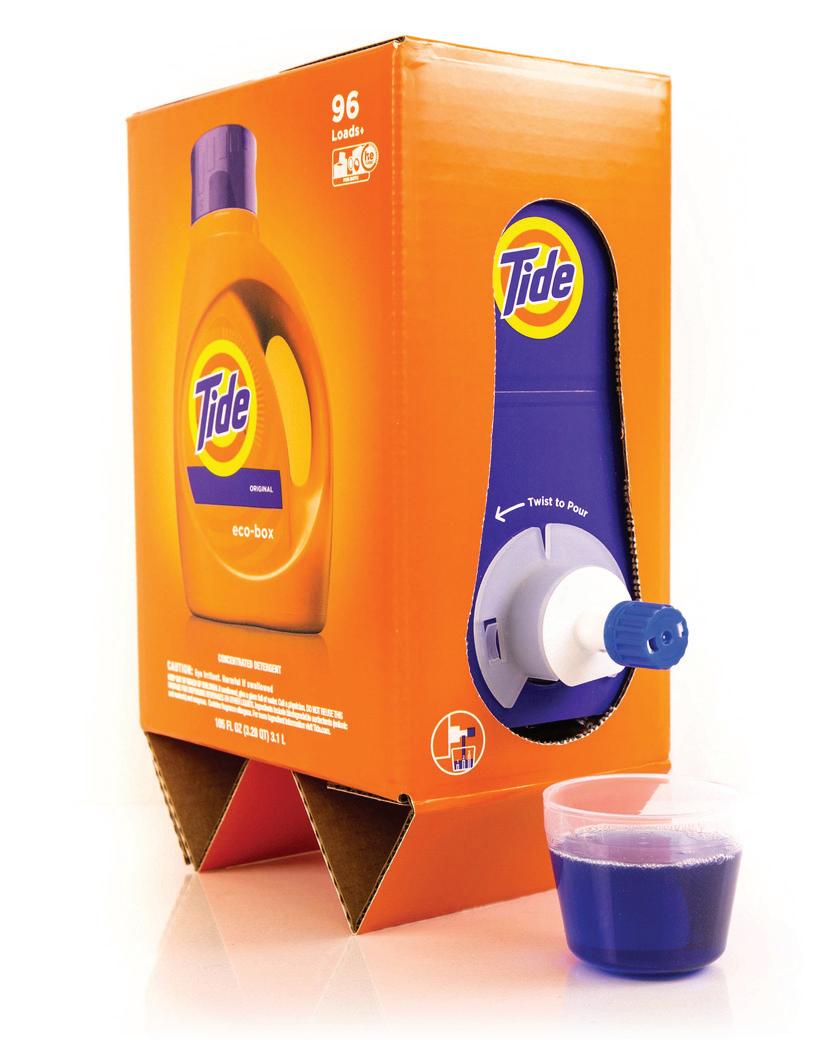
For large companies, solving the problem can deliver significant business value because it protects both economics and consumer trust. One recent example involved a blow-molded package with an injection-molded flip-top cap. In traditional retail, the package performed acceptably. In e-commerce, however, the cap would occasionally pop open (or pop off entirely), spilling product in transit. The result was not just product loss and mess; it also damaged the consumer’s confidence in the brand. That kind of failure is no longer a minor operational issue. It is a strategic threat. Some companies respond with e-commercespecific packaging, such as the Tide eco-box (pictured) or Truman’s concentrated home cleaners, which shift the product and package format to better fit direct shipment. Others pursue omnichannel formats that can work in both retail environments, such as AeroFlexx liquid packaging. Still others go further and redesign the product itself, as Tide has done with Tide Evo. The point is not that one answer will fit every brand. It is that the old answer, doing nothing and paying for extra protection, is becoming much less viable.
The challenge is especially acute for products such as beverages, shampoos, laundry detergents, and cleaning products. These items are often heavy, sold in bulky bottles, and carry limited margins. When more than 20% of sales are exposed to the risks of e-commerce distribution, cutting further into margin is not an option.
The traditional retail supply chain, developed and refined over decades, is highly controlled. Companies manufacture and package products, place them in corrugated shipping cases, stack those cases on pallets in carefully designed patterns, stretch-wrap the loads, and ship them by truck. Packages and shipping cases are engineered
E-commerce is here to stay, and for many companies it has reached a scale that makes packaging strategy impossible to ignore. Brands that move quickly to develop smart, cost-effective, channelappropriate solutions will be better positioned to win in this new sales environment. There will not be one universal answer. The most successful companies will likely build a portfolio of solutions: some omnichannel packages, some e-commerce-specific formats, and in some cases entirely redesigned products. What matters is recognizing that e-commerce packaging is no longer a niche issue. It is becoming a core part of how consumer products companies compete. PW

By Anne Marie Mohan, Senior Editor
What began in Haley Maness’s kitchen as a personal response to chronic illness and early motherhood has grown into Roots and Leaves, a 60-SKU herbal wellness brand carried by roughly 3,500 independent retailers nationwide. Yet despite its rapid expansion, the company’s packaging remains closely tied to the same principles that shaped its first product, Elderberry & Honey Tonic. For Maness, packaging was never a secondary business decision. It was part of the product’s integrity from the beginning.
Maness, an herbalist and founder of Roots and Leaves, launched the company after her own struggle with Lyme disease and mold exposure led her to herbal medicine when conventional treatments failed. At the same time, she was creating remedies for her infant daughter’s colic, diaper rash, and sleep issues. Many of those homemade formulations became the backbone of the business.
“What really differentiates Roots and Leaves is that the products weren’t created to start a business; they were created out of necessity during my personal healing journey,” Maness says. “Every product comes from a place of real-life use and real-life need, not from chasing trends in the wellness industry.”
That deeply personal origin story shaped not only her formulations, but also her packaging philosophy. From the outset, Maness prioritized glass packaging whenever practical. In the company’s earliest days, that meant filling tonic in Ball mason jars purchased from Walmart. As Roots and Leaves scaled, those jars gave way to glass stout bottles that offered improved retail presence while maintaining the material benefits Maness valued.
“Many of our products are herbal extracts, vinegars, and nutrientdense liquids, and glass protects the integrity of those ingredients without the potential chemical interactions you can see with certain plastics,” Maness explains. “I was very intentional about minimizing unnecessary toxins in every part of the process, including packaging.”
Today, 32 of Roots and Leaves’ products are packaged in glass, including tonics, tinctures, dropper bottles, and skincare jars. Glass remains the preferred choice because it aligns with both ingredient protection and sustainability goals through recyclability and durability.
Still, Maness’s approach is pragmatic. Product safety and functionality often require compromise, and her packaging decisions reflect a practical understanding of real-world use. Shampoo and conditioner, for example, are sold in recyclable high-density polyethylene bottles because glass is unsafe for wet shower environments. Sunscreen is packaged in tubes made from sugarcane-derived

resin, while loose-leaf teas use compostable, plant-based bags derived from fermented starches such as cornstarch or sugarcane. Soap bars are contained in recyclable paperboard cartons.
“So, while glass is always our first choice, our broader approach is to balance product safety, functionality, and sustainability, choosing the best available packaging material for each product type,” Maness says.
This material flexibility is central to Roots and Leaves’ sustainability ethos. Rather than relying on broad environmental claims, the company continuously evaluates emerging packaging technologies to reduce petroleum-based plastics while preserving shelf stability and customer safety.

Packaging design has followed a similarly personal path. Without outside agencies or consultants, Maness developed the brand’s visual identity herself while still working in corporate HR. Her lifelong interest in graphic design, paired with a deep appreciation for herbal traditions, became the basis for Roots and Leaves’ distinctive aesthetic.
“I’ve always loved the old-school apothecary aesthetic, that timeless, herbalist feel of traditional remedy shops,” Maness says. “I wanted the packaging to feel like something you might have found in a traditional herbal apothecary but updated in a way that still feels clean and modern on a retail shelf.”
The resulting design architecture blends heritage and modernity. Earthy botanical hues such as
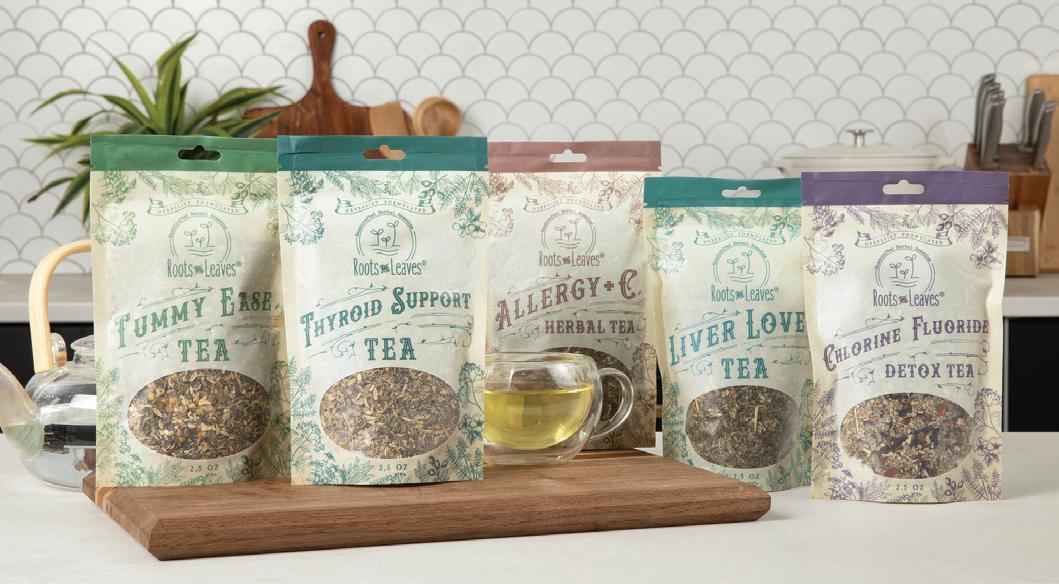
greens, creams, browns, and muted purples dominate the brand’s color palette. Typography evokes traditional remedy labels, with classic fonts chosen for readability and permanence rather than trend appeal. Product-specific illustrations often depict key botanical ingredients, such as elderberries or apples, helping consumers visually connect the product to its plant origins.
Maness sees the graphics as doing more than just catching the eye on shelf. They’re intended to convey trust, a sense of tradition, and a clear understanding of what’s inside the package. “My goal with the packaging was to evoke a feeling of slower days and traditional remedies, the kind of wisdom that was passed down from our grandmothers and great-grandmothers,” she says. “Ultimately, the goal was for someone to pick up a Roots and Leaves product and immediately feel that sense of authenticity and care.”
The modular label system she created also supports efficient line expansion. Consistent logo placement, typography, and layout
establish strong shelf recognition, while color shifts and product naming allow for category differentiation across wellness products, teas, skincare, and personal care.
Retailers have responded positively. According to Maness, independent store owners frequently cite the packaging as a major driver of sales. “One of the most common things I hear from retailers is that the products look like artwork on their shelves,” she says. “Retailers often tell me that customers will pick up the product simply because it catches their eye.”
That success underscores how closely Roots and Leaves’ packaging reflects its broader company ethos. Built around small-batch manufacturing, family wellness, community employment, and partnerships with independent retailers rather than mass marketplaces like Amazon, the brand’s packaging choices consistently reinforce its values.
As Roots and Leaves continues to grow, Maness remains focused on maintaining that alignment: “At the end of the day, Roots and Leaves is really about creating the kinds of products I wished existed when my family needed them most— clean, effective herbal products made with integrity and no greenwashing.” PW


The emergence of layer-by-layer robotic depalletizing in Walmart DCs is exposing a new failure mode, sustained horizontal (side-to-side) compression. This signals broader shifts in how cases and shelf-ready packaging must be designed, tested, and validated for automated distribution.
By Matt Reynolds, Chief Editor
At Walmart scale, packaging is no longer just a protective layer around product. It’s a critical input into their highly automated case/tray material handling systems. These systems depalletize inbound pallets of like product, then build mixed product pallets, specific to the variable needs of each Walmart location served by a given Distribution Center (DC).
As the retailer continues to invest heavily in distribution center automation, packaging performance is becoming tightly linked to system efficiency. Cases that once moved through largely manual environments
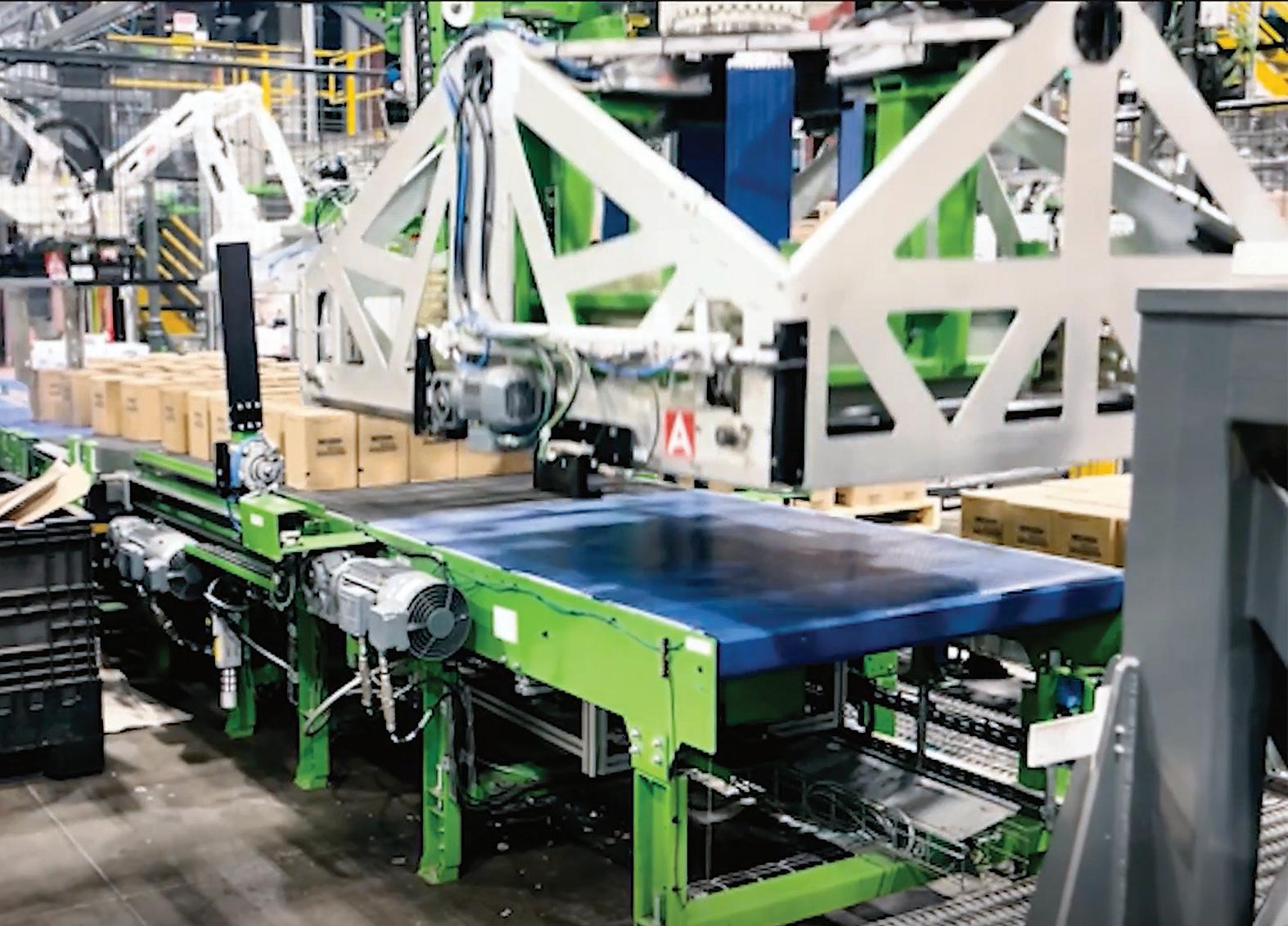
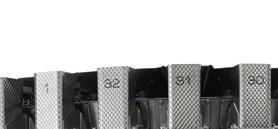
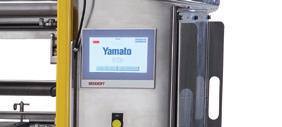
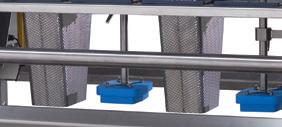
Layer-by-layer depalletizing systems move entire tiers of product at once, applying lateral pressure across cases to stabilize and transfer them—introducing sustained horizontal compression forces not typically accounted for in traditional packaging design.
must now withstand a growing range of machine-driven interactions. Many of those packaging/machine or packaging/robot interactions between the secondary packaging and the machines or robots now handling them were never part of traditional design or testing methods or assumptions. The number of “touches” from the CPG’s packaging line to the Walmart store shelf is changing.
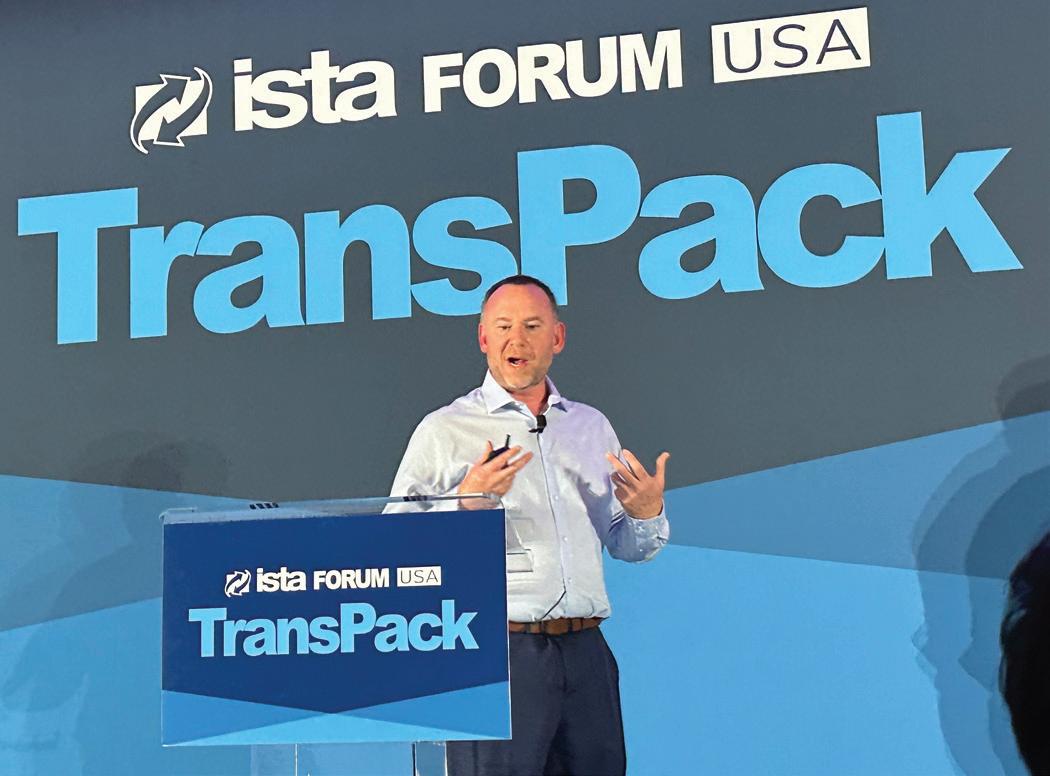
“Automation is really re-shaping the packaging requirements that we see today,” Jim Thomson, Walmart’s director of product packaging, told a rapt audience at the International Safe Transit Association (ISTA)’s TransPack conference last week.
That shift is already surfacing new performance gaps. And one of the clearest examples is emerging in how packages behave under forces that, until recently, simply didn’t exist in distribution. At least, they didn’t exist at this scale.
While elements of this automation, such as layer-by-layer depalletizing, have existed in limited form for years, the rapid expansion of automated DCs following Walmart’s post-pandemic $35 billion supply chain automation investment has brought packaging-related defects into sharper focus. Prior to that expansion, depalletizing operations were limited enough that packaging failures did not draw significant attention. At scale, those same failure modes are now surfacing more consistently.

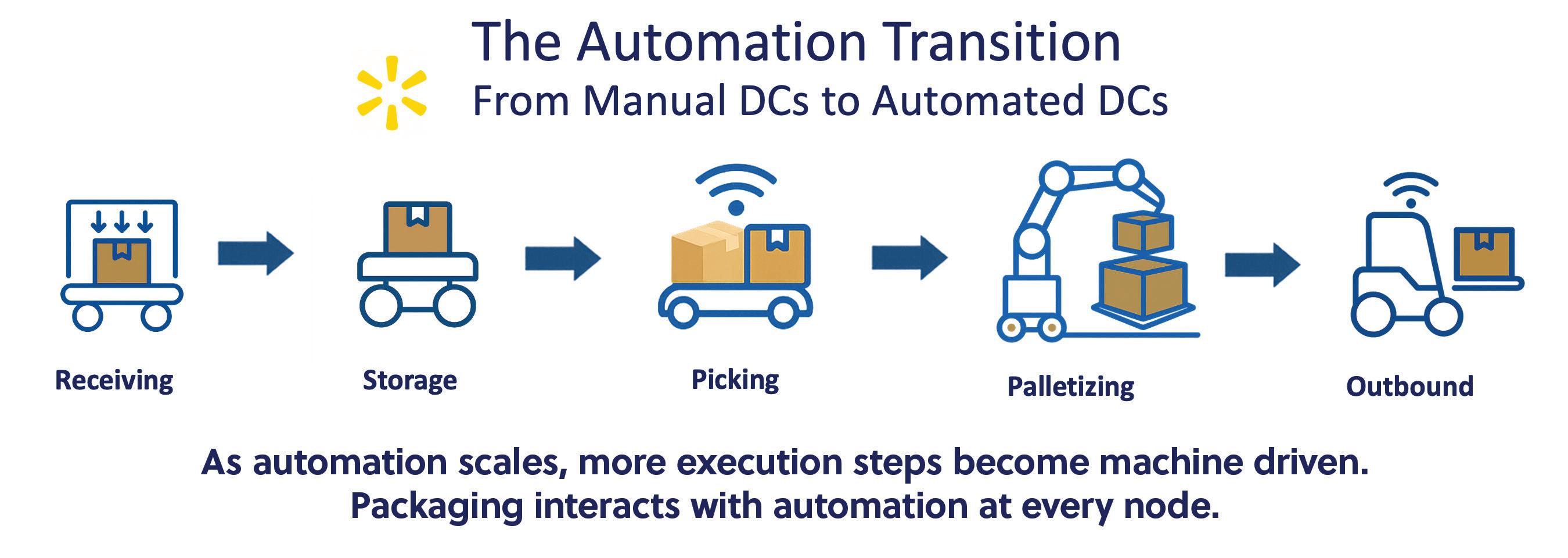
When execution is machine‑controlled, packaging performance must stand on its own—because machines execute exactly what they’re given, without adaptation or forgiveness, Walmart told the ISTA TransForum audience. Image courtesy of Walmart
In manual environments, variability in packaging could often be managed on the fly. A human operator could compensate for a poorly sealed or damaged case, a shifted load, a missing or non-readable barcode, or an inconsistent case structure. Automated systems don’t offer that flexibility.
Consistency of weight, geometry, identification, and structural integrity becomes essential.
“When we start looking at case weight uniformity, I know that’s something that can be very difficult to control. Sometimes it can be controlled by adding multiple items in the case or maybe through the product design itself. But having consistent weights on these items, and having that center of weight or mass in the center, is going to really help move these items through supply chains and get them to the store where they can be sold, and strength needs to be matched to the dynamic loads,” Thomson said on stage.
Traditional packaging design has largely focused on vertical (top to bottom) compression—how cases stack in transit or storage. That’s how things have been tested in the Packaging Lab on ISTA Transit Tables and in real world ship tests. But Walmart says it’s no longer sufficient.
“In the past you’ve always been looking at static loading or stacked cases, and that’s not going to change. But what is changing is there are other forces now that we’re seeing on these packages that haven’t been seen in the past,” Thomson said.
Those forces are being introduced and amplified by the systems driving Walmart’s next phase of DC automation.
As more DC functions become automated across receiving, storage, picking, depalletizing, and mixed pallet building, packages encounter new mechanical interactions. Robotic clamps, high-frequency vibration, and automated transfers all introduce stresses that are not well represented in legacy test protocols. One of the most significant is horizontal compression.
“The sustained horizontal compression is a really big deal and something that really needs to be looked at. When you have that depalletizer head … taking that entire pallet layer off to move it around, you haven’t seen those types of horizontal pressures in the past on packaging, and it’s something that needs to be considered,” Thomson said.
Layer-by-layer robotic depalletizing systems lift entire tiers of product all at once, applying lateral pressure across cases to stabilize and move them. Unlike momentary impacts, this pressure can be sustained, and it acts on package structures that may not have been designed with that force in mind.
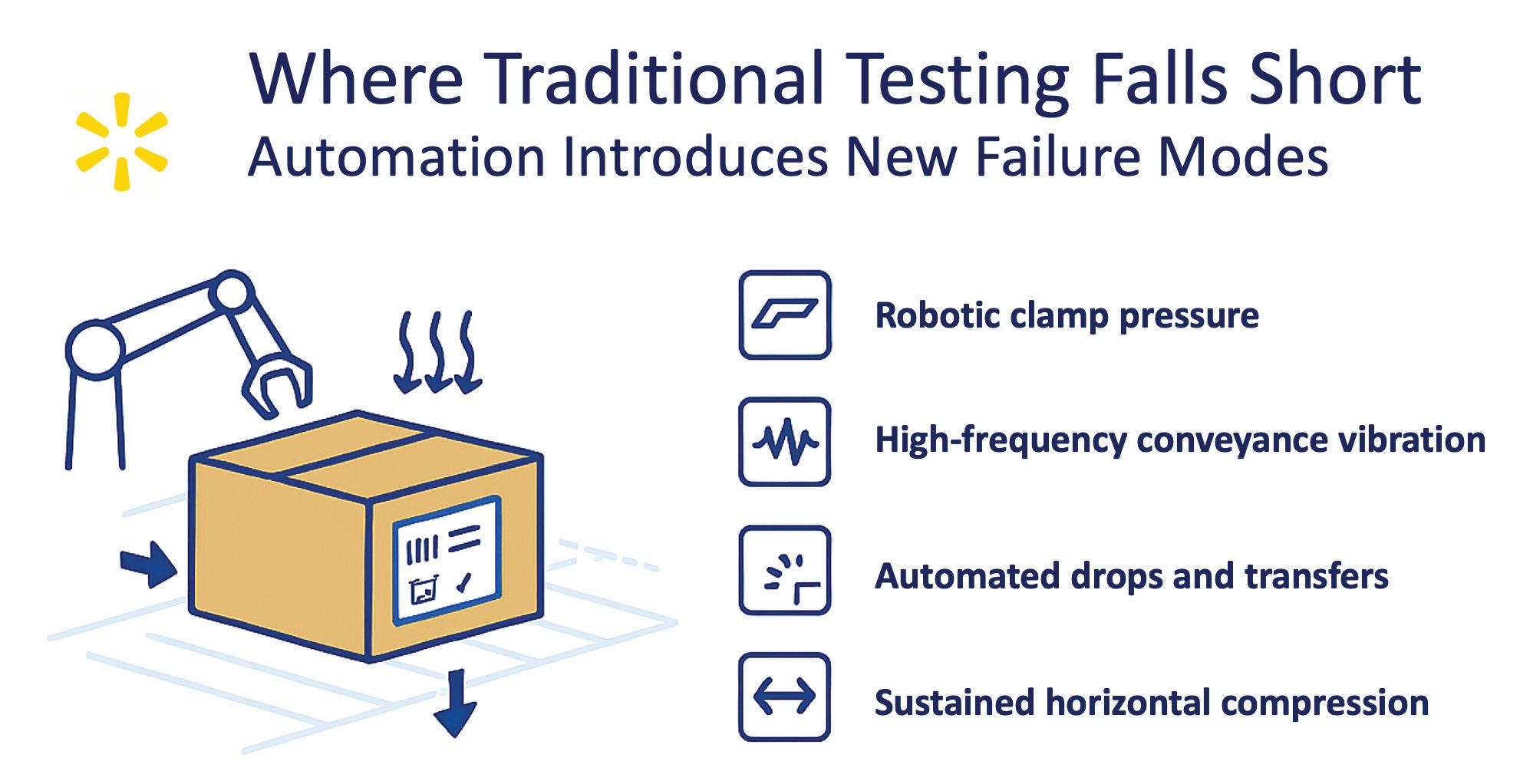
According to Walmart, many of these stresses are not well represented in legacy test protocols. This gap becomes visible at scale. Image courtesy of Walmart
While horizontal compression itself is not entirely new in distribution environments—clamp handling has long been used for large or bulky goods—its application across full pallet layers introduces a different condition. Those forces have typically been applied to individual large units, not across multiple cases simultaneously. Applying sustained lateral pressure across an entire pallet layer of smaller cases creates a load scenario that most CPG packaging has not historically been designed to withstand. I asked Brian Stepowany, owner of packaging consultancy Step Pack LLC, who previously held packaging leadership roles at B&G Foods, Kraft,


Bumble Bee, Johnson & Johnson, and others, about his experience with these types of forces. He noted that in layer-by-layer depalletizing, compression forces are concentrated at the layer level rather than distributed across an entire pallet, increasing the stress applied to individual cases.
At the event, I also spoke to Tom Blanck, senior advisor with BoldtSmith Packaging Consultants about what this emerging trend means for brands and their packaging strategies.
“It is an added variable. It might not be the trump card that changes everything, but it could be. If you have shelf-ready packaging (SRP), they’ll perforate the case, and that just weakens the case entirely. So imagine a whole bunch of these boxes lined up and compressed together—depending on the product, all those perfs could fold and collapse, and you could have catastrophic failure immediately.”
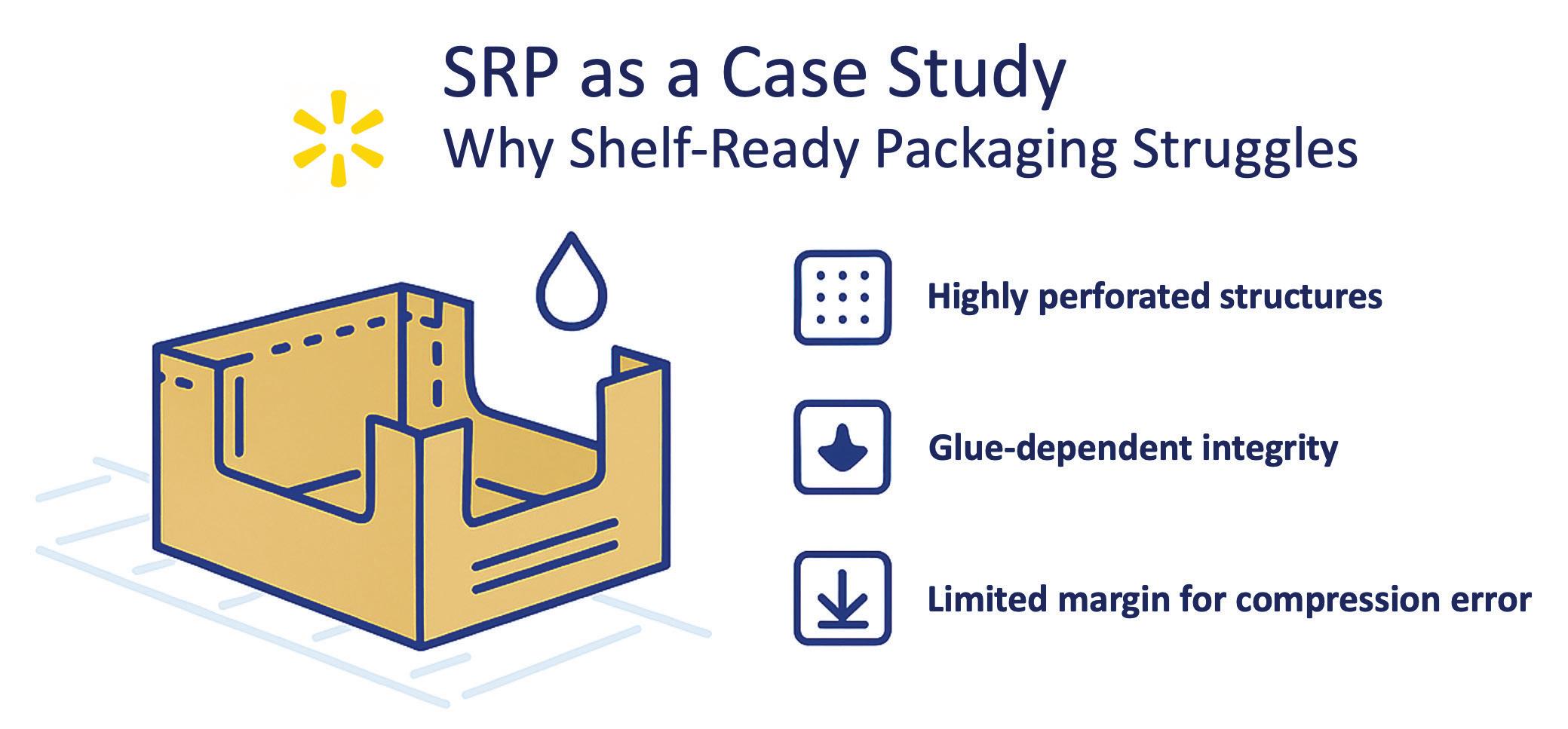
According to Walmart at the ISTA TransPack Forum, SRP was not designed for automation, yet it flows through automated systems every day. Failures here made testing gaps impossible to ignore, they say. Image courtesy of Walmart
The potential result, according to Blanck? Deformation, loss of structural integrity, and, in some cases, outright failure.
SRPs draw attention
The shelf-ready packaging (SRP) that Blanck described has emerged as an early indicator of where packaging design and warehouse automation may be misaligned in places.
Designed for retail convenience—with perforations or covers that allow store associates to remove a top panel and place the case directly on the shelf—SRPs inherently trade some structural strength for functionality. Not for nothing, that shelf-level, easy-open decorated case functionality and aesthetic only exists because demanded by the retailer in the first place.
In automated environments, those tradeoffs become more pronounced.










Perforations create weak points. Adhesive bonds can become failure points under lateral pressure. Even small structural changes, like a slightly shifted lid or a partially compromised base, can disrupt how a machine interprets and handles the package downstream.
“Some of these challenges are not new. Designing a perforation which provides the necessary strength, and yet can be cleanly opened and looks good on the shelf, is an age-old problem,” one brand owner, who chose not to be named, told me.
Failures in SRPs have included cases where bottoms drop out, lids shift out of alignment, or geometry changes enough to confuse automated systems, slowing throughput.
At the same time, not all SRPs are failing under these conditions. Some designs are performing within expected ranges, suggesting that the issue is not the format itself, but how it is engineered. That distinction matters.
Performance is also highly dependent on what’s inside the case.
“It does depend. If you’ve got cake mix or things that are solid cartons inside, it may not be a problem at all. But if you’ve got shelf-ready packaging or something that’s light and airy and doesn’t provide any stacking strength or reinforcement to the case, it could be a killer,” Blanck said.
From a design standpoint, that may require material and structural changes.
“Through additional testing, time, and cost, companies will have to evaluate their shippers and display cases. Board grades used in light-
weight applications will most likely have to be increased,” said Stepowany.
“The ratio between cut and board in perforations has to be evaluated. There may be a need to increase the amount of board between the cuts to increase strength. New dies and testing mean added cost and time.”
Rather than eliminating SRPs, the direction appears to be toward better-defined performance expectations—particularly around perforation design and overall structural integrity under horizontal compression.
To better understand these new forces, Walmart has been studying packaging performance in live automated environments, working with partners to capture compression data, vibration profiles, and impact events.
The goal is to move from observation to measurable inputs—and from there, to updated requirements.
“We’re studying those horizontal compression forces, vibration profiles through automation, and the impact events during the transfer,” Thomson said.
That work is expected to inform both internal requirements and broader industry alignment around packaging performance in automated systems.
It also exposes a growing gap between today’s emerging real-world conditions and how packaging is currently being designed, lab tested and validated.





































Many existing test protocols were developed around traditional distribution environments. As automation introduces new stresses, those protocols may no longer be sufficient to predict performance.
“[Packaging] Labs are going to have to adapt to new protocols, and that may include new equipment being installed because, again, these are forces that haven’t been seen on packaging in the past that we really need to look at and validate before they flow into DCs,” Thomson said.
Walmart is already working to characterize those conditions. “We’re studying those horizontal compression forces, vibration profiles through automation, and the impact events during the transfer,” he added.
In practical terms, that could mean new methods to simulate sustained horizontal compression, updated vibration and impact profiles, and equipment capable of replicating automated handling conditions. Those methodologies are likely to be shaped by the data Walmart is now generating as it studies how packaging performs inside its automated network.
For third-party package testing labs, this represents both a challenge and an opportunity to evolve alongside the systems they are meant to validate.
Thomson emphasized that Walmart has long aligned its packaging guidance with broader industry standards where possible. But the scale and speed of DC automation are creating situations where new requirements must be defined more quickly.
“We try to align as best as we can to industry standards. We don’t like to create Walmart-specific standards, but we will do that when we need to for specific products through supply chain,” Thomson said.
From a brand perspective, that reality is difficult to ignore.
“From a brand owner perspective, one of the biggest realities is if you sell a lot through Walmart, you’re going to have to deal with this sooner rather than later. Walmart is kind of the leader on this—they’re exploring and proving the efficiencies of automation. If that starts working for them, you’ll see others follow,” Blanck said.
The implications extend beyond design into cost and sustainability tradeoffs.





















“As engineers try to optimize shippers and displays to lower cost and improve sustainability, using clamp-style handling will increase costs and board usage,” Stepowany said.
“Brands may overreact. Alternative designs should be considered, not just reinforcing current designs. Companies also need to understand when these changes will be required and which products will actually be impacted. Not all products will be affected the same way,” Stepowany said.
In practice, those decisions carry weight well beyond a single retailer. Costco and others are certainly implementing similar systems.
Suppliers design packaging to meet Walmart requirements because they must. Over time, those requirements often influence broader industry expectations—especially when they are rooted in real, measurable system demands.

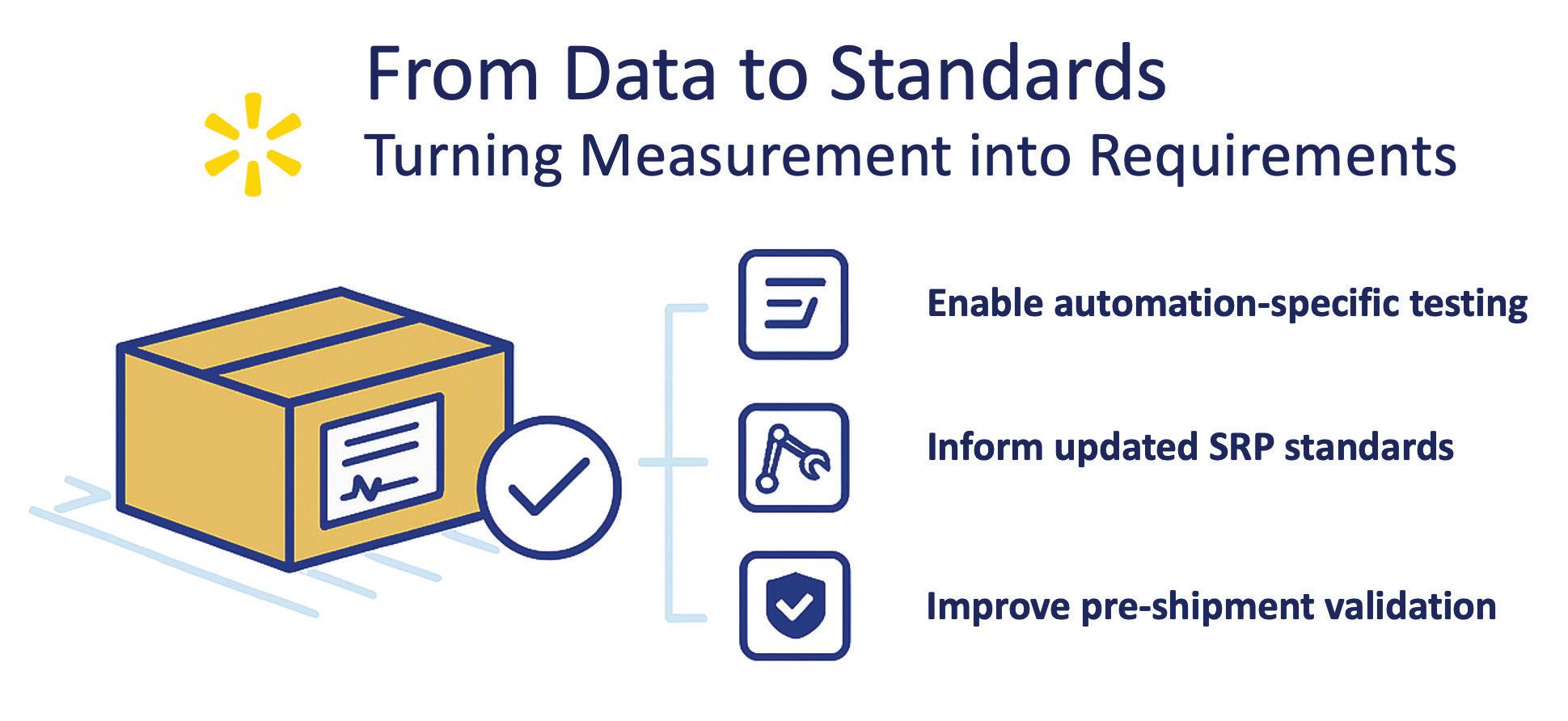
According to Walmart, this work is not retailer‑specific. The goal is better alignment between real system inputs and how packaging is evaluated, they say. Image courtesy of Walmart
Horizontal compression from layer-by-layer depalletizing is one of the first clearly defined examples of how supply chain automation and mixed pallet building are reshaping packaging requirements. It won’t be the last.
Walmart’s approach spans multiple automation systems and partners—from WITRON in grocery distribution to AI-driven platforms like Symbotic—each introducing different handling dynamics that packaging must now accommodate. At the same time, technologies such as
Wiliot’s ambient IoT tags are adding new visibility into how packages move through those systems, helping define the conditions packaging must withstand.
As automated systems continue to evolve, they will introduce new forces, new failure modes, and new expectations for consistency and performance. Packaging that performs well in traditional environments may not meet the demands of these systems without adjustment.
“Probably the biggest thing is just to stay tuned. Walmart mentioned they put out their guidelines twice a year, and you can’t be complacent in your packaging. Keeping an eye on the damage signals is really important. If you see issues in certain parts of the distribution chain, that’s a sign there’s a hazard or handling condition causing it. The key is to figure out what that is, test for it, and use that to guide your design,” Blanck said.
The bottom line? For brands, material suppliers, equipment OEMs, packaging developers, and testing labs alike, a new DC automation variable is being added to an already complex equation.
Tertiary and secondary packaging must now be designed not just for transport and the retailer’s shelf, but for the machines that move it in between. And increasingly, those machines are setting (or resetting) the rules. PW
With paperboard packs designed to ship, store, organize, and recycle what it describes as ‘the only zero-waste batteries on the planet,’ Better Battery Co. evolves its packaging system from D2C innovation into a retail-ready format.
By Anne Marie Mohan, Senior Editor
In 2025, legacy battery brands Duracell and Energizer made headlines when they switched to paper packaging, leaving behind traditional plastic blister packs and enabling full recyclability of the new cartons. While they received widespread attention for what was called a “transformational shift” for the category, it was a lesser-known, but just as innovative, battery brand that helped establish an early model for paper-based battery packaging.
Founded in Toronto, Ontario, Canada in 2021 by sisters Jaclyn Byles and Jessica Jenkins, Better Battery Co. was launched with the goal of bringing a more circular solution to the everyday battery category. That included plastic-free packaging in the form of paper cartons that doubled as shippers for the company’s range of carbon-neutral, alkaline batteries. It also did triple duty as a household storage solution. Quadrupling its functionality, the packaging was also designed to allow Better Battery’s D2C customers to send depleted batteries back to the company for recycling.
“Better Battery Co. was designed from the beginning to avoid plastic packaging entirely,” says Byles. “Importantly, our focus on sustainability does not come at the expense of performance or value. Our batteries are designed to deliver the dependable performance consumers expect from leading brands, while offering competitive everyday pricing.
“This combination of strong performance, better value, and a fully plastic-free packaging system, along with our carbon-neutral certification and built-in battery recycling program, helps differentiate Better Battery Co. in a category that has historically relied heavily on plastic packaging and is only now beginning to transition away from it.”
In 2023, the company expanded into retail, a move that required refinements to the paper battery packs. Last year, the company further updated its retail packaging to ensure strong shelf presence, easy navigation for consumers, and compatibility with retail merchandising systems—all while maintaining its plastic-free format.
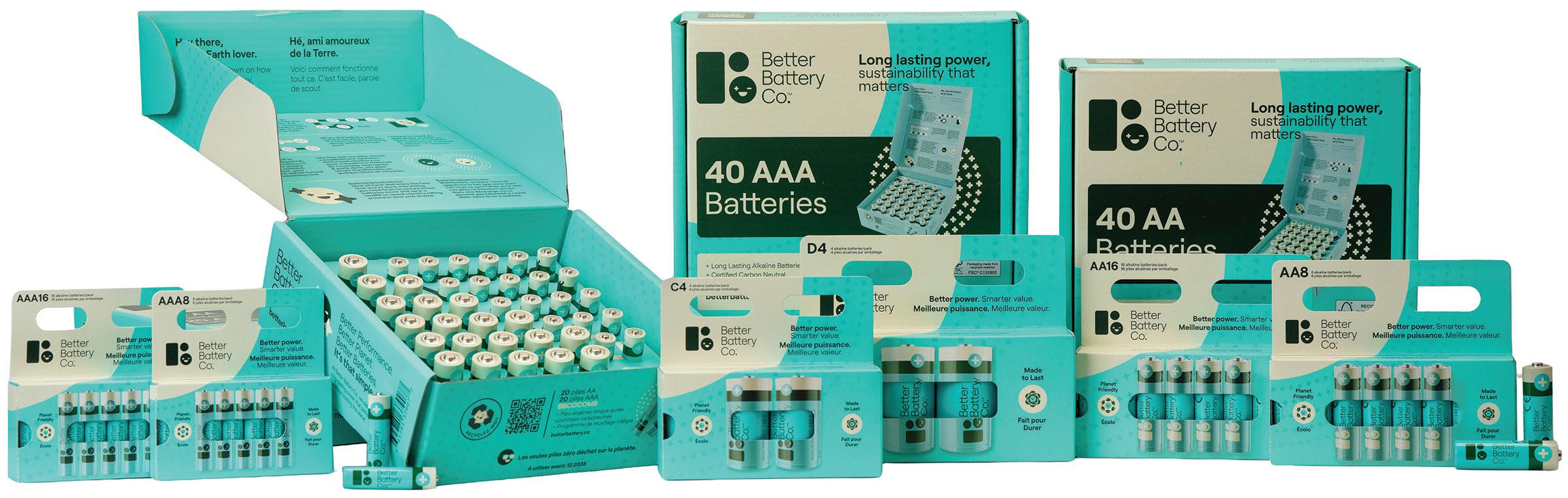
As Better Battery Co. expanded from large-format kits into a broader retail assortment, it unified its redesigned packaging around a signature teal visual system that strengthens shelf impact, improves product-line cohesion, and helps consumers quickly navigate battery sizes and formats.
As noted, before Better Battery’s packaging ever needed to compete on a retail shelf, it was engineered first and foremost as a multifunctional e-commerce platform. For a startup entering the battery category through D2C channels, the package had to solve logistical and wastereduction challenges simultaneously while introducing consumers to a fundamentally different model centered on storage, reuse, and recycling.
According to Byles, launching initially through a D2C e-commerce model allowed the company to test packaging formats, shipping durability, and consumer messaging while building early brand awareness. Those early learnings directly informed the structural demands of the packaging. Better Battery chose a tab-lock roll-end carton made from FSC-certified paperboard that functions as a shipper without requiring secondary or tertiary packaging—an Amazon SIOC [ships in own container]-style container, if you will. The rigid box format is designed to withstand transportation stresses while securely housing batteries upright in circular die-cut cavities that separate each cell, preventing terminal contact during shipment. This structural engineering not only improves safety and durability, but it also creates an orderly household storage system that deliberately addresses the common consumer frustration of loose batteries cluttering junk drawers.
The design’s true innovation, however, lay in how packaging becomes a communications platform. Inside each larger-format battery kit, Better Battery incorporates a printed “battery path,” a guided visual system that instructs consumers on which battery to use next. In this
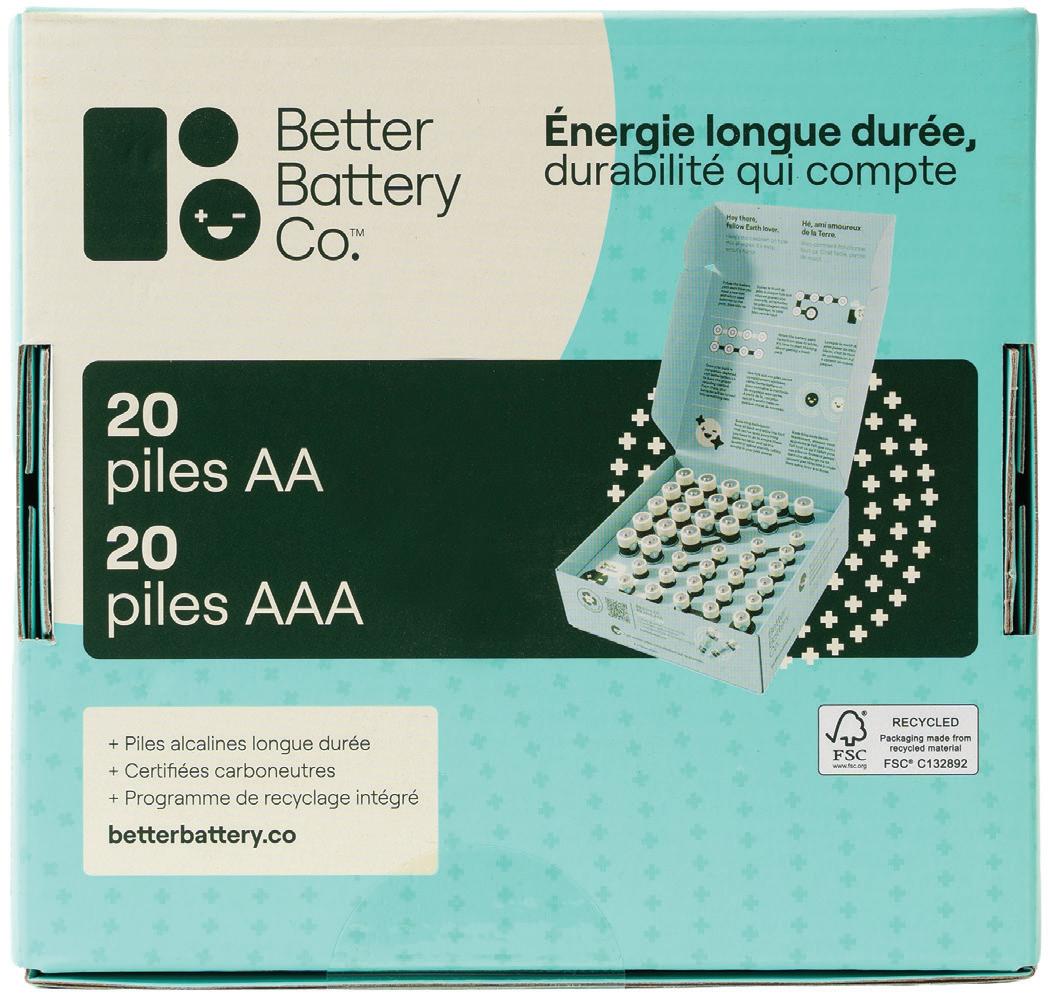
Better Battery’s large-format combo kit package uses an FSCcertified paperboard tab-lock roll-end carton that functions as shipper, storage system, spent battery tracker, and recycling take-back platform for 20 AA and 20 AAA carbon-neutral alkaline batteries.
Inside the paperboard battery kit is a printed ‘battery path’ system that guides consumers through battery use and replacement while allowing depleted cells to be reinserted in reverse orientation, creating a simple visual ‘depletion map’ that supports organization and end-of-life recycling.
system, the positive end of the battery is white, while the negative end is blue.
“In our larger kit formats, consumers can place depleted batteries back into the box upside down, reversing the positive and negative terminals, to easily distinguish used batteries from new ones,” explains Byles. The resulting white-to-blue visual transformation creates a clear “depletion map” while encouraging proper battery management.
Educational copy printed beneath the lid further reinforces the closed-loop model, guiding customers through usage, depletion tracking, and recycling return. A QR code printed on the side of the carton links users directly to Better Battery’s online take-back program, where they can provide information on the depleted battery pack and receive a prepaid shipping label.
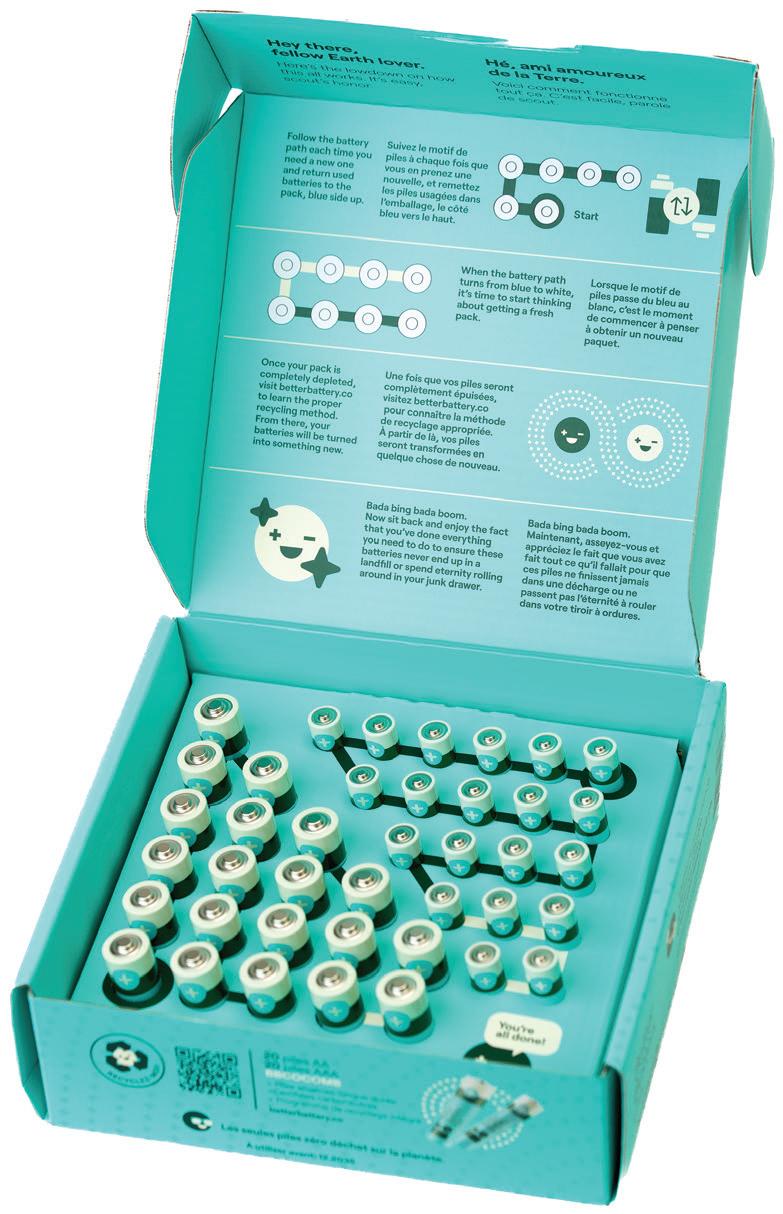
Better Battery large-format kits include a combo box, which holds 20 AA batteries and 20 AAA batteries, a 40-ct pack of AA batteries, and a 40-ct pack of AAA batteries. Each is priced at $29.99 when purchased through the company’s website.
As Better Battery moved into retail channels in 2023, packaging requirements evolved from shipping durability and educational use to include merchandising performance. Distributing its products in grocery, hardware, and specialty retailers demanded that the company use packaging that could compete visually in crowded battery sets while aligning with its longstanding commitment to plastic-free design and circularity.
In 2025, the brand further updated its retail packaging, refining its graphics while maintaining the core identity. The redesign was developed by Better Battery’s internal team along with Toronto-based Juliet Creative and was guided by feedback from consumers.
According to Byles, the project was driven by three primary goals: “improving shelf impact in retail environments, enhancing consumer usability, and continuing to push sustainability forward.”
The new design centers on the standardization across SKUs of Better Battery’s signature deep teal color, which reflects the sustainability focus of the brand while also helping the packaging stand out in the battery aisle. “We wanted the product lineup to feel more cohesive across all SKUs,” explains Byles. “In earlier versions, some of our larger battery kits used slightly different visual treatments. In the new design, those kits have been brought into the core Better Battery Company color system, using our signature BBCo teal and supporting brand colors. This creates a more unified look across the full assortment while strengthening brand recognition on shelf.”
The redesigned typography is clean and bold to emphasize performance and ensure battery sizes and counts are easy to identify at a glance. Messaging focuses on three core pillars of the brand: performance, everyday value, and sustainability.
Another key improvement was to make the packaging fully bilingual, with English and French copy—important for Canadian retail compliance—while still maintaining clear, easy-to-read messaging for consumers.
The retail-ready packs were also designed to feel less technical and intimidating than traditional battery packaging. “We wanted the brand to feel approachable and a bit more fun than traditional battery packaging, which is often very technical and serious,” Byles notes. One exam-



ple: copy on the bottom of the smaller pack formats reads, “Itty Bitty Positivity Committee.”
Byles adds, “The bold color palette and clean design help the product stand out on shelf while creating a more modern, engaging look that attracts attention and makes the category feel less utilitarian.”
The redesign also created opportunities to broaden the product assortment beyond the brand’s original large-format kits. While Better Battery’s original kits remain central to the brand, newer smaller packs were introduced to better serve traditional retail channels and consumer purchase behaviors. Among them are 8- and 16-ct packs of AAA and AA batteries, 4-ct packs of C and D batteries, and a 2-ct 9V battery pack.
These additional offerings allow the company to compete more directly with established battery brands while preserving its commitment to plastic elimination. Developed to integrate into conventional peg-hook and shelf merchandising systems, the smaller formats broaden retail flexibility while extending the brand into more familiar battery purchase occasions.
“This allows consumers to choose between convenient everyday packs or larger household kits, while maintaining the same performance, sustainability, and packaging principles across the full range,” says Byles.
Key functional advantages carried over from the larger kits include
reclosability, recyclability, and ease of organization. “Our smaller retail packs are also designed to be reclosable, allowing them to function as convenient storage so batteries can be kept together rather than loose in drawers or cabinets,” says Byles.
Better Battery Co.’s packaging evolution was shaped in large part by its initial go-to-market strategy. Because the brand launched first through D2C, it had the advantage of developing its packaging without the immediate constraints of retail shelving, peg compatibility, or instore visual competition. That allowed the brand to focus first on solving for shipping durability, structural efficiency, consumer organization, and circular use. Only after establishing and validating the integrated packaging platform did Better Battery adapt and refine it for broader retail merchandising requirements.
For emerging CPGs entering through e-commerce or alternative channels, Better Battery’s journey is a good example of how early packaging development can prioritize operational and consumer-use challenges before later evolving to meet the demands of traditional retail environments.
For Better Battery Co., paper packaging was never simply about replacing plastic. It was about redesigning the consumer battery experience from purchase to storage to end-of-life recovery, an approach that continues to set the company apart as larger competitors begin their own transition. PW























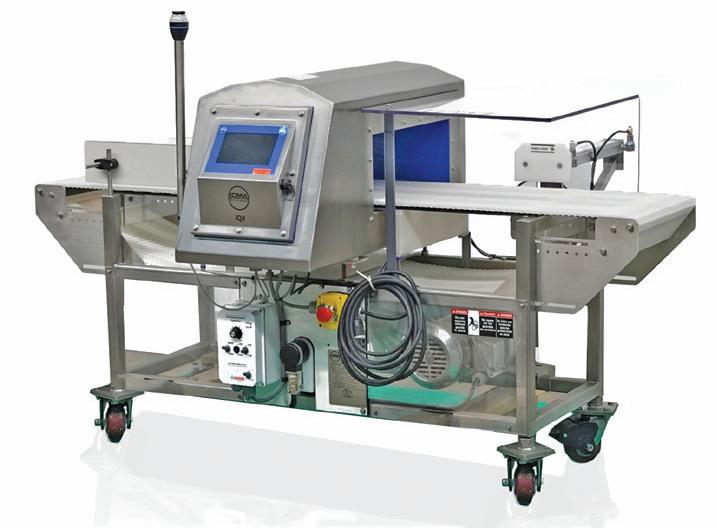
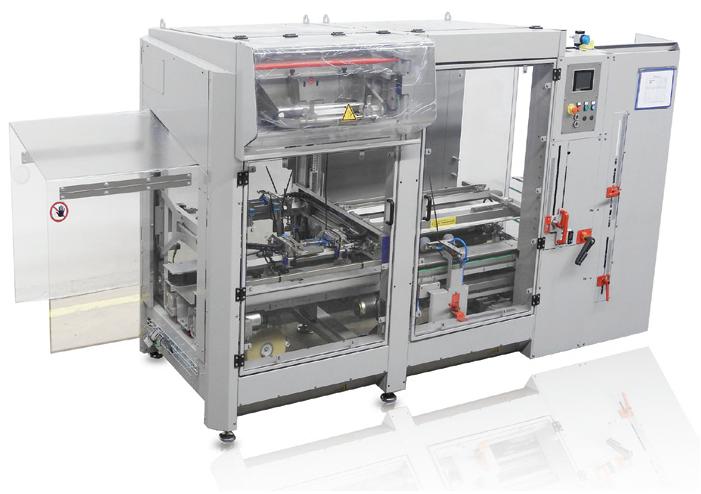
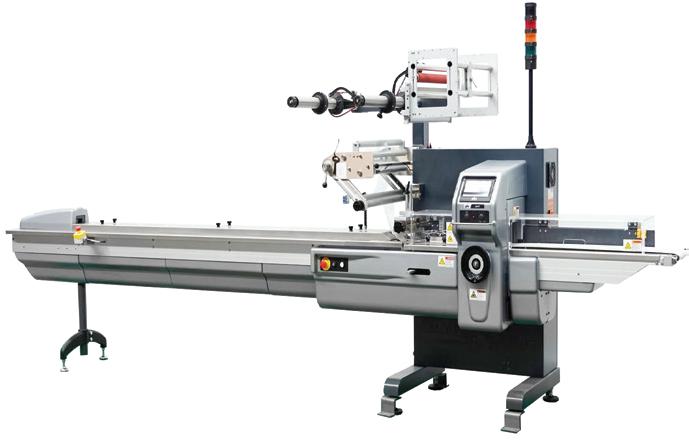
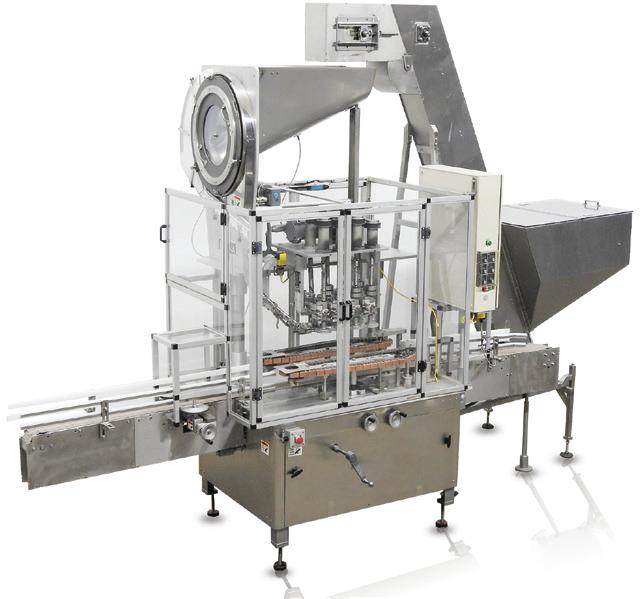
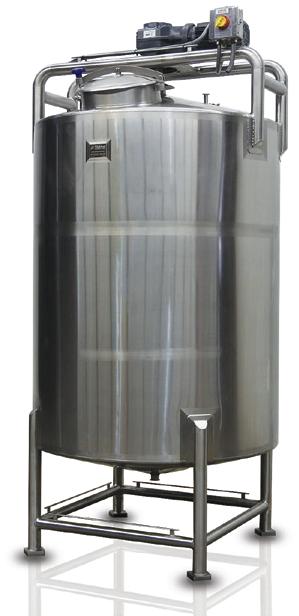
Built around the Arthritis Foundation’s Ease of Use Design Guides, Tilt Beauty reengineered cosmetic packaging for grip, torque, and control. The application shows how inclusive design can elevate usability, brand loyalty, and packaging performance.
By Matt Reynolds, Chief Editor
When Aerin Glazer set out to launch a beauty brand, she wasn’t thinking first about color palettes or marketing campaigns. She was thinking about torque, grip, and opening force.
“Growing up with psoriatic arthritis, I found many existing beauty products difficult to use,” says Glazer, founder of Tilt Beauty. “I struggled to open and hold traditional packaging, and often the formulas were irritating on my sensitive skin. I knew I couldn’t be the only one having this experience. That’s when I started thinking—there has to be a better solution.”
Rather than treating accessibility as a feature addon, Glazer built Tilt Beauty around a packaging premise: conventional cosmetic components weren’t designed for hands experiencing pain, stiffness, or limited dexterity.
Designing the entire user journey
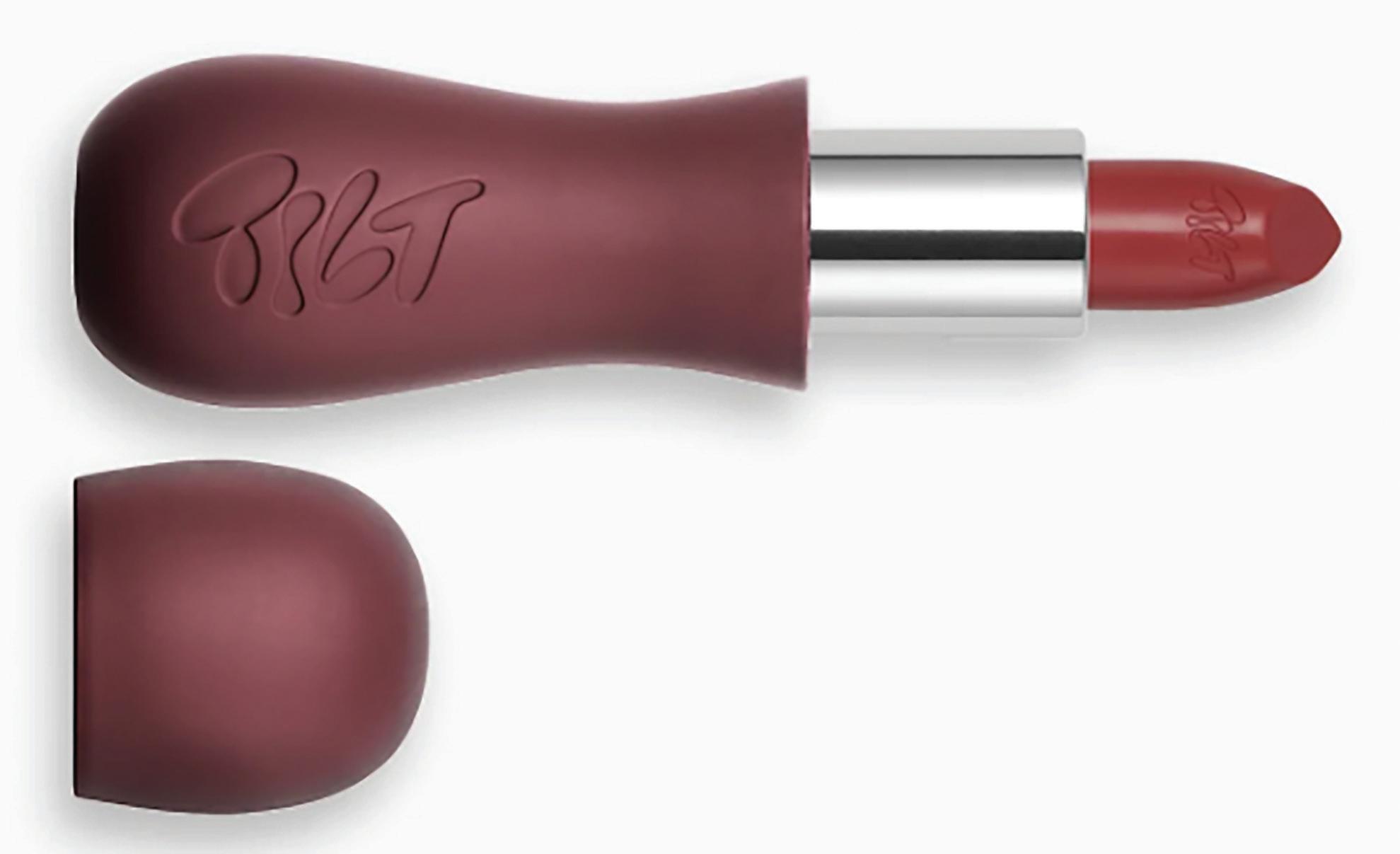
Tilt Beauty’s patented ergonomic lipstick component is wider at the ends to rest more naturally in the hand, with an extra-wide grip and proprietary soft, “squishable” material to enhance comfort and control. The magnetic cap is engineered with a calibrated pull force—strong enough to prevent accidental opening in a handbag, yet gentle enough to remove without significant twisting or hand strain. The design earned Arthritis Foundation Ease of Use® Certification following laboratory and human factors evaluation.
“We approached accessibility from as many angles as possible,” Glazer says. “We wanted to ensure that our customers’ journey from the outer carton, to opening the product itself, to the actual application, was as seamless as possible. I wanted to create products that keep the joy in beauty and allow people with arthritis, chronic pain, or limited mobility to truly feel included in the beauty community.”
All products in Tilt Beauty’s collection—including the Grip Stick Hydrating Lip Treatment, The Easy Way Effortless Lip Liner, The Easy Way Satin Hydrating Lipstick, and Lashscape Mascara—have earned the Arthritis Foundation’s Ease of Use Certification.
“It was incredibly important to me that Tilt Beauty achieved the Ease of Use Certification as a way to demonstrate our genuine commitment to accessibility and inclusion,” Glazer says. “Working with the Arthritis Foundation meant meeting strict criteria that hold the brand to a high
standard and ensure our products are truly easy to use for individuals with chronic pain or arthritis. As a member of the arthritis community myself, I felt this was something we had to do.”
With its sculpted silhouette, Tilt’s lipstick component departs from the industry’s traditional slim cylinder.
“With our lipstick and lip treatment, we wanted to ensure the product could sit comfortably and securely in someone’s hand,” Glazer says. “It features a patented ergonomic design that is wider at the ends, allowing it to rest more naturally in the hand. The extra-wide grip also


makes it easier to hold and control.”
“The material of the component is just as important as the shape,” she continues. “We used a proprietary soft, squishable material that enhances grip and feels gentler on the joints.”
Opening force was engineered carefully as well. “They are strong enough that they won’t open up in your handbag, yet gentle enough to allow the user to remove the lid without significant effort or using one hand,” Glazer says of the magnetic caps.
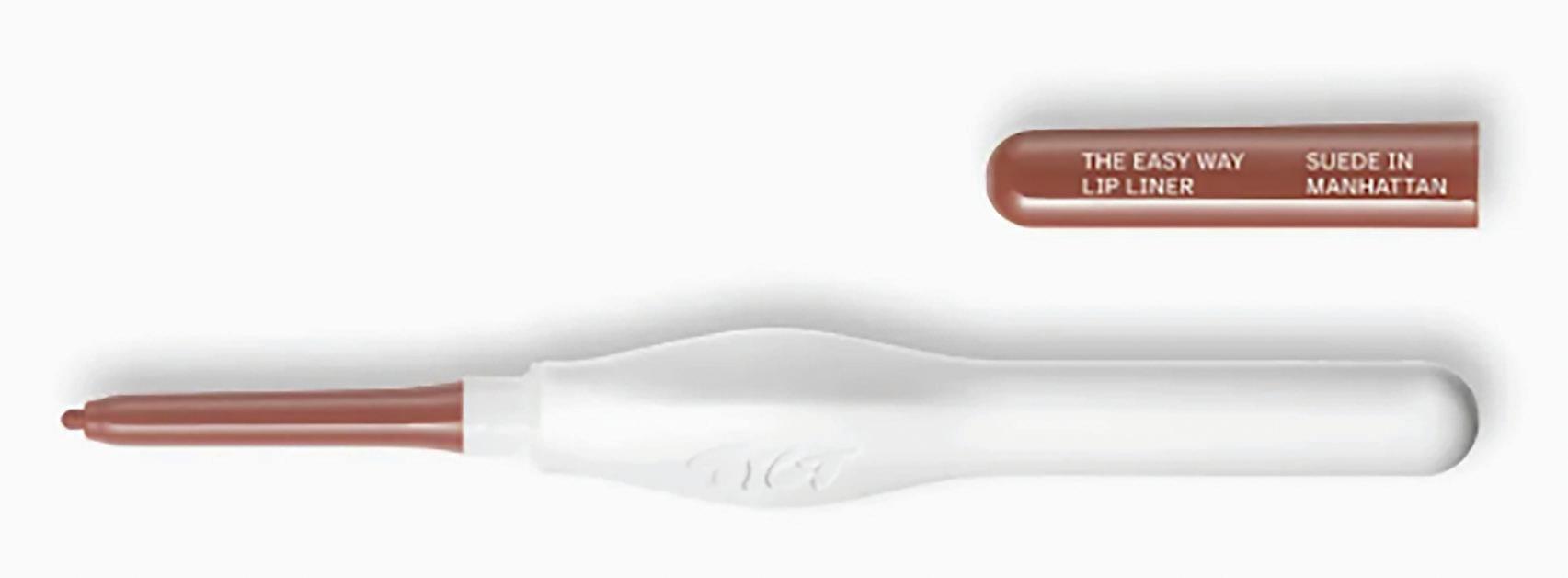
Tilt Beauty’s The Easy Way Effortless Lip Liner replaces the traditional slim pencil format with a wider midsection and slightly heavier center to improve grip stability and application control. The component features a proprietary soft-touch material designed to enhance friction and reduce joint strain for users with arthritis, chronic pain, or limited dexterity. The liner is also refillable, adding another layer of engineering complexity to the ergonomic design.
The lip liner also rethinks the thin-pencil norm. “Our The Easy Way Effortless Lip Liner features a wider grip in the middle and has a slightly heavier feel in the middle to support more controlled application,” Glazer says. “It also uses our proprietary soft-touch material for added comfort, and it’s refillable as well.”
“From ideation to launch, we spent close to five years working on Tilt Beauty,” Glazer says. “There were many rounds of prototypes and refinements before we were ready to launch in 2025… And because everything we make is also refillable, this added another level of complexity to the process.”
“The Ease of Use Certification evaluates eight key design elements using both laboratory testing and human factors evaluations,” says Deb Gokie, VP of consumer health and ease of use with the Arthritis Foundation. “These criteria are applied based on the specific product or package being assessed and may include opening force, grip, twisting, readability, and overall usability.”
“Yes, we have quantitative benchmarks that brands must meet,” Gokie adds. “These benchmarks are recommended in the Ease of Use Design Guides… and they are available for free download.”
“Tilt Beauty stood out for its innovation and intentional focus on accessibility from the very beginning,” Gokie says. “The Tilt team


engaged with us early in the design process, sought our recommendations, and conducted focus groups to evaluate designs before formal testing — which ultimately led to a very successful outcome.”
“Ease of Use has evolved into a broader consumer experience expectation rather than a niche trend,” Gokie says. “Consumers feel the impact immediately when a product is difficult to use. Brands that prioritize convenience and usability build trust and loyalty.”
In Tilt’s first year, Glazer says the response has been encouraging. “We have built an incredible, dedicated, and engaged community. It demonstrates that there is a market for accessible beauty, and I hope it helps to encourage more brands to explore accessibility improvements for their products.”
Ultimately, Gokie notes, “Inclusive design isn’t just about accommodation—it’s about creating better packaging overall. When brands design for people living with arthritis, chronic pain, or limited mobility, they improve usability and quality of life for everyone.” PW
Note: Packaging World asked Tilt Beauty about suppliers and material details, but the brand chose not to reveal them.















From EPR and flexible films to paper packaging and composting, the Sustainable Packaging Coalition’s SPC Impact 2026 event delved into how CPGs are turning sustainability goals into scalable systems.
By Anne Marie Mohan, Senior Editor
In April, SPC Impact 2026 brought the packaging industry to Nashville for the Sustainable Packaging Coalition’s annual conference, produced by environmental non-pro t GreenBlue Across 45 breakout and main stage sessions, the event zeroed in on the packaging challenges companies are dealing with as policy deadlines approach, material choices shift, and recovery systems continue to evolve.
Extended Producer Responsibility was the conference’s biggest topic, with 12 sessions dedicated to EPR and related policy discussions. Flexible lms, where recovery and labeling remain major industry challenges, were the focus of six sessions. Paper packaging, driven by rising interest in paper-based alternatives to plastic as well as growing questions around recyclability and recovery, appeared in eight. Composting was another popular topic that showed up repeatedly on the agenda.
Opening the conference on Earth Day, GreenBlue executive director Paul Nowak described the moment as the “Year of the Relationship,” urging attendees to approach the challenges ahead through practical action, what he called “realistic optimism,” and collaboration.
“You really cannot do it alone,” Nowak said, emphasizing that sustainable packaging’s next phase will depend on how effectively brands, suppliers, policymakers, and recovery systems work together.
Paul Nowak, executive director, GreenBlue
Across the industry, EPR is quickly becoming a core business issue, in uencing everything from data systems and material choices to long-term packaging strategy.


That idea carried through much of the event, where conversations repeatedly returned to the operational challenges of turning sustainability goals into workable systems. Whether the focus was EPR, exible lms, paper packaging, or composting, companies were largely focused on guring out what comes next and how to make it work.

Amanda Humes, director of packaging stewardship at Conagra Brands, explained how EPR is pushing companies to look beyond design claims and focus on how packaging actually performs once it enters the waste stream. “It’s no longer just about voluntary commitments or isolated improvements,” she said. “Increasingly it’s about demonstrating accountability across the entire value chain.”

That shift is creating pressure for better internal systems. Panelists repeatedly emphasized that data collection, forecasting, and compliance infrastructure need immediate attention. Brie Seferian, senior manager of EPR North America at Mondelez International, said many companies are still trying to assemble packaging information from disconnected systems. “We need better data,” she said.
California remains the clearest example of how complicated EPR implementation can become. For compostable packaging, AB 1201 and related legislation continue to create uncertainty by tying compostability claims to outdated federal National Organic Program rules. These rules currently do not recognize packaging materials as allowable agricultural inputs, effectively blocking compostable packaging from being labeled as such in California.



















Rhodes Yepsen, executive director at the Biodegradable Products Institute, described the state’s framework as having “the right ingredients, but the wrong recipe,” warning that misaligned laws could effectively eliminate compostables as a viable pathway despite broader sustainability goals.
Molded ber packaging is facing similar confusion. Under California’s SB 343 EPR legislation, products long viewed as recyclable are being reclassi ed because recyclability now depends heavily on collection, sortation, and end-market data rather than technical recyclability alone. Tom Hendrickson, industry affairs manager for the International Molded Fiber Association noted that many molded ber products are now in regulatory limbo, even when consumers widely perceive them as sustainable options.


Polycoated paper is also under review, with California’s covered material categories forcing companies to prove where speci c formats t (read more at pwgo.to/9083). Scott Byrne, VP, global sustainability and industry affairs at Sonoco, said some polycoated materials may qualify under current rules while others may not, even when the functional differences are minimal.
A growing concern throughout the conference was how dif cult it will be for brands to manage a state-by-state patchwork long term. While panelists did not suggest that federal legislation is imminent, Humes pointed to the need for greater alignment in how programs are


structured. A more harmonized national framework, she suggested, would help companies build systems that are more ef cient and scalable, rather than repeatedly adapting to different reporting rules, fee structures, and material de nitions across states. Without that kind of consistency, compliance risks become far more resource-intensive, particularly for large brands operating across multiple markets.
For producers, navigating this environment requires more than compliance reporting alone. Companies are being pushed to strengthen internal data systems, coordinate more closely across sustainability, legal, nance, and packaging teams, and stay engaged in policy discussions as requirements continue to evolve. Waiting for regulations to stabilize is not a practical option. As Humes noted, design changes made solely to lower fees or meet shifting requirements can create unintended tradeoffs elsewhere in the system.
With more states moving from policy development into implementation, EPR is shifting from long-term planning into day-to-day business operations. “I think we’re all going to have to get all of our systems integrated better,” Seferian said, as brands work to avoid being caught unprepared by rising compliance, reporting, and packaging demands.
A tour of Nashville’s The Compost Company during SPC Impact offered a practical look at how compostable packaging functions in a commercial composting system, and why packaging design plays a critical role long before material reaches a compost pile.
The Compost Company processes commercial food waste and certified compostable packaging from businesses across Middle Tennessee, combining incoming material with wood waste and composting it in aerated piles that reach temperatures of 150ºF to 180ºF. Those highheat conditions help break down food scraps along with most compostable serviceware within roughly 30 to 45 days.

For co-owner Clay Ezell, accepting compostable packaging is largely about making food waste diversion easier for customers. “A lot of our customers wouldn’t be composting at all if they couldn’t use compostable packaging,” Ezell said. That approach places heavy importance on packaging
Read the full article: pwgo.to/9085
recognizability. Compostable items must be easy for consumers and staff to identify quickly, particularly in busy commercial settings where sorting decisions happen in seconds. Ezell said color, shape, and clear visual cues can significantly improve proper disposal, reducing contamination before materials even enter the collection stream.
The company reinforces that process through customer training, bin audits, and route drivers who inspect loads during pickup. While contamination remains an ongoing challenge, upstream material choices and operational consistency help determine whether compostable packaging succeeds in practice.
Said Ezell, “We don’t know that we’re going to get over our single-use culture anytime soon, so we’re trying to give people a better option, and we want to be the outlet for that.” PW


Adam Met opened SPC Impact 2026 with an argument that building sustainability movements has less to do with broad messaging than with making people feel personally connected to change.

Adam Met of AJR, Columbia University, and Planet Reimagined
Met, the bassist for multi-platinum band AJR as well as a Columbia University professor, policy strategist, and founder of Planet Reimagined, drew heavily from his experience growing a global fan base to explain how industries can drive meaningful behavior change. His core point was that good storytelling alone is not enough unless it leads to participation.
“Good storytelling is the kind of story that you’ll take home, share with your friends and family,” Met said. “Effective storytelling will actually make you get up off your butt and do something about it.”
Throughout the keynote, Met emphasized specificity over abstraction. Whether working on climate policy, concert-based activism, or packaging, he argued that people respond more strongly to local, immediate concerns than to sweeping global narratives. One example Met shared came from an activation
in Phoenix, where temperatures reached 109ºF during an AJR tour stop. There, his team encouraged concertgoers to sign a petition urging the city council to declare extreme heat an emergency. Thousands participated, and the effort helped unlock municipal funding to address the issue. By tying action directly to a visible local problem, Met said engagement rose significantly.
Met also urged sustainability leaders to rethink language. Terms like climate change or net zero may resonate within policy circles, but he suggested broader public engagement often depends on connecting issues to everyday realities such as health, transportation, jobs, or food.
“If it means we’re going to expand our tent effectively to use different language, I’d ditch that,” Met said.
For Met, creating change depends on matching the story, the audience, and the moment. “When you think about the timing of it, the kind of scope of the story, and how comfortable and uncomfortable you want to make people, that’s when you can get real, large-scale systemic change to happen.” PW
SPC’s Retailer Forum launched in 2025 (see pwgo.to/9084) as a way for major retailers with private label brands to work together on those packaging challenges they were struggling to solve individually. Retailers including Amazon, Walmart, Target, and CVS wanted to give packaging suppliers more direct guidance on where sustainable innovation was most urgently needed.
One of the earliest challenges, according to Brandi Parker, founder

and consultant at Parker Brands and Forum facilitator, was that retailers’ priorities were not clearly reaching suppliers. “Something we heard over and over again is, ‘I’m going to my suppliers, and I’m saying, “Guys, we really need to start innovating on X, Y, Z.” And the suppliers would be like, ‘Well, we’re not really hearing that,’” Parker said.
That communication gap became the foundation for the Forum’s first collaborative exercise. Retailers anonymously mapped their highest-priority packaging pain points, which helped shape the inaugural supplier brief. That process was designed to pool retailer demand, provide clearer supplier direction, and uncover solutions capable of moving beyond pilot programs.
That first brief centered on low-barrier flexible films, where retailers saw an opportunity to improve recyclability but needed stronger supplier innovation to bring scalable solutions to market. Nine supplier submissions followed, all representing solutions either already at scale or nearing commercialization.
For Amazon, one of the biggest surprises was the quality and originality of what came back. “My concern coming into it really was that this was just going to resurface the common solutions that we’re seeing with some known problems,” said Matt Swenson, senior sustainability specialist at Amazon. “But real, novel innovation was coming through.”
At SPC Impact 2026, the Forum launched its second project brief, this time shifting toward rigid packaging formats such as beverage bottles, personal care containers, pharmaceutical packaging, and home care

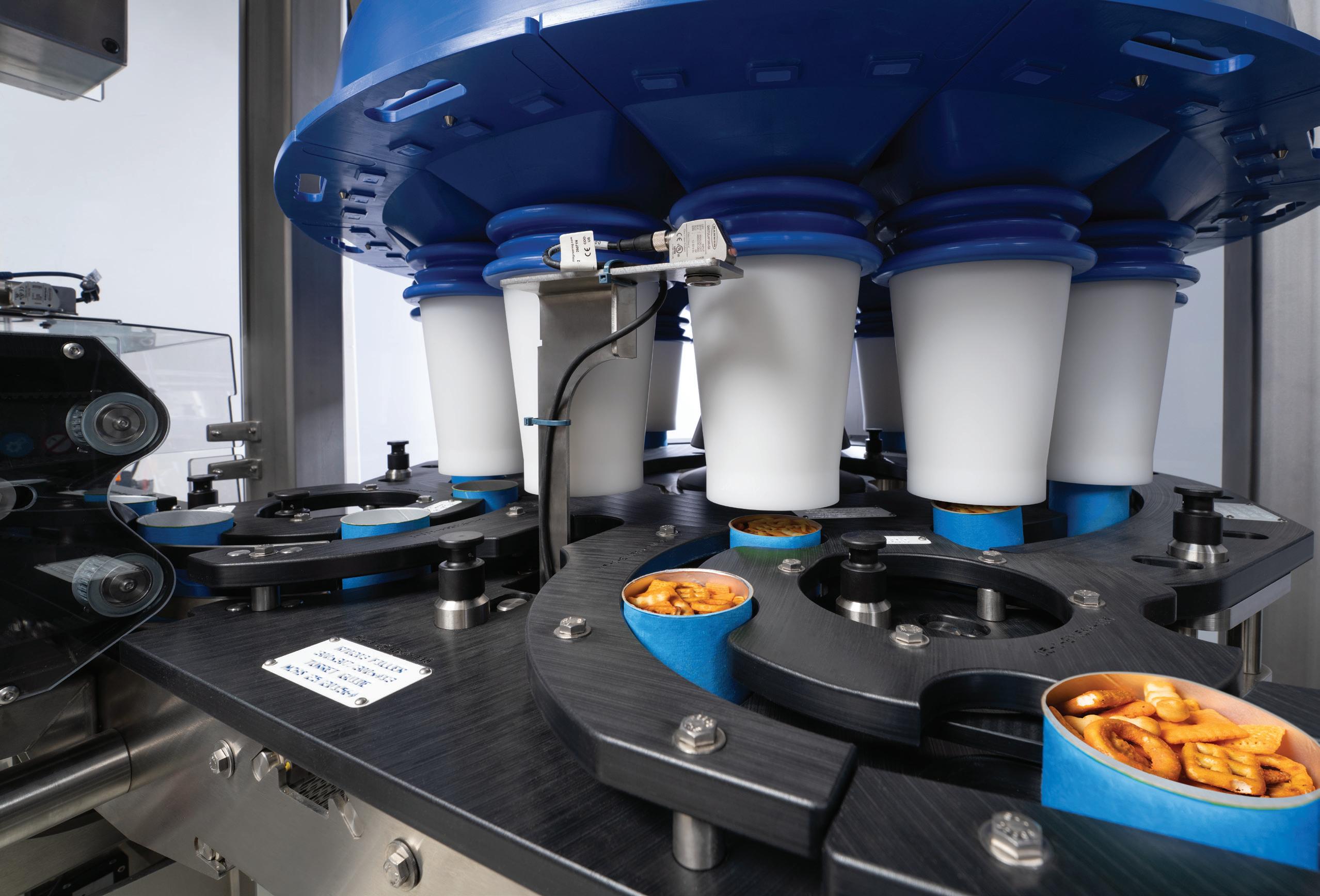
bottles. The new challenge is focused on source reduction, seeking recyclable, reusable, or refillable container and bottle solutions that minimize or eliminate virgin plastic while remaining operationally viable in existing retail supply chains. Suppliers are also being asked to meet increasingly stringent regulatory demands, including California SB 343 and SB 54 compliance, along with recyclability validation through frameworks like How2Recycle, APR [Association for Plastic Recyclers], and third-party repulpability standards.
As the Forum moves into more complex packaging categories, Cheryl Lam, director of Walmart Brands sustainability initiatives, said the larger opportunity lies in giving suppliers clearer direction from retailers on where innovation is most needed. “I’m hoping we build on this momentum, and we start really aligning on what our needs are in a more unified way for clarity for our supply base.”




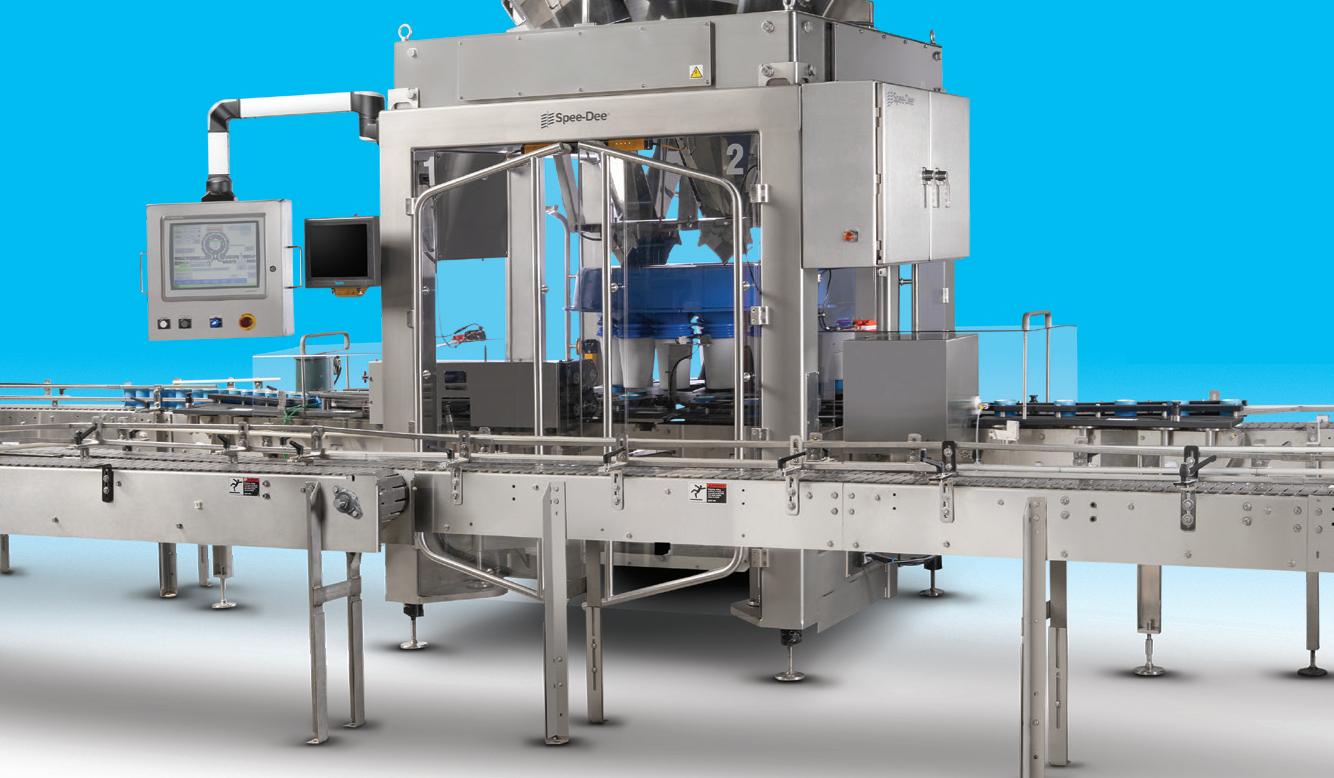
Olga Kachook, director of the Sustainable Packaging Coalition at GreenBlue, used SPC Impact 2026 to position the organization’s latest Sustainable Packaging Trends Report as a tool for companies trying to look beyond immediate regulatory pressure. “Mastering EPR compliance is an essential, inevitable part of today’s sustainable packaging landscape,” Kachook said. “But once we move beyond the complexity of implementation, we can begin to realize the benefits.”
That broader view shapes this year’s report, which outlines four major trends across packaging design, innovation, policy, and recovery. Kachook said sustainable packaging teams are under enormous pressure to manage reporting requirements, fee structures, and evolving legislation, but warned against treating compliance as a complete strategy. “The teams that treat compliance as a powerful tool within their broader strategies, as a foundation rather than a finish line, will move us meaningfully closer to realizing the promise of a circular packaging economy,” she explained.


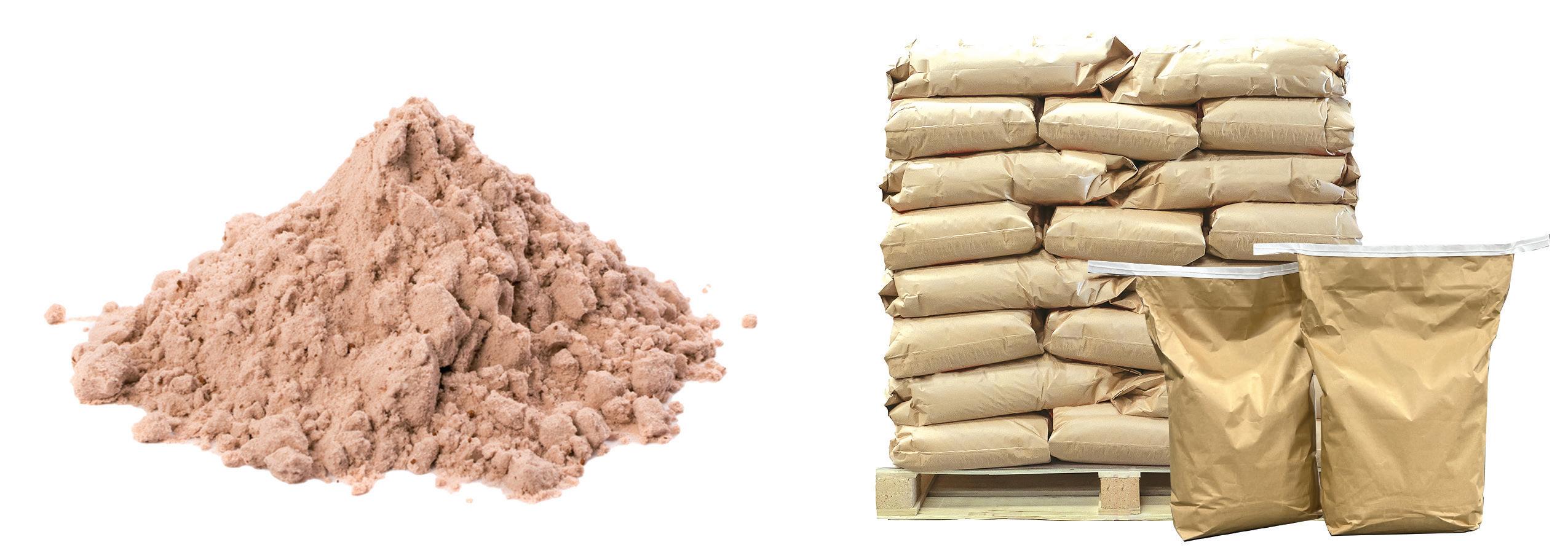






L delivers fully integrated solutions from fill to pallet designed, built, and supported in-house.

F m Industrial applications, our equipment por olio includes form fill & seal machines, bag ging systems, shrink bundlers, robotic palletizers, and more engineered to perform and built to last.


Your product. Our system. One seamless solution.





For companies waiting for regulatory uncertainty to settle before making major packaging changes, Kachook urged a more proactive approach. Rather than delaying action, she encouraged brands to “set your own certainty” by designing packaging portfolios around the assumption that requirements are likely to remain strict or become more demanding over time.
“What if you decided we’re going to take an approach that assumes that yes, even the smallest, most annoying components that we are kind of hoping might not have to be reported on, what if we determined and set for ourselves the certainty that I think they are included,” Kachook said. Building strategies around tougher assumptions now, she argued, can help companies avoid scrambling later as regulations tighten and reporting expectations expand.
A major focus of the report is how recyclability rules are becoming more clearly de ned across key global markets. Kachook pointed to Canada, the EU, and the U.K. as examples of markets moving toward more standardized recyclability de nitions, creating stronger design signals for global packaging teams. “The greatest opportunity lies in global
Flexible packaging recovery pathways are expanding beyond traditional store drop-off models, which has prompted SPC and How2Recycle to update label systems to help consumers navigate a growing range of disposal options.
At the conference, Brandi Parker presented new consumer research from the multi-company collaborative responsible for developing expanded label designs for lms that may be recovered through municipal drop-off, mail-back, and subscription services. The initiative builds on the current Store Drop-off label, which already bene ts from strong consumer familiarity.
According to SPC research, 73% of consumers recognize store dropoff as a recycling option for lms, while 92% of Americans live within 10 miles of a collection site. “We know that this is a successful collection method. We know that people are aware,” Parker said. “But we need to build upon it.”
SPC’s research showed that the most effective labels clearly communicate both material type and required action. Consumers responded best to labels featuring recognizable exible packaging imagery paired with active disposal instructions. Parker said the word “return” proved especially important, helping consumers understand that lm packaging requires an action beyond curbside recycling.
“The key here is you need to return it,” Parker said. “Whether you’re mailing it back or schlepping it somewhere, you’ve got to take it.”
As testing progressed, the collaborative also looked outward for design inspiration, drawing from packaging iconography being developed by EUROPEN. Its simpli ed exible package symbol offered a cleaner alternative to more detailed hand-based graphics. Parker said the updated design better aligns with How2Recycle’s broader label refresh while also improving speed of consumer comprehension.
Mastering EPR compliance is an essential, inevitable part of today’s sustainable packaging landscape.
harmonization,” the report states, as more consistent de nitions could help companies design packaging portfolios that can perform across markets rather than reacting region by region.
Kachook also highlighted healthcare and OTC packaging as an area where sustainability innovation is nally accelerating despite historically strict product safety requirements. “Prescription pill bottles are a massive, completely untapped opportunity that no one has touched,” she said, pointing to paper bottles, re ll systems, and material substitution as signs that even heavily regulated categories are beginning to shift.
Across the report, Kachook’s larger point was that companies need to use this period of regulatory disruption to rethink packaging more fundamentally. “Companies that zoom out today to plan for the bigger picture will be better positioned to handle any turbulence tomorrow.”

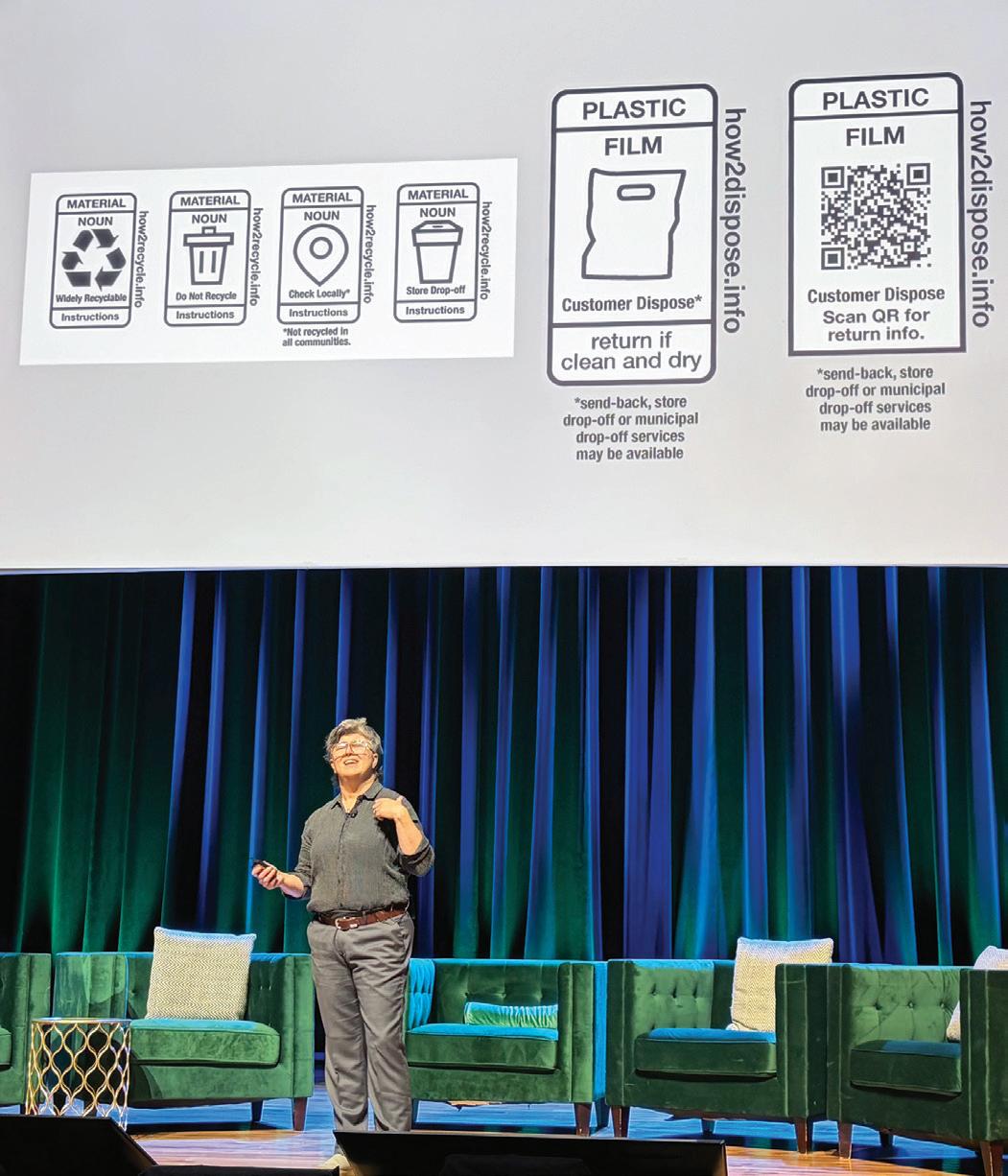
“This [icon] could be read as a piece of primary packaging, not just a shopping bag,” Parker said, noting that the simpli ed symbol offered broader applicability across exible packaging types.
The label framework remains under re nement, with the goal of helping consumers more quickly understand how and where exible packaging can be recovered as collection options continue to expand. Notes the SPC report, “As lm packaging collection evolves, clear onpack communications will play a critical role in connecting consumers to the right recovery pathways.” PW


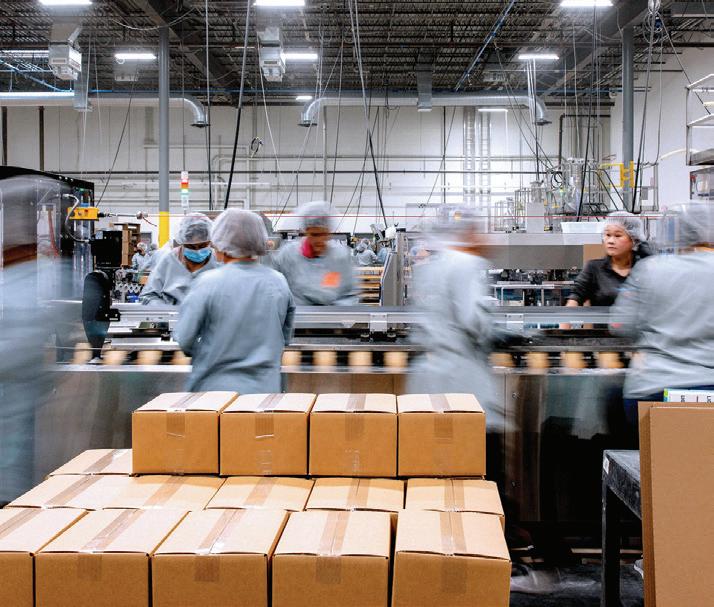


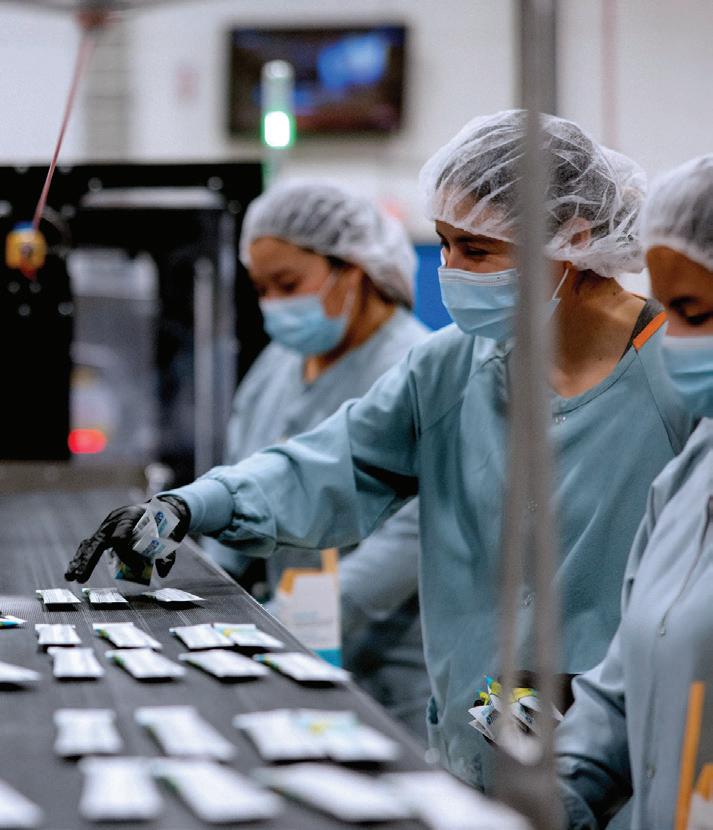


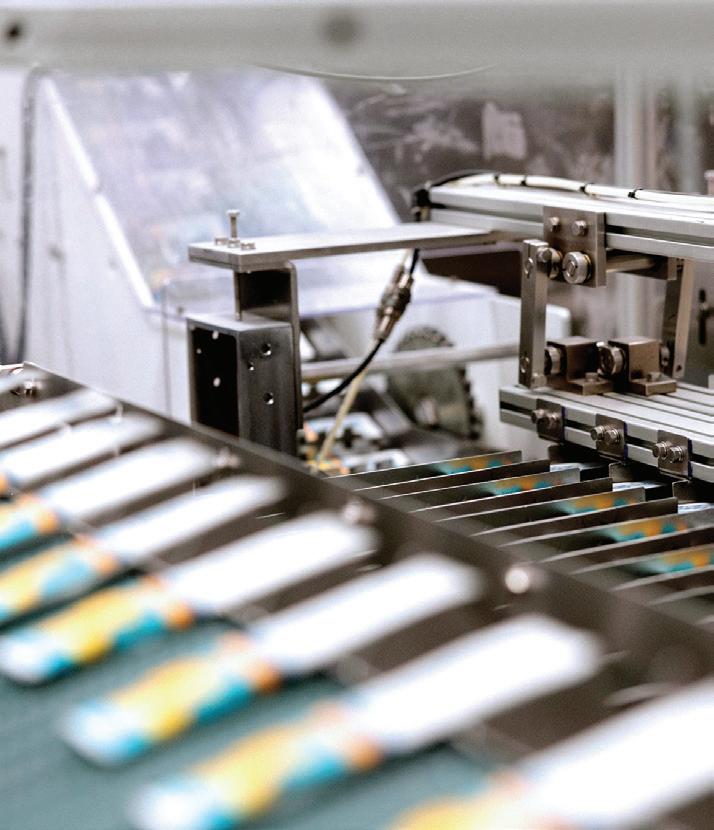
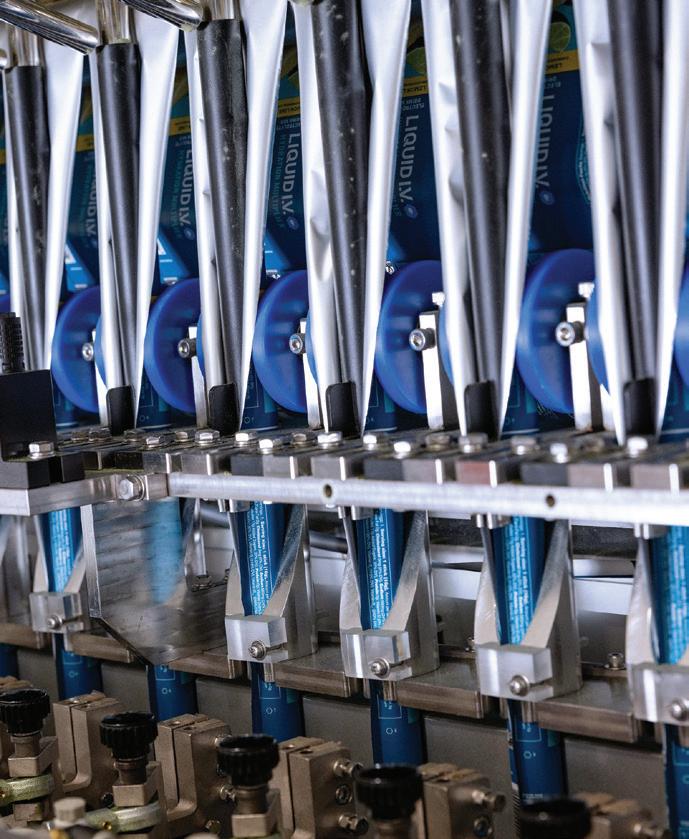
BUILD YOUR PRODUCTION, ON YOUR TIMELINE. WE’LL MEET YOU WHERE YOU ARE AND GROW FROM THERE.
We introduced Sanko single-serve machinery to North America in 1996. We run it, sell it, and service it better than anyone in the country. Co-pack with T.H.E.M. while you build. Own a Sanko line when you’re ready.
Along the way, you’re backed by the same team, the same standards, and a partner who’s already seen what comes next.
BILLIONS PACKAGED ANNUALLY. DELIVERED SAFELY, EVERY TIME.




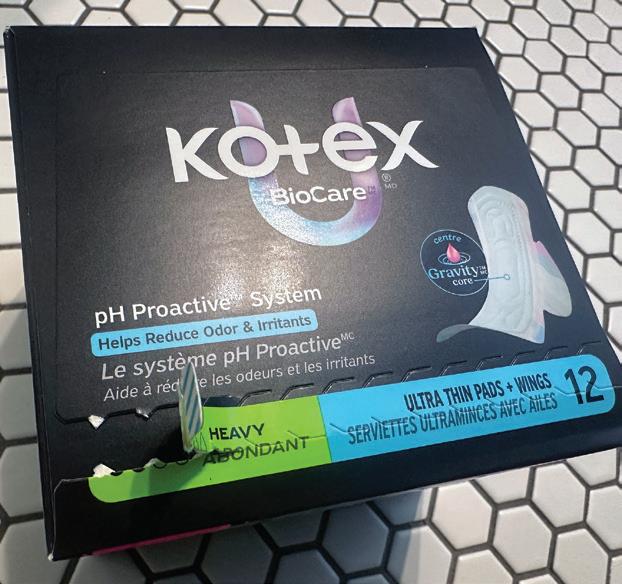
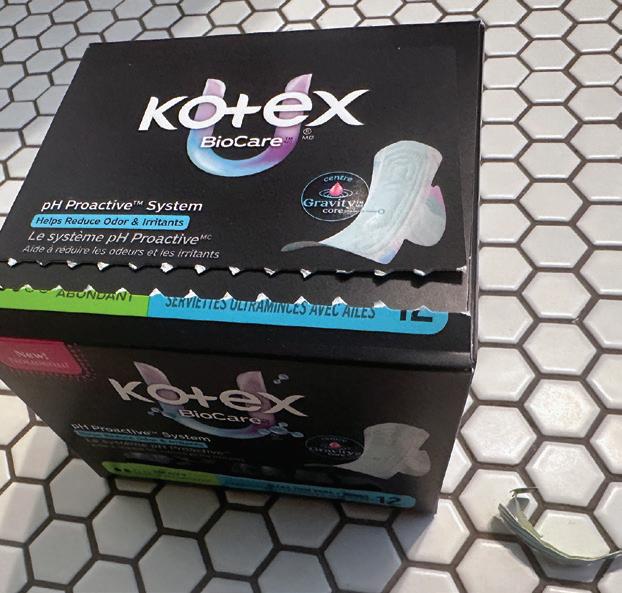
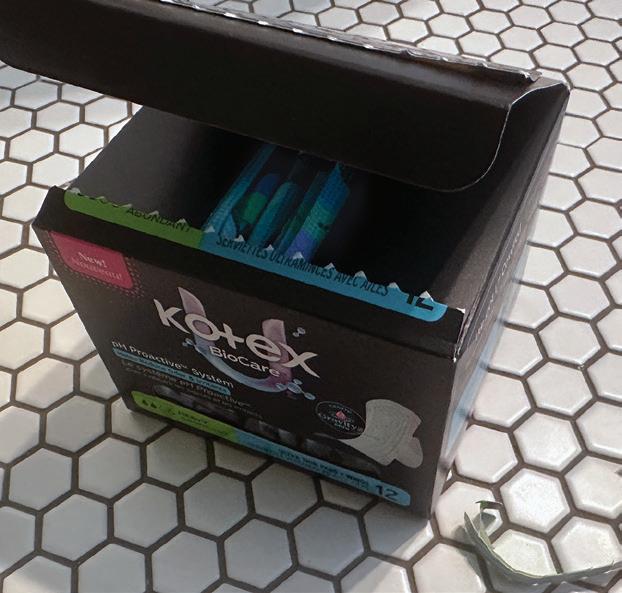
Left to right: The back-panel perforation is engaged, the tear strip is removed, and the carton opens into dual flaps—creating a wide, accessible opening for product retrieval.
Kimberly-Clark’s Kotex transitions from plastic film polybags to recyclable cartons, introducing dual-panel opening, integrated windows, and premium finishes that are all engineered for improved in-home use and machinability with existing automation equipment.
By Matt Reynolds, Chief Editor
Kimberly-Clark’s Kotex brand is rolling out a full packaging redesign across its portfolio of pads, liners, and tampons. The move replaces a significant portion of its traditional polybag formats with recyclable cartons that incorporate new structural features, better visibility on the shelf, and premium decorative elements.
At the center of the redesign is a shift toward functionality in the home, particularly how consumers open, store, and repeatedly access the product. The updated cartons feature a new dual-panel opening system located on the back of the pack, designed to accommodate multiple storage orientations and usage scenarios.
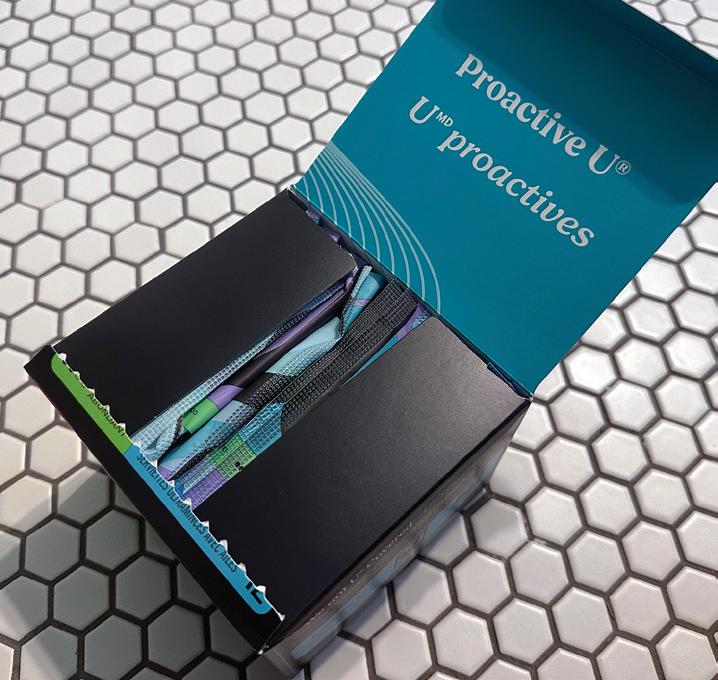
“We added an easy-open and reclose feature on two different panels to provide the consumer with flexibility and easy access to product whether they lay the box flat or upright,” says Chris Bechyne, senior team leader, packaging, at K-C.
The structure was informed directly by consumer feedback around everyday use, particularly the need for secure closure and adaptability across different storage locations in the home.
“Consumers told us a secure closure and ability to store in different locations at home was important,” Bechyne adds.
A notable aspect of the redesign is the transition from flexible
The back-panel, dual-opening feature creates a wide dispensing aperture, with two flaps that separate to allow access whether the carton is stored upright or flat.
packaging to folding cartons across much of the portfolio. The move not only enables recyclability, but also introduces new structural and visual opportunities not possible with polybags. Among them is a product window integrated into the carton, allowing consumers to view the individually wrapped pads or liners prior to purchase. This is an uncommon feature in the category, the company says.
“Because she likes to see what’s inside, we made sure the product is easy to view in the window, before buying,” says Kristi Schroeder, design strategy director, K-C.
The cartons also include a hidden interior print element intended to create a moment of engagement at first use, reinforcing brand identity beyond the shelf.
“Kotex brought back the essence of our brand and added a little surprise to spark joy when she opens it,” Schroeder says.
From an engineering standpoint, integrating a window into highspeed, high-volume carton automation required careful attention to

structural details and automation compatibility. The team refers to the feature as an internal window, designed not just for visibility but for manufacturability within existing cartoning constraints.
“The window placement was carefully designed to be fully compatible with the cartoner during carton forming,” Bechyne explains.
To achieve this, K-C optimized glue-application tolerances and engineered precise spacing between carton scores and the window cutout to ensure the feature would not interfere with automated forming. The placement and geometry of the window were also aligned with the folding sequence of the carton, helping maintain structural integrity and consistent performance on the line.

“We aligned the product’s ideal in-carton orientation with the automation sequence to support a consistent consumer experience,” Bechyne says.
These adjustments allowed package designers to introduce new structural features, such as windowing, dual openings, and reclosure, without compromising cartoning efficiency, the company says.
The packaging overhaul coincides with a reimagined lineup of pads and liners, including Ultra Thin, Bamboo, Biocare, and Teen variants, along with Night Defense options, which required corresponding updates to packaging formats. Changes in product form factor drove refinements in both carton dimensions and structural elements.
“Packaging dimensions and structural elements were refined to match the new and improved product forms across the lineup,” Bechyne says.
At the same time, Kimberly-Clark worked closely with key retail partners during development to ensure pack configurations aligned with shelf requirements and merchandising expectations. That collaboration helped the brand maintain a cohesive, consistent presence across a wide SKU range while optimizing how the products block and present at retail.
The shift from poly bags to cartons also opened up new opportunities on the graphics side. With more printable surface area, Kotex leaned into a design approach inspired by beauty and skincare packaging, emphasizing bold, confident visuals, strong contrast, and a more elevated aesthetic.
“We drew inspiration from her favorite beauty brands and translated that simplicity into the Kotex experience,” Schroeder says.
A key element of the redesign is bringing the Kotex brand more prominently to the forefront, leveraging its heritage while using the iconic “U” design as a telegraphic visual cue to communicate product
The carton’s embossed back panel directs finger placement (demonstrated with a green pen here) to a perforated opening feature; once opened, the dualpanel design creates a wide aperture that exposes product orientation, interior print, and the integrated window.
benefits and differentiate variants across the portfolio.
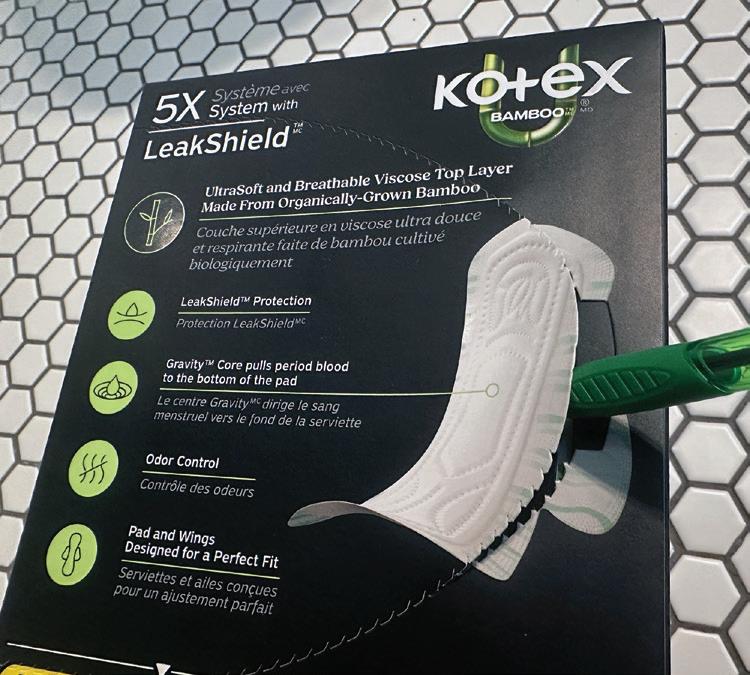
While the underlying printing process remained unchanged, the transition to cartons enabled the use of additional decorative techniques and a broader design palette. Embossing was introduced to create tactile dimension, while high-gloss accents help draw attention to key brand elements and improve shelf impact.
“This transition allowed for a broader design canvas, resulting in an increased number of colors compared to the previous packaging,” Schroeder explains.
Despite the expanded SKU set, the brand maintained a cohesive shelf presence through consistent use of black as a primary color and structured visual hierarchy across packs.
“Strong black brand blocking keeps Kotex instantly recognizable on shelf, while distinct U-variant differentiation helps her quickly find the product that best fits her needs,” Schroeder says.
Kimberly-Clark partnered with Landor as its strategic brand design
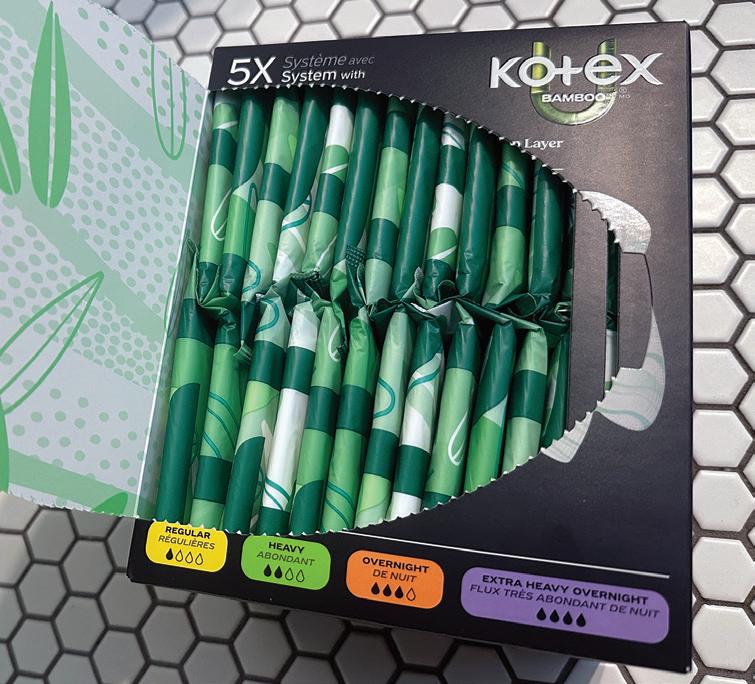
partner, responsible for shaping the overarching brand identity and system, while Kay James Design led the development of product-level aesthetics. Together, the partners worked to align structural and visual elements into a unified packaging experience.
Executing the redesign at scale required balancing design ambition with operational and commercial realities, the stakeholders say, particularly given the scope of replacing all SKUs across the portfolio.
“The biggest challenge was balancing the technical requirements and tight timelines while still preserving the core design strategy,” Schroeder says.
The effort also involved integrating retailer feedback and coordinating across product, packaging, and manufacturing teams, resulting in a packaging system designed to function both on shelf and in the home while meeting the demands of high-speed production. PW

Faced with high labor turnover, tight floorspace, and nearly 900 SKUs, Nyco Products turns to modular cobot palletizing to stabilize end-of-line operations, improve throughput, and create a more sustainable workforce model.
By Anne Marie Mohan, Senior Editor
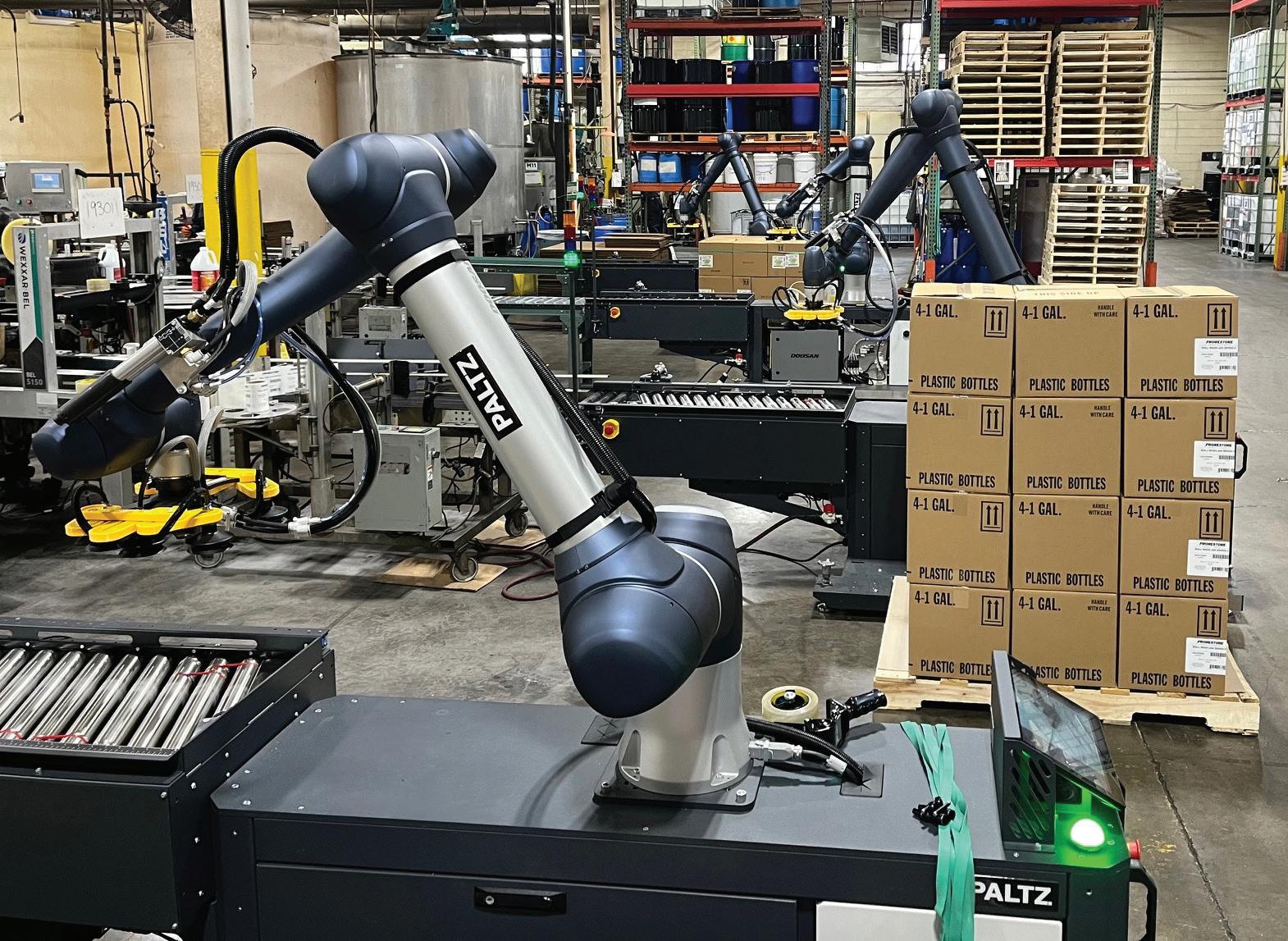
Nyco Products, a 106-year-old manufacturer of specialty cleaning chemicals, blends and packages products for facility maintenance, foodservice, HVAC, industrial cleaning, and other applications. With more than 300 formulations and nearly 900 SKUs, the Countryside, Ill.-based company has experienced steady growth in both product variety and production demands. Combined with ongoing labor pressures, that growth began to strain end-of-line operations, making manual palletizing more difficult to sustain efficiently.
Nyco Products has deployed four modular cobot palletizing systems across its end-of-line operations, enabling flexible, space-efficient automation to support high-mix production and reduce reliance on manual stacking.
a compact, flexible system that could handle high SKU variability without extensive guarding or line redesign.
“Labor availability and significant turnover had been an increasing issue over the past three years,” says CEO Bob Stahurski. “As absenteeism increased, we were forced to utilize our upskilled labor for palletizing and stacking, resulting in increased costs and reduced productivity.”
According to the company’s internal assessment, turnover in stacking roles averaged roughly every 90 days, creating both operational inefficiencies and morale challenges. As labor pressures intensified, the company began evaluating automation options for palletizing.
In Nyco’s search for an automated solution, equipment footprint was the top consideration. “We have some space constraints in our facility,” Stahurski explains. “We have five lines in one area that are fairly tightly placed together, so we were looking for a solution that would meet those needs.”
The company reviewed conventional robotic systems but found them difficult to accommodate within the available footprint. It needed
Nyco ultimately selected four IP54-rated PALTZ cobot palletizing systems from beRobox. Three of the systems are PALTZ.C30 units, featuring a 30-kg payload capacity and a maximum height of 92 in., including the pallet. The fourth is a PALTZ.C20 palletizer. The system has a maximum payload of 20 kg and a height of 60 in., including the pallet. The four palletizers are fully collaborative and operate at 6.5 cycles/min.
All four cobots use end-of-arm tooling fitted with four vacuum cups for picking cases. The cups are divided into two independently controlled zones, which enables the cobot to handle different case sizes or patterns. All four also feature a skewed conveyor that presents cases in a consistent position and ensures accurate pick points for the vacuum EOAT.
The PALTZ system uses an HMI equipped with beRobox STACKiT palletizing software, which drives much of the system’s flexibility. Operators select preconfigured programs through the software interface to match each product and case configuration. “Operator changeover is very, very quick,” says Stahurski. “We use touch menus in our system, which gives us incredible flexibility at the end of the line”—a critical capability for managing hundreds of SKUs and frequent changeovers.
The systems were deployed at the end of four production lines and run across two shifts with varying stack configurations. Their modular

design allows Nyco to expand or adjust capacity without reworking the full line. “They are designed and deployed as standardized, self-contained palletizing modules that can be added, replicated, relocated, or scaled without redesigning the rest of the line,” Stahurski explains.
The compact footprint and collaborative design allow Nyco to operate without traditional guarding. “By controlling speed and height limitations, we are able to stay in compliance without the screen cages or light zone sensors,” says Stahurski.
Because of footprint limitations in the line length, the system’s dualsided palletizing is critical. As Stahurski explains, one operator can clear pallets from several lines without any disruption in case delivery to the palletizer.
Speed of implementation was also a key factor in Nyco’s decision. After Stahurski saw the palletizing system in operation in a YouTube video, the company moved from initial contact with beRobox to an in-plant demo within two weeks and had a unit running, with “some minor tweaking and menu adjustments,” within a day of arrival.
Stahurski says that very little end-of-line modification was required. Some power and air lines were preinstalled, and the PALTZ units were connected with a 3-ft roller conveyor from Nyco’s case sealers. This ease of integration allowed the team to quickly evaluate the system under real production conditions.
“It was supposed to be a one-week demo, but we negotiated one
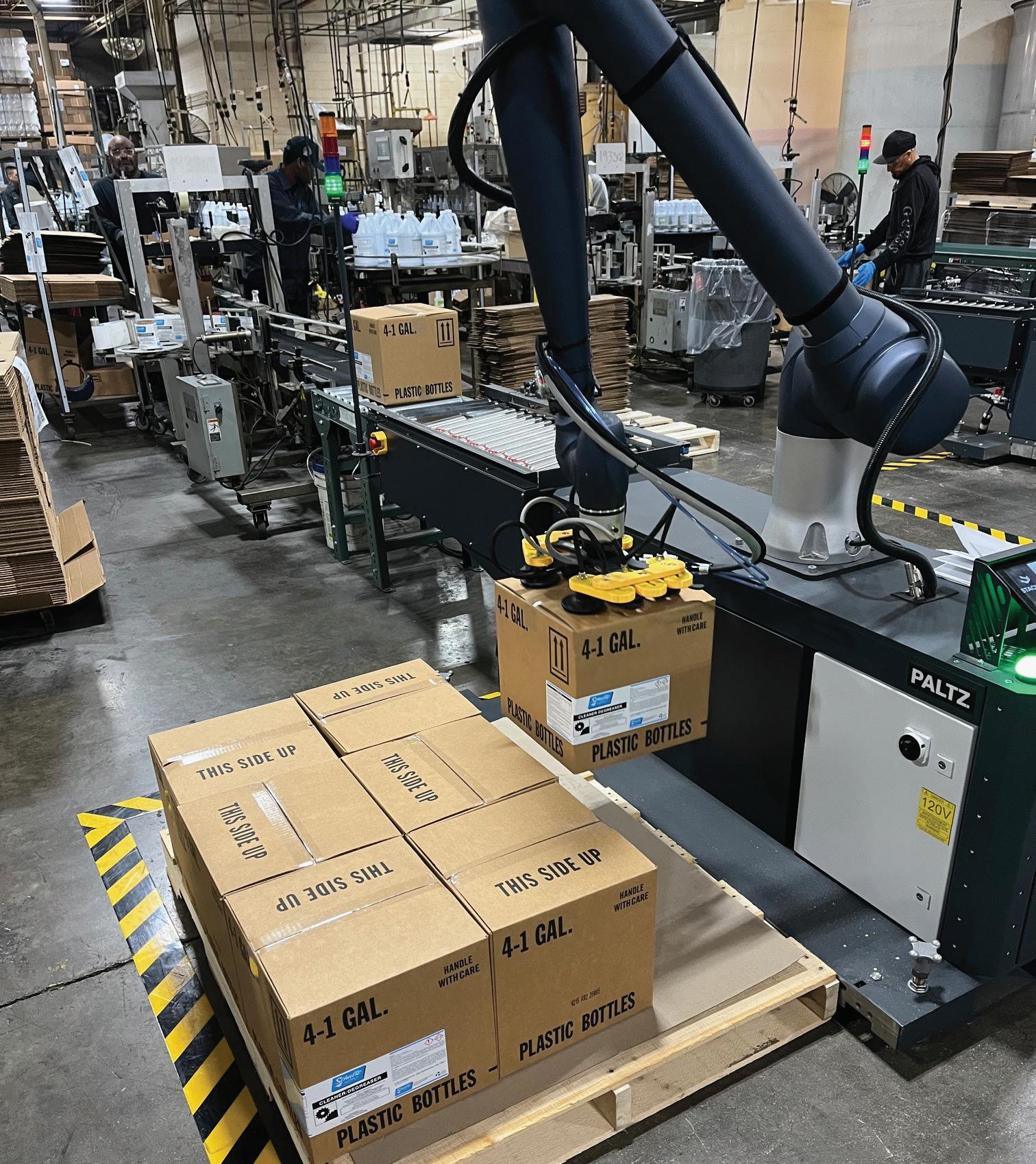
This cobot palletizing system handles cases containing four 1-gal containers with precision, using vacuum end-of-arm tooling to ensure consistent placement and stable pallet builds across varying configurations.
month so we could move it across multiple lines and see the integration with different packaging,” Stahurski says. That hands-on trial allowed Nyco to validate performance across its operations before committing to a broader rollout. Once the first unit proved successful, the company moved quickly to scale the solution.
The approach reduced risk while enabling rapid adoption. “Here we are, we’re about 60 days, maybe 70 days later from the day I watched that YouTube video, and we’ve got four units running highly functional in our facility today,” Stahurski says.
Since installation, Nyco reports an 11% increase in overall throughput. The system supports a range of pallet configurations, including 36 cases/pallet for gallon containers and 50/pallet for smaller formats.
Labor impacts have also been significant. The company has reduced headcount by six full-time equivalents and cut temporary labor by 61% year to date. At the same time, roles have shifted toward more skilled work. “We have significantly reduced turnover in the stacker role while transitioning that position into a highervalue cobot operator and setup role,” Stahurski says.
He emphasizes that clear communication and employee involvement played an important role in adoption. “There is an important factor to consider when introducing automation. Stating the project objective is critical,” he says. “Our employees raised the high turnover as an issue. Our machine operators embraced the technology very quickly because it increased productivity and reduced continual training as a result of the high turnover.”
Two employees have already moved into cobot programming and system oversight roles, reflecting a broader effort to upskill the workforce. “We’re on a directive right now where we’d like to get our lines running this year with one operator per line,” says Stahurski. “That’s a significant labor reduction so we can keep the best, upskill our workforce, provide higher wages, and create better efficiencies and consistency in our facility.”
The financial return has also met expectations. “Our estimated calculation is about a 1.88-year payback on the ROI on the equipment,” Stahurski says. “Anything under three years is the gold card for us, so 1.88 years was not a big decision for us in making this investment.”
Beyond labor, productivity, and ROI, pallet quality has also noticeably improved. According to Stahurski, pallet stacks are consistent every time. “The tolerances are very tight, and case placement is perfect on the pallets,” he says.
One unexpected benefit has been the visual impact of automation. “It’s a whole different tour now when we bring a customer or prospective customer through the facility,” Stahurski says. “Last week we had a customer bring 16 people from their company on an operation tour. Everyone loves to watch these cobots operate. It’s a statement of our continued commitment to investing in the facility and our business.”
Looking ahead, Nyco plans to expand its modular palletizing to other lines (it has eight in all) and is evaluating automated case packing, including cobot-based solutions. PW
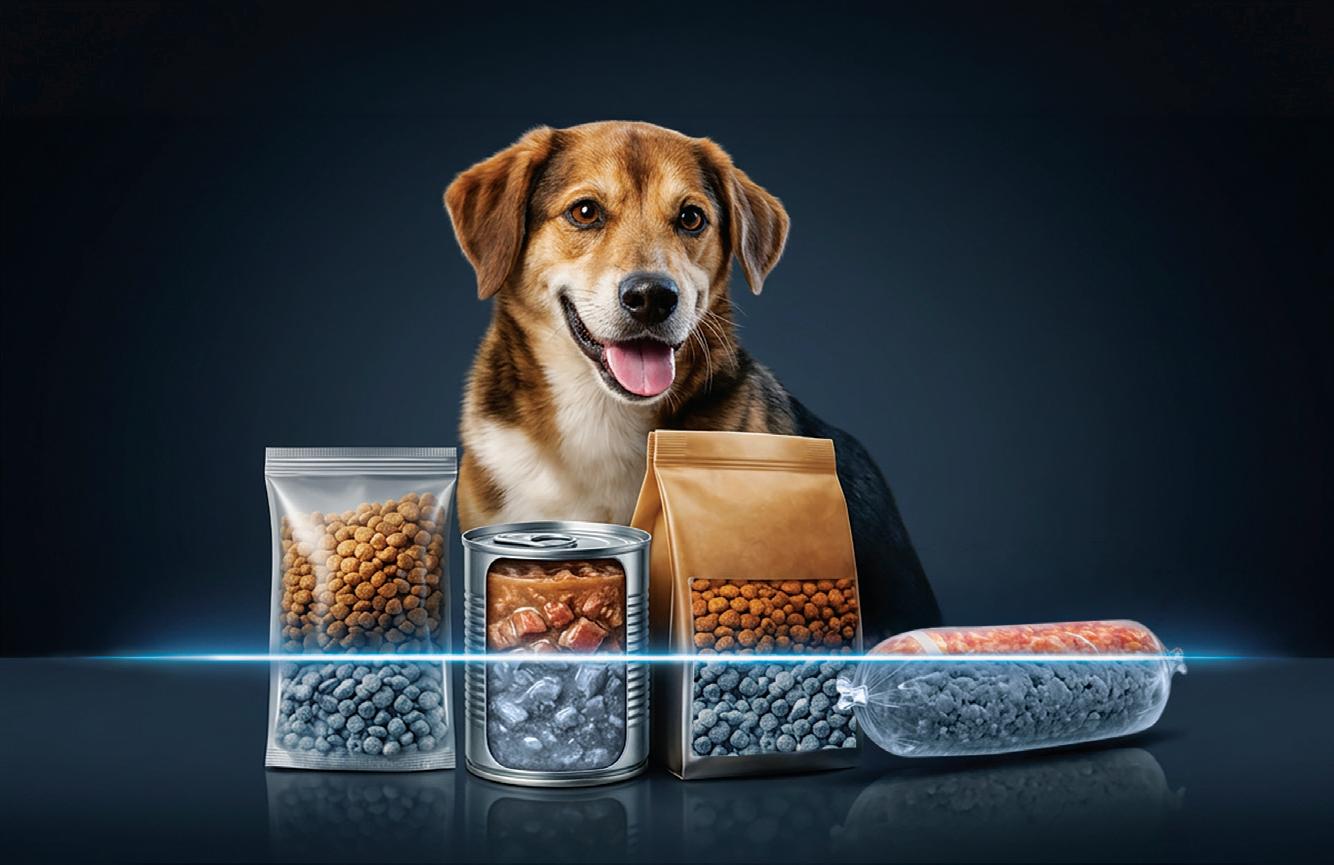
Today’s pet food manufacturers face growing demands for safety, accuracy, and efficiency. Wipotec delivers advanced X-ray inspection and dynamic checkweighing solutions designed for pet food applications — from stand-up pouches and cans to large bags and fresh pet food packs.
Reliable foreign body detection
100% weight compliance
Reduced product giveaway
Improved line performance
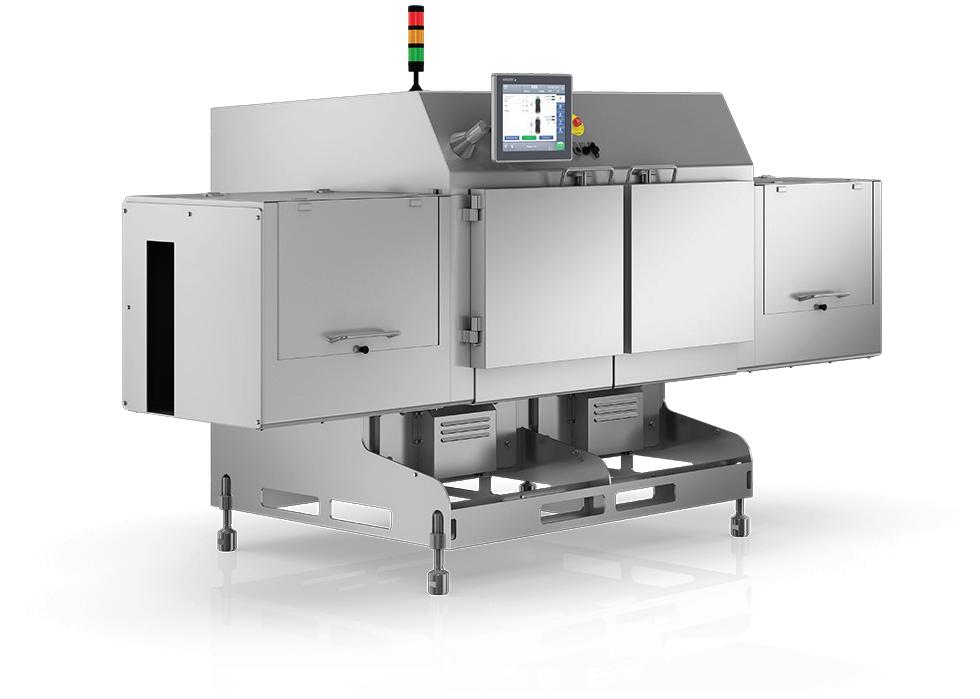
FANUC’s CRX-3iA—an ultralightweight cobot that supports tasks like case handling, palletizing, and inspection— can be carried and set up in minutes to quickly redeploy automation across high-mix packaging lines and end-of-line operations.
FANUC America pwgo.to/9093


Mespack’s HKE Series uses an electronically controlled vertical carousel for precise, single-grip pouch handling, enabling greater stability, higher speeds, automated changeovers, and consistent seal quality across roll-stock and pre-made formats. Mespack, a Duravant company pwgo.to/9103

TemperPack’s WaveKraft paper-based mailer— which delivers up to 80% better cushioning and has a gusseted structure to open wide while maintaining shape—helps e-commerce brands replace boxes with a more ef cient and sustainable solution. TemperPack pwgo.to/9092
Theegarten-Pactec’s FPC6—a high-speed, exible system designed for products like chocolate, cereal, and snacks—combines exible material handling, automated operation, and integrated cartoning for reliable, high-quality packaging.
Theegarten-Pactec pwgo.to/9095


Cheer Pack N.A.’s SqueezeNSip spout integrates Aptar’s SureSnap ow-control valve technology to provide leak-resistant, on-demand dispensing with clean cutoff, customizable ow rates, and food-safe materials for a controlled, hygienic user experience.
Aptar Closures
Cheer Pack North America pwgo.to/9091
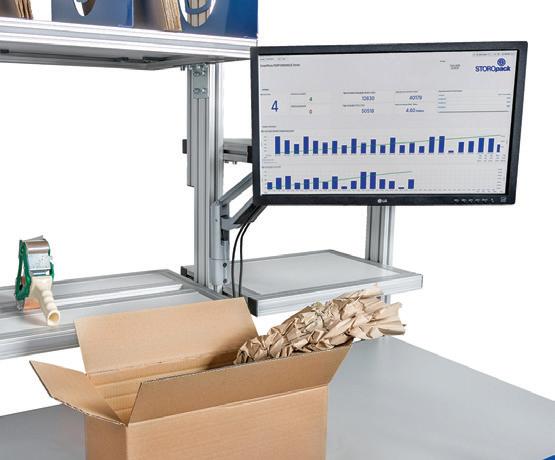
Sidel’s Returnable PET – Still Water is a reusable bottle for still water applications with a lightweight, durable design that withstands up to 25 washing cycles while supporting customizable branding and full compatibility with PET recycling streams.
Sidel pwgo.to/9098



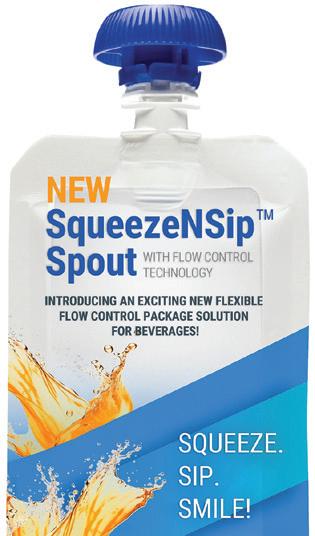


Storopack says its SmartPack.PERFORMANCE Portal is the industry’s rst digital solution that provides real-time monitoring and analysis of packaging material consumption to improve ef ciency and support automation and sustainability initiatives.
Storopack pwgo.to/9106
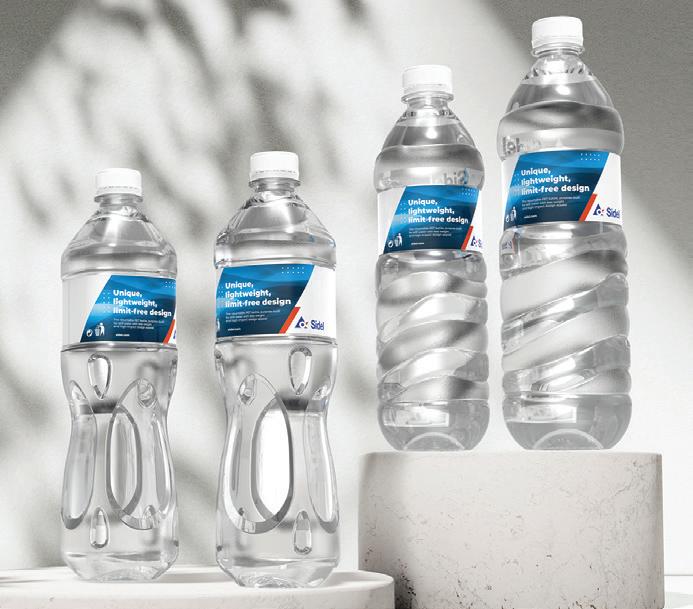
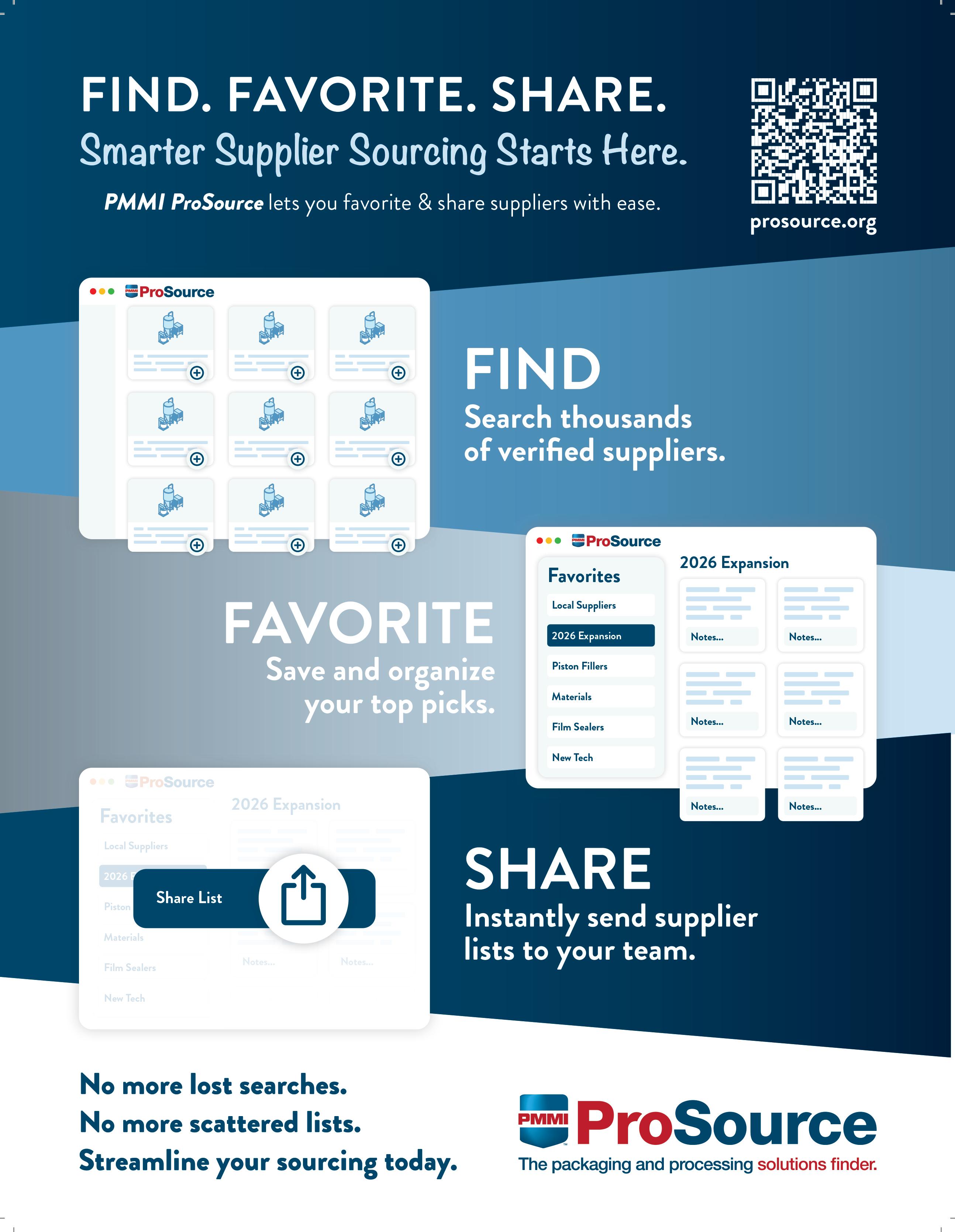
Domino Printing Sciences’ Egg Pack Printing Traverser integrates its Gx Series thermal inkjet printers with a traverser platform to improve accuracy, traceability, speed, and efficiency while reducing operating costs in egg packaging.
Domino Printing Sciences pwgo.to/9097
ABB Robotics’ PoWa cobot family offers payloads from 7 kg to 30 kg, speeds up to 5.8 m/s, and extended reach to enable flexible, industrial-grade automation for packaging applications such as palletizing in compact collaborative environments. ABB Robotics pwgo.to/9101
Siegwerk’s UniLEAF, which stands for “Low Energy Acrylic Free,” is a water-based flexographic ink that uses bio-based polymers to reduce carbon footprint and lower drying energy consumption while maintaining high performance and efficiency. Siegwerk pwgo.to/9102
Michelman’s Nuvita Life 4002 and Nuvita Life 4605 are two plastic-free barrier coatings designed to provide heat sealing, oil and grease resistance, and moisture protection for recyclable and compostable fiber-based food packaging applications.
Michelman pwgo.to/9105
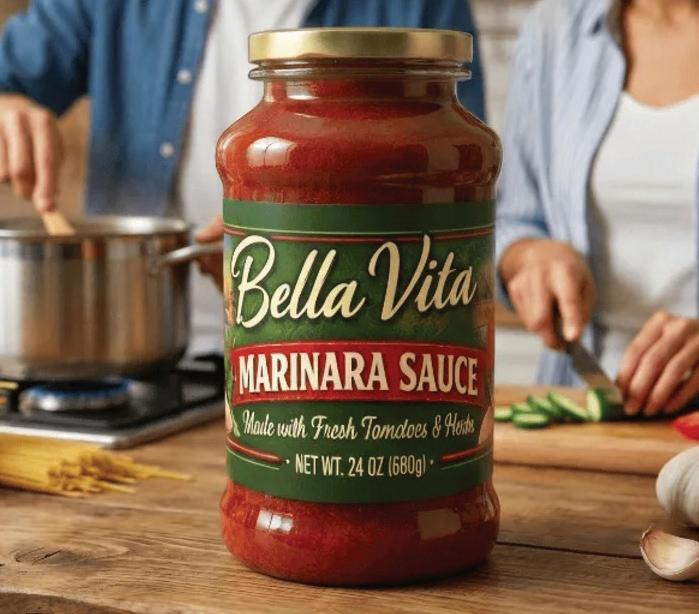
Amcor’s upgraded Apex PET jars feature metal lug closures and Elevate technology, designed to improve hot-fill performance and durability, reduce shipping weight and breakage compared to glass, and support customizable packaging.
Amcor pwgo.to/9099
Reelables says its Anywhere label is the first printable smart label for Bluetooth and cellular networks that enables real-time, item-level tracking of shipments worldwide, giving companies continuous visibility across the supply chain at a low cost.
Reelables pwgo.to/9089
ALPS Inspection’s FlexPitch Solo Moving-Head Leak Testing System is designed to improve inspection accuracy and container stability for difficult-to-handle plastic bottles and containers at speeds up to 200 containers per minute.
ALPS Inspection pwgo.to/9107
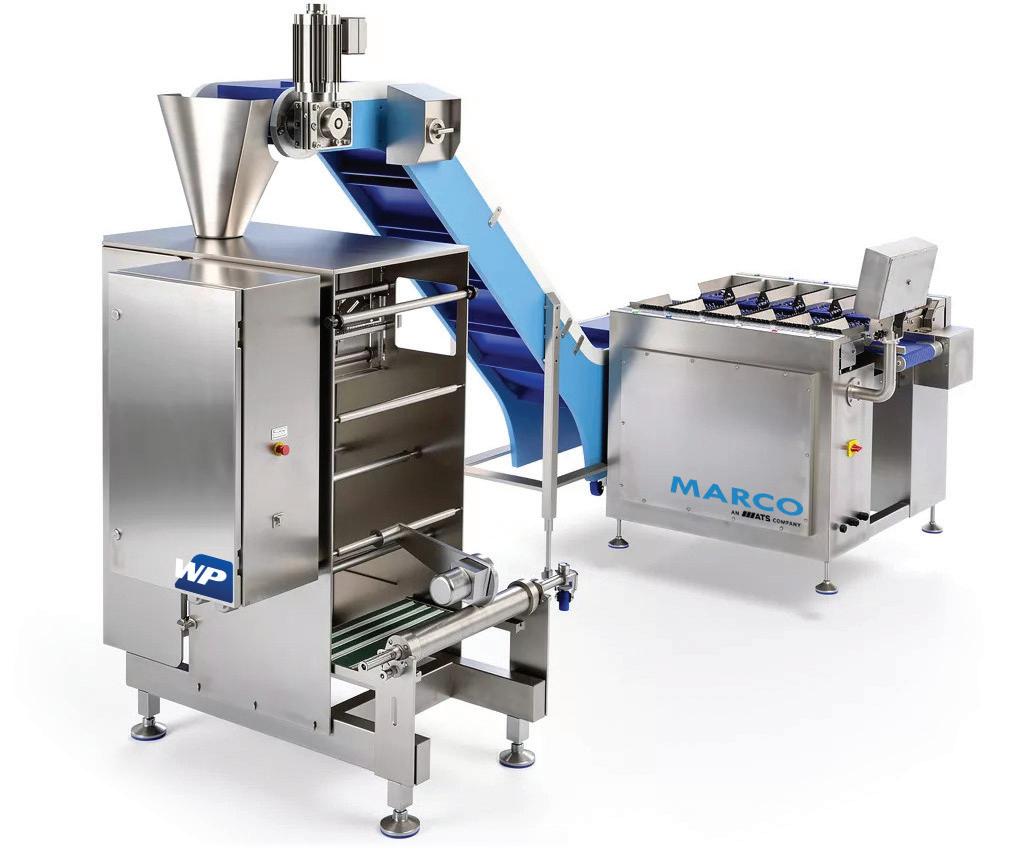
This system combines MARCO’s SelectMaster Automatic Weigher with Paxiom’s VerTek 800 VFFS bagger to create a streamlined, automated workflow—from weighing to finished package— with gentle handling, accurate weighing, and reduced waste.
Paxiom Group, an ATS company MARCO Limited, an ATS company pwgo.to/9104
Fox IV’s 5961 Compact delivers high-resolution, small-format labeling in a space-saving design, combining flexible label handling, integrated print technology, and user-friendly controls for efficient operation in tight production environments.
FOX IV Technologies pwgo.to/9096

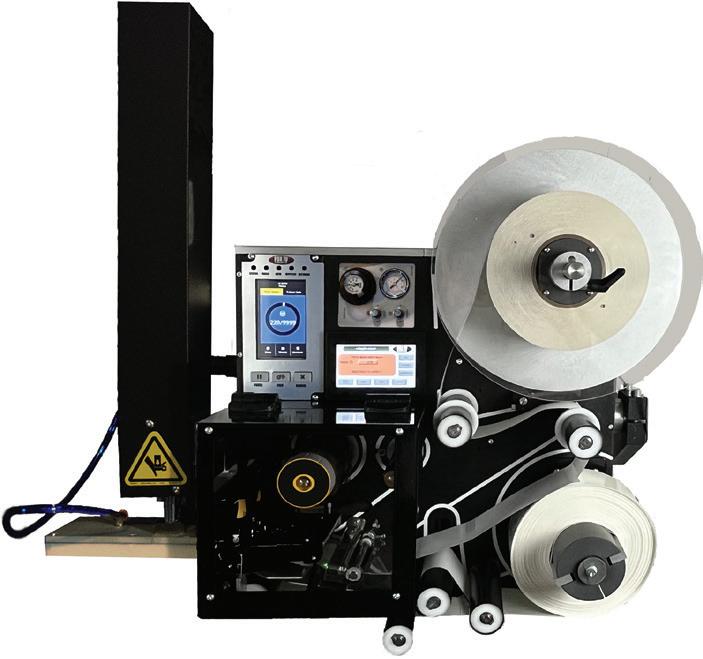
Neopac’s NeoDose Solo combines a recyclable mono-PE pump with a highbarrier Polyfoil tube to deliver oxygen and moisture protection, precise dispensing, and compatibility with PE recycling streams for sustainable skincare brands.
Hoffmann Neopac AG pwgo.to/9074

ProMach acquires UK bottling and packaging provider Evolution BPS
PolyExpert Inc. and Polykar Industries Inc. announce the merger of equals to form flexible packaging platform Invera Flexibles.
Yaskawa America, Inc. acquires Colombia-based drive supplier Variadores SAS
MECH-I-TRONIC expands into the Americas with the acquisition of Apex Machine Company (U.S.) and RK Ferramentaria (Brazil).
International Paper agrees to acquire North Pacific Paper Company (NORPAC)
PLAN IT Packaging announces an expansion to its Toronto/Mississauga operations.
Handle-It Inc. celebrates 50 years of providing end-of-line packaging equipment and material handling solutions.
Hamrick Packaging Systems names Jordan Hamrick president and CEO, succeeding Phil Hamrick, who will transition to chairman of the board.
Charter Next Generation appoints Mark Howell executive vice president of sales.
Econocorp promotes Bob Kuzmich to vice president of sales.
Stephanie Ochoa is named Morrison Container Handling Solutions’ sales representative for Mexico.
The Flexible Packaging Association announces its 2026 Board of Directors, with Russell Grissett of Sealed Air Corporation continuing as chair, Kevin Keneally of PPC Flex elected executive vice chair, and David Love of Printpack re-elected treasurer.
Michigan State University names Dr. Brian Via director of its School of Packaging, which has been granted a $47 million gift for expansion from alumnus Chuck and Jackie Frasier
Squid Ink hires Ryan Sparacino as district sales manager – Southwest.
SUN Automation Group names Dawn Wittkopf West Coast capital equipment sales manager.
The EOL Group appoints Roger Schmidt chief executive officer, succeeding Sebastian Jost, who transitions to chief operating officer.
Nicola Magriotis is appointed chief sales officer of the Romaco Group.
Dan Semanskee retires as chief financial officer and treasurer after 25 years with Formost Fuji Corporation.

Robert H. Chapman, who assumed leadership of Barry-Wehmiller after his father’s death in 1975 and recently handed the reins to his son, wrote about his people-centered philosophy in the bestselling book Everybody Matters: The Extraordinary Power of Caring for Your People Like Family.

By Chaitanya Arekar, CPP
Traditionally, packaging has focused on ensuring physical integrity—using a hierarchy of primary, secondary, and tertiary layers to protect products and communicate usage to customers. However, as we enter the new age of AI, the landscape is rapidly changing. Today’s AI hardware is heavy, fragile, and densely packed, requiring swift movement and assembly to support demanding training and inference workloads. This shift calls for packaging to evolve beyond its conventional role, becoming a functional tool that actively enables rapid deployment. Here are four ways packaging can accelerate AI deployment:
1. Packaging for automation: To keep the pace of AI deployment, packaging must be engineered for machine interfaces as primary users. This new focus unlocks a range of possibilities. For instance, packaging can incorporate latching surfaces, allowing Automated Guided Vehicles (AGVs) to register or attach to packaging for repeatable, precise handling. Additionally, packaging can be designed for robotic gripper access with features that minimize slippage and ensure secure manipulation. These enhancements help robots handle products consistently so packaging can be manipulated reliably, thereby reducing the risk of dropped or damaged goods. Furthermore, smoothing and structurally reinforcing package surfaces ensures that both the product and the robotic equipment remain protected during automated handling.
2. Packaging as a fixture: Building on the need for automation, another major challenge in large-scale AI clusters is cable management. Dense interconnecting cables often lead to tangled wires and disorganization, commonly referred to as the “spaghetti” problem. Here, packaging can serve as a fixture, offering solutions by pre-organizing cables before installation. For example, comb-like structures integrated into the packaging insert can hold cables in their final, indexed position. Further, instead of packaging each cable individually, which consumes unpacking time, packaging can be designed to act as a spool, allowing technicians to pull cables at scale and reduce set-up times.
and verification while the hardware remains secure in the packaging. These capabilities further reduce unpacking time and non-valueadded work.
Moreover, excessive unpacking time can become a bottleneck, limiting the volume of hardware that can be processed. To address this challenge, fixture-based packaging should be designed for easy recovery and quick removal, ensuring that deployment remains efficient and scalable.
3. Single-stream material packaging: As we consider efficiency in assembly and logistics, the adoption of single-stream material packaging emerges as a key innovation. This approach eliminates the need to separate secondary or tertiary layers of packaging from the primary layer during assembly. For example, certain AI hardware parts need to be assembled in secure places where traditional packaging materials are not permitted. In such cases, products qualified with single-material packaging can be taken directly to the AI assembly spaces, reducing transfer times and simplifying reverse logistics.

4. Digitally compatible packaging: Finally, the integration of digital technologies into packaging can further streamline deployment. By equipping packaging with RFID tags, 2D barcodes, and sensors (such as GPS, shock, and temperature monitors), organizations can enable faster deployment and receive proactive alerts. For example, tags can notify teams of system arrivals and facilitate automatic deployment by identifying destinations through building management systems. Sensors can log unusual shocks or temperature fluctuations, alerting receiving teams and preventing “dead on arrival” units from entering the system. Moreover, hardware that experiences minimal shocks or temperature changes can bypass secondary inspections and be immediately deployed for AI workloads. Most importantly, time-stamped data empowers teams to make quick decisions—whether to continue deployment, order a replacement, or halt a shipment—thereby minimizing downtime.
Transitioning from cable management, packaging can also accelerate other aspects of AI hardware deployment such as stacking, hardware verification, and unpacking. By incorporating alignment rails and materials and surfaces with reduced friction, hardware can be positioned more easily and accurately. This simplifies handling for technicians and automated systems while allowing for initial testing
Moving beyond product-focused solutions, QR codes on packaging can also empower people. By providing instant access to training materials, these codes enable new staff to quickly become autonomous and effective in their roles. This approach fosters greater independence and efficiency among team members.
By reimagining packaging as an active enabler to AI deployment, organizations can overcome traditional bottlenecks and unlock new levels of efficiency, reliability, and scalability in the age of intelligent automation.