OFFICIAL PUBLICATION OF
WINTER 2026 Marketing Insights | 10 Five best practices for 2027
OEM_1226_Cover_V3msFINAL.indd 1
OEM Profile | 28 VDG’s four-decade bet on one product
Automation | 32 Unified namespaces in digital transformation
Machine Design | 34 Incorporating magnetic transport
11/10/26 12:11 PM
Untitled-1 2
10/28/26 15:26
Untitled-1 2
11/6/26 10:59
2
WINTER 2026
CONTENTS
CONNECT WITH US:
OEMmagazine.org facebook.com/OEMmagazine @OEMmagazine
VOLUME 9 • ISSUE 4
DEPARTMENTS BUSINESS INTELLIGENCE
6 Packaging Sustains Growth PMMI’s 2026 State of the Packaging Industry report.
MARKETING INSIGHTS
10 Planning for Next Year
Five things every OEM should have in its 2027 marketing plan.
SALES FOCUS
12 The Earned Revenue Matrix Which leader is running your sales team?
INDUSTRY NEWS
14 The Biggest PACK EXPO International Ever
6
Next stop: Atlanta’s PACK EXPO Southeast.
FEATURES
ASSOCIATION NEWS
38 PMMI Member Roundup
The Sound Stage’s smashing PACK EXPO debut.
YO U N G PROFES SIONALS
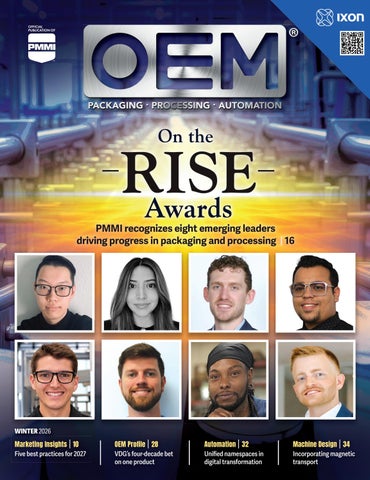
16 2026 On the Rise Awards
PMMI honors the emerging leaders of packaging and processing’s next generation.
EXHIBITOR’S CORNER
42 Why the Show Matters More Than Ever
O E M P ROFIL E
28 Van der Graaf’s Four-Decade Bet Continues to Pay Off
The North America-based OEM has built its business on one product and on manufacturing every component itself.
Trade shows are twice as effective as digital connections at building loyalty.
28
WORKFORCE
44 The Automation You Can’t Staff Smarter machines don’t add capacity on their own.
D I GI TA L TR ANSFOR MATI ON
32 The Spec Fight OEMs Didn’t Know They Were In
OEMs that design for unified namespaces and ontologies are quietly winning specifications.
32 NEW PRODUCTS
A P P LI CATION BR IE F
34 Washdown Requirement Drives Move to Magnetic Transport Bartelt built its MAG Series of pouching machines around Beckhoff ’s XTS magnetic transport.
OEM_1226_TOC_V3_FINAL.indd 2
46
46 OEM Machine Technology Check out the latest product innovations.
FINAL THOUGHTS
34
48 PACK GIVES BACK Foundation The “why” behind PMMI’s new member initiative.
11/10/26 12:08 PM
Untitled-1 2
11/3/26 08:54
The official publication of PMMI OEMMAGAZINE.ORG CON TEN T Sean Riley Editor-in-Chief sriley@pmmimediagroup.com | 571 266 4419 Tracey Labovitz Editorial Operations Coordinator Kim Overstreet Director of Content Norman Smith Art Director David Bacho Creative Director
ADVERTI SI N G Reggie Lawrence Vice President, Sales rlawrence@pmmimediagroup.com Lara Krieger Senior Manager, Print Operations lkrieger@pmmimediagroup.com Janet Fabiano Financial Services Manager jfabiano@pmmimediagroup.com
PMMI Media Group 500 W Madison, Suite 1000, Chicago, IL 60661 www.pmmimediagroup.com David Newcorn President Elizabeth Kachoris Vice President, Digital Jen Krepelka Senior Director, Digital Media Amber Miller Director of Marketing Joan Jacinto Director, Ad Tech and Search Angie Szerlong Director of Industry Strategy Joseph Angel Founding Partner
PMMI, The Association for Packaging and Processing Technologies 12930 Worldgate Dr., Suite 200, Herndon VA, 20170 Phone: 571 612 3200 | Fax: 703 243 8556 www.pmmi.org Jim Pittas President and CEO Glen Long Senior VP Tracy Stout VP, Marketing and Communications Laura Thompson VP, Trade Shows Andrew Dougherty VP, Member Services
SU B SCRI PTI ON S To subscribe to OEM visit: oemgo.to/9999 To change or modify a subscription, please contact circulation@pmmimediagroup.com
OEM EDI TORI AL ADVI SORY BOA R D Greg Berguig President, PAC Machinery Jacob Cox VP of Electrical and Controls, Fallas Automation Rick Fox III Vice President, Fox IV Technology Jordan Hamrick President, Hamrick Packaging Systems Paul Irvine Executive Chairman & Owner, Plexpack Zack Lynch Founder, Next Tech Automation Stacy Johnson VP Business Development, Hoosier Feeder Company Tom Sosnoski Director of Advanced Development, JLS Automation Alex Vargo VP of Manufacturing, LAKO Colin Warnes Director Sales Engineering & Project Management, ADCO Manufacturing
OEM_1226_Masthead.indd 4
11/10/26 9:17 AM
FOR OPENERS
WINTER 2026
5
Ensuring There Is a Next Generation of Emerging Leaders to Honor
Level Control of High Temperature Oils and Glues 482°F / 250°C
By Sean Riley, Editor-in-Chief
F
“
or nearly a decade, PMMI has honored the next generation of packaging and processing professionals with the On the Rise Awards. Each year, the winners are featured in the winter issue of OEM Magazine. This issue is no exception (On the Rise Awards, p. 16), and once again I had the privilege of talking to these rising stars about their different paths to early success. When I ask the winners, “How did you find your way into packaging?” I hear a familiar answer, and this year was no different. Some knew about the industry from a family member or a neighbor. Most years, though, the majority of winners give some version of the same answer: They didn’t know packaging and processing, or manufacturing in general, was a career option until they stumbled into it. That reminded me of an episode of the Thanks to those efforts, unPACKed with PMMI podcast I recorded the next generation of this summer with Mike Rowe of Dirty Jobs fame. I touched on that discussion in the On the Rise winners will summer issue of OEM (Re-“Packaging” Jobs in Manufacturing, p. 40), and the discover our industry at full episode is available on all major podcast platforms. a much younger age . . . For reasons Rowe and I discussed, which I won’t rehash here, manufacturing fell off young professionals’ radar as they started their job searches. He urged the industry to repackage manufacturing as a lucrative, fulfilling career rather than the dark, dirty, and dangerous work of yore. This year’s On the Rise winners echo that message. Many said that once they saw what a career in packaging and processing could offer, they became strong advocates for the industry. No one advocates for the industry more than PMMI, and in this issue we spotlight that advocacy. Automation You Can’t Staff (p. 44) looks at what PMMI and the PMMI Foundation are doing to promote packaging and processing careers, attract new talent, and support education programs whose curriculum reflects how the industry actually runs. Thanks to those efforts, the next generation of On the Rise winners will discover our industry at a much younger age, a promising sign for closing the workforce skills gap. As always, thanks for reading, and I hope you enjoy this issue of OEM. If you have any feedback, good or bad, please don’t hesitate to reach out to sriley@pmmimediagroup.com. ■
Level Probes Analog or Digital
”
www.rechner.com 1-800-544-4106 Sanborn, NY OEM_1226_For Openers_V3_FINAL.indd 5
11/10/26 12:20 PM
WINTER 2026
6
BUSINESS INTELLIGENCE
2026 Packaging Machinery State of the Industry U.S. PACKAGING MACHINERY SALES AND GROWTH VALUE OF
$11.7 BILLION IN 2025
CAGR
2.3% OVER 2024
ESTIMATED VALUE OF
$13.0 BILLION IN 2027 END-USER INDUSTRY SEGMENTS 2025 $5.1 BILLION FOOD
$1.5 BILLION HOUSEHOLD, INDUSTRIAL, & AGRICULTURAL CHEMICALS
$1.4 BILLION PHARMACEUTICALS
$1.7 BILLION BEVERAGE
$1.4 BILLION OTHER END-USER SECTORS
$628 MILLION PERSONAL CARE, TOILETRIES, & COSMETICS
CANADIAN PACKAGING MACHINERY SALES AND GROWTH VALUE OF
SHIPMENT VALUES CAGR
$1.2 BILLION 3.6% IN 2025 OVER 2024 ESTIMATED VALUE OF
$1.4 BILLION IN 2027
OEM_1226_Business_Intel_V2FINAL.indd 6
2025
$1.2 BILLION DOMESTIC
$504 MILLION IMPORTS
$550 MILLION EXPORTS
11/10/26 8:11 AM
WINTER 2026
7
SHIPMENT VALUES 2025
$11.7 BILLION DOMESTIC
$3.8 BILLION IMPORTS
$688 MILLION EXPORTS
MACHINERY TYPES 2025 $2.5 BILLION CONVEYING, FEEDING & HANDLING $2.1 BILLION CARTONING, MULTIPACKING & CASE PACKING $1.7 BILLION BAGGING, POUCHING & WRAPPING $1.3 BILLION FILLING, CAPPING & CLOSING $1.0 BILLION PALLETIZING & LOAD STABILIZATION $997 MILLION INSPECTION & TESTING $908 MILLION CODING, LABELING, PRINTING & READING $622 MILLION SPECIALTY EQUIPMENT $523 MILLION TRAY, CLAMSHELL & BLISTER
KEY MARKET TRENDS 2025-2031
HIGH IMPACT
MEDIUM IMPACT
LOW IMPACT
BIG DATA & AI
SHIFTING BUYER BEHAVIOR
USED MACHINERY & ASSET PRESERVATION
U.S. REGULATORY LANDSCAPE
PRODUCT VIRALITY
OBBB: ACCELERATED DEPRECIATION
RISING COST OF GAS
CARBON EMISSION GOALS BY MAJOR PLAYERS
OEM_1226_Business_Intel_V2FINAL.indd 7
11/10/26 8:11 AM
Untitled-1 2
11/3/26 08:52
Untitled-1 2
11/3/26 08:53
WINTER 2026
10
SALES & MARKETING
MARKETING INSIGHTS
Five Things Every OEM Should Have in Their 2027 Marketing Plan Building long sales cycles, multiple decision-makers, and buyers who aren’t shopping yet, into next year’s plan. By Amber Miller, Director of Marketing, PMMI Media Group
I
f you’re a packaging or processing OEM marketer, you know the million-dollar question: How do you get the most from your marketing budget while creating real opportunities for your sales team? Trade shows, email, digital advertising, and industry publications all compete for the same dollars. That makes it tempting to spread your budget across as many channels as possible. But the best marketing plan isn’t the one with the biggest budget or the most channels. It’s the one where every investment has a purpose, reaches the right audience, and works with your other activities to move buyers closer to a purchase. That matters even more for packaging and processing OEMs. Equipment purchases can take months or years, with several people weighing in on each one, and customers aren’t always shopping for machinery. As you finalize your 2027 strategy, here are five things worth prioritizing.
1. A brand awareness strategy
that doesn’t stop when lead gen starts
It’s easy to favor campaigns that produce leads right away. Leads are measurable and tangible, and sales can act on them. But what about the packaging engineer who will need a new case packer in 18 months? Or the plant manager whose automation project is waiting on next year’s capital budget? They’re future customers, and they’re worth reaching today. In PMMI Media Group’s 2025 Buying Cycle Study, 86% of equipment buyers said seeing a supplier’s brand multiple times was somewhat or extremely important to establishing credibility. Brand recognition can decide whether a buyer even considers you when a need comes up. Starview Packaging understands this. As a smaller machinery manufacturer competing against larger players, the company has moved away from
OEM_1226_Marketing Insights_V4_FINAL.indd 10
one-off campaigns and toward a coordinated, yearround presence across multiple channels. For 2027: Set aside part of your budget to build awareness with buyers who aren’t ready to purchase yet. Staying visible now makes your future lead generation work better.
2. An audience strategy
prioritizing quality over quantity
Reaching the right audience is especially hard for OEMs selling to end users. Potential customers include packaging engineers, plant managers, operations executives, and procurement professionals across many industries. And not everyone with an engineering title has a say in equipment purchases. Starview learned this firsthand. Outbound email, cold calling, and third-party lists weren’t reliably producing the engagement it wanted. When the company shifted to targeted, industry-specific channels, it saw stronger engagement from the audiences it was trying to reach. For 2027: Define your ideal customer profile more precisely. Judge each channel by how well it reaches qualified buyers, not by the size of its audience. A short list of relevant contacts is worth far more than hundreds of leads that never become sales conversations.
3. A trade show strategy beyond the show floor
Trade shows are still one of the best ways for OEMs to demonstrate equipment, talk through applications, and build relationships face to face. But exhibiting shouldn’t be a standalone activity. Picture two visitors arriving at your booth. One has never heard of your company. The other has seen your ads, watched a video of your equipment, or read your content before the show. Which conversation starts further along?
11/10/26 12:17 PM
WINTER 2026
PACK EXPO has long been central to Starview’s marketing, and the company backs it with consistent pre-show messaging. Starview says booth visitors arrive increasingly familiar with its solutions. It hasn’t tied that to specific campaigns but believes steady visibility has made conversations more productive. Keep following up after the show, too. Not every booth visitor is ready to buy, and those relationships lose momentum fast. For 2027: Plan your trade show strategy in three stages: build awareness before the event, create meaningful engagement on the floor, and follow up with prospects afterward. Your show investment should keep paying off long after the show closes.
The right approach depends
4. A marketing mix
on your equipment, target
informed by data
11
performing, and use competitive benchmarks to challenge your assumptions about where your money goes.
5. A measurement plan
beyond leads and clicks
“
Opens, clicks, site visits, and form fills don’t always tell you whether you’re getting closer to a sale. With long evaluations and multiple decision-makers, OEMs need to measure more than immediate conversions. Track engagement from target accounts, qualified sales conversations, repeat interactions with prospects, and opportunities marketing helped create. Use your CRM to capture it. That takes coordination with sales, but it’s worth it. Then ask your sales team directly: Are prospects showing up to meetings and demos better informed? Are you reaching companies that weren’t on your radar before? Are customers saying they’ve already seen your equipment or content? Smaller teams can’t measure everything, so pick a handful of metrics tied to business goals. For 2027: Get marketing and sales to agree on what counts as a qualified opportunity, and review performance together regularly. Look at both shortterm campaign results and longer-term progress toward revenue.
No single marketing mix works for every OEM.
industries, sales cycle,
Each channel has its own strengths. The challenge isn’t picking the single best one. It’s understanding how they work together. In a PMMI Media Group supplier marketing survey, 95% of respondents used in-house email marketing, 92% used organic social media, 75% named video as an investment priority, and 61% used print advertising in trade media. But a channel being popular doesn’t mean it’s effective. Look at how competitors in your equipment category divide their budgets, which channels they use, and what engagement they get. That can show you openings in your own strategy. Are you leaning heavily on email while competitors stay visible across several channels? Are you overlooking industry content, digital advertising, or video? The goal isn’t to copy a competitor’s plan or match its spending. It’s to find where you’re underrepresented. For 2027: Audit your marketing mix. Define what each channel should accomplish, review how it’s
”
budget, and growth goals.
OEM_1226_Marketing Insights_V4_FINAL.indd 11
Make every channel count in 2027
No single marketing mix works for every OEM. The right approach depends on your equipment, target industries, sales cycle, budget, and growth goals. These five priorities shouldn’t be separate initiatives. Think of them as one continuous loop, where brand awareness, targeted reach, engagement, and sales opportunities each feed the others. ■
11/10/26 12:17 PM
12
WINTER 2026
SALES & MARKETING
SALES FOCUS
Predictable Revenue in 2027: Which Leader Is Running Your Sales Team? Four sales leaders, one framework for predictable revenue. By Matthew Neuberger, President, Neuberger & Company, Inc.
A
packaging machinery CEO spread his charts across my table and asked: “I can’t get my sales to line up with my engineering resources. Either we have too much work and I’m paying overtime, or not enough and I’m paying people to sit around. I’d really like more predictable revenue.” A plant runs only as fast as its constraint. His constraint wasn’t engineering. It was predictable sales in an unpredictable market. Why do some companies master that constraint while others fight it every year? If you’ve read my articles this year, you know the pieces: free engineering on quotes, training that fades, and buyers screening vendors with AI. With new AI tools pitched every week, keeping up can feel like plugging holes in a dam. Here’s a way to see how the pieces fit, score yourself, and prepare for your next move.
The Earned Revenue Matrix: Which leader is running your sales team? More operating discipline
Capability, discipline, and four leaders
Predictable revenue takes two things. Capability is the selling team: the skills of managers, regional sales managers, salespeople, and sales engineers. Operating discipline is the line and its maintenance: a defined selling system and a management rhythm of weekly inspection and coaching. When revenue misses, the instinct is to blame the salespeople. In my experience, it’s more often the structure around them. Skills only grow, and stay, when that structure is in place. How leaders think about selling decides how much of each they build. Together, they form the Earned Revenue Matrix, and each quadrant shows what’s missing. Market-carried revenue rises and falls with demand. Earned revenue is growth your team produces on its own, the kind you can predict. Each pattern starts with a belief. Whatever leadership believes about buying, it will tolerate in its selling system. PMMI members build equipment they’re rightly proud of. Believe a great machine sells itself, and nobody inspects the pipeline.
The Meteorologist: missing both. When the pipeline thins, they call peers: “Are you seeing a slowdown?” That’s a smart habit. It only The Builder limits growth when the quesCapability and discipline tion stops being “What could we change?” The sales process “Build a team that sells without me.” may sit in a binder, installed but Earned, predictable revenue never commissioned. Revenue: market-carried.
selling system, inspection, coaching
The Operator Discipline, missing capability “We’ve invested in the right tools.” Steady but capped revenue
The Meteorologist
The Firefighter
Missing both
Capability, missing discipline
“Are you seeing a slow down too?”
“I talk to my people all the time.”
Market-carried revenue
Rescued revenue
skills, sales DNA, right seat
OEM_1226_Sales_Focus_V4_FINAL.indd 12
The Firefighter: missing discipline. “I don’t need a formal management process. I talk to my people all the time.” The best people are tired. Deals close late, sometimes outside their lane, and engineering pays. Nobody
More capability
11/10/26 5:30 PM
WINTER 2026
asks why the plant keeps catching fire. Busy is not the same as productive. Revenue: rescued. The Operator: missing capability. “We’ve invested in the right tools, so the results will come.” There’s a CRM, a weekly email asking everyone to update it, an AI tool, and a sales process. The parts are dating, but they aren’t married yet. Revenue: steady but capped. The Builder: capability and discipline. “My job is to build a team that sells without me.” They arrive early, as advisors who know each client’s long-term goals and help shape the budget. They line up support for each seat: a recruiter they meet regularly; assessments before hiring or promoting; a candid peer group; and an outside coach who reinforces habits so the team practices on each other, not on clients. As Author James Clear puts it: “You do not rise to the level of your goals. You fall to the level of your systems.” Revenue: earned.
13
Builder isn’t a diploma you frame. It’s a standard you maintain. Intel’s Andy Grove put it bluntly: “Only the paranoid survive.” The hiring market shows why. Our assessment benchmark of 20,072 manufacturing salespeople puts the average at the 45th Sales Percentile. Reaching decision-makers scores 42%; growing existing accounts, 31%. That’s a fair picture of the pool you hire from. Coachability scores 81%, so the gap can close, but only if you keep closing it.
How each seat moves to the upper right quadrant
If you’re the CEO or president: Before approving the 2027 plan, ask for your close rate on quotes and how many open quotes have a met decision-maker. If no one can answer, that’s your first move. If you own or invest in the company: Ask how much of last year’s growth was earned, how much came from three customers, and how much depends on one person. ITR Economics expects a serious downturn in the 2030s. Market-carried revenue is usually the first to vanish. If you lead sales: Every Monday, check three deals for a pain tied to a client’s longterm goals, its dollar cost, a met decision-maker, and a known budget. Before rescuing one, ask, “What would you do next?” If you’re a regional sales manager or salesperson: Start with your customers. PMMI research found 89% of OEMs offer conversion kits; only 48% of end users use them. Whatever you sell, where is your version of that gap? Ask top accounts about three-year plans before they become RFQs. Get to the person who signs the check: As I wrote in the Fall, close rates run 11%–13% when nobody qualifies before engineering quotes. That’s hope, and last time I checked, you can’t buy groceries with hope. I’ve been the other three quadrants. Along the way, I learned that chasing the number is a reliable way to miss it. The Earned Revenue Builders I know start somewhere else. They fall in love with helping clients reach their goals and build the system on top of that. Revenue tends to follow. That CEO’s charts line up when sales runs like a line at rated speed, and that starts with one Monday meeting in January. ■
“how the pieces fit,
Here’s a way to see
Find your quadrant, then check it
Score yourself honestly: have leaders and a few salespeople pick a quadrant privately, then compare.
score yourself,
and prepare for your
Then check your numbers: • Meteorologist: How consistently do you set targets and hit them? If one hot product, big order or customer made the year, could you repeat it? First move: commission the binder, then assess each seat. • Firefighter: Two or three people carry the number. First move: turn instincts into three standards and inspect them weekly. • Operator: Activity and turnover are up; close rates haven’t moved in a year. First move: assess each seat, then coach skills, not CRM updates. • Builder: You hit targets consistently, outgrow the industry, and start earlier with decision-makers. The pipeline is bankable. First move: keep reinforcing, especially when the market turns.
OEM_1226_Sales_Focus_V4_FINAL.indd 13
”
next move.
11/10/26 8:20 AM
WINTER 2026
14
INDUSTRY NEWS
INDUSTRY NEWS
PACK EXPO International 2026: Buyers Came to Chicago With Real Projects More than 72,000 professionals, live demos, and a strong workforce focus filled four days at McCormick Place. The next stop is Atlanta. By Sean Riley, Editor-in-Chief
P
ACK EXPO International 2026 closed after four days at McCormick Place in Chicago, drawing more than 43,000 attendees and 29,000 exhibitor personnel, about 72,000 packaging and processing professionals in all. It featured more than 2,700 exhibitors across 1.3 million net square feet, serving more than 40 vertical markets. Seven pavilions organized the floor by industry, including food and beverage processing, healthcare packaging, confectionery, logistics, reusable packaging, and printing. “What makes this event so powerful is the business happening across the show floor,” said Jim Pittas, president and CEO of PMMI. “Attendees come with real challenges and investment priorities.”
Buyers came with projects
For OEMs, the most useful signal from Chicago may be the type of attendee. Exhibitors kept describing visitors who arrived with active, defined projects rather than just browsing. At PTI (Packaging Technologies & Inspection), about 70% of visitors were new contacts, according to marketing manager Michelle Wolf. Robin van Praat, global head of business development at AmbaFlex, said face-to-face technical discussions are “still the most efficient way to shorten project timelines and build trust.” Lilly Roth of Quest Industrial, a ProMach brand, said the show connected her team with people “we’ve been trying to reach for months, and in some cases even years.” For the most part, attendees echoed these sentiments. Bradley Hannah, packaging engineer at General Mills, called PACK EXPO “the best place to see the newest technologies firsthand and discover what’s possible for your operational efficiency.” Julie Kendall, senior packaging engineer at Mondelēz International, said the show turns up new materials and partners “you simply wouldn’t find through standard web research.”
OEM_1226_Industry News_V3_FINAL.indd 14
Education and workforce
More than 150 free sessions across five stages covered AI, robotics, automation, sustainability, regulatory change, and workforce development. Sustainability sessions focused on recyclability, extended producer responsibility, and reuse systems already in use. Workforce programs ran all week. They included the PACK Challenge, the Future Innovators Robotics Showcase sponsored by Schneider Electric, Students PACK the EXPO, the Amazing Packaging Race, and the Workforce Development Pavilion. PACK gives BACK, sponsored by Rockwell Automation, raised money for the PMMI Foundation. The first CPG NexGen Awards recognized 10 young professionals from CPG and other end-user companies.
Next up: Atlanta
PACK EXPO Southeast 2027 runs April 12–14 at the Georgia World Congress Center in Atlanta. The regional show brings suppliers, live machinery demonstrations, and education closer to manufacturers in the growing Southeastern U.S. More information is at packexposoutheast.com. ■
11/10/26 8:19 AM
Untitled-1 2
11/3/26 08:51
16
WINTER 2026
YOUNG PROFESSIONALS NETWORK
2026
Meet the PMMI On the Rise Winners These eight leaders have emerged as standouts at their companies and in the packaging and processing industry. By Sean Riley, Editor-in-Chief
Now in its ninth year, the PMMI On the Rise Awards recognize young packaging and processing professionals who demonstrate exemplary leadership at PMMI member companies. In keeping with tradition, winners who could attend were flown to PMMI’s Annual Meeting in Montreal, Quebec, where they were unveiled during the Chairperson’s Dinner. As you’ll read, this year’s diverse array provides a fresh, forward-thinking perspective on the industry. OEM Magazine was fortunate to speak with each one and offer a glimpse into these outstanding rising stars in the industry.
OEM_1226_F1_On The Rise_V4_FINAL.indd 16
11/10/26 5:23 PM
WINTER 2026
17
Building a department while learning to lead at Huapaq Diana Castro has built a logistics and import operation from scratch and cut customs clearance times from two weeks to two days.
Diana Castro remembers the moment she saw the job posting at Huapaq with unusual clarity. “From the moment I saw it, I thought, ‘I want to work there. That job is for me,’” she recalls. That instinct proved correct, though the career that followed looked nothing like what she might have planned. Castro joined the company in 2022 in an administrative role, and through curiosity and proximity to the technical side of the business, gradually found herself drawn deeper into projects, machinery, and eventually After Sales. The packaging industry, she says, wasn’t a destination she had mapped out. She discovered it by moving toward what interested her. The work she has done since has been anything but incidental. As After Sales Manager, Castro built Huapaq’s logistics and import department from the ground up, developing partnerships with logistics providers, engineering more efficient customs processes, and reducing import costs by 15%. The most concrete measure of that work: Huapaq can now clear machinery imports in two to three days. End users and competitors typically wait up to two weeks. That gap didn’t exist when she started. She created it. The path to success required Castro to develop expertise she didn’t have. When import operations expanded and the company needed someone to manage the process, the decision was made to build that capability internally rather than hire from outside. “Little by little, I made the process more efficient,” she says. A similar evolution happened with spare parts. She took it upon herself to develop an inventory analysis that clarified what quantities the company needed, reduced import-related costs, and improved planning in ways that also drove sales growth. Alongside that operational learning came the more personal challenge of leading a team of electromechanical technicians as an Industrial and Systems Engineer. Castro’s background gave her strong tools for process analysis and operational thinking, but it didn’t include hands-on repair experience. Early on, that gap created uncertainty. “At first, I felt somewhat insecure about leading people with extensive hands-on experience and highly specialized technical knowledge,” she says.
OEM_1226_F1_On The Rise_V4_FINAL.indd 17
Her perspective shifted when she reframed what her role actually required. Her job wasn’t to repair machines but to make sure they had the organization, tools, information, and support they needed to do their jobs. That clarity led her to engage more directly with the team by listening, asking questions, learning from their technical expertise, and establishing clearer processes. “There was no specific moment when everything changed; it was a constant adaptation on both sides,” she says.
“
A leader does not have to know everything. ... [I]t is also important to listen, ask questions and surround yourself with people who have differ-
”
ent knowledge and experiences.
It’s a philosophy she now carries into how she thinks about leadership more broadly. “A leader does not have to know everything,” she says. “I have learned that it is also important to listen, ask questions, and surround yourself with people who have different knowledge and experiences.” The willingness to adapt—to let the way you lead evolve as teams and circumstances change—is, in her view, what separates leaders who sustain momentum from those who stall. Castro’s proudest accomplishment isn’t a single project but the arc of the department itself. “After Sales has evolved with me, and I have evolved with it,” she says. “I feel much more confident in my ability to make decisions and lead while also knowing that I still have a lot to learn. I think that is one of the things I value most about my journey so far.” Looking ahead, she has her eye on AI’s role in manufacturing—specifically how machine data and production patterns could enable predictive maintenance, reduce downtime, and minimize waste before problems occur. “I imagine a future where a machine could learn from production and maintenance patterns, identify unusual behavior, anticipate the wear of certain components, and help make decisions before a failure occurs,” she says. Her longer-term ambition is to one day become a General Manager so she can understand the business completely and develop the leaders who will grow it. ■
11/10/26 5:23 PM
18
WINTER 2026
YOUNG PROFESSIONALS NETWORK
Where IT meets the plant floor at Sneed Coding Solutions Samuel Cediel traded airport infrastructure for packaging machinery—and discovered that the skills he built managing networks translate directly to keeping production lines running. Some career pivots are calculated. Samuel Cediel’s was driven by something simpler: the feeling that he hadn’t yet found the room where his technical abilities could be fully tested. Working as an IT technician managing infrastructure for food concession companies at an airport, Cediel recognized a ceiling. “I was eager to transition into a role that was more heavily focused on complex technical challenges,” he says. What Cediel found as CX Specialist & L2 Technician at Sneed Coding Solutions was a challenge bigger than he anticipated—and exactly what he was looking for. Adapting traditional IT support skills to the physical world of packaging and processing equipment required him to fundamentally rethink how he diagnosed and solved problems. High-stakes moments, like a customer facing critical downtime on a production line, demanded a composure and creative methodology that no airport IT role could have prepared him for. His solution was rooted not in technical shortcuts but in mindset. “I rely on patience, empathy, and stepping back to look at problems from a different perspective rather than just following conventional diagnostic methods,” he says. That philosophy has become his professional signature. What fascinates Cediel most about his work is the intersection he now occupies: traditional mechanical equipment increasingly running on modern IT networks. As packaging machinery becomes more connected, his ability to apply IT and networking knowledge on the plant floor has become a genuine differentiator for his customers, his colleagues, and Sneed Coding Solutions as a whole. The clearest demonstration of that value came during one of the highest-pressure moments of his
“
career. A customer experiencing intermittent failures with automated case erectors was within their 30-day return window and ready to send the equipment back. Cediel stayed on-site, set aside conventional diagnostics, and worked systematically to find the root cause. He identified the issue and fixed it permanently. “It prevented a costly return and turned a potentially failed installation into a long-term success story for Sneed Coding Solutions,” he says. Beyond his work with customers, Cediel has invested equally in the people around him. He mentors newly hired technicians, serves as a resource for colleagues navigating difficult service calls, and has worked to build out an internal Knowledge Base designed to help the entire team work more efficiently. “Leadership isn’t always about having a formal title,” he says. “It’s about sharing your knowledge, stepping up to help your team, and building trust with customers.” His commitment to continuous growth extends to the classroom. Cediel is currently balancing full-time work with an academic program that aligns with where he sees the industry heading, pursuing his bachelor’s degree in cybersecurity and information assurance at Western Governors University. The convergence of operational technology (OT) and information technology (IT) security is a trend he’s watching closely, convinced that as smart manufacturing and IoT integration expand across packaging machinery, the need for professionals who can fluently navigate both worlds will only intensify. “As industrial networks and smart manufacturing technologies continue to grow, I want to blend my hands-on packaging equipment experience with advanced cybersecurity knowledge,” he says. “My goal is to lead the charge in securing and supporting the next generation of connected processing equipment.” For other emerging professionals, his advice is both practical and principled: “Never underestimate the power of patience, empathy, and a calm approach to problem-solving. Also, never stop learning. The industry is always evolving, and investing time in your own education and continuous improvement will always pay off.” ■
Never underestimate
the power of patience, empathy, and a calm approach to
”
problem-solving.
OEM_1226_F1_On The Rise_V4_FINAL.indd 18
11/10/26 5:23 PM
Untitled-1 2
11/3/26 08:50
20
WINTER 2026
YOUNG PROFESSIONALS NETWORK
Writing the code that runs the shop floor at Morrison Ryan Frederick came to Morrison Container Handling Solutions as an IT Programmer and spent his first year building the tools, integrations, and automated workflows that now touch every corner of the business. Morrison Container Handling Solutions was OK with Ryan Frederick not knowing the ins and outs of the packaging industry when they hired him. Instead, they needed someone who could look at how a manufacturing business actually operates and build technology that makes it run better. “I had a lot to learn about the packaging industry when I started,” he says. “But working closely with people throughout the company helped me understand both the equipment we build and the processes behind it.” That combination—industry knowledge earned through relationships, applied through software—has defined his first year at Morrison in ways that reach well beyond a single project.
“
A solution can be technically impressive, but if it doesn’t solve the right problem or it makes someone’s job more difficult, it isn’t really a
”
good solution.
The most visible example is the OrderQueue Web App, a production TypeScript/Node.js application that didn’t exist in any mature form when Frederick arrived. He built and deployed it: Redis-backed sessions, a containerized setup on Azure, and a clean promotion from staging to production. It now runs as a daily tool for manufacturing and scheduling teams, surfacing live production percentage breakdowns, supporting endpoint visibility, and providing shop-floor quick links. It’s the kind of capability expansion that typically requires a team. Frederick delivered it almost entirely himself.
OEM_1226_F1_On The Rise_V4_FINAL.indd 20
He also built the integration that connects Morrison’s HubSpot CRM to its internal sales hub—syncing OEM and Retail data automatically across systems that previously didn’t speak to each other. The result: manual reconciliation eliminated, cleaner data for the sales side, and a cross-departmental contribution that moves the business forward rather than simply maintaining it. What ties those projects together is a philosophy Frederick developed through hard-won experience. Early in his career, he defaulted to what many programmers do: focus on the technical elegance of the solution. The larger challenge, he discovered, was building something the right people would actually use. “A solution can be technically impressive, but if it doesn’t solve the right problem or it makes someone’s job more difficult, it isn’t really a good solution,” he says. The adjustment required more listening, more time spent understanding why a process exists before deciding whether to change it, and more investment in relationships outside his own department. That same curiosity shapes how he approaches his own development. Frederick proactively submitted an Individual Development Plan outlining a path toward Senior Programmer, with a focused skill-building program in front-end development depth and project management fundamentals. He’s incorporated AI development tools into his workflow to accelerate output and treat each new build as reusable learning. For other emerging professionals, his advice cuts through the noise: “Don’t limit yourself to what is written in your job description,” he says. “Be curious about how other parts of the business work, and look for problems you can help solve. Some of the best opportunities I’ve had come from seeing something that could be improved and taking the initiative to work on it.” Looking ahead, Frederick is focused on growing beyond software development into something more strategic, identifying where technology will have the greatest impact on the organization, and turning those opportunities into practical solutions. He’s watching AI and automation closely, but with a specific lens. “I’m interested in how AI can make company knowledge easier to access, reduce repetitive administrative work, and help employees make better decisions,” he says. “The companies that can turn data into useful, actionable information will have a significant advantage.” ■
11/10/26 5:23 PM
WINTER 2026
21
Rebuilding Septimatech’s marketing engine Jonathan Hodge has doubled website traffic, tripled monthly leads, and transformed how Septimatech converts trade show floors into sales pipelines. Jonathan Hodge grew up watching the television documentary show How It’s Made. The details of manufacturing—how things come together and what happens behind the products people use every day—held a fascination he never quite shook. So, when a job search coming out of the pandemic led him to a marketing posting at Septimatech Group Inc., something clicked. “I was fascinated by this corner of the manufacturing world and became even more interested as I learned about it during the interview process,” he recalls. When the job offer came, he didn’t hesitate and accepted it the same day. What followed has been a methodical reimagining of how Septimatech markets itself. With Hodge’s steady hand, it has been rebuilt on clear objectives, cross-functional coordination, and a commitment to measuring what actually matters. The most visible expression of that work is Septimatech’s website relaunch. Hodge led the initiative end-to-end, coordinating internal teams across Engineering, Sales, and Finance alongside external developers and creative partners. Before launch, he set performance benchmarks for traffic, lead generation, and revenue attribution, projecting when the new site would outperform its predecessor. After one year, those projections held as website traffic doubled, monthly leads increased 130%, and websiteattributed revenue grew 30%. The platform was also designed with forward flexibility in mind, built to incorporate emerging technologies and AI capabilities as they become practical. He applied the same rigor to Septimatech’s trade show presence. When Hodge joined the company, PACK EXPO represented a significant investment, with room to improve how that investment converted into the sales pipeline. He overhauled the logistics of how displays are shipped and deployed, cutting setup and teardown time and freeing the team to spend more time in front of customers. He redesigned how leads are captured, classified, and distributed by implementing an AI-powered process that feeds prospects directly into the CRM and enables sameday follow-up and meeting scheduling. Both PACK EXPO Las Vegas and PACK EXPO International have
OEM_1226_F1_On The Rise_V4_FINAL.indd 21
since posted year-over-year growth in lead volume and conversion rates. Behind the results is a marketing philosophy grounded in organizational curiosity. Hodge’s role is in marketing, but he argues that effective marketing requires understanding how salespeople qualify opportunities, what information engineering teams need to evaluate a deal, and what challenges customers are trying to solve. “Learning how your colleagues work helps you ask better questions, respect their responsibilities, and see how different decisions affect the organization more broadly,” he says. “Leadership begins when you look beyond your daily tasks and start thinking strategically about how the entire business succeeds.” That orientation shows up in how he spends his development time. Hodge has attended every PACK EXPO since his hire, participates actively in PMMI Young Professionals events and regional dinners, and is a member of PMMI’s MAX Marketing Group. He has completed training in Microsoft AI productivity tools, Dynamics 365, and Power Platform. More importantly, he consistently brings what he learns back into Septimatech’s processes rather than treating certifications as personal trophies. One initiative that reflects his approach particularly well is Septimatech’s early investment in answer engine optimization, positioning the company’s content for AI-powered research and purchasing platforms before most competitors recognized the shift was coming. But he also recognizes human oversight is needed. “AI is changing how we can create and organize information, but it is also massively increasing the importance of accurate, relevant, and personalized technical content,” he says. “The human element has never been more important.” For other emerging professionals, his advice is disarmingly practical: admit what you don’t know, learn from people who do, and expand your line of sight beyond your own job description. “Asking thoughtful questions and learning from others is not a weakness,” he says. “It is one of the fastest ways to grow.” Looking ahead, Hodge is focused on experiential marketing and finding ways to turn ideas into programs that create tangible value, for Septimatech and the customers it serves. The packaging industry, he discovered by accident. The career he’s building within it is anything but. ■
11/10/26 5:23 PM
22
WINTER 2026
YOUNG PROFESSIONALS NETWORK
From field technician to service architect at PAC Machinery Since joining, RaeDon Lee has transitioned from the technician who solves every problem to the leader who builds the team and systems that prevent problems from recurring.
When RaeDon Lee joined PAC Machinery as a Field Service Technician in 2021, he independently studied machine functionality, troubleshooting methods, and customer applications, going beyond what formal onboarding covered until he became one of the company’s leading technical experts. Response times improved, customer downtime dropped, and sales and support teams grew more confident. The results were hard to miss. But the move that defines his trajectory wasn’t a technical achievement. It was a shift in orientation. “I started out focused on solving the problem in front of me,” Lee says. “Over time, my focus shifted toward building the people, processes, and systems that prevent the same problems from happening again.”
“
Leadership is building a team that becomes more capable
”
because you were there.
That shift earned him a promotion to Product Support Manager in 2023, where he now leads PAC Machinery’s Aftermarket team: overseeing service, technical support, and preventive maintenance initiatives for a growing installed base. Under his direction, the team has built proactive maintenance programs that improve equipment reliability, extend machine lifespan, and reduce unplanned downtime. The commercial results have followed with stronger customer retention, higher consumables revenue, and relationships built on consistent follow-through rather than reactive problem-solving. He has also become the organization’s primary trainer for new technicians, assemblers, and technicians at distributor partners worldwide. His ability to make complex technical concepts approachable has accelerated how quickly new team members become
OEM_1226_F1_On The Rise_V4_FINAL.indd 22
productive and extended PAC Machinery’s service quality well beyond its internal headcount. The leadership challenge that has tested him most, Lee says, is one familiar to anyone who rises through technical ranks. “When you know how to solve a problem yourself, it can be tempting to simply handle everything,” he says. “But that does not build a strong team or a scalable organization.” He has learned to create space for his team to think, troubleshoot, and develop confidence, while staying close enough to support them when it matters. He has also learned to look past the surface of technical problems. “Some of the hardest technical problems are not purely technical,” he says. “Communication, documentation, ownership, training, and cross-functional alignment can determine whether a problem gets solved once or continues to happen.” That systems-level thinking now shapes how he approaches every issue that comes his way. For other emerging leaders, Lee’s advice cuts through the noise: Don’t chase the title before you’ve developed the person capable of carrying it. “Learn as much as you can outside of your immediate job description,” he says. “Understand what the technicians see, what the customer experiences, what engineering needs, what operations is dealing with, and what the business is ultimately trying to accomplish. Leadership is building a team that becomes more capable because you were there.” Lee’s proudest moments aren’t machine repairs or individual wins—they’re the technicians who no longer need to escalate, the processes that prevent failures before they reach the field, the service organization that looks different than it did when he arrived. Winning the PMMI On the Rise Award this year carries particular weight as he was nominated for three consecutive years before receiving the recognition. “Winning it this year feels like recognition not only of what I have accomplished but also of the direction I am heading,” he says. That direction points toward a bigger stage. Lee envisions service having a stronger strategic voice within manufacturing organizations, one that feeds what technicians and customers experience in the field back into engineering, product development, training, and sales expectations. “The customer experience does not end when the machine ships,” he says. “In many ways, that is where it begins.” ■
11/10/26 5:23 PM
AMS8375by10875print.pdf
1
7/20/26
10:47 AM
C
M
Y
CM
MY
CY
CMY
K
Untitled-1 2
11/3/26 08:49
24
WINTER 2026
YOUNG PROFESSIONALS NETWORK
Family legacy leads to sales leadership at BW Packaging Joe Leonard’s path into the packaging industry began with a family connection and has since taken him through engineering, marketing, and product line leadership, culminating in rebuilding a sales team. Joe Leonard, Director of Sales at Barry-Wehmiller Packaging, didn’t need to “discover” the packaging industry. His uncle spent nearly 40 years at Barry-Wehmiller Packaging, and an early exposure to what the company’s automation equipment could accomplish at high speed left a lasting impression. “I was immediately hooked,” Leonard says. That fascination turned into an engineering internship with the organization, which turned into a full-time marketing role after college, which turned into something neither a job posting nor a family connection could have predicted: a career defined by learning how to lead. Leonard’s rise through Barry-Wehmiller has been deliberate and cross-functional. He earned his footing as an individual contributor, sought out training across multiple product lines, and leaned heavily on experienced colleagues to build the subject-matter foundation that technical credibility requires. The pivotal chapter came during his time as Product Line Leader for the company’s Converting product line. In this role, he was forced to develop a leadership style rooted in influence rather than authority. “Continually learning through experiences while building trust with team members across the organization was critically important,” he says. That foundation was put to the test when Leonard took on the challenge of rebuilding BarryWehmiller Packaging’s North American Bag Filling
“
& Palletizing sales team. The results have been hard to argue with: greater than 25% pipeline growth in the first nine months, with momentum to surpass the prior year’s sales results inside that same window. The achievement reflects both his individual drive and his commitment to extending success across a team. “It was incredibly rewarding to achieve sales targets as an individual contributor,” he says, “and having the opportunity to extend that to my team to help them achieve their sales targets and career goals has taken things to the next level.” The work itself keeps him engaged in ways that a purely transactional sales role never could. Every customer brings a different configuration of challenges, and Leonard finds genuine energy in developing solutions tailored to complex needs. That problem-solving orientation, combined with an investment in his team’s personal and professional development, shapes how he shows up every day. Leonard has sharpened his approach through structured development as well, completing Barry-Wehmiller’s Top Gun Sales Training and the company’s Communication and Culture program, both of which have informed how he leads and coaches the people around him. His advice for other emerging professionals reflects the same philosophy that has guided his own path: “Stay hungry, continually pursue new challenges, and find a mentor or two. Learning from those that have gone before you can be a great way to shorten the learning curve.” Looking ahead, Leonard is watching two trends with particular attention: automation and sustainability. As customers demand smarter, more flexible equipment, he sees the two forces converging rather than competing. “We need to make sure that sustainable materials can run effectively on our equipment without sacrificing performance,” he says. ■
Stay hungry, continually
pursue new challenges,
and find a mentor or two. Learning from those that
have gone before you can be a great way to shorten
”
the learning curve.
OEM_1226_F1_On The Rise_V4_FINAL.indd 24
11/10/26 5:23 PM
WINTER 2026
25
From the machine shop to operations leadership at Norwalt Matt Seitel started as a machinist 15 years ago, worked his way through every department in the building, and has since built a lean manufacturing operation, launched a facility from an empty warehouse, and designed a global purchasing system. Matt Seitel didn’t come up through a management track. He came up through the shop. Fifteen years ago, he joined Norwalt Automation Group as a machinist and spent the years that followed moving through assembly, engineering, purchasing, and plant management—accumulating the kind of cross-functional perspective that can’t be taught in a classroom. What kept pulling him forward was the nature of the work itself. “What intrigued me the most was the focus on taking on the design and building of machinery that was a level of complexity no one wanted to touch,” he says. “That made the job exciting every single day.” As Operations Director, Seitel now oversees operations across all Norwalt Automation Group locations—and the scope of what he has built in that role reflects the ambitions of someone who has seen the business from every angle. His implementation of S5 lean manufacturing principles across Norwalt’s facilities, with particular impact at the Florida location, produced the kind of results that take years of disciplined effort: improved throughput, reduced downtime, and a measurably more organized shop floor. The work wasn’t a single initiative—it was a sustained transformation driven by process rigor, waste elimination, and the patience to bring teams along through genuine culture change rather than mandate. His most technically audacious achievement is a fully automated bulk purchasing system he designed for non-commercial components sourced from suppliers around the world. The system independently monitors inventory levels, triggers purchase orders, manages international supplier relationships, and ensures parts availability—with zero manual intervention required. No one places an order. The system does it, continuously, at scale. The cost savings have been significant: reduced procurement overhead and smarter bulk buying have lowered component
OEM_1226_F1_On The Rise_V4_FINAL.indd 25
costs in ways that compound over time. It’s the kind of operational thinking most companies discuss and few attempt. Seitel delivered it. He also leads project management for some of Norwalt’s most demanding clients—Fortune 500 pharmaceutical companies where on-time delivery, documentation quality, and regulatory-level reporting carry real consequences for drug production. His most recent engagement involved a large-scale drug assembly system managed from inception through delivery, with zero missed milestones. The client’s senior manufacturing engineers offered exemplary feedback, citing his communication, precision, and professionalism throughout. Managing capital equipment projects at that level requires strict change control, meticulous documentation, and the composure to operate under scrutiny without losing forward momentum. That composure was forged in a harder crucible. When Seitel was handed responsibility for launching Norwalt’s Tampa facility, he walked into an empty warehouse with a single employee and the full weight of building something from nothing. “Day 1, I remember walking into an empty warehouse with only one worker hired,” he recalls. “Learning to grow a facility where everyone also needed to be trained from scratch was challenging.” He worked 80 to 90 hours a week that first year, with a philosophy that guided him through the inevitable mistakes: Work through your backup plans before you leave, no matter how long it takes. The facility stands today as his proudest professional accomplishment. The lesson he took from that experience shapes how he leads now. “Growing the culture by growing the people” is how he frames it. “If you do not have the right people and if the people working for you are not happy, you’ll never succeed.” His advice to other emerging leaders follows the same logic: Learn to engage with each person differently, recognize their individual strengths and weaknesses, and focus on what you can do to help them succeed in their role. The work that excites him most remains the same as it always has: problems no one has solved before. “We are working on projects no one has ever done before,” he says, “and some we have patented—others have thought we were crazy for coming up with.” For Seitel, that’s not a warning. It’s the point. ■
11/10/26 5:23 PM
26
WINTER 2026
YOUNG PROFESSIONALS NETWORK
Computer vision to collaborative robotics at FANUC America Haochun Yu joined FANUC America’s R&D team fresh out of college with a background in computer vision and quickly found himself at the leading edge of palletizing automation. A May 2023 computer science graduate with a focus on computer vision, Haochun Yu joined FANUC America’s R&D team as a Research and Development Engineer expecting one kind of technical challenge and found another entirely: an assignment to develop a new feature for FANUC PalletTool, the company’s palletizing software platform. That pivot—encouraged by his former manager, Dr. Ganesh Kalbavi, who urged him not to limit himself too early—became the defining turn of his career. “His advice led me to take on opportunities in palletizing and packaging automation,” Yu says, “ultimately introducing me to an industry that I now find both technically challenging and highly rewarding.” The learning curve was steep. FANUC PalletTool is built on FANUC Teach Pendant Program and KAREL, proprietary programming languages Yu had never encountered. Beyond the languages, he had to absorb the fundamentals of robot operation, palletizing applications, and robotic work cell integration—simultaneously. His approach was methodical: dedicated study, hands-on validation work, and a deliberate effort to learn from the experienced engineers around him. “I proactively sought opportunities to perform validation work and resolve smaller software issues, which helped me gain a deeper understanding of the development lifecycle,” he says. That foundation paid off. As a contributor to FANUC PalletTool 3—released in 2024—Yu grew from someone learning the codebase to leading the development of one of the platform’s most technically ambitious features: Automatic Payload Setting. The problem the feature addresses has frustrated collaborative robot palletizing deployments for years. Accurately determining the weight of boxes during operation typically requires complex customer programming and manual configuration. Yu’s solution leverages the built-in force sensing technology of FANUC CRX collaborative robots to automati-
OEM_1226_F1_On The Rise_V4_FINAL.indd 26
cally identify each box’s payload during palletizing—without additional hardware, without increasing cycle time, and without requiring customers to program it themselves. The practical result is that PalletTool 3 can now support multi-case palletizing, handling boxes of varying weights with no manual payload setup. “This capability increases operational flexibility, simplifies system deployment, and improves overall productivity,” Yu says. Seeing that feature move from concept to customer factory floor is what he finds most rewarding about the work. Trade shows like PACK EXPO offer a particular window into that journey. “It is exciting to watch customers interact with a feature for the first time and see how it can address their operational needs,” he says. Yu credits FANUC’s collaborative culture—and its global reach—as central to what makes the work possible. Engineers are encouraged to propose ideas and draw on expertise across disciplines. His work on PalletTool has contributed to features supporting key customer applications in Europe and Asia, a scope that has broadened his understanding of how automation challenges vary across regions. “This open exchange of ideas across disciplines, teams, and countries is one of the key reasons FANUC continues to develop innovative solutions,” he says. His advice for other emerging engineers is simple and earned: embrace collaboration. “Innovation rarely happens in isolation,” he says. “The most successful projects I have been part of were driven by strong teamwork, open communication, and a willingness to learn from colleagues with different perspectives.” Looking ahead, Yu is watching the rise of physical AI with close attention—particularly how large language models, vision-language models, and advances in collaborative robotics are enabling more adaptive, intelligent automation. FANUC’s partnerships with Google and NVIDIA, along with the growing ROS 2 open-source driver ecosystem, represent a foundation he’s eager to build on. “I believe we are entering one of the most exciting periods in the history of robotics,” he says, “and I am enthusiastic about contributing to the innovations that will shape the industry’s future.” ■
11/10/26 5:23 PM
Untitled-1 2
11/3/26 08:48
WINTER 2026
OEM PROFILE
Courtesy: VDG
28
Van der Graaf’s Four-Decade Bet on Drum Motor Specialization The North America-based OEM has built its business on one product—drum motors for belt conveyors—and on manufacturing every component itself. By Sean Riley, Editor-in-Chief
W
hen Alexander Kanaris founded Van der Graaf (VDG) in Ontario in 1985, the drum motor did not have any industrial capabilities. Compact and self-contained, with the motor, gears, and shaft housed inside the drum, it had been designed for light-duty applications like grocery checkout conveyors. Kanaris, an electrical engineer, saw it differently. He saw a drive system that could, with the right engineering, handle the loads and power demands of heavy industrial conveyors. The hard part was making the internal motor, gears, and shaft stiff and precise enough that the drum would not deflect under belt tension. From a 3,500-square-foot facility, Kanaris redesigned those internals and set out to prove the concept.
OEM_1226_F2_OEM Profile_VDG_V4_FINAL.indd 28
Four decades later, VDG remains exclusively a drum motor company, but its product line now reaches up to 42-inch diameters and 500 horsepower.
Proving ground: baggage and automotive
The first VDG Drum Motors went into Air Canada’s baggage-handling systems at Toronto Pearson International Airport, followed shortly by Ford’s stamping plant in Sterling, Michigan. Both environments were exactly the kind of demanding duty cycles the company had designed for, and both performed. That success opened the door to a stainless-steel SSV Series designed for food-processing sanitary applications. With food, VDG could lean on the drum motor concept’s inherent advantage of no external belts, chains, or gearboxes exposed to the production environment.
11/10/26 12:19 PM
WINTER 2026
Hygiene has been a continuous innovation vein. SSV Drum Motors evolved from machined-on belt profiles to removable profiled drive sleeves and, most recently, to CleanFlow Sprockets. Each iteration aimed to eliminate the gaps and crevices that external drive systems introduce. Alongside the sanitary line, MSHA and USDA certifications have let VDG push the same platform into mining, aggregate, warehousing, and parcel handling. The drum motor concept went further than its originators imagined—not because VDG tried to be more than one thing, but because it kept getting better at being one.
In-house, end to end
Ask VDG what sets it apart and the answer comes back to in-house. Every drum motor component—the electric motor, the gears, and the gear housing—is designed and manufactured in the company’s own plants, with no outsourcing to third-party vendors. Engineering, R&D, machining, assembly, and testing all live under the same roofs in Ontario, Michigan, and Arkansas. That vertical approach shapes how the company operates. R&D investment runs around $5 million a year and is driven by field feedback and application challenges rather than roadmap theory. New concepts are engineered and validated under demanding operating conditions before they ship. One of the most consequential outputs of that cycle is the low-thermal-output electric motor that anchors VDG’s latest generation of drum motors. The design is engineered to run 80,000 hours of continuous operation before requiring maintenance. In a product category where the drive sits inside the drum and is harder to service than an exposed gearbox, maintenance intervals are not a marketing stat but a business case. The vertical integration also lets VDG move faster when a customer needs something off standard. Standardized configurations cover most applications, but in-house engineering and manufacturing allow customization without the lead-time penalty that outsourced supply chains typically impose.
From inquiry to out the door
VDG’s sales process starts with the application, just as the product’s engineering does. A VDG sales engineer or customer support representative works with the customer through a defined list of application variables, including calculated horsepower, belt speed, operating voltage, belt width, the type of product being conveyed, ambient temperature, conveyor length, and whether the conveyor is horizontal or inclined. The team also captures the belt type, whether the application involves frequent starts and stops (indexing), and whether a variable frequency drive will
OEM_1226_F2_OEM Profile_VDG_V4_FINAL.indd 29
29
Van der Graaf at a Glance Founded: 1985 Product focus: Drum motors for belt conveyors (exclusively) Headquarters/plants: Ontario, Canada; Shelby Township, Michigan; Russellville, Arkansas Facility footprint: 250,000 sq. ft. Employees: 167 (Six field service) Annual revenue: $50M+ R&D investment: ~$5M annually Sales/support territory: North & South America Executive team: Alexander Kanaris, President; Pinder Saini, Vice President; Dimitrios Pavlidis, Vice President, Manufacturing; Rick Zander, Director, Business Development Web: vandergraaf.com Shelby Township, Michigan, Facility
Ontario, Canada, Facility
Courtesy: VDG
be used. Only then does VDG propose a drum motor configuration. The goal, the company says, is to make sure the proposed solution is properly matched to the customer’s operating conditions. Internally, VDG organizes each project around a team rather than a single account manager, pulling together sales, engineering, manufacturing, and service support as the project requires. That structure keeps communication direct and decisions quick, and it means a customer talking to a sales engineer is one call away from the people who will actually build the unit.
11/10/26 12:27 PM
30
WINTER 2026
OEM PROFILE
When a purchase order lands, it is entered into VDG’s ERP and released to production. The customer gets a sales order confirmation with a promised ship date and, when the unit ships, an automated tracking notification. Turnaround time varies with the drum motor’s size, configuration, and level of customization, but having engineering and manufacturing under the same roof lets VDG move from application review and design through manufacturing, testing, and shipment on what the company says are the shortest lead times in the industry, with one to two weeks as standard. Every drum motor is factory-tested before shipment. Electrical testing covers current, voltage, insulation resistance, dielectric strength, winding integrity, and Corona Inception Voltage. Mechanical checks cover speed, rotation, vibration, noise, temperature, sealing, and overall performance. Units are verified against UL, CSA, and other applicable industry standards, with final testing confirming performance against the specified nameplate ratings.
Service and training as part of the product
VDG runs dedicated Service & Tech Centers in Shelby Township, Michigan, and Russellville, Arkansas, staffed by VDG service engineers and technicians. Shelby Township serves the northern and southeastern U.S. while Russellville covers the central and western regions. The centers handle inspections, diagnostic testing, failure analysis, and training. Training consists of lunch-and-learn sessions, hands-on workshops, and interactive demonstrations. Field service personnel are multilingual and travel with demonstration kits and specially equipped trailers that carry industry-specific drum motors and related products. The point of the trailers is to let a customer handle the equipment, see available options, and reason through what fits their application. Sales representatives, meanwhile, work closely with the in-house engineering team to provide application-engineering assistance and ongoing technical consultation.
Culture and the people side
For a specialized manufacturer, the hardest problem is often not the next drum motor; it is the next drum motor engineer. VDG recruits through online platforms, employee referrals, and industry networks, looking for people with manufacturing, mechanical and electrical engineering, machining, and technical-service backgrounds. Technical knowledge, hands-on experience, and problemsolving matter, but so do work ethic, adaptability, teamwork, and willingness to learn.
OEM_1226_F2_OEM Profile_VDG_V4_FINAL.indd 30
11/10/26 12:19 PM
31 Courtesy: VDG
WINTER 2026
A cutaway of the drum on a conveyor.
VDG’s workplace is described as one prioritizing fairness, mutual respect, accountability, and inclusiveness, with professional development a visible part of the employment deal. The goal is to create an environment where employees take pride in their work and have the opportunity to build long-term careers.
Looking ahead
Like many specialized manufacturers, VDG sees skilled-personnel availability as the industry’s defining medium-term challenge. As experienced workers retire, preserving valuable institutional knowledge while developing the next generation of skilled workers becomes increasingly important. Technological change compounds the pressure; workforce skills have to develop fast enough to keep pace with evolving production technology, which requires ongoing investment in training, knowledge transfer, and succession planning. Customer expectations are moving in parallel. Buyers want higher product quality, greater reliability, greater efficiency, and faster response, all against a backdrop of rising operational costs and uncertain supply chains. VDG’s answer, four decades in, is the same formula that has carried it this far: specialize, keep it in-house, invest in people, and build for the long haul. The company has facility expansion in its near-term plans—a continuation of a pattern that has taken it from 3,500 square feet to 250,000—and remains, in its own words, optimistic about what the next chapter looks like. ■
OEM_1226_F2_OEM Profile_VDG_V4_FINAL.indd 31
11/10/26 12:19 PM
WINTER 2026
32
DIGITAL TRANSFORMATION
The Spec Fight OEMs Didn’t Know They Were In As customers hunt for trusted partners to standardize plant data, OEMs that design for unified namespaces and ontologies are quietly winning specifications. The ones still building to the old interoperability spec are getting left out. By Grant Gerke, Contributing Editor
L
egacy and greenfield plants are creating mountains of data. A recent Rockwell Automation survey shows 59% of manufacturers are actively running smart manufacturing technologies, while only 43% of the data collected gets used. Interoperability among equipment, controllers, and middleware, and sharing data throughout the plant, present many challenges for end users. OEMs have implemented tools that have elevated food and beverage plants to different levels of digital transformation over the last 10 years. Now, agentic AI is driving a more comprehensive form of digital transformation through standardized asset data and defined equipment relationships.
The next chapter: Unified namespace structure
The industry is struggling to define and roll out standardized data initiatives and is looking for trusted sources. OEMs, system integrators, and external data specialists are emerging as trusted sources and showing how to scale digital transformations. The first wave of Industry 4.0 included advanced sensors, adoption of open industrial protocols, and sharing data to middleware. Now, the data needs meaning. “The unified namespace structure (UNS) conversation the industry’s been having is really the middle chapter of a three-part story,” says David Ariens, co-founder, IT/OT Insider Academy. IT/OT Insider Academy offers educational content on contextual data architecture for food and packaging operations. “Before UNS, plants were living with data spaghetti, think mixed protocols, point-to-point links between PLC, SCADA, and ERP, and no shared naming convention,” adds Ariens. OEMs understand the moment and the serious challenges for food processors contending with unstructured data. “A vibration or temperature value
OEM_1226_F3_Digital Trans_V3_FINAL.indd 32
alone does not explain the potential impact on equipment condition, production, quality, or energy consumption,” says Thiago Prada, Project Mgr., Automation and Digital Sales, Bühler Group. “Creating value requires connecting measurements with the machine, process conditions, product, and operational events.” “Every company needs a common data model that spans assets, processes, systems, and departments throughout the organizational structure,” says Patrick Fetterman, Research Analyst, LNS Research. Acquisitions and mergers have led to multiple vendors in plants with legacy packaging, processing, and controls, leading to disparate data. “Different asset names, data structures, and KPI definitions make it difficult to create a consistent view of performance across machines, lines, and facilities,” adds Prada. “A lot of companies still lean on system integrators for every point-to-point connection, and this leads to no internal standard for the next project, and every integration is a bespoke job instead of a repeatable one,” according to Ariens. So OEMs are stepping up, as they did in the first phase of Industry 4.0, and pushing processors toward action. Recently, Bühler Group combined time and vibration measurements, historical operator adjustments, process expertise, and AI to develop the Grinding Optimizer Mill System. A recent use case with the mill system showed reduced power consumption in a single roller pair by as much as 38%, while maintaining quality within the target range. “This was a specific result for one adjustment, not a plant-wide expectation,” Prada adds. “More broadly, the company targets an 8% to 10% reduction in roller-mill energy consumption through AI-supported grinding optimization, with potential improvements in yield and product quality.” Blentech, a supplier of industrial blenders, cookers, and kettles, has worked with customers for over a decade to move machine data across the enterprise.
11/10/26 8:14 AM
Blentech’s machinery uses API and MQTT communication systems and runs on Inductive Automation’s Ignition platform. “I’m seeing awareness when we’re getting customers to engage with data context,” says Daniel Voit, CEO and CRO, Blentech Corp. “There is a tendency for people to want to jump to AI as the solution and skip the creation of a robust data layer.” According to Ariens, the next step is a standardized ontology layer on top of process data. “The UNS, as most people know it, proposes a solution with a centralized broker
Customers want asset data standardization to propel much-needed contextualization—ontologies—for eventual AI-based strategies. and an ISA-95-style namespace,” adds Ariens. “Progress, but still a flat tree since it tells you what data exists, not how it relates.” Many reports point to the food industry’s struggles with standardized data projects within companies. The struggle is real, and OEMs reflect it. “If a customer comes to us and says this is our tag structure, then we have a phase that’s built in,” says Voit. “Now, the vast majority of customers are not actually asking us, but we are doing it and telling them they need it.” Large food manufacturers have stopped large, cumbersome data standardization projects because they didn’t connect to specific business cases. However, food and beverage producers are turning to external resources to address these challenges. Ruiz Foods turned to Infor and its extensive integrator ecosystem for its R&D data project. Ruiz Foods’ Michael Warter, SVP and CIO, shared its successful lab testing data standardization initiative at the 2024 IFT FIRST conference. The business case was to standardize unstructured R&D and lab data in cloud-based Enterprise Resource Planning (ERP) and Product Lifecycle Management (PLM) systems. “Data was in disparate systems, and integration was vital in getting the systems to work together and move away from spreadsheets,” said Warter during the panel discussion. “The first step provided regulatory, compliance, and track-and-trace benefits.”
OEMs and data contextualization
OEMs’ interoperability efforts with machine designs through open networking protocols have been successful, and UNS appears to be the next hill to climb. “OEMs are increasingly being asked by end users to design machines that fit into a UNS-based data infrastructure, where information flows into a single, organized, real-time layer rather than siloed systems
OEM_1226_F3_Digital Trans_V3_FINAL.indd 33
Courtesy: Blentech
talking past each other,” said Nikki Gonzales, Dir. of Business Development, Weintek USA, in a 2026 OEM article. Successful OEMs see the writing on the wall when it comes to winning customers. “OEMs who understand it and design for it from the start are winning specifications that others are not even aware they are competing for,” says Voit. In addition to OEMs, data contextualization companies can provide answers. HiveMQ, HighByte, Litmus, and Haystack Data Solutions are partnering with automation and control companies like Rockwell Automation, Siemens, and more to help solve data modeling and contextualization. “In the future, food producers will present a specification and say this is the tag structure we need,” says Voit. “That’s the reason we’ve built API and MQTT communication systems so that we can include the contextualization from our system in the data.” Contextualizing data is essential for manufacturers and processors to scale and move to agentic AI. “Where the field is heading now is ontologies and graphs on top of that: explicit relationships between equipment, process, and product, plus proper historized storage instead of just current state,” says Ariens. With so much unstructured data in plants, this presents a sturdy challenge for food producers. “It’s also forcing companies to realize ‘industrial data’ isn’t just PLC tags; it’s the CMMS entries, wiring diagrams, and RCAs that never made it into the historian,” says Ariens. “The trend is clear: Processing equipment is becoming not only a production asset but also a reliable source of contextualized information,” adds Prada. Digital transformation and success look very different across companies. As many have seen, digitizing processes was the first step. Now OEMs and other vendors are helping companies standardize data models and, more importantly, add ontologies to scale and move toward a “complete digital transformation.” ■
11/10/26 8:14 AM
WINTER 2026
34
ENGINEERING - MACHINE DESIGN
Washdown Requirements Drive HF/F/S OEM to Magnetic Transport
P
ouch lines have to form, fill, and seal film at high speed while handling more formats and smaller batches, all amid an ongoing shortage of skilled labor. Meanwhile, for CPGs packaging powders, snacks, and cheese, hygiene standards are also getting stricter, and some food applications require full washdown capability instead of dry operation. Traditional chain-driven systems with fixed speeds and formats often require multiple dedicated machines or extended downtime to change over pouch widths and motion profiles. Bartelt Packaging, part of ProMach, ran into those limits when a customer application requiring high-level sanitation exposed the shortcomings of the track and control systems it had been using in washdown environments. The company began evaluating alternatives in 2023 and ultimately built its MAG Series of hf/f/fs (horizontal form, fill, and seal) machines around Beckhoff’s XTS magnetic transport and PC-based controls.
XTS intelligent transport technology enables scalable MAG-B operation from simplex to triplex indexing. Other features include on-the-fly clamping, controlled shaking for product settling, and optimized nitrogen filling. Courtesy: Beckhoff/Bartelt/ProMach
By Matt Reynolds, Chief Editor, Packaging World
Courtesy: Beckhoff/Bartelt/ProMach
Bartelt Packaging built its MAG Series of pouching machines around Beckhoff’s XTS magnetic transport and PC-based controls to handle washdown environments and frequent pouch format changes.
Stress-testing a hygienic track
Bartelt wanted a hygienic system with pushbutton changeovers that could run a broad range of pouch sizes and products on one machine. The company tested a Beckhoff demo system of the stainless steel, IP69K-rated XTS Hygienic in-house before committing. “We beat up that demo system with days of continuous testing, including the addition of weights to each carrier to simulate maximum product weight,” says Tom Tomac, vice president and general manager at Bartelt. “We put everything on it that we possibly could and put the XTS through its paces. We provided Beckhoff our detailed feedback, and their dedicated engineers reworked and refined the solution for Bartelt and shipped another XTS Hygienic that took all the team’s testing feedback into account. More testing ensued, which we upped to another level with sticky, sugary gummy bears and more, but the new and improved system could not be beat.”
OEM_1226_F4_Application Brief_V3_FINAL.indd 34
Close-up of the XTS Hygienic, which permits washdown in environments with rigorous sanitary and cleaning requirements.
“That made a big impact on us,” says Tom Brooker, vice president of engineering at Bartelt. “Beckhoff was willing to listen to our feedback and actually act on it.” Bartelt commercialized the Beckhoff-based solution in the MAG-B, which launched in 2025.
Three layouts on one transport platform
The MAG Series includes the MAG-L linear, MAG-B compact, and MAG-R rotary machines. Because XTS serves as the transport foundation, the platforms can be configured in straight-line, rotary, or dual-lane
11/10/26 8:16 AM
Untitled-1 2
11/3/26 08:47
WINTER 2026
ENGINEERING - MACHINE DESIGN
Images courtesy: Beckhoff/Bartelt/ProMach
36
TwinCAT includes built-in XTS track simulation and supports a remote connection to the controller for commissioning and support.
layouts to suit a customer’s production goals and facility. Each machine uses the GFX Guidance System from HepcoMotion to support higher payloads and duty cycles. “The advent of the magnetic track systems has allowed us to up our game in terms of providing our customers with the best possible packaging solutions,” says Brooker. The MAG-L fills pouches along the length of the machine at up to 150 pouches/min. The MAG-B fills on both the front and back of the machine to maintain the same output in a more compact design. The MAGR is the smallest of the three and uses XTS in a rotary process to save floor space. Every configuration handles rollstock, pre-made pouches, or both. The MAG-B scales from simplex to triplex pouch indexing, and the machine architecture also allows variable timing between stations and features such as on-the-fly clamping, controlled shaking for product settling, and optimized nitrogen filling. Traditional mechanically indexed machines have a fixed pitch. On the MAG Series, the XTS movers are pitchless and independently controlled, so pouch indexing can be adjusted dynamically based on the product being run. According to Beckhoff, the XTS uses a V-profiled rail design that is self-cleaning, self-aligning, and quiet. Bartelt says it has seen reduced wheel and track wear compared with competing systems after months of operation, along with simpler diagnostics from integrated LED status indicators.
Washdown and format changes
Bartelt offers IP69K-rated construction for key components, which allows thorough washdown in high-sanitary environments. The company says this
OEM_1226_F4_Application Brief_V3_FINAL.indd 36
An ultra-compact C6032 industrial PC provides significant processing power while occupying minimal cabinet space.
is especially important in highly regulated food applications such as cheese packaging. Format changes rely on digitally controlled machine adjustments. Automated repositioning of axes and tooling streamlines setup, which Bartelt says also reduces reliance on skilled labor. An in-house-designed auto-splicer, a semi-automatic zipper splicer, and an unwinder allow continuous operation during film roll changes. According to the company, the design lets the machine use film rolls down to the core and reduces floor space by eliminating third-party equipment.
Controls and networking
Beckhoff PC-based control hardware and software run automation and motion control on the MAG-B, MAG-L, and MAG-R. A C6032 industrial PC handles control and computing tasks while occupying minimal cabinet space. EtherCAT ties the system together, providing real-time motion control and I/O performance, automatic device recognition, and faster configuration and commissioning. “I really like their programming software—it is intuitive to use, simplifies programming and saves me engineering time,” says Chris Conley, electrical engineering manager at Bartelt. TwinCAT includes built-in XTS track simulation and Open from Source functionality, which allows code to be verified, updated, and debugged directly on the machine. Engineers can also run applications through a remote Windows connection to the controller, which streamlines commissioning and support.
Looking ahead
Bartelt expects pressure on machine builders for higher throughput, greater product variety, tighter quality expectations, and added features to keep growing, and says it designed the MAG Series with that in mind. The company also sees digitalization and artificial intelligence moving machines toward self-correcting, self-optimizing operation with minimal operator intervention. Bartelt is also exploring Beckhoff’s MX-System, which allows cabinet-free automation mounted directly onto machines, to reduce footprints further and speed installation. For Bartelt, the MAG Series represents an effort to run a wider range of pouch formats on one platform while meeting washdown requirements. ■
11/10/26 8:16 AM
Untitled-1 2
11/3/26 08:47
38
WINTER 2026
ASSOCIATION NEWS
ASSOCIATION NEWS By Sean Riley, Editor-in-Chief
Successful Sound Studio Debut PACK EXPO International 2026 debuted the
Sound Studio, a curated podcast recording space built right on the show floor. The Sound Studio gave industry podcasters a place to capture conversations with industry thought leaders right in the middle of the action, turning the energy of the show into content the industry can keep listening to long after the aisles clear. UnPACKed with PMMI made the most of it, recording various conversations over the course of the show that tackled the issues OEMs, end users, and the next generation of manufacturing talent are facing right now. The Sound Studio’s debut was a strong success, and the conversations it sparked won’t end with the show. Look for new unPACKed episodes that carry PACK EXPO’s most pressing topics forward by searching for unPACKed with PMMI wherever you listen to your podcasts.
Accelerate Your Career with PMMI’s YPN Mentorship Program PMMI’S Young Professionals Network (YPN) Men-
torship Program is connecting emerging leaders (age 35 and under) with experienced industry veterans. Designed to build leadership skills, expand networks, and bridge the knowledge gap in packaging and processing, this program offers a powerful way to grow your career—or give back as a mentor. Get involved today. For more information, scan the QR Code:
OEM_1226_Assoc_News_V4_FINAL.indd 38
BUSINESS INTELLIGENCE
Fresh from Vision 2030: Three New Reports GET THE LATEST perspectives from CPG compa-
nies and OEMs who participated in Vision 2030 sessions at PACK EXPO International 2026. Three newly released PMMI reports explore key operational challenges, from turning downtime data into actionable improvements to strengthening OEM and end-user collaboration and managing cybersecurity on the production floor. Discover what manufacturers are prioritizing, where challenges remain, and practical approaches to improving operations. Read the Latest
Where Could Your Next Opportunity Be? PMMI’s 2026 Guide to Global Markets puts global growth opportunities at your fingertips. Explore where demand for packaging and processing machinery is headed, compare key markets, and gain a clearer picture of import and export activity, tariffs, market trends, and opportunities across the food, beverage, pharmaceutical, and other sectors. With forecasts looking ahead through 2030, this guide can help you spot potential markets, navigate a changing global landscape, and make more informed decisions about where your business could go next.
11/10/26 5:26 PM
ASSOCIATION NEWS
Make Sure You’re Up to Date Are you ready for 2027? Make sure your team is prepared with the latest information from the 2026 Packaging State of the Industry Report, the webinar, the dashboard, and the infographic (See page 6). From pent-up capital investment and automation to shifting buyer behavior, AI, tariffs, regulations, and material reduction, these resources provide a timely look at the trends and challenges shaping packaging and processing. Grab Your Copy
Overcoming Sales & Marketing Disconnect Overcoming Sales & Marketing Disconnect provides practical strategies to help teams work more effectively as one unified revenue engine. Explore actionable guidance for improving lead management, strengthening trade show collaboration, aligning customer insights, optimizing communication and technology, and establishing shared goals and metrics that drive sustainable growth. Grab a Copy
2026 URS Excellence Response Guide and Template Take the guesswork out of user requirement specification (URS) responses. The 2026 URS Excellence Response Guide offers a practical, standardized approach to help OEMs streamline proposals, improve customer communication, and reduce back and forth. Built through collaboration across the packaging and processing community, it’s designed to save time, boost clarity, and make every response more consistent and effective. Download the Report
OEM_1226_Assoc_News_V4_FINAL.indd 39
WINTER 2026
39
OPX WORK PRODUCTS
Supply Chain Adaptability Published October 2026 PMMI’S OpX Leadership
Network’s Supply Chain Adaptability: Building Resilience and Agility provides a practical guide to helping CPG companies and OEMs navigate disruptions and build stronger, more resilient operations. From workforce challenges and aging equipment to supplier volatility, shifting demand, and regulatory pressures, this resource explores key supply chain risks and offers actionable strategies.
Implementation Guide: Operator Training Standardization Published October 2026 PMMI’s OpX Leadership Network’s Implementation Guide: Operator Training Standardization provides practical tools and strategies to help CPG firms and OEMs develop, deliver, and maintain effective operator training programs. Building on the original Operator Training Standardization work product, this guide explores how to turn training standards into real-world results.
Upcoming Workshops from PMMI U PACKAGING and Processing
Equipment Selling in Today’s Market Learn systematic consultative selling techniques to become trusted advisors to customers purchasing packaging, processing, and automation equipment. Upcoming classes will be held in Herndon, Virginia, March 24–25, and in Kansas City, Missouri, Nov. 11–12.
11/10/26 5:31 PM
40
WINTER 2026
ASSOCIATION NEWS
Field Service Essentials
Risk Assessment
Field service technicians are the face of your organization. They spend more time with your customers than anyone from your operation. This two-day workshop explores the non-technical knowledge and skills needed to be a great technician.
Risk assessment is a process that manufacturers use to evaluate their equipment before an accident or incident occurs. Many end users now require risk assessment as part of the procurement process. This workshop provides valuable insights and strategies for maximizing safety and minimizing liability in machinery-related accidents.
Upcoming classes will be in Atlanta, April 12–13, and in Milwaukee, June 8–9. More to be held later in the year.
Certified Trainer This workshop gives your company the strategies and tactics to become an effective and successful trainer across all employee skill levels.
This year’s course will be held in Las Vegas on Sept. 25–26. Learn more and register for these workshops today at pmmiu.org.
Upcoming classes will be in Atlanta, April 12–13, and in Milwaukee, June 10–11. More to be held later in the year.
CyberHealth News SheLeads: Navigating Leadership for Women This course is designed specifically for women in manufacturing seeking to enhance their leadership skills. The interactive program provides a platform for participants to explore new ideas, reflect, share experiences, practice new skills, and build new relationships with other leaders to support their growth. The 2027 workshop will be held in Chicago on May 19–20. Learn more at pmmi.org/sheleads.
Project Management for the Packaging & Processing Industry Tailored around PMBOK Guide (6th Edition) principles, this course combines proven methodologies with practical scenarios from the packaging and processing world to equip you with actionable techniques and strategies to deliver projects with confidence. The upcoming workshop will be held in Chicago on May 25–26.
Successful Trade Show Selling Trade shows are a big investment, and an even bigger chance for setting up and closing high-impact deals. Turn high-value leads into long-term opportunities. The upcoming workshop will be held in Chicago on June 22–23.
OEM_1226_Assoc_News_V4_FINAL.indd 40
Cybersecurity has become a critical topic for PMMI members and the packaging industry in today’s business environment. As a result, PMMI created CyberHealth, a blog to help with your cybersecurity needs and keep you up to date on current business practices, key trends, and emerging threats. Recent topics include: •C yberHealth Special Edition: Your PACK EXPO Cybersecurity Playbook Simple steps exhibitors and attendees can take to stay cyber secure before, during, and after the show. • The Human Firewall—Why Culture Is Your Best Cybersecurity Investment Technology plays an important role in cybersecurity, but your people remain your strongest defense. • Your Cybersecurity Is Only as Strong as Your Suppliers Understanding third-party risk in an increasingly connected world. • You’ve Secured the Purchase. Have you Secured the Platform? Why cybersecurity doesn’t end when the contract is signed. Check pmmi.org/cyberhealth often, as we will update the information and resources regularly. ■
11/10/26 5:26 PM
Untitled-1 2
11/3/26 08:41
WINTER 2026
42
MANAGEMENT | SALES & MARKETING
EXHIBITOR’S CORNER
Why the Show Floor Matters More Than Ever Research shows that trade shows are twice as effective as digital connections at building genuine customer conviction and loyalty. By Peggy Lotfi, Exhibitor Operations Coordinator, PMMI
B
uyers have access to more information than ever before. A few clicks, or a single question to an AI chatbot, returns specs, comparisons, and case studies in seconds. Yet all that information has not made buying decisions easier. Knowing a vendor is not the same as trusting one. That distinction sits at the heart of The Belief Gap, a study from The Freeman Company conducted with The Harris Poll. In a March 2026 survey of 506 U.S. marketing professionals, 72% said their organizations face a gap between brand awareness and genuine conviction among target customers. Of those, 74% are extremely or very concerned about closing it. What drives the gap? The top answer, cited by 45% of respondents, was a lack of in-person or experiential touchpoints with customers. Close behind, at 44%, was too much competition for attention in digital channels.
major show create a public record that AI tools draw on. When a buyer asks a chatbot which suppliers to consider, the companies that showed up are more likely to be the ones that get named.
Contact, not content
Where belief gets built
Asked which single channel builds deep trust most effectively, marketers chose events and experiential marketing by a wide margin: 35%, more than double digital advertising (15%) and triple social media (11%). Ninety-three percent said events help people discover a company, 90% said they establish credibility and authority, and 87% said they drive sales.
The AI factor
The study points to a newer reason in-person events matter. Gartner projected that traditional search engine volume would drop 25% by 2026 as AI chatbots become the default for online searches. Ninety-seven percent of marketers surveyed believe events and event-generated content are important to brand visibility in AI-generated answers, and 62% say events play a major role in the content they create for AI visibility. Product launches, live demonstrations, education sessions, and trade press coverage from a
OEM_1226_Exhibit_Corner_V3_FINAL.indd 42
Budgets follow belief
Marketers are acting on these convictions. Seventy-three percent plan to increase event spending over the next 12 months, and events/experiences top the list of channels gaining budget, ahead of digital advertising, video, and AI visibility efforts. The study also carries a caution: 85% of marketers do not report using a formal KPI program to measure how events affect their AI visibility. Exhibitors who set clear goals before the show and track meetings, qualified leads, media pickup, and the content they capture will be best positioned to prove the return.
PACK EXPO shows are where the packaging and processing community can close the belief gap. Exhibitors have the opportunity to see machinery in motion, and components, materials, and services on display in front of decision-makers from 40+ vertical markets. Attendees can compare solutions side by side, talk directly with the engineers who built them, and size up partners in a way that drives real value for your business. The next shows are coming up soon: PACK EXPO Southeast, April 12–14, 2027, in Atlanta; EXPO PACK Guadalajara, June 15–17, 2027, in Mexico; PACK EXPO Las Vegas, September 27–29, 2027; and PACK EXPO East, March 21-23, 2028, in Philadelphia, PA. If your company wants to be trusted rather than merely known, the show floor is where that happens. To exhibit in a PACK EXPO event, visit www.packexpo.com, or email sales@pmmi.org. ■
11/10/26 8:12 AM
Untitled-1 2
11/3/26 08:41
WINTER 2026
44
MANAGEMENT
WORKFORCE
The Automation You Can’t Staff Smarter machines don’t add capacity on their own. Here’s what PMMI is doing to build the workforce that does, and why Schneider Electric’s support goes beyond sponsorship. By Sean Riley, Editor-in-Chief
T
he full breadth of the manufacturing skills gap crisis doesn’t show up as a line item in a report. Instead, it hides in longer onboarding and slipping commissioning schedules. It shows up when a maintenance team waits on the one technician who knows the legacy line, and when an automation project never delivers the capacity it promised. “If we do not close the gap, the realistic outcome is that companies will own technology they cannot fully use,” says Greg Magdanz, VP of OEM & Robotics at Schneider Electric. That framing matters for OEMs. The competitive divide, Magdanz argues, “will not simply be between companies that bought automation and companies that did not. It will be between companies that developed their people alongside the technology and companies that treated workforce development as an afterthought.” The numbers suggest the industry sits closer to the second group than it would like. About 74% of companies report acute skilled-worker shortages, according to PMMI research, and more than half of advanced manufacturing workers will need upskilling by 2030. The job itself is also changing. Roles that once needed one main skill now draw on automation, data, connectivity, energy management, and cybersecurity, on top of knowing the process itself.
The knowledge that never made the manual
PMMI surveyed 136 end users and OEMs for its Inside the Workforce Gap report. It found that headcount is only part of the problem. The bigger risk is undocumented skill loss as tribal knowledge leaves with retiring operators. Magdanz describes that knowledge as “the workaround an experienced technician knows, the sound that tells an operator something is beginning to fail, or the intuition that comes from seeing the same process run thousands of times.” The report found growing interest in practical, near-term fixes: HMIs built into the machine, short task-based training videos, QR-linked documentation and predictive maintenance tools. Those design decisions fall squarely on OEMs and their automation suppliers. Magdanz points to operator interfaces that say what to do next, not just that something failed; digital twins that let new engineers program and test before a physical machine exists; and standardized, reusable code that makes equipment easier to support across sites and shifts. Open, software-defined architectures matter, too, he says, because “employees should not have to learn an entirely different proprietary environment every time a component changes.” But he draws a firm line on how far technology should go. “Technology should not replace mentorship. It should scale mentorship,” he says. “The line is crossed when we treat AI as the expert rather than as a tool serving the expert and the operator.”
Three horizons at once
Better machines can shorten the learning curve, but they can’t produce the learners. That is where PMMI’s strategy comes in. It works on three time horizons at once: • Promoting packaging and processing careers to attract new talent • Supporting education programs with curriculum that reflects how the industry actually runs • Training employees already on the floor to keep up with changes in equipment, connectivity, and energy management
OEM_1226_Workforce_V4_FINAL.indd 44
11/10/26 8:22 AM
WINTER 2026
45
and integration partners, and those of its OEM cusThe PMMI Foundation, the association’s charitable tomers. When it sponsors the Student Lounge at PACK arm, drives the first two. Its 2025 numbers show how EXPO, its engineers and HR staff are in the room. The wide the effort reaches: investment is circular by design. • More than 70 programs across North America “This is not a workforce challenge any one comwere supported through the PMMI U Skills Fund. That pany can solve alone,” Magdanz says. included over $600,000 in matching funds and $1.2 million in combined industry investment in packaging education and training. What a brownfield plant teaches • More than $168,000 in scholarships went to stuSchneider’s own operations test the argument dents in packaging, processing, engineering, automathat people and technology have to move together. Its tion, and related fields. Lexington, Ky., plant was built in 1957. It modern• More than 1,000 students attended PACK EXPO ized without replacing the building, the legacy equipSoutheast and PACK EXPO Las ment, or the workforce. The Vegas with Foundation travel site added sensors, connected support. controls, remote monitoring, If we do not close the gap, • More than 19,000 students and predictive maintenance the realistic outcome is that were engaged at the SkillsUSA in small steps, and employees National Leadership and Skills helped identify pain points and companies will own technology Conference through a dedicated test new tools. Packaging Pavilion. Training followed a 10-20they cannot fully use. • 23 co-branded SparkForce 70 model: 10% formal educasummer camps gave more than tion, 20% learning from peers 500 students hands-on time in advanced manufacturand experts, and 70% hands-on experience. Leading environments. ers also had to manage pushback while teams built • 36 FIRST Robotics Competition teams and 10 confidence. Mean time to repair (MTTR) fell 20%, FIRST Tech Challenge teams were sponsored to atenergy spend dropped 26%, and manual paperwork tend the FIRST Championships. fell 90%. What ties these together is exposure. Many stuFor OEMs and their customers, the lesson is dents never come across packaging and processing as less about the tools than the order of operations. a career option. Those who do often have an outdated “It is the difference between installing technology picture of factory work. and actually being able to capture its full value,” Magdanz calls this the industry’s perception Magdanz says. problem: “Younger workers expect to engage with AI, robotics, software, data, and connected technologies. How to know it worked … Manufacturing careers should feel advanced, purMagdanz offers three tests for whether today’s poseful, and attractive, because that is increasingly investments have paid off five years from now: what modern industrial work actually is.” • Workforce readiness: Are new hires productive faster, and can more technicians fix problems without waiting for one expert? More than a logo on a banner • Operational performance: Are onboarding In March 2026, Schneider Electric was named the time, MTTR, commissioning time, and downtime PMMI Foundation’s Visionary Benefactor, the highest falling? level of the Foundation’s Benefactors Program. The • Pipeline health: Are more students entering support goes to scholarships, education programs, packaging, processing, and automation careers, and workforce development initiatives, the Student Lounge are they staying? at PACK EXPO and year-round student engagement. The most meaningful sign, he says, would be What sets this apart from a typical sponsorship workforce development no longer being treated as a is that the company is on both sides of the problem. separate initiative. “It becomes part of every autoSchneider operates more than 20 factories and distrimation investment, with the technical implementabution centers in the U.S., employs more than 21,000 tion, training plan, change-management plan, and American workers, and has openings of its own to fill. employee feedback process designed together from By backing PMMI U Skills Fund curriculum, it helps the beginning.” ■ shape the pipeline that will produce its own operators
“
”
OEM_1226_Workforce_V4_FINAL.indd 45
11/10/26 8:22 AM
46
WINTER 2026
NEW PRODUCTS
NEW PRODUCTS Vacuum Suction Cups
Signal Tower Balluff Inc. launches the SmartLight BlackLine signal tower to provide more visibility, control, and impact in environments where signaling is critical. Balluff expands its portfolio with a powerful signal tower for demanding industrial applications. It is designed specifically for situations where information must be seen reliably, even from a distance. Signals from SmartLight BlackLine products remain clearly visible and support reliable status assessment even over long distances or in intense ambient light. The SmartLight BlackLine signal tower integrates a strobe light to extend its classic signaling with a highly noticeable light pulse. This visual cue helps operators detect critical conditions faster, regardless of ambient noise or the environment’s visual complexity.
Balluff, www.balluff.com
Updated Decentralized Variable Frequency Drive (VFD)
Elesa vacuum components represent the ideal solution for automatically and safely handling parts with different shapes, sizes, and surfaces. The function of these components is based on the presence of a vacuum generator that, by creating a depression inside the vacuum suction cup, allows it to adhere to the surface of the part to be moved.
Elesa, www.elesa.com
Electric Cylinders SEW-EURODRIVE has introduced the LM3S series of electric cylinders, electromechanical actuators that convert motor rotation into precise push-pull movement. The new series expands the company’s linear motion portfolio for machine builders seeking fast, accurate actuation in demanding automation applications. Building on the proven CMS platform, the LM3S series gives machine builders a wider range of force options while making linear motion easier to integrate into new machine designs.
SEW-EURODRIVE, www.seweurodrive.com
NORD DRIVESYSTEMS recently extended functional safety features for their latest product family of decentralized variable frequency drives, NORDAC ON, furthering their applicability in automation systems. Decentralized NORDAC ON variable frequency drives are characterized by a compact design and full Plug-and-Play functionality that significantly reduces wiring efforts and provides a maintenance-friendly, cost-effective solution for modern automated production environments. These drives include an on-board PLC for drive-related functions and can process data from connected sensors and actuators, initiate control sequences, and communicate drive and application data to the control center, networked components, or the cloud.
TOSS Machine Components, Inc., a manufacturer and distributor of advanced impulse heat sealing controls and components, announces the launch of its new PIREG®-548 Touch-Screen Interface Terminal, expanding the TOSS line of precision heat seal solutions. Purpose-built to pair seamlessly with the PIREG-C2 line of DIN rail mounted in-cabinet controllers, the PIREG-548 terminal offers an elevated user experience and expanded functionality for industrial heat sealing applications.
NORD DRIVESYSTEMS, www.nord.com
TOSS Machine Components, www.tossheatseal.com
Heat Seal Controller Interface
Industrial Automation Engineering Software Siemens announced the launch of SIMATIC AX WinCC Unified Elements, an IT-like engineering application for the SIMATIC WinCC Unified system. This application empowers automation engineers to build, perform version control, and deploy visualization engineering projects with the same workflows used by IT software developers. The application is available now exclusively in the United States, giving manufacturers an opportunity to bring modern software practices to the plant floor.
Siemens, www.siemens.com
OEM_1226_NewProd_V4_FINAL.indd 46
11/10/26 2:35 PM
AD INDEX
WINTER 2026
COMPANY NAME/WEBSITE
47
PAGE
Bodine Electric Company www.bodine-electric.com
4
Encoder Products Company www.encoder.com
31
Ixon Inc. www.ixon.cloud
OFC, 1
Lubriplate Lubricants Company www.lubriplate.com PMMI www.pmmi.org
3
27, 35, 37, 41, 43, 47, IBC
Probandas America LLC www.probandas.com
IFC
Rechner Electronics Ind., Inc. www.rechner.com
5
Rittal Corporation www.rittal.com
8, 9
Seifert Systems www.seifertsystems.com
30
SEW-EURODRIVE, Inc. www.seweurodrive.com
OBC
SMC Corporation of America www.smcusa.com VDG (Van der Graaf) www.vandergraaf.com
23 Cover-1
VEGA Americas www.vega.com
19
Wire Belt Company of America www.wirebelt.com
15
OEM Magazine (ISSN# 2377-293X) is a trademark application of PMMI, The Association for Packaging and Processing Technologies. OEM Magazine is published four times annually by PMMI with its publishing office, PMMI Media Group, located at 500 W. Madison, Suite 1000, Chicago, IL 60661; 312.222.1010. Copyright 2026 by PMMI. All rights reserved. Materials in this publication must not be reproduced in any form without written permission of the publisher. To subscribe or manage your subscription to OEM Magazine, visit oemgo.to/9999. POSTMASTER; Send address changes to OEM Magazine, 500 W. Madison, Suite 1000, Chicago, IL 60661. PRINTED IN USA by Quad. The opinions expressed in articles are those of the authors and not necessarily those of PMMI. Comments, questions and letters to the editor are welcome and can be sent to: support@oemmagazine.org. Mailing List: We make a portion of our mailing list available to reputable firms. If you would prefer that we don’t include your name, please write us at the Chicago, IL address. Volume 9 • Number 4
OEM_1226_AdIndex.indd 47
11/9/26 07:30
48
WINTER 2026
FINAL THOUGHTS
Why We Created the PACK GIVES BACK Foundation A new way to return value to PMMI members, and a better way to say yes. By Jim Pittas, President & CEO, PMMI
E
very year, PMMI is asked to support charitable causes, and we respond to needs inside and outside our industry, supporting communities, charities, and relief efforts. Over the years, we’ve given generously, and I’m proud of that. This fall, we formalized that commitment with the launch of the PACK GIVES BACK Foundation, an independent 501(c)(3) organization dedicated to causes important to PMMI members. Approved and funded by the PMMI Board of Directors, the foundation is now accepting member requests for matching contributions and direct charitable donations. I’d like to briefly explain why we built it.
Reason one: We want to give back to our members.
PMMI is in a strong financial position. Thanks to the success of the PACK EXPO portfolio and the support of our members, we’ve built a healthy reserve. A for-profit company in our position might pay a dividend or issue a rebate. As a nonprofit, we can’t do either. So, if we can’t send the money back directly, how do we put it to work for the people who made it possible? The answer is to back the causes our members care about. When a member company donates to a charity that matters to its employees or community, PACK GIVES BACK will match it. It returns value to our members and multiplies the good they’re doing.
Reason two: Giving should follow a process, and members should drive it.
The second reason matters just as much. In the past, our giving was largely staff-driven, decided request by request. With the PACK GIVES BACK Foundation, members bring the causes forward, and a defined process decides what gets funded. That process includes its own governance. The PACK GIVES BACK Board is separate from and independent of the PMMI Board, and it votes on every
OEM_1226_Final Thoughts_V3_FINAL.indd 48
request. Our giving now has structure, accountability, and a clear path from application to approval.
How it works
The mechanics are simple by design: • PACK GIVES BACK will match a member’s charitable donation up to $25,000 per year. • The member submits an application listing the organization and the donation amount, along with proof of the donation. • The matching funds go directly to the charitable organization, never to the member company or to an individual. • The PACK GIVES BACK Board reviews and votes on each application.
Built to last
This isn’t a one-year gesture. The PMMI Board has moved $6 million into a separate investment account dedicated to funding the PACK GIVES BACK Foundation, enough to sustain the program for at least 20 years. I’m also pleased that the PACK GIVES BACK name, which many of you know from our fundraising events at PACK EXPO, now represents a lasting commitment to the communities where our members live and work. If your company supports a cause that matters to your team, I encourage you to apply. You’ll find the details, eligibility, and application at packgivesbackfoundation.org. Our members have always been generous with their time, expertise, and support of this industry. Now PMMI gets to be generous right alongside you. ■ Jim Pittas is the President & CEO of PMMI. He may be reached at jpittas@pmmi.org or at linkedin.com/in/ jimpittas.
11/10/26 8:17 AM
Untitled-1 2
11/3/26 08:40
48V Extra-Low Voltage Drives
Low Voltage. High Performance.
MOVIMOT® performance ELV - Built for Modular Automation. • 48 V DC decentralized drive for motors up to 500 W • Motor-mounted electronics eliminate control cabinets and reduce wiring • Plug-and-play startup with automatic motor recognition • High overload capacity with integrated feedback Contact Us to Learn More
• Industrial Ethernet for direct, gateway-free PLC communication • Compact, lightweight design for space-constrained packaging and processing machines
SEWEURODRIVE.COM \ INDUSTRIAL DRIVE AUTOMATION \ ENGINEERING \ SERVICE
Untitled-1 2
10/28/26 13:31