






Ashworth Factory Service is trusted worldwide for quality products, reliable support, and smart solutions that boost productivity. Our full-service team offers system refurbishments, proactive maintenance programs, troubleshooting and phone support, installation and commissioning, controls retrofits, and more—keeping your line running at peak performance.
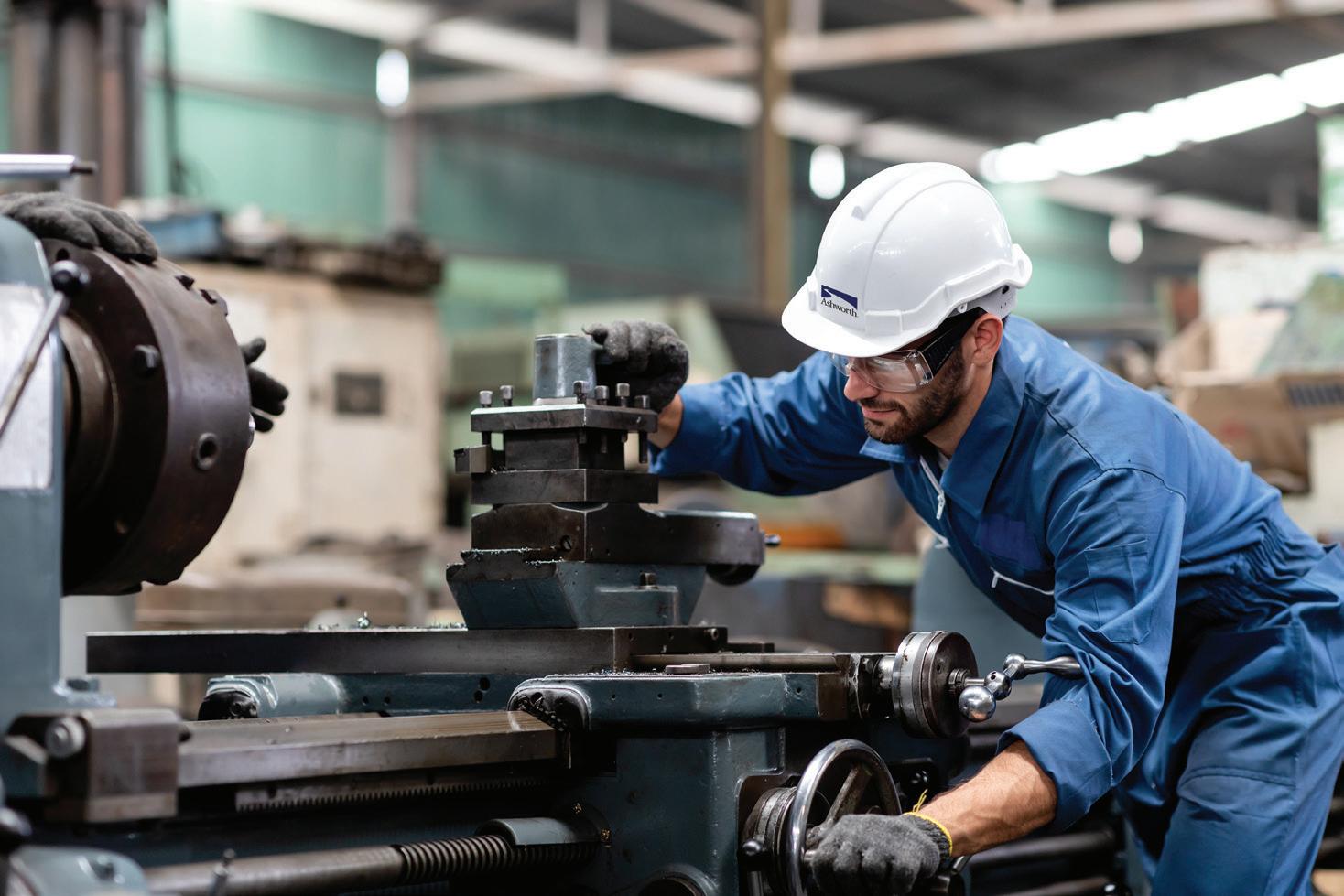
Call on Ashworth Factory Service troubleshooting, and maintenance of your belting system.



CONNECT
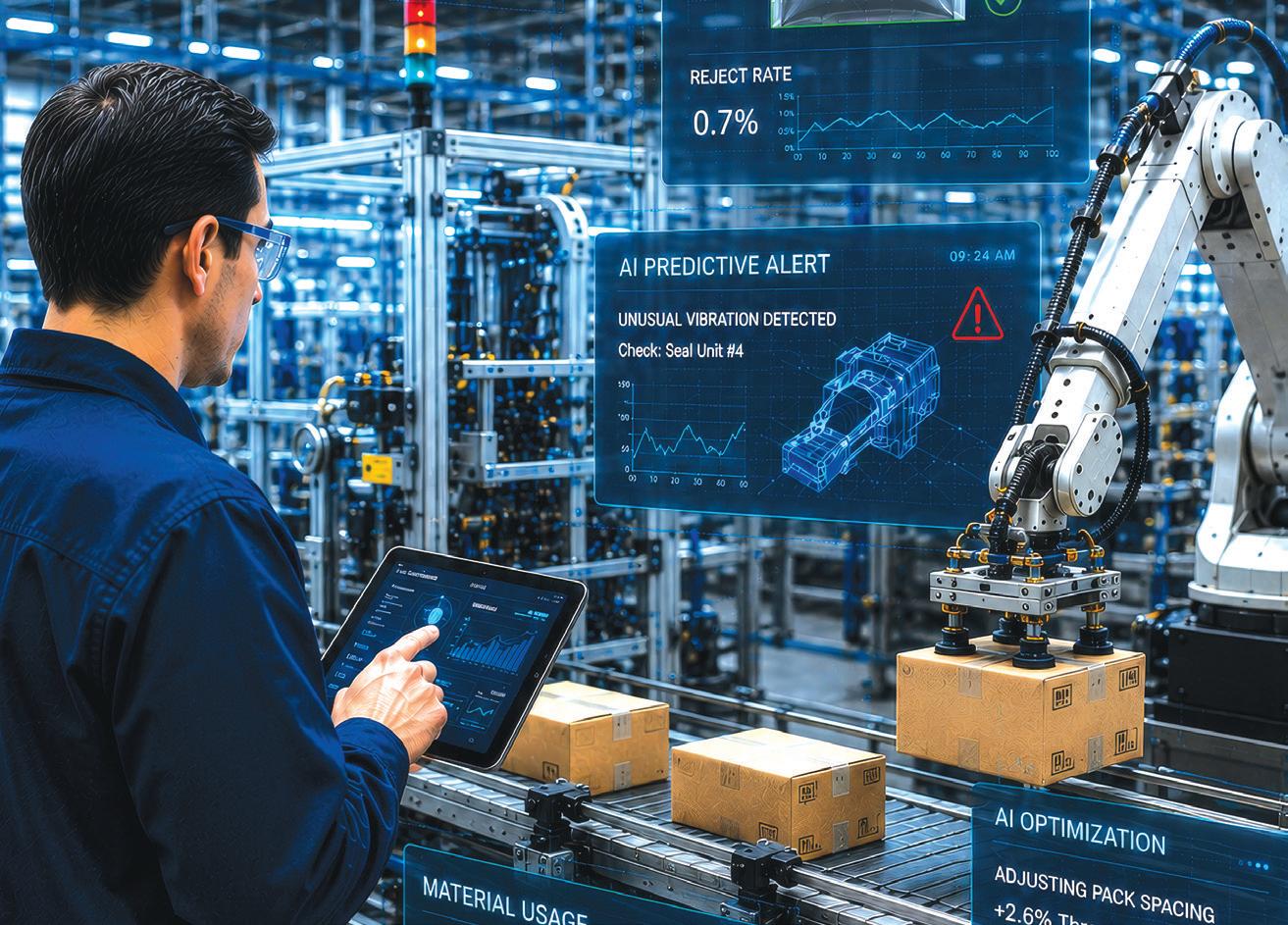
BUSINESS INTELLIGENCE
6 State of the Processing Industry PMMI’s inaugural barometer of food and beverage processing.

SALES FOCUS
8 Training on Equipment A er the Sale
What every OEM knows about equipment operation that nobody applies to their sales team.
MARKETING INSIGHTS
10 What’s Holding Teams Back
The missing piece isn’t e ort; it’s shared definitions and shared context.
INDUSTRY NEWS


12 PMMI and interpack Partner
The PMMI North American Pavilion strengthens international market access.
ASSOCIATION NEWS
30 PMMI Member Roundup Annual Meeting heads to Montreal
PERSPECTIVES
34 New Era HMIs
Eight years later, machines still lack modern interfaces.




WOMEN’S
38 A Look at SheLeads
A modern playbook for women leaders.

WORKFORCE
40 Re-“Packaging” Jobs
A conversation with Mike Rowe.
EXHIBITOR’S CORNER



42 A racting Young Professionals Don’t risk missing the next wave of decision-makers.


44 OEM Machine Technology
Check out the latest products. FINAL THOUGHTS

48 Next Gen PMMI Programs


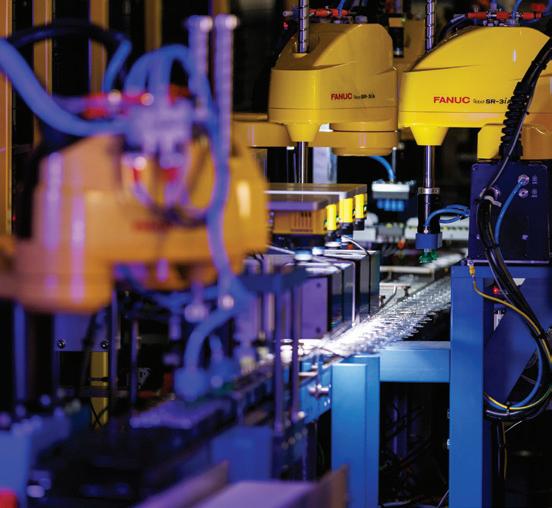
Exposing students to packaging and processing.


The official publication of PMMI OEMMAGAZINE.ORG
Sean Riley Editor-in-Chief sriley@pmmimediagroup.com | 571 266 4419
Tracey Labovitz Editorial Operations Coordinator
Kim Overstreet Director of Content
Norman Smith Art Director
David Bacho Creative Director
Reggie Lawrence Vice President, Sales rlawrence@pmmimediagroup.com
Courtney Nichols Director, Client Success & Development cnichols@pmmimediagroup.com
Lara Krieger Senior Manager, Print Operations lkrieger@pmmimediagroup.com
Janet Fabiano Financial Services Manager jfabiano@pmmimediagroup.com
PMMI Media Group
500 W Madison, Suite 1000, Chicago, IL 60661 www.pmmimediagroup.com
David Newcorn President
Elizabeth Kachoris Vice President, Digital
Jen Krepelka Senior Director, Digital Media
Amber Miller Director of Marketing
Joan Jacinto Director, Ad Tech and Search
Angie Szerlong Director of Industry Strategy
PMMI, The Association for Packaging and Processing Technologies
12930 Worldgate Dr., Suite 200, Herndon VA, 20170 Phone: 571 612 3200 | Fax: 703 243 8556 www.pmmi.org
Jim Pittas President and CEO
Joe Angel Executive VP, Industry Outreach, PMMI Glen Long Senior VP
Tracy Stout VP, Marketing and Communications
Laura Thompson VP, Trade Shows
Andrew Dougherty VP, Member Services
SUBSCRIPTIONS
To subscribe to OEM visit: oemgo.to/9999
To change or modify a subscription, please contact circulation@pmmimediagroup.com
OEM EDITORIAL ADVISORY BOARD
Greg Berguig President, PAC Machinery
Jacob Cox VP of Electrical and Controls, Fallas Automation
Rick Fox III Vice President, Fox IV Technology
Jordan Hamrick President, Hamrick Packaging Systems
Paul Irvine Executive Chairman & Owner, Plexpack
Zack Lynch Founder, Next Tech Automation
Stacy Johnson VP Business Development, Hoosier Feeder Company
Tom Sosnoski Director of Advanced Development, JLS Automation
Alex Vargo VP of Manufacturing, LAKO
Colin Warnes Director Sales Engineering & Project Management, ADCO Manufacturing
By Sean Riley, Editor-in-Chief


At the tail end of PMMI’s Executive Leadership Conference,
I had the pleasure of recording an unPACKed with PMMI podcast with Mike Rowe of Dirty Jobs fame (Re-“Packaging” Jobs in Manufacturing, p. 40). Rowe really opened my eyes with his belief that, concerted or otherwise, the benefits of manual labor careers like those in manufacturing were suppressed for a generation.
A leading part of Rowe’s hypothesis pointed to the demise of shop class and the lack of exposure for impressionable teenagers to a variety of jobs in the trades. Couple this with the push toward four-year college degrees, and it’s no wonder hundreds of thousands of manufacturing jobs remain unfilled.
chinery is harnessing the power of AI to ensure senior employees leave more than just a legacy.
Meet Digital Dennis! Capturing Decades of Expertise with AI (p. 18) is one of the most novel applications of the technology I have encountered. Dennis carries a small AI digital recorder and follows a script to share details about projects and products cataloged in a searchable database. At a time when good help is clearly hard to find, imagine the impact of losing 40 years’, or another entire generation’s, worth of knowledge. Spee Dee is making sure that tribal knowledge isn't walking out the door, and it isn't the only example of AI aiding the workforce in this issue.
“ A generation ignored the merits of manufacturing, which is magnified by Baby Boomers reaching retirement age.”
A generation ignored the merits of manufacturing, which is magnified by Baby Boomers reaching retirement age. Not only are jobs hard to fill, but decades of priceless tribal knowledge are riding into the sunset.
To help alleviate some of the pain caused by a shortage of skilled workers, Spee Dee Packaging Ma-
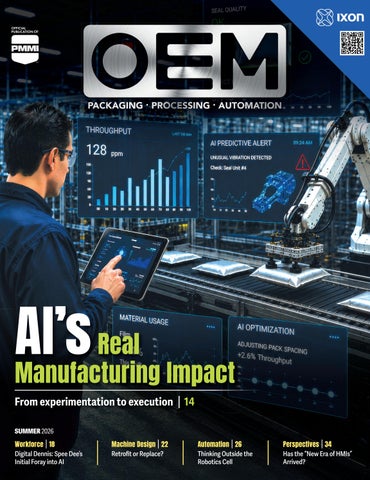
From Experimentation to Execution: AI’s Real Manufacturing Impact (p. 14) covers a panel discussion on realworld uses of AI, offering a clearer view of how OEMs can apply it today and what challenges remain. The spotlight in the story shines on examples where AI is bridging the skills gap.
As always, I hope you enjoy this issue of OEM. If you have feedback—positive or negative—please reach out at sriley@pmmimediagroup.com. ■
$6.2 BILLION
TOTAL SHIPMENT VALUE
GRAINS & CEREALS
COOKING OILS
3.2% MODEST GROWTH OVER 2024
HEALTH: CONSUMER PREFERENCES ARE SHIFTING TOWARD SIMPLIFIED INGREDIENTS, HIGHER PROTEIN DENSITY, AND PERCEIVED NUTRITIONAL QUALITY.
WORKFORCE: PERSISTENT LABOR SHORTAGES REMAIN A DEFINING STRUCTURAL CONSTRAINT ACROSS THE PROCESSING LANDSCAPE, PRIORITIZING AUTOMATION.
MACHINE DESIGN: WORKFORCE CONSTRAINTS AND INTEGRATION DEMANDS PRIORITIZE INTUITIVE CONTROLS, REDUCED MANUAL INTERVENTION, AND SYSTEMS REQUIRING LESS INTERNAL ENGINEERING OVERSIGHT.
SANITATION: RISING RECALL VISIBILITY, HIGHER SKU COMPLEXITY, AND FORMULATION CHANGES ARE ELEVATING THE IMPORTANCE OF HYGIENIC DESIGN, CLEANABILITY, AND REPEATABLE SANITATION WORKFLOWS.
AI & BIG DATA: AI ADOPTION REMAINS GRADUAL AND RISK-WEIGHTED, FOCUSING ON DATA MONITORING, INSPECTION ENHANCEMENT, AND DECISION SUPPORT RATHER THAN AUTONOMOUS CONTROL.
SUSTAINABILITY: WATER USE, ENERGY CONSUMPTION, AND WASTE MINIMIZATION ARE INFLUENCING EQUIPMENT UPGRADES, SANITATION PRACTICES, AND SYSTEM DESIGN DECISIONS.

What every OEM knows about equipment operation that nobody applies to their sales team
By Ma hew Neuberger, President, Neuberger & Company,

Ihave delivered the PMMI two-day sales training program to companies across this industry. The feedback is consistently strong. Participants leave energized. The content lands. Then, a few months later, I get the call.
“We loved it. We used it. We got results. And then—I’m not sure what happened—we kind of stopped.”
I know exactly what happened. And it has nothing to do with the quality of the training.
Here is the internal monologue of a sales leader when results fade—and I say this with full respect, because I have heard a version of it from some of the sharpest operators in this industry.
You approved the investment. You championed the program. You watched your team engage, saw the energy in the room, and got the survey scores back. Something real happened in that room. You felt it.
Then gradually—not all at once—the new behaviors started drifting. The language faded. The team started selling the way they sold before. And you landed on the only conclusion that made sense from where you were standing: we have an accountability problem. So you pushed harder on the outcome. Tougher pipeline reviews. Consequences attached to the number. It worked—for about a quarter. Then it didn’t.
Inc.
a pass. I sent them to training. I did my part. The failure is theirs.
That is the most expensive sentence in sales management.
Here is a version of this story that every company in this industry knows from the other side.
You ship a machine. Installation is perfect. The commissioning team walks the operators through everything—how to run it, how to maintain it, and what never to do. The feedback is excellent. The customer is thrilled.
Six months later, your phone rings. The machine isn’t performing. Your techs arrive on-site. The picture is immediate. Equipment wasn’t operated to spec. Someone made modifications that voided the warranty. Maintenance schedules weren’t followed. Spills sat long enough to become problems. The machine didn’t fail. It was failed.
“ The machine didn’t fail. It was failed.
Whose fault is that?”
Whose fault is that? The honest answer is complicated. The machine was right. The installation was right. What was missing was the ongoing operating discipline that keeps a well-built system performing the way it was designed to perform.
Your sales training didn’t fail either. It was failed. By the management system that was supposed to hold it in place—and was never built.
So you pushed harder. The cycle repeated. Because the diagnosis was wrong from the start.
Applying pressure to outcomes is not the same thing as coaching to behaviors. The team didn’t revert from a lack of discipline. They reverted because no one built the management infrastructure to hold the new behavior in place. And in concluding the accountability issue, leadership quietly gave itself
Your training is the machine. Your managers are the operators. And right now, most of them have never been given a maintenance schedule.
The data is blunt about this. Without reinforcement, 87% of training content is forgotten within 30 days. Not because the training was poor. Because the system around it was missing.

What makes training stick is not a better curriculum. It is what happens after. In every company that has sustained results, the pattern is the same: managers own the after. A structured weekly coaching rhythm. Live call debriefs. Scripts reviewed in 1-on-1s. A measurement system that tracks lead quality, win rate, and margin so a manager can tell you whether the system is producing or exactly where it is breaking down. The difference between a manager who reports outcomes and one who coaches to behaviors.
Most managers in this industry were never taught to do any of that. They were promoted from the sales floor because they were the best rep—which is a great way to lose a great rep and gain a struggling manager. Nobody taught them what the after looks like. Nobody gave them a system to run.
Here is what changes when they have one.
The sales team stops reverting. Not because someone cracked down, but because the environment makes improvement the path of least resistance. Junior reps develop faster because their manager finally has a framework to coach from, not just an instinct to sell from. Senior reps stop carrying the team and start building it. Pipeline becomes predictable. Revenue follows margin instead of chasing it. And the CEO stops being the de facto sales manager for a team that should be running without them.
That is not a fantasy. It is the operating reality of every company in this industry that has decided to build the management infrastructure instead of just scheduling the next training event.
The fix is not more training alone. It is building the system that makes training irreversible.
Before you approve the next program: ask who in your organization owns what happens on day 91. If the honest answer is no one, you don’t have a training gap. You have a management gap. And filling it is the most energizing thing you will do this year. That question has an answer. And the companies in this industry that have found it are the ones getting better every quarter—without anyone having to push. ■
Matthew Neuberger is President & CEO of Neuberger & Company, a Sandler Training franchise specializing in the packaging and processing equipment industry. He works with PMMI members to design and install Sales Operating Systems that drive measurable, lasting revenue performance. He can be reached at matthew@neubergerco.com.
Maximize your trade show investments by training your trade show team. This 2-day in-person course, customized for the selling of packaging and processing equipment, focuses on what exhibitors can do to maximize sales from trade shows.
This course is based on the Sandler Sales System and developed for PMMI with member subject ma er experts. Learn how to use trade shows as your most powerful year-long marketing and business development opportunities. Visit pmmiu.org to register.

Marketing teams at packaging and processing OEMs are running fuller calendars across more channels, with more pressure to tie it all back to revenue. The missing piece isn’t e ort—it’s shared definitions and shared context.
By Amber Miller, Director of Marketing, PMMI Media Group


Across PMMI Media Group’s 2025 and Q1 2026 Packaging and Processing Supplier Surveys, one theme appears again and again— marketing teams are being asked to do more, but often without the bandwidth to fully connect all the moving parts. Teams are busier than ever. Content calendars are full. Campaigns are running across more channels. There’s growing pressure to generate leads, support sales, and demonstrate measurable impact on the business. At the same time, the landscape itself is shifting—AI-driven search is now a part of SEO, new tools are emerging, and buyer behavior moves further upstream.
And yet, for many organizations, results don’t always reflect the level of effort being put in.
In many cases, we found packaging and processing OEM marketing teams to be small (but mighty!). More than half of suppliers report having just one or two people dedicated to marketing, with many leaning on external partners to help manage everything from SEO to content creation, and automation. That structure isn’t unusual for the industry, but it does create a constant balancing act between day-to-day execution and longer-term strategy.
At the same time, expectations around performance continue to rise. Marketing is no longer just responsible for one-off email and awareness campaigns, but with new lead-tracking capabilities popping up in many platforms, it’s increasingly expected to contribute directly to pipeline and revenue.
That shift has put a spotlight on areas that have always been complex, but are now harder to navigate under pressure.
Lead generation remains a top priority for most suppliers, but so do the challenges that come with it. Many organizations report ongoing challenges with lead quality, converting leads into opportunities, and ensuring a smooth handoff between marketing and sales. Even when interest is generated, moving that interest through the pipeline isn’t straightforward. Part of the challenge lies in visibility. Marketing teams are tracking performance, but the metrics available don’t always tell the full story. Engagement indicators like page views, clicks, and time spent on page are widely used, yet they don’t always connect clearly to downstream outcomes. As a result, teams can see activity but still struggle to tie that activity to revenue in a way that satisfies both leadership and sales. This is where alignment becomes important.
When marketing and sales are closely aligned, there’s a shared understanding of what a qualified lead looks like, where opportunities are coming from, and how conversations are progressing. Content reflects real customer needs, and follow-up is informed. But when that alignment is still developing, gaps can emerge. Leads may not fully match what sales expects. Content may not address the most pressing buyer concerns. Opportunities that begin with strong interest can lose momentum along the way.
It’s not a matter of one team falling short. In most cases, both sides are working toward the same goal, but from different vantage points, with different pressures. At the same time, the environment marketers are operating in has become more complex.
Take search and digital visibility, for example. Most suppliers recognize its growing importance—nearly three-quarters reported that SEO or AI-driven search


Marketing teams are juggling multiple tasks, but despite being stretched thin, opportunities arise when marketing, sales, and measurement align on a shared goal.
optimization has been discussed at the leadership level, with many actively working to improve their approach. But translating that awareness into execution is another matter. Many teams are still building internal expertise, experimenting with tools, or relying on outside support to keep pace with rapid changes.
A similar pattern shows up with marketing technology. While CRM and automation platforms are widely used, many organizations are still in the process of fully implementing or optimizing those systems.
Individually, none of these challenges are surprising. Taken together, they point to something larger: the difficulty of connecting strategy, execution, measurement, and sales into a single, cohesive system. Without that connection, even strong content can struggle to move opportunities forward. Its impact depends on how well it aligns with what buyers are trying to understand, how it supports sales conversations, and how it fits into the broader journey from awareness to decision.
What’s encouraging is that many teams are already working to address these challenges. There’s a growing focus on improving lead quality rather than simply increasing volume. There’s also a shift toward being more intentional about where and how suppliers engage with their audience—particularly earlier in the buying process.
In a specialized industry like packaging and pro -
cessing, visibility is less about scale and more about relevance. Reaching the right audience in the right context can make a meaningful difference in how opportunities develop.
For some teams, that has meant looking beyond internal efforts alone. With limited bandwidth, many suppliers are exploring ways to extend their reach through more targeted, industry-specific channels— connecting with decision-makers in environments where they are already actively researching solutions.
Organizations like PMMI Media Group are part of that broader ecosystem, helping suppliers engage with highly relevant audiences across editorial platforms, digital programs, and industry events. For marketing teams managing multiple priorities, these types of channels can provide a way to stay visible without adding additional complexity to their day-today workload.
Of course, visibility is only one piece of the equation. Its impact ultimately depends on what happens next—how leads are handled, how conversations evolve, and how closely marketing and sales remain aligned throughout the process.
The opportunity lies in making that effort more connected—bringing together the tools, content, data, and teams already in place (and the many emerging AI platforms), and aligning them more closely around one common goal—connecting with engaged, qualified buyers at the right time, in the right place, and with the right message. ■
By Sean Riley, Editor-in-Chief
PMMI and interpack signed a strategic partnership agreement designed to expand international business opportunities for North American packaging and processing companies and strengthen global industry collaboration.
Announced during interpack 2026 in Düsseldorf, Germany, the Memorandum of Understanding (MoU) reinforces a longstanding relationship between the two organizations while creating new pathways for North American manufacturers and suppliers to connect with global customers, partners, and emerging markets.
The MoU includes the creation of a dedicated PMMI North American Pavilion at interpack 2029 in Düsseldorf, Germany, organized and managed by PMMI.
The partnership reflects increasing demand for stronger cross-market collaboration as packaging and processing companies navigate evolving supply chains, automation investments, digital transformation initiatives, sustainability goals, and continued global growth opportunities.
As part of the agreement, PMMI will lead the development and management of the PMMI North American Pavilion at interpack 2029, creating a centralized destination for PMMI Members from across the United States, Mexico, and Canada. The pavilion is expected to enhance visibility for participating companies while strengthening business connections between North American manufacturers and international buyers.
“Packaging and processing is a global industry, and our members are increasingly looking for stronger access to international markets, customers, and innovation partners,” says Jim Pittas, president & CEO, PMMI. “This partnership creates a strategic platform for PMMI members to expand

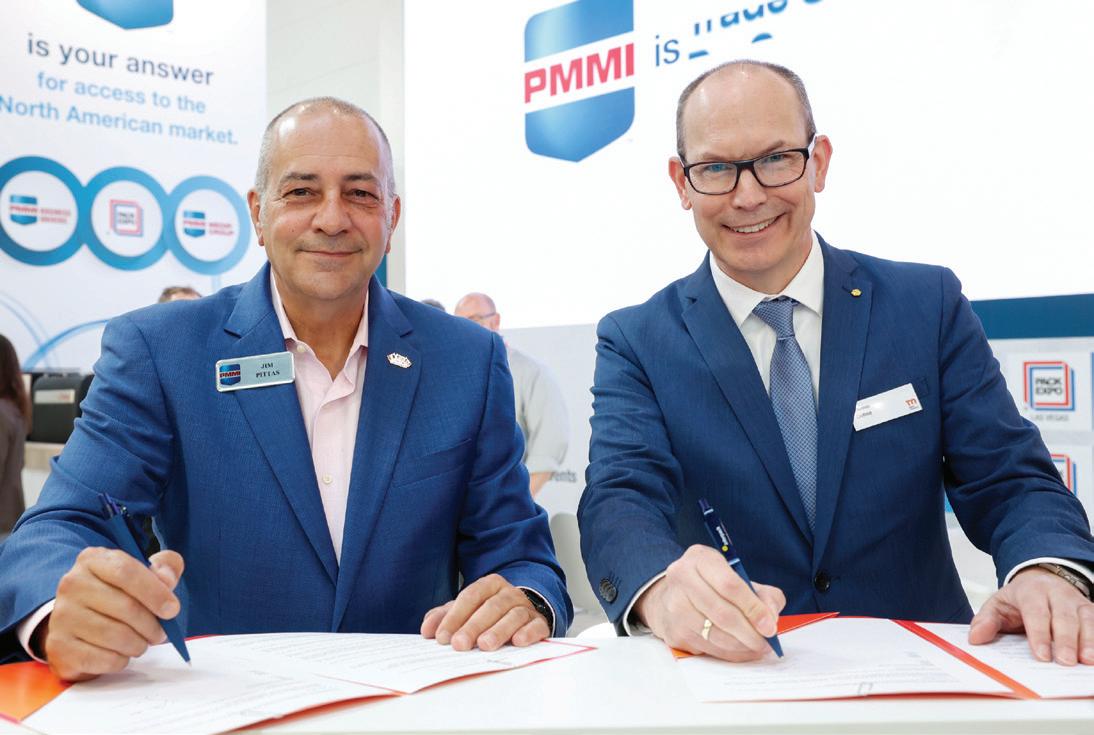
their global footprint, build new business relationships, and showcase North American innovation on one of the industry’s most influential international stages.”
“For many years, PMMI and interpack have maintained a close and trusted dialogue that we highly value. This agreement is a natural next step to further develop that exchange and expand international connectivity for the benefit of our shared customers,” says Thomas Dohse, director of interpack.
The PMMI North American Pavilion at interpack 2029 will provide participating exhibitors with a unified presence and expanded visibility at one of the world’s leading processing and packaging events. The initiative is also expected to support broader industry collaboration around automation, sustainability, smart manufacturing, and next-generation packaging solutions.
Both organizations said the agreement reflects a shared commitment to advancing innovation and strengthening the global packaging and processing industry through greater international engagement and collaboration. ■


Jorge



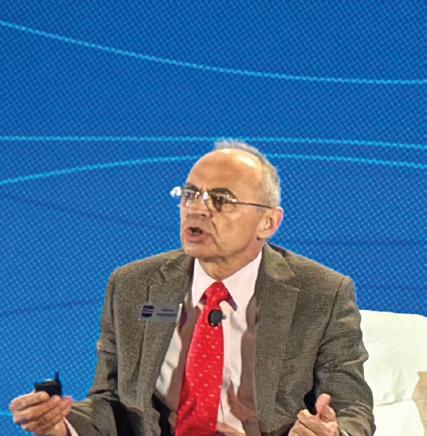



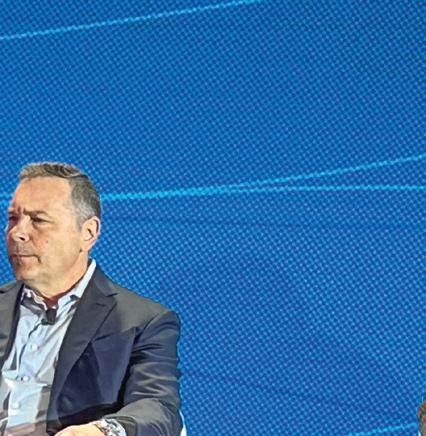
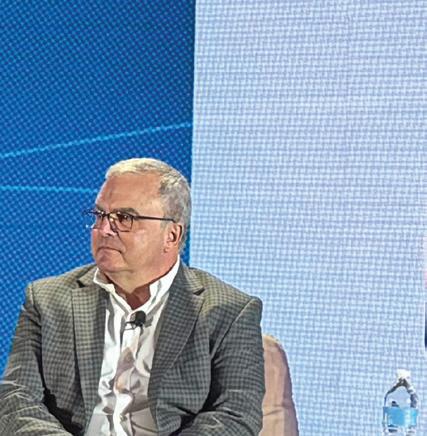
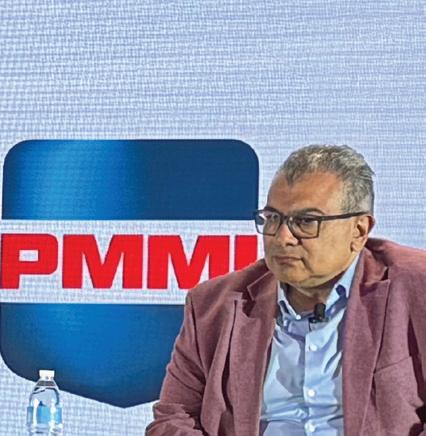
At PMMI’s Executive Leadership Conference, leaders discussed how AI
is moving into real-world use, o ering a clearer view of how OEMs can apply it today and what challenges remain.
By Sean Riley, Editor-in-Chief
Artificial intelligence has quickly become an operational imperative, according to the kick-off session of PMMI’s Executive Leadership Conference. But while the technology continues to dominate headlines, the real question facing industry leaders is far more practical: How do you move from experimentation to measurable business impact?
That question was at the center of the panel, where Jorge Izquierdo, vice president, market development, PMMI, moderated a discussion on how companies are operationalizing AI in real-world environments. Joining him were Rob Cartia, vice president, Business Process and Corporate Technology Leader at ProMach; Dave Navin, president and CEO of Spee-Dee Packaging Machinery; and Eddy Saad, strategic account executive at Microsoft.
One of the clearest takeaways from the discussion was that AI adoption is already underway inside most organizations, whether leaders have formalized a strategy or not.
For Navin, the rise of AI represents a natural evolution in how companies operate.
“AI is probably more akin to moving from 2D drawing on paper to CAD, and then from 2D CAD to 3D,” he said. “It’s just the next evolution of where we’re going as companies.”
That sense of inevitability is driving urgency across the industry. Companies are recognizing that waiting for the technology to mature is no longer a viable option.
At ProMach, Cartia said the company’s AI journey didn’t begin as a top-down initiative. Instead, it emerged organically from within the organization. “We had teams already experimenting with it,” he explained. “That pull became validation for a business case. It made it clear we had to move quickly and deliberately.”
Without that structure, he warned, organizations risk data exposure, vendor sprawl, and fragmented experimentation happening in silos.
Saad echoed that observation from a broader industry perspective.


“Organizations are looking at AI not just as something to experiment with, but as something to scale across the entire enterprise,” he said. “That’s where the real value comes from.”
As the panel explored where AI is delivering value today, one theme consistently rose to the top: knowledge transfer.
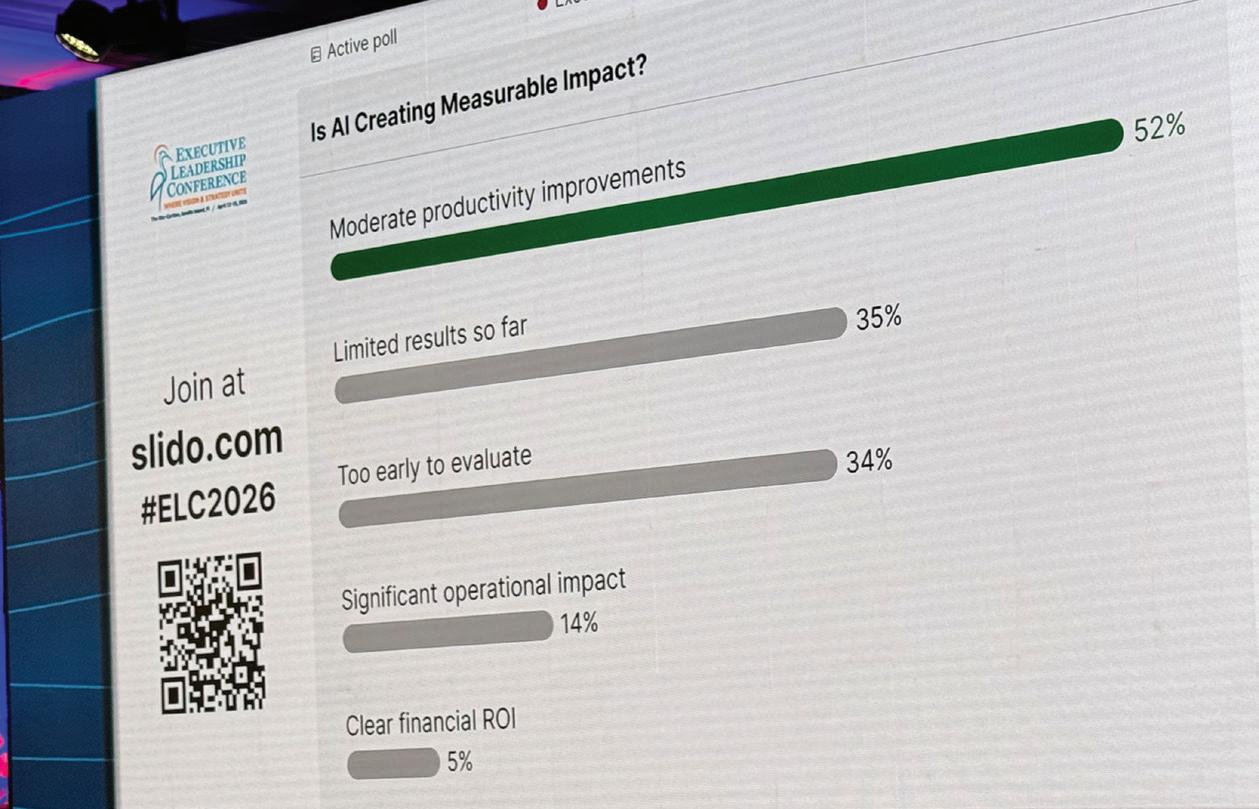
Audience polling during the session reinforced that insight, with knowledge capture ranking as the leading area where companies are already seeing impact. For OEMs facing workforce turnover and retirements, the ability to preserve institutional knowledge has become increasingly urgent.
Navin shared how Spee-Dee is tackling that challenge by capturing the expertise of long-tenured employees. One initiative—Digital Dennis (see page 18 for the full story)—focuses on a veteran employee with more than four decades of experience. “We’ve got someone with 45 years of knowledge,” Navin said. “How do we get that information out of his head and make it accessible?”
The solution involves recording conversations, transcribing them with AI, and storing them in a searchable system. But the goal goes beyond documenting technical settings.
The impact of that effort is already tangible. Navin described a recent case where a customer reported an unusual machine issue on equipment that had been in the field for years. By searching archived service reports, the team quickly identified a similar issue from a decade earlier.
“What would have taken hours, we found in about 30 seconds,” he said.
For Saad, that type of application represents one of AI’s most accessible entry points. “You can capture meetings, transcribe them, summarize them, and make that knowledge searchable,” he said. “That becomes incredibly valuable over time.”
While AI’s long-term potential includes advanced automation and machine intelligence, most organizations are beginning with internal efficiency gains.
At ProMach, Cartia said the company is focusing on areas such as engineering, sales, and productivity. “We’re starting to see value in driving internal efficiencies,” he said.
Engineering teams, for example, are using AI tools to access standard operating procedures across divisions, particularly valuable in an organization that has grown through acquisitions. “There is no need to recreate the wheel,” Cartia noted. “There’s a huge efficiency gain there.”
On the commercial side, AI is helping teams better manage customer interactions. Tools like Salesforce Einstein allow employees to quickly summarize com-

Transferring knowledge was the leading use case for AI among ELC a endees.

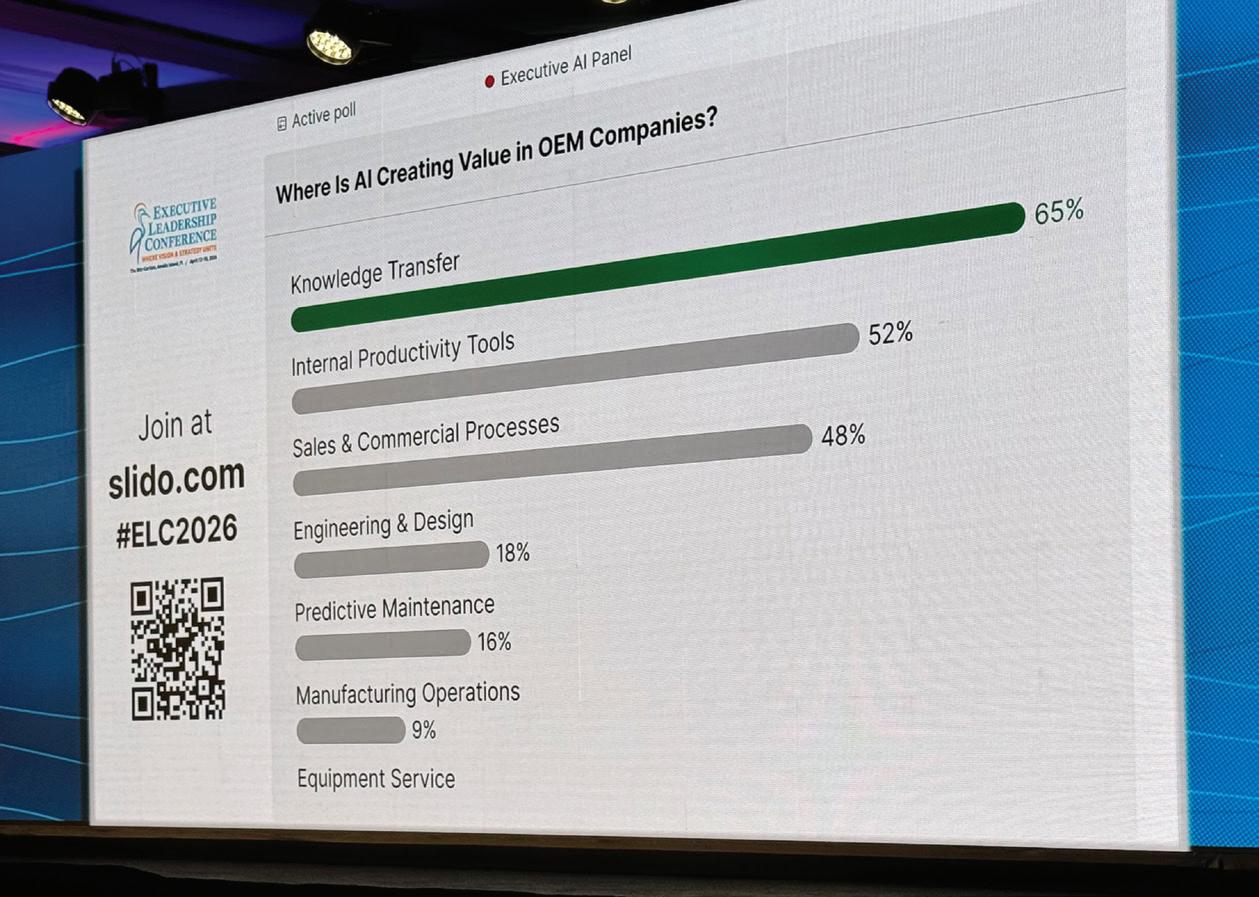
Most ELC a endees are working with AI in some capacity, with some further along than others.

“ Organizations are looking at AI not just as something to experiment with, but as something to scale across the entire enterprise.”
munications and identify next steps.
“Being able to respond to customers faster, that’s something you can tie to revenue,” Cartia said.
At Spee-Dee, even relatively simple applications are delivering value. Navin highlighted a tool that automates service quotation preparation by pulling realtime travel data into proposals.
“It’s more accurate, and it saves time,” he said. “We’re not guessing anymore—we’re giving customers realistic numbers.”
As adoption accelerates, so does the need for governance.
Saad emphasized that even small organizations need a basic framework for managing AI. “It doesn’t

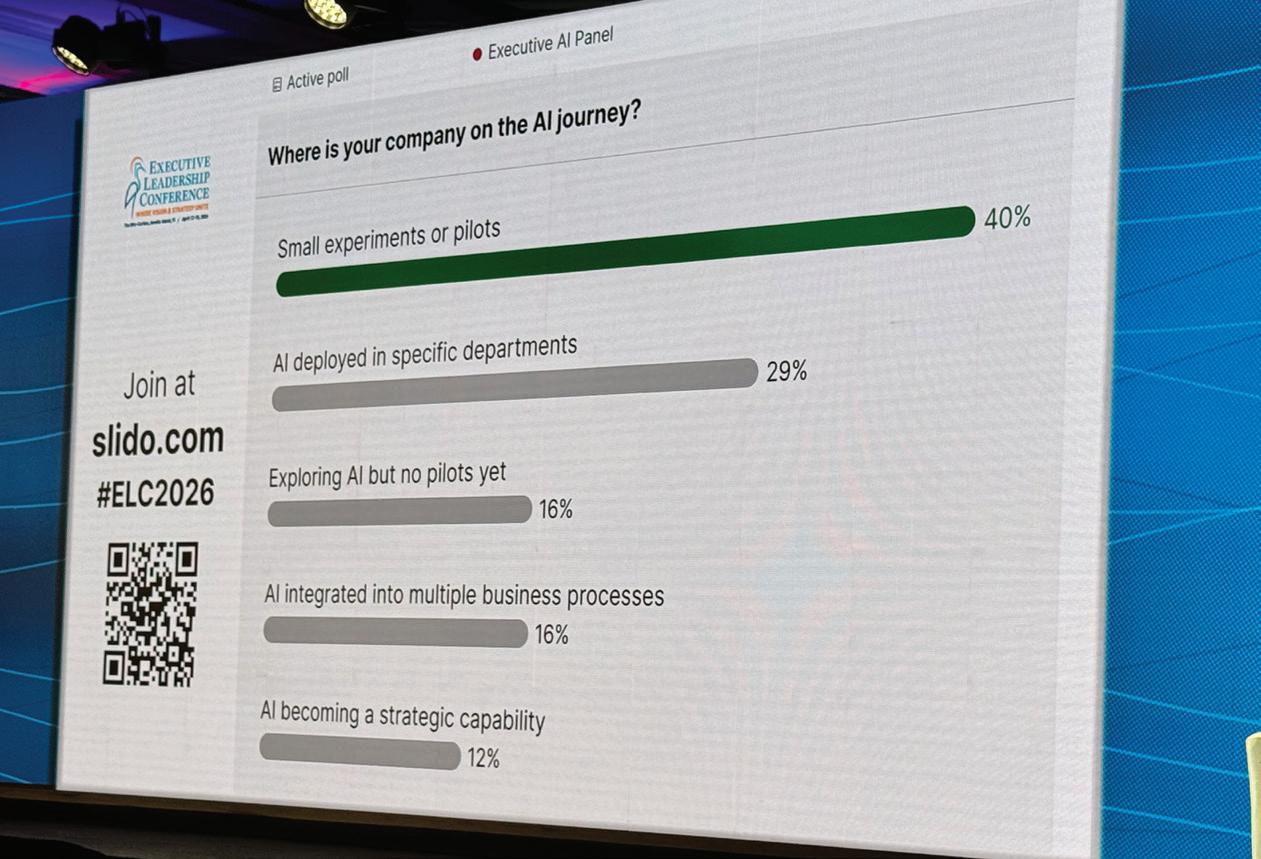

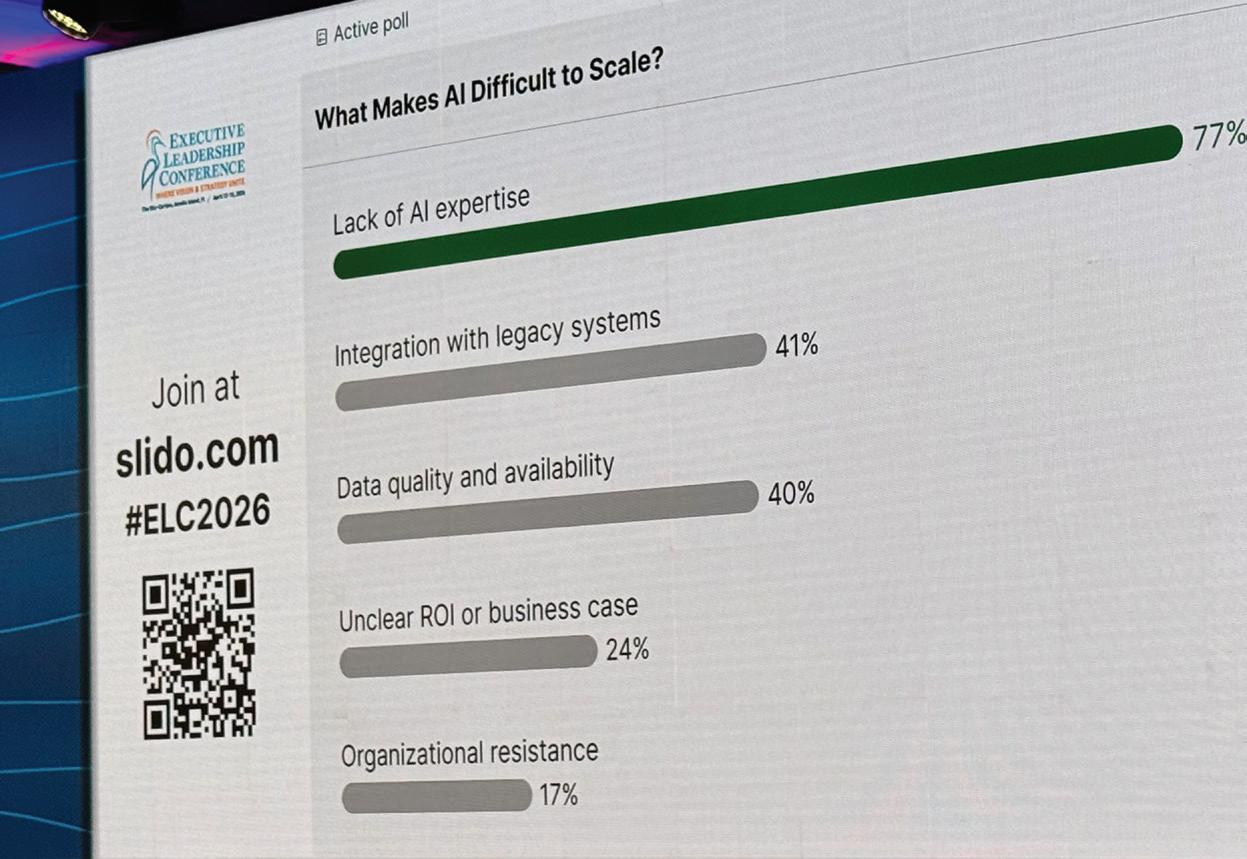
Areas where AI is creating impact as well as what makes it di cult to scale (below) for ELC a endees.


Courtesy: PMMI
At ProMach, governance includes restricting access to certain tools and creating controlled internal systems. The company has developed its own platform—PAIRIS—to manage AI resources and maintain oversight.
Despite growing adoption, scaling AI across an organization remains difficult.
Audience feedback highlighted the primary barriers: lack of expertise, integration with legacy systems, data quality, and unclear ROI.
Cartia noted that expertise often exists within organizations but is fragmented. ProMach is addressing that by identifying internal talent and building a network of AI leaders across business units.

“ It’s new, it’s evolving– but you’ve got to get on board to stay relevant.”
Courtesy: PMMI
have to be complex,” he said. “But you need to define use, identify champions, and set some standards.”
That structure is essential for building trust and ensuring responsible use.
Cartia stressed the importance of working closely with IT teams. “You’ve got to make sure your data is protected,” he said. “That’s paramount.”
He also cautioned companies to carefully evaluate third-party vendors. “If a vendor tells you your data is 100% protected, I’d question that,” he said. “And you need to ask whether they’re outsourcing any part of the solution.”
Navin said Spee-Dee is taking a more exploratory approach. “We’re encouraging people to use it and come up with use cases,” he said. “It’s about getting comfortable with it.”
Saad added that many companies already have “power users” who can serve as internal champions. The key is identifying those individuals and giving them the tools and structure to succeed.
While efficiency gains are widely recognized, the panel emphasized that companies must go further to quantify AI’s financial impact.
Cartia was particularly direct on this point. “You have to tie it to financials,” he said. “It’s very difficult to justify the investment if you can’t show what it means.”
That means translating productivity improvements into measurable outcomes, such as increased throughput or reduced labor requirements.
“If an engineer is more efficient, what does that actually mean?” Cartia asked. “Are we producing more machines? Are we reducing costs? That’s what matters.”
Without that clarity, AI initiatives risk losing momentum as they scale.
While the panelists represented companies at different stages of adoption, they shared a common perspective: AI is not something to wait on.
The most successful approaches are starting small, focusing on real problems, and building from there. Knowledge transfer, customer responsiveness, and internal efficiency are proving to be effective entry points.
For OEMs, the message is clear. AI may still be evolving, but it is already reshaping how companies operate—and those who begin the journey now will be better positioned to capture its long-term value.
As Navin put it, “It’s new, it’s evolving—but you’ve got to get on board to stay relevant.” ■

Spee-Dee’s
first AI win didn’t start with a strategy deck. It started with a 40-year veteran, a digital recorder, and a SharePoint list—and grew from there into field service and quoting.
By Sean Riley, Editor-in-Chief
For many manufacturers, artificial intelligence still feels easier to talk about than to implement. The possibilities are wide-ranging, but the first step is often unclear. At Spee-Dee Packaging Machinery, that uncertainty did not lead to a sweeping AI strategy. It led to a much narrower question: How do you capture tribal knowledge before it disappears?
That question became the foundation for Digital Dennis, an internal knowledge platform that began as a way to document machine setup expertise, preserve application know-how, and make service insights easier to find. What started as a focused effort to keep valuable knowledge from living only in people’s heads has since grown into a broader, practical AI initiative touching tribal knowledge, troubleshooting, and service quoting.


in a searchable format. Navin said the database now includes roughly 150 machines and continues to grow each week.
The name comes from Dennis, a 40-plus-year company veteran whose practical knowledge of products and machine setups had never been fully captured in written form. As Spee-Dee thought about how to preserve that expertise, the company developed a process that did not require turning experts into technical writers. Instead, Dennis uses a small Plaud. ai digital recorder and follows a script built around a specific product or application. Those recordings are then transcribed and moved into SharePoint so they can be searched alongside other machine records.
“ We were scared to death of [AI]. So we just decided to do something simple.”
Dave Navin, president and CEO of Spee-Dee, said the company did not begin by asking how to “do AI.” Instead, it focused on a business problem that had become increasingly hard to ignore. Years of machine information were spread across files, reports, and internal records, with much of the most valuable expertise still sitting with experienced employees. Finding the right answer often meant digging through folders, searching old service documents, or relying on someone’s memory.
“We were scared to death of [AI],” Navin said. “So, we just decided to do something simple.”
That simple starting point was tribal knowledge documentation. Navin described it as Spee-Dee’s first and most important goal. The company built Digital Dennis on SharePoint lists, added a Power App front end, and created a structured way to store machine records, setup settings, and product-specific details
In one example Navin shared, Dennis recorded guidance on filling fivepound bags of rice. That short recording produced a detailed guide covering critical setup items, preferred machine configurations, and cup-sizing philosophy— information that otherwise would have been difficult to capture in a consistent, reusable way.
“This is what he dictated in about 12 minutes,” Navin said. “It’s good information for the engineer to look up.”
That distinction matters. Digital Dennis was not built as an AI showcase. It was built as a documentation and retrieval system, with AI layered in to make the information easier to use. Navin put it plainly: “The goal right now was to document tribal knowledge, not to leverage AI. But AI is a great tool to leverage the tribal knowledge.”
That mindset helped Spee-Dee avoid a common trap: chasing tools instead of outcomes. Rather than


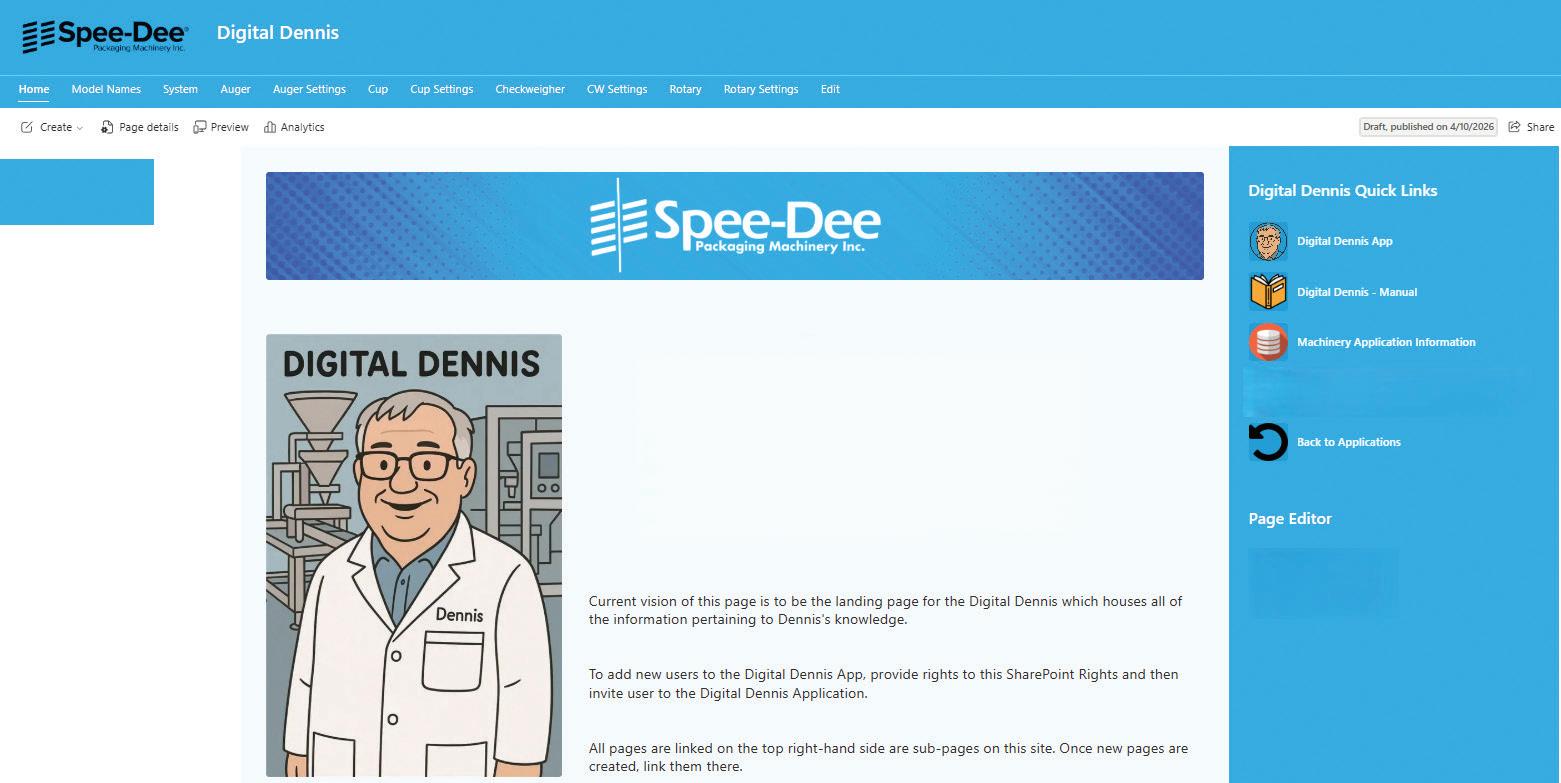


jumping between platforms, the company chose to work within Microsoft’s ecosystem, using tools it already had and trusted. “We did say we were going to stay with Copilot because it’s internal,” Navin said. “We’re looking at the outcomes we’re trying to get rather than the tool itself.”
The practical nature of the project also shaped how it was adopted internally. Spee-Dee did not try to force a major process change all at once. Instead, it began assigning different parts of the record to the people who already owned those workflows. Sales engineering enters basic order information. Machine builders log the details of product runs. Service technicians are beginning to use and contribute field

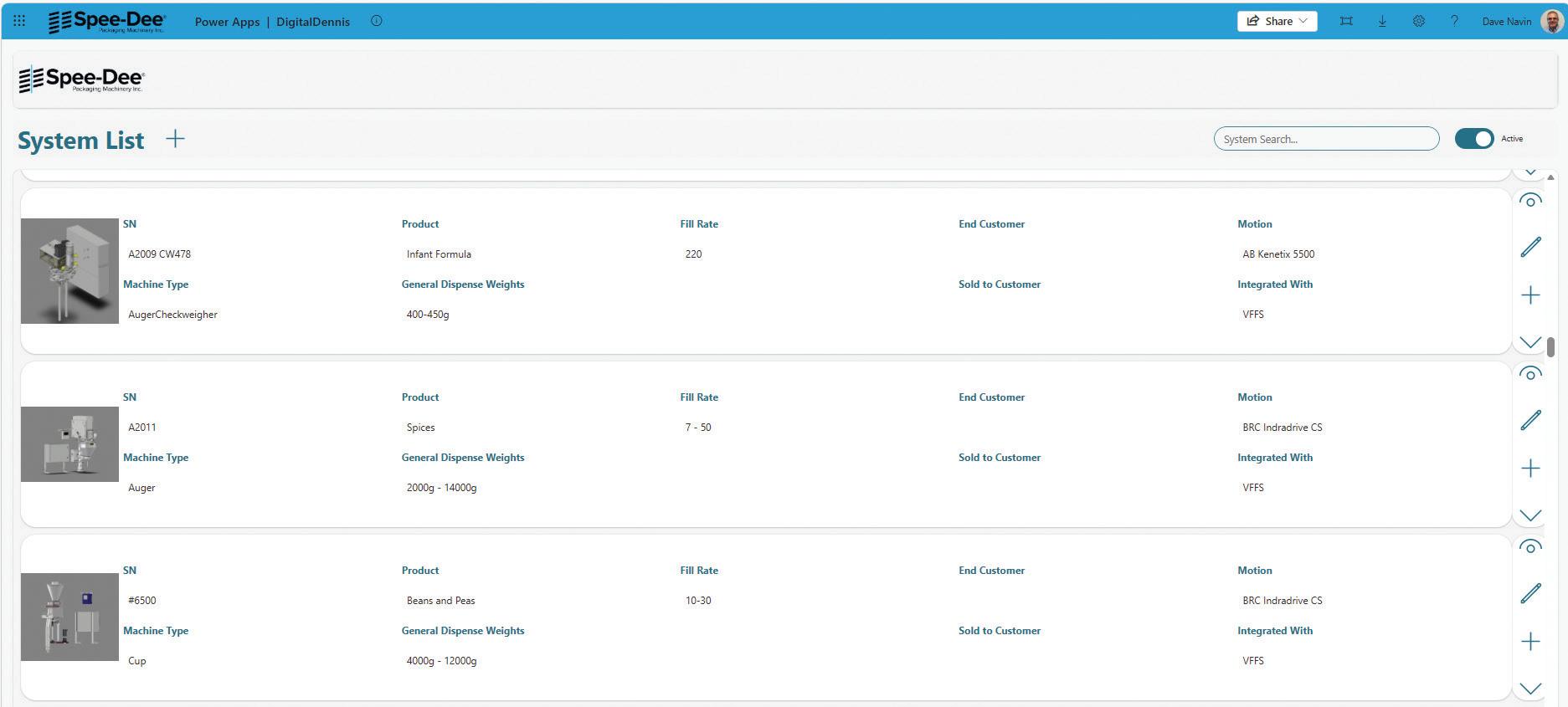
The database now includes roughly 150 machines and continues to grow weekly as employees add to the logs.
information. Adoption is still evolving, but Navin said the value is becoming clearer as the volume of records grows.
“It’s difficult to get people to change the way they’ve done it,” he said. “But they see the value in it.”
Once Spee-Dee had that entry point, the effort began to expand naturally. One application is in field service. The company uses the system to log baseline


“ . . . AI is a great tool to leverage the tribal knowledge.”
settings during factory acceptance testing, then compare those settings with what technicians find when they return to a machine months later. Over time, that creates a searchable record of what worked, what changed, and what settings performed best for a specific customer or product.
Another use case emerged in service support. Navin cited a member of the aftermarket team who pulled 15 years of service reports into cloud storage and built an internal agent to search them. Instead of digging manually through old records, technicians can type in a problem and receive a short or long answer drawn from prior service history. The tool is also configured not to hallucinate—if it does not know the answer, it says so.
Navin pointed to one example that highlighted the value. A search for a servo drive error code first returned a generic manufacturer explanation. But within the service reports, the system found a prior technician note identifying the issue as a cable shielding problem and recommending that the cable ends be regrounded.
“It took 35 seconds to find that answer,” Navin said.
Spee-Dee also extended AI into service quoting. The company now uses an app to estimate service trip costs based on variables such as time on site, travel origin and destination, and shift length, then cross-checks travel sources to create more realistic customer estimates.
Just as important, the effort did not require a massive investment. Navin said the Power App front end was developed by a contractor in roughly two and a half weeks, with the total cost coming in under $15,000.
For other OEMs still trying to find their own way into AI, Spee-Dee’s path offers a useful reminder. The company did not begin with a moonshot or a machine-level AI strategy. It began with a simple operational need, used familiar tools, and was built around a practical first use case. Digital Dennis created that opening. From there, AI became less of an abstract technology conversation and more of a working system for preserving expertise, improving service response, and supporting better decisions. ■
Configurable CO2 laser Integrator Packages enable OEMs to choose the best combination of laser power, wavelength, and working distance to fit specific application and machine needs.
Factory pre-aligned CO2 laser sub-system include laser source, scan head, controller, software, and mounting hardware ordered as a single part number with harmonized shipping.
Discover



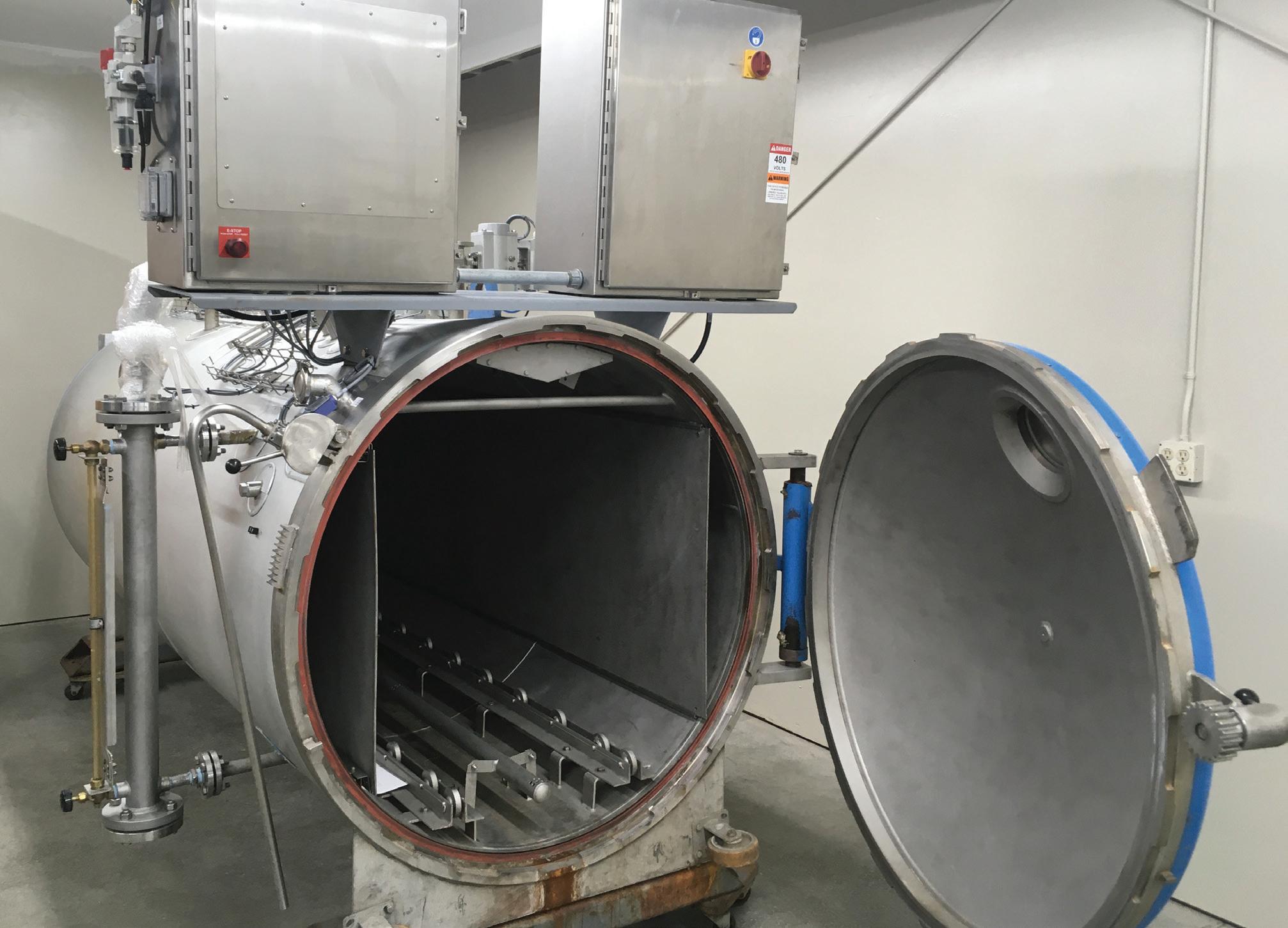
This used retort had its shell refurbished and new valves and control panels installed. Purchasing a unit on the secondhand market at a 50-to60% cost savings versus a new retort allowed Hoganville Family Farms to automate its workflow.
OEMs should guide customers through cost, time, and risk when performance or obsolescence forces a decision.
By Steve Sterling, Contributing Editor
Apackaging machine rarely fails all at once. Performance drops, components become harder to replace, or new requirements expose limits the system was not designed to handle. When this happens, production, cost, and delivery commitments are at risk. The OEM and the customer must decide whether to retrofit the machine or replace it.
Retrofits can extend service life with less cost and downtime. Replacement can remove constraints and reset performance. The risk is choosing the wrong path for the actual condition of the system.
In practice, OEMs frame the decision around three questions:
∙ Is the base machine structurally sound?
∙ Can a retrofit bring the machine back to the necessary performance levels?
∙ Can the work be completed within production and labor cost constraints?
Jordan Hamrick, president, Hamrick Packaging Systems, Kent, Ohio, said, “The first thing we look at is the machine’s performance. Did the scope of the product change during the life cycle? Is the current machine still conducive to the design, or would a new machine
Factor
Mechanical integrity
Obsolescence
New requirements
Production constraints
Cost and time
Risk horizon
Favors retrofit
Structurally sound frame
Controls can be modified
Met with upgrades
Downtime constrained
Lower cost, shorter timeline
Supports another lifecycle
be a better fit? If the machine is 4–5 years old and the customer just wants to speed it up, we can look at replacing pneumatic components with servos. But when requirements jump 400% to 600% in throughput, we quote new rather than retool the existing.”
When the decision is not clear, the right call is the one that minimizes the risk of unplanned downtime. A common mistake is to move too quickly to one path. Some OEMs push replacement before fully understanding what the existing machine can do. Others expect a lower-cost retrofit to deliver new-machine performance. Both approaches create unnecessary cost, risk, and disruption.
Retrofit projects often fail not because the concept is flawed, but because the initial scope is incomplete. Jared Jones, COO of CODI Manufacturing, Littleton, Colorado, remembers a project that taught the organization a valuable lesson.
“We assumed components were the same throughout the system,” he said. “When we got downstream, we found everything had been modified down to the bolts. What should have been a straightforward retrofit turned into a labor- and time-intensive effort that required cutting components out. The retrofit took longer than replacing the system would have. Now we thoroughly examine the entire system before making a recommendation.”
Bill Gagne, owner of Harris Hill Automation in Poland, Maine, adds that the short- and long-term goals of the customer and the project should be understood. “For example, a controls modernization can accommodate the next few years of stable or scaling production, while in parallel, we work to develop a long-term strategy for increased throughput and reliability.”
The starting point in the assessment is the condition of the base machine. Frames, major structures, and core mechanical elements must be capable of supporting one or more new lifecycles. Gagne at
Favors replace
Structural limitations
Core system obsolete
Built-in limitations
Downtime available
Higher cost, longer timeline
Short remaining life
“ It comes down to how much labor is needed onsite. Is it less [labor] to install new or less to retrofit?”
Harris Hill said his company “utilizes 3D scanning technologies to assist in the reproduction of vintage mechanical parts that may not have the modern documentation or models we’re accustomed to.”
In the industry, a legacy machine remained mechanically sound but operated with obsolete controls and components that were becoming difficult to support. Production demand ruled out taking the line down for an extended period to install a new machine. The OEM carried out a thorough evaluation and, in consultation with the customer, concluded that a retrofit was the lower-risk path. Controls, motion components, and key accuracy elements were upgraded in stages while the base machine remained in place. The result was improved performance, reduced scrap, and continued production without disruption.
The next question is whether the machine still can be supported. Some key components that cannot be substituted by off-the-shelf replacements may be near the end of their commercial life or no longer serviceable. When parts become difficult to source or support, the retrofit path becomes higher risk.
“If a customer acquires a machine from the 1980s where most components are obsolete and it requires a complete teardown to the frame, it makes more sense to purchase new,” Hamrick said.
Another factor is whether the machine can meet current throughput, material, and performance requirements. Increasingly, this includes new and lighter materials that change handling, sealing, and stability requirements. These materials introduce new challenges that older machines were not designed to address.
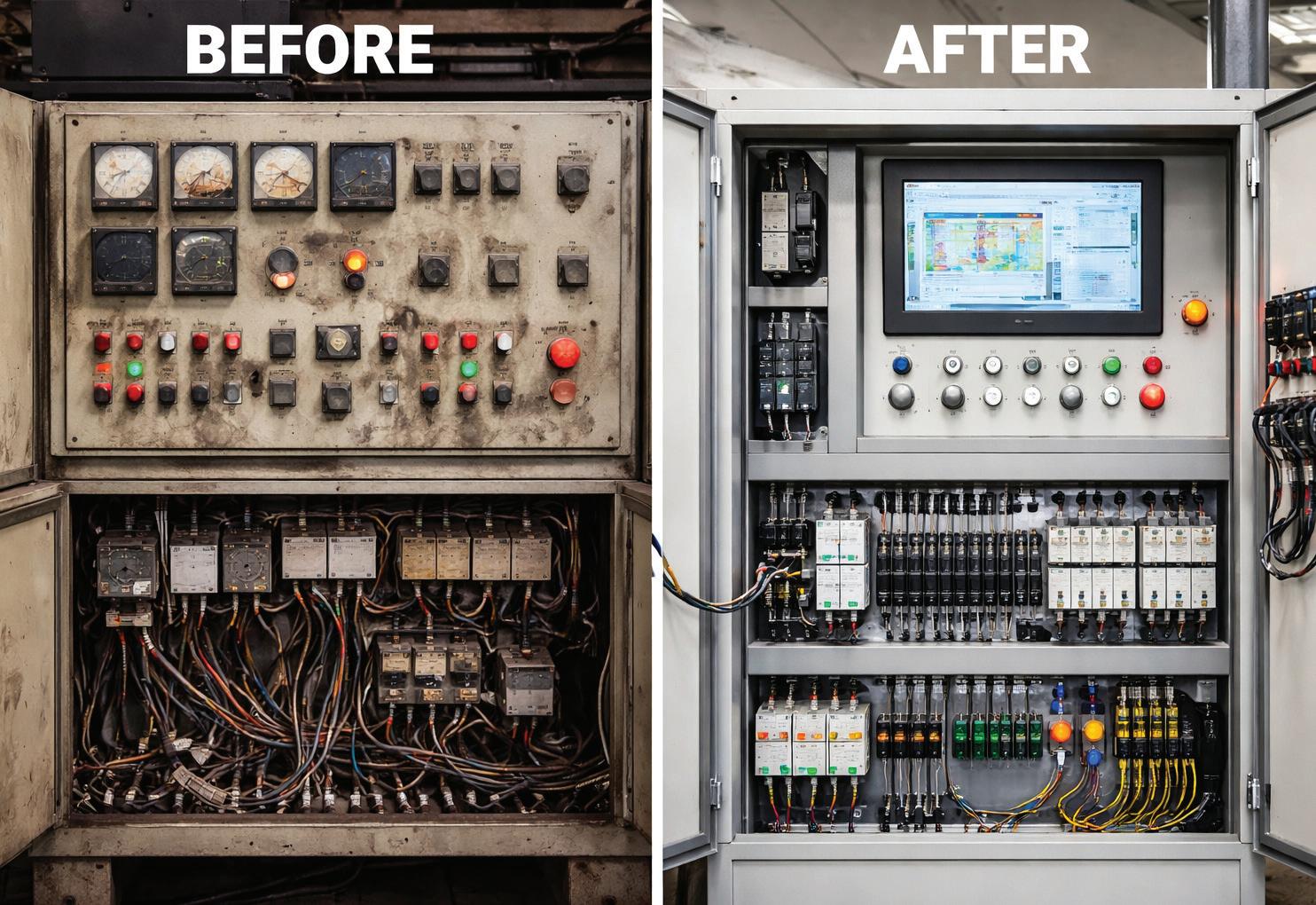
Courtesy: Steve Sterling
The amount of on-site labor required to remove, modify, and reinstall equipment can outweigh the expected cost savings of a retrofit. “It comes down to how much labor is required on site,” said Jones. “Is it less to install new or less to retrofit? That’s one of the first things we look at.”
“When customers acquire older machines—especially units from the 1990s or early 2000s—we often need a full on-site audit to understand what we’re dealing with,” Hamrick said. “Sometimes these retrofits can be five to six times what the customer paid for the machine itself, and the sticker shock makes them reconsider whether they should have purchased new.”
Cost and timing must be evaluated together. Retrofit is often less expensive and can be completed more quickly than replacing the machine, but those advantages depend on the scope. As the number of components replaced or redesigned rises, costs and timelines can approach those of a new system.
In some cases, the machine can be brought forward through targeted upgrades of key components. In others, the limitations are built into its structure. The question is not whether the machine can run, but whether it can run reliably at the required throughput, accuracy, and control level.
A key limitation is how far the existing platform can be advanced. If a retrofit cannot support currentgeneration controls, communication, or performance requirements, the long-term value diminishes. “If I can’t bring the machine up to current technology, it doesn’t make sense,” CODI’s Jones said. “You don’t want to invest and still be behind.”
A critical but often underestimated factor is the scope of control system changes. Replacing components with like-for-like equivalents carries relatively low risk. However, when a retrofit introduces new control architectures or shifts in actuation technology, the programming and validation effort increases significantly. “If you are just doing like-for-like components, that’s minimal risk,” Jones said. “But if you are trying to advance the machine into newer technology, that’s a different program, and it has to be fully proven out.”
Production realities often drive the decision. In many operations, line utilization requirements and available shutdown windows limit how long a machine can be taken out of service. Retrofit can also be executed in phases without taking the entire system offline. Replacement typically requires a longer installation and ramp-up period. If production cannot absorb extended downtime, retrofit may be the more practical path.
In many cases, the decision is less about equipment cost and more about installation complexity.
Replacement decisions may also be offset by the residual value of existing equipment. In some cases, legacy systems retain value on the secondary market, offsetting replacement cost. Hoganville Family Farms bought a retort on the secondary market. “We purchased a used retort and then trucked it to an OEM,” said Jeff Rome at Hoganville Family Farms, Ottawa, Kansas. “Retrofitting was the only way we could have upgraded our operation.”
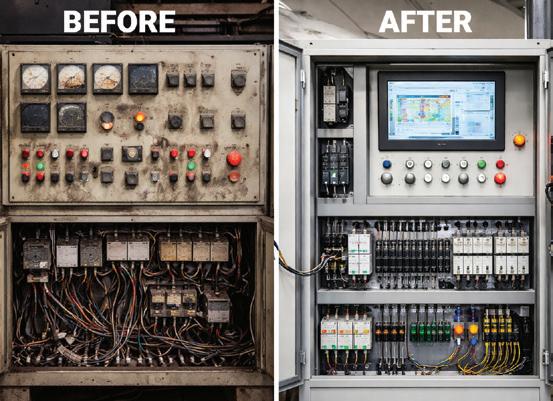
The OEM refurbished the stainless-steel retort shell, replaced the valves, rebuilt the control system within a modern control panel, and added a touchscreen HMI. The retrofit brought the system up to current standards at an estimated 50-to-60% cost savings compared to a new system. The retort automated the sterilization cycle, eliminating manual handling and stabilizing process consistency. For this operation, rebuilding a secondhand asset was the lower-risk path.
The final consideration is how long the solution will hold. Retrofit addresses current gaps, but it does not reset the entire machine. Remaining components continue to age and may introduce new risks over time. Replacement, by contrast, resets the system.
“We don’t care how you get a Hamrick machine, whether it’s new or retrofit, we will support it regardless,” Hamrick said. “We try to convey the best approach and often will quote both options.”
Retrofit is appropriate when the base machine remains mechanically viable, can be supported with available components, and can meet current requirements through targeted upgrades. Replacement becomes necessary when structural limits, obsolescence, or performance gaps cannot be resolved without introducing new risks.
The decision is not which option is better, but which option avoids creating the next failure. ■
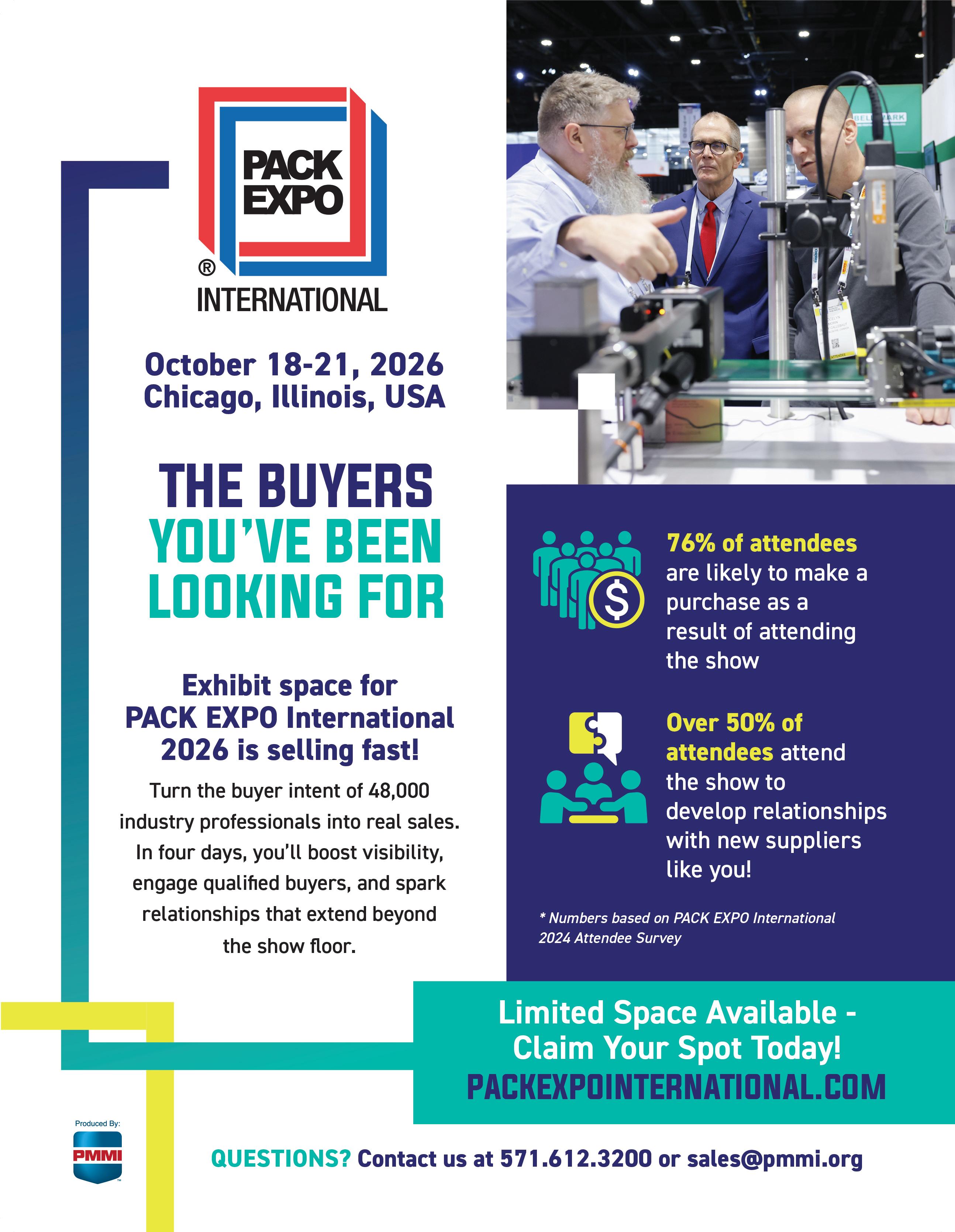
Advanced technology is enabling OEMs to move robots beyond their traditional box-like environments. As new use cases emerge, piloting opportunities and operator training could differentiate the OEMs that see the most success and the strongest return on investment.
By Joe Darrah, Contributing Editor
Sam Goldberg, chief operating officer at Econocorp Inc., is fairly certain he won’t ever hire a robot to build his machinery or fill a truly intuitive role. Even the most advanced robots will keep performing tasks that are at best monotonous and at worst the kind of dangerous or “dirty” work humans prefer to avoid. But when someone like Elon Musk floats mass-producing humanoids for consumers at roughly $30,000 by 2027, Goldberg can’t help but wonder how much more headroom there is for what robots can offer OEMs.
“You’re seeing a lot of today’s robot manufacturers look at what really differentiates their robots,” Goldberg said. “You’re starting to see people use robots in different ways than they traditionally have.”
As innovation accelerates and component standardization drives costs down, industry leaders see widening options for integrating robotics beyond traditional cells and end-of-line solutions. Artificial intelligence (AI)-guided vision, mobile capabilities, and software-driven systems are making robots more productive, safer, and more comprehensive.
One prevailing concern about robotics has long been that the technology would erode the value of human workers. There’s growing evidence of a collective change in perspective as the industry struggles with lingering workforce shortage issues, particularly among skilled employees.
According to Dillon Sego, vice president of engineering and sales at CRG Automation, a shift in how today’s robots are being applied has been born out of those challenges.
“When robotics really kicked off, many people saw it as something that would take jobs away,” Sego said. “But we’re not seeing that. Most of our customers are struggling to fill the roles they already have open. Automation may reduce a position on paper, but in practice it shifts people away from repetitive, non-value-added, and physically demanding work into more skilled, higher-value roles.”
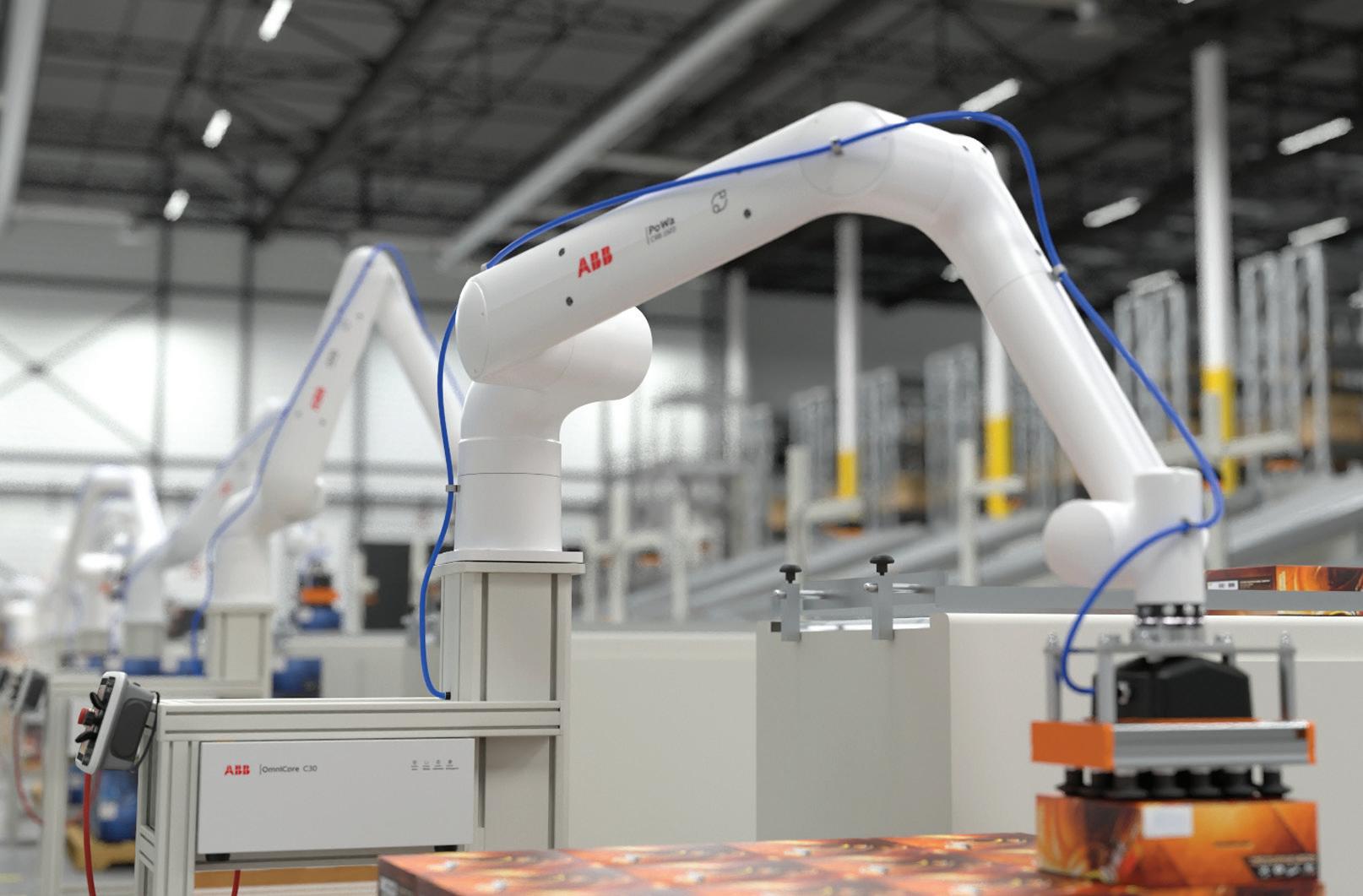
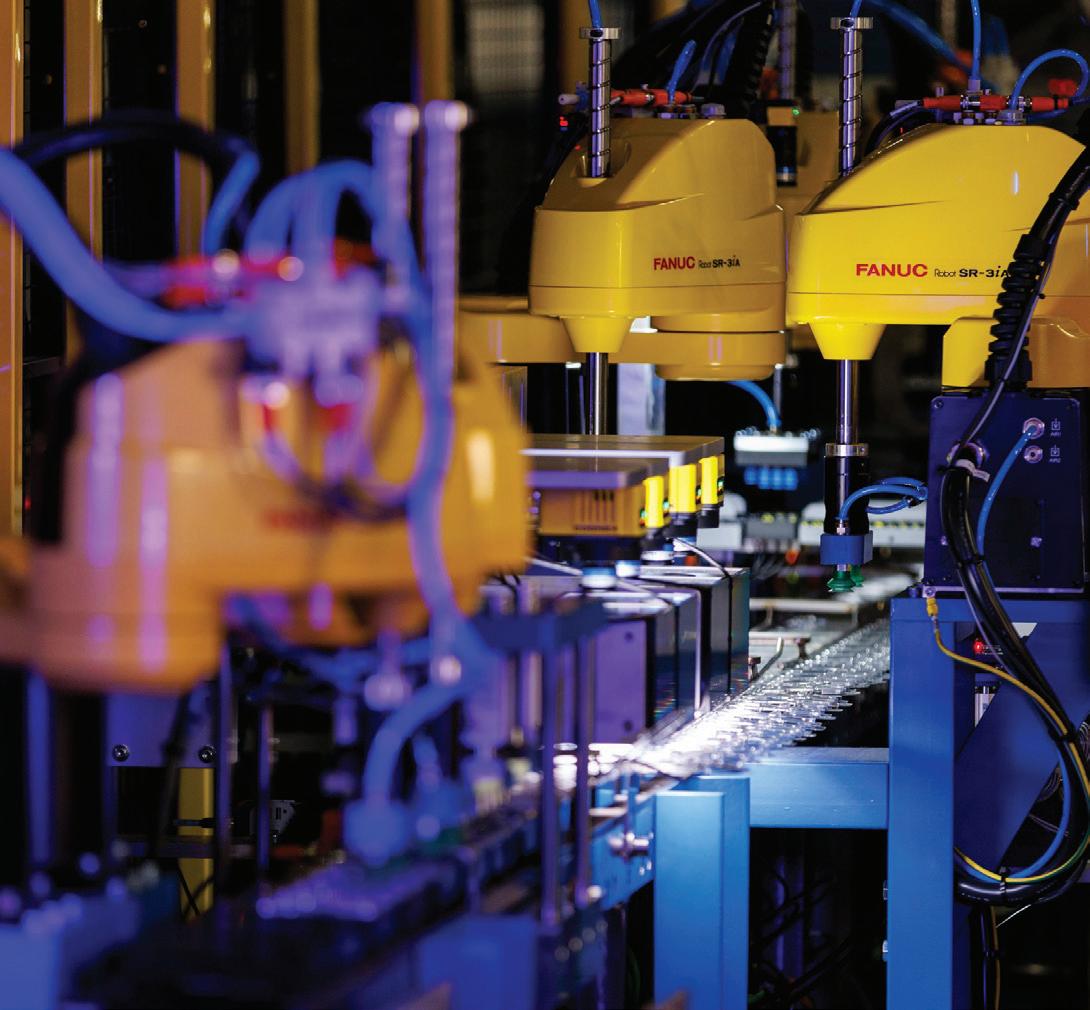
Driving much of that innovation is the rise of vision-guided systems that bring sight to robots through advanced cameras, vision software, and arms that increasingly rely on machine learning and deep learning AI to perceive, interpret, and interact with various environments. These smart systems are replacing rigid, fixed fixtures with flexibility and dynamic automation—helping robots detect objects and their position, orientation, and variations during pick-and-place procedures, including for sorting mixed-SKU loads in unstructured environments.
“You can send in new SKUs that the robot hasn’t been taught, and it can dynamically adjust to pick and place that specific product,” Sego explained. “I’m teaching them what they need to do, and to some extent the robot is figuring out the most optimal path.”
At Econocorp, which has specialized in secondary packaging machinery since the 1960s, a recently earned FANUC-authorized system integrator status is opening new opportunities to design, build, and install custom robotic automation systems, Goldberg said.
“ End users prefer that OEMs build sophisticated, complex equipment and handle all the work involved.”
“Traditionally, we would sell standalone equipment to an integrator that would take responsibility for the customer,” he said. “But more customers today don’t want to buy machines from an integrator. End users prefer that OEMs build sophisticated, complex equipment and handle all the work involved.”
As vision-guided robots become more robust, Goldberg expects engineered lighting to grow in importance, improving contrast and visibility while eliminating shadows that can interfere with object detection. He also thinks vision systems on robot applications will become the norm.
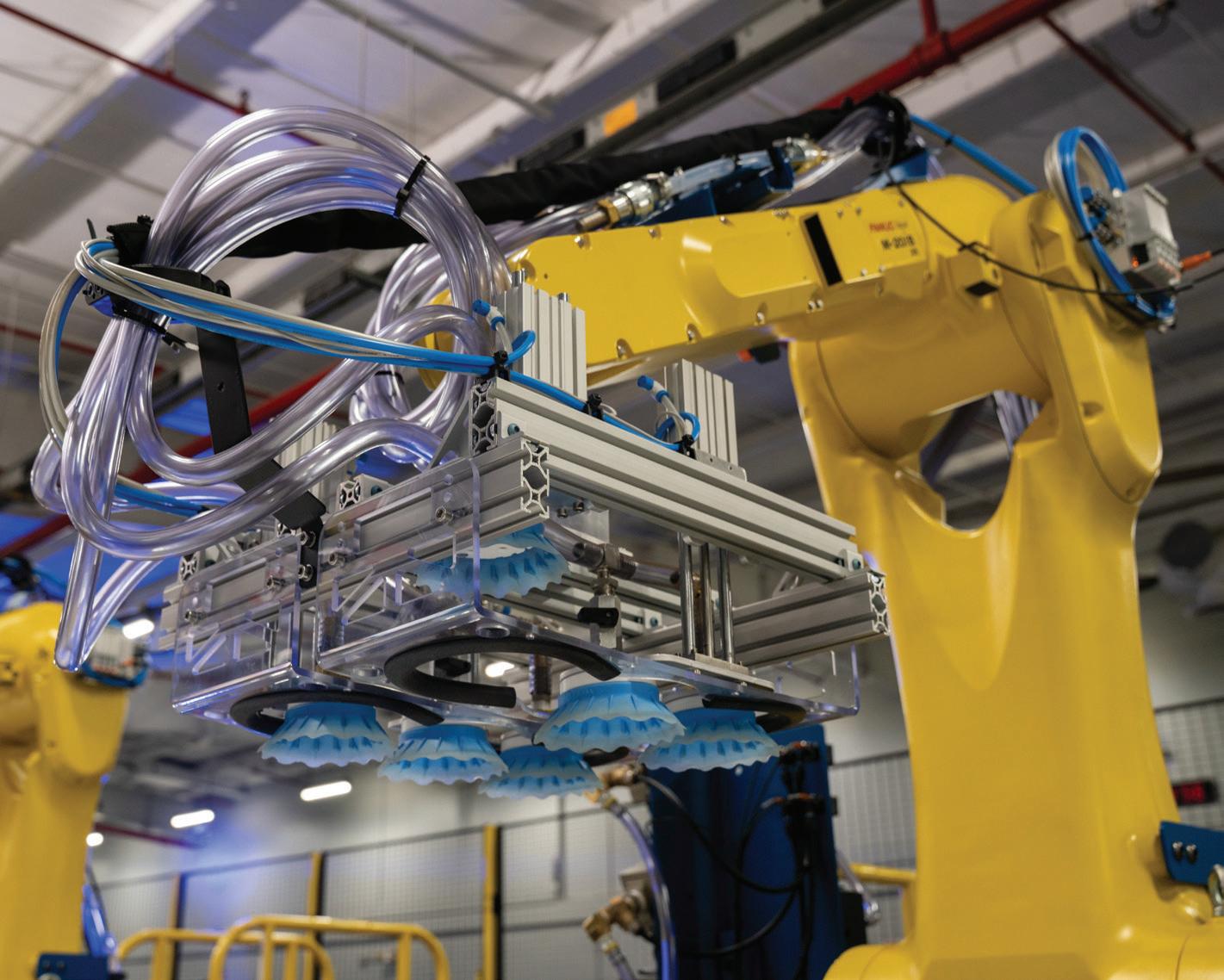
“We’ve learned that the conveyor color matters as well as the lighting color,” he said. “You’re looking to be on the opposite side of the color spectrum of what you’re picking up. That way, the vision system has the best shot of seeing the product as it comes through and being able to identify the correct orientation to be placed in.”
Although historically difficult to automate due to varying product types and small, inconsistent batch quantities, kitting has become one of the more intriguing examples of how robots are extending their reach, said Greg Berguig, president at PAC Machinery. PAC has partnered with MSD Sales to integrate its Rollbag automatic baggers with MSD’s KitAmatic system—a vision-guided solution that replaces manual, multi-part assembly. The KitAmatic combines a circular flexible feeder with a 6-axis robot that picks,
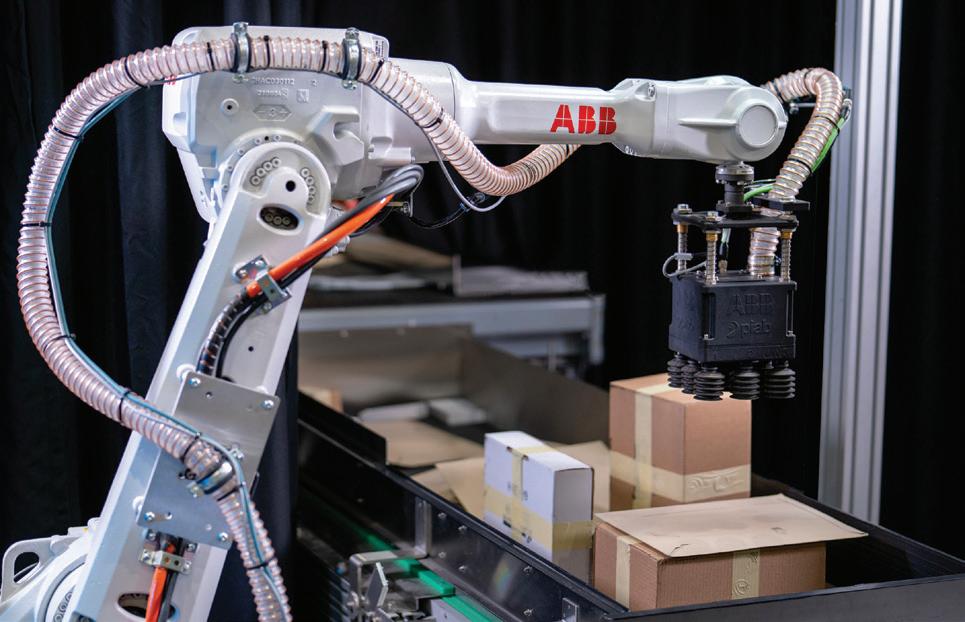
inspects, and places disparate parts into bags.
“It’s a rotary table and a robotic arm that uses vision to pick the correct items and put them into a bag that it seals,” Berguig explained. “Where we see robotics really playing a bigger role is in our bagging lines—putting something into a bag, sealing that bag, and then labeling it. Most kitting applications can’t run for five minutes without a changeover, but robotic arms do a nice job when you have small batch runs and you’re changing kit counts frequently.”
Changeovers, he added, are an easy transition with this setup, which is built for accuracy rather than raw speed—a tradeoff he said is increasingly common as shipments become more specialized. Berguig also pointed to warehouse logistics and outbound mailing as areas worth investing in.
Another emerging area is e-commerce logistics and outbound shipping.
Pairing robotic arms with automatic baggers has also been a strong way for customers to increase output while reducing labor costs, Berguig said. “They’re able to set up systems to run without operator intervention, which allows packaging to be done outside of regular shifts and increases output.” While a robot may not bag as fast as a human, it reduces the error rate—and serves as a strong alternative to other feeding systems such as bowl feeders and weigh scales when packaging the same item repeatedly.
When it comes to cobots, Goldberg sees palletizing as the most rapidly expanding application because of their effectiveness at slower speeds.
“Cobots are not necessarily fast enough to do a lot of the industrial pick-and-place that you’d see at the front end of secondary or primary packaging operations,” he said. “On the palletizer, the cobot can move
Courtesy: CRG
up to roughly 2,000 millimeters per second. It’s a great solution when trying to reduce labor dependency.”
As Ben Perlson, director of consumer industries at ABB Robotics, sees it, the most successful OEM robotics applications aren’t the most glamorous—they’re the most predictable.
“The more advanced, forward-looking OEMs are embedding robotics directly into their standard machine offerings rather than treating them as bolt-ons,” he said. “Customers get a productized system from a single supplier with validated cycle times and unified controls. That turns what used to be a multi-vendor juggling exercise into a cohesive, repeatable product.”
Despite the technological gains, Sego believes safety and operator training will remain significant challenges as the industrial robotics footprint grows.
“If you’re going to invest in robotics, you have to invest in your people to be able to maintain it,” he said. “I can build the best robot on the planet, but if your maintenance staff doesn’t know how to interface with it or recover when there are potential issues, it’s going to be a significant uphill battle.”
Robot suppliers, he added, owe end users a level of foolproof fail-safes.
“We’re always going to have to think about the staff member who’s never seen this before and walks onto the floor with no training,” he said. CRG’s case packers and other systems are being designed with that in mind.
“ The more advanced, forward-thinking OEMs are embedding robotics directly into their standard machine offerings . . . ”
“We chose a robotic solution because it’s more cost-effective and faster to deliver,” Sego said. “Designing a fully mechanical system takes significantly more time than mounting a robot, developing the end effector, and teaching the motion. End users can be trained to interact with the robot and resolve issues, rather than understand a custom one-off.”
The technology itself is also progressing toward predictive action rather than reaction, with machines helping to predict failures and diagnose potential issues with both robotic components and changing environments. At Rockwell Automation, programmable logic controllers (PLCs) connect integrators to robots and enable them to scale faster and at lower cost, said James C. Fadool, senior global OEM technical consultant. Helping push that technology forward are Rockwell’s Emulate3D digital-twin tool and the Logix Echo platform, a software-based controller emulator for ControlLogix 5580 and GuardLogix 5580 PLCs.
“Without turning a wrench or picking up a screw, we can build an entire line, write all the program, and test it in real time on a single computer,” Fadool said. “The ability to do that at the machine-builder level is just unmatched.”
That said, robotics won’t always deliver sufficient ROI, Perlson cautioned.
“Robotics is not a silver bullet for a broken or unstable process,” he said. “It tends to amplify whatever is already there, good or bad. If variability or poor upstream control exists, automation will highlight them quickly. Customers also often underestimate the operational readiness required. This is where strong OEMs differentiate themselves—by challenging assumptions early, aligning on realistic operating conditions, and preventing projects from slipping during execution.”
Going forward, Berguig anticipates that OEMs will need to encourage customers to pilot advancing robotic systems as machines evolve quickly.
“You’re not going to get anywhere without that,” he said. “If you’re not piloting these types of systems, you’re going to be very far behind. You’re not going to have any sense of what works well, what doesn’t, or what you need to do as an organization to understand this technology.” ■
By Sean Riley, Editor-in-Chief
JOIN fellow industry leaders this September in Montreal for the 2026 PMMI Annual Meeting (Sept. 14-16, 2026; Le Centre Sheraton Montreal, Montreal)—a valuable opportunity to connect, collaborate, and gain insights shaping the future of packaging and processing.
This year’s agenda features expert-led sessions on AI, market trends, and cybersecurity. Hear from end users in Canada and participate in networking events and plant tours of world-class facilities at Paxiom and BellatRx, all designed to help your company stay competitive and informed. Register early and bring colleagues from across your organization to maximize the experience and return with actionable ideas for your entire team.
For details and to register, go to pmmi.org/annual-meeting.
backlogs. It also explores how companies are managing supply-chain pressures, tariffs, and cash flow, while showing where engineering teams are investing to build more resilient operations.
Download your copy today from the Business Intelligence Library at pmmi.org/research.
The 2026 Q1 Tariffs Quickie Survey Report explores how PMMI members are responding to evolving tariff conditions. Highlighting rising procurement costs, pricing strategies, and how companies are sharing tariff impacts with customers, this report looks at supply-chain adjustments and charts how tariffs are influencing sales, lead times, and project decisions.
Download your copy today from the Business Intelligence Library at pmmi.org/research.
Global tariffs are continuing to shape packaging and processing. Unpack what’s happening across key markets through updates on PMMI’s Global Trends Blog. From shifting trade policies to market opportunities, it’s your go-to for understanding the bigger picture.
Read the latest update at pmmi.org/global-marketing.


The How’s Business: First Quarter 2026 report takes a clear-eyed look at economic and member-sourced data. Drawing on PMMI surveys and key economic indicators, this report points to strengthening demand and growing
Field service technicians are the face of your organization. They spend more time with your customers than anyone from your operation. This two-day workshop explores the
non-technical knowledge and skills needed to be a great technician.
Upcoming workshops: Aug. 25–26, Minneapolis and Oct. 18–19, Chicago.
This workshop gives your company the strategies and tactics to become an effective and successful trainer across all employee skill levels.
Upcoming workshops: Aug. 27–28, Minneapolis and Oct. 18–19, Chicago.
Tailored around PMBOK Guide (Project Management Body of Knowledge - 6th Edition) principles, this course combines proven methodologies with practical scenarios from the packaging and processing world to equip you with actionable techniques and strategies to deliver projects with confidence.
Upcoming workshop: Aug. 25–26, Chicago.
Trade shows are a big investment, and an even bigger chance for setting up and closing high-impact deals. Turn high-value leads into long-term opportunities.
Upcoming workshop: Sept. 2–3, Chicago.
Risk assessment is a process that manufacturers use to evaluate their equipment before an accident or incident occurs. Many end users now require risk assessment as part of the procurement process. This workshop provides valuable insights and strategies for maximizing safety and minimizing liability in machinery-related accidents.
This year’s course will be held Oct. 16–17, Chicago. Learn more and register for these workshops today at pmmiu.org.
THE PMMI Roadshow brings together industry leaders, innovators, and decision-makers for two days of insight, connection, and real-world experience designed to move your business forward. Join us in Wichita, Kansas, July 15–16.
Register for free online at pmmi.org/roadshow.



PMMI SUPPORTS its members through the PACK EXPO portfolio of trade shows, PMMI Media Group, and the PMMI Business Drivers. Members have access to resources and programs for every level of your operation.
Learn more about the benefits offered by PMMI, and find ways you can move your business forward, at pmmi.docsend.com/view/6efye9s.
The PMMI Board of Directors approved the PMMI Member Travel Reimbursement Fund, an exciting new initiative designed to expand member access to PMMI events. The fund, backed by a $1,000,000 investment, launches with the 2026 Annual Meeting. Members can access the fund to cover up to three nights at PMMI’s selected hotel for meetings.
This membership benefit makes it easier for companies and team members to take part in the conversations, connections, and insights shaping the industry at these meetings. Stay tuned for more information as we approach the 2026 Annual Meeting. You won’t want to miss what’s ahead!

THE PPWLN Learning Circle Series covers the biggest topics, challenges, and solutions to help women grow their careers, navigate the workplace, and communicate effectively. Listen and watch past webinars like Emotional Intelligence, Communication, Networking, and more, that can help guide you in the next steps in your career.
Watch today at pmmi.org/womens-leadershipnetwork/learning-circle.

This course is designed specifically for women in manufacturing seeking to enhance their leadership skills. The interactive program provides a platform for participants to explore new ideas, reflect, share experiences, practice new skills, and build new relationships with other leaders to support their growth.
The 2026 workshop will be held in Sept. 29-30, Chicago. Learn more at pmmi.org/sheleads.
THE NEXT generation of industry leaders is coming together at PMMI’s Young Professionals Seminar on July 14 in Wichita, Kansas. Designed for emerging leaders in packaging and processing, this one-day event features executive career panels, leadership development sessions, networking opportuni-
ties, and discussions focused on team engagement and mental wellness. Attendees will gain practical insights, build valuable industry connections, and develop skills to help accelerate their professional growth.
Learn more and register at pmmi.org/young-professionals/seminar.
PMMI is now accepting nominations for the 2026 On the Rise Awards, recognizing young professionals who are making meaningful contributions across the packaging and processing industry. This program highlights emerging leaders within PMMI member companies. Nominations are open May 8 through July 17.
Learn more at pmmi.org/young-professionals/ awards.
PMMI members are invited to help spotlight the next generation of industry leaders by nominating a customer or partner from a CPG* company for the CPG NexGen Awards. This new industry-wide program recognizes 10 outstanding young professionals who are driving innovation in packaging and processing and shaping the future of CPGs. Winners will receive a hosted PACK EXPO International experience and industry-wide recognition.
Learn more at pmmi.org/young-professionals/cpgnexgen-awards and submit a nomination by July 17.
*CPG/end users are defined as companies who use/or buy packaging machinery, processing equipment, and automation solutions to produce and package their products.
The Young Professionals Network’s new Mentorship Program connects emerging leaders in packaging and processing with experienced industry professionals for guidance, career development, and
meaningful industry connections. Mentors from the PMMI Emerging Leaders Committee bring real-world experience and a shared commitment to helping shape the future of the industry. If you’re ready to learn, grow, and build lasting industry connections, this program is for you. Mentees must work for a PMMI Member company.
Visit pmmi.org/young-professionals for more information.
PMMI’S unPACKed with PMMI podcast gives the packaging and processing industry a front-row seat to the ideas, people, and trends shaping its future. Through conversations with industry leaders and experts, each episode covers topics like technology, workforce, sustainability, and supply chain, delivering practical insights listeners can implement right away.
Here’s a look at a few recent episodes worth a listen at pmmi.org/podcast.
• Shifting Perceptions of ‘Dirty Jobs’ with Mike Rowe
A candid conversation on the stigma around skilled trades and why perception, not opportunity, is the real barrier to closing the workforce gap.
• Where Manufacturing Careers Really Begin
Explore how careers in manufacturing often begin long before college, highlighting the role of early exposure, mentorship, and visibility in shaping the next generation in the industry.
• Are Your Competitors Out-Marketing
Learn what effective marketing looks like for manufacturers today, with practical tips on content, LinkedIn, and turning engagement into real connections.
PMMI, during its 2026 Executive Leadership Conference, announced that its Board of Directors has approved the establishment of the PACK gives BACK™ Charitable Foundation, a new 501(c)(3) organization designed to amplify and expand the industry’s philanthropic impact.
Backed by an initial $6 million investment from PMMI’s reserve fund, the PACK gives BACK™ Charitable Foundation represents a significant milestone in PMMI’s ongoing commitment to supporting its members, their communities and interests, and the broader industry. The Foundation will operate as a separate entity with its own Board of Directors and bylaws, ensuring a dedicated, strategic focus on determining the best fit for the Foundation’s vision.
The new Foundation will amplify charitable contributions through a matching gift program, partnering with members to ensure their support for the causes that matter most to them. In addition, the Foundation will have the ability to make direct donations to other non-member charitable organizations, extending its reach beyond member-led giving.
“This is a transformational moment for PMMI and our industry,” said Jim Pittas, president and CEO, PMMI. “The PACK gives BACK™ Charitable Foundation reflects our deep commitment to serving our members’ needs and supporting their interests, as well as the industry at-large. By creating a platform that multiplies the impact of our members’ generosity, we are taking meaningful, progressive action to drive positivity and change on a much larger scale.”
The PACK gives BACK™ Charitable Foundation is targeting operational readiness by Fall 2026.
The Foundation becomes PMMI’s second philanthropic arm, complementing the longstanding work of the PMMI Foundation, established in 1988. While the PMMI Foundation focuses on strengthening the future workforce through scholarships, educational support, and career awareness initiatives, the The PACK gives BACK™ Charitable Foundation expands PMMI’s charitable reach to include a broader range of causes with community impact. ■
Why machines still lack modern interfaces: it’s not technology, it’s how OEMs apply it that creates competitive advantage.
By Nikki Gonzales, Founder, Automation Ladies PERSPECTIVES


In 2018, OEM Magazine published “A New Era of HMI,” a forward-looking piece that made substantive promises: HTML5-driven interfaces, IIoT connectivity, mobile monitoring, smarter diagnostics, and HMI design that could help close a growing skills gap on the plant floor.
All that technology exists today, but the question was never whether it would get built. It was whether the industry would build it into machines. The 2018 article caught the industry at an interesting inflection point.
One quote from the story framed the opportunity well at the time: “It’s not the technology itself, but how you apply it, that will create competitive advantage,” said John Kowal of B&R Industrial Automation. Eight years later, that observation holds up. The platforms that pulled ahead were the ones that figured out how to apply open connectivity standards, not just support them.
As Director of Industry Development at Murrelektronik and host of the Machine Builder Talk podcast, Colin Cartwright works with OEM machine builders across packaging on connectivity and machine architecture every day.
writing it into their specs, the incentive to design for it is limited. This is not a technology problem. It is an education and priorities problem on both sides of the transaction.
For a long time, the HMI was the last thing designed but the first thing blamed. Screens were cluttered, navigation changed from machine to machine, and error messages sent operators to a binder manual. The hardware shipped, the software got finished later, and the operator figured it out.
What the industry was calling for in 2018 was an HMI that works the way modern software does: layered, intuitive, context-aware, and accessible from multiple places. That capability is broadly available now at price points that no longer require a special conversation in the BOM (Bill of Materials). The barrier is not the hardware. It is the design philosophy that guides how the hardware is used.
“ Success came when we switched from trying to solve engineering problems to trying to solve business problems.”
Jeff Denson, CEO of FP Developments, puts it plainly. “Success came when we switched from trying to solve engineering problems to trying to solve business problems,” he says. “It is just a totally different way of thinking.”
His assessment is direct: “There are still a lot of machines out there without a PLC or HMI at all. And even where the capability exists, too many are still not properly connected to the wider Industry 4.0 and plant data infrastructure. That should be far more standard by now.”
OEMs build what their customers ask for. When customers do not know what is possible or are not
That shift matters because recipe management, guided changeovers, operator prompts, and other HMI capabilities the industry has discussed for years are only possible because someone first decided to build a machine that can handle them. The HMI is the interface to a capability that must already exist in the machine. The conversation about smarter operator interfaces must start in mechanical and controls design, not at the touchscreen.


FP Developments recently partnered with Australian OEM Packserv to bring Packserv’s modular, PLC-controlled capping and filling systems to the US market. Nathan Wardell, managing director of Packserv, describes the philosophy simply: “This isn’t just about building another machine. It’s about creating equipment that genuinely makes operators’ lives easier while giving supervisors the insights they need to optimize production.” The fact that a machine designed around that principle is finding its market in the US right now is not a coincidence.
Frank Skerl, Vice President of Sales at Hamrick Packaging Systems, was demonstrating exactly this at PACK EXPO. His company embeds preventative maintenance and changeover videos directly in the HMI. “We can add those videos and play them for customers so they can walk through a changeover right there on the machine,” he says.
What these examples share is something Denson describes as the complexity behind simplicity. Making a machine genuinely simple to operate, easy to change over, and intuitive to troubleshoot requires more engineering work up front, not less. The machine that an operator can run confidently on day one did not get there by accident.
Cartwright makes the same point about machine design. “A machine can look modular from the outside
“ A machine can look modular from the outside and still be surprisingly rigid underneath. ”
and still be surprisingly rigid underneath,” he says.
Real modularity shows up in the control architecture, the connectivity approach, and the ease of future change. A machine that looks flexible in a proposal but requires a full engineering engagement every time a customer needs to run a new product is not modular in any meaningful sense. Neither is an HMI that cannot be updated or connected to the plant’s broader data infrastructure without significant effort.
A few things have shifted meaningfully, and not always in the direction the industry expected.
The vision in 2018 for mobile monitoring was for operators to run machines from tablets. What emerged, and what has proven genuinely useful, is

“ It’s about creating equipment that genuinely makes operators’ lives easier while giving supervisors the insights they need to optimize production.”
mobile access for maintenance teams, FATs, and supplementary monitoring alongside the main HMI.
Whether it be a technician walking a line during commissioning, a service engineer diagnosing a fault remotely, or a plant manager checking output from across the facility, that is where mobile delivers real value. OEMs who design for those use cases are providing something their customers actually use.
AI-assisted programming tools are available now. Several automation platforms are shipping tools that help engineers build projects faster, generate structured logic, and reduce commissioning time.
Rather than replacing programmers, this addresses the reality that skilled programmers are becoming as difficult to find as skilled operators. Compressing the time from concept to a running machine has real business value.
The Unified Namespace is worth calling out specifically because it is the architecture the industry has been working toward for seamless integration from machine to cloud to enterprise systems.
The concept is gaining real traction, and OEMs are increasingly being asked by end users to design
machines that fit into a UNS-based data infrastructure, where information flows into a single, organized, real-time layer rather than siloed systems talking past each other. OEMs who understand it and design for it from the start are winning specifications that others are not even aware they are competing for.
Part of what sustains the adoption gap is a perception problem rooted in real experience. The dominant brands in industrial HMI have historically charged significant premiums for the capabilities the 2018 article described as the future: data logging, alarming, historizing, MQTT, OPC UA connectivity, remote access, and database integration.
Some vendors still charge licensing fees for remote viewing, require separate gateway hardware to enable IIoT connectivity, and layer subscription software costs on top of everything from data connectors to middleware.
For OEMs and end users who have priced out those solutions, the assumption that smart, connected HMI capability is expensive is entirely rational. It is also not universally true. Specialist HMI vendors focused on innovation rather than ecosystem lock-in have been offering these capabilities without the added cost baggage for years, with no need for additional cabinet space, gateway appliances, or subscription licensing to unlock what should be standard functionality. The product exists, the value is real, and most of the market simply does not know it yet.
The conversation hasn’t changed. The cost of ignoring it has.
Reading the 2018 article again, the story has not changed much. The OEMs who treat the HMI as a strategic design decision, something thought about at the beginning of a project rather than bolted on at the end, are building machines that are easier to sell, easier to support, and more likely to stay in a customer’s plant for the long haul.
In 2018, this publication described the HMI as the business card of the OEM and the face of the machine. Eight years later, that still feels right. The question is what yours says about you. ■
Nikki Gonzales is Director of Business Development at Weintek USA and co-founder of OT SCADA CON, a conference dedicated to operational technology, SCADA, and industrial cybersecurity. She is also the founder of Automation Ladies, a media platform and community dedicated to elevating diverse voices in industrial automation.

How PMMI’s workshop helps women in packaging and processing find their voice, sharpen their leadership brand, and walk away with a network of peers.
By Sean Riley, Editor-in-Chief

For women working in packaging and processing, walking into a meeting and finding they are the only woman in the room is still a common experience. SheLeads, a two-day leadership workshop developed in partnership with PMMI’s Packaging and Processing Women’s Leadership Network (PPWLN), was built to help them not just navigate that reality, but also lead within it.
The program is facilitated by Kristi Dooley, a leadership coach for PMMI who originally coached participants in PMMI’s broader leadership development program. Around the same time, the Women’s Leadership Network was floating a parallel idea.
“The Women’s Leadership Network had proposed the idea of putting on a leadership program specifically geared toward women in the manufacturing space among PMMI members,” Dooley explained.
The PPWLN had been hosting networking events and webinars, but members wanted a program designed for women who want to step up more effectively.

To build it, Dooley and PMMI went straight to the source. “We reached out to members of PPWLN and got feedback on what they would want the compo-
nents to be,” she said. After ground-truthing with member input, the team piloted the program with a group of women leaders, adjusted it, and has been offering SheLeads as an annual program.
The first day of SheLeads is built around a single question: What do you uniquely bring to your organization? Dooley spends most of day one helping participants articulate their leadership brand and explore the components of leadership presence— what it means, what it looks like, and how to live it more fully.
A coaching assessment grounded in archetypes anchors the work. Participants explore which archetypes resonate most with them as a doorway into identifying their distinct strengths and contributions. The intent, Dooley emphasized, is not to fit into a template.
“It’s not about being some cookie-cutter version of ‘leadership looks this way,’” she said. “It’s really bringing what’s unique for me and amplifying and bringing more of it.”






By the end of day one, participants have to speak their brand to the class—naming it out loud and, as Dooley put it, having it “in their bones.”
Day two pivots from self-awareness to skill building. Dooley walks participants through models for having more confident, assertive, and effective conversations at work—including how to give feedback up, across, and down the organization.
It is a particularly relevant focus given the audiences SheLeads serves. When asked how the program helps women who realize, through the day-one work, that assertiveness isn’t yet a strength, Dooley pointed back to the foundation.
“Part of successfully being more assertive and speaking out is really about knowing who you are and

what strengths you bring,” she said. From there, the second day equips participants with the skills and, therefore, the confidence to speak up, push back, engage in conflict productively, and give feedback.
That includes a simple, repeatable model for delivering feedback without triggering defensiveness. This is a tool participants frequently cite as one of their favorite takeaways. “A lot of times that’s something people feel uncomfortable with or shy away from,” Dooley said. “They don’t want to be in conflict with someone or risk damaging the relationship, so they just don’t say anything.”
SheLeads was initially marketed to mid-level managers, but Dooley said it quickly became clear the program’s value reaches well beyond that group. The most recent cohort, held in Chicago last October, ranged from women in their early 20s in their first or second jobs out of college to senior leaders such as HR directors and operations managers.
“What we noticed was that the conversations we had in the group were so cool because some of the people with more experience were learning so much from the Gen Zers or millennials,” Dooley said. Stereotypes about generational work styles got challenged in the room, and participants of every level walked away having learned from one another.
While there isn’t a formal networking track, the connections built during the two days are a major part of the experience. Dooley deliberately mixes participants into pairs, trios, and small groups throughout the workshop, and PMMI typically sponsors a relaxed group dinner on the first evening. Because cohorts almost never include two attendees from the same company, participants build cross-organizational relationships across the industry.
“That is one of the things people say is one of their favorite parts of the program, just making contacts with other women,” Dooley said. ■
SCAN HERE to register for SheLeads upcoming workshop Sept. 29-30 in Chicago.
Q&A on ways to change the narrative on careers in packaging and processing.
By Sean Riley, Editor-in-Chief
Manufacturing, including packaging and processing, is facing a workforce epidemic with hundreds of thousands of well-paying careers sitting unfilled. Mike Rowe, the host of Dirty Jobs, spoke at PMMI’s Executive Leadership Conference and with unPACKed with PMMI about the ways his foundation, mikeroweWORKS, tries to reframe the narrative around manufacturing jobs. Here is an edited excerpt of his unPACKed with PMMI interview.
Sean Riley: You’ve dedicated years of your life to promoting the trades. And PMMI, on our end, has spent decades promoting these well-paying, careeroriented jobs. Yet, we still have a workforce crisis and a skilled labor gap. I know there’s not a magic bullet, but what can we do? What are we missing?
Mike Rowe: The answer to your question is packaging. Every single industry that I know of today that’s struggling to recruit and is freaked out by the obstacles and the challenges—they’re all grappling with how to package the opportunities that exist within their industry. You guys are no different. It’s just that, instead of a literal package, we’re really talking about public perception. We’re talking about how a company and an industry can present to the world what you do and why it matters.
“ . . . instead of a literal package, we’re really talking about public perception.”
Because if you do that right, then you’ll inspire people. People are looking—not just for a reliable way to make a living—they’re looking for purpose. They’re looking for meaningful work, and that kind of meaning absolutely exists in your industry.
Sean Riley: There aren’t necessarily commercials for manufacturing or commercials for skilled labor, but there are for going to college or even joining the military. Is it marketing? Is it as simple as something like that?
Mike Rowe: Nothing is simple about this, but a lot of times the packaging is overlooked or dismissed as one-dimensional or superfluous. It’s just a package. When you think about how you present the opportunity in whatever industry you’re in, you have to decide—are we going to assume that we need to sell the listener, or are we just going to challenge them? You never really know what’s going to appeal to an individual in terms of what they might find persuasive.
Sean Riley: One thing I’ve often thought is that kids aren’t exposed. They’re in school, and they’re exposed to the classics of reading, writing, and arithmetic, but the shop class is gone. Could you speak a little bit about that and how that’s had such an impact on this generation?
Mike Rowe: I doubt that you’ll be able to find a decision remembered more poorly years from now than the decision to take shop class out of high school. It led to a lot of very specific problems, but it’s the unintended consequences that I think are most devastating. You took all the optical proof of work out of high school. So a kid couldn’t even, in passing, get a look at a fabricating lab or a CNC machine. Even a sconce— making a simple sconce in wood shop—we just robbed a whole generation of the curiosity of figuring out, on the simplest level, if these careers are an option. We made a terrible mistake when we removed an essential part of our workforce from the public schools, and we’re still dealing with the ramifications of that today.
Sean Riley: How do we make these kids aware that this is an opportunity? How do they become aware that not only does this exist, but these aren’t the jobs that you see from a hundred years ago, where you’re in a dark, dangerous, dirty job?
Mike Rowe: There’s no easy button. It took a long time to effectively disparage an entire part of our workforce. It took a generation of portrayals in sitcoms, and we reinforced and created stigmas and stereotypes and myths and misperceptions around these jobs. I would say one of the easiest things that


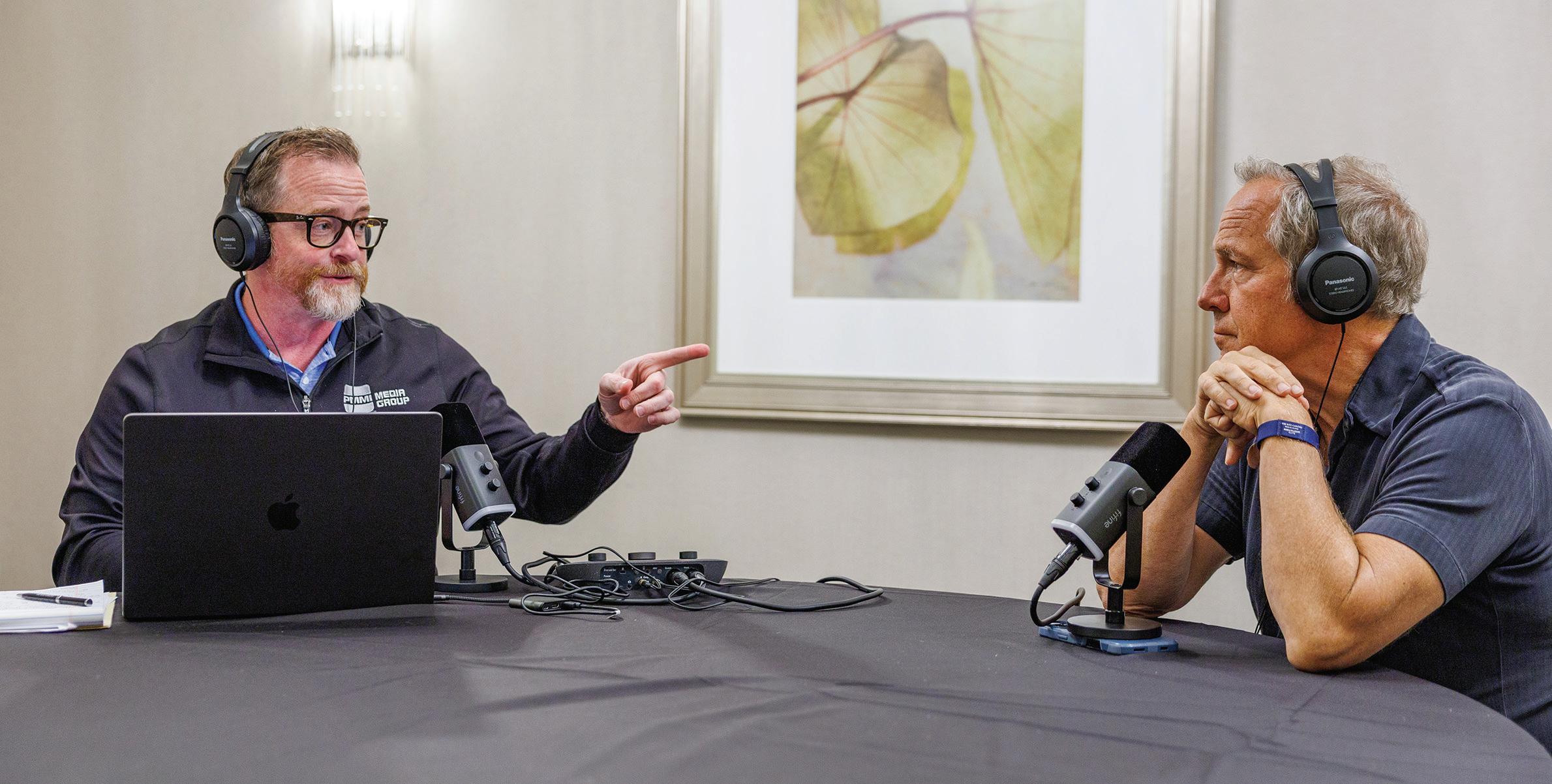

“ We made a terrible mistake when we removed an essential part of our workforce from the public schools, and we’re still dealing with ramifications of that today.”
can be done—and I’m not really sure why more industries don’t do it—just take out billboards across the country and show me a picture of the six-figure welder. Give me his name. I’ve got 3,500 people who went through my foundation’s program. A lot of them are welders. Ninety percent of them are making six figures or better.
Most people, when they hear that, they just don’t believe it. Parents simply don’t believe it, and a lot of kids—they don’t believe it. So what do you do with that? I make the rounds. I’ve been interviewed a thousand times on every network. I spend a fair amount of resources telling the stories of the people who have prospered through my program as a result of learning a skill that’s in demand.
Sean Riley: You actually referenced that you’ve started doing some commercials with some of the students who have gone through your programs to showcase that, right?
Scan this QR code to hear the entire interview
Mike Rowe: You have to. We have 3,500 examples, and I can make sure that a lot of people on social media see them, and I can make sure a lot of people on broadcast see them. It’s just money. And not to sound glib about it, but it just goes back to your first question—it’s packaging. Never mind how you package the package—how do you package the opportunity? How does your industry propose to change the way people think about the opportunities therein? No wrong answer, but some approaches are probably more effective than others.
And a lot of what we’re talking about here is much more bespoke. It’s not a cookie-cutter, one-size-fits-all approach. I’m not looking to D.C. to solve the problem, and I’m not looking to guidance counselors to solve it either. I look primarily to parents and kids specifically. And the only way to reach them is to show them examples of people who look like them, who are prospering as a result of making the kind of vocational decision you’re talking about. ■
As younger attendees gain influence, OEMs that fail to establish relevance quickly on the show floor risk missing the next wave of decision-makers.
By Jefferson Davis, President, Competitive Edge
“Most hockey players skate to where the puck is, I skate to where it is going,” is a variation of a quote attribute d to the great Wayne Gretzky that comes to mind when I think about how trade show attendees are changing. An important thought to keep in mind is “today’s students and young professionals are tomorrow’s buyers and CEOs.”
It’s no secret that the presence of Gen Z and Millennials on trade show floors is increasing rapidly. Young professionals (YPs) are 20 to 35 years old. They have multiple objectives for attending trade shows, and they arrive with clear business intent. Learning, networking, and product and service discovery are their top reasons for attending. They are seeking solutions that are relevant to their role in their companies. While they may not be the final decision-makers in some cases, they do have purchase influence.

that quickly answer their “What do you do?” and “Why should I care?” questions.
Staffing/Presentations: YPs do not want salesdriven presentations in the booth. They want authentic, consultative interactions with knowledgeable and helpful booth staffers. They value hands-on, minds-on demonstrations and presentations with multisensory activation from product experts. They want to see the product in action.
“ [YPs] have multiple objectives for attending trade shows, and they arrive with clear business intent.”
The key to attracting young professionals is to quickly and visually establish relevance.
In your pre-show marketing efforts, be sure to quickly communicate how your product/service helps them perform their job better. Also include this in your exhibitor description, which will appear in the online directory and the mobile app—the top places they look to pre-plan their agenda.
Your Booth: YPs approach the exhibit hall as a discovery-driven journey. They tend to walk the show aisle by aisle, visually scanning the environment in search of solutions relevant to their role. Make sure you have colorful, eye-catching visuals accented with lighting and strong in-booth signage and visual cues
Information Takeaway: YPs want quickly accessible and easyto-use content that can be shared to support internal advocacy of solutions relevant to their role. QR codes and printed literature are both desired by young professionals.
Giveaways: YPs do respond well to giveaways like food and beverages. They prefer swag and promotional products that are useful, cause-based, and environmentally friendly.
Follow-up: If you have established clear and compelling relevance, helped YPs discover and learn something about your solution that supports their job function, and engaged them in an authentic and consultative manner, they will be extremely open to your post-show follow-up efforts.
With the rapid growth of young professionals at trade shows, it’s important that you apply as many of the ideas in this article as possible. If you do, you will attract and engage your fair share of young professionals, positioning your business for long-term growth. ■
Jefferson Davis, president of Competitive Edge, LLC, is known as the “Tradeshow Turnaround Artist." For more information email Davis at jdavis@compedgetraining.com.
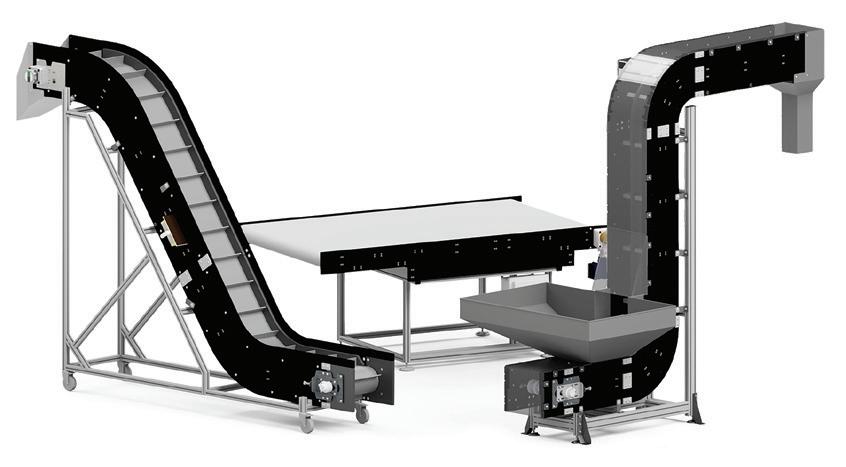
Dynamic Conveyor, an expert in conveyor design and automation, demonstrates its innovative Hybrid® Specialty Conveyor System. This system features a modular design that enables reconfiguration and repurposing, significantly reducing costs and improving operational adaptability. The system’s versatile design effectively meets challenging conveyance requirements across a range of applications.
The Hybrid conveyor system boasts a fully customizable design that ensures fit-for-purpose solutions from light to heavy-duty applications. It utilizes premium construction materials, including HDPE, and UHMW, ensuring longevity across various operational settings. A key feature is its innovative tensionless belt design, which eliminates tracking (alignment) issues and minimizes maintenance requirements.
Additionally, the system comes standard with variable speed energy-efficient DC motors, contributing to reduced power consumption. The wide array of customizable belting solutions allows the system to cater to diverse industrial needs. Dynamic Conveyors
Applications Engineering team will collaborate with end users to determine which of hundreds of belt types and configurations to match the needs of their application and/or specific requirements. Furthermore, the system’s plug-and-play drives and controls facilitate seamless integration of supplementary equipment and accessories, enhancing its versatility and ease of use.
A significant advantage of the Hybrid system is its minimal maintenance needs, which leads to reduced downtime and a lower total cost of ownership. Dynamic Conveyors, www.dynamicconveyors.com
Mechanical demands on connectors in industrial environments continue to intensify. Applications involving moving machinery, energy chains, and robotic systems place increasing stress on strain relief, anti-twist performance, and overall cable longevity. In response, binder has introduced an innovative design solution: a specially engineered triangular moulding, now implemented for the first time in its updated M16 cable connectors as well as M12 K- and L-coded variants.
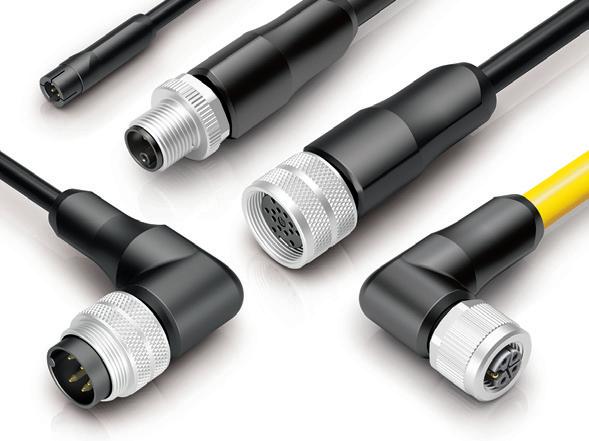
This new moulding geometry delivers both functional and visual advantages, enhancing mechanical durability, improving handling, and providing a distinct, modern design that sets the connectors apart.
binder, www.binder-usa.com
Emerson announced the latest advancement to its Guardian™ Digital Platform, delivering new artificial intelligence (AI) capabilities and more robust customization to help organizations improve visibility, accelerate workforce productivity and strengthen operational performance. These enhancements empower teams to monitor and optimize systems more efficiently, supporting increased uptime and faster performance improvements.
The lean teams in many of today’s plants need ways to quickly access the right information when diagnosing issues or maintaining and updating automation solutions. They also expect personalized experiences that simplify access to the content they need and eliminate the clutter of irrelevant information and displays.
Emerson, www.emerson.com
OEM machine platforms evolve as additional zones, modules, or downstream cells are integrated into the original control design. When remote I/O extends beyond its initial boundary, added gateways, new Ethernet addresses, and separate power distribution increase wiring complexity and commissioning effort.
To simplify scalable machine architecture, Festo introduces intelligent end plates for the CPX-AP-A remote I/O platform. This solution extends system communication, diagnostics, and power across multiple machine zones. The intelligent end plates connect distributed on-machine I/O to cabinet-based PLC control with no cabinet rewiring or added gateways.
With intelligent end plates EPLI and EPLI-S, machine builders can scale remote I/O systems across independent machine sections without redesigning controls or duplicating power and networking connections. I/O and pneumatic valves can be placed at the point of use. Festo, www.festo.com
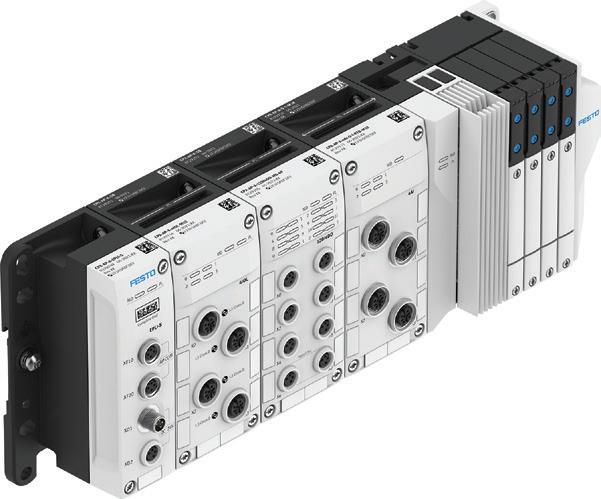
KHK USA Inc., distributor of the KHK® brand of metric gears, highlights its extensive line of helical gears, manufactured to the highest quality standards by Kohara Gear Industry Co., of Japan. KHK’s large selection of stock helical gears is suitable wherever high-speed rotation is required, including in machine tools, speed reducers and other industrial machinery.
Helical gears are cylindrical disks which have involute-shaped teeth cut into their face at a helix angle. By slanting the teeth, helical gears can obtain a large contact ratio and the gradual change to the contact surface load which give helical gears their characteristic of smooth transmission of rotation. Consequently, compared to spur gears, helical gears generate less vibration and noise and perform be er in high-speed rotation and high-load applications.
Unique to KHK USA is the KHG Ground Helical Gear series. The unique feature of these gears is that they allow designs to be more compact because the KHG ground helical gears use a “transverse” module. KHK USA, Inc., www.khkgears.us
The vacuum compatible HVCM095-051-051-01VAC Hollow Core Linear Voice Coil Servo Motor from Moticont, features an open aperture, a 1.0 in. (25.4 mm) stroke, high speed, and sub-micron positioning accuracy if an external high resolution position sensor is used! A smooth Electroless Nickel plating prevents gassing o contaminates in a vacuum, is noncorrosive, nonabsorbent, and is easy to clean and sanitize for use in medical and laboratory equipment. This Vacuum Compatible Linear DC Servo Motor has a continuous force rating of 16.1 lbs. (71.4 N) and a peak force of 50.8 lbs. (225.8 N) at a 10% duty cycle. Clean and quiet, this, “Made in America”, non-commutated, long life brushless linear servo motor features: High acceleration/deceleration, zero cogging and zero backlash when connected directly to a load.
The 2.000 in. (50.8 mm) diameter open aperture of the Vacuum Compatible HVCM-095-051-051-01VAC Hollow Core Voice Coil Linear Servo Motor allows for optics, illumination, laser beams, tubing, and cable passage. The extended length of the motor is 3.0 inch (76.2 mm) at mid-stroke. Moticont, www.moticont.com
Vention, creator of the world’s only full-stack so ware and hardware automation platform, announced the commercial launch of Rapid Operator AI, a solution designed to automate complex, unstructured tasks, beginning with deep bin picking.
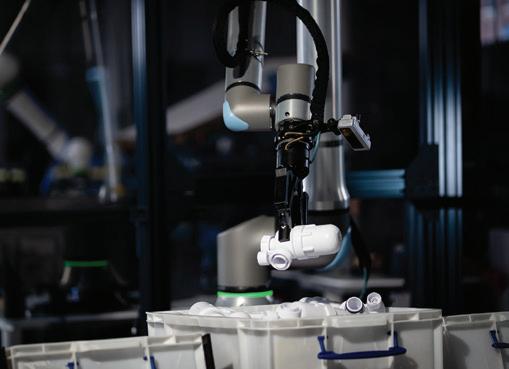
The launch marks a significant evolution from last year’s GTC technical showcase debut of AI Operator as physical AI for unstructured tasks. Rapid Operator AI transforms that concept into a turnkey industrial system built on Vention’s Generalized Robotic Industrial Intelligence Pipeline (GRIIP™) and engineered for immediate deployment in production environments.
At its core, Rapid Operator AI is powered by GRIIP™, Vention’s Generalized Robotic Industrial Intelligence Pipeline. GRIIP delivers a unified pipeline from perception to motion by integrating Vention’s proprietary models with NVIDIA Isaac open models, specifically NVIDIA FoundationStereo for stereo matching, and NVIDIA FoundationPose for pose estimation. Vention, www.vention.io
Rollon announces the integration of its range of roller guides, including Compact Rail and X-Rail, in the Configurator tool of myRollon, the digital platform developed to support engineers and designers throughout all phases of project development. Users can now define product configurations, generate unique product codes, and request quotations for these products as well.
“The integration of our portfolio on myRollon is one of our top priorities as part of our ongoing e ort to provide users with a comprehensive digital experience,” says Franck Michaux, Digital Transformation Director at Rollon. “This milestone takes us a step further in centralizing all resources and tools in a single environment. By continuously extending the platform’s capabilities, we aim to o er engineers faster access to the solutions they need, while supporting them with intuitive digital services that simplify every phase of their work, from selection to configuration and beyond.” Rollon, www,myrollon.com
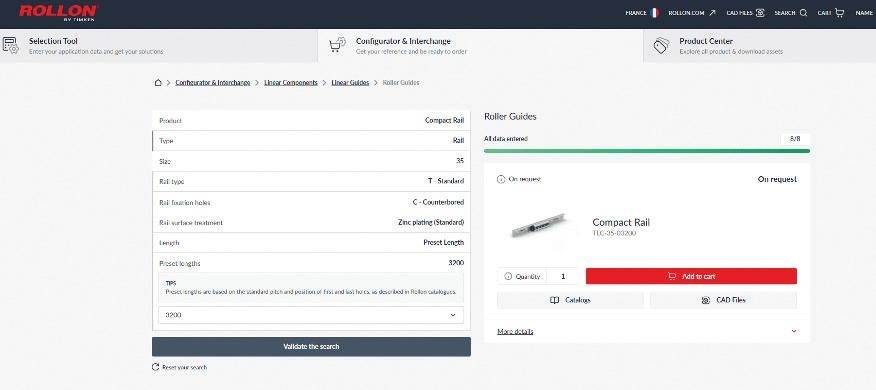









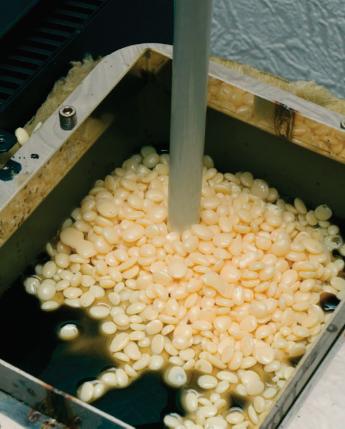






PMMI continues to expand future workforce programs that expose students to packaging and processing careers.
By Jim Pi as, President & CEO, PMMI


At PMMI’s 2026 Executive Leadership Conference, Mike Rowe of Dirty Jobs fame spoke about the need to “package” manufacturing better for the next-generation workforce. In his opinion, the lack of shop class in high schools and the poor portrayal of careers in industries like packaging and processing turned off an entire generation. He is admirably trying to change that through his mikeroweWORKS Foundation, which offers work ethic scholarships to people willing to learn a skilled trade. At the ELC, PMMI gladly donated $10,000 to this great cause via mikeroweWORKS, but as many of you already know, PMMI provides funding, programs, and resources to attract the future workforce every day.
In fact, we recently announced that we are expanding our PACK Challenge to an annual competition. This will keep students engaged and provide further connections with the industry. Like a modern-day STEM “shop class,” the PACK Challenge gives students the opportunity to develop technical expertise in engineering, programming, marketing, and project management through end-to-end design and execution tasks while exposing them to manufacturing processes. Going forward, the competition will be 100% virtual to accommodate teams from across the country and introduce them to the world of packaging and processing. Teams will essentially serve as integrators. After receiving a bid spec for a specific product, they will have access to cutting-edge 3D simulation models from participating member companies to build their line. Awards are presented to the winning schools, but the experience is invaluable for all participants.
If you know a high school team that would be interested, they can sign up for our newsletter and stay up to date on the free competition at packchallenge.org
PMMI also helps members expose high school and college-age students to the industry with our PMMI U Career Toolkit and Skills Fund. The toolkit provides resources and best practices for internships, workplace retention, a guide to hiring veterans, Career Fair Promotion. and more. The Career Fair Promotion 101 User Guide (pmmi.org/pmmiu/ career-toolkit), for example, handles the marketing of the packaging and processing industry for you with customizable PowerPoints and social media assets.
“ . . .PMMI provides funding, programs, and resources to a ract the future workforce every day.”
The PMMI U Skills Fund is a top resource for helping members form meaningful partnerships with technical schools, high schools, and other educational programs by matching contributions of up to $50,000 per year.
Whether you support a school to help strengthen an industry-related program, join forces with a STEM summer camp, sponsor a robotics team, coordinate a group of students to bring to PACK EXPO, or choose to invest in the future workforce in your community throughout the year, the PMMI U Skills Fund assists you with the financial obligations that come with these types of initiatives.
I could go on with the many ways PMMI “packages” our industry, but it would be easier to direct you to pmmi.org/workforce for all the resources we offer to help build a pipeline of skilled future employees. Packaging our industry is what we do. ■
Jim Pittas is the President & CEO of PMMI. He may be reached at jpittas@pmmi.org or at linkedin.com/in/ jimpittas.



MOVIMOT® performance ELV delivers industrial performance in a compact, decentralized 48 V DC drive solution for systems and machines. Eliminate control cabinets, reduce wiring, and simplify architecture with motor-mounted electronics and a fully connectorized design. Plug-and-play startup with automatic motor recognition accelerates commissioning, while high overload capacity and integrated feedback ensure dynamic performance. Seamless Industrial Ethernet communication enables real-time PLC integration, no gateways required.
Meet our experts at: Automate - Booth # N-19034