OFFICIAL PUBLICATION OF
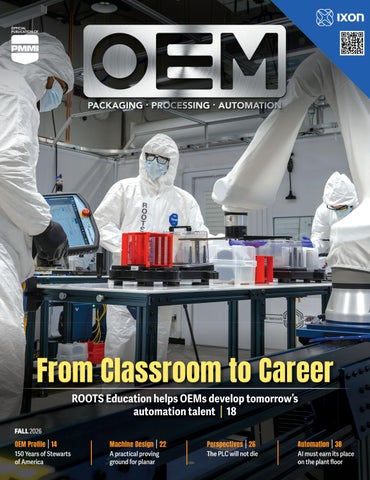
From Classroom to Career ROOTS Education helps OEMs develop tomorrow’s automation talent | 18 FALL 2026 OEM Profile | 14 150 Years of Stewarts of America
OEM_0926_Cover_01_V4_FINAL.indd 1
Machine Design | 22 A practical proving ground for planar
Perspectives | 26 The PLC will not die
Automation | 38 AI must earn its place on the plant floor
8/4/26 8:50 AM
Untitled-1 2
7/29/26 09:50
Untitled-1 2
7/22/26 12:05
2
FALL 2026
CONTENTS
CONNECT WITH US:
OEMmagazine.org facebook.com/OEMmagazine @OEMmagazine
VOLUME 9 • ISSUE 3
DEPARTMENTS BUSINESS INTELLIGENCE
6 Robots on the Rise
PMMI’s 2026 Robotics U.S. Packaging and Processing Report.
MARKETING INSIGHTS
8 Working with Engineering
Seven ways marketing and engineering can combine strengths.
SALES FOCUS
12 Are You Giving Away Engineering? What a qualification gap is costing your business.
18 FEATURES
32 PMMI Member Roundup
Annual Meeting heads to Montreal.
EXHIBITOR’S CORNER
36 You Already Have Your Best Booth Leads
O E M P ROFIL E
14 Turning 150 Years of History into a Competitive Advantage Stewarts of America brings century-old technology to the demands of modern sustainable packaging.
ASSOCIATION NEWS
Use PACK EXPO’s Customer Invite Program before your competition does.
AUTOMATION
14
38 AI Must Earn Its Place
What it takes for AI and automation to deliver real shop-floor impact.
WO R K F ORC E
18 From Classroom to Career: Bridging the Skills Gap
WOMEN’S LEADERSHIP
40 Lead in Your Style
Reframing vulnerability not as a weakness but as a defining trait.
ROOTS Education is helping OEMs develop tomorrow’s automation talent today.
A P P LI CATION BR IE F
22 A Practical Proving Ground for Planar
22 42
Norwalt applied Beckhoff ’s XPlanar technology to a direct-to-object printing platform designedto handle multiple package geometries.
NEW PRODUCTS
42 OEM Machine Technology
M ACH I N E DESI GN
Check out the latest product innovations.
26 The PLC Will Not Die
Every few years, someone declares the programmable logic controller dead. AI will not be the death knell some predict for the PLC.
OEM_0926_TOC_V2FINAL.indd 2
26
FINAL THOUGHTS
48 PACK EXPO International
Predicting a record-breaking show.
8/4/26 9:09 AM
Untitled-1 2
7/29/26 09:51
Level Control of High Temperature Oils and Glues 482°F / 250°C
The official publication of PMMI OEMMAGAZINE.ORG CON TEN T Sean Riley Editor-in-Chief sriley@pmmimediagroup.com | 571 266 4419 Tracey Labovitz Editorial Operations Coordinator Kim Overstreet Director of Content Norman Smith Art Director David Bacho Creative Director
ADVERTI SI N G Reggie Lawrence Vice President, Sales rlawrence@pmmimediagroup.com Lara Krieger Senior Manager, Print Operations lkrieger@pmmimediagroup.com Janet Fabiano Financial Services Manager jfabiano@pmmimediagroup.com
Level Probes Analog or Digital
PMMI Media Group 500 W Madison, Suite 1000, Chicago, IL 60661 www.pmmimediagroup.com David Newcorn President Elizabeth Kachoris Vice President, Digital Jen Krepelka Senior Director, Digital Media Amber Miller Director of Marketing Joan Jacinto Director, Ad Tech and Search Angie Szerlong Director of Industry Strategy
PMMI, The Association for Packaging and Processing Technologies 12930 Worldgate Dr., Suite 200, Herndon VA, 20170 Phone: 571 612 3200 | Fax: 703 243 8556 www.pmmi.org Jim Pittas President and CEO Joe Angel Executive VP, Industry Outreach, PMMI Glen Long Senior VP Tracy Stout VP, Marketing and Communications Laura Thompson VP, Trade Shows Andrew Dougherty VP, Member Services
SU B SCRI PTI ON S To subscribe to OEM visit: oemgo.to/9999 To change or modify a subscription, please contact circulation@pmmimediagroup.com
OEM EDI TORI AL ADVI SORY B OARD Greg Berguig President, PAC Machinery Jacob Cox VP of Electrical and Controls, Fallas Automation Rick Fox III Vice President, Fox IV Technology Jordan Hamrick President, Hamrick Packaging Systems Paul Irvine Executive Chairman & Owner, Plexpack Zack Lynch Founder, Next Tech Automation Stacy Johnson VP Business Development, Hoosier Feeder Company Tom Sosnoski Director of Advanced Development, JLS Automation
www.rechner.com 1-800-544-4106 Sanborn, NY OEM_0926_Masthead.indd 4
Alex Vargo VP of Manufacturing, LAKO Colin Warnes Director Sales Engineering & Project Management, ADCO Manufacturing
8/4/26 10:10 AM
FOR OPENERS
FALL 2026
5
Watch End of the Line on OEM By Sean Riley, Editor-in-Chief
I
’m a little late in sharing some publication news with our print readers—news our online readers have hopefully already stumbled across. A few months back, the editors of PMMI Media Group decided it might be entertaining and informative to come together weekly to discuss the interesting topics that have come across each of our desks. As with everything in today’s online world, we decided it just might make good fodder for a video. (Full disclosure: recording and releasing it to the masses was Healthcare Packaging Editor-in-Chief Liz Cuneo’s idea.) Fans of Packaging World, Healthcare Packaging, ProFood World, and OEM Magazine might find it worth a watch or listen. It’s a casual watch called End of the Line, but it allows each of our industry experts to offer insight into how our different beats cross over and
OEM_0926_For Openers_V2_FINAL.indd 5
impact the packaging and processing industries at large. How does it work? On a recent episode, I discuss tariffs and their impact on machinery imports; PW’s Matt Reynolds weighs in on how that’s hitting CPGs; and PFW’s Derrick Teal shares what it means for food and beverage. Honestly, they have been fun to make, and they’re worth a visit to OEMmagazine.org. This might be a good time to remind our new readers that the website is updated multiple times a week with fresh content that we can’t squeeze into the print editions. When you are finished reading your print issue every quarter, be sure to visit us online every day for information of interest to machine builders, including reporting on the latest technologies, products, and business topics. As always, I hope you enjoy this issue of OEM. If you have feedback—positive or negative—please reach out at sriley@pmmimediagroup.com. ■
8/4/26 9:11 AM
FALL 2026
6
BUSINESS INTELLIGENCE
2026 Robotics U.S. Packaging & Processing MARKET SIZE 2025-2031
WORTH MORE THAN
$440 MILLION IN 2025
CAGR
10.3% 2025-2031
PREDICTED WORTH OF
$800 MILLION IN 2031 CURRENT & FUTURE USAGE 2025-2031
END-USERS 2025
72%
UTILIZING CURRENTLY
2031
95%
UTILIZATION EXPECTED
OVER NEXT YEAR
61%
EXPECT TO INCREASE INVESTMENT
KEY FUTURE APPLICATIONS
ROBOTIC ARMS FOR LOADING PACKAGING MATERIALS INTO PACKAGING MACHINES MOBILE ROBOTS BRINGING MATERIALS TO LINE
MOBILE ROBOTS WITH COBOT ARMS PROCESSING APPLICATIONS
OEMS / INTEGRATORS OVER NEXT YEAR
2025
2031
86% EXPECTED
81% EXPECT TO
OFFER IN PORTFOLIOS
TO OFFER IN PORTFOLIOS
INCREASE INVESTMENT
69% CURRENTLY
OEM_0926_Business_Intel_V2FINAL.indd 6
8/4/26 9:12 AM
FALL 2026
7
MARKET SHARE 2025
63% 32% 5% 0.1%
INDUSTRIAL ROBOTS MOBILE ROBOTS COLLABORATIVE ROBOTS HUMANOID ROBOTS
NOTABLE GROWTH
FASTEST GROWING
HUMANOID ROBOTS
MOBILE ROBOTS
INCREASE TO 5% BY 2031
MOST POPULAR BY 2031 45% MARKET SHARE
DRIVERS & BARRIERS TO ADOPTION END-USERS
TOP THREE DRIVERS INCREASING THROUGHPUT AND PRODUCTIVITY LOWERING COSTS IMPROVING QUALITY AND CONSISTENCY
TOP THREE OEM CRITERIA RELIABILITY AND UPTIME PERFORMANCE AVAILABILITY AND QUALITY OF SERVICE AND SUPPORT DEMONSTRATED ROI / PAYBACK
TOP THREE BARRIERS
Scan the code below for more info:
HIGH UP-FRONT COST INTEGRATION WITH EXISTING EQUIPMENT AND SYSTEMS MAINTENANCE AND SERVICE SUPPORT CONCERNS
OEM_0926_Business_Intel_V2FINAL.indd 7
8/4/26 9:12 AM
8
FALL 2026
MARKETING INSIGHTS
MARKETING INSIGHTS
Seven Ways Marketing and Engineering Can Work Better Together Marketing and engineering teams can be even more successful when they combine strengths. The challenge, however, is to create a consistent process that respects how each team works. By Amber Miller, Director of Marketing, PMMI Media Group
S
ome of your best customer stosolve? What made the application difficult? What is ries are happening inside your technically different about the solution? Which claims business. Engineers are solving need careful qualification? difficult applications, improving equipThe marketer can then create the first draft and ment, and developing ways to stand out return it to the engineer for a technical review. to end users. Marketing’s job is to help customers understand that value. 2. Bring marketing into the process earlier Sounds easy enough, right? But engiMarketing is often introduced to a project shortly neering teams are focused on designing before a launch. By then, the most valuable opportuequipment and solving customer issues. Marketing nities to document the work may have passed. teams are managing campaigns and Earlier involvement does not creating content. Neither team lacks mean marketing needs to attend ideas or effort. More often, they lack every engineering meeting. Maybe Tip: Use an app the time and structure needed to marketing participates in selected like Granola to record consistently connect their work. product development meetings, Engineering and marketing also has sightline into the project plan, and transcribe the approach communication differreceives updates when a project ently. Engineers naturally focus on reaches an important stage, or is meetings. how a solution works, while marincluded when a new capability is keting must consider how it can being tested. This gives the team transform that information into something engaging time to understand the story, plan the necessary asfor multiple audiences. sets, and ask questions, so when the launch happens, Those differences are not a problem to eliminate both teams are aligned on the benefits and value. but a strength to combine. The following practices Earlier visibility is important for trade shows as can help both teams create a more productive relawell. The teams should meet at the end of the year to tionship while improving the quality of the informareview the next year’s show calendar. This way they’re tion customers receive. prepared if a machine requires modifications, and engineering can flag new capabilities that haven’t been demoed. Marketing also benefits from understanding 1. Make engineering participation focused what can be shown and which features will be most The greatest barrier to collaboration is often meaningful to attendees. bandwidth. Asking an engineer to write an article or produce marketing copy places the responsibility on someone whose primary role is not content. 3. Create a process for capturing A more effective model is for marketing to ask enstories on the plant floor gineering for a focused contribution. A 15- to 30-minSome of the strongest content emerges from cusute conversation can provide enough substance for an tom or unique orders. When engineering or sales flags article, application story, video script, or sales tool. one before the machine leaves the shop floor, there’s Marketing can prepare specific questions in time to capture photographs, video, interviews, and advance: What problem was the customer trying to application footage.
OEM_0926_Marketing Insights_V4FINAL.indd 8
8/4/26 9:14 AM
Untitled-1 2
7/29/26 09:51
10
FALL 2026
MARKETING INSIGHTS
MARKETING INSIGHTS Factory acceptance tests can provide similar opportunities. With the customer’s approval, an FAT may offer a chance to document a system operating under realistic conditions, explain a technical feature, or gather material that can support future sales conversations. This turns existing engineering work into a steady content pipeline without asking engineers to help create marketing materials. The technical story is documented as it happens rather than reconstructed months later.
4. Translate the same technical value for different audiences
A CPG engineer may want speeds, tolerances, and controls information. A maintenance professional may focus on accessibility, reliability, and changeover. Operations may care about throughput, labor, and ease of use. Purchasing and leadership may be evaluating TCO, service support, and return on investment. Engineering provides the technical foundation. Marketing helps organize and translate that knowledge so each audience can quickly recognize the relevance to its role. A technical data sheet, short demonstration video, application article, and executive-level ROI summary may all describe the same solution, but each serves a different purpose. The most effective content retains engineering’s accuracy while helping the customer see how the product solves a challenge that directly affects their role.
5. Build content around how engineers actually research
When engineers begin researching a solution, they are usually looking for an answer—not a campaign. They may start with Google, YouTube, AI, or a supplier website to determine whether a solution exists and whether a supplier has relevant experience. That makes clear, searchable, visual information especially important. A short equipment demonstration, an application photo, a technical diagram, or a page answering a specific question can provide the immediate confirmation an engineer needs. Long-form resources still have value, particularly as the buyer moves deeper into evaluation. Dense paragraphs and broad promotional statements can slow down a user who is trying to answer a specific technical question during early research.
6. Use AI to reduce the workload, not replace expertise
Generative AI can make technical content
OEM_0926_Marketing Insights_V4FINAL.indd 10
development faster, particularly for lean marketing teams. It can organize notes, turn engineer bullet points into a first draft, and adapt approved content for different formats. However, AI-generated technical content still requires careful review. A hallucinated specification, unsupported performance claim, or inaccurate application statement can damage trust quickly. Use AI to reduce repetitive drafting and formatting; keep engineering responsible for the technical review. AI helps teams move faster, but it does not replace the subject matter expert.
7. Create a regular feedback loop with sales
Marketing and engineering alignment becomes even more valuable when sales is included in the exchange. Sales owns the customer relationships and hears the questions buyers ask, the objections that slow opportunities, and what they request after meetings and trade shows. Those insights help marketing identify content gaps and help engineering focus on the technical details that matter most. A regular feedback loop does not need to be complicated. Marketing might ask sales to share the five most common questions received each quarter. Engineers could help answer them, and marketing could turn those answers into website content, sales tools, videos, or follow-up materials. The same process can improve outreach to engineers at CPGs. Engineers tend to respond more positively to concise, relevant communication than to broad promotional messages. A follow-up email that references a specific trade show conversation, application challenge, or technical requirement is more useful than a generic email blast.
Different working styles can produce a stronger result
Marketing and engineering do not need to think or work alike. The goal is to create a process that allows each group to contribute its expertise without adding unnecessary work. The impact reaches beyond content. It sharpens trade show readiness, strengthens sales conversations, and helps customers evaluate complex solutions more efficiently. Engineering creates the solution. Marketing communicates the value of that solution to the end user in a targeted, engaging way. When the two teams work together consistently, the result is more than better marketing—it’s a stronger path for technical innovation, business growth, and company cohesiveness. ■
8/4/26 9:14 AM
| MX01USA |
Smart. Modular. Cabinet-free. The MX-System advantage.
Have you taken a serious look at your electrical cabinets lately? Sure, they protect your equipment and have been there right alongside your machines since, well, forever. Maybe you take them for granted, like they just have to be there. They don’t. Our new MX-System has changed automation and controls system design forever. This flexible, space-saving, and intelligent automation hardware platform can completely replace conventional control cabinets and literally transform your machines. Seriously. With pluggable modules for all main areas of automation and control such as the controller, I/O, drives, relays and system modules, the MX-System opens up exciting new possibilities for machine builders, system integrators, and end users alike. Sorry, electrical cabinets, but we think it’s time to retire.
Scan to go cabinet-free and send your enclosures on a permanent vacation!
Untitled-1 2
7/29/26 09:52
12
FALL 2026
SALES & MARKETING
SALES FOCUS
Are You Giving Away Engineering for Free? What a qualification gap is actually costing your business— and what you could do with the difference. By Matthew Neuberger, President, Neuberger & Company, Inc.
S
omewhere in your building right now, your best engineers are solving a problem for a prospect who will never place an order. They are doing it cheerfully, thoroughly, and at full cost to your business. The prospect is grateful. Your engineers feel useful. And everyone is too busy to notice the machine is running on empty. This is not a criticism of your engineers. They are doing exactly what the culture built them to do. When a prospect calls with a technical challenge, the instinct is immediate and genuine: engage, solve, impress. Nobody told them to ask whether the opportunity is real before the engineering begins. That is a commercial question—and in most companies in this industry, it belongs to no one. You built your reputation on technical excellence, and customers have told you they value it. That feedback is genuine—and incomplete. The customers telling you they love working with your engineers are the ones who placed an order. You applied their feedback universally, to every prospect, regardless of whether they ever sent a purchase order.
“
Think of it this way: Running empty samples on a line tells you the machine moves. It tells you nothing about whether the product fills correctly, seals, or survives downstream. A warm response from a prospect tells you the conversation went well. It tells you nothing about whether they have budget authority, a real decision timeline, or any genuine intention of placing an order. You are declaring the line functionally acceptable based on criteria that excluded the details that matter. Engineers are wired to solve problems—it is the core of their professional identity. So the time goes out freely, because solving the problem feels like earning the order. Giving away engineering time does not equal getting the work.
Giving away engineering time does not equal getting the work.
”
Taking back that engineering time
Consider two prospects who call your company the same week. Both have a genuine need. Both respond warmly. The first has budget authority, a clear decision timeline, and a real project ready to move. The second has the same technical need but no budget authority, no timeline, and no internal alignment on whether this is the year they invest. Without the commercial questions that separate them, your team treats them identically—same hours, same access,
The Actual Cost of Free Engineering Company A
Company B
Company C
Close rate
11%
15%
25%
Cost to quote
$25,000
$20,000
$15,000
Proposals per closed order
9.1
6.7
4.0
Engineering cost per closed order
$227,500
$134,000
$60,000
Annual engineering cost (20 orders)
$4,550,000
$2,680, 000
$1,200,00
OEM_0926_Sales_Focus_V4FINAL.indd 12
8/4/26 9:15 AM
FALL 2026
13
same investment. You won’t find out which was which until one sends a PO and the other sends a LinkedIn connection request six months later. Here is what that costs—in numbers most leadership teams in this industry have never put on paper. Company C’s cost to quote is lower because qualified prospects engage more efficiently. Scope is clearer. Engineering time concentrates on real opportunities rather than spreading across applications that were never going to convert. Now imagine what Company C does with the $3,350,000 it recovered compared to Company A. It invests in R&D. It sends people to training. It hires. It markets more aggressively. It shows up at PACK EXPO with a bigger footprint and a stronger story. Profits don’t just feel good—they fund the next version of the company. The gap between Company A and Company C is not capability. It is not market conditions. It is qualification. Most importantly—and this is the part worth pausing on—Company C’s senior engineers are not grinding through unqualified proposals at 10 o’clock on a Tuesday. They are doing the work they became engineers to do. Solving hard problems for customers who are genuinely committed. Teaching junior engineers because they finally have time. They are not grumbling. They are growing. The fix is not punishing. It is freeing. A qualification gate—a defined standard for when engineering access is earned rather than assumed— does not close the door on relationships. It opens the door to better ones. Your engineers work on real opportunities. Your best people have the capacity to develop the ones behind them. Revenue becomes more predictable. Margin moves with it. Before you set this down: take last year’s proposals. Divide by purchase orders received. Multiply by your cost to quote. That number is what the current system is charging you. Then imagine what you would do with it back. ■ Matthew Neuberger is President & CEO of Neuberger & Company, a Sandler Training franchise specializing in the packaging and processing equipment industry. He works with PMMI members to design and install Sales Operating Systems that drive measurable, lasting revenue performance. He can be reached at matthew@ neubergerco.com.
OEM_0926_Sales_Focus_V4FINAL.indd 13
8/4/26 9:15 AM
FALL 2026
14
OEM PROFILE
How Stewarts Turned 150 Years of History Into a Competitive Advantage From British textile mills to perforating and converting technologies for the Americas, Stewarts of America brings century-old pin technology to the demands of modern sustainable packaging. By Sean Riley, Editor-in-Chief
T
he next time you pull a paper mailer off your doorstep, hold it up to the light. If you look closely, you may notice something surprising: tiny, nearly invisible holes that allow the package to breathe just enough to seal cleanly at high production speeds without trapping air inside. The company behind those holes has been perfecting precision perforation technology since before most of today’s packaging machinery builders existed. Stewarts was founded in the United Kingdom in 1874, originally to develop pinned product technology for the textile industry. Their precision-engineered cylinders and bars—containing hundreds of thousands of pins—replaced traditional wire-wound products, improving fiber handling while reducing breakage of brittle natural bast fibers, like jute, flax, and hemp. As American textile manufacturing expanded in the 1970s, Stewarts established operations in Simpsonville, South Carolina, at the time a hub of U.S.
textile production. When that industry contracted in the late 1990s and shifted offshore, Stewarts made a strategic pivot: applying its deep expertise in precision pin manufacturing to new industries, including perforating, packaging and converting.
A vertically integrated advantage
What distinguishes Stewarts of America from other suppliers in the perforation space isn’t just the breadth of its perforating and converting technology, but the depth of its integration. The company doesn’t simply sell pinned products; it designs and builds complete perforation and converting systems, including auxiliary equipment such as slitters, unwind and rewind systems, and sheeting machinery. Its portfolio spans hot- and cold-pin perforation, slit perforation, inline EZ-tear perforation, vertical punch, rotary punch, cross-web, laser, flame, ESD (electrostatic discharge), and vacuum perforation, as well as embossing. This enables Courtesy: Stewarts of America
An electro-pneumatic punch perforating unit is a converting device used to create precise holes or perforation patterns in moving web materials (such as plastic film, foil, paper, or nonwovens) by combining electronic control systems with pneumatic actuation.
OEM_0926_Feat1_OEM Profile_V3FINAL.indd 14
8/4/26 9:24 AM
15 Courtesy: Stewarts of America
Courtesy: Stewarts of America
FALL 2026
Company Background When established: 1874 Range of products: Precision Pins, Pinned Products, and Perforating Technologies
Courtesy: Stewarts of America
A typical perforating nip with a pinned roller against a brush anvil roller, with the material sandwiched between the two.
Executive team: Craig Jackson, Managing Director, and Alex Barlow, Managing Director Headquarters/manufacturing location(s): Simpsonville, SC, USA Number of employees: 25 Number of field service personnel: 3 Facility square footage: 30,000 square feet Geographic sales and support areas: Global/Worldwide Company website: www.StewartsofAmerica.com Annual revenue: 5 to 10 million
A close-up of nipped material between a pinned micro-perforating roller and a brush roller.
customers to trial multiple perforation approaches under one roof. “This integration allows for tighter control of performance outcomes, faster development cycles, and the ability to tailor systems to highly specific customer requirements,” says Craig Jackson, Managing Director. Product development at Stewarts is applicationdriven by design. Ideas originate from direct customer collaboration and long-term relationships. Once a need is identified, the engineering team evaluates solutions based on performance, manufacturability, and scalability. Often, 3D modeling and SolidWorks simulations are used to validate machine fitment within existing production lines before a single piece of steel is cut. Where applicable, systems can be virtually simulated prior to build, identifying inte-
OEM_0926_Feat1_OEM Profile_V3FINAL.indd 15
gration issues early and ensuring seamless commissioning on installation. As the packaging industry moves toward greater connectivity and data transparency, Stewarts is evolving alongside it. In more sophisticated machine platforms, the company has begun integrating enhanced data acquisition and communication capabilities into its controls software, positioning those systems for future connectivity with plant-level analytics. At the same time, it recognizes that a significant portion of its portfolio comprises auxiliary and bolt-on equipment, where simplicity and reliability take precedence. “Our approach is to maintain a balanced strategy: continuing to evolve toward greater connectivity in advanced systems while preserving the simplicity and durability our auxiliary equipment customers rely on,” says Jackson.
Joining the packaging community
Stewarts’ decision to join PMMI reflected a deliberate move to deepen its engagement with the broader packaging and processing industry. As the company expanded beyond traditional textile markets
8/4/26 9:24 AM
16
FALL 2026
OEM PROFILE
These unwinding, hot-pin perforating, and rewinding units can be built from 100mm - 5000mm working width. Courtesy: Stewarts of America
into packaging and converting, it needed a platform to better understand evolving market needs, regulatory trends, and emerging technologies, and to connect with the OEMs and end users shaping those trends. The alignment extends to workforce development. Stewarts serves on the advisory boards of Greenville Technical College and the Golden Strip Career Center vocational school, both located in Greenville, South Carolina, helping to shape programs that prepare the next generation of manufacturing talent. The company operates an apprenticeship program designed to bring promising candidates from those institutions directly into hands-on technical careers, pairing them with a seasoned team that includes retired engineers and machinists from major regional manufacturers. That investment in people shows up in tangible ways. Stewarts is among the approximately 3% of South Carolina companies that provide 100% employer-paid health insurance, and it fully funds life insurance for every team member, benefits that Jackson views not as overhead but as competitive tools for attracting and retaining the skilled talent a precision engineering operation requires.
rewind of an existing asset. Partway through planning, ACC decided to invest in a brand-new rewinder, a more significant capital commitment, but one that would give the line the performance it needed. Stewarts of America applied ACC’s existing deposit toward the revised scope and adapted the machine design to integrate with the new OEM-built rewinder, coordinating closely with the rewinder manufacturer during installation. Then ACC’s customer changed the specification. Rather than treating the revision as a setback, Stewarts of America absorbed it. The machine was shipped back to Stewart’s facility in Simpsonville, where the team worked through the changes with an urgency that Michaud hadn’t expected. “They worked overtime—guys came in off vacation, worked overnight—and within two or three days they shipped the machine back to us,” he recalls. “They didn’t even change the schedule.” The machine now runs extensible kraft paper at the speeds required by the major national retailer. Demand for the sustainable packaging product is so strong that supply of the specialty paper can’t keep up: When material arrives, ACC runs it. “They go above and beyond and are very easy to work with,” adds Michaud, calling Stewarts of America “a great company.”
When the spec changes mid-project
Looking ahead
The real test of an equipment builder isn’t just what they deliver; it’s how they respond when things get complicated. For John Michaud, President of American Custom Converting (ACC), a recent project with Stewarts put that responsiveness to the test more than once. ACC had identified an opportunity to perforate web materials for a sustainable flexible paper packaging product, the aforementioned paper mailer that millions of consumers now receive on their doorsteps, replacing traditional plastic. The application required precise micro-perforation: sufficient breathability to allow high-speed sealing without trapping air, yet tightly controlled enough to protect the contents. The project began as an add-on: a perforation system to be integrated between the unwind and
OEM_0926_Feat1_OEM Profile_V3FINAL.indd 16
For Stewarts of America, the ACC project is emblematic of the model the company has carried forward through 150 years in business: solve a hard problem under pressure, build a relationship that extends beyond a single order, and apply foundational engineering expertise to whatever the market brings next. The company’s growth strategy is measured and demand-driven, with ongoing investments in machining capability and digital infrastructure designed to expand output without compromising the precision that has defined the Stewarts name since 1874. The technology has evolved considerably since the first precision pins were straightened and ground for the textile industry. The commitment to getting the application right has remained the same. ■
8/4/26 9:24 AM
Untitled-1 2
7/29/26 09:53
FALL 2026
WORKFORCE
Courtesy: ROOTS Education/PMMI
18
ROOTS Education installs advanced cleanroom lab training workstations for education partners, providing hands-on learning environments for students preparing to enter the workforce.
From Classroom to Career: Bridging the Manufacturing Skills Gap How ROOTS Education is helping packaging and processing OEMs develop tomorrow’s automation talent today. By Maria Ferrante, Senior Director, Strategic Communications, PMMI
E
very packaging and processing OEM faces the same challenge: finding skilled technicians who can install, operate, and maintain increasingly sophisticated automation systems. As manufacturers invest in robotics, smart manufacturing, and Industry 4.0 technologies, demand for technicians continues to outpace the available workforce. The challenge is no longer simply recruiting talent—it’s helping build the pipeline before those employees even enter the job market. ROOTS Education is taking an innovative approach to addressing that challenge by bringing industrial manufacturing equipment directly into classrooms, giving high school and technical college students hands-on experience with the same technologies they will encounter in today’s production facilities.
OEM_0926_Feat2_Roots_Edu_V4FINAL.indd 18
“What I enjoy most is solving the problems that others may see as too challenging, too custom, or not worth pursuing. At ROOTS, we do not believe in simply selling equipment and moving on. We work closely with the best distributors, work side by side with our customers, and make sure the local workforce is part of the conversation from the beginning,” says Jeff Kondel, president and founder, ROOTS Education. “Our approach may look different, but I believe it is the only way to truly check all the boxes. Why spend time selling, building, and training on something that is less than what the customer actually needs? A deep dive is necessary. Understanding the goals is necessary. Listening is necessary. Sometimes reinventing the approach is necessary. But what is never acceptable is a poor buyer’s journey.”
8/4/26 9:19 AM
Courtesy: ROOTS Education/PMMI
FALL 2026
Founded in 2021 in Venice, Florida, ROOTS Education is dedicated to preparing students for careers in robotics, automation, and advanced manufacturing. Working with students from elementary school through vocational colleges, the organization partners with educators and manufacturers to develop industry-driven training programs that help bridge the manufacturing skills gap. Rather than teaching automation through simulators alone, ROOTS creates immersive learning environments where students gain experience using real industrial equipment, building the technical confidence employers increasingly seek.
Learning on the same equipment used in industry
A key differentiator for ROOTS Education is its close collaboration with manufacturing companies to design customized learning environments that reflect real-world production settings. The organization works with educators to develop curriculum while partnering with equipment manufacturers to build training systems tailored to regional workforce needs. Students learn about the same types of robotics, automation equipment, and manufacturing technologies they will encounter after graduation. One recent example is in Texas, where ROOTS Education installed an advanced training system at Temple College. In addition to designing custom robotics, ROOTS Education worked closely with the faculty to develop a curriculum aligned with regional industry needs, helping prepare graduates for careers in one of the nation’s fastest-growing manufacturing sectors. Temple College was the first institution to create direct training pathways for military veterans in advanced manufacturing and semiconductor fabrication. The college is expanding by adding a semiconductor fabrication training solution at another of its campuses.
OEM_0926_Feat2_Roots_Edu_V4FINAL.indd 19
19
ROOTS Education recently expanded that model to the West-MEC Northeast Campus in Phoenix, Arizona. The facility features a training system developed by ROOTS Education that introduces high school students to the workstations, processes, and protocols common in today’s work environments. West-MEC students gain practical experience operating industrial equipment, programming robots, learning automation principles, and even managing production through a student-built and studentoperated business that markets and sells original, 3D-printed products. West-MEC also continues to grow the program and is currently adding a system at another campus. Rather than simply learning about advanced manufacturing, students experience it firsthand, building technical skills that make them workforceready upon graduation.
“ to close itself . . . ”
The skills gap isn’t going
Today, ROOTS Education has partnered with more than 100 schools nationwide, supporting over 500 students through customized training systems and industry-focused curricula.
Educators see ROOTS Education’s impact firsthand
“Their personalized approach and care are unsurpassed,” says Harold Linginfelter, Lake Technology. “I can receive support daily if needed, usually within an hour. Without ROOTS, I would not be seeing the success I have in such a short time frame. ROOTS has made the job much more fun and engaging.” “The missing piece was a mixture of having the right type of equipment and training modules on specific devices. ROOTS has done a great job at filling in the gaps and being able to bridge the gap of theory and practice,” says Robert Bazo, Valencia College. “This has done well to better assist students with the most current technology and have them workforce-ready.”
Connecting education and industry
Preparing students for advanced manufacturing careers requires more than modern classrooms—it requires active collaboration between educators and industry. That is where PMMI, The Association for Packaging and Processing Technologies, plays an important role. ROOTS Education works to align student education with PMMI’s Mechatronics Certification program by building curricula with schools that cover industrial
8/4/26 9:19 AM
WORKFORCE
ROOTS Education installs advanced cleanroom lab training workstations for education partners, providing hands-on learning environments for students preparing to enter the workforce.
training in manufacturing. The Mechatronics Certification covers core competencies and domains identified by PMMI Members as industry needs. Preparing students to master mechatronics skills equips them to be the workforce PMMI Members require. Through its partnership with ROOTS Education, PMMI also helps connect PMMI Member companies with educational institutions seeking industry expertise, equipment, and curriculum support. Together, the organizations are creating stronger connections between manufacturers and the future workforce. “Industry collaboration with ROOTS Education is essential to building a workforce that is not only educated but truly job-ready through hands-on experience with the technologies and skills employers need today,” says Corey Adams, senior academy and education program manager, AMER at Teradyne Robotics. Each training installation is customized to the school’s educational goals and the workforce needs of local manufacturers, creating opportunities for OEMs to help shape the skills students develop before entering the workforce. One company helping support that effort is SICK Inc., a provider of industrial sensor technology and a PMMI Member company based in Minneapolis. “ROOTS is unique because they’re one of the only integrators for education that’s a custom builder. It’s not a part number in a catalog; they work with the school to figure out what they actually need,” explains Bryan Sellers, strategy & business exploration, SICK Inc. “They come at it from such a unique perspective that draws a lot of people in. Being a partner for ROOTS has been great.” For SICK, the partnership extends beyond supporting education. It represents an investment in develop-
OEM_0926_Feat2_Roots_Edu_V4FINAL.indd 20
Courtesy: ROOTS Education/PMMI
FALL 2026
Courtesy: ROOTS Education/PMMI
20
ing the skilled workforce manufacturers will depend on for years to come. “Building a strong manufacturing workforce requires industry and education to work together,” says Kate Torrence, director, workforce development, PMMI. “When PMMI Member companies engage with schools, they help shape the next generation of skilled technicians by bringing real-world expertise into the classroom, giving students exposure to the technologies, career opportunities, and hands-on skills employers need most. These partnerships strengthen the talent pipeline our industry depends on for long-term growth.” The PMMI Foundation and ROOTS Education’s joint presence at school visits and educational manufacturing events, such as SkillsUSA, expands their reach and ability to network with companies and schools.
Career pathways beyond graduation
ROOTS Education’s efforts don’t end when students complete high school or technical training. This August, the organization plans to launch two registered national tracks: the Robotics Technician Apprenticeship and the Semiconductor Technician Apprenticeship, creating more pathways for students to transition directly into manufacturing careers. The 4,000-hour apprenticeships combine classroom instruction with hands-on industry experience, helping participants master industrial robotics, automation systems, and advanced manufacturing technologies. Training focuses on five core areas:
∙ Safety and mechanical foundations ∙ Equipment installation and robot programming
∙ Advanced troubleshooting ∙ Industry 4.0 technologies and systems integration
8/4/26 9:19 AM
FALL 2026
∙ Technical communication and leadership Participating manufacturers can implement the apprenticeship within their organizations, creating a structured pipeline to develop highly skilled technicians while helping to address ongoing labor shortages. Rather than competing for a limited pool of experienced workers, employers have an opportunity to develop talent from the beginning of each technician’s career. “The skills gap isn’t going to close itself, which is why the ROOTS approach is intentionally mapped to industry demand and apprenticeship standards. Teaming up with PMMI allows us to bridge the gap between classroom theory and the actual jobs waiting to be filled,” says Justin Erickson, vice president, ROOTS Education. “Our hands-on, ‘plugand-produce’ training gives future technicians a deep understanding of both system integration and troubleshooting. “This makes them incredibly valuable to employers who are looking for a plug-and-play workforce to fuel their registered apprenticeship programs and specialized technician pipelines.”
OEM_0926_Feat2_Roots_Edu_V4FINAL.indd 21
21
Investing in manufacturing’s future
As packaging and processing manufacturers continue investing in automation, robotics, and smart manufacturing technologies, developing the workforce capable of supporting those investments has become equally important. ROOTS Education demonstrates how industry and education can work together to close the manufacturing skills gap, giving students meaningful career opportunities while helping OEMs cultivate the next generation of skilled automation professionals. Students coming out of the ROOTS Education system are successfully entering the workforce or upskilling with major industry leaders, including Amazon, TSMC, Amcor, Intel, Raytheon, Lockheed Martin, NXP, TEL, and other Fortune 500 employers. For PMMI Member companies, the partnership offers more than an opportunity to support education. It provides a path to influence the curriculum, strengthen relationships with local schools, and invest directly in the future workforce that will power the packaging and processing industry for decades to come. Manufacturers can connect with ROOTS Education to partner on current initiatives and the apprenticeship programs when they launch in August 2026. ■
8/4/26 9:19 AM
APPLICATION BRIEF
Courtesy: Beckhoff/Norwalt
FALL 2026
22
The Tesseract from Norwalt is an advanced directto-object printing machine based on XPlanar adaptive automation technology.
Direct-to-Object Printing Application a Practical Proving Ground for Planar Norwalt applied Beckhoff ’s XPlanar planar technology to a direct-to-object printing platform designed to handle multiple package geometries through software-defined motion rather than dedicated mechanical change parts. By Matt Reynolds, Chief Editor, Packaging World
F
or CPGs and pharma companies managing track and trace, shorter production runs, SKU proliferation, regional packaging variations, and even emerging examples of mass customization, conventional labeling workflows can create operational friction. Large inventories of pre-printed labels require storage space, changeovers consume production time, and introducing limited-edition or test-market packaging can become costly.
OEM_0926_Feat3_App_Brief_V5FINAL.indd 22
To address those challenges, Norwalt Automation Group developed a direct-to-object printing platform designed to handle multiple package geometries with software-driven flexibility rather than dedicated mechanical change parts. The machine, called the Tesseract, combines digital printing with Beckhoff ’s XPlanar magnetic planar transport system and a PC-based controls architecture.
8/4/26 9:27 AM
Courtesy: Beckhoff/Norwalt
FALL 2026
DIN rail mounted ELM7212 servo terminals and connected AM8000 series servomotors control printhead positioning to ensure smooth overlay of multiple ink colors.
The resulting system allows packages to move independently beneath printheads while rotating, translating, and adjusting position dynamically during the print process. “We had a big push towards flexible machinery so customers could go about different business concepts, like customization with print or better demand forecasting,” says Kyle Seitel, Norwalt technical sales director. The family-owned machine builder, headquartered in Randolph, N.J., serves industries including packaging, pharma, food and beverage, and digital printing. According to the company, increasing demand for regionalized SKUs and shorter product runs pushed it toward a more flexible direct-printing approach.
Moving beyond conventional labels
Traditional label-printing workflows often rely on large reels of pre-printed labels, which can create storage requirements, inventory exposure, and material waste during changeovers or product updates. “A lot of time, what happens in the CPG market is costs start shooting through the roof because you’re ordering large reels of labels, you have to hold them in an air-conditioned unit, and it takes up a lot of space that could be dedicated to other manufacturing,” says Seitel. “When you move to direct-to-object printing, you’re basically replacing label reels with ink. A bottle of ink goes a long way and doesn’t need to be put in a special room, lowering costs.” Norwalt’s goal was to create a machine capable of printing directly onto a wide range of package geometries while minimizing mechanical changeover requirements. Conventional direct-to-object systems can struggle with irregular or tapered containers, often requiring dedicated fixturing or fixed-motion systems tailored to a specific package.
OEM_0926_Feat3_App_Brief_V5FINAL.indd 23
23
The Tesseract instead uses software-defined motion to reposition packages dynamically beneath the printheads. At the center of the system is Beckhoff’s XPlanar technology, which uses magnetically levitating movers traveling across planar tiles. Each mover can independently transport and position a package while coordinating movement with the printing process. The approach allows packages to rotate 360 degrees, move in X and Y coordinates, and adjust Z-axis height as much as 5 mm during printing. According to Norwalt, that flexibility helps the machine accommodate a broader range of package shapes without extensive mechanical reconfiguration. Norwalt says the original concept emerged after company engineers saw an XPlanar demonstration and began exploring whether planar transport could simplify direct-to-object printing for multiple container geometries. “That’s the real beauty of XPlanar—as we run out of room, we can just keep adding tiles,” says Seitel. The machine’s modular architecture also allows print stations and planar tiles to be expanded as throughput requirements increase.
Software-defined package handling
In the Tesseract system, containers are loaded onto XPlanar movers by a robotic handling system before being transported through the print area. Rather than relying on fixed mechanical timing, package movement is controlled through softwaredefined motion profiles. Packages can rotate or reposition dynamically beneath the printheads while maintaining synchronization with the print process. “We don’t have to modify any of the Tesseract’s mechanical components. We can do everything on the fly with just the press of a button,” says Norwalt Controls Engineer Darshan Nayee. Norwalt used Beckhoff TwinCAT automation software as the development environment for motion control, PLC functionality, HMI, and safety integration. TwinCAT runs on a Beckhoff CX2062 embedded PC platform. For additional motion control tasks, the machine uses ELM7212 servo terminals and AM8000 servomotors connected over EtherCAT. According to Norwalt, EtherCAT communication helped maintain tight synchronization across distributed motion and I/O devices while also simplifying commissioning and diagnostics. Instead of manually configuring large numbers of networked devices individually, engineers can scan the EtherCAT network to identify connected components and troubleshoot wiring or communication issues more quickly.
8/4/26 9:40 AM
FALL 2026
Courtesy: Beckhoff/Norwalt
APPLICATION BRIEF
Courtesy: Beckhoff/Norwalt
24
Courtesy: Beckhoff/Norwalt
Precise control and tightly synchronized EtherCAT communica‑ tions allowed multiple color passes with the registration accura‑ cy required for high‑quality results.
Machine safety functions are integrated through TwinSAFE I/O terminals and Safety over EtherCAT (FSoE). The operator interface uses TwinCAT HMI software displayed on Beckhoff CP22xx multi-touch control panels and CP3xxx Panel PCs. Norwalt also incorporated a PackML state machine into the HMI structure.
Modular software approach
Norwalt says the project also pushed the company toward a more modular software-development strategy. Using TwinCAT’s structured A robot removes containers from the magnetically floating text and object-oriented programXPlanar movers when printing ming capabilities, engineers deis complete. veloped reusable function blocks, motion profiles, properties, and methods that could be standardized across machines. The text-based software environment also allowed the company to adopt conventional software versioncontrol practices including branching, commits, and merges. Norwalt says that reduced programming and software-merge time while simplifying machine updates and field modifications. The company also worked closely with Beckhoff USA’s Special Projects Team during development and integration. “I couldn’t have asked for better people to get me to a point where I can take projects and run them on my own,” says Michael Forte, controls engineer at Norwalt.
OEM_0926_Feat3_App_Brief_V5FINAL.indd 24
Printing flexibility and reduced mechanics
Norwalt says the Tesseract project delivered benefits in both machine flexibility and mechanical simplification. By replacing portions of traditional mechanical transport systems with planar motion, the machine reduced the number of conventional moving components and mechanical change parts required for different package formats. “Mechanically, it reduces the cost of a machine by 30% to 40%, saving hundreds of thousands of dollars,” says Keith Harman, Norwalt’s executive business director. The machine’s smaller footprint can also help reduce floor-space requirements, according to the company. Fewer mechanical components also reduces maintenance requirements and simplifies troubleshooting. “And for any errors we do get, 95% of all fixes can be handled remotely because there’s no mechanical failure to correct,” says Harman. Norwalt also says the synchronized motion architecture improved print registration accuracy during multiple color passes. The ability to dynamically adjust package height using XPlanar movers helped support print consistency across varying container geometries without mechanical repositioning. Together, planar transport, synchronized motion control, and software-defined package handling allowed Norwalt to build a direct-to-object printing system capable of accommodating a wider range of package types than conventional fixed-motion systems. For Norwalt, the project represented an effort to simplify changeovers and expand packaging flexibility through software-driven motion control rather than relying on dedicated mechanics for each package format. ■
8/4/26 9:27 AM
Untitled-1 2
7/29/26 09:54
FALL 2026
26
AUTOMATION
The PLC Will Not Die Is the death of the PLC finally here? Every few years, someone declares the PLC dead, but I don’t think so, and here is why. By Nikki Gonzales, Founder, Automation Ladies
T
he first time I can find the programmable logic controller (PLC) declared dead was 1998. A trade magazine asked whether your desktop PC would run the machine on your floor, and the people it quoted did not hedge: The PLC was finished, software on commercial hardware would take over, and the boxes that had run factories since 1968 would fade out. The claim came back with the programmable automation controller (PAC) in the early 2000s. And it is back again now, with a new name. A recent announcement from Vention intrigued me. When the company launched its MachineMotion AI controller, it said we were entering a “post-PLC era” with one device running motion, vision, robotics, and onboard AI, marketed as the end of the PLC. It is a serious pitch from a well-funded company at a time when everyone is considering how AI will affect or disrupt their business. I asked end users who write specifications, the integrators who deploy the machines, and the controls vendors building the technology if this is what anyone actually wants. The short answer is that AI is here and real, but I don’t see it putting the PLC out of its misery any time soon.
own dashboards and wire it to its AI models. That is the real enabler, and it is what gives teams options: Adopt AI at the layer that fits their priorities and their risk tolerance, on their own terms, instead of accepting it welded into the controller. The intelligence does not have to live in the machine. The interfaces to reach it already do.
The chicken or the egg
At a recent PMMI roadshow, I asked end users: Would you buy a machine controlled by AI today, and if not today, is it the future? Joe Zembas, senior engineering project and capital leader at Procter & Gamble, was pretty clear that he would not put an AI controller on a line. His reason was that at your desk you reboot and lose a minute. On a running line you lose production, and that is not a bet a plant makes on faith. That is the same argument as to why the PLC hasn’t died every time its life has been threatened by a technological shift. Steve Schlabsz, senior director of capital and engineering at Cargill North America, said he would be interested, but right now every bit of his company’s AI effort is aimed at decision support, not at running the machine. Between those two answers is the truth: The appetite is real in places, but it is unproven, and nobody wants to go first. Rowdy Brixey, president/CEO of Brixey Engineering, whose firm inspects hundreds of machines a year, ended with a quotable comment: “The early bird gets the worm, but the second mouse gets the cheese. I want to be the second mouse.” Acyr Borges builds servo-driven filling equipment as CEO of ProSys Fill, and he is no technophobe. He just starts where an OEM has to start: What does it do for my machine? His answer, for the next few years at least, is blunt. To his customers, telling them a machine has AI in the control would be a deterrent, not a selling point—not because the capability is worthless, but because the market has not proven
“the PLC out of its misery any time soon. ”
I don’t see [AI] putting
Where the AI actually is
You can put a smart, AI-assisted HMI on top of a conventional, deterministic PLC and the operator gets every bit of the benefit. The AI-native controller bundles a thing customers want, a better operator experience, with a thing they are not asking for (yet), replacing the deterministic control that has to run for 20 years. You can buy the first without betting on the second. Underneath the AI conversation is a plainer request I heard from end users and OEMs alike: Get the data out of the machine cleanly. Standard interfaces—MQTT, OPC UA, APIs, and now MCP servers, the emerging standard for connecting AI models to live systems—let a team pull machine data into its
OEM_0926_Feat 4_V4.indd 26
8/4/26 9:52 AM
FALL 2026
it enough to trust it. Until “powered by AI” is something a buyer wants to see, it does not matter whether it saves money or gives their engineering team an edge. That is the gap every OEM lives in, between what is possible and what a customer will specify and stand behind.
Whose data is it?
The second reason the plants are wary is ownership. The end users I spoke with are not AI skeptics— several are running serious AI programs—but they are unwilling to hand a proprietary vendor control of their data, their models, or the intellectual property their own applications generate. Nate Pieren of Newell Brands told me he would do a great deal with AI, but not on terms that tie him to a single vendor and put his data outside his control. Cargill is all in on AI but was recently forced to pull back from a vendor relationship once it became clear the vendor wanted to own the data and the IP from Cargill’s use cases. When a machine learns from your process, who owns what it learned stops being an academic question. For a packaging OEM weighing an “AI-native” platform, that is the clause that belongs in the specification: What does the controller collect, where does it go, and who owns the model and motion path?
OEM_0926_Feat 4_V4.indd 27
27
does the controller collect, “ What where does it go, and who owns the model and motion path? ” Where the vendors are putting it
CODESYS just won a Product of the Year award from a German trade magazine for an MCP server that connects AI to its development environment to generate and test PLC code by prompt. Siemens ships a copilot that writes controller code and screens from plain language. Rockwell built a generative AI Copilot into its FactoryTalk Design Studio, developed with Microsoft, that turns plain-language prompts into ladder logic and explains inherited code—and it is pushing a small, industrial-specific model to the edge and into its FactoryTalk Optix operator interface to give packaging operators AI-guided instructions. Beckhoff, which has run logic, motion, and vision on one industrial PC since the 1990s, offers engineering-side AI, too. Four of the biggest names in control, and their first serious AI products, all point at the same two places: the engineering desk and the operator screen, not the
8/4/26 9:52 AM
FALL 2026
28
AUTOMATION
GPU inference passed to the motion loop separately—and Bachmann described the same method independently on the CODESYS side. Vention was also straight about the state of it: Full commercial shipping began only in late 2025, and non-disclosure agreements meant it could not name a running customer or share a metric. That is an honest picture of an early product, and buyers should read it as exactly that.
Why this keeps happening
“ . . . boring in the best way. ”
Plants stick with the PLC because it is
runtime. That is not the behavior of an industry that thinks the controller itself is about to be replaced. “CODESYS has always focused on giving controls engineers the best tools,” said Markus Bachmann, president of CODESYS Corporation. He is candid about the limits: AI is strong on clearly stated tasks and weak on vague ones, and the engineer still has to write the instruction and check the result. He is also seeing something telling—customers now asking about AI in their vendor security questionnaires, because feeding an AI your specifications raises a real question about who owns the information that AI learns.
What Vention concedes
To its credit, Vention answered the hard questions directly, and the most important thing it did was draw its own line. “Post-PLC,” the company told me, is accurate for motion, sequencing, and orchestration. It is “not yet true for certified machine safety, which remains hardwired to separate, deterministic hardware.” Despite making the post-PLC claim, Vention agrees the PLC has not been replaced for the one thing a machine builder should care about most. On whether AI and real-time control can share a processor, Vention gave a specific answer—isolated CPU cores for motion,
OEM_0926_Feat 4_V4.indd 28
Step back, and the rhythm is obvious. The PLC was sold in 1968 by salesmen who avoided the word “computer” because plant managers simply did not want one. In the 1990s, PC-based control was going to end it, and instead Rockwell and Siemens shipped their own software controllers and the category survived. The PAC was going to displace it, and around 2008, an Automation World survey found PACs in about 5% of the applications that could use them while the PLC market kept growing. CODESYS, the soft PLC that actually won, still calls its product a PLC. Siemens virtualizes the PLC and still calls it a PLC. Each wave carried something real, and each time the real part got absorbed into the thing it was supposed to replace. There is a straight line from the disruptors who called the PLC dead and then disappeared to the AI control vendors today. Will they last, or will they be bought or out-featured by the big controls houses? History says the second. And the plants will do what they always do: adopt slowly, alongside the mixedvintage equipment already installed. Brownfield is most of what the industry runs. Talking to old equipment, keeping it repairable, sourcing parts—that is what owners worry about, more than whether the newest box can run a neural network.
The question under all of it
Almost every hesitation comes back to lifecycle. Plants stick with the PLC because it is deterministic, proven, and boring in the best way—no blue screen, no forced updates, no surprise downtime—and it runs on the same machine for decades. Obsolescence budgets are large and getting larger, and large end users increasingly specify a proven platform and pay more for support they can count on. So, is the PLC dead? No. I would posit that it will never die. It will keep evolving, absorbing whatever in
8/4/26 9:52 AM
Untitled-1 2
7/29/26 09:52
FALL 2026
30
AUTOMATION
each wave turns out to be real, because it sits on exactly what manufacturers want: capital equipment that makes money for 20, 30, or 50 years, that stays supported and upgradable, that will not strand them on obsolescence or a vanished vendor. They are not buying the shiniest mousetrap or the fastest throughput. They are buying the partnership with an OEM and the ability to support, maintain, and update existing equipment across a multi-decade timespan. AI cannot be ignored. It is here, and the appetite is real—for productivity, decision support, training, and simpler operator screens. Simplicity over complexity was the loudest signal in every room. What is not here yet is proof: clear ROI and a clear picture of how AI sits next to the safety architecture. When that arrives, the appetite may turn into mass adoption. Until then, the smart money is watching the pilots closely and letting someone else be the early bird. Take the “post-PLC era” with the skepticism it deserves—but aim that skepticism at the marketing, not the mechanics. The underlying engineering is
“
real; isolating a real-time core and running inference alongside it works. What does not hold up is the revolution the phrase implies. Real constraints, like data ownership, lifecycle, and the unwillingness to be first, make an AI-native controller a hard no for most manufacturers right now, and this industry moves notoriously slowly. The front-runner on AI is comfortably a decade ahead of where most of the plant floor will be. The people marketing a “post-PLC era” are probably smart enough to know all of that. The phrase may be less a prediction than a way to get attention, to get people talking—which is exactly what this article is doing. I intend to keep following it, and to keep asking the question, at PACK EXPO and beyond. ■
AI cannot be ignored.
It is here, and the appetite is real.
”
Nikki Gonzales is Director of Business Development at Weintek USA and co-founder of OT SCADA CON, a conference dedicated to operational technology, SCADA, and industrial cybersecurity. She is also the founder of Automation Ladies, a media platform and community dedicated to elevating diverse voices in industrial automation.
WAIT!
BEFORE YOU REPLACE THE MACHINE! RETROFIT IT ADAPT TO NEW PRODUCTION DEMANDS EXTEND EQUIPMENT LIFE
RETROFIT OPPORTUNITIES
IMPROVE PERFORMANCE
Not every production challenge requires a new machine. Strategic retrofits can increase throughput, reduce downtime, improve changeovers, and accommodate new container formats while maximizing your existing investment.
CONTROLS & AUTOMATION HANDLING UPGRADES NEW CHANGE PARTS AUTO ADJUST RAILS®
335 W. 194th Street, Glenwood, IL, 60425
https://morrison-chs.com
OEM_0926_Feat 4_V4.indd 30
SCHEDULE AN ASSESSMENT! +1 708 756 6660
TIMING SCREWS DRIVE UNITS 8/4/26 9:52 AM
Untitled-1 2
7/29/26 09:56
32
FALL 2026
ASSOCIATION NEWS
ASSOCIATION NEWS By Sean Riley, Editor-in-Chief high-impact deals. Turn high-value leads into long-term opportunities. Upcoming workshop: Sept. 2—3, Chicago.
Packaging & Processing Equipment Selling in Today’s Market
PMMI Annual Meeting Returns to Montreal JOIN PACKAGING and processing industry
leaders Sept. 14–16 in Montreal for the 2026 PMMI Annual Meeting, where operations and solutions meet. This year’s program delivers timely business insights, peer-to-peer networking, and practical strategies to help members navigate today’s evolving marketplace. Highlights include discussions on AI adoption, cybersecurity, Canadian market opportunities, the latest PMMI State of the Industry findings, PACK EXPO International booth success strategies, member plant tours at BellatRx and Weighpack Systems/Paxiom, and countless opportunities to connect with fellow industry leaders. Don’t miss PMMI’s premier member event—where ideas, innovation, and relationships come together to shape what’s next for the packaging and processing industry. New this year: PMMI will cover up to three hotel nights for eligible attendees at the host hotel. Register early to secure your spot and hotel accommodations. For more information and to register, scan this QR code.
Customers are increasingly seeking trusted partners who can guide them collaboratively toward solutions that deliver real value and address their unique business challenges. This course equips machinery sales professionals with systematic consultative selling techniques to make them trusted advisors to customers. Upcoming workshop: Sept. 17—18, Montreal.
Field Service Essentials Field service technicians are the face of your organization. They spend more time with your customers than anyone from your operation. This two-day workshop explores the non-technical knowledge and skills needed to be a great technician. Upcoming workshop: Oct. 18—19, Chicago.
Certified Trainer This workshop gives your company the strategies and tactics to become an effective and successful trainer across all employee skill levels. Upcoming workshop: Oct. 18—19, Chicago.
Risk Assessment
Upcoming Workshops from PMMI U Successful Trade Show Selling: TRADE SHOWS are a big
investment and an even bigger chance for setting up and closing
OEM_0826_Assos_News_V3FINAL.indd 32
Risk assessment is a process that manufacturers use to evaluate their equipment before an accident or incident occurs. Many end users now require risk assessment as part of the procurement process. This workshop provides valuable insights and strategies for maximizing safety and minimizing liability in machinery-related accidents. Upcoming workshop: Oct. 16—17, Chicago.
8/4/26 9:28 AM
ASSOCIATION NEWS
Learn more and register for these workshops today at pmmiu.org or scan the QR code.
FALL 2026
33
across six Southeast Asian markets. Focus areas include workforce and automation, sustainability and regulation, and digital integration, while charts highlight comparative market maturity and adoption patterns.
SheLeads Are You Ready? Your next career move might be right around the corner. Don’t wait till it’s too late to be prepared! SheLeads: Navigating Leadership for Women (Sept. 29-30 in Chicago) is specifically created for women in manufacturing who are preparing to grow in their roles, move past what’s holding them back, and take charge of what’s next in their careers.
Packaging and Processing Women’s Leadership Network INVEST in your momentum. During
PACK EXPO International, join women from across manufacturing at the PPWLN Networking Breakfast on Oct. 20, from 7:30 to 9:00 a.m. This year, hear from retired U.S. Air Force Colonel and first female Air Force Thunderbird Nicole Malachowski, as she shares insights from a career spent breaking barriers and leading under pressure. It’s your time; come make the most of it!
Global Marketing Are You Fully Prepared? The NEW 2026 Southeast Asia Packaging Machinery Market Report is your expert guide into regional demand drivers, supplier dynamics, and investment priorities
OEM_0826_Assos_News_V3FINAL.indd 33
Mexico’s Outlook and Trends
Mexico’s packaging machinery market is booming as automation, sustainability initiatives, and major manufacturing investments reshape the region. Get ahead of the conversation at EXPO PACK México by reading PMMI’s latest report, Mexico’s Packaging Machinery Market Outlook and Trends.
unPACKed with PMMI IN THE unPACKed
with PMMI podcast, OEM Editor in Chief Sean Riley talks with industry leaders tackling the issues OEMs face today, from the workforce shortage to where automation is headed next. Recent episodes include a conversation with Mike Rowe on changing perceptions of skilled trades work. Hear a new episode each week by simply searching for “unPACKed with PMMI” on Apple Podcasts, Spotify, or wherever you listen to your podcasts, and begin streaming all six seasons today! Scan below for two of our more popular episodes from the past few months. Shifting Perceptions of “Dirty Jobs” with Mike Rowe
The Workforce Crisis You Can’t Ignore
8/5/26 9:50 AM
34
FALL 2026
ASSOCIATION NEWS
FUTURE WORKFORCE:
Spotlight on the PMMI Foundation THE PMMI FOUNDATION is investing in
the future of the packaging and processing industry by building the next generation of skilled talent. Since its inception, the Foundation has contributed more than $5.4 million to workforce development initiatives that inspire students, strengthen educational partnerships, and connect future professionals with career opportunities. Through scholarships, manufacturing summer camps, and PMMI’s Skills Fund, the Foundation helps PMMI Member companies collaborate with local colleges, universities, technical schools, and workforce development programs to create sustainable talent pipelines. The Foundation also sponsors the PACK Challenge, a hands-on engineering competition in which high school teams design and build a packaging machine and showcase their innovation before industry leaders at PACK EXPO International. In addition, the Foundation supports student participation in PACK EXPO trade shows through educational programming and travel assistance, providing students with firsthand exposure to the industry and creating valuable recruiting opportunities for PMMI Member companies. The PMMI Foundation extends a special thank you to Schneider Electric, the PMMI Foundation Visionary Benefactor, for supporting the advancement of the future packaging and processing workforce. ■
OEM_0826_Assos_News_V3FINAL.indd 34
8/4/26 9:28 AM
Untitled-1 2
7/29/26 09:56
FALL 2026
36
MANAGEMENT | SALES & MARKETING
EXHIBITOR’S CORNER
Your Best Booth Leads Are Already in Your Contact List PACK EXPO International’s Customer Invite Program gives exhibitors free, branded marketing tools to personally bring customers on the show floor. Here’s how to use it before the competition does. By Peggy Lotfi, Exhibitor Operations Coordinator, PMMI
A
s an exhibitor, your success at PACK EXPO depends not just on what happens on the show floor—it starts long before the doors open. That’s where the Customer Invite Program comes in, a powerful and completely free tool designed to help drive qualified traffic directly to your booth.
What is the Customer Invite Program?
The Customer Invite Program is an exclusive benefit available to all PACK EXPO exhibitors. It empowers you to personally invite your customers, prospects, and key contacts to visit you at the show—at no cost to you. By sharing your comp code using tailored, marketing assets, the program removes one of the biggest barriers to attendance and lets attendees know you’ll be at the show. When more of your customers show up, more meaningful conversations happen. Get access to valuable resources fully branded with your logo and comp code: ∙ Email/Web Banners embedded with one-click registration, making it easy for attendees to use your comp code. ∙ Email Invitations with four template options (including video) that can be shared with your prospects and customers. ∙ Landing Page Invite - a link that allows you to send customers to your HTML email invite with just one click. ∙ Print-Ready PDF Invites to share in person or as an attachment. ∙ Social Media Tools for sharing your code on LinkedIn, Facebook, X, and Instagram.
Reach your prospects for free
One of the program’s standout advantages is its ability to help you reach your prospect lists for free, using professionally developed marketing pieces provided by the program. Rather than investing time and budget building campaigns from scratch, you gain
OEM_0926_Exhibit_Corner_V3FINAL.indd 36
access to ready-made, on-brand materials that make outreach simple, polished, and effective. Take advantage of having Nvytes send invitations on your behalf using your company’s marketing and branding or with the assets included in the program. Whether you’re targeting long-standing clients, warm leads, or contacts you’ve been nurturing for months, the Customer Invite Program gives you a streamlined way to get them through the door.
Track engagement and gain customer insights
The benefits don’t stop at the invitation. The Customer Invite Program also enables you to track end users who’ve used your complimentary code, giving you powerful insights into your customer base. You’ll be able to see who responded to your outreach, understand engagement patterns, and identify which contacts are most interested in connecting at the show. Set up meetings with your customers long before you step on the show floor and plan for engaging conversations that will continue long after the show ends. This data is invaluable—not just for maximizing your PACK EXPO experience, but for informing your broader sales and marketing strategy.
Get started today
Ready to start inviting your customers? Log in to the Exhibitor Resource Center and select the Customer Invite Program tile to get started. For assistance, contact Nvytes Support: Email: PACKEXPO@Nvytes.com Phone: (949) 545-8839 Don’t leave booth traffic to chance—take control of your show results with the Customer Invite Program. ■
Customer Invite Program 189,000+ Total Customized Landing Page Views Source: PACK EXPO Las Vegas 2025
8/4/26 9:29 AM
Untitled-1 2
8/5/26 11:40
FALL 2026
38
ENGINEERING
AUTOMATION
AI Must Earn Its Place on the Control Layer In a keynote address at Automate, Siemens Digital Industries leaders Chris Stevens and Annemarie Breu walked the audience through what it takes for AI and automation to deliver real shop-floor impact. By Sean Riley, Editor-in-Chief
F
or all the hype around industrial AI, bolting it onto an existing control system is more likely to add complexity than subtract it. That was the through-line of the Day 2 keynote at Automate 2026, delivered by Chris Stevens, president of US Automation for Siemens Digital Industries, and Annemarie Breu, senior director of automation software development and incubation. Stevens opened with the macro picture. Manufacturing contributes about $3 trillion to the U.S. economy, but the pressures are accelerating: 2.1 million unfilled manufacturing jobs by 2030, the half-life of skills down to under 2.5 years (from seven), and 90% of the world’s data created in the last two years, much of it sitting in dashboards that don’t drive actual insights. Data centers, he noted, are projected to consume 12% of U.S. energy in the coming years. A bill of this size has to be paid in productivity if the math is going to work, according to Stevens. The framing for the rest of the hour was that AI can either compound those pressures or solve them—but only on top of a digital-enterprise foundation. “AI should love automation,” Breu argued, and the keynote was organized around three roots of predictability, safety, and orchestration to make that relationship work.
Predictability: digital twins as proving ground
Stevens anchored predictability in virtual manufacturing—the digital twin of production. He pointed to a CES appearance by PepsiCo’s Athina Kanioura, who described designing plants entirely in the virtual world before spending a dollar on physical construction and using AI-powered simulation to explore “hundreds or thousands” of layout options. The headline numbers: a 20% increase in throughput and 90% of potential issues identified before they reach the shop floor. Breu added the engineer’s counterpart, a first-principles simulation built on math, physics, and chem-
OEM_0926_Automation_V3FINAL.indd 38
without execution “ Strategy is merely a dream. ”
istry that can take an AI’s suggestion, simulate a few steps ahead, and either accept or reject the change before it reaches the control layer. Same digital twin idea, different level of reliability. And a way to teach AI when to write back and when to wait.
Safety: borrowing from fail-safe I/O
For safety, Breu drew an analogy to fail-safe I/O modules, which evaluate emergency-stop signals across two independent channels so a single wire break can’t compromise the machine. “AI on the control layer needs the same two-channel discipline,” she said. “Every AI suggestion needs to be validated against a simulation or policy gate before it is allowed to act.” Stevens widened the definition to include psychological safety on the floor. He cited Siemens’ Fort Worth facility, which staffed up with roughly 800 workers from non-traditional backgrounds using workflow tools, training, and hackathons to turn anxiety about new technology into engagement. Retention there is 75%.
2
m
8/4/26 9:31 AM
FALL 2026
Orchestration: the conductor
For the third scene, Stevens was joined onstage by Roland Joseph, senior technical director at Procter & Gamble. Joseph described a lesson that P&G learned the hard way. It thought it was a big-data company, but its MES and automation historians were sampling at one-minute and one-second intervals, respectively, which was useless for catching transformations like the five-millisecond friction weld on a Febreze nozzle. The cloud was too slow and unreliable; the PLC couldn’t host the model. P&G’s “aha moment” was an edge industrial PC sitting alongside the PLC at the same Purdue level, with high-speed bidirectional communication. In partnership with Siemens, P&G has deployed hundreds of those edges globally, closing the loop on AI models in real time and catching, for example, the previously mentioned underperforming nozzle the moment the data shows it. Breu walked through what the orchestration layer does mechanically: leasing write-back rights so only one AI is master at a time, retrieving context from the control layer, validating proposals against
39
policies and simulations, and presenting decisions to a human operator.
From strategy to execution
Closing the loop, Stevens pointed to Siemens’ Fort Worth site as “customer zero” proof. It is a fully digital-thread plant that came together in under 15 months, using the same digital twin, contextualized data, orchestration layer, and integrated workflows that are offered to customers. Internally, the company is now replacing serial engineering with simultaneous “agent-to-agent” workflows, compressing time-to-value from months to weeks. Stevens said he recently challenged his team to take that down to a single week. “Strategy without execution is merely a dream,” he said. “Execution without results is what we call a science project.” Finally, he left the audience with this takeaway. “AI can be the problem or the solution,” he said, adding that the OEMs and end users in the room get to decide. ■
EVERYTHING YOU NEED
Belting & Chain Power Transmissions Hydraulics Pneumatics Sanitary Fittings Electrical Consumables Bearings Overhead Components Xpress Oil
256.400.1172 mypartsxpress.com
OEM_0926_Automation_V3FINAL.indd 39
Custom-Machined Products Non-Slip Stainless Surfaces
8/4/26 9:31 AM
FALL 2026
40
MANAGEMENT
WOMEN’S LEADERSHIP
“Lead in Your Style”: Authenticity, Vulnerability, and Building Winning Teams This Q&A on leadership reframes vulnerability not as a weakness but as the defining trait of high-performing teams and offers advice to anyone taking on a leadership role for the first time. By Sean Riley, Editor-in-Chief
D
uring PACK EXPO International’s Packaging and Processing Women’s Leadership Network breakfast on Oct. 20, from 7:30 to 9:00 a.m., attendees will hear from retired U.S. Air Force Colonel and first female Air Force Thunderbird Nicole Malachowski as she shares insights from a career spent breaking barriers and leading under pressure. Here is an edited transcript from her summer interview with unPACKed with PMMI.
Question: After 21 years in the Air Force and everything that you’ve done since, including working with the White House, is there a definition of leadership that you’ve landed on that might be different than what you believed early in your career?
be just leading yourself or maybe one other aircraft around. By the time I had advanced 15 years into my career and was commanding an F-15E fighter squadron, given billions of dollars in flying hours, program equipment, and responsibility not only for the personnel assigned to me but also for their families, I think you start to see the bigger picture. Some of that, again, is because of the organizational talent management pipeline, the amount of years of experience it takes, and some of it’s just based on life, wisdom, and maturity. By the time you approach 40 years old, you’re starting to figure out it’s not about just you or just getting the mission accomplished as much as making sure that you’re developing people in a way that the mission can continue without you. That somehow you’re laying down that long line or thread that will continue to propagate into the future.
Malachowski: I think early on in my career, I didn’t fully TO REGISTER for the understand how much leadPPWLN Networking ership was about developing breakfast, scan this QR Code. Q: You’ve led teams in some other people. I saw leadership really high-pressure environas being solely about getting the ments, whether it was in combat or precision flying mission accomplished or executing the mission that for the Thunderbirds. What’s something about buildwas assigned to me. I learned over time, through age, ing trust on a team that you think leaders might get maturity, and experience, that true leadership rewrong, that is something that’s widely believed as ally is about bringing the best out of the people that being a leadership quality that maybe isn’t everything you’re responsible for. it’s cracked up to be? Q: Do you think that evolved from a military backMalachowski: I’m so glad you asked this quesground too, where the goal was the mission, and then tion because I think this is a vital thing that leaders as you were in it, you realized that bringing the team need to understand. I believe the foundation and up to speed is just as important as the endgame? cornerstone of elite team performance is actually vulnerability. A lot of times, when we use the term Malachowski: Yeah, I do think some of that has to “vulnerability,” it can make people feel a little bit do with the military systems themselves. When you uncomfortable or it’s a little bit too touchy-feely. start out very young as a young lieutenant, you might
OEM_0926_Women's Leadership_V4FINAL.indd 40
8/4/26 9:32 AM
FALL 2026
But I discovered, especially in an F-15E combat squadron, the teams that can honestly harness this idea of vulnerability through their behaviors, decisions, and actions are really the ones that can take that level of performance to the next level. Outsiders might look at fighter pilots and think that we’re utterly confident and everything just goes right. At the end of the day, I think what makes fighter pilots in the fighter community so special is that we are very vulnerable with each other. When we train, we hold each other to a standard. And there’s nothing that’s personal about it. There’s nothing emotional about it. It’s all about how we hold each other to a standard so we can all learn from mistakes and move forward stronger together as a team.
41
your team across the company, especially a client has a question about what it is that you do, you want them to know that you’re the source. You are the answer. So be a master of your craft. I think sometimes when we get that feeling of maybe not belonging or the feeling of selfdoubt, “I’m the only woman in the room” kind of thing, it’s important to remind yourself of your why. Why is it that you chose this profession? Why is it that you’ve stayed in this career for so long? Because the people who can define their why are Demonstrating the ones, I think, that can more safely navigate change, hardvulnerability as a leader ships, criticism, and naysayers. And I think, finally, especially is one of the greatest gifts for women in the room, I would you can give your team. say, believe those who believe in you. It’s very easy for us to focus Nicole Malachowski on the negative and the naysayers, but if you step back and look Q: That’s interesting because at the strategic picture, the vast majority of men unfortunately people hear vulnerability and often who work alongside us are very supportive. And so immediately interpret it as weakness. It’s interesting we need to actively choose to surround ourselves to hear that from someone in such a high-pressure with those people. And when they say, “Look, you’re environment. ready for the next promotion. We want to grow your portfolio. We’re going to give you our best client. Malachowski: Unfortunately, yes, many equate You’re ready,” believe them. They have a vested vulnerability with weakness. “I’m a failure. I’m not interest in the success of the company, and that up to snuff. I’m not meeting the standards. I’m not means they have a vested interest in your success. as good as everybody else.” When in fact, I think demonstrating vulnerability as a leader is one of Q: If you had to give one piece of advice to someone the greatest gifts you can give your team. Because who’s stepping into a leadership role for the first time, by demonstrating it yourself as a leader, you enable whether it’s a young professional or maybe it’s a more and empower those on your team to do the same. veteran professional who is being put into a different role, what would that piece of advice be? Q: A lot of women in packaging and processing face the same kind of challenges that you faced, where you Malachowski: It’s going to sound maybe a little were the only woman in the room. What advice do you bit trite, but you’ve got to be authentic. Lead in your have for women navigating that same experience? style. It’s OK to learn from other people’s leadership styles, to take a little bit of a piece here and there, but Malachowski: The advice that I’m going to give you have to be completely authentic in the way you here, I hope, is applicable to both women and men. lead. People can sense a lack of sincerity and a lack The first thing is every day you come into work, of authenticity from 10 miles away. And when people ask yourself, “What can I do to be a master of my sense that, it doesn’t feel real or genuine. People will craft today?” You want to be so good, so credible, resonate with leaders who are authentic. ■ so reliable in all circumstances that if anybody on
OEM_0926_Women's Leadership_V4FINAL.indd 41
“
”
8/4/26 9:32 AM
42
FALL 2026
NEW PRODUCTS
NEW PRODUCTS Emergency Stop Pushbuttons
Dexterous Robotic Gripper ABB Robotics is collaborating with California bionics company, PSYONIC, to advance robotic gripping and dexterity using a new approach that utilizes real-world manipulation data from human prosthetic use. By combining the PSYONIC Ability Hand with an ABB GoFa™ cobot, the collaboration will explore how touch and motion data generated by human prosthetic use can be used to train robots to perform delicate, variable tasks that have traditionally been difficult to automate. Grasping and dexterity are central to Autonomous Versatile Robotics (AVR™) – ABB Robotic’s vision for robots that can sense, reason, move and handle objects with precision in dynamic environments. They are also critical to advancing physical AI in industry: robotic systems that can learn from real-world interaction and apply that intelligence with industrial-grade reliability. The collaboration will explore new applications across numerous industries, including automotive, aerospace, packaging and logistics, and life sciences. By enabling robots to take on tasks that are repetitive, ergonomically challenging or difficult to perform consistently at scale, ABB Robotics and PSYONIC can help people and robots to work together more effectively, while improving productivity, flexibility and workplace safety.
ABB Robotics, www.abb.com
Altech’s E-stops, available in 22- and 30-mm configurations, feature rugged construction, easy assembly, and customizable options for industrial machine safety applications. Altech Corporation, an expert in industrial automation solutions, offers a broad line of E-Stops for industrial applications. These high-quality pushbutton control devices come in 22- and 30-millimeter mounting sizes and are designed for easy assembly. In fact, installation typically requires only a screwdriver. Many models are certified for NEMA Type 4X and 12 environments, providing watertight protection and corrosion resistance. In addition to having a comprehensive range of standard products, Altech can custom-create an assembly with the right mix of contacts, enclosure, shroud and markings to meet an application´s regulatory and operational requirements.
Altech, www.altechcorp.com
Ultrasonic Flow Meters AQ Matic Valves & Controls, a manufacturer of precision, US-crafted valves, controls, and related components, highlights the F Series Inline Flow Meter, an ultrasonic flow meter engineered to elevate water treatment and usage measurement in food and beverage applications. Designed for accurate flow monitoring, long service life, and straightforward integration with commonly used controls, the F Series helps operators improve water usage visibility, support process control, and advance conservation and cost-management initiatives. Available in 1-inch, 1-1/2-inch, 2-inch, and 3-inch sizes, the AQ Matic F Series offers flexibility for different pipe sizes and flow requirements across a variety of system designs. NPT or BSP threaded connections support regional and application-specific piping standards to ease integration in global installations, while an 8-foot cable extension adaptor provides convenient reach from the meter to control panels or monitoring equipment.
AQ Matic Valves & Controls, www.aqmaticvalvesandcontrols.com
Industrial Cameras Balluff Inc.’s BVS CA-GW 25GigE family features fanless, energy-efficient designs with fast, highresolution image capture for demanding automation and inspection applications. Balluff’s compact 25GigE cameras (40 x 40 mm face) provide high-resolution image acquisition and transmission with the latest RDMA technology. This is achieved via the RoCEv2 protocol, which is part of the new GigE Vision 3.0 standard. Data is transferred via fiber-optic cables using SFP28 transceivers; alternatively, copper‑based options are available. The energy-efficient design with low power consumption of 11W is ideal for integration in demanding space-constrained systems for automotive, logistics, machinery, pharmaceutical, semiconductor, packaging, equipment manufacturing and other applications.
Balluff Inc., www.balluf.com
OEM_0926_NewProd_V3FINAL.indd 42
8/4/26 9:33 AM
Untitled-1 2
8/5/26 09:30
FALL 2026
44
NEW PRODUCTS
NEW PRODUCTS AI Vision Development Platform Cognex Corporation announced the general availability of OneVision™, its collaborative AI vision development environment designed to simplify and scale AIpowered inspection across manufacturing operations. Since its beta launch in June 2025, more than 100 customers worldwide have used OneVision to accelerate AI-powered vision development and deployment, with many progressing from single-line applications to multi-site rollouts in days instead of months. This reflects a broader shift as manufacturers move beyond isolated AI pilots toward connected, enterprise-wide inspection strategies. Cognex expects momentum for OneVision to accelerate as manufacturers demand scalable AI vision to drive operational efficiency.
Telescopic Linear Rail
Daudin iO-GRID NEMO modules are a practical option for connecting small quantities of grouped I/O signals—ideal for applications like data centers, building automation, utility systems, and more—and integrating them with host systems using the leading industrial Ethernet communications protocols. The iO-GRID NEMO series is available in versions supporting five leading industrial Ethernet protocols: PROFINET, EtherCAT, EtherNet/IP, Modbus TCP, and CC-Link IE Field Basic. Standard products address most applications, and Daudin also offers customization via extensive hardware, firmware, software, labeling, branding, and application-specific design capabilities. Daudin is committed to collaborating with end users to create innovative solutions for intelligent and connected power, networking, and communications designs.
Rollon expands its HVC and H1C rails with the MG, featuring a redesigned ball cage and integrated magnets for smoother motion, improved load handling, and longer service life. The new MG version integrates magnets that allow the sequential opening of the rail elements, delivering improved load management, smoother extension, and increased durability, even under intensive operating conditions. Sequential motion control technology for enhanced performance The MG version – available for sizes 54 and 68 of HVC and for size 68 of H1C – features a redesigned ball cage with reduced pitch, combined with end blocks incorporating internal magnets. The reduced pitch increases the number of balls within the same cage length, resulting in higher load capacity without changes to overall dimensions. At the same time, the integrated magnets enable a defined motion sequence of the rail elements during extension, resulting in more controlled motion and reducing the force required to open the rail. This combination enables the handling of higher loads while helping to improve overall ergonomics. In addition, the optimized load distribution aids in reducing stress on the raceways, contributing to extended service life and more consistent long-term performance.
Daudin, www.daudin.co
Rollon, www.rollon.com
Cognex Corporation, www.cognex.com
Remote I/O Modules
ENGINEERED TO PERFORM BUILT TO LAST
PRECISION UNDER PRESSURE. PERFORMANCE YOU CAN BUILD ON. Built for OEM integration in the most demanding applications, Wipotec load cells deliver unmatched accuracy, durability, and reliability
HIGH ACCURACY Consistent perfromance you can count on
RUGGED & RELIABLE Built to withstand harsh environments.
Your partner in smart weighing technology.
OEM_0926_NewProd_V3FINAL.indd 44
EASY INTEGRATION Designed for seamless OEM implementation.
PROVEN QUALITY Engineered and tested to the highest standards.
Visit us at:
October 18-21, 2026 Chicago, Illinois Booth: S-3986
Learn more about our load cell solutions. www.wipotec.com/us
8/4/26 9:33 AM
ORM LAST
FALL 2026
45
Belt-driven Linear Actuators For the large-format industrial market, PBC Linear is extending its MT Series of belt-driven linear actuators with two new variants — the MTE and MTS — built on the same architecture as the established MTB Series but engineered for applications that demand greater rigidity, higher payloads, and longer strokes. The MTE Series introduces a dual-profile rail guidance system to enhance rigidity and load capacity over the single-rail MTB while remaining more compact than the MTS. This makes it well-suited for industrial automation, material handling, robotics, and gantry applications where space is at a premium. The MTS Series steps up further, using a full dual-profile rail configuration to support multi-axis Cartesian gantry systems in material handling, automotive, packaging, and large-scale assembly applications with higher demands for stroke length and load capacity.
PBC Linear, www.pbclinear.com
Vacuum Suction Cups Piab is expanding its suction cup portfolio with the introduction of the BLFF 42 and BLFF 55 cups, the first commercially released sizes in the new BLFF (Bellow Long Flexible Fit) family. BLFF stands for “bellow, long, flexible fit” and reflects the series’ unique combination of reach, stability and adaptability to different objects. The BLFF cups have been developed to solve a classic trade‑off in vacuum handling: stability versus flexibility. Their design combines a rigid bellow structure with a soft, over‑molded lip, allowing the cup to grip both heavy and delicate objects while remaining extremely stable under acceleration. When fully compressed under vacuum, the cups behave like a compact “hockey puck,” resisting elongation and minimizing sway of the load, which supports higher accelerations and throughput compared to typical multi‑bellow cups. The BLFF 42 and 55 cups support a wide range of fitting sizes to match different machine interfaces, including quarter‑inch, three‑eighths and half‑inch options for the 55 mm version, in both male and female configurations.
Piab, www.piab.com
Duplex Worm Gears KHK USA introduces its Duplex Worm Gears for precision backlash adjustment, which feature a duplex worm design that simplifies gearbox assembly and maintenance. KHK USA Inc., a factory-owned distributor of the KHK® brand of metric gears, is pleased to announce its innovative Duplex Worm Gears, engineered to streamline the adjustment of backlash in worm gear assemblies. Unlike conventional systems requiring alterations to the gearbox housing, KHK’s duplex solution enables easy, precise backlash adjustments through simple axial movement of the worm shaft, reducing both installation time and maintenance complexity. Duplex worm gears incorporate a unique dual-lead tooth profile. By forming a difference between the right and left tooth surfaces, the tooth thickness varies continuously along the worm, allowing fine backlash adjustment as the worm moves axially.
KHK USA, www.khkgears.us
OEM_0926_NewProd_V3FINAL.indd 45
8/4/26 9:33 AM
46
FALL 2026
AD INDEX
COMPANY NAME/WEBSITE
PAGE
Beckhoff Automation LLC www.beckhoff.com
11
Bodine Electric Company www.bodinedecatur.com
34
Dalton Electric Heating Co. www.daltonelectric.com
21
Hiwin Corporation www.hiwin.com
5
Ixon Inc. www.ixon.cloud
OFC, 1
Lubriplate Lubricants Company www.lubriplate.com
3
Morrison Container Handling Solutions www.morrison-chs.com
30
PartsXpress, Inc. www.mypartsxpress.com
39
PAXTON, An ITW Air Management Company www.paxtonproducts.com
45
Pepperl+Fuchs, Inc. www.pepperl-fuchs.com
17
PMMI www.pmmi.org
31, 35, 37, 43 46, 47, IBC
Rechner Electronics Ind., Inc. www.rechner.com SEW-EURODRIVE, Inc. www.seweurodrive.com
4 OBC
Slideways, Inc. www.slideways.com
13
SMC Corporation of America www.smcusa.com
IFC
VDG (Van der Graaf) www.vandergraaf.com
Cover-1
VEGA Americas www.vega.com
9
Wipotec www.wipotec.com
44
Wire Belt Company of America www.wirebelt.com
25
Yaskawa America, Inc. www.yaskawa.com
29
OEM Magazine (ISSN# 2377-293X) is a trademark application of PMMI, The Association for Packaging and Processing Technologies. OEM Magazine is published four times annually by PMMI with its publishing office, PMMI Media Group, located at 500 W. Madison, Suite 1000, Chicago, IL 60661; 312.222.1010. Copyright 2026 by PMMI. All rights reserved. Materials in this publication must not be reproduced in any form without written permission of the publisher. To subscribe or manage your subscription to OEM Magazine, visit oemgo.to/9999. POSTMASTER; Send address changes to OEM Magazine, 500 W. Madison, Suite 1000, Chicago, IL 60661. PRINTED IN USA by Quad. The opinions expressed in articles are those of the authors and not necessarily those of PMMI. Comments, questions and letters to the editor are welcome and can be sent to: support@oemmagazine.org. Mailing List: We make a portion of our mailing list available to reputable firms. If you would prefer that we don’t include your name, please write us at the Chicago, IL address. Volume 9 • Number 3
OEM_0926_Ad Index_IDStatement.indd 46
7/31/26 10:39
Untitled-1 2
7/29/26 09:58
48
FALL 2026
FINAL THOUGHTS
PACK EXPO International Continues to Grow This year’s show is pacing to be the biggest in our history. By Jim Pittas, President & CEO, PMMI
I
love talking about our trade shows and our “main event,” PACK EXPO International. Many of you know that before I was honored to lead PMMI as president and CEO, I led the trade show team at PMMI. It fills me with great pride to see how each show in the PACK EXPO portfolio of trade shows–whether it’s one of our regional events, PACK EXPO Southeast and PACK EXPO East, our EXPO PACK shows in Mexico City and Guadalajara, or PACK EXPO Las Vegas and PACK EXPO International–continues to grow and outpace the previous editions. This fall’s show will be the largest in its history, featuring 1.3 million net square feet of exhibit space, over 2,600 exhibitors, and approximately 48,000 packaging and processing professionals from over 40 vertical markets. Processing in particular has grown at PACK EXPO International, as what was once North America’s premier packaging trade show has truly become the onestop event for packaging and processing professionals facing accelerating technological change, workforce shortages, and rising sustainability demands. In the two years since our last show, trends like AI, robotics, and automation have taken off and become prominent in the industry, and as exhibitors, you are offering attendees the opportunity to address these trends head-on. All of our research points to the opportunity to experience equipment in action in real time as one of the primary reasons two out of every three attendees at PACK EXPO International make or influence purchasing decisions. And these important attendees come from a who’s who of businesses, with 74 of the top 100 food and beverage companies and 21 of the top 25 pharmaceutical companies sending buying teams to PACK EXPO International. It’s not just the big guys, however, as many small and medium-sized businesses (SMBs) come to PACK
OEM_0926_Final Thoughts_V5.indd 48
EXPO with projects in hand. A new feature we added this year is the SMB FastTrack program, which offers these SMBs a powerful way to connect with exhibitors offering special financing, discounts, and services. With intuitive planning tools, SMB FastTrack simplifies the connection between SMBs and SMBfriendly exhibitors. This exclusive program gives both exhibitors and attendees smarter, faster ways to find each other and unlock new opportunities for business growth. Exhibitors also still have the opportunity to impact the next-generation workforce through the PMMI Foundation’s Amazing Packaging Race. Connect with the future workforce and be one of the stops during the race. Participating creates unique exposure to the future industry workforce and sparks interest in your company’s distinctive products and offerings. Finally, I would be remiss not to mention some of the many networking opportunities that exist for exhibitors. For our emerging leaders, the Young Professional Networking Reception wraps up the first day of PACK EXPO on Sunday night at the Game Room at Chicago Athletic Association. The event is free. On Monday, Oct. 19, PACK Gives Back presents Third Eye Blind at the House of Blues Chicago. Tickets are $95 each (or 10 for $855), and all proceeds benefit the PMMI Foundation. Tuesday kicks off with the always free-to-attend Packaging and Processing Women’s Leadership Networking breakfast featuring Colonel Nicole Malachowski, a retired U.S. Air Force pilot and the first female Thunderbird pilot. More information on each event and registration details are available online at packexpointernational.com. As you can see, I’m excited about our biggest event yet and hope you are ready to conduct business in Chicago. I’ll see you there in October! ■ Jim Pittas is the President & CEO of PMMI. He may be reached at jpittas@pmmi.org or at linkedin.com/in/ jimpittas.
8/5/26 10:20 AM
Untitled-12 2
8/3/26 10:54
Stainless Steel Gear Units and Gearmotors
Less heat. More options.
A Smarter Stainless Steel Drive Solution SEW-EURODRIVE’s stainless steel gear units and gearmotors are engineered for applications subject to frequent cleaning and harsh washdown conditions. Helical, helical-bevel, and SPIROPLAN® gearing provides flexibility for torque, speed, efficiency, and installation requirements. Compared to traditional worm gear solutions, these gearing technologies offer higher operating efficiency, reduced heat, extended lubricant life, and longer service intervals. Contact Us to Learn More
Units are available as integral stainless steel gearmotors or with stainless steel adapters for IEC, NEMA, and servo motors, providing flexibility for new designs and retrofit applications. Join us at: PACK Expo - Booth # S-3783
SEWEURODRIVE.COM \ INDUSTRIAL DRIVE AUTOMATION \ ENGINEERING \ SERVICE
Untitled-1 2
7/21/26 11:32