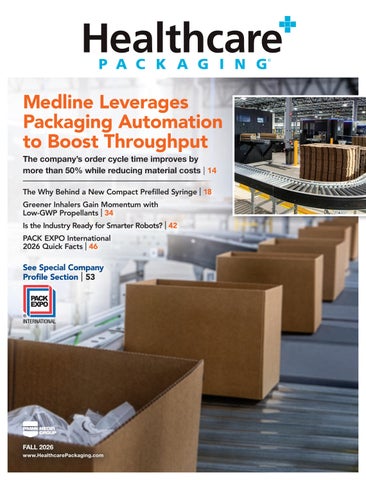
Medline Leverages Packaging Automation to Boost Throughput The company’s order cycle time improves by more than 50% while reducing material costs | 14 The Why Behind a New Compact Prefilled Syringe | 18 Greener Inhalers Gain Momentum with Low-GWP Propellants | 34 Is the Industry Ready for Smarter Robots? | 42 PACK EXPO International 2026 Quick Facts | 46
See Special Company Profile Section | 53
FALL 2026
www.HealthcarePackaging.com
SUPPLEMENT_Ad_PreflightTemplate.indd 2
8/18/26 14:50
CONTENTS
Vol.21 ∙ No. 2
12
30
22
14 REGULATORY
12 Preparing for the 12-Digit NDC
The shift will require coordinated updates across packaging, barcoding, and supply chain systems.
AUTOMATION
14 Medline Leverages Packaging Automation to Boost Throughput and Sustainability
The company’s order cycle time improves by more than 50% while reducing material costs.
PACKAGE DESIGN
18 How Compact Prefilled Syringes Could Reduce Shipping and Storage Costs
Pacto Medical, a startup born from humanitarian logistics, is redesigning the prefilled syringe plunger rod.
MATERIAL DEVELOPMENTS
22 CVS Pharmacy Swaps Plastic for
Aluminum in OTC Product Packaging The company will introduce the new package format on select wellness essentials.
MACHINERY
26 Digital Printing Gives Healthcare Packagers Greater Control
Ink and printer advancements broaden healthcare applications.
TECHNOLOGY
30 Clinical Trials and Smart Packaging: Closing the Knowledge Gap
How intelligent packaging is reshaping clinical research, participant safety, and the future of connected healthcare.
SUSTAINABILITY
34 Greener Inhalers Gain Momentum as
Low-GWP Propellants Enter the Spotlight
What low-GWP propellants mean for inhaler design, manufacturing, and packaging.
34 PROMINENT PEOPLE IN PACKAGING
38 What’s Driving Innovation in Medical Device Packaging?
In this interview, Paul Marshall from Zimmer Biomet reflects on balancing innovation and patient safety.
ROBOTICS
42 Robots Are Getting Smarter—But Is
the Industry Ready to Integrate Them?
As robots become more sophisticated, today’s machines are evolving from task-oriented capabilities to smarter systems.
PACK EXPO PREVIEW
46 PACK EXPO International Quick Facts Get oriented before you hit the show floor with this fast guide to the most essential sessions, resources, and events.
BUSINESS INTELLIGENCE
80 New PMMI Report Reveals Sustainability Is Reshaping Equipment Requirements
PACK EXPO International 2026 offers a one-stop destination for companies seeking sustainable packaging and processing solutions.
SPECIAL SECTION
53 Company Profiles
COLUMNS & DEPARTMENTS 3 EDITOR’S NOTE 4 QUOTABLES/BY THE NUMBERS 6 INDUSTRY NEWS 8 COLD CHAIN CORNER 10 INSIGHTS FROM THE HPRC 50 NEW PRODUCTS: FOCUS ON TECHNOLOGY Fall 2026 • Healthcare Packaging | 1
HCP_1026_TOC_V3_FINAL.indd 1
8/23/26 12:22 PM
Leak Testing Solutions for Pharma and CCIT. Safeguarding sterility, compliance, and data integrity.
www.healthcarepackaging.com
Content EDITOR-IN-CHIEF Elisabeth Cuneo
ecuneo@pmmimediagroup.com
CONTRIBUTING EDITOR Joseph Derr EDITORIAL OPERATIONS COORDINATOR Tracey Labovitz DIRECTOR OF CONTENT Kim Overstreet ART DIRECTOR Norman Smith CREATIVE DIRECTOR David Bacho
Advertising VICE PRESIDENT, SALES Reggie Lawrence
rlawrence@pmmimediagroup.com
SENIOR MANAGER, PRINT OPERATIONS Lara Krieger
lkrieger@pmmimediagroup.com
FINANCIAL SERVICES MANAGER Janet Fabiano
jfabiano@pmmimediagroup.com
PMMI Media Group PRESIDENT David Newcorn VICE PRESIDENT, DIGITAL Elizabeth Kachoris SENIOR DIRECTOR, DIGITAL MEDIA Jen Krepelka DIRECTOR OF MARKETING Amber Miller DIRECTOR, AD TECH AND SEARCH Joan Jacinto DIRECTOR OF INDUSTRY STRATEGY Angie Szerlong FOUNDING PARTNER AND EXECUTIVE VICE PRESIDENT, INDUSTRY OUTREACH, PMMI Joseph Angel
Questions about your subscription or wish to renew? Contact circulation@pmmimediagroup.com.
Scan QR code to learn more about our vacuum solutions for applications in pharma and biotech.
PMMI Media Group 500 W. Madison, Suite 1000 Chicago, IL 60661 www.pmmimediagroup.com
PMMI The Association for Packaging and Processing Technologies 12930 Worldgate Dr., Suite 200, Herndon VA, 20170 Phone: 571.612.3200 | Fax: 703.243.8556 | www.pmmi.org
PLEASE RECYCLE THIS MAGAZINE
Remove inserts or samples before recycling.
Pfeiffer Vacuum, Inc. 1-800-248-8254 pfeiffervacuum.com
Healthcare Packaging® (ISSN # 21543666) is a registered trademark of PMMI, The Association for Packaging and Processing Technologies. Healthcare Packaging® is published twice annually by PMMI with its publishing office, PMMI Media Group, located at 500 W. Madison, Suite 1000, Chicago, IL 60661; 312.222.1010. Copyright 2026 by PMMI. All rights reserved. Materials in this publication must not be reproduced in any form without written permission of the publisher. Applications for a free subscription may be made online at hcpgo.to/9999. POSTMASTER; Send address changes to Healthcare Packaging®, 500 W. Madison, Suite 1000, Chicago, IL 60661. PRINTED IN USA by Quad. Volume 21, Number 2 The opinions expressed in articles are those of the authors and not necessarily those of PMMI. Comments, questions and letters to the editor are welcome and can be sent to: editors@healthcarepackaging.com. Mailing List: We make a portion of our mailing list available to reputable firms. If you would prefer that we don’t include your name, please write us at the Chicago, IL address.
2 | Healthcare Packaging • Fall 2026
HCP_1026_Masthead.indd 2
8/18/26 2:57 PM
EDITOR’S NOTE
What’s Trending, What’s Innovative, and Sometimes, What’s Plain Weird This year, my fellow editors and I started a
or podcast channel. And if you feel like you have some insights to video podcast series called End of the Line. It’s share, reach out—we’re ready for guests to join us! been our platform to talk candidly about what Speaking of guests, I had the pleasure to sit down with the we’re seeing in the industry, young entrepreneurs that founded Pacto MediWe laugh, we from trends to recalls, cringe cal, a startup born from humanitarian logistics. emails from PR folks, and pontificate, and often The company is redesigning the prefilled syringe what’s going on with mutton. plunger rod in order to fit more devices in each the conversations We laugh, we pontificate, and box being sent to disaster zones. This compact often the conversations get derailed, (and then prefilled syringe technology is designed to reduce get derailed (and quickly get back on track). It’s a nice reprieve packaging volume, improve supply chain effithen quickly back from the (mostly) solo work that each of us ciency, and better support emergency and logiseditors conduct on our respective brands. Long tics-constrained healthcare environments. It’s an on track). gone are the news desks and bullpen days of jourinspiring story, and the founders are some of the most interesting guests I have had the pleasure to interview. You nalism and publishing (though I am sure this format does exist can read the full story on page 18 and even watch our video intersomewhere). With remote work and email domination, most of view online at hcpgo.to/450. us toil in relative quiet. So, each Friday, I get excited to meet with my colleagues and talk about the thought-provoking, innovative, or even funny things that came across our desks that week. If you Liz Cuneo is the Editor-in-Chief of Healthcare Packaging. She may be reached at ecuneo@pmmimediagroup.com. haven’t had a chance to tune in, check them out on our website
Your Trusted Partner for Medical Packaging Solutions S ‑ ‑ F‑ ‑
‑‑‑‑‑‑‑‑‑‑‑‑ ‑ ‑‑‑‑‑‑
‑ ‑
MEDICAL PACKAGING (252) 446‑6177 |
HCP_1026_Editor Note_V4_FINAL.indd 3
‑
8/25/26 9:32 AM
Q
QUOTABLES
BY THE NUMBERS
“
$93.1
People think they’re doing the right thing,
BILLION THE PROJECTED VALUE OF THE COLD CHAIN packaging market
but they don’t understand that you need
to keep the recyclables loose, because if you bag them, most likely they won’t even make it
”
through the materials recovery facility (MRF).
—WALTER WILLIS OF THE SOLID WASTE AGENCY OF LAKE COUNTY, AT THE MOST RECENT PACKAGING RECYCLING SUMMIT DISCUSSING COMMON RECYCLING MISTAKES MADE BY CONSUMERS.
by 2033, up from $33.7 billion in 2025, reflecting a critical need for advanced thermal packaging to ensure product integrity. Source: Grand View Research
$24.2
BILLION THE PROJECTED GLOBAL second-
“
Your story might not be ready when you launch the product. But through the 2D
ary packaging market for medical devices by 2036, up from an estimated $15 billion in 2026. Source: Future Market Insights
code, you can continuously add digital content without changing the artwork.
”
That’s a pretty big value for us.
—PRAKASH CHRISTOPHER, DIRECTOR OF DIGITAL IDENTIFICATION AND TRACEABILITY, KENVUE, AT THE 2025 GS1 CONNECT EVENT.
“
In CPG, packaging is everything; it’s your most effective billboard. That said, you have a lot that you have to fit on there. So for us, it
was about organizing that information in a way that was extremely easy to understand while
”
still leaving room for the pack to breathe.
—CARMEN GRAHAM, CHIEF OF MARKETING, GENEXA, IN AN INTERVIEW ABOUT THE BRAND’S RECENT REDESIGN.
$10K
PMMI’S CONTRIBUTION TO the mikeroweWORKS Foundation’s 2026 scholarship program, which aims to invest in workforce development and create pathways for individuals to pursue rewarding careers in technical and skilled trades professions.
60%
REDUCTION IN OPERATIONAL COSTS BY implementing 2D barcodes in warehouse and distribution environments, according to research commissioned by GS1 US and conducted by VDC Research. Source: GS1
4 | Healthcare Packaging • Fall 2026
HCP_1026_Quotables_V3_FINAL.indd 4
8/23/26 12:02 PM
Monoblock Fill-Finish Equipment
Chase-Logeman Corporation has spent over six decades at the forefront of monoblock-style filling and finishing innovation. Every machine is designed with one purpose: to provide our customers a competitive edge through precision-engineered, application-specific performance. For fill volumes from microliters to 125 mL and across a wide range of glass or plastic container configurations, Chase-Logeman’s expertise with bottles, tubes, and vials with plugs, crimp, or screw caps ensure products move seamlessly from fill-finish on to final processing. Chase-Logeman Corporation delivers the capabilities, consistency, and control modern manufacturers expect.
Contact us at:
Chase-Logeman Corporation 303 Friendship Drive Greensboro, NC 27409 336.665.0754 info@chaselogeman.com https://www.chaselogeman.com
SUPPLEMENT_Ad_PreflightTemplate.indd 2
8/18/26 14:51
INDUSTRY NEWS
Community poll:
Closed Loop Partners Invest in California to Advance Recovery of Small-Format Plastics Billions of small-format plastics currently end up in
landfills each year simply because they are too small to be properly captured by traditional recycling equipment. To address this challenge, Closed Loop Partners’ Center for the Circular Economy announces the next phase of its Smalls Consortium: Advancing the Recovery of Small-Format Packaging joined by founding partner L’Oréal, supporting partners Kraft Heinz and CVS Health, and strategic advisor Circular Action Alliance. With this powerful cross-industry backing, the Smalls Consortium is focusing its field testing efforts on California. As the state prepares for the implementation of SB 54, this initiative serves as a critical proving ground to help brands, recyclers, and end markets build a scalable roadmap for capturing small rigid plastics before they are lost to waste.
Pharma Inspection Machines Market to Reach $1.62 Billion by 2031 THE GLOBAL MARKET for pharmaceutical inspection machines is projected to grow to $1.62 billion by 2031 from about $1.14 billion in 2026, a 7.2% compound annual growth rate, according to research firm MarketsandMarkets. The report links demand to rising manufacturing volumes across generics, vaccines, biologics, and specialty drugs, which are pressuring quality-control operations to automate inspection of vials, syringes, ampoules, cartridges, and packaging. Automated systems—often combining machine vision, AI-powered analytics, X-ray, checkweighers, sensors, and robotics—are being deployed to detect defects, contamination, fill-level issues, and packaging errors at line speeds that outpace manual inspection.
Pharma’s AI Adoption Hurdles Offer a Blueprint for the Sterilization Sector As regulated industries like healthcare sterilization increasingly look to artificial
intelligence to enhance quality, efficiency, and compliance, a new study from the pharmaceutical sector provides a valuable roadmap of the challenges that lie ahead. The research, based on a survey of 300 quality and manufacturing leaders in life sciences conducted by MasterControl, highlights that the biggest obstacles to successful AI implementation are not technical, but human and infrastructural. While 86% of pharmaceutical leaders report that AI’s impact is meeting or exceeding their expectations, the survey reveals a critical underlying weakness: low employee engagement with existing quality management systems (QMS). A staggering 94% of pharma quality leaders identified poor employee adoption and utilization of their current quality system as a significant pain point.
We asked, you answered: Which area of regulatory compliance is most challenging for your packaging operations?
49%
Balancing compliance with speed to market
32%
Meeting packaging integrity and sterility testing standards
12%
Keeping up with global regulatory updates
5%
Documenting and validating packaging processes
Answer the latest poll online at the HCP homepage and look for reader polls in our e-newsletter.
Dual Chamber Device (DCD) Market to Soar THE MARKET for dual chamber drug delivery devices is growing, spurred by rising demand for patient-friendly administration systems, according to a report from Research and Markets. The analysis projects the global market will expand to $17.56 billion by 2040, up from an estimated $6.25 billion in the current year. This expansion is largely a response to the healthcare industry’s increasing focus on self-administered therapies and home care. DCDs, which keep drug components separate until the point of administration, offer advantages over conventional systems, including enhanced drug stability, precise dosing, and simplified handling for patients.
CALENDAR OF EVENTS PACK EXPO International (Oct 18-21) Chicago, IL PharmSci 360 (Oct 25-28) New Orleans, LA GS1 Global Healthcare Conference (Nov 2-5) Boston, MA Pharmapack 2027 (Jan 27-28) Paris MD&M West (Feb 9-11) Anaheim, CA PACK EXPO Southeast (April 12-14) Atlanta, GA
6 | Healthcare Packaging • FALL 2026
HCP_1026_IndustryNews_V4_FINAL.indd 6
8/23/26 11:34 AM
Blister packaging solutions for your tablets, capsules, gummies, softgels, and medical devices • Dependability • Sustainability • Innovation • Flexibility
Visit Us in Booths W-24010 & S-3850
PHONE 727-232-8200
EMAIL Sales@Pharmaworks.com
WEB Pharmaworks.com
2346 Success Drive Odessa, FL 33556
©2025 ProMach Inc.
SUPPLEMENT_Ad_PreflightTemplate.indd 2
8/18/26 14:52
COLD CHAIN CORNER
CVS Infusion Service Replaces Foam Coolers with Recyclable Packaging The move away from expanded polystyrene (EPS) for temperature-sensitive drug shipments aims to improve logistics, reduce plastic waste, and enhance the patient experience, signaling a broader push for sustainability in the healthcare supply chain. KEY TAKEAWAYS The transition to paper-based, recyclable packaging for specialty infusion therapies addresses challenges associated with non-recyclable materials.
Coram’s initiative is expected to increase operational efficiency in business operations, logistics, and workflow while optimizing storage space.
The successful implementation of this model could serve as a template for other segments of the healthcare industry dealing with cold chain distribution and environmental regulations.
A
The previous packaging method for these life-sustaining medications presented logistical and disposal challenges for both the company and patients. The EPS coolers were described as bulky and difficult to store, maneuver, or recycle, with the material taking many years to decompose in landfills. The new system is designed to improve efficiency across the supply chain. “By replacing difficult-to-recycle materials with compostable and recyclable alternatives, we’re reducing waste, improving the patient experience, and removing thousands of pounds of plastic each year,” says Jenny McColloch, chief sustainability officer and VP, Community Impact at CVS Health. The new packaging, which utilizes a “nested box” design to consolidate shipments, has undergone rigorous testing to ensure it meets or exceeds performance standards for temperature control and durability. According to the company, the design is more compact and easier for patients to break down for recycling or composting.
Courtesy: CVS Health
s the healthcare sector faces increasing pressure to reduce its environmental footprint, companies are reevaluating their supply chain and logistics operations, particularly in the packaging of temperature-sensitive pharmaceuticals. Coram CVS Specialty Infusion Services has initiated a shift away from traditional expanded polystyrene (EPS) coolers, replacing them with a recyclable, paper-based packaging solution for its specialty infusion and nutrition therapies.
Coram CVS Specialty Infusion Services transitioned to recyclable, compostable packaging for temperature-sensitive medications— replacing bulky legacy packaging with wood and paper-based insulation.
This operational change is being implemented in phases, starting with pharmacies in Mendota Heights, Minnesota; Malvern, Pennsylvania; and San Diego. The company is framing the initiative as a potential model for wider application. “We’re exploring opportunities to extend these learnings to other segments—and build on the success of the integrated, cross-functional team that demonstrated the power of enterprise-wide collaboration to drive meaningful change,” says Tom Underkoffler, executive director of logistics and packaging, CVS Health. This suggests the company views the packaging redesign not just as a sustainability project, but as a scalable operational improvement for its logistics network.
8 | Healthcare Packaging • Fall 2026
HCP_1026_ColdChain_V3_FINAL.indd 8
8/23/26 11:10 AM
SUPPLEMENT_Ad_PreflightTemplate.indd 2
8/18/26 14:53
THOUGHT LEADERS
Collaboration Is the Cornerstone of Healthcare Plastics Recycling Progress In this column from the HPRC, the group emphasizes that healthcare plastics recycling is a systems challenge, and that systems challenges don’t yield to siloed solutions. Courtesy: HPRC
HPRC - Healthcare Plastics Recycling Council
H
ealthcare packaging plays a critical role in patient safety, infection prevention, and clinical efficiency—but it also contributes to a growing plastics waste challenge. From device manufacturers and packaging suppliers to hospitals, recyclers, and policymakers, the healthcare plastics ecosystem is deeply interconnected. That reality was on full display at the HPRC’s Spring 2026 Full Council Meeting, where one message came through loud and clear: Collaboration is not optional, it’s essential.
Regulations as a Catalyst for Collaboration Regulatory uncertainty, particularly around extended producer responsibility (EPR) and the EU’s Packaging and Packaging Waste Regulation (PPWR), packaging waste rules, and recycled content requirements, can feel like a moving target. Yet many meeting participants noted that regulations, while challenging, are also forcing necessary conversations across the value chain. A panel discussion at the meeting addressed some of the more pressing questions arising from emerging regulations. Panelists emphasized the importance of continuing conversations as these regulations evolve: not only discussing the impacts internally but working with customers and suppliers to share resources and education on how operations may be impacted and what changes may be necessary to ensure compliance. And while preparation is important, other panelists emphasized the need to remain flexible and adaptable given the ever-changing nature of the regulations. At the end of the discussion, all four panelists agreed that although emerging regulations present challenges and uncertainties, they are ultimately driving conversations that needs to be had: conversations around responsibility and how value chain partners can work together, not only to comply with the regulations but also to come up with creative solutions for the barriers that have long faced healthcare plastics and packaging.
Overcoming Operational Barriers In addition to discussing challenges, it’s important to recognize successes being made in recycling healthcare plastics. One success shared during the meeting came in the form of a partnership between BD, a medical device manufacturer, and Envetec, a cleantech company that treats biohazardous medical waste. The two companies embarked on a feasibility study to test the ability to recycle polystyrene Petri dishes into new, high-quality manufacturing feedstock. Their study found that polystyrene and similar high-quality polymers, including polyester, polypropylene, and polyethylene, could be reused in the manufacturing supply chain after being safely disinfected and processed. While there is still more work to be done in order to scale this process, the pilot demonstrates a sustainable pathway for these plastics to remain in circulation and create a closed-loop solution.
Moving Forward, Together Healthcare plastics recycling is a systems challenge, and systems challenges don’t yield to siloed solutions. The progress highlighted at HPRC’s Spring meeting shows what’s possible when collaboration is placed at the forefront. For healthcare packaging, this is the key to overcoming today’s barriers and the foundation for building a more sustainable future.
10 | Healthcare Packaging • Fall 2026
HCP_1026_Thought Leaders_V3_FINAL.indd 10
8/23/26 12:20 PM
CONTRAST. SPEED. PRECISION. UV laser coding built for the compliance demands of healthcare packaging. g.
HIGH CONTRAST DATAMATRIX CODES
BUILT FOR LINE SPEED
FINE, PRECISE MARKING
Crisp, high-contrast codes on white, colored and recyclable plastics.
Engineered for demanding and high-speed healthcare production environments.
Sharp text, graphics, serialization data and 1D and 2D codes, even in small marking areas.
SEE THE Ux360i IN ACTION! Visit Domino in booth #S-2843
SUPPLEMENT_Ad_PreflightTemplate.indd 2
800.444.4512 domino-na.com
8/18/26 14:54
REGULATORY
Preparing for the 12-Digit NDC:
Packaging Implications and Next Steps A long-anticipated shift in drug identification will require coordinated updates across packaging, barcoding, and supply chain systems. By Ullrich Mayeski, Customer Success Director, Healthcare, GS1 US. KEY TAKEAWAYS While the new rule does not take effect until 2033, its implications for packaging, labeling and product identification begin now.
Updating packaging will require coordination across labeling, regulatory, operations and IT departments
O
n March 5, 2026, the U.S. Food and Drug Administration (FDA) issued a final rule revising the format of the National Drug Code (NDC), moving from the variable 10-digit structure to a single, standardized 12-digit format. While the new rule does not take effect until March 7, 2033, its implications for packaging, labeling, and product identification begin now.
Why the NDC is Changing The NDC is the FDA’s unique identifier for drug products. It is a three-segment code that identifies the manufacturer, the product, and the package configuration, and it appears on drug labels and packaging across the healthcare system. Since NDC connects physical packaging to prescribing, dispensing, and reimbursement systems, even small changes to its structure will have system-wide effects. Under the current system, FDA-assigned NDCs are 10 digits long and issued in multiple segment configurations (such as 4-4-2 or 5-3-2). This lack of uniformity has created long-standing challenges, requiring additional data normalization across systems and increasing the potential for discrepancies between physical products and digital records. At the same time, certain segments of the 10-digit NDC are expected to run out of available numbers in the coming years. Without a structural change, this would pose a significant risk to consistent product identification and traceability. The FDA’s final rule resolves both issues by establishing a uniform 12-digit NDC format with a 6-4-2 structure. This standardiza-
The NDC update strengthens the foundation for a more consistent, traceable and connected healthcare supply chain.
tion expands the numbering capacity and improves consistency across systems that rely on the NDC, ensuring it can support future product growth while enabling more reliable data exchange. The transition will take place over several years:
∙ March 5, 2026 – March 6, 2033: A seven-year period during which FDA will continue assigning NDCs under the current 10-digit format, and the industry should update systems, processes, and infrastructure to handle the 12‑digit format.
∙ March 7, 2033: The 12‑digit NDC format becomes effective. FDA will convert existing FDA‑assigned NDCs to the new format by adding leading zeros as needed.
∙ March 7, 2033- March 6, 2036: A three‑year transition period during which FDA does not intend to object to continued use of 10‑digit NDCs on product labeling, allowing time to update artwork and deplete existing packaging inventory.
Packaging and Labeling Implications From a packaging perspective, the transition to a 12-digit NDC will require updates to product labels, packaging artwork, and barcoding strategies. In some cases, existing packaging configurations may not easily accommodate the expanded identifier without redesign. The finalized rule allows the use of two-dimensional (2D) barcodes to encode the NDC on product labeling, giving manufacturers more flexibility in how product information is represented. Linear barcodes have traditionally been used on
12 | Healthcare Packaging • Fall 2026
HCP_1026_Regulatory_V2_FINAL.indd 12
8/23/26 12:09 PM
Courtesy: Szymon Shields; Pexels
non-prescription drugs to encode NDCs, but they are limited in how much data they can hold. As identifiers expand and additional data elements are incorporated, these constraints can create challenges, particularly on smaller packages. Barcodes using 2D technology, such as the GS1 DataMatrix, can encode significantly more information in a smaller space, making them a more practical option for carrying expanded product data. Adoption of 2D barcodes is already underway in parts of the industry, as pharmaceutical manufacturers have implemented the DataMatrix to meet Drug Supply Chain Security Act (DSCSA) requirements for serialized prescription drugs. The use of 2D barcodes has helped enable the interoperable exchange of data, leading to a safer and more secure supply chain. These benefits and more can be similarly unlocked for over-the-counter (OTC) and animal health products. Updating packaging will require coordination across labeling, regulatory, operations, and IT departments. Packaging teams will need to evaluate label real estate, print quality, scanner performance and regulatory requirements. Even small changes can affect production, distribution, and point-of-care scanning.
A Supply Chain-wide Impact While packaging is a critical touchpoint, the NDC update affects all systems that rely on product identification, from prescribing and pharmacy workflows to inventory management and reimbursement. Manufacturers, distributors, pharmacies, solution providers, and healthcare systems will need to update systems to recognize and process the new format. For a while, systems will need to consume both the 10- and 12-digit NDCs, as inventory already in the supply chain gets sold and used. If updates aren’t aligned, mismatches between product and associated data can lead to rejected shipments, delays in dispensing, and reimbursement issues.
Using Data Standards to Reduce Complexity Standards-based approaches can help reduce complexity across packaging and systems. GS1 Standards, such as GS1 Global Trade Item Numbers (GTINs) for product identification and Electronic Product Code Information Services (EPCIS) for data sharing, provide a common framework for aligning physical products with digital information across the supply chain. For pharmaceutical products, a GTIN can incorporate the current 10-digit NDC in a linear barcode, but not the new 12-digit version. As a result, the NDC will be encoded into an Application Identifier (AI) allowing for continued association to the GTIN. Since UPC-A barcodes cannot carry AIs, 2D barcodes will be necessary.
From a packaging perspective, the transition to a 12-digit NDC will require updates to product labels, packaging artwork and barcoding strategies.
The GTIN bridges U.S. regulatory identification with global supply chain standards and enabling consistent use in barcodes and interoperable data exchange. This can help ensure that product information is captured and shared accurately from manufacturing through dispensing. Although the U.S. FDA’s timeline provides several years for full implementation, waiting increases the risk of disruption, added cost, and rushed implementation. Packaging changes require time for design, validation, approval, and rollout across multiple SKUs, while updating legacy systems and aligning data across partners can be complex. Companies that delay planning may find themselves managing packaging redesigns and system updates under tighter deadlines, increasing both cost and operational risk.
Planning for What Comes Next As organizations evaluate the impact of the change, key questions will include how to update packaging efficiently, whether to adopt more advanced barcode technologies, and how to ensure alignment across internal systems and external partners. Companies that start early and align packaging, data, and systems can avoid last-minute disruption and move through the transition more smoothly. Ultimately, the NDC update strengthens the foundation for a more consistent, traceable, and connected healthcare supply chain. For more information about GS1 Standards in healthcare, please visit www.gs1us.org. Fall 2026 • Healthcare Packaging | 13
HCP_1026_Regulatory_V2_FINAL.indd 13
8/23/26 12:09 PM
Ranpak’s Cut’it! EVO system uses intelligent rightsizing to reduce package void before automatically closing and sealing the box, leading to savings on transport costs, improved throughput, and greater operational efficiency.
COVER STORY
Medline Leverages Packaging Automation to Boost Throughput and Sustainability
Courtesy: Ranpak
The company’s order cycle time improves by more than 50% while reducing material costs. By Liz Cuneo, Editor in Chief KEY TAKEAWAYS Medline turned to Ranpak Holdings Corp. to eliminate a growing bottleneck at pack-out.
M
The company now picks directly into a tray that’s automatically formed, then sends it downstream where it’s lidded and completed.
edline Industries, a large provider of medical-surgical products and supply chain solutions serving all points of care, is turning to packaging automation to streamline its operations, reduce material use, and keep pace with growing order volumes.
The automation flow was able to uphold a consistent standard for each box, as well as optimizing volume and material usage.
“We’re the biggest medical company you’ve probably never heard of,” says Daniel Schwartz, vice president of engineering, operations at Medline, noting the company’s portfolio of more than 300,000 products used across hospitals, nursing homes, and physician offices. “Our mission is to make healthcare run better.”
14 | Healthcare Packaging • Fall 2026
HCP_1026_CoverStory_V3_FINAL.indd 14
8/23/26 11:12 AM
Courtesy: Ranpak
Form’it! automated case erector forms and seals corrugated boxes from flat blanks to deliver consistent, ready-to-pack cartons at high speed.
To do that, Medline turned to Ranpak Holdings Corp., a global leader in sustainable packaging automation technology and solutions, to eliminate a growing bottleneck at pack-out. Medline had already invested in high-speed picking using an AutoStore AS/RS goods-to-person system, but downstream processes lagged. “We were picking at a pretty high volume throughput but then sending items in totes to a manual packing area,” says Schwartz. “That created a bottleneck.” Enter Ranpak’s right-sizing machine, Cut’it! EVO, and Form’it! case erector—two automated packaging systems designed to modernize end-of-line packaging. Together, they provide a scalable solution that optimizes throughput, improves labor efficiency, and enhances sustainability across Medline’s highvolume outbound operations. The Cut’it! EVO advanced automated right-sizing system optimizes the height of shipping boxes after items have been picked and packed to minimize void then automatically closes and seals them. The Form’it! automated case erector forms and seals corrugated boxes from flat blanks to deliver consistent, ready-to-pack cartons at high speed. A significant share of Medline’s products now move through these automated packaging systems, especially the smaller, everyday items such as gloves, syringes, and personal care products. “When we’re selling less than a case—which is a majority of the line volume—we’re running those products through this system,” Schwartz explains. The new system eliminates the bottleneck issue by changing the line flow entirely. “We now pick directly into a tray that’s
WE’VE ELIMINATED the manual pack-out step. ... We got rid of the air pillows we used before. — Daniel Schwartz, vice president of engineering, operations at Medline
automatically formed, then send it downstream where it’s lidded and completed,” explains Schwartz. “We’ve eliminated that manual pack-out step.” While automating pack-out was the main goal of the project, Schwartz says that they’re seeing other benefits emerge. For instance, the company can now handle more than 10,000 cartons per day while maintaining operational flexibility to support future needs. Additionally, the cycle time of an order improved by more than 50%.
Reducing Materials and Improving Efficiency The shift to right-sized packaging has also delivered material and sustainability gains. “We got rid of the air pillows we used before,” says Schwartz. “You don’t need that with this solution because it eliminates empty space and prevents items from shifting.” At the same time, Medline has dramatically simplified its packFall 2026 • Healthcare Packaging | 15
HCP_1026_CoverStory_V3_FINAL.indd 15
8/23/26 11:12 AM
Courtesy: Ranpak
COVER STORY
“You can’t look at automation as a pocket of efficiency,” says Bryan Boatner, Ranpak’s chief revenue officer. “You have to analyze how it fits into the overall flow.” That’s especially true as more warehouses adopt automated picking systems. “Companies are gaining efficiency in picking but then hitting a manual pack-out process and stalling,” says Boatner. “Integration across systems is critical.” Ranpak’s approach combines automation with softwaredriven rightsizing. “We use software tools to determine the ideal case or tray footprint and then dynamically adjust packaging to match how items are packed,” Boatner says. “That reduces volume and enhances sustainability.”
Managing Change and Scaling Results The Cut’it! EVO Multi-Lid machine enables up to four unique lids to be placed on boxes on a single line.
YOU CAN’T LOOK AT automation as a pocket of efficiency ... [it’s] how it fits into overall flow. — Bryan Boatner, Ranpak’s chief revenue officer
aging footprint. “We used to have about 14 different box sizes,” says Schwartz. “Now we’re down to four tray sizes that cover a wide range of products.” Finally, by replacing manual box erection, the automation flow was able to uphold a consistent standard for each box, as well as optimizing volume and material usage to promote high-quality packaging for each end customer. That reduction in corrugated use, combined with smaller package sizes, is driving downstream logistics benefits as well. “We’re more cubically efficient,” Schwartz notes. “That means fewer trailers going out, especially with partners like FedEx.”
Automation as a System, Not a Point Solution For Ranpak, the project highlights a broader industry challenge: aligning packaging automation with upstream and downstream systems.
As with any automation project, implementation required careful coordination. “The biggest challenge was integration—making sure all the systems were talking to each other,” says Schwartz. The team also made incremental improvements to simplify operations. One example: automating barcode printing directly onto trays. “It sounds like a small step, but it made change management much easier,” Schwartz says. And with Medline’s continued growth, labor has been redeployed rather than reduced. “We didn’t eliminate roles, we moved people to other parts of the operation,” says Schwartz. But, the most significant outcome has been improved speed. “The biggest benefit is cycle time,” says Schwartz. “It allows us to hit our cutoff times and maintain next-day delivery for the majority of our orders.” That capability is critical in healthcare distribution, where speed and reliability are essential. Any type of automation can improve overall system efficiency. “There’s a cascading effect,” Boatner says. “You’re reducing labor, improving the customer experience, and cutting shipping volume, often by 30 to 40%.” Schwartz adds that companies should take a holistic view when evaluating automation. “Don’t just look at averages, look at peak demand and variability. And think about the full end-to-end system. That’s where the real value comes from.”
16 | Healthcare Packaging • Fall 2026
HCP_1026_CoverStory_V3_FINAL.indd 16
8/25/26 9:41 AM
See us at PACK EXPO International Booth W-20040
SUPPLEMENT_Ad_PreflightTemplate.indd 2 SUPPLEMENT_Ad_PreflightTemplate.indd 2
7/16/26 14:55 8/18/26 10:31
PACKAGE DESIGN
How Compact Prefilled Syringes Could Reduce Pharmaceutical Packaging, Shipping, and Storage Costs Pacto Medical, a startup born from humanitarian logistics, is redesigning one of healthcare’s most overlooked components—the prefilled syringe plunger rod. By Liz Cuneo, Editor in Chief KEY TAKEAWAYS Pacto Medical has redesigned the plunger rod on prefilled syringes to fit more in a box.
The weight of each syringe remains the same, but materials used are greatly reduced.
I
n hospitals, ambulances, disaster zones, and military settings around the world, prefilled syringes are a valuable tool, as they are sterile, accurate, and ready to use. Clinicians can administer medications quickly without drawing from a vial, reducing contamination risk and minimizing dosing errors during critical moments. But according to Pacto Medical co-founders Ian Speers and Robert Halvorsen, one major problem has been hiding in plain sight for decades: their size. “They were huge,” Speers says. “Every time I’d open a box of prefilled syringes, there were only about 30 in a given box, and we’d go through them really quickly. I realized we were taking a lot of time, effort, money, and carbon to move each of these boxes through the system.” That observation eventually led to the founding of Pacto Medical, a medical device startup focused on redesigning the plunger rod to save space in each box. This compact prefilled syringe technology is designed to reduce packaging volume, improve supply chain efficiency, and better support emergency and logistics-constrained healthcare environments.
From Disaster Response to Device Design The passion behind Pacto Medical stands out as much as the unique syringe design. Speers’ path into healthcare packaging
Reducing syringe volume significantly lowers supply chain costs.
innovation did not begin in manufacturing or engineering. His background is in public health, emergency medical services, and medical logistics. He started his career working as an EMT and search-and-rescue technician before transitioning into nonprofit work focused on medical logistics and supply chain management in low-resource and disaster settings, primarily across Africa and the Middle East. There, he noticed a disconnect between the products commonly used in high-resource healthcare systems and what was actually available in the field. “A lot of the care we wanted to deliver was being challenged by the availability of products,” Speers explains. “I started to realize that what a product looks like, the amount of space it takes up, and how much it costs to move from the point of manufacture to the point of care delivery really matters.” That realization pushed him to examine prefilled syringes more closely. “What if we could make that more efficient? Could that help us deliver care in a more effective and affordable manner?” While traditional prefilled syringes rely on a full-length plunger rod that extends outward, this makes the overall device bulky during storage and transport. Clinically, this format is effective, but it creates inefficiencies across packaging, sterilization, ship-
18 | Healthcare Packaging • Fall 2026
HCP_1026_PackageDesign_V4_FINAL.indd 18
8/23/26 11:47 AM
Pacto Medical’s Slimshot
Courtesy: Pacto Medical
ping, and storage. So, Speers began to explore how he could take his findings and create a new solution. “I came back from those experiences, started grad school, and had a bit more time to dig into this page of frustrations that I had accumulated over the years, and I realized that I really needed an engineer to help me create a lot of these products,” says Speers. To turn the concept into reality, he reached out to longtime friend Robert Halvorsen, a mechanical engineer whose previous work included consumer electronics and product development projects for companies like Amazon and Ember. Halvorsen immediately recognized the potential and brought in another engineer he knew from his grad school, Ryan Stinebaugh. “He told me about these prefilled syringes and said, ‘That plunger rod sticks all the way out—we’ve got to do something about them,’” Halvorsen recalls. “And I said, ‘That’s something I can prototype.’”
Redesigning the Plunger Rod Three years later, the company has developed a compact prefilled syringe design that cuts the overall storage footprint roughly in half while maintaining the same medication volume and compatibility with existing syringe components and systems.
“
I STARTED TO REALIZE that what a product looks like, the amount of space it takes up, and
”
how much it costs to move from the point of
manufacture to the point of care really matters. the syringe barrel, plunger stopper, or components that contact medication, Pacto Medical focuses exclusively on the plunger rod itself.
“We don’t change anything that touches the medication,” Speers says. “Because we know if we do, the regulatory burden immediately goes way up.” That decision also minimizes manufacturing disruption for pharmaceutical companies and syringe manufacturers already operating established production lines. “We’re trying to make it as easy for them as possible to say yes,” says Speers.
Instead of redesigning the entire syringe, Pacto Medical engineered a detachable plunger rod system that is installed immediately before use.
The approach could allow manufacturers to integrate the compact design without requiring a complete overhaul of existing tooling or filling systems.
“When you’re ready to use it, you just take off the (plunger rod), install it, and then you’re ready to go like any other prefilled syringe,” Halvorsen explains.
Solving a Real-World Space Problem
The company’s strategy is intentionally conservative from a regulatory and manufacturing standpoint. Rather than altering
For healthcare workers operating in constrained environments, the benefits extend well beyond convenience. Combat medics, emergency responders, disaster relief teams, and ambulance crews often work with tightly packed kits where every cubic inch matters. Fall 2026 • Healthcare Packaging | 19
HCP_1026_PackageDesign_V4_FINAL.indd 19
8/23/26 11:47 AM
PACKAGE DESIGN
“If you are in a disaster setting or you’re a combat medic, you don’t have space in your kit for something this big because you have to carry it with you,” Halvorsen says, holding up a traditional prefilled syringe. As a result, clinicians sometimes resort to improvised workarounds, he explains, including removing plunger rods entirely and reusing a single rod across multiple syringes. “If they lose the plunger rod, they’ll use a finger, they’ll use a pen,” Halvorsen notes. “It’s not clinically the best.” The founders of Pacto Medical believe compact prefilled syringes could improve both preparedness and medication accessibility in emergency settings by allowing providers to carry more medications within the same storage footprint. The company’s first target application is the 10 mL saline flush, one of the most widely used prefilled syringes in healthcare. The product is already ubiquitous in IV start kits, emergency carts, and hospital workflows, making it an ideal entry point for commercialization.
Packaging, Sustainability, and Cold Chain Implications While the clinical advantages are compelling, the downstream packaging and logistics benefits might be equally significant for healthcare manufacturers and supply chain stakeholders.
“
WE DON’T CHANGE ANYTHING THAT
TOUCHES THE MEDICATION ... Because
”
we know that if we do, the regulatory burden immediately goes way up.
Halvorsen said that while the weight of the syringe remains the same, the packaging materials used are significantly reduced, which has far-reaching implications. Supply chain savings come from multiple areas, including smaller secondary packaging requirements, more efficient palletization and shipping density, and reduced sterilization chamber runs. According to the company, reducing syringe volume by approximately 40% can lower supply chain costs by roughly 35%. “The material use is dramatically reduced because these are stored in plastic wrappers,” explains Halvorsen. “Our wrapper is half the size.” But cold chain logistics may represent one of the largest opportunities.
Many injectable medications require refrigerated or frozen transport, making packaging density especially important due to the high cost of temperature-controlled shipping and storage. “Those shipping boxes are expensive,” Halvorsen says. “Those trucks are very expensive to keep a large volume of stuff cold. If we can be more efficient in packing those cold shippers, the savings are significant.”
Designing With Clinicians, Not Just for Them One of the company’s defining philosophies is continuous user feedback. “I think as soon as we stop interacting with end users, we’ll fall right on our face,” says Speers. “It’s always our goal to continue to be as close to the problem as we possibly can.” To do that, the team has spent significant time conducting hands-on testing sessions with nurses, physicians, and emergency care providers at hospitals, conferences, and healthcare innovation events. The founders say those interactions have shaped nearly every design decision. “It took about a year to optimize this design,” says Halvorsen. “Every new piece of innovation did not come from me thinking really hard in my chair. It came from going out and giving it to a nurse and watching them play with it.” The company recently held a design workshop with clinicians at Mass General Brigham in Boston, where they gathered direct feedback on medication use cases, workflow pain points, and device usability. “We’ve gotten to the point now where we’ve gotten this feedback a few times. They’ll say, ‘Was that it?’ ‘Yes,’ It’s supposed to be that simple, but it took us time to go to the nurses and iterate and get feedback to make it that simple,” explains Halvorsen. That user-centered approach has also influenced another product currently in development: a dosing clip designed to reduce cognitive load during medication administration. The adjustable clip enables providers to preset dosage levels on the plunger rod based on patient size or weight, potentially reducing dosing errors during high-stress pediatric emergencies. “About 25% of pediatric resuscitation doses are misdosed,” Halvorsen says. “We think there’s a big impact to be had by reducing that cognitive load for providers.”
20 | Healthcare Packaging • Fall 2026
HCP_1026_PackageDesign_V4_FINAL.indd 20
8/23/26 12:32 PM
Courtesy: Pacto Medical
Pacto Medical’s founders (from left) Ryan Stinebaugh, Ian Speers, and Robert Halvorsen.
Balancing Innovation with Adoption For many startups entering healthcare, regulatory complexity and adoption barriers can stall promising technologies before they ever reach the market. Pacto Medical’s founders say understanding those realities early has been essential. “Really knowing your regulatory pathway and understanding how you can make something that will actually be adopted and manufactured rather than just a cool science project— that’s critical,” Speers says. By limiting design changes to the plunger rod, the company hopes to streamline approvals while minimizing risk for manufacturing partners. Its initial commercialization efforts are focused on saline flushes, with plans to expand into other emergency drugs in the near future. Longer term, the founders see opportunities within vaccines, cold-chain pharmaceuticals, emergency medications, and home healthcare applications. But for Speers, the mission remains rooted in the healthcare inequities he witnessed firsthand years ago in his humanitarian work. “I spent a lot of years trying to optimize downstream,” he says. “Then I realized you have to go further upstream to the root of the problem.” By redesigning one of healthcare’s smallest and most overlooked components, Pacto Medical believes it can influence the entire supply chain that surrounds it. “We’re going to go upstream to where design and manufacturing decisions are being made, and we’re going to get into those rooms and provide a better alternative, which will then cascade benefits down, so that people in humanitarian settings or disaster settings or pre-hospital settings have something that is designed for them, with them,” says Speers. Fall 2026 • Healthcare Packaging | 21
HCP_1026_PackageDesign_V4_FINAL.indd 21
8/23/26 11:47 AM
MATERIAL DEVELOPMENTS
CVS Pharmacy Swaps Plastic for Aluminum in OTC Product Packaging
Courtesy: CVS Pharmacy
The company will introduce the new package format on select wellness essentials. By Liz Cuneo, Editor-in-Chief KEY TAKEAWAYS The change provides consumers with a packaging option that reduces plastic and uses a highly recyclable material instead.
More broadly, this update reflects an ongoing effort at CVS to rethink how everyday healthcare products are packaged.
Aluminum is among the most common materials accepted by the majority of recycling programs.
C
to simplify the shopping experience for customers. Last year, the company rolled out a new look for the CVS brand of OTC health and wellness products to make it easier for customers to quickly find the items they need.
More broadly, this update reflects an ongoing effort at CVS to rethink how everyday health care products are packaged
“The refresh is now 50% complete, with several categories, including cold, allergy, children’s remedies, and digestive health, already debuting new packaging, and others, including feminine care and adult care, hitting shelves in the coming months,” says Wier. “The new aluminum bottles also have the new brand look.” Compared to glass, aluminum is lightweight and shatter-resistant, making it safer and more efficient to transport, reports CVS. Aluminum bottles are also highly recyclable, and aluminum is among the most common materials accepted by the majority of recycling programs.
VS Pharmacy is unveiling an aluminum bottle for storebranded OTC products nationwide, beginning with select value-sized CVS brand allergy and pain relief support products. The change provides consumers with a packaging option that reduces plastic and uses a highly recyclable material instead. “The new aluminum bottles give customers looking to reduce their plastic use a recyclable aluminum option for some of their everyday wellness essentials. Aluminum is highly recyclable, giving it a reliable end-of-life pathway. And like more traditional packaging options, aluminum provides a strong barrier to help maintain stability and shelf life,” says Michael Wier, vice president of Store Brands CVS.
22 | Healthcare Packaging • Fall 2026
HCP_1026_Material_Develop_V5_FINAL.indd 22
8/23/26 11:45 AM
91
97
16 96
PHARMA EUTI AL INSPE TION &
93 FOREIGN OBJE T DETE TION •
EIA high se si ivi y me -fe
•
Ishi
98p •
Ishi
e ec i
; fe
1
us,
59
us, s i ess s ee
17 f eig
X- y f uc
bjec
101
efec s
p ecisi
checkweighi g f
6 5
weight verification •
P w e s, c psu es,
b e s, iqui s
102 1
34 ®
He
ffe s
c mp e e i e f me
116 116 11 e ec s, checkweighe s, X- y i spec i sys ems f 94 ph m ceu 9 ic 4p uc s f m he e i g m uf c u e s, Ishi
EIA®. Tech ic
es i g is v i b e i N
supp
, em
h, e
s
i
,
S u h Ame ic .
36 108 3
42
ol. I spec i f eig bjec e ec i sys ems h ffe u p e e se si ivi y f ph m ceu ic p uc s p ec y u c sume y u b .
~2~ 103
107 41
104
27
20
26
1
56
52
Oc . 18–21, 2026 B
14
h N-4706 hic g , IL USA
28 i f @he
c
.c m | he
LOOKING BACK. PRESSING FORWARD. ALWAYS INNOVATING.
SUPPLEMENT_Ad_PreflightTemplate.indd 2
c
.c m
29 52 8/18/26 14:57
MATERIAL DEVELOPMENTS
“
The new aluminum bottles give customers looking to reduce their plastic use a recyclable aluminum option for some of their everyday wellness essentials.
”
For CVS, this product launch fits into the company’s larger sustainability goals. “As part of our Healthy 2030 strategy, we’re focused on improving the sustainability of the materials we use,” says Wier. “That includes our Store Brands packaging, where we strive to use less virgin plastic and increase recyclability across our portfolio. We aim to eliminate or use less plastic, replace plastic with alternative sustainable materials, and identify new strategies to increase recyclability and safer end-of-use disposal of the materials we use where we can.” According to the company, aluminum is not just sustainable, it’s well-received by consumers. “In our initial product testing, we’ve received positive feedback about the look and feel of the aluminum bottles,” says Wier.
HCP_1026_Material_Develop_V5_FINAL.indd 24
“Many customers have noted that the aluminum bottles stand out on shelves with their unique look. Additionally, many customers emphasized that the recyclable element of the product is appealing to them, as they’re trying to reduce their plastic use.” Many healthcare products have traditionally relied on plastic packaging due to performance, regulatory, and cost considerations. But for many companies, making a material swap can net a big impact. According to Wier, the company strategy focuses on driving measurable progress in reducing virgin plastic use and improving end-of-life outcomes for plastics, while balancing health care quality, safety, and consumer experience. “Starting with value-sized products proved most effective, making it easier to bring a more consistent look across a set of products,” says Wier. “The larger aluminum bottles also make the packaging change more noticeable to our customers than it would be on a smaller, 100-count plastic bottle.” Wier says that while the company’s initial focus is the performance of these first six items, if they resonate well with customers, CVS might expand the aluminum bottle across more categories.
8/23/26 11:45 AM
SUPPLEMENT_Ad_PreflightTemplate.indd 2
8/18/26 14:58
Courtesy: Sealed Air
MACHINERY
A Sealed Air digital printing solution demonstrates how pharma manufacturers can produce customized, high-resolution labels on demand— reducing inventory risk and enabling advanced traceability (mock-up shown with fictional brand).
Digital Printing Gives Healthcare Packagers Greater Control Ink and printer advancements broaden healthcare applications. By Cindy H. Dubin, Contributing Editor KEY TAKEAWAYS The FDA finalized a rule requiring 12-digit NDC format implementation by March 7, 2033.
I
Digital printing allows on-demand production and faster regulatory compliance.
n March, the FDA finalized a rule requiring a standardized 12-digit National Drug Code (NDC) format to be fully implemented by March 7, 2033—replacing the current 10-digital format. There will be a three-year transition period through March 6, 2036, to allow for old 10-digit inventory to be depleted. Digital printing will be essential for this transition, enabling flexible, on-demand variable data printing for updated 6-4-2 formatting, including 2D barcodes on pharmaceutical packaging. “The best part of digital printing in the move to NDC-12 is on the flexibility and size of the printer,” says Paul Hammond, sector manager, Life Sciences, Greydon. “For folks who have the NDC pre-printed on their packaging and labels, the difficulty would be transitioning from a 10- to a 12-digit NDC. Packagers can go with a pre-printed label with a blank
Digital printing also enables enhanced patient safety through greater control over printed packaging.
space for their NDC in its original location and then use a digital printer to print either 10- or 12-character NDCs.”
Overcoming the Pain Points of Traditional Printing Self-adhesive label printing was dominated by flexography (analog printing using plates) and gravure printing methods, which lack agility for quick change of artwork as they are largely fixed once a plate is made. “Digital printing eliminates physical plates and allows companies to print closer to actual demand, reducing obsolete inventory and waste,” says Rick Thompson, senior director, Global Medical Portfolio, Sealed Air. Hammond points to the real-world example of a contract packager with a whole suite set up to fill product. When the labels got delivered,
26 | Healthcare Packaging • Fall 2026
HCP_1026_Machinery_V2_FINAL.indd 26
8/23/26 11:35 AM
H E A LT H CA RE PACK AG I N G
MEDICAL
CO N S U M E R H E A LT H
P H A R M AC E U T I C A L
COME SEE US!
LEARN MORE ABOUT PRECISION PACKAGING YOU CAN TRUST amcor.com/products/healthcare SUPPLEMENT_Ad_PreflightTemplate.indd 2
8/18/26 15:00
they were for the wrong dose. The whole setup was wasted. With digital print, that CPO could have printed the exact number of labels needed on demand, even used the capability as a revenue generator, and avoided being beholden to vendors charging higher costs or risking issues like lost shipments, misprints, etc.
Courtesy: Greydon
MACHINERY
Additionally, labels being used for laser printing are subject to the whim of the manufacturer or the buyer. Coating can change, layers can change, manufacturing processes can change, and that has an impact on the code being printed on the label. “Digital printing fixes all of that,” says Hammond.
Ensure Greater Supply Chain Flexibility Digital printing has come a long way, with new inks being developed to produce high-quality, durable printing on a variety of substrates, including low-surface-tension and varnished surfaces. This allows printing to take place in end-user facilities—
Greydon’s new L-MAX digital label printing machine.
previously this was possible only in specialist label printing facilities. Thompson points out that digital presses can print up to 54 inches wide at speeds up to 400 feet per minute with 1,200 dpi resolution. “The advances broaden the range of healthcare applications, where digital can be used practically and cost effectively,” he says. For example, digital printing supports more personalized labeling and instruction in clinical trials. Independent of media, digital printing can stand up to the rigors of the supply chain. For example, Hammond says UV-cured ink technology isn’t subject to smearing during cold chain storage or limitations in adhesion. “Goal No. 1 is getting product out the door efficiently, correctly, and without adding additional cost due to miscoded, illegible, missing, or incorrect codes,” he says. He references a major IV bag manufacturer that needed to make a shift to full
R
C
HCP_1026_Machinery_V2_FINAL.indd 28
8/23/26 11:35 AM
color printing of its IV bags. Due to the sterilization process, no ink could hold up, so Greydon developed a solution that prints the complete bag in full color after it has been filled and sterilized. “The result is no sterilization concerns and no leachability concerns,” says Hammond. Indeed, demand is growing for closer integration between digital printing and cartoning and pouching equipment. “If the industry can reliably print more of the package live during the filling process, it could improve supply chain responsiveness and strengthen control over printed packaging,” says Thompson. Experts say digital printing offers greater supply chain flexibility and faster compliance. Additionally, digital printing supports short runs and just-in-time manufacturing, reducing inventories and minimizing waste, while rapid prototyping accelerates time to market and regulatory updates and facilitates adoption of regulatory requirements that reinforce traceability and increase patient safety.
Transitioning to Digital Printing Experts acknowledge concerns packagers might have as they transition to digital printing and offer the following tips. Hammond says that packagers could simply stick with a solution
that churns out codes to meet regulatory and distribution requirements and eventually make the move to printing the entire label. Thompson recommends designing for digital print at the outset rather than adapt artwork that was originally created for traditional print. Some suggest implementing late-stage customization. For example, to comply with the EU’s 27-member state linguistic and regulatory requirements, consider hybrid (conventional and digital) printing. In this scenario, the label converter prints the “chassis” of the label with conventional priting and stores the labels. The printer will later digitally print the labels with the specific language and localized legal text when the market destination and exact volume are confirmed. The packager would handle the serialization 2D matrix that is digitally printed on the packing line. “This is an industry that should want control,” says Hammond. “It has always seemed odd that the pharma industry leaves the success of its printed product up to a $10,000 thermal inkjet printer, a label manufacturer trying to make their own profit, and a purchasing team always looking for ways to cut costs on consumables. Going digital takes all of those issues away. This is a truly game-changing alternative and represents a new frontier.”
Reliable. Reproducible. Traceable. Harpak-ULMA offers validation-ready medical packaging solutions that meet all of the standards required, helping to provide maximum product protection, hermetic sealing, customizable package shapes, hygienic individual or multi-packs, and easy-open options, all possible with our product to pallet automation.
Come see us at:
Learn More
Booth W-20098 (Medical Booth) TFS 300 Medical Thermoformer with ULMA Vision Inspection and Inline Printing 02.02.2020
Contact us Today!
© 2026 Harpak-ULMA Packaging, LLC 85 Independence Drive, Taunton, MA 02780 USA
HCP_1026_Machinery_V2_FINAL.indd 29
Booth S-2939
www.harpak-ulma.com • 800-813-6644
(Main Booth) FM305 Medical Flow Wrapper 1234567890
8/23/26 11:35 AM
Courtesy: Christine Tervo
TECHNOLOGY
Clinical Trials and Smart Packaging:
Closing the Knowledge Gap How intelligent packaging is reshaping clinical research, participant safety, and the future of connected healthcare. By Christine Tervo, Contributing Editor KEY TAKEAWAYS Real-time adherence data from smart packaging helps researchers distinguish drug performance from patient behavior in clinical trials.
W
Smart packaging supports remote monitoring, anti-counterfeit protection, and patient engagement.
hat was once considered simple pharmaceutical packaging is now emerging as a source of clinical intelligence. Embedded sensors, radio-frequency identification (RFID) tags, near-field communication (NFC) chips, and connected blister systems can capture when investigational drugs are accessed, helping researchers better understand whether trial data reflect true drug performance or participant behavior.
Smart packaging is rapidly transforming clinical trials from research models dependent on estimation and self-reporting into connected, data-driven systems capable of capturing precise investigational drug-use behavior in real time.
For pharmaceutical companies and researchers, this matters because study participant adherence remains one of the most persistent challenges in clinical research. Participants may miss doses, take the investigational drug inconsistently, or misinterpret dosing instructions. Traditional adherence measures such as diaries and pill counts often provide incomplete or imprecise information.
30 | Healthcare Packaging • Fall 2026
HCP_1026_Technology_V3ms_Final.indd 30
8/23/26 12:18 PM
Courtesy: Image generated by writer, prompt ChatGPT
Courtesy: Christine Tervo
The result is a fundamental challenge: It is often unclear whether a therapy failed due to the investigational drug itself or because it was not taken as intended according to the protocol. Smart packaging helps close that gap.
Packaging That Records Investigational Drug Behavior Modern smart packaging systems can automatically record when an investigational drug is accessed and whether dosing aligns with protocol requirements. Smart blister packs embedded with sensors and NFC technology can detect dose removal events and transmit data to secure digital systems. This shifts adherence tracking away from self-reporting toward objective, time-stamped records of medication access. Examples include platforms such as MEMS®-based solutions from AARDEX Group and Med-ic® smart blister systems from Information Mediary Corporation, which have been used in clinical research settings to monitor adherence patterns and support data analysis. These systems log dosing events, allowing researchers to compare clinical outcomes against observed investigational drug-use behavior rather than estimated adherence. Other RFID-enabled packaging systems assign unique digital identities to drug packages, supporting serialization, supply chain traceability, and authentication. While primarily designed for logistics and anti-counterfeit purposes, these capabilities increasingly intersect with clinical trial monitoring in decentralized study designs. Together, these systems allow investigators to identify adherence issues earlier in a study, rather than discovering them only during final analysis.
Identifying Adherence Gaps and Improving Data Integrity One of the most important contributions of smart packaging is improving the interpretability of clinical trial data. In traditional studies, poor adherence can distort outcomes, making a treatment appear ineffective or confounding the interpretation of safety events. Without clear dosing data, separating drug performance from participant behavior is difficult. Smart packaging helps address this by providing a clearer link between dosing patterns and outcomes. For example,
if a participant reports worsening symptoms but packaging data shows repeated missed doses, researchers can better contextualize whether the investigational drug itself is responsible. Rather than relying on delayed or retrospective analysis, researchers can also monitor adherence trends during the study and respond more quickly when issues arise, an especially important capability in decentralized clinical trials, where site visits are limited. Industry groups such as Thermo Fisher Scientific’s clinical research services have highlighted the role of connected technologies in improving adherence visibility and strengthening data reliability across distributed study populations. At the same time, serialization and digital tracking systems, including those used in global supply chain platforms like Körber, support traceability and product integrity across increasingly complex trial networks.
Why This Improves Safety and Trial Predictability The implications extend beyond data quality. When researchers can distinguish between drug performance and participant behavior, clinical trials become more stable, more efficient, and often safer. Earlier identification of missed doses can improve participant monitoring and enable timely intervention when adherence issues emerge. It also strengthens confidence in efficacy and safety findings, supporting more reliable regulatory and development decisions. Fall 2026 • Healthcare Packaging | 31
HCP_1026_Technology_V3ms_Final.indd 31
8/23/26 12:18 PM
TECHNOLOGY
Companies such as Takeda have emphasized the importance of digital, participant-centered trial designs that reduce burden while improving engagement and retention. Key benefits of smart packaging include:
∙ Improved adherence visibility ∙ Earlier detection of protocol deviations
∙ Stronger clinical data integrity ∙ Enhanced supply chain traceability ∙ Reduced risk of counterfeit or tampered product exposure
∙ More representative real-world evidence
Courtesy: Image generated by writer, prompt ChatGPT
This capability is increasingly relevant as healthcare systems and clinical research move toward decentralized and hybrid trial models, where participants are monitored remotely rather than in controlled clinical environments.
HCP_1026_Technology_V3ms_Final.indd 32
Regulatory frameworks are also reinforcing this shift. The Food and Drug Administration’s Drug Supply Chain Security Act (DSCSA) continues to drive adoption of serialized, traceable, and digitally enabled packaging systems across manufacturers, distributors, and dispensers, supporting broader transparency and supply chain security.
8/23/26 12:18 PM
d
From Clinical Trials to Broader Healthcare Use Clinical trials are increasingly acting as the proving ground for technologies that are now expanding into mainstream healthcare. Connected packaging systems are already appearing in applications such as:
∙ Digital adherence reminder systems ∙ Smart pill dispensers ∙ QR-linked patient education tools ∙ RFID-based authentication and anti-counterfeit labeling ∙ Temperature and condition-monitoring packaging ∙ Remote care and digital health platforms
e Some systems integrate directly with mobile apps and wearable devices to deliver reminders, adherence alerts, and patient-provider communication tools. The Proteus Digital Health system, developed in partnership with Otsuka Pharmaceutical, takes technology further by using an ingestible sensor that activates in the stomach and transmits a signal to a wearable patch, enabling confirmation of ingestion rather than dispensing alone. In recent years, AI-enabled packaging systems are beginning to combine sensor data, serialization records, and analytics to support pharmacovigilance, detect supply chain anomalies, and improve real-world medication insight.
What’s Next Smart packaging is redefining the role of packaging in clinical research and healthcare delivery. In clinical trials, it is helping reduce uncertainty around adherence, improve data reliability, and strengthen confidence in study outcomes. More broadly, it is shifting packaging from a passive container into an active data layer within the clinical evidence ecosystem, enabling continuous visibility into medication-use behavior across decentralized and hybrid study environments. For sponsors, manufacturers, and healthcare providers, the trajectory is clear: Future clinical systems will increasingly integrate regulatory compliance, real-time adherence intelligence, and patient-centered digital design into a unified, connected infrastructure that supports more adaptive trial design, faster decision-making, and improved engagement across the study lifecycle. Fall 2026 • Healthcare Packaging | 33
HCP_1026_Technology_V3ms_Final.indd 33
8/23/26 12:18 PM
SUSTAINABILITY
Greener Inhalers Gain Momentum as Low-GWP Propellants Enter the Spotlight What low-GWP propellants mean for inhaler design, manufacturing, and packaging. By Liz Cuneo, Editor in Chief KEY TAKEAWAYS A new generation of low–global warming potential (GWP) propellants is emerging.
Low-GWP propellants require full product redevelopment.
A
Success depends on balancing climate goals with patient needs and business strategy.
s sustainability pressures intensify across healthcare, one often-overlooked component is taking center stage: the propellant inside metered dose inhalers (MDIs). While invisible to patients, these propellants account for up to 95% of an inhaler’s formulation—and a significant share of its environmental footprint.
Since inhalation devices contribute 3% of global emissions, it became a problem that needed a solution. That transition is being formalized through the Kigali Amendment to the Montreal Protocol, which calls for a global phase-down of HFCs (and eventual phase out) in favor of alternative propellants with significantly lower GWP.
Now, a new generation of low-global warming potential (GWP) propellants is emerging, prompting a complex industry-wide transition that touches formulation, manufacturing, regulation, and packaging.
A Global Shift—But Not a Uniform One
Andy Burns, Vice President of Business Development for MDI at Kindeva, a drug delivery CDMO that specializes in injectable, inhalation, and dermal products, explains what’s driving the shift and what it means for pharma and packaging stakeholders.
While the direction is clear, the pace of change varies widely by region. Europe is leading the charge, with F-gas regulations set to reduce allowable propellant volumes by roughly 80% between 2027 and 2029. In contrast, the U.S. currently lacks a unified federal mandate, though states like California are moving ahead with phase-out timelines in the early 2030s.
Why Propellants Matter
“It’s a mixed bag globally,” Burns notes. “Some regions are moving quickly, others are still evaluating how to implement the transition.”
“In a metered dose inhaler, the propellant is essentially the engine,” says Burns. “It’s what turns the API into a mist that can be delivered deep into the lungs.”
For packaging and device manufacturers serving global markets, that variability adds another layer of complexity.
Historically, inhalers relied on chlorofluorocarbons (CFCs), which were phased out under the 1987 Montreal Protocol due to ozone depletion. They were replaced with hydrofluorocarbons (HFCs), which solved the ozone issue but introduced a new challenge. “HFCs don’t damage the ozone layer, but they are potent greenhouse gases,” Burns says. “So now we’re going through another transition, this time driven by climate impact.”
Not a Simple Swap: Implications for Formulation and Manufacturing Yet another complexity is the manufacturing. Despite the appeal of “drop-in” sustainability solutions, transitioning to low-GWP propellants is anything but straightforward. “The new propellants have different physical and chemical properties, density being one example, which impacts the formulation,” says Burns. “This isn’t plug-and-play. You’re effectively redeveloping the product as if it were new.”
34 | Healthcare Packaging • Fall 2026
HCP_1026_Sustainability_V2ms_FINAL.indd 34
8/23/26 12:13 PM
SUPPLEMENT_Ad_PreflightTemplate.indd 2
8/25/26 13:00
SUSTAINABILITY
Courtesy: Cnordic Nordic; pexels
This has cascading implications including a formulation redesign to ensure consistent drug delivery, device compatibility considerations since the new propellant has different characteristics, and finally regulatory uncertainty, as agencies like the FDA and EMA refine their expectations. From a packaging standpoint, while the core MDI architecture remains familiar, subtle changes in formulation behavior may influence container closure systems, valve performance, and long-term stability considerations.
The Business Case: More Than Sustainability
Now, a new generation of low-global warming potential (GWP) propellants is emerging, prompting a complex industry-wide transition that touches formulation, manufacturing, regulation, and packaging.
While environmental impact is a key driver, Burns emphasizes that sustainability alone doesn’t justify the investment. “This is really a Venn diagram,” he says. “You have sustainability, patient needs, regulatory compliance, and commercial opportunity, all overlapping.”
In the pharmaceutical space, patient care remains the top priority. MDIs remain the preferred option for many asthma and COPD patients, and ensuring access to these devices— rather than forcing a switch to alternative formats—is a major consideration. At the same time, companies that move early in adopting lowGWP propellants may gain a competitive edge. “This transition is an opportunity for us to lead the market, just like the shift away from CFCs in the 1990s,” Burns adds. While propellants are currently the biggest lever for reducing inhaler carbon footprint—potentially by as much as 90%— they’re only part of the broader sustainability equation. “There are multiple pillars,” says Burns. “Energy use, materials, packaging, and end-of-life considerations all play a role.” And in today’s market, sustainability is more top of mind than ever before. According to Burns, their clients want to work with a company that has a progressive sustainability program that
reaches beyond the packaging. Part of the program can include alternative energy sources, solar panels, and a company’s focus on the environment. One emerging area of focus is recyclability. MDIs are composed of multiple materials—aluminum canisters, stainless-steel components, plastics, and elastomers—making them difficult to recycle through conventional streams. “There’s growing interest in take-back programs and material repurposing,” Burns says. “For example, how do we reuse plastic components in non-pharmaceutical applications?”
For packaging professionals, this raises important questions around design for disassembly, material selection, and circularity strategies.
Where the Industry Stands Today Despite growing momentum, green propellant adoption is still in its early stages. “Right now, only one product has been approved in the UK, and there are no widespread approvals globally,” Burns notes. “Most inhalers on the market today still use traditional HFC propellants.” That’s expected to change over the next decade as regulatory pressure increase, and more products move through development pipelines. “We’re at the beginning of a major shift,” Burns says. “The companies that invest now, both in technology and sustainability, will be the ones shaping the future of inhalation therapy.” Watch the full video interview on our website.
36 | Healthcare Packaging • Fall 2026
HCP_1026_Sustainability_V2ms_FINAL.indd 36
8/23/26 12:13 PM
Visit Us in Booths W-24010 & S-3854
Precision that Defines the Standard PR-12 & PR-24
RL-420 Labeler
Plunger Rod Insertion and Labeling
Ultra-High Speed, Precise Labeling
2025 Pharma Technology Excellence Award Winner
Part of the Complete OSD Packaging Line on Display
• • •
Award-Winning Performance Unmatched Accuracy Patented ATR Technology
• • •
PHONE
WEB
856-273-3377
WLS@ProMachBuilt.com
Weilerls.com
High-Speed Labeling Flexible Integration Highest Efficiency Levels
1256 North Church Street Moorestown, NJ 08057
©2025 ProMach Inc.
SUPPLEMENT_Ad_PreflightTemplate.indd 2
8/18/26 15:04
PROMINENT PEOPLE IN PACKAGING
What’s Driving Innovation in Medical Device Packaging? In this Prominent People in Packaging interview, Paul Marshall from Zimmer Biomet reflects on balancing innovation and patient safety. By Liz Cuneo, Editor-in-Chief
M
edical device packaging has evolved far beyond its traditional role of simply protecting a product. Today, it sits at the intersection of patient safety, regulatory compliance, sustainability, and user experience. Few understand that balance better than Paul Marshall, Global Director of Packaging and Labeling for Zimmer Biomet, a global medical technology leader offering innovative implants and digital technologies across all stages of the patient journey.
for about 24 years. Once I found my niche, I stayed with it.
HCP: On LinkedIn, you describe yourself
as a passionate advocate for medical device packaging, focused on innovative and compliant solutions that drive patient safety. Is that your primary focus?
Paul Marshall
Marshall: Absolutely. I consider myself an innovative risk taker, and innovation isn’t always heavily emphasized in this space. That said, patient safety is always the top priority for any medical device company. For me, innovation means delivering better packaging systems and solutions that enhance the user experience and help facilitate the use of the device. That’s a main driver for me—balancing innovation with compliance and safety.
Global Director of Packaging and Labeling
HCP: Tell me about your background,
your current role, and the path that led you into packaging engineering and development.
Paul Marshall: My name is Paul Marshall, and I’m the Global Director of Packaging and Labeling for Zimmer Biomet. I’ve been with the company for about eight years. My path into packaging engineering was an interesting one. I didn’t start out in packaging. I graduated with a mechanical engineering degree and began my career in that field, doing contract work that included packaging projects. I found packaging particularly interesting. My younger sister was attending Michigan State at the time and mentioned their packaging program. That sparked my curiosity, and I eventually pursued a second degree in packaging from Michigan State. Since then, my career has been in packaging across several industries before I landed in medical devices.
HCP: How long have you been in the medical device space, and was that always your goal?
Marshall: I worked in several industries before medical devices, including aerospace, retail, and semiconductor. I eventually transitioned into medical devices and have been in this space
HCP: How does sustainability factor into your work? Marshall: As a global company, we see stronger sustainability initiatives in Europe, which influence our global strategy. Sustainability is certainly part of our focus in medical devices. That said, it’s a balance. Implementing new or recycled materials is challenging because of regulatory requirements and validation processes. There’s significant work involved in gaining approvals. In the near term, our primary focus is reducing material usage—streamlining packaging, making it smaller, and thinning materials where possible. Alternative materials often require longer timelines, so we’re taking both short-term and long-term approaches.
HCP: What do you see as major opportunities
for innovation in medical packaging over the next decade?
38 | Healthcare Packaging • Fall 2026
HCP_1026_ProminentPeople_V2_FINAL.indd 38
8/23/26 12:00 PM
SUPPLEMENT_Ad_PreflightTemplate.indd 2
8/18/26 15:04
PROMINENT PEOPLE IN PACKAGING
Marshall: One key opportunity is greater direct engagement with end users. In my experience, packaging has often been somewhat removed from direct customer interaction. Medical device manufacturers do an excellent job collecting voice-ofcustomer data for the product itself, but packaging plays a critical role as well. Packaging serves many stakeholders— from supply chain and manufacturing to distribution, hospital staff, nurses, and surgeons. Collecting voice-of-customer input from all those groups can drive meaningful innovation and improve the overall experience for everyone who interacts with the packaging.
Reviewing thousands of labels manually has limitations. AI could help translate requirements into label content and verify compliance more efficiently.
HCP: Do you see a future for digital labeling?
Packaging serves many stakeholders—from supply chain and manufacturing to distribution, hospital staff, nurses, and surgeons. Collecting voice-of-customer input from all those groups
Marshall: We’re currently exploring direct print on packaging to eliminate separate labels while maintaining required content. Fully digital labeling presents challenges because customers must have the capability to access electronic information. Even 2D barcode adoption isn’t universal yet, so widespread digital solutions may still be some time away. Patient implant cards are a similar example—they could be digital, but not everyone has reliable electronic access, so paper remains necessary.
There’s often a disconnect between can drive meaningful meeting technical requirements and optiinnovation and improve mizing usability. If packaging maintains the overall experience for sterility, survives distribution, supports everyone who interacts with shelf life, and enables aseptic transfer, HCP: What has changed most in the packaging. it checks the regulatory boxes. But that the industry over the past 20 years? doesn’t necessarily mean it’s optimized for usability. There’s significant opportunity to improve how Marshall: Regulatory requirements for packaging and labeling packaging facilitates product use. have become much more stringent. There’s increased scrutiny around DHF documentation, user validations, and EU MDR compliance. HCP: How do you see AI, machine learning, and
data analytics influencing your work?
Marshall: We’re actively exploring AI solutions that allow engineers to focus more on engineering. AI can help eliminate redundant tasks, such as label verification and content review, and reduce human error. AI will likely play a larger role than we fully realize today. In packaging engineering, there’s opportunity in predictive modeling. FEA analysis has been used for decades, but integrating AI could make those models more predictive. Packaging is still very hands-on, so I don’t see AI replacing engineers. Instead, it will complement their work.
HCP: What are some of the biggest challenges in labeling? Marshall: Labeling is highly complex and less harmonized globally than packaging. Packaging standards are largely aligned around ISO requirements, but labeling often varies by country. There are differences in symbology, UDI requirements, and regulatory nuances.
One thing that has surprised me is that testing methodologies haven’t evolved as much as I expected. Many test methods have been in place for decades. With advances in AI and predictive modeling, I would have anticipated more innovation in testing approaches—for example, predictive tools that could supplement or reduce reliance on traditional vibration testing.
HCP: Finally, what advice would you give to young engineers entering medical device packaging?
Marshall: Don’t be afraid to ask questions or challenge the status quo. Many processes exist simply because they’ve always been done that way. Bringing a fresh perspective is valuable. Leverage your technical background. The tools you’re comfortable with may have applications others haven’t considered. And don’t be afraid to fail in development. Failure is part of learning and growth. Even though setbacks near product launch are difficult, those experiences build stronger engineers and better processes.
40 | Healthcare Packaging • Fall 2026
HCP_1026_ProminentPeople_V2_FINAL.indd 40
8/23/26 12:00 PM
SUPPLEMENT_Ad_PreflightTemplate.indd 2
8/18/26 15:05
Courtesy: ABB
AUTOMATION
Robots are Getting Smarter— But is the Industry Ready to Integrate Them? As autonomous and versatile robots become more sophisticated, today’s machines are evolving from task-oriented capabilities to smarter systems. By Joe Darrah, Contributing Editor KEY TAKEAWAYS As robots become enabled by smart systems, experts expect more autonomous machines to replace fixed automation.
AI-powered vision systems enable label verification, defect detection, and intelligent material movement.
M
ike Wilson still remembers reading Isaac Asimov’s robot book series as a young boy and thinking that those humanoid-type machines were the ultimate embodiment of what robotics could become. The stories also cultivated his fascination in their conceptualization and fit among humans, a development that has essentially been brought full circle with how they’re advancing and becoming more ingrained industrially since being introduced by the automotive industry in the early 1960s. He says it’s of no real surprise that robots have grown into an increasingly more omnipresent status, including within healthcare packaging, as organizations seek better methods of efficiency and versatility. “Given all of the issues that we have in the world today, we need our manufacturing to be much more resilient,” says Wilson, chief automation officer at the Manufacturing Tech-
Successful robot integration requires managing entire workstreams rather than isolated automation steps.
nology Center, an organization that seeks to bridge academia and industry. “We have the capability now to have smaller batches, lower volumes, and more flexible solutions using robot-based systems that enable more customization. We can then produce systems that can accommodate a greater range of product or more frequent changes in the products they’re processing.” But it will remain important among those designing the machines and those ultimately utilizing robots to manage integration and optimization reliably if operational intent will successfully produce optimal outcomes. Those on the development side appear to be up to the task of building robots that can function in ways that are more collaborative with their human counterparts while enhancing performance in workspaces that are constantly adapting to industry changes.
42 | Healthcare Packaging • Fall 2026
HCP_1026_Automation_V4_FINAL.indd 42
8/23/26 11:05 AM
Courtesy: ABB
Courtesy: Rockwell Automation
Courtesy: ABB
OTTO is designed for material handling and transporting stacked items, lifting pallets, and towing carts.
“What we’re doing is trying to change automation from being just mechanical and operating in a silo to a more intelligent orchestration of smart systems that are capable and equipped to handle dynamic and inconsistent environments, which is how we see these systems providing the most value,” says Ben Perlson, segment manager of consumer industries at ABB Robotics, a supplier that specializes in AI-powered robots, cobots, and AMRs. “We’re not just talking about better robots when we talk about selling robots and putting robots in manufacturing and packaging environments. It’s looking at how to manage an entire workstream, rather than just a step of it.” As robots become enabled by smart systems, Perlson and others in the industry expect more autonomous, versatile machines to replace fixed, deterministic automation, with robots displaying more flexibility and adaptability to accommodate changing regulatory requirements, product specifications, and other nuances.
Advancing with Autonomous Versatile & Mobile Robots Perlson says ABB has created a platform called Autonomous Versatile Robotics (AVR), where robots move beyond fixed, preprogrammed automation and instead plan, adapt, and execute a variety of tasks autonomously in real time. At ABB, Perlson says he and his colleagues see AVR as a key lever to closing one of the last automation gaps that challenge industry today—logistical variability and the overall “randomness” that comes with managing specialized product offerings, SKU variability, and anti-counterfeit measures. With AVR, mobile robots can more seamlessly switch between assignments in real time without human intervention and can perform a diverse range of tasks autonomously by following instructions and having the ability to plan and independently perform tasks. They can also be integrated into existing workflows through the assistance of generative AI. “The idea of AVRs enables automation in nondeterministic environments,” says Perlson.
Developers can simulate robots in digital twins and generate synthetic data to train their physical AI models, enabling the deployment of AI-driven robotics for various workflows.
From the life science perspective, Perlson says the needs can be similar to other packaging environments related to such things as SKU mixes and process changes that bring high demand for throughput and efficiency. “But some of the key differences are around traceability, cleanliness, and hygienic ability.” At Rockwell Automation, a developer industrial automation and digital transformation technologies, the majority of life sciences AMRs are being deployed in warehouses for the transporting of finished goods for medical devices. “They are usually bringing materials to and from people, or to and from racks, or connecting islands of automation,” says Vivian Huynh, global industry technical consultant at Rockwell. Among the company’s AMR portfolio is the OTTO, which is designed for material handling and transporting stacked items, lifting pallets, and towing carts. “They’re also continuously updating if something changes within the environment and can live alongside humans,” says Huynh. “We’re seeing technology that enables autonomy and an understanding of the facility landscape, such as the aisle width, flooring, and lighting conditions, while being integrated into existing systems,” says Huynh. As life sciences moves more to modular design and packaging that function through flexible open spaces and individually interchangeable modalities for labeling and other tasks without replacing entire lines, Huynh says Rockwell’s “plug and produce” solutions leverage AMRs and other robots to create harmonized automation that integrates modular into plant-wide production. “Plug and produce adapts the module-type package standard to allow faster integration and changeover based on open standards for integration,” she says. “We’re seeing the desire to have the flexible ballroom facility design concept and having space that is dynamic to the changes of the facility and that’s able to change the production line to meet demand. It’s a space that’s changing Fall 2026 • Healthcare Packaging | 43
HCP_1026_Automation_V4_FINAL.indd 43
8/23/26 11:05 AM
Courtesy: Rockwell Automation
Courtesy: ABB
AUTOMATION
Developers can simulate robots in digital twins and generate synthetic data to train their physical AI models, enabling the deployment of AI-driven robotics for various workflows. Rockwell’s Emulate3D tool is used to design, simulate, and virtually commission robot cells before they are physically installed for opportunities to test designs of automated systems offline earlier in the project lifecycle.
of ABB’s RobotStudio suite and NVIDIA’s Omniverse libraries to help manufacturers deploy physical AI in real-world robotics applications.
in these concepts, and AMRs are fitting into that space.”
Vision Guidance & Robotic Control The evolution of automated packaging robotics at Rockwell is also present in the expanding deployment of machines that feature unified robot control (URC), a transformative technology that removes the need for a dedicated robot controller and software by incorporating motion sensors to help directly control robots as part of a platform that configures, programs, and deploys AMRs. The company’s Emulate3D tool is a key component of URC digital twin and virtual simulation software. It is used to design, simulate, and virtually commission robot cells before they are physically installed for opportunities to test designs of automated systems offline earlier in the project lifecycle. The technology is commonly employed to simulate and validate vision-guided robotic systems.
The collaboration will reportedly focus on combining RobotStudio with the physically accurate simulation power of Omniverse to close a long-standing “sim-to-real” gap. Developers can simulate robots in digital twins and generate synthetic data to train their physical AI models, enabling the deployment of AI-driven robotics. “We’re able to model, emulate, and predict how robots are going to perform in dynamic or complex environments in a far more accurate and robust manner than any automation company has been able to do,” says Perlson.
Impact of Vision Systems & AI
“It gives us the ability to create a full digital twin of almost any manufacturing system,” says James C. Fadool, Rockwell’s senior global OEM technical consultant. “An end user can see what the product is going to look like and interact with the product, including on the human-machine interface, without installing it. It gives huge advantages during the build process and during the installation and training process for end users.”
The push toward more intelligent automation solutions for med-tech and the life sciences is also what is currently driving product identity from a packaging process-level standpoint at Benchmark Electronics, a global provider of electronic manufacturing services and original design manufacturing services based in Tempe, AZ, says Justin Blair, global automation manager. “The impact for vision guidance inspection, intelligent material movement, and digital traceability are playing critical roles,” he says. “From an automation standpoint, packaging and vision inspection systems are two areas where we’ve really progressed over the last year. And those are the variables that tie into which systems we’re automating and which packaging solutions make more sense.”
URC technologies also require less hardware to purchase and can be maintained and serviced by OEMs. Disparate robot and machine control systems are eliminated by using a Kinetix Logix controller that manages robot control by selecting robot mechanics and comprehensively controlling the system. A recently announced partnership between ABB and NVIDIA, a full-stack computing infrastructure company, is also expected to help accentuate the presence of enhanced robotics control while scaling industrial-grade physical AI through an integration
The AI-supported systems assist with label verification, defect detection, and line clearance. “These camera systems and traceability solutions observe what the environment is putting out from a data standpoint and what the cameras are translating from the environment of how the robots are interacting with products and parts. The goal is that by speeding up how easily we can upgrade, change, modify, and expand to the workstream, the more we will help customers to further expand their automation,” says Blair.
44 | Healthcare Packaging • Fall 2026
HCP_1026_Automation_V4_FINAL.indd 44
8/23/26 11:05 AM
TACKLE ALL YOUR TOUGHEST CHALLENGES AT ONE SHOW In the life sciences industry, you face regulatory demands, automation pressures, space constraints, data and reporting requirements and ongoing workforce challenges—to name a few. At PACK EXPO International 2026, you can explore packaging and system-wide solutions to address all these and more, all in one place.
See technology in action— equipment, materials and systems from 2,600 exhibitors.
Gain insight from 150+ free sessions on all the latest trends to help improve operations.
REGISTER NOW! PACKEXPOINTERNATIONAL.COM Find hundreds of suppliers with new tech, tailored for life sciences.
Address complex issues with cross-industry solutions for 40+ verticals.
October 18-21, 2026 Chicago, Illinois, USA Produced by:
SUPPLEMENT_Ad_PreflightTemplate.indd 2
8/18/26 15:06
QUICK FACTS packexpointernational.com
PACK EXPO International 2026 Quick Facts
Get oriented before you hit the show floor with this fast guide to the most essential destinations, sessions, resources, and events at PACK EXPO International 2026.
SHOW HOURS
9:00 a.m.-5:00 p.m. Sunday-Tuesday 9:00 a.m.-3:00 p.m. Wednesday
Must-See Pavilions With 2,600 exhibitors across 1.3 million net square feet, PACK EXPO International gives you four days to see live machinery, compare materials and containers, and explore solutions for more than 40 industries. Use the themed pavilions to focus your search and connect with the right suppliers. For more pavilion information and to find exhibitors within every pavilion, visit hcpgo.to/443.
October 18-21, 2026 Chicago, Illinois, USA
The Reusable Packaging Pavilion Sponsored by the Reusable Packaging Association, this Lakeside Upper Hall destination showcases reusable transport packaging products, services, and systems. Explore solutions designed to reduce waste, lower costs, and improve material handling and supply chain efficiency.
The Healthcare Packaging Pavilion This “show within a show” in the West Hall is a key destination for life sciences companies. Discover innovations for pharmaceuticals, biologics, nutraceuticals, and medical devices, with technologies addressing the specialized safety, quality, and performance demands of healthcare products.
The Food & Beverage Processing Zone Find the show’s widest variety of food and beverage processing equipment yet in the Lakeside Upper Hall. Explore front-of-theline technologies such as homogenizing, heat treating, forming and sizing, and coating, with solutions designed to improve efficiency, support system integration, and enhance safety.
The Logistics Pavilion Head to the North Hall for targeted supply chain solutions spanning distribution, warehousing, transportation, material handling, docking, and inventory management. This pavilion gives you a clear look at how logistics innovation can lower costs, speed operations, and improve agility.
The Containers and Materials Pavilion Explore materials and containers that can refresh or differentiate your brand, improve shelf impact, add convenience or functionality, advance sustainability goals, and remain compatible with existing equipment. Located in the West Hall, the pavilion also houses the Showcase of Packaging Innovations®, sponsored by Smurfit Westrock, featuring award-nominated packages from around the world at Booth W-42004.
The PACKage Printing Pavilion Discover digital printing, converting, and labeling solutions built for today’s production demands. This West Hall pavilion high-
46 | Healthcare Packaging • Fall 2026
HCP_1026_PE Show Preview_V7_FINAL.indd 46
8/25/26 9:29 AM
lights technologies for customization, short runs, traceability, and variable data packaging.
The Confectionery Pavilion Sponsored by the National Confectioners Association (NCA), the Confectionery Pavilion in the South Hall features technologies for aeration, batch refining, shaping, cluster production, and related processes. The Candy Bar Lounge, hosted by NCA and sponsored by Syntegon Packaging Technology, offers space to network, exchange ideas, and recharge at Booth S-2583.
The Association Partner Pavilion Meet leading organizations from the PACK EXPO International Partner Program in one central North Hall location. This pavilion connects attendees with associations representing a wide range of packaging and processing sectors, along with the resources, market insights, and technical expertise they provide. For a full list of participating associations, visit hcpgo.to/444.
The Workforce Development Pavilion Strengthen your current team and connect with the industry’s future workforce in this West Hall pavilion. Explore PMMI U training resources, learn about mechatronics and packaging programs from participating colleges and universities, and meet students interested in careers in packaging and processing.
Educational Opportunities Abound Your registration includes access to more than 150 free educational sessions at five destinations located directly on the show floor. Topics span AI, automation, robotics, food safety, processing, sustainability, Extended Producer Responsibility, 2D barcodes, workforce challenges, tariffs, supply chain, maintenance, and more.
e n
m
t
Choose from three Innovation Stages (North Hall, Booths N-4570, N-4580, and N-4585); the Food & Beverage Processing Innovation Stage (Lakeside Upper Hall, Booth LU-7764); Fall 2026 • Healthcare Packaging | 47
HCP_1026_PE Show Preview_V7_FINAL.indd 47
8/25/26 9:29 AM
QUICK FACTS packexpointernational.com Industry Speaks (North Hall, Booth N-4544); Sustainability Central, presented by Packaging World and sponsored by EFP, LLC (West Hall, Booth W-52060); and the Reusable Packaging Learning Center, sponsored by the Reusable Packaging Association (Lakeside Upper Hall, Booth LU-6645). Sessions are designed to deliver timely ideas, practical strategies, and examples attendees can apply to their own operations. Visit hcpgo.to/445 for more information on each stage and updated session listings.
PMMI U Workforce Development PMMI’s expert-led workshops provide practical skills you and your team can apply immediately, whether you are strengthening safety practices, developing in-house trainers, or improving field service performance. Learn more about each workshop and secure your spot at hcpgo.to/446. • Risk Assessment Workshop: Oct. 16-17 • Certified Trainer Workshop: Oct. 18-19 • Field Service Essentials: Oct. 20-21
HCP_1026_PE Show Preview_V7_FINAL.indd 48
SMB FastTrack Program At PACK EXPO International 2026, SMB FastTrack helps small and medium-sized businesses connect with suppliers offering special financing, discounts, and services. Look for the SMB Friendly logo to find participating suppliers and educational sessions.
Attendee Resource Center The Attendee Resource Center is an online gateway to tools that can help you maximize your time at the show. Download a justification letter template, watch explainer videos, and explore search and planning resources designed to connect you with relevant solutions. Use it to access My Show Planner and build a personalized list of exhibitors and sessions, schedule appointments in advance, and identify exhibitors displaying machinery or participating in the SMB FastTrack program. Find it at hcpgo.to/447.
8/25/26 9:29 AM
Technology Excellence Awards: Your Vote Counts! The Technology Excellence Awards recognize innovative technologies that have not previously been shown at a PACK EXPO event. Registered attendees can vote through the mobile app or online for their favorite finalists in three categories: Food/Beverage, General Packaging and Processing, and Sustainability. Learn more about the finalists at hcpgo.to/448.
Packaging & Processing Women’s Leadership Network Breakfast The Packaging & Processing Women’s Leadership Network (PPWLN) works to recruit, retain, and advance women’s careers in packaging and processing. At PACK EXPO International, join
the network’s breakfast for professional development, practical leadership insights, and meaningful industry connections. This year’s keynote speaker is Col. Nicole Malachowski, USAF (Ret.), the first female Thunderbird pilot (pictured). Drawing on her experience in a traditionally male-dominated field, Malachowski will discuss leadership and professional growth and share practical ideas to help you step up and stand out in your career. The free breakfast takes place Tuesday, Oct. 20, from 7:30 a.m. to 9:00 a.m. in West Building, Room W-375ab. Advance registration is required. Learn more and register at pwgo.to/449. The PPWLN Breakfast is proudly sponsored by Gold Sponsors: Morrison Container Handling Solutions and ProMach, and their PowHER Women’s Resource Group. Silver Sponsors: BW Packaging, Dassault Systèmes, Duravant, Plexpack Corp., Ryson International Inc., and Septimatech Group, Inc.
free PACK EXPO • Create a personal agenda and access it anywhere. PLAN AHEAD the International Mobile App • Use turn-by-turn navigation with improved GPS-style directions.
with the PACK EXPO International Mobile App
HCP_1026_PE Show Preview_V7_FINAL.indd 49
Sponsored by ProMach,
• Look up exhibitors, products, and educational sessions.
is your key to navigating the show like a pro.
• Receive updates on demonstrations, giveaways, and other activities. • Join the PACK EXPO Scavenger Hunt for a chance to win $1,000.
8/25/26 9:29 AM
NEW PRODUCTS
Nitrosamine-mitigation Packaging Technology Aptar Active Material Science, part of AptarGroup, Inc. The company’s foundational U.S. patent application for its N-Sorb technology has been approved by the United States Patent and Trademark Office. The N‑Sorb technology IP uniquely integrates material science innovation with demonstrated performance on drug products. As a result, the technology establishes a new standard for packaging-delivered mitigation of nitrosamine impurities. N‑Sorb technology can be deployed across multiple packaging configurations, including blister systems, bottle formats (including drop-in solutions), and film-based structures, enabling integration without changes to formulation or manufacturing processes. The patent application encompasses both the proprietary material composition and validated reduction of nitrosamines across multiple active pharmaceutical ingredients (APIs) known to exhibit nitrosamine vulnerability.
Visual Inspection & Leak Detection Machine for Prefilled Syringes Antares Vision Group Antares Vision Group introduces a new automatic system for liquids in prefilled syringes. The CY Series achieves exceptional levels of inspection accuracy while maintaining high speeds. Container closure integrity testing is conducted via integrated high-voltage technology to best assure no leak goes overlooked. The system also checks for proper fill levels as well as any microcracks, pinholes or other potential defects in PFS components like flanges, needle shields and plungers.
Secure Digital Intelligence for Ultra-Compact Applications
Advanced RFID Inlays Avery Dennison Healthcare facilities can now track medical devices and surgical instruments through the entire sterilization process without compromising RFID functionality following the launch of Avery Dennison’s sterilization portfolio. The solution enables
Identiv, Inc.
‘tagging at source,’ allowing medical devices, surgi-
Identiv, Inc., announces the
cal instruments, and pharmaceutical products to
expansion of its ID-Tiny
be tracked throughout their entire lifecycle. By
product family, a portfolio of
eliminating manual retagging, the technology helps
ultra-miniaturized HF/NFC
prevent human error—improving accuracy in the
inlays and tags designed to
distribution of medical items to more than 99%.
bring secure digital intel-
The portfolio includes three new RFID inlay prod-
ligence to compact products
ucts: AD Minidose U9 Steri, AD Accessory U9 Steri,
where space is extremely
and AD Shelter Steri, all which withstand autoclave
limited. The expansion opens new possibilities for connecting physi-
and ethylene oxide gas sterilization.
cal objects that have historically been too small, too design-sensitive, or too irregularly shaped for conventional RFID and HF/NFC deployments, including surgical instruments and pharmaceutical vials. ID-Tiny enables brands and manufacturers to add secure digital functionality without changing how a product looks, feels, or functions.
50 | Healthcare Packaging • Fall 2026
HCP_0826_Products_V4_FINAL.indd 50
8/23/26 11:55 AM
Single Minute Changeover Labeler IL Group IL Group announces the SMCL Series RC-506E Single Minute Changeover Labeler, a pharmaceutical labeling solution designed to reduce changeover complexity, minimize downtime, and improve production efficiency through automated setup and no-part-change operation. The RC-506E is smaller and more versatile than the RC-506, accommodating a broader range of container sizes and enabling frequent format changes and smallerbatch production. Designed for pharmaceutical manufacturers, clinical trial production, and CMO/CDMO operations, the RC-506E eliminates the need for replacement parts during product changeovers. This makes it especially well-suited for investigational drug production and smaller-scale, flexible manufacturing environments.
Enterprise-Grade Edge Intelligence for Autonomous Reading Solutions
Laser Machine for Medical Device Manufacturing Laserax Laserax launches the Preci-
Impinj
sionFLEX laser workstation,
Since 2020, R700 readers
a high-precision UV laser
deliver advanced tag read-
system designed to meet the
ability, enterprise-grade
strict requirements of medical
security, and modern
device manufacturing. Built to
IoT developer tools that enable the company’s global ecosystem to
process delicate components
build high-performance autonomous reading solutions. In 2024, the
with exceptional accuracy,
company expanded R700’s capabilities with Gen2X, allowing for a
PrecisionFLEX enables
new wave of autonomous applications that push the limits of RAIN
manufacturers to perform
RFID performance. Now, it’s being upgraded to meet the increas-
marking, texturing, ablation,
ing computational demands of these challenging use cases with the
and selective cleaning opera-
introduction of a more powerful and versatile R700. With twice
tions on sensitive materials used in medical applications.
the processor performance and three times the embedded applica-
Medical device manufacturers face increasing demands
tion memory size of its predecessor, the upgraded R700 maintains
for traceability, precision, and regulatory compliance.
its best-in-class RFID performance while adding significant edge
PrecisionFLEX addresses these challenges with advanced
computing power, allowing enterprises to collect and manage data at
UV laser technology capable of producing high-resolution,
the edge of networks, enabling real-time edge intelligence that helps
permanent markings and micro-processing results while
optimize speed and automation.
minimizing heat impact on delicate materials..
Remote Sealing System PackworldUSA PackworldUSA’s PW4214 is a compact, remote impulse heat sealing system designed to deliver repeatable, high-integrity seals within space-constrained, controlled environments, such as biological safety cabinets and laminar flow hoods commonly used in tissue banking and regenerative medicine workflows. Engineered to keep the small sealing head inside the critical clean zone while locating the control module and touch screen interface outside, the PW4214 helps maximize workspace without compromising aseptic technique or process safety. Its lightweight, low-profile remote sealing head integrates easily into existing containment equipment and fixtures, allowing technicians to seal flexible sterile barrier systems within confined spaces. Fall 2026 • Healthcare Packaging | 51
HCP_0826_Products_V4_FINAL.indd 51
8/23/26 11:55 AM
NEW PRODUCTS
Lab-scale Filling and Stoppering System TurboFil Packaging Machines LLC TurboFil Packaging Machines LLC has developed a lab-scale version of its popular vial filling and stoppering system. The UDS/BDS Benchtop Vial Filler provides precise vial filling and stoppering for early-stage treatments, using the same safe, reliable technique as its higher-volume fillers. The result is streamlined lab settings, and for products moving toward wide-scale clinical trials and commercialization, seamless downstream process transition. Ideal for investigational drugs and small batches, the UDS/BDS Benchtop Vial Filler combines ease of use with the exacting precision for which TurboFil’s larger-scale automatic filling systems have become known. Operators manually place each vial into a holding puck then activate the servodriven filling station. Product can be drawn from a variety of common containers, including beakers and reservoir bags. The filling process, which exceeds the accuracy requirements for such applications, is performed via ceramic pump, and a suck-back nozzle helps ensure drip-free operation.
QR-Enabled Monitoring Portfolio with FreezeSafe QR SpotSee SpotSee announces the launch of three QR-enabled indicators: FreezeSafe QR, TiltWatch XTR QR, and ShockWatch Label QR. These additions expand SpotSee’s growing portfolio of connected, single-use sensors that transform physical events in the supply chain into real-time digital data from the edge. With this launch, SpotSee now offers a robust suite of QR-enabled solutions— including previously announced WarmMark QR (time-temperature indicator) and ShockWatch 2 QR—designed to capture critical condition data from the first mile to the last mile using a simple smartphone scan. Together, these solutions create digital data points at the edge of the supply chain, enabling companies to monitor temperature, impact, and orientation in real time without the need for batteries, apps, or complex hardware. Each scan captures condition, time, date, GPS location, and serial number, automatically uploading to the SpotSee Cloud to deliver actionable insights, improve quality, reduce costs, and increase confidence in delivery.
Computer Systems Validation Services Verista Verista highlights its specialized Computer Systems Validation (CSV) services designed to support every phase of the product lifecycle, from research and clinical testing to manufacturing and distribution. CSV is a complex, multi-faceted function that encompasses a broad range of validated computer systems throughout the entire business. From research and clinical testing to manufacturing and distribution, CSV plays a critical role at every stage. The increasing adoption of cloud-based systems alongside traditional on-premise solutions has introduced new layers of complexity, making it even more challenging for organizations to maintain compliance. Verista addresses this challenge by offering managed services that seamlessly integrate quality and compliance functions, including vendor auditing and computer system validation testing.
52 | Healthcare Packaging • Fall 2026
HCP_0826_Products_V4_FINAL.indd 52
8/23/26 11:55 AM
PROFILES This special section of company profiles includes select companies who will be exhibiting at PACK EXPO International, October 18-21, 2026. These profiles highlight the companies, the markets they serve, and the packaging equipment, products, and services they offer.
COMPANY INDEX CATEGORY/COMPANY
Profile
Booth #
55 73 72 75 76
S-3500 W-24010 S-4029 N-5969 N-5535
70 73
W-26056 S-3314 W-24010
BLISTER PACKAGING
Amcor Flexibles North America Pharmaworks LLC Pfeiffer Vacuum+Fab Solutions Simco-Ion Starview Packaging Machinery Inc.
CARTONING
MG America, Inc. Pacteon Group Pharmaworks LLC
CASE PACKING & PALLETIZING Harpak-ULMA Packaging, LLC Heat and Control, Inc. MG America, Inc. Pacteon Group ProSys Fill LLC.
60 61 70 74
CONTAINERS, AMPOULES, CLOSURES Chase-Logeman Corporation Dispense Works Inc. James Alexander Corp.
57 58 64
CONTRACT MANUFACTURING & PACKAGING James Alexander Corp. MG America, Inc.
CONVERTING EQUIPMENT Simco-Ion
DIGITAL TRANSFORMATION Pepperl+Fuchs, Inc.
75
N-5969
71
LU-8147
57 58 61 62 68 74
55 62 67 69
INSERTS, OUTSERTS, HANDLES, DESICCANTS Metsa Board Americas WLS
W-20040 W-20040 W-26056
FLEXIBLE PACKAGING MATERIALS/MACHINERY Amcor Flexibles North America High Tek USA Multivac, Inc. Ossid
S-4021
64
FILLING & ASEPTIC BLOW/FILL/SEAL Chase-Logeman Corporation Dispense Works Inc. Heat and Control, Inc. High Tek USA NJM Packaging ProSys Fill LLC.
W-20098 N-4706 W-26056 S-3314 S-2454
65 78
S-4021 N-4706 N-6149 W-24010 S-2454 S-3500 N-6149 W-24072 S-3558 W-45036 W-24010
CATEGORY/COMPANY INSPECTION SYSTEMS
Dispense Works Inc. Harpak-ULMA Packaging, LLC Heat and Control, Inc. METTLER TOLEDO Multivac, Inc. Ossid Pepperl+Fuchs, Inc. Wipotec
LABELING, MARKING/CODING BELL-MARK Chase-Logeman Corporation Dispense Works Inc. Domino Mettler Toledo NJM Packaging ProSys Fill LLC. Wipotec WLS
MEDICAL DEVICE PACKAGING All Packaging Machinery Corp. Amcor Flexibles North America BELL-MARK Dispense Works Inc. Domino Harpak-ULMA Packaging, LLC Metsa Board Americas Multivac, Inc. Ossid Pharmaworks LLC Pfeiffer Vacuum+Fab Solutions Simco-Ion Starview Packaging Machinery Inc.
PACKAGE DEVELOPMENT James Alexander Corp. Metsa Board Americas
SEALING
All Packaging Machinery Corp. Dispense Works Inc. Starview Packaging Machinery Inc.
Profile
Booth #
58 60 61 66 67 69 71 77
W-20098 N-4706 S-2122 W-24072 S-3558 LU-8147 W-27074
56 57 58 59 66 68 74 77 78
S-2843 S-2122 W-24010 S-2454 W-27074 W-24010
54 55 56 58 59 60 65 67 69 73 72 75 76
S-2843 W-20098 W-45036 W-24072 S-3558 W-24010 S-4029 N-5969 N-5535
64 65
W-20040 W-45036
54 58 76
S-2366
SERIALIZATION & TRACK-AND-TRACE BELL-MARK Domino NJM Packaging Pacteon Group Wipotec WLS
S-1626 S-4021
56 59 68 70 77 78
S-2366 S-3500 S-1626
N-5535 S-1626 S-2843 W-24010 S-3314 W-27074 W-24010
Fall 2026 • Healthcare Packaging | 53
HCP_ShowIssue2026_ProfileIndex.indd 53
8/25/26 11:07
BOOTH S-2366
All Packaging Machinery Corp. Ronkonkoma NY 631/588-7310 sales@allpackagingmachinery.com
www.allpackagingmachinery.com Complete, visible validation for medical pouches! Validatable Band Sealer for Medical Pouches Supplied with verification ports for process validation of pressure, speed, and temperature. Dual heating and dual cooling bars offer faster sealing of difficult materials. Embossing coder available. A pressure wheel can be added to provide flat seals on Tyvek® pouches. Requires clean compressed air. Seals Tyvek® pouches up to 40 feet per minute
Tabletop Model Designed for lightweight products and smaller pouches. Topstop guide shown is an available option to assist with seal alignment.
Fully Framed Stand Model Includes crank handle for height adjustment of sealing head to position over existing variable speed conveyor.
Conveyorized Model Synchronized conveyor to support pouches while travelling through extended heating and cooling zones.
54 | Healthcare Packaging • Fall 2026
APM.indd 54
8/18/26 14:26
BOOTH S-3500
Amcor Deerfield, Illinois healthcare@amcor.com
www.amcor.com/healthcare Healthcare packaging that makes a difference Amcor Flexibles Healthcare North America is recognized globally as a premier supplier for medical and pharmaceutical packaging. The company has a broad technology base, specializing in coating, lamination, extrusion, thermoforming, and converting and printing technology. Amcor provides unparalleled customer focus, technical leadership, breakthrough innovation, responsive tailored solutions, industry-leading quality and the expertise to be your all-inclusive packaging partner. Quality—in manufacturing and end-user experience With eight ISO-certified facilities in North America, Amcor Flexibles Healthcare North America’s broad manufacturing network provides supply chain efficiency and continuity of supply. Our partnerships are built on a deep understanding of end-users to help you develop quality packaging that meets their needs. Our expertise helps reduce complexity and risk, increase efficiency, and ensure a safe, smoother and simpler route to market. Partner with the packaging leader to enable innovation as your competitive advantage Amcor has best-in-class R&D capabilities and teams to collaborate in making your pipeline a reality. Together we create better ways to move your business forward. From providing breakthrough innovation so you can proactively deliver solutions and rapid prototyping to validate usability to collaborating on more efficient production lines and supply chains, Amcor can help you enable scalable growth.
Fall 2026 • Healthcare Packaging | 55
Amcor.indd 55
8/18/26 14:27
BOOTH S-1626
BELL-MARK Pine Brook, NJ 973-882-0202 connect@bell-mark.com
www.bell-mark.com For over 65 years, BELL-MARK has been a global leader in the design and manufacture of innovative in-line coding and printing systems. Beyond its presence in the food, beverage, and converting industries, they focus heavily on the demanding and highly regulated medical device and pharmaceutical markets. By prioritizing engineering excellence and industry integration, BELL-MARK has become the standard for manufacturers seeking to bridge the gap between complex regulatory requirements and high-speed production efficiency. BELL-MARK offers a diverse portfolio of printing solutions—including Piezo Inkjet, Thermal Inkjet, Thermal Transfer, and Flexographic systems—that integrate seamlessly into existing packaging lines. Users can print on a wide range of substrates, such as Tyvek, medical-grade paper, poly-films, foils, cartons and cases. With a wide range of solutions available, BELL-MARK ensures that every individual application is optimized for its unique substrate, line speed, and printing environment. New innovations like the InteliJet HD3R Reel-to-Reel system and its push-button automated maintenance represent a new standard in package printing. Utilizing an in-house, print-on-demand workflow, users can pivot to market demands instantly, removing the burden of costly preprinted inventory that frequently becomes obsolete. This platform handles complex variable data and serialization with ease, ensuring high-density 2D barcodes meet the strictest UDI and EUMDR mandates. Through streamlined production and the elimination of downtime, these innovations provide significant cost savings and ensure the lowest total cost of ownership available. BELL-MARK supports its global customer base through a network of factory-trained technicians and remote support capabilities, including recently expanded facilities in Europe. By focusing on precision, compliance, and operational efficiency, BELL-MARK remains a cornerstone of the healthcare packaging landscape, providing manufacturers the ability to deliver products with absolute confidence in the integrity of their package.
56 | Healthcare Packaging • Fall 2026
Bell-Mark.indd 56
8/18/26 14:27
BOOTH S-4021
Chase-Logeman Corporation Greensboro, North Carolina 336.665.0754 info@chaselogeman.com
www.ChaseLogeman.com Headquartered in North Carolina, Chase-Logeman Corporation has been designing and manufacturing monoblock filling and finishing equipment for more than 65 years. Built on a legacy of innovation and reliability, our systems deliver precision, efficiency, and performance for today’s demanding production environments. To meet your exact production requirements, Chase-Logeman can integrate a complete production line to provide a fully turnkey process solution from filling through final closure. Our Monoblock Filling, Stoppering, Capping, and Aluminum Sealing systems are engineered for fast, efficient multi-component changeover. Typical changeovers, including vial and stopper type, can be completed in less than 30 minutes. Our widely adopted “tool-free” design simplifies operation and is especially valued in sterile filling environments where efficiency and cleanliness are critical. For containers requiring screw caps, our systems accommodate container sizes ranging from microtubes to 125 mL (4 oz). Eye dropper tips, dropper bulb closures, plugs, and caps are applied with precision to ensure a secure, leak-free package. Each filling machine is controlled by an Allen-Bradley PLC with a full-color touchscreen HMI, providing intuitive operation and reliable process control. Hazardous-duty rated control packages are available to meet specific facility requirements. Whether your application involves bottles with plugs and caps or vials with stoppers—filling volumes from microliters to 125 mL—Chase-Logeman brings decades of expertise to design, integrate, and support your complete filling line.
Fall 2026 • Healthcare Packaging | 57
Chase Logeman.indd 57
8/18/26 14:28
Dispense Works Inc. McHenry, Illinois 815-363-3524 info@dispenseworks.com
www.cap-fill.com Dispense Works Inc., located in McHenry, Illinois, designs and manufactures advanced robotic dispensing, filling, capping, and fluid handling systems. From compact benchtop units to fully automated production equipment, our machines are engineered for precision, reliability, and ease of use, making them the operator’s choice for industrial dispensing applications. Our proprietary file-based control system, developed over 15 years ago, sets us apart from conventional automation platforms. Designed for future expansion, the system allows customers to add new features and software enhancements with a simple file update, protecting their investment while providing access to hundreds of integrated functions. The control platform combines real-time motion control, I/O logic, vision, and machine control into one seamless system—eliminating the need for external PLCs, valve controllers, or PCs. Standard Ethernet, RS-232, USB connectivity, and production data logging provide the performance and traceability demanded by today’s manufacturing environments. Dispense Works systems are trusted by manufacturers in the pharmaceutical, medical device, food, chemical, industrial, and packaging industries. Our experience across diverse applications enables us to deliver both standard machines and fully customized automation solutions. One of the few U.S. manufacturers to build its robotic product line entirely in-house, Dispense Works designs and manufactures its electronics, controls, software, firmware, and machinery at our Illinois facility. This vertical integration ensures superior quality, rapid innovation, and responsive technical support.
58 | Healthcare Packaging • Fall 2026
Dispense Works.indd 58
8/18/26 14:28
BOOTH S-2843
Domino North America Gurnee, IL 800.444.4512 solutions@domino-na.com
www.domino-printing.com/en-us In healthcare manufacturing, every code matters. Lot numbers, expiration dates and serialized 2D codes support identification, traceability and patient safety. Coding cannot be an afterthought. Domino works with pharmaceutical, medical device, diagnostics and other healthcare manufacturers to develop solutions around their production requirements. By evaluating the substrate, code content, print area, line speed and integration needs, Domino helps identify the right technology for each application. Domino’s Dx-Series CO₂ lasers permanently mark cartons, labels, films and selected plastics. They produce text, graphics, serial numbers and machine-readable codes without inks or fluids—ideal where permanence and reduced consumable use are priorities. For sensitive materials, the Ux-Series UV laser creates crisp, high-contrast marks through a photochemical reaction in the upper substrate layer, with minimal impact on the material. The Ux360i is well suited to white, colored and recyclable plastics and applications requiring fine detail in a small marking area. It supports text, graphics, serialization, and 1D and 2D codes. Domino’s Ax-Series continuous inkjet printers provide flexible, non-contact coding across many shapes, sizes and materials. Inks can be matched to adhesion, contrast and process requirements, making the Ax-Series suitable for bottles, containers, closures, pouches and other healthcare applications. Supported by an experienced global team, Domino helps healthcare manufacturers achieve reliable production and confidence in every code.
Fall 2026 • Healthcare Packaging | 59
Domino.indd 59
8/18/26 14:29
BOOTH W-20098
Harpak-ULMA Packaging Taunton, MA 800.813.6644 info@harpak-ulma.com
www.harpak-ulma.com Look to Harpak-ULMA Packaging to prototype, design, build, implement and maintain packaging automation solutions for today’s complex packaging landscape. Harpak-ULMA packaging systems can handle all your medical primary and secondary packaging equipment requirements – from single components through completely automated systems. Our full-service solutions address installation, training, spare parts, service and customer support, while capabilities span robotics and automation, thermoforming, tray sealing, filling, flow pack, stretch, blister, skin pack, and vacuum. Our secondary equipment can prepare products for retail ready displays, create multipacks for bundling of products, and erect and load cartons to get your product out the door. We provide the total solution – from beginning to end, product to pallet – for the medical industry. Our medical packaging solutions offer maximum product protection, hermetic sealing, the ability to customize the package shape, blister packs for retail sale, hygienic individual and multipacks, easy open options, and protection during transport and handling. These solutions meet the strictest standards required by the medical sector. We can meet them all, like ISO 11607, EN 868, ASTM D1585, ASTM F2097 and ASTM F3475-11. Packages are suitable for sterilization processes and maintain these conditions until opened. You can also expect to be in accordance with CFR 21 Part 11 for documentation. We have in-process controls like vision inspection for product and printing, product in pack-age height detection, and automatic rejection. Process monitoring includes alarm conditions for critical parameters out of range like time, temperature and pressure. There’s also a data integrity option for track and trace of operator in the HMI, plus trending of critical parameters. When it comes to calibration, our critical parameter equipment comes calibrated from the factory, and access points are provided for routine calibration.
60 | Healthcare Packaging • Fall 2026
Harpak Ulma.indd 60
8/18/26 14:30
BOOTH N-4706
Heat and Control, Inc. Hayward, California 1.800.610.9674 info@heatandcontrol.com
www.heatandcontrol.com Detect metal contaminants with confidence by choosing the world’s leading metal detection solution. CEIA®, is a leading innovator of industrial metal detection systems for products such as powders, capsules, tablets, and liquids. Quality control is at the core of CEIA development of the most advanced electronic and mechanical technologies for detecting contaminants accidentally present in products. CEIA metal detection systems meet high level industrial metal contaminant detection standards. Find what you don’t see with the latest Ishida X-ray solutions. The photon counting dual energy IX-PD Series X-ray machine employs an alternative sensor and accompanying image processing technology to give our highest sensitivity and accuracy of low-density and minute foreign object contaminant detection. This technology differentiates with high accuracy between product and foreign objects, reducing the rate of erroneous detection. All models offer exceptionally sensitive foreign body contaminant detection and additional benefits such as the ability to identify damaged and missing products or components, helping the pharmaceutical industry achieve a rapid return on investment. Providing safeguards that help ensure your products match the prescription. Anywhere along the line, protect your consumer and your equipment. Efficient detection of foreign objects is critical to consumer safety, brand survival, and will also protect machinery and prevent downtime. We offer a complete line of metal detectors, checkweighers, and X-ray inspection systems from our strategic partners: CEIA and Ishida. Providing sales, service and spare parts expertise across the globe for metal detection and X-ray anywhere along a production line.
Fall 2026 • Healthcare Packaging | 61
Heat and Control.indd 61
8/18/26 14:30
BOOTH N-6149
High Tek USA 12420 Gold Flake Court, Rancho Cordova, California, USA 800.504.7120 sales@hightekusa.com
www.hightekusa.com Automated Weighing & Packaging Equipment Designed Specifically for the Pharmaceutical and Nutraceutical Industries Our High Tek USA MINI Weigher was designed to weigh and accurately dispense pharmaceutical and nutraceutical products, with accuracies down to one-hundredth of a gram. Our automated pharmaceutical weighing and packaging Mini Weigher provides the speed and accuracy needed for efficient operation of packaging lines in the pharmaceutical industry, outperforming traditional methods for weighing and packaging Pharmaceuticals and Nutraceuticals. We are experts in manufacturing our custom High Tek USA brand of Multi-head Weighers, Combination Weighers, Vertical Form Fill & Seal (VFFS) Baggers, Pre-made Pouch Machines, Rotary Pouch Machines, Inline Checkweighers and Checkscales, Scale Platforms, Bucket Elevators, Incline Conveyors, Take-away Conveyors, Rotary Pack-off Tables (Lazy Susans), High-Speed Scales & Baggers, Product Distribution & Seasoning Systems, and Stand-alone Combo Units. We offer 24-hour technical support, parts, and service for all our equipment, along with preventive maintenance agreements.
62 | Healthcare Packaging • Fall 2026
High Tek.indd 62
8/18/26 14:32
BOOTH S-1720
IMA Group Ozzano dell’Emilia, Bologna, Italy +39 051 6514111
www.imagroup.com Established in 1961, IMA is a global leader in the design and manufacture of automatic machines for the processing and packaging of pharmaceuticals, cosmetics, food, tea and coffee, as well as in automation solutions. Its position of leadership is the result of significant investments in R&D, regular and constructive dialogue with the end-users in its sectors and the Group’s ability to expand internationally, conquering new markets. Its history features a constant growth. The IMA Group has more than 7,600 employees, around 61% in Italy and 39% abroad, and is present in more than 80 countries, supported by a sales network made up of 31 branches (Italy, France, Switzerland, the United Kingdom, Germany, Austria, Spain, Poland, Israel, Russia, the United States, India, China, Malaysia, Thailand and Brazil), representative offices in central-eastern Europe and more than 140 agencies. The IMA Group has 56 manufacturing plants in Italy, Germany, France, Switzerland, Spain, UK, Ireland, USA, India, Malaysia, China and Argentina. The IMA Group owns more than 3,500 patents and patent applications in the world and has launched many new machine models over the last years. IMA S.p.A. was listed on the Milan Stock Exchange from 1995 to January 2021. In more than 60 years in business, IMA has built up highly qualifying values such as experience, reliability, an extensive presence in the global market and a strong capacity to respond to the requests of end-users; which now enable it to propose innovative solutions as well as high quality products.
Fall 2026 • Healthcare Packaging | 63
IMA Group.indd 63
8/18/26 14:32
BOOTH W-20040
James Alexander Corp. Blairstown, NJ 908-362-9266 info@james-alexander.com
www.james-alexander.com Located in northern New Jersey, James Alexander Corporation (JAC) is a leading contract manufacturer and custom filler of single-use crushable glass and plastic ampoules. Its manufacturing facility features unique, company-designed equipment and produces its patented plastic ampoules, among other product offerings. James Alexander Corp. has expanded its operations floorspace, adding 18,000 square feet to its warehousing capacity and 2,000 feet apiece to manufacturing and office space. The expansion provides additional capacity for servicing key markets including pharmaceutical (OTC & Rx), medical devices, health & beauty products, first aid and diagnostics. JAC’s patented single-use plastic ampoules, which have undergone various enhancements since their initial market introduction, are available in a variety of colors and with an array of applicators, offering singlehanded activation in a customizable format. Meanwhile, the company’s glass ampoules can be filled and assembled in single-use swab or dropper packages. JAC also recently introduced a winged device, THE ACTI-VATOR™, which provides easier activation for these glass formats. Other services include autoclave sterilization for glass ampoules, blister packaging and formula compounding. Plastic Unit-Dose Dispensing Systems James Alexander Corp.’s revolutionary plastic ampoule combines style and ease of use through single-handed activation. With just a gentle squeeze, the inner membrane ruptures, allowing the contents to be dispensed by the user. The plastic ampoule is available in sizes up to 5ml, as well as a range of colors and applicators. Unit-Dose Glass Swabs James Alexander Corp.’s unit-dose swabs offer the stability of glass in one- or two-part systems allowing for convenient application of pharmaceuticals and health aids. JAC also produces single-use glass ampoules for inhalation and dropper tip assemblies for the dispensing of liquids.
64 | Healthcare Packaging • Fall 2026
James Alexander.indd 64
8/18/26 14:33
BOOTH W-45036
METSÄ BOARD Norwalk, CT 203.229.7480 americas.metsaboard@metsagroup.com
www.metsagroup.com/metsaboard Healthcare packaging must protect product integrity, support patient safety, meet regulatory requirements, and perform reliably throughout the supply chain. Metsä Board helps healthcare brands, converters, and pharmaceutical manufacturers meet these demands with premium fresh fiber paperboards and technical expertise. Metsä Board is a leading European producer of lightweight folding boxboards and white kraftliners used in pharmaceutical, nutraceutical, medical device, personal care, and overthe-counter healthcare packaging. Its fresh fiber paperboards are engineered for consistent performance on high-speed converting and packaging lines while delivering excellent print quality for graphics, coding, Braille embossing, and 2D matrix readability. Product safety is a core priority. Metsä Board’s paperboards are manufactured to strict hygiene and quality standards using fresh Nordic wood fibers known for their purity and consistency, supporting the demanding requirements of healthcare packaging applications. As healthcare companies seek opportunities to optimize packaging and reduce material use, Metsä Board’s lightweight paperboards help improve resource efficiency while maintaining strength, performance, and product protection. Lightweighting can also support more efficient transportation and packaging operations. By combining premium fresh fiber paperboards, technical support, and responsible manufacturing practices, Metsä Board helps healthcare companies create packaging solutions that protect products, support patient safety, and address evolving industry expectations.
Fall 2026 • Healthcare Packaging | 65
Metsa Board.indd 65
8/18/26 14:34
BOOTH S-2122
METTLER TOLEDO Lutz, FL 813-889-9500 pi.marketing@mt.com
www.mt.com/pi METTLER TOLEDO delivers proven product inspection solutions that help manufacturers protect their brands, profits, and productivity by reducing the risk of unsatisfactory products reaching the market. Safeline metal detection systems are extremely sensitive, easy to use, and help prevent costly recalls by removing ferrous, non-ferrous and stainless-steel contaminants which can be introduced during processing. Safeline X-ray inspection systems can detect contaminants including stone, glass, metal and dense plastics, as well as detect mass and check for missing or damaged product inside closed packages. Hi-Speed checkweighers are available in a wide range of sizes and configurations to handle nearly any container type or package design at high speeds to ensure accurate product delivery, reduced giveaway, and an optimized production process. CI-Vision vision systems perform accurate label and package quality inspections on all types of packaging, including label quality, 1D, 2D, and alphanumeric text, proper sealing, cap and lid placements, and tamper band presence. ProdX™ software facilitates the collection and storage of production data across multiple lines and facilities. All data is easily accessible and exportable to other systems, facilitating compliance with all regulatory requirements. Our wide range of solutions are supported by the most comprehensive engineering solutions, product testing, and training in the industry, with 24/7 telephone support and nationwide field service.
66 | Healthcare Packaging • Fall 2026
Mettler Toledo.indd 66
8/18/26 14:34
BOOTH W-24072
MULTIVAC Health Packaging Kansas City, Missouri 800.800.8552 sales@multivac.com
www.multivac.com/us MULTIVAC Health Packaging is your partner for medical and pharmaceutical packaging, labeling, inspection, and handling solutions. MULTIVAC is one of the world’s leading suppliers of packaging solutions for a wide variety of medical and pharmaceutical products, as well as consumer and industrial goods. Our portfolio covers virtually all packaging design, performance, and resource efficiency requirements. In addition, it encompasses an extensive range of packaging technologies, automation solutions, and labeling and quality control systems. All MULTIVAC equipment can be integrated into holistically designed systems thanks to our comprehensive line solutions. To ensure maximum line operating and process reliability, high efficiency, and low Total Cost of Ownership (TCO). With this in mind, we are consistently driving forward digitalization through real-time analysis tools such as MULTIVAC Smart Services, targeted towards predictive maintenance and machine learning. Thinking and acting sustainably, we are dedicated to the responsible use of resources and energy in terms of manufacturing our products and their use at your site. MULTIVAC is your equipment and technology partner who makes a decisive contribution to your business success – whether you are a start up or a large company, when you decide on a MULTIVAC packaging solution, you opt for the highest level of quality and efficiency, comprehensive customer care, and perfect service. As a worldwide group with 85 subsidiaries, we are closely linked with our customers and their markets, allowing us to identify trends and developments early. As our customer, you benefit from our highly qualified sales and service team in your area.
Fall 2026 • Healthcare Packaging | 67
Multivac.indd 67
8/18/26 14:35
BOOTH W-24010
NJM, A ProMach Product Brand Montreal, QC | Canada 800.811.6990 info@NJMPackaging.com
www.NJMPackaging.com NJM Packaging is a long‑established leader in automated pharmaceutical packaging and labeling systems, with more than a century of experience serving pharmaceutical, nutra‑ ceutical, biotech, and personal care markets. The company offers a comprehensive portfo‑ lio that spans stand‑alone machines to fully integrated turnkey packaging lines. Their solutions cover every major function on a solid‑dose or liquid packaging line, includ‑ ing bottle unscramblers, desiccant dispensers, tablet counters, cottoners, cappers, labelers, outserters, vial filling and closing systems (through partner Dara), track‑and‑trace/serializa‑ tion systems, print‑and‑apply labelers, cartoners, bundlers, case packers, and palletizers. NJM is also known for its robust line integration expertise—designing custom layouts that combine ProMach equipment, third‑party machines, and existing assets into cohesive, high‑efficiency lines. Built with cGMP design principles, stainless‑steel construction, and advanced controls, NJM equipment emphasizes reliability, accuracy, and long service life. As part of ProMach Pharma Solutions, NJM provides end‑to‑end support, from engineering and integration to aftermarket service and parts.
68 | Healthcare Packaging • Fall 2026
NJM.indd 68
8/18/26 14:35
BOOTH S-3558
Ossid Battleboro, NC (252) 416-6177 brian.guillaume@promachbuilt.com
www.ossid.com Ossid Medical Packaging is a leading provider of sterile medical packaging equipment, with decades of experience delivering rugged, efficient, and compliant solutions for the healthcare and life sciences industries. Your packaging equipment is more than machinery. It’s a critical part of your manufacturing process, validation strategy, and patient safety chain. That’s why commodity-focused, off-the-shelf systems have no place in the cleanroom. Ossid engineers packaging systems specifically for medical device and healthcare manufacturers. Our equipment features stainless-steel construction, servo-driven precision, open-architecture Rockwell Automation controls, and comprehensive IQ/OQ/PQ validation support, backed by a team that understands your industry and regulatory requirements. From standalone systems to fully integrated automated lines, we partner with you through every phase of the project, from specification and installation to validation and long-term lifecycle support.
Fall 2026 • Healthcare Packaging | 69
Ossid.indd 69
8/18/26 14:36
BOOTH S-3314
Pacteon Group Brewerton, NY 315-753-8770 contact@pacteon.com
www.pacteon.com Pacteon Group delivers a responsive and integrated approach to complete packaging line solutions. Through the acquisition of companies with complementary products and shared values, Pacteon provides a unified portfolio that simplifies complexity across the packaging process. Pacteon brands include Schneider Packaging Equipment, Phoenix Wrappers, Descon Conveyor Systems, and our pharmaceutical division, ESS Technologies. ESS Technologies is a leader in advanced pharmaceutical and healthcare packaging solutions that prioritize efficiency, precision, compliance, and flexibility. Our equipment is designed to reduce labor demands, adapt seamlessly to evolving production needs, and maintain stringent quality standards with IQ/OQ documentation. • Multi-format cartoners: Engineered for precision handling of bottles, tubes, pouches, cartridges, vials, and more—our cartoners deliver exceptional accuracy across formats. Their flexibility supports fast changeovers, short runs, and minimal downtime. • High performance case packers: Available in top-load, side-load, and bottom-load configurations, our case packers integrate seamlessly with serialization, track-and-trace technologies, product inspection and rejection systems, and leaflet placement. • Scalable palletizing systems: From collaborative palletizing solutions and ultra-compact modular cells to fully integrated systems with high-speed stretch wrappers, labelers, and AMRs, our palletizing lineup scales effortlessly with your operational needs.
70 | Healthcare Packaging • Fall 2026
Pacteon.indd 70
8/18/26 14:36
BOOTH LU-8147
Pepperl+Fuchs, Inc. Twinsburg, OH USA sales@us.pepperl-fuchs.com
www.pepperl-fuchs.com Pepperl+Fuchs bridges the gap between high-speed factory automation and process control for the packaging and processing industries. We combine industry-leading sensors, industrial communications, explosion protection, intrinsically safe devices, and IIoT solutions. Merging Factory and Process Automation Hazardous & Cleanroom Safety: Our HMIs, purge and pressurization systems, intrinsic safety barriers, and other solutions support chemical, pharmaceutical, and combustible dust applications without compromising packaging precision. Ethernet-APL: We pioneered high-speed, 10 Mbps Ethernet communication over a single two-wire cable for distances up to 1,000 m in intrinsically safe, hazardous, and cleanroom environments. Packaging & Logistics Solutions Tray Detection: SmartRunner Matcher and SmartRunner Matcher 3-D laser profile sensors perform food tray verification and volume calculation without external image processing. Material Handling: G20 Ethernet motor control modules activate conveyor zones only when packages are detected, improving efficiency and extending equipment life. Ultrasonic Detection: IO-Link ultrasonic sensors provide reliable double-sheet, label, and splice detection across opaque, shiny, and transparent materials. IIoT & Digitization IO-Link Connectivity: Real-time monitoring lets operators configure sensors and actuators during operation, minimizing downtime during recipe and format changes. Enterprise Mobility: Intrinsically safe smartphones and tablets provide secure access to real-time data, workflow management, and GMP-compliant operations. For 81 years, Pepperl+Fuchs has delivered innovative automation solutions driven by one promise: “Your automation, our passion.”
Fall 2026 • Healthcare Packaging | 71
Pepperl+Fuchs.indd 71
8/18/26 14:38
BOOTH S-4029
Pfeiffer Vacuum+Fab Solutions Nashua, NH 800.248.8254
www.pfeiffervacuum.com Pfeiffer Vacuum+Fab Solutions, part of the Busch Group, provides advanced leak detection equipment for the medical and pharmaceutical industries. Leak testing plays a critical role in ensuring the safety and integrity of medical devices and pharmaceutical packaging, particularly for applications requiring reliable container closure integrity testing (CCIT). With decades of experience supporting medical manufacturers and research institutions worldwide, Pfeiffer Vacuum+Fab Solutions delivers tailored vacuum and leak detection solutions designed for highly sensitive healthcare applications. The company’s portfolio supports CCIT and device testing using three deterministic technologies: mass extraction, helium mass spectrometry, and optical emission spectroscopy. From development through production, Pfeiffer Vacuum+Fab Solutions offers highsensitivity, non-destructive CCIT solutions capable of detecting extremely small leaks in container closure systems. These technologies help manufacturers maintain sterile barrier integrity, meet global regulatory requirements, and ensure consistent pharmaceutical product quality. For more information about our CCIT solutions, visit www.pfeiffervacuum.com under Solutions.
72 | Healthcare Packaging • Fall 2026
Pfeiffer Vacuum.indd 72
8/18/26 14:38
BOOTH W-24010
Pharmaworks, A ProMach Product Brand Odessa, FL 727.232.8200 Sales@Pharmaworks.com
www.Pharmaworks.com Pharmaworks, part of ProMach Pharma Solutions, is the leading North American manu‑ facturer of pharmaceutical blister machines, known for delivering innovative, flexible, and dependable packaging solutions. With more than 20 years of experience, the company designs and builds a full range of thermoforming blister machines—from semi‑automatic units to high‑output systems—as well as cartoners, feeding systems, and product handling equipment. Beyond new machinery, Pharmaworks is also a major provider of rebuilds and upgrades for many OEM blister machines and cartoners, offering controls modernization, full refurbish‑ ments, and tooling solutions for both its own platforms and third‑party equipment. Their portfolio extends into advanced vision inspection systems, including exclusive distribution of Scanware technologies in the U.S. and Canada. Serving pharmaceutical, nutraceutical, medical device, and consumer product markets, Pharmaworks combines engineering expertise with operator‑focused design to deliver reliable performance, fast changeovers, and cGMP‑compliant packaging lines.
Fall 2026 • Healthcare Packaging | 73
Pharmaworks.indd 73
8/18/26 14:39
BOOTH S-2454
ProSys Fill LLC. Webb City, Missouri 417.673.5551 • US 800-231-3455 info@prosysfill.com
www.ProSysFill.com ProSys is a premier manufacturer of semiautomatic and fully automatic equipment for filling, Squeeze Tubes, Syringes, Airless Pumps, Cartridges, Jars, Custom Containers & Hot Melt applications for the Health Care industry. A global supplier of filling equipment since 1985 with U.S. sales, manufacturing and customer service facilities located in Southwest Missouri and Durham North Carolina. FEATURES & BENEFITS • Fill Accuracy of +/- 0.1% by Volume • Turnkey & Custom Designs • Air-Free Vertical Bottom-Up Filling • Custom Mix Solutions (Eliminates Batching) • Drum & Pail Presses • SERVO Solutions • Explosion Proof Controls (Class 1 Division 1&2, ATEX 0&1) • Tool-free Release System for Simple Changeovers • “Digital Readout Indicators” for Fast & Accurate Adjustments • Multiple Service Technicians for Less Down Time & Preventive Maintenance • On-line Service & Support • Recipe Storage & Recall • Creams, Lotions & Viscous Pastes to 3 Million Centipoise • Designed & Built in the U.S.A.
74 | Healthcare Packaging • Fall 2026
Prosys.indd 74
8/18/26 14:40
BOOTH N-5969
Simco-Ion Hatfield, PA 215.822.6401 customerservice@simco-ion.com
www.simco-ion.com/industrial Simco‑Ion, an Illinois Tool Works (ITW) company, is the global leader in static control solu‑ tions, delivering proven technologies that enhance product quality, process consistency, and contamination control throughout healthcare packaging operations. Since 1936, Simco‑Ion has engineered innovative ionization and particulate‑management systems designed to solve electrostatic challenges across highly regulated, clean manufacturing environments. With decades of research and field expertise, Simco‑Ion provides a comprehensive port‑ folio of static neutralizing bars, ionizing blowers, air guns, web cleaners, and monitoring devices used to optimize medical and pharmaceutical packaging lines. These solutions help reduce particle attraction, support sterility requirements, improve film and material handling, and minimize defects caused by electrostatic charge—critical factors for health care packaging where product integrity and compliance are paramount. Serving industries that include medical device, pharmaceutical, and sterile barrier packag‑ ing, Simco‑Ion’s application specialists work closely with OEMs and end‑users to integrate tailored static‑control strategies into extrusion, converting, form‑fill‑seal, assembly, and cleanroom processes. With global manufacturing, rapid delivery, and a commitment to continuous innovation, Simco‑Ion provides reliable, high‑performance solutions that help healthcare packagers achieve greater safety, efficiency, and regulatory confidence. Driven by close collaboration with customers, Simco‑Ion continually develops new prod‑ ucts and application‑specific innovations to address emerging challenges in healthcare packaging. This customer‑focused development process enables healthcare packaging teams to maintain precision, cleanliness, and consistency as their production environ‑ ments grow more sophisticated.
Fall 2026 • Healthcare Packaging | 75
Simco-Ion.indd 75
8/26/26 19:23
BOOTH N-5535
Starview Packaging Machinery Dorval, QC 888/278-5555 sales@starviewpackaging.com
www.starviewpackaging.com Starview Packaging Machinery, Inc. is the leading manufacturer of packaging machinery for high-visibility packaging and medical device packaging with over 30 years of providing standard and custom packaging systems to our customers and distributors. We engineer, design, and manufacture a comprehensive line of manual, semi-automatic, and automatic sealing machines. Available in shuttle, rotary, carousel, and inline configurations, with a variety of standard and custom sealing areas to meet exact requirements and maximize productivity. Machines are configured to suit specific applications such as retailcarded packages, sterile medical device packages, pharmaceutical wallet packages, OTC pharmaceutical packages and food tray packaging. Starview offers many value-added features for our machines such as: marking / printing systems, vision verification systems , robotic product loading, product detection / sensing, automatic packaging materials loading, automatic inline fold-over, finished package unloading with reject feature for non-compliant packages, RFID tooling identification and hydropneumatic cold seal presses. Machines are offered worldwide through a network of Authorized Distributors who provide sales and service as well as the packaging materials used in conjunction with our machines. Leading the industry with the most complete and innovative packaging machines for: Blister & Clamshell Packaging, Medical & Pharmaceutical Packaging, Systems with Automation & Integration, Food Tray Packaging, Skin Packaging & Die Cutting, Stretch Pak Packaging, Thermoforming Equipment, Customized Packaging Equipment.
76 | Healthcare Packaging • Fall 2026
Starview.indd 76
8/18/26 14:41
BOOTH W-27074
Wipotec Lawrenceville, GA 678.344.8300 info.usa@wipotec.com
www.wipotec.com/us Wipotec is a global leader in innovative weighing and inspection technology, delivering exceptional accuracy, speed, and reliability to the pharmaceutical industry. Our solutions provide 100% in-line control, ensuring product safety and full regulatory compliance. At the core is our TQS (Traceable Quality System) – a modular Track & Trace solution offering serialization and aggregation to meet strict global regulations. With TQS, each package is traceable back to the manufacturer, helping combat counterfeiting and ensuring process integrity. Wipotec systems are designed with compact, modular architecture, allowing easy integration into existing packaging lines. All machines meet stringent hygiene and validation standards, making them ideal for cleanroom environments. Our high-precision EMFR Weigh Cells enable dynamic weighing at high speeds, used for individual tablet weighing, completeness checks, and verifying package contents—including leaflets and inserts. Wipotec checkweighers, such as the HC-A series, achieve throughputs of up to 600 units per minute with unmatched accuracy. Key features include: • Intuitive ConfigureFast interface for easy setup and fast changeovers • Open XML interfaces for seamless integration with Level 3 systems • Secure remote service tools for efficient troubleshooting and minimal downtime With 85% in-house production, Wipotec ensures rapid delivery, high quality, and tailored solutions. Trusted worldwide, we bring precision, speed, and safety to every stage of your pharmaceutical production.
Fall 2026 • Healthcare Packaging | 77
Wipotec.indd 77
8/18/26 14:41
BOOTH W-24010
WLS, A ProMach Product Brand Moorestown, NJ 856.273.3377 WLS@ProMachBuilt.com
www.WeilerLS.com WLS (Weiler Labeling Systems) is a leading manufacturer of advanced pressure‑sensitive labeling and label‑printing solutions, serving pharmaceutical, biotech, medical device, and other regulated industries. With more than 30 years of experience, WLS designs, builds, integrates, and supports high‑performance rotary and in‑line labeling systems known for exceptional precision, reliability, and long service life. Their portfolio includes: • Plunger rod insertion + labeling systems, including award‑winning NEW technologies • Rotary and in‑line pressure‑sensitive labelers for bottles, vials, syringes, and other containers • Label printing systems for high‑accuracy serialization and variable data • Device stabilization and specialty labeling solutions for complex formats WLS is recognized for engineering excellence, robust construction, and deep expertise in pharmaceutical compliance. As part of ProMach Pharma Solutions, they also provide full lifecycle support—parts, service, integration, and customization—to ensure maximum uptime and performance.
78 | Healthcare Packaging • Fall 2026
WLS.indd 78
8/18/26 14:42
AD INDEX All Packaging Machinery Corp. 28, 54 www.allpackagingmachinery.com
IMA Group www.ima.it
39, 63
Pepperl+Fuchs, Inc. www.pepperl-fuchs.com
9, 71
Amcor Flexibles North America www.amcor.com
27, 55
James Alexander Corporation www.james-alexander.com
17, 64
Pfeiffer Vacuum+Fab Solutions www.pfeiffer-vacuum.com
2, 72
BELL-MARK www.bell-mark.com
56, IBC
Metsa Board www.metsagroup.com
48, 65
Pharmaworks www.pharmaworks.com
7, 73
49, 66
PMMI www.pmmi.org
41, 45
ProSys Fill LLC. www.prosysfill.com
21, 74
32, 75
Chase-Logeman Corporation www.chaselogeman.com
5, 57
METTLER TOLEDO www.mt.com/pi
Dispense Works Inc. www.dispenseworks.com
58, 79
MG America, Inc. www.mgamerica.com
Domino North America www.domino-na.com
11, 59
MULTIVAC Group www.multivac.com
IFC, 67
Simco-Ion www.simco-ion.com/industrial
Harpak-ULMA Packaging, LLC www.harpak-ulma.com
29, 60
NJM Packaging www.njmpackaging.com
35, 68
Starview Packaging Machinery Inc. 24, 76 www.starviewpackaging.com
Heat and Control, Inc. www.heatandcontrol.com
23, 61
Ossid www.ossid.com
3, 69
Wipotec www.wipotec.com
77, OBC
High Tek USA www.hightekusa.com
47, 62
Pacteon Group www.pacteon.com
33, 70
WLS www.weilerls.com
37, 78
HCP_AdIndex_1026.indd 79
25
8/19/26 09:19
BUSINESS INTELLIGENCE
New PMMI Report Reveals Sustainability is Reshaping Equipment Requirements
P
MMI, The Association for Packaging and Processing Technologies, has released a new report, “The Ripple Effect: CPG Sustainability and the New OEM Spec Sheet.” The report reveals how sustainability initiatives are fundamentally changing the relationship between consumer packaged goods (CPG) companies and original equipment manufacturers (OEMs). Based on research conducted among CPG companies, co-packers, OEMs, and component suppliers, the study found that 82% of end users are actively engaged in sustainability initiatives, while 64% of OEMs say sustainability directly influences equipment design decisions. Additionally, more than half of end users report that limitations in packaging machinery are preventing them from achieving their sustainability goals. The report highlights growing demand for equipment capable of handling lightweighted packaging, post-consumer recycled (PCR) materials, smaller pack sizes, elimination of secondary packaging, and handling other sustainable formats. It also underscores the increasing importance of energy efficiency, waste reduction, sustainability reporting, and compliance with evolving regulations such as Extended Producer Responsibility programs. “The sustainability conversation has moved well beyond packaging materials,” says Jorge Izquierdo, vice president, market development, PMMI. “Today, sustainability is influencing equipment specifications, production processes, reporting requirements, and supplier relationships. Companies that want to successfully navigate these changes need access to the latest technologies, expertise, and industry insights. PACK EXPO International 2026 brings all of those resources together in one place.” Taking place Oct. 18–21, 2026, at McCormick Place in Chicago, PACK EXPO International 2026 will provide attendees with direct access to thousands of packaging and processing solutions designed to help companies address sustainability
challenges and opportunities. Attendees will find a wide range of resources throughout the show floor, including: Sustainability Central, presented by Packaging World, sponsored by EFP Engineered Foam Packaging, a dedicated destination where attendees can connect with experts, explore emerging trends, and gain practical guidance on sustainability strategies and technologies. The Sustainability Solutions Finder, an online planning tool that helps attendees quickly identify exhibitors offering equipment, materials, and services that support sustainability objectives, making it easier to build a customized show-floor experience focused on specific environmental goals. The Reusable Packaging Pavilion, sponsored by the Reusable Packaging Association, showcases the latest innovations in reusable transport packaging, reusable containers, tracking technologies, and circular economy solutions designed to reduce waste and improve supply chain efficiency. Sustainability-focused education on the show floor, featuring expert-led sessions on regulatory developments, sustainable materials, circular economy initiatives, package design trends, energy efficiency, and best practices for sustainability programs. According to PMMI’s research, both OEMs and end users agree that greater collaboration, earlier engagement, and improved communication will be critical to meeting future sustainability goals. PACK EXPO International 2026 provides a unique environment where brand owners, manufacturers, suppliers, and technology providers can come together to address these challenges, evaluate new solutions, and accelerate progress toward a more sustainable future. Visit packexpointernational.com to learn more and register.
80 | Healthcare Packaging • Fall 2026
HCP_1026_Business Intell_V2_FINAL.indd 80
8/23/26 11:08 AM
SUPPLEMENT_Ad_PreflightTemplate.indd 2
8/18/26 15:08
TQS Case Labeling Complete Traceability Seamless Aggregation
Modular TQS Traceable Quality System
100% aggregation from single serialization to full case verification.
Effortless Aggregation: Linking Items to Cases to Pallets Mark and Verify with Precise Accuracy Label Application from Multiple Sides Hygienic Design and Small Footprint
VISIT US AT PACK EXPO INTERNATIONAL OCTOBER 18-21, 2026 CHICAGO, ILLINOIS
BOOTH: SOUTH HALL: # S-3986 WEST HALL: # W-27074
Learn more at www.wipotec.com/us
SUPPLEMENT_Ad_PreflightTemplate.indd 2
8/18/26 15:09