




Artisan Soap Co-man Turns Cartoner Investment Into a Growth Platform. p. 12

Why Are You Afraid of AI? p. 3
Serious Serialization: Inside Apace Packaging's All-at-Once Overhaul p. 6
Five Steps to Optimize CIP for Beverage Filling Ops p. 16 Arcade Beauty Goes









How a pharma CMO overhauled serialization, ERP, and packaging lines all at once —and came out ahead.
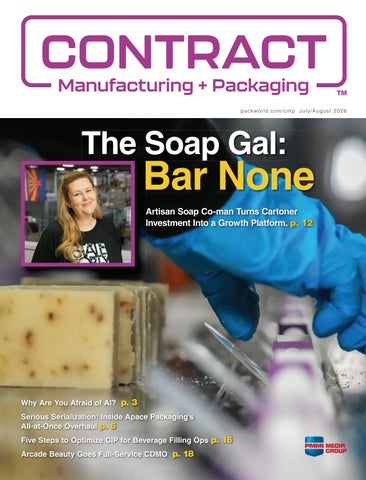
The Soap Gal, a cold-process soap manufacturer, turns to a Yeaman cartoner to scale up without losing the human touch.
Thinking CIP optimization for your beverage operation? Read this quick primer first.
Fragrance and cosmetics supplier moves beyond sampling to stay ahead of the curve.
Joseph Derr EDITOR jderr@pmmi.org
Kim Overstreet DIRECTOR OF CONTENT
Kathy Travis ART DIRECTOR
David Bacho CREATIVE DIRECTOR
Reggie Lawrence VICE PRESIDENT, SALES rlawrence@pmmimediagroup.com
Lara Krieger SENIOR MANAGER, PRINT OPERATIONS lkrieger@pmmimediagroup.com
Janet Fabiano FINANCIAL SERVICES MANAGER jfabiano@pmmimediagroup.com
David Newcorn PRESIDENT
Elizabeth Kachoris VICE PRESIDENT, DIGITAL
Jen Krepelka SENIOR DIRECTOR, DIGITAL MEDIA
Amber Miller DIRECTOR OF MARKETING
Joan Jacinto DIRECTOR, AD TECH AND SEARCH
Angie Szerlong DIRECTOR OF INDUSTRY STRATEGY
Have a question or an idea for an article? Contact Joseph Derr, Editor. Contract Manufacturing and Packaging magazine prefers to receive press releases by e-mail. Send to jderr@pmmi.org.
PMMI MEDIA GROUP 500 W. Madison, Suite 1000, Chicago, IL 60661 WEB www.pmmimediagroup.com
PMMI THE ASSOCIATION FOR PACKAGING AND PROCESSING TECHNOLOGIES 12930 Woodgate Dr., Suite 200, Herndon, VA 20170 PHONE 571/612-3200 • FAX 703/243-8556 WEB www.pmmi.org
PUBLICATIONS MAIL AGREEMENT NO. 40064408
Return undeliverable Canadian addresses to Express Messenger International, P.O. Box 25058, London Brc, Ontario, Canada N6C 6A8
Questions about your subscription or wish to renew? Contact circulation@pmmimediagroup.com.

When is the last time you thought about this: what is it that separates the contract manufacturers and packagers that thrive from those that merely survive?
If this issue is any indication, the answer is a willingness to invest in capability, even when it’s hard, expensive, or when the timing isn’t perfect.
Our lead story (p. 6) takes you inside Apace Packaging, a pharmaceutical CMO that made a bold decision to overhaul its serialization platform, ERP system, and packaging lines all at once. While it was a massive undertaking that took longer than expected, the payoff has been real. The compliance headaches that plagued
the old system are gone, and Apace has since expanded into packaging formats — ointment tubes, liquid sachets, formed liquid cups — it had never attempted before. This story shows what’s possible when an organization bets on itself.
We also feature The Soap Gal (p. 12), our cover story about a cGMP-certified co-man specializing in private-label cold process soap and body care. Founder Joanna Couch built the business on artisan quality at scale, and a recent cartoner installation helps deliver it, with flexibility and faster changeovers. Enlarging the capability portfolio doesn’t always mean a multi-year overhaul; sometimes it’s one smart equipment decision.
Also in this issue you’ll find the story of how Arcade Beauty evolved into a fullservice CDMO (p. 18), a practical primer on
CIP optimization for beverage processors (p. 16), and our Partnering with Brands column (p. 3), where Robby Martin makes the case for why co-mans shouldn’t fear AI — and why the opportunity goes well beyond using it to write emails.
The theme connecting all of it is one I hear more and more in conversations with people across this industry: the future belongs to the operations that are building for it right now.
As always, I’d love to hear what you’re working on. Please drop me a line at jderr@pmmi.org if you have questions or have an idea for us.
Happy reading,




Fear during times of change is understandable, but perhaps we should be more afraid of not recognizing this moment of opportunity.

BY ROBBY MARTIN Owner and Founder, 3-Fold Consulting
While traveling in Atlanta recently, Dr. Kelly Drummond stepped into a vehicle with no one in the driver’s seat.
It’s not a metaphor. She was heading to dinner after a long workday in a real autonomous ride — a car driving itself.
Kelly, who is head of talent management for Boys & Girls Clubs of America, and a friend of mine, wrote about the experience in a LinkedIn post* entitled “I Met the Future in the Backseat of a Car in Atlanta.”
What struck her most wasn’t the technology itself. It was her own instinct to reach for a steering wheel that simply wasn’t there. As she reflected afterward, she realized she had a choice: cling to what had always felt familiar or learn how to lead in a world already shifting beneath her feet.
Fear has always accompanied technological change, from the industrial revolution to the rise of the internet, and artificial intelligence (AI) is generating similar reactions today. People are worried about job displacement, loss of control, and whether technology is advancing faster than society can adapt. Those concerns are understandable. But as someone who works in and around change management, I see fear hold people back in all kinds of ways. Too often, it prevents us from recognizing opportunity.
For high-achieving leaders, the choice Kelly faced in that backseat might be the most important question of our time. It’s not simply about maintaining excellence in the environment we know. It’s about remaining open to what’s emerging — AI,
automation, and entirely new ways of working — and deciding who we want to become within that change.
Here’s the thing worth saying plainly: if you think AI is primarily about writing emails, creating presentations, or conducting research, you’re only seeing the tip of the iceberg. (That said, if you’ve never used AI before, those everyday tasks are a great place to begin. Let it organize your thoughts or proofread a document. Learning a little often creates the confidence to learn a lot.)
The organizations creating real competitive advantages are using AI in ways that go much deeper, especially in manufacturing. The contract manufacturers and co-packers who are pulling ahead aren’t simply using AI to improve office productivity. They’re integrating it directly into operations and decision-making (see box).
• Predictive maintenance systems analyze sensor data in real time to identify potential equipment failures before they occur, reducing costly downtime.
• Machine vision and AI-powered inspection systems improve quality control by identifying defects quickly and consistently.
• Digital twins allow manufacturers to simulate line configurations, test process improvements, and optimize changeovers before implementing them on the factory floor.
• Predictive analytics are helping organizations make smarter decisions around demand forecasting, inventory management, procurement, and supply chain planning.
Most of these applications are concentrated within larger organizations today, but technology has a way of becoming more accessible over time. What begins as a competitive advantage often becomes a standard expectation.
The question isn’t whether AI will influence the future of manufacturing, leadership, and business. It already is. The more important question is how leaders choose to respond.
Kelly’s experience in that autonomous vehicle serves as a useful reminder. The challenge wasn’t learning how the technology worked. The challenge was becoming comfortable with a new reality where familiar assumptions no longer applied. Many organizations are facing that same moment right now.
Success will not belong exclusively to the companies with the most advanced technology. It will belong to the leaders who can balance innovation with sound judgment, embrace change without abandoning their values, and remain curious enough to learn before circumstances force them to adapt.
After her ride, Kelly posed three questions that seem increasingly relevant for all of us. She has given me permission to shamelessly steal them for our use here.
• Are you preparing your career and your team for the future that’s arriving, or the past that feels familiar?
• Where are you still insisting on “driving” when you should be learning how to guide and adapt?
• And if the future pulled up to the curb tonight, would you recognize it — or cancel the ride?
The road ahead may not allow us to remain in the driver’s seat. The opportunity is to become the kind of leader who can navigate the journey anyway. CM+P
On April 15, Alcami , a U.S.-based contract development and manufacturing organization (CDMO), announced plans to acquire Tjoapack, a global contract packaging organization with facilities in the United States and the Netherlands.
Tjoapack has a 35-year history as a supplier of contract primary and secondary packaging solutions. The company’s services include oral solid dose (blister and bottles), sterile injectables (vials, pre-filled syringes, and autoinjectors), and kitting.
The contract packager operates from the Netherlands with 23 packaging lines and employs over 400 workers.
“This acquisition marks our first European expansion, which is an essential element of our investment strategy to

expand our presence in the global market,” says Patrick Walsh, Chairman and CEO of Alcami. “Furthermore, this increased scale aligns with our growth and expansion in pharmaceutical testing lab services, drug product manufacturing and pharma storage service offerings at Alcami.”
By purchasing Tjoapack, Alcami is able to offer U.S. supply chain redundancy and scale for packaging and labeling, while adding Qualified Person (QP) release and related services in Europe. This allows customers to expand their global reach from a single supplier.
The procurement was finalized May 5. The combined organizations now employ
The global pharmaceutical contract packaging market is on a growth trajectory, with multiple industry analyses pointing to a significant expansion over the next decade.
While valuation figures vary by methodology, Fortune Business Insights valued the market at USD 14.59 billion in 2025, projecting it to reach USD 30.58 billion by 2034 at a CAGR of 8.63%. Strategic Packaging Insights places the 2025 market value higher at $22.76 billion, forecasting growth to $40.46 billion by 2034 at a CAGR of 6.60%. Regardless of the exact baseline, both reports confirm this market is expanding fast.
The core of the expansion stems from a shift in how pharmaceutical companies operate. Growing pharmaceutical outsourcing, escalating regulatory complexities, and the need for costeffectiveness are fueling demand for contract packaging services, Fortune Business Insights says. Additionally, drug manufacturers are seeking flexible, compliant, and scalable packaging solutions to avoid investment in internal infrastructure.
The rise in biologics and personalized medicine is also a driver for market growth. According to Strategic Packaging Insights , these create demand for specialized packaging solutions that
Have a story idea, industry insight or topic you’d like to see covered? We welcome input from contract manufacturers, contract packagers, and the brand owners who partner with them. Send your suggestions, tips, and editorial ideas to us, and you may be featured in an upcoming issue of the magazine or online. Help us shape content that matters most to this community!
CONTACT THE EDITOR AT: jderr@pmmi.org
over 1,400 workers across the U.S. and the Netherlands.
The merged companies are advancing planned integration activities to expand end-to-end CDMO capabilities across the U.S. and Europe.
According to Alcami, Tjoapack customers can expect uninterrupted service across all sites, while gaining access to Alcami’s broader portfolio of capabilities, including drug product manufacturing, laboratory services, and pharma storage.
“This acquisition represents a meaningful step forward in Alcami’s longterm growth strategy to provide integrated global solutions for our clients,” says Walsh. “We welcome the Tjoapack team and look forward to unlocking the full potential of our combined capabilities.”
accommodate complex drug formulations, reduced batch sizes, and stringent storage and handling requirements.
The market has a semi-consolidated structure, with key players including West Pharmaceutical Services , Nipro Corporation, CCL Industries , Sharp Services , Gerresheimer, and Catalent Pharma Solutions
These CDMOs maintain their positions through broad service offerings including primary and secondary packaging, blister packaging, and serialization and labeling services. Their ability to offer customized solutions and adhere to stringent regulatory requirements has enabled them to maintain a strong foothold in the market.
However, challenges within the contract packaging market remain. Stringent regulatory requirements and high compliance costs can hinder growth, particularly for smaller operators, while the highly competitive landscape leads to pricing pressures and reduced profit margins. Rising labor costs, energy prices, and volatile raw material costs put further pressure on operating margins.
Apricity Contract Packaging , a northeast Wisconsin operation, was recently featured in an article by Wisconsin Public Radio telling the story of how co-packer has built its entire workforce around people recovering from addiction.

The Appleton- and Milwaukeebased company employs roughly 100 workers annually in packaging and assembly, offering an environment where recovery isn’t a liability to hide but a shared reality. Leaders conduct interviews focused on recovery rather than work history, accommodate probation and drug court schedules, and provide relapse prevention support alongside on-the-job skills training. Client companies receive a 5 percent tax rebate for contracting with Apricity. 40 percent of workers eventually transition to mainstream manufacturing employers.
For contract manufacturers looking to expand their labor pipeline or explore recovery-friendly partnerships, Apricity represents a model worth considering: one where the packaging floor doubles as a pathway back to the workforce.
Indian pharmaceutical giant Aurobindo Pharma has inaugurated TheraNym, a new dedicated biologics contract manufacturing organization based in Hyderabad. The facility, formally opened by Telangana’s Minister for IT, Industries & Commerce, is designed to serve global pharmaceutical supply chains and positions Aurobindo to capitalize on rising worldwide demand for biologic therapies. MSD is the anchor customer for the new CMO. Company leadership described TheraNym as a milestone for large-scale biologics manufacturing in India, with the facility built to international standards.
Michelle Plesh has been named president of Plesh Contract Packaging, a Buffalo, N.Y.-based CMO specializing in mixing and filling liquids, waxes, pastes, powders, and slurries. The company offers more than 1,600 base formulations with an emphasis on short runs, fast delivery, and competitive pricing. Markets served include automotive aftermarket, fuel additives, and cleaning products, with customers ranging from brand marketers to private labelers.
With reporting by Brianna Guntz and Joseph Derr

How a pharma CMO overhauled serialization, ERP, and packaging lines all at once — and came out ahead.
BY JOSEPH DERR
Apace Packaging has been in the pharmaceutical contract business since 2005 and has been doing it at a level that has put the company well ahead of many peers on one of the industry’s most demanding fronts: serialization and trackand-trace compliance.
Based in Fountain Run, Kentucky, the contract manufacturing organization (CMO) is running four automated bottling lines plus three blister lines, handling prescription medications almost exclusively. Each of Apace’s main filling lines is fully automated, serialized, and aggregated all the way to the pallet — a deliberate strategic decision made more than a decade ago that set the stage for what came next: a massive, simultaneous upgrade of its serialization platform, ERP system, and packaging lines that would leave Apace more capable and ready to take on packaging formats it had never attempted before.
And the upgrade has paid off, helping Apace grow beyond its oral solid dose core into kitting, repackaging, and ointment tube filling.
“We want to be a premier packager in the pharmaceutical packaging industry,” says Associate Director of Production Wendell Bell, who has been at Apace for 17 years in numerous roles. “We understand and acknowledge that patient safety is first and foremost, and we want to provide a safe and quality package to the patient.”
But if we flash back to a few years ago, we see an Apace that was facing problems that are today familiar to many operations: a system that had been stateof-the-art had aged out.
Early DSCSA adopters
Back in 2012, when most of the pharmaceutical packaging world was still working out what the looming Drug Supply Chain Security Act (DSCSA) would actually require, Apace made what at the time was a bold move into serialization systems. By the end of that year, the company had selected a vendor and was moving toward installation. By Memorial Day 2014, one bottling line and one blister line were up and running with full serialization. By Labor Day of that same year, Apace launched two more lines.
Apace’s decision to take a big leap into serialization was driven by aggregation. “We elected to go ahead and go fully aggregated to the bundle, to the case, and to the pallet all at the same time,” Bell says, “to eliminate that secondary process of having to come back and do aggregation later.”
It was a smart call, and it gave Apace a running start. But it also meant that by the time the system was approaching its tenth birthday, the company had a lot riding on aging infrastructure.
Any operations manager who has lived
with an aging computer-dependent system knows what eventually happens. Processors slow, hard drives accumulate wear, and the tasks that once ran clean start throwing errors.
For Apace, the main symptom of an antiquated system was corrupted EPCIS files — the electronic records that document serialization events throughout the supply chain and form the backbone of DSCSA compliance. “We started getting corrupt files and the system would shut down and we’d have to reboot,” Bell says. “A lot of this was due to the processors and hard drives and the system.”
At line speed, operators couldn’t see what the software was doing in the background. The corruption only became apparent when closing out a batch file, precisely the moment when Apace could least afford a problem.
“It made it obvious, so we said, ‘We really need to do an upgrade now,’” says Bell.
By the end of 2020, Apace approached four or five serialization vendors, asked each to present and demo their systems online, and then put them through a rigorous evaluation led by an in-house
DSCSA team that Bell describes as among the sharpest in the contract packaging business.
“We have a very knowledgeable DSCSA serialization team here that I would put up against anyone out there,” he says. “We asked a lot of questions and pushed them to show us how we could drill into the EPCIS files, into the HMIs, the timestamps, the data they were collecting, but also how they compiled that information.”
Apace narrowed down its list with inperson visits and by running live demos before making its decision to select Antares Vision Group, a global supplier of trackand-trace and inspection solutions with a deep presence in pharmaceutical packaging.
The decision came down to the equipment itself as much as the software. “It didn’t look like an afterthought,” Bell says of the Antares Vision serialization hardware. “It was actually a standalone piece of equipment that you would take and slide into your line, and it would do the function it was supposed to do and feed the product out the other side.”
Chris Collins, North America sales director at Antares Vision Group, had a longer view of the relationship than most sales directors get to have. He
had contacts at Apace since its earliest serialization days, when the company had just two lines.
Collins notes that the industry itself had matured considerably since those early years. “In 2012, we [suppliers] were the smartest guys in the room,” he says. “Now you walk into a facility and the customers are the smarter people in the room, because they’re living it day in and day out.”
What Apace took on next was not, by any measure, a mere system swap but a complete overhaul. The CMO set an ambitious goal of not only upgrading serialization across all existing lines but also of installing a brand-new fourth bottling line with Antares Vision from the ground up. Further, Apace would also implement a new Microsoft D365 ERP system, and add an L3 serialization layer, Antares Vision’s Global Tracking System (GTS), that Apace had never had before — all at the same time.
“It was a huge challenge and undertaking, much bigger and to be honest, it took longer than we anticipated,” Bell says. The extended timeline reflected the complexity of the project rather than any single bottleneck. The ERP system required roughly 12 months to fully develop and integrate, and the serialization installation was phased across multiple lines over time, each requiring its own installation, debugging, and validation before moving to the next.
“It was a major undertaking,” Bell says.
The facility itself required physical changes, with lines extended and secondary packaging areas reshaped to accommodate the larger footprint of new equipment. Collins says that Antares Vision had technicians on-site for roughly three and a half months at the height of the installation, cycling in and out to cover multiple lines simultaneously.
“We had multiple lines down at the same time with multiple technicians,” Collins says. “My sales team, our president, and our operations manager all spent time at Apace, because management would get a very small view of what was going on, and we didn’t want to leave the technicians in a position where
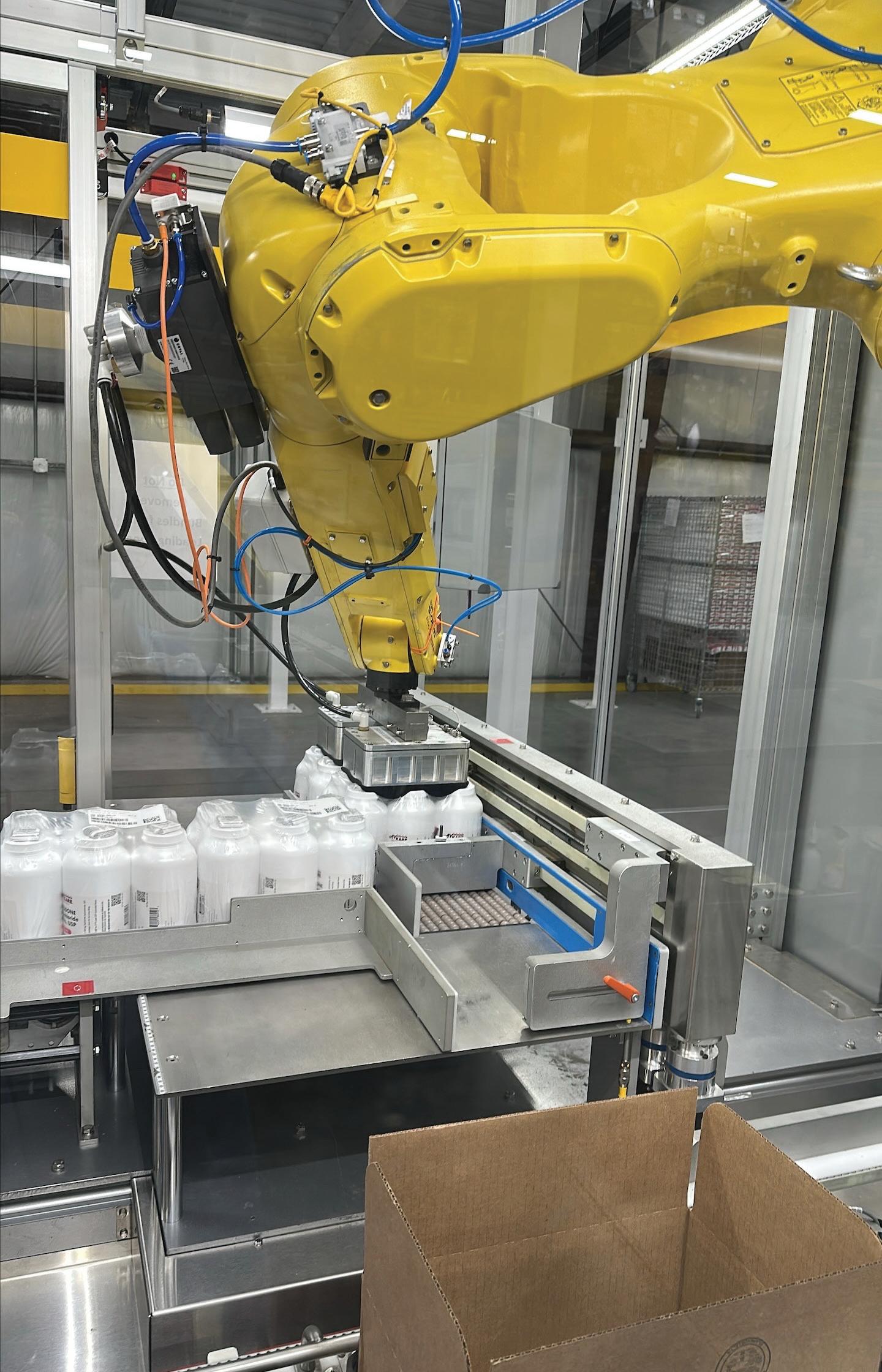
A robotic arm cases bundled pharmaceutical bottles after Antares Vision’s system captures each serial number at line speed, without bottle orientation.
they had to explain to senior management what was happening on the line.”
The integration also involved other major suppliers. Systems integrator Catalyx (formerly Xyntek) was brought in to handle IT-level configuration and SOP changes on the Apace side. Aside from Antares Vision, one of Apace’s main equipment suppliers is NJM Packaging , which the CMO turns to for labelers, cappers, and topsert machines. Other major suppliers to the upgraded line include ESS for robotic case packers,
Pharmaworks for blister line equipment, Krämer tablet fillers, in addition to Kaps-All automatic induction sealers.
Bell notes that one of the trickier integration challenges involved getting the ESS robotic case packer, the Antares Vision system, and the line’s PLC controls to coordinate correctly.
“Getting the automatic robot case packer to pack bundles into cases — with the vision system reading those bundles and tracking those cases — was a challenge working with multiple
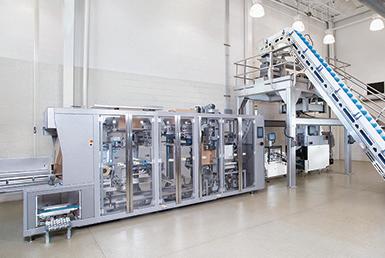
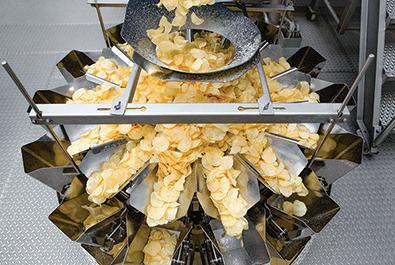
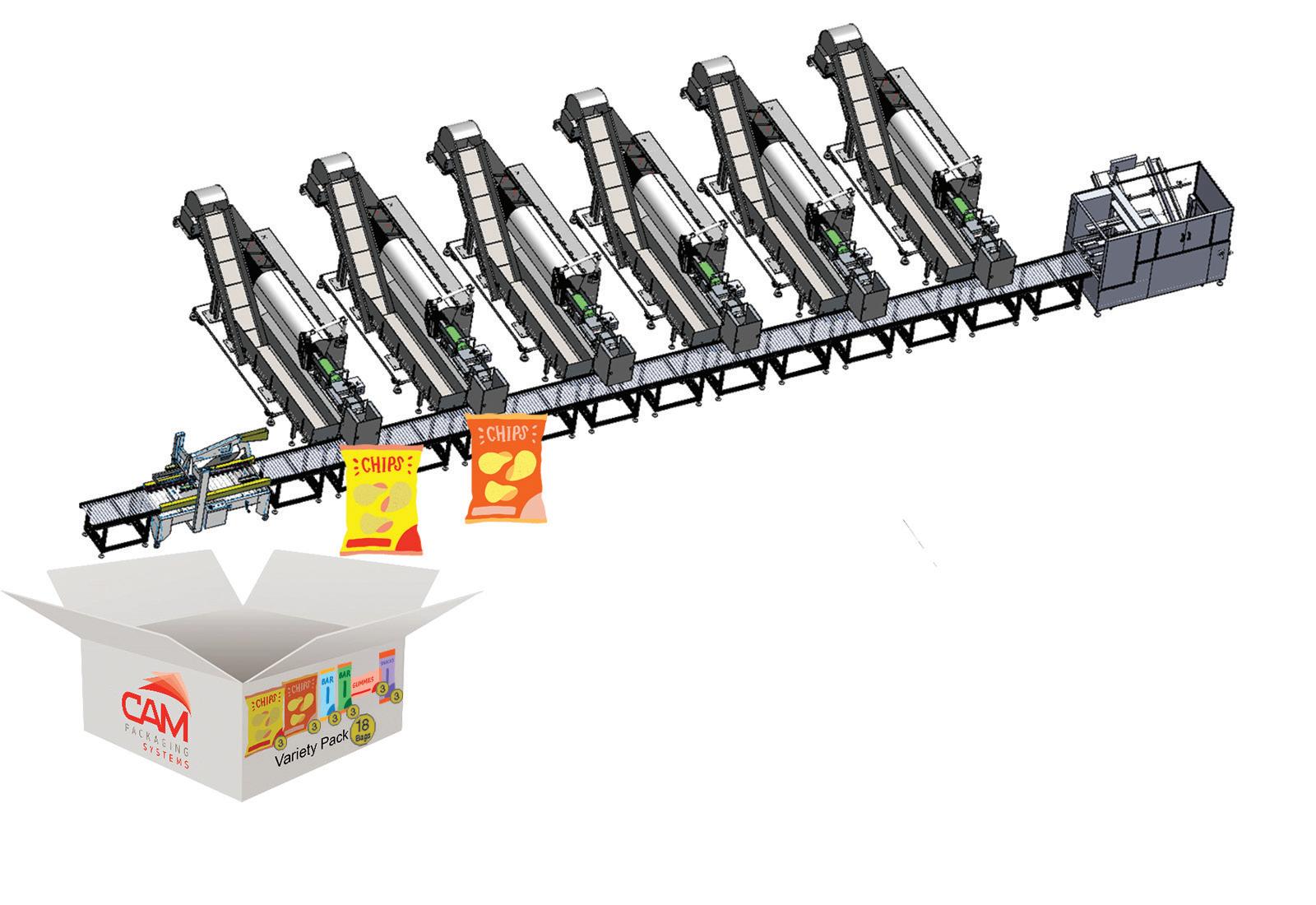
Whether you're working with single-flavour products or creating multi-flavour variety packs, we have the solution. Our primary and secondary packaging systems are designed to accurately count, weigh and collate products, streamlining your operation and ensuring consistency every time. From contract packagers and co-manufacturers to health & wellness brands, sports nutrition companies, and snack food manufacturers, we support businesses across the industry with efficient, reliable packaging automation tailored to your needs. Contact us and discover why so may businesses trust CAM Packaging Systems with their automation.





suppliers,” Bell says. “It took a while to get the programming so we could track the bundles and the cases through the system, but everyone worked with us.”
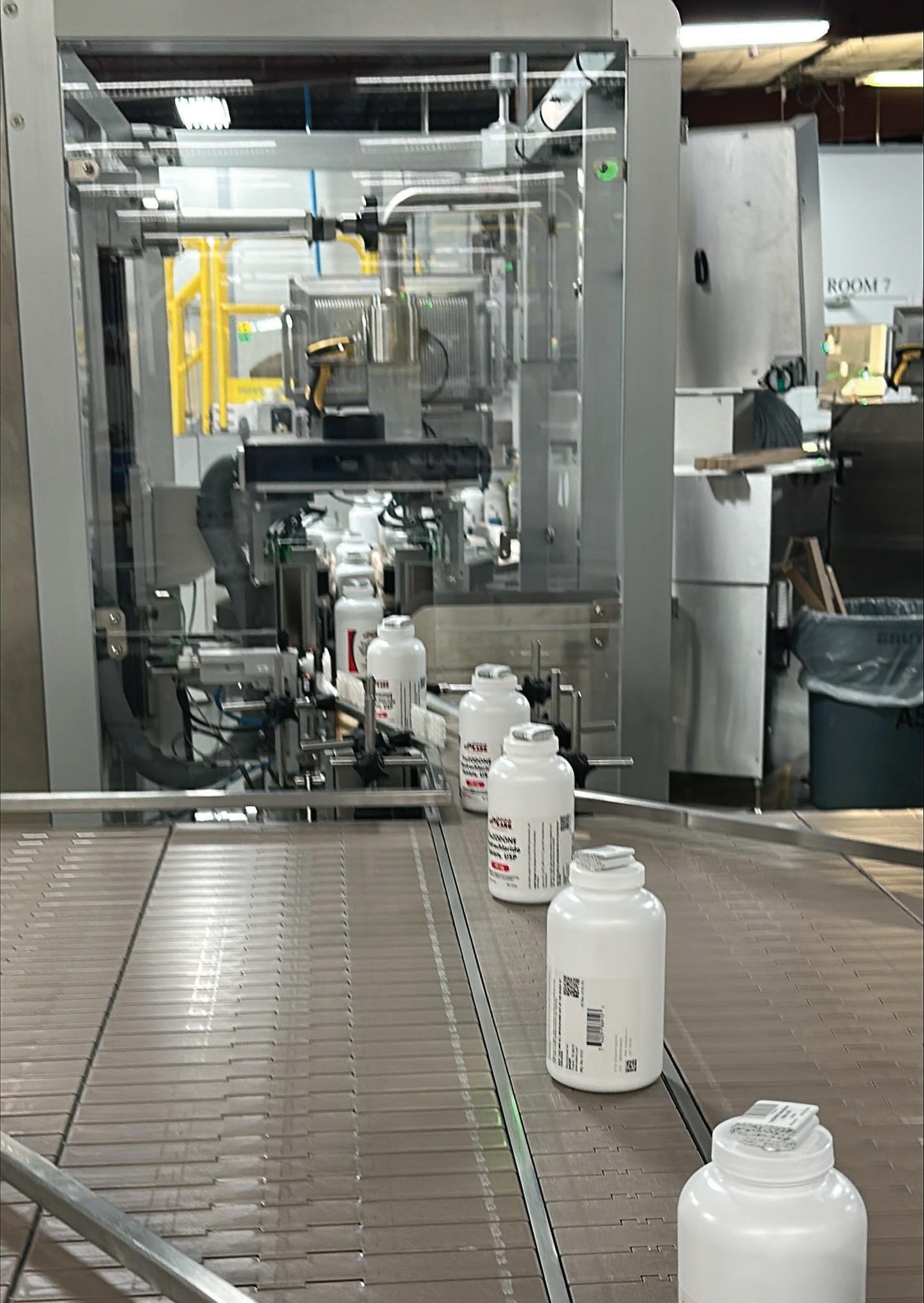
Following a bottle through the line from the descrambler room all the way to the pallet tag illustrates just what the integrated system can do.
After the descrambler orients and airrinses bottles, it feeds them into a primary packaging suite, where they move past the desiccant machine and then the tablet counter. Apace runs four-headed Krämer volumetric fillers on three lines and an eight-headed continuous-motion Krämer filler on the high-speed line. From there it’s on to the checkweigher for gross overand underweight checking and an optional cotton or fiber fill station. Then, NJM’s belt torque capper and the induction sealer finish off the primary package before entering the secondary packaging area.
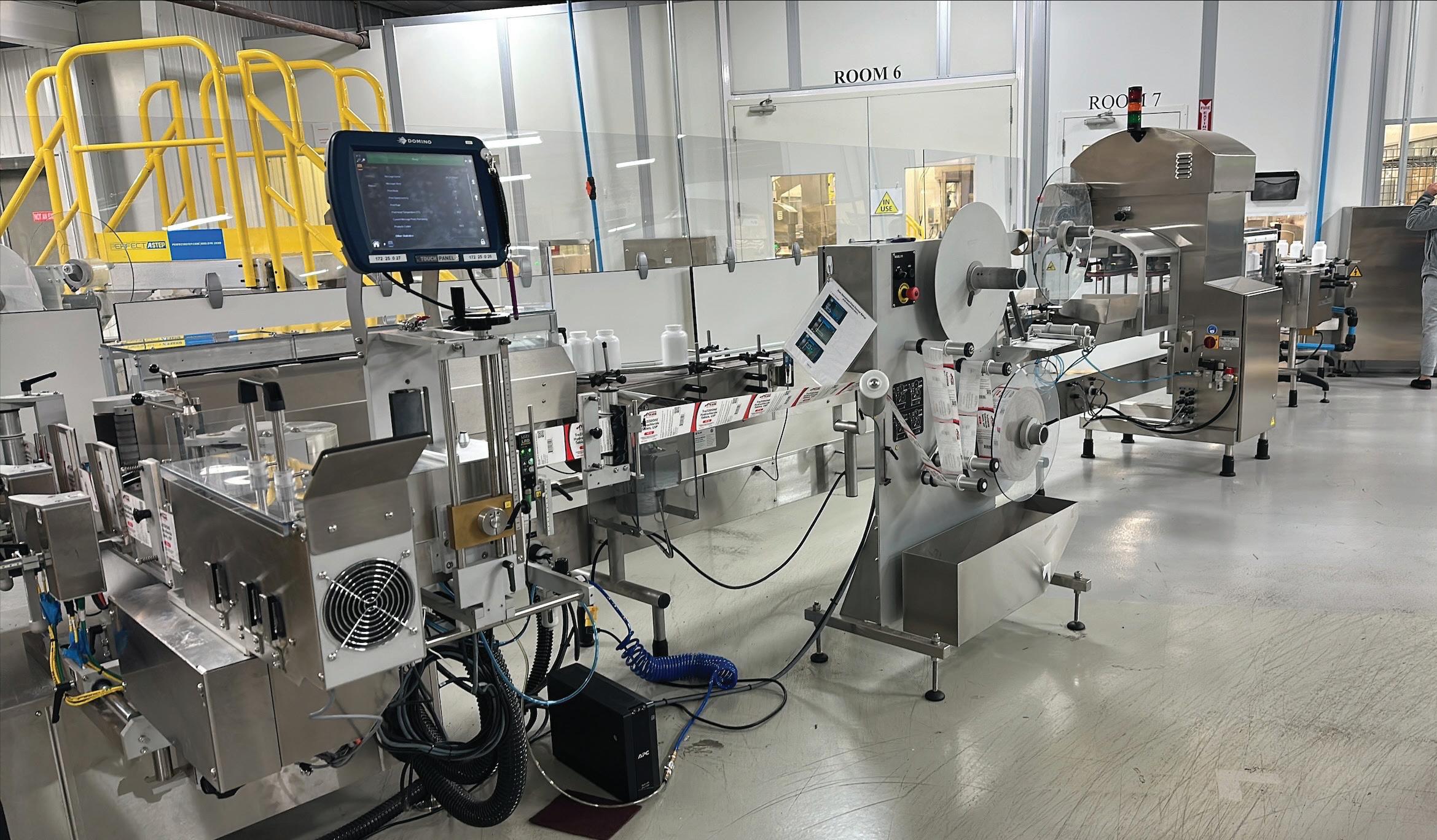
This is where serialization begins in earnest. At the NJM labeler, each bottle receives a label printed with lot number, expiration date, serial number, and GTIN, all encoded in a 2D Data Matrix code, thanks to the Antares Vision System, which inspects labels before application. Any bottle that fails inspection is rejected before it ever gets a label.
Next comes the topsert, usage and instruction labeling applied to the top of the bottle, followed by one of the more distinctive touches in the Apace operation: each bottle enters what Bell calls the “bottle tracker,” a station built around the Antares Vision Omnivision platform. The Omnivision prints UV ink onto the bottom of the bottle, invisible to the naked eye but readable under black light, to create what the system calls a “helper code.” Its cameras then perform a 360-degree read of the unoriented bottle surface, locate the 2D code on the label, and marry the serialization data to that helper code.
The value of the helper code becomes clear during bundling. When bottles go into a shrink-wrap bundle, the label faces
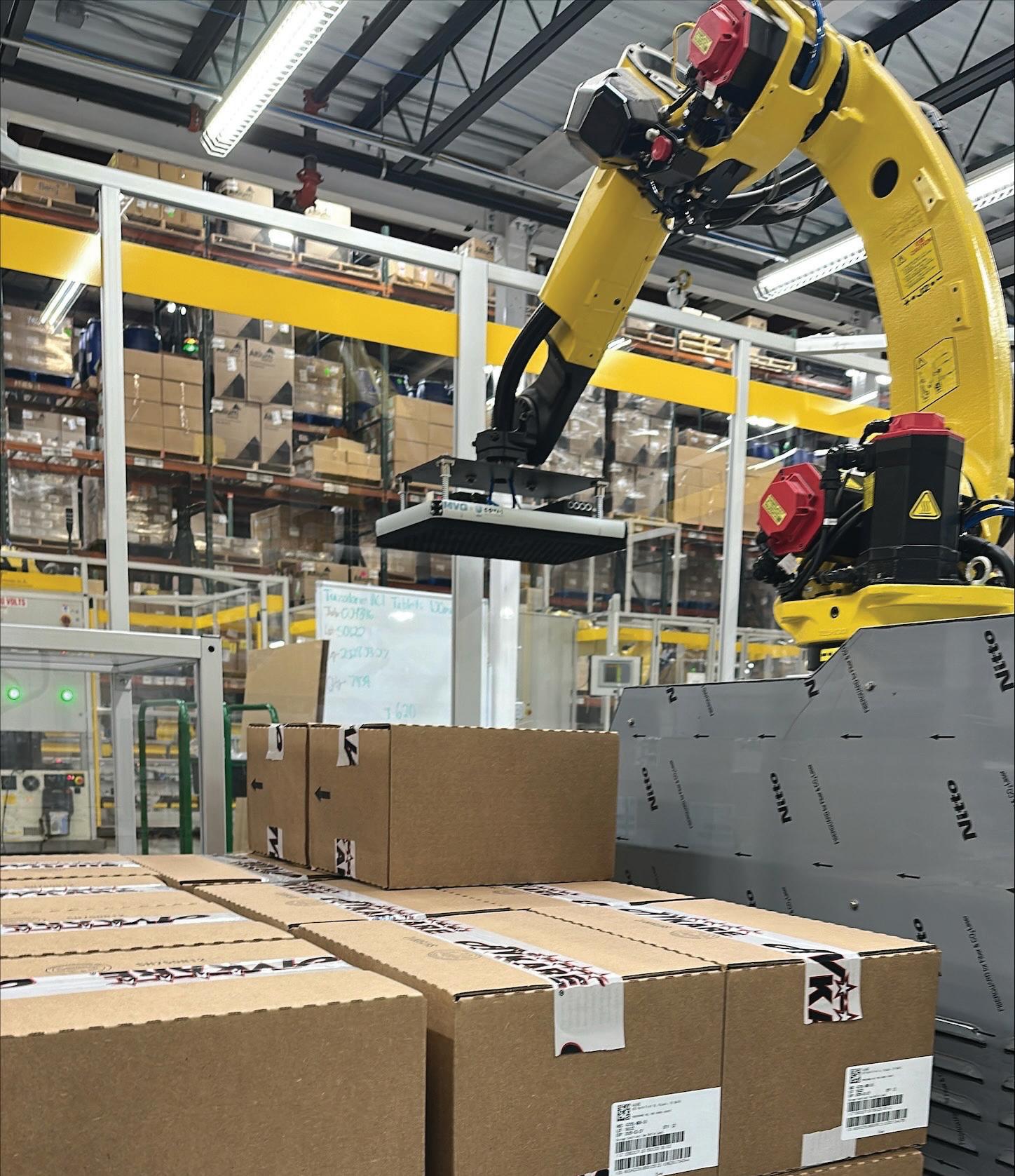
After 2D codes are verified to confirm bundle counts and contents, cases are sealed and palletized.
outward but the bottle bottom faces down. Antares Vision’s bundle print-and-apply system scans the bottle bottoms at line speed to identify every serial number in a given bundle without needing the bottles to be oriented.
“We print a helper code on the bottom of the bottle in UV ink — you need a black light to see it,” Bell explains. “We use the Antares Vision camera system to find the 2D code on the label and marry the serialization information to that helper code. Then when the bundle comes out of the heat tunnel, we scan the bottle bottoms for those helper codes, and we know exactly which serial numbers are in that bundle.”
Bundle sizes vary by container (e.g., 12 bottles for anything under 200cc, six for 250cc through 950cc, and four for 1,500cc and above.) Once bundled and heat-shrunk, each bundle passes through the bundle tracker station, where the Antares Vision Print & Apply Module
generates and applies a bundle label that aggregates all bottle serial numbers to a single parent code. The bundle then moves on to case packing.
Two of Apace’s lines use manual case packing, while two others use ESS robotic case packers. On all four lines, before the case is sealed, an Antares Vision Top View Matrix Station camera looks down into the open case and photographs the 2D codes on the bundle labels inside, confirming what has been packed and how many bundles are present.
Cases are then taped before case labels are applied, aggregating all bundles to the case. That case label gets a final vision verification before the case goes either to a manual palletizing station. On Apace’s high-speed lines, they go into an automated palletizer. When a pallet reaches its full case count, the system prints a pallet tag representing every case, bundle, and bottle on it.
On Apace’s cartoning lines, the Antares


Vision Print & Check EVO units handle serialization, printing and verifying directly on carton flaps at speeds up to 300 units per minute, with a Top View station managing carton-to-case aggregation as cartons are loaded.
At the center of all of this is the Antares Vision GTS (Global Tracking System), an L3 platform that hosts all SKU recipes, printing layouts, and camera formats on a central server, which can receive serialization data from all lines in real time. Because the GTS is a centralized system, it can modify a recipe for one line and automatically apply it to equivalent lines, thereby eliminating the station-by-station type of updating that was required under Apace’s legacy system.
The GTS system also enables something that proves particularly valuable in a multi-line operation: if a mechanical issue forces a line down mid-batch, the batch can be closed, sent back up to GTS, and resumed on another compatible line from exactly the serial number where it left off.
“If they have a critical batch that needs to get out, they can actually reallocate and resume on another line,” says Collins, who knows his customer’s lines intimately.
New lines, new mindset
Apace’s serialization mastery also supports product remediation, another area of its contract services business. If a pharmaceutical product arrives at a third-party logistics (3PL) provider and fails to scan, the issue can create a DSCSA compliance failure and stop the shipment. With its upgraded capabilities, Apace can help identify and resolve the problem quickly.
“We’ve had a few 3PLs reach out and say, ‘We know you’ve been helping people fix their serialization — here’s a customer of ours that has an issue,’” Bell says. The work ranges from applying new case labels and re-aggregating, to re-serializing inner packs entirely, with Antares Vision printing and labeling systems central to the process.
Since the upgrade went live in late 2022, the problems that characterized the final years of the legacy system have simply stopped, says Bell.
“All the issues we were having before, like the corrupted files, the lags, the unplanned system shutdowns all kind of just went away.”
The expertise Apace built throughout the all-at-once upgrade has led it to tackle new packaging formats it had not previously attempted for its pharmaceutical customers, including ointment tubes, liquid sachets, and formed liquid cups. They are all now part of the Apace production mix, and all fully serialized.
“Going through these steps — the new lines, the new equipment, upgrading our system, learning this technology — it gave us the confidence as individuals here at Apace and as a company to go out and challenge ourselves by taking on new endeavors,” Bell says. CM+P












The Soap Gal, a cold-process soap manufacturer, turns to a Yeaman cartoner to scale up without losing the human touch.
BY JOSEPH DERR
Joanna Couch’s favorite movie scene is from City Slickers, where the old cowboy tells Billy Crystal’s character that the secret to life is one thing — but you have to find it yourself. For Couch, founder and CEO of The Soap Gal, that one thing is soap.
“I just love making soap,” says Couch. “And I get to show love by making a product that helps keep people clean, healthy, and cared for so they can go out and find their own one thing.”
The Soap Gal, based in
Mesa, Ariz., has taken Couch’s one thing and made it a big thing: the C-GMPcertified private label and contract manufacturing operation is now producing cold-process soap bars for brands across the United States from indie e-commerce sellers and boutique retailers to global brands.
As Couch puts it, The Soap Gal has grown to become “some of the largest
natural soap brands’ little secret.”
The company traces its roots to 2009, when Couch — dealing with health issues in her early 20s — was advised by her doctor to cut out dairy. Rather than give up dairy entirely, she bought two goats off Craigslist and started making goat milk soap on her family’s seven-acre hobby farm in Maricopa, Ariz. Adapting her grandmother’s recipe, she began selling at farmers’ markets and craft fairs, eventually landing in 10 local Whole Foods locations. By 2019, as The Soap Gal she had expanded to a range of soap and body care products and focused on private label manufacturing.
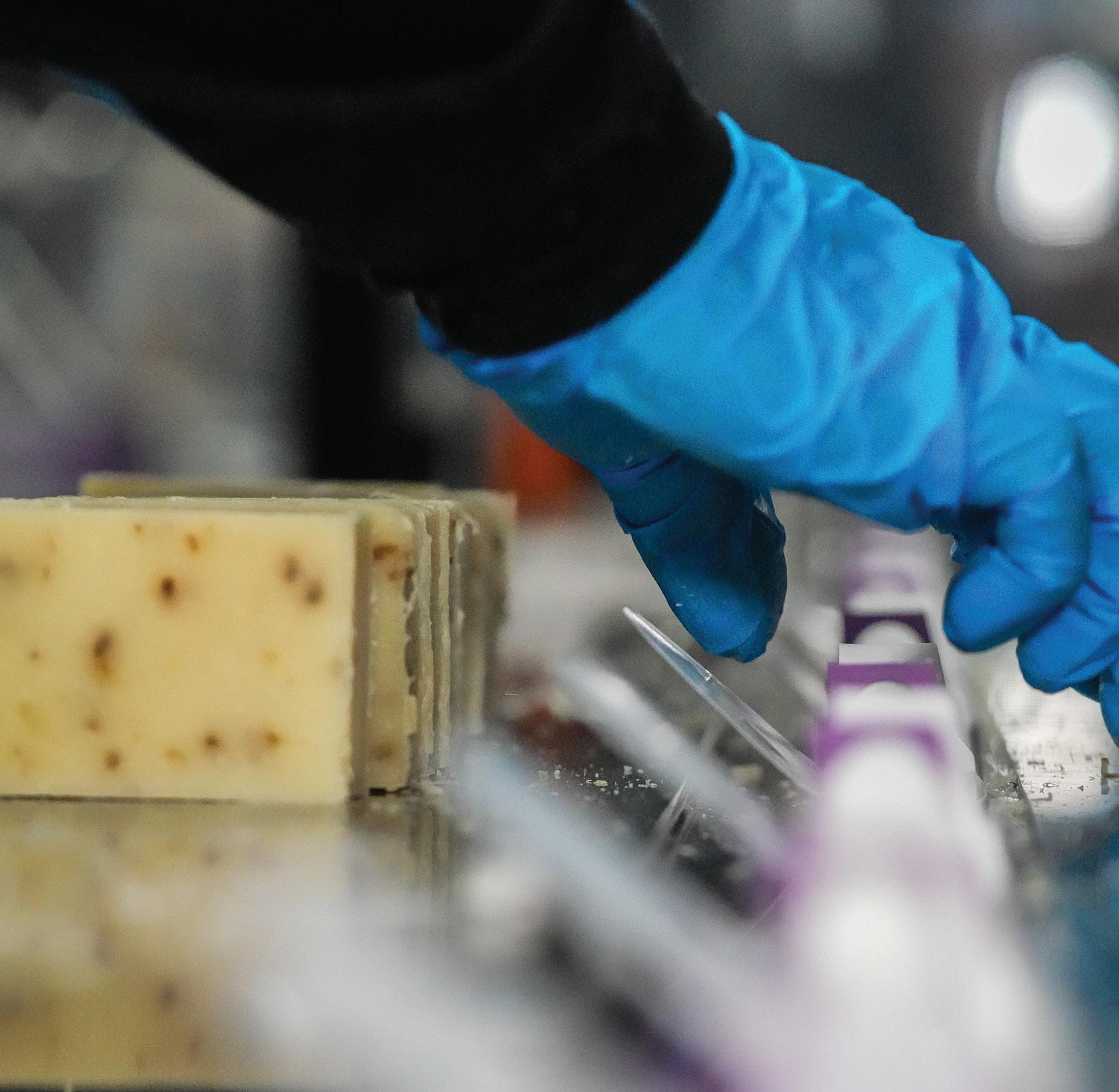
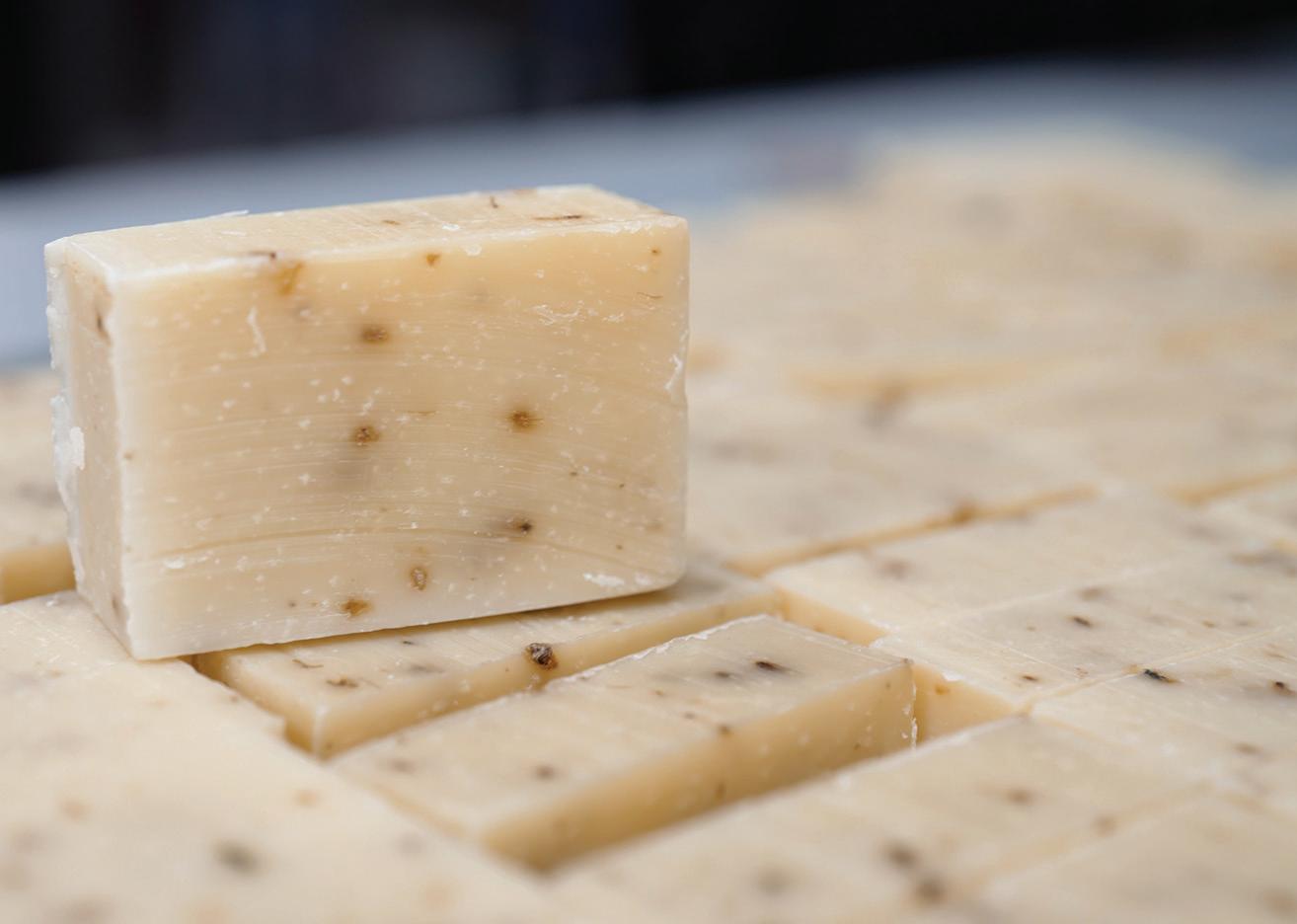
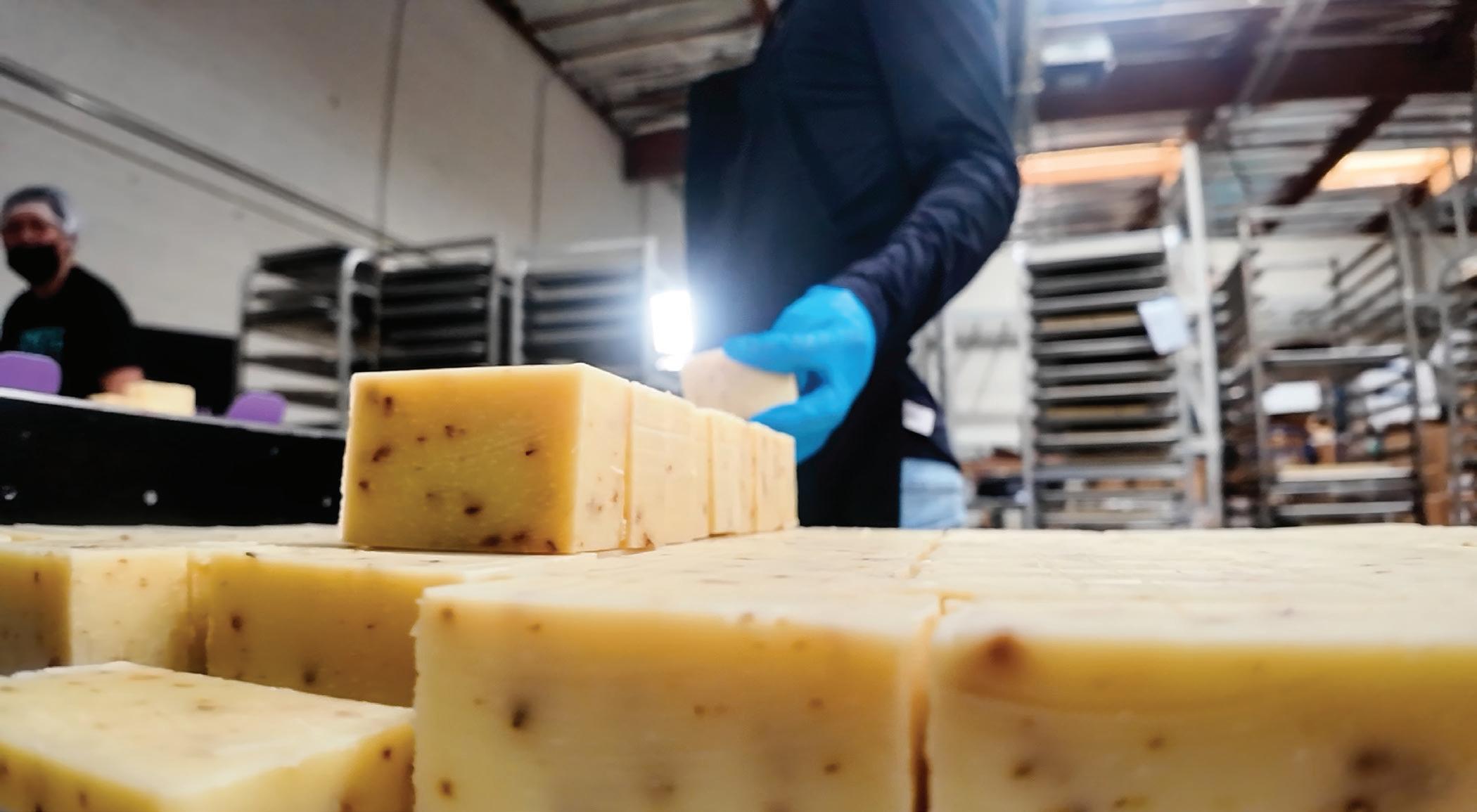
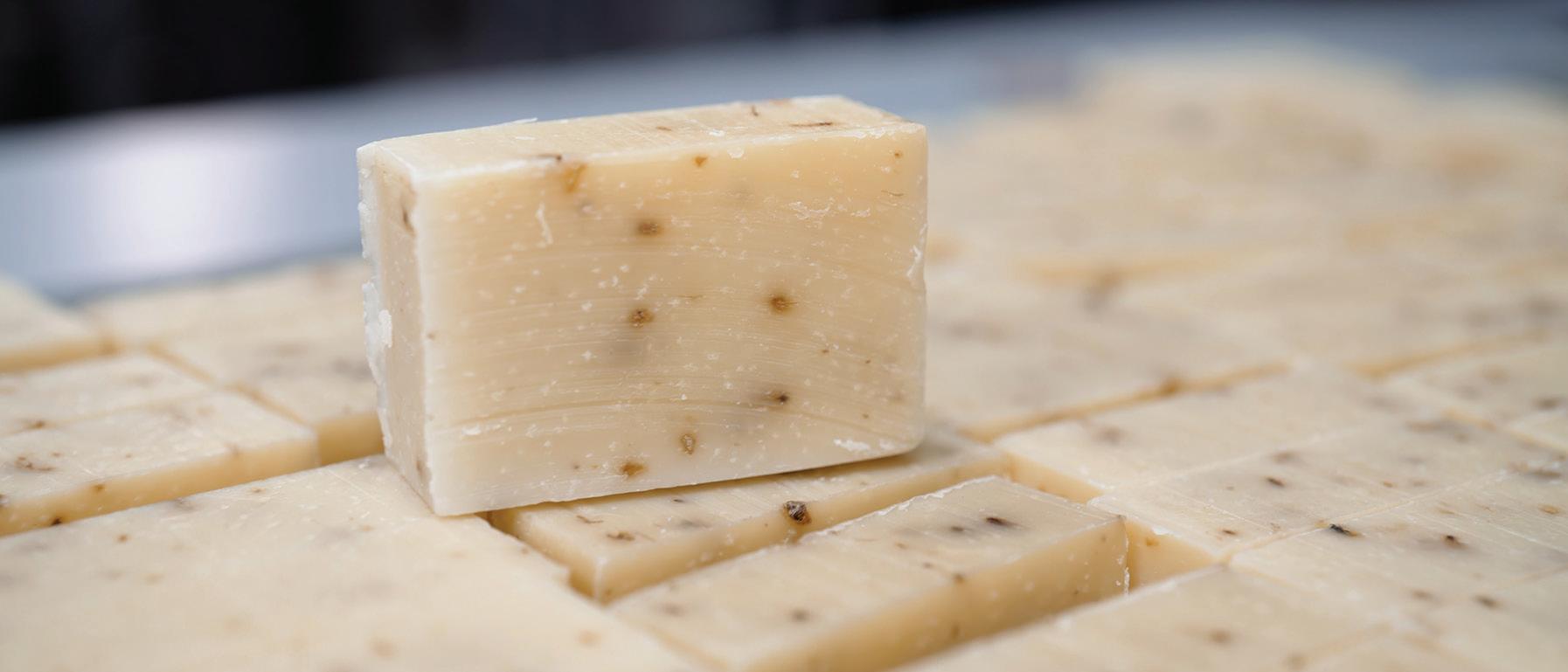
What sets The Soap Gal apart from larger soap manufacturers is its commitment to the traditional cold-process method, starting from scratch with sodium hydroxide and fats and oils, preserving the glycerin that extrusion-based manufacturers typically remove. Couch says every 130-pound batch yields between 280 and 1,000 soap bars, depending on bar size. Bars cure for 48 hours after pouring, then move through cutting, quality assurance, and staging before reaching the packaging department.
As demand for The Soap Gal’s product line of retail-ready, carton-packed soap grew, Couch found herself facing a familiar coman dilemma: the production side could
scale, but packaging couldn’t keep up. A semi-automatic, single size cartoner she bought in 2022 for the job quickly revealed its limits.
“Once I got it and started using it, I realized my packers could actually pack faster by hand,” Couch says. “It only does one size, so we spent more time trying to get it to unjam than we did actually packing soap.”
“I just love making soap. And I get to show love by making a product that helps keep people clean, healthy, and cared for so they can go out and find their own one thing.”
— Joanna Couch, founder and CEO, The Soap Gal
EXPO floor in 2024, where Interstate brought her over to see the Yeaman Packaging Systems booth.
Couch wanted to say yes to a broader range of customer programs without dedicating a full manual labor crew to every cartoning run. So, she set a target: she needed a machine that could pack a minimum of 30,000 bars per day across multiple carton sizes.
The quest begins
Couch turned to Interstate Packaging , a local Arizona distributor that had been advising her packaging operation for years. Together, they walked the PACK
“The key feature I was after was multisize capability — the ability to push a button and have it shift to another size,” Couch says.
What she saw on the show floor piqued her interest, but it was a visit to Yeaman’s facility that sealed the deal. “When I walked through Yeaman’s door and got to meet the whole Yeaman family, I felt the passion in that space,” she says.
Watching the machine run, Couch says, was the moment she knew. During her visit, the line built 1,000 boxes without a
single jam, a stark contrast to the chronic jamming that had plagued her existing cartoner.
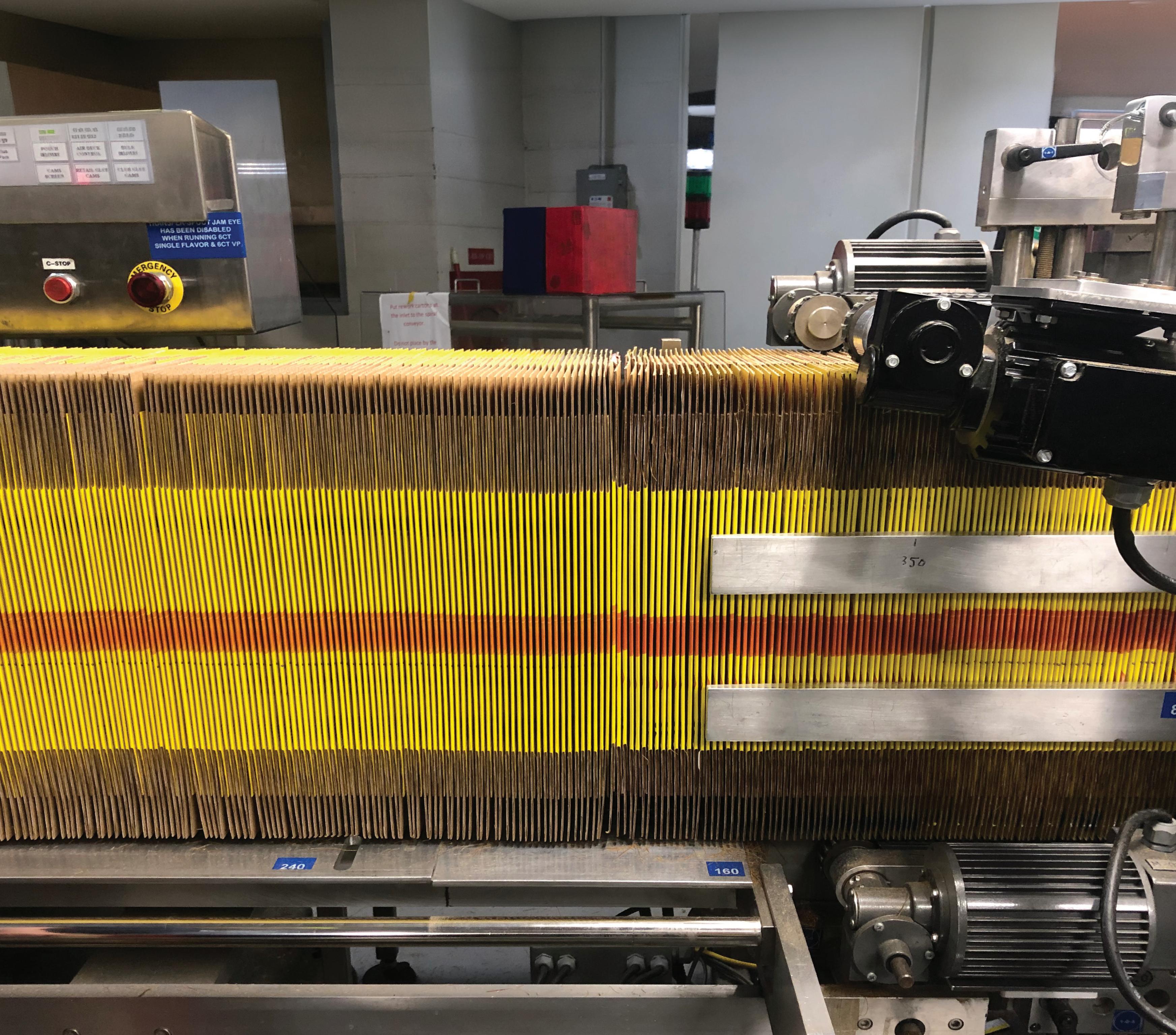
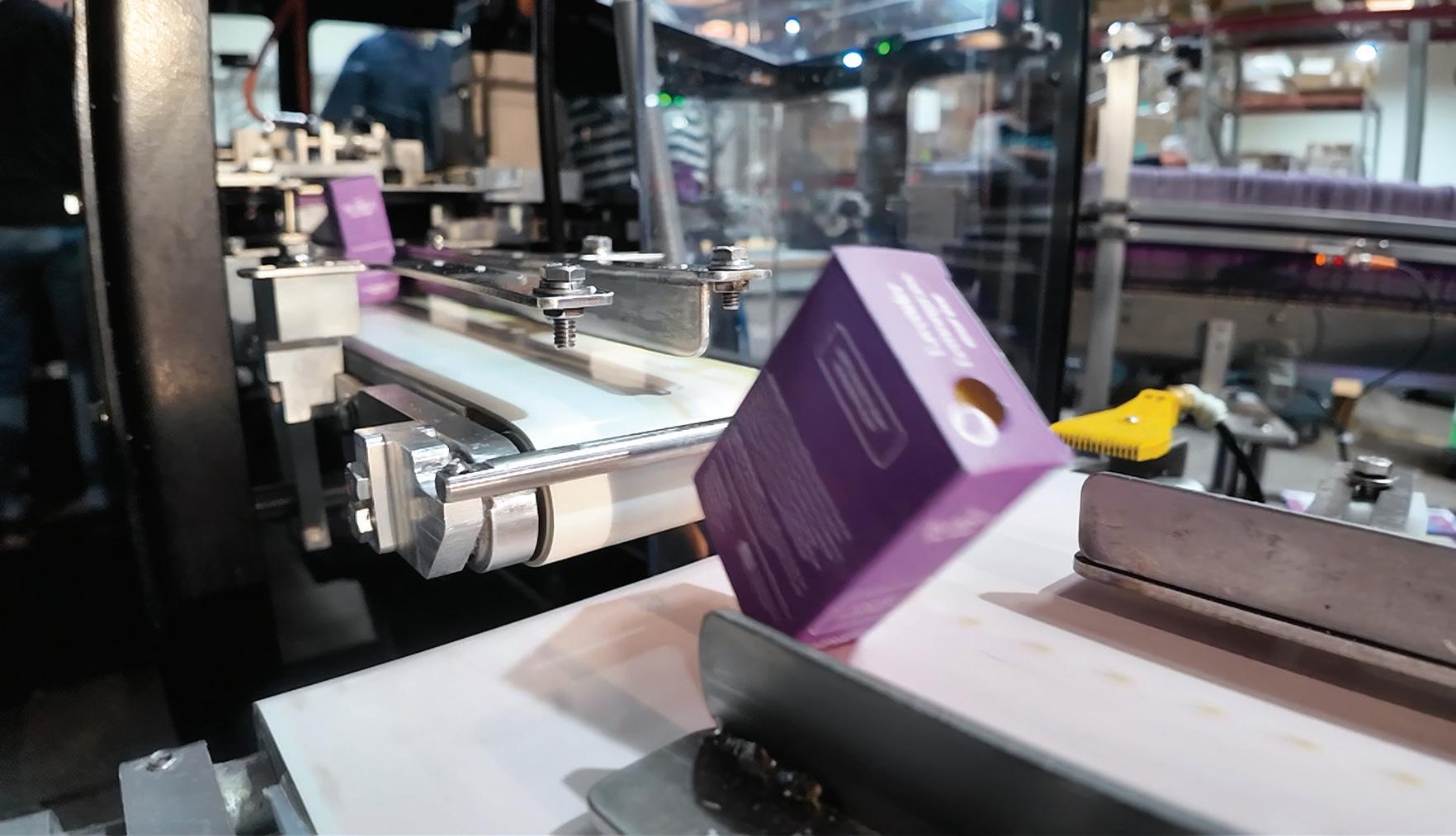
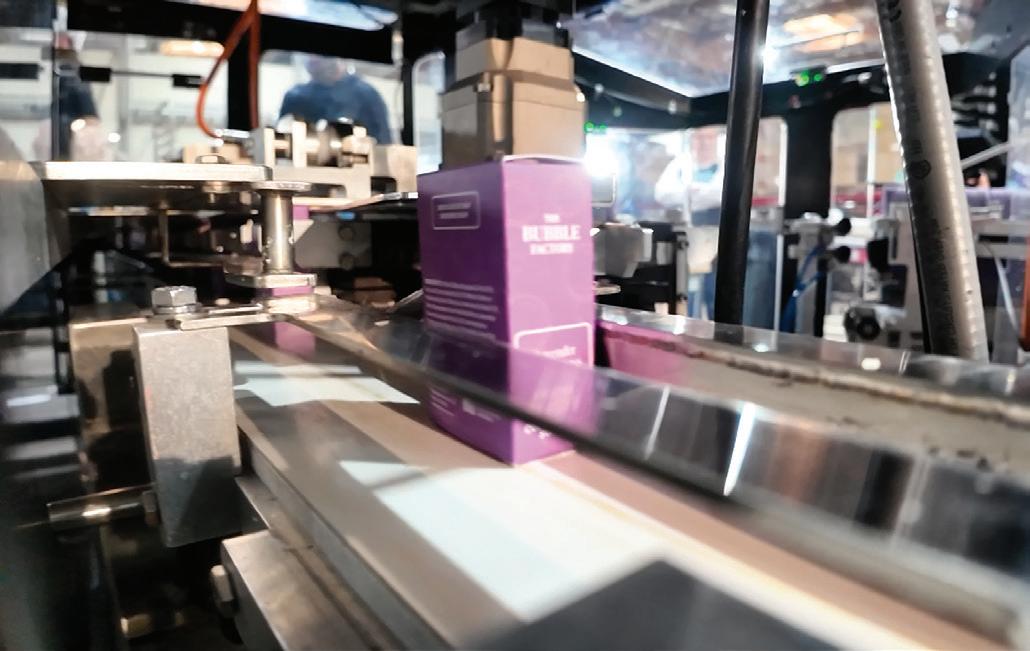
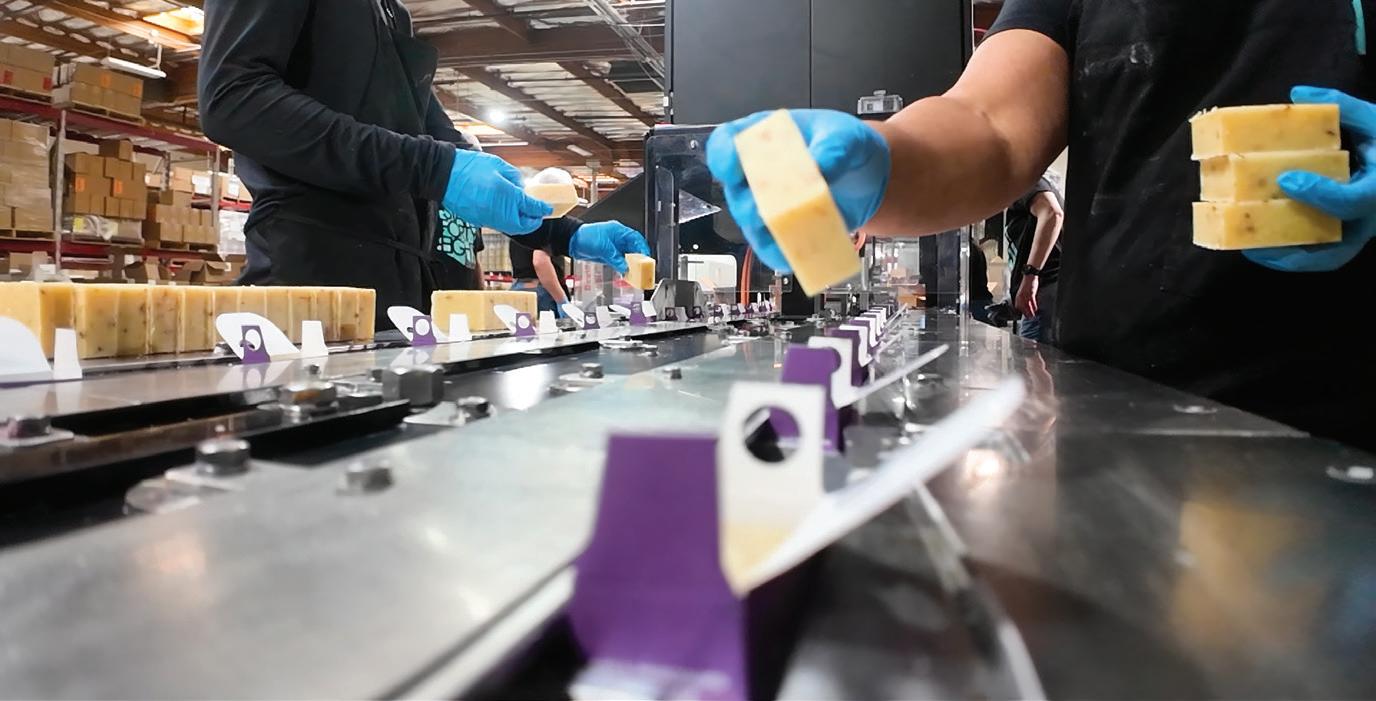
The Yeaman cartoning machine model TK 177690 uses a robotic arm with suction cups to pick carton blanks, erect them, and move them into position. Workers insert soap bars in as the cartons travel through the machine, which closes the top and moves finished cartons onto a conveyor. From there, workers hand-pack inner cartons into master cases, which run through a tape machine before palletizing.
The Soap Gal cartoning line is now greatly streamlined because the machine does the repetitive work reliably, letting a small team pack and palletize 30,000plus bars a day without breaking stride.
With the Yeaman cartoner, The Soap Gal can now run 60 cartons per minute, hitting
30,000 bars per day all on a single shift, 6 a.m. to 2:30 p.m., Monday through Friday. That equates to 150,000 bars per week from one line, with roughly six to seven workers covering the full packing and palletizing operation.
Changeovers between most carton sizes take no more than 15 minutes, Couch says. Now, switching from a one-inch to a one-and-a-quarter-inch bar thickness — the one configuration requiring a plate swap — takes about 45 minutes and is handled by maintenance the evening prior so the shift is never disrupted.
The machine also allowed The Soap Gal
to venture into new sizes including what Couch calls “mini bars.”
“These are the 2×2×1 sample sizes that every brand seems to want,” she says. “Before, I had to hand-pack every single one. Now I’m able to use the machine, and I’m not losing money when I’m taking an order to pack smaller bars of soap.”
People first, productivity second Couch emphasizes that she sees the Yeaman machine not as a headcount reducer but rather as a labor multiplier for her team.
“I don’t want a fully automated product,” she says. “My product is artisan-
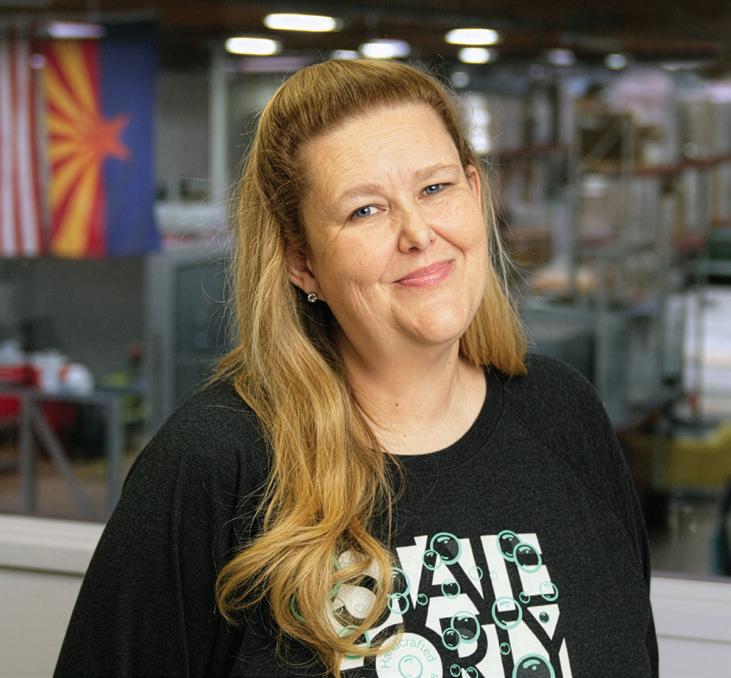
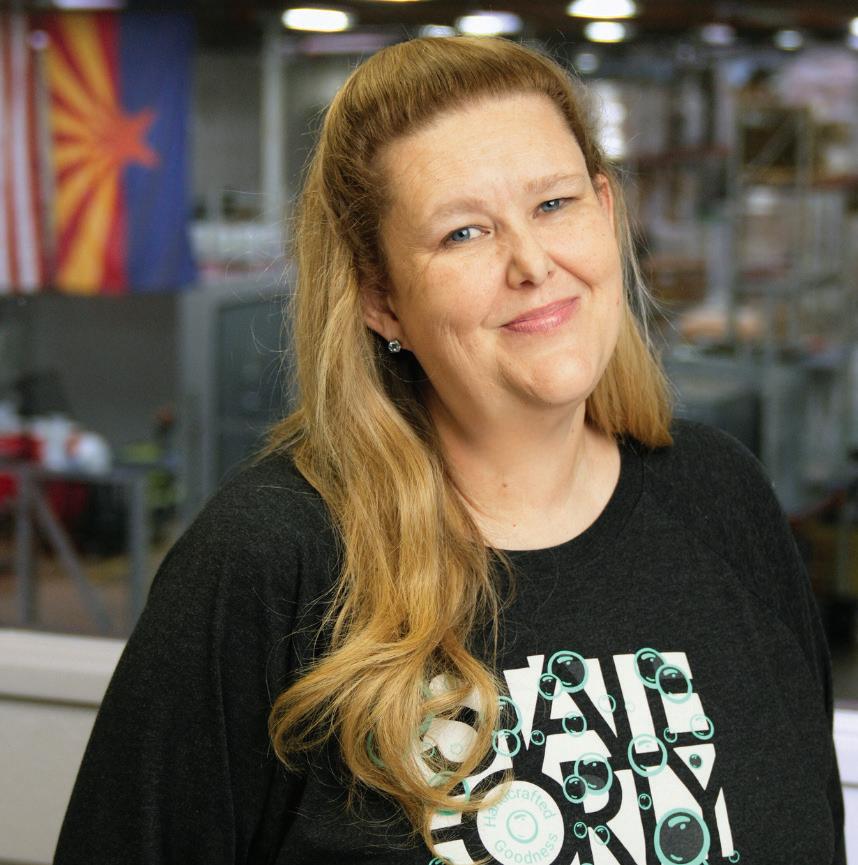
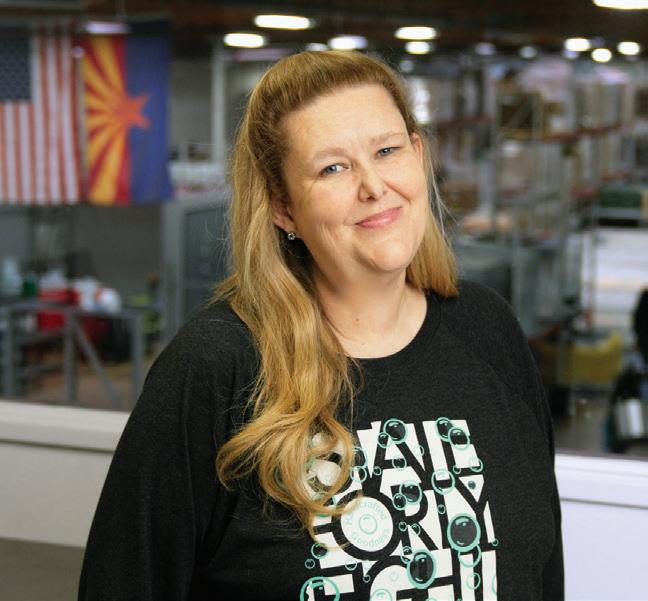
The Soap Gal’s product line, produced today in a C-GMP certified facility, is inspired by a family recipe passed down to CEO and Founder Joanna Couch (below).
made and there is human interaction. I think the key to being an entrepreneur is really about your community; I want to provide jobs for my community.”
Couch says the history of her company reflects an “I-to-we-to-them” philosophy— moving from solo founder to a selfsustaining operation that depends on a team. For her, this is the backdrop for why automation matters at all.
“I want to find machines that help us become more efficient so that we’re able to create more products for more people,” she says.
With the cartoning bottleneck resolved, Couch is focused on growing The Soap Gal’s customer base, reducing concentration risk, and expanding the semi-custom “ready-to-pour” menu she’s building for emerging brands to streamline their private label and contract choices for soap. She sees the Yeaman machine as the first piece of a broader automation roadmap, and almost certainly not the last Yeaman in her future.
“When I need a secondary cartoner or other equipment, it’s going to be Yeaman,” Couch says. CM+P
Thinking CIP optimization for your beverage operation?
Read this quick primer first.
BY JOSEPH DERR
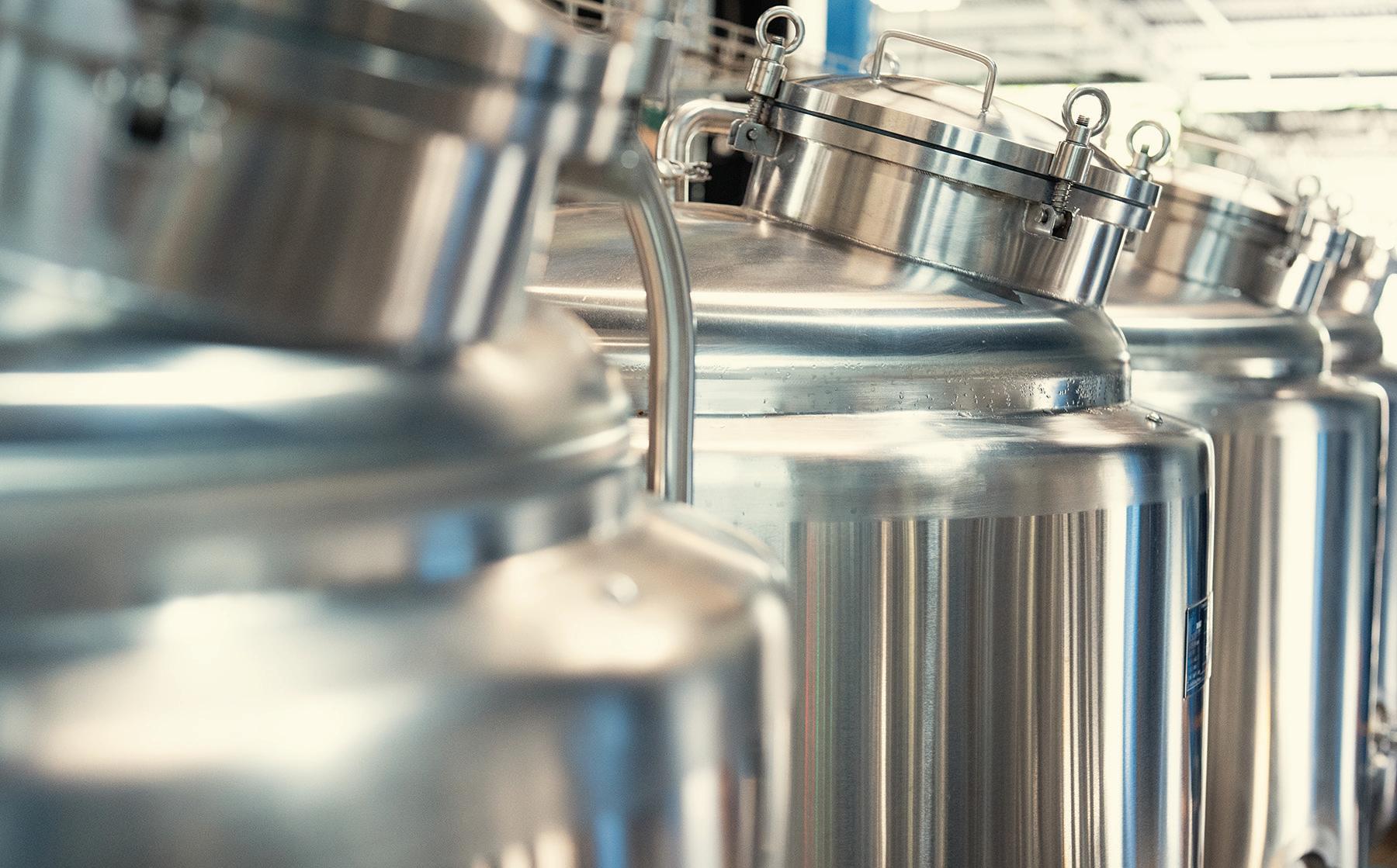
Clean-in-Place (CIP) — the automated process of cleaning interior surfaces of pipes, vessels, and equipment without disassembly — is perhaps one of the most resource-intensive and operationally critical processes in beverage manufacturing.
When done right, it ensures product safety, microbiological integrity, and consistent quality. But if done inefficiently, it drains water, energy, and that most precious resource — time — that plants can’t afford to waste.
Here is a quick primer on CIP optimization best practices, adapted from a presentation at BevTech 2026*.
1
Fix problems first, optimize later
Before exploring ways to clean less frequently or use fewer resources, plants must be in a stable, highperforming state. Attempting to optimize during periods of microbiological or quality issues will make things worse, not better. If micro-problems or quality issues are present, that is not the time to clean less frequently or less aggressively.
2
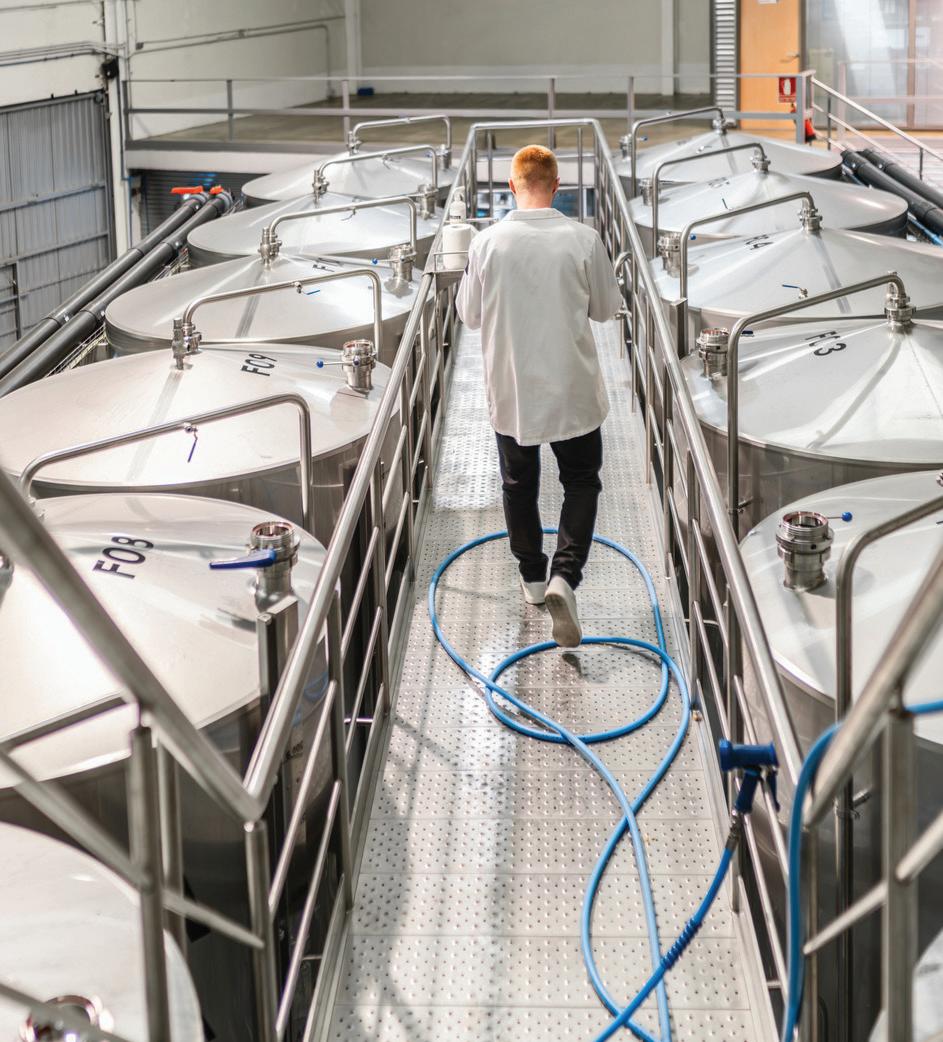
CIP is one of the most resource-intensive and operationally critical processes in beverage manufacturing.
optimization work begins:
Know the three CIP types
Not every CIP is the same, and knowing the distinct goals of each of the three main types is essential before any
• A “clean and sanitation CIP,” which removes soil and kills microorganisms
• A “cleaning-only CIP,” designed to remove soil but does not reset the sanitation clock
Clean-in-Place (CIP) is the automated process of cleaning interior surfaces of pipes, vessels, and other equipment.
• A flavor changeover CIP, which can range from a simple water flush to a complex multi-step process depending on the products involved
3
Changing CIP type or frequency adds value
There can be real, measurable value in changing CIP type or frequency. A variables matrix approach can illustrate just how significant the resource savings can be. For example, moving from a 5-step hot-water-sanitized wash to a 3-step cold wash could yield 75 hours of production time, 1,500 cubic meters of water, and nearly 60 million BTUs of energy savings per year. But those savings come with trade-offs: switching to a 3-step hot wash will increase energy usage even while saving water and time.













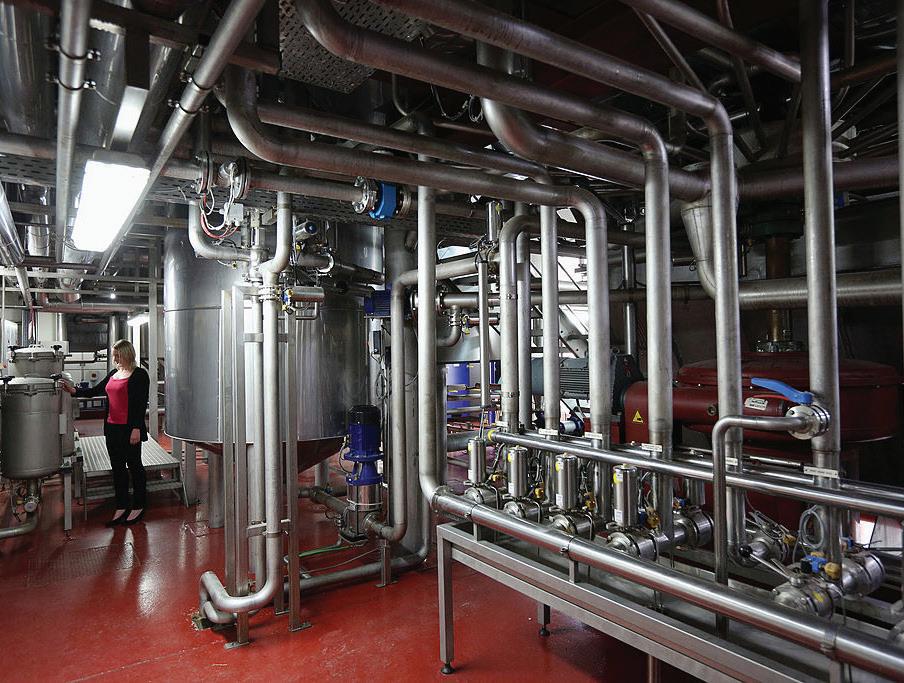
Many plants incorporate a CIP protocol that is progressive and iterative.
4
path to CIP optimization is iterative
Using a new production line with a daily clean-and-sanitation requirement as a baseline, consider four progressive steps. A processor might begin by extending the interval between washes from one day to two, cutting time, water, and energy consumption by half; that interval might then be pushed to three days, provided micro-quality results continue to hold.
From there, the beverage maker might consider changing the CIP type itself. A five-step wash might be swapped for a three-step hot wash that achieves the same cleaning and thermal sanitation in fewer steps, saving significant time and water despite a modest energy increase. Introducing a cleaning-only wash mid-week and reserving the full sanitation step for later in the cycle can also eliminate the need to cool the system down entirely.
Such an approach can lead to a leaner, more efficient schedule that still preserves microbiological integrity — though it’s worth noting that requirements vary by brand and bottler, and no single approach is a universal fit. Revalidation takes real effort, time, and investment, but the efficiency gains are well worth it.
5
The ultimate goal of a CIP optimization program is not simply to clean less, but to ensure that every wash does exactly what it should, using exactly the resources needed. That means tracking quality results (conformance) alongside resource consumption (performance) at every step of the optimization journey. CM+P
* This article was adapted from content presented by representatives of Ecolab during a technical committee meeting at BevTech 2026. BevTech is an annual conference of the International Society of Beverage Technologists (ISBT), with content driven by its member community. Learn more about the event and membership in ISBT at www.isbt.com.


















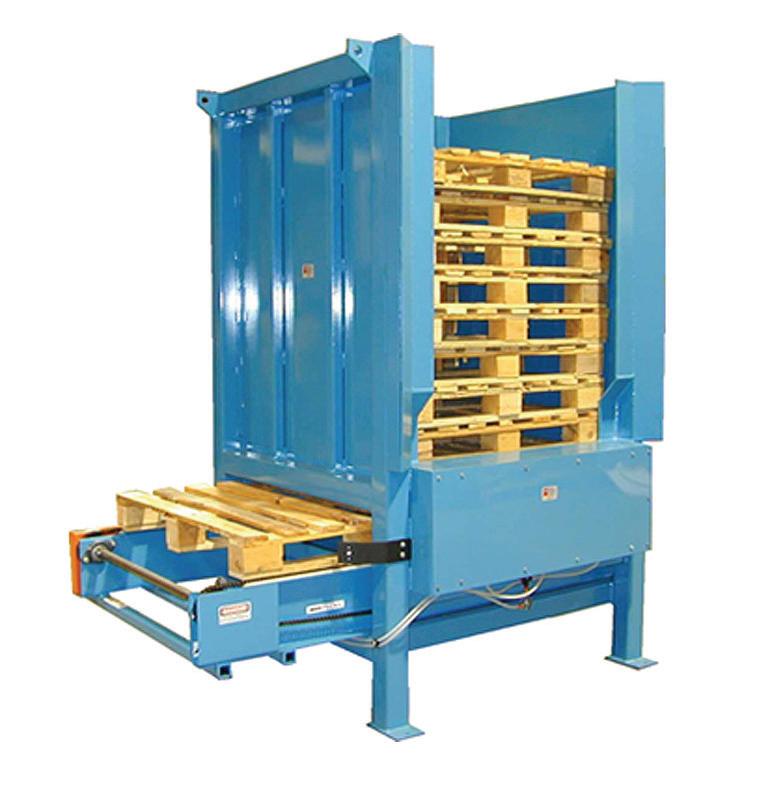
Our dispensers can stack or destack pallets, trays, slave boards, or bins automatically and safely. Most pallet dispenser models can be converted to a pallet collector as well. With our heavy-duty models, pallets can be discharged in one of three directions, onto another conveyor, or directly onto the floor.
» Wooden pallets, metal pallets, plastic pallets, corrugated pallets
» Highest-quality construction to reduce maintenance and improve machine life
» Proudly designed and built in the USA
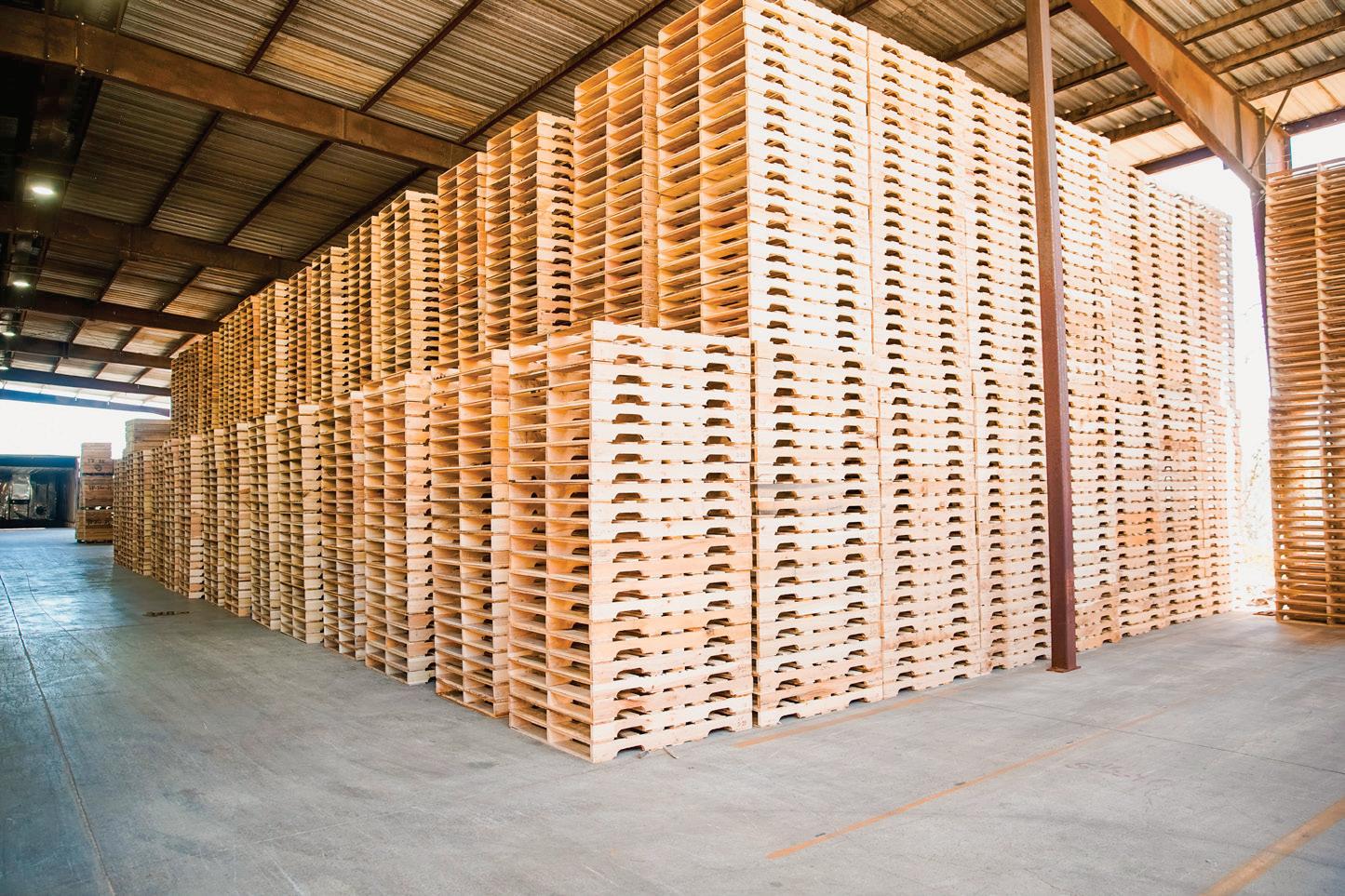
This solution has a variety of product options available to meet your needs. To learn more, contact us by calling 833-467-3432.




























Fragrance and cosmetics supplier makes strategic move beyond sampling to stay ahead of the curve.
BY JOSEPH DERR
Arcade Beauty, long established as a leader in fragrance and cosmetics sampling, has expanded its manufacturing footprint and capabilities as it moves further into the CDMO space. Recent investments, including a facility acquisition in France and planned capacity expansion in Dayton, New Jersey, highlight a strategy focused on scaling blending, improving supply chain flexibility, and supporting both low- and high-volume production.
In this Q&A for Packaging World and Contract Manufacturing + Packaging, President of Arcade Beauty North America Jorge Garcia explains how Arcade is leveraging its roots to support increasingly complex retail programs across global markets.

President of Arcade Beauty North America Jorge Garcia.
Jorge Garcia : If you think about Arcade Beauty, typically the first thing that comes to mind is that we’re a leading supplier of samples in the beauty market. That’s effectively where the business grew and how we became who we are today. But over the last several years—certainly the last five to ten—the business has continued to expand its footprint and capabilities, and we’ve gotten a lot more into what I’ll call the world beyond samples.
A lot of our business, which people may not recognize as much, is now supporting our customer base with saleable products, whether that’s a discovery set or full retail product. We effectively do the gamut across beauty, and especially on the fragrance side, where we offer blending and filling across the full range of retail formats.
CM+P: What would you say is unique about your approach?
Garcia: A big part of it comes from our DNA. We started as a sampling business, and that’s given us an entrepreneurial spirit that you see today. It brings a lot of agility and flexibility to our operations, which has allowed us to support not only the prestige brands, but also emerging and “masstige” players.
That includes automating where

Arcade Beauty’s luxury discovery set for Mind Games.
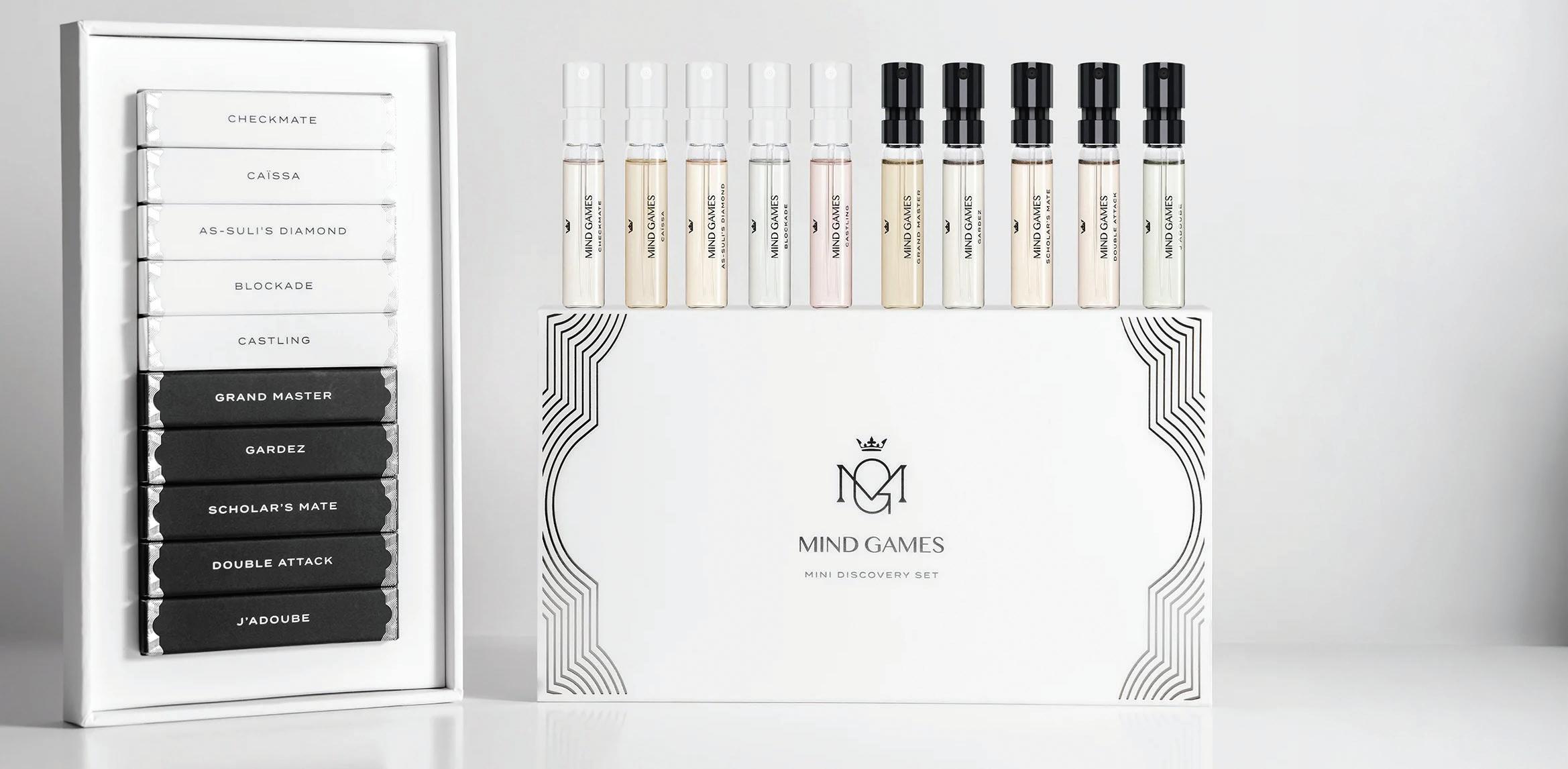


necessary to maintain the flexibility to support project complexity, which also exists in the retail and saleable space. In many cases we also support low Minimum Order Quantities (MOQs), which has really supported our growth. That’s often where relationships start, and then they expand from there.
Beyond filling and assembly, we also have blending capabilities on the fragrance side, which are critical. While fragrance houses lead formulation, once the oils come to us, we run a comprehensive lab process evaluating color, odor, and appearance to make sure everything aligns with the brand. We collaborate closely with customers and adjust formulations depending on whether the product is going into a sample or a retail format. Those are very different requirements, and we support both.
We also differentiate through innovation. For example, we partnered with NEST New York on an alcohol-free fragrance formulation, a key development. We can replicate existing customer formulas, but we can also help develop new and more innovative ones, and that’s now true across both the U.S. and France with the Ploërmel acquisition.
CM+P: What was behind this expansion in France?
Garcia: We are super excited about it. What drove it was continued strong demand from our customer base. We see the category as still very fragmented, and we have the capabilities to offer not only a piece of the market but now full scale as well. Our Biopack facility in France had reached capacity—we outgrew it—and we saw this as a great opportunity to expand within the fragrance area in a much broader way.
Through the acquisition from Groupe Rocher in late 2024, we significantly increased capacity and, importantly, brought blending capabilities into France, similar to what we have in our Dayton facility. That’s a key value-add for customers and something not everyone can claim.
CM+P: How is this a strategic move for Arcade Beauty?
Garcia: As we become a more prominent player in the CDMO space, scale is critical. This move is not just about capacity; it’s about capability.
Bringing blending to France is particularly important because, as you know, that is where the fragrance world’s deepest expertise and heritage reside. That gives us a path to grow in a much more meaningful way and grab market
share from competitors that, frankly, may not have the same level of flexibility we do, or the service and quality levels we’ve been able to offer.
Ultimately, it’s about doing more of what we were already doing, but in a much bigger way and making a more serious commitment that we’re going to be bigger players in the fragrance retail filling space.
CM+P: Would you say your company is now moving away from the sampling niche?
Garcia: Sampling is still very much a core part of what we do, and I think people would be surprised by the level of growth we’re seeing in our retail and saleable business. We’re seeing a lot of great trends in discovery sets, which was a natural progression from sampling.
From a sampling perspective, we can offer everything from a label, which is still the most cost-effective sampling solution out there today, to vials, spray pens, discovery sets, and more. We can effectively cover any solution and give customers options that match their budget or the type of program they’re looking for.
But I think it’s important to talk about where we’re going, too. We can now
support customers across the full commercial lifecycle from samples or discovery sets, all the way to deluxe minis and full-size retail. At our Dayton, New Jersey facility, we’ve recently made investments that will triple our blending capacity, while also expanding warehousing for bulk, components, and finished goods, all in anticipation of the growth and market share we’re positioned to capture.
CM+P: What would you say is Arcade Beauty’s approach to sustainability?
Garcia: We’re very proud of the work we did with Estée Lauder on an 80% recyclable paper-based packette [sachet], that won an award at Luxe Pack New York.
The 80% paper solution we created is much easier to recycle and significantly reduces plastic content while maintaining the integrity and look of a traditional foil laminate packet.
This innovation was the result of a close collaboration with Estée Lauder who
have ambitious sustainability goals. What was exciting was that we were able to get well above what the current regulation standards, hitting sustainability targets that are years out, not just today. It shows what we can do when we partner with brands and support future market trends or brand specific objectives.
CM+P: Where do you think external manufacturing for cosmetics and fragrance is headed?
Garcia: Premiumization is going to continue to be a major trend. At the same time, customers are asking for lower MOQs and more flexibility while still expecting a premium feel and constant innovation. Discovery sets and spray pens are continuing to grow. They’re formats that really connect with consumers.
We also talked about alcohol-free fragrance. It’s not as prominent today as it could be, but we believe it’s an area with strong growth potential, and our work with NEST New York shows what’s possible there.
Hair and body mists is an emerging trend, particularly with younger consumers who are drawn to its entry point into fragrance. It’s a fast growing category, and we’re already producing today in both the U.S. and in France so we’re well positioned to scale with it.
Overall, it’s about staying flexible and continuing to innovate in a market that’s evolving quickly. We built this business on agility, flexibility, and speed for our customers, and that’s what’s going to continue to drive us forward. CM+P