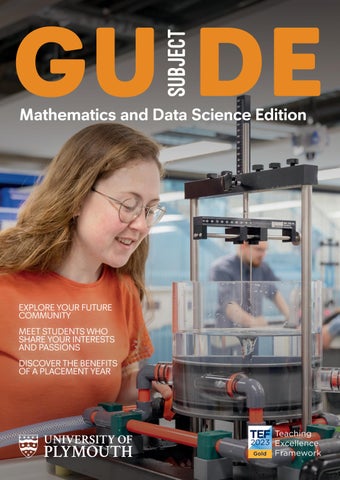
SUBJECT Mathematics and Data Science Edition
EXPLORE YOUR FUTURE COMMUNITY MEET STUDENTS WHO SHARE YOUR INTERESTS AND PASSIONS DISCOVER THE BENEFITS OF A PLACEMENT YEAR
Gold
Admissions +44 (0)1752 585858 admissions@plymouth.ac.uk plymouth.ac.uk Schools & Colleges Outreach outreach@plymouth.ac.uk
University of Plymouth Drake Circus Plymouth Devon PL4 8AA United Kingdom Follow us on social media @PlymUniApply
Mathematics and Data Science Edition
Inside...
SUBJECT
FEATURES: P.4 10 reasons to study at Plymouth Our top 10 for why new starters should consider studying mathematics with us.
It’s never too early to start thinking about what you would like to do after school or college, or if you are thinking of a career move! At Plymouth, we know that choosing a university and course is a big decision. While you may have an idea of a profession, career or industry that you’re aspiring towards, if you’re unsure of exactly what you want to do or are keen to find out more – this is where our handy guide comes in.
P. 16 The power of placements Find out how a placement can enhance your graduate prospects and what it’s done for our students.
Meet some of this issue’s contributors: P.20 Supporting you to succeed See what support is available for our students, from our dedicated maths lab to our Peer-Assisted Learning Scheme (PALS).
Dr Nathan Broomhead Admissions Tutor for Mathematical and Data Sciences Nathan shares his top 10 reasons why studying mathematics at Plymouth is special. P. 4
Luxi BSc (Hons) Mathematics with Finance Luxi shares her experience while studying with us. P.12
Sophie BSc (Hons) Mathematics with Statistics Sophie shares her placement experience and the career path it led to. P.18
E XPLO R E YO UR FU T UR E H O M E Visit us at an Open Day
Virtual tour Welcome to our city
When it comes to finding out if university feels right for you, nothing compares to an open day. Talk to current students and ask lecturers about your course. You can register to attend here plymouth.ac.uk/open-days
Our virtual tour allows you to experience first hand what it is like to be on campus and explore the environments and facilities that inspire and shape our learning every day.
P.26 Graduate stories Alex tells us about the work she’s been doing with BAE Systems since graduating from her BSc (Hons) Mathematics with Statistics course.
Information correct at time of going to print – September 2026
4
10 R E ASON S TO S TU DY AT PLYMOU TH I’m assuming that if you’ve picked up this guide, you’ve already started considering your future. Perhaps asking yourself if studying mathematics or data science is something you would like to do, and whether the University of Plymouth is the right place for you. I expect you may have a mixture of feelings as you’re going through this process: perhaps excitement, but also nervousness or worry. This may not be the first guide you’ve looked through, and you may be a little overwhelmed with the choices that need to be made. Well, let’s see if I can help you. Here are my top 10 reasons for studying mathematics or data science with us! Dr Nathan Broomhead Mathematics and Data Science Admissions Tutor
5
1. DEGREE FLEXIBILITY We offer a range of Mathematics and Data Science degrees, including mathematics with other subjects. They all feature a common first year, so you develop the fundamental skills that characterise a mathematician. This also allows you to tailor your degree: as your knowledge and understanding deepens, you can follow your interests and if you wish, transfer between our mathematics degrees.
2. YOU WANT TO KNOW (AND BE KNOWN BY TEACHING STAFF) You won’t be “just another student” as we know our students by name in our close-knit, collaborative and supportive mathematical sciences family at Plymouth. We offer small group tutorials, study space next to staff offices and our lecturers’ opendoor policy.
3. GAIN PAID WORK EXPERIENCE
Our optional, but highly recommended paid placement year allows you to explore where your mathematics degree can take you. You’ll gain valuable work experience, commercial awareness and industry contacts, preparing you for your final year and when you graduate.
6
4. ACCREDITATION
Our mathematics degrees are accredited by the Institute for Mathematics and its Applications (for Chartered Mathematician status). BSc (Hons) Mathematics with Theoretical Physics is also recognised by the Institute of Physics.
5. BE SUPPORTED BY THOSE AROUND YOU
We run weekly Peer-Assisted Learning Scheme (PALS) sessions in mathematics or data science. Students from later stages of the degree lead workshops to help support foundation and first year students. You’ll benefit from meeting other students, discussing mathematics or data science, and University life in general.
7
6. SOUGHT AFTER BY EMPLOYERS
Our degrees equip you with skills which are highly sought after by employers: problemsolving, knowledge of computing languages and mathematical software packages, as well as presentation and communication skills. Our curriculum, teaching methods and assessments have been constructed with your future in mind.
7. MODERN FACILITIES
Our £63 million Babbage Building offers you a state-of-the-art facility for collaboration – with industry, experts and peers – across science, technology, engineering, arts and mathematics (STEAM). Enjoy our state-of-the-art lecture theatres, computer laboratories, study and social spaces.
8
8. RESEARCH-
INFORMED TEACHING
All your lecturers are active researchers in their field, and their research underpins the curriculum’s content. Linking teaching with research benefits you in many ways, e.g. developing critical thinking, enhancing employability, improving your confidence and enhancing your experience of real-world issues. It also means that you are taught by academics who are passionate and excited about the cutting edge of the subject.
9. STUDY ABROAD WITH ONE OF OUR PARTNERS
Take advantage of a wide range of work placement positions and the chance to study at a university overseas in mainland Europe or North America.
9
10. STUDY
SOMEWHERE THAT SUITS YOU
Plymouth is Britain’s Ocean City, home to the UK’s first national Marine Park, and one of the UK’s most sustainable cities. It is also close to Dartmoor National Park and the Tamar Valley Area of Outstanding Natural Beauty. The city has just under ten miles of coastline including plenty of beaches. It is a friendly and magnificent place to live and study.
10
WHICH DEGREE IS RIGHT FOR YOU?
One of the features of our mathematics and data science degrees is the common course content within your first year of study. This gives you flexibility to move between the courses within that subject area. You can transfer between courses at the end of your first year, to suit your interests and passions ready for your second year. BSc (Hons) MATHEMATICS Whether you are drawn to the exhilaration of solving problems, the beauty of an elegant or unexpected result, or the power and adaptability of mathematical models of the world around us, this degree trains you to think systematically and creatively.
BSc (Hons) MATHEMATICS WITH FINANCE Take on the financial world with this specialist pathway for BSc (Hons) Mathematics students, when you transfer across at the end of your first year. You’ll develop high level mathematics and statistical techniques, and master programming in Excel and R.
BSc (Hons) MATHEMATICS WITH STATISTICS Gain key statistical knowledge and skills to build data fluency that is highly valued by employers. Your skills will provide innovative solutions to real-world problems in business, information technology, engineering, finance, medicine, biology and psychology.
Find out more
Find out more
Find out more
BSc (Hons) MATHEMATICS WITH EDUCATION Are you ready to make a difference? Learn from expert staff and worldleading researchers by transferring to this pathway at the end of your first year. You’ll gain hands-on experience of the educational environment through a school placement and undertake a research project which allows you to investigate an area of mathematics education.
BSc (Hons) MATHEMATICS WITH COMPUTER SCIENCE Explore the beauty of mathematics in familiar areas such as calculus, algebra and probability, and extend your skills into computing-intensive topics such as artificial intelligence, fluid dynamics, high performance computing and machine learning.
BSc (Hons) MATHEMATICS WITH THEORETICAL PHYSICS Acquire a deep insight into modern theories of nature using powerful mathematical techniques. This degree will provide you with the necessary mathematics to be able to describe, analyse and predict natural physical phenomena.
Find out more
Find out more
Find out more
BSc (Hons) Mathematics
BSc (Hons) Mathematics with Education
BSc (Hons) Mathematics with Finance
BSc (Hons) Mathematics with Computer Science
BSc (Hons) Mathematics with Statistics
BSc (Hons) Mathematics with Theoretical Physics
11
BSc (Hons) DATA SCIENCE Gain the skills to turn complex data into insight to make informed decisions. You’ll develop strong foundations in maths and computing and gain expertise in AI, machine learning, statistics and big data.
Find out more BSc (Hons) Data Science
BSc (Hons) DATA SCIENCE WITH ARTIFICIAL INTELLIGENCE
Gain expertise in practical AI and data science skills and develop strong mathematical, computational and applied experience to empower you to make data informed decisions.
Find out more
BSc (Hons) Data Science with Artificial Intelligence
BSc (Hons) MATHEMATICS WITH FOUNDATION YEAR Are you passionate about studying mathematics or data science? Perhaps you’ve shown evidence of good academic potential, but don’t have sufficient qualifications, or have been out of formal education for a while. Taught on campus, this four-year degree route incorporates a foundation year and develops your computing skills and mathematical knowledge. Successful completion of the foundation year enables you to progress onto the first year of any of our mathematics or data science degrees. Find out more
BSc (Hons) Mathematics with Foundation Year
“Being able to complete a foundation year gave me time to build up my knowledge.” Em, BSc (Hons) Mathematics with Foundation Year graduate
“The supportive teaching style, the vibrant location and the friendly atmosphere made Plymouth feel like the right place for me.” Luxi, BSc (Hons) Mathematics with Finance student
“My peers and I have built a real rapport with our lecturers, due to cohort sizes, leading to a much more interpersonal learning experience.” Amelie, BSc (Hons) Mathematics with Statistics student
“A BSc in Mathematics involved both practical coding sessions and theoretical knowledge to better prepare me for a career in health data science.” Josh, BSc (Hons) Mathematics graduate
12
LUXI'S STORY BSc (Hons) Mathematics with Finance PASSION FOR MATHEMATICS Mathematics was one of those subjects I would say I enjoyed and understood during school, and I wanted to carry that on for the future. I knew having a mathematics degree under my belt would open a lot of doors for me in terms of my career, so it motivated me to stay on course, no matter what struggles I faced. THE RIGHT PLACE FOR ME The University of Plymouth wasn’t initially on my radar for mathematics. However, after visiting friends during Christmas break, I was struck by the city’s beauty. I remember like it was yesterday when we drove down past the Barbican lights and then up to the Hoe – it left a lasting impression, making Plymouth feel welcoming. On results day, I applied to the University through Clearing, onto the Mathematics with Foundation Year course. While the foundation year added an extra year, it proved invaluable. The supportive lecturers, the friendships I formed, and the taste of university-level mathematics solidified my interest in the subject. Ultimately, it was the combination of factors: the supportive teaching style,
the vibrant location and the friendly atmosphere that made Plymouth feel like the right place for me. The lecturers genuinely cared about student success, which dispelled the myth of complete independence often associated with university. Their support, along with the positive experience during the foundation year, solidified my decision to return to Plymouth after my gap year. OPPORTUNITIES FOR GROWTH The University consistently promotes enrichment opportunities within the field of mathematics; you’ll be exposed to the latest advancements, and have a chance to delve deeper into specific areas that pique your interest. It’s evident that the staff are passionate about mathematics, and that enthusiasm is contagious. Their dedication fosters a stimulating learning environment that can spark your own passion for the subject. SUPPORT ON THE COURSE The Peer-Assisted Learning Scheme (PALS) was a fantastic resource during my foundation year and first year at Plymouth. Having sessions led by students a year ahead was incredibly helpful. They’d already been through
the material, so they understood the challenges we were facing. This made it easier to ask questions and get alternative explanations in a comfortable environment. In addition to PALS, the University offered the SUM:UP service which is daily support in the library from a dedicated maths lecturer. They were available from 10–4, always patient, and willing to help with any mathsrelated problem. The supportive and non-judgmental atmosphere made it a great place to go for additional clarification. CAREER ASPIRATIONS My current career aspirations lie in securing a graduate role within the finance sector. The University has been instrumental in equipping me with the necessary skills and knowledge to achieve this goal.
13
14
JOE'S STORY BSc (Hons) Mathematics MY ENTHUSIASM FOR MATHEMATICS I have always been drawn to puzzles and problems that required analytical thinking, and mathematics for me fills that passion with a wide variety of applications to apply this to. This is what motivated me to study mathematics, to hopefully solve problems in more impactful areas. MATHS AT PLYMOUTH I decided to come to study at the University because of student recommendations of the friendly and helpful learning environments, high quality content and most importantly to me, the ability to be heard and helped when needed, if for some reason you’re not understanding a certain area. The curriculum is well structured and gives you experience with a broad range of topics during your first and second year, ensuring a solid foundation in multiple mathematical fields. Your third year allows you to narrow down your modules to choose what specific areas of mathematics you would like to study further.
HANDS-ON EXPERIENCE The course is very well divided up so that you gain very good experience in pure mathematics and hands-on applications of mathematics. Whether that be development of coding skills or research-style investigations, I believe that these hands-on experiences are enjoyable as well as useful.
explaining ideas with your peers can be one of the best devices for deeper understanding of a topic.
SUPPORTIVE LEARNING ENVIRONMENT Both academics and support staff are extremely helpful and friendly. Whenever I’ve needed help or clarification, staff have been quick to communicate help where they can over email, or they have been more than happy to explain concepts and examples in their office on whiteboards which has been extremely useful.
I am hoping to take the knowledge and skills learned while studying at the University to develop a career in developing the advancements in artificial intelligence. During my time at university, I have developed a much better understanding of complex mathematical concepts that will contribute to this pathway, along with being exposed to coding in a various scenarios, also contributing to a skillset relevant to this field.
The Peer-Assisted Learning Scheme (PALS) also facilitates an environment of collaborative learning, which in my experience has been one of my favourite aspects of studying mathematics, as learning from/
FUTURE CAREER PATH The versatility of a mathematics degree is endless. The problem-solving skills that you develop during your time at the University are desired among an enormous range of industries.
15
16
THE POWER OF PLACEMENTS Placements can be incredibly beneficial for undergraduate students studying our mathematics and data science degrees. A placement provides valuable, hands-on experience outside of the classroom, and can provide a great networking opportunity.
17
Many of our students have gone on to either be offered graduate employment by their placement organisations, or have used a placement to help them decide their career routes. A placement gives you the perfect chance to refine your CV, put theory into practice and hone valuable skills that will be attractive to employers after you graduate. WHAT COULD YOU DO ON YOUR PLACEMENT YEAR? Placements can also help you to gain a deeper understanding of the various career paths available to you in the field of mathematical sciences. For example, a student who is interested in statistics may choose to pursue a placement in data analysis for a pharmaceutical company, while a student more interested in education may choose a placement within a school.
Placements can help you to enhance specialist skills and gain valuable experience that are highly sought after by employers, such as problem solving and data analytics, for example. WHY SHOULD YOU UNDERTAKE A PLACEMENT? While we equip you with much handson experience and opportunity to put theory into practice, a placement can provide you with something extra to stand out from the crowd. A placement also exposes you to a professional environment where you’ll be expected to work with a team, communicate and collaborate with others in that setting. Being able to bounce ideas off the people around you and gaining direct experience of working in industry, can be invaluable to your career path and your final years in university.
EXAMPLES OF RECENT PLACEMENT ORGANISATIONS • Office for National Statistics • GlaxoSmithKline • Lilly UK • Visteon • Volkswagen Group UK Ltd • Plymouth Marine Laboratory • Redmayne-Bentley • Plymouth Community Homes • National Air Traffic Services • Babcock International • Thames Water • Home Office • Liberty Living • L’Oréal
FIND OUT MORE about our placement opportunities:
18
CLINICAL STATISTICS AT GSK SOPHIE BSc (Hons) Mathematics with Statistics graduate Sophie worked as a Clinical Statistician at GlaxoSmithKline during her placement year, providing her with the skills to go on to become an actuary for the government.
PLACEMENT ROLE I did a placement year at GlaxoSmithKline (GSK) as a Clinical Statistician. I was based in Uxbridge, near London. I was primarily involved in analysing the results from clinical trials to treat patients with Chronic Obstructive Pulmonary Disease (COPD). SKILLS GAINED I was introduced to software called SAS for the first time when at GSK, to produce various summaries/tables and analyse the results of the clinical trials. Despite never having used it prior to my placement year, by the end I was fluent in the code. I was able to apply these skills to the extensive use of R on my course in the final year. One of the highlights from the placement year was being able to contribute to a paper published in a medical journal, where I was listed as a primary author. I was involved in
both the analysis and the reporting of the results. Even after I had completed my placement year, I was asked to continue working on the paper which I enjoyed. OPPORTUNITIES I had the opportunity to attend conferences around London, and get involved in social events with the other placement students. As an extracurricular activity, I joined the GSK fundraising group “Orange United” and part way through the year I actually led the team in organising fundraising events around the office with another placement student. This role greatly enhanced my organisational skills and improved my confidence. CAREER PATH While I thoroughly enjoyed my placement year, I wasn’t completely certain that it was the path I wanted to
19
follow after university. The other area I was interested in and keen to explore was actuarial science. I decided that I would like to study a masters degree. On completion of my Masters, I was accepted on the KPMG actuarial training program where I started as a Trainee Actuary in the pensions team in Bristol. After around two and a half years, I started at the Government Actuary’s Department (GAD) in London where I worked as a Senior Trainee Actuary. I completed all of the actuarial exams and became a Fellow of the Institute and Faculty of Actuaries in 2023, so I now work as a qualified Actuary at GAD. My day-to-day role consists of reviewing calculations/results and reports that have been done and checked by other colleagues, managing small teams on various
projects and carrying out high level actuarial calculations, while ensuring our work is consistent with the relevant actuarial and technical requirements. At GAD, I used SAS on a daily basis in order to “clean” very large public sector pension datasets (some of which have over one million members) so my exposure to this on my placement year was invaluable. GAD has since moved the process to R which I used heavily throughout university and has meant that I am already familiar with many of the commands we have been using. REWARDING CAREER MOMENT Qualifying! The actuarial exams are not for the faint-hearted, and require a lot of hard work and commitment. That feeling when I opened the results letter and saw the final “P” (pass) that I needed to qualify was unmatched… finally free of exams!
PLYMOUTH I thoroughly enjoyed my time at Plymouth and wouldn’t change it at all. The University shaped my future career. Without the encouragement to do a placement year and the various careers sessions that were held for us, I certainly wouldn’t have ended up doing what I am doing today. I would 100% recommend doing a placement year, particularly if you are torn between a few different career trajectories, as it will help you to make up your mind even if it turns out that you don’t want to go into that particular area as a result, which is equally as useful to find out!
20
S U PPO R T I N G YO U
TO SUCCEED We want you to be successful while you’re studying at university and for you to have a brilliant time from start to finish. We know that starting university can be a big change, and we are here to support you during your studies with our open-door policy, personal tutor system, peer-assisted learning and much more.
21
PERSONAL TUTORING Our personal tutoring system supports you throughout your studies at Plymouth, providing you with guidance and personalised feedback on your progress. Your personal tutor is a member of the mathematics staff that teach you, so you see them in classes as well. Solving problems and presenting solutions in small groups improves your presentation skills and supports you into becoming a confident communicator. THE MATHS LAB In addition to the study spaces around campus, we have the Maths Lab, a dedicated study area for mathematics and data science students. The Maths Lab is the ideal space for students to support each other’s learning, with areas for problem solving and practising presentations. Located close to the mathematics staff offices, the Maths Lab provides you with easy access to lecturers, should you want to make use of our open-door policy to get additional help and support.
SUM:UP SUM:UP is a University-wide facility, run by mathematical sciences staff, providing mathematical and statistical support for students. PALS Take the opportunity to learn from other students studying in their advanced stages of their degree. The weekly Peer-Assisted Learning Scheme sessions provide support to foundation-year and first-year students. Attending these sessions gives you the opportunity to meet students from other years on your course, discuss mathematics and data science and university life in general, and get advice from the perspective of other students. The sessions allow students to gain confidence in both their mathematics/ data science and presentation skills.
“In my first year I attended the PALS sessions, especially in the run-up to exams season. The second and third year students were always very helpful and insightful. Apart from maths, those sessions were really nice for general student life interaction. Talking to people roughly your age, who have already been through what you are experiencing, is an amazing opportunity to gain insights on what to do, what not to do etc... But, more importantly, it’s very calming knowing that people just like you, managed to get through the first year of university, which, for many, is quite intimidating. I appreciated the PALS support so much that I became a PALS leader myself the following year.” Pier, BSc (Hons) Mathematics with Theoretical Physics student
22
23
CAREER SUPPORT One of our main goals when it comes to our students, is helping them to find employment after university. Our Careers Service offers bespoke guidance for both students and graduates which aims to support and encourage their development, networks and job applications. HOW DO WE SUPPORT OUR STUDENTS’ CAREER PROSPECTS? Our mathematics and data science students are exposed to industry possibilities from day one, with talks from industry professionals and our own graduates. Our lively, immersive “Enhance Your Future” programme equips you with the tools you need to research and formulate your career ideas. WHAT ARE THE JOB PROSPECTS IN THE MATHEMATICS AND DATA SCIENCE SECTOR? Mathematics and data science graduates can be found working in just about every industry. Careers popular with graduates include accountancy, banking, insurance, finance, education, health and other commercial and management careers. There are also rapidly growing opportunities in the technology sector. Government departments such as the Office for National Statistics, as well as the intelligence and security services such as GCHQ and MI5, are also eager to recruit mathematics and data science graduates.
WHAT CAREER SUPPORT SERVICES DOES THE UNIVERSITY OFFER? As well as our bespoke career development programme within the curriculum, we also offer a range of services, including: • support with job hunting, application writing, CVs, networking and interview skills • on-campus careers fairs, where students can explore career opportunities and develop their professional networks • individual placement support, both before and during the placement, as well as internship opportunities • a paid work placement programme using our extensive industry contacts and an industry mentoring scheme. The latter matches students with an industry individual who will meet with them regularly to provide incredibly valuable insights into a specific sector. University of Plymouth alumni now working for employers who are keen to spot future talent, usually host the mentoring scheme. The University’s myCareer internet platform hosts an extensive vacancy database of both graduate, placement and part-time opportunities allowing students to sign up for events such as employer panels, enterprise competitions or mentoring. myCareer also holds a range of highly specialised digital tools such as a CV builder, an interview simulator, online courses and video resources. Access to myCareer is available to our graduates at any time in the future.
“I have found great use in the Careers service sessions hosted throughout my time here. In these sessions, you develop key skills in making yourself a more desirable candidate when it comes to applying for jobs.” Joe, BSc (Hons) Mathematics student
“The Careers Service supported me in building a CV for a healthcare modelling micro-internship and writing of a personal statement to continue studying an MSc Health Data Science and Statistics degree at the University of Plymouth.” Josh, BSc (Hons) Mathematics graduate
GET IN TOUCH Follow us on , or @uniplymcareers Contact us or visit our website for more information. careers@plymouth.ac.uk +44 (0)1752 587456 plymouth.ac.uk/careers
24
HEALTH DATA RESEARCHER AT THE UNIVERSITY OF PLYMOUTH JOSH BSc (Hons) Mathematics Graduate
25
WHY I CHOSE MATHEMATICS I was motivated to study mathematics as I greatly enjoyed the subject, and I knew I would be able to follow a career in a wide range of fields, thanks to the generality of mathematics. I further continued studying in the field of health data science after realising the practical aspects of mathematics in potentially helping people and improving public health, while studying a module in Medical Statistics. MY CAREER PATH Studying Medical Statistics in my third year of the BSc (Hons) Mathematics degree showed me how statistics can be used in a way to improve public health. I loved the idea of being able to improve people’s lives simply by using mathematics to analyse data, so after delving into medical statistics, I looked for graduate opportunities in the subject area.
With support from academic staff, I secured a NIHR Pre-Doctoral Fellowship to fund my early research career into health data science and medical statistics. MY TIME AT PLYMOUTH I’ve thoroughly enjoyed my time socially and academically at the University. The University itself appealed to me when I first arrived in Plymouth. I liked the aesthetics of the modern buildings and the convenience of a campus-styled university within a beautiful ocean city. A BSc in Mathematics involved both practical coding sessions and theoretical knowledge to better prepare me for a career in health data science. The staff in the mathematics department are approachable and very knowledgeable in the subject area.
SUPPORT ON THE COURSE My first-year personal tutor was very helpful in easing my transition from sixth form to university, supporting me with extra time for written exams. During my third and final year, I reached out to potential PhD supervisors and was supported by staff in applying for a fellowship to support my early research career.
26
GRADUATE SYSTEMS ENGINEER FOR BAE SYSTEMS ALEX BSc (Hons) Mathematics with statistics Graduate
From my experience, I would strongly recommend attending the University of Plymouth. The lecturers are very passionate about you progressing with your learning and excelling in your subject. There is so much support available for you to get where you want to be, such as the SUM:UP facility which is great for any maths related questions. The campus is constantly being updated with great new facilities, and there is a huge range of societies available for you to join. So, you get the social aspect as well as the high-level teaching of your chosen subject. I didn’t really have a career path in mind, but just knew that this subject was something I really enjoyed and wanted to carry on doing. The opportunities since then have been endless! I had several interviews before I secured my role as a Graduate Systems Engineer for BAE Systems’ Underwater Weapons department.
I took a bit of a risk with applying for my current role, as I completed mathematics and statistics while studying, but now I have found myself in an engineering role! I have gained so much confidence and knowledge since beginning this role. I have presented to high level customers and worked on some big projects. I use logical and analytical thinking every day, a vital skill I gained while studying at the University. Within the next year, I hope to complete the graduate programme and gain a permanent role within my department. I have also taken part in many Women in Engineering, Women in Data and Women in Defence events. All of these are extremely rewarding.
I could not recommend the University more to fellow mathematicians! You’ll have an amazing time working with other great minds and making so many friends along the way! The support you receive is second to none, and if you put the work in you will succeed!
27
28 28
SOFWARE ENGINEERING AT BOEING JENNIFER BSc (Hons) Mathematics with Theoretical Physics Graduate
Studying at the University had a profound influence on that has led to a fulfilling career in software development.
29 29
PLACEMENT My career journey began with a pivotal placement during my degree as an Operational Data Analyst Support with Plymouth Community Homes. This role was instrumental in shaping my early career, providing hands-on experience in data analysis and giving me the opportunity to develop key skills such as SQL, data cleansing and stakeholder communication. The exposure to realworld data problems and the chance to contribute to meaningful projects solidified my interest in data analytics. CAREER My exposure to Python programming, both during my studies and in my career, sparked a keen interest in software development. Recognising the potential to leverage my analytical skills in this new field, I decided to make a career change. I transitioned into a role as a Software Engineer with Boeing, where I now apply my expertise in data and programming to develop innovative software solutions.
As a Software Engineer, I am involved in designing, developing, and maintaining software systems that support Boeing’s operations. This role has allowed me to integrate my data science background with software development, working on complex projects that require a combination of analytical thinking and technical proficiency. The skills and experiences I have gained throughout my career, including programming, problem-solving and project management, have been invaluable in my current position. REWARDING MOMENT One of the most rewarding moments in my career thus far was participating in a hackathon event with industry professionals and emerging as the winning team. The experience served as a catalyst for personal and professional growth, bolstering my confidence, expanding my network, and reaffirming my passion
for problem-solving and technology. It reinforced the importance of collaboration, perseverance, and continuous learning in achieving success in the dynamic and competitive landscape of the tech industry. PLYMOUTH The variety of modules offered on my course was a crucial aspect that drew me to Plymouth. The University offers great facilities that significantly enhance the student experience. From state-ofthe-art lecture theatres to extensive library resources and modern study spaces, the campus is designed to support learning and research. I would highly recommend undertaking a course at the University. My experience was extremely positive, and without the support I received during my studies I would not be where I am today.
YOUR NEXT STEPS
30
There is a lot to consider on your student journey, from deciding to study a higher education course to having your application accepted. Explore our top tips to help you prepare.
31
RESEARCH COURSE OPTIONS At Plymouth, you can choose between different mathematics and data science courses. These specialist course pathways allow you to follow your interests and gain more specialist skills. The courses at Plymouth are flexible, with shared core modules within the first year which provides you the opportunity to flexibly transfer between the courses within the subject area. Look into the details of each course you are interested in. • What tariff points and subject profile do you need? • Does the course include modules you are interested in? • Will it forge a career in an industry you aspire towards? EXPLORE OUR COURSES
GET ORGANISED Make a pros and cons list and discuss it with your family and friends. Undertake additional research by looking at course webpages, professional body sites or ucas.com for further information.
“I would recommend undertaking mathematics with the University of Plymouth to students who are passionate about applying maths, as I feel this is where the University particularly shines. The University has a dynamic theoretical physics department, statistics department, and computer science department which students can collaborate with. Furthermore, there are incredible connections to local industries which provide a valuable way to contribute your knowledge to wider society.” Mia, BSc (Hons) Mathematics with Theoretical Physics student
VISIT AND CONNECT WITH US Find out more about our courses, facilities and support services at one of our open days held throughout the year! BOOK YOUR PLACE
IT’S YOUR FUTURE MAKE IT COUNT Over 93% of our graduates are in work or further study* *15 months after graduation – most recent Graduate Outcomes Survey. Excludes those travelling, retired or caring for someone, out of all UK domiciled, full-time first-degree graduates.
Apply
now