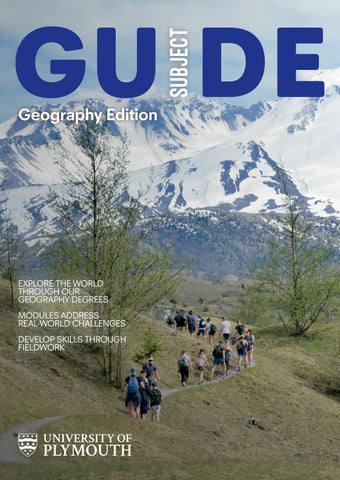
SUBJECT Geography Edition
EXPLORE THE WORLD THROUGH OUR GEOGRAPHY DEGREES MODULES ADDRESS REAL-WORLD CHALLENGES DEVELOP SKILLS THROUGH FIELDWORK
Admissions +44 (0)1752 585858 admissions@plymouth.ac.uk School & College Outreach outreach@plymouth.ac.uk University of Plymouth Drake Circus Plymouth Devon PL4 8AA United Kingdom
Follow us on social media @plymuni
Geography Edition
Inside...
SUBJECT
FEATURES: P. 8 Which degree is right for me? Which Geography courses are available?
It’s never too early to start thinking about what you would like to do after school or college, or if you are considering a career move. At Plymouth, we know that choosing a university and course is a big decision. Our Geography degrees provide the knowledge and skills to help tackle global challenges and prepare students for a wide range of exciting careers. This subject guide details some of the exciting opportunities available through our suite of Geography degrees.
Meet some of this issue’s contributors:
P. 14 Out in the field Learn how working in the field improves your skills set. P. 18 Work experience Learn about our work-based learning modules and industry placement year and how they enhance your professional development. P. 20 Mapping a career Learn more about what careers are available in Geography. P. 22 Real life experience Joshua talks about his experiences at Plymouth.
Joshua Webborn BSc Geography with Ocean Science graduate Joshua shares his experience of his work placement with Plymouth Coastal Observatory. P22
Sophia Craddock BSc Geography graduate Sophia shares what she has been up to since graduating. P24
Jon Christie Careers and Employability Consultant Jon talks about the support available to our Geography students through the Careers Service. P28
P. 30 Spotlight on some of our research Read about some of the exciting developments we are making in different research areas.
E XPLO R E YO UR FU T UR E H O M E Visit us at an Open Day
Virtual tour Welcome to our city
When it comes to finding out if university feels right for you, nothing compares to an open day. Talk to current students and quiz lecturers about your course. You can register to attend here plymouth.ac.uk/open-days
Experience first-hand what it is like to be on campus and explore the environments and facilities that inspire and shape our learning every day. Step into one of our campus buildings and picture yourself studying here with us.
Information correct at time of going to print - September 2026
4
10 R E ASON S TO S TU DY AT PLYMOU TH If you have picked up this brochure, then you have already taken the first steps of an exciting journey into your future. By studying Geography at University you will learn about our incredible planet, the people, places and environments that shape it, and the global challenges we face. Geography offers you the knowledge and skills to understand these challenges and to be part of positive solutions. Here are my top ten reasons to study Geography with us here in Plymouth.
Dr Nicky Harmer, Lecturer in Human Geography and International Exchange Coordinator
5
2. BE TAUGHT BY EXPERTS
Your lecturers are part of a friendly academic team who are passionate about their research. They draw on their cutting-edge expertise in their field to inform their teaching and share their knowledge with you.
1. BE INSPIRED TO BE PART OF THE SOLUTION Studying the connections between society and the environment, geographers are uniquely placed to understand the connections between humans and the world around us, and to help provide solutions to many of the planet’s most pressing problems.
3. DEGREE FLEXIBILITY
Our flexible BA (Hons) and BSc (Hons) courses allow you to tailor the degree to your interests through module choices in the second and third years. There is also flexibility to swap between some of our Geography degrees.
6
4. OUTSIDE THE CLASSROOM
Plymouth offers vibrant city living with our main campus conveniently located in the heart of the city centre with the wide open space of Dartmoor and the miles of coastline and beaches easily accessible for students. A range of student societies make use of the location and offer something for everyone, including GeogSoc, which provides social and sporting activities and helps create a lively and friendly community of student geographers.
5. EXAM FREE OPTIONS
Our single honour degrees all offer exam free pathways, designed to support all learning styles.
6. YOU'LL USE CUTTING-EDGE FACILITIES
You’ll have full access to our well-equipped teaching and IT labs, including LABplus and our GeoMapping Unit. You’ll also benefit from our state-of-the-art Nikon lab which provides access to digitally enabled microscopes.
7
7. EXPERIENCE LEARNING OVERSEAS
You will have the opportunity to attend a residential international field trip in your second year of study from a choice of exciting locations. Previous trips have included: Sweden, USA, Australia and Iceland.
8. STUDY ABROAD WITH ONE OF OUR GEOGRAPHY PARTNERS Take advantage of a wide range of work placement positions and the chance to study at a university overseas in mainland Europe or North America.
*The location of international field trips may vary year upon year.
9. EXPLORE YOUR INTERESTS
Choose from our wide range of human, physical, environmental and GIS/data science modules. Our degrees offer practical and hands-on learning so that you will gain skills which are so sought after by employers.
10. ACCREDITATION
Our degrees are accredited by the Royal Geographical Society (with IBG), reflecting their quality and relevance in today’s society.
8
WHICH DEGREE IS RIGHT FOR ME?
BSc (Hons) GEOGRAPHY Our BSc (Hons) Geography degree explores the relationships between physical processes, nature and environmental change. You’ll learn from expert, accessible and supportive staff who are skilled researchers in their field. Plymouth is the ideal setting as a vibrant urban environment surrounded by iconic rural and coastal landscapes.
BA (Hons) GEOGRAPHY Our BA (Hons) Geography degree explores the impacts of humans on societies, mobilities and environmental governance. All our Geography degrees have modules that align with the United Nations Sustainable Development Goals to provide you with the knowledge and skills to understand and tackle the biggest global challenges facing the planet and humanity.
Find out more
Find out more
BSc (Hons) GEOGRAPHY WITH GIS AND DATA SCIENCE This degree gives you the knowledge and skills to work at the cutting edge of analysing, mapping and communicating spatial data.
BSc (Hons) GEOGRAPHY WITH OCEAN SCIENCE This degree allows you to focus on physical geographical processes while also studying ocean science. Plymouth’s coastal location, close to Dartmoor and flanked by two major estuaries, is the perfect setting to study marine and terrestrial environments.
about our BSc (Hons) Geography course
Find out more
about our BSc (Hons) Geography with GIS and Data Science
Find out more
about our BSc (Hons) Geography with Foundation Year course
Find out more
about our BSc (Hons) Environmental Geography course
about our BA (Hons) Geography course
Find out more
about our BSc (Hons) Geography with Ocean Science course
BSc (Hons) GEOGRAPHY WITH FOUNDATION YEAR This course provides the opportunity for progression onto any of our Geography degrees on successful completion of the foundation year. This option is aimed at those returning to education or if their current qualifications do not allow direct entry onto a three or four year course.
BSc (Hons) ENVIRONMENTAL GEOGRAPHY This Environmental Geography degree explores the relationship between humans and the natural world through the investigation of environmental issues. It combines a unique combination of environmental and geographical modules.
BA (Hons) GEOGRAPHY WITH INTERNATIONAL RELATIONS Discover the core principles of human geography while also exploring key international political and economic issues. You’ll study the relationships between people, place and environment in your Geography modules, while in International Relations the focus is on understanding the international political landscape. Find out more
about our BA (Hons) Geography with International Relations course
PLANNED NEW COURSES FOR 2027 BSc (HONS) ENVIRONMENTAL PLANNING AND DESIGN Gain knowledge and skills to plan and design more sustainable places for people, nature and the economy. These include providing new homes, jobs and infrastructure, responding to climate change, and creating places that support people’s health and wellbeing.
MPlan (HONS) ENVIRONMENTAL PLANNING AND DESIGN This four‑year integrated master's degree gives you the practical skills and knowledge needed to develop creative, evidence‑based solutions that benefit people, places and the environment. You’ll learn how to prepare plans and policies, work with communities and stakeholders, and support the design and delivery of real projects on the ground.
Find out more
about our BSc (Hons) Environmental Planning and Design course
Find out more
about our MPlan (Hons) Environmental Planning and Design course
9
“A key focus of the BA and BSc Geography courses at Plymouth is the flexibility that they afford in allowing you to pursue the aspects of the discipline you find interesting. A valuable element of the course is the range of fieldwork you can engage in, taking advantage of our local environment both in terms of the physical environments on our doorstep as well as Plymouth’s complex coastal urban and social geographies.” Simon Dickinson Geoscience and Society Programme Lead
“As a result of the course's flexibility I developed a well rounded understanding of our physical environment and crucially, how we as humans interact with it." Alex, BA (Hons) Geography
“Studying at Plymouth completely shaped my career plans. It opened so many doors and enabled me to be employed in my dream job just one week after graduating! It was from an employability talk I attended in my final year that I was able to get in touch with Plymouth City Council and secured work experience with one of the speakers, which ultimately led to full-time employment.” Sophie, BA (Hons) Geography with International Relations
10
EXPLORING THE WORLD THROUGH YOUR GEOGRAPHY DEGREE
11
Each Geography student’s learning journey is unique. As you progress through your degree you will start to choose the modules and topics that fire your imagination and interest. In your first week at Plymouth, you will meet your personal tutor, one of our Geography academic staff, and fellow tutees – a great opportunity to make friends in a small group of geographers.
12
Throughout your first year, your group will meet regularly, helping you settle in and learn key academic skills. Your tutor is also your first port of call if any issues affect your study and they can direct you to support services. Each semester you will take three modules (courses), taught by our research-active academics who are recognised as excellent university teachers and bring their cutting-edge research into the classroom. In the first year, depending on your degree, this could include learning about glaciers, deserts and climate change, water, landscapes and environmental management, our digital planet, Geographical Information Systems (GIS), or key sustainability challenges.
If you are taking a combined honours degree you could also study modules such as about biodiversity and marine ecosystems or international relations since 1945. Some classes are in large lecture halls but there are also fieldtrips in the Southwest of England, practical sessions in our well-equipped laboratories or specialised computer suites, smaller seminar groups, and independent study. Each module is assessed, and we use a range of different assignments to cater for different learning styles. For single honours students there are exam-free pathways and instead we use presentations, open book assessments, reports, essays, policy briefs, podcasts and others to help build your skills for professional employment.
In the second year you choose modules depending on your degree’s pathway or your interests, whether that is urban planning and security, transport and mobility, nature and society, remote sensing, weather, climate and meteorology, or others. In semester two you have the opportunity for residential fieldwork overseas – an incredible chance to learn in and explore a different culture and physical environment, led by academic experts. Your third year sees even more choice of specialist modules, the chance to experience an interdisciplinary fieldwork expedition overseas, and your capstone achievement – a dissertation research project produced with the one-to-one guidance of an expert academic advisor.
13
Our academic staff are experts in their area of research and bring their enthusiasm for their subject into the classroom. They are approachable and friendly and the Geography department has a community feel. This sense of community is fostered further by the Geography Society (GeogSoc), an optional studentrun society that brings together Geographers across all the years of study, through sports, social and community-orientated activities. Whichever pathway you choose, we are confident that you will gain cutting edge knowledge, expert skills and learn in depth about the fascinating geographies of our planet.
14
OUT IN THE FIELD
Our extensive international field trip programme allows you to hone your geographical and transferable skills in exciting and challenging environments. “An unforgettable adventure. This trip challenged my skills and offered the opportunity to conduct original research in one of the world’s most complex drylands. It is a defining, hands-on experience that I encourage every student to seize.” Lois Barnes, BSc Geography, took part in the field trip to Namibia
Find out more We've signed up to the Royal Geographical Society's principles for undergraduate field courses. Encompassing safe, sustainable, ethical, accessible and inclusive field work opportunities for all students.
15
All of our degrees offer local, regional and international fieldwork. In addition to short field visits within Devon and Cornwall, we run residential trips to European and other international destinations. We believe you learn best from direct experience of the world’s natural and cultural environments. In your first year, you’ll undertake fieldwork in the region as well as within and around the city of Plymouth. These activities are designed to help you build skills and confidence, familiarising you with key human and physical geography themes. In the second year, our field programme is geared towards supporting your training in geographical research methods, enabling you to develop the skills base you’ll need to complete your dissertation and other research projects in the final year of your degree. You tailor the nature of your field-based training to the areas of geography in which you plan to specialise.
Our trips enable you to study very different cultures and environments in more distant parts of the world. The contrasting places we visit open up the possibility of small group studies in a huge range of human and physical geography topics. In any given year we usually offer a choice of trips to destinations where our staff have active research interests, contacts and sources of project work, so you are able to learn from local experts, including academics, field scientists, planners and policy makers. Students rate our field trips as one of the highlights of their degree – a unique educational and social experience. STUDY OVERSEAS Once enrolled at Plymouth all geography students are given the opportunity to apply to study abroad for either one semester or the whole of the second year. You will then return to Plymouth and complete the final year of your degree. If you wish, you could still also complete a work placement the year after returning from abroad.
We have extended global networks with leading geography departments across Europe, North America and Australia. Research shows that students who study abroad are more likely to achieve at a higher academic level, get a job and earn more when they graduate, are more international in their lives, and show greater personal development.
16
You’ll make use of our modern, well equipped teaching and IT laboratories and cartographic facilities.
17
LABplus is our open access, student centred learning environment – a great group working space which contains laptop computers, compound microscopes, stereo microscopes, microscope cameras, flexible desk space, a portable screen for presentations, Wi-Fi, printing and photocopying as well as specially designed resource boxes to support individual modules. For physical geographers, our scientific officers and technicians work with the latest equipment and instrumentation in: • a large fully-equipped physical geography teaching laboratory • an analytical laboratory • palaeoecology laboratories • a microscopy laboratory. We also have soil and sediment preparation facilities, environmental monitoring
equipment for both field and laboratory analysis, extensive field equipment and specialist analytical instrumentation. The GeoMapping Unit provides expertise in cartography and GIS. Resources available to you include advice on map production and design for coursework and projects, field data capture and how to access and analyse the many digital spatial datasets available. We have collections of aerial photography and paper maps covering topography, soils, geology and many other themes. FACILITIES • LABplus • GeoMapping Unit • Teaching laboratories • Computing suites • Physical geography laboratories • Nikon 5G microscopy labs • Our local environment.
18
WORK EXPERIENCE & INDUSTRY PL ACEMENTS WHERE WILL YOUR GEOGRAPHY WORK PLACEMENT TAKE YOU...? Our final year work-based learning optional module is a great demonstration of the importance our geography degrees place on preparation for employment. Working with an employer provides you with the chance to develop skills and refine career ambitions, whatever they may be. The diverse nature of the placement opportunities is illustrated on the right.
The work-based learning module enables you to apply your geographical knowledge, expertise and skills in a professional setting and provides a detailed insight into the world of work.
hands-on experience outside of the classroom, invaluable insight into life after graduation and provides you with rich professional development and networking opportunities.
Another pathway is to take a placement year between the second and final years of your degree. This option is becoming increasingly popular.
A placement exposes you to a professional working environment where you’ll be expected to work with a team and communicate and collaborate with others in that industry. You'll gain direct experience of working in industry which will be invaluable to your career path and your final years at university.
Placements can be incredibly beneficial for undergraduate students. A placement provides valuable,
19
"The work-based learning module is incredibly flexible. Students do work placements all over the world and undertake varying roles." MATT BISHOP BA (Hons) Geography graduate, International Travel Consultant, Placement at Flight Centre
EXAMPLES OF RECENT PLACEMENT ORGANISATIONS • BBC Worldwide Ltd • Beazley Management Limited • Bournemouth Borough Council • Corylus Ecology • Dartmoor Zoo • Devon and Cornwall Food Association • Field Studies Council • MVV UK • PFA Consulting • Plymouth City Council • Plymouth Coastal Observatory
• Reading Transport Limited • Royal Geographical Society • Scottish Natural Heritage • Swansea City Council • Totnes Neighbourhood Plan • Totnes Town Council • UK Hydrographic Office • Waterwise
20
MAPPING YOUR FUTURE CAREER
"The role of geography is increasingly important in today’s changing and complex world and is critical to solving the next generation of challenges." Baroness Lynda Chalker, Former President of the Royal Geographical Society
21
HELPING YOU FIND YOUR CAREER The applied and practical nature of our degree courses provides an excellent foundation for many varied career opportunities, and geography graduates are highly sought after by employers. Our degrees are designed to embed careers guidance every step of the way. • Our modules place an emphasis on skills for employment. • Career choices and employability training are included clearly within core second year modules, providing you with advice on identifying and applying for suitable jobs. • Placement opportunities in industry are available as part of your course between the second and final years. • Work-based learning is an option in your final year. As a geography graduate you will be empowered with the knowledge and skills to develop successful careers in a wide range of areas. Prince William is a geography graduate, as are Network Rail Chairman Peter Hendy, fashion designer
Wayne Hemingway, broadcaster Chris Tarrant and Kaiser Chiefs drummer Nick Hodgson. SKILLS YOU WILL GRADUATE WITH You will become familiar with unexpected challenges and understand in detail different relationships between cultures, political systems, economies and environments across local, regional and international scales. You will be very well-equipped to understand and develop the complex multidisciplinary systems in which the business and public sectors operate. When you graduate you will be: • open-minded and curious • a good communicator with strong presentation skills • versatile • confident • an independent researcher with skills in critical analysis • able to work effectively in a team • effective at managing your time and prioritising • good at gathering information from a variety of sources to create an argument • an excellent writer • confident using IT systems.
As well as these important transferable skills you will gain a whole range of specialist skills and knowledge including: • scientific and lab skills • producing and interpreting maps skills • research and interpretation of data skills including Geographic Information Systems (GIS) • environmental and social awareness • written and verbal communication skills • team-based project work • fieldwork techniques.
"The activities that I undertook with the Careers and Employability Service have made my options after graduation a lot clearer and have taken away the pressure of trying to research and learn everything on my own." Abi Kinsella, BSc (Hons) Geography graduate
22
REAL LIFE SKILLS A work placement with Plymouth Coastal Observatory (PCO) provided BSc (Hons) Geography with Ocean Science graduate Joshua Webborn with valuable experience and led to him obtaining a job with the organisation. The PCO is part of a national network of six individual regional coastal monitoring programmes around the UK that collect and analyse data in a systematic manner to accommodate coastal and engineering management needs. Joshua explained: "As part of my workbased learning module on my Geography with Ocean Science degree, I completed 100 working hours on placement with PCO. I used and built upon my surveying skills by assisting the PCO team carrying out beach surveys using RTK GPS in a systematic manner and understanding the essential precision of accuracy while surveying. It was extremely relevant to my degree as it provided me with extended knowledge of the coastal environment and the processes
that occur. It also provided me with the skill set needed to pursue a career in coastal processes and has led to a job with the PCO.” Joshua now assists in the provision of the South West Regional Coastal Monitoring Programme. The programme’s aim is to produce a standard, cost effective and repeatable method of monitoring the coastline in the South West. As one of three Coastal Process Scientists, Joshua is a part of a dedicated, specialist team that analyses and quality checks all of the data and reports the findings to provide accurate information upon which management decisions can be made.
23
24
GRADUATE STORIES
SOPHIA CRADDOCK
Geography graduate tackles flooding in the South West BSc (Hons) GEOGRAPHY GRADUATE Sophia Craddock graduated in 2017 with a BSc (Hons) Geography degree and now has an exciting role helping to combat flood risk and to improve the environment using solutions based on natural processes. As Nature-based Solutions (NBS) Lead Advisor for Devon, Cornwall and the Isles of Scilly at the Environment
Agency (EA), she works closely with flood risk and environmental specialists. Part of her role is on a project helping to reduce flood risks facing communities around the River Otter catchment in East Devon – an area which saw significant flooding in 2023.
Sophia explains that she enjoys working with colleagues towards common goals through various project and strategic work with highlights being able to share learning, advance nature-based solutions science, and close knowledge gaps for wider adaptation of measures at the landscape scale, while increasing flood resilience for
25
local communities who are at an ever-increasing risk due to climatic changes. Sophia explains: “My degree was great preparation academically for my current role and provided the key understanding of systems and processes which I would go on to continue to draw upon in my working life. “A prime example would be developing my Geographic Information Systems skills which has continued to be beneficial, whether in supporting me to develop Naturebased Solutions tools, or creating visual mapping resources to aid project partner collaboration”. Sophia also believes her Geography degree, which included various field trips locally and abroad to Portugal, helped her to understand the practicalities around project work and delivery.
My degree was great preparation academically for my current role and provided the key understanding of systems and processes which I would go on to continue to draw upon in my working life." She says: “Accompanied by taking modules in Climate Change, Hydrology and others, this has stood me in great stead for both my past self-employed and current employed role working in the environment sector.” And Sophia is now working with the University of Plymouth Geography researchers through her role at the Environment Agency, to push the boundaries on NBS science and towards a better understanding of flood resilience for local communities.
She explains that studying at Plymouth significantly shaped her career aspirations: “Before attending university, I was unsure of my career path and where Geography might take me. However on completing the first year of the course I was presented with multiple opportunities for both further professional and social development which formed and informed my thinking around future career paths. I also found the careers team really helpful for advice and CV support. “I’d recommend undertaking a course with Plymouth University as this may also provide you with the opportunity to explore new ways of thinking and develop key skills which enabled me to grow both academically and as a person, providing the base for an exciting career in the environment sector!”
26
GRADUATE STORIES
NAOMI GROOME
Flood and Coastal Risk Management Officer, Environment Agency BSc (Hons) GEOGRAPHY WITH OCEAN SCIENCE GRADUATE
27
"I chose Plymouth as it was one of the only universities in the UK offering this course – it struck the perfect balance between developing my interests in physical geography (my favourite subject throughout school) and the broadening of my more specific interest in coastal environments. Having this combined offering meant I didn’t have to commit myself to one degree subject and gave me the opportunity to meet like-minded people across two degree disciplines . The location of Plymouth within the South West and the associated coastline perfectly aligned my interests, making it the perfect environment to undertake my degree. "The academic staff were key in guiding and shaping my university experience. I found them willing to provide unwavering help and support throughout my studies with nothing
"The final year field trip to Iceland was one of my favourite memories from my time at university. I got to work with a group of people that I had previously not met on the course, whilst exploring an incredible landscape and undertaking fieldwork"
"The hands-on elements of my studies I found to be most inspiring. I found that through putting into practice the theory behind the things we learnt about in lectures, my understanding was greatly enhanced along with a huge sense of enjoyment. Such experiences included the undertaking of fieldwork on the University’s research vessel as well as field trip experiences in Ireland and Iceland.
too big of an ask. The help from the staff in LABplus was vital in developing my understanding of the more technical elements of the degree, such as using ArcGIS and other software, and this guidance was invaluable. For my dissertation, the support provided by my advisor was incredible; they made themselves available to me to answer my questions and provide guidance throughout the whole process which I believe was certainly a key factor in my project’s success.
"The final year field trip to Iceland was one of my favourite memories from my time at university. I got to work with a group of people that I had previously not met on the course, while exploring an incredible landscape and undertaking fieldwork where I was able to put my learnt knowledge into practice. My other favourite memories are of long days in the library with friends, lunch from Loafers and a pint at Air at the end of the day."
28
CAREER SUPPORT
Meet Jon Christie, our Careers and Employability Consultant (STEM specialist). Jon has been working in the university careers sector for over 20 years. HOW DO YOU SUPPORT THE CAREER PROSPECTS OF OUR STUDENTS? One of the important parts of my job is to make students aware of the breadth of opportunities that are open to them both during and after they graduate. Geography is a fantastic example of a subject area with so many exciting pathways open to graduates.
THIS IS FACILITATED BY: • course-based lectures on employability in all three years of study, the opportunity of doing a year long work placement, and one-to-one careers guidance appointments • inviting employers and alumni onto campus via careers fairs, employer panels and specific academic activities.
WHAT CAREER SUPPORT SERVICES DOES THE UNIVERSITY OFFER? The Careers Service offers students one-to-one careers guidance at any point during their studies and continues after graduation so that graduates can continue to benefit from support with: • job hunting, application writing, CVs, networking, and interview skills • on-campus careers fairs
29
• a work placement programme using our extensive industry contacts (with many opportunities being paid) and an industry mentoring scheme. The latter matches students with a specific industry individual who will meet with them regularly to provide incredibly valuable insights into a specific sector. University of Plymouth alumni, now working in key areas are invited to become mentors and use the programme to give something back and to spot future talent. Our myCareer vacancy platform hosts an extensive database of both graduate, placement, and part-time opportunities. It allows students to sign up for events such as employer panels, enterprise competitions or mentoring. It also holds a range of highly specialised digital tools such as a CV builder, an interview simulator, online courses and video resources. Access to myCareer is available to our graduates at any time in the future.
HOW DO YOU JUDGE THE JOB PROSPECTS FOR GEOGRAPHY GRADUATES? Excellent. Currently demand for Geography graduates is extremely high in several sectors but also many of the academic skills are transferable across a very broad range of STEM employer sectors. Geography graduates from the University enter the following sectors – meteorology, transport planning, teaching, GIS, sustainability, international development, environmental consultancy, hospitality management, project management and the armed forces, to name a few. Graduate salaries are also very competitive and for many students doing work placements, it is highly likely that they may well be offered a graduate role with the placement host after completing their final year. This is also reflected by the great willingness of employers seeking to recruit our students by engaging with our events and online vacancy platform.
"The Careers Service were a huge help to me when looking for a placement. They gave me the skills and confidence to reach out to companies and organisations in order to put myself ‘out there’ as someone who could be an asset to them while gaining practical skills myself that would set me up for future employment.” Naomi, BSc (Hons) Geography with Ocean Science Graduate
FIND OUT MORE about the Careers team and how they can help you
30
GEOGRAPHY IN ACTION
Educators leading the way in research At the heart of our Geography programmes is a vibrant research community committed to understanding how people and environments interact in an increasingly complex world. Our expert staff are not only dedicated educators but also active researchers working at the forefront of their fields. Their work shapes policy, informs realworld decisions, and contributes to global debates on pressing environmental and social challenges.
31
Our research spans a wide spectrum of exciting themes, with studies in the following topics: MULTIPLE MOVES DURING CHILDHOOD CAN INCREASE THE RISKS OF DEPRESSION IN LATER LIFE
Professor Clive Sabel, Professor of Big Data and Spatial Science is working with researchers from Aarhus University (Denmark) and the University of Manchester (UK). This study used population registers to examine how moving house in adolescents impacted mental health in later life.
THE DISCOVER OF DUNES ON PLUTO
Research led by Dr Matt Telfer, lecturer in Physical Geography has made an exciting discovery of dunes of frozen methane on Pluto. Analysing images sent from NASA provided new insights into Pluto and its environmental conditions.
SUPPORTING SOIL SUSTAINABILITY
Professor Will Blake, Director of the Sustainable Earth Institute, has partnered with a group of farmers across Cornwall in a trial to improve soil health while reducing erosion and flooding, using robotics technology to help measure success.
MOUNTAIN HAZARDS AND THEIR LASTING IMPACT ON LANDSCAPES Dr Matt Westoby leads an international team working in the Indian Himalaya, researching how landscapes adjust after landslides and avalanches where vast quantities of rock, ice and snow are transferred to the valley floors. The importance of this research has been highlighted by the devastating Tibet-Nepal flood in August 2026, which was triggered by a rock and ice avalanche. Matt’s research will provide valuable insights into how communities and infrastructure remain affected long after floodwaters have receded.
URBAN SECURITY IN AN AGE OF RISK
Cities today face a range of challenges, including crime, civil unrest, and terrorism. In response, governments, police forces, local authorities, and urban planners are developing new ways to make urban spaces safer and more resilient. Dr Paul Simpson’s research explores how these security challenges, and the measures designed to address them, shape people’s everyday experiences of living, working, and interacting in cities.
IT’S YOUR FUTURE MAKE IT COUNT Over 93% of our graduates are in work or further study* * Excludes those travelling, retired or caring for someone, out of all UK domiciled, full-time first-degree graduates. Graduate Outcomes Survey 2026
Apply
now