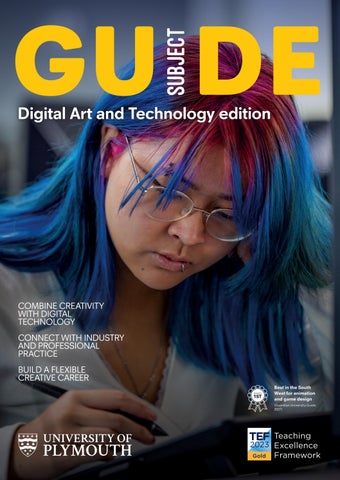
SUBJECT Digital Art and Technology edition
COMBINE CREATIVITY WITH DIGITAL TECHNOLOGY CONNECT WITH INDUSTRY AND PROFESSIONAL PRACTICE BUILD A FLEXIBLE CREATIVE CAREER Best in the South West for animation and game design (Guardian University Guide 2027)
Gold
Admissions +44 (0)1752 585858 admissions@plymouth.ac.uk plymouth.ac.uk School of Art, Design and Architecture University of Plymouth Drake Circus Plymouth Devon PL4 8AA United Kingdom
Follow us @plymuni @plymuniapply
3
Digital Art and Technology
Inside...
SUBJECT
FEATURES: P.4 10 reasons to study at Plymouth
Start your extraordinary story. It’s never too early to start thinking about what you would like to do after school or college, or if you are thinking of a career move! At Plymouth, we know that choosing a university and course is a big decision. While you may have an idea of a profession, career or industry that you’re aspiring towards, if you’re unsure of exactly what you want to do or are keen to find out more – this is where our handy guide comes in.
Meet some of this issue’s contributors:
Dan BA (Hons) Game Arts and Design student Building a game world from the ground up P.18
Emma BA (Hons) Illustration graduate Making art that makes a difference P.36
Ellie BA (Hons) Game Art and Design graduate Finding my place in the games industry P.40
E XPLO R E YO UR FU T UR E H O M E Visit us at an Open Day
Discover our city by the sea
When it comes to finding out if university feels right for you, nothing compares to an open day. Talk to current students and quiz lecturers about your course. Register to attend here.
Our city-centre campus is the focal point for student life at the University of Plymouth. Picture yourself studying here with us – we know you’ll enjoy the view.
P.10 Which degree is right for me? Explore, experiment, excel in your creative career. P.14 Where ideas become experiences Push your creativity further with specialist facilities designed for digital making, game development, immersive experiences, visual communication and content creation.
P.26 Where will your degree take you? Alongside your studies, we’ll support you in the realisation of your career goals and help you get to where you want to be. P.28 Building a global illustration career Freelance illustrator Mark Smith has built an international career creating work for clients including Rolling Stone, Vanity Fair, Time and The New York Times.
4
10 R E ASONS WHY DIGITAL CR E ATIVIT Y THRIVES AT PLYMOUTH From games and immersive experiences to digital content, graphic design and illustration, technology is transforming the way we create, communicate and experience ideas. At Plymouth, you’ll explore where creativity meets technology – developing practical skills, experimenting with emerging tools and working on projects that reflect the way creative industries work today. Whether you’re passionate about games, digital media, design, illustration or immersive technology, you’ll have the opportunity to turn your ideas into a flexible creative career. Here are ten reasons to start your digital creative journey at Plymouth.
5
1. COMBINE CREATIVITY WITH DIGITAL TECHNOLOGY
Bring your ideas to life using industry-standard creative tools and emerging technologies. Explore game engines, 3D modelling, digital media, AI, creative coding, VR/XR, motion capture and immersive technologies – developing the confidence to experiment, adapt and create.
2. CREATE IN SPECIALIST FACILITIES
Get hands-on in specialist facilities including the Digital Fabrication and Immersive Media Laboratories, Make, VR and Game Labs, photographic studios and darkrooms, film and TV production studios and digital design and fabrication facilities. Experiment, prototype and bring your ideas to life using professional equipment and technologies.
6
3. LEARN BY MAKING Develop your skills through practical projects, experimentation and studiobased learning. From creating games and digital content to developing visual identities, illustrations and immersive experiences, you’ll learn by making, testing and refining your ideas.
4. WORK ON INDUSTRYINSPIRED CREATIVE CHALLENGES Respond to live briefs, collaborative projects, competitions and industryinformed challenges. Build experience of working to a brief, solving problems creatively and developing work that has a clear audience and purpose.
7
5. CONNECT WITH INDUSTRY
Learn from practising professionals, visiting speakers and industry experts while developing an understanding of professional creative practice. Opportunities such as placements, live projects, commissions and industry engagement help you build valuable experience and professional connections.
6. COLLABORATE ACROSS CREATIVE DISCIPLINES Work alongside other creative students and explore what happens when different skills and perspectives come together. From games and illustration to graphic design, digital media and immersive technology, collaboration can open up new creative possibilities and ways of working.
8
7. DEVELOP ADAPTABLE SKILLS
Prepare for a creative landscape that is constantly evolving. Develop creative problem-solving, technical skills and the ability to experiment with emerging technologies, including AI, XR and interactive media. Learn how to adapt as technologies, audiences and industries change.
8. TURN YOUR CREATIVITY INTO OPPORTUNITY
Explore different routes into the creative industries, from employment and freelance careers to entrepreneurship and your own creative venture. The Cube supports students and graduates with business ideas, freelancing and selfemployment through advice, workshops, networking and one-to-one support.
9
9. BUILD A PORTFOLIO THAT SHOWS EMPLOYERS WHAT YOU CAN DO Develop a body of work that reflects your creative voice, technical abilities and professional ambitions. Across the courses, portfolio development is an important part of preparing for employment, further study and opportunities within the creative industries.
10. SHAPE A FLEXIBLE CREATIVE CAREER
Graduate with the creative, technical and adaptable skills to take your next step. Careers can span games, digital content, graphic design, illustration and immersive technology – as well as emerging roles across the wider digital economy. From XR and simulation to creative technology and content creation, you’ll be prepared to keep learning, adapt and shape your career.
10
WHICH DEGREE IS RIGHT FOR ME? Explore, experiment, excel in your creative career
Where creativity meets technology, new possibilities take shape. Explore digital media, games, graphic design, illustration and immersive technology through practical, industryinformed degrees designed for the way creative careers are evolving. Whether you want to create content that gets noticed, design captivating game worlds, communicate ideas through graphic design, develop your own visual voice or build immersive experiences that address practical challenges, you’ll learn by making, experimenting and collaborating. Develop your creative and technical skills, build a professional portfolio and graduate ready to start your career. BA (Hons) DIGITAL MEDIA AND CONTENT CREATION Want to create content that gets noticed? Develop your creative voice across video, photography, graphic design, branding, social media and digital storytelling. Explore emerging tools including AI while learning how to create engaging, platform-native content and understand audiences. With live briefs, studio projects, collaborative work and opportunities to explore entrepreneurship, you’ll graduate with the creative, business and professional skills to build a career in the fast-moving creator economy. FIND OUT MORE BA (Hons) Digital Media and Content Creation
BA (Hons) GAME ARTS AND DESIGN Love creating the worlds, characters and visual experiences that bring games to life? Develop skills in 2D art, 3D modelling, animation, level design and gameplay coding using industry-standard tools including Unreal Engine and Blender. Work on games and immersive experiences in specialist facilities, learn from industry experts and explore the different stages of game development. With opportunities for placements and a focus on professional practice, you’ll build the skills and portfolio to launch your career in games and beyond. FIND OUT MORE BA (Hons) Game Arts and Design
BSc (Hons) GAME PRODUCTION AND DESIGN Want to bring games to life through code, creativity and interactive design? Learn to design, build and prototype games while developing your skills in programming, game mechanics, C++ and scripting. Work independently and collaboratively on industry-ready projects, exploring everything from interactive gameplay to alternative controllers, installations and immersive digital experiences. Graduate with a professional portfolio and the technical and creative skills to take your ideas into the games industry. FIND OUT MORE BSc (Hons) Game Production and Design
11
“The moment I realised I was becoming a games developer was a lecture in my first year where we started learning coding in Unreal Engine 5. Using industry-standard software to do something that felt so advanced made me feel so professional, and I felt like everything suddenly just fit into place.” Esther, BA (Hons) Game Arts and Design student
12
“The fact that I’m now in a job that I love, that I trained for, just proves how well the course prepares you.” Caitlin, BA (Hons) Graphic Design graduate
BA (Hons) GRAPHIC DESIGN Want to use design to communicate ideas that make an impact? Explore typography, image-making, editorial, identity and digital design while developing your own creative approach. Combine traditional and digital processes, collaborate on practical challenges and explore how design can respond to contemporary issues including sustainability. With expert teaching, industry insight and a strong focus on portfolio development, you’ll graduate ready to start your career in the creative industries.
FIND OUT MORE BA (Hons) Graphic Design
BA (Hons) ILLUSTRATION Ready to develop your own visual voice? Experiment across digital media, immersive VR and traditional techniques including drawing, printmaking, ceramics and bookbinding. Work on live briefs, commissions and competitions while learning from practising illustrators, visiting professionals and global speakers. With opportunities to explore specialist areas such as animation, comics, children’s markets and printmaking, you’ll have the freedom to shape a creative career around your passions.
FIND OUT MORE BA (Hons) Illustration
BSc (Hons) IMMERSIVE TECHNOLOGY AND SIMULATION DESIGN Want to build immersive experiences and digital simulations? Combine creativity, programming and design to create virtual and augmented reality experiences, interactive simulations and digital twins. Work with game engines, creative coding and immersive technologies to tackle challenges across areas including healthcare, marine technology, engineering and beyond. With live industry briefs, specialist facilities and hands-on projects, you’ll graduate ready for emerging careers in XR, simulation, visualisation and creative technology. FIND OUT MORE BSc (Hons) Immersive Technology and Simulation Design
13
14
WHERE IDEAS BECOME EXPERIENCES Push your creativity further with specialist facilities designed for digital making, game development, immersive experiences, visual communication and content creation. From motion capture and virtual reality to 3D scanning, digital fabrication, game engines and professional photography spaces, you’ll have the tools to experiment, prototype and make your ideas.
CREATE, EXPERIMENT AND EXPLORE
DIGITAL FABRICATION AND IMMERSIVE MEDIA LABORATORIES Explore emerging technologies and turn digital ideas into physical and immersive experiences. The Digital Fabrication and Immersive Media Laboratories give you access to motion capture, augmented, mixed and virtual reality, 3D scanning and digital fabrication technologies. Experiment with rapid prototyping, 3D printing, CNC milling, 3D modelling and immersive visualisation. The Immersive Media Lab also provides a black-box environment for testing games, interactive experiences, products and simulations – giving you space to experiment, collaborate and push creative boundaries.
15
PROTOTYPE IDEAS. BUILD WORLDS. MAKE GAMES
VR AND GAME LABS Bring interactive ideas to life in specialist spaces dedicated to making, virtual reality and game development. Use 3D printers, electronics, sensors, motion-tracking equipment and prototyping tools to develop physical and digital projects. The VR Development Lab gives you access to VR headsets and VR-ready PCs running Unity and Unreal Engine, while the Games Development Lab provides highspec workstations, 4K monitors, controllers and industry-standard software including Unity, Unreal Engine, Maya, ZBrush and Substance Painter.
16
SEE YOUR IDEAS IN IMMERSIVE DETAIL
IMMERSIVE VISION THEATRE Experience digital work in the Immersive Vision Theatre, which provides a dedicated space for projects that combine surround vision, sound and interactive technologies. Use immersive visualisation to explore new ways of presenting ideas, storytelling and experiences – from digital media and design projects to immersive worlds and simulations. “Making content for the immersive dome and being able to see what you and your classmates made on such a large scale was such a cool experience!” Esther, BA (Hons) Game Arts and Design student
CAPTURE YOUR IDEAS
PHOTOGRAPHIC DARKROOMS AND STUDIOS Develop your visual and technical skills using professional photography facilities. Work across analogue and digital processes in specialist darkrooms and studios, with access toAprofessional lighting, backdrops, tethered shooting setups, high-resolution scanning and colour-accurate displays. These spaces give you the flexibility to create content, develop visual assets and experiment with photography as part of your wider digital practice.
17
DESIGN, MAKE, PROTOTYPE
DIGITAL DESIGN AND FABRICATION Move between the digital and physical worlds. Develop concepts, create prototypes and explore new approaches to making using specialist digital fabrication equipment. Facilities include 3D printers, laser cutters, CNC machines, 3D scAanners and digital modelling software. You can work with tools including Adobe Illustrator, Autodesk Maya, ZBrush, Rhino, Fusion 360 and Gravity Sketch, giving you opportunities to explore everything from graphic and product ideas to 3D assets and immersive environments.
CREATE, CAPTURE AND REFINE
FILM, TV, AUDIO AND ANIMATION Bring moving-image and digital content projects to life in professional production environments. Access film and TV studios, animation facilities, postproduction spaces and audio production resources alongside industry-standard software and equipment. These facilities complement your digital practice, giving you opportunities to develop content across photography, video, animation, sound and digital media.
18
BUILDING A GAME WORLD FROM THE GROUND UP DAN
BA (Hons) Game Arts and Design student For Dan, studying Game Arts and Design at Plymouth has given him the opportunity to turn his passion for games into practical experience, from designing game environments to working with industry-standard software. His projects have allowed him to experiment, collaborate and develop the skills he hopes to take into a career in games.
19
WHY DID YOU CHOOSE TO STUDY GAME ARTS AND DESIGN? I have been passionate about games and game design from a very young age. I remember, when I was very young, realising that someone had to have made what I was playing. From that point onward, I knew that I wanted to pursue a career in video game design. I chose to study at Plymouth because I had heard that it’s one of the best universities to study video game art and design. Its facilities are some of the best in the country. Not only that, but it is a vibrant city that I fell in love with immediately after visiting for the first time. WHAT HAVE YOU ENJOYED MOST ABOUT THE COURSE? Being able to work on a wide variety of team projects with some amazing, likeminded people has been an incredible highlight. TELL US ABOUT YOUR FAVOURITE PROJECT My favourite project that I have worked on so far is a PlayStation One style
‘Metroidvania’ game, in which you play an axolotl named Quetzal that must navigate through a complex largescale dungeon to reach the door to the underworld. I was behind the entire creation of the level and environment design – with help from my team to create a variety of assets for me to use. It’s interesting reflecting on how the project developed from a simple greybox test, alongside a design journal, to a fully-fledged environment that makes the most of all the gameplay mechanics. WHAT TECHNOLOGY DID YOU USE? We used Unreal Engine 5 to produce the game and Maya to model external assets that we used in the game. Adobe Substance 3D Painter was also used to create the textures for the game. HOW DID PEOPLE RESPOND TO YOUR PROJECT? The audience reaction to my project was incredibly positive and I am really proud of what I have made!
WHAT SUPPORT HAVE YOU RECEIVED? The support I have from the lecturers of the course has been unmatched. They are incredibly friendly and are always willing to help with an issue. The Careers Service has also been efficient and very easy to access. WHAT ARE YOUR CAREER AMBITIONS? My career ambitions are to be a level designer or environmental artist for a large-scale video game studio to help make big budget games. It’s what I am most passionate about doing in the industry and I would love to work for a company like Valve or Naughty Dog. WOULD YOU RECOMMEND THE COURSE? If you’re at all interested in making video games, I would highly recommend the BA (Hons) Game Arts and Design course. It covers everything you need to know about making games and allows you to pursue your creativity without any restrictions. Plymouth is an incredible university with incredible people and facilities – and I cannot recommend it enough.
20
ONCE IN A LIFETIME EXCHANGE TO JAPAN ANNA
BA (Hons) Illustration Student
21
For Anna, choosing to study Illustration at Plymouth came down to one incredible opportunity: the chance to study in Japan. After hearing about the exclusive exchange programme at an open day, she knew she had to study at Plymouth. “It was a once-in-a-lifetime experience that massively increased my confidence. It opened my eyes to international opportunities I never thought possible before.”
22
AN INTERNATIONAL OPPORTUNITY I became a Student Ambassador, worked the open days, and threw myself into the course to give myself the best possible chance. The dedication paid off. After a portfolio review and an interview with lecturers, I secured one of two soughtafter places to study at Bisen College in Hokkaido, Japan. Supported by a £1,100 grant from the University, alongside funding from my church and the host college, I arrived in the snowy city of Sapporo. At Bisen College, I explored traditional techniques including ceramics, metal craft
and painting using mud paint, alongside a highly valuable portfolio-making class – something I can take forward to promote my work in future. The cultural experience extended beyond the studio, with lessons in flower arranging, tea ceremonies and calligraphy. BUILDING CONFIDENCE THROUGH EXPERIENCE The transition was made seamless thanks to a strong support system. The college’s point of contact, Miyazaki sensei, provided weekly language lessons and cultural trips to local shrines, while my lecturers back in Plymouth maintained regular video calls to offer continuous guidance.
“It’s taught me how to walk into environments where I don’t feel comfortable, throw myself in, and come out with a professional career.” The Japanese people were so friendly and encouraging. It was a once-in-a-lifetime experience that massively increased my confidence. It opened my eyes to international opportunities I never thought possible before. When I returned to Plymouth, I turned my experience into academic work, delivering an
23
assessed presentation and a 5,000-word essay blending my personal experiences with observations on Japanese society and politics. FROM LIVE BRIEFS TO REAL CLIENTS Back on campus, I channelled my newfound confidence into the course’s Professional Practice module. Working to a live client brief, I collaborated with the charity Students and Refugees Together (START), creating a Plymouth-specific piece around migratory birds. Guided by the course’s ethics seminars, I learned how to thoughtfully navigate sensitive client needs.
The real-world focus has also helped me build my professional client base. By sharing my live projects on LinkedIn, I caught the attention of major organisations. I was invited by Find Me Again to a live-scribing event in Croydon, where my work caught the eye of the local councillor and potential future clients. A company also spotted my work on LinkedIn and approached me for a commercial animation project. BUILDING A CREATIVE BUSINESS Plymouth has also given me opportunities to develop the practical skills I need to build a creative career.
Through The Cube, the University’s independent business start-up service, I’ve developed my understanding of invoicing, copyright and building a professional business pack. I’ve also put these skills into practice by running a student popup shop at the Year 1 and 2 Exhibition. The opportunities Plymouth has given me have been amazing. Genuinely one of the best experiences of my life. It’s taught me how to walk into environments where I don’t feel comfortable, throw myself in, and come out with a professional career.
24
FROM PLYMOUTH TO ONE OF THE TOP AAA GAMES STUDIOS LEAH
BA (Hons) Game Arts and Design graduate Game Design Intern, Criterion Games / Electronic Arts “I knew it would be really rewarding to experience working as a designer for a team of over a hundred people and to learn from industry veterans, and that a placement would boost my understanding of the game development industry. Looking back on it now, I can safely say it did!” FROM PORTFOLIO TO PLACEMENT I heard about the EA internships through my lecturers and saw the role at Criterion Games on LinkedIn. I sent in my cover letter and portfolio and was invited to a Zoom interview, followed by a visit to the EA office. The designers had played the games in my portfolio and asked me about the decisions I had made. Being able to talk about my work and explain my design choices was a really important part of the process.
If they are able to play your work and hear from you about the decisions you made in making it, then that puts you ahead of the rest. LEARNING FROM A AAA STUDIO I worked as a Game Design Intern at Criterion Games, part of Electronic Arts, for 14 months. I worked on levels for players to test, blocked out narrative elements and created design documentation for other teams.
I learned how to work effectively in a team of over a hundred people, collaborate to make decisions and communicate those decisions across the studio. PUTTING MY DEGREE INTO PRACTICE During my degree I built up a portfolio of art and design documentation as well as actual playable games. Being able to show employers something they can actually play puts you ahead of the rest.
25
The placement gave me the experience and confidence to work outside an educational environment and opened up freelance design opportunities. The contacts I made have also been really useful for getting advice and hearing about teams that need narrative designers. SUPPORTED INTO INDUSTRY The Careers team helped me through multiple sessions to improve my CV and, once I got the offer, they were instrumental in helping organise my start. The
academic staff also encouraged me to take a placement year and helped me develop my portfolio. I’d definitely recommend trying a placement in something you’re not completely confident in. It’s only one year and there’s nothing to lose. You might discover skills and knowledge you didn’t know you had.
26
27
CAREER SUPPORT
Where creativity meets opportunity One of our main goals is helping you find employment after university. Our Careers Service provides tailored guidance to support your development, expand your networks and strengthen your job applications. HOW WILL WE HELP BUILD YOUR CAREER? CONNECT WITH INDUSTRY Meet practising professionals, alumni and employers through talks, workshops, masterclasses, live projects and networking opportunities. These experiences can help you explore different career paths, build professional contacts and understand how your skills could be applied in the workplace. “When it comes to networking during our course, they’ve brought in a lot of people from different areas of the industry. You can get involved with research and you can get involved with other projects outside of the University.” Glen, BA (Hons) Game Arts and Design BUILD EXPERIENCE Put your skills into practice through placements, internships, live briefs and other work experience opportunities. The Careers Service can support you in finding and preparing for placements and internships, including University micro-internships and summer internships. DEVELOP YOUR PROFESSIONAL PORTFOLIO Your portfolio is an important part of your journey into the creative industries. Throughout your degree, you’ll have opportunities to develop and refine work that demonstrates your ideas, creative voice, technical abilities and professional ambitions – giving you something tangible to take to employers and clients.
GET CAREER-READY From choosing a career direction to finding opportunities and making applications, the Careers Service offers individual advice, workshops and digital resources to help you prepare. You can get support with CVs, applications, interviews, job searches and developing your professional skills. WHAT ARE THE JOB PROSPECTS IN THE CREATIVE INDUSTRIES? The creative industries offer an everexpanding range of career paths, combining creative thinking with digital skills, technology and innovation. Whether you’re interested in games, digital content, graphic design, illustration, immersive experiences or simulation, studying at Plymouth can equip you with the specialist, technical and creative skills to build a career in a fast-evolving sector. You could work across games development, digital content creation, branding and communication, animation, illustration, UX and interactive design, XR and immersive technology, simulation, visualisation or creative technology. You could join a creative studio, work in-house for an organisation, pursue freelance opportunities or develop your own creative business. With practical experience, industryinformed projects, portfolio development and opportunities to connect with professionals, you’ll graduate ready to apply your skills in
the workplace – with the confidence, adaptability and problem-solving abilities to respond to new technologies and opportunities. WHAT CAREER SUPPORT SERVICES DOES THE UNIVERSITY OFFER? As well as our bespoke career development programme within the curriculum, we also offer a range of services, including: • support with job hunting, application writing, CVs, networking and interview skills • on-campus careers fairs, where students can explore career opportunities and develop their professional networks • individual placement support, both before and during the placement, as well as internship opportunities • a paid work placement programme using our extensive industry contacts and mentoring scheme.
GET IN TOUCH Follow us on or @uniplymcareers Contact us or visit our website for more information. careers@plymouth.ac.uk +44 (0)1752 587456 plymouth.ac.uk/careers
28
29
30
Freelance illustrator Mark Smith has built an international career creating work for clients including Rolling Stone, Vanity Fair, Time and The New York Times. After graduating from Plymouth in 2009, he went on to develop a distinctive visual style and work across editorial, publishing and advertising. In 2024, Mark won both the editorial category and overall prize at the World Illustration Awards, selected from more than 5,000 entries. “It is, and always has been, a total pleasure doing this job and I count myself so lucky to get to do something that was a dream for me as a kid.” TURNING A PASSION INTO A CAREER My passion for drawing has been there since I was a kid. I loved it and used to spend hours copying old comic panels when I was very young, anything from old Commando comics to Asterix. I didn’t really think I’d be able to make a career out of it but when Ashley Potter, Programme Leader for Illustration, accepted me onto the illustration programme at Plymouth he managed to teach me to turn drawings into illustrations. LEARNING TO THINK VISUALLY Ashley and the team taught me how to illustrate, I didn’t have a clue before I did the course. I could always draw relatively well but illustration is another thing altogether. They taught me how to think visually, be self-critical without being destructive and gave me the training I needed to go forward and develop beyond my years on the course. GETTING INTO THE INDUSTRY I was lucky enough to get my first few commissions when I was in my last year at Uni. Linda Boyle at You Magazine gave me my first job. It wasn’t until then that I even started to believe that I could make a proper go of this as a job.
31
When I started out I used to send out emailed samples to art directors, usually three samples every three months just to keep them up to date with my latest work or achievements. On top of this I had various portfolio websites that I’d direct art directors to so that they could check out my work. I also picked up a rep for North America around this time. It took a couple of years for the USA work to take off but I’ve been with him ever since and it’s my main client base now. WORKING WITH CLIENTS I’ve usually got to read the article or brief a few times before it really sinks in and I can start to find an angle that I want to approach it from. Sometimes an idea comes straight away but there are plenty of times when I’ve just got to start drawing and hope a concept reveals itself.
I always send three different options for each image that I’ve been commissioned for. I get annoyed with myself when it isn’t working, feel on top of the world when it does, then cross my fingers and hope the ideas are received well by the client.
THE REWARD I wasn’t sure I’d ever make any money at all out of illustration, so to have done so, and to have won the awards I’ve won, is so far beyond my initial expectations I’m absolutely bursting with pride.
FINDING MY CREATIVE VOICE It’s been small steps for me. I think I always had an idea of how I wanted my work to communicate but it was a bit stylistically crude when I first started out.
Having to do all the work needed to establish yourself, on top of developing your practice, and hitting deadlines isn’t easy. The reward is getting to do the best job in the world though.
Over the years I’ve found small things here and there, added them to the mix and slowly progressed towards something that better represents my ideas. The search for that balance is addictive, particularly when you feel like you’ve really nailed an image.
32
FROM DEGREE SHOW TO DESIGN CAREER CAITLIN
BA (Hons) Graphic Design Graduate Junior Designer I’ve always been creative; I love painting, drawing and any type of creative hobby so graphic design felt like the right fit. I actually fell into graphic design by accident. I wanted to take 3D design for GCSE, but they weren’t running it, so my school suggested graphics instead. I went with it, and honestly it turned out to be one of the best things that’s ever happened to me, and I carried on studying it for my A levels in Sixth Form.
After my A levels, I took a gap year because I wasn’t 100% sure which creative course I wanted to take. There are so many, and I wanted to choose something that would be valuable longterm. I ended up freelancing in this year, doing little projects for different clients, and that sealed the decision for me – graphic design was absolutely what I wanted to do. I love how it can be so creative, and you can have a lot of fun with it, but it can still be applied in more corporate settings.
33
34
strong. One of my favourite parts was the flexibility; you could be completely digital or totally hands-on creative or a mix of both.
across all the zoo. This is exactly the type of work I wanted to specialise in and such a rewarding way to finish the degree. The final exhibition was such a proud moment, seeing everyone come together was amazing.
After having a chat with an academic from the course and hearing about how practical and industry-focused it was, I decided to transfer in my second year. Transferring to Plymouth was the best decision I’ve ever made.
I love hands-on art, so being able to do things like lino-cut printing, illustration and many experimental methods made it so much fun. My very first project was a typeface design module where I made a font out of sticks. My lecturer kept telling me to go to the park and photograph sticks, and after putting it off for three weeks, I finally did and it became one of my favourite projects ever.
MY EXPERIENCE ON THE COURSE The course was amazing. The modules were so well structured and the variety of projects meant my portfolio by the end was really
FINAL YEAR PROJECT For my final year project, I created a huge zoo rebrand. I went all out, creating the signage, maps, branding and illustrations that will be used
My interview went really well – we spent half the time talking about the course! – and I got the role as a junior designer.
WHY I CHOSE PLYMOUTH My route to the course was a bit unusual. I actually did my first year at a different university, but the course did not match what I was interested in, especially branding. I had heard that Plymouth offered a branding specialism and that instantly caught my attention.
STARTING MY CAREER After graduation, I stayed in Plymouth and started applying for jobs. My now supervisor, who is also a Plymouth graduate, had been to our degree show and recognised my work when I had applied for a job at his marketing agency.
35
My work is mostly creating ads, emails and social content for financial clients. It’s busy, very fast paced, but really fun. I love that I get to experiment with colours, layouts, typography, everything that I enjoy. One of the biggest highlights was when the company did a rebrand. They brought the junior designers into the process and my concept for the logo ended up being one they chose. Seeing it live now and thinking that was my idea, still makes me smile. HOW MY DEGREE PREPARED ME Uni prepared me unbelievably well. The workload, deadlines, critiques, it all mirrors what the industry is like. I learned how to take feedback, apply it quickly and just get on with things without taking anything personally. That mindset has been essential in my day-to-day job. I would love to specialise in branding in the future, that’s always been my passion, and I think there may be opportunities coming up in my role, so fingers crossed. OPPORTUNITIES AT PLYMOUTH I really made the most of everything the University offered. I started a student society, The Taylor Swift Society, in my final year, and it is still running today which makes me so proud! I did the mentorship programme through the Careers Service, and also completed a micro-internship for them, where I got the chance to design materials for the Careers Service. There’s genuinely so much support and so many opportunities, you just have to take them all. I always say this but choosing the graphic design course at Plymouth was the best decision I ever made. The staff, the freedom, the structure, the opportunities – I couldn’t have asked for a better experience. The fact that I’m now in a job that I love, that I trained for, just proves how well the course prepares you. I would do it all again in a heartbeat.
36
37
MAKING ART THAT MAKES A DIFFERENCE EMMA
BA (Hons) Illustration graduate Award-winning Artist, Illustrator and Animator Emma is a multi-award-winning artist, illustrator and animator whose work explores immersive storytelling, bold colour and meaningful themes. Since graduating from Plymouth, Emma has developed a freelance practice spanning illustration and animation. Her work explores subjects including science, education, nature and global issues.
38
AWARD-WINNING ANIMATION Emma’s award-winning final degree animation, Eden and the Greed, explores the importance of fresh air and how easily we can take it for granted. Inspired by a brief from the Fresh Air World Organisation, Emma imagined a future where consumerism has completely taken over and the world left behind is desolate. The project took around four months and involved more than 2,000 drawings, from research and development through to the final animation. “It’s important to try something new and if it doesn’t go to plan then that’s also a really good thing because you can learn from it.” The animation went on to win the Birmingham Film and Television Festival student animation award.
39
FINDING MY CREATIVE VOICE “I get inspiration from everywhere, but most often than not from people I talk to. Whether someone says something in a comical way or has an opinion on something, it inspires me and I’ll find scrap paper and start scribbling words down and make drawings from that. “I’m also really inspired by music. When I start creating an animation, I often start to write a song at the same time. I can see the journey and flow of the work through my storyboards and start hearing the drawings and how they could flow to audio. “I think it’s important to keep sketching on paper and allow your ideas to flow naturally. Most of my projects start with a pencil and paper or a sketchbook before I sometimes redraw them digitally in Procreate.”
MY TIME AT PLYMOUTH “My lecturers were really helpful in providing opportunities for us to collaborate with external clients and briefs. In relation to having experience of applying our work to real-life projects, my course was great. “The lecturers were also practising illustrators, artists and animators, which really helped because they were always happy to offer advice about their own experiences. “The highlight was being in the illustration studios with my friends and course mates. We would collaborate together, laugh together, be there for each other and have the best creative time together. I always felt so inspired being surrounded by them. The studios were the best.”
ART CAN MAKE A DIFFERENCE As a student, Emma also won a competition to design artwork for SailGP’s Great Britain Sail Grand Prix merchandise, responding to the theme Powered by Nature. “Our visual language is intercultural, it’s not language or nationality bound, it’s understood by so many – so why not make something impactful and make a difference with it if you can.” HER ADVICE TO ASPIRING CREATIVES? “Just try and get involved in anything you can – even if you aren’t sure of your style or if your way of working is suitable.” Emma continues to develop illustrative and animated work inspired by nature, music and issues she cares about. “Ultimately, I’ll be happy as long as I’m making work that I want to make, then work doesn’t feel like work.”
40
FINDING MY PLACE IN THE GAMES INDUSTRY ELLIE
BA (Hons) Game Arts and Design graduate Game designer
41
FINDING MY SPECIALISM “I chose to study Game Arts and Design at Plymouth because I enjoyed playing games, but I was new to understanding how game development actually worked. “The course gave me lots of different skills across design and the wider production process, helping me understand what it really takes to make a game. It also allowed me to explore different areas, figure out what I was passionate about and find my specialism.” BUILDING SKILLS AND CONNECTIONS “The course helped me build connections with like-minded people and develop skills across different aspects of digital media and games.
“It also gave me the opportunity to build a portfolio that I could use when applying for jobs, giving me something tangible to show prospective employers.
READY FOR A CREATIVE CAREER “For me, the biggest benefit of the course was the range of skills it gave me and the freedom to explore what worked for me.
“It really allowed me to build connections, to figure out what I was passionate about and build a portfolio so that I was ready to join the industry.”
“I would recommend that students come and study game design at Plymouth because I think it really sets you up with various different skills.”
GETTING MY FOOT IN THE DOOR “After graduating in 2020, I applied for lots of jobs and took on some freelance work to help get my foot in the door. “I made it into the games industry in 2021, when I joined Auroch Digital, where I continue to work as a game designer.”
42
TURNING THE ORDINARY INTO THE EXTRAORDINARY VIOLET
BA (Hons) Illustration Graduate Freelance illustrator
“I like to spend my time imagining ordinary things as anything but ordinary. That is often how a project or illustration comes about for me!” Inspired by nature, history and folk stories, Violet creates whimsical, comforting illustrations using gouache, embroidery and other hands-on techniques.
Research into these areas always sparks an idea, and I love sneaking in little nuggets of knowledge I have collected into my illustrations.
Her work has been recognised with a Highly Commended award in the Macmillan Children’s Picture Book 2024 competition, while her work was also spotted by Flying Eye Books, leading to a three-book deal.
“I’m not sure I consciously developed a creative voice. I can definitely see my inspirations morph and develop and that’s influenced my creative journey, but I just create what I fancy, and I see where it takes me.
FINDING MY CREATIVE VOICE “I have always been intrigued and drawn to magic, historical fashion, dark and whimsical stories from history and folktales.
“Don’t put yourself in a box. Illustration is such a wonderfully diverse and creative subject, and it allows for so many different methods and mediums.”
43
44
FROM UNIVERSITY PROJECT TO BOOK DEAL “My entry for the Macmillan competition was made for my final project at university and it came together perfectly because I had the time, resources and the most wonderful guidance from my lecturers and tutors. “The seed for the idea was planted back in my second year when we were tasked with creating a dummy book for a children’s picture book. Being a three-week project, I didn’t manage to finish it, but I absolutely fell in love with the process. There was something so magical about bringing my own little world to life and it filled me with so much joy! “My entry was highly commended, which was a bit of a shock. I was completely stunned and then just overwhelmed with happiness.
“It was such a heart-warming, reassuring feeling to have my work recognised, especially since I was still at university.
“Painting with gouache makes me feel like a witch, mixing all the beautiful and grubby colours together and, fingers crossed, creating something beautiful.
“Alongside my classmates, I had the opportunity to have our work displayed at a big London show. That’s where Sam Arthur, co-founder of Flying Eye Books, saw my work, specifically my Macmillan entry, and he liked it.
“One project of mine, which conveyed our society’s overconsumption of fashion and its damaging effect on the planet, was done using textiles because it partnered perfectly with the subject of the piece.
“He got in touch, we had a lovely chat, and before I knew it, I was offered a book deal. I am unbelievably grateful for it.”
“If I had stuck to what I thought I wanted to do, I wouldn’t have discovered the joy in creating a children’s book and I wouldn’t have entered the Macmillan competition.”
MAKING, EXPERIMENTING AND EXPLORING “When I start a project it all feels very intuitive – I just know that something should be stitched and the other painted.
PREPARING FOR A CREATIVE CAREER “Knowing how to market yourself and set up your website, for example, is often how that luck is started. It has also instilled in me that you must push yourself, grasp opportunities or make them yourself.
45
“The course has ignited a quiet confidence in me and has provided me with the practical skills I need to thrive. “I would also love to one day have my own little shop that sells my handmade embroidery pieces as well as my illustrations. “Please don’t worry over finding your art style. It really doesn’t matter too much and you can’t force it. Anything you create is yours, and when you look at your work, you’ll see that all those inspirations and interests of yours have merged together and created something which is, in fact, very you. “So, stay curious and don’t overthink where you think you need to be.”
YOUR NEXT STEPS
46
There is a lot to consider on your student journey, from deciding to study a higher education course to having your application accepted. Explore our top tips to help you prepare.
47
HOW SHOULD YOU CHOOSE YOUR COURSE? We recommend that you look into the details of the course online, and consider the following: • What UCAS points tariff and subject profile do you need? • What are the entry requirements? • Does the degree include modules that sound interesting to you? • Will your degree forge a career in an industry you aspire towards?
DO YOU NEED TO PRODUCE A PORTFOLIO ONCE YOU’VE APPLIED? BA (Hons) Game Arts and Design, BSc (Hons) Game Production and Design, BA (Hons) Graphic Design and BA (Hons) Illustration require its applicants to produce and submit a digital portfolio for consideration, before your offer to study can be unconditional. Your portfolio is a record of your creative potential. It’s your chance to make an impression, and to show us work that best showcases you. SCAN FOR EXTRA INFORMATION AND HELPFUL ADVICE ON OUR PORTFOLIO PROCESS.
WHAT IS THE BEST APPROACH TO BEING ORGANISED WHEN APPLYING TO UNIVERSITY? We recommend going onto the UCAS website and making a list of all their key dates that you ought to be aware of. Also, when trying to make decisions between universities and courses, we’d suggest that making a list of pros and cons, which you can then talk through with friends and family, would be a really good way of making choices that are right for you. WHAT ARE MY NEXT STEPS? It all depends on where you’re at in your student journey, and at what point you’re reading this. Chronologically, here’s what we’d recommend: • Do your research and compile a list of potential degrees and universities that could be right for you • Attend one of our open days before you apply • Make your application to Plymouth • Attend one of our Offer Holder Days after you’ve received your offer SCAN NOW TO BOOK YOUR VISIT TO OUR CITY-CENTRE CAMPUS.
From studios to sunsets Extraordinary every day
Discover our range of courses