4 minute read
PLYMOUTH HISTORY COMMITTEE REPORT THE FIRST JULY 4TH IN LAWRENCE, KANSAS

July 4, 1855. Excitement and anticipation were running high in Lawrence. Not only was it the city's first Independence Day, but the celebration was to feature a speech on the topic of rebellion or acquiescence. This was the setting.
On March 30, 1855, an election mandated by the U.S. Congress was held in the new Kansas Territory to elect members of the first Kansas Territorial Legislature. This body would then make plans for Kansas statehood as either a free state or slave state. Since many Territory settlers were either abolitionists, Free Staters, or both, it was assumed their persuasion would prevail in the election. Instead, thousands of slave state Missourians poured over the border in the absence of a list of eligible voters, intimidated local voters, stuffed ballot boxes, and elected a pro-slavery Territorial Legislature. One report noted that there were an estimated 369 qualified voters in the Lawrence election district and 1,034 votes cast. Legitimate residents labeled the result the "bogus legislature."
Advertisement
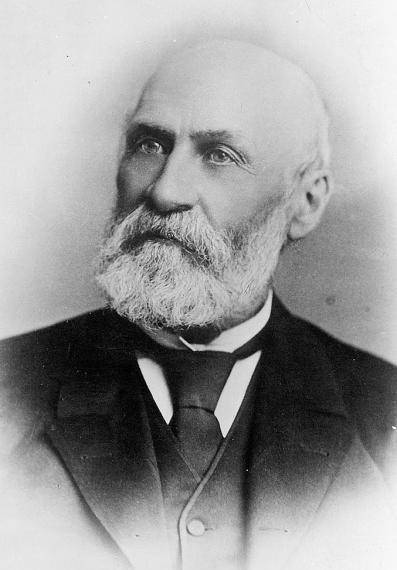
Most Lawrence residents were Free Staters who knew reaction stakes were high. Rebellion would border on treason. Acquiescence would violate their hopes and plans for a new "free" state. Eagerly awaited direction on how to proceed was thought to be addressed by the main 4th of July speaker, Charles Robinson.
Robinson was an influential leader of the Emigrant Aid Society that selected the location and the 1854 founding of the new city of Lawrence. His post-election advice would be persuasive. But, while his sentiments were well known, it was uncertain how bold he would be in urging action.
This speech was one of many reasons Robinson is a historic Kansan. Following the bogus election, he was selected as extra-legal Territory Governor. Years later, in 1861, he was elected first legal Governor of the State of Kansas and is the only Kansas Governor ever impeached. In addition, of local interest, he left a legacy of land on which much of the University of Kansas campus now stands.
When Lawrence's first church, Plymouth Congregational, was founded in October 1854, Robinson, though not a member, served on the governing body that handled its business matters. Thus, while most events described herein occurred prior to the 1857 arrival of Richard Cordley, the 38-year pastor of Plymouth and noted Lawrence historian, it is likely he and Robinson were colleagues in activity and persuasion.
What was that first 4th of July like in Lawrence? In her book Kansas: Its Interior and Exterior Life, Sara Robinson, Charles' wife, described it as a festive mixture of settlers
and Native Americans. Following short speeches and presentation of the Flag in downtown Lawrence a procession formed on Massachusetts Street and was escorted by the military present ..." to a fine grove about a mile from town. Here in one of nature's grand old forests, seats had been provided and a platform raised for the orators....singers, and musicians."
The time for the main speech was at hand. Robinson wasted little time making his call to action clear: a resounding rallying call for renunciation and rebellion. These rousing words are from his speech's conclusion (Sara Robinson Book):
"...it is for us to choose...what institutions shall bless or curse our beautiful Kansas. Shall we have freedom of all the people, and consequent prosperity, or slavery for a part, with the blight inseparable from it? Choose ye this day which you will serve, --slavery or freedom-and then be true to your choice. ...the entire nation is agitated upon the questions of our rights; the spirit of '76 is breathing upon some...I seem to hear the millions of freemen, and the millions of bondsmen....the spirits of the revolutionary heroes, and the voice of God, all saying to the people of Kansas. 'DO YOUR DUTY.'"
The speech was widely publicized nationwide. Subsequently, Robinson was selected extralegal Territorial Governor by Free-Staters, indicted for treason, jailed four months in Lecompton, and then released pursuant to a pardon by President Pierce. The speech ushered in an era of violence labeled "Bleeding Kansas," including the Pottawatomie Massacre, the Battle of Black Jack (which some historians consider the first battle of the Civil War), the Battle of Osawatomie, and frequent unrest and conflict in Lawrence.
Later, passions cooled, pro-slavery sentiment declined, subsequent Territorial Legislatures were dominated by Free-Staters, and a Constitution was drafted for statehood. Finally, in 1861, with a new U.S. Congress in Washington, Kansas was admitted to the Union as a Free State. Lawrence's own Charles Robinson, the author of the July 4, 1855 speech that led to so many historic events, was elected its first Governor. Charles Lawrence Robinson
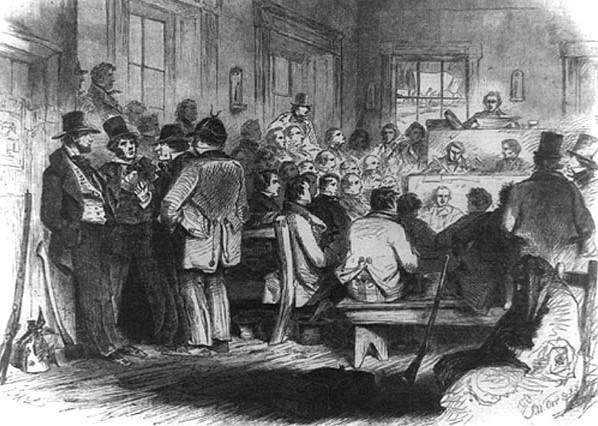
News story about Kansas’ Constitutional Convention.