Plenty
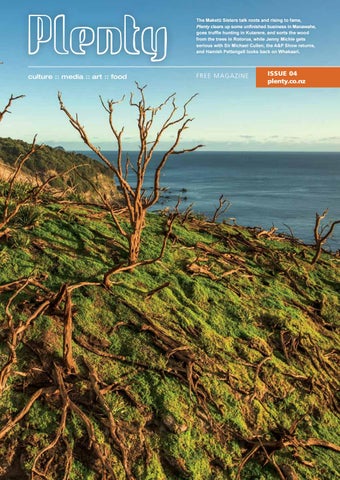
The MaketĹŤ Sisters talk roots and rising to fame, Plenty clears up some unfinished business in Manawahe, goes truffle hunting in Kutarere, and sorts the wood from the trees in Rotorua, while Jenny Michie gets serious with Sir Michael Cullen, the A&P Show returns, and Hamish Pettengell looks back on Whakaari.
culture :: media :: art :: food
FR E E M A GA Z IN E
ISSUE 04 plenty.co.nz
CONTENTS SEPTEMBER two thousand and sixteen
AN DY TAY LOR info@plenty.co.nz
SARAH TRAVERS design@plenty.co.nz
plenty.co.nz
fb.com/plentyNZ
WE ARE SERVING UP QUITE A SPREAD IN THIS ISSUE OF PLENTY, and it is a veritable Bay-wide smorgasbord of deliciouness. First and foremost, the wonderful Maketū Sisters talk us through their roots and rise to celebrity, as well as their new TV show and upcoming book. If that isn’t enough, we take a look at one of the best kept secrets in the Eastern Bay, Kutarere’s remarkable truffle farm collective. We also get a taste into another well-kept secret, as Jenny Michie takes us inside the amazing Manawahe studio of the talented Helen Lees, who gives us a sneak peek of her upcoming contribution to the Tauranga Garden and Arts Festival. Then for good measure, the very same Jenny Michie gets serious – sort of – with Ōhope resident and Kiwi Bank inventor Sir Michael Cullin. Hamish Pettengell of the Whakatāne Museum and Research Centre takes a look at the strange and sombre story of sulphur mining on Whakaari (White Island), and we see how the past is being brought back into the present at Rotorua’s Gantry. Then to top it all off, we take to the treetops with an awesome new tourism venture and make ourselves thoroughly sick on hotdogs and candy floss as the Whakatāne A&P Show roars back to life. It's a feast of Eastern Bay goodness, and once you’re done you’d better take a hike around the block to walk it all off.
06 13 18 22 27 30 33 38
SISTER ACT
THE CURIOUS CASE OF HELEN LEES
AN INTERVIEW WITH SIR MICHAEL CULLEN TRUFFLEUPAGUS
ALL THE FUN OF THE FAIR ON THE SHOULDERS OF GIANTS
MORE THAN MEETS THE EYE
Cover image: White Island, Courtesy of Frontier Helicopters
THE LONG WHITE CLOUD
So
here we Plenty culture :: media :: art :: food
James Rolleston talks acting and Ōpōtiki, Greg Malcolm talks to Lonnie Berg, Harlem Shine talks about things that wash up - and away - at Ōhope, Plenty gets a word in edgeways with Bread Asylum, and Anne Thorp tells it like it is.
F ree Magazine
Issue 01 plenty.co.nz
Plenty culture :: media :: art :: food
Glenn Smith talks radio and Kay Boreham interviews artist Jamie Boynton, we meet the multi-talented Mr Anthony Clyde, Plenty dwells on an affair to remember in Kawerau, Lonnie Berg juggles her beverages, and we talk to two – yes, two! – Sam Clarks.
Fr ee Magazine
Issue 02 plenty.co.nz
Plenty culture :: media :: art :: food
The John McKay Trio raise the roof and Matatā reclaims the All Blacks, Plenty goes organic in Edgecumbe and Kay Boreham talks to Sir Wira Gardener, Jennie Michie is the new Lonnie Berg and war is declared to save the kiwi.
Fr ee Magazine
Issue 03 plenty.co.nz
The Maketū Sisters talk roots and rising to fame, Plenty clears up some unfinished business in Manawahe, goes truffle hunting in Kutarere, and sorts the wood from the trees in Rotorua, while Jenny Michie gets serious with Sir Michael Cullen, the A&P Show returns, and Hamish Pettengell looks back on Whakaari.
culture :: media :: art :: food
Fr ee Magazine
03 SO HERE WE ARE – Issue 04 of Plenty and hasn’t time flown. When we started the magazine back in autumn we never thought that come the spring we’d see it being welcomed so warmly throughout the Bay, whether that be east, west, central or beyond. We still get requests for copies of our back issues, and we’re stoked to get these from as far afield as Auckland, Wellington and the Mainland (where we expect they use them as motivational tools).
We started Plenty because we thought there were so many great stories to be told about where we live, and telling those stories has been a blast; we got to meet some incredibly creative people, some visionaries, some pioneers and some people who are just hard-out awesome. We also got to get our knuckles rapped by DOC; yes folks, the cover of Issue 02 was not an actual native toetoe (that plumed tussock, feathery, cutty grass thingy), but we did that intentionally to raise awareness of invasive non-native species. So there. But while we were busy telling all these stories, we kept getting asked about our own story. Who is Plenty and where does it come from, how did it start and where is it going. And why did you put non-native pampas on the cover of Issue 02?
04
P L E N T Y. C O . N Z // S E P T E M B E R 2 0 1 6
S
Plenty
Issue 04 plenty.co.nz
fb.com/plentyNZ SARAH TRAVERS design@plenty.co.nz
plenty.co.nz AND Y TAY LOR info@plenty.co.nz
are...
So SO, TO SET THE RECORD STRAIGHT HERE’S US IN A NUTSHELL. Plenty is made
in the Bay by locals and primarily for locals, but we do like to flash it about in front of the neighbours up the road a bit as well. We are 100% independent with no corporate or governmental sponsorship (but Apple Computers and Bacardi, if you’re reading this, we’re willing to talk). We started the magazine because we wanted to promote the Bay of Plenty and all the great people in it, and we also wanted to provide a creative outlet in a premium quality print publication that also embraces the web and social media. In the past, print and the web have been seen as mutually exclusive mediums; we think they play well together and will become good friends in later life, probably attending each other’s weddings.
We think print is the perfect medium to reach out to new readers, while our web presence gives us a greater reach, and social media lets us really get the conversation going two ways. In addition, our paper stock is sustainably sourced and we think that turning paper into our mag treats it with the greatest respect, so between our digital and print versions we like to think we have the best of both worlds.
Our contributors are also sustainably sourced (sort of) and treated with respect (not really; we’re working on that). Just as we feature stories about talented people in our magazine, the people writing, researching, editing and photographing those stories are also creative dynamos in their own rights, and we couldn’t do it without them. And just like us, they do all this in addition to their day jobs, putting in time, talent and effort after hours and on weekends to promote the Bay. Did we mention we couldn’t do it without them? We did, and we’ll say it again because it’s true. But we also couldn’t do it without our advertisers, because without them at the end of the day we couldn’t press print. We’d like to thank them for helping us bring you the magazine you have in your hands right now, and also if you like what you are flicking through and you have a business that wants to be a part of something special, then get in contact, lets talk about you being in Plenty. Where are we going? Well, we have expanded our distribution to now cover the Bay of Plenty and beyond, we’ve built up an online presence that reaches even further, and we have some exciting collaborations and developments lined up to tell you about, not to mention some sweet giveaways along the way. Stay tuned for what’s next, this weekend hobby of ours is taking on a life of it’s own!
INTERVIEW SULATA GHOSH /// PHOTOGRAPHY ANDY TAYLOR
T
HE FIRST THING that struck me when I met Kasey and Karena Bird for this interview was how down to earth and grounded they are. With a MasterChef win, an award-winning
cookbook, and their own TV show, the Maketū sisters seem to have every reason to let it go to their head. And yet when we caught up with them in between trips and their jet-setting lifestyle, they warmly welcomed us into their mum and dad’s home in Maketū and shared their story over a hot cuppa tea with us. “We never cook at our own house, we always cook at my mum’s house. “Karena explains. The walls are covered with ideas and plans for their next cookbook. How do your parents feel about all the blue tack on their walls, I jokingly ask. “It’s better than the wood paneling, to be honest!” comes the reply. They’ve been to 20 countries in the last year. And yet, it is clear that they are the happiest in their hometown of Maketū in the Bay of Plenty, surrounded by their whānau.
STARTING OUT… “I wanted to be a chef when I was 10 years old,” Kasey tells me. “But then I realised when you are a chef you have to give your food away to other people,” she laughs. The sisters have always been passionate about food. But mostly they were passionate about eating good food, not cooking it. “I’d just wait till my dinner showed up and then critique it. Uh... can I have the salt please?” laughs Karena. Through high school the girls became very interested in eating out at restaurants. While their friends were spending their money on clothes and concerts, they saved all their money to spend one weekend away in Auckland, eating at restaurants they’d picked out. “Once we started driving, that’s where we’d drive to - restaurants!”
06
P L E N T Y. C O . N Z // S E P T E M B E R 2 0 1 6
With a traditional upbringing, being a chef was never a career option, not even having taken cooking in high school. “In our family, we go to school then go to university and then get a job” says Karena. Their dad was a chartered accountant and mum a Māori language teacher in Waikato University, and they were fully expected to follow the path of higher education set for them. When Kasey moved to Melbourne and Karena moved to Wellington to pursue their studies, they continued to eat out at restaurants all the time, and their passion for good food continued to grow. “I’d go down to meet Karena in Wellington, and all we’d do is go out and eat at restaurants and come back and watch the Food channel. Karena was working two jobs – over 40 hours- and studying full time just to fund her eating habit!” When Karena called her parents, still in the middle of
her degree, to tell them that she was moving back home to save money for a AU$30,000 a year culinary school in Sydney, they were not happy. When she had her farewell party in Wellington, one of her friends gave her a MasterChef New Zealand cookbook and wrote on it, “Can’t wait to see you on the cover someday.” The words were prophetic. Back at home, when the whole family was together again, everyone took turns cooking one night a week followed by an extended family dinner on Sundays. With their one night to shine, and being fiercely competitive, the girls tried quite a lot of different things to make their dinners special. Entering MasterChef came on a whim and the rest, as they say, is history.
You watched them take MasterChef by storm, now Plenty gets up close and personal with MaketĹŤ sisters, Karena and Kasey Bird, as they talk about their next adventure.
POST MASTERCHEF MasterChef put them in the public eye very quickly, and they were seen as experts in the food industry. Kasey and Karena took some time after their win to train themselves up by working at cafés and restaurants in Tauranga, Auckland and even the South of France to build their confidence in being in commercial kitchens.
ON KARENA AND KASEY’S KITCHEN DIPLOMACY… At the time of this interview, their new show Karena and Kasey’s Kitchen Diplomacy was just about to air on TV One the next day. “We are quite nervous about it. It is a 10 episode series, and we go to a new country in every episode. We meet the New Zealand ambassador or Consul General in the country, and we interview them and learn about the connection that New Zealand has with that country and vice versa. We learn
08
P L E N T Y. C O . N Z // S E P T E M B E R 2 0 1 6
about all the interesting ties we have to these different diplomatic posts that we don’t really know about. Then we learn all about the food and all about the culture. We go out for street food, we go into families’ homes, and we go to fine dining places. At the end of the week, we have an event or a challenge that we have to cook for. It could range from fine dining, tasting menus to running a street food cart to cooking at a wedding to all these different things,” they explain. Did you say a wedding?! “This poor couple!” laughs Karena. “I was wondering how they roped them in with these two random people from New Zealand cooking at their wedding! It was scary, because these are real life events and you’re not just cooking for judges, you are cooking for real people at their real life event! There was a lot of pressure.” The sisters are not new to world travel, their parents having taken the family on a world trip when they were 10 and 11 to show them that there is
a whole world out there. “I was 10, and I remember they asked me what I wanted for my birthday, and I said I wanted to go on an aeroplane. I got my wish, but then everyone else was going too!” Kasey reminisces.
ON BEING SISTERS…. That’s a lot of travelling and being in very close proximity with your sister all the time. I jokingly wonder out loud if they have ever tried to kill each other. “If I try something, I succeed!” says Karena. However, Kasey tells me, “The only time we try to kill each other is when it comes to food. Like when we go to a restaurant, we order different things so we can try different things. And the rule is that you cut it in half, and you eat your half and then you swap. But the issue is Karena sometimes doesn’t understand what half means.” They both agree that it is a good thing that they have different personalities, as it keeps everything in balance. “We are lucky that we get to
do this together. A lot of the time you’re travelling and even just sitting on the plane you feel a bit lonely, and it is so nice having each other. But then we get to see some amazing places and get there, and we wish that our family were there. The beauty of the show is that they get to watch the experience.”
“WE’VE TRAVELLED AROUND THE WORLD LEARNING ABOUT DIFFERENT FOOD AND CULTURES, AND IT HAS GIVEN US THIS DESIRE TO COME BACK TO NEW ZEALAND AND LEARN ABOUT ALL THE TRADITIONAL MĀORI RECIPES.”
ON THE NEW ZEALAND FOOD SCENE… Having been to so many countries, (20 in one year) gives them a fresh perspective on New Zealand’s food industry. “New Zealand is a melting pot of cuisines and cultures. Most chefs that train in New Zealand go abroad for their work experience and bring back all of their skills with them and put their own unique Kiwi twist to other cuisines,” Karena says. But what they find challenging is how to define New Zealand’s cuisine. “We get asked that all the time, and it is a very difficult question to answer. You can go to India and you can define the cuisine, but New Zealand doesn’t really have that strong identity,” Kasey explains. “We’ve travelled around the world learning about different food and cultures, and it has given us this desire to come back to New Zealand and
learn about all the traditional Māori recipes. Travelling all the way from the top of the North Island to the bottom of the South Island and getting all of these recipes, and saving them because they are getting lost with all of our ancestors as they pass away. Especially with Māori cuisine, because you pass it down through word, and we want to get that and put it into something because then there would be a way to define what New Zealand cuisine is. That’s what the show and travel has inspired us to do. To know our own culture and put it on a modern platform and not reinvent it but reinvigorate it. I am quite excited to do that.”
ON THEIR NEW COOKBOOK… Their new cookbook will be released at the end of October 2016. Their first cookbook, ‘For the love of…’ , was a biography of recipes from their childhood to MasterChef. The new cookbook portrays their journey of recipes since MasterChef. “During MasterChef, people saw our journey, saw us discovering our new careers. Now we want to show them our progress of what we have learnt since we have been on MasterChef.” The cookbook will have recipes inspired from their travels abroad as well as within New Zealand. “Every recipe has its story about where the recipe was inspired from and what we were doing when we came up with that recipe. All of these recipes have really vivid memories for me,” says Karena.
ON KEEPING A FIRM HEAD ON THEIR SHOULDERS… With fame at such a young age and in such a short time, I wonder how they remain so unaffected by it. “Everybody still treats us the same. We get back home and our mum says where’s your washing? and we’ve been just been at one of the top five restaurants in the world, and the next day our mum’s giving us a hard time. ‘Oh you’re back to mess my house up again!’ Even though they are travelling overseas and spend a lot of time in Auckland, they are still based in Maketū and go back there even if it is just for a night or two a week. “There is just this really nice and relaxed atmosphere here in the Bay, and that’s why everyone’s moving here. It’s like the secret is out!”
SOUL FOOD… “Maketū Pies!” They both chime together when I ask them what they crave the most when they are on the road visiting exotic places and eating exotic food. “Mum’s roast chicken and boil up.” P L E N T Y. C O . N Z // S E P T E M B E R 2 0 1 6
09
ASIAN
BEEF 10
SALAD P L E N T Y. C O . N Z // S E P T E M B E R 2 0 1 6
ASIAN
BEEF
SALAD SERVES 4
We eat this dish almost once a week. It is a family favourite, and we hope it becomes a favourite in your home, too. Spooning the dressing over the hot meat while it is resting really releases the aromatics from the
ginger and garlic. Feel free to adjust the flavours of the dressing to suit your own taste.
DRESSING ½ cup coriander stalks (reserved from salad) 1 chilli, roughly chopped 1 tbsp fish sauce 2 cloves garlic 4 cm piece of ginger, peeled and chopped 2 tbsp palm sugar (or caster sugar) 1 tsp sesame oil Juice of 1 lime
SALAD 3 spring onions, chopped finely 1 packet mung bean sprouts 1 cup cherry tomatoes, halved ¼ cup mint leaves, chopped 1 cup coriander leaves (stalks reserved for dressing) ½ cucumber, peeled into ribbons
2 tbsp sweet chilli sauce
TO SERVE 1.2 kg rump steak Salt and pepper 2 tbsp vegetable oil ¼ cup crushed peanuts
FOR THE DRESSING Place all the ingredients into a small food processor and whizz until well combined. Taste and adjust the seasoning, using more fish sauce or lime juice if needed. Set aside.
FOR THE SALAD Combine all of the salad ingredients in a large bowl and spoon over 2 tablespoons of the dressing.
TO SERVE Pat the steak dry with paper towels and season generously on both sides. Heat a heavy-bottomed fry pan until smoking. Add the oil. Cook the steak in batches for 2–3 minutes on each side. Remove from the pan and spoon over the remainder of the dressing while the steak rests for 5 minutes. Slice the steak into 1 cm thick slices. Arrange the salad on a long platter and arrange the steak on top. Garnish with the crushed peanuts.
ROTORUA
TAURANGA
1131 Amohau Street jen@vetrorotorua.co.nz Phone: 07 346 0081
111 Third Avenue sales@vetrotauranga.co.nz Phone: 07 579 9111
Open 6 days & 7 days over the summer
vetro.co.nz
Opening September
VetroRotorua
vetro.tauranga
ALL THOSE HARD TO FIND INGREDIENTS AT EVERYDAY LOW PRICES
Bay of Plenty Regional Council Toi Moana
Preparing for the worst White Island (Whakaari) is an awesome visitor attraction and a symbol of the Bay of Plenty, but it is also an active marine volcano. It pays to be prepared, and a few agencies recently took the opportunity to make a visit to Whakaari a lot safer. GNS Science, the New Zealand Police, Civil Defence and Bay of Plenty Regional Council, other partneragencies, and local tour operators put their heads together and decided that some emergency shelter was needed, so they invited the New Zealand Defence Force to come on board – after all, they’re the most practical way to get a shipping container out to an old mining site on a volcanic island 50km off-shore!
Whakaari now has a Good Plan in place and is prepared and ready for a potential emergency situation, and while we’re not suggesting that everyone needs a container full of supplies in their backyard, families should be putting together their own Good Plan that can get them through the worst case scenario. “It was great to be part of the container drop with the Defence Force,” says Clinton Naude, the Director of Emergency Management Bay of Plenty, “but hopefully these spectacular images are a trigger for all of us to get organised. Preparedness starts at home. “It’s not just about the big stuff; being prepared for small emergencies like a power outage or localised flooding can turn a pretty terrible few days into something you are ready to get through.
As well as a great opportunity for the Defence Force to run an exercise along a spectacular route to a unique location, there was an even bigger plan afoot. The NH90 helicopter was dropping a 2.4-tonne shipping container to the island to provide visitors with the necessary emergency shelter and supplies in case something went wrong. And something could go very wrong. It is, after all, an active volcano visited by about 10,000 tourists each year. Not to mention the scientists and researchers who spend plenty of time in and around the island.
“Everyone thinks it will never happen to them. But it does and we need to be prepared. Start at www.happens.nz and get yourself a Good Plan.”
“It doesn’t have to be a big deal – it can be simple things like having a few bottles of water and a plan for where you and your family will meet in an emergency if phones are down or power is off. It is something you and your family can organise over dinner one evening, and you will be a good step closer to prepared if the worst happened.”
The Curious Case of Helen Lees Plenty first met Helen Lees as part of the crime-fighting, sourdough-baking team at Bread Asylum, and when we caught a glimpse of her studio we swore we’d be back, as soon as we’d plucked up the courage. Six months later, we sent Jenny Michie. WORDS JENNY MICHIE PHOTOGRAPHY ANDY TAYLOR
13
As
Helen Lees
leads me into her studio, we wind our way carefully amid the most macabre, motley and marvellous collection of curiosities I’ve ever seen in a private space. Indeed, this is the foundation of what will be the Museum of Curiosity: a cache of treasured objet d’art, clothes, dolls and antique mannequins, paintings, taxidermy and gothic medical supplies (amongst much else) collected while poring through flea markets and junk shops here and in Europe. Upstairs in her studio, the sun shines on even more ephemera, much of which is decidedly humorous as well as fascinating. She points to a German leather mannequin bottom with an antique hypodermic needle sticking out of it, a teaching device from the old days and a gift, she says, from Adolf (not that one). The setting for this chaotic trove is unique, high on a rural idyll in the Manawahe hills, alongside the family home and husband Maurice Lees’ well-known and highly-regarded Bread Asylum bakehouse, complete with dappled stream and an outdoor stage.
14
P L E N T Y. C O . N Z // S E P T E M B E R 2 0 1 6
I read recently that the messier one is, the more creative a genius one is likely to be. From this we may assume Helen is right up there with Einstein and Jobs. She says she likes to “surround myself with physical manifestations of my thoughts and experiences, which then give structure to my work and everyday life.” This is the sort of high-sounding rhetoric I expect from artists. To me it’s just dark, deeply disquieting, fabulous clutter. She admits to being a terrible housekeeper. I can see why. Helen fits in perfectly here. In fact, it’s hard to picture her in a sterile setting; it would go against the rules of nature. She has an ethereal, ageless beauty balanced by a good shot of grunge. I covet her crocheted fingerless gloves and effortless style. We’ve got together to talk about Helen’s entry in the Tauranga Garden and Arts Festival being held Thursday 17 to Sunday, 20 November, which also includes an inspiring line-up of speakers and workshops, all at the Tauriko Lakes Festival Hub. She describes the installation she intends to create as having “a state of decay with a sense of strangeness sitting somewhere between beauty and unease.” From what I’ve seen, the effect will be like staging a mock execution at the Chelsea Flower Show. “No, no,” she assures me. Representatives of the Tauranga Garden and Arts Festival have been to see her work, including her great friend Marilyn Cleland who invited Helen to exhibit in the first place, and they know what they’re getting. Although she admits her work is likely to stand out. Ya think?
We wind our way carefully amid the most
macabre, motley marvellous and
collection of curiosities I’ve ever seen in a private space.
P L E N T Y. C O . N Z // S E P T E M B E R 2 0 1 6
15
Some of Helen’s signature pieces, which will feature prominently in the installation, are her Dali-esque white clay figures – endearing fragile creatures neither human nor bird. Helen describes them like mythical, alien poetry. Another piece for the show is an antique prosthetic arm trailing a veil of ivy. Well, it is a garden show after all. The Tauranga Garden and Arts Festival is also a chance for Helen to spread her own wings by having to design an entire space including lighting, walls and ceiling, and creating everything in it, right down to the hand-painted wallpaper featuring baby possums drinking moonshine. “Normally in an exhibition all that is done for you,” she says, “and you simply hang a painting on a wall or put an installation on a plinth, but I haven’t done this before. Director John Beech and the Festival team have been enormously helpful and given me free reign to do whatever I want.”
...people who have visited her studio have
been seriously worried about her mental health. They needn’t be. This is an artist happy at work. Helen’s creative genius and sense of fun were first on full display in the Bay of Plenty when she created the Tarnished Frocks and Diva show back in 2005. She is very proud of being the founder of the name and the original idea behind the show, as it is a great platform and confidence builder for women over 40. She worked on Tarnished Frocks and Divas as Creative Director for the first two shows and then moved on to pursue another artistic direction when she sensed it was heading towards something big, commercial and mainstream. She says the people behind the current TF&D show have kept the genesis of her original idea and are doing it their way now. Big, commercial and mainstream are three things Helen is not. She says some people who have visited her studio have been seriously worried about her mental health. They needn’t be. This is an artist happy at work. A little fey perhaps, but show me an artist who isn’t. She shows me some crowns she made for the original Tarnished Frocks and Diva show. One in particular is magnificent and made of dozens of twisted forks and velvet. It must have taken hours and hours to create. But I can imagine Helen making it, perfectly content in the mysterious playroom inside her own head.
16
“No, no,” she assures me...
Representatives of the Tauranga Garden and Arts Festival have been to see her work, including her great friend Marilyn Cleland who invited Helen to exhibit in the first place, and
they know what they’re getting.
Although she admits her work is likely to stand out.
P L E N T Y. C O . N Z // S E P T E M B E R 2 0 1 6
17
AN INTERVIEW WITH
SIR MICHAEL CULLEN WORDS JENNY MICHIE PHOTOGRAPHY ANDY TAYLOR
18
It’s been over eight years since Sir Michael Cullen left parliament, after a stellar (depending on your political point of view, naturally) 27 years service in New Zealand’s most gilded cage, where careless comments can ruin careers and policies and politics not only affect the lives of hundreds of thousands of people but can literally prove to be the difference between life and death. Parliament is a world within a world; intense, claustrophobic, incestuous and deeply attractive to those who crave power. It is also home to MPs and staffers who truly want to do good no matter what their political stripe.
PLENTY Do you have any regrets of your time in politics – maybe a policy you considered but didn’t progress, but wish you had now?
In the interests of full disclosure, you need to know that I spent quite a few years working around that world within a world, and came to interview Michael Cullen not as a disinterested observer but as someone who has known him for over 20 years. In my opinion there’s no one left in parliament to match him, and New Zealand’s democracy is a sadder place for that.
PLENTY There are a number of senior MPs standing down at the next election, so we’re going to see a lot of new MPs. What advice do you have for someone just starting out in politics?
Still, if parliament misses Michael Cullen, I’m not sure if Michael Cullen misses parliament. Greeting us at the door of his sunny Ōhope home he looks relaxed and decidedly thinner than in his ministerial days, albeit a little jet-lagged as he and his wife Anne have just returned from a month in Britain.
PLENTY You have said that the policy you are most proud of is the Superannuation Fund, which is not surprising seeing as everyone still calls it the Cullen Fund, but why exactly is it your favourite achievement?
MC Because it’s a policy for the long term, and that requires foregoing some economic benefits in the short term, but which will ultimately pay a huge dividend. There are fundamental issues here that have to be addressed around the fact that in the future we will almost certainly have a smaller proportion of the population in the work force and a larger proportion of the population amongst the elderly, and we have to ensure that within that context we can maintain the standard of living of the aging. The Superannuation Fund was crafted to address this, and not just because I am a member of that age group!
MC More regrets than Frank Sinatra! There are many possible examples. There’s things we didn’t do. I wish in hindsight we’d taken a firmer line on Trusts for example. I think the use of Trusts not just for tax avoidance but also for manipulating the benefit system, or for hiding wealth from scrutiny, are things that have to be thought about, and the recent issue of foreign Trusts has highlighted this. We also paid insufficient attention to the financial institutions but luckily – for all of us – our banks weren’t doing all the detrimental stuff they were doing in New York that caused the Global Financial Crisis. They were certainly doing some ‘interesting’ things, but not in the same league as those institutions in the United States.
MC Well certainly not just Sir Keith Holyoak’s advice of just to breathe through your nose for the first few years! People who have had success and/or prestige in their own careers may find it takes some getting used to being a nobody backbencher, but remember that the MPs already there may have some valuable experience you can learn from. There are lots of ups and downs in politics, and I was involved in it for a very long time - I was on the front bench for 19 years - so I saw a lot of both. The short answer? Be true to the policies you were elected on.
PLENTY As well as being Deputy PM, Minister of Finance, Attorney General, Leader of the House and other Ministerial appointments, you were an MP for a long time. Although it’s been eight or so years since you left Parliament, did you struggle to adapt to life outside politics? MC Not at all. What I did struggle with was being a backbencher with nothing to do for six months after I stood down from the front bench after Labour’s defeat in 2008.
PLENTY Was that humiliating? MC No. You shouldn’t be in politics if you’re not prepared to lose, but having said that you should be there to win. P L E N T Y. C O . N Z // S E P T E M B E R 2 0 1 6
19
PLENTY What brought you and Anne to the Bay of Plenty?
MC Surviving in politics for 27 years! But seriously, we changed the framework of economic debate in NZ. There is a belief that there is a thing called neoliberalism that has remained unchanged for the past 30 years without anything happening and that really is quite dangerously untrue. When we took power in 1999 there were very strong voices arguing that government had no utility in solving social and economic problems and that we should go further and faster down the track of allowing market forces to resolve things; it was very black and white – in what I call neo-classical economics, the Chicago School that drove the reforms in Britain and Australia and New Zealand – and clearly that was not true. But it was seen as favourable to follow that, and I feel that has had a very negative impact on society and also the economy. So I feel that we introduced the idea that there was a middle ground to be found, and by the time we left office the debate had significantly shifted, and while there are some in the current government that might like to go back down that black and white track they haven’t actually done so, because though they clearly believe in less government and more business they have less of the ideological fervour the religious crusade - and more pragmatism.
MC We used to live here but we moved to Napier when Anne (Collins, former Labour MP for East Cape) left parliament and retrained as a teacher. We also have a lot of family there. After I left parliament we built this house here in Ōhope and you know I can sit here and look at Whale Island and Ōhiwa Harbour and it is so beautiful, and the people here really are so nice that why would you want to live anywhere else.
PLENTY Did you really never aspire to be Leader? MC No. Honestly, a leader has no private life; you’re under scrutiny every hour of every day. I’ve always valued having a private life.
PLENTY Have you given any advice to Helen Clark in her bid to become the next United Nations Secretary General? MC God no! She’s always known she was an outside chance and it will all come down to whether the Big Five (the countries with the power of veto: the United States, England, France, China and Russia) can find someone they can all back. But Helen won’t give up. She is a great reformer; the question is whether the United Nations – and the Big Five – really want a reformer.
20
PLENTY What was the most successful achievement of your career?
P L E N T Y. C O . N Z // S E P T E M B E R 2 0 1 6
“YOU SHOULDN’T BE IN POLITICS IF YOU’RE NOT PREPARED TO LOSE, BUT HAVING SAID THAT YOU SHOULD BE THERE TO WIN.”
PLENTY Yes it’s a beautiful place and it’s wonderful to live here but where do you think towns like this are headed economically? What can save Whakatāne from becoming a zombie town? MC Well I don’t think Whakatāne needs saving! We need to see ourselves as part of a wider region with Ōpōtiki and Kawerau. We also need to ask ourselves have we been wise to invest so much of our economy in just two industries, dairy and kiwifruit. Should Whakatāne be pursuing a retirement development? Some people say no, that this lacks dynamism, but look what that has done for Tauranga? It started off as a retirement town and now it’s one of the fastest growing cities in New Zealand. It would also help Auckland’s housing crisis if retirees cashed up their million dollar homes and moved down here. Imagine the strain on pensioners in Auckland; their incomes have remained static but their rates have gone up astronomically.
PLENTY You’ve just finished eight years as Chairman of NZ Post. What’s the future of NZ Post looking like? MC It will be a partial owner of a financial bank but not a 100% owner, which will be quite a change, and it will become primarily a parcels company with a ‘minority
interest’ in letters. That will mean it will be much more focussed on defining who its customers are and trying to service the increasingly complex and varied needs of its customers. And the customers are both people who put parcels into the system and the people who the parcels are delivered too – that is important to recognise. With traditional post it was very much a one-sided relationship, but now it is two-sided, and that is quite different – we have to be able to deliver parcels when people want them delivered rather than just when we want to do it - whether you want it or not!
PLENTY So, is being Sir Michael all that it’s cracked up to be? MC The Sir part is not a title I use everyday! It is sort of handy if I’m writing a reference for somebody! It’s a recognition that I do value, but I wish we could find a more New Zealand way of achieving that, and that is why we looked at revising the system when we were in government. Our attempt was horribly clumsy – it looked like it was designed by a committee and probably was, and the current government has gone back to the old system, but I still think we can find a New Zealand title. I like the Māori form – Ta – but you can’t expect an ex-finance Minister be known as Ta Michael, it sounds like they expecting gratitude!
WHAKATANE GOLF CLUB Championship course - one of the finest golf courses in the Bay of Plenty.
With fast running greens and lush, forgiving fairways, the course offers golfers of all levels a challenging but rewarding 18 holes. Relax afterwards at our lounge bar and restaurant/cafe with tasty home-made snacks and meals. Par 70, 6009m course just 10 minutes from town near the airport.
WHAKATANE GOLF CLUB 181 Golf Links Rd, Paroa 07 308 8117 whakatanegolfclub@clear.net.nz www.whakatanegolf.com
PLENTY What next for the man Richard Prebble famously called “too clever by 3/4s”? MC I’m doing some think piece work for Treasury and I’m still heavily involved with Tuwharetoa around their Treaty claims, and we will get the main part of that tidied up soon, as well as some work with Tūhoe.
PLENTY Will we see a memoir? MC (laughs) No! I can rarely remember conversations and who said what to whom. People don’t seem to realise that as a minister you’re making dozens and dozens of decisions every day. It’s amazingly busy. I would never write a candid work, and besides I’ve been out of the spotlight for a long time now, so who would really read it? Not many people recognise me in the street nowadays. And that’s quite nice.
B E S PO K E FR A M I N G, O R I G I NAL AR T & VALUAT I O N S M O N DAY TO F R I DAY 10 A M – 4 PM (O R BY A P P O I N TM E N T ) 2 D A P P E N Z E L L D R I V E , W H A K ATA N E P H O N E 07 3 07 9 3 0 2 O R 0 21 2 4 4 6 0 0 4
T ruffleupagus
In classical times, it was believed that truffles were the result of lightning strikes; in 2012, an equally random occurrence led an Eastern Bay couple to find themselves the owners of the most productive truffle farm in New Zealand.
22
WORDS ANDY TAYLOR PHOTOGRAPHY SARAH TRAVERS
At first glance,
Matiu Hudson and Annette Munday’s place seems an unlikely location for a truffle farm. There are utes and gumboots, kids and cats and chooks, and on a winter afternoon soft light and bird song in the trees outside and a roaring fire inside. It’s a classic Kiwi rural home, and it’s only after Matiu and Annette have invited you in for a cuppa and a chat on the couch and the conversation has turned to inoculated oak trees, périgord fungus and truffle-infused honey that you realise this place is something special. Born and bred in Kutarere, Matiu spent 17 years in Australia, working in the mining industry and also running his own cleaning business. All that changed in 2011. “I had a bit of a calling to come home really,” Matiu says, “and we both fell in love with some land near the Ōhiwa Estuary, so decided it was time to make the move and buy a bit of home.” That bit of home had a couple of hundred mandarin trees and a grove of
avocados; it was only after they had agreed to buy it that the previous owner mentioned another attribute of the property. “It was pretty much a done deal when the owner said that there was also a trufflery,” Matiu says. “We really didn’t know anything about truffles, so it has been a steep learning process for us, but it was quite a bonus to say the least.” Quite a bonus indeed. In 1989, the Pittar family from Gisborne had originally planted 30 trees inoculated with périgord black truffle spores in Kutarere in one of the first-ever attempts to cultivate them in this country. Eight years later no truffles had appeared, and the Pittars sold the property to Bryan and Colleen Basset as a retirement home. Then, in 2000, Mr Bassett’s brother literally stumbled across the first truffle, and the family started up a fledgling business, driving to Auckland and walking in to restaurants to see what demand there was. P L E N T Y. C O . N Z // S E P T E M B E R 2 0 1 6
23
Truffles have, for centuries, been one of the most sought-after prizes of the culinary world, but they were – and are – relatively unknown in New Zealand. In Europe they have been dubbed ‘the diamonds of the kitchen’ and sell for well over $1000 per kilo. In 1825, the father of all food writers, Jean Brillat-Savarin, noted that they were so expensive that they appeared only on the tables of ‘great nobles and kept women’, and monks were warned never to eat them lest they were swayed by the gastronomic delight and abandoned their calling to Christ. By 1900, production had risen to such an extent that they were far more affordable and increasingly found in the kitchens of commoners, with contemporary recipe books often mentioning the use of truffles. Two World Wars, acid rain and mechanized agriculture managed to change all that, however, and by the 1960s the truffle was again in short supply, available only in the finest restaurants and acutely expensive. The main reason for the truffle’s rarity is the difficulty in growing it. To this day we have only a rudimentary understanding of how it propagates, and planting a truffle farm is still a very hit and miss affair. Saplings, usually oak or hazelnut, are inoculated with the spores of the truffle and planted out. “Truffles really prefer quite poor soils,” Matiu says, “which suits what we have around here, but they need quite a high level of acidity. The PH level needs to be as close to eight as possible, so we regularly use lime to shift
24
P L E N T Y. C O . N Z // S E P T E M B E R 2 0 1 6
the PH up – but you do need a lot of lime just to get a single degree of shift in acidity!” Once the saplings have been planted, they take around ten years to mature, but even then there is no guarantee that you will get truffles; this is clearly not a get-rich-quick scheme, nor for those who lack patience. “We still don’t fully understand all the different factors that lead to a successful trufflery,” says Matiu. The weather, the environment, and the soil all play their part, and in the ten to fourteen years it takes to see results, you have to constantly monitor and care for the soil. It’s a long term proposition!”
TRUFFLES HAVE, FOR CENTURIES, BEEN ONE OF THE MOST SOUGHT-AFTER PRIZES OF THE CULINARY WORLD, BUT THEY WERE – AND ARE – RELATIVELY UNKNOWN IN NEW ZEALAND.
Matiu and Annette currently sell most of their product to Auckland or Wellington, including the award-winning French Café, though their truffles can also be found closer to home, in Tree Tops in Rotorua and Nautilus in Tauranga. “New Zealanders are still very much discovering the truffle and starting to develop a palate for it,” says
Matiu. “So we still see many people confusing our truffles with the chocolate variety! But that is starting to change. There are now four other truffleries in the area, and we have formed a sort of collective to market them around the country. We have also been in contact with Export New Zealand – because our Southern Hemisphere season compliments Europe’s truffle season, there is good potential to get our truffles into the European market.” Though the potential for raw product exports is clear, it is the value-added aspect of the truffle that Matiu and Annette are most excited about. “Truffles are very expensive, probably too expensive for many people, but they are also very, very strong – if you put a truffle in a glass container with an egg overnight, when you break that egg and eat it the next day you can taste the truffle. So we are looking at infusing things like honey, salt and oil with truffles, to make the flavour a lot more accessible.”
Moutohora Extra Virgin oliVE oil ✔ Healthy and Delicious ✔ World Famous and from the Bay of Plenty ✔ Simply the best Moutohora EstatE 40b Moore road, thornton rD4, Whakatane 3194 Ph/Fax: 07 304 9963 Mobile: 021 055 7408 Email: moutohoraestate@netsmart.net.nz Facebook: Moutohora Extra Virgin olive oil
It is the latter of these – olive oil – that has been consuming most of their free time recently. “We are currently lifting truffles for Gerrit and Wil Kruithoeds of Moutohorā Estate Olive Oil (see Issue 01 of Plenty),” says Matiu, “and are planning to infuse about 30 litres of their olive oil; Gerrit wants to submit it to the NZ Olive Oil Awards, so time is of the essence, and fingers crossed that it all goes well. As a joint venture we are only in the early stages, but teaming up two quality products like this makes perfect sense to me, and Annette and I are very excited about this opportunity.” Top-quality, value-added products like this are widely considered to be the global niche market New Zealand has been looking for, and the development of this sector has been promoted from the halls of power in Wellington to the boardrooms of Auckland. On a quiet hillside in Kutarere, Matiu and Annette seem to be well ahead of the curve.
rest | relax | rewind WELCOME TO DRIFTSAND OHOPE’S PREMIER ACCOMMODATION
Phone 07 312 4616 31 West End Rd, Ohope
info@driftsand.com www.driftsand.co.nz
Committed to providing service beyond a sale EDGE Realty Whakatane Limited (REAA 2008)
261 The Strand, Whakatane Bay of Plenty info@edgerealty.co.nz (07) 308 0232
Meet our dedicated team
We know how important the home and business is to your well being and lifestyle. It has to be right. That’s just part of why we love being in realty and why our clients en-joy our advice and services. Our team offers experience, dedication and commitment in our dealings with you. For all your Residential, Rural, Commercial and Property management needs, get the Edge Today!
Richard Baker - Director e. rich@edgerealty.co.nz
m. 021 087 35393
Richard is focused on maintaining the independent and boutique EDGE brand that is established and he is committed to providing service beyond a sale. Previous experience in the service industry with 15 years helping manage and run Super Yachts have provided a wealth of experience in a multimillion dollar service industry that can now be transferred to helping clients in Real Estate. Talk to us today and find out how we can help you.
Lynne Baker (AREINZ) - Residential Sales e. lynne@edgerealty.co.nz
m. 027 284 6996
Dedicated and knowledgeable, Lynne has over 30 years experience in real estate. She is known for her well rounded expertise. Clients appreciate Lynne’s highly professional nature, sense of humour and integrity. Amidst numerous achievements, Lynne has a strong track record of repeat business and referrals, saying it is a wonderful compliment that allows her to maintain her passion for working with people.
Lorraine Cunningham (AREINZ) - Residential Sales e. lorraine@edgerealty.co.nz m. 0274 830 508
Lorraine has over 22 years experience in real estate and has built her reputation on a foundation of trust and honesty. Her industry commitment has earned her numerous awards and achievements, including a National Award for Excellence in Customer Service. Her solid focus on commitment to outstanding client results and the importance of ongoing communication and consultation have made her a favourite within the realty sector.
Ray Owens - Residential Sales e. ray@edgerealty.co.nz
m. 027 840 9274
Ray has lived locally in Whakatane and Ohope for over 20 years, with 35 years sales experience predominantly in the building supplies industry. Now with a career change, I am looking forward to the challenging role of being a real estate agent. I will be focussing on the Ohope and Whakatane residential markets. I look forward to your future support in the coming years.
Mary Donovan - Business & Commercial Specialist e. mary@edgerealty.co.nz
m. 021 982 670
Mary brings more than 20 years of experience in the Commercial sector of the Real Estate Industry. Mary is willing and able to offer solutions to the sometimes tricky situations faced when it comes to buying, selling and leasing commercial or industrial property. With more than 10 years experience working as a specialist Business Broker she is ready to discuss your options in preparing your business for sale in either the short or long term.
Ross Niederer - Rural and Surrounds e. ross@edgerealty.co.nz
m. 0211740258
A Local lad, known in the area well. Ross has over 20 years sales experience with cars (Japan based) and Insurance (NZ based). Having grown up on a farm, Ross is looking forward to the challenges of rural real estate where his interest is and complementing this with being a registered financial advisor. Thank you for your future support in the Rural and surrounding areas of Opotiki, Matata, Kawerau and Edgecumbe!
Kevin Shone - Edgecumbe, Matata and Kawerau Sales e. kevin@edgerealty.co.nz
m. 027 434 0320
Having lived in the bay of Plenty since 1983, I spent my early working years in the former Lands & Survey Department in a career involving all aspects of mapping, aerial photography, survey and land title work. I have over 15 years in real estate with experience in residential and lifestyle properties. I am married and living in Edgecumbe and have a desire to provide my services in the Edgecumbe, Matata and Kawerau residential markets.
Residential • Rural/Lifestyle • Commercial/Leasing • Property Management
edgerealty.co.nz
CT
e h t F u l l n T H F E O A
7-8 O
2016
Fair
A&P
SHOW WORDS ANDY TAYLOR
F
OR ONE HUNDRED YEARS the Whakatāne
A&P Show brought together town and country, Māori and Pākehā, young and old, until it fell victim to the passing of time and the vagaries of bureaucracy. Now it’s back.
As any kid growing up in 70s Whakatāne will remember, summer always arrived one Saturday morning when an echoing, metallic voice floated over the town. You could never make out a word it said, but it didn’t matter – it was the public address system at The Domain and it meant just one thing: the Show was in town. The Show was the A&P – Agricultural and Pastoral – Show, and that heralded a weekend of hotdogs and sideshows, tractor pulling and shearing competitions, old friends, uncles and aunts, horses and hay bales. People came from far and
Whakatāne A&P Show 1987 Jos’s Photo and Framing
wide; kids for the chance to see trucks and horses and each other, young families for the distraction, farmers to see the latest agricultural products, travelling salesmen for a captive audience, and the captivating and yet slightly unsettling collection of sideshow people who came for the town’s spare change. It ran from dawn till dusk, and in Whakatāne, as in most regional centres throughout New Zealand, the A&P Show was the biggest show in town. The first Show in the District was held in 1908, not in Whakatāne but in Tāneatua, which at that time was a far bigger settlement. The A&P Association had been formed only a year previously and the first Tāneatua Show aimed to highlight the importance of the agricultural sector to the District – and generally have a decent knees-up.
27
surely be ready for a comeback; you read it here first!). By the 1960s Ferris wheels and other terrifying rides had arrived, always thrown together on the Friday afternoon by disinterested youths with hand-rolled cigarettes in the corners of the mouths and excessive Brylcreem in their hair.
Early A&P Show, 1912, Tāneatua. Whakatāne Museum, P6917 Sideshow attractions were lured from Auckland, including a lady who arrived with a box of snakes, which she arranged around her body much to the consternation of polite society, and a fire-eater, who terrified the local children. There are also persistent rumours from the early shows of an elephant that came as an attraction but which died after eating native bush and was buried – for reasons unclear now and also possibly then – at Hillcrest in Whakatāne; the logistics of transporting a dead elephant up the hill at that time would have been challenging to say the least. The essence of the early shows was all about matters bovine and winning an argument that started with “My bull is better than your bull”, but equine events also drew the crowds: best lady rider, best horse over fourteen hands, best gig or buggy, hurdles events, ploughing events, and Clydesdales displays to name a few. There were also competitions for children and – these were simpler times folks – needlework, jam and flower arranging classes for the ladies. Simpler times, but also prosperous times. New Zealand’s agricultural sector was booming and by the 1930s the District’s population was growing and shifting, so much so that the decision was made to move the show to Whakatāne. Initially held at a James Street location, it soon outgrew that too and found a new home at The Domain. This site had a long association with horses, being at one time the site of the stables for the Constabulary, with – by a quirk of history – the stable master situated where Hoofcamp Saddlery now operates. It was at this location that the A&P Show grew into a serious social occasion. Shearing and wood chopping joined the cattle and equestrian events, and as the agricultural sector grew increasingly mechanised it also became a veritable international exhibition of machinery from around the world that promised to milk more, plough faster, bail better and make fencing a breeze. Highland dancing became a regular and popular fixture, as did the peculiarly Kiwi institution of Marching Girls (which in our nostalgia-obsessed current climate must
28
P L E N T Y. C O . N Z // S E P T E M B E R 2 0 1 6
David Dowd served the A&P Association as Secretary/Treasurer, in addition to other roles, for 40 years and remembers it as a huge logistical operation – and a daunting collection of characters. “Maintaining a good working relationship with whoever was the sideshow boss was essential,” he says. “They are indeed amazing people, who needed to be very strong business people with the many sub-contractors all jockeying to get the best site and to pay the least rent. The image of one such character, Curley Ryan, is forever imbedded in my memory. Seemingly a tough, gruff negotiator he ruled The Domain with the proverbial iron fist but was always up for a few quiet ones and a sizeable donation to the A&P coffers when the Friday night crowd results were counted.”
THE LOGISTICS OF TRANSPORTING A DEAD ELEPHANT UP THE HILL AT THAT TIME MUST HAVE BEEN CHALLENGING TO SAY THE LEAST.
For Don Herdman, current patron of the Show and ex-Mayor of Whakatāne, the appeal of the Show was simple: “It brought together town and country,” he says, “and that was important. In a place like this it is important to connect the people out on the plains and farms and in the valleys with those in the town, and the A&P did that.” With the turn of the Century however, things had changed. The generation that had steered the Show through thick and thin were thinning out themselves, and as Whakatāne had grown, The Domain, which had become Rex Morpeth Park, had seen its focus shift from rural to suburban. By 2008, the centenary of the Show, with dwindling and aging membership, the A&P A&P Show, Team Events, Whakatāne. Whakatāne Museum, P6896
Association teamed up with Pride Whakatāne to organise the event, but the next year disaster struck. Ironically, spring rain (so often prayed for by farmers) came in great volume and though some pony events were cancelled to avoid damaging the grounds, enough damage was done to call in to question cancelling the Show altogether. The A&P Show had only ever been cancelled for extreme medical emergencies; a polio epidemic in 1927 and in 1948 an outbreak of infantile paralysis. There had been suggestions of a cancellation in 1941 due to the dire situation in Europe, but the Association President of the time, Bob Ruddick, had thundered in suitably Churchillian tones that, “If Adolf Hitler thinks he can frighten us into cancelling the Show he is wellmistaken!” Sadly, in 2010, the waning support base and concerns about the uses and abuses of Rex Morpeth Park succeeded where Hitler had failed; the Show was cancelled, put into recession with its future uncertain and the whole concept apparently unloved. And there it may have languished forever but for a fateful day four years later. Andrew Iles, a Whakatāne District Council member and Pride Whakatāne Chairman, was sharing a ride to Whakatāne with Council Chief Executive Marty Grenfell when the conversation turned to local Shows. “Marty said to me that he thought it surprising that a town like Whakatāne didn’t have an A&P Show,” recalls Iles, “and I said that there was a long story behind that – but I’ll give you the short version – and by the time we were back on Commerce Street he had agreed to Council helping us bring the show back. And I’m happy to say they moved mountains to do just that.”
For all your equestrian needs The one-stop horse shop with everything from shoes to feed and equipment to clothing.
We cater for the stockman/shepherd, western and trail riders, dressage, pony club, show jumping, eventing, endurance and the pleasure rider. Large second-hand corner and workshop for heavy machine jobs. 197 Commerce st, Whakatane Phone: 07 3078556 facebook: Hoofcamp saddlery www.hoofcamp.co.nz
Where there is a will there is a way, and in 2015 the A&P Show returned to Rex Morpeth Park, complete with horse events. “With some new blood on the committee, cooperation from Council and great support from the community it was a real success,” says Andrew Iles. “People said to me it was like seeing an old friend again, and the number of people coming forward to help with future events was really encouraging.” That future is now, with the 2016 Show, the second since its resurrection, to be held 7-8 October. Come on over, everyone’s going to be there. Maybe even the ghost of an elephant looking down from the hill.
Number one in your animal's health WHAKATANE 100 Commerce St, Whakatane 3120 P: 07 307 0759 F: 07 308 7842
EDGECUMBE 40 Bridge St, Edgecumbe 3120 P: 07 304 9184 F: 07 304 8170
KAWERAU 37 Liverpool St, Kawerau 3127 P: 07 323 1052 F: 07 323 9063
0800 838 748 (24HR CALL-OUT AVAILABLE)
ON THE SHOULDERS OF GIANTS WORDS ANDY TAYLOR PHOTOGRAPHY SARAH TRAVERS
30
P L E N T Y. C O . N Z // S E P T E M B E R 2 0 1 6
Top/bottom images supplied: Tourism Media.
M
ANY of us get inspired while on holiday, but none as much as Alex Schmid.
After
seeing
Rotorua’s
majestic Redwoods Forest in 2008, the native of Germany fell in love with the place and had a vision of walking amongst the treetops; now he is doing just that in the Bay’s newest – and coolest – adventure tourism project. The first thing most people do when they walk amongst the Redwoods is crane their necks up to the canopy that towers above, marvelling at the height and grandeur of these enormous trees, but never really thinking that they could be up there looking down. Alex Schmid looked up, and the trained mechanical engineer within him set about coming up with some way of getting himself – and others – up into those treetops. “I wanted visitors to be able to see these 110 year old trees up close, but also to see the forest from a spatial perspective,” he says. “I also knew it had to be environmentally friendly and we had to be sure we wouldn’t harm the trees in any way. And of course it had to be completely safe, so we had to come up with some technological solutions.” These came in the form of tree platforms and bridges that are suspended using special slings that can hold up to four tonnes but do not damage the trees and allow them to grow without hindrance. Visitors climb stairs up six metres to the first suspension span, but the whole walk – which is more than half a kilometre long – rises to a height of 12 metres. Which is pretty high. “Naturally everything has to
be very secure,” says Alex with enviable understatement, “but we also have to allow the trees to move, and when it is stormy they sway up to 10 cms. We also have to ensure that they continue to grow without hindrance. They are huge trees, but their ecosystem is quite delicate. The hardest part of the construction was probably choosing which trees to include in the tree walk, but most of the work went into ensuring that we had an absolutely minimal environmental impact on the trees and the forest ecosystem.”
“I WANTED VISITORS TO BE ABLE TO SEE THESE 110 YEAR OLD TREES UP CLOSE...”
To preserve this ecosystem, all the platforms, bridges and suspension parts were carried into the forest by hand, completed on the ground and then winched into place, with the entire construction taking just six weeks to complete. As anyone familiar with such ventures will know, the planning and implementation – okay, let’s be honest, the paperwork – took much longer. “It was a long process,” says Alex. “Essentially it took six years, but we had to get it right, we had to assure all stakeholders – iwi, Council and the Redwoods Guardians – that what we were doing would fit with the location and would not harm the trees. And I have to stress that we got great support from Council, and they continue to support us in the ongoing development.”
31
“PEOPLE LOVE IT. THEY LOVE GETTING CLOSE TO THE TREES AND TO SEE WHAT THE FOREST CANOPY IS REALLY LIKE” That ongoing development is the addition of night lighting that would allow Treewalk to operate into the evening, and also give it a whole new feel – romantic or spooky, it’s very much up to you. One thing is clear however: Treewalk has been a resounding success. In the short seven months since its opening, nearly 40,000 people have taken the opportunity to get up close and personal with the Redwood giants, and feedback has been uniformly positive. “People love it. They love getting close to the trees and to see what the forest canopy is really like,” says Alex, “and they love that it has no impact on the Redwoods.” The Redwoods have certainly had an impact on Alex; he and his family now call Rotorua home.
Your one-stop flooring shop!
Come and see us for Tiles Whakatane’s local boutique one-stop flooring Carpet, Vinyl, Laminate, Cork, Floor Sanding and shop. We are locally Polyurethane owned and operated and proudly support our local - you name it, we do it, and we do it best. tiler’s and trades people. OPEN: Monday - Friday, 8am - 5pm 26 Commerce Street, Whakatane Ph: 07 307 1973 www.onallfloorsbop.co.nz
For all your garden and landscaping needs The Good Garden Company 11 Gateway West, Whakatane Telphone: 07 308 0088 info@thegoodgardencompany.co.nz www.thegoodgardencompany.co.nz Open 7 Days
More than Meets T HIS IS A STORY of the power of a building to re-create itself, reinvent itself, and at the same time remain an icon to its surroundings, in this case the Ngongotaha landscape. The “Gantry,” an old TrustPower building in Western Road, Ngongotaha, has evolved from a power sub-station to a transformer repair station to the “Woolly Bugger” restaurant, a fine dining establishment, and finally a vintage-slash-retro shop and hairdressers-slash-barbers. They say you can’t teach an old dog new tricks, and the Gantry is a very old dog, but some things, often the really good things, just keep on keeping on.
the Eye
The name Gantry comes from the Herbert Morris Overhead Gantry manufactured in Loughborough, England and installed in the centre of the main building, where it remains to this day. Its lift capacity was 15 ton on slow speed, or five ton a bit quicker, and it was designed to assist maintenance WORDS BRIAN TRAVERS on electrical transformers (though it was also pressed into PHOTOGRAPHY ANDY TAYLOR service on the occasional Ford Cortina motor or boat, at the weekends naturally). But the story of the Gantry and electricity in Ngongotaha began a long time before Cortinas. As the Bay of Plenty developed in the early 1900’s, electricity brought convenience and boosted industry, and Rotorua was one of the first towns in New Zealand to have its own supply. A hydro¬-electric generating plant was built at Okere Falls on the north side of the Lake, coming into operation in May 1901, and electricity was supplied to the township initially for the sewerage plant, street lighting and for lighting government buildings, such as the railway station and the sanatorium.
Rotorua was one of the first towns in New Zealand to have its own electricity supply. Early in the 1930’s settlers between Ngongotaha and Kaharoa applied to the County Council to persuade the Tourist Department (for decades responsible for electricity supply in the Rotorua District) for a line to supply power to the out-lying farmers. As the Depression worsened, increased power charges affected struggling farmers to such an extent that they were considering alternative sources for milking. Major development at the site commenced in 1932 and in 1935 larger transformers were installed at the Ngongotaha sub-station; by 1939 further lines brought power to many in Hamurana, Kaharoa and Paradise Valley, and it was around this time that the main building – the Gantry - was constructed to service the many transformers now employed in powering the District.
33
The transformers were delivered by trucks which drove through the open section of the building and the overhead gantry was used to lift them off the trucks, after which they were moved into the wings of the building for servicing and testing. By 1959 however, the sub-station had been mothballed when its functions were transferred to the Malfoy Road sub-station, though the Gantry continued on as a repair and storage facility. According to ex-staff it was a “perk” posting: there was not a lot of officialdom - and the pie shop was just across the road. In addition to serving a variety of functions, the Gantry has also seen numerous changes in ownership. When the Rotorua Borough was established in April 1923, the government had retained control of the electricity supply, a situation which upset many business owners and residents especially when the town was subjected to repeated power cuts during and after World War II. Continued lobbying by locals finally saw control vested in the Rotorua County Council and Rotorua City Council in 1971, under the Rotorua Area Electric Authority. In 1994, the name was changed to Rotorua Electricity Ltd, and this entity was taken over by TrustPower in 1995.
According to ex-staff the Gantry was a “perk” posting: there was not a lot of officialdom - and the pie shop was just across the road.
Facilities like the gantry had been instrumental in the growth of the district, but all this progress came at a price. Industrial contaminants, by-products of the testing of transformers, had found their way into the storage area at rear of the property and the flooring in the main building, and it was deemed unsuitable for alternative uses. Remedying this required some serious excavations to remove contaminated soil, and the sizable hole created was filled with the concrete from the demolished sub-station and transformer storage area, with those sites restored as a spacious lawn. Contaminated timber walls, fixtures and flooring were also removed from the main building and the walls and floors cleaned. In 2003, the property was prepared by TrustPower for sale as a site “remediated, suitable for residential land use and not posing an unacceptable risk to the environment”, and the Gantry was transferred into private ownership and began its rejuvenation in earnest.
The Gantry under construction in the early 1940s.
This began in 2004 with an application for resource consent to operate a licensed café, an office, an art, crafts and production area, and a conference area being granted by the Council. After a refit of the interior of the main building and the addition of a kitchen facility to the rear, the Gantry opened as the “Woolly Bugger” in 2006, a restaurant aimed at the Auckland tourist market. And a Woolly Bugger, in case you didn’t know, is a trout fly. With the decline of Auckland visitor numbers, 2009 saw the Woolly Bugger morph into the Gantry Café, an establishment for fine dining, for the locals this time, and when this moved to other premises in Rotorua the Gantry was empty again. But a property of this character does not remain empty for long, and it has now undergone something of a culture shock, transforming into a vintage/retro shop and hairdressing salon, called, well, Kulture Shock.
34
P L E N T Y. C O . N Z // S E P T E M B E R 2 0 1 6
BLAST
FROM THE
PAST
Way back in 1959, Vox introduced the single speaker AC10. Exactly 50 years after the original was discontinued, the AC10C1 joins the Vox family. It’s sweet-sounding with valve amps, volume and gain controls, Top Boost tone circuit, and high quality digital reverb. History repeats, but better. Experience the Vox smooth sound at Outlet Productions today.
Outlet Productions
17A Commerce St, Whakatane Phone: 07 308 9161
An emporium of retro chic, Kulture Shock embraces nostalgia like few others of its ilk, from an enormous range of collectibles and clothing to a snazzy modern take on a hairdressing salon, all basking under that cavernous ceiling. Brett Forlong and Jessica Caulfield started the business because of a mutual love affair of ‘everything old and cool’, and it seems an excellent fit for the gantry. “To be honest,” Brett says, “in winter it is bloody freezing! But it’s got so much character and its perfect for what we are doing. I think New Zealanders are starting to value things from the past more – those things have more quality and personality – and it is great to see them appreciated.” And not just New Zealanders it seems. In 2015, one of the old Gantry staff houses next door was used as the set for the Hollywood film Pete’s Dragon. Coming soon to a theatre near you, the film stars Robert Redford, who usually puts in solid performances, but we’re betting the old residential home in Western Road, Ngongotaha put in an equally Oscar-winning turn as a mid-western homestead. As the heritage buildings of regional New Zealand are increasingly falling to the wrecking ball because of earthquake concerns or market forces, it is good to see a grand old dame like the Gantry standing proud and being loved and used after 80 years. Here’s looking forward to the next 80. Sources: Rotorua Central Area Built Heritage Study Ngongotaha’s Story – Philip Andrews
Sea Breeze Souvenirs 103 The Strand, Whakatane Telephone: 07 308 4629 www.seabreezesouvenirs.co.nz
Everything under the sun Native ConnectionNZ
We don’t just think Whakatāne is a great place to live, we also think it is a great place to do business, and to prove it we are highlighting three new or growing businesess that have shunned the congestion and high costs of the main centres to call Whakatāne home.
Wren Building
Simon Wren has lived and worked around the world, but after meeting his future wife - Bay of Plenty girl Tiffany - in Barcelona he decided that New Zealand was the place to be. “We wanted to be close to family in the Bay and we initially thought of Mount Maunganui,” says Simon, “but I’m a small town person at heart, and I love the climate and people in Whakatāne. It is also quite a thriving business hub, and it is great to have so many fantastic businesses around you and to be a part of a community that is going places.” Since setting up Wren Building eight years ago, Simon is living proof of this. “I started with a battered Hilux and a few Simon, Tiffany and their family tools,” he says, “and we have built things up from there. In a place like this reputation is everything, and I get real pleasure out of using my skills to make building a home a happy journey and making sure the customer is happy with the result.” And despite being globetrotters for many years, he and Tiffany and their four children will be staying in the Bay. “I couldn’t think of a better place to be out of all the places I’ve been. It really has everything – climate, environment, and people. If you are thinking of setting up in Whakatāne, go for it!”
Ōhope Beach Fitness
Jane Miskell had an idea about helping new – and soon to be new – mums work on their health and wellbeing, and it didn’t involve spending time in the gym. “I’d worked as a tennis coach and personal trainer overseas,” she says, “but I wanted to do something that got out of the gym environment and away from all the equipment. I wanted people to use their bodies instead of weight machines, and I wanted it to be something that would work for busy people, people with new-borns and families.” She also had the perfect location: the harbor-side reserve near her home. “Why go into an artificially lit gym when you can work out in the fresh air, with fabulous views? We live in such a beautiful place, I thought why not just use it?!”
Her company, Ōhope Beach Fitness, now offers group circuit classes catering for all shapes, sizes and fitness levels as well as pre and post natal training, men’s classes, and one on one sessions. Jane also offers short workouts to do at home. “As a mother, I know how important it is to be a good role model for your children, so it is great for little ones to see adults being active about health. They learn by example, so involving them early makes so much sense” And for Jane and her family, living in Ōhope makes so much sense. “We live in this perfect playground, a place where you can have a lifestyle that feels like you are on holiday every day. There is the opportunity here to live the perfect work and life balance, and there are not many places where that is true.”
Networking Queen “Kiwis enjoy doing business with people they know, like and trust,” says Carmel Murphy, “and yet many think networking is boring, or takes too long. Many of us just don't understand it, don't see the point of it or are just plain scared of it.” Carmel speaks from experience; just seven years ago she admits to being terrified of strangers herself, and yet now she runs a successful networking business - Networking Queen - from her home town of Matatā. “It was incredibly hard work to overcome my fears and my doubts,” she says, “but now I relish having the opportunity to show people how they can own their personal brand and get them feeling comfortable networking. I get to work alongside people to help them feel comfortable with the process and, in fact, enjoy meeting new people and making new contacts.”
“I love working with clients in the Bay because they are so friendly and relaxed.” Born and bred in the Bay of Plenty, she originally started her business in Auckland, but has now extended it to the Bay of Plenty, returning to her roots in Matatā, and is sharing her experience and insights with businesses across the District.
Carmel Murphy at home in Matatā “I love returning home,” she says, “seeing the highway open up to showcase the beautiful Eastern Bay coastline, and then of course there is the great weather and spending time with friends and extended family. I love working with clients in the Bay because they are so friendly and relaxed. Plus, they show me how I can create a greater work-life balance.”
Discover a
We would like to hear about your new business! CONTACT:
Priceless Lifestyle
Live, work and invest in the Whakatāne District Take the opportunity to live your dream
Roslyn.Mortimer@whakatane.govt.nz or call 07 306 0585 or on 027 702 4205 whakatane.com whakatane.govt.nz
THE LONG
A
T 6:30PM ON A BLUSTERY TUESDAY
in September 1914, Albert Mokomoko, pilot for the Northern Steamship Company at Ōpōtiki, steered his launch close in to Whakaari - or White Island as Captain Cook dubbed it on 17 November 1769 - with a cargo of water, supplies and mail for the ten men stationed there as sulphur miners. As usual, Mokomoko used the ship’s siren to attract the attention of those ashore, but on this occasion his arrival was met with silence, and as he peered through the rapidly failing light he could make out no sign of movement or activity. His launch carried no dinghy, so the men ashore were required to row out in theirs, but though he lingered near the island till after eleven that night in the hope of reaching those ashore, no signal, no dinghy, nor any sign of life ever appeared. HAMISH PETTENGELL OF THE WHAKATĀNE MUSEUM AND RESEARCH CENTRE LOOKS BACK ON THE HISTORY OF THE BAY'S ICONIC WHAKAARI.
38
P L E N T Y. C O . N Z // S E P T E M B E R 2 0 1 6
NO SIGNAL, NO DINGHY, NOR ANY SIGN OF LIFE EVER APPEARED...
White Island railway line used to transport sulphur to the factory for processing, c.1927, Whakatāne Museum, 110
White Island railway line and harbour, c.1927, Whakatāne Museum, 133
Two days later Mokomoko was back, and this time, in broad daylight, he was horrified by what he saw. The whole outline of the island had changed, with part of the crater’s rim having collapsed. The camp, the boiler house, the cook house, the manager’s quarters and the men’s accommodation were gone without trace, swept into the ocean by an enormous lahar. Where the camp had been there was a now only a debris field two to seven metres deep, scattered with huge boulders. In the days that followed, several rescue parties were dispatched to the island, and trenches were dug in a vain effort to find the remains of the miners, but the ten men who lived there were never seen again. Some wreckage from the camp eventually washed ashore near Maketū, but the only living soul to survive the fury of Whakaari was the camp cat, known as Peter. Though it will never really be known what happened, as no living witness other than Peter survived, it is widely believed that the lahar must have struck at night, when all the men were asleep in the camp rather than scattered across the island at work. And though officially ten men lost their lives, there was also speculation in the District that two other men had been there who, for reasons known only to themselves, had taken employment on the island because they did not want their whereabouts known; this they achieved for eternity.
40
P L E N T Y. C O . N Z // S E P T E M B E R 2 0 1 6
A FAIRLY READY SUPPLY OF MEN WILLING TO ENDURE THE BOREDOM AND THE RISK OF A FIERY DEATH IN ORDER TO MINE WHAKAARI’S ‘YELLOW GOLD’.
...THEY DID FIND HIS BOOTS, AND IT WAS ASSUMED HE HAD COMMITTED SUICIDE BY THROWING HIMSELF INTO THE CRATER
The 1914 disaster was not the first time White Island had claimed a life, in recorded history at least. In early 1914, one of the retorts used in the mining operation exploded, severely burning a fireman named John Williams; far from specialist medical care, he died of his injuries later that day. Not long after that, Donald Pye, another fireman – it seems to have been an ill-fated profession – simply vanished. A hasty search never found him, but they did find his boots, and it was assumed he had committed suicide by throwing himself into the crater; it seems a hard way to buy your ending, but the White Island miners were a hard breed, and they had to be. Though the work was relatively well paid at 20 cents an hour, the mere sight of the volcano was enough to put some off; when the ship carrying new miners arrived at the island, several refused to disembark and chose instead to return to dry land. One even went so far as to lash himself to the ship’s mast until it had left and was on its way home. Even at a time when far less was known of volcanic activity, he may have been forgiven; Whakaari is an imposing site, barren and arid, devoid of any obvious refuge except the sea, and the very object of the miners’ reason for being there – sulphur – hangs coarsely in the air and soon permeates eyes, nose and throat. Mining it, crushing it, refining it and bagging it would have seen it truly get under their skin. Mining ceased following the disaster, but resumed in 1923, with a new factory completed in 1925. The men working in it chose to camp at Bungalow Beach, on the outer crater wall on the southern side of the island. Much safer than the original campsite in Crater Bay, this location was by most accounts quite pleasant, surrounded by pohutukawa and sea views, with clear air and a bustling gannet colony for company. But the men still had to live with frequent tremors and the possibility of a cataclysmic eruption, and the worst aspect of the new site was the hair-raising trip to work. When the weather permitted, this entailed lowering boats and rowing to Crater Bay, but if the weather was rough – and in winter it often was – it meant a dangerous hike up and around the outer crater wall and then a zigzag down to the crater floor. When they weren’t traversing the crater wall or working, there was obviously little for the miners to do. Some took to carving the pohutukawa, operating the amateur radio, or running the Post Office. Some men formed their own band for amusement to wile away the hours. There was always fishing, and many today might marvel at the opportunity to try their luck each day from Whakaari, but after a relentless diet of rice and fish day in and day out, even this bit of sport grew tiresome. And yet there seems to have been a fairly ready supply of men willing to endure the boredom and the risk of a fiery death in order to mine Whakaari’s ‘yellow gold’. This lure of riches was based largely on optimistic exaggeration - and partly on outright falsehood. As early as 1885, it was claimed that the island contained the greatest deposits of high grade sulphur ‘in the Empire’, and that its purity ran as high as 90%. The reality was quite different. Much of the sulphur was only of 40% purity, and many of the ‘vast’ deposits were in fact iron pyrites, known commonly – and in this case quite rightly – as Fool’s Gold. And while sulphur was – and is - an important component of the superphosphate, White Island’s output could be patchy, with average quality control and a marked lack of refinement. Some farmers swore on its efficacy, others simply swore that it scorched more grass than it grew, and it was also noted that it was good for killing the weeds on the driveway.
White Island Products factory where the all processing took place, 1927, Whakatāne Museum, 144 P L E N T Y. C O . N Z // S E P T E M B E R 2 0 1 6
41
By the 1930s, the Depression and falling demand for lower grade sulphur meant it was no longer profitable to run an operation that required such logistical overheads, and mining ceased in 1933. Whakaari was abandoned to the gannets once more. Frontier Helicopters Below: Troy Baker Photography
Today Whakaari draws tourists, not miners, a tradition dating back to the 1860s, when schooners first started to carry brave souls from the mainland to view the volcano and return with tales of their daring. Today they come to marvel at the awesome power of New Zealand’s only active marine volcano, one of the most accessible in the world and a remarkable illustration of the forces that have shaped Aotearoa. They also come to dive in the waters that surround it, which are home to a startling array of sea life as well as underwater volcanic vents, soft corals and sponges, and of course to fish for the giants of the deep. But it is still possible to see the remnants of where those hardy souls, the sulphur miners, once worked. The old factory still stands, battered by the elements, the reinforcing steel in the concrete walls corroded and bursting from within, and the abandoned machinery eaten steadily away by the sulphur it came to conquer. As alien as a moonscape, Crater Bay remains an incredible place to visit, hostile and strangely beautiful, breathtaking in more ways than one, truly a destination like no other. And while you are there, spare a thought for the ten – or was it twelve? – young men who met their end on Whakaari, trying to take from the island riches that it never really had to give.
P
OSTSCRIPT:
Peter, the cat who was the only living soul to survive the disaster of 1914, was taken to Ōpōtiki, where, having clearly used up all of his own nine lives, he set about creating new life. Famously promiscuous, he fathered so many litters of kittens that the locals dubbed him Peter the Great, and to this day his offspring wander the streets of the town.
42
Troy Baker Photography
The besT 2 hours iN New ZealaNd! Come with us on an unforgettable and breathtaking journey by helicopter to New Zealand’s only active marine volcano.
booK oNliNe aT whiteislandvolcano.co.nz
0800 804 354
info@whiteislandvolcano.co.nz www.whiteislandvolcano.co.nz Operated by Frontier Helicopters Aerial Work
Flight Training
Charters
White Island
Scenic Flights
Frost Protection
Film/Photography
Hunters/Fishermen
Beehive Transport
Wild Animal Management
Precision lifting
Fire fighting