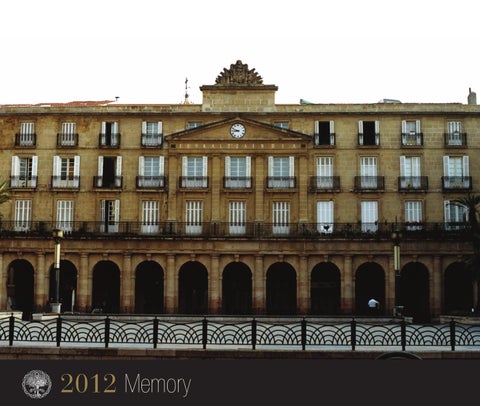
2012 Memory
E U S K A LT Z A I N D I A INDEX
3
PRESENTATION
1. The organization’s activities . Internal Activities
5 5 16
I
II
External Activities
2. Academic activities . Lexicography I
II. III. IV. V. VI.
VII.
VIII.
Grammar Dialectology Onomastics Literature Jagon Department VI.I. Corpus Committee VI.II. Dialect Working Group VI.III. Promotion Committee VI.IV. Joanes Etxeberri Project Structural Committees VII.I. Azkue Library Committee VII.II. IT and Communications Committee VII.III. History of Euskaltzaindia Project VII.IV. Erlea Magazine R. M. Azkue Prizes
3. The organization’s services . Azkue Library I
II. III. IV. V. VI. VII.
EUSKALTZAINDIA Plaza Barria, 15. 48005 Bilbo Tel.: 94 415 81 55 Fax: 94 415 81 44 info@euskaltzaindia.net www.euskaltzaindia.net
Onomastics Service Publishing Service Publishing/Distribution Service Information Technology and Telecommunications Service Press and Communications Service Jagonet Service
23 24 28 28 30 35 37
39
40 42 43 45 46 49 50 50 50
4. Public Administrations and Institutions 51 5. Website and work with the public 53 6. Euskaltzaindia’s Accounts 57 and Profit and Loss Account I. II.
Balance Profit and Loss Account
58 59 2012 Memory y 2
E U S K A LT Z A I N D I A
Presentation
I
of Euskaltzaindia's 2012 Memory, it should be taken into account, above all, that our financial situation has been particularly difficult and that we have been gravely affected by the serious state of the economy. As a result of these unfortunate circumstances, the organizations which provide for Euskaltzaindia's economic basis -the Spanish State, the Basque Government and the Provincial Governments of Araba, Bizkaia and Gipuzkoa- have raised less money from taxes than they had expected to and, because of the economic crisis, find themselves faced by ever-growing social needs which they have to work to ameliorate and solve. In situations like this, as is well known, politicians follow very strict criteria and, in general, culture is always the last priority: and even more so N THE CONTEXT
Xabier Kintana Urtiaga, Secretary
when there are other more "viewable" things such as cinema, theatre, dance, sports, bull fighting and such like available. But we should not complain because, after periods such as this come to an end, complaining about it tends to do no good. In these times good sense calls for something different, bearing in mind the social mediators we have and the subsidies we have obtained: sensible planning to use what we have in the best possible way, to gain the best possible results thanks to them and, in this case, to work in favour of Basque language and culture. All enterprises, either from the start or as time goes on, have their own main objectives and, in times of scarcity, the temptation is to use all available means in the pursuit of those objectives and
nothing else. That is one option. That way, at least apparently, the enterprise's basic activities are carried out, though at the expense of other things. But there is another option: distributing the funds acquired amongst all activities, be the sums large or small. In an Academy such as ours, and with a language such as ours, as in many poor families, we cannot pass on all the help we have been given to just a few children, leaving the others to starve. Euskaltzaindia's objective, like that of all Basque speakers, is to help keep Basque alive, and the Academy has to keep in mind what is needed for that purpose. Euskaltzaindia has committees, subcommittees and work groups and each one of them carries out work on specific areas connected with our language: 2012 Memory y 3
E U S K A LT Z A I N D I A
PRESENTATION
phonology, morphology, writing, syntax, general and specialised vocabulary, literature, paremiology, proper names and so on. Often our resources and prestige are not on the same level as the needs of Basque speakers in society, academic surroundings and the media, and Euskaltzaindia sees on a daily basis in the requests it receives from private individuals and organizations. Likewise, Academies have to plan their activities with a long-term perspective, anticipating future factors, and, without overlooking what is needed today, take the needs of the future into account. It is obvious that not all products need the same amount of time to ripen and, because of that, prudent farmers know that if they want to eat fruit at home they sometimes have to plant and graft fruit trees instead of replanting cabbages and leeks, even though the latter plants can be
harvested three or four times a year. Even so, large, hungry Arabian families do not spend much time planting palm trees in the hope of harvesting dates forty years later. When a worker does not work, work skills are lost and when no results are obtained, interest in work is also lost. It takes time, experience and work to form work groups and it is not sensible, after so many years building them up little by little, to suddenly undo everything which has been put together, and even less so when this is done in order to cover other priorities which are not, in fact, that important. For that reason, it would be positive for the members of Euskaltzaindia, if we are concerned about the reality around us, to realise what type of things people most ask Euskaltzaindia for. n 2012 Memory y 4
E U S K A LT Z A I N D I A
1 The Organization’s Activities I.
INTERNAL ACTIVITIES
Euskaltzaindia (founded 1919) is the official institution which is responsible for the Basque language. It is responsible for the language’s corpus and also for the language’s status in society. Because of this, there are two departments in Euskaltzaindia, Iker and Jagon, each with its own activities. The Academy has full official recognition, in Spain as a Royal Academy (1976) and, in France, as an Institution of Public Interest for the French Republic (1995). Euskaltzaindia is also accepted as the official advisory institution with regards to the Basque language by the Statute of Gernika (18/3/1979) and by the Government of Navarre (15/12/1986). Euskaltzaindia’s academic activity is carried out by committees and working groups and the results of this work are organized and carried out by the services in charge of infrastructures and human resources. These services are also
indispensable in order to be able to meet society’s and other institutions’ needs. The Academy’s head offices are in Bilbao. The monthly plenary sessions and management meetings are usually held in Bilbao and also, occasionally, in Donostia and in various other places too. The management normally meets twice a month. It is management’s responsibility to govern the institution, its activities and, in general, to manage its internal activities. 23 meetings have been held this year. Committees, project and working groups also meet at the head offices and in the local offices. The secretariat is responsible for following up and collecting projects’ and committee’s academic work. Updates about all of this work is given to managers, the management and, within the established time frames, to the appropriate public administrations in specially prepared reports. As agreed with the public authorities, the Deputy Secretary, along with the organizer, also organizes project contacts for the Technical Committee.
I. INTERNAL ACTIVITIES I.1. New Management I.2. “Word Order. Strategic Use” Conference. 1.3. Euskaltzaindia's Statement about the Demonstration held at Baiona on 31st March I.4. A new section on Euskaltzaindia's website: “The Social History of Basque. Bibliographic Information” I.5. Publishing of the fourth volume of the Basque Towns' Speech Atlas I.6. Digitalisation of Luis Villasante's Works I.7. Euskaltzaindia Dictionary. Meanings and Examples were published 1.8. XVII Jagon Conferences, “Basque's Current Situation and Future in the Northern Basque Country” I.9. Deaths I.10. Obituaries II. EXTERNAL ACTIVITIES 2012 Memory y 5
E U S K A LT Z A I N D I A
INTERNAL ACTIVITIES
Euskaltzaindia's Plenary Meeting at its head offices in Bilbao
2012 Memory y 6
E U S K A LT Z A I N D I A
INTERNAL ACTIVITIES
I.1. New Management At a special meeting held in the Academy's head offices in Bilbao on 18th October, 2012, Euskaltzaindia chose its new management for the next four years. This is the Academy's new management team: • Director: Andres Urrutia • Vice Director: Xarles Videgain • Secretary: Xabier Kintana • Bursar: Sagrario Aleman • Head of Iker Department: Adolfo Arejita • Head of Jagon Department: Jean-Baptiste Coyos
Xarles Videgain, Xabier Kintana, Sagrario Aleman, Andres Urrutia, Adolfo Arejita and Jean-Baptiste Coyos 2012 Memory y 7
E U S K A LT Z A I N D I A
INTERNAL ACTIVITIES
I.2. “Word Order. Strategic Use” Conference. On 24th February Euskaltzaindia's Corpus Committee organised a conference entitled “Word Order. Strategic Use” in Donostia at the Luis Villasante Basque Research Centre. The starting point for the conference was the book published by Euskaltzaindia with the same title -Word Order. Strategic Use. Around 90 people took part.
From left to right: Paskual Rekalde, Carlos del Olmo, Xabier Aristigieta and Jexux Mari Agirre at the debate in the “Hitz-ordena. Erabilera estrategikoa” ("Word Order. Strategic Use") event
Andres Iñigo, the head of Jagon Department, opened the conference and Pello Esnal, Xabier Mendiguren Bereziartu, Andres Urrutia and Igone Etxebarria were the speakers. There was an open debate after the conference. The following people took part: Jexux Mari Agirre, Translation, Proofreading and Interpretation technician at the Basque Parliament; Karlos del Olmo, translator and interpreter at Donostia City Hall; and Xabier Aristegieta, translator and interpreter at the Parliament of Navarre. Paskual Rekalde, the secretary of the Corpus Committee, was the moderator.
2012 Memory y 8
E U S K A LT Z A I N D I A
INTERNAL ACTIVITIES
1.3. Euskaltzaindia's Statement about the Demonstration held at Baiona on 31st March Euskaltzaindia expressed its solidarity with the aims of the Deiadar demonstration organised by the Euskal Konfederazioa and Kontseilua (Basque Confederation and Council associations). This was approved by Euskaltzaindia's management in the meeting held in Donostia on 22nd March. The demonstration's slogan was “Our Language: a Right, a Law”.
Euskaltzaindia's Statement is as follows: «18 years ago in Biarritz Euskaltzaindia asked the French Government to give the Basque language official status in the three northern Basque provinces in the same way it already had in the southern Basque provinces. Nothing came of Euskaltzaindia's request and France has not changed its attitude subsequently: it continues to deny local languages official status and legal protection. It is true that some changes were made to the Constitution in 2008 (Constitutional Law 2008-724) and an amendment was made to Article 75 recognising local languages as part of France's heritage. It might have been thought that the mention of these languages in the Constitution meant a greater understanding of them and that the speakers of these languages, consequently, would be protected by this new text in the defence of their languages. Unfortunately, that did not actually happen. On the contrary, the interpretation of Article 75.1 taken by the Constitutional Council (Decision 2011130: 11/05/2011) was very strict, clearly stating that "The Constitution does not create guaranteed rights or freedom". Consequently, the Constitutional Council rendered the Article ineffective in any potential practical sense. With regards to the use of Basque, Basque citizens were unprotected by the law, as they had been before, while their request for official status for their language is as just and fair as ever. In order to communicate the request for official legal status for Basque, Euskaltzaindia is at one with Euskal Konfederazioa and Kontseilua (Basque Confederation and Council associations) in the objectives of its DEIADAR demonstration held in Baiona on 31st March, 2012». Approved by Euskaltzaindia, 22nd March 2012 at a meeting in Donostia
2012 Memory y 9
E U S K A LT Z A I N D I A
INTERNAL ACTIVITIES
I.4. A new section on Euskaltzaindia's website: “The Social History of Basque. Bibliographic Information” On 20th July Euskaltzaindia opened a new section on its website: “Bibliographic Information: The Social History of Basque” at the following address: www.euskaltzaindia.net/ehsbib. The Social History of Basque section. This bibliographic information is about the book in question. The main objective of the book, which was published in 2011, was to offer bibliographic information about the social history of Basque. The new section, which is available to all, has the same objective: making resources about the social history of Basque available to all. The book was prepared by the director and honorary Euskaltzaindia member Joseba Intxausti and Euskaltzaindia technicians Izaskun Etxebeste and Koro Segurola. The same team is responsible for the new section on the website.
I.5. Publishing of the fourth volume of the Basque Towns' Speech Atlas On September 28th the fourth volume of The Basque Towns' Speech Atlas was presented by Euskaltzaindia in Iruñea. As with the three previous volumes, the Academy has been sponsored by Euskadiko Kutxa. Many concepts have been studied and are dealt with in the book, especially household animals and houses. The first part of the volume is about household animals (pigs, poultry, dogs, bees) and the second part is mostly about houses. The following took part in the presentation: Andres Urrutia, the head of Euskaltzaindia; Xabier Egibar, the head of Business Development at Euskadiko Kutxa; Maximino Gómez, the managing director of Euskarabidea; and Adolfo Arejita, the atlas's academic director. The institution's representatives stated how pleased they were and how important the book is and, later, Adolfo Arejita and Xarles Videgain gave more specific information about the project. Videgain is the in charge of the technical aspects of the atlas along with Gotzon Aurrekoetxea.
The Fourth Volume of the Basque Towns' Speech Atlas
The Basque Towns' Speech Atlas project was also presented at the University of Pau and Pays de l'Adour at the Baiona campus. Andres Urrutia, the head of Euskaltzaindia, Adolfo Arejita, the project's academic director and member of the Academy, and the people in charge of the project's technical aspects, Xarles Videgain and Gotzon Aurrekoetxea, took part in the act.
2012 Memory y 10
E U S K A LT Z A I N D I A
INTERNAL ACTIVITIES
From left to right: Xarles Videgain, Adolfo Arejita, Andres Urrutia, Maximino G贸mez and Xabier Egibar, in Iru帽ea, at the presentation of the The Fourth Volume of the Basque Towns' Speech Atlas 2012 Memory y 11
E U S K A LT Z A I N D I A
I単aki Beristain, Miriam Villasante, Josune Ariztondo, Joan Mari Torrealdai, Andres Urrutia, Jon Etxabe and Xabier Kintana
I.6. Digitalisation of Luis Villasante's Works Euskaltzaindia has digitalised and organised Luis Villasante's archives and texts making use of the subsidy granted by Bizkaia Provincial Government especially for this project. Villasante was director of Euskaltzaindia between 1970 and 1988. His first publication dates from 1944 and his last was in 2000. Altogether, 929 writings have been catalogues and collected and all of them can be accessed on the Academy's website. Villasante's archives, manuscripts, letters and photographs have also been digitalised.
Villasante's writings (previously published and now available on the Internet) fall into four main categories: complete books (41), parts of books (106), articles (769, most of them written in Basque) and special editions. These special editions are complete books, but particular in that Villasante did not write the texts: he collected and edited them. As far as subject matter is concerned, most of the writing is about religious issues (381). There are 298 writings about Basque (about Euskaltzaindia, linguistics, the revival of Basque) and 180 about literature. He also worked in many other subject areas.
All the works are available in PDF digital format. This project was managed by Euskaltzaindia and carried out by the team led by Joan Mari Torrealdai at Jakin magazine. The presentation was on the 19th of September at Euskaltzaindia's head offices and the following people took part in it: Joan Mari Torrealdai, Josune Ariztondo (the member of parliament in charge of culture in the Bizkaia Provincial Government), I単aki Beristain (representing the Franciscans of Arantzazu) and Andres Urrutia, the head of Euskaltzaindia. Miriam Villasante, Luis Villasante's niece, was also there. 2012 Memory y 12
E U S K A LT Z A I N D I A
INTERNAL ACTIVITIES
I.7. Euskaltzaindia Dictionary. Meanings and Examples was published On 3rd October the Euskaltzaindia Dictionary (Meanings and Examples) was presented at Euskaltzaindia's head offices in Bilbao. This work is a Basque dictionary prepared by Euskaltzaindia, the publishers Elkar and Elhuyar Foundation together. The work is based on Euskaltzaindia's Unified Basque Dictionary and the words in its first edition. The new work, on the other hand, offers much more information: It includes the 20,000 words in the first Unified Basque Dictionary, their definitions, grammatical categories, information about their special areas, registers, use in dialects, verb types and real examples of usage; in other words, information which will help readers to use Basque words appropriately is provided in this publication. The following people took part in the presentation: Andres Urrutia, the head of Euskaltzaindia; Olatz Osa, the director of Elkar publishers; Itziar Nogeras, the managing director of Elhuyar Foundation; Andoni Sagarna, the head of Euskaltzaindia's Iker section; and Ibon Sarasola, in charge of Euskaltzaindia's lexicography. The director of the Meanings and Examples project.
1.8. XVII Jagon Conferences, “Basque's Current Situation and Future in the Northern Basque Country” Euskaltzaindia's Promotion Committee organised the 17th Jagon Conferences, held on 16th November by Euskaltzaindia at Baiona, Université de Pau et des Pays de l'Adour (Thesis Hall) on the Baiona Campus: “Basque's Current Situation and Future in the Northern Basque Country". Many subjects were dealt with at these conferences: the socio-linguistic development of Basque in the Northern Basque Country; Basque's cultural evaluation; the language policy resources necessary for Basque to prosper; the challenges of bilingual teaching; and a presentation about experiences in different situations, amongst other things. Around 90 people took part. At these same conferences Euskaltzaindia presented the booklet "Euskaltzaindia and the Northern Basque Country". The booklet gives information about the work done and being done by members of the Academy in the Northern Basque Country. There are several sections to it: institutional relationships, Euskaltzaindia meetings and initiatives in the Northern Basque Country and publications. There is also a list of all the Academy members, honorary members and assistant members from the Northern Basque Country. 2012 Memory y 13
E U S K A LT Z A I N D I A
INTERNAL ACTIVITIES
Itziar Nogeras, Andoni Sagarna, Andres Urrutia, Ibon Sarasola and Olatz Osa at the presentation of the Euskaltzaindia Dictionary 2012 Memory y 14
E U S K A LT Z A I N D I A
INTERNAL ACTIVITIES
Relatives of those paid tribute to and members of Euskaltzaindia
I.9. Deaths
I.10. Obituaries
The following members of Euskaltzaindia died in 2012: the assistant member Jose Luis “Txillardegi” Alvarez Enparantza (14th January), the honorary member Karmele Esnal (30th May) and assistant member Josu Arenaza (29th September).
On 27th February Euskaltzaindia held a public meeting in the Academy's head offices in Bilbao in tribute to the members of the Academy who had died during 2011. The following obituaries were read: • Vahan Sarkisian (1954-2011). Honorary member. Academy member Xabier Kintana read.
• Xabier Gereño (1924-2011). Honorary member. Academy members Jose Luis Lizundia and Xabier Kintana read. • Jose Antonio Arana Martija (19312011). Emeritus member. Academy members Jose Luis Lizundia and Joan Mari Torrealdai and Begoña Arana, Jose Antonio Arana's sister, read.
• Fernando Mendizabal (1934-2011). Assistant member. Honorary member Joseba Intxausti read. 2012 Memory y 15
E U S K A LT Z A I N D I A
II. EXTERNAL ACTIVITIES Euskaltzaindia has always worked in collaboration with other institutions. The following are some of the acts which were organised during 2012: “In Praise of Basque / A Language with a Future” Conferences Etxepare Basque Institute, Euskaltzaindia and Euskalerriaren Adiskideen Association organised the “In Praise of Basque / A Language with a Future” Conferences, held in Madrid between 13th and 15th March. The conferences' objective was the following: To praise Basque in Madrid, underlining the advances in activities in Basque over recent years, showing that it is a language with a great future and explaining the results of the highest level which are being obtained in linguistics and literature. As well as the conferences, various other acts were programmed too. Tributes to Henrike Knörr and Pedro de Irizar were held on 14th and 15th March, respectively; on 16th March Bernardo Atxaga and Jabier Muguruza offered the Katuak eta paradisua ("Cats and Paradise") show at the Círculo de
Bellas Artes. The main act, however, was held on 14th March in tribute to the Basque language at the Spanish Royal Langauge Academy. As well as representatives from the organisations which have organised this institutional act, there were representatives from the Spanish Royal Language Academy, the Galician Royal Language Academy and the Institute of Catalan Studies. José Ignacio Wert, the Spanish Minister for Education, Culture and Sports led the act, in which the following people also took part: José Manuel Blecua, the director of the Spanish Royal Language Academy; Arantza Quiroga, the speaker of the Basque Parliament; Aizpea Goenaga, the director of Etxepare Institute; Andres Urrutia, the head of Euskaltzaindia; José María Urkia, the director of Euskalerriaren Adiskideen Association; Xosé Luis Méndez Ferrín, the director of the Galician Royal Language Academy; and Joan A. Argenter, professor of the UNESCO Language Chair at the Institute of Catalan Studies.
other people and Basque political representatives took part in the act. They paid tribute to the late Henrike Knörr, whose family was present. Jose Luis Lizundia, Euskaltzaindia's bursar, and José Antonio Pascual, the Spanish Royal Language Academy's vice director, spoke about Henrike Knörr. Two works by Euskaltzaindia were also presented during the conferences, on 15th March at the Iberian Languages Hall: Andoni Sagarna, the head of Iker Department, explained the work which Euskaltzaindia has carried out with regards to lexicography, particularly mentioning and thanking the people who have worked in this area over recent years; Adolfo Arejita, the head of the Basque Popular Speech Atlas project explained the same. Xabier Kintana, Euskaltzaindia's secretary, gave the presentation.
As well as members of Euskaltzaindia, the Spanish Royal Language Academy and Euskalerriaren Adiskideen Elkartea, many 2012 Memory y 16
E U S K A LT Z A I N D I A
EXTERNAL ACTIVITIES
The conclusion of the meeting held with the Spanish Royal Academy; in Henrike Knรถrr's memory. In the picture, Jose Luis Lizundia reading the tribute to Knรถrr
2012 Memory y 17
The exhibition about the Basque Renaissance. The Azkue Library has loaned material
The Maule Book Day, the Sara Writers' Meeting and Book Fairs Book Day was held at Maule on 17th March. It was organized by the town's Basque House and was open throughout the day. Euskaltzaindia also had a sales stand there and exhibited 20 works with connections with Zuberoa. The official inauguration ceremony was held on the 16th of the month. Writer and Emeritus member Jean-Louis Davant gave the opening speech at the 1st Maule Book Day: “A Walk through Basque Literature in several Books”.
Euskaltzaindia took part in the Sara Writers' Meeting in April and presented four books there: Xiberoko Antzertia edo Pastorala (“Zuberoan Theatre and Pastorala”) by Junes Casenave-Harigile; Further Verse Sermons by Gratien “Zaldubi” edited by Henri Duhau; Gazteak, aisialdia eta euskara Ipar Euskal Herrian (“Young People, Leisure and Basque in the Northern Basque Country”) by Erramun Baxok and Jean Baptiste Coyos; and Eugène Goyheneche: Onomastique du Nord du Pays Basque (“Onomastics in the Northern Basque Country”) by Xarles Videgain. Euskaltzaindia was also present at the Durango and Barcelona Book Fairs.
From 31st May to 10th June an exhibition about the Basque Renaissance was open at the Bilbao Book Fair. The Book Fair itself organized this exhibition with Euskaltzaindia's collaboration and loans from the Academy's Azkue Library. Euskaltzaindia took part in the Barcelona Book Fair (Liber 2012) along with the Institute of Catalan Studies and the Galician Culture Committee. And in December, like every year, the Academy was present at the Durango Basque Book and Record Fair.
2012 Memory y 18
E U S K A LT Z A I N D I A
EXTERNAL ACTIVITIES
At the “Collection, Treatment and Broadcasting of Basque” conferences On 7th June the Government of Navarre's Euskarabidea organised the, “Collection, Treatment and Broadcasting of Basque” conferences at Burlata. Euskaltzaindia presented two projects: The Basque Popular Speech Atlas and the Oral Tradition Speech Corpus. The Academy was represented by the following people: Adolfo Arejita was the academic director of both projects; Amaia Jauregizar was the technician for the first project and Aritz Abaroa for the second. In June the Socio-linguistic Cluster named Euskaltzaindia as an honorary member. This was decided on 14th June at the 8th General Meeting. The following institutions took part in the meeting: Emun Kooperatiba, Eusko Ikaskuntza, Topagunea, Artez Euskara Zerbitzua, Elhuyar Aholkularitza, AEK, Gipuzkoako Urtxintxa, Mondragon Unibertsitateko Humanitate eta Hezkuntza Zientzien Fakultatea (HUHEZI), Gipuzkoa Donostia Kutxa, Bai Euskarari Ziurtagiriaren Elkartea and Aztiker. On 22nd June the prize giving ceremony was held for the second Gerardo Lopez de Guereñu competition, organised by Araba Provincial Government. A series of conferences throughout Araba was organised
at the same time. Altogether there were 21 conferences with the following speakers: Elena Martinez de Madina and Felix Mugurutza, members of Euskaltzaindia's Onomastics Committee; linguist and assistant Academy member Koldo Zuazo; and Andoni Llosa, the Trebiñu Basque technician. At those conferences Euskaltzaindia also presented and distributed its publications about Gasteiz Toponymy, organised in three books (The City of Gasteiz, Malizaeza and Ubarrundia). On 4th July the book about Leioa Place Names was presented at Euskaltzaindia's head offices in Bilbao. This book brings together the results of studies about Leioa places names carried out over the last three years and they have now been made available to all by Leioa Town Council and the Academy. Mikel Gorrotxategi, Iratxe Lasa and Goizalde Ugarte carried out this work. They presented it in Leioa on 15th November. Like every year, Euskaltzaindia took part in the Nafarroa Oinez festivities and the Academy organised several acts in Zizur Txikia.
2012 European Heritage Conferences The 2012 European Heritage Conferences were held throughout October under the heading “The End of the Middle Ages”. Bizkaia Provincial Government organised this project and Euskaltzaindia took part. The Academy held the conferences on six days in October: the 2nd, the 3rd, the 10th, the 23rd and the 24th. During two sessions entitled "The Dawn of Basque Literature at the End of the Middle Ages" information was given about the epic poetry from that period. At a further ten acts the origins of Basque and its evolution were discussed; the recuperation and normal usage of Basque names was explained; and there were guided visits of the Academy's head offices. The following people gave talks: Xabier Kintana, Jabier Kaltzakorta, Pruden Gartzia, Josune Olabarria, Patxi Galé, Mikel Gorrotxategi, Aritz Abaroa, Amaia Jauregizar and Gorka Intxaurbe. The Azkue Library also prepared an exhibition entitles “15th and 16th Century Documents and Documents about the Period in the Azkue Library's Archives”. The exhibition was open between 2nd and 17th October in the Euskaltzaindia Hall.
2012 Memory y 19
E U S K A LT Z A I N D I A
EXTERNAL ACTIVITIES
Amaia Jauregizar, Adolfo Arejita and Aritz Abaroa at the event held in Burlata
2012 Memory y 20
E U S K A LT Z A I N D I A
EXTERNAL ACTIVITIES
Tribute was paid to Manuel Lekuona on November 7th at Oiartzun Town Hall. His relatives were present. The following are with them in the photograph: mayor Aiora Perez de San Roman, Euskaltzaindia Head Andres Urrutia, Euskal Herriko Bertsozale Elkartea Director Iñaki Murua and Euskaltzaindia Popular Literature Committee Secretary Jose Ramon Zubimendi
The 17th Jagon Conferences, in tribute to Manuel Lekuona and Eusebio Erkiaga On 7th November, Oiartzun Town Council offered a tribute to the linguist, anthropologist and Academy member Manuel Lekuona on the 25th anniversary of his death. Representatives from the town council, Manuel Lekuona's relatives, representatives from Euskaltzaindia and Euskal Herriko Bertsozale Elkartea (the Basque Improvised Poetry Association) took
part. Euskaltzaindia's management held a meeting in Oiartzun on the same day. Euskaltzaindia's Promotion Committee organised the 17th Jagon Conferences, held on 16th November by Euskaltzaindia at Baiona, Université de Pau et des Pays de l'Adour (Thesis Hall) on the Baiona Campus: “Basque's Current Situation and Future in the Northern Basque Country". Several subjects were dealt with at these conferences: Basque's socio-linguistic development in the Northern Basque Country; Basque's cultural value; the
necessary linguistic policies for Basque to be able to carry on as a language; the challenges of bilingual education; and the presentation of different experiences in different situations, amongst other things. A act of tribute to Eusebio Erkiaga was held on 30th November at Deusto University in Bilbao by Euskaltzaindia's Literature Reseach Committee in collaboration with Deusto University. Bilbao City Council helped with this act. The Academy also took part in Xalbador Day, held at Urepele. 2012 Memory y 21
E U S K A LT Z A I N D I A
EXTERNAL ACTIVITIES
The Jagon event held at Baiona
2012 Memory y 22
E U S K A LT Z A I N D I A
2 Academic activities
Euskaltzaindia’s Academy Activities are carried out by committees, projects and services. Monthly plenary sessions make the linguistic proposals that come from the committees into rules.
Euskaltzaindia has two main departments: Iker and Jagon. The Heads, Committees and Committee members are appointed every four years. The committees are made up of committee members and committee advisors. Working groups are also set up, depending on the urgency of each case and on the resources available. Academicians, assistant academicians and experts from different areas make up the committees. Experts include university and high school teachers, writers of teaching material for adult Basque literacy courses, writers, communications technicians, translators, lexicographers, administration technicians and others.
I. LEXICOGRAPHY II. GRAMMAR III. DIALECTOLOGY IV. ONOMASTIC V. LITERATURE VI. JAGON DEPARTMENT VII. STRUCTURAL COMMITTEES VIII. R. M. AZKUE PRIZES
2012 Memory y 23
E U S K A LT Z A I N D I A
ACADEMIC ACTIVITIES
I. LEXICOGRAPHY Lexicography is an absolutely fundamental activity for all language Academies. As well as the completed Orotariko Euskal Hiztegia (General Basque Dictionary), Euskaltzaindia is working on two further projects: Euskaltzaindiaren Hiztegia (The Euskaltzaindia Dictionary) and Hiztegi Batua (The Unified Basque Dictionary). I.1. The Euskaltzaindia Dictionary (Meanings and Examples) The Euskaltzaindia Dictionary (Hiztegi Batua (The Unified Basque Dictionary) - 1st version, Meanings and Examples) is based on Euskaltzaindia's Hiztegi Batua (The Unified Basque Dictionary) and the words published in the first version of the same.
I.1.1. The Euskaltzaindia Dictionary (Meanings and Examples) Project On 3rd October the Euskaltzaindia Dictionary (Meanings and Examples) was presented at Euskaltzaindia's head offices in Bilbao. This work is a Basque dictionary prepared by Euskaltzaindia, the publishers Elkar and Elhuyar Foundation together. The basis for the work is Euskaltzaindia's Unified Basque Dictionary and the words in its first edition. The new work, on the other hand, offers much more information: it includes the 20,000 words in the first Unified Basque Dictionary, their definitions, grammatical categories, information about their special areas, registers, use in dialects, verb types and real examples of usage; in other words, information which will help readers to use Basque words appropriately is provided in this publication.
I.1.2. Euskaltzaindia Dictionary. Meanings and Examples Executive Committee “The Euskaltzaindia Dictionary. Meanings and Examples" Executive Committee was set up in 2009. It has continued with its work, having been given the complete authority by Euskaltzaindia’s plenary session, on the The Euskaltzaindia Dictionary. Meanings and Examples. During 2012, 1,000 articles were studied every month for the second version of the Unified Basque Dictionary, a total of 7,00 articles throughout the year. On completing the dictionary, the executive committee understood its work to be finished and ceased to meet.
The following took part in the presentation: Andres Urrutia, the head of Euskaltzaindia; Olatz Osa, the director of Elkar publishers; Itziar Nogeras, the managing director of Elhuyar Foundation; Andoni Sagarna, the head of Euskaltzaindia's Iker section; and Ibon Sarasola, in charge of Euskaltzaindia's lexicography. The director of the Meanings and Examples project. 2012 Memory y 24
E U S K A LT Z A I N D I A
ACADEMIC ACTIVITIES
I.2. Batua (Standard Basque) Dictionary I.2.1. Unified Basque Dictionary (2nd Version) Executive Committee Euskaltzaindia set up the Unified Basque Dictionary (2nd Version) Executive Committee in 2010. This committee's objective was, having been given complete authority by Euskaltzaindia’s plenary session, to increase the efficiency of the process of Euskaltzaindia’s work on the Unified Basque Dictionary, shortening delivery times and giving the project a closer conclusion date. This year three up-dates of the Unified Basque Dictionary were completed and presented in April, July and December respectively. Altogether, around 1,500 words have been studied. Euskaltzaindia’s plenary session also studied a further 81 words which had been left for future investigation when the previous two versions were prepared and which the Lexicography Observatory had recommended for study.
I.2.2. Unified Basque Dictionary Working Group The Unified Basque Dictionary is the dictionary in which rules are laid down. In the first version of The Unified Basque Dictionary the most used and most widely used word forms were included. Further commonly used words are included in the second version. When all the work is concluded, there will be more than 55,000 words in The Unified Basque Dictionary. Many groups of words from specific areas have been researched and included: chemical elements, the signs of the zodiac, the names of coins, units of size, animal breeds and words derived from proper nouns. The Unified Basque Dictionary work group has also spent years working on and suggesting the forms used in the Dictionary, basing this work on the corpuses: The General Basque Dictionary corpusand the 20th Century Basque corpus. The basic dictionary has been obtained from these sources, but a more extensive corpus is needed in order to go forward and meet the needs of contemporary Basque. So the new corpus, put together by this work group, is an observatory for this tendency: The Lexical
Observatory. The Academy has developed this in partnership with UZEI, Elhuyar and the University of the Basque Country’s Ixa group. During 2011 the words taken from the 17 million text words which were in the Lexical Observatory were studied: a total of 7 million. Euskaltzaindia's plenary session accepted 1,500 words which had been excluded from the previous two versions because of their frequent appearance in the Lexical Observatory. 359 new forms which appeared more than 25 times in the Lexical Observatory were also studied. As in previous years, Euskaltzaindia and UZEI worked together on this project. 2012 Memory y 25
E U S K A LT Z A I N D I A
2012 Memory y 26
E U S K A LT Z A I N D I A
ACADEMIC ACTIVITIES
I.3. The Science and Technology Dictionary Project Work was started on this project in 2008 with the following objective: collecting the basic words used in science and technology and researching them in order to be able to include them in Euskaltzaindia’s Unified Basque Dictionary. The list of mathematical terms has been given some final touches and the complete list has been delivered to Euskaltzaindia. In the physics area, a group of experts was formed and then the list of basic terms was drawn up and delivered to Euskaltzaindia. The list of astronomy and astrophysics terms was also drawn up and experts continue to work on it.
I.4. The Etymological-Historical Basque Dictionary Project Our intention is to systemically research the history and origin of Basque words, basing ourselves on historical and etymological work carried out until present and using the information provided by the General Basque Dictionary. Work has been carried out on the Etymological-Historical Basque Dictionary's prototype. The objective was to have a collection of around 550 words and a manual. So drafts were written from 80 entries (around 240 words) and a further 150 (around 450 words) are at an advanced stage. Final versions have been written for 175 entries (around 525 words). The dictionary's final prototype has been prepared, including 175 entries and etymological studies of around 550 words.
I.5. Lexical Observatory Project The Unified Basque Dictionary working group saw that a more extensive corpus was required to meet the demands of contemporary Basque, and that this corpus should uninterruptedly collect contemporary texts. So the new corpus, put together by this work group, is an observatory for this tendency: The Lexical Observatory. The Academy has developed this in partnership with UZEI, Elhuyar and the University of the Basque Country’s Ixa group. 9,385,000 text words have been catalogued and put into the corpus. All phases have been completed and the application is available on Euskaltzaindia's website. The Corpus has 26,565,924 text words. Euskaltzaindia has signed agreements with many media (Berria, Argia, EiTB, Deia, Noticias de Gipuzkoa, Diario Vasco and Jakin) in order to have access to the texts they produce in Basque.
2012 Memory y 27
E U S K A LT Z A I N D I A
ACADEMIC ACTIVITIES
II. GRAMMAR
III. DIALECTOLOGY
Basque Grammar Committee. Work on the first phase has been finished and work has started on updating and completing what Basque Grammar is going to be. After drawing up a report about the planning for this project, the committee has started to determine the new Grammar's contents and work procedures. In order to make work more effective, the committee's operative group has been formed.
III.1. The Basque Popular Speech Atlas Project
As usual, the committee answered the questions received by the JAGONET service.
After establishing interview places, questionnaires and work methodology, Euskaltzaindia started carrying out tests in 1986 and doing interviews in 1987. 145 towns were chosen for these interviews: – In the Basque Autonomous Region: 1 town in Araba, 36 in Bizkaia and 36 in Gipuzkoa. –Navarre Autonomous Region: 27 towns. –In the Northern Basque Country: 15 in Lapurdi, 18 in Lower Navarre and 12 in Zuberoa. In each interview location 2,857 questionnaires were completed. Euskaltzaindia collected more than 4,000 hours of recordings. The project’s objective is to make an atlas based on the questions asked, in other words, to make maps based on the answers given and to make these maps available to the public. The fourth tome was published in 2012 and the fifth tome's provisional version was completed. 204 questions have been
prepared for the seventh and eighth tomes, and the maps and answers for each have been studied and corrected. In addition, the eighth tomes 41st subject's question (pentzea) and the 42nd subject's question (belar lana) have been prepared. III.2. Oral Tradition Speech Corpus Project This project’s objective is to collect orally transmitted material, classify it, selectively transcribe it and then make it available as the basis for research. The material to be collected concerns the following, amongst others: work, customs, tales, events, old memories, superstitions, sayings, games, songs. In order to do this, a systematic, methodical plan for dealing with this orally transmitted heritage has been drawn up. 10 recordings have been made, a further 20 have been prepared, 325 passages have been selected and labelled and 165 transcriptions have been corrected. 165 transcriptions have been corrected for the Oral Heritage Collection. Work has also been carried out on "Criteria for Transcribing Zuberoan Basque". 115 transcriptions have been corrected. 2012 Memory y 28
E U S K A LT Z A I N D I A
ACADEMIC ACTIVITIES
Xarles Videgain speaking at the presentation of the Basque Towns' Speech Atlas at Baiona on December 11th
2012 Memory y 29
E U S K A LT Z A I N D I A
ACADEMIC ACTIVITIES
IV. ONOMASTIC IV.1. Onomastics Committee The Onomastics Committee researches first names, surnames and place names: in other words, its work is to establish the general catalogue of names, supervise it, establish criteria and issue certificates or to give advice. It has supervised research carried out on many towns’ place names and maps and given answers to the questions received from EUDEL, other institutions, associations and individuals.
names. It has also started work on the list of Basque surnames. Toponymic maps have been presented for the Aiara, Arakaldo, Elgoibar and Zaratamo areas. In addition, several programs about onomastics have been recorded in collaboration with Bizkaia Irratia.
IV.2. Exonymastics Committee This committee researches and regulates foreign names, sets criteria and advises on the same. This year the norm about Middle Eastern and North African toponyms (norm 164) and norm 165 (the system for names written in the Arabic alphabet to be transcribed into Basque) have been prepared. Work has been carried out on toponyms from Sub-Saharan Africa, Central Asia, the Far East, the Americas and Oceania and on potential norms. The committee has also carried out work on astronomical names.
The Committee receives and gives answers to requests received from public administrations throughout the Basque Country (the Basque Government and Provincial Governments, the Government of Navarre, Town and City Councils in the Northern Basque Country). One first name and 30 surnames have been accepted. The norm about rivers in the Basque Country (number 166) has been completed. The committee has continued working on saints' names, on Basque Country town names and has also updated the list of first 2012 Memory y 30
E U S K A LT Z A I N D I A
ACADEMIC ACTIVITIES
The exhibition about Ea place names was held in November
2012 Memory y 31
E U S K A LT Z A I N D I A
ACADEMIC ACTIVITIES
IV.3. Basque Onomastics Corpus Project This project’s objective is to collect the most complete corpus possible of Basque proper nouns. To do this, further work has been carried out on designing a database and collecting data. Considerable onomastic data has been registered and included in the database. For example, onomastic information has been taken from Aurnaut Oihenart’s Notitia utriusque vasconiae and Patxi Salaberri’s Etxalarko etxeen izena (House Names in Etxalar). Onomastic information from the first tome of Alfontso Irigoien’s De rephilologica linguae vasconicae ("On Basque Philology") has been collected, and this has also been done with the following works: Toponyms and place names from Oñati (Jesus Mari Ugarte and Iñaki Zumalde), Farmstead names in the Mungia area (Andoni Cayero), The Unity of the 276 Boundary Stones on the Basque Frontier, from the Bidasoa to Belagua (Iñaki Vigor and Carlos Sanz), Bakaiku Place Names (Jose Luis Erdozia), Basque Land: Land and Men. A section of the Basque Country (Jose Luis Lizundia), Generic River Names in Basque Toponymy (Bernardo Garro).
Toponymy included in the French Institut Géographique National's cartography of Lapurdi, Lower Navarre, Zuberoa and Bearn has been collected. The geographical position of all the places in the Basque Onomastics database have been specified. Information has been collected about the lists of municipalities and town names from the Official Archive of Navarre, the Spanish Official State Bulletin, the Basque Country Official Bulletin, the three Basque Province Official Bulletins. This project is expressly included in the Academy's agreement with the Government of Navarre and can be carried out thanks to the subsidy granted by this latter.
2012 Memory y 32
E U S K A LT Z A I N D I A
ACADEMIC ACTIVITIES
The presentation of the Elgoibar place name map
2012 Memory y 33
E U S K A LT Z A I N D I A
ACADEMIC ACTIVITIES
IV.4. Gasteiz Place Names Project Thanks to its agreement with Gasteiz City Council, Euskaltzaindia has been able to continue its work collecting and establishing place names in the city. Until present three of this collection's tomes have been published: Gasteiz Toponymy I (the City), Gasteiz Toponymy II (Malizaeza) and Gasteiz Toponymy III (Ubarrundia).
In blue, Malizaeza. In red, Ubarrundia
2012 Memory y 34
E U S K A LT Z A I N D I A
ACADEMIC ACTIVITIES
V. LITERATURE
V.1. Popular Literature Committee
V.2. Literary Research Committee
Euskaltzaindia’s Literature Section has worked on two main areas. On the one hand, popular literature’s different means of expression have been studied. On the other hand, a study of Basque literature has been started, researching different periods and subject matters.
The Committee has continued work on the publication of Xaho’s songbook. In preparation for the book in tribute to Antonio Zavala, work has been carried out for the publication of the texts for ceremonies from the popular literature selected.
The conferences entitled “Agosti Xaho eta erromantizismoa Euskal Herrian” (Agosti Xaho and Romanticism in the Basque Country) were published in Euskera 2011, 56, 3. This was presented at Gipuzkoa Provincial Government in December. The committee has also carried out work on the Basque Literature Anthology. Texts and entries for the first tome from the Basque Middle Ages and 16th Century have been completed.
Like every year, we also took part in the organization of Xalbador Day.
In collaboration with Deusto University, the committee prepared a conference to celebrate the centenary of Eusebio Erkiaga's birth. It was held on 30th November at Deusto University Library.
2012 Memory y 35
E U S K A LT Z A I N D I A
ACADEMIC ACTIVITIES
Miren Agur Meabe, Iratxe Retolaza and Igone Etxebarria at the tribute to Eusebio Erkiaga, Deusto University
2012 Memory y 36
E U S K A LT Z A I N D I A
ACADEMIC ACTIVITIES
VI. JAGON DEPARTMENT The Jagon Department has existed in Euskaltzaindia since the Academy’s creation, its objective being to protect the Basque language. This department is divided into two committees: Corpus and Promotion.
VI.1. Corpus Committee This committee is responsible for protecting the Basque corpus with the objective of guaranteeing language quality. The JAGONET service forms part of this, including its question and answers database. The committee presented “Word Order. Strategic Use” in Donostia in January. This book is the 14th in the Academy's “Jagon” collection and was prepared by the Euskaltzaindia Corpus Committee under Pello Esnal's coordination.
Bereziartu, Andres Urrutia and Igone Etxebarria were the speakers. There was an open debate after the conference. The following people took part: Jexus Mari Agirre, Translation, Proofreading and Interpretation technician at the Basque Parliament; Karlos del Olmo, translator and interpreter at Donostia City Hall; and Xabier Aristegieta, translator and interpreter at the Parliament of Navarre. Paskual Rekalde, the secretary of the Corpus Committee, was the moderator.
VI.2. Dialects Working Group
VI.3. Promotion Committee This committee works on the language’s status. This year it collected the papers read at and the reports about the 15th Jagon Conference and these were published in Euskera, 2011, 56, 3 under the title “Arabatik Arabara” ("From Araba to Araba"). This was presented at Gipuzkoa Provincial Government in December. This year the 17th Jagon Conference was held and was based around “Basque's Current Situation and Future in the Northern Basque Country".
This group is working on the “From Basque Dialects to United Basque: How to Complete the United Basque Dictionary” project. This year the entries for E and F in the Labayru Dictionary were studied and work was started on the entries for G. Word lists and reports on words for possible inclusion in the Unified Basque Dictionary were prepared.
A conference about proper names was held in February at the Luis Villasante Basque Research Centre. Andres Iñigo, the head of Jagon Department, opened the conference and Pello Esnal, Xabier Mendiguren
2012 Memory y 37
E U S K A LT Z A I N D I A
ACADEMIC ACTIVITIES
Alazne Gorrotxategi and Joseba Intxausti presenting the “Euskararen Historia Soziala. Argibide bibliografikoak” ("The Social History of Basque. Bibliography") website
VI.4. Joanes Etxeberri Project (The Social History of Basque) This project’s objective is to research the social character and ways of life of Basque, and the other languages which have been in contact with Basque, throughout history; it aims to study the beliefs, sciences, types of organization, situations, attitudes, behaviour, variations and so on which society has held with regard to languages from linguistic, sociological and historiographical points of view. In 2012 a considerable part of the report about methodology models was drawn up. A bibliographical list with 144 entries was completed. The Abbadia Prizes as seen in posters This book about Basque cultural activity has been finished and is ready for publication. Likewise, the research books
Euskal aipamenak arabiar iturrietan (Mentions of Basque in Arabic Sources) and Basque and Basque Society in the 17th and 18th Centuries: A First Approach have been written.
reference. More information has been fed into the database and, thanks to an agreement with HABE, many new books and documents have been scanned.
In July The Social History of Basque. Bibliographical information about the book in question has been put on the Academy's website and can be accessed there for 2012 Memory y 38
E U S K A LT Z A I N D I A
ACADEMIC ACTIVITIES
VII. STRUCTURAL COMMITTEES
VII.2. Information and Communications Technology Committee
VII.1. Azkue Library Committee The committee followed the Azkue Library's work throughout 2012. In addition, a report entitled A Proposal for the Renewal of the Azkue Library was prepared and presented to the management. Likewise, the inventory of Piarres Lafitte's archives was presented and accepted and the cataloguing phase is considered to have been concluded. In the same way, safety copies of all the original recordings for The Basque Popular Speech Atlas have been made on a new support and, at the same time, the existing sound catalogue has been examined in depth. The results of this is the Basque Popular Speech Atlas Sound Material Inventory (2012) report.
This committee’s work is to make the contents created by Euskaltzaindia as well known as possible using the resources offered by new technologies and to study the ways in which the latter can be used. In 2012 some changes were made to the Anaitasuna Internet-based newspaper and periodicals library and a search option was added. Luis Villasante's complete works were digitalised and put onto the Academy's website, as was The Social History of Basque. Bibliographical information about the book in question was too. Nafarkaria, the supplement about Navarre published by Euskaldun Egunkaria for eleven years is now ready to be put onto the Academy's website.
VII. 3. History of Euskaltzaindia Project The project’s objective is to collect the Academy’s history. During 2012 the Manuel Lekuona (1966-1970) sub-section was developed as were the structures for the Luis Villasante (1970-1988) and Jean Haritschelhar (1989-2004) sub-sections. In all three cases, Academy members, emeritus members and assistant members were interviewed. VII.4. Erlea Magazine In 2012 the sixth number of Erlea magazine was published.
At the same time the 20th Century Basque Corpus database was updated and put onto the Academy's website. The digital versions of publications from 2012 were put onto the Academy's website and the Basque Onomastics database's materials and the Basque Popular Speech Atlas work group's internal application were renewed. 2012 Memory y 39
E U S K A LT Z A I N D I A
ACADEMIC ACTIVITIES
VIII. R. M. AZKUE PRIZES
Euskaltzaindia and Bilbao Bizkaia Kutxa Foundation award prizes to young writers every year. There are two classes of prizes: narrative and poetry. There are two levels in each class: Class A, for young people between 11 and 14; and Class B, for those between 15 and 18. The main objectives of the R.M. Azkue Prizes is to attract young writers to the world of literature. The following works won the 2012 R.M. Azkue Prizes:
Prize
Prize-winning Works
Prize Winners
Schools and Towns
The judges were the following:
A: Narrative 10-13 years old
1) Gauza txikiak 2) Altxa porru! 3) Bizi berri baten bila
Izar Foroni Iñaki Arizmendi Uxue Imaz
Loinazpe (Beasain) Urola ikastola (Azpeitia) Beasain Inst. (Beasain)
• Class A: Yolanda Arrieta, Igone Etxebarria and Antton Irusta.
Special Mentions: Maialenen egunerokoa Abestia Errespetua Pierre Heme
Nerea Urrestilla Ana Zubiaurre Olatz Erkoreka Jon Foruria
Urola ikastola (Azpeitia) Elgoibar ikas. (Elgoibar) S. Altube (Gernika) S. Altube (Gernika)
And, in November, the Narrazioak eta olerkiak 2011 (“2011 Narrative and Poetry”) book was published. The winners of Bilbao Bizkaia Kutxa Foundation and Euskaltzaindia’s 2010 Resurreccion Maria Azkue prize winners’ narratives and poetry are published in this book. The winners were: Ane Lapeira, Maddi Petralanda, Evangelina Descalzo, Julen Antxia, Xabie Oianguren, Amaia Rodriguez, Malen Barriola, Maite Larrarte, Maialen Akizu, Ainhoa Urien, Mikela Atxoarena, Maialen Elortza and Mikel Aranburu.
A: Poetry 10-13 years old
No works were presented
B: Narrative 14-17 years old
1) Metamorfosia 2) Goian bego 3) 06:18
Garazi Mugarza Markel Txasko Maialen Akizu
J. Zumarraga (Durango) Mitxelena (Errenteria) Iparragirre (Urretxu)
B: Poetry 14-17 years old
1) Agerraldi perfektuetan 2) Baztertutako zapata gehiago egon ez dadin 3) Tangoaren eskean
Eider Perez Maialen Elortza
Santo Tomas (Donostia) Haurtzaro (Oiartzun)
Eider Perez
Santo Tomas (Donostia)
• Class B: Joseba Butron, Jabier Kaltzakorta and Mayi Iza.
2012 Memory y 40
E U S K A LT Z A I N D I A
The winners of the 2012 R.M.Azkue prizes
2012 Memory y 41
E U S K A LT Z A I N D I A
3 The organization’s services Euskaltzaindia’s head offices are in Plaza Barria in Bilbao. Infrastructure coordination work is done there and the services which are controlled by that work are based there: the Secretariat, Financial, Azkue Library, Onomastics, Publishing and Distribution and Press and Communication and IT and Telecommunications Services. The Jagonet Service, however, works from the Donostia local offices.
In order to be able to offer its services to institutions, associations and individuals, Euskaltzaindia also has local offices in four of the Basque provincial cities: Baiona, Donostia, Gasteiz and Iruñea. This contact with people is very important: language consultations, certificates and group visits, amongst other things, are coordinated from both the head offices and from the local offices. There is continual attention to the public in all five offices about first names and surnames, about which certificates are issued, and also about place names and many other issues related with the study of other Basque language issues. Certificates about first names and surnames are issued at all five offices.
III. 1. AZKUE LIBRARY III.2. ONOMASTICS SERVICE III.3. PUBLISHING SERVICE III.4. PUBLISHING SALES SERVICE III.5. INFORMATION TECHNOLOGY AND COMMUNICATIONS SERVICE III.6. PRESS AND COMMUNICATION SERVICE III.7. JAGONET
In addition to that, the culture rooms at the head offices and at the Gasteiz office are available for institutions and associations to give press conferences and presentations about subjects connected with Basque and to hold meetings.
2012 Memory y 42
E U S K A LT Z A I N D I A
THE ORGANIZATION’S SERVICES
III.1. AZKUE LIBRARY The Azkue Library’s catalogue is made up of books, magazines and similar publications. Four separate processes are involved here: purchase/adquisition, cataloguing, users (consultation, loans, copies) and maintenance. Pruden Gartzia is the director of the Azkue Library. In 2011 there were 530 new additions to the catalogue, of which 243 are wholly catalogued. 97 of them were numbers of the Euskera magazine and a further 17 were Euskaltzaindia’s publications. The Azkue Library's complete catalogue has been thoroughly examined. As a result, all authorities have been cleaned up and rewritten according to their own technical characteristics using only the first three databases. At present there are 6,366 authority entries, all in a single database, studied and in the same structure. Maintenance work was done on the complete photographic archive, all the dossiers from 2011 (94 in total) were organized using the same protocols. In addition, 1,510 digital dossiers from the ABA-RMA heritage catalogue (%70 of the whole legacy) have been linked and some
work has been done on the administrative archive (ABA-EUS) with the cataloguing of the dossiers from 1919-1921 (28). Also in the archive area, Xipri Arbelbide's sound legacy (ABA-XAR) and the Northern Basque Country Toponymy Research legacy (ABA-ITI)'s digitalisation and cataloguising plan has been prepared and accepted. It will be carried out during 2013. It has also collaborated in putting the late Euskaltzaindia head Luis Villasante's complete works onto the Academy's website. Basilio Sarober and Pello Joxe Aranburu Ugartemendia's documentary donations have also been received and organized. Altogether, two book exhibitions have been held, one about the Basque Renaissance at the Bilbao Book Fair, and the other about Basque Epics as part of Bizkaia Provincial Government's Heritage Conferences.
2012 Memory y 43
E U S K A LT Z A I N D I A
THE ORGANIZATION’S SERVICES
Azkue library reading room
2012 Memory y 44
E U S K A LT Z A I N D I A
THE ORGANIZATION’S SERVICES
III.2. ONOMASTICS SERVICE This service’s work is divided into three main areas: surnames, first names and place names. Questions are received from institutions, companies and individuals and some of these have to be answered immediately (birth registries, for instance) while some call for more in-depth investigation. Mikel Gorrotxategi is the director of this service. In 2011 more than 200 people came to the head office to ask their questions, mostly in connection with first names (71), surnames (22) and place names (27). Around 850 enquiries have also been made over the telephone by both individuals and by registrars. Of the latter, 178 calls were about the appropriateness of first names and how to write surnames. There were also questions about place names and surnames, with first names being the source of greatest interest. Of the approximately 700 questions asked about names, more than 200 were asked by individuals and a similar number were asked by registrars. Questions were also asked by e-mail and, in this case too, most questions were about names. More than 1,200
messages were answered and half of them were about people’s names. As is specified in the agreement the Academy has with EUDEL, we offer consultation services to town and city councils about place names. We advised the following municipal authorities: Aiara, Amurrio, Añana, Areatza, Azkoitia, Bergara, Berriz, Ea, Eibar, Ekora / Yécora, Elgoibar, Galdakao, Gasteiz, Getxo, Iruña Oka, Ispaster, Kuartango, Lagran, Mallabia, Markina-Xemein, Soraluze, Tolosa, Zalla, Zamudio, Zaratamo, Zarautz and Zornotza. And the following street name guides were also prepared: Donibane Garazi, Arbona, Lehuntze, Gasteiz, Trapagaran, Iruña Oka, Elorrio and Gernika. The service's director also took part in a radio programme on Bizkaia Irratia about Bizkaian toponyms. And the following conferences and presentations were made: Presentation of the Aiara and Elgoibar maps; Presentation of the book about Leioa; Presentation of the book about Ea; Conference at Enkarterri Basque School and San Viator School about names and Euskaltzaindia. It also carries out the Onomastics committee's work. 2012 Memory y 45
E U S K A LT Z A I N D I A
THE ORGANIZATION’S SERVICES
III.3. PUBLISHING SERVICE Under Rikardo Badiola's direction, the Publishing Service published the following works during 2012:
• Euskera, 2011,1-2. Author: Various. • Euskera, 2011,3. Author: Various. • Euskaltzaindia’s 2011 Memory (in Basque, French, Spanish and English) • Itzulpengintza eta itzulpen-praktika Joseba Sarrionandiaren lanetan. (Translations and Translation Practices with Joseba Sarrionandia's work). Author: Aiora Jaka. • Koldo Mitxelenaren zinema- eta liburukritiketako diskurtso estrategiak: enuntziatu parentetikoak. (Koldo Mitxelena's strategic discourse for cinema and book criticism: statements in parenthesis). Author: Agurtzane Azpeitia. • Jon Mirande, olerkaria. (Jon Mirande, Poet). Author: Txomin Peillen.
• Antoine D´Abbadia, Abbadiaz. Author: Jean-Louis Davant. • Gratien Adema “Zaldubi”: Gaineratikoen bilduma. (Anthology of Remaing Works). Editor: Henri Duhau. • Euskararen Herri Hizkeren Atlasa IV. (The Basque Popular Speech Atlas IV). Author: Various. • Nafarroako ipar-mendebaleko hizkeren egitura geolinguistikoa. (North-Western Navarrese Geolinguistic Speech Structure). Author: Amaia Apalauza. • Erlea magazine, 6th number. Director: Bernardo Atxaga. Authors: various.
In addition to these new publications, some digital versions of books have been put onto the Academy's website. • Euskera 2010,3. Author: Various. • Perpetua Saragueta: eskuidatziak eta hiztegia. (Perpetua Saragueta: Manuscripts and Dictionary). Author: Andres Iñigo. • Ikastolen mugimendua. Dabilen herria (The Ikastola Movement. A People on the Move). Author: Various.
• Narrazioak eta olerkiak (Narrative and Poetry), 2011. Author: Various.
• Pirinioetako hizkuntzak: lehena eta oraina. (The Languages of the Pyrenees: Then and Now. Euskaltzaindia's 16th General Meeting). Author: Various.
• Euskaltzaindia eta Iparraldea. (Euskaltzaindia and the Northern Basque Country, leaflet). Editor: Jean-Baptiste “Battitu” Coyos.
• Gramatika emendakinak. Zuberoako euskaraz. (Amendments to the Grammar. Zuberoan Basque). Author: Jüje Etchebarne.
2012 Memory y 46
E U S K A LT Z A I N D I A
THE ORGANIZATION’S SERVICES
Béatrice Lahargoue, Junes Casenave-Harigile, Andres Urrutia and Jean-Louis Davant at the presentation of Casenave-Harigile's book Xiberoko antzertia edo pastorala (“Ziberoa Theatre and Pastoral”) at Maule 2012 Memory y 47
E U S K A LT Z A I N D I A
THE ORGANIZATION’S SERVICES
2012 Memory y 48
E U S K A LT Z A I N D I A
THE ORGANIZATION’S SERVICES
III.4. PUBLISHING/DISTRIBUTION SERVICE During 2012 Euskaltzaindia published 14 works. While some of them are co-editions, Euskaltzaindia has made almost all the sales. In a very few cases the co-editors have also made sales. Most copies are sold by distributors (2012: 1,026 books), at fairs and on direct demand (2012: 491 books) and a few are sold at bookshops (2012: 24 books). Jon Artza is the director of this service. The Academy takes part in the DILVE program and is a member of the Basque Editors' Guild. Many of Euskaltzaindia's publications are available in various different formats at www.euskaltzaindia.net. Amongst the 2012 publications, the following works have been particularly well received: "Word Order. Strategic Use; Ziberoan Theatre and Pastorala; The Euskaltzaindia Dictionary. Meanings and Examples; and the 6th number of Erlea literary magazine. Likewise, Euskera magazine had 212 subscribers at the end of 2012.
Euskaltzaindia at the Durango Book Fair
2012 Memory y 49
E U S K A LT Z A I N D I A
THE ORGANIZATION’S SERVICES
III.5. INFORMATION TECHNOLOGY AND TELECOMMUNICATIONS SERVICE Directed by the IT and Communications Committee, technological innovations in this area have included Euskaltzaindia’s publications’ electronic versions and work for publishing decisions on language rules on the website, preparing the back catalogue and digital catalogue for publishing on the Academy's website (Nafarkaria, Anaitasuna magazines and Luis Villasante's complete works), data exporting from Euskaltzaindia's publications (The Euskaltzaindia Dictionary, LEF, the Basque Popular Speech Atlas), renewing the Basque Popular Speech Atlas work group's internal application, renewing the 20th Century statistics search option. Iñaki Kareaga is in charge of this service and of maintaining its IT service.
III.6. PRESS AND COMMUNICATIONS SERVICE This service has the following objectives: Strengthening links between Euskaltzaindia and the media, publicising the Academy’s activities and giving information about the Academy’s collaborations with other institutions and associations. Amaia Okariz is the service's director. This service is also responsible for the academicians’ curriculae and updating them, as well as updating news on the website. The institution’s monthly internal bulletin Albiste Orria and Euskaltzaindia’s Memory are written in conjunction with the Secretariat. This service is also in charge of managing the Plazaberri blog. During 2012 240 pieces of news were published on the blog. The following work carried out in 2012 may be underlined: "Word Order. Strategic Use" conferences; the “In Praise of Basque / A Language with a Future” conferences; the digitalisation of Luis Villasante's works; public meetings and conferences; the deaths of academicians (Jose Luis “Txillardegi” Alvarez Enparantza, Karmele Esnal and Josu Arenaza), obituaries (Vahan Sarkisian, Fernando Mendizabal, Xabier Gereño and Jose Antonio Arana Martija), the presentation of the Euskaltzaindia Dictionary, and the presentation of the 4th tome of the Basque Popular Speech Atlas as well as further publications.
III.7 JAGONET Euskaltzaindia’s JAGONET consultation and advisory service was formed 11 years ago. It is JAGONET’s responsibility to help promote the correct and appropriate use of Basque, making clear how Basque should be used and helping people who care about the language. JAGONET’s questions and answers database can be consulted on the Academy's website. Finally, if those interested in Basque cannot find what they are looking for there, they can send their questions to Euskaltzaindia’s JAGONET questions area. Euskaltzaindia’s questions area is reached by e-mail and is individual and the privacy of each question is respected. Information about 2012 is as follows: 566 questions and answers were added to JAGONET’s database and the questions and answers were visited 65,792 times. 721 questions were sent to the question area and 717 of these were answered. Joxe Ramon Zubimendi is this service's director. .
2012 Memory y 50
E U S K A LT Z A I N D I A
4 Public Administrations and Institutions Euskaltzaindia has agreements with many public administrations, institutions, media and associations. They include the following: • The Basque Government and the Provincial Governments of Araba, Bizkaia and Gipuzkoa • The Government of Navarre • The Basque Parliament
• Navarre Public University
• Azkue Foundation
• Euskaltel (Telecommunications Company)
• Deia newspaper
• EITB (Basque Public Media Corporation)
• Noticias de Gipuzkoa newspaper
• Euskal Herriko Ikastolen Konfederazioa
• El Diario Vasco newspaper
• Topagunea
• Mondragon University
• Feve
• Mintzola Foundation
• Bizkaia Irratia (radio station)
• Bilbao Bizkaia Kutxa (savings bank)
• Euskarazko Komunikazio Taldea (Basque Language Communication Group)
• Etxepare Basque Institute
• Spanish Public Administration
• Labayru Euskal Kulturaren Erakundea (Labayru Basque Culture Organization)
• The Deanery of the Association of Property and Mercantile Registrars in the Basque Country
• Basque Language Public Office
• Elhuyar Fundazioa
• University of La Rioja
• The French National Geographical Institute
• HABE (Liburutegia - Library)
• The Cervantes Institute
• EUDEL, Bilbao, Donostia, Gasteiz, Iruñea, Erandio, Zornotza, Azkoitia, Oiartzun, Berriz, Gernika, Getxo, Sopela, Ajangiz, Berriz, Elgoibar, Okondo, Leioa, Artziniega, Abadiño, Zierbena, Orozko, Gernika-Lumo, Aiara, Soraluze, Mallabia, Getaria (town and city concils).
• Olaso Dorrea Creative Association • Euskalerria Irratia (radio station) • Berria newspaper • Basque Institute of Public Administration (HAEE – IVAP)
• Bilbo Zaharra Basque Language School • Bilbao Bizkaia Kutxa (savings bank) • Euskadiko Kutxa (savings bank) • Gipuzkoako Kutxa (savings bank) • Caja Vital Kutxa (savings bank) • Basque Studies Popular Foundation
• Bergara Irigoyen Foundation
• Soziolinguistics Cluster • Langune Association
• The University of the Basque Country
• Arantzazu Franciscans and Bizkaia Provincial Government
• The Basque Country Summer University
• Unesco Etxea
• Mediatheque of Baiona
• Deustu Univertsity
• Argia magazine
• Ikas Basque Pedagogy Service
• UZEI
• Jakin magazine
2012 Memory y 51
E U S K A LT Z A I N D I A
PUBLIC ADMINISTRATIONS AND INSTITUTIONS
1
2
3
4
1. The cooperation agreement between IKAS and Euskaltzaindia. From left to right, Aines Dufau, Andres Urrutia, Maite Erdozaintzi and Aurelia Arkotxa 2. Andres Urrutia and Euskarabidea managing director Maximino Gómez signing the cooperation agreement. 3. The cooperation agreement between Langune and Euskaltzaindia. From left to right, Fernando Alana, Aurelia Arkotxa, Josu Waliño and Andres Urrutia. 4. Signing the cooperation agreement between the Socio-Lingustic Cluster and Euskaltzaindia. From left to right, Andres Iñigo, Jaime Altuna, Andres Urrutia and Ibon Usarralde. 2012 Memory y 52
E U S K A LT Z A I N D I A
5 Website and work with the public There were 737,906 visits to Euskaltzaindia’s website in 2012. There were also 4,247,414 pages visited. The most visited pages on the Academy’s website were the Basque Onomastics Database and the Unified Basque Dictionary. The breakdown is as follows:
www.euskaltzaindia.net 1) Total visits
2012
737.906
2) Visits to each page: Direct access to the home page
157.299
Batua (Standard Basque) Dictionary
964.938
Euskaltzaindia's Norms JAGONET Service General Basque Dictionary EODA (Euskal Onomastikaren Datutegia)
88.320 525.256 64.632 1.302.223
Basque Onomastics Database
59.347
Plazaberri Blog
40.752
Others
1.044.647
Total Webpage Visits
4.247.414 2012 Memory y 53
E U S K A LT Z A I N D I A
WEBSITE AND WORK WITH THE PUBLIC
September 20th, Euskaltzaindia's head offices, “Zatoz euskaltegira!” (“Come to the Basque School!”) Campaign presentation
2012 Memory y 54
E U S K A LT Z A I N D I A
WEBSITE AND WORK WITH THE PUBLIC
2012 V I S I T O R S TAT I S T I C S
90.000 80.000 70.000 60.000 50.000 40.000 30.000 20.000 10.000
Au gu st Se pte mb er O cto be r No ve mb er De ce mb er
Ju ly
Ju ne
ay M
Ap ril
M arc h
Fe bru ary
Ja nu ary
0
2012 Memory y 55
E U S K A LT Z A I N D I A
WEBSITE AND WORK WITH THE PUBLIC
2012 Visitor Statistics 5.II. WORK WITH THE PUBLIC
70
As has been mentioned, there is a continual response to the requests of the members of the public who come to Euskaltzaindia’s five offices. Many people come to the Academy to clear up doubts about first names and surnames. People also come to Azkue Library to consult the books, magazines and other publications there. And guided visits to Euskaltzaindia are organized. Azkue Library is the main feature of those visits.
60
40 30 20 10
7
9
8
10
11
Se pte mb er O cto be r No ve mb er De ce mb er
6
Ju ly
5
Ju ny
4
ay
3
M
2
Ap ril
1 Administración Biblioteca TOTAL
M arc h
0 Ja nu ary Fe bru ary
In addition to that, the culture rooms at the head offices and at the Gasteiz office are available for institutions and associations to give press conferences and presentations about subjects connected with Basque and to hold meetings
50
The following visits were made to Euskaltzaindia's head offices during 2012:
Administration 28
26
29
17
16
26
22
19
27
21
10
241
Library 36
32
27
20 20
36
27
19
17
22
10
266
TOTAL 64
58
56 37 36
62 49 38 44 43
20 507
2012 Memory y 56
E U S K A LT Z A I N D I A
6 Euskaltzaindia's Accounts and Profit and Loss Account The Balance and Profit and Loss Account included in this Memory have been checked by the auditors PKF ATTEST. According to the audit report on the 2012 Accounts are an accurately reflect, on December 31st, 2012, Euskaltzaindia's assets, financial situation and the results of the financial year which finished on that date and are in compliance with all relevant laws and norms.
The Balance explains Euskaltzaindia's assets at the end of the year, specify a list of its assets (Active), as well as the financial resources needed to finance them (Passive). • The institution's assets (buildings, installations, stock, cash...) are shown. • The financial resources which the institution used for its assets are shown as Passive (legacy, suppliers...)
The Annual Profit and Loss Account shows Euskaltzaindia's income and outgoings as well as the total difference between the two during the financial year. The main conclusions about the 2012 financial year are the following: 1.- Euskaltzaindia had a balanced financial year. The amounts received and spent were the same. 2.- As a result of the general economic situation, public authorities have given Euskaltzaindia less and less financial support over the last four years. 2012 was no different in this respect. To deal with this situation, the Academy had to reduce its expenses, fix its priorities and improve efficiency in all areas and types of expenses. 3.- Although the economic situation is difficult, Euskaltzaindia has fulfilled its previously prepared plan and worked to make the contribution to society which its services, committees and investigation give more significant and of greater value than ever. 2012 Memory y 57
E U S K A LT Z A I N D I A
EUSKALTZAINDIA’S ACCOUNTS AND PROFIT AND LOSS ACCOUNT
BALANCE (EUROS)
ASSETS
2012
2011
985.193
1.126.411
46.275 14.517 31.758
60.499 16.986 43.513
908.436 651.274 239.895 17.267
1.035.430 680.693 354.737 -
30.482 30.482
30.482 30.482
1.177.194
1.463.656
Stock
20.170
43.950
Members/Clients and debtors connected with our activities
10.500
35.760
Commercial debtors and other accounts receivable Debtors Employees Debtors, public authorities
705.665 55.852 318 649.495
759.728 40.804 718.924
Commercial credits and other pending Suppliers Employees Creidits, Public authorities
Short-term financial investments Cash and other liquid assets
1.775 439.084
1.755 622.463
Short-term adjustments
2.162.387
2.590.067
NONCURRENT ASSETS
Intangible Fixed Assets Patentes, licences and brands IT programs
LIABILITIES
2012
2011
1.559.687
1.573.799
1.276.648 1.278.039 (1.391)
1.278.039 1.278.039 -
283.039
295.760
82.049
85.649
82.049
85.649
CURRENT LIABILITES
520.651
930.619
Short-term debt Other financial currents
25.953 25.953
19.034 19.034
486.198 195.768 1.582 288.848
903.835 336.927 40.106 526.802
8.500
7.750
NET ASSETS Equity Surpluses from previous years Profit for the period Grands and bequests
Material Fixed Assets Land and buildings Technical installations and other material assets Fixed assets under construction and advances paid
NONCURRENT LIABILITES Long-term adjustments
Long-term finnacial investments Other financial assets CURRENT ASSETS
TOTAL ASSETS
TOTAL LIABILITES
2.162.387
2.590.067
2012 Memory y 58
E U S K A LT Z A I N D I A
EUSKALTZAINDIA’S ACCOUNTS AND PROFIT AND LOSS ACCOUNT
PROFIT AND LOSS ACCOUNT (EUROS) Financial Year
2012
2011
2.841.253 77.062 2.764.191
3.601.012 187.210 3.413.802
(23.780)
2.493
690 (1.259.648) (972.779) (286.869)
2.861 (1.443.949) (1.153.698) (290.251)
Other Trading Expenses (1.416.752) External Services (1.416.076) Taxes (314) Variations, Asset Loss and Losses in Supply. Caused by Commercial Operations (362) Other Routine Trading Expenses -
(1.997.392) (1.917.282) (2.346) (72.764) (5.000)
Income from the Institution’s Activities Sales, Promotional Activity and Collaboration Agreements Public Subsidies Corresponding to Financial Year Surpluses Variations in Productions in Progress and Completed Productions Other Trading Income Personnel Expenses Salaries and Similar Social Security
Asset Amortization and Losses
(169.709)
(183.143)
Allocation of Financial Year Surplus Subsidies
12.721
4.240
Other Results
13.946
17.913
(1.279)
4.035
4.615 1.015 3.600
4.750 750 4.000
(4.727) (4.727)
(8.785) (8.785)
(112)
(4.035)
(1.391)
-
TRADING SURPLUS Financial Income Negotiable Stock and Financial Resources Updating Supply Financial Expenses Third Party Debts FINANCIAL YEAR FINANCIAL RESULTS FINANCIAL RESULTS
2012 Memory y 59
E U S K A LT Z A I N D I A