
The City of Playford is committed to being welcoming, inclusive and accessible for everyone. Our Disability Access and Inclusion Plan (DAIP) 2025-2029 outlines how we will break down barriers, create opportunities, and strengthen connections so that people with disability can fully participate in all aspects of community life.
Playford is home to a diverse and growing population, and with growth comes both challenges and opportunities. We recognise that all people with disability, including those from Aboriginal and Torres Strait Islander, culturally and linguistically diverse, LGBTQIA+, and regional communities, bring unique strengths and perspectives to our city. This plan is about ensuring those voices are heard and reflected in how we design our places, programs, and services.
In developing this plan, we listened carefully to people with disability, their families, carers, and support networks, as well as service providers and advocates. Their insights and experiences have guided our priorities and actions. The result is a plan that aligns with the South Australian Disability Inclusion Plan (the State Plan) and provides a local roadmap for building an accessible, inclusive city.
Our commitment is both practical and aspirational: from improving physical access to facilities and infrastructure, to shaping attitudes, policies, and programs that remove barriers and support participation. This plan represents a partnership between Council and our community - a shared effort to create a city where every person feels valued, connected, and able to thrive.
We thank all who contributed their time, ideas, and lived experience to the development of this plan. Together, we will continue to shape a Playford that is inclusive by design and welcoming for all.




Glenn Docherty Sam Green Mayor Chief Executive Officer
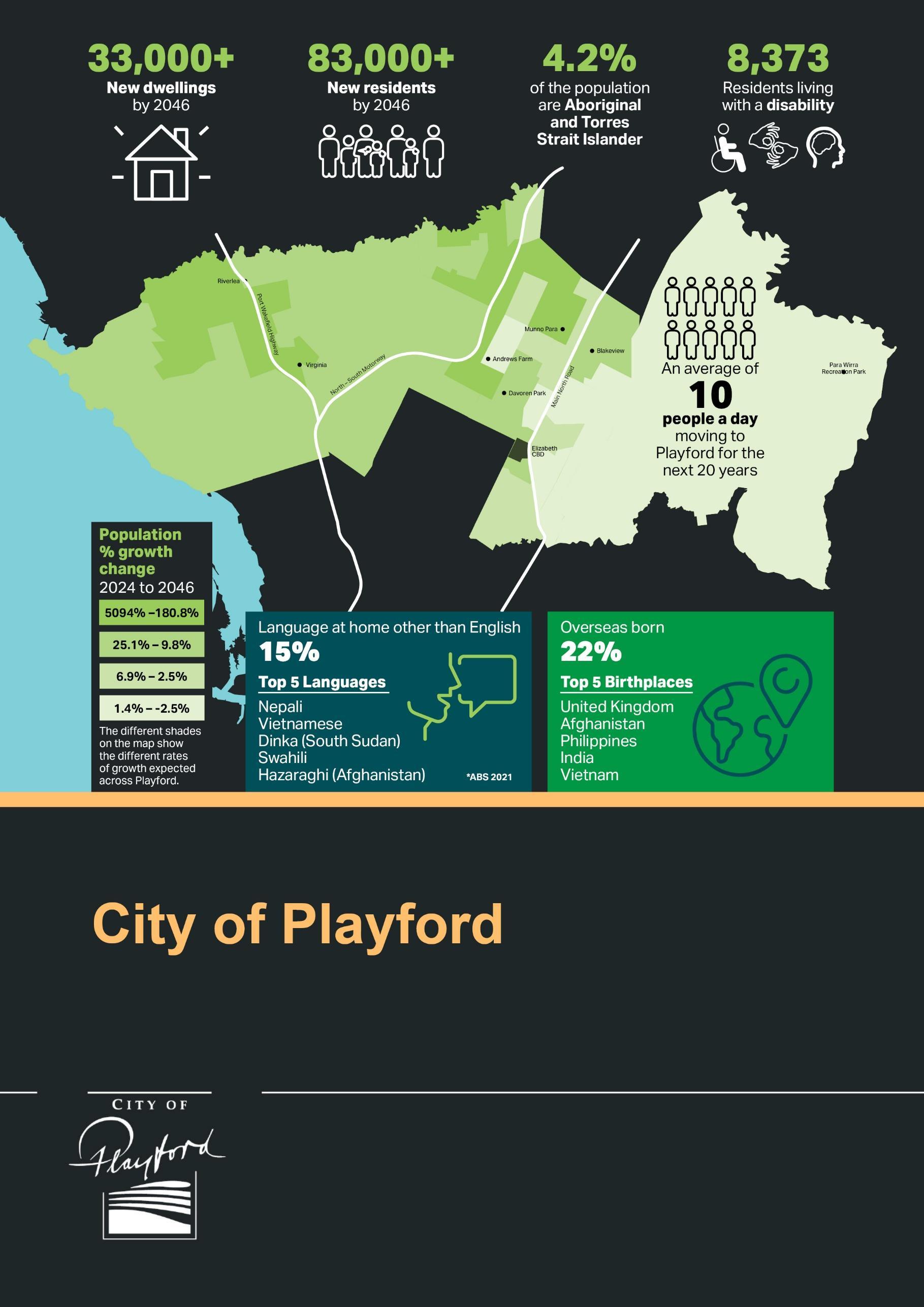

The City of Playford is a local government area in the north of Greater Adelaide. It covers an area of 345 km2 and currently includes the suburbs of: Andrews Farm, Angle Vale, Bibaringa, Blakeview, Craigmore, Davoren Park, Elizabeth, Elizabeth Downs, Elizabeth East, Elizabeth Grove, Elizabeth North, Elizabeth Park, Elizabeth South, Elizabeth Vale (part), Elizabeth West, Evanston Park (part), Gould Creek (part), Hillbank, Hillier (part), Humbug Scrub (part), MacDonald Park, Munno Para, Munno Para Downs, Munno Para West, One Tree Hill, Penfield, Penfield Gardens, Port Gawler (part), Riverlea, Sampson Flat, Smithfield, Smithfield Plains, St Kilda (part), Uleybury (part), Virginia, Waterloo Corner (part) and Yattalunga.
Local governments (councils) provide a diverse range of services and facilities to their communities. Councils work to improve disability access and inclusion relating to:
• Council buildings, parks and facilities (e.g. libraries, community centres, sports facilities, playgrounds).
• Public footpaths, roads, and on-street parking
• Information (e.g. website, signage) and services (e.g. customer service)
• Proposed developments (e.g. new buildings).
• Community events, training and activities.
• Employment and volunteer work
• Consultation (e.g. providing input to a council plan or project) and community representation opportunities (e.g. being elected to council or a committee).
Across Australia, commitment to improving disability access and inclusion has grown over time. There were long periods when standards and expectations around accessibility were not adequately met. As a result, many councils still manage older infrastructure that is not fully accessible, and continue to review and improve their programs, systems, and organisational practices to better support inclusion.
Councils are working within their budgets to progressively make improvements in relation to disability access and inclusion. They are providing awareness training to staff and elected members, and are engaging with people with disability, carers and the disability sector to identify how to best remove barriers.
City of Playford welcomes feedback about access barriers, inclusion concerns, or ideas to improve participation for people with disability. Community members can report access issues, request adjustments, or seek support through the customer service team or online accessibility page. Feedback helps us to identify priorities, respond to concerns, and improve services over time. Contact information, including accessible reporting options, is available on City of Playford’s website www.playford.sa.gov.au.

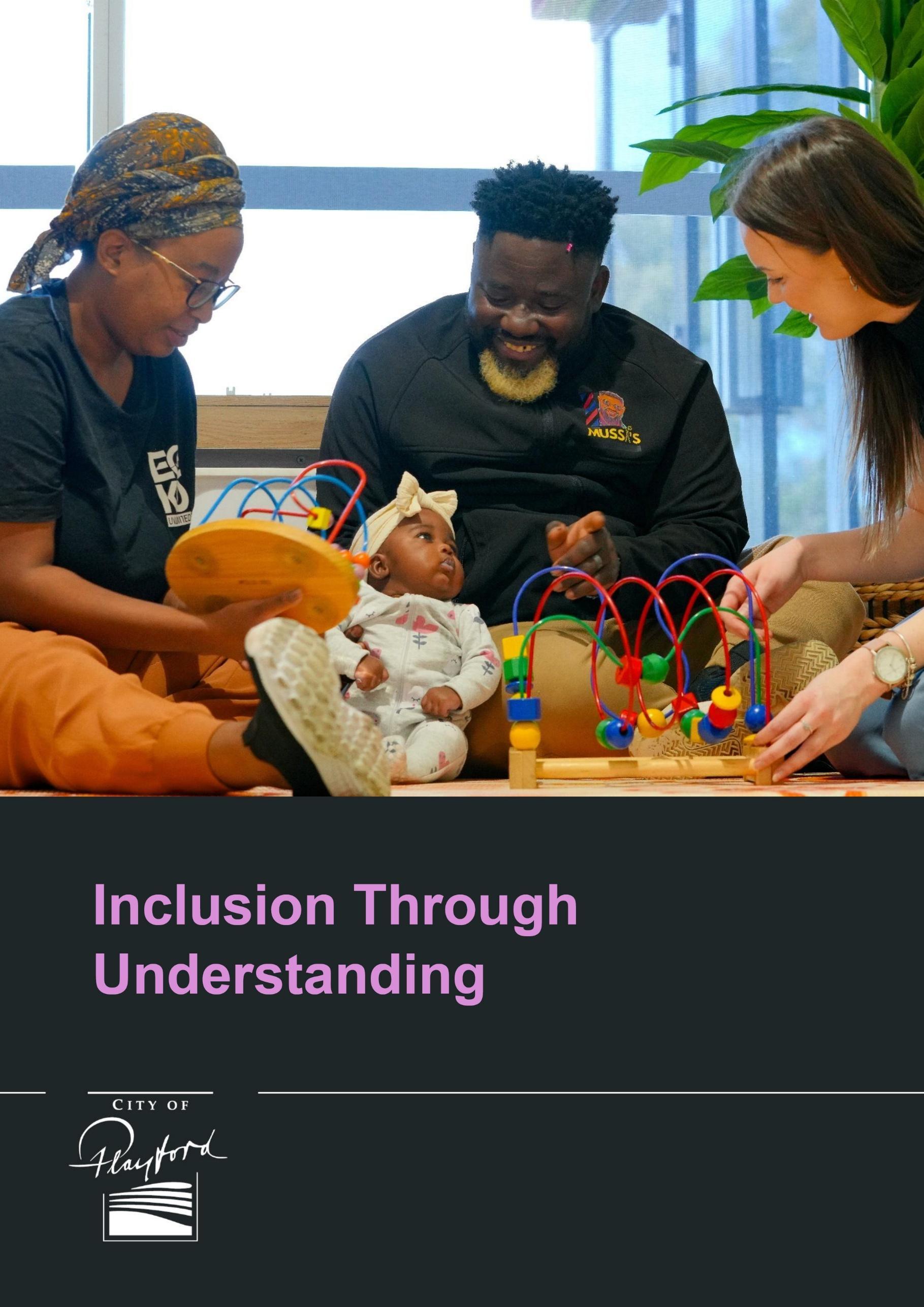

Every person with disability is different, with unique qualities, strengths, weaknesses and support needs.
Every disability is different, and some may not be visible.
We all play an important role in changing the way we think and talk about disability. From the conversations we have, to the documents we write, it is our collective responsibility to make important choices that support long lasting change.
There are many misconceptions and misunderstandings in the community about what it means to have a disability. This is why the use of accurate and respectful language is so important.
We acknowledge that language is a personal preference, and that different language and terminology preferences exist within the disability and neurodivergent community.
Based on feedback during statewide consultations, we have adopted ‘person-first language’ (i.e. person with disability) for this Plan, rather than ‘identity-first language’ (i.e. disabled person).
Creating a more inclusive community begins with listening, learning and reflecting on assumptions we may hold about disability. While many people with disability generously share their experiences, fostering broader understanding is a responsibility we must all share.
The most important thing is to ask the person with disability how they would like to be referred to and represented, and to respect their wishes.
(Source: The State Disability Inclusion Plan 2025-2029)
Disability is diverse and experienced by people of all ages, backgrounds and cultures. It can include physical, sensory, cognitive, intellectual, psychosocial and invisible disability
This Plan is underpinned by both the social and human rights models of disability, which recognise that disability is not caused by an individual’s impairment, but by the physical, attitudinal and systemic barriers created by society.
These models emphasise the importance of removing those barriers to create a more inclusive and equitable community – one where people with disability have the same opportunity to participate, contribute and thrive as everyone else.
The human rights model further reinforces this by affirming the inherent dignity, autonomy and equal rights of people with disability, as outlined in the United Nations Convention on the Rights of Persons with Disabilities (UNCRPD). It places responsibility on society to uphold and protect these rights across all areas of life.
The Disability Inclusion Act 2018 (SA) defines disability as:
In relation to a person, includes long-term physical, psychosocial, intellectual, cognitive, neurological or sensory impairment, or a combination of any of these impairments, which in interaction with various barriers may hinder the person’s full and effective participation in society on an equal basis with others.
(Source: The State Disability Inclusion Plan 2025-2029)
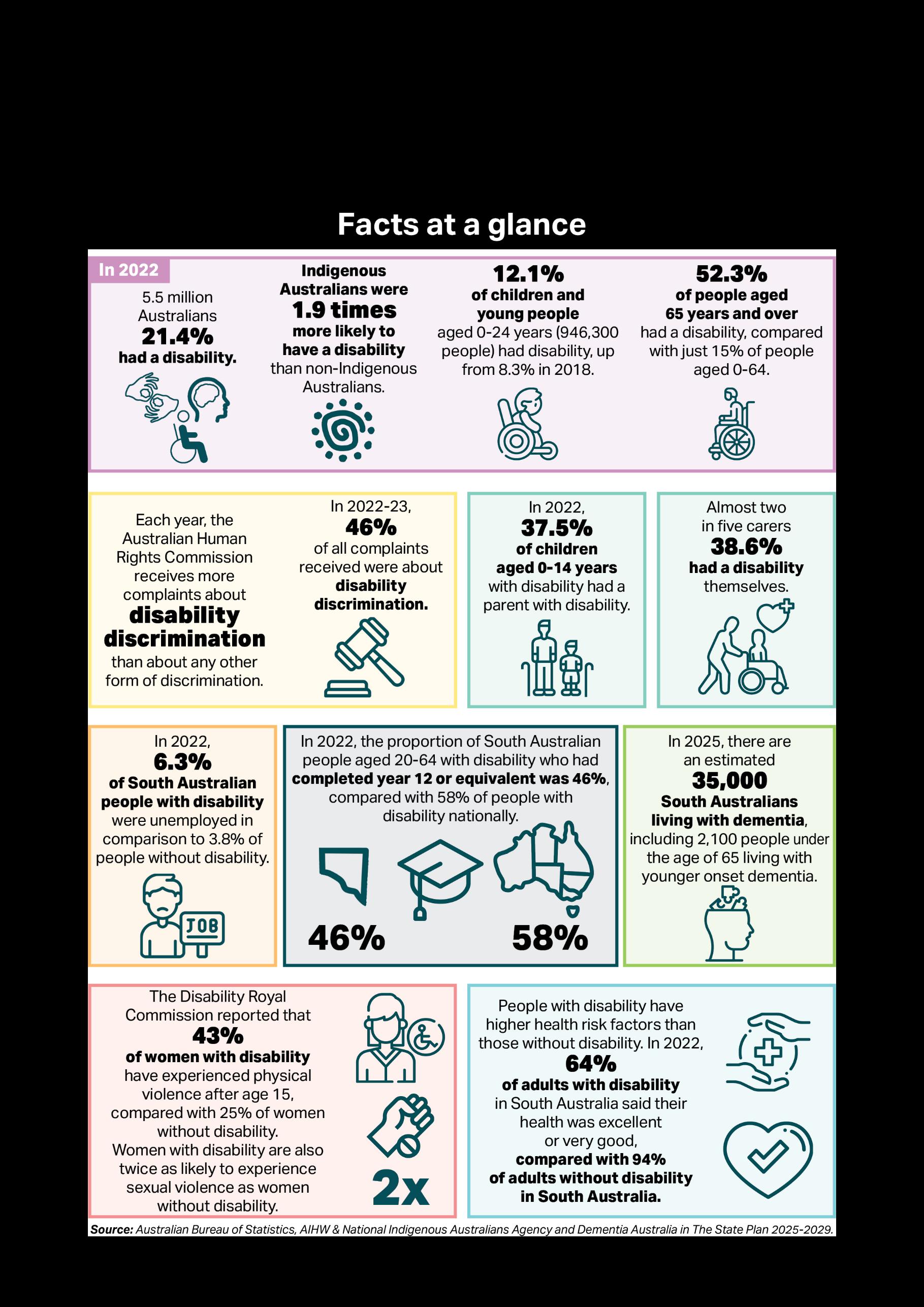
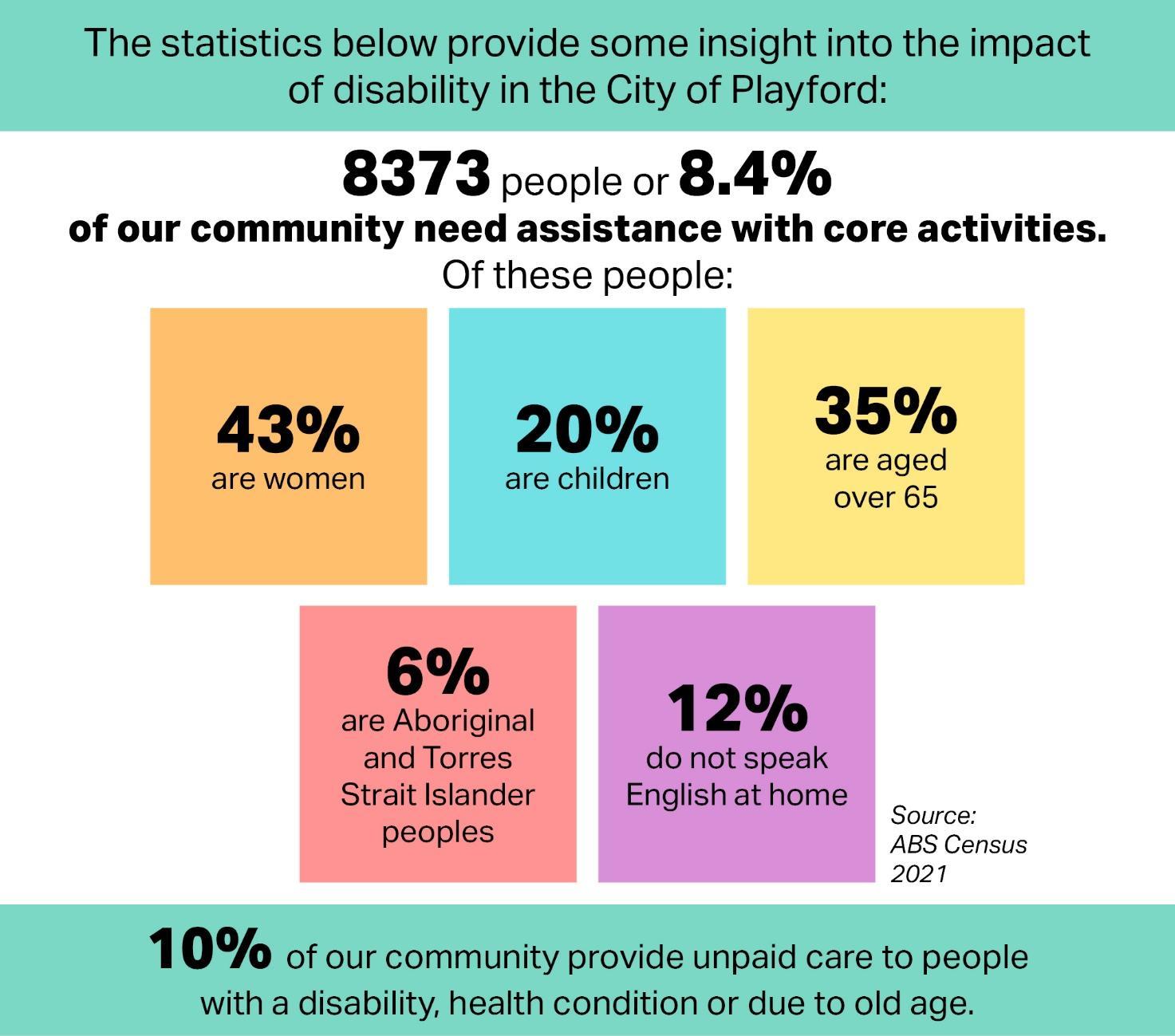
People with disability are diverse. Intersectionality is about recognising that a person with disability may also be subject to discrimination or disadvantage relating to their race, religion, age, gender, sexual orientation, social or financial capacity. For instance, an Aboriginal and Torres Strait Islander person with disability may experience discrimination relating to their race and disability. This compounds the impacts experienced by people with disability.
Groups of people with disability who may face additional or compounded barriers include:
1. Aboriginal and Torres Strait Islander people with disability.
2. Culturally and linguistically diverse (CALD) people with disability
3. Women with disability
4. Children with disability
5. LGBTQIA+ people with disability.
6. People with significant intellectual disability or who have high levels of vulnerability due to disability.
7. People with disability who live in regional communities.
8. Older people with disability.
9. Carers of people with disability
10. People experiencing socio-economic disadvantage
The Disability Inclusion Act 2018 (SA) lists the groups numbered 1-7 and requires councils to tailor actions to address the diverse and intersecting needs of these groups. In addition, the State Disability Inclusion Plan 2025-2029 also acknowledges the intersectionality of older people with disability and carers.
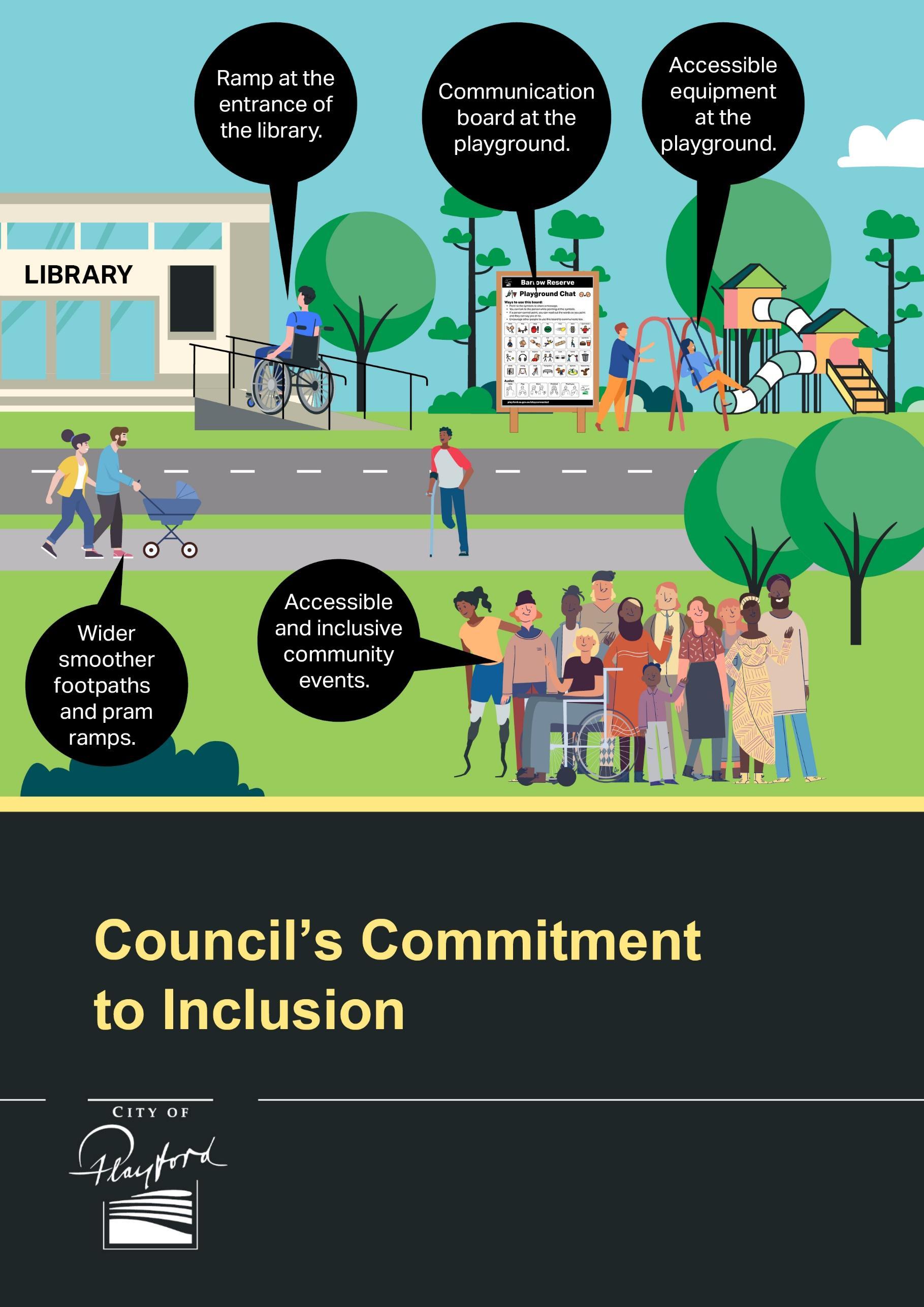

Community Vision
The Playford Community Vision 2043 is built around three core themes:
1. Prosperity
2. Liveability
3. Happiness
Strategic Plan 2025-28
The City of Playford’s Strategic Plan 2025-2028 sets out a clear direction for building a stronger, more connected, and inclusive community. Through four key themes, the plan reflects the voices of local residents and aims to create a city where everyone, regardless of age, ability, or background can thrive.
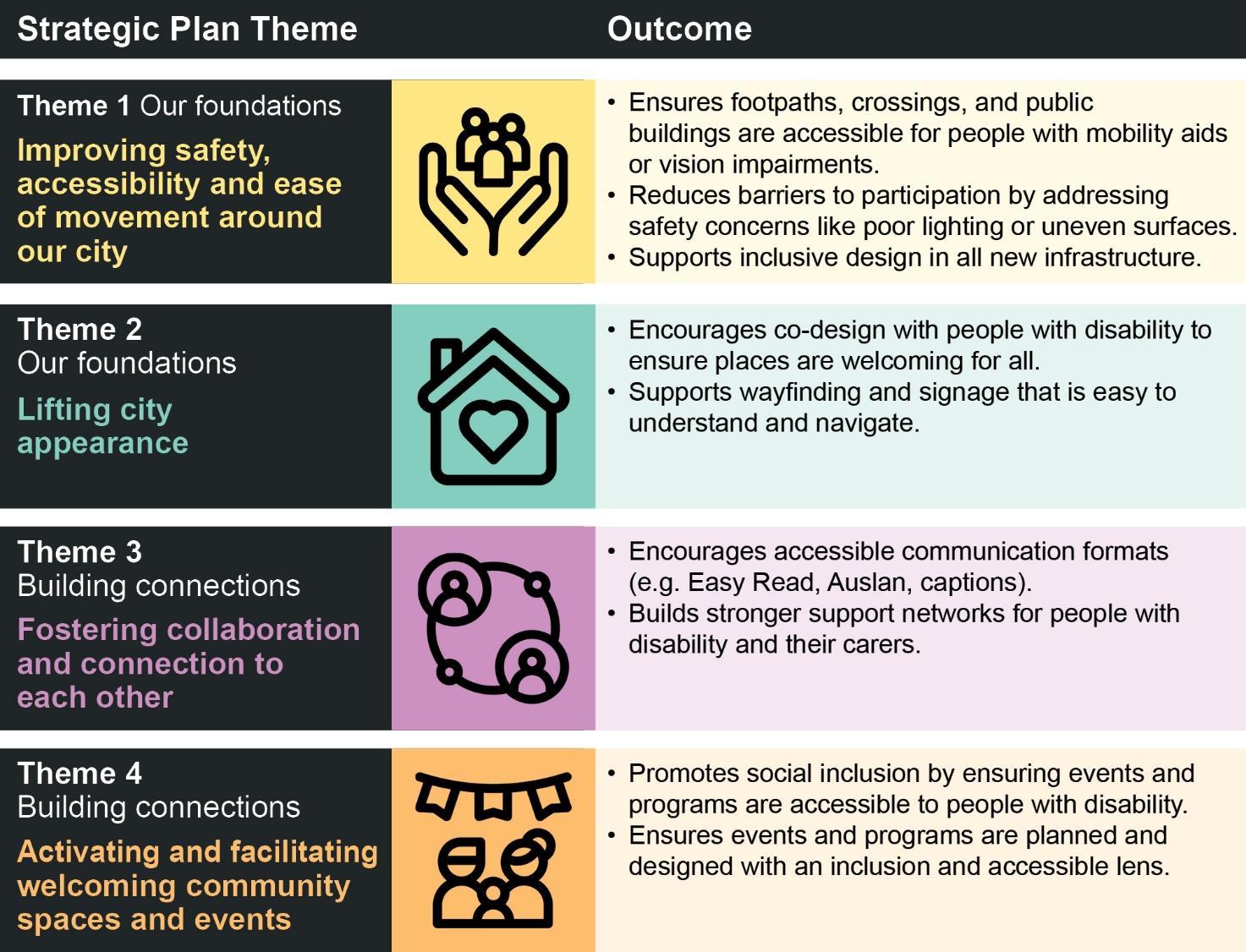
This Disability Access and Inclusion Plan will be Council’s sixth Plan. It sets out the actions Council will deliver to contribute to the domains, priority areas, and mandatory measures identified for councils in the State Disability Inclusion Plan 2025-2029.
At the City of Playford, we’re working alongside people with disability to build a more inclusive, accessible and connected community. Here are some of the milestones we’re most proud of:
Opening doors to opportunity
Every year, hundreds of people with disability, families, carers and services come together at our Positive Futures Expo. The event showcases opportunities in education, employment, health, housing, sport, the arts and more. It is about connections, inspiration and building brighter futures together.
Access that changes lives.
The Changing Places facility at Fremont Park means people with complex support needs can fully enjoy one of Playford’s most popular parks. With features like a height-adjustable adult change table and hoist, it provides dignity, safety and true inclusion for the whole community.
Confidence in the kitchen, at the shops, and in life.
Our community projects focus on the everyday skills that build independence, inclusion and joy. Highlights include:
• Look ’n Cookbook – a step-by-step accessible recipe book designed by and for people with disability.
• Everyday Money Skills – practical workshops supporting budgeting, banking and financial confidence.
• Right Track Toolkit – co-designed with Aboriginal and Torres Strait Islander people and culturally and linguistically diverse communities, these resources support people to build confidence in understanding disability and navigating the National Disability Insurance Scheme (NDIS).

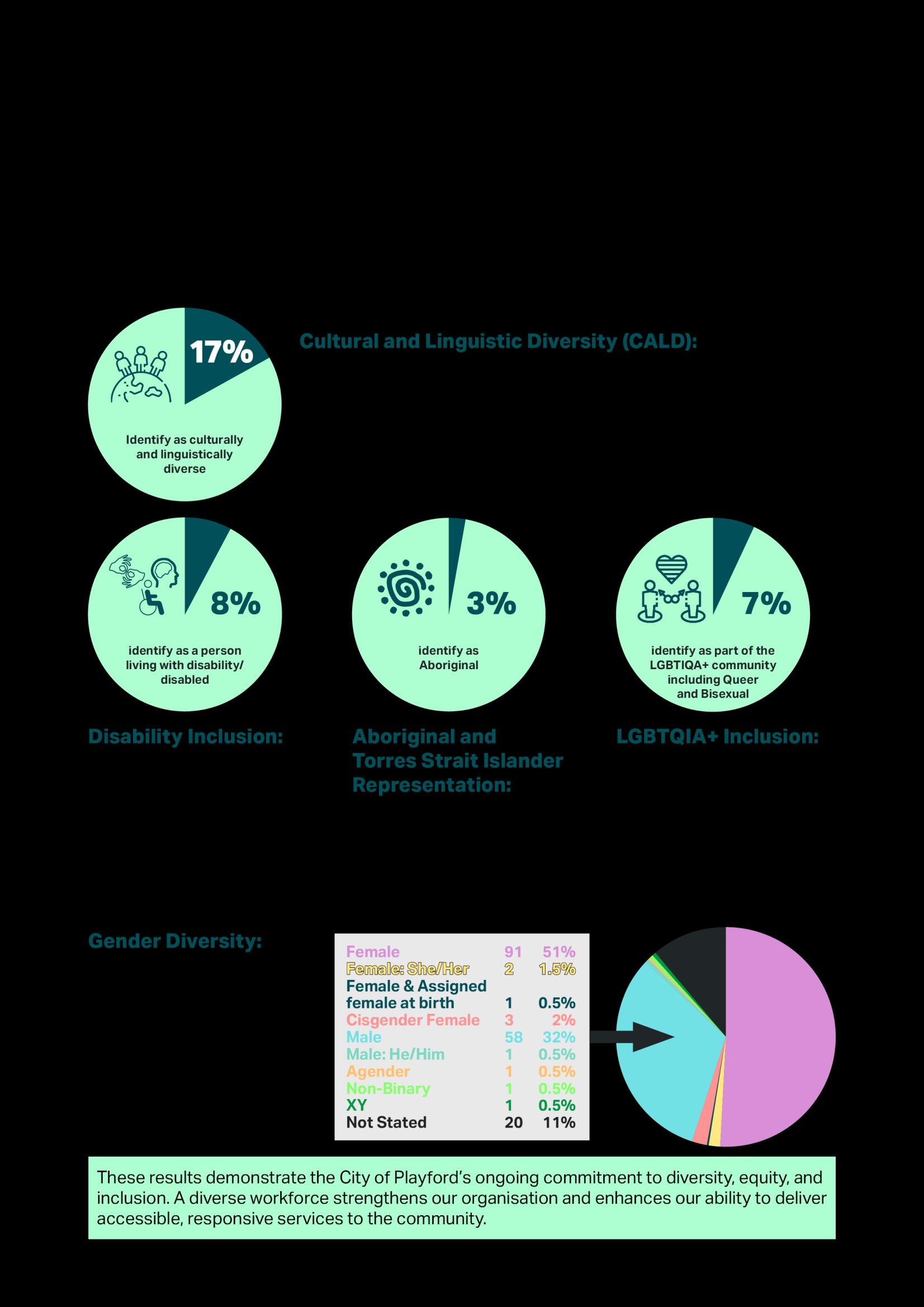

Our community is vibrant and diverse, made up of people of all ages, genders, backgrounds and abilities.
There is no single statistic that perfectly measures the number of people living with disability in a council area. The Australian Census only records the number of people who need assistance with core activities such as self-care, mobility or communication.
However, we know disability is very diverse and not always visible. While many people need supports, not all people living with disability do, and some may not identify as having a disability. For instance, older people may see changes in their physical or cognitive abilities as part of ageing, rather than as a disability.
Similarly, some people with autism may view their neurodivergence as a difference rather than a disability.

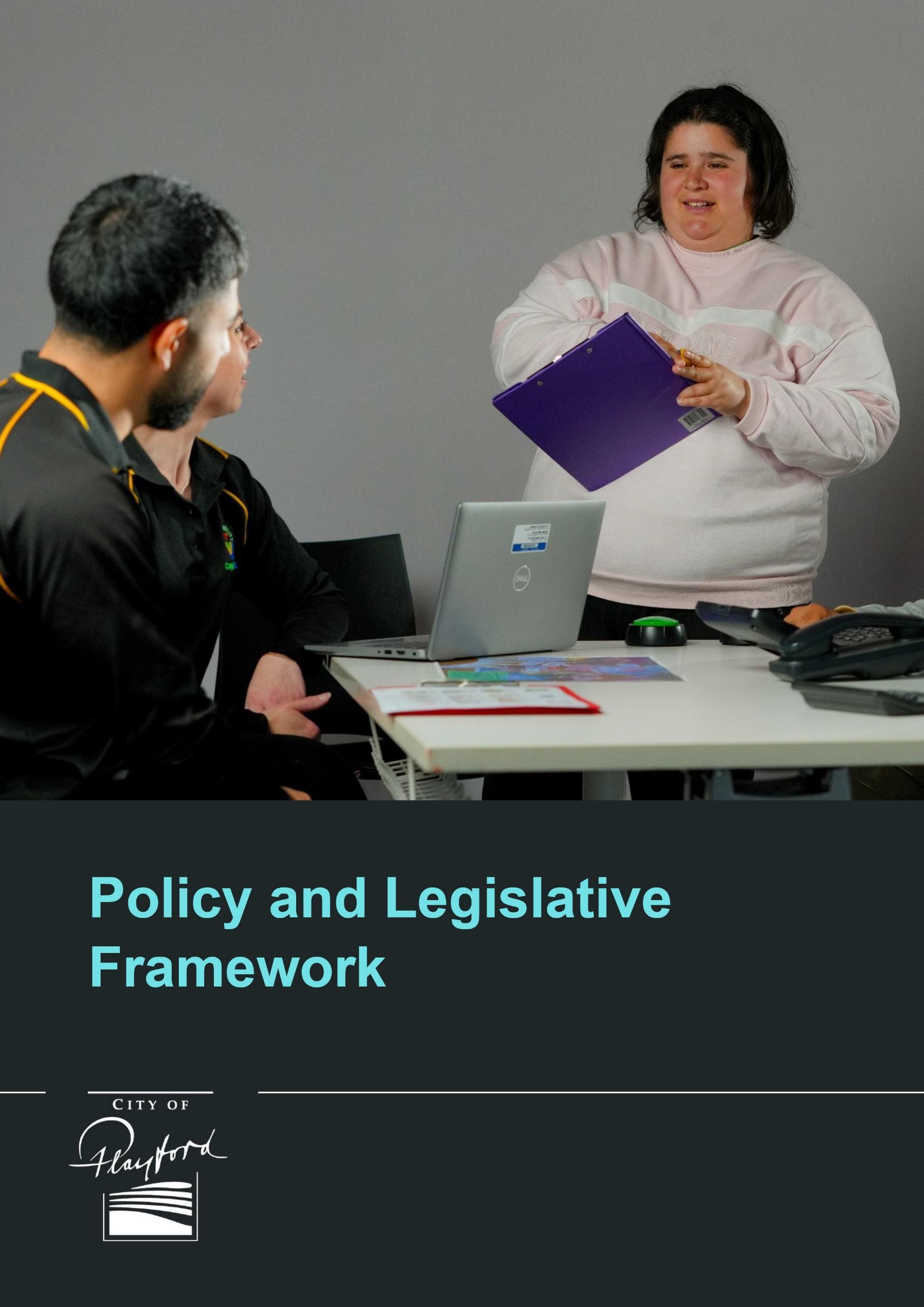
City of Playford’s Disability Access and Inclusion Plan is shaped by a range of international, national, state, and local commitments. These frameworks guide how Council supports people with disability, ensuring our actions are aligned with broader efforts to promote inclusion, uphold human rights, and respond to emerging reforms.
United Nations Convention on the Rights of Persons with Disabilities
Acknowledges that people living with disability have the same human rights as other members of the community and that the State and the community have a responsibility to facilitate the exercise of those rights.
These national laws and strategies establish the legal and policy framework that councils must operate within. They also set expectations for inclusive practices and continuous improvement in access and participation.
Disability Discrimination Act 1992 (Australian)
Makes it unlawful to discriminate against a person, in many areas of public life, because of their disability.
Australia’s Disability Strategy 2021-2031
Sets out a plan for all levels of government to continue to improve the lives of people with disability in Australia.
Royal Commission into Violence, Abuse, Neglect and Exploitation of People with Disability
The report made 222 recommendations on how to improve laws, policies, structures and practices to ensure a more inclusive and just society that supports the independence of people with disability.
National Reform Agenda
Extensive reforms to the NDIS and Australia’s Disability Strategy are reshaping how disability services are delivered across Australia. These changes will influence how councils plan for access and inclusion, requiring greater flexibility and responsiveness, and alignment with evolving priorities.
Acknowledges the equal human rights and promotes the independence and social and economic inclusion of people with disability.
Requires all State authorities (including councils) to prepare and report on Disability Access and Inclusion Plans.
Identifies five domains of action for the state and local governments to achieve the vision of a South Australia where no one is left behind. Council Disability Access and Inclusion Plans must align to the State Plan and include the measures assigned to local government.
NDIS data indicates that autism remains the largest disability group in South Australia, followed by intellectual disability. This Strategy sets out a five-year roadmap for the government to help improve the lives of people with Autism of all ages and their families
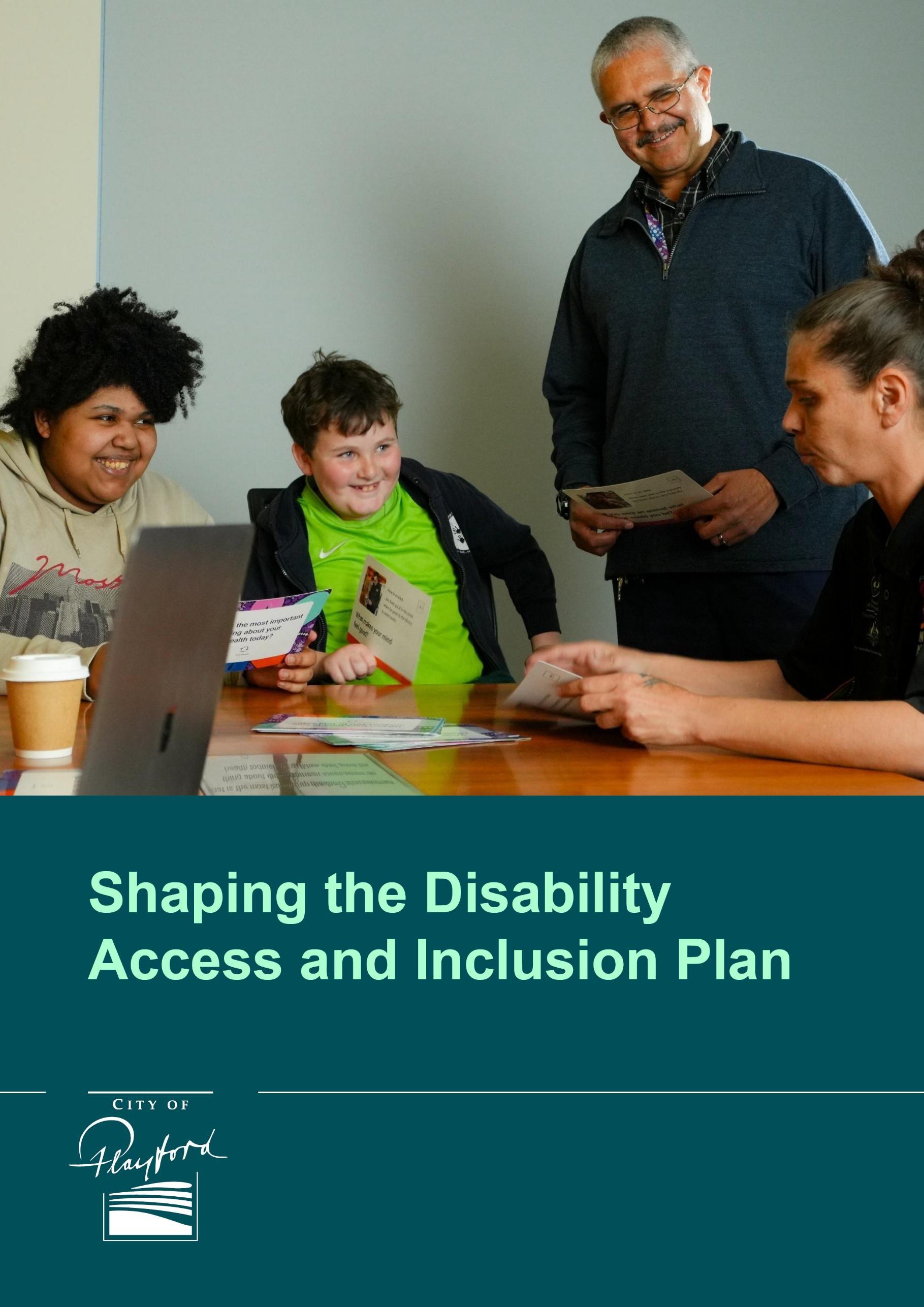
This Disability Access and Inclusion Plan has been prepared by the City of Playford All councils in South Australia are required by legislation (law) to prepare a Disability Access and Inclusion Plan.
A Disability Access and Inclusion Plan says what a council will do to enable people with disability to access and be included in council places, services, events, employment and government representation. The Disability Access and Inclusion Plan sets out Council’s commitment to creating a community where people with disability have equal opportunity to participate in all aspects of life.
This Disability Access and Inclusion Plan is Council’s roadmap for action over the next four years. It outlines the practical steps that will be taken to remove barriers, improve access, and ensure people with disability are included in the design and delivery of council places, services, programs, employment opportunities, and decision-making.
The Disability Access and Inclusion Plan reflects the aspirations of our community and is shaped by the voices of people with disability, their families, carers, and support networks. It is not just a plan on paper - it is a statement of shared responsibility and a call to action across Council to embed access and inclusion into everything we do.
By delivering on this Disability Access and Inclusion Plan, Council will:
• Build on the progress achieved through our Disability Access and Inclusion Plan (2020 – 2024).
• Contribute to the statewide vision of “a South Australia where no one is left behind.”
• Support our local community vision of prosperity, liveability, and happiness for all.
This Disability Access and Inclusion Plan represents Council’s ongoing commitment to creating an inclusive city where every person can contribute, belong, and thrive
This Disability Access and Inclusion Plan is designed to be a practical tool for Council, our partners, and the community. It outlines clear actions that will guide Council in removing barriers, creating opportunities, and embedding access and inclusion in all aspects of Council business.
The Disability Access and Inclusion Plan can be used in the following ways:
• Council staff and Elected Members to inform decision-making, service delivery, infrastructure planning, and community engagement. The Disability Access and Inclusion Plan acts as a whole-of-organisation commitment that ensures access and inclusion are considered across all programs, policies, and projects.
• People with disability, families, and carers to understand Council’s priorities and hold us accountable to delivering meaningful improvements. The Disability Access and Inclusion Plan also highlights opportunities for people with disability to be involved in shaping our city.
• Partners, service providers, and community organisations to support collaboration and alignment with Council’s work. The Disability Access and Inclusion Plan provides a shared framework for building an inclusive community together.
• The wider community to promote awareness, celebrate diversity, and encourage collective responsibility in making Playford accessible, welcoming, and inclusive for all.
The Disability Access and Inclusion Plan is not a static document. Council will report annually on progress and review actions regularly to ensure they remain relevant, achievable, and responsive to community needs.
The City of Playford is committed to ensuring that the actions and strategies outlined in this plan are effectively delivered, monitored, and continuously improved. Implementation is a shared responsibility, involving Council, community leaders, stakeholders, and people with disability.
Group Role
SA Department for Human Services
City of Playford
(Elected Body)
Council StaffDisability Access and Inclusion
Responsibilities
Oversees the implementation of the Disability Inclusion Act 2018 and the State Disability Inclusion Plan.
Ensures councils develop, implement, report on, and review Disability Access and Inclusion Plans in accordance with the Act.
Endorses the Disability Access and Inclusion Plan and approves budget allocations for its delivery.
Tracks progress through the Council’s Annual Report.
Deliver, report, and review Council actions that support access and inclusion.
Collaborate across departments and consult with the community to ensure initiatives meet needs.
Coordinate and track progress through the Quality Coordinator, Disability Inclusion.
Membership
Chief Executive of the Department for Health
City of Playford Elected Members
Nominated staff from all Council departments responsible for delivering actions.
Staff contribute to planning, implementation, and reporting of inclusion initiatives.
Access & Inclusion Community Leaders (e.g., Access & Social Inclusion Advisory Group)
Provides guidance and advice on Council plans, projects, programs, services, and events from an access and inclusion perspective.
Meets regularly to review initiatives and provide feedback during development phases.
Stakeholders Collaborates with Council to support delivery of Disability Access and Inclusion Plan actions, including promotion of opportunities, consultation, and awareness.
People with disability, carers, family members, and service providers. Includes The State Plan priority groups such as women, children, and people of Aboriginal and Torres Strait Islander and culturally and linguistically diverse backgrounds.
Service providers and organisations representing women, children, and people of Aboriginal and Torres Strait Islander and culturally and linguistically diverse backgrounds.
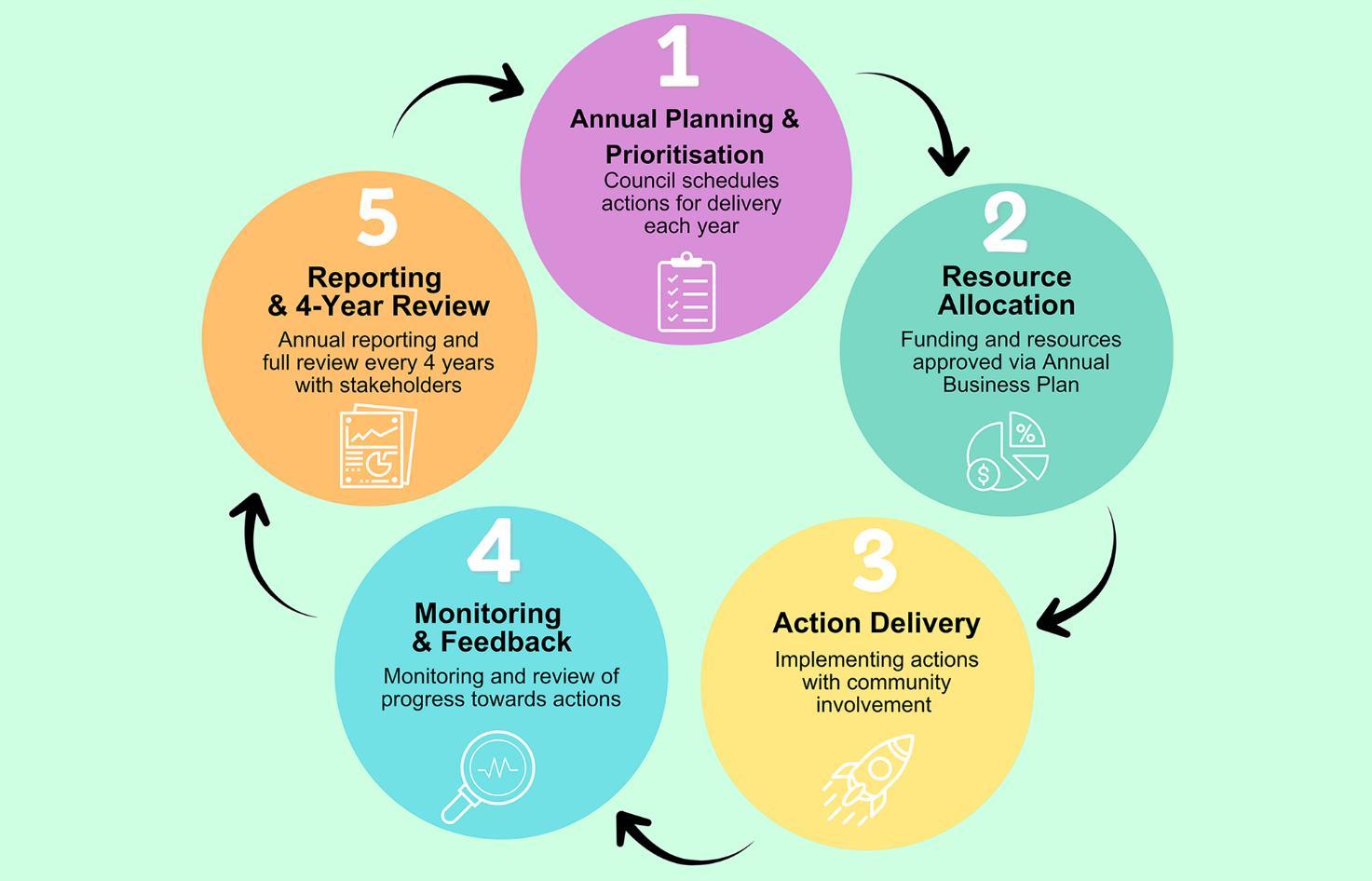
Each year, the City of Playford will identify and plan for actions to be delivered. Actions requiring new resources will be subject to approval as part of Council’s Annual Business Plan and Budget process.
Progress on actions within the Disability Access and Inclusion Plan will be reported annually to Council and the Department of Human Services. Annual progress reports are published on the City of Playford website within Council meeting minutes to ensure transparency and accountability to the community.
An interim review will be conducted to ensure consistency with any changes to the South Australian Disability Inclusion Plan, legislation or law. Every four years, the Disability Access and Inclusion Plan will be reviewed and updated in consultation with people with disability, the community and stakeholders.
Council will consistently monitor and adjust Disability Access and Inclusion Plan actions through:
• Consultation and feedback from Council staff, Elected Members, Access & Inclusion Community Leaders and stakeholders.
• Continuous improvement based on community feedback and emerging best practices. This approach ensures accountability, transparency, and ongoing engagement with the people and communities the Disability Access and Inclusion Plan is designed to support.
Steps undertaken to prepare the Disability Access and Inclusion Plan:
1. Background Paper (May 2025)
We prepared a background paper that outlined key information about our community, disability and how other levels of government are planning for access and inclusion.
2. Community Engagement - Phase 1 - Shaping the Plan (June - July 2025)
We invited community members, service providers, and stakeholders to help shape the Plan by sharing what worked well in the previous Disability Access and Inclusion Plan, what could be improved, and what priorities should guide the next one. Their feedback directly informed the draft Disability Access and Inclusion Plan
3. Drafting the Disability Access and Inclusion Plan (August - September 2025)
Following the release of the State Plan 2025-2029 (August 2025) we began drafting our Disability Access and Inclusion Plan.
Our Plan aligns with the guidelines, template, goals and measures for councils in the State Disability Inclusion Plan 2025-2029.
4. Community Engagement - Phase 2 - Checking In (January - February 2026)
We will return to the community to share the draft Disability Access and Inclusion Plan and check that it reflects what we heard. Feedback from this phase will help finalise the Plan.
5. Finalise Disability Access and Inclusion Plan (Early 2026)
We will revise the Disability Access and Inclusion Plan based on community feedback and present to Council for formal adoption. Once endorsed, both the full Strategy and an Easy Read version will be published on Council’s website.
6. Close the Loop
We will share the endorsed Disability Access and Inclusion Plan with the community and outline the next steps for implementation and reporting.
In June and July 2025, we reached out to people with disability, their carer/s, families, service providers and other key stakeholders for feedback on:
• What worked well and what could be improved in the Disability Access and Inclusion Plan (2020-2024)
• Their top priorities for disability, access and inclusion across the City of Playford
• Their big ideas on what they would like to see in the next Disability Access and Inclusion Plan (2025-2029).
To support participation for people with different needs, consultation materials were available in multiple formats. The Playford Engagement Hub also featured accessibility tools, including the UserWay accessibility widget, a built-in language translator, and a short video tutorial.
People provided feedback in a way that suited them best, including:
• Online surveys.
• Face-to-face sessions.
• Social media interactions.
• Audio/video recordings or drawings.
• Ideas wall on Engagement Hub.
• Email submissions.
• “Your Big Idea” proposals.
• Dotmocracy voting activities.
• Phone conversations.
This mix of methods, offered in accessible formats, helped ensure a broad range of voices were heard.
• More than 2,600 people visited the project page.
• Over 4,500 people saw social media posts.
• Nearly 1,700 people opened project emails.
• In total, 240 people provided direct feedback through these channels.
Top five priorities for our Disability Access and Inclusion Plan identified by the community:
1. Universal design and improving physical access
2. Supporting active participation in community life
3. Disability awareness and education.
4. Strengthening cultural inclusion and safety
5. Creating more inclusive events and activities for all ages
A detailed summary of community feedback is available in the What We Heard report, which can be accessed on Playford Engagement Hub | City of Playford's New Disability Access and Inclusion Plan
Our Disability Access and Inclusion Plan is aligned to The State Disability Inclusion Plan, representing our local community needs and contributing to creating an accessible and inclusive South Australia.
The State Plan domains and outcomes we will work towards are:
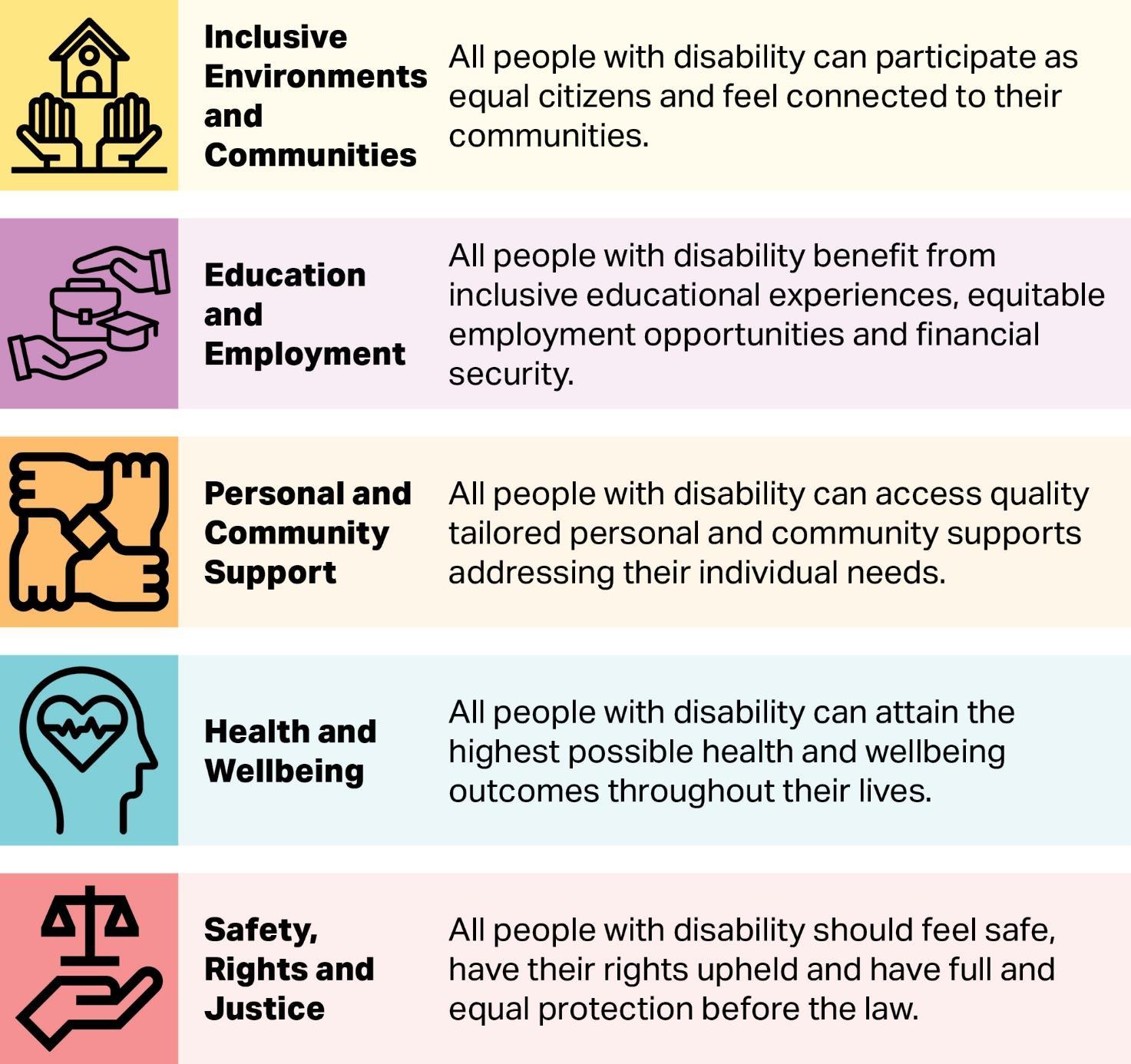
The next section follows The State Plan template required for councils to use for their Disability Access and Inclusion Plan. For each domain it lists the actions council will deliver, when and how each action will be measured. The State Disability Inclusion Plan includes compulsory measures that councils must collect data for, to enable reporting on certain measures at a statewide level. These compulsory measures are shown with a State Plan reference number (e.g., The State Plan 1.1.2).
Domain 1: Inclusive environments and communities
Domain 1: Inclusive environments and communities.
Outcome Statement: A South Australia where all people with disability can participate as equal citizens and feel connected to their communities. Objective: To influence community attitudes to remove discrimination and build a South Australian community that values difference and respects the contributions people with disability make to our communities. This includes ensuring the community itself is fully accessible.
Priority Areas for Domain 1
1 Active participation
2 Inclusive communities and attitudes
3 Universal Design
4. Accessible facilities

5 Communications and information
6 Transportation
7 Collaboration, consultation and innovation
8. Housing
Priority Area 1: Active participation
Outcome: People with disability are active participants in accessible and inclusive communities.
1
Provide social and recreation programs, events and activities that are accessible and inclusive of people with disability including children, young people and adults of diverse cultural, social, and community backgrounds.
2 Develop and follow accessible event guidelines to enable the inclusion of people with disability in all City of Playford events.
3 Identify the factors that enable people with disability, from diverse ages, cultures, and gender identities, including LGBTQIA+ communities, to participate in community programs and events, and apply these learnings in practice.
4 Provide information about the accessibility features of all City of Playford events and programs and ask questions about access and cultural needs in registrations.
The number of inclusive and accessible events, both internal and external, with 50+ people following best practice event management principles
(The State Plan 1.1.2) Ongoing
Ongoing
& Inclusion Events
& Inclusion
& Inclusion Events
Priority Area 2: Inclusive communities and attitudes
Outcome: People with disability are respected and included in their communities, where inclusive attitudes and behaviours are widely demonstrated.
5 Provide disability access and inclusion training to Elected Members, staff, and volunteers.
6 Support local businesses and community groups and organisations to become more accessible and inclusive for people with disability.
7 Collaborate with Aboriginal and Torres Strait Islander community organisations to identify and implement ways council can support Aboriginal people with disability and their families, ensuring inclusion is part of everyday community life. Respect, empathy, advocacy, and the promotion of independence are prioritised so that everyone feels valued, engaged, and able to participate and contribute
8 Facilitate opportunities for the community to connect, learn about, and celebrate disability through inclusive events and educational workshops, fostering awareness, understanding, and participation for all.
The number of initiatives undertaken to promote disability inclusion and improve community attitudes towards people with disability in the community, including:
• The number of staff and volunteers participating in disability awareness training, including Universal Design.
• The number of workplace initiatives promoting disability inclusion.
(The State Plan 1.2.1)
The number of actions embedded in our Disability Access and Inclusion Plan working towards Closing the Gap targets.
(The State Plan 1.2.3)
Feedback and reflections from participants on increased awareness, understanding, and sense of inclusion following events/workshops.
Documented examples of how events or workshops contributed to community awareness and positive attitudes toward people with disability.
Ongoing Organisational Development
Ongoing Economic Development Connection & Inclusion
Ongoing Connection & Inclusion
Ongoing Connection & Inclusion Events & Activation
Priority Area 3: Universal Design
Outcome: Everyone in South Australia can access and enjoy inclusive and accessible natural and built environments.
Follow universal design principles in the upgrade, construction and maintenance of buildings, facilities, public realm, and open space in line with community needs and council budgets.
Build, upgrade, and maintain council footpaths, paths, trails, and crossings to be accessible and safe in line with community needs and council budgets.
Provide or make improvements to council on-street and facility accessible parking spaces and drop-off zones.
Prioritise accessibility upgrades at council-owned community venues to enable participation.
• The number of public-facing council buildings, spaces, play spaces and infrastructure that are modified to improve accessibility. For example, by adding signage or widening doors.
• The number of new council developments that incorporate Universal Design.
(The State Plan 1.3.2)
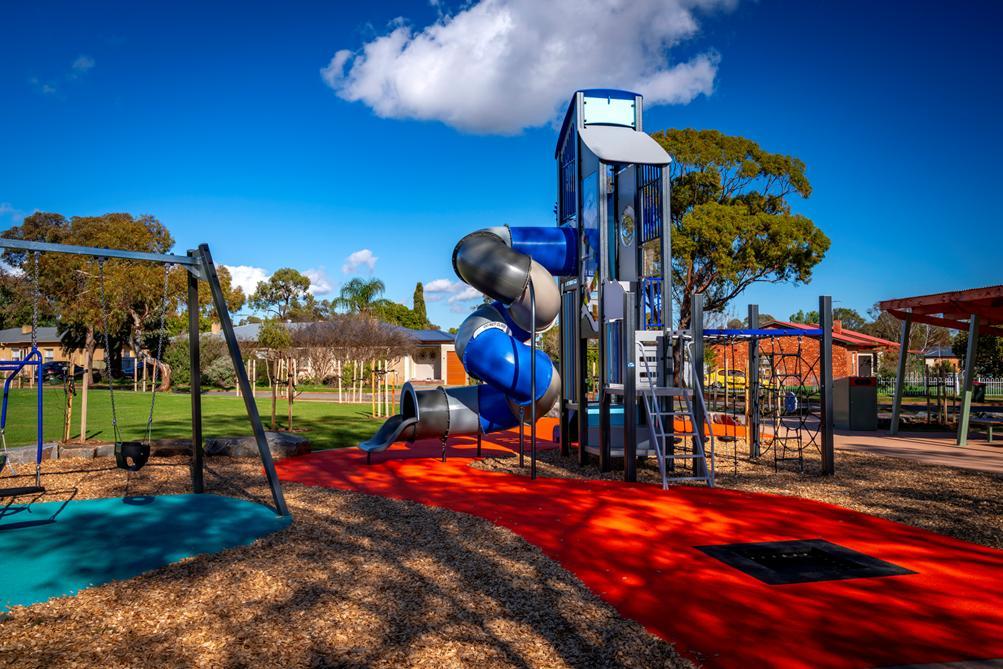
• The number of upgrades to parks, reserves, beaches, and playgrounds (within these areas) that are built or modified to improve accessibility.
(The State Plan 1.3.3)
Educate developers about the benefits and opportunities of incorporating universal design into commercial or housing developments
Priority Area 4: Accessible facilities
Outcome: People with disability can access public toilet facilities that meet their needs when out in the community.
Upgrade or install new accessible toilets or changing places facilities in line with community needs and council budgets. The number of public council owned toilet facilities across the council area that meet accessibility standards and/or a designated Changing Places facility.
(The State Plan 1.4.1)
Priority Area 5: Communications and information
Outcome: People with disability can find the information they need in the format(s) they need it in.
15 Ensure council venue information, including access features and visual stories, is available in accessible formats online and in hard copy to support inclusion.
16 Continue to provide accessible communication through plain language, different formats and assistive tools.
17 Introduce visual communication supports at council service points, including libraries, community centres, and customer service desks, to facilitate inclusive engagement for people with diverse communication needs.
The number of resources or materials that have been developed in accessible formats. For example, websites that meet Web Content Accessibility Guidelines (WCAG) 2.2 level AA accessibility standard or above, Auslan translations and Easy Read documents.
(The State Plan 1.5.1)
1
& Inclusion
1:
Priority Area 6: Transportation
Outcome: People with disability can get to where they need to go safely.
18
Advocate for improved and inclusive transport options that meet the needs of people with disability, ensuring they can travel safely, affordably and independently to access employment, education, services, and community activities.
The number and quality of council advocacy actions undertaken to improve inclusive transport options for people with disability.
Ongoing Strategy & Advocacy
Priority Area 7: Collaboration, consultation and innovation
Outcome: People with disability are actively involved in government decisions that affect their lives.
19 Undertake community engagement activities using accessible information and tools, promote it to disability networks and share outcomes
20 Sustain and enhance the Access and Social Inclusion Advisory Group, providing meaningful engagement for members and leveraging their input in the planning and design of major council projects and programs.
The number of public consultations that included and sought input from people with disability.
(The State Plan 1.7.1)
The number of people with disability, including parents and carers, serving on committees and working groups.
(The State Plan 1.7.2)
Ongoing Community Insights
Ongoing Connection & Inclusion
21
Ensure questions about disability access and inclusion are in council’s annual community survey.
Priority Area 8: Housing
No identified actions for local government within this area.
Community perceptions of City of Playford’s progress on disability access and inclusion, are reflected in survey responses and themes.
Qualitative feedback from survey respondents on barriers and opportunities for improving inclusion.
Ongoing Community Insights
Outcome Statement: A South Australia where all people with disability benefit from inclusive educational experiences, equitable employment opportunities and financial security.
Objective: To ensure equal opportunity to learning and earning is achieved by addressing the barriers and obstacles people with disability of all ages continue to face at all levels of the education and employment experience.
Priority Areas for Domain 2
1. Targeted knowledge, understanding and support
2. Supports and resources for children and young people
3. Targeted transitional supports
Priority Area 1- Targeted knowledge, understanding and support.
No identified actions for local government within this area.
4. Access to employment opportunities
5. Inclusive working environments
6. Data and reporting
Priority Area 2 - Supports and resources for children and young people.
No identified actions for local government within this area.
Priority Area 3: Targeted transitional supports
Outcome: People with disability have supportive environments to learn, grow, and transition throughout their life
22

Develop diverse and meaningful volunteering opportunities through accessible and inclusive promotion, administration, and support.
23 Strengthen lifelong learning opportunities by ensuring council’s spaces and programs are accessible and inclusive of people with disability including children, young people and adults of diverse cultural, social, and community backgrounds
The number of initiatives taken to encourage people with disability to volunteer.
(The State Plan 2.3.5)
Examples of participation outcomes showing people with disability are supported to engage, learn, and transition throughout life.
Ongoing Library Services
Priority Area 4: Access to employment opportunities
Outcome: People with disability have opportunities to achieve, develop and succeed in their chosen fields.
24 Adopt accessible and inclusive recruitment guidelines and build the capacity of human resources staff and hiring managers to implement them effectively.
25 Deliver community “expo” events that promote opportunities for participation, leadership and employment for people with disability.
Priority Area 5: Inclusive working environments
Outcome: People with disability have access to supportive places to learn.
The number of organisational changes adopted to improve inclusive recruitment for people with disability. For example, tailoring roles to fit individuals and employer incentives.
(The State Plan 2.4.3)
Highlighting improvements or adjustments made to the events based on participant feedback or sector collaboration. Ongoing Connection & Inclusion Economic Development
26 Adopt universal design principles in the upgrade or construction of new workplace environments.
27 Explore and put in place practices that promote inclusive employment for staff with disability through assistive technologies, flexible or outcome-based work arrangements, and appropriate workplace supports.
28 Support staff in leading inclusive teams by providing targeted guidance, mentoring, and development opportunities focused on disability inclusion.
Priority Area 6: Data and Reporting.
No identified actions for local government within this area.
The number of workplace practices implemented to support people with disability to have equal opportunities for growth and success, including support to remain in employment.
For example, outcome-based employment, flexible work arrangements, workplace adjustments and mentoring programs.
(The State Plan 2.5.1)
1 and ongoing Organisational Development
1 and ongoing Organisational Development
Domain 3: Personal and community support
Domain 3: Personal and community support.
Outcome Statement: A South Australia where people with disability can access quality, tailored personal and community supports addressing their individual needs.
Objective: To build a service system in South Australia that takes a person-centred approach that recognises the contributions and potential of all people with disability.
Priority Areas for Domain 3
1. Accessibility 4. Family and carer support
2. Advocacy and supports 5. Programs
3. Information sharing
Priority Area 1: Accessibility
Outcome: People with disability can easily access community supports and services.
Connect people with disability to council and local services by maintaining accessible information across digital and print channels.
Engage with community and sector experts to inform, design, and deliver targeted programs and services that are inclusive and responsive to the needs of people with disability.
The number of council initiatives and improvements made to connect people with disability to community supports and services wherever they present. For example, referral hubs, mobile outreach, online information platforms, frontline worker training, and partnerships with community organisations.
(The State Plan 3.1.1)

Priority Area 2: Advocacy and supports
Outcome: People with disability are supported to make their own choices and use advocacy when needed to protect and promote their rights
Maintain dedicated staff resources to advocate for disability inclusion and provide clear contact points for the community.
31
Description of outcomes delivered through council advocacy and accessible contact points for people with disability.
Domain 3: Personal and community support
Priority Area 3: Information sharing
Outcome: People with disability receive more coordinated and effective support when services work together and share information.
32 Participate in the Local Government Access and Inclusion Network. The number of inter-agency meetings and initiatives to support the implementation of the State Plan and our Disability Access and Inclusion Plan.
33 Partner with the Sunflower Project to acknowledge and support people with hidden or invisible disability.
1 and ongoing
(The State Plan 3.3.1)
34 Be responsive to new partnerships to improve disability access and inclusion.
Priority Area 4: Family and carer support.
No identified actions for local government within this area.
Priority Area 5: Programs
Outcome: Government-funded programs and services include disability-specific provisions to enable full and equal participation.
& Inclusion
35 Review council grant programs to make them more inclusive, enabling people with disability to participate fully and equally in opportunities that deliver positive outcomes. The number of council grants and funding amount distributed to enhance disability inclusion.
(The State Plan 3.5.1) Year 1 and ongoing Connection & Inclusion

Outcome Statement: A South Australia where all people with disability can attain the highest possible health and wellbeing outcomes throughout their lives.
Objective: To have a well-connected health and mental health sector that is easy to access, navigate and interact with for all people with disability.
Priority Areas for Domain 4
1. Inclusive infrastructure
2. Targeted knowledge, understanding and support
3. Supports and interventions
Priority Area 1: Inclusive infrastructure.
No identified actions for local government within this area.
Priority Area 2: Targeted knowledge, understanding and support.
Outcome: People with disability can access healthcare that is inclusive and responsive to the intersectionality and diversity of disability, recognising the important role of carers.

36 Engage with government agencies, health providers, and disability sector experts to advocate for accessible and inclusive health and wellbeing services that respond to the diverse needs of people with disability
Description of outcomes delivered through council advocacy, including improvements in accessibility, inclusiveness, and responsiveness of health and wellbeing services for people with disability, and increased sector awareness of diverse needs and carer perspectives.
Priority Area 3: Supports and interventions.
Outcome: People with disability receive coordinated health supports that meet their needs, with stronger connections between mental health and disability services.
37 Collaborate with community organisations and health providers to design and deliver inclusive, accessible health and wellbeing programs and supports for people with disability.
Description of outcomes delivered through council-led collaborations, including increased accessibility, inclusiveness, and responsiveness of health and wellbeing programs and supports, and enhanced participation and engagement of people with disability. Ongoing Connection & Inclusion
38 Partner with dental institutions, practitioners, and disability stakeholders to strengthen access to oral health care and promote improved dental hygiene for people with intellectual disability.
Description of outcomes delivered highlighting examples of resources, pathways, or programs developed to address barriers and improve oral health outcomes.
Year 1 and ongoing Connection & Inclusion
Outcome Statement: A South Australia where all people with disability feel safe, have their rights upheld and have full and equal protection before the law.
Objective: To improve the safety and overall experience of people with disability coming into contact with our emergency services, criminal justice and civil law systems.
Priority Areas for Domain 5
1. Targeted knowledge, understanding and support
2. Responding to emergencies
3. Support and navigating the justice system
4. Consultation and collaboration
5. Safeguarding
Priority Area 1: Targeted knowledge, understanding and support. No identified actions for local government within this area.
Priority Area 2: Responding to emergencies.
Outcome: People with disability are kept safe during emergencies, with their needs planned for and prioritised.
39 Build understanding and experience in Person-Centred Emergency Preparedness (P-CEP) across council emergency planning.
Priority Area 3: Support and navigating the justice system. No identified actions for local government within this area.
Priority Area 4: Consultation and collaboration.
No identified actions for local government within this area.

The number of emergency response resources and systems developed for people with disability, including the Person-Centred Emergency Preparedness (P-CEP) approach.
(The State Plan 5.2.1)
Year 1 and ongoing Work Health & Safety
Priority Area 5: Safeguarding
Outcome: People with disability can access effective, inclusive and responsive safeguarding supports and services.
40 Apply appropriate safeguards, checks and accreditation for staff or volunteers working with vulnerable people with disability. Ongoing use, maintenance, and improvement of safeguarding policies, procedures, and compliance measures for staff and volunteers supporting people with disability.
Access and Inclusion - Ensuring that people with disability can participate fully, equally, and independently in community life by removing physical, social, cultural, and systemic barriers.
Accessible Formats - Information provided in ways that suit different needs, such as Easy Read, Auslan, captions, large print, Braille, or screen-reader compatible digital documents.
Carer - A person who provides unpaid support to a family member or friend who has a disability, health condition, mental illness, or who is ageing.
Changing Places - Fully accessible public toilet facilities with specialised equipment such as hoists and adult change tables for people with high support needs.
Co-design - A collaborative process where people with lived experience, including people with disability, work alongside organisations to design, plan, and deliver projects, programs, or services.
Culturally and Linguistically Diverse (CALD) - Refers to people who identify as having a cultural heritage and/or language background other than English.
Disability Access and Inclusion Plan (DAIP) - A legislated plan prepared by South Australian councils and other State authorities under the Disability Inclusion Act 2018, setting out actions to improve access and inclusion for people with disability.
Intersectionality - Recognising that people may experience overlapping forms of disadvantage or discrimination based on disability, race, gender, sexuality, culture, socioeconomic status, or other identities.
Neurodivergent - A broad term for people whose brain functions, learns or processes information differently from what’s considered typical. This includes a wide range of conditions and ways of thinking such as autism, attention deficit/hyperactivity disorder (ADHD), dyslexia and others and isn’t limited to a specific list.
Person-Centred Emergency Preparedness (P-CEP) - An approach that ensures the needs and capabilities of people with disability are included in emergency management planning.

Person-first language - Language that places the person before their disability (e.g. “person with disability”), emphasising individuality and humanity.
Priority Cohorts - Groups of people with disability who may experience additional barriers, such as Aboriginal and Torres Strait Islander peoples, culturally and linguistically diverse communities, women, children, older people, LGBTQIA+ people, or carers.
Universal Design - A design approach that creates buildings, environments, products, and services usable by all people, to the greatest extent possible, without the need for adaptation.
UNCRPD - The United Nations Convention on the Rights of Persons with Disabilities, an international treaty affirming the rights and dignity of people with disability.
The City of Playford gratefully acknowledges the invaluable contributions of individuals, groups, and organisations who supported the development of this Disability Access and Inclusion Plan 2025-2029. Their insights, lived experiences, and dedication have been essential in shaping a plan that reflects the needs, aspirations, and diversity of our community.
We extend our sincere thanks to:
• Members of Council’s Access & Social Inclusion Advisory Group, for their ongoing guidance, advice, and commitment to ensuring community voices are central to council decision-making.
• People with disability, their families, carers, and loved ones, whose lived experiences provided critical insights into the barriers, opportunities, and priorities for inclusion in our community.
• Disability service providers, who contributed their expertise, shared sector perspectives, and supported engagement with people with disability across the city.
• Community members and volunteers, who provided feedback, participated in consultations, and helped to shape initiatives that make the City of Playford more welcoming and accessible for everyone.
We also acknowledge Urban and Regional Planning Solutions, whose professional facilitation of consultation activities, research, and support throughout the Disability Access and Inclusion Plan development process ensured a robust, inclusive, and evidenceinformed plan.
The City of Playford thanks all contributors for their generosity, expertise, and dedication. This plan reflects a shared commitment to building a more accessible, inclusive, and thriving community.
City of Playford
08 8256 0333
playford@playford.sa.gov.au
12 Bishopstone Road Davoren Park SA 5113
This Disability Access and Inclusion Plan is available on the City of Playford website www.playford.sa.gov.au
Including versions in alternative formats, such as Easy Read and screen reader word files.
For any further accessibility requests please contact via Email: playford@playford.sa.gov.au or by phone: 08 8256 0333