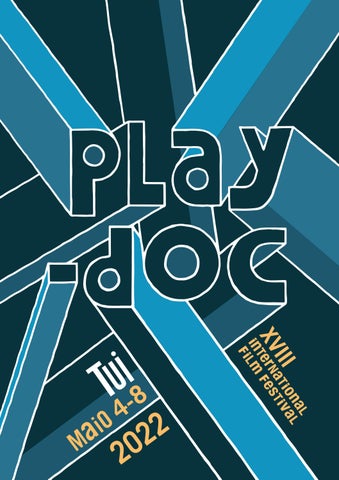
Benvidos á Welcome to
2
XVIII
edición edition
4 6 14 23 31 41 44 47 50 58 60 63 64 64 65 68 69 70 71
Benvida / Welcome Helke Misselwitz Danny Lyon Richard P. Rogers António Campos Sesión especial / Special Screening Competición internacional longametraxes / International Features Competition Competición internacional curtametraxes / International Shorts Competition Competición Galicia / Galician Competition Xurados / Juries Cinema percorridos III: Coreografías / Cinema Tours III: Choreographies Mesas online / Online Roundtables Coming Soon Play-Doc en FILMIN Play-Doc Live! Equipo / Team Sponsors TUI Horario / Schedule 3
Encántame mirar.
Sempre me fascinaron o cinema e ese secreto pracer de voyeur que me causa mirar imaxes na pantalla. Cando
se atenúan as luces e eu fico sentada na escuridade, durante eses momentos que transcorren xusto antes de se despregar maxicamente o mundo cinematográfico na pantalla, quedo suspendida no espazo e no tempo, nun estado de desexo. Non hai mellor xeito de sentir tal pracer unha e outra vez que nun festival de cine situado nunha das cidades máis bonitas da comunidade española de Galicia e á beira do río Miño, fronte a Portugal, onde se pode pasar dun país a outro simplemente con cruzar a ponte. O Play-Doc é Cinema e constitúe unha celebración da inventiva e do poder visual do aparello cinematográfico. Este festival convida o público a explorar como as películas nos chaman, nos retan, nos inspiran e nos fan volver por máis. O Play-Doc é un testemuño da pura emoción que sente un cando descobre cineastas que crean o tipo de cinema que custa atopar no baleiro das innumerables plataformas de emisión; o Play-Doc ofrécelle ao público a ocasión de descubrir o que este non ía atopar en ningunha outra parte. Na Viennale de 2019, tras coñecer a Sara García Villanueva, codirectora do Play-Doc xunto con Ángel Sánchez, quedei entusiasmada ao recibir o convite de vir a Tui para proxectar unha retrospectiva das miñas primeiras curtas experimentais, así como a miña película máis coñecida, VARIETY. Púxenme a planificar a viaxe de inmediato, pero uns meses despois a covid arrasou a nosa vida e por todo o mundo quedamos todos confinados; ninguén sabía como iamos combater ese virus. Ao cabo, despois de case dous anos de agarda, en 2021 por fin puiden acudir a este festival de cine tan pequeno, íntimo, senlleiro e persoal, que trae un programa meditado, provocador e seleccionado con moito coidado que abrangue cintas, realizadores e convidados procedentes de todas as partes. Levo desde a década de 1980 asistindo a festivais internacionais, pero nunca namorei de ningún como do Play-Doc, deses directores e organizadores tan cálidos e apaixonados, do público e da xente de Tui e da cidade mesma. Mentres paseaba unha tardiña con Sara e Ángel por unha ruela serpeante que ascendía por unha costa bastante empinada, deixoume cativada unha
4
Foto_ Tamara de la Fuente
Bette Gordon
catedral gótica do século xiii que se conserva desde a Idade Media. Ao contemplala, conmovida, comprendín que estaba a vivir un momento perfecto. Facer cinema é unha elección vital; require moitísima dedicación, require moitísimos azos e un ten que crer de verdade nesa idea. Cando se lle mostra un filme a un público, como aos do Play-Doc, todas as inseguridades e preocupacións desaparecen e, no canto diso, un sente a calidez, a curiosidade e o gozo de compartir a experiencia cinematográfica, unha experiencia como ningunha outra.
Bette Gordon
I Love to Watch.
I have always been fascinated by the cinema and the secretive, voyeuristic pleasure I get from looking at images on the screen. When the lights dim, and I sit in darkness, for those moments right before
the cinematic world on the screen magically unfolds, I am suspended in space and time, in a state of desire. There is no better way to experience such pleasure over and over again than at a film festival set in one of the most beautiful towns in the Galicia region of Spain, and on the bank of the Minho River, across the water from Portugal, where you can simply walk across the bridge from one country to the next. Play-Doc is about Cinema and celebrates the inventiveness and visual power of the cinematic apparatus. The festival invites the audience to explore the way in which films engage us, challenge us, inspire us and keep us coming back for more. Play-Doc is a testament to the pure excitement you feel when you discover filmmakers who create the kind of cinema that is hard to find in the void of endless streaming platforms. PlayDoc offers the audience an opportunity to discover what they would not find anywhere else.
At the Viennale in 2019, after meeting Sara García Villanueva, co-director of Play-Doc with Ángel Sánchez, I was excited to receive an invitation to come to Tui, to screen a retrospective of my early experimental short films as well as my most well-known film, VARIETY. I started planning my trip immediately, but Covid overwhelmed our lives a few months later, and across the world, we all went into lockdown; nobody knew how we would battle this virus. Finally, after almost two years of waiting, in 2021, I was eventually able to attend this small, intimate, unique and personal film festival, with a thoughtful, provocative and carefully selected program of films, filmmakers and guests from everywhere. I have been attending international festivals since the 1980s, but I have never fallen in love as I have with PlayDoc, with its warm and passionate festival directors and organizers, with the audiences and people of Tui, and with the town itself. Walking with Sara and Ángel one evening, on a small street winding up a pretty steep hill, I was mesmerized by a 13th-century gothic cathedral preserved from the Middle Ages. As I gazed in awe, I understood that I was experiencing a perfect moment. Making films is a life choice; it takes enormous dedication, heart and belief in your idea. When you show your film to an audience, like the audiences at Play-Doc, all the self-doubt and anxiety disappears, and instead you can feel the warmth, curiosity and enjoyment of sharing the cinematic experience, an experience like no other.
Bette Gordon 5
Helke Misselwitz:
Viaxes por un país que xa non existe / Journeys Through a Country Which Doesn't Exist Anymore
F
I
un pola cuestión histórica e marCame for History and I Left With chei co corazón cheo de xente: a a Heart Full of People: On Helke propósito de Helke Misselwitz. Misselwitz.
Sempre mantiven unha relación especial cos filmes realizados na época en que vin ao mundo e, en especial, con aqueles que se refiren á miña cultura; é coma se portasen un segredo do que eu non debería ser coñecedor. Souben deles polos sons que puiden ouvir pero non entendía, e polas faces que vía pero cuxa expresión non era quen de interpretar daquela. Esas cintas permitíanme existir unha vez máis, non como a persoa que eu coidaba que era, senón como unha parte 6
I've always had a special relationship with films made at the time I came into this world, especially those relating to my culture. It's as if they were carrying a secret I was not supposed to know about. I learn from them about the sounds I might have heard but didn’t understand and the faces I saw but couldn't read at the time. Those films let me exist once more, not as the person I thought I was, but as a tiny part of bigger movements. They make me realize who I am.
©Sibylle Bergemann / Helke Misselwitz, 1988
Primeira retrospectiva española / First Spanish Retrospective
minúscula duns mecanismos maiores, e fixeron que me dese de conta de quen son. Helke Misselwitz rodou algunhas das súas obras máis logradas arredor da época en que eu nacín, a cal coincidiu coa chamada reunificación da República Democrática Alemá e a República Federal de Alemaña: a caída do muro de Berlín. Filmes como Sperrmüll, Winter Adé ou Wer fürchtet sich vorm schwarzen Mann, que documentan os derradeiros días dun país que agoniza, dinme máis da vida en Alemaña Oriental do que me aprendeu nunca a miña formación xermanooriental. Son cintas que deixan constancia dun mundo que está a mudar e que poden ser descritas como viaxes por un país que xa non existe. Con todo, é mellor non baixar a garda porque, malia ser Misselwitz unha cineasta que se asocia con facilidade á DEFA e a unha potente dupla emancipación, referida a un pobo e á muller en particular, as súas películas resultan moito máis complexas que as consignas políticas baixo cuxa bandeira se realizaron. En repetidas ocasións me topei con elas nun contexto máis ou menos político ou histórico, e ao final sempre quedei pampo ante a súa absoluta franqueza, curiosidade e brillantez formal. Eu ía pola cuestión histórica e marchaba co corazón cheo de xente. Misselwitz, que naceu en Zwickau en 1947 (un ano antes de ver a luz a obra de Rossellini Germania anno zero), seguiu unha traxectoria bastante infrecuente dentro do sistema profesional regrado da RDA. Antes de estudar na escola de cinematografía de Babelsberg, a directora xa se formara como ebanista e fisioterapeuta; tamén traballou como moderadora para televisión, profesión que debeu de influír no papel que ela mesma desempeña nas súas películas, xa que non é, en absoluto, unha observadora muda. Así, moitos dos seus filmes benefícianse enormemente da súa presenza tras a cámara, a carón dela ou mesmo ante ela. Non entrevista os seus protagonistas: tópase con eles. No seu traballo documental existe certa timidez dos protagonistas cara á cámara, mais tamén certa intimidade entre a realizadora e eses mesmos protagonistas. Son infindas as metáforas con que se tentou describir a relación entre o director e os seus personaxes principais, pero ningunha me convenceu tanto como a que suscita unha escena da magnífica Winter Adé de Misselwitz. No filme faise un percorrido en tren desde o lugar de nacemento da autora, Zwickau, ata o mar Báltico. Polo camiño, a realizadora fala
Helke Misselwitz shot some of her most accomplished works around the time I was born. This time coincided with the so-called reunification of the German Democratic Republic and the Federal Republic of Germany: the fall of the Berlin Wall. Documenting the final days of a dying country, films like Sperrmüll, Winter Adé or Wer fürchtet sich vorm schwarzen Mann tell me more about life in East Germany than my West German education had ever told me. Those films document a changing world. They can be described as journeys through a country which doesn't exist anymore. However, it's better to remain careful because, although Misselwitz is a filmmaker easily associated with DEFA and a strong double emancipation, relating to a people and to women in particular, her films are much more complex than the political slogans under whose banner they were made. Time and time again, I've encountered them in a more or less political or historical context, and I always ended up feeling blown away by their sheer openness, curiosity and formal brilliance. I came for History and I left with a heart full of people. Misselwitz, who was born in Zwickau in 1947 (one year before Rossellini’s Germania anno zero saw the light of day), has followed a rather unusual trajectory within the regulated career system of the GDR. Before studying at the film school in Babelsberg, the director had already trained to be a cabinetmaker and a physiotherapist. She also worked as a moderator for television, a profession that must have influenced her own role inside her films as she is anything but a silent observer. Many of her films gain immensely from her presence behind, next to, or even in front of the camera. She doesn't interview her protagonists, she encounters them. In her documentary work there exists a shyness of the protagonists towards the camera but also an intimacy between the filmmaker and the very same protagonists. There have been endless metaphors trying to describe the relationship between directors and their protagonists but none has convinced me as much as one provoked by a scene in Misselwitz’s magnificent Winter Adé. The film follows a train route from Misselwitz’s birth place, Zwickau, to the Baltic Sea. On the way the filmmaker talks to different women about their life and work in socialism. At a diamond wedding, she talks to the elderly wife and husband. Suddenly, we see her dancing with the husband and talking to 7
con varias mulleres da vida e do traballo destas baixo o socialismo. Nunhas vodas de diamante conversa cos dous anciáns cónxuxes; de súpeto vémola bailar co home e falando con el, en algo que constitúe unha sorte de entrevista pero feita bailando. Un momento así describe á perfección a perspectiva adoptada por Misselwitz: danzar coa xente. Todas as persoas que filma interactúan con ela. En Wer fürchtet sich vorm schwarzen Mann, Misselwitz tócalle as tatuaxes a un dos provedores de carbón. A responsable da empresa en Prenzlauer Berg (Berlín), a quen está a retratar, dille á realizadora cando cortar. Non é só que a súa presenza se deixe sentir a cada segundo: é que resulta esencial nese enfoque tenro e directo que adoptan as súas películas. Misselwitz é unha cineasta que entende a política a través do intercambio humano e simplemente mirando as cousas como ela as percibe. Non se trata de elaborar argumentos, trátase de mirar. Moi a miúdo emprega dous fíos paralelos nos seus filmes, dos cales un se refire á maneira de mirar algo e o outro amosa como é ese algo en realidade. En Aktfotografie – z.B. Gundula Schulze intercala reflexións sobre a representación da muller na fotografía comercial e imaxes de mulleres a faceren a súa vida diaria. Logo de mergullarse nas celebracións das vodas de diamante de Winter Adé, mantén outra conversa coa dona na que chega a saber das traizóns do home e da falta de amor no que parecía ser unha relación ben bonita. Alén diso, a directora grava televisores repetidamente, inserindo relatos e medios oficiais nun mundo contraditorio. Misselwitz, que criou a súa filla mentres vivía nunha pensión, cursou estudos de cinema, pero decidiu facerse autónoma tras o seu paso polas aulas, empresa moi pouco común e arriscadísima na RDA. Na década de 1980 realizou algunhas curtas fascinantes, xa que ao principio o sistema cinematográfico de Alemaña Occidental, dominado por varóns, se interpuxo na senda que debería levala a converterse en realizadora de longametraxes. Non foi ata máis adiante cando traballou co famoso director da DEFA Heiner Carow e, logo do colapso da RDA, tivo a posibilidade de facer longas; con todo, como adoita ocorrer, da súa loita xurdiron algunhas das películas máis potentes que se fixeron na RDA. Tomemos a súa curta Marx-Familie, por exemplo. Nesta cinta, feita por encarga para o centenario 8
him. It's a sort of interview but it’s done in dancing. Such a moment describes Misselwitz's approach perfectly: she dances with people. Whoever she films interacts with her. In Wer fürchtet sich vorm schwarzen Mann Misselwitz touches the tattoos of one of the coal suppliers. The woman in charge of the company in Prenzlauer Berg, Berlin, who she is portraying, tells the filmmaker when to cut. Her presence is not only felt in every second, it is essential for the tender and direct approach of her films. Misselwitz is a filmmaker who understands politics through human exchange and simply looking at things in the way she perceives them. It's not about making arguments, it's about seeing. Very often she employs two parallel threads in her films. One is concerned with how something is looked at and the other shows what it really looks like. In Aktfotografie – z.B. Gundula Schulze she intercuts reflections on the representation of women in commercial photography with images of women living their daily life. After plunging into the celebrations regarding the diamond wedding in Winter Adé, she has another talk with the wife in which she learns about the husband's betrayals and the lack of love in what seemed to be such a nice relationship. Misselwitz, furthermore, repeatedly films television sets, embedding official narratives and media in a contradictory world. Raising her daughter while living in a boarding house, Misselwitz studied film but decided to become a freelance worker after school, a highly unusual and risky endeavor in the GDR. During the 1980s she made some fascinating documentary shorts as her path towards becoming a feature film director was at first made impossible by the male-dominated film system in East Germany. It was only later that she worked with famous DEFA director Heiner Carow and, after the collapse of the GDR, was able to realize feature films. However, as is often the case, her struggle brought about some of the strongest films ever to be made inside the GDR. Take her short Marx-Familie, for example. In the film, which was commissioned for the centenary of Karl Marx's birth, Misselwitz combines personal texts of the philosopher and his wife about their poor living conditions with historical photographs and filmed images of an abandoned East Berlin apartment. The latter is typical for her detailed observations of furniture, rooms and the little objects that have by now been transformed into
do nacemento de Karl Marx, Misselwitz combina textos persoais do filósofo e da súa muller, referidos ás súas pobres condicións de vida, con fotografías históricas e imaxes filmadas dun piso abandonado de Berlín Oriental. Isto último é moi típico das observacións polo miúdo que fai de mobles, cuartos e obxectos pequenos que hoxe se transformaron en estraños recordos cargados de nostalxia. O filme describe unha ausencia de persoas, pero tamén de utopías. As súas películas parecen dicir: Mira! Así é o aspecto que teñen as cousas! Ao igual que na maioría dos seus traballos, este pode entenderse como o retrato dunhas persoas que viven á sombra da historia. Misselwitz crea instantáneas dos tempos e as súas cintas cabe velas como fotografías en movemento. Con moita frecuencia, a aqueles que está a filmar pídelles, literalmente, que se poñan ante a cámara coma se fose para unha foto; pero mesmo así eles se moven, están vivos, no canto de seren fantasmas dun pasado que apenas podemos xa aferrar. Isto queda ben patente nunha obra como 35 Fotos: esta película, feita por encarga con motivo do trixésimo quinto aniversario de Alemaña Oriental, retrata unha muller nada no ano en que se fundou a RDA a través de trinta e cinco fotografías e algunhas imaxes nas que ela as comenta. A Misselwitz impórtanlle aqueles cuxa vida non se corresponde co relato oficial da RDA, coas súas familias felices, ambientes laborais sans e igualdade entre os sexos. Nos seus filmes eu coñecín os divorciados, os perdidos, os pobres, os traballadores, os marxinados e os truáns; ela dálles voz a aqueles aos que se lles pediu que ficasen calados. Deste xeito, a realizadora capta todas as gretas e incongruencias dun sistema destinado a fallarlle á súa xente. No entanto, isto non carece das súas ambivalencias, xa que as cintas tamén prefiguran os aspectos negativos dunha unificación alemá aínda non superada por unha sociedade que parece politicamente dividida ata o mesmo día de hoxe. Misselwitz non foi a única artista que lles deu voz ás mulleres que traballaban e vivían na RDA; estaba, por exemplo, Maxie Wander, que publicou unha importante obra titulada Guten Morgen, du Schöne, na cal dezanove mulleres de distintas idades falan da súa vida. En Alemaña empregamos o termo ungeschminkt para describir algo descarnado e carente de adobíos; a súa tradución literal é «sen maquillaxe», dupla connotación que
strange nostalgic memorabilia. The film describes an absence of people, but also of utopias. Her films seem to say: Look! This is what it looks like! Like most of her work, it can be understood as a portrait of people living in the shadow of history. Misselwitz creates snapshots in time. Her films can be understood as photographs in movement. Very often, she literally asks the people she is filming to stand in front of the camera as if it were a photograph. But then they still move, they are alive instead of being ghosts from a past we can barely grasp anymore. This becomes very apparent in a film like 35 Fotos. Commissioned on the occasion of the 35th anniversary of East Germany, the film portrays a woman born in the year the GDR was founded via 35 photographs and some images of her talking about them. Misselwitz cares for those whose lives do not correspond with the official GDR narrative of happy families, healthy work environments, and gender equality. In her films I get to know the divorced, lost, poor, workers, dropouts and punks. She gives a voice to those who were asked to remain silent. Thus the filmmaker captures all the cracks and inconsistencies of a system bound to fail its people. However, it doesn't come without its ambivalences, as her films also foreshadow the negative aspects of German unification still not overcome by a society that seems to be politically separated to this very day. Misselwitz was not the only artist giving voice to women working and living inside the GDR. There was, for example, Maxie Wander, who published an important book called Good Morning, My Lovely in which nineteen women of different ages talked about their lives. In German we use the term ungeschminkt when we want to describe how something is unvarnished and gritty. It literally translates as without make-up, a double connotation which fits the portraits of women in Misselwitz's films very well. Somehow she creates a protected space in front of her camera in which women finally feel free to speak out. Films like Winter Adé or 35 Fotos also deal with the act of narrating one's life. They confront us with the necessity and powerlessness of words; they are oral histories clinging to the emancipatory effect of speaking. Misselwitz's films are in strong accordance with Bertolt Brecht's lines: “Scheue dich nicht zu fragen, Genosse! / Laß dir nichts einreden / Sieh selber nach! / Was du nicht selber weißt / Weißt du nicht” (“Don't be afraid 9
se axusta moi ben aos retratos de mulleres das cintas de Misselwitz. Dalgunha maneira, ela crea un espazo de protección ante a cámara no que as mulleres senten por fin liberdade para expresar as súas opinións. Por outra banda, películas como Winter Adé ou 35 Fotos tamén tratan do acto de un narrar a súa vida: enfróntannos á inevitabilidade e á impotencia das palabras e constitúen historias orais que se aferran ao efecto emancipador da fala. Os filmes de Misselwitz concordan rotundamente con aqueles versos de Bertolt Brecht: «Scheue dich nicht zu fragen, Genosse! / Laß dir nichts einreden / Sieh selber nach! / Was du nicht selber weißt / Weißt du nicht» («Non temas preguntar, compañeiro! / Non te deixes convencer, / compróbao ti mesmo! / O que non sabes por ti / en realidade non o sabes»). Nos ollos dos seus protagonistas, sobre todo en Winter Adé, existe a firme convicción de que o cinema pode axudarlles. Creen na verdade. Pode resultar inxenuo, pero é bonito e sincero. A historia sempre se moveu máis rápido que o cine. Esta idea fica ben patente cando a confrontamos cunha mudanza tan fonda como a caída, non tan definitiva —no cal temos que reparar máis de trinta anos despois—, da cortina de ferro. A Historia non ten final, e ningún medio o demostrou mellor que o cinema, que está, en si mesmo, sempre en movemento. Os tempos están a mudar, sempre. En Sperrmüll, os acontecementos que conducen á unificación de Alemaña Oriental e Alemaña Occidental tomáronlle a dianteira á idea orixinal de retratar músicos novos e ofrecer unha imaxe auténtica da xuventude da RDA; no canto disto último, máis ou menos durante a rodaxe caeu o muro de Berlín e a película, seguindo estes acontecementos, transfórmase nun documento sobre identidades perdidas e rapaces inseguros respecto ao que facer coas novas oportunidades que se lles presentan e as súas utopías perdidas. Así, pois, que podo aprender eu desas cintas verbo da época en que vin a un mundo de cambios? Principalmente, que esa época aínda non rematou porque se atopaba daquela e se atopa agora ocupada por persoas, interaccións humanas e as súas historias de intentos de supervivencia. Dunha maneira conmovedora, pero nunca sentimental, Misselwitz capta a cativeza dos humanos que se enfrontan á vida e, deste modo, revela a súa grandeza. Texto escrito por Patrick Holzapfel para o noso catálogo. 10
of asking, brother! / Don't be won over, / See for yourself! / What you don't know yourself, you don't know”). There is a firm belief in the eyes of her protagonists, especially in Winter Adé, that cinema can help them. They believe in truth. It may be naive, but it is beautiful and honest. History has always moved faster than cinema. This becomes very obvious when confronted with a change as vast as the – as we have to learn more than 30 years later – not so final fall of the Iron Curtain. There is no end to History. No medium has proven that better than cinema, which is itself always in movement. The Times They Are A-Changin', always. In Sperrmüll the events leading to the unification of East and West Germany overtook the original idea of portraying young musicians and giving a true image of GDR youth. Instead, the Berlin Wall came down more or less during the shooting and, following those events, the film transforms into a document of lost identities and young people insecure about what to do with their new opportunities and lost utopias. So, what can I learn about the time I was born into a world of change from those films? Most of all, that this time is not over yet because, then and now, it is occupied by people, human interactions and their stories of trying to survive. Misselwitz touchingly but never sentimentally captures the smallness of humans confronting life and thus reveals their greatness. Text written by Patrick Holzapfel for our catalogue.
Estrea española / Spanish Premiere Unha película de Helke Misselwitz Escrita por Christiane Hein y Helke Misselwitz Fotografía: Jürgen Rudow Música: Volker Friedemann Seumel Con Gundula Schulze Producida por DEFA-Studio für Dokumentarfilme
FOTOGRAFÍA DE ESPIDOS, P. EX. GUNDULA SCHULZE. / NUDE PHOTOGRAPHY GUNDULA SCHULZE (AKTFOTOGRAFIE, Z.B. GUNDULA SCHULZE) 12′ / 1983 / RDA
Sala 2 sábado Saturday ás 17:30 h
A fotógrafa de Alemaña do Leste Gundula Schulze, explica vividamente o seu proceso creativo e fala sobre o seu desexo e preocupacións por capturar a personalidade completa das mulleres que retrata. Cara a fins dos anos 70, as innovadoras fotos de Schulze sufriron a desaprobación oficial porque transmitían a soidade, a pobreza e a angustia que algúns sentían na sociedade de Alemaña do Leste.
In this shor t, East German photographer Gundula Schulze vividly explains her creative process and talks about her desire to and concerns about capturing the whole personality of the women in her work. As of the late 1970s, Schulze's innovative photo series were met with official disapproval because they captured and conveyed the loneliness, poverty and distress felt by some in East German society.
Estrea española / Spanish Premiere Escrita e dirixida por Helke Misselwitz Fotografía: Jürgen Rudow Montaxe: Yvonne Loquens Son: Peter Dienst Con Bärbel Bolle, Dieter Montag Producida por DEFA-Studio für Dokumentarfilme
A FAMILIA MARX / THE MARX FAMILY (MARX-FAMILIE)
6′ / 1983-88 / RDA
Sala 2 sábado Saturday ás 17:30 h
Filmada cunha vella cámara Parvo L con manivela e estratexias de montaxe radicais, esta curta é un retrato experimental e alternativo da familia de Karl Marx e as súas pobres condicións de vida durante os longos anos que viviron en Londres. A curta foi producida para celebrar o centenario de Marx en 1983, pero aos funcionarios do goberno non lles pareceu o suficientemente digno. Só estreouse cinco anos despois. DEFA Film Library.
Filmed using an old handcranked Parvo L camera and radical montage strategies, this short is an experimental and alternative portrait of Karl Marx’s family and their poor living conditions during their long years in London. This short was produced to celebrate Marx's 100th birthday in 1983, but officials did not find it worthy. It was released only five years later. DEFA Film Library.
11
Estrea española / Spanish Premiere Escrita e dirixida por Helke Misselwitz Fotografía: Bernd Merten, Jürgen Rudow Montaxe: Karin Schöning Son: Helke Misselwitz Música: Cathrin Pfeifer Con Michael Braumann Producida por DEFA-Studio für Dokumentarfilme
35 FOTOS / 35 PHOTOS (35 FOTOS)
7′ / 1984-85 / RDA
Sala 2 sábado Saturday ás 17:30 h
Unha muller nada en 1949, ano en que foi fundada a República Democrática Alemá, fala sobre a súa vida baseándose en 35 imaxes do seu álbum familiar, cada unha das cales representa un ano. Este filme ía estrearse no 35º aniversario de Alemaña Oriental, pero os funcionarios rexeitárono por consideralo un retrato ostensiblemente negativo da vida familiar na RDA presentado por unha muller atípica. Un ano despois, estreouse cun título diferente. DEFA Film Library.
A woman born in 1949, the year the GDR was founded, talks about her life based on 35 images in her family album that each represent one year. This short was to premiere on the occasion of the 35th anniversary of East Germany. Officials rejected the short, however, as an ostensibly negative portrait of GDR family life presented by an atypical woman. It was released under a different title a year later. DEFA Film Library.
Estrea española / Spanish Premiere Unha película de Helke Misselwitz Escrita por Helke Misselwitz e Gudrun Plenert Fotografía: Thomas Plenert Montaxe: Gudrun Plenert Música: Mario Peters Son: Ronald Gohlke, Heinz Kaiser, Eberhard Pfaff, Peter Pflughaupt Producida por DEFA-Studio für Dokumentarfilme
ADEUS, INVERNO / AFTER WINTER COMES SPRING (WINTER ADÉ)
116′ / 1988 / RDA
Sala 1 venres Friday ás 20:45 h
12
Pouco antes da caída da República Democrática Alemá, Helke Misselwitz percorreu o país en tren entrevistando a mulleres de diferentes idades e contornas. Neste maxistral e revolucionario documental, as mulleres revelan as súas frustracións persoais e profesionais, os seus desexos e aspiracións, e ao facelo retratan unha sociedade cambiante. As súas historias cuestionan a afirmación de que Alemaña do Leste alcanzara a igualdade de xénero, socavando a imaxe oficial das mulleres. Ao mesmo tempo, unha nova independencia fai que estas falen abertamente sobre as súas vidas como nunca filmouse antes.
Shortly before the collapse of the GDR, Helke Misselwitz traveled the country by train to interview East German women of different ages and backgrounds. In this documentar y masterpiece, women reveal their personal and professional stories, their frustrations, hopes and aspirations—and, in doing so, paint a portrait of a changing society. It challenged East German claims to have achieved gender equality and undermined the official image of women. At the same time, a new independence helped women talk more openly about their lives than had ever been filmed before.
Estrea galega / Galician Premiere Unha película de Helke Misselwitz Escrita por Helke Misselwitz, Thomas Plenert Fotografía: Thomas Plenert Montaxe: Gudrun Plenert Son: Ronald Gohlke Música: Brigitte Unterdörfer Producida por DEFA-Studio für Dokumentarfilme
QUEN TEME AO HOME DO SACO / WHO'S AFRAID OF THE BOGEYMAN (WER FÜRCHTET SICH VORM SCHWARZEN MANN) 52′ / 1989 / RDA
Sala 1 sábado Saturday ás 20:30 h
Un achegamento a unha pequena compañía privada que distribúe carbón para fogares no distrito de Prenzlauer Berg, en Berlín Este. A enérxica muller a cargo deste negocio lévao adiante con humor e coñecemento, e os seus sete empregados homes respéctana. As súas discusións van desde a construción do Muro de Berlín e a posibilidade de escapar cara ao Oeste ata o abuso de menores, o suicidio, a prisión e o alcoholismo. DEFA Film Library.
A close-up of a small private company that delivers heating coal in the Prenzlauer Berg district of East Berlin. The feisty woman who runs the business does so with humor and understanding, and her seven male employees respect her. Their discussions range from the building of the Berlin Wall and possibly escaping to the West, to child abuse, suicide, prison and alcoholism. DEFA Film Library.
Estrea española / Spanish Premiere Unha película de Helke Misselwitz Escrita por Helke Misselwitz, Gerd Kroske Fotografía: Thomas Plenert Montaxe: Gudrun Plenert Música: Sperrmüll Producida por DEFA-Studio für Dokumentarfilme
RESIDUOS VOLUMINOSOS / BULKY TRASH (SPERRMÜLL)
75′ / 1990 / RDA
Sala 2 domingo Sunday ás 17:30 h
Filmado en Berlín Este a comezos do verán de 1989, este documental é o retrato dun grupo punk formado por catro músicos que se fan chamar Sperrmüll (Residuos voluminosos). Helke Misselwitz céntrase especialmente en Enrico, un mozo de Berlín Este que decide quedar nesa cidade cando a súa nai Erika casa no lado Oeste, e insiste en manter a súa identidade cultural incluso despois da caída do Muro. Os mozos músicos queren seguir sendo cidadáns do seu propio Estado e teñen unha actitude máis ben escéptica cara á inminente reunificación.
This documentary filmed in East Berlin in the early summer of 1989 portrays a punk band of four young musicians who call themselves Sperrmüll (Bulky Refuse). Helke Misselwitz concentrates especially on Enrico, a young East Berliner who decides to stay behind when his mother Erika marries in the West, and who insists on maintaining his cultural identity, even after the fall of the Wall. The young musicians want to remain citizens of their own state and have a generally skeptical attitude towards the looming reunification.
13
Danny Lyon:
Filmar contra os procedementos de exclusión / Filming Against Exclusion Procedures
O
s desprazados. Notas sobre os filmes de Danny Lyon.
Prefiro dar a este texto a aparencia de notas tomadas en limpo, pero conservando o seu carácter espontáneo. Aquí paréceme imposible facer outra cousa: ao cabo, sei demasiado pouco sobre o cinema de Danny Lyon, non sei nada dos modos de produción que lle permitiron realizar tantas películas nun período de vinte e cinco anos, e tampouco sei nada sobre a súa forma de distribución (redes de televisión por cable?, circuíto militante?). E a documentación (esencialmente
14
T
©Jack Foley / Danny and Nancy Lyon in the Penitentiary of New Mexico, 1985
Primeira retrospectiva internacional / First International Retrospective
he Displaced. Notes on Danny Lyon’s Films.
I prefer to give this text the appearance of notes taken neatly, but retaining their spontaneity. It seems impossible to me to do otherwise here: in the end, I know just too little about Danny Lyon's cinema, nothing about the modes of production that have allowed him to make so many films over a period of twenty-five years, and nothing about their mode of distribution either (cable TV networks?, a militant circuit?). And there is a lack of documentation (which is essentially
estadounidense) é escasa, ou resulta aínda case inaccesible. Presentar un texto denso e vertical sobre o Danny Lyon cineasta podería dar como resultado algo semellante a unha mentira: un discurso de especialización. Pero non significa eludir estes filmes o negarse un a propoñer máis nada que unha serie de notas. Ao contrario, é obedecer ao seu sentido propio: se hai algo que pareza guiar a mirada de Danny Lyon, é precisamente un noxo profundo, orixinal e arraigado ante toda forma de dominación. Textos que lles impoñen aos homes o trazado físico e cartográfico dos seus desprazamentos. Decretos ministeriais ou rexionais que lles ditan a determinados corpos, de determinada cor ou que se expresan en determinadas linguas, que non deben cruzar tal ou cal fronteira; caso contrario, pagarán o prezo do abandono: o aceptar non vivir dunha forma que non sexa na clandestinidade, con todo o que iso comporta de pobreza, perigo e desigualdades. Textos legais escritos polos vencedores e que delimitan unhas zonas nas que entrar significa renunciar a algo da propia liberdade orixinaria. Os seus filmes levan o rexeitamento do control gravado na súa propia escritura. As películas de Danny Lyon non se ven desde hai décadas. E se ese descoñecemento procedese dos apertos mesmos en que meteron estes filmes aos seus patrocinadores nos Estados Unidos, fosen as televisións, as institucións, as redes activistas ou a crítica? As películas de Lyon non responderon espontaneamente ao traballo de caricatura da realidade que uns e outros, por razóns a miúdo encontradas, esperaban delas. Véndoas hoxe constátase que non eran nin condescendentes dabondo nin simplistas dabondo. Que lles reprochaban aos documentais de Danny Lyon? Talvez que cresen de máis na Realidade. Risos. Non querían servirse dunha fermosa e enfática voz en off para fundamentar un propósito ou unha causa que só pedise iso. Non, Lyon debeu de dicir para si, de cada vez, que poñer aí unha voz en off para falar dos inmigrantes ilegais que cruzan a fronteira por Arizona, como nesa extraordinaria escena de El Otro Lado (a súa película máis fermosa?, na miña opinión si), sería igual que falar en lugar do outro. Non esconderse tras o comentario era aínda unha decisión moi minoritaria, pois, no cinema documental dos anos 70; só Frederick Wiseman
American), or it is still almost inaccessible. To present a massive, vertical text on Danny Lyon as a filmmaker might produce something like a lie: a discourse of mastery. But it is not to shy away from these films to refuse to propose anything other than a series of notes. On the contrary, it is to observe their very meaning: if there is one thing that seems to direct Danny Lyon's gaze, it is precisely a profound, original, deeply-rooted disgust for all forms of domination. Texts that impose on men the physical, cartography layout of their movements. Ministerial or regional decrees that dictate that certain bodies, of a certain colour, or speaking certain languages, must not cross this or that border, or else pay the price of abandonment: that they must accept to live in no other way than in hiding, with all that this implies in terms of poverty, danger and inequality. Legal texts written by the victors and delimiting zones; to enter these is to give up something of one’s own original freedom. The rejection of control is embedded in the very writing of his films. Danny Lyon's films have not been seen for decades. What if this lack of recognition came from the very embarrassment these films were to their sponsors in the United States, whether it was televisions, institutions, militant networks or critics? Lyon's films did not spontaneously respond to the work of caricature of reality that all such sponsors, for often opposing reasons, expected from them. Watching them today, one can see that they were neither condescending nor simplistic enough. What were Danny Lyon's documentaries criticised for? Perhaps the fact that they believed too much in Reality. Laughter. They did not want to use a nice emphatic voiceover to support a point or a cause that was just asking for it. No, Lyon must have told himself each time that putting a voice-over there to talk about illegal immigrants crossing the border through Arizona, as in that extraordinary scene in El Otro Lado (his most beautiful film?, in my opinion, yes), would be like speaking in the place of the other. Not hiding behind the commentary was still very much of a minority decision, then, in the documentary cinema of the 70s. Only Frederick Wiseman seemed to stick to it. In the case of Danny Lyon, given the populations that inhabit his films, the absence of voice-over is a determining 15
parecía acollerse a ela por entón. No caso de Danny Lyon, dada a poboación que habita as súas películas, a ausencia de voz en off constitúe un factor determinante a partir do cal as cintas se inscriben nunha postura política. A pregunta esencial do seu cinema desde finais dos anos 60 formulouna en 1985, en termos potentes e esclarecedores, Gayatri Spivak: Can the Subaltern Speak? Si, poden falar os subordinados? Pregunta política, pregunta filosófica. Pero trátase tamén, e antes de máis, dunha pregunta de cineasta; un documentalista que formula ao longo da súa vida a cuestión dos exiliados, dos emigrantes, os sen papeis e os presos tamén formula para si, en primeiro lugar, a cuestión da palabra: quen toma a palabra?, quen a asigna? Lyon podería roubarlla, roubarlle a palabra á minoría. Quen ía reparar niso? No entanto, decide non facelo, non falar por eles. Impón para si a prohibición de facelo. A partir dese momento, atopa para si mesmo un lugar de cineasta, un lugar moi cativo, estreito, mais precioso: el é o que relata unha experiencia. Non filma para tomar a palabra, senón para a transmitir. Pero como a transmite? Situándose xunta deles, filmando desde o seu carón, mais sen facer crer tampouco que é un deles. En todo momento, o lugar desde o que filma lémbranos que el é externo a eles, diferente deles. Non vai facer de emigrante mexicano, de indocumentado nin de preso. A súa posición determina outra cousa, moi sutil: dinos quen é, a saber, un fotógrafo e cineasta estadounidense, branco e libre. A súa situación non é comparable á deles. Porén, a súa liberdade non tería o mesmo sabor se non dese conta de vidas distintas da súa, vidas que loitan por poder desprazarse libremente dun espazo a outro. E esta cuestión do movemento posible no espazo Lyon convértea nunha cuestión propia do cineasta. É a cuestión que o obriga, en determinados momentos da súa vida, a deixar por un instante a fotografía para rexistrar e plasmar desprazamentos sensibles. A cuestión da posibilidade (fluxo migratorio), mais tamén da imposibilidade (cárcere, clandestinidade), do movemento, do paso dun espazo a outro, tórnase a cuestión central do seu cinema. E Lyon formúlalles esta cuestión aos Estados Unidos, o gran país que fixo da travesía do territorio e da 16
factor in the films' political position. The essential question of Danny Lyon's films since the late 60s was put in luminous and powerful terms by Gayatri Spivak in 1985: Can the Subaltern Speak? Yes, can the subaltern speak? A political question and a philosophical question. But it is also, and first of all, a filmmaker's question: a documentary filmmaker who asks the question of exiles, migrants, illegal immigrants or prisoners throughout his life also asks, in the first place, the question of speaking: who will speak? Who will assign the turn to speak? Lyon could steal that voice, the minority's voice. Who would notice? However, Lyon decides not to do so — not to speak for them. He forbids himself to do so. From then on, he finds a place for himself as a filmmaker, a very small and tight but precious place: he is the one who reports an experience. He does not film in order to speak but to transmit what is spoken. But how does he transmit that? He stands next to them; he films from their side but without making it look like he is one of them. The place from which he films always reminds us that he is external to them, different from them. He is not going to play the Mexican migrant, the illegal immigrant or the prisoner. His position determines something else, something very subtle: it tells us who he is, i.e. an American photographer and filmmaker, white and free. His situation is not comparable to theirs. But his freedom would not have the same taste if it did not reflect lives other than his own, lives that struggle to move freely from one space to another. And Lyon turns this question of the possible movement in space into a filmmaker's question. It is the question that obliges him, at certain times in his life, to leave photography for a moment to record movements and render them sensitive. The question of the possibility (migratory flow) but also of the impossibility (prison, clandestinity) of movement, of crossing from one space to another, becomes the central question of his cinema. And Lyon poses this question to America, the great country that has made the crossing of its territory and its conquest into a history, a moral doctrine and a mythology. His films always seem to have begun without us, and in a way they end as they began: without concluding anything definitive, without punctuation. Lyon hates conclusions. Danny Lyon's
súa conquista unha historia, unha moral e unha mitoloxía.
films are all very careful not to build on the illusion of a climax.
As súas películas sempre parecen comezar sen nós e, en certo modo, rematan como empezaron: sen que se conclúa nada definitivo, sen puntuación. Lyon odia as conclusións. Todos os seus filmes teñen coidado de non levantarse sobre a ilusión dun clímax.
There might be two Danny Lyons: the photographer and the filmmaker. No, sorry, there is only one Danny Lyon. The one we knew was a photographer. The one we did not know was a filmmaker. That is all; there, and only there, is where the difference lies.
Cabe a posibilidade de que haxa dous Danny Lyon: o fotógrafo e o cineasta. Non, síntoo, non hai máis que un. O que coñeciamos era fotógrafo; o que non coñeciamos era cineasta. Iso é todo e aí, só aí, radica a diferenza.
On the back cover of his book The Bikeriders, a daring book on the Hell's Angels, one can read this presentation:
Na contraportada do seu libro The Bikeriders, arriscada obra sobre os Anxos do Inferno, pódese ler esta presentación: En 1965, Danny Lyon, veterano de 23 anos do movemento polos dereitos civís dos estados do sur, entrou no Chicago Outlaws Motorcycle Club, montado nunha Triumph de 650 cc e disparando unha Nikon Reflex e unha Rolleiflex. Son lendarias as súas imaxes da vida carceraria, do movemento a prol dos dereitos civís no sur e das nacións indias estadounidenses. Entre os seus numerosos libros cóntanse The Destruction of Lower Manhattan, Conversations with the Dead, Knave of Hearts e Indian Nations. Lyon divide o seu tempo entre o val do Hudson (Nova York) e o val do río Grande (Novo México). Lyon vivía con Robert Frank e Mary na W 86 th Street de Nova York cando realizou a súa primeira película, Social Sciences 127, sobre un artista da tatuaxe de Houston, Bill Sanders. Estabamos en 1969. Tamén a Robert Frank lle gustaba variar os medios e pasar da fotografía ao cinema; pero, en certa maneira, nunca procurou facer extensible a fotografía ao documental, senón que o cinema lle serviu para converter os Estados Unidos nun pequeno teatro, histérico (Pull My Daisy) ou mitolóxico (Candy Mountain). Lyon, pola súa banda, non fixo divisións. É coma se nunha escena el tivese postos os dous ollos, un para a fotografía e outro para a cámara. Pero como, que non son o mesmo? Abofé que non: son dous ollos que traballan en tempos diferentes. Un é para o Laocoonte, é dicir, vai á busca da pose máis fermosa, do instante preciso en que o suxeito se mostra na súa perfección estatuaria. O outro, por agora, non é xa
In 1965, Danny Lyon, a 23-year-old veteran of the southern civil rights movement, joined the Chicago Outlaws Motorcycle Club, riding a 650-cc Triumph and shooting with a Nikon Reflex and a Rolleiflex. His pictures of prison life, the southern civil rights movement and American Indian nations are legendary. His many books include The Destruction of Lower Manhattan, Conversations with the Dead, Knave of Hearts and Indian Nations. He divides his time between the Hudson Valley of New York and the Rio Grande Valle of New Mexico. Lyon was living with Robert Frank and Mary on W 86th Street in New York when he made his first film, Social Sciences 127, about a Houston tattoo artist, Bill Sanders. It was 1969. Robert Frank, too, liked to vary his mediums, to switch from photography to film. But in a way, Frank never sought to extend his photography into his documentary work. He used his films to turn America into a small theatre, whether hysterical (Pull My Daisy) or mythological (Candy Mountain). Lyon, for his part, drew no divisions. It is as if he had both eyes on a scene – one eye for photography, another eye for the camera. What, they are not the same? Of course not – they are two eyes working at different times. One is for Laocoön, that is, it goes in search of the most beautiful pose, the precise moment when the subject is shown in its statuary perfection. The other one is, for the moment, no longer specific but "no matter which one." It is the eye of cinema, and the pose is melted into a series of twenty-four photographs per second in which another power emerges: that of continuity, of movement and space seen in its disturbances. It is interesting to see what Lyon the filmmaker brings to Lyon the photographer. Or vice versa 17
un concreto senón «calquera»; é o ollo do cinema e a pose fúndese nunha serie de vinte e catro fotografías por segundo na cal xorde outro poder: o da continuidade, o do movemento e do espazo que se deixa ver nas súas perturbacións. É interesante ver o que o Lyon cineasta lle achega ao Lyon fotógrafo. Ou á inversa. O que o seu cinema perpetúa a partir das súas fotografías. Unicamente un exame sistemático dos dous arquivos nos permitiría teorizar ao respecto, así que contentémonos cunha mera intuición: o documental talvez lle ensinou a ser menos compositivo. A tradición fotográfica á que pertencía Danny Lyon soñaba cunha escritura xornalística que, non obstante, levaba no seu interior as regras da composición clásica. As súas fotos de The Bikeriders ou Conversations with the Dead importan a composición clásica á enerxía do cotián. O cinema documental apresúrase a desconfiar das imaxes fermosas de máis e das composicións sólidas de máis. Sobre todo un cinema que, igual que o seu, como pode verse en El Otro Lado e en Little Boy (unha película curiosa, case experimental, na que amosa uns Estados Unidos brancos invadidos pola televisión, que confronta cuns Estados Unidos non representados, invisibles: o país dos inmigrantes ilegais, o dos pobos das reservas), moi pronto aprenderá a situar a súa investigación nun lugar distinto do da composición, mais adoptando unha forma de se situar el mesmo no interior dunha serie de desprazamentos que deciden sobre a supervivencia dos seus suxeitos. Así, pois, non é tanto o encadramento como o espazo e a duración o que lle serve de muletas para facer a imaxe. Volvo de novo á súa cinta máis rica, El Otro Lado. Non obstante, todas as películas de Danny Lyon son películas que buscan ir ao outro lado. Xa non as filma desde o seu propio espazo, senón que se incorpora a outro que está separado de nós pola fronteira trazada pola lei, un espazo milimetrado no que un mexicano aínda era un mexicano hai uns segundos e se converte en ilegal uns metros máis aló. Cal é ese espazo que a fotografía non pode cubrir e que o cinema pode tentar salvar in extremis? Un espazo no que os sons resultan primordiais, porque alertan. O son das películas de Lyon leva en si a información que precisan para sobrevivir os que viven na clandestinidade. Ese espazo áchase sempre en confrontación cun son externo que dá 18
– what his cinema perpetuates from his photographs. Only a systematic examination of the two archives would allow us to theorise about this, so let us make do with one mere intuition: documentary cinema may have taught him to be less compositional. The photographic tradition to which Danny Lyon belonged dreamed of a journalistic writing style that nevertheless carried with it the rules of classical composition. His photos in The Bikeriders or Conversations with the Dead import classical composition into the energy of everyday life. Documentary cinema is quick to distrust images that are too beautiful or too solidly composed. Especially a cinema which, like his own, as can be seen in El Otro Lado or in Little Boy (this funny, almost experimental film, in which he shows a white America invaded by television, which he confronts with an unrepresented, invisible America: that of the illegal immigrants, of the people of the reserves), will very quickly learn to locate its research elsewhere than in composition, but in a way in which it locates itself within a series of displacements that decide the survival of its subjects. It is not so much the frame, then, as the space and duration that become his crutches for making the image. I return once again to his richest film, El Otro Lado. However, all of Danny Lyon's films are films that seek to go to the other side. He no longer shoots them from his own space: he enters a space, separated from us by the border drawn by the law – a space graduated in millimetres, in which a Mexican was still a Mexican a few seconds ago and becomes an illegal immigrant a few metres further away. What is this space that photography cannot cover and that cinema can try to save in extremis? It is a space where sounds are paramount because they alert. The sound in Lyon's films carries the information that those who live in secrecy need to survive. This space is always in confrontation with an external sound that raises the alarm. The offscreen decides everything, Eisenstein noted. And Eisenstein knew a thing or two about playing with the rules of politics and the political. The very little editing in his films is also a result of this: to intervene as little as possible, so as not to move around in space in the place of the person being filmed, but also to allow the time for the
a alerta. O fóra de campo decídeo todo, sinalou Eisenstein. E Eisenstein sabía un par de cousas sobre como xogar coas regras da política e do político. A moi escasa montaxe das súas películas tamén é resultado diso: intervir o menos posible, para non desprazarse polo espazo en lugar da persoa filmada, mais tamén con obxecto de deixar o tempo necesario para que a información achegada polo son entre na imaxe, se despregue nela e lle resulte útil á acción que está a filmar, a cal é sempre unha acción de supervivencia. Unha nota ao final dos créditos de El Otro Lado: «A andaina polo deserto foi recreada polos seguintes traballadores indocumentados». Isto é importante: el non traballa como xornalista, para captar o instante, senón como cineasta, de ficción se é preciso, que se permite refacer a toma, noutro lugar, noutro momento, mais segundo uns parámetros de espazo e movemento que puido observar sen cámara, durante unha situación na que resultaba perigoso para os emigrantes que el acudise con cámara (poderían ser detectados). Iso non muda en nada o obxectivo das películas: dar a sensación dunha experiencia. Porén, cando chega o cinema, por veces é tarde de máis; o que sexa xa pasou. Mais o problema segue aí e aínda non se filmou. Así que hai que escenificar a acción unha segunda vez para que sexa oída na realidade. Dese primeiro visionamento das películas de Danny Lyon conservo a impresión de que para el o cinema só existe co obxecto de captar a experiencia: hai vidas, vidas invisibles, e o seu deber é captalas para contar unha historia. E para así lles dar a esas vidas clandestinas a posibilidade de un día, talvez, existir no visible.
information brought by the sound to enter the image, unfold and become useful to the action he is filming, which is always an action of survival. A note at the end of the credits of El Otro Lado: "The desert walk was re-enacted by the following undocumented workers." This is important: he does not work as a journalist to capture the moment, but as a filmmaker, of fiction if need be, who allows himself to redo the shot, elsewhere, at another time, but according to the parameters of space and movement that he was able to observe without a camera, during a situation where it was dangerous for the migrants for him to come with a camera (they could have been spotted). This does not change the aim of the films one bit: to give the feeling of an experience. But by the time the cinema arrives, it is sometimes too late – it has already happened. However, the problem is still there and it still has not been filmed. So the action needs to be staged a second time to make it heard in reality. From this first viewing of Danny Lyon's films, I have the impression that for him, cinema only exists to capture experience: there are lives, invisible lives, and his duty is to capture these lives in order to tell a story. And thus to give these clandestine lives the possibility of perhaps existing in the visible space one day. That is what filming against exclusion procedures is all about. Text written by Philippe Azoury for our catalogue.
Niso consiste filmar contra os procedementos de exclusión. Texto escrito por Philippe Azoury para o noso catálogo.
19
Estrea internacional / International Premiere Unha película de Danny Lyon Son: Ed Hugetz, David Gerth Producida co apoio do American Film Institute
SOC. SCI. 127 21′ / 1969 / EUA
Sala 2 sábado Saturday ás 17:30 h
Filmado en Houston, Texas, en 1969, a primeira película de Lyon Soc. Sci. 127 trata sobre un excéntrico tatuador que bebe, fuma e que se aferra a unha cosmovisión caótica feita de opinións aleatorias sobre todas as cousas, desde a reveladora etimoloxía da palabra felación ás súas propias motivacións para facer unha película documental.
Shot in Houston Texas in 1969, Lyon's first film Soc. Sci. 127 is about an eccentric, tattoo artist named Bill Sanders who drinks, smokes, and snatches at a matted worldview stitched together from haphazard opinions on everything from the telling etymology of “fellatio” to his own motivations for making a documentary film.
Estrea internacional / International Premiere Unha película de Danny Lyon
LLANITO
52′ / 1971 / EUA
Sala 2 venres Friday ás 19:30 h
Llanito é a primeira película da súa triloxía filmada en Bernalillo, Novo México, e é tamén o debut na pantalla de Willie Jaramillo. A película deambula pola cidade e entre os seus habitantes, ás veces co agudo instinto dun aguia do deserto e outras cun estupor beodo, tropezando dunha escena a outra coa certeza visceral e irracional da atracción gravitatoria.
Llanito is the first of Lyon's trio of films shot in and around Bernalillo, New Mexico, and it is also the screen debut of Willie Jaramillo. The film meanders through the town and among its inhabitants, passing between groups of people at times with the keen instinct of a desert eagle and at others in a drunken stupor, stumbling from one scene into the next with the visceral and irrational inevitability of a gravitational pull.
Estrea internacional / International Premiere Unha película de Danny Lyon Son: Ed Bevan, James Blue, Stephanie Chrisman Producida por J.J. Meeker Cos Sawdust Boys de New Mexico
EL MOJADO
18′ / 1974 / EUA
Sala 2 sábado Saturday ás 17:30 h
20
«El Mojado é unha película sobre o meu mellor amigo en Novo México, un traballador sen papeis, proveniente da zona rural de Chihuahua. El introduciume no incrible mundo dos “inmigrantes ilegais”». Danny Lyon.
“El Mojado is about my best friend in New Mexico, an undocumented worker from rural Chihuahua. He introduced me to the whole unbelievable world of ‘illegal aliens’.” Danny Lyon.
Estrea galega / Galician Premiere Unha película de Danny Lyon Son: Paul Justman
LOS NIÑOS ABANDONADOS
63′ / 1975 / COLOMBIA
En 1975 Danny Lyon viaxou a Colombia e realizou unha película impasible aínda que chea de lirismo, dedicada á crecente poboación de nenos sen fogar, vivindo nas rúas, abandonados polas súas familias e ignorados tanto pola Igrexa como polo Estado.
In 1975 Danny Lyon traveled to Colombia and made an u nblinking yet ly r ical f ilm dedicated to the surging population of homeless children living on the streets, abandoned by family and ignored by Church and State alike.
Sala 1 domingo Sunday ás 18:30 h
Estrea internacional / International Premiere Unha película de Danny Lyon Montaxe e son: Paul Justman Subvencionada polo National Endowment for the Arts
LITTLE BOY
54′ / 1977 / EUA
Sala 2 sábado Saturday ás 19:30 h
A bomba Little Boy lanzada sobre as xentes de Hiroshima, foi deseñada e probada en Novo México. Pero hai outro «little boy» chamado Willie Jaramillo. Aos dezaoito anos acaba de saír da prisión por unha serie de delitos menores. Mentres Lyon rolda as rúas preguntando a veciños e amigos por Willie, a película regresa á súa infancia, idílica en comparación co presente, e a historia dun home emerxe con máis importancia que a propia bomba atómica.
The Little Boy bomb dropped on the people of Hiroshima was designed and tested in New Mexico. But there is another little boy, Willie Jaramillo. At age eighteen, he has just been released from prison for a series of minor offenses. As Lyon pounds his beat around town, asking friends and neighbors about Willie, the film jumps back in time to scenes from Willie's childhood and the history of one man's life emerges as a fact of greater significance than the atom bomb itself.
Estrea internacional / International Premiere Unha película de Danny Lyon Asistente de montaxe: Alton Walpole Son: James Blue (Mexico), Michael Becker (Arizona) Realizada grazas ao apoio de The New Mexico Arts Commission, The National Endowment for the Arts, John Simon Guggenheim Memorial Foundation, Parish Witness Program, American Baptist Churches
EL OTRO LADO 60′ / 1978 / EUA
Sala 1 venres Friday ás 23:15 h
El otro lado foi filmado nos campos de cítricos do condado de Maricopa, unha vasta area agrícola próxima a Phoenix, en EUA. Nela preséntanos á familia Garey á que Lyon filma no seu fogar en México. O cruzamento ilegal da fronteira é unha reconstrución na que traballadores ilegais escenifican a súa entrada ilegal nos Estados Unidos.
El otro lado was shot in the citrus groves of Maricopa County, a large agricultural area close to Phoenix. It features the Garey Family. Lyon traveled to Mexico to film the family in its, home. The illegal crossing of the border was a reenactment, using illegal workers to play an illegal entry into the United States.
21
Estrea internacional / International Premiere Unha película de Danny Lyon Son: Nancy Weiss Lyon, Ed Hugetz, Jack Foley, Doug Kuntz Produción, fotografía e montaxe: Danny Lyon Asistente de montaxe: Nancy Weiss Lyon Producida coas subvencións de The New Mexico Arts Commission, The Santa Fe Council for the Arts, The Southwest Alternate Media Project, The National Endowment for the Arts
WILLIE
78′ / 1985 / EUA
Sala 1 domingo Sunday ás 16:30 h
Lyon entra nas prisións e comisarías onde Willie ou os seus amigos de infancia cumpriron condena, observando e entrevistando a Willie e aos seus irmáns, aos seus compañeiros de prisión, aos alcaides e a calquera no seu círculo de coñecidos, coma se nalgún lugar existise unha pista que explicase os problemas interminables que lle perseguen sen compaixón e que parecen apoderarse da súa sorte.
Lyon enters the prisons and precincts where Willie Jaramillo or his childhood friends have served time, observing and interviewing him, his brothers, his fellow inmates, wardens, and anyone else in his circle of acquaintance, as if there might be a clue somewhere to the trouble that seems to endlessly and ruthlessly seek Willie out and take a hold of his fate.
Estrea internacional / International Premiere Unha película de Danny Lyon
SNCC
74′ / 2020 / EUA
Sala 2 xoves Thursday ás 19:30 h
22
Utilizando centos de fotogramas inéditos filmados no Sur profundo dos Estados Unidos no apoxeo do Movemento polos dereitos civís, Lyon recrea unha das organizacións estudantís máis exitosas da historia, a SNCC (Comité Coordinador Estudantil Non Violento), a punta de lanza que puxo de xeonllos a Jim Crow.
Using hundreds of unknown 35 mm stills Lyon shot in the deep south at the height of the Civil Rights Movement, he recreates one of the most successful student organizations in history, the SNCC (Student Nonviolent Coordinating Committee) the point of the spear in bringing Jim Crow to its knees.
Retrato por outros medios: catro películas de Richard P. Rogers / Portraiture by Other Means: Four Films by Richard P. Rogers Curado por / Curated by Haden Guest
©Susan Meiselas. Richard P. Rogers with Leica, date unknown
Primeira retrospectiva internacional / First International Retrospective
A
o longo da súa vida artística, Richard P. Rogers (1944-2001) estivo en activo tanto en calidade de célebre director e produtor de filmes de non-ficción como no seu posto de profesor e mentor en Harvard, onde foi moi querido e impartiu aulas de fotografía fixa e cinematografía. O seu omnívoro apetito polo coñecemento levouno a percorrer o mundo: das selvas de Nicaragua ás fontes de Roma, e dos dormitorios das vivendas coloniais de Nova Inglaterra ás rúas da Albany de clase traballadora. Pero, en última instancia, o tema máis importante que
T
hroughout his artistic life Richard P. Rogers (1944-2001) was active both as a celebrated director/producer of non-fiction films and a beloved teacher and mentor at Harvard, where he taught still photography and filmmaking. Rogers' omnivorous appetite for knowledge took him around the world; from the jungles of Nicaragua to the fountains of Rome, from the bedrooms of colonial New England homes to the streets of working-class Albany. But Rogers' most important subject was ultimately much closer: himself, explored in films that turned 23
tratou atopábase moito máis preto: el mesmo, e a si mesmo se estudou en cintas nas que se volveu cara ao seu propio interior para examinar criticamente a súa vida e a súa arte. Este programa reúne as curtas máis conseguidas de Rogers, que son, cada unha ao seu xeito, unha sorte de autorretrato no que se exploran os afáns deste cineasta reconvertido a fotógrafo por captar a esencia, a miúdo esquiva, do tema abordado, xa fose un lugar senlleiro, como unha canteira, unha comunidade e o espírito dunha época en Quincy (Massachusetts); xa unha historia familiar, como en Elephants; xa unha relación inestable, como en 226-1690; xa, como en Moving Pictures, un artista que tenta construír unha alegoría animada de incertezas psicosexuais e xeopolíticas. — Haden Guest Todas as películas deste programa preséntanse en versión dixitalizada das copias en 16 mm procedentes da Colección do Arquivo Cinematográfico de Harvard. QUARRY (1970) En Quarry faise un magnífico uso da experiencia de Rogers como profesional da foto fixa, a cal permite contemplar a superficie das cousas, as texturas e a luz e especular a pracer sobre o contexto maior en que se insiren. A cinematografía narrativa adoita empregar a imaxe para impulsar a acción e a historia, deixando atrás calquera visión máis contemplativa; no entanto, a cinematografía documental da mellor clase (clase que semella estar a evaporarse, mais que para Rogers seguía viva) crea un sentido diferente do ritmo e do tempo, que deixa penetrar na nosa consciencia o tacto das cousas: a áspera superficie das rochas, o brillo da pel húmida, as transitorias columnas de salpicaduras de auga. Rogers empeza o seu retrato deste lugar concentrándose nos elementos naturais: rocha, auga, ceo e o que queda do traballo que tallou aquelas —remaches abandonados na pedra, maquinaria ferruxenta—, mentres os ecos do corte de rochas que tivo lugar no pasado reverberan na banda sonora. Esta paisaxe baleira non tarda en encherse de acción cando cobra protagonismo o tema principal tratado por Rogers: os rapaces e adultos de clase traballadora que se valen da canteira como lugar 24
inward to critically examine his own life and art. This program brings together Rogers' most accomplished short films, each in their own way self-portraits of sorts that explore the struggles of the photographer-turned filmmaker to capture the often elusive essence of his subject, be it a singular place, such as a quarry, community and zeitgeist in Quincy, Massachusetts, or a family history, as in Elephants, or an uncertain relationship as in 226-1690, or, as in Moving Pictures, an artist trying to craft an animated allegory of psycho-sexual and geopolitical uncertainties. — Haden Guest All films in this program are presented as digitized versions of 16 mm prints from the Harvard Film Archive Collection. QUARRY (1970) Quarry makes fine use of Rogers' background as a still photographer. Still photographs allow one to contemplate the surfaces of things, textures and light, and to speculate on their broader context at one’s leisure. Narrative filmmaking more often uses image to propel action and story, leaving a more contemplative vision in the dust. But documentary filmmaking of the best sort (a sort that seems to be vanishing, but which was still alive for Rogers) creates a different sense of pace and time, allowing the feel of things — the rough surface of rocks, the sheen of wet skin, the transient plumes of splashing water — to enter our consciousness. Rogers begins his portrait of this place by focusing on natural elements: rock, water, sky, and the remains of the labor that carved the rocks — rivets left in the stone, rusting machinery — as the echoes of the rock cutting of the past reverberate on the sound track. This empty landscape soon fills with action as Rogers' main subject takes over: the working class kids and adults who use the quarry as a place of recreation, a non-commercialized water park that belongs to them through their use of it, a place where they can swim, talk, flirt, dive, drink beer, gamble, inscribe their names in graffiti on the cliffs — have a good time with a hint of danger. As Rogers films their pastimes, one senses the mixture of alienation and fascination these working class guys and girls had for this Harvard student, born on New York's posh Park Avenue. But Rogers does more than simply observe; he
de recreo, como parque acuático non comercial que lles pertence por mor do uso que lle dan, como lugar onde poden nadar, conversar, coquetear, tirarse á auga, beber cervexa, apostar, facer nos precipicios pintadas co seu nome…; en suma, pasalo ben cun punto de perigo. Mentres Rogers filma os pasatempos desas persoas, un percibe a mestura de afastamento e fascinación que sentían eses mozos de clase traballadora ante este alumno de Harvard, nado na fina Park Avenue de Nova York. Pero o artista fai moito máis que limitarse a observar; tamén escoita. Ao tempo que as imaxes expoñen en detalle os mergullos, as escaladas, os xogos e as proezas, a banda sonora capta conversas que nos din que este espazo serve de refuxio, de lugar que se define pola súa diferenza co xugo diario, de vía de escape das normas dos xefes da fábrica ou dos polis da rúa. Destas voces ambientais que ocupan unha banda sonora rica en matices, tamén captamos relatos de morte e dano resultantes de Vietnam e lembramos o ano en que se rodou a película: en 1967 o conflito atopábase no seu punto álxido, e foron mozos coma estes os que constituíron as tropas que loitaron e perderon a vida naquela guerra. En aplicación das teorías do cineasta soviético Sergi Eisenstein verbo da relación entre son e imaxe, o que ouvimos na banda sonora transforma o que vemos na pantalla. Así, mentres escoitamos conversas sobre bombas e disparos, as imaxes das persoas que se tiran á auga, cando entran en contacto con esta, empezan a asemellarse a explosións. Con todo, hai que insistir no sutil de tal transformación: non vemos os saltadores como un grupo de B-52, senón que seguen sendo rapaces que se divirten. Máis ben, a violencia á que se fai referencia aí, lonxe de inundar a imaxe, forma un novo horizonte de significación, un fondo de ameaza, e non unha metáfora forzada. Rogers tamén refai esa lección de edición que xorde da potente secuencia dos saltos á piscina rodada por Leni Riefenstahl e incluída no seu filme dos Xogos Olímpicos de 1936 na Alemaña nazi. Tanto Riefenstahl como Rogers cortan no momento da caída dos saltadores, interrompendo a acción de tal forma que non chegan á auga e deixándoos, deste xeito, suspendidos no aire e transportados pola imposible éxtase do voo. No entanto, mentres que as imaxes de Riefenstahl constitúen unha exaltación dos poderosos corpos masculinos no seu agresivo impulso, Rogers capta os fráxiles corpos de adolescente durante
also listens. While the images detail the dives, the climbing, the games and stunts, the sound track picks up conversations which tell us this space serves as a haven, a place defined by its difference from the daily grind, an escape from regulation by factory bosses or cops on the street. From these ambient voices on a richly layered sound track, we also pick up stories of death and injury from Vietnam, and recall the year of the film was shot. 1967 saw the height of this conflict, and young men like these formed the troops who fought and died in that war. In an application of Soviet filmmaker Sergi Eisenstein’s theories about the relation between sound and image, what we hear on the sound track transforms what we see on the screen. As we listen to discussion of bombs and gunfire, the images of divers hitting the water begin to resemble explosions. Yet the subtlety of this transformation must be stressed. We don’t see the divers as B-52s; they remain kids having fun. Rather, the violence referenced here, far from overwhelming the image, forms a new horizon of significance, an overtone of threat rather than a forced metaphor. Rogers also re-tools a lesson in editing from Leni Riefenstahl's powerful diving sequence from her film of the 1936 Olympics in Nazi Germany. Both Riefenstahl and Rogers cut on the divers' falls through the air, interrupting the action so that they never reach the water, leaving them suspended in midair in an impossible ecstasy of flight. But whereas Riefenstahl's images exalt powerful male bodies in a thrust of aggression, Rogers captures the frail bodies of adolescents in a moment of soon-to-be-curtailed delight. Riefenstahl creates cinematic supermen sailing over the earth. Rogers shows us a moment of liberation that we know must surrender to the pull of gravity. Like the haven of the quarry itself, Rogers transforms this free fall into a temporary respite in a world otherwise bound by restrictions, unappreciated work and, ultimately, worldwide aggression. — Tom Gunning ELEPHANTS (1973) The alienation that appears as an undertone in Quarry becomes the main topic of Elephants as the filmmaker steps into the spotlight in this autobiographical film. But how central to the film is Dick Rogers? He first appears five minutes 25
un anaco de deleite que pronto chegará ao seu termo. Riefenstahl crea superhomes cinemáticos que navegan sobre a terra; Rogers amósanos un momento de liberación que sabemos que debe renderse ante a forza da gravidade. Como o propio refuxio que é a canteira, Rogers transforma esa caída libre nun respiro temporal no medio dun mundo, polo demais, sometido a restricións, traballo non valorado e, en última instancia, agresividade mundial. — Tom Gunning ELEPHANTS (1973) O distanciamento que xorde de fondo en Quarry eríxese no tema principal de Elephants, un filme autobiográfico no que o cineasta pasa a constituír o foco de atención. Con todo, ata que punto é Dick Rogers o núcleo da película? O artista aparece por vez primeira aos cinco minutos do comezo, tras unha profusión de fotografías do álbum de familia que constitúen unha crónica do elegante estilo de vida dos seus entregos de clase alta, que posan cos seus colos amidonados e vestidos ondulantes, e as voces dos seus pais, que se entrelazan (mais sen perderen a súa plena identidade) na banda sonora. Tras un varrido pola fotografía dun bebé, a cámara desprázase e capta a Rogers mirando fixamente cara á lente, como en disposición para unha fotografía policial. Nesta imaxe, o cineasta parece máis o tema que o autor da cinta, ao presentarse como o último dunha liña xenealóxica e soportando a carga da historia familiar acumulada que acabamos de ver e ouvir. Elephants constitúe un autorretrato, de sinceridade extraordinaria, dunha conciencia dividida que sente á vez atracción e aborrecemento ante o reino de riquezas e privilexios que representa o pasado da súa familia. Cando as imaxes do álbum familiar e as entrevistas aos seus parentes dan paso ao roldar da cámara de Rogers polas rúas de Boston, percibimos o seu devezo doutra vida, mais tamén o seu distanciamento das imaxes do mundo que o rodea, o cal, decididamente, carece de toda elegancia. A busca de mulleres que fai a cámara (e, ao final, o amorío que grava) transmite unha sensación de timidez e, ao mesmo tempo, de luxuriosa soidade, coma se procurase salvación mediante a liberación erótica (outro clixé dos anos 60). Porén, esa liberación amósase esquiva, cando a cita que presenciamos, segundo analizou anos despois a sensata muller coa que o artista 26
into the film, after a plethora of family album photographs chronicling the elegant life styles of his upper class ancestors, posed in their starched collars and billowing dresses, and the intertwined (but absolutely separate) voices of his father and mother on the sound track. After panning over a baby picture, the camera pans and picks up Rogers staring straight on at the camera, as if posed for a mug shot. The filmmaker seems in this image more the subject than the author of the film, presenting himself as the last in the line of family genealogy, bearing the burden of the accumulated family history we have just seen and heard. Elephants presents an extraordinarily honest self-portrait of a divided consciousness, simultaneously attracted to and loathing the realm of wealth and privilege that his family's past represents. As the family album images and parental interviews give way to Rogers' camera prowling the streets of Boston, we sense his longing for another life, yet also his alienation from the images of a decidedly non-elegant world that surrounds him. The camera's searching out of women (and the eventual pickup it records) carries a sense of timidity as well as lustful loneliness, as if searching for deliverance through erotic liberation (another Sixties cliché). But liberation remains elusive when the tryst we see, as analyzed years later by the quite wise woman he picked up, only reveals the fact of their mutual loneliness. — Tom Gunning 226-1690 (1984) While Rogers' films constantly reflect the visual acuity of a still photographer, in some way his use of sound stands as the most consistently original aspect of his films. Neither Quarry nor 226-1690 use synch-sound and although powerful synchsound interviews occur in Elephants, that film also creates the tapestry of interweaving voices Rogers had experimented with in Quarry. This interweaving of voices (the collective voice of those who gather at the quarry; his parents' voices in Elephants) affects us insidiously: they seem overheard and ambient rather than supplying the voices of authority and explanation so often encountered in documentary. These voices seem to penetrate space, overlapping in their stories, their maxims, and their proclamations. This interpenetration of space by voices coming from elsewhere becomes more literal in 226-1690 as
moceou, non revela senón o feito da súa mutua soidade. — Tom Gunning 226-1690 (1984) Se ben as películas de Rogers reflicten decontino a agudeza visual dun profesional da foto fixa, en certo modo o seu emprego do son destaca repetidamente como o aspecto máis orixinal destas cintas. Nin en Quarry nin en 226-1690 se fai uso do son sincrónico e, malia en Elephants haber entrevistas moi potentes con este son, no filme tamén se crea ese tapiz de voces entrelazadas con que Rogers experimentara en Quarry. Este entretecerse das voces (a colectiva daqueles que se reúnen na canteira; a dos seus pais en Elephants) aféctanos dunha maneira insidiosa: parecen ouvidas por casualidade, ambientais, no canto de achegaren a autoridade e a explicación que tan a miúdo se encontran no documental. Estas voces semellan penetrar no espazo, superpoñéndose nas súas historias, as súas máximas e nas súas proclamas. Esta interpenetración espacial dunhas voces que proceden doutra parte tórnase máis literal en 226-1690, posto que Rogers converte en metáfora persoal un aspecto da tecnoloxía moderna: as voces que quedan nun contestador automático. Nesta cinta, acaso a máis persoal e mesmo a máis reveladora, nun sentido íntimo, de todas as do seu autor, Rogers non aparece. De feito, non vemos a ningunha das persoas que ouvimos na banda sonora (nin ouvimos a ningunha das que vemos na pantalla); a independencia de son e imaxe nunca foi maior. Aínda que a banda sonora está chea de detalles persoais da vida do artista, a película ten un algo de impersoal, de distanciamento incluso. Isto non quere dicir que se manteña unha distancia emocional, senón, máis ben, que Rogers presenta aquí unha vida en toda a súa complexidade de emocións, por moi indirecta e enigmática que sexa a súa maneira de o facer. Segundo escoitamos e miramos, temos que a recompoñer, identificando as voces de parellas, pais, amigos, compañeiros. Mesmo con todo o persoal que nel se desvela, o filme ten un carácter esquivo, cunha elegante interrelación entre o revelador e o oblicuo, nese baile dialéctico entre a intimidade e a distancia que caracterizou a Rogers como persoa a como artista. Porén, dun xeito certeiro, a cinta avanza ás apalpadelas entre detalles persoais
Rogers makes an aspect of modern technology into a personal metaphor: the voices left on a telephone answering machine. In this, perhaps his most personal and even confessional film, Rogers never appears. In fact, we never see any of the people we hear on the sound track (or hear any of the people we see on screen); the independence of sound and image has never been stronger. Although the sound track is filled with personal details of Rogers' life, the film has an impersonal, even distanced aspect. This is not to say the film is distanced emotionally but, rather, that Rogers presents a life here in all its emotional complexity, however indirectly and enigmatically. As we listen and watch, we have to piece it together, identifying the voices of lovers, parents, friends, colleagues. Although confessional, the film remains elusive, with an elegant interplay of the revelatory and the oblique, the dialectical dance between intimacy and distance that characterized Rogers as a person and as an artist. But, unerringly, Rogers' film gropes through personal details to achieve an insightful analysis of the way personal lives are negotiated in an age of global awareness and modern technology. — Tom Gunning MOVING PICTURES: THE ART OF JAN LENICA (1975) While Jan Lenica was a visiting professor at Harvard, Richard Rogers set out to make a portrait of the acclaimed Polish animator and graphic designer in action. Rogers structures his film much like his subject might, in funny fits and starts, with slightly ominous, minimalist camerawork interrupted by artfully composed, offkilter perspectives. Throughout Rogers creates a sense of underlying mystery and irreverent humor. When a solemn Lenica admits to having “no working method” and trusting visual information over language, Rogers responds with a close examination of Lenica calmly engaged at the animation stand and, later, with an experimental cut-up audio track of Lenica's terse aphorisms. After witnessing Lenica drawing, painting and shooting segments of his film Landscape in his Carpenter Center studio, Rogers brings that work to life so the audience can immediately witness the magical results of Lenica's understated undertaking. 27
para concluír unha lúcida análise de como se vai levando a vida nunha época de conciencia global e tecnoloxía moderna. — Tom Gunning MOVING PICTURES: THE ART OF JAN LENICA (1975) Mentres Jan Lenica exercía como profesor visitante en Harvard, Richard Rogers propúxose elaborar un retrato do aclamado animador e deseñador gráfico polonés en acción. Rogers estrutura a película dun xeito moi parecido a como podería facelo o suxeito tratado, a trancas e barrancas e con moita graza, e cunha fotografía minimalista e un punto desacougante interrompida por perspectivas desequilibradas e de enxeñosa composición. Do principio ao fin, Rogers consegue que teñamos unha sensación de misterio subxacente e humor irreverente. Cando un solemne Lenica admite non ter «método de traballo ningún» e fiarse máis da información visual que da lingüística, Rogers responde cun estudo minucioso da súa persoa durante o seu calmado traballo na mesa de animación e, máis tarde, co corte dunha pista de audio no que se ouven os sucintos aforismos de Lenica. Rogers, tras presenciar como o artista debuxa, pinta e roda segmentos da súa película Landscape no seu estudio do Carpenter Center, dálle vida a ese traballo para que, de inmediato, os espectadores poidan ser testemuñas do máxico resultado da discreta tarefa de Lenica. LANDSCAPE (1974) Esta película, unha escura alegoría da segunda guerra mundial que Jan Lenica contaba entre as súas obras favoritas, foi creada no ano en que o artista impartiu deseño gráfico en Harvard, no Departamento de Estudos Visuais e Ambientais. Considérase tamén que Landscape figura entre as cintas máis privadas de Lenica, ao estar inspirada en experiencias e lembranzas dos anos da guerra que el, durante moito tempo, evitara deliberadamente. No filme, a animación de imaxes feitas de retallos de papel, movidas por unha crueldade en estado absoluto, evocan unha visión ou soño infantil dun horror inefable. Igualmente importante en Landscape é a música vangardista e rotundamente asíncrona creada por Garby Leon, quen daquela cursaba estudos de posgrao en Harvard.
28
LANDSCAPE (1974) A dark allegory about the Second World War that Jan Lenica counted among his favorite works, Landscape was created during Lenica’s year teaching graphic design at Harvard in the Department of Visual and Environmental Studies. Landscape is also considered among Lenica's most private films, drawing on experiences and memories of the war years that he had for very long deliberately avoided. The film's animation of paper cut-out images driven by absolute cruelty suggests a child's vision or dream of unspeakable horror. Equally important to Landscape is the powerfully asynchronous avant-garde score created by Garby Leon, then a graduate student at Harvard
Estrea internacional / International Premiere Dirixido por Richard P. Rogers
CANTEIRA / QUARRY 13′ / 1970 / EUA
Sala 1 sábado Saturday ás 18:30 h
Este retrato dunha canteira abandonada en Quincy, Massachusetts captura a impresionante beleza natural do lugar, á vez que explora os costumes sociais dos mozos que se reúnen ao longo das súas escabrosas paredes. Mozos e mozas gozan do seu tempo de lecer no que unha vez foi un lugar de duro traballo.
This portrait of an abandoned quarry in Quincy, Massachusetts captures the striking natural beauty of the site as it explores the social rites of the young people who gather along its rugged shores to enjoy leisure in what was once a place of toil.
Estrea internacional / International Premiere Dirixido por Richard P. Rogers
ELEFANTES: FRAGMENTOS NUNHA DISCUSIÓN / ELEPHANTS: FRAGMENTS IN AN ARGUMENT
Este autorretrato do cineasta aos vinte e nove anos é unha colaxe provocativa de fotografías, escenas de rúa e entrevistas con familiares e amigos, mediante o que busca demostrar que «a consciencia dun mesmo é o resultado da súa propia relación co poder e non ao contrario, como moitos cren».
A self-portrait of the filmmaker at twenty-nine, this provocative collage of photographs, street scenes, and interviews with family and friends seeks to prove that "one’s consciousness is the result of one’s relationship to power and not, as many believe, vice-versa.”
25′ / 1973 / EUA
Sala 1 sábado Saturday ás 18:30 h
Estatus de estrea descoñecida / Premiere Status Unknown Dirixido por Jan Lenica
PAISAXE / LANDSCAPE 8′ / 1975 / EUA
Sala 1 sábado Saturday ás 18:30 h
«Paisaxe é un soño nocturno, unha paisaxe da miña mente, da miña imaxinación. Evoca memorias do pasado, reflicte as imaxes da realidade nun mundo de fantasía. Pero a palabra soño ten neste caso outro significado. Existe tamén o soño da razón que produce monstros e é o que se pode aprender dos Caprichos de Goya e o que mellor explica o significado da miña película». Jan Lenica.
“Landscape is a nightdream, a landscape of my mind, of my imagination. It evokes memories of the past, reflects the images of reality into the world of fantasy. But the word dream has in this case another meaning. There is also the dream of reason which produces monsters and that is what is learned from Goya's Caprices and explains in the best way the significance of my film.” Jan Lenica.
29
Estrea internacional / International Premiere Dirixido por Richard P. Rogers Este filme mostra ao mestre animador polaco Jan Lenica traballando na súa película Paisaxe, e explora a relación do artista entre o mundo real e as súas visións fantásticas.
This film shows the Polish master animator Jan Lenica working on his film Landscape, and explores the relationship of the artist between the real world and his fantasy visions.
IMAXES EN MOVEMENTO: A ARTE DE JAN LENICA / MOVING PICTURES: THE ART OF JAN LENICA 20′ / 1975 / EUA
Sala 1 sábado Saturday ás 18:30 h
Estrea internacional / International Premiere Dirixido por Richard P. Rogers
226-1690
23′ / 1984 / EUA
Sala 1 sábado Saturday ás 18:30 h
30
Rogers creou este melodrama minimalista a partir de mensaxes deixadas no contestador automático do seu teléfono durante o transcurso de todo un ano. Xunto ás as gravacións, as escenas filmadas desde as xanelas do seu apartamento en Nova York, proporcionan un entretido relato da vida atrapada entre o público e o privado. As vodas que se celebran na igrexa de en fronte e os transeúntes que camiñan con dificultade polas beirarrúas cheas de neve mergúllanse gradualmente nos ritmos meditativos do mundo interior do cineasta.
Rogers created this "minimalist soap opera" out of messages left on his telephone answering machine over the course of an entire year. Together with the accompanying visuals of scenes shot from the windows of the filmmaker's New York loft, the recordings provide an amusing account of life caught between the public and the private; we see weddings take place in the church across the street, passersby struggling through the snow on the sidewalk, gradually becoming submerged in the meditative rhythms of Rogers' interior world.
António Campos:
O Amador de Leiria
Primeira retrospectiva española / First Spanish Retrospective
A
Campos o que é de Campos.
A obra cinematográfica de António Campos (Leiria, 1922-1999) chega ao ano do centenario do nacemento do autor aínda perseguida por unha inxusta falta de recoñecemento. É unha illa á parte na illa que é o cinema portugués. Nunca se afiliou a asociacións e movementos. Nunca compartiu loitas e trincheiras, a pesar de que os seus filmes fosen eles mesmos un combate. Comezou por dedicarse en Leiria ao teatro amador e «cineasta amador» se tornou, cunha cámara
T
o Campos What Is Campos'.
The film work of António Campos (Leiria, 19221999) has reached the centenary of the author's birth still haunted by an unfair lack of recognition. He is a separate island on the island of Portuguese cinema. He never affiliated to any associations or movements. He never shared fights and trenches, in spite of the fact that his films were a combat in themselves. He began by engaging in amateur theatre in Leiria and an "amateur filmmaker" he became, with an 8 mm camera bought on 31
de 8 mm comprada a prazos. Na súa obra, bastante máis extensa do que moitos cren (realizou case cincuenta filmes, moitos deles encomendas institucionais) e da cal esta edición do Play-Doc exhibe os pilares esenciais, foi a filmar a vida do campo e o pobo como Campos construíu o seu camiño artístico. E construíuno practicamente só, afastado dos centros urbanos e as súas modas, arredado de apoios financeiros do Estado, dos cales só se beneficiaría nunha fase xa avanzada do seu traballo. Os cineastas portugueses activos no final dos anos 50 ignoraban o que Campos estaba a facer en Leiria con poucos ou ningún medio, nun sistema de autoprodución. Salváronse a admiración polos seus primeiros filmes mostrada de inmediato por Manoel de Oliveira e o entusiasmado apoio —que a unha altura dada se tornaría decisivo— do entón aínda estudante de cinema Paulo Rocha. Á falta de algo mellor, acabou a obra de Campos por ser arquivada como documental etnográfico, o que, non sendo mentira —el é un dos poucos cineastas que se debruzan nos costumes e modos de vida centenarios dos portugueses—, non corresponde enteiramente á verdade. Cineasta sen «escola», Campos inventou a súa. Non hai nesta obra nin no seu modus operandi evidentes ligazóns, sequera, cunha práctica do documental portugués vangardista na viraxe dos anos vinte para os anos trinta. Son, en realidade, ficcións —ao contrario do que din os dicionarios desleixados— dúas das primeiras catro obras de Campos, Um Tesoiro (1958) e O Senhor (1959), ambas adaptadas de contos, a primeira de Loureiro Botas, escritor de Vieira de Leiria, a segunda de Miguel Torga, tamén este un autor dedicado aos valores ancestrais da terra e ao traballo rural. Rodado con actores amadores, leirienses, do Teatro do Grupo Miguel Leitão, en 8 mm e sen son, O Senhor é un caso extremo da perseveranza e do talento innato, inexplicable, de António Campos. A historia deste filme é moi sinxela: a piques de dar a luz, a muller dun muiñeiro retórcese de dor, o que leva o marido a procurar axuda na aldea máis próxima, onde é auxiliado polo cura, dada a ausencia do médico. E, con todo, son quince minutos de cinema rigorosamente planeados e encadrados. A montaxe está próxima da forza do cinema soviético, en especial dos primeiros filmes de Dovzhenko, transformando o sufrimento do parto, o inminente nacemento do bebé e a carreira contra o reloxo do muiñeiro nunha 32
instalments. In his work, much more extensive than many believe (he made almost fifty films, many of them institutional commissions), and of which this edition of Play-Doc shows the essential pillars, it was by filming the life of the countryside and the people that Campos built his artistic path. And he built it practically alone, far from urban centres and their fashions, far from any financial support from the state, which he would only benefit from at an already advanced stage of his work. The Portuguese film directors active at the end of the 1950s were unaware of what Campos was doing in Leiria with little or no means, in a system of selfproduction. What was saved was the admiration for his early films shown immediately by Manoel de Oliveira and the enthusiastic support – which at a certain point would become decisive – of the then still film student Paulo Rocha. For lack of anything better, Campos' work ended up being shelved as ethnographic documentary, which, while not a lie – he is one of the few filmmakers to focus on the age- old customs and ways of life of the Portuguese – does not entirely correspond to the truth. A filmmaker without a "school," Campos invented his own. There are no obvious links in this work or in its modus operandi, not even with the avant-garde Portuguese documentary practice at the turn of the 1920s and 1930s. Two of Campos' first four works, Um Tesoiro (1958) and O Senhor (1959), are in fact fictions – contrary to what sloppy dictionaries say – both adapted from short stories, the first from Loureiro Botas, a writer from Vieira de Leiria, the second from Miguel Torga, also an author dedicated to the ancestral values of the land and to rural work. Filmed with amateur actors from Leiria, from the Miguel Leitão Group Theatre, in 8 mm and without sound, O Senhor is an extreme case of the perseverance and innate, inexplicable talent of António Campos. The story of this film is very simple: about to give birth, the wife of a miller writhes in pain, which leads her husband to seek help in the nearest village, where he is helped by the priest, given the doctor's absence. And yet, it is fifteen minutes of cinema rigorously planned and framed. The editing is close to the strength of Soviet cinema, especially the first films by Dovzhenko, transforming the suffering of childbirth, the imminent birth of the baby and the miller's race against the clock into an experience of harrowing suspense. Campos also manages to
experiencia de suspense angustioso. Campos consegue aínda rexeitar calquera indicio do ruralismo folclórico que era entón norma vixente no cinema portugués dos anos cincuenta. A súa abordaxe é temeraria, antinaturalista, dramaticamente consistente. E, tal como escribiu Manuela Penafria na monografía O Paradigma do Documentário, hai aquí «unha focalización no universo feminino e o mesmo enraizamento na vida das xentes do pobo […], a muller-nai como personaxe central e aglutinadora de toda a acción». Esa figura feminina acompañaría a Campos ata os seus derradeiros filmes, Terra Fria (1992) e A Tremonha de Cristal (1993). É preciso subliñar tamén a orixinalidade de A Invenção do Amor (1965), baseado nun poema homónimo de Daniel Filipe. O filme acompaña dous amantes acosados que, por causa da invención do título, son perseguidos por unha sociedade opresiva nunha cidade de arquitectura modernista nunca nomeada. A banda sonora recorre á música concreta e electrónica, algo que xa seducira a Oliveira na súa curta A Caça. A Invenção do Amor é unha alegoría do Estado Novo e da ditadura sen paralelo no cinema portugués, ata o punto de que o cineasta, para se protexer de persecucións políticas, decidiu suspender a súa exhibición. Eloxiada por Paulo Rocha, que nel viu o «único filme surrealista portugués», é a proba de que a filmografía de Campos nunca deixou de soñar coa ficción. Un cinema de salvagarda António Campos non posúe o lirismo dun Vittorio De Seta nin o delirio desbordante dun Jean Rouch, contemporáneos seus. Mais o respecto ético e a integridade intelectual do seu traballo, o feito de saber colocarse á altura exacta das persoas que filma, o seu ollar minucioso, atentísimo a cada xesto e a cada detalle, fixeron del un cineasta maior. Antepuxo sempre o instinto á teoría. Home modesto, habituado a traballar só, mantivo a súa «sinatura de autor» en segundo plano. Esta non foi a menor das súas calidades. Nada cultivou que puidese parecerse a unha «imaxe de marca». Non se vendía nin sabía venderse. Todo isto contribuíu tamén ao seu afastamento dun cinema oficial e honorífico, así como de certos círculos de influencia artística que o ignoraban. Mais Campos sorteou con humildade e bravura ese esquecemento cando deixou finalmente o río Lis da súa infancia e se botou á estrada: non era
reject any hint of the folk ruralism that was then the norm in the Portuguese cinema of the 1950s. His approach is reckless, anti-naturalistic, dramatically consistent. And as Manuela Penafria wrote in her monograph O Paradigma do Documentário, there is here “a focus on the feminine universe and the same rootedness in the life of the people... the woman-mother as the central character and agglutinator of all the action.” This female figure would accompany Campos until his last films, Terra Fria (1992) and A Tremonha de Cristal (1993). The originality of A Invenção do Amor (1965), based on a poem of the same name by Daniel Filipe, must also be underlined. The film follows two harried lovers who, because of the invention of the title, are persecuted by an oppressive society in a never-named city of modernist architecture. The soundtrack resorts to concrete and electronic music, something that had already seduced Oliveira in his short A Caça. A Invenção do Amor is an allegory of the New State and the dictatorship without any parallel in Portuguese cinema – so much so that the filmmaker, to protect himself from political persecutions, decided to suspend its exhibition. Praised by Paulo Rocha, who saw in it the "only Portuguese surrealist film," it is proof that Campos' filmography never stopped dreaming of fiction. A Salvage Cinema António Campos does not possess the lyricism of a Vittorio De Seta or the overflowing delirium of a Jean Rouch, his contemporaries. But the ethical respect and intellectual integrity of his work, the fact that he knew how to place himself at the exact height of the people he films, his meticulous eye, extremely attentive to every gesture and every detail, made him a major filmmaker. He always put instinct before theory. A modest man, used to working alone, he kept his "author signature" in the background. This was not the least of his qualities. He cultivated nothing that could resemble a "brand image." He neither sold himself nor knew how to sell himself. All this also contributed to his alienation from official and honorary cinema, as well as from certain circles of artistic influence that ignored him. But Campos humbly and bravely bypassed this oblivion when he finally left the Lis River of his childhood and hit the road: it was not Lisbon or Porto that he was interested in, but rather the rural north or the fishing south, the Atlantic west or the mountainous northeast. 33
Lisboa nin o Porto o que lle interesaba, senón o norte rural ou o sur pesqueiro, o oeste atlántico ou o nordeste montañoso. Os seus filmes eran exhibidos con timidez en Portugal, case sempre en sesións puntuais. E só en 1994, case catro décadas despois do seu primeiro filme, foi esta obra homenaxeada coa consideración debida, no Festival de La Rochelle, por intervención do crítico Jean-Loup Passek, ao cal seguiu a retrospectiva da Cinemateca Portuguesa no ano 2000, un despois da morte do cineasta. É inestimable o valor de A Almadraba Atuneira (1961), un dos grandes filmes portugueses da súa década. Liga umbilicalmente a Campos á práctica documental coa que fixo un nome e, non menos importante, lígao a unha ruralidade en vías de extinción que o cineasta continuaría a perseguir. Xa na altura de Um Tesoiro deixara Campos constancia dunha comunidade de pescadores que desaparecería pouco despois por inclemencias varias, naturais e sociais. O mesmo sucedería con A Almadraba Atuneira, que rexistra para a posteridade, no verán de 1961, na entón chamada Ilha da Abóbora (actual Ilha de Cabanas), fronte a Conceição de Tavira, no Algarve, aquela que sería a última compañía de pesca do atún no campamento que o mar destruiría no inverno seguinte. Foi o primeiro filme de Campos rodado en 16 mm, cunha cámara emprestada, e é un portento cinematográfico, que nos transporta, cun toque de elevación e de melancolía, á vida dos pescadores, aos rituais da faena, ata a matanza final, expoñente da dramatización acompañado por A consagración da primavera, de Stravinsky. Vilarinho das Furnas (1971), rodado no concello miñoto de Terras de Bouro, é un filme moito máis complexo en termos de produción, rodaxe e duración e tamén no plano político, que fixa definitivamente o cinema de Campos a unha idea de cinema de salvagarda. É Paulo Rocha quen lle suxire a Campos filmar os días que restan dunha aldea con morte anunciada, condenada á desaparición baixo as augas dun novo encoro en construción. E é sen impoñer ningún punto de vista doutrinal, recusando tamén a facilidade do comentario ou do oráculo, como Campos parte para Vilarinho á busca dunha complicidade total cos seus habitantes, disposto a filmar un presente que ten os días contados. O cineasta impón para si entón a regra de querer vivir, comportarse e ata de falar cos modos dos habitantes da aldea. Enfróntase á desconfianza xeneralizada da poboación, que 34
His films were shown timidly in Portugal, almost always in one-off screenings. And it was only in 1994, almost four decades after his first film, that this work was honoured with due consideration at the La Rochelle Festival, through the intervention of the critic Jean-Loup Passek, followed by the retrospective at the Cinemateca Portuguesa in 2000, a year after the filmmaker's death. The value of A Almadraba Atuneira (1961), one of the great Portuguese films of its decade, is inestimable. It links Campos umbilically to the documentary practice that made his name and, no less important, it links him to a rurality heading towards extinction that the filmmaker would continue to pursue. At the time of Um Tesoiro, Campos had already shot a fishing community that would disappear soon afterwards due to various natural and social hazards. The same would happen with A Almadraba Atuneira, which records for posterity, in the summer of 1961, on the then called Ilha da Abóbora (now Ilha de Cabanas), opposite Conceição de Tavira, in the Algarve, what would be the last tuna fishing party in the camp that the sea would destroy the following winter. It was the first film by Campos shot in 16 mm, with a borrowed camera, and it is a cinematographic wonder, which takes us, with a touch of elevation and melancholy, to the fishermen's lives, to the rituals of the day's work, until the final slaughter, an exponent of the dramatisation accompanied by Stravinsky's The Rite of Spring. Vilarinho das Furnas (1971), shot in the Minho municipality of Terras de Bouro, is a much more complex film in terms of production, shooting and duration and also on a political level, which definitively cements Campos' cinema to an idea of salvage cinema. It was Paulo Rocha who suggested that Campos should film the remaining days of a village with an announced death, condemned to disappear under the waters of a new dam that was under construction. And it is without imposing any doctrinal point of view, and also refusing the facility of a commentary or an oracle, that Campos sets off to Vilarinho in search of total complicity with its inhabitants, willing to film a present whose days are numbered. The filmmaker then imposes on himself the rule of wanting to live, behave and even speak with the manners of the villagers. He faces the generalised mistrust of the population, who sees him as a probable spy of the expropriating company (Hidro-Eléctrica do Cávado). Forced to
o ve como un probable espía da empresa expropiadora (Hidro-Eléctrica do Cávado). Obrigado a traballar con cautela e a filmar a distancia, xa que a confianza se gañaba ou se perdía día da día, Campos vai pasar dezaoito meses na aldea, nunha «inmersión» devota e talvez só comparable ao traballo do documentalista xaponés Shinsuke Ogawa no colectivo Ogawa Pro. Campos chega a Vilarinho no medio dun enfrontamento político de David contra Goliat. Os habitantes son pobres, van perder as súas casas e unha vida de traballo, bátense contra as miserables indemnizacións do poder político e económico, simbolizado pola visita á aldea dun gobernador que vén repartir promesas. E, se a imaxe fixa o presente, é a través da banda sonora como o filme «viaxa no tempo», mediante a voz en off do aldeán ao que Campos lle outorga o papel de narrador da película; isto é: a historia dun lugar, dunha comunidade, seguida da ameaza da súa extinción. Vilarinho das Furnas cartografa exhaustivamente ese espazo e ese tempo, encádraos no problema social que está en xogo, ata se asociar implicitamente ao destino dese pobo e á súa impotencia. Non fala só desa aldea, senón de todas as do mundo que chegaron á mesma canella sen saída. António Campos faría outra longametraxe documental antes da Revolución de Abril de 1974, Falamos de Rio de Onor, rodada entre 1972 e 1973 mais só exhibida despois da fin da ditadura. O método de traballo e a abordaxe cinematográfica non difiren moito do que xa se vira en Vilarinho das Furnas. Hai un maior sincronismo, en determinados momentos (a homilía do cura da aldea, por exemplo), entre banda de imaxe e banda sonora, malia estas continuaren a funcionar como pistas independentes en gran parte da obra. Se a imaxe se centra en xestos cotiáns e en descricións pictóricas, é a través do son como a narración avanza unha vez máis, ora dando a palabra aos habitantes de Rio de Onor, ora reproducindo textos extraídos do libro Rio de Onor: Comunitarismo Agro-Pastoril, do etnólogo Jorge Dias. Un alberga a sensación, con todo, de que Campos tivo aquí unha tranquilidade que non encontrou no filme anterior e que lle permitiu alternar momentos de observación con outros de contemplación, pasando con frecuencia do plano xeral ao primeiro plano (a fabulosa secuencia do nacemento do becerro e o ollar atónito do miúdo), nun conxunto máis telúrico, con evidentes trazos de lirismo. Este aspecto é tamén salientado pola presenza
work cautiously and to film from a distance, as trust was gained or lost day after day, Campos eventually spent eighteen months in the village, in a devout "immersion" perhaps only comparable to the work of the Japanese documentary filmmaker Shinsuke Ogawa in the Ogawa Pro collective. Campos arrives at Vilarinho in the middle of a political clash of David against Goliath. The inhabitants are poor, they are going to lose their houses and a life of work, they fight against the miserable compensation of the political and economic power, symbolised by the visit to the village of a governor who comes to hand out promises. And if the image fixes the present, it is through the soundtrack that the film "travels in time," through the voice-over of the villager to whom Campos gives the role of narrator of the film; that is: the story of a place, of a community, followed by the threat of its extinction. Vilarinho das Furnas exhaustively maps that space and that time, frames them in the social problem that is at stake, until it implicitly associates itself with the destiny of that people and its impotence. It does not speak only of that village, but of all the villages in the world that have reached the same dead end. António Campos would make another feature documentary before the April Revolution of 1974, Falamos de Rio de Onor, shot between 1972 and 1973, but only shown after the end of the dictatorship. The working method and the cinematographic approach do not differ much from what had already been seen in Vilarinho das Furnas. There is a greater synchronism at certain moments (the village priest's homily, for example) between the image track and the soundtrack, although these continue to function as independent tracks in much of the work. While the image is centred on everyday gestures and pictorial descriptions, it is through sound that the narrative progresses once again, sometimes giving a voice to the inhabitants of Rio de Onor, sometimes reproducing texts taken from the book Rio de Onor: Comunitarismo Agro-Pastoril, by the ethnologist Jorge Dias. One senses, however, that Campos experienced a tranquillity here that he did not find in his previous film, and which allowed him to alternate moments of observation with others of contemplation, frequently moving from a general shot to a close-up (the fabulous sequence of the birth of the calf and the astonished look on the child's face), in a more telluric whole, with obvious lyrical touches. This aspect is also 35
da cor na película en 16 mm de Falamos de Rio de Onor. Campos xa experimentara coa cor nos dez minutos da curtametraxe muda Retratos dos das Margens do Rio Lis, encomenda da Comissão de Turismo de Leiria, de 1965. Non contara aínda coa preciosa colaboración do gran director de fotografía portugués Acácio de Almeida, que a partir de Falamos de Rio de Onor vai estar presente, inclusive como produtor (Terra Fria), en practicamente todos os filmes seguintes de Campos. Falamos de Rio de Onor non é unha obra menos pesimista que as anteriores nin menos asombrada pola morte. O filme comeza, de feito, cun toque de defuntos e unha ida ao cemiterio («Están presentes as familias dos mortos e as viúvas dos vivos…»). Tamén aquí se fala dun pasado ameazado polo futuro, ante a ambigüidade do discurso do sacerdote, que reclama un retorno ás tradicións, e o poder da Igrexa que el representa. Dise que os homes partiron; ficaron as mulleres e os nenos. E o problema é considerable, pois percíbese que esa aldea illada, pegada á fronteira española, está ameazada pola cuestión da emigración, tema ao que Campos volverá na longametraxe seguinte. Falamos de Rio de Onor é tamén o filme en que o propio Campos se expón (nos créditos finais), por vez primeira, cara a cara, ante o seu público. E o filme remata co fotograma conxelado dun neno que, pola súa expresión, parece lanzarlle ao espectador todas as preguntas, recordando o neno que tamén pechaba o filme dos retratos de Lis e que arrincaba as follas dunha póla de oliveira. Este ciclo do Play-Doc conclúe co sublime Gente da Praia da Vieira, que ten unha relación directa coa curta A Festa, ambos de 1975. Son os primeiros filmes de Campos no Portugal democrático. E por vez primeira consegue o realizador unha subvención estatal do Instituto Português de Cinema. Con 53 anos de idade, Campos sente a necesidade de facer balance da súa insólita traxectoria, ollando para ese espello retrovisor coa franqueza de sempre. Campos sabe que está a filmar un Portugal novo. Mais o seu país cinematográfico segue a ser o mesmo, en harmonía cos movementos dun mundo que el coñece por dentro. Gente da Praia da Vieira é un filme de afinidades e de reencontros con lugares (Vieira de Leiria e Escaroupim), persoas e filmes pasados. Documenta e ficciona ao mesmo tempo esa praia da infancia e as dificultades para sobrevivir das persoas que el elixiu como protagonistas. E é, máis unha vez, un filme de confrontación co 36
highlighted by the presence of colour in the 16 mm film of Falamos de Rio de Onor. Campos had already experimented with colour in the ten minutes of the silent short film Retratos dos das Margens do Rio Lis, commissioned by the Leiria Tourist Board, in 1965. He had not yet had the precious collaboration of the great Portuguese photography director Acácio de Almeida, who from Falamos de Rio de Onor onwards would be present, including as producer (Terra Fria), in practically all of Campos's following films. Falamos de Rio de Onor is no less pessimistic a work than its predecessors, nor less haunted by death. The film begins, in fact, with a death knell and a trip to the cemetery ("The families of the dead and the widows of the living are present…"). This, too, talks of a past threatened by the future, in the face of the ambiguity of the priest’s speech, which calls for a return to traditions, and the power of the Church that he represents. It is said that the men left, and the women and children stayed. And the problem is vast because one realises that that isolated village, right at the Spanish border, is threatened by the question of emigration, a subject to which Campos will return in his following feature film. Falamos de Rio de Onor is also the film in which Campos himself exposes himself (in the closing credits), for the first time, face to face, to his audience. And the film ends with the freeze-frame of a child who, by his expression, seems to throw all the questions to the spectator, recalling the child who also closed the film of the portraits of Lis and who plucked the leaves of an olive branch. This Play-Doc cycle ends with the sublime Gente da Praia da Vieira, which has a direct relationship with the short film A Festa, both from 1975. These are the first films by Campos in a democratic Portugal. And for the first time, the director receives a state subsidy from the Portuguese Film Institute. At 53 years of age, Campos feels the need to make a balance of his unusual path, looking at that rearview mirror with his usual frankness. Campos knows he is filming a new Portugal. But his cinematographic country remains the same, in harmony with the movements of a world he knows inside out. Gente da Praia da Vieira is a film of affinities and reunions with past places (Vieira de Leiria and Escaroupim), people and films. It simultaneously documents and fictionalises that childhood beach and the difficulties of survival of the people he chose as protagonists. And it is, once again, a film of confrontation with the present and
presente e as súas contradicións, libre das cartillas dunha militancia política que, por razóns comprensibles, se tornara en 1975 na regra dominante do cinema portugués. Acontece que Campos, antes da revolución e antes da militancia, xa estaba alí onde sempre estivo e de onde nunca quixo saír: no campo, ao lado dos desfavorecidos, no Portugal profundo que as cooperativas cinematográficas do período revolucionario agora procuraban. Gente da Praia da Vieira ten unha asombrosa liberdade de movementos; comenta o seu proceso de realización, comentando ao mesmo tempo toda unha obra. Anticípase en décadas a algunhas prácticas recentes do cinema contemporáneo que quixeron ser tomadas como novidade cando, en realidade, había moito que foran inventadas. O cinema de António Campos foi un privilexio para uns happy few durante demasiado tempo. Continuou, infelizmente, a selo nos máis de vinte anos que pasaron desde a súa morte. Coas restauracións ultimadas pola Cinemateca Portuguesa, mostrarase agora en todo o seu esplendor, como nunca antes foi visto. Chegou o momento de compartir este legado. Texto escrito por Francisco Ferreira para o noso catálogo.
its contradictions, free from the cards of a political militancy that, for understandable reasons, had become the dominant rule in Portuguese cinema in 1975. It so happens that Campos, before the revolution and before militancy, was already in the place where he had always been and which he never wanted to leave: in the countryside, alongside the underprivileged, in the deep Portugal that the film cooperatives of the revolutionary period were now looking for. Gente da Praia da Vieira has an amazing freedom of movement; it comments on its production process and at the same time comments on a whole work. It anticipates in decades some recent practices of contemporary cinema that wanted to be taken as novelty when, in truth, they had long been invented. António Campos' cinema was a privilege for the "happy few" for too long. Unfortunately, it has remained so in the more than twenty years since his death. With the restorations now completed by the Cinemateca Portuguesa, it will now be shown in all its splendour, as it has never been seen before. The time has come to share this legacy. Text written by Francisco Ferreira for our catalogue.
37
Estrea mundial da copia dixital restaurada / Digital Restoration World Premiere Dirección, fotografía e montaxe: António Campos Guión: António Campos, adaptado do conto homónimo de Miguel Torga Con: Dulcina de Sousa, Miguel Franco, Manuel Catarro, Assis Brasil, Octavia de Almeida, habitantes de Telhados Grandes
O SENHOR / THE LORD 14′ / 1959 / PORTUGAL
Sala 1 xoves Thursday ás 22:30 h
A muller do muiñeiro está a piques de dar a luz. Tombada no seu leito, retórcese de dor. A parteira non consegue axudala e o médico non está. Entón é cando chaman o cura.
The miller's wife is about to give birth. Lying in her bed, she writhes in pain. The midwife cannot help her and the doctor is not here. It is then that the priest is called.
Estrea mundial da copia dixital restaurada / Digital Restoration World Premiere Dirección, produción, guión, fotografía e montaxe: António Campos Son: Alexandre Gonçalves Música: Stravinsky Reparto: Pescadores de atún na almadraba da Ilha da Abóbora, frente a Conceição de Tavira, e as súas familias
A ALMADRABA ATUNEIRA / THE TUNA TRAP 27′ / 1961 / PORTUGAL
Sala 1 xoves Thursday ás 20:30 h
Homenaxe ao traballo e o esforzo dos pescadores de atún do Algarve, filmando a que sería a súa última almadraba ou «companha» pois pouco despois de terminada a película o mar destruiría este arraial. A película foi sonorizada en 1974 co apoio da Fundación Calouste Gulbenkian.
Tribute to the work and effort of the Algarve tuna fishermen, filming what would become the last "almadraba" or "companha" made by them, since shortly after the film was finished the sea destroyed this Algarve arraial. The sound was made in 1974, with the support of the Calouste Gulbenkian Foundation.
Estrea mundial da copia dixital restaurada / Digital Restoration World Premiere Dirixido e producido por António Campos
RETRATOS DOS DAS MARGENS DO RIO LIS / PORTRAITS OF THE PEOPLE OF THE LIS RIVER BANKS 10′ / 1965 / PORTUGAL
Sala 1 xoves Thursday ás 18:30 h
38
Esta película baséase nunha asociación entre o fluír das augas do río e o fluír da vida dos homes e mulleres que traballan día a día, loitando por sobrevivir. O título anuncia que o enfoque será posto nas persoas que viven nas marxes do río Lis, a película ofrécenos retratos dos seus habitantes. O traballo e a pobreza van da man pero tamén a esperanza, xa que os nenos teñen un lugar especial nesta película… Manuela Penafria, O Paradigma do Documentário – António Campos, Cineasta.
This is a film supported by an association between the flow of the waters of the river and the flow of the lives of the men and women who work day to day, fighting for their survival. The title of the film states that the focus will be on the people who live on the banks of the River Lis, that is, the film offers us portraits of those who are from the banks of the River Lis. The work and poverty of the people living on the banks of the river run side by side, but also hope, as children have a special place in this film… Manuela Penafria, O Paradigma do Documentário – António Campos, Cineasta.
VILARINHO DAS FURNAS 77′ / 1971 / PORTUGAL
Sala 1 xoves Thursday ás 18:30 h
Estrea mundial da copia dixital restaurada / Digital Restoration World Premiere Dirección, produción, fotografia e montaxe: António Campos Argumento: António Campos, a partir dunha idea de Paulo Rocha e baseado en Vilarinho das Furnas, Aldeia Comunitária, de Jorge Dias Mistura de son: Alexandre Gonçalves Con: Aníbal Gonçalves Pereira (narrador), Joaquim Manuel (Quiné), Fernando Cruz, Jorge Pereira, Glória Postergada por algúns anos, a sentenza de morte que fora ditada, finalmente chegou en 1969 a Vilarinho das Furnas que foi destruído por mor da construción dun encoro. Remitido a un sistema de vida comunitaria pastoral, o único posible para superar as deficientes condicións de subsistencia que o lugar ofrecía, Vilarinho das Furnas desapareceu baixo un manto de augas frías e cristalinas, as mesmas que durante anos déronlle vida… Un tributo ao pobo que acompañou nos seus últimos doce anos de existencia.
The death sentence that had been dictated was postponed for some years, but in 1969 Vilarinho das Furnas saw the time come for its destruction by the construction of a dam. Removed to a pastoral community life system, the only possible to overcome the deficient subsistence conditions that the place offered, it disappeared under the mantle of cold and clear waters that, for so many years, gave it life... A tribute to the people, by who followed its last twelve months of existence.
Estrea mundial da copia dixital restaurada / Digital Restoration World Premiere Dirección, guión e montaxe: António Campos Fotografía: António Campos, Acácio de Almeida Son: Alexandre Gonçalves Produción: António Campos, co patrocinio da Fundação Calouste Gulbenkian – Centro Português de Cinema
FALAMOS DO RIO DE ONOR / TALKING ABOUT RIO DE ONOR 63′ / 1974 / PORTUGAL
Sala 1 xoves Thursday ás 20:30 h
Rio de Onor, unha aldea fronteiriza de Trás-os-Montes, a 27 km de Bragança, mantivo ata hai pouco, grazas ao seu illamento, os vellos costumes comunitarios de agricultores e pastores que facían dela un importante e inconfundible núcleo. A decadencia: algúns habitantes argumentan que aínda queda algo, o cura di que todas as características perdéronse.
A border village of Trás-osMontes, 27 km from Bragança, Rio de Onor has maintained — until recently, thanks to its isolation — the old community customs, of farmers and shepherds, which make it an important nucleus, unmistakable. The decadence: some inhabitants argue that something still remains, the priest says that all the characteristics have been lost.
39
GENTE DA PRAIA DA VIEIRA / PEOPLE FROM PRAIA DA VIEIRA 73′ / 1975 / PORTUGAL
Sala 1 xoves Thursday ás 22:30 h
40
Estrea mundial da copia dixital restaurada / Digital Restoration World Premiere Dirección, guión e montaxe: António Campos Adaptación de diálogos e dirección de actores: Joaquim Manuel (Quiné) Fotografía: Acácio de Almeida, António Vampos Son: Alexandre Gonçalves Asistente de cámara: Carlso Mena Asistente de produción: José J. Mota Música: Shostakovich, Luciano Bério, Bruno Maderna Reparto: Quiné, Miguel Franco, Carolina Young, Octávio Ferreira, actores do Grupo de Teatro do Orfeão de Leiria Esta película inclúe elementos ficcionales e ilustra a vida dos pescadores da praia de Vieira (Vieira de Leiria), mostrando aspectos da súa migración para o Tejo, cara a augas máis tranquilas, a mediados de século e da ocupación das zonas costeiras nas areas de Ribatejo, onde construíron pequenas aldeas palafíticas ao bordo da auga.
This film includes fictional elements and illustrates the life of fishermen from Vieira Beach (Vieira de Leiria), showing aspects of their migration to the Tagus River, to calmer waters, in the middle of the century, and of the occupation of riverside areas in the Ribatejo marshes, where they built small villages on stilts, by the water's edge.
O tesouro da súa mocidade: as fotografías de Paolo Di Paolo / The Treasure of his Youth: The Photographs of Paolo Di Paolo Un filme de / A film by Bruce Weber
©Paolo di Paolo. Pier Paolo Pasolini, Monte dei Cocci, Roma.
Estrea española / Spanish Premiere
O
noso documental explora a vida do fotoxornalista autodidacta Paolo Di Paolo, facendo un percorrido polo seu ascenso desde a súa cidade natal, a agraria Larino, ata a súa breve pero intensa carreira profesional en Roma, que abrangueu un período de catorce anos durante os cales traballou para publicacións culturais como Il Mondo e Tempo illustrato (1954-1968). As súas íntimas fotografías —que mostran o mundo da arte, a cultura, a moda, o cinema e a vida da clase traballadora— pintan un cadro da Italia que rexorde da destrución e da pobreza da posguerra. Coa Leica na man, Di Paolo converteuse no fotógrafo
O
ur documentary explores the life of selftaught photojournalist Paolo Di Paolo, tracing his rise from the agrarian hometown of Larino through his brief but intense 14-year career in Rome working for cultural publications like Il Mondo and Tempo illustrato (1954-1968). His intimate photographs — featuring the worlds of art, culture, fashion, cinema and working-class life — paint a tableau of Italy as it re-emerged from the destruction and poverty of the post-war era. With Leica in hand, Di Paolo became the most trusted photographer and confidant of the cultural elite at the dawning of la dolce vita. 41
máis leal e o maior confidente da elite cultural nos albores de la dolce vita.
©Paolo di Paolo. I Piccoli Guerrieri di Monte Mario, Roma, 1954
A carreira de Di Paolo freouse en seco co peche de Il Mondo e o auxe do xornalismo de paparazzi, algo que el rexeitaba de plano. «Deixei de fotografar por amor á fotografía. Converteuse noutra cousa.» Casou coa súa moza secretaria e retirouse ao campo, onde dedicou o resto da súa vida a actividades intelectuais e paixóns persoais. Chegou a ser o historiador oficial dos Carabinieri (a policía militar), formou unha familia e deu en coleccionar e restaurar coches antigos; unha existencia tranquila de relativa escuridade. A decisión de Di Paolo de abandonar a vida fotográfica foi definitiva: nunca falou sequera cos seus propios fillos daqueles anos en que fotografou a Pier
Paolo Di Paolo’s career stopped short with the closing of Il Mondo and the surge of paparazzi journalism, something he thoroughly rejected. “I stopped photographing for the love of photography. It became something else.” He married his young secretary and retreated to the countryside, where he dedicated the rest of his life to intellectual pursuits and personal passions. He became the official historian of the Carabinieri (military police), raised a family, and began collecting and restoring antique cars — a quiet life of relative obscurity. Di Paolo’s decision to leave the photographic life behind was definitive — he never spoke with his own children, even, about those years photographing Pier Paolo Pasolini (with whom collaborated closely), Luchino Visconti, Anna Magnani, Elizabeth Taylor, Grace Kelly, Marcello
42
Paolo Pasolini (con quen colaborou estreitamente), Luchino Visconti, Anna Magnani, Elizabeth Taylor, Grace Kelly, Marcello Mastroianni, Rudolf Nureyev, Sofía Loren, Ezra Pound, Giorgio de Chirico, Tennessee Williams…, e a lista segue. Hai vinte anos, o arquivo de Di Paolo foi redescuberto accidentalmente pola súa filla, Silvia, o que lles mudou a vida para sempre. Ela asumiu de xeito gradual a función de arquivista e representante súa e comezou a devolver a obra do seu pai ao lugar que lle corresponde na historia. En 2019, os seus esforzos culminaron na inauguración da primeira exposición sobre a carreira de Paolo Di Paolo no Museo MAXXI de Roma —titulada Mondo Perduto («Mundo perdido»)— e a publicación da súa primeira monografía. Pero o misterio da historia de Di Paolo segue aí: por que un home ía darlle as costas dunha maneira tan radical a aquela vida de glamour, para a desterrar por completo? Que ía motivar un artista a borrar calquera rastro do seu antigo eu? Con esa pregunta como núcleo, a nosa película explora a viaxe de autoinvención, perda e redención de Di Paolo. É un relato de glamour e intriga, cheo de estrelas, aspirantes ao estrelato e aristócratas. É un relato de familia, unha familia que se reconcilia cun patriarca e co seu tácito pasado. É unha historia sobre o poder curativo da arte: o restablecemento dun home e do seu legado e a súa conexión co mundo. E é un relato de inspiración, xa que o prestixioso fotógrafo e cineasta Bruce Weber tropeza cunha fotografía de Pasolini nunha pequena galería de Roma e fica tan impresionado pola súa beleza que emprende a busca do escorregadizo fotógrafo que a tomou, poñendo así en marcha esta extraordinaria historia.
Mastroianni, Rudolf Nureyev, Sophia Loren, Ezra Pound, Giorgio de Chirico, Tennessee Williams… the list goes on. Twenty years ago, Di Paolo's archive was accidentally re-discovered by his daughter, Silvia — changing their lives forever. She gradually assumed the role of his archivist and agent and began restoring her father's work to its rightful place in history. In 2019, her efforts culminated in the opening of Paolo Di Paolo's first careerspanning exhibition at the MAXXI Museum in Rome — titled Mondo Perduto (“Lost Worlds”) — and the publication of his first monograph. But the mystery of Di Paolo’s story remains — why would a man turn his back so radically on that glamorous life, to banish it so completely? What would motivate an artist to erase any trace of his former self? With that question at its center, our film explores Di Paolo's journey of self-invention, loss, and redemption. It is a tale of glamour and intrigue; filled with luminaries, starlets and aristocrats. It is a tale of family, reconciling with a patriarch and his unspoken past. It is a story about the healing power of art — the restoration of a man and his legacy and his connection to the world. And it is a tale of inspiration, as the renowned photographer and filmmaker Bruce Weber stumbles upon a photograph of Pasolini at a small gallery in Rome and is so struck by its beauty that he seeks out the elusive photographer who took it — setting in motion this extraordinary story.
O TESOURO DA SÚA MOCIDADE: AS FOTOGRAFÍAS DE PAOLO DI PAOLO / THE TREASURE OF HIS YOUTH: THE PHOTOGRAPHS OF PAOLO DI PAOLO 109′ / 2021 / EUA
Sala 1 sábado Saturday ás 22:30 h
Un filme de Bruce Weber Protagonizada por Paolo di Paolo Escrita por Bruce Weber, Antonio Sánchez, Eva Lindemann-Sánchez Fotografía: Theodore Stanley Montaxe: Antonio Sánchez Música orixinal: John Leftwich Produción: Nan Bush, Eva Lindemann-Sánchez Con: Silvia Di Paolo, Elena Di Paolo , Giuseppe Casetti, Luca Stopinni, Tony Vaccaro, Pierpaolo Piccioli, Matilde Caputo, Marina Cicogna, Antonio Di Paolo, Michele Di Paolo 43
COMPETICIÓN INTERNACIONAL LONGAMETRAXES / International Features Competition DIARIO AMERICANO / AMERICAN JOURNAL
(JOURNAL D'AMÉRIQUE)
Arnaud des Pallières / 108′ / 2022 / Francia Sala 1 venres Friday ás 16:00 h
Estrea española / Spanish Premiere Dirixido e editado por Arnaud des Pallières Música: Martin Wheeler Consultor de arquivo: Rick Prelinger Produción: Michel Klein, Jérôme Dopffer Mestura de audio: Mélissa Petitjean Gradación de cor: Serge Antony Dixitalización de arquivo: Rick Prelinger, Skip Prelinger Pensa en América, díxenme. As cidades, as casas, a xente, as chegadas, as partidas, os nenos indo e vindo, morte, vida, movemento, fala. Pensa no suspiro profundo de todas as cousas vivas en America. Báixache. E recolle o que outros refugan da vida. Así non se voará todo co vento. Think of America, I told myself. The cities, the homes, the people, the arrivals, the departures, the children coming and leaving, death, life, movement, speech. Think of the deep sigh inside of all things alive in America. Bend down. And pick up what others let go to waste from life. So the wind won’t blow it all away. 44
TERRA QUE MARCA / STRIKING LAND Raul Domingues / 66′ / 2022 / Portugal Sala 1 xoves Thursday ás 16:30 h
Estrea española / Spanish Premiere Fotografía, son e montaxe: Raul Domingues Deseño de son: Paulo Lima Mestura: Tiago Matos Corrección de cor: Andreia Bertini Producido por Oublaum Filmes, Etnograf Filmes, Raul Domingues con Terratreme Filmes Con: Maria Alice Sousa, Manuel Jesus, Duro, Joaquim Sousa, Manuel Carpalhoso, José Silva, António Sousa, Luís Mil Homens, Manuel Carlos, Luís Carpalhoso, Edmundo Lisboa, Maria Alice Domingues, Maria Sousa, Isaura Domingues, Adelino Sousa, Abílio Domingues, Fernando Carpalhoso, Daniela Sousa, Bianca, Bruna, Eva and Leonor Cóntase que hai moito tempo viñeron dous malfeitores a cumprir a súa condena e ocuparse desta terra deshabitada e sen cultivar. A súa sentenza pasou de xeración en xeración e foi herdada polos homes que a traballan. Unha muller descalza labra a terra e é sorprendida por unha folla. It is told that in the past, two wrongdoers came to serve their sentence of taking care of an uninhabited and fallow land. Their sentence was passed from generation to generation and was inherited by the men who work it. A barefoot woman is tilling the land and is surprised by a leaf.
DE BO CORAZÓN / KIND HEARTS
Olivia Rochette & Gerard-Jan Claes / 87′ / 2022 / Bélxica Sala 1 venres Friday ás 11:00 h
Estrea española / Spanish Premiere Unha película de Olivia Rochette e GerardJan Claes Fotografía: Olivia Rochette Montaxe: Dieter Diependaele Son: Lennert De Taeye Nina de Vroome Edición de son: Ingrid Simon Produción: Rasmus Van Heddeghem, Ruben Desiere Con: Billie Meeussen, Lucas Roefmans, Romane Van Damme, Charlotte Meyntjens, Rana Hamzaoui, Gaspard Renier, Victoria De Man Billie e Lucas, unha parella de mozos de Bruxelas, van deixar a súa cidade natal para ir estudar á universidade e afrontar un ano cheo de cambios. A súa visión do futuro, as dúbidas sobre as relacións e as expectativas para a idade adulta convértense na base das conversacións entre eles e das discusións cos seus amigos. Un tenro e sincero retrato dos aspectos influentes pero incertos de todo (primeiro) amor. Billie and Lucas, a young Brussels couple, both leave for university facing a year rife with change. Visions of the future, doubts about relationships and the expectations of adult life make up the main material for their conversations with friends and each other. Kind Hearts paints a candid portrait of the formative but also uncertain facets of every (first) love. 45
EUROPA / EUROPE
Philip Scheffner / 105′ / 2021 / Alemaña-Francia Sala 1 xoves Thursday ás 11:00 h
Estrea española / Spanish Premiere Dirixido e editado por Philip Scheffner Guión: Merle Kröger, Philip Scheffner Asistentes de dirección: Pascal Capitolin, João Carvalho Fotografía: Volker Sattel Son: Tristan Pontécaille Deseño de son e mestura: Simon Bastian Produción: Caroline Kirberg, Merle Kröger Producido por pong film Unha parada de autobús, unha praza, unhas cantas mazás nunha estrada suburbana. Zohra Hamadi, barras de metal na súa columna vertebral, se baixa do autobús. Camiña ergueita, por fin é capaz de respirar con facilidade. Pero Europa só asegúralle uns poucos días de descanso. Zohra Hamadi, decide tomar nas súas mans o futuro. EUROPE – unha historia de ficción forzosa. A bus stop, a square, a few blocks on a suburban road. Zohra Hamadi, metal rods down her spine, gets off the bus. She walks upright, finally able to breathe easily. But Europe only grants her a few days of respite. Zohra Hamadi decides to reach out to the future. EUROPE – a story of forced fiction.
NOTA AO PÉ / FOOTNOTE
Zhengfan Yang / 92′ / 2022 / EUA Sala 1 sábado Saturday ás 11:00 h
Estrea española / Spanish Premiere Director, fotografía, deseño de son e montaxe: Zhengfan Yang Produción :Shengze Zhu, Zhengfan Yang Mestura: Aymeric Dupas Colorista: Vivian Bao Audio: Broadcastify Producido por Burn The Film
Un retrato audiovisual dun barrio da cidade de Chicago. A vida preséntase de dúas maneiras contraditorias: a que se ve desde as xanelas dun apartamento, filmada ao longo de tres anos, pacífica, mundana, ambigua; e a que é narrada pola radio da policía durante o último ano do goberno de Trump, tamén o primeiro ano da pandemia en curso, violenta, tráxica, absurda. Desde este lugar, un barrio é observado, unha cidade é reflectida e un país recibe anotacións ao pé de páxina. An audio-visual portrait of a neighborhood in the city of Chicago. Life presents itself in two contradictory ways: as seen through the windows of an apartment filmed over the course of three years — peaceful, mundane, ambiguous; and as told through the local police scanner recorded during the last year of the Trump administration, also the first year of the ongoing pandemic — violent, tragic, absurd. From here, a neighborhood is observed, a city is echoed, and a country is footnoted. 46
COMPETICIÓN INTERNACIONAL CURTAMETRAXES / International Shorts Competition AGRILOGISTICS
Gerard Ortín Castellví / 21′ / 2022 / Reino Unido-España Sala 1 venres Friday ás 18:30 h
Estrea española / Spanish Premiere Director: Gerard Ortín Castellví Fotografía: Gerard Ortín Castellví Montaxe: Maddi Barber, Mirari Echávarri, Gerard Ortín Castellví Son: Oriol Campi Solé Coprodución: Vivianne Jorritsma, Oriol Campi Solé Consultora de produción: Sabine Groenewegen Agrilogistics achéganos ás recentes transformacións tecnolóxicas dentro da agricultura industrial contemporánea. Bulbos de tulipanes, pugas de crisantemos, ou cultivos de tomate son procesados mediante cámaras e algoritmos que regulan o seu crecemento. De día, o invernadoiro convértese nun dispositivo cinemático, un estudio automatizado para a produción en masa de flores e vexetais. De noite, a fábrica detense: exterior e interior confúndense nun espazo onírico onde plantas, animais e máquinas forman un novo armazón ecotecnolóxico. Machines are checking and sorting nature in an industrial greenhouse. Cameras enable the robots to do their work. Human hands only intervene to straighten anything that is crooked, plant delicate items or clean the mechanics to ensure things continue to run smoothly. Products must be up to standard so that they are market-ready for the consumer. Only at night, when everything is asleep, does unexpected life move in and take control. 47
SILABARIO
Marine de Contes / 14′ 30″ / 2021 / Francia
Sala 1 venres Friday ás 18:30 h
Estrea galega / Galician Premiere Escrito e dirixido por Marine de Contes Baseado nun poema de Miguel Ángel Feria Fotografía: Gabriel Roman Montaxe: Marine de Contes Son: Etienne Haan, Jean Navarra Edición de son: Raphaël Mouterde Mestura: Xavier Thibault Música: Etienne Haan Producido por L'atelier documentaire Unha illa, un poema, un soño. Desaparición e reaparición dunha lingua asubiada, o Silbo Silabario conta a historia da transmisión deste patrimonio milagroso da illa da Gomera. An Island, a poem, a dream. Disappearance and reappearance of a whistled language, the Silbo. Silabario recounts the history and transmission of this miraculous patrimony from the island of La Gomera.
POLICEFALIA EN RE / POLYCEPHALY IN D
Michael Robinson / 23′ / 2021 / EUA Sala 1 venres Friday ás 18:30 h
Estrea española / Spanish Premiere Dirixido, producido, escrito e editado por Michael Robinson Deseño de son: Michael Robinson Música: Evening Botany Con: James Andrew
Polycephaly in D é unha investigación a modo de colaxe densa sobre a deriva existencial, o trauma colectivo e caída libre psicolóxica do momento presente. Saltando, caendo e atopando o teu novo eu nun terremoto; perdemos unha cabeza para que creza outra. Polycephaly in D is a densely collaged exploration of the existential drift, collective trauma, and psychological free-fall of the contemporary moment. Leaping, falling, and meeting your new self in an earthquake; we lose one head so as to grow another.
48
A TUMBA DE KAFKA / THE TOMB OF KAFKA (LE TOMBEAU DE KAFKA)
Jean-Claude Rousseau / 14′ / 2022 / Francia Sala 1 venres Friday ás 18:30 h
Estrea española / Spanish Premiere Dirixido, filmado, editado e producido por Jean-Claude Rousseau
«Non necesitas saír da túa habitación. Queda sentado na túa mesa e escoita. Nin sequera escoites, simplemente espera. Nin sequera esperes, mantente calado, quieto e solitario. O mundo ofrecerase libremente a ti para que o desenmascares; non ten elección; rodará en éxtase aos teus pés». F. Kafka. "You do not need to leave your room. Remain sitting at your table and listen. Do not even listen, simply wait. Do not even wait, be quiet still and solitary. The world will freely offer itself to you to be unmasked, it has no choice, it will roll in ecstasy at your feet." F. Kafka.
SORPRENDIDOS POLA CHOIVA / CAUGHT IN THE RAIN
Elie Maissin & Mieriën Coppens / 21′ / 2022 / Bélxica Sala 1 venres Friday ás 18:30 h
Estrea española / Spanish Premiere Dirección: Elie Maissin e Mieriën Coppens Produción: Cobra Films, Daniel De Valck Fotografía: Mieriën Coppens Son: Elie Maissin Montaxe: Mathijs Poppe e Mieriën Coppens Etalonaxe: Lennert De Taeye Edición de son: Guillaume De bergeyck Mestura: François Dumont Con: Doulo Kandé, Bili Diarra, Mamadou Diallo Taslim Tres homes traballan nunha obra. O traballo foi interrompido por cinco meses de encarceramento. A choiva cae de súpeto como o silencio que precede ao desaloxo. Three men are working on a construction site. The work has been interrupted by five months of imprisonment. The rain suddenly falls like the silence that precedes an eviction.
49
COMPETICIÓN GALICIA / Galician Competition O FUTURO É DAS CABRAS / THE FUTURE IS FOR THE GOATS
Óliver Laxe / 30′ / 2021 / España Sala 2 venres Friday ás 21:30 h
Dirección: Óliver Laxe Con: Susín Méndez, Luis López, Pablo López, Nemesio Osorio, Imara Ishuiza, Alexia Méndez, Helena Gil, Yolanda Álvarez
Óliver Laxe achéganos ao seu mundo inmediato: A Vilela, onde trata de levantar o seu proxecto vital ao tempo que reflexiona sobre a espiritualidade, o sinxelo e o simbólico, sobre o solo no que enraíza o noso futuro. A volta ao sector primario é unha metáfora sobre como coidar a paisaxe e deixarnos coidar por ela. Óliver Laxe brings us closer to his immediate world: A Vilela, where he tries to build his life's project while reflecting on spirituality, the simple and the symbolic, on the soil in which our future is rooted. The return to the agricultural sector is a metaphor for how to care for the landscape, and to let ourselves be cared for by it. 50
O NIÑO DOS PAXAROS / NEST OF BIRDS Lucía Estévez / 16′ / 2021 / España Sala 2 venres Friday ás 17:30 h
Estrea galega / Galician Premiere Dirección: Lucía Estévez Guión: Lucía Estévez, Manu Estévez Fotografía: Ariadna Cordal, Dani Cornes Montaxe: Lucía Estévez, Brandán Cerviño Música: Xavier Bértolo, Golpes Bajos Con: Manu Estévez, Diego Anido, María Tasende
Os pardais fanse oco entre a maquinaria, nos tubos de escape, nos motores abertos ou nos asentos dos coches da terceira planta. Cando escoitan abrir o gran portón á primeira hora da mañá, voan rápido para entrar. Hoxe o taller é un lugar seguro para eles, do mesmo xeito que o foi para o meu pai nos anos 80. The sparrows make their way through the machinery, into the exhaust pipes, the open engines or the seats of the cars on the third floor. In the early morning, when they hear the opening of the big gate, they fly quickly to get inside. Today the garage is a safe place for them, just as it was once for my father in the 1980s.
O QUE QUEDA / WHAT REMAINS Alejandro Rodríguez / 9′ / 2022 / España Sala 2 venres Friday ás 17:30 h
Estrea mundial / World Premiere Dirección: Alejandro Rodríguez Produción: Julia Aranda, Nicolás Solís Fotografía: Alejandro Rodríguez, Fran Lozano Montaxe: Ainhoa Cruz Con: Basilio Rodríguez, Remedios Diéguez, Ana Campos
A través da galería dun teléfono móbil reflexiónase acerca das relacións entre a memoria e o arquivo que imos xerando diariamente. Through the gallery of a cell phone, the documentary reflects on the relationships between memory and the archive that we generate every day. 51
TATUADO NOS OLLOS LEVAMOS O POUSO / TATTOOED ON OUR EYES WE CARRY THE AFTERTASTE
Diana Toucedo / 26′ / 2022 / España Sala 1 sábado Saturday ás 16:30 h
Estrea galega / Galician Premiere Dirección: Diana Toucedo Fotografía: Diana Toucedo Montaxe: Diana Toucedo Son: Oriol Gallart Música: BFlecha
As mariscadoras de Redondela afánanse cada día de marea por sementar, sachar e coidar o umbral entre a agua do mar e a area. En simbiose, a conciencia colectiva e os afectos emerxen dos seus corpos, dos seus xestos e das súas verbas. The shellfish gatherers of Redondela strive every day of the tide to sow, dig and care for the threshold between the sea and the sand. In symbiosis, a collective consciousness and affection emerge from their bodies, their gestures and their words.
ESCRIBIR LO IMPOSIBLE / TO WRITE THE IMPOSSIBLE
Simone G. Saibene / 64′ / 2021 / España Sala 2 sábado Saturday ás 21:30 h
Dirección: Simone G. Saibene Produción: Simone G. Saibene Guión: Simone G. Saibene Fotografía: Jairo Iglesias Montaxe: Fran Barba Música: Paolo Apollo Negri Con: Juan Tallón, Marta Vázquez, Helena Tallón Vázquez, Andrea Aguilar, Pablo Araujo, Ramón Tallón
Juan Tallón (Vilardevós, Ourense 1975) pasa todo o día escribindo, especialmente cando non escribe. Este documental narra a historia do proceso de creación de Rewind, da súa última novela Obra maestra, e de como a nova realidade acabou apoderándose da ficción. Juan Tallón (Vilardevós, Ourense,1975) spends all day writing, especially when he isn't writing. This documentary tells the story of the process of creating Rewind, his latest novel Masterpiece, and how the new reality ended up taking over from fiction. 52
LIQUID GROUND
Enar de Dios / 31′ / 2021 / Austria Sala 2 venres Friday ás 17:30 h
Dirección: Enar de Dios Música: nara is neus, Valentí Adell
Liquid Ground é un videoensaio que ten como eixe temático os fondos mariños e a súa cartografía actual para falar de colonialismo, ecoloxía e representación. Formado por unha gran variedade de material atopado, Liquid Ground funciona coma un recordatorio das terras líquidas que, en realidade, nos sosteñen e compoñen. Liquid Ground is a video essay that uses the ocean floor and its current cartography to talk about colonialism, ecology and representation. Shaped by a wide variety of found material, Liquid Ground functions as a reminder of the liquid grounds that make up and sustain the planet.
EL SEMBRADOR DE ESTRELLAS / THE SOWER OF STARS Lois Patiño / 25′ / 2022 / España Sala 1 sábado Saturday ás 16:30 h
Estrea galega / Galician Premiere Dirección: Lois Patiño Fotografía: Lois Patiño Montaxe: Lois Patiño Son: Xabier Erkizia Voces: Yumiko Teramoto, Tetsuro Mareda
Luces afastadas debuxan a cidade. Chegan barcos luminosos con xente durmida e a noite vólvese líquida. O sembrador de estrelas espértalles e atravesan a cidade falando disto e daquilo, mentres se despiden de todo. Distant lights draw the city. Shining ships arrive with sleeping people and the night turns liquid. The sower of stars wakes them up and they travel through the city, talking about this and that, while saying goodbye to everything. 53
NINGÚN RÍO ME PROTEXE DE MIN / NO RIVER PROTECTS ME FROM MYSELF
Carla Andrade / 27′ / 2021 / España Sala 1 sábado Saturday ás 16:30 h
Estrea galega / Galician Premiere Dirección: Carla Andrade Produción: Gonzalo E. Veloso, Carla Andrade Montaxe: Carla Andrade, Carlos MartínezPeñalver Música: Carlos Suárez Sánchez Con: Blanca Andrade Olivié
Ningún río me protexe de min toma como punto de partida o misterioso roubo dun material filmado na selva do Congo, dando resposta aos conflictos xurdidos no fráxil e transubxectivo encontro co non-eu. Encontro que unicamente pode ser practicado ou experimentado, en canto se trata de virtualizar, para de existir. No river protects me from myself takes as its starting point the mysterious theft of filmed material shot in the Congo Basin rainforest. The material offers a response to conflicts arising from the fragile and transsubjective encounter with the “non-self,” which can only be practised or experienced: if you try to virtualise it, it ceases to exist.
O CEO É AZUL CUNHA SOA NUBE / THE SKY IS BLUE WITH ONE SOLE CLOUD
Fernando Areal / 8′ / 2021 / España Sala 2 venres Friday ás 17:30 h
Estrea mundial / World Premiere Dirección: Fernando Areal Música: Fernando Areal
Traballo de corte experimental no que o autor recupera material da voda dos seus pais para explorar a memoria allea. Trata de combinar a abstración cunha aproximación documental á historia da súa familia. Trabajo de corte experimental en el que el autor recupera material de la boda de sus padres para explorar la memoria ajena. Trata de combinar la abstracción con una aproximación documental a la historia de su familia. 54
WELCOME TO MA MAISON Andrés Goteira / 76′ / 2021 / España Sala 1 mércores Wednesday ás 22:30 h
Estrea galega / Galician Premiere Dirección: Andrés Goteira Produción: Laura Doval, Suso López, Andrés Goteira, Alberto Díaz, Adrián Folgueira Fotografía: Lucía C. Pan Montaxe: Andrés Goteira Con: Igor Fernández, Angel Sala, Nacho Ozores, Suso López, Andrés Goteira Burr
Igor NON quere atracar unha xoiería. Igor NON ten obsesión coas mans. Igor NON é admirador do director Nicolas Winding Refn. Igor NON viste xerseis do Nadal. Igor NON é Igor (e isto NON é un falso documental). Igor does NOT want to rob a jewelry store. Igor is NOT obsessed with hands. Igor is NOT a fan of director Nicolas Winding Refn. Igor does NOT wear Christmas sweaters. Igor is NOT Igor (and this is NOT a mockumentary).
UN CIELO IMPASIBLE / AN IMPASSIBLE SKY David Varela / 81′ / 2021 / España Sala 2 xoves Thursday ás 21:30 h
Estrea galega / Galician Premiere Dirección: David Varela Produción: Rocío Cabrera Fotografía: Raquel Fernández Montaxe: David Varela Música: Jonay Armas Con: Jimena Gómez de Diego, Paula Gordils Carrillo, Andrea Lázaro Pacios, Jacobo Llavona Pastor, Ricardo Castellano Ruíz de la Torre, Ernesto Viñas Zona oeste de Madrid. Lugar onde aconteceu unha das batallas máis cruentas e mortíferas da Guerra Civil Española. Un grupo de adolescentes investiga, recita e debate sobre os testemuños dos soldados que loitaron durante eses terribles días; fan súas as vivencias dos veteranos e os mortos. Western Madrid. A place where one of the bloodiest and deadliest battles of the Spanish Civil War took place. A group of teenagers research, recite, and debate on the testimonies of those soldiers who fought back then. They embrace the experiences of the veterans and the dead. 55
MEMORIA / MEMORY
Nerea Barros / 15′ / 2021 / España Sala 2 venres Friday ás 17:30 h
Estrea galega / Galician Premiere Dirección: Nerea Barros Produción: Nerea Barros, Hernán Zin, Ana Pincus, Xavi Font Guión: Nerea Barros Fotografía: Raquel Fernández Montaxe: Julia Juániz Son: David Machado Con: Margiyana Anuarbekova, Saymbetov Anuarbek
A transmisión do legado dun avó a súa neta a través dun mar que xa non está. The transmission of the legacy of a grandfather to his granddaughter through a sea that is no longer there.
O ÚLTIMO DE ARGANEO / THE LAST OF ARGANEO
David Vázquez / 30′ / 2022 / España Sala 2 venres Friday ás 21:30 h
Dirección: David Vázquez Guión: Lorena Gallardo, David Vázquez Fotografía: Humberto Novoa, David Vázquez Montaxe: David Vázquez Música: Edilberto Rodríguez Con: Edilberto Rodríguez
«Eu son do país, son cabreiro, son de acó. E teño orgullo e teño amor polas miñas tradicións e polas miñas cousas…» "I'm from the country, I'm from Cabreirés, I'm from here. And I have pride and love for my traditions and for my things..."
56
SYCORAX
Lois Patiño, Matías Piñeiro / 20′ / 2021 / Portugal-España Sala 1 mércores Wednesday ás 20:30 h
Estrea galega / Galician Premiere (Fóra de competición / Out of Competition) Dirección: Lois Patiño, Matías Piñeiro Produción: Rodrigo Areias, Beli Martínez Fotografía: Mauro Herce Montaxe: Jorge Jacome Con: Agustina Muñoz, Diana Dieguez, Susana Abreu
Quen é Sycorax? O primeiro personaxe en pisar a illa de A Tempestade de William Shakespeare. Pero o problema na obra é que Sycorax non ten voz. É apenas mencionada por Próspero como unha bruxa mala, vella e encorvada, que encerrou vilmente a Ariel, o espírito do aire, nunha árbore. Pero, por que pecharía a Ariel nunha árbore? Aquí, nós, non lle creriamos tanto a Próspero. Who is Sycorax? The first of all characters in William Shakespeare's The Tempest to set foot on the island of the play. The problem is that Sycorax has no voice. She is barely mentioned by Prospero as a crooked, old, wicked witch who vilely locked Ariel, the spirit of the air, in a tree. But why would she lock Ariel in a tree? Here, we wouldn't believe Prospero so much.
57
XURADO
COMPETICIÓN INTERNACIONAL LARGOS Y CORTOS / International Features and Shorts Competition ÉMILIE CAUQUY Émilie Cauquy ten ao seu cargo a promoción dos fondos cinematográficos da Cinémathèque française e é responsable do proxecto HENRI, a plataforma de VBD da institución, así como do catálogo virtual de restauracións. Programa distintos ciclos con regularidade, en especial para Il Cinema Ritrovato (Boloña) (Marie Epstein, Colette, Nicole Vedrès, Musidora), alén de emisións caracterizadas pola súa espectacularidade que oscilan entre a proxección, a performance e a lectura teatral (Germaine Dulac, Musidora, Georges Méliès).
Émilie Cauquy is in charge of the promotion of the Cinémathèque française's film collections. She is in
charge of the HENRI project, the institution's VOD platform, as well as the online catalog of restorations. She regularly programs cycles, notably for Il Cinema Ritrovato in Bologna (Marie Epstein, Colette, Nicole Vedrès, Musidora), as well as spectacular screenings between projection, performance and theatrical reading (Germaine Dulac, Musidora, Georges Méliès).
HADEN GUEST Haden Guest é director do arquivo cinematográfico de Harvard, de cuxa filmoteca, que emite ao longo
de todo o ano, é curador, e na que tamén se dedica a supervisar o programa de colección e conservación activa, dunhas dimensións que aumentan sen cesar. Comisariou o programa cinematográfico de diversos festivais, como a Viennale, o Oberhausen e o Mar del Plata, e de museos como o Haus der Kunst (Múnic), o Museo Nacional de Arte Moderna e Contemporánea (Seúl) e a Fundación e Museo Gulbenkian (Lisboa). É profesor titular do Departamento de Arte, Cinema e Estudos Visuais de Harvard, onde imparte cursos de historia do cinema e prácticas arquivísticas.
Haden Guest is director of the Harvard Film Archive, whose year-round cinematheque he curates while also overseeing its ever-growing collection and active preservation program. He has curated film programs for festivals including the Viennale, Oberhausen, Mar del Plata as well as museums such as the Haus der Kunst in Munich, the National Museum of Modern and Contemporary Art in Seoul, and the Gulbenkian Foundation and Museum in Lisbon. As Senior Lecturer in Harvard's Department of Art, Film, and Visual Studies, he teaches courses on film history and archival practice. ANDREA MENEGHELLI Andrea Meneghelli é curador dos Fondos Cinematográficos da Fondazione Cineteca di Bologna. O seu
labor comprende a conservación, catalogación e dixitalización, a ampliación dos fondos mediante a realización de novas adquisicións, a restauración e a distribución internacional dos filmes da Cineteca. No seu traballo abrangueu, así mesmo, a xestión de iniciativas europeas dedicadas á difusión en liña do patrimonio audiovisual, a programación de retrospectivas en festivais cinematográficos, a edición de coleccións de DVD dedicadas ao cinema documental italiano, a escrita de varios ensaios e artigos sobre historia do cinema e a publicación de diversos libros, revistas e publicacións periódicas. Tamén é membro do consello asesor do festival de cine Il Cinema Ritrovato.
Andrea Meneghelli is curator of the Film Collections at Fondazione Cineteca di Bologna. His work covers
conservation, cataloging, digitization, collection enhancement through new acquisitions, restoration and international distribution of Cineteca's films. He managed European initiatives devoted to the on-line diffusion of the audiovisual heritage, programmed retrospectives in film festivals, edited DVD collections devoted to Italian documentary cinema, wrote several essays and articles on film history and published various books, magazines, and periodicals. He is also member of the advisory board of the film festival Il Cinema Ritrovato.
58
XURADO
COMPETICIÓN GALICIA / Galician Competition RAMIRO LEDO Fundador e director de Atalante, distribuidora cinematográfica creada en 2021 que combina no seu ca-
tálogo cinema independente e de autor contemporáneo, óperas primas e filmes de patrimonio. Foi socio fundador da cooperativa NUMAX e o seu presidente desde 2014, proxecto ao que pertenceu até 2021. Desde 2019 é tamén director xerente e programador de DUPLEX Cinema. É vicepresidente de Próxima (asociación de distribuidoras de cinema independente e de autor en versión orixinal) e presidente de Promio, red de cines independientes. O seu labor cinematográfico foi recoñecido co premio Entrepreneur of the Year Award en 2020 por Europa Cinemas. Founder and director of Atalante, a film distribution company created in 2021 that combines independent and contemporary auteur films, debut films and heritage films in its catalogue. He was a founding partner of the NUMAX cooperative and its president since 2014, a project to which he belonged until 2021. Since 2019, he has also been managing director and programmer of DUPLEX Cinema. He is vice-president of Próxima (an association of original-language independent and auteur film distribution companies) and president of Promio, a network of independent cinemas. His film work was recognised with the Entrepreneur of the Year Award in 2020 by Europa Cinemas.
ELOÍSA SUÁREZ Eloísa Suárez traballa na actualidade na programación de cinema e música do Goethe-Institut Madrid.
Iniciouse como programadora en SHORT SHOTS Madrid e no Festival de Cinema en Español de Berlín programando cinema latinoamericano. Programou semanalmente o Cine Club Goethe, así como o ciclo «50 películas / 50 años» con motivo do aniversario do Goethe-Institut en México. Tamén impartiu seminarios sobre as vangardas no cinema alemán e elaborou programación en estreita colaboración con redes de cineclubes polo territorio mexicano, ademais de ofrecer programas e asesorías para os usuarios do acervo fílmico do Goethe-Institut Mexiko. Eloísa Suárez is currently working in film and music programming at the Goethe-Institut Madrid. She started as a programmer at SHORT SHOTS Madrid and at the Berlin Spanish Film Festival programming Latin American films. She programmed weekly the Cine Club Goethe, as well as the cycle "50 películas / 50 años" ("50 Films / 50 Years") on the occasion of the anniversary of the Goethe-Institut in Mexico. She also gave seminars on the avant-garde movements in German cinema and developed programmes in close collaboration with film club networks throughout Mexico, in addition to offering programmes and advice for users of the Goethe-Institut Mexiko's film collection.
GEMMA VIDAL Gemma Vidal é produtora executiva en Atresmedia Cine, con foco no desenvolvemento, o financiamento
e a distribución do cinema español. Anteriormente traballou como coordinadora de produción na produtora e distribuidora Avalon e foi experta para o desenvolvemento de longametraxes do capítulo MEDIA do programa Europa Creativa. Foi a directora responsable da Incubadora de The Screen, o programa para o desenvolvemento de longametraxes da ECAM, consistente nunha serie de mentorías, workshops e financiamento dirixido a produtores, directores e guionistas emerxentes e residentes en España. Gemma Vidal is executive producer at Atresmedia Cine, focusing on the development, financing and distribution of Spanish cinema. She previously worked as production coordinator at the production and distribution company Avalon and has been an expert for the development of feature films for the MEDIA strand of the Creative Europe programme. She was the director in charge of The Screen's La Incubadora, the programme of Madrid’s School of Cinematography and Audiovisual Studies (ECAM) for the development of feature films, consisting of a series of mentoring sessions, workshops and financing aimed at emerging producers, directors and screenwriters living in Spain.
59
Cinema Percorridos III: Coreografías / Cinema Tours III: Choreographies Curado por / Curated by Xisela Franco
C
inema Percorridos é unha orixinal proposta que leva o cinema artístico alén da sala e pantalla tradicionais para o proxectar sobre edificios históricos de Tui. Nesta terceira edición propoñemos a unión entre o live cinema (cinema en directo) e a danza contemporánea. Queremos presentar unha maridaxe entre estas dúas formas expresivas, que unidas dan lugar a unha arte nova, o «coreocinema», denominado así xa desde os anos 40 a partir dos experimentos de film-dance da lendaria cineasta Maya Deren, que entendeu o propio medio fílmico como unha práctica coreográfica. Coreografía e cinematografía son ambas escrituras (grafías) que xogan co espazo, o tempo e o movemento. Cando nace o cinema a finais do século xix, a danza (que se remonta ás orixes do
60
C
inema Tours is an original proposal that takes artistic cinema beyond the traditional cinema and screen to project it onto historic buildings in Tui. In this third edition, we propose the union between live cinema and contemporary dance. We want to present a pairing between these two expressive forms, which together give rise to a new art form, "choreocinema", so called since the 1940s already after the film-dance experiments of the legendary filmmaker Maya Deren, who understood the film medium itself as a choreographic practice.
Choreography and cinematography are both scripts (graphic representations) that play with space, time and movement. When cinema was born at the end of the 19th century, dance (which dates back to the origins of human beings) could
ser humano) por fin pode ser rexistrada, estudada e inmortalizada alén da súa efémera natureza. Se a danza contemporánea xorde como reacción ás formas máis clásicas, o cinema de vangarda tamén se rebela contra o discurso convencional, para propoñeren en ambos os casos novas formas de arte en movemento.
finally be recorded, studied and immortalised beyond its ephemeral nature. If contemporary dance arose as a reaction to more classical forms, avant-garde cinema also rebelled against conventional discourse, in both cases proposing new forms of art in movement.
Invitamos seis artistas radicais, tres delas coreógrafas-bailarinas (Mercé de Rande, Carolina Fernández e Echo Higuchi) e tres cineastas-artistas visuais (Judith Adataberna, Marta Valverde e João Beira), para que en parellas realicen unha performance en directo. Propúxoselle a cada artista a súa parella en función de afinidades e correspondencias e, así, cada dúo artístico mergullouse nun proceso intenso, rico e colaborativo, no que se aprecia a improvisación que todos practican. Cinco destes artistas son mulleres e, neste sentido, insístese nunha mirada insubordinada, móbil, fragmentada e profundamente subxectiva.
We invited six radical artists, three of them choreographers-dancers (Mercé de Rande, Carolina Fernández and Echo Higuchi) and three visual artists-filmmakers (Judith Adataberna, Marta Valverde and João Beira), to create a live performance in pairs. A partner was proposed to each artist based on affinities and correspondences, and so each artistic duo immersed itself in an intense, rich and collaborative process, in which the improvisation that they all practice can be appreciated. Five of these artists are women and, in this sense, the insistence is on an insubordinate, mobile, fragmented and deeply subjective female gaze.
Mercé de Rande (Vigo) é coreógrafa, bailarina e directora artística. No seu traballo combina as artes escénicas coa fotografía e a pintura. A súa proposta performativa baséase na hibridación, un cruzamento entre as artes escénicas e o cinema, a fotografía e a pintura.
Mercé de Rande (Vigo) is a choreographer, dancer and artistic director. In her work she combines the performing arts with photography and painting. Her performative proposal is based on hybridisation, a cross between the performing arts and cinema, photography and painting.
A súa parella de creación é a tamén galega Judith Adataberna, cineasta experimental e fotógrafa, que estende a súa praxe cara á videoinstalación e o live cinema. Xunto a Mercé de Rande, céntrase para este proxecto no atávico, a natureza e os mitos e lendas galegos.
Her creative partner is Judith Adataberna, also from Galicia, an experimental filmmaker and photographer, who extends her praxis to video installation and live cinema. Together with Mercé de Rande, she focuses for this project on atavism, nature and Galician myths and legends.
Carolina Fernández (Grenoble) é artista visual e escénica, dramaturga e bailarina. A súa formación interdisciplinar achégalles ás súas obras unha combinación de linguaxes entre as artes escénicas, a performance, a instalación, a poesía e o vídeo.
Carolina Fernández (Grenoble) is a visual and performing artist, playwright and dancer. Her interdisciplinary training brings to her works a combination of languages between the performing arts, performance art, installation art, poetry and video.
Marta Valverde (Nigrán) é unha artista visual que xoga co cinema desde o documental autobiográfico, desprazándoo cara ao live cinema e o VJing, explorando as marxes do medio e a pantalla múltiple e abranguendo tamén a fotografía ou o videoclip. Xunto a Carolina Fernández, mergúllase nun proceso creador situado alén de convencionalismos.
Marta Valverde (Nigrán) is a visual artist who plays with cinema from the autobiographical documentary, shifting it towards live cinema and VJing, exploring the margins of the medium and multiple screens and also encompassing photography and music videos. Together with Carolina Fernández, she immerses herself in a creative process beyond conventionalisms.
E por último, como presenza en movemento, unha deseñadora de roupa e accesorios artísticos, gorros e máscaras para moda e performances, tamén bailarina de lume e artista de circo, a
And finally, as a presence in movement, a designer of artistic clothing and accessories, hats and masks for fashion and performance art, also a fire dancer and circus artist, the Japanese Echo 61
xaponesa Echo Higuchi (Osaka, Xapón), que leva ao deseño e á dirección de arte o seu universo de estética trance e fascinación tribal.
Higuchi (Osaka, Japan), who brings her universe of trance aesthetics and tribal fascination to design and art direction.
João Beira (Porto), artista visual, especialista en instalacións inmersivas e de gran tamaño, 3D video mapping e live visuals, desenvolvedor de software e artista de código, centrou a súa práctica artística e a súa investigación académica na interacción entre a luz, o corpo, a danza e o audiovisual interactivo e en directo. O seu interese polo inesperado, a natureza, os sistemas vivos e a psicodelia fusiónase cos da súa parella de creación, Echo Higuchi, que achega a presenza do seu corpo e a forza do deseño. Ambos son membros do colectivo Datagrama Visuals.
João Beira (Porto), a visual artist, specialist in immersive and large-scale installations, 3D video mapping and live visuals, software developer and code artist, has focused his artistic practice and academic research on the interaction between light, the body, dance and live and interactive audiovisuals. His interest in the unexpected, nature, living systems and psychedelia merge with those of his creative partner, Echo Higuchi, who brings the presence of her body and the power of design. Both are members of the Datagrama Visuals collective.
Hoxe todas as artes se fusionan e estes artistas exploran nas súas obras a linguaxe audiovisual contemporánea cando se retroalimenta coas artes escénicas. Para o espectador, unha experiencia única con tres paradas no camiño, tres accións performativas irrepetibles especificamente pensadas para Play-Doc. Viva o cinema, viva a danza!
Today all the arts merge and these artists explore in their works the contemporary audiovisual language when the performing arts feed back into it. For the spectator, a unique experience with three stops along the way, three unrepeatable performative actions specifically designed for Play-Doc. Long live cinema, long live dance!
Co lón
Encontro: Cinema-arte interseccións Sala de prensa domingo Sunday ás 17:00 h Entrada de balde ata completar aforo
A
Saídas da Capela de San Telmo sábado Saturday 7
z
San
2
AC
orr
1 en
ca
PLAY-DOC Sala 1
se
o
An
flu
Ca Pas lvo eo So telo
B
San Telmo
Pa
A Teatro Municipal
era
3
Bispo La go
Cu
ter
via
l
oR
Entradas / Tickets 12 € Entradas en play-doc.com e enterticket
ub
ín
B Seminario Menor
1
PLAY-DOC Sala 2
C Catedral
2
62
MERCÉ DE RANDE & JUDITH ADATABERNA Cárcere Vello
Horario 22:00 h 22:30 h 23:00 h
ed
Bisp Castañoón
C
4
3
CAROLINA FERNÁNDEZ & MARTA VALVERDE Seminario Menor
4
PUNTO DE ENCONTRO / MEETING POINT Capela de San Telmo
ECHO IGUCHI & JOÃO BEIRA Igrexa de San Domingos
MESAS ONLINE / Online Roundtables Nesta edición Play-Doc presenta catro interesantes mesas online que reúnen a importantes profesionais da industria de diversas partes do mundo. As mesas, moderadas por Roger Koza, estarán dispoñibles na nosa canle de YouTube e na nosa web play-doc.com a partir do día 4 de maio.
In this edition Play-Doc presents four interesting online roundtables that bring together important professionals from across the film industry worldwide. The tables, moderated by Roger Koza, will be available on our YouTube channel and our website play-doc.com from May 4th.
Hibridismo, a categoría dunha época: verdade, ficción e realidade / Hybridity, the category of an era: truth, fiction and reality Participantes / Panellists: Radu Jude, Gastón Solnicki, Marta Mateus Moderador / Moderation: Roger Koza
O obxecto misterioso: unha indagación sobre todas as películas que quedan fóra da visibilidade dos festivais / The mysterious object: an enquiry into all the films that are left out of the visibility of festivals Participantes / Panellists: Eva Sangiorgi, Gonzalo de Pedro Amatria, Jean-Pierre Rehm Moderador / Moderation: Roger Koza
As fábricas de películas: a invisible talladura do cinema contemporáneo / Film factories: the invisible carving of contemporary cinema Participantes / Panellists: Adrian Martin, Manuel Asín, Mariano Llinás Moderador / Moderation: Roger Koza
A memoria do mundo: arquivo, restauración e difusión na era dixital / The Memory of the World: Archiving, Restoration and Dissemination in the Digital Era Participantes / Panellists: Haden Guest, Émilie Cauquy, Andrea Meneghelli Moderador / Moderation: Roger Koza
63
COMING SOON Sala de prensa domingo Sunday ás 18:30 h Entrada de balde ata completar aforo
Cineastas presentan en directo ao público un breve adianto dalgúns dos filmes que poderemos ver durante o próximo ano 2023.
Filmmakers present, live to the public, a short preview of some of the films that we will be able to see in the coming year 2023.
Na derradeira xornada do festival queremos achegarnos aos proxectos que están por vir; aqueles que amosarán proximamente o camiño renovador que está a tomar o cinema documental galego. Traballos en pleno proceso de xestación dos que, da man dos seus autores, veremos as primeiras imaxes e nos contarán o estado do proxecto.
On the final day of the festival we want to move closer to projects that are yet to come; those that will soon show the innovative path Galician documentary cinema is taking. We will see the first images from these works in progress, direct from the hands of their authors, who will also tell us about the state of the project.
Participarán neste encontro os seguintes proxectos e cineastas:
The following projects and filmmakers will take part in the meeting:
A foreign Song de / by César Souto As defensas de / by Lucía Estévez, The Wonderful and Boring Life of Micah P. Hinson de / by Fon Cortizo
Play-Doc tamén se poderá desfrutar en liña, en FILMIN, unha das plataformas máis importantes de cine baixo demanda, accesible para todo o territorio español. É unha marabillosa oportunidade para poder gozar de Play-Doc desde a distancia. A nosa selección inclúe as retrospectivas de Helke Misselwitz, Danny Lyon e os irmáns Maysles, que estarán dispoñibles do 9 ao 22 de maio.
64
65
NACHO - FAIA - LAR
| De não saber o que me espera
Tradición e vangarda en homenaxe a Zeca Afonso / Tradition and the Avant-garde, in Homage to Zeca Afonso Visuais por / Visuals by Sr. Pause MÉRCORES 4 DE MAIO / WEDNESDAY 4th MAY 20:30 h
TEATRO MUNICIPAL. Entradas / Tickets 8 € Entrada de balde con pase especial supporter / Free entry for special supporter ticket-holders
De não saber o que me espera é o nome que dá título a un proxecto musical de nova creación feito por tres artistas referentes da vangarda musical galega: Nacho Muñoz (Igmig) ao piano e eléctrónica, Faia Díaz (FAIA, de Vacas) na voz e Lar Legido (Sumrrá) na batería.
De não saber o que me espera is the name of the title of a new musical project created by three leading artists of the Galician musical avant-garde: Nacho Muñoz (Igmig) on piano and electronics, Faia Díaz (FAIA, de Vacas) on vocals and LarLegido (Sumrrá) on drums.
De recoñecida traxectoria no ámbito da música tradicional e experimental, Nacho · Faia · Lar colaboran xuntos por vez primeira na creación deste proxecto que afonda na figura e repertorio do cantante Zeca Afonso desde unha perspectiva transgresora e contemporánea para mostrarnos unha visión renovada da obra do artista portugués e ofrecernos un concerto que se move entre a tradición, a vangarda e a experimentación sonora nunha proposta transfronteiriza alén do espazo-tempo.
With renowned careers in the field of traditional and experimental music, Nacho - Faia - Lar collaborate together for the first time in the creation of this project that delves into the figure and repertoire of the singer Zeca Afonso from a transgressive and contemporary perspective to show us a renewed perspective on the work of the Portuguese artist, to offer us a concert that moves between tradition, the avant-garde and sound experimentation in a cross-border proposal from the other side of space-time.
Para o concerto de Play-Doc estarán acompañados das creacións visuais en directo de Sr. Pause, alter ego do artista galego Roi Fernández.
For the show at Play-Doc they will be accompanied by the visual creations of Roi Fernández, aka Sr. Pause.
Entradas en play-doc.com e enterticket Tickets on play-doc.com and enterticket 66
NIÑO DE ELCHE
+RAÚL CANTIZANO +Imaxes de / Visuals by LOIS PATIÑO DOMINGO 8 DE MAIO / SUNDAY 8th MAY 20:30 h
TEATRO MUNICIPAL. Entradas / Tickets 18 € Entrada de balde con pase especial supporter / Free entry for special supporter ticket-holders
Na primeira parte da proposta Niño de Elche basearase no seu último disco titulado La Exclusión, que parte da colaboración co escritor e filósofo Ramón Andrés e o seu libro Pensar y no caer para reflexionar, entre outros aspectos, sobre a alteridade co animal, a súa humanidade e a domesticación do home. Tamén sobre a idea do excluído con Europa como contexto, os corpos problemáticos, a dor, así como a concepción da morte e a nada. Xunto ao músico e compositor Raúl Cantizano, as imaxes que acompañarán neste primeiro movemento pertencen á colaboración que desenvolveu co cineasta galego Lois Patiño. O proxecto está gravado en ADEBO – Asociación para la Defensa del Borrico, un admirable proxecto que, ademais de dar acubillo a máis de 100 asnos, trata de concienciar sobre a situación dramática destes animais en España. A segunda parte estará marcada por diferentes pezas e cancións doutros proxectos que Niño de Elche foi desenvolvendo ao longo da súa carreira.
The first part of the show will be based on Niño de Elche's latest album La Exclusión, itself based on a collaboration with the writer and philosopher Ramón Andrés, and his book Pensar y no caer, to reflect, among other aspects, upon the otherness of the animal, its humanity and the domestication of man. Moreover, on the idea of the excluded, with Europe as the context; problematic bodies, pain, as well as the conception of death and nothingness. Together with the musician and composer Raúl Cantizano, the images that accompany this first movement belong to the collaboration he has developed for the project with the Galician filmmaker Lois Patiño. The project was filmed at ADEBO - Asociación para la Defensa del Borrico, a project that, in addition to providing shelter to more than 100 donkeys, tries to raise awareness about the drastic situation of these animals in Spain. The second part will be marked by different pieces and songs from other projects that Niño de Elche has developed in different artistic projects throughout his career.
Entradas en play-doc.com e enterticket Tickets on play-doc.com and enterticket 67
Dirección artística Sara García
Responsable de comunicación Julia Sánchez Álvarez
Dirección executiva Ángel Sánchez
Tradución e subtitulado Cristina López Rio, Elizabeth Dexter, Marián Sande
Dirección de produción Pablo Comesaña Programación Sara García, Gustavo Beck Programación Galicia Beli Martínez Cinema Percorridos Xisela Franco
Deseño e imaxe Calpurnio Pisón www.calpurnio.com Aplicación da imaxe María Rodríguez Coordinador técnico Gus Abreu
Coordinador de mesas online Roger Koza
Vídeo Gus Abreu, Alejandro Rodríguez Diéguez, Christian Villaverde
Play-Doc Live! Ángel Sánchez
Cabeceira Marcos Mosquera
Equipo de produción Patri Alfaya, Sara Alonso Guerreiro, Rafa Alonso, Sara Álvarez, Jorge Álvarez Romero, Frans Banfield, Elizabeth Dexter, Raquel Diz, Miguel Estévez Agudo, Diego Estévez, Marta Fernández, Mar Font Calzado, Ana Belén Fernández, Fran García, Lucía González, Carlos Hermida, Sel de la Iglesia Faraldo, Iria Konchalova, Gonzalo Lomba, Sergio Martínez Pérez, Sofía Monteiro, Nillo Nández, David Ríos, Aline Romero, Ana Rodríguez, Dani Rodríguez, Romina Rodríguez, Juan J. Serodio Vila
Fotografía Tamara De La Fuente, Pablo Nunes Web On_Media Teatro Municipal de Tui Miguel Alfaya, Melchor Ordóñez, Diego Leirós Merchandising Arlequín SomosOcéano www.somosoceano.com
Trofeos obra do escultor Juan Vázquez
Agradecementos Helke Misselwitz, Danny Lyon, Susan Meiselas, Haden Guest, Tom Gunning, Philippe Azoury, Patrick Holzapfel, Francisco Ferreira, Bette Gordon, Walter Saxer, Adrian Martin, Eva Sangiorgi, Manuel Asín, Mariano Llinás, Gonzalo de Pedro Amatria, Jean-Pierre Rehm, Radu Jude, Marta Mateus, Gastón Solnicki, Paolo Di Paolo, Bruce Weber, Nan Bush, Eva Lindemann, Silvia Di Paolo, Fiona Villella, Michelle Carey, CGAI (Centro Galego de Artes da Imaxe), Jaime Pena, Cinemateca PortuguesaMuseu do Cinema, ANIM (Arquivo Nacional das Imagens em Movimento), Tiago Baptista, Sara Moreira, João Antunes, Paulo Cunha, Manuela Penafria, HFA (Harvard Film Archive), Deutsche Kinemathek, Mirko Wiermann, DEFA Film Library UMass, Hiltrud Schulz, Agnès Wildenstein, GoetheInstitut Madrid, Eloísa Suárez, Cecilia Cenciarelli, Pascale Ramonda, Azeitonino, Pixi, Antonio Menduiña, Seminario Menor de Tui, Conchi Sales, Paulino Pérez, Eduardo Cadenas e María Dolores Balseiro… Grazas ao persoal do Teatro Municipal de Tui, ao equipo da RMT, a Jose Font, ao alumnado da Universidade de Vigo, ao voluntariado e ao equipo de producción polo seu traballo e dedicación. A todas as empresas, entidades e particulares que colaboran co festival e por suposto á xenerosidade dos nosos supporters. Este festival, como todos os anteriores e os que virán, está dedicado á memoria de Leo Cardell, nela sempre atopamos apoio, bo refuxio, e a mellor das enerxías para poder seguir adiante. Amor infinito. 68
Play-Doc é posible grazas ao apoio de:
69
1. Tapería Alboio 2. Arte Pizza 3. Casa Pote 4. Emma Tapas & Brunch 5. Jamonería Jaqueyvi 6. La de Manu 7. Le Crêpe da Pía 8. Tapería O Albergue
ONDE COMER
10
ugal
e Port
ñe
Río Miño
13. Amadeus 14. Cafetería Amazonas
CERVEXERÍAS, CAFETERÍAS, BARES
iro
ca
en
Cu
9
1
r
Do P race
San Telmo
3
12
Praza da Estrela
os
rn
fo
En tre
z
n Sa
15. Central 16. El Pilar Café Bar 17. Ideas Peregrinas 18. Pony Express 19 & 20. Taller de dulces Óscar Romero 21. The White Clover
Praza de Frómista
9. O Novo Cabalo Furado 10. Restaurante do Parador de Tui 11. Santiamén 12. Tapas e Viños
po
Bis
a ceir Ma
4
8
5 17
4
ñez
ñón
Pi
Ordó
Casta
15
7 13
2
Pº
19
Praza da Armada
Praza do Pracer
Bispo
Avda. d
7
z
11
lo era »
da
dia
Paseo fluvial
Convento de S. Domingos Igrexa de S. Bartolomeu Praia da Marina
5 6 7
Muralla s.xii-xvi Camiño de Santiago
Actual
Zona Moderna s. xv-xvi
Catedral
liño
6
Guillarei – Vigo
4
nón igo V a
Concor
Seminario Menor PLAY-DOC Sala 2
. Ca
Avda. da
3
Avd a
14
Ca sa lA bo y
Teatro Munipal PLAY-DOC Sala 1
do
lde
ca
Al
2
ñe
do
se
16
Carretera Baiona – Vigo Monte Aloia
1
zo s
an
Be t
ren
Mo n
Ou
1
20
H
3
Zona Medieval s. xi-xiv
5
6
lón go
Zona monumental
oR ub ín
2
ed
An ter
«A Co rr
Foxo
adín ez P
Co Lu
18
ste po Co m
rtín Ma
So te ñe
dó
Or
lvo
Ca
Tide
Ro
la
Irm
21
B
ah sa B
as
A Guarda – Portugal
ispo La go
de on am
gu
esa .B
lez sto G
Au
ist ar M án s
Sala de prensa
Domingo Sunday 8 ás 17:00 h. Encontro: Cinema-arte interseccións. p. 62
Sábado Saturday 7 ás 17:30 h. Mesa Proxecta. Conversa aberta festivais de cinema.
Venres Friday 6 ás 19:30 h. Encontro con CREA.
ENCONTROS / Roundtables
76’ · p. 55
108’ · p. 44
87’ · p. 45
20:45 h
64’ · p. 52
52’ · p. 13
54’ · p. 21
75’ · p. 13
78’ · p. 22
ENTRADAS
Filme premiado Longametraxes
Filme premiado Galicia & Curtas
Concerto Niño de Elche + Raúl Cantizano + Imaxes de Lois Patiño
18 €
ENTREGA DE PREMIOS 20:30
63’ · p. 21
Los niños abandonados
SALA 2: Seminario Menor Non esperes ao último día, compra as túas entradas en www.play-doc.com
DOMINGO 8
Residuos voluminosos
Willie
SALA 1: Teatro Municipal
109’ · p. 43
O tesouro da súa mocidade: as fotografías de Paolo Di Paolo
Escribir lo imposible
Quen teme ao home do saco
Little Boy
89’ · p. 29-30
Canteira / Elefantes / 226-1690 / Imaxes en movemento / Paisaxe
64’ · p. 20-11-12
El Mojado / SOC. SCI. 127 Fotografía de espidos / 35 fotos A familia Marx
78’ · p. 52-54-53
A partir do 4 de maio. Online en play-doc.com e na nosa canle de YouTube. Mesas online. p. 63
60’ · p. 21
59’ · p. 50-56
116’ · p. 12
52’ · p. 20
92’ · p. 46
Tatuado nos ollos levamos o pouso Ningún río me protexe de min El sembrador de estrellas
Nota ao pé
SÁBADO 7
ENTRADAS 4 € por sesión
El otro lado
23:15 h
O futuro é das cabras O último de Arganeo
Adeus, inverno
Llanito
93′30″ · p. 47-48-49
Competición Internacional Curtametraxes
79′ · p. 56-54-51-53
Memoria / O ceo é azul cunha soa nube / O niño dos paxaros / Liquid Ground / O que queda
Diario americano
16:00 h
De bo corazón
VENRES 6
Domingo Sunday 8 ás 18:30 h. Coming Soon - O cinema que vén. p. 64
87’ · p. 38-40
O Senhor Gente da Praia da Vieira
Welcome to ma maison
22:30
81’ · p. 55
90’ · p. 38-39
A Almadraba Atuneira Falamos do Rio de Onor
Un cielo impasible
20’ · p. 57
Sycorax Concerto Nacho-Faia-Lar
74’ · p. 22
21:30
20:30
19:30
8€
SNCC
18:30
ACTO DE INAUGURACIÓN
Retratos dos das Margens do Rio Lis Vilarinho das Furnas 87’ · p. 38-39
Obradoiro: O imaxinario da fronteira
66’ · p. 45
105′ · p. 46
17:30
Europa
Terra que Marca
HORARIO SCHEDULE
XOVES 5
16:30
11:00
MÉRCORES 4