






What international businesses and organisations are doing to build a better carbon-neutral future

What international businesses and organisations are doing to build a better carbon-neutral future
by Désirée Sormani
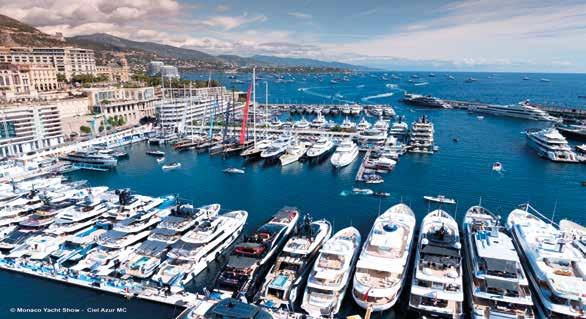
Following tits successful 2025 pilot programme, which highlighted 59 environmental solutions, the Monaco Yacht Show strengthens its commitment to sustainability with the launch of Blue Wake 2026, an initiative designed to identify and highlight solutions that actively contribute to environmental improvement across the yachting sector. Building on last year’s pilot edition, the updated framework invites exhibitors to clearly outline their environmental focus and substantiate their claims with credible supporting evidence. Developed in collaboration with the Water Revolution Foundation, the 2026
programme expands its scope to include brokerage and yacht management companies. This broader approach reflects an increasing awareness that sustainability must be addressed throughout the entire lifecycle of a vessel, from its design and construction to operation and resale. In doing so, the initiative underlines a more structural commitment to environmental responsibility throughout the industry. “Blue Wake marks a pivotal moment for the Monaco Yacht Show, as we continue to evolve into a platform where technical transparency and environmental sustainability redefine industry standards,” commented Toby Moore, CEO of Informa Prestige, the
“Blue Wake 2026 is a crucial milestone in embedding standards that enable exhibitors and the wider yachting industry to advance together,” Leah Werner, Executive Director of the Water Revolution Foundation
luxury brands portfolio that includes the MYS. Leah Werner, Executive Director of the Water Revolution Foundation, highlighted the importance of creating shared standards that enable both exhibitors and the wider industry to progress collectively. Drawing on her background as a biological oceanographer, Leah noted that the initiative translates complex scientific data into practical evaluation tools, allowing participants to present structured and verifiable environmental initiatives. Applicants may register by submitting the dedicated module found in the exhibitor portal. The deadline for entries is set for 1 July 2026.
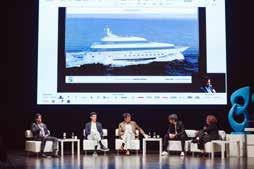

New to this year’s BDS26 is the international “Designing for Exploration” competition, which challenges students to imagine a luxury yacht capable of respecting the planet’s most fragile ecosystems
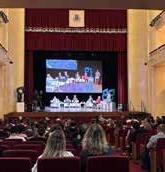
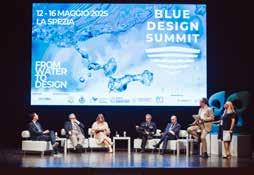
T he Blue Design Summit, dedicated to the design, construction and refitting of superyachts, returns to La Spezia. This exclusive event invites industry professionals, designers and shipyards to experience a rich programme. Taking place this year from 18 to 20 May and hosted once again at the Teatro Civico in La Spezia, the 2026 Blue Design Summit (BDS26) will focus on sustainability and innovation, exploring the yachting sector’s latest frontiers: from sailing superyachts to advanced materials, right through to the latest green propulsion solutions. Over its three days, the Summit will see designers, shipyards, owners, design studios, supply chain companies and international stakeholders come together to offer an eclectic calendar of conferences, meetings, technical visits and networking opportunities. The title of this third edition is “The Next Wave Now”, a slogan that expresses how the future of design is already underway.
New to this edition of BDS26 is the international “Designing for Exploration” competition, which challenges students of design, architecture and naval engineering to imagine an explorer yacht (42-67 metres) capable of tackling any sea in the world while ensuring a constant level of comfort. Above all, however, the yacht must also respect the planet’s most fragile ecosystems by minimising its environmental impact, striking a balance between extreme luxury and environmental responsibility. La Spezia thus reinforces its role as a “Creative City of Design”, a title conferred by UNESCO in recognition of the region’s creative and productive excellence, particularly in the field of nautical design.
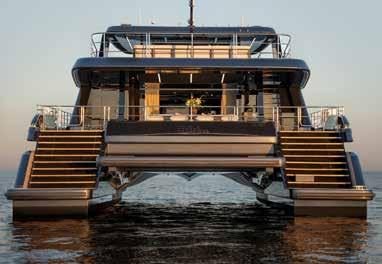
Sunreefraises the bar for luxury cruising with the 100 Sunreef Power Eco. Featuring a remarkable 13.5-metre beam, this yacht is the first 100-foot electric model built by the Sunreef shipyard. Blending cutting-edge eco-innovation with five-star comfort and reliable performance, four 180 kW electric motors and a powerful 990 kWh battery bank allow Double Happiness to provide silent, eco-conscious cruising, without fumes or vibrations. With two range extenders and solar panels integrated into the bimini roof, the 100 Sunreef Power Eco also offers the highest standards of autonomy and energy-efficiency. At the heart of Double Happiness is a design ethos that prioritises openness and connection to the sea. The vast main deck saloon, lined with panoramic windows, flows directly into the full-beam aft cockpit through sliding glass doors. When fully opened, the space dissolves boundaries between interior and exterior. One of the most distinctive features of the yacht is her walk-around beach club, featuring two large fold-down platforms. The combination of ecoconscious power solutions, expansive spaces, and bespoke craftsmanship cements Double Happiness as one of the standout yachts in the 100 Sunreef Power Eco series.
The Superyacht Eco Association (SEA Index®) has launched its new Air Quality Certification, representing a major expansion of its environmental assessment framework for superyachts. This pioneering certification evaluates vessels’ emissions of nitrogen oxides (NOx) and fine particulate matter (PM₂ ₅), providing the industry with its first dedicated benchmark for local air quality impact. Developed with AtmoSud, the air quality observatory for Provence-Alpes-Côte d’Azur, the new scheme strengthens SEA Index’s mission to deliver scientifically robust, third-party-verified tools that promote sustainable practices across the superyacht sector. It complements the flagship SEA Index CO₂ Rating, the market’s leading climate impact reference, which already considers hybrid propulsion, battery systems, and alternative fuels. Air quality is an increasingly important focus, as NOx and PM ₂ ₅ directly affect human health and coastal environments. Superyachts spend much of their time at anchor or in port, often near marinas and populated shorelines, making emissions a critical consideration.
Yachts has unveiled the first example of its all-new VISIONF 65 Hybrid, marking the yard’s strategic entry into the sub-24m (80ft) segment. Scheduled to be launched and delivered to her owner later this spring, the 19-metre catamaran represents an evolution for the builder, long recognised for its 24m-plus power and fully electric multihulls. With the 65, VISIONF Yachts aims to preserve the brand’s core values while offering a more accessible format for owners seeking efficiency, liveability and contemporary hybrid technology. The shipyard also confirmed an additional hull has already been sold, with construction currently underway. VISIONF Yachts has leveraged the advantages of a catamaran configuration to deliver interior volumes that challenge expectations in this size range. Accommodation is arranged for eight guests across four cabins, supported by quarters for four crew. At the heart of the VISIONF 65 Hybrid lies a propulsion and energy package combining twin 450hp Volvo Penta D8-450 diesel engines and an advanced energy management system supported by high-capacity solar panels.
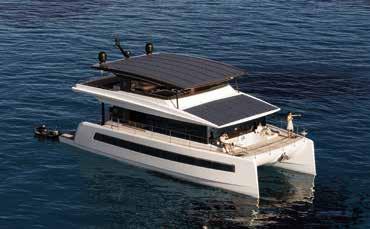
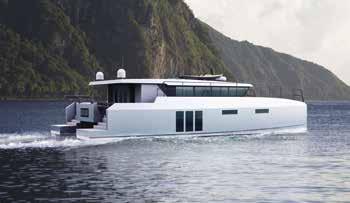
Methanol is emerging as a leading solution in the push to decarbonise the marine industry, offering a practical balance between performance and sustainability. As pressure mounts to reduce emissions, the fuel is gaining ground across both commercial shipping and yachting. Its advantages include cleaner combustion, ease of storage and the potential for renewable production, making it more viable than alternatives such as hydrogen or battery-electric systems. Challenges remain, but industry innovation is gaining momentum. In the leisure sector, companies like Archipelago Yachts are translating commercialgrade technology into refined applications. Their zero.63 yacht, developed with Chartwell Marine, showcases a methanol-hydrogen hybrid system that combines fuel cells, reformers and a combustion engine to enable long-range, low-emission cruising. CEO Dr Stephen Weatherley described the model as a “proving ground” for combining reliability with zero-emission capability when it matters most.