






An exhibition in Milan awakens renewed interest in Fortunato Depero, an eclectic artist who introduced Futurism into everyday life through advertising, fashion, theatre and design. An eccentric talent now very popular among collectors
by Micaela Zucconi
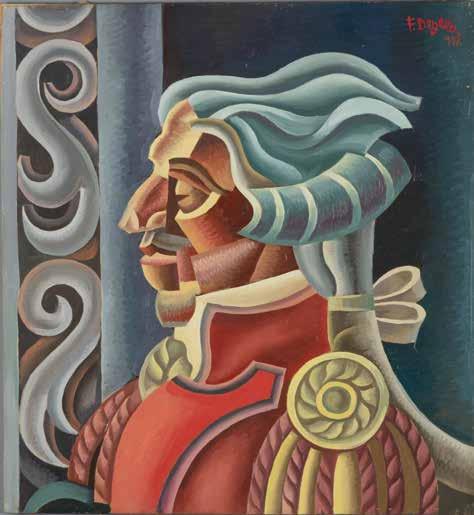
To side, Fortunato Depero, The Butler, oil on board, 1943, (Fondo, TN, 1892Rovereto, TN, 1960) Mart, Museum of Modern and Contemporary Art Trento and Rovereto Fondo Depero

When we drink a Campari Soda from the iconic transparent little bottle – it has no label, but everyone recognises it – we’re taking advantage of an innovative product created in 1932 for the Davide Campari company by artist, designer and trend-setter Fortunato Depero (1892-1960), a member of the Futurist movement, a group that developed the revolutionary ideas propounded by Filippo Tommaso Marinetti. As a painter, illustrator, expert in the applied arts, costume designer and with a special talent for staging and set design, the eclectic Depero skilfully displayed his talent in advertising through collaborations with companies and public bodies like ENIT, the Italian Tourism Agency, as well as in the more purely artistic field. Even after the death of Marinetti in 1944, when Futurism was declared a closed chapter, he refused to abandon his Futurist essence, retaining that explosive energy the movement devoted to its iconoclastic work. Born in Fondo in the Trento province, then part of the Austro-Hungarian empire, Depero studied at the Scuola
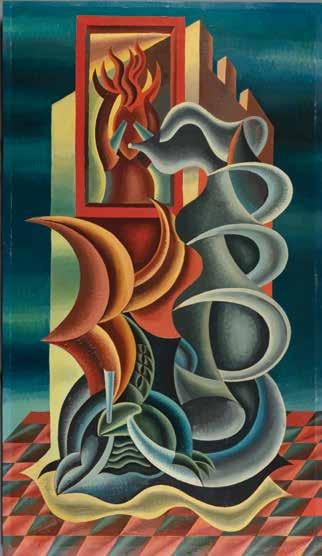
To side, Fortunato Depero, Horses on a Tightrope, oil on board, 1948 (Fondo, TN, 1892 - Rovereto, TN,1960)
Mart, Museum of Modern and Contemporary Art Trento and Rovereto Fondo Depero
Below, Fortunato Depero, The Shout, oil on board, 1951 (Fondo, TN, 1892 - Rovereto, TN, 1960)
Mart, Museum of Modern and Contemporary Art Trento and Rovereto Fondo Depero
Reale Elisabettiana in Rovereto. Rejected by the Academy of Fine Arts in Vienna he went to Turin, where he worked as a decorator at the International Exposition in 1910 and then as a mason on his return to Rovereto, where he began to exhibit his works and write. He then went to Rome, where he met Filippo Tommaso Marinetti, Umberto Boccioni and Giacomo Balla, whose pupil he became, inheriting his manifesto, the Ricostruzione futurista dell’Universo, infiltrating Futurist art into everyday life through fashion, the theatre, furnishing and advertising as well as museums and galleries. Guided by his unerring instinct, Depero looked to America to find new outlets for his creativity. New York, the “metropoli parolibera”, twice became a destination – from
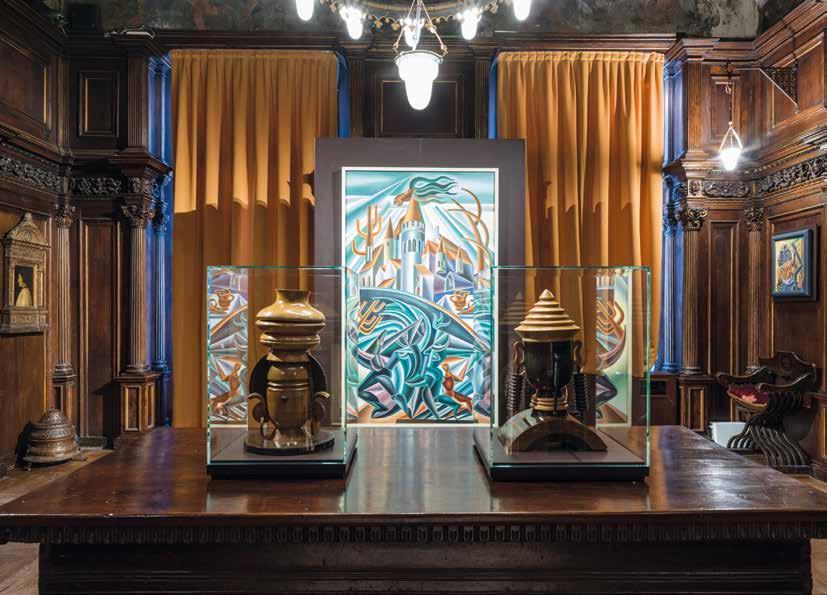
1928 to 1930 and from 1947 to 1949, when the climate for Futurists in Italy was extremely hostile. This complex period brought a series of disappointments, and he was unable to participate in several important shows – attention was focussed exclusively on the artists forming the original nucleus of the Futurist movement, figures such as Boccioni, Balla and Russolo. Only from the late 1950s did people rethink their ideas on what came to be called Second Futurism. Depero did not lose heart and continued with new ideas, as Nicoletta Boschiero describes in her essay Crepuscolo Futurista, published in the catalogue for the show “Depero Space to Space. La Creazione della Memoria” at the Museo Bagatti Valsecchi in Milan (until 2nd August 2026). On display are
Right-hand page/top caption
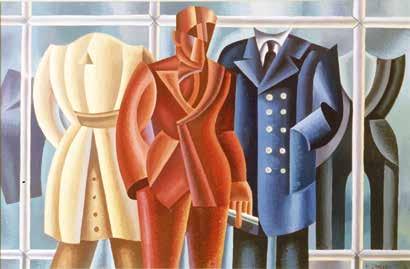
Fortunato Depero, Men’s Clothing, oil on board, 1945
(Fondo, TN, 1892 - Rovereto, TN, 1960)
Mart, Museum of Modern and Contemporary Art Trento and Rovereto Fondo Depero
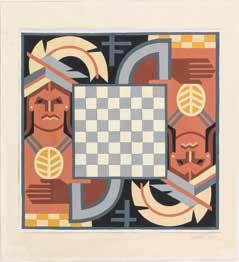
Fortunato Depero, Chessboard, tempera on card, 1938-1940 (Fondo, TN, 1892 - Rovereto, TN, 1960).
Mart, Museum of Modern and Contemporary Art Trento and Rovereto Fondo Depero
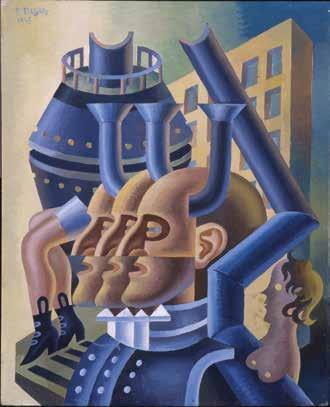
Fortunato Depero, Heads and Tubes. Simultaneous forms, oil on canvas, 1945.
(Fondo, TN, 1892 - Rovereto, TN, 1960)
Mart, Museum of Modern and Contemporary Art Trento and Rovereto Fondo Depero
over 40 of the artist’s works from the MART, the Museum of Modern and Contemporary Art of Trento and Rovereto, completed in the period between 1930 and 1960, shown in a daring juxtaposition with the project for a dialogue between ancient and modern created by the barons Fausto and Giuseppe Bagatti Valsecchi in their home, which eventually became a museum residence like Depero’s, the Casa d’Arte Futurista, opened in Rovereto in 1959. The artist handled every detail, with mosaics, furniture, painted panels, tapestries, paintings, inlays, advertising art and photographs, integrating his contemporary language into the context of a period building.
The Milanese show once more awakens interest in the artist and the
enthusiastic reception afforded his works has brought some spectacular results at recent auctions. The work Skyscrapers and Tunnels, for example, a tempera on canvas work painted between 1934 and 1935, reflecting the artist’s voyage to New York, went under the hammer at Christie’s for 99,000 euro. The oil on canvas painting Vampe Galoppanti from 1947, was sold at Sotheby’s for 187.500 euro, while another oil on canvas, Mucca in Montagna, from 1924-25, brought a winning bid of 60,000 euro, also at Sotheby’s. The Cambi auction house, which has a special interest in Depero, sold Pagliaccetti, an oil on canvas work from 1918, for 100,100 euro and the wooden Buxus, with box wood veneer, went for 64,100 euro.