







by Désirée Sormani
Born in 1963, Francesco Paszkowski is one of the most eclectic yacht designers on the international scene. Since 1992 he has collaborated with the long-established Baglietto yard, but he has also worked with prestigious companies like the Dutch yard Heesen, the Ferretti Group’s Custom Line, Sanlorenzo, Tankoa Yachts and Cantieri delle Marche. Now he has put his name to the first Tuxedo 40, an aluminium yacht by the Tuxedo Yachting House, marking the Ceccarelli family’s return to the superyacht market
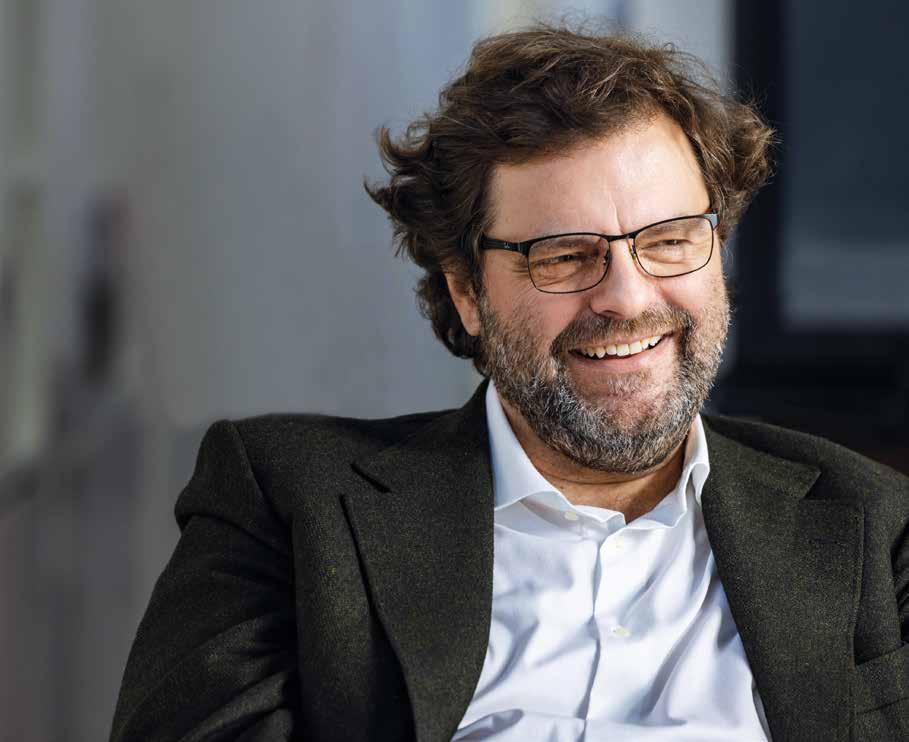
The name Paszkowski conjures up an image of dynamism and taut athletic lines that evoke the world of automotive design. But there’s much more - art, culture, tradition and talents that are handed down. That decisive pencil stroke flowing smoothly across the page, depicting the beautiful lines of so many wonderful megayachts designed by Francesco Paszkowski, is a
true family gift. But while it may be true, as classic musician Gustav Mahler said, “Tradition is not the worship of ashes but the preservation of fire”, it’s even more true that in this case it burns strongly. “My great-grandfather on my father’s side was the writer and philosopher Giovanni Papini”, says Paszkowski, “He was an important influence on the Italian cultural scene in the early 1900s.
And our family”. Together with Ardengo Soffici, he shifted the axis of the Futurist movement from Milan (the city where Filippo Tommaso Marinetti launched the avant-garde school that celebrated speed, the machine, and a break with the past) to Florence. “Through my grandmother Viola, Giovanni Papini’s daughter, my father Giovanni Paszkowski was totally immersed in this artistic-cultural atmosphere, and he passed it down to us children, also teaching us how to experience the beauties of the world through travel. When I was little my grandmother passed on her love for shaping clay, so much so that now I create and exhibit sculptures under the name of Francesco Zadora”. His father, who was a graphic artist for a famous ad agency in Milan, where Francesco’s family moved to for six years, was also a painter. “Some of his works are in the Uffizi collection. He used pastels, pencil and mixed techniques. He’s the one who taught me to draw!” But when you are given the skills of an artist, the hardest task is reinventing rather than repeating your work – and Francesco Paszkowski has taken the gift transmitted in his DNA and used it to shape some of the most beautiful yachts in the nautical sector. “My drawing ability attracted the attention of Pierluigi Spadolini. He was a real mentor for me”, says Paszkowski. “Our families knew each other, and I met him when I worked in the new yacht design studio established by
his son Tommaso, who took me on as a renderer. This was in the late 1980s, I’d just left the architecture department at university and I was passionately enthusiastic about car design, fascinated by its movement (like the Futurists – ed.). Pierluigi was surprised by the way I manipulated the pencil. I soaked up like a sponge everything I could about yacht design!” The rest is history –opening his own studio in 1990, his drive, his ability to seize opportunities and a series of fortuitous encounters – like the one with Michael Breman, now sales director of Lürssen, but at the time with Baglietto. “He wanted to see my designs, and he sponsored me…”. It was the beginning of Francesco’s grand adventure in Baglietto. “Baglietto is like a family to me”, says the designer. “Every meeting has been decisive but my encounter with Michael, his active acknowledgement of young people, giving them the opportunity to express themselves, was very important. I work a lot on this concept. Two years ago I began following the theses by the future designers of the IED in Turin. I have a great hunger for interesting things and experiencing them with the young people. I find it gratifying because I can help young potential yacht designers to grow. The new technology, for example, is enabling fantastic developments, which means constant improvement. I’m always ready for new journeys”. Like working for different yards without repeating himself. “Assimilating and
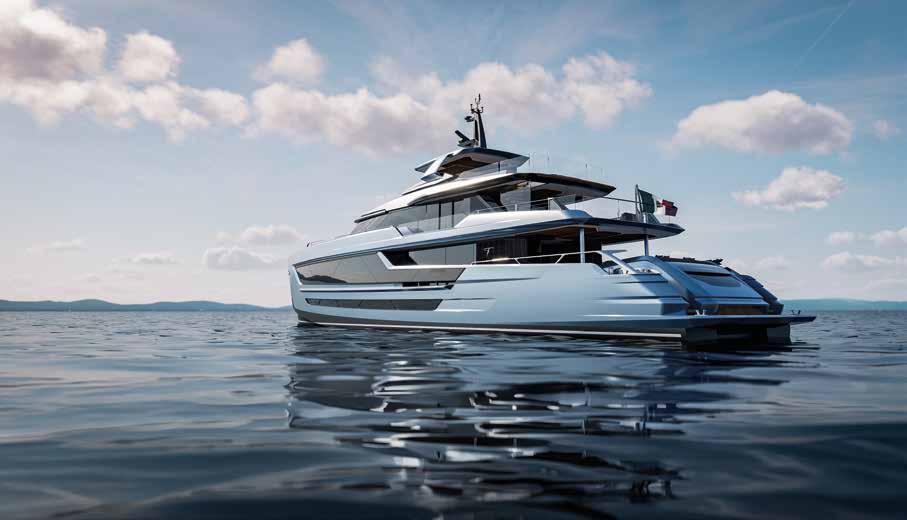
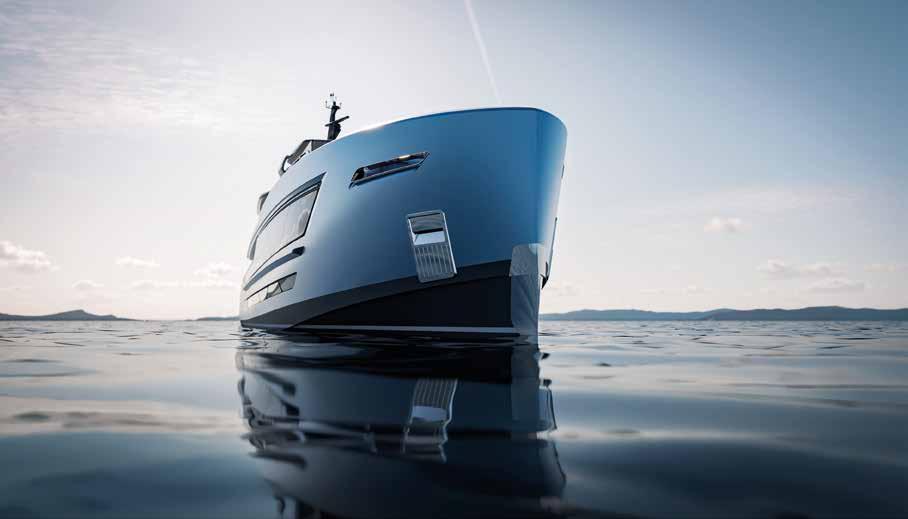
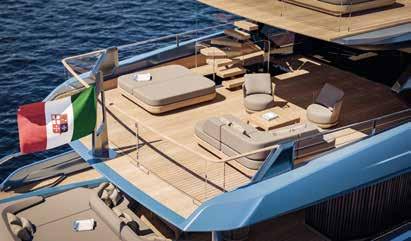
The Tuxedo 40 features lines that are simple yet full of detail, like the elaborate design of the ceilings and the stanchions supporting the upper deck that integrate with the coaming leading to the hatch, which has a window that allows light to enter the interior. The stern plays a significant role in the yacht’s recognisability. The spacious cable-passage gives greater functionality to the area during mooring operations. Much attention has been devoted to details, like the use of materials in the exteriors that replicate those in the interiors, creating a coherent dialogue between spaces. The Tuxedo 40 is created in collaboration with the architect Margherita Casprini for the interiors and, for the first time, with Sebastian Martinez for the exteriors, with naval architecture by Francesco Rogantin’s NAMES studio
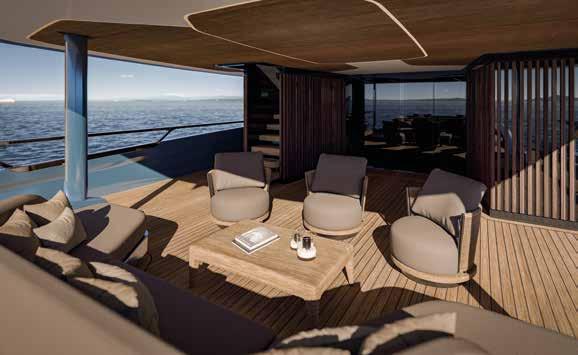
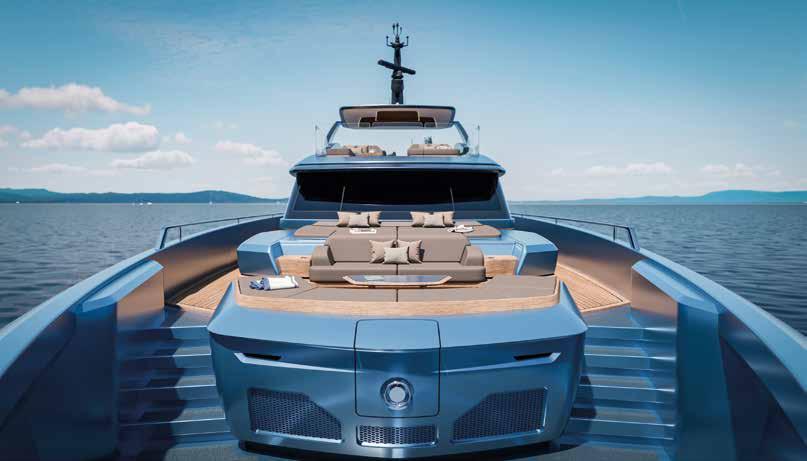
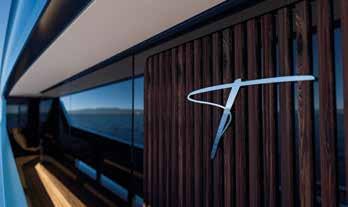
The bows also feature care and elegance, embodied in a lounge underneath the wheelhouse that makes it possible to take in the sunshine. There is also a locker with integrations evoking the automotive world. The colours give this superyacht exceptional balance. Large windows on the decks provide full in/out enjoyment of the spaces
respecting their family feeling, adding a personal touch of my own with clean, essential lines to create objects that I’d describe as Limitless”. These concepts fit the ideas of Laura and Francesco Ceccarelli like a glove, who as experts in the construction of aluminium yachts mark the return of the Ceccarelli family to the superyacht sector with a new collection of 40-metre yachts. “It was a project I could put my heart into because for them it would be a new start”. For the Ceccarellis the aim was to create a yacht with traditional, elegant lines combined with contemporary technology, the utmost attention to detail and immediate recognisability. “The Tuxedo 40 has a coherent design, despite the vertical bow, which is not a typical feature in my yachts”, says Paszkowski.
“It has clean, dynamic and elegant lines. Its distinctive elements include the vertical wood details that help blur the distinction between interiors and exteriors, a carefully designed stern and details like the flying bridge wing and the upper deck fin, providing immediate recognisability. Then there are the interior materials replicated in the exteriors, enabling the two settings to enter a coherent dialogue. This yacht’s shapes have solid references to my way of designing in a contemporary style”.