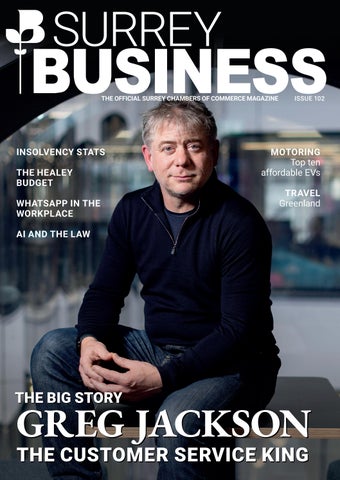
SURREY
BUSINESS THE OFFICIAL SURREY CHAMBERS OF COMMERCE MAGAZINE
INSOLVENCY STATS THE HEALEY BUDGET WHATSAPP IN THE WORKPLACE
ISSUE 102
MOTORING Top ten affordable EVs TRAVEL Greenland
AI AND THE LAW
THE BIG STORY
GREG JACKSON THE CUSTOMER SERVICE KING
Surrey Chambers helps your business TODAY Membership gives you practical support, stronger visibility and valuable connections that help your business move faster. Whether you want to win new business, raise your profile, build your network or access trusted advice, Surrey Chambers gives you the tools, relationships and opportunities to make it happen.
PROTECT YOUR BUSINESS
NURTURE YOUR STAFF STA T FF TA
Access the helplines, services and support you need for added peace of mind
Solutions to help you support your staff, f keep up to f, date and grow
SAV SAVE A E MONEY & AV INCREASE PRODUCTIVITY Enjoy significant savings with member offers, discounts and productivity gains
EXPAND YOUR KNOWLEDGE Tap into essential resources and join discussions on important business trends, learn AI and how to implement internally
T arrange a conversation, contact Surrey Chambers on: To 01483 735540
info@surrey-chambers.co.uk info@ @surrey y-chambers.co.uk
www.surrey-chambers.co.uk www.surrey y-chambers.co.uk
ISSUE 102
CONT ENTS 40 BIG STORY
LEGAL
40 Greg Jackson CBE Octopus Energy has gone from energy market entrant to market leader in just 10 years. Greg Jackson CBE, Chief Executive and Co-Founder, is at the forefront of this business success story.
26 Mayo Wynne Baxter In the age of AI, do I really need a solicitor? 32 DMH Stallard WhatsApp in the workplace – should employers be worried?
SURREY CHAMBERS
52
6 Surrey Chamber News A round up of Surrey Chambers of Commerce members’ news 8 Surrey Chamber Events What’s on for Surrey Chambers members 12 Learning Skills Improvement Plan Surrey Chambers invests in future talent 15 Surrey Business School Help To Grow comes to Surrey Business School
NEWS
18 National news A round up of important business stories from around the world 20 Local news A look at the business news stories across the South East
EVENTS
54 Sussex Business Awards Time is running out to get your entries in for the blue riband Sussex Business Awards. Get involved!
BUSINESS
22 Gatwick Airport Building capacity, creating opportunity 36 Azets Responding to the latest insolvency statistics 48 MDHUB Interview with Peter Luck, Founder of ROCC
52 The English Soap Company The East Sussex-based award-winning company has achieved B-Corp status
34 Angels’ Den The real life business charity event returns to Sussex in November
56 Cleankill B&M’s rat infestation and prosecution – a cautionary tale for everyone
MEDIA GROUP
24 Kreston Reeves How AI is changing tax, accounting and profitability for creative industries
TRAVEL 58 A trip through Greenland Barry Hoffner explores the freezing cold geopolitical hot potato
MOTORING 62 The most affordable EVs One the sole preserve of the wealthy, electric vehicles are becoming better priced. Maarten Hoffmann runs the rule over which ones are most affordable
50 Benchmark Who is Chancellor John Healey, and what are his plans for the Budget?
28 Surrey Business Awards Tickets are selling fast for this prestigious 2026 event
PLATINUM
FINANCE
62
All rights reserved. The views expressed in this publication are not necessarily those of the publisher. The publisher cannot accept responsibility for any errors or omissions relating to advertising or editorial. The publisher reserves the right to change or amend any competitions or prizes offered. No part of this publication may be reproduced without prior written consent from the publisher. No responsibility is taken for unsolicited materials or the return of these materials whilst in transit. Surrey Business Magazine is owned and published by Platinum Media Group Limited.
3
FROM SURREY TO THE WORLD: WHY NOW IS THE TIME TO START EXPORTING This month I want to talk to every Surrey business that hasn’t yet decided to venture into exporting. Whether you’re a new start-up finding your feet or an established business that has simply never looked beyond the UK market. Because the data is compelling. And the opportunity to strengthen your revenue, build real capability, and secure the long-term future of your business is genuinely worth taking seriously.
The routes into international markets are also more varied and accessible than ever, from direct online sales to service contracts, licensing arrangements and distribution partnerships. The infrastructure to reach international customers has never been more accessible, across the board, regardless of your business’s size or sector.
or fewer employees rarely engage in international trade. I find those numbers genuinely difficult to sit with, because the opportunity is there. The support is there. And yet, across the board, too many smaller businesses haven’t yet taken that first step. William Bain, BCC Head of Trade Policy, said it clearly earlier this year: “This is the exact time when we must double down on our efforts to grow exports and involve more UK businesses in this fight. To take an isolationist approach and retreat from the principles of fair and open trade would be a grave mistake.”
For SMEs that actively export, ❛❛international revenues account for 59% of total turnover.❜❜
Whilst local is important, and I will always champion our Surrey business community, long-term growth capability is critical too. And exporting is one of the most reliable ways to build it. The opportunity is bigger than most people realise I speak with Surrey business owners every week, and one of the things I hear most often is that exporting feels like something other businesses do and I can understand why it can feel that way. But the evidence tells a different story. For SMEs that actively export, international revenues account for 59% of total turnover. This isn’t a sideline. For businesses that have made the move, it becomes a core part of what they do, transforming their scale, their resilience and their profitability. Exporting businesses are more competitive, pay higher wages and generate stronger returns than those trading solely in domestic markets.
4
Cambridge Econometrics puts a number on the national picture too. A 2% increase in UK exports would have added nearly half as much again to GDP growth in 2025. Half as much again. From just a 2% shift. That tells you something significant about how much unrealised potential is sitting in businesses just like yours. Between 2020 and 2023, the number of UK SME goods exporters fell by 19%, which is over 23,000 firms that stopped exporting altogether. Only 23% of UK trading businesses with 10 or more employees exported anything in the last 12 months. And 84% of companies with 10
I agree completely. And I want Surrey businesses to know that you don’t have to figure this out on your own. There is also financial support available that most smaller businesses simply aren’t accessing. 92% of businesses that have used UK Export Finance support rate it as effective, yet only 27% of exporters report using UK Export Finance support, despite 79% being aware of it.. That gap between what’s available and what’s being used is something we can help you close.
WELCOME Here is something worth reflecting on. Surrey sits between three of the UK’s most significant trade gateways. Heathrow to our north, handling around 1.5 million tonnes of freight annually and connecting to over 180 destinations worldwide. Gatwick to our south, serving 227 destinations across more than 50 countries. And Southampton Port, the UK’s number one port for vehicle exports, is accessible within an hour for the vast majority of our businesses. Businesses in other parts of the country would consider that a transformational advantage. And they’d be right. Surrey also has one of the most internationally connected business communities in the country. Professional services, technology, manufacturing, life sciences. These are sectors with strong, natural export potential in markets worldwide. The question isn’t whether Surrey businesses could export successfully. It’s why more of them haven’t started yet. What Surrey Chambers can offer you right now?
Surrey members have access to a range of export support that, honestly, most businesses don’t know exists.
nal growth through exporting, a revenue stream that most Surrey businesses haven’t yet opened, but absolutely could.
The BCC Diplomatic Advisory Hub, a joint venture with the Foreign, Commonwealth and Development Office, provides free, personalised guidance on market conditions, geopolitical risks and the right government support to accelerate your export growth. ChamberCustoms provides expert trade documentation support for businesses moving goods across borders. And the BCC’s training programme for first-time exporters covers the practical steps for any new export drive, designed for business owners and their teams rather than trade specialists.
Surrey has the location, the businesses and the support network. Whether you’re a start-up thinking about your first overseas sale or an established business ready to enter new markets, the opportunity is real, and the time to explore it is now. Come and talk to us. I’d love to help make it happen.
Our own dedicated international trade team at Surrey Chambers is here alongside all of that, actively supporting new and existing members at every stage of the journey.
Helene Hall
Last month I wrote about internal efficiency through AI, the lever businesses can pull to do more with what they already have. This month is about exter-
CEO Surrey Chambers of Commerce Surrey Chambers of Commerce can be reached on 01483 735540, info@surrey-chambers.co.uk, @surreychambers www.surrey-chambers.co.uk
AND WHILE YOU’RE HERE... Platinum Media Group enjoys the largest circulation of any business magazines in the UK, reaching over 720,000 readers across the South East and this includes 468,000 online readers. If you can’t wait for the next issue then jump onto our social media platforms and join the conversation.
@platbusmag Platinum Media Group www.platinummediagroup.co.uk
5
NEWS
CHAMBERS NE WS SURREY HILLS SHEEP PARADE CELEBRATES SHEEP AND PROMOTES RESPONSIBLE DOG WALKING A colourful flock of 13 life-size sheep sculptures travelled across the Surrey Hills this summer as part of a campaign celebrating the vital role sheep play in shaping the landscape and encouraging responsible dog walking around livestock. The Surrey Hills Sheep Parade officially launched on National Dog Day, August 26th, at Denbies Wine Estate, where the full flock was unveiled for the first time. The event brought together local farmers, artists and communities to celebrate sheep and raise awareness of protecting livestock while enjoying the countryside.
destinations across the Surrey Hills, sharing an important message: keep dogs on leads where sheep graze. The campaign highlighted how sheep support nature recovery, sustainable farming and the landscapes enjoyed by visitors, while also raising awareness of sheep worrying, where dogs can cause distress, injury or even death to livestock. Rob Fairbanks, Director of Surrey Hills
National Landscape, said the parade was a powerful example of how creativity could inspire positive change by bringing together artists, farmers and communities. The launch event at Denbies Wine Estate gave visitors the opportunity to meet those involved in the project, enjoy dog training demonstrations, help name the sheep and discover more about the flock’s journey across the Surrey Hills. The Surrey Hills Sheep Parade continued throughout the summer, encouraging visitors to enjoy the countryside responsibly while celebrating one of the landscape’s unsung heroes.
Each sculpture was individually painted by Surrey artists and toured farms, National Trust sites and visitor
SURREY PUPILS GAIN WORKPLACE INSIGHT ON BEHIND-THE-SCENES AMAZON FILTERS TOUR Twelve Year 9 pupils from Tomlinscote School in Camberley gained first-hand insight into the world of manufacturing and engineering during a behindthe-scenes visit to Amazon Filters’ production centre. The visit, organised through Amazon Filters’ support for the Community Matters Partnership (CMP) RAISE initiative, aimed to inspire young people by showcasing vocational opportunities and building confidence in their future careers. Students toured key areas of the business, including Cartridge Production, Housing Fabrication, Housing Production, Component Manufacturing and Despatch, while also learning about the design and engineering processes behind Amazon Filters’ products.
6
The pupils were welcomed by senior representatives, including Managing Director Neil Pizzey and Head of People and Culture Ruth Pappadakis, and participated in activities designed to foster engagement and curiosity about the company’s work. RAISE, which stands for Raise Aspirations, Inspire, Support and Encourage, brings together businesses and schools to help young people understand different career pathways. As part of the programme, pupils have also visited organisations including Farnborough Airport, UK Connect, The Village Hotel and BMW Group.
Ruth Pappadakis added that the visit provided students with “a little taste of the world of work” while highlighting the importance of safety, sustainability and efficiency in modern manufacturing.
Reflecting on the experience, one student said: “We were able to speak to people who have the opportunity to work in many different departments across the company.”
Amazon Filters has partnered with CMP since 2021, supporting initiatives that benefit young people and local charities through volunteering and community engagement.
NEWS
FIRST BRITISH-MADE SPARKLING WINE BOTTLE ENTERS PRODUCTION AS UK WINE SECTOR GROWS Croxsons, a 150-year-old packaging partner to the food and drink sector, has collaborated with glass manufacturer Encirc to produce Sovereign, the UK’s first British-made sparkling wine bottle. Designed specifically for the English and Welsh sparkling wine industry, the amber bottle provides producers with a domestic alternative to imported glass packaging. The first production run saw nearly one million bottles manufactured at Encirc’s Cheshire facility, marking a significant milestone for the sector. Until now, producers have relied largely on imported bottles from Europe. Sovereign aims to strengthen supply chain resilience, improve availability, and reduce reliance on overseas imports, supporting a more
localised and sustainable approach to production. The UK wine industry continues to grow, with more than 1,000 vineyards and over 200 wineries now operating across the country. As sparkling wine remains the dominant category, demand for specialist packaging has increased. Made with 49% post-consumer recycled glass, Sovereign’s distinctive amber colour offers up to 99% UV protection, helping preserve wine quality while creating a recognisable identity for English and Welsh sparkling wines. Tim Croxson, CEO of Croxsons, said the launch represents “a huge collective
effort” and gives producers “a bottle that is designed, produced and supplied closer to home.” The bottle has already been adopted by producers including Three Choirs and Ridgeview, with further wineries invited to explore the British-made packaging solution.
MADE SMARTER SOUTH EAST HELPS SURREY FIRM ACCELERATE INNOVATION Surrey-based specialist film equipment company Camera Revolution Limited is transforming its product development capabilities with support from Made Smarter South East.
major productions including Netflix, Amazon MGM, Apple and Disney, has invested in building its own engineering and design capabilities to create innovative solutions for the film industry.
The company, which supplies camera support systems, motion control equipment and stabilisation rigs to
Previously, reliance on external CNC machining suppliers limited the speed at which prototypes could be designed, tested and refined. With support from Made Smarter, Camera Revolution has invested in a Selective Laser Sintering (SLS) 3D printing system, allowing the business to produce high-quality components in-house. The technology has reduced prototype development times from two to four weeks to less than 48 hours, enabling engineers to test ideas faster, improve efficiency, and respond quickly to the needs
of film productions where deadlines are often measured in days. The investment is expected to reduce external machining costs by around £40,000 per year, with overall annual savings forecast at approximately £130,000. Rowan Newbitt, Lead Design Engineer at Camera Revolution, said the Made Smarter grant has been “a genuine enabler” for the business, allowing the team to design, prototype and deliver solutions entirely in-house. The investment marks an important step in Camera Revolution’s journey towards becoming a fully integrated design, manufacturing and rental business, supporting future product development, global growth and new opportunities within the film industry.
7
SURRE Y CHAMBERS E VENT CALENDAR SEPTEMBER 2026 ONWARDS...
BUSINESS BREAKFAST SURREY BUSINESS SCHOOL
Tuesday 8th September 8th 08:30–10:30 Surrey Business School, University of Surrey, Faculty of Arts and Social Sciences, Rik Medlik Building, Stag Hill, Guildford, GU2 7XH Join Surrey Chambers of Commerce and Surrey Business School for a morning of networking, discussion, and leadership development. Designed for SME leaders, this event explores what sustainable business growth really looks like, offering valuable insights into overcoming the challenges of running a business.
COMMUNICATION WORKSHOP – UNLOCK YOUR EDGE
Wednesday September 16th 10:00–12:30 Login Business Lounge, 34 Park Street, Camberley, GU15 3PL Join Generation Next for an engaging half-day workshop designed to help young professionals communicate with greater confidence and impact. Learn practical techniques for delivering presentations, handling difficult conversations, negotiating effectively, and writing clear, action-driven messages. With a coffee and pastry networking break included, this interactive session provides valuable tools to strengthen workplace communication, build professional confidence, and enhance your influence in any business setting.
SURREY CHAMBERS GOLF SUMMER SOCIAL
Wednesday September 9th 11:00–18:00 Chobham Golf Club, Chobham Road, Knaphill, Woking, GU21 2TU A relaxed and friendly day of golf and networking at Chobham Golf Club. Open to golfers of all abilities, this informal Summer Social focuses on building connections rather than competition. Enjoy coffee and a bacon roll on arrival, 18 holes of golf, followed by sandwiches, chips, and networking with fellow members and the wider Surrey business community. Whether you’re an experienced golfer or trying the game for the first time, everyone is welcome for a fun and inclusive day outdoors.
ANNUAL PROPERTY LUNCH
Thursday September 17th 12:00–15:00 Harbour Hotel Guildford, 3 Alexandra Terrace, High Street, Guildford, Surrey, GU1 3DA Network with industry leaders at Surrey Chambers of Commerce’s Annual Property Lunch at Harbour Hotel Guildford. Enjoy a twocourse lunch with a complimentary glass of wine while hearing from expert speakers on the latest trends, challenges, and opportunities in the commercial and residential property markets. Ideal for professionals in real estate, construction, architecture, urban planning, and related sectors, this event offers valuable market insights and excellent opportunities to build new business connections.
TALENT WITHOUT BORDERS: PRACTICAL INSIGHTS FOR SURREY EMPLOYERS
Wednesday September 23rd 08:00–10:00 The County Club, 158 High Street, Guildford, Surrey, GU1 3HJ A practical breakfast briefing exploring the key compliance considerations businesses should understand around immigration enforcement visits. Hear first-hand insights from Mandira Sarkar of Mandira’s Kitchen and Dan Caruso from Beagle HR, as they share guidance on maintaining Home Office compliance, preparing your business, and responding appropriately if enforcement officials visit.
MEMBERS NETWORKING EVENING – MOLE VALLEY
Wednesday September 30th 18:00–20:00 Surrey FA, Meadowbank Football Ground, Mill Lane, Dorking, Surrey, RH4 1DX Connect with Surrey’s business community at this relaxed Members Networking Evening hosted at Surrey FA Headquarters in Dorking. Enjoy welcome drinks and canapés while meeting local professionals, business leaders, and the Surrey Chambers team in a friendly environment. This is the perfect opportunity to expand your network and showcase your business.
FOR MORE EVENTS, CLICK ON BWiS EXCLUSIVE SPA AFTERNOON AND NETWORKING
Wednesday October 14th 14:00–20:00 Pennyhill Park Hotel & Spa, London Road, Bagshot, GU19 5EU Unwind with Business Women in Surrey (BWiS) at an exclusive afternoon of relaxation, wllbeing, and networking at Pennyhill Park Hotel & Spa. Enjoy a traditional cream tea, full access to the award-winning spa facilities, and meaningful conversations with like-minded professional women from across Surrey. Set in tranquil surroundings, this event offers the perfect opportunity to recharge, build new connections, and invest in both your personal wellbeing and professional network.
www.surrey-chambers.co.uk/ event-listing
Source in Surrey y AI Tool An intelligent online platform that connects Surrey-based SMEs with buyers and procurement opportunities from larger businesses and public sector organisations, making it easier to buy local and keep spend within the county. Using AI, the tool matches suppliers to relevant opportunities and supports SMEs to grow their customer base.
Buyers Buy yers
Suppliers Sup ppliers
Tell T Te ll us about your buying needs: Complete a short form to create your profile, outlining requirements.
T Te ll us about your business: Tell Complete a brief form to create your supplier profile.
Get matched with the right suppliers: Using your information, our platform identifies and connects you with suppliers and resources that suit your needs.
Match with opportunities: Based on your profile, our platform connects your business to buyers in need of your services.
Choose how to engage: Review your tailored recommendations and connect with the suppliers or opportunities that best support your goals.
Get notified: When the buyer selects a matched supplier, rr, Source in Surrey will notify you and the buyer will contact you directly.
www.sourceinsurrey.co.uk
BUSINESS
Services
Helping businesses trade successfully overseas export@surrey-chambers.co.uk 01483 735540
11
BUSINESS
Surrey Chambers invests in future talent Employer engagement is at the heart of Surrey’s Local Skills Improvement Plan (LSIP). This is achieved not only through verbal feedback from businesses but also through active involvement in training young people in the skills they will need for the workplace. A year ago, Surrey Chambers of Commerce demonstrated this commitment by recruiting its first Policy Apprentice and LSIP Events and Marketing Intern. We will be sharing why the Chambers decided to take on this responsibility, the benefits the company has experienced, as well as how both young people have grown, thanks to their workplace.
practical experience while continuing his education made an apprenticeship the ideal route into employment. Reflecting on his decision, Oli explained: “I wanted to gain real work experience while continuing to learn. An apprenticeship offered the best balance of developing practical skills alongside a recognised qualification.” Since joining the Chamber, Oli has already taken ownership of significant
placement as part of my sandwich degree. I have been assigned an array of responsibilities, including, but not limited to, social media campaigns, organising a series of stakeholder events, and contributing to the launch of Surrey’s new LSIP. Thanks to the support of the team at Surrey Chambers of Commerce, I have greatly developed both my technical and employability skills, which will assist me in the next stages of my career. I have learnt so much from my colleagues and been exposed to such a variety of opportunities. As I prepare to graduate next year, I know I will enter the job market with far more confidence than I would have had without this placement.
Investing in early careers isn’t ❛❛ simply about filling vacancies; it’s about building a workforce for the future. ❜❜
We spoke to Tom Woods, the LSIP Business Connector who has worked closely on the initiative for three years, about the specifics of why the Chambers took on an intern and an apprentice. He shared, “The decision to bring on board an intern and an apprentice wasn’t a hard one to make. It allowed us to pass on our skills, experience and knowledge to the generation stepping into the workforce. Having them on board also meant we could incorporate their fresh ideas and perspectives and implement new ways of working we wouldn’t have otherwise considered. For Oli Porter, Surrey Chambers’ Policy Apprentice, the opportunity to gain
projects. When asked about the work he is most proud of, he highlighted his involvement in the Quarterly Economic Survey:
“Leading on the Quarterly Economic Survey has been a highlight for me. It’s been rewarding to take ownership of a project that captures business insight and helps shape the Chambers’ policy work and contributes to national business data.” Looking ahead, Oli is excited to continue developing professionally while remaining open to where his apprenticeship may lead. He shared: “I’m not entirely sure yet, and I think that’s the exciting part. I’m looking forward to seeing where the experience takes me while continuing to develop my skills and explore opportunities within policy and the wider business landscape.” As the LSIP Events and Marketing Coordinator, I am completing my internship as a university
12
Investing in early careers isn’t simply about filling vacancies; it’s about building a workforce for the future. Apprentices and interns bring enthusiasm, new perspectives and a willingness to learn, while employers have the opportunity to develop talent that meets their business needs. As Surrey’s LSIP continues to champion employer-led skills development, businesses of every size have an opportunity to play their part. If you’ve been considering taking on an apprentice or offering an internship, now could be the perfect time to start.
Employers interested in getting involved with the Surrey LSIP and supporting future college and skills activity across the region, please get in touch with us at: lsip@surrey-chambers.co.uk.
SURREY CHAMBERS
Annual Property Lunch
2026
Join us in Guildford for expert insights into commercial and residential property, sustainability in the built environment, and futureproofing your assets plus a two-course lunch and the chance to connect with industry peers. 17 September
11-2 pm
Harbour Hotel Guildford, GU1 3DA
Book your place now to secure your spot.
Proudly sponsored by
NEW MEMBERS
Surrey Chambers of Commerce welcomes its latest member companies
When you join Surrey Chambers of Commerce, your company details automatically get listed on this page alongside fellow new members. What a fantastic way to let the Surrey Business community know you are out there and ready to get those all-important connections.
Active Print Services Ltd
www.activeprintservices.co.uk
Howden Insurance Farnham
www.howdeninsurance.co.uk/ farnham-commercial
Futurelink Group
https://futurelinkgroup.co.uk
saltertrainingandconsulting.com
www.bluestarleasing.com
Surrey Park Women’s Clinic
Saiph Watch Ltd
www.thesurreyparkclinic.co.uk
Glow Homes
Transflex Logistics Solutions Ltd
www.saiph.watch
Salter Training and Consulting Ltd
Bluestar Business Finance
https://glow.homes/
www.transflexlogistics.co.uk
All new Chamber members are entitled to a one-off 50% discount for a company profile within this magazine. Contact lesley@platinummediagroup.co.uk for more details
If you are looking to join Surrey Chambers, then please do get in touch: sarah.butcher@surrey-chambers.co.uk or call 01483 735540. We look forward to hearing from you! @surreychambersofcommerce @surreychambers @surreychambersofcommerce
www.surrey-chambers.co.uk 01483 735540 @surreychambersofcommerce
BUSINESS
Your next training Help To Grow:Management course at Surrey Business School
WHAT IS IT? A 90% government-funded, practical 12-week programme to help you lead better, grow stronger and plan your next move as a company with confidence. This means a cost of only £750 per participant.
• Trading for one year or more • Senior decision-maker with direct reports (e.g. Director, Head of Department, Senior Manager)
WHO IS IT FOR? Designed for senior leaders and decision-makers in UK small and medium-sized enterprises who want greater clarity, stronger strategy and sustainable growth. ELIGIBILITY • UK small or medium-sized business, 5-249 employees
WHAT YOU’LL GET... • 50 hours of leadership training across 12 weeks including webinars, in-person workshops and peer-to-peer sessions • 10 hours of one-to-one mentoring • Access to industry-leading business experts • Build a tailored Growth Action Plan for your business • Access to the Help to Grow alumni network
If you would like to find out more about the programme, click below or please get in touch by email at sbsbusiness@surrey.ac.uk . Surrey Business School wants to support your business
“92% of alumni would recommend this course to another business leader.” - Small Business Charter
15
Surrey Chambers of commerce SURREY CHAMBERS COMMERCE Surrey Chambers of commerce Surrey Chambers Surrey ofOF commerce Chambers of commerce EXECUTIVE PARTNERS
EXECUTIVE PARTNERS EXECUTIVE EXECUTIVE PARTNERS PARTNERS & PATRONS EXECUTIVE PARTNERS & PATRONS PATRONS Learn more about executive pa r t n PATRONS e r m e& mbe r s h i p o& r p aPATRONS tronage at & w w . s uabout r r e y - c h aexecutive m b e r s . c o . u kpartner membership Learn wmore
r ex eaLcbeuo t eibvroem m sntherio aae ttrrosnhai pg eo ra tp a t r o n a L e a r n m oL r ee aarbno m u to e atu ri v nt eemx poearcretuna upteam erxtbn eee crrus th i ive pemopbraep rrta rpnmoaergm ep b w w w . s u r r e y c h a m b e r s . c o . u k w w w . s u r r e y - c h a m b e r sw. c wow. .usku r r e y - c h a m b e r s . c o . u k
or patronage at www.surrey-chambers.co.uk
www.surrey-chambers.com
@surreychambersofcommerce www.surrey-chambers.co.uk @surreychambers 01483 735540 www.surrey-chambers.com www.surrey-chambers.com www.surrey-chambers.com @surreychambersofcommerce www.surrey-chambers.com@surreychambersofcommerce
Surrey Chambers
GOLF SOCIETY
Summer Su S uummmmmmeeerr So S Social oc o ciiia c al a l Wednesday 9 September
The Chobham Golf Club Register Now www.surrey-chambers.co.uk 01483735540
NEWS FINANCE B&Q UNDERPAID STAFF DIY store B&Q and the fast food chain Five Guys top a list of 658 UK businesses named by the government for paying staff below the minimum wage. The employers were ordered to pay affected workers the outstanding wages, with £4m returned to workers, according to the Department for Business and Trade. The firms have also been issued penalties worth £7m. B&Q said the underpayments were unintentional and the result of calculations involving geographical allowances, while Five Guys blamed “technical differences in how payroll regulations were applied”. B&Q underpaid 4,530 workers more than £456,000.
ECONOMIC GROWTH NOT TIED TO IMPROVED QUALITY OF LIFE Almost half of people in Britain live in areas where economic growth does not translate into a better quality of life, with a “stark” North-South divide in household spending power, a new report finds. Researchers at the consultancy PwC said every region in the north of England, the Midlands, and Wales had lower spending power than
the country’s average, with London and the South East comfortably above. The PwC report said the equivalent of 12.5 million households - 46% - lived in parts of the country where economic growth, often seen through increased business investment and job opportunities, was not leading to better living standards.
NATIONAL NEWS DUTCH BANK MOVES GOLD TO LONDON
The Dutch central bank (DNB) has confirmed that billions of dollars in gold has been taken out of North America and relocated to London, citing “increasing geopolitical unrest”. DNB said that 86 tonnes of gold had been removed from the US and Canada in a complex operation that took place between March and August this year. It is now being held by the Bank of England, where the precious metal can be traded more easily “in a crisis situation”. Bank president Olaf Sleijpen said the move was “necessary to strengthen our resilience and preparedness”. The decision comes amid an ongoing trade dispute between the US and Canada, with both countries announcing fresh tariffs on each other after failed trade talks.
RANGE ROVER PRODUCES FIRST EV Range Rover has unveiled its first fully electric model, after a year‑long delay to its planned launch. The Range Rover Electric, to be built in Solihull, marks a major shift in its electrification programme, backed by large‑scale upgrades across its West Midlands sites. Parent company JLR said it had up-
❛❛I don’t want to achieve immortality through my work. I want to achieve it by not dying.❜❜ Woody Allen, American writer, actor and director
COLMAN’S MUSTARD FOR SALE
Colman’s Mustard, which has had a factory in Norwich for 160 years, has been put on the market ahead of a merger between Unilever and American food giant McCormick in a deal believed to be worth £48bn. The company was founded in 1814 by Jeremiah Colman. A Unilever spokesperson said: “A
18
skilled 10,500 workers as it pushes ahead with modernisation despite recent financial pressures and planned job cuts. The launch comes as the Coventry‑based carmaker faces falling profits, supply chain disruption and restructuring following a cyber attack a year ago that cost an estimated £1.9bn.
decision has been taken to market the Colman’s brand and assets to potential buyers in order to seek to address potential competition concerns from the planned combination of Unilever Foods and McCormick.” The firm had a cradle-to-grave ethos and provided education, housing, healthcare and leisure for workers and their families.
FINANCE NEWS MILITARY VETERANS ASKED TO REPAY OVERPAID PENSIONS Hundreds of former members of the military have had their pensions slashed after receiving letters telling them to repay thousands of pounds because of a clerical error. The Ministry of Defence (MoD) confirmed to the BBC that more than 1000 retired service personnel are
being pursued for debts. The majority, 335 veterans, were overpaid a total of £5.1m as a result of incorrect National Insurance calculations. The Forces Pension Society said it is aware of a small number of veterans whose debts were wiped after raising a formal complaint. Ray Lawton, 70, was
UK ENERGY PRICES UP AGAIN Energy prices for millions of households will rise to their highest level in three years under the regulator Ofgem’s price cap. Ofgem said the price cap will increase by 4% on October 1st, driven by higher wholesale gas prices due to the war in Iran. A household using a typical amount of gas and electricity will pay £60 more a year, but more than a third of households are on fixed tariffs, so their prices will not change. The government said its cut to VAT on electricity bills would save households £45 and that it was taking further action to address cost-of-living pressures. The new cap will hit household bills as the colder weather arrives in October.
BUSINESS RATES REVIEW LAUNCHED A review is being launched into how business rates are calculated for pubs and hotels in England and Wales and could lead to reform of the system. The Treasury says business rates expert Jerry Schurder will lead the review into rate valuations and report back in March 2027, with the government calling for the views of landlords, hoteliers and business owners to feed into the process. In July, the government announced a 20% cut in business rates for pubs, social clubs and live music venues in England, to come into effect in April. Pub groups have argued they face disproportionately higher rates bills, but other businesses have called for a wider reform of the rates system.
told in July he owed £8,000 following six years of overpayments. Days later, his monthly military pension was cut from £550 to £365.
BUILDING FIRMS URGED TO HIRE MORE APPRENTICES The head of a non-profit agency working in the sector has said it is becoming harder to secure placements for young people in the building trade. Charmaine Holland, who runs Co-Train, a flexi-employment agency in Reading, registered with the Department for Education (DfE), said “increasing employer engagement” is key to boosting numbers. It comes as the government says it wants to “end the snobbery around hands-on learning”, investing £287m in colleges offering vocational courses. Formal apprenticeships rely on companies to employ someone and pay their wages for two years, but only the training element is funded by the government.
❛❛ Being hated by idiots is the price you pay for not being one of them. ❜❜ Jean Cocteau, French poet and playwright
THREE UK FIRMS INVESTIGATED FOR ‘DRIP PRICING’ Trainline, Virgin Atlantic and RED Driving School are being investigated by the consumer watchdog over concerns they are not showing full prices upfront to customers. The Competition and Markets Authority (CMA) is examining whether the three companies engaged in so-called ‘drip pricing’, an illegal practice in which mandatory fees are not included in the headline price shown to customers.
If the CMA concludes that the firms have broken the law, it can fine them or order them to compensate customers. The three companies said they were committed to transparency for customers and would engage fully with the CMA. In the case of Trainline, the CMA observed fees of up to £2.79 added to headline train fares and up to £1.50 for coach bookings.
19
NEWS TOP ACCOUNTANCY FIRM RELOCATES TO CRAWLEY National accountancy and advisory firm, MHA, the UK member firm of Baker Tilly International, has moved into Crawley as part of a wider
investment in the Gatwick Diamond, creating a platform for growth following its IPO and increasing demand for its services across the South East. The AIM-listed firm has relocated from its previous office in Reigate to Global House on Crawley High Street, placing its Gatwick team at
the heart of the Gatwick Diamond. The move will support the continued growth of MHA’s Gatwick team, with plans to significantly expand headcount as demand for its audit, tax, advisory and outsourcing services increases.
EAST SUSSEX COMPANIES BENEFIT FROM £10M FUNDING
LOCAL NEWS ❛❛ “The two most important days in your life
are the day you are born... and the day you find out why ❜❜
Entrepreneurs in East Sussex have now received over £10m in funding from the British Business Bank’s Start Up Loans programme, which provides governmentbacked personal loans and mentoring to new businesses. More than 1,000 Start Up Loans have supported local people in starting or growing a business in the county. Of those, 41% went to female business owners, while 22% of financing for 18-24-year-olds went to those not in education, employment or training. Louise McCoy, Managing Director of Start Up Loans products at the British Business Bank, said: “We are delighted that Start Up Loans has supported more than 1,000 East Sussex business owners, and the figure continues to rise.”
Mark Twain
MALAYSIAN DELEGATES VISIT SUSSEX Business and political leaders from Sussex and Selangor, Malaysia, have agreed to strengthen commercial ties after a delegation visited Crawley as part of efforts to boost trade between the two regions. The chief minister for Selangor led the delegation from Malaysia’s main industrial and commercial hub. The delegation from Invest Selangor, which included investment officials and business executives, met a group of counterparts from Invest Gatwick Diamond. The Gatwick Diamond is an economic region centred around the airport with about 45,000 businesses that contribute £42 billion a year to the British economy.
20
MATHS-ONLY EDUCATION CENTRE OPENS IN SURREY Mathnasium, a leader in maths-only education with centres across the UK, has opened a new maths learning centre in Frimley. It will welcome children for free assessments and then be open for one-to-one tuition from September 7th to help them develop skills and confidence in maths. Aqil, Centre Manager, Mathnasium Frimley, commented: “It’s common for pupils to struggle with fundamental concepts like fractions, algebra and geometry, but the right support can make a huge difference. At our new specialist maths learning centre, we’ll assess each child to understand their individual strengths and any gaps in their knowledge, before creating a bespoke learning plan to help them build their skills, understanding and confidence in maths.”
NEWS LAW FIRM CELEBRATES HALF-CENTURY
Surrey law firm, Meadows & Co, recently celebrated its 50th year with a memorable celebration at the prestigious St George’s Hill Lawn Tennis Club.
During the summer, friends and colleagues of the firm, which was founded by Peter Meadows in 1976, undertook a 50-mile walk from The Boathouse at Walton Marina, via the Riverside Pantry, to Hampton Court.
ECLIPSE BRINGS BOOSTED TRADE
50 years ago, I could never have imagined the journey ahead. Our success has always been built on our people, our clients, and a commitment to doing the right thing. This challenge is a wonderful way to celebrate how far we’ve come together while looking forward to the next chapter.”
The partial solar eclipse, which took place on August 12th across many parts of the UK and western Europe, saw pubs, restaurants and retailers experience a boom in bookings and sales associated with the astronomical phenomenon. The Longshore on Brighton Road, Shoreham, invited customers to a viewing event. However, five hours later, the business had to rescind the offer due to the event’s popularity. A ticketed event at The Beach, in Sea Road, Littlehampton, was also fully booked. Wendy Doherty, owner of Handmade By Wendy, in Arundel Road, Littlehampton, said her success selling eclipse glasses has ‘put me on the map’. Meanwhile, Karen Dawson, manager of The Longshore in Shoreham, said she ‘genuinely didn’t realise how popular it would be.’
Peter Meadows commented, “When I founded Meadows & Co.
LOCAL FOOD & DRINK CAMPAIGN ATTRACTS 200TH MEMBER Two hundred shops, restaurants, pubs, cafés and caterers have now made the Sussex Six pledge to serve more Sussex food and drink produce, with Brighton & Hove and Lewes joining the campaign this summer alongside Horsham, Mid Sussex, Rother and Wealden Districts. “With support from local authorities across Sussex, we are celebrating our 200th sign-up,
which is Mange Tout in Brighton,” said Hilary Knight, co-director of Natural Partnerships CIC, which manages the Sussex Six Campaign. Sussex Six retail and hospitality businesses have pledged to take on at least six new Sussex food and drink products or ingredients in the coming year, to support local producers, reduce food miles and boost the local economy.
❛❛I didn’t get there by wishing for it or hoping for it, but by working for it ❜❜ Estée Lauder
NEWHAVEN SHOPFRONT REVITALISATION GRANTS Businesses in Newhaven town centre have benefited from nearly £100,000 of investment for shopfront makeovers since the launch of Newhaven Enterprise Zone’s (NEZ) Town Centre Revitalisation Fund. Grants have been awarded to 17 town centre businesses to help them transform the outside of their shops with new signage, lighting and more. There has been an increase in demand for commercial space in the town centre as a result of the funding, and businesses which received a grant have reported a boost in trade after their makeover. Michelle Connors, programme manager at Newhaven Enterprise Zone, said: “The modernised shopfronts look fantastic and reflect the ambition of the people behind these businesses who want to help Newhaven become a thriving place.”
TOPPING OUT ON BRIGHTON’S NEW HOTEL A new 187-bedroom Premier Inn hotel at the site of a former nightclub in central Brighton has topped out ahead of its scheduled launch in early 2028. The flagship location on Brighton’s West Street will be the second in the city for the budget brand and its parent company, Whitbread. Once open, the hotel is expected to create approximately 40 hospitality jobs.
Simon Lancaster, head of construction for Whitbread in London and the South, said: “It is always a proud moment topping out a new Premier Inn hotel, and it is especially significant at a location as prominent as West Street in Brighton. Completing the frame brings us another step closer to delivering a flagship new Premier Inn for the city”
21
BUSINESS
Building capacity, creating opportunity: London Gatwick’s next phase of growth London Gatwick’s focus on long-term growth extends beyond any single project or initiative. From progressing the Northern Runway Programme and delivering its £1.9bn capital investment programme, to expanding its route network and supporting people into employment, recent developments demonstrate how the airport is continuing to invest in its future while delivering benefits across the South East.
Focus turns to Northern Runway programme London Gatwick has turned its attention to delivering its £2.2bn Northern Runway Programme after the Court of Appeal brought an end to the legal challenges against the scheme, marking a significant milestone in one of the UK’s most important infrastructure projects. The ruling concludes an eight-year planning and legal process. It provides certainty for the airport to move into the detailed design and delivery phase of a programme that will increase capacity, support economic growth and strengthen the UK’s global connectivity. Once fully operational, the Northern Runway is expected to enable up to 100,000 additional flights each year and accommodate around 13m more passengers annually, expanding choice for travellers and creating new opportunities for airlines, tourism and trade. The programme is also expected to generate significant economic benefits across the South East and beyond. London Gatwick estimates the scheme will create 14,000 new jobs and deliver a £1bn annual boost to the UK economy, supported by a comprehensive employment, skills and business strategy designed to maximise opportunities for local communities and businesses. Welcoming the decision, London Gatwick Chief Executive Pierre-Hugues Schmit said: “The Court of Appeal decision to comprehensively reject the
22
legal challenges brought by the two campaign groups opposing London Gatwick’s Northern Runway Project confirms, yet again, that the September 2025 decision by the Secretary of State for Transport to approve the Northern Runway Project was taken properly and lawfully.” He added: “The Northern Runway project will deliver significant business, tourism and trade benefits for the UK, including 14,000 new jobs, a £1bn boost to the economy every year and a
comprehensive employment, skills and business strategy designed to bring maximum benefits to local people and the Gatwick region.” For London Gatwick, the decision marks the start of an exciting new chapter. With planning certainty secured, the airport can now focus on bringing the project to life and delivering additional capacity that will support future growth, enhance resilience and reinforce Gatwick’s role as a key economic gateway for the South East and the UK.
BUSINESS
Solid first-half performance as growth plans progress London Gatwick has reported solid operational and financial performance in the first half of 2026, demonstrating continued demand for travel despite the conflict in the Middle East and capacity reductions by some low-cost carriers. The airport served 231 destinations via more than 60 airlines during the period, with seven new carriers joining, including Jet2, Air France, Condor and Eurowings. Despite a challenging operating environment, London Gatwick continued to strengthen its network, expanding passenger choice and reinforcing its position as one of the UK’s most connected airports. Revenue increased by 4.8% to £515.2m during the first six months of the year, while EBITDA rose by 5.5% to £276.5m.
Operational performance also remained strong, with passengers passing through security in five minutes or less 95% of the time and the airport achieving 99% of its agreed passenger service measures. London Gatwick Chief Executive Pierre-Hugues Schmit said: “Despite a challenging backdrop, London Gatwick has continued to perform well, grow its network and deliver a world-class service for passengers.”
Looking ahead, the airport continues to invest in future growth through its £1.9bn capital investment programme, alongside the now-approved Northern Runway Programme. Innovation also remains a focus, with initiatives such as Smart Stand technology that improves operational effi ciency and maximises capacity across the airfield. At the same time, the introduction of robotic parking offers passengers new, convenient travel options.
Over 100 complete Aviation Academy employment scheme More than 100 people have completed London Gatwick’s Aviation Academy since its launch in February 2026, helping jobseekers across Sussex, Surrey and Croydon access new career opportunities within the airport community.
He added that 70% of participants in Sussex and Surrey have moved into employment through the scheme.
Delivered in partnership with the Department for Work and Pensions (DWP), Crawley College, John Ruskin College and 12 airport employers, the programme provides participants with a Level 1 Introduction to Aviation qualification and a Barry Cullen (Employment and Skills Lead, Gatwick Airport); guaranteed interview with Osatahamhen Odigie (Aviation Academy participant); Lex Venner (DWP) an airport employer. So far, 110 people have completed the 10-day course, with 59 participants either securing employment or awaiting a start date. The programme’s success was highlighted during a recent visit by Secre-
tary of State for Work and Pensions Pat McFadden, who said: “Partnerships like the Sector-based Work Academy Programmes (SWAPs) at the Gatwick Aviation Academy have shown what’s possible when government and employers work together.”
Osatahamhen Odigie, an Aviation Academy graduate who now works as a Customer Service Advisor at Swissport, said the programme helped build confidence, develop new skills and identify a future career path within the aviation industry.
“The programme has helped me get to where I am now, and I would encourage anyone unsure about their next step to give it a try – you never know where the journey could take you.”
www.gatwickairport.com
23
FINANCE
By Jamie Servante, Partner and Paul Strutt, Advisory and Assurance Manager, Kreston Reeves
How AI is changing tax, accounting and profitability for creative businesses Artificial intelligence is rapidly becoming part of everyday life for creative businesses. Agencies, designers, production companies and publishers are using AI tools to automate tasks and improve efficiency. However, alongside these opportunities come important accounting, tax and commercial considerations that business owners can’t afford to ignore. AI INVESTMENT IS BECOMING A SIGNIFICANT BUSINESS COST Many creative businesses are now spending significant sums on AI-powered tools, including content generation platforms, image creation software, video editing applications, transcription services and workflow automation systems.
have based pricing and profitability on billable hours. AI is challenging that model. Tasks that once took hours can often be completed in minutes, allowing creative teams to increase capacity and deliver work more efficiently. Greater efficiency is obviously good news, but it creates a challenge for businesses that still price work based on time. If work takes less time to complete, should clients still be charged
continues to evolve, particularly where third-party platforms have been used to produce creative work. Businesses should ensure they understand the licensing terms associated with the AI tools they use and consider whether their contracts with clients adequately address ownership of AI-assisted content. Clients increasingly want clarity about how AI has been used and who owns the resulting work.
As AI costs increase, businesses ❛❛ need to understand how these costs affect profitability and cash flow. ❜❜
In most cases, subscriptions to these services will be treated as a business expense and deducted when calculating taxable profits. However, businesses investing heavily in bespoke AI solutions or developing their own proprietary tools may need to consider whether certain costs should be capitalised rather than treated as immediate expenses.
based on hours worked or should pricing focus more on expertise, creativity and outcomes? Understanding AI’s financial impact requires more than monitoring revenue. Businesses may need new metrics such as project profitability, revenue per employee and client margins to assess whether efficiency gains are improving financial performance.
As AI costs increase, businesses need to understand how these costs affect profitability and cash flow.
INTELLECTUAL PROPERTY HAS BECOME MORE IMPORTANT THAN EVER For many creative businesses, intellectual property is one of their most valuable assets.
AI IS CHANGING HOW CREATIVE BUSINESSES MEASURE PROFITABILITY Traditionally, many creative agencies
Ownership of AI-generated content remains a grey area in some situations, creating uncertainty for both agencies and their clients. The legal position
24
OPPORTUNITIES FOR R&D TAX RELIEF Although simply using an offthe-shelf AI platform is unlikely to attract tax relief beyond the normal deduction for business expenses, some creative businesses are beginning to develop their own AI-powered tools and workflows. Where projects involve genuine technological innovation and technical uncertainty, there may be opportunities to benefit from innovation tax incentives, such as R&D tax relief. However, eligibility depends on whether the project seeks to advance science or technology and involves overcoming genuine technological uncertainty. Businesses undertaking qualifying activities should maintain records of technical challenges, staff involvement and development costs. HMRC continues to scrutinise R&D claims closely, making robust documentation more important than ever.
FINANCE
LOOKING AHEAD AI is no longer a future consideration for the creative sector. It’s already changing how agencies, studios and production companies operate. As adoption increases, businesses will need to consider not only the creative opportunities but also the accounting, tax and commercial implications.
Those that combine AI with ❛❛ creative talent are likely to be best positioned for long-term growth. ❜❜ THE HUMAN ELEMENT STILL MATTERS One of the biggest concerns within the creative sector is whether AI will replace creative professionals. So far, the evidence suggests that AI works best as a tool rather than a substitute for human expertise. Clients still pay for strategic thinking, creativity and judgement. AI may speed up production, but human expertise remains essential. This means businesses should think carefully about workforce planning, training and investment. Those that combine AI with creative talent are likely to be best positioned for long-term growth.
The businesses likely to benefit most from AI will be those that understand the costs, track the returns and put sensible safeguards in place for its use. For creative sector leaders, the challenge isn’t whether to embrace AI, but how to do so in a way that strengthens both creativity and commercial performance. As AI continues to reshape the creative sector, business owners should regularly review the financial, tax and commercial impact of new technologies.
Seeking professional advice can help ensure that AI investment is structured effectively, costs are treated correctly, and opportunities for innovation incentives are not overlooked.
If you would like to discuss the tax, accounting or commercial implications of AI within your creative business, please get in contact with Jamie Servante, Partner or Paul Strutt, Advisory and Assurance Manager: Call: +44 (0)33 0124 1399 Email: enquiries@krestonreeves.com Visit: www.krestonreeves.com
25
LEGAL
Sarah Gopaul, Commercial Property Executive, Mayo Wynne Baxter
In the age of AI, do I really need a solicitor? Do you remember the sound of dial-up connections? Then simple websites turned into social media platforms. Before you knew it, smartphones were pocket computers, and the age of digital use created the data that formed the basis of the AI we see today. AI can draft with apparent poise in minutes and works 24/7, but AI is just a tool, and algorithms from the World
are made, so when a legal professional gives you advice, someone is accountable for it. When a ‘chatbot’ gives you some generic template through an unregulated online service, no one is accountable. Contracts and Commercial Agreements Generic templates that appear flawless and are rolled out by AI in seconds can miss the commercial intent of a deal and lack a real understanding of each business’s specific requirements. A solicitor’s role is to properly consider what their client actually wants to achieve, having regard to each client’s long- term objectives. A badly drafted agreement can be very costly when disputes end up in court.
When a ‘chatbot’ gives you ❛❛ some generic template through an unregulated online service, no one is accountable. ❜❜ Wide Web lack any real checks. Commercial deals can get complicated, and mistakes can be expensive. Unlike advice from trained professionals, AI lacks the commercial wisdom to protect a business interest. THE ACCOUNTABILITY DISPARITY Solicitors are regulated by the Solicitors Regulation Authority, and they carry professional indemnity insurance. Clients are financially protected if errors
26
CORPORATE TRANSACTIONS AND M&A Share purchase agreements, shareholde rs’ agre e m e nts , c o mpany reorganisations, mergers and acquisitions all come with layers of complexity that no template can ever capture. Due diligence, warranties and indemnities, d is c l o s u re l e t te r s , c o m p l e ti o n
mechanics, post-completion undertakings etc all need proper legal judgment behind them. AI systems will struggle to understand complex and unique corporate transactions, and AI models trained on old data are likely to misjudge business risks. Whilst AI can excel at processing data, it cannot spot what is missing. Miss a disclosure or draft a warranty poorly, and you could be looking at a messy (and costly) dispute after the deal has closed. REAL ESTATE AND PROPERTY Commercial property transactions can be high-stakes deals, and the funds involved usually trump the legal fees, so it pays to have a matter in safe hands from instruction through to completion. The property market is ever-changing. Commercial property transactions are, more often than not, unique in nature. Algorithms will always struggle with this, and property law leaves little room for error. Title checks, Land Registry requirements, and questions under the Landlord and Tenant Act 1954 all need
LEGAL
someone who knows what they are doing. Whether you are acquiring, disposing of or leasing a property, it pays to have someone who is properly trained and commercially focused. EMPLOYMENT LAW Employment law seems to change every five minutes and tribunal claims can get expensive. Unfair dismissal, redundancies, TUPE transfers, discrimination claims, settlement agreements are all governed by the Employment Rights Act 1996 and a web of related legislation.
your legal advice stays confidential. Uploading sensitive business data or draft contracts into an AI tool can compromise confidentiality and, as a business, could expose corporate data or trade secrets to competitors.
CONCLUSION Legal tech and online services have definitely made certain routine tasks easier and cheaper. However, whenever there’s real risk, regulatory exposure or commercial complexity involved, businesses are still much better off with a qualified solicitor in their corner.
Legal fees are, time and ❛❛ again, a fraction of what you’d
Legal fees are, time and again, a fraction of what you’d pay for litigation, regulatory fines, or a deal gone wrong. Don’t think of solicitors as a cost to be trimmed. Think of them as a resource to be used wisely.
pay for litigation, regulatory fines, or a deal gone wrong ❜❜
Get a dismissal wrong or fumble a TUPE consultation, and you could face uncapped discrimination awards or protective awards that run into thousands of pounds per employee. A solicitor gives you advice that is current and specific to this jurisdiction, which is something a generic HR platform just can’t offer. LEGAL PROFESSIONAL PRIVILEGE Communication with a solicitor is, almost invariably, protected by legal professional privilege. Privilege means
THE VALUE OF A TRUSTED LONGTERM ADVISER Maybe the most underrated thing a solicitor offers is continuity. A solicitor who actually knows your business, your risk appetite, your key relationships and where you are headed will flag issues before they become problems, rather than just cleaning up after the fact. Online services and AI-generated documents lack accountability, tailored judgment, and a real sense of negotiation strategy. A good solicitor becomes someone you trust, who spots trouble early and helps structure deals in a way that actually fits your bigger picture.
If you need any assistance with a commercial matter, please get in touch with one of our experienced team at Mayo Wynne Baxter on 0800 84 94 101. Our specialist team can advise on all aspects of commercial and property law. sgopaul@mayowynnebaxter.co.uk
27
FINANCE
SURREY
2026
BUSINESS AWA R D S
STEP INTO THE SPOTLIGHT WHERE SURREY’S LEADING BUSINESSES ARE RECOGNISED
Judging underway for the Surrey Business Awards 2026 The stage is set. Entries for the Surrey Business Awards 2026 have officially closed - and it’s been a truly record-breaking year. An outstanding and diverse group of businesses from across the region have stepped forward, each demonstrating the ambition, innovation and resilience that define Surrey’s thriving business community. From pioneering start-ups to established industry leaders, this year’s entrants represent the very best in leadership, growth and impact. Now, the spotlight turns to our esteemed judging panel. Comprising respected business leaders and industry experts, the panel has begun the rigorous process of reviewing every submission in detail.
28
Beyond commercial success, judges are looking for the powerful stories behind the numbers – the vision, determination and influence that set exceptional organisations apart. Finalists will be revealed in next month’s issue - a moment that will celebrate the businesses who have risen to the top and earned their place among the region’s elite. Winners will then be announced at a spectacular gala ceremony on November 19th at G Live in Guildford. This prestigious evening brings together influential leaders and decision-makers from across the region for an unforgettable night of recognition, celebration and connection.
FINANCE
TICKETS NOW ON SALE THURSDAY NOVEMBER 19TH 2026 G LIVE GUILDFORD HOSTED BY COMEDIAN
CALLY BEATON
TICKETS SINGLE TICKET
£140
Award-winning comedian and TV regular, Cally Beaton brings her sharp wit and infectious energy to your Surrey Business Awards evening
“
What a great night! Thank you so much for organising everything - our table thoroughly enjoyed the evening and it was fantastic to connect with so many people. Surrey County Council
”
+VAT
TABLE OF 12
£1,500
+VAT
BOOK NOW www.platinummediagroup.co.uk info@platinummediagroup.co.uk
PROUDLY SPONSORED BY
29
FINANCE
LOOK AFTER YOUR PEOPLE AND THEY'LL LOOK AFTER YOUR BUSINESS Occupational health that cuts absence and keeps you compliant, delivered by a team that treats your business as if it's our own. We're an independent, nurse-led occupational health provider based in West End, Southampton. We've kept south coast workforces healthy since 1995, and today we look after more than 400 organisations, from two-person teams to companies with thousands of staff.
WHY BUSINESSES CHOOSE US SEQOHS accredited since 2014 Independently verified, not a claim we make ourselves. Nurse-led and clinically led Real clinicians making the decisions, not a call centre. Clinical triage within 4 hours We pick up referrals fast, so your people aren't left waiting. Reports back in a matter of days, not weeks. Clear, practical advice you can act on straight away. Physician access five days a week Specialist input whenever a case needs it.
30
02380 475000 support@occupationalhealthltd.co.uk occupationalhealthltd.co.uk
FINANCE
A WE DO WHAT AT Health surveillance & statutory medicals Management referrals & OH reports Pre-placement & fitness-to-work assessments Safety-critical & driver medicals Drug & alcohol testing Wellbeing clinics & mental health support DSE & workstation assessments Occupational health training courses
£1.93
saved in absence costs for every £1 invested in occupational health*
Healthy, well-supported employees take less time off and stay with you longer. Good occupational health also helps you meet your legal duties and keep the right records. *Source: Society of Occupational Medicine.
30 years in business
400+ clients
SEQOHS accredited
LET’S HAVE A CHAT Scan the QR code to submit an enquiry, or email us at support@occupationalhealthltd.co.uk. A member of our team will be happy to help.
Trusted by
31
FINANCE
Hollie Ryan, Partner, Employment Law, DMH Stallard
WhatsApp in the workplace: should employers be worried? WhatsApp’s journey from a personal messaging app to an everyday workplace tool has been rapid, with billions of users globally. From an employment perspective, we are seeing WhatsApp feature prominently in disciplinary matters, grievances, Tribunal litigation and data subject access requests. The informality invites off-the-cuff comments, jokes and opinions that can land badly and, potentially, fuel allegations of bullying or harassment. Employers should be mindful of data security; messaging platforms can be vectors for the accidental disclosure of client or sensitive personal data. The challenge is not whether to use messaging at all, but how to govern it. HOW IMPORTANT IS INSTANT MESSAGING IN DISCLOSURE? In civil litigation, WhatsApp is now the “quick and easy email” of the day. Parties are obliged to disclose documents that support or undermine their case; that commonly includes relevant WhatsApp messages on work devices and courts expect parties to have taken reasonable steps to identify and preserve relevant content. Derogatory, ill-judged or deeply informal WhatsApp exchanges can surface and damage a case. CAN WHATSAPP MESSAGES AMOUNT TO BINDING CONTRACTS? Even when messages are stored on personal devices, relevant material
32
may still be disclosable by the individual employee or emerge through the opponent’s disclosure, underscoring the need for employer-led guidance on messaging use. The High Court authority confirmed in Jaevee Homes Ltd v Fincham [2025] that informal WhatsApp exchanges can form an enforceable contract where the essential elements are present, including an agreement, the intention to create legal relations and consideration.
Messaging platforms can ❛❛ be vectors for the accidental disclosure of client or sensitive personal data ❜❜ In the employment context, there can be a presumption of intention to create legal relations in employer–employee communications. Discussions about bonuses, pay or benefits over WhatsApp can carry legal weight unless clearly qualified. ARE EMPLOYERS DOING ENOUGH TO CONTROL DATA FLOWS AND REDUCE RISK? Many organisations underestimate how extensively staff use WhatsApp and similar platforms. Blanket bans are rarely realistic. Policies should set parameters for acceptable content, prohibit sharing client or sensitive personal data via messaging apps, and require the use of approved tools for communication. Training should address etiquette, inclusion and respect as much
as legal risk. Employers should map where work-related conversations occur, align device/SIM provisioning with policy and set retention, exit and handover processes to reduce the leakage of confidential information when staff leave the business. HOW CAN EMPLOYERS MONITOR WITHOUT “SPYING” ON WORKERS? The governing principles are proportionality, necessity and transparency. Any monitoring must be justified by a legitimate business interest—such as preventing data breaches, complying with legal obligations, or maintaining professional standards. Employers should tell staff, in plain terms, what monitoring may occur, on which systems, and for what purpose. They should avoid accessing personal content that is absent of clear justification, and they should conduct Data Protection Impact Assessments for higher-risk activities. WHO OWNS THE DATA AND WHAT ARE THE DISCLOSURE IMPLICATIONS ACROSS DIFFERENT DEVICE MODELS? Ownership and control are clearer when the business owns the device. Corporate devices allow employers, under a well-drafted policy, to monitor and preserve work data and to meet disclosure duties. Where the employer owns the SIM and phone number but not the handset, there is still greater leverage to control use and retention given WhatsApp’s link to the telephone num-
FINANCE
ber rather than the device, although most content resides on the device or in the Cloud, not on the SIM itself. Where the employer operates a bringyour-own-device policy, the position is more complex: the employer typically lacks custody or control of the device, and access may depend on the employee’s cooperation. Nevertheless, relevant messages may still be disclosable by individuals or recovered through forensic means or counterparties.
ing may later be scrutinised in litigation or internal processes. It’s therefore important to keep communications professional and aligned with policy. Remember that WhatsApp conversations with colleagues—even on personal devices—can be treated as an extension of the workplace.
to mandate approved, secure channels for client communications. Where messaging tools are used internally for operational convenience, employers should implement explicit boundaries, training and oversight, ensure device/ SIM strategies support those controls and maintain litigation-ready processes for preservation and disclosure.
Offensive or inappropriate ❛❛ content may result in serious disciplinary consequences ❜❜
Employers should implement robust joiner/mover/leaver processes, including prompt return or deactivation of devices and numbers, secure wiping, and documented handover to prevent inadvertent transfer of client or personal contacts and to preserve relevant records. WHAT MESSAGE DO EMPLOYERS NEED TO COMMUNICATE TO THEIR EMPLOYEES? WhatsApp is a fast platform to communicate, but anything expressed in writ-
Offensive or inappropriate content may result in serious disciplinary consequences, up to and including dismissal, depending on the severity of the conduct. If negotiations are ongoing, clearly mark exchanges “subject to contract” and move substantive terms into approved, recorded channels.
PRACTICAL TAKEAWAYS FOR MANAGING CLIENT CONFIDENTIALITY ON WHATSAPP The safest position is to prohibit the sharing of client confidential information and sensitive personal data, and
Done well, organisations can capture the productivity benefits of instant messaging while protecting confidentiality, meeting their legal obligations and maintaining a respectful workplace culture.
For advice on reducing the risk with your employees, please contact enquiries@dmhstallard.com
33
EVENTS
ANGELS’ DEN RETURNS TO SUSSEX
MONDAY NOVEMBER 9TH 2026 • THE CORN EXCHANGE, BRIGHTON Focus Foundation is set to bring Angels’ Den back to Sussex for a second year, offering grassroots charities the opportunity to secure transformational funding for innovative projects that will make a lasting difference in their communities.
Den sees a select group of charities pitch bold new ideas to a panel of phil-
anthropic ‘Angels’. Each Angel contributes £15,000, with Focus Foundation
Following a hugely successful inaugural event, which attracted more than 120 applications and awarded £104,690 to grassroots charities, Angels’ Den 2026, taking place on Monday, November 9th 2026, promises to be even bigger and more impactful. The unique funding forum gives small charities a rare opportunity to secure significant investment, raise their profile and connect directly with philanthropists, business leaders and supporters.
Above: Pelican Parcels delivers its three-minute pitch to the Angels’ Den panel
Inspired by the investment format made famous by Dragons' Den, Angels’
Top: The Angel investors who helped award more than £104,000 to grassroots charities
34
EVENTS
matching every donation to create a total funding pot of £150,000 available on the night. Ten shortlisted charities will have just three minutes to present their vision and demonstrate how funding could help them tackle some of society's most pressing challenges. From supporting vulnerable children and young people to improving mental health and wellbeing, tackling poverty and homelessness, and strengthening local communities, the event shines a spotlight on the remarkable work being delivered by grassroots organisations across Sussex and beyond. Taking place at Brighton's iconic Corn Exchange, the event will bring together more than 500 guests from the worlds of business, philanthropy and the charity sector, creating a unique platform for charities to share their stories, build valuable connections and secure funding that could accelerate their impact. More than just a fundraising event, Angels’ Den encourages charities to think creatively, challenge traditional funding models and showcase ambitious ideas with the potential to create meaningful, measurable change. It also offers
Brighton Table Tennis Club celebrates receiving £25,000 in Angels’ Den funding.
using their funding to expand services, reach more people and bring ambitious projects to life. Brighton Table Tennis Club, which secured the headline award of £25,000 to support the growth of its nationally recognised junior coaching programme, is one such example. "We are absolutely delighted," said Co-Founder Tim Holtam. "Our young coaches are incredible, and this funding means we can invest in their development and bring the sport into more communities across Brighton. This will genuinely help change lives."
pists and the community the chance to experience an unforgettable evening of inspiring pitches, live funding decisions and meaningful networking. Whether you're looking to support bold ideas, expand your local connections or simply witness the power of community collaboration in action, Angels’ Den Sussex 2026 is an event not to be missed.
More than just a fund ❛❛ raising event, Angels’ Den
encourages charities to think creatively, challenge traditional Focus Foundation is now invitorganisations to become funding models and showcase ing event sponsors or philanthropambitious ideas.❜❜ ic Angels, helping to shape the business leaders and philanthropists the opportunity to engage directly with local organisations, discover innovative projects and see first-hand the difference their investment can make.
next chapter of Angels’ Den. By pledging £12,500 or more, Angels play a direct role in backing innovative grassroots charities while demonstrating a meaningful commitment to creating lasting local impact.
The impact of last year's event is still being felt across Sussex, with charities
Audience tickets are also now on sale, offering business leaders, philanthro-
Further information, audience tickets and opportunities to become an Angel or sponsor can be found at www.angelsden.org.uk. For more information about Angels’ Den, other upcoming events or any of Focus Foundation’s initiatives, please contact the team at info@focusfoundation.org.uk
35
BUSINESS
Azets responds to latest insolvency statistics There were 1,931 corporate insolvencies in July 2026. This was an increase of 4.5% compared to June 2026 (1,847) and a 4.9% decrease compared to July 2025 (2,031). Chris Tate, Restructuring and Insolvency Partner at international accountancy and business advisory group Azets, which has offices in Guildford and Sutton and also at Heathrow, says: “For an increasing number of firms, July was the month where the cost of doing business became too heavy.
flected the impact of the increases in National Minimum Wage and Employer National Insurance, which resulted in a rise in insolvencies as businesses found themselves unable to absorb those increased costs after years of soaring expenses and shrinking margins.
“In a climate where expenses continue to rise, and debts continue to be chased, an increasing number of directors ran out of road, and more businesses ran out of time and options.
“Corporate insolvencies continue to be driven by a mixture of high costs, cautious consumer and customer spending, political and geopolitical uncertainty, and creditor aggression. Businesses are operating in a world where everything costs more, people are spending less, and creditors are turning to the courts if bills are paid late. This is leading to more of them seeking advice and support for their financial and cash flow issues.
“The main driver of July’s rise in corporate insolvency numbers was Creditors’ Voluntary Liquidations, which rose to the second highest number this year, and a small increase in Compulsory Liquidations. Administration numbers were also down month-on-month, which shows rescue was an option for fewer firms by the time they sought insolvency advice. “While numbers are lower this month than they were a year ago, we should remember that July 2025’s figures re-
the public purse. Private sector creditors have followed suit and are now going after debts with a ferocity driven by fear of facing the same cash flow issues and pressure from those they owe money to. “Many directors are running out of options, ideas and energy and are choosing to close down their businesses. This is because they don’t have any alternative options and they don’t believe the situation can or will improve enough in the short-term for them to turn things around.
“HMRC has been assertive in chasing down overdue tax debts and has used winding-up petitions to force payment of overdue bills for some time now. However, they have increased their use of this in recent months in an attempt to more aggressively recover funds for
Corporate insolvencies continue to be driven by a mixture of ❛❛ high costs, cautious consumer and customer spending, political and geopolitical uncertainty, and creditor aggression. ❜❜
36
BUSINESS
“The change of Prime Minister and the ongoing effects of the conflict in the Middle East have hit incomes, hiring and confidence hard. This is affecting borrowing costs and availability at a time when many firms need rescue finance to allow them to trade through challenging times. “There has been some good news in the retail industry in recent weeks, but sales increases are based on volume rather than value. With online shopping growing at the expense of traditional retail stores, and hot weather pushing up energy bills as businesses try to keep shoppers cool, margins remain tight at a time when retailers badly need a financial shot in the arm.
“We’re hearing the residential property sector is struggling as the housing market has declined and companies that based their business models on prices increasing find themselves overloaded
Many directors are running out of options, ❛❛ ideas and energy and are choosing to close down their businesses. ❜❜
with debt. With flats, in particular, struggling to sell and losing value in some parts of the country, this is hitting property companies hard and pushing them into the red. “The construction sector is also continuing to struggle with increased wage bills, shrinking margins, delays in projects starting and legacy contracts whose slim profits have eroded to the point they become losses. “Firms who survived and even made a profit on these kinds of arrangements historically are now seeing these slim margins eroded to the point where they have no alternative but to seek the support of insolvency specialists, as their business models have become unsustainable. “Anyone worried about their finances should speak to a restructuring or insolvency advisor as a priority. We know how hard it is to talk about, but having the conversation as early as possible can ensure that Directors maximise their potential options. “More time to consider and make robust decisions is crucial and usually leads to better outcomes than if you’d waited until the situation became more serious and the options more limited.”
www.azets.com
37
FINANCE
Flex Matters Mid Sussex Leaders Lunch
An exclusive afternoon with Alison Bennet In support of the Rockinghorse Children’s
Connect with senior business leaders from across Mid Sussex
38
Enjoy drinks, canapés and a two-course lunch in a stunning setting
FINANCE
tt MP s Charity
MP y
Grow your network through quality conversations and Grow your network through new introductions
BOOK NOW
quality conversations and new introductions
Greentrees Estate
High Street, Balcombe, West Sussex, RH17 6JZ
Friday 9th October • 12-3pm
GREENTREES £60 per head or ESTATE £600 a table TH Book now: www.rockinghorse.org.uk/events FRIDAY 9 OCTOBER 2026 39
FINANCE BIG STORY
Gre
40
www.platinummediagroup.co.uk
BIG STORY
eg Jackson CBE
THE BIG STORY
CEO, OCTOPUS ENERGY Octopus Energy has gone from energy market entrant to market leader in just 10 years. Greg Jackson CBE, Chief Executive and Co-Founder, is at the forefront of this business success story. The secret? It’s nothing to do with energy, he says - it’s the Kraken software that links the company to its customers and suppliers. So how did he do it? What’s is his story?
Born in Germany, Jackson grew up in Yorkshire. He became interested in electronics and computer coding in the early 1980s, leaving school at 16 to programme computer games. He told the BBC that he remembered having his energy supply cut off when he was growing up. He returned to sixth form college to study economics, before attending Pembroke College, Cambridge. Jackson also founded software technology platform Kraken Technologies to introduce efficiencies across customer needs and operational fulfilment. A minority stake in the platform was sold for $1 billion in December 2025, valuing Kraken at $9 billion. In August 2025, Jackson was appointed to a three-year term as a non-executive member of the Cabinet Office board; he said he would press government departments to use technology to implement policies more rapidly and ef-
ficiently. He is also a member of the government’s Industrial Strategy Advisory Council. In January 2026, Jackson became the first Co-Chair of the Department of Science, Innovation and Technology (DSIT) specialist unit CustomerFirst, seeking to modernise UK public services. HISTORY AND GROWTH Greg Jackson is the founder of Octopus Energy Group Ltd (previously Octopus Energy Ltd and Octopus Energy Holdings Ltd), known colloquially as Octopus Energy, holding the position of Chief Executive. Octopus Energy Ltd was formally incorporated on October 14th 2014, as Mercury Energy Supply Limited. Following its renaming in August 2015, the company started operations in November 2015 and began supplying energy to customers the next month. By April 2018, the company had
www.platinummediagroup.co.uk
41
BIG STORY
In January 2026, Octopus ❛❛ was named as “Recommended
Provider” by the Which? consumer organisation for the ninth successive year. ❜❜
198,000 customers and had made an energy procurement deal with Shell. Later in 2018, Octopus acquired Iresa’s 100,000 customers under Ofgem’s “supplier of last resort” process after Iresa ceased trading. The same year, Octopus replaced SSE as the energy supplier for M&S Energy, a brand of Marks & Spencer, and bought Affect Energy, which had 22,000 customers. A 2019 agreement with Midcounties Co-operative saw Octopus gain more than 300,000 customers, taking its total beyond one million. The following year, ENGIE UK announced that it was
selling its residential energy supply business (comprising around 70,000 UK residential customers) to Octopus. That same month, Octopus launched the not-for-profit Octopus Centre for Net Zero (OCNZ), a research organisation tasked with creating models and policy recommendations for potential paths to a green energy future. Octopus built the UK’s first R&D and training centre for the decarbonisation of heat. Located in Slough, the centre trains 1,000 heat pump engineers per year and develops new heating systems. Just as the company was com-
ing out of lockdown, it was appointed as the Supplier of Last Resort for Avro Energy, acquiring Avro Energy’s domestic customers and increasing its customer base to 3.1 million. In October 2022, Octopus reached an agreement with the UK Government to acquire Bulb Energy’s 1.5 million customers, at a time of high volatility in energy costs. The government provided funding to allow Octopus to procure energy for ex-Bulb customers for that winter. In February 2023, Marks & Spencer announced it was pulling out of the energy supply business and ending its five-year partnership with Octopus; the 60,000 M&S Energy customers transferred to Octopus Energy two months later. Ofgem reported the following year that Octopus had become the UK’s largest electricity supplier by domestic customer numbers, with a 22% share, and held a similar share of domestic gas customers, ranking second behind British Gas. By the end of that year, Octopus, having gained almost one million new gas and elec-
42
FINANCE
Financial planning tips for parents
Parenthood comes with so many responsibilities that juggling them all can be overwhelming. It’s no wonder long-term financial planning often takes a back seat. Here are five ways to get started.
1. Build a rainy-day fund You should typically have at least six months’ worth of essential expenditure in an easy-access savings account to help pay the bills if you suffer a period of unemployment or cover unexpected emergencies.
2. Create a financial safety net Income protection pays out a proportion of your salary if you suffer from a long-term illness and are unable to work. It’s also worth considering life insurance, which pays out a lump sum if you pass away during the policy term. You should also check you have an up-to-date will.
3. Invest in your kids’ future While you may wish to keep your money in a savings account because investing tends to involve more risk than holding cash, history shows that over long periods, the stock market tends to perform better. A great way to invest for children is through a Junior Individual Savings Account (JISA). Investment gains are tax free, and your child won’t be able to access the money until they reach age 18.
4. Focus on your pension and savings If you’ve taken time off work to look after your children, it’s important to look for ways to top up your pension savings. The first step is to protect your state pension. To qualify for the maximum amount, you need to have paid national insurance (NI) contributions for 35 years.
If you’re not working, you’ll get NI credits automatically as long as you claim child benefit and your child is under 12. You can still receive these credits if you’ve claimed child benefit but have opted out of receiving payments.1 You should also consider topping up your workplace or private pensions. Pensions are a cost-effective way of saving for retirement because of the tax relief you receive on personal pension contributions.
5. Get some financial advice By understanding you and what you want to achieve in life, a wealth manager can help you decide how much you should be investing – and where.
We live and work local to you. We would be delighted to help you and your family achieve financial clarity and stability. Paul Cannons Director, Wealth Manager E: paul.cannons@brewin.co.uk M: 07702 632019
Evelyn Iriajen Associate Director, Wealth Manager E: evelyn.iriajen@brewin.co.uk M: 07702 631971 RBC Brewin Dolphin, 16 Lonsdale Gardens, Tunbridge Wells, TN1 1NU T: 01892 739580 W: www.brewin.co.uk/royal-tunbridge-wells
(1) www.gov.uk/child-benefit/what-youll-get
The value of investments, and any income from them, can fall and you may get back less than you invested. This does not constitute tax or legal advice. Tax treatment depends on the individual circumstances of each client and may be subject to change in the future. You should always check the tax implications with an accountant or tax specialist. Information is provided only as an example and is not a recommendation to pursue a particular strategy. Information contained in this document is believed to be reliable and accurate, but without further investigation cannot be warranted as to accuracy or completeness. RBC Brewin Dolphin is a trading name of RBC Europe Limited. RBC Europe Limited is registered in England and Wales No. 995939. Registered Address: 100 Bishopsgate, London EC2N 4AA. Authorised by the Prudential Regulation Authority and regulated by the Financial Conduct Authority and the Prudential Regulation Authority. ® / TM Trademark(s) of Royal Bank of Canada. Used under licence.
RBCBDM6980_2608_1
43
BIG STORY tricity accounts, had become Britain’s largest household energy supplier, with 12.9 million domestic customer accounts in 7.3 million households (a 23.7% market share). This is a position Octopus has held ever since. Headquartered in London, it has operations in the UK, France, Germany, Italy, Spain, Australia, Japan, New Zealand and the United States. The group operates a range of business divisions including Octopus Energy Retail, Octopus Energy for Business, Octopus Energy Services, Octopus Electric Vehicles, Octopus Energy Generation, Octopus Heating, and Kraken Technologies. It supports the not-for-profit thinktank Centre for Net Zero. The group also supplies software services to other energy suppliers. KRAKEN SOFTWARE Octopus Energy licenses its proprietary customer management system called Kraken, which runs on Amazon’s cloud computing service. It was first licensed by UK rival Good Energy in late 2019, for an initial three-year term, to manage its 300,000 customers. Today, E.ON and its Npower, EDF Energy in the UK, and Far Eastern energy suppliers Hanwha Group and Tokyo Gas all licence the software for their collective tens of millions of customers. Internet service provider TalkTalk also use the technology.
Octopus HQ, UK House, Oxford Street, London
Headquartered in London, it has operations in ❛❛ the UK, France, Germany, Italy, Spain, Australia, Japan, New Zealand and the United States.❜❜ COMPANY APPROACH In January 2026, Octopus was named as “Recommended Provider” by the Which? consumer organisation for the ninth successive year. This is no surprise given the personal experience
Jackson, a government advisor, with the then UK Prime Minister Sir Keir Starmer
44
more than one person at Platinum has had with energy suppliers. There is - or at least, it feels like - a customer-centred approach from Octopus. What Jackson may ever say about how he feels his customers should be treated is secondary; it’s how they are actually treated that’s key. There is, for instance, a gnawing habit among utility companies (see the article on Martin Lewis in PBM 148) of flying in the face of their contracts and arbitrarily raising prices. In the case of energy companies, it’s often the direct debit being paid by a given household that arbitrarily changes (let’s face it - increases), even if that account is in credit by hundreds of pounds. Octopus indulges in this irritating practice, which is possibly why their scores in the Which? surveys, while the highest, could certainly be higher. However, there are many documented cases in which a quick phone call to them resolves the situation, usually without pushback.
FINANCE
Award winning employment and immigration lawyers in Sussex and Surrey
“DMH Stallard often brings to the fore not just the legal issues, but also the practical issues and solutions for us.” Chambers and Partners UK 2025
Simon Bellm Partner, Employment
Adam Williams
Greg Burgess
Partner, Employment & Immigration
Partner, Employment
Kamilla Kelemen
Hollie Ryan
Partner, Immigration
Partner, Employment
Alexei Zuyev
Will Walsh
Senior Associate, Immigration
Partner, Employment
Specialising in:
Specialising in:
Work visa sponsorship and visa applications
Breach of employment contracts
Sponsor licencing audit and compliance support
Claims against former employees
SMS representative activity
Contracts, policies, and procedural support
Risk management for illegal working/civil penalty regime
Employment tribunal claims Executive recruitment and termination TUPE, outsourcing and corporate transactions
Contact the Team
enquiries@dmhstallard.com +44 (0)3333 231580
dmhstallard.com
“DMH Stallard” is a trading name of DMH Stallard LLP. DMH Stallard LLP is a limited liability partnership registered in England and Wales (registered number OC338287). Its registered office is at The Portland Building, 27-28 Church St, Brighton and Hove, Brighton BN1 1RB. It is authorised and regulated by the Solicitors Regulation Authority (SRA ID No. 490576). The term partner is used to refer to a member of DMH Stallard LLP, and a list of its members may be inspected at the registered office.
45
BIG STORY
It’s not an ideal scenario, but being named ‘Recommended Provider’ is a statement of comparative behaviour rather than absolute or cultural behaviour. It’s a comment on just how bad some of the other providers can be. It does, however, go part-way to explaining Octopus’ rapid rise from nowhere to the top in 10 years. Acquisitions are part of the company’s growth narrative, too, although people are free to leave their energy provider if another company has acquired it. In this instance, as the numbers will tell you, they don’t. ELECTRICITY GENERATION In its early years, the company did not generate gas or electricity, instead purchasing them on the wholesale markets. In 2019, Jackson stated that all its electricity came from renewable sources and began offering a “green” gas tariff with carbon offsetting. In July 2021, Octopus acquired its sister company, Octopus Renewables, which claims to be the UK’s largest investor in solar farms and also invests in wind power and anaerobic digesters.
As Martin Lewis states on his website, “If being eco-friendly is a key consideration for you, then the lack of savings might not concern you when looking to replace your current boiler.” The CEO of rival energy provider Ecotricity, Dale Vince, who is also a government advisor, feels that, given the grants available for more efficient heating, the money would be better spent on what he considers more scalable options, such as solar roof panels. He argues that a significant percentage of British homes are poorly insulated or structurally unsuited for low-temperature heat pump systems without expensive retrofits. ELECTRIC VEHICLES Octopus Group set up Octopus Electric Vehicles in 2021 as an electric vehicle (EV) leasing operation. By last year, the company had become one of the UK’s leading providers, with a fleet of over 30,000 cars. As part of an energy group, Octopus Electric Vehicles can offer integrated services and equipment, such as a home charger, smart meter, solar panels and a heat pump, plus a cheap electricity tariff.
People are free to leave their ❛❛ energy provider if another
HONOURS AND AWARDS In the 2024 King’s Birthday Honours, Jackson was appointed Commander of the Order of the British Empire (CBE). In the same year, he was named in the 100 Most Influential Climate Leaders in Business in Time magazine’s Time 100 Climate.
company has acquired it. In this instance, as the numbers will tell you, they don’t. ❜❜ HEAT PUMPS Octopus Energy, having acquired a heat pump manufacturer in Northern Ireland, is keen to promote the use of the energy-providing unit. However, heat pumps have their detractors. While they are clearly better for the environment, as they do not burn fossil fuels (they use electricity, which Octopus will provide from renewable sources), they are not cheap to install. This has the effect that, by the time you’ve factored in the cost of installation, there is not much of an overall saving.
46
Jackson is an honorary fellow of Pembroke College, Cambridge and holds an honorary doctorate from Teesside University. In April 2026, Jackson was named “Business Leader of the Year” at the British Business Awards, and in May 2026 he was named “Personality of the Year in the City AM Awards 2026. JACKSON’S APPROACH In February 2026, Jackson told The Pivot business podcast, “After the pan-
demic, the wholesale cost of energy doubled or tripled. Then Russia invaded Ukraine. Suddenly the price of energy went up 15 times. We ended up with a £75bn forward commitment. I remember looking at that and swearing. “Then I realised it was actually a huge opportunity. At every one of our rivals, someone was looking at the same thing, and we were a stronger, more efficient, better capitalised, more agile business than any of them. “It took maybe 72 hours to go from
BIG STORY
looking down the hole to feeling that, if this was the biggest ever crisis, it was also the biggest opportunity. We acquired Avro Energy, Bulb and Shell’s energy business as a result of that insight. “Peter Drucker apparently said that culture eats strategy for breakfast. Process is just the scraps off the bottom of the breakfast plate.
every one of our employees could tell you the mission in their own words, and they mean it deeply. We use something we call the family dinner, where we get the entire company together on a Zoom call to reinforce what matters. People can then make decisions without having to work through a list of KPIs or take PowerPoints up to management all the time. They just get on with it.
“Relentless positivity is a driver, and putting that at the heart of what you do is more important than process. We don’t have a mission statement, but
“When we built our company, we had a relentless focus on getting to know the customers and what they want from us. Call it an energy company, but
we’re really a service provider for people’s third-biggest outgoing expense. Nobody wants to buy electrons or gas molecules off us. They want to heat their homes. No one phones us up about volts and kilowatts. They call us about money. “We worked out what they wanted, and we built the company to deliver that. Then we did the marketing at the end. If we can find ways to put electricity in your car more cheaply, by doing it at certain times and automating it, that’s compelling.”
we built our company, we had ❛❛a When relentless focus on getting to know the customers and what they want from us. Call it an energy company, but we’re really a service provider for people’s third-biggest outgoing expense. ❜❜
47
BUSINESS
Peter Luck – the ROCC of MDHUB By Richard Green, MDHUB “I was burnt out,” Peter says, surprisingly, when asked how he became Managing Director. “I didn’t know what to do next.” Peter is a familiar face at MDHUB events: an active and warm presence, involved in multiple workgroups across AI and Tech, and ROCC - a special-
ist technology firm developed for the housing sector - is a sponsor of the annual Hubbub Awards. He joined MDHUB just before he became a first-time Managing Director, so we took it back to the start of his leadership journey. ROCC’s owner, Luke Aldrich, had asked Peter to join an MDHUB workgroup as part of his development. In his first session, Peter suggested he wasn’t sure whether he would be a member
for long, as he was struggling to understand where his career was headed. The room turned the conversation toward him - why? Over the afternoon, they helped him realise he wasn’t struggling to determine his next steps; he had unrealised goals and needed to focus on them. His new peers pushed him to explore the ideas he’d been sitting on - about where ROCC was heading, the products and services it could deliver and the type of company it needed to meet future challenges. He took that pitch straight back to Luke. The response? “Let’s go for it”. This trust in employees’ vision appears to be a hallmark of both ROCC and Peter’s leadership style. He joined ROCC as a rookie on the customer service desk. His first interview was foundational: his hiring manager offered him better terms than he’d expected, thanks to his clear statement of ambition. “I was just about to turn 22,” he says. “I was blown away by that. How can someone have that much faith in me?” In the eight years since taking on a leadership role, he’s paid that forward, giving ambitious people the chance
Peter is a familiar ❛❛ face at MDHUB events: an active and warm presence ❜❜ 48
BUSINESS
to succeed and building roles around people’s strengths rather than slotting them into a job description written before anyone met them. “All of our roles - certainly our senior ones - are created because of the people,” he says. “We find good people and then work out how this company can run with those good people.”
A key part of how these relationships are formed is through the R-SAB (ROCC Strategic Advisory Board), which brings together leading customers to discuss innovation and the future of the industry. MDHUB’s Helen Bailey, who facilitates the board, joined early on and has remained fiercely independent. “She’ll lit-
We turn to the upcoming Hubbub Awards, which ROCC sponsors. Peter’s track record is impressive - having notched up previous wins for the Alchemist and Disruptor Awards - but he is far more animated when discussing his former colleague Tash Wilson, winner of Best Supporting Act in 2025. “Those awards are given because of what’s been talked about [by the leaders across MDHUB] over the previous year. I was overjoyed.”
He’s certainly a passionate ❛❛ advocate for a relationship-first
He’s certainly a passionate advocate for a relationship-first culture, and it’s integral to ROCC’s client work, as well. One of the first things Peter did as MD was to rethink the sales function. “I want our customers to be looked after with a plan for the long term,” he says, “not a plan for how much short-term commission we can rinse out of this client.”
What the wins mean to him has culture, and it’s integral to less to do with the trophies than ROCC’s client work, as well. ❜❜ the team who are selecting them.
It’s a bet that’s paid off: client relationships span decades, and ROCC’s average staff tenure is nearly 12 years. He calls the test for a good client relationship the ‘phone a friend’ test - someone whom you could ring and say “I’ve got a problem and need a favour”, knowing they’d say yes?
erally point fingers across the room and challenge ROCC as much as she’ll challenge the customer,” Peter says. “But everyone’s hugging Helen. It’s wonderful to see.” Running it, he admits, is relentless - a major annual event on top of weekly contact all year round - but he’s unequivocal about the return. “It’s worth it financially. It’s worth it reputationally. The friendships being created between supplier and customer are just worth a million bucks.”
“These are people that know how to run businesses, and they thought you were worthy of getting an award,” he says. “Whenever I’m having a bit of self-doubt, it’s a great reminder.”
www.mdhub.co.uk
49
FINANCE
By Devin Smith, Regional Director - South, Benchmark Financial Planning
Who is Chancellor John Healey – and what will his first Budget look like?
When Andy Burnham took over as prime minister, there was one key question on many people’s minds – who will take over from Rachel Reeves as chancellor and lead crucial decisions about spending and taxation? On July 20th, Burnham announced John Healey as his choice. Now, the new chancellor has set a date for his first Budget, and on October 28th, he will unveil his plans, many of which could affect your finances. WHO IS JOHN HEALEY AND WHAT WILL HIS FIRST BUDGET LOOK LIKE? John Healey has held several cabinet positions since being elected as an MP in 1997. The new chancellor has been in parliament for decades, having been elected to represent Wentworth in 1997 under Tony Blair’s government. Since then, he has been a mainstay of the Labour Party, holding several key cabinet positions: • Shadow Health Secretary from 2010 to 2011 • Shadow Housing Secretary from 2015 to 2020 • Secretary of State for Defence from July 5th 2024 to June 11th 2026 Healey’s position as defence minister ended abruptly as he was among the high-profile ministers to step down in the lead-up to Keir Starmer’s resignation, after a dispute over defence funding. When he was first an MP, Healey
50
FINANCE also served as a parliamentary private secretary to the chancellor from 1999 to 2001, so he has some experience in the role. HEALEY’S PRIORITIES FOR THE BUDGET ECHO ANDY BURNHAM’S SENTIMENTS When he announced the date of his first Budget, John Healey talked about his priorities as chancellor. He said that the Budget would be built on “fiscal discipline” and echoed the prime minister’s promises to “kickstart growth in every postcode” and “move money and power out of Westminster”.
additional funding to cover some of the policies already announced. He wrote that they needed to be “disciplined on spending, looking at the tough choices and being ready to shift funding away from unproductive or legacy programmes that no longer reflect this administration’s priorities.” This might suggest that Healey is hoping to fund many of the government’s new policies from existing budgets.
make changes to Inheritance Tax (IHT) and Capital Gains Tax (CGT) to address the perceived imbalance. For instance, the Chancellor could announce that CGT rates will increase to match Income Tax rates. Alternatively, Healey could reduce the Annual Exempt Amount – the level of profits you can make each year before paying CGT. Where IHT is concerned, Burnham has previously suggested the idea of replacing the tax with a 10% flat-rate levy on all estates. Should this happen, you may need to reconsider your estate plan.
He said that the Budget would be ❛❛ built on “fiscal discipline” and echoed the
prime minister’s promises to “kickstart growth in every postcode” and “move Healey also committed to sticking to previous Chan- money and power out of Westminster” ❜❜ IT’S IMPORTANT cellor Rachel Reeves’ fiscal rules. These guidelines state that all government spending must be funded by tax revenues and other income rather than by borrowing by 2029/30. This means that if Healey wants to continue with the cost-of-living measures announced so far and push for further investment in public services, he will need to raise taxes or make savings elsewhere. THE CHANCELLOR HAS TOLD GOVERNMENT DEPARTMENTS TO FIND MONEY IN THEIR BUDGETS In a letter to government departments, Healey stressed that there would be no
However, Andy Burnham’s devolution plans are likely to be costly. Also, Healey previously resigned over a lack of defence funding, so he may well want to increase spending in that area. So, there is a significant chance that the chancellor will seek to raise more revenue through taxation. THERE IS SPECULATION ABOUT CHANGES TO INHERITANCE TAX AND CAPITAL GAINS TAX Andy Burnham has previously said that he feels income is overtaxed and wealth is undertaxed. This has led to widespread speculation that he will
TO AVOID MAKING REACTIVE DECISIONS IN THE LEAD-UP TO THE BUDGET Only time will tell what changes John Healey announces on October 28th, and it’s important to avoid making any decisions before then. While it may be tempting to try to get ahead of tax changes by adjusting your financial plan, this could lead to worse long-term outcomes. Once we know what is going to change, we can help you navigate new legislation and ensure you remain on track to meet your goals, get in touch to chat with one of our expert financial advisers.
www.benchmarkfp.co.uk Approved by Best Practice IFA Group on 12/08/2026. Important information This article is for general information only and does not constitute advice. The information is aimed at individuals only. All information is correct at the time of writing and is subject to change in the future. Benchmark Financial Planning is not responsible for the accuracy of the information contained within linked sites. Please do not act based on anything you might read in this article. All contents are based on our understanding of HMRC legislation, which is subject to change. The Financial Conduct Authority does not regulate estate planning or tax planning. The views and opinions contained herein are those of Benchmark Financial Planning. They do not necessarily represent views expressed or reflected in other Benchmark Financial Planning communications, strategies or funds and are subject to change. This document is intended to be for information purposes only and it is not intended as promotional material in any respect. The material is not intended as an offer or solicitation for the purchase or sale of any financial instrument. The material is not intended to provide, and should not be relied on for, accounting, legal or tax advice, or investment recommendations.
Information herein is believed to be reliable, but Benchmark Financial Planning does not warrant its completeness or accuracy. The data has been sourced by Benchmark Financial Planning and should be independently verified before further publication or use. No responsibility can be accepted for error of fact or opinion. Benchmark Financial Planning is not responsible for the accuracy of the information contained within linked sites. Reliance should not be placed on the views and information in the document when taking individual investment and/or strategic decisions. Past Performance is not a guide to future performance and may not be repeated. The value of investments and the income from them may go down as well as up and investors may not get back the amounts originally invested. Issued by Benchmark Financial Planning Limited. An Appointed Representative of Best Practice IFA Group Limited which is authorised and regulated by the Financial Conduct Authority, the registration number is 223112. Registered office: Broadlands Business Campus, Langhurst Wood Road, Horsham, West Sussex, RH12 4QP. Registered in England and Wales No 07572431.
51
FINANCE BUSINESS
The English Soap Company achieves B Corp™ certification The English Soap Company is proud to announce that it has officially become a Certified B Corporation™, joining a global community committed to using business as a force for good. This certification recognises the company’s dedication to high standards of social and environmental performance, transparency, and accountability. Becoming a B Corp means looking at the business as a whole, from how it supports its people and local community to the choices it makes for the environment and its customers. As part of the certification process, The English Soap Company achieved a B Impact Score of
86.2, recognising the positive work already taking place across the business while also helping to identify where further improvements can be made. For over 25 years, the company has been creating beautifully fragranced soaps and toiletries from its family-run home in the heart of the East Sussex countryside. Achieving B Corp certification reflects a long-standing commitment to crafting products that are as thoughtful as they are beautiful. The company has
always believed that creating beautiful products should go hand in hand with caring for people and the planet. From manufacturing products in England and using plastic-free soap pack-
Becoming B Corp certified is an ❛❛ important milestone in The English Soap Company’s ongoing journey. ❜❜ aging to installing a solar array, the company continually strives to improve its environmental impact and to support its local community. Becoming B Corp certified is an important milestone in The English Soap Company’s ongoing journey. Achieving B Corp Certification has been almost a year in the making. The assessment involved gathering information and evidence from across the business, reviewing existing policies and processes, and looking closely at how the company operates day-to-day. It also meant taking the time to understand what was already being done well and where changes could be made. Throughout the process, The English Soap Company used the assessment as an opportunity to consider where improvements could be made. The certification project was led by Chloe, Personal Assistant to the MD & HR Assistant, who worked with colleagues across the business to bring
52
BUSINESS FINANCE
together the information and evidence required for the assessment. Input from the Finance, Health & Safety, Operations and Procurement teams, alongside contributions from across the wider business, helped build a detailed picture of how The English Soap Company operates and of the work already underway.
For The English Soap Company, achieving certification is both a recognition of the work already taking place and an opportunity to keep learning. The assessment has provided a clearer picture of where the business is today and where further progress can be made.
mitted to making a positive difference, while continuing to create luxurious gifts our customers love. “Achieving a B Impact Score of 86.2 is something we're incredibly proud of, but we also see this as the beginning. The certification process has encouraged us to look closely at every area of the business, recognise the progress we've already made and, importantly, understand where we can do better. It has given us a much clearer idea of where we can make further progress and where to focus our efforts as we move forward.”
Our B Corp certification reflects ❛❛the values that have guided our business from the very beginning ❜❜
Bringing together knowledge from across the company was an important part of the process. It helped highlight the positive work already happening dayto-day, while also encouraging conversations about where things could be done differently and where there are opportunities to continue improving.
“Our B Corp certification reflects the values that have guided our business from the very beginning,” says Oliver Butts, CEO. “We're incredibly proud to join a community of businesses com-
The English Soap Company is now part of a global movement working to benefit people and the planet. This achievement marks the beginning of the next chapter, as The English Soap Company continues to grow with purpose, responsibility, and a commitment to creating products that make everyday moments feel special.
T HE
EN GLI S H S OA P COM PA NY
www.theenglishsoapcompany.com
53
FINANCE
2026
SUSSEX BUSINESS AWARDS
CELEBRATING 38 YEARS OF BUSINESS EXCELLENCE
DON’T MISS YOUR CHANCE TO CELEBRATE EXCELLENCE!
WWW.PLATINUMMEDIAGROUP.CO.UK
ENTRY DEADLINE • SEPTEMBER 18TH AWARDS CEREMONY • DECEMBER 3RD, THE GRAND BRIGHTON 54
FINANCE
Hosted in 2026 by comedian, Jo Caulfield
“
“
These awards recognised the dedication of our entire team and our commitment to innovation and creating memorable experiences. Tulleys Farm COMPANY OF THE YEAR 2024
LIMITED SPONSORSHIP AVAILABLE Contact info@platinummediagroup.co.uk
PROUDLY SPONSORED BY
55
PEST CONTROL
By Clive Bury, Spokesperson for Cleankill Pest Control
B&M’s £2m fine: why pest c should be on every boardroo When news broke that retailer B&M had been fined £2 million following serious mouse infestations in three of its stores, many business owners probably viewed it as someone else’s problem. They shouldn’t. The case is one of the most significant food hygiene prosecutions in recent
years and demonstrates just how seriously the courts now regard failures that put customers and employees at risk. Environmental Health Officers found evidence of widespread rodent activity, including contaminated food and mouse droppings, leading to emergency closure notices before the stores eventually reopened.
For every business owner, facilities manager or landlord, the message is clear: pest management has become a critical business risk. The law has steadily become more robust over the past two decades. Food businesses have a legal duty to ensure that their premises are protected against pest contamination and that effective monitoring and control measures are in place. Local authorities have shown they are increasingly willing to prosecute businesses that fall short of these standards, with fines now running into hundreds of thousands, and even millions, of pounds. But it’s not just supermarkets and restaurants that should be paying attention. Across London, offi ce buildings, hotels, warehouses, healthcare facilities, schools, apartment developments and hospitality venues all face pest pressures. The capital’s ageing infrastructure, dense population, extensive transport network and constant redevelopment create ideal conditions for rodents and insects to thrive. At Cleankill Pest Control, we’re seeing increasing demand from organisations that recognise pest control isn’t simply
The case is one of ❛❛ the most significant
food hygiene prosecutions in recent years ❜❜ 56
PEST CONTROL
control om agenda about responding when rats or mice appear. It’s about preventing them from becoming a problem in the first place. Unfortunately, many businesses still see pest control as a commodity and appoint providers based on price alone. That can prove to be a very expensive decision. A reputable pest control company should be carrying out far more than routine bait checks. Professional surveys identify vulnerabilities in a building, from structural defects and drainage issues to poor waste management and housekeeping practices. Modern pest management also uses digital monitoring technology and detailed reporting to identify trends before they become infestations.
Control Association (BPCA), appropriately qualif ied technicians, comprehensive documentation and a commitment to ongoing staff training all provide reassurance that the contractor is working to recognised professional standards.
The financial cost of a professional pest management programme is tiny compared with the consequences of getting it wrong. A prosecution can result in substantial fines, legal costs, damaged customer conf idence, adverse media coverage and, in some cases, temporary closure.
reputable pest control ❛❛ Acompany should be
The B&M prosecution is by no means an isolated case. Local authorities continue to take enforcement action against businesses where pest infestations have compromised food safety or public health.
For London businesses, protecting your premises from pests isn’t just about compliance. It’s about safeguarding your reputation, your people and your customers.
carrying out far more than routine bait checks ❜❜
While every organisation hopes it will never face such scrutiny, the reality is that inspectors increasingly expect businesses to demonstrate not only that they have a pest control contractor, but that they are actively managing pest risks.
The recent B&M case should be viewed as far more than another headline. It is a reminder that effective pest management is an investment in business resilience. In today’s regulatory environment, prevention really is the best form of protection.
The most effective programmes follow the principles of Integrated Pest Management (IPM), combining prevention, monitoring, proofing and targeted treatments to minimise both pest activity and pesticide use. Businesses should also look carefully at the credentials of the company they appoint. Membership of the British Pest
ABOUT THE AUTHOR
Clive Bury is spokesperson for Cleankill Pest Control, one of the South East’s leading providers of commercial pest management services. Cleankill works with businesses across London and the South East, helping organisations protect their people, property and reputation through proactive, environmentally responsible pest management.
For a free survey or cost comparison contact Cleankill www.cleankill.co.uk
57
FINANCE TRAVEL
GRE A commu Adapted from Barry Hoffner’s book, ‘Belonging to the World’ “What are your plans for visiting Greenland?” I asked the middle-aged man seated beside me as our flight lifted off from Newark, bound for Nuuk. Until 2024, that journey wasn’t possible: Nuuk’s runway was too short to accommodate international flights. Its recent expansion has transformed access to Greenland. “I’m here for work,” he replied. It turned out he was a Danish soldier assigned to NATO. Given President Trump’s repeated interest in acquiring Greenland, already a territory of my seatmate’s country and NATO ally, Denmark, I suspected our conversation would eventually drift toward politics. Greenland, once an Arctic island that most Americans rarely thought about, had suddenly become the subject of presidential statements, cable news debates, and geopolitical speculation. Earlier this year, I read a Wall Street Journal article titled “Donald Trump Jr. Visited Greenland. Then Things Got Weird”, describing his visit to Nuuk. According to the article, locals at a bar called Daddy’s were handed MAGA hats, offered free beer, and asked whether Greenland might prefer becoming part of the United States. Greenland has its own vision of becoming an independent country one day. The episode struck me as oddly surreal, political theatre unfolding in one of the world’s smallest and most isolated capitals. Yet shortly afterwards, local polls overwhelmingly confirmed that Greenland had little interest in becoming part of
58
www.platinummediagroup.co.uk
TRAVEL
EENLAND unity, not a commodity the U.S. They wanted to determine their own future, not be swapped between countries as part of a business deal. While the geopolitical question intrigued me, I really came to learn about the Arctic land itself.
the muted Arctic environment. At first, I assumed the colours were simply meant to brighten an otherwise drab landscape.
You know you’ve arrived in the Arctic when you look out the aeroplane window and see no trees. I had experienced that same feeling the year before in Longyearbyen on the archipelago of Svalbard in Norway. Greenland produces that same sensation. As our aircraft descended toward Nuuk, I looked out over granite mountains, scattered snowfields, and dark water stretching into distant fjords. There were no forests, no highways disappearing over the horizon. The landscape felt raw, even barren. The next morning, over breakfast, a couple at the neighbouring table gazed through the dining room windows toward the grey harbour. “Why would anyone choose to live here?” one of them asked. With those words still echoing in my mind, I headed into town. Almost immediately, Nuuk challenged the impression of that couple.
written signs could not. Government buildings were commonly red, hospitals yellow, post offices green, police buildings black, and blue was associated with fishing and hunting. Whether every building followed these conventions mattered less than what the colours represented: a practical way for two cultures to communicate despite speaking different languages. The buildings were no longer simply picturesque; they had become part of Greenland’s history. As I continued toward the harbour, I heard shouting before I saw what had drawn the crowd. Dozens of kayaks darted across the water. I had stumbled upon a “kayak tournament.” Competitors paddled furiously through the harbour before leaping ashore, hoisting their kayaks onto their shoulders, sprinting across land, and launching themselves back into the sea. Families lined the waterfront cheering in Greenlandic, their voices rising and falling with the rhythm of the race. The event covered only a few hundred metres at a time, yet it looked exhausting. But for the locals, it also appeared joyous. For Greenlanders, the kayak is far more than sporting equipment. The word itself comes from the Greenlandic qajaq.
You know you’ve arrived in the ❛❛ Arctic when you look out the aeroplane window and see no trees. ❜❜
Against the grey rock stood rows of brightly painted wooden buildings, red, blue, green, yellow, and black. They climbed the hillsides above the harbour like pieces from a child’s building set, their colours almost startling against
Later, my guide, Sikki, explained that they also told a bit of history. During the Danish colonial period, many Greenlandic Inuit spoke only Greenlandic, a language preserved through storytelling rather than writing. As Danish institutions spread across the island, painted buildings often communicated what
For centuries, the kayak was essential to Arctic survival. In a landscape where villages were separated by water and ice, mobility meant life
www.platinummediagroup.co.uk
59
TRAVEL itself. During winter, people travelled by dog sledges; in the brief Arctic summer, they hunted seals and covered vast distances by kayak. Built from driftwood or bone and covered with sealskin, traditional kayaks were light, quiet, and agile enough for Arctic seas. Each was custom-made for its owner. The kayak wasn’t invented as a sport; it was invented because survival depended on it. Watching the racers, I noticed how many possessed remarkably powerful shoulders and torsos. Later that afternoon, Sikki, a Greenlander in his early twenties, explained why. He spoke Greenlandic, Danish, and fluent English, which he had learned during a year in Canada as a teenager. His easy smile made our conversation effortless.
Carved through ❛❛ cliffs and mountain valleys, the highway snakes north toward the Chinese border through terrain so dramatic it often felt imaginary. ❜❜
“Our ancestors didn’t spend all day walking,” he said. “They paddled. They hunted from kayaks. They hauled equipment. They drove dog sledges. Your arms and your core did most of the work.” I thought back to the racers I had watched earlier. Their broad shoulders and powerful upper bodies suddenly made sense. Their comparatively leaner legs, I realised, reflected the biological evolution of a culture shaped more by paddling than by walking.
“Greenland isn’t really a country,” he said. “It’s a community.” It was a simple answer, but it revealed the hidden treasure of life in a small place: a community bound together by mutual dependence.
remains the backbone ❛❛ofFishing Greenland’s economy, while tourism continues to grow. ❜❜
When I asked Sikki what he loved most about Greenland, he answered without hesitation. “The community.” Then he added, “And the peace. You’re never very far from nature.” His answer couldn’t have been more different from the conversations taking place thousands of miles away in Washington, Brussels, or Beijing. Foreign governments discussed Greenland in terms of military strategy, Arctic shipping routes, and critical minerals. Sikki talked about neighbours, family, and the comfort of living in a place where everyone seemed connected. That doesn’t mean Greenland is without problems. Alcohol abuse and suicide have left deep scars across many communities. Some of that pain stems from the rapid upheaval of the twentieth century, when families moved from isolated hunting settlements into larger towns and Danish colonial policies reshaped education, language, and daily life. Like many Indigenous peoples, Greenlanders have had to balance preserving an ancient culture with adapting to the modern world. Yet despite those challenges, Sikki never spoke about leaving one day. When
For generations, survival here had required cooperation. Hunters shared food because the next successful hunt might belong to someone else. Families depended on neighbours during long winters. In isolated settlements, community wasn’t an ideal. It was survival. Over lunch our conversation naturally drifted toward Greenland’s political future. Greenland has governed most of its own affairs since 2009, although it remains part of the Kingdom of Denmark. Danish financial support still underpins much of the public budget, making full independence as much an economic question as a political one. Fishing remains the backbone of Greenland’s economy, while tourism continues to grow. Beneath its mountains lie rare earth minerals and other resources that could one day transform the island’s finances. This partly helped to explain why Greenland has become a geopolitical prize. They could also transform Greenland itself. “What happens,” I asked Sikki, “if mining becomes the price of independence?” He paused before answering. “That’s the conversation we’re having.” It was one of the few times all day he answered slowly. For outsiders, Greenland’s minerals seem like the obvious story. For Greenlanders, the story is more complicated.
Greenland isn’t really a country,” ❛❛ he said. “It’s a community. ❜❜ I asked whether many of his friends wanted to build lives elsewhere, he shook his head. “Most of us wouldn’t want to live anywhere else.” Then he said something that stayed with me for the rest of my journey.
60
People may own their homes, but much of the land is held collectively. Traditionally, the land, sea, and ice were not commodities. They were the shared foundation of life. Listening to Sikki, I realised we had come a long way from the conversation
TRAVEL that began on my flight from Newark. We were no longer talking about who wanted Greenland. We were talking about what Greenland wanted to become. Walking back through Nuuk that afternoon, I passed the same colourful buildings that had first caught my eye. Now I understand they reflect a people who have adapted to centuries of change without losing their identity. I thought again about the kayak race. What looked to me like a sporting event was, for Greenlanders, another way of preserving their culture.
listening to Greenlandic echo across the waterfront, and learning the stories behind Nuuk’s colourful buildings, that question seemed almost beside the point. The real story was not what Greenland possesses, but who Greenlanders are.
nities where cooperation has long mattered more than individual gain. Greenland occupies an important place on the geopolitical map. It sits astride emerging Arctic shipping routes and possesses minerals many nations covet. But if those are the only reasons we pay attention to Greenland, we’ve missed its essence. The Greenland I came to know, even in a few days, was defined not by its strategic location or buried wealth, but by the warm, resilient people who call it home.
The Greenland I came to know, ❛❛ even in a few days, was defined not by its strategic location or buried wealth, but by the warm, resilient people who call it home. ❜❜
Before coming here, I assumed Greenland’s story was about strategic competition, who wanted it, who might control it, and what lay beneath its mountains. After spending time with Sikki, watching families gather along the harbour,
They are descendants of people who survived one of Earth’s harshest environments by depending on one another. Over centuries, they made their way from Siberia, across the Bering Strait, Alaska, and Northern Canada to Greenland. They preserved an ancient language, carried forward traditions that still shape daily life, and built commu-
As Sikki said, Greenland is a community. And communities should not be for sale.
Barry is the author of Belonging to the World and was recently named the 2026 “Most Purposeful Traveler” by NomadMania. He has visited every country in the world (except North Korea, which he will visit soon), including all the highest-risk “Level 4: Do Not Travel” regions. His firsthand experiences challenge one-dimensional narratives, revealing the complexity, resilience, and humanity that exist alongside very real danger.
61
FINANCE MOTORING
The most afford By Maarten Hoffmann, Motoring Editor Electric cars were once the preserve of the wealthy as a second car, but now it’s possible to drive away in a brand new EV for as little as £12,000. It wasn’t too long ago when the most important thing an electric car buyer needed was a large bag of cash. But recently, the cost of new electric cars
has fallen considerably, and the price difference between EVs and their petrol-powered counterparts has shrunk. Of course, many cars with a list price of less than £37,000 also qualify for the Government’s electric car grant, which can reduce the cost by as much as £3,750. However, in a bid to meet
the Government’s strict ZEV mandate, which is set to ban the sale of new petrol and diesel cars by 2030 (it won’t happen), many dealers are also offering further discounts. And of course, the Chinese EV invasion has driven prices down considerably, but beware of depreciation on these models, as they are untried and untested. Leasing would seem the sensible route; then you have no worries about the depreciation.
1DACIA SPRING
2 LEAPMOTOR T03
Strengths • Cheaper than other electric cars • Range is enough for commuting • Respectable performance around
Strengths • Well priced • Lots of standard kit • Comfortable ride
List Price: £11,990. PCP: £206. Range: 139 miles
Weaknesses • Terrible safety rating • Cramped interior • Poor to drive
List Price: £12,995. PCP: £198. Range: 165 miles
Weaknesses • Range suited to city drivers • Not particularly fast • Driving position could be better for taller drivers
3 FIAT 500e
4 CITROËN e-C3
Strengths • Fun and easy to drive around town • Small battery version is reasonably priced • Cheery interior
Strengths • Roomier inside than many rivals • Plus version is keenly priced • Relatively quiet on the motorway
List Price: £17,245. PCP: £279. Range: 202 miles
Weaknesses • Tiny rear seats • Noisy at motorway speeds • Rivals can go further on a charge
62
www.platinummediagroup.co.uk
List Price: £18,495. PCP: £269. Range: 130 miles
Weaknesses • Disappointing efficiency • So-so performance • No Euro NCAP rating
MOTORING FINANCE
dable electric cars 5 BYD DOLPHIN SURF
6
Strengths • One of the cheapest EVs on sale • Well-equipped from entry • Bigger-battery versions have a respectable range
Strengths • Easy to park, with great visibility • Low price, yet generously equipped • Ultra-flexible Magic rear seats
List Price: £18,675. PCP: £373. Range 137 miles
Weaknesses • Heavily predicted depreciation • Feeble range of entry-level Active version • Front space is slightly limited for taller drivers
HONDA SUPER-N List Price: £18,995. PCP: £282. Range: 128 miles
Weaknesses • Limited sub-130-mile official range • Tiny boot • No Euro NCAP safety rating
7 FIAT GRAND PANDA ELECTRIC
8 NISSAN MICRA
Strengths • Very competitively priced • Funky, colourful interior • Good interior and boot space
Strengths • Good to drive • Smart and user-friendly interior • Competitively priced
List Price: £20,995. PCP: £285. Range: 199 miles
Weaknesses • Renault 5 is better to drive • Hyundai Inster has more versatile seating • No Euro NCAP safety rating yet
9 RENAULT 5
List Price: £21,495. PCP: £343. Range 193 miles
Strengths • Grown-up driving manners • Great infotainment system • Aggressive pricing – particularly after grants Weaknesses • Rear legroom is tight • MG4 Urban has a much bigger boot • Cheapest trim misses out on Google infotainment functions
List Price: £21,495. PCP: £293. Range: 198 miles
Weaknesses • A bit tight in the back • No cupholders • Minimal discounts
10 HYUNDAI INSTER
List Price: £22,995. PCP: £224. Range 203 miles
Strengths • Small size makes it perfect for the city • Can offer surprising practicality • Good value for money Weaknesses • Only practical in the pricier 02 trim • Renault 5 is much better to drive • Rudimentary interior feel
www.platinummediagroup.co.uk
63
FINANCE
AI won't replace your employees. But an employee who knows how to use AI might. Most businesses know AI can improve productivity. The challenge is knowing where to start. Activate Business School and Surrey Chambers of Commerce are launching an exclusive Surrey Chambers cohort of the Level 4 AI Automation Practitioner Apprenticeship. Develop an in-house AI champion who can: X Identify opportunities for AI
X Support colleagues to adopt AI
X Automate repetitive processes
X Deliver measurable business improvements
X Improve productivity
Discover more at our FREE Breakfast Briefing or Live Webinar ✔
Practical AI ideas you can use immediately Apprenticeship overview Funding explained Q&A with our experts
64
Scan the QR code to register your interest.
THE BUSINESS MAGAZINE FOR WOMEN
DYNAMIC COLUMNISTS Alex Bailey I no longer want to be a ‘strong woman’
Camille Pierson Toxic resilience: why ‘burnout’ got a rebrand
Sophia Lorimer Creating a lasting first impression
ISSUE #64
BUILDING A CRITICAL BRAND HIGH COMPETENCE, LOW INTIMACY YOUR EGGS, YOUR TIMELINE, YOUR CHOICE
Natalie Montagnani The hidden costs of blurred boundaries
Laura Hearn We need to read the news
THE BIG STORY
DAME
CAROLYN McCALL THE EASYJET WHISPERER
CONTENTS
ISSUE 64
“Don’t think about making women fit the world - think about making the world fit women.”
❛❛
– Gloria Steinem, American journalist and social-political activist
18 DAME CAROLYN MCCALL: BIG STORY
THE EASYJET WHISPERER
News
4 Upfront: The top international news stories involving women in business 14 In the Right Direction: Good news stories from around the world
Finance
6 Kreston Reeves Introducing Sam Jones, who will be writing for you bi-monthly
Regulars
16 The Natalie Montagnani Column The hidden costs of blurred boundaries 32 The Camille Pierson Column Toxic resilience: why ‘burnout’ got a rebrand 36 The Sophia Lorimer Column Creating a lasting first impression
Features
22 Sandrine El-Khodry CEO Women Europe: Rethinking leadership and building bridges
10 The Alex Bailey Column ”I no longer want to be the strong woman”
24 Spotlight Focusing on two women who are not getting the recognition they deserve
12 The Laura Hearn Column We need to read the news
26 Dr Soumaya Zinet Building a clinical brand in a crowded market
8
8 London Women’s Clinic Freezing your fertility: your eggs, your timeline, your choice
Further Reading
30 Coral McConnon Why we need to change the way we approach creativity
30
28 Sam Thurlow The version of success no one warned me about 34 Georgina Vass High competence; low intimacy: How certain common traits of high achievers can affect intimacy 38 Historical Spotlight Focusing on two women whose past achievements have been overlooked, forgotten or erased from the history books
PLATINUM MEDIA GROUP
2
Wellbeing
www.platinummediagroup.co.uk
Travel
40 Hurt abroad? The first two days matter the most
What’s On
42 A brief snapshot of what’s on in the South East
All rights reserved. The views expressed in this publication are not necessarily those of the publisher. The publisher cannot accept responsibility for any errors or omissions relating to advertising or editorial. The publisher reserves the right to change or amend any competitions or prizes offered. No part of this publication may be reproduced without prior written consent from the publisher. No responsibility is taken for unsolicited materials or the return of these materials whilst in transit. Dynamic Magazine is owned and published by Platinum Media Group Limited.
EDITOR’S NOTE Welcome to our September edition. There’s a back-to-business charge to this time of year, and it runs right through these pages. Our Big Story explores the career of Dame Carolyn McCall, the woman who saw easyJet’s shares almost quadruple before taking the helm at ITV. It’s a portrait of a leader who has spent a career proving the doubters wrong, and doing it on her own terms. Alex Bailey’s column rather stopped me in my tracks. She writes about being introduced as ‘one of the strongest women I know’ and realising she no longer wants the title. It fits beautifully alongside Camille Pierson, who asks why we’ve let burnout be re-branded as growth and what that flattering language stops us seeing. There’s plenty more besides. Georgina Vass explores why the very traits that make people high achievers can get in the way of real intimacy; Natalie Montagnani examines the moment warmth in a team tips into over-familiarity, and we mark six years of the Investing in Women Code with the evidence that backing women simply works. Our Spotlight introduces us to two remarkable women while Historical Spotlight pulls two fascinating women up from the footnotes. For something altogether more indulgent, Charlin reviews Amari, the fabulous Spanish tapas spot quietly making waves on the foodie scene. After reading her feedback, I went myself and loved it. Don’t forget to book ahead though. We hope that you enjoy this month’s Dynamic.
Editor, Dynamic Magazine tess@platinummediagroup.co.uk
CONTACTS
PUBLISHER: Maarten Hoffmann maarten@platinummediagroup.co.uk EDITOR: Tess de Klerk tess@platinummediagroup.co.uk MOTORING EDITOR: Fiona Shafer fionaas@platinummediagroup.co.uk COMMERCIAL MANAGER: Imogen Hunt imogen@platinummediagroupco.uk EVENTS DIRECTOR: Fiona Graves fiona@platinummediagroup.co.uk HEAD OF DESIGN / SUB EDITOR: Alan Wares alan@platinummediagroup.co.uk
WWW.PLATINUMMEDIAGROUP.CO.UK www.platinummediagroup.co.uk
3
NE WS
DOMESTIC ABUSE UP DURING FOOTBALL TOURNAMENTS Researchers at Lancaster University found that incidents of domestic abuse increased by 38% when England lost World Cup matches and by 26% when they won or drew. The day after an England match, incidents remained 11% higher than normal. Another study examining police records in the West Midlands found alcohol-related domestic abuse reports increased by 47% following England victories in major tournaments. During Euro 2024, more than 300 domestic abuse offences were reported to police where victims believed the perpetrator’s behaviour was linked to football. Calls to domestic abuse helplines rose significantly. One regional charity reported a 20% increase in contacts during the 2026 World Cup.
ALL-WOMEN MUSIC EVENT SOCIAL GROUP TOPS 700 MEMBERS An all-women group set up so people would not have to go to music events alone has grown to more than 700 members,. The Girly Gig Army was started by Lucy Havard in Eastbourne in East Sussex and had grown to cover Brighton and Hastings. Helen Foster, who joined after losing her husband to cancer, said: “It was two years of hell. This has really helped me become me again. It is the best thing ever. It has literally changed my life.” The Girly Gig Army, which started as a WhatsApp group among colleagues and organisers, said it helped women build confidence, enjoy live music and make friends.
MEDIAN PAY GAP WIDER IN OLDER GENERATIONS The median weekly pay of men working full-time outstrips that of women at every age. The gap widens significantly from around age 30 until workers reach their 60s, likely because more women than men have disrupted career paths.
Women are more likely to take career breaks and re-enter the workforce in lower-paid roles. The median annual salary of men aged 50 to 59 in full-time work is £43,940 – 8% more than that of women of the same age, whose median
salary is £40,456. *The gender pay gap, calculated by the ONS, is a measure across all jobs, not of the pay difference between men and women doing the same job.
UPFRONT THE LATEST BULLETINS FROM AROUND THE WORLD
SUSSEX MARKETING FOUNDER TRAVELODGE BOSS QUITS NOMINATED FOR NATIONAL AWARD The CEO of the hotel chain Travelodge, Jo Boydell, has stepped down amid the fallout from the company’s handling of a sexual assault case.
Rhianna Stacey, founder of Eastbourne-based Roo Media Marketing and Foundher Social, has been shortlisted as a Finalist at The UK Small Business Awards, alongside multiple national finalist nominations at the Social Day SMM Awards. Rhianna has been shortlisted for Female Entrepreneur of the Year at The UK Small Business Awards 2026, a national celebration of UK small business success. “I am incredibly honoured to be recognised for the years of hard work and determination
4
www.platinummediagroup.co.uk
Kyran Smith was jailed after sexually attacking a woman in the chain’s Maidenhead hotel in December 2022. Smith, who had been at the same party as the victim, was handed a key after telling reception staff he was the woman’s boyfriend. The only information he was asked to provide was the guest’s name. The victim, who had never stayed in a hotel by herself before, was later offered a £30 refund. I have put into myself and my business,” said Rhianna Stacey. “Although I feel I am just at the beginning, I am so excited to have been nominated as a finalist.”
Boydell was criticised over her handling of the Maidenhead case, particularly when she declined a second meeting with MPs to discuss the sexual assault.
FIREFIGHTER TURNS COFFEE PROVIDER A former female firefighter Jordie O’Hara has taken a ‘leap of faith’ to start her own independent coffee business, launching The Golden Bean Coffee Company from a trailer at Ford Station in June. After eight years as a firefighter based out of Littlehampton, Jordie left the service in May, admitting she found the role too traumatic and ‘saw too much’, eventually realising it wasn’t for her. “I adored my job, but I had a mental health crisis at work, and I knew I had to come out of it. The business was inspired by my passion for
wellbeing, community connection, and creating a welcoming space where people can stop, chat and enjoy great coffee”
❛❛
Find out what you like doing best and get someone to pay you for doing it.” - Katherine Whitehorn
ALBION ATTRACTS INTEREST FROM PINTEREST Brighton & Hove Albion Women have signed a multiyear deal with Pinterest, the first of its kind for the club. The four-year agreement marks the first time a brand or business has solely sponsored the club’s women’s team, with the visual search and discovery
platform’s logo set to adorn the back of the Seagulls’ shirts. The move is Pinterest’s first in professional football, having signed their first-ever sports partnership with the WNBA’s New York Liberty last year. In addition to shirt sponsorship,
NI FEMALE-LED COMPANY RECEIVES INNOVATION FUNDING Derry-based technology company SeeMe Ltd has secured a £75,000 Innovate UK Women in Innovation Award, with CEO and Founder Mary Blake selected from 1,590 applicants from across the UK. Mary is one of only 61 award winners nationally and one of only two successful applicants from Northern Ireland. Both businesses will also receive 12 months of business support, training, networking and role-modelling opportunities. The Innovate UK Women in Innovation Awards, now in their tenth year, support female entrepreneurs to maximise the impact of their innovative ideas, particularly those that align with the UK’s Industrial Strategy. Over £15m has been invested to date in 260 women founders who have received the awards.
they’ll also work closely with Brighton to elevate player storytelling and the matchday experience for fans. The newly sponsored kit debuted in a friendly against Paris Saint-Germain on August 9th.
CRICKET CLOTHING SISTERS REJECT DRAGONS DEN OFFER A cricket clothing company founded by two teenage sisters in Chichester was offered a £50,000 investment on the BBC TV show Dragons’ Den. Honor Black, 18, and her sister Cat, 17, appeared on the programme on August 28th, where their business, Maiden Cricket, attracted offers from all five dragons after a pitch centred on making cricket more accessible to women and girls. The sisters launched the company in 2024 after becoming frustrated by the lack of cricket clothing and equipment designed specifically for female players. Although the entrepreneurs secured and accepted a combined offer of £50,000 for a 25% stake in the company, they later decided not to proceed with the investment. Instead, Maiden Cricket completed a separate fundraising round which was oversubscribed, raising more than £400,000 and giving the company a valuation of £2.1 million.
❛❛
True friends are those who really know you but love you anyway.” — Edna Buchanan www.platinummediagroup.co.uk
5
FINANCE
By Sam Jones, Partner, Head of Corporate Tax, Kreston Reeves
ALL CHANGE A
t the time of writing, we are getting to know the refreshed Cabinet and, in particular, the recently appointed Chancellor of the Exchequer, John Healey. Early signs suggest there may be tax changes ahead, but we can only plan properly once the details are known.
There is already plenty of speculation about what the future may hold, but in my role as Partner and Head of Corporate Tax at Kreston Reeves, my focus is not to add to the noise. Instead, I work closely with clients as a trusted adviser and sounding board, helping them understand what potential changes could mean for their businesses and personal wealth, and supporting them in making informed decisions with confidence. Speaking of change, as you may have noticed from the picture, Alison Jones is enjoying retirement and pursuing some
Don’t stay on this too long. Have something to look forward to
6
www.platinummediagroup.co.uk
new charitable projects, so I have stepped into her shoes to share my thoughts from time to time. If we have not met before, I hope we get the chance to do so soon. You will often find me at business events across Sussex and the South East, and I am always happy to have a chat over a coffee or, depending on the time of day, perhaps a glass of wine.
As I thought about how best to introduce myself, I felt I should probably start by dispelling a common misconception. Accountants, and tax advisers in particular, are often thought of as being a bit dull. There, I've said it. Whilst being a tax partner, advising businesses on tax matters is very much my day job; outside of work, you are just as likely to find me at a music event or festival. Admittedly,
“The highlight of my summer so far has been a five-day beach festival in Croatia.”
Travel is another passion of mine. I always like to have a trip in the diary, and Mexico and Belize are next on the list. Beyond that, I enjoy discovering a good restaurant and, most importantly, spending time with friends and family. Having things to look forward to is important. In our increasingly busy work lives, it can be all too easy to become trapped on the hamster wheel, constantly focused on the next deadline, the next project or the next challenge. Taking time to switch off, recharge and reward ourselves for our hard work is not a luxury; it is a necessity.
© khaliphotography
these days I tend to favour events that finish before midnight as I have become rather protective of my sleep. The highlight of my summer so far has been a five-day beach festival in Croatia.
through a similar challenge and can offer both technical expertise and the benefit of experience. This is one of the aspects of my role that I enjoy most. During my 23 years with Kreston Reeves, progressing from trainee to partner, I have had the privilege of working with hundreds of businesses and business owners across the South East. Many remain clients today, and it has been incredibly rewarding to watch them start, grow, overcome challenges and, in some cases, successfully exit their businesses.
“Having things to look forward to is important. In our increasingly busy work lives, it can be all too easy to become trapped on the hamster wheel” My clients value my straight-talking As business owners and entrepreneurs, I often wonder how many of us truly make that time for ourselves. Are we taking a step back occasionally, or are we simply concentrating on the next goal ahead? Those running a business often find that the path is never straight and the goalposts frequently move. Whether this is due to changes to the tax rules, technology or simply the market moving on, it is vital to take a break from time to time. Taking a break and enjoying your downtime, which may or may not include sharing my passion for music and festivals, allows you breathing space and can help to provide some clarity. What friends and family may not always see is the constant stream of decisions that comes with running a business. Some are exciting, some are difficult, and some may have long-term consequences. Making those decisions with the best information available and with trusted people around you who can challenge, advise and support you can make all the difference. Having access to up-to-date financial information and a strong team of advisers around you helps take some of the pressure out of decision-making. More often than not, your trusted advisor team will have supported another business
and honesty. If I do not think something is the right approach, I will say so. Equally, I will work hard to present practical alternatives and help people understand the options available to them. Decision fatigue is very real when you are in the thick of running a business, and sometimes the most valuable thing you can do is pause, take stock and consider the bigger picture. The direction of this Government will undoubtedly create new opportunities and challenges for businesses over the coming years. Whatever lies ahead, my team and I will be here to help you navigate it and ensure you make decisions with confidence.
For more information on how we work alongside clients to understand their goals and help them achieve their ambitions, please get in contact with Sam Jones, Partner, Head of Corporate Tax: Call: +44 (0)33 0124 1399 Email: sam.jones@krestonreeves.com Visit: www.krestonreeves.com www.platinummediagroup.co.uk
7
FE ATURE
YOUR EGGS, YOUR TIMELINE,
A congresswoman a conversation for W
hen US Congresswoman Alexandria Ocasio-Cortez (pictured left) recently shared that she has chosen to freeze her eggs at 36, the story travelled fast. Her openness and transparency about the process felt refreshing and sparked a conversation among women around the world about egg freezing. Here, London Women’s Clinic (LWC) follows last month’s Dynamic article with their own experience of the egg freezing process, along with insights from women who have frozen their eggs through LWC in the UK. A BALANCING ACT Ocasio-Cortez has spoken about wanting to feel more in control of her own life, choosing to freeze her eggs while continuing her work in Congress, describing the process as a balancing act fitted around the ordinary chaos of political life. This will sound familiar to many of the women Dr Ellen Davenport-Pleasance, Research Fellow at London Women’s Clinic, has interviewed. Logistics, not medicine, tend to be the real challenge. As one patient put it: “You’ve got to be organised, haven’t you? Because of course, there’s different scans on different days.” NORMALISING THE PROCESS What sets this story apart is how openly Ocasio-Cortez has chosen to share it, including live streaming herself injecting her medication on social media. Egg freezing has long been a private subject, something many women feel they cannot discuss openly. Dr Davenport-Pleasance’s research found some women chose not to tell colleagues or managers, while others described curiosity instead, with friends privately wondering about their own fertility but never having had someone to ask.
“Women are rarely educated about their own reproductive health in any structured way, and fertility decline tends to be information they have to seek out themselves” 8
www.platinummediagroup.co.uk
WHO IS FREEZING, AND WHY? LWC has been gathering insights directly from patients, and the picture is far broader than the career woman stereotype. More recent research at the clinic shows that 90% of patients today freeze their eggs for elective reasons, with 4% citing medical reasons, 4% citing clinical reasons, and 2% citing incidental reasons. Interestingly, while most patients state an elective reason, around 10% also have a diagnosis of endometriosis or PCOS. Reasons range from not yet having a partner, to wanting more time before making a decision, to simply not wanting to feel rushed. As one woman explained: “I didn’t want to
, YOUR CHOICE
n’s choice: r us all be rushed into having to make a big, consequential decision around who I partnered with, who I would marry, who I would have a family with.” Most describe the process itself positively, using words like “straightforward” and “a lot less daunting than I initially thought it would be,” crediting clinic staff for how manageable it felt: “I felt held. I felt truly held by them.” For many, the emotional impact outweighed the medical one. “It is so empowering as women to be able to have just an extra layer of choice around fertility,” one patient reflected. Looking back, gratitude was a recurring theme: “My present self thanks my past self for doing this.”
Step 1: Fertility health assessment. A pelvic ultrasound scan and blood tests, including an Anti-Müllerian Hormone (AMH) test, assess your ovarian reserve and other routine markers. Step 2: Consultation with your specialist. You will meet with a specialist to review your results, discuss your goals, and explore your options. Step 3: Preparing for treatment. Pre-treatment screening and a nurse consultation follow. Your nurse will guide you through the cycle, teach you to administer medications, and complete consent forms with you. Step 4: Hormonal stimulation. Medication gently encourages multiple eggs to mature in a single cycle. Step 5: Egg collection procedure. A short procedure under light sedation allows our skilled doctors to collect your eggs safely and comfortably. Most patients are back to normal activities the next day.
“As women in general, we are not taught about our bodies, we are Step 6: Vitrification (flash not prepared for our own lives” freezing). The eggs are rapidly
THE INFORMATION GAP Women are rarely educated about their own reproductive health in any structured way, and fertility decline tends to be information they have to seek out themselves, often later than they would have liked. Ocasio-Cortez made this same point herself, sharing on Instagram: “As women in general, we are not taught about our bodies, we are not prepared for our own lives, whether that is in puberty, whether that is in pregnancy, whether that is in perimenopause, menopause, whether that is in so many different aspects of our lives.” Reflecting after freezing her eggs at 39, one LWC patient said: “I wish I’d done this earlier, but 10 years ago the information out there about this was quite scarce.” It is a gap that stories like this help to close. THE BIGGER PICTURE Building a family, whenever and however it happens, can ask a great deal of women, from the injections and the appointments to the waiting and the decisions made along the way. Choosing to share that journey in the public eye, as Ocasio-Cortez has done, takes a particular kind of courage. It also does something valuable for every woman watching: it brings the options available into focus and makes it a little easier for the next person to ask the questions she needs answered. THE EGG FREEZING JOURNEY: STEP BY STEP Part of what makes this kind of openness valuable is that the process itself is often misunderstood. Here is what is actually involved.
frozen at minus 196°C using the latest vitrification techniques. Step 7: Long term storage. The eggs can be safely stored for up to 55 years under UK law. Step 8: Future use. When you are ready, your eggs can be thawed, fertilised via ICSI and resulting embryos transferred to the uterus.
That conversation continues this month, when Professor Nick Macklon, Medical Director at London Women’s Clinic, joins Her Future Self: Women, Wealth and Wellness, an event exploring how women can feel more in control of their money, their wellbeing, their fertility and their next chapter. It takes place on Monday September 7th, from 9am to 1pm, at The Grand Brighton, and offers a chance to hear more about reproductive health and egg freezing directly from one of the field’s leading voices. ABOUT LONDON WOMEN’S CLINIC London Women’s Clinic has twenty clinics across the UK, with Freeze Local available in the South East, including at LWC Brighton, based at 169 Preston Road, Brighton. Visit www.londonwomensclinic.com to find out more. London Women’s Clinic Stirling House, Guildford GU2 7HJ www.platinummediagroup.co.uk
9
FE ATURE
The
Alex Bailey Column
By Alex Bailey
S
COMPANY OF THE YEAR 2022
We are delighted to hav and CEO of Bailey & Fre She founded leadership team delivering work ac large blue chips as well
I NO LONGE ‘THE STRON
omeone recently introduced me at an event as “one of the strongest women I know.” The audience smiled, I smiled, and I accepted the compliment in the way we are all expected to. Yet afterwards, driving home, I kept thinking about those words. Not because they were inaccurate, but because I realised I no longer felt entirely comfortable with them. There was a time when being described as strong was something I aspired to. Like many women of my generation, I admired women who persevered. Women who kept going when circumstances were difficult. Women who put one foot in front of the other despite setbacks, disappointments and obstacles. Strength felt synonymous with capability, resilience and character.
Most of the time, they mean well. Yet there is a loneliness hidden within these assumptions. Strong women are often entrusted with enormous responsibility, not simply because they are capable but because others believe they require less support. They become the people everyone else relies upon. In organisations, they carry emotional labour that is difficult to quantify: holding difficult conversations, absorbing tension, supporting struggling colleagues and creating stability through uncertainty. At home, many continue to shoulder caregiving, family administration and the invisible work of keeping relationships functioning.
“There was a time when being described as strong was something I aspired to. Strength felt synonymous with capability, Much of this labour goes unnoresilience and character” ticed because it is performed so
Over the years, I have probably been called strong more times than I can remember. As a psychologist, business founder and leader, there have been moments that demanded exactly that. Difficult decisions had to be made. Uncertainty surrounded me. Other people needed reassurance while I was navigating my own doubts. In those moments, strength was useful. Sometimes it was essential. The problem begins when strength stops being something we draw upon and starts becoming something we are expected to be. Once people place you in the category of “strong woman,” they start relating to the identity rather than the person. They assume you can cope, that you will manage, that you will find a way through. 10
www.platinummediagroup.co.uk
well. When someone appears capable, we focus on the outcome rather than the effort.
As an organisational psychologist, I have spent years speaking with senior women who outwardly appear incredibly successful. They lead teams, run businesses and influence industries. Yet behind closed doors, many describe an exhaustion that does not come from the work itself. It comes from the relentless expectation to remain composed while carrying so much of what others do not see. I recognise aspects of myself in those conversations. For a long time, I measured my ability to cope as evidence that everything was fine. If I was still producing results and supporting those around me, then I was managing. There is a narrative, particularly for women in leadership, that suggests resilience is demonstrated by how much we can endure. We celebrate women who keep going despite
ve Alex Bailey contributing to Dynamic. She is an organisational psychologist, author, ench, and a global expert in humanising leadership, culture, and the world of work. p and culture consultancy Bailey & French which has grown organically to a global cross 155 countries, in all markets and industries and trusted by the board/execs of as those at the most senior levels of central government.
ER WANT TO BE NG WOMAN’
“The leaders I admire most today are not necessarily the strongest in the room, but the most self-aware.”
For much of my career, I believed leadership required certainty: projecting confidence, staying calm under pressure and always knowing the way forward. Experience has taught me something different. The leaders I admire most today are not necessarily the strongest in the room, but the most self-aware. They know their limits, value recovery and are willing to say, “I don’t know.” They understand that leadership is not about carrying everything alone, but about creating the conditions in which responsibility, wisdom and humanity can be shared.
impossible demands. We admire those who appear unshakeable under pressure. Endurance becomes a badge of honour. Yet I increasingly wonder whether this narrative has served us well. When did we decide that carrying excessive weight was a marker of success? Why do we so readily applaud women for surviving circumstances that perhaps should never have been expected of them in the first place? And why do so many of us still believe that asking for help diminishes our credibility? The older I become, the less interested I am in proving my resilience and the more interested I am in protecting my humanity.
Perhaps that is why the word that resonates with me now is not strength, but wholeness. Wholeness allows us to be capable and vulnerable, ambitious and tired, confident and uncertain, strong and in need of support. It asks us to stop performing an edited version of ourselves and embrace the complexity of being human. So if someone calls me a strong woman today, I will receive it with gratitude. But it is no longer the identity I am striving towards. What I aspire to now is not invulnerability, but authenticity; not endless endurance, but sustainable contribution; not strength at all costs, but the courage to be fully human.
alex@baileyandfrench.com www.baileyandfrench.com www.rapidreculturing.com www.platinummediagroup.co.uk
11
FE ATURE
Laura Hearn is a former BBC journalist, now storytelling consultant and founder of Flip It - a podcast and platform helping people and businesses use storytelling as a tool for clarity, connection and change. This month, for Dynamic, Laura looks at being carfeul of what your news outlets is telling you... and why.
Yes, we nee By Laura Hearn
F
or more than twenty years, I inhaled the news. My days at the BBC were a rollercoaster of headlines, interviews, breaking stories and events – all unfolding in real time. I needed to know what was happening, understand why it was happening, who was affected and whose perspective and voice might be missing. After leaving the newsroom, that curiosity has never left me. I am fascinated by the world and people in it. While I may not be as obsessed as I was, I still listen to different programmes, follow journalists whose work I trust, and read publications from across the political spectrum. Not because I agree with everything they say, but because I want to understand how the same event can be interpreted in completely different ways. News no longer arrives through a handful of newspapers or scheduled television bulletins. It reaches us through podcasts, social media, newsletters, search engines, influencers, online videos and increasingly, artificial intelligence. Anyone with a phone can publish an opinion, share a clip or present their interpretation of events to thousands, sometimes millions, of people. This has created extraordinary opportunities. We can hear directly from people living through events on the other side of the world. We can access voices and experiences that might once have been ignored. We can learn from different cultures, communities and perspectives without leaving our homes. But greater access to information does not necessarily mean greater understanding. The challenge is no longer about finding the news, but deciding what to believe. It requires more from us than scrolling through a feed and clicking on the stories that confirm what we already think. We all have biases - naturally drawn to people who share our beliefs, values and view of the world. It can make us feel understood, but it can also convince us that our truth is the only truth. Technology reinforces this - the more we engage with a particular type of content, the more of it we are shown. Before long, repetition starts to feel like evidence.
“TikTok, Instagram and other platforms can introduce us to important stories and voices, but a confident delivery and thousands of likes do not make something accurate.” 12
www.platinummediagroup.co.uk
TikTok, Instagram and other platforms can introduce us to important stories and voices, but a confident delivery and thousands of likes do not make something accurate. A sixty-second video may be compelling, emotional and beautifully produced, yet omit crucial facts or context. That does not mean we should dismiss everything we see on social media, but we must approach it with curiosity and healthy scepticism.
ed to read the news That does not mean abandoning our values or agreeing with every argument. Listening is not the same as endorsing, but an attempt to understand how another person arrived at their point of view. When we expose ourselves only to voices that reflect our own opinions, we lose the opportunity to question our assumptions, recognise our blind spots and deepen our understanding of other people. This is important in politics, but it is equally important in business and leadership. If a leader listens only to people who agree with them, they will never see the complete picture. If an organisation pays attention only to its most supportive customers, it may miss the experiences of those it is failing to reach. If we communicate only from our own perspective, we cannot expect to connect with people whose lives look different from ours.
• Who is telling me this? • How do they know? • What evidence are they offering? • What might be missing? • Can I verify it somewhere else?
The stories we consume shape the lens through which we see other people. They influence what we fear, who we trust and what we believe is possible. Choosing those stories carefully is therefore an act of responsibility.
These are questions I learned to ask as a journalist, but they should no longer belong only to newsrooms. They are skills we all need. Not every source is equally credible. There is a difference between listening to multiple perspectives and accepting every claim as fact. Reliable journalism involves verification, evidence, editorial scrutiny and accountability. It is not infallible, because journalists are human, but credible news organisations have processes designed to test information before it is published.
So yes, I believe we need to read the news. We need journalism that takes us beyond our immediate surroundings and introduces us to experiences we might never encounter on our own. We need reporters who ask difficult questions, investigate wrongdoing, hold power to account and help us understand the forces shaping our lives. But we also need to take responsibility for how we engage with it.
“I deliberately read from across the political spectrum and choose sources with a record of credible reporting.”
Those processes matter. So does recognising the difference between reporting, analysis and opinion. A news report should tell us what is known. Analysis helps us understand what it could mean. Opinion tells us what somebody thinks about it. Online, those boundaries are often blurred, leaving us to separate fact from interpretation for ourselves. This is why I deliberately read from across the political spectrum and choose sources with a record of credible reporting. I don’t want an algorithm, editor or commentator to do all my thinking for me. Nor do I want my understanding of the world to be constructed entirely from people who see it exactly as I do. Some of the most valuable things I have learned have come from listening to people whose lives, backgrounds and beliefs are very different from my own.
We need to read beyond the headline. Seek out reliable sources. Check where information has come from. Listen to voices from different cultures, communities and backgrounds. Read opinions that challenge us, not simply those that comfort us. Most importantly, we must remain willing to change our minds when the evidence asks us to. Question what we are told, be humble enough to recognise what we do not know and open enough to listen to more than one side of a story. At a time when misinformation can travel around the world in seconds, this is part of being a responsible human. You can listen to Laura’s podcast, Flip It, wherever you get your podcasts, and you can connect with her at www.flipitglobal.com www.platinummediagroup.co.uk
13
NE WS
LONDON UNVEILS PLAN TO RESTORE ITS RIVERS London is embarking on a 10-year programme to clean up its rivers, restore wildlife habitats and make waterways more accessible for recreation. The Clean Rivers and Waterways plan focuses on 10 locations across the capital, from Croydon to Waltham Forest, with ambitions to restore 550 hectares of habitat and 80km of rivers. More than 50 organisations are involved, backed by £16 million from the mayor’s office and a further £1.8 billion from partners over five years. Sadiq Khan described access to nature as “an issue of social justice”, linking cleaner waterways with healthier, fairer communities.
IN THE RIGHT
DIRECTION ROYAL MAIL REACHES 9,000 ELECTRIC VANS
Royal Mail has reached a major milestone in its transition to cleaner transport, adding its 9,000th electric van to its fleet. Almost a third of its delivery routes are now operated by zero-emission vehicles, with 44 delivery offices already fully electric. The postal service is also introducing smaller electric vehicles and e-cargo bikes across the UK as it works towards net zero by 2040. Stuart Murphy, Royal Mail’s head of fleet transformation,
said the shift was bringing “quieter, cleaner deliveries” to communities. Meanwhile, demand for used electric vehicles is also rising sharply.
LONDON CHILDREN BREATHE EASIER AFTER ULEZ
London’s Ultra Low Emission Zone appears to have delivered a significant health benefit for children, with research linking cleaner air to improved lung development. Researchers followed 3,400 schoolchildren and found that five years after Ulez was introduced, the gap in lung size and function between children in London and those in nearby Luton had disappeared. The proportion of London children with impaired lung function also fell from 14% to 9%. “We already knew that the Ulez reduced air pollution but now we know that children’s lung health has improved,” said researcher Dr Helen Wood.
14
www.platinummediagroup.co.uk
❛❛
If you want the rainbow, you gotta put up with the rain.” — Dolly Parton, Icon
BOLIVIAN COURT RULING ADVANCES EQUAL MARRIAGE
A landmark court victory has allowed two women to become the first samesex couple to marry in Bolivia, despite the country’s constitution still restricting marriage to heterosexual couples. Fabiana Banzer and Scarlett Rocha won their four-year legal battle by arguing that Bolivia’s international human rights commitments require marriage rights to be provided without discrimination. The ruling applies only to the couple for now, so it does not change the country’s marriage laws. However, campaigners believe the case could establish an important precedent and encourage further legal challenges. Banzer described the decision as making her “very happy”.
EUROPE’S AI RULES ENCOURAGE TRANSPARENCY New European Union rules requiring greater transparency around artificial intelligence have come into force, giving people clearer information about when they are interacting with AI. Companies must disclose AI interactions, while manipulated text, audio and images must be labelled. Businesses that fail to comply face fines of up to €15 million or 3% of
Turkey has approved conditional amnesties for members of the Kurdish separatist group PKK as part of an attempt to bring a decades-long armed conflict to an end. The legislation follows a ceasefire announced last year in which the PKK pledged to lay down its weapons. The conflict has claimed around 40,000 lives since 1984. Under the new law, some former fighters could receive suspended sentences in return for full disarmament. The move passed with more than 80% of parliamentary support, although opposition remains.
their global annual turnover. The rules form part of the EU’s wider AI Act, designed to give citizens more control over how the technology is used. European Commission executive vice-president Henna Virkkunen called the measures “an important step towards AI that people and businesses can understand and trust”.
MIDLIFE HEALTH CHOICES COULD DELAY DEMENTIA Maintaining healthy blood pressure, avoiding diabetes and not smoking during middle age could delay the onset of dementia by more than a decade, according to new research. Scientists at New York University Langone Health analysed decades of data from more than 12,000 Americans, examining vascular health and later cognitive decline. People without any of the three risk factors lived almost 13 years longer without developing dementia than those with all three. The findings add to growing evidence that brain health is closely linked to lifestyle and cardiovascular health. Researchers say people should “actively avert these factors in midlife” to protect cognitive health.
PERSONALISED VACCINE MARKS ADVANCE IN CANCER TREATMENT A personalised cancer vaccine has shown promising results in preventing high-risk melanoma from returning, potentially marking a significant shift in cancer care. Developed by Merck and Moderna, the treatment uses DNA from a patient’s tumour to create an mRNA vaccine that targets their specific cancer cells. The phase three trial involved 1,000 people and found that patients stayed cancer-free for longer when the vaccine was combined with existing immunotherapy. Full results are still to come, but experts have called it a “landmark moment for cancer vaccines”.
❛❛
A man’s got to do what a man’s got to do. A woman must do what he can’t” – Rhonda Hansome, American stand-up comedian
www.platinummediagroup.co.uk
15
FE ATURE
Natalie Montagnani is a Business & Leadership Coach for Women and Founder of Ignite. Drawing on 25 yea with female founders and leaders to strengthen their self-leadership, people leadership and commercial lead confident, influential and commercially powerful.
The hidden costs of blurre
How empathy, without boundaries, can quietly un By Natalie Montagnani
E
arly in my career, I was told I wasn’t being promoted to Account Manager in a PR firm because I looked too young and clients simply wouldn’t take me seriously.
“Don’t take it personally,” my boss said. “It’s just business.” As an ambitious young woman who wanted nothing more than to prove herself, those words stung. Of course I took it personally; how could I not?
invest your time, your energy, your money and often a huge part of your identity into creating something that matters. You weather difficult months together, celebrate victories together and, particularly in smaller businesses, your team often feels like an extension of your family. However, the challenge begins when warmth quietly becomes over-familiarity and when professional boundaries become blurred. Employees may begin speaking to you in ways they would never have spoken to previous employers, constructive challenge turns into personal criticism, and kindness starts being mistaken for unlimited flexibility.
“ ‘Don’t take it personally,’ my boss said. ‘It’s just business.’ Of course I took it personally; how could I not?” Before you know it, you’re lying Looking back now, I can see my manager probably believed she was giving me practical business feedback rather than delivering a personal blow. But that experience taught me something I’ve never forgotten: that business is never entirely separate from being human. WHEN LEADERSHIP BECOMES TOO PERSONAL Building or leading in a business is deeply personal. You
16
www.platinummediagroup.co.uk
awake at night replaying conversations and questioning yourself. THE HIDDEN COST OF BLURRED BOUNDARIES We want to see cultures in organisations where everyone feels valued, supported and able to thrive. But blurred boundaries are something I see time and time again with the female leaders I work with.
ars of commercial experience, she works dership, helping them become more
ed boundaries
ndermine your leadership We don’t just manage performance; we try to manage feelings too, and we don’t just lead people; we carry them. We become detectives, analysing behaviour, trying to understand what someone meant, wondering whether they’re struggling at home, whether we’ve communicated badly, or whether we’ve somehow caused their frustration. While all of that emotional energy is being spent, the behaviour itself often goes unaddressed. Compassion is one of the greatest leadership strengths you can possess. But it should inform your leadership, not replace it. STOP TRYING TO GET INSIDE THEIR HEAD I was speaking to a client recently who was tying herself in knots trying to understand one of her employees. She wanted to develop her, mentor her and help her grow into greater responsibility. And she asked me, “What do you think she’s thinking?” It became clear that my client wasn’t really leading this employee anymore; she was trying to rescue her and was carrying far more emotional responsibility than belonged to her.
you’re not. But your role also isn’t to be everyone’s friend. It’s to create an environment where people can perform, grow, feel respected and be held accountable. Those things are not mutually exclusive. Five leadership reminders 1. Protect your empathy but don’t let it become emotional self-sacrifice 2. Manage behaviours, not assumptions 3. Don’t rescue people from their own growth 4. Keep your standards consistent 5. Boundaries are an act of kindness
“One of the biggest myths is that professionalism I had to remind her that our role creates distance. It really doesn’t; it creates clarity.” isn’t to diagnose people or carry the emotional weight of every member of our team. We can absolutely be compassionate, curious and supportive, but we also have to remember adults are responsible for their own thoughts, choices and behaviours.
You cannot coach someone into becoming a different person, nor can you want someone’s growth more than they do. And you certainly cannot lead effectively if you’re spending all your energy trying to read minds instead of providing clarity, accountability and direction. PROFESSIONAL DOESN’T MEAN COLD One of the biggest myths is that professionalism creates distance. It really doesn’t; it creates clarity. People feel safer when they know where the boundaries are. They know what’s expected of them, how decisions are made, and they know everyone is being treated fairly. Ironically, clearer boundaries almost always create healthier relationships. You don’t need to become corporate or distant, and you certainly don’t need to become someone
THE SHIFT THAT CHANGES EVERYTHING You can support people without rescuing them, understand their emotions without taking responsibility for them, and make difficult decisions without taking responsibility for how everyone feels about them. Because the strongest leaders aren’t the ones who absorb the emotional weight of everyone around them. They create clarity, boundaries and trust that allow other people to carry their own. And perhaps that’s the real shift: leadership isn’t about caring less. It’s about carrying less. Natalie Montagnani Founder of IGNITE Women in Business 07900 153503 ignitewomeninbusiness.com Connect with Natalie on LinkedIn or drop her an email to natalie@ignitewomeninbusiness.com www.platinummediagroup.co.uk
17
STORY BIG
THE BIG STORY
DAME
CAROLYN McCALL The woman who put easyJet at the top of the stack
Dame Carolyn McCall has been the CEO of ITV since 2018, having, among other roles during her business career, been the Chief Executive of EasyJet from 2010 to 2017. Dynamic looks at the ongoing career of a remarkable businesswoman, innovator and someone who likes to, as Management Today put it, ‘stick it to the man...’
B
Media Group’s ranks.” After rising to become CEO of Guardian Newspapers Ltd (now Guardian News & Media Ltd) in August 2006, she became CEO of the Guardian Media Group. During her tenure, the Manchester Evening News and regionally based business were sold to Trinity Mirror. A 49.9% stake in Trader Media Group was sold to Apax Partners in a deal valuing the business at £1.35bn.
McCall started her working career as a research planner at The Guardian. As she rose through the media group, Management Today magazine later called her “one of the toughest operators to have risen through The Guardian
In March 2010, she was appointed as the Chief Executive of EasyJet. She was said to prefer a “pragmatic approach to human resources rather than politically correct niceties”. McCall became one of just five female CEOs of a FTSE 100 Index company at that time.
orn in India, she had a Scottish father, Arthur McCall, who ran the Far East division of a US textile multinational, and an Irish-born mother, Colleen McCall, who worked for the British High Commission in India. She was educated in India and Singapore until her teens, then at a Roman Catholic girls’ boarding school in Derbyshire. She studied for a BA degree in history and politics at the University of Kent.
18
www.platinummediagroup.co.uk
“Management Today magazine called her ‘one of the toughest operators to have risen through The Guardian Media Group’s ranks.’ ”
During McCall’s tenure at EasyJet, the airline’s shares almost quadrupled in value, and McCall arranged for the airline to “snatch up pieces” of Air Berlin and Alitalia. Upon her departure from the airline in 2017, Management Today magazine, using just about every airline metaphor available, listed her three most impressive achievements during her tenure as CEO. The first achievement, the magazine stated, was in her performance. EasyJet had been beset by ongoing delays, not helped by overbooking during the summer holiday periods. Share prices had dropped over 7% just before she took over.
Faced with the task of managing cancellations and boosting the morale of a frustrated workforce, McCall championed a leadership philosophy of prioritising people over planes, which aligned with the company’s strategic objective of increasing revenue per passenger. “I didn’t know quite how bad things were operationally when I took the job,” McCall said at the Fortune Most Powerful Women Summit in 2015. “For the first year or 18 months, we had to keep reminding ourselves how good the business model is. If we lost sight of that, we would have lost hope.” Whatever she did, it worked.
“Faced with the task of managing cancellations McCall delivered with a 6% rise in revenue and boosting the morale of a frustrated per seat and an 8% increase in flyers for the final quarter of that year. Full-year workforce, McCall championed a leadership revenues for 2010 duly rose 11.5% philosophy of prioritising people over planes” to £2.97 bn. She presided over six www.platinummediagroup.co.uk
19
Carolyn McCall improved easyJet’s status immeasurably
straight years of growth, culminating in a record high of 80.2 million passengers in 2017 (up from 49.7 million the year she arrived). Secondly, as one of five female FTSE 100 CEOs (a number that rose to seven by 2017), McCall’s continued success made her a role model. She was named as one of Britain’s 100 most powerful women by Radio Four. One of her more admirable feats was keeping her company’s outspoken founder, Stelios Haji-Ioannou, in his box. Long critical of her expansion plans, he quit the board in 2010 in an attempt to stop her decision to target a higher market share of 10% (it was 7% in 2010; rising to 15% by 2017). “My job is to keep our people focused on what we do. It is not personal, and we don’t let it get in the way of delivery,” McCall told MT when quizzed about how she dealt with Haji-Ioannou’s demands. “I won’t allow myself to be distracted.”
ITV Studios, Salford Quays
customer service. EasyJet and the industry are better as a result of her tenure.” Willie Walsh, the then Chief Executive of the British Airways parent International Airlines Group, said he was “sorry to see Carolyn leave.” That kind of dignity and respect from your peers and rivals is always very satisfying. Six months later, McCall became the first female chief executive of commercial broadcaster ITV. She replaced Adam Crozier in the role. She is a creator of BritBox, a subscription video service launched in late 2019 in the UK in partnership with its decades-old rival, the BBC. She commented at the time, “It’s quite bold, going into a market which Netflix has already been in for eight years.” She closed BritBox UK in 2024 when ITV launched ITVX, with the BBC already having had iPlayer in its arsenal for many years.
“ITV Studios has grown by a third since 2018 McCall has led ITV plc’s significant and is now a business transformation in the competitive digital media landscape since joining in Words became action when McCall generating over £2bn in 2018, successfully evolving it from a purchased 135 new Airbuses in 2013, linear organisation to a strong linear annual revenue.” despite his protests. There was also the controversial moment in 2014 when Haji-Ioannou voted against McCall’s £6.5m pay packet, despite having just delivered a 51% growth in profit and a record shareholder dividend payout in 2013 of £308m. It didn’t work, and he was put back in the corner.
Thirdly, and more generally, Management Today suggested, was how she piloted the company through stormy times (those metaphors again). Profits had fallen despite passenger numbers rising, during a turbulent (sorry!) period for the aviation industry. In short, she left EasyJet in far, far better shape than she found it, and most of that was directly down to her. McCall’s departure from EasyJet was announced in July 2017 after seven years at the company. Michael O’Leary, the CEO of rival Ryanair, said the airline industry would have been poorer without her; “I clearly underestimated her and I was proved wrong. She forced us to up our game on 20
www.platinummediagroup.co.uk www.platinummediagroup.co.uk
and digital media, entertainment, and global production business. ITVX, the company’s streaming service, launched in 2023 and is now the UK’s fastest-growing streaming platform since its launch. Also under her leadership, Planet V launched in 2018 and has become the UK’s second-biggest video ad platform (after Google). This has enabled ITV to be the market leader in UK advertiser-funded streaming. ITV Studios has grown by a third since 2018 and is now a business generating over £2bn in annual revenue. As a result of this transformation, almost two-thirds of ITV’s revenue now comes from digital and studios. Within Westminster, McCall served as a non-executive board member in the Department for Business, Energy and Industrial Strategy between 2017 and 2020. McCall, along with other senior executives, took a 20% pay cut in the wake of the coronavirus pandemic in the Spring of 2020.
“My job is to keep our people focused on what we do. It is not personal, and we don’t let it get in the way of delivery” In June 2023, she appeared before the Culture, Media and Sport Committee, where she was interrogated by Caroline Dinenage about the culture at ITV, especially in the wake of the ‘inappropriate’ relationship between Philip Schofield and a member of the This Morning production team. It was quite a bizarre encounter with one MP querying why she needed to attend the Committee at all, given everyone was a consenting adult. McCall had to clarify the point to the MPs that this was also a safeguarding issue, at which point she put another male back in his box. In 2024, Carolyn joined the Board of the Royal Ballet & Opera as a Trustee and serves on its Finance and
Commercial Committee. She is also a Non-executive Director (NED) of Bridgepoint plc and President of The Marketing Society. Her prior NED roles include Burberry plc, Tesco plc, Lloyds Bank plc, and New Look Group plc. She also served as a Trustee of the Royal Academy for eight years and chaired their Corporate Advisory Board. HONOURS McCall was named Veuve Clicquot Businesswoman of the Year in April 2008, and was appointed Officer of the Order of the British Empire (OBE) in the 2008 Birthday Honours for services to women in business. In February 2013, she was assessed as one of the 100 most powerful women in the UK by Woman’s Hour on BBC Radio 4. The following year, she was awarded a Doctor of Science, Honoris causa, by Cranfield University in recognition of her outstanding contributions to the aerospace industry and her distinguished achievements in international business. She was appointed Dame Commander of the Order of the British Empire (DBE) in the 2016 New Year Honours for services to the aviation industry.
Dame Carolyn getting grilled by the Culture, Media & Sport Select Committee’s look into safeguarding at ITV, 2023
In addition to her Veuve Clicquot awards, she has received business leadership awards from the Evening Standard, City AM and Management Today. Quite a career path, and not bad for someone who started as a research planner at The Guardian. www.platinummediagroup.co.uk www.platinummediagroup.co.uk
21
FE ATURE
By Sandrine El Khodry, SVP Global & Sales at Alcatel-Lucent and President of CEO Women Europe
CEO WOMEN EUROPE Rethinking leadership and building bridges in a world in transition
I
n a world where all points of reference are shifting fast, I am convinced that leadership today lies in our ability to connect, to build trust and to bring together players who might never otherwise have met.
This, to my mind, is where leadership begins: knowing how to bring together people who do not share the same culture, the same background or the same instincts, but who share the same ambition.
UNDERSTANDING BEFORE LEADING We are living through a cycle of change. Artificial intelligence is transforming jobs. Geopolitical balances are shifting rapidly. Value chains are being redrawn. Investments are taking new directions. Companies are moving forward in an environment where the status quo is constantly changing.
FROM THE ISOLATED COMPANY TO ECOSYSTEMS Over the course of my career, between Europe and the East, I have learned one thing: the best partnerships do not begin with a contract. They begin with a relationship of trust.
In this context, one question seems essential to me: what kind of leadership will truly enable us to move forward?
We spend a great deal of time talking about strategy, innovation or competitiveness. We talk far less about trust. Yet it is often trust that makes the difference between a oneoff collaboration and a lasting partnership.
“We are living through a cycle of change. Artificial intelligence is Technology speeds everything transforming jobs. Geopolitical up. Information circulates in real time. Decisions are made For a long time, a leader was balances are shifting rapidly. faster. But trust does not keep above all someone who knew how to decide, arbitrate and set Value chains are being redrawn.” pace with technology. It is a course. These qualities remain essential. But they are no longer enough.
The most important quality today is perhaps the simplest in appearance: understanding the people you work with. Listening, respecting differences, building trust. But this is precisely what often makes the difference. The reason is simple. Companies no longer work alone. They move forward with partners, investors, clients and institutions, sometimes on the other side of the world. The cultural context is not always the same. Neither are the ways of making decisions. 22
www.platinummediagroup.co.uk
built. It demands dependability, listening and a true willingness to understand the other person. And trust takes time. It is built over the long term through listening, consistency and honouring commitments. In an increasingly unstable environment, it is not merely a human quality. It is also a real driver of performance. The challenges of today and tomorrow are such that no organisation can claim to move forward alone. The most ambitious projects almost never come about due to a single actor. They take shape when companies, start-ups, investors,
universities or public stakeholders come together around a shared challenge and work as one. That is when ideas move, are tested against one another and are refined. Each brings something different: an area of expertise, an experience, a reading of the problem. And very often, what is still missing is not ideas or talent, but occasions to meet in person. This is where the role of a leader becomes concrete: connecting people who would probably never have crossed paths and bringing new projects to life. BUILDING BRIDGES AND TAKING ON RESPONSIBILITY I am convinced that we are still on the wrong track when we talk about diversity. To my mind, diversity is not a question of representation but of performance. When women and men, different generations, cultures and backgrounds work together, decisions are better. Debates gain in quality. Blind spots shrink. Companies understand the changes in their environment more quickly. In an increasingly complex world, diversity is a real advantage. I sometimes hear the debate on women’s leadership presented as a form of feminism. I do not share that view. I do not see this issue as a confl ict. Women and men are equal. They are not meant to replace one another. They are meant to succeed together. In that sense, companies do not need fewer men. They need more women to take their full place alongside men. It is a question of collective intelligence. The more varied the perspectives around the table, the better the decisions. The main obstacle, moreover, is no longer talent. Women have amply proven their abilities. What changes more slowly are still certain ideas about power. Every female leader who reaches a position of responsibility thus helps to shift those ideas.
Beyond the economic stakes, they also carry two relationship cultures that can enrich one another. In Europe, trust is often built around a project. In the East, it is very often the relationship that allows the project to come into being. These approaches are different. They do not stand in opposition. They complement one another. Creating these bridges is precisely the purpose of CEO Women Europe.
“Women and men are equal. They are not meant to replace one another. They are meant We talk a great deal about arIt is this conviction that lies at the to succeed together.” tificial intelligence, sovereignty origin of CEO Women Europe. The initiative extends CEO Women, created in Egypt four years ago to bring together women leaders, entrepreneurs, investors and public decision-makers around a simple ambition: to give rise to new forms of cooperation.
Its development in Europe answers a shift I have been observing for several years. Relations between the West and the East are taking on a new dimension. Investments are intensifying. Industrial projects are developing. The two worlds have a great deal to build together.
and competitiveness. These subjects are essential, and we should invest in the best technologies. However, they will never replace the trust between the women and men who bring a company to life. It is for the leader to provide the impetus. Leading by example remains the first form of leadership. And leadership cannot be decreed. It is embodied day after day. www.ceo-women.com/ceo-women-europe www.al-enterprise.com www.platinummediagroup.co.uk
23
SPOTLIGHT
In our exclusive Spotlight feature, we highlight women who are doing good things in their community. They’re not always seen but we think they should be.
SPOTLIGH T Jane Coleman Jane is the Chief Operating Officer & Designated Safeguarding Lead at The Russel Martin Foundation, and winner of the Inspirational Award at the Dynamic Awards 2026
I
joined the Russell Martin Foundation in 2019 after working in child protection and with children in care. I am now Chief Operating Officer and have been part of the Foundation’s growth over the past few years. We now support more young people and families across Sussex through our work in education, health and sport. The young people we support are always at the centre of what I do. Many face difficult challenges in their lives, including poverty, safeguarding concerns and issues around knife crime. Sometimes my role means dealing with very difficult situations, but the most important thing is making sure a young person feels safe, listened to and supported. Being a parent has always been one of the most important parts of who I am, shaping my values, perspective and determination to make a difference for others. My life and career have taken me around the world, allowing me to experience different cultures, communities and ways of life. I have also worked across a wide range of environments, meeting people from incredibly diverse backgrounds and gaining an understanding of the different challenges people face. These experiences have shaped my belief that everyone deserves to be heard, supported and given the opportunity to thrive. They continue to influence everything I do within my community
opportunity they may not otherwise have had. Those are the moments that make the work so rewarding.
Inspirational Award
My role also involves helping RMF continue to grow. I work with our staff and partners, help develop our team and make sure safeguarding is at the heart of all our programmes. I am very proud of how much the Foundation has grown since I joined and of how many more young people we can now support.
“These experiences have shaped my belief that everyone deserves to be Winning the Inspirational Award at heard, supported and given the Dynamic Awards 2026 was a really proud moment for me. I never expected the opportunity to thrive.” to receive an award for the work I do, so
For me, seeing the difference we can make is the best part of the job. It could be seeing a young person grow in confidence, helping someone through a difficult time or giving them an 24
www.platinummediagroup.co.uk
it was very special to be recognised for something that means so much to me.
Although my name was on the Inspirational Award, I see it as recognition for the whole RMF team. I work with an amazing group of people who genuinely care about the young people and communities we support. www.russellmartinfoundation.co.uk
Natalie Rea CEO of Clarity, and winner of the Dynamic Awards 2026 Businesswoman of the Year, Natalie Rea is redefining what leadership looks like in a highly technical and regulated industry.
A
s CEO of a business delivering multiple environmental compliance services, Natalie has brought a heart-centred leadership approach to a traditionally logic-driven sector, demonstrating that a focus on people and on performance are not competing priorities but complementary drivers of success. By combining regulatory excellence with a culture that unlocks human potential, innovation, and sustainable growth, she has challenged conventional thinking about leadership in compliance-led industries. Under her leadership, the business has invested significantly in technology, launching a Software as a Service (SaaS) solution and transforming traditional compliance services into a leading source of environmental intelligence. At the same time, Natalie has embedded a people-first philosophy throughout the organisation, ensuring growth is achieved without compromising culture.
A key differentiator has been the introduction of the Career Coaching Businesswoman Programme, providing coaching and deof the Year velopment opportunities at every level of the organisation. By aligning individual aspirations with business objectives, Natalie has created a culture in which people can continue to grow even when no immediate vacancy exists. This approach has contributed to 96% staff retention and customer retention exceeding 99%.
“By daring to be who she is here to be, Natalie has shown that vulnerability can become a catalyst for success”
Every people process was redesigned around a simple principle: when we improve lives, we improve business, and when we improve business, we improve lives. Through clear career pathways, structured development programmes, and a company-wide bonus scheme, more than 40% of employees receive development opportunities or promotions each year, while over 96% of colleagues report that working at Clarity has a positive impact on their lives. Drawing on her background in HR, people, and culture, Natalie reimagined the role of the CEO itself. She introduced her Life Ladder™ methodology, transforming traditional career frameworks into a coaching model that builds engagement, accountability, and growth. Her belief is simple: when people develop from the inside out, businesses grow from the outside in. Leading by example, Natalie personally delivered the Pioneering Leadership Programme, helping to create a culture centred on self-leadership, collaboration, and personal responsibility. The result has been leadership survey scores exceeding 98% and a workplace where employees are empowered to learn from setbacks, take ownership of outcomes, and contribute meaningfully to the company’s future.
Her achievements are even more remarkable given the scale of change she has led. Since becoming CEO, Natalie has successfully guided the business through four major regulatory changes, significant market volatility, the tripling of headcount within two and a half years, major technology transformation programmes, and the development of new services to meet rapidly evolving customer needs. Despite this complexity, the business achieved more than 58% growth while maintaining exceptional levels of employee engagement, customer retention, and operational performance. The result has been multiple local, regional, and national industry awards, culminating most recently in the title of Businesswoman of the Year at the Dynamic Awards 2026. For Natalie, this recognition is not simply a personal achievement; it is evidence that leadership driven by care, purpose, and accountability delivers extraordinary results. She has demonstrated that compassion is not a soft leadership trait but a strategic strength. By daring to be who she is here to be, Natalie has shown that vulnerability can become a catalyst for success, and that the strongest businesses are built by investing in people. www.clarity.eco www.platinummediagroup.co.uk
25
FE ATURE
Building a clinic in a crowded ma By Dr Soumaya Zinet, Founder, Invisiblebraces4u
I
n healthcare, trust has always been one of the most valuable assets a business can build. But today, earning that trust is becoming more complicated. Patients are no longer choosing a dental practice based solely on location, word of mouth or a friend’s recommendation. They are scrolling through Instagram and TikTok, comparing treatments, watching before-and-after videos and increasingly encountering healthcare through the language of social media. For clinicians building a practice, this creates an important challenge. How do you build a recognisable brand without allowing the brand to become more important than the clinical care behind it? For me, the answer has always been to build the brand around trust rather than trends. YOUR REPUTATION IS YOUR BRAND It is tempting to think of branding as a logo, colour palette, website or social media presence. Those things matter, but they are only the visible part of a much bigger picture.
“In a clinical business, your real brand is the experience patients have from their first interaction with you.”
In a clinical business, your real brand is the experience patients have from their first interaction with you. Are they listened to? Are treatment options explained properly? Do they feel pressured? Is the information you provide clear? Does the experience match what you promised online? These details build a reputation over time. A strong clinical brand therefore cannot simply be manufactured through marketing. It has to be reflected in the way the business operates. DON’T COMPETE WITH SOCIAL MEDIA. USE IT DIFFERENTLY Social media has transformed dentistry. It has made cosmetic treatments more visible and given patients access to
26
www.platinummediagroup.co.uk
cal brand arket information that previously would have been difficult to find. But visibility can also create unrealistic expectations. A treatment that looks simple in a 30-second video may involve detailed assessment, planning, limitations and clinical judgement. As clinicians, we have a responsibility to provide that context. I don’t believe practices should try to win the social media game by producing increasingly sensational content. Instead, social media can be used to demonstrate expertise.
technology. Once you identify that strength, build your brand around it. DON’T LET GROWTH DILUTE TRUST Another challenge in building a successful clinical business is maintaining consistency as you grow. The bigger a practice becomes, the easier it is for the original patient experience to become diluted. Processes become important. So does recruitment. Every member of the team needs to understand the standards the business has been built around. For a clinical brand, growth shouldn’t simply mean seeing more patients. It should mean being able to deliver the same level of care and communication at greater scale. That requires investment in people, training and systems — not just marketing. THINK LONG-TERM, NOT VIRAL Social media encourages businesses to think in days: How many views did that video get? How many followers did we gain? How many enquiries came from that post? But building a clinical brand requires a much longer view.
patient might discover you “One of the biggest mistakes Athrough a video today, follow you Explain why something works. businesses make in crowded for six months, read your website, ask a friend about you and only Discuss who may or may not be suitable for a treatment. Talk about markets is trying to appeal then book a consultation. The concommon misconceptions. Explain to everyone. Dental practices version doesn’t necessarily happen when someone likes your content. what patients should ask at a conare no different.” The strongest clinical brands unsultation. That type of content may not always generate the biggest immediate reaction, but it can build something much more valuable: credibility. FIND YOUR POINT OF DIFFERENCE One of the biggest mistakes businesses make in crowded markets is trying to appeal to everyone. Dental practices are no different. When I was developing my own clinical brand, I had to think carefully about what I wanted patients to associate with the practice. It wasn’t simply about offering a particular treatment. It was about creating an experience and a standard of care around that treatment. Your point of difference doesn’t have to be something nobody else offers. In many markets, that is almost impossible. Instead, ask: What can we do exceptionally well and consistently? It might be communication. It might be clinical expertise. It might be patient education. It might be the experience you create for nervous patients. It might be the way you use
derstand that every piece of communication contributes to a much bigger reputation.
THE REAL COMPETITIVE ADVANTAGE IS TRUST Healthcare is becoming increasingly visual and increasingly competitive. That isn’t necessarily a bad thing. Social media has made it easier for clinicians to educate patients and for patients to become more informed about their options. But there is a danger in allowing popularity to become confused with expertise. A clinical brand doesn’t need to be the loudest voice online. It needs to be the voice patients believe. For me, that means resisting the pressure to chase every new trend and instead focusing on the fundamentals: excellent clinical care, honest communication, patient education and consistency. In a crowded market, trends will come and go. Trust is what remains.
invisiblebraces4u.co.uk www.platinummediagroup.co.uk
27
FE ATURE
By Sam Thurlow, Founder, In Collaboration
The version of success nobody warned me about
S
itting in the hospital waiting room, I wondered if the cause of my sudden onset vision loss was permanent. As I listened to comments about meningitis, neurological examinations and tumours from doctors trying to make sense of my sudden crippling illness, I never considered that the cause could be so simple. Something we take for granted, that has been an undercurrent through so much of my life, an experience almost every business owner I’ve ever met knows well: stress. No other diagnosis – only stress. I’d failed in a business before. But not this time. I was, by all accounts, running a successful business, but without realising it, I had built one I couldn't sustain. Despite every milestone, it never felt like enough, so I continued to work harder… until one day I couldn’t see. That's the version of success nobody warned me about. Even as we ruled out every serious cause, I struggled to associate stress (a normal part of life) with such significant physical pain and limitation. Accepting the damage my years of taking stress for granted had caused to my mind and body, I underwent months of learning how to recover, manage stress and avoid relapsing into burnout. In doing so, over six months I not only recovered but also saw my business triple in size. Not because I pushed harder or increased productivity, but because I stopped treating my own capacity as an unlimited business resource.
“Despite every milestone, it never felt like enough, so I continued to work harder… until one day I couldn’t see. That’s the version of success nobody warned me about.” 28
www.platinummediagroup.co.uk
I started to believe that periods of sustainability were not a failure; protecting your time and your health is not in contradiction with maintaining or growing a business. And as I stepped back, my business stepped forward. While my recovery was full of lessons and changes, a few actions had the biggest impact, and I now maintain a focus on sustainable growth.
I STOPPED BUILDING MY BUSINESS AROUND ‘SHOULD' My business, my life and my day-to-day actions were built around perfectionism, expectations and ‘shoulds’. The supposed right way to run a business was one of the main drivers behind my first business failure. Feeling like I needed to be everywhere, do everything and have no boundaries contributed to my burnout. But while we are inundated with advice, success stories and trends showing what we ‘should’ be doing to be successful, there is no one right way to build a business. BUILD SUPPORT BEFORE YOU FEEL COMPLETELY READY FOR IT For too many years, I felt the pressure to do everything myself, stretch my capacity and prove I could take on the world alone, which affected my productivity, growth and ultimately my health. I started to break the cycle as soon as my capacity began to fill up; decisions became easier, work became faster, and leads flowed more easily. Ask yourself, are you truly focusing your energy where it matters most? Are you pushing your capacity and telling yourself ‘I can make time’, when you know you’re already too busy? If the answer is yes, it might be time to take on support.
RECOGNISE THE WARNING SIGNS I was always too focused on the next goalpost to see the signs. I knew prioritising self-care was important, but it always fell to the bottom of the list until I was forced to change this for good and realised that connecting with these warning signs happens in the quiet moments. If you too know what’s needed but juggling life and business makes it feel impossible, start by focusing on the little moments. It’s often small, quiet moments where we connect with ourselves. Sometimes that’s in nature, through music or reading, or simply a few quiet, deep breaths.
“I use a static 9-grid strategy, create content that feels good, focus more on relationships, and my business revenue has grown.” BUILD CONSISTENTLY, NOT CONSTANTLY Consistency and constantly are often viewed interchangeably in business and marketing. I felt immense pressure to be on multiple platforms, posting multiple times per week. Now I use a static 9-grid strategy, create content that feels good, focus more on relationships, and my business revenue has grown. Are you prioritising your sustainable version of consistency? Or falling into the pressures of ‘shoulds’? Choosing your own consistency, your own way of building a business, can help you reconnect with passion and authenticity, and often makes finding sustainable consistency simple and no longer feel overwhelming. I used to think success meant endless achievement. My first failure taught me that success means a sustainable business. Burnout taught me a harder lesson: that we founders have to survive and sustain too. Success isn’t how full your day is, how many clients need you or how much you’re personally doing. Success is building your business, your way. It’s building something sustainable that feels good and authentic to you, the founder. It’s running and growing your business the way you want, without it coming at your expense.
Sam Thurlow is the Founder of In Collaboration. She built the business after burnout severe enough to affect her vision, returning as a first-time mum to grow In Collaboration to three times its previous size. www.incollaboration.co.uk
www.platinummediagroup.co.uk
29
RE VIE WS
FURTHER READING…
CREATIVITY’S REPUTATION PROBLEM: TO CHANGE THE WAY WE APPROACH C
Coral McConnon has an MSc in the Neuroscience of Creativity and is the Founder of 8 Innovation. She c smarter, more strategic innovation. She is the author of The Breakthrough Brain: The neuroscience of cr published by Practical Inspiration
M
ost people have experienced creativity at work in a workshop, or maybe while solving a problem, and felt the shift into fresh thinking. When it works, creativity is a source of competitive advantage.
Creativity is all about producing ideas that are novel, useful, and surprising in response to complex problems. It is a powerful tool not only for innovation but for strategic problem-solving, helping us move beyond business-as-usual thinking and develop commercially valuable solutions.
But creativity has a reputation problem. It’s often seen as uncontrollable, risky, a bit of a lottery, or dismissed as a lightweight, nice-to-have factor. This is because many teams have lived through creativity that has overpromised and underdelivered. If your path to leadership has been through analytical functions – finance, operations, R&D or procurement – then deliberately deploying creativity might not have played a big part in your role.
Creativity is not magic, a personality trait or a mysterious spark that some people have and others do not. It is a brain-based process that can be understood, structured and deliberately built.
HOW GREAT IDEAS HAPPEN: THE HIDDEN STEPS
BEHIND BREAKTHROUGH SUCCESS By George Newman (Simon & Schuster, 2026)
A fresh take on creativity, offering a practical, research-backed method for discovering breakthrough ideas through exploration rather than inspiration. Newman dismantles the myth of the sudden flash of genius and replaces it with something more useful to managers: a repeatable process for arriving at ideas nobody else has had.
30
www.platinummediagroup.co.uk
According to an HBR study, 96% of businesspeople recognise that creative ideas are essential for growth, yet only 22% believe they are successfully harnessing creativity.The more strategically consequential the problem becomes, the
THE CREATIVE SHIFT: HOW TO POWER UP YOUR ORGANIZATION BY MAKING SPACE FOR NEW IDEAS By Andrew Robertson (Basic Venture, 2025)
Written by the former CEO of advertising agency BBDO, this is a fast-moving book of clear examples and psychological findings about where, when and how creativity thrives. It offers concrete steps to support group creativity, aimed at leaders and managers but with plenty for individual employees too.
THE STORYTELLER’S ADVANTAGE: HOW POWERFUL
NARRATIVES MAKE BUSINESSES THRIVE By Christina Farr (Basic Venture, 2025)
Winner of Porchlight’s Best Innovation & Creativity Book of 2025. Farr, a former journalist turned health-tech investor, argues that storytelling is a skill every part of a company should learn — shaping everything from website language to sales pitches — and that only humans can do it convincingly.
: WHY WE NEED CREATIVITY
champions the power of creativity to deliver reativity for smarter early-stage innovation, more organisations tend to retreat into analytical, businessas-usual thinking precisely when they most need creativity. The issue is not whether creativity matters; it’s whether organisations are building and protecting the skills to deploy it under pressure.
Leaders need to design the conditions for better creative thinking.
teams free from business-asusual thinking and deliver breakthrough ideas. That means moving away from the idea that creativity is about getting people in a room and asking them to “think outside the box”.
make courageous choices about which ideas to progress. When we approach creativity this way, it stops being an unpredictable gamble and becomes a strategic capability.
Start with a clear strategic focus.
“96% of businesspeople Give people enough time and for deep thinking. Create recognise that creative ideas are space the conditions for creative flow. essential for growth, yet only Deliberately challenge the This is an execution disconnect: and conventions that organisations aren’t consistently 22% believe they are successfully assumptions keep teams trapped in businessdesigning the conditions – and as-usual thinking. And, crucially, the decision points – that break harnessing creativity.”
THE IMAGINATION EMPORIUM: CREATIVE RECIPES
FOR INNOVATION By Duncan Wardle (Amplify Publishing, 2024)
Wardle, former head of innovation and creativity at Disney, believes the skills we are born with — creativity, empathy, curiosity and imagination — will be the most sought-after of the next decade, because they are hardest to program into AI. Presented as illustrated, dip-inand-out recipes.
RAISING CREATIVE TEAMS By Kevin Frank (Apress, 2025)
Creativity doesn’t thrive on talent alone — it needs the right environment. Raising Creative Teams explores how leaders can build workplaces where ideas flourish, collaboration feels purposeful and creative people can do their best work. From communication and feedback to team culture and leadership, Kevin Frank offers practical ways to unlock collective creativity.
CREATIVITY IN LARGESCALE CONTEXTS
By Jonathan S. Feinstein (Stanford Business Books, 2023) Creativity rarely happens in isolation. In Creativity in Large-Scale Contexts, Jonathan S. Feinstein explores how ideas develop within the complex networks of organisations, industries and society. The book offers a deeper understanding of how businesses can nurture, connect and accelerate creative thinking — turning individual ideas into meaningful innovation and wider impact.
www.platinummediagroup.co.uk
31
WELLBEING
Toxic resilience
Why ‘burnout’ got a rebrand By Camille Pierson
I
want to talk about a word that has quietly become one of the most overused and, I would argue, most damaging words in the modern workplace vocabulary. Resilience.The first time I heard it used in a professional context, something in me bristled. I couldn’t quite name why at the time. It sounded positive. Admirable, even. The ability to bounce back, to absorb pressure, to keep going. Who wouldn’t want that? And then, slowly, I began to recognise myself in it. The more I took on, the more I was praised for coping. The more I absorbed, the more capable I appeared. I wore my resilience like a badge, adding layer after layer of responsibility, pressure, and endurance until I genuinely believed that my capacity to withstand difficulty was one of my greatest strengths. It wasn’t. It was burnout with a university degree and better PR.
“It has become a word we use to make suffering sound like a skill ” Camille Pierson is a wellness entrepreneur, founder of Float Spa, and a qualified naturopathic health coach specialising in behaviour change and nervous system regulation. With over a decade of experience in the wellness industry and a background in marketing, Camille brings a unique blend of science, strategy and real-world insight to her work. Following her own personal health challenges, she has developed a deep understanding of stress, resilience and sustainable wellbeing. Camille is passionate about helping individuals and organisations move from burnout to balance through practical, accessible tools that create lasting change. 32
www.platinummediagroup.co.uk
Because here is what nobody was saying out loud: resilience, in the way it is most commonly applied in professional culture, has become a socially acceptable way of asking people to tolerate conditions that should not be tolerated. It has become a word we use to make suffering sound like a skill. And we have been so thoroughly convinced by it that we congratulate ourselves for enduring things that we should, by rights, be questioning. I am not saying resilience itself is the enemy. True resilience, the kind rooted in genuine recovery, self-awareness, and the ability to process difficulty rather than simply push through it, is enormously valuable. But that is not what most organisations mean when they talk about building a resilient workforce. What they often mean, whether they realise it or not, is: we need you to absorb more, complain less, and keep performing regardless of what it costs you. That is not resilience. That is endurance dressed up in motivational language. The distinction matters because endurance has a ceiling, and when you hit it, the fall is significant. I hit mine in
2014. The diagnosis was PTSD, anxiety and depression. The more honest word, the one we use more freely now, is burnout. And looking back, the warning signs had been there for years. I simply had a very good vocabulary for reframing them. I wasn’t exhausted; I was resilient. I wasn’t overwhelmed; I was being tested. I wasn’t struggling, I was growing. The language we use shapes what we allow ourselves to see. And when the language is flattering enough, we stop looking altogether. SO WHAT IS THE ALTERNATIVE? It begins, as so many things do, with acknowledgement. Not the performance of coping. Not the narrative of strength. Just an honest moment of contact with what is actually happening in your body and your life. In earlier columns I’ve talked about the Micro Reset, those small, deliberate pauses throughout the working day that interrupt the stress cycle before it compounds. The same principle applies here. You cannot address what you refuse to name. Start by asking yourself a more honest question than “am I coping?” Coping is a very low bar. Instead ask: am I recovering? Is there genuine rest in my life, or am I simply pausing between rounds? Do I feel restored after a weekend, or do I arrive at Monday already depleted? True resilience is not the ability to keep going indefinitely. It is the ability to know when to stop, to recover fully, and to return to yourself before the next demand arrives. It requires rest to be real, not performed. It requires boundaries
“True resilience is not the ability to keep going indefinitely. It is the ability to know when to stop, to recover fully, and to return to yourself before the next demand arrives” to be structural rather than aspirational. And it requires us to stop mistaking our tolerance for our strength. The most resilient people I know are not the ones who have never broken. They are the ones who noticed the cracks early enough to do something about them. If any of this is landing somewhere familiar, I’d invite you to sit with that. Not to catastrophise, not to diagnose, but simply to notice. Your body has been keeping score long before your mind was willing to look at the tally. That noticing, quiet, honest, and without drama, is where real resilience actually begins. Camille x www.camillepierson.co.uk www.thefloatspa.co.uk www.platinummediagroup.co.uk www.platinummediagroup.co.uk
33
W E FL EL AB TE UI N RG E
By Georgina Vass, Relationship & Sex Therapist
HIGH COMPETENC
How certain common traits of high a
I
ntimacy is a state of extreme emotional closeness between two people, achievement of which requires more than ability. Unlike professional tasks, intimacy can flourish in emotionally unpredictable, inconvenient, ambiguous and unpolished ways between two truly vulnerable people. Competency tends to be measured by outcomes or performance, whereas intimacy is measured through levels of connection and safety. High competency, whilst a desirable trait, is often associated with low intimacy.
It’s likely that common success-oriented traits of highachieving people can interfere with cultivating intimacy in relationships and may foster beliefs that vulnerability is a weakness or a risk. Competency and intimacy can support each other, but strength in one does not guarantee strength in the other. Below are seven common traits and skills of highly competent individuals, and how they may backfire in promoting intimacy. GRIT. This trait is characterised by perseverance and passion for achieving long-term goals. However, when the endurance or ‘never give up’ mentality is applied to emotions, it may suppress discomfort and prevent a strengthening of connection through disclosure or mutual understanding. Powering through tough emotions can be helpful at times, but in a relational context, it may lead to missed opportunities to embrace vulnerability, which is key to strengthening intimacy. INTELLIGENCE. The ability to derive information, learn from experience, adapt to the environment and understand and correctly utilise thought and reason is typically a great quality to possess. However, in relationships, high intelligence may kill spontaneity through overanalysis and increased anxiety. Some highly intelligent people may struggle to switch off and embrace their immediate social
‘Instead of strengthening connection, too much empathy can lead to burnout, resentment or reduce authenticity.’ 34
www.platinummediagroup.co.uk www.platinummediagroup.co.uk
environment, leading to emotional distance or difficulty bonding. People who tend to question norms or embrace unconventional ideas may also clash with traditional groups or those seeking to establish stable routines, thereby reducing the range of people with whom they can form intimate relationships.
CONSCIENTIOUSNESS. The tendency to be organised, responsible and hardworking is desirable in both professional and romantic domains. However, it may tip into inflexible or rigid terrain, where the relationship becomes something to manage rather than something to feel. This may cause friction and reduce the capacity to be emotionally
“Competency and intimacy can support each other, but strength in one does not guarantee strength in the other.”
CE, LOW INTIMACY
achievers can interfere with intimacy present. Dependability is crucial in relationships, but intimacy also requires flexibility. AGENTIC. The agentic person intentionally uses their competence to shape outcomes, which undoubtedly has professional benefits. But agentic people may struggle with intimacy when their focus on self-reliance makes it difficult to ask for help or to move at a different pace. Friction can be caused by a tendency to avoid working collaboratively, and a willingness to push past external guidance or operate without input from others. ASSERTIVENESS. Assertive people tend to express
themselves directly, with emotional control and mutual respect, and an assertive communication style has profound benefits for mental health and in professional domains. Whilst this style often also has benefits in a relationship, in some circumstances assertiveness can be misinterpreted as aggression. For some people, direct communication can be hard to tolerate and may feel uncomfortable or unfamiliar, which can block the potential for intimacy. Deadlines and stress may cultivate a work environment where expressing valid concerns as and when they arise is generally celebrated, but to promote intimacy in relationships the appropriate timing or delivery of the assertive communication is more nuanced. DEMANDING STANDARDS. Having demanding standards and aiming for excellence can be a significant strength, and ‘perfectionists’ will often pursue demanding self-imposed standards that are important to them but which may take the form of rigid rules. High standards can improve relationship satisfaction in some ways; however, the standards and rules can also create an environment of constant assessment and rigid behavioural expectations. This may lead to increased conflicts and erode closeness. Vulnerability is a key component of intimacy, and high standards may encourage people to hide flaws or insecurities rather than share them with their partner. EMPATHY. Are you the understanding one? Understanding a person from their point of view rather than your own is a foundation of human connection and an essential skill for fostering emotional safety for colleagues, clients and loved ones. However, when an empathetic individual absorbs distress and loses sight of their own needs, it can interfere with closeness, enable destructive habits and blur boundaries. Instead of strengthening connection, too much empathy can lead to burnout, resentment or reduced authenticity. Georgina is a relationship and sex therapist with over 15 years of academic and professional experience in sex education and mental health services. She offers a sexpositive approach to individuals and couples. georginavass.com www.platinummediagroup.co.uk www.platinummediagroup.co.uk
35
FE ATURE
The story we tell before we speak is a little like our clothes, posing as the summary on the back of a book.
F EM A LE S Creating a la By Sophia Lorimer
H
ave you been completely wrong about someone because of the first impressions? Studies say it takes 0.1 to 7 seconds to make a first impression, and whether we like it or not, it’s something we all do subconsciously. We read the visual cues like body language, facial expressions and how someone is dressed. Some do this not from a point of judgment but from a place of ‘can I trust this person? Am I safe with this person?’ All of this happens in those first few seconds. Now that’s a lot to read about a person in that short time, right? When you pick up a new book, you might be attracted by the front cover, but you don’t just buy it because of it; you read the short summary at the back to make sure it’s for you. It tells you that little bit more about what to expect in the story. That’s the same story our clothes can tell; it can bridge that gap for us before we even speak. The story we tell before we speak is a little like our clothes, posing as the summary on the back of a book. They don’t tell people everything about us, but they can give an indication of what’s inside. They can communicate confidence, creativity, authority, approachability and even our attention to detail, and all these things matter when it comes to business and leadership. The question is, does the story people see match the one you actually want to tell? Now, this isn’t about rewriting your story or changing yourself to be more palatable to others; quite the opposite. It’s about making sure that how you show up on the outside supports who you already are on the inside. Your knowledge, experience and capabilities are already there, but your clothes can help communicate them before you’ve even had the opportunity to speak. Have you ever met a woman who you know full well could
Dynamic Magazine is pleased to have Sophia Lorimer as its columnist for Female Style at Work. A sustainable stylist and founder of Fine-Tuned Wardrobe, Sophia helps people feel confident in what they wear while making more conscious choices. She has spoken at the House of Lords, spoken at Channel 4 and been featured in Forbes Magazine, Good Housekeeping and The Sun. She was also named Sustainability Champion of the Year at The Dynamic Awards. 36
www.platinummediagroup.co.uk www.platinummediagroup.co.uk
ST Y LE AT WOR K: asting first impression
do her job with her eyes closed? She has the knowledge, the experience and all the credentials, yet somehow the way she shows up doesn’t communicate any of it. That disconnect can create confusion, because what you see isn’t necessarily telling you the same story as the woman standing in front of you.
afterwards: “Sophia helped me to properly see myself for the first time in a very long time.” I see versions of this with so many women. They are capable, experienced and incredibly good at what they do, but somewhere along the way their wardrobe has stopped communicating that. Sometimes the first thing we need isn’t more clothes at all; it’s clarity on the story we want to tell and giving ourselves permission to actually own it.
“Sometimes the first thing we need isn’t more clothes at all; it’s clarity on the story we want to tell”
One thing I hear time and time again from the women I work with is that their wardrobe simply doesn’t represent who they are anymore, and there is often a real disconnect between the story they know to be true about themselves and the one they feel their clothes are telling the world.
Lisa was one of those women. When we first met, she told me she was bored of getting dressed, never felt special and had reached the point where she thought the answer was to throw everything away and start again. In her words, she felt “frumpy and uncool”, but underneath that, what I saw was a woman whose wardrobe wasn’t reflecting the person standing in front of me the woman who had left a corporate career to start her own thriving business. What I love most about Lisa’s story isn’t actually the clothes we created or even the compliments she now gets from women in the street and her peers. It’s something she said
For me, this really started when I became serious about growing FineTuned Wardrobe. I knew what my values were and what I wanted my business to stand for, but I also realised that the way I was showing up needed to communicate that.
When I first started speaking, my clothes almost became my armour; they helped me walk onto a stage or into a room and tell part of my story before I’d even said a word. They didn’t create a different version of me; they helped communicate the one that was already there. And I think that’s the real power of personal style; your clothes shouldn’t create a false version of you; they should help the world see the story that’s already yours. www.finetunedwardrobe.com www.platinummediagroup.co.uk
37
S P FO ET AL TI G UH RE T
In our new Historical Spotlight feature, we highlight women whose achievements in the past did not get th
HISTORICAL Hedy Lamarr Although she hasn’t been entirely forgotten in history, there is a remarkable strand of Hedy Lamarr’s life that was overlooked – at least until many decades after her great scientific achievement
T
he Austrian-American actress who also an inventor who pioneered the technology that would one day form the basis for today’s WiFi, GPS, and Bluetooth communication systems. Society has largely ignored her inventive genius. As an only child, Lamarr received a great deal of attention from her father. He would often discuss the inner workings of various machines, such as the printing press and streetcars. These conversations guided Lamarr’s thinking, and at just five years of age, she was taking apart and reassembling her music box to understand how the machine operated. Lamarr’s brilliant mind was ignored, and her beauty took centre stage when she was discovered by director Max Reinhardt at age 16. Austrian munitions dealer Fritz Mandl became one of Lamarr’s adoring fans when he saw her in the play Sissy. Lamarr and Mandl married in 1933, but it was short-lived. In Hollywood, as war approached, Lamarr was introduced to a variety of quirky real-life figures, including businessman and pilot Howard Hughes. Her scientific mind had been stifled by Hollywood, but Hughes helped fuel Lamarr’s innovative skills by giving her a small set of equipment to use in her trailer on set. This allowed Lamarr to work on inventions between takes. He took her to his aeroplane factories, showed her how they were built, and introduced her to the scientists. Lamarr was inspired to innovate after Hughes wanted to create faster planes for the US military. She bought books about fish and birds and looked at the fastest of each. She combined the fins of the fastest fish and the wings of the fastest bird to sketch a new wing design for Hughes’ planes. In 1940, Lamarr met George Antheil. He shared Lamarr’s inventive spirit. After her marriage to Mandl, she had knowledge of munitions and weaponry that would prove beneficial. 38
www.platinummediagroup.co.uk www.platinummediagroup.co.uk
So Lamarr and Antheil began to tinker with ideas to combat the Axis powers. They came up with an extraordinary new communication system intended to guide torpedoes to their targets in war. The system used “frequency hopping” among radio waves, with both the transmitter and receiver hopping to new frequencies together. Doing so prevented the interception of the radio waves, thereby allowing the torpedo to find its intended target. They were awarded a U.S. Patent in August 1942, but the Navy decided against implementing the new system. The rejection led Lamarr to support the war effort instead by using her celebrity to sell war bonds. The patent eventually expired before she ever saw a penny from it, and her inventive genius was left unrecognised by the public. It wasn’t until years later that she received any recognition for her inventions. The Electronic Frontier Foundation jointly awarded Lamarr and Antheil their Pioneer Award in 1997. Lamarr also became the first woman to receive the Invention Convention’s Bulbie Gnass Spirit of Achievement Award. She died in 2000 and was posthumously inducted into the National Inventors Hall of Fame in 2014 for the development of her frequency-hopping technology. Hedy Lamarr (b. Vienna 1914, d. 2000)
he recognition they deserved or who were completely overlooked at the time or have simply been forgotten
L SPOTLIGHT Alice Ball A pioneering Black American medical student who enhanced the treatment for leprosy, and whose work caused her to die at a very young age
A
lice Augusta Ball, an African-American chemist, made a groundbreaking contribution to the treatment of leprosy (Hansen’s disease) during her short yet impactful life.
She became the first woman and first African American to earn a Master’s degree in chemistry from the College of Hawaii, now the University of Hawaii. At just 23 years old, Ball revolutionised the use of chaulmoogra oil in leprosy treatment, offering hope to those suffering from this stigmatised and misunderstood disease. Leprosy, caused by Mycobacterium leprae, had long been a source of social ostracism due to its tendency to cause visible deformities and its contagious nature. Before the 20th century, leprosy patients were often segregated in colonies or asylums, with few effective treatments available. Chaulmoogra oil, derived from the seeds of the Hydnocarpus tree, had been used for centuries in traditional medicine across Asia to treat leprosy. However, its application in Western medicine was problematic—oral intake caused severe gastrointestinal distress, and injections were painful due to the oil’s viscosity, leading to inconsistent results. The search for a more effective treatment seemed futile until 1915, when a young chemist, Alice Ball, changed everything. Ball’s genius lay in her ability to chemically modify the active components of chaulmoogra oil, thereby altering its pharmacokinetic properties and significantly enhancing the agent’s bioavailability. In 1915, she developed a method to extract ethyl esters from fatty acids in oil, thereby making them water-soluble. This formulation could be safely injected, be absorbed more effectively by the body, and cause fewer side effects than earlier versions of chaulmoogra oil treatments. Known as the “Ball Method,” her breakthrough in 1915 provided the first effective and viable treatment for leprosy, which was used until the introduction of sulfa drugs in the 1940s. From a pharmacological perspective, the key components of chaulmoogra oil, chaulmoogric and hydnocarpic acids, belong to a unique class of cyclopentenyl fatty acids (CFAs)
with a cyclic 5-carbon ring structure. This structure plays a crucial role in the oil’s bactericidal effect on M. leprae. The oil’s fatty acids may interfere with the bacterium’s ability to synthesise its fatty capsule, which is essential for its survival5. Despite her remarkable discovery, Alice Ball did not live to see the full impact of her work. Tragically, she died at the young age of 24 before she could publish her findings. Today, leprosy is treated with multidrug therapy (MDT), which combines antibiotics such as dapsone, rifampicin, and clofazimine. MDT is used because monotherapy is not effective, as Mycobacterium leprae can quickly acquire resistance to individual antibiotics. These drugs, in combination, are highly effective in curing the disease and preventing its transmission, allowing patients to reintegrate into society without fear of contagion. Ball’s pioneering work paved the way for these advancements, as her method provided a foundation for further research into the treatment of leprosy. Alice Ball’s legacy continues to inspire future generations of scientists, particularly Black women in STEM, showing that perseverance and innovation can change the course of history, even in the face of adversity. Her contributions to the treatment of leprosy remain a testament to the power of science in alleviating human suffering. Alice Ball (b. Seattle 1894, d.1916) www.platinummediagroup.co.uk www.platinummediagroup.co.uk
39
TR AVEL
HURT A M
The first two
ost holidays pass without incident. But two warnings issued to travellers this year point in the same direction: the protections we assume we carry abroad are conditional and can be lost through nothing more dramatic than a few hours’ delay or a small box tucked into a wash bag. Start with the package holiday, where the protection is strongest. Under the Package Travel and Linked Travel Arrangements Regulations 2018, the tour operator is legally responsible for the negligence of its suppliers, including hotel staff and excursion providers, so a claim can usually be brought here in a UK court rather than in a foreign legal system. It is a genuine safety net. It also depends entirely on evidence you gather yourself, on the worst afternoon of your trip.
within 24 to 72 hours, so the request to preserve it needs to be made immediately and in writing. Witnesses are just as fleeting: an independent statement can be decisive, but other guests fly home within days and are almost impossible to trace afterwards. REPORT IT, THEN SEE A DOCTOR Report the incident to hotel management and your tour operator’s representative straight away, ensure it is included in an official accident report, and photograph it before you leave. Then see a doctor, even if you feel fine. Adrenaline masks a great deal, and soft-tissue damage can take days to
THE GOLDEN WINDOW CLOSES FAST Stephen Goodman, a practice development leader at Slater and Gordon with more than 20 years specialising in travel cases, says the timing is what catches people out. ‘Most people don’t realise how crucial the immediate aftermath of an accident can be and that the golden window for the best chance of securing a holiday injury claim closes within 48 hours of the accident,’ he says. ‘While the law gives you years to bring a claim, evidence can disappear within hours as CCTV is overwritten, witnesses fly home, and hotels hastily fi x hazards to avoid liability.’ PHOTOGRAPH THE CAUSE, NOT JUST THE INJURY Photographing the injury is only half the job. Capture what caused it: the wet floor, the cracked tile, the stairwell with no working light. Take close-ups with a coin beside the defect to show scale, and photograph the warning signs or their conspicuous absence. Document the injury on the day and again as bruising develops, ideally with time stamps. CCTV is what people most often assume will still be there when they get home. Hotels frequently overwrite footage
“Time limits are usually around three years, but cruise ships, international flights and certain jurisdictions can cut that to one or two.” 40
www.platinummediagroup.co.uk
ABROAD?
o days matter most declare itself. A dated medical report ties the injury to a specific time and place, which stops an insurer later arguing the condition was pre-existing.
“It would be optimistic to assume that calling something a peptide rather than a drug changes how a claims handler or a border official reads the situation”
Keep receipts too – taxis to hospital, prescriptions, a changed room – along with booking confirmations, invoices and the ATOL certificate, which proves the holiday qualifies as a package.
Two further cautions. Insurers routinely check social media, and a cheerful dinner photograph can be used to argue an injury was not serious. And do not sign anything you have not understood, including waivers offered alongside vouchers or a free excursion. ‘The biggest misconception is people assume they can deal with everything once they’re home, but by then it can be too late,’ Goodman says. THE ITEM YOU PACKED ON PURPOSE The second warning concerns something travellers bring deliberately. Research peptides have moved from the fringes to the mainstream, and plenty of people now travel with them. The difficulty is the label. Products sold for research use only are not approved medicines, and suppliers state plainly that they are not intended for human consumption. That wording matters to an insurer. A research use only label is not a prescription, a medical authorisation or any guarantee of human safety. If someone injects a product explicitly labelled not for human use and a medical event follows, the insurer will closely review its exclusions. It would be optimistic to assume that calling something a peptide rather than a drug changes how a claims handler or a border official reads the situation. CHECK BEFORE YOU FLY The border is the other risk. A product being freely available online in the UK says nothing about whether it can lawfully be imported elsewhere. Depending on the country and the quantity, authorities may confiscate it, issue a fine, detain the carrier or bring criminal charges. UK government guidance is blunt: travellers can be fined or imprisoned for carrying medicine that is illegal in another country, and are advised to check with the destination’s embassy before flying. Neither warning asks much of us. A photograph, an email, a query to an embassy, a receipt kept rather than binned. It is dull administration set against the pleasure of being somewhere else, and it is the difference between having protection and merely assuming you do. www.platinummediagroup.co.uk
41
ON WHAT'S
HASTINGS
HASTINGS SEAFOOD, WINE & MUSIC FESTIVAL Fresh-off-theboat seafood and Sussex and Kent wines, with cookery demonstrations, live music and a wine marquee on the working fishing beach. A relaxed celebration of Hastings’ fishing heritage and the Sussex coast.
SHEFFIELD PARK
BLUEBELL RAILWAY BEER FESTIVAL Real ale, cider and live music spread across four heritage stations, with steam trains running throughout. A wonderfully unusual festival format pairing Sussex breweries with the nostalgia of a working railway. September 18th-20th Bluebell Railway, Sheffield Park www.bluebell-railway.com
September 11th-13th The Stade Open Space, Hastings Old Town www.stadeevents.co.uk
WHAT’S ON... A brief snapshot of art and culture in the region
FARNHAM
FARNHAM FOOD & DRINK FESTIVAL One of the South East’s biggest one-day food festivals, with more than 100 stalls filling the town centre with street food, artisan producers and cookery demonstrations. September 27th Farnham Town Centre www.farnham.gov.uk
ARDINGLY
SOUTH OF ENGLAND AUTUMN SHOW & HORSE TRIALS Elite dressage, showjumping and cross-country alongside countryside pursuits, falconry and harvest celebrations. A proper autumn day out balancing serious equestrian sport with family-friendly rural activities. September 26th-27th South of England Showground, Ardingly www.seas.org.uk 42
www.platinummediagroup.co.uk
GUILDFORD
JIMMY CARR, LAUGHS FUNNY
GUILDFORD
GUILDFORD BOOK FESTIVAL
Sharp, dark and relentlessly quotable, Jimmy Carr brings his latest hour of one-liners to Guildford across two shows on the same night. Expect nearthe-knuckle wit and perfectly timed delivery.
The South East’s leading literary festival, bringing novelists, historians and broadcasters to venues across Guildford and beyond. This year’s programme includes Sebastian Faulks and Victoria Hislop, alongside a schools programme that has introduced authors to young readers since 1989.
September 8th G Live, Guildford www.glive.co.uk
October 3rd-18th Venues across Guildford and beyond www.guildfordbookfestival.co.uk
GOODWOOD
GOODWOOD REVIVAL The world’s only historic race meeting staged entirely in period dress, recreating 1948 to 1966 with classic cars and motorcycles, wartime aircraft flypasts and the much-loved children’s pedal car race. September 18th-20th Goodwood Motor Circuit, near Chichester www.goodwood.com
BRIGHTON
KEVIN BRIDGES: HERE IF YOU NEED ME The Glaswegian stand-up returns with a brandnew show, turning the ordinary — family, work and growing older — into sharply observed storytelling delivered with his trademark warmth and timing. September 9th Brighton Dome, Brighton www.brightondome.org www.platinummediagroup.co.uk
43
TINUM
PUBLISHING & EVENTS
THE LEADING VOICE OF BUSINESS ACROSS THE SOUTH EAST
ING & EVENTS
VOICE OF BUSINESS HE SOUTH EAST SUSSEX AWARDS PROPERTY SUSSEX BUSINESS
AWARDS
INFO@PL ATINUMMEDIAGROUP.CO.UK W W W.PL ATINUMMEDIAGROUP.CO.UK UMMEDIAGROUP.CO.UK
UMMEDIAGROUP.CO.UK