THE BUSINESS MAGAZINE FOR WOMEN
DYNAMIC COLUMNISTS Alex Bailey
Leaving home to go home
Camille Pierson Breaking up with your phone
Sophia Lorimer The fashion rules you’ve been following without question
Natalie Montagnani Going beyond referrals
Laura Hearn What reading thrillers can remind you of
ISSUE #65
FUNDING FOR BLACK WOMEN IN BUSINESS MENOPAUSE POLICY WOMEN, WEALTH & WELLNESS GLORIA STEINEM RIP GIRL TORQUE BMW X7 TRAVEL Óbidos
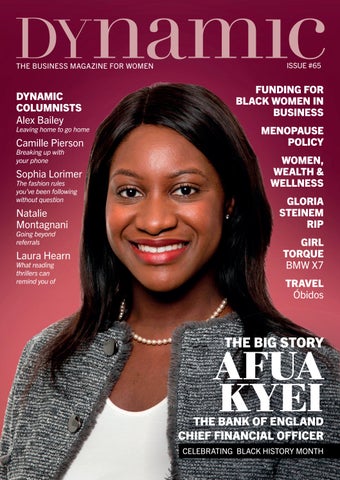
THE BIG STORY
AFUA KYEI
THE BANK OF ENGLAND CHIEF FINANCIAL OFFICER CELEBRATING BLACK HISTORY MONTH
CONTENTS
ISSUE 65
In order to insult me, I must first value your opinion.”
❛❛
– Anon 40 Historical Spotlight Focusing on two Black women whose past achievements have been overlooked, forgotten or erased from the history books
18 AFUA KYEI: CFO AT THE BIG STORY
Wellbeing
BANK OF ENGLAND
News
4 Upfront: The top international news stories involving women in business 6 In the Right Direction: Good news stories from around the world
Tribute
8 Gloria Steinem Dynamic remembers a pioneering activist and feminist who passed away in September
Regulars
12 The Alex Bailey Column Leaving home to go home
8
14 The Laura Hearn Column What a thriller in Portgual reminded me about reading – and work 16 The Natalie Montagnani Column Beyond referrals: how women can get more proactive about getting business through their door 34 The Camille Pierson Column Breaking up with your phone 36 The Sophia Lorimer Column The fashion rules you’ve been following without question
Features
22 The Magical Mystery Tour In conversation with Tracey Ledger, Sales Director at Eastbourne Coaches 24 Spotlight Focusing on two women who are not getting the recognition they deserve
10 London Women’s Clinic Her Future Self: highlights from the sold-out event at The Grand Brighton 32 Lucy Fitzpatrick The menopause policy is only as good as the culture behind it
Further Reading
38 Black History Month Ten titles exploring history, culture and ethnicity in Britain
Travel
42 Óbidos Tess de Klerk explores this ancient Portuguese village that kings gave their queens for a gift
Girl Torque
46 BMW X7 Fiona Shafer, MD of MDHUB, test drives BMW’s latest offering, and picks up more than she intended to
What’s On
50 A brief snapshot of what’s on in the South East
26 Lucy McCarraher Writing yourself into the room: Books, visibility and female leadership 28 Black History Month Who is backing Black women in business?
PLATINUM MEDIA GROUP
2
www.platinummediagroup.co.uk
40
All rights reserved. The views expressed in this publication are not necessarily those of the publisher. The publisher cannot accept responsibility for any errors or omissions relating to advertising or editorial. The publisher reserves the right to change or amend any competitions or prizes offered. No part of this publication may be reproduced without prior written consent from the publisher. No responsibility is taken for unsolicited materials or the return of these materials whilst in transit. Dynamic Magazine is owned and published by Platinum Media Group Limited.
EDITOR’S NOTE
Welcome to our October edition of Dynamic. The clocks go back this month and, inspired by Laura Hearn, I’ve promised my extra hour to a book. It is also Black History Month which has given us some of this issue’s best reading.
Gloria Steinem passed away in September and I have written our tribute. I grew up hearing her name from my mum who was offered two careers as a young woman in South Africa: secretary or teacher. She chose teaching, later retrained as a journalist and raised me to know I had more than two options. We owe Gloria rather a lot. Our Big Story is Afua Kyei who grew up in South London on Enid Blyton and Boyzone, became CFO at the Bank of England and now tops the Powerlist of Britain’s most influential Black people. In Spotlight, media and marketing guru, Stephanie Prior and and President of the Sussex Law Society, Angela Arnold write about their Jamaican heritage and their respective families’ journeys to the UK. Addtionally, I ask who is backing Black women in business.
Our columnists are on good form. Alex Bailey writes from a Texas airport about what home means. Laura Hearn took a thriller to Portugal and came home hooked on reading for fun. Natalie Montagnani explains why a business built on referrals works brilliantly until it doesn’t, while Camille Pierson urges us to put our phones down, which seems fair given we pick them up around 186 times a day! Sophia Lorimer has a challenge for anyone who has ever said ‘I can’t wear that’. Ask yourself why, who told you so and whether that is what you actually want. Further back are ten books for Black History Month and a Historical Spotlight on Una Marson and Dorothy Vaughan, one of whom has a crater on the moon named after her. I take you to Óbidos, the Portuguese village kings gave their brides as a wedding present. And Fiona Shafer collects her first speeding fine in seven years of reviewing cars. However you spend your October, I hope something here makes you think, pick up a book or put down your phone.
Editor, Dynamic Magazine tess@platinummediagroup.co.uk
CONTACTS
PUBLISHER: Maarten Hoffmann maarten@platinummediagroup.co.uk EDITOR: Tess de Klerk tess@platinummediagroup.co.uk MOTORING EDITOR: Fiona Shafer fionaas@platinummediagroup.co.uk COMMERCIAL MANAGER: Imogen Hunt imogen@platinummediagroupco.uk EVENTS DIRECTOR: Fiona Graves fiona@platinummediagroup.co.uk HEAD OF DESIGN / SUB EDITOR: Alan Wares alan@platinummediagroup.co.uk
WWW.PLATINUMMEDIAGROUP.CO.UK www.platinummediagroup.co.uk
3
NE WS
11-YEAR-OLD GIRL BECOMES CHESS GRANDMASTER A British child chess prodigy has become the youngest ever player to earn the woman grandmaster (WGM) title. Bodhana Sivanandan, 11, from London, secured her third and final WGM norm - a certified title-level performance - while representing England at the 46th Chess Olympiad in Samarkand, Uzbekistan, the International Chess Federation (FIDE) confirmed. It is the latest milestone in a remarkable rise for the schoolgirl, who has already become both Britain’s youngest women’s chess champion and to represent England internationally in any sport.
HAILSHAM SEEKS VIEWS ON WOMEN’S SPORTS IN THE TOWN Hailsham Town Council’s survey exploring women’s and girls’ participation in sport has now closed, with responses received from residents across the town. The survey formed part of the Town Council’s wider campaign promoting women’s and girls’ sport in Hailsham and was designed to better understand residents’ experiences, views and priorities when it comes to local sporting opportunities. Residents were invited to share their views on a range of issues, including the availability and quality of local sports facilities, the range of clubs and sporting opportunities, potential improvements and any barriers that may prevent women and girls from participating.
WOMEN’S BONUSES SMALLER THAN MEN’S Women in Britain continue to receive substantially lower bonus payments than men, according to human resources data firm Brightmine. Payroll records for almost 1.5 million employees as of July 2026 showed male workers received average annual bonuses of £5,442 compared with
£3,062 for women. The data also showed 14% of male employees received a bonus compared with 9% of females. The disparity widened with age: at 56, men received average bonuses of £8,817 compared with £3,769 for
women. Some of the biggest gaps were in finance and in professional and business services. Sheila Attwood, HR insights and data lead at Brightmine, said the findings suggested differences in progression, seniority and access to higher-value incentive schemes.
UPFRONT THE LATEST BULLETINS FROM AROUND THE WORLD
4
NATWEST ACCELERATOR SCALES UP ‘SHE SCALES’ INITIATIVE
MORE WOMEN CEOs ACROSS EUROPE’S TOP COMPANIES
NatWest Accelerator is launching its She Scales initiative nationwide across the UK following a successful pilot phase. For fintech professionals and the broader startup ecosystem, this expansion is a significant effort to bridge the gender gap in entrepreneurship by giving female founders structured access to networking, peer support, and practical growth expertise. The She Scales
The 2026 Fortune 500 Europe has revealed that women run 8.6% of companies on the list, up from 8.2% a year earlier.
www.platinummediagroup.co.uk
initiative is moving from a pilot phase to a permanent national programme under the identity “Where female founders build their future.” The expansion follows a pilot involving 13 NatWest Accelerator hubs. The programme addresses three priorities identified by female founders: a stronger sense of belonging, greater visibility for their businesses, and improved access to growth opportunities.
Companies led by female CEOs generated $1.2 trillion in revenue on this year’s list, up 24% from $1 trillion last year. Meg O’Neill (left), CEO of BP, is behind much of that increase. The share of revenues for woman-run companies is 8.0%, up from 6.7% last year but less than the 8.6% of companies women run. Also high on the list was Karin Rådström, who leads Daimler Truck, the world’s largest manufacturer of commercial vehicles, and by her own admission, is used to being the only woman in the room.
SPANISH FA PAYS FOR FERTILITY TREATMENT Spain’s football federation has become the latest organisation to support fertility treatment for female players, including egg-freezing. As part of its agreement, the Royal Spanish Football Federation (RFEF) said that it will cover the full cost of egg-freezing treatment for all international players who have been called up at least twice.
“It’s important that female athletes feel they don’t have to choose between their professional and personal lives,” Barcelona midfielder Patri Guijarro said at the announcement. For female athletes, the window of peak performance and the window for fertility overlap, which researchers have noted has often made athletes feel as though they have to choose one or the other.
❛❛
Once we give up searching for approval, we often find it easier to earn respect.” - Gloria Steinem
NATIONWIDE PARTNERS WITH FEMALE FOUNDERS RISE Nationwide has become the sole banking partner of Female Founders Rise (FFR), one of the UK’s largest communities helping female entrepreneurs and nonbinary founders build stronger, more profitable businesses.
members as they grow and scale their businesses, bringing together Nationwide’s commitment to support businesses and local communities with FFR’s mission to
The partnership aims to strengthen support for FFR’s 12,000-plus
AFRICA MATCHES UK FOR LOW LEVELS OF FEMALE INVESTMENT According to data that starkly mirrors the UK’s story, female solo business founders and all-women founding teams received less than 1% of tracked funding across African markets, compared with 91% for male solo founders and all-male teams, figures cited at the She Code Africa Summit 2026. The figures, from Africa: The Big Deal reports, were cited by B4B Partners Managing Partner Napa Onwusah (above) during a discussion on women’s participation in technology and investment at the summit, which marked the organisation’s 10th anniversary. Onwusah said mixed-gender founding teams accounted for 8% of the funding, highlighting a significant disparity in capital allocation to women-founded businesses.
support early-stage female founders, from idea through to their first million. The Rise Report, one of the largest grassroots studies of female entrepreneurship in the UK, found that up to £310 billion of new value could be added to the UK economy if women started and scaled businesses at the same rate as men.
CRICKET CLOTHING SISTERS PARTNER UP WITH SNAP A female-led cricket clothing brand is partnering with a sponsorship company to help clubs, schools and universities raise money for their women’s and girls’ cricket programmes. Maiden Cricket, the Chichester business founded by sisters who previously appeared on BBC’s Dragons’ Den, has announced a partnership with SNAP Sponsorship, which supports clubs, schools and universities seeking sponsorship for their women’s and girls’ cricket programmes. Maiden Cricket, meanwhile, produces clothing, teamwear and equipment designed specifically for female cricket players. Clubs will receive exclusive access to SNAP through Maiden. The companies say this will give clubs the tools needed to create sponsorship opportunities and generate additional revenue.
❛❛
This is not a men vs. women issue. It’s about people vs. prejudice.” — Laura Bates, ‘Everyday Sexism’ www.platinummediagroup.co.uk
5
NE WS
LONDON CRIME FALLS DESPITE PUBLIC PERCEPTIONS
Research from King’s College London suggests people significantly overestimate crime levels in the capital. A survey of around 5,000 people found that 62% believed crime had risen between 2019 and 2025 when recorded crime actually fell by 1.4%. Forty per cent thought the murder rate had increased although it fell by around 15%. Some offences, including shoplifting, have risen, which may contribute to the perception gap. Researchers said people are “far too negative about the realities in London”.
IN THE RIGHT
DIRECTION DELAYING SMARTPHONES LINKED TO BETTER CHILD WELLBEING Research involving 12,000 English primary schools suggests that delaying children’s access to smartphones may benefit their mental health. In schools where at least one in five families agreed to postpone smartphones, support needs fell by 8.2% while psychiatric disability claims fell by 6%. The study has
not yet been peer-reviewed, but its author described it as the “first causal evidence” that coordinated delays can improve children’s mental health. Campaign founder Daisy Greenwell said delaying a smartphone gives children back “more time, better sleep, real-world friendships” and space to focus.
PLASTIC BAG LITTER FALLS BY 80%
Plastic carrier bags found on UK beaches have fallen by 80% since charges for single-use bags were introduced. Figures from the Marine Conservation Society suggest targeted policies can make a measurable difference, even as plastic still makes up a growing share of beach litter. Volunteers recorded plastic in 87% of rubbish collected in 2025 compared with 75% in 1995. Catherine Gemmell said: “Simple policies can make a big difference.” She also pointed to the potential impact of a future drinks container deposit scheme
6
www.platinummediagroup.co.uk
❛❛
Spend your money on the things money can buy. Spend your time on the things money can’t buy.” – Haruki Murakami, Japanese author
TURKMENISTAN TO TACKLE METHANE Turkmenistan, one of the world’s biggest sources of methane emissions, has begun repairing major leaks from its oil and gas facilities. Satellite monitoring identified more than 1,000 large methane leaks globally in 2022, with Turkmenistan responsible for many of the biggest. The country has now plugged eight major leaks and responded to 20% of the 192 alerts it received through the UN’s Methane Alert and Response System last year. The UN described the repairs as an “incredible first step”. Despite the progress, methane still accounts for around a quarter of global warming.
SOLAR POWER BECOMES DRAMATICALLY CHEAPER The cost of solar power has fallen to extraordinary new lows, with Chinese-made photovoltaic panels now costing around $0.12 per watt, down from $6 in 2000. This decline is unprecedented among major energy technologies and has helped drive record levels of solar installation worldwide.
The price falls are particularly significant as countries seek alternatives to volatile fossil fuel markets. Energy think tank Ember describes solar as “offensively cheap” and says 97% of the world’s population lives in countries where solar and wind potential far exceeds current electricity demand.
NEW FUND TARGETS GLOBAL FGM CRISIS A new $15.5m fund aims to support efforts to end female genital mutilation, with millions of girls still at risk each year. Although rates of FGM have fallen over the past decade, an estimated 4.4 million girls face the practice annually. The Her Horizon Fund has received $14m from the Wallace Global Fund plus $1.5m from an anonymous donor. The funding comes as support for health organisations tackling FGM has declined. Susan Gibbs said frontline groups have been “absolutely starved for resources”.
MARTHA’S RULE EXPANDS ACROSS ENGLAND Martha’s Rule is being extended to A&E departments across England, giving patients and families a clearer route to request a second opinion when they have concerns about care. The scheme was created following the death of 13-year-old Martha Mills from sepsis after her family’s concerns were not acted on. During hospital trials, 4,906 calls were made to helplines, with 241 leading to “potentially life-saving interventions”. NHS England says the expansion will strengthen patient safety and reassure families.
BREAST CANCER DRUG APPROVED IN ENGLAND Women living with incurable HER2-low breast cancer in England can now access Enhertu after a two-year campaign by patients and charities. The drug can extend life by an average of seven months, with some patients living up to three years longer.
NICE rejected its use in 2024 because of its cost but has now reversed that decision. The move has been welcomed by campaigners including Kathryn Hulland, who described it as bringing “a renewed sense of hope” for women and their families.
❛❛
Don’t think about making women fit the world - think about making the world fit women.” — Gloria Steinem
www.platinummediagroup.co.uk
7
TRIBUTE
Gloria Steinem By Tess de Klerk
I
have been aware of Gloria Steinem for as long as I can remember. My mum was a great admirer of hers, and I grew up knowing her name and hearing about her work. This was in South Africa at a time when society was still very traditional, and the choices available to women were limited. I remember my mum telling me that when she was young she had really only been given two career options: secretary or teacher. She became a teacher and, much later, retrained as a journalist. Gloria Steinem was one of the women who inspired that change of direction.
and backgrounds and remained involved in many women’s movements for decades. The world now looks different from the one in which Gloria began her career. A woman deciding to pursue a career, leave an unhappy marriage, manage her own money or return to education is not unusual in the way it once could have been. The choices are still not equal for everyone, with massive differences between countries and cultures, but the conversations are now often loud and proud. Gloria was the trailblazer who helped lay the foundations for this. I now understand my mum’s admiration for Gloria more than I did when I was young. At the time I simply knew that she was an influential woman whose name came up at home. I didn’t have any real sense of what it meant for a woman from her generation to look at someone like Gloria and see a different way of living and working.
“We owe her so much: for her passion and Gloria’s generation challenged ideas Gloria died on September 2nd 2026, at determination, for that had been accepted for a very long the age of 92, having spent more than five decades writing, campaigning and insisting on asking the time. They argued about women’s place the workplace, in the home and in sospeaking about women’s lives. She bedifficult questions” in ciety, and they made subjects that had came one of the best-known figures of the modern women’s movement and used her journalism to question ideas about what women were expected to be and what they were allowed to do.
When Ms. magazine appeared in the early 1970s, it covered subjects that women’s magazines at the time didn’t really discuss. Reproductive rights, domestic violence, sexual harassment, work, money and relationships all found their way into its pages. The preview issue sold out within days, and women began writing to the magazine about their own experiences. Some women had spent years thinking certain frustrations and problems were simply part of being a woman, but seeing those subjects discussed publicly gave them the language and courage to talk about what they had often dealt with on their own. Gloria’s work went much further than the pages of a magazine, though. She helped establish and support organisations including the National Women’s Political Caucus, the Ms. Foundation for Women and the Women’s Media Center. She worked with women from different generations 8
www.platinummediagroup.co.uk
been kept behind closed doors part of public debate. Younger women have grown up in a world shaped by some of those changes, which makes it easy to forget how contested they once were.
Of course, the conversation hasn’t ended. The questions have changed, and new ones have developed. Each generation has its own experience of what equality means and its own frustrations with what still gets in the way. Perhaps the simplest way for me to think about Gloria Steinem is through that connection between generations. A woman I knew about as a child had influenced my mum enough to help her pursue what she really wanted. And my mum then raised me knowing I could do the same. That is a long way for an idea to travel. We owe her so much: for her passion and determination, for insisting on asking the difficult questions, and for being one of the women who came before us and made it easier for the rest of us to ask our own. Gloria Steinem (b. Toledo, Ohio 1934, d. 2026)
Gloria Steinem at the LBJ Library, 1975
www.platinummediagroup.co.uk
9
E VENTS
HER FUTURE SELF
Women, wealth and wellness By Anya Sizer, Patient Advocacy Lead, London Women’s Clinic
O
n the morning of September 7th, I welcomed a room full of businesswomen to something rare: a few hours that belonged entirely to them. As host of the first Her Future Self: Women, Wealth and Wellness event at The Grand Brighton, my hope was simple: not another task, but permission to slow down and take stock. Through keynote talks, expert Q&As and conversations over coffee, four speakers offered four ways to care for yourself: a nervous system reset, fertility guidance, emotional support and a financial checklist. Here is what our attendees took away.
The Float Spa has been around since 2015 and was developed by Camille because she wasn’t very well herself, and she used flotation therapy to overcome her own PTSD, anxiety and depression. FERTILITY, BODY AND MIND Professor Nick Macklon, Medical Director at London Women’s Clinic, spoke about everyday steps supporting fertility over time: eat a Mediterranean-style diet; maintain a healthy BMI; avoid smoking and vaping; limit alcohol intake; consider a fertility health check if you are unsure where you stand
“Stress is actually very healthy but it is understanding stress that really matters.” Camille Pierson
THE MICRO RESET METHOD Camille Pierson, founder of The Float Spa, opened with what she calls the Micro Reset Method: three small habits that take only a few quiet seconds, wherever you are. 1. The physiological sigh: two inhales through the nose, one long slow exhale through the mouth, repeated for about thirty seconds. 2. The ten-second transition: a brief pause, feet on the floor, one slow breath, before stepping through the door, opening the laptop or picking up the phone. 3. Protecting your drain: identifying whatever is depleting your energy that week, and treating the fix as ‘fixed and essential’, the way you would treat a meeting with your boss.
10
www.platinummediagroup.co.uk
Samantha Kaye, Anya Sizer and Camille Pierson
Professor Nick Macklon, Medical Director at London Women’s Clinic
Anya Sizer
I followed with a softer, more personal note on the emotional side of fertility. Drawing on research from Jacky Boivin, I spoke about stress often being a reality of fertility treatment but one that doesn’t impact success rates once in a clinic. My key points to support you on the journey:
Mental health is an enormous part of the fertility journey, and for me the real value was building a holistic picture of how finances, fertility and stress fit together. It is essential that women all over the country can have conversations like these.
• Build a nurturing toolkit • Support your mind, body and soul • Balance fertility and work
Looking after your future self, physically, emotionally or financially, means taking small, kind and consistent steps. For many attendees, the real gift was simply permission to stop, in the middle of a busy week, and sit quietly with what their future self might need.
“Small, consistent changes can make a meaningful difference over time” Professor Nick Macklon
WHAT THEY DID NOT TEACH YOU IN SCHOOL Closing the morning, Samantha Kaye, Wealth Management Partner at True Potential Wealth Management, offered a different kind of self-care: financial peace of mind. Her five priorities for every woman’s financial wellbeing were: 1. Income 2. Life insurance 3. Wills and power of attorney 4. Savings and ISAs 5. Pensions
Her Future Self: Women, Wealth and Wellness, sponsored by London Women’s Clinic, is intended to be the first of many such mornings. I am already looking forward to hosting the next one.
“Money is a big stress and a worry for lots of people. Allowing yourself to get your finances in order, whether that is before you think about having a family or while you are building one, is really important too” Samantha Kaye
Financial education many of us never received at school, a starting point rather than a finished plan. LOOKING AHEAD By the end of the morning, I had reconnected with old friends, made new ones, and taken away plenty myself. Finance, fertility and stress are closely connected: financial worries affect stress levels, and stress in turn affects fertility. Bringing that mix together felt like exactly the conversation Brighton needed.
ABOUT LONDON WOMEN’S CLINIC For more on London Women’s Clinic, visit londonwomensclinic.com. 169 Preston Road Brighton BN1 6AG www.platinummediagroup.co.uk
11
FE ATURE
The
Alex Bailey Column
COMPANY OF THE YEAR 2022
We are delighted to have Alex Bailey contributing to Dyna and CEO of Bailey & French, and a global expert in huma She founded leadership and culture consultancy Bailey & team delivering work across 155 countries, in all markets large blue chips as well as those at the most senior levels
LEAVING HOME TO GO HOME By Alex Bailey
I
’m waiting for my flight from Texas back to the UK. As always, leaving feels more emotional than I expect. Not because I am leaving somewhere I love for somewhere I don’t. Quite the opposite.
It always feels like I’m leaving home to go home. This afternoon, leaving Texas, the familiar things felt unusually vivid: the last hug, the heat outside, the road stretching towards the airport and the loudness of the trucks. Perhaps we notice the texture of home most sharply when we are about to leave it. I’ve spent much of my life moving between the United States and the United Kingdom. Different chapters of my life have unfolded on both sides of the Atlantic, and over time I’ve developed deep roots in each place. Family, friendships, memories, opportunities and a sense of identity are spread across both countries, which means every departure carries a mixture of gratitude, excitement and sadness. When people ask where home is, I often struggle to answer. The truth is that home isn’t one place anymore.
“Different chapters of my life have unfolded on both sides of the Atlantic, and over time I’ve developed deep roots in each place.” 12
www.platinummediagroup.co.uk
amic. She is an organisational psychologist, author, anising leadership, culture, and the world of work. & French which has grown organically to a global s and industries and trusted by the board/execs of s of central government.
Texas feels like home. Sussex feels like home. And while that is a privilege, it can also be surprisingly difficult. As I sit here reflecting on this trip, I find myself thinking about the people who make a place feel like home in the first place. The friends who have known you through multiple versions of yourself. The family members who don’t need an explanation because they already know the backstory. The people who remain a constant presence despite the years, the miles and the busyness of life. As an organisational psychologist, much of my work focuses on helping people navigate change. We talk a lot about resilience, adaptability and courage. We celebrate those who embrace uncertainty and step into new challenges. Yet what I’ve learned, both personally and professionally, is that our ability to navigate change is often strengthened by something much quieter.
from people who matter enormously to me. The conversations over coffee. The familiar faces. The shared history. The feeling of being known. Yet there is something reassuring about knowing those connections endure, regardless of geography. For much of my life, I assumed that growth came from moving forward. Chasing the next opportunity. Taking the next leap. Beginning the next adventure. I still believe that.
“Whether I’m leaving Texas or The strongest people I know are leaving Sussex, I’m not simply But I also believe growth comes not necessarily those who stand departing from a location. I’m from understanding what grounds us along the way. The people we independently. They are often the people who are deeply rooted in stepping away from people who return to, the places that restore us the relationships that remind relationships that sustain them. matter enormously to me. “ and us what really matters. They have people who celebrate Connection.
their successes without envy, challenge them when needed and remind them who they are when life feels overwhelming. As women, particularly those balancing careers, businesses, family responsibilities and personal ambitions, we often place enormous value on our ability to carry things alone. Strength can become synonymous with self-sufficiency. But increasingly, I find myself questioning that idea.
As I head to my gate shortly, I know I will feel the familiar pull between two worlds. Part of me is already missing Texas. Part of me is relieved to return to Sussex and see my family again. For a long time, I thought I needed to choose between those feelings. Now I realise I don’t. Having more than one place that feels like home isn’t a conflict to solve. It’s something to be grateful for.
The older I get, the more I realise that resilience is rarely a solo act. Behind most successful people is a network of family members, friends, mentors and communities providing encouragement, perspective and support. The stabilising force of familiarity allows us to step into uncertainty with greater confidence.
Because if leaving feels difficult, it’s usually because we’ve been fortunate enough to build a life filled with people worth missing.
Perhaps that is why driving to the airport never gets any easier either way. Whether I’m leaving Texas or leaving Sussex, I’m not simply departing from a location. I’m stepping away
alex@baileyandfrench.com www.baileyandfrench.com www.rapidreculturing.com www.platinummediagroup.co.uk
13
FE ATURE
Laura Hearn is a former BBC journalist, now storytelling consultant and founder of Flip It - a podcast and platform helping people and businesses use storytelling as a tool for clarity, connection and change. This month, for Dynamic, Laura looks at why we read, and what we can get emotionally and intellectually from this pastime
What a thrille me about rea By Laura Hearn
L
ast week, on a welcome few days’ change of scenery in Portugal, I took a book with me. It was for work purposes. And although it was a thriller rather than a heavy read, I still thought of it as something I needed to get through. Yet, a few pages in, I stopped thinking about work. I wanted to know what happened next. I cared about the characters, the choices they were making and the things they couldn’t quite say to one another. I looked forward to picking the book up again, and in the middle of their story, I kept recognising parts of my own. I hadn’t realised how much I’d missed reading until I was doing it again. I read and write all day, in one sense. Messages, articles, emails, headlines. My days are full of words. But I had forgotten what it feels like to stay with one story for long enough to become absorbed in it. I’d find myself thinking about a character while I was doing something else, then come back to the page to see what they did next. Being away gave me room for that. At home, I can always think of something that needs doing. I might sit down with
“Wolf explains that reading asks us to draw on our memories, imagine places and people we haven’t seen, and consider what life might feel like from someone else’s point of view.” 14
www.platinummediagroup.co.uk
ler in Portugal reminded ading - and work a book, then remember a message I ought to answer or reach for my phone without thinking. In Portugal, I opened the book and carried on reading. I loved holding an actual book again, too. I liked feeling how far I’d got as the pages shifted from my right hand to my left. When I finished it, I could remember where I’d been when I read certain scenes. Then I began thinking about who I could pass it on to, and the conversation we might have about it afterwards. After I got home, I came across Maryanne Wolf ’s writing about deep reading. She studies what happens in our brains when we read, and her work helped me understand why those hours in Portugal had meant so much to me. Wolf explains that reading asks us to draw on our memories, imagine places and people we haven’t seen, and consider what life might feel like from someone else’s point of view. We make connections between what’s on the page and what we’ve known in our own lives. Sometimes those connections lead us somewhere unexpected. That was what had been happening to me. I was caught up in the plot, but I was also wondering why a character had acted as they did. Their lives were made up; my responses to them were real. I’d put the book down and find that a conversation or a decision in it was still on my mind.
“A novel asks something else of us. You can suspect a character is making a mistake, but you have to keep reading to understand why they made that choice.”
It made me think about work, too. As business leaders and founders, we spend so much of our time responding. A decision is needed. Someone wants an answer. There’s another problem to solve before we’ve finished thinking about the first. It can become difficult to give one thing our full attention, particularly when the answer isn’t obvious. A novel asks something else of us. You can suspect a character is making a mistake, but you have to keep reading to understand why they made that choice. You may change your mind about them as you learn more. There’s value in spending time with a story that doesn’t give us all the information at once. Books can help us find words for things we’ve felt but haven’t known how to express. I noticed that happening as I read: a character would say something, or struggle to say it, and I’d think about a conversation I needed to have in my own life. For anyone leading a team, finding the right words matters. Wolf writes about the time and attention deep reading needs. I recognised that as well. At first, I sometimes had to bring myself back when my thoughts wandered. Then I’d get into the story and forget to check how many pages were left in the chapter. For women building businesses, time can feel hard to claim when there’s no clear outcome to show for it. That was part of why I’d let reading for pleasure slip. If I had half an hour, there was always something useful I could do with it. But I came back from Portugal glad I’d spent those hours reading. I’d enjoyed myself. I’d also had space to imagine, question my first impressions and follow someone else’s journey. Those are things I want room for in my life, including the part of it I spend at work. The fact that it was a thriller mattered. I hadn’t chosen it to improve myself or learn a lesson. I wanted to find out what happened. That was enough to bring me back to the book each day. I’m grateful it came to me through work. Otherwise, I might still be telling myself I’d read for pleasure when I had more time. Instead, I’ve finished it, I know who I want to give it to, and I’m looking for what to read next. You can listen to Laura’s podcast, Flip It, wherever you get your podcasts, and you can connect with her at www.flipitglobal.com www.platinummediagroup.co.uk
15
FE ATURE
Natalie Montagnani is an entrepreneur, Business Growth Coach & Strategist, and tech start-up Director. With Founder of Ignite, where she advises senior female leaders and business owners on commercial growth, lea
BEYOND REFE
How women can get more proactive about bringing b By Natalie Montagnani
A
new client recently found herself facing a dilemma many successful business leaders would probably quite like to have. Her business had grown; they enjoyed a strong reputation, and had happy clients and years of expertise behind them. New business came through recommendations, relationships and people who already knew the company. In other words, they were doing a lot right. But when we started talking seriously about the next stage of growth, it became clear that relying on referrals just wasn’t going to cut it. And I see this a lot. For many women, particularly those running service businesses or leading professional firms, growth has happened relatively organically. They’re excellent at what they do, build strong relationships, look after their clients, network locally, get known, and people recommend them. That can work brilliantly. Of course, until it doesn’t. THE REFERRAL TRAP Let me be clear: I LOVE referrals! They’re one of the strongest indicators that you’re doing good work. They arrive with trust already attached; they’re often easier to convert, and because they’ve come from someone you like, they’re often nice people too (always handy)! But there’s an uncomfortable truth about building a business predominantly through referrals: you’re putting somebody else in charge of your pipeline. That’s not necessarily a problem when there’s plenty of work coming through the door. But what happens when a major client leaves? When the market changes? When you want to grow faster than your existing network can support? FROM WAITING FOR TO CREATING Being commercially proactive doesn’t mean treating every human interaction as a sales opportunity. It simply means becoming more intentional about where your next piece of business might come from and being prepared to do something about it. A useful place to start is by asking: 16
www.platinummediagroup.co.uk
Where do we actually want our next £50k or £100k of revenue to come from? Not simply “more clients”, but which services, which types of clients and which parts of the market offer the greatest opportunity? Who are the people we should be talking to? Existing clients, previous clients, warm contacts, strategic partners, prospective clients. Who already sits within touching distance of the business? What problem are we solving for them right now? People rarely buy a service simply because it’s good. They buy because something needs fixing, changing or improving. Be the paracetamol, not the vitamin. And are we actually moving opportunities forward? Starting conversations is one thing. Commercial confidence also means following up, asking for introductions, suggesting the next meeting, making an offer and, yes, sometimes actually saying: “Would you like to work with us?”
h 25 years’ commercial experience, she is also the adership and building more profitable businesses.
ERRALS
business through their door
YOUR BIGGEST OPPORTUNITY I recently explored a simple question with a client: Are you actually maximising the commercial opportunity already sitting in front of you? In her case, that meant looking at her existing customers and getting curious about them: • What are your clients trying to achieve next? • What problems are emerging that you could help solve? • A re there services or expertise you offer that they don’t even know about? • W here could you add more value — and potentially generate more revenue as a result? • A nd when did somebody last sit down with them, without an agenda, and simply ask what was coming next? We can become so focused on finding the next client that we overlook the opportunity sitting within the relationships we’ve already built. Sometimes growth doesn’t require another hundred leads. Sometimes it requires better commercial conversations with the people who already know, like and trust you.
“By all means, celebrate every referral that lands in your inbox, but don’t make them your entire growth strategy” COMMERCIAL CONFIDENCE IS LEADERSHIP CONFIDENCE I strongly believe that this matters for women beyond the immediate revenue, because something changes when you know you can create business. It would mean being less dependent on luck, algorithms or somebody remembering to recommend you. You could have more intelligent conversations about growth because you understand how opportunities actually move through the business. It would mean that you don’t just deliver. You contribute to growth. That creates confidence, influence and options, which is why I think we need to stop treating commercial skills as something that belongs exclusively to the sales team, because commerciality belongs in leadership.
“Let me be clear. I LOVE referrals! They’re one of the strongest indicators you’re doing good work”
BEYOND REFERRALS So by all means, celebrate every referral that lands in your inbox, but don’t make them your entire growth strategy because the shift from waiting for business to creating business isn’t about becoming more salesy. It’s about becoming more commercially powerful. And I think that’s a shift more women should be encouraged to make.
Natalie Montagnani Founder of IGNITE Women in Business 07900 153503 ignitewomeninbusiness.com Connect with Natalie on LinkedIn or drop her an email to natalie@ignitewomeninbusiness.com www.platinummediagroup.co.uk
17
B I GH S E TA O L TR H Y 18
“You don’t need to be a mathematician, you don’t need to be an accountant, and you don’t need to be an economist. What we’re looking for is fresh perspectives, and we want the best people”.
www.platinummediagroup.co.uk www.platinummediagroup.co.uk
THE BIG STORY
AFUA KYEI Afua Kyei is a British financial executive who has been chief financial officer (CFO) of the Bank of England since 2019, having cut her teeth at Ernst & Young and Barclays Bank. She also topped the 2026 Powerlist of most influential Black people in the UK. Dynamic looks at the rise of the prominent and highly respected financial expert
A
fua was born in London to Ghanaian parents and attended Old Palace School, a private secondary school for girls in Croydon. According to her interview with the BBC in November 2025, “she grew up in South London, reading copious numbers of Enid Blyton books and listening to Boyzone, got six A levels and went to university a year early.”
© Sane Seven / Powerful Media
She earned her bachelor’s and master’s degrees in chemistry from Somerville College, Oxford, where she was selected to join Professor Sir Jack Baldwin’s research group; her Organic Chemistry research on creating anti-tumorous molecules using Organic Synthesis was published in an international science journal. She graduated with a Master’s degree and received a Junior Research Fellowship in Organic Chemistry from Princeton University. In 2023, Afua was elected an Honorary Fellow of Somerville College, Oxford University. She worked as a junior researcher in organic chemistry at Princeton University and trained as a chartered accountant at Ernst & Young in London. www.platinummediagroup.co.uk
19
POST UNIVERSITY AND EARLY CAREER During the Global Financial Crisis, she was an Investment Banker at UBS from 2007 until 2012, in the Financial Institutions Group and in Mergers and Acquisitions, Group Strategic Advisory. She was part of the team that advised RBS during the financial crisis on its divestments mandated as part of EU State Aid remediation, its participation in HM Treasury’s £282bn Asset Protection Scheme, and its £33.5bn capital issuance to HM Treasury. She left Ernst & Young in 2012 to join Barclays Bank, where she was the Chief Financial Officer, Mortgages and played a key role in Barclays’ strategic cost transformation program, TRANSFORM, whilst in the Investment Bank and as Group COO, which led to a net cost reduction of 17% in 2012-2015.
been central to the Bank’s leadership and decision-making. Afua oversees the financial governance of the Bank’s balance sheet, which peaked at over £1 trillion during the Covid pandemic. She has been responsible for modernising the Bank’s funding mechanism as reflected in the Financial Services and Markets Act 2023. She is also a Director of the Bank of England Asset Purchase Facility Fund, Alternative Liquidity Facility, and previously the Covid Corporate Financing Facility. She is a member of the Bank’s Executive Board, which oversaw the upgrade of the UK’s Real Time Gross Settlement System in 2025, the Critical National Infrastructure, which processes over £780bn in payments each day. The new system went live in 2025, after its previous upgrade in 1996.
“At the age of 36, Afua Kyei was recruited by then Governor of the Bank of England (now Prime Minister of Canada) Mark Carney”
Of her career, she has commented on the role played by those around her. She said her parents, who moved to the UK from Ghana to go to university at 18, have been her biggest role models.
MOVE TO THE BANK OF ENGLAND In 2019, at the age of 36, Afua Kyei was recruited by then Governor of the Bank of England (now Prime Minister of Canada) Mark Carney as Chief Financial Officer and Executive Director of the Bank of England.
“My mother came to Liverpool, trained to become a midwife and enjoyed a 40-year plus career working for the NHS. My father has enjoyed a long career in the oil industry. I saw them juggling work and home. They instilled really strong values in us,” she said.
Afua is the Executive Director at the Bank of England responsible for finance, strategy, performance and tax. She is co-executive sponsor for Diversity, Equity and Inclusion and co-executive sponsor for the Bank’s Climate Change disclosure. Since her appointment in June 2019, she has
“You don’t need to be a mathematician, you don’t need to be an accountant, and you don’t need to be an economist. What we’re looking for is fresh perspectives, and we want the best people,” she added.
The Old Lady of Threadneedle Street, where Afua Kyei has had her office for the past seven years
20
www.platinummediagroup.co.uk
The top 10 list in full, with Powerlist’s comments
HONOURS AND AWARDS Afua’s achievements have earned her widespread recognition. She was named CFO of the Year at the Women in Finance Awards UK in 2021, honoured with the Freedom of the City of London two years later. Also in 2023, she was elected as Honorary Fellow of Somerville College, Oxford, and listed as the UK’s most influential Black person in the Powerlist 2025 and 2026. She also topped the Empower Global Executives Role Model List as the leading female executive of 2024 and was elected Honorary Fellow of Somerville College, Oxford. As a keynote speaker, Afua shares her experience of navigating leadership as a Black woman in finance, the importance of inclusion in decision-making, and the future of purpose-driven business. Whether addressing the G20, COP, or private boardrooms, she speaks with insight, empathy, and conviction, inspiring others to lead with both excellence and equity.
“Perhaps her highest-profile accolade came towards the end of 2025, when she was honoured as the UK’s most influential Black person in the Powerlist 2026.” She was also recognised in the 2024 Women of the Year Awards. In 2024, Afua was honoured as the top female on the Empower Global Executives Role Model List 2024, supported by YouTube. To mark International Women’s Day 2025, Afua was named on The Independent’s Influence list as No.17 in the 50 most influential women in the UK. Of her Honorary Fellowship, awarded in 2023, Afua said, “To be invited to be an Honorary Fellow of Somerville is the greatest honour and took me completely by surprise! I loved my time at Somerville. It played such an instrumental role in my career, and I made lifelong friends.” Perhaps her highest-profile accolade, however, came towards the end of 2025, when she was honoured as the UK’s most influential Black person in the Powerlist 2026. This list recognises the most powerful people of African, African Caribbean, and African American heritage in the UK. The Top 10 list (right) indicates the depth of quality of the Black UK nominees, shortlisted from hundreds of considerations. Afua is a keynote speaker and represents the Bank at national and international fora, including the International Monetary Fund, G20 and COP, as well as with industry and in the community. She is married, has four children, and is passionate about “achieving better outcomes for society and driving cultural changes within organisations.”
1
Afua Kyei Afua Kyei became the Bank of England’s first black executive and youngest executive director when she was appointed to the top job at the age of 36.
2
Ian Wright MBE, OBE “Ian Wright is a generational icon whose legacy in British football, media, and advocacy continues to transform lives.”
3
Dame Pat McGrath, DBE “Hailed by her legions of fans as the ‘mother of make-up’, Pat McGrath is a bona fide industry legend.”
4
Pamela Maynard “Pamela Maynard is the first-ever Chief AI Transformation Officer for Microsoft Customer and Partner Solutions (MCAPS).”
5
Joshua Siaw, MBE “Joshua Siaw MBE is a partner at the leading global law firm White & Case LLP and Director of the Firm’s Africa practice.”
6
Tunde Olanrewaju, CBE “Tunde Olanrewaju is the managing partner for Europe and a senior partner in McKinsey’s London office.”
7
Steven Bartlett “At 19, Steven Bartlett disrupted the marketing industry. Now he is redefining global media with The Diary of a CEO – the world’s second biggest interview podcast.”
8
Emma Grede “Described as the ‘real mastermind of the Kardashian empire’, business mogul, built a multimillion-dollar fortune with the launch of talent and marketing agency ITB.”
9
Sir Idris Elba, OBE “Hollywood movie star, musician, filmmaker, activist: Idris Elba is categorically not a man to rest on his (very many) laurels.”
10
Ije Nwokorie “As the CEO of one of the UK’s most iconic footwear brands, Ije Nwokorie is leading a radical shakeup of Dr Martens.” Kyei said topping the list was “incredibly humbling”. She says she saw obvious differences in the workplace growing up. “I didn’t see so many women in big leadership roles who had families, and I know that there are lots of women who think that they need to choose between work and having a family. What I love about the Bank of England is that we really support working families and working parents.”
www.platinummediagroup.co.uk
21
FE ATURE
THE MAGICAL MYSTERY TOUR In conversation with Tracey Ledger, Sales Director, Eastbourne Coaches
You made the leap from a secure role in the NHS into business. When did you realise you were ready? I don’t think you are ever quite ready for these types of decisions, especially when you’re coming from such a stable career and are later in life. Julian and I had worked together on and off over many years. I had always supported him in his business ventures, and he had always supported me in my career choices. It felt quite natural to take the step. What were your biggest fears? My biggest fear was losing the financial security my salary gave us. I was also going into a business that, in many respects, I didn’t know much about. Could I achieve what we needed to achieve?
W
hen Tracey Ledger left her secure NHS career to join her husband Julian at Eastbourne Coaches, she knew she was taking a gamble. After years as an operations manager overseeing doctors’ practices, she swapped a reliable salary for the uncertainties of running a growing business.
I’m lucky to have a great support network around me, including Julian, my family, friends and old work colleagues, who all encouraged me. But essentially, I decided to put those fears aside and start my new journey. How did your background in travel and marketing help? My very first love was travel. I worked for local and national travel agencies, so I had a good understanding of what customers looked for when choosing their holidays.
“Eastbourne Coaches is a family-run business providing private coach hire, I also worked for a local PR and marketing company, helping to Eastbourne Coaches is a famiday trips and holidays.” ly-run business providing private launch an arts and theatre magacoach hire, day trips and holidays. Tracey has been instrumental in developing its holiday offering, driving sales and building customer relationships, bringing together her early experience in travel, marketing and healthcare. Her approach is simple: treat every customer as you would a member of your own family. In its first eight months, the holiday division generated bookings of over £170,000, and the business is expected to exceed £1m in annual turnover. 22
www.platinummediagroup.co.uk
zine. That taught me how to understand audiences, reach potential customers and navigate competitors, as well as the importance of networking with local businesses. Transport has traditionally been a male-dominated sector. What has your experience been? It’s been really positive and very welcoming. I’ve also joined the ‘Women in Bus and Coaches’ group, which supports, represents and encourages women working in the profession.
“Nothing is more satisfying than seeing our progress. It keeps you grounded.” How has your understanding of customer experience influenced the business? Having spent a long career assisting customers and patients, I’ve learnt how important communication is. Even when things don’t quite go to plan, customers won’t necessarily remember what went wrong. They’ll remember how you resolved the issue for them. Julian and I decided very early on that our tours needed to be personal. I want every customer travelling with us to feel they’ve been considered and looked after. Our advertising strapline is ‘We don’t pack your suitcase’, but we do everything we can to make a holiday as easy as possible, including home pick-ups. We also ensure attraction admission fees are included in the packages. You run the business as a husband-and-wife team. How do you balance work and personal life? It’s hard because there’s no clear line between work and home when it’s your business. Everything goes into it, and you have to accept that life will look very different for a while. We make sure we get out for dinner semi-regularly, turn our phones off and enjoy each other’s company. When we go away for trade events, we try to add an extra night so we can have an evening away from it all. What are the advantages of working so closely together? At least we get to see each other! In my previous job, I
worked extremely long hours, so for many years we were like ships passing in the night. We know each other well and completely trust one another. We can be honest when we disagree and have a healthy debate. We have the same goal, and we both strive together to achieve it. How do you stay motivated during tougher periods? We focus on our goal and look back at where we started. Nothing is more satisfying than seeing our progress. It keeps you grounded. What does success look like to you? We want to keep growing our fleet and what we offer, while remaining a stable, safe operator of high-quality coach tours and private hire services. For me, success is written on our customers’ faces when they come off one of our tours and have clearly had a good time. It’s in the written comments telling us everything they loved about travelling with us. It’s also in the proud look my husband gives me when he welcomes me back from a tour. The look that says, “We did it.” Finally, what would you say to women considering a bold career change? It’s a bit like having children. You can never be truly prepared for a step this huge, but you take that leap of faith anyway. Just do it and don’t look back. I’m sure you’ll find, as I have, that it’s possibly one of the best decisions you’ll ever make. www.eastbournecoaches.co.uk www.platinummediagroup.co.uk
23
SPOTLIGHT
In our exclusive Spotlight feature, we highlight women who are doing good things in their community. They’re not always seen but we think they should be.
SPOTLIGH T Stephanie Prior Stephanie Prior is Founder and Managing Director of Prior Media & Marketing
MY CHAPTER IN A BIGGER STORY
W
henever I face a challenge, I think about my great-grandmother. She was part of the Windrush generation, leaving Jamaica to build a life in the UK before eventually bringing her family here to join her. I often wonder what that must have felt like. The courage it took to leave home, the uncertainty and hardships she faced and the sacrifices she made in the hope of creating greater opportunities for her family. If we go further back, our family history includes ancestors who were enslaved. It is difficult to comprehend what previous generations endured, but knowing where I come from has strongly influenced how I approach my own life. When something feels hard, I remind myself of the strong roots I come from. It gives me perspective. The challenges I face are very different, and I have opportunities that my ancestors could never have imagined. For me, that creates a determination to say yes, push myself and make the most of those opportunities.
always been easy. But when I look at what I have built, the clients who have trusted me and the relationships I have developed, I can feel proud. And now, becoming a mum has made me think about all of this differently again. I look at my son and think about the generations that came before him. From my great-grandmother making that journey from Jamaica to the life we have today, a thread connects us all.
“When something feels hard, I remind myself of the That is what Black History Month That attitude has taken me on quite a journey! strong roots I come from.” means to me. It is about recognising I studied at Goldsmiths, University of London, pursued modelling opportunities, became Miss Sussex and competed in Miss Universe Great Britain. I then built a career in media and marketing before taking one of my biggest leaps and starting Prior Media & Marketing. Along the way, I’ve had plenty of moments when I have questioned myself. Starting and growing a business certainly hasn’t 24
www.platinummediagroup.co.uk
the people whose courage and sacrifices created opportunities for the generations that followed. My great-grandmother probably never imagined that one day her great-granddaughter would go to university, compete in Miss Universe Great Britain or build her own business. I hope she would be as proud as I am to be part of Her Story. www.prior-media.com
Angela Arnold Angela is a Partner at Mayo Wynne Baxter Solicitors, specialising in residential property, and is the President of the Sussex Law Society
COURAGE, CONNECTION AND THE TOMORROW PEOPLE
B
efore the courtroom, there was soil. Before there was a presidency, there was a seamstress’s needle and an engineer’s steady hands. Angela’s story did not begin in a boardroom. It began with a family who crossed an ocean so that the next generation could go further. This Black History Month, we celebrate the President of Sussex Law Society, a lawyer whose story is about heritage, resilience and the courage to go first. Angela comes from a Jamaican farming family. Her mother came to the UK as a seamstress and their father as an engineer. They arrived with skill, grit and a belief that what you build with care will outlast you. That was their legacy, and Angela carries it into every room she enters.
That belief has shaped her time here. As President of Sussex Law Society, Angela has given back to the local community and supported the people who will lead tomorrow. “Tomorrow” is a word that always makes Angela smile. As a teenager, Angela loved the TV series The Tomorrow People, whose heroes could “jaunt” through time and space to solve problems instantly. “It was a pipe dream,” Angela laughs, “but my connections across Sussex have been the next best thing.”
“I’ve felt fear at every stage, and I still move past it. Visibility matters.”
Angela took the long road into law and qualified later in life. She doesn’t see it as a delay. She sees it as an advantage. By the time she qualified, she had years of experience with people, teamwork and real-world challenges. “I came into the law with a deep understanding of people,” Angela says. “Collaboration isn’t a buzzword for me. It’s how things get done.” Colleagues call Angela a courageous leader, a change agent and a natural collaborator. What sets her apart is how openly she talks about fear. “I’ve felt fear at every stage, and I still move past it. If people see me do that, I hope they’ll believe they can do it too. Visibility matters, because someone is always watching to see if it’s possible.”
Those connections include serving as a Non-Executive Director of a local cricket club, where Angela takes on challenges for the greater good and opens doors that others can walk through. “I don’t shy away from a challenge. It’s part of my make-up.” The next chapter has now begun at Mayo Wynne Baxter as a residential property partner. For Angela, the move is deliberate: a chance to build within a great organisation and to leave a legacy that lasts beyond her own career. “Every journey is a lesson,” Angela reflects. “Some of the challenges I’ve faced need only be remembered through the victories.”
With a new season ahead, Angela remains hungry for the next challenge. The Sussex was never part of the plan. Angela seeds her parents planted have grown into first came to the county as a locum with a The Tomorrow People, 1973 a legacy of their own, and it is still growing. local Kent and Sussex firm, with no intention of staying. Then came a proposal too compelling to turn No time travel is needed, just the courage to keep showing up down, and she swapped West London for Sussex. She has nev- so that tomorrow’s leaders can follow. er looked back. “Wherever you live, you should contribute positively to your community,” she says. “You build so that others www.mayowynnebaxter.co.uk www.sussex-law.co.uk can reap the rewards in the future.” www.platinummediagroup.co.uk
25
FE ATURE
By Lucy McCarraher MBE, Chair of Forbes Books UK and author of The Significance Shift
WRITING YOURSELF INTO Books, visibility and fema
W
hen I founded the Business Book Awards in 2017, I thought I had created an impeccably fair process. We had 150 entries, a judging panel of ten women and ten men, a broad range of categories and rigorous judging criteria. Then the results came in.
authors as ‘staking out their territory in their own business arena’. Writing a book turns knowledge that may have previously existed in meetings, processes, presentations, conversations and inside your own head into intellectual property with your name on it. That changes how other people see you.
Every single one of our eleven winning books was written by a white man.
I’ve watched it happen repeatedly with the women I’ve published and mentored. Cybersecurity expert Jane Frankland was already blogging, making videos and active on social
The authors were excellent. The books deserved to win. The judges had done nothing wrong. So I went back to the entries and discovered something disturbing: only one third of the books submitted had been written by women. The problem wasn’t simply who was winning; it was who was putting themselves forward in the first place. That discovery eventually led me to write A Book of One’s Own, about why more women should write business books. I interviewed more than 50 female authors and explored the barriers that stopped women from turning their expertise into books.
“One theme kept recurring: women didn’t necessarily doubt their knowledge or experience; what felt uncomfortable was putting themselves out there.”
One theme kept recurring: women didn’t necessarily doubt their knowledge or experience; what felt uncomfortable was putting themselves out there. Because writing a business book involves making quite a bold statement – I know something about this. I have something useful to say. And I believe other people should listen. That is not just authorship. It is leadership.
VISIBILITY ISN’T VANITY Women can spend years and decades becoming extremely good at what they do while remaining surprisingly invisible outside the organisations, businesses and professional circles in which they operate. They lead teams, build companies, advise clients, develop ideas, solve problems and accumulate years of experience and judgment, but expertise and visible authority are not the same thing. When I wrote A Book of One’s Own, I described women 26
www.platinummediagroup.co.uk
publicly about why more women needed to write their business books, facilitated women-only book-writing programmes and actively encouraged them to enter the Awards. Within three years, we had equal numbers of entries from men and women, and that balance was reflected in our finalists and winners.
O THE ROOM: ale leadership media before she published IN Security. The book increased her visibility, led to speaking opportunities and gave her a platform from which to campaign for greater gender diversity in her industry. She didn’t become more expert because she wrote a book; the book made her expertise more visible. I also saw what could happen when we deliberately encouraged more women to claim that visibility. After the first Business Book Awards, I highlighted the lack of female representation, wrote A Book of One’s Own, talked
The women had not suddenly become more knowledgeable, experienced or capable. They had started putting their knowledge into a form in which it could be seen, judged and recognised. AUTHORITY ISN’T THE DESTINATION Seven years after writing A Book of One’s Own, my thinking has moved on. I still believe women need to claim authority for their expertise, but I no longer think authority is the destination. It is what allows our ideas to travel. I call what comes next The Significance Shift: the move from private expertise to public usefulness. But that cannot happen if our ideas remain invisible. Before our thinking can make a difference, we have to be prepared to put it into the world. That is why writing a business book can be such a powerful act of leadership. A book can become the centrepiece of an authority platform, with its ideas travelling through articles, podcasts, talks, workshops and media. If standing on stages is your idea of hell, the book can travel without you, carrying your experience and wisdom into rooms you may never physically enter. It changes the question from ‘What have I achieved?’ to ‘What have I learned that other people can use?’ For women, there is one more question we need to ask: ‘What happens if we don’t?’ If experienced women don’t articulate their ideas, claim authority for them and put them into the world, those ideas don’t get to shape the conversation. Other voices fill the space. Writing yourself into the room isn’t about ego, vanity or becoming a celebrity. It’s about deciding that what you have learned is worth sharing, and giving your ideas the authority to travel beyond you. We don’t simply need more women in the room. We need our thinking there too. Lucy McCarraher MBE is Chair of Forbes Book UK. Lucy is founder of the Business Book Awards, and co-founder of Rethink Press and Book Magic AI – the multi-award-winning app for entrepreneurs and experts writing their business books. She is the UK’s most experienced business book mentor and has guided 1,000+ entrepreneurs through planning and writing their books. Lucy was awarded a Member of the Order of the British Empire (MBE) in the King’s New Year’s Honours List 2026 for her services to publishing and diversity.
www.platinummediagroup.co.uk
27
FE ATURE
Who is backing Black Black History Month felt like a good moment to take a closer look at funding for Black women in business. What I found wasn’t quite the story I expected, and the better half of it has barely been reported. By Tess de Klerk
I
n Dynamic, we come back to the funding gap regularly, whether through venture capital or a bank manager, and we all know that there is room for improvement. Black History Month seemed a good moment to narrow it down to what happens to Black women in particular. I assumed it would be a harder version of the same story, and some of it is, but much of it wasn’t what I expected. One thing that has been said, usually by people who mean well, is confidence. Or the lack thereof. The idea being that Black women don’t pitch and don’t apply, and that with a bit more self-belief the numbers would start to move. A lot of public and corporate money has gone into that theory, mostly on workshops, panel events and inspirational breakfasts. What I found instead were lending figures that make the people in question look like rather shrewd judges of their own chances. The British Business Bank surveys small firms every year about borrowing, and its 2024/25 report found 59% of Black entrepreneurs expected difficulty in getting finance, a higher proportion than any other group asked, while the London Chamber of Commerce and Industry has found that 44% of Black African business owners and 39% of Black Caribbean business owners fear prejudice from financial providers before they have picked up the phone. That all looks like nerves until you put it next to what the same bank found in 2020, the last time it properly looked at who actually gets a yes: 39% of Black entrepreneurs had loan applications approved, compared with 67% of white entrepreneurs. It seems a Black woman who hesitates over a form she expects to be refused isn’t short of self-belief so much as doing the maths. It gets worse at venture capital, the investment money that backs businesses hoping to grow fast, where what is telling is how little has been measured about Black women lately. The figure everybody quotes, 0.02% of UK venture capital going to Black women founders, covers 2009 to
“In 2020, 39% of Black entrepreneurs had loan applications approved, compared with 67% of white entrepreneurs” 28
www.platinummediagroup.co.uk
k women in business? One thing that has been said, usually by people who mean well, is confidence. Or the lack thereof.
www.platinummediagroup.co.uk
29
2019, and there is still no comparable, regularly updated figure for Black women. Diversity VC’s Equity Record found fewer than 20 Black professionals in investment decision-making roles across British venture capital, which helps explain the rest. The numbers here are problematic, which is part of the problem itself. Most of the research clumps all women as one group or ethnic minority businesses as another rather than looking properly at the intersection of the two. So some of what follows is about women in business generally, because that is where we can find the numbers. Where there is evidence specifically about Black women, it is worth paying attention to, and the picture is usually worse. Government’s Women and Equalities Committee reported on female entrepreneurship in October 2025. It concluded that voluntary schemes had
30
www.platinummediagroup.co.uk
achieved very little and that government would have to act, recommending a national strategy with ministerial oversight, a target for 10% of public contracts to go to female-led businesses, a target for the British Business Bank to allocate at least 30% of the finance it makes available to female-led businesses and a tax incentive for people investing in women-led businesses. The response in January leaned heavily on the Invest in Women Taskforce and on schemes already running. We will see what the autumn budget does with it. Which would all be pretty disheartening if it were the whole story, but it isn’t. The more interesting part, and the part that very little is written about, is how much people have built by
“The Invest in Women Taskforce has convened £635 million in capital commitments to back female entrepreneurs, again through women investors”
giving up waiting for institutions to come around. The Black Equity Organisation runs the F100 Growth Fund, backed by a £1 million partnership with Sky, taking up to 15 Black-led British businesses through months of workshops, financial planning and mentoring before a demo day at Sky’s headquarters. Founders can receive up to £15,000, and it asks for no share of the business in return, which is a big deal since most early money expects a founder to hand over a piece of what she’s building. In Brixton, Black Seed has raised more than £5 million to back Black-led startups, set up by Karl Lokko, Cyril Lutterodt and Yvonne Nagawa with the declared aim of building a Black Silicon Valley in the neighbourhood two of them grew up in. The big institutions are moving too, albeit at a slower pace. The Government has put together £500 million of backing for under-represented investors and fund managers, including a
“What Britain seems to lack is not energy so much as permanence, and Ireland is worth a look at that.”
£400 million British Business Bank programme which started this year. At least half of that programme’s investment targets female fund managers. The Invest in Women Taskforce has convened £635 million in capital commitments to back female entrepreneurs, again through women investors. But money is only one part of the support needed. This year’s Rise Report, which asked 2,225 female founders across the UK, found that founders put considerable value on other founders, their own networks and mentoring, while formal accelerator programmes trailed behind. What women want is somebody a couple of steps further down the road who will pick up the phone. That is more or less what the National Black Women’s Network has been doing for over 20 years under Sonia Brown MBE, what Hatch Enterprise does through its programmes for founders from ethnic minority backgrounds and what the London Chamber of Commerce and Industry’s Black Business Association does within the chamber system. There is a much older version of this. Depending on where a family comes from, you might know it as susu, esusu or simply a partner: an informal arrangement in which a group of women pay into a pot on a regular cycle and take turns drawing out the full amount, held together by trust rather than credit records. Researchers have increasingly treated these as serious financial arrangements with their own rules and ways of handling risk, which is a nice way of saying the academic world has taken a long time to notice what communities have made work for a long time. What Britain seems to lack is not energy so much as permanence, and Ireland is worth a look at that. National Women’s Enterprise Day has run there since 2006, through Local Enterprise Offices, and has grown to around 2,200 attendees across 14 locations in a day, with women making up 64% of those in year-round training. It is not the day that does the work so much as having an office you can walk into on a wet Tuesday in March, when the bank has said no, and you need somebody who has seen it before. Sonia Brown’s argument is that we have most of the pieces in this country and almost nothing joining them up. A couple of those pieces are close to home. BARCO, the Blackled anti-racism organisation working across Sussex, takes over the Brighton Centre in October with Black History, Our History, and runs a development programme for creative talent aged 18 to 35. Afrori Books has turned a bookshop into something much closer to a community sitting room, with a book club that meets all year rather than once each October. The measure of all this will be slow and nothing to do with launch events and photo ops. It will be whether the F100 cohorts are still running in five years, whether that £500 million reaches the fund managers it was promised to and whether there are places for women with a decent business plan and a refused loan application to go on a random Tuesday afternoon. www.platinummediagroup.co.uk
31
WELLBEING
By Lesley Fitzpatrick
A menopause policy is only as good as the culture behind it
T
here is a big difference between having a menopause policy and being a workplace that genuinely supports women through menopause. I think we need to start there.
Increasingly, businesses are recognising menopause as something that belongs on the workplace agenda. Policies are being written, wellbeing initiatives introduced and conversations encouraged. That is progress, but a beautifully written document sitting somewhere on the company intranet means very little if the woman experiencing brain fog, anxiety, exhaustion or a sudden loss of confidence still doesn’t feel able to tell her manager that she is struggling. An effective menopause policy shouldn’t simply demonstrate that an organisation has thought about menopause. It should change what happens when somebody needs help by starting with the woman, not the symptoms.
• A quiet space when somebody is feeling overwhelmed. • The option of regular weekly or monthly check-ins with a trusted, designated wellbeing contact - someone women can speak to openly and confidentially about how they are managing, what support they may need, and whether any reasonable adjustments could help them remain well and effective at work. FLEXIBILITY IS THE IMPORTANT WORD A policy should provide a framework, but managers need enough understanding and discretion to respond to the person sitting in front of them. Because what somebody needs in January may not be what she needs in June. Menopause isn’t static, and workplace support shouldn’t be either.
One of the biggest mistakes we make when discussing menopause is looking for a standard experience. The reality is that there isn’t one. For one woman, hot flushes may be incredibly disruptive. For another, they may barely feature. She might instead be experiencing insomnia, heart palpitations, anxiety, joint pain, memory problems or a complete loss of confidence that seems to have appeared from nowhere. Imagine being highly experienced in your role and suddenly struggling to recall information in a meeting. Imagine waking repeatedly through the night and then being expected to perform at your usual level the following morning. Imagine experiencing anxiety for the first time in your career and wondering whether you’ve simply become bad at your job. A good menopause policy recognises this individuality and therefore creates room for an open conversation rather than a checklist. MAKE SUPPORT PRACTICAL Workplace menopause support doesn’t always require huge organisational change - sometimes relatively small adjustments such as these can make an enormous difference: • Flexible start times following disrupted sleep patterns. • Greater freedom to take short breaks. • Temperature control. Adjustments to uniforms. • Home working where the role allows it. 32
www.platinummediagroup.co.uk
“An effective menopause policy should change what happens when somebody needs help by starting with the woman, not the symptoms”
TRAIN THE PEOPLE HAVING THE CONVERSATIONS For me, this is where policies either become meaningful or fall apart. You can have the most comprehensive menopause policy in the world, but if a line manager feels embarrassed discussing it, doesn’t understand the symptoms or unintentionally dismisses what somebody is experiencing, the policy hasn’t worked.
appears less confident, more forgetful, more emotional or less resilient than she once was, what happens next? Does somebody ask what has changed? Or does the organisation immediately start looking at performance?
“Ultimately, the best Women can reach menopause at exactly the point in their careers when they hold menopause policy enormous knowledge, experience and leadpotential. Losing that talent because is one women aren’t ership nobody recognised what was happening frightened to use.” isn’t simply a women’s health issue.
Managers don’t need to become menopause experts, but they do need to know how to listen. They need to understand that symptoms can affect concentration, sleep, confidence, mental health and physical wellbeing. They need to know what adjustments are available and where to signpost somebody who needs further support. And importantly, they need to understand that a woman asking for support isn’t asking for lowered expectations. Often, she is asking for what she needs to continue meeting them.
LOOK AT PERFORMANCE DIFFERENTLY This is perhaps the conversation I would most like businesses to have. When an experienced, capable woman suddenly
It’s a business issue. Good menopause support therefore needs to sit alongside conversations about retention, leadership, absence, flexible working, wellbeing and progression, not exist as an isolated policy that gets discussed once a year. CREATE A CULTURE WHERE THE POLICY CAN ACTUALLY WORK Ultimately, the best menopause policy is one women aren’t frightened to use. Nobody should have to reach crisis point before asking for help. Nobody should feel that mentioning menopause will make colleagues question her competence. And nobody should have to quietly manage debilitating symptoms because she fears being perceived differently once she speaks up. Such culture doesn’t come from a PDF, it comes from effective leadership. It comes from managers being educated, conversations being normalised and women seeing that asking for support doesn’t negatively affect how they are viewed. So yes, businesses should have menopause policies. But the more important question is this: ‘If one of your most valued employees walked into work tomorrow struggling with menopause symptoms, would she know who she could talk to, would that person know what to do, and would she genuinely feel safe having the conversation?’ If the answer to any part of that is no, the work isn’t finished. Because a menopause policy shouldn’t exist to prove that a business takes menopause seriously. It should prove useful when a woman needs it most.
Lesley Fitzpatrick is a Menopause & Wellbeing Specialist, Corporate Menopause Speaker and Consultant and founder of The Fitz Method, which combines menopause education, movement, strength training, nervous-system regulation, nutrition, and stress management. www.alignworthing.co.uk
www.platinummediagroup.co.uk
33
WELLBEING
Breaking u By Camille Pierson
L
et me ask you something. When did you last sit in a waiting room, queue for a coffee or lie in bed for a few quiet minutes before sleep without reaching for your phone?
If you struggled to answer that, you’re not alone. And you’re not weakwilled. You are up against something that has been very carefully engineered to be as compelling as possible. The infinite scroll, the autoplay, the perfectly timed notification- none of these is an accident. They are the product of significant investment designed to keep your attention exactly where it is. The more time you spend looking at the screen, the more data is harvested, the more advertising is consumed. You are not the customer. You are the product.
Camille Pierson is a wellness entrepreneur, founder of Float Spa, and a qualified naturopathic health coach specialising in behaviour change and nervous system regulation. With over a decade of experience in the wellness industry and a background in marketing, Camille brings a unique blend of science, strategy and real-world insight to her work. Following her own personal health challenges, she has developed a deep understanding of stress, resilience and sustainable wellbeing. Camille is passionate about helping individuals and organisations move from burnout to balance through practical, accessible tools that create lasting change.
The average person now picks up their phone around 186 times a day. At an average daily screen time of roughly four to five hours, that adds up to somewhere between 1,500 and 1,800 hours a year spent on a device. More than ten full weeks of waking life, every single year. Sit with that for a moment. This matters because the cost of that transaction is becoming increasingly hard to ignore. Research has consistently linked compulsive scrolling through negative or distressing content to reduced life satisfaction, heightened anxiety, and an increased risk of secondary trauma. And it isn’t only us. Ofcom data shows that in 2024, almost a quarter of children aged 5 to 7 owned a smartphone, with parents reporting increasing difficulty managing screen time and online behaviours across all age groups. Research suggests a 52% increase in children’s screen time between 2020 and 2022, and that nearly 25% of children and young people now use their smartphones in ways consistent with behavioural addiction. Children who get access to digital devices before they develop the cognitive strategies to manage them risk never fully recovering their attention spans. That sentence deserves a moment of stillness. Then there is what constant phone use does to our relationships. Not in dramatic, obvious ways, but in the quiet erosion of presence. The half-listened-to conversation. The meal eaten alongside a screen. The reflexive reach for the phone in the middle of a moment that deserved our full attention. We are physically together and mentally elsewhere, and we have normalised it so thoroughly that we barely notice it happening.
“Persistent with behavioural addiction. Children who get access to digital devices before they develop the cognitive strategies to manage them risk never fully recovering their attention spans.” 34
www.platinummediagroup.co.uk
And then there is the comparison trap. Social media was not designed to show us real life. It was designed to show us the edited, filtered, highlight-reel version of other people’s lives, at the very moment we are sitting in our own unedited reality. The research on this is unambiguous: passive scrolling through other people’s carefully curated content consistently drives down self-esteem, increases
up with your phone anxiety, and deepens feelings of inadequacy. We know this. We do it anyway. That is the design working exactly as intended. SO WHAT DO WE ACTUALLY DO ABOUT IT? The answer is not to throw your phone into the sea, tempting as that occasionally sounds. It is to bring the same principle I have talked about in earlier columns into your relationship with your phone: acknowledgement first, then small and consistent change.
so ordinary it barely registers, can pull the nervous system back into alertness at the precise moment the body is trying to complete its overnight repair work. A broken night’s sleep is not always about stress or worry. Sometimes it is simply about where the phone is sitting. Switch to night mode from early evening. If the phone must be in your hand in the hours before sleep, a blue light filter reduces some of the physiological disruption, though it does not address the stimulation of the content itself.
“Your phone is a tool — Set phone-free windows. Choose a remarkable one, but Use your Micro Resets. Those two periods in your day where the somewhere along the way, small, intentional pauses we disphone goes face-down, silent and earlier in this column series on ‘do not disturb’. The first hour many of us stopped using it cussed are just as relevant here. Before you after waking and the two hours before bed are the highest value tar- and started being used by it.” reach for your phone out of habit gets. Your morning cortisol should be rising naturally to bring you into the day, not spiking in response to emails and news before you have had a single conscious breath.
Keep it out of the bedroom. This is the single change I recommend most consistently. Light exposure within two hours of bedtime can disrupt the sleep-wake cycle. When the sun goes down, the body is designed to produce melatonin to induce sleepiness, and screen light directly interferes with that process. An alarm clock costs less than a week’s worth of coffee. It is a worthy investment. And it is not only about falling asleep. Research suggests that one in two people who wake in the night for no particular reason will reach for their phone. That single habit,
or boredom, pause. One breath. One moment of noticing. Often, the reach is not about the phone at all. It is about discomfort, restlessness, or the need for a brief escape. The Micro Reset gives you a way to meet that need without the cost. Your phone is a tool — a remarkable one, but somewhere along the way, many of us stopped using it and started being used by it. The good news is that awareness, as always, is where change begins. You noticed. That is already something.
Camille x
www.camillepierson.co.uk www.thefloatspa.co.uk
www.platinummediagroup.co.uk
35
FH E A E TA U L TR H E
“Breaking fashion rules isn’t the point. Having the freedom to choose what’s right for you is.”
F EM A LE S
The fashion rules yo By Sophia Lorimer
“I
can’t wear that because…” is one phrase I hear far too often, and it’s usually followed by “I’m too old”, “my legs aren’t nice”, “I can’t wear that colour”, “I can’t wear prints”, “that’s not professional”, “I’m the wrong body shape” … honestly, the list goes on. What I find so fascinating is that women often say these things not because they’ve tried them and decided they don’t like them, but because they’ve picked up rules somewhere along the way. We dress through other people’s lenses and take that as the blueprint for our own style. I know how powerful that need to belong can be because, growing up, I used clothes very differently. I used them to fit in, blend in and not express who I was. I wore the same clothes as everyone else because I thought I would be accepted and, looking back, I wore things I didn’t even really like because they made me feel like I belonged. As adults, I don’t think that need necessarily disappears; I think the rules just become more sophisticated. Nowhere do I see this more than in business. We swap the playground for the workplace, but there is still an unspoken idea of what someone successful, credible or professional is supposed to look like. We learn the uniform of the room and start dressing to belong there. But when everybody follows the same blueprint, what happens to the person underneath it? Something I’ve seen over the years with hundreds of women I’ve worked with is that the more authority we give other people over what we wear, the less we practise trusting ourselves. I’ve watched clients pick up something they love, something that makes them light up, only to shy away because somewhere along the way they have been told they shouldn’t wear it. I also see women dressing according to comments they received years ago. Somehow those comments have made their way into their everyday wardrobe and become rules without ever being questioned. Instead of having fun and enjoying what we wear, we worry about getting it wrong.
Dynamic Magazine is pleased to have Sophia Lorimer as its columnist for Female Style at Work. A sustainable stylist and founder of Fine-Tuned Wardrobe, Sophia helps people feel confident in what they wear while making more conscious choices. She has spoken at the House of Lords, spoken at Channel 4 and been featured in Forbes Magazine, Good Housekeeping and The Sun. She was also named Sustainability Champion of the Year at The Dynamic Awards. 36
www.platinummediagroup.co.uk www.platinummediagroup.co.uk
ST Y LE AT WOR K:
ou’ve been following without question I recently took this conversation onto social media around colour rules, and it sparked such an interesting discussion. My point wasn’t to bash colour analysis or tell anyone not to use it; it was about having the autonomy to wear whatever colour you love, and how that makes you feel. If someone tells you a colour you absolutely love isn’t ‘your colour’, who gets the final say? As a stylist who empowers women, that question matters hugely to me because I don’t believe my role is to hand someone another set of rules. I can give you knowledge around fit, proportion, colour, styling, fabrics and how you might put things together, but ultimately, you are the person wearing the clothes. I believe expert advice should give you more agency, not take it away. Especially in business, the aim shouldn’t be to dress you up as somebody else’s idea of a leader. It should help you use your clothes intentionally, so the person walking into that meeting, onto that stage or into that room still feels unmistakably like you. Something I never expected happened when I stopped trying to get fashion ‘right’. I stopped trying to dress like my idea of what a businesswoman should look like and started trusting myself enough to wear what felt like me and aligned with my values. I became more creative, experimented lots and customised pieces. My personal brand became stronger because I wasn’t trying to look like everybody else in the room. I became more comfortable taking up space as myself.
dismissing those. What I’m inviting you to do is dig a little deeper into who made them, when you adopted them and whether they’re helping you or keeping you stuck in someone else’s idea of how you should look.
It was about deciding that how you wanted to look and feel mattered, that your voice mattered and that you didn’t need to blend in because somebody else had decided what the rules were.
say, “I can’t wear that…”, ask yourself three things: Why? Who told me that? And do I still believe it? You don’t need to break every fashion rule for the sake of breaking it. Keep the rules that serve you and question the ones that don’t.
“I also see women dressing according to comments When so much of business and leadis about knowing what you they received years ago. ership stand for and having the confidence Somehow those comments to make your own decisions, surethe way we show up deserves the have made their way into lysame thought. their everyday wardrobe So, I want to set you a challenge this As I spoke about at Ideas Fest reand become rules” month. Every time you hear yourself cently, it was never about the clothes.
Breaking fashion rules isn’t the point. Having the freedom to choose what’s right for you is. Not all rules are bad. You may follow rules that are useful for you, and I’m not
www.finetunedwardrobe.com www.platinummediagroup.co.uk
37
RE VIE WS
FURTHER READING…
I
n the third century, a unit of North African soldiers was stationed on Hadrian’s Wall. Some 1,200 years later, a Black trumpeter named John Blanke played at the courts of Henry VII and Henry VIII. By the 1770s, London had Black writers, servants, sailors and shopkeepers, and one of them, Ignatius Sancho, became the first Black Briton known to have voted in a general election.
For Black History Month, we’ve chosen ten books that bring stories like these back into view, drawing on a reading list from Black History Month UK. Between them, they cover two thousand years, from those early arrivals to Windrush, a police raid in 1980s Brixton and the conversations about race Britain is still having. There’s history, memoir, one outstanding novel and two more personal, polemical books. You won’t get through them all during October, but any one of them is a good place to start.
BLACK AND BRITISH: A FORGOTTEN HISTORY
By David Olusoga (Macmillan, 2016) Britain’s Black history did not begin in 1948. Historian and broadcaster David Olusoga starts with the North African soldiers stationed on Hadrian’s Wall and carries on through Tudor England, the era of slavery and abolition, Lancashire’s cotton mills, two world wars and on to Windrush and beyond. It is a big book but never a dry one, built on archives, family records and the stories of individual lives. It won the PEN Hessell-Tiltman Prize in 2017, and a revised edition covers the Windrush scandal and the 2020 protests.
STAYING POWER: THE HISTORY OF BLACK PEOPLE IN BRITAIN By Peter Fryer (Pluto Press, 1984)
When Peter Fryer’s history appeared in 1984, little like it existed. A journalist who had reported on the Windrush arrivals in 1948, he spent years in archives piecing together two thousand years of African and Asian presence in Britain, from the Roman occupation and the trumpeter at Henry VIII’s court to Georgian abolitionists, Victorian campaigners and the post-war settlers. Much of what historians have written on the subject since rests on the ground he cleared. The current edition keeps Paul Gilroy’s introduction and adds a foreword by the journalist Gary Younge.
WINDRUSH: THE IRRESISTIBLE RISE OF MULTI-RACIAL BRITAIN
By Mike Phillips and Trevor Phillips (HarperCollins, 1998) Written to accompany the BBC series marking fifty years 38
www.platinummediagroup.co.uk
since the Empire Windrush docked at Tilbury, this book lets the passengers and their families do much of the talking. Brothers Mike and Trevor Phillips use the interviews gathered for the series to follow Caribbean settlers from wartime service and the voyage through the 1958 riots in Notting Hill and Nottingham, the fallout from Enoch Powell and the remaking of Britain’s cities. It is the story of ordinary people changing a country, told largely in their own words.
MOTHER COUNTRY: BRITAIN’S BLACK COMMUNITY ON THE HOME FRONT 1939–45 By Stephen Bourne (The History Press, 2010)
The Blitz is one of the most retold stories in British history, yet the Black Britons who lived through it rarely appear. Stephen Bourne sets that right. In cities from Cardiff to Liverpool, Black civilians worked as air-raid wardens, firefighters and first-aiders, while children were evacuated and entertainers kept performing through the raids. Bourne draws on interviews and family memories, including those of his adopted aunt, the seamstress Esther Bruce, and writes plainly about the colour bar many faced while doing their bit.
SMALL ISLAND
By Andrea Levy (Headline, 2004) London, 1948. Queenie Bligh, unsure whether her husband Bernard will ever come home from the war, takes in Jamaican lodgers to her neighbours’ disgust. One is Gilbert Joseph, an RAF veteran who finds the country he fought for much less welcoming
now he is out of uniform. His new wife Hortense arrives expecting refinement and finds a cramped, grubby room and a husband she barely knows. Told in four voices, Levy’s novel is funny, sad and exact about the distance between the Britain they were promised and the one they found. It won the 2004 Orange Prize.
THE LOUDER I WILL SING
By Lee Lawrence (Sphere, 2020) In September 1985 armed police raided a house in Brixton looking for Michael Groce. They shot his mother, Cherry, leaving her paralysed, and Brixton erupted. Her son Lee, then 11, saw it happen. His memoir follows what came next: a family rearranging itself around her care, a boy growing up angry in the shadow of that morning, and a campaign for accountability that ended with a 2014 inquest, three years after Cherry’s death, which found police failings had contributed to it. It is a story of racism and injustice, but also of faith and forgiveness.
BRITAIN’S BLACK PAST
By Gretchen H. Gerzina, editor (Liverpool University Press, 2020) This collection grew out of Gretchen Gerzina’s BBC Radio 4 series of the same name, and gathers essays from the historians, curators and researchers who took part. Its focus is largely the eighteenth century, when Britain dominated the Atlantic slave trade yet Black men and women were living, working, marrying and campaigning in its towns and cities. There are chapters on Olaudah Equiano, Ignatius Sancho, Francis Barber and Dido Elizabeth Belle, alongside lesser-known lives and a study of Liverpool’s long-established Black community. Scholarly but readable, it suits anyone wanting more depth.
THE INTERESTING NARRATIVE OF THE LIFE OF OLAUDAH EQUIANO
By Olaudah Equiano (published by the author, 1789) Published in London in 1789, this is one of the earliest accounts of slavery written by someone who lived through
“You won’t get through them all during October, but any one of them is a good place to start.” it. Equiano describes being taken as a child from his home in what is now south-eastern Nigeria, the Middle Passage and years at sea under different owners before he bought his own freedom. He settled in England, married an Englishwoman and became a leading voice in the campaign to end the slave trade, travelling widely to promote his book. Some historians have questioned his account of his birthplace, but the book’s power and importance are not in doubt.
WHY I’M NO LONGER TALKING TO WHITE PEOPLE ABOUT RACE
By Reni Eddo-Lodge (Bloomsbury, 2017) It started as a 2014 blog post about the exhaustion of discussing racism with people who denied it existed. The book that followed explains, in clear and direct language, how racism in Britain operates through institutions and systems rather than just individual prejudice. Eddo-Lodge covers the Black British history missing from the school curriculum, the links between race and class and the blind spots of white feminism. It won Non-Fiction Narrative Book of the Year at the 2018 British Book Awards, and in 2020 she became the first Black British author to top the UK book charts.
NATIVES: RACE AND CLASS IN THE RUINS OF EMPIRE By Akala (Two Roads, 2018)
Akala, the rapper, writer and educator, grew up in Camden in the 1980s and 1990s, the son of a Jamaican father and a white Scottish mother. He uses episodes from his own life, from being put in a special needs class at primary school to his first encounters with the police, as a way into bigger questions about empire, class, education and how Britain tells its own history. It is angry in places but carefully argued and well sourced, and it has found a particularly strong following among younger readers.
www.platinummediagroup.co.uk
39
S P OHT EL AI GL H TH T
In our new Historical Spotlight feature, we highlight women whose achievements in the past did not get th
HISTORICAL Una Marson When she first arrived in the UK from Jamaica in 1932, Una Marson found the colour bar restricted her ability to find work, so she campaigned against it.
U
na Marson was a Jamaican feminist, activist and writer, producing poems, plays and radio programmes. She was also an experienced journalist and published writer when she started working at the BBC in 1939. She had travelled to London in 1932, at the age of 27, and became the first black woman to be employed by the BBC. In 1942, she became producer of the programme Calling the West Indies, turning it into Caribbean Voices, which became an important forum for Caribbean literary work. Her biographer Delia Jarrett-Macauley described her (in The Life of Una Marson, 1905–1965) as the first “Black British feminist to speak out against racism and sexism in Britain”. British civil rights leader Billy Strachan credited Una Marson with educating him on political and racial issues. Her first role in the Corporation was working at the Alexandra Palace television studios. When war broke out and the BBC’s TV services shut down, she moved to radio to work both behind the scenes and on air.
had granted her an exceptional period of sick leave before this and helped her return to Jamaica so she could benefit from what one manager called “her home environment”. She died in 1965, at the age of 60. Her poetry was included in the 1992 anthology Daughters of Africa, edited by Margaret Busby. In 1998, Delia Jarrett-Macauley published the original full-length biography The Life of Una Marson, 1905–1965.
“A big rally of women workers would be the best thing to sweep the In 2022, Lenny Henry’s proMarson worked for the BBC full-time from March 1941 cobwebs from certain brains and dust duction company, Douglas as a Programme Assistant in out the eyes so they can see better.” Road Productions, made a
television documentary entithe “Empire Programmes” Una Marson tled Una Marson, Our Lost department. Her interest in Caribbean Voice, broadcast poetry soon led her to develop Caribbean Voices, a weekly feature within the Calling the on BBC Two television, in which Delia Jarrett-Macauley asks: “How could we have let someone of Una Marson’s calibre just West Indies series, which started towards the end of the War. disappear?”; the film included dramatisations of Marson’s life, It included poems and short stories by Caribbean authors, many in which she was played by Seroca Davis. of whom were either unknown or just beginning to establish an international reputation. She gave these voices an international The Una Marson Library was opened by Southwark platform. The series would continue until 1958. Her managers Council near the Old Kent Road in South London in February wrote privately of her being an “excellent producer”, however, 2024 as part of the redevelopment of the Aylesbury Estate, recognising Marson as a “local hero”. her pioneering role with Caribbean Voices was cut short. In May 1946, she was diagnosed with schizophrenia. The BBC 40
www.platinummediagroup.co.uk www.platinummediagroup.co.uk
Una Marson (b. Santa Cruz, Jamaica 1905, d.1965)
he recognition they deserved or who were completely overlooked at the time or have simply been forgotten
L SPOTLIGHT Dorothy Vaughan The pioneering Black American mathematician whose work with NASA and the space programme went largely publicly unrecognised for nearly 50 years
D
orothy Vaughan was an American mathematician, human computer, computer programmer and schoolteacher who worked for the National Advisory Committee for Aeronautics (NACA), (later NASA), at Langley Research Center in Hampton, Virginia.
In 1943, Vaughan began a 28-year career as a human computer (an occupation, not a piece of hardware) and computer programmer, where she performed calculations for flight paths, the Scout Project and computer programming. In 1949, she became acting supervisor of the West Area Computers, the first African-American woman to receive a Jackson (the other two main mathematicians depicted in promotion and supervise a group of staff at the centre. She was later promoted officially to supervisor. During her Hidden Figures), helped calculate astronaut John Glenn’s career, Vaughan prepared for the introduction of comput- launch into orbit, Neil Armstrong’s 1969 Appollo XI mission, and the first American in ers in the early 1960s by teaching space, Alan Shepard. herself and her staff the Fortran programming language. She later Vaughan was the first Black female headed the programming section manager at NASA. As one of the of the Analysis and Computation Dorothy Vaughan first female FORTRAN programDivision (ACD) at Langley. mers, she instructed her peers and Vaughan is one of the women featured in Margot Lee paved a way for female programmers at NASA. Shetterly’s history Hidden Figures: The Story of the African-American Women Who Helped Win the Space In 2005, the Salem Community Foundation created a Race (2016). It was adapted as a biographical film of the scholarship fund in Dorothy Vaughan’s name to further same name, also released in 2016, with Octavia Spencer music training through the Salem Music Study Club. playing her role. The Dorothy J. Vaughan Academy of Technology opened Vaughan continued after NASA, the successor agency, was in Charlotte, NC, in August 2017. This school is inspired established in 1958. When NACA became NASA, it abol- by Vaughan’s “leadership, innovation, creativity, curiosity, ished segregated facilities, including the West Computing and love of learning.” The school is a member of the Magnet office. In a 1994 interview, Vaughan recalled that working Schools of America Association. at Langley during the Space Race felt like being on “the She died in November 2008, aged 98 and was posthumouscutting edge of something very exciting”. ly honoured with the Congressional Gold Medal in 2019, Vaughan wanted to continue in another management po- while the ‘Vaughan Crater’ on the far side of the moon was sition at NASA, but never received an offer. She retired named in her honour. from NASA in 1971, at the age of 61. In the final decade of her career, she, alongside Katherine Johnson and Mary Dorothy Vaughan (b. Kansas City 1910, d. 2008)
I changed what I could, and what I couldn’t, I endured”
www.platinummediagroup.co.uk www.platinummediagroup.co.uk
41
H TE R A LV TE H L
Óbidos Portugal’s most beautiful village By Tess de Klerk
F
or more than 600 years, Portuguese kings gave Óbidos to their brides as a wedding gift. Having walked its cobbled lanes and castle walls, I think the queens did rather well out of the arrangement. It’s quaint and pretty, with whitewashed houses trimmed in blue and yellow and bougainvillaea over the doorways. We liked it very much. People have lived on the hilltop for a very long time. The Celts settled there more than 2,000 years ago. The Romans, Visigoths and Moors all followed before Portugal’s first king Afonso Henriques took Óbidos in 1148. It wasn’t always inland either. Until storms and silt pushed the coastline west in the 15th century, ships could sail right up to the foot of the hill. Now Óbidos is roughly 8km from the coast! The tradition of giving Óbidos to the queen began in 1210
42
www.platinummediagroup.co.uk www.platinummediagroup.co.uk
with King Afonso II and Queen Urraca, and the queens left their mark. Queen Catherine of Austria commissioned a 3km aqueduct in the 16th century to bring water to the town’s fountains, and it still stands beside the car park outside the walls. The respective queens were also avid supporters of the village’s arts and culture over the centuries. Earthquakes in 1535 and 1755 brought buildings down, but Óbidos mattered so much to the crown that it was rebuilt each time. STAY THE NIGHT Óbidos is about 80km from Lisbon and just over an hour by car or express bus, so it’s a very popular day trip. Most visitors come on coach tours that also take in places like Nazaré and Fátima, so they spend very little time in the village itself. They walk quickly down the main street, Rua Direita and back to the bus, thereby missing a lot. Because the coaches keep arriving all day, the middle of the day can be very crowded.
“Earthquakes in 1535 and 1755 brought buildings down, but Óbidos mattered so much to the crown that it was rebuilt each time”
www.platinummediagroup.co.uk www.platinummediagroup.co.uk
43
My advice is to absolutely stay overnight. Only around 100 people live inside the walls, and once the last coach leaves, the village goes much quieter. Early evening and first thing in the morning are the best times to wander the cobbled streets and walk the walls in peace. That’s how you’ll experience the authentic Óbidos. You can even stay in the castle! It had fallen into ruin by the 20th century, but in 1950 it reopened as Portugal’s first pousada in a historic building. It’s still a hotel today. Book lovers might prefer The Literary Man Hotel, which holds more than 60,000 books. Plenty of other options are inside the walls and just outside them. THINGS TO DO The best thing to do in Óbidos is walk the castle walls. The circuit is about 1.5km and free but entirely at your own risk. There are no railings, just a stone wall on one side and a sheer drop on the other. It isn’t for anyone nervous of heights, but the views over the rooftops and countryside are well worth it.
Admire the azulejos. Most visitors enter through the main gate, Porta da Vila. Stop inside and look up at the balcony lined with blue-and-white tiles from 1740. Then step off the main Rua Direita into the side streets, where you’ll find quiet lanes and glimpses of private gardens full of lemon trees. Visit Igreja de Santa Maria. It began as
“Óbidos is known for its festivals, including a Visigoth temple, later became a mosque and became a church in the 12th cena medieval market, a chocolate festival, the tury. Inside are tiled walls and a paintliterary festival FOLIO and a Christmas village” ed ceiling. In the 1440s, King Afonso V
44
www.platinummediagroup.co.uk
married his cousin Isabel here when he was about ten, and she was younger still. Look out for the painting by Josefa de Óbidos to the right of the altar. She was one of the few celebrated female painters of the 17th century. Browse the bookstores. Óbidos has been a UNESCO City of Literature since 2015 and has a remarkable number of bookshops for its size. I particularly liked the no-frills Livraria de Santiago, which is inside an old church beside the castle. Try some ginjinha, the local cherry liqueur. You’ll find it
everywhere, but I’d vote for one of the little hole-in-thewall places where grannies sell what they made themselves. You’ll pay a euro or two and be served in a chocolate cup that you eat once you’re done. What a fantastic way to minimise plastic! Festivals. Óbidos is known for its festivals, including a medieval market, a chocolate festival, the literary festival FOLIO and a Christmas village. I’m eyeing the chocolate festival in March. www.turismo.obidos.pt
“The best thing to do in Óbidos is walk the castle walls” www.platinummediagroup.co.uk
45
46
www.platinummediagroup.co.uk
TH OE RA QL T UH E GIRL
BMW X7 M
M60i xDrive By Fiona Shafer, Managing Director, MDHUB
I
always look forward to reviewing a BMW. For simplicity’s sake, let’s just refer to this one as a BMW X7 - purely because its name is as long and big as the car itself – I am no stranger to SUVs, 7-seaters, or larger vehicles, but this car made its presence known from the get-go, as did its eye-watering price of £135,417.49* (ex VAT). It is a car that made me feel like I should be on my best behaviour, but more on that later.
“It is a car that made me feel like I should be on my best behaviour” An invitation to a wedding at Ullswater in the Lake District gave me the perfect opportunity to review the X7, combining around 750 miles of motorway and country-road driving from Sussex to the Lakes and back. I built in a couple of visits to National Trust properties - Hardwick Hall in Derbyshire and Beningborough Hall in Yorkshire to break the journeys either way, so armed with a handy ChatGPT itinerary, I purposely set off in Eco mode, given our eye-watering petrol prices, for the first 320-mile drive of my solo adventure. Let’s start with the interior - the finish of this Oxford Green X7 is a thing of beauty. You could smell the leather, finished in Merino / Tartufo trim, as soon as you opened the door, even from a good metre away. Think rich Caramac chocolate colour for us mere mortals. If you were a passenger, you would think you had just
www.platinummediagroup.co.uk
47
entered Business Class – minus the G&T and peanuts, something I am sure BMW could arrange if you asked them nicely. With a wonderfully named Sky Lounge Panoramic Glass sunroof and headrests, oodles of leg room in the back, air conditioning and a smart little USB unit (with a neat sliding door) built into the seat in front for all of your tech paraphernalia, you are guaranteed a fantastic ride.
So I was glad I didn't have any passengers and had sole responsibility for my wedding hat box, luggage and myself. Disappointingly, the exterior design didn’t match the interior. If you compare its main rivals, the Range Rover P530 (with which it shares the same V8 engine), the Audi SQ7 and the Mercedes-Benz GLS 580 to the X7, I’d suggest their designs are still very distinct to their respective heritages and brands. I am really quite puzzled by what happened to
“I am really quite puzzled by what happened the X7. Especially as it is an M series. I haven't had a single favourable comment from BMW to the X7. Especially as it is an M series. I enthusiasts about the design. I can’t even say that it is an understated design by way of behaven’t had a single favourable comment ing kind, as it is so big – 5m long, 2m wide and from BMW enthusiasts about the design.” 1.8m high, so that is a lot of lack of design, and There are myriad buttons which adjust, move, support or massage you. You can flip headrests forward, adjust the seating; there are almost too many buttons and gadgets, frankly. There was another raft of buttons in the boot as well – I could feel a Degree in Buttonology coming on. The seats glide back and forth, but not very quickly, and I am not sure how practical it would be for impatient children to escape after a long journey or for someone desperate for a wee. And I am also not sure how forgiving the upholstery would be with muddy footprints and spilt drinks, as it did mark quite easily. I had a sense it might even be a car where you really should take your shoes off before you get in the back; it is so elegant. 48
www.platinummediagroup.co.uk
I can’t actually repeat what a couple of people said other than drawing a comparison with two well-known pantomime characters in Cinderella.
The Infotainment System was one of my biggest frustrations with this car – there were pages and pages of touchscreen. Not a button in sight when you needed one. You had to dive deeply into it to find anything – so yet again, way too much tech to distract you, plus you also had to have very long arms to reach the far side of the screen, which I found dangerous. The AI assistant kept asking if I was bored. Yes – I was actually, thank you for asking. I ended up asking them how many miles were left to my respective destinations, as the Sat Nav design is very poor.
SO HOW DOES IT DRIVE? It is a fabulously comfortable, if heavy, drive. Propelling a 2,675kg, very expensive car about needs extra care and actually made me unusually nervous about reversing and driving through narrow spaces. I had to abandon entering an archway at the very charming Blue Lion Pub in East Witten because the car just wouldn’t fit, much to the amusement of people sitting in the pub garden.
At the heart of this car is a 4.4-litre twin-turbocharged V8 engine paired with a 48-volt mild hybrid system. It produces 523 horsepower and 553 lb-ft of torque and launches you from 0 to 60 mph in as little as 3.8 to 4.5 seconds. That’s a whole lot of Vroom!
“The star of the show was always I am used to driving a car with a going to be the S68 V8 engine, V6 engine on a daily basis but, as expected, the V8 was on another which was to prove the undoing level. The Durham Constabulary of me on the journey home.” duly noted this on the A66 at
The suspension is firm thanks to standard active roll stabilisation, rear-axle steering, and M-tuned adaptive air suspension and it corners really well, which is a good thing if you have a full complement of passengers having a party in the back. And finally, the star of the show was always going to be the S68 V8 engine, which was to prove the undoing of me on the journey home.
Barnard Castle (can you believe it? I should have gone to Specsavers!) while I accelerated on a dual carriageway into one lane. It’s my only speeding fine while reviewing cars for Dynamic since starting in 2019.
CAN YOU TELL THAT THIS CAR AND I WERE NOT A MARRIAGE MADE IN HEAVEN? It will never put me off the brilliance of BMW, but I do think that this is a serious derailment in the design camp. It is £30,000 less than the rival Range Rover, money that could no doubt have been well spent on living up to BMW’s iconic design. It was, in its entirety, almost too much car on so many levels, when less would definitely have been more. And it really pains me to allocate a reluctant 6.5/10.
6.5 /10
TECH STUFF Model tested: BMW X7 M60i Power: 4.4-litre twin turbo 523 bhp Speed: 0-62 - 4.7 secs Top: 155 mph Economy: 23.3 combined Price from: £118,305 www.platinummediagroup.co.uk
49
ON WHAT'S
HASTINGS
TAPESTRY OF BLACK BRITONS
A major touring exhibition exploring African and Caribbean contributions to British history through a collaborative collection of textile art, digital design and community storytelling. The Hastings exhibition spans centuries, from Roman Britain to the present day. October 10th – November 9th Hastings Museum, Hastings tapestryofblackbritons. com
WOKING
SURREY EMIGRATION AND IMMIGRATION A fascinating day conference exploring the many ways people have moved to, from and through Surrey over the centuries, from nineteenth-century emigration schemes to Vietnamese refugees and Czech refugees who found sanctuary in the county. October 10th Surrey History Centre, Woking surreycc.gov.uk
WHAT’S ON... A brief snapshot of art and culture in the region
SOUTHAMPTON
JAZZ PLATFORM: GENEVIEVE NAMAZZI & CHRIST-STÉPHANE BOIZI A double bill bringing together contemporary jazz, East African musical influences and the traditions of the Black Church, with Genevieve Namazzi and trombonist Christ-Stéphane Boizi sharing the stage. October 30th Turner Sims, Southampton turnersims.co.uk
BRIGHTON
KIELL SMITH-BYNOE: KOOL STORY BRO The actor and comedian behind Ghosts and Derry Girls brings his improvisational comedy show to Brighton — a lively night of audience interaction, stories and completely unscripted moments. October 18th The Dome, Brighton brightondome.org 50
www.platinummediagroup.co.uk
BRIGHTON
MENOPAUSE CAFÉ A relaxed and confidential space for conversations around menopause and perimenopause, marking October’s Menopause Awareness Month and leading into World Menopause Day on October 18th. Open to people experiencing menopause, those wanting to learn more and anyone supporting someone else. October 15th University of Sussex, Falmer, Brighton sussex.ac.uk DORKING
AUTUMN MARKET AT DENBIES WINE ESTATE An autumn market bringing independent makers, producers and small businesses together at one of Surrey’s best-known vineyard estates. A good combination of local shopping, countryside and seasonal food and drink. October 18th Denbies Wine Estate, Dorking denbies.co.uk
WEST HORSLEY
SAXON SAGA LIVING HISTORY & FIRE FESTIVAL
Travel back 1,000 years for a weekend of Saxon living history, demonstrations, storytelling and a dramatic fire festival at West Horsley Place. A wonderfully atmospheric autumn heritage event. October 24th-25th West Horsley Place, West Horsley westhorsleyplace.org
FARNHAM
HALLOWEEN AT THE MUSEUM OF FARNHAM A seasonal family event exploring the history and traditions of Halloween, with spooky activities and plenty of opportunities for children to get creative. October 31st Museum of Farnham, Farnham farnhammaltings.com www.platinummediagroup.co.uk
51
TINUM
PUBLISHING & EVENTS
THE LEADING VOICE OF BUSINESS ACROSS THE SOUTH EAST
ING & EVENTS
VOICE OF BUSINESS HE SOUTH EAST SUSSEX AWARDS PROPERTY SUSSEX BUSINESS
AWARDS
INFO@PL ATINUMMEDIAGROUP.CO.UK W W W.PL ATINUMMEDIAGROUP.CO.UK UMMEDIAGROUP.CO.UK
UMMEDIAGROUP.CO.UK