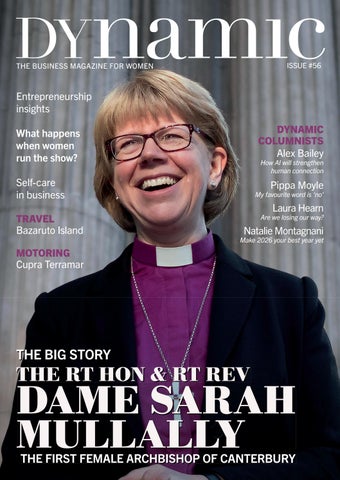
ISSUE #56
THE BUSINESS MAGAZINE FOR WOMEN
Entrepreneurship insights DYNAMIC COLUMNISTS Alex Bailey
What happens when women run the show?
How AI will strengthen human connection
Self-care in business TRAVEL Bazaruto Island
Pippa Moyle
My favourite word is ‘no’
Laura Hearn
Are we losing our way?
Natalie Montagnani
Make 2026 your best year yet
MOTORING Cupra Terramar
THE BIG STORY
THE RT HON & RT REV
DAME SARAH MULLALLY THE FIRST FEMALE ARCHBISHOP OF CANTERBURY
CONTENTS
ISSUE 56
Sisters. ❛Mothers. ❛ Friends. Professors.
When women affirm women, it unlocks our power. It gives us permission to shine brighter.”
20
THE BIG STORY
DAME SARAH MULLALLY For the first time in 1,429 years, the Archbishop of Canterbury is a woman. Dynamic chronicles her rise within the Anglican church
News
6 Upfront: The top international news stories involving women in business 14 In the Right Direction: Good news stories from around the world
Finance
8 Kreston Reeves Is starting a business on your New Year’s Resolution list?
28 Spotlight Focusing on Suzie Thompson and Amy Wonnacott – two women who deserve more recognition than they current receive 30 Entrepreneurship insights Lessons from launching and scaling a business successfully 32 From the ‘Great Resignation’ to the ‘Great Re-entry’ Women who left their work roles during Covid are now going back
Regulars
Features
4 Dynamic Awards 2026 Offering you a unique sponsorship opportunity
PLATINUM MEDIA GROUP
2
www.platinummediagroup.co.uk
38 Gudiya Dagur Patel Your business depends on self-care
Art
40 Art ‘Clay Paintings’ – Kellie Miller on the works of Isobel Merrick
Further Reading
36 Dr Samantha Hiew Human-first neurodiversity – cultivating understanding, not just awareness 42 Bazaruto Island Tess de Klerk explores the astonishing archipelago off the coast of Mozambique
12 The Laura Hearn Column Are we losing our way? Laura on how best to ‘keep it human’
18 The Natalie Montagnani Column Let’s make 2026 our best year yet
Wellbeing
Travel
10 The Alex Bailey Column How AI will strengthen human connection at work in 2026
16 The City Girl Column My favourite word is ‘no’. Don’t be afraid to use it
Elaine Welteroth Author, Journalist, Editor & Television Host
34 34 Namibia What happens when women run the show?
Events
26 Dynamic Awards 2026 Back for their fifth year, the premier awards for women in business is open for entries
Wine & Dine
46 Taro A new Japanese experience in the heart of Brighton
Girl Torque
48 Cupra Terramar Fiona Shafer of MDHUB struggles with liking Spain’s new offering
What’s On
50 A brief snapshot of what’s on in Sussex and Surrey
All rights reserved. The views expressed in this publication are not necessarily those of the publisher. The publisher cannot accept responsibility for any errors or omissions relating to advertising or editorial. The publisher reserves the right to change or amend any competitions or prizes offered. No part of this publication may be reproduced without prior written consent from the publisher. No responsibility is taken for unsolicited materials or the return of these materials whilst in transit. Dynamic Magazine is owned and published by Platinum Media Group Limited.
EDITOR’S NOTE Welcome to another brand new year. No big bang necessary. Most of us are not walking into January with a perfect plan and endless energy - and that’s fine. What matters is moving forward with the wisdom gained last year, being honest about what works for us and being brave enough to face what no longer does. That sense of focus runs through this issue of Dynamic. Our Big Story features Dame Sarah Mullally, the first woman to become Archbishop of Canterbury. Her story is not about symbolism alone but about leadership built steadily over time, shaped by service, empathy and conviction. It’s a reminder that progress and commitment run hand in hand. Our regular columnists explore themes that feel especially relevant right now. Alex Bailey looks at how AI can strengthen human connection at work when used thoughtfully. Laura Hearn asks what happens when we rely too heavily on technology to do our thinking for us and why trusting our own judgement and intuition is paramount. And urgent. Pippa Moyle writes candidly about learning to say ‘no’ and how that shift can be quietly powerful. Natalie Montagnani sets out a clear and motivating way to approach the year ahead, with confidence and momentum. Further on in Dynamic, we look at the shift of power in Namibia toward a female-led nation, the realities facing women-led businesses and why self-care needs to be treated as a professional priority, not an indulgence. There’s also space, as always, for fabulous food, travel and culture, offering perspective alongside inspiration. This month I’ll sign off with Natalie Montagani’s words, “Let this be the year you trust yourself more deeply, back yourself more boldly and rise more intentionally. Your best year yet begins now… let’s go!”
Editor, Dynamic Magazine tess@platinummediagroup.co.uk
CONTACTS
PUBLISHER: Maarten Hoffmann maarten@platinummediagroup.co.uk EDITOR: Tess de Klerk tess@platinummediagroup.co.uk MOTORING EDITOR: Fiona Shafer fionaas@platinummediagroup.co.uk COMMERCIAL DIRECTOR: Lesley Alcock lesley@platinummediagroup.co.uk EVENTS DIRECTOR: Fiona Graves fiona@platinummediagroup.co.uk HEAD OF DESIGN / SUB EDITOR: Alan Wares alan@platinummediagroup.co.uk
WWW.PLATINUMMEDIAGROUP.CO.UK www.platinummediagroup.co.uk
3
FE ATURE
BE PART OF THE SUCC A unique sponsorship oppo
N
ow in their fifth year, The Dynamic Awards are designed to recognise and reward women for their hard work and huge contribution to the South East business community. Following the overwhelming success of this event in 2025, and a high demand from businesswomen across the South East, the 2026 Dynamic Awards will welcome entries from Sussex, Surrey, Hampshire and Kent. Winning a Dynamic Award has rapidly become the most sought-after accolade in the region. Sponsoring an award offers a fantastic opportunity to position your brand alongside a prestigious, high-profile event with comprehensive marketing support, whilst demonstrating your commitment to this highly influential demographic. The awards offer up to six months of intensive marketing including significant support from Platinum Business Magazine, the largest circulation business magazine in the UK, Surrey Business Magazine, the county’s largest circulation magazine, and Dynamic Magazine, the UK’s leading business women’s publication, reaching over 720,000 business readers each month. The intense social media campaign will spread the word to a national audience. Each sponsoring company puts forward the judge for their category, offering the opportunity to network with key influencers whilst enforcing your organisation’s support for this all-important demographic, and assisting in levelling-up the UK business community. This is a must-attend gala event that sells out every year with an audience of 500 business leaders from across the region coming together to celebrate the huge contribution that women make to the country’s balance sheet.
4
www.platinummediagroup.co.uk
AWARDS CEREMONY: MARCH 26TH GET INVOLVED CONTACT US
dynamic@platinummediagroup.co.uk 07767 613707 Get in touch now as availability is limited
CESS STORY ortunity CATEGORIES AI Excellence Award Small Business of the Year (-500k) Medium Business of the Year (500k-£2m) Large Business of the Year (2m+) Best Customer Service Award Best New Business Award Business Growth Award Employer of the Year Future Talent of the Year Gamechanger of the Year Inspirational Award Professional Services Award Property Professional of the Year Women in Tech Award MD of the Year Businesswoman of the Year Company of the Year
SPONSORSHIP BENEFITS
Sponsoring the Dynamic Awards is a fantastic opportunity to demonstrate your commitment to recognising and supporting business excellence throughout this region. In addition, we offer a range of unique marketing opportunities for all sponsors aimed at brand awareness, new business development and general marketing campaigns that drive business forward. As Platinum own and publish all the business media across the South East, such benefits are a well proven method For more details about sponsorship, get in touch – dynamic@platinummediagroup.co.uk
www.platinummediagroup.co.uk
5
NE WS
NE WS
NATWEST EXCEEDS FEMALE INVESTMENT TARGET NatWest surpassed its headline commitment at the end of 2025 to lend £2 billion to women-led businesses, announcing that it has already delivered £2.84 billion in funding across almost 56,000 loans. The achievement comes a full year ahead of schedule and reinforces the bank’s role as one of the UK’s largest backers of female entrepreneurship. The average loan size was around £50,700, with high demand across a wide variety of sectors. Health-related enterprises received the most support, followed by leisure, commercial real estate, retail and professional services. Regionally, London led the way in total lending, closely trailed by the South East, North West, Scotland and the South West — signalling the breadth of economic activity driven by women-run companies nationwide.
NESTLÉ WITHDRAWS BABY FORMULA PRODUCTS Nestle has issued a global recall of some baby formula products over concerns they contain a toxin which can cause food poisoning. The food and drink giant, previously criticised for aggressive marketing of baby formula products, said specific batches of its SMA infant formula and follow-on formula were not safe to be fed to babies. The batches were sold across the world, Nestle said, and they potentially contain cereulide, which can cause nausea and vomiting when consumed. The company said there had been no confirmed reports of illness associated with the products, but was recalling them “out of an abundance of caution”.
WOMEN’S SEXUAL HEALTH COMPANY ATTRACTS ANGEL FUNDING Mint Ventures, a Scottish business angels group has led a round investing in MyBliss in a company pioneering women’s sexual health, alongside co-investors Alma Angels and Lifted Ventures. MyBliss was founded by Huddersfield-based Mo Carrier after her experience with the
side effects of hormonal contraception. It is now developing its flagship condom product through a £100,000 Innovate UK–funded project with the University of Manchester. It is also due to launch an intimate gel. Gillian Fleming, managing director of Mint Ventures, said: “We are
thrilled to support My Bliss and their visionary team. Their commitment to improving women’s health through evidence-based innovation aligns perfectly with our mission to back diverse founders who are changing the world for the better.”
UPFRONT THE LATEST BULLETINS FROM AROUND THE WORLD
GOVERNMENT LAUNCHES WOMEN IN TECH TASKFORCE
BRITISH BUSINESS BANK RECEIVES FURTHER BOOST
Women across Britain will be better supported to enter, stay and lead in the UK’s tech sector as Technology Secretary Liz Kendall launches the Women in Tech Taskforce.
The British Business Bank has agreed to invest £30m to the Invest in Women Taskforce’s Women backing Women fund.
Every year, the economy loses an estimated £2 – £3.5 billion because women leave the tech sector or change jobs due to barriers that should not exist. Ms Kendall is seeking to change that, having convened the first meeting of the Women in Tech Taskforce at the British Science Association in December. It is bringing together leading industry figures and experts from across the tech ecosystem. This initiative will advise the government on how to better support diversity in tech and ensure the UK accesses the full talent pool, market opportunities, and innovation capacity needed for economic growth.
6
www.platinummediagroup.co.uk
The taskforce was formed following the landmark Rose Review, which found that putting serious funding behind women entrepreneurs could not only help reduce the inequality female founders face, but also add significantly to the UK economy. The British Business Bank initially committed £50m to the Invest in Women Taskforce, which it doubled in June. With its new contribution to the fund of funds led by Bootstrap4F alongside Barclays, M&G, and Nationwide, its total investment in the taskforce has been brought to £130m.
DECLINE IN EMPLOYMENT IN WOMEN-LED FIRMS Women are entering entrepreneurship in record numbers, but new analysis from Prowess shows a sharp decline in women-led employer firms since the pandemic. The problem isn’t ambition — it’s access to finance, policy misalignment and a system that still makes growth harder for women. Women’s entrepreneurship in the UK has reached a turning point, and not the one policymakers expected. While more women than ever are starting
businesses and entering selfemployment, the number of womenled companies with employees has fallen sharply since the pandemic. The report ‘The State of Women’s Enterprise 2025’ – shows that growth-potential firms led by women are being squeezed out just as the UK economy needs them most.
❛❛
“When life is giving you lemons, squirt somebody in the eye.” – Cathy Guisewite
SWEDISH COMPANY ALLOWS DAYS OFF FOR WELLBEING
NEW GOVERNMENT ROLE FOR SCOTTISH BANKING CEO
Staff at a major Swedish pharmacy chain are being given paid time off to spend with friends, as Sweden’s government calls on businesses to help tackle loneliness.
Scottish banker Dame Debbie Crosbie is taking on a UK Government role to help women take key roles in the financial services sector.
Yasmine Lindberg, 45, is one of 11 participants taking part in the pilot “friendcare” scheme for the pharmacy group Apotek Hjärtat. “I’m exhausted when I go home. I don’t have time or energy to meet my friends,” she explains, before restocking a shelf of paracetamol.
Dame Debbie, chief executive of Nationwide Building Society, becomes Women in Finance Champion, succeeding Aviva’s Dame Amanda Blanc, whose five-year tenure has seen senior female representation rise from 32% to 36%.
Yasmine spends a lot of her free time with her teenage children, who live with her every other week. But she admits to feeling “quite lonely” since separating from her partner four years ago, which has led to fewer social invitations from couples in their network.
NEW APPOINTMENT AT WOMEN’S BUSINESS UNIVERSITY She’s In Business, a pioneering, triple accredited, women-led business university, has announced the appointment of Deidre Beacham as Strategic Partner in a 90-day collaboration designed to scale impact, accelerate operational excellence, and strengthen the university’s position as a global force in female entrepreneurship. With fewer than 2% of female founders ever reaching £1m in revenue, ambition or drive aren’t the issues; it’s in access to high-level mentorship, strategic education, and donewith-you business building. She’s In Business was created to close that gap, blending accredited learning with handson execution to help women build profitable, purpose-led enterprises in real time.
❛❛
“Women who want to be equal with men are not ambitious.” - Marilyn Monroe
It is an unpaid, direct ministerial appointment reporting to the Economic Secretary to the Treasury. Chancellor Rachel Reeves, said: “When I became Chancellor, I said my time in office would be a success if more young women and girls knew there should be no ceiling on their ambition and no limit to what they can achieve.”
POST OFFICE SCANDAL VICTIM AWARDED OBE The oldest surviving victim of the Post Office Horizon IT scandal has been appointed Officer of the Order of the British Empire (OBE) for her services to justice after campaigning against wrongful prosecutions. Betty Brown, 92, ran the Annfield Plain Post Office in Co Durham with her late husband, Oswall, from 1985. They were forced out in 2003 after spending more than £50,000 of their savings to cover non-existent shortfalls. She recently received her long-awaited settlement from one of the government’s compensation schemes.
www.platinummediagroup.co.uk
7
FINANCE
By Alison Jones, Partner, Kreston Reeves
Is starting a business on your New Year’s resolutions list?
A
fter more than 30 years advising entrepreneurs, many of them brilliant, determined women across the South East, I’ve learned the most successful businesses aren’t always the ones with the biggest budgets or flashiest ideas. They’re built on solid, sensible foundations and with determination and passion. If you’re taking your first steps into business ownership, this “back-to-basics” guide will help you start with clarity and confidence. CHOOSING THE RIGHT BUSINESS STRUCTURE For many people starting out, becoming a sole trader is the simplest route. It’s quick to set up and easy to manage, but you’ll have full personal responsibility for any debts and that’s an important consideration.
UNDERSTANDING YOUR FINANCIAL RESPONSIBILITIES You’ll need to keep accurate financial records, track income and expenses, and organise receipts. Good bookkeeping is the difference between a business that thrives and one that constantly feels chaotic. How can you manage a business if you don’t track your cash or profit position? This is why many businesses fail in the first year, so don’t fall into this trap. You can manage this yourself with cloud accounting software, but many new business owners choose to outsource the bookkeeping early on, to focus on building up their business.
“For many people starting Tax obligations will vary depending your structure. Sole traders pay out, becoming a sole trader on Income Tax and National Insurance A limited company provides more on profits. Limited companies pay is the simplest route.” protection because it separates your business finances from your personal ones. It can also look more professional to potential clients. It does come with extra admin costs, including annual filings with Companies House. If you’re going into business with someone else, you may also look at partnerships, but make sure you have a solid partnership agreement in place.
REGISTERING THE BUSINESS Once you’ve chosen your structure, there are a few simple steps to make it official. If you’re a sole trader, you’ll register your new business with HMRC for self-assessment. Limited companies register with Companies House, choosing a business name that’s unique and meets the naming rules. Whichever structure you choose, HMRC will issue you with a Unique Taxpayer Reference (UTR), which you’ll need for filing tax returns. It’s a good idea to set up your Government Gateway account early on. 8
www.platinummediagroup.co.uk
Corporation Tax, and their directors may also need to file personal tax returns. You only need to register for VAT once your turnover hits the threshold, but there can be benefits to registering early, so take advice. LICENCES, INSURANCE AND COMPLIANCE The nature of your business will determine whether you need any specific licences. Beauty therapists, food businesses, and childcare providers, for example, often require additional permissions or inspections. A few insurance policies are considered essential, including Public liability insurance, Professional indemnity insurance, and Employers’ liability insurance, which is legally required if you employ staff. If you’re handling customer data (and most businesses do), you may need to register with the Information Commissioner’s Office (ICO). FUNDING YOUR START Not every business needs external funding; however, there
“Not every business needs external funding; however, there are several accessible options.”
are several accessible options. Some start with personal savings or small loans from friends or family. Others apply for the government-backed Start Up Loan scheme, which includes mentoring alongside funding. Traditional bank loans are still a viable option, and here in the South East, we’re lucky; local enterprise partnerships and councils periodically offer grants for growth, innovation, or sustainability. Angel investors and crowdfunding can work too, though they demand more preparation and a strong pitch.
than perfection and some social media platforms work better for certain products, so do some research.
CRAFTING A USEFUL BUSINESS PLAN A business plan doesn’t need to be a 50-page document. In fact, some of the best I’ve seen fit on just a few pages and get straight to the point. Be clear on: • What your idea is • What problem you are solving • Who your customers are • How you’ll reach them • How you’ll price your product or service • What your first-year finances might look like • Why choose you
STARTING SIMPLE, BUILDING STRONG Starting a business is both exciting and daunting. With the right foundations, it becomes far more manageable. Take things step by step. Ask for help early. Remember, you don’t need to know everything on day one.
A good plan isn’t about impressing a bank; it’s about giving yourself direction and a purpose. BRAND, PRESENCE AND VISIBILITY Your brand is more than your logo; it’s the feeling customers get when they interact with you. Start with a clear message: who you help and why. A simple, well-structured website, even a basic one, can make a big difference. So can creating a Google Business Profile, which helps local customers find you. Choose one or two social media platforms rather than trying to be everywhere at once. Consistency matters far more
GROWING YOUR SUPPORT NETWORK No one builds a business alone. Sussex for example has a thriving community of networking groups, coworking hubs, and mentoring programmes. These spaces provide not only knowledge and encouragement and that sense of being surrounded by people who “get it” which can be invaluable.
Also, don’t neglect your own health and well-being on the journey. Make time to prioritise your own needs as well as those of your customers. So why not make 2026 the year that you launch your new business. I would be delighted to meet up for a coffee and hear all about your ideas and ambitions.
Call: +44 (0)33 0124 1399 Email: Alison: alisonjones@krestonreeves.com Visit: www.krestonreeves.com www.platinummediagroup.co.uk
9
FE ATURE
The
Alex Bailey Column
COMPANY OF THE YEAR 2022
We are delighted to hav Co-Founder, with 20+ y organisational change. delivering impactful pro
HOW AI WILL STRE CONNECTION AT W By Alex Bailey
W
e will be hearing a lot more this year about augmenting AI into our work and our roles as more people explore it to sustain performance. This is particularly relevant with the increased pace and volume of changes affecting us at all levels. With AI pop-ups and tabs available on most platforms, those who are more experimental will try the suggestions when available, but that allows AI to guess what we need. As humans, we have to tap into our consciousness intentionally and be more in control of what we do, how and why. As a psychologist, I am often asked how AI will affect human interaction. People already recognise the increased dispersion of our workforces through hybrid, remote and global working, and we can use AI to improve our human connection – but how to start? We’ve all had an email or text that is obviously written by AI, or is it? We question whether the person really sounds like that because we are highly attuned to how people speak, write, and express themselves, even without the nonverbal cues present in person. I’m still writing all my own emails, because I know when I receive one of those that is AI-engineered, for whatever reason, it is helping that person, and the connection between us feels instantly lost. So how can we use AI beyond simple email responses to support our human connections at work this year? FINDING HIDDEN CONNECTIONS AI will increasingly appear in our work systems to offer more than just personal support, but team, project and organisational insights. Imagine working on a strategic plan and uploading it to a shared database to receive a message linking you to someone you’ve not met before, who has just completed a similar plan in your organisation. The chance to link with that person increases enterprise-wide collaboration and efficiency opportunities, as well as personal growth potential through mentoring and 10
www.platinummediagroup.co.uk
supporting each other. Further to this, by surfacing shared interests, values, and expertise across teams, AI can help colleagues discover common ground and build authentic relationships that might otherwise remain hidden within an organisation or beyond. Currently available example systems that do this are Microsoft Graph and Viva Topics as well as platforms like LinkedIn. EMPATHY BUILT IN Not everyone is blessed with the ability to be empathetic, or even if they are, perhaps the stress and time pressure impact them when under strain. AI can play out multiple scenarios to identify how people might be experiencing our messages. This rapid sentiment analysis can offer real-time feedback so we can adjust our tone in the moment for the best impact. This helps us avoid damage to trust and psychological safety, which is harder to rebuild and recover later. Currently
“AI will increasingly appear in our work systems to offer more than just personal support, but team, project and organisational insights.”
ve Alex Bailey contributing to Dynamic. She is a Global CEO and years of expertise in HR leadership, psychology, coaching, and She specialises in cultural evolution, leadership,and performance, ogrammes globally while speaking at international events.
ENGTHEN HUMAN WORK IN 2026 available example platforms for meeting sentiment analysis include: Read.ai , Knapsack and Insight7. MORE TIME FOR WHAT MATTERS One of AI’s most powerful contributions is supposedly freeing humans from repetitive tasks. Instead of spending hours compiling weekly performance reports, leaders can rely on AI to automate the process. That reclaimed time can be invested in open forums, storytelling sessions, or one‑to‑one conversations, and these are the moments where authentic connection thrives. But do we actually do it? I know I enjoy using AI to support my work in many ways and automate tasks quickly, but do I really then repurpose the time saved with my team for connection, or do I allow the AI questions to draw me into the rabbit hole of interesting in-depth analysis? This is where we must recognise when we must stop, reset and re-prioritise, often at multiple points throughout the day.
“AI can help colleagues discover common ground and build authentic relationships.”
INCLUSION IN HYBRID & GLOBAL TEAMS In a global workplace, connections often reduce across both time zones and languages. It can be hard to keep up with different cultural celebrations and the nuances that local language applies, particularly to the delicate fabric that builds relationships through understanding and trust. AI‑powered translation and scheduling tools can have a rapid impact. Picture a team meeting with participants from Tokyo, Abu Dhabi, and Houston: AI translates conversations instantly and adjusts scheduling to respect local time zones and celebrations/holidays. Everyone feels equally included, no matter where they are. Example tools for AIpowered translation include: Microsoft Translator, DeepL and scheduling assistants such as Clockwise or Motion, which ensure meetings respect diversity. HUMAN AGILITY, MEASURED AND EMBEDDED Finally, AI is making human connection measurable. By tracking wellbeing indicators like meeting fatigue or engagement levels, AI alerts leaders when connection is dropping. Leaders can respond with shorter check‑ins or rotating facilitation roles, embedding human agility into the operating system of the business. Microsoft Viva Insights offers monitoring of collaboration patterns, meeting overload and focus time, giving leaders signals of disengagement or declining connection. The future of work is inviting us to use technology to deepen our humanity. In 2026, AI can help leaders move beyond efficiency and automation into empathy and authentic connection. The organisations that thrive will be those that treat human connection not as a soft skill, but as a strategic asset and use AI to make it stronger every day.
Alex Bailey styled by Gresham Blake Email: Alex@baileyandfrench.com www.baileyandfrench.com Insta @alexbaileybackstage Follow me on LinkedIn: www.linkedin.com/in/ alex-bailey-26562b2/ www.platinummediagroup.co.uk
11
FE ATURE
Laura Hearn is a former BBC journalist, now storytelling consultant and founder of Flip It - a podcast and platform helping people and businesses use storytelling as a tool for clarity, connection and change. This month, for Dynamic, Laura questions if AI could be being used to manipulate our thinking
Are we l By Laura Hearn
A
few weeks ago, I was having a conversation with a friend, who just so happens to also be a pretty bad-ass CEO of a large global tech firm. Over a cup of overpriced tea, she told me about a decision that she admits challenged her own moral compass. She sat on it for a few days before running it by her daughter, who said, “Why don’t you ask ChatGPT?” We’re living through something that researchers are calling “knowledge collapse” - with implications that are far more subtle and insidious than the term suggests. It’s not whether AI will deem us all redundant, but whether we are losing our ability to know what we don’t know. THE WORLD IS DRIFTING TOWARD A SINGLE CENTRE OF TRUTH The systems we increasingly rely on to tell us what is true and what is worth knowing are trained predominantly on a narrow slice of global experience. The largest public datasets used to train AI models are overwhelmingly shaped by Western, English language, digitised material. This does not mean AI is malicious. It simply reflects what is available to it, what we humans tell it. Which means it cannot learn from oral knowledge which has passed between generations without ever touching a keyboard. It cannot learn from indigenous ecological systems, which evolved through observation rather than documentation. It cannot learn from the lived experience of communities that do not exist online in a way the algorithm can parse. The result is a world that appears increasingly homogenous, not because it is, but because our tools cannot see its full texture.
“We’re living through something that researchers are calling ‘knowledge collapse’ – with implications that are far more subtle and insidious than the term suggests.” 12
www.platinummediagroup.co.uk
THERE IS ANOTHER CHANGE HAPPENING TOO The individuals and companies building these tools are becoming harder to reach. Journalistic access is narrowing. Questions are being filtered. Interviews are either tightly choreographed, edited to an inch of their life or avoided altogether. And the people with the most influence are the least accessible and escape accountability. But perhaps what saddens me most is how these forces converge to
losing our way? weaken the most important navigational tool we have – our human compass. That inner sense of knowing. The feeling that something is off. The instinct that nudges you to question the obvious. The intuition that has guided humans for thousands of years, before algorithms existed. The moral compass that my friend struggled to find.
“Our human compass is still there. It is at times being quietened - even silenced, but it is not lost. The work for all of us is to listen to it.”
Instinct is not anti-intellectual. It is the culmination of lived experience, emotional memory, pattern recognition and embodied wisdom. It is how our ancestors navigated the land and oceans. It is how parents know when something is wrong. It is how leaders make decisions that data cannot fully explain. It is how journalists notice what others overlook. But like any muscle, it weakens through lack of use. And we are using it less. The kind of knowing you cannot outsource. I don’t have a tidy answer, but I know it starts with noticing. Noticing when we reach for the algorithm instead of our own judgment. Noticing whose voices are missing from the conversation. Noticing when access to people and information is being quietly restricted while we’re being told it’s being democratised. It starts with asking better questions. Not just “what does the data say?” but “whose data? Measured how? Leaving out what?” Not just “what’s the most common answer?” but “what
are the uncommon answers, and why might they matter?” And perhaps most importantly, it starts with your own internal instinct that something doesn’t add up, that sense that there’s more to the story, that feeling that the consensus might be wrong. Those are profoundly human capacities, honed over millennia. We can’t afford to lose them to the convenience of algorithmic certainty. Once we do, we won’t just have lost knowledge, we’ll have lost the compass that helps us navigate towards wisdom in the first place. HOW DO WE FIND OUR WAY BACK? The solution is not to reject technology. It is to remember that technology is a tool, not a compass. It can inform, but it cannot orient. It can answer, but it cannot interpret. It can reflect, but it cannot see. To rebuild our human compass, we have to practice the habits that keep it alive. • Real-life conversation • Curiosity without agenda • Proximity to real people • Listening for what is unsaid • Noticing whose voices are missing •A sking questions even when they feel uncomfortable These small acts strengthen our ability to understand rather than simply consume. Technology will keep evolving. Algorithms will become more convincing. Gatekeepers will continue to manage access. But the stories that move us… the decisions that define us and the relationships that sustain us will always depend on our capacity to feel, sense, question and know. We do not need to return to a pre digital world. We simply need to remember how to navigate the one we are in. Our human compass is still there. It is at times being quietened - even silenced, but it is not lost. The work for all of us is to listen to it. And most importantly, to trust it.
You can listen to Laura’s podcast, Flip It, wherever you get your podcasts, and you can connect with her at www.flipitglobal.com www.platinummediagroup.co.uk
13
NE WS
SCALE OF THE UK’S ‘WINDUSTRIAL REVOLUTION’ REVEALED
The UK’s offshore wind sector has grown from a single 4MW project in 2000 to a major energy force producing 16,000MW today, according to new analysis. The report, published by energy thinktank Ember, describes the transformation as a “windustrial revolution” that now powers millions of homes and employs around 40,000 people. The rapid expansion has played a key role in the UK’s move away from coal and helped lift renewables to around 60% of national electricity generation, underlining the scale of change achieved in a single generation.
IN THE RIGHT
DIRECTION GENE THERAPY SHOWS PROMISE AGAINST ‘UNTREATABLE’ BLOOD CANCER A pioneering gene therapy developed in London has delivered long-term remission in patients with previously untreatable T-cell leukaemia. The treatment, created by researchers at Great Ormond Street Hospital and University College London, reprogrammes donor T-cells to attack cancer without harming
healthy tissue. Trials involving children and adults showed the majority entered deep remission, with several remaining cancer-free years later. Scientists describe the therapy as a major breakthrough in personalised medicine, demonstrating how targeted gene editing could transform outcomes for aggressive blood cancers.
MONTHLY INJECTION OFFERS HOPE FOR PEOPLE WITH SEVERE ASTHMA A new monthly injection has shown strong results for people with severe asthma who rely on daily steroid tablets. In an international trial led by King’s College London, most participants receiving the drug tezepelumab were able to reduce or stop steroid use without worsening symptoms. The treatment works by calming immune responses that trigger lung inflammation. Researchers say the findings are encouraging, particularly
14
www.platinummediagroup.co.uk
given the serious long-term side effects associated with steroid tablets, and could mark a significant shift in how severe asthma is managed.
❛❛
“I try to take one day at a time, but sometimes several attack me at once.” Jennifer Yane
IMPROVED OVARIAN CANCER DIAGNOSIS New draft guidance from the UK’s National Institute for Health and Care Excellence now recommends agebased thresholds for the CA125 blood test, aiming to help GPs identify ovarian cancer earlier and with greater accuracy. The updated approach replaces the previous single cut-off level, which evidence suggests could miss cases in older women. By tailoring thresholds to age, the guidance reflects differences in how CA125 levels present across life stages, supporting faster referral and more timely diagnosis while reducing the risk of cancers being overlooked.
LONDON MURDER RATE FALLS TO RECORD LOW New analysis shows London’s murder rate is at its lowest level since records began in 2003. Data from the Mayor’s Office for Policing and Crime also points to a sharp reduction in youth homicides, alongside falling knife crime offences and hospital admissions related to knife
injuries. The figures challenge claims that violence in the capital is rising. City leaders say the progress reflects sustained investment in policing and prevention, while acknowledging that continued effort is needed to tackle the root causes of serious violence.
NEW YORK FASHION WEEK SAYS FAREWELL TO FUR New York Fashion Week has confirmed that animal fur will no longer appear on its runways, joining London and Copenhagen in banning fur from fashion week events. Campaigners welcomed the decision as another sign that fur is falling out of favour across the industry. Animal welfare groups say the move increases pressure on remaining fashion capitals that still permit fur on the catwalk. With designers increasingly turning to highquality alternatives, critics argue that fur now feels outdated, unnecessary and out of step with modern fashion values.
NEW OVERNIGHT TRAINS TO LINK NORTHERN EUROPE WITH ITALY Night train travel in Europe is set to expand again with a new service connecting Amsterdam and Brussels to Milan. The route is being launched by European Sleeper, a communityowned Dutch-Belgian railway company already operating international night services. Running three times a week, the
A FUR FARMING NATION CALLS TIME ON CRUELTY Poland has formally banned fur farming, drawing a line under one of Europe’s largest industries of its kind. The legislation, signed into law by President Karol Nawrocki, prevents new fur farms from opening and gives the country’s remaining 200 operations until 2034 to close, with financial compensation available for a limited period. The move makes Poland the 18th EU nation to outlaw fur farming, increasing pressure on those that still permit it. The decision follows sustained campaigning by animal
welfare groups, including a petition backed by tens of thousands of supporters.
journey will pass through Switzerland’s Simplon line, with stops including Cologne, Bern and Stresa on Lake Maggiore. The operator says the route supports growing demand for low-impact, city-centreto-city-centre travel and offers a viable alternative to short-haul flights.
❛❛
“Your job is not just to do what your parents say, what your teachers say, what society says, but to figure out what your heart calling is and be led by that.” Oprah Winfrey
www.platinummediagroup.co.uk
15
FE ATURE
Pippa Moyle is the CEO and founder of the City Girl Network, a mission-driven business dedicated to empowering and supporting women across the UK. Since launching in March 2016, the network has built a vibrant community of over 150,000 women, facilitating new friendships, business connections, job opportunities, housing solutions, and valuable life advice.
My favou By Pippa Moyle
I
used to follow that statement up with “after ‘yes’ that is”, but I recently realised that I’d only offer that quip through a visceral need to people-please. Of course, I love a ‘yes’ to a campaign idea, a new client signing or an event invitation, but ‘no’ holds the key to so much more. Close your eyes with me and visualise for a moment: what do you think of when you hear ‘no’? How does your body react? What’s the next thing you want to do? What does your environment look like when you’re having those thoughts? A year ago, I would have told you that my tense body was readying itself for fight-or-fl ight mode that I do not welcome nor enjoy, surrounded by a dark emptiness. ‘No’ is rejection; ‘no’ is bad. Yet, somehow, after years of building an intolerance to ‘no’, I enter this new year with a whole new perspective and a new favourite word.
“A year ago, I would have told you that my tense body was readying itself for fight-or-flight mode that I do not welcome nor enjoy, surrounded by a dark emptiness.”
16
www.platinummediagroup.co.uk
‘NO’ IS AN ANSWER Let’s start with the moment that I realised how much I loved ‘no’. It was a crisp, blue-skied afternoon in February, walking my dog through the nearby meadow, when I broke the ‘digital detox in nature’ rules of checking my emails for the third time. “I’m sorry, Pippa, but it’s a no from us,” wrote a target customer that I’d been schmoozing. I had subconsciously braced myself for the wave of rejection, self-deprecation, and failure-shaming that would
urite word is ‘no’ follow. Yet, instead, I let out a deep breath of relief. I could take the anticipation and uncertainty that came from putting that proposal together and let it go. There are dozens of proposals floating around in my target clients’ inboxes. Some are stuck in the ‘maybe’ limbo, some in the ‘another day’ folder, and the rest are in a holding pen of doom (lovingly known as ‘the bin’). Whatever the folder, they’ve all become ghosts. ‘No’ gives them the closure that those ideas deserve.
the one saying it. Mastering the art of saying ‘no’ is a whole lesson in itself, especially if, like me, you were conditioned to view kindness as compliance. Softness is saintly, sacrifice is admirable, our time is infinitely elastic if it serves someone else’s need, and to say ‘no’ is to break an unspoken social contract. A contract that neither you nor I have ever signed. It would be fun for me to write a visual piece here about burning that contract to the ground with an almighty ‘NO’. But there’s a more authentic angle I need to impart: it’s kind to say ‘no’.
“I don’t want to romanticise ‘no’ as a word that lands softly. But It’s better to stand disappointed we can take that energy and turn than in discontent. it into a shot of adrenaline.” It gives both parties certainty, ‘NO’ IS A LESSON No is their answer, but it’s your lesson. Sometimes it comes with feedback from the responder, but more often it comes from within yourself.
honesty and clarity. I’m regularly pitched to by workshop practitioners and professionals looking to reach our audience through events. Sometimes their ideas suit our audience, sometimes they don’t.
In the case of the aforementioned sunny February dogwalk ‘no’, my relief came from not having to face my fear of speaking on camera. It’s not something I considered at the time of writing the proposal – I thought the legal side would be more daunting – but that fear of speaking on camera has always held me back. Thus, I identified a growth project to work on.
In the case of the latter, my ‘no’ reaffirms our company’s values, as well as saving the practitioner time and energy chasing up the idea. Their reaction to the ‘no’ also helps me decide whether they’re the right partner to collaborate with in the future.
Other ‘no’ responses have taught me to look at my business from different perspectives. It highlighted cracks that I was too close to see, taught me how to communicate my message and helped me shape our core values. ‘NO’ IS KIND There’s a difference between being given a ‘no’ and being
‘NO’ IS AN ADRENALINE BOOST I don’t want to romanticise ‘no’ as a word that lands softly. It is, after all, a word powerful enough to awaken savage emotions of hate, rejection and loss. But we can take that energy and turn it into a shot of adrenaline. I heard ‘no’ more in 2025 than ever before in my working life. But I also heard ‘yes’ more too. All because I stopped being scared of a ‘no’ and started putting myself in the firing line for it. In fact, I made a game out of it. For every ‘no’ I receive, I have to pitch the idea to another brand within 24 hours. ‘No’ may not open one door, but it will always lead to another.
Pippa Moyle CEO + Founder citygirlnetwork.com Our Communities: Brighton, London, Manchester, Bristol, Bath, Leeds, Edinburgh, Birmingham, Worthing, Liverpool, Newcastle, Chester, Milton Keynes, Oxford, York, Cardiff, Glasgow, Perth and Rural Sussex www.platinummediagroup.co.uk
17
FE ATURE
Natalie Montagnani is a Business & Leadership Coach and Business. With over 25 years’ commercial experience, she coaching, corporate workshops and events to lead and cla influence and commercial impact they deserve.
2026? LET’S YOUR BEST By Natalie Montagnani ‘Failures’ strengthen you, refine you, and prepare you. Let the lessons of 2025 fuel you, not follow you. Feel gratitude for the wisdom, grit and resilience they gave you.
NEW YEAR, NEW BEGINNINGS As the fabulous Ted Lasso once said, “I smell potential.” January arrives with a spark of possibility that is unlike anything else. We are invited to step into a fresh new year with a renewed sense of clarity and potential. This moment is more than symbolic; it’s pivotal and offers you a huge opportunity. EMBRACING THE LESSONS Women are often incredibly harsh on themselves. They look back on a year just passed with judgment and see only what they didn’t accomplish or what they should have. But what if last year wasn’t a problem to unpack, what if everything that challenged you, stretched you or made you doubt yourself was actually shaping you for what’s next? THE OPPORTUNITY Let’s reframe 2025 instead. Here are some powerful words from John Maxwell’s incredible book Failing Forward: “If the possibility of failure were erased, what would you attempt to achieve? It’s true that you risk failure if you try something bold because you might miss it. But you also risk failure if you stand still and don’t try anything new. Fail early, fail often, but always fail forward.”
Let this be the year you trust yourself more deeply, back yourself more boldly and rise more intentionally. Your best year yet begins now… let’s go! 18
www.platinummediagroup.co.uk
WHAT DO YOU ACTUALLY WANT? To step into your best year yet, you must ask yourself honestly: What do I want for 2026? Not the sensible or safe choice, or what others expect from you. The real vision — the business or career that feels aligned, the life that feels expansive, the income that feels liberating, the boundaries that feel empowering, the energy that feels sustainable, and the version of yourself who feels deeply proud of the world she’s building for herself and her family. Women rarely permit themselves to think this boldly. Yet this is the exact season asking you to. POSSIBILITY INTO POWER Clarity is the difference between a year of growth and a year of guessing. When you understand where you’re going, what matters most, and what needs your attention right
FIVE GUIDING PRINCIPLES FOR 2026 1. Clarity over chaos What feels aligned? Not what looks impressive or what you’ve been “shoulding” yourself about. Let desire lead your direction, and intuition choose your answers. 2. Set standards and goals Goals give you something to move towards, but standards define what you will no longer tolerate. A goal might say: “I want a promotion,” but a standard says: “I no longer abandon myself to please others.” Or a goal might say: “I want more clients,” but a standard says: “I only work
with people who resp tise and energy.”
3. Build the support Why do we feel that w the burden of everyth were never meant to Support isn’t a luxury ture that keeps you s Get a coach, join a co a women’s employee your organisation or o that drain you. A pow isn’t the one doing ev one who stops trying
d founder of IGNITE Women in e empowers women through aim the visibility, confidence,
“As the fabulous Ted Lasso once said, “I smell potential.” January arrives with a spark of possibility that is unlike anything else.”
S MAKE IT YEAR YET now, momentum becomes natural, not forced. Clarity helps you move forward and make decisions with the grounded certainty of a woman who knows exactly who she is and where she’s headed. When your identity rises, everything else rises with it — confidence, opportunities and impact. 2026: THE YEAR OF THE POWERHOUSE 2026 isn’t waiting for a ‘better’ version of you, it’s waiting for THIS version. The woman who has already walked through the lessons, gathered wisdom, survived storms and is now standing at the edge of a brand-new chapter with more strength, awareness and potential than she probably realises. Let this be the year you trust yourself more deeply, back yourself more boldly and rise more intentionally. Your best year yet begins now… let’s go!
pect my time, exper-
you need we should shoulder hing ourselves? You do any of this alone. y; it’s the infrastrucstanding as you grow. ommunity, launch e resource group in outsource the tasks werhouse woman verything; she’s the to.
4. Simplify to amplify When everything matters, nothing moves. So this year, apply the following ruthlessly: Do the things only you can do Ditch the things no longer align Delegate things draining your energy 5. Lead from who you’re becoming Your next level has nothing to do with your past and everything to do with the identity you’re willing to step into. Ask yourself: “How would the woman I’m becoming think? Decide? Speak? Show up?” Then start acting from that place today.
Natalie Montagnani Founder of IGNITE Women in Business 07900 153503 ignitewomeninbusiness.com Connect with Natalie on LinkedIn or drop her an email to natalie@ignitewomeninbusiness.com www.platinummediagroup.co.uk
19
STORY BIG
THE BIG STORY
DAME
SARAH MULLALLY
The first female Archbishop of Canterbury
In October 2025, His Majesty the King approved the nomination of the Bishop of London, the Right Reverend and Right Honourable Dame Sarah Mullally, as the next Archbishop of Canterbury. Alan Wares tells the back story of the woman who has broken down some of society’s final taboos.
B office.
ishop Sarah becomes the 106th Archbishop of Canterbury, a title dating back to 597 AD, when Saint Augustine arrived in Kent from Rome. Bishop Sarah will be the first woman to hold the
Born Sarah Bowser in Woking in 1962, Bishop Sarah became a Christian at the age of 16. Before being ordained, Bishop Sarah worked as a nurse in the National Health Service, which she has described as “an opportunity to reflect the love of God”. She received clinical training in nursing from St Thomas’ Hospital and worked both there and at the Royal Marsden
Hospital in Brompton, South West London, where she also began her study for ministry in the Church of England. She was ordained a priest in 2002 and began her ministry in the diocese of Southwark. She served in various London churches and, in 2012, became a canon of Salisbury Cathedral. Three years later, Bishop Sarah took the role of Suffragan Bishop of Crediton in the Diocese of Exeter. In May 2018, Bishop Sarah was installed as the 133rd Bishop of London at St Paul’s Cathedral, the first woman to hold the role. Bishop Sarah is married to Eamonn, and they have two grown-up children, Liam and Grace. Before that, she was the Bishop of Crediton in the Diocese of Exeter.
“In a career of firsts, Dame Sarah Mullally has been the Bishop of London since 2018, which also made her the first woman to be appointed to that role” 20
www.platinummediagroup.co.uk
Prior to her ordination in 2001, she was the Government’s Chief Nursing Officer for England – the youngest person ever to be appointed to that role at the age of 37 – having previously
© Roger Harris Photography
www.platinummediagroup.co.uk
21
specialised in cancer care. Bishop Sarah has described nursing as “an opportunity to reflect the love of God”. Bishop Sarah was made a Dame Commander of the Order of the British Empire in recognition of her outstanding contribution to nursing. She was ordained in 2001 and served her curacy in the Diocese of Southwark, initially as a self-supporting minister, before leaving her government post in 2004.
The most senior bishop in the Church of England, the Archbishop of Canterbury’s ministry combines many roles including serving as the Diocesan Bishop of the Diocese of Canterbury, Primate of All England and Metropolitan, as well as primus inter pares – or first among equals – of the Primates of the global Anglican Communion, which consists of around 85 million people, across 165 countries.
“She will be the first woman to hold the post, and only the second since the Middle Ages not to have a degree from Oxford or Cambridge universities.”
The Crown Nominations Commission (CNC) for Canterbury nominated Bishop Sarah following a process of public consultation and prayerful discernment that began in February 2025. The Canterbury CNC was made up of representatives from across the Church of England, the global Anglican Communion and the Diocese of Canterbury.
She was sworn of the Privy Council of the United Kingdom in March 2018, and was introduced to the House of Lords to sit on the Lords Spiritual benches two months later. She sits by virtue of her office (the Bishop of London is one of five Church of England bishops who automatically receive a Lords seat, independent of seniority). She succeeded Richard Chartres and became the first female dean of the Chapel Royal in July 2019. Bishop Sarah played a leading role in King Charles’ 2023 coronation, one of three female prelates involved in the ceremonies. On October 3rd 2025, the Church of England announced that Bishop Sarah would become the next archbishop of Canterbury, in succession to Justin Welby. As such, she will be Primate of All England and the metropolitan bishop of the Province of Canterbury. She will be the first woman to hold the post, and only the second since the Middle Ages not to have a degree from Oxford or Cambridge universities. She was elected by the college of canons in December 2025, with legal confirmation following at St Paul’s Cathedral on January 28th. At this point, she legally becomes Archbishop of Canterbury and ceases to be Bishop of London. She will then be formally installed at Canterbury Cathedral in March, marking the beginning of her public ministry in the role. Using language and vernacular clearly out of date for such a (belated) breakthrough, some conservative Anglican groups expressed their opposition to her appointment, based around her gender. Within the Church of England, the conservative evangelical Church Society stated that her election “creates additional problems of disunity in the Church in England and around the world” and voiced concern relating to her views on same-sex relationships.
Drawing of St Augustine of Canterbury, a sixth century emissary of Pop Gregory I, and the first Archbishop of Canterbury
22
www.platinummediagroup.co.uk
Meanwhile, the traditionalist Anglo-Catholic Forward in Faith organisation, which rejects the ordination of women as priests and bishops, recognised her as the “true and lawful holder of that office”. Some Anglican churches, particularly in Africa, opposed her due to their opposition to the ordination of women and to Mullally’s views on the blessing of same-sex couples. The Global Fellowship of Confessing Anglicans, a conservative Anglican group primarily based
Takaichi’s priorities for Japan’s foreign policy are for closer ties with the USA
The resplendent Canterbury Cathedral
in Africa and Asia, expressed its “sorrow” at Mullally’s appointment, saying that it proved that the Church of England “has relinquished its authority to lead”.
“Using language and vernacular clearly out of date for such a (belated) breakthrough, her appointment drew opposition from The Church of Uganda’s Stephen Kaziimba statsome conservative Anglican groups.” ed his “sadness” on Mullally’s appointment due to “her support and advocacy for unbiblical positions on sexuality and same-sex marriage that reveal her departure from the historic Anglican positions that uphold the authority of Scripture for faith and life”.
With that in mind, can anyone fail to understand the Church’s waning popularity and relevance now, given some of those regressive comments? However, other Anglican groups in Africa have supported her; Emily Onyango, the first female Anglican bishop in Kenya, said that Mullally’s election indicated that “things will be done differently ... We know there will be justice in the church”. Thabo Makgoba, the archbishop of Cape Town, said that Mullally’s election was a “thrilling development”.
SOCIAL VIEWS Bishop Sarah, on the other hand, is having none of that. She is a self-described feminist and has ordained both men and women. According to the Financial Times, Mullally “is seen as a theological liberal” (another unhelpful label, seemingly damning her with faint praise). However, she also supports the inclusion in the Church of England of those who reject the ordination of women, stating upon her announcement as the next Bishop of London: “I am very respectful of those who, for theological reasons, cannot accept my role as a priest or a bishop. My belief is that Church diversity throughout London should flourish and grow; everybody should be able to find a spiritual home.” www.platinummediagroup.co.uk
23
Dame Sarah Mullally’s new London residence, Lambeth Palace
In September 2016, she became one of ten bishops to make up the church’s “Bishops’ reflection group on sexuality”. In relation to same-sex relationships, she stated in 2017: “It is a time for us to reflect on our tradition and scripture, and together say how we can offer a response that is about it being inclusive love.” When asked about LGBT people in the church, she went further, and said: “What we have to remember is this is about people, and the church seeks to demonstrate love to all, because it reflects the God of love, who loves everybody.”
a continuum, I would be somewhere along it moving towards pro-life when it relates to my choice and then enabling choice when it relates to others.” In June 2025, she opposed new legislation that would extend abortion rights by decriminalising terminations in utero up to full term. Bishop Sarah signed an open letter from Anglican clergy that called the bill a “dangerous change” to the law.
“When asked about LGBT people in the church, she said: ‘What we have to remember is this is about people, and the church seeks to demonstrate love to all, because it reflects the God NEW ROLE of love, who loves everybody.’” Upon her ordination as
In 2018, Bishop Sarah stated that she supported the Church of England’s traditional teaching on marriage being between one man and one woman. In 2022, Mullally supported the observance of LGBT+ History Month and the launch of an advisory group to advise the diocese on “pastoral care and inclusion of LGBT+ people in the life of our church communities”. Previously, Mullally has described her views on abortion as favouring abortion rights, although she would lean against abortion faced with her own decision. She has said: “I would suspect that I would describe my approach to this issue as ‘pro-choice’ rather than ‘pro-life’, although if it were 24
www.platinummediagroup.co.uk
Archbishop of Canterbury, Bishop Sarah said: “As I respond to the call of Christ to this new ministry, I do so in the same spirit of service to God and to others that has motivated me since I first came to faith as a teenager. “At every stage of that journey, through my nursing career and Christian ministry, I have learned to listen deeply – to people and to God’s gentle prompting – to seek to bring people together to find hope and healing. “I want, very simply, to encourage the Church to continue to grow in confidence in the Gospel, to speak of the love that we find in Jesus Christ and for it to shape our actions. “And I look forward to sharing this journey of faith with
the millions of people serving God and their communities in parishes all over the country and across the global Anglican Communion. I know this is a huge responsibility, but I approach it with a sense of peace and trust in God to carry me as He always has.” Currently known as the Archbishop of Canterburydesignate, Bishop Sarah will legally become the Archbishop of Canterbury at her Confirmation of Election at St Paul’s Cathedral this month, with a service of installation taking place at Canterbury Cathedral in March. As communities move on, the Church of England continues its struggles to regain the power and authority it once had over Anglican society. Bishop Sarah not only has to appeal to an absent flock, but also to fight an ongoing internal battle within her own Church to placate those who don’t want her in the top job in the first place. But, as Margaret Thatcher once said, “If you want something said, ask a man; if you want something done, ask a woman.” It’s entirely possible that the Church of England has finally woken up to that mantra.
+
ARCHBISHOP OF CANTERBURY
The Roman province of Britannia had four archbishops, seated at Londinium (London), Eboracum (York), Lindum Colonia (Lincoln) and Corinium Dobunnorum (Cirencester). However, in the fifth and sixth centuries, Britannia began to be populated by Anglo-Saxons, who were pagan. Of the seven kingdoms they created, Kent arguably had the closest links with European politics, trade and culture, because it was conveniently situated for communication with continental Europe. In the late sixth century, several years before the arrival of the first Christian mission to England, King Æthelberht of Kent married a Christian Frankish princess named Bertha. At this point, he permitted the preaching of Christianity. The first archbishop of Canterbury was Saint Augustine of Canterbury. He led a delegation of 40 monks, who arrived in Kent in 597 AD, having been sent by Pope Gregory I on a mission to the English. He was accepted by King Æthelbert, on his conversion to Christianity, about the year 598. Pope Gregory, oblivious of recent developments in the former Roman province, including the spread of the Pelagian heresy, had intended the new archepiscopal sees for England to be established in London and York. In the event, Canterbury was chosen over London owing to political circumstances. Since then, the archbishops of Canterbury have been referred to as occupying the Chair of St. Augustine. Bishop Sarah Mullally becomes the 106th Archibishop of Canterbury, a role that had been vacant since January 2025, following the resignation of the previous Archbishop, Justin Welby. In November 2024, Welby had faced calls to resign, following the publication of the Makin Review into the Church’s handling of allegations of physical and sexual abuse committed by the barrister John Smyth at Christian camps in the 1970s and 1980s. The report criticised Welby for failing to follow up on his subordinates’ claims that they had passed on the matter to the police after he was informed of the allegations in 2013, and stated that it was “unlikely” Welby was not aware of concerns being reported about Smyth during the time of the alleged offences, as he had claimed.
Mullally’s predecessor in the role, Justin Welby, who resigned in disgrace in November 2024
Despite initially stating that he would not resign, on November 12th 2024, following mounting pressure from both victims and clerics, Welby announced that he had spoken to King Charles III, the Supreme Governor of the Church of England and would resign.
www.platinummediagroup.co.uk
25
RECOGNISING VISION. REWARDING LEADE
HONOURING THE WOMEN REDEFINING BUSINESS
SUSSEX • SURREY • KENT • HAMPSHIRE
FREE TO ENTER ENTRY DEADLINE: JANUARY 23RD EVENT: MARCH 26TH | THE GRAND BRIGHTON
SPONSOR A CATEGORY AND SUPPORT THE REGION’S LEADING WOMEN IN BUSIN
MAGAZINE 26
www.platinummediagroup.co.uk
ERSHIP. INSPIRING THE NEXT GENERATION. Do you work alongside a woman who inspires everyone around her? A leader, innovator, or rising star who truly deserves recognition?
NOMINATE HER FOR THE DYNAMIC AWARDS! VIEW CATEGORIES AND ENTER ONLINE WWW.PLATINUMMEDIAGROUP.CO.UK “I was honoured to have won and be part of a night of inspiration, powerful women and shared success.”
Fran Wyatt, Porky Whites LARGE BUSINESS OF THE YEAR 2025
“This award isn’t just an award, it represents all the hard work that happens both here on this platform and quietly behind the scenes”
Sophia Lorimer, Fine-Tuned Wardrobe SUSTAINABILITY CHAMPION AWARD 2025
Want to nominate someone but not sure where to start or which category fits best? Email us at events@platinummediagroup.co.uk
NESS. FOR MORE INFORMATION, EMAIL DYNAMIC@PLATINUMMEDIAGROUP.CO.UK
www.platinummediagroup.co.uk
27
SPOTLIGHT
In our exclusive Spotlight feature, we highlight women who are doing good things in their community. They’re not always seen but we think they should be.
SPOTLIGH T Suzie Thompson Co-founder of The Leadership Visibility Co and ODN Europe Board Member
I
’ve always been driven by people, helping them step into their potential, own their story, and lead from a place of truth. After more than 22 years in corporate life, I’ve co-founded The Leadership Visibility Co., a personal branding agency with a difference. We’re not just marketers. We come from lived experience: knowing what it’s like to have your voice dismissed, your presence questioned, and the emotional labour of being ‘othered’ in leadership spaces.
I started working at 16, with just my GCSEs and a strong will to prove the doubters wrong. My first role at Regus PLC exceeded expectations, financially and professionally, and led me into a long, rich career in advertising. It wasn’t always easy. In rooms dominated by men, I learned to stand my ground.
She’s bright, passionate, full of cheer and caught in a system that doesn’t flex for kids like her. That’s been heartbreaking. It’s also shown me how much we need to reimagine systems: in education, in business, in leadership.
to support her, nurture “Visibility, to me, is about Trying my eldest as she flourishes into a strong, curious woman, run a busimore than strategy. It’s ness, and still show up as me - it’s a about making space for the lot. Some days, it’s overwhelming. unheard, the underestimated, But the hardest moments came But it’s also why I do what I do. I and the quietly brilliant.” help people, especially women and later, in senior leadership, when I
28
was told to “hair up, heel up, leather up” if I wanted to be taken seriously. That didn’t just jar, it crystallised everything I was no longer willing to perform.
neurodivergent individuals, get visible, with clarity and confidence. Because too often, their stories are the ones left out.
The most valuable lesson I’ve learned is this: Authenticity isn’t a luxury, it’s a necessity. Especially when you’re juggling life as a mum to two daughters with very different needs. My youngest was diagnosed with autism last year and hasn’t been able to attend school due to anxiety.
Visibility, to me, is about more than strategy. It’s about making space for the unheard, the underestimated, and the quietly brilliant. It’s personal. It’s political. And it’s possible.
www.platinummediagroup.co.uk
leadershipvisibility.co.uk
Amy Wonnacott Amy is the Founder of Brighton-based social media agency, Lemon Drizzle
I
’m Amy Wonnacott, the founder of Lemon Drizzle, a social media agency built on the belief that visibility doesn’t have to be overwhelming. My tagline, “making social media a piece of cake,” reflects how I work: practical, human, but fun too. I help businesses of all sizes show up online with confidence and a clear strategy, without feeling pressured to post constantly or perform for the algorithm.
“I was made redundant twice, including just before Christmas from a high-profile role, and those moments forced me to rethink what success really meant to me.”
My journey to running Lemon Drizzle hasn’t been linear. After facing the loss of my mother at 18, I threw myself into varying sales and marketing roles. I was made redundant twice, including just before Christmas from a high-profile role, and those moments forced me to rethink what success really meant to me. Instead of shrinking back, I chose to rebuild, and Lemon Drizzle grew from that resilience. Today, I work with a diverse range of clients, from creatives and architects to accountants and growth-driven businesses, supporting them with strategy, content and clarity in a very noisy digital world.
business and in writing, is rooted in honesty, reinvention and showing up even when it feels uncomfortable. That’s why I proudly describe myself as the Comeback Queen.” www.lemondrizzlesocial.co.uk @lemondrizzlesocial
Alongside my work in social media, I’m also an author. My debut novel, An Old Wives’ Tale, is available on Amazon and Waterstones and explores relationships, identity and the quiet complexities of today’s influences. Writing allows me to tell stories more deeply and connect with people beyond metrics and analytics. Everything I do, both in www.platinummediagroup.co.uk
29
FE ATURE
“I honestly think entrepreneurship is often misunderstood. So let me tell you what it is for me.” By Marian Evans BEM
ENTREPRENEURSHIP
Lessons from launching and scaling a b
A
n entrepreneur is someone who identifies opportunity, mobilises resources, accepts risk and takes responsibility for the outcome. It is a way of thinking, one that makes it difficult not to act when you see potential. Once you recognise how something could work better, more efficiently or more sustainably, it becomes almost impossible to ignore. That mindset also explains why, like me, most entrepreneurs don’t do it just once. After building a multi-millionpound property business, my instinct was, and still is, to look for what’s next, or how I could improve, build or do things differently. Entrepreneurs tend to be impatient, endlessly curious and alert to opportunity everywhere. We see the risks clearly, but they do not put us off. There is a real thrill in committing, in backing yourself and in turning possibility into reality. BACKING YOURSELF STARTS WITH KNOWING YOUR NUMBERS Entrepreneurs are often described as risk-takers, but in reality, we are risk-aware rather than reckless. Knowing your figures is non-negotiable. Cash flow, margins, leverage and downside exposure are not details to outsource or review occasionally. They are the difference between control and guesswork. In property especially, where small miscalculations can have outsized consequences, understanding the numbers allows you to move decisively when an opportunity presents itself, and to walk away when it doesn’t stack up. Backing yourself does not mean ignoring risk. It means understanding it well enough to proceed with conviction, or not proceed at all. BUILD FOUNDATIONS BEFORE YOU CHASE SCALE One of the biggest mistakes I see entrepreneurs make is scaling too early. Growth amplifies everything, including weaknesses. In the early stages of building any of my businesses, the focus has always been conservative assumptions, disciplined cash management, robust legal structures and sound systems. 30
www.platinummediagroup.co.uk
Before scaling, entrepreneurs need to be honest with themselves. Is the business genuinely profitable, not just busy? Can it withstand market shocks? Does success rely on me personally, or on a system that others can operate? Strong foundations may slow early momentum, but they are what make long-term success possible. THE ENTREPRENEURIAL MINDSET DOESN’T SWITCH OFF Entrepreneurial thinking is not something you turn on and off. I still instinctively see inefficiencies, unmet demand and assets that are mispriced or underutilised. That instinct is a strength, but it requires discipline.
MARIAN EVANS BEM
“Entrepreneurs are often described as risk-takers, but in reality, we are risk-aware rather than reckless.”
P INSIGHTS:
business successfully
Entrepreneurs are naturally impatient. We want momentum, progress and improvement. The challenge is not finding opportunities; it is choosing which ones not to pursue. Focus, not enthusiasm, is what turns potential into value. One piece of advice I return to again and again is simple: just because you can, doesn’t mean you should. Time is your most precious resource. CASH MATTERS Revenue can flatter, but cash sustains. I have seen many good businesses struggle, not because the idea was wrong, but because liquidity was mismanaged. Strong cash control creates optionality. It allows you to grow on your own
Marian has been recognised in the King’s Honours for her contribution to business. Currently, she serves as Chair of Monmouthshire Building Society, making her one of the few women to lead a financial services board. She has also earned a place on the Forbes Midas List. Previously, she led Thomas Carroll’s Special Risks Division and held a senior role at NFU Mutual, managing a £58 million portfolio. Marian began investing in property at 18 and now owns a diverse portfolio, including the historic Llansteffan Castle. Today, she is a Non-Executive Director, executive coach and founder of Elevate Business Consultancy, and a Fellow of both the Institute of Leadership & Management and the Chartered Management Institute. terms, absorb shocks and avoid being forced into poor decisions. Particularly in cyclical sectors, this discipline is fundamental. SCALING REQUIRES A SHIFT IN LEADERSHIP In the early days, success is driven by effort and execution. As a business grows, judgment matters more than energy. Scaling requires letting go of control, trusting others and being willing to evolve your own role. Strong governance, external challenge and appropriate oversight are not constraints. They are enablers of better decisions. In my advisory work with founders and boards, the businesses that embrace this early are consistently more resilient and more investable. This is what I enjoy most about running an advisory firm: sharing experience and instinct to help other entrepreneurs thrive. RESILIENCE IS BUILT QUIETLY No entrepreneurial journey is smooth. Deals fall through. Markets turn. Confidence is tested. What matters is how you respond. For me, resilience comes from consistency, perspective and making rational decisions under pressure. Some of my toughest periods came while juggling personal demands, starting a family, raising young children and managing health issues. Failure was not an option, so the question was always how to get through it. We learn the most in the toughest times. FINAL REFLECTION Entrepreneurship is not about speed or perfection. It is about judgment, self-belief and disciplined execution. Entrepreneurs see risk, but they also see possibility. For most of us, it isn’t something we do once. It is a way of thinking, and once you have it, it rarely leaves you. It’s a strength. Use it wisely. Marian Evans, Business & Success Coach https://marian-evans.com www.platinummediagroup.co.uk
31
FE ATURE
By Laurie McPherson
FROM THE GREAT RE
TO THE GREAT R
Y
ou’ll have heard of The Great Resignation, the period during Covid when many women turned their backs on the workplace and started their own businesses in the quest for the purpose, flexibility and joy that were missing in the traditional workplace setup.
Five years on, however, fewer people are talking about The Great Re-Entry - when women leave their businesses to go back to work. Still, it’s happening, and it’s leaving women feeling ashamed, underconfident, and as if they’ve failed in some way. If you’re starting to wonder if this might be the best option for you, you’re not alone. Women are navigating this dilemma privately every day; they’re just not talking about it, and I want to change that as someone who often mentors women in this position. A big part of the issue is how business ownership is framed. It’s seen as the best option for everyone, so many people talk about ‘sacking the boss’ and post on social media pictures of themselves having drinks on a Tuesday afternoon. That does happen, but what they’re not talking about is the amount of work you might need to do to make that business replace your corporate salary. Nor do they talk about how long that might take, how much you’ll have to market yourself (usually with no marketing skills or experience) and crucially, how lonely you might feel while doing so, with no colleagues to talk to and bounce ideas off, and no one really understanding what you do, and what you’re aiming for.
“Five years on, fewer people are talking about The Great Re-Entry, and it’s leaving women feeling ashamed, underconfident, and as if they’ve failed in some way.” 32
www.platinummediagroup.co.uk
Business coaches often lure people into thinking running a business is easy, but it’s really not. Some people are just not cut out for the rejection, the ebbs and flows, the constant promotion you have to do, and the rapid rate of change in how the platforms you promote yourself on work. This leads women to cling on for much longer than is helpful for them, rather than admitting, “this isn’t for me” and seeking to return to traditional employment.
If you are starting to wonder if all of this is for you, here are some things to think about. 1. Is your business giving you what you need? Is it providing the salary you need, or are you putting in the hours for less than minimum wage? Are you lonely and lacking in routine? Is it flexible, or are you glued to your phone 24/7? Can you change any of this, e.g., with more marketing, finding a business-owner community, and setting (and sticking to) boundaries, or is it time to think about your options? 2. You don’t have to burn it all down. Can you seek out a contract or freelance role with more hours to give you some financial stability while you decide whether the business is a goer? No one makes great decisions from a place of fear or panic, and this might give you the space you need. Let it be known that you’re looking, and for what, as you build the business. There’s no shame in this, and no one who understands will ever judge. And those who do, probably haven’t been brave enough to do what you’ve done in the first place. 3. Remember that whatever decision you make is for now, not forever and with time and space, I’ve seen women go back into their business full-time, as well as some stay in employment, with a side hustle. Both are fine, you need to do what’s best for you. 4. Ignore the business owners who say, “I’m unemployable.” They might be, or they might just prefer to work for themselves. If they had to do something different in order to pay their bills, they’d do what they needed to. So will you.
“Business coaches often lure people into thinking running a business is easy, but it’s really not.”
ESIGNATION
RE-ENTRY
5. Once you decide, you might well feel relief mixed with sadness. That’s okay. You are making a practical decision that’s right for you now, and there’s never any shame in that, so hold your head high and have a few stock phrases prepared if you need to protect yourself when you are feeling a bit vulnerable. I love “I’m taking stock and looking at my options” as a polite shut-down for the days when you are not quite ready, or not speaking to someone you want to ruminate with.
Business ownership is brilliant when you enjoy it, and when it makes you money - otherwise it’s an expensive and time-consuming hobby. This is your permission slip to go and do what suits you best in 2026 and beyond. Laurie Macpherson is a career mentor. Find out more at www.lauriemacpherson.com www.linkedin.com/in/lauriemac
+
ABOUT MARY TAYLOR
Mary Taylor has worked with top executives in many globally recognised brands, including Apple, Cartier, Ferrari, Dior, Pfizer, Prada and Sony, from which she has developed a unique understanding of corporate life at the top and the challenges faced there. Mary’s extraordinary academic and professional background includes working as a leader in maximum-security prisons, as a corporate lawyer for a top international firm and being a qualified psychologist. Mary has over 20 years of experience as a coach and consultant, and draws on this wealth of knowledge to deliver hard-hitting advice and recommendations that have had major impacts on leading organisations across the world.
www.platinummediagroup.co.uk
33
FE ATURE
W w ru
Netumbo Nandi-Ndaitwah, President of Namibia
By Tess de Klerk
S
omething unexpected unfolded in southern Africa in 2025. Namibia begins the new year as the only country in the world where women hold the presidency, vice presidency, and speakership, supported by a cabinet in which women hold most of the top seats. It is the first country in the world where female political representation has reached this level of visibility and influence simultaneously. The question is not whether this is historic. It is. The question is what happens next. For years, we have talked about the impact of women in leadership. We have plenty of research linking gender diversity to better decision-making, stronger oversight and more collaborative styles of governance. Yet few governments have reached a point where this is being tested at scale. Namibia now gives us that chance. We have set ourselves an ambitious project to track Namibia’s progress over this year. This is not about placing pressure on a single country. It is not intended as a report card on Namibia’s overall performance.
34
www.platinummediagroup.co.uk
It is about watching what happens when women hold enough political power to shape direction. It is a closer look at whether a government with unusually high female representation behaves differently and, if so, whether that difference shows up in the data. The coming year should offer clues about whether increased female representation can translate into measurable outcomes. WHAT WE’LL BE TRACKING Rather than attempting to measure everything, we will focus on indicators that are published regularly and widely enough to support our quarterly reporting. Some facts and figures will move quicker than others and some may not move at all but the pattern over time will matter. POLITICAL POWER How many women hold senior cabinet posts across the year, and which ones? Portfolios such as finance, mines, energy, trade, home affairs and justice carry weight. If women stay in these roles or gain ground during reshuffles, it tells us something about political confidence. If they are moved aside, it tells its own story. POLICY MOVEMENT Many governments announce ambitious reforms, but fewer manage to carry them through budgets, regulations and
Vice President Lucia Witbooi
hat happens when women un the show? implementation. Here, we will track if major announcements progress into funded plans and whether ministries led by women meet timelines more consistently than others. ECONOMIC SIGNALS Short-term economic information doesn’t tell a full story, but it does offer a useful baseline. Each quarter, we will monitor: • Inflation • GDP growth updates • Interest rate decisions • Major investment announcements or withdrawals
Speaker of the National Assembly - Saara Kuugongelwa-Amadhila
leadership leads to better outcomes. Sometimes that claim is made with confidence, sometimes not so much. Namibia isn’t perfect, and its challenges aren’t simple, but women now hold enough authority to influence direction. If improved representation leads to positive shifts, where resources go and how consistently policies are delivered, it should show in the data. If it does not, that is equally important to understand. By the end of 2026, we should have a clearer picture of whether high female representation changes how a government behaves once the novelty fades. Do women remain in the roles that matter most? Do policies move more consistently from intention to action? Is governance steadier, even when the numbers move slowly? This is not a search for neat answers. It is an attempt to move the conversation around women in leadership away from symbolism and towards evidence. Over the next twelve months, we will return with quarterly updates, tracking the same indicators so that patterns become visible. Namibia may not deliver definitive answers in the short or long term, but for now, the experiment has begun.
+
BASELINE JANUARY 2026
Unemployment must feature too, but the only available figures are from an official labour force survey in 2023 that places unemployment at 36.9%. That figure will remain our baseline until new data is released.
Political representation • Women hold the presidency, vice presidency and speakership • Women in cabinet: approximately 57% • Women in parliament: approximately 40–44%
GOVERNANCE AND TRUST Here we will keep an eye on corruption-related scandals and how they’re handled. In other words, not whether they occur but rather what happens when they occur. We will also track the Corruption Perceptions Index and shifts in public opinion if poll results are available.
Economic baseline • Official unemployment rate: 36.9% (2023 labour force survey) • Inflation: around 3.5 % • GDP growth: around 3-4 %
There is a longstanding assumption that more women in
Corruption Perception Index: 49 (59th in the world)
www.platinummediagroup.co.uk
35
RE VIE WS
FURTHER READING… HUMAN-FIRST NEURODIVERSITY: CULTIVATING UNDERSTANDING, NOT JUST AWARENESS Dr Samantha Hiew is founder of ADHD Girls, lived experience scientist and author of ‘The Tip of the ADHD Iceberg’.
W
omen in business know what it means to be misunderstood. We’ve built careers inside systems that weren’t designed for our brains, bodies, or biological rhythms. No wonder neurodivergent women, the ones juggling innate intuition, sensory load, lived experience, and leadership, are demanding a new conversation: one that puts our humanity first. Corporate neurodiversity awareness is everywhere now. Posters. Policies. Panels. But awareness doesn’t equal understanding - and understanding is what actually keeps people well. Human-first neurodiversity starts with one truth: We do not show up as neat diagnostic labels. We show up as whole humans with intersecting identities and complex life circumstances.
UNMASKED: THE ULTIMATE GUIDE TO ADHD, AUTISM AND NEURODIVERGENCE By Ellie Middleton Penguin Books (2023) A very approachable, TikTok-adjacent but substantial guide from autistic and ADHD creator Ellie Middleton. Written in short, punchy sections for “whizzy brains,” it blends lived experience with explanation of masking, work, mental health, identity and self-diagnosis, aiming to help readers understand themselves and push for a more inclusive world.
36
www.platinummediagroup.co.uk
Your nervous system is not just “how you are wired.” It’s a culmination of your innate biological code, the joys, traumas, stress, coping and survival patterns you’ve inherited or lived through, your cultural conditioning, the roles and expectations placed on you, and the hormonal landscape of your current life stage. All of this changes how you communicate, handle conflict, ask for support, set boundaries, and build relationships at work and everywhere else. That’s why neurodivergent women often experience emotions through the body first: a tight chest before a pitch, a blank mind in a rapid-fire meeting, irritability that is actually sensory overload, or shutdown after carrying the emotional weight of a team. These reactions
ADHD IS AWESOME: A GUIDE TO (MOSTLY) THRIVING WITH ADHD By Penn Holderness & Kim Holderness HarperCollins ( 2024)
A humorous, highly visual guide that treats ADHD as a difference rather than a defect. The Holdernesses mix memoir, practical strategies and input from ADHD clinicians like Ned Hallowell to cover work, relationships, parenting and self-acceptance, in a layout deliberately designed to suit an ADHD brain.
THE POCKET GUIDE TO NEURODIVERSITY
By Daniel Aherne Jessica Kingsley Publishers (2023) A short, very accessible primer aimed at workplaces and educators. Aherne explains autism, ADHD, dyslexia and dyspraxia with everyday analogies (including his cactus-in-a-desert metaphor) and focuses on adapting environments instead of “correcting” people. Useful if you want a quick orientation plus concrete, neuroaffirming adjustments.
“Corporate neurodiversity awareness is everywhere now. Posters. Policies. Panels. But awareness doesn’t equal understanding...”
aren’t “overreactions.” They’re the nervous system signalling that something isn’t right. And we must listen to these cues. Layer this on top of cultural or racial identity. A BritishAsian entrepreneur may internalise distress because she was taught to endure. A Black autistic woman may mask more heavily to avoid stereotype threat. A white ADHD founder may express overwhelm outwardly and then shut down because she was never asked to compress or regulate it. Different conditioning gives rise to different identities, expressed differently, but all our equally human. Human-first neurodiversity means recognising these nuances before they turn into burnout, rupture, or withdrawal.
NINE MINDS: INNER LIVES ON THE SPECTRUM By Daniel Tammet Profile Books/Wellcome Collection (2024) Essay-style portraits of nine autistic people, written by autistic author and savant Daniel Tammet. Rather than focusing on deficit, he explores emotional depth, creativity and constraint in each life, challenging clinical stereotypes and arguing for autism as part of human cognitive diversity, not a pathology to be “fixed”.
As leaders, compassionate, mindful leadership that is attuned to our human realities helps us develop the skills to notice the nervous system beyond behaviour you can see, reduce unnecessary cognitive load on our teams, normalise boundaries and pauses, create sensory-considered environments, and learn the early signs of overwhelm and respond before things escalate. When women can access their emotional balance, they become powerful leaders. When workplaces become emotionally literate, people stop performing safety and start experiencing it. Awareness is a checkbox, understanding is culture change, and human-first neurodiversity is the leadership the future demands.
ADHD…NOW WHAT?:
A PRACTICAL SURVIVAL GUIDE FOR ADULTS WITH ADHD By Katie Friedman, Alex Campbell Jessica Kingsley Publishers (2025) A hands-on guide for ADHD adults navigating daily life, work, relationships and executive challenges. With contributions from lived-experience authors and professionals, this book mixes practical strategies, compassionate reframing and actionable tips designed for neurodivergent strengths and needs.
ADHD FOR SMART ASS WOMEN: HOW TO FALL IN LOVE WITH YOUR NEURODIVERGENT BRAIN By Tracy Otsuka, William Morrow HarperCollins (2024)
A bold, empowering guide tailored to women with ADHD that reframes traits often seen as weaknesses—like distractibility or hyperactivity—as strengths. Drawing on coaching experience and science, Otsuka provides practical tools for focus, selfesteem, productivity, relationships and identity, with plenty of humour and real-world insight
www.platinummediagroup.co.uk
37
WELLBEING
Your business success By Gudiya Dagur Patel
I
n our drive to build businesses, land clients, hit targets, stay visible and create more success, many women entrepreneurs push themselves to their limits for years on end, often forgetting that the greatest asset they have is their own wellbeing. I’ve learned, sometimes the hard way, that without prioritising self-care, ambition can so easily turn into burnout. As a wellness practitioner and entrepreneur with more than 15 years in integrative health, blending clinical nutrition, mindfulness, breathwork and business strategy, I’ve seen through my own experience and the experiences of others that self-care is not a luxury. It is the foundation that allows success to be sustainable. Earlier phases of my life were entirely about drive and achievement. I was ambitious, focused and determined, yet often running on empty. It took my own health crises (I
have twice overcome kidney cancer) to show me the truth. Without health, there is no success worth having. Too often, women in business push on under constant pressure, ignoring the quiet voice that tells them they need to rest. We fall into late nights, endless to-do lists, constant hustle and the pressure to be all things to all people. From the outside, it may look like momentum. Inside, it is stress on the nervous system, drained energy and a gradual erosion of wellbeing. You might eat well, sleep (somewhat) and exercise, but if your nervous system is stuck in survival mode, those efforts only patch symptoms rather than addressing root causes. That is why I now combine nutrition and lifestyle with mindfulness, breath-work and self-awareness. True transformation begins when both body and mind are supported. For smart entrepreneurs, taking care of your mind, body and spirit becomes a business strategy in itself. A focus on wellbeing can deliver: • Resilience and clarity: Mindfulness, breath-work and nervous system regulation bring calm, better decision-making and a stronger ability to handle pressure. • Creativity and energy: When you are rested and grounded,
“I’ve seen through my own experience and the experiences of others that selfcare is not a luxury. It is the foundation that allows success to be sustainable.”
38
www.platinummediagroup.co.uk
s depends on self-care creativity flows, and you can step back to see the bigger picture rather than operating from survival mode. • Long-term sustainability: Hustle alone is not success. Chronic stress or blurry boundaries eventually reduce productivity or lead to health issues. • Authentic leadership: When you feel balanced, you show up more whole. That authenticity resonates with clients, collaborators and partners. Years ago, I was all business, intense ambition, targets, building a London clinic and feeling increasingly depleted. Then life pushed back. Two serious health crises forced me to pause and recalibrate. I realised that wellbeing is not a checklist of healthy meals or gym sessions. I was already doing those things. Real wellbeing comes from aligning your nervous system and your inner world with your outer goals.
15 minutes counts. Boundaries prevent silent burnout. • Rest and reset: Prioritise sleep and downtime. Your brain and body need breaks to renew, so rest becomes a quiet but powerful success tool. • Connect and reflect: Speak to friends, mentors or a coach. Get used to sharing feelings, challenges and wins rather than carrying everything alone. • Integrate wellbeing into work: Don’t treat self-care as separate from business. Let it shape the rhythm of how you work and support your team to do the same. If you are a woman building a business, your drive, intelligence and ambition are powerful, but they only take you so far. Deeper success comes when you invest in yourself. Your business rests on you, your mental strength, physical health and emotional resilience. Those foundations are yours to build.
“I learned that true wealth is health, clarity and balance, and that internal alignment is what allows a business to flourish sustainably.”
My own journey led me to merge my wellness knowledge with my business acumen, founding retreats, coaching women and leading the holistic health division within my clinic. Through that process, I learned that true wealth is health, clarity and balance, and that internal alignment is what allows a business to flourish sustainably. If you want to build a business that lasts rather than one that burns you out, start with simple, actionable self-care habits: • Mindful pauses: Schedule five to ten minutes a day for breath-work or mindful stillness. It resets your nervous system faster than caffeine and supports clarity and calm. • Nourish, don’t just fuel: Eat in a way that supports brain and body. Hydrate well and choose foods that genuinely energise you. • Move with intention: Choose movement that feels good rather than punishing workouts. Walk, stretch, practise yoga or dance, anything that supports circulation, mood and energy. • Boundaries and balance: Say no when you need to. Delegate where possible. Protect time for yourself, even
You can find out more about Gudiya at www.gudiyawellness.com or on Instagram @wellnesswithgudiya.
+
ABOUT GUDIYA DAGUR PATEL
Gudiya Dagur is a wellness expert with more than 15 years of experience in holistic health, aesthetics and mindfulness. She is the Managing Director of the multi-award-winning PHI Clinic on Harley Street in London and founder of Gudiya Wellness. With qualifications in Clinical Nutrition, Transformational Coaching and Mindfulness, she blends science-backed practices with Ayurvedic and naturopathic principles. Her personalised, heart-led approach helps clients cultivate balance, inner peace and authentic wellbeing.
www.platinummediagroup.co.uk
39
ART
Clay paintings The artworks of Isabel Merrick By Kellie Miller Isabel Merrick’s artistic career spans nearly 30 years. She lives in the Devonshire countryside, close to local coastlines. She is sensitive to seasonal changes and her environment, and both influence her work. The seasons not only determine her colour palette, but also dictate a rhythm and method of working. She uses the winter months to hunker down in her studio and produce her art—a form of hibernation. Whereas, come the spring and summer months, she is ready to reveal her creations at various exhibitions and events she has planned and to be more social.
Harbour
40
www.platinummediagroup.co.uk
She says, “Expanding the palette, helping towards exploring ways to convey my view of the environment I live in. A bit like using a telescope to look into the details of the landscape, deconstructing the elements of the countryside. Looking at the season’s colour and light changes. The chaos of a hedge or the strength and power of a tree created with its presence, and then reconstructing and simplifying those images to portray the energy and feeling of a thing.” She deeply connects with nature, not just visually, but also in how it grows, develops, and forms. There is an evident synergy between how she creates, nature and time. The appreciation that spending moments in nature slows time, but it also takes time to birth an idea or creation.
Accompanied by her dog, she roams to collect ideas, using photography and plein-air sketches to record a visual diary ofStrata changes in nature and the seasons. During these ramblings, Isabel will collect leaves, twigs, and moss to serve as a starting point for the work. By magnifying, simplifying and capturing the overall sense of nature in all its beauty, she includes rolling hills and landscapes onto the surface of the clay. Using simple domestic forms, she transforms them into three-dimensional paintings. Building her visual diary through recording ideas in her sketchbooks is a central component of her creative dialogue and in the development of new ceramic work.
Working in a painterly way with coloured slips and incorporating mark-making elements such as Sgraffito, Isabel finds a new visual narrative for the environment she lives in through her ceramic art.
Kellie Miller is an artist, curator, critic and gallery owner. Kellie Miller Arts, 3 Church Street, Brighton, BN1 1UJ. kelliemillerarts.com
“The seasons not only determine her colour palette, but also dictate a rhythm and method of working. ”
www.platinummediagroup.co.uk
41
TR AVEL
T
here are places that hold us in their thrall long after we’ve left their shores, and Bazaruto Island is precisely that for me. Returning after decades, I understood why my father considered this sliver of Mozambican paradise his sanctuary - a destination he sought out repeatedly throughout his life. Part of the Bazaruto Archipelago, this 37-kilometre stretch of sand dunes and turquoise waters sits off Mozambique’s coast like a fever dream of what a tropical island should be. Unlike the manicured resorts that dominate so much of the Indian Ocean, Bazaruto retains an almost prehistoric wildness. Huge dunes tower over pristine beaches, freshwater lakes shimmer inland and the surrounding marine reserve teems with dugongs, turtles and over 2,000 species of fish. The vibe is decidedly barefoot luxury - sophisticated yet unpretentious. The island operates on a different temporal plane entirely. Days melt into one another in the best possible way: sunrise dhow cruises, snorkelling kaleidoscopic reefs, horse riding
“The island operates on a different temporal plane entirely. Days melt into one another in the best possible way...”
42
www.platinummediagroup.co.uk
Baz
RETUR
along endless beaches or simply surrendering to the rhythm of the tides. The local fishermen still use traditional methods, and watching their carved wooden boats glide across the water at sunrise feels like something eternal. For those wanting the ultimate Bazaruto experience, Anantara Bazaruto Island Resort offers beachfront villas that blend modern design with African touches. The property spreads across its own peninsula, offering both seclusion and full-service indulgence.
zaruto ISLAND
RN TO PARADISE
www.platinummediagroup.co.uk
43
Alternatively, Azura Benguerra - technically on neighbouring Benguerra Island but worth mentioning - delivers a more intimate experience with just 20 villas and a refreshingly personal approach to hospitality. For something more accessible, Bazaruto Lodge provides comfortable accommodation without the eye-watering price tag, though facilities are more rustic. The island differs depending on when you visit. June through October brings dry weather, magnificent whale watching and ideal conditions for diving and snorkelling, though temperatures can be slightly cooler. November through March offers warmer seas perfect for swimming, occasional tropical rains and proper scorching temperatures. April and May occupy a sweet spot with fewer tourists, pleasant temperatures and generally cooperative weather. The sea remains warm year-round, between 24 and 28 degrees.
“Getting there isn’t simple, which partially explains why Bazaruto remains uncrowded.” Getting there isn’t simple, which partially explains why Bazaruto remains uncrowded. From the UK, you’ll fly to Johannesburg (roughly 11 hours), then catch a connecting flight to Vilankulo on Mozambique’s coast (about 90 minutes). From Vilankulo, it’s a scenic helicopter transfer or boat journey to the island. Yes, it’s a schlep, but that’s rather the point. Places this special should require effort. Don’t leave without experiencing a dhow safari at sunset. There’s something transcendent about sailing these waters in vessels barely changed since Arabic traders first plied these routes centuries ago. The snorkelling and diving here rank among Africa’s finest, particularly around Two Mile Reef, where the coral gardens flourish in impossible colours. If you’re fortunate enough to spot dugongs grazing on seagrass beds, consider it a profound privilege- these gentle marine mammals are increasingly rare. Standing on Bazaruto’s beaches, I finally understood my 44
www.platinummediagroup.co.uk
father’s repeated pilgrimages. Some destinations offer escape; others offer perspective. Bazaruto provides both. Its natural beauty is so overwhelming that it borders on the spiritual.
slows, worries recede and the essential things, and you can’t help but reconnect to yourself and nature. My father knew what he was doing, returning again and again.
The island hasn’t changed much since childhood, and that constancy feels increasingly precious in our accelerating world. It remains what it’s always been: a place where time
Now, so do I. Hanle Albertyn was talking to Tess de Klerk
www.platinummediagroup.co.uk
45
DINE & WINE
TARO Brighton
By Charlin Thompson Taro describes itself as an everyday dining room and, in Japanese, that is exactly what the word means. It is a useful starting point because it tells you what to expect. This is not a place trying to wow you or reinvent Japanese food for Brighton. It is about familiar dishes, done well, in a setting you could come back to regularly. The story begins in London, where Mr Taro opened his first restaurant in the late 1990s. At the time, Japanese food in
the UK felt far less everyday than it does now. It was often expensive and saved for the odd night out. His idea was simple. Create relaxed restaurants serving honest Japanese cooking at prices that make repeat visits a realistic option. The group has grown steadily over the years by sticking to that idea. Brighton’s branch, which opened in September 2025, feels like a natural next step rather than a big statement opening. Inside, the space is unfussy. There is a gentle background buzz without it ever feeling loud. Tables are close but not cramped, and it works well for dinner, especially midweek. Nothing is trying too hard here. It feels comfortable and easy, which is precisely what you want from a place like this. The menu is long. Very long. Sushi, sashimi, ramen, donburi, teppan dishes and a hefty list of starters all sit side by side. Usually, that can be a warning sign, but here it works. These are familiar dishes, clearly laid out and cooked with
“The menu is long. Very long. Sushi, sashimi, ramen, donburi, teppan dishes and a hefty list of starters all sit side by side.” 46
www.platinummediagroup.co.uk
confidence rather than flair. It feels like a menu built for regulars, not for showing off. We started with sushi and yakitori. My tuna maki roll was very good. The pieces were small and neat, properly bitesized, with a good ratio of tuna to rice. The rice was well seasoned, and nothing felt heavy or overworked. It disappeared quickly. From the starter section, the grilled chicken yakitori arrived in a portion that felt more generous than expected. It could easily pass for a light main. The chicken was juicy, lightly charred and simply seasoned. No fuss, no distractions, just good cooking.
“Inside, the space is unfussy. There is a gentle background buzz without it ever feeling loud.” For mains, my friend ordered the beef teriyaki. It arrived on a hot plate with rice and seasonal vegetables, still gently sizzling. The beef was reasonably tender and tasty, with a teriyaki sauce that was balanced rather than overly sweet. It was comforting and filling without being too much. I went for one of Mr Taro’s special ramen dishes, the Kumamoto tonkotsu. This is a rich pork broth ramen with black garlic oil and fried garlic. It was deeply satisfying and filling, exactly what you want from a tonkotsu. The broth had depth without being overwhelming, and the garlic added richness rather than dominating the dish. A proper, warming bowl of ramen. Dessert stayed simple. We shared one ball of green tea ice cream and one of purple yams. The green tea was clean and familiar, but the purple yam was the standout. It had a surprising depth of flavour and was absolutely delicious. We drank Ozeki sake. It was not the smoothest or best I have ever had, but we chose the cheapest option, and, with sake, price often reflects quality. It did the job and worked well enough with the food. We did not skimp on the meal, and the bill came to £84 including service. For dinner in central Brighton (Ship Street), with several courses and drinks, that feels fair. Brighton has plenty of Japanese restaurants, but Taro sits comfortably in the middle ground. Relaxed, reliable and easy to like, it delivers precisely what its name suggests. An everyday dining room you could happily return to. Taro Brighton 60 Ship Street, Brighton BN1 1AE Tel: 01273 524003 www.tarorestaurants.uk/locations/brighton www.platinummediagroup.co.uk
47
TORQUE GIRL
“Its stealth-like arrival into my drive was rather like a miniature Sherman tank minus the gun turret pointing at me.”
Cupra Terramar 2.0 TSI – 265PS 4 Drive
H
aving now reviewed two Cupras in succession – the Tavascan and the Terramar - it has been interesting to see the significant effort and investment that have gone into the collective branding activity for Cupra. Apparently, it’s aimed at a younger, more style-conscious customer base, through extensive advertising and sponsorship of music festivals in Europe and the America’s Cup, to help position Cupra as a cool, outdoor disruptor. And an expensive one at that. I stop short of agreeing it is a cool brand, as I think it is almost trying too hard to be one, and as we know, that is not the essence of cool.
www.platinummediagroup.co.uk
So, this Terramar range, built at Audi’s Gyor plant in Hungary and currently one of the strongest performing cars in the Volkswagen group, is in fact one of Cupra’s last ever combustion engine SUVs to be produced before the Volkswagen group transitions the Cupra brand to become fully electric by 2030.
“You are certainly not going to miss the Cupra design, tyres, logo and full bar tail light So what is it like to drive? Its when you are out and about” stealth-like arrival into my drive
What lets it down is that the aggressive, sci-fi design and slightly tacky parts of the interior lack the clever design understatement required for ‘cool’. You are certainly not going to miss the Cupra design, tyres, logo and full bar tail light when you are out and about, as it most certainly does stand out amongst the growing melee of SUVs on the road today. The Terramar definitely shouts “look at me taking up the road”, but it’s not a glance I hold for long, I am afraid. 48
The Terramar gets its name from the historic Autodrome de Stiges, Terramar, a legendary racetrack built in 1923 near Barcelona in Spain. Terramar translates to ‘land and sea’, reflecting the vehicle’s performance and its connection to its Catalan roots.
was rather like a miniature Sherman tank minus the gun turret pointing at me. You definitely know the Terramar has arrived, and it would not be out of place in a Bond villain’s Russian military base. It has presence and is almost distinguished, so why did I not take to it as I hoped I might ? At 0–62 mph in 5.9 seconds and a top speed of 151 mph, my expectations were met, and its handling is sharp. Still,
TECH STUFF Model tested: Cupra Terramar V1 2.0 TSI Power: 265 bhp Speed: 0-62 - 5.9 secs Top: 151 mph Economy: 32.1 mpg Price from: £38,995
it felt surprisingly heavy (reminding me of some of the early electric SUVs I have tested) and, as a result, felt really quite uncomfortable on uneven roads and potholes. My biggest concern with this car – as it was with the Tavascan – is that it is difficult to judge how much pressure you need to apply to the brake pedal. Whilst it did take some getting used to, that lag could be the difference between you and an accident, and it is a whole heap of car to crash as well. It comes in a confusing array of trims and engines, and I recommend getting hold of their 48-page manual and doing more research than normal before embarking on a purchase. In a nutshell, there are several types of engine: three V1 engines (RRP – from £37,995); three V2 engines (RRP – from £40,590); two VZ1 engines (RRP – from £47,815); and finally, two VZ2 engines (£50,555). If you are a fan of sailing, there are also 1,337 limited-edition units of the America’s Cup version available. It was not the most memorable of drives, but I have a feeling that, from now on, it may lead the charge over the Volkswagen Tiguan as a family car, by sheer force of its marketing, if nothing else.
7.0 YAY +
/10
• A 540-litre boot, which can extend to 630 litres if you push the rear seats forward. • You need to adjust the boot door height. At 6ft tall, even I had a stretch to reach the button to close it – so whilst it’s great to have head clearance for a change and place for big items in the boot, you will need to adjust the height to suit you. • Sustainably crafted and good-looking upholstery • Good safety record
NAY – • Huge blind spots in the back rear corners. • You know it when you go over bumps and pot holes – it feels rather like a carbon bike frame • Hard shell on the backs of the front seats – not great for your knees
As a lifelong fan of Volkswagen, I wish I could will myself to love it more, but I am left with the feeling that the cross-pollination of the SEAT, Audi and Volkswagen design and engineering features has not quite worked on this occasion. www.platinummediagroup.co.uk
49
WHAT'S
ON
LEATHERHEAD
BUSINESS WOMEN IN SURREY NETWORKING BREAKFAST A supportive morning meet-up for women across Surrey, featuring speaker Nicci Clark, founder of RE:NOURISH. She shares insights on leadership, resilience and building a purpose-led brand, with plenty of time for open networking over breakfast.
CRAWLEY
SUSSEX CHAMBER – MANOR ROYAL DROP-IN HUB
Fetcham Park, Leatherhead, Surrey February 4th www.surrey-chambers.co.uk/event-listing/event-detail
Open to all local businesses seeking practical guidance on trading, payroll, HR, international trade and growth. Frequent drop-in sessions hosted by chamber advisors lighten the earlyyear load for SMEs. Manor Royal, Crawley January 13th www.sussexchamberofcommerce.co.uk/ events-training/events.html
WHAT’S ON... A brief snapshot of art and culture in the region GUILDFORD
THE GREAT JAZZ GUITARISTS OF THE 1960S Guitarists Nicolas Meier and Pete Roth invite you to join them as they take a look at the great guitarists of the 1960s. Expect an invigorating afternoon with the beautiful sound of the guitar duo exploring many standards of jazz. The Guildford Institute January 15th www.guildford-institute.org.uk/event/ the-great-jazz-guitarists-of-the-60s-gi-25-166
DORKING
BRING YOUR OWN BABY COMEDY A popular baby-friendly comedy club where adults enjoy a hilarious stand-up show while babies up to 15 months are welcome. There’s buggy parking and baby-friendly facilities, and the line-up features professional comedians in a relaxed daytime setting — perfect for parents seeking laughter without childcare stress. Dorking Halls, Reigate Road, Dorking, Surrey January 14th www.byobcomedy.com/area/dorking
50
www.platinummediagroup.co.uk
HORSHAM
‘LITTLE SUSSEX’ HISTORY TALK & QUIZ WITH KEVIN NEWMAN Dive into Sussex history with this engaging talk and quiz exploring quirky tales from the county’s past. Includes Q&A, refreshments and learning with local historian Kevin Newman. Leonardslee Lakes & Gardens, Nr Horsham January 17th www.leonardsleegardens.co.uk UCKFIELD
ASHDOWN FOREST FIVE AND TEN-MILE SERIES – RACE 2 Run through scenic trails in the second race of this winter series across Ashdown Forest’s stunning landscapes. Suitable for runners seeking winter fitness goals and a community atmosphere. Uckfield January 25th www.visitsoutheastengland.com/events/ whats-on-in-sussex
HASTINGS
LONDON SYMPHONIC ROCK ORCHESTRA Experience classic rock anthems reimagined by a full symphony orchestra. Iconic hits from bands such as Led Zeppelin and Metallica are given epic, larger-thanlife arrangements — ideal for music lovers seeking an imaginative orchestral twist on guitar-driven classics. White Rock Theatre, Hastings January 11th www.whiterocktheatre.org.uk/whats-on/event/ london-symphonic-rock-orchestra-2026
BRIGHTON
THE ETERNAL SHAME OF SUE PERKINS You may know her as Bake-Off Sue, Taskmaster Sue, Just A Minute Sue, or the Sue that gives you travel envy - but stand-up Sue is full of surprises. In this brand-new show, she shares the unlikely happenings from a career in the spotlight. Brighton Dome January 31st www.brightondome.org www.platinummediagroup.co.uk
51
TINUM
PUBLISHING & EVENTS
THE LEADING VOICE OF BUSINESS ACROSS THE SOUTH EAST
ING & EVENTS
VOICE OF BUSINESS HE SOUTH EAST SUSSEX AWARDS PROPERTY SUSSEX BUSINESS
AWARDS
INFO@PL ATINUMMEDIAGROUP.CO.UK W W W.PL ATINUMMEDIAGROUP.CO.UK UMMEDIAGROUP.CO.UK
UMMEDIAGROUP.CO.UK