From the publishers of Plastic Surgery News
ISSUE 22 | SPRING 2021
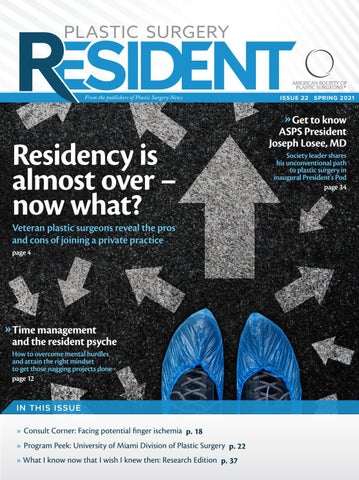
» Get to know
Residency is almost over – now what?
Veteran plastic surgeons reveal the pros and cons of joining a private practice page 4
» Time management
and the resident psyche How to overcome mental hurdles and attain the right mindset to get those nagging projects done page 12
IN THIS ISSUE » Consult Corner: Facing potential finger ischemia p. 18 » Program Peek: University of Miami Division of Plastic Surgery p. 22 » What I know now that I wish I knew then: Research Edition p. 37
ASPS President Joseph Losee, MD Society leader shares his unconventional path to plastic surgery in inaugural President's Pod page 34
A note from the editor
W
elcome to the Spring 2021 issue of Plastic Surgery Resident.
In our first issue of 2021, we bring to you a truly incredible roundtable discussing “Life after Residency.” This is the first of a two-part piece offering guidance on negotiating and reviewing contracts, writing a business plan, billing, running an office and developing practice skills. We’re fortunate to have Dallas Buchanan, MD, Troy Pittman, MD, and Eric Payne, MD, each draw upon their own experiences and provide this insight.
Sanjay Naran, MD Chief Medical Editor
Plastic Surgery Resident Chicago
The inauguration of ASPS President Joseph Losee, MD, this fall was also accompanied by the inauguration of “The President’s Podcast” – an ongoing offering that allows ASPS members to submit to the president any questions that come to mind. This issue features the transcript of the first podcast, in which we get to learn a little bit about our newly minted ASPS president. If you missed it, it’s available in the ASPS Podcast library (plasticsurgery. org/for-medical-professionals/presidents-pod). Be sure to submit questions to AskJoe@plasticsurgery.org – it’s a rare opportunity to learn about and directly engage the leadership within this Society. Ahead of the American Association of Plastic Surgeons (AAPS) Annual Meeting slated for May 15-18 in Miami, we feature the University of Miami Division of Plastic Surgery and its residency training program. The AAPS 2021 meeting will be one of the first national plastic surgery meetings to be held in person since 2019, so should you make your way to Miami, the “24 Hours in Miami” written by the residents of “The U” will be sure to provide you with several spots to enjoy during your visit.
From the publishers of Plastic Surgery News
ISSUE 21 | WINTER 2020
» Centennial
of excellence Washington University in St. Louis celebrates 100 years of plastic surgery page 8
» Residents Bowl 2020: Two views, one victory
University of Pittsburgh wins its first title in the annual ASPS contest page 26
Figuring out your finances A primer for residents to set them on a path of financial security page 4 IN THIS ISSUE » Consult Corner: Orbital floor fracture p. 11 » Program Peek: Cleveland Clinic Department of Plastic Surgery p. 17 » What I know now that I wish I knew then: International Edition p. 20
Finally, rounding out this issue, in our recurring columns we cover Targeted Muscle Reinnervation; Regenerative Peripheral Nerve Interface; Surgical Simulation; and Acute Digital Ischemia from Frostbite; and we present the timely article Time Management. Thank you to all of our writers for their contributions. As always, thank you to you, our readers, and to our team of editors and the ASPS production staff. We hope you enjoy the read! |
TELL YOUR PROGRAM DIRECTOR OR COORDINATOR ASPS is asking program directors and program coordinators to submit names of residents in their final or penultimate year of residency (beginning July 1) for consideration to join the ASPS/PSF Board of Directors as a Resident Representative. The term runs from Nov. 1, 2021, to Oct. 31, 2022. Submit names by April 30 by going to plasticsurgery.formstack.com/forms/resident_representative_to_the_board_of_directors. 2
Plastic Surgery Resident | Spring 2021
Table of
Contents Life after residency, Part I: Is private practice for you?...................................................... 4 Veteran plastic surgeons address the cost/benefit ratios of private practice models for residents facing tough post-training decisions.
Time management: An international perspective................................................ 12
Plastic Surgery Resident | Spring 2021 | Vol.5 No.1 The mission of the American Society of Plastic Surgeons is to support its members in their efforts to provide the highest quality patient care, and to maintain professional and ethical standards through education, research and advocacy of socioeconomic and other professional activities.
Elise Lupon, MD, quotes jazz great Miles Davis and Thomas Edison as she brings principles of sound time management to light.
A SPS PR ESI DEN T Joseph Losee, MD | Joseph.Losee@chp.edu
ASPS launches PROPEL resident mentoring program............................................... 16
EDITOR Sanjay Naran, MD | sanjaynaran@hotmail.com
PROPEL program brings experienced faculty together with residents using a formula that matches personalities, strengths and needs.
Consult Corner: Moving on digital ischemia.................................................. 18 How to approach frostbite for patients with a history of unprotected, prolonged exposure to below-freezing temperatures.
Program Peek: University of Miami................................................................22
ASSOCI ATE EDITORS Russell Ettinger, MD | retting@uw.edu Kavitha Ranganathan, MD | kranganathan925@gmail.com J U NIOR ASSOCI ATE EDITOR Joseph Lopez, MD | joeyl07@gmail.com SEN IOR R ESI DEN T EDI TOR Lisa Gfrerer, MD, PhD | lg frerer@partners.org
The only plastic surgery training program in Miami boasts a rich tradition built and borne by acknowledged leaders in the specialty.
R ESIDENT EDITORS Janak Parikh, MD | janak.parikh@gmail.com Matt Pontell, MD | matthew.e.pontell@vumc.org Elie Ramly, MD | elie.ramly@gmail.com
Message from the Director: Devinder Singh, MD...............................................................24
I N T E R N AT I O N A L R E S I D E N T E D I T O R Konstantinos Gasteratos, MD | kgasteratos1@gmail.com
The roster of highly respected plastic surgeons associated with University of Miami/Jackson Memorial attests to its institutional strength.
Faculty Focus: Lauren Yarholar, MD............................................................. 25 Assistant professor of Surgery in the Division of Plastic Surgery speaks of the importance of strong mentors – and self-care, too.
24 Hours In: Miami, Florida......................................................................... 28 South Beach (rightfully) gets the press, but Miami also offers paddleboarding, the Everglades, Cubano cuisine and riveting art.
Journal Club: Surgical simulation................................................................ 30 Especially relevant during the ongoing COVID-19 pandemic, surgical simulation can be used to augment real O.R. experience.
InService Insights: TMR, RPNI and nerves.......................................................... 32 Chronic neuropathic pain after surgery can be addressed via TMR and RPNI – which has the attention of In-Service examiners.
President's Pod: Get to know ASPS President Joseph Losee, MD..............34 Dr. Losee answers questions about his upbringing, career and what makes him tick in the office and away from it.
What I Know Now: Research edition.................................................................... 37
Eric C. Liao, MD, PhD, says residents should aspire to be passionate, to acquire all the skills they can and to target big problems.
E X EC U T I V E V ICE PR ESI DEN T Michael Costelloe | mcostelloe@plasticsurgery.org STAFF V ICE PR ESIDENT OF COMMU NICATIONS Mike Stokes | mstokes@plasticsurgery.org M A N AG I N G E D I T O R Paul Snyder | psnyder@plasticsurgery.org A S SI S TA N T M A N AGI NG E DI T OR Jim Leonardo | jleonardo@plasticsurgery.org A S S O C I AT E E D I T O R Kendra Y. Mims | kmims@plasticsurgery.org GR A PHIC DESIGN ER Elena Bragg A DV ERTISING SA LES Michelle Smith (646) 674-6537 | Wolters Kluwer Health
Plastic Surgery Resident (ISSN 2469-9381) is published four times per year and distributed free to members of the ASPS Residents and Fellows Forum and plastic surgery training programs. Letters, questions or comments should be addressed to: Editor, Plastic Surgery Resident, 444 E. Algonquin Road, Arlington Heights, IL 60005. The views expressed in articles, editorials, letters and other publications published by Plastic Surgery Resident (PSR) are those of the authors and do not necessarily reflect the opinions of ASPS. Acceptance of advertisements for PSR is at the sole discretion of ASPS. ASPS does not guarantee, warrant or endorse any product, program or service advertised. ASPS Home Page: www.plasticsurgery.org
Plastic Surgery Resident | Spring 2021
3
Life After Residency – Part I
Group, solo, private or employed: How to choose By Janak Parikh, MD
4
Plastic Surgery Resident | Spring 2021
T
he path for plastic surgery trainees is fairly prescribed: undergraduate, medical school, residency and, possibly, Fellowship. Long nights, hard work and dedication are required, but the main goal has always been clear. However, as they come to the end of many years of training, young plastic surgeons find themselves facing novel choices without knowing just how to go about making them – or understanding the short- and long-term ramifications of these choices. Additionally, after more than a decade of immersion in science and medicine, they’ve not yet developed the practical, non-medical skills that will aid them going forward: negotiating and reviewing contracts, writing a business plan, billing processes, running an office, etc. Hence, despite the joy of reaching the end of the training tunnel, the next step of a career in plastic surgery can be anxiety-provoking. ASPS offers numerous symposia and webinars to help trainees address some of these gaps, but they tend to provide the “30,000-foot” view. In this two-part series, we seek to provide a ground-level look at the pros and cons of certain startup options by speaking with three plastic surgeons in private practice and in different geographic locations. Given their limited exposure to private practice models during training, our readers may glean important information from the responses to common questions posed to these plastic surgery veterans.
Dallas R. Buchanan, MD
Troy Pittman, MD
Eric Payne, MD
Years in practice: seven
Years in practice: nine
Years in practice: nine
Practice location: Tampa Bay, Fla.
Practice location: Washington, D.C.
Practice location: Houston
Practice model: Solo private; cosmetic and reconstructive (primarily breast)
Practice model: Two-surgeon private; all aesthetic
Practice model: Solo private; craniofacial and aesthetic
Fellowship: None
Fellowship: Aesthetic and breast reconstruction
Fellowship: Craniofacial surgery
Path to current practice
Path to current practice
Path to current practice
2014: Completed training
2012: Completed training
2012: Completed training
2014-18: Joined another plastic surgeon in Spokane, Wash.
2012-13: Faculty at John’s Hopkins
2012-14: Joined another plastic surgeon
2018: Started solo private practice in Tampa Bay
2013-18: Faculty at Georgetown, director of breast reconstruction 2018: Private practice
2014: Solo private (shared office)
Plastic Surgery Resident | Spring 2021
5
LIFE AFTER RESIDENCY / continued from previous page PSR: WHO SHOULD CONSIDER A PRIVATE PRACTICE? Dr. Buchanan: For those who enjoy the extra challenge and details of running a business and desire an active and authoritative role over their career choices, the private practice model will provide more control. Dr. Pittman: Those interested in creating their own brand and controlling patient experience – and have an entrepreneurial drive – will be a good fit in a solo or smallgroup private practice. A mentor once said: “When you pick up the pen in your office, do you want it to show your name, or do you not care? If the former, then private practice is for you.” You’ll need to tolerate the ups and downs of private practice. In the beginning, you may not book a surgery for two to three months and think that you’re going to starve. That’s when you’ll need to ask yourself: How many starving plastic surgeons do you know? This is the time to market yourself by introducing yourself and your services to OB/ GYN and dermatology practices. If you don’t want to knock on doors, meet referring doctors and market yourself, then you may want to consider an employed model. Dr. Payne: Those who should consider private practice are those who have the initiative to run their own business. They’re also less interested in an academic setting, doing research and interacting with residents. However, they can still be involved with research and residency training in private practice. If you don’t enjoy dealing with day-to-day business operations, then a private practice will not be enjoyable.
PSR: WHO’S BETTER-SUITED TO AN EMPLOYED MODEL? Dr. Buchanan: If you prefer a very structured, day-to-day practice and aren’t interested in the administrative duties of practice management, you’ll certainly be better off in an employed model. The big benefits of an employed model are: Lifestyle or work/life balance – You can prioritize your work/life balance much easier. You’re responsible for being present at predictable times and can schedule your life appropriately. Predictability of income – You’ll have a predictable salary and will never worry about the check clearing. You’ll have compensation metrics, and those are clear. You can count on a consistent income from month to month or year to year. The downside is that the metrics for compensation can change at any time, and changes in reimbursement or renegotiation of the contract can lead to significant changes in your income. Focus on care – A large portion of the administrative duties are taken care of; you won’t have to worry about such items as human resources, accounting, billing, overhead, etc. Most of the time, your only responsibilities will be patient care and documentation. Dr. Pittman: If you’re interested in areas of plastic surgery that require multidisciplinary teams (i.e., pediatric craniofacial surgery or gender affirmation surgery), an employed model may be of benefit because it’s very hard to create those care teams in private practice. Additionally, for areas that require referrals (i.e., breast reconstruction or lower extremity reconstruction), being in private practice may become increasingly challenging, as more and more of these referring physicians are becoming employed and will thus refer to their in-house plastic surgery colleagues. Dr. Payne: Plastic surgeons who are better fitted for an employed model are those who aren’t interested in running the practice, as well as those who want to pursue an academic career. If you desire a private practice, especially a solo practice, you must be ready and willing to run a business.
6
Plastic Surgery Resident | Spring 2021
PSR: HOW DO YOU DECIDE BETWEEN SOLO PRIVATE AND GROUP PRIVATE? Dr. Buchanan: In the end, it will be about control. If you’re OK giving up some control and stepping away from some the administration of the practice, then group practice is certainly going to be beneficial. However, you must keep in mind that if disagreements arise within a group practice, significant stress and work dissatisfaction can result – and may even lead to a provider leaving the practice and starting over in a new practice, which can be a significant career event. Disagreements eventually happen, and they’re not always easy to resolve. Dr. Pittman: Honestly, going into a solo private practice directly out of training is very difficult, due to the startup costs. There are several reasons that it’s better to join someone who’s senior: It allows you to be in private practice without having to run the business; it can provide a source of patients; and you can have experienced help with difficult cases or for a second opinion. You can learn how to run a practice – and if you choose, you can go out on your own after a couple of years. Dr. Payne: People who go solo typically understand what it takes to set up the practice and are willing to learn how to run a business on their own. Ideally, you want to gather this information before you finish residency training. Those who don’t have a desire to set up their own practice but still want to do private practice should join a group. This offers the opportunity to learn how to run a business from mentors or senior partners. Obviously, it’s less work in a group private practice, because the day-to-day operations are shared among the group members. When I initially started my private practice, I partnered with someone who finished their Fellowship at the same time, and we benefited by sharing the workload and helping each other run the business. We also shared overhead expenses and on-call coverage. The other advantage is that we were equal partners in the business venture. One of the overlooked aspects of the partnership or group practice is having an exit strategy set up at the beginning of the partnership. This is like having a prenuptial for a marriage in the event one wants to leave or move away from the practice.
PSR: WHAT’S BETTER FOR A SOLO PRIVATE PRACTICE: OWN YOUR OFFICE FROM THE START, OR OFFICE-SHARE FOR THE FIRST FEW YEARS? Dr. Buchanan: It’s a great idea to share office space for your own private practice early in your career. The concept of office sharing is basically an arrangement to split overhead costs while maintaining your own individual identity and business. I equate this to kind of a mini-partnership, as there will be some decisions about how to share equally and distribute costs. Especially if you’re considering going into a very competitive and busy market in a metropolitan area, the cost of medical office space and overhead can be very significant for someone starting a practice. However, there will come a time where each practitioner will want to branch out and have their own office and unique identity, and hopefully this transition is peaceful and agreeable. Dr. Pittman: The key to starting out is keeping your overhead expenses low. The three main expenses, in order, are: office space, staff and marketing. Time-sharing space and even sharing staff when you’re first starting is a great way to minimize expenses. Dr. Payne: Ideally, it’s best to share an office to lower your overhead in the first few years of practice – and even after your practice matures. However, it can be difficult to find somebody who’s willing to take on someone to share office space because they think of that other plastic surgeon as competition. In my opinion, this is the wrong attitude, because there can be synergistic competition when more than one plastic surgeon shares space in the same location – more foot traffic through the office ultimately benefits everyone in the practice. If two plastic surgeons set up offices near each other, their overhead isn’t shared and patients tend to seek practices that are larger groups that offer more in the procedure niches they’re looking for.
PSR: WHAT ARE SOME ADVANTAGES OF SOLO PRIVATE PRACTICE? Dr. Buchanan: The substantial benefits are: Control – This is the major one. The solo private practice model gives you the ability to have total control of your future and allows you to make all decisions without having to clear them with someone else. If you want to control your own destiny and be responsible for the decisions that you make, then a private practice model suits your personality much better; you’ll easily become frustrated within the employed model, where you have very little control over the decisions or the logic used in making these decisions. Plastic Surgery Resident | Spring 2021
7
LIFE AFTER RESIDENCY / continued from previous page
Income potential – Although compensation from an employed model can be very good, there’s definitely a ceiling to your earning potential. Employed physicians are often compensated on metrics regarding their output and productivity; while his or her initial salary may be better than the initial salary for a private practice surgeon, over time the ability to grow in compensation in the employed model becomes limited, while the private practice model has much greater potential for growth over time.
Dr. Pittman: The obvious advantages in my mind are that you completely control how your practice looks and how it’s branded, as well as its goals and values. You make all decisions and set everything up exactly how you like it. Another advantage is the sense of accomplishment from building something from scratch. You’ll feel personal growth, as you’ll need to learn things such as marketing and accounting to run your business. Similar to research in an academic job, developing and growing a business adds a different flavor to your life outside of patient care. Dr. Payne: The advantage is that you ultimately make all the decisions for your practice. You can have a solo private practice with shared office space, which can reduce overhead. However, there still needs to be cooperative decision-making in some areas of the practice, and you’ll likely need to accommodate another surgeon’s time and use of the office.
PSR: WHAT ARE SOME DISADVANTAGES OF SOLO PRIVATE PRACTICE? Dr. Buchanan: Lifestyle or work/life balance – Within private practice, especially solo private practice, your work becomes the dominant force in your life. Although you aren’t technically at work 24/7, you’re usually thinking about work or doing something related to work almost all the time. Compensation – With a private practice model, your income can have significant variance from month-tomonth and you can even have months where you don’t get paid at all. This also comes with the price – probably the biggest disadvantage of a solo private practice – of everything within the practice falling to you. You are the de-facto office manager, CEO, CFO, H.R. manager and countless other roles, which means you must be knowledgeable about a lot of things and responsible for everything. This will demand a massive investment of energy and time. Hopefully, over time, you’ll reap the benefits of this early investment in terms of financial security and job satisfaction later in your career. 8
Plastic Surgery Resident | Spring 2021
Dr. Pittman: The biggest disadvantage is the unpredictability. You won’t know how much you’ll make; where your referrals will come from; and what you don’t know. In addition, some of the advantages can be disadvantages. You have to make all of the decisions – including the marketing and direction of your practice, when you haven’t necessarily been formally taught those skills. It can be scary at times and you need the stomach to get through it. Dr. Payne: The disadvantages are that you have few people to help you run the day-to-day operations. You’ll also miss the ability to help each other on difficult cases, such as asking for advice or even getting surgical assistance in the O.R.
PSR: WHAT ARE ADVANTAGES OF A GROUP PRIVATE PRACTICE? Dr. Buchanan: Mainly, the benefit of splitting costs and overhead. As a surgeon, I’m traditionally away from my office about half of the time doing surgery, and if no other passive revenue streams flow during this time, I’m essentially paying for staff, rent and other overhead costs when I’m not using my office. If you’re in a group practice, you can be much more efficient with the use of resources and costcontainment strategies. The major advantages of this practice have to do with the ability to offload or distribute certain parts of the business, such as practice management, overhead costsharing and a multitude of other things – such as increased negotiating power as a group, better ability to compete in the marketplace, etc. You’ll likely be able to hand off to your partners certain parts of the practice that you don’t like and take on other things that they may be better suited to deal with. Dr. Pittman: As I’d mentioned, joining a group practice shields you from having to worry about the business side while you get used to being a new attending. Another advantage could be decreased frequency of being on call, though this can be a negative if you’re trying to get busy. You’re also likely to have some guaranteed salary. Finally, a group practice may be able to feed you the cases you need for board collection – which can be hard to get in a solo practice. Dr. Payne: The opposite of solo private practice disadvantages are the group practice advantages.
PSR: WHAT ARE SOME DISADVANTAGES OF A GROUP PRIVATE PRACTICE? Dr. Buchanan: Giving up control. A group practice with one other provider will have a 50-50 split on every decision – who to hire and fire, the equipment or supplies to buy or how to proceed with the future of the practice. Unanimous decisions will be needed before anything gets done. If in a larger practice of 30 or more physicians, it’ll likely be “majority rule” for these decisions, and if you disagree with certain things in the practice, you may lose control over that decision-making. You might find that certain decisions that you feel very strongly about may go against your preference. These can involve the direction of the practice or of your individual patients. If another partner in your practice focuses on facial cosmetic surgery, for example, and you’re practicing general plastic surgery, your group may decide to filter all the facial cosmetic surgery to that provider rather than to you – and if this isn’t the direction you see your practice growing, significant issues may arise over time. If problems force you to leave that practice, sometimes there isn’t much left to show for what you’ve put into it. In a solo practice, there’s never any concern about control or having to abandon what you’ve put effort into. Dr. Pittman: You need to be realistic about your goals. Statistically, 80 percent of people leave their first job. You need to look at the practice you’re joining and ask yourself: Who’s running the practice; how is it branded; what is its practice volume? The answers will give you an idea of how successful you can be there. If the practice’s brand is the other surgeon’s name, how will you be able to market yourself? If the other surgeon’s spouse is the practice manager, how fair will be the staff sharing, cost sharing – and, even, how the phone is answered for your patients? One way to tease this out would be to ask if the surgeon or group has ever had an associate, and if not, why they feel this is the right time for them to bring someone in. Even asking these questions is not foolproof in preventing you from entering a bad relationship. That’s why it’s important for you to have an exit strategy and an iron-clad contract (reviewed by a contract lawyer) before joining. Dr. Payne: Some of the disadvantages include having to compromise or losing autonomy in decision-making. Sometimes that can come with hiring and firing certain office personnel. If the senior partner insists on hiring their spouse as the office manager, it can be very difficult to build a collegial working environment. Ideally, everyone needs to be treated fairly and respected.
PSR: SHOULD ONE CONSIDER AN EMPLOYED POSITION AND LATER TRANSITION TO PRIVATE PRACTICE – OR BEGIN PRIVATE? Dr. Buchanan: This decision will likely come down to a financial question. If you know you want to have a private practice after leaving training but aren’t in a financial position to invest significantly in its startup, you may not have that option. However, if your ultimate goal is a private practice and you have sources of financial security that allow you to start right after training, I don’t see much downside in this – you can start investing in yourself early-on and not have to worry about wasting time or effort in an employed model. This was my case: I went into a blended employed/ group practice model for four years before I could start my own private practice. But looking back on it, I wish I would’ve made that transition sooner, rather than spend four years in something that I couldn’t “take with me” when I left. Dr. Payne: Several plastic surgeons consider this option of being employed for one or two years before starting their own solo private practice to build up equity to start that practice. There are advantages and disadvantages to this strategy. The first advantage is: You won’t go into significant debt and can begin to build your nest egg for retirement. The downside: The patients you treat during the employed position aren’t truly your patients – they’re part of the system that employs you, and you may not be able to continue treating those patients in the future. You also may lose your before-and-after photos, unless it’s agreed that you can keep those for marketing. Another disadvantage to being employed for several years is that you essentially start over again with your private practice. Every person who begins practice after residency will experience a significant slowdown in the number of surgical procedures performed and patients seen in clinic. The best analogy is that during residency, you feel like you’re driving 90 mph down the freeway – then you begin your career as an attending, but somebody shifts you into first gear and you can’t go faster than 15 mph. Now imagine if that happened twice when you started your solo private practice. Plastic Surgery Resident | Spring 2021
9
LIFE AFTER RESIDENCY / continued from previous page PSR: HOW CAN YOUNG PLASTIC SURGEONS BECOME KNOWN IN THE COMMUNITY? Dr. Buchanan: This has a lot to do with the type of practice you want to start, and the market in which you’re starting. Traditionally, getting on E.R. call schedules was a good way to begin and grow a private practice. However, with a few possible exceptions, I’m not so sure that this is a great strategy anymore when it comes to plastic surgery. It all depends on the type of practice you’re trying to build. For a busy reconstructive practice, relying on referrals from other providers in the area, getting privileges at a hospital and taking call can, hopefully, fortify your referral streams. However, with reimbursements for reconstructive work rapidly declining year-to-year, it’s going to be very difficult for you to maintain a private practice on reconstructive work alone – especially if you’re a solo provider in an area with poor reimbursement or significant competition. Some of my colleagues practice in areas where E.R. call can be a lucrative prospect via reimbursement, but this isn’t the case in my market. If you’re trying to start a practice that relies on referrals but can’t get on call schedules, there are certainly alternate ways to introduce yourself to the referral providers you’ve targeted to help grow your practice. However, if you’re looking to build a cosmetic or elective plastic surgery practice, most of your referrals will come from direct consumer marketing and/or word of mouth advertising and patient referrals. Therefore, participating in E.R. call schedules and meeting other physicians in the area won’t contribute as much to your practice growth as will your marketing strategy. Dr. Pittman: The most conventional way is to take as much E.R. call as you can. You can take hand call, facial trauma call and general practice call. Hospitals will often pay for call coverage, so that can be a small source of revenue when you’re first starting. Taking call is also a great way to get a potpourri of cases during board collection. Other things you can do are wound care, injectables and other office-based procedures.
ASPS offers a number of services to assist in starting and running a practice through PS2 Practice Management consulting services at plasticsurgery.org/ps2 and the ASPS Endorsed Practice Solutions at plasticsurgery.org/endorsed.
10
Plastic Surgery Resident | Spring 2021
Dr. Payne: In terms of taking E.R. call, some surgeons who’ve been taking call for a number of years may be ready to scale that back. Even if the call schedule looks full, I recommend asking the hospital administration if there’s a way you can help out in the future. There are also a number of hospitals that don’t have plastic surgeons on a regular call schedule. This is an opportunity for you to meet those emergency medicine colleagues and provide them your contact information – so they can call you with any future consultations. You need to be very specific with them about what you will and will not see for consultations. Typically, in the beginning, you want to be the person who always says “yes,” if you want to grow your practice quickly. Another way to get your name out is to meet with referring providers. This can involve meeting with family medicine and internal medicine doctors to let them know you can help with breast reductions or any other breast reconstruction cases. If you’re interested in pediatrics, meet with pediatricians and let them know you’re available to assist them. In my practice, I treat craniofacial and pediatric plastic surgery, and I have a large following of private pediatricians who continue to refer patients to my practice. Plastic surgeons interested in trauma or hand surgery should reach out to E.R. physicians as well as primary care physicians to build their practice.
PSR: HOW EARLY SHOULD ONE START PREPARING FOR PRIVATE PRACTICE? Dr. Buchanan: I think the old adage is true: It’s never too early to start preparing. Just when you think you have everything planned, you’ll come to learn that there are a multitude of things for which you didn’t plan. If you have a timeline in place for opening a private practice, start planning for its grand opening at least a year in advance. Dr. Payne: Planning for a future practice should begin in the first year of residency, whether it’s private practice or academics. There are number of ways to do this: • Create preference cards for each surgical procedure • Create pre-op and post-op instructions for each surgical procedure • Create template operative notes for each surgical procedure • Create website content for each surgical procedure, in your wording – don’t plagiarize other surgeon’s websites • Create a business plan
PSR: WHAT CAN YOU DO IN TRAINING TO HELP THE TRANSITION INTO PRIVATE PRACTICE? Dr. Buchanan: It’s a difficult time to start working on a transition into private practice or starting your own business. You’re working a ton of hours and have a long list of responsibilities, but very little free time. Your ability to plan a private practice will be significantly limited. However, one of the biggest resources that we don’t utilize during our training is our teachers and colleagues. Many of the connections you’ve made during training are either currently in private practice or have had experience in the private practice world and are a wealth of information and knowledge. I’d suggest that anyone considering moving directly from training into their own private practice make a concerted effort to “pick the brains” of the connections they’ve made and have them help with that planning. One can often avoid future pitfalls by talking to those who’ve fallen into those pits before.
Dr. Pittman: If you’re sure you want an aesthetic practice, talk to as many private-practice aesthetic plastic surgeons as you can during training, and educate yourself on how to start and build that practice. I also recommend learning how to write a business plan – you’ll need to present a business plan to a bank in order to get funding to start your practice. Also, if you’re planning on staying in the area you’re training, get to know the local implant, neurotoxin and filler reps. They can be a huge help when you’re starting out. Most importantly, you’ll need to learn about marketing. For that, I’d recommend reading Building a Story Brand by Donald Miller. You’ll also need to familiarize yourself with social media platforms. Dr. Payne: Read The Business of Plastic Surgery: Navigating a Successful Career by ASPS members Heather Furnas, MD, and Joshua Korman, MD. | Part II of this article will appear in the Summer 2021 edition of Plastic Surgery Resident.
Dr. Parikh is PGY-6 at Houston Methodist Hospital.
Resident abstracts for PSTM will be accepted through Friday, April 30 CLICK HERE: ASPS.CONFEX.COM/ASPS/2021SRC/CFP.CGI
Plastic Surgery Resident | Spring 2021
11
INTERNATIONAL VOICES
TIME MANAGEMENT
How to get things done without really trying “Time is really the only capital that any human being has, and the only thing he can’t afford to lose.” – Thomas Edison
By Elise Lupon, MD
12
Plastic Surgery Resident | Spring 2021
T
he fundamental principles of entrepreneurship that all successful business leaders know are rarely taught in medical school.1,2 It’s time to become fully aware of these basic principles, which are essential to boost your efficiency and awaken the proactive mindset that sleeps in you.
TIME
Let’s return time to the place it deserves. Miles Davis said: “Time isn’t the main thing. It’s the only thing.” Time is incompressible, infinite, priceless and cannot be saved – and each of us uses it for very different purposes, depending on our culture, aspirations and, above all, our awareness of its value. Two powerful laws of success are thus to be combined to combat any tendency to procrastinate – the force that prevents you from following through on what you set out to do:
• Parkinson’s law3 “Work expands so as to fill the time available for its completion” or the “deadline principle.” The more time you have to write an article, for instance, the more time you take to write it. Thus, the human tendency is to exploit the totality of a given amount of time. When there’s no time limit, a project may never see the light of day. The time you give yourself to do a task is a mental limit, often linked to an external constraint. But this mental limit can be easily rescheduled: halve the time you gave yourself to do a job. Divide it into elementary sub-tasks and eliminate the non-essential tasks. You will see that it works; you’ll have taken half the time to do it. Once you understand the principle, divide this time by three; you’ll be amazed to discover that it still works.
• The 80/20 law of the Italian economist Vilfredo Pareto4: He found that 80 percent of the country’s wealth was in the hands of 20 percent of his countrymen. This law became progressively more popular when it was realized that it applied to many other areas.
In other words, 20 percent of the work is responsible for 80 percent of the final result. We agree that 80 percent isn’t 100 percent, but as Sir Winston Churchill said, the word perfection is spelled “P-A-R-A-L-Y-S-I-S.” Don’t aim for
perfection. Aim for efficiency. Aim for 80 percent – it only takes 20 percent of your time. It’s more important to do the right thing than it is to do it right. Combine and apply these two laws as often as possible and you’ll see your productivity take off.
HABITS AND PROACTIVITY
Our relationship to time and our behaviors depend on our habits. To change, we must change our habits. This separates us from our freedom to consider and react differently to the obstacles we encounter. It’s easier to say than to do – and changing a habit requires determination and unwavering conviction. Becoming aware of the stimuli triggering our counter-productive habits is the first step to fighting them. Look at yourself and identify your distracting stimuli. Our behaviors are the result of our decisions and not our condition. Everything we do is the result of our choices, intended or not. If you really want to be the architect of your own life, your choices must no longer be the result of the external circumstances. Think specifically about your own situations. For example, do you continually find yourself in internships where there aren’t enough people? Is what you’re doing right now going to help you get to what you really want in life? Finally, you have to be extraordinarily proactive: This is the most important habit to adopt. Make an attempt to stop being reactive and to become proactive as often as possible. It’s a matter of being clear about your long-term goals and thus acting according to your internal values, the ones you hold most dear. Plastic Surgery Resident | Spring 2021
13
TIME MANAGEMENT / continued from previous page
Proactive people act according to their system of values and principles in life and decide according to the circumstances – or even provoke those circumstances. Your responses to external stimuli depend on your own values; therefore, what matters is how you react when external forces test your convictions. Don’t sit on the sidelines and wait to see what happens. When you’re proactive and take the initiative into the unknown you may fail, but more often you will win. The words used by each individual make it fairly easy to distinguish which category they’re in. The vocabulary of reactive people will typically be: “I can’t…”, “I must…”, “If only…,” while the proactive expressions are “I choose…” and “I can approach the problem differently.”
If you don’t know (don’t worry, you’re not the only one), take an afternoon out of your life and think: “I’ll have a successful life in 20 years and I will look like…” Imagine yourself in every situation. If you can’t imagine that, look for new experiences to give you a clearer picture of the situation. This answer is personal; there’s no point in lying to yourself. What do you really want? Write it down. Ignore the mental constraints that stand in front of your most ambitious desires. Free yourself of any guilt about those.
Don’t consume energy dealing with that which you can’t control (i.e., politics, news or social media trends). Rather, focus upon what you can improve in your world today. What are you dedicating your 24 hours to? Your circle of concern should be in harmony with your circle of influence (where you can make an impact today).5, 6
Congratulations – you have set your direction.
The reagent’s circle of concern focuses on things for which they are powerless, which don’t depend on them (in other words, bistro discussions). Reagents will readily criticize others’ shortcomings, thus releasing negative energy that significantly reduces their circle of influence.
Some principles of sociology can be very useful to optimize your climbing time7,8,9:
The proactive are a part of the solution, not part of the problem.
THE DIRECTION
This is the fundamental element. After climbing the ladder, it’s one thing to realize that our life is not exactly what we dreamed of 20 years ago, but it’s quite another to live the life we dreamed of and not live it at all.
14
That’s what can happen if you let yourself be carried along by the will of others. What makes you vibrate? On which wall are you going to put your ladder? The walls of the public hospital or those of the private clinic? Academic research or leisure and family life? Living abroad or staying at home?
Plastic Surgery Resident | Spring 2021
MANAGEMENT
Now you’ve put your ladder on the right wall, all you have to do is climb it.
• A principle generalized by General Dwight D. Eisenhower is to work as much time as possible on “non-urgent/important” tasks. Sort out today each of your tasks to be performed – individualizing urgent/important tasks, non-urgent/ important tasks, non-important urgent tasks and nonurgent/non-important tasks (see cells below).
URGENT
NON-URGENT
IMPORTANT
I
II
NON-IMPORTANT
III
IV
Prioritize your readings (sort “to be read in the month;” “to be read;” and “to be read before 6 p.m. tomorrow”). Impose time limits (give yourself one hour to understand the main principles of this surgical technique, for instance).
• Manage interruptions: It’s better to go to people’s homes than to let your office become invaded by others.
Reactive individuals who let themselves be carried away by circumstances will spend a lot of time exercising in Cell I – and eventually, without planning, in Cell III and IV when the periods are calmer. The proactive that you have become works in Cell II, focusing on what’s not yet urgent but will become urgent. This is the secret of your efficiency (your presentation is in 3 months, so it’s not urgent yet but will become so).
• Know how to say no: If someone offers you something
you won’t have time to do, dare to say: “No, I don’t have time.” You’ll avoid being considered unreliable.
• Teamwork: Spread your time by amplifying the actions
that will allow you to broaden your collaborations and synergies. You’ll increase your impact by associating with new people on projects.10
• Adapt to the hours of productivity: Productivity is
“A goal without a plan is just a wish.”
highest in the morning and lowest in the evening, generally after 8 p.m. Save the most important things for the morning.
• Dare to delegate: Time is also money! How much does
an hour of your working time cost? To find out, divide your monthly income by the number of hours and days you work, which will give you something to compare – to see if what you do with your professional time is wisely used, or if you’d be better off entrusting certain tasks to someone else.
• Take regular breaks to boost your efficiency. During
a presentation, the listener’s attention quickly fades dramatically after 45 minutes. Even a tiny break will ease your body and reboot your brain.
– Antoine de Saint-Exupéry
I would like to thank Marc Revol, MD, for sharing his inspiring teaching, and Ian Hovenkamp for his proofreading. | Dr. Lupon is PGY-4 in the Department of Plastic, Reconstructive and Aesthetic Surgery at Hôpital Européen Georges Pompidou, Paris, and a Research Fellow at the Vascularized Composite Allotransplantation Laboratory, Center for Transplantation Sciences, Massachusetts General Hospital, Harvard Medical School, Boston.
• Always give yourself a deadline for every job you start. • Reward yourself every time you complete the project on time.
• Start immediately! Don’t plan to think and then take
action. Typically, to combat “white sheet syndrome,” write anything on your screen. Never wait until you’re ready, because that moment will never come. If you fight this moment of initial paralysis, in one hour you’ll have solved a problem that could’ve lasted for months.
• Use speed reading – and avoid reading what’s
unnecessary. You have to select your readings (use the Tables of Contents; does my query justify reading an entire book chapter, an article or just a summary?).
REFERENCES 1. 2. 3. 4. 5. 6. 7. 8. 9. 10.
Covey, S.R. (1989). The 7 Habits of Highly Effective People: Powerful Lessons in Personal Change. Covey, S.R., Merrill, A. R., & Merrill, R. R. (1995). First Things First: To Live, to Love, to Learn, to Leave a Legacy. Parkinson, C. Northcote (1957). Parkinson's Law, or The Pursuit of Progress. Koch R. (1999). The 80/20 Principle. The Secret to Achieving More With Less. Epictetus. (2002). A Stoic and Socratic Guide to Life. Seneca. (2017). On the Happy Life. Translated by Aubrey Stewart Charles Hobbs. (1988). Time Power: The Revolutionary Time Management System That Can Change Your Professional and Personal Life. Josephs R. (1994). How to Gain an Extra Hour Everyday: New Time Strategies That Work. Allen D. (1945). Getting Things Done: the Art of Stress-Free Productivity. Carnegie D. (1964). How to Win Friends and Influence People.
Plastic Surgery Resident | Spring 2021
15
MENTORSHIP: A WAY TO ‘PROPEL’ YOUR FUTURE CAREER Editor’s Note: In an effort to restructure mentorship in plastic surgery, ASPS in 2020 introduced a new program that it labeled “Professional Resource Opportunities in Plastic and Reconstructive Surgery Education and Leadership,” or PROPEL. Rather than the familiar, one-onone approach to mentorship, PROPEL assembles launch teams to provide greater mentor collaboration and an enhanced experience. Each team consists of a senior plastic surgeon, junior plastic surgeon, senior plastic surgery resident and junior plastic surgery resident, with teams curated based on individual preferences and interests. The goal of each team is to build relationships and create a continuum of learning opportunities that reflects the vast, yet overlapping, experiences between faculty members and trainees in a longitudinal fashion. This allows team members the opportunity to serve as both a mentor and mentee in various ways. In this special PSR feature, PROPEL participant Cassie Nghiem, MD, PGY-6 at the University of Rochester, shares her experiences with the program.
By Cassie (Bao Tram) Nghiem, MD
E
stablishing connections is important in plastic surgery, but what happens when “rubbing elbows” is frowned upon by the CDC? One year into the COVID-19 pandemic, I’m still learning the nuances of building virtual relationships. My after-hours Zoom uniform is a pair of pajama pants and an “In Case of Emergency” button-down shirt for when cameras need to be on. This past year, many residents like myself lost opportunities to rub elbows at Society meetings, Fellowship interviews and networking events. As a graduating chief resident, a common question kept returning: How do I navigate the job search or interview, or move to a new city, with few connections?
CASUAL, LIGHTHEARTED AND EFFECTIVE
PROPEL’s team-based mentoring comes at a pivotal time in history and in my career. Launched in 2020, PROPEL is a unique mentorship model that connects like-minded plastic surgeons and residents from all over the country. Each team of six consists of one early-career and one seasoned plastic surgeon, along with senior and junior residents, all of whom are matched based on location and professional interests. Our group email chains and Zoom meetings are light-hearted and casual, but they provide valuable perspectives from surgeons who’ve already worked their way through this stage of their careers. In six months, I’ll move to the Washington, D.C., metropolitan area for an aesthetic Fellowship, with plans to practice in the area. Having gone to medical school at the University of Michigan and trained at the University of Rochester, I have strong family ties but few professional connections in D.C. Luckily, my two PROPEL mentors are both private-practice 16
Plastic Surgery Resident | Spring 2021
surgeons in the area with more than three decades of combined experience. Their guidance alleviated the stress of my job-search process, as one of my mentors analogized the first post-residency job to “the first person you ever dated in middle school – a good place to start, but it doesn’t have to be a lifetime commitment.”
BUILD-A-PRACTICE
My mentors explained several different models of practice building (e.g., taking E.D. call or generating a referral basis from breast and Mohs surgeons), and provided insight into the demands of the D.C. market (region-specific insurance reimbursement for DIEP flaps versus implant-based breast reconstruction). In just a few hours with them, I learned practical aspects of practice building that medical school and residency simply do not teach. I also took note of the advice the two surgeons gave to a more junior resident and wished that I had similar guidance earlier in my training. They normalized pursing a non-academic career – even if it means disappointing your program director. They encouraged us to seek a healthy work-life balance, and both acknowledged that many of their own career decisions were based on family considerations. One surgeon noted that “you can have anything you want, but you can’t have everything you want,” when referring to the dream career and personal life that residents may envision. Balance is in the eye of the beholder, so the most important thing is to take stock of your own life every so often and consider whether you are striking the balance that’s right for you. To put more renowned voices to the power of mentorship, a 2019 editorial by Smita Ramanadham, MD, and PRS Editor-in-Chief Rod Rohrich, MD, titled “Mentorship: A Pathway to Succeed in Plastic Surgery,” illustrated that mentorship is critically important in enhancing professional development, academic productivity and, ultimately, job satisfaction.1 Mentorship is important throughout our training and professional careers. An overwhelming 80 percent of medical school graduates cited the influence of their mentors in making their choice to pursue plastic surgery.2 Mentors continue to play an important role in later careers, and the lack of mentorship is one of the three leading reasons for attrition among academic surgeons.3,4,5
LEVEL THE MENTORING FIELD
Building these relationships can be difficult for residents – especially for trainees seeking mentors outside of their institutions. Residents may have variable opportunities to connect with mentors based on their program size and structure, with smaller programs potentially being at a disadvantage. PROPEL provides equal opportunities and levels the playing field for residents seeking to build their professional network. For mentors, joining PROPEL is a way to play a pivotal role in trainees’ professional growth. I strongly encourage both residents and attending surgeons to join the next recruitment round. Plastic surgery is a small community based on connections. Both of my PROPEL mentors gave me a list of their colleagues in the area – and I gained an informal job interview based on their recommendation. Naturally, I stayed loyal to my pajama bottoms throughout the interview. | REFERENCES 1.
2. 3. 4. 5.
Ramanadham SR, Rohrich RJ. Mentorship: A Pathway to Succeed in Plastic Surgery. Plast Recontr Surg. 2019;143:353-355. Barker JC, Rendon J, Janis JE. Medical student mentorship in plastic surgery: The mentee’s perspective. Plast Reconstr Surg. 2016;137:1934-1942. Cropsey KL, Masho SW, Shiang R, et al. Why do faculty leave? Reasons for attrition of women and minority faculty from a medical school: Four-year results. J Women’s Health. 2008;17:1111-1118. Dyrbye LN, Shanafelt TD, Balch CM, Satele D, Sloan J, Freischlag J. Relationship between work-home conflicts and burnout among American surgeons: A comparison by sex. Arch Surg. 2011;146:211–217. Waljee JF, Chung KC. Discussion: Academic plastic surgery: Faculty recruitment and retention. Plast Reconstr Surg. 2014;133:405e–407e.
More information on PROPEL is available at: www.plasticsurgery.org/for-medical-professionals/community/asps-mentorship-program
Plastic Surgery Resident | Spring 2021
17
Acute digital ischemia from frostbite
“Consult Corner” addresses a consult commonly encountered by an on-call resident. The column begins with the reason for consult and assesses questions that might go through a resident’s mind as he or she heads to the emergency department to see the patient. Key aspects of the history and physical, as well as additional testing that should be obtained, are also presented. Finally, a review of the decision-making process will present possible management strategies, all of which are synthesized into the context of an actual case.
By Daniel Ruter, MD, & James Drinane, DO
FEMALE WITH FINGER ISCHEMIA CONCERN It’s 5 a.m., you’ve just finished scraping your windshield free of ice and settled into the driver’s seat of your slowly warming vehicle when you receive a page from the E.D.: New consult for 55F with concern for finger ischemia.
HISTORY
You begin a thorough history and physical examination that includes the following:
FIRST STEPS
• Age • Handedness • Occupation • Time of exposure • Details and duration of exposure • Medical comorbidities • Recent surgeries • Medications • Smoking status • Illicit drug use • Allergies • Tetanus status
Upon arrival, the patient has warmed intravenous fluids infusing, and a full set of laboratory tests have been drawn. You confirm that all gloves, bandages, jewelry and/or wet clothing have been removed, as these may obscure physical findings and will only
PHYSICAL EXAM
The assessment of extremity lesions begins with a full body examination for concomitant injuries. With a history of unprotected, prolonged exposure to below-freezing temperatures, patients are predisposed to the development of frostbite and digital ischemia. Akin to a trauma or burn activation, assessment and management of frostbite occur simultaneously. ATLS protocol is initiated by the E.D., and after the primary survey is completed, the patient is exposed and evaluated for other injuries. You instruct the trauma team to begin soaking both hands in a 40-degree Celsius water bath after other traumatic injuries have been excluded and/or addressed.
18
become more difficult to remove – and can potentially aggravate distal ischemia – as edema worsens. Rewarming is the critical first step and should begin when the patient has arrived at the treating facility, even if there’s a possibility of inter-facility transfer. Affected areas should be submerged in a warm water bath at 4042 degrees Celsius for 30 minutes.
Plastic Surgery Resident | Spring 2021
After initial stabilization and questioning, you begin a comprehensive physical examination with additional focus on the bilateral hands and forearms.
Table I. STAGES OF FROSTBITE AND CORRESPONDING PATHOPHYSIOLOGY, IMAGE AND TREATMENT PATHO-PHYSIOLOGIC STAGE
DESCRIPTION
CLINICAL STAGE
IMAGE
TREATMENT
Tissue cooling; vasoconstriction
First degree: redness, hyperemia, mild swelling
Rapid rewarming; NSAIDs
Freeze-thaw
Ice crystal formation; cellular dehydration; disruption of intracellular metabolism; cell membrane de-stabilization and lysis
Second degree: redness, prominent swelling, superficial blisters with clear or white liquid
Rapid rewarming; NSAIDs; possible thrombolysis
Vascular stasis
Vasoconstriction; increased plasma viscosity due to ice crystals; microvascular coagulation, thrombosis and embolization; inflammation
Third degree: blue or black morphology, prominent swelling, hemorrhagic blisters with evidence of necrosis
Rapid rewarming; NSAIDs; thrombolysis
Further inflammation; endothelial damage; cell lysis
Fourth degree: mottled morphology with resultant gangrene, minimal swelling, prominent necrosis
Rapid rewarming; NSAIDs; thrombolysis
Pre-freeze
Reperfusion injury
IMAGE REFERENCES (ABOVE) 1. Mohr WJ, Jenabzadeh K, Ahrenholz DH. Cold injury. Hand Clin. 2009;25(4):481-496. 2. Woo E-K, Lee JW, Hur G-Y, et al. Proposed treatment protocol for frostbite: a retrospective analysis of 17 cases based on a 3-year single-institution experience. Arch Plast Surg. 2013;40(5):510-516.
• Skin o Inspect both hands and forearms for wounds. Viable skin should be assessed for color change and the presence of blisters. Pallor indicates decreased perfusion and first-degree frostbite. Blisters with surrounding edema indicate seconddegree frostbite. Third degree presents with hemorrhagic blisters, and fourth degree with tissue loss and deep structure exposure (Table I). The proximal end of the blister often correlates with the level of vascular occlusion. Forearm and hand compartments should also be examined to determine the presence or absence of compartment syndrome. • Neurovascular o Test perfusion by feeling the temperature of the digits and extremities if rewarming has not begun. Assess for capillary refill and utilize a pulse oximeter to detect distal oxygen saturation and/or a Doppler probe to assess for digital artery signals. Radial and ulnar pulses should also be examined.
Figure 1: Right and left hands with third-degree frostbite of multiple digits. Figure is from an unpublished clinical case. Photos by Daniel Ruter, MD Plastic Surgery Resident | Spring 2021
19
CONSULT CORNER / continued from previous page o A neurologic examination should evaluate sensory perception to light and deep pressure. Static and dynamic two-point discrimination should also be evaluated. If a patient is unable to cooperate with physical examination, the digits can be submerged in water, the presence of neurologic deficits may result in an absence of skin wrinkling. Examinations should be repeated in the median, radial and ulnar nerve distributions. • Musculo-tendinous o All cardinal movements of the radiocarpal and distal radioulnar joint should be examined. A complete musculotendinous examination of the hand should follow. History and physical examination should also elucidate findings that may preclude thrombolytic therapy (Table II).
STUDIES
A complete blood count (CBC), complete metabolic panel (CMP), lactic acid level and EKG should be obtained. Other injuries
Table II. ABSOLUTE AND RELATIVE CONTRAINDICATIONS FOR THROMBOLYTIC THERAPY ABSOLUTE CONTRAINDICATIONS
RELATIVE CONTRAINDICATIONS
Recent intracranial hemorrhage (ICH)
History of severe and poorly controlled hypertension
Structural cerebrovascular lesion
Severe hypertension at presentation (systolic blood pressure >180mmHg; or diastolic blood pressure > 110mmHg)
Intracranial neoplasm
Prolonged (>10 minutes) cardiopulmonary resuscitation or major surgery within three weeks
Ischemic stroke within three months
History of ischemic stroke
Possible aortic dissection
Dementia
Active bleeding or bleeding diathesis (excluding menses)
Internal bleeding within two to four weeks
Significant head injury or facial trauma within three months
Non-compressible vascular punctures
Recent intracranial or spinal surgery
Pregnancy
Severe uncontrolled hypertension
Active peptic ulcer
Previous treatment with streptokinase within six months
Currently on anticoagulant therapy with an elevated INR > 1.7; or a prothrombin time longer than 15 seconds
Baig MU, Bodle J. Thrombolytic Therapy. [Updated 2020 Jun 1]. From StatPearls [Internet]. Treasure Island (Fla.): StatPearls Publishing; 2020 Jan. www.ncbi.nlm.nih.gov/books/NBK557411/
20
Plastic Surgery Resident | Spring 2021
should be evaluated as necessary, and three-view X-rays of the bilateral hands and forearms should be ordered.
DIFFERENTIAL DIAGNOSIS
Acute ischemic insults of the hand can occur due to a variety of causes and present similarly to frostbite. Prompt diagnosis and treatment of the underlying cause is key to restoring blood flow and limiting the damage caused by ischemia. Traumatic injury, aneurysm, thrombosis, emboli and vasospastic disorders are all causes of hand ischemia and are reviewed in Table III.
PHYSIOLOGY
Frostbite is a combination of direct exposure of the affected body part and the body’s physiologic response to a cold environment. When exposed to cold temperatures, peripheral vasoconstriction occurs to maintain core body heat. Shivering, cold extremities and hyperventilation are signs of hypothermia. Frostbite manifests as cold digits, paresthesias, numbness and difficulty moving the digits. Injury is a combination of direct damage from the cold; ice crystal formation, causing cell membrane damage; vascular stasis leading to thrombosis/ischemia; and reperfusion injury.
MANAGEMENT
Mild frostbite without signs of decreased perfusion is treated with conservative measures that can include topical aloe vera, ibuprofen 800mg tid, the offloading of affected extremities, elevation and non-adherent dressings. A tetanus booster is given to all patients who are not up-to-date. Rewarming is performed to arrest the insult from cold exposure, while elevation and non-steroidal antiinflammatory (NSAID) drugs are used to treat the inflammation and minimize reperfusion injury. Patients with second- through fourth-degree frostbite with signs of decreased perfusion may be candidates for angiography if they present within 24 hours of the initial insult. Angiography is potentially diagnostic and therapeutic, as intra-arterial contrast imaging can diagnosis vascular occlusion (Figure 2, 3) and intervene with thrombolysis if indicated (Figure 4, 5). Interventional radiologists will perform an angiogram of each affected extremity – and if decreased perfusion is confirmed on angiography, thrombolysis catheters are placed, a heparin drip is started and the patient is monitored in the surgical ICU. Repeat angiography is performed 24 hours later to determine treatment response and whether therapy should be continued. At 48 hours, a final angiogram is performed, thrombolysis catheters are removed and heparin is discontinued. Daily CBC and CMP are monitored for anemia, thrombocytopenia and acute kidney injury. A multimodal pain regimen is required for neuropathic pain. Patients follow-up serially to allow for injury to demarcate, to determine if surgical debridement is required. | Dr. Ruter is PGY-3 and Dr. Drinane is PGY-5 at Albany (N.Y.) Medical College.
Table III. OTHER CAUSES OF DIGITAL ISCHEMIA; PRESENTATION AND TREATMENT PATIENT
ETIOLOGY
TREATMENT
SIGNS AND SYMPTOMS
Presents with traumatic injury to upper extremity, i.e., deep laceration, fracture, arterial cannulation
Active pulsatile bleeding, expanding hematoma, absent pulse, injury to nearby nerve, bruit
Ligation if adequate distal perfusion, otherwise repair or bypass
Thromboembolic
IV drug user or patient with atrial fibrillation presents with pulseless extremity
Rapid onset of pain, pallor, pulselessness, paresthesias and poikilothermia (The “5 P’s”)
Emergent arteriography and heparin therapy, open thrombo/ embolectomy or intra-arterial thrombolysis, work-up for source
Raynaud’s phenomenon
Patient with autoimmune disorder whose fingers blanch and numb in cold weather
Reversible ischemia in distinct distribution; can cause ulceration if chronic
Calcium channel blockers (nifedipine); botulinum toxin injection if recalcitrant; digital sympathectomy or adventitial stripping; work-up for secondary causes
Manual laborer with repetitive trauma to hand and wrist
Painful pulsatile mass (aneurysm), cold intolerance, pain, ulceration of ring and small finger
Activity avoidance, smoking cessation, digital brachial index >0.7 arterial ligation, <0.7 excision and reconstruction
Trauma
Hypothenar hammer syndrome
Figure 2: Left hand diagnostic angiogram 18 hours after exposure. Note the abrupt cut-off of the digital arteries
2
3
4
5
Figure 3: Right hand diagnostic angiogram 18 hours after exposure. Note the abrupt cut-off of the digital arteries Figure 4: Left hand 24 hours after catheter directed thrombolysis. Note the improved visualization of the distal digital arteries. Figure 5: Right hand 24 hours after catheter directed thrombolysis. Note the improved visualization of the distal digital arteries. improved visualization of the distal digital arteries. Figures 2-5 are from unpublished clinical cases. Photos by Daniel Ruter, MD
Plastic Surgery Resident | Spring 2021
21
University of Miami Division of Plastic Surgery By Luccie Wo, MD History • Founded in 1918, Jackson Memorial Hospital (JMH) today is the third-largest hospital in the United States, with more than 1,700 beds. The University of Miami (UM) Miller School of Medicine is the oldest medical school in Florida, having opened its doors in 1952. • The Division of Plastic Surgery at the University of Miami/ Jackson Memorial Hospital was formed in 1963 under the leadership of Gilbert Snyder, MD. • The plastic surgery training program was founded in 1963 by Clifford Snyder, MD, Howard Gordon, MD, and D. Ralph Millard, MD. Since then, the program has continued to expand; today, it annually accepts two residents in the independent program and two residents in the integrated program. • Innovations and contributions to plastic surgery from UM/JMH include introduction of cartilage graft for augmentation of the nasal tip; cantilever bone graft; mandibular reconstruction with use of bone graft; revolutionary techniques for cleft lip/palate repair; the fork flap; and the Latham appliance. • UM/JMH is the only plastic surgery training program in Miami, which is considered the plastic surgery capital of the United States.
22
Plastic Surgery Resident | Spring 2021
Leadership • Devinder Singh, MD: Division Chief of Plastic Surgery, Residency Program Director • Wrood Kassira, MD: Associate Residency Program Director • Sara Danker, MD: Assistant Residency Program Director • Zubin Panthaki, MD: Hand Fellowship Program Director National Leadership • Devinder Singh, MD: Vice Chair of the ASPS BIAALCL Committee, Past Chair of the ASPS Regulatory Affairs, Legislative and Advocacy Committee, Past Chair of the Maryland Board of Physicians • Kyle Xu, MD: ASPS Curriculum Development Subcommittee • Seth R. Thaller, MD, DMD: Editorial Board member of the Journal of Craniofacial Surgery, Senior Examiner of the American Board of Plastic Surgery, Past President of the American Society of Maxillofacial Surgeons • James Stuzin, MD: Co-editor of PRS, Chairman of the Baker Gordon Educational Symposium • S. Anthony Wolfe, MD: Past President of ASMS, Past President of The Rhinoplasty Society, founding member of the International Society of Craniofacial Surgeons and Past President, Senior American Board of Plastic Surgery, Editorial Board member of PRS and Annals of Plastic Surgery.
Clinical Experience The Residency Program faculty includes 15 plastic surgeons, 12 of whom are based primarily at the three core hospitals. In addition, the program boasts more than 40 community plastic surgery faculty. Clinical Sites Jackson Memorial Hospital (JMH) – Considered our home base, it’s a large community hospital that covers all of Miami-Dade County. This is one of the main sites for rotation throughout training (both on- and off-service rotations) with an incredible depth and diversity of complex reconstruction for oncology, trauma and reconstruction. Overall this site has the highest acuity patients from the local population – and often from overseas. This is also the site for the resident cosmetic cases; we have several programs in place for discounted cosmetic surgery and free breast implants.
Ryder Trauma Center (RTC) – Opened in 1992 following the devastation of Hurricane Andrew, RTC is one of the busiest trauma centers in the country and the only national Army Trauma Training Center. This is the main source of complex burn reconstruction, face trauma, hand trauma and replantation, and lower-extremity reconstruction.
Holtz Children’s Hospital – This pediatric hospital is associated with JMH and is one of the nation’s top children’s hospitals. This is our source of referral for congenital anomalies and pediatric trauma.
University of Miami Hospital – This is the university’s main private hospital, with rotations throughout training, offering general reconstruction and cosmetics recruited from attending clinics. This is also the site of our resident cosmetic clinic for minor aesthetic procedures and injectables. Sylvester Cancer Institute – Affiliated with the University of Miami Health system, this is the only NCI-designated cancer institute in south Florida. Cases include breast and skin cancer reconstruction. Lennar Foundation Medical Center – An outpatient surgical center associated with University of Miami and located 20 minutes from the main campus, we rotate here throughout training for outpatient procedures in general surgery, plastic surgery and hand surgery.
Miami VA – The third major hospital system on the main campus, the Miami VA serves three south Florida counties and a tertiary referral center for other VA Hospitals in Florida. Cases routinely seen here include abdominal wall reconstruction, outpatient hand surgery, skin cancer resection and Mohs reconstruction.
Jackson South Community Hospital – An affiliated hospital 40 minutes south of the JMH, this is the site of 50 percent of residents in their PGY-3 year.
Nicklaus Children’s Hospital – The largest pediatric teaching hospital in southeastern United States, residents rotate on the plastic surgery service for several months with exclusive focus on pediatric plastic surgery, including brachial plexus reconstruction, congenital hand anomalies and cleft lip and palate. Bascom Palmer – Consistently ranked as the nation’s best eye hospital, residents rotate here for oculoplastics and dermatology.
Educational Curriculum All educational activities are held virtually, in keeping with social-distancing protocols. The educational program includes: • Weekly Grand Rounds on current plastic surgery topics • Weekly didactics conferences led by residents and faculty covering topics based on the PSEN curriculum and cases • Semi-annual mock oral-style conference • Monthly quality assurance conference • Quarterly research meeting • Monthly Journal Club • Visiting professors (at least four per year) • Microsurgery curriculum led by faculty Fellowship Training 2021: Microsurgery (University of Pennsylvania), craniofacial surgery (UCLA), private practice 2020: Hand (Integris health), private practice 2019: Craniofacial surgery (Vanderbilt), private practice 2018: Private practice 2017: Transgender surgery (University of Miami); private practice Resident Benefits • Miami, the “Magic City:” We live where people vacation • Annual educational stipend of $2,000, with additional funds available for travel when presenting at conferences • Food stipends at JMH and University of Miami Hospital • Committee of Interns and Residents: resident union responsible for negotiating pay increases and benefits • No state income tax • Time during mission work not deducted from vacation • Resident clinic with discounted rates for cosmetic surgery • Resident cosmetic injectable clinic PGY-1-6 • ACAPS Annual Boot Camp for incoming interns • Surgery lab: a month-long dedicated lab, with one-on-one teaching and dedicated fresh cadaveric arm and head • Quarterly microsurgery course • Complimentary registration to Baker Gordon Conference annually: the largest live surgery symposium in the United States, initially founded by Thomas Baker, MD • Biennial complementary registration to ASMS course | Dr. Wo is PGY-4 at University of Miami /Jackson Plastic Surgery Resident | Spring 2021
23
A Message From the Program Director, Devinder Singh, MD
T
he Jackson Memorial/University of Miami Plastic Surgery Residency Program is iconic and world-renowned. This historic program was founded in 1964 with Program Director Gil Snyder, MD. In 1967, D. Ralph Millard, MD, was named chief/program director of the Division of Plastic Surgery. He revolutionized cleft lip surgery with the rotation advancement flap. A pioneer, legend, innovator and winner of numerous accolades, Dr. Millard transformed lives and educated generations of plastic surgeons on “the principles and art of plastic surgery.” To this day, this group of trainees form the “Millard Society.” In 1994, Seth Thaller, MD, DMD, assumed the positions of chief/ program director. Under his leadership, the independent program grew to cover multiple clinical sites; developed a robust educational curriculum; became a frequent host of the American Society of Maxillofacial Surgeons (ASMS) educational course; and led multiple humanitarian missions with residents and students. He also established our integrated plastic surgery program. In 2017, Zubin Panthaki, MD, became program director – and that program expanded under his stewardship. I assumed the helm in July 2020 as chief and now also as program director of the Division of Plastic Surgery at the University of Miami/ Jackson Health System. I trained at Yale University and was faculty at Johns Hopkins. More recently, I served as chief of plastic surgery at Anne Arundel Medical Center, Annapolis, Md. Since arriving in Miami, my emphasis has been on quality, excellence and integrity. It’s an exciting time to be here! We doubled our faculty, expanded our existing programs and developed new clinical programs. Our current service lines are: aesthetics, breast cancer, cleft and craniofacial, microvascular, lymphedema, gender affirmation, hand surgery, trauma (face, lower extremity, burn) and humanitarian. We are in support of investigation, innovative new therapies, techniques and technologies. We’re excited to teach and train the next generation of students, residents and Fellows – at the “U,” we transform lives. As program director, I’m assisted by Associate Program Director Wrood Kassira, MD, and Assistant Program Director Sara Danker, MD. We currently offer a three-year independent plastic surgery residency program and offer two positions per year. In 2014, we began a six-year integrated plastic surgery residency program. That program has grown, and we now offer two positions through the match. In addition, we have a one-year hand Fellowship program under the leadership of Dr. Panthaki and offer two positions each year. Our program combines our public county hospital/Jackson Health System with UHealth/University of Miami Health system. Jackson Memorial Hospital is the third-largest hospital in the United States and includes Holtz Children’s Hospital and Ryder Trauma Center. On the same campus, we also have Uhealth Tower, the University of Miami Hospital and the Miami VA Hospital. We serve a broad patient base with a vast range of pathology, and we have brilliant physician-professors, surgeon-scientists and faculty. Our academic vision is clinical, research and teaching, while also focusing on quality, innovation, development and humanitarian. We’re an institution with resources, including the National Cancer Institute (NCI) Designated Sylvester Cancer Center, Bascom Palmer Eye Institute (the No. 1 Eye Hospital in the country), Diabetes Research Institute and the Miami Project to Cure Paralysis – all on a single campus. In addition, we provide ambulatory surgery at the
24
Plastic Surgery Resident | Spring 2021
Lennar Foundation and we have a partnership with Nicklaus Children’s Hospital. With our unique geographic location, we serve as a gateway to hemispheric and global health. Our faculty bring with them superb clinical training and support the many clinical service lines in our vast academic practice. My practice focuses on breast reconstruction, microsurgery and aesthetics. Dr. Thaller’s Devinder Singh, MD clinical focus includes craniofacial, aesthetic and reconstructive surgery. Dr. Panthaki, who was Fellowship-trained at the Buncke Clinic, focuses on hand surgery, breast reconstruction and Mohs reconstruction. Aesthetic Fellowshiptrained Wrood Kassira, MD, provides breast reconstruction, aesthetic surgery and general reconstruction. John Oeltjen, MD, focuses on breast reconstruction and microsurgery. Anne-Sophie Lessard, MD, is hand Fellowship-trained and her clinical focus includes hand and breast surgery. Buncke Clinic-trained Kyle Xu, MD, and MD Andersontrained Juan Mella, MD, run our lymphedema practice and also perform complex microsurgery. Dr. Danker, who’s also MD Anderson-trained, specializes in microsurgery and is building our gender affirmation program. Lauren Yarholar, MD, has a craniosynostosis and craniofacial practice. Natalia Fullerton, MD, focuses on hand and lower-extremity reconstruction and the practice of Helen Hui-Chou, MD, includes hand and nerve surgery, including targeted muscle reinnervation. At Nicklaus Children’s Hospital, our residents learn under the tutelage of S. Anthony Wolfe, MD, Chad Perlyn, MD, and Aaron Berger, MD. The superb, pediatric plastic surgery clinical experience offers vast experience in craniosynostosis, cleft lip and palate surgery, as well as pediatric hand surgery. Miami is a center for cosmetic surgery – and our resident training experience is second to none. Residents learn aesthetic surgery from our core faculty and also from our voluntary faculty members. Residents have the extraordinary privilege of rotating with James Stuzin, MD, an internationally known expert of facial aesthetic surgery and co-editor of the journal PRS. In addition, their aesthetic experience includes rotating with local community plastic surgeons Onelio Garcia, MD, and Joe Garri, MD. Our residents’ clinical experience is complemented by a robust educational curriculum, which includes weekly Grand Rounds and didactics, weekly oral board-style case discussions, monthly quality assurance conference, visiting professors (two to four times per year) and quarterly research meetings. Residents also have multiple educational labs: face/rhinoplasty cadaver lab, microsurgical skills lab and an upperand lower-extremity flap dissection lab. In addition, Miami is often the host to many national and international plastic surgery meetings, including the Baker Gordon Educational Symposium – and this year, the American Society for Aesthetic Plastic Surgery, which together provide amazing educational and networking opportunities. Our program provides a supportive educational environment that encourages inquiry and embraces diversity. We look forward to the continued growth of our program and to an exciting and productive future. |
Q&A WITH LAUREN YARHOLAR, MD
By Jim Leonardo
Plastic Surgery Resident strives to provide readers with career advice designed to aid them in their professional advancement after residency – by sharing insights that may help them create their own, desired path. In this installment of Faculty Focus, we present ASPS member Lauren Yarholar, MD, assistant professor of surgery in the University of Miami Miller School of Medicine’s Division of Plastic Surgery. Dr. Yarholar focuses on craniofacial surgery as well as pediatric, reconstructive and aesthetic plastic surgery, and her research interests include clinical outcomes in secondary facial trauma and craniosynostosis repair. She joined the Miller School of Medicine after completing a craniofacial surgery Fellowship at New York University (NYU), and a plastic and reconstructive surgery residency at St. Louis University (SLU). Dr. Yarholar’s path began with chemical engineering but quickly turned to plastic surgery – particularly pediatric craniofacial surgery – when she saw the innovation and creativity that’s part and parcel of the specialty, and perhaps more definitively when she witnessed the impact she could have on children and their families. She’s learned much along her path, perhaps most importantly the realization that physicians need to look after themselves as deeply and completely as they do those in their charge, and to follow your passion no matter what obstacles might arise. Dr. Yarholar is also an advocate of strong mentors – having had several throughout her career – and she admits to being somewhat partial to individuals who react positively to one of the newest members of her family: Winston, her French bulldog puppy.
PSR: WHAT DREW YOU TO PLASTIC SURGERY? Dr. Yarholar: I always knew I belonged in medicine, for as long as I can remember. However, I chose a non-traditional path at the University of Oklahoma by pursuing a degree in chemical engineering; I was drawn to it because it was the perfect combination of science and math. My engineering courses were hardly ever straightforward. Our exams involved intense mental gymnastics that merged a combination of concepts to get to the correct answer. In medical school, I saw plastic surgeons as the “engineers” in the world of surgery. Plastic surgeons are required to think creatively to solve unique problems. I’m drawn to plastic surgery because the solutions to surgical problems are never an exact recipe. There’s room for creativity.
PSR: HOW DID YOU PREPARE DURING RESIDENCY TO GET INTO A COMPETITIVE FELLOWSHIP? Dr. Yarholar: I spent a stretch of six consecutive months on my pediatric plastic surgery rotation that made everything click for me. Once I had decided on a craniofacial career, I became obsessed with all things craniofacial. The residency program SLU allows for flexibility and career exploration. The pediatric plastic surgery rotation provides a well-rounded experience with cranial vault remodeling; cleft care instruction from two different surgeons; exposure to pediatric facial trauma; and challenging head-to-toe reconstructive cases. Further, I was able to attend the American Society Plastic Surgery Resident | Spring 2021
25
FACULTY FOCUS / continued from previous page
of Maxillofacial Surgeons (ASMS) Basic and Advanced courses (the latter is held at SLU), and attend national pediatric conferences both as a presenter and attendee. I also embraced an excellent adult trauma craniofacial experience, which allowed me to lead with regularity pan-facial fracture repairs by my chief year. I also immersed myself in craniofacial research. I’m extremely grateful for the group of residents with whom I worked in residency, as well as for the growing program at SLU.
PSR: WHAT IMPACT DID THE FELLOWSHIP HAVE ON YOUR CAREER? Dr. Yarholar: The NYU craniofacial Fellowship provided me the experience of clinical variety and autonomy, as well as continued development of my academic platform. This Fellowship is unique, in that each of my mentors varied in their training, and that variety became reflected in their teaching. As NYU is an international hub for patients with craniofacial issues, I was exposed to a wide range of interesting and challenging cases – including pediatric and adult patient populations. Exposure to clinical and research experiences are one thing, but this continued mentorship allowed me to be competitive in a tough job market.
PSR: HOW IMPORTANT IS A MENTOR EARLY IN ONE’S PRACTICE? Dr. Yarholar: Mentorship does not stop in medical school or residency; we can all learn from those who’ve come before us. Bruce Kraemer, MD, my former chief, frequently quoted the well-known phrase: “We stand on the shoulders of giants” – and I love this idea. I was fortunate that SLU offered access to mentors from a variety of settings: private practice, hospital employee, pediatric, adult, new and experienced faculty. Each had a niche perspective and was able to provide practical tips on choosing a career. Leaving residency, I felt that I was knowledgeable in the spectrum of clinical settings and perspectives, thus allowing me to make an informed decision regarding the path I wanted to pursue. I sought a strong mentor when looking for a position in academic medicine, which led me to the University of Miami. Division of Plastic Surgery Chief Devinder Singh, MD, is a leader with heart and passion, and a vision for the program. Four months into practice and I’m extremely grateful for my mentors from NYU and SLU, and for the new relationships I’ve developed here in Miami. I’m confident in my training and skills, but I feel like nothing in craniofacial surgery, or plastic surgery, is truly “textbook.” 26
Plastic Surgery Resident | Spring 2021
Everyone’s anatomy is a little bit different and every case is unique. It has been comforting to be able to discuss cases with the mentors I’ve collected on my journey.
PSR: HOW HAS YOUR INVOLVEMENT IN SOCIETIES AND COMMITTEES HELPED YOUR CAREER? Dr. Yarholar: Networking is invaluable in both personal and professional growth. It’s easy to get bogged down in daily duties, clinical load and an insular mindset within a residency. Keeping the larger picture in mind and staying active in professional societies can give a trainee – especially in the early years – excellent exposure, a different perspective and a chance to meet peers and mentors outside his or her home institution.
PSR: WHAT’S THE ONE ATTRIBUTE A RESIDENT NEEDS TO BE SUCCESSFUL? Dr. Yarholar: It’s a tie: Grit and a good attitude. It’s easy to get dragged down with the chaos of residency, and then you forget to be a good human. The E.D. resident who’s waking you up is calling because they really don’t know what to do and they need your help. For some of the patients you’re treating, this is truly the worst time in their life. Your attitude goes a long way. Having grit means you have a drive to be better than you were yesterday. You acknowledge weaknesses and you never stop working on them.
PSR: HOW DO YOU BALANCE YOUR PROFESSIONAL AND PERSONAL LIVES? Dr. Yarholar: I won’t claim to be an expert, as I’m still trying to figure this one out… Taking the time to reflect and enjoy extracurricular activities has allowed me to relax and appreciate my work even more. Whether it’s triathlons, marathons, yoga or climbing, I’m enjoying my time outside the hospital. I’m excited about the outdoor activities Miami has to offer. I’ve been reintroduced to rollerblading and I’m hoping to pick up paddleboarding soon. One of the best additions to my life since moving to Miami has been the adoption of my French bulldog puppy, Winston. We interviewed phenomenal applicants for residency positions this year, but I was most impressed with the applicants’ patience and tolerance for Winston’s uninvited appearance during the virtual interviews.
PSR: WHAT WAS YOUR GREATEST NON-MEDICAL CHALLENGE – AND HOW DID YOU HANDLE IT? Dr. Yarholar: During my PGY-5 year, I had a family emergency that required my attention. During this time, I came to truly appreciate the family vibe of SLU’s residency program. I was able to easily lean on the relationships I had built with not only my co-residents, but with attendings, too. During Fellowship at NYU, I elected to join the medicine teams working in the COVID-19 ICUs. The experience made a lasting impact on me. Being on the front lines was humbling. It helped me gain appreciation for my medical colleagues and our healthcare system. Helping to fight against a virus that seemed to have no boundaries at the time reinforced the importance of innovative/evidencebased approaches to the new challenges we’ll inevitably face as clinicians.
PSR: WHAT DO YOU ENJOY MOST ABOUT BEING A PLASTIC SURGEON? Dr. Yarholar: The human connection I make with the people around me – faculty, staff, residents, students and, of course, my patients. I’m happiest when I feel as though I’ve made an impact or a positive difference in someone else’s life. I understand this is likely true for being a physician in general; however, as a plastic surgeon, specifically a pediatric craniofacial surgeon, you’re allowed into a certain type of vulnerability in a child’s life. You’re making a connection with this child, but also with their family and all the people they’ll meet in the future.
PSR: WHAT CHALLENGES DO YOU REGULARLY ENCOUNTER IN YOUR PRACTICE? Dr. Yarholar: I find that despite a lot of training and education, I spend a significant amount of time teaching and advocating for my patients and our specialty. There are common misconceptions about what plastic surgeons do. Whether it’s explaining to a patient that we don’t do scarless surgery or advocating for a child’s craniofacial reconstruction to an insurance company, we are constantly an ambassador for our specialty, particularly as attendings.
PSR: HOW DOES TEACHING PLAY A ROLE IN YOUR SCHEDULE? Dr. Yarholar: I look at teaching as an activity of daily living. Not only do I try to teach every day, I also try to learn something every day. Everyone has something to teach, and I don’t know everything.
PSR: WHAT’S YOUR WORD OF ADVICE FOR RESIDENTS? Dr. Yarholar: Follow your passion and find a good mentor. Don’t let logistics, specifics or semantics interfere with your passion. You have to go with your gut, as at the end of the day it’s not your mentors, faculty or peers who will live your life. It’s you.
PSR: COMPLETE THIS SENTENCE: “I KNEW I WANTED TO BECOME A PLASTIC SURGEON WHEN …” Dr. Yarholar: I realized there was more to plastic surgery than what was advertised on TV. I’m lucky to have had early exposure to the wonderful spectrum of plastic surgery. Once I saw the variety and the innovation, I was hooked! |
Plastic Surgery Resident | Spring 2021
27
Miami
W
elcome to the “Magic City,” otherwise known as Miami, where the sun is inviting all year round. Located on the southeastern coast of Florida, Miami is a one-of-a-kind culturally and artistically diverse epicurean center which draws an international crowd. While it’s also known as the epicenter of plastic surgery in the United States, Miami has plenty more to offer – including a variety of contrasting neighborhoods and outdoor activities from stand-up paddleboarding in the Atlantic Ocean to alligator spotting on an airboat ride through the Everglades. When you visit, don’t forget to pack your swimwear, as most days are sunny and never dip below 70 degrees. Take a trip with us to sunny Miami, where even the songs written about it don’t do it justice.
By Lee Weber, MD
marine life such as manatees, puffer fish and manta rays. On the way back, pause to soak-in the beautiful views of Biscayne Bay with the Miami skyline backdrop. You’ll make it into Brickell, the major downtown area of Miami – but save that for later and head to South Beach for lunch.
WAKE UP
Start your day by visiting a local Cuban coffee shop – the shops pepper nearly every block and bodega in the city. Here you’ll pick up some pastelitos (Cuban pastries), croquetas de jamón, and a piping hot Cuban espresso (colada), which is so strong it’s meant to be shared. Then rent a bike and take a ride over the Rickenbacker causeway to Bill Baggs State Park on Key Biscayne, along beautiful beaches where you’ll catch glimpses of 28
Plastic Surgery Resident | Spring 2021
The actual beach portion of South Beach
SOUTH BEACH
From Biscayne Bay, head about one mile north and ride across the pedestrian-friendly Venetian causeway and disembark on South Beach. With its renowned white sandy beaches, resorts, food, bustling night life and vibrant energy, South Beach will vitalize (or revitalize) you. The vintage art deco architecture is preserved in time-capsule like perfection; hotels such as the Clevelander, Congress, Leslie and the famous Versace Mansion all lay along historic Ocean Drive. Walk the beaches, take in the sights and do some shopping while luxuriating in the 80-degree sun before heading to Sweet Liberty – one of the best cocktail bars in the nation – for a late lunch and refreshing beverage. If your timing is right, you may be visiting during Art Basel, the world-renowned art fair and one of the largest public shows in the world, and roam leisurely through various galleries and installations.
Vizcaya Museum & Gardens
EXPLORING
Grab an Uber back to Brickell on mainland Miami and hop on the Metromover, a free shuttle service provided by MiamiDade Transit. Then move throughout the city and explore at your leisure, but end up on Calle Ocho (8th street) in the heart of Little Havana, the Cuban cultural capital of America. This neighborhood provides Cubanos and Miamians (and visitors) alike a place to escape the typical American grind. With street performers, domino players, cultural exhibits, richly painted murals, food and music, you’ll get a taste of the Cuban influences that nourish the city. When someone pours you a shot of colada from theirs – not an unheard occurrence – you might discover a new spring in your step. From here, the options are endless, and you can’t go wrong, either. (Explore Coconut Grove, a quaint family-friendly neighborhood on the bay known for its lush greenery or Vizcaya Museum & Gardens.)
DANIEL DI PALMA/WIKIMEDIA (WYNWOOD)
If you find yourself contemplating where next to go, hop back onto the Metromover and head north to explore Wynwood, the arts and culture district. Wynwood is a newly emerged neighborhood in Miami known for its street art, graffiti, dining and nightlife. Wynwood Walls is a continuously rotating graffiti-art installation that draws tourists from throughout the world, but you can find street art at every turn in this neighborhood. When ready for another snack, stop by Coyo Taco for some tacos, elote (seasoned and spiced Mexican corn on the cob) and a frozen margarita.
NIGHTFALL
You may feel weary after the sun has set on a busy day of exploring the beaches, art, food and culture of Miami, but you’ll begin to feel a “third wind” through the energy that’s beginning to permeate the atmosphere. This side of Miami is different than what you’ve experienced earlier, but you’ll notice that the “YOLO” message is a common thread no matter what time of day. You may struggle to decide on a restaurant because Miami offers a plethora of award-winning dining experiences with a wide variety of cuisines. We recommend Byblos on South Beach – a Mediterranean restaurant that epitomizes Miami through
Wynwood Walls art installation
delicious international food, pleasing aesthetics and dance club feel with a live DJ. But if you’re in the mood for a quieter experience and drool-inducing Florida stone crab, you might opt for Joe’s Stone Crab. Miami’s night life, with its bars, nightclubs and ultraclubs, is known worldwide. If you like to dance, this is the scene for you – you may choose to start your night by returning to Wynwood and hopping from hipster cocktail bars to a ’70s dive bar, Gramps, where disco music plays and pizza is served. Or stay on South Beach and check out Basement, where even Floridians can ice skate and dance at the same time. If you’re hungry for more, Space is a nightclub open 24 hours a day, where you can dance to deep house music until the sun rises and sets again. If you prefer a quieter night, you can catch an evening performance of the Miami City Ballet at the Adrienne Arsht Center for Performing Ars. Frankly, 24 hours isn’t nearly enough time to experience all that Miami has to offer. Next time you’re in town, we recommend that you visit the Everglades, take a boat out on the ocean and check out the Perez Art Museum. We feel lucky to live in a unique city with rich culture, diversity and a climate that rarely keeps us indoors after work. We welcome you to visit us and experience it for yourself! But be warned: You may be tempted to never return home. | Dr. Weber is PGY-2 at Jackson Memorial Hospital, Miami. Plastic Surgery Resident | Spring 2021
29
Journal Club; 2021 Spring; (22)
1. Teaching Surgical Skills – Changes in the Wind Reznick, Richard K; MacRae, Helen. The New England Journal of Medicine. 2006;355(25):2664-2669.
This review article in The New England Journal of Medicine provides an excellent summary of the evolution, features and important issues associated with surgical simulation. Highlights of the article include a description of the stages of motor skill acquisition, the theory behind reaching high levels of proficiency, the advantages and disadvantages of different simulation modalities and the evidence supporting the efficacy of simulation in surgical training.
2. Surgical Simulation: A Vital Part of our Future Reznick, Richard. Annals of Surgery. 2005 Nov; 242(5): 640-641.
JOURNAL ARTICLES ON
SURGICAL SIMULATION
EVERY
3. Testing technical skill via an innovative ‘bench station’ examination
PLASTIC SURGERY RESIDENT
Reznick, Richard; Regehr, Glenn; MacRae, Helen; Martin, Jenepher; McCulloch, Wendy. The American Journal of Surgery. 1997;173(3):226-230.
By Dale Podolsky, MD, PhD & Christopher Forrest, MD, MSc
This final article in this series by Dr. Reznick, a pioneer in surgical education, describes one of the first technical assessment tools developed and utilized for objective evaluation of surgical residents’ technical skills during eight benchtop simulation sessions. For each session, the residents’ technical performance was assessed using a task-specific scale, “objective structured assessment of technical skill” (OSATS) and global rating scale. The analysis found high interstation reliability and construct validity, suggesting that OSATS can effectively be used to measure residents’ technical ability outside the O.R. using bench model simulation.
SHOULD READ
S
urgical simulation is playing an increasingly prominent role in plastic and reconstructive surgery training. Pressing public demand for patient safety, duty hour restrictions and emphasis on surgical efficiency impact the case volume and hands-on experience necessary for residents to reach competency. This is particularly relevant during the ongoing COVID-19 pandemic. Surgical simulation can be used to augment real O.R. experience. Its specific advantages include its ability to provide practice without compromising patient safety; that trainees can learn and rehearse techniques without the time pressures of the O.R. environment; and its ability to provide focus on specific technical aspects of complex procedures. The following articles provide a background on the value of surgical simulation, the development and utilization of assessment tools, and finally, an overview of available, plastic surgery-specific simulators that have been developed, tested and refined for resident use.
30
This short article provides an excellent case for the important role of surgical simulation in the future of surgical education. Surgical simulation augments real O.R. experience and is necessary given the limitations of the apprenticeship model within the current surgical training environment. Emphasis is placed on simulation being an adjunct and not a replacement for learning in the actual O.R. The article also reviews a simulated O.R. environment developed at Imperial College, London.
Plastic Surgery Resident | Spring 2021
4. Technical Skills Assessment Toolbox: A Review Using the Unitary Framework of Validity Ghaderi, Iman; Manji, Farouq; Park, Yoon Soo; et al. Annals of Surgery. 2015;261(2):251-262.
The traditional method of evaluating the validity of assessment tools uses the concepts of face, construct and content validity. This article provides a different conceptual framework of evidence as proposed by Messick, and argues that the traditional methods of determining validity have significant limitations. The more comprehensive theory presented doesn’t define assessment tools as being valid or invalid; rather, it argues that assessment tools should be more appropriately characterized by whether evidence exists to support their use and effectiveness. The process includes five domains: content, process response, internal structure, relations to other variables and consequences. Using these domains, assessment tools can be readily developed and analyzed using more rigorous methods and criteria.
5. Acquisition and Maintenance of Medical Expertise: A Perspective From the ExpertPerformance Approach With Deliberate Practice Ericsson KA. Academic Medicine. 2015;90(11):1471-1486.
Anders Ericsson, whose theories became popularized by Malcolm Gladwell in describing the “10,000-hour rule,” wrote this article discussing the acquisition and maintenance of medical expertise. The review focuses on the expert performance approach and the importance of deliberate practice. Deliberate practice requires feedback from an expert. Although sheer volume of practice is not enough to reach mastery, practice with direct feedback on how to improve is. This article provides a review of the evidence on how to reach expert-level performance within the medical field, with particular attention to surgical skill.
6. Simulation in Plastic Surgery Training and Education: The Path Forward
Rosen, Joseph M; Long, Sarah A; McGrath, Dennis M; Greer, Sarah E. Plastic and Reconstructive Surgery (1963). 2009;123(2):729-738. The authors provide an excellent review, focusing specifically on plastic surgery simulation. The introductory section defines simulation and provides valuable historical context. A comparison of the advantages and disadvantages of different simulator types includes benchtop inanimate models, animals, cadavers and computer simulators. A discussion of the utilization of simulators focuses on qualitative and quantitative metrics for assessing surgical skill. The phases of implementation begin with a focus on the basic skills required, followed by procedural training where cognitive learning is introduced. Finally, team training focuses on communication, leadership and workload distribution to improve operating efficiency.
7. Assessing Technical Performance and Determining the Learning Curve in Cleft Palate Surgery Using a High Fidelity Cleft Palate Simulator Podolsky, Dale J; Fisher, David M; Wong, Karen W; et al. Plastic and Reconstructive Surgery (1963). 2018;141(6):1485-1500
This study involved utilization of a high-fidelity cleft palate simulator to determine the surgical learning curve for simulated cleft palate repair. This first required developing a cleft palate-specific rating scale: the “cleft palate objective structured assessment of technical skill (CLOSATS).” The simulator was then utilized by residents within a longitudinal training curriculum of repeated practice. Four of the residents used the simulator five times and one of the residents used it nine times. The simulated sessions were videorecorded and then assessed by blinded experts using the CLOSATS. The results demonstrated improved performance with repeated use. Using standard setting techniques, it was determined that six simulation sessions are required to reach minimum competence, and 16 sessions are required to approach expertlevel performance in simulated cleft palate repair.
8. Current Status of Simulation and Training Models in Microsurgery: A Systematic Review Javid, P; Aydın, A; Mohanna, PN; Dasgupta, P; Ahmed, K. Microsurgery. 2019 Oct;39(7):655-668.
Microsurgery requires a high level of dexterity and practice. The use of microsurgery labs to augment real O.R. experience has become commonplace within plastic surgery training programs. This paper provides a comprehensive review of the numerous training models available. Eighty-six studies were included, with 28 of them describing synthetic models that were largely considered basic-skills trainers. Eleven studies described different anatomical parts of a chicken, and porcine models, cryopreserved rat vessels and earthworms also were described. Human cadaveric tissue has been used – including the placenta and umbilical cord. Live-animal models most commonly featured the live rat. Finally, six studies described virtual reality models. Each of the 86 studies were assessed for face, content, construct, transfer and concurrent validity.
9. 3D Printed Hand Surgical Simulator for Resident Training
Farrell, Daniel A; Miller, Travis J; Chambers, Justin R; Joseph, Vinitha A; McClellan, W Thomas. Plastic and Reconstructive Surgery (1963). 2020; Publish Ahead of Print This is an innovation paper that describes a hand surgery simulator. The simulator has three-dimensionally printed bones surrounded by a translucent soft-tissue silicone cast. It features a fifth metacarpal oblique shaft fracture, and the authors demonstrate the use of fluoroscopy to place a K-wire. The model demonstrates excellent simulation of imaging performed using fluoroscopy. The clear silicone aids in learning and can be advanced by application of an opaque glove over the model. The simulator appears to be a great tool for K-wire fixation but lacks the realism required to simulate more complex hand-surgical procedures. As this is an innovation paper, the simulator itself is described – but no analysis has been performed investigating its realism and effectiveness as a training tool.
A Novel Mammoplasty Part-Task Trainer 10. for Simulation of Breast Augmentation: Description and Evaluation
Kazan, Roy; Courteau, Brigitte; Cyr, Shantale; Hemmerling, Thomas M; Gilardino, Mirko. Simulation in Healthcare: Journal of the Society for Medical Simulation. 2016;11(1):60-64. This paper describes the most advanced synthetic simulator developed for augmentation mammoplasty. The simulator includes multi-layered silicone to represent the different tissues encountered during breast augmentation. The simulator was evaluated by four board-certified plastic surgeons using a Likert-type questionnaire. The simulator scored highest with respect to its value as a training tool at 4.5 out of 5 on average. Realism of the material scored the lowest, at 3.7 out of 5 on average. Simulation of soft tissue using synthetic material is notoriously challenging, and the authors should be commended for including the multiple tissue layers. The authors conclude that the simulator has excellent potential for training residents while requiring further development and technical refinement.|
Dr. Podolsky is a pediatric craniofacial Fellow at the University of Washington, Seattle; Dr. Forrest is chair of the Division of Plastic, Reconstructive & Aesthetic Division and medical director of the HSC Centre for Craniofacial Care and Research at the University of Toronto. Plastic Surgery Resident | Spring 2021
31
Targeted muscle reinnervation to avoid neuroma or nerve injury By Janak Parikh, MD
C
hronic neuropathic pain after surgical procedures is a challenging and debilitating problem. While some operations such as amputations and inguinal hernia repair have a greater likelihood of nerve injury or symptomatic neuroma formation, this phenomenon can be seen after a variety of operations – making this condition relevant to all surgical specialties.1, 2 Additionally, neuropathic pain can develop after trauma. This topic recently has become clinically popular and carries a growing probability of appearing on future exams, which makes it a logical focus of InService Insights.
TARGETED MUSCLE REINNERVATION (TMR) CONCEPT
Targeted muscle reinnervation (TMR) is a technique by which proximal sensory nerve endings are coapted to distal motor nerve targets to allow axonal regeneration to have an appropriate distal target, thereby preventing neuroma formation and its symptoms. First described by Todd Kuiken,
32
Plastic Surgery Resident | Spring 2021
MD, PhD, in 2004 as a technique for improved prosthetic control in upper-limb amputees, TMR has been primarily used to treat or prevent chronic neuropathic pain in lower-extremity amputation stumps.3 Transfer of a sensory nerve to a denervated muscle segment allows the regenerating axon of the sensory nerve to find distal motor-end plates of the denervated muscle. This prevents the axons of the regenerating sensory nerve from forming a neuroma. The muscle segment that’s denervated must be carefully chosen to not affect function. This is fairly straightforward in lower-extremity amputations but needs to be more thoughtful when TMR is being done in intact limbs.4,5 INDICATIONS
There are three common indications for TMR: unreconstructable neuromas; management of nerve endings in acute amputations; and treatment of chronic amputation stump or phantom limb pain. The definition of unreconstructable neuroma may vary, but some consider nerve gaps of 2-3cm better suited for TMR as opposed to reconstruction.1
TECHNIQUE
The nerve of interest is first identified and freed from any surrounding scar tissue. If a neuroma is present, the nerve is sharply transected proximal to the neuroma in a healthy segment of the nerve. A branch of a motor nerve to an adjacent muscle is identified and transected. In an intact extremity, the branch should be a minor branch so as to not compromised muscle function. In an amputation stump, any distal motor nerve can be used. Using a nerve stimulator, the motor component of the distal target nerve and the sensory component of the proximal nerve are identified. The two ends are then coapted under loupe magnification using permanent monofilament 6-0 or 7-0 suture to approximate the epineurium. The coaptation site should be close to the muscle to avoid tension.
REGENERATIVE PERIPHERAL NERVE INTERFACE (RPNI)
Regenerative peripheral nerve interface (RPNI) is an alternative to TMR. Also originally developed for myoelectric control of prostheses, RPNI offers a simpler way to treat and/or prevent neuromas, as it doesn’t require nerve-to-nerve coaptation. CONCEPT
The principle behind RPNI is to cover the nerve ending with a free muscle graft, thereby providing a denervated and devascularized piece of muscle into which sprouting axons can find motor-end plates. The muscle graft must be thin (no more than 5mm thick), since it survives in the same way as a skin graft. In addition, the nerve provides trophic factors that aid in muscle-graft survival and eventual revascularization. The larger the nerve, the more muscle grafts are needed to ensure that all of the regenerating axons will have a distal target.
INDICATIONS
Indications for RPNI are similar to those for TMR. The difference between the two is in the technique, with RPNI being easier to perform – since it doesn’t require nerve coaptation and thus loupe magnification is not required. TECHNIQUE
The transected nerve is freed of adhesions proximally. The neuroma bulb is resected sharply with a blade. If the nerve ending is in a weight-bearing area, it’s repositioned to a more favorable location. For small sensory nerves, a single RPNI will often suffice. However, for larger mixed nerves, intraneural dissection to separate the fascicles along the epineurium is required to accommodate multiple RPNIs, to assure that the regenerating axons will have ample denervated muscle fibers to reinnervate. A donor muscle is identified and a small, thin piece of muscle is sharply harvested in the direction of the muscle fibers. In the lower extremity, vastus lateralis serves as a good donor site, as muscle can be harvested without compromising donor muscle function. The muscle graft should be no more than 5mm thick and approximately 15mm in width. It’s cleared of all fat. The epineurium is then sewn to the muscle with 6-0 Prolene to secure the nerve in place. The muscle edges are then reapproximated over the nerve.6
TAKE HOME
The benefits of TMR and RPNI have been clearly demonstrated in reducing chronic pain or phantom limb pain after lower-extremity amputation.6 The principles can be applied anywhere nerves are injured or damaged, both to treat and prevent neuropathic pain. | Dr. Parikh is PGY-6 at at Houston Methodist Hospital.
REFERENCES 1. 2. 3. 4. 5. 6. 7.
Lanier ST, Jordan SW, Ko JH, Dumanian GA. Targeted muscle reinnervation as a solution for nerve pain. Plast Reconstr Surg. 146: 651e, 2020. Kehlet H, Jensen TS, Woolf CJ. Persistent postsurgical pain: risk factors and prevention. Lancet 2006; 367: 1618-1625 Kuiken TA, Dumanian GA, Lipschutz RD, Miller LA, Stubblefield KA. The use of targeted muscle reinnervation for improved myoelectric prosthesis control in a bilateral shoulder disarticulation amputee. Prosthet Orthot Int. 2004 Dec;28(3):245-53. Introduction to targeted muscle and sensory reinnervation. In: Hong J, Hallock G, ed. Lower Extremity Reconstruction: A Practical Guide. 1st Edition. Thieme; 2020. Neumeister M, Sauerbier M, ed. Problems in Hand Surgery: Solutions to Recover Function, Chapter 26. 1st Edition. Thieme; 2020. Dumanian GA, Potter BK, Mioton LM, Ko JH, Cheesborough JE, Souza JM, Ertl WJ, Tintle SM, Nanos GP, Valerio IL, Kuiken TA, Apkarian AV, Porter K, Jordan SW. Targeted muscle reinnervation treats neuroma and phantom pain in major limb amputees: a randomized clinical trial. Ann Surg. 2019 Aug;270(2):238-246. Regenerative peripheral nerve interface (RPNI). Marcus J, Erdmann D, Hollenbeck S, ed. Duke Flap Course Video Collection. 1st Edition. Thieme; 2020.
Plastic Surgery Resident | Spring 2021
33
PRESIDENT’S POD
Get to know ASPS President Joseph Losee, MD The following is an edited transcript of the first edition of the “President’s Pod,” a new podcast where ASPS President Joseph Losee, MD, takes member questions on a given topic. The introductory episode, recorded in January, took the theme of “This is Me,” with moderators Ash Patel, MBChB, and Michelle Roughton, MD, and other ASPS members asking Dr. Losee about his upbringing, career and what makes him tick in the office and away from it. Find the full recording by going to plasticsurgery.org/for-medical-professionals/presidents-pod.
CAN YOU TELL US A LITTLE BIT ABOUT WHERE YOU GREW UP AND YOUR JOURNEY TO PLASTIC SURGERY?
HOW DID GROWING UP IN AN EVANGELICAL CHRISTIAN HOUSEHOLD AFFECT YOUR EARLY LIFE?
Dr. Losee: I deal with a lot of medical students and they now refer to things as “non-trad,” or non-traditional. I’m certainly non-trad. I grew up in upstate New York. Both of my parents were evangelical Christian ministers. My mom taught school and my dad was a carpenter – I grew up in really humble means. I was just destined to go into the ministry. No one in my family went to college. My dad was an ambulance chaser – in our small town, when the fire trucks went by or an ambulance went by, he’d say, “Come on, get in the car,” and we’d go and watch. I think that somehow sparked an interest in EMS in me and I became a paramedic.
Dr. Losee: In some ways, it’s an amazing way to grow up. I always say that I never drank, smoked or cussed until I met Joe Serletti as a resident. I stayed out of trouble, and the moral compass this kind of upbring provides is, in some ways, just incredible. I grew up in a very black-and-white, “there’s right and there’s wrong and there’s no questions about it” structure – even though deciding what’s right and wrong is a whole lot of interpretation.
I went to a small, private Christian school that my parents ran, where I was the valedictorian of a class of two. My senior year, I really didn’t go to school – I taught second grade and third grade, so I don’t have a high school diploma. That’s the God’s honest truth. I worked in a private, Christian school during the day, and I worked as a paramedic at night. The docs in the E.R. said, “You ought to go to medical school.” I didn’t think I was rich enough or smart enough. There was one emergency medicine doc who really was my main mentor and got me into community college, where I did my high school classes. I went to community college, and then transferred to a four-year school. I ended up going to the University of Rochester meeting Joe Serletti, MD – and life changed.
34
Plastic Surgery Resident | Spring 2021
You know, I came out in the middle of my first year of medical school and half of my friends had thought I was just this conservative, Christian straight kid. They were afraid to talk about family planning around me. When I came out, it floored everybody – including me. I’ll just say everyone in my family has evolved, and we all get along very well. My parents live with us for four months out of the year. But there was a really rough patch for a good five years.
IN YOUR PERSONAL LIFE, WHAT ARE YOU MOST PROUD OF? Dr. Losee: I think most parents would say their children. Even though my husband, Franklyn, and I really didn’t have anything to do with bringing him in the world, our son is the most important thing to me. You usually wait a year or two with adoption agencies, but we waited three months. We found out on a Tuesday that Hudson was coming home; I flew out to give the boards on Wednesday; came back on Sunday and met him for the first time on Monday. He’s 11 years old now.
WHAT’S THE BEST MEMORY OF YOUR PROFESSIONAL CAREER? Dr. Losee: Coming to Pitt in 2003. My husband and I were recruited to the Children’s Hospital in 2003 by W.P. Andrew Lee, MD, who, along with Dr. Serletti, is one of the main reasons why I’m here. Andy took a huge risk recruiting me here – I’m not sure I would have done it – and brought me in to develop the Children’s Hospital program. J. Peter Rubin, MD, and I were Andy’s lieutenants. I did a lot of the administrative and residency stuff, and Peter was insanely successful on the research front. Then Andy was recruited to go to Johns Hopkins to be the department chair, and the dean at Pitt at the time basically decided there wouldn’t be a formal search to replace Andy – it would just be either Peter or me as the chair of the new department. As soon as that happened, Peter and I went in our conference room. We closed the door and made a pact that whoever got that job, the other person would be their No. 1 and support them. Now, I had worked my entire life to be a department chair. My entire career had been focused toward that, and I really thought I was going to get the job because I’d done so much of the administrative work. The process dragged on and on because they had a really hard time deciding. Ultimately, they chose Peter, which at the time, was the worst experience for me. Andy asked me to go with him to Hopkins, and I’m so glad that I didn’t go. Looking back – and I say this with complete sincerity – they made the right choice. The reason why I’m here and the reason why I’ve been so successful is because of Peter, who has treated me so well and been so supportive. I tell people this every day: He was made for that job, and he’s done a much better job than I could have. It allowed me to refocus my career and find something that I’m even more excited about, which is working in the dean’s office.
HOW HAVE YOU MANAGED TO BALANCE BEING A GOOD FATHER WITH YOUR PROFESSIONAL RESPONSIBILITIES? Dr. Losee: Wellness is something that I constantly think about in my role as Dean of Faculty. It’s immensely personal – what is wellness to me could be torture for another doctor, and vice versa. First off, I don’t believe in work/life balance, but work/ life integration. That’s the only way to succeed. For the first 10 years of our career, Franklyn and I were in the hospital seven days a week. We loved it. We worked with residents, Fellows and medical students on Saturdays, we’d have lunch together in the cafeteria, I got to actually see my husband. On Sundays, we’d take everybody out to the movies. I wouldn’t have changed that for the world. But that wouldn’t be wellness for me today.
ASPS President Joseph Losee, MD
I was lucky in the sense that I had no commitments. My husband and I were on the same track. We were in the hospital seven days a week, so I got a lot done in that decade and was promoted. Once we brought Hudson home, life changed. That was the year I became a professor. It’s not as if I don’t work anymore – I still work on Saturdays and Sundays, but I have control over how I integrate work with my family, and I hope I’m doing a good job. I have a lot more control over my schedule now.
WHAT DOES BEING ASPS PRESIDENT MEAN TO YOU? YOU’RE ESSENTIALLY THE CHAIR OF ALL THE COMMITTEES – HOW DO YOU FIND THE TIME TO MAKE IT ALL WORK? Dr. Losee: This is one of the greatest honors of anybody’s professional career, to be sure. But leadership comes with a cost, and you have to be willing and interested in paying that cost of late-night calls, early-morning work and all of that nonreimbursable time, energy and effort. You have to like solving problems – getting an email about this conflict, or this person being unhappy, or this person is going to try to sue you and this person is doing this, etc. Plastic Surgery Resident | Spring 2021
35
PRESIDENT'S POD / continued from previous page But it’s all helping to solve human problems, and that’s what plastic surgeons do best. I’ve always taken some warped pleasure in taking care of other people’s problems. It can be fun – you get to do things like this or speak at meetings and travel (when it’s permissible) – but you have to like hard work. And you have to differentiate if being on a conference call at 9 p.m. and then getting up at 4 a.m. to answer all the emails about it is wellness to you. If that makes you excited, well then, sign up.
IF YOU COULD ACCOMPLISH ONE THING IN YOUR PRESIDENCY WITH A WAVE OF THE HAND FOR ASPS, WHAT WOULD IT BE? Dr. Losee: Plastic surgery as a specialty is one of the smallest specialties out there. We have more subspecialties than probably any other field, which means we’re really divided and siloed. Not all of those silos get along, and we don’t all work together. We have a lot of infighting, and while we’re doing all of that infighting amongst ourselves, dermatologists are doing breast reductions, dentists are doing facelifts and OB/GYNs are doing abdominoplasty. In Europe, we’ve lost breast reconstruction entirely to the OB/GYNs and in America, general surgeons are putting implants in. So we can all choose to continue fighting amongst ourselves, watch the rest of the fields take over plastic surgery and in 50 years, we’ll be irrelevant. There are good universities out there without plastic surgeons at all. Somehow, they survive. ENT does all the facial trauma with oral surgery and they do all the craniofacial stuff. Ortho does all the hand and the lower extremities, and general surgery can do breast reconstruction. So my biggest goal as president is to try to see plastic surgery become a completely unified body once again. We really all need to work together.
IF YOU WERE STRANDED ON A TROPICAL ISLAND SOMEWHERE AND HAD ALL THE SURVIVAL EQUIPMENT YOU NEED, BUT COULD ONLY HAVE THREE OTHER THINGS THAT YOU WOULD FIND INDISPENSABLE, WHAT WOULD THOSE BE? Dr. Losee: Well, I’d want a global cell phone so I could call for help. I’d want Franklyn and Hudson with me. And then, of course, probably my laptop with Internet connectivity. If I could have four things, I might then ask for a bottle of Beefeater Gin, or a good bottle of Burgundy.
HOW DID YOU GET SO FAR IN YOUR CAREER SO QUICKLY? Dr. Losee: Well, it hasn’t been so quick – it’s been 20-plus years. Andy Lee and Joe Serletti really pushed me forward, opened doors of opportunity and pushed me through. The other thing is saying yes to everything. I know that kind of flies in the face of our current wellness discussions, but again, everybody’s idea of wellness and what they can manage is different. It has to make you happy to say yes. “Do you want to be on this committee?” Yes. “Do you want to do this?” Yes. What else can I do? Let me be involved, do what I can do and then work really hard. That’s what I tell all our Fellows and residents who are interested in this kind of leadership. For some people, that’s just not them, and that’s fine.
WHAT MAKES YOU LOSE SLEEP THESE DAYS? Dr. Losee: With what I said earlier about infighting; I’m really anxious that if we don’t get our act together, there could be a future where plastic surgery looks different than what we want it to be. Having said that, we just had our resident interviews yesterday, and talk about the absolute best of the best – a two-time Olympic medalist, a CEO who was named in the “30 Under 30” in Forbes, a professional baseball player, a dancer who performed at the Met. We really have the best of the best going into plastic surgery. So to train them to be the innovators and to continue finding and solving new problems is a vehicle for our survival. Another thing that really bothers me is watching TV today [Editor’s note: This podcast was recorded Jan. 6], you know, our country’s on fire right now. I don’t care who you are, what color you vote or whatever – I don’t think anyone can think that we’re in a good place right now. It appears as if our standing in the world just fell quite a bit today and that’s disheartening to me. I also worry about the same things that all of you parents out there worry about – what our kids are going to be like, are we doing a good job and so forth.
WHAT DO YOU ENJOY OUTSIDE OF BEING ASPS PRESIDENT AND AWAY FROM WORK? Dr. Losee: Having an 11-year-old means most of my free time is trying to be a good dad and just trying to spend time with Hudson. One hobby I have is French wine. I go to Burgundy each year for a week. So spending time with my friends, my mentors and my colleagues, and getting to do fun things with them and my family. |
36
Plastic Surgery Resident | Spring 2021
WHAT I KNOW NOW
That I WISH I KNEW then By Eric C. Liao, MD, PhD As interviewed by Lisa Gfrerer, MD, PhD
RESEARCH EDITION Eric Liao, MD, is a pediatric plastic surgeon-scientist focused on improving the care of patients born with orofacial clefts and complex craniofacial conditions. He’s an associate professor of Surgery at Harvard Medical School, with additional appointments in the Department of Genetics and Harvard Stem Cell Institute. As a surgeon-scientist leader, Dr. Liao serves Mass General Surgery as chief research officer, managing the largest surgical research program in the country. He’s also director of Pediatric Plastic Surgery and of the Cleft and Craniofacial Center at Massachusetts General Hospital for Children. In addition to caring for children with complex craniofacial anomalies, Dr. Liao also carries out robust clinical and fundamental research programs, funded by the National Institutes of Health and Shriners Hospital for Children. Dr. Liao hopes to make impact through treating children with cleft and craniofacial anomalies, developing future leaders in surgical research, and investigating fundamental research question that will lead to improvements in future patient care. Visit his lab at www.liaolabmgh.org.
R
esearch is the most patient-centered contribution we can make. As surgeons, we make a difference in the lives of our patients every day. When we make research advances, we impact the lives of patients we may never meet. I hope many of you are aspiring surgeon-scientists – and I look forward to sharing what I know now, that I wish I knew then. There are three top things to consider as you set yourself up to becoming an academic surgeon: 1. Identify a big problem to solve. Think about the current top-five challenges in plastic surgery and identify your topics of interest within this field. Then delve into the field, know it inside out, go to conferences, read journals become an expert. Fit your clinical expertise to your research interest. 2. Be passionate and focused about solving big problems. This passion is important to solve big questions that require a lot of thought, time and hard work. It will give you resilience to keep asking, keep pushing forward until you to obtain the answers that have broad and high impact in the field. There’s no doubt that the road to becoming a surgeon-scientist is tough, but your passion will be the driving force behind your success. Once you’ve identified an area of clinical need or scientific knowledge gap and found your passion, you need to focus on it with most of your effort and time. Everything we do has opportunity cost – and time is the most precious commodity. Don’t get sidetracked by other smaller projects with little gain or impact.
3. Understand and develop the academic skills. In the clinical world, acquiring skills is regimented and clinical surgery has standards of care. By the end of training, every resident arrives at a somewhat equal level of surgical skill and knowledge of patient care. In academia, the path to obtaining skills is less prescribed. It’s important to know how to plan experiments or clinical trials, how to write a grant and secure funding for your ideas, and how to present and publish research. Classes are available in public speaking, study design, biostatistics, bench research (methods), computational biology, grant writing and communication; these must be practiced and mastered to succeed in academia.
It’s essential to assemble a team of your mentors with complementary expertise who can teach you the skills required to become an academic surgeon. Some mentorship is organic, and therefore arises from need or shared interest. One should start to seek mentors early and be intentional about it. In our surgery program, every intern on Match Day is paired with one clinical, one academic and one peer mentor. Before their start day, they have a mentorship team. This team provides important career development advice over the entire residency period and assures advancement of skills. Lastly, understand that you cannot be an expert in everything – so take a team approach to supplement your expertise with collaborators. |
Dr. Gfrerer is an international medical graduate. Plastic Surgery Resident | Spring 2021
37
Get ready for an exciting in-person event with a virtual component!
Connect. Collaborate. Transform.
OCT. 29-NOV. 1, 2021
PlasticSurgeryTheMeeting.com