
Introduction
FPSO (Floating Production Storage and Offloading)
vessels are essential for offshore oil and gas
production.
Chartering an FPSO is a significant cost for oil
companies, making rate estimation critical for
budgeting and decision-making.
This presentation covers the key factors influencing
FPSO charter rates.
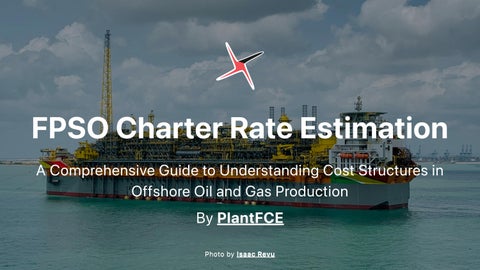
What is an FPSO?
An FPSO is a floating vessel used to extract, process,
store, and offload oil and gas.
Itʼs particularly useful for remote or deep-water fields
where permanent infrastructure is impractical.
FPSOs are mobile and flexible, often moved from one
field to another after a project ends.
Importance of FPSOs in Offshore Production
Essential for deep-water and remote oil fields.
Eliminates the need for long pipelines or costly
permanent platforms.
Allows for storage and offloading directly at the site.
Factors Influencing FPSO Charter Rates
Vessel Specifications:
Processing capacity and storage size impact costs.
Larger FPSOs with higher capacities cost more to
lease.
Contract Duration:
Longer contracts often have lower daily rates.
Contracts can range from 5 to 15 years or more.
Market Conditions
Oil Prices: Higher oil prices increase demand for
FPSOs, pushing rates up.
Market Supply: An oversupply of FPSOs can drive
charter rates down.
Timing is critical in securing favorable charter rates.
plantfce.com plantfce.com
Geographical Influence
The location of oil fields plays a major role in charter
rate costs.
Deep-water regions (e.g., Brazilʼs pre-salt fields)
require larger, more expensive FPSOs.
Calmer waters (e.g., Southeast Asia) allow for smaller,
less costly vessels.
Pricing Examples by Region
. West Africa: Medium FPSO ( 50,000 to 100,000 barrels/day):
$150,000 to $300,000 per day. . Brazil (Deep-water):
Large FPSO ( >150,000 barrels/day): $350,000 to
$550,000 per day. . Southeast Asia:
Small FPSO ( 25,000 to 50,000 barrels/day):
$100,000 to $200,000 per day.
Other Cost Considerations
Mobilization and Demobilization:
Moving the FPSO to and from the site can cost between $5,000,000 to $20,000,000 .
Maintenance and Upgrades:
Routine maintenance and vessel modifications may
add to the overall expense.
Market Dynamics
Oil Price Crashes:
During periods of low oil prices, FPSO charter rates
can drop significantly (e.g., 2014-2016 oil crash).
Recovery Periods:
As oil prices recover, charter rates rise due to
increased demand for offshore projects.
Future Outlook
Technological Advancements:
New, automated FPSOs may reduce operational costs
and lower charter rates.
Environmental Regulations:
Increased focus on sustainability might raise costs, with more energy-efficient vessels required.
Conclusion
FPSO charter rates depend on vessel size, contract
length, market conditions, and geographical factors.
A combination of these elements determines the total
cost of leasing an FPSO for offshore oil and gas
projects.
Understanding these dynamics is essential for making
informed decisions in the offshore oil and gas industry.