AL Philanthropies Research Programme Key points at a glance Providing a whole school mental health service makes a difference to staff, pupils and parents as it becomes embedded over time. Place2Be’s research over the past four academic years provides evidence to suggest this for the first time: •
•
•
• •
•
Our accessible school-based service is providing a positive experience of seeking and receiving tailored help: More of the school community accessed Place2Be services over time and the majority of pupils, staff and parents continued to have a positive experience of being supported (pages 4-5). Stigma is reduced: School staff and parents noted an increase in how open children are talking about their feelings, suggesting a reduction in mental health related stigma in the schools (page 5-6). Staff and parents have the tools to better support children with their mental health: Through accessing services such as Place2Think and Mental Health Champions Foundation Programme for school staff, and parent partnership sessions for parents/carers, there has been an increase in understanding of children's mental health. This had a positive impact on staff’s practice with supporting children, as they implemented the approaches they had learned, and a positive impact on parents with supporting their children directly or seeking out additional support (pages 6-8). Relationships are improving: Place2Be's support contributed to improved staff relationships with parents and pupils (page 8). Pupils’ wellbeing is maintained even when school is less enjoyable: Children reported enjoying school less, but children’s wellbeing continued to be maintained across the 4 years (page 9-13). Place2Be is building mentally healthy schools: The school community has viewed the schools as significantly more mentally healthy after 4 years (page 13).
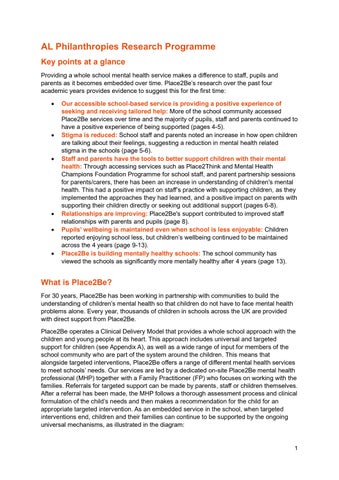
What is Place2Be? For 30 years, Place2Be has been working in partnership with communities to build the understanding of children’s mental health so that children do not have to face mental health problems alone. Every year, thousands of children in schools across the UK are provided with direct support from Place2Be. Place2Be operates a Clinical Delivery Model that provides a whole school approach with the children and young people at its heart. This approach includes universal and targeted support for children (see Appendix A), as well as a wide range of input for members of the school community who are part of the system around the children. This means that alongside targeted interventions, Place2Be offers a range of different mental health services to meet schools’ needs. Our services are led by a dedicated on-site Place2Be mental health professional (MHP) together with a Family Practitioner (FP) who focuses on working with the families. Referrals for targeted support can be made by parents, staff or children themselves. After a referral has been made, the MHP follows a thorough assessment process and clinical formulation of the child’s needs and then makes a recommendation for the child for an appropriate targeted intervention. As an embedded service in the school, when targeted interventions end, children and their families can continue to be supported by the ongoing universal mechanisms, as illustrated in the diagram:
1
What are the aims of the research? In 2022, AL Philanthropies provided funding to Place2Be to undertake a four-year research programme to evaluate the impact of the service. The research aims to examine and provide evidence of the impact of having a whole-school approach on mental health and wellbeing. At its core, the project was designed to be a proof-of-concept approach testing implementation as well as impact. We believe that our data driven findings can influence how good mental health services are delivered. Furthermore, we hope findings will inform and influence the debate for all stakeholders. What were the schools like before Place2Be? Twenty primary schools in Salford were recruited to take part in the programme. Prior to the programme, all schools had some level of provision in place to assist with mental health and wellbeing. Although the amount and type of provision varied across schools, none had previously accessed Place2Be services, thus the schools represented a true baseline. Altogether, the schools had a higher proportion of pupils who were eligible for Free School Meals (FSM) and children with Special Educational Needs (SEN). On average, 30% of pupils in the 20 Salford schools were eligible for FSM, and 16% had SEN, compared to the national averages of 22.5% and 12.6%, respectively. The Good Childhood Report (2023) indicates that children from financially struggling families are more likely to feel unhappy at school, and this is also associated with lower academic attainment (Social Mobility Commission, 2024). Some of the schools were experiencing these issues at the start of the programme:
“The context of our school is that we’ve got a higher percentage of children with free school meals than nationally. So, that indicates sort of, some level of deprivation… [school’s area] is one of the highest areas of Manchester for reported incidents of domestic violence and drug abuse, so I suppose for us, we know that some of our children come to school with a lot of baggage” Headteacher, Spring 2023
2
Prior to the project, pupil wellbeing in the programme schools was similar to the wellbeing of other samples in the UK population 1. There was, however, a minority of pupils in the schools who had lower levels of wellbeing, and pupils who were experiencing feelings of sadness (4%) and worry (4%). Moreover, 1 in 5 pupils were struggling to fall asleep at night and over 1 in 3 reported they were feeling tired. These pupils were also found to be more likely to have lower levels of wellbeing. Headteachers reported that children who were struggling with their wellbeing were coming into school “very distracted”, “withdrawn” or “not very cooperative” and this impacted their ability to engage with learning. To assist pupils’ wellbeing, most schools drew on external expertise from agencies. However, headteachers reported that there was scope for improvement with building schools’ relationships with Child and Adolescent Mental Health Services (CAMHS) and improving their experience of making referrals to CAMHS. In addition, staff wellbeing was slightly lower than that of the general UK population 2 and over 1 in 3 staff members were experiencing high levels of anxiety. Although staff generally had a positive view on the culture and ethos of their school, many teachers felt like they spent a lot of time managing pupils’ behaviour and the school environments were quite disruptive and noisy.
What has happened so far? Over the past four years, pupils, parents and staff from 20 schools have accessed support provided by Place2Be’s whole school service. From the project’s launch in September 2022 through to June 2026, these services have become embedded in the schools, as reflected in the number of pupils, school staff and parents who have used the range of services available: •
3,889 pupils self-referred to Place2Talk
•
755 pupils accessed one-to-one counselling
•
544 pupils participated in Journey of Hope group counselling
•
137 pupils and their parents accessed PIPT (since September 2023)
•
719 whole class work sessions were delivered to pupils
•
2,973 parent partnership sessions were used by parents/carers
•
6,108 Place2Think sessions were accessed by school staff
Each year around 3 in 10 of the schools’ pupil population made use of one or more of the Place2Be services available in their school 3.
ImpactEd mean=3.64, Place2Be schools mean=3.64 Scores from pupils in years 4, 5 and 6 in the ImpactEd database (May 2022). 3 30% in 22/23, 31% in 23/24, 34% in 24/25 and 30% in 25/26. 1
3
What difference has adopting a whole school approach made to pupils and school staff to date? Research methods Our evidence of the impact of the whole school approach to mental health and wellbeing is based on the experiences of pupils, school staff and parents/carers. Pupils and staff were invited to take part in a survey in the autumn term of 2022, 2023, 2024 and 2025. Each academic year, around 2,000 pupils from years 4, 5 and 6 participated, representing over 90% of the pupils in these year groups in the schools. The survey covered topics such as pupil wellbeing, school-engagement and experiences with Place2Be services. We were able to track the responses of some pupils as they progressed from year 4 to year 6, which allowed us to measure any changes over time. Additionally, between 300-500 staff, from teaching and non-teaching roles, participated in a staff survey that assessed topics such as staff wellbeing, relationships and their experiences of Place2Be. Between 37% and 63% of the school staff population took part in the staff survey each year. Parents and carers were invited to take part in a survey during the summer term of 2023, 2024 and 2025. Each year, between 450 and 720 parents and carers took part. This survey covered topics on pupil wellbeing, relationships, their experiences of their school and Place2Be. For more details on the research methodology see appendix B. This report presents the findings from these surveys across the four academic years in the following areas: • • • • • • •
Help-seeking and stigma Staff’s and parents’ knowledge and skills Relationships School environment Pupil and staff wellbeing School engagement School culture and ethos
(See Appendix C for trends across the survey phases) Pupils had a positive experience of help-seeking and the stigma around mental health was reduced for the school community Place2Be aims to destigmatise views of mental health, offer pupils accessible support when they need it and promote a positive experience of help-seeking. The findings show that these aims were achieved in the schools. Building on the work delivered in the schools in previous academic years, Place2Be has continued to actively engage pupils and encourage them to seek support through Place2Talk. For example, at the start of the 2024/25 academic year, the MHPs visited the classrooms of year 4, 5 and 6 pupils to raise awareness of the Place2Be’s services. MHPs also made themselves available in the playground during break times to create opportunities, for children who might not typically seek support, to access Place2Talk. This ongoing support resulted in more pupils being aware of who their MHP is in school and more pupils self-referring to Place2Talk in 2025/26 compared to 2022/23. As this marks the fourth year of the project, it is important to note that children in 2025/26 have also had increased exposure to, and familiarity with the service which gave them more opportunities for support.
4
More children were aware of their Mental Health Practitioner: Significantly more children who responded to the survey knew who the Mental Health Practitioner was in their school.
More children were seeking help from Place2Be: Significantly more children who responded to the survey attended Place2Talk in 25/26 compared to 22/23.
As with previous years, pupils who reached out for Place2Be support continued to report a positive experience. Most pupils felt that the MHPs were available, a good listener, trustworthy and helpful: • • • • •
81% of children felt that they can see the MHP if they wanted to 85% of children felt the MHP listened to them 81% of children felt the MHP helped them 82% of children trusted the MHP 82% of pupils would recommend Place2Talk to a friend.
In each academic year, around 29% of the schools’ pupil population chose to self-refer to Place2Talk to share their feelings. This indicates that Place2Be might have helped to create an environment in school that encourages children to talk about mental health. In particular, staff and parents have perceived children to be more open talking about their mental health. In the first year, 41% of staff reported that children were comfortable talking about their mental health and the percentage increased to 56% of staff in the third year. Similarly, 58% of parents and carers surveyed in 2025 also felt their child was more comfortable talking about their feelings since Place2Be. These perceptions are reflected in the finding that two in three pupils (68%) said that they know where to go for help when they have a problem and 52% find someone to talk to when they need help. “Children are more open with their feelings/emotions/mental health. [Place2Be] has provided a safe space for children who are struggling with their mental wellbeing which has been positive.” Staff, 2024 ““My child is more open and speaks freely about his feelings and thoughts and knows he can come to mum for help and advice instead of holding back.” Parent, 2025 Moreover, there is evidence to suggest that Place2Be has had an impact on parents accessing support. Since Place2Be, 45% parents and carers found it easier to get help and this was more noticeable from parents and carers who engaged with Place2Be services than from those who did not.
5
“it is pressure off us as parents knowing our child has someone safe they can talk to. It also helps us feel more supported and we know we have somewhere to go for advice.” Parent, 2025 As well as pupils, there was a positive change in the wider school community as 74% of staff also observed that the school community was more comfortable talking about mental health. One staff member noted how much of an impact this was for parents: “The biggest impact has been on parents/carers feeling comfortable in discussing both their child's mental health and also their own.” Staff, 2024 This has also been reflected in the parent findings, with over half of parents/carers feeling that staff were more understanding about their child’s needs (53%) and over half of parents/carers were more comfortable talking to school staff (56%) since Place2Be services started in the schools. Staff noted how this impacted the school atmosphere and helped to normalise conversations around mental health. “Having Place2Be in our school has helped to normalise discussion around mental health.” Staff, 2024 “[Place2Be] has made for a more accepting atmosphere for the children regarding mental health.” Staff, 2024 Together, these findings suggest that Place2Be may be helping to reduce mental healthrelated stigma amongst the school community. School staff and parents were better equipped to support children’s wellbeing The whole school approach includes building the understanding and skills of the adults who support the children, as well as direct work with children. The findings demonstrated that school staff were more well informed and adapted their practice as Place2Be became embedded. As part of Place2Be’s whole school approach, staff had access to specialist bespoke support (e.g., Place2Think) and digital training (MHCF programme) to enhance their knowledge and skills in understanding and supporting children’s mental health in their role. Since the start of the project, staff used Place2Think to explore strategies to support pupils who were accessing Place2Be’s targeted interventions (49% of sessions) and to help them understand communication behind children’s behaviour (35% of sessions). Specifically, MHPs reported they had engaged staff in developing strategies to help children to manage difficult emotions and for advice on how to build zones or spaces in school to help pupils self-regulate. Through the consultations between the MHP and school staff, Place2Be helped to improve staff’s understanding of children’s mental health and of how mental health can impact pupils’ behaviour and learning.
6
91% of staff agreed or strongly agreed that they had a good understanding of children's mental health in 25/26 which was higher than 86% of staff in 22/23.
91%
95%
96%
95% of staff agreed or strongly agreed that they had a good understanding of how children's mental health relates to their behaviour in 25/26 which was higher than 92% of staff in 22/23.
95% of staff agreed or strongly agreed that they have a good understanding of how children's mental health relates to their learning in 25/26 which was higher than 92% of staff in 22/23/
This increased understanding and awareness of mental health in staff as the Place2Be service became embedded, led to staff adopting new approaches and strategies that they used in their everyday practice.
Overall, staff reported that Place2Be has been “a supportive tool for the class teachers”. One staff member mentioned that they “personally love having a practitioner as a sounding board to give an unbiased opinion”. As a result, more staff felt confident in supporting children’s mental health.
7
[Place2Be] has improved staff confidence in dealing with mental health issues.” Staff, 2024
Percentage of parents who agreed or strongly agreed
Parents and carers also had access to support through parent partnership sessions. The most common topics discussed at parent partnership sessions were seeking general advice on their child’s wellbeing and mental health (42%) and gaining a better understanding of their child and their behaviour (25%) 4. Many parents/carers who spoke to a Place2Be practitioner reported that they had received new advice that they had not had before and many also took action as a result. Moreover, over half of parents and carers also learned about additional sources of support and made use of these recommendations. 100 90 80 70 60 50 40 30 20 10 0
65
59
55
57
61 51
58
54
Had new advice not had Done something different Learned where else they Made use of the support before as a parent could get support the MHP told them about
Mental Health Practitioner
Family Practitioner
Parents/carers with children in one-to-one counselling also shared that it had helped improve their understanding and learn new strategies. This shows Place2Be has been informative and supportive for parents.
Improved staff relationships with parents/carers and pupils Having an MHP in school also helped to develop working relationships across the school community. Prior to Place2Be, over 95% of parents/carers had a positive view of the school, which remained consistent throughout the three years of the project. However, despite already having a strong relationship, nearly half of parents and carers reported that Place2Be improved their relationship with their school and that they felt more supported by the school. This finding is also reflected in the staff survey. In 2022/2023, 44% of staff stated that Place2Think helped them with their working relationships with parents and carers. As the service has become more embedded, significantly more staff felt their relationships with parents benefited from Place2Think (65% of staff). Some staff also used Place2Think to help them reflect on and manage their own emotional responses to children (covered in 10% of sessions). Staff who responded to the survey felt that Place2Think made a difference to their relationship with their pupils, higher in 25/26 (67% of staff) compared to 22/23 (48% of staff). Throughout the four years, children had maintained a high sense of connection with their school. There were no statistically significant differences in pupils’ school connection scores between 25/26 and 22/23.
4
Parent partnerships with parents/carers who did not have a child in targeted support
8
School environment has been evolving The evaluation to date provides some evidence that Place2Be had a positive impact on the school environment. “Our practitioner makes a significant contribution to the calm, inclusive and understanding ethos within the school and is proactive in supporting team building.” Staff, 2024 Since Place2Be has been in schools, 38% of staff felt that arguments between pupils had been reduced.
“Less time [is] taken out of lessons to discuss pupil disagreements, arguments or fallings out. Pupils are more able to resolve these situations themselves or know they can use the service to discuss things rather than needing time from the teachers out of class.” Staff, 2024 This could reflect the fact that pupils received support for their friendships’ issues through Place2Talk - friendship being the most common issue discussed in 63% of sessions. MHPs led whole class work that covered topics on friendships and understanding emotions of their peers. “She [MHP] is proactive and recognises the pressures within a school environment and adapts her plans to suit the children and schools’ needs.” Staff, 2024 However, the staff survey findings also indicated that the school environment was less calm to some extent. Staff perceived the classrooms were more disruptive in 25/26 compared to 22/23. Moreover, more staff spent a lot of their time managing children’s behaviour in 25/26 compared to 22/23. These findings may be reflecting the changes in the contexts of the schools. For example, school staff reported a reduction in teaching assistant availability, while the number of children potentially needing them increased. Thus, there were occasions when the teaching staff had to provide 1:1 and 2:1 support for children with SEN. There was also a shortfall of places within special schools to accommodate the needs of SEN children. These had an impact on staff workload and their capacity to manage behaviour in the classroom.
Wellbeing of pupils and school staff was maintained and pupils said they felt better after using Place2Talk Throughout the past three years, pupils have been able to access Place2Be services to support their wellbeing either directly (through targeted services and Place2Talk) or indirectly (through whole class work and assemblies). Common issues discussed at Place2Talk included the ways pupils could manage their emotions such as sadness (44%), worry (47%) and anger (28%). A minority of children used Place2Talk to discuss more complex issues such as loss/bereavement (18%), traumatic events (2%) and self-harm (1%). The latest pupil survey demonstrated that Place2Talk was a valuable service for supporting children’s wellbeing. Overall, 87% of pupils felt listened to during Place2Talk and it had helped: 9
• • •
81% of pupils to feel calmer 76% of pupils to sort out a problem 76% of pupils to feel less worried.
Staff also reported that since Place2Be has been in their school, children “are better able to articulate strategies [on] how to manage their mental health” and the presence of having the MHP in school had a positive effect on pupils’ wellbeing: “[pupils] feel happy and safe knowing that [MHP] is in the building and children’s mental health has improved since she has been on board.” Staff, 2024 This was also highlighted by parents and carers whose children accessed one-to-one counselling. They shared that the support had helped their children to understand their emotions better and develop strategies to support them: “It has made family life at home better as [pupil] is developing skills to talk and reducing her emotional state from high anxiety to find ways to problem solve.” Parent, 2025 Since Place2Be had been in the schools, the pupils’ responses showed that pupil wellbeing had been maintained across the four academic years. This effect remained after controlling for age and gender (see Appendix D).
25.26
3.61
24/25
3.65
23/24
3.63
22/23
3.64
22/23
23/24
24/25
25.26
While pupils’ experience of Place2Be and the difference it makes were positive for the majority, it may take some time for these positive experiences of Place2Be to translate into a measurable difference in pupils’ wellbeing scores. It also may be that Place2Be is having a preventive effect, whereby without the support, there may have been a decline in wellbeing. To address the latter, a comparative analysis has been conducted using statistical matching techniques 5 with data from pupils in other primary schools in the UK. The findings show that the wellbeing of pupils in the Place2Be schools was similar to the comparison group. Within the Place2Be schools, there were no statistically significant differences found in pupil wellbeing between each year group across different academic years. For example, year 4 pupils in 2022 had similar level of wellbeing to year 4 pupils in 2025. However, there was evidence to suggest that pupils’ wellbeing declined with age. In each academic year, year 4 pupils had higher wellbeing compared to year 6 pupils. Moreover, pupils who were tracked 5
Coarsened Exact Matching
10
from year 4 in 22/23 to year 6 in 24/25, and year 4 in 23/24 to year 6 in 25/26, showed a significant decline in their wellbeing score as they got older. Although the wellbeing had remained consistent, parents whose children accessed one-toone counselling said that there had been a positive impact on their child’s wellbeing. The majority of parents and carers reported in the survey that the support their child received had improved their child’s wellbeing (89% of parents/carers). In particular, some parents mentioned how it had improved their child’s confidence, reduced their child’s anxiety and improved relationships with peers and siblings. This support also had a positive impact on their family, with 71% of parents and carers reporting that they also felt that one-to-one counselling had improved their homelife. “My son seems a lot calmer which makes a massive difference on home life.” Parent, 2025 Similarly to pupil wellbeing, staff wellbeing had also been maintained across the three years of this programme. While the assumption in our Theory of Change that there would be an impact on staff wellbeing has yet to be demonstrated measurably, school staff used the service to support their wellbeing. For example, 11% of Place2Think sessions focused on self-care (e.g., stress in the job) and some school staff reported beneficial impact of Place2Be on their wellbeing: “I feel like [MHP] checks in with us all and makes sure we are looking after ourselves. It feels much more than her job role.” Staff, 2024 “SLT are more aware of staff wellbeing and actively try to address this.” Staff, 2024 Altogether, the majority of staff felt happy (67%), satisfied (67%) and considered that things they do in life are worthwhile (79%) in 25/26, which was consistent with previous years. While most staff reported positive experiences of Place2Be, anxiety levels remained the same as previous years, with 60% of staff experiencing medium to high levels of anxiety in 25/26. There may be wider contextual factors impacting on their wellbeing. “The service provides an excellent outreach to children, parents and staff. Having a practitioner on site means that anyone at crisis can reach out without having to wait or go through a referral process. This reduces stress and quite often resolves issues before they spiral.” Staff, 2024
Pupils found school less enjoyable, but their connection to school was maintained Overall, the findings suggested that pupils were significantly less engaged at school in 25/26 when compared to 22/23. This effect was evident in the emotional aspects of school engagement (e.g., if pupils enjoy school) rather than the behavioural aspects of school engagement (e.g., if a pupil is following the rules) and was therefore more related to how pupils feel about school than what they do in school.
11
School engagement over time 4.2 4 3.8
4.06 3.8 3.62
4.01
4.01
3.72
3.69
3.53
3.6
3.99
3.63
3.48
3.39
3.4 3.2 3 22/23
23/24 Total
24/25 Behavioural
25/26
Emotional
When the school engagement scores among the individual year groups were explored, there was a significant decline in school engagement, especially for the emotional aspects of engaging with school, across all year groups. This decline was particularly noticeable in the 24/25 year 4 cohort. A possible explanation for this may be the age of these children during the COVID-19 pandemic. There is evidence that the most affected children during the national school lockdown were children in the Reception year (age 4-5) (Tracey et al., 2022). The group of schools in this programme reported that they felt that this may have had an impact on the school engagement for this year group in particular. However, even though children liked school less, the wellbeing of children and their connection to school remained the same in 25/26. Since school engagement and wellbeing were significantly related6, we would expect to also see a decline in in the wellbeing scores. However, although pupils liked school less, their wellbeing did not change possibly suggesting that Place2Be might have had a protective effect. Furthermore, although pupils reported that they have been enjoying school less, some staff noticed how having Place2Be in school helped children engage better with their learning: “Place2Be allows children the time and space to discuss any worries or problems they may have thoroughly. Because of the busy school timetable, teachers don't always have the space or time to have effective conversations as this can require a lot of time. This in turn has allowed children to come back into class ready to learn. The positive impact is incredible.” Staff, 2024 Moreover, over half of parents and carers felt their child was happier going to school since Place2Be (56%) and parents/carers who had children who had received one-to-one counselling reported it had a positive impact on how their children felt about school: “[child] seems more happier in school environment and handles change/anxiety a little better.” Parent, 2025
6
r=.57, p<0.001
12
Schools were increasingly viewed as more mentally healthy by the school community As Place2Be has become more embedded across the three years, it was evident that school leaders, staff and parents all viewed their school as more mentally healthy in 25/26 than in 22/23. For Senior Leaders and school staff, this had increased significantly each year. These changes over the time that Place2Be has been working in partnership with the schools suggests that Place2Be may be positively shaping the schools’ culture and ethos around mental health. Overall, how would you currently rate your/your child’s school as a ‘mentally healthy school’ on a scale from 1 to 7, where 1 means ‘nothing in place’ and 7 means ‘being a mentally healthy school is embedded’
6.00
5.75
5.84
5.6 5.50
5.7
5.47 5.05
5.00
5.52
5.53
5.31 5.14
4.50 4.47 4.00 Before Place2Be
22/23
23/24
school context
staff
24/25
25/26
parents
What do these findings mean? After four years, there was evidence of progress towards achieving some of the intermediate outcomes outlined in our theory of change for the whole school service. The school communities have consistently engaged with Place2Be’s services and continued to have positive experiences. Specifically, findings indicated Place2Be’s positive impact on: •
pupils’ access to expert support and their experience of help seeking
•
staff's and parents’ perception of help-seeking among pupils
•
staff's knowledge, skills and their practice including classroom management
•
relationships between staff, parents and pupils
•
squabbles/arguments between pupils
•
the school community's perception on how mentally healthy the school is.
13
Overall, having a whole school service with an embedded Mental Health Practitioner and a Family Practitioner who provide an accessible service to the pupils, staff and families, has likely contributed to a positive shift in the school’s culture. In just 4 years, Place2Be’s presence in schools has helped them to evolve into more mentally healthy and supportive environments.
References Fredericks, J.A., Blumenfeld, P., Friedel, J., & Paris, A. (2005). School engagement. In K.A. Moore & L. Lippman (Eds.), What do children need to flourish?: Conceptualizing and measuring indicators of positive development. New York, NY: Springer Science and Business Media. Liddle, I., & Carter, G. (2010). Emotional and psychological wellbeing in children: The standardisation of the Stirling Children's Wellbeing Scale. Stirling Council Educational Psychology Service. OECD. (2018). Teaching and Learning International Survey (TALIS): Teacher Questionnaire. https://www.oecd.org/education/school/TALIS-2018-MS-Teacher-Questionnaire-ENG.pdf Office for National Statistics. (2018, September 26). Personal well-being user guidance. https://www.ons.gov.uk/peoplepopulationandcommunity/wellbeing/methodologies/personalw ellbeingsurveyuserguide#:~:text=The%20measures%20include%20both%20standard,evalu ative%2C%2 0eudemonic%20and%20affective%20experience. Renshaw, T. L., Long, A. C., & Cook, C. R. (2015). Assessing teachers’ positive psychological functioning at work: Development and validation of the Teacher Subjective Wellbeing Questionnaire. School Psychology Quarterly, 30(2), 289. Stevens, K. (2009). Developing a descriptive system for a new preference-based measure of health-related quality of life for children. Quality of Life Research, 18, 1105-1113. Stewart-Brown, S., Tennant, A., Tennant, R., Platt, S., Parkinson, J., & Weich, S. (2009). Internal construct validity of the Warwick-Edinburgh mental well-being scale (WEMWBS): a Rasch analysis using data from the Scottish health education population survey. Health and quality of life outcomes, 7(1), 1-8. Sun, J., & Stewart D. (2007). Development of population-based resilience measures in the primary school setting. Health Education, 7(6), 575-599. Tracey, L., Bowyer-Crane, C., Bonetti, S., Nielsen, D., D'Apice, K., & Compton, S. (2022). The Impact of the COVID-19 Pandemic on Children's Socio-Emotional Wellbeing and Attainment during the Reception Year. Research Report. Education Endowment Foundation.
14
Appendix A: Targeted interventions for pupils Children could access three targeted interventions by the Mental Health Practitioner as follows: •
One-to-one counselling
These sessions are offered once a week for about 50 minutes and are on the same day and at the same time in school/location every week. These sessions give the child/young person the opportunity to express their feelings using play and art. One-to-one sessions usually continue for up to 10 weeks, but very occasionally longer, depending on each child’s needs. •
Journey of Hope
Journey of Hope is a structured group therapy programme to help children and young people learn positive coping mechanisms to challenging life circumstances and develop confidence and resilience. Group sessions run from six to eight weeks and consist optimally of six to eight children. Each session lasts for 45-60 minutes. In the case of groups run with young children in reception classes, group size and length of sessions may be less than for older children. •
Alternative Group work
Where school-based staff identify a specific need or theme of groupwork that Journey of Hope isn’t suitable for, they have the option to develop a needs-led alternative intervention, which is carefully planned, resourced, delivered and reviewed with the agreement of Clinical Supervisors and Area Managers. Children and parents/carers could also access the following from the Family Practitioner: •
Personalised Individual Parenting Training (PIPT)
Parenting training works by directly coaching parents/carers in how to interact differently with their children in order to increase their child’s friendly and cooperative behaviours and reduce undesirable behaviours. Parents/carers are offered between 6-10 sessions and their child joins them for some of each session.
15
Appendix B: Methodology Schools in Salford were invited to apply to take part in the project and completed an expression of interest form that set out the needs of their school. The Place2Be team then selected 20 schools who met the criteria required and who were similar to other schools who accessed Place2Be services across the UK. These requirements included the schools not already receiving in-house support or commissioned mental health services to support children (e.g. MHST), having a room available in school for Place2Be to use 2 days per week, staff members to participate in Place2Be training programmes and for the school to actively take part in the research.
Pupil survey Participants Pupils could choose whether to complete the survey or not at the start. Parents and carers were also informed via an information sheet and could choose to opt their child out.
Male Female
Phase 1 Phase 2 Phase 3 Phase 4 50% 51% 51% 49% 50% 49% 49% 51%
Pupil Premium English as an Additional Language Special Educational Needs Free School Meals
28%
31%
29%
28%
19% 19% 33%
22% 22% 32%
23% 23% 33%
24% 23% 34%
Procedure Place2Be collaborated with ImpactEd who provided schools with an online platform to host the survey. This platform also connected to schools' Management Information Systems which gathered relevant demographic data. Each pupil was provided with a unique ID code to access they survey. Pupils used devices at school to complete the survey which took approximately, 20-30 minutes. All pupil data that was gathered on the ImpactEd platform was then shared with Place2Be anonymously. Pupil Survey Measures included: • • • •
Stirling Children’s Wellbeing Scale (Liddle & Carter, 2010) School Engagement Scale (Fredericks et al., 2005) School connection and problem solving subscales from The Student Resilience Survey (Sun & Stewart, 2007) CHU9D (Stevens, 2009)
16
Staff survey Participants All staff, including teaching and non-teaching staff were invited to take part. Participant consent was obtained at the start of the survey. Procedure The survey was hosted on an online platform. The survey link, along with an information sheet, was emailed to schools for distribution among school staff members. At the end of the survey, an open-ended question was used to collect qualitative responses. Staff survey measures included: • • • •
Short Warwick-Edinburgh Mental Wellbeing Scale (Stewart-Brown et al., 2009) Office of National Statistics wellbeing measure (Office of National Statistics, 2018) School Culture and classroom environment scales from Teaching And Learning International Survey (2018) Teacher Subjective Wellbeing Questionnaire (Renshaw et al., 2015)
Parent survey Participants All parents/carers from the Salford schools were invited to take part in the survey. Participant consent was gathered at the start of the survey. Procedure The survey was hosted on an online platform, with a separate survey generated for each school. The survey link, along with an information sheet, was emailed to schools for distribution amongst their parent and carer community.
17
Appendix C: Trends across survey phases Help-seeking Problem solving subscale (Student resilience survey) Percentage of staff that agreed or strongly agreed that most pupils at their school are comfortable talking about mental health Percentage of parents/carers that agreed or strongly agreed that their child feels more comfortable talking about their own feelings Percentage of parents/carers that agreed or strongly agreed that they had found it easier to get help Percentage of parents/carers that agreed or strongly agreed that staff were more understanding of their child’s needs Percentage of parents/carers that agreed or strongly agreed that they felt more comfortable talking to school staff Staff knowledge and skills Percentage of staff who agreed or strongly agreed that they had a good understanding of children's mental health Percentage of staff who agreed or strongly agreed that they had a good understanding of how children's mental health relates to their behaviour Percentage of staff who agreed or strongly agreed had a good understanding of how children's mental health relates to their ability to learn Percentage of staff who agreed or strongly agreed that they felt confident in supporting children with their mental health Percentage of staff who agreed or strongly agreed that Place2Think had helped them to develop strategies to support children with their mental heath and wellbeing Percentage of staff who had used one or more new approach from the MHCF programme
Phase 1 (22/23)
Phase 2 (23/24)
Phase 3 (24/25)
Phase 4 (25/26)
3.70
3.68
3.66
3.58
41.2%
57.06%
59.7%
55.75%
Did not collect
Did not collect
58.49%
N/A
42.5%
41.86%
45.45%
N/A
48.94%
50.64%
53.21%
N/A
42.06%
52.84%
55.89%
N/A
Phase 1 (22/23)
Phase 2 (23/24)
Phase 3 (24/25)
Phase 4 (25/26)
85.96%
89.34%
91.05%
90.64%
92.38%
94.24%
94.92%
94.60%
92.86%
94.23%
96.12%
94.60%
68.34%
79.25%
78.81%
76.62%
53.52%
79.59%
73.69%
79.45%
48.08%
84.44%
67.92%
72.09%
18
Relationships
Phase 1 (22/23)
Phase 2 (23/24)
Phase 3 (24/25)
Phase 4 (25/26)
4.16
4.16
4.18
4.11
44.28%
54.84%
54.8%
64.79%
47.89%
67.00%
65.34%
67.14%
37.2%
40.84%
44.55%
N/A
42.02%
48.32%
47.58%
N/A
Phase 1 (22/23) 3.38
Phase 2 (23/24) 3.35
Phase 3 (24/25) 3.35
Phase 4 (25/26) 3.42
60.00%
65.13%
61.49%
69.06%
Phase 1 (22/23)
Phase 2 (23/24)
Phase 3 (24/25)
Phase 4 (25/26)
Pupil Wellbeing Stirling Children’s wellbeing mean score Positive emotion subscale mean score Positive outlook subscale mean score
3.64 3.58 3.70
3.63 3.56 3.71
3.65 3.57 3.73
3.61 3.53 3.69
Year 4 mean score Year 5 mean score Year 6 mean score
3.70 3.60 3.62
3.69 3.64 3.58
3.70 3.65 3.60
3.66 3.60 3.58
75%
72.41%
88.57%
53.85%
51.72%
71.43%
22.00
21.93
22.34
Mean score from school connection subscale from The Student Resilience Survey (pupils relationship with staff) Percentage of staff who strongly agreed or agreed that Place2Think had helped them with their working relationships with parents and carers Percentage of staff who strongly agreed or agreed that Place2Think had helped with their working relationships with pupils Percentage of parents/carers that strongly or agreed that they had a better relationship with the school Percentage of parents/carers that strongly agreed or agreed that they felt more supported by the school
School environment School environment (TALIS) mean score Percentage of staff who agreed or strongly agreed that they spend a lot of my time managing pupils' behaviour
Wellbeing
Percentage of parents/carers who reported that one-to-one counselling helped their children with their mental health and wellbeing Percentage of parents/carers who reported that one-to-one counselling that their child had received helped their family or homelife Staff wellbeing Short Warwick-Edinburgh Mental Wellbeing Scale total score
22.13 19
Phase 1 (22/23)
Phase 2 (23/24)
Phase 3 (24/25)
Phase 4 (25/26)
School engagement School engagement scale mean score Behaviour subscale mean score Emotion subscale mean score
3.80 4.06 3.62
3.72 4.01 3.53
3.69 4.01 3.48
3.63 3.99 3.39
Year 4 mean score Year 5 mean score Year 6 mean score
3.90 3.77 3.72
3.82 3.75 3.60
3.74 3.72 3.62
3.71 3.59 3.58
51.57%
54.85%
56.23%
Percentage of parents/carers that agreed or strongly agreed that their child is happier going to school
20
Appendix D: Age Standardisation While the Stirling Children’s Wellbeing Scale (SCWBS) is typically scored as a raw total (12–60), age standardization allows unbiased comparison across different age range - especially useful in mixed-age datasets. When different sub-groups are compared in respect of a variable on which age has an important influence, any differences in age distributions between these subgroups are likely to affect the observed differences in the proportions of interest. Therefore, age standardisation of the wellbeing scores was used in order to enable groups to be compared after adjusting for the effects of any differences in their age distributions. We used the direct standardisation method. The standard population to which the age distribution of sub-groups was adjusted was from the 2021 Census for Salford. Age standardisation was carried out using the age groups: 9-10, 10-11, and 11-12. All age standardisation has been undertaken separately within each sex. Age standardisation was applied in four steps: 1. We multiplied the wellbeing mean score for the specific age group by the standard population for that group 2. We added the products and obtain the total weighted wellbeing score 3. We added the standard population totals 4. We calculated the age standardized total wellbeing score by dividing the total weighted score by the total standard population Variances for each means were also estimated based on the weighted standard deviations of the means to allow for statistical comparisons. Age Standardised Children’s Stirling Wellbeing scores for all pupils and for boys and girls.
21