European Child & Adolescent Psychiatry (2022) 31:1591–1599
https://doi.org/10.1007/s00787-021-01802-w

European Child & Adolescent Psychiatry (2022) 31:1591–1599
https://doi.org/10.1007/s00787-021-01802-w
Received: 12 November 2020 / Accepted: 9 May 2021 / Published online: 14 May 2021
© Springer-Verlag GmbH Germany, part of Springer Nature 2021
Abstract
Children’s mental health is deteriorating while access to child and adolescent mental health services is decreasing. Recent UK policy has focused on schools as a setting for the provision of mental health services, and counselling is the most common type of school-based mental health provision. This study examined the longer-term efectiveness of one-to-one school-based counselling delivered to children in UK primary schools. Data were drawn from a sample of children who received schoolbased counselling in the UK in the 2015/16 academic year, delivered by a national charitable organisation. Mental health was assessed at baseline, immediately post-intervention, and approximately 1 year post-intervention, using the Strengths and Difculties Questionnaire (SDQ) completed by teachers and parents. Paired t tests compared post-intervention and follow-up SDQ total difculties scores with baseline values. Propensity score matching was then used to identify a comparator group of children from a national population survey, and linear mixed efects models compared trajectories of SDQ scores in the two groups. In the intervention group, teacher and parent SDQ total difculties scores were lower at post-intervention and longer-term follow-up compared to baseline (teacher: baseline 14.42 (SD 7.18); post-intervention 11.09 (6.93), t(739) = 13.78, p < 0.001; follow-up 11.27 (7.27), t(739) = 11.92, p < 0.001; parent: baseline 15.64 (6.49); post-intervention 11.90 (6.78), t(361 = 11.29, p < 0.001); follow-up 11.32 (7.19), t(361) = 11.29, p < 0.001). The reduction in SDQ scores was greater in the intervention compared to the comparator group (likelihood ratio test comparing models with time only versus time plus group-by-time interaction: χ 2 (3) = 24.09, p < 0.001), and model-predicted SDQ scores were lower in the intervention than comparator group for 2 years post-baseline. A one-to-one counselling intervention delivered to children in UK primary schools predicted improvements in mental health that were maintained over a 2 year follow-up period.
Keywords Counselling · School counselling · School mental health
Approximately half of adults with mental health disorders experienced their initial symptoms before the age of 14 [1, 2], and there is now convincing evidence that the mental health of children is in decline [3, 4]. Access to child and adolescent mental health services (CAMHS) is decreasing as services struggle with increasing referrals and fewer resources [5, 6], and the COVID-19 pandemic is accelerating mental health changes in adults, particularly emerging adults, with children and young people predicted to be even more vulnerable [7–9]. Increased access to efective mental health intervention for children and adolescents should
K.e.fnning2@exeter.ac.uk
1 University of Exeter College of Medicine and Health, Exeter, UK
2 Place2Be, London, UK
3 University of Cambridge, Cambridge, UK
be a critical priority to prevent entrenchment of poor mental health into adolescence and early adulthood, but it is unlikely that CAMHS can expand sufciently rapidly to meet this increased need.
Recent UK policy has focused on increasing the liaison between CAMHS and schools with the training of schoolbased mental health practitioners [10]. Schools provide an optimal setting for the provision of early-intervention mental health services given their near-universal access to children and families, including those considered hard-toreach. Children who are well educated have better health and wellbeing, while those with better health, including better mental health, perform better at school [11]. Children with mental health problems have poorer academic attainment, greater school absences, and an increased risk of school exclusion compared to their mentally healthy peers [12–14]. Recent research by the Institute for Public Policy Research showed that parents would like greater priority to be given
to school-based mental health support, while more than 70% of teachers believed greater access to onsite mental health support would improve student attainment [15].
Counselling is the most common type of school-based mental health provision and is currently ofered in 60–70% of schools in England, although it is less likely to be available in primary compared to secondary schools [15–17]. Previous studies have demonstrated the efectiveness of school-based counselling at improving mental health postintervention and for up to 3 months afterwards [18–20]. However, less is known about the longer-term impact of school-based counselling. A previous pilot study evaluated the efectiveness of school-based humanistic counselling delivered to 64 adolescents aged 11 to 18 years, and found that the benefts observed immediately post-intervention were not sustained at 6 or 9 month follow-up [21]. However, research has yet to examine the longer-term efectiveness of school-based counselling delivered to primary school children.
Place2Be is a mental health charity that provides mental health support, including one-to-one counselling, to children in schools across the UK. Previous research has demonstrated that this counselling intervention has a positive short-term impact on the mental health of primary school children [20], and also has economic benefts resulting from higher employment output and lower spending on public services, amounting to over £5700 per child [22]. However, the longer-term efectiveness of the counselling intervention on children’s mental health has yet to be explored.
The current study aims to examine the longer-term efectiveness of this school-based counselling intervention by addressing the following research questions:
1. Does the school-based counselling intervention lead to improvements in primary school children’s mental health measured (a) immediately after counselling is completed, and (b) approximately 1 year later?
2. How do the mental health trajectories of children who receive the counselling intervention compare to the trajectories of a matched group of children who did not receive a mental health intervention?
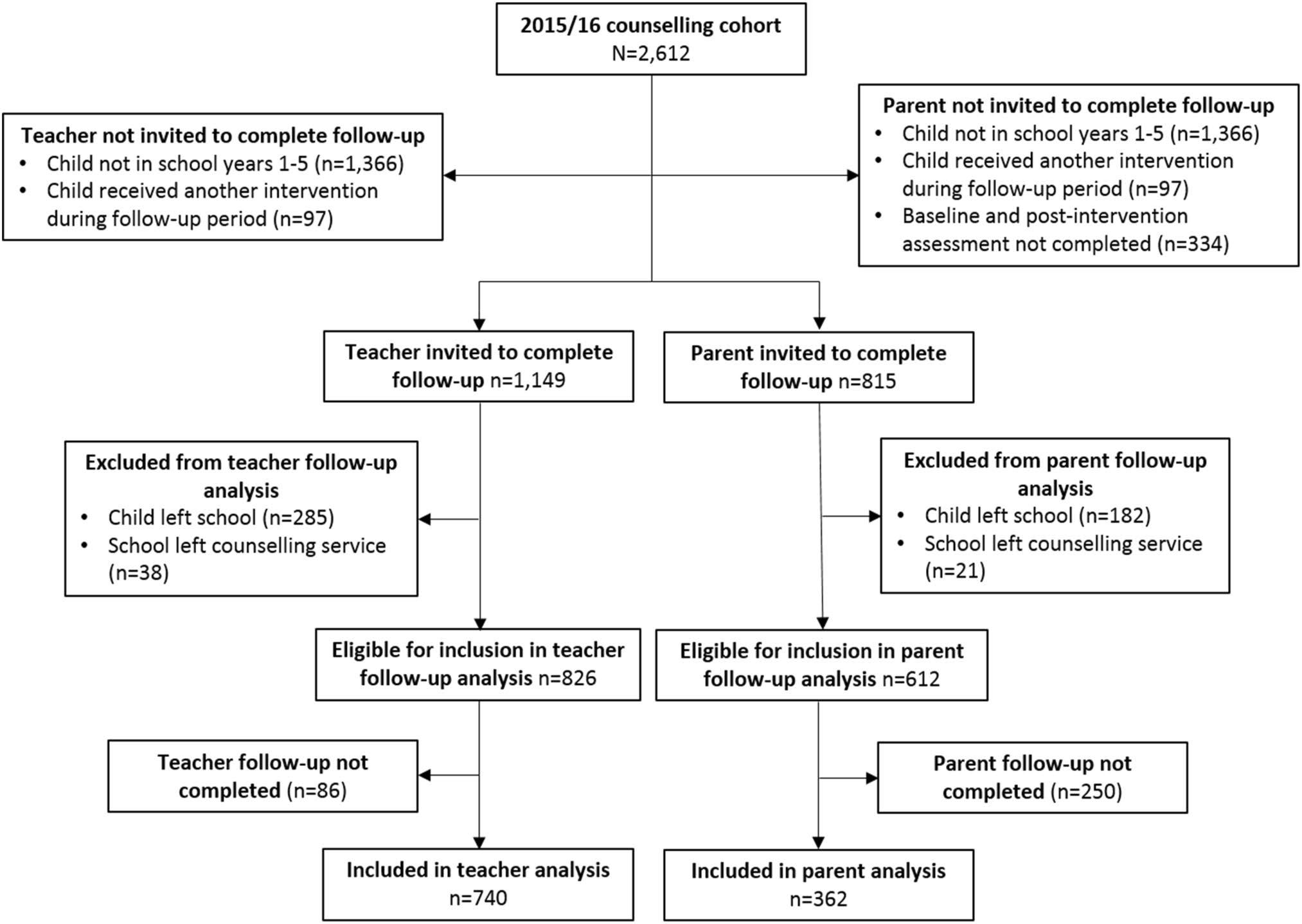
Data were drawn from 2612 primary school children who received the counselling intervention during the 2015/16 academic year. Follow-up assessments were carried out with the 1149 children who were in school years 1 to 5 (to reduce
administrative burden associated with tracing children into secondary school), did not receive another intervention during the follow-up period, and had baseline and post-intervention Strengths and Difculties Questionnaires (SDQs) available. Children were excluded from the follow-up analysis presented here if they had left the school or the school left the counselling service. This resulted in 826 and 612 children eligible for inclusion in the teacher and parent reported follow-up analysis, respectively, of which 740 (89.6%) and 362 (59.2%) provided follow-up data (see Fig. 1).
The 2004 British Child and Adolescent Mental Health Survey (BCAMHS) was a nationally representative population survey of young people in Great Britain aged 5 to 16 years, sampled via the Child Beneft register, which at that time was a universal beneft available to all parents. Four hundred and twenty-six postal sectors were randomly sampled by the Ofce for National Statistics, stratifed by regional health authority and socio-economic group. A total of 10496 families were approached and 7977 completed a baseline interview. Full details of the survey methods are reported by Green and colleagues [23]. To identify a comparison sample of children for the current analysis, we excluded children who had been in contact with specialist mental health or education services in relation to the child’s mental health (n = 450). Of the remaining 7527 children, 6584 had an SDQ at baseline and at least one follow-up period, and were included into the pool for matching with the intervention group.
Referral pathways into the counselling service varied, but children were most commonly referred by school staf (see Tables S4 and S5 in online supplementary information). Initial assessments were undertaken by school-based counsellors with the child, their parent/carer, and their main class teacher to determine reasons for referral, develop a clinical formulation, and obtain demographic and clinical information, including completion of the SDQ by the parent and teacher. The intervention is based on a combination of person-centred, psychodynamic and systemic therapeutic approaches. Sessions may involve talking, creative work, and play, and take place in a room at the school equipped with toys and creative materials. Children were ofered 12 to 36 weekly sessions, which typically ended through mutual agreement between the child and therapist, although treatment could also end at the request of the parent or child, or if the child left the school or was excluded. On completion of counselling, post-intervention assessments were
1 3
undertaken with the child, parent and teacher to assess the child’s progress, including completion of the SDQ. Teachers and parents were asked to complete a further SDQ approximately 1 year after the post-intervention assessment.
In the 2004 BCAMHS, face-to-face interviews were conducted with parents of all children at baseline and 36 month follow-up, while keep-in-touch postal questionnaires were mailed to parents at 6, 12 and 24 months. The SDQ was completed at each of these time-points. A postal questionnaire, including the SDQ, was also sent to teachers at baseline and 36 months, where parents provided consent.
In both the intervention and comparator samples mental health was assessed with the SDQ, which is a validated
questionnaire that screens for common psychopathology in children aged 4 to 16 years [24]. Versions are available for completion by parents, teachers and young people aged 11 years or above. Due to the young age of participants, only teacher and parent reports were used for this study. The SDQ consists of 25 items grouped into fve subscales: emotional problems, conduct problems, hyperactivity-inattention, peer problems, and prosocial behaviour. A total difculties score is calculated by summing the totals of the frst four subscales; a higher score indicates greater diffculties. An impact supplement asks teachers and parents about the impact of the child’s difculties on peer relationships and classroom learning, and additionally asks parents about the impact on home life and leisure activities. The SDQ has satisfactory internal consistency (teacher α = 0.82; parent α = 0.80), test–retest reliability (teacher r = 0.84; parent r = 0.76), and parent/teacher inter-rater agreement correlation (0.44), and is able to discriminate between clinical and community samples [25].
In both samples parents were asked to report the child’s age, gender and ethnicity, as well as their highest qualifcation level and family structure. Teachers were asked to report whether the child had any Special Educational Needs or Disability (SEND) (referred to as Additional Support Needs in Scotland and Additional Learning Needs in Wales), which was collapsed into a binary variable in both groups (any versus no SEND). Parental mental health was assessed by asking parents whether they have a mental health problem (currently or in the last 6 months; 6 to 18 months ago; over 18 months ago; or no) in the intervention group, and via the 12-item General Health Questionnaire (GHQ-12) in the comparison group. The GHQ-12 is a commonly used validated screening device for the identifcation of psychiatric disorders in the general population [26]. For the current study we created a binary parental mental health variable in both samples (GHQ-12 scores of 3 or higher in the comparison group [26], and answer “yes, currently or in the last 6 months” in the intervention group).
Data were analysed using Stata 14 and 15 [27, 28]. Both samples were summarised using means and standard deviations for continuous variables and numbers and percentages for categorical variables. Descriptive statistics explored differences between children who did and did not have followup SDQs.
First, we tested whether mean teacher- and parentreported SDQ total difculties scores varied across time by comparing post-intervention and follow-up scores with pre-intervention values, using paired t tests on all available reports in the intervention group. Second, we used propensity score matching to identify a comparator group of children from the BCAMHS. All variables that were available in both datasets and are predictive of mental health difculties and treatment utilisation (using previous literature and exploratory analyses with the BCAMHS data) were included as matching variables. These were: age, gender, ethnicity, family structure, baseline SDQ total difculties and impact scores (parent- and teacher-reports), SEND status, parental qualifcations, and parental mental health. Matching methods explored were: 1:1, 2:1, 3:1 and 4:1 nearest neighbour matching without replacement, caliper matching and radius matching. The model that achieved the best balance of covariates between the two groups was selected. To investigate the potential impact of residual confounding, informed by methods for sensitivity analysis suggested by VanderWeele and Arah [29], we explored the degree to which a binary unmeasured confounder would need to be associated with the intervention to move (a) the predicted diference
in SDQ at 24 months to 0 and (b) the estimate of the lower confdence bound of the diference in SDQ at 24 months to 0. We explored this on a risk diference scale for the association between the binary unmeasured confounder and the treatment variable.
Once a comparator group was identifed, we used linear mixed efects models (with command mixed in Stata) to identify trajectories of parent-reported SDQ total difculties scores over time, and compared these between the intervention and comparator groups. Mixed efects models are ideal for investigating outcomes collected at repeated time-points, and beneft from being able to account for imbalanced and unstructured data (whereby individuals have data on a diferent number of occasions or collected at diferent times) [30], as well as implicitly accounting for data missing at random. This part of the analysis focused on parent reports because teacher SDQs were only collected at two time-points in the BCAMHS, and at least three data-points are required for trajectory analyses. All matching variables (described above) were included in multivariable models as level two covariates to adjust for residual confounding. Clustered standard errors were used to account for school-level clustering in the intervention group. Linear, quadratic and cubic models were tested and compared using likelihood ratio (LR) tests in a model without intervention status to describe the functional form of the time relationship. We then modelled the interaction between time and intervention status to allow estimation of treatment efect. Predictive margins with 95% confdence intervals (CIs) were obtained and plotted. These represent model-predicted SDQ total difculties scores for an average individual in the intervention and comparator groups.
Table 1 summarises characteristics of the intervention and comparator groups. The mean duration of counselling was 26.0 sessions (SD 10.4), and the mean length of time between baseline and the post-intervention and longer-term follow-up assessments was 9.8 (SD 4.6) and 21.3 (SD 4.9) months, respectively. In the intervention group, there were no diferences between children with missing and complete follow-up SDQ data in terms of gender, ethnicity, family structure, SEND, parental qualifcations, parental mental health, receipt of pupil premium or free school meals, or care order or child protection plan (see Tables S2 and S3 in online supplementary information). Children with missing follow-up data were, however, older, had higher baseline SDQ total difculties and impact scores, and were less likely to have been referred into the counselling service by their mother and more likely to have been referred by a learning
Table shows characteristics of (a) the 740 children in the intervention group included in the teacher SDQ analysis, (b) the 362 children in the intervention group included in the parent SDQ analysis, (c) the 362 children from the 2004 British Child and Adolescent Mental Health Survey used as a comparator group, selected via propensity score matching
GCSE general certifcate of secondary education; SD standard deviation; SDQ Strengths and Difculties Questionnaire; SEND Special Educational Needs and Disability, known as Additional Support Needs in Scotland and Additional Learning Needs in Wales
mentor (see Tables S2 to S5 in online supplementary information). The intervention group were similar in terms of their mental health to children from the national survey who had been in contact with specialist mental health or education services in relation to their mental health (See Table S6 in online supplementary information).
In the intervention group, mean teacher SDQ total difculties scores reduced from 14.42 (SD 7.18) at baseline to 11.09 (6.93) post-intervention (t(739) = 13.78, p < 0.001), and this improvement was maintained at longer-term followup (11.27 (7.27), t(739) = 11.92, p < 0.001) (see Table 2). Likewise, mean parent SDQ total difculties scores reduced from 15.64 (6.49) at baseline to 11.90 (6.78) post-intervention ( t (361) = 11.29, p < 0.001). This improvement was
also maintained at longer-term follow-up (11.32(7.19), t(361) = 11.40, p < 0.001) (see Table 2).
The matching method that achieved the best balance of covariates was 1:1 nearest neighbour matching without replacement, which reduced imbalance overall and for each covariate individually, with the exception of parental mental health (see Figure S1 in online supplementary information). Some degree of imbalance remained in four covariates: baseline teacher SDQ total difculties and impact score, baseline parent SDQ impact score, and parental mental health (see Table 1). These were all in the direction of marginally worse child mental health in the intervention group, and a greater proportion of parents with mental health problems in the control group. All matching variables were included as level two covariates in the linear mixed efects model.
Likelihood ratio tests suggested that a cubic functional form was more appropriate than a quadratic one (χ 2 (1) = 13.02, p < 0.001). Our sensitivity analysis suggested that with an unmeasured binary confounder associated with a 1.0 SD diference in the outcome (i.e. d = 1.0 for the unmeasured confounder, which is generally regarded as a large efect), the intervention and control group would need to be unbalanced with respect to this unmeasured confounder by 84 percentage points for the true efect to equal 0; for the lower confdence interval to include unity, this imbalance would be equal to 25 percentage points. This suggests that our analysis was highly robust to unmeasured confounding.
Table 3 displays results of the fnal linear mixed efects model. There was no diference in baseline parent SDQ total
difculties scores between the intervention and comparator groups (adjusted coefcient: − 0.57, 95% CI − 1.58 to 0.44, p = 0.27). Across both groups SDQ scores decreased over time, and a likelihood ratio test of models with and without the group-by-time interaction terms suggested a signifcant efect of group on SDQ trajectories (χ 2 (3) = 24.09, p < 0.001).
Figure 2 displays predicted trajectories of parent SDQ total difficulties scores (predictive margins) in the two groups across the follow-up period. The data underlying Fig. 2 can be found in Table S7 of the online supplementary information. These show that predicted SDQ scores are signifcantly lower in the intervention compared to the comparator group at all time-points after baseline (p < 0.001 for 3 to 21 months; p = 0.005 at 24 months). These diferences
1 3
represent moderate-to-large effect sizes (e.g., Cohen’s d = 0.51 at 12 months and 0.84 at 24 months; see Table S7 in online supplementary information for efect sizes at all time-points between 3 and 24 months). A similar trend was observed between 24 and 36 months, but due to a small number of children with data beyond 24 months in the intervention group, confdence intervals were wide, efect estimates imprecise, and predicted SDQ scores fell below the minimum possible score of 0. These are, therefore, not included in the main results but can be found in Table S7 of the online supplementary information.
This study evaluated the longer-term effectiveness of a one-to-one counselling intervention delivered to children in UK primary schools. Pre- and post-intervention analyses showed improvements in children’s mental health as reported by teachers and parents at post-intervention (mean 9.8 months after baseline) and longer-term follow-up (mean 21.3 months after baseline). Trajectories of children’s mental health difculties as reported by parents, analysed with linear mixed efects models, showed that difculties reduced more in the intervention group than in a matched comparator group of children, and remained lower over a 2 year follow-up period. Our fndings support previous research highlighting the short-term beneft of school-based counselling on children’s mental health [18–20], and additionally provide the frst evidence to suggest that these improvements persist over a longer-term follow-up period. In addition to the strong statistical signifcance, the diference in SDQ scores between the intervention and control groups (modelpredicted diference of 3.47 points at 12 months and 5.65 at 24 months) represents a clinically meaningful reduction in children’s difculties. These diferences translate into efect sizes of 0.51 at 12 months and 0.84 at 24 months, which would be considered moderate and large respectively, and exceed that reported at between 4 and 8 months by CAMHS in the UK (0.40) [31]. A previous economic evaluation of the same counselling intervention examined in the present paper showed clear cost benefts amounting to over £5700 per child, but this economic evaluation assumed a “fading out” of mental health benefts over time [22]. Findings from the current study suggest that these economic benefts are likely to have been under-estimated.
Our fndings highlight the promising role of primary schools as a setting for the provision of intervention for childhood mental health problems, and provide support for continued calls for schools to play a role in young people’s mental health [10, 15]. This is likely to be important in the coming years given that children’s mental health is in decline and may be further adversely afected by the
COVID-19 pandemic, alongside increased referrals and fewer resources distributed to CAMHS [3–7, 9]. Counselling is the most common mental health provision currently ofered in schools, but is more likely to be implemented in secondary rather than primary schools [16, 17]. Our fndings suggest that greater consideration should be given to the provision of counselling in primary schools. Early intervention at this young age, before mental health problems become entrenched in adolescence and young adulthood, may help to prevent the long-term impacts of childhood mental health problems, including adverse educational outcomes [12–14]. Children who received the counselling intervention were similar in terms of their mental health to individuals from a national population survey who had been in contact with specialist mental health and/or education services (see Table S6 in online supplementary information). Expanding primary school counselling services could increase access to support and reduce the pressure on oversubscribed CAMHS.
The counselling service analysed here is a targeted intervention that is offered within a universal wholeschool mental health framework. The universal service has an ‘activating systems’ element, bringing into efect the engagement of parents and teachers in increasing wider mental health awareness and understanding in practice. The bolstering efect of the whole-school mental health provision could be a contributory factor to the positive outcomes demonstrated in this paper and there would be value in further research to explore the therapeutic efect of this universal approach on building on and sustaining these positive outcomes.
Convergence of evidence from our analyses using diferent statistical methods and multiple informants provides strong support for the efectiveness of the school-based counselling intervention, while propensity score matching enabled us to identify a comparator group of children with similar characteristics to the intervention group but who had not received specialist mental health intervention. The study beneftted from use of the SDQ which is a validated and commonly used measure for the assessment of psychopathology in young people [24, 25], and the use of both parent and teacher reports strengthened our analysis. We were, however, unable to utilise teacher reports for the second part of the analysis examining trajectories of mental health, because these were not collected at enough time-points in the survey from which the comparator group was drawn. Given that our analysis focused only on primary schools, it is also unknown whether the counselling intervention would confer similar benefts for secondary school aged students, and this should be a priority for future research.
Propensity score matching is able to reduce the impact of imbalance in pre-treatment characteristics and thus enables more robust and less biased estimation of treatment efects in instances where a randomised controlled trial (RCT) cannot or has not been conducted. A limitation of propensity score matching is that it is unable to account for imbalance in unmeasured covariates where this imbalance cannot be addressed through correlation with measured covariates. However, a comparison of results from RCTs and observational studies using propensity scores in the feld of cardiovascular disease found that while the magnitude of efects were often more extreme in observational studies, they were rarely diferent to a statistically signifcant degree from those reported in RCTs [32]. Furthermore, our sensitivity analysis (informed by methods proposed by VanderWeele and Arah [29]) suggested that our analysis was highly robust to unmeasured confounding. We were unable to match on socioeconomic factors such as household income or eligibility for free school meals as these were not measured in comparable ways in the two groups, although we were able to adjust for parental qualifcations, which is a broad indicator of socioeconomic status [33]. Some imbalance between our two samples remained after matching, specifcally in terms of child mental health, which was marginally worse in the intervention group, and parental mental health, which was worse in the comparator group. These variables were, however, included as covariates in the multi-level models.
and linear mixed efects models with support from GJMT and TF. All authors contributed to preparation of the manuscript for publication, which was led and coordinated by KF. KT and KF have verifed the underlying data used for this analysis.
Funding KF was funded by Place2Be and Research England’s Strategic Priorities Fund. The initial research for this manuscript was conducted as a service evaluation by Place2Be’s in-house evaluation team, and the addition of the comparator sample and subsequent analysis forms part of Policy@Exeter—a scoping programme that seeks to build the University of Exeter’s external profle and internal capacity for policy engaged research.
Availability of data and materials The data from this study are not available for use by the wider research community at this time.
Code availability The Stata code for this analysis is available from the authors on request.
Conflict of interest JW, KT and SG are employed by Place2Be, and KF’s time for the analysis involving propensity matching and linear mixed efects models was part-funded by Place2Be. TF works as an unpaid advisor to Place2Be.
Ethics approval and consent to participate Place2Be obtained parent/carer consent to collect and use their child’s data for evaluation purposes. Only anonymised data were used, in line with the charity’s General Data Protection Regulation (GDPR) compliance. The BCAMHS had approval from Medical Research Ethics Committees. Ethical approval for the analysis presented here was granted by the University of Exeter College of Medicine and Health Ethics Committee (ref May20/D/241).
Our fndings demonstrate that a one-to-one counselling intervention delivered to children in UK primary schools leads to improvements in children’s mental health above and beyond that observed in a matched comparator group of children. These improvements in mental health were maintained over a 2 year follow-up period.
Supplementary Information The online version contains supplementary material available at https://doi.org/10.1007/s00787-021-01802-w.
Acknowledgements We would like to thank the counsellors at Place2Be for their diligent data collection, and the parents/carers who allowed us to learn from their child’s experience. We are grateful for the advice of the charity’s Research Advisory Group on this manuscript. We would also like to thank Nikhil Naag and Becky Salter from the Research and Evaluation Team for their support and help during the research process.
Author contributions SG and TF conceived the idea for the study in collaboration with Place2Be’s Research Advisory Group. JW managed the data collection process for Place2Be, KT conducted the pre- and post-intervention analyses, and KF performed the propensity matching
1 3
1. Kessler RC, Berglund P, Demler O, Jin R, Merikangas KR, Walters EE (2005) Lifetime prevalence and age-of-onset distributions of DSM-IV disorders in the National Comorbidity Survey Replication. Arch Gen Psychiatry 62(6):593–602. https://doi.org/10. 1001/archpsyc.62.6.593
2. Kim-Cohen J, Caspi A, Moftt TE, Harrington H, Milne BJ, Poulton R (2003) Prior juvenile diagnoses in adults with mental disorder: developmental follow-back of a prospective-longitudinal cohort. Arch Gen Psychiatry 60(7):709–717. https://doi.org/10. 1001/archpsyc.60.7.709
3. Collishaw S (2015) Annual research review: secular trends in child and adolescent mental health. J Child Psychol Psychiatry 56(3):370–393. https://doi.org/10.1111/jcpp.12372
4. Sadler K, Vizard T, Ford T, Marcheselli F, Pearce N, Mandalia D, Davis J, Brodie E, Forbes N, Goodman A, Goodman R, McManus S (2018)Mental health of children and young people in England, 2017: summary of key fndings. Mental Health of Children and Young People in England, 2017. NHS Digital, London. https:// fles.digital.nhs.uk/A6/EA7D58/MHCYP%202017%20Summary. pdf
5. Hagell A, Coleman J, Brooks F (2015) Key data on adolescence 2015. Association for Young People’s Health, London
6. YoungMinds (2018) Children’s mental health funding: where is it going? https:// young minds. org. uk/ blog/ child
rens-mental-health-fundingwhere-is-it-going/. Accessed 1 Nov 2020
7. Holmes EA, O’Connor RC, Perry VH, Tracey I, Wessely S, Arseneault L, Ballard C, Christensen H, Cohen Silver R, Everall I, Ford T, John A, Kabir T, King K, Madan I, Michie S, Przybylski AK, Shafran R, Sweeney A, Worthman CM, Yardley L, Cowan K, Cope C, Hotopf M, Bullmore E (2020) Multidisciplinary research priorities for the COVID-19 pandemic: a call for action for mental health science. Lancet Psychiatry. https://doi.org/10.1016/S22150366(20)30168-1
8. Pierce M, Hope H, Ford T, Hatch S, Hotopf M, John A, Kontopantelis E, Webb R, Wessely S, McManus S, Abel KM (2020) Mental health before and during the COVID-19 pandemic: a longitudinal probability sample survey of the UK population. Lancet Psychiatry 7(10):883–892. https://doi.org/10.1016/S2215-0366(20) 30308-4
9. Vizard T, Sadler K, Ford T, Newlove-Delgado T, McManus S, Marcheselli F, Davis J, Williams T, Leach C, Mandalia D, Cartwright C (2020) Mental health of children and young people in England, 2020: wave 1 follow up to the 2017 survey. NHS Digital, London
10. Department of Health & Department for Education (2017) Transforming children and young people’s mental health provision: a green paper. Department of Health and Department for Education, London
11. Bonell C, Humphrey N, Fletcher A, Moore L, Anderson R, Campbell R (2014) Why schools should promote students’ health and wellbeing. BMJ 348:g3078. https://doi.org/10.1136/bmj.g3078
12. Finning K, Ford T, Moore DA, Ukoumunne O (2020) Emotional disorder and absence from school: fndings from the 2004 British Child and Adolescent Mental Health Survey. Eur Child Adolesc Psychiatry 29(2):187–198. https:// doi. org/ 10. 1007/ s00787-019-01342-4
13. Lereya ST, Patel M, dos Santos JPGA, Deighton J (2019) Mental health difculties, attainment and attendance: a cross-sectional study. Eur Child Adolesc Psychiatry 28:1147–1152. https://doi. org/10.1007/s00787-018-01273-6
14. Parker C, Tejerina-Arreal M, Henley W, Goodman R, Logan S, Ford T (2019) Are children with unrecognised psychiatric disorders being excluded from school? A secondary analysis of the British Child and Adolescent Mental Health Surveys 2004 and 2007. Psychol Med 49(15):2561–2572. https://doi.org/10.1017/ s0033291718003513
15. Quilter-Pinner H, Ambrose A (2020) The ‘new normal’: the future of education after Covid-19. Institute for Public Policy Research, London
16. Sharpe H, Ford T, Lereya ST, Owen C, Viner RM, Wolpert M (2016) Survey of schools’ work with child and adolescent mental health across England: a system in need of support. Child Adolesc Mental Health 21(3):148–153. https://doi.org/10.1111/camh. 12166
17. Marshall L, Wishart R, Dunatchik A, Smith N (2017) Supporting mental health in schools and colleges: quantitative survey. Department forEducation. DFE-RR697b
18. Baskin TW, Slaten CD, Crosby NR, Pufahl T, Schneller CL, Ladell M (2010) Efcacy of counselling and psychotherapy in schools: a meta-analytic review of treatment outcome studies 1Ψ7. Couns Psychol 38(7):878–903. https://doi.org/10.1177/00110 00010369497
19. Fox CL, Butler I (2009) Evaluating the efectiveness of a schoolbased counselling service in the UK. Br J Guid Couns 37(2):95–106. https://doi.org/10.1080/03069880902728598
20. Lee RC, Tiley CE, White JE (2009) The Place2Be: measuring the efectiveness of a primary school-based therapeutic intervention in England and Scotland. Couns Psychother Res 9(3):151–159. https://doi.org/10.1080/14733140903031432
21. Pearce P, Sewell R, Cooper M, Osman S, Fugard AJB, Pybis J (2017) Efectiveness of school-based humanistic counselling for psychological distress in young people: pilot randomized controlled trial with follow-up in an ethnically diverse sample. Psychol Psychother Theory Res Pract 90(2):138–155. https://doi.org/ 10.1111/papt.12102
22. Pro Bono Economics (2018) Economic evaluation of Place2Be’s counselling service in primary schools: a Pro Bono Economics report for Place2Be. Pro Bono Economics, London
23. Green H, McGinnity A, Meltzer H, Ford T, Goodman R (2005) Mental health of children and young people in Great Britain, 2004. The Ofce for National Statistics, London
24. Goodman R (2001) Psychometric properties of the strengths and difculties questionnaire. J Am Acad Child Adolesc Psychiatry 40(11):1337–1345. https:// doi. org/ 10. 1097/ 00004 583- 20011 1000-00015
25. Stone LL, Otten R, Engels RCME, Vermulst AA, Janssens JMAM (2010) Psychometric properties of the parent and teacher versions of the strengths and difculties questionnaire for 4- to 12-yearolds: a review. Clin Child Fam Psychol Rev 13(3):254–274. https://doi.org/10.1007/s10567-010-0071-2
26. Goldberg DP, Gater R, Sartorius N, Ustun TB, Piccinelli M, Gureje O, Rutter C (1997) The validity of two versions of the GHQ in the WHO study of mental illness in general health care. Psychol Med 27(1):191–197. https://doi.org/10.1017/s003329179
6004242
27. StataCorp (2015) Stata statistical software: release 14. StataCorp LP, College Station
28. StataCorp (2017) Stata statistical software: release 15. StataCorp LP, College Station
29. Vanderweele TJ, Arah OA (2011) Bias formulas for sensitivity analysis of unmeasured confounding for general outcomes, treatments, and confounders. Epidemiology 22(1):42–52. https://doi. org/10.1097/EDE.0b013e3181f74493
30. Singer JB, Willett JB (2003) Applied longitudinal data analysis: modelling change and event occurrence. Oxford University Press, New York
31. Wolpert M, Görzig A, Deighton J, Fugard AJB, Newman R, Ford T (2015) Comparison of indices of clinically meaningful change in child and adolescent mental health services: diference scores, reliable change, crossing clinical thresholds and ‘added value’— an exploration using parent rated scores on the SDQ. Child Adolesc Mental Health 20(2):94–101. https://doi.org/10.1111/camh. 12080
32. Dahabreh IJ, Sheldrick RC, Paulus JK, Chung M, Varvarigou V, Jafri H, Rassen JA, Trikalinos TA, Kitsios GD (2012) Do observational studies using propensity score methods agree with randomized trials? A systematic comparison of studies on acute coronary syndromes. Eur Heart J 33(15):1893–1901. https://doi. org/10.1093/eurheartj/ehs114
33. Galobardes B, Shaw M, Lawlor DA, Lynch JW, Davey Smith G (2006) Indicators of socioeconomic position (part 1). J Epidemiol Community Health 60(1):7–12. https://doi.org/10.1136/jech.2004. 023531