ISSUE TEN
SPRING 2025
A COLLECTION OF IMAGES, PROJECTS, AND THOUGHTS FROM THE STUDIO OF PHILLIP K. SMITH III
PKS3 STUDIO
2
“
[Walking through the entry for the first time] the entire house unfolds through multiple planes of glass, in layers of perspective and reflection from one side of the house to the other.
—Phillip K. Smith III
”
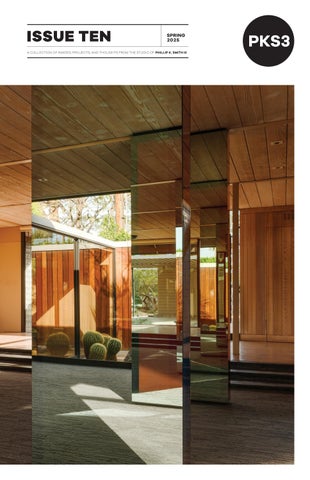
Top: During the day, 0/90/120 collages the architecture and landscape, blurring understandings of transparency and reflection. Right: William Cody perspective drawing of A House in the Desert, which would become his family home. Next pages: Daytime installation view of 0/90/120 with the color visible within the reflected shadows and silhouettes of the 0 and 120-degree volumes.
ISSUE TEN. SPRING 2025
0/90/120 WILLIAM CODY FAMILY HOME, PALM SPRINGS, CA FEBRUARY 14 - APRIL 6, 2025 11 reflective and color shifting volumes in the 3,000 square foot 1952 William Cody family home. Aluminum, glass, acrylic, LED lighting, electronic components, unique color choreography.
3
4
PKS3 STUDIO
ISSUE TEN. SPRING 2025
5
6
PKS3 STUDIO
ISSUE TEN. SPRING 2025
7
Choreography of Light By Janelle Zara
The hours between 3 and 7 p.m., according to artist Phillip K. Smith III “are an iconic, transformative moment in the desert,” when the beating sun above Palm Springs performs its daily ritual. In the diminishing light, the expansive skies swell from immaculate blues to richer shades of gold and pink before ultimately fading from cerulean to deep purple and ultimately black as the sun sinks below the mountains. This daily phenomenon sets the stage for 0/90/120, Smith’s site-specific intervention in the historic home of the late architect William F. Cody (1916–1978) that he designed for his family. “It’s a choreography of light that plays with that transformation,” the artist says of the work that comprises luminous, reflective surfaces that shift in color alongside the desert sky and architecture of the home. Positioned at 0, 90, or 120 degrees in relation to the home’s iconic glass walls, the volumes engage with the iconic architecture, characterized by its horizontality, rigid right angles, material thinness, and dissolution of barriers between indoor and outdoor. Smith and Cody naturally share a mutual fascination with the inimitable light of the desert; and with the arid Low Desert sky seemingly stretching into infinity, Palm Springs is a particularly good place to watch the desert transform from dawn to dusk. Born in Dayton, Ohio, Cody arrived in Palm Springs in 1945, where the beauty of the environment shaped the contours of his architectural practice. Designed by Cody himself, the architect’s family home is the material and canvas of Smith’s installation and features the hallmarks of Desert Modernism: glass walls with sliding
glass doors supported by the thinnest of steel frames, which together create an incredible sense of transparency and weightlessness. Smith recalls the sensation of walking through the entry for the first time. “The entire house unfolds in that singular moment, through multiple planes of glass, in layers of perspective and reflection from one side of the house to the other.” Cody built a home that is virtually transparent, blurring the barriers between the domestic interiors and the landscape. A native of Southern California, Smith recalls his days as a teenager on the salt flats of Death Valley, watching “the glow of the sun on a massive, crystalline white surface extending out for miles in every direction.” That kind of sublime experience of light, combined with the vastness of the environment, influenced the Light and Space artists and Desert Modernist architects alike, who sought to capture a bit of the elusive, ineffable qualities of the sun, if only they could find the right container. Artists like Peter Alexander (1939–2020) and Helen Pashgian (b. 1934), in their contemplation of these natural phenomena, seemed to have almost spiritual ambitions. According to Smith, “for any artist that is working in light or taking on the kind of raw beauty and scale of the natural environment, I think it’s only inevitable to ask questions about something that is larger than oneself.” And like these previous generations of Southern California artists, Smith himself gravitates towards reflection, transparency, and translucency. He employs glass for its quality of light reflectivity, allowing him to merge sculpture, performance, and color to create an ever-changing experience.
8
PKS3 STUDIO
Organized across the home’s 3,000 square feet, the durational work consists of 11 reflective and color shifting volumes creating four distinct floor-to-ceiling compositions. Smith conceptualized 0/90/120 as a blurring of art and architecture, where the house, stripped of furniture and any allusions of function or domesticity, becomes an “armature for light.” Radically changing hourly during the sunset transformation, Smith’s installation shifts from the real to the seemingly unreal. During the brightest point in the afternoon, the planes reflect and tint the surrounding environment as the main event. But at dusk, as the ambient light of the environment begins to dim, the light of the installation gradually grows in intensity as the surrounding landscape darkens. The art and environment enter a complementary exchange equally balanced between the interior and exterior of the home. “After the sun drops behind Mount San Jacinto and the quality of reflection begins to diminish within the artwork, the color comes forward; at the same time, the transparent glass of the home inverts, becoming naturally reflective. It’s these two qualities that combine to dissolve the house into an abstract space of color,” the artist explains. “The work oscillates between the art showcasing the architecture and the architecture showcasing the art. If William Cody brought the light in, I am reverberating it back out.”
ISSUE TEN. SPRING 2025
Prior pages: Afternoon tinted reflections echoing within each other as one’s perception of the architectural space alters through color, reflection, and transparency. Left: The open 120-degree volumes reflecting elements of the adjacent open air courtyard at the center of the home. Above: Dusk view looking from the 0-degree volumes to the open 120-degree volumes. Next pages: Evening view of the closed 120-degree volumes reflected in the floor and glass with the 90-degree volumes in the foreground.
9
10
PKS3 STUDIO
ISSUE TEN. SPRING 2025
11
12
PKS3 STUDIO
In his practice, Smith’s choreography, “a bit like writing a piece of music,” is a composition of color, brightness, and pace of change, evoking the transformation of the day as it progresses through the full spectrum of lit color. In 0/90/120, Smith merges the daytime dominating reflection of the environment with quiet color seen in the edges of reflection. “During the day, I rely on the colors of Cody’s home, the mountains, landscape, and sky through reflection,” he says. “Whereas at night, the true colors of the environment and the materials of the architecture fall away, leaving only pure primary colors of red, blue, and green to mix, project and reflect off of the three angles that define the installation.” The transparency of Cody’s glass extends the perceived boundaries of the home by day; by night that same transparent glass becomes reflective, extending the boundaries of Smith’s installation. Looking through the house’s many layers of reflections, it feels like a different place altogether. “The simple movement of the sun,” adds Smith, “allows wood, steel, glass, and cacti to dissolve to floating planes of light in the darkness of the desert night.”
Above: Nighttime view of the 0-degree volumes mixing and merging color as the entire installation projects and reflects color across the William Cody home. Right: One of the 90-degree corners is seen to the right as the open 120-degree volumes are reflected to the left. Next pages: Nighttime installation view of 0/90/120 seen from the exterior garden.
ISSUE TEN. SPRING 2025
“
The work oscillates between the art showcasing the architecture and the architecture showcasing the art. If William Cody brought the light in, I am reverberating it back out.
—Phillip K. Smith III
”
13
14
PKS3 STUDIO
ISSUE TEN. SPRING 2025
15
Credits: Photography: Lance Gerber Studio @lance.gerber Graphic Design: Mariana Pariani. FairyFierceFree.com Editors: Phillip K. Smith III @phillipksmith3 & Arlene Amick WWW.PKS3.COM @PHILLIPKSMITH3
#PKS3
#PHILLIPKSMITH3
Cover image: Daytime installation view of 0/90/120 reflecting the architecture, landscape, and atmosphere of the day within the three 0-degree volumes.