Selected Works from 2004-2022
K. SMITH
PHILLIP
III
Copyright c 2023 PKS3
All rights reserved. No part of this book may be reproduced in any form by any electronic or mechanical means, including information storage and retrieval systems, without permission in writing from the publisher.
Photography: Lance Gerber Studio
Lucid Stead images on pages 58, 62-65, 67 by Steve King Architectural Imaging.
Bio photo on page 3 by Kim Stringfellow
Design: PKS3 Studio & Mariana Pariani
Published by PKS3 Studio. www.PKS3.com
PHILLIP K. SMITH III
 Selected Works from 2004-2022
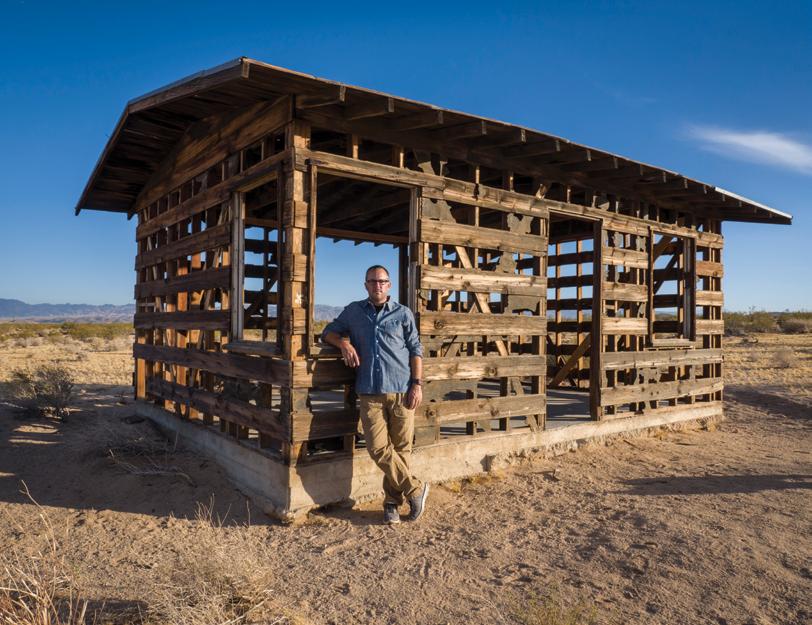
Phillip K. Smith III
American, 1972-
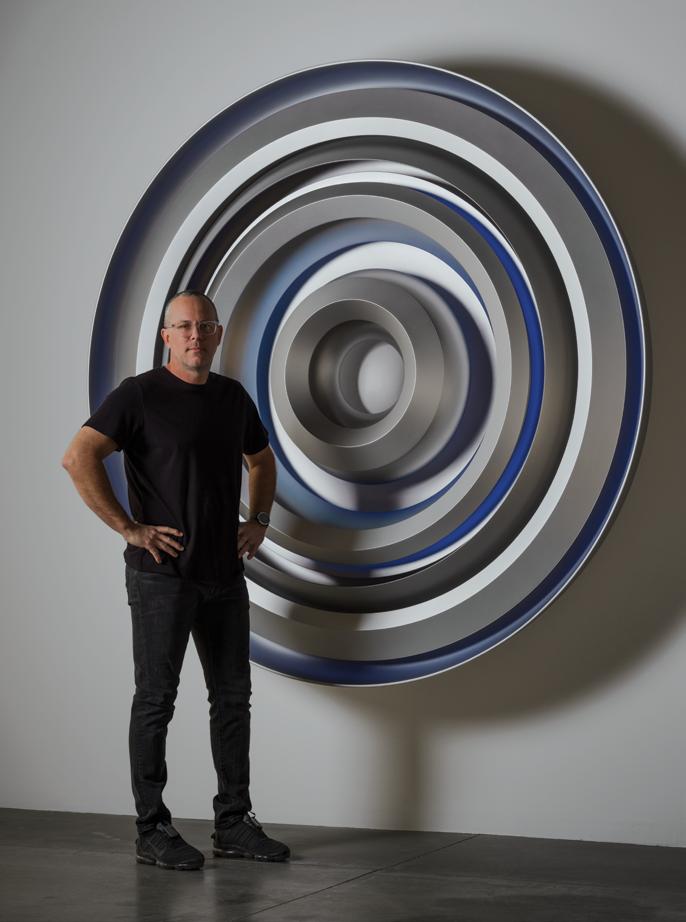
American artist Phillip K. Smith III (b. Calif., 1972) uses light as a medium to create optically shifting sculptures and site-specific installations. His minimal but imposing interventions into vast outdoor landscapes and his more discretely scaled sculptures are nuanced perceptual encounters in response to the unique conditions of site and context. Smith’s use of glass, acrylic, highly polished steel, and LED technology explores the interplay of light, color, and surface to modify and reflect the viewer’s physical encounter.
Informed by the material history of Minimalism and its pursuit of formal concision, Smith lists Sol LeWitt (1928-2007) and Dan Flavin (1933-1996) among his influences —LeWitt for his belief in the elemental universality of form expressed through the simplest means and Flavin for his pioneering introduction of light as a viable art medium. Smith’s work is equally indebted to Southern California’s Light and Space practitioners, notably Robert Irwin (b. 1928) and James Turrell (b. 1943), who helped usher in a new era of experiential concerns, displacing the static object with work that required time-based and sustained viewing.
Trained as artist and as architect at Rhode Island School of Design, Smith incorporates the site-specificity of architecture, with its reliance on scale and its capacity to physically impact the human interaction it supports, to create immersive and transformative experiences.
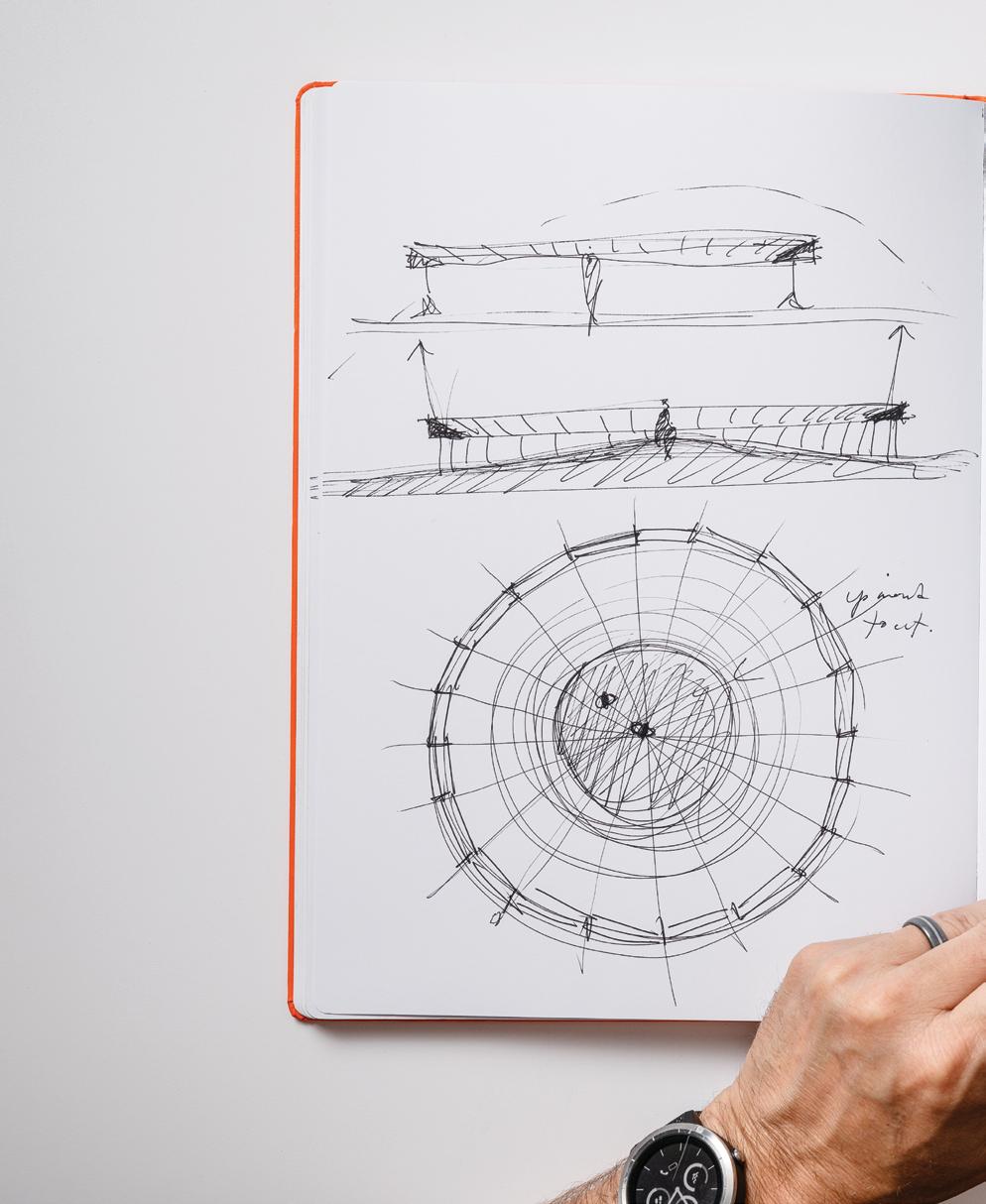
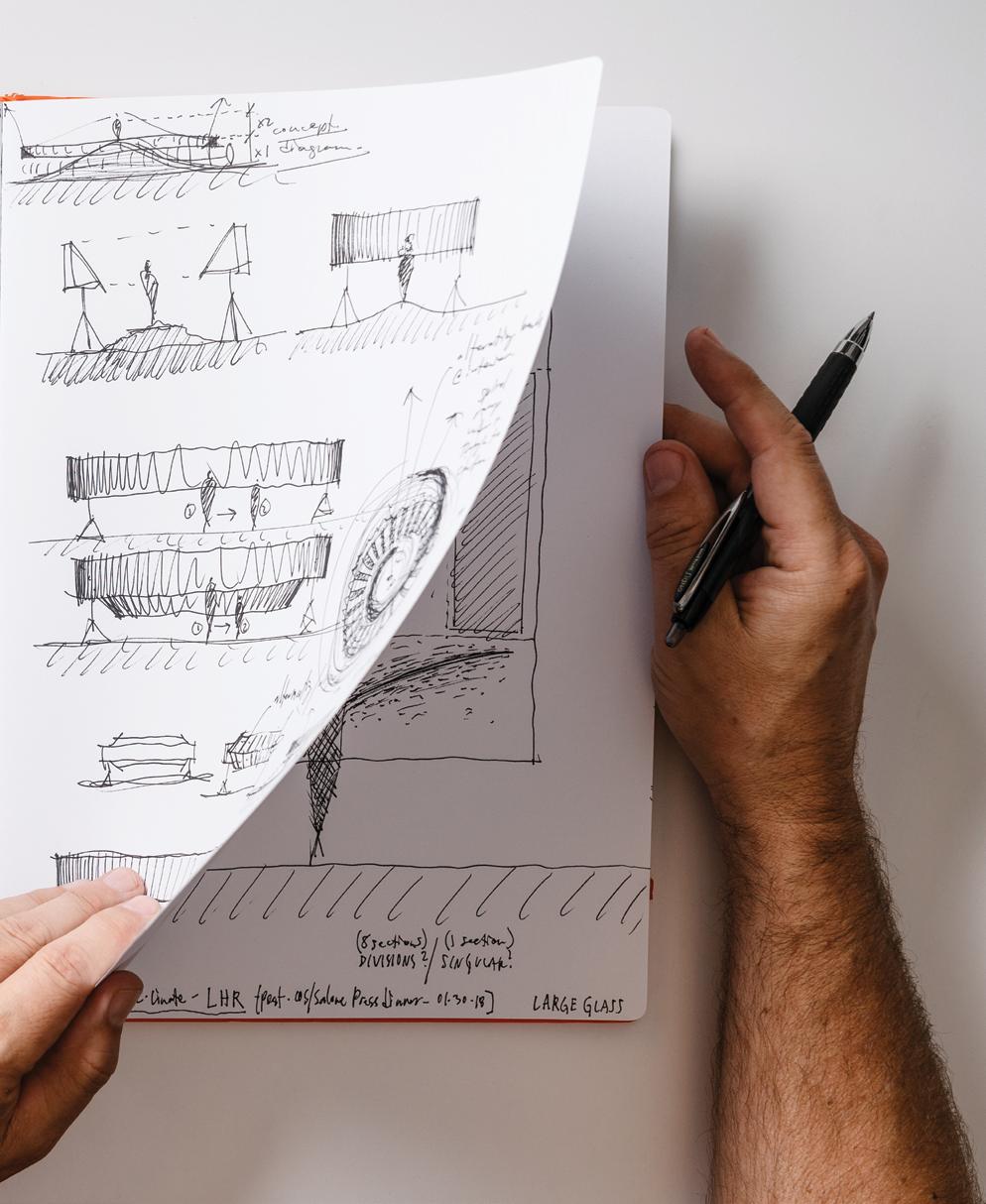
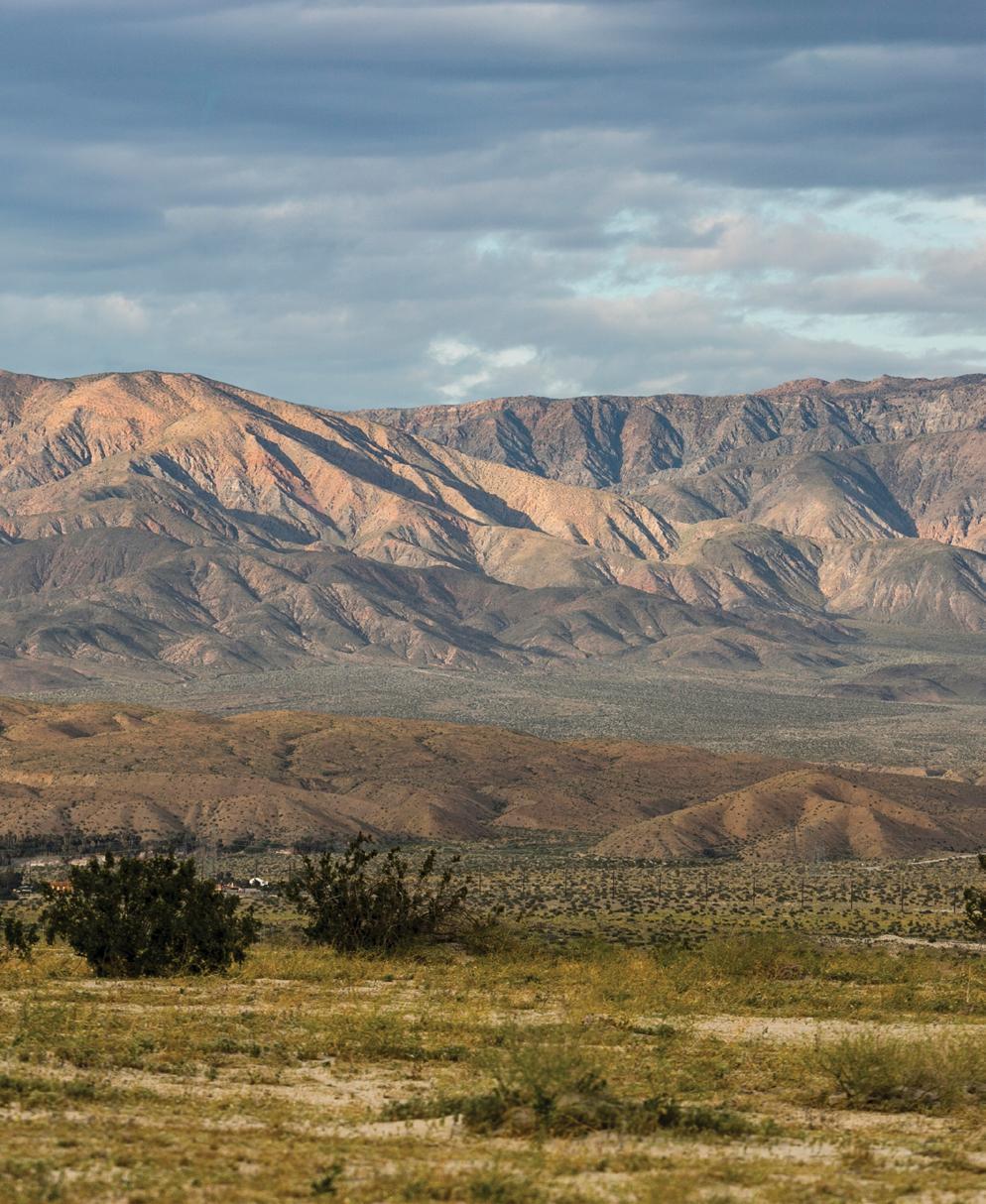
“I am interested in creating experiences that tap into universal beauty - experiences that make us step away from our pattern, our life, our work, our errands, and allow us to see sublime beauty shifting and changing before our eyes.”
“I believe in the distillation of thought - of reducing an idea, a form, a site to the pure elements. At the core of that distillation process is a common languagea language that allows all of us to enter into the work, no matter our understanding of art history.”
“People often say we need to celebrate our differences. I think that’s true, but I would say even more than ever that it’s important to celebrate those things that are common amongst all of us - the things that unify us no matter where we live or what we believe in. I am interested in projects that bind all of us together as human beings.”
CYLINDERS
APERTURE LIGHTWORKS LIGHT & SHADOW WORKS LUCID STEAD REFLECTION FIELD IRREGULAR HORIZONTAL #1 BENT PARALLEL PORTALS CIRCLE OF LAND & SKY
OPEN SKY REFLECTORS DETROIT SKYBRIDGE
COLUMNS
COLUMNS: SMALL, MEDIUM, LARGE SANTA MONICA LINEAR
1
PERPENDICULAR
PARALLELS LIGHT + CHANGE 2004 2010 2010-ONGOING 2012-ONGOING 2013 2014 2014 2016 2016 2017 2018 2018 2018 2018 2019 2020 2020 2020 2015–2020 2022 2022 Palm Springs, CA Joshua Tree, CA Indio, CA La Quinta, CA Laguna Beach, CA Indio, CA Palm Desert, CA Milan, Italy Milan, Italy Detroit, MI Hollywood, CA Hollywood, CA Santa Monica, CA West Hollywood, CA Scottsdale, AZ Palm Springs, CA
REGULAR/IRREGULAR
10
10
PORTAL-VARIANT
PARALLEL
THREE
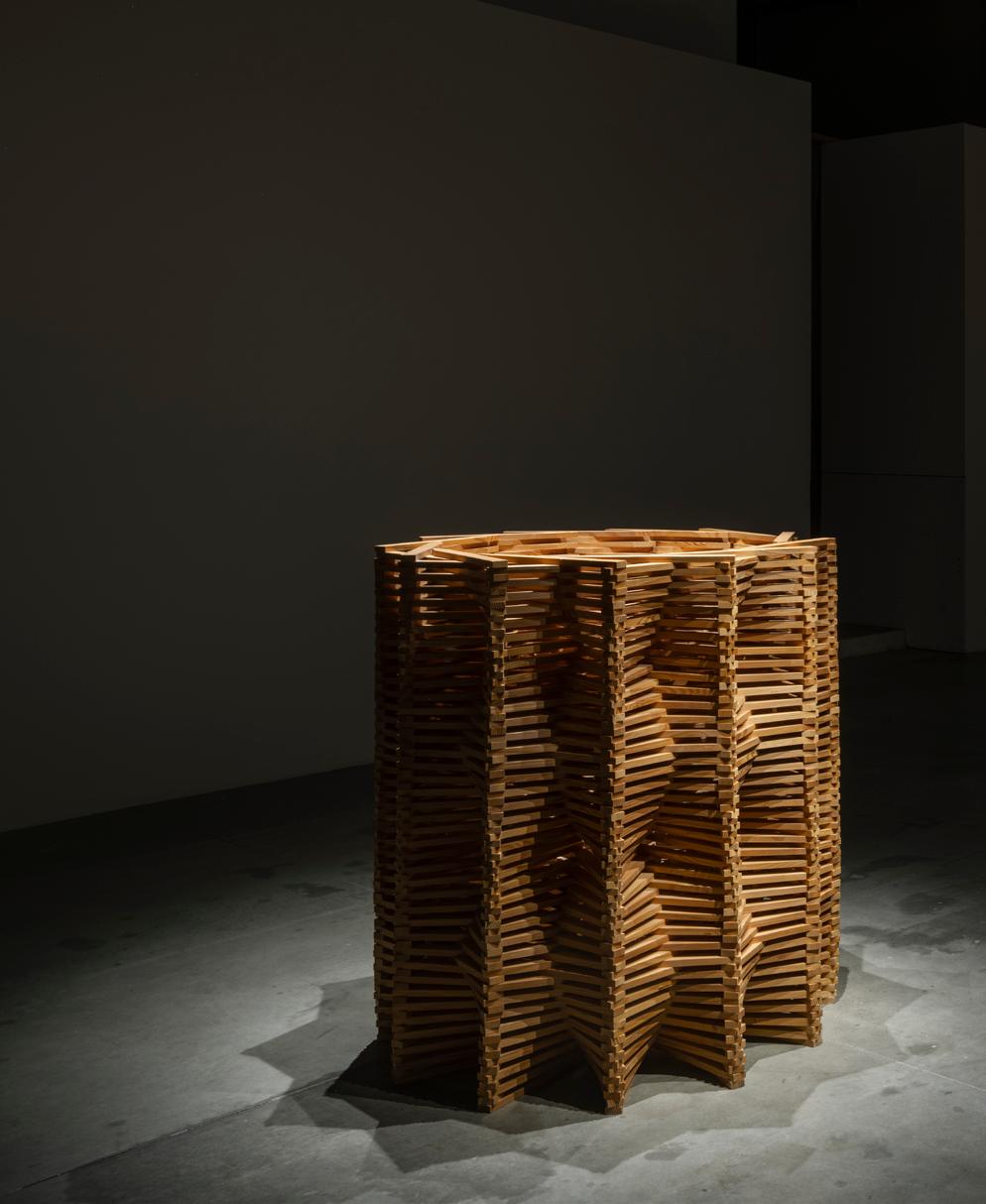
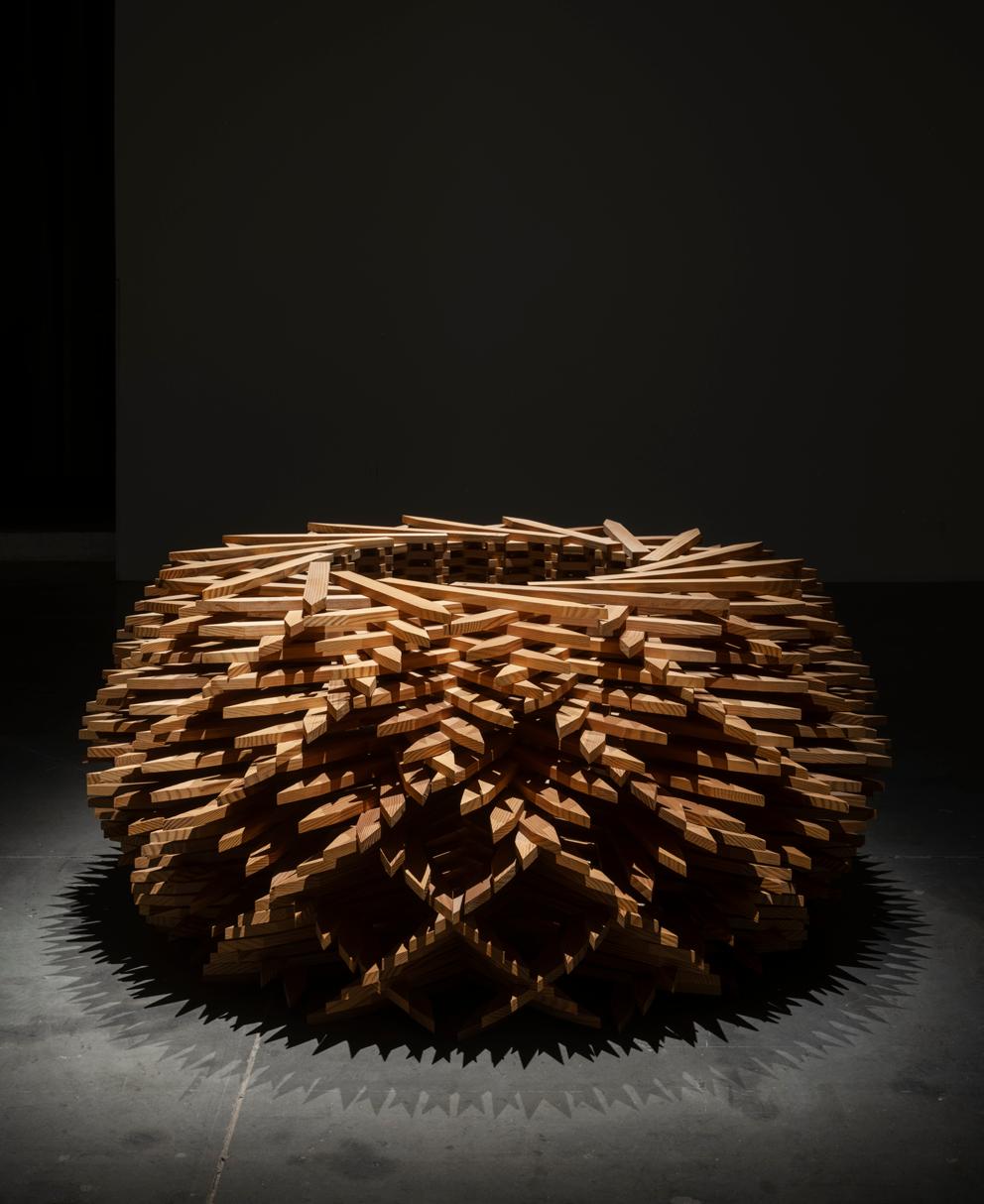
CYLINDERS 2004
Dimensions vary. Douglas fir stakes.
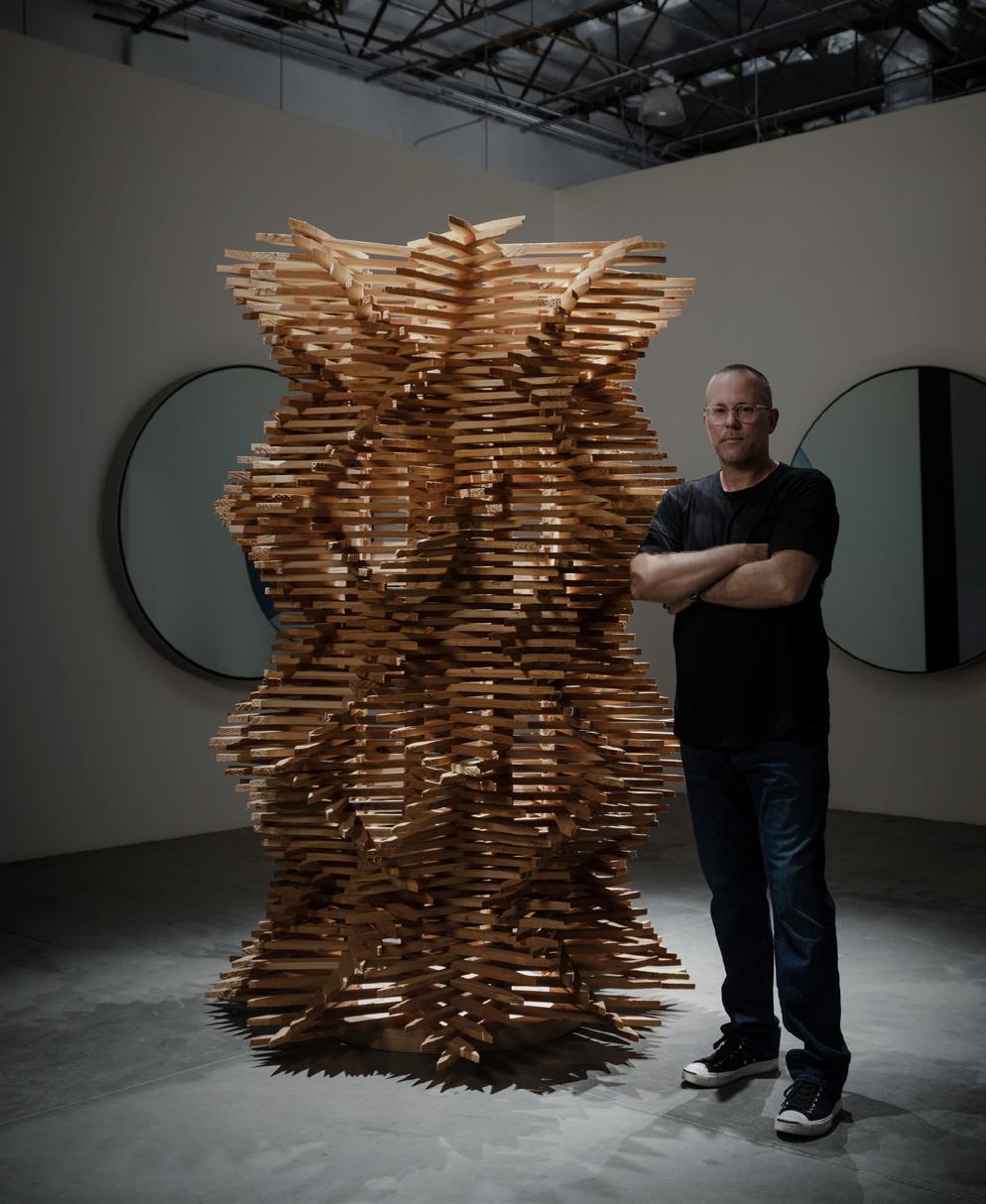
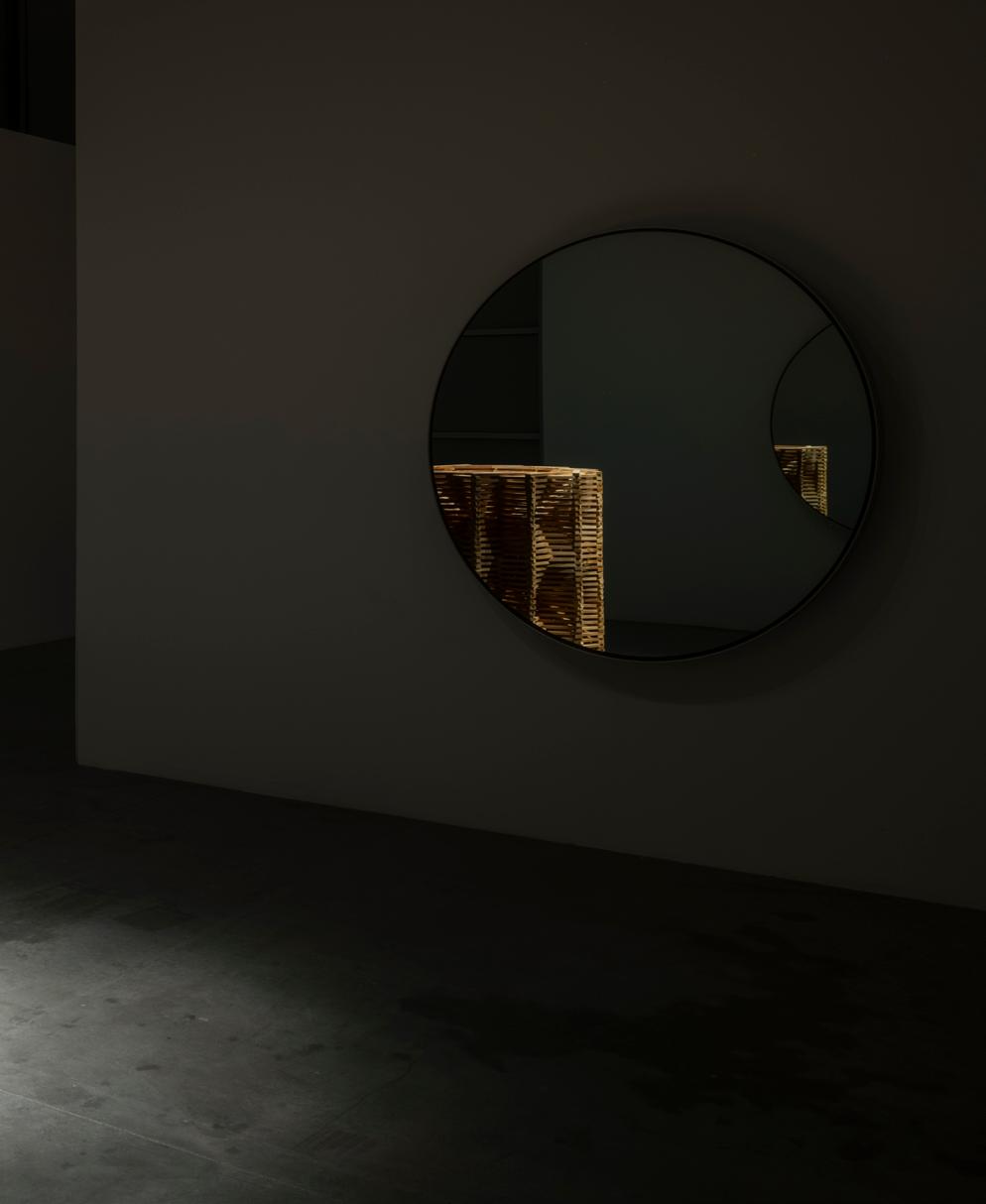
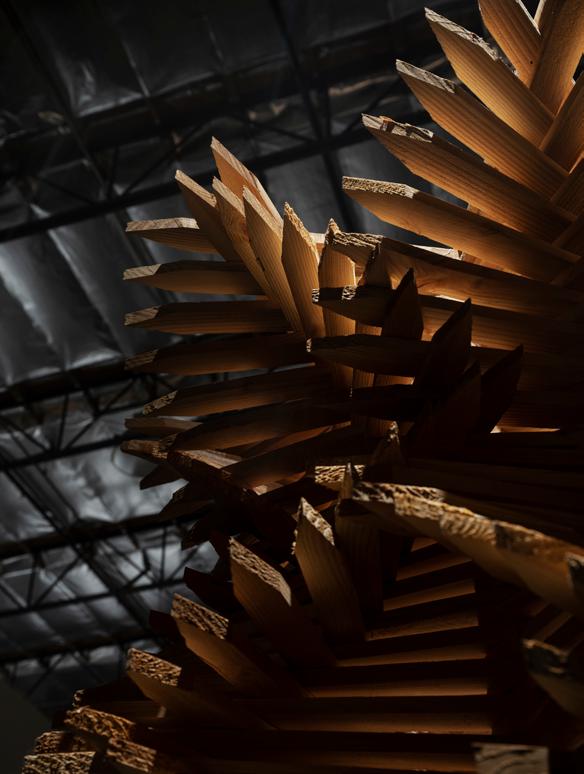
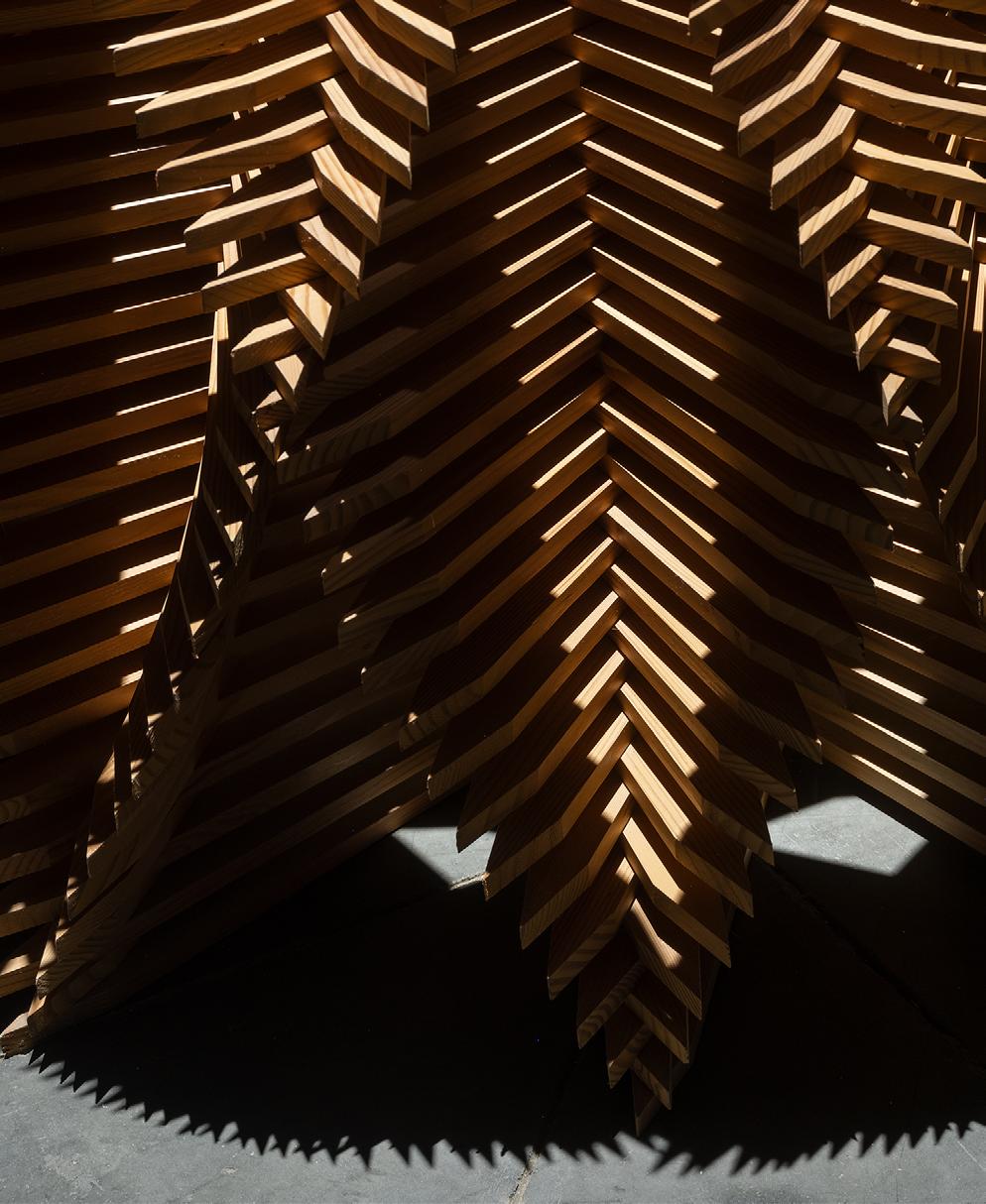
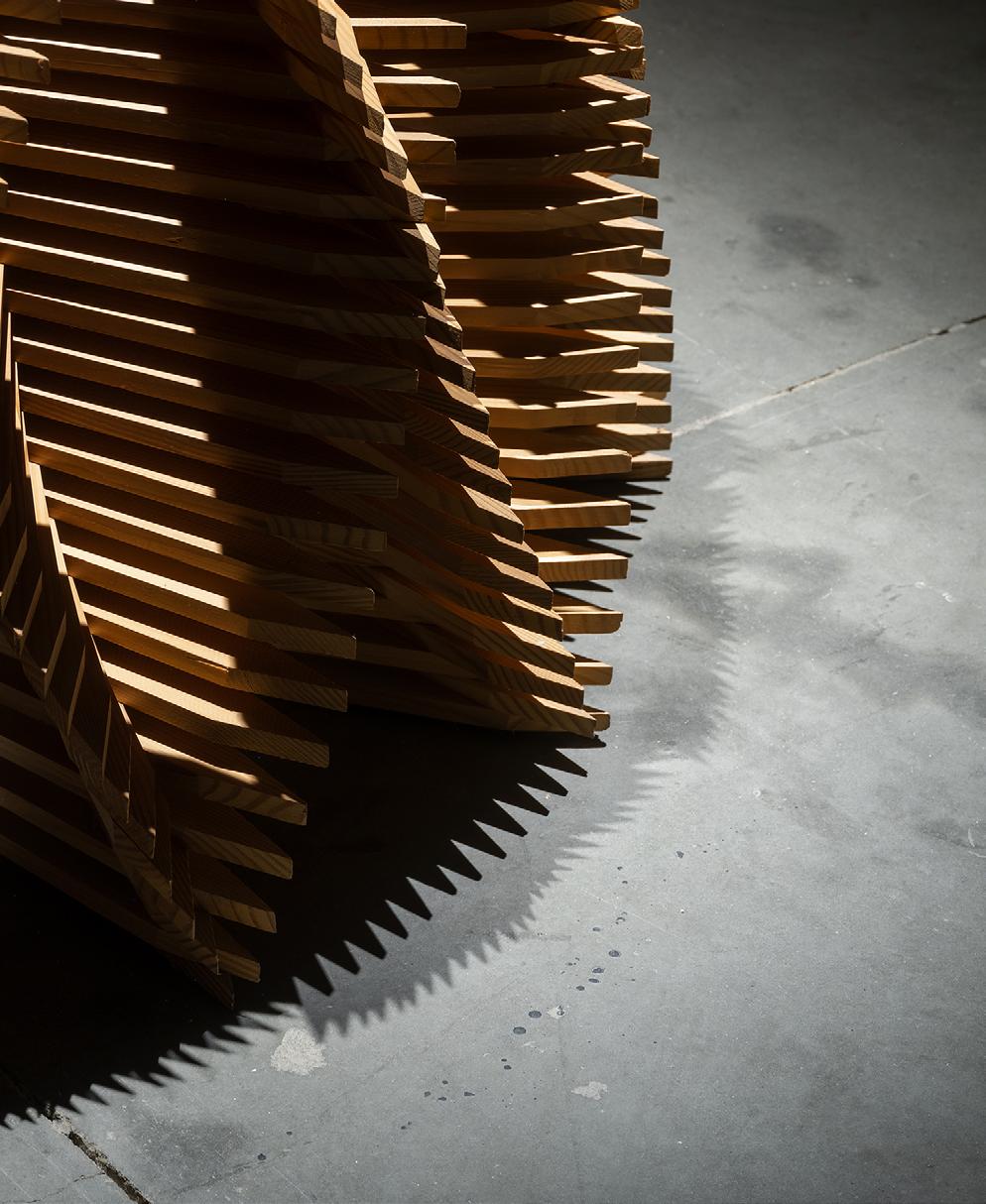
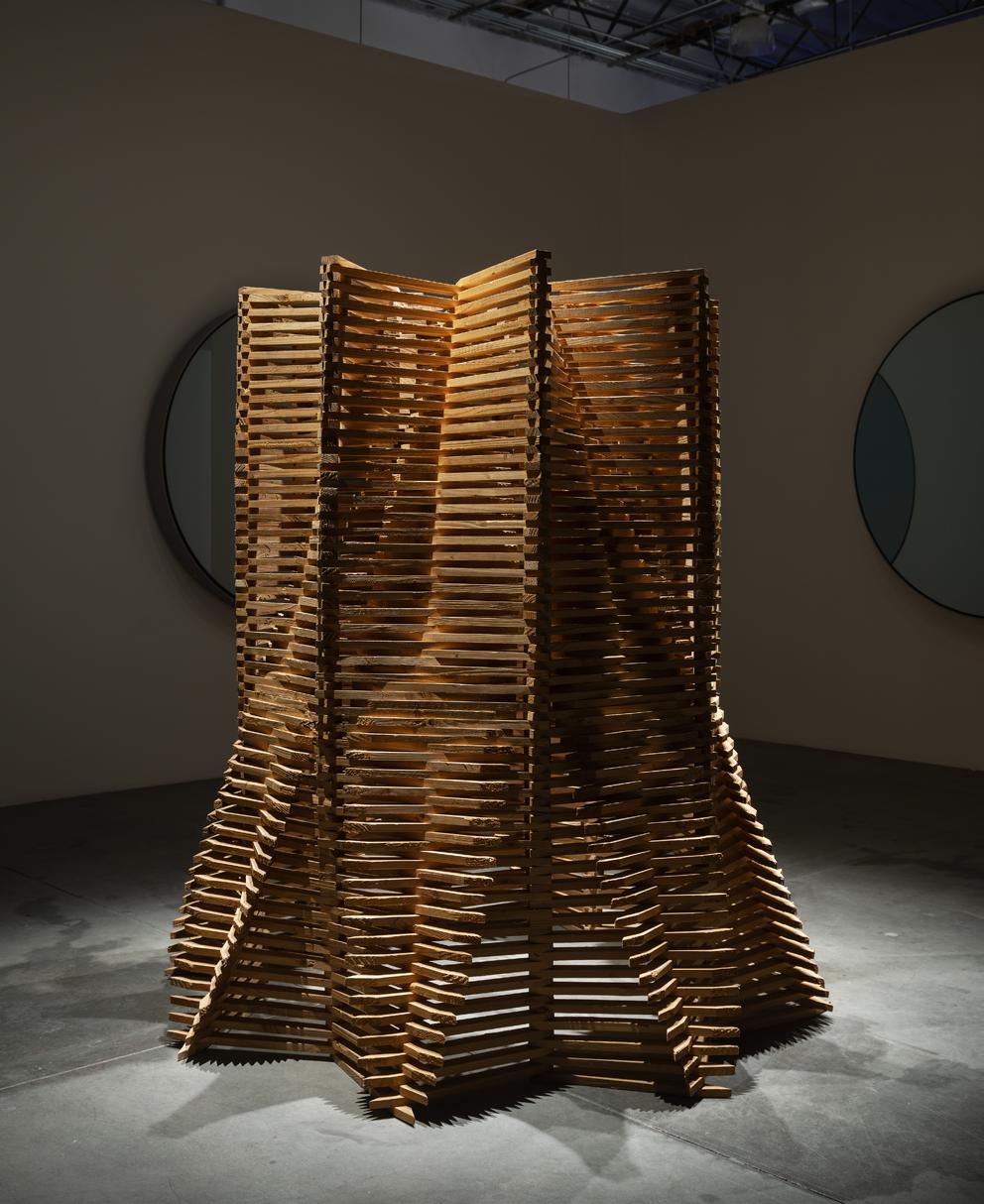
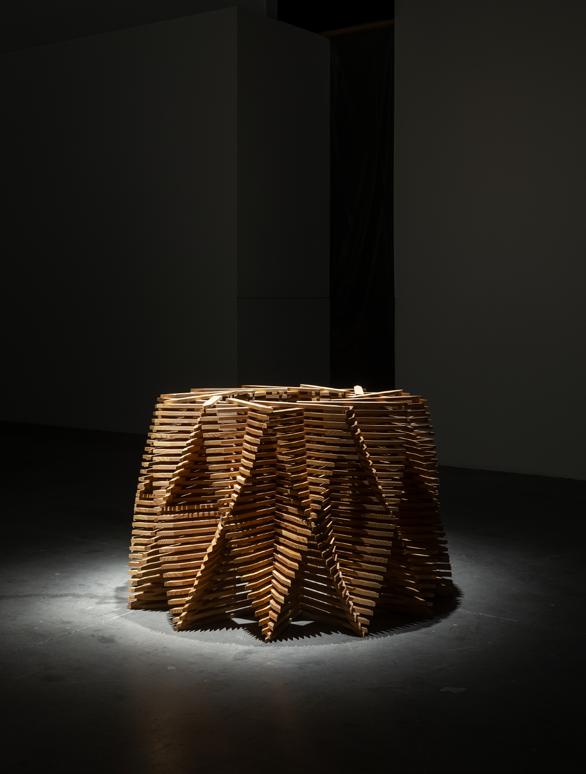
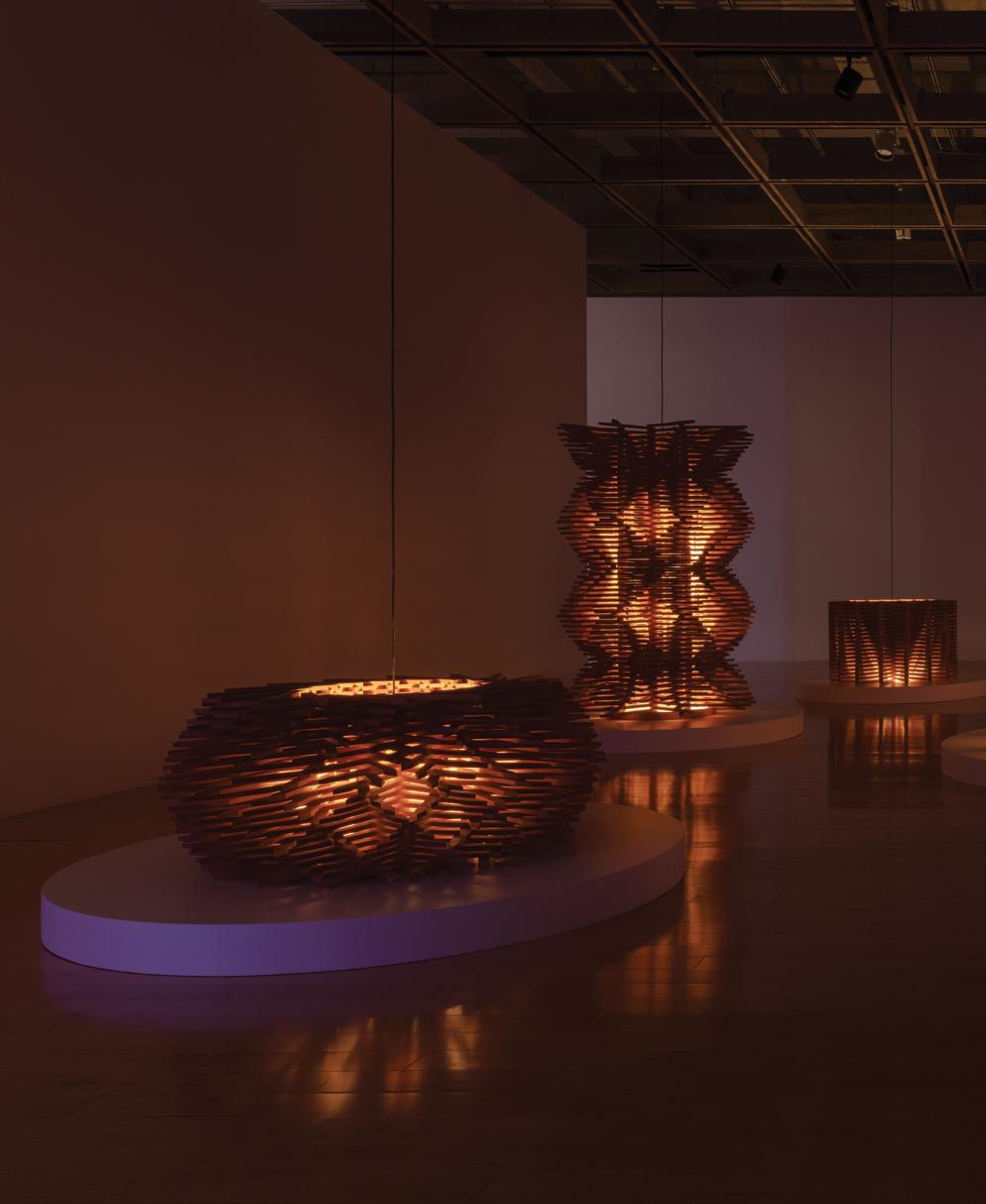
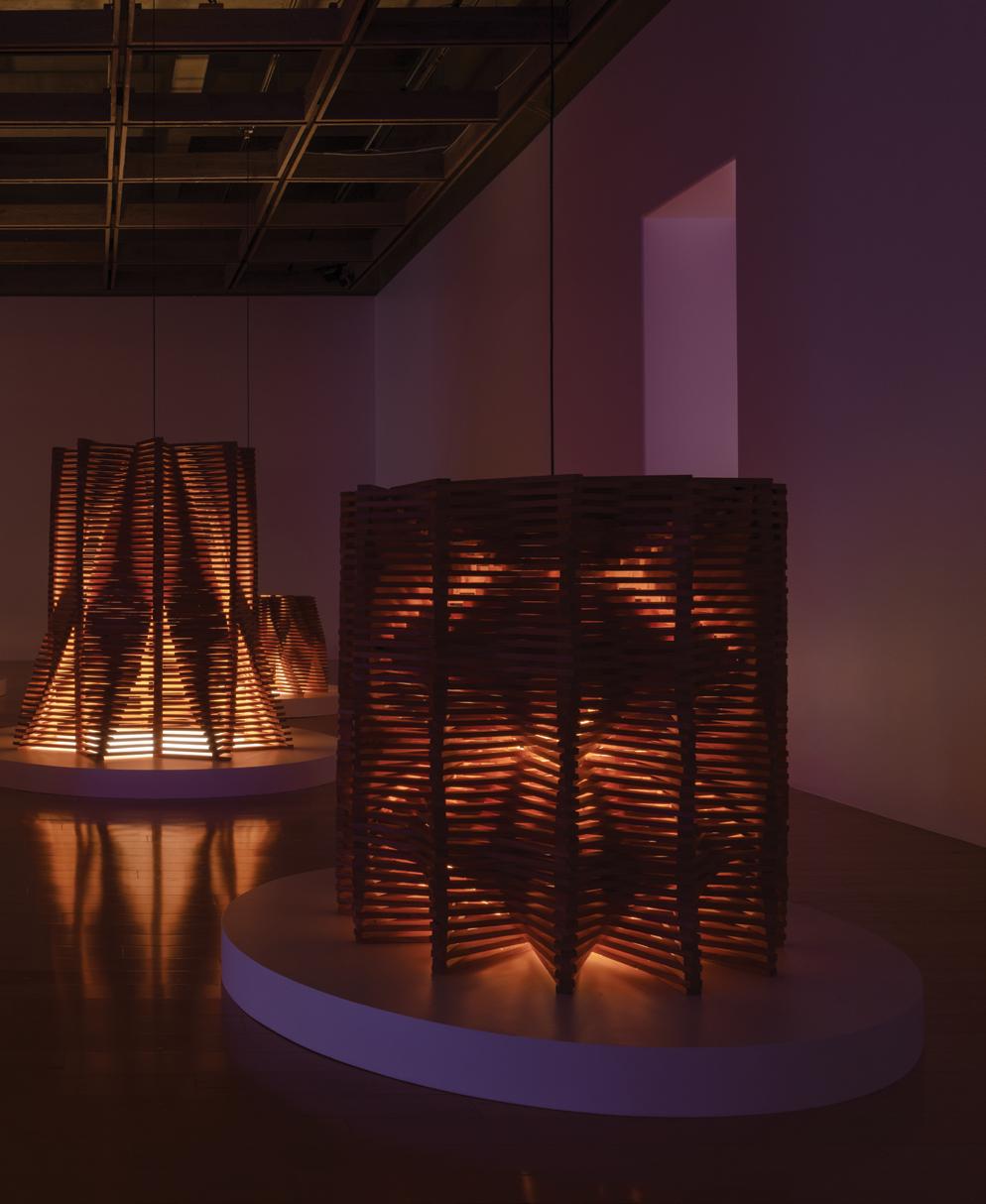
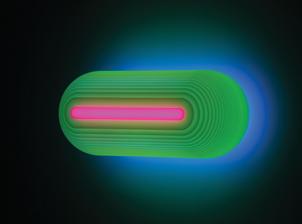
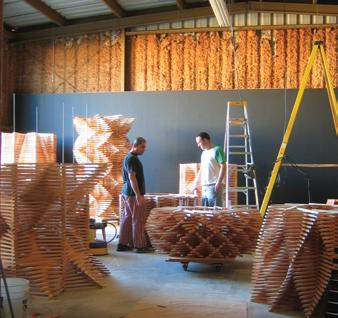
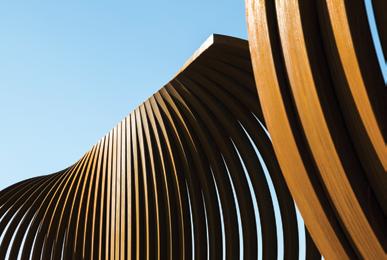
The Cylinders is a series of sculptures focused on light and shadow created through the precise manipulation and rotation of a single module: a readily available, off-the-shelf Douglas Fir surveyor stake. Defined through a variety of structural parameters set up by Smith, there are 3 variations of 3 variations of 3 variations that create 27 unique forms, varying wildly in scale, opacity, and density of structure. While the daylight animates the exterior surfaces in a cacophony of textured light and shadow, the evening’s internal lighting reveals a canvas of geometric patterns defined through opacity/translucency, light/ shadow, and figure/ground relationships. Like lit geometric campfires or glowing lanterns, the Cylinders invite discovery, movement, warmth, and calm.
17
APERTURE
Palm Springs Art Museum
Palm Springs, CA 2010
7’-0” x 24’-0” x 1’-10”, 2.1 x 7.3 x 0.5m
Acrylic, aluminum, MDF, LED lighting, electronic components, unique color program
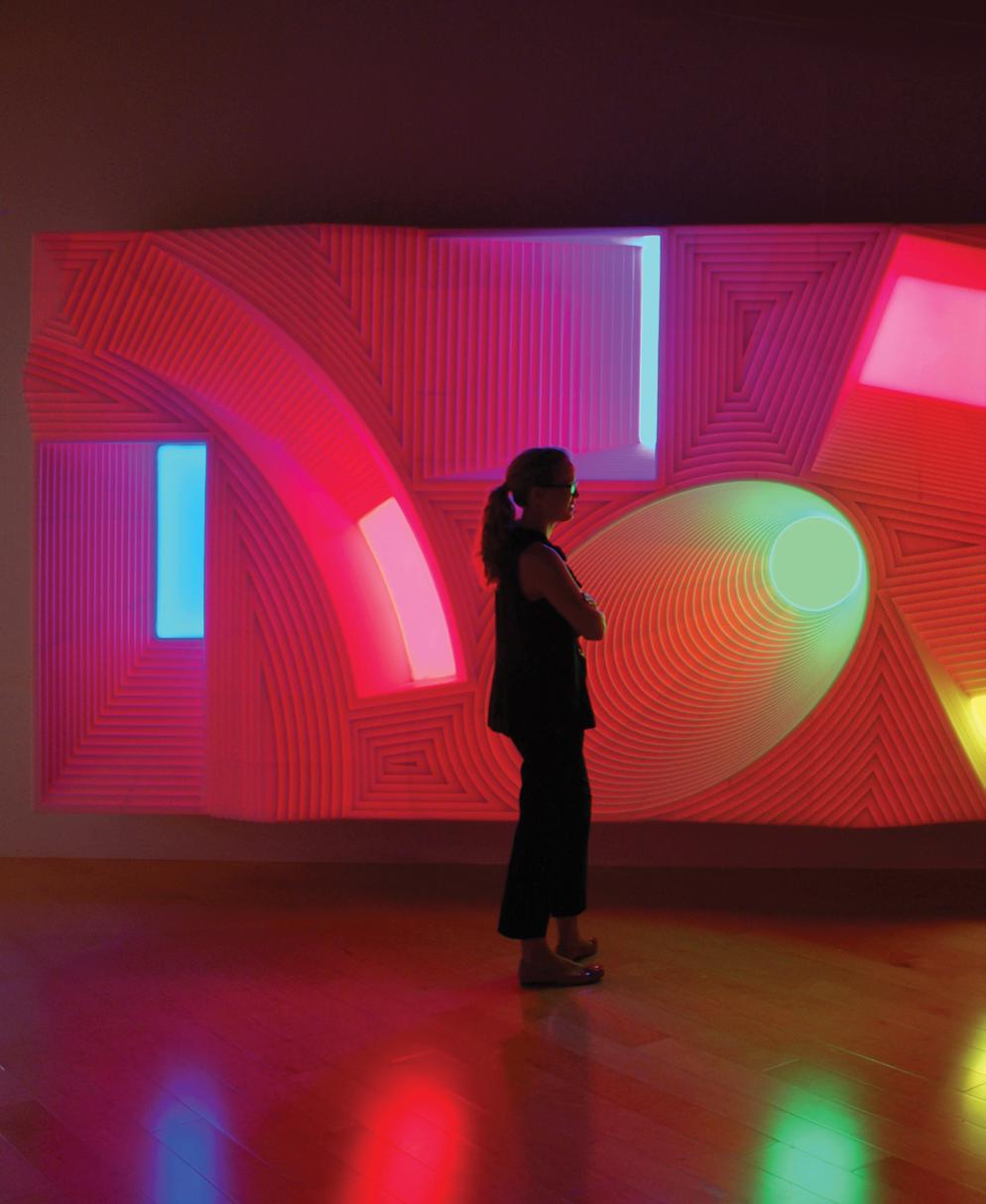
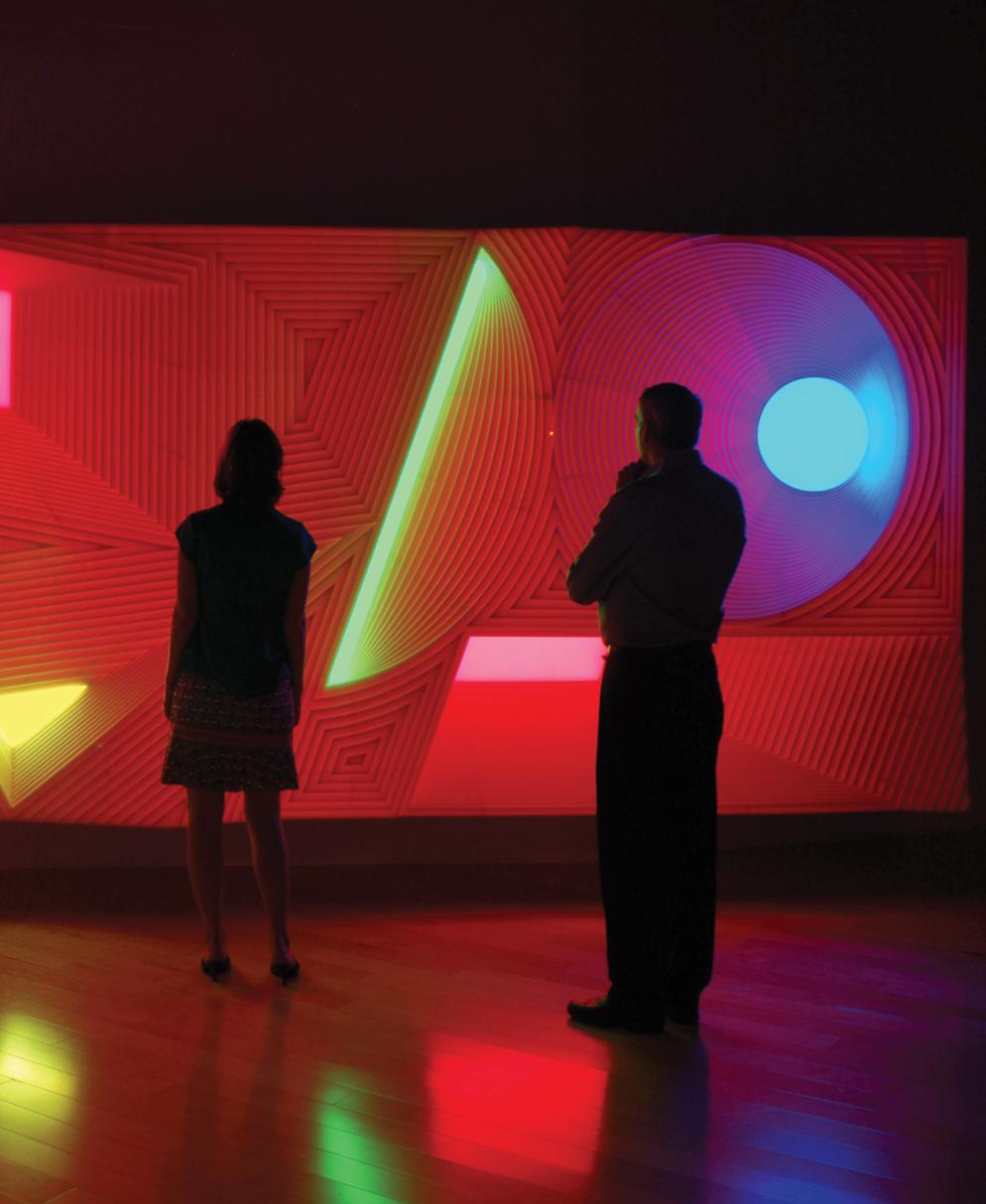
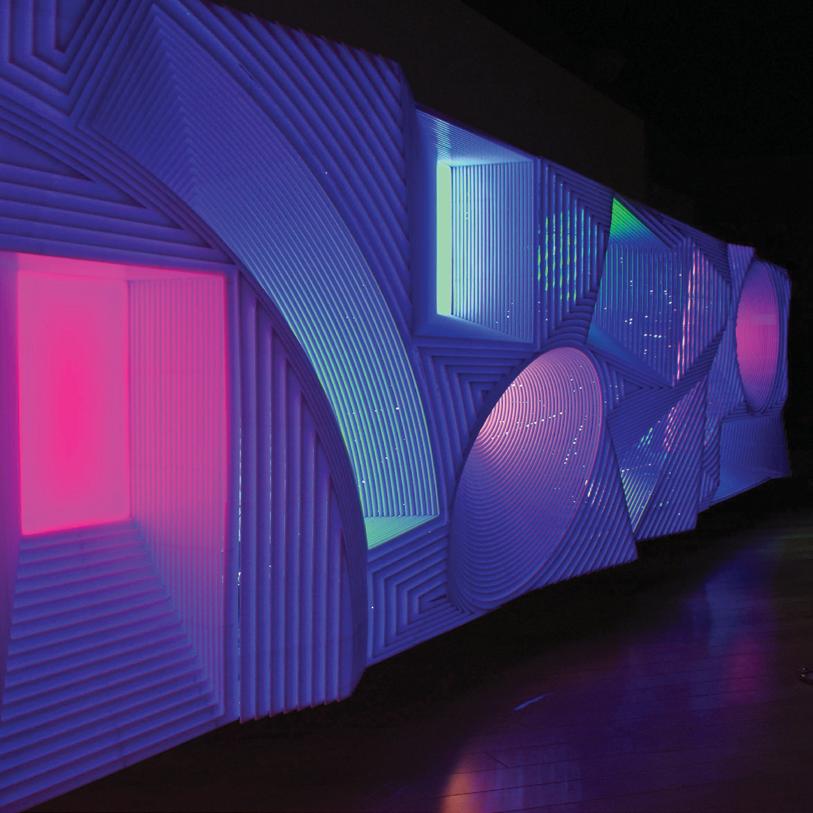
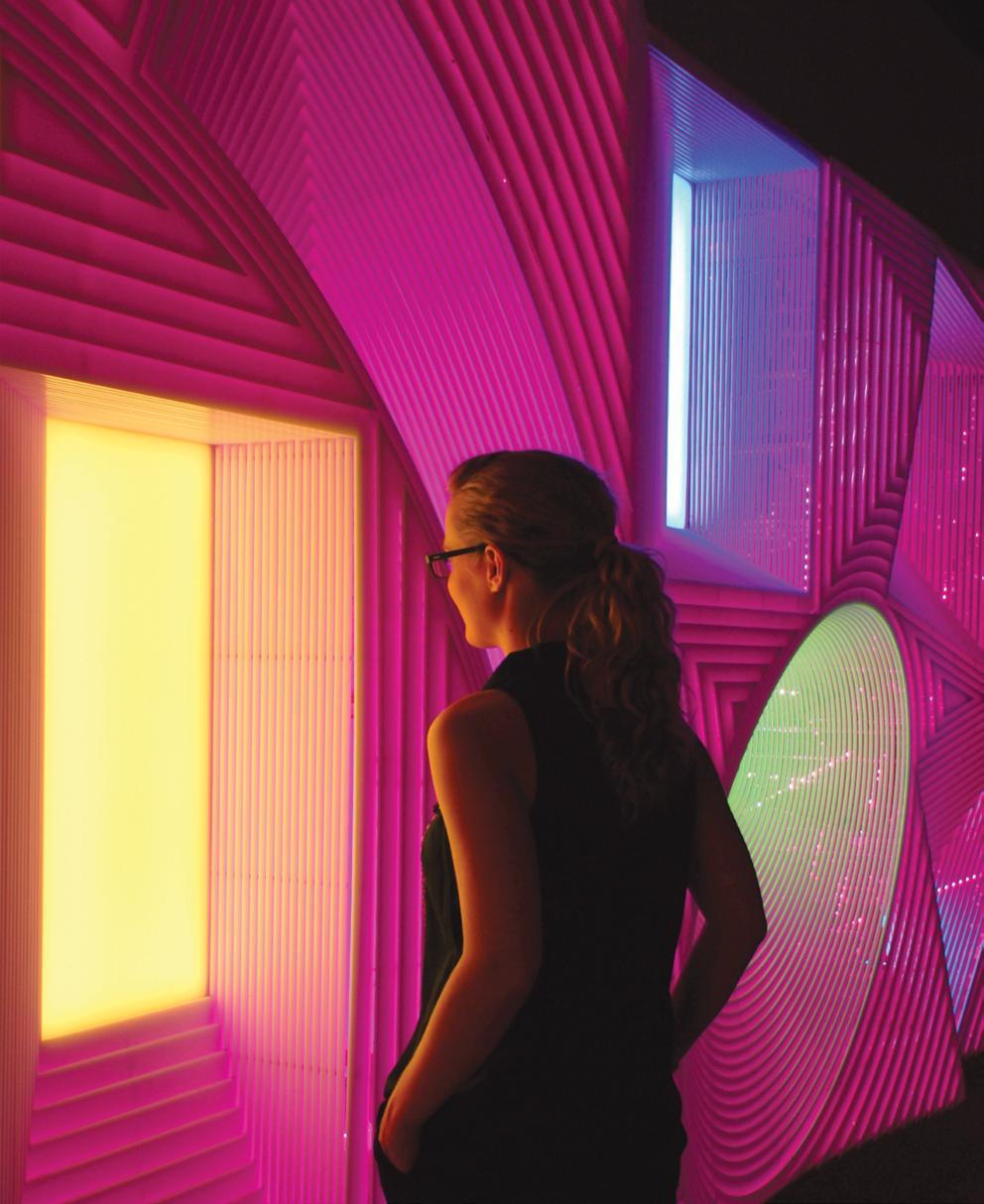
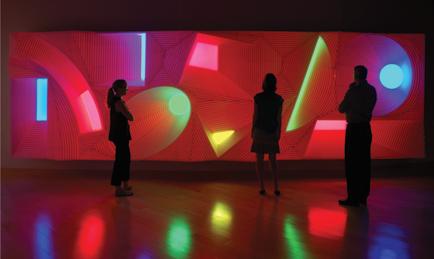
Created during Smith’s artist residency at the Palm Springs Art Museum, Aperture marks Smith’s first use of colored light via LED lighting and the beginning of his interest in the controlled pace of experience and change.
Aperture is a topography of undulating form and shifting color, structurally composed of eight pure geometric forms (circle, square, arc, trapezoid, ellipse, triangle, parallelogram, and rectangle). Each focused geometric form shifts through its own spectrum of color as the overall topography shifts as a united hue. From afar, these two shifting zones of color appear both as gradients and as singular, united colors. Up close, within the intimate space of projected color and geometry, singular colors separate into two, revealing the mixture of color across the translucent white acrylic’s face and edge. As the orchestration of color slowly shifts between warm and cool, the work appears to breathe, seemingly floating away from or pushing into the wall.
27
LIGHTWORKS SERIES
2010– ongoing
Dimensions vary Acrylic, aluminum, plywood, carbon fiber, LED lighting, electronic components, unique color program
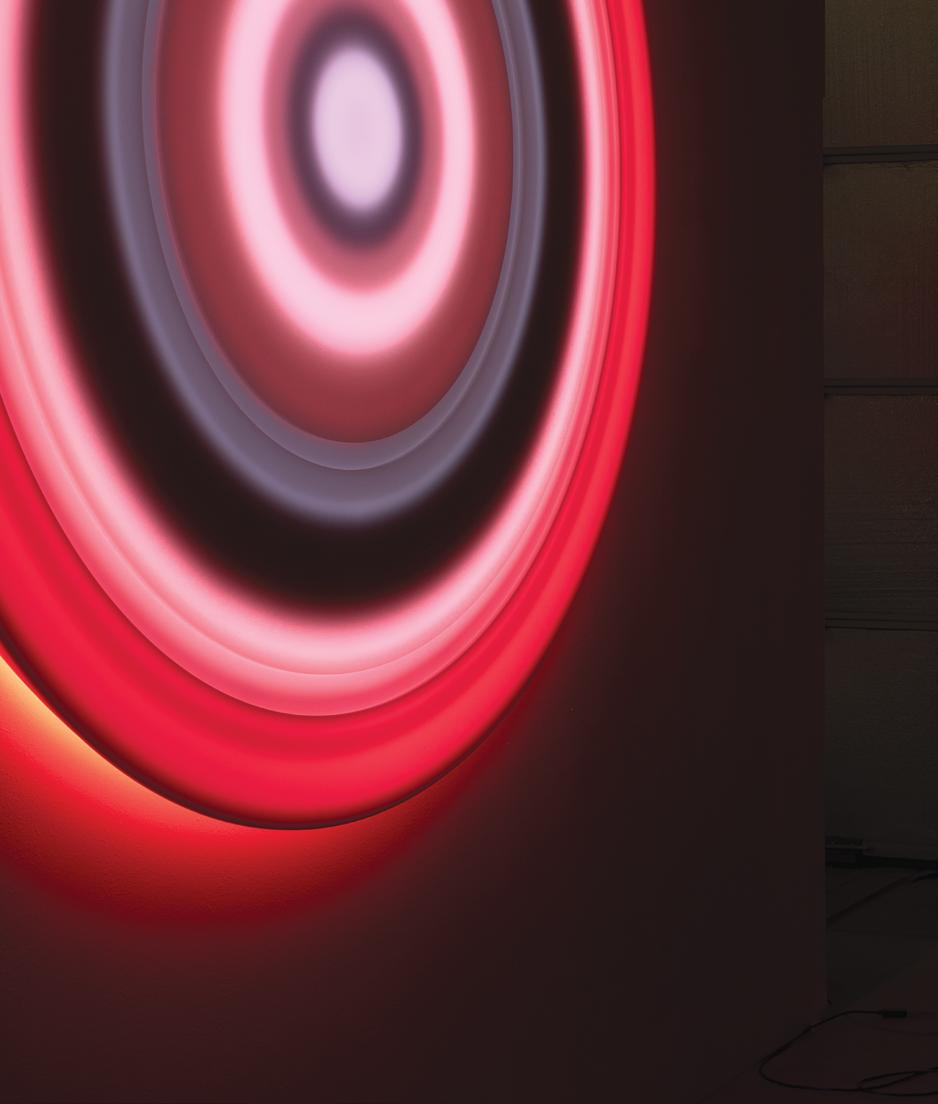
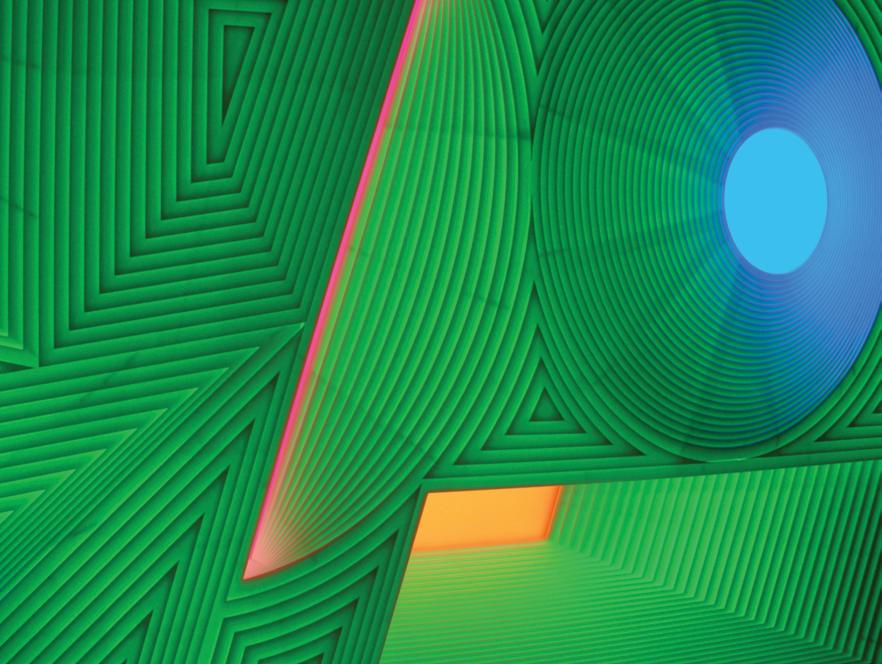
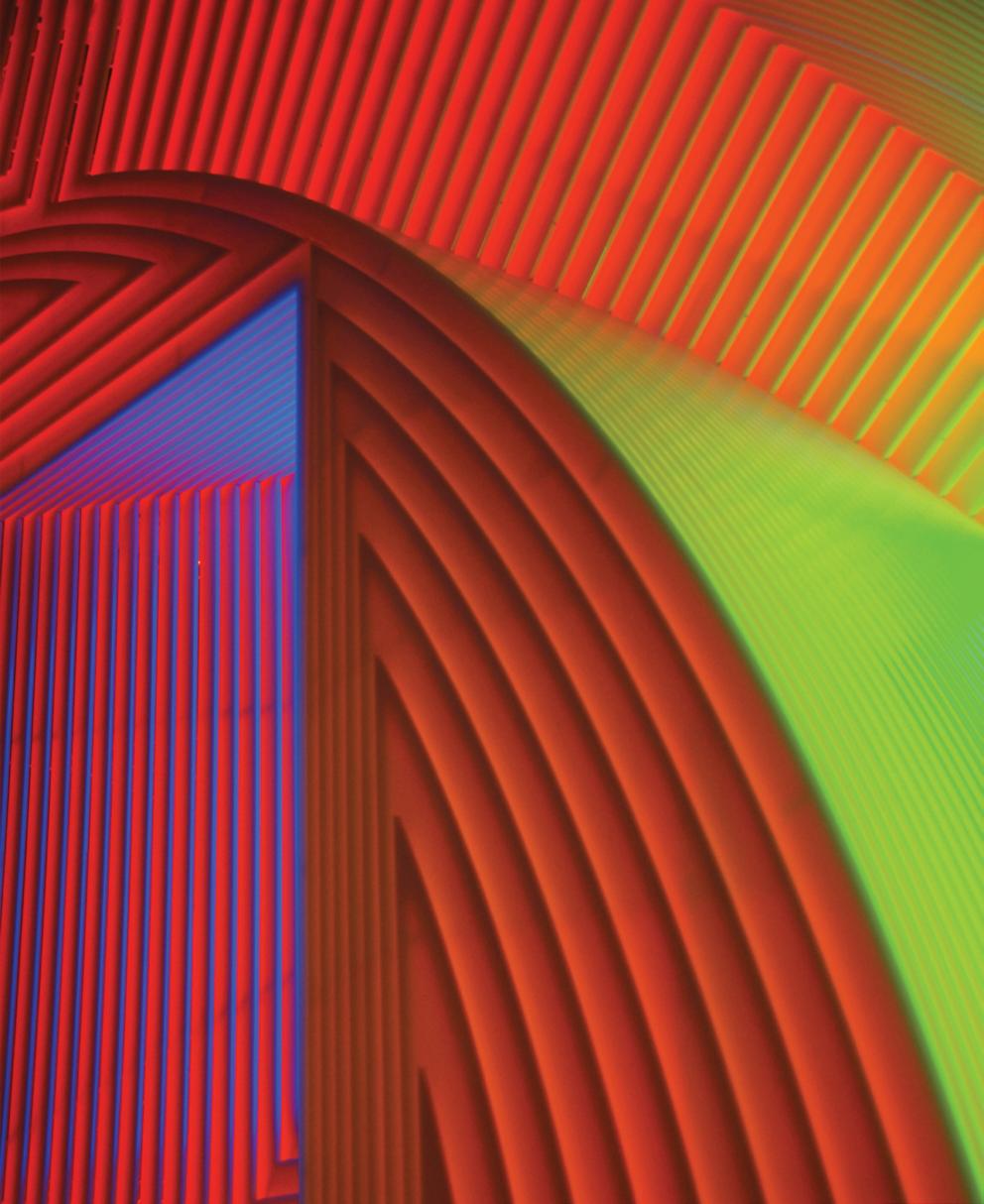
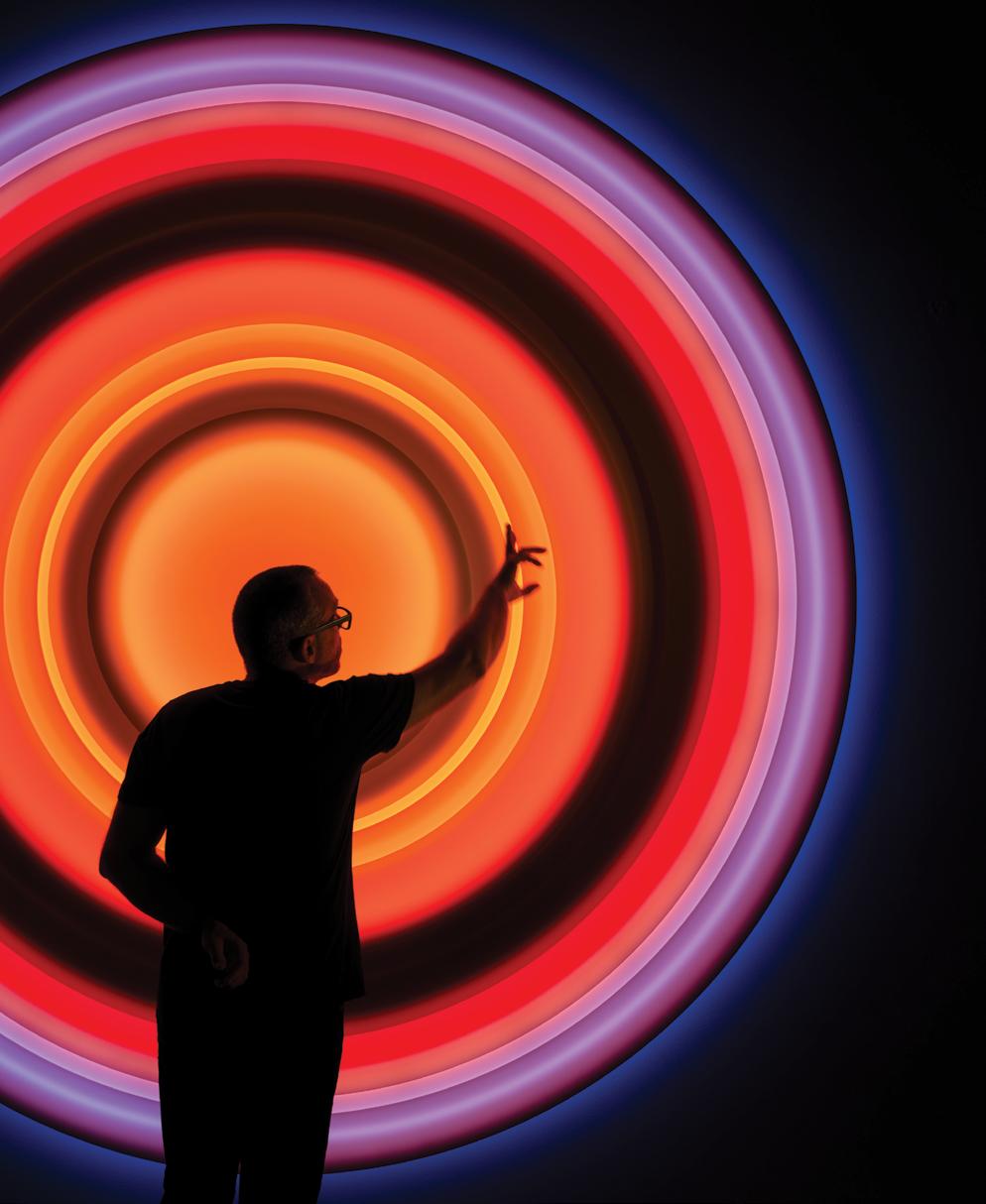
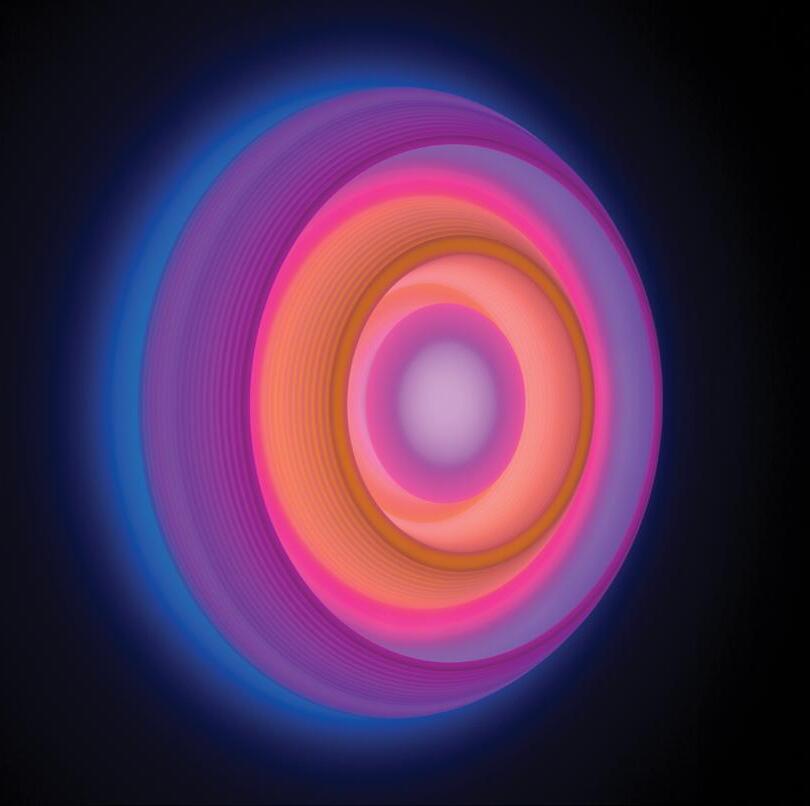
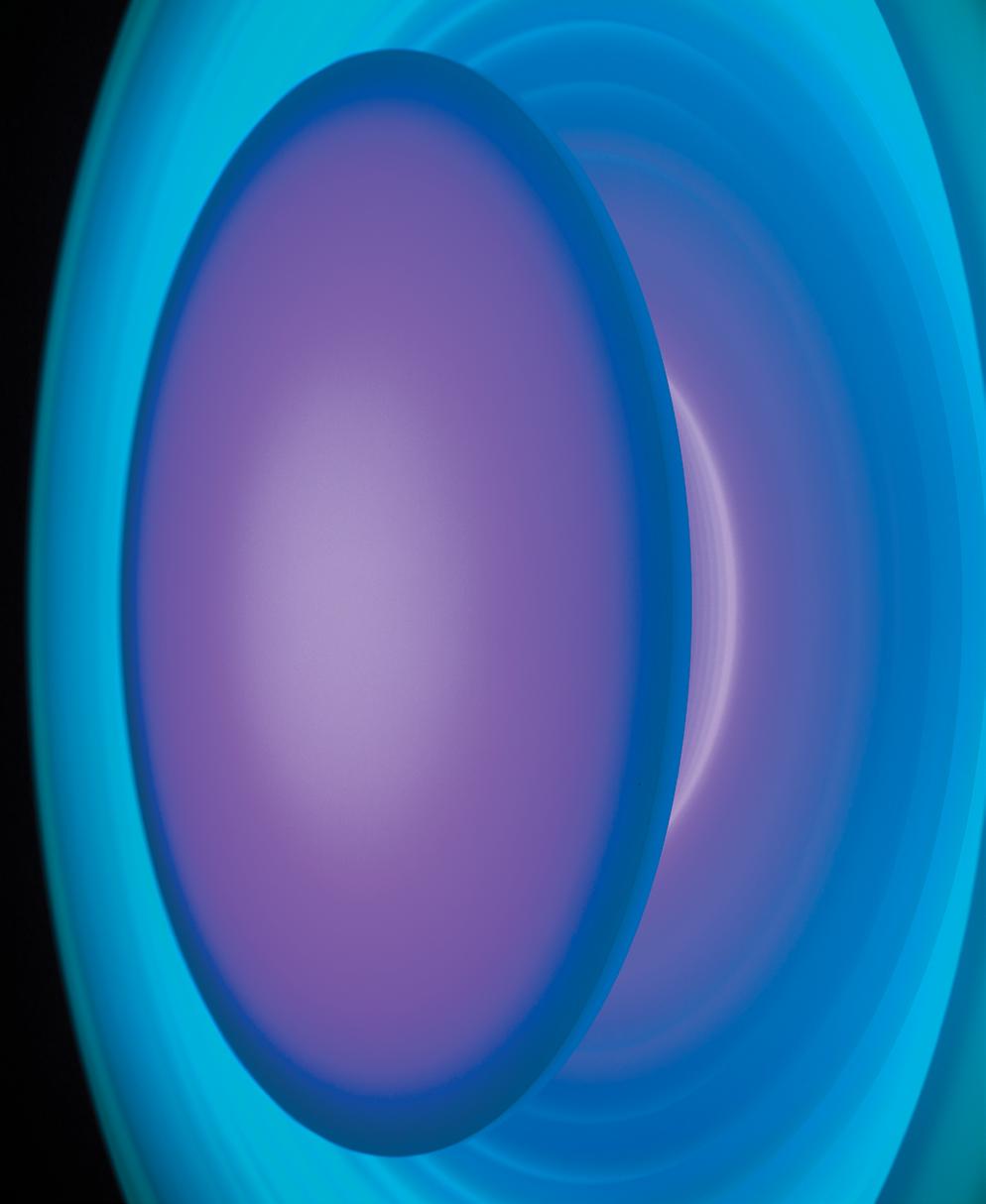
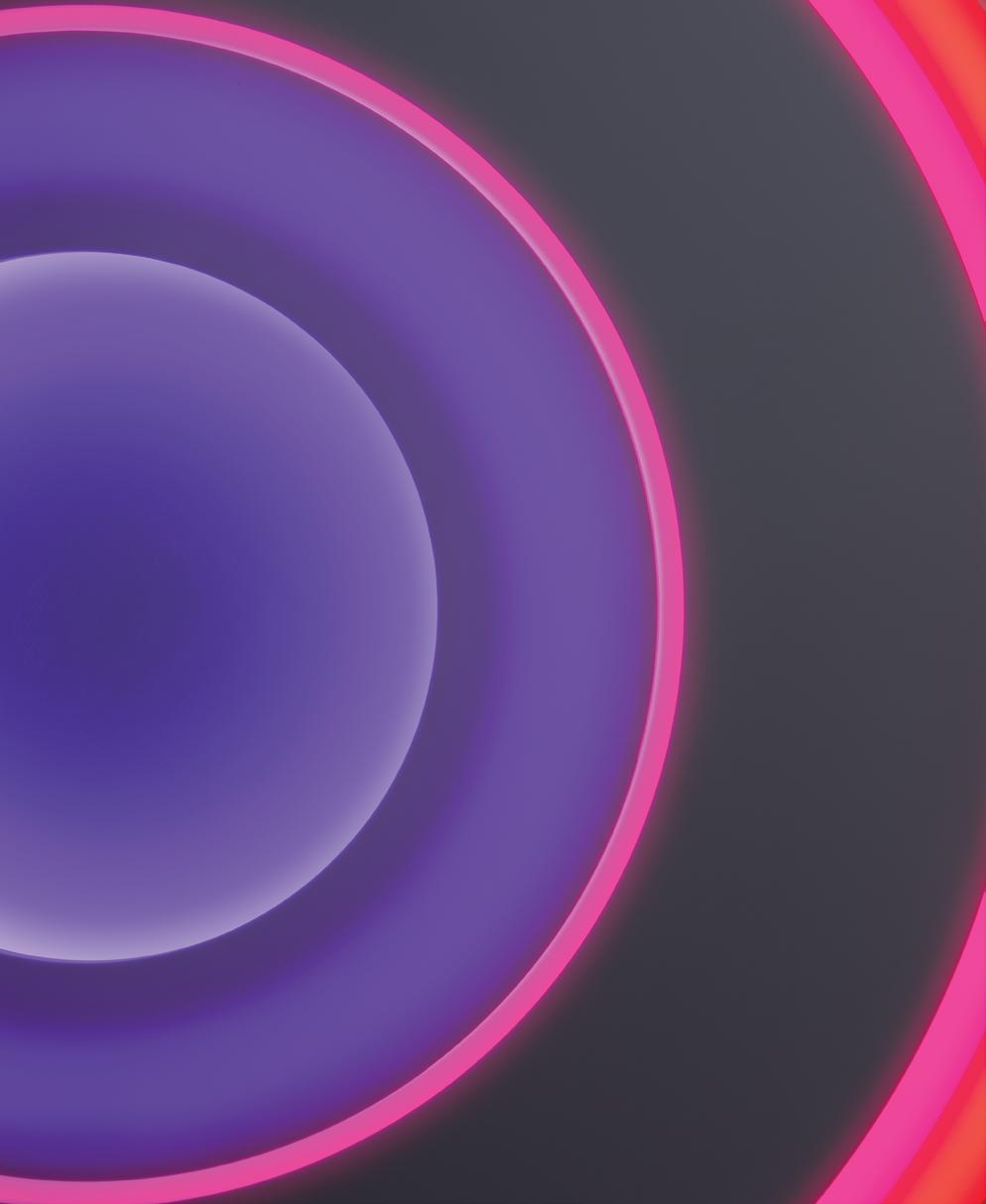
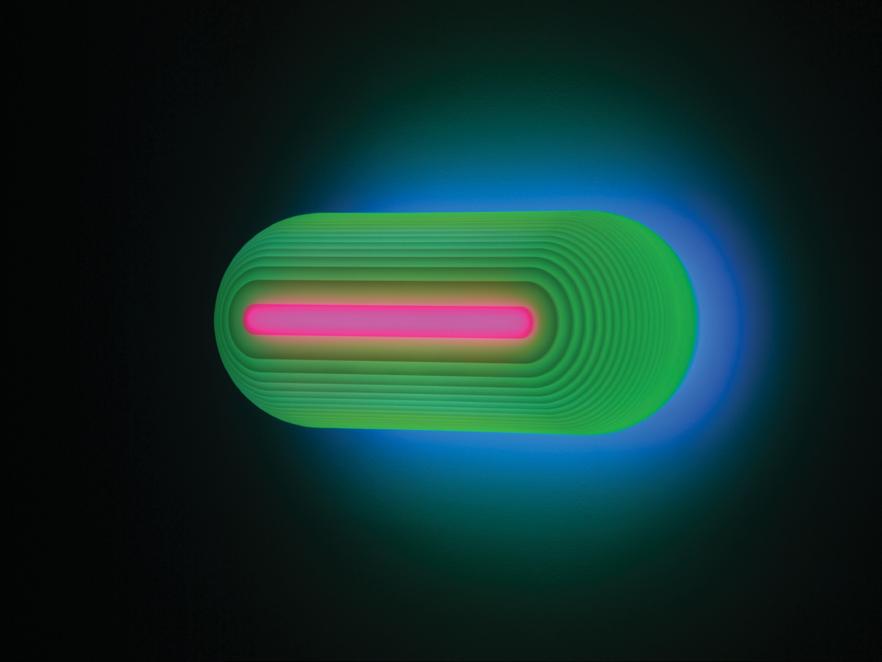
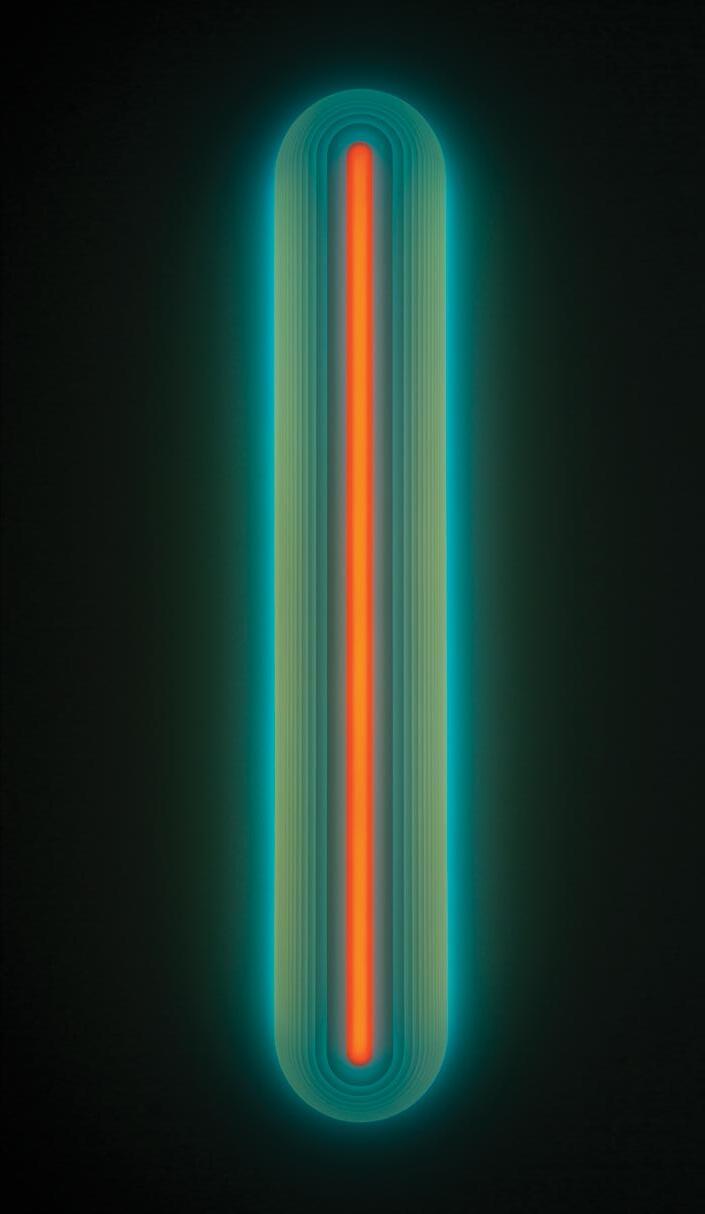
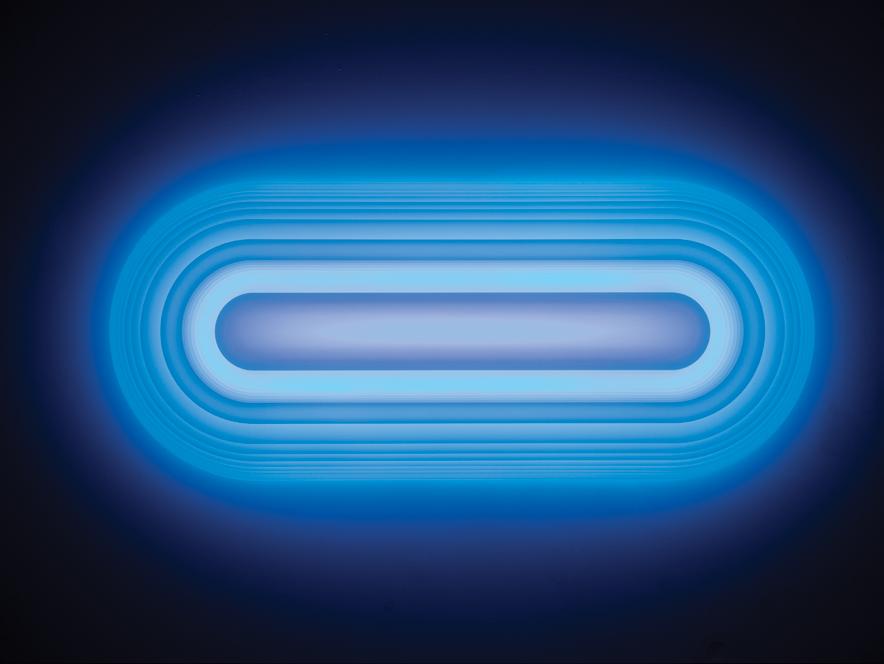
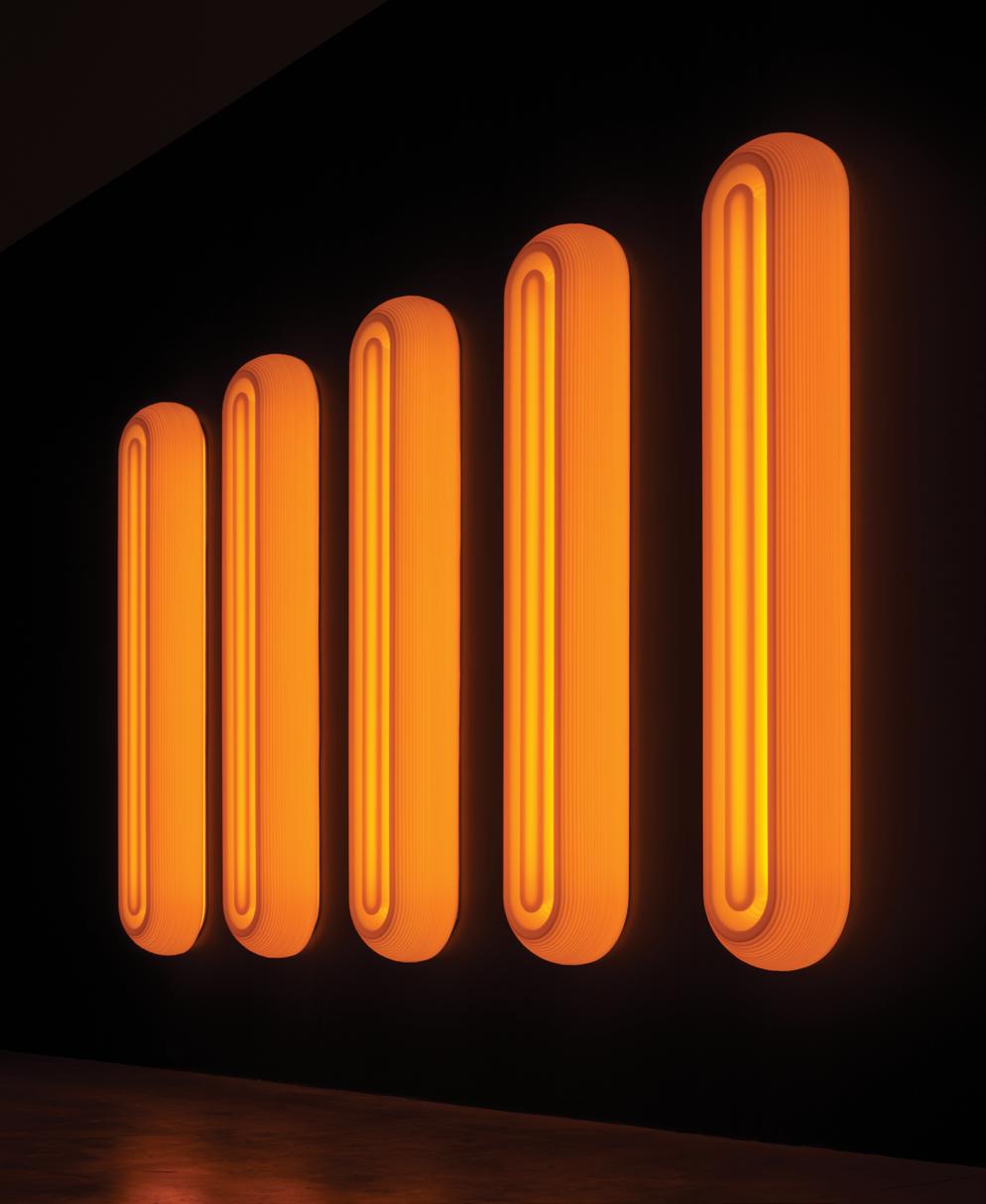
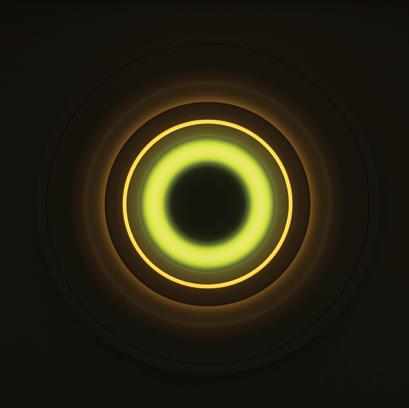
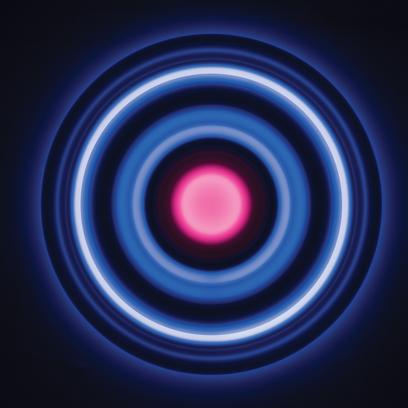
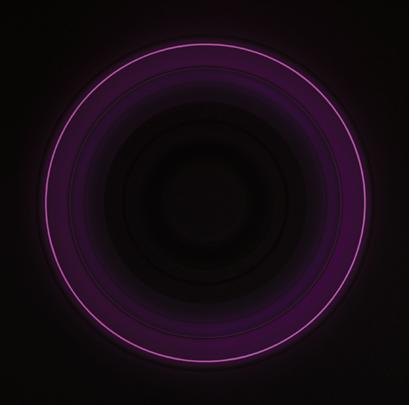
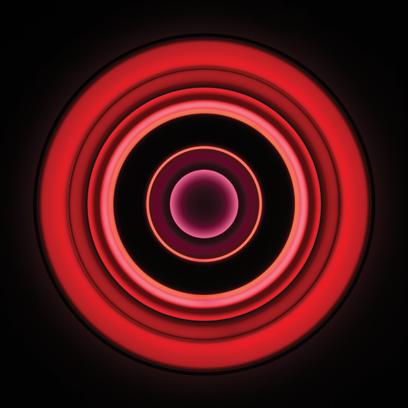
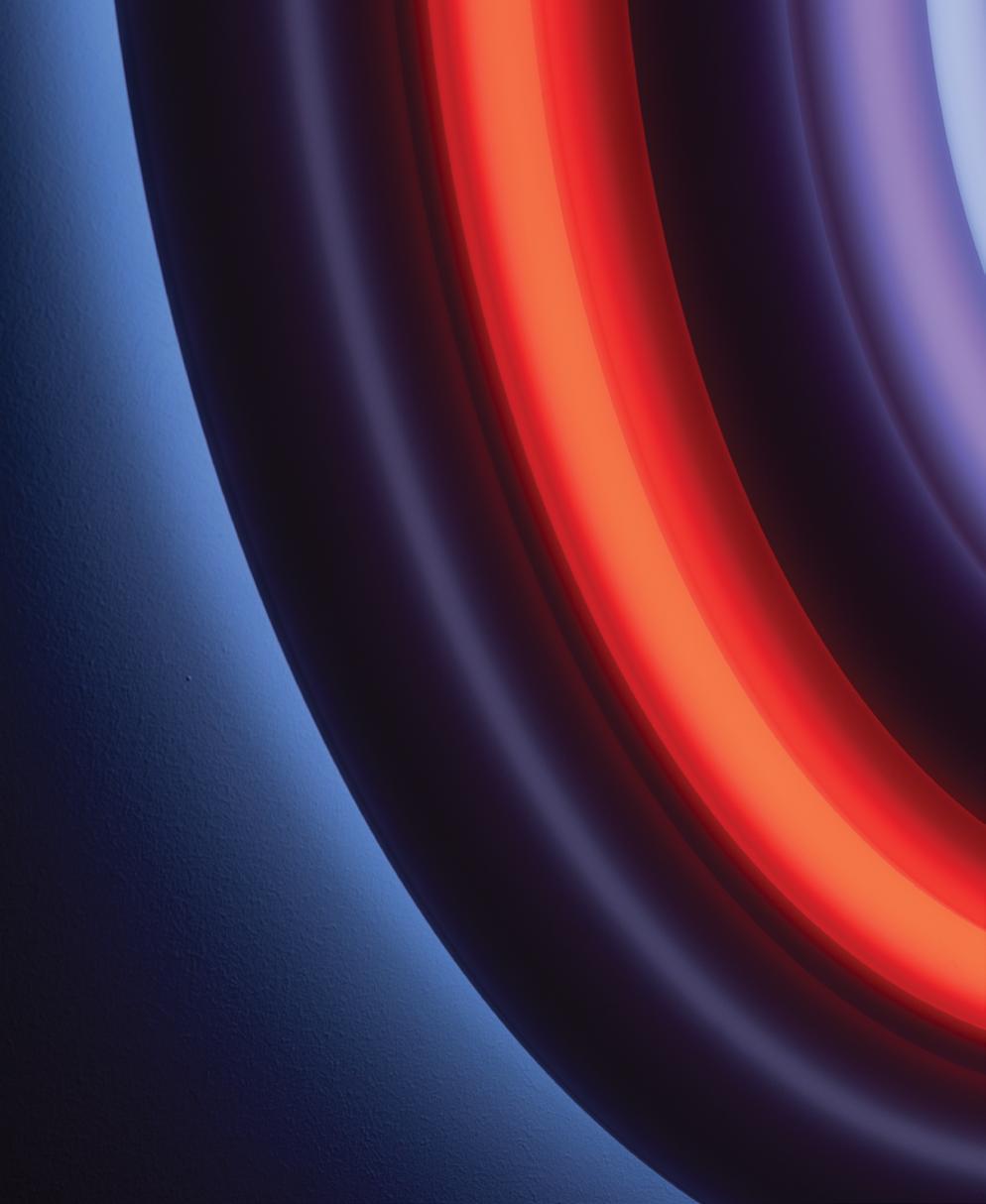
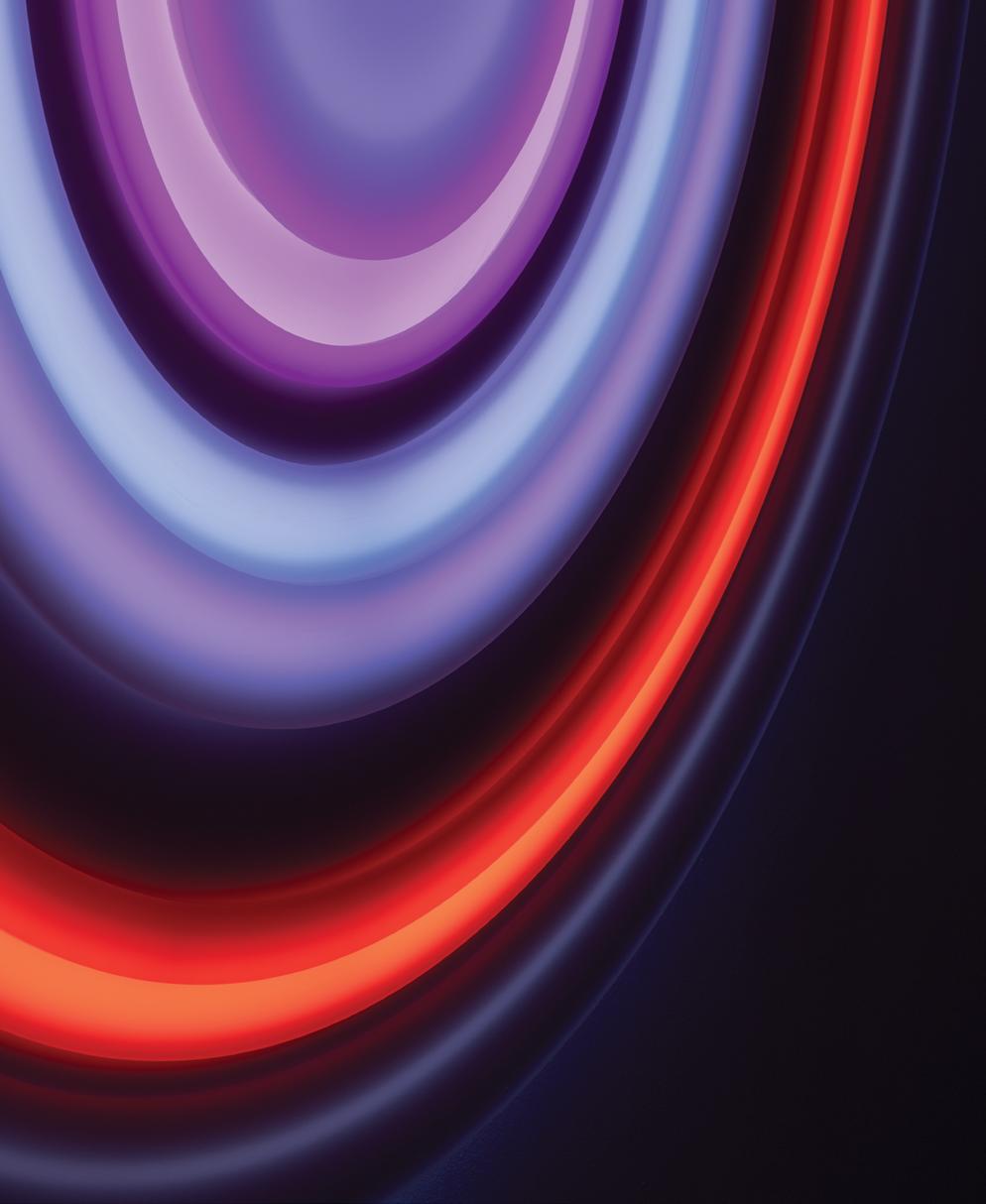
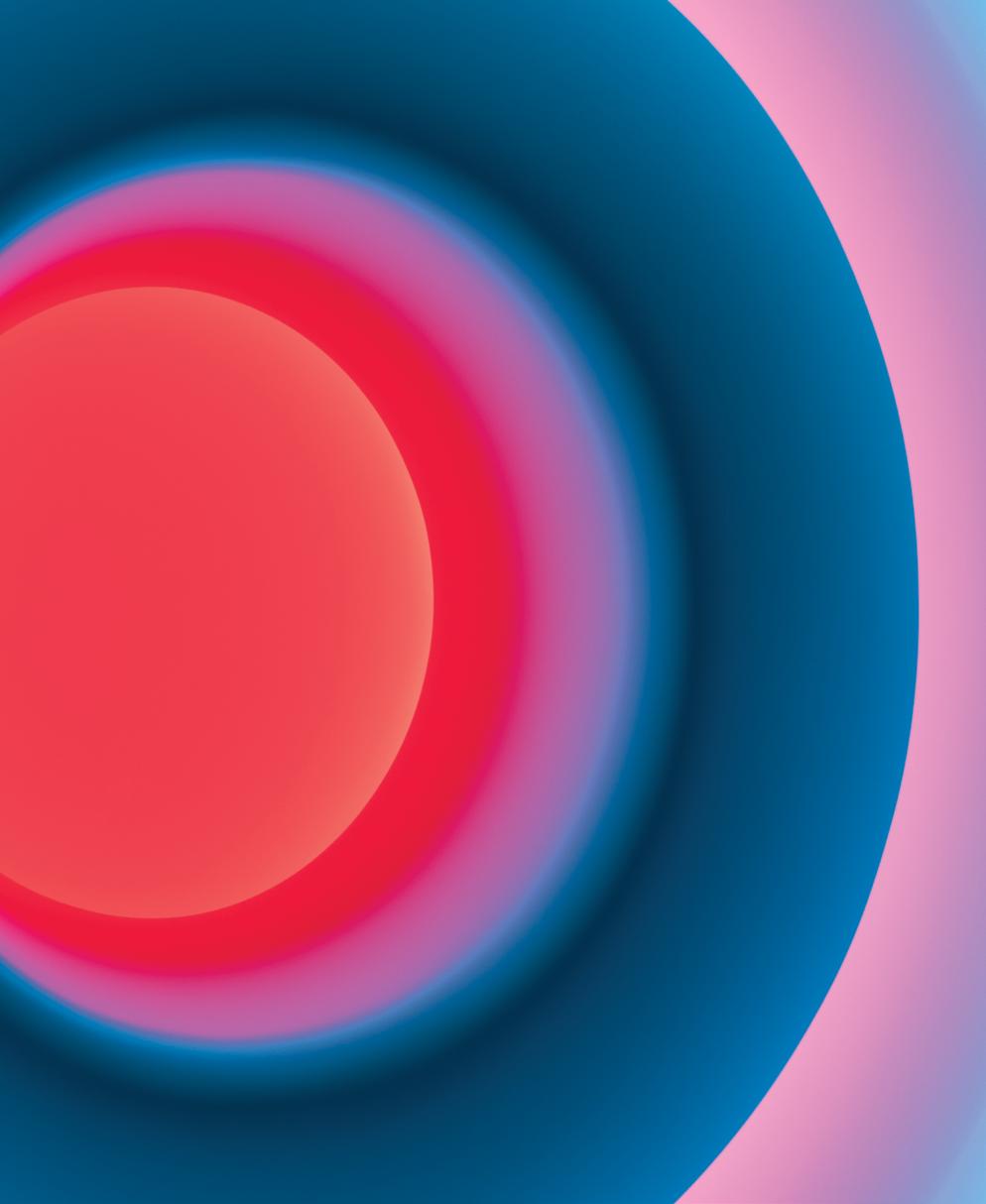
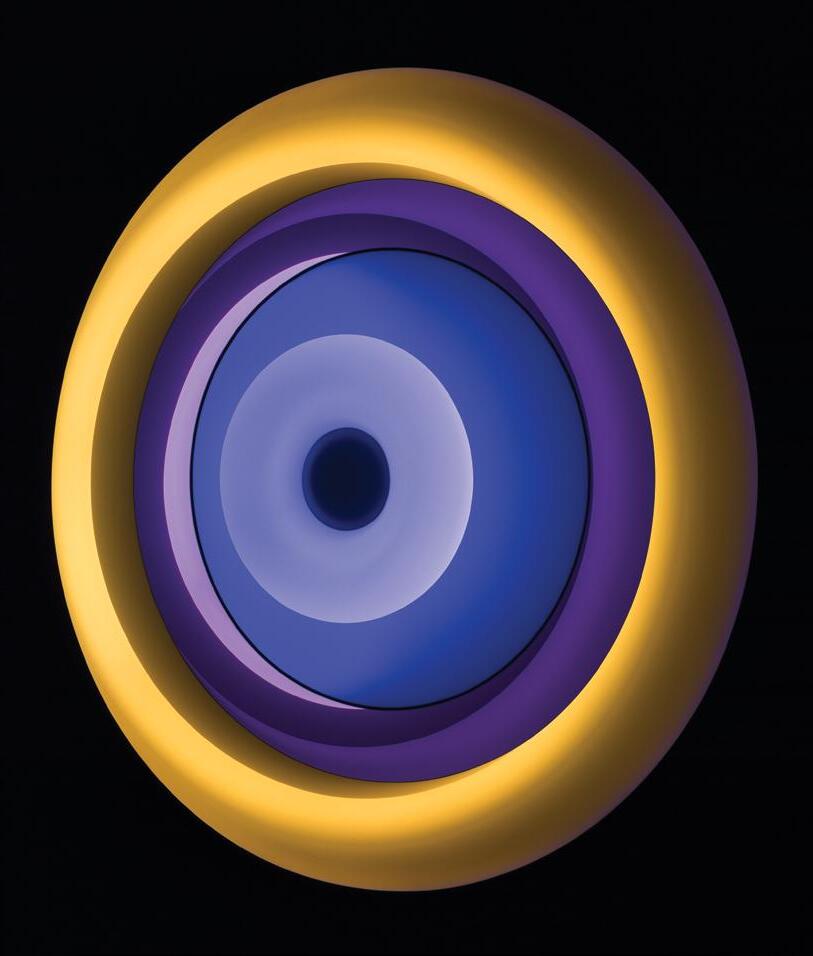
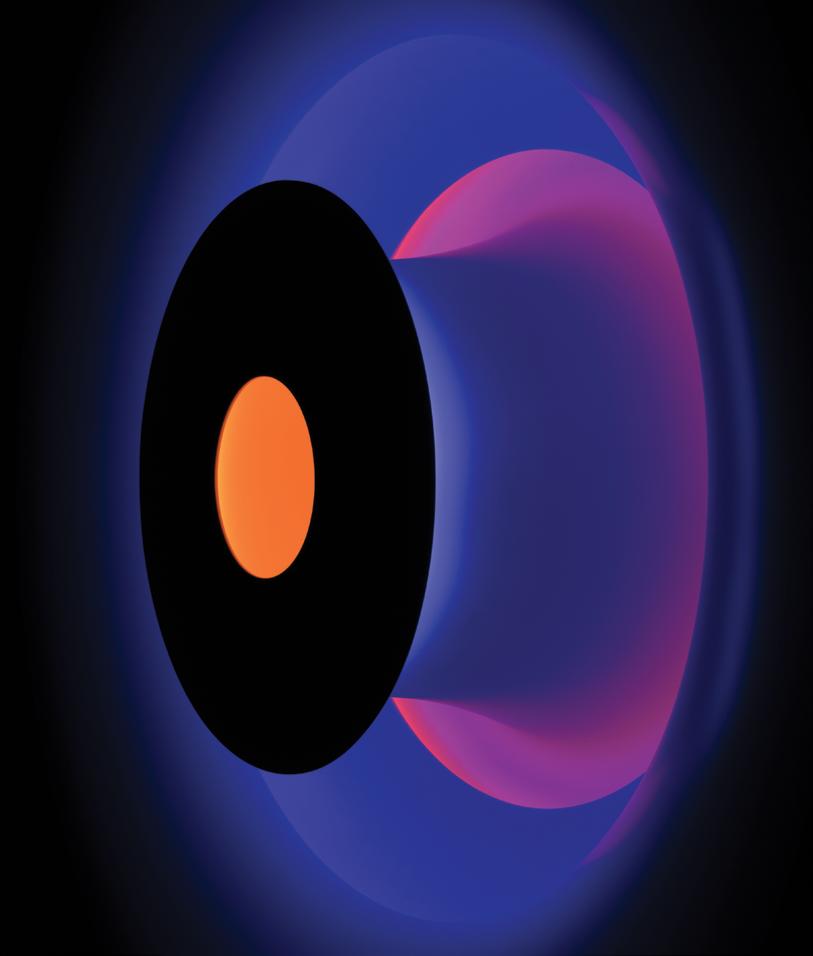
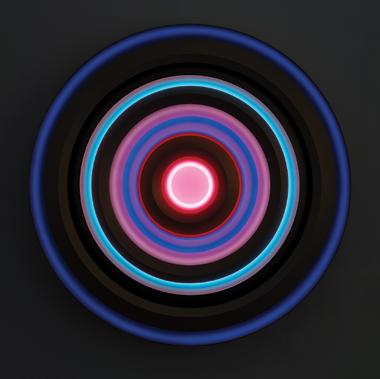
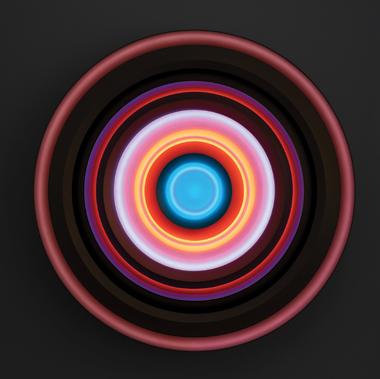
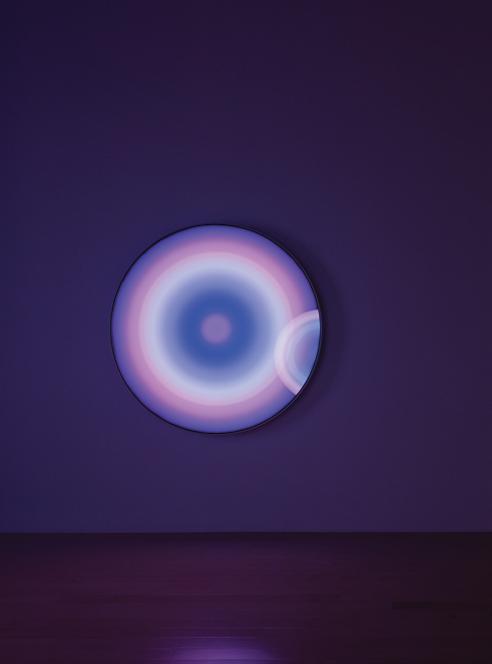
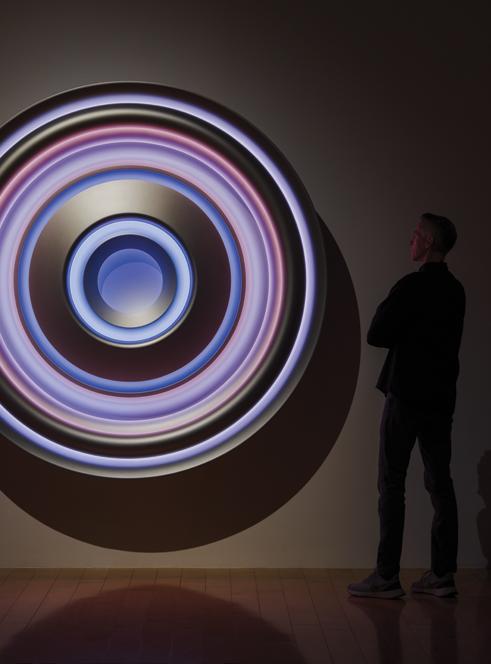
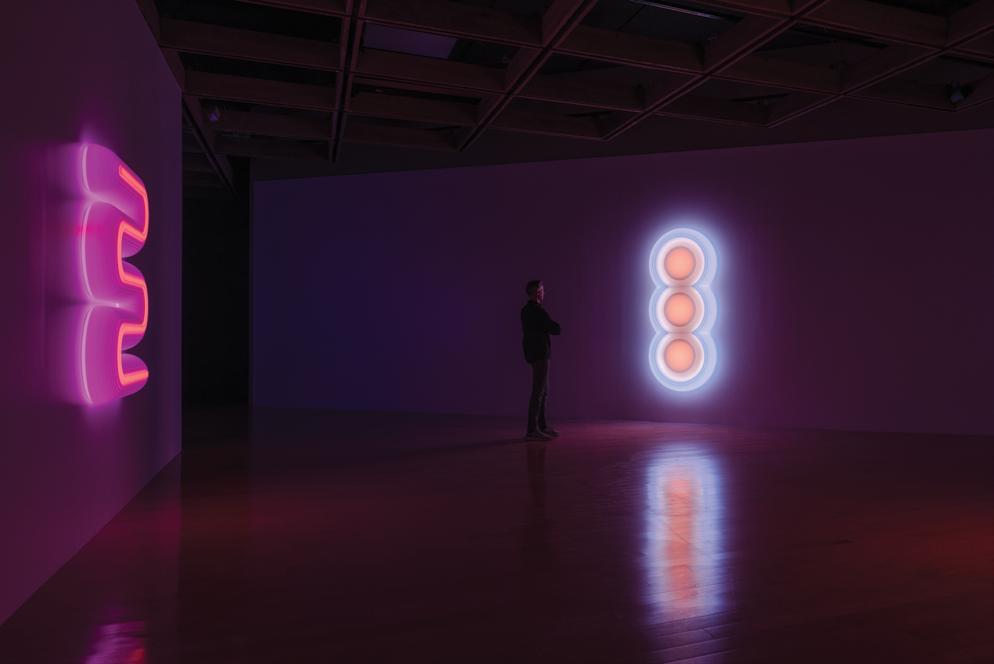
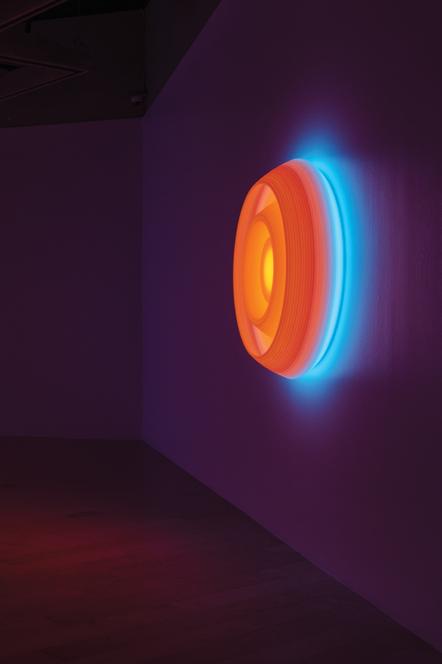
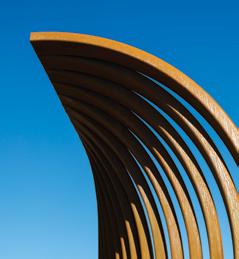
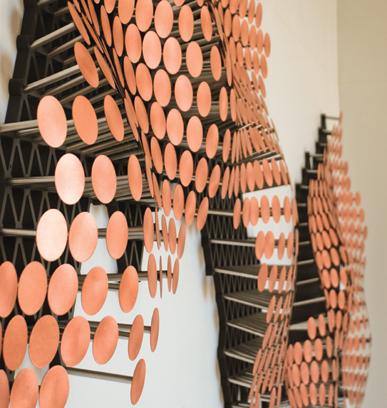
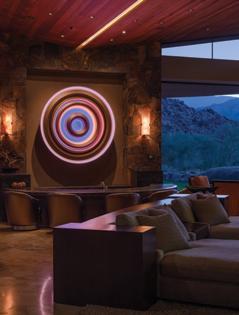
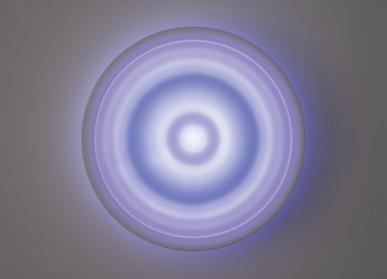
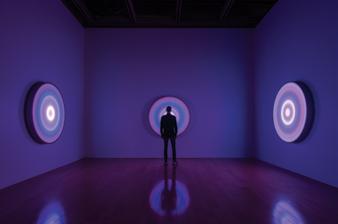
Inspired directly by Aperture, the Lightworks create unique, more intimate experiences in color, form, surface, and change. Formally focused as Torus or Lozenge shapes, each new iteration builds upon the former, expanding Smith’s dialogue with and investigation of color. Set to precisely delineated paces, brightnesses, and colors, Smith sees these works as highly specific three-dimensional canvases that he paints with light and that are durationally experienced.
35
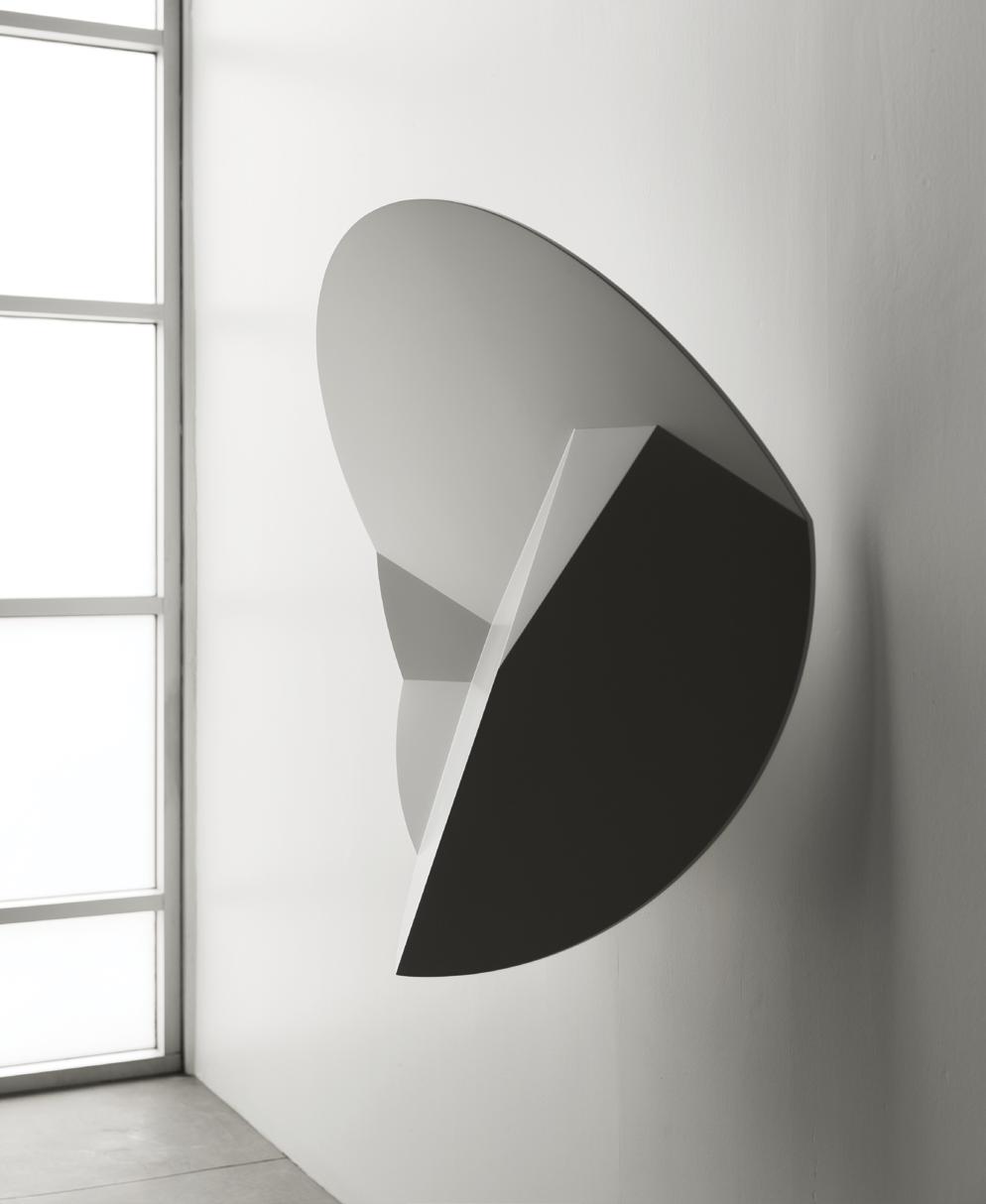
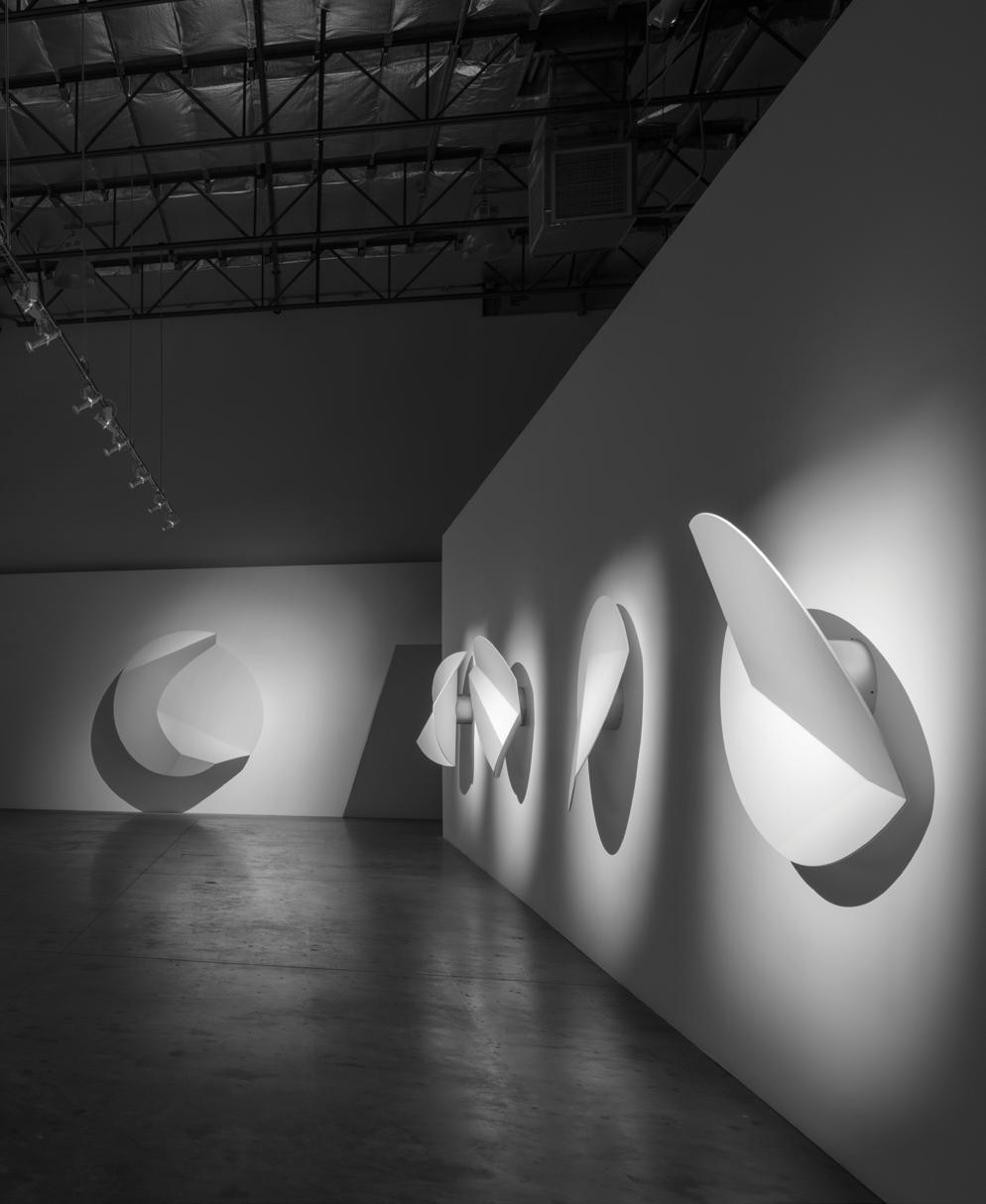
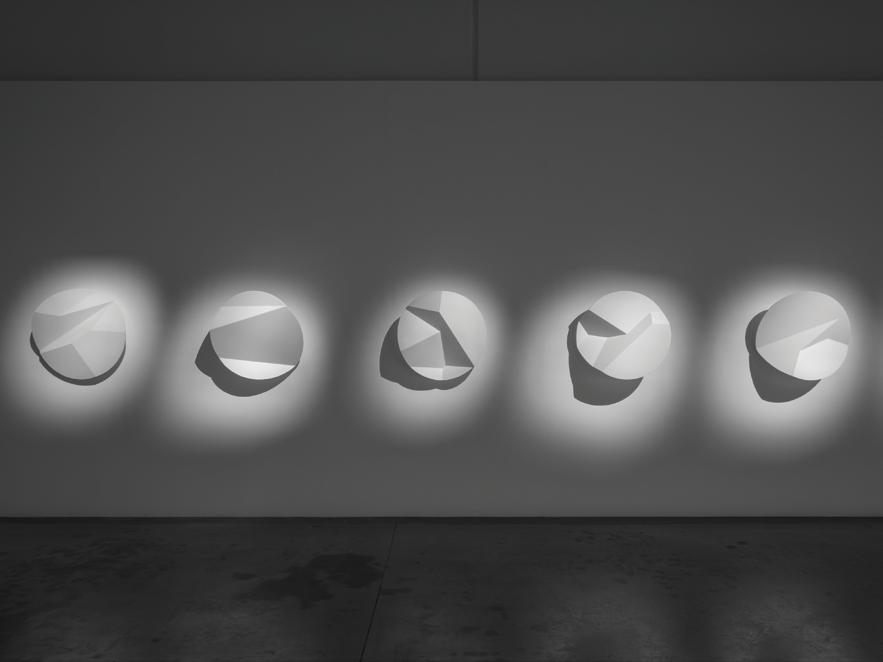
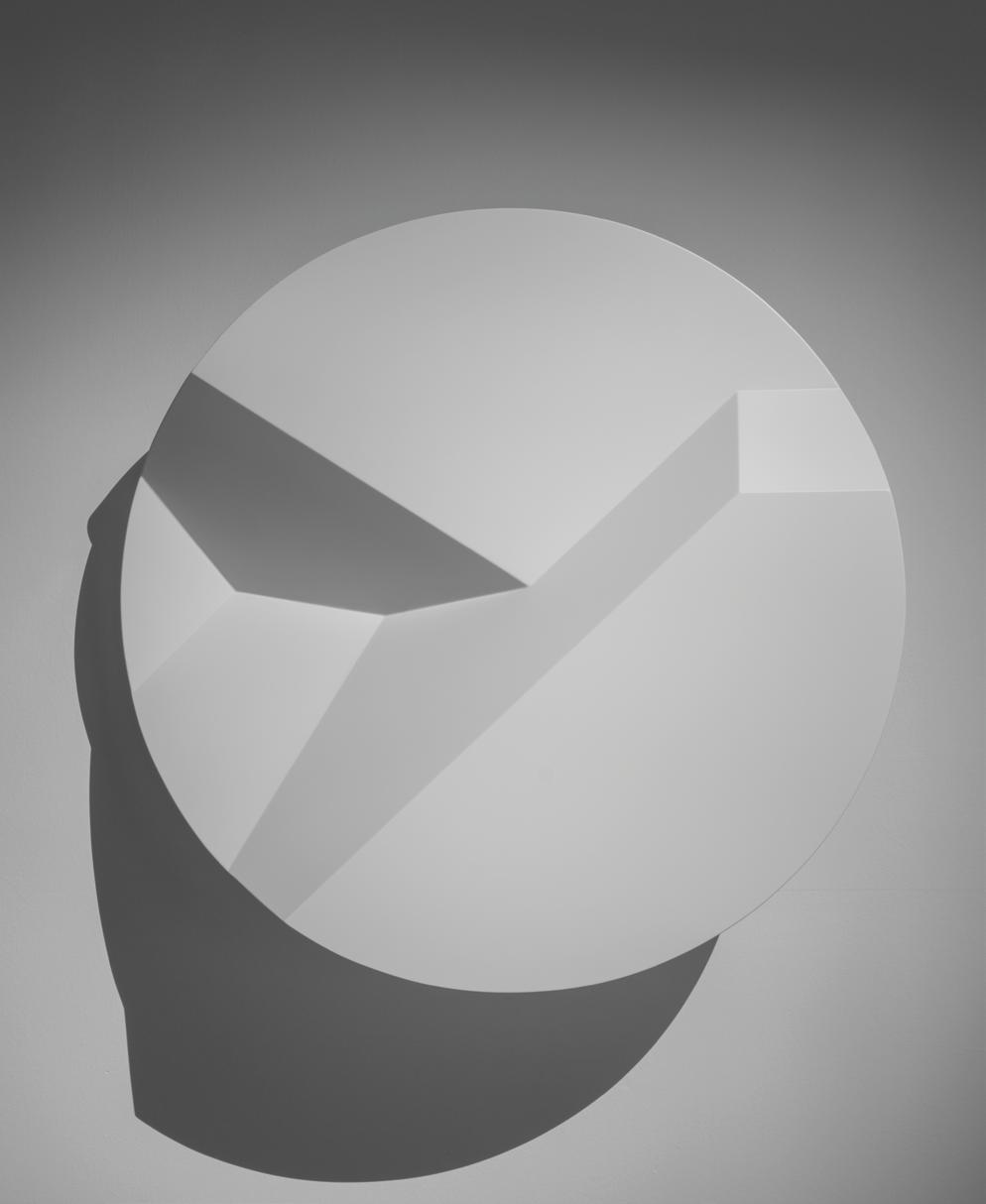
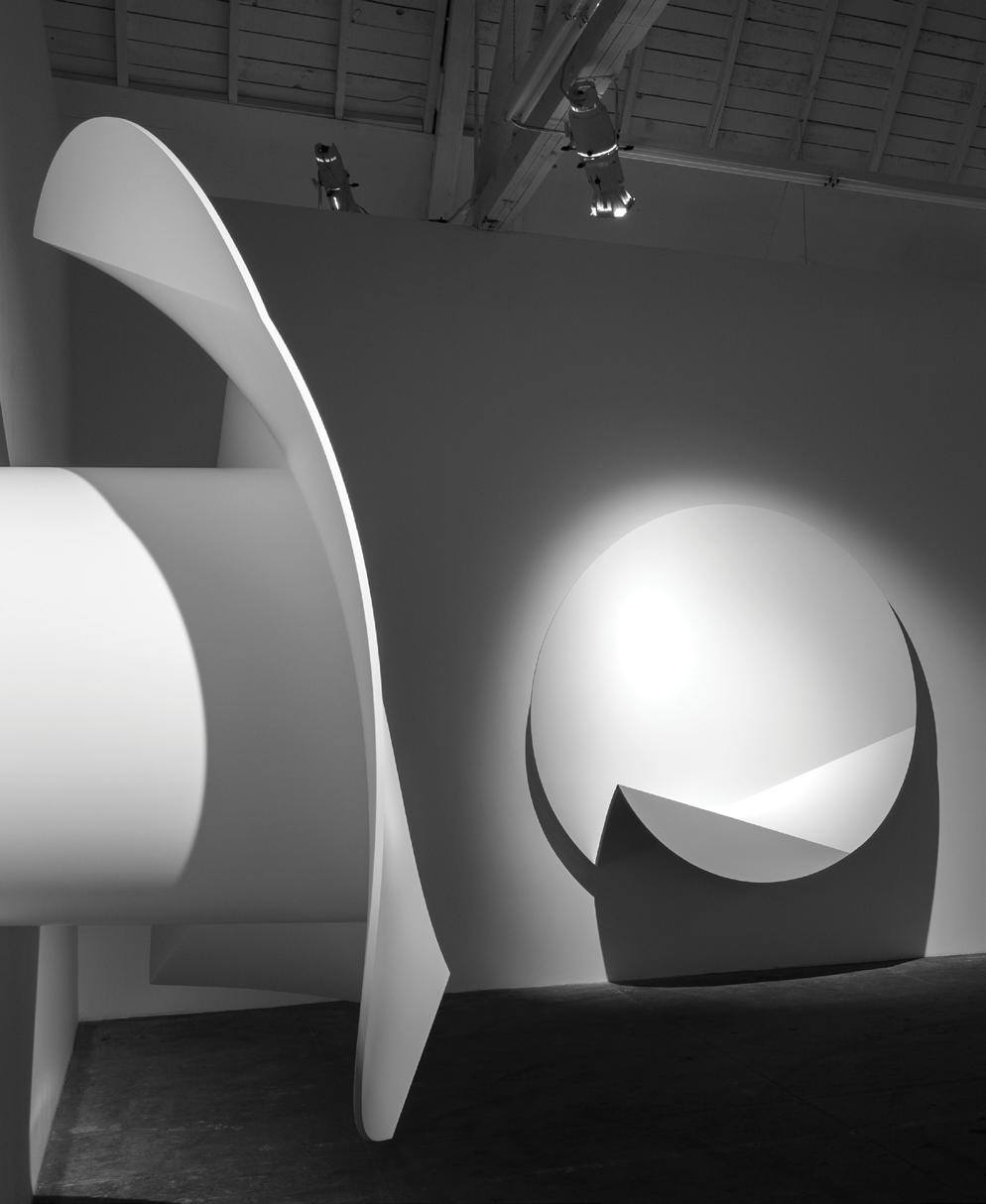
LIGHT+SHADOW WORKS SERIES
2012 – ongoing
Dimensions vary
Fiberglass, carbon fiber, automotive paint
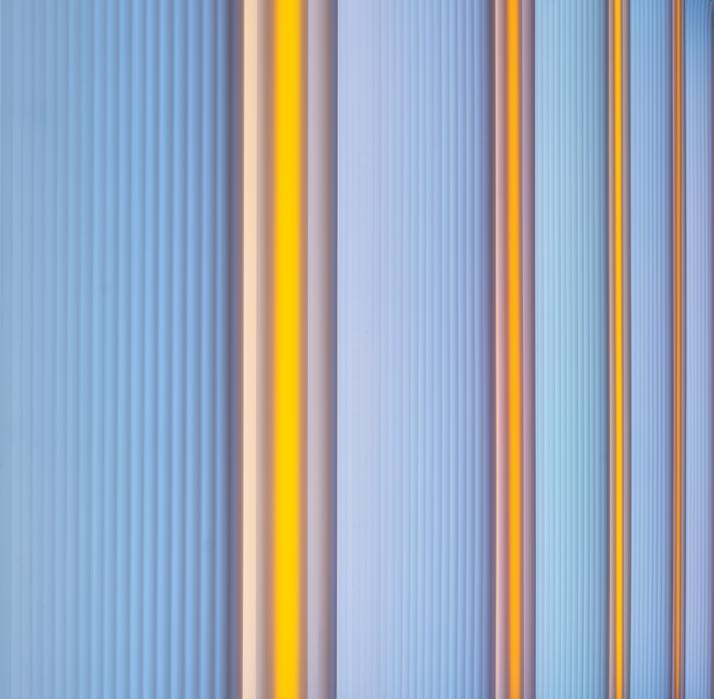
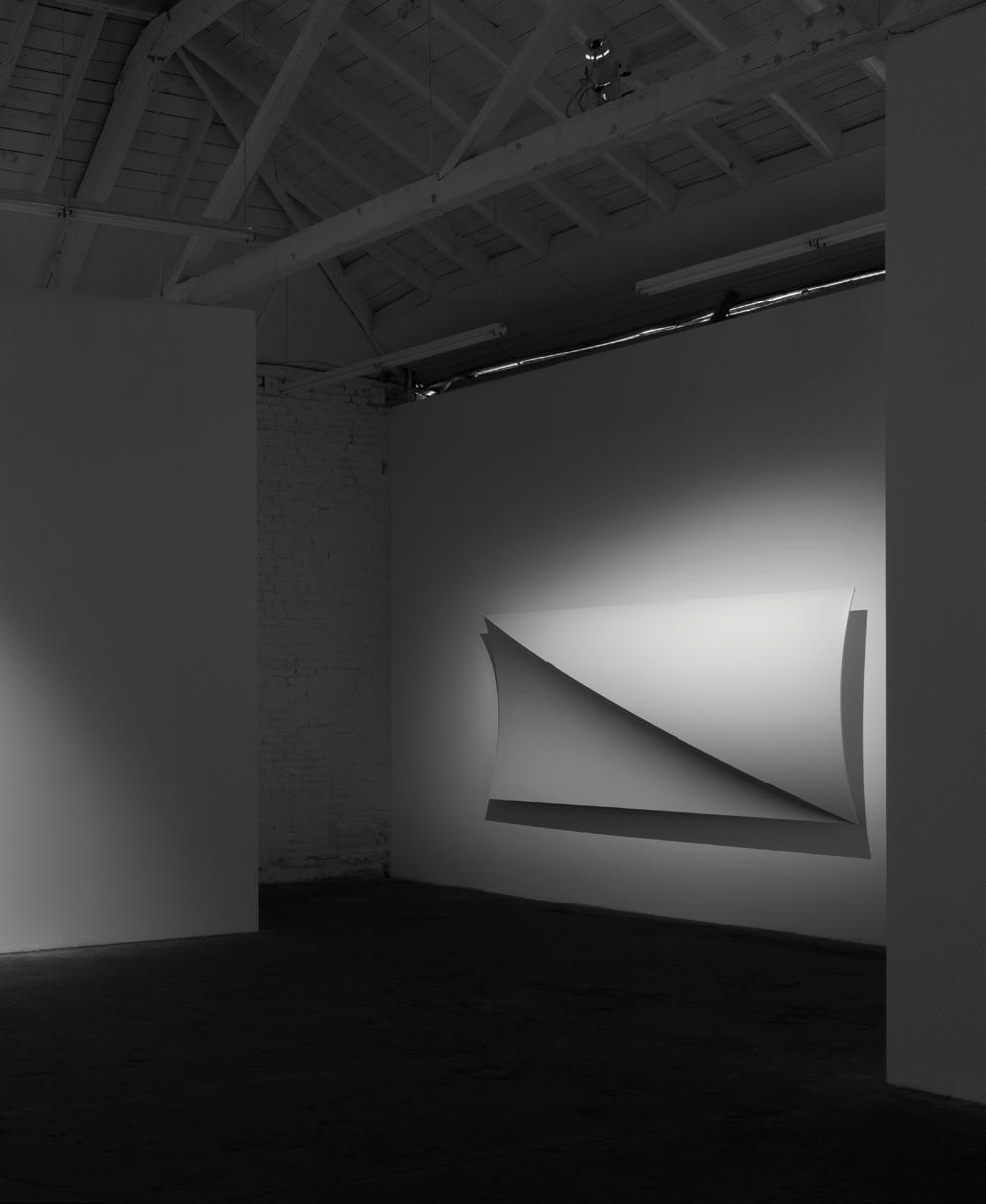
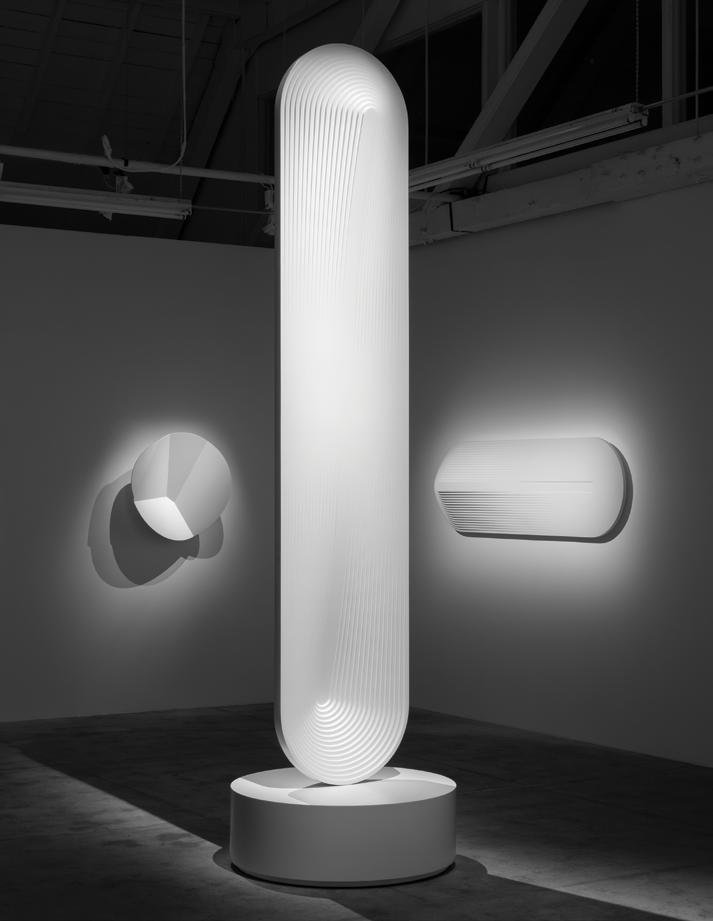
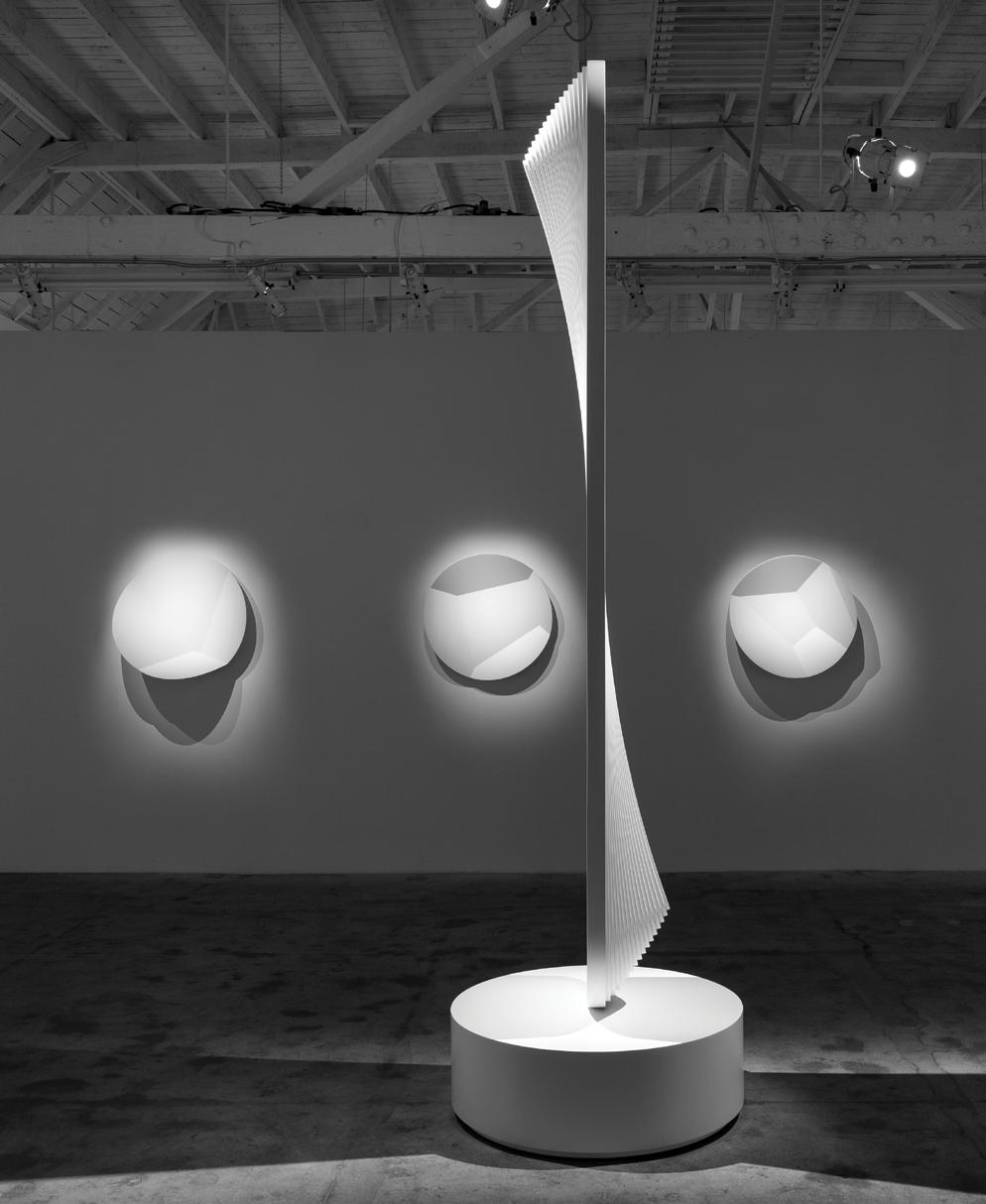
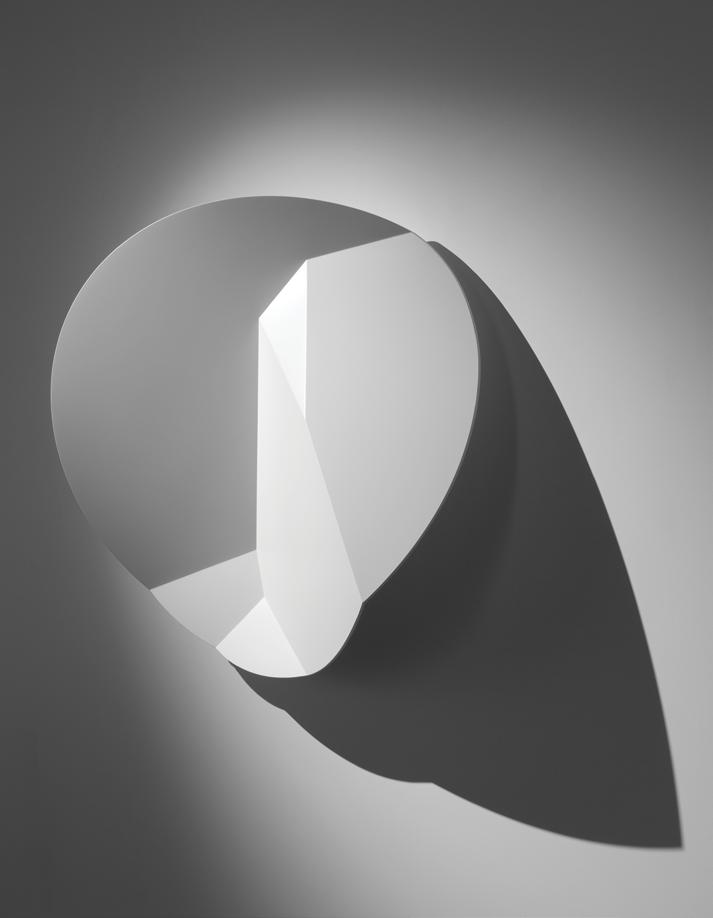
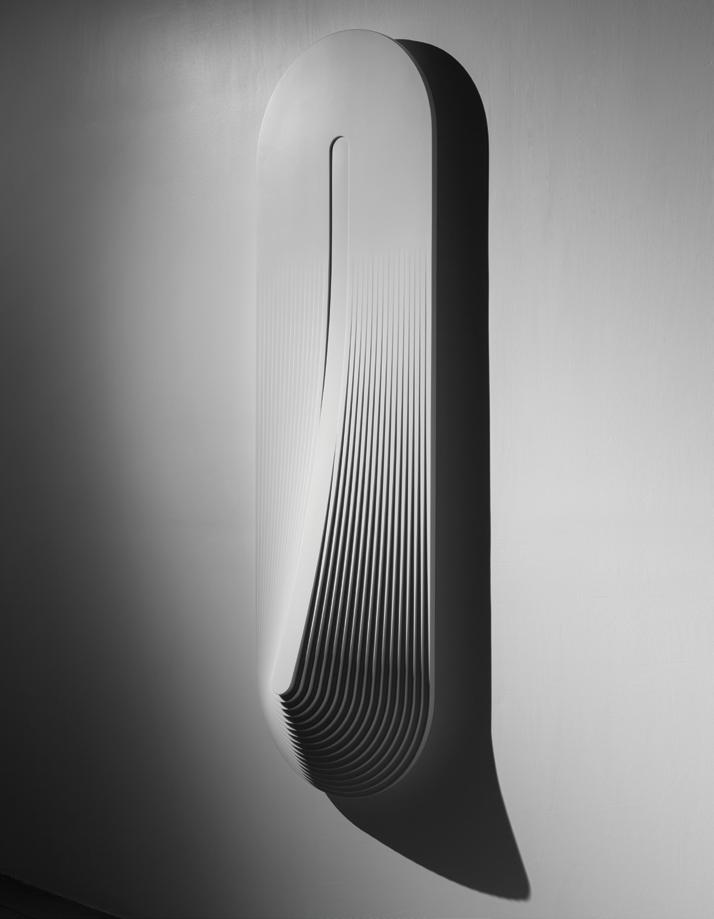
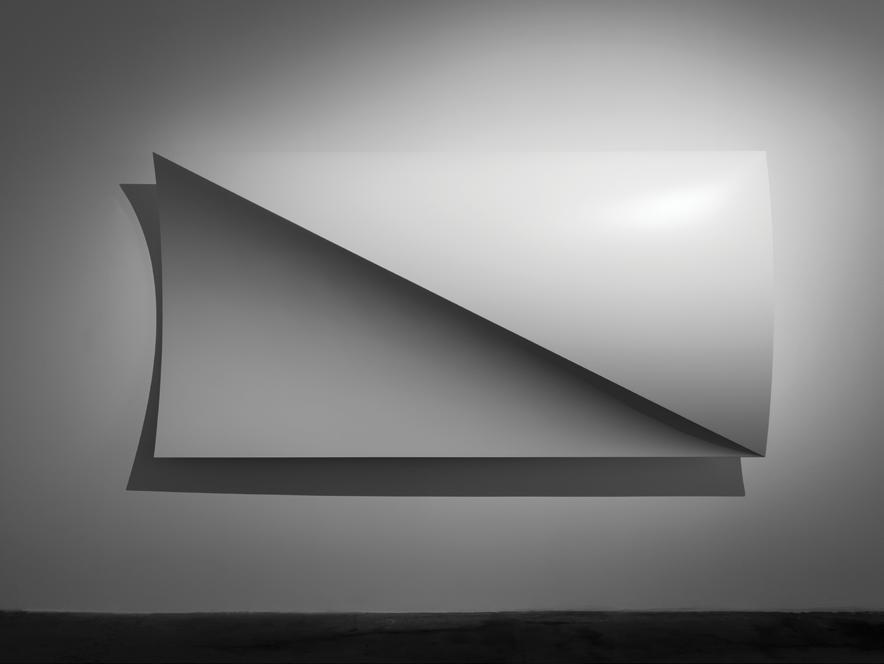
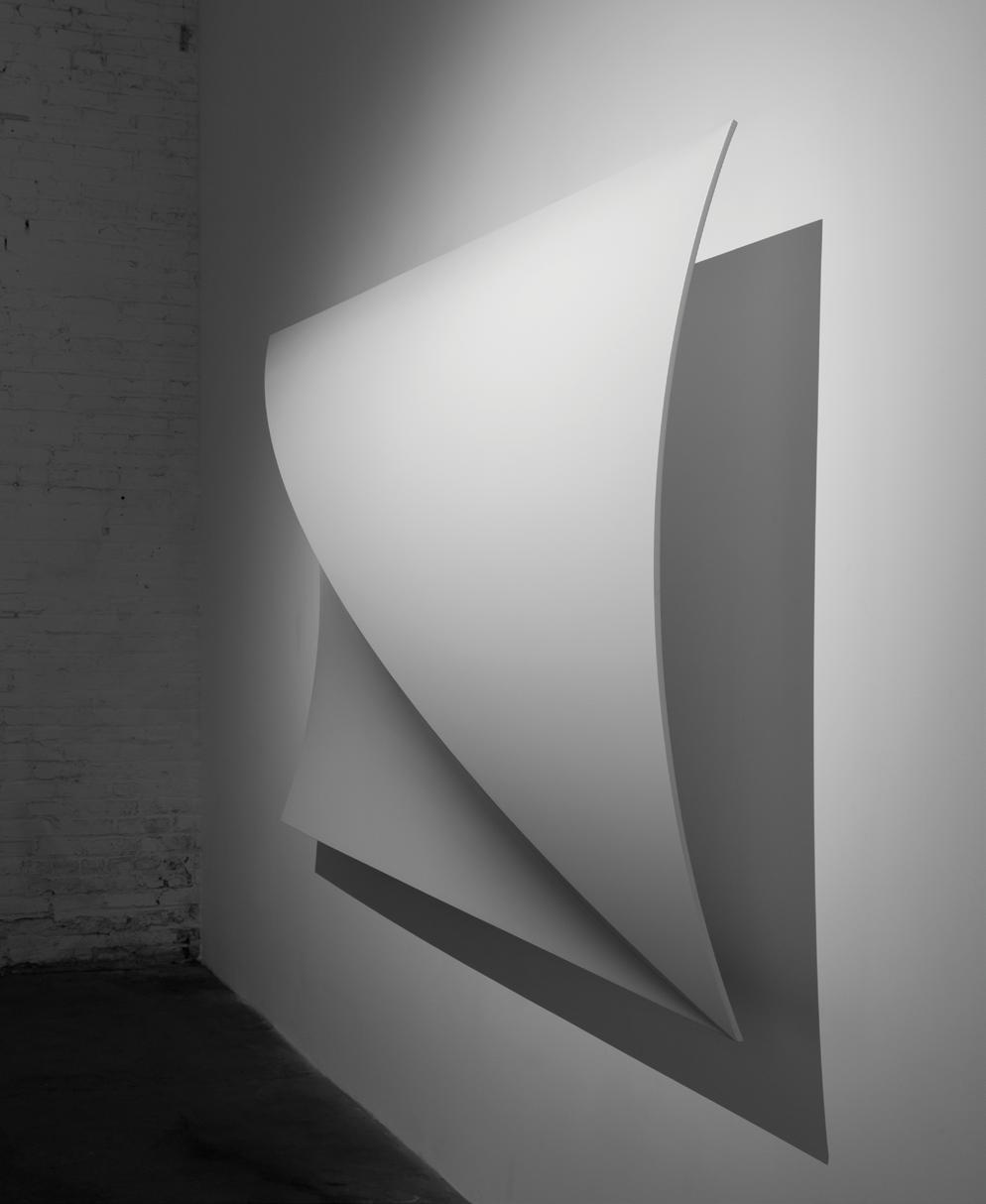
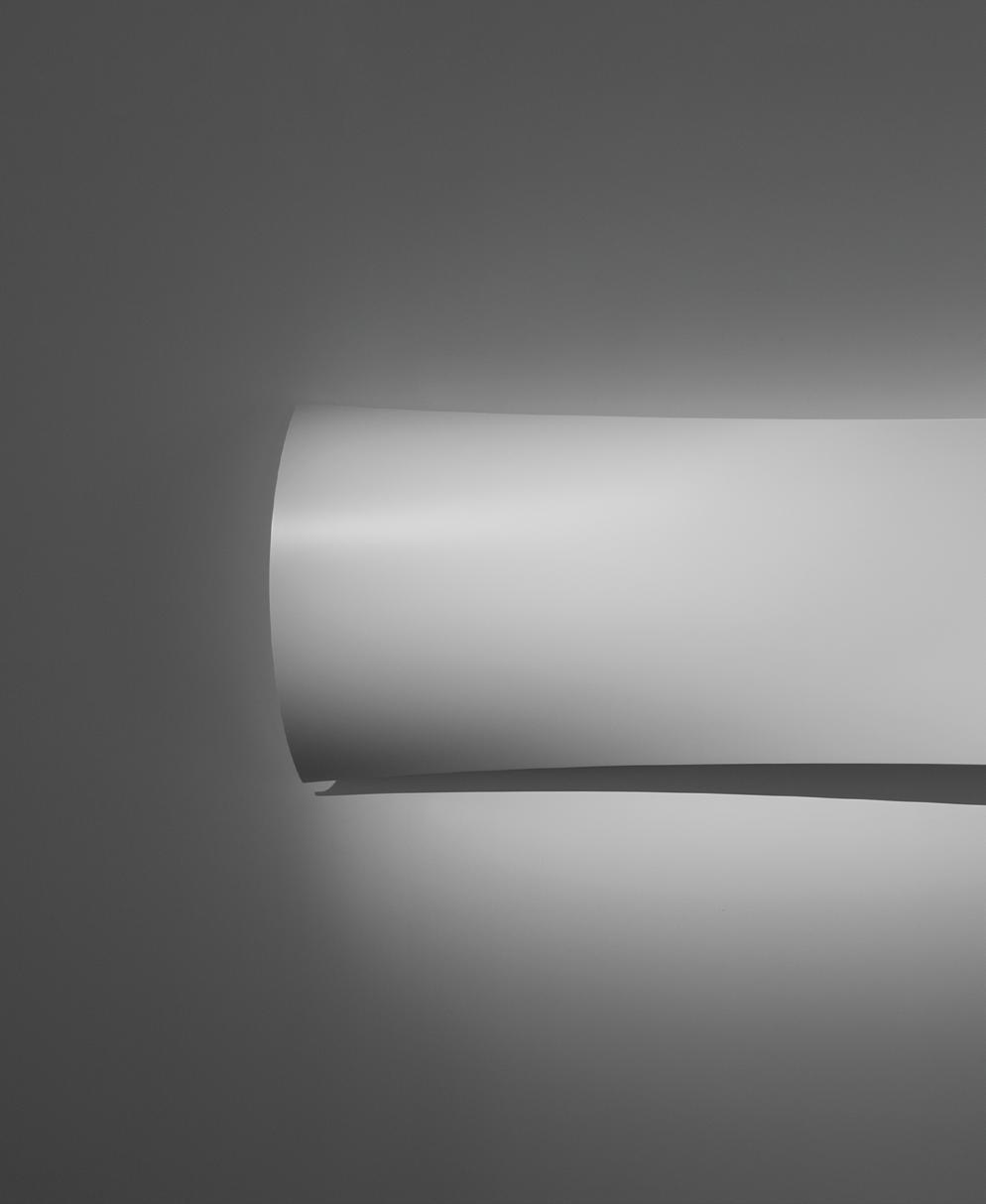
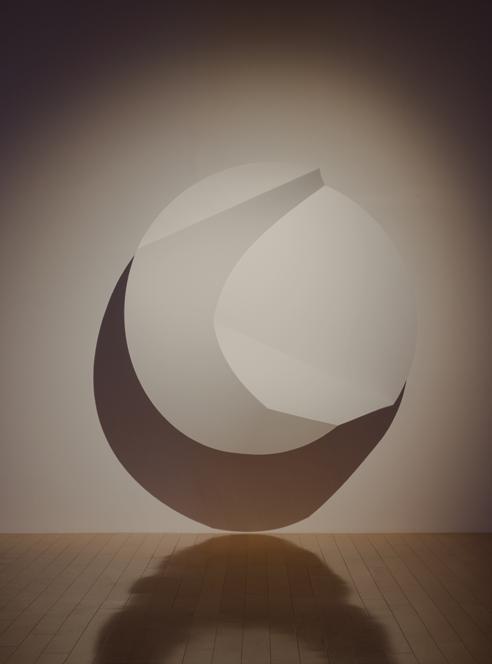
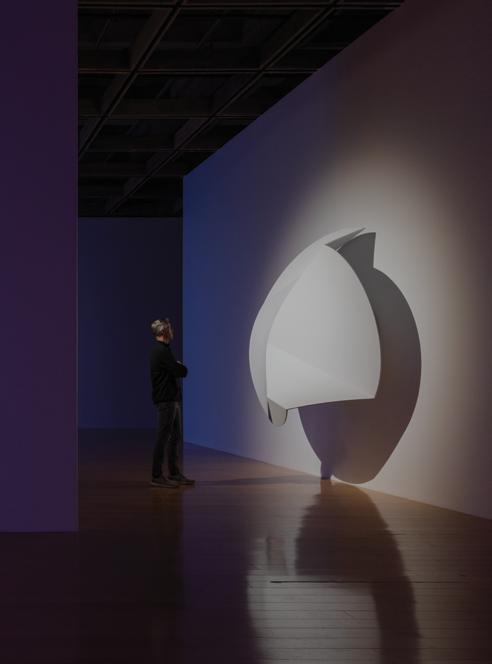
One of Smith’s daily rituals is watching the early morning and late afternoon sun as it travels across the Little San Bernardino Mountains, transforming the hills from monochromatic silhouettes into highly textural, three-dimensional surfaces of light and shadow. This daily influence has had a significant impact on Smith’s work. Seeking to present light in its simplest state, the Light + Shadow Works dematerialize, perceived as forms composed solely of light and shadow.
51
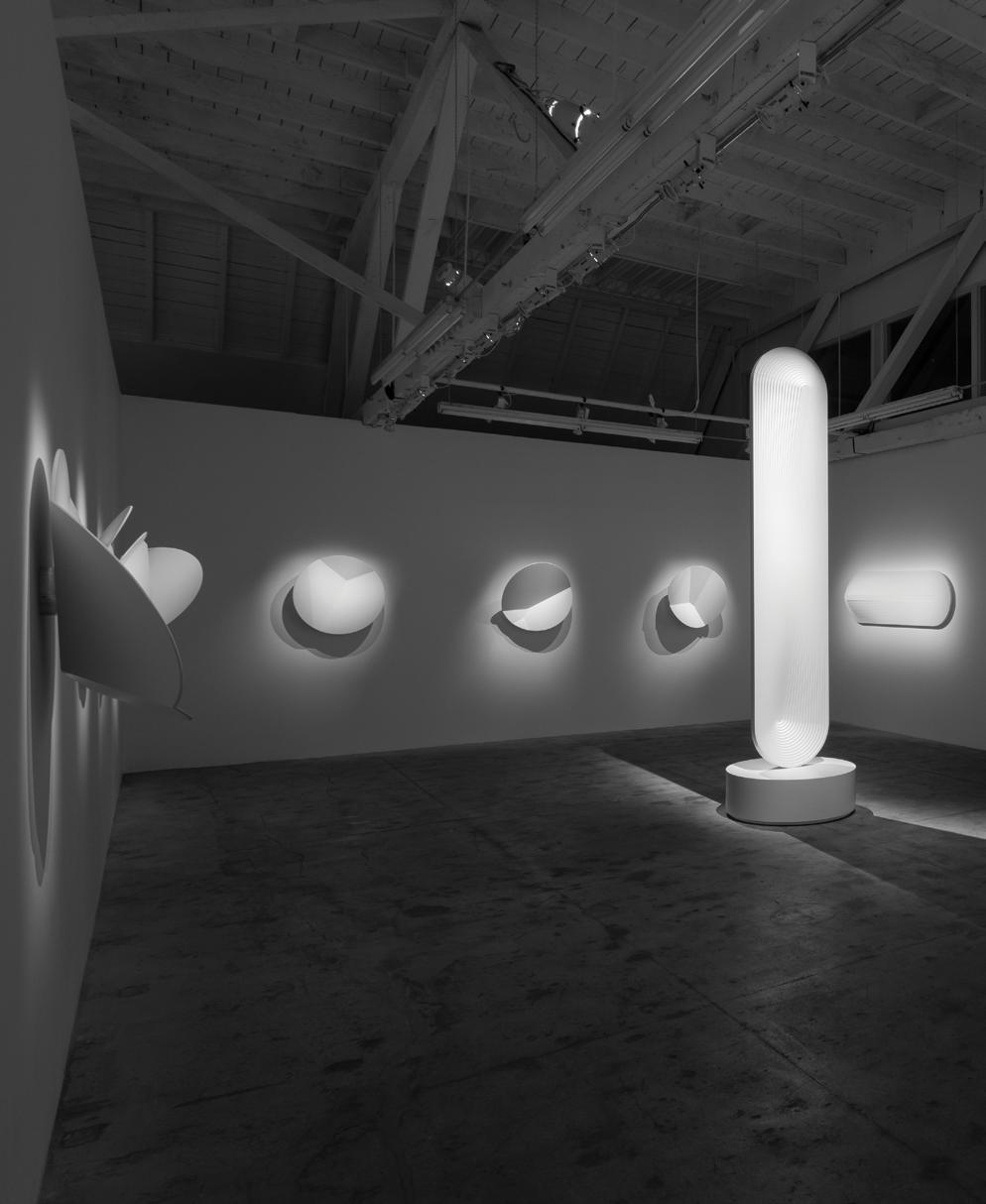
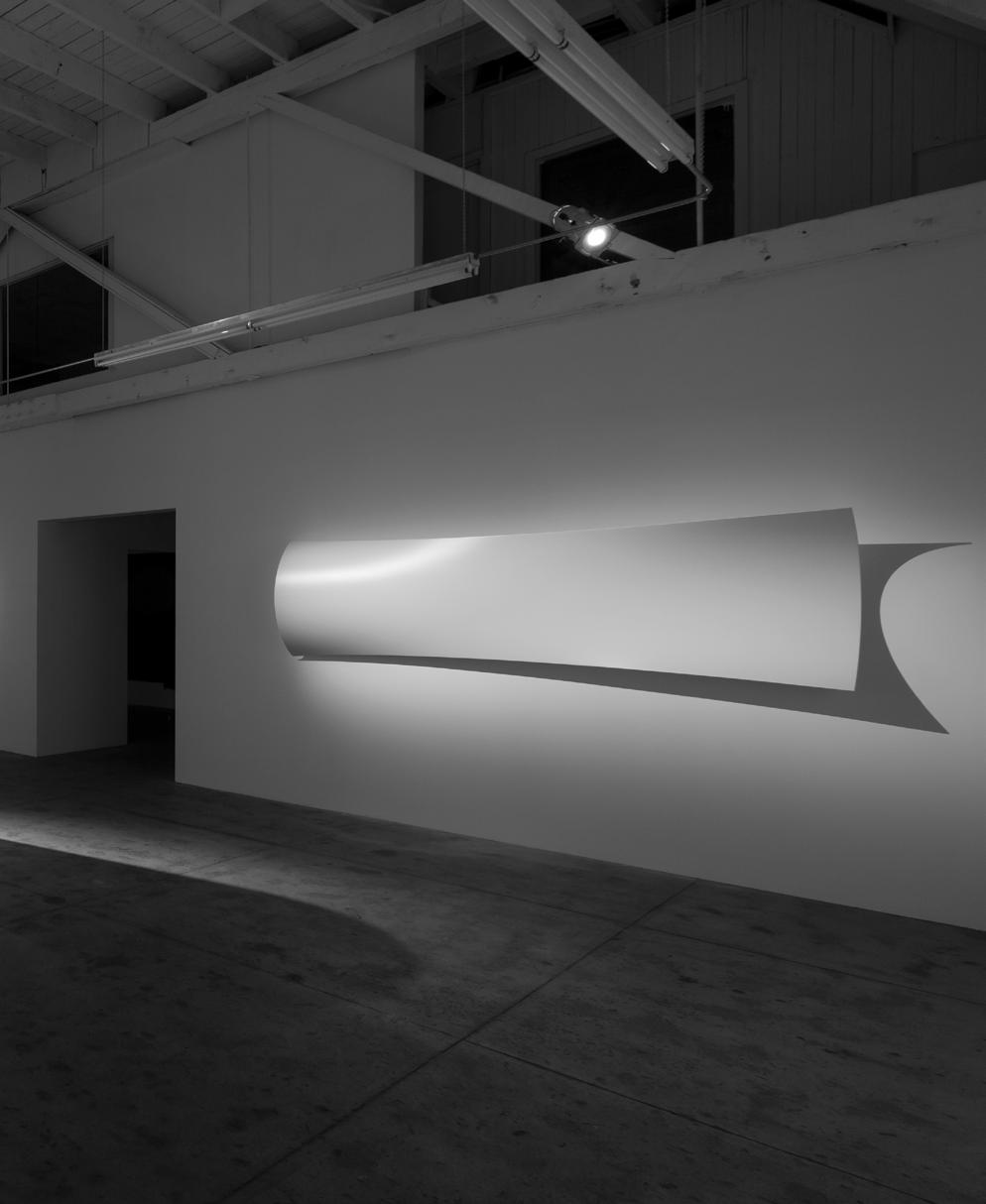
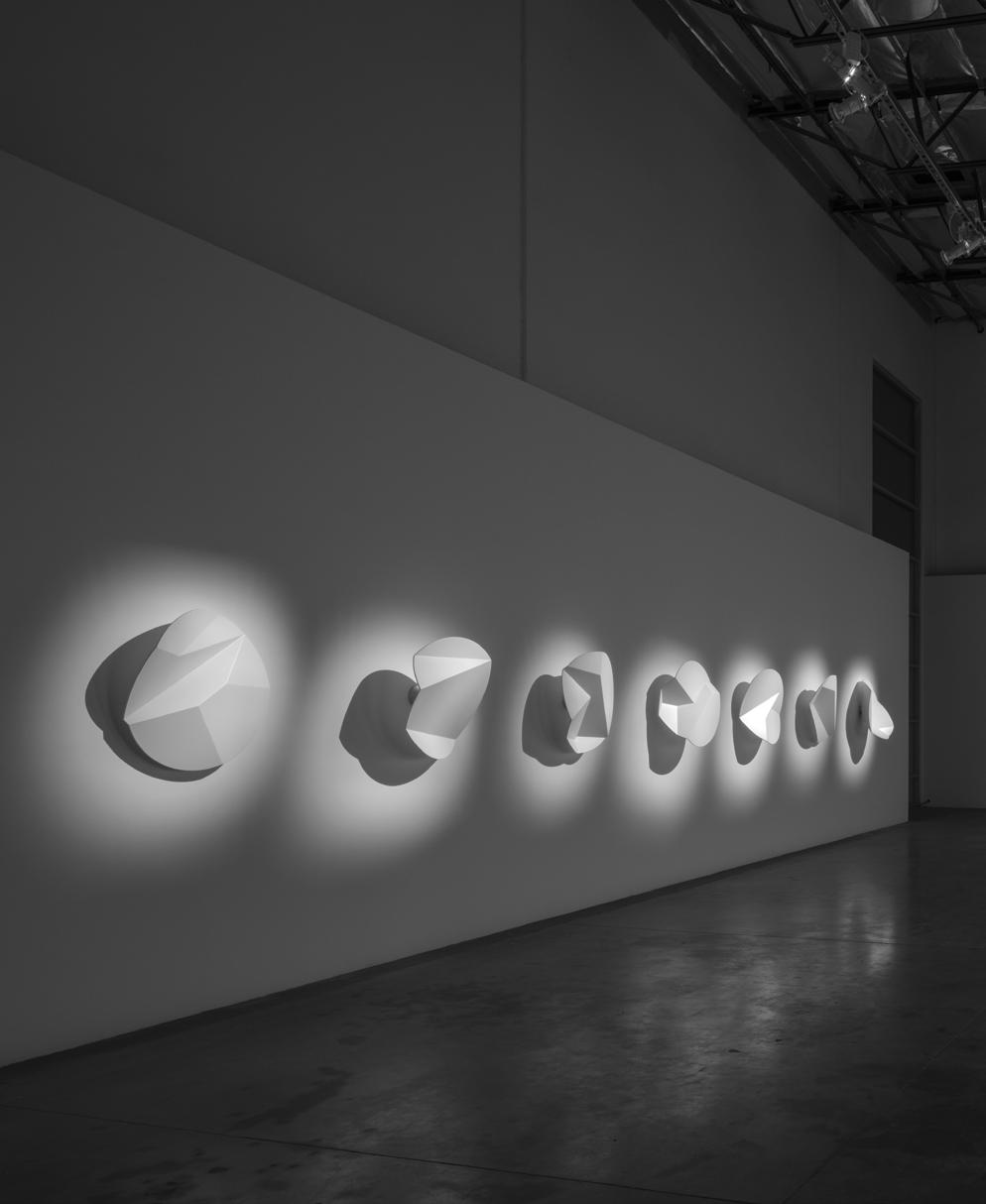
LUCID STEAD
Joshua Tree, CA 2013
9’-7” x 20’-3” x 14’-3”, 2.92 x 6.17 x 4.34m
Existing homesteader shack, glass mirror, acrylic mirror, plywood, LED lighting, fluorescent lights, custom electronic components, unique color program, solar array
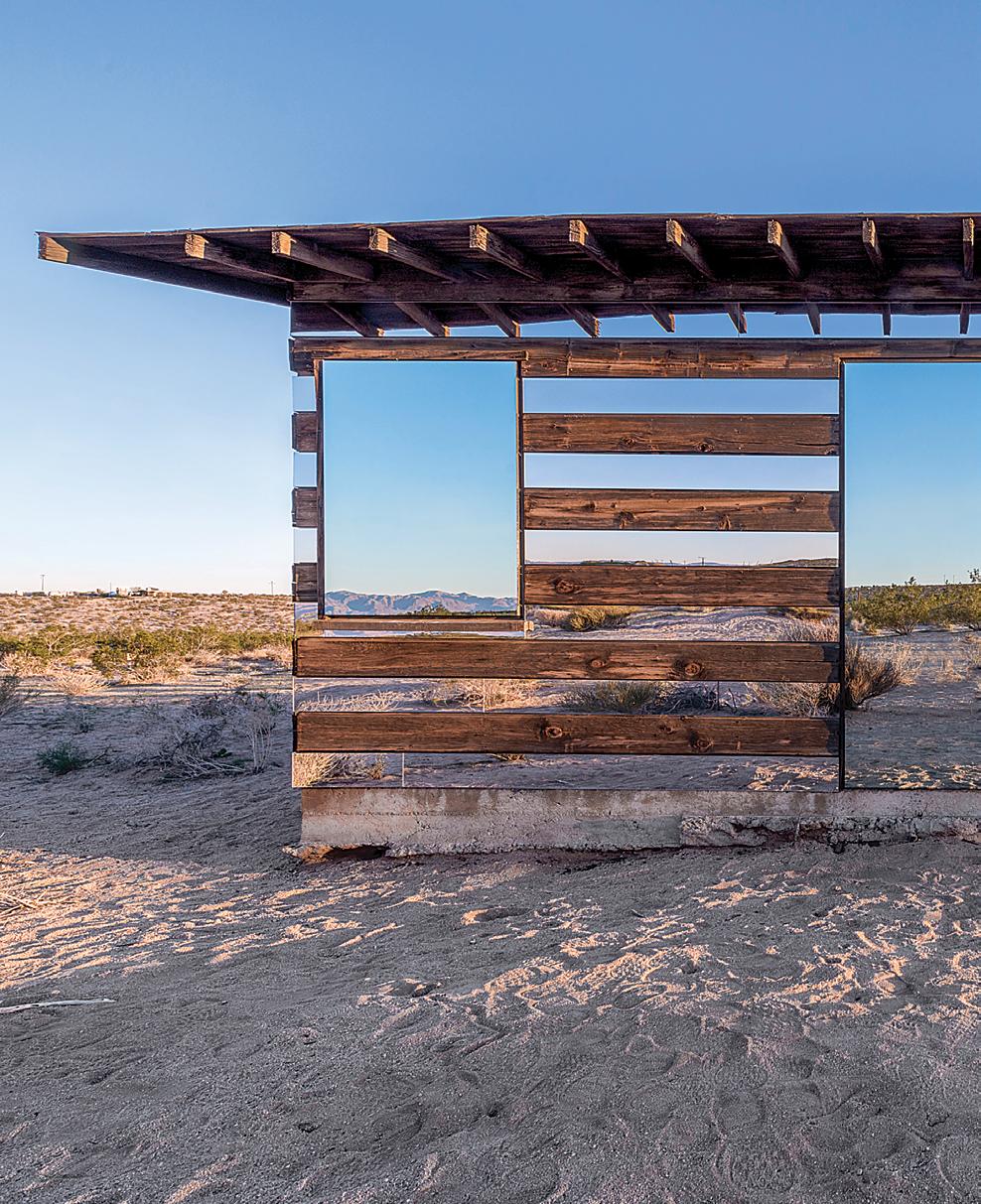
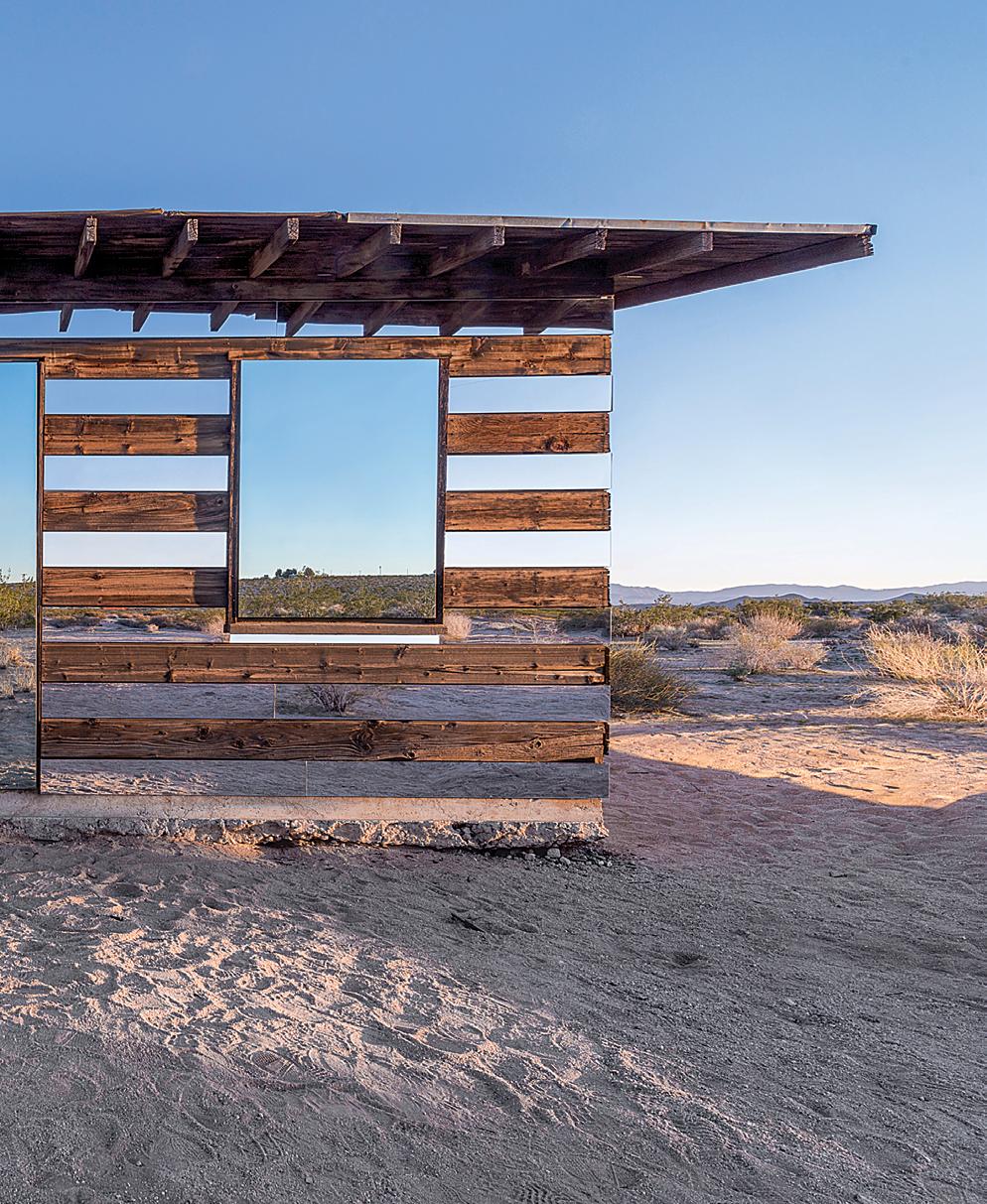
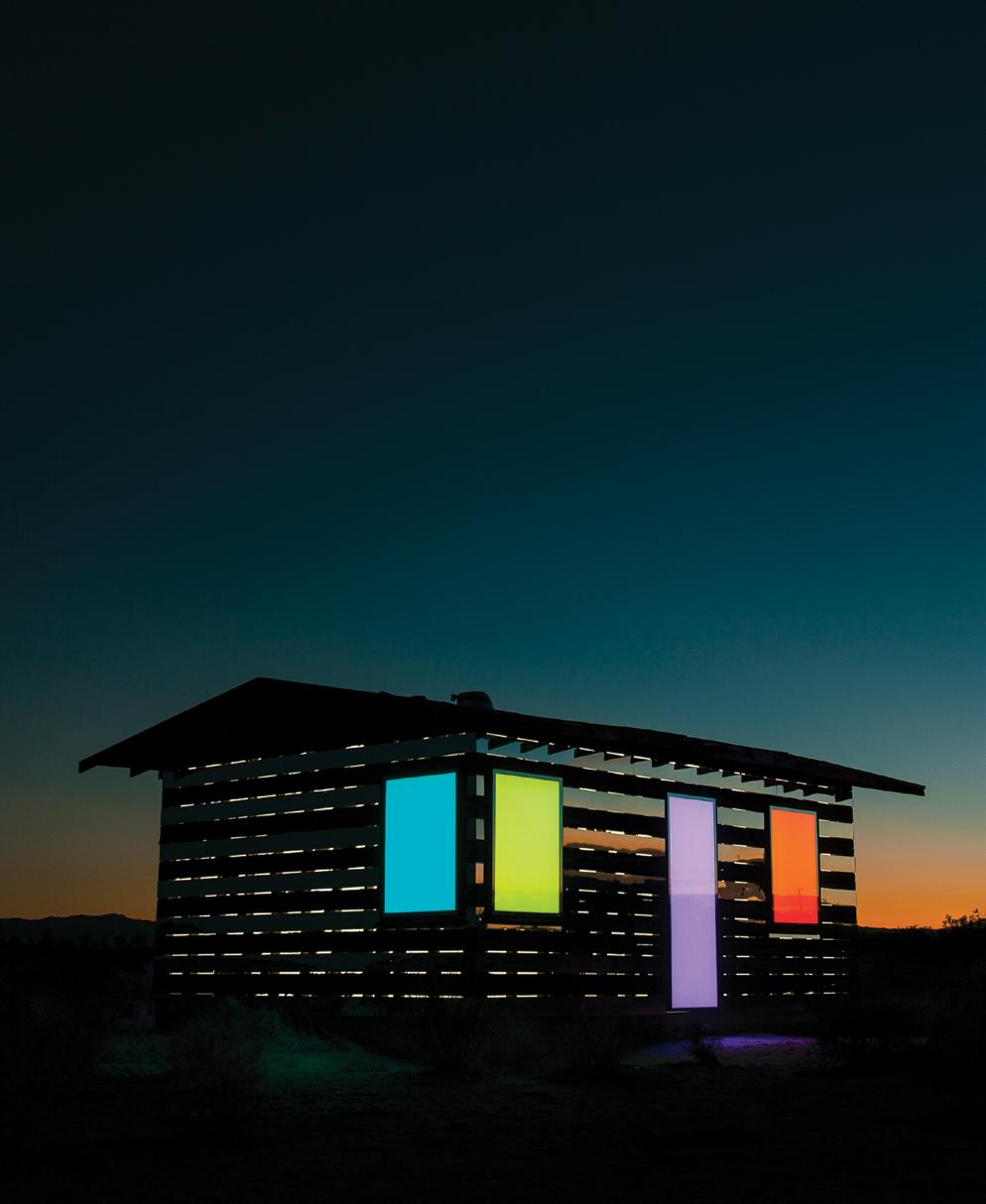
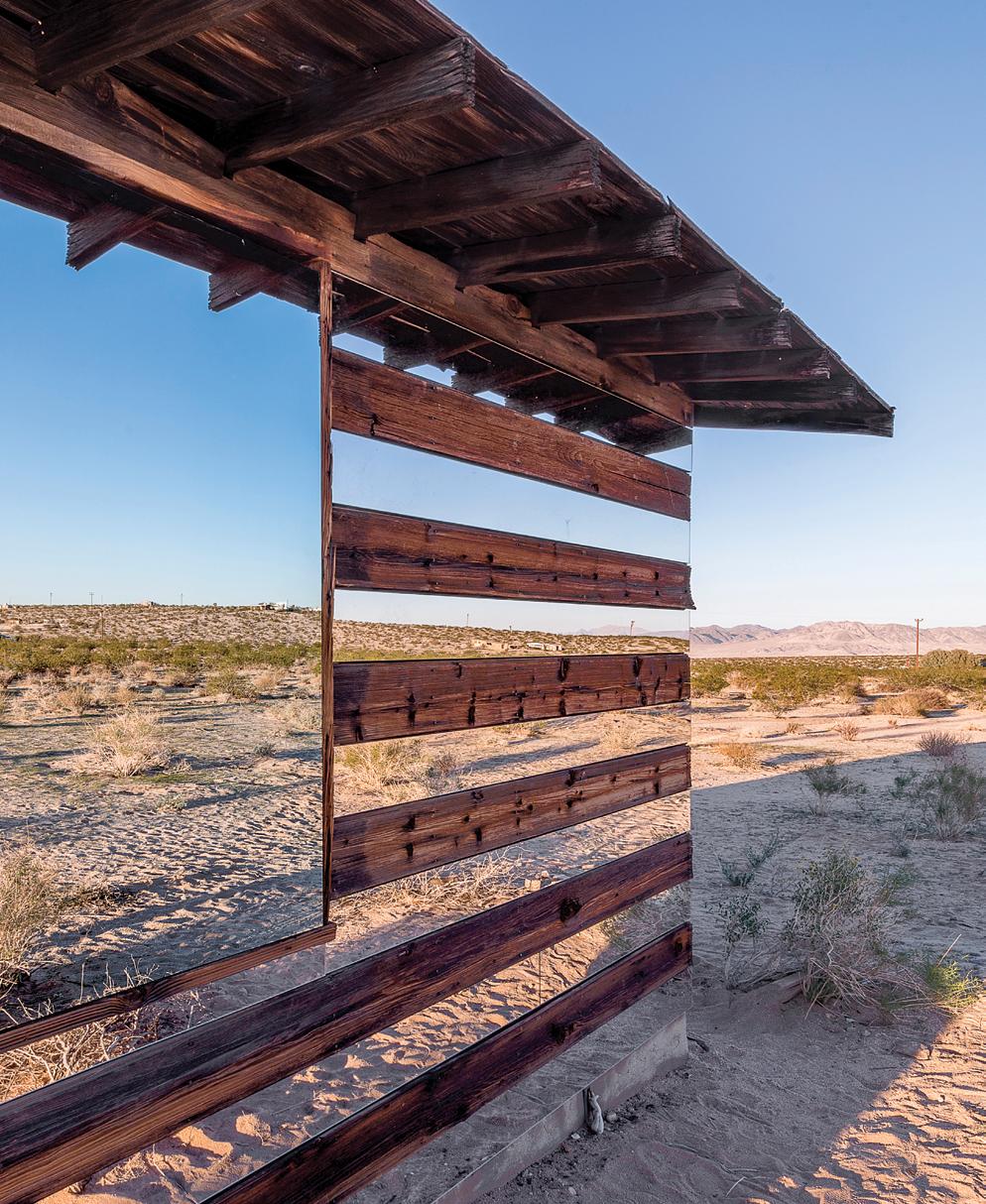
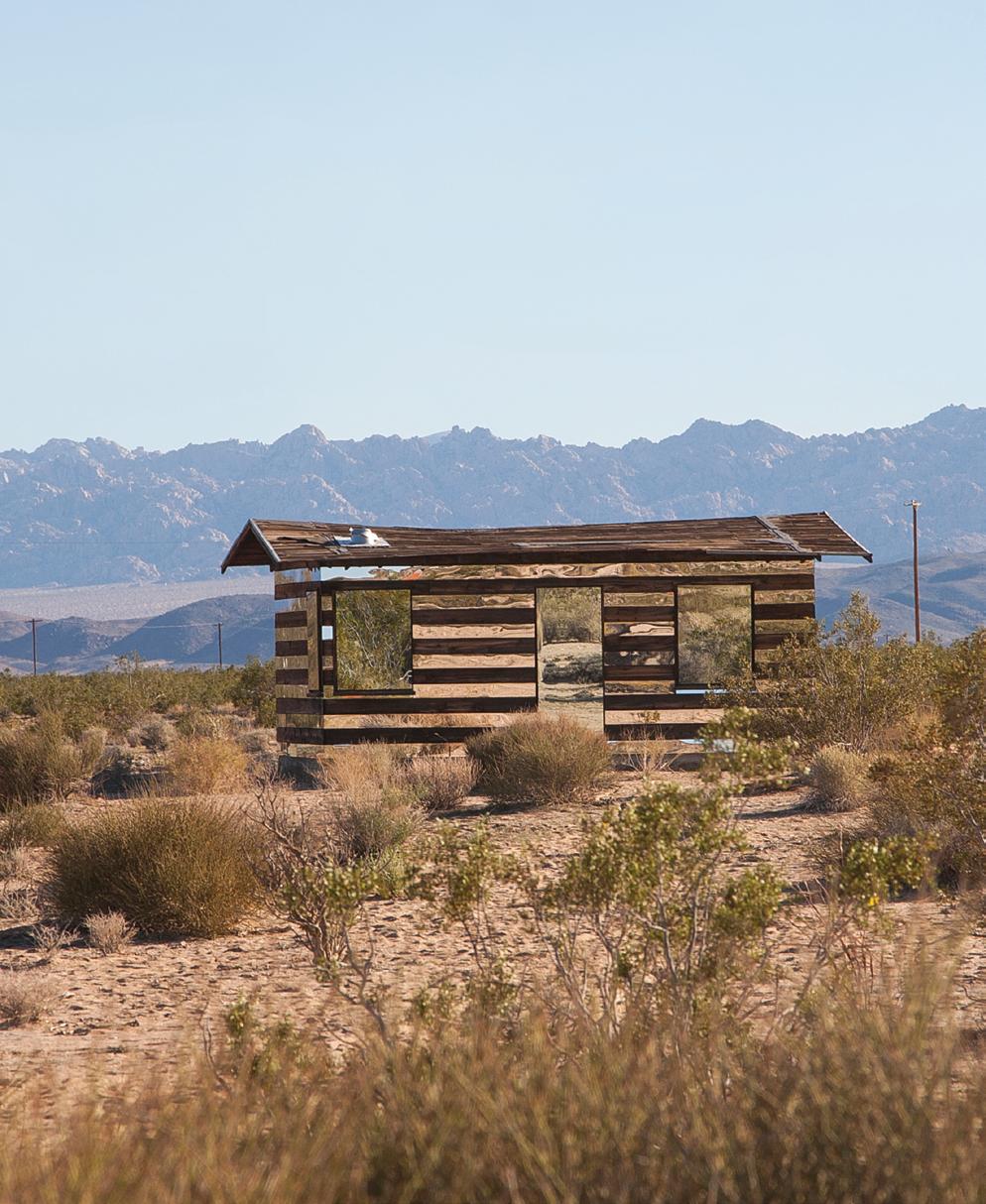
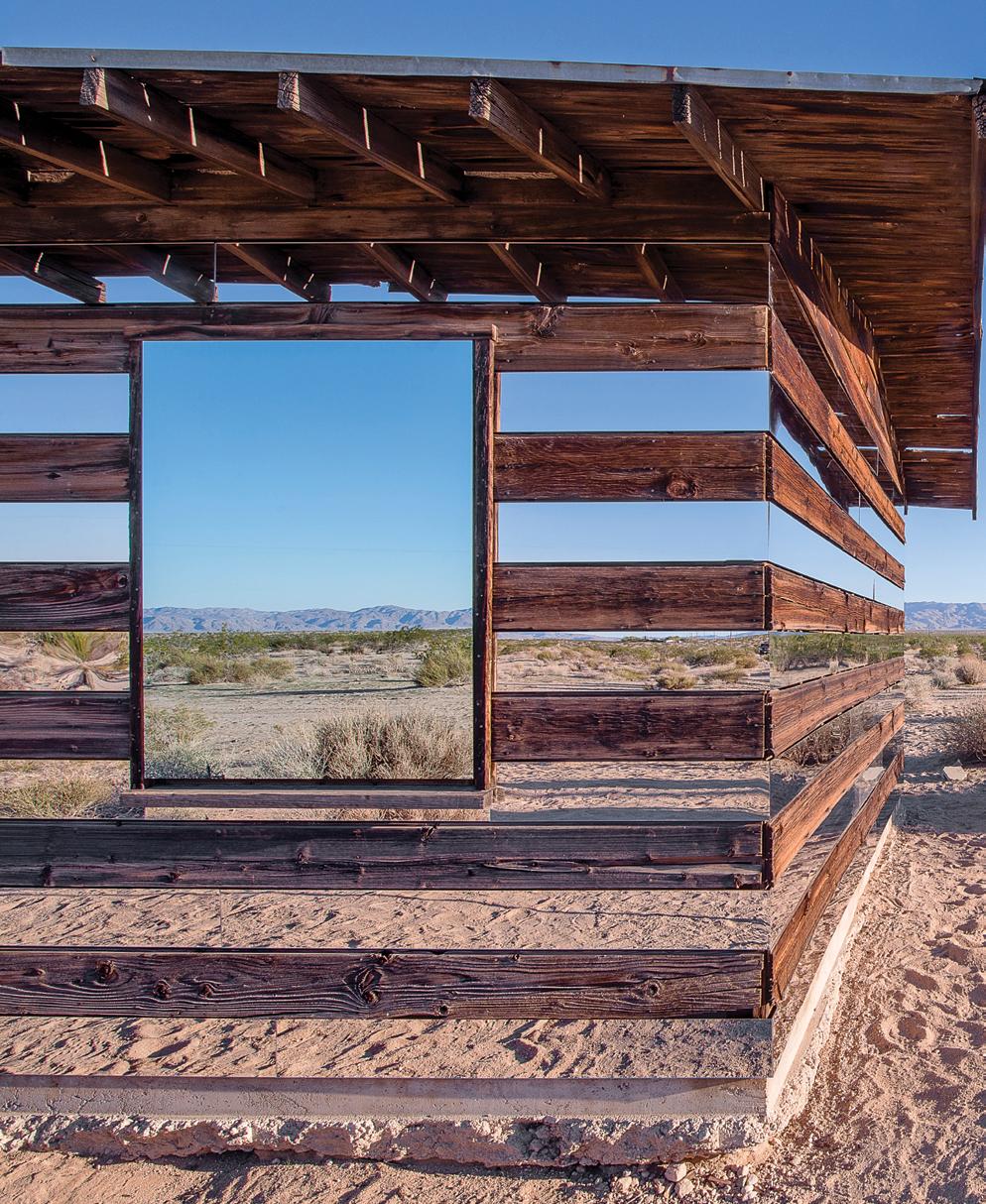
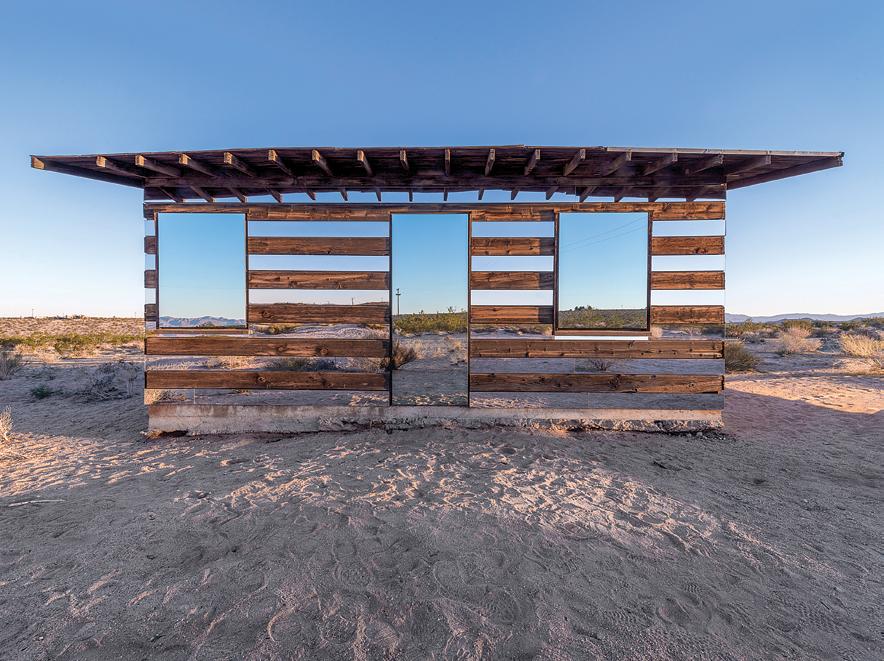
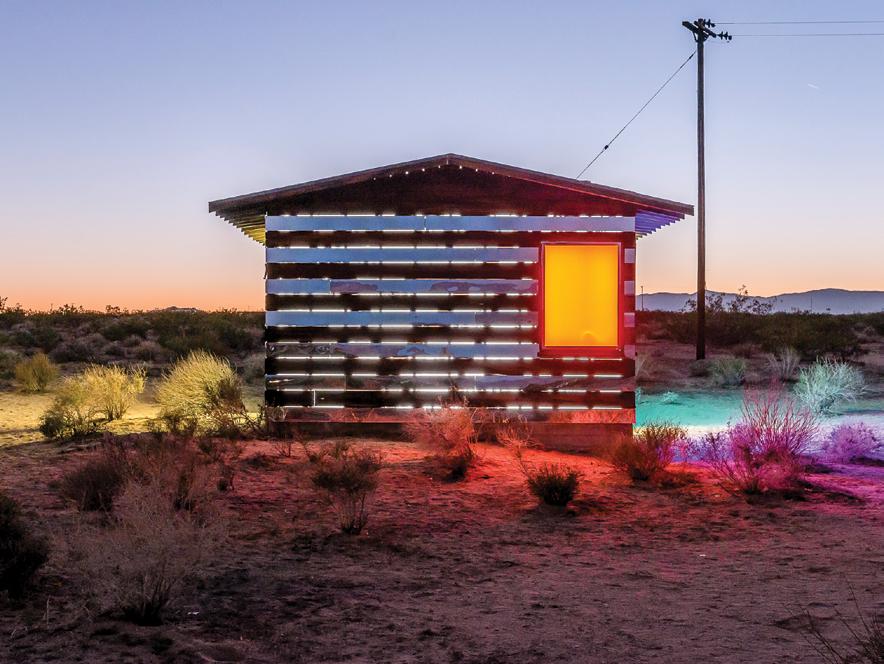
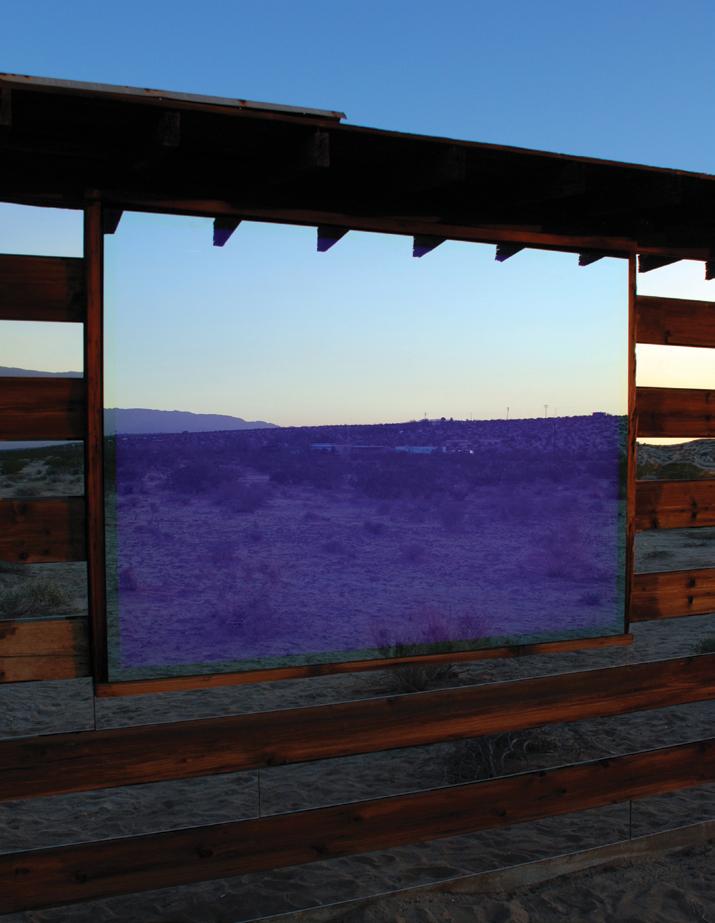
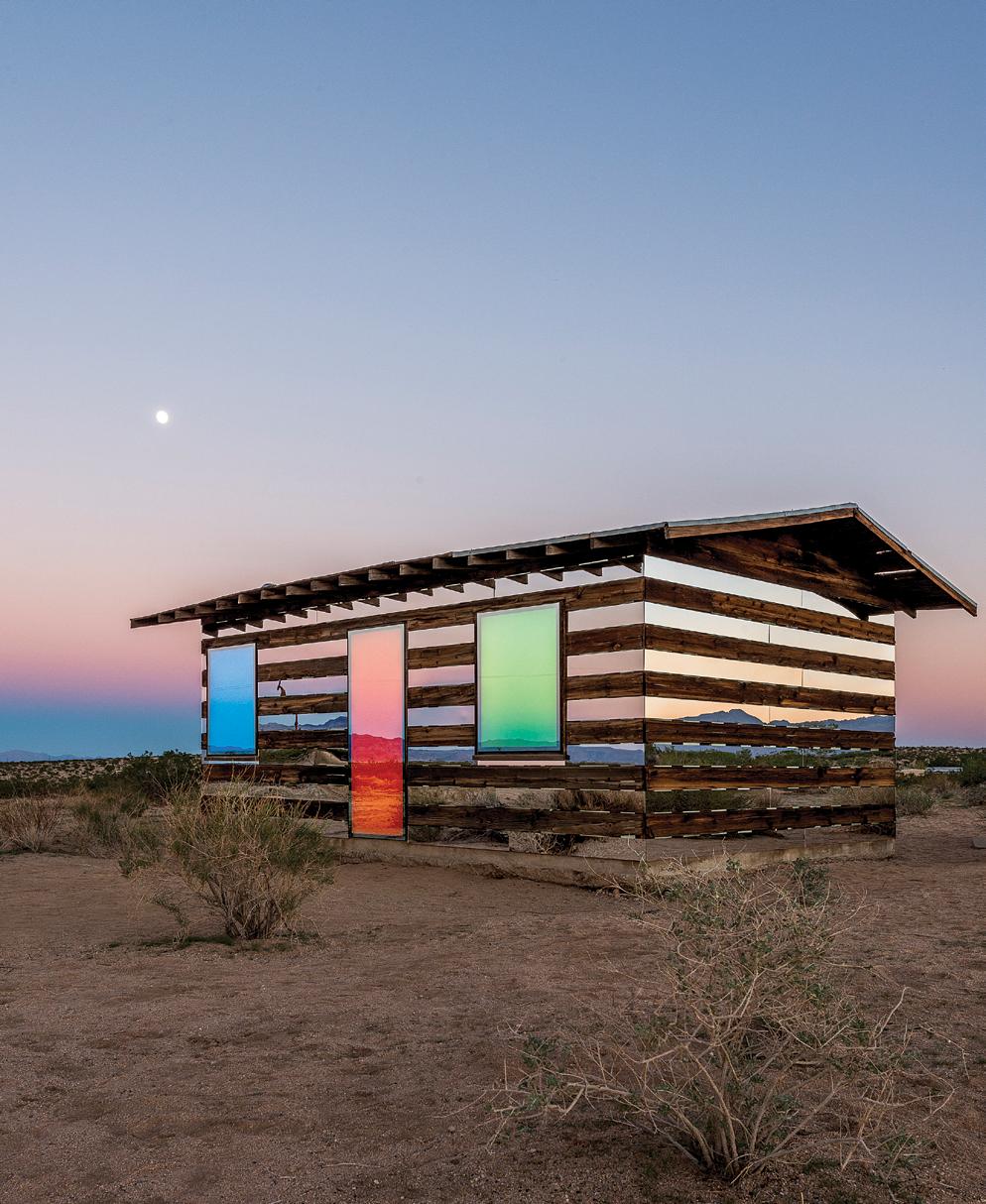
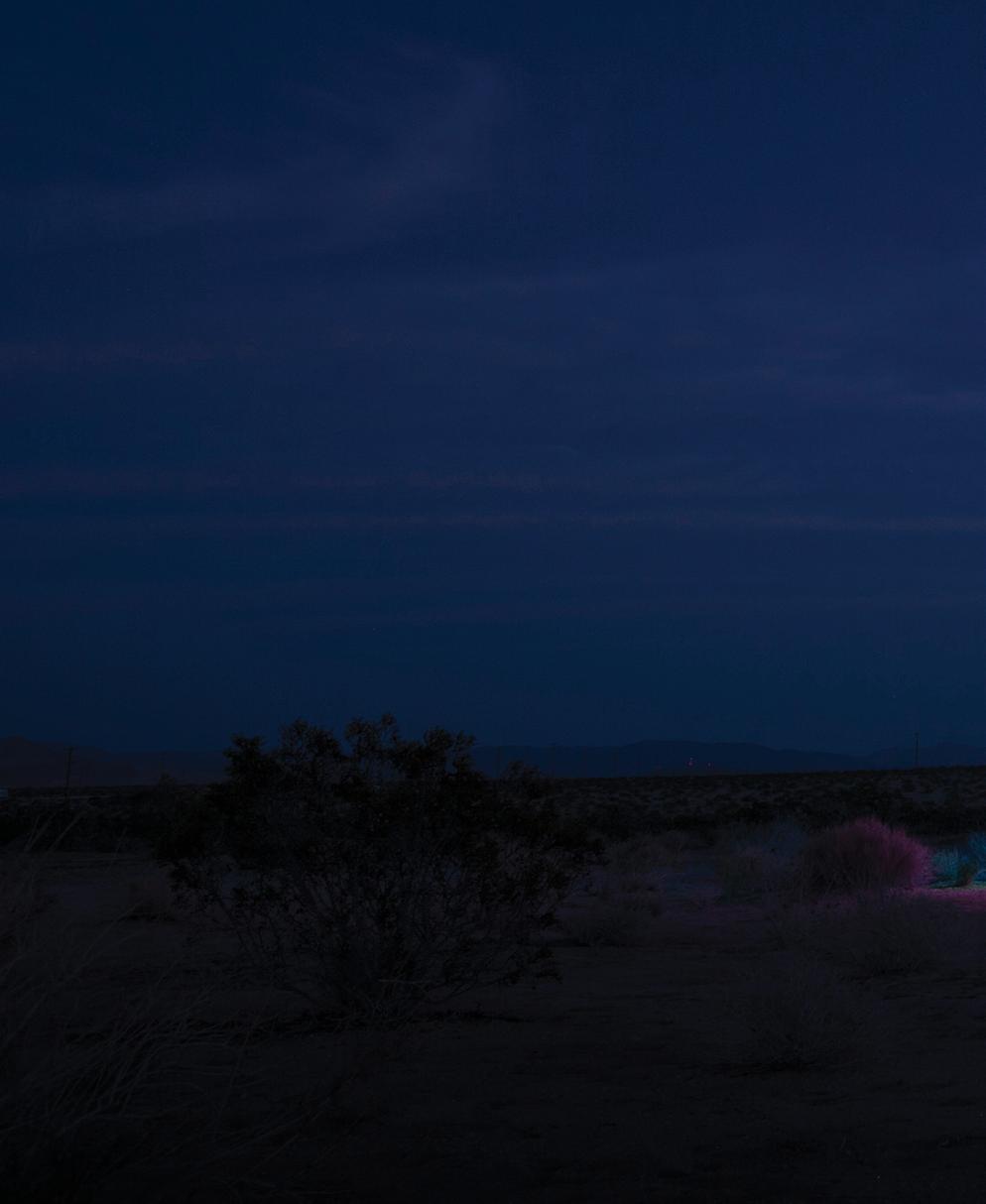
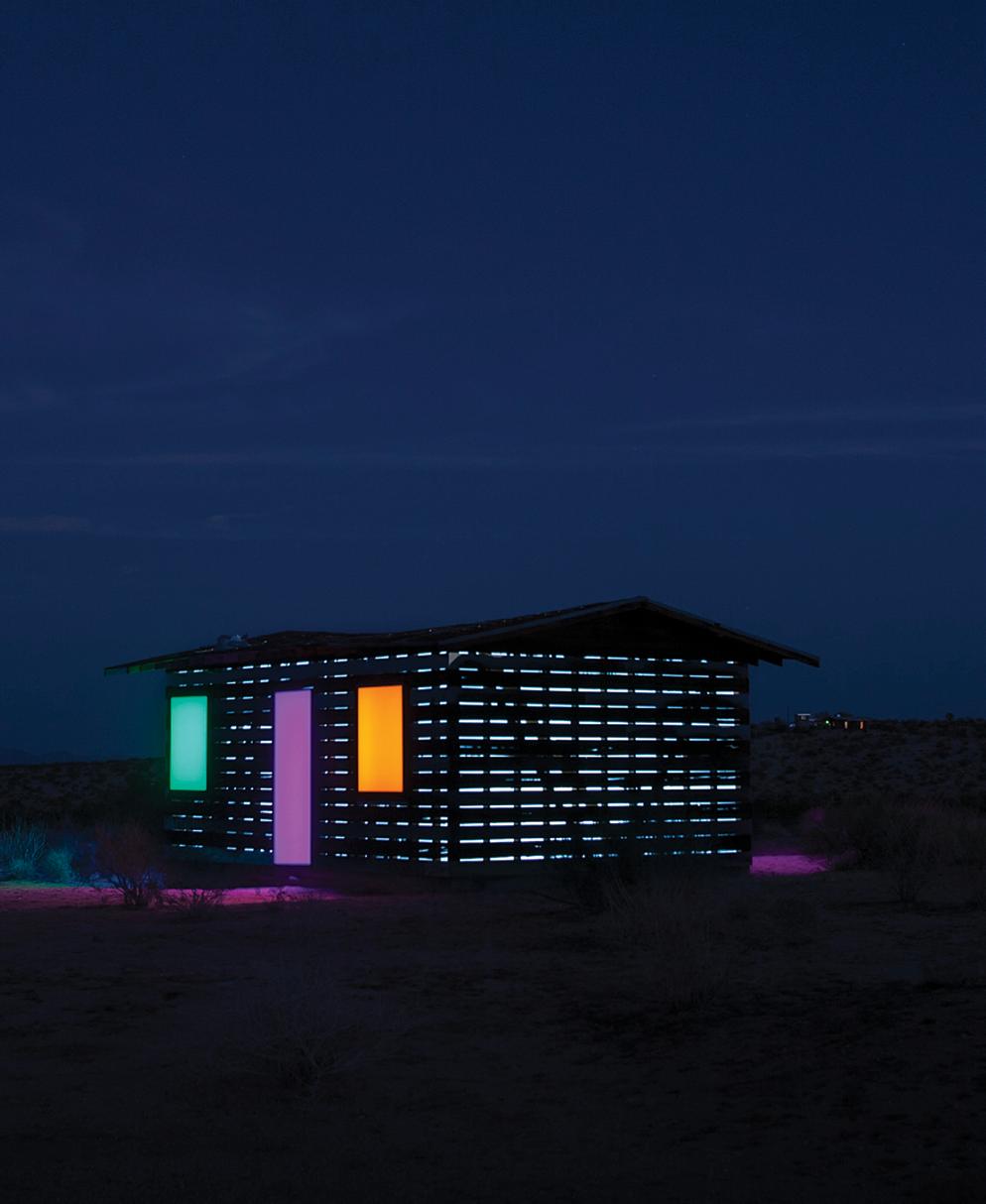
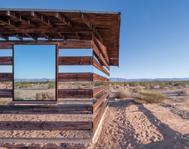
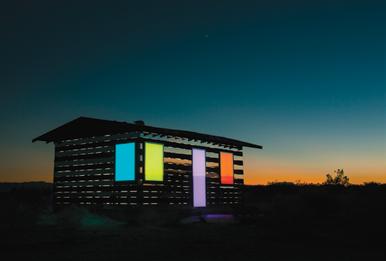
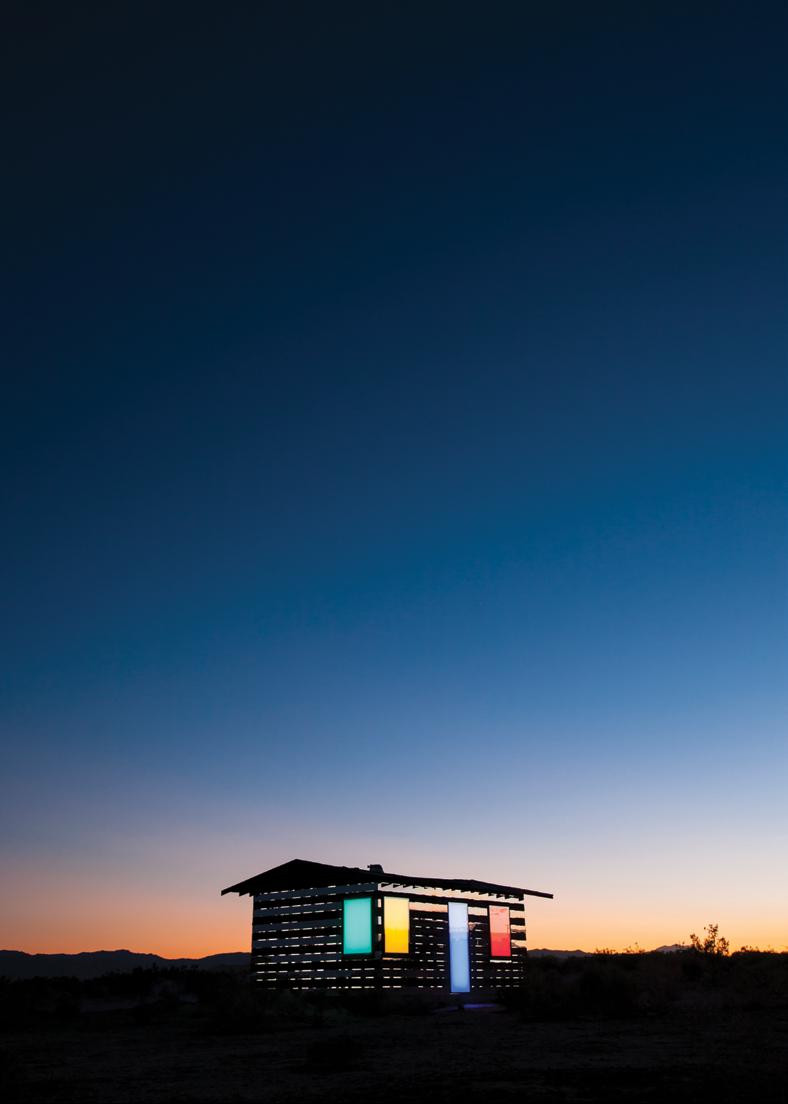
Composed of mirror, LED lighting, and custom-built electronic equipment amalgamated with a pre-existing structure, this architectural intervention, at first, seems alien in context to the raw, desert landscape. Upon further viewing, Lucid Stead imposes a delirious, almost spiritual experience. Like the enveloping vista that changes hue as time passes, Lucid Stead transforms. In daylight, the 70-year-old homesteader shack, which serves as the armature of the piece, reflects and refracts the surrounding terrain like a mirage or a hallucination. As the sun tucks behind the mountains, slowly shifting, geometric color fields emerge until they hover in the desolate darkness. This transformation adapts personal perception, realigning one’s sensory priorities within a heightened awareness of solitude and the measured pace of the environment.
69
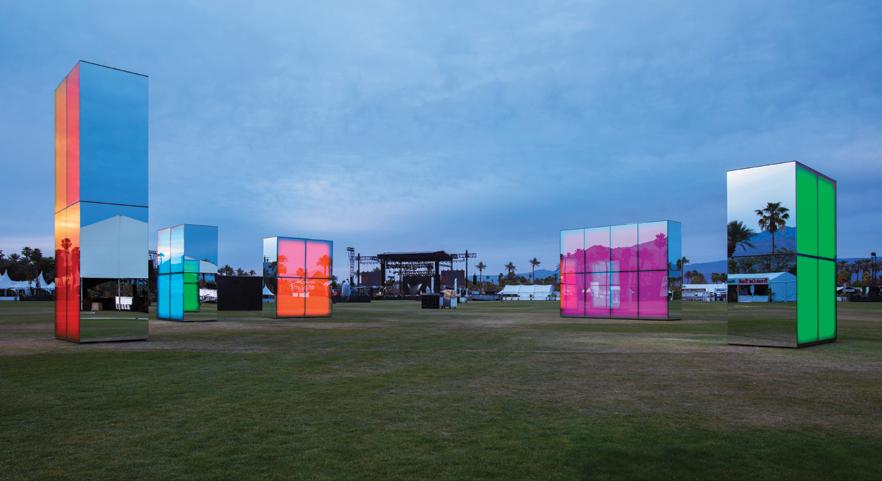
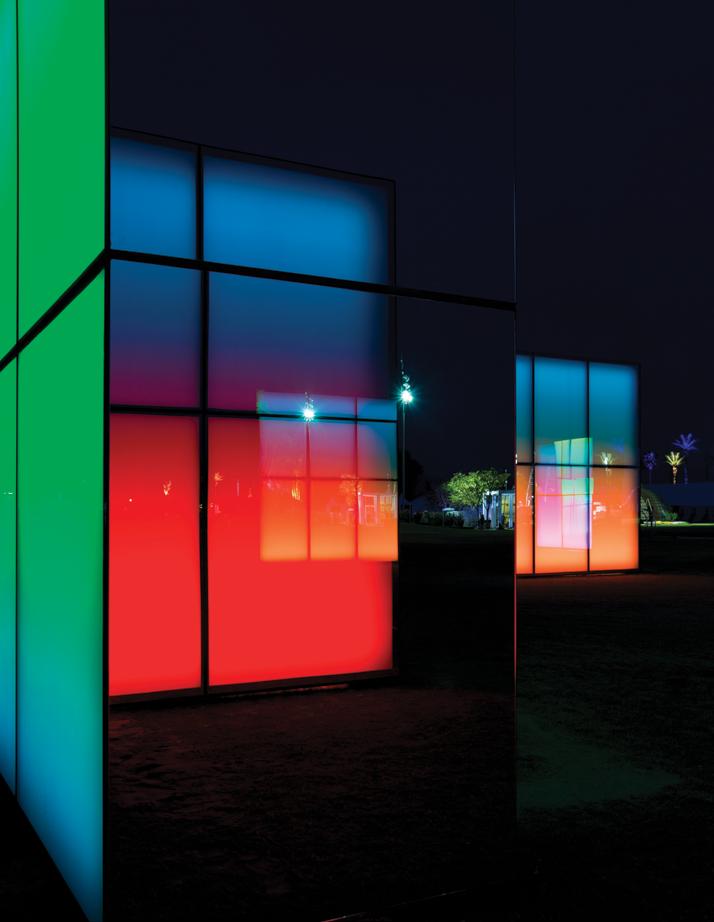
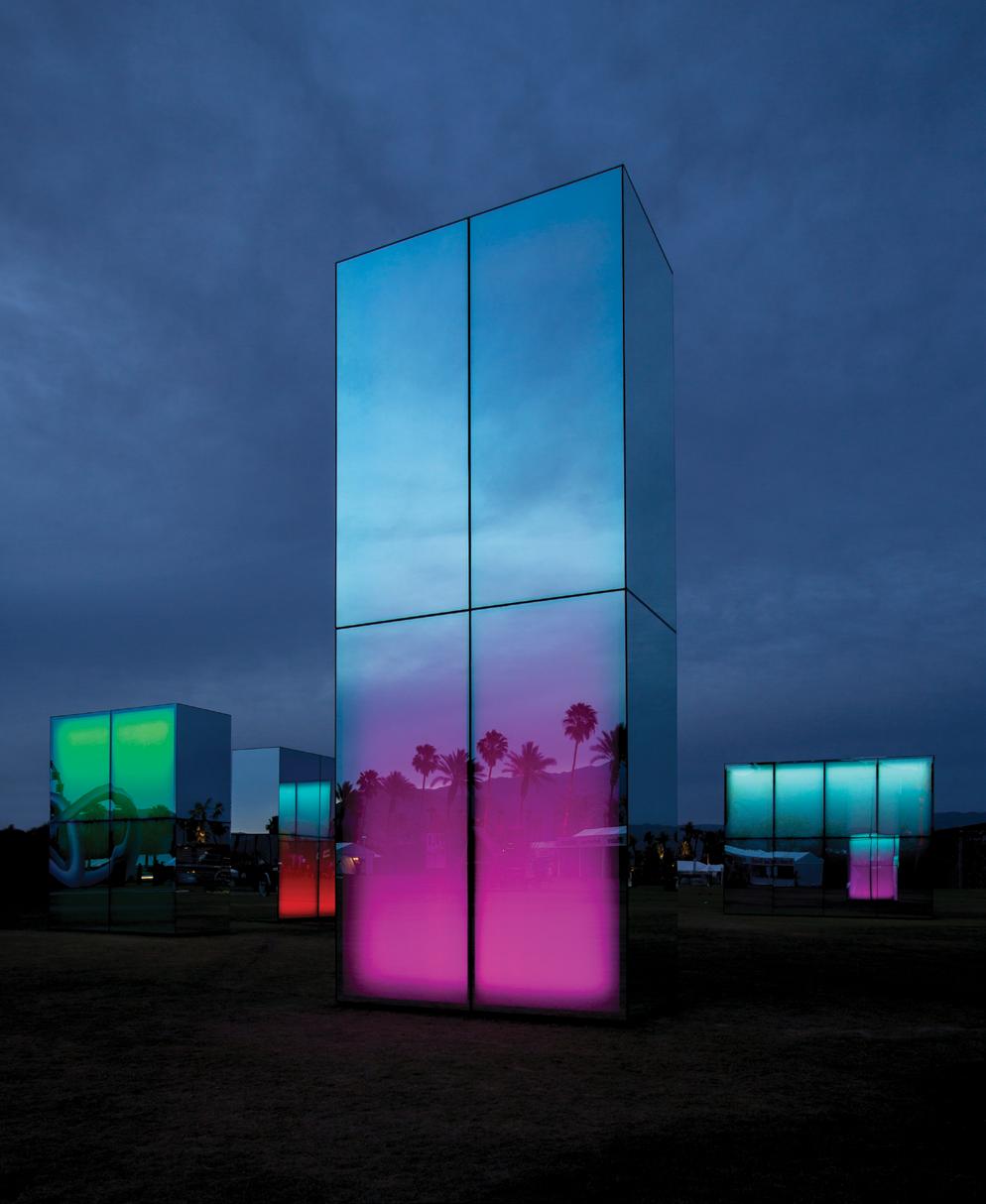
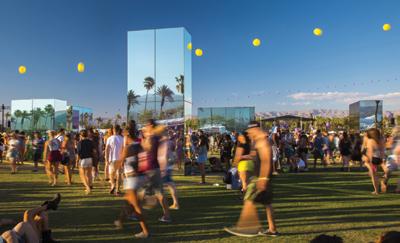
REFLECTION FIELD
Coachella Valley Music & Arts Festival Indio, CA 2014
100’-0” diameter x 11’-0” to 18’-0” high, 30.5 x 3.3 - 5.5m Glass, steel, LED lighting, electronic components, computer, unique color program
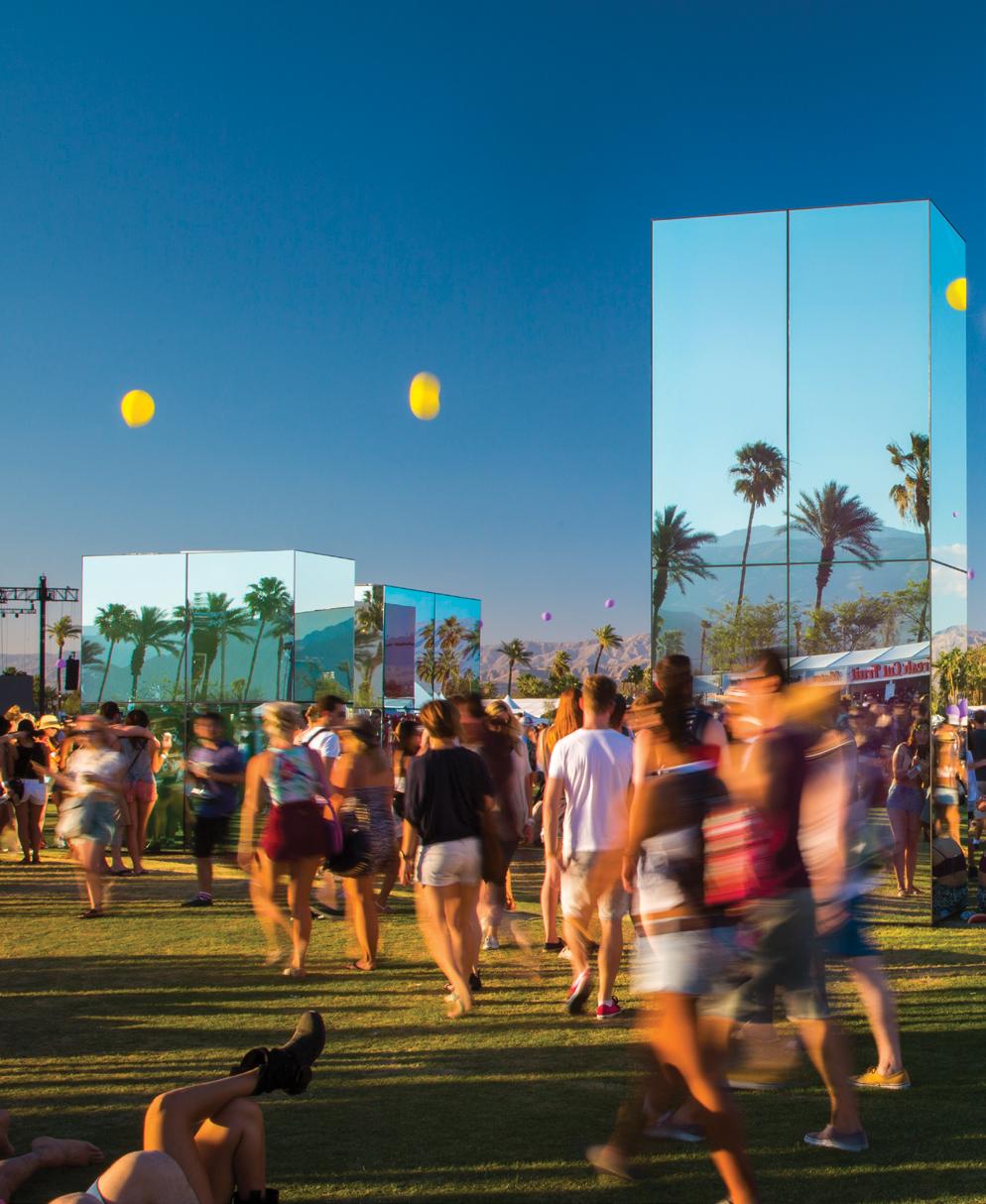
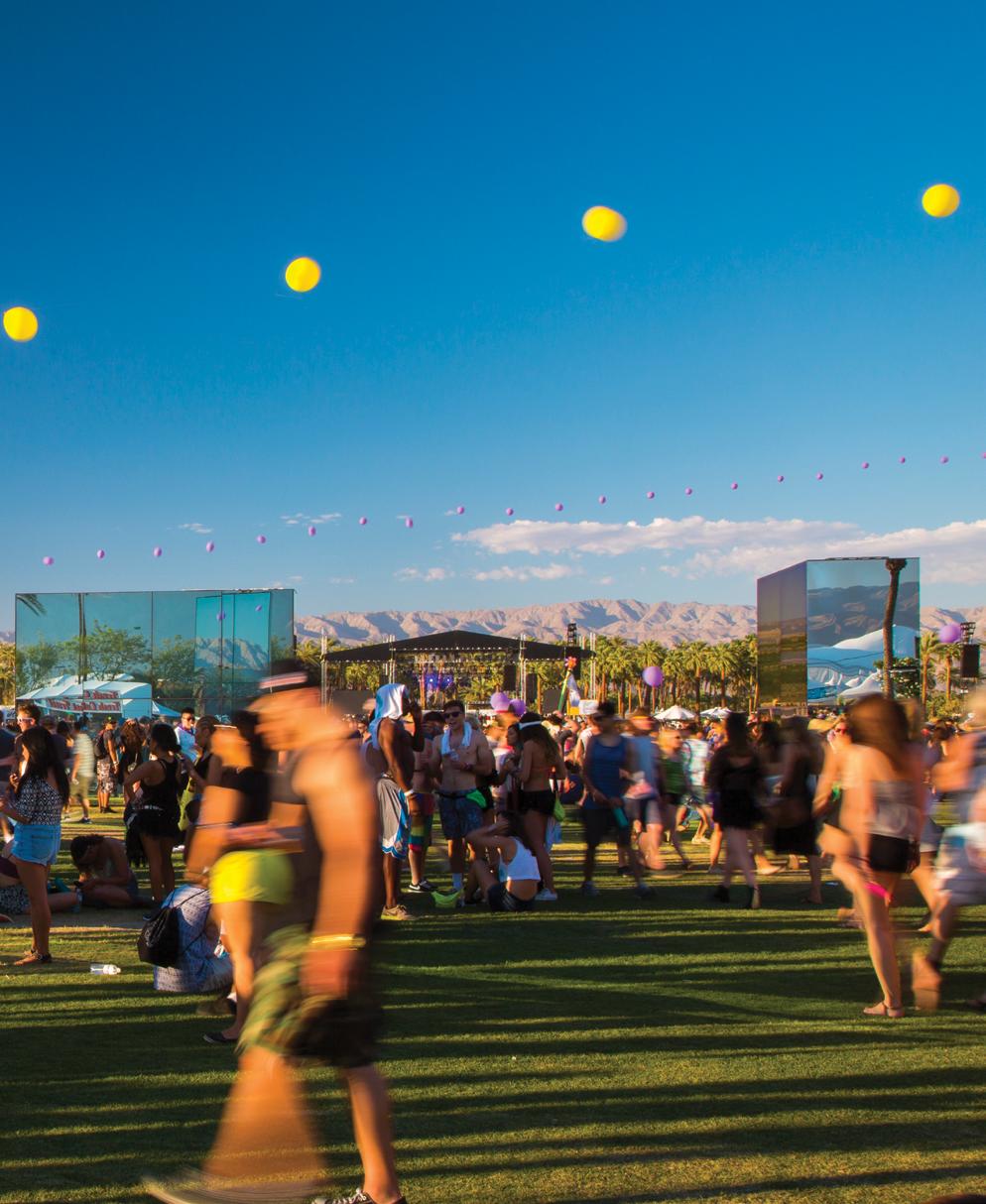
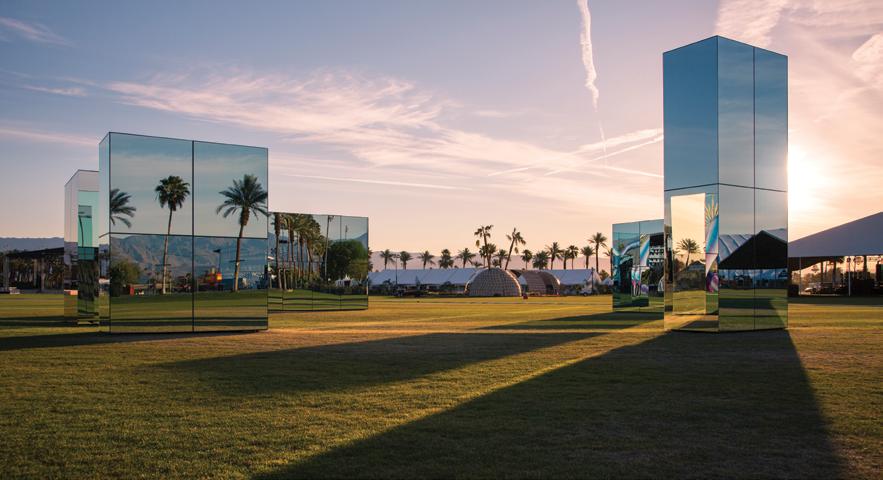
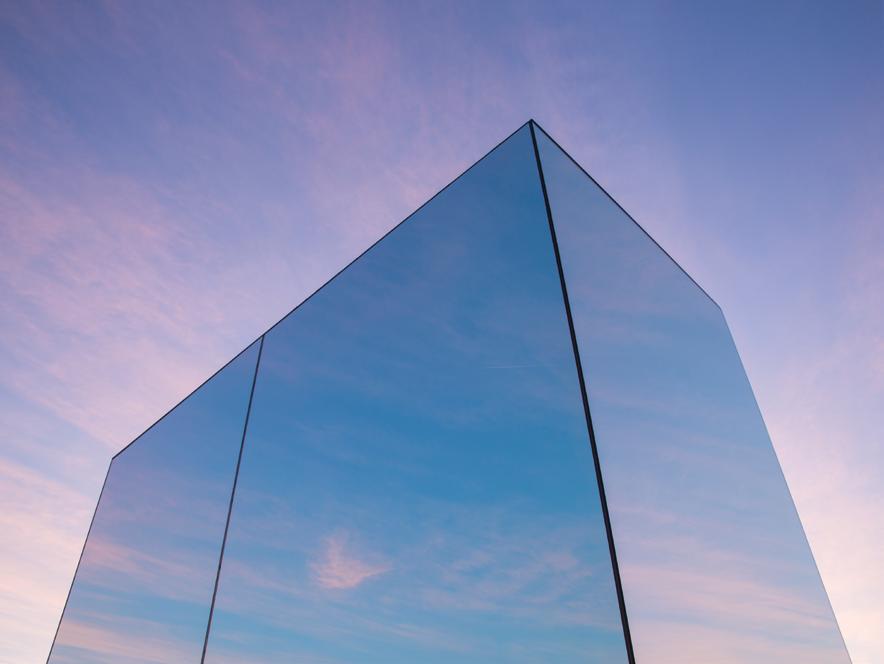
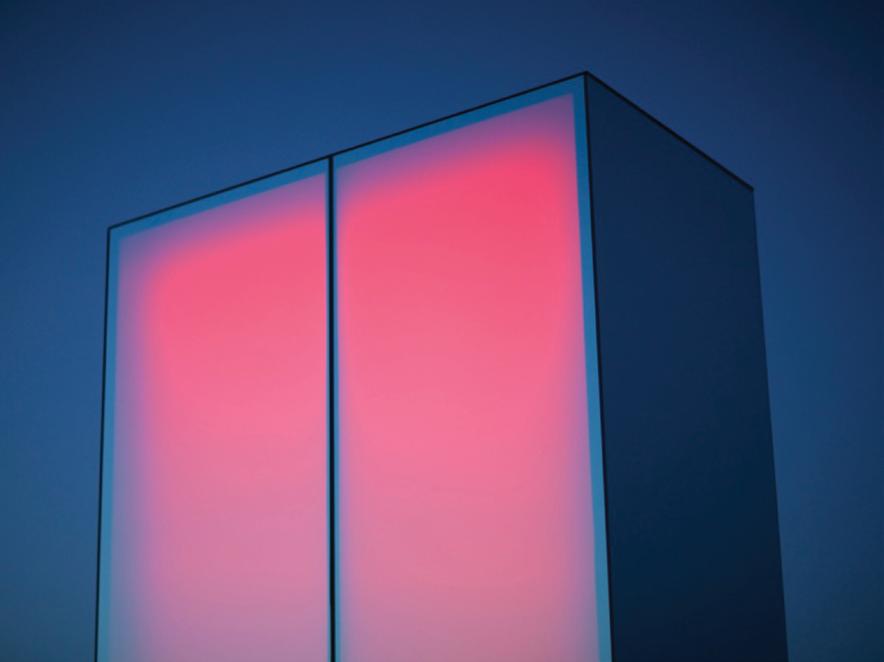
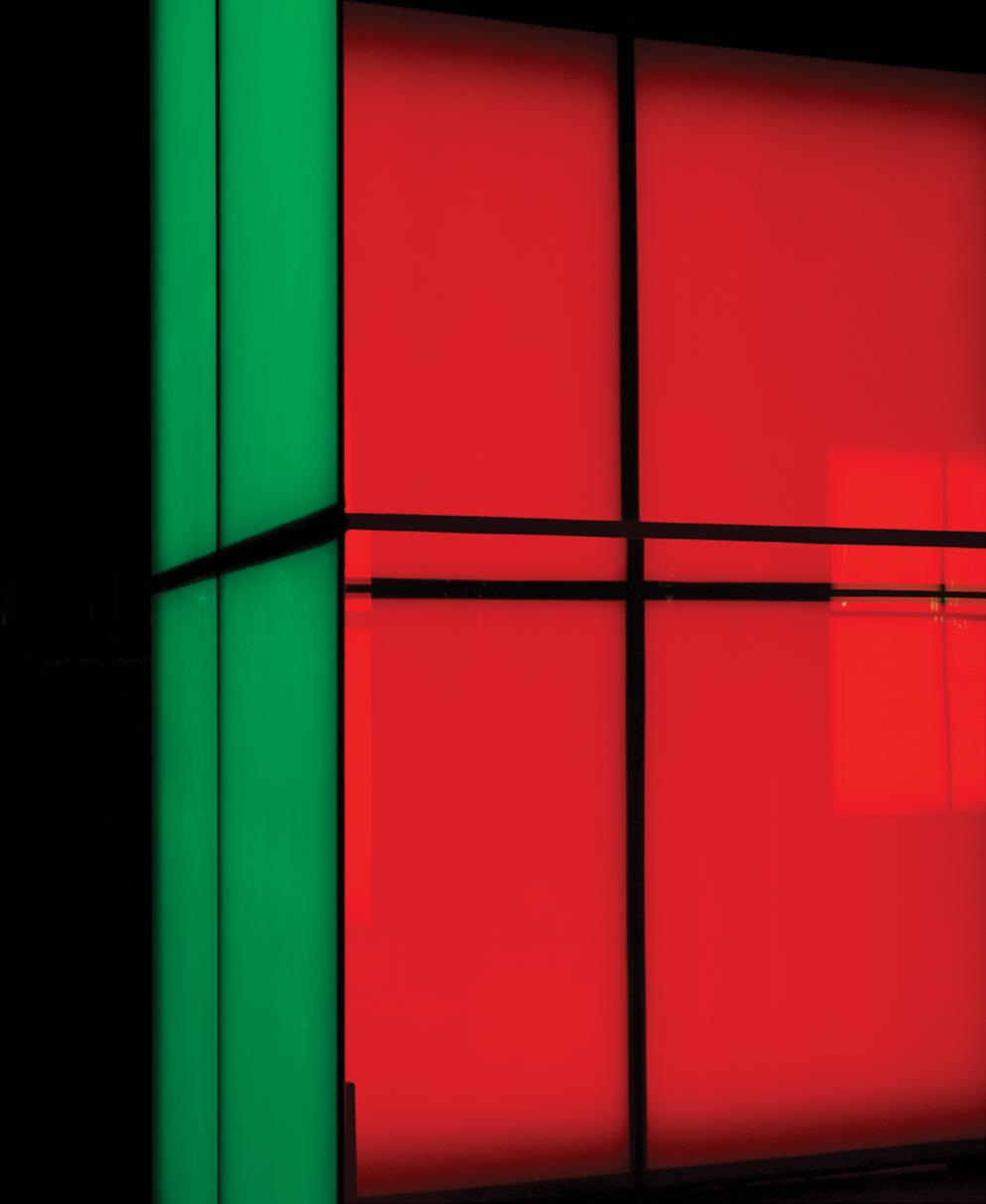
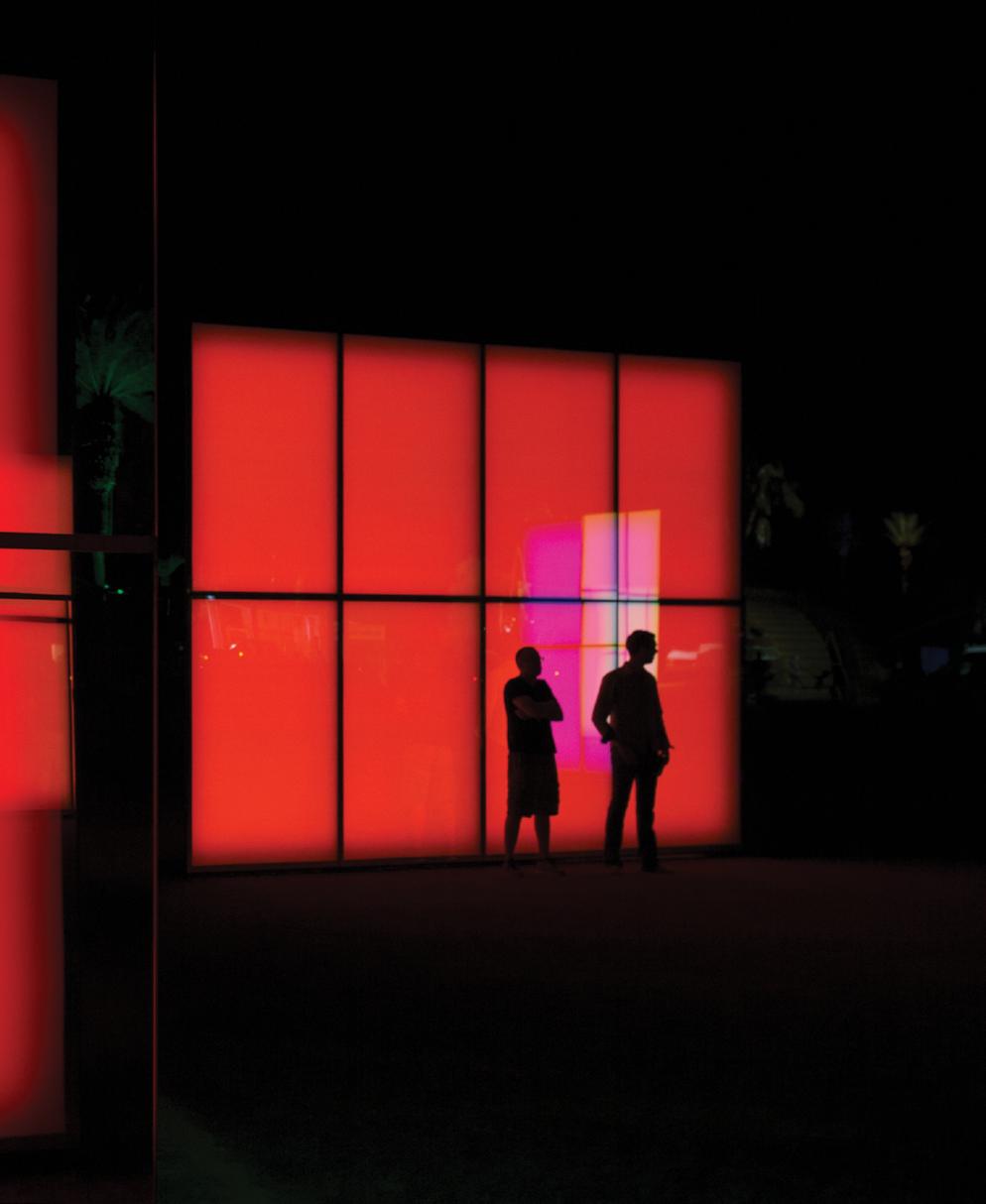
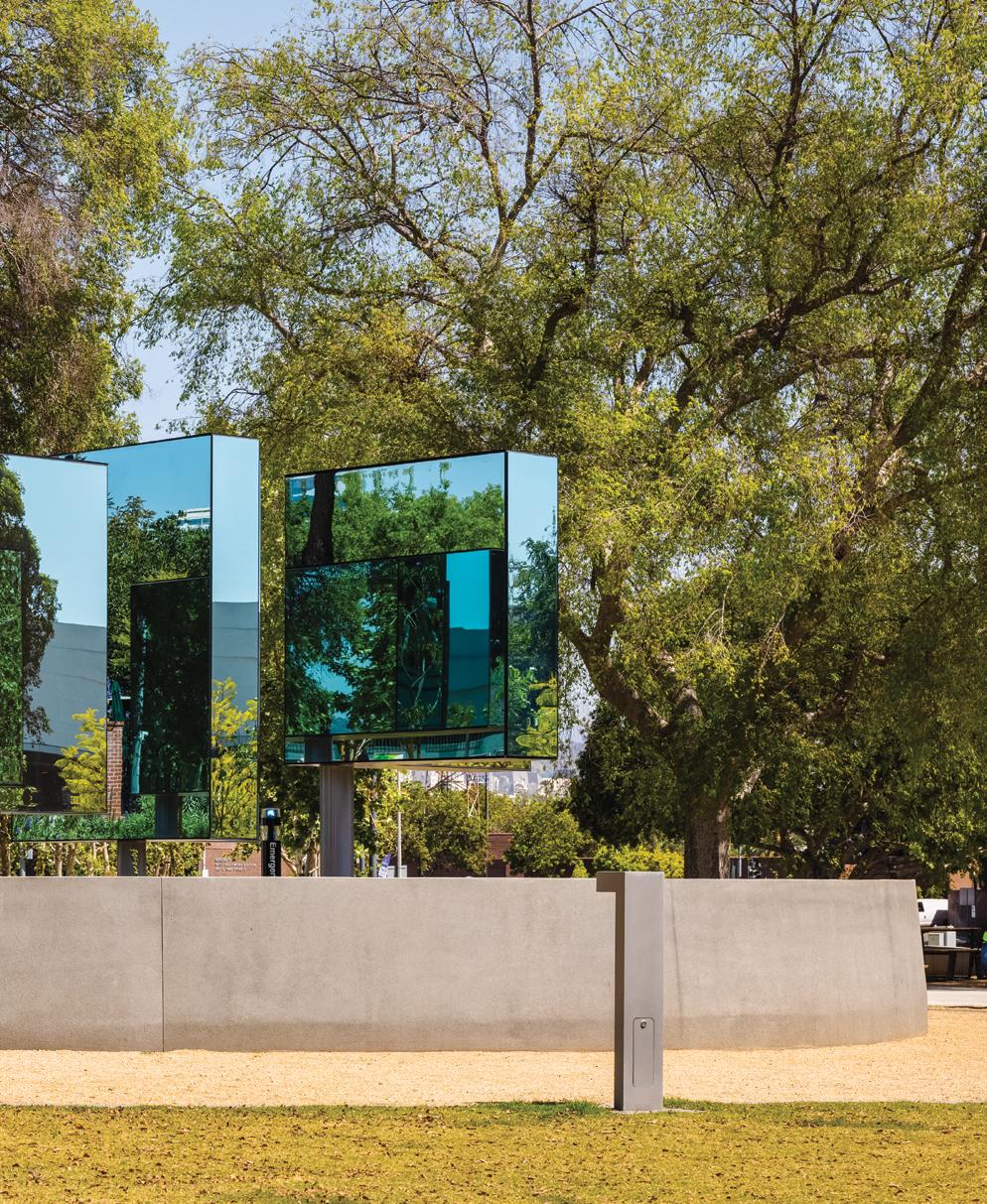
Defining a 100’ diameter space within a vast green grass plain, Reflection Field consists of five, large-scale, free-standing volumes constructed from mirrored and luminous surfaces. The series of objects span a diameter of 100 feet, across the vast green grass plain. By day, the monolithic reflective masses are prisms of earth and sky, wrapped by the surrounding greenery and environment. By night, they transform into expansive fields of color that blend and layer through echoes of reflection. Spaces become simultaneously infinite and finite, while hues push and pull, saturating and dissolving the surroundings and one’s periphery into pure color.
81
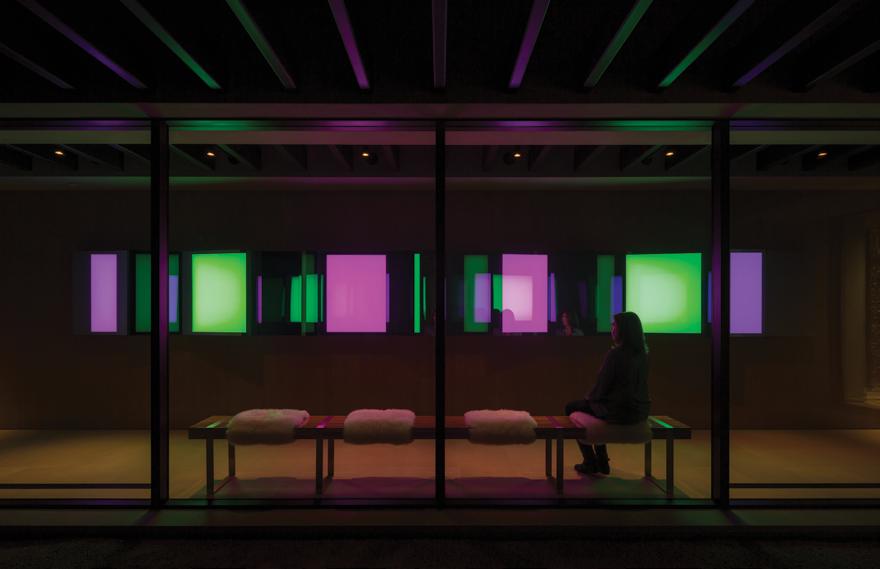
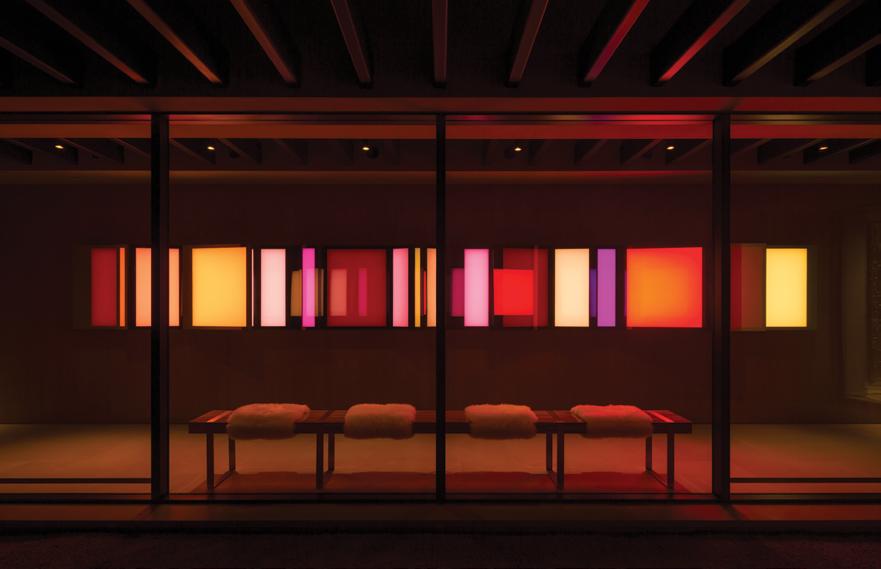
IRREGULAR HORIZONTAL #1
La Quinta, CA 2014
3’-0” x 26’-6” x 10”, 91 x 808 x 25cm Glass, powder-coated steel, acrylic, LED lighting, electronic components, unique color program
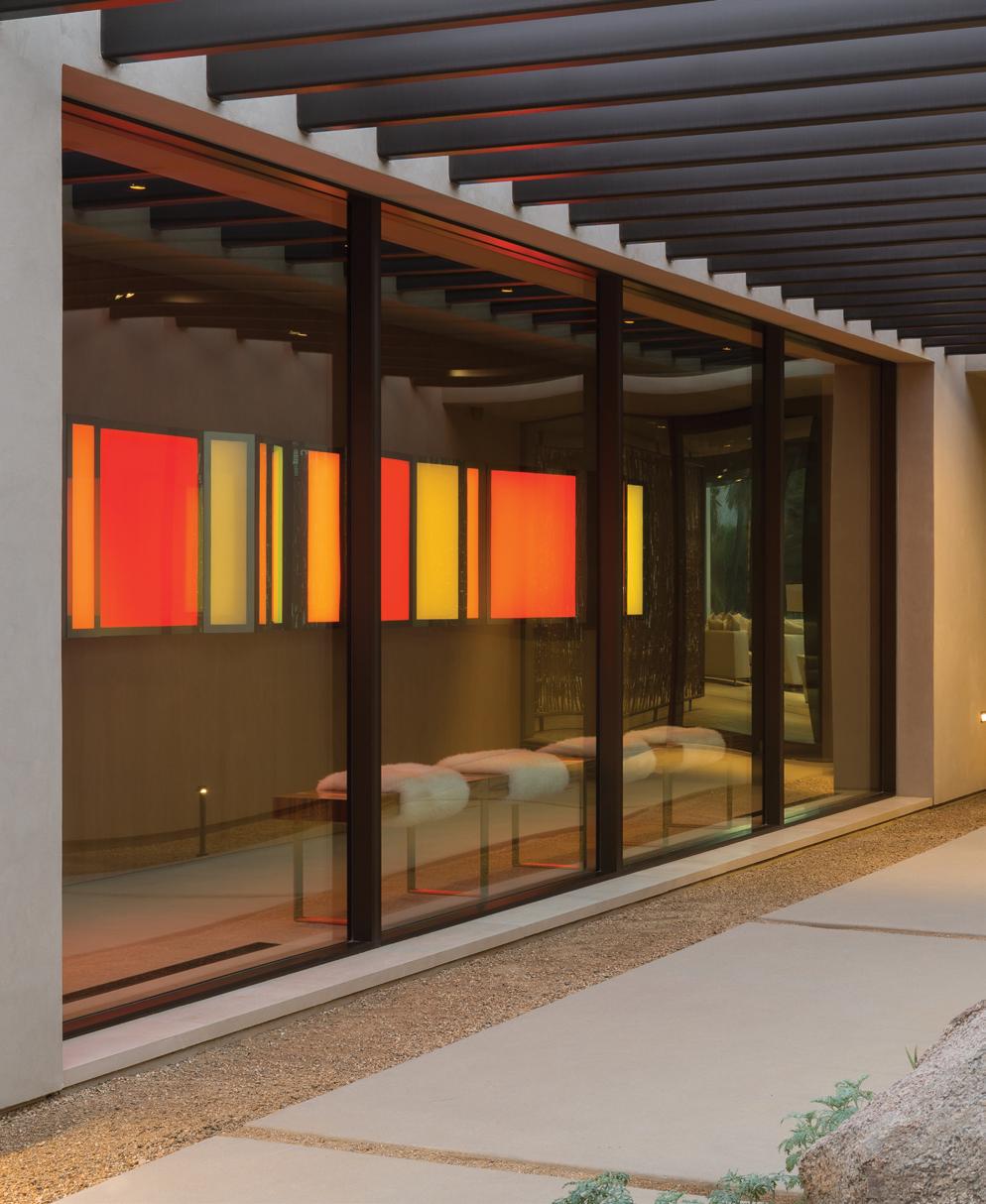
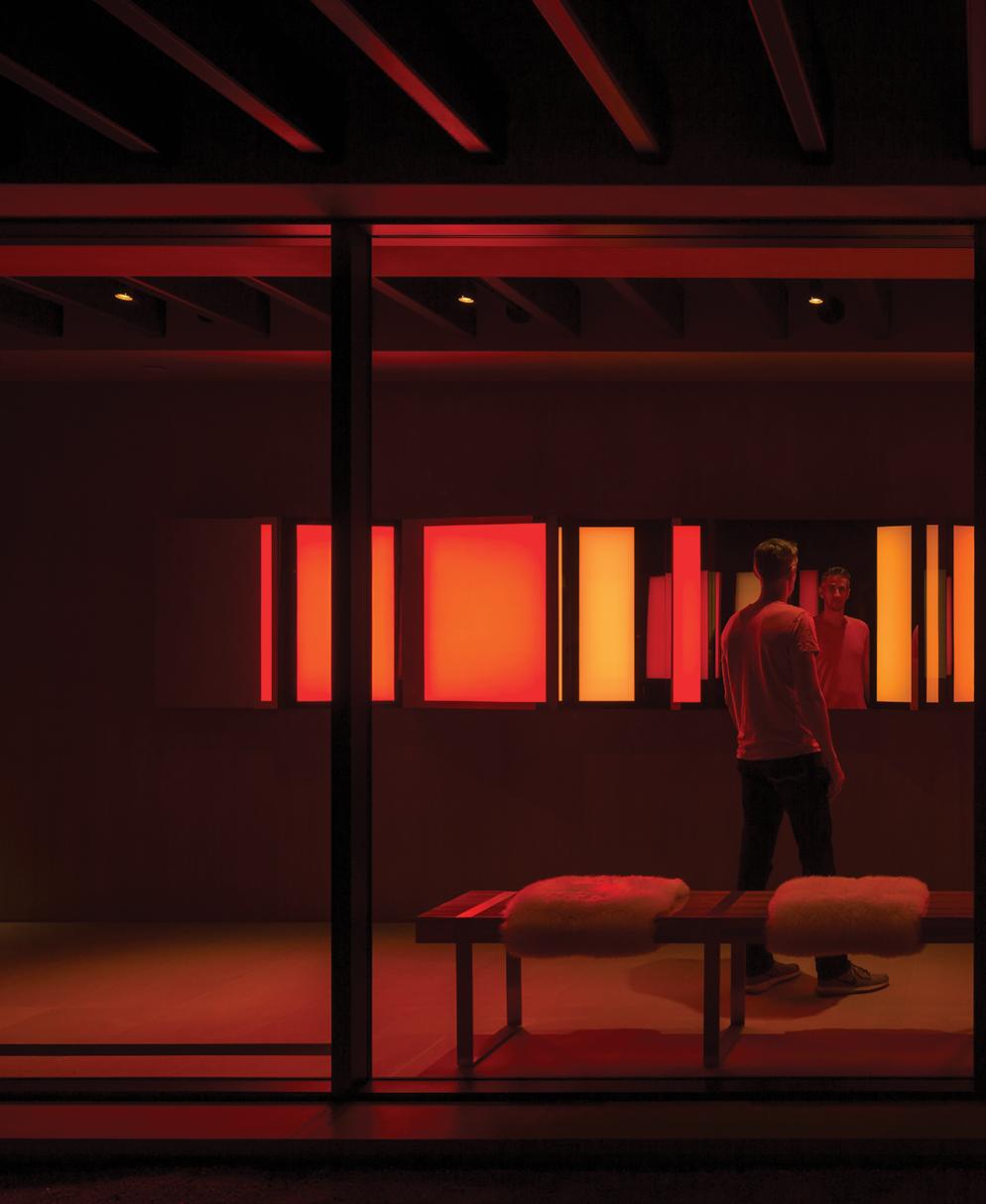
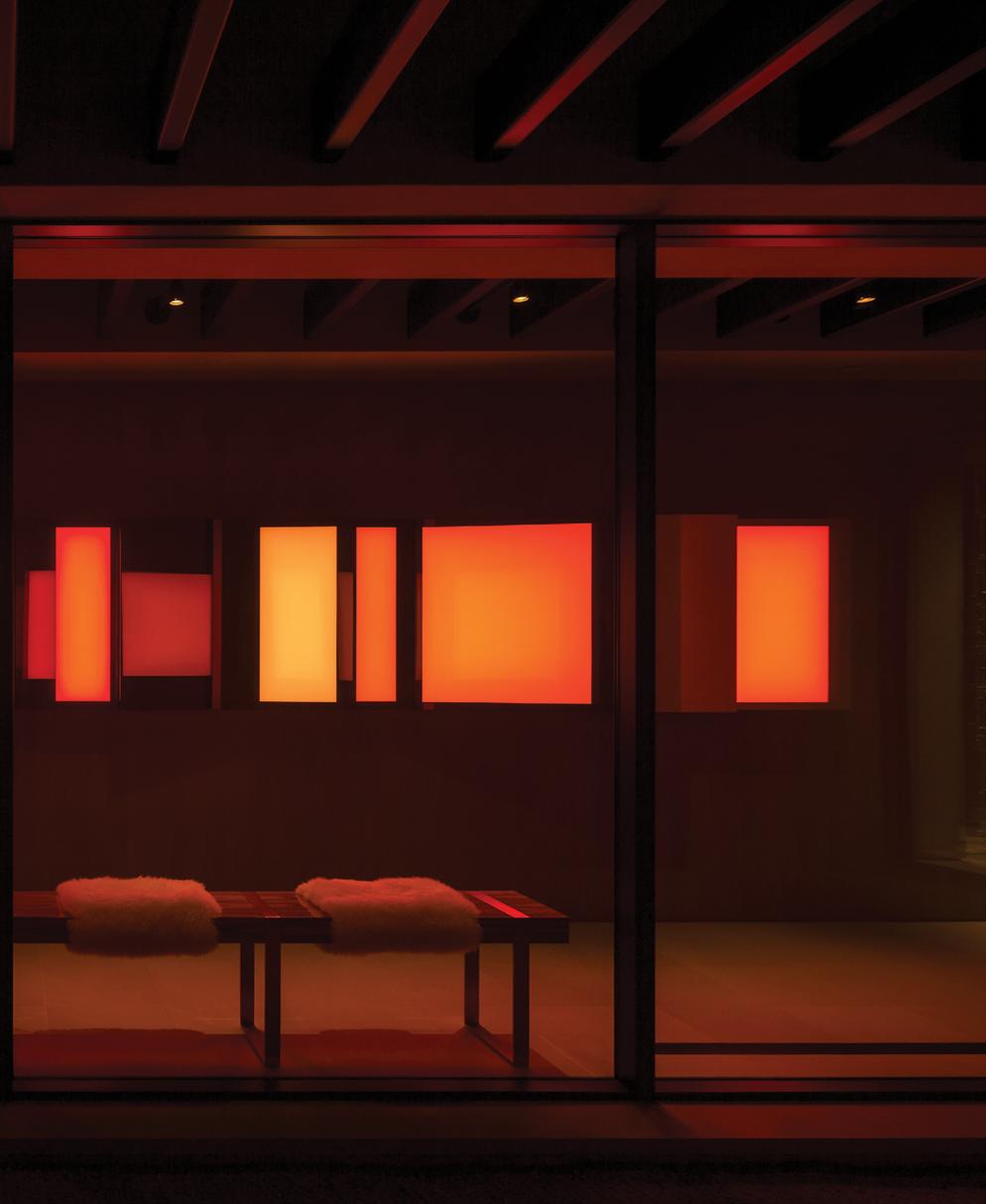
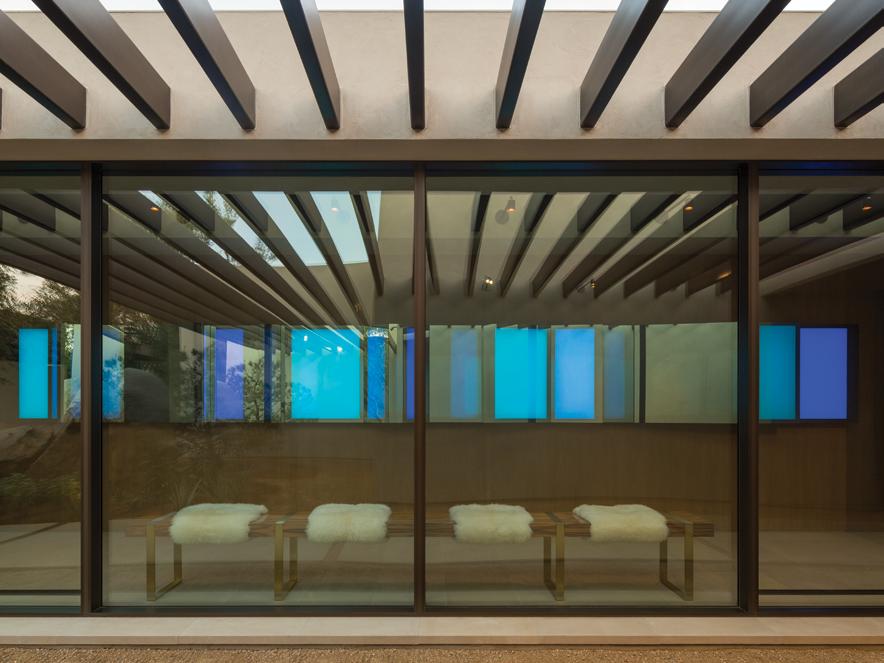
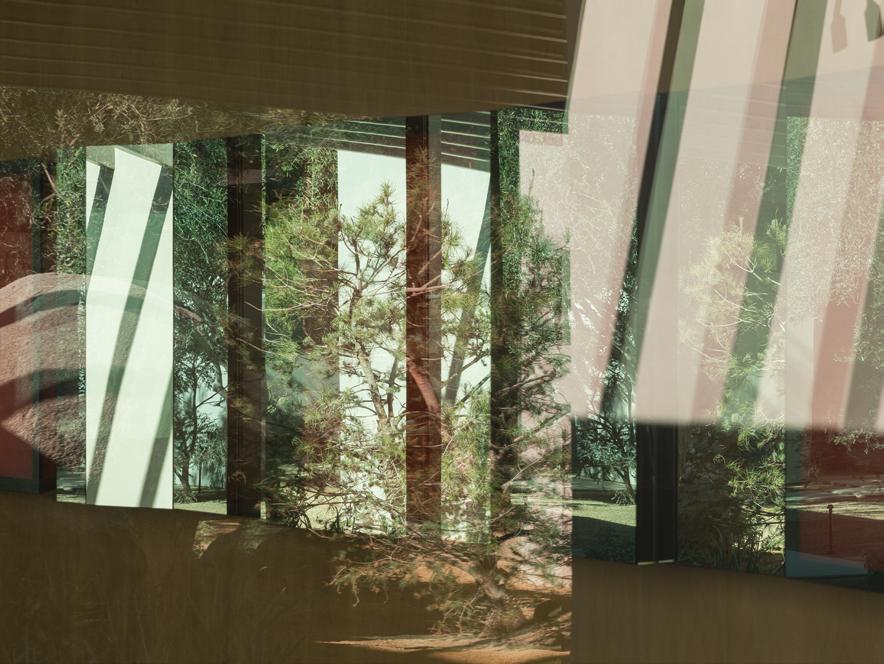
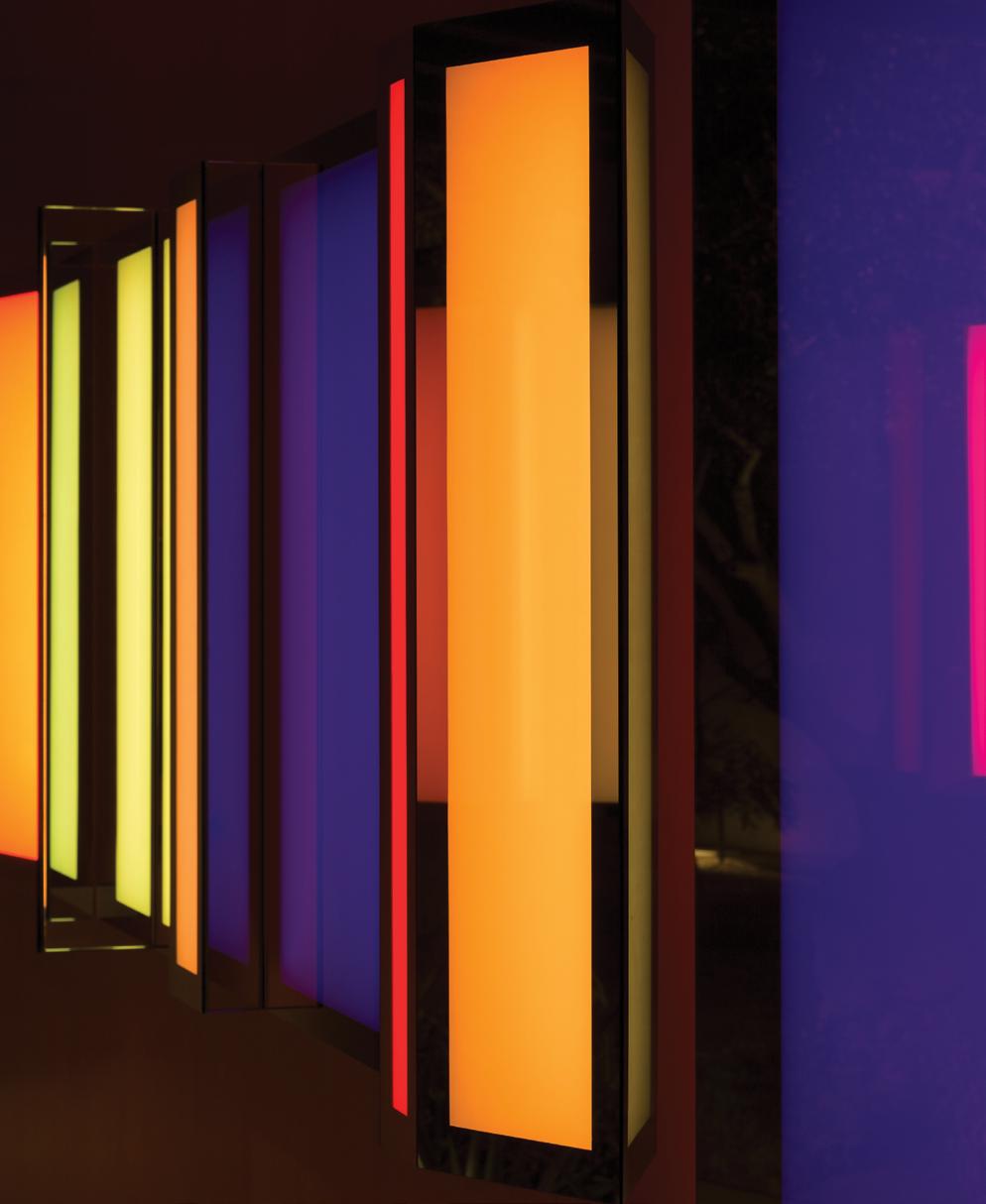
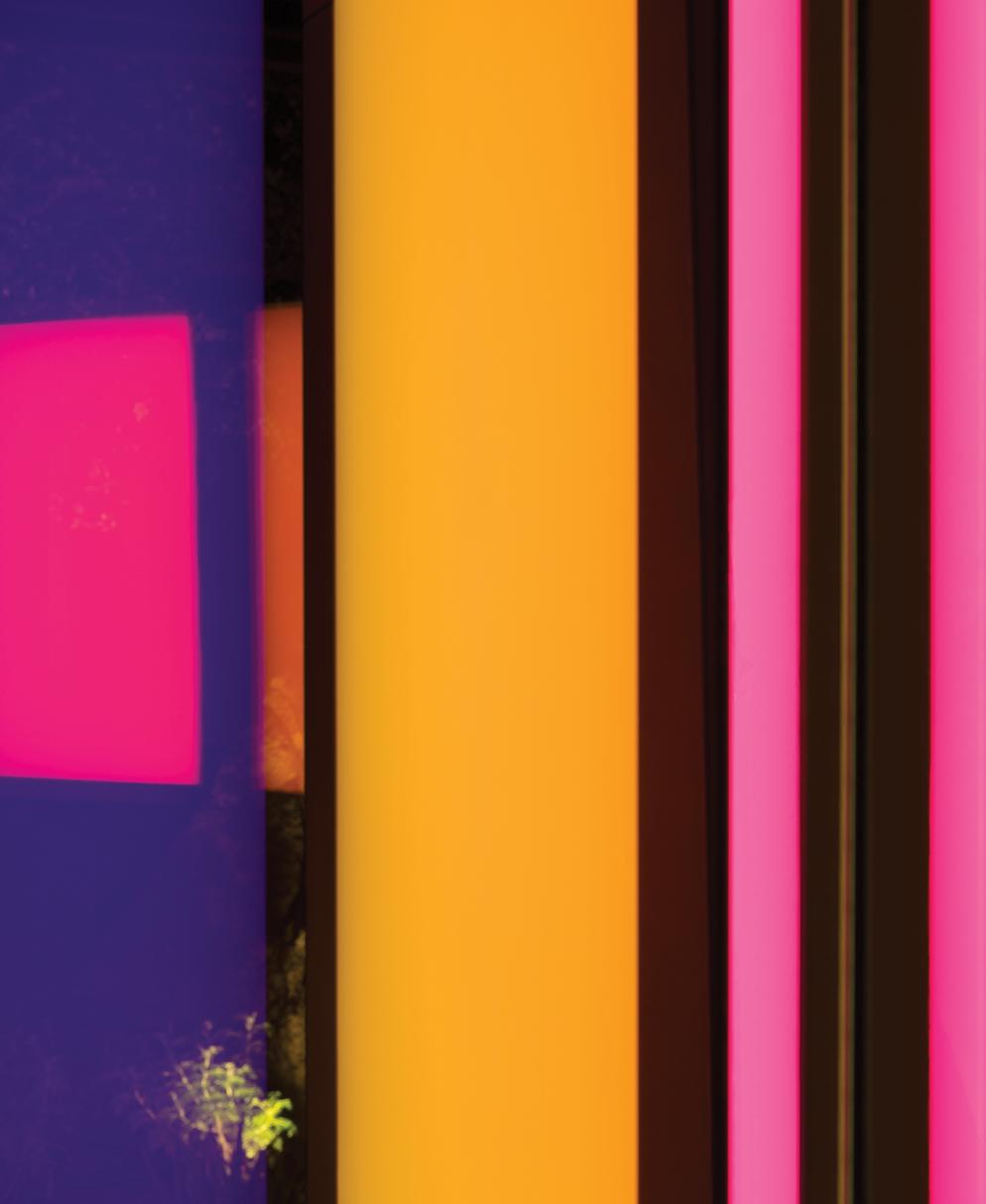
Irregular Horizontal #1 directly engages with the changing light, shifting shadows, and colors of the intimate garden located directly opposite the work. Experienced frontally and from the oblique, the garden and atmosphere of the day are collaged across the work’s mirrored surface. As dusk approaches, color emerges from the undulating mirrored surface, amalgamating tinted views of the environment. As the sun fully sets, the work becomes floating fields of shifting color in the night.
93
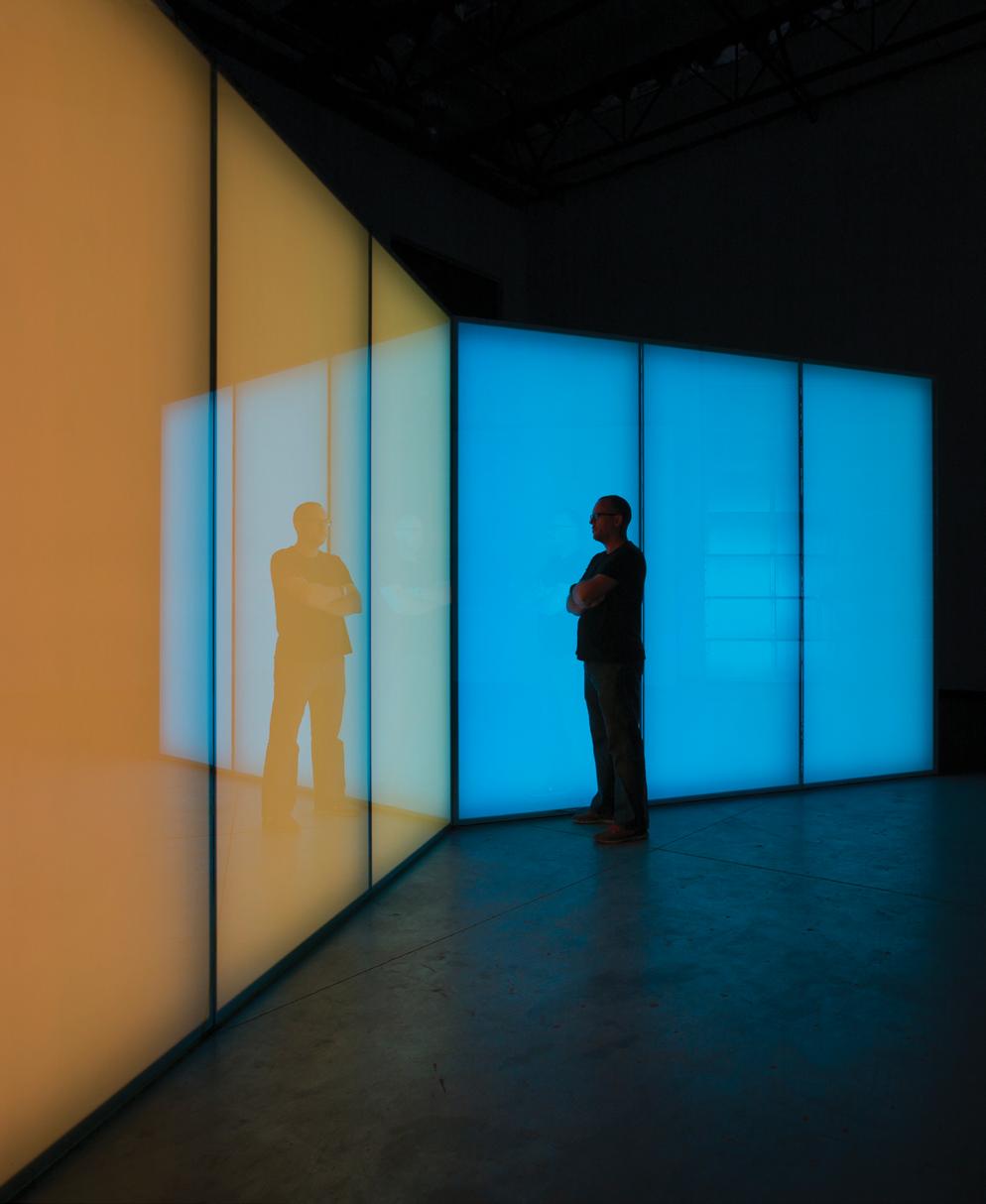
BENT PARALLEL
Laguna Art Museum
Laguna Beach, CA
October 16, 2016 – January 15, 2017
9’-0” x 21’-6” x 8’-8”, 2.74 x 6.55 x 2.64m Glass, aluminum, LED lighting, electronic components, unique color program
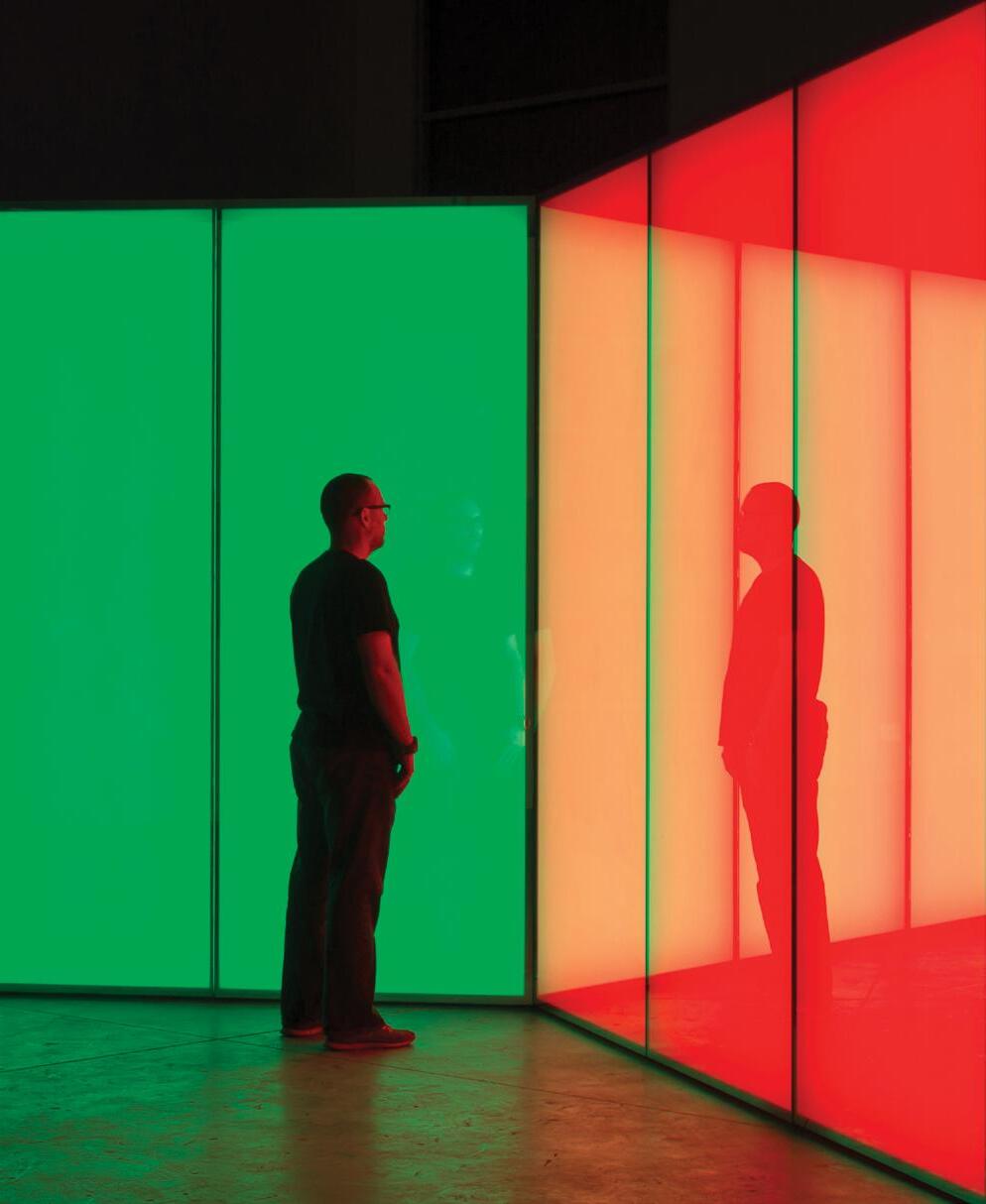
Continuing Smith’s ongoing dialogue with color theory, optics, scale, and technology, Bent Parallel envelopes viewers in light. Appearing as two angled colorfield walls, the hinge-like structure merges surfaces to engender a perception of shifting and blending. At the center of the bend, there is a third, material-less, zero-thickness plane that mixes the adjacent colors and seems to extend the physical bounds of the space. The resulting environment appears simultaneously infinite and finite.
101
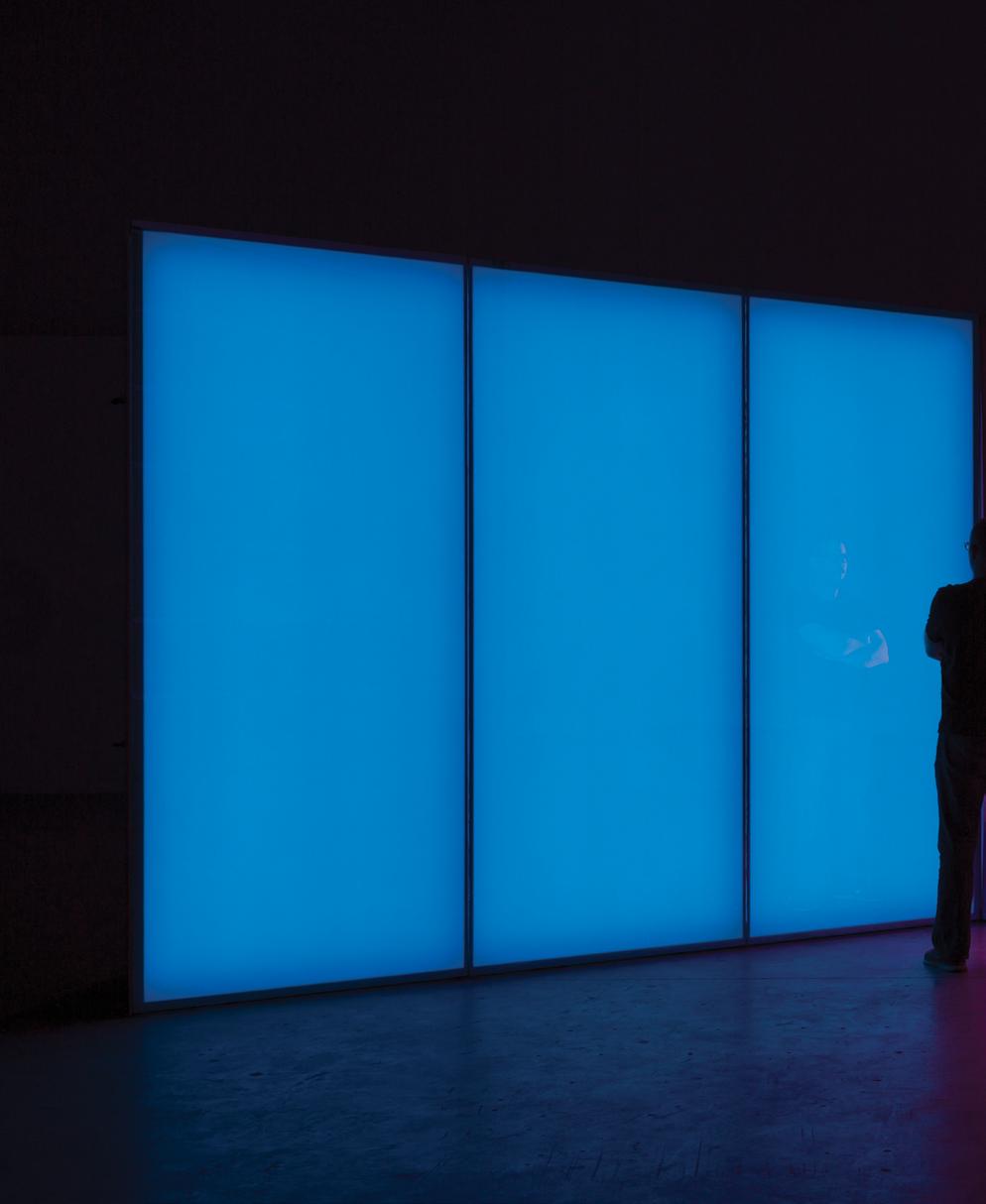
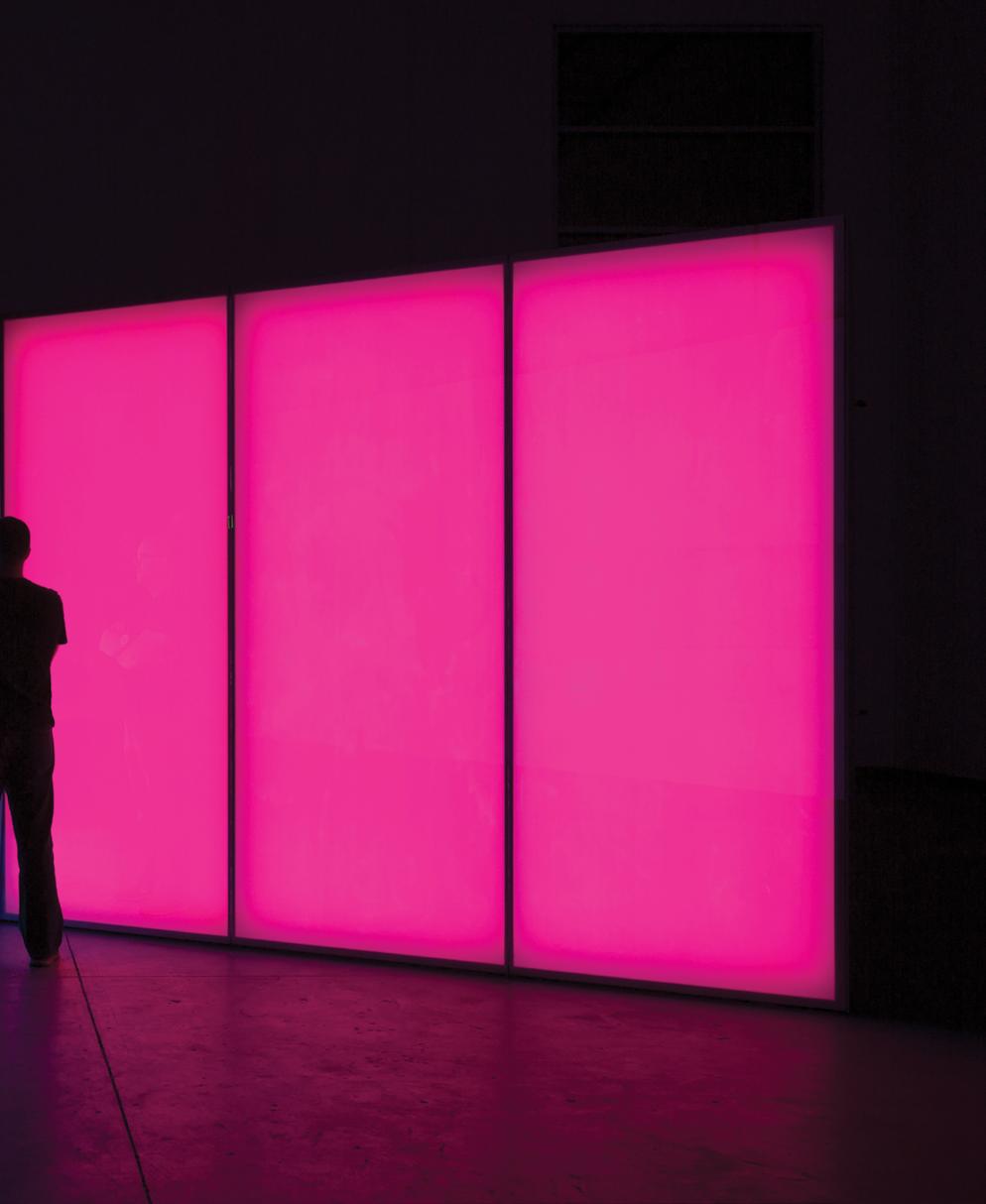
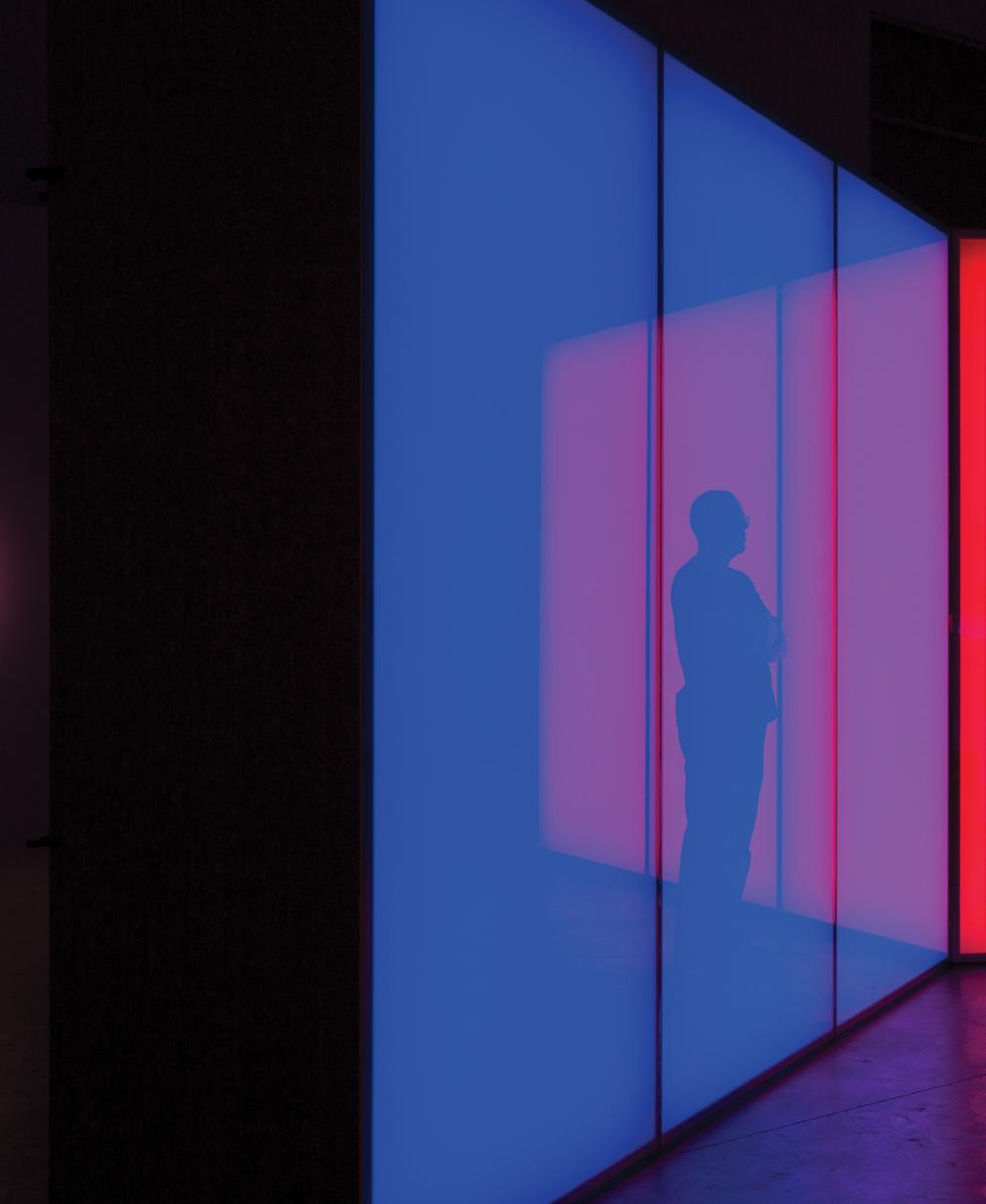
PORTALS
Coachella Valley Music & Arts Festival
Indio, CA 2016
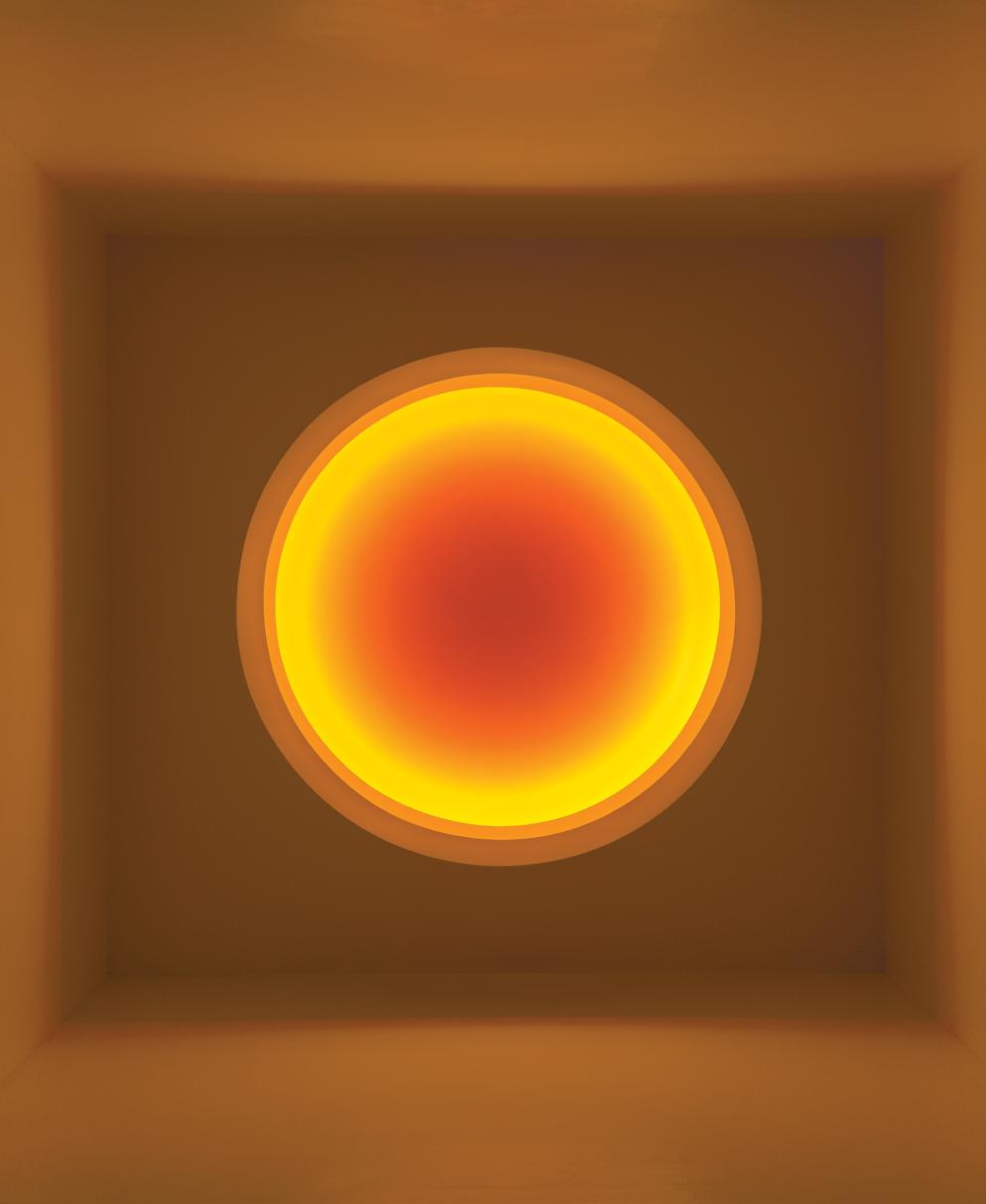
Portals (6’-0” diameter x 2’-0” deep, 1.8 x 0.6m) Fiberglass, automotive paint, LED lighting, electronic components, unique color program
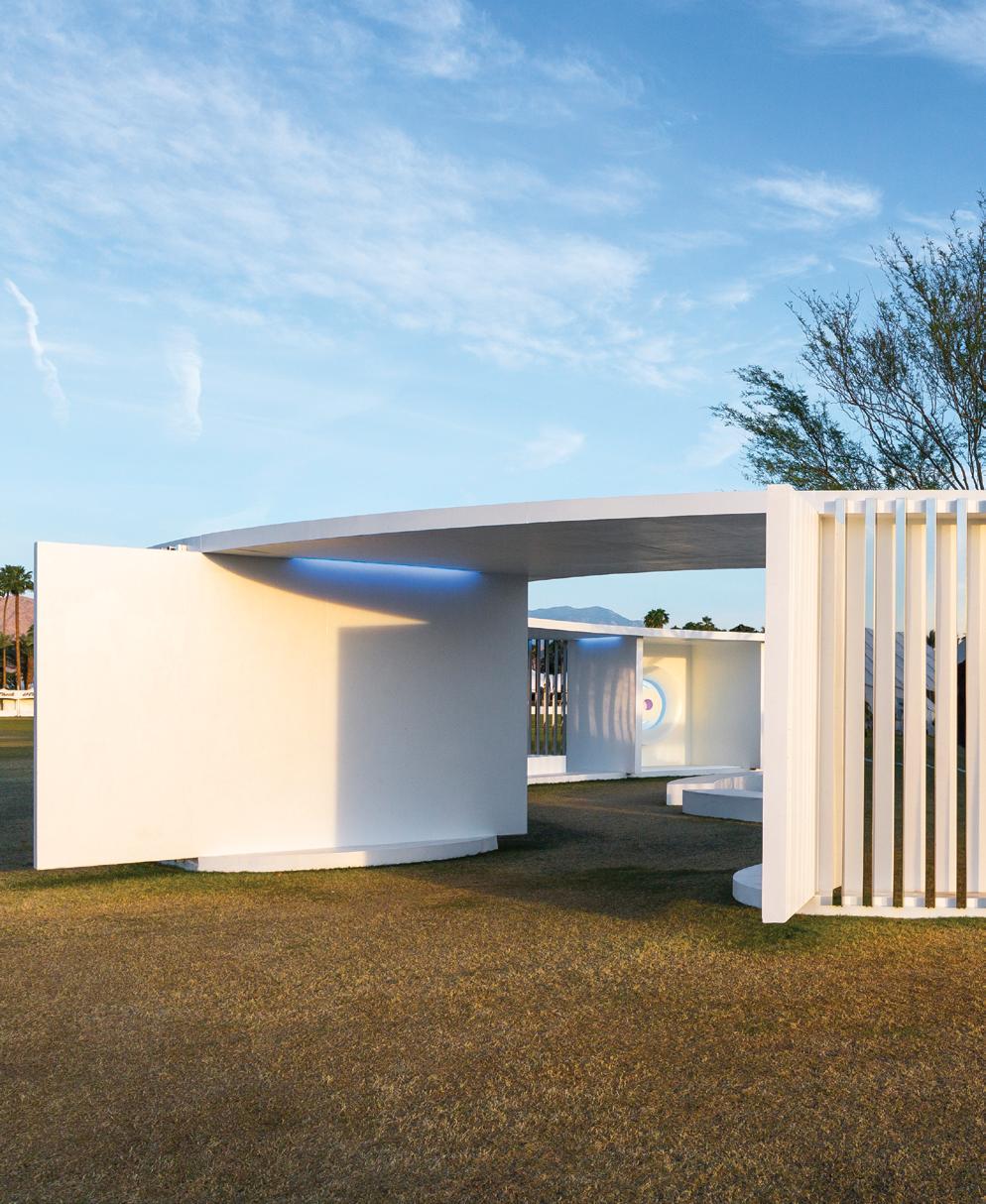
Pavilion (85’-0” diameter x 10’-6” high, 26 x 3.2m) Wood construction, white paint, mirror polished stainless steel, 35’ high boxed mesquite tree, Cresta boulders, LED lighting
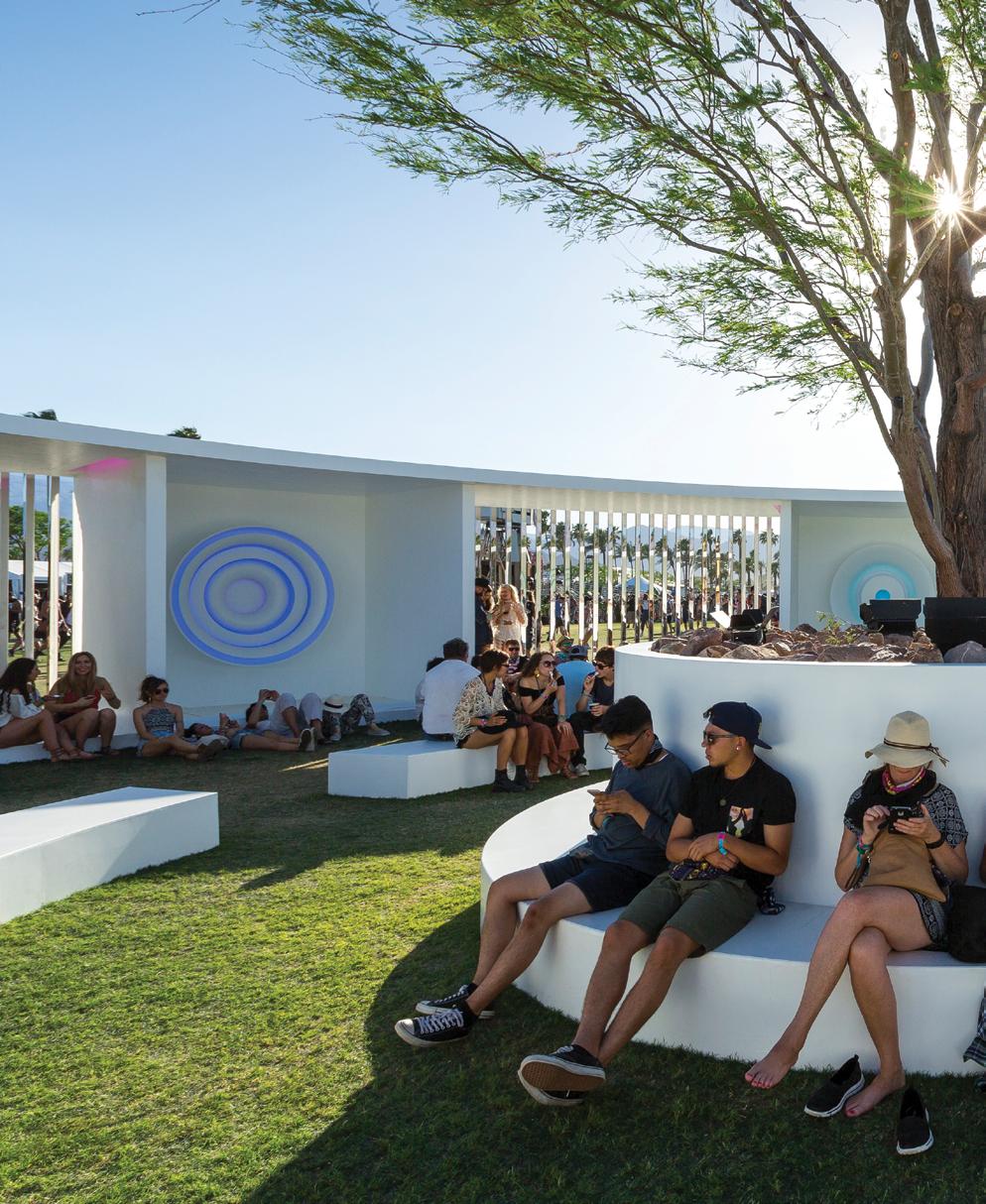
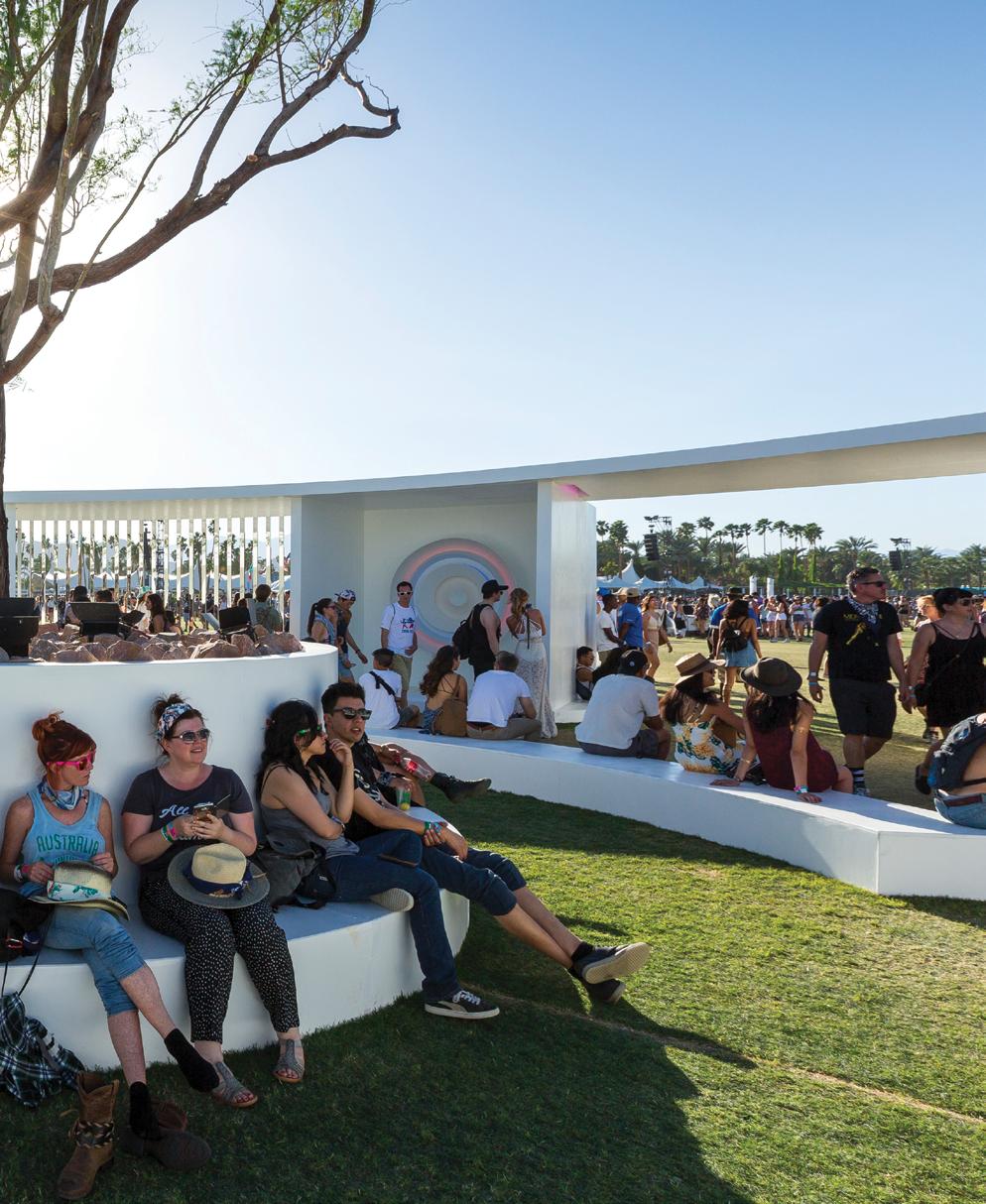
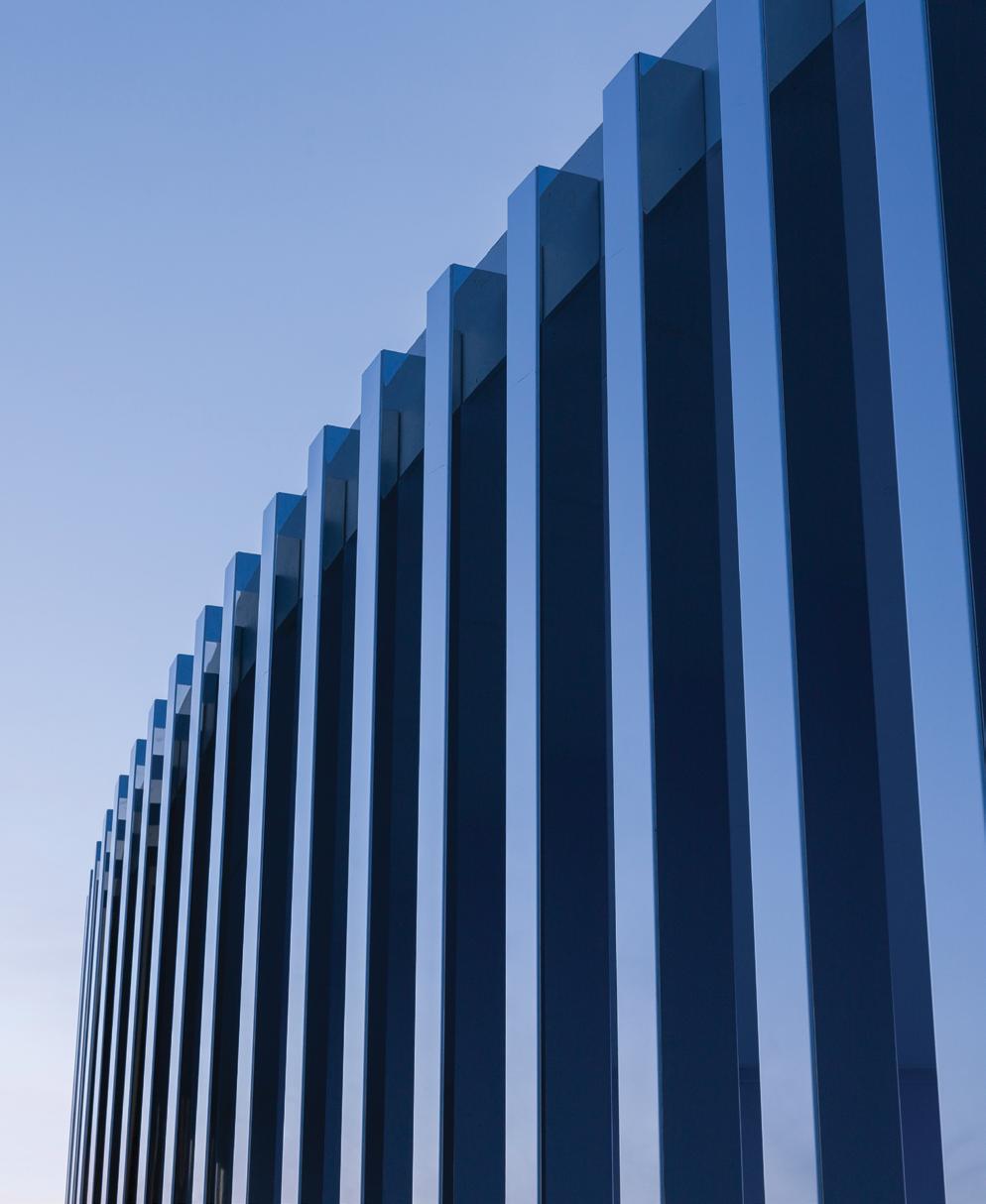
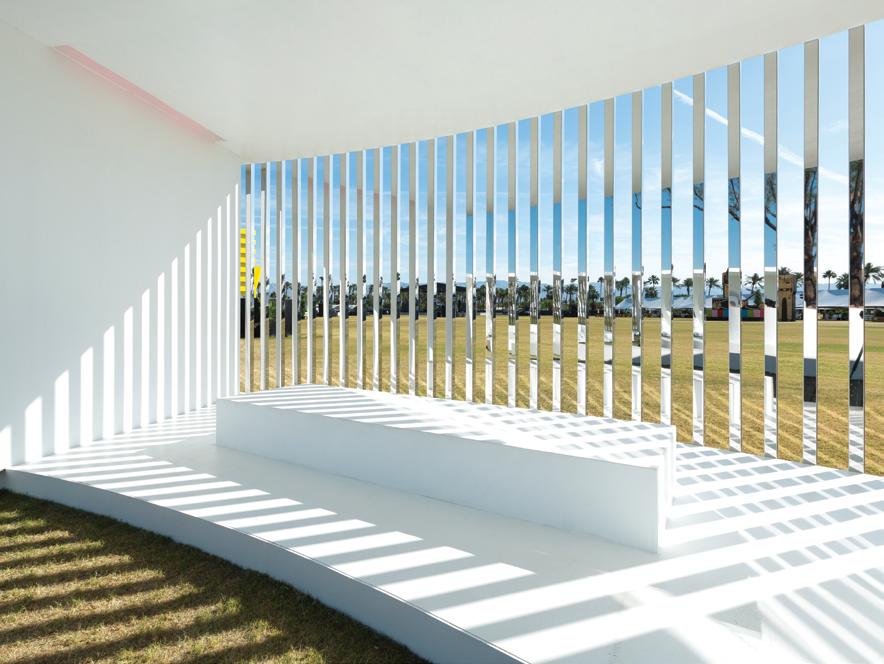
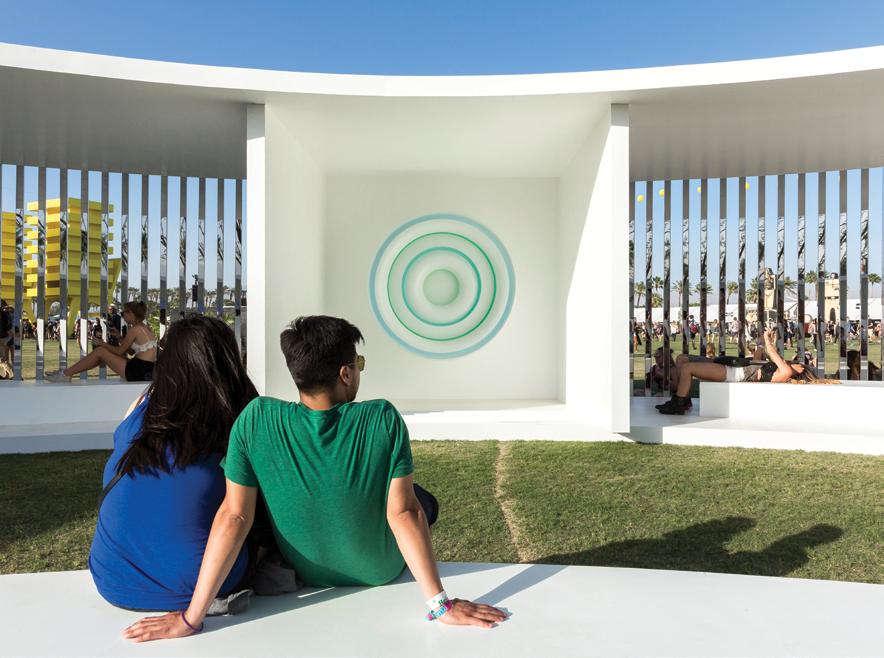
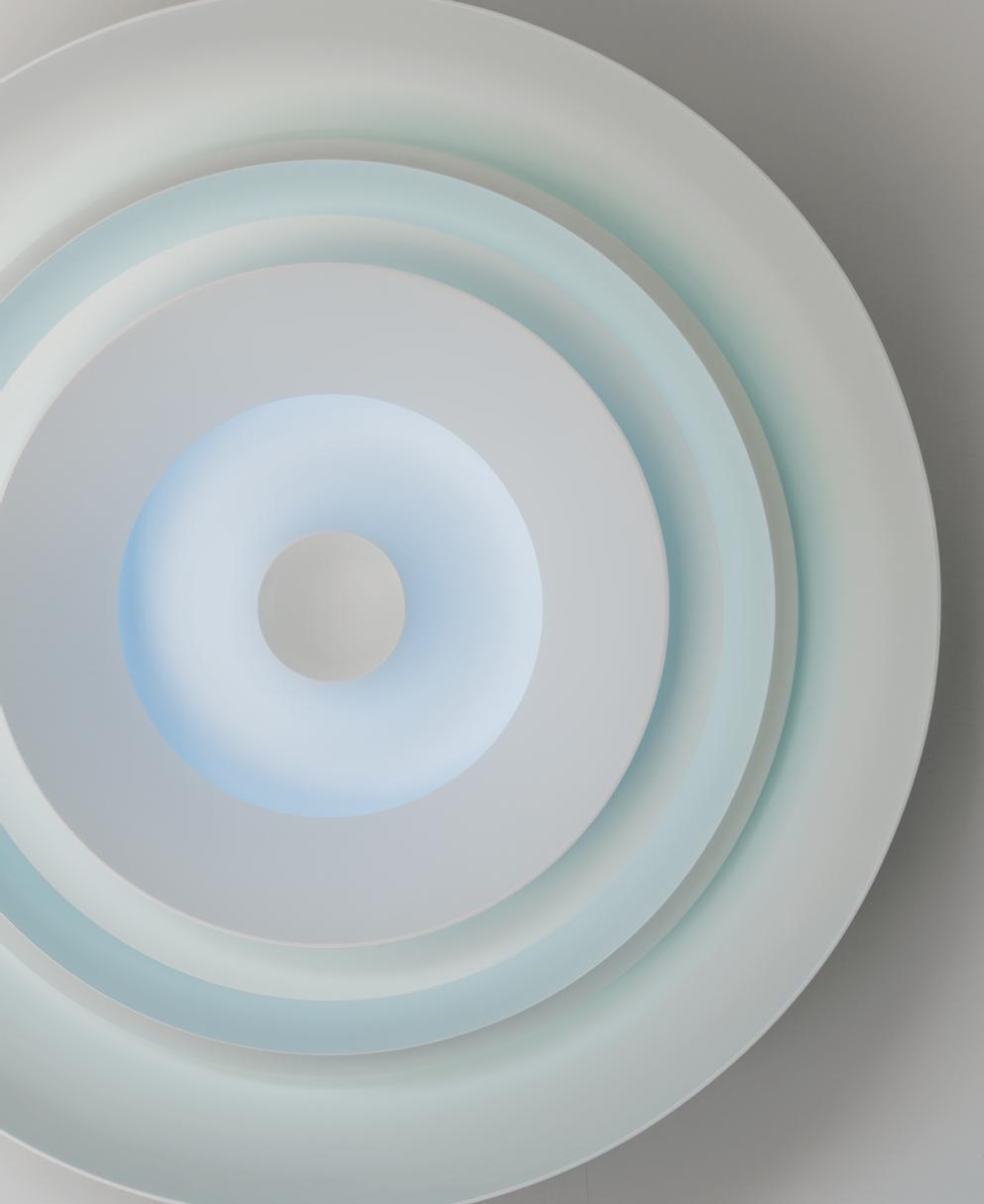
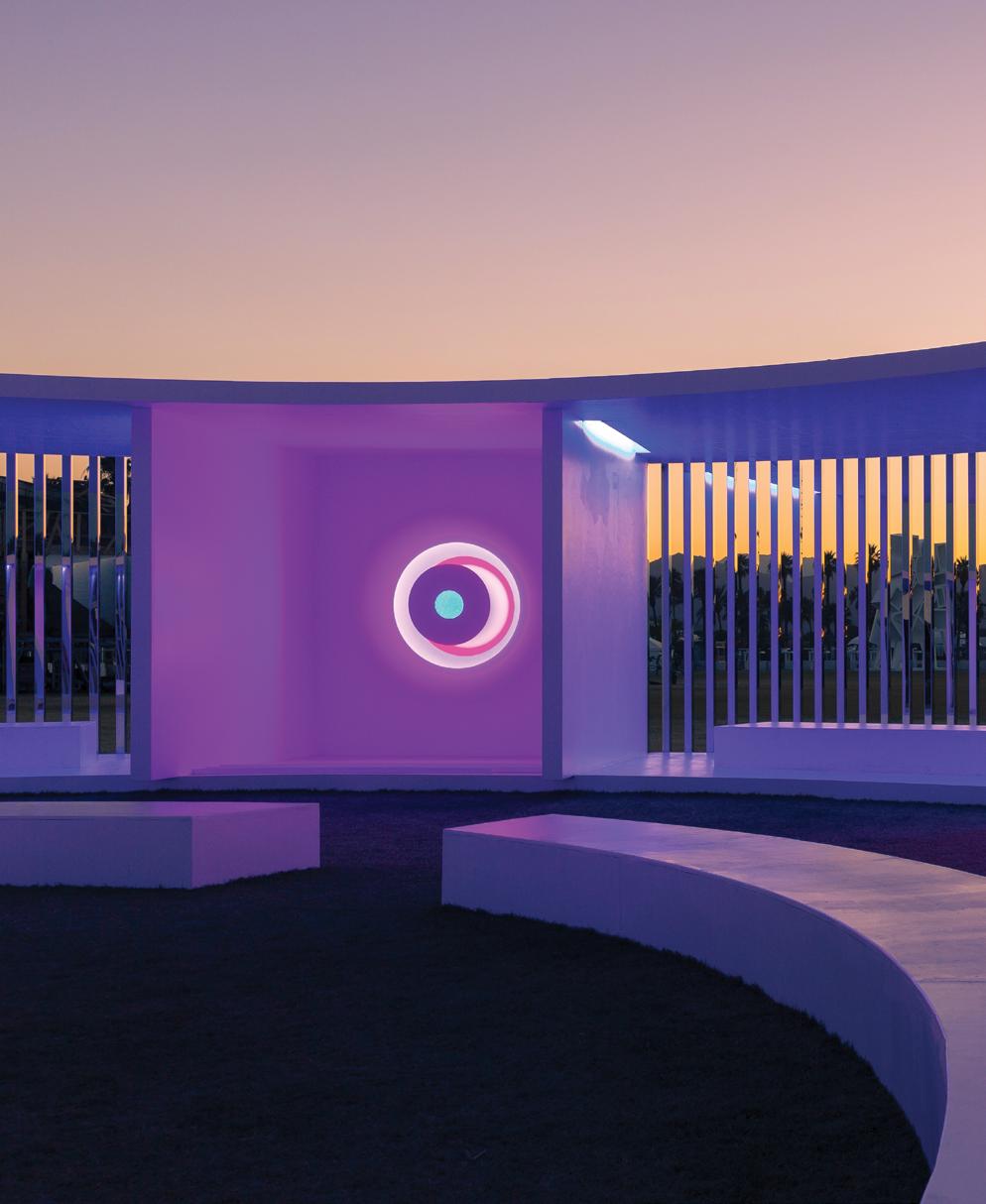
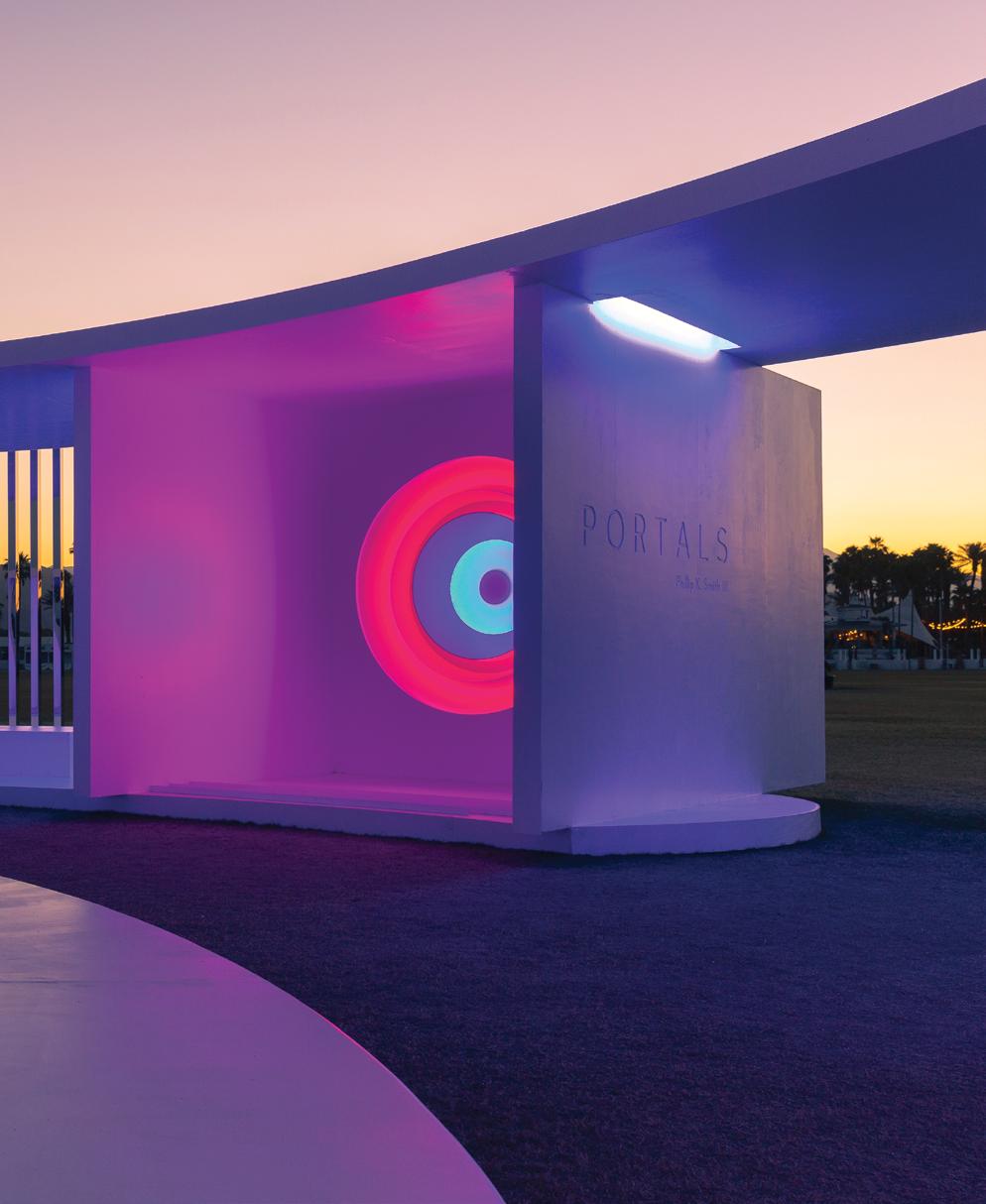
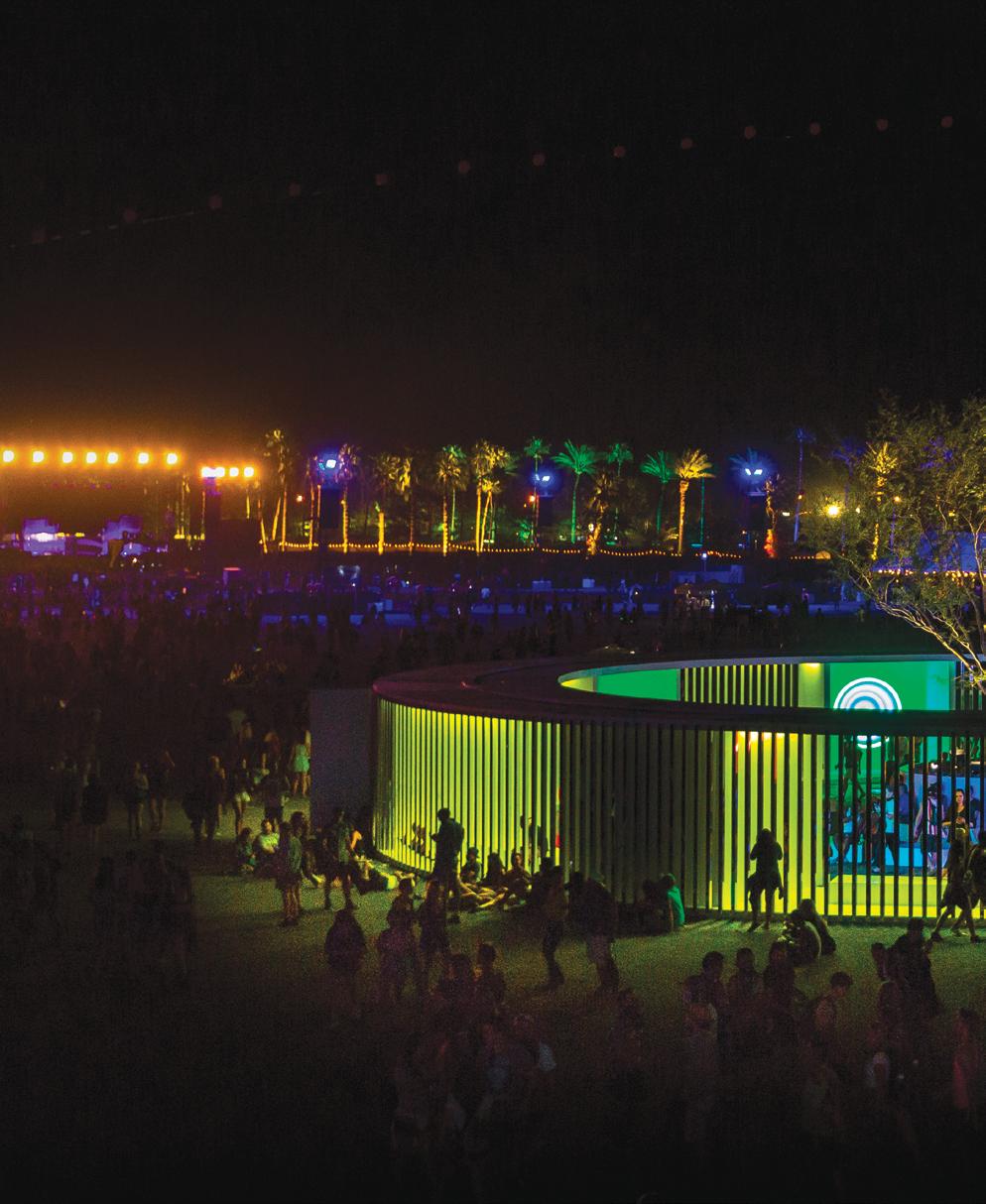
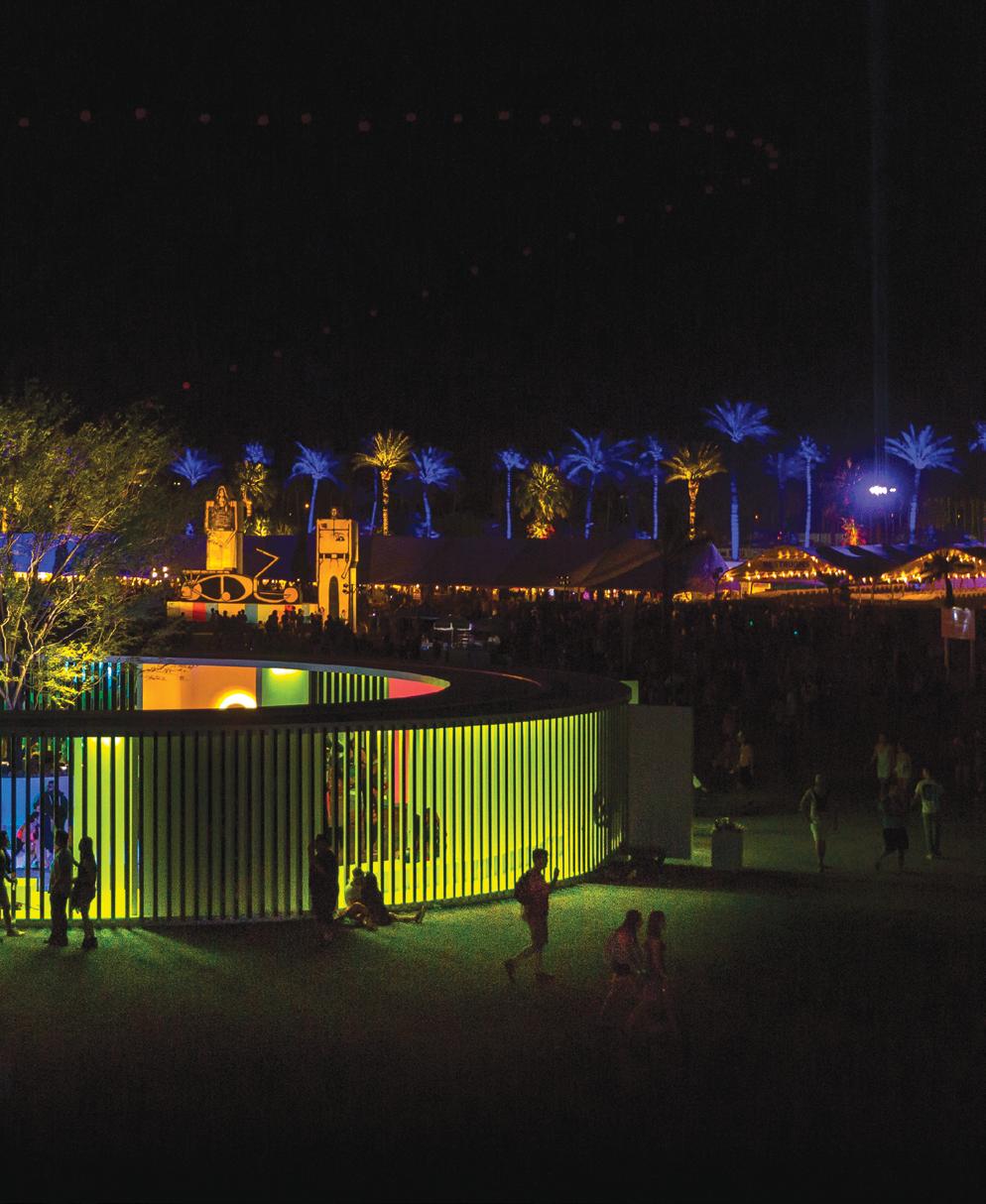
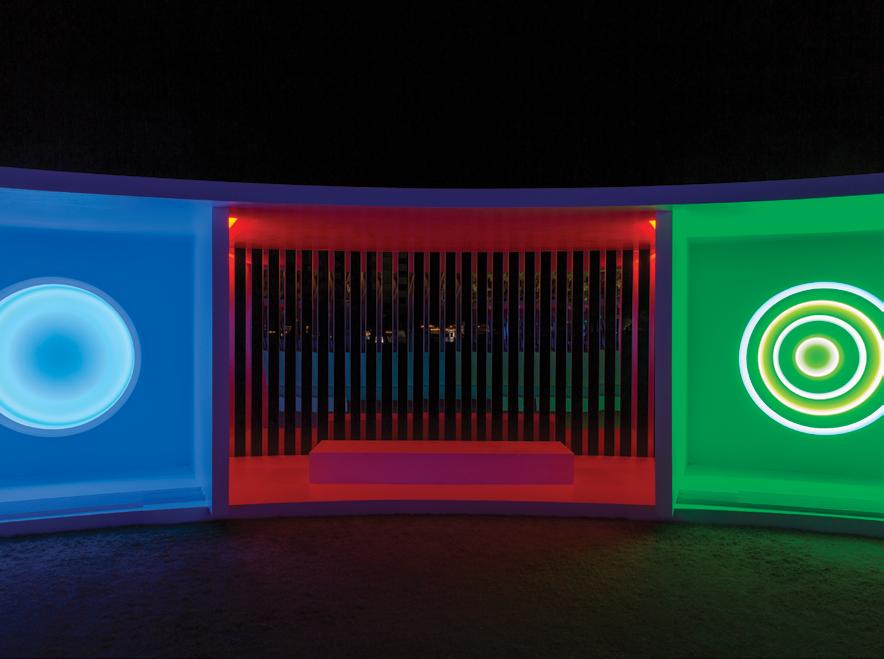
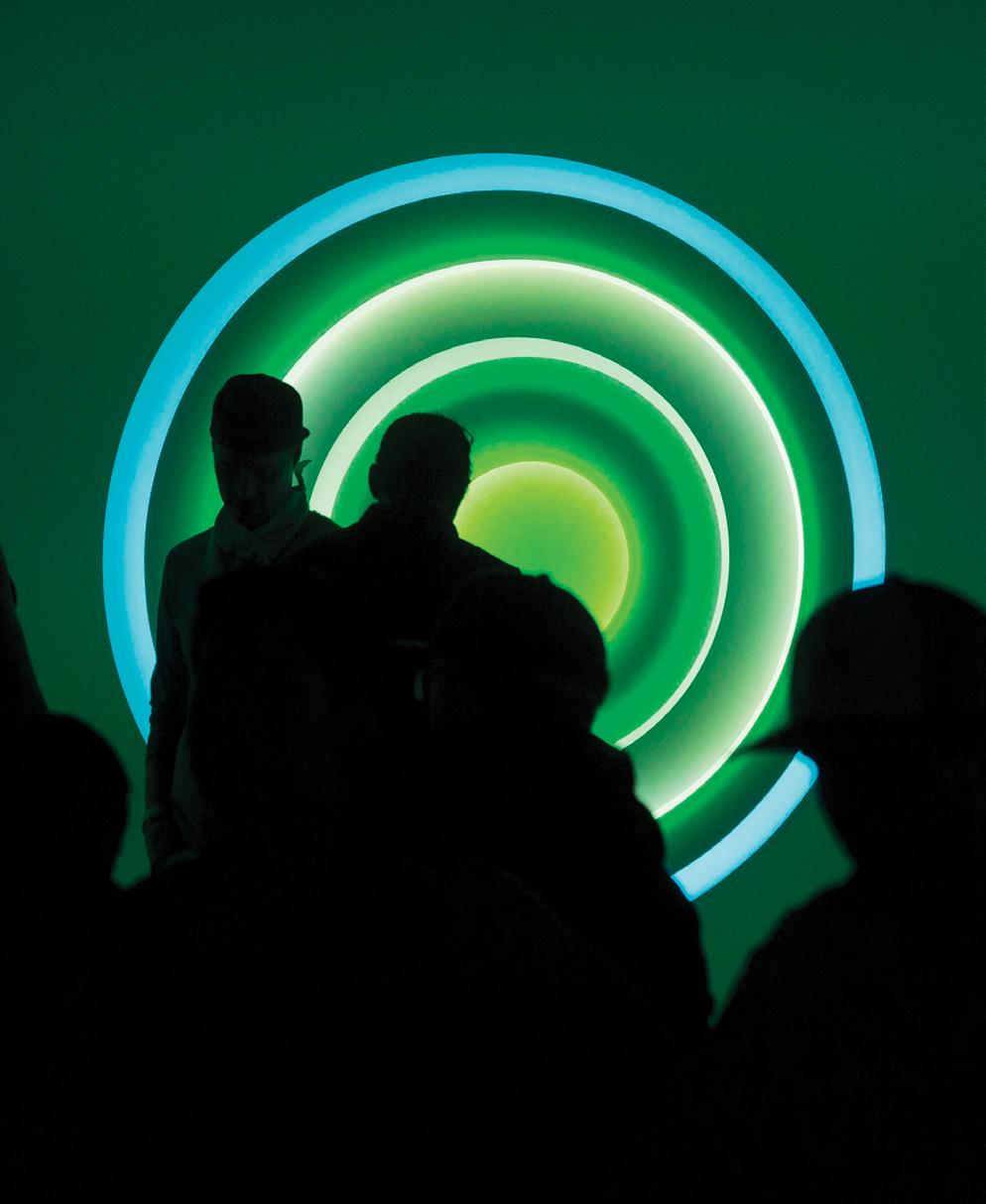
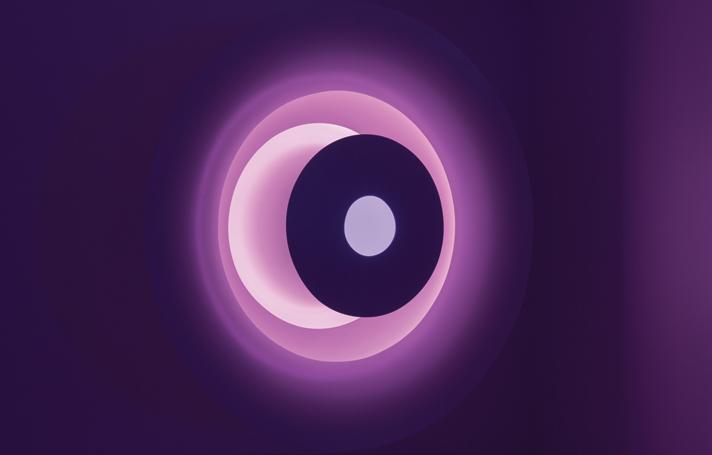
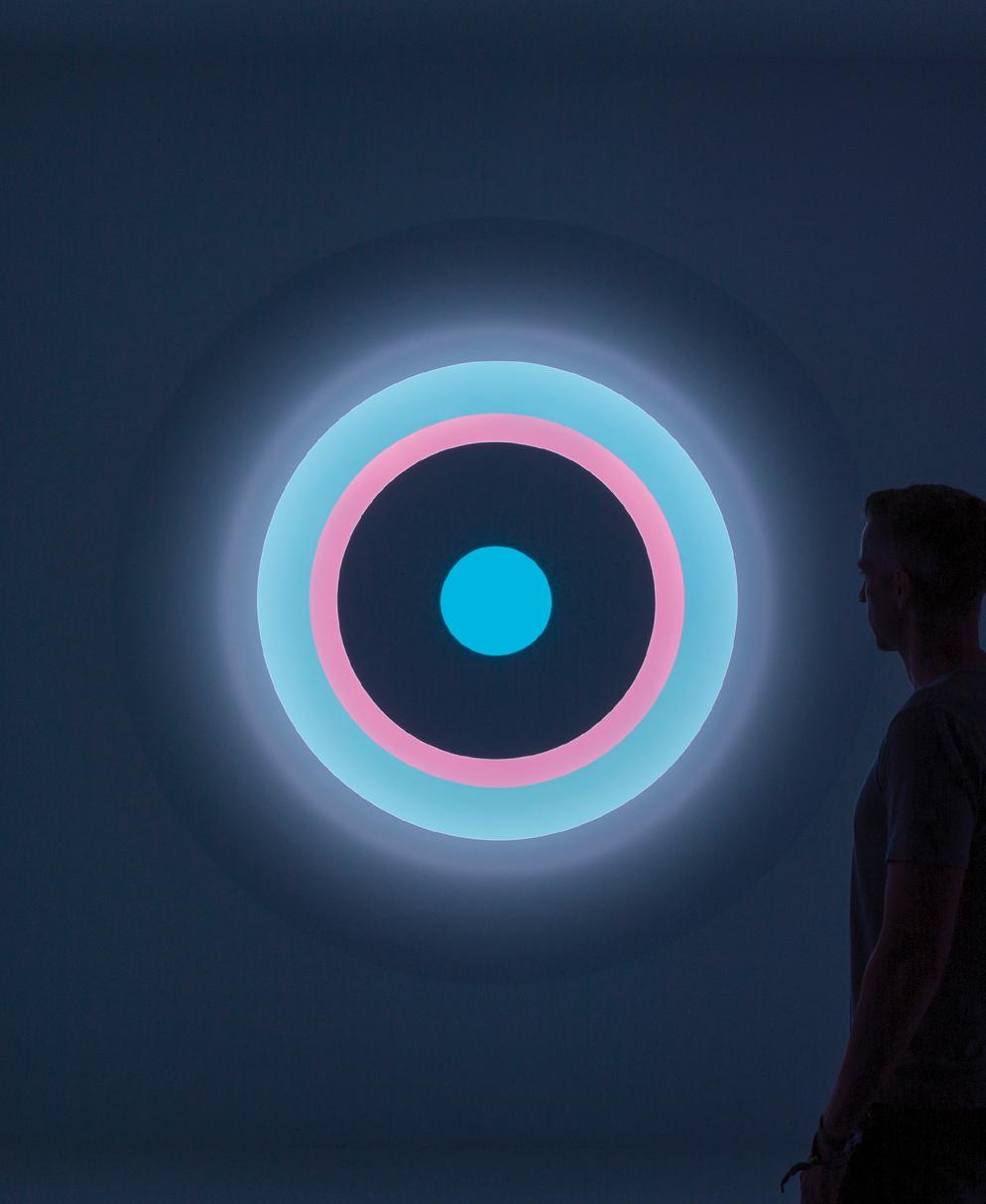
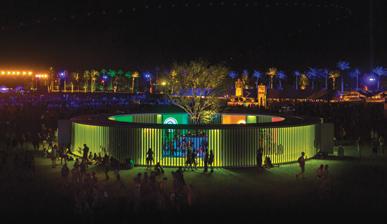
The Portals pavilion defines a space for light, while carving out a meditative space for calm amongst the intensity of Coachella. At 85 feet in diameter, the pavilion’s reflective exterior skin dances with the pace of the show and fans, while the interior quietly opens to the sky, pierced by a 35’ high Mesquite tree. A spatial rhythm of shifting color separated by intermediate reflective public spaces rings the circular structure. Contained within its own open white cube, each light shifting Portals sculpture projects its color and pace inward where people gather to be bathed in light. Stepping up to the edge of each Portal, the adjacent walls allow the 99,999 other people to fade away, opening the viewer to their own unique, individual experience with color and light.
113
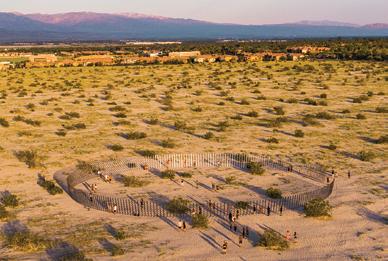
THE CIRCLE OF LAND AND SKY
Desert X Palm Desert, CA 2017
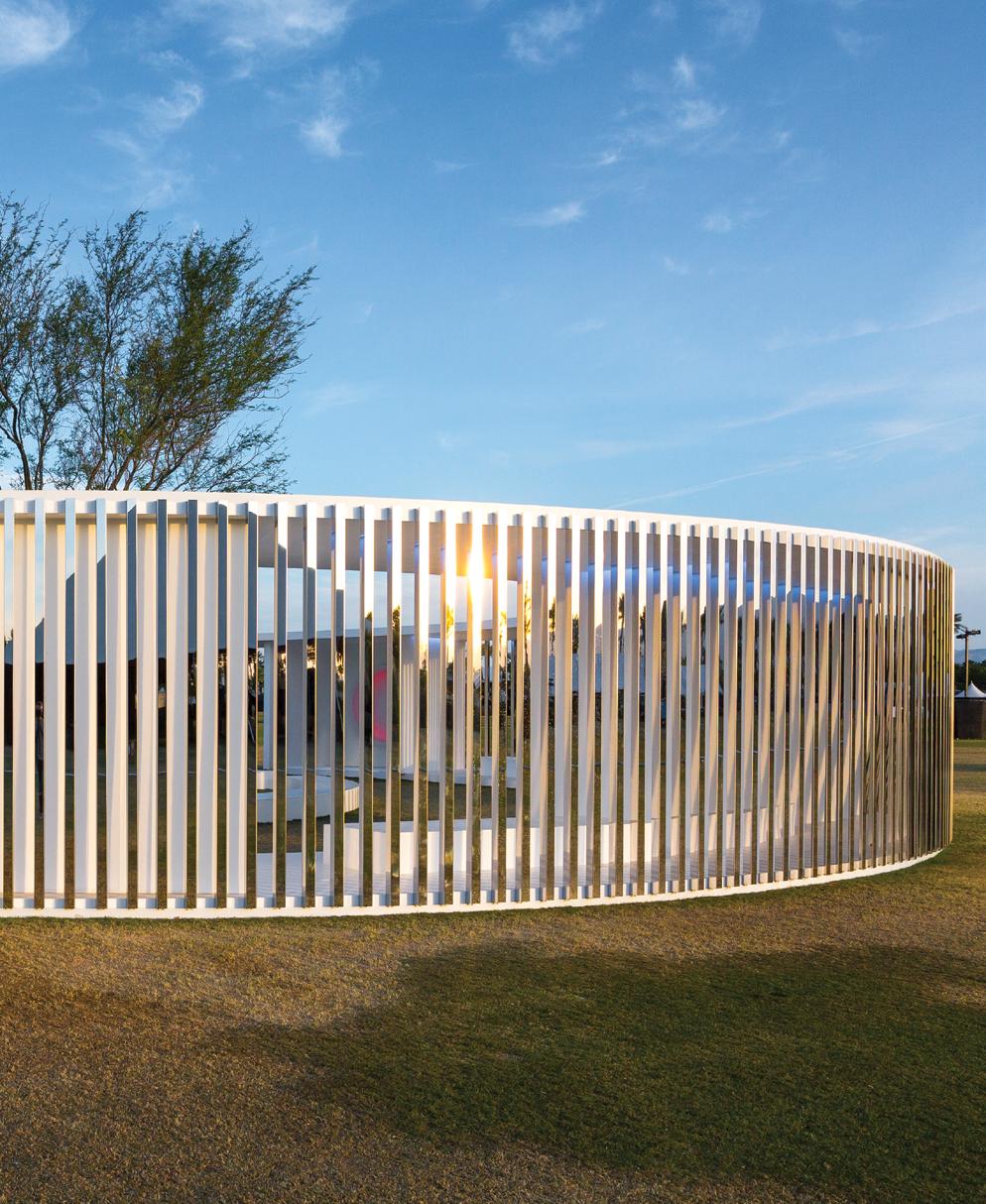
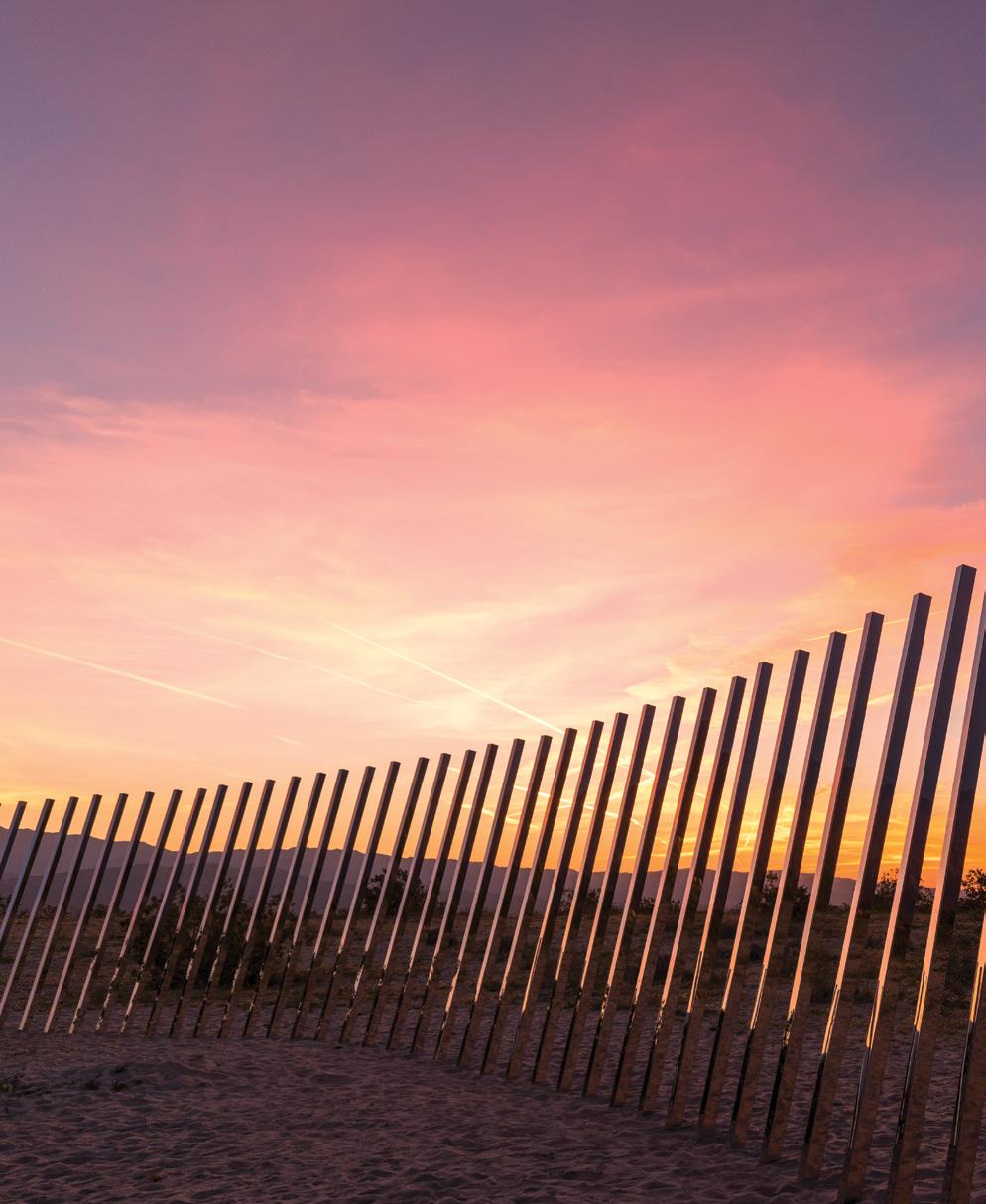
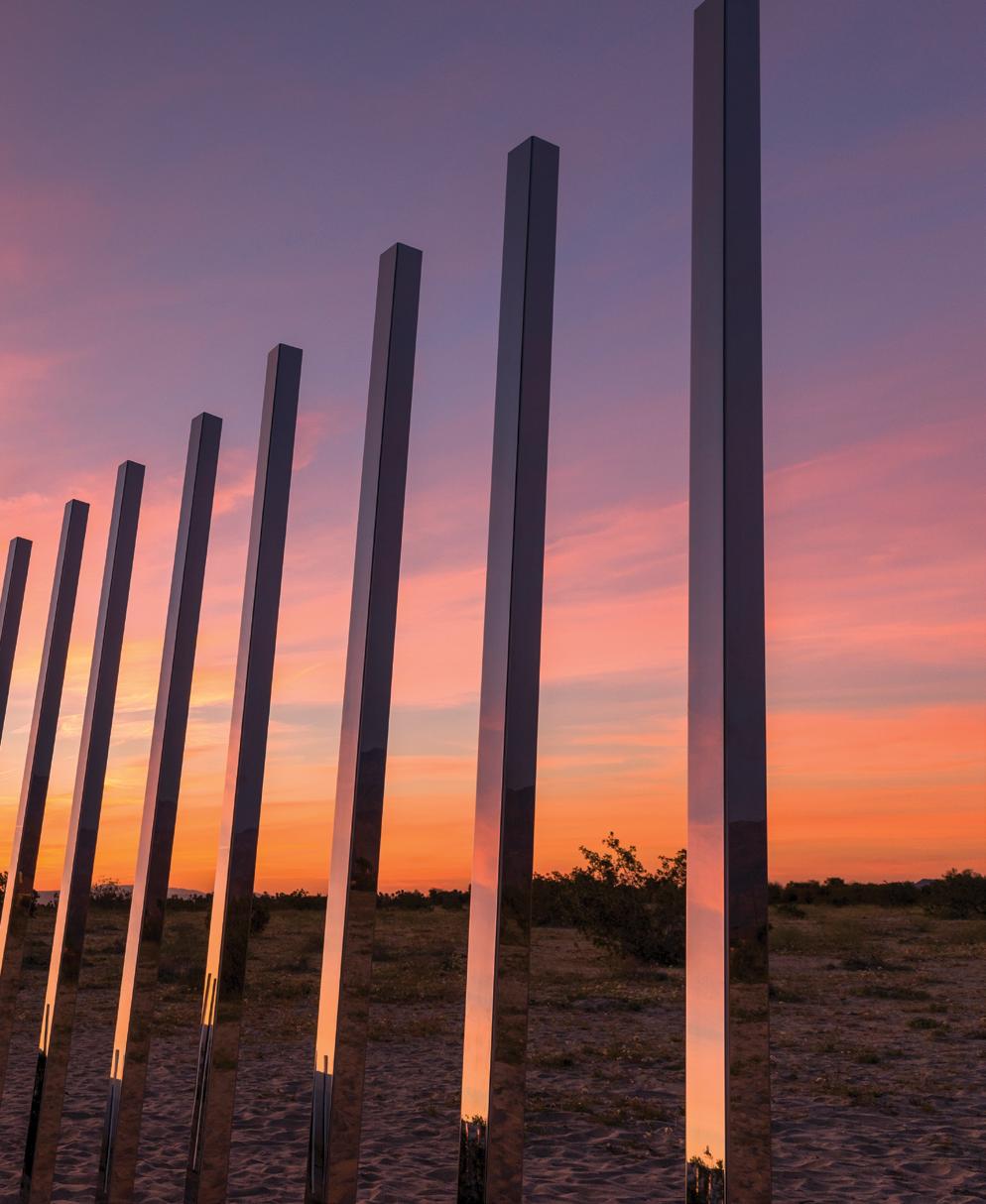
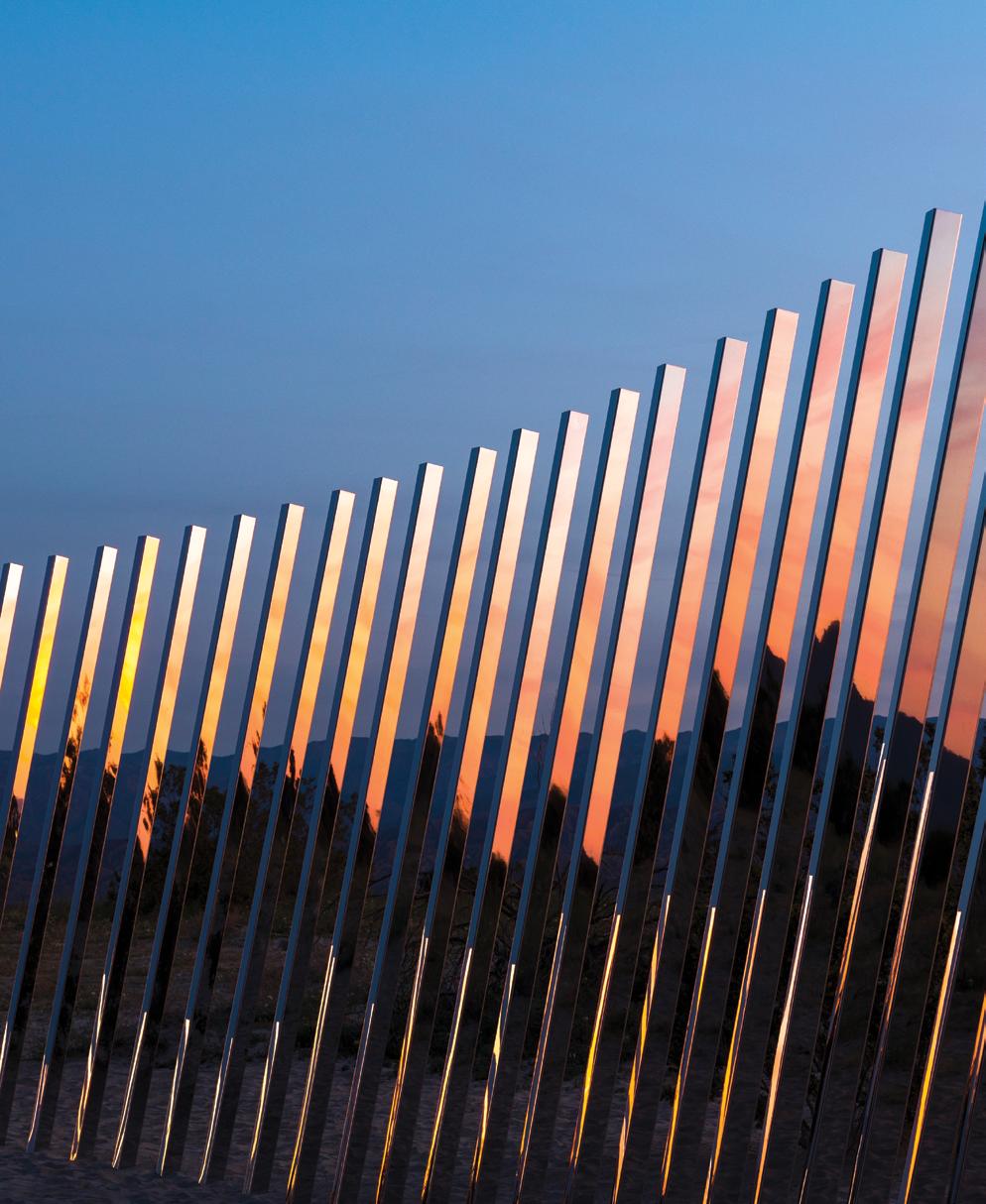
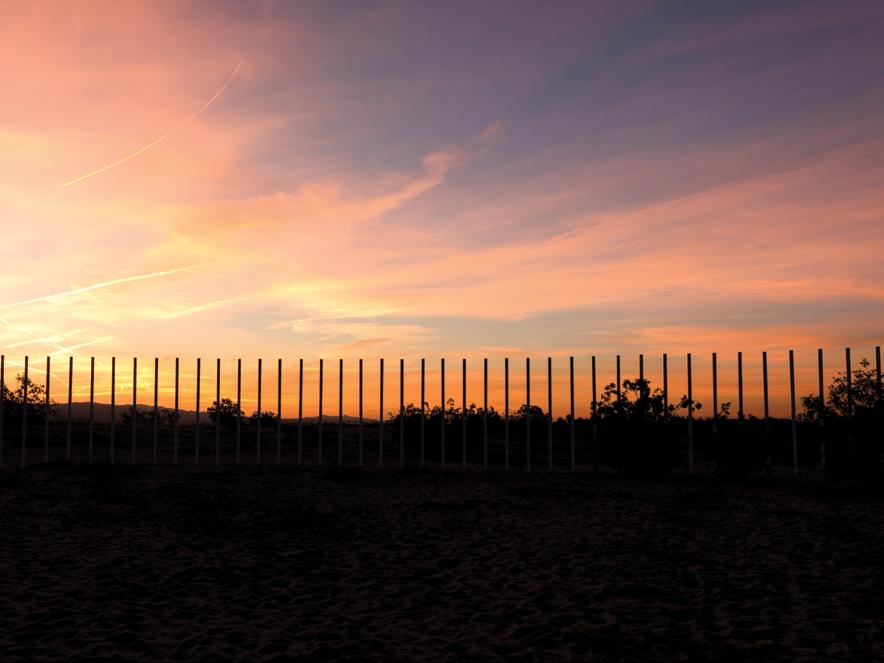
165’-0” diameter x 10’-0” high, 50 x 3m Mirror polished stainless steel
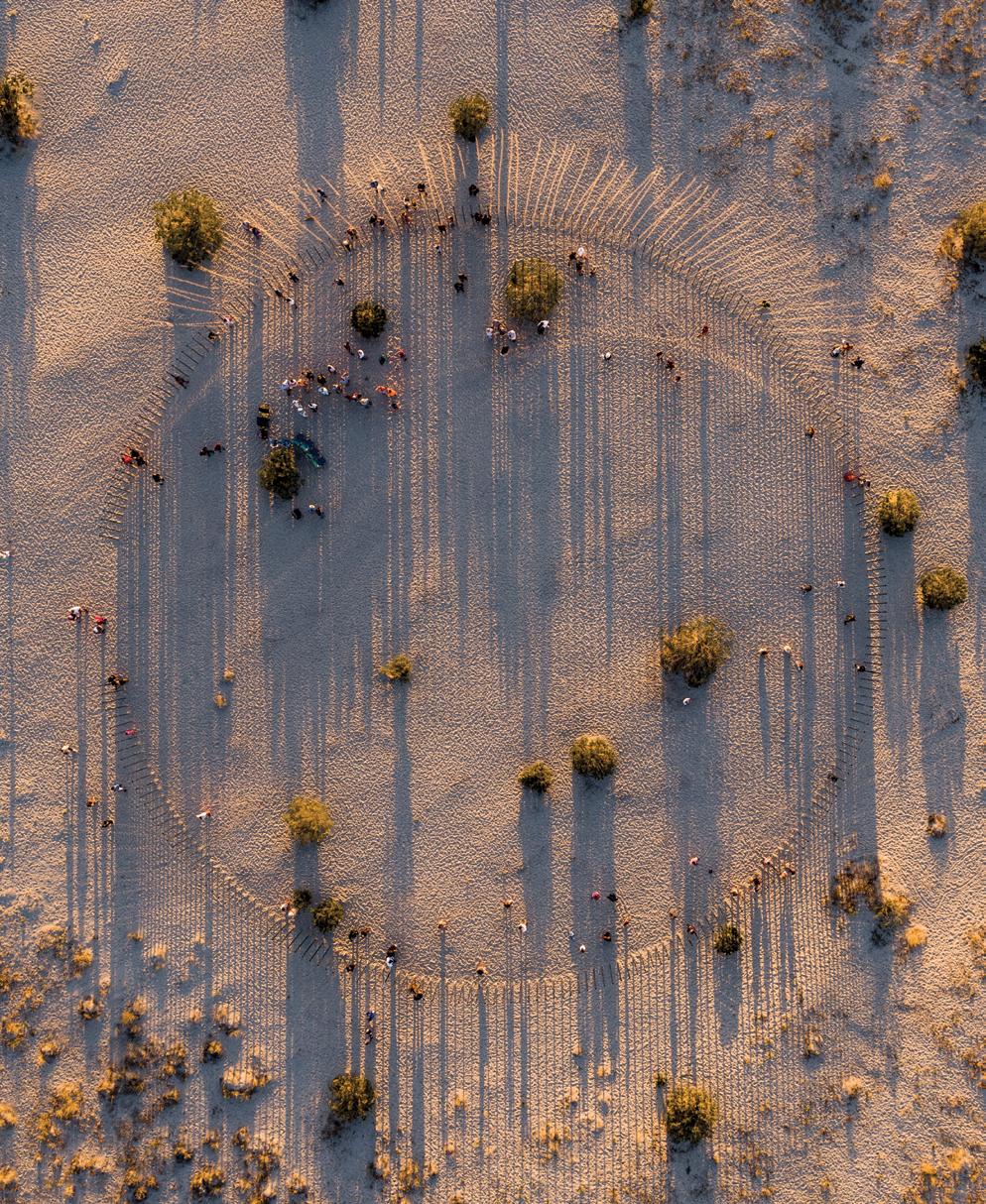
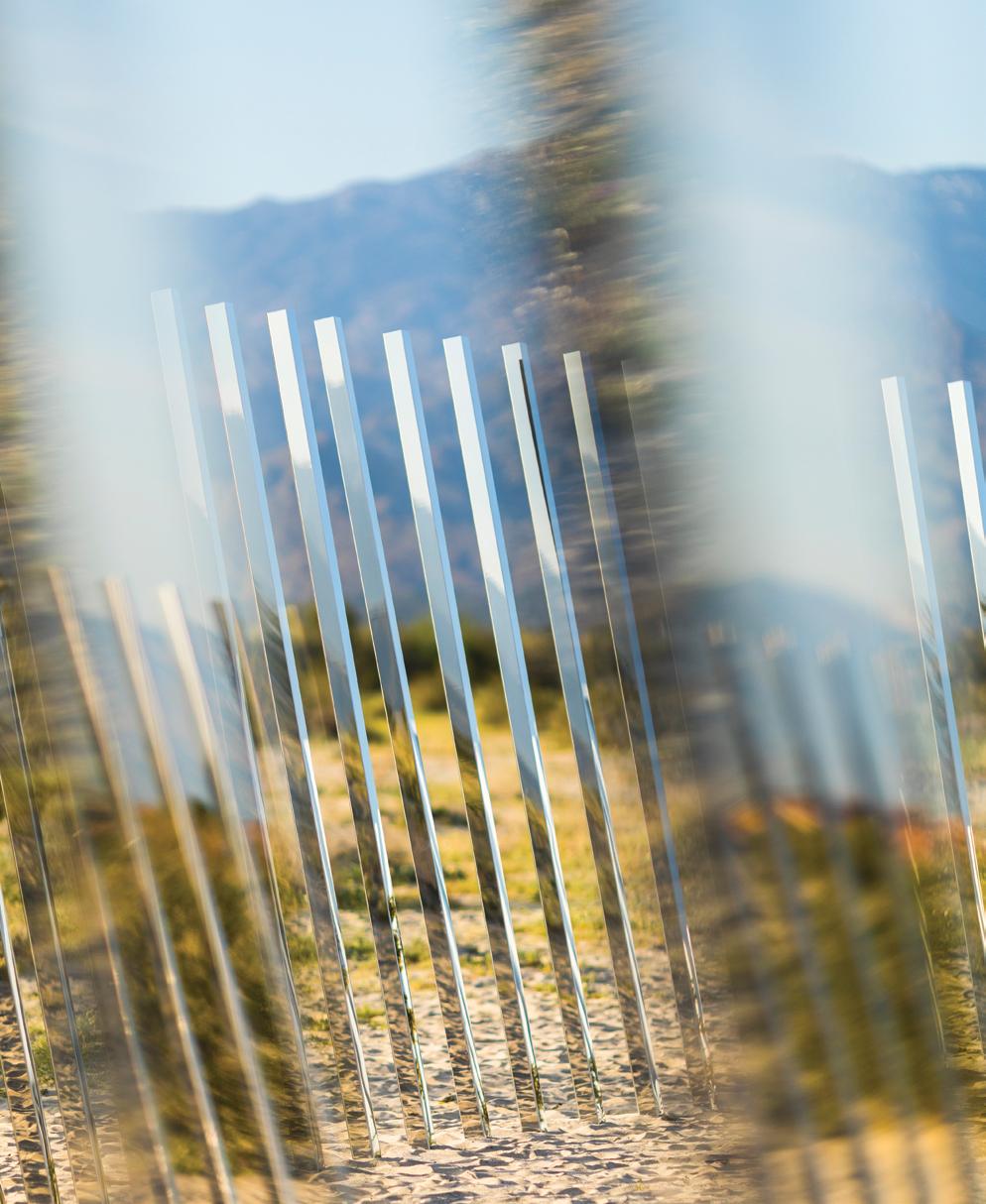
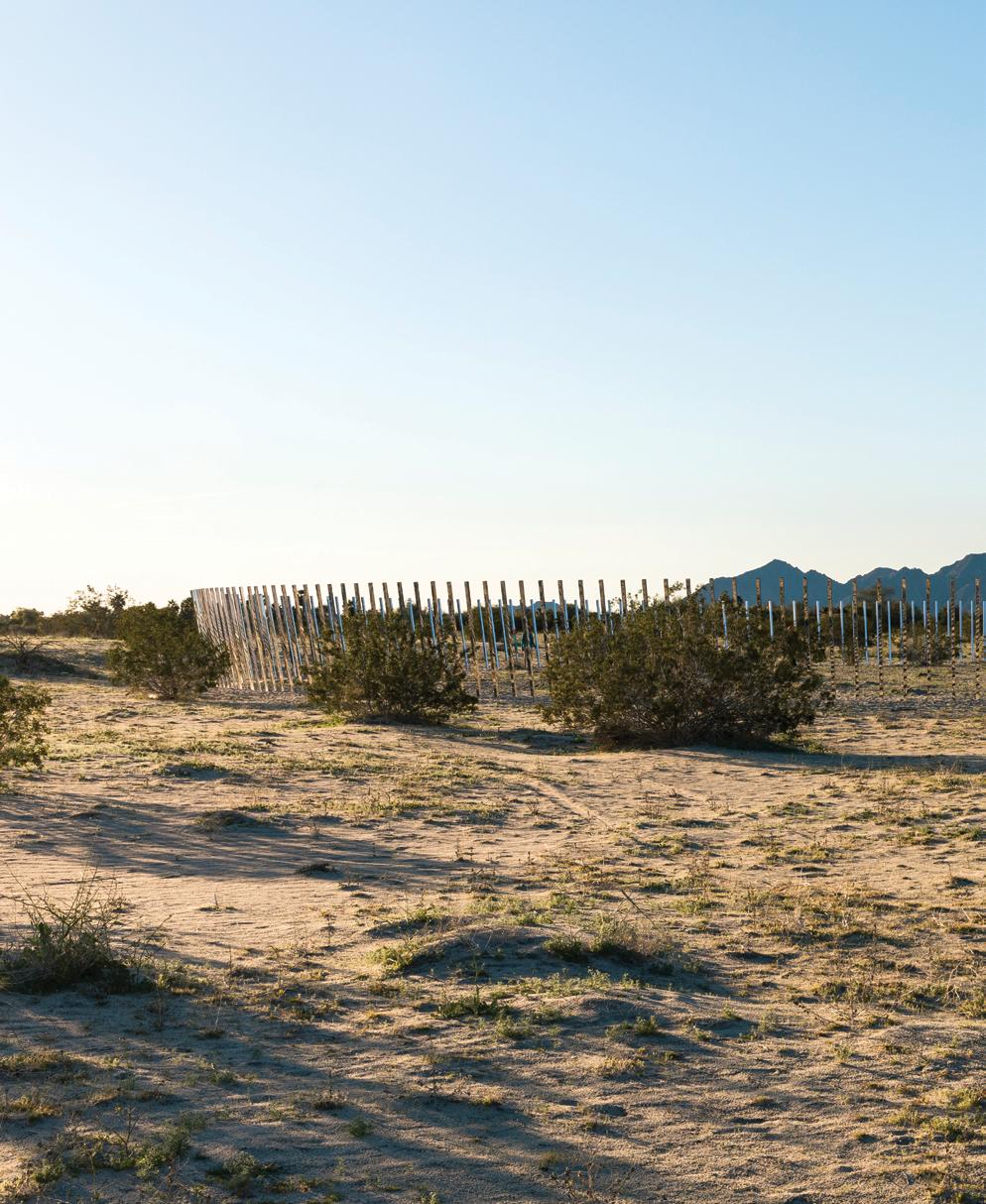
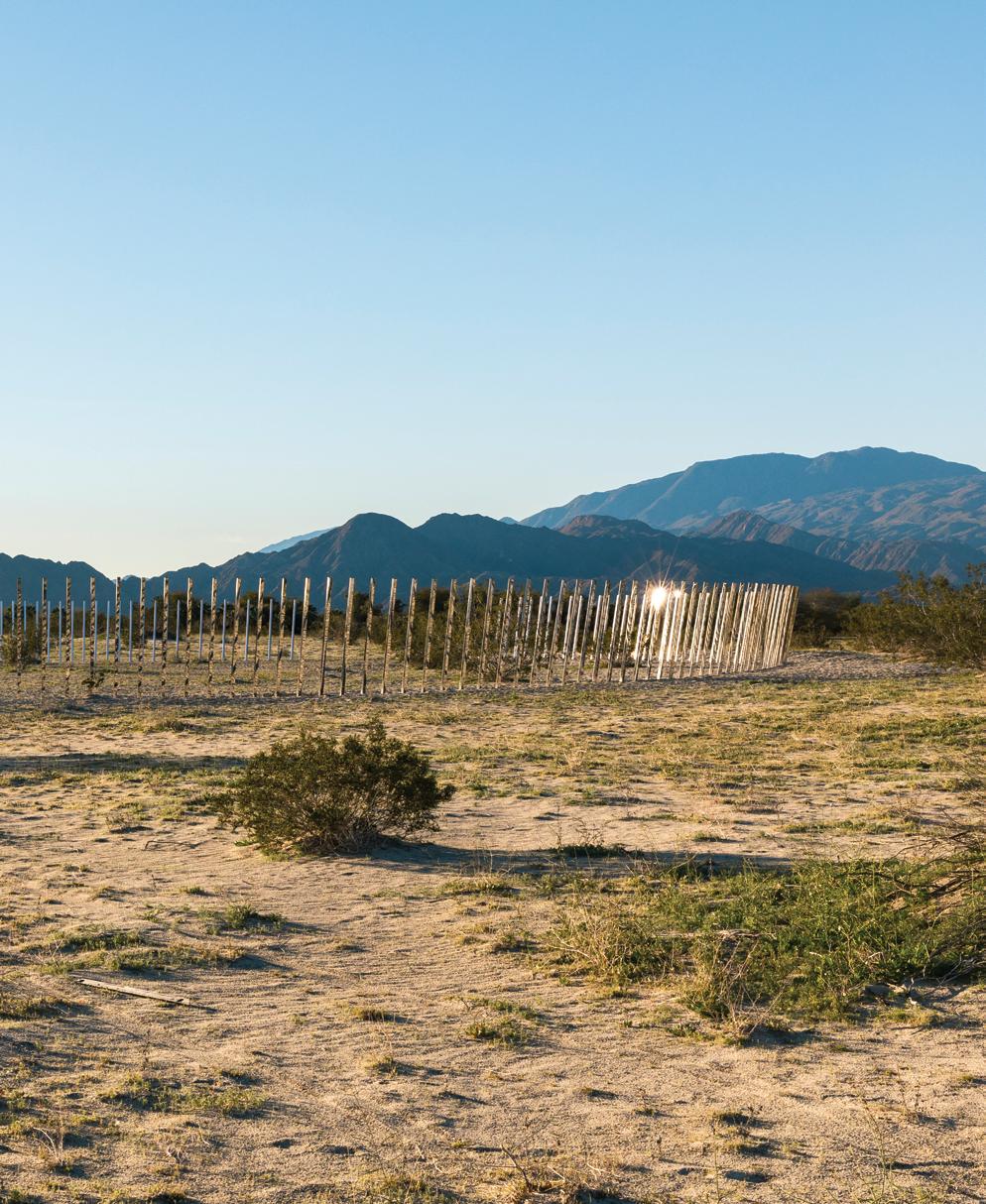
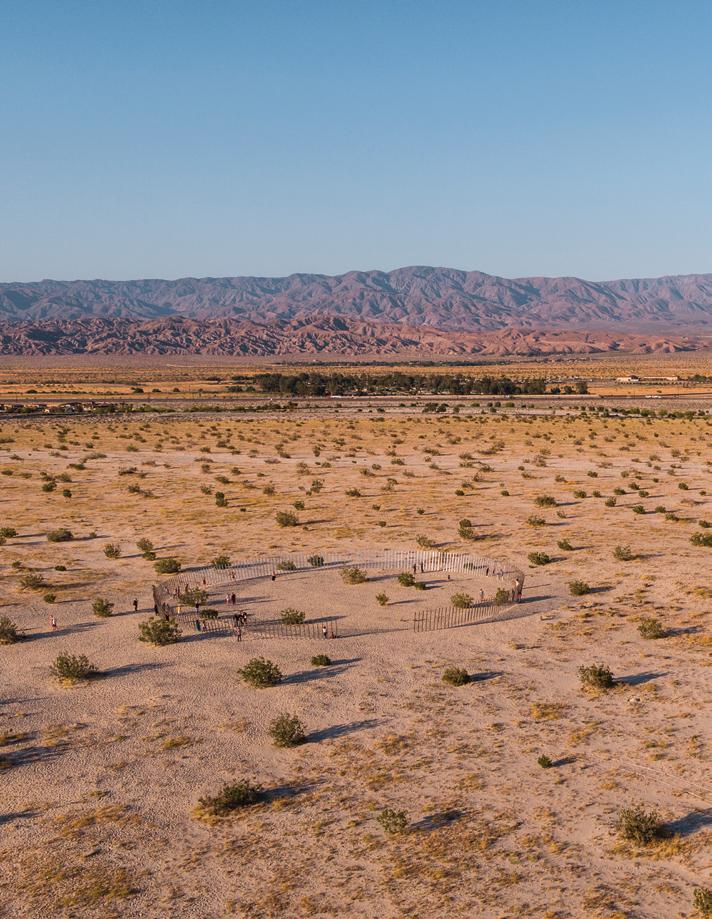
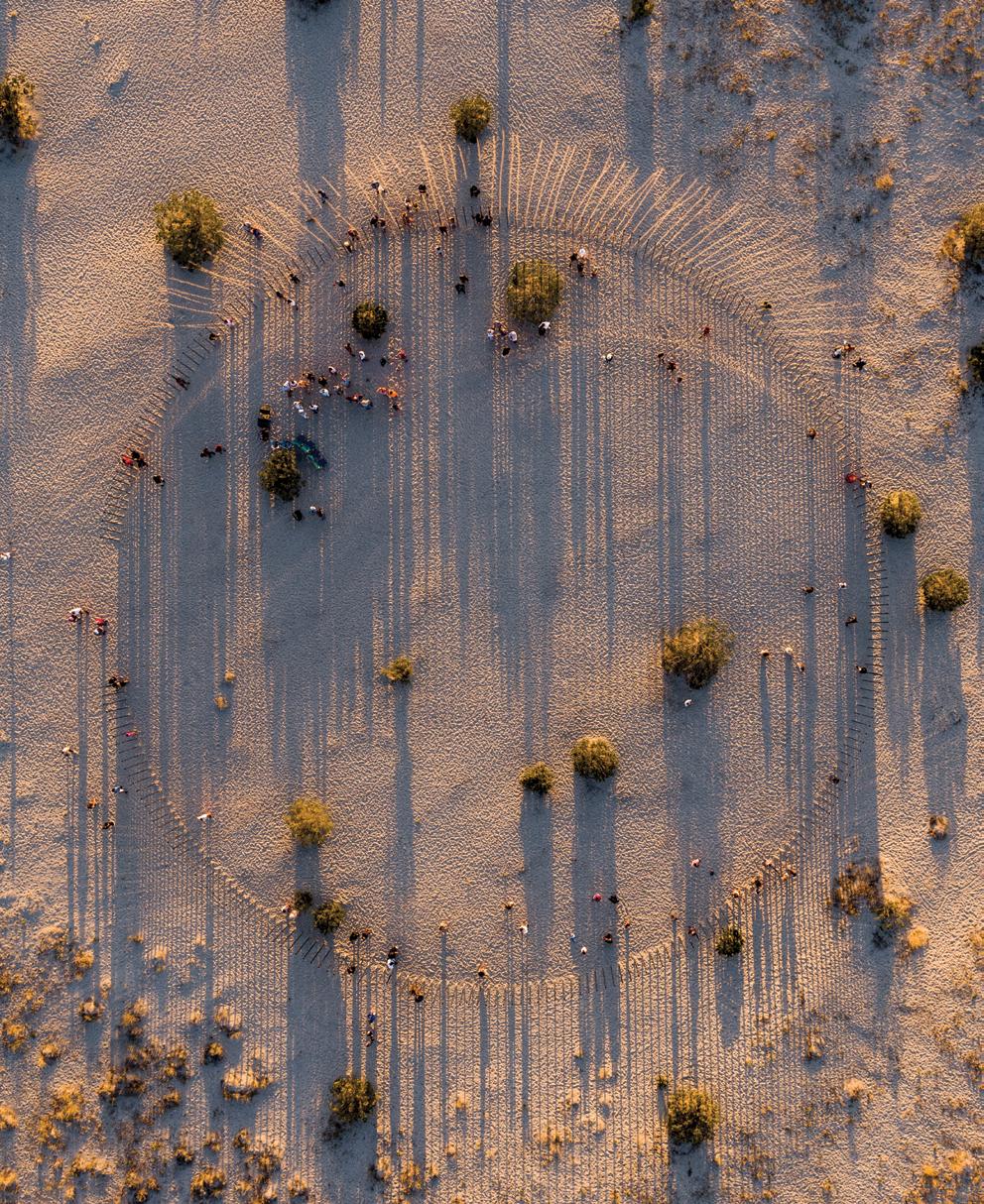
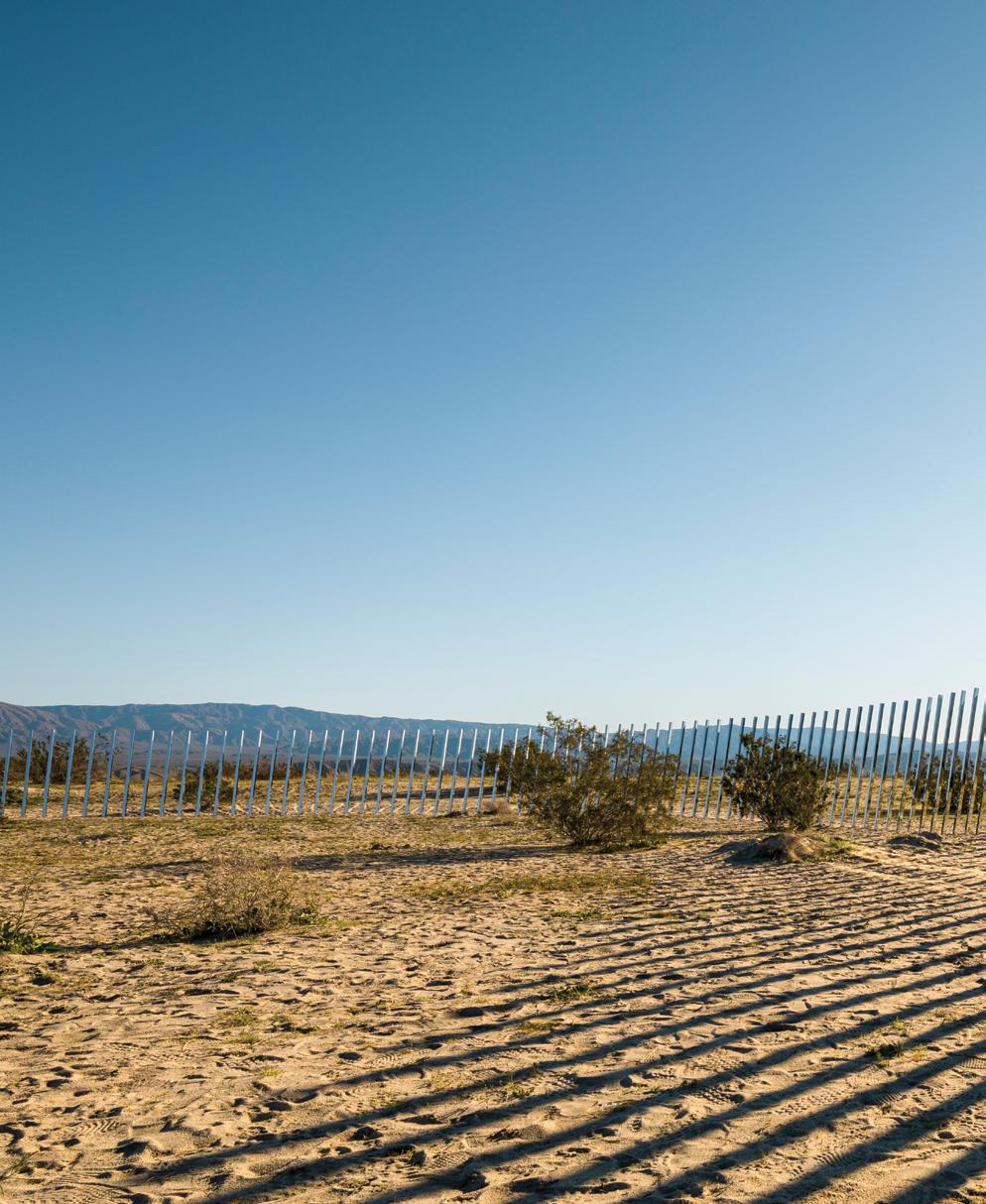
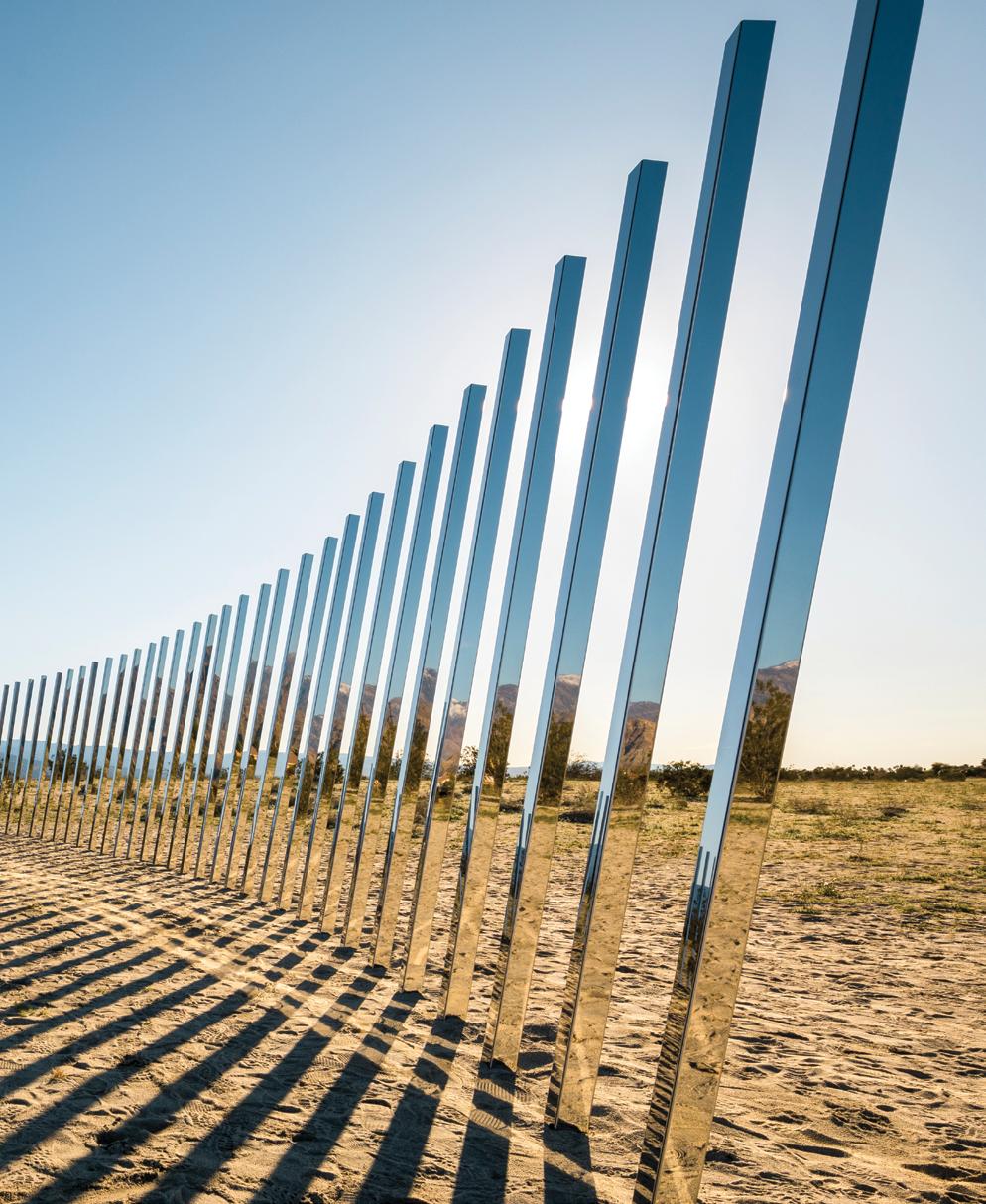
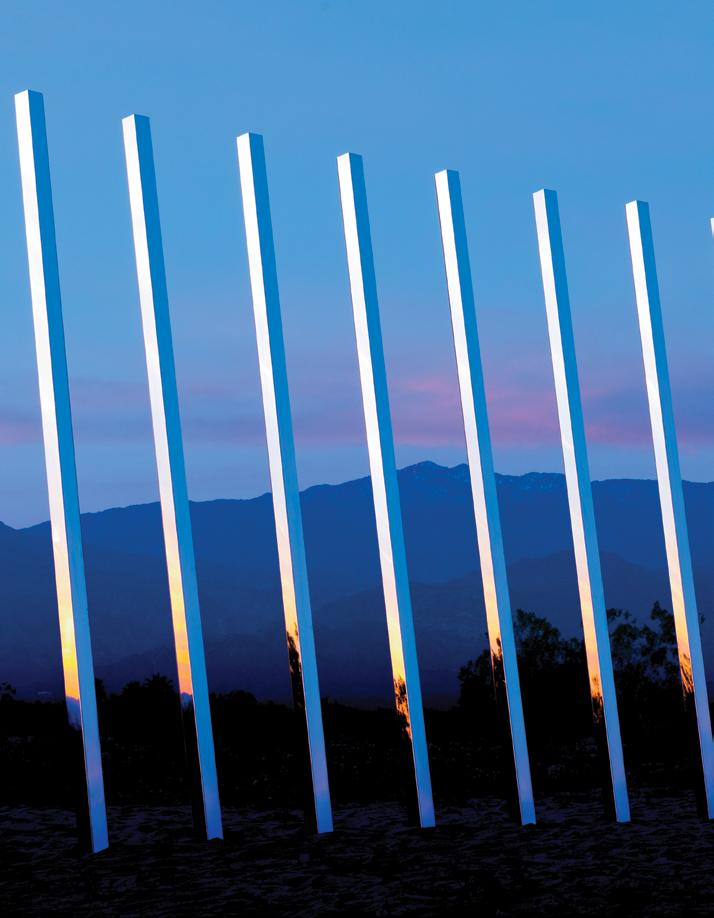
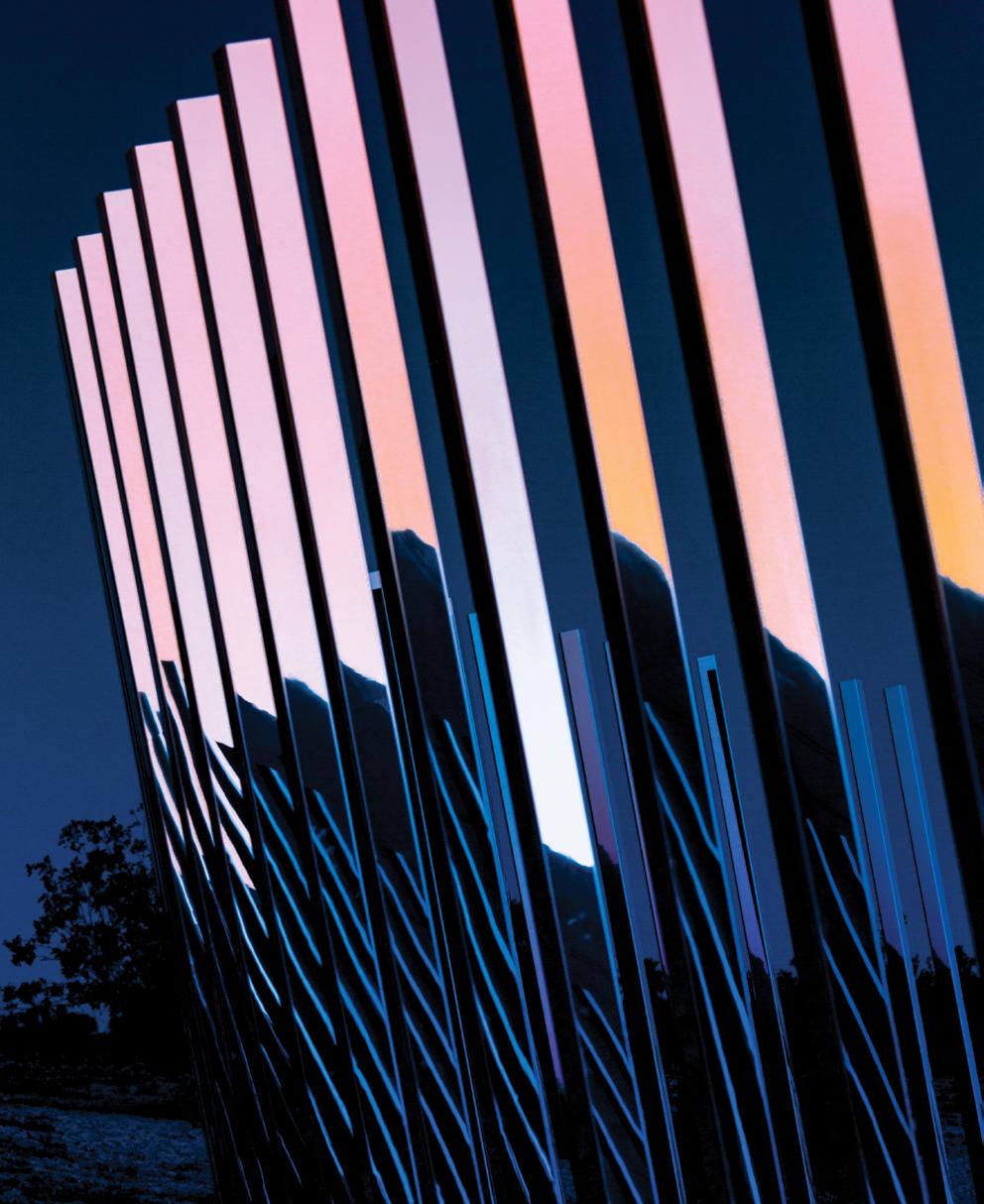
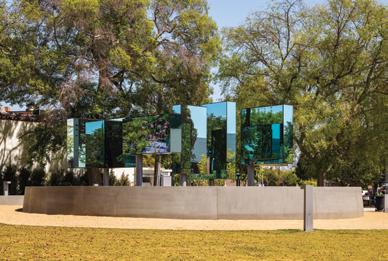
The Circle of Land and Sky defines a reflective space within the desert, composed entirely of the environment’s two most prominent physical characteristics: land and sky. Formed by 300 geometric reflectors angled at 10 degrees, the artwork directly engages with the Sonoran surrounding and the endless heavens. As the light shifts and the viewer moves through the installation, land and sky are separated, merged, and displaced, subverting one’s assumed relationship with the desert horizon. At times, the sky is pulled down to the land or the land lifted up to the sky, while the colors of the west may merge with the colors of the east. It is a constantly changing installation that can never be seen the same way twice.
135
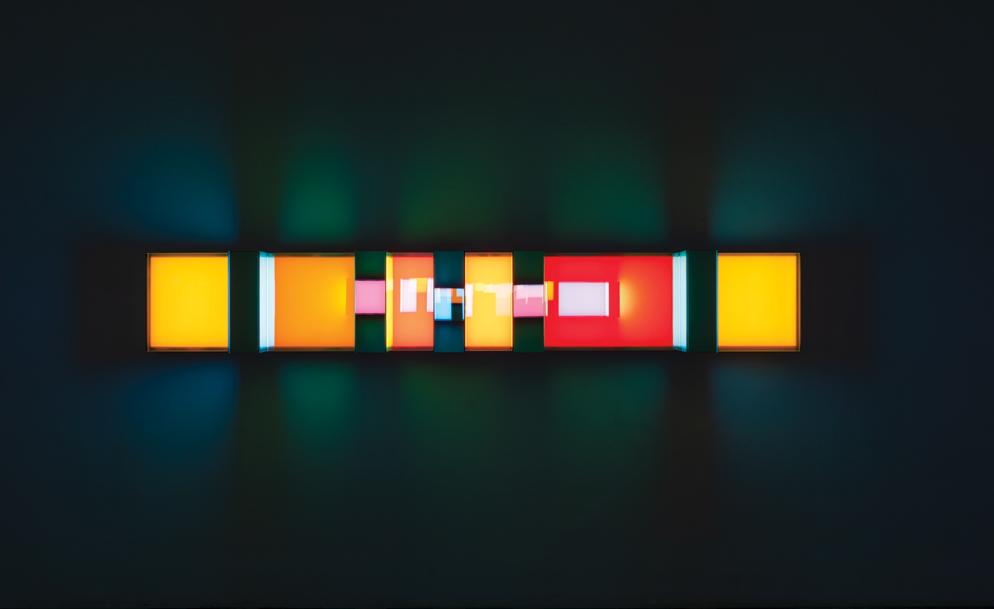
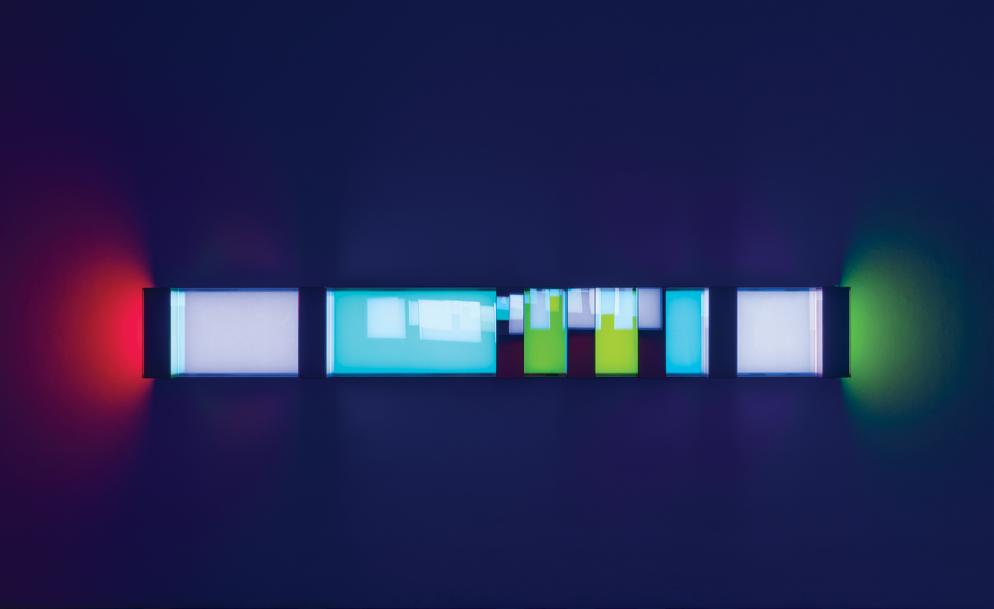
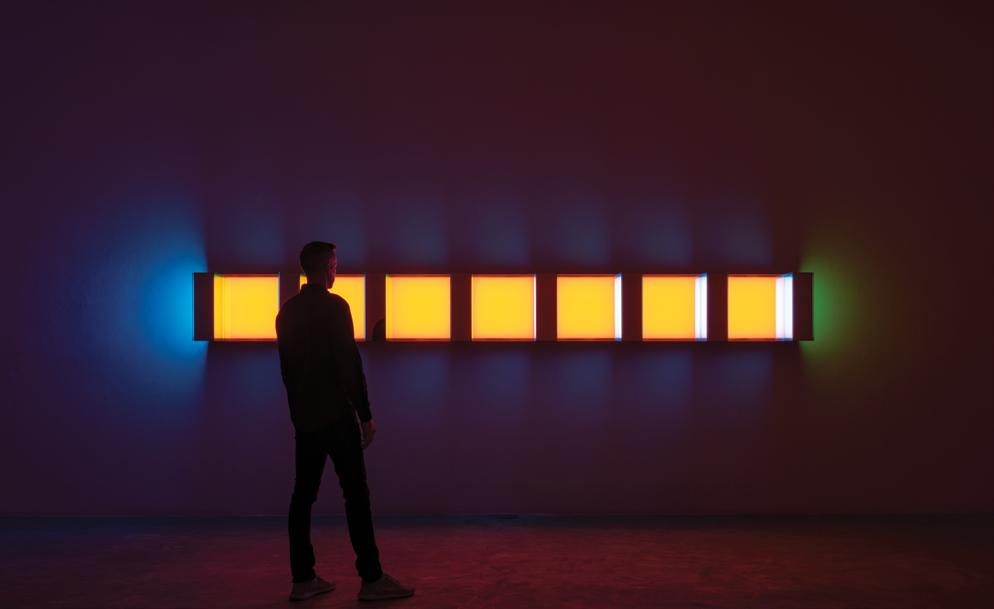
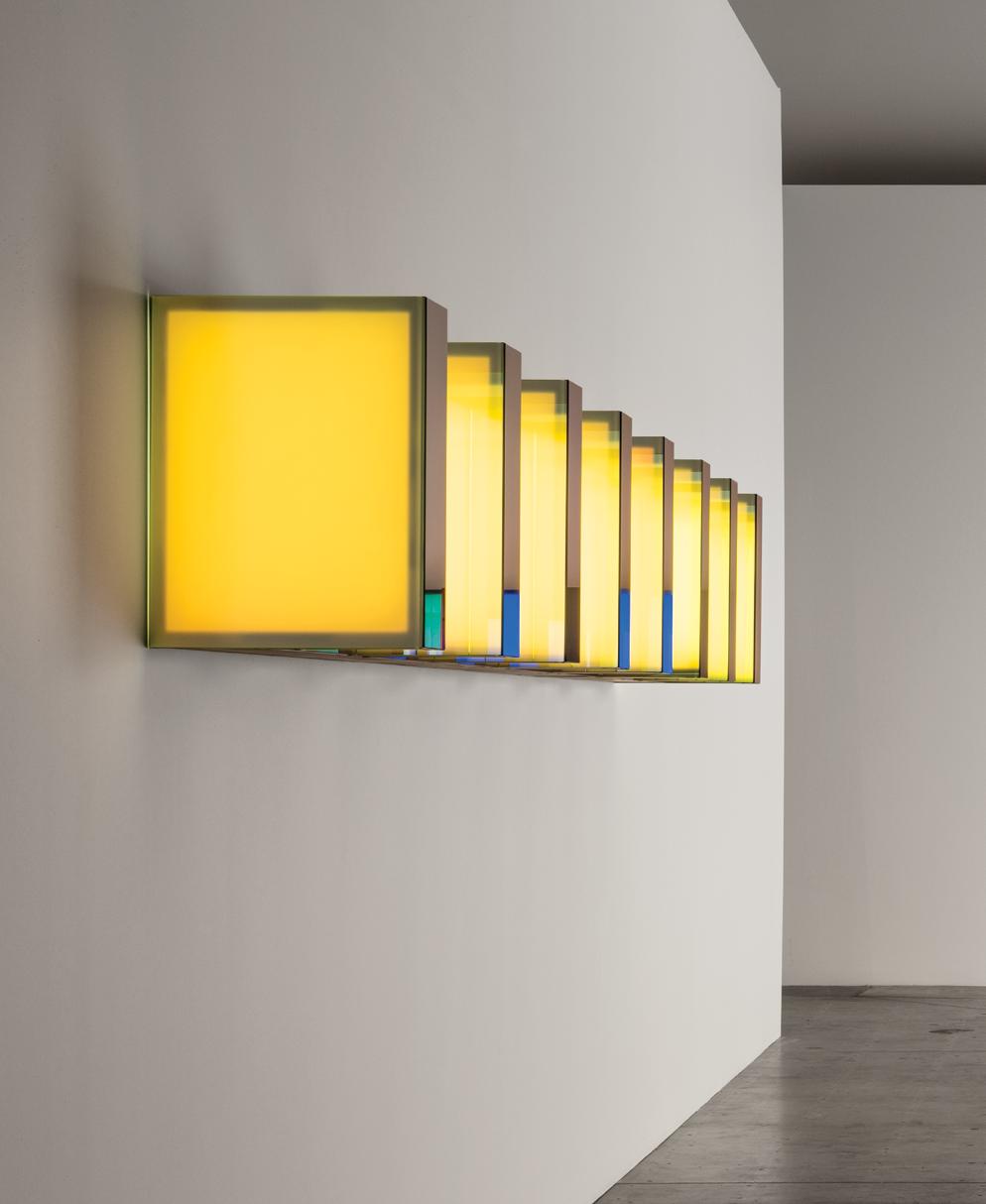
REGULAR/IRREGULAR SERIES 2019
Regular 1: 1’-7.25” x 14’-6” x 1’-3”, 49 x 442 x 38 cm
Irregular 1: 1’-7.25” x 5’-0”x 1’-3”, 49 x 152 x 38 cm
Irregular 2: 1’-7.25” x 10’-9” x 1’-3”, 49 x 328 x 38 cm
Irregular 3: 1’-7.25” x 12’-6” x 1’-3”, 49 x 381 x 38 cm
Glass, aluminum, LED lighting, electronic components, unique color program
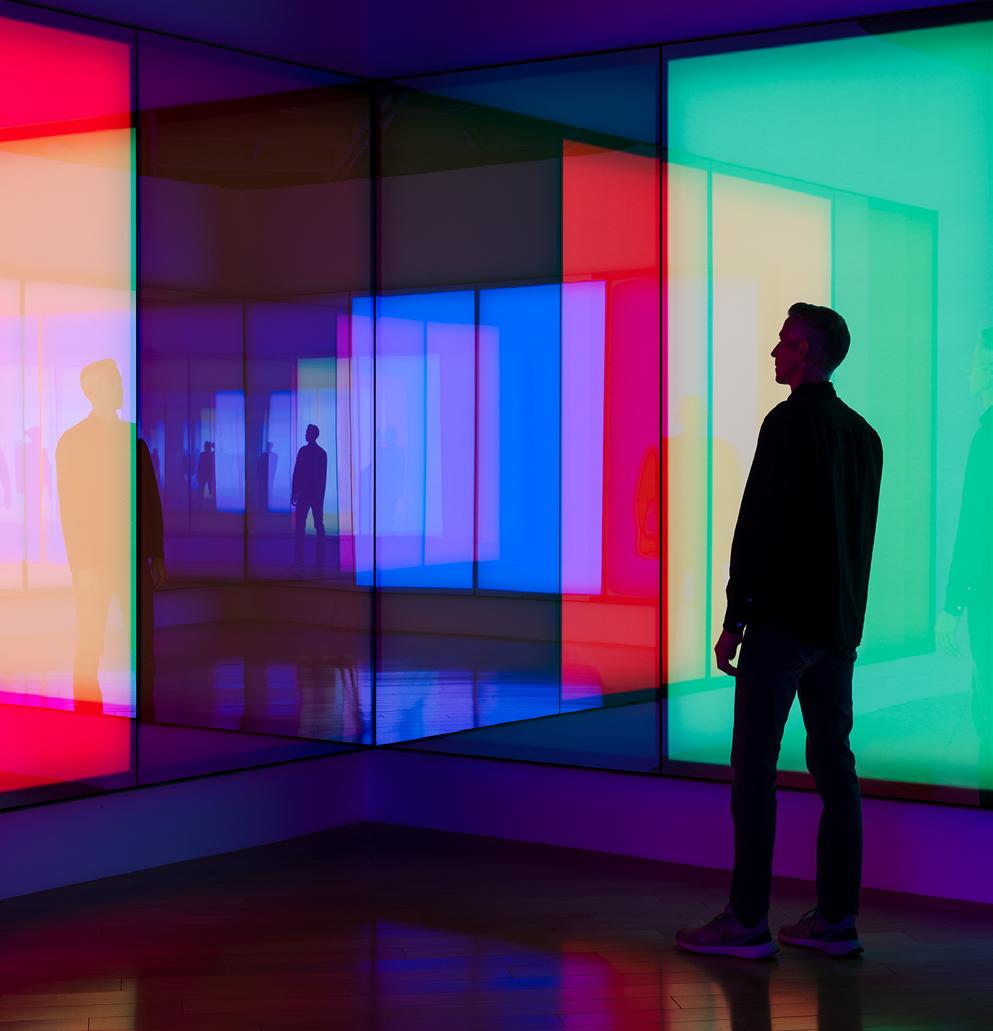
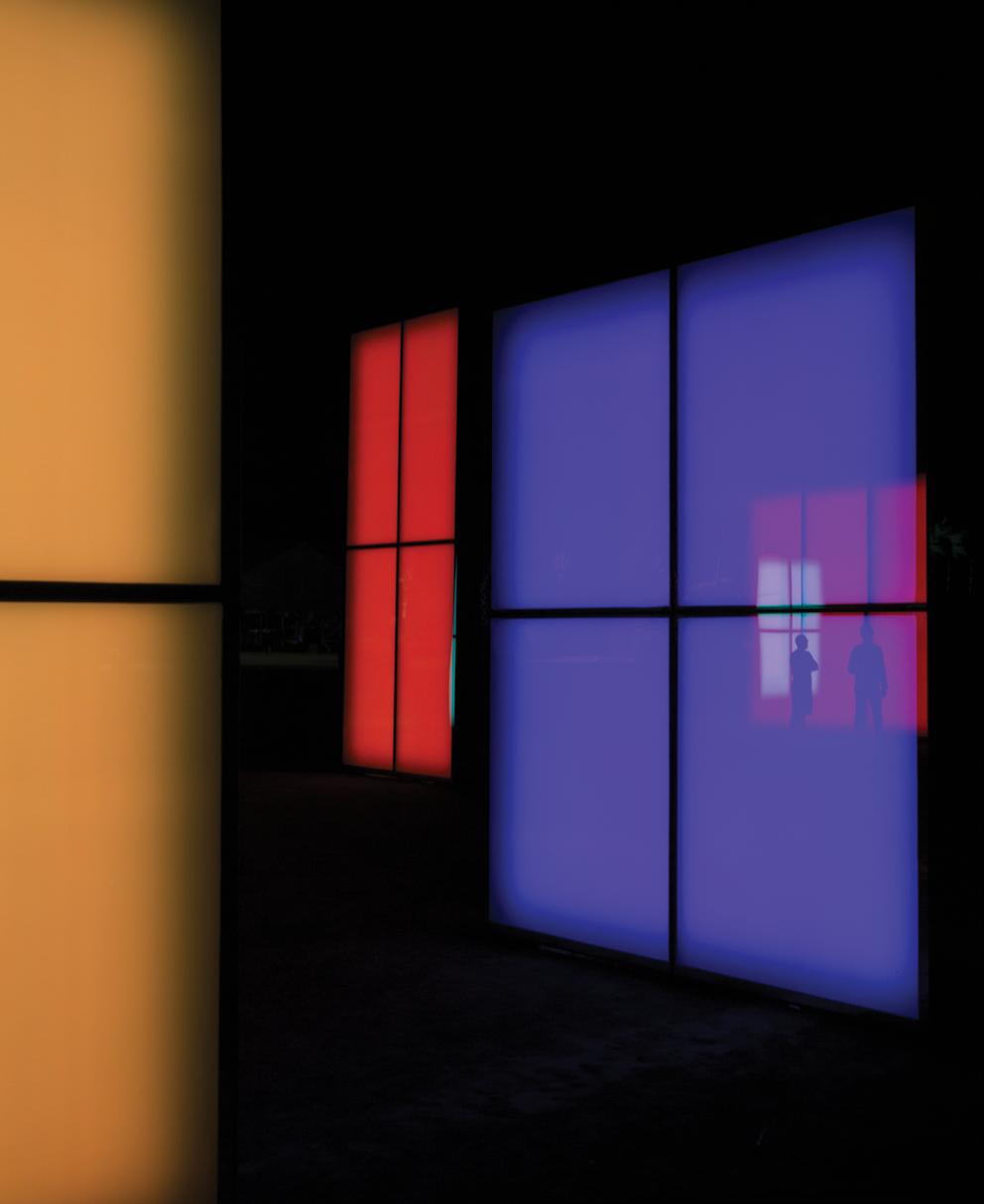
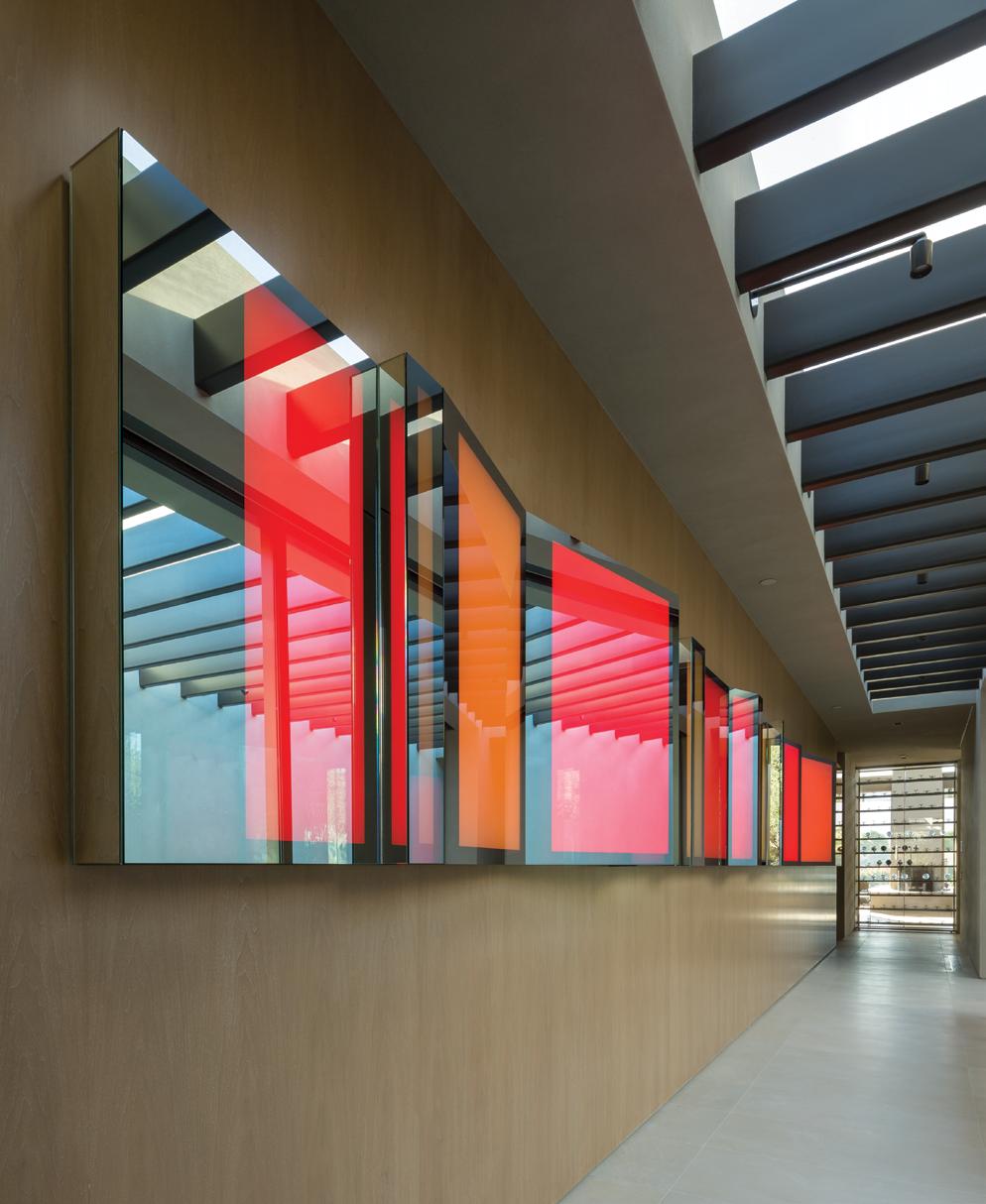
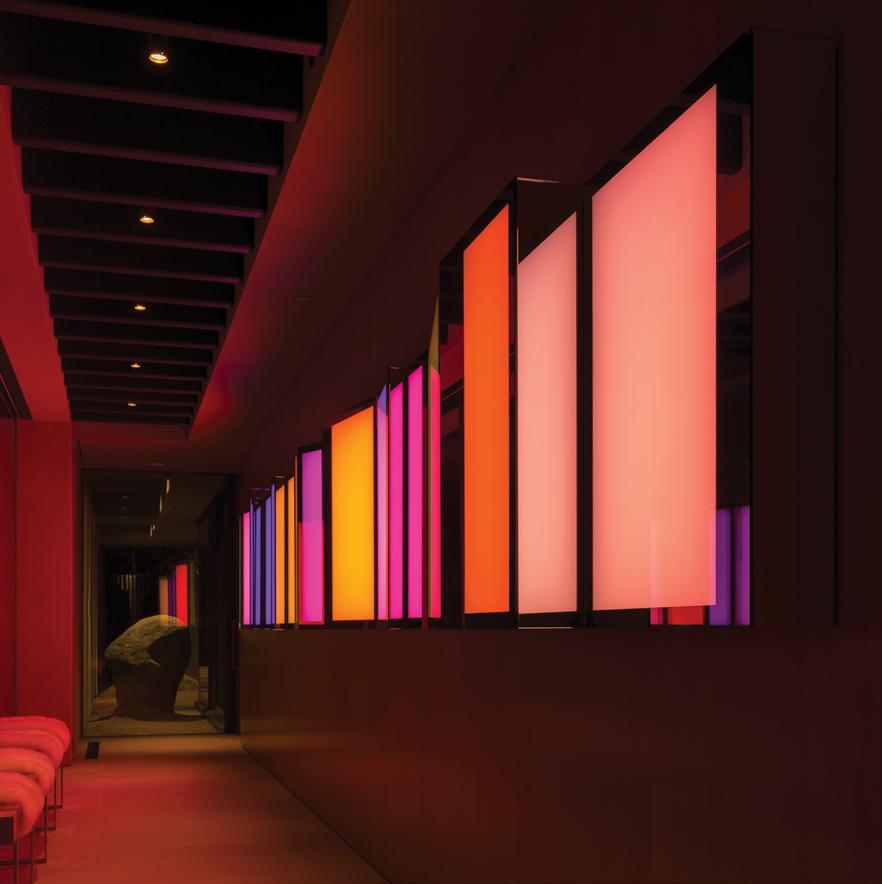
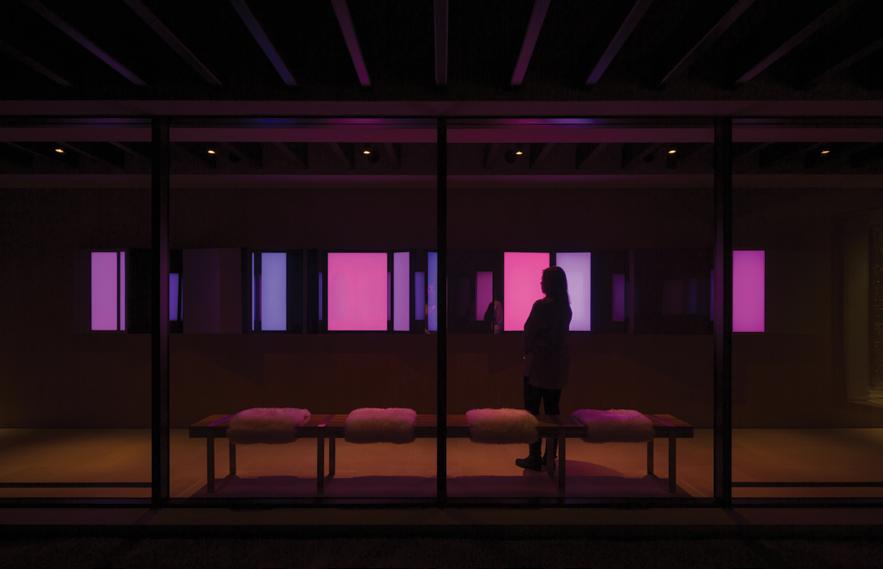
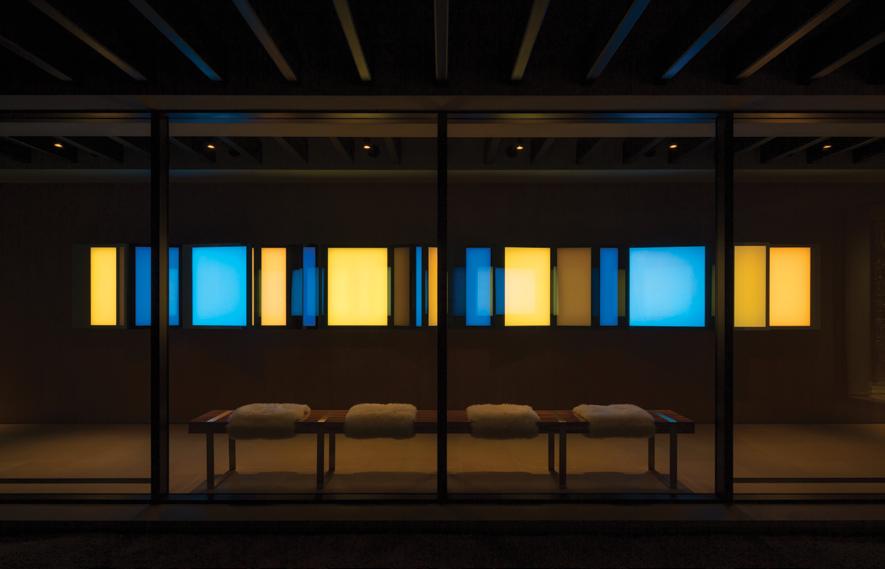
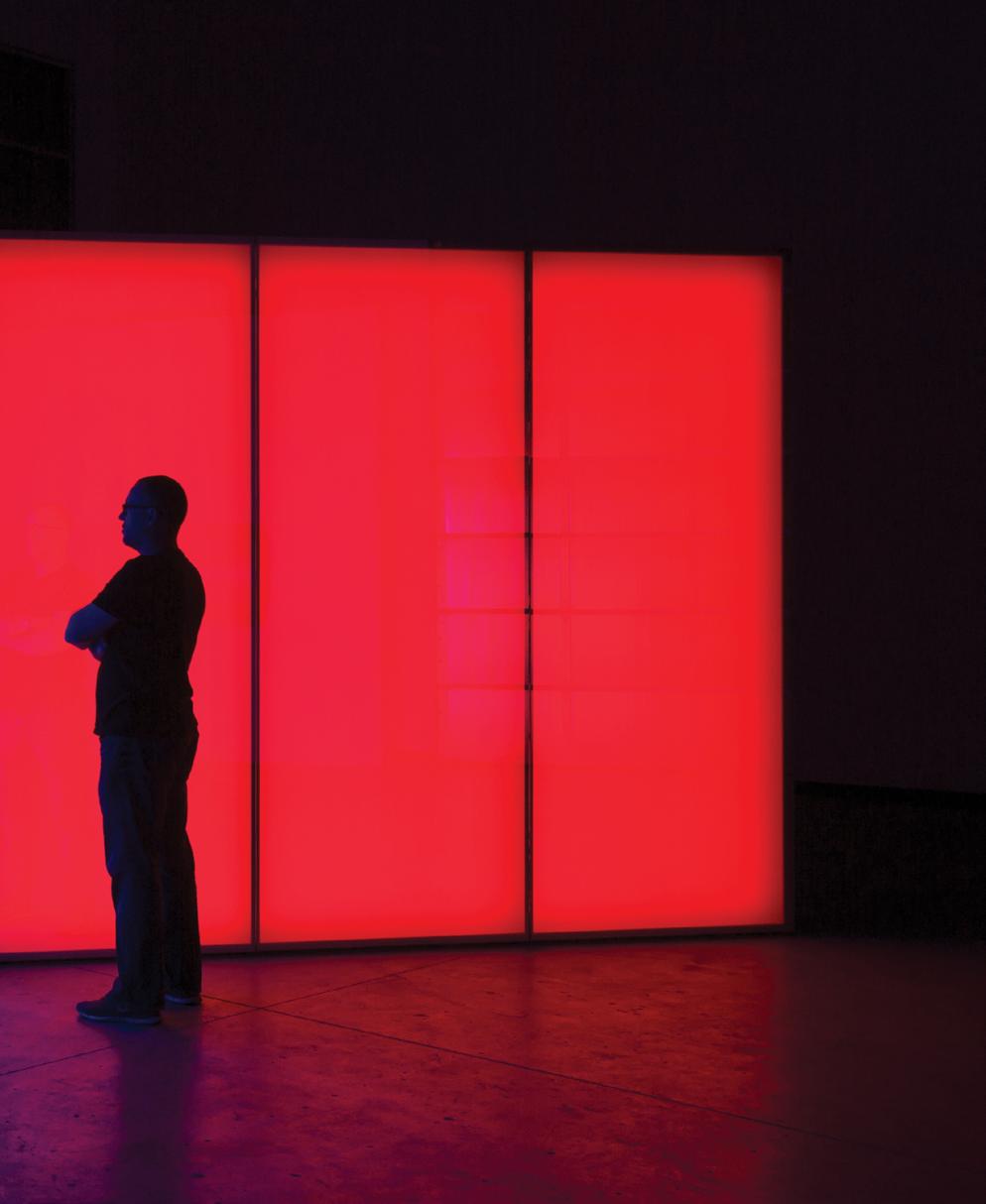
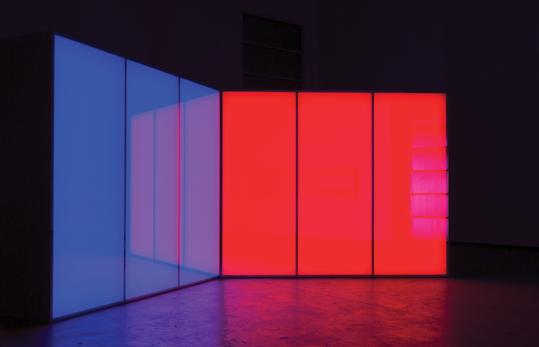
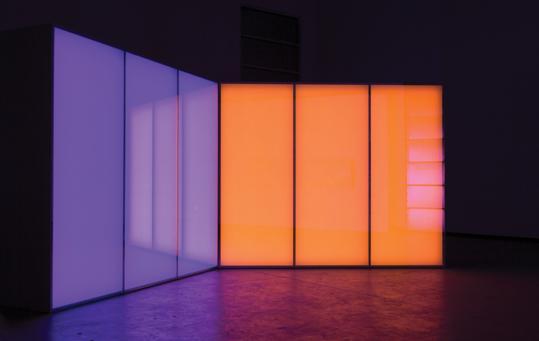
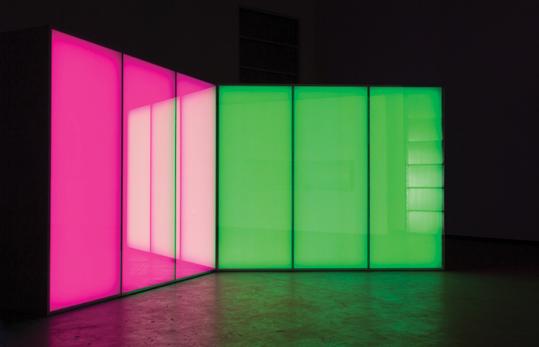
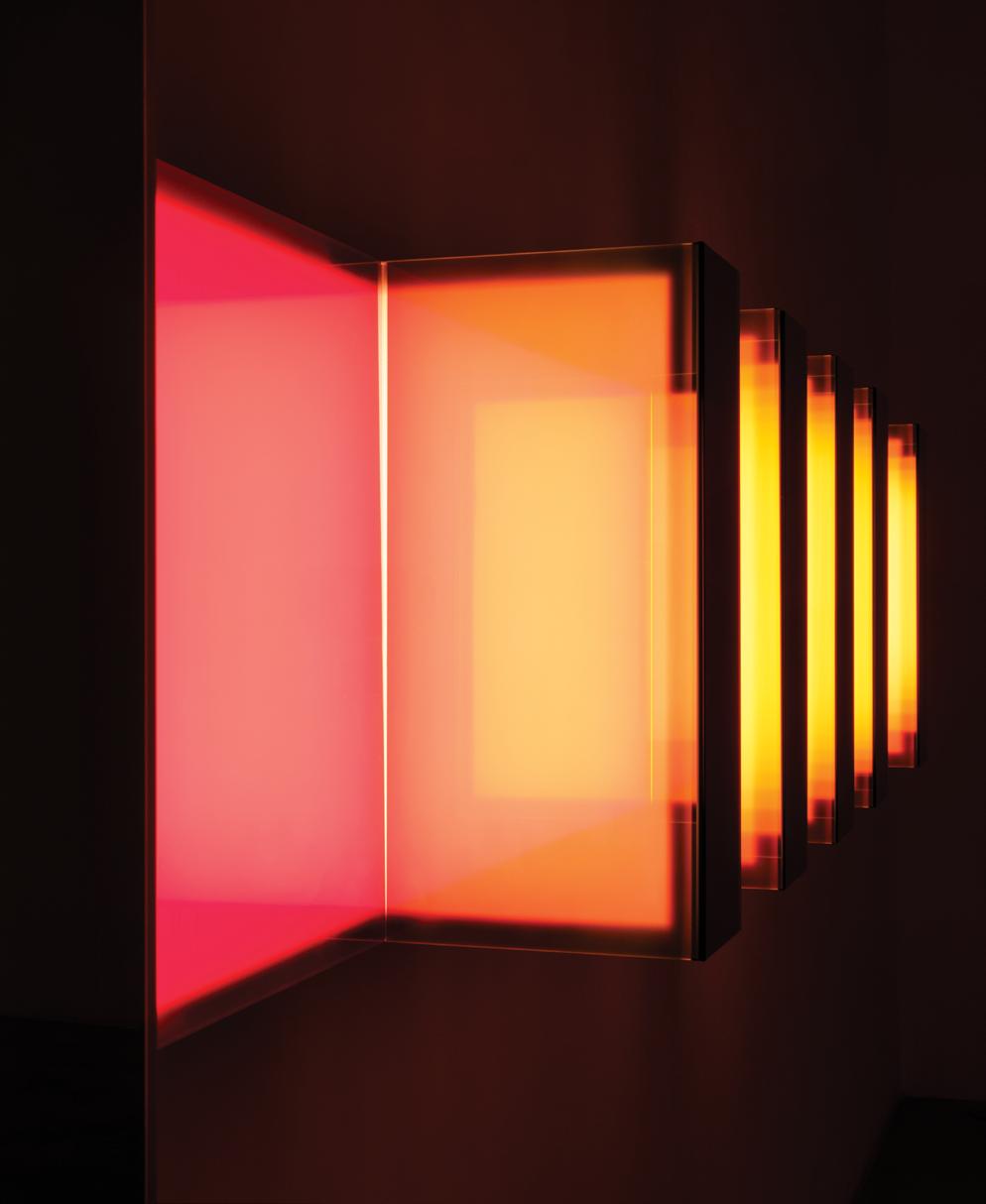
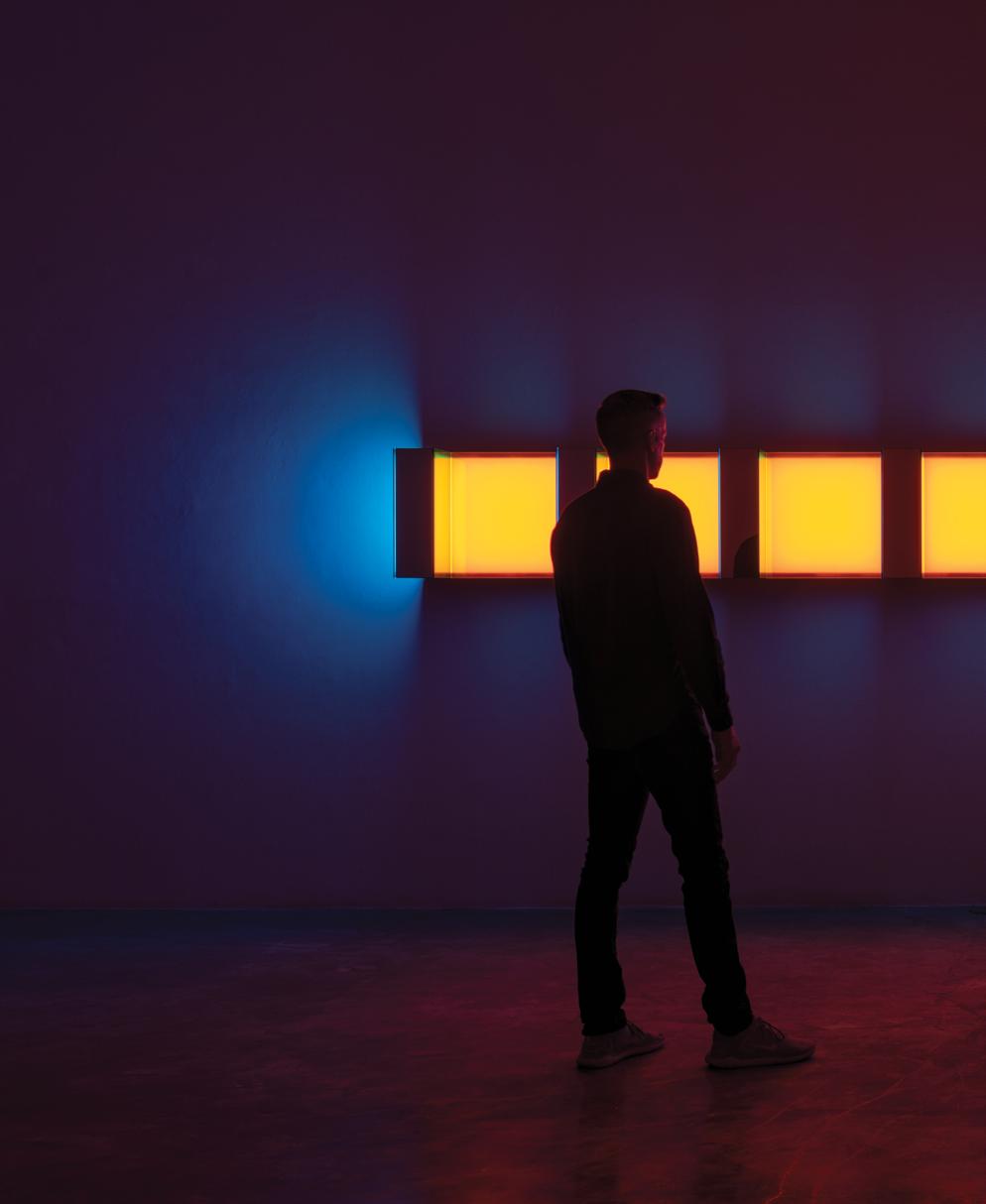
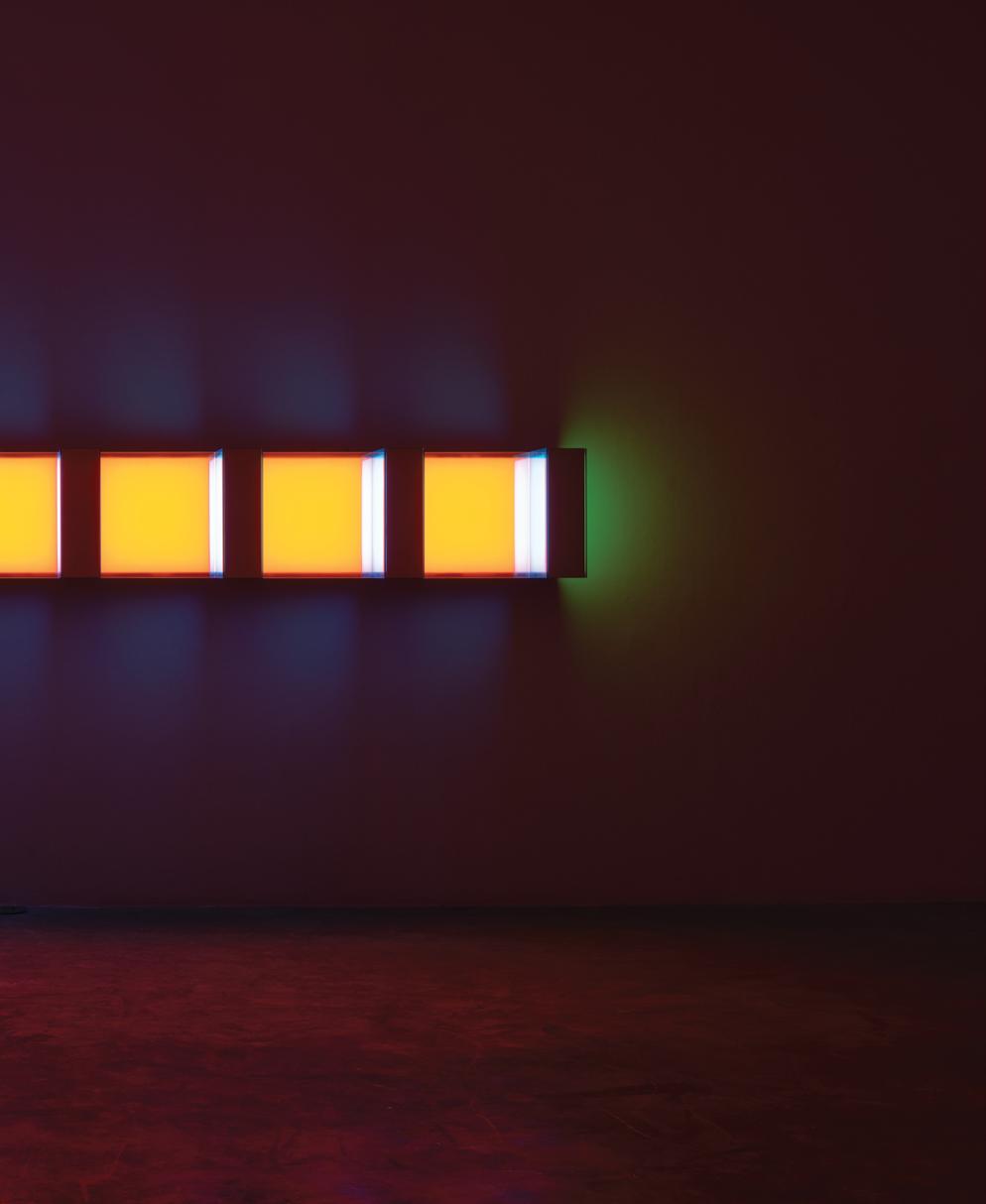
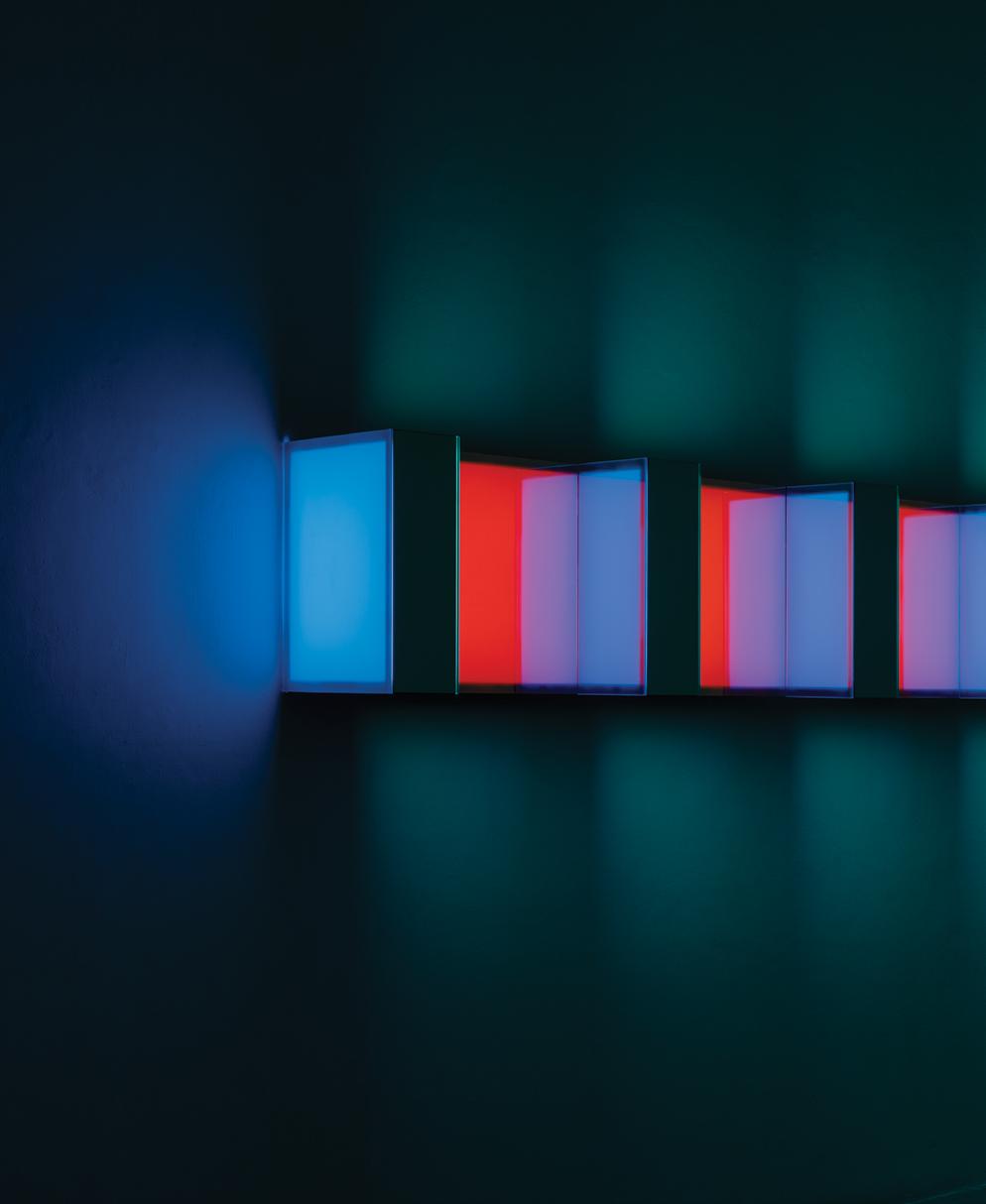
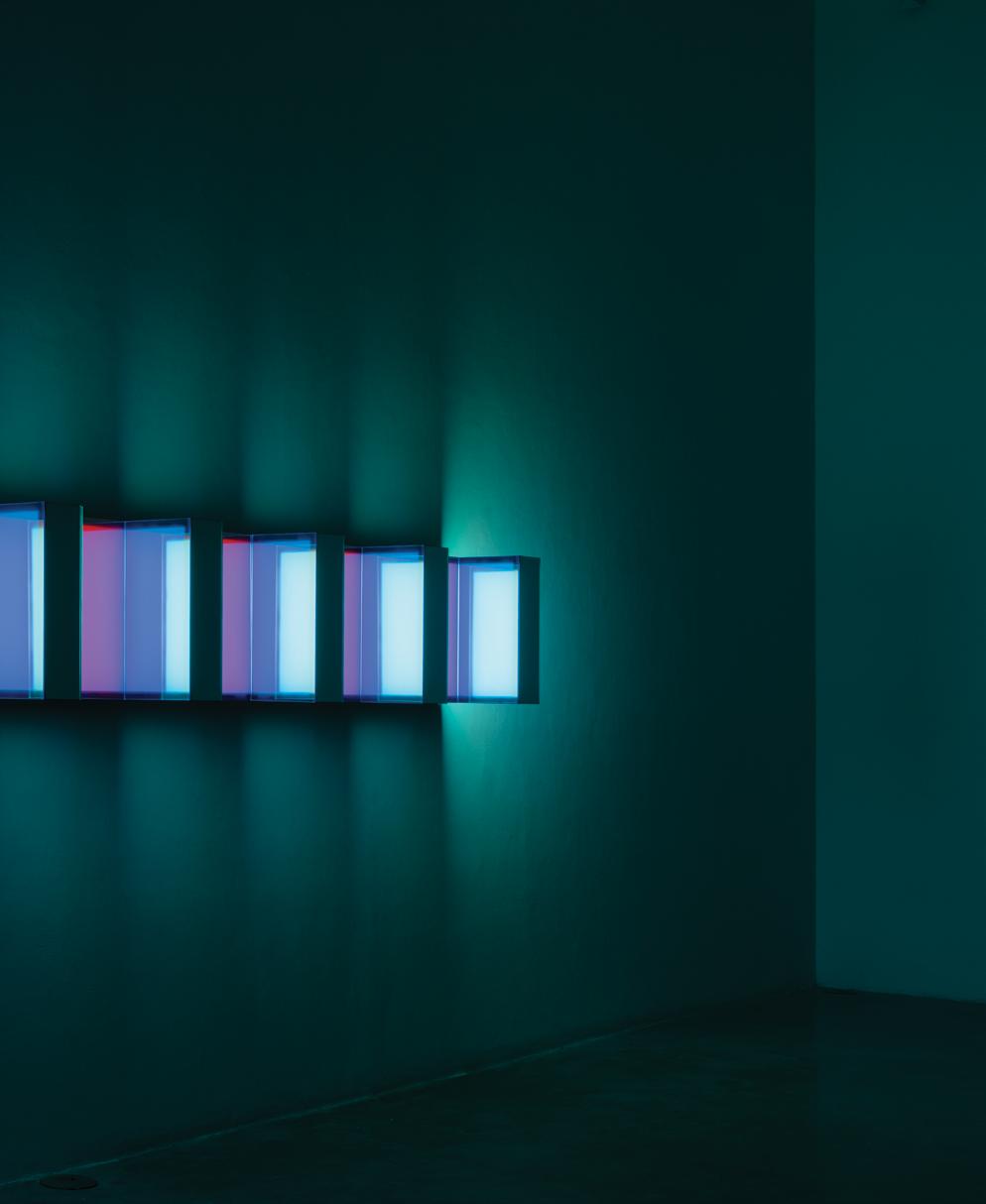
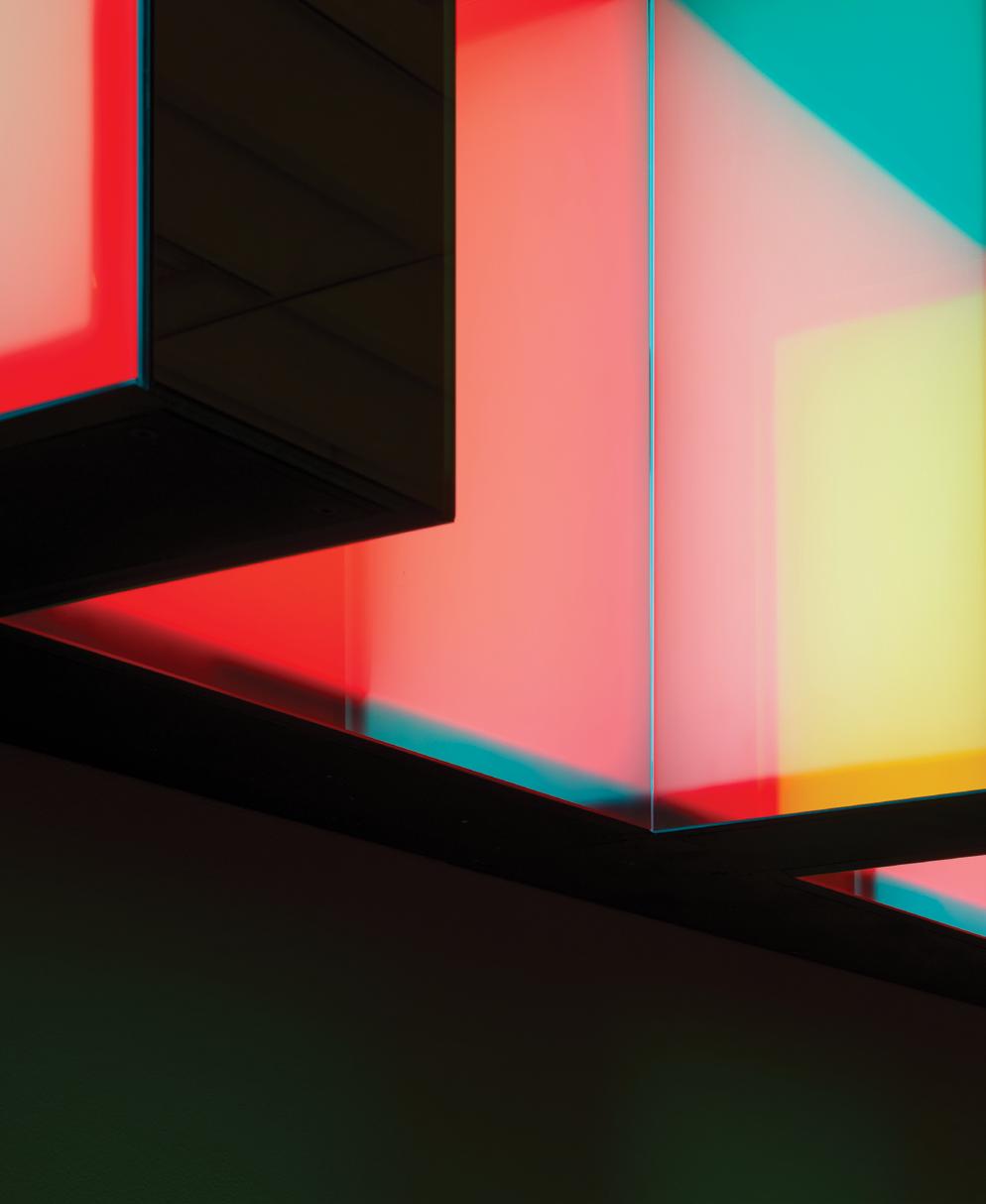
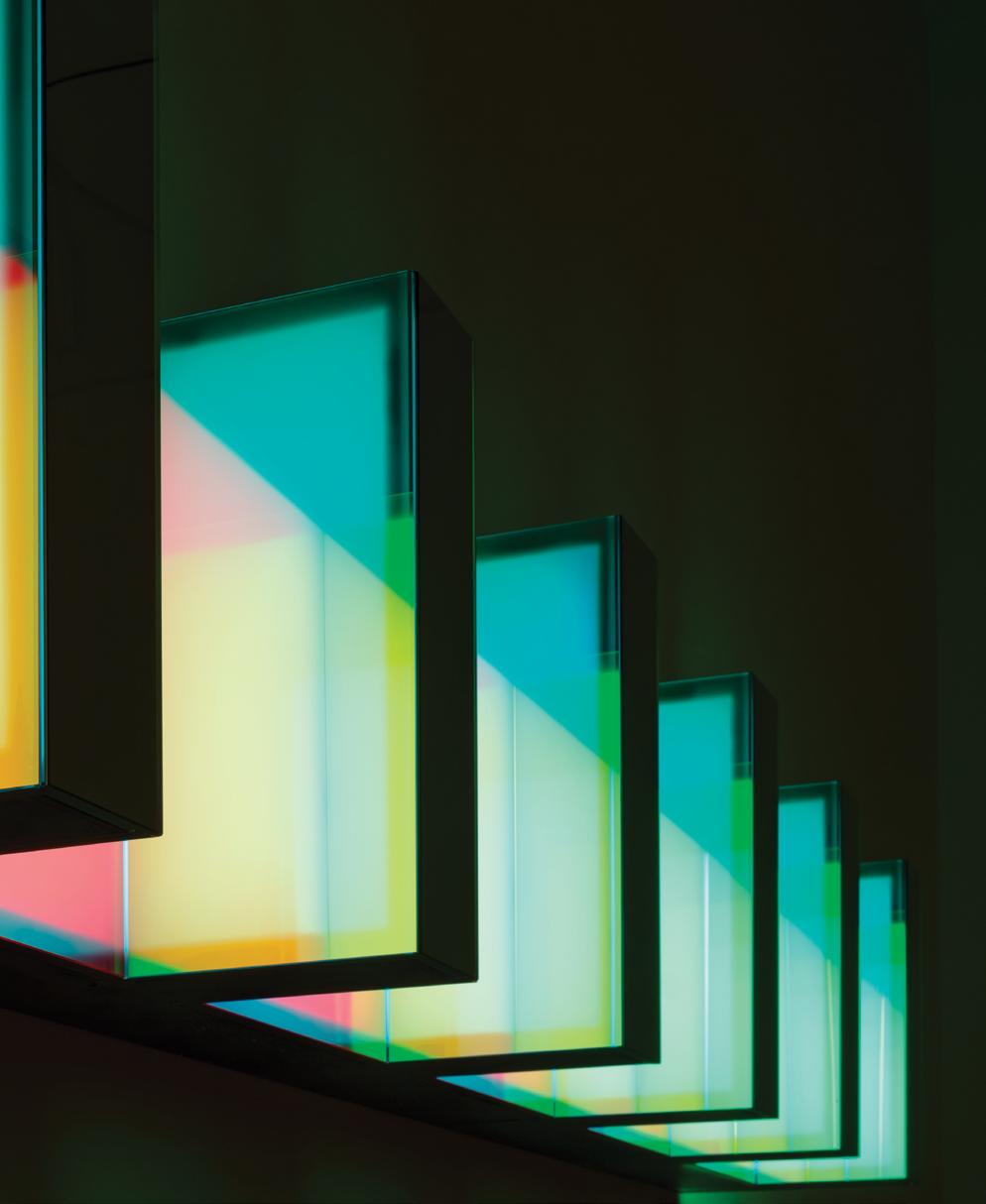
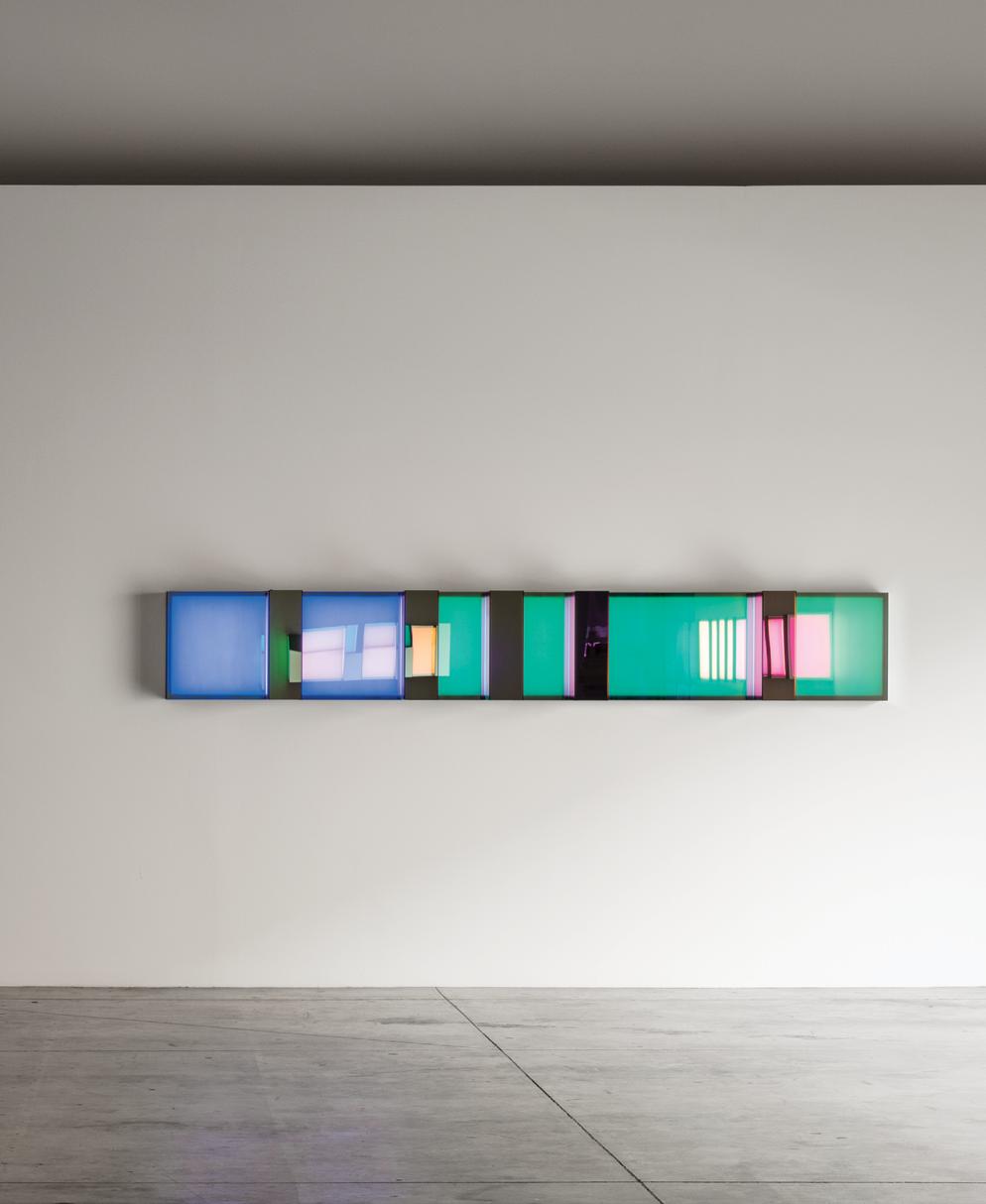
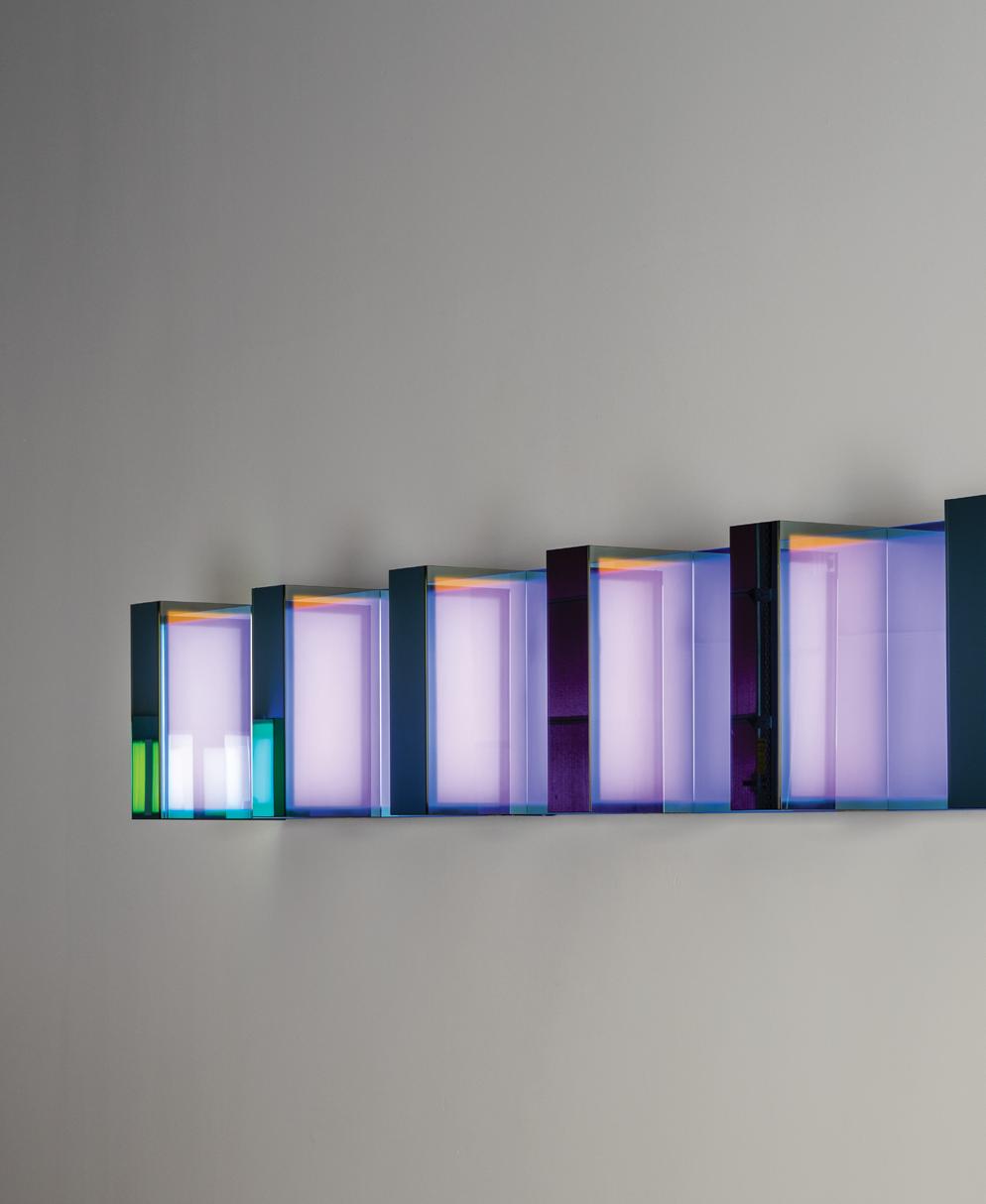
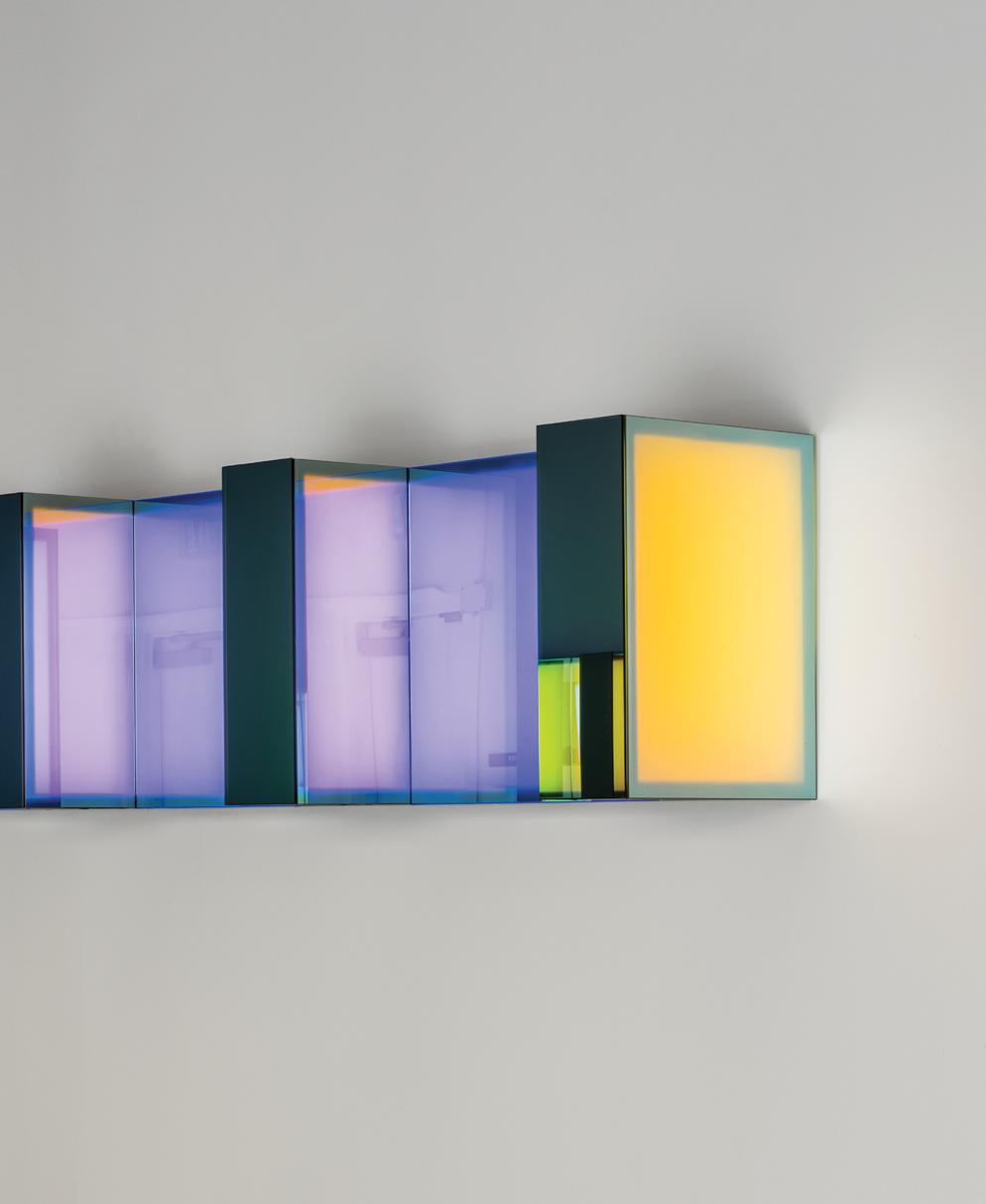
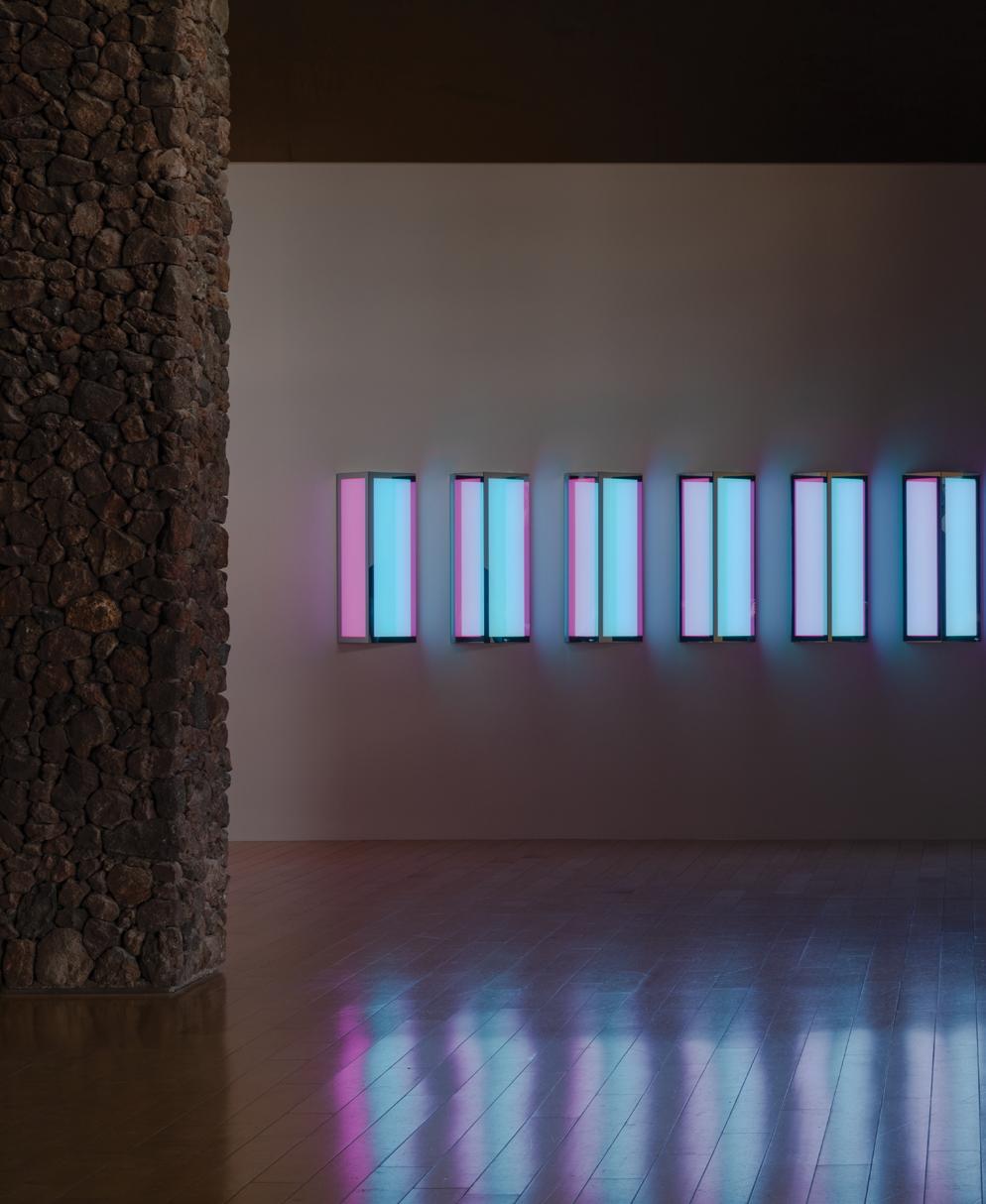
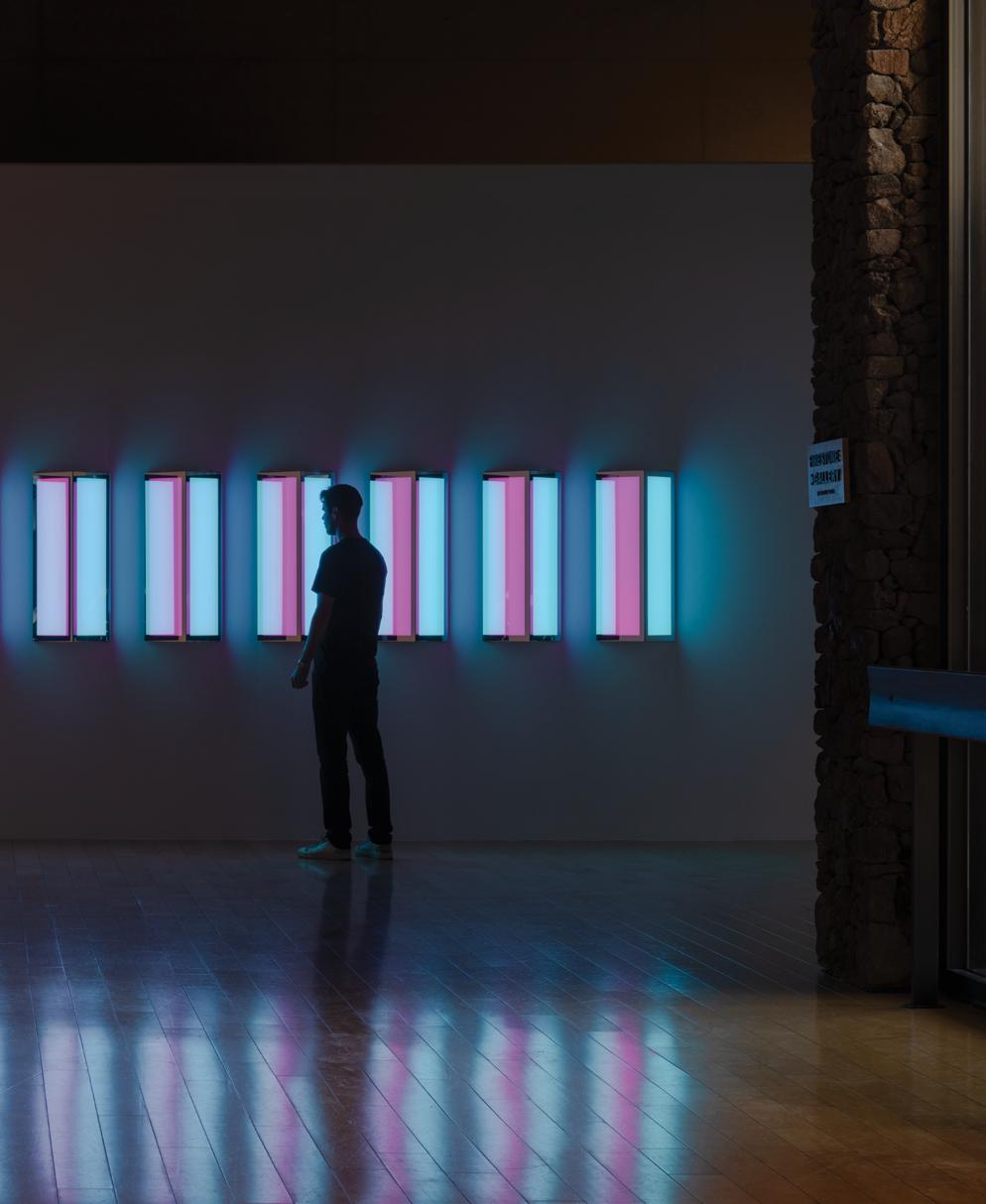
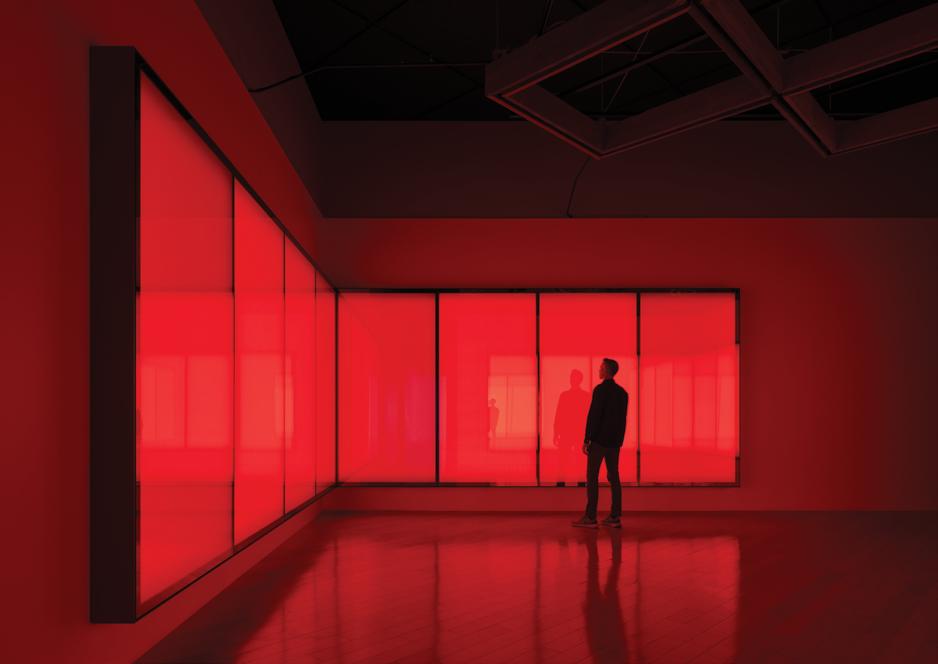
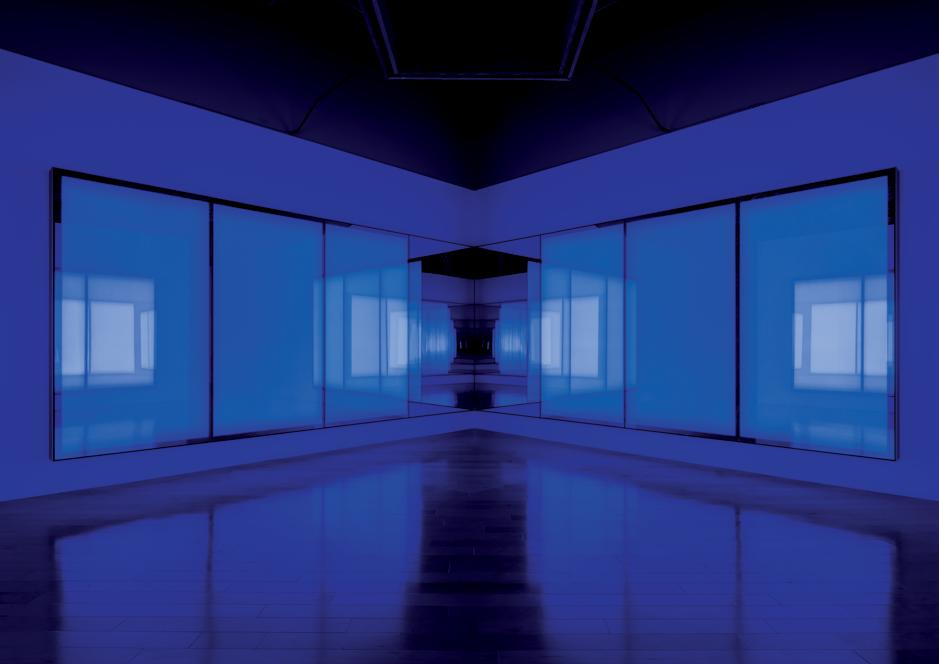
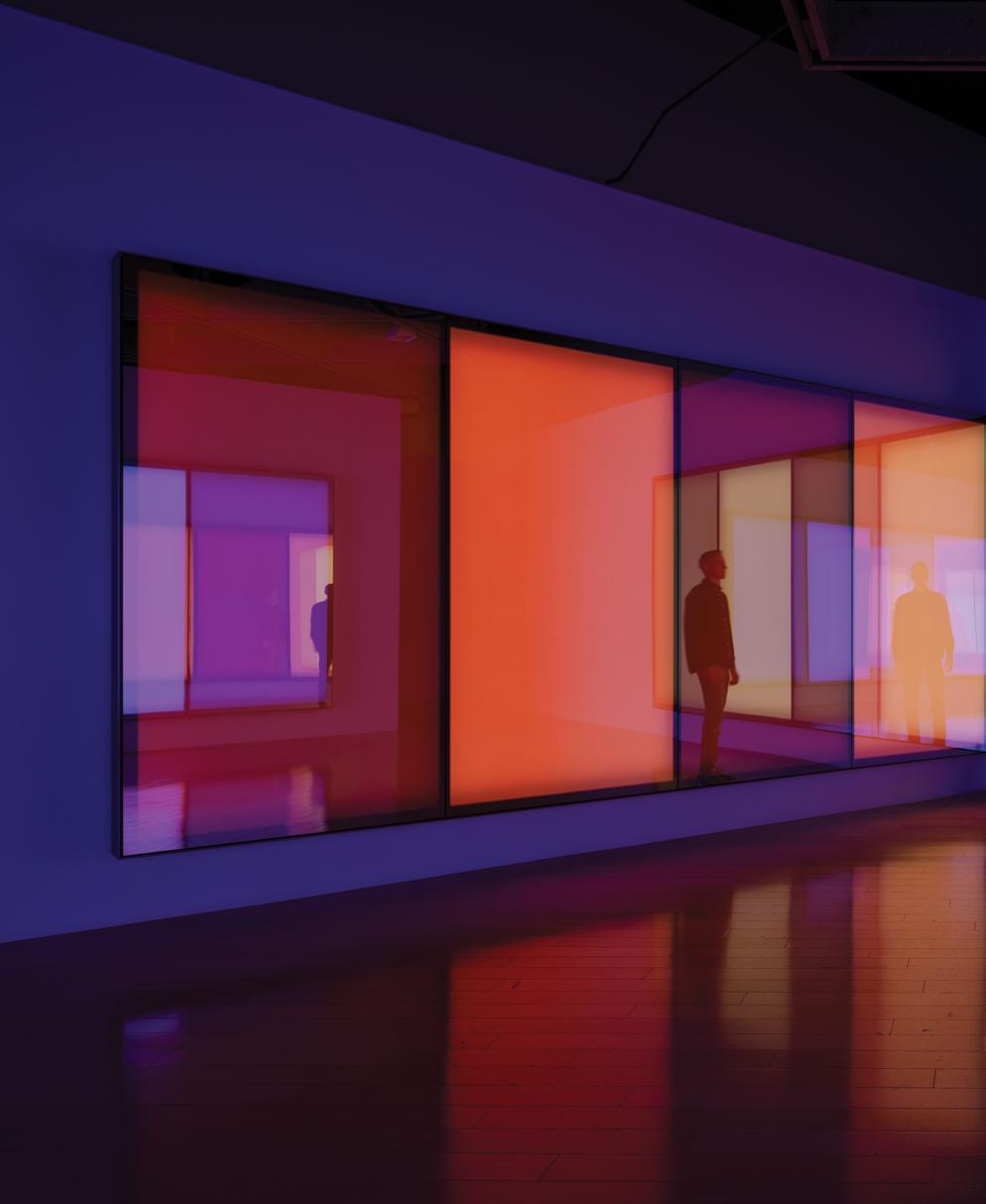
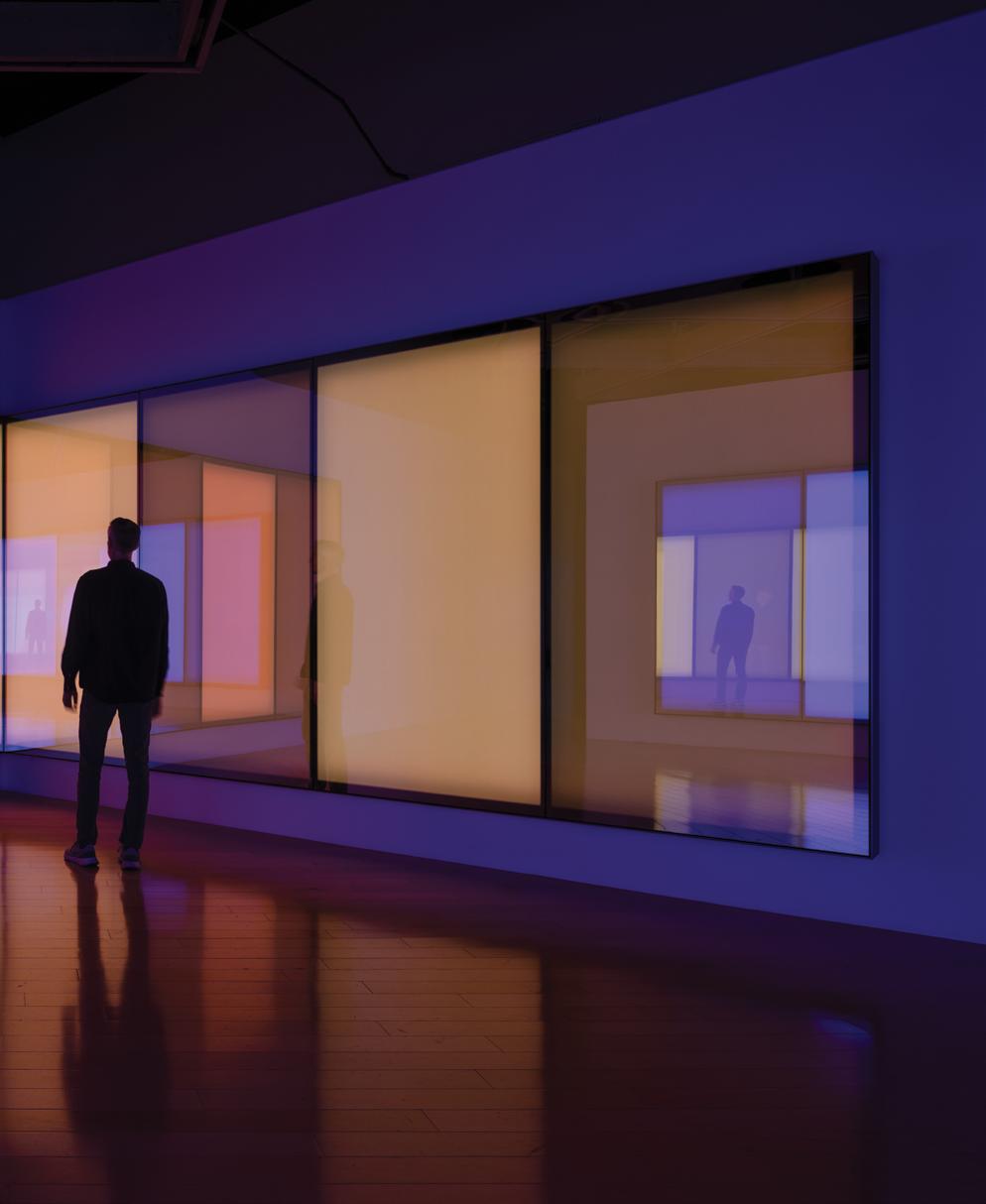
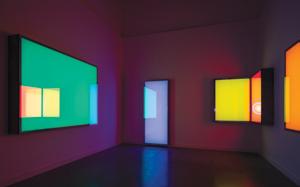
Inspired by the “corner window” in Smith’s Lucid Stead: Four Windows and a Doorway, the Regular/Irregular works merge color with reflection within a durational, spatial experience. Using a consistent modular logic, this series of work is composed of regular or irregular compositions. Irregular compositions have no particular pattern or symmetry, which allow color to be pushed across the reflective surfaces in a more organic way. The regular composition adheres to a consistent rhythm of dimension and spacing allowing the color to be distributed consistently across similar surfaces (all of the right-facing panels are blue, while the left-facing panels are red, for instance). The dialogue of color, form, and reflection creates a continuity and shift of one’s perception of the space being viewed and the space in which the work is located. Dark room (night) conditions amplify the concentration of color over reflection, allowing color to float, whereas lit room (day) conditions amplify reflection over color, creating tinted views of oneself and the surrounding environment.
151
OPEN SKY
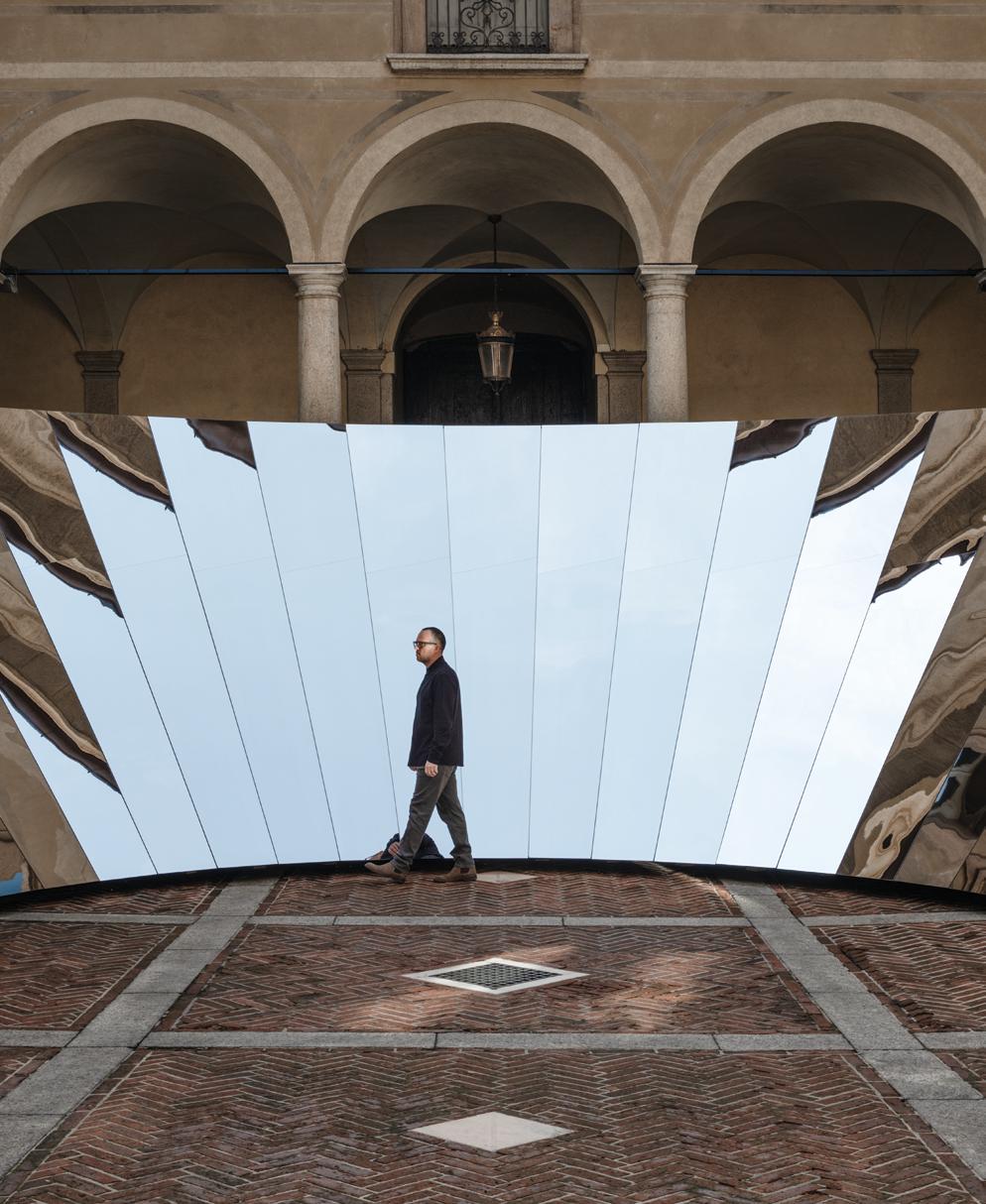
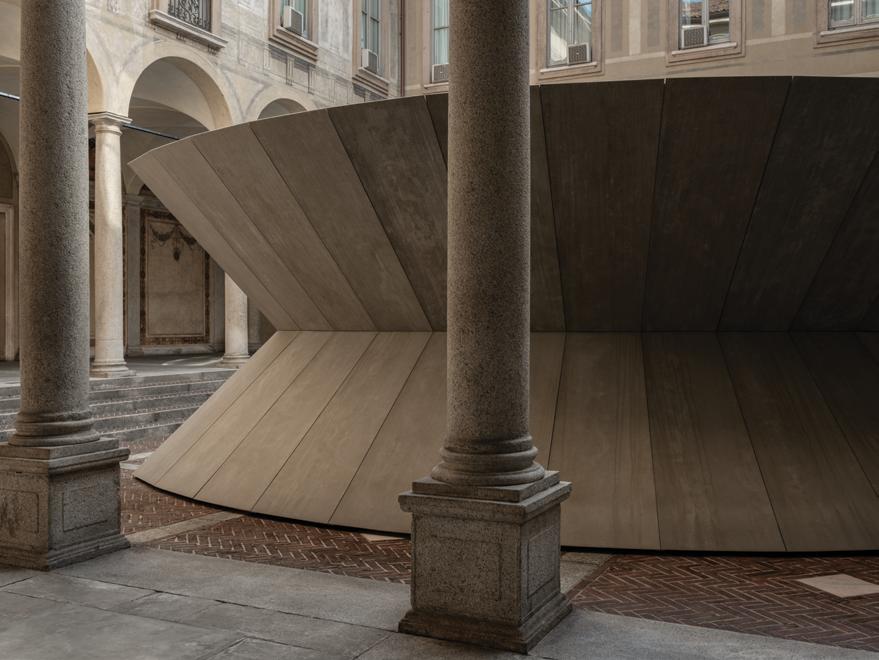
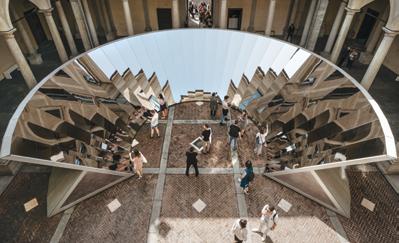
Salone del Mobile Milan, Italy (Palazzo Isimbardi) 2018
11’-3”
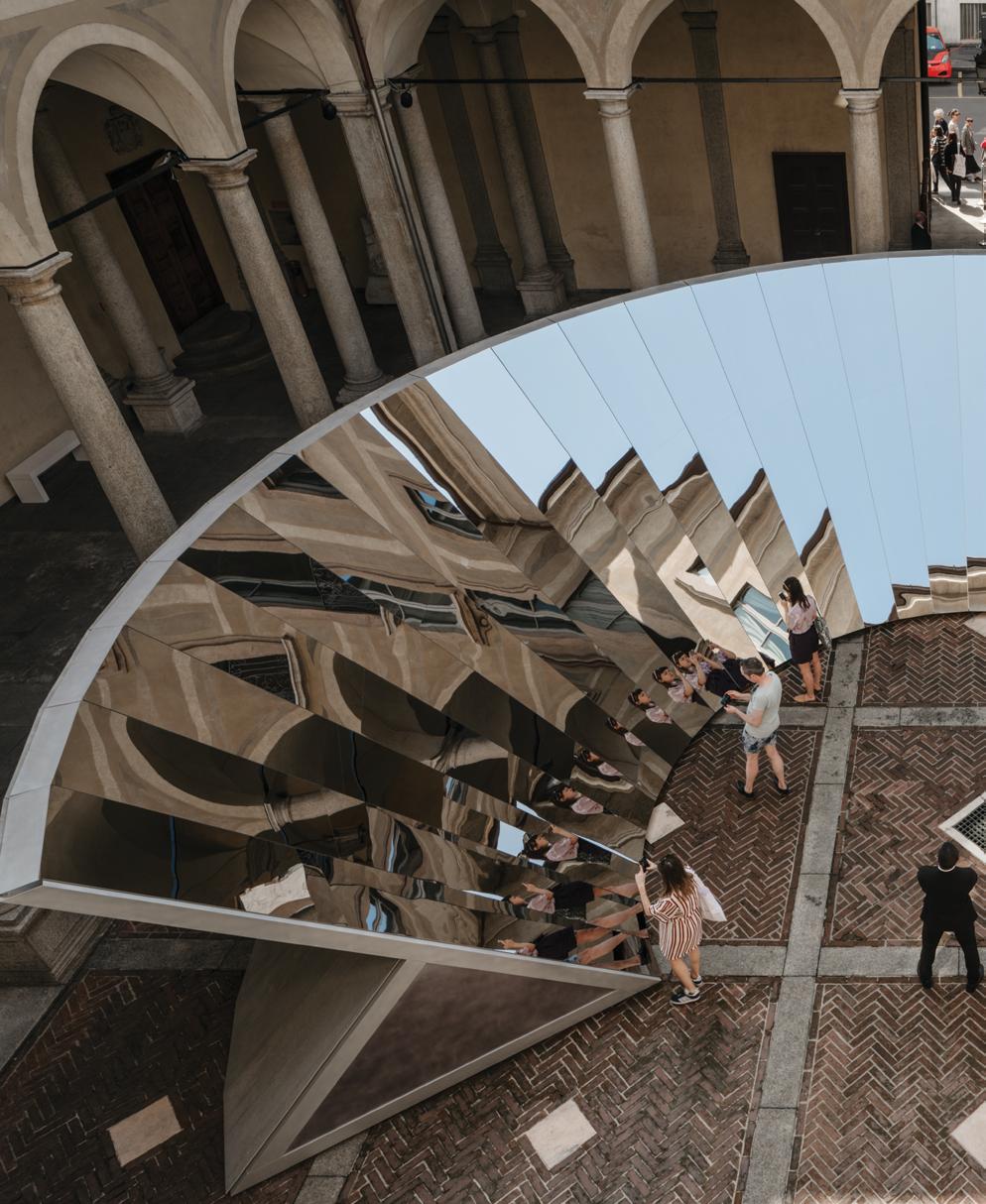
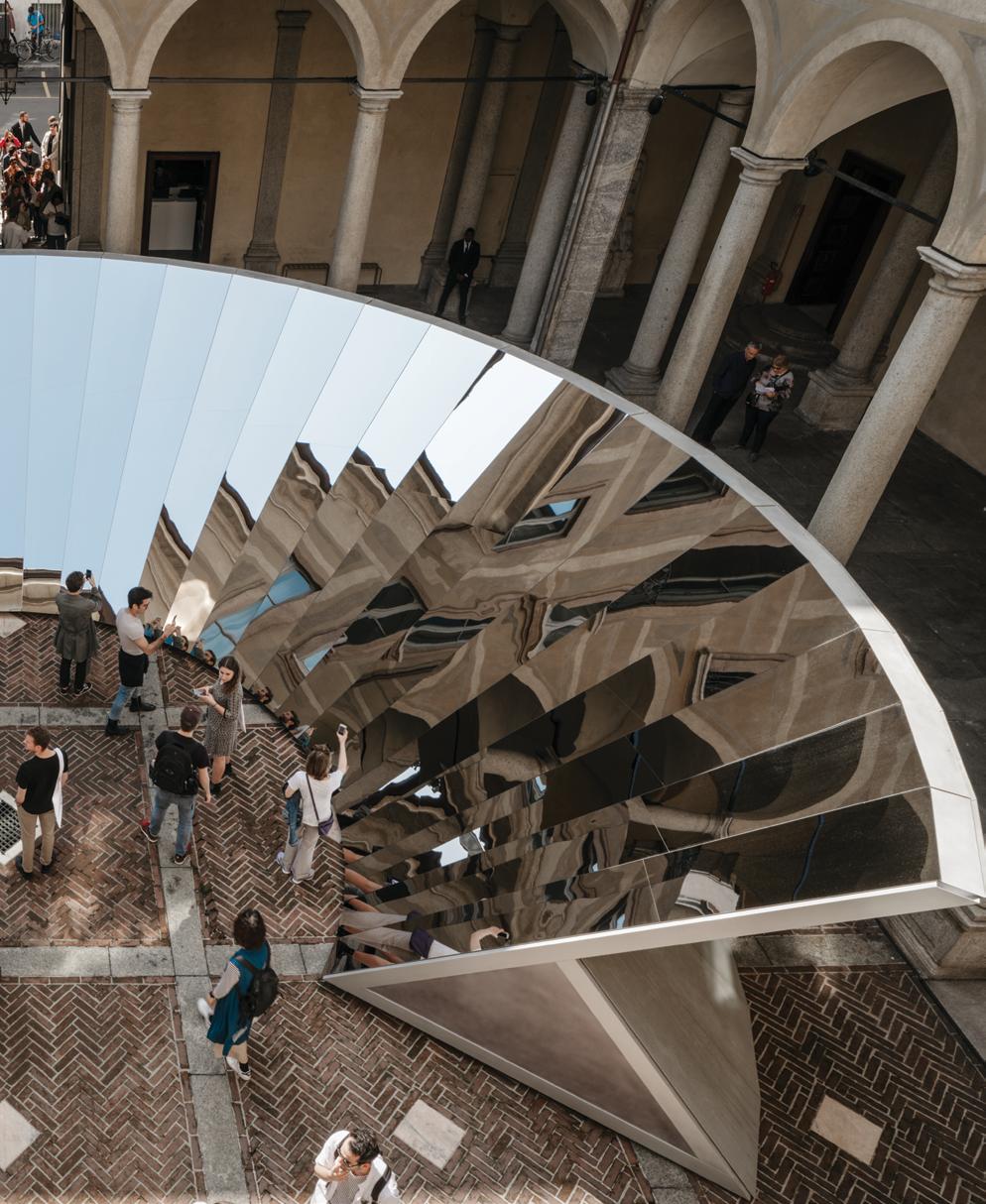
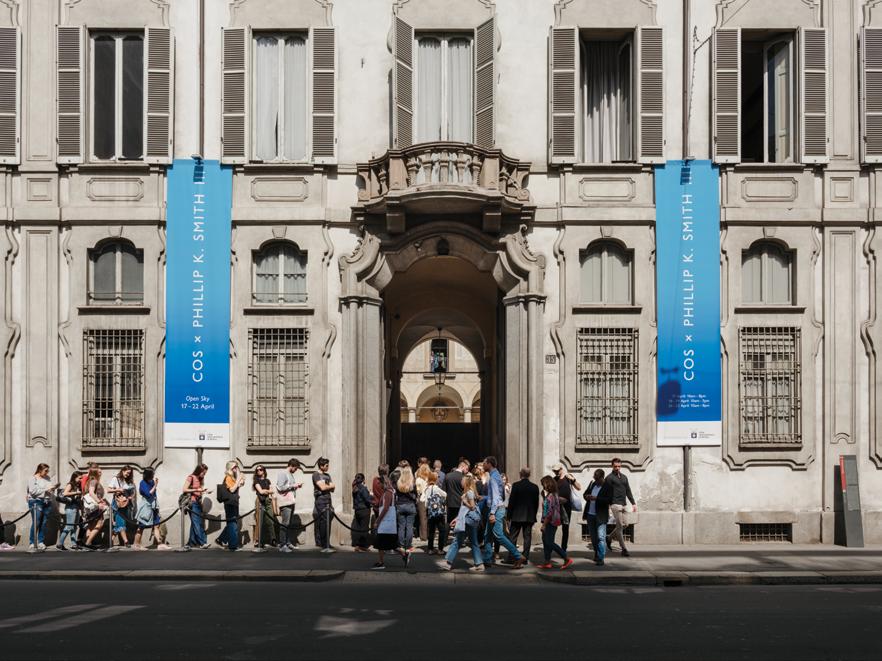
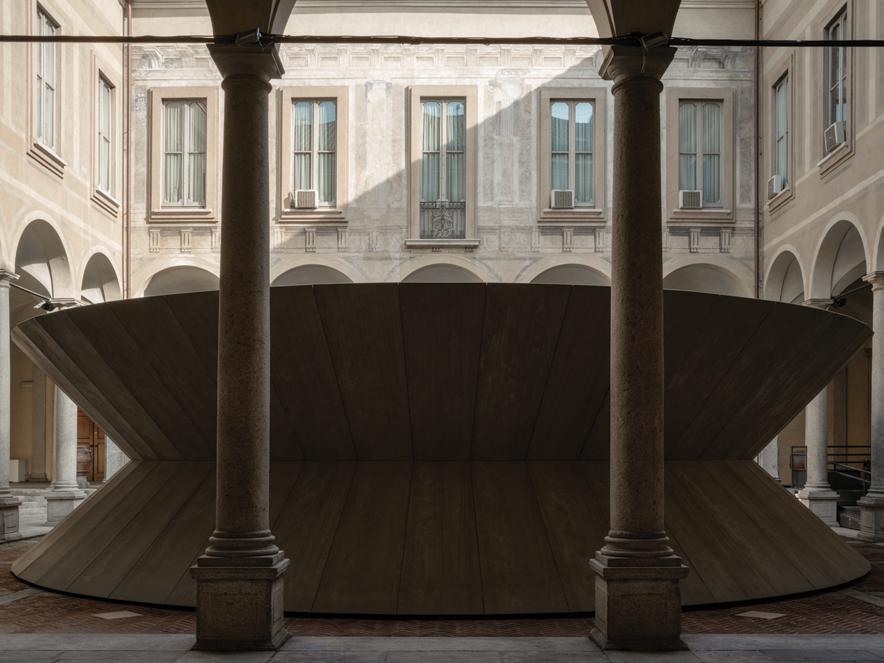
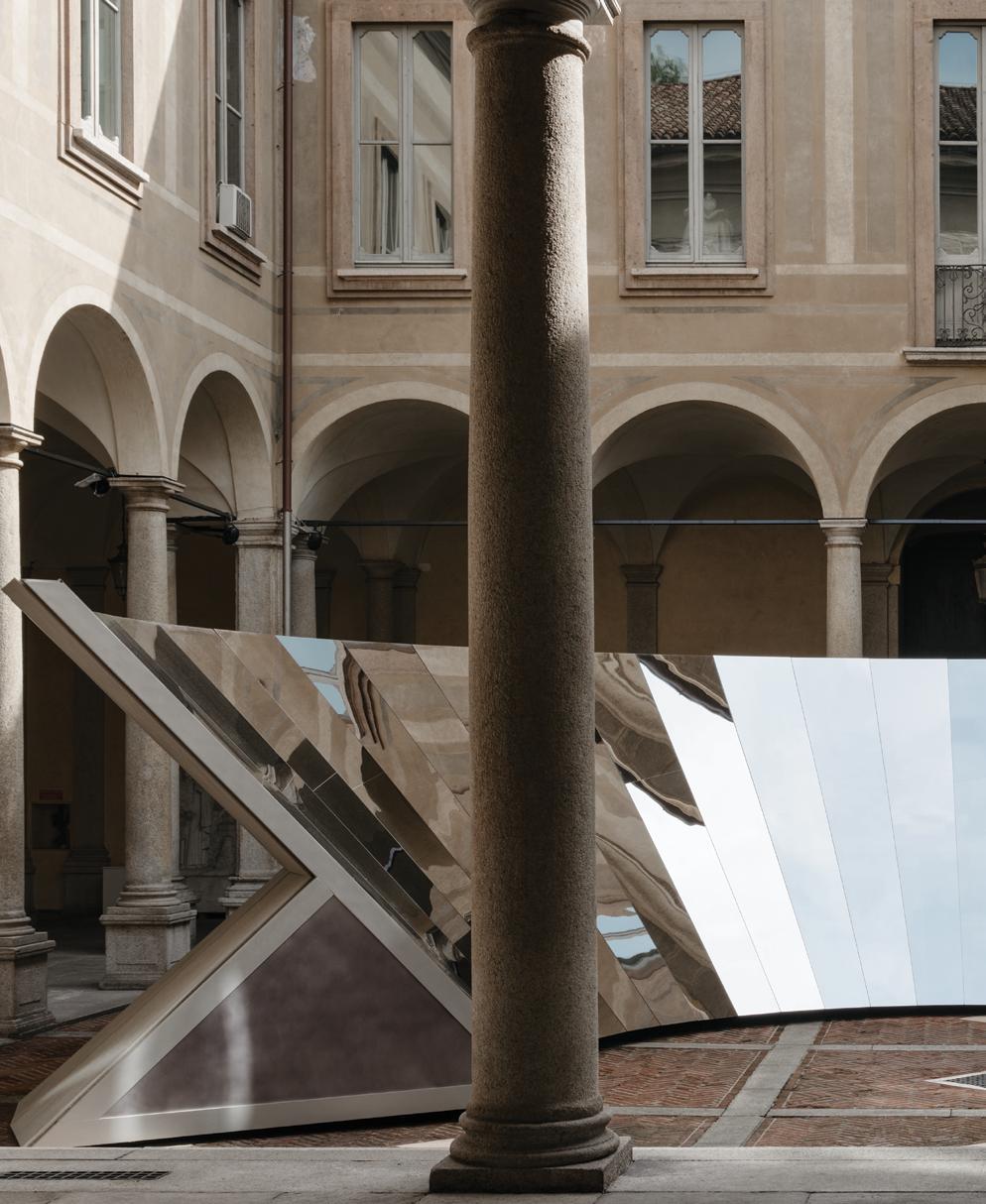
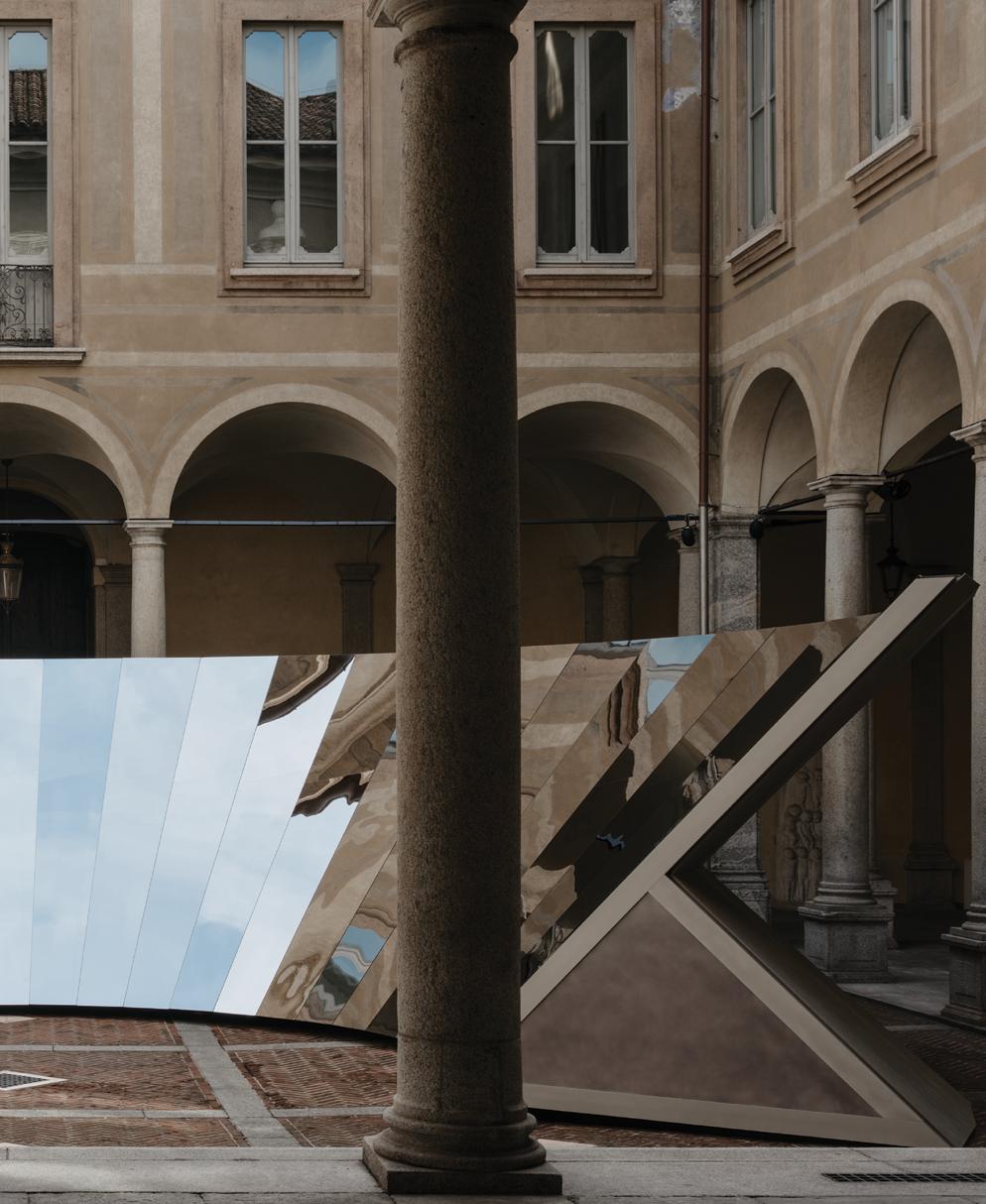
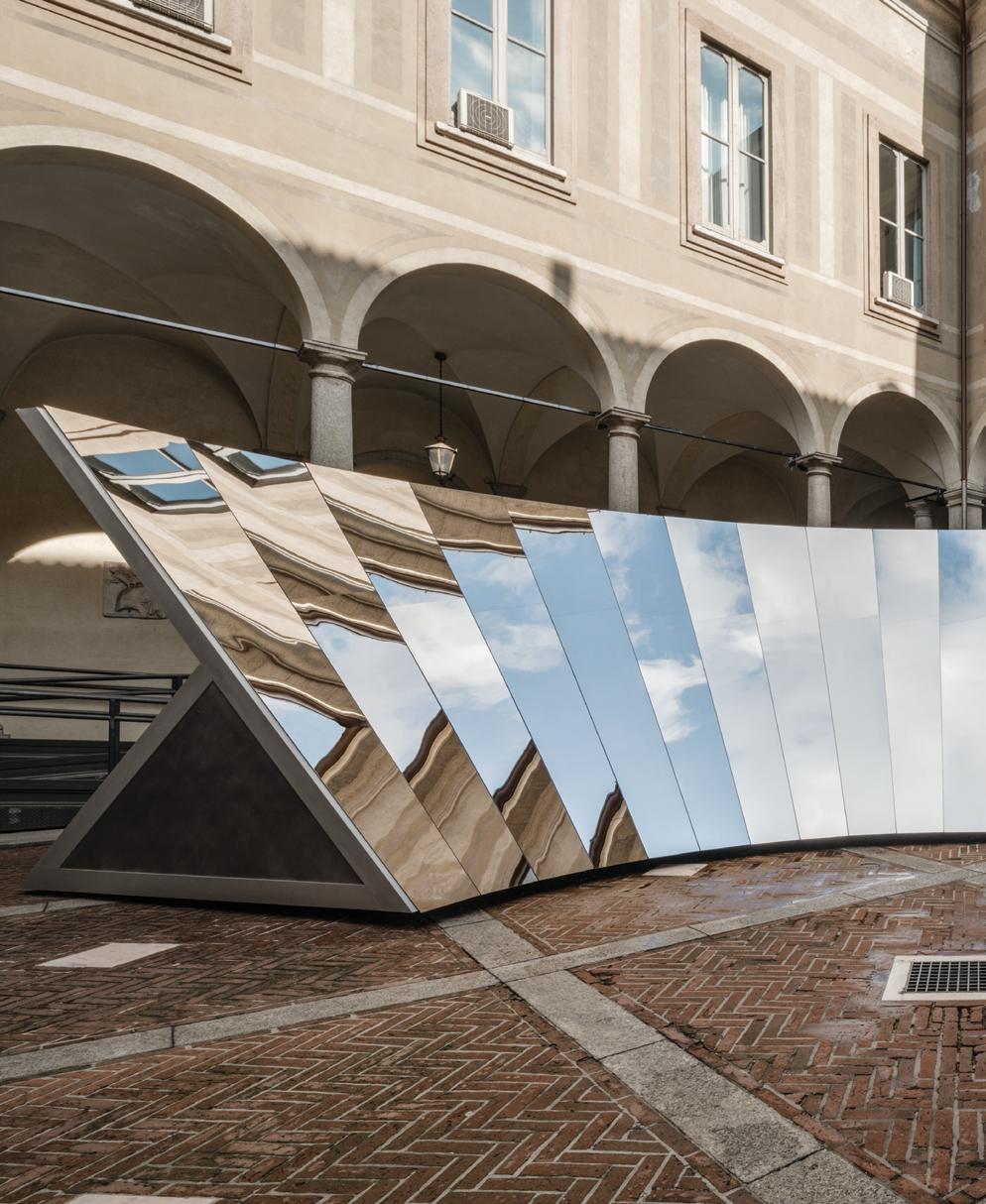
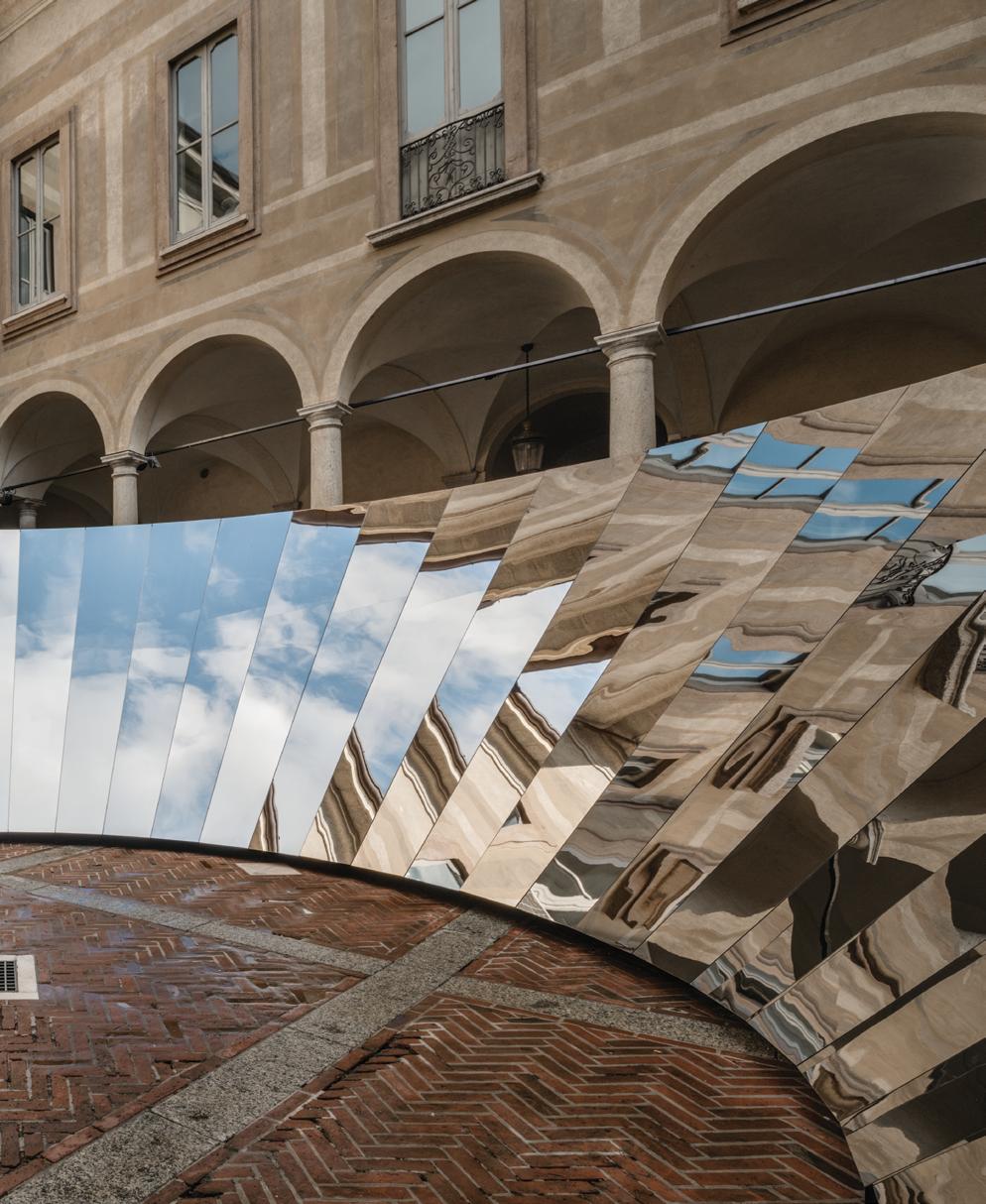
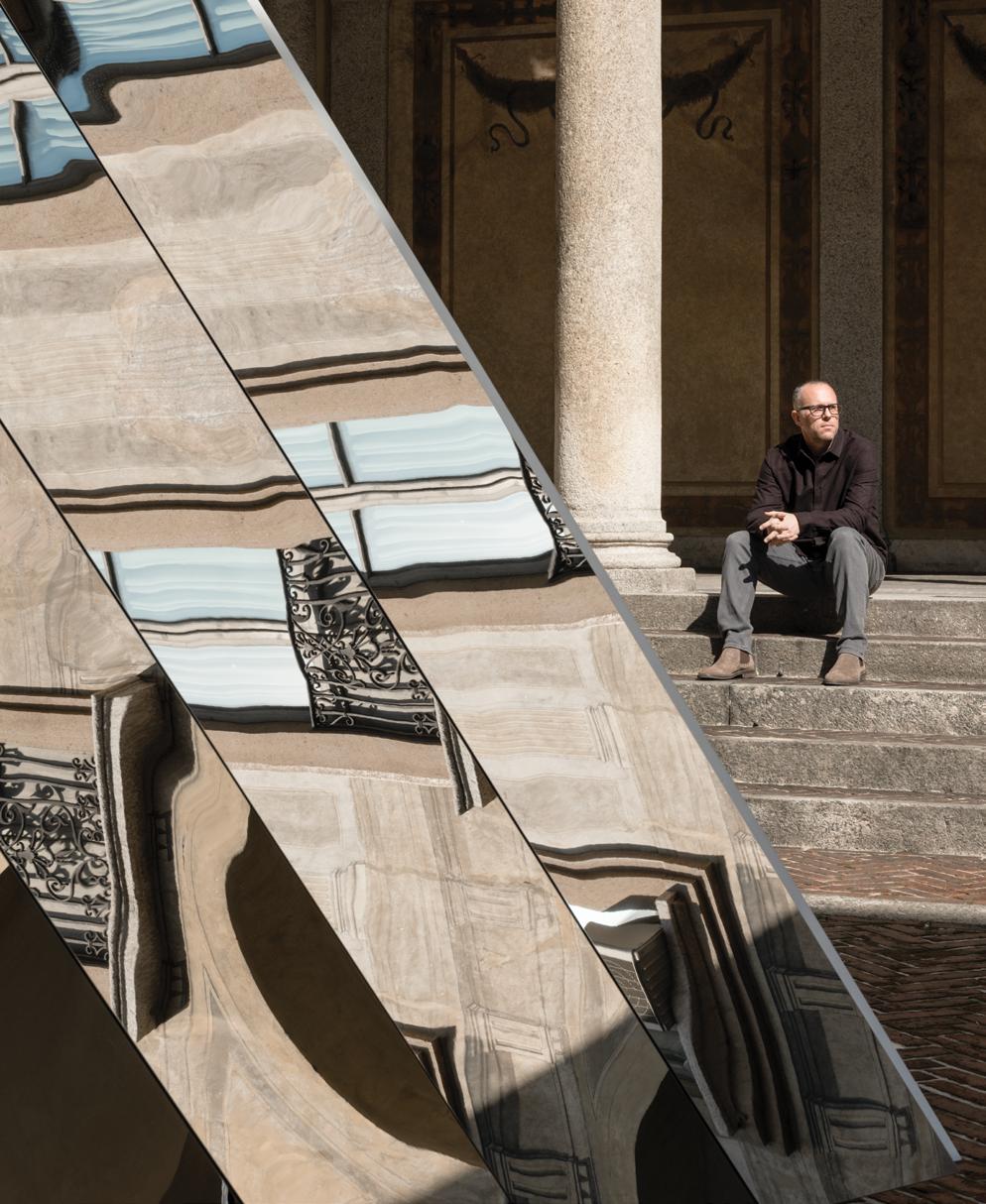
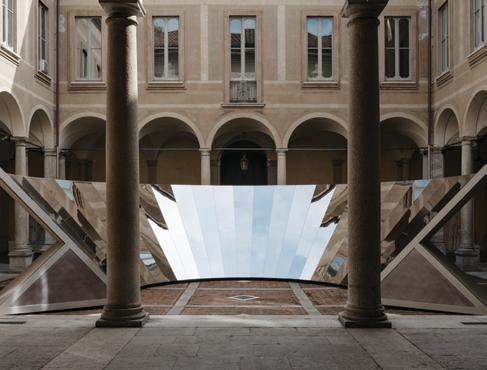
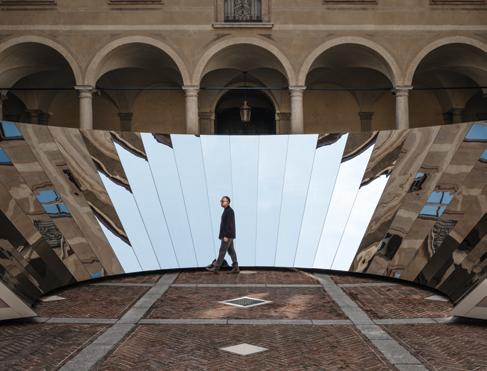
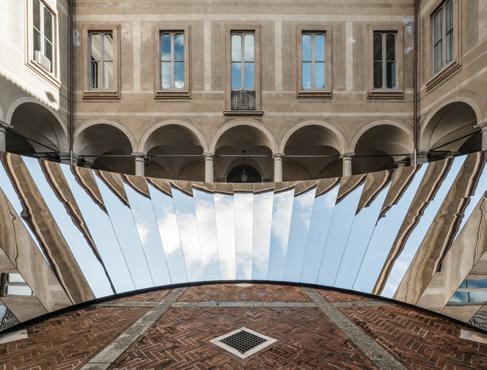
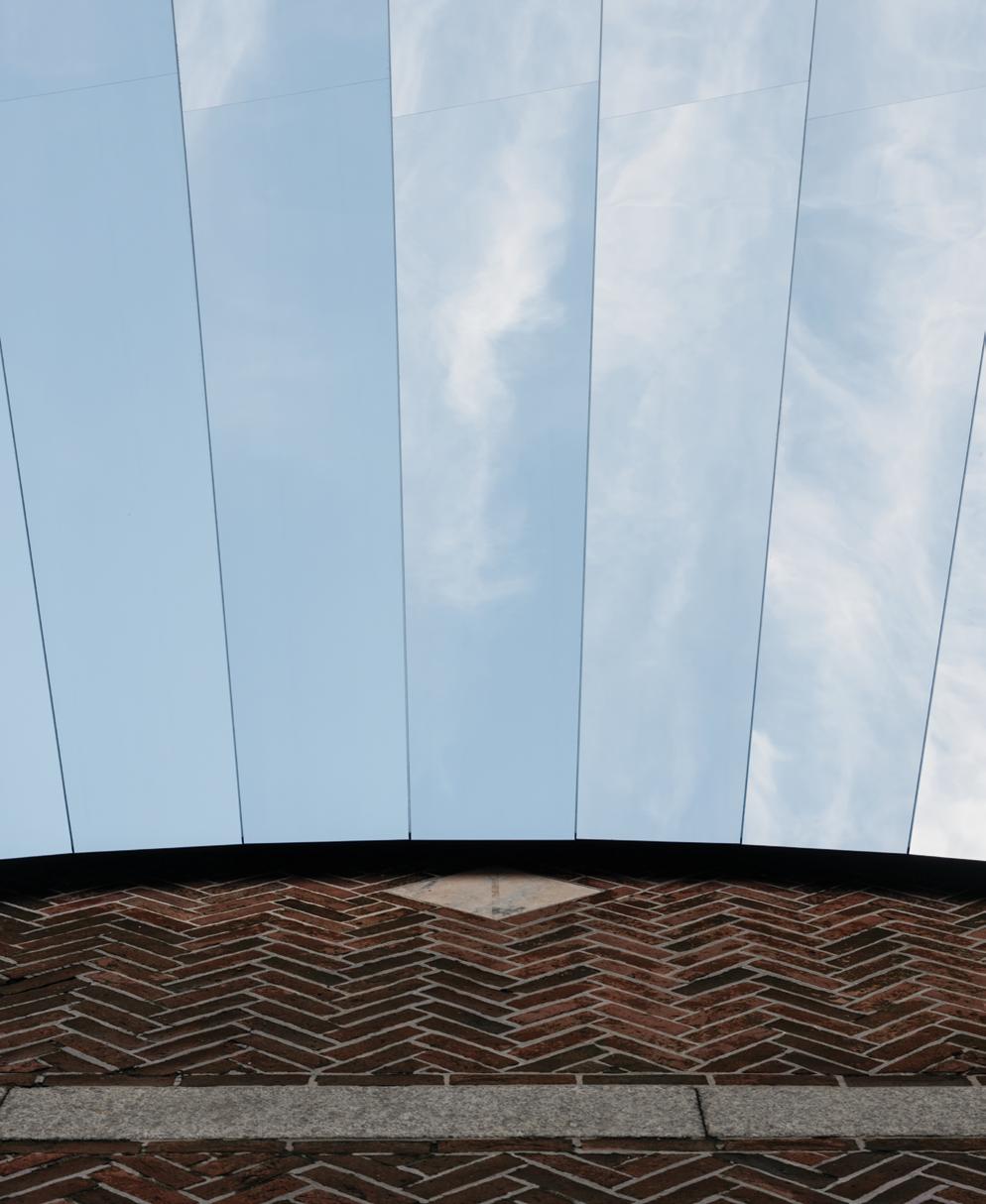
Open Sky transforms the overhead square of sky of Palazzo Isimbardi’s courtyard into a grounded, physical ring of reflected sky. Upon entry into the courtyard, one is faced with the tactile, yet abstract presence of the immense, circular form. Moving through the colonnade to the far side of the courtyard, the palazzo’s 16th-century architecture is seen angularly reconfigured across the faceted, reflective surface. Approaching the center of the installation, the angle of reflection shifts and the architecture slowly pulls away like a curtain, opening up the sky. At the center, one is fully encircled by the sublime, slowly paced physicality of the sky’s changing color gradient and the shifting clouds. It is an installation that is always in a constant state of flux as the colors of the environment shift, as the light of the day changes, and as the viewer moves through the space, resulting in an entirely unique experience for every individual that can never be replicated.
167
x 44’-3” x 35’-6”, 3.4 x 13.5 x 10.8m Mirror polished stainless steel, aluminum, plywood, concrete composite panels
REFLECTORS
Milan, Italy (Palazzo Isimbardi) 2018
Five volumes with the following varied dimensions:
72” x 81” x 20”, 183 x 206 x 51cm
108.5” x 48” x 20”, 276 x 122 x 51cm
137.5” x 30” x 21”, 349 x 76 x 30cm
Mirror polished stainless steel, painted steel
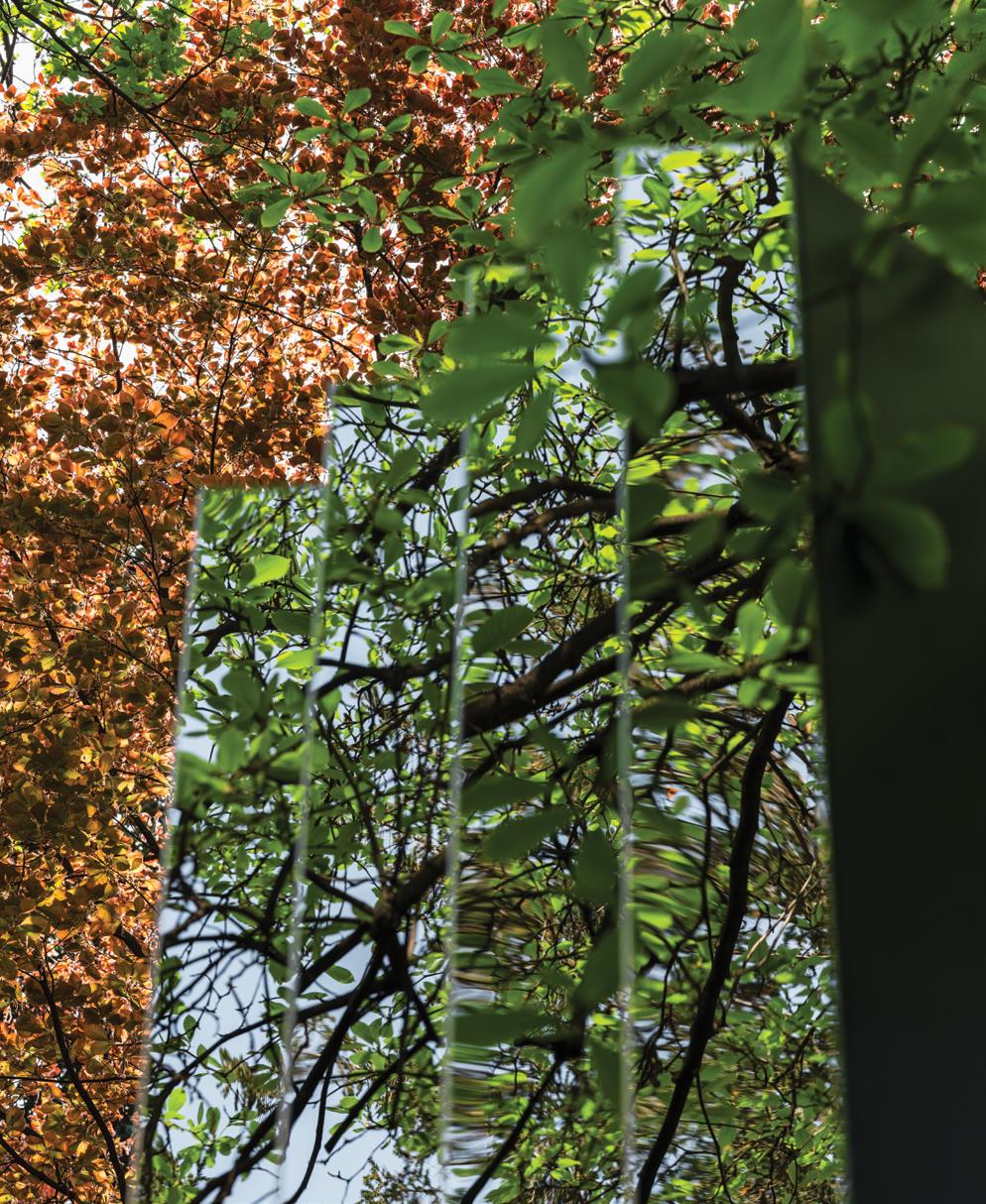
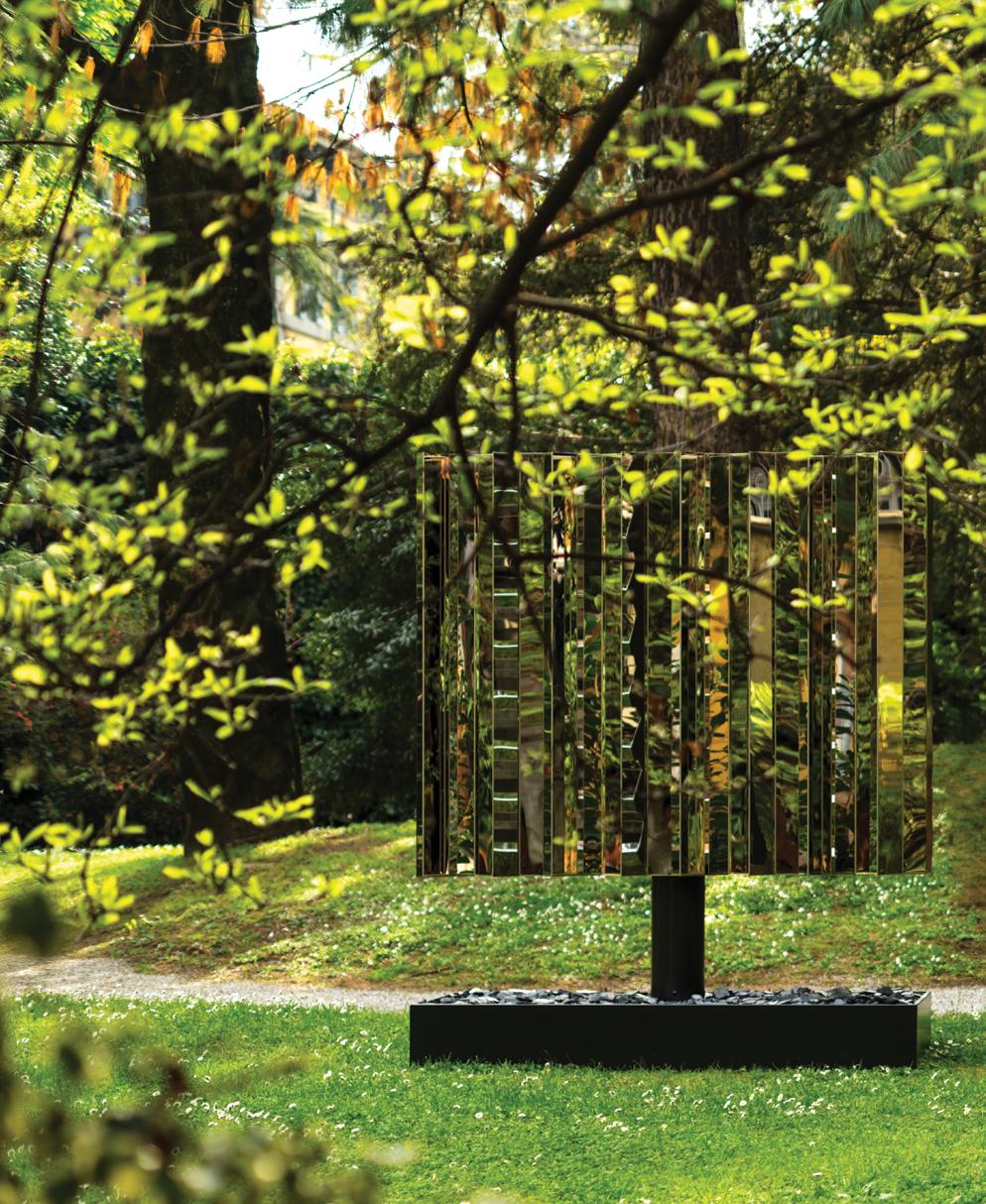
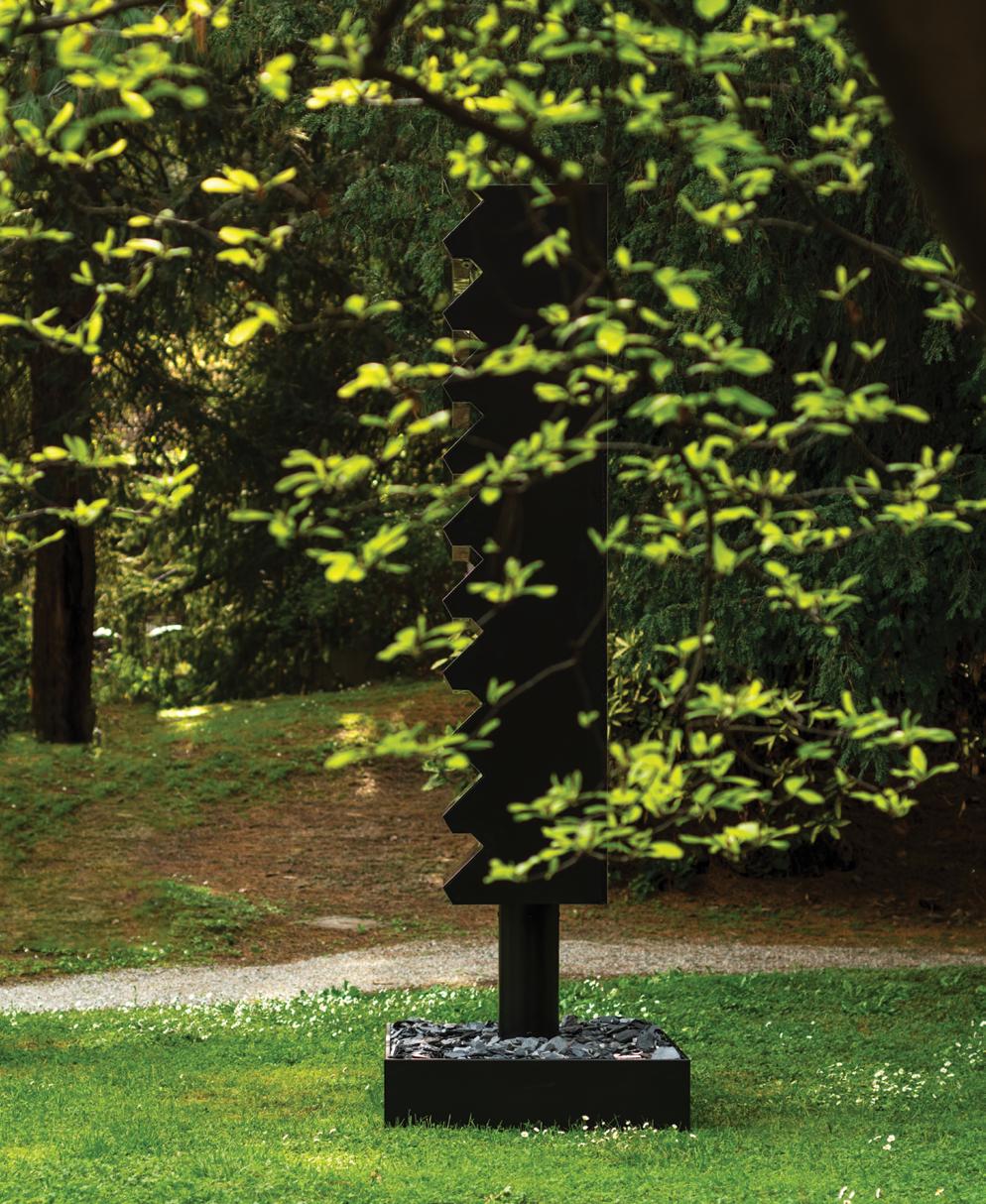
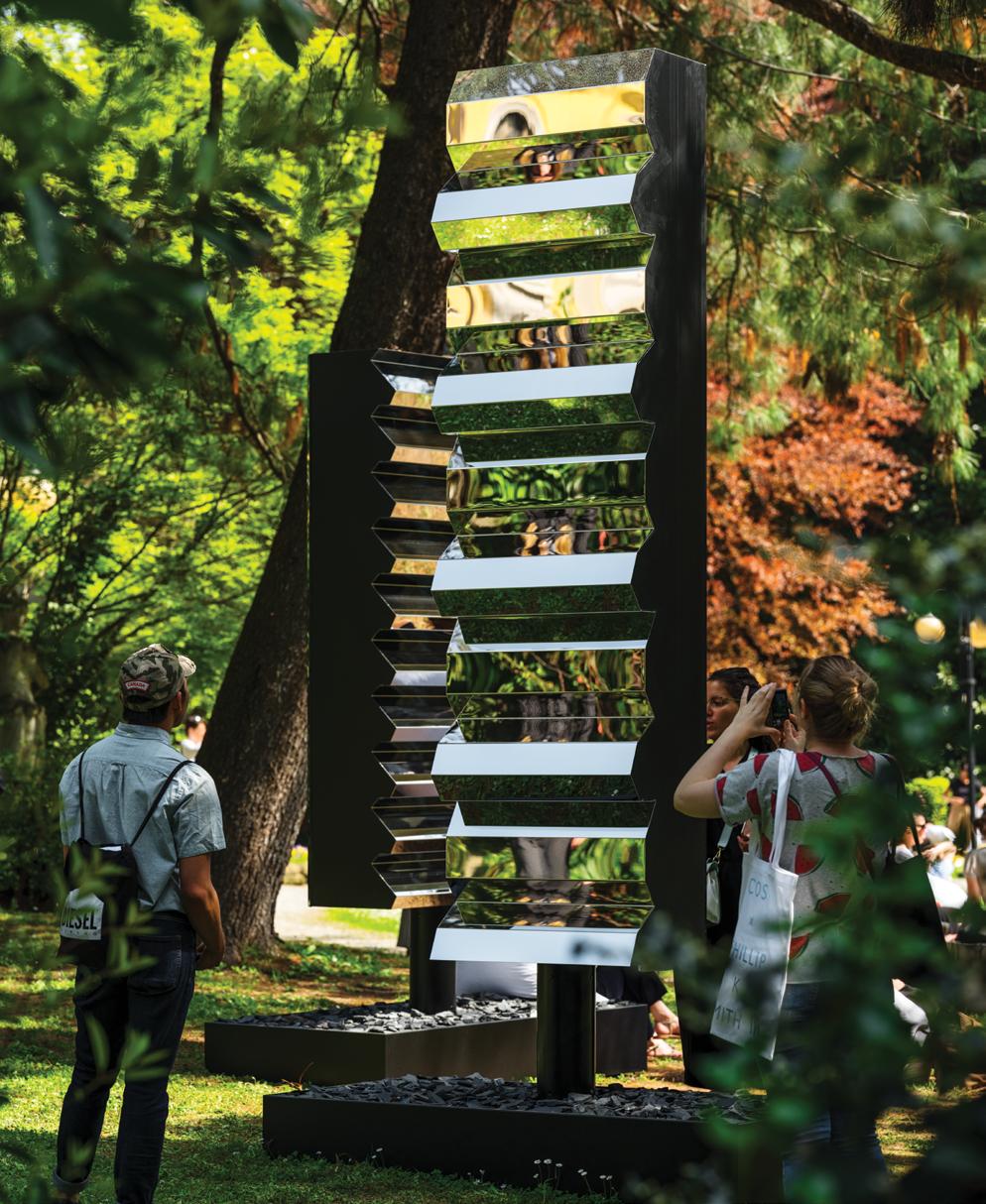
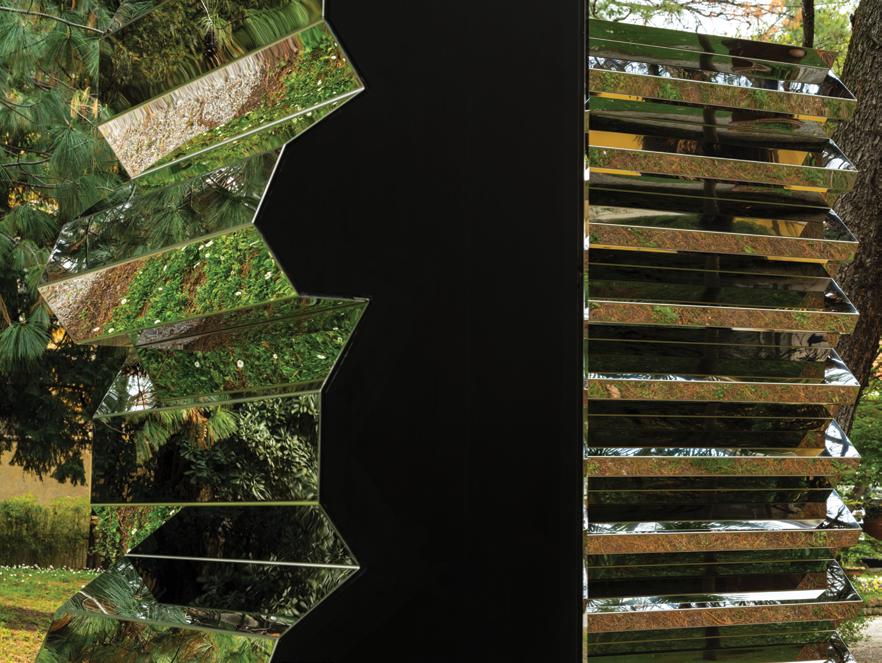
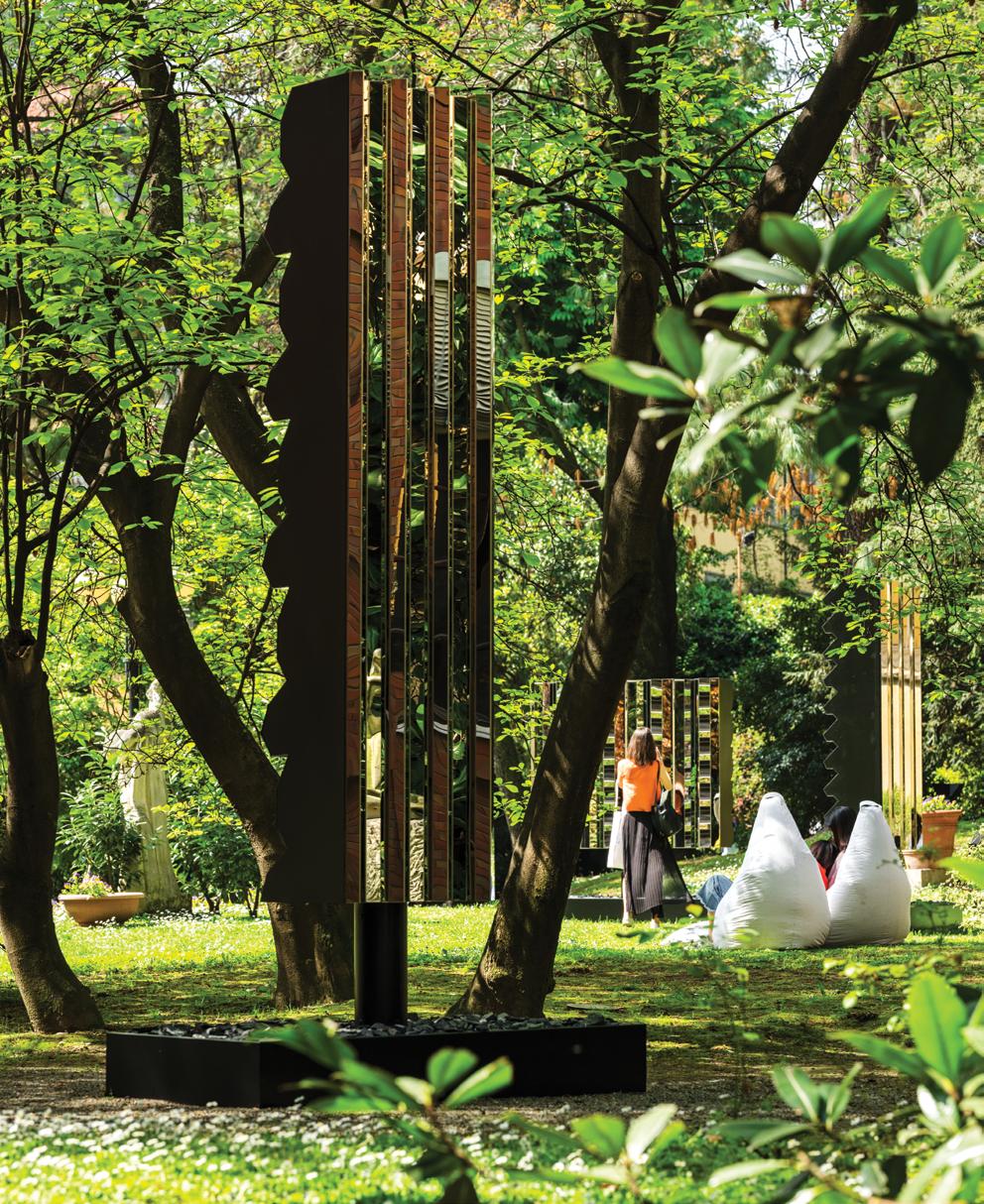
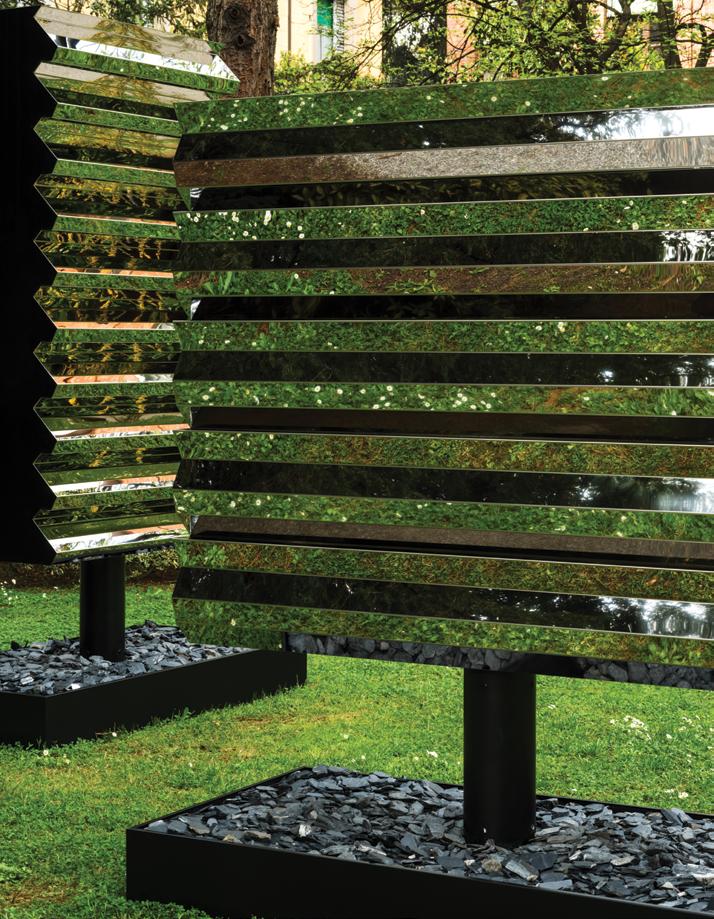
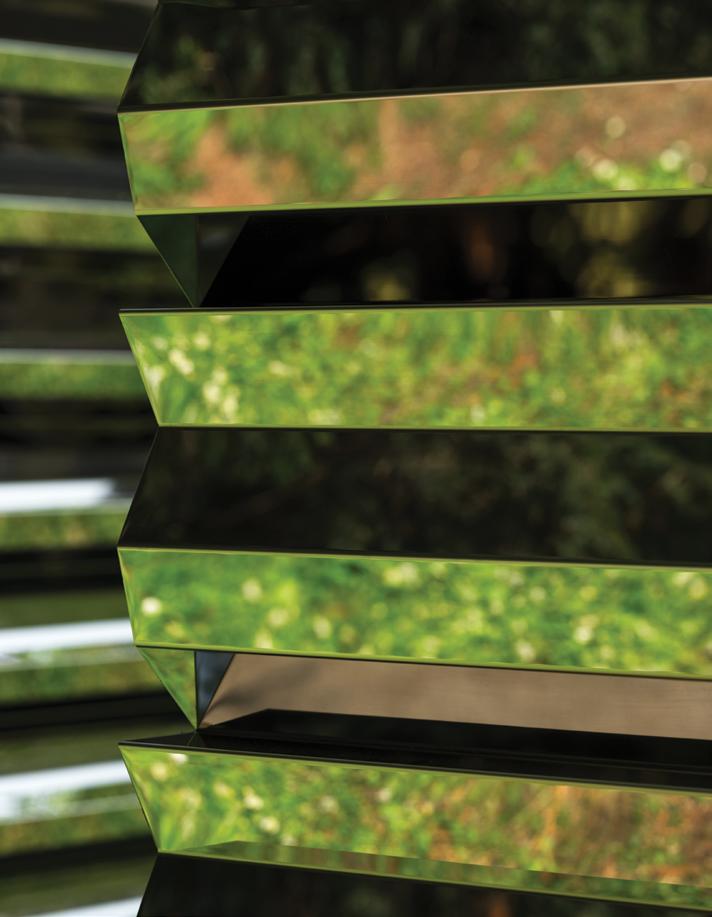
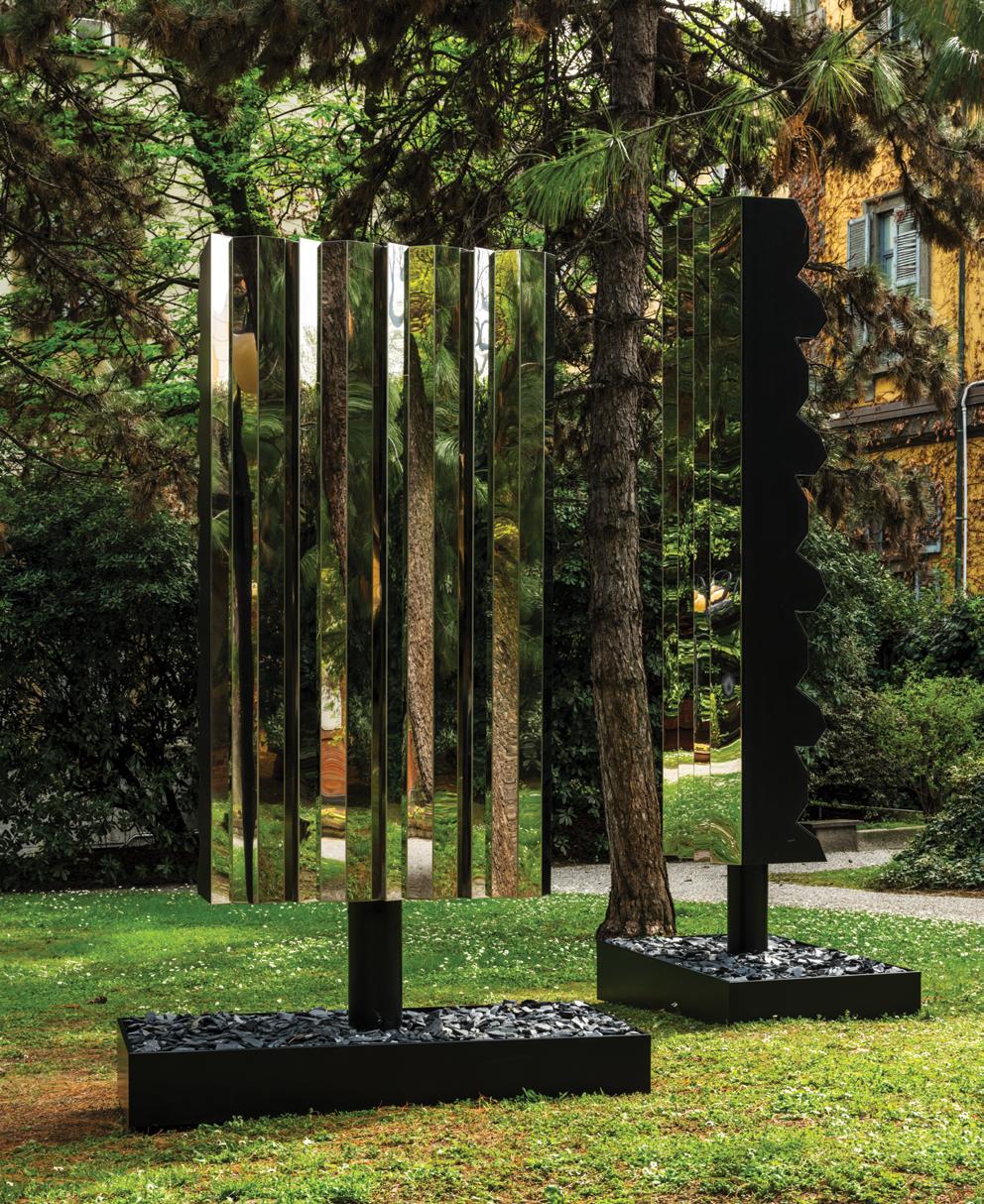
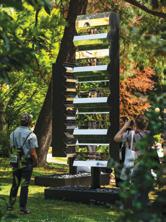
After experiencing Open Sky in the courtyard of Palazzo Isimbardi, visitors continue through the grand 16th-century palace and out into the private, secluded garden. In this respite from urbanity, they encounter five free-standing sculptures strategically placed across the verdant greens. The works mirror the foliage, surrounding architecture and sky across their horizontal and vertical corrugated and reflective skins, collaging the surrounding environment.
The work creates opportunities to view the garden in altogether new ways as each piece reconfigures its existing surroundings into an entirely fresh vignette. As the sculpture surfaces serve to compress space and directionality, the time of day acts as co-creator of the viewer’s experience in its deliverance of various colors and atmosphere to the reflected planes. As the light of the sky, the tones of the landscape, and the actions of the viewer continuously shift, the Reflectors stand testament to the perpetual existence of change in our daily lives. Designed as a complementary series to Open Sky, the Reflectors accentuate and extend the installation’s overall experience by offering smaller, more intimate interactions with environmental reflection and spatial perspective.
181
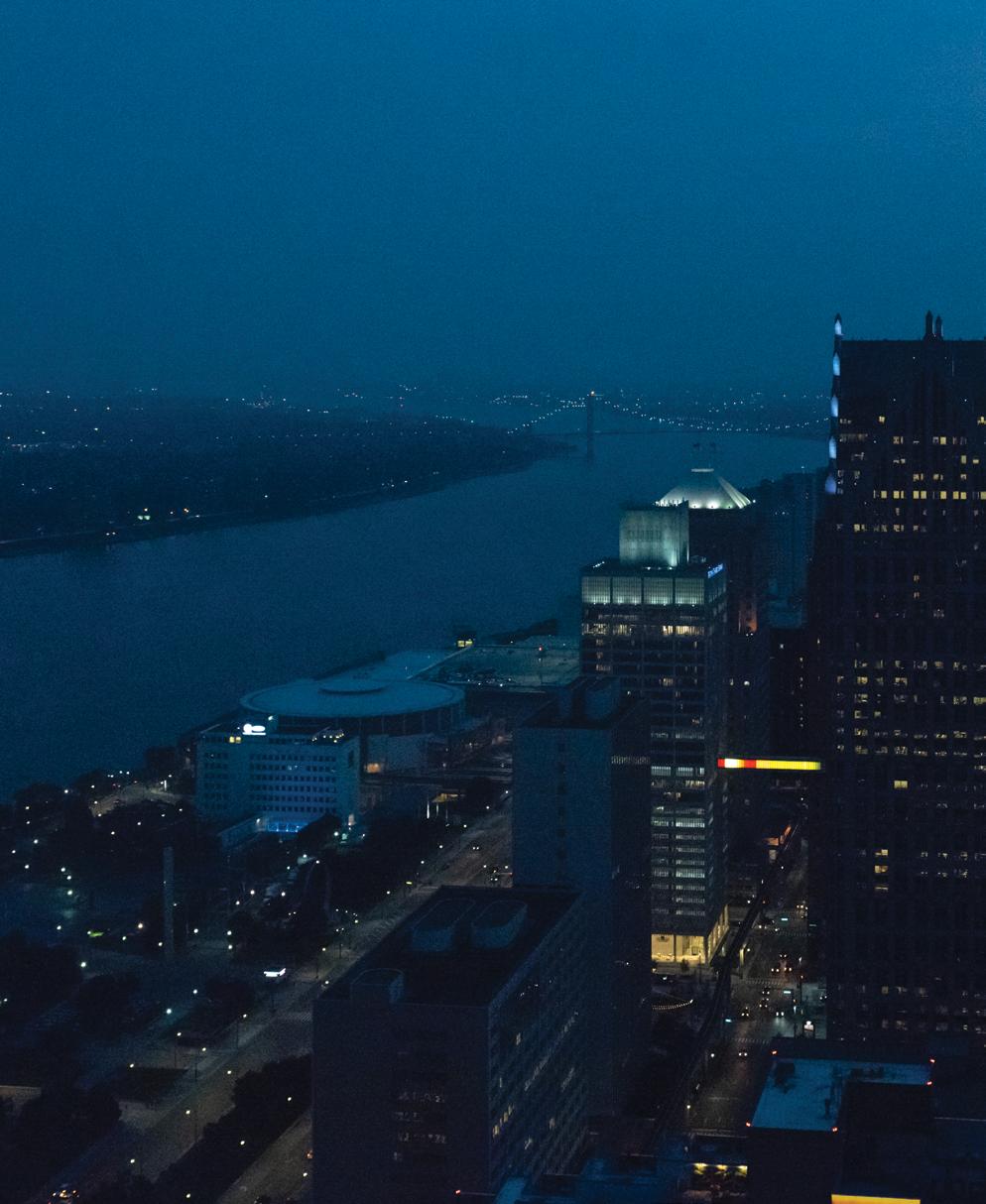
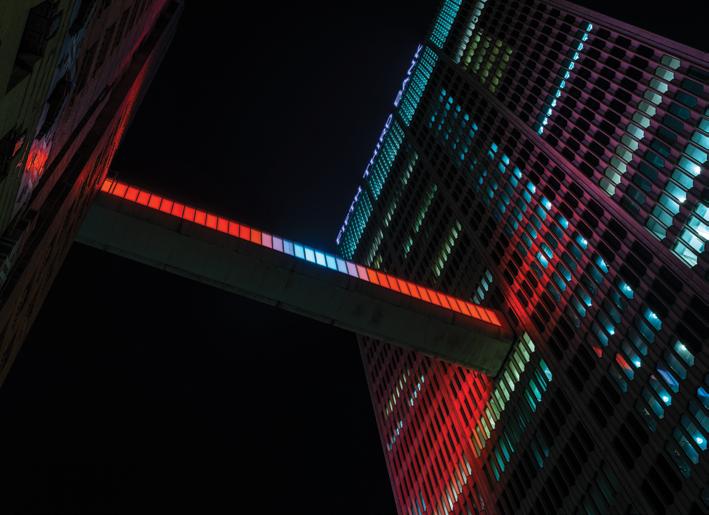
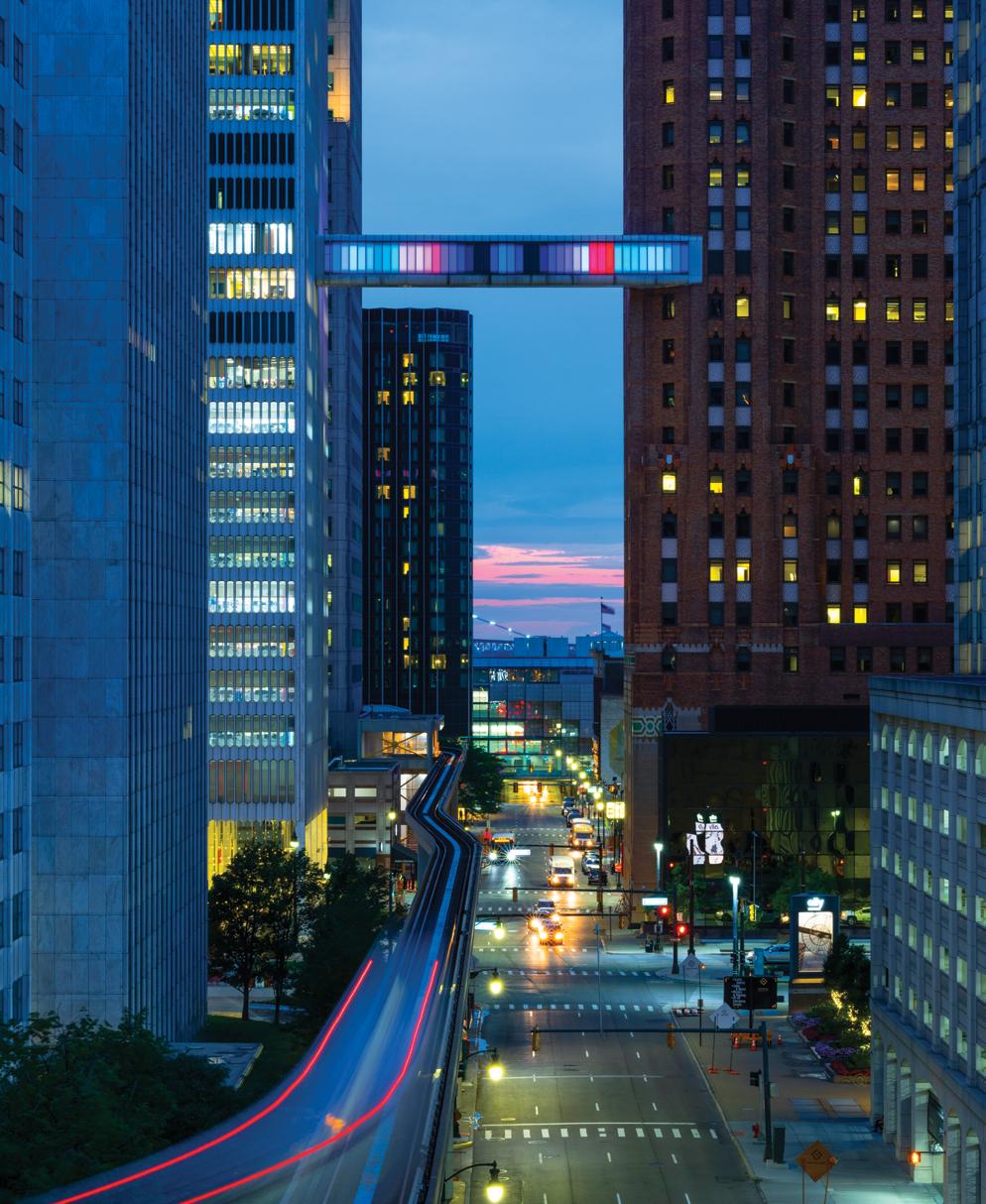
DETROIT SKYBRIDGE
Detroit, MI 2018
13’ x 100’ x 11’, 3.9 x 30.5 x 3.3m
Existing skybridge, acrylic, aluminum, LED lighting, electronic components, unique color program
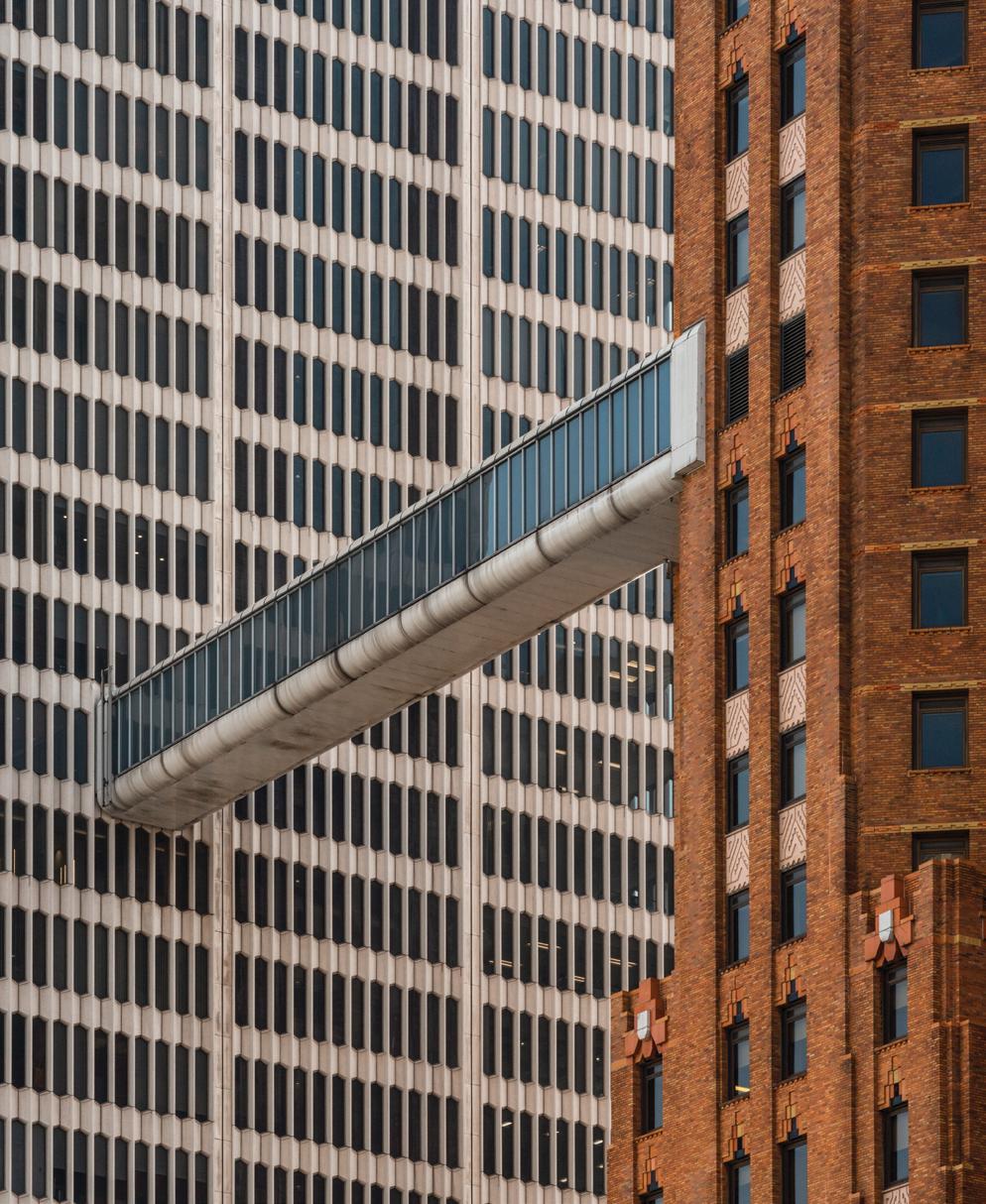
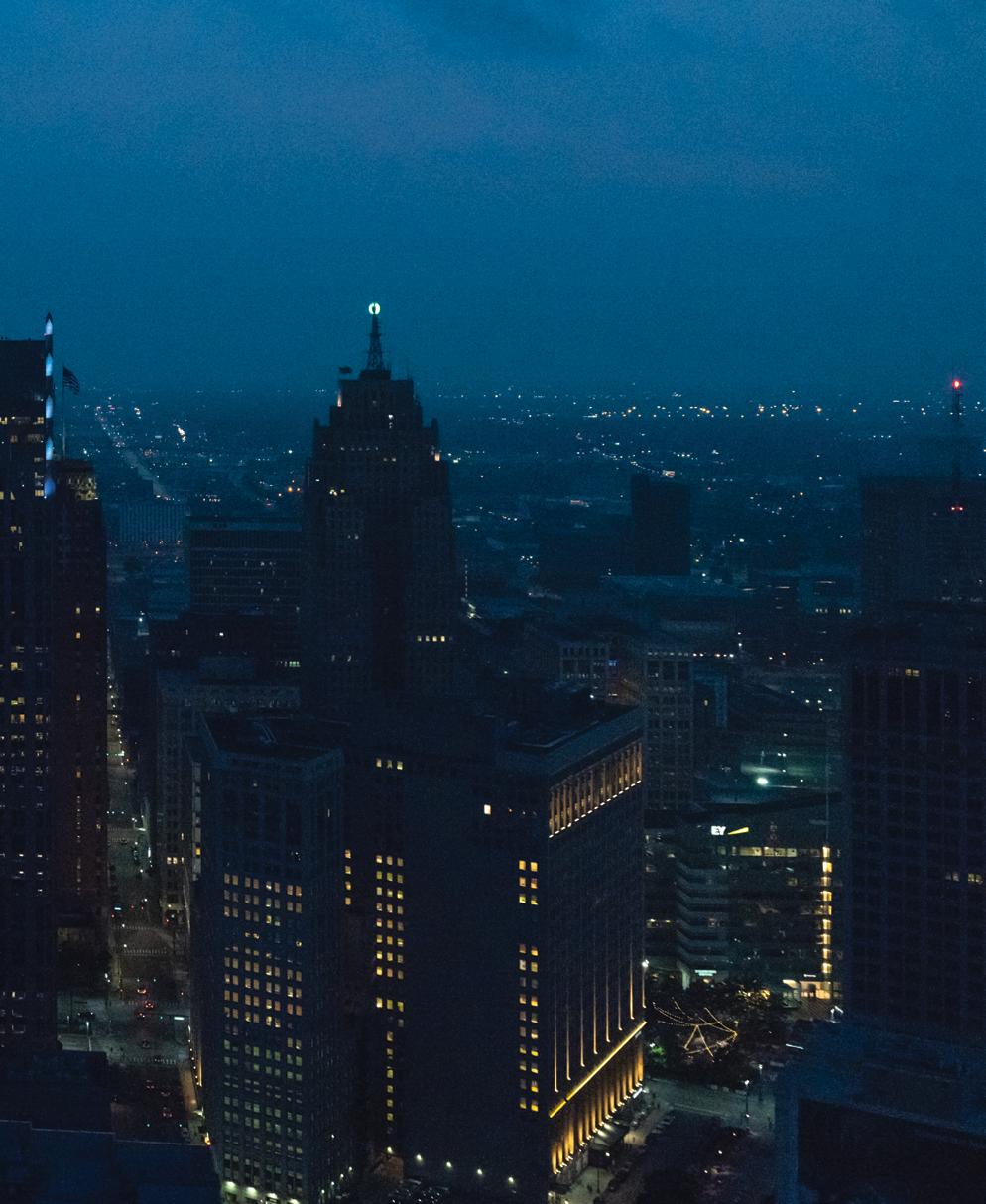
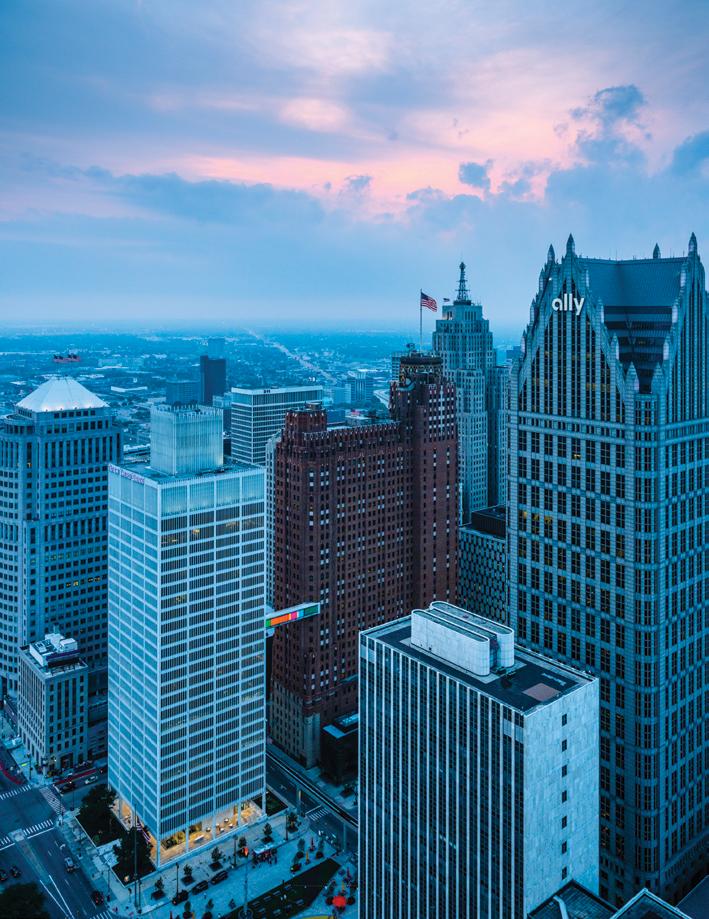
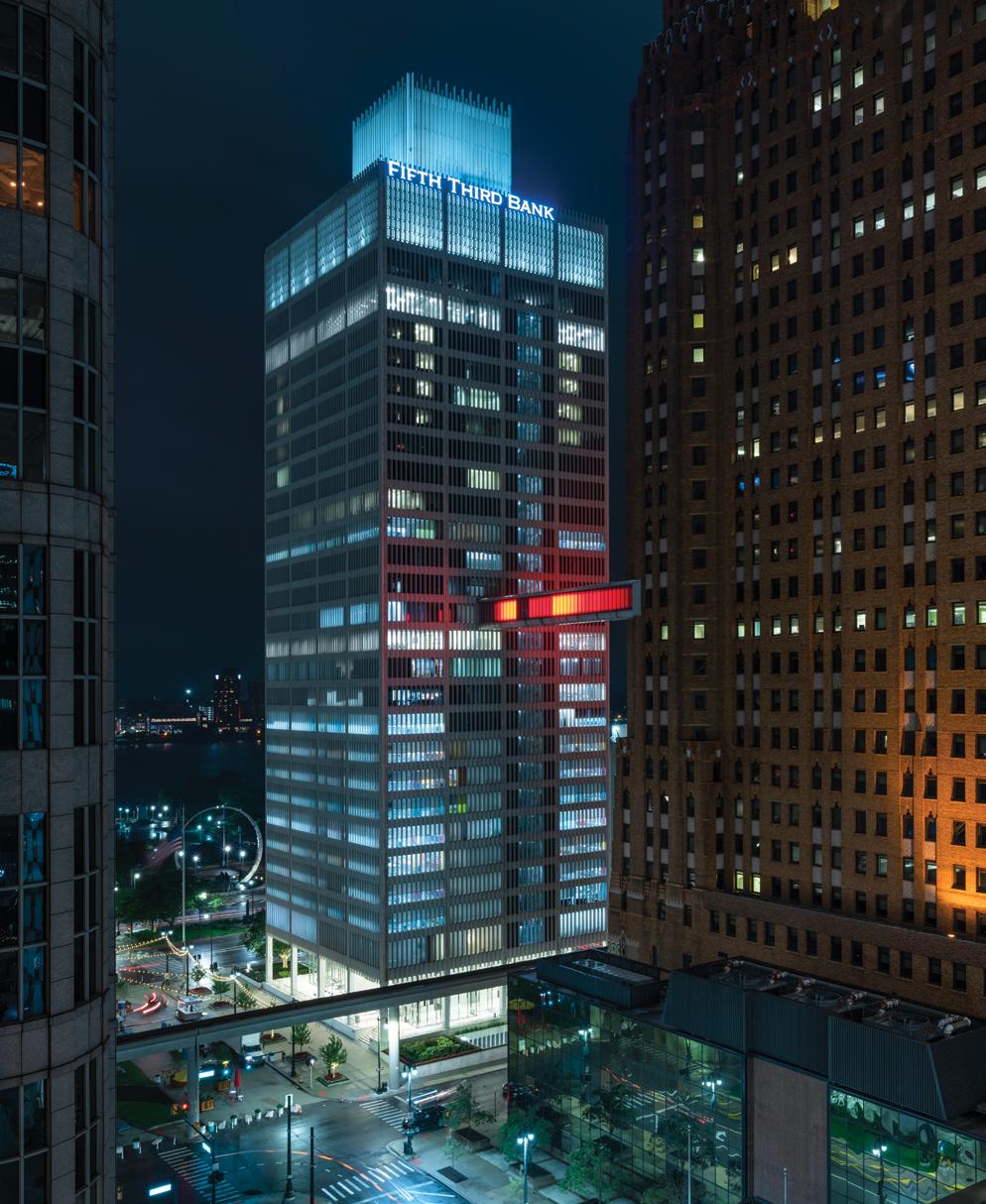
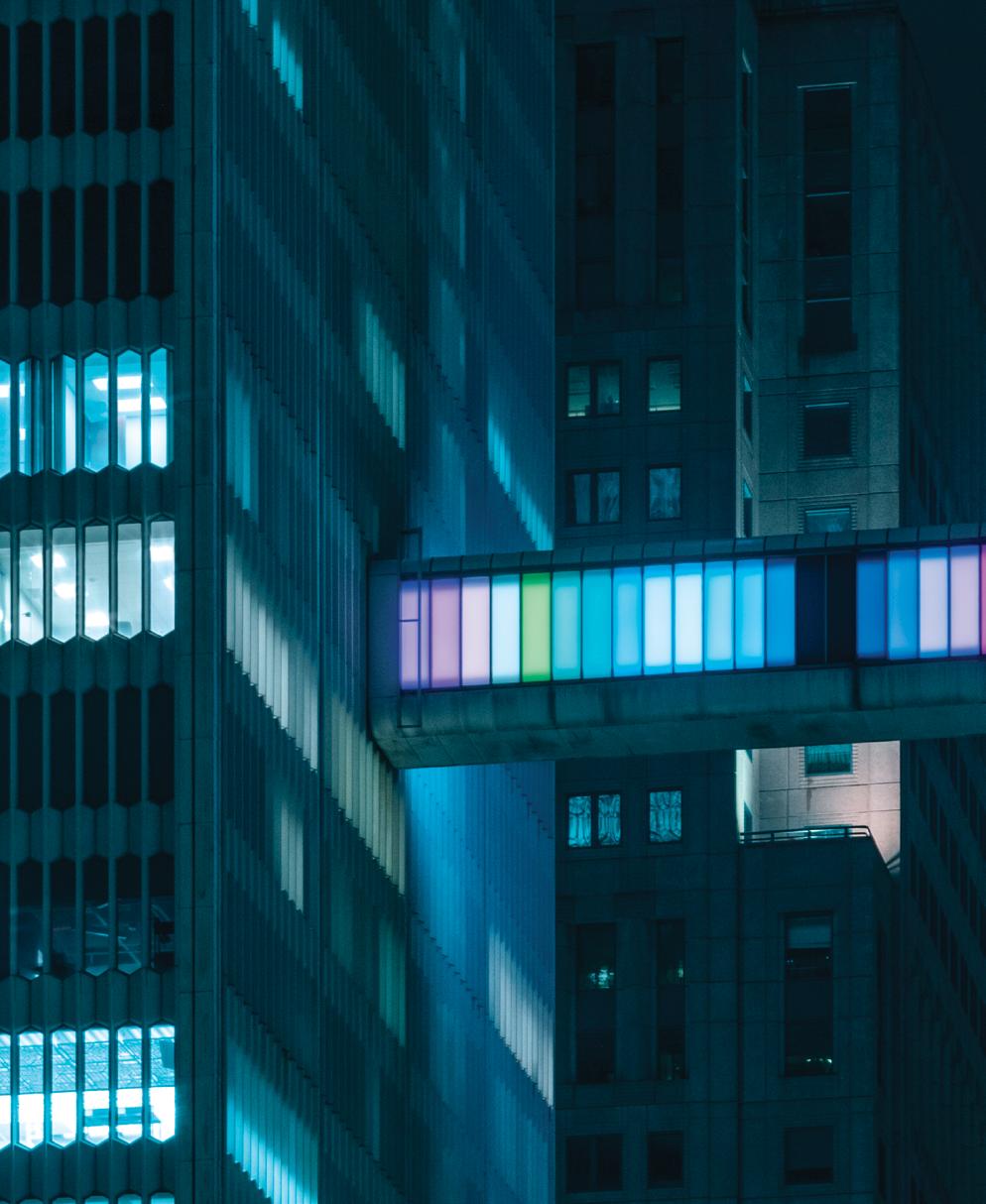
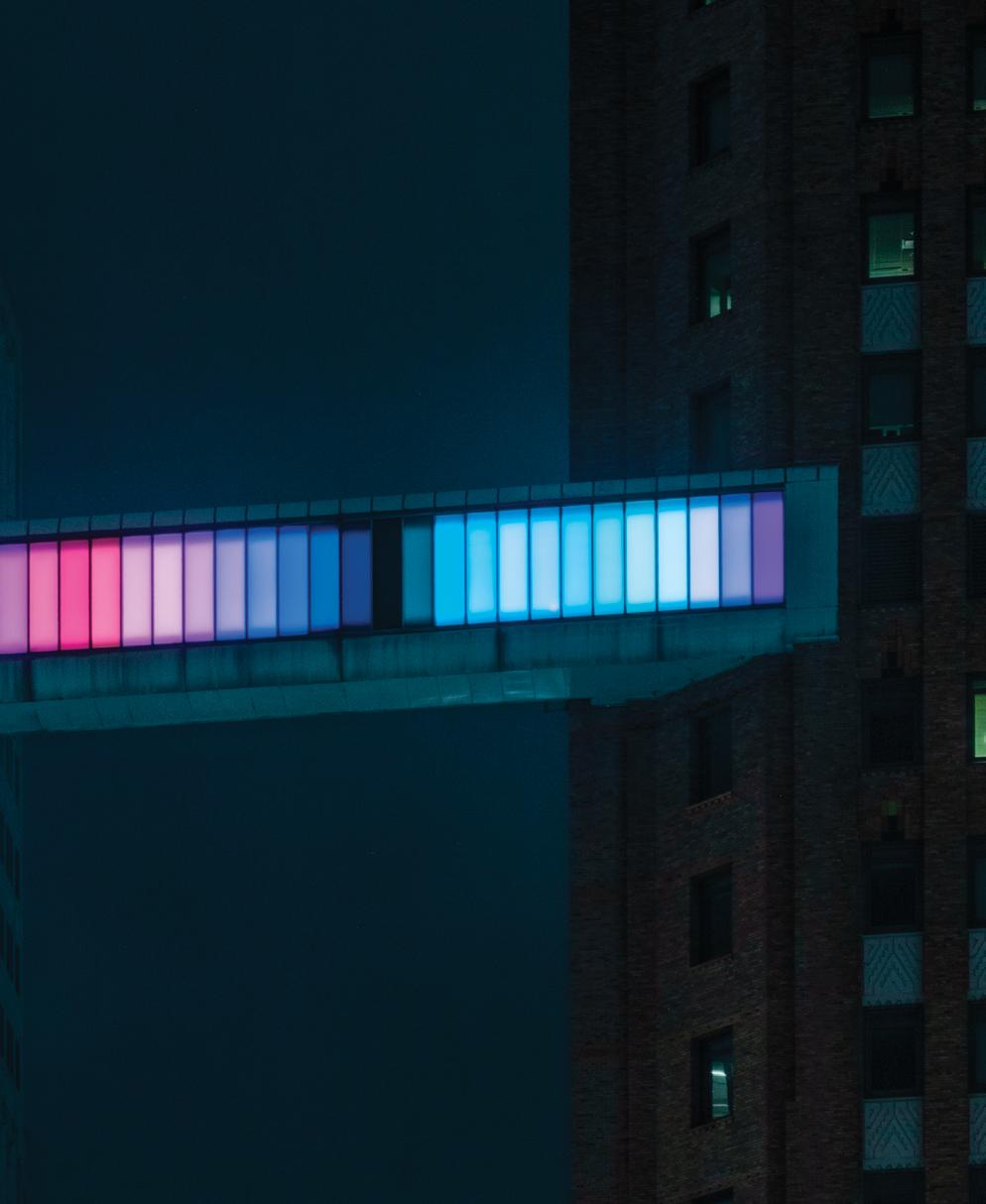
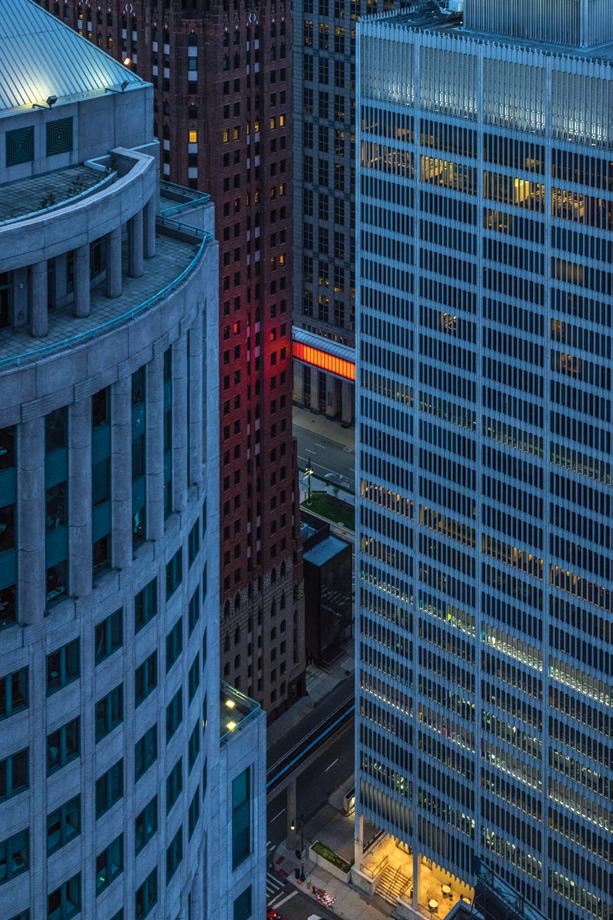
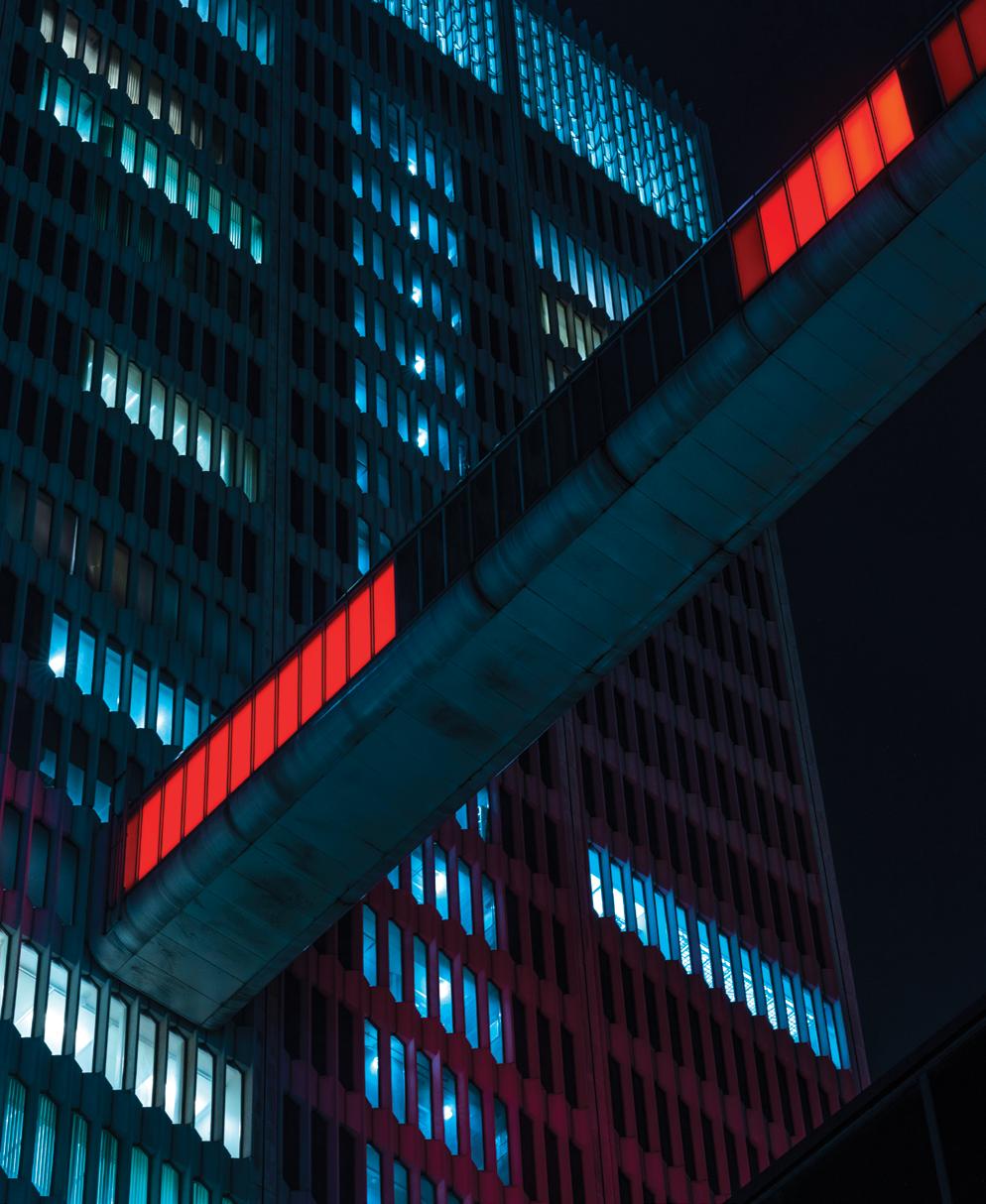
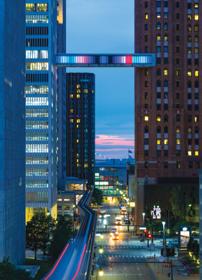
Connecting two of Detroit’s most iconic buildings, One Woodward and the Guardian Building, the 100-foot long 16th-floor Detroit Skybridge becomes a floating bar of light hovering over the streets of Downtown. Inspired by the modular white concrete of Yamasaki’s 1962 skyscraper and the mosaic of color within the 1929 Guardian Building, Smith has created a unique color program for this significantly scaled project. Composed of shifting gradients and moving planes of light, this precisely paced installation merges art with architecture at the scale of the city.
Presented as an entirely unique art experience outside of the traditional bounds of the museum or gallery, this project positions itself within the public realm for all to experience freely. By day, the Detroit Skybridge is seen as its historical self within the architecture and massing of Downtown. By night, it becomes a beacon for the beauty, creativity, and innovation of Detroit.
191
10 COLUMNS
Inaugural Exhibition at Bridge Projects Hollywood, CA 2019
7000 sq.ft x 10 columns at 15’ high
Small: 3’-6” x 1’-4” x 9”, 106 x 41 x 23 cm
Medium: 3’-6” x 2’-2” x 9”, 106 x 66 x 23 cm
Large: 3’-6” x 3’-0” x 9”, 106 x 91 x 23 cm
Existing column grid, aluminum, glass, LED lighting, electronic components, unique color program
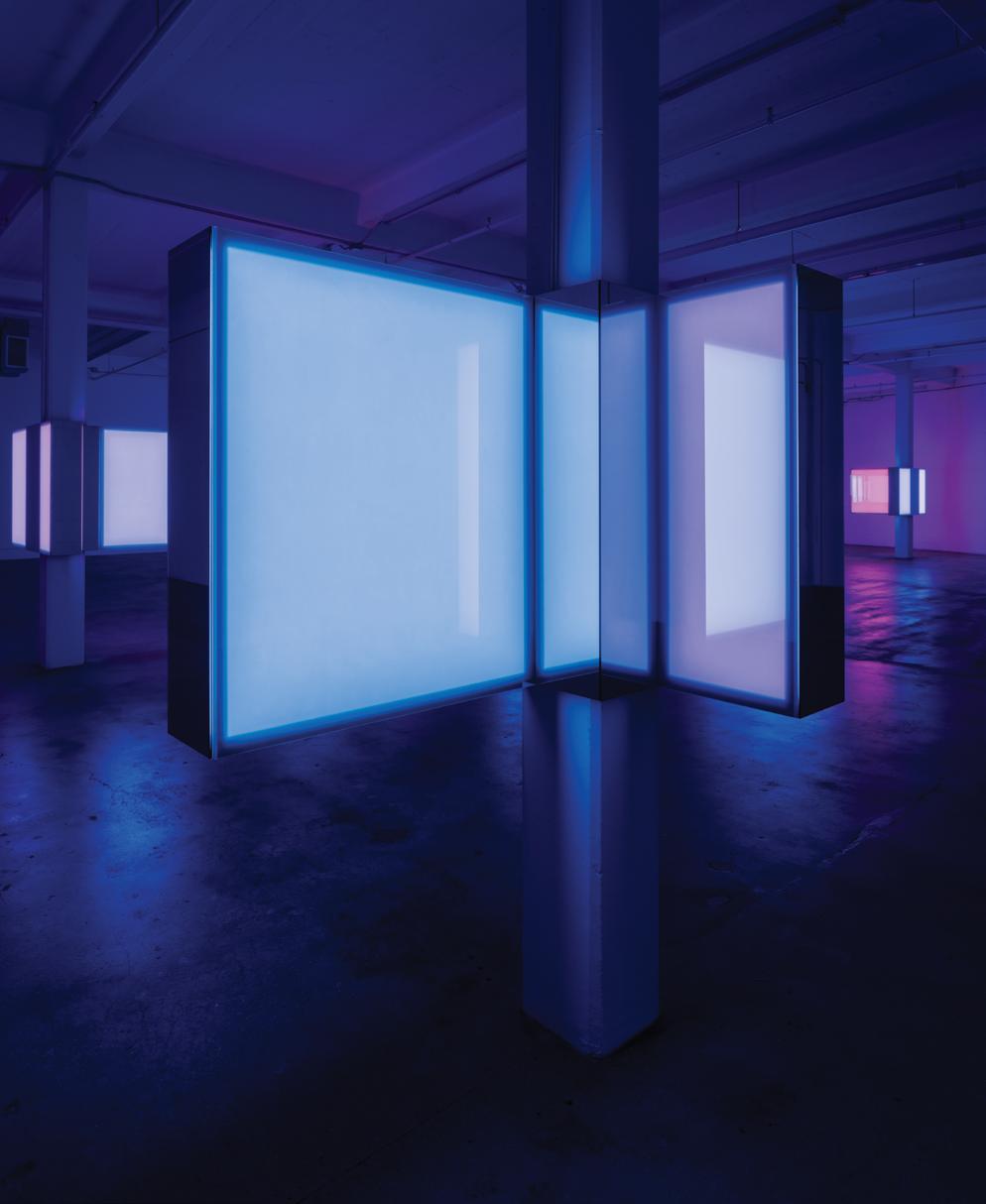
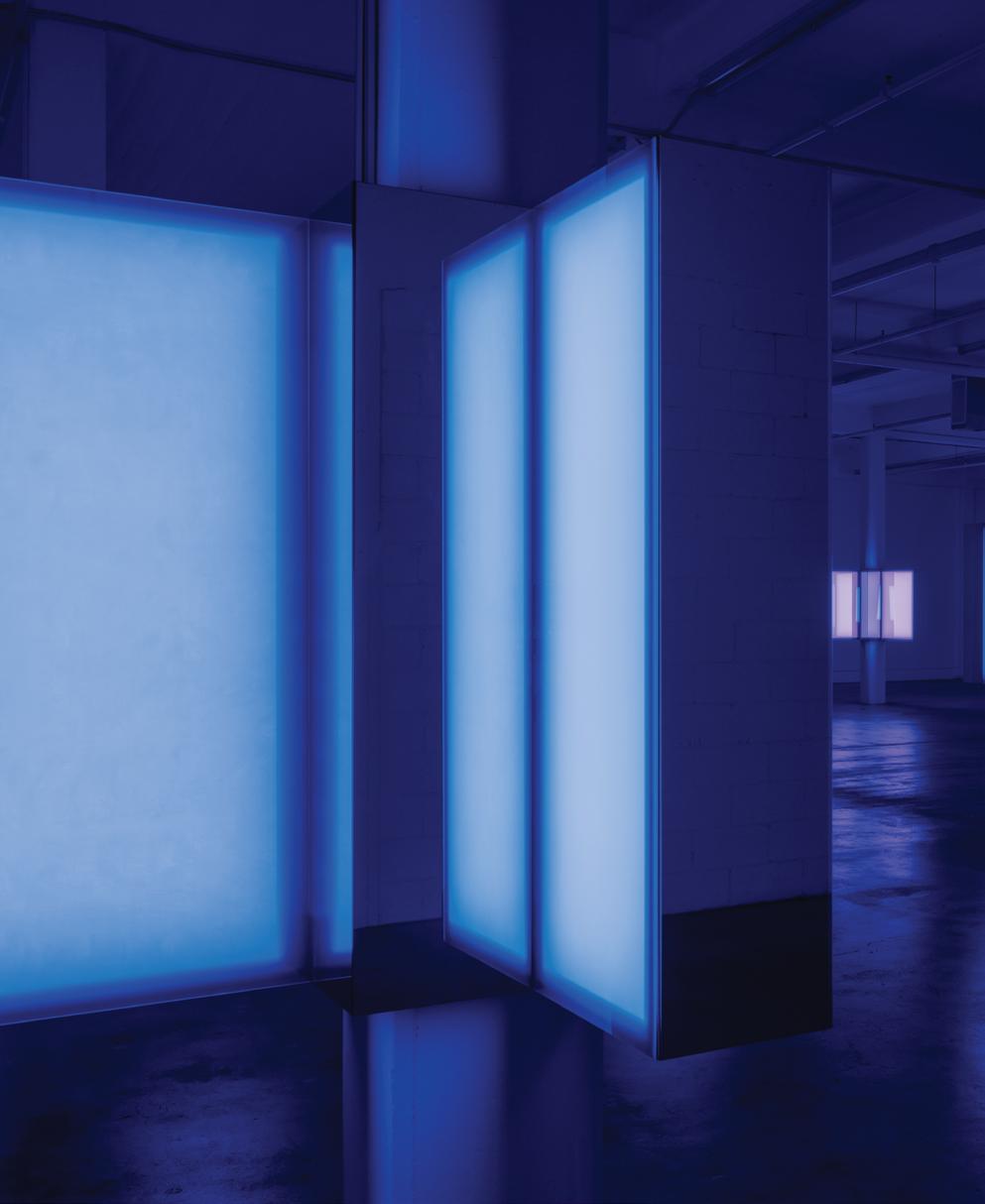
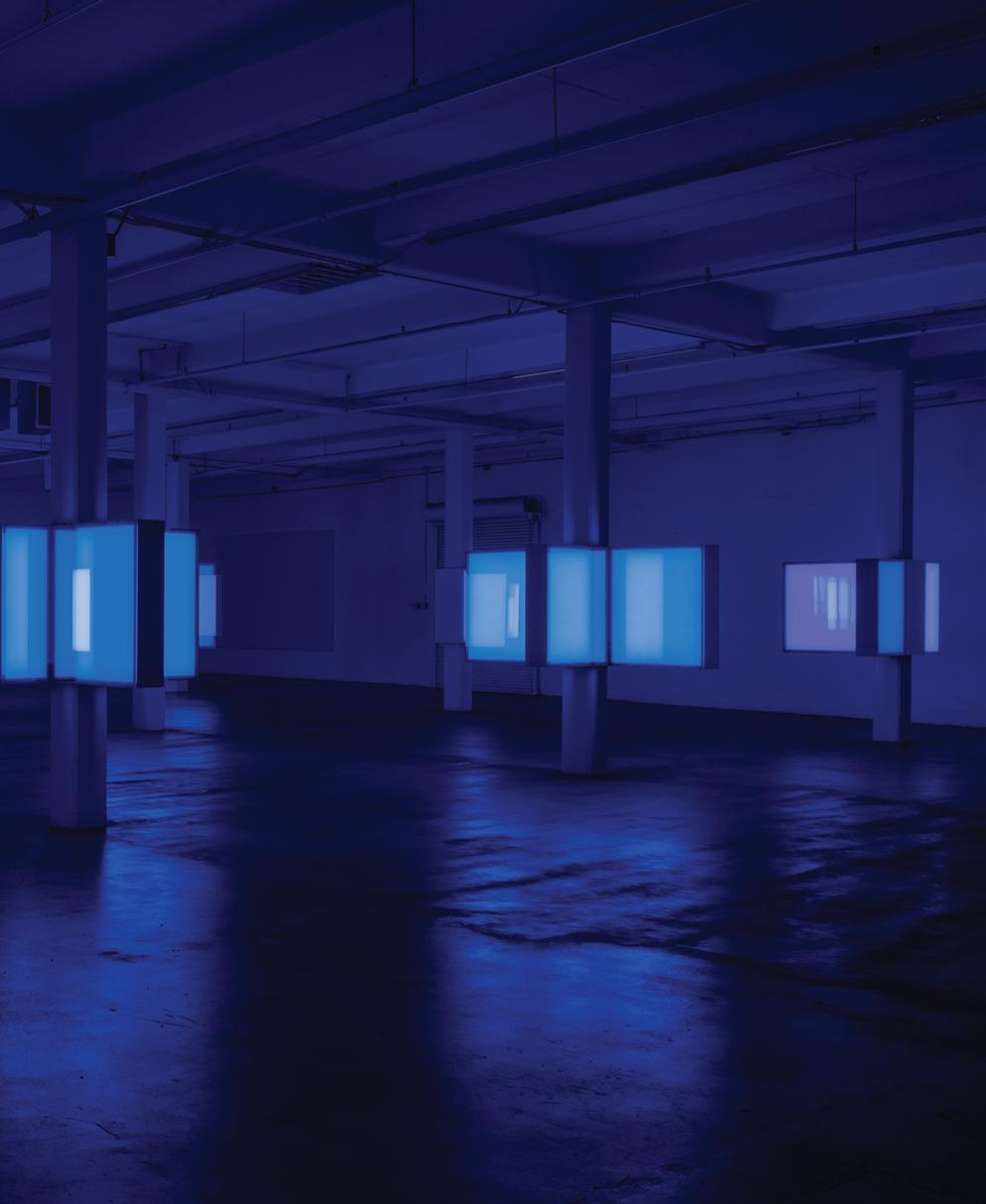
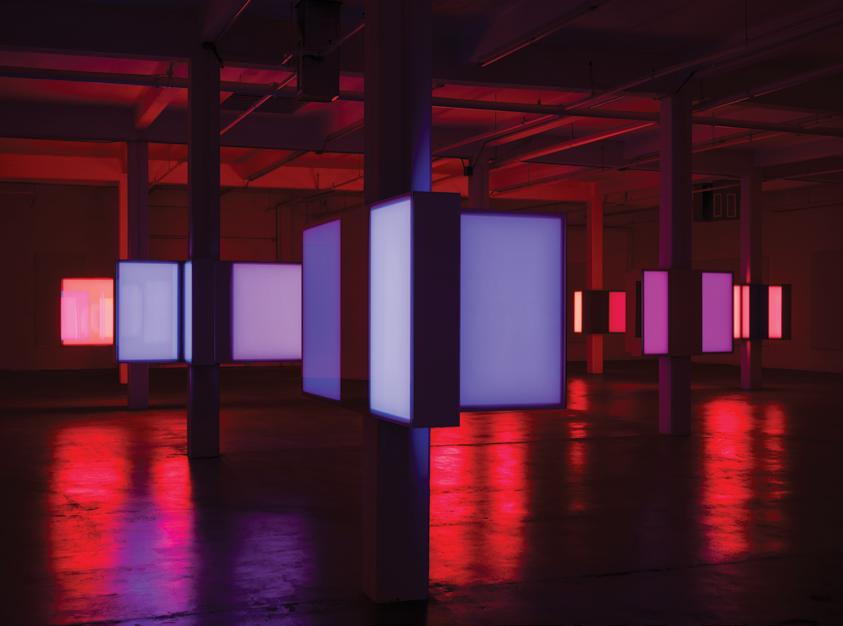
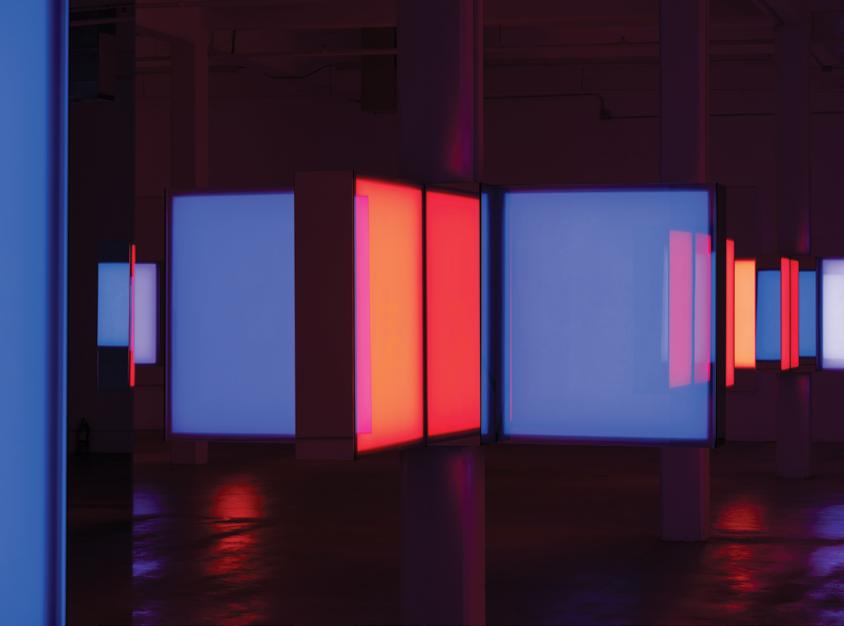
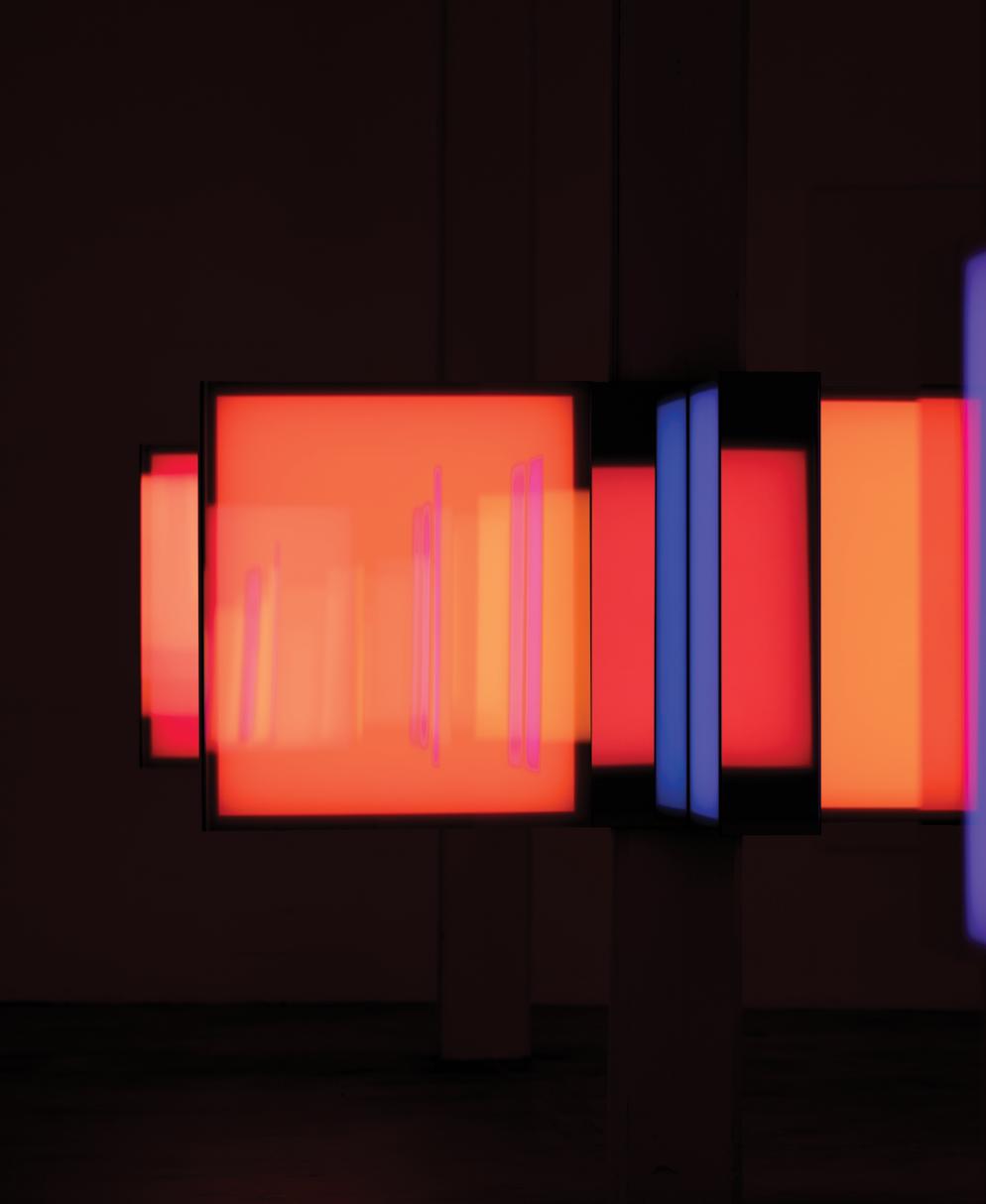
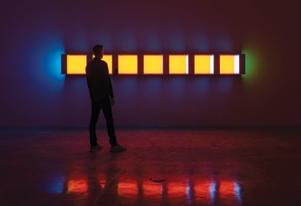
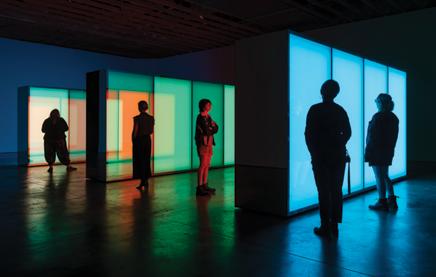
10 Columns defines an ever-changing spatial experience in which projected and reflected color shifts, merges, and floats along a horizontal datum. The installation is composed of 30 mirrored volumes cantilevered from ten existing columns in the 7,000sf space. Conceived as a modular system of color and reflection, the 30 volumes are all the same height (42”) and are divided equally into three groups of ten at each of the three lengths (16”, 26” and 36”). The volumes and mirrored panels adhere to a system that provides for varied configurations focused on three corner conditions that alter perceptions of space, color, and materiality.
The unique color program specifically created for 10 Columns defines varied spatial experiences through the brightness, location, and selection of color. At times, the entire space is immersed in deep, dark blue or all mirrors facing west are united in yellow. Sometimes, most of the space is dark, as pure, unlit, mirrored surfaces, while a singular column glows from the corner. The color program’s varied conditions seamlessly interweave at a slow, meditative pace, allowing for objective acknowledgment from afar or engaged abstraction of reflected color from up close.
203
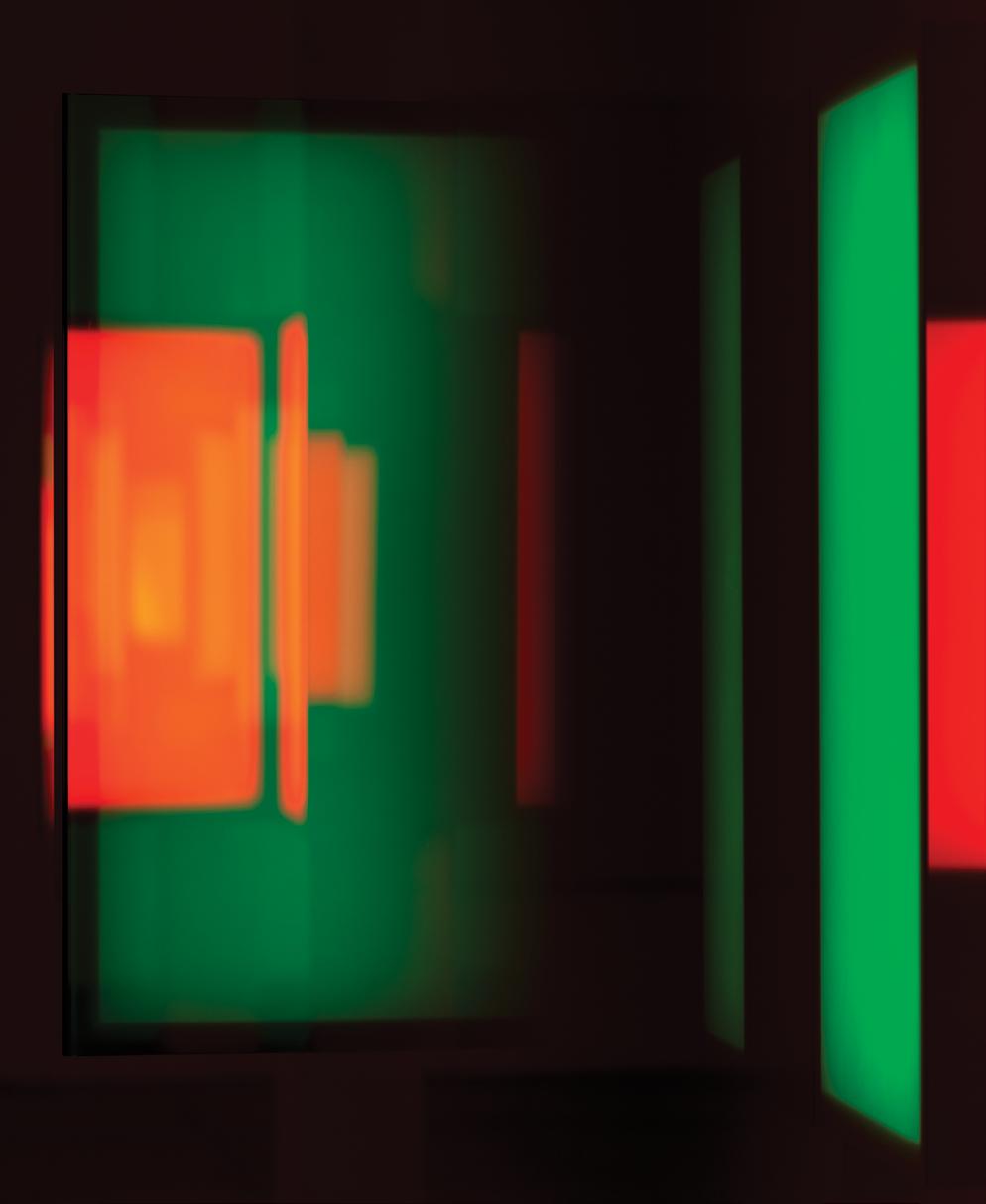
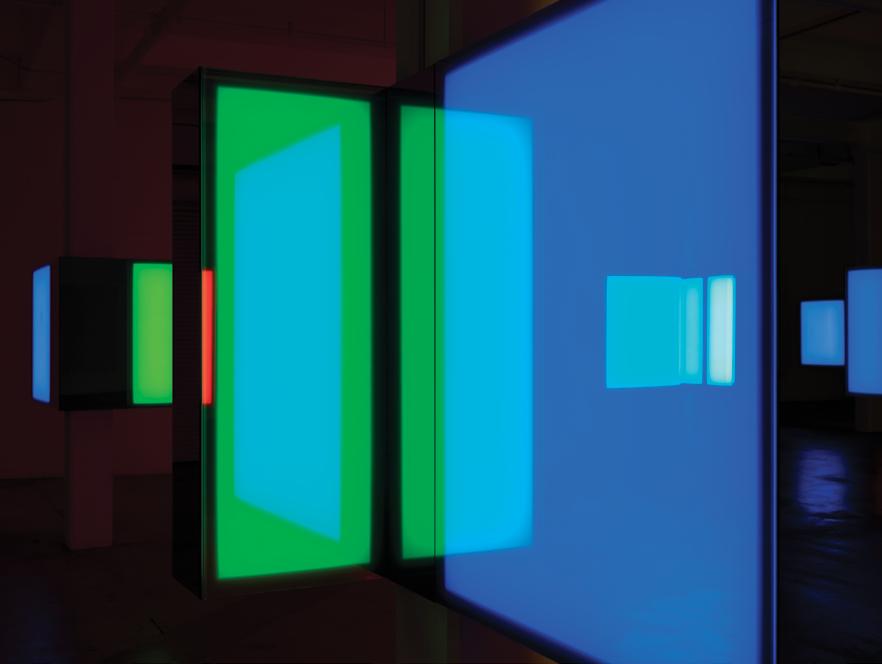
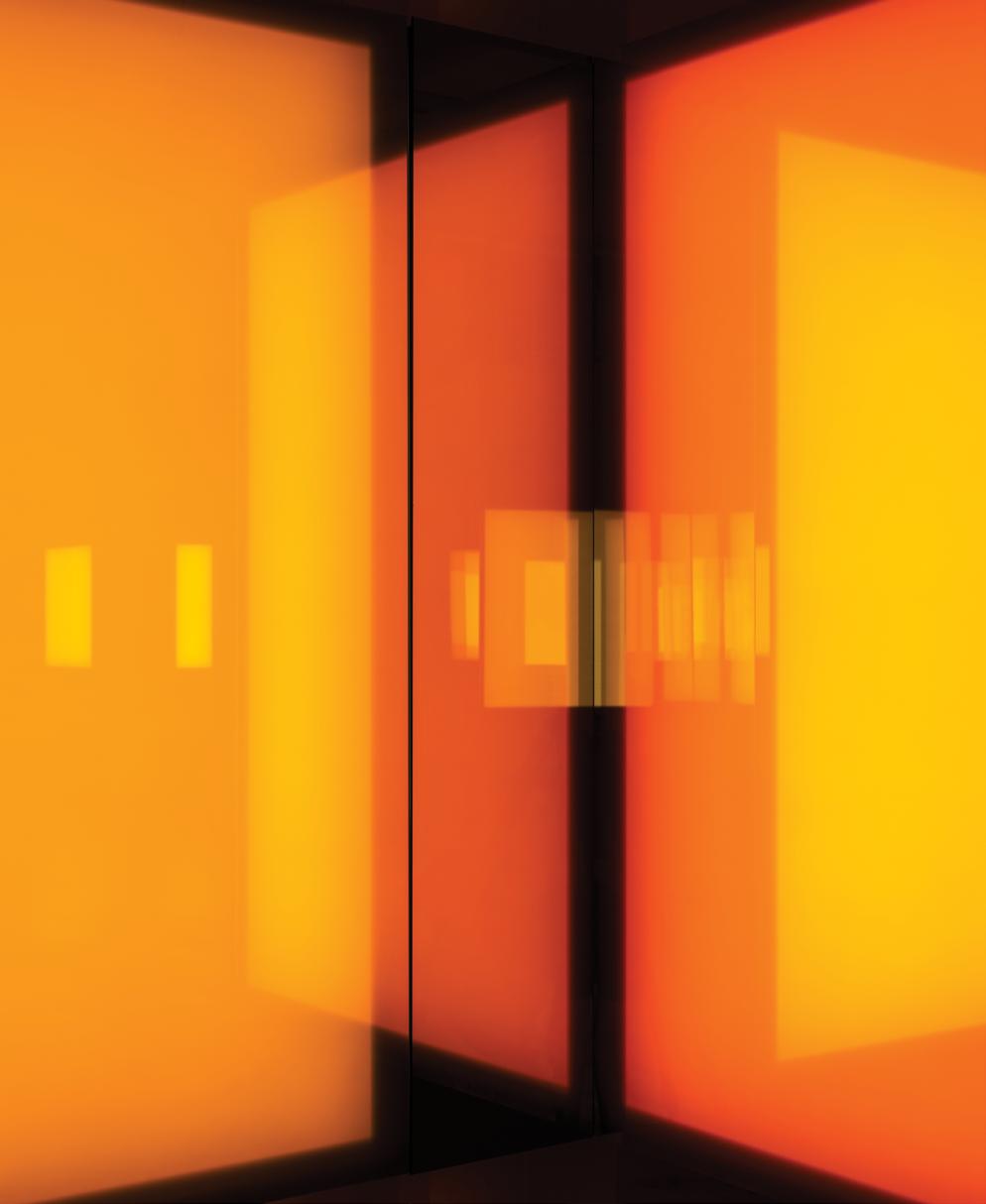
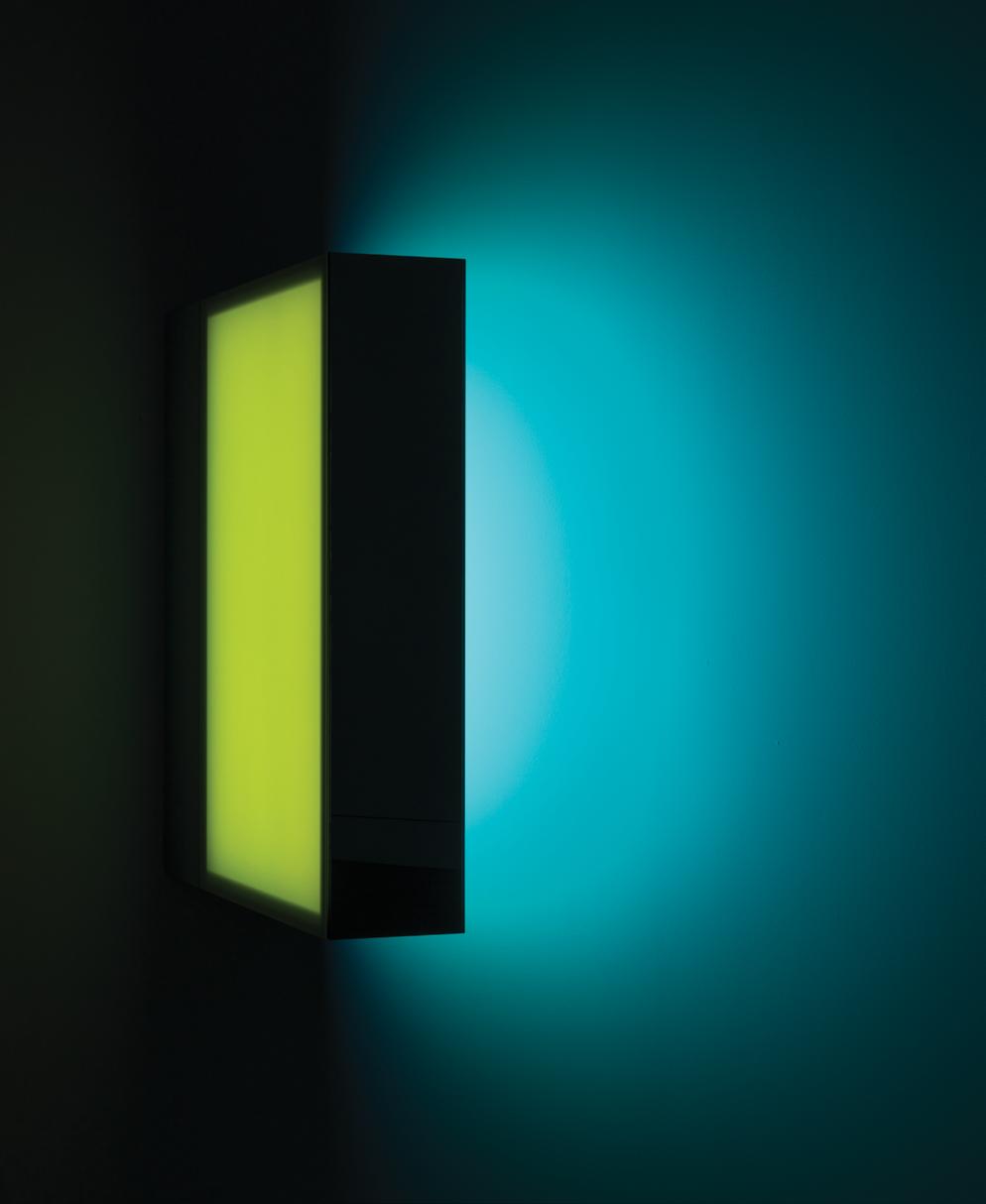
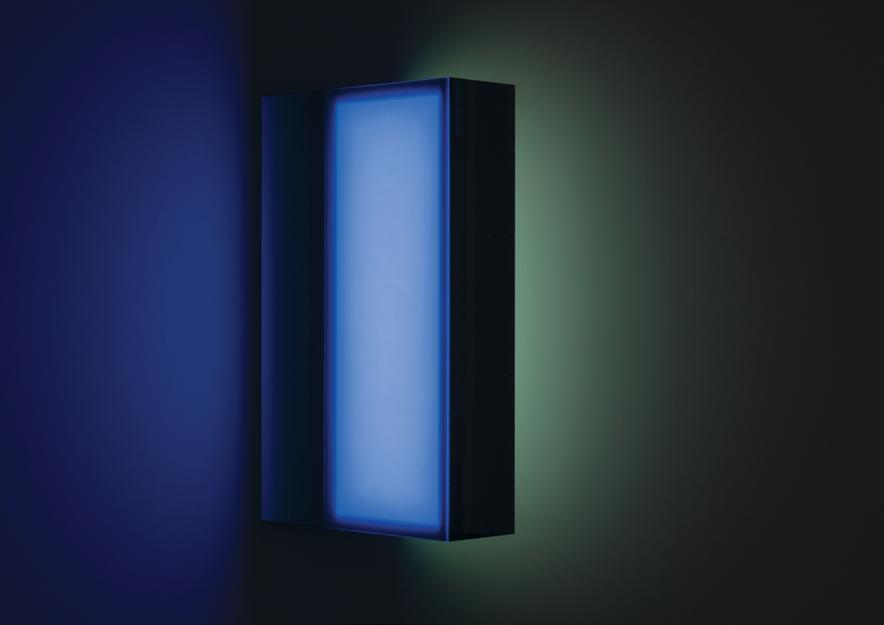
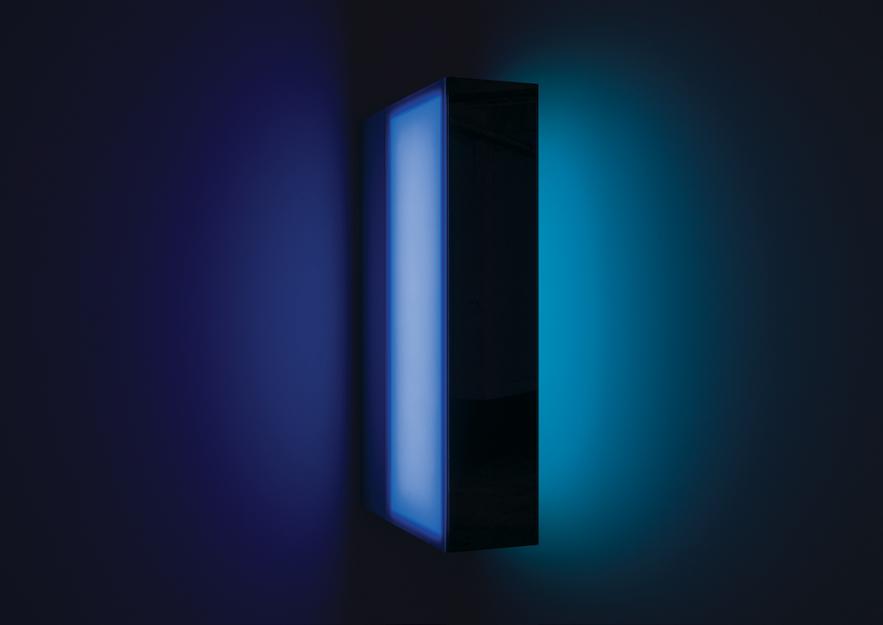
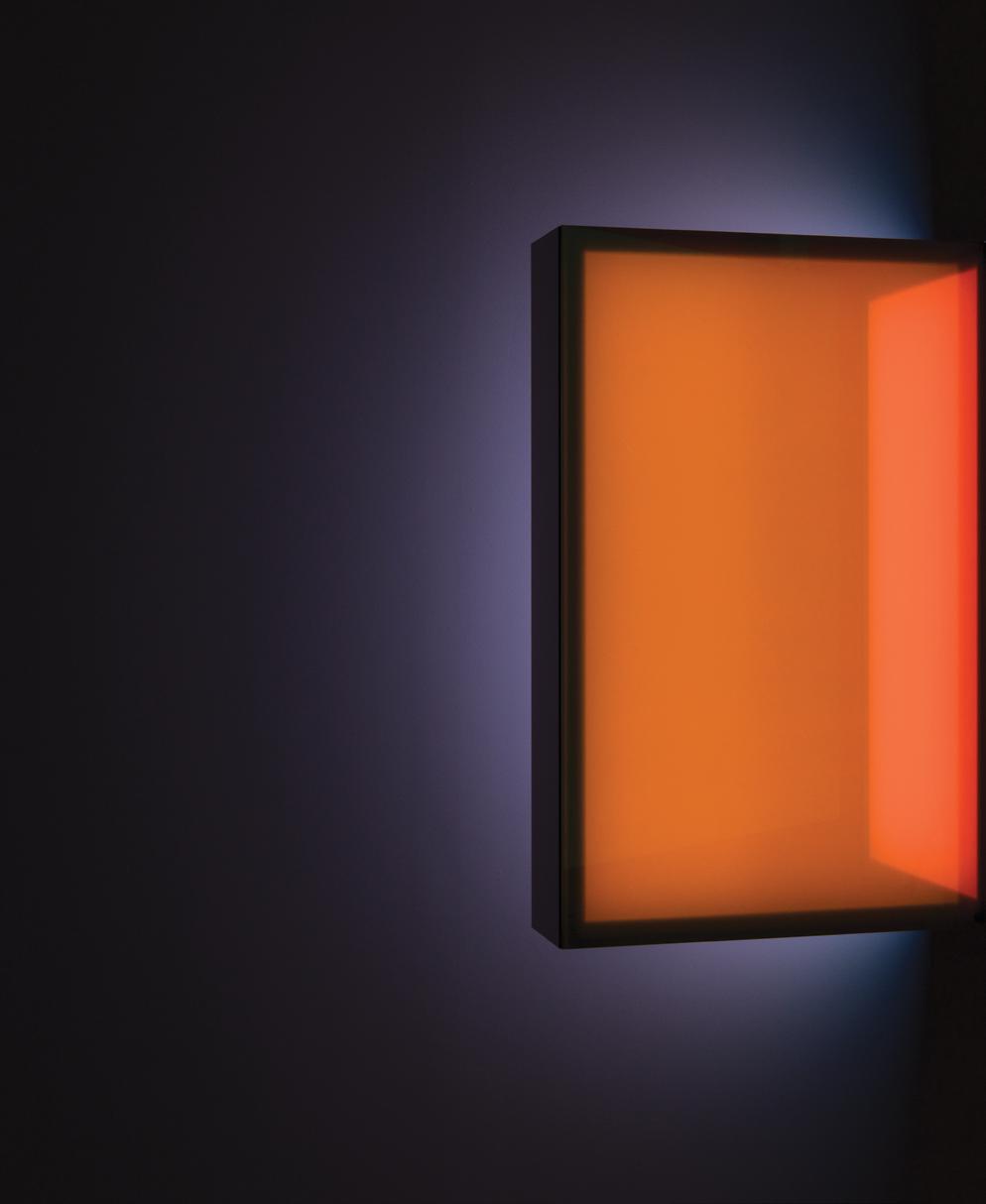
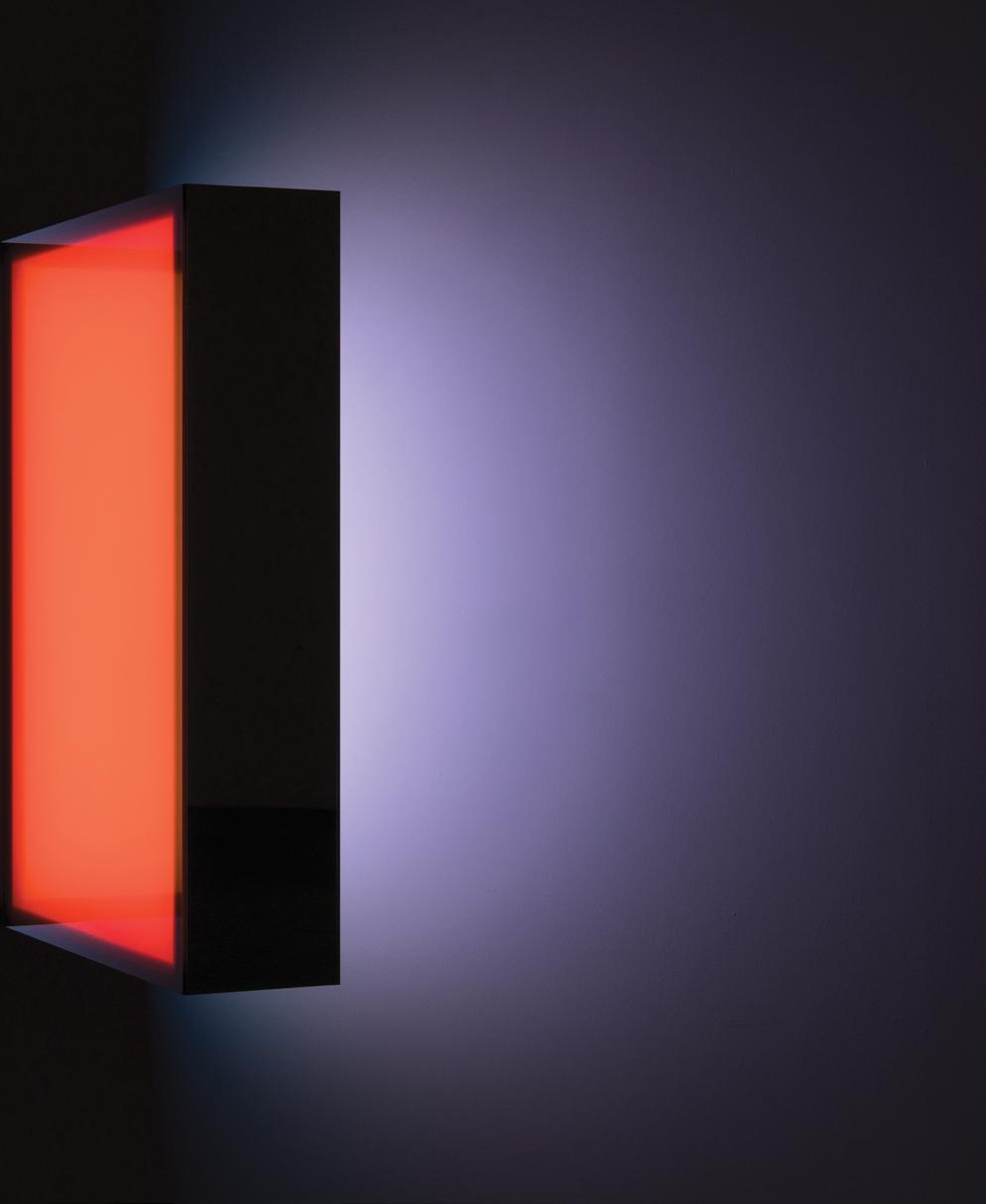
10 COLUMNS: SMALL, MEDIUM, LARGE Bridge Projects Hollywood, CA 2020
Single volumes:
Small: 3’-6” x 2’-0” x 1’-6”, 107 x 62 x 46 cm
Medium: 3’-6” x 2’-7” x 2’-1”, 107 x 79 x 64
Large: 3’-6” x 3’-2” x 2’-8”, 107 x 96 x 81 cm
Double volumes:
Small-Small: 3’-6” x 3’-0” x 1’-6”, 107 x 91 x 46 cm
Small-Medium: 3’-6” x 3’-7” x 2’-1”, 107 x 109 x 64 cm
Small-Large: 3’-6” x 4’-2” x 2’-8”, 107 x 127 x 81 cm
Medium-Medium: 3’-6” x 4’-2” x 2’-1”, 107 x 127 x 64 cm
Medium-Large: 3’-6” x 4’-9” x 2’-8”, 104 x 145 x 81 cm
Large-Large: 3’-6” x 5’-4” x 2’-8”, 107 x 163 x 81 cm
Aluminum, glass, LED lighting, electronic components, unique color program
When Smith conceived of the 10 Columns installation, he acknowledged that the site specific installation would only happen once, never able to be precisely replicated as experienced in the Hollywood, CA exhibition space. Accordingly, as Smith was developing his thoughts on the main installation, he was working parallel on a second and final iteration that would incorporate all 30 of the mirrored volumes as reimagined works.
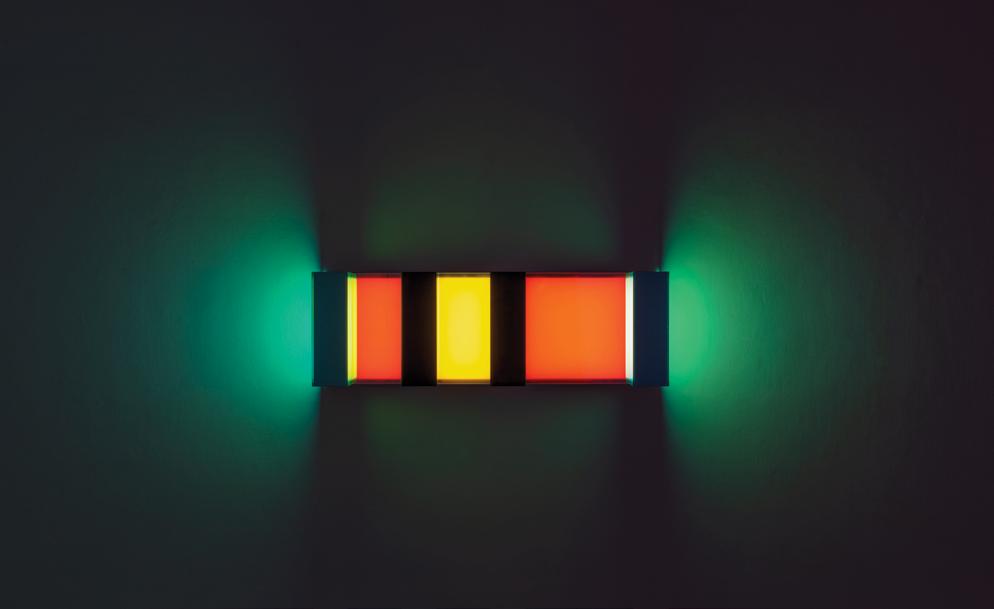
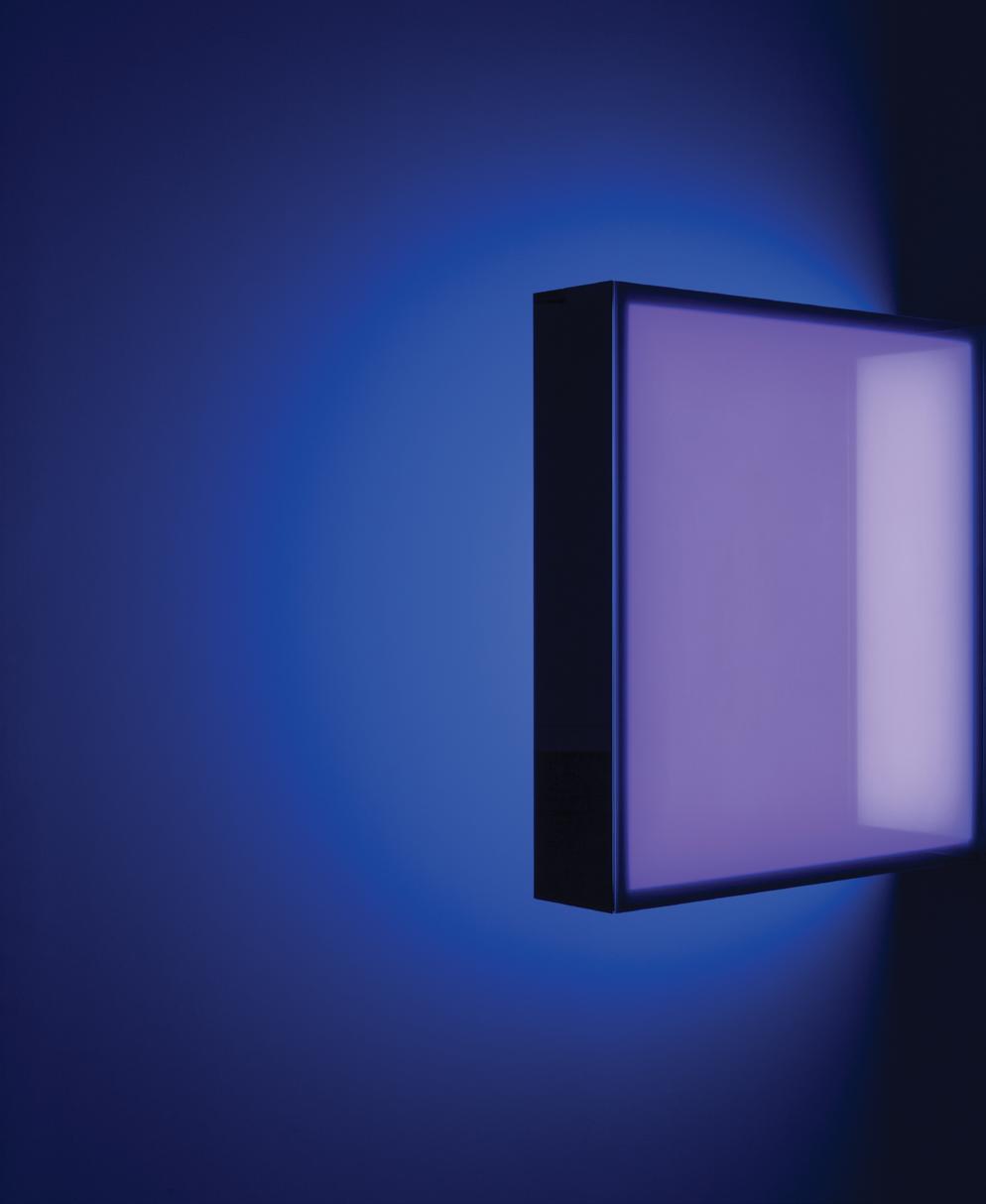
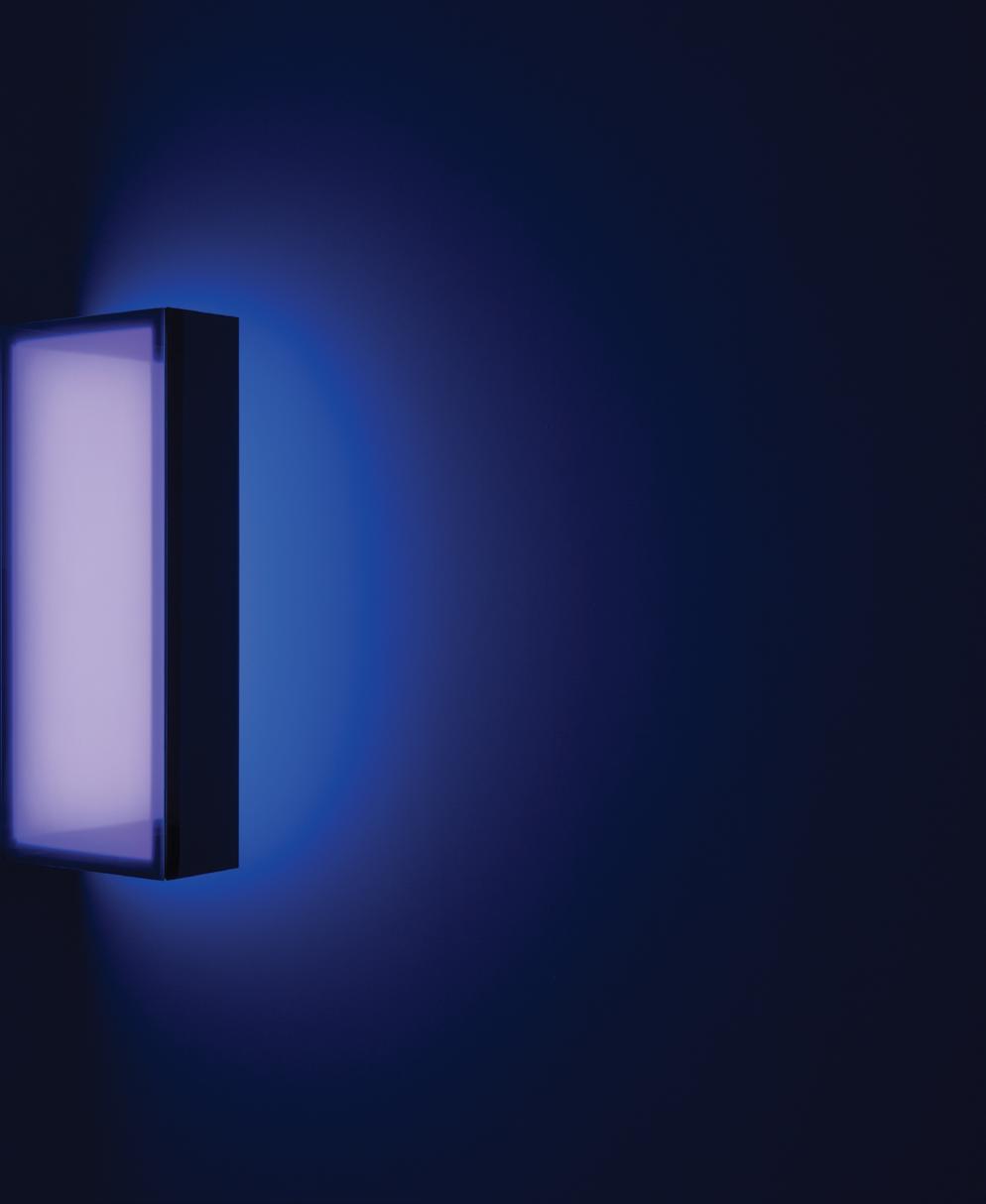
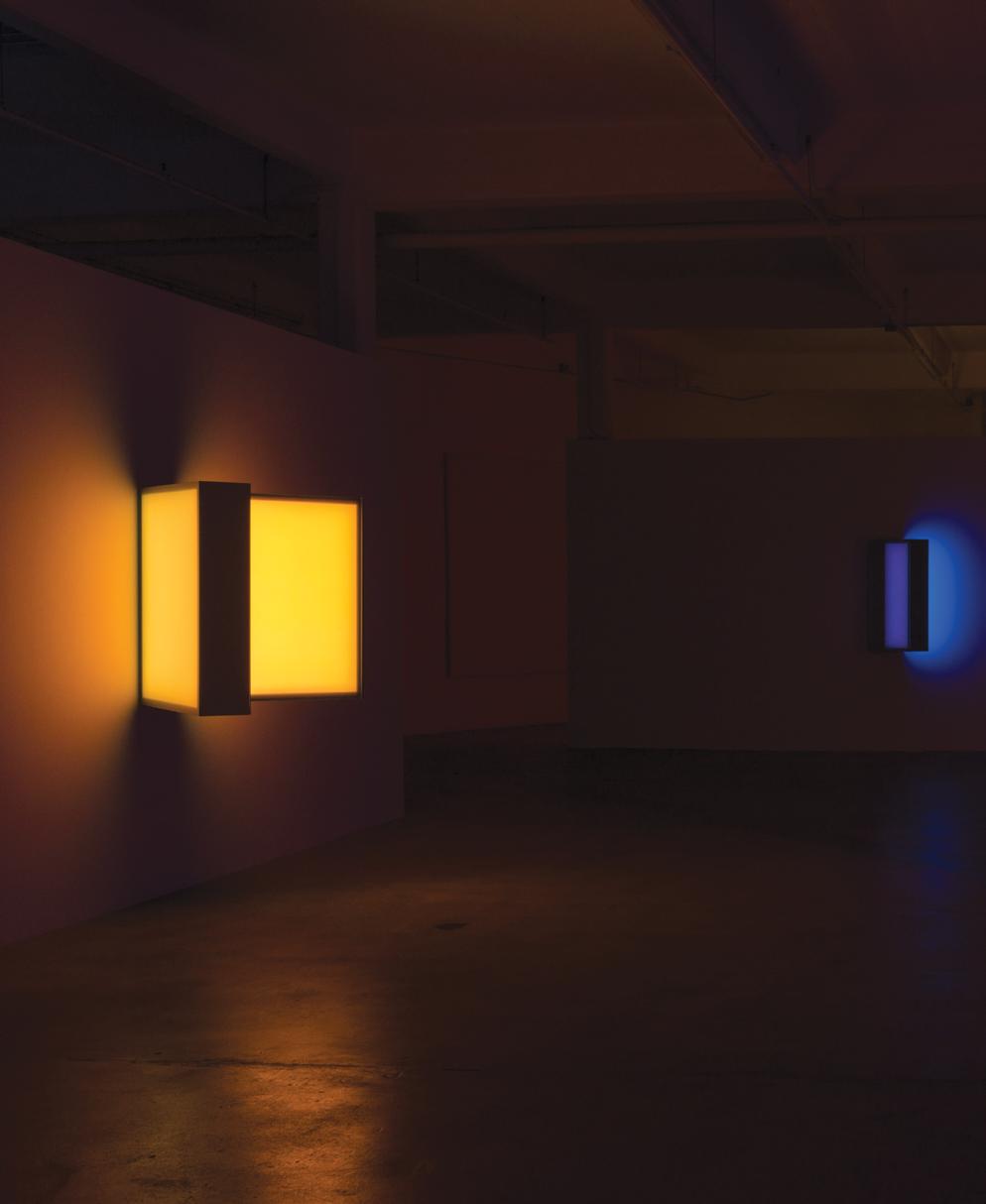
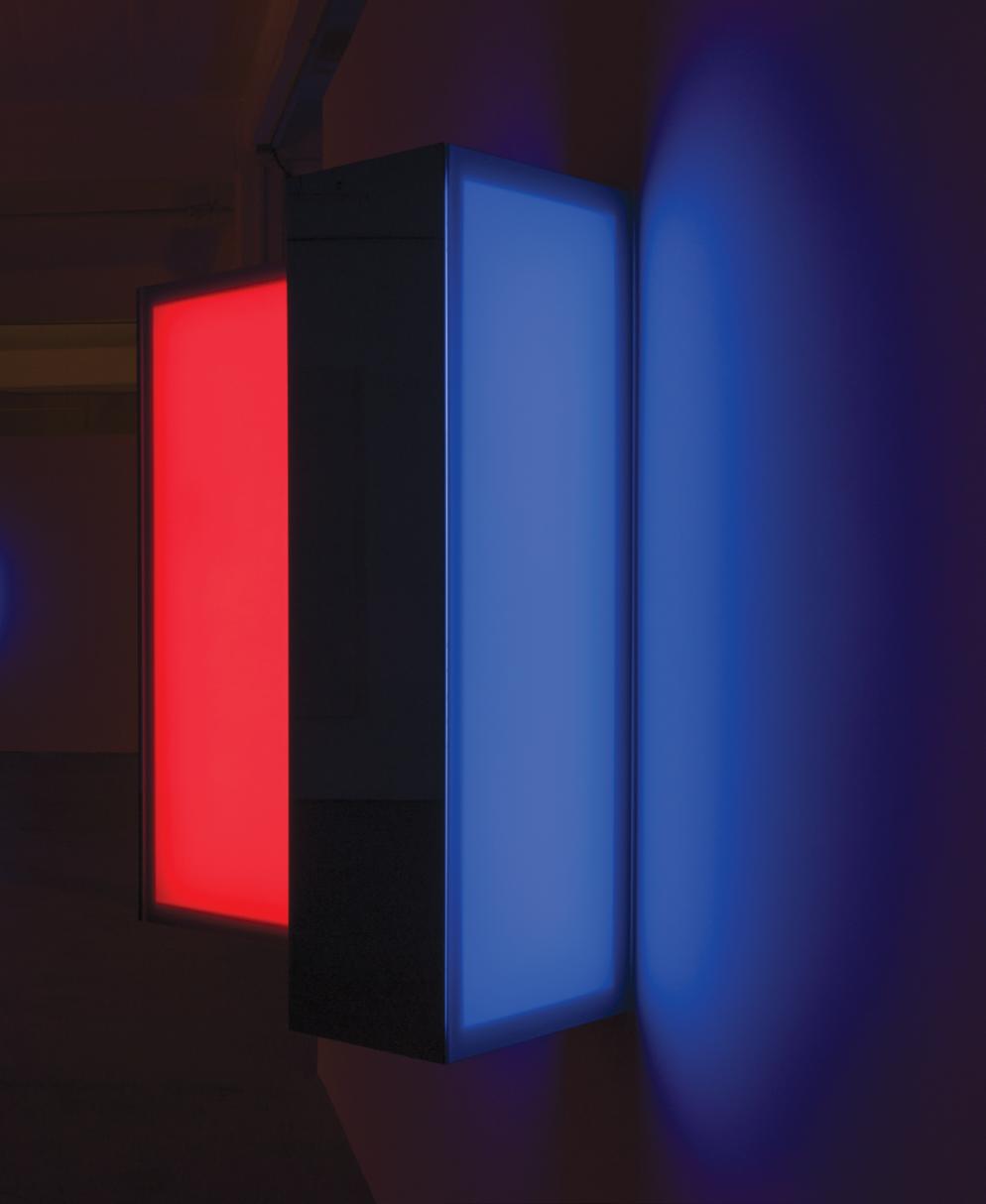
The result was 10 Columns: Small, Medium, Large, composed of nine individual wall-mounted works each at an edition of two. Acknowledging the modular logic of the original installation through their titles, these works also define the finite iterations of single and double volumes, all of which (at an edition of 2) tally to the original 30 volumes. Each color-choreographed by Smith, these wall-mounted works celebrate the 10 Columns installation’s merging of reflection, color, and space within a 90 degree angle cantilevered off of the wall.
215
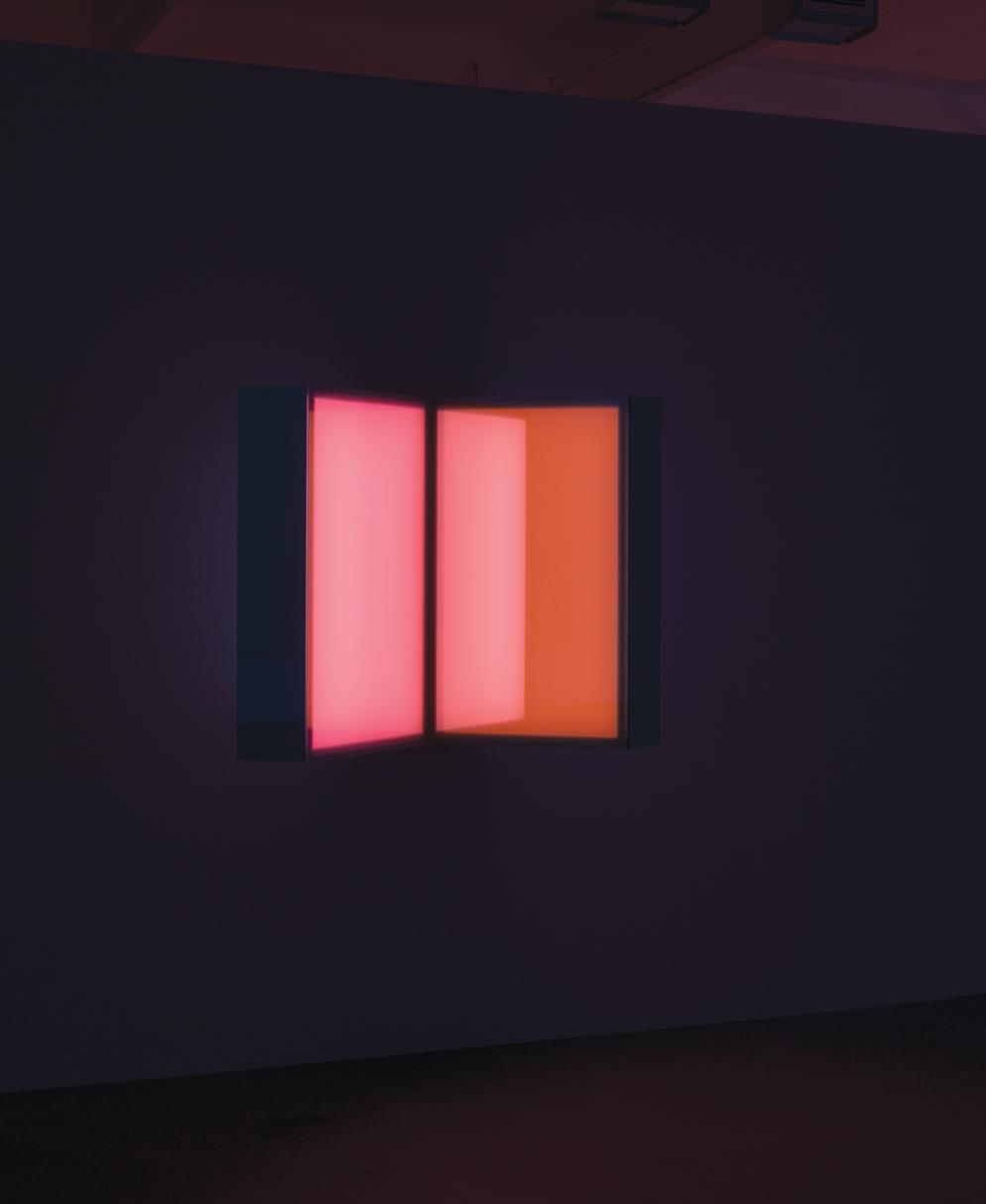
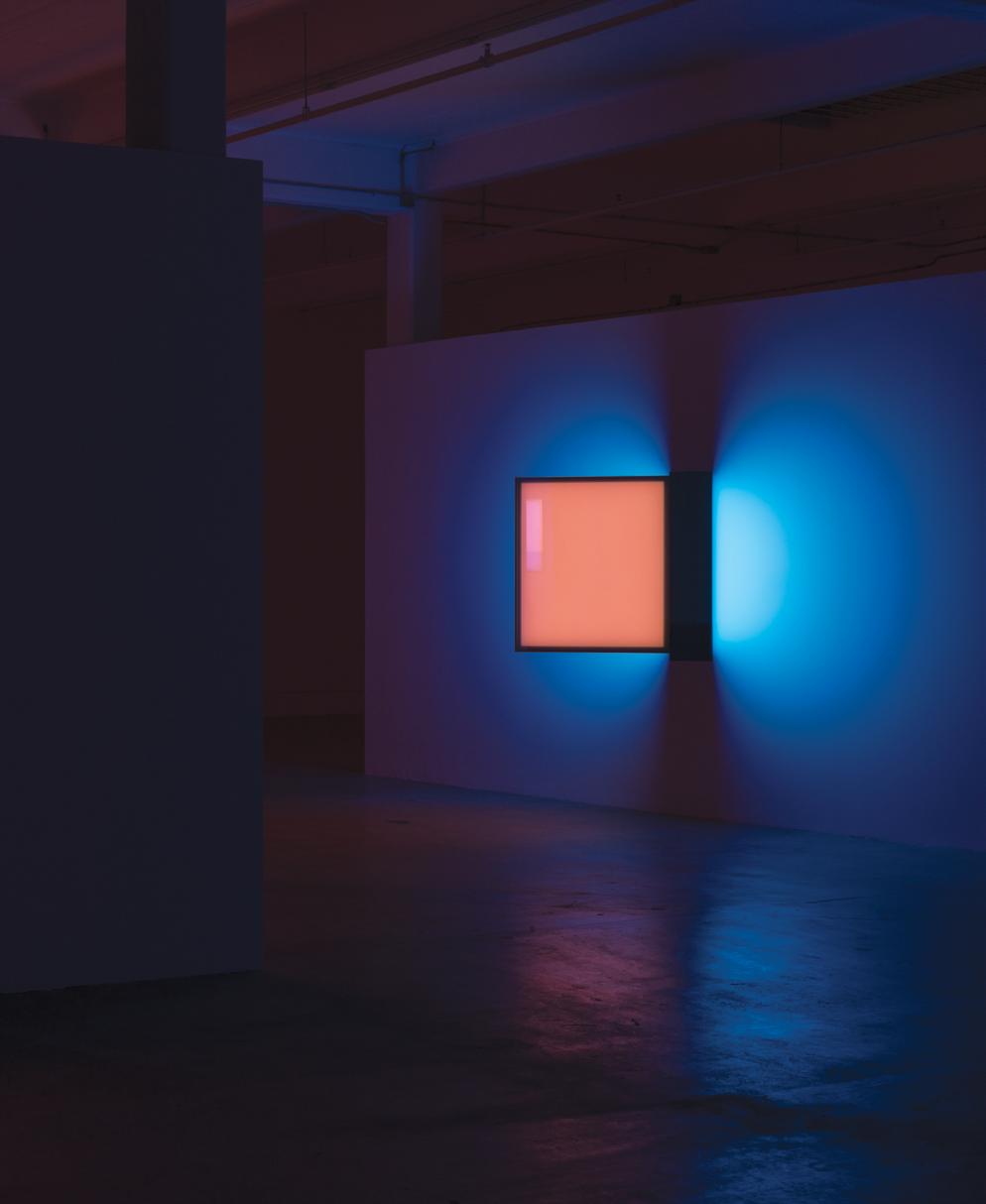
SANTA MONICA LINEAR
Santa Monica, CA 2020
2’-6” x 30’-0” x 2’-4”, 7.6 x 9.14 x 7.1m Aluminum, steel, glass, LED lighting, electronic components, unique color choreography
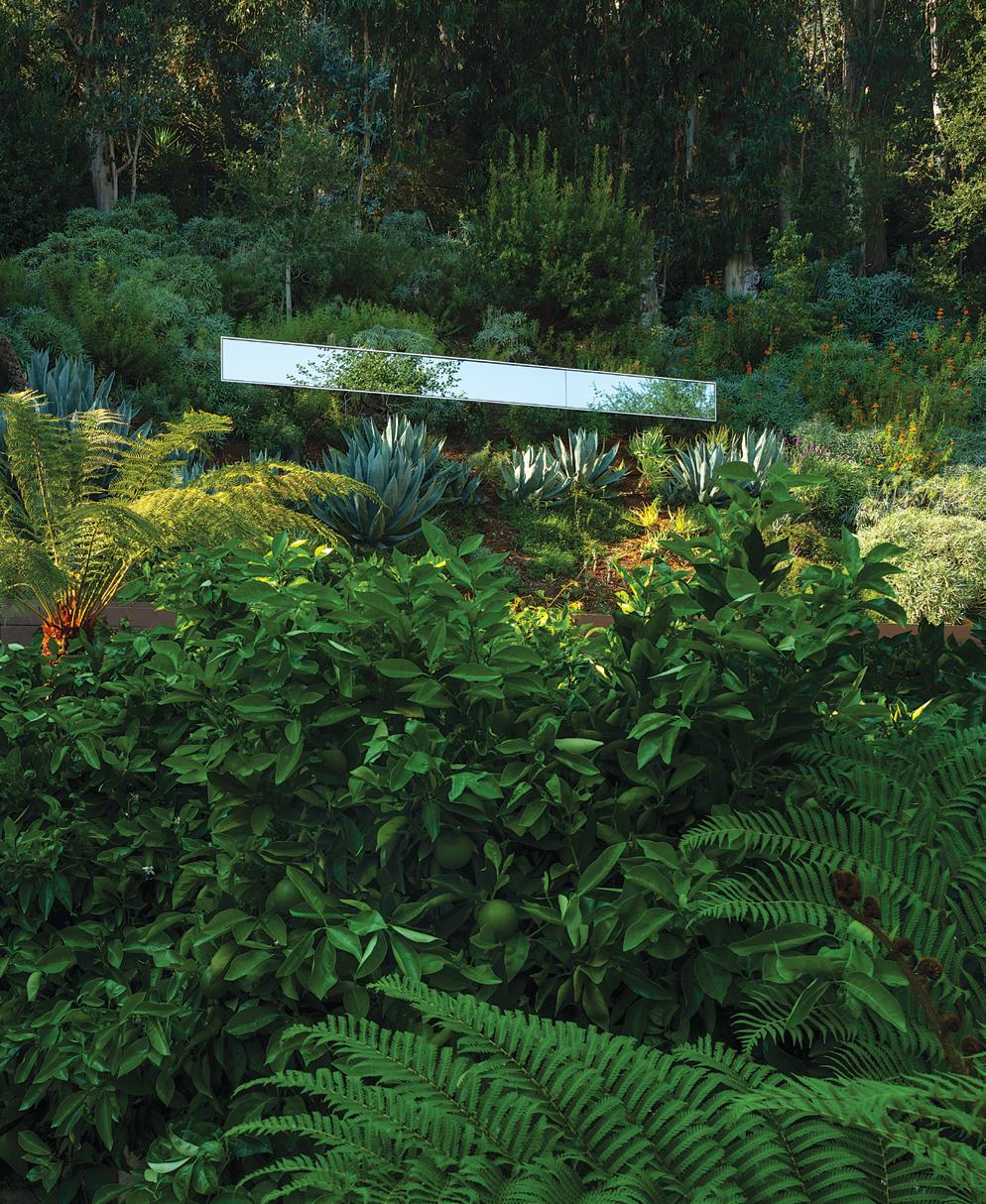
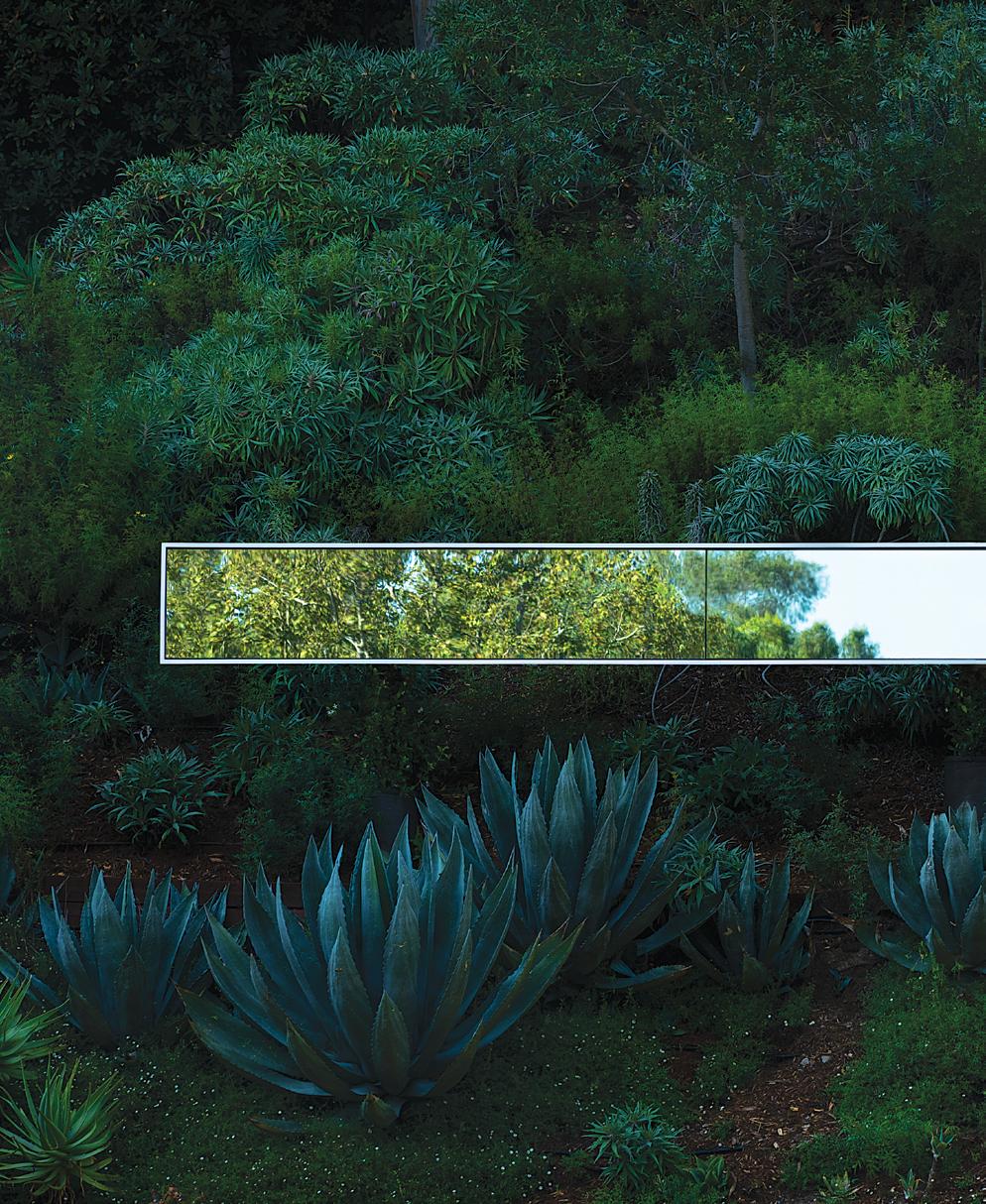
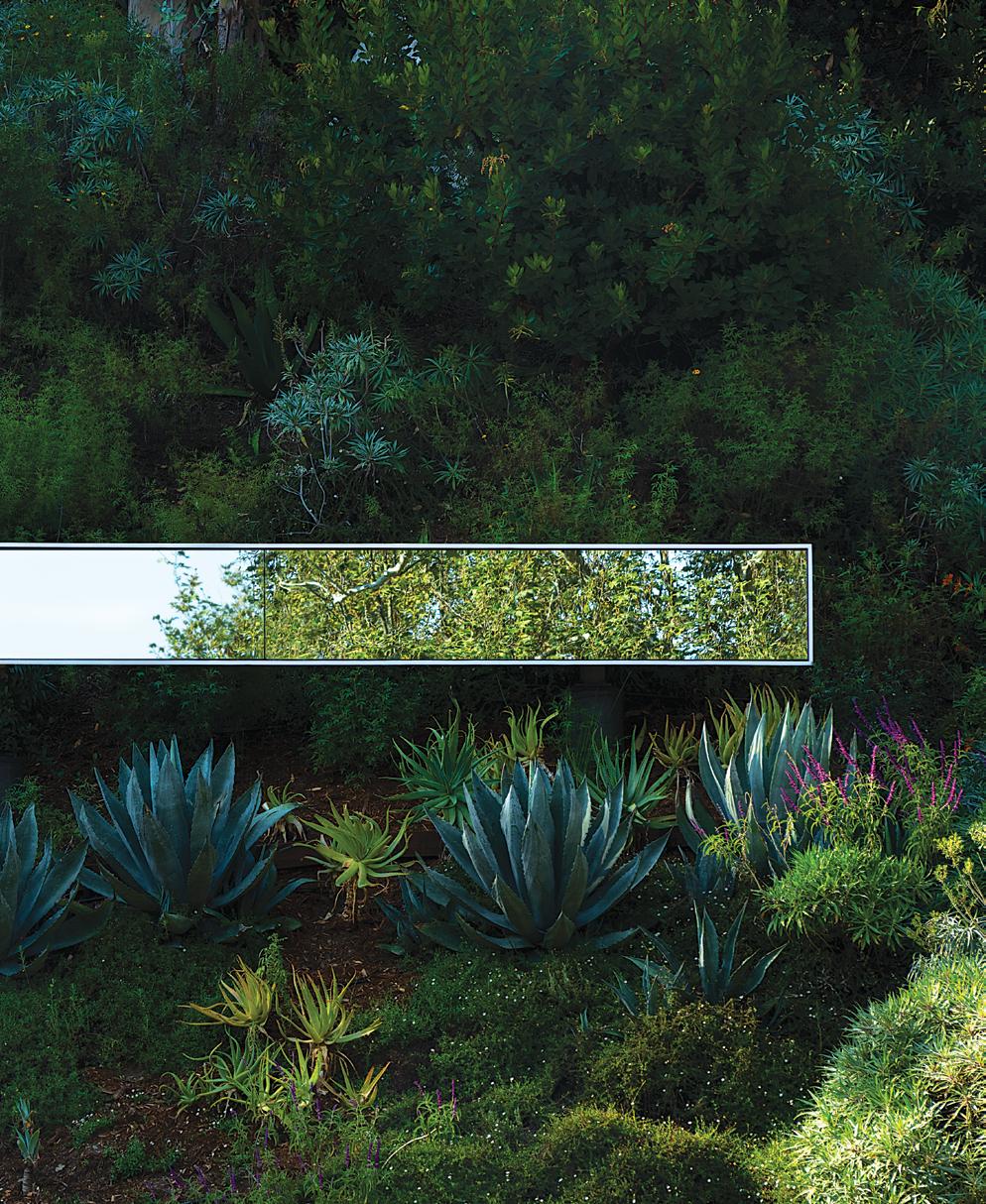
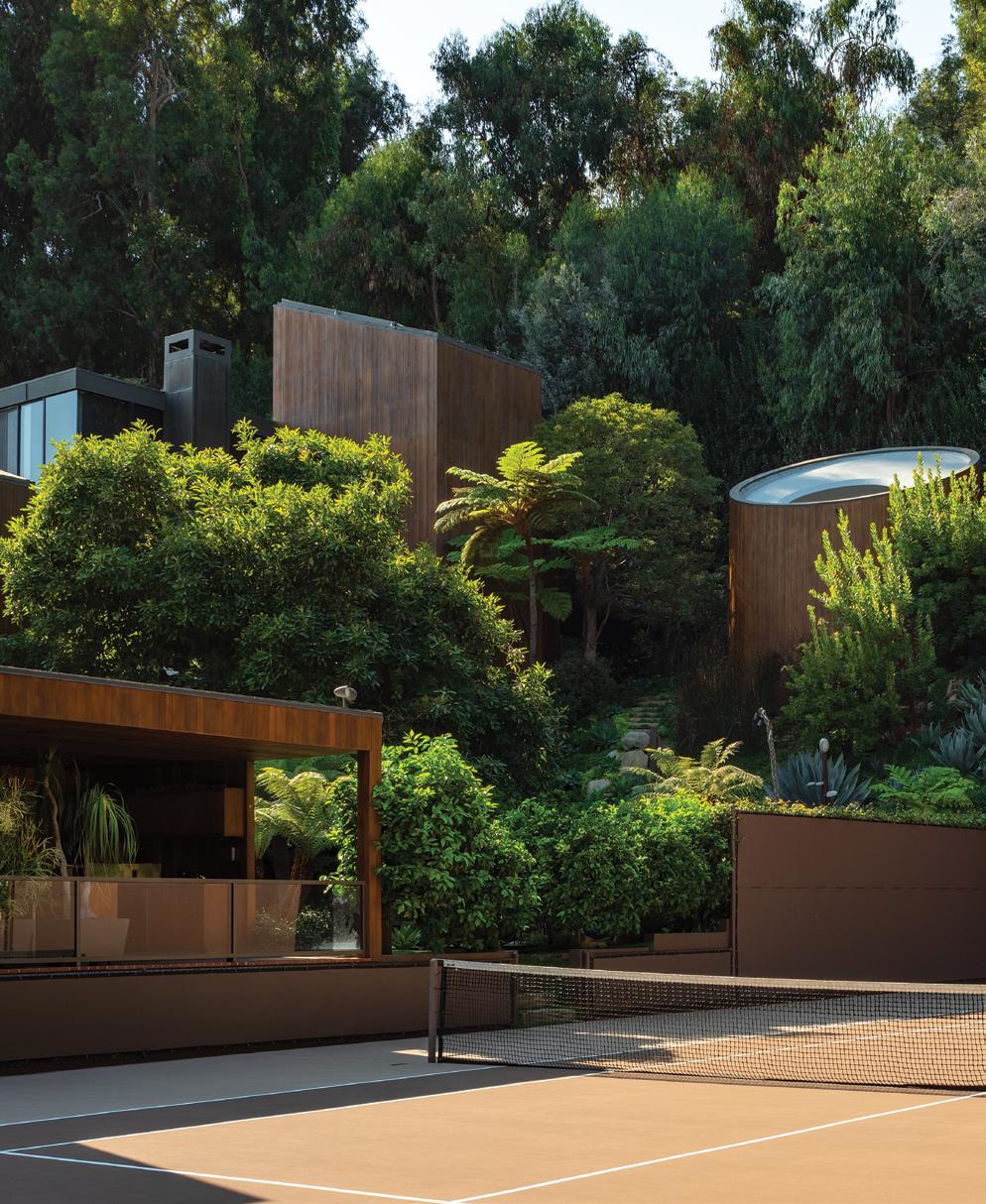
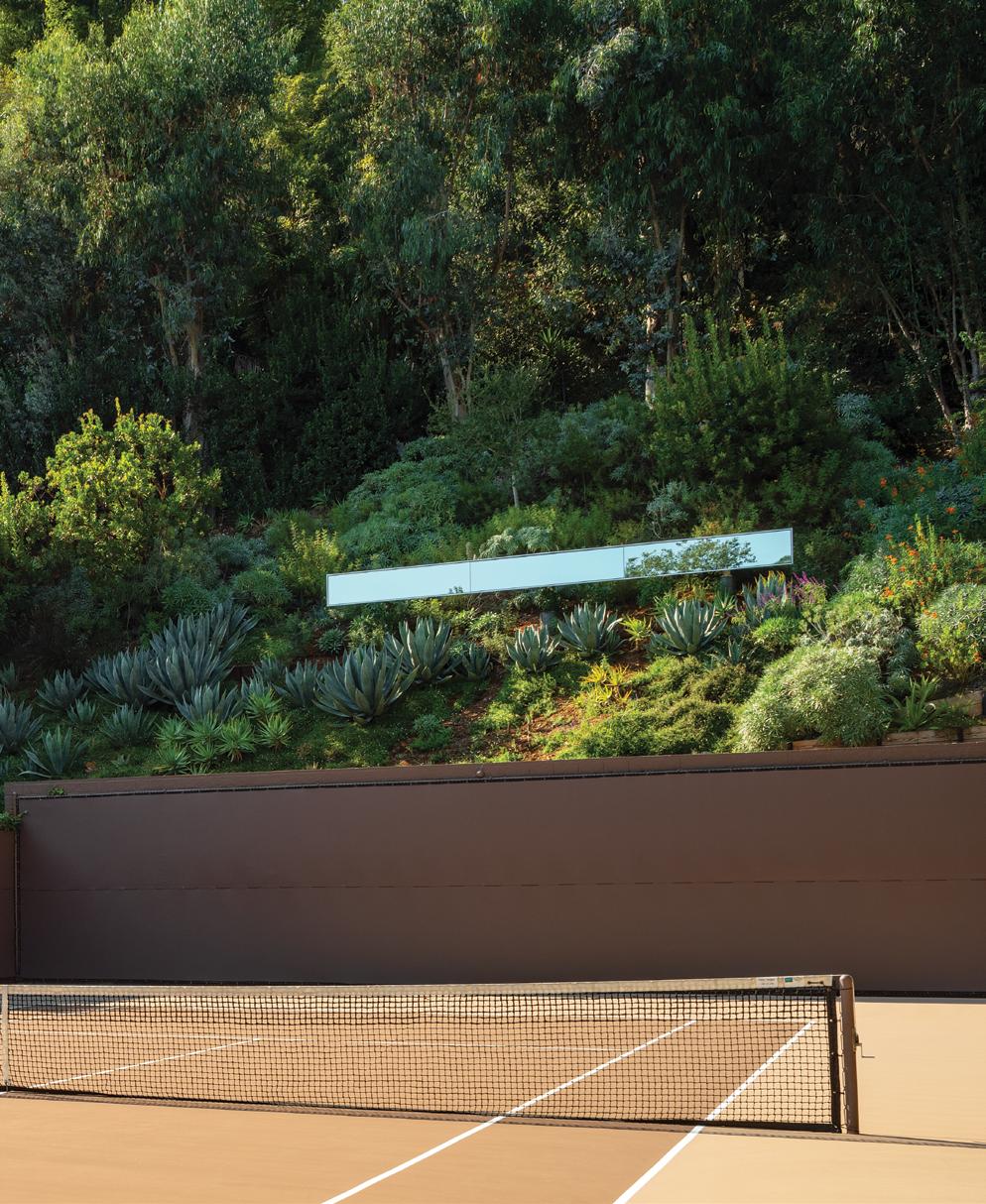
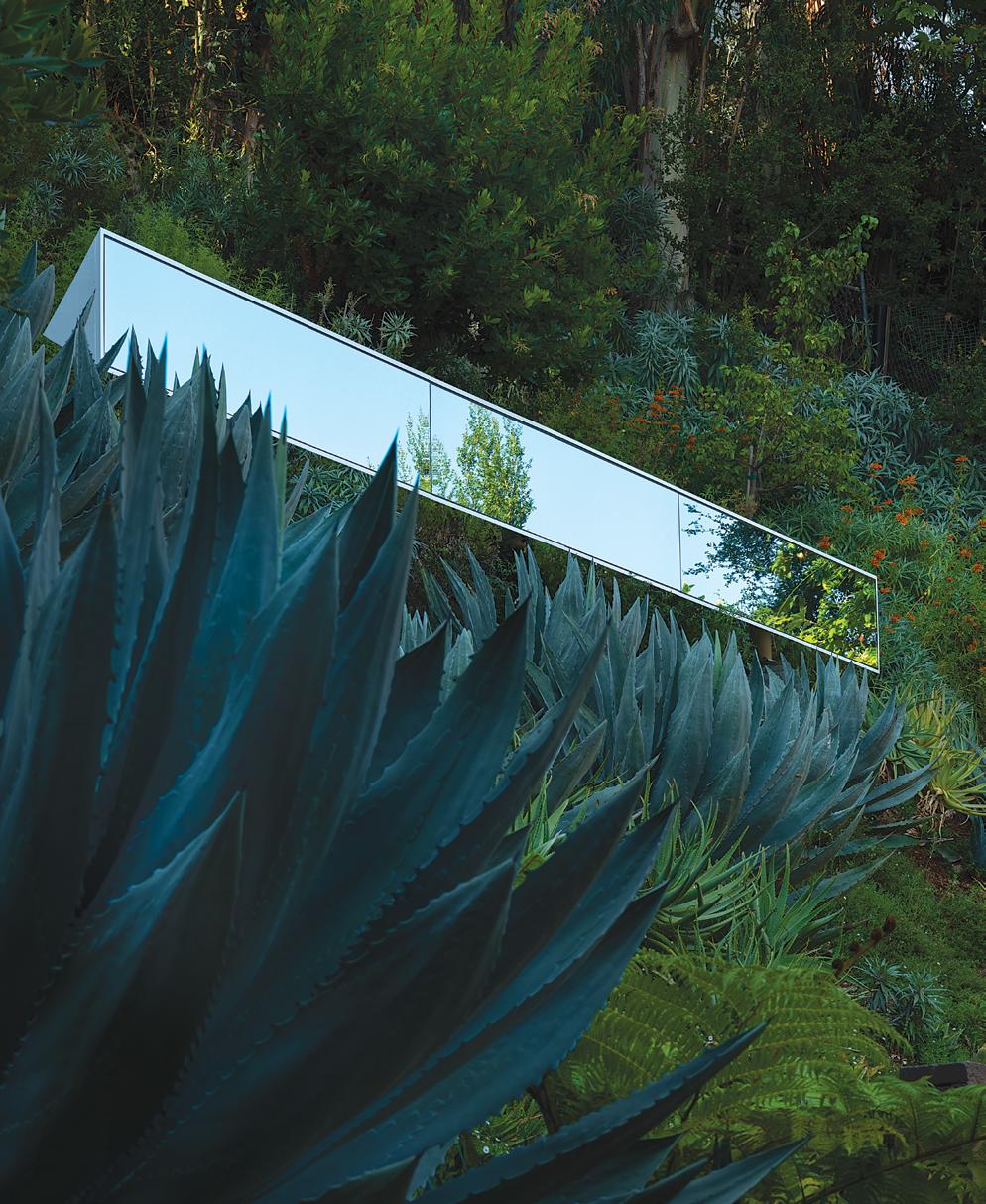
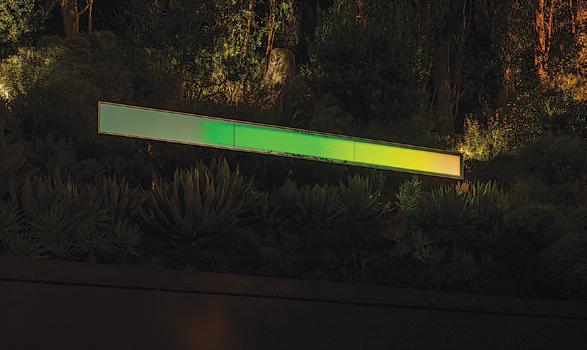
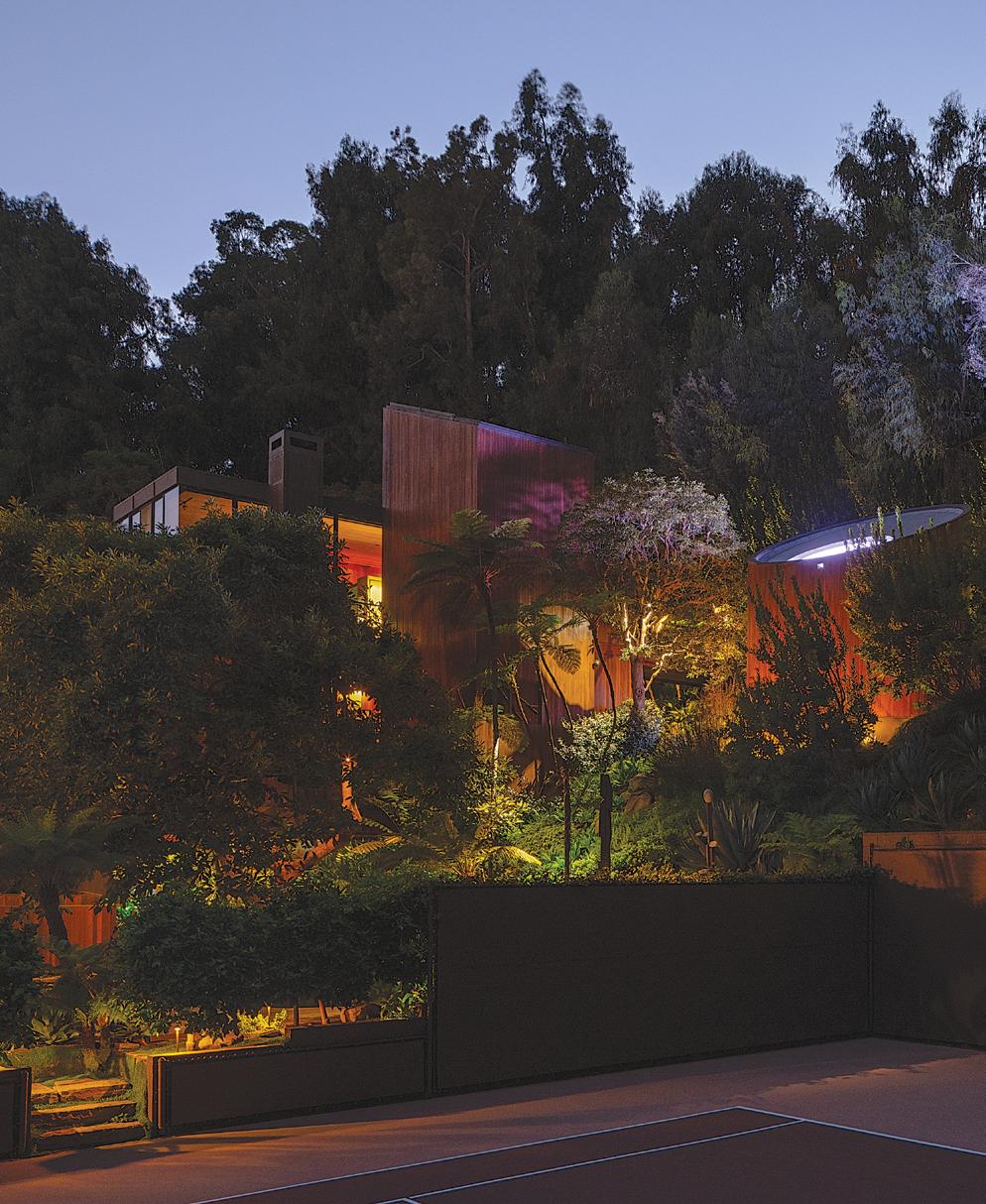
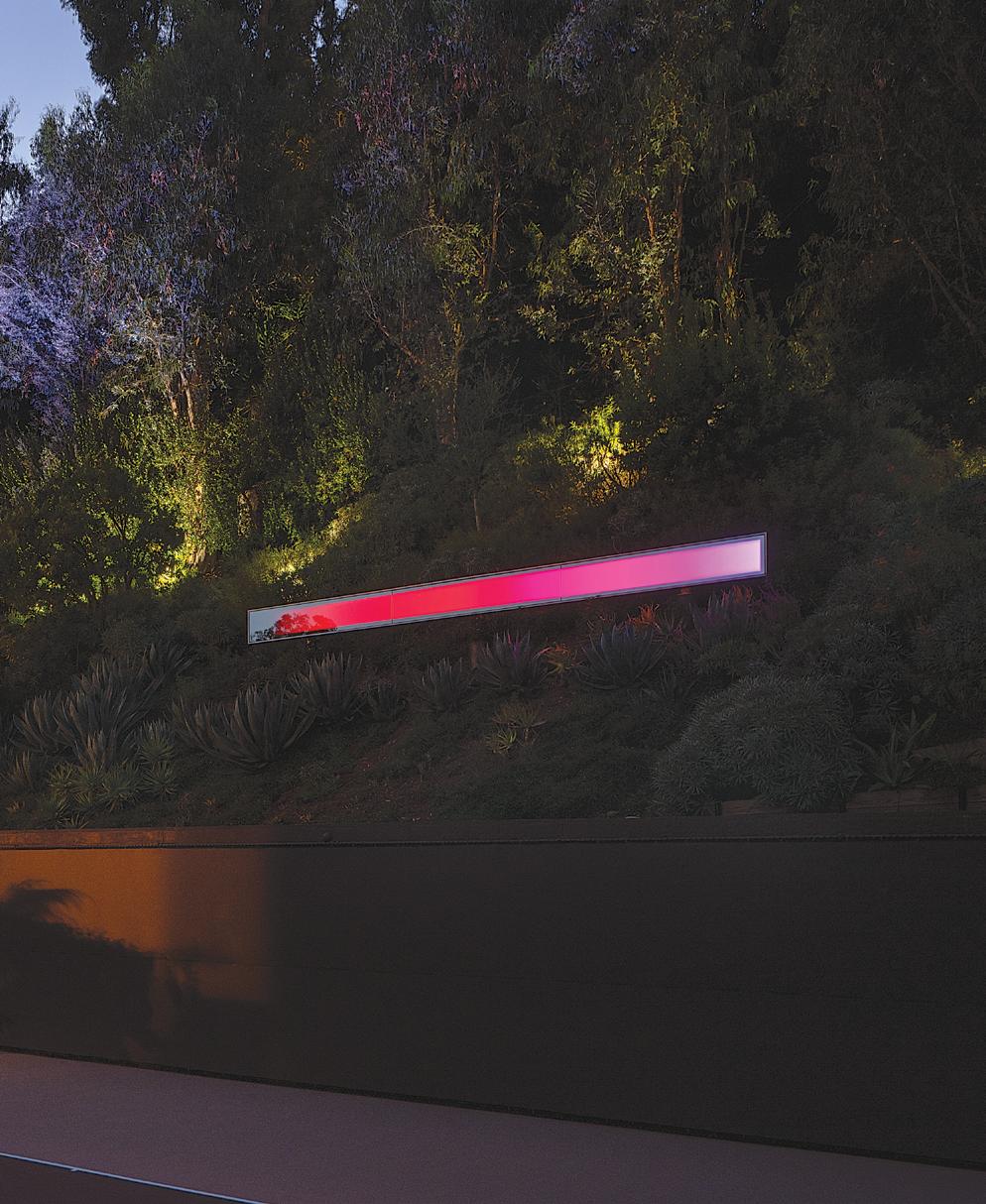
Commissioned for a private collection in Santa Monica, CA, the artwork is sited on a 42-degree slope coated in lush landscape and topped with 60’ tall eucalyptus trees, defining a 110’ tall wall of green on the northeast side of the client’s historic and sprawling Ray Kappe home and property. Flanked by an early James Turrell Skyspace and a 40’ tall Nancy Rubins, the proposed site itself holds ingrained importance when visiting the property.
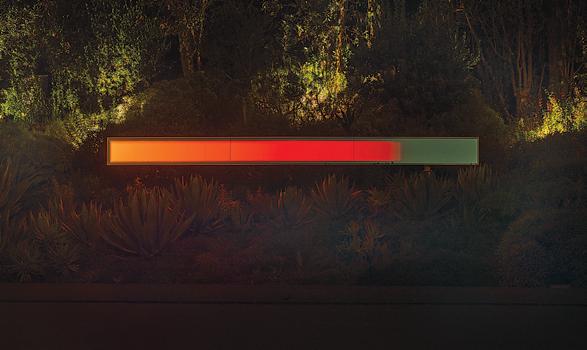
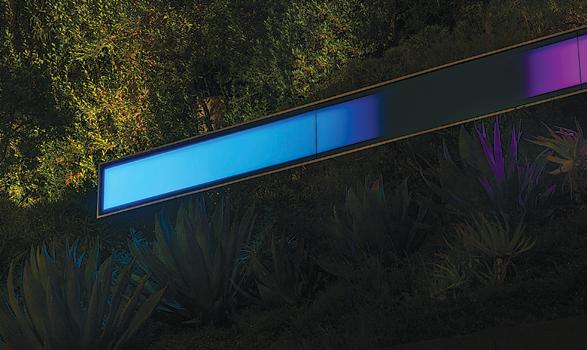
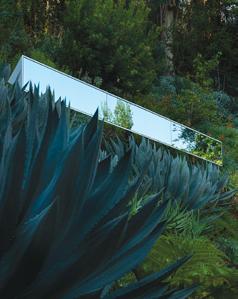
Responding to the scale of the site, Santa Monica Linear is a 30’ long singular, horizontal, monolithic gesture that inserts a line of reflected sky and treetops into the vertical plane of lush green landscape. With the reflective surface elevated, the piece reflects the lit sky miles to the South, even when the hillside is in the shade of the late afternoon. The adjacency of the Pacific Ocean creates conditions that range from fast-moving fog, to a perfect partly cloudy sky, to pure blue. All of these changing reflected conditions become part of Santa Monica Linear.
At sunset, the reflection of the glowing sky and on-shore moving clouds merges with floating, shifting gradients of light across the surface of the work. Reds emanate from the center and dissipate into reflection. A deep royal blue blends to a yellow across the entire 30’ long face. Hazy purple gradients anchor the left and right, blending to the blackness of the night sky at the center. The pace of the color choreography inspires stillness. Like watching a sunset, presence and focus are the simple requirements in order to witness awe-inspiring change. Just as each day’s sky is entirely unique, so is Santa Monica Linear.
227
PORTAL - VARIANT 1 2020
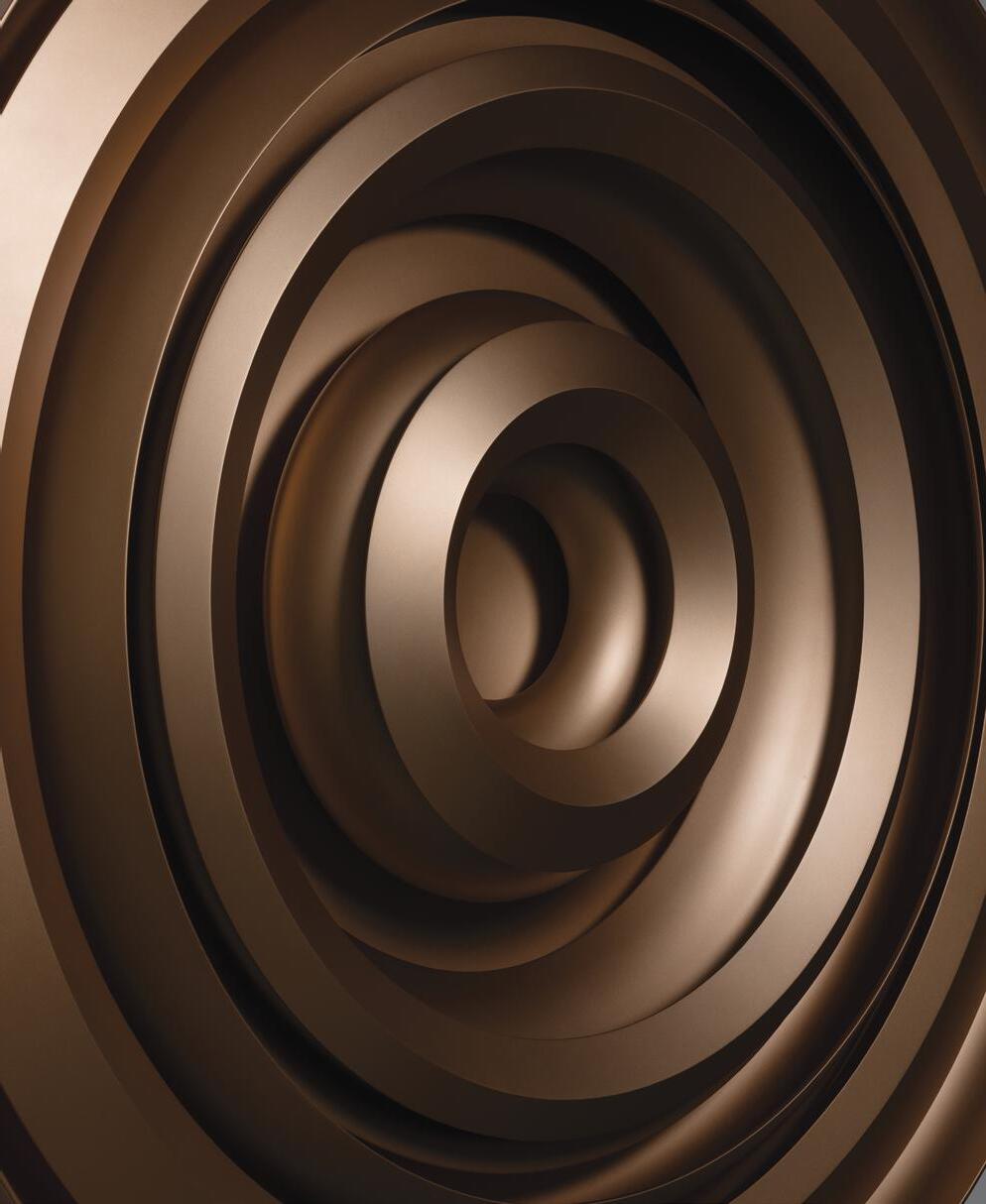
6’-8” x 6’-8” x 14”, 223 x 223 x 35,5 cm Fiberglass, automotive paint, LED lighting, electronic components, unique color choreography
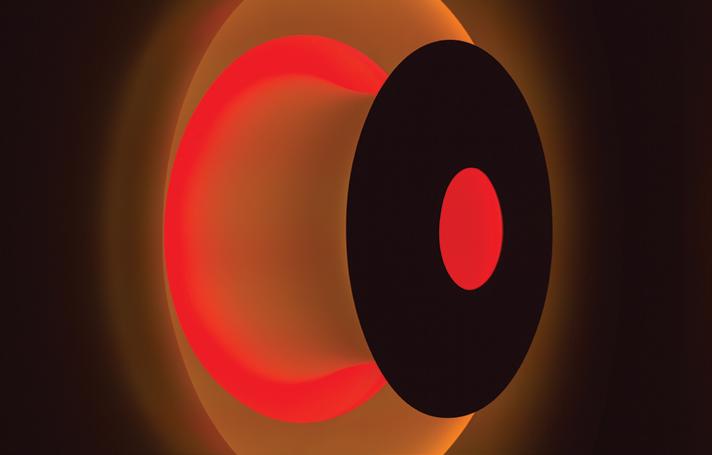
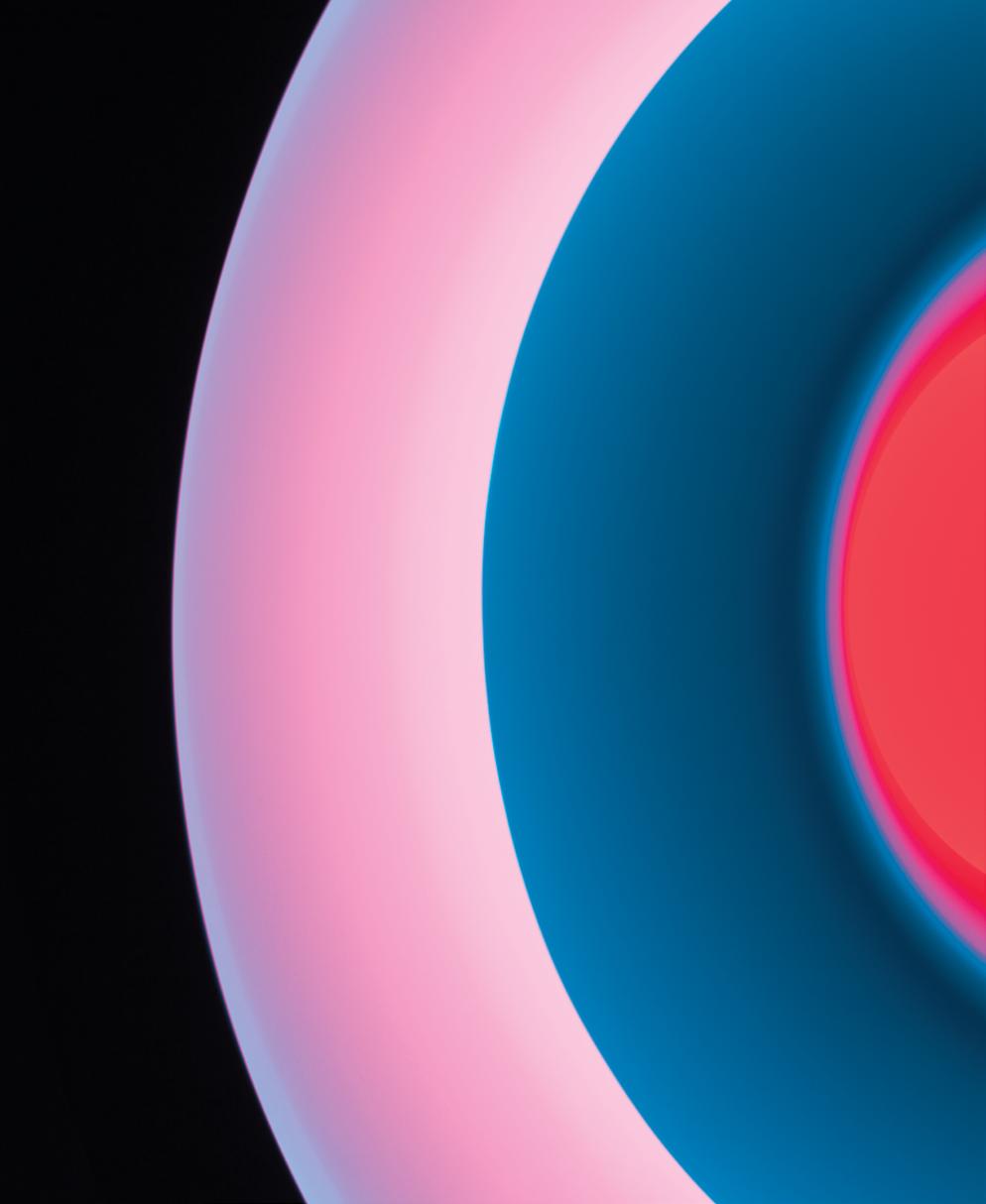
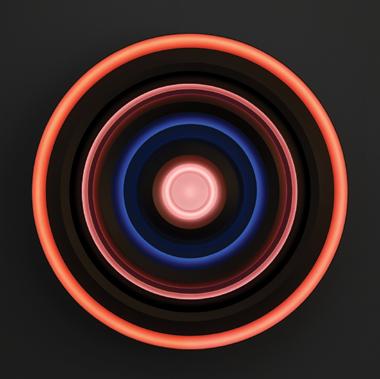
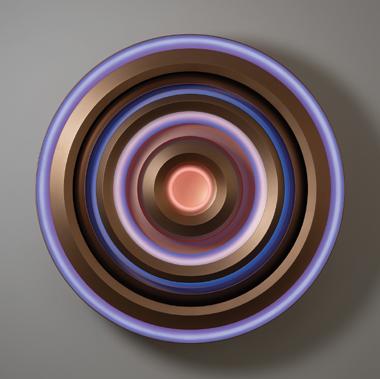
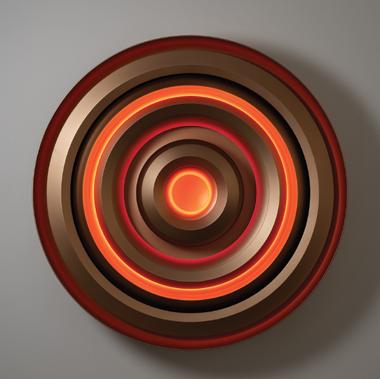
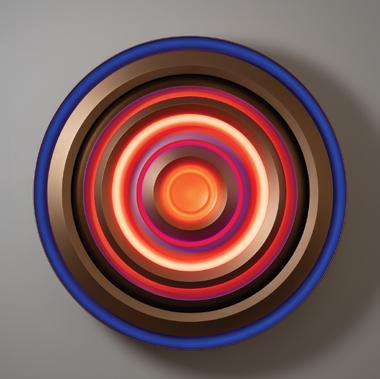
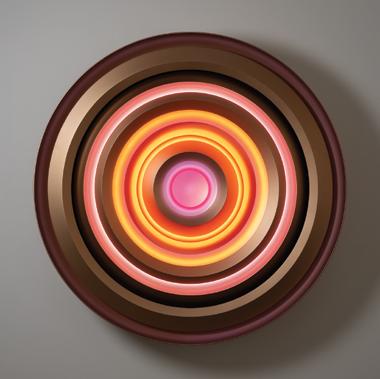
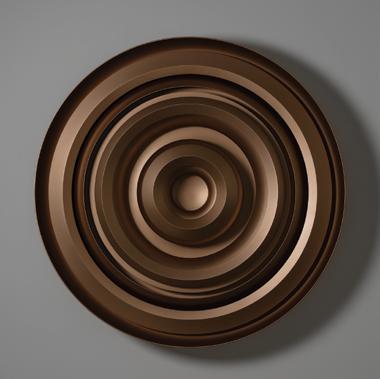
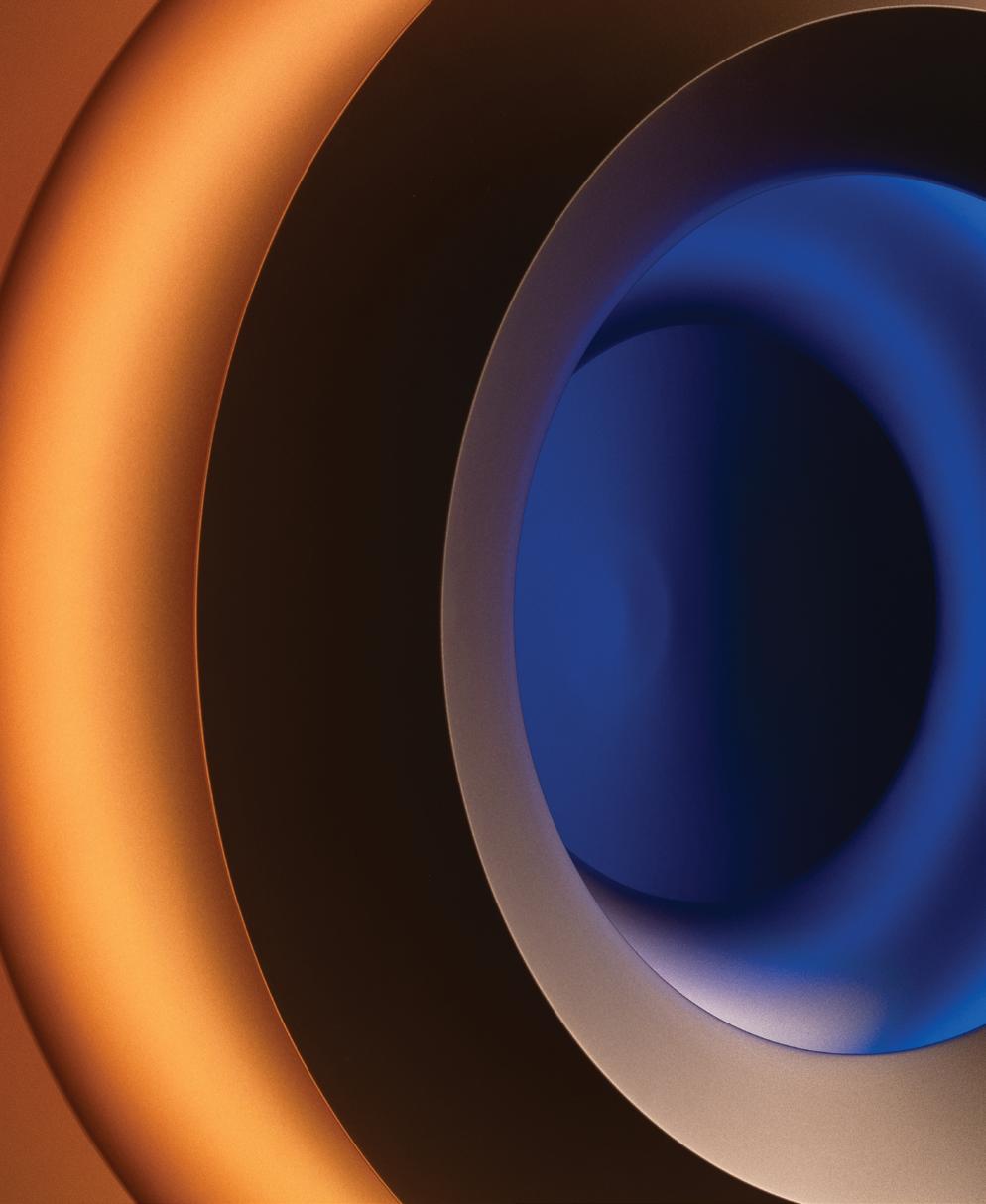
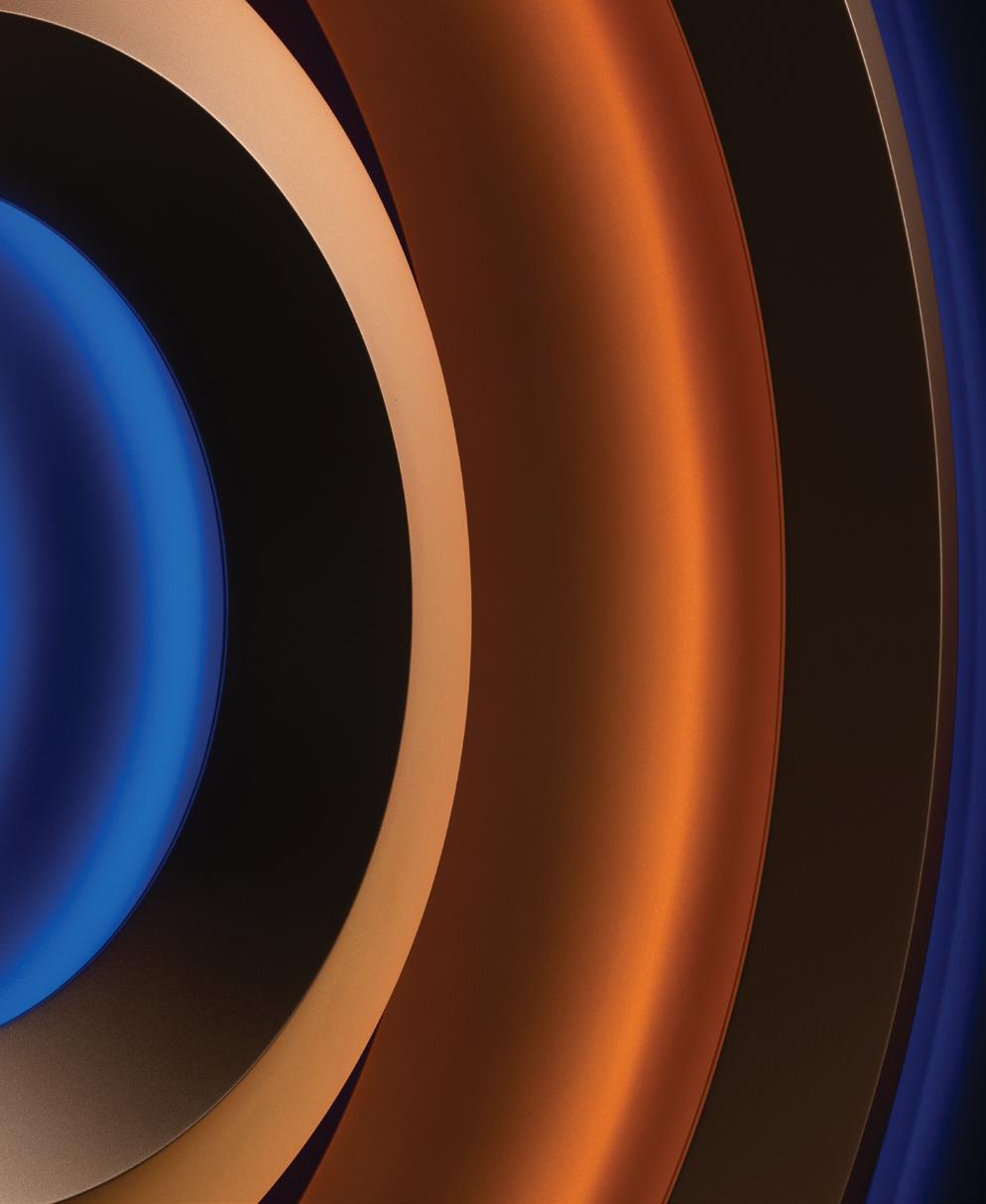
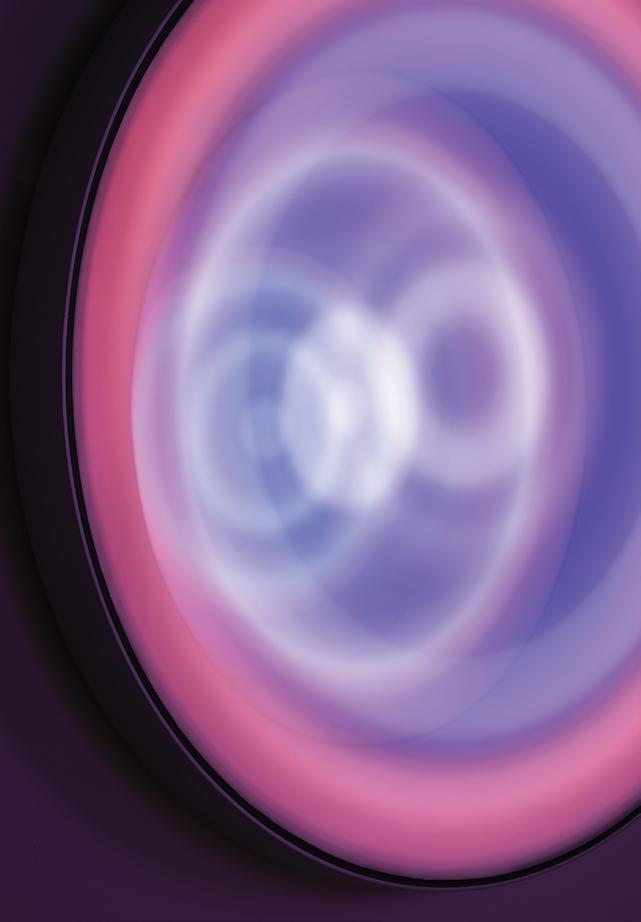
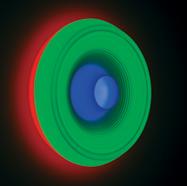
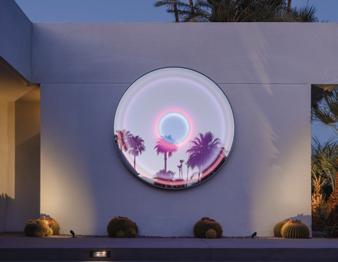
Smith’s ten original 6’ diameter x 2’ deep low sheen white Portals were first exhibited within his 85’ diameter pavilion of light created for the 2016 edition of the Coachella Valley Music and Arts Festival. Since that time, Smith developed similarly scaled works, the Flat Torus works, as flatter, more complex iterations of his ongoing Lightworks series. Inspired by the site conditions for a private commission acquired in early 2020, Smith merged the complexity of composition and density of color of his Flat Torus works with the formal exuberance of his Portals series in Portal - Variant 1 , his first new work in the series since 2016. At 6’-8” in diameter, Portal - Variant 1 is an imposing, circular, gold/copper metallic work that merges light, shadow, and color across an undulating surface of concentric rings. The metallic finish, interacting with the shifting color, yields a “metallic light” across the work, transforming opaque surfaces into seemingly transparent and translucent opalescent curves. The metallic surface, lit by ambient light during the day, pushes forward, while the shifting color at night takes precedence.
237
PARALLEL PERPENDICULAR
West Hollywood Park West Hollywood, CA 2015–2022
Volume 1: 8’-2” x 4’-2” x 1’-8”, 249 x 127 x 51cm
Volume 2: 4’-1” x 8’-3” x 1’-8”, 125 x 251 x 51cm
Volume 3: 6’-2” x 6’-2” x 6’-2”, 188 x 188 x 188cm
Volume 4: 6’-2” x 6’-2” x 6’-2”, 188 x 188 x 188cm
Volume 5: 9’-10” x 7’-4” x 4’-6”, 300 x 224 x 137cm
Glass, steel, LED lighting, electronic components, unique color choreography
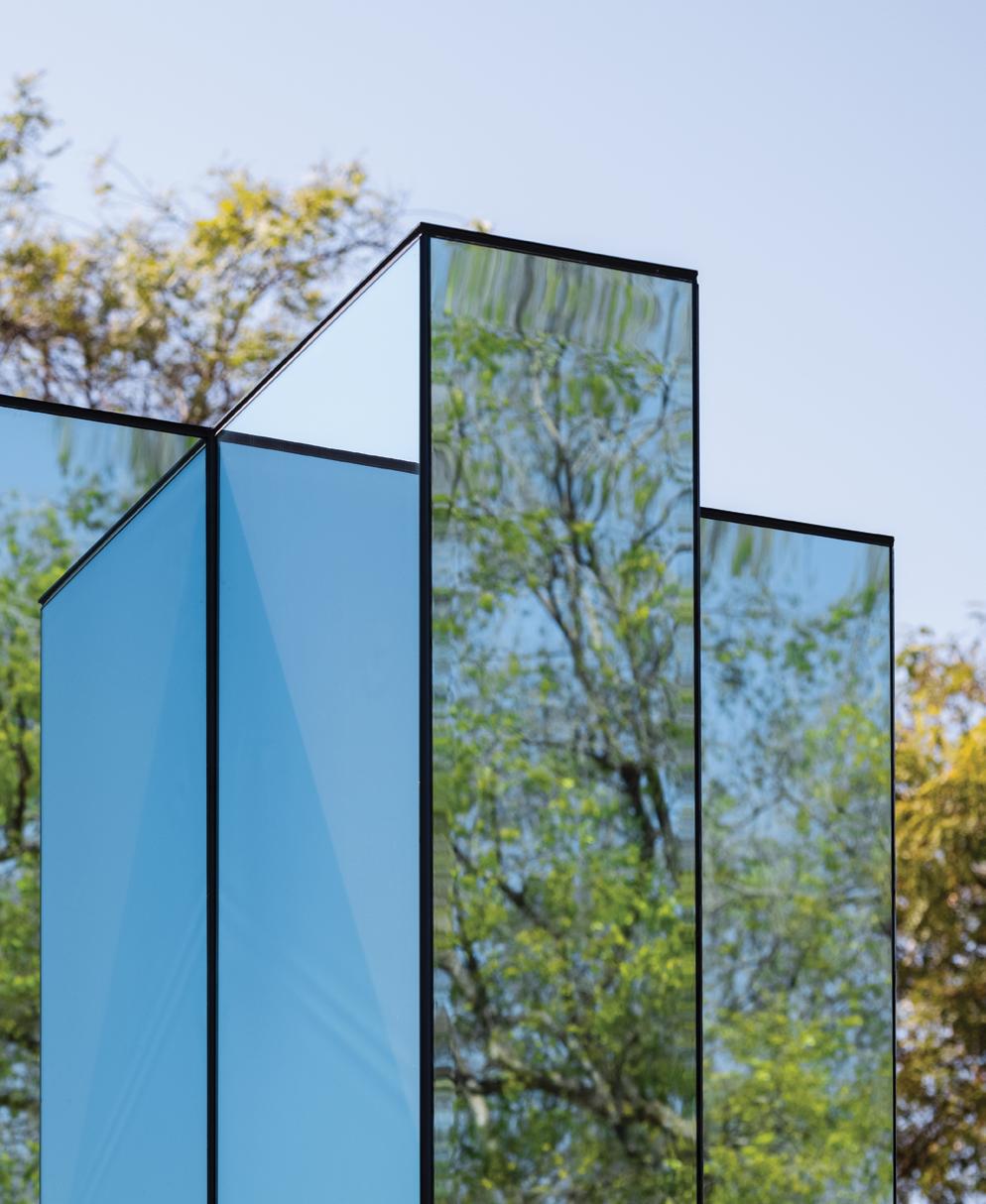
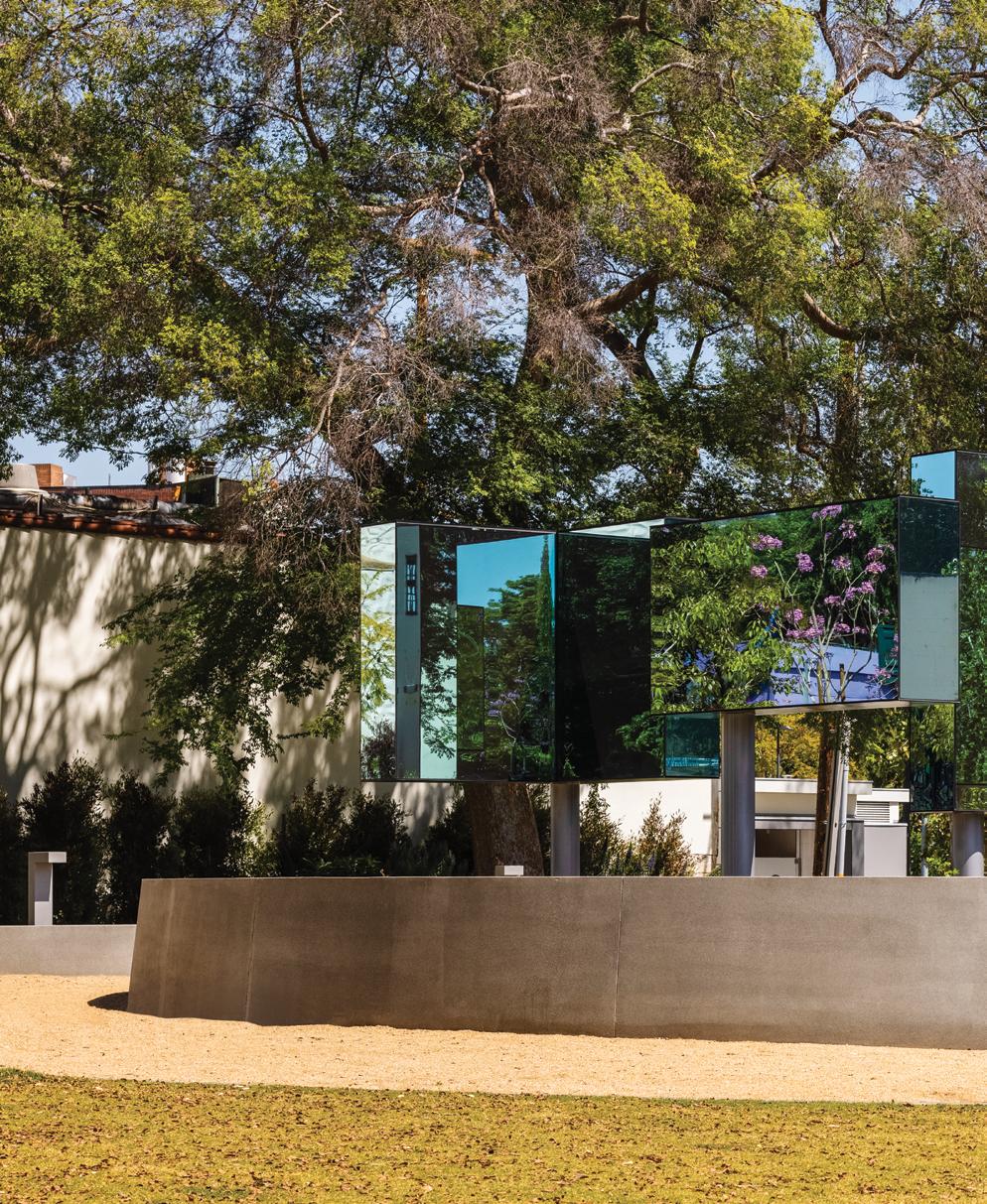
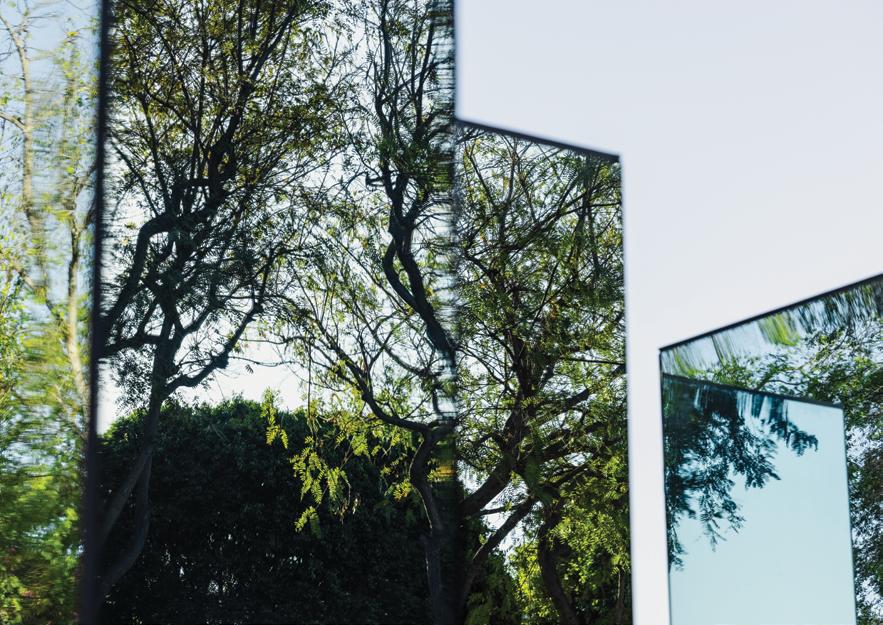
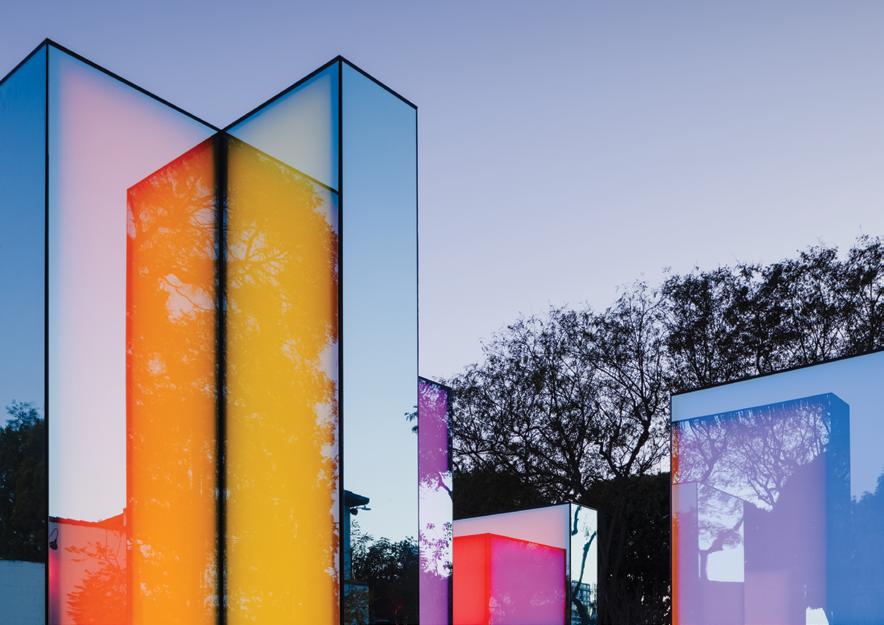
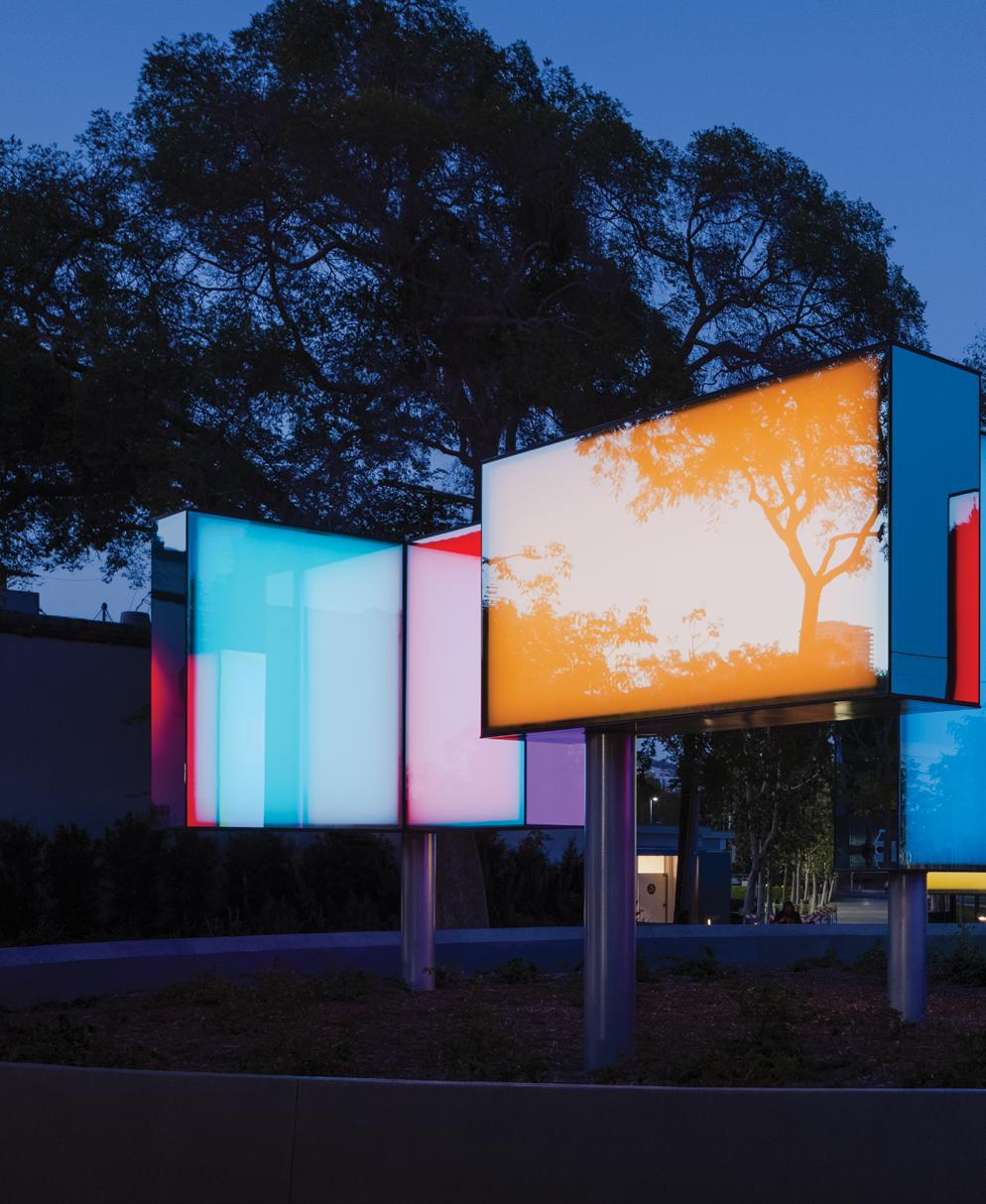
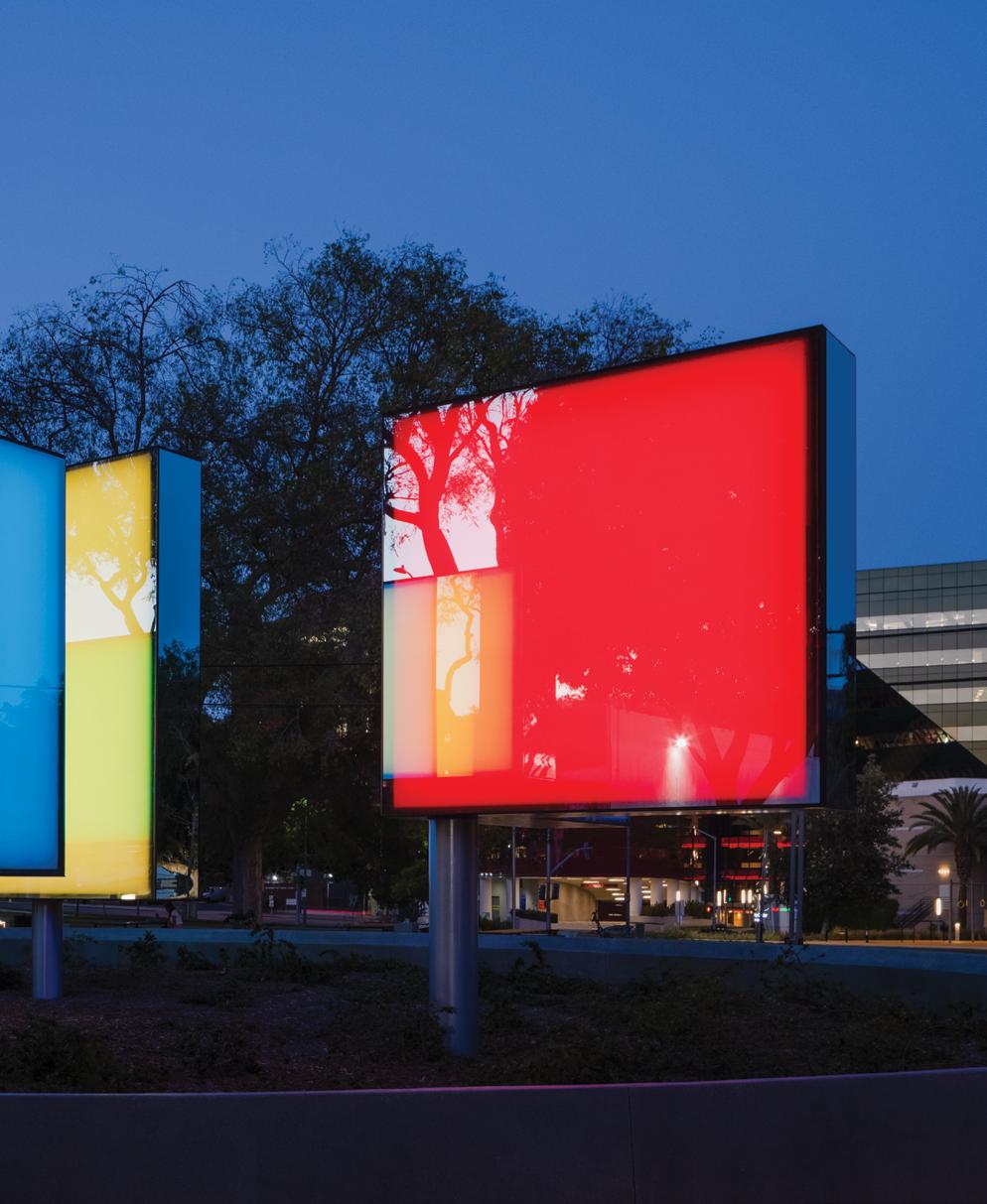
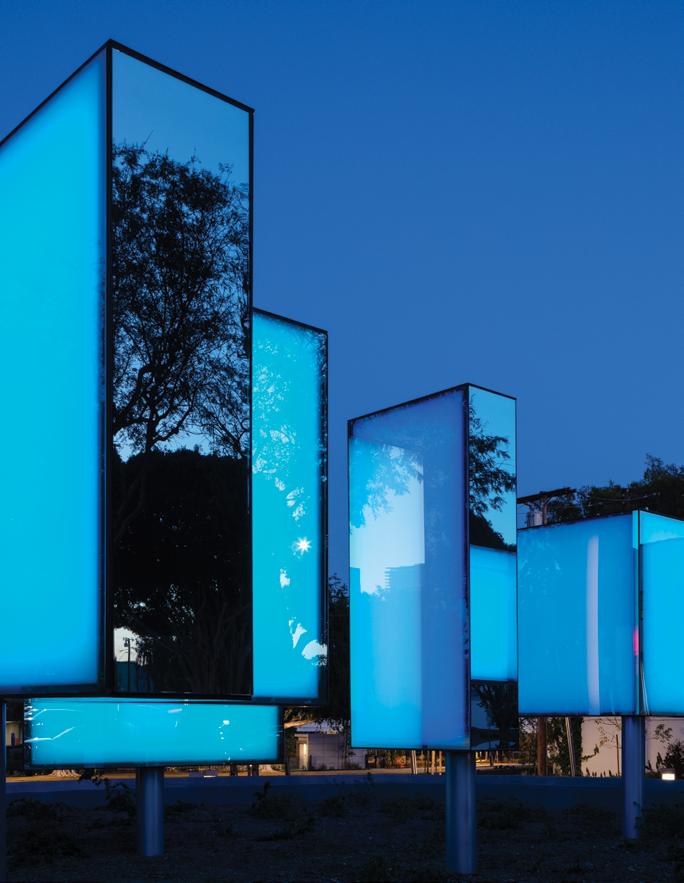
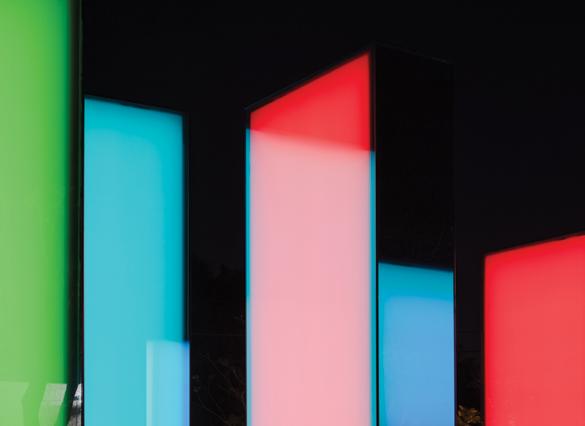
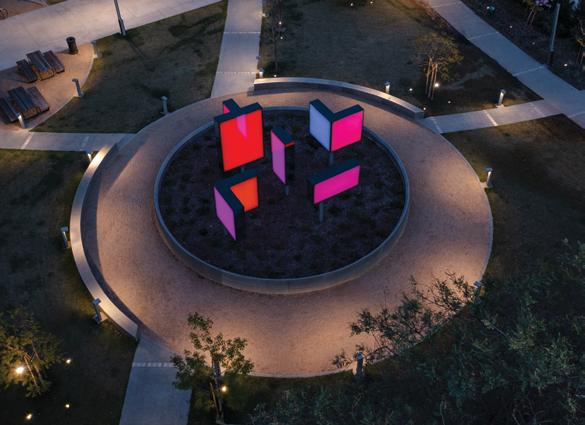
Composed of five freestanding volumes, Parallel Perpendicular orchestrates parallel and perpendicular planes of reflection and color that transform from day to night through the movement of the sun and the viewer. By day, the beauty of the park, sky, and West Hollywood community collages across the sculpture’s surface as fragmented reflections. By night, the reflective planes become fields of floating color that slowly shift and merge to create an everchanging, precisely choreographed composition of color, light, and reflection. Parallel Perpendicular is an artwork that can never be seen the same way twice and, as a result, is meant to be engaged with and visited throughout the year as the light, color, and atmosphere of West Hollywood transforms through the seasons.
243
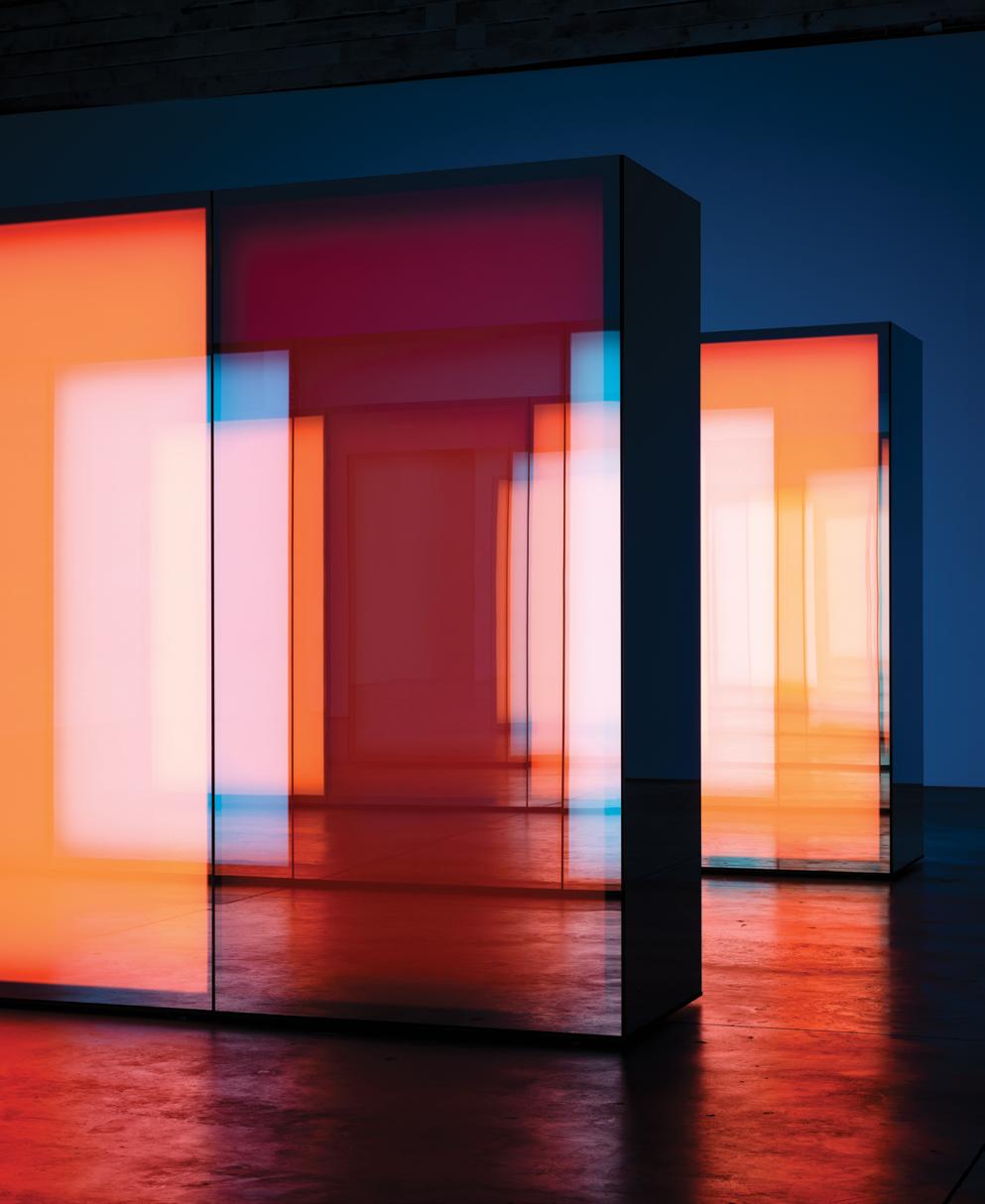
THREE PARALLELS
Scottsdale Museum of Contemporary Art
Scottsdale, AZ
October 29, 2022 - January 14, 2024
All three volumes: 7’-11” x 16’-2” x 2’-11”, 242 x 493 x 89 cm Aluminum, glass, LED lighting, electronic components, unique color choreography
SMOCA exhition text:
Southern California artist Phillip K. Smith III creates experiential art that highlights changes in perception as related to light, color, time, and space. Using reflection, varying translucency, and shifting color, the artist’s interior installations provide richly hued environments that respond to the spatial and atmospheric conditions. As with other artists of the Light and Space movement, Smith transforms spaces to expand the sensorial experience of viewers. This exhibition presents a new large-scale, site-specific work that incorporates Smith’s precisely paced program of changing colors.
The exhibition Three Parallels is the seventh in the SMoCA series Architecture + Art, which has commissioned architects and artists over the past 10 years to create site-specific installations that respond to the spatial, environmental, and social context of the Museum. The series pushes forward the increasingly important area of creative activity that lies between architecture and art.
As a trained architect and practicing artist, Smith is well versed in both worlds. While his work is predominantly based in object-making, it also seamlessly incorporates the environment. Through an invisible use of technology, the gallery projects a future in which our lives have a more symbiotic relationship with the digital realm. The programmed color changes quietly affect the viewer’s relationship to the surrounding architecture. In this new and evolving surrounding, visitors navigate around large mirrors that reflect and project infinite light and shadow.
253
Organized by Scottsdale Museum of Contemporary Art and curated by Jennifer McCabe, director and chief curator. Support provided by Presenting Partner Walter and Karla Goldschmidt Foundation and Supporting Sponsors Louise Roman and Will Bruder.
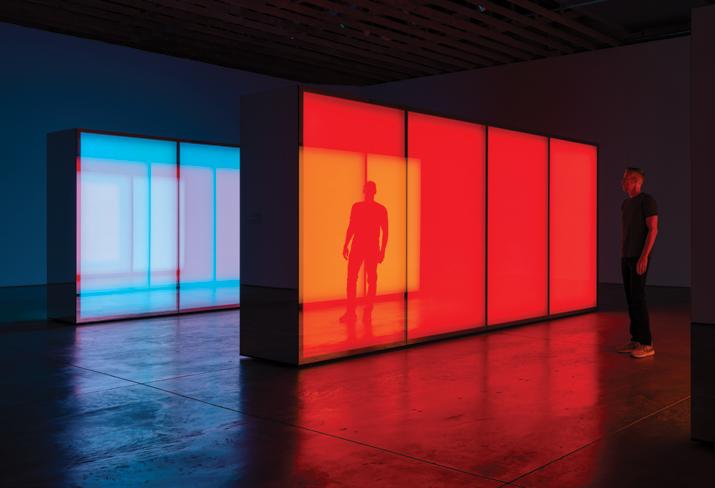
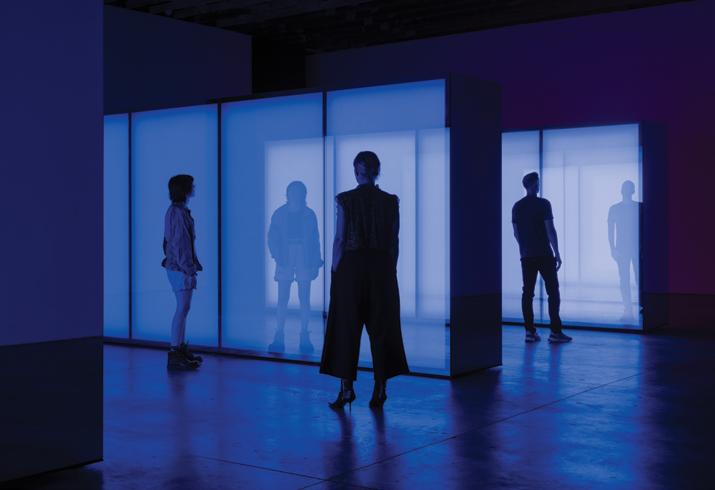
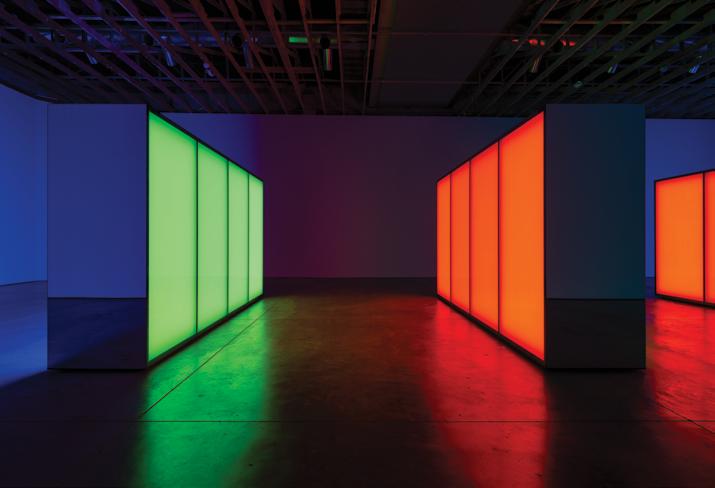
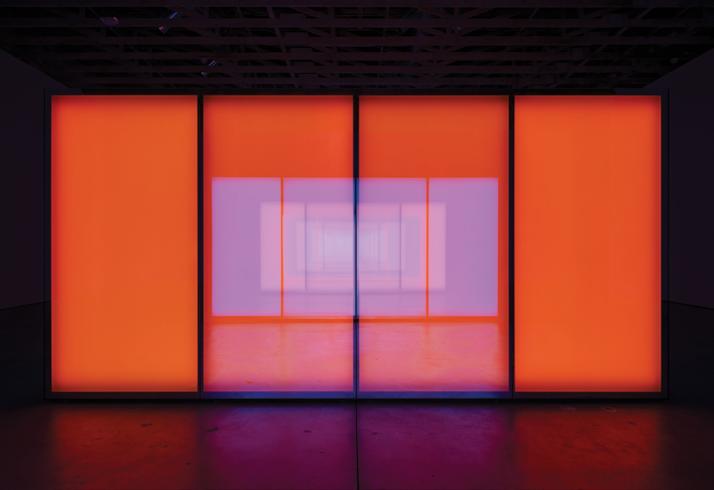
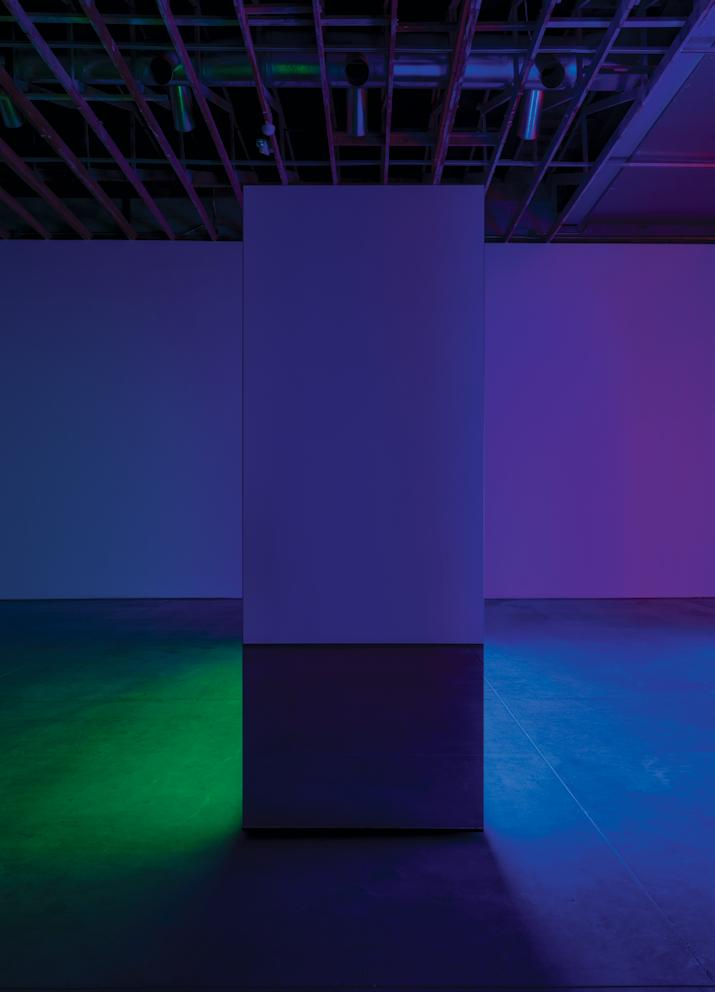
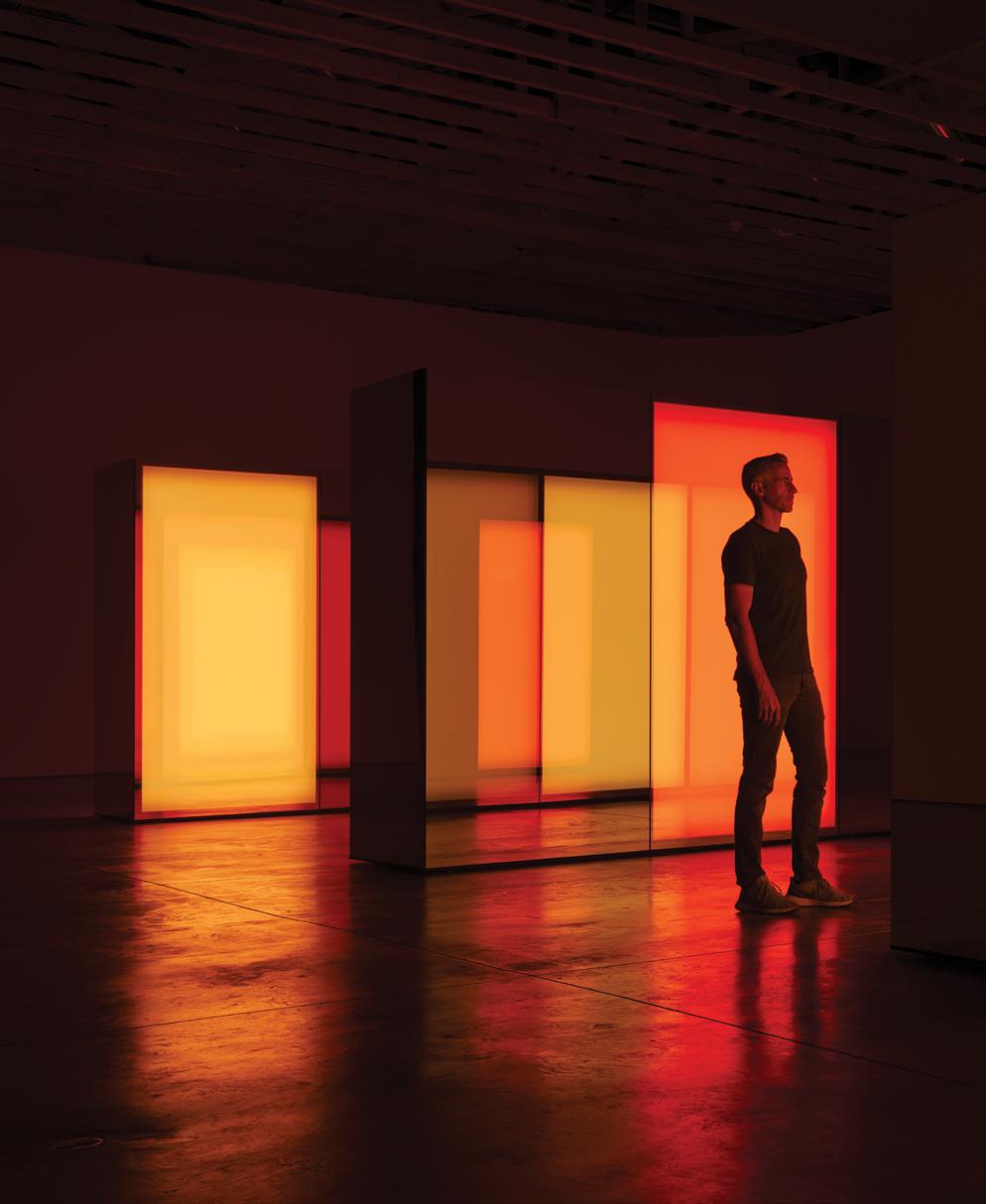
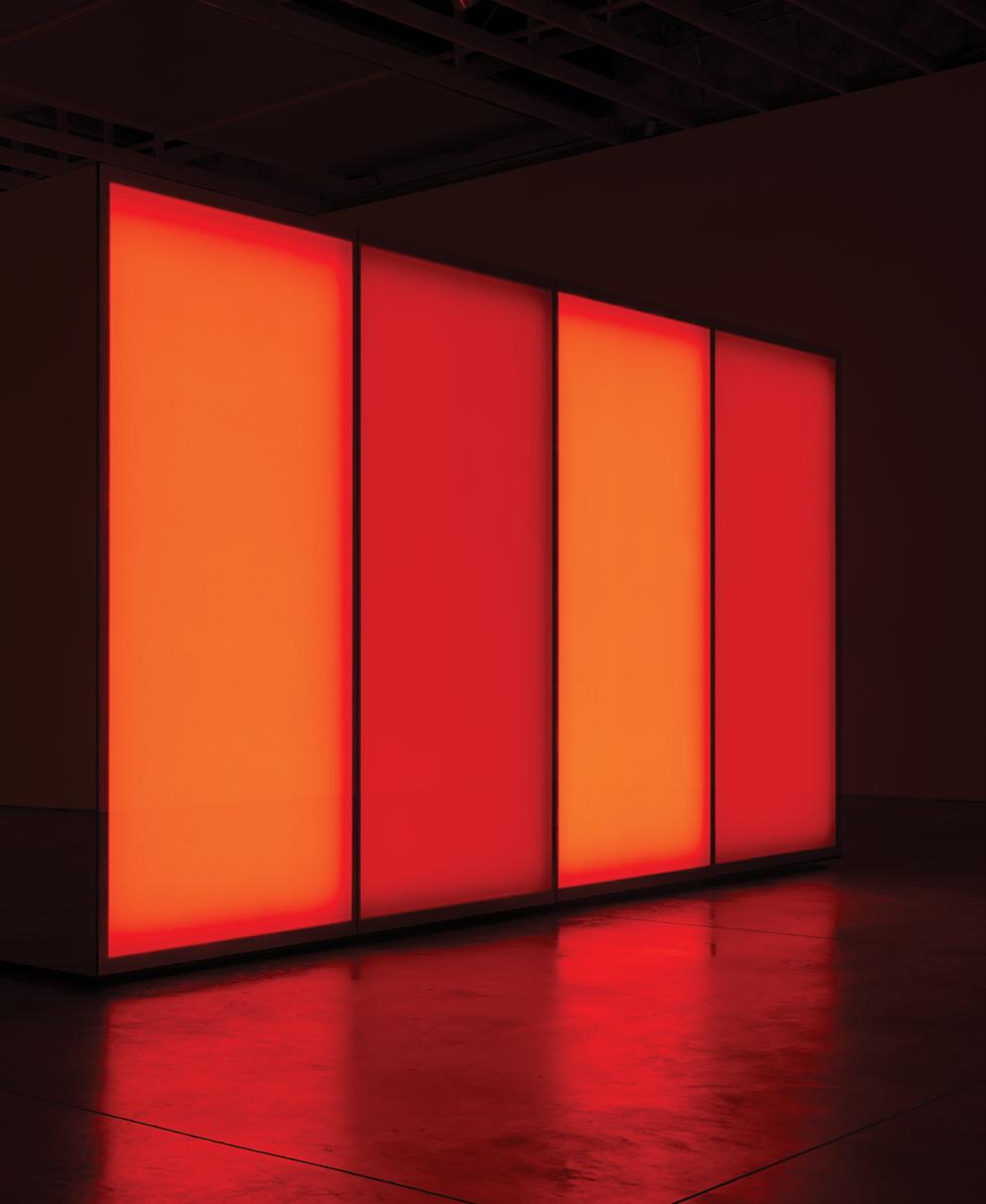
LIGHT + CHANGE
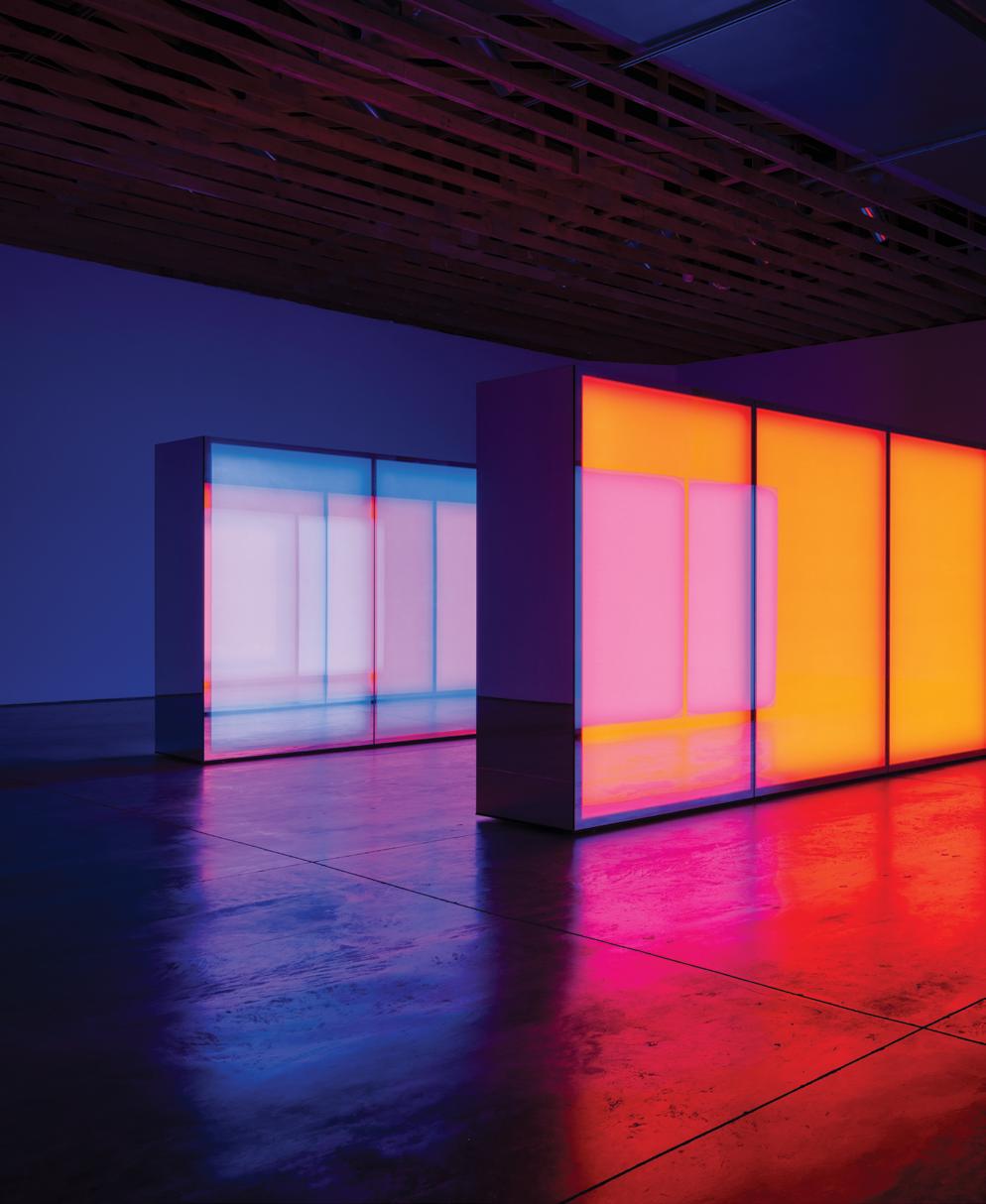
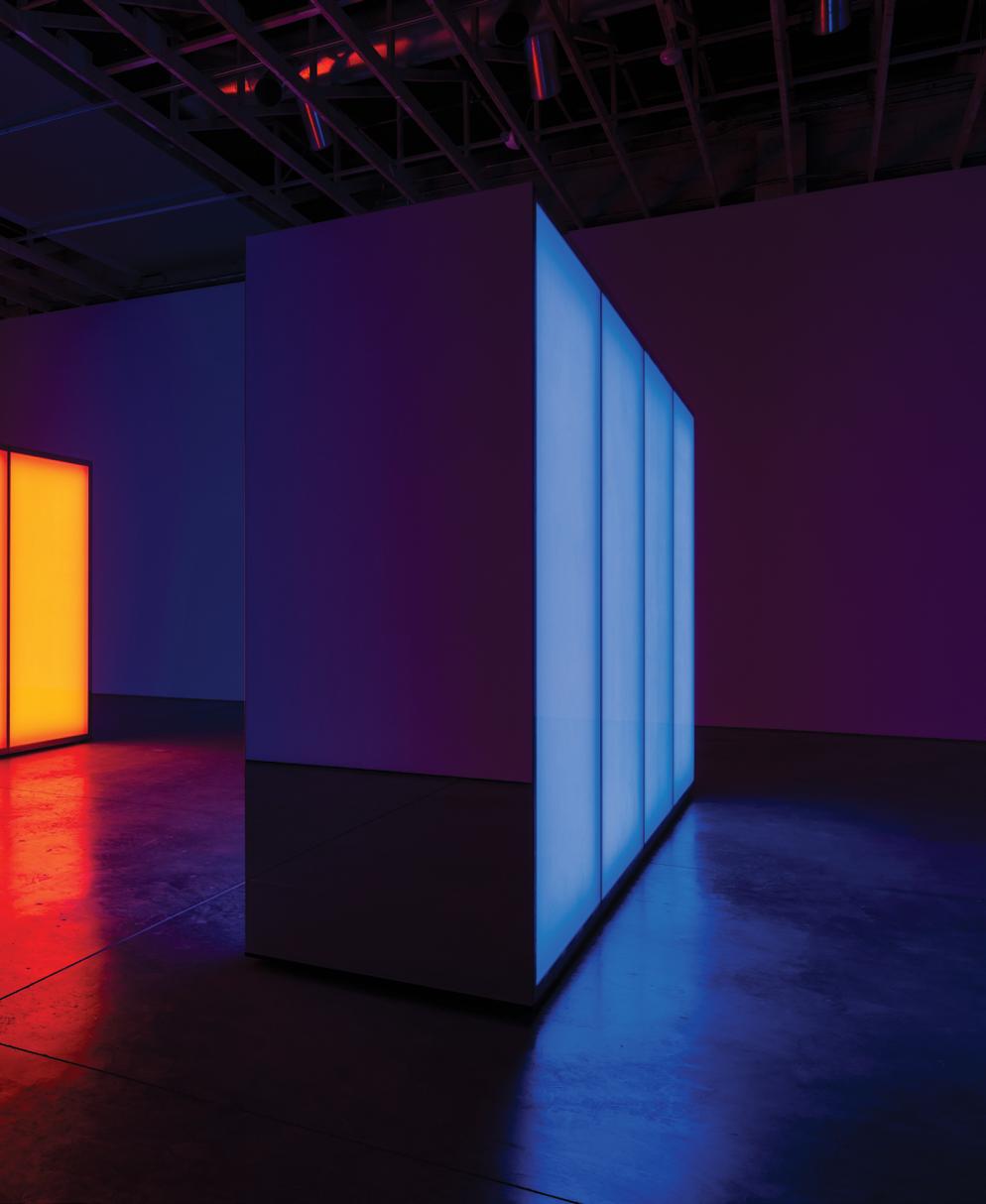
Palm Springs Art Museum
Palm Springs, CA
November 25, 2022 - May 7, 2023
Twelve 90’s, 2022
Complex Surface: Disc 2, 2015
Flat Portal 4:2, 2022
Sky Torus Variants 1, 2 & 3, 2022
Cylinders: XM8, XS12, XM16, YM12, YS16, ZS8, 2004
Flat Torus - Variant 5:8, 2020
Flat Lozenge 1:3, 2017
Torus Combine 1:1, 2022
Bent Lozenge 2:1, 2022
Torus 9, 2014
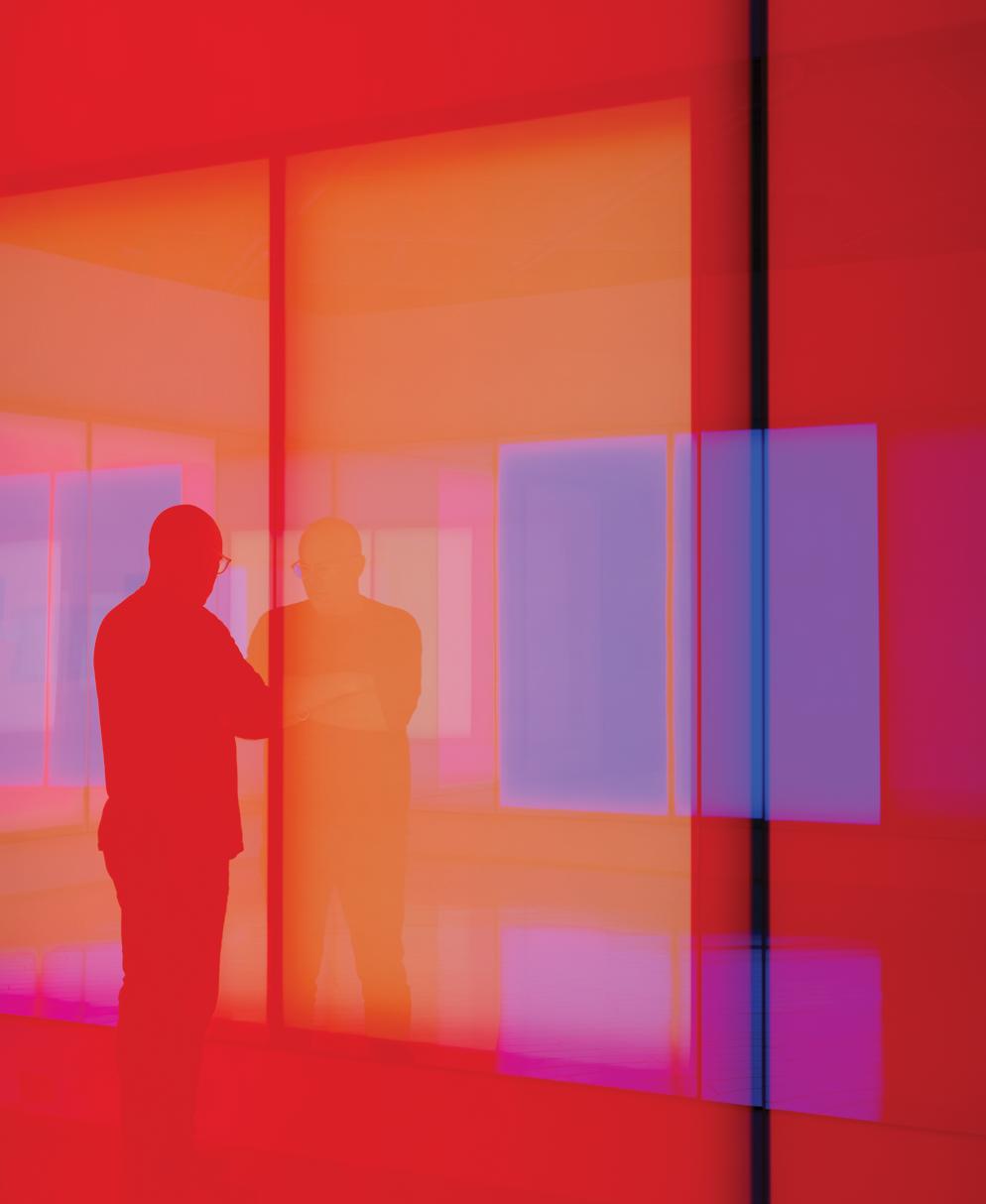
Two Corners, 2022
Palm Springs Art Museum exhibition text:
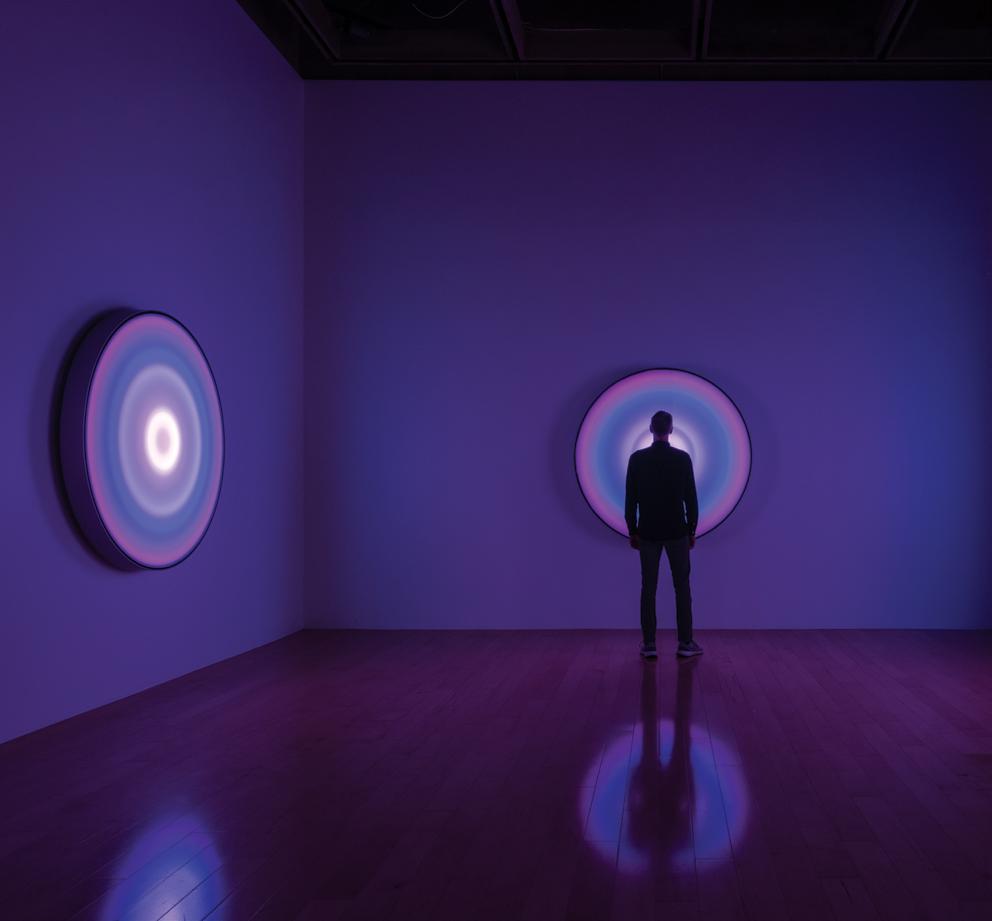
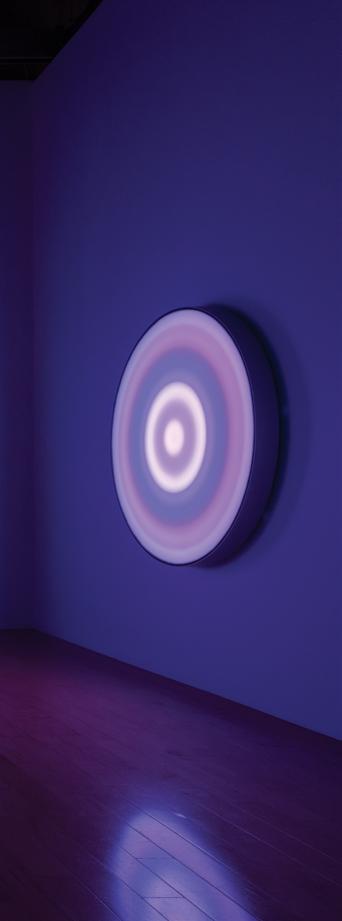
This survey of Phillip K. Smith III’s spectacular experiments with light and change spans almost two decades from 2004 to 2022. Presented throughout four galleries, this selection of free-standing objects, wall-mounted works, and immersive installations demonstrates the breadth of the artist’s mastery of his medium. Phillip draws from elements of painting, sculpture, and architecture, and deploys a pared-down vocabulary of pure forms, reflective surfaces, and continually changing colors to create absorbing perceptual and atmospheric effects.
Inspired by the daily light phenomena of the desert, many works slowly shift from hue to hue as determined by Phillip’s precisely paced color choreography. All of his works have an elusive, ephemeral quality to them. As the light and the perspective of the viewer shift, so the form and perception of the works fluctuate—creating an ever-changing experience.
263
Lead sponsorship for this exhibition provided by Patsy & David Marino. Additional funding provided by Joan & Gary Gand, Dave Locke, Keith Markovitz, Melissa Morgan Fine Art, Bonnie Serkin & Will Emery, The Art Collective Fine Art Services, and Linda Usher & Malcolm Lambe.
The artist would like to thank the following people for their support of the production of work for this exhibition: Clayton Baldwin, Nora & Guy Barron, Jeff Brock & Richard Crisman, JJ & Anthony Curis, Marcy & Leo Edelstein, Dolly & Richard Flasck, Karen Fox, Tara Lazar & Marco Rossetti, Marlene Louchheim, Deborah Page, Dallas Price & Bob Van Breda, Rebecca & Phillip K. Smith, Jr., Aldona & Damon Spiegel, Linda Usher & Malcolm Lambe, and Marguerite & David Wilson.
APPENDIX
TIMELINE
PKS3 Studio selected projects and events
DOUBLING DOWN
Essay by William Fox
PHILLIP K. SMITH III: SUBLIME REFLECTIONS
Essay by Dr. Daniel Cornell
PRIMORDIAL LIGHT
Essay by Dan Cameron
LIGHT + CHANGE
Essay by Adam Lerner
279
2004-2010
Cylinders
In progress at the studio Indio, CA
Infinity Column
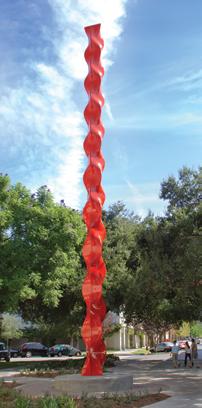
Palm Desert, CA
First public artwork
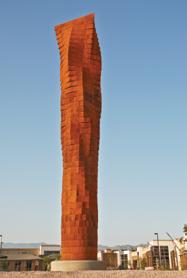
Artist in Residence
Aperture
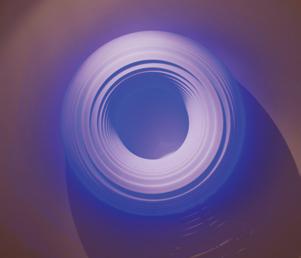
Palm Springs Art Museum. Palm Springs, CA
Inhale/Exhale University of La Verne La Verne, CA
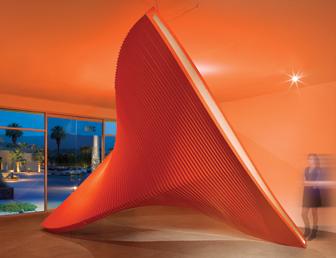
Torus 1 Lozenge 1
Line to Line
2011
Spectrum I Indian Wells, CA
Line to Circle Arc - Line – Arc Arlington, VA
2012
Gradient Column Walnut Creek, CA
Faceted Disc #1 Smooth Operations Exhibition Lancaster Museum of Art and History Lancaster, CA
Parallel Perpendicular
Selected by City of West Hollywood for Public Art installation (scheduled for 2021) West Hollywood, CA
Los Angeles Times names Phillip K. Smith III as 1 of 3 artists in the paper’s “Faces to Watch” year-end article.
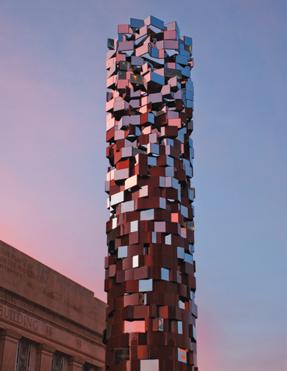
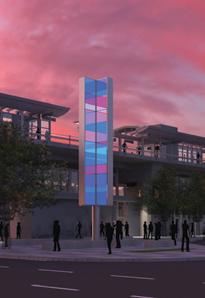
Four Corners Extruded Selected by Seattle Sound Transit for Bellevue Public Art installation (scheduled for 2023) Bellevue, WA
2013
Lucid Stead Joshua Tree, CA
First Exhibition of Lightworks
Where the Earth and Sky Meet City Hall Oklahoma City, OK
Reflection Field Coachella Valley Music and Arts Festival Indio, CA
Lucid Stead: Four Windows and a Doorway Lancaster Museum of Art and History Lancaster, CA
2014
Gradient Arc
Palo Alto Veterans
Affairs Mental Health Center
Palo Alto, CA
PKS3 Studio opens in Palm Desert CA Studio moves from 4,000 sq.ft. Indio, CA location to 12,000 sq.ft. space in Palm Desert, CA.
Portals
Coachella Valley Music and Arts Festival Indio, CA
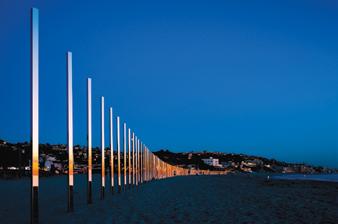
1/4 Mile Arc
Laguna Art Museum - Art + Nature
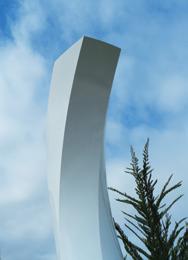
Main Beach, Laguna Beach, CA
Artist in Residence
Light + Shadow Exhibition
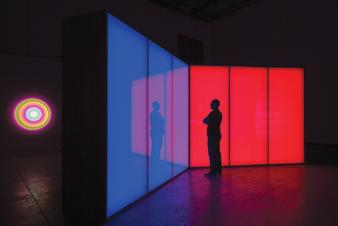
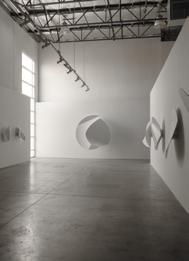
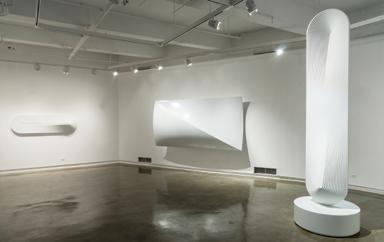
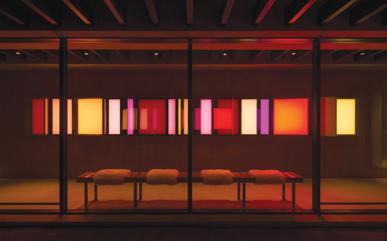
Dartmouth College
Hanover, NH
Bent Parallel & Torus 9, Laguna Art Museum - Art + Nature Laguna Beach, CA
Palm Springs
Art Museum permanent collection acquisition
Palm Springs, CA
2015
Irregular Horizontal #1 La Quinta, CA
Lucid Stead Element #4
2016

 The Circle of Land and Sky Desert X Inaugural Exhibition Palm Desert, CA
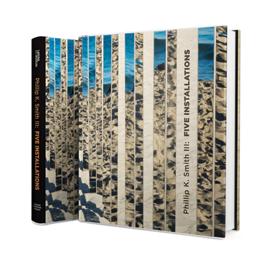
Five Installations
Published by Laguna Art Museum and Grand Central Press.
120 Degree Arc East-Southeast
Commissioned by Faena Art for Art Basel Miami Beach, FL
Torus 9
2017
The Newark Museum of Art permanent collection acquisition. Newark, NJ
Open Sky & Reflectors Commissioned by COS for Salone del Mobile Palazzo Isimbardi, Milan, Italy
Detroit Skybridge Detroit, MI
Regular/Irregular Claremont Graduate University Exhibition, curated by David Pagel Claremont, CA
2018
Lucid Stead Element #7 Denver Art Museum permanent collection acquisition Denver, CO
2019 2020
10 Columns
Inaugural Exhibition for Bridge Projects Hollywood, CA
Mexico City, Mexico
Washington, D.C.
Chromatic Variants
National Academy of Sciences permanent collection acquisition and exhibition From Lucid Stead: Prints and Works by Phillip K. Smith III
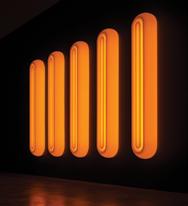
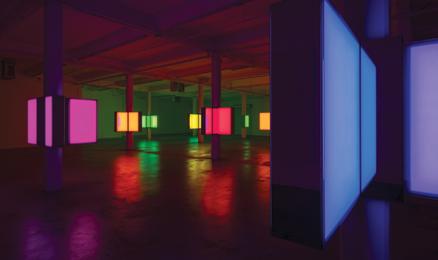
Washington, D.C.
“Practical Anthem” solo exhibition at PKS3 Studio PKS3 studio begins showing work from emerging desert area artists with first solo show for Yucca Valley painter, Harrison Fraley.
Artnet Dinner
Celebrating Phillip K. Smith III at PKS3 Studio and Artnet’s 30th anniversary.
Toledo Museum of Art permanent collection acquisition
Toledo, OH
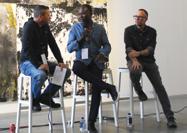
Mobius Art + Activism Artist Panels at PKS3 Studio
“Art in Public Places” discussion with Phillip K. Smith III, Francis Kéré & Steven Biller
 Santa Monica Linear Santa Monica, CA
Lozenge 7 Brookfield Properties
Harrison Fraley
Flat Torus Variant 1
Lucid Stead
Flat Torus 4
Flat Torus Variant 5 Palm Desert, CA Portal - Variant 1 Palm Desert, CA
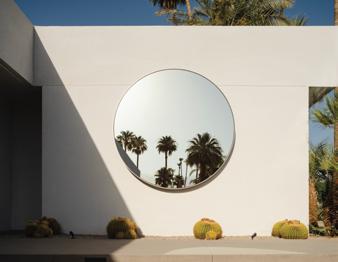
 Sky Torus 1 Rancho Mirage, CA
Light + Change Solo Museum Exhibition Palm Springs Art Museum. Palm Springs, CA
Three Parallels Solo Museum Exhibition. Scottsdale Museum of Contemporary Art. Scottsdale, AZ
2021
Three Half Lozenges Permanent Installation The Newark Museum of Art. Newark, NJ
2022
Parallel Perpendicular West Hollywood, CA
In Process
Scheduled for install 2023
Scheduled for install 2023
Scheduled for install 2023-2024
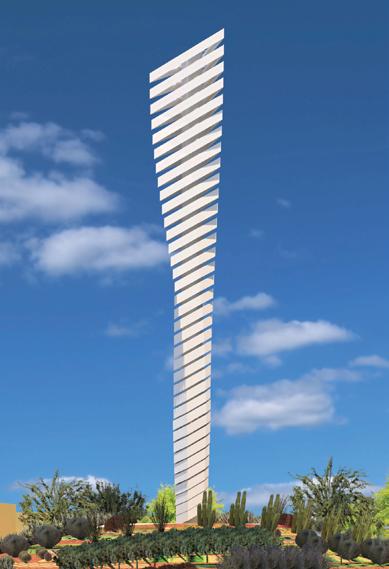
 Tri-Hex-Circ Raintree Drive Extension, Scottsdale, AZ
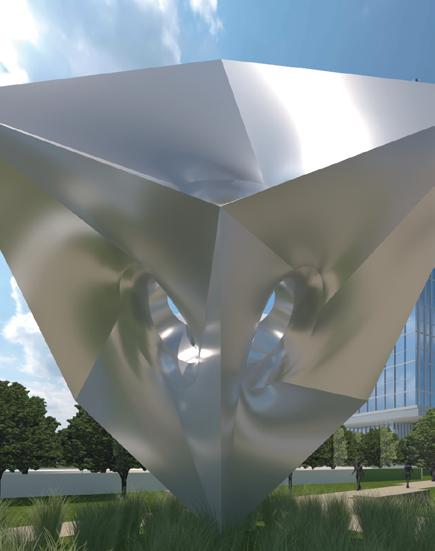
The Cube La Jolla, CA
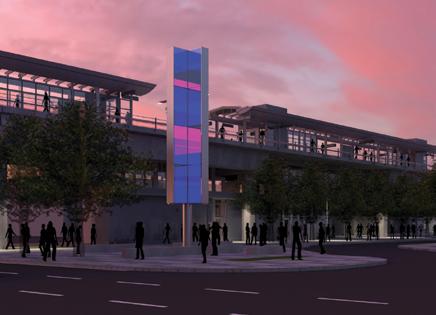
Four Corners Extruded Seattle Sound Transit for Bellevue Bellevue, WA
Doubling Down
By William L. Fox
According to published surveys, you look in a mirror between eight and twenty-six times a day. If you are a male and you shave, you spend sixteenand-a-half minutes on average in front of a mirror while shaving; if a woman, you may spend an average of fourteen-and-a-half minutes applying makeup and adjusting your personal experience in its presence. Artificial mirrors have been with us for at least 8,000 years, glass ones with metal backing for more than 2,000 years. Mirrors reverse the forward-to-backwards axis, which is why we think they reverse left to right. No matter, we are so adept at the mirror effect that we manage not to slit accidentally one’s throat while shaving, or to put out an eye while applying eye-shadow.
We picture mirrors in paintings and photographs, and clad entire skyscrapers in them, sometimes inadvertently cooking adjacent buildings as a result. We deploy them in periscopes and lasers, but also in optometrist and dentists’ offices, and carnival funhouses. Virtually every vehicle hosts at least one. As a result, it’s difficult to surprise us with a mirror, but the slender and elusive Invisible Barn by the architect studio STMPJ that sits in a forest in the northern Sierra, and Doug Aitken’s full-size Mirage ranch house in the Swiss Alps above Gstaad are examples of contemporary artists putting mirrors on structures in hopes of helping encounter reality in unexpected ways.
Phillip K. Smith III’s temporary installation Lucid Stead is the most interesting of these interventions by several virtues. Smith was born and raised in the Mojave Desert, returning to his home terrain to practice architecture and make art after earning Bachelor’s of Fine Art and Architecture degrees at the Rhode Island School of Art. His early sculptures and installations used architecture as their inspiration, sometimes incorporating mirrors and lights with stacks of interleaved material, but Lucid Stead adopted an actual building for its armature. Using an abandoned “jackrabbit homestead” cabin (the name comes from the American desert hares that inhabit the land), Smith profoundly destabilized what you thought of a mirror.
One of the last homestead movements in America, the Bureau of Land Management’s Small Tract Act of 1938 provided people with up to five acres in the Mojave’s Morango Basin for only a few dollars if you improved the property (most often by building a cabin of at least 400 square feet) within three years. It was an attempt to monetize what the government considered useless land, but veterans returning from WWII spurred a land rush and as late as 2004 there remained 2,000 of the simple structures. Many were oneroom bilateral tripartite cabins—four walls and a roof fronted by a door with a window on each side. It’s the most common face of a domicile in American architecture.
Smith wrapped mirrored bands around the house that alternated with the original slats of wood siding. The effect in the highly isotropic environment of the Mojave—where everything looks much the same in all directions— was that you thought you were looking through the house. It was difficult to remember that you were looking in a mirror, a bit as if the Invisible Man had taken off alternating strips of bandages and revealed not what was behind
him, but behind you. The effect produced an affect that left you betwixt and between. The mirrored structures by STMPJ and Aitken retained their visual integrity, despite open windows and doors through which you could see the landscape on the other side of the house. But the gestalt of Mirage as a house was so compromised by alternation of mirrored and un-mirrored planks that you had to concentrate to reassemble its condition as a house. You lost track of time, could literally get dizzy while performing this reverse prestidigitation, and in short experienced what you least needed in an isotropic space: disorientation. On the other hand, it was safer and more interesting than doing drugs.
Additionally, Smith took an historical building as his armature, which meant you found yourself moving back and forth in time, between the old weathered boards and the slick mirrored bands, between the Old West and the Post-Rural, between homesteading and art-going. The effect at night was, if not as disorienting, even more complicated. Smith used LEDs to turn the windows and doors into solid panels of blue, red, yellow, green, orange or purple that slowly rotated through the palette. In between the boards and bands of mirrors white light leaked out, making visible the diagonal twoby-fours inside and holding up the walls. What by day looked like slices of a house hovering improbably over the desert by night became something both more solid but oddly eerie.
Smith’s work has been compared to that of the earlier masters of the Light and Space movement in Southern California during the 1960s and early ‘70s, artists such as James Turrell, Robert Irwin, and Larry Bell. The linkage is apt, their spare geometries and use of both natural and projected light tinkering with the permeable boundaries of cognition and reality. Manipulating materials to make the world at once strange and beautiful so that we can perceive more of it is the useful task of an artist. Rearranging what we think a mirror does in the Mojave—an environment so alien to us that we stage science fiction movies on it because there is no objective correlative to contradict the imagination—is to double down on the question of sight itself. If we think that what we see is what we believe, then Phil Smith has given us every chance to question that assumption.
This essay was originally commissioned by the Cultural Programs of the National Academy of Sciences in conjunction with Smith’s exhibition “From Lucid Stead.” For more information, please visit www.cpnas.org.
William L. Fox, Director of the Center for Art+Environment at the Nevada Museum of Art in Reno, Nevada, has variously been called an art critic, science writer, and cultural geographer. He has published seventeen books on cognition, art, and landscape, more than a hundred essays in art monographs, magazines, and journals, and fifteen collections of poetry. He is a fellow of both the Royal Geographical Society and Explorers Club, and recipient of fellowships from the Guggenheim Foundation, National Endowment for the Humanities, and National Science Foundation.
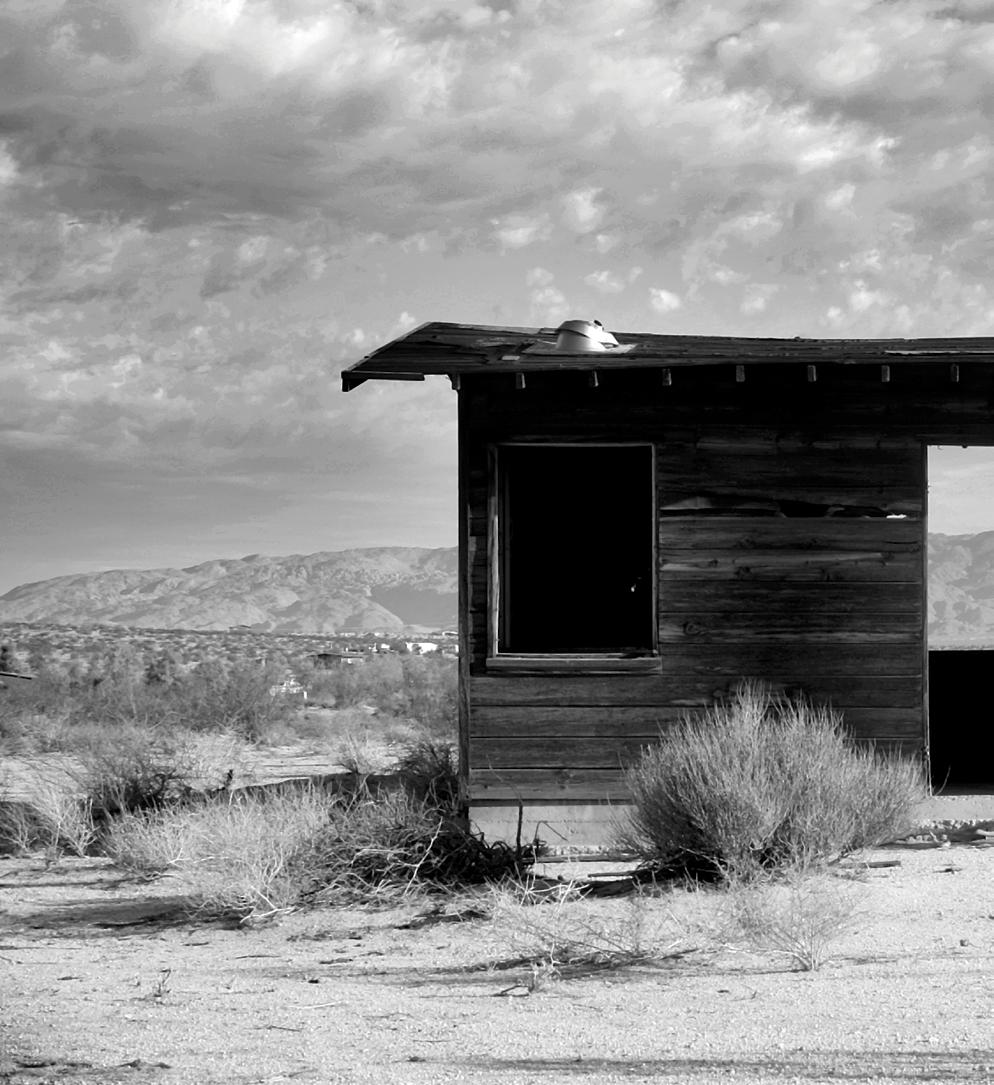
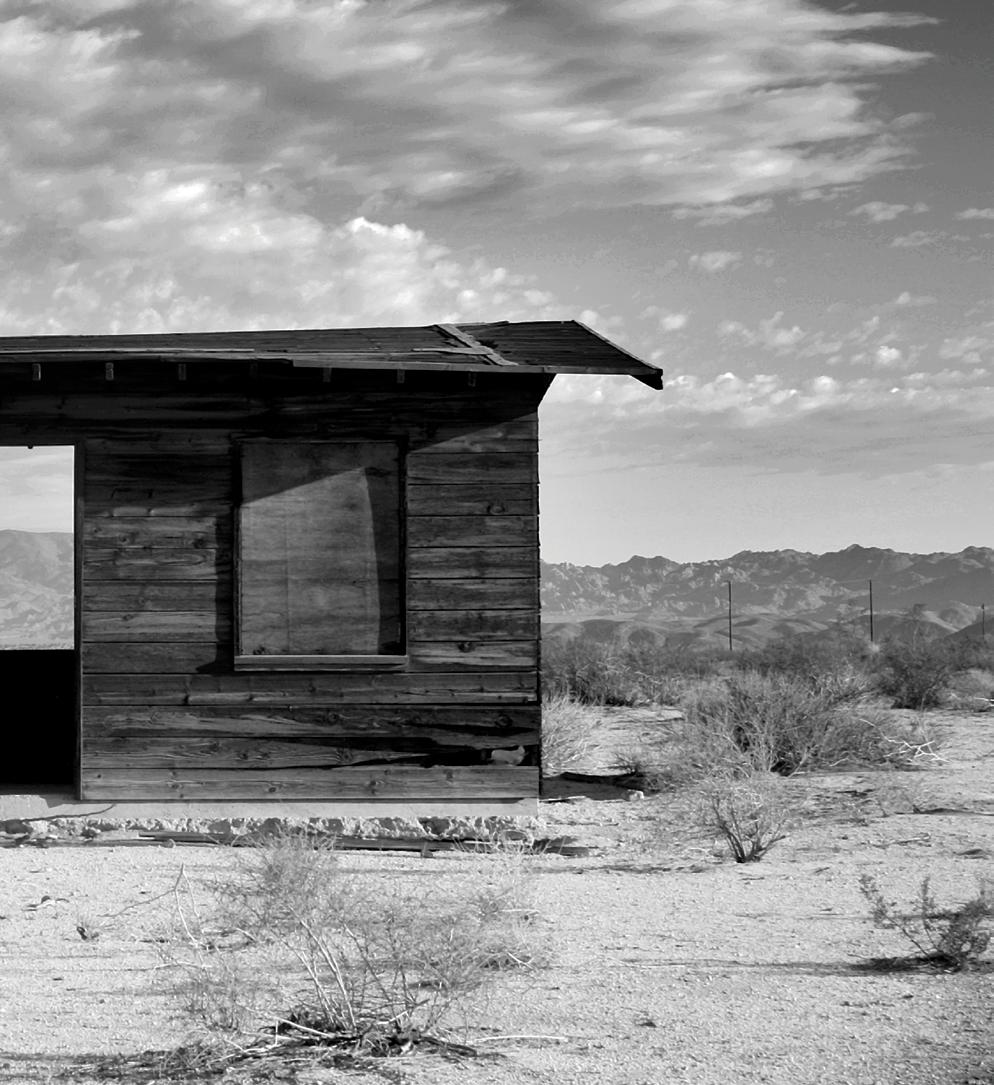 Before Smith conceived of Lucid Stead in 2013 and unbeknownst to him, artist Diane Best photographed the original homesteader shack in 2005 located on his property in Joshua Tree, which he purchased that same year. On his acquisition of this large photograph from Best, Smith says: “It reminds me each day how far I’ve come as an artist and also underlines the importance of following through on your ideas, no matter what.”
Phillip K. Smith III: Sublime Reflections
Dr. Daniell Cornell
The Circle of Land and Sky, Phillip K. Smith III’s project for Desert X is more than a site-specific installation; it is an intervention into the desert landscape. That is not to say that its location was not artfully chosen. The deliberateness of what cannot be seen is as important as what can be seen.
In the Coachella Valley, a patchwork pattern of built and unused parcels of land results in juxtapositions of suburban density with large unconstructed sections of desert. Smith chose to place his sculpture near a busy intersection but within an undeveloped 180-acre plot owned by the City of Palm Desert.1 A wooden boardwalk path led from the heavily trafficked road, carrying visitors to the slight depression in the ground that was the site of the work’s installation. At the end of the path they arrived at a place where all evidence of the surrounding built environment disappeared from view. Of course, this apparent emptiness is exactly the point Smith’s work addresses: in spite of its lack of development, the desert is anything but empty. In fact, one might even say that this lack allows us to experience the desert’s full embodiment of the space, the way it occupies one’s physical and psychological experience.
As the 2010 artist in residency at Palm Springs Art Museum, Smith created a contoured wall relief in translucent, sheet acrylic cutouts and colorchanging LEDs that mined the effects of light, form, color, and space in the tradition of earlier artists who used abstraction, hue, and tonality to alter perception. However, he was already evincing an interest in moving beyond the visitor’s experience in a gallery environment through the dimensional layers of his geometric shapes that recalled topographic mapping, alluding to the shape of landscape.
Most commentators of Smith’s sculptures point out that he is continuing explorations by artists in Southern California’s major minimalist movements of Light & Space and Finish Fetish. The Circle of Land and Sky extends both art traditions in its manipulations of space through the properties of light and the highly polished steel surface that capitalizes on its reflectivity. One thinks here of Larry Bell, Robert Irwin, and James Turrell, original members of the Light & Space movement, who use light in ways that appear to dissolve solid boundaries even as they conjure the illusion of substance and physicality. 2
Inspired by and working in the tradition of these west coast predecessors, Smith has been continuing their explorations of industrial surfaces to capture the play of light effects. However, whereas the earlier artists principally emphasized the perceptual optics of visual effects, Smith has focused on the special quality of light and its shifting ambience that the desert environment generates. Smith has said, “The desert is a place where the environment can be simplified to sky and earth, activated by light.”3
In addition, as in most Land art, another historical tradition relevant to his project, Smith reveals his chosen terrain, the desert, to be a sacred space. He constructed a shrine, conjured out of rock, sand, plants, animals, and sky. However, rather than erect a building, as in a typical shrine, Smith magically
reinvents the environment itself through a poetics of embodiment. In writing about another sculptural project, Eric David identifies this “perceptual corporeality of light and shadow” as the heart of Smith’s practice.”4 Rather than simply present the desert as something to be admired or honored, he allows one to enter, experience, and be transformed by it.
As art critic Jan Tumlir has written of Smith’s works, they represent his dual training in both art and architecture. The use of polished mirrored surfaces, especially, suggest the curtain walls of high-rise urban buildings.5 Yet Smith inserted this urban reference into the natural expanse of the desert, evoking instead the phenomenon of a mirage and the illusory optics of intense sunlight. The result, simultaneously minimal and maximal, is reminiscent of the way indigenous people have given shape to ceremonial places by inscribing them with geometric designs.
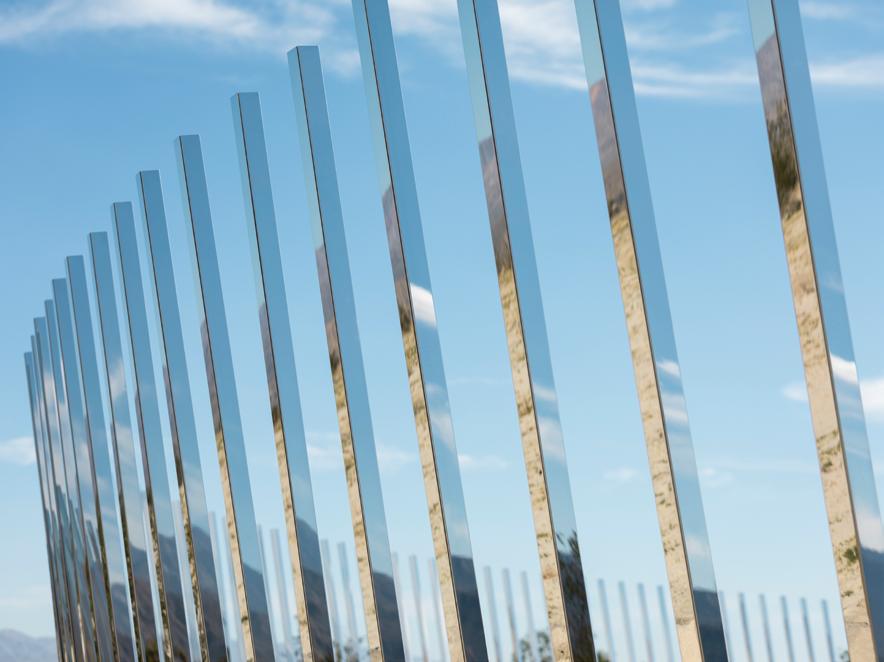
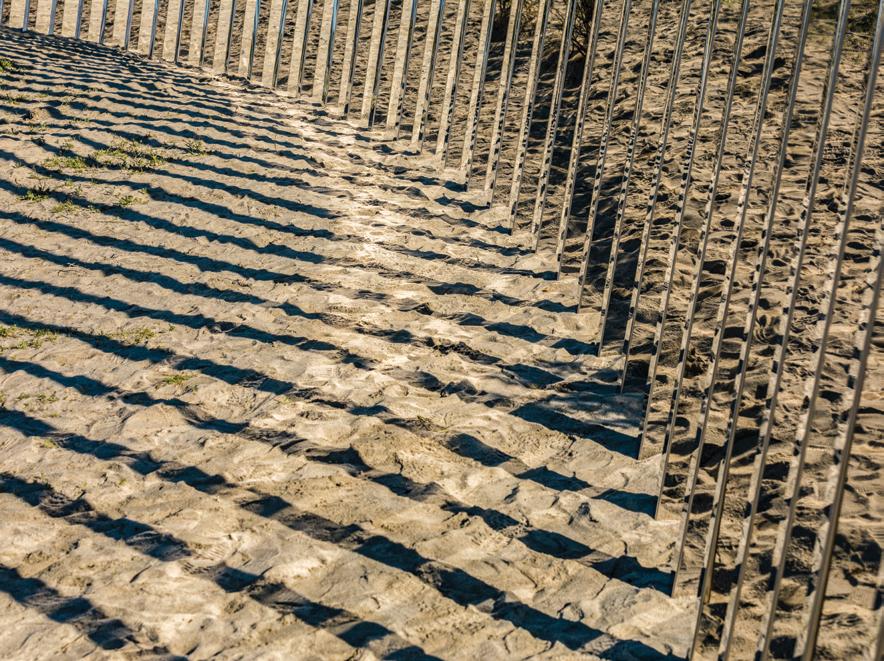
Smith reimagines the landscape in The Circle of Land and Sky by fragmenting the viewer’s experience on the one hand and enlarging it on the other. The sculpture consists of 300 ten foot high reflecting beams set at ten degrees in the ground to form a 165-foot diameter, monumental circle, a modern day Stonehenge.6 The beams lean out from the center, so they reflect the land on the outside and the sky on the inside. Viewers perceive the landscape as a series of fractured segments. Smith transforms nature through a close-up confrontational and dizzying point of view, altering one’s perception as his installation scrambles the desert floor and the sky and mountains in the distance.
The coherence of landscape as a vista for contemplation is subverted by the more immediate experience of the viewer’s relation to the natural elements as both observer and participant. The sensation is heightened as viewers move toward the reflecting beams and find themselves mirrored in them and visually thrown into the sky or projected onto the ground. One feels both rooted in place and displaced by the fragmented reflections that break the horizon. An experience of the physical world transitions into one of artifice, blurring the distinction that historically has defined a dichotomous binary between nature and culture.
That binary most often has been articulated in art through the philosophical tradition of the sublime, which associates the natural world with an awesome presence that overwhelms individual sensations to create feelings of anxiety and apprehension. It asserts the priority of the earth and cosmos over human endeavors. However, an inherent tension exists between the rhetoric of the sublime and human actors. On the one hand, an encounter with a feeling of nature’s excessive power diminishes the individual’s importance through an awareness of the inconsequential, fragile, and temporary quality of life. But on the other, it plunges the individual into a state of mystery where the self is negated so the limitations of the body can be transcended to achieve a higher consciousness.
Smith’s installation seeks to reconcile these opposing experiences of nature. His is not the religious experience that historically has been associated with ascetics, who remove to the desert seeking the heightened private sensibility its austerity offers. Rather, his work enables the more spiritual experience that connects people to each other. He has explained that it is rooted in the consciousness that “...there are moments of universal beauty, of shared experience, of discovering experiences that bond all of us together as human beings. Light is most often at the root of these experiences. It’s these moments of beauty, purity, and universality that I’m seeking to create.”7
To say that Smith’s project is deeply humanist is an understatement. In The Circle of Land and Sky, Smith performs an extraordinary feat of magic—the desert’s essential elements transposed from everyday life into a spiritual gesture. He makes visitors to his site pay attention to the mystery that is the desert, drawing them into a revelation of the shared humanity we discover through the natural world. These are the stakes he has placed in the ground.
This essay was originally commissioned by Desert X with support from Dr. Loren Lipson.
1. The intersection is Portola Avenue and Frank Sinatra Drive.
2. In an article for Artnet, Smith cites these artistic inspirations and is quoted, “I’m the next generation pursuing those artists.” The article also cites Smith’s enthusiastic embrace of Mark Rothko as an important influence on his interest in the luminosity of color. Alexandra Peers, “Meet Phillip K. Smith III,” Artnet (March 27, 2018). https://news.artnet.com/art-world/meet-philip-k-smith-iiicoachella- artist-instagram-1253594.
3. Franceasca Seiden, Interview with Phillip K. Smith III
4. Eric David, “Double Truth: Light Artist Phillip K. Smith III Plays with our Perception of Space,” Yatzer (January 9, 2016). https://www.yatzer.com/phillip-k- smith-iii-light-shadow-works.
5. Jan Tumlir, “The Desert of the Real,” Phillip K. Smith III: Light + Shadow Works (Hanover, New Hampshire: Dartmouth College, 2015), p. 26,” Whitehot Magazine (September 2016). https:// whitehotmagazine.com/articles/interview-with-phillip-k-smith/3504. ,” (September 2016). https:// whitehotmagazine.com/articles/interview-with-phillip-k-smith/3504.
6. Design specifications from a communication with the artist, April 12, 2018.
7. Seiden, “Interview with Phillip K. Smith III
Daniell Cornell, Ph.D., is an independent art professional, cultural historian, curator, and educator. He served as Fulbright Professor at University of Porto, Portugal, and has held positions at The New Museum, The Morgan Library, Yale University Art Gallery, Fine Arts Museums of San Francisco, and Palm Springs Art Museum.
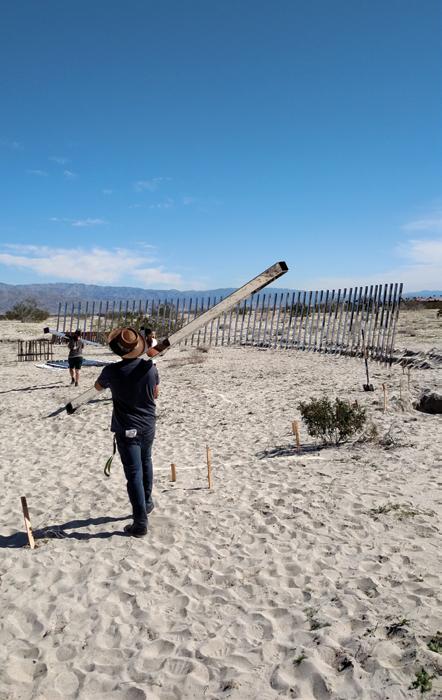
Carrying reflectors by hand across the desert sand.
Primordial Light
By Dan Cameron
One of the knottier mental exercises in basic physics comes from trying to imagine measuring, or even experiencing, light and space in terms apart from one’s effect on the other. To be sure, there is no mistaking the two realms in the abstract. But while we possess the mental capacity to conceive of space as something we might be able to navigate in the total absence of light—blind people do it—the same concept doesn’t apply if we contemplate light as a phenomenon that would still be real if there was no space where it could shine.
The two are so fully and inextricably intertwined that sighted people generally feel pretty confident we know what we are seeing when we experience an illuminated space because our entire sentient lives have been spent navigating a seamless fusion of these two elements as if they were a single entity. You enter a dark room, turn on the light or open the curtains, and voila!—space and light instantly snap into perfect formation.
For most of our collective existence, the control of light and its movement through space was tied to our conquest of fire. This is why the narrative of Iron Age humans creating the earliest cave art by the flickering light of torches is so compelling to us thousands of years later. Most of us, at some point in our lives, have fallen under the mysterious spell a campfire or a shimmering nighttime panoply of stars has on our human imagination. We might even construct a viable argument that our string of qualified successes at controlling the movement of light through space is one of the weightiest hallmarks we employ without hesitation to define the project of human civilization. From the life-saving regulations of lighthouses, airports, and traffic lights to the benign amusements of movies, smart phones, television, and video games, we seem to feel secure being surrounded by the tools and infrastructure that permit us to shape and organize all of the moving, blinking fragments of our immediate surroundings.
Because it’s not technically possible to pry space and light apart to observe or deploy their properties separately, an international network of artists that has gradually expanded over the past half-century has focused their collective attention on the possibility of developing interactions between the two realms in order to destabilize the perceptual mechanism by which light—in concert with its handmaiden, color—acts to reinforce the solidity of space and form. Although far from household names, two important precursors of this development are the American artist Thomas Wilfred (1889—1968) and Brazilian artist Abraham Palatnik (b. 1928). Wilfred began in the 1930s to create a series of Lumia sculptures that seemed to compress the colors and shapes of the aurora borealis into console form. In the early 1950s, Palatnik started making installations and motorized sculptures that confronted viewers with semi-translucent screens behind which a smooth interplay of lights, tracks, switches, and conveyor belts created the visual impression of miniature abstract worlds populated by illuminated biomorphic shapes that swam in slow motion through fields of glowing and receding colors. Although both artists used electricity to generate colorful pulsing movement that had certain artistic roots in European modernism (i.e., Marcel Duchamp, Naum Gabo), their fusion of the kinetic and the illuminated appears all the more groundbreaking to our twenty-first century eyes.
By the late 1960s, a small group of artists in Southern California found their individual practices overlapping in process and intent as each developed an approach soon dubbed Light and Space, precisely for its concentration on isolating the two elements as much as possible from solid form. Robert Irwin, James Turrell, Larry Bell, and Doug Wheeler forged a collective approach through which they treated light itself as a primary material, signifying a shift
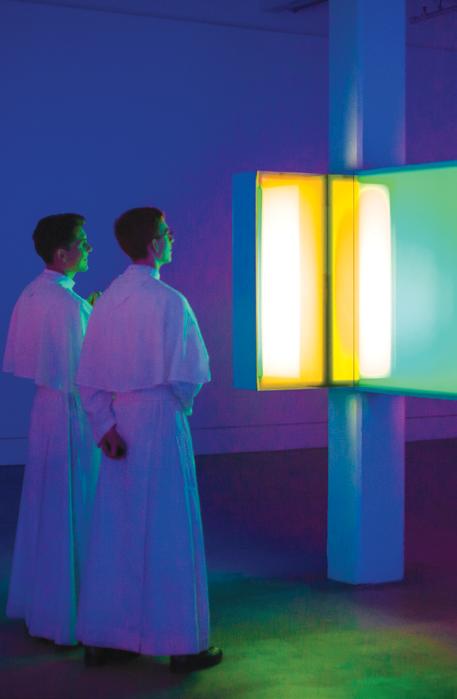 The novices of Saint Michael’s Abbey sing Gregorian chants to close out the final day of the 10 Columns installation at Bridge Projects.
in visual attention that had a profound impact on the perception of art by giving its environmental context greater attention. Concurrently, New York artist Dan Flavin developed a tangent of Minimal Art that used fluorescent light fixtures to similar ends, while Fred Sandback began quietly implying the presence of solid forms in space simply by stretching taut lengths of colored yarn between fixed points in a room. In all of these cases, the viewer’s attention was not drawn to any solid presence within a fixed space but to the overall impact of light, color, line, and/or shadow onto surrounding walls, ceiling, and floors. While there are important stylistic differences among all involved, the Light and Space generation and certain New York Minimalists helped link the idea of industrially-scaled architecture with the gradual dematerialization of the art object itself, a quest that continued unfolding well into the 1980s.
The potential to merge light and architectural space attained heightened levels of interest and engagement as computer software and LED lighting gradually took the place of pulleys, dimmers, fuses, and other remnants of the analog age, and this lacuna marks the precise cultural zone into which artist Phillip K. Smith III seems to be locating his delicately-calibrated 10 Columns installation. As it pertains to the technological transformations that increasingly define our era, we now have at our fingertips far more capabilities than we can ever have imagined. Yet, because of this very same proliferation, it has become all but impossible for a non-specialist to fully appreciate the unique characteristics and boundless variations of so many simultaneous developments. Absent any clear potential for astonishment, the panorama of technological miracles unfolding around us can easily become an obstacle course of distraction, a gateway drug to prolonged states of mental passivity and social isolation. We haven’t lost a taste for the marvelous or the sublime but we do seem to have succumbed to the myth that such experiences are instantly available, if we just keep scrolling.
Entering Smith’s 10 Columns, we aren’t immediately aware of the technology’s sophistication because how light is generated within the architecture sets up a visual ambiguity that is never entirely clarified: Are these solid blocks of color that morph independently of each other or are we somehow seeing through them to the other side? Each of the ten columns within the Bridge Projects exhibition space supports one of three distinct arrangements of screens at 90- and 180-degree angles but making one’s way through the installation merely reinforces the original questions of what is a physical shape and what is a reflection. As the slow transformation of color becomes more apparent over time, what at one moment appears as a reflection can also transform, a minute later or from a different angle, into what looks like another glowing element waiting on the other side. By overlaying multiplying reflections that tend to proliferate the more one’s vision adjusts to the darkness, reflections of reflections generate still more light and color. At a certain point, it is more than likely some viewers will start to lose their sense of orientation.
In 10 Columns, Smith harnesses a means of tricking or short-circuiting our learned responses to the ways illuminated color behaves within darkened spaces to tell us where things are and how far away. Here, he employs the visual cues that typically ground us within the space we’re inhabiting to introduce the visual possibility that these glowing reflections might be receding into infinity, or that one screen pitched at a right angle to another screen might reveal the unfolding of a room inside the room, with its own receding surfaces and slowly undulating colors. The cumulative effect is akin to a promenade of two-way mirrors, with every other surface either an expansive reflection of its surroundings or a partly translucent lens.
As a result of the meticulous calibration and synchronization behind the continual segueing of one color into another, Smith’s installation subtly yet radically undermines the spatial orientation of the human body. In contrast to typical installations by Turrell or Irwin, which tend to incorporate direct or indirect natural light in order to reinforce the fullness of space, Smith employs darkness for the opposite reason. His motive isn’t to induce disorientation for its own sake but rather to enhance and magnify the capacity of an illuminated space to overwhelm the normal parameters of visual perception, flooding the brain’s receptors with messages. If this glowing field of spatially ambiguous elements can define one’s immediate reality while standing in its midst, then perhaps the mental restraints that tether us to the ways we perceive the world outside this space also deserve a closer re-examination. We might permit ourselves to consider historic architectural connections to Smith’s project such as the Great Mosque of Córdoba, Spain, celebrated for its receding fields of slender columns with banded arches which induce a similar sense of purposefully defying the physicality of the surrounding walls and floors to induce a sense of the divine by way of an out-of-body experience that requires no preparation other than a well-honed perceptual acuity.
Framing 10 Columns as a work of temporary architecture is nearly irresistible once we factor into the discussion Smith’s own training and professional background as an architect. And, although it might seem to be splitting hairs, the hybrid aspects of Smith’s artistic practice seem foundational to his work’s nearly physiological impact on the viewer. When we think of installation art, it is typically in terms of some spatial alteration or augmentation the artist has made to impact our perception of where it’s shown. But what Smith has done instead is develop an entirely new series of sculptures, custom-designed and fabricated for this particular space; while he’s installed those works directly on the columns, we see them, at first glance, merely as objects in space. It’s a clever and disarming tactic because the thought that we are there to look at sculptures doesn’t begin to anticipate what happens when all of the works are functioning in perfect synchronicity—at which point the work’s own internal logic has gained the upper hand.
As with all significant works of art, this grouping has been conceived in order to stay with us long after we’ve moved on to the next destination. But what may cause 10 Columns to stand apart is that, unlike nearly any other spatial or aesthetic experience, Smith’s goal is to demonstrate (in the most persuasive terms) that the most advanced technological breakthroughs of our time have not numbed our craving for experiencing the transcendental and the sublime. Something as primordial as the movement of colored lights in darkness is still the most clear-cut path to get us there.
Essay included in the book assembled by Bridge Projects for Smith’s 10 Columns installation, which ran from October 11, 2019, to February 16, 2020, as the inaugural exhibition in the new Hollywood gallery space.
Dan Cameron is a New York-based independent curator, art writer, archivist, and educator. He founded Prospect New Orleans, was Artistic Director of Open Spaces in Kansas City in 2018, and a year prior served as guest curator of Kinesthesia: Latin American Kinetic Art 1954-1969 at Palm Springs Art Museum, part of the Getty Foundation’s Pacific Standard Time initiative. Cameron served as senior curator at the New Museum from 1995 to 2006, was Director of Visual Arts at New Orleans Contemporary Arts Center from 2007 to 2010, Chief Curator at Orange County Museum of Art in Newport Beach from 2012-2015, and Curator of the 2016 Bienal de Cuenca in Ecuador.
Phillip K. Smith III: Light + Change
Adam Lerner, JoAnn McGrath Executive Director/CEO, Palm Springs Art Museum
You don’t need to know art history to be captivated by the work of Phillip K. Smith III, yet history nevertheless illuminates his sculptures and installations, which belong to a rich tradition of art making.
Light is the primary medium of Smith’s art, and changing conditions bring his work to life. The movement of the viewer animates some of his works. In others, a change in the light source itself transforms them, and in still others, the work morphs according to both internal and external factors. The physical component of the art never provides the entirety of the art experience, which incorporates the relation of the objects to space and time. Unlike a conventional painting, more like a video, Smith’s art is only manifest when it is activated. Though this emphasis on the relationship between art object and its context may seem like a cerebral take on a body of art that causes such an immediate sense of delight and wonder, that emphasis nevertheless places Smith’s art centrally within the history of twentieth century art.
Of the many ways to tell the story of modern and contemporary art, one possible narrative posits two paths: one centered on materiality and the other on immateriality. The first path can be said to have been plotted by the towering figure of Pablo Picasso, whose innovations in painting always remained within the frame itself. Even while inventing new ways of making pictures, the physicality of the rectangular canvas predominated. The other path can be sourced in the Swedish spiritualist painter Hilma af Klimt, who understood her art as a form of divination. For her, the physical nature of art was a gateway to what really mattered, the realm of the metaphysical. And so, twentieth century art can be described as having one lineage that fully embraces the power of concreteness, and another that combines an interest in tangible things with the intention to transcend them in search for something more ethereal. One of the high points on this transcendent latter path is the California Light and Space movement, which flourished from the 1960s to the 1980s. Smith’s work shares a deep connection to works by those artists, most of whom also took light as their medium.
California Light and Space artists worked with unconventional art materials and technologies such as neon and cast acrylic in order to create perceptual experiences that often blurred the line between physical reality and environmental effects. Referring to artists such as Larry Bell, Robert Irwin, Mary Corse, Helen Pashgian, and James Turrell, the term “Light and Space” was coined in the exhibition Transparency, Reflection, Light, Space: Four Artists at the UCLA University Art Gallery in 1971. Robert Irwin explained his approach to objects: “If you begin to assume that the object is no more real than the space around it, no more important than the shadows, it is simply one of a series of events, and you begin to try to deal with the consequences of that, then it becomes obvious you can’t make an object any longer or you can’t make anything that is not relative to the circumstances that it exists in.” Objects were important to the Light and Space cohort, but so was the space around the
objects, the circumstances in which it exists. At the heart of the movement is the paradox that meticulous attention to surface and material is necessary to create experiences of environments that transcend physical things.
As in the works of his California predecessors, Smith’s art demonstrates an interplay between physical objects and their environments. In his Light + Shadow series—which do not contain any internal source of light—shapes, and gradients appear only in response to how they are lit from the outside. His Cylinder series, consisting of complex geometries assembled from a multitude of similar segments, are animated by the changing perception of the viewer in the space around the works. The most dramatic example of this relationship between object and environment may be his 2013 installation Lucid Stead, an abandoned high desert homestead shack transformed with mirrors and LED panels. After dusk, the physicality of the house manifests itself through the colored rectangular forms of windows and doors. In the bright light of day, the horizontal mirrored slats reflect the environment dissolving the outside edges of the structure and blending it into the sweeping landscape of earth and sky to create a sublime effect that approaches Hilma af Klimt’s spiritual ambitions for art.
Like his other Light and Space artists, Smith attributes his interest in working with light to his experience living under the California sun and the desert sun in particular. Speaking of the beauty of the Coachella Valley, he notes, “It’s the color of the sky, the shifting texture of the mountains, and the sense of space created by the layers of landscape.” The continually changing quality of this light inspires him to introduce the element of time into all of his works. “It’s often the pace of change across a day or year that reveals the beauty of this place... the top of San Jacinto turns pink and then purple and then blue. This can happen over 20 minutes.” The colored light in many of Smith’s works change at a similar pace to the color changes he describes on Mount San Jacinto. In other works, light and shadow move according to the movements of the viewer. In our encounters with the world in everyday life, we tend to favor objects over experiences. We tend to see the mountain rather than the shifting gradations of light playing over it. It took artists like Robert Irwin to teach us that the object is no more important than its shadows. Smith was among the best students of that lesson, and he teaches it to us afresh with his work.
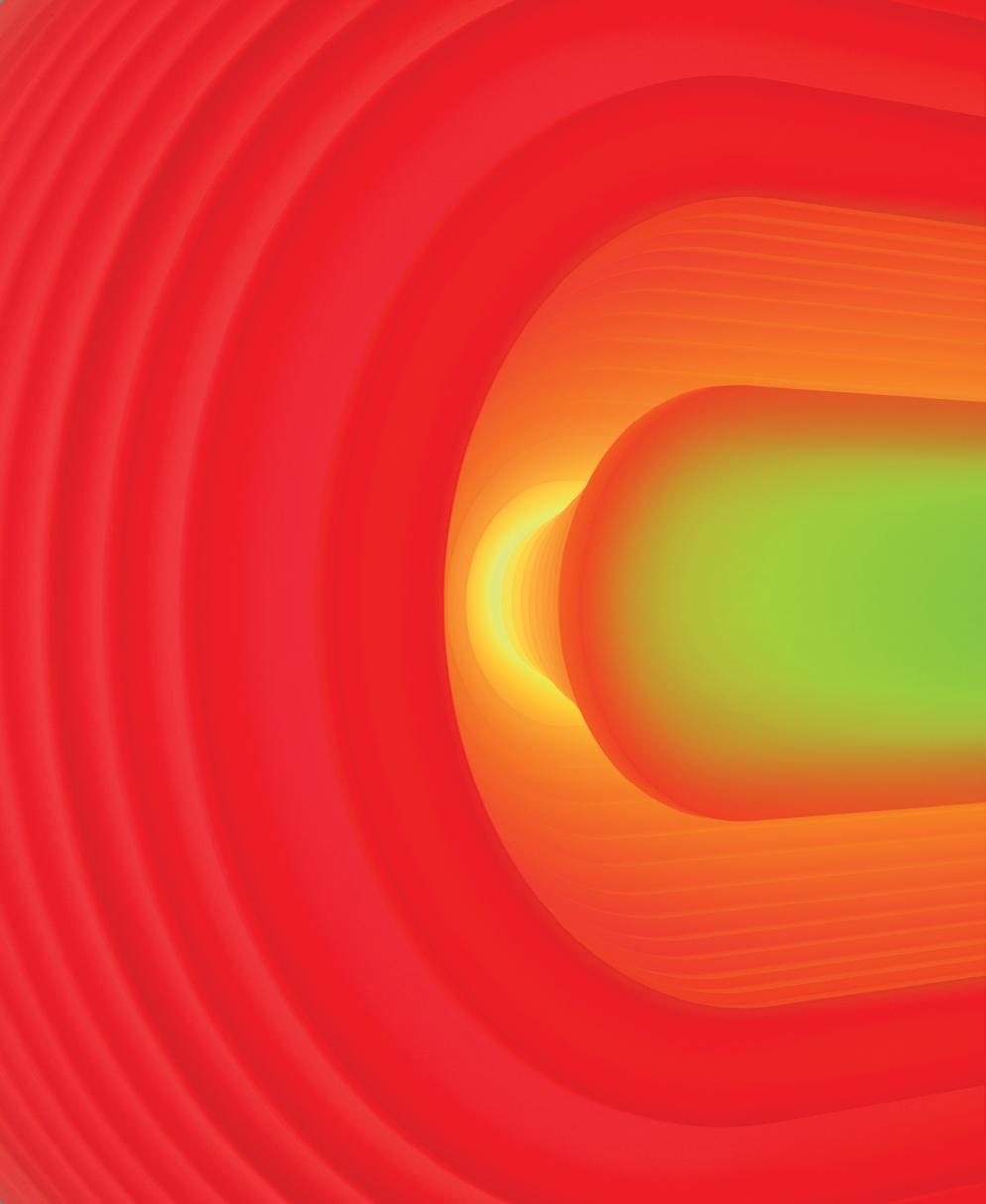
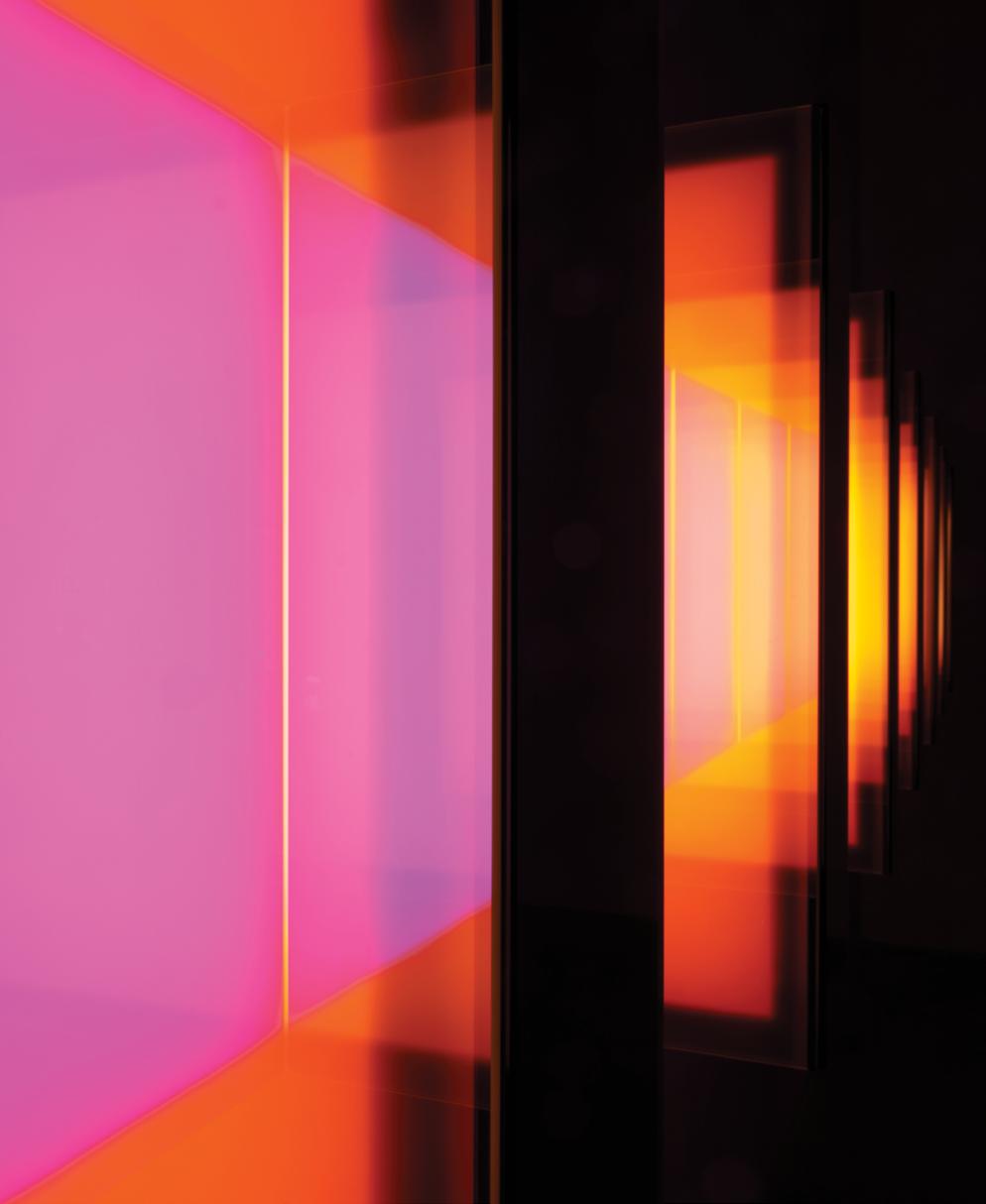
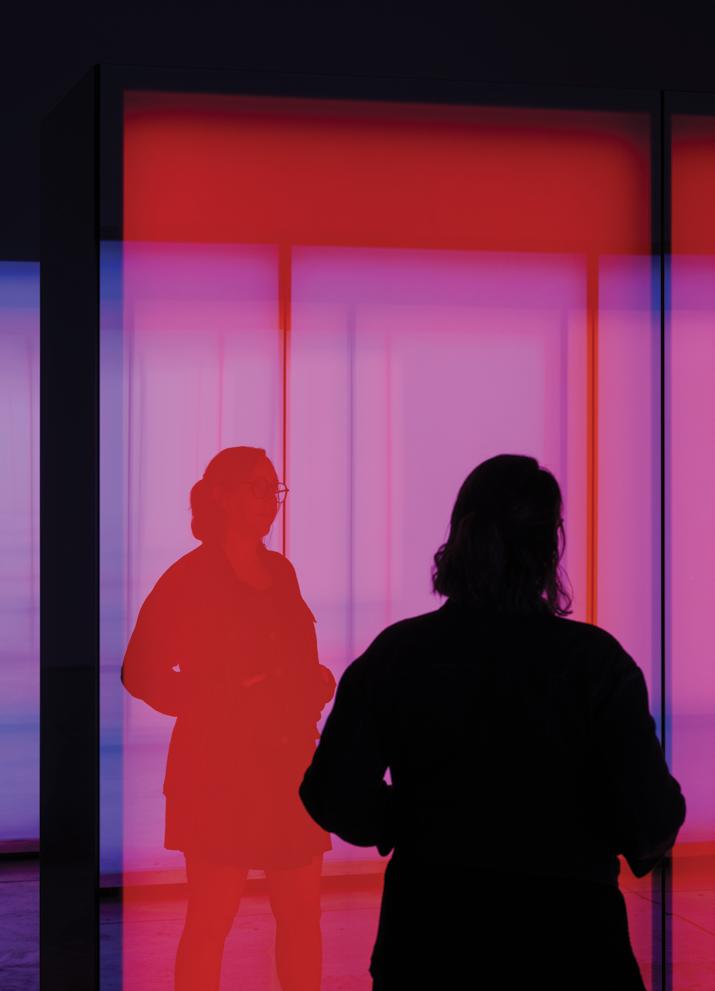
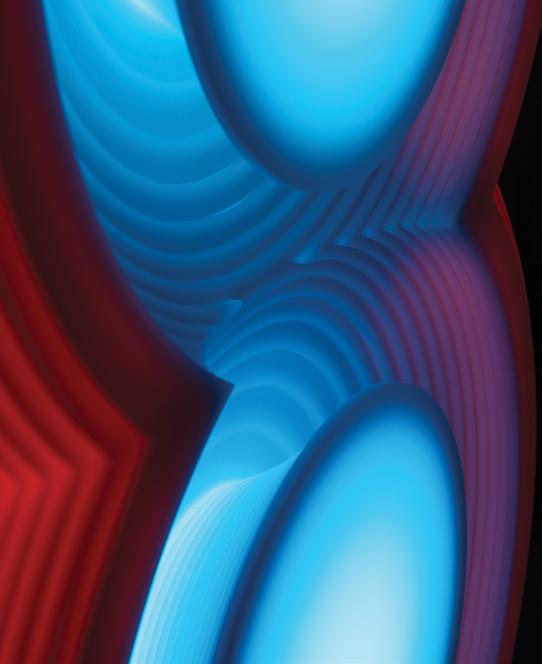
Two Corners (detail) at Palm Springs Art Museum.