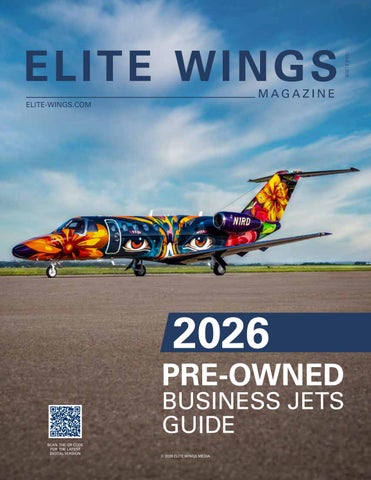
ISSUE 9 | 2026
E LITE WINGS MAGAZINE
ELITE-WINGS.COM
2026
PRE-OWNED
BUSINESS JETS GUIDE SCAN THE QR CODE FOR THE LATEST DIGITAL VERSION
© 2026 ELITE WINGS MEDIA
AIRCRAFT SALES & ACQUISITIONS A LEGACY OF EXPERTISE, INNOVATION AND RELIABILITY SPANNING 70 YEARS. At Duncan Aviation, we understand that buying or selling a private jet is not just a simple asset transaction, but part of a bigger picture. As your vital advisors, we take the time to truly understand your goals and offer thoughtful insights, market intelligence, operational expertise, and comprehensive support solutions for your entire ownership experience. Our team’s dedication and vast network of industry connections ensure that every decision you make is thoroughly informed, aligning perfectly with your unique mission and aspirations. 2 / E L IT E W I N G S M AGA Z I N E © 2 0 2 5
www.DuncanAviation.aero/aircraftsales
COMPLETE BUSINESS AIRCRAFT SERVICES Aircraft Sales & Acquisitions | Airframe Maintenance | Avionics Installation | Duncan Manufacturing Solutions (DMS) | Emergency Assistance (AOG) | Engine & APU | Engineering & Certification Services | FBO Services | Government & Special Programs | Paint & Interior | Parts, Avionics, Instruments & Accessories Experience. Unlike any other. | www.DuncanAviation.aero © 2 0 2 5 E L IT E W I N G S M AGA Z I N E / 3
A B OUT
E L IT E W I N G S
ELITE WINGS MAGAZINE ISSN 2816-4040
Elite Wings publishes timely, structured, validated, unbiased, and relevant business aviation intelligence.
ELITE-WINGS.COM
EDITOR-IN-CHIEF Abdelmajid Jlioui abdelmajid.jlioui@elite-wings.com
DIRECTOR CONTENT STRATEGY Viswanath Tata viswanath.tata@elite-wings.com
EDITORIAL DIRECTOR Jane Stanbury jane.stanbury@elite-wings.com
SENIOR EDITOR Mark Lowe mark.lowe@elite-wings.com
CONTACTS Editorial: editorial@elite-wings.com General Inquiries: info@elite-wings.com Advertising: ads@elite-wings.com
Cover Image: Duncan family-owned Citation CJ3+ with 46-colour paint refurbishment by Duncan Aviation © Duncan Aviation
ELITE WINGS MAGAZINE (ISSN 2816-4040) IS PUBLISHED BY ELITE WINGS MEDIA INC, MONTREAL, CANADA. Any information of a technical nature contained in this document may contain inaccuracies and is subject to change and should never be relied upon for operational use. Copyright © 2024 All rights reserved. Reproduction in whole or in part without permission of Elite Wings Media is strictly prohibited.
WELCOME TO T H E 2 0 2 6 P R E - OW N E D B U S I N E S S J ET S G U I D E F RO M E L IT E W I N G S Acquiring a pre-owned business jet delivers many advantages and is often a savvy move for buyers looking for cost-effective, strategically sound and timely access to a business aircraft. Choosing a pre-owned airframe can significantly lower initial investment costs, reduce depreciation costs, and with careful planning can be customised for the individual owner’s specific needs. Research and planning are essential to ensure the right choice, and with this edition of the Elite Wings Pre-Owned Guide we want to enable readers to make informed decisions when selecting, acquiring, and managing a purchase. We created this guide to provide a trusted resource full of relevant and timely knowledge from industry leaders, shapers, and analysts who are intensely familiar with this complex landscape. We identify the key points to consider when selecting aircraft, identify what to ask who and when, to help streamline the process. Brokers, MROs and OEMs give their input on how to manage a pre-owned aircraft, while industry experts share information about the range of considerations to make.
Majid
Vis
The guide is formulated to detail the benefits of each out of production aircraft enabling readers to simply identify suitable models for their mission needs. Like any journey acquiring an aircraft is a long process that starts with a single step, and we hope the guide will help navigate the journey. We know that it’s a dynamic market, which is why we publish this resource annually; however, if you have questions about an article, find information lacking or would like to read more about the subject, please do let us know. These guides are for you, our industry colleagues, and your feedback is most welcome.
Jane
PRE-OWNED 2026 BUSINESS JETS
GUIDE
I N T E RV I E W S
10
IADA State of the Global Pre-Owned Market
14
ECHO AVIATION LEASING State of Pre-Owned Financing
20
AIRCRAFT RECORDS The Blockchain Opportunity in Business Aviation
22
CHARTERING WITH CONFIDENCE The keys to a seamless private aviation experience with STACK.Aero
26
FAST AIR Operating a Mixed Fleet to Best Serve Western Canada
30
WHY PRE-OWNED MAY BE THE NEW PREMIUM Exploring the Customization Advantage with Duncan Aviationn
39 40
44 48
50
ELITE WINGS DESIGN AWARDS 2026 AWARD WINNER BUSINESS JETS | RETROFIT PROJECT LONG RANGE CATEGORY Bombardier Global XRS By Shalini Misra Design In Collaboration with AeroVisto Interior Services AG SUPER LARGE CATEGORY Embraer Legacy 650 By F/LIST LARGE CATEGORY Verdant Sky Falcon 2000 By Sarah Larranaga In Collaboration with West Star Aviation MIDSIZE CATEGORY Challenger 350 By Duncan Aviation 2026 AWARD WINNER BUSINESS JETS | EXTERIOR LIVERY
56
PAINT REFURBISHMENT G-IV Speed In Motion By Duncan Aviation
MIDSIZE
2026 PRE-OWNED BUSINESS JETS GUIDE
110
Learjet 60
112
G100 / 150
114
Hawker 800
116
CE-680 Citation Sovereign
118
Legacy 450 / Praetor 500
120
CE-680A Citation Latitude SUPER MIDSIZE
VERY LIGHT
70
Eclipse 500 / 550
72
SF50 Vision Jet
74
CE-510 Citation Mustang
76
CE-525 Citation CJ1 / M2
78
Phenom 100E / 100EV / 100EX
80
HA-420 HondaJet LIGHT
122
CE-750 Citation X / X+
124
Hawker 4000
126
CE-700 Citation Longitude
128
Challenger 300 / 350 / 3500
130
Legacy 500 / Praetor 600
132
G200 / 280 LARGE
134
Falcon 2000
136
Falcon 50
81
Premier I
84
CE-525A Citation CJ2
86
CE-525B Citation CJ3
140
Falcon 900
88
Hawker 400
142
Legacy 600 / 650
90
Learjet 31A
144
Challenger 850
92
CE-550 Citation Bravo
146
Gulfstream IV / G300 / 350 / 400 / 450
94
CE-560 Citation Encore
96
CE-525C Citation CJ4
148
Global Express / 6000 / 6500 / 5000 / 5500
98
Phenom 300
150
Gulfstream V / G500 / 550
100
PC-24
152
Gulfstream VII / G500 / 600
102
Learjet 40 / 70
154
Falcon 6X
156
Falcon 7X / 8X
SUPER LIGHT
SUPER LARGE
LONG RANGE
104
CE-560XL Citation Excel / XLS / ASCEND
158
Gulfstream VI / G650 / G650ER
106
Learjet 45 / 75
160
Global 7500 / Global 8000
108
CE-650 Citation VII
162
Gulfstream VIII / G700 / G800
BUY WITH CONFIDENCE. SELL WITH CREDIBILITY. Every aircraft on AircraftExchange.com is represented by an IADA Accredited Dealer— rigorously vetted for ethics, transparency, and expertise.
POWERED BY IADA ACCREDITED DEALERS
A Message from the International Aircraft Dealers Association The International Aircraft Dealers Association (IADA) is proud to once again serve as an advisor to Elite Wings on its 2026 guide to buying a pre-owned aircraft. Each year, pre-owned transactions outnumber new aircraft transactions by more than three to one, making the pre-owned market the backbone of business aviation. IADA works to keep that market strong and trustworthy. Demand for pre-owned business aircraft continues to climb. Buyers want availability, value, and speed to market, and the pre-owned sector delivers all three. It is also where the stakes are highest. Every aircraft carries its own history, condition, and documentation, and evaluating those details takes specialized expertise. That is why choosing a qualified
dealer or broker is the most important decision a buyer will make. For more than thirty years, IADA has worked to elevate the entire business aviation market by advocating for ethical standards, professional accountability, transparency, and exceptional service. IADA Accredited Dealers and IADA Certified Brokers are involved in nearly half of the world's pre-owned business aircraft transactions. Each has met IADA's rigorous accreditation or certification requirements and is bound by the IADA Code of Ethics. When you buy through an IADA Accredited Dealer or Certified Broker, you work with a qualified professional held to a higher standard.
Soaring Ahead, Lou Seno Executive Director, IADA © 2 0 2 5 E L IT E W I N G S M AGA Z I N E / 9
STAT E O F T H E P R E - OW N E D M A R K E T F RO M I A DA By Abdelmajid Jlioui
The pre-owned market remains a critical part of business aviation. As the industry continues to evolve in 2026, how do you see IADA’s role in supporting the growth and long-term health of business aviation? IADA’s vision is to set the global standard for business aircraft transactions, and that becomes increasingly important as the market grows more complex. Buyers and sellers need to know they are dealing with experienced professionals who operate with integrity, transparency and accountability.
A conversation with IADA Vice Chair John Odegard, Founder & Partner of IADA-Accredited Dealer 5x5 Trading
10 / E L IT E W I N G S M AGA Z I N E © 2 0 2 5
IADA-Accredited Dealers represent approximately 17% of aircraft dealers worldwide but account for more than 50% of global pre-owned aircraft transactions. That gives our members a meaningful role in the health of the overall business aviation marketplace.
STATE OF TH E M A R KET | IA DA
But our impact goes beyond transaction volume. IADA provides accreditation for dealer organizations, certification for individual brokers and access to a worldwide network of transaction specialists, manufacturers and verified products and services companies. Together, those resources help transactions move more efficiently while reducing risk for aircraft owners and buyers. A healthy pre-owned market also helps drive the entire business aviation ecosystem. When aircraft change hands efficiently, it supports new aircraft purchases, financing, insurance, maintenance, upgrades, management and flight operations. Our objective is to help make that marketplace more professional, transparent and dependable. The market entered 2026 following a very strong finish to 2025. What are the most important findings from IADA’s latest market report, and what do they tell us about buyer and seller sentiment? The first half of 2026 has been considerably stronger than many people expected. IADA dealers closed 746 aircraft transactions during the first six months of the year, a 21% increase compared with the same period in 2025. We also saw 536 aircraft placed under acquisition agreements, up 8%, while dealers purchased 118 aircraft for inventory, an 87% year-over-year increase. That willingness of dealers to commit their own capital is another indication of confidence in the underlying market.
The biggest issue today is not a lack of demand. It is finding the right aircraft. High-quality, late-model inventory remains historically tight, particularly in newer midsize, super-midsize and large-cabin aircraft. That scarcity is supporting values and giving sellers greater negotiating leverage. Another important indicator is that only 67 aircraft received price reductions during the first half, 11% fewer than a year earlier and the lowest number since IADA began tracking that metric in 2023. Overall, I would characterize the market as healthy, active and increasingly seller-driven. Buyers are still very much in the market, but when the right aircraft appears, they need to be prepared to make decisions quickly. The return of permanent 100% bonus depreciation contributed to the strong finish in 2025. How is it influencing the market in 2026, and how do you expect this year to compare with 2025? Bonus depreciation remains an important demand driver in the United States, but one significant difference this year is that it is now a permanent part of the tax environment rather than an incentive facing an immediate phaseout. That gives buyers and their tax advisers greater certainty and allows transactions to be planned more strategically. We are already seeing the impact of that demand com-
© 2 0 2 5 E L IT E W I N G S M AGA Z I N E / 11
STATE O F T H E M A R K ET | IADA
bined with other favorable conditions. Strong equity markets, acceptable financing conditions, lengthy OEM delivery backlogs and limited availability of desirable preowned aircraft are all supporting activity. IADA members rated current market conditions at 3.45 on a five-point scale in the second quarter, compared with 3.07 a year earlier. Expectations for demand have also remained remarkably consistent.
cross-border transactions? That is one of the greatest strengths of IADA. Aircraft transactions have always been complicated, but international transactions can involve multiple jurisdictions, import and export requirements, tax considerations, tariffs, sanctions, registration issues, financing, insurance, title, escrow and regulatory compliance.
Following 1,630 closed transactions by IADA dealers in 2025, the 21% year-over-year increase through the first half of 2026 provides a very strong foundation for the year.
No individual broker can reasonably be an expert on every jurisdiction. What differentiates an IADA professional is access to a worldwide network of experienced dealers, brokers and transaction specialists who can provide knowledge and resources when those issues arise.
Assuming there is no major geopolitical or economic disruption. I believe 2026 should compare very favorably with 2025. The limiting factor may ultimately be inventory and transaction capacity rather than buyer demand. Maintenance availability, pre-purchase inspection scheduling, parts availability and the scarcity of high-quality aircraft can all affect how quickly transactions reach closing.
IADA members operate across more than 100 countries, and that network includes not only aircraft dealers and brokers but also aviation attorneys, lenders, insurers, maintenance organizations, technical specialists, aircraft management companies and other verified products and services providers.
IADA has members operating throughout the world. With geopolitical, trade and regulatory uncertainty continuing in 2026, how can IADA members help buyers and sellers navigate increasingly complicated
12 / E L IT E W I N G S M AGA Z I N E © 2 0 2 5
Global conditions can change very quickly. Having trusted contacts already in place allows an IADA broker to obtain current information, identify potential problems earlier and
STATE OF TH E M A R KET | IA DA
assemble the appropriate team for the transaction.
John Odegard, IADA Vice-Chairman
For the buyer or seller, that translates into something very important: greater confidence that the people representing them understand both the aircraft and the transaction environment in which the deal is taking place.
John, Partner and Co-Founder at 5x5 Trading, is a seasoned aviation industry executive with over 30 years of experience in various sales and marketing positions, including 18 years with NetJets, driving sales results through territory and management roles. John co-founded QS Partners, NetJets’ sales and acquisitions company and led the growth to become an IADA member and a leading broker/dealer. He has a BS in Aviation from the University of North Dakota and an MBA from the University of St. Thomas. He holds a Commercial Pilot certificate with Instrument ratings in both aircraft and helicopter as well as being a Certified Flight Instructor.
AircraftExchange.com has continued expanding its visibility and reach. How has the platform evolved, and why is it an important part of IADA’s commitment to transparency and professionalism? AircraftExchange is really the consumer-facing extension of what IADA represents. It is the only aircraft marketplace where every aircraft listed for sale is represented by an IADA-Accredited Dealer. That distinction matters because buyers know they are looking at legitimate aircraft being represented by organizations that have successfully completed IADA’s accreditation process and agreed to follow its Code of Ethics. The platform has continued expanding its reach. AircraftExchange made a major European appearance at AERO Friedrichshafen in 2026 and has established relationships with aircraft owner organizations, including the Embraer Jet Operators Association and Citation Jet Pilots. Those relationships put authenticated IADA listings directly in front of qualified aircraft owners and prospective buyers. The technology has evolved as well. Buyers can create confidential dashboards, establish aircraft criteria, monitor listings and price changes, and receive regular market information. AircraftExchange gives IADA dealers greater exposure for their aircraft while giving buyers something increasingly valuable in an online marketplace: confidence in who is standing behind the listing. Ultimately, AircraftExchange supports the same objective as IADA itself. We want aircraft buyers and sellers to have access to experienced professionals, reliable information and a transparent process so they can make informed decisions with confidence.
About the International Aircraft Dealers Association IADA sets the global standard for business aircraft transactions, uniting Accredited Dealers, Certified Brokers, OEMs, and trusted products and services members. IADA is a worldwide network across 100+ countries, committed to integrity, efficiency, and transparency in the marketplace. IADA stands on a foundation of values that shape every interaction: Do What’s Right – Uphold an unwavering commitment to the IADA Code of Ethics. Put Clients First – Ensure honesty, transparency, and trusted guidance to protect owner interests. Elevate Each Other – Cultivate collaboration, mutual respect, and shared expertise among peers. Raise the Bar – Promote professional integrity through best practices and continuous improvement. Set the Standard – IADA is uniquely recognized as the world’s only accredited and certified network of aircraft dealers and brokers.
© 2 0 2 5 E L IT E W I N G S M AGA Z I N E / 13
MEBAA Show 2024 © MEBAA
STATE OF PRE-OWNED FINANCING WITH ECHO AVIATION LEASING By Abdelmajid Jlioui As business aviation continues to mature as an asset class, the pre-owned aircraft market has become increasingly sophisticated, attracting a growing mix of lenders, lessors and private capital providers. Yet financing a business jet is about far more than evaluating a borrower’s balance sheet. Aircraft values, maintenance exposure, market liquidity and long-term asset relevance all play a critical role in determining how transactions are structured and funded. In today’s market, where inventory dynamics, shifting interest rates and evolving capital sources continue to reshape the landscape, specialized expertise has never been more important. Celebrating its tenth anniversary, Echo Aviation Leasing has navigated every stage of this evolution, from periods of abundant liquidity to more selective lending environments. Headquartered in Montreal, one of the world’s leading aerospace hubs, the company combines aviation finance with aircraft acquisition, sales and advisory services, offering clients a comprehensive perspective on ownership and financing decisions. In this interview, Maxime Gaudreau discusses the state of pre-owned aircraft financing, the factors that drive residual value, evolving funding structures, and why understanding the aircraft itself is often just as important as understanding the borrower. 14 / E L IT E W I N G S M AGA Z I N E © 2 0 2 5
Maxime Gaudreau Director of Underwriting & Portfolio Management with Echo Aviation Leasing Corporation.
STATE OF PRE-OWN ED FIN AN C IN G | ECHO AVIATION LEASIN G
Echo Aviation Leasing is celebrating a decade in business. How has Echo Aviation Leasing navigated the changing landscape of aircraft financing over the past decade? Over the past decade, and more, we’ve seen aircraft finance move through very different cycles, from abundant bank liquidity and relatively predictable values, through COVID-era disruption, unprecedented demand and inventory constraints, and more recently, an overall more selective credit environment. Echo’s ability to navigate those cycles has come from remaining independent and adaptable. Turbulence doesn’t scare us, and instead, creates opportunities. We are not tied to a single funding model, credit box or aircraft category. That allows us to structure transactions around the aircraft, the borrower and the underlying use case rather than trying to fit every transaction into the same box. Aircraft are highly specialized assets, and each transaction requires an equally specialized approach We’ve also deliberately built Echo beyond financing, in order to provide our customers with a one-stop-shop for their aviation needs. Our involvement in acquisitions, sales and portfolio management gives us a broader view of the asset throughout its lifecycle. After ten years, one lesson stands out: aviation finance is ultimately a combination of credit underwriting and asset expertise. Understanding the aircraft, its market and its future liquidity can be just as important as understanding your client’s balance sheet, and how they will repay your loan. Does Montreal's position as a global business aviation capital provide a competitive edge for aircraft lessors and financiers? Absolutely. Montreal, and Quebec more broadly, has more than a century of aviation history and one of the deepest aerospace ecosystems anywhere in the world. The region has played an important role in the development of aviation for generations, and today that legacy is represented by global leaders such as Bombardier, Pratt & Whitney Canada, CAE and Bell, and so many more, alongside a remarkably deep network of manufacturers, MROs, engineering firms, operators and specialized suppliers.
technical expertise to maintenance, training, operations and, increasingly, specialized aviation finance. That creates a level of connectivity and institutional knowledge that is difficult to replicate elsewhere. For Echo, being headquartered in the heart of Montreal means we are not simply financing aircraft from a distance. We operate within an ecosystem that understands them. There is also a broader geographic advantage. Montreal sits naturally between major North American and European aviation markets, while giving us immediate access to both the Canadian and U.S. business aviation communities. For a firm whose transactions frequently cross borders, that positioning has helped Echo develop relationships well beyond Quebec while remaining anchored in one of the world's most established aerospace hubs. Ultimately, I think Montreal gives firms like Echo an advantage that goes beyond geography. Aviation is part of the industrial DNA of this city. That history, combined with the concentration of talent and companies around us, creates an environment where aviation expertise, relationships and capital naturally intersect. What are the key differences between financing a preowned business jet and financing a factory-new jet? With a new aircraft, the asset is generally easier to define and approve the known specification, new warranties, predictable maintenance status and typically strong manufacturer support. Financing can also begin well before delivery through PDP financing, which introduces its own considerations around deposits, delivery risk and purchase agreements. A pre-owned aircraft requires significantly more asset-level underwriting. Two aircraft of the same model year can re-
The geographical concentration of that expertise is a significant advantage. Within a relatively small radius, we have access to virtually every discipline that touches the lifecycle of an aircraft, from manufacturing, engines and © 2 0 2 5 E L IT E W I N G S M AGA Z I N E / 15
STATE O F P R E - OW N E D F INANCING | E CHO AV IAT ION L E ASIN G
MEBAA Show 2024 © MEBAA
present very different credit propositions depending on total time, maintenance history, engine programs, upcoming inspections, damage history, configuration, ownership history and overall marketability. That makes due diligence particularly important. We are not simply asking, “What is this aircraft worth today?” We are asking what capital expenditures are approaching, how liquid the aircraft will be several years from now and what the lender’s exit looks like under a downside scenario. That complexity is also where specialized aviation financiers can add considerable value. Understanding the metal allows you to structure around risks that a conventional lender may simply decline, ultimately better serving all parties around the table. What are the primary sources of funding available for pre-owned aircraft transactions today, and how are they evolving in response to changing market conditions? The financing landscape has evolved considerably. Traditional banks remain an important source of capital, particularly for strong credits acquiring newer aircraft, but today they are only one part of the market. Specialized aviation lenders, leasing companies, private credit funds, family offices and other alternative capital providers have all become increasingly active. At the same time, we have seen meaningful consolidation within the North American aviation finance market. M&A activity has combined a number of established lending 16 / E L IT E W I N G S M AGA Z I N E © 2 0 2 5
platforms, while other institutions have reduced their exposure or exited the sector altogether. Interestingly, many of those decisions have had less to do with the performance of their aviation portfolios and more to do with broader corporate strategy, bank consolidation, balance-sheet allocation or changes in ownership. The result is that some very experienced aviation lenders and longstanding sources of capital have disappeared or changed considerably over the past decade. That evolution has created both a challenge and an opportunity. While there may be fewer traditional aviation lenders in certain segments of the market, new sources of private and institutional capital have emerged to fill that space. It has also reinforced the importance of having access to multiple funding channels rather than relying on a single source of capital. Every aircraft and every borrower presents a different credit profile, and there is no universal financing solution. A transaction involving a five-year-old large-cabin aircraft owned by a public company should not necessarily be financed the same way as a 20-year-old aircraft being acquired by a private entrepreneur. Each aircraft is a unique asset and requires a tailored approach. For Echo, our role is increasingly about providing the right transaction with the right structure. In today's market, the value is not simply having access to capital; it is understanding where that capital is available, how different sources view the asset and credit, and which structure is best suited to the transaction.
STATE OF PRE-OWN ED FIN AN C IN G | ECHO AVIATION LEASIN G
How does the funding structure of a pre-owned aircraft transaction change as an aircraft ages, and what factors influence lender appetite at different stages of an aircraft's lifecycle?
also extremely important. Airframe, engine and APU program enrollment, complete records and a well-managed inspection history can materially influence both value and marketability.
Age certainly matters, but it is only one part of the equation. As an aircraft gets older, lenders generally become more conservative on leverage and amortization because the financing term begins to extend further into the aircraft's economic life. At that point, maintenance condition, engine status, program enrollment, records, upcoming inspections and secondary-market liquidity become increasingly important.
We also pay close attention to where an aircraft sits within its product lifecycle. Is the model still in production? Is there a newer aircraft replacing it? How large is the worldwide fleet? How many aircraft are currently for sale? How quickly are they trading? Are buyers concentrated in one geography or is there a truly global market? And ultimately, why are customers buying this aircraft model?
We often say that aircraft age and aircraft quality are not necessarily the same thing. A 20-year-old aircraft with excellent records, engines enrolled on a recognized program, recent major inspections and a large global installed base can represent a very financeable asset. Conversely, a much younger aircraft with limited market acceptance, poor records or significant upcoming maintenance can present greater collateral risk. As the aircraft ages, the structure therefore tends to become more asset-driven. You may see lower loan-to-values, shorter amortization periods, larger equity requirements or structures designed around upcoming maintenance events and expected residual value. Ultimately, we look beyond what an aircraft is worth today. We want to understand what it will look like several years into the financing term and, importantly, how liquid that aircraft will be at that point. The lender has to underwrite both the client's ability to repay and the asset's ability to remain relevant in the secondary market, which is where Echo’s expertise is found. From a financier's perspective, what makes one business jet retain its value better than another in the secondary market? Liquidity is probably the most important word here. Value on paper is important, but from a lender's perspective, the ability to actually remarket an aircraft at that value is equally important. Aircraft that retain value well generally have a combination of strong market acceptance, a meaningful installed base, good OEM support, attractive operating economics and tadvanced technology and a mission proile that appeals to a broad group of buyers. Maintenance predictability is
Configuration matters as well. Cabin layout, avionics, connectivity, interior condition and modifications can either expand or significantly narrow the potential buyer pool. Beyond financing, Echo Aviation Leasing also provides advisory services. What role do these services play in helping clients navigate aircraft acquisitions, sales, and financing decisions? Our advisory business is extremely complementary to our financing activities because the best financing decision starts with making the right aircraft decision, and that’s why we encourage buyer’s to get in touch with us early on in the process. An aircraft acquisition involves considerably more than negotiating a purchase price. We help clients evaluate mission requirements, identify and source aircraft, understand market value, construct detailed P&Ls, negotiate transactions, coordinate pre-purchase inspections, assess maintenance exposure, structure financing and ultimately plan for the aircraft's eventual disposition. Because we participate in both the financing and transactional sides of the industry, we tend to look at an acquisition through several lenses simultaneously, and are fully aligned with the customers. Is this the right aircraft operationally? Is it being purchased at the right value? Is the maintenance position properly understood? Is it financeable? And what is the likely exit five or seven years from now? That last question is particularly important. The cheapest aircraft to acquire is not always the cheapest aircraft to own. An attractive purchase price can quickly be offset by major inspections, engine exposure, required upgrades or poor resale liquidity.
© 2 0 2 5 E L IT E W I N G S M AGA Z I N E / 17
STATE O F P R E - OW N E D F INANCING | E CHO AV IAT ION L E ASIN G
Our objective is therefore to help clients think about the complete ownership cycle, from acquisition through financing, operation and eventual sale. For many clients, particularly first-time buyers, having one team that understands how all of those pieces interact can significantly reduce both financial and execution risk. As you engage with funding partners, do you find that business aviation is viewed as a familiar asset class, or does the industry still face challenges in attracting and explaining opportunities to lenders? Business aviation is still generally viewed as a specialized asset class. While many capital providers understand aviation broadly, there can still be a tendency to group business aircraft together with commercial aviation, airlines, or even personal and recreational aircraft, despite the very different credit, operating and asset dynamics involved. There is also a lingering perception of business aircraft as luxury assets. In reality, for many owners and operators, they are business tools used to improve productivity,
MEBAA Show 2024 © MEBAA 18 / E L IT E W I N G S M AGA Z I N E © 2 0 2 5
connect locations that are not efficiently served by scheduled airlines, support customer and employee travel, and manage increasingly complex geographic operations. For capital providers, that makes sector expertise particularly important. Understanding aircraft values, market liquidity, maintenance status, operating profiles, documentation and remarketing dynamics can materially affect how a financing opportunity is assessed and structured. Experience through different market cycles is equally valuable. That is where Echo plays an important role. We combine aviation-specific underwriting and asset knowledge with longstanding financing experience, helping capital providers understand the underlying aircraft, the credit and the transaction structure. In many cases, our role is not simply to originate an opportunity, but to provide the specialized expertise and ongoing servicing infrastructure that allows a funding partner to participate in the asset class with greater confidence.
E L IT E W I N GS AV I AT I O N S U M M I T
MONTREAL 2027 27 - 28 APRIL 2027
Business Aviation Is Evolving Connect, Learn, and Help Shape Its Future
LEARN MORE ELITE-WINGS.COM/EWAS
© 2 0 2 5 E L IT E W I N G S M AGA Z I N E / 19
NBAA-BACE ©NBAA
TRANSFORMING AIRCRAFT RECORDS THE BLOCKCHAIN OPPORTUNITY By Larry Hinebaugh
Larry Hinebaugh, Senior VP with Vision Aircraft Records and Executive Director of the Foundation for Business Aircraft Records Excellence.
BLOCKCHAIN DEFINED
PRACTICAL USES IN BUSINESS AVIATION
Blockchain is a decentralized, distributed, digital record that is used to record transactions across multiple computers so that any individual record cannot be altered retroactively, without the alteration of all subsequent blocks. In simpler words, Blockchain is an electronic record-keeping system that allows multiple parties to see and trade virtual information and assets in a secure, trusted environment.
Two ways blockchain could be used in business aviation is with replacement parts or loaner components installed on the aircraft to keep the aircraft airworthy and working properly; and in the aircraft’s maintenance planning and management process.
By design, a blockchain is resistant to modification of the data. It is an open, distributed ledger that can record transactions between two parties efficiently and in a verifiable and permanent way. Blockchain is typically managed collectively by a peer network.
In addition to the 8130 Airworthiness Certificate required to accompany a part, imagine an A&P technician being able to see the complete on/off cycle and maintenance/ repair history of a part before installing this part on the aircraft? The operator of the aircraft receiving the part
2 0 / E L IT E W I N G S M AGA Z I N E © 2 0 2 5
INSTALLING PARTS AND LOANER EQUIPMENT
B LOCKC H A IN IN B U SIN ESS AVIATION | AIRC R A FT R EC OR D S
being forewarned could save time, money, and potentially a busted flight. Because we would have more knowledge and information available to us through blockchain that isn’t available to us today. MANAGING MAINTENANCE TRACKING DATA
would become both knowledgeable of the history of the part and have a much better understanding of why the part had been replaced by other operators on previous aircraft, even to the point of having access to information of the repair accomplished by the vendor issuing the 8130. CONSIDER THE FOLLOWING SCENARIO: An Engine Start Valve is removed from N345 because it won't open to start the aircraft’s engine when it’s sitting at high-altitude airports. The component is sent back to the manufacturer’s repair facility who "Bench Tests" the Valve but can't find anything wrong with it. The repair facility then returns the valve to service as NO FAULT FOUND. Another operator orders a start valve to put on their plane – N678, so the repair facility sends them this valve ... now returned to service and sitting on the shelf ready for its next mission. The aircraft operates without issue, until one day it attempts a start in Mexico City. And guess what? The engine start valve doesn"t open. I know many A&P technicians that will tell you that this type of thing happens often in business aviation. But if the valve had been a part of a blockchain of history hosted by the OEM or repair facility, the maintenance people for N678 would have been able to see that the part had been removed from N345 due to a "will not start engine at high altitude airport" issue. This would have alerted them to a potential problem that could become a serious issue, and to be prepared. At the very least, the operator might not have been caught completely unaware if the "no start" issue happened to them. Maybe they might have even decided to carry an extra valve "just-in-case" and wouldn't be in such as awkward position when the start valve doesn't open issue surfaced during an otherwise routine trip. The term fore-warned is forearmed applies here. And
In another scenario, an operator inputs an aircraft into a local MRO for a maintenance event. Blockchain could be used to sync each task completed on the aircraft with the MRO workorder and the associated maintenance tracking company’s data. No longer would maintenance tracking data be distinct and sometimes different than from the logbook data completed by the maintenance provider or by flight department personnel. USING WITH AN ELECTRONIC LOGBOOK Using an electronic logbook could even further aid in the discovery and troubleshooting of the parts installed on an aircraft. A logbook would become not only a record of the history of maintenance performed on the aircraft but would also act as a data collection point for this information. For example: a parts blockchain combined with an electronic logbook would allow a person to "click" on the part recorded as installed on the aircraft to access its blockchain. The information they now have access to via the blockchain could potentially give them great insight into a problem they have just encountered on the aircraft, making the troubleshooting of the problem faster, and the resolution potentially much easier than starting from scratch without this information.
THE BOTTOM LINE Digital documents and electronic record keeping are fantastic technologies that business aviation can employ to improve the way we fly and manage aircraft. Blockchain should be implemented on all aircraft parts and loaner equipment, at MROs and maintenance tracking companies, and combined with electronic logbooks will give us the current and accurate information we need to operate the sophisticated aircraft we fly. We need to start taking advantage of the numerous benefits that the digital world offers to us. Blockchain and Electronic Recordkeeping are steps in the right direction.
© 2 0 2 5 E L IT E W I N G S M AGA Z I N E / 2 1
CHARTERING WITH CONFIDENCE The Keys to a Seamless Private Aviation Experience By Jane Stanbury THE KEYS TO A SEAMLESS PRIVATE AVIATION EXPERIENCE For those new to private aviation, the industry's choices and terminology can be bewildering. It can be difficult to know what to expect and how to gauge the standards of brokers and operators. STACK.aero, a leading developer of business operations systems for aviation, understands what makes a good brokerage run efficiently and effectively. The STACK.aero business operating system (BOS) brings multiple broker tools together in one digital platform built on the established Salesforce customer relationship management platform. Added value comes from integrating with trusted industry information sources to identify buying trends, manage client interactions, and improve service delivery. Key is the centralization of customer data, enabling companies to manage interactions with clients more effectively. The system provides tools that help brokers enhance customer engagement and frees teams to focus on creating the best possible experience for passengers. Catherine Buchanan, Director of Business Development at STACK. aero, is well positioned to advise those seeking charter options on what to expect and how to get the most from their broker and charter experience. 2 2 / E L IT E W I N G S M AGA Z I N E © 2 0 2 5
Catherine Buchanan Director of Business Development at STACK.aero
C H A RTER IN G WITH CON FID EN C E | STAC K.A ERO
What should customers expect when chartering a private flight through a broker? The joy of business aviation is that it offers you a fully tailored experience, where the service proposition extends far beyond simple aircraft type. A good broker will provide a deep and extensive set of services that go beyond just finding the right aircraft at the lowest price. This is a relationship-driven business, so a good broker will provide a dedicated, named point of contact who understands every detail of the trip and proactively coordinates every element to streamline the journey. They will advise on FBO options and ground transportation, including, where operationally possible, a car to meet the aircraft on the tarmac, and will simplify immigration processes where possible. Understanding charter nuances is also valuable. These details should be delivered to the customer in a concise and comprehensive pre-flight briefing. This should cover timings, aircraft type, tail number, crew details, meeting points, what to expect on arrival, and answer any questions the passenger has in real time. What makes the difference between a good broker and a great one? What types of questions should a customer expect them to be able to answer?
A good broker will know more than the simple details that can be looked up in an online database. They should know for example that there is often a delay in fuelling at a specific airport, that weather on a route can change unexpectedly, that there are roadworks between the airport and the client destination, that a customer is arriving in a destination on a national holiday and all those extra details that make the difference. Importantly, a great broker will know the right questions to ask the operator around slots at airports, aircraft positioning and any associated challenges, crew duty limitations, and other operational variables, so they can identify
© 2 0 2 5 E L IT E W I N G S M AGA Z I N E / 2 3
C HA RTE R I N G W IT H C O N F IDE NCE | STACK .AE RO
issues and either resolve them or communicate necessary changes before they become a problem for the passenger. In an increasingly security-conscious world, a great broker will also be a bureaucratic expert. Management of documentation, for example passports, visas, APIS and other passenger information requirements will be a seamless process, and we note that increasingly, good providers automate much of this process to reduce the risk of errors through duplication or something being missed. Does price reflect the level of service that a charter customer can expect? What else really matters during the charter process? While price primarily buys access to a particular aircraft and operating solution, a higher cost does not automatically translate into greater attentiveness or efficiency from your provider. The difference between a good and poor customer experience is often down to the process, systems and people in place, rather than the size of the invoice. A well-run broker with robust systems and established workflow can catch the small operational details that a cheaper, less structured operation may miss, regardless of the headline price. Those systems can be more important to the overall customer experience than a relatively small difference in the quoted charter price. A good broker acts on behalf of the customer to source 2 4 / E L IT E W I N G S M AGA Z I N E © 2 0 2 5
and coordinate an appropriate aircraft and operator. A great broker can provide access to a broad operator network with a wide aircraft selection and additional trip coordination to ensure the right fit. A weak one may simply add an additional margin of cost and no more value. Consistency is the strongest indicator of service quality. Most providers can deliver one excellent trip. Delivering the same level of execution repeatedly requires robust supplier management, operational procedures, passenger profiles, documentation workflows, and contingency planning. How can passengers know what sort of aircraft is needed? Should they request a certain type of aircraft, or leave it to the broker, and what factors should they consider? Less experienced charter passengers likely won't know the best aircraft for the trip, so if a customer isn’t familiar with aircraft categories, it is important to take the broker's advice, as matching the right aircraft to the right customer can make or break a flight experience. A light jet and a long-range heavy jet are fundamentally different propositions in terms of cabin volume, baggage capacity, range, payload, where they can operate, and which airports will accept them. There are myriad variables to consider. Short-haul is generally about speed and simplicity, with customers prioritizing efficient airport handling, minimal
C H A RTER IN G WITH CON FID EN C E | STAC K.A ERO
waiting, quick boarding, and a straightforward turnaround. Long-haul introduces crew rest and duty limitations, and cabin configuration, sleeping arrangements, diverse catering, lavatory configuration requirements, and consistent connectivity, all of which become more significant.
Make a checklist and ask questions early. Is ground transport included? Is reliable high-speed Wi-Fi available? Will the aircraft need de-icing? Are these included in the price? What happens if I need to move the departure time? What are the costs if the itinerary changes?
The destination can matter as much as the distance. Remote or operationally constrained airports may involve permits, slots, handling limitations, airport operating hours, and other restrictions. Regulatory and customs requirements also vary by route. A competent provider should manage much of this in the background, while keeping the passenger informed of anything that actually requires their input.
Be clear on special requests, such as pets in the cabin, skis, golf clubs, musical instruments and other oversized or non-standard baggage. These are usually manageable but should be flagged early so the operator can confirm aircraft compatibility and handling requirements.
What are your tips to ensure a happy and successful trip for both you and your broker? The best approach is to spell out your needs and expectations explicitly before the trip. Over-communicate at the beginning. Discuss every detail of your journey. Explain why you are travelling, how you like to travel, what matters to you and what is non-negotiable. A good provider will ask those questions; a great one will remember the answers for the next trip and likely use a system like STACK.aero to aggregate the data needed to manage a highly personalized service.
Once you have agreed, get the details in writing. A clear pre-flight brief and a transparent quotation showing exactly what is and isn't included will eliminate most unpleasant surprises. Remember, value is not all about price. While there is usually room to negotiate cost, much of the value comes from finding the right operational fit. Chartering is unlikely to be a single journey, so it is worth building a relationship rather than simply shopping for the lowest quote every trip. The value of a good provider compounds over time. They learn how you travel, understand your preferences, and anticipate the details, which is ultimately what makes the experience feel seamless.
© 2 0 2 5 E L IT E W I N G S M AGA Z I N E / 2 5
FAST AIR Operating a Mixed Fleet to Best Serve Clients in Western Canada by Mark Lowe
2 6 / E L IT E W I N G S M AGA Z I N E © 2 0 2 5
OPERATIN G A MIXED FL EET | FAST A IR
Please tell our readers about a typical Fast Air client and a typical mission… We work with everyone from individuals and families to corporations, sports teams and other businesses that rely on aviation to keep their people moving. What connects our clients is that they’re looking for a more efficient way to travel. A typical mission might be businesspeople travelling to a community that would otherwise require multiple connections, or a group needing to make several site visits in a single day. We also serve luxury/leisure clients travelling for personal reasons, where privacy and flexibility are paramount. For many of our clients, private aviation isn’t simply about luxury. It’s about getting people where they need to be, when they need to be there. How does extreme weather in western Canada impact Fast Air’s operations? Weather is simply part of our operations. In Manitoba, winter temperatures can fall below -30°C, while summer brings thunderstorms, wildfire smoke and rapidly changing conditions. Farther north, the environment can be even more challenging. These conditions affect everything from flight planning and aircraft performance to de-icing, runway conditions, fuel planning and ground handling. Extreme weather isn’t unusual for us. Our crews and teams have decades of experience operating in this environment, including into northern and remote airports where infrastructure may be limited. How does Fast Air distinguish itself from its competitors? I think we’ve developed the capabilities of a larger aviation company while maintaining the relationships and accessibility that have always been important to us. Over the past 30 years, we’ve grown to provide comprehensive aviation services including charter, aircraft management, FBO, maintenance and medevac. That breadth allows us to look at a client’s total needs, rather than simply selling them a charter flight. Many of our clients have been flying with us for years. They know the people answering the phone, coordinating their flights and flying the aircraft. There is a sense of familiarity, accountability and trust in those relationships. Ultimately, we combine strong aviation capabilities with a personal approach, managing the complexities behind the scenes so the client experience feels simple and reliable.
Fast Air provides charter, aircraft management, FBO, maintenance and medevac services from its bases in western Canada. The company’s headquarters in Winnipeg, Manitoba (CYWG), is strategically positioned to serve this immense territory, including northern communities. The company’s Abbotsford (CYXX) location provides convenient access to greater Vancouver, British Columbia. Today, the company operates a fleet of 17 aircraft. Nine aircraft are owned by Fast Air and eight are managed on behalf of private owners. The fleet comprises nine Beechcraft King Air B200s, two King Air 350s, two Gulfstream G150s, a Gulfstream G280, a Bombardier Challenger 350, a Cessna Citation X and a Citation CJ3. Company founder Dylan Fast became a commercial pilot in 1981 and soon specialized in flying missions in northern Manitoba. In 1995, Fast Air was founded and operations began with the management of a single Piper Cheyenne. In the late 1990s, the company acquired its first King Air. By the early 2000s, Fast Air began managing jets and medevac services were later added. In 2015, the company expanded its Winnipeg operations through the acquisition of the Esso Avitat FBO. Further expansion to Abbotsford, BC, followed in 2023. Mark Lowe sat down with Dylan to discuss his perspective on 30+ years of successful operations, the benefits of operating a mixed fleet and his "Better, not bigger" philosophy.
O PER AT I N G A M I X E D F L E ET | FAST AIR
In Fast Air’s 30-year history, how have client expectations evolved? Clients have always expected safety, reliability and good service. What has changed is the speed, flexibility and information expected. Thirty years ago, charters were scheduled over the phone and much of the process was done by hand. Today, clients expect to make inquiries, receive information and communicate with us very quickly. At the same time, the human element has become even more important. Aviation is complex, particularly when operating into remote communities or navigating changing weather and schedules. Technology provides convenience, but when something changes, clients want an experienced person to solve the problem. So, while technology has transformed the experience, our business remains relationship driven. Where does Fast Air recruit its pilots and how do you manage retention? The pilot shortage has been a significant issue across the industry. We recruit pilots from across the country and our 30 years in business have helped us build a strong reputation within the aviation community. While recruitment is important, retention is equally important. One advantage we offer is variety. Our operations include charter, aircraft management and medevac flying across a diverse fleet, with missions ranging from major cities to remote northern communities. This gives pilots a breadth of expe2 8 / E L IT E W I N G S M AGA Z I N E © 2 0 2 5
rience that can be difficult to find elsewhere. Culture and quality of life also matter. Pilots want to develop professionally, feel valued and build a career. As a family-owned Canadian company, we’ve worked to maintain that sense of connection as we’ve grown. Ultimately, our people and their experience are what make Fast Air successful. You operate a mixed, majority turboprop, fleet. How does that best serve your clients’ needs? Our fleet reflects our geography and the types of missions we fly. Turboprops are incredibly practical, particularly in Canada. They give us access to smaller airports and communities, perform very well on shorter runways and can be an efficient option where a jet simply isn’t necessary. That’s particularly important when serving northern and remote communities or businesses operating outside major cities. At the same time, having a mixed fleet gives us flexibility. Not every mission calls for the same aircraft. Jets provide greater speed, range and comfort for longer-distance missions, allowing clients to travel efficiently between major centers, reduce total travel time and reach more distant destinations non-stop. Depending on the distance, number of passengers, runway, baggage requirements and schedule, we can look at the mission and recommend the aircraft that makes the most sense. That versatility is important because our goal is to put our clients on the right aircraft every flight.
OPERATIN G A MIXED FL EET | FAST A IR
Do you ever encounter clients who assume they will require a jet but are persuaded that a turboprop is really a better solution? There can be a perception, particularly among clients less familiar with western or northern Canada, that private aviation automatically means flying by jet. But depending on the mission, a turboprop can be the more practical aircraft. Once we understand client needs – destination, passenger count and baggage requirements, a turboprop can quickly become the obvious choice. Many communities and work sites are served by smaller, remote airports. An aircraft like a King Air can operate from shorter runways, access airports that may not be suitable for some jets and still carry passengers and baggage efficiently over significant distances. Ultimately, we’re not trying to put clients on the most expensive aircraft; we’re trying to put them on the right aircraft for their mission. You have expressed a ‘better, not bigger’ vision for your company. How does that apply to day-to-day operations? And has it been difficult to manage growth without sacrificing your values of customer service and relationship-building? The ‘better, not bigger’ approach is about being intentional with growth. We’re certainly interested in growing, but size by itself isn’t the measure of success. Day to day, that means asking whether the decisions we’re making actually improve the experience for our clients, our aircraft owners and our employees. Growth does make maintai-
ning that personal connection more challenging. When you’re smaller, a lot can happen naturally through individual relationships and conversations. As you grow, you need more structure and better systems—but you have to introduce those things without losing the human side of the business. That balance is something we think about a lot. The goal is to use better processes and technologies to support relationships, not replace them. Fast Air recently celebrated its 30th anniversary. Thinking back and looking forward, what is your vision for the years ahead? Thirty years has given us a really strong foundation. Fast Air has evolved considerably over that time, but many of the things that built the company—relationships, service, operational expertise and a willingness to adapt—are still very much at the center of who we are. Looking ahead, I think the opportunity is to continue modernizing and strengthening the business while protecting those qualities. We’ve expanded our presence geographically and broadened the services we provide, and we see opportunities to continue developing our charter, aircraft management and FBO services. But we want that growth to be thoughtful. Ultimately, the vision isn’t simply to have more aircraft or more locations. It’s to build a stronger aviation company— one that clients and aircraft owners trust, that great people want to work for, and that is well positioned to serve Canadian aviation for the next 30 years.
© 2 0 2 5 E L IT E W I N G S M AGA Z I N E / 2 9
WHY PRE-OWNED MAY BE
THE NEW PREMIUM
EXPLORING THE CUSTOMIZATION ADVANTAGE
WITH DUNCAN AVIATION By Abdelmajid Jlioui
3 0 / E L IT E W I N G S M AGA Z I N E © 2 0 2 5
EXPLORIN G TH E C U STOMIZATION ADVA N TAG E | D U N C A N AVIATION
Duncan Aviation paint experts used Gloss Black and Pearl Gold on the two-tone base on this Gulfstream G550 they painted for American rapper and record executive Rick Ross.
Pre-owned aircraft have historically been viewed as an alternative to factory-new business jets. Today, however, a combination of unprecedented OEM backlogs, long delivery schedules, and increasingly standardized production processes is changing that perception. For many owners, acquiring a pre-owned aircraft and transforming it through a comprehensive refurbishment program has become a faster, more flexible path to achieving a highly personalized aircraft. In many cases, the final product can offer a level of customization that goes well beyond what is available through a new-aircraft order book. To better understand this shift, Elite Wings spoke with Jeff Beaudette, completions & modifications sales representative at Duncan Aviation, one of the industry's most respected providers of aircraft refurbishment, modification, and paint services.
© 2 0 2 5 E L IT E W I N G S M AGA Z I N E / 3 1
EXPLO RI N G T H E C U STO MIZ AT ION ADVANTAGE | DUNCAN AVIATION
Duncan Aviation is recognized as a leader in aircraft refurbishment. Can you provide an overview of your interior refurbishment capabilities and the range of customization options available to clients? We support virtually every segment of business aviation, from Learjets and Hawkers to Falcons, Embraers, Gulfstreams, and Bombardier aircraft. Across our facilities in Lincoln, Nebraska; Battle Creek, Michigan; and Provo, Utah, we offer full-service interior refurbishment capabilities. What makes today's refurbishment projects so exciting is the sheer scope of customization available. Beyond replacing soft goods, carpets, and upholstery, we regularly undertake full cabin reconfigurations, relocate seating, install divans, redesign monuments, update veneers, integrate new technologies, modernize lighting systems, and incorporate highly personalized features tailored to a specific owner's lifestyle and operational needs. Increasingly, owners are looking at pre-owned aircraft as blank canvases that can be transformed into exactly the airplane they want. Duncan Aviation has a long history of delivering bespoke cabin interiors. Can you share a few standout projects that illustrate the level of craftsmanship, innovation, and personalization achievable through a refurbishment program? One recent Gulfstream G550 project really demonstrates the breadth of what is possible through refurbishment. The aircraft received a completely new cabin management system, upgraded connectivity, enhanced lighting, updated window shades, and extensive veneer replacement. We incorporated quartz flooring and countertops, powder-coated trim elements, redesigned table mechanisms, quilted seating surfaces, custom galley inserts, personalized linens, and owner branding elements throughout the cabin. We've also completed projects featuring custom wine displays with integrated lighting, unique storage concepts, and highly specialized interior features that owners simply would not be able to obtain through a standard OEM production process. Those types of requests are exactly why many customers come to Duncan Aviation. We approach customization with the mindset of finding a way to make it happen rather than immediately saying no.
3 2 / E L IT E W I N G S M AGA Z I N E © 2 0 2 5
EXPLORIN G TH E C U STOMIZATION ADVA N TAG E | D U N C A N AVIATION
For an owner considering a cabin refurbishment, what does a typical project journey look like, from initial consultation and design through completion and delivery? What timelines should customers generally expect? Every project starts differently, but most follow a similar framework. The process begins with consultations to understand the owner's objectives, operational requirements, and vision for the aircraft. Once design selections are finalized, materials are sourced and the project transitions into detailed planning. A dedicated project manager then coordinates communication between the customer, designers, engineers, certification teams, and production shops. Refurbishments are often combined with major maintenance events, which makes the process more efficient since the aircraft is already “opened up”. Depending on the scope, timelines can vary significantly. A straightforward soft-goods refresh may take approximately three months, while larger projects involving paint, connectivity upgrades, cabin management systems, lighting modernization, and interior modifications typically fall within the three-to-six-month range. More extensive projects can take longer, but combining refurbishment
with scheduled maintenance generally reduces overall downtime. Can you provide an overview of Duncan Aviation's in-house interior design capabilities and explain how your design team helps clients bring their vision to life? Each of our three major facilities includes a dedicated design center and professional design staff. Our designers work closely with clients throughout the entire process, helping them navigate everything from colour palettes and material selection to cabin layouts and exterior paint concepts. We maintain extensive libraries of carpets, veneers, leathers, fabrics, and finish samples that allow customers to physically interact with materials before making decisions. We also utilize advanced visualization tools, including 3D renderings, conceptual cabin layouts, floorplan illustrations, and design mockups. This allows owners to see exactly how different materials, seating concepts, and configurations will look before work begins. Ultimately, our role is to translate a customer's vision into a certified, practical, and beautiful aircraft interior.
© 2 0 2 5 E L IT E W I N G S M AGA Z I N E / 3 3
EXPLO RI N G T H E C U STO MIZ AT ION ADVANTAGE | DUNCAN AVIATION
Duncan Aviation performs much of the refurbishment process in-house. Why is maintaining these capabilities under one roof important for quality, efficiency, and the overall customer experience? Having extensive in-house capabilities gives us tremendous flexibility. Aircraft projects inevitably encounter unexpected challenges, whether that's a custom component requirement, a damaged part, or a late design change. Because we have engineering, manufacturing, machining, certification, cabinetry, upholstery, paint, and maintenance capabilities within the organization, we're able to respond quickly. That level of agility has become increasingly important as the industry continues to contend with supply chain constraints and material availability challenges. By minimizing reliance on multiple external vendors and avoiding the need to move components between various suppliers, often across international borders, we can address issues more efficiently in-house, helping maintain project schedules, enhance execution, and ensure the highest standards of quality.
3 4 / E L IT E W I N G S M AGA Z I N E © 2 0 2 5
Today's cabin upgrades go well beyond aesthetics. What emerging technologies and cabin enhancements are owners most frequently requesting to improve comfort, connectivity, productivity, and the onboard experience? One of the most significant trends shaping refurbishment projects today is the growing demand for enhanced connectivity. Aircraft owners expect the same connected experience in the air that they enjoy on the ground. As new connectivity solutions enter the market and older cabin management systems approach obsolescence, many refurbishment projects include major technology upgrades. We're seeing strong demand for new CMS platforms, satellite connectivity solutions, USB charging stations, Bluetooth audio integration, upgraded speakers, full-spectrum LED lighting systems, and enhanced passenger interfaces. Owners are also focused on comfort. Popular upgrades include redesigned seating, improved recline and leg-rest mechanisms, customized lighting environments, deeper cup holders, upgraded faucets, and residential-style galley appliances that offer significantly better functionality than older aircraft-specific equipment.
EXPLORIN G TH E C U STOMIZATION ADVA N TAG E | D U N C A N AVIATION
Aircraft refurbished by Duncan Aviation are often perceived to command a premium in the resale market. What factors contribute to this added value, and how do quality refurbishment investments influence an aircraft's long-term market appeal?
Duncan Aviation is one of the industry's leading aircraft paint providers. How do you approach highly customized paint projects, and what role does exterior design play in enhancing an aircraft's overall value and identity?
The impact depends largely on the type of refurbishment and how well the design choices age over time.
Aircraft paint is often just as personal as the cabin itself.
Timeless, well-executed interiors generally retain value better than highly personalized designs. Buyers tend to respond positively to modern technology, refreshed cabins, contemporary finishes, and quality workmanship. Many owners evaluate refurbishment investments alongside their long-term ownership plans. Some intend to keep the aircraft for many years, while others may sell within three to five years. In those situations, our teams help guide decisions toward materials and design solutions that balance personalization with future market appeal. The experience we've gained through decades of refurbishment projects allows us to provide practical advice on what works well over time and what buyers are most likely to value in the future.
Some customers prefer understated, elegant designs that are easy to maintain. Others see the aircraft as a powerful extension of their personal identity or corporate brand and want something that makes a statement on every ramp it visits. Our design teams work directly with customers to develop custom paint concepts that align with their vision. In some cases, owners simply want to refresh an existing scheme. In others, we're creating a completely unique exterior design. A well-executed paint scheme not only protects the aircraft but also contributes significantly to its visual impact, brand identity, and perceived value.
© 2 0 2 5 E L IT E W I N G S M AGA Z I N E / 3 5
EXPLO RI N G T H E C U STO MIZ AT ION ADVANTAGE | DUNCAN AVIATION
As more buyers view pre-owned aircraft as a premium acquisition strategy rather than a secondary option, what trends do you expect to shape the future of aircraft refurbishment and customization over the next several years? We are already seeing more owners reconsider newer pre-owned aircraft because of the flexibility refurbishment provides. OEM production slots remain limited, and customization requests often face increasing constraints. As a result, many buyers are discovering that acquiring a pre-owned aircraft and investing in a comprehensive refurbishment program allows them to create an aircraft that better reflects their personal preferences, operational requirements, and lifestyle. I expect demand for connectivity upgrades, cabin technology modernization, highly personalized interiors, and custom paint solutions to continue growing. Owners increasingly want aircraft that are unique to them rather than simply selecting from a predefined menu of available options. For many buyers, the pre-owned market is no longer a compromise. It's becoming the preferred route to obtaining a truly bespoke aircraft.
3 6 / E L IT E W I N G S M AGA Z I N E © 2 0 2 5
Final Thoughts The traditional distinction between "new" and "pre-owned" is becoming increasingly blurred. As factory delivery positions stretch further into the future and customization options become more constrained, the pre-owned market is emerging as a premium alternative for discerning buyers. With the right refurbishment partner, a preowned aircraft can deliver the immediacy of acquisition, the latest technology, and a level of personalization that rivals - and in some cases exceeds - what is available from a production line. As Duncan Aviation's projects demonstrate, refurbishment is no longer simply about updating an aircraft. It is about creating one that is uniquely its owner's.
E L IT E W I N GS AV I AT I O N S U M M I T MARRAKECH 2027 23 - 24 NOVEMBER 2027
Business Aviation Is Evolving Connect, Learn, and Help Shape Its Future
LEARN MORE ELITE-WINGS.COM/EWAS
© 2 0 2 5 E L IT E W I N G S M AGA Z I N E / 3 7
At Gogo, we minimize data retention and protect what’s sensitive. Our philosophy: if it’s not essential to service, it’s not our business. READ THE FULL STORY
3 8 / E L IT E W I N G S M AGA Z I N E © 2 0 2 5
ELIT E WIN G S
BUSINES S AVI AT I ON
INTERIOR DESIGN AWARDS The 2026 ELITE WINGS Business Aviation Interior Design Awards are sponsored by:
The Elite Wings Business Aviation Interior Design Awards are among the industry’s premier accolades for excellence in business aircraft cabin design, honoring innovative concepts, completed refurbishments, bespoke interiors, and exterior liveries across both private jets and VIP helicopters. Organized by Elite Wings Media, the awards celebrate creativity, craftsmanship, passenger experience, and the successful integration of luxury, functionality, and advanced design technologies. Winning projects are selected from submissions by leading design studios, completion centers, OEMs, and independent designers, highlighting the latest trends and achievements shaping the future of business aviation interiors. The awards cover categories including new concept designs, retrofit projects, VIP cabin interiors, and exterior paint schemes, providing a global platform for showcasing excellence in aircraft design and completion.
© 2 0 2 5 E L IT E W I N G S M AGA Z I N E / 3 9
Business Jets | Retrofit Project Long Range Category Bombardier Global XRS by Shalini Misra Design In Collaboration with AeroVisto Interior Services AG
4 0 / E L IT E W I N G S M AGA Z I N E © 2 0 2 5
© 2 0 2 5 E L IT E W I N G S M AGA Z I N E / 4 1
Business Jets | Retrofit Project
Long Range Category
Bombardier Global XRS by Shalini Misra Design In Collaboration with AeroVisto Interior Services AG
Shalini Misra Design completed an extensive renovation and bespoke interior for a 14-seat Bombardier Global XRS in June 2025, commissioned by a private client. The studio approached the aircraft as a temporary in-air residence rather than a fittedout vehicle, calibrating the cabin to the client's daily routine and lifestyle rather than to standard aviation specification. Every element was custom made. Seating uses contrasting leathers from Garrett Leather and Lance Woven Leather, with quilting, piping and saddle strap detailing, and stitching developed for the curved geometry of the cabin chairs. Bulkheads and internal doors are wrapped in custom-designed hand-painted wallpaper from de Gournay, drawn from 19th-century British expeditions to India and adapted over months of coordination so that imagery aligned with seat positions and screen placements, rather than being interrupted by them. A hand-knotted rug developed in collaboration with Jaipur Rugs runs the length of the cabin, with pattern, scale and construction tested for the aircraft's dimensions and onboard light conditions. Marquetry on the table and credenza surfaces was produced with Simon Orrell Designs, with AeroVisto leading fabrication and QCM coordinating technical work, including the development of an adhesive certified for high-altitude conditions. In the aft bathroom, embroidered leather wall panels by Rosemary Rose draw on classical motifs and were developed in close coordination with the technical team to meet aviation compliance requirements. Polished wood, leather and restrained metal detailing are used together throughout. Precision joinery and fine metal inlays bring aviation-standard fittings into a residential register without compromising certification.
4 2 / E L IT E W I N G S M AGA Z I N E © 2 0 2 5
Long Range Category
Business Jets | Retrofit Project
The project began from a question that is not usually asked of a private aircraft: what would it mean to design this as a living space rather than as a vehicle? The studio observed many cabin fit-outs proceed from aviation engineering and apply finishes on top. The studio embedded the client experience from the outset. The client lives itinerantly by necessity. The studio designed the cabin as a continuation of how they live on the ground rather than as a separate, more clinical environment encountered only in transit. That meant treating the aircraft as a one would a home: spatial planning, considered materiality throughout and craftwork that would more frequently appear in a private residence. The cultural references are specific rather than decorative. The de Gournay scenes draw on a documented historical encounter between Britain and India. The Jaipur Rugs collaboration places hand-knotted Indian craft directly into the architecture of the aircraft. The Rosemary Rose embroidery, the Simon Orrell marquetry and the Garrett and Lance Woven Leathers each represent a discipline that exists in residential interiors but is rarely forefront in aviation. The work shows that the technical constraints of flight do not require substantial aesthetic concessions, when executed by expert, cross-discipline teams.
© 2 0 2 5 E L IT E W I N G S M AGA Z I N E / 4 3
Business Jets | Retrofit Project Super Large Category Embraer Legacy 650 By F/LIST
4 4 / E L IT E W I N G S M AGA Z I N E © 2 0 2 5
© 2 0 2 5 E L IT E W I N G S M AGA Z I N E / 4 5
Business Jets | Retrofit Project
Embraer Legacy 650 by F/LIST
Super Large Category
F/LIST’s creation of beautifully crafted materials for the refurbishment of this Embraer Legacy 650 reflects a growing movement in business aviation toward softer, more residentially inspired interiors with an emphasis on matte finishes, natural materials, and understated luxury. The aircraft underwent a comprehensive cabin refurbishment, transforming its traditionally finished interior into a refined example of contemporary high-end design. Previous high-gloss wood veneers were removed, and the uniform leather surfaces were replaced with a carefully curated palette of soft neutrals, tactile materials, and low-sheen finishes. At the core of the redesign is a shift toward a more residential and relaxed aesthetic. The newly introduced F/LAB Natural Oil Finish — the first-ever application in a business jet — on F/LIST's Real Wood Veneer 65/65 in dark wood brings a sense of natural authenticity and depth, moving away from the reflective surfaces typical of dated business jet interiors. This is complemented by further F/LIST creations, such as a bespoke wool-silk blend carpet inspired by a marble slab, adding visual movement and a distinct design signature within the cabin. F/LIST reimagined the seating and soft furnishings to enhance both comfort and visual warmth, incorporating a mix of fine leather and premium textiles to all seating in the cabin and cockpit. The refurbishment included new two-tone seat styling with completely new foam buildups, a refurbished divan, new cockpit seats and carpet, updated dado panels in the same dark wood veneer with F/LAB Natural Oil Finish, NTF flooring in the entrance area, and new curtains. The overall composition is unified through subtle contrasts, balanced tones, and carefully controlled material transitions.
4 6 / E L IT E W I N G S M AGA Z I N E © 2 0 2 5
Super Large Category
Business Jets | Retrofit Project
The refurbishment of this Embraer Legacy 650 highlights a changing direction in business aviation interior design, where contemporary residential influences are increasingly shaping the onboard experience to introduce a sense of home, calm and comfort. With materials developed and crafted by Austria-based F/LIST, the project moves away from the traditional visual language of highgloss surfaces and highly formal finishes in favor of a softer, more tactile approach centered on natural materials, matte textures, and understated luxury. The design concept focused on creating an environment that feels warm, calm, and visually balanced while maintaining the sophistication expected within a business jet interior. Through the use of layered textures, muted tones, and carefully controlled material transitions, the cabin was reimagined to deliver a more relaxed atmosphere that prioritizes comfort, authenticity, and timelessness over visual excess. A key element of the redesign is the introduction of F/LAB Natural Oil Finish — the first application of the finish in a business jet — on the newly applied F/LIST Real Wood Veneer 65/65 in dark wood to most hard surfaces throughout the cabin and washroom. The lowsheen treatment enhances the natural depth and character of the wood while reducing the reflective quality commonly associated with more traditional aircraft interiors.
© 2 0 2 5 E L IT E W I N G S M AGA Z I N E / 4 7
Business Jets | Retrofit Project Large Category Verdant Sky Falcon 2000 By Sarah Larranaga In Collaboration with West Star Aviation
4 8 / E L IT E W I N G S M AGA Z I N E © 2 0 2 5
© 2 0 2 5 E L IT E W I N G S M AGA Z I N E / 4 9
Business Jets | Retrofit Project
Verdant Sky Falcon 2000 By Sarah Larranaga
Large Category
The Verdant Sky project transformed a corporate-operated Dassault Falcon 2000 into a fully modernized aircraft. The scope of work elevated both performance and the passenger experience through comprehensive integration of the latest aviation technologies. The project began with a complete avionics overhaul, bringing the aircraft into compliance with evolving global airspace requirements. The upgraded systems provide pilots with greater efficiency, safety, and operational confidence, positioning the aircraft at the forefront of modern business aviation standards. This company aircraft is used for work travel, so connectivity upgrades was key. The aircraft is now equipped with Starlink WiFi, enabling real-time productivity. The cabin management system was upgraded to a new Collins Aerospace Venue CMS, offering intuitive, touch-controlled environments that let passengers tailor lighting, temperature, and entertainment effortlessly. The interior underwent a full bespoke redesign that balances luxury with performance. The team carefully selected lightweight, high-performance materials to improve fuel efficiency while maintaining a refined aesthetic. Enhanced soundproofing and optimized cabin layouts create a quieter, more spacious atmosphere. Custom furnishings, layered textures, and integrated ambient lighting deliver a sophisticated and highly personalized onboard experience. Externally, the aircraft received a contemporary paint scheme that reflects a clean, modern identity, subtle yet commanding.
5 0 / E L IT E W I N G S M AGA Z I N E © 2 0 2 5
Super Large Category
Business Jets | Retrofit Project
A great aircraft interior doesn't just look impressive; it controls emotion. Every surface, light source, and proportion quietly shapes the client's journey. The most successful interiors feel like stepping into the client's world, which often means materials that echo their homes, yachts, or offices. Every inch is upgraded to the highest standard, bringing the newest innovations to life in the sky. The Falcon 2000 stands out because it blends widebody comfort, airline-level reliability, and remarkable runway performance in a size that's still efficient to operate. West Star Aviation East Alton was selected to complete the retrofit. They have a highly technical team, which was key, as this retrofit equipped the aircraft with the new Venue CMS, a new ALto Sound System, new Prizm lighting, Starlink high-speed connectivity, and a connectivity system from Gogo. Say West Star also completed the 2C maintenance visit in parallel, incorporating the latest service bulletins, all while working with the best aviation brands. The team used custom seat inserts from Aeristo Leather, the highest-quality seat and dado leather from Garrett Leather, and embossed tables and bulkheads from Moore & Giles Leather. We incorporated a custom carpet from Kalogridis International, F/List stone and a knockout velvet black plating from High Tech Finishing. Last but not least, the custom Tapis Corporation headliner reflects a private piece of artwork. The final result is a revitalized Falcon 2000 that bridges branding and reliability with cutting-edge innovation. This aircraft not only meets today’s expectations but also anticipates future changes and needs in private aviation.
© 2 0 2 5 E L IT E W I N G S M AGA Z I N E / 5 1
Business Jets | Retrofit Project Midsize Category Clean & Modern Challenger 350 By Duncan Aviation
5 2 / E L IT E W I N G S M AGA Z I N E © 2 0 2 5
© 2 0 2 5 E L IT E W I N G S M AGA Z I N E / 5 3
Business Jets | Retrofit Project
Super-Midsize Category
Duncan Aviation – Challenger 350
Duncan Aviation has completed a comprehensive refurbishment of a Challenger 350 at its full-service facility in Provo, Utah. The project included a full exterior strip and repaint along with a complete interior transformation, resulting in a modern, eye-catching aircraft tailored to the owner’s vision. The exterior design was created to stand out as a bold statement piece. Inspired by the owner’s Falcon, the scheme was adapted to complement the Challenger 350’s sleek airframe. A luminous white pearl base flows across the fuselage, emphasizing both speed and elegance. Darker elements on the tail provide balance, while strategic striping draws attention along the aircraft’s length. The engines feature a dynamic swooping design that guides the eye upward toward the tail. At the owner’s request, crisp whiteand-blue stripes were also added to both the top and bottom of the wings, enhancing the aircraft’s distinctive appearance. Senior Lead Designer Molly Pfeiffer described the result as “the opposite of ordinary,” noting that the design gives the aircraft a fast, showpiece quality. Inside, the cabin was fully refreshed, with only the existing woodwork retained. The redesign focused on a clean, contemporary aesthetic that blends light and dark tones. Seats were updated with two-tone leather, accented by black French stitching and perforated inserts, while darker leather details on armrests and headrests add durability and contrast. The divan complements the look with a single-tone leather design and subtle stitching. A custom carpet serves as a standout feature, with a modern black-and-white pattern revealed through a tip-shearing process. Overall, the interior replaces the previous beige and brown palette with a lighter, more refined atmosphere that feels cohesive and current.
5 4 / E L IT E W I N G S M AGA Z I N E © 2 0 2 5
Super-Midsize Category
Business Jets | Retrofit Project
The design philosophy focused on creating a bold, cohesive aircraft that blends visual impact with modern refinement. The exterior emphasizes motion and balance through a clean white pearl base, strategic dark accents, and flowing lines that highlight the aircraft’s natural shape. Inside, the cabin was reimagined with a sleek, contemporary look using a black-and-white palette, subtle contrasts, and refined materials. Overall, the approach combines strong visual presence with clean, intentional design to reflect the owner’s vision. The retrofit project includes a full exterior strip and repaints. And full interior refurbishment minus woodwork—seats, divan, carpet, upper and lower sidewalls.
Designer: Molly Pfeiffer is a Senior Lead Designer at Duncan Aviation, where she specializes in creating custom aircraft interior and exterior designs. Known for her ability to translate client vision into cohesive, high-impact concepts, she blends modern aesthetics with functional design to deliver refined, one-of-a-kind aircraft environments.
© 2 0 2 5 E L IT E W I N G S M AGA Z I N E / 5 5
Business Jets | Exterior Livery Paint Refurbishment G-IV Speed In Motion By Duncan Aviation
5 6 / E L IT E W I N G S M AGA Z I N E © 2 0 2 5
© 2 0 2 5 E L IT E W I N G S M AGA Z I N E / 5 7
Business Jets | Retrofit Project
Paint
Speed in Motion: A Gulfstream G-IV with Automotive Inspiration
Drawing inspiration from high-performance sports cars, this Gulfstream G-IV, painted by Duncan Aviation in Provo, Utah, was designed to capture a sense of speed even while standing still. Senior Lead Designer Molly Pfeiffer worked with an owner who admired the sleek, dynamic look of luxury sports cars. After exploring several concepts, the team landed on a striped design that emphasizes motion and energy. The lower half of the aircraft remains clean and white, while bold, angled stripes rise from the nose toward the tail, creating the illusion of airflow sweeping up and over the fuselage. By concentrating color along the upper portion of the aircraft and using tones inspired by exotic sports cars, the design delivers both drama and refinement. The result is a paint scheme that feels fast, modern, and unmistakably tailored to the owner’s passion for performance.
5 8 / E L IT E W I N G S M AGA Z I N E © 2 0 2 5
The driving force behind the design was the owner’s desire to translate the emotion and visual energy of high-performance sports cars into an aviation setting. Rather than simply applying bold colors, the goal was to recreate the feeling those vehicles evoke, speed, precision, and forward motion, even when the aircraft is parked on the ramp.
Designer: Molly Pfeiffer is a Senior Lead Designer at Duncan Aviation, where she specializes in creating custom aircraft interior and exterior designs. Known for her ability to translate client vision into cohesive, high-impact concepts, she blends modern aesthetics with functional design to deliver refined, one-of-a-kind aircraft environments.
MARRAKECH 23 - 24 NOVEMBER 2027
ELITE WINGS
D E S I G N & T E C H N O L OG Y
2 0 2 7 AWA R D S SUBMISSIONS NOW OPEN
The Elite Wings Design & Technology Awards 2027 will be held in Marrakech, Morocco on November 24th , 2027
© 2 0 2 5 E L IT E W I N G S M AGA Z I N E / 5 9
2 0 2 6 B U S I N E S S AV I AT I O N
C O N N E C T I V IT Y G U I D E
ATG Network Offering Network
Bizav Offering Gogo Biz
Apcela ATG
Coverage
Service Launch
Speed
Service Provider
Plan Cost
2008
Up to 10 Mbps
Gogo 5G
Continental US + Canada
2026
Up to 80 Mbps
-
Apcela ATG
Continental US
2025
Up to 30 Mbps
$4,495 / $5,995
Gogo Apcela ATG
Low Earth Orbit (LEO) Satcom Network Offering Network
Bizav Offering
Coverage
Service Launch
Speed
Plan Cost
Service Provider Honeywell Forge
IRIDIUM
Iridium Certus
Fully Global
2019
GOGO
352 Kbps 1.4 Mbps (Planned)
ARINC DIRECT THALES FLYTLINK
ONEWEB
Gogo Galileo
Fully Global
2025
Up to 195 Mbps
$3.5K - $10.5K
GOGO
SPACEX Starlink
Starlink
Fully Global
2023
Up to 220 Mbps
$4K - $20K*
STARLINK
* Starlink doubled its Business Aviation monthly service fees, effective August 7, 2026
LATEST BUSINESS AVIATION GUIDES Elite Wings 2026 Connectivity Guide
6 0 / E L IT E W I N G S M AGA Z I N E © 2 0 2 5
2 0 2 6 B U S I N E S S AV I AT I O N
C O N N E C T I V IT Y G U I D E Geostationary Orbit (GEO) Satcom Network Offering Frequency Band
Network Operator
Bizav Offering
L
VIASAT (ex-Inmarsat)
SwiftBroadband (SBB)
KU
SES
Coverage
Global
Service Launch
2009
Speed
Plan Cost
Up to 432 Kbps
Pay-AsYou-Go or Subscription
Service Provider Honeywell Forge ARINC DIRECT GOGO
LuxStream
Near Global
2019
25 Mbps (CONUS) 15 Mbps (Global)
$7.4K $23.5K
ARINC DIRECT
FlexExec
Global
2018
Up to 50 Mbps
Customized
GOGO Honeywell Forge
VIASAT (Including ex-Inmarsat)
KA
JetXP (including Viasat Ka & Jet ConneX)
Global
2024
Uncapped speed Subscription with Service Pricing Level Agreement
GOGO ARINC DIRECT Viasat Select
BUSINESS AVIATION CONNECTIVITY SERVICE PROVIDERS Gogo ATG
Gogo Biz
X
ATG 5G
Gogo 5G
X
Iridium Certus
X
Eutelsat OneWeb
X
SATCOM LEO
ARINCDirectSM
Honeywell Forge
X
X
Viasat Select
Starlink
X
SATCOM L-Band
Viasat SBB
X
X
X
Viasat SwiftJet
X
X
X
SATCOM Ku-Band
SES LuxStream
SATCOM Ka-Band
Starlink
X
Intelsat FlexExec
X
Viasat JetXP
X
X
X
X
LATEST BUSINESS AVIATION GUIDES Elite Wings 2026 Connectivity Guide
© 2 0 2 5 E L IT E W I N G S M AGA Z I N E / 6 1
PR E- OW N E D A I RC R A F T UP GRADE P ROGRAMS | AV IONICS
Citation XLS with Garmin G5000
Legacy 600 with Honeywell Primus Elite (PEEF*)
Challenger 604 with Collins Pro Line Fusion
As technology capabilities continue to evolve, aircraft need to keep up with this modernization. Aircraft also need to adapt to new regulations and airspace infrastructure updates. In addition, old technology is slowly being replaced and, in some cases, is no longer supported. Examples of Avionics Upgrade Requirements: ` New Airspace Requirement Compliance: FANS 1/A, CPDLC,
ATN-B1/CPDLC, WAAS/LPV, TCAS II 7.1, ADS-B Out,…etc
` Enhanced Situational Awareness: Synthetic Vision System (SVS), Enhanced Vision System (EVS), Graphical Charts ` Obsolescence: CRT Display to LCD Display, Navigation system IRU, Avionics processing capabilities, FMS,…etc
Aircraft
Factory Delivered Avionics
Upgraded Avionics
Manufacturer
Model
Manufacturer
Model
Manufacturer
Model
Textron Aviation (Cessna)
Citation CJ1+/ CJ2+ / CJ3
Collins Aerospace
Pro Line 21
Collins Aerospace
Pro Line Fusion
Textron Aviation (Cessna)
Citation EXCEL/XLS
Honeywell
Primus 1000
Garmin
G5000
Textron Aviation (Cessna)
Citation CJ/CJ1/CJ2
Collins Aerospace
Pro Line 21
Garmin
G600TXi
Textron Aviation (Cessna)
Citation Mustang
Garmin
G1000
Garmin
G1000 Nxi
Textron Aviation (Cessna)
Citation X
Honeywell
Primus 2000
Honeywell
Primus Elite
Textron Aviation (Cessna)
Citation 550 / 560
Honeywell
Primus 1000
Honeywell
Primus Elite
Textron Aviation (Cessna)
Citation XLS+
Collins Aerospace
Pro Line 21
Garmin
G5000
Textron Aviation (Cessna)
Citation Jet / CJ1 / CJ2
Collins Aerospace
Pro Line 21
Garmin
G600TXi / GFC 600
Textron Aviation (Beechcraft)
Hawker 400 / 400A / 400XP
Collins Aerospace
Pro Line 4
Garmin
G5000
Embraer
Legacy 600
Honeywell
Primus 2000
Honeywell
Primus Elite
Embraer
Phenom 100 / 100E
Garmin
G1000 (Prodigy)
Garmin
G1000 Nxi
Embraer
Phenom 300
Garmin
G1000 (Prodigy)
Garmin
G1000 Nxi
Dassault Aviation
Falcon 2000
Collins Aerospace
Pro Line 4
Collins Aerospace
Pro Line 21
Dassault Aviation
Falcon 50 EX
Collins Aerospace
Pro Line 4
Collins Aerospace
Pro Line 21
Dassault Aviation
Falcon 2000EX EASy and later
Honeywell
Primus EPIC (EASy)
Honeywell
Primus EPIC (EASy II)
Dassault Aviation
Falcon 900EX EASy and later
Honeywell
Primus EPIC (EASy)
Honeywell
Primus EPIC (EASy II)
Dassault Aviation
Falcon 7X
Honeywell
Primus EPIC (EASy)
Honeywell
Primus EPIC (EASy IV)
Dassault Aviation
Falcon 8X
Honeywell
Primus EPIC (EASy III)
Honeywell
Primus EPIC (EASy IV)
Dassault Aviation
Falcon 900B
Honeywell
SPZ-8000
Universal
EFI-890R
Dassault Aviation
Falcon 50
Collins Aerospace
Pro Line II
Collins Aerospace
Pro Line 21
Bombardier
Global Express / XRS / 6000 / 5000
Honeywell
Primus 2000 XP
Honeywell
Step C Upgrade
Bombardier
Challenger 604
Collins Aerospace
Pro Line 4
Collins Aerospace
Pro Line Fusion
Bombardier
Challenger 605
Collins Aerospace
Pro Line 21
Collins Aerospace
Pro Line 21 Advanced
Bombardier
Learjet 40/45
Honeywell
Primus 2000
Honeywell
Primus Elite (PEEF)
Bombardier
Global Express / XRS / 5000
Honeywell
Primus 2000 XP
Honeywell
Primus Elite
Bombardier
Global 5000 / 6000
Collins Aerospace
Pro Line Fusion
Collins Aerospace
Pro Line Fusion (AAU*)
Gulfstream
G650/G650 ER
Honeywell
Primus EPIC
Honeywell
Primus Primus Epic Block 3
* PEEF: Primus Epic Enhanced Features
** AAU: Advanced Avionics Upgrade
6 2 / E L IT E W I N G S M AGA Z I N E © 2 0 2 5
PR E-OWN ED A IRC R A FT U PG RA D E PROG RA M S | W IN G LETS
Citation CJ M2 with Tamarack Active Winglets
Cessna Citation X with Winglet Technology Elliptical Winglets
Falcon 2000S with baseline Aviation Partners Blended Winglets
Winglets are advanced aerodynamics wing extensions, designed to significantly reduce wingtip vortex, resulting in less drag, lower fuel burn and superior climb and cruise characteristics. Aviation Partners blended winglets are a good example of innovation in business aviation that benefits to whole aviation industry. Introduced first, for the Gulfstream II in 1992, this patented technology was ultimately installed on over 70 percent of the GII fleet and is now flying on over 8,000 business and commercial aircraft. Winglet Technology and Cessna Aircraft Company collaborated to develop the world’s fastest winglet for the world’s fastest civilian aircraft with a top speed of 0.92 Mach. Winglet Technology worked closely with Cessna Aircraft Company to develop a Supplemental Type Certificate (STC) permitting the installation of the Elliptical winglets on the Cessna Citation X business jet. Elliptical winglets become standard equipment on the Citation X+.
A Boeing Business Jet (BBJ) with Aviation Partners Split Scimitar Winglets
The active winglets from Tamarack combines three major elements to achieve new levels of aircraft performance, efficiency, and sustainability. A lightweight wing extension, a composite winglet and the autonomous ATLAS® load alleviation system.
Aircraft Manufacturer
Winglets Aircraft Models Manufacturer
Type
Offering
Citation CJ/ CJ1/CJ1+ / M2 Textron Aviation
Citation CJ2/CJ2+
Tamarack
Active Winglets
Upgrade STC
Citation CJ3/CJ3+ Textron Aviation
Hawker 800 / 800XP
Aviation Partners
Blended Winglets
Upgrade STC
Textron Aviation
Citation X
Winglet Technology
Elliptical Winglets
Upgrade STC
Textron Aviation
Citation X+
Winglet Technology
Elliptical Winglets
Baseline
Textron Aviation
Citation Sovereign
Winglet Technology
Transitional Winglets
Upgrade STC
Dassault Aviation
Falcon 2000 / EX / DX
Aviation Partners
Blended Winglets
Upgrade STC
Dassault Aviation
Falcon 2000LX / S / LXS
Aviation Partners
Blended Winglets
Baseline (From 2009)
Dassault Aviation
Falcon 50 / Falcon 900
Aviation Partners
Blended Winglets
Upgrade STC
Dassault Aviation
Falcon 900LX
Aviation Partners
Blended Winglets
Baseline (From 2009)
Boeing Business Jets
BBJ, BBJ 2, BBJ3
Aviation Partners
Blended Winglets
Baseline
Boeing Business Jets
BBJ, BBJ 2, BBJ3
Aviation Partners
Split Scimitar Winglets
Upgrade STC
© 2 0 2 5 E L IT E W I N G S M AGA Z I N E / 6 3
ELITE WINGS GUIDES
Elite Wings business aviation guides aggregate knowledge from industry leaders, shapers, and analysts to deliver relevant information about the current state of the market and its future direction in each segment of our industry. We identify the key points to consider when selecting solutions, what to ask, and who to ask. Our motivation is to enable readers to make informed decisions when selecting, acquiring, and managing their business aviation strategies and decisions.
THE GO-TO REFERENCE IN BUSINESS AVIATION
2026 P R E - OW N E D A I RC R A F T GUIDE
© 2 0 2 5 E L IT E W I N G S M AGA Z I N E / 6 5
19 9 7 - 2 0 2 5 P R E - OW N E D G U I D E
B U S I N E S S J ET S O F F E R I N G T I M E L I N E PRODUCTION YEARS
1997
Manufacturer
Family
Eclipse Aerospace
Eclipse 500 / 550
Cirrus Aircraft
SF50 Vision Jet
Textron Aviation (Cessna)
CE-510 Citation Mustang
Textron Aviation (Cessna)
CE-525 Citation CJ1 / M2
Embraer
Phenom 100E/EV
Honda Aircraft Company
HA-420 HondaJet
Manufacturer
Family
Textron Aviation (Beechcraft)
Premier I
Textron Aviation (Cessna)
CE-525A Citation CJ2
Textron Aviation (Cessna)
CE-525B Citation CJ3
Textron Aviation (Beechcraft)
Hawker 400
Bombardier
Learjet 31A
Textron Aviation (Cessna)
CE-550 Citation Bravo
Textron Aviation (Cessna)
CE-560 Citation Encore
Textron Aviation (Cessna)
CE-525C Citation CJ4
Embraer
Phenom 300
Pilatus Aircraft
PC-24
Bombardier
Learjet 40 / 70
Manufacturer
Family
Textron Aviation (Cessna)
CE-560XL Citation XLS
Bombardier
Learjet 45 / 75
Manufacturer
Family
Textron Aviation (Cessna)
CE-650 Citation VII
Bombardier
Learjet 60
Gulfstream
G100 / 150
Textron Aviation (Beechcraft)
Hawker 800
Textron Aviation (Cessna)
CE-680 Citation Sovereign
1998
1999
2000
2001
2002
2003
2004
2005
2006
2007
VERY LIGHT Eclipse 500 265
Citation CJ1 433
LIGHT Premier I 133
Citation CJ2 243
Hawker 400A
Hawker 400XP 264 (All Models)
Learjet 31A 209
Citation Bravo 336
Citation Ultra
Citation Encore
279
169
Learjet 40
Learjet 40/XR 132
SUPER LIGHT Citation Excel
Citation XLS
370
330
Learjet 45
Learjet 45XR 454
MIDSIZE Citation VII 118
Learjet 60 316
IAI 1125 Astra SPX
G100
59
G150
22
126
Hawker 800XP
850XP
494
118
Sovereign 349
19 9 7 - 2 0 2 5 P R E - OW N E D G U I D E
B U S I N E S S J ET S O F F E R I N G T I M E L I N E 2008
2009
2010
2011
2012
2013
2014
2015
2016
2017
2018
2019
2020
2021
2022
2023
2024
2025
VERY LIGHT Eclipse 550 35
Vision Jet
Vision Jet G2
Vision Jet G2+ All models: 615
Citation Mustang 479
Citation CJ1+
Citation M2
102
M2 Gen2
309
Phenom 100
Phenom 100E
272
80 (in prod)
Phenom 100EV
55
Phenom 100EX
75
HondaJet
HondaJet Elite
18 (in prod)
Elite S
Elite II
All Elite models: 259
LIGHT Premier IA 165
Citation CJ2+ 226
Citation CJ3
CJ3+ Gen 2
Citation CJ3+
416
288
Hawker 400XP 264 (All Models)
Models
LEGEND:
Total produced
Citation Encore+ 66
Citation CJ4
CJ4 Gen2
34
113
Phenom 300
Phenom 300E
591
243 (in prod)
PC-24
282 (in prod)
Learjet 40/XR
Learjet 70
132
14
SUPER LIGHT Citation XLS+
XLS Gen2
311
51
Learjet 45XR
Learjet 75
454
155
MIDSIZE
Learjet 60XR 114
G150 126
Haker 900XP / Hawker 750 241
Sovereign 349
Sovereign+ 98
19 9 7 - 2 0 2 5 P R E - OW N E D G U I D E
B U S I N E S S J ET S O F F E R I N G T I M E L I N E PRODUCTION YEARS
1997
1998
1999
2000
2001
2002
2003
2004
2006
2007
MIDSIZE
Manufacturer
Family
Embraer
Legacy 450 / Praetor 500
Textron Aviation (Cessna)
CE-680A Citation Latitude
Manufacturer
Family
Textron Aviation (Cessna)
CE-750 Citation X / X+
Textron Aviation (Beechcraft)
Hawker 4000
Textron Aviation (Cessna)
CE-700 Citation Longitude
Bombardier
Challenger 300 / 350 / 3500
Embraer
Legacy 500 / Praetor 600
Gulfstream
G200 / 280
IAI Galaxy / G200
Manufacturer
Family
LARGE
Dassault Aviation
Falcon 2000
Bombardier
Challenger 600/604/605/650
Challenger 604
Dassault Aviation
Falcon 50
Falcon 50EX
Manufacturer
Family
SUPER LARGE
Dassault Aviation
Falcon 900
Embraer
Legacy 600 / 650
Bombardier
Challenger 850
Gulfstream
Gulfstream IV / G350 / 450
Manufacturer
Family
Dassault Aviation
Falcon 6X
Gulfstream
Gulfstream VII
Bombardier
Global (BD-700-1A11)
Bombardier
Global (BD-700-1A10)
Gulfstream
Gulfstream V / G500 / 550
Dassault Aviation
Falcon 7X / 8X
Gulfstream
Gulfstream VI / G650
Bombardier
Global 7500
Gulfstream
Gulfstream VIII
6 8 / E L IT E W I N G S M AGA Z I N E © 2 0 2 5
2005
SUPER MIDSIZE Citation X 317
Challenger 300 456
248
Falcon 2000
Falcon 2000EX / EX EASy
219
156
365
101
900B
Falcon 900EX / 900C
167
900EX EASy / 900DX
144
145
Legacy 600 192
CRJ Special Edition (SE) 25
GIV-SP
G400|G300
303
36
G450/G350 365
LONG RANGE
Global Express 148
Gulfstream V 194
LEGEND:
Models
Total produced
Gulfstream V-SP / G550 / G500 625
19 9 7 - 2 0 2 5 P R E - OW N E D G U I D E
B U S I N E S S J ET S O F F E R I N G T I M E L I N E 2008
2009
2010
2011
2012
2013
2014
2015
2016
2017
2018
2019
2020
2021
2022
2023
2024
2025
MIDSIZE Legacy 450
Praetor 500
58
90 (in prod)
Citation Latitude 410 (in prod)
SUPER MIDSIZE Citation X
Citation X+
317
32
Hawker 4000 79
Citation Longitude 128 (in prod)
Challenger 300
Challenger 350
456
CL 3500
429
144 (in prod)
Legacy 500
Praetor 600
80
117 (in prod)
G280
IAI Galaxy / G200
135
248
LARGE Falcon 2000 LXS / Falcon S
Falcon 2000LX /DX
2000LXS
107
152 (in prod)
Challenger 605
Challenger 650
288
159 (in prod)
SUPER LARGE 900EX EASy / 900DX
Falcon 900LX
145
94 (in prod)
Legacy 600
Legacy 650
192
Legacy 650E
92
16
Challenger 850 71
G450/G350 365
LONG RANGE Falcon 6X 10 (in prod)
G500/G600
G500
304 (in prod)
Global 5000
Global 5500
237
Global Express XRS
41 (in prod)
Global 6000
165
Global 6500
327
108 (in prod)
Gulfstream V-SP / G550 / G500 625
Falcon 7X
Falcon 7X / 8X
Falcon 8X
300 / 113
G650
409 (All models)
G650 / G650ER 598
Global 7500 250 (in prod)
G700
124 (in prod)
© 2 0 2 5 E L IT E W I N G S M AGA Z I N E / 6 9
VERY LIG HT
Eclipse 500 © Eclipse Aviation
Eclipse Aerospace | Eclipse 500 / 550 MODELS
ECLIPSE 500
ECLIPSE 550
MODELS EVOLUTION
Eclipse 500 P&W C PW610F First Flight: 2002 Certification: 2006
Eclipse 550 P&W C PW610F Certification: 2013 ` Improved Avionics ` Autothrottles ` Reduced cabin noise
Nothing symbolizes more the rise and decline of the air taxi market than the Eclipse 500 Very Light Jet (VLJ). The air taxi business was planned to fill the gap between commercial airline services and charter services using low-cost short-haul jets before being severely hit by the financial crisis of 2008, when dozens of growing air taxi operators were unable to raise the capital required to finance the large quantity of business jets needed to serve that market efficiently. A good example is DayJet, the largest fleet operator of the Eclipse 500 with 28 aircraft, which filed for bankruptcy in September 2008. DayJet had 1,400 Eclipse 500 jets on order, representing 58% of the order book. The six-seat Eclipse 500 is an all-metal, Very Light Jet originally produced by Eclipse Aviation of Albuquerque, New Mexico. It is based on Burt Rutan’s 1997 Williams-V-Jet II demonstrator for engine manufacturer Williams International. Eclipse Aviation was founded by Vern Raburn, one of Bill Gates’s first Microsoft executives. Bill Gates will become a major early stakeholder in the Eclipse project. Two months after DayJet's collapse, Eclipse Aviation entered Chapter 11 bankruptcy on November 25, 2008. By then, 259 airplanes had been delivered. With more than $1 billion of total liabilities, the company entered Chapter 7 liquidation on February 24, 2009. The company assets were sold Although the Eclipse 500 prototype flew with Williams FJ22 engines on its maiden flight on August 26, 2002, the powerplant was later changed to Pratt & Whitney Canada PW610F engines, significantly delaying the development program. The Eclipse 500 entered service in December 2006 with a price tag of $1.45 million, double the original price target of $775,000. The airplane design was optimized for mass production, using techniques adopted from the automotive industry. One crew can assemble an airframe on a single shift, and the interior can be installed in 45 minutes on a moving assembly line. The Eclipse 500 cabin didn’t feature a lavatory as the airplane was designed to fly 60-minute average routes. The Eclipse 550 was launched in 2013 as a successor to the 500. It features enhanced avionics, autothrottles and anti-skid brakes. The Eclipse 550 is certified for single-pilot operation.
7 0 / E L IT E W I N G S M AGA Z I N E © 2 0 2 5
Eclipse 500
Eclipse 550
FAA Certification
30-sept-06
juin-13
In-Production Years
2006 - 2008
2014 - 2017 | 2023 -
265
35
$1M - $1.9M
$1.8M - $2M
Max Range*
1,125 nm
1,125 nm
Max Cruise speed
371 kts
375 kts 2,433 ft
Total Produced
WEIGHTS
PERFORMANCE
Price Range
Takeoff Distance
3,776 ft
Landing Distance
3,920 ft
2,790 ft
Max Cruise Altitude
41,000 ft
41,000 ft
Max Takeoff
5,995 lbs
6,000 lbs
Max Landing
5,600 lbs
5,600 lbs
Max Zero Fuel
4,922 lbs
4,922 lbs
Usable Fuel
248 gal
251 gal
Engines Manufacturer
SYSTEMS
Pratt & Whitney
Pratt & Whitney
Engines Model
PW610F-A
PW610F-A
Engines Thrust
900 lbf
900 lbf
Avionics Manufacturer
Innovative Solutions & Support IS&S
Avionics Model
Avio Avionics Suite
CABIN
All Max Passengers
1+4
Cabin Volume
240 cu.ft
Cabin Height
4 ft 2 in
Cabin Width
4 ft 8 in
Cabin Length
12 ft 4 in
Baggage Storage
16 cu.ft
Cabin Cross Section
Cabin Floor Plan
Original Eclipse 500 interior © Eclipse Aerospace
© 2 0 2 5 E L IT E W I N G S M AGA Z I N E / 7 1
VERY LIG HT
Cirrus G2 Vision Jet © Cirrus Aircraf
Cirrus Aircraft | SF50 Vision Jet MODELS
VISION JET
G2 VISION JET
G2+ VISION JET
MODELS EVOLUTION Vision SF50 WI FJ33-5A First Flight: 2008 Certification: 2016
Vision Jet SF50-G2 WI FJ33-5A Certification: 2019 ` RVSM ( FL 310
Altitude) ` Upgraded avionics
with Autothrottle ` Reduced cabin noise
Vision Jet SF50-G2+ WI FJ33-5A Certification: 2021 ` Hot & High
performance improvement ` Wi-Fi (Gogo Avance L3)
G3 Vision Jet WI FJ33-5A Certification: 2026 ` Redesigned cabin ` Improved third-row
seating ` Additional avionics
functions ` New exterior lighting
7 2 / E L IT E W I N G S M AGA Z I N E © 2 0 2 5
G3 VISION JET
The all-composite, single-engine Vision Jet was launched in 2006 and achieved certification a decade later. This jet was initially designed to offer owner-pilots of piston-powered aircraft an easy step-up to a very light personal jet. The Vision Jet is also Part 135 approved for operators seeking to provide air taxi services. The Cirrus’s signature airframe parachute system is unique to the Vision Jet, deploying from the aircraft nose. In 2018, the Vision Jet was awarded the Collier Trophy for developing the world’s first single-engine general aviation personal jet aircraft with a whole-airframe parachute system. In 2020, Cirrus Aircraft introduced Safe Return, a revolutionary emergency auto-land system allowing passengers to turn the Vision Jet into a fully autonomous vehicle with just a touch of a button. In 2019, Cirrus Aircraft introduced the improved G2 version, adding RVSM capability and allowing flight operations up to a 31,000 ft ceiling. The G2 range was improved to 1,200 nm. The 2021 G2+ version introduced a more optimized FJ33-5A engine thrust profile that provides up to 20% increased performance during take-off, allowing for shorter runway operations, increased payload/range, and improved take-off safety margins, especially on hot and high airports. In 2023, Cirrus introduced an Auto Radar function powered by avionics supplier Garmin and Cirrus IQ LTE-based connectivity. The Auto Radar allows the pilot to select the desired radar range, which then automatically scans the area ahead with the most optimal horizontal and vertical tilt combination. Cirrus IQ adds LTE-enabled hardware, allowing real-time aircraft data access on the ground.
Vision Jet
G2 Vision Jet
G2+ Vision Jet
G3 Vision Jet
FAA Certification
28-oct-16
2019
2023
2026
In-Production Years
2016 - 2019
2019 - 2023
2023 - 2026
2026-
1,275 nm
721
Total Produced
$1.8M - $4M
WEIGHTS
PERFORMANCE
Price Range Max Range*
1,200 nm
1,275 nm
1,275 nm
Max Cruise speed
304 kts
311 kts
311 kts
317 kts
Takeoff Distance
2,036 ft
2,036 ft
2,036 ft
2,036 ft
Landing Distance
1,628 ft
1,628 ft
1,628 ft
1,628 ft
Max Cruise Altitude
28,000 ft
31,000 ft
31,000 ft
31,000 ft
Max Takeoff
6,000 lbs
6,000 lbs
6,000 lbs
6,000 lbs
Max Landing
5,550 lbs
5,550 lbs
5,550 lbs
5,550 lbs
Max Zero Fuel
4,900 lbs
4,900 lbs
4,900 lbs
4,900 lbs
Usable Fuel
250 gal
250 gal
250 gal
250 gal Williams Int
Engines Manufacturer
SYSTEMS
Williams Int
Williams Int
Williams Int
Engines Model
FJ33-5A
FJ33-5A
FJ33-5A
FJ33-5A
Engines Thrust
1,846 lbf
1,846 lbf
1,846 lbf
1,846 lbf
Avionics Manufacturer
Garmin
Avionics Model
G3000
CABIN
All Max Passengers
1+6
Cabin Volume
163 cu.ft
Cabin Height
4 ft 1 in
Cabin Width
5 ft 1 in
Cabin Length
11 ft 6 in
Baggage Storage
54 cu.ft
Aircraft Side View
Cabin Floor Plan
Vision Jet original interior © Cirrus Aircraft
© 2 0 2 5 E L IT E W I N G S M AGA Z I N E / 7 3
VERY LIG HT
Cessna Citation Mustang © Textron Aviation
Textron Aviation (Cessna) | CE-510 Citation Mustang MODELS
CITATION MUSTANG
MODELS EVOLUTION
Launched at the 2002 NBAA-BACE, the Cessna Model 510 was developed as an entry-level Very Light Jet (VLJ) to capture the much-anticipated air taxi and owner-pilot markets.
Model 510 (Mustang) P&WC PW615F-A
The prototype aircraft first flew on April 23, 2005, prior to certification on September 8, 2006. The aircraft was built at the Cessna production facility in Independence, Kansas along with the company’s single-engine piston aircraft.
First Flight: 2005 Certification: 2006
Model 510 (Mustang) High Sierra Edition P&WC PW615F-A Certification: 2010 ` Special paint scheme
and Interior ` Synthetic vision
In 2004, Cessna selected the Independence site to build its new Citation Mustang, the first Citation to be manufactured outside of Wichita. After significantly expanding the facility, Independence began production of the Mustang on October 5, 2005. Cessna never called the Mustang a VLJ as it was not a revolutionary airplane, as other VLJ makers, but an evolutionary airplane that built on the nearly 40 years of experience the company had in designing business jets. The Citation Mustang is powered by two Pratt & Whitney PW615F turbofans mounted in pods on the aft fuselage, each producing 1,460 lbf of thrust. The all-glass cockpit features a fully-integrated Garmin G1000 avionics suite with dual-channel autopilot. Two 10-inch primary flight displays flank a 15-inch multifunction display in the centre of the instrument panel. Due to the 2008-2009 financial crisis, Cessna Mustang deliveries quickly declined from a record high of 125 jets in 2009 to eight in 2014. After almost 500 deliveries in 11 years, Cessna stopped producing the Mustang in 2017 as customer interest turned to the upgraded Citation M2.
74 / E L IT E W I N G S M AGA Z I N E © 2 0 2 5
Citation Mustang FAA Certification
08-sept-06
In-Production Years
2006 - 2017
Total Produced Price Range
WEIGHTS
PERFORMANCE
Max Range*
967 nm
Max Cruise speed
340 kts
Takeoff Distance
3,380 ft
Landing Distance
2,380 ft
Max Cruise Altitude
41,000 ft
Max Takeoff
8,645 lbs
Max Landing
8,000 lbs
Max Zero Fuel
6,750 lbs
Usable Fuel
388 gal
Engines Manufacturer
SYSTEMS
479 $1.2M - $2.2M
Pratt & Whitney
Engines Model
PW615F-A
Engines Thrust
1,460 lbf
Avionics Manufacturer
Garmin
Avionics Model
G1000
CABIN
Citation Mustang Max Passengers
1+5
Cabin Volume
163 cu.ft
Cabin Height
4 ft 6 in
Cabin Width
4 ft 7 in
Cabin Length
9 ft 9 in
Baggage Storage
63 cu.ft
In 2010 Cessna launched a special luxury edition called the High Sierra Edition
Cabin Cross Section
Cabin Floor Plan
Original Citation Mustang interior © Textron Aviation
© 2 0 2 5 E L IT E W I N G S M AGA Z I N E / 7 5
VERY LIG HT
Cessna Citation CJ1 with a new paint scheme by Duncan Aviation
Textron Aviation (Cessna) | CE-525 Citation CJ1 / M2 MODELS
CITATION CJ1
CITATION CJ1+
CITATION M2
MODELS EVOLUTION Model 500 (Citation I) P&WC JT15D-1A First Flight: 1969 (Fanjet 500) Certification: 1971
Model 550 (Citation II) P&WC JT15D-4 Certification: 1978
Model 525 (CitationJet) WI FJ44-1A First Flight: 1991 Certification: 1992 ` Citation II fwd fuselage ` New supercritical wing ` New T-tail
Model 525 (Citation CJ1) WI FJ44-1A Certification: 2000 ` Pro Line 21 Avionics ` Increase MTOW
Model 525 (Citation CJ1+) WI FJ44-1AP Certification: 2005 ` FADEC Engines
Model 525 (Citation M2) WI FJ44-1AP-21 Certification: 2013 ` Improved Engines ` Garmin G3000
Avionics ` New wingtips
Model 525 (Citation M2 Gen2) WI FJ44-1AP-21 Certification: 2022 ` Restyled Cabin
76 / E L IT E W I N G S M AGA Z I N E © 2 0 2 5
CITATION M2 GEN2
Launched in 1989, the Cessna Model 525 is a single-pilot, Very Light Jet (VLJ) marketed successively under the CitationJet, Citation CJ1 then Citation M2 marketing designations. The original model was certified on October 16, 1992. The Model 525 is based on an all-aluminum airframe with a T-tail and a straight laminar flow supercritical wing. It can carry two crew members and up to six passengers. The fuselage cross-section, cockpit, and engines are shared with larger Cessna Citation CJ models, the CJ2, the CJ3, and the CJ4. Starting with the CJ1+, the Model 525 received FADECcontrolled Williams International FJ44-1AP engines, which greatly reduced pilots’ workload. The CJ1+ could climb directly to 41,000 ft and cruise at up to 389 kts. The 2013 Citation M2 variant, recognizable by the addition of small winglets, introduced more powerful FJ44-1AP-21 engines and Garmin G3000 avionics in replacement of the Collins Aerospace Pro Line 21 suite on previous versions. The 2022 Citation M2 Gen2 version introduced a new cabin experience with enhanced styling and updated functionalities.
Citation CJ1
Citation CJ1+
Citation M2
Citation M2 Gen 2
FAA Certification
15-oct-92
17-juin-05
20-déc-13
04-avr-22
In-Production Years
2000 - 2007
2005 - 2013
2013 - 2023
2022 -
191
102
309
80 (In Prod)
$1.2M - $2M
$2.5 M - $3M
$4M - $5M
$5.8M - $6.5M
Max Range*
1,137 nm
1,128 nm
1,184 nm
1,550 nm
Max Cruise speed
377 kts
389 kts
404 kts
404 kts
Takeoff Distance
4,115 ft
3,890 ft
3,250 ft
3,210 ft
Total Produced
WEIGHTS
PERFORMANCE
Price Range
Landing Distance
3,309 ft
2,590 ft
2,590 ft
2,590 ft
Max Cruise Altitude
41,000 ft
41,000 ft
41,000 ft
41,000 ft
Max Takeoff
10,600 lbs
10,700 lbs
10,700 lbs
10,700 lbs
Max Landing
9,800 lbs
9,900 lbs
9,900 lbs
9,900 lbs
Max Zero Fuel
8,400 lbs
8,400 lbs
8,500 lbs
8,500 lbs
Usable Fuel
485 gal
484 gal
492 gal
492 gal
SYSTEMS
Engines Manufacturer
Williams Int
Williams Int
Williams Int
Williams Int
Engines Model
FJ44-1A
FJ44-1AP
FJ44-1AP-21
FJ44-1AP-21
Engines Thrust
1,900 lbf
1,964 lbf
1,964 lbf
1,964 lbf
Collins Aerospace
Collins Aerospace
Garmin
Garmin
Pro Line 21 (2 / 3 screens)
Pro Line 21
G3000
G3000
Avionics Manufacturer Avionics Model
CABIN
All Max Passengers
1+7
Cabin Volume
199 cu.ft
Cabin Height
4 ft 9 in
Cabin Width
4 ft 10 in
Cabin Length Baggage Storage
Cabin Cross Section
11 ft 45.6 cu.ft Cabin Floor Plan
Cessna Citation CJ1 with a refurbished interior by Duncan Aviation
© 2 0 2 5 E L IT E W I N G S M AGA Z I N E / 7 7
VERY LIG HT
Phenom 100EV with a new paint scheme by Duncan Aviation
Embraer | Phenom 100E / 100EV / 100EX MODELS
PHENOM 100
PHENOM 100E
PHENOM 100EV
PHENOM 100EX
MODELS EVOLUTION
The Phenom 100 is the marketing designation of the Embraer EMB-500 Very Light Jet (VLJ) model.
(EMB-500) Phenom 100 P&W C PW617F-E
In 2005, the Brazilian manufacturer decided to enter the booming VLJ market with a new clean-sheet, purpose-built business jet, using the latest technologies. Thanks to flawless program execution, the first Phenom 100 prototype completed its first flight on July 26, 2007, at São José dos Campos in Brazil, paving the way for the first delivery in December 2008.
First Flight: 2007 Certification: 2008
(EMB-500) Phenom 100E P&W C PW617F-E Certification: 2015 ` Multifunction Spoilers
addition
(EMB-500) Phenom 100EV P&W C PW617F1-E Certification: 2017 ` Engine thrust increase ` Garmin G3000 touch-
screen avionics
(EMB-500) Phenom 100EX P&W C PW617F1-E Certification: 2023 ` Improved cabin ` Runway Overrun
Awareness and Alerting system (ROAAS) Certification
7 8 / E L IT E W I N G S M AGA Z I N E © 2 0 2 5
The Phenom's roomy cabin, which has won the Robb Report Best of the Best award in its segment seven times, comfortably accommodates up to seven passengers. The Phenom 100 and 300 share the exclusive Oval Lite® cabin that Embraer and BMW Designworks USA developed. These jets also feature oversized windows, setting new standards for comfort in their category. In 2011, Embraer opened its first U.S.-based aircraft final assembly plant in Melbourne, Florida, where it began operations with a second production line for the Phenom 100. In 2016, after a major expansion of the site, Embraer shifted all Phenom jet assembly work to Florida. The 2017 Phenom 100EV model introduces a touchscreen flight deck powered by the Garmin G3000 avionics suite and several performance improvements thanks to a more powerful Pratt & Whitney Canada PW617F1-E engine.
Phenom 100
Phenom 100E
Phenom 100EV
Phenom 100EX
FAA Certification
12-déc-08
2015
2017
2023
In-Production Years
2007 - 2014
3013 - 2017
2017 - 2024
2023 -
299
55
75
$1.7M - $3M
$3M - $4M
$4.5M - $5.5M
$5.8M
Max Range*
1,160 nm
1,178 nm
1,178 nm
1,178 nm
Max Cruise speed
380 kts
380 kts
405 kts
405 kts
Takeoff Distance
3,400 ft
3,190 ft
3,138 ft
3,138 ft
Total Produced
WEIGHTS
PERFORMANCE
Price Range
Landing Distance
2,964 ft
3,400 ft
2,430 ft
2,430 ft
Max Cruise Altitude
41,000 ft
41,000 ft
41,000 ft
41,000 ft
Max Takeoff
10,472 lbs
10,582 lbs
10,703 lbs
10,703 lbs
Max Landing
9,766 lbs
9,877 lbs
9,998 lbs
9,998 lbs
Max Zero Fuel
8,444 lbs
8,775 lbs
9,072 lbs
9,072 lbs
Usable Fuel
421 gal
422 gal
422 gal
422 gal
SYSTEMS
Engines Manufacturer
Pratt & Whitney
Pratt & Whitney
Pratt & Whitney
Pratt & Whitney
Engines Model
PW617F-E
PW617F-E
PW617F1-E
PW617F1-E
Engines Thrust
1,695 lbf
1,695 lbf
1,730 lbf
1,730 lbf
Avionics Manufacturer
Garmin
Avionics Model
G1000 Prodigy ®
CABIN
All Max Passengers
1+7
Cabin Volume
212 cu.ft
Cabin Height
4 ft 11 in
Cabin Width
5 ft 1 in
Cabin Length Baggage Storage
G3000 Prodigy Touch® Cabin Cross Section
11 ft 64 cu.ft Cabin Floor Plan
Original Phenom 100 interior © Embraer
© 2 0 2 5 E L IT E W I N G S M AGA Z I N E / 7 9
VERY LIG HT
HondaJet Elite S © Honda Aircraft
Honda Aircraft | HA-420 HondaJet MODELS
HONDAJET
HONDAJET ELITE
MODELS EVOLUTION (HA-420) HondaJet GE Honda HF120 First Flight: 2010 Certification: 2015
HondaJet Elite GE Honda HF120 Certification: 2018 ` Improved performance ` Improved Interior ` Updated FlightDeck
HondaJet Elite S GE Honda HF120 Certification: 2020 ` Increase MTOW
HondaJet Elite II GE Honda HF120 Certification: 2022 ` Increase MTOW ` Autothrottles ` Emergency autoland
8 0 / E L IT E W I N G S M AGA Z I N E © 2 0 2 5
HONDAJET ELITE S
HONDAJET ELITE II
The HA-420 HondaJet is the first aircraft developed by Honda Aircraft Company, a wholly-owned subsidiary of the Japanese Honda Motor Company. Conceptualized in Japan, the airplane is assembled in Greensboro, North Carolina. The low-wing Very Light Jet is recognizable by the unique engine mounting configuration above the wing. In 1997, lead HondaJet designer Michimasa Fujino developed a new breakthrough in aviation technology that allowed aircraft engines to be placed above the main wing, all while improving aerodynamics. He soon patented his discovery, making the HondaJet the first business jet in the world to successfully develop an over-the-wing engine mount (OTWEM). Thanks to the OTWEM technology that eliminates the need for an engine mount support structure installed on the fuselage, the HondaJet can fly faster, higher, and further than other aircraft in its class, all while featuring a quieter and more spacious cabin. The first HondaJet prototype took to the sky on December 3, 2003. The FAA certification was received in December 2015 following many years of development. The HondaJet fuselage is made of a carbon-composite material that is stronger and lighter than the aluminum used in most other aircraft. The HondaJet flight deck is based on the Garmin G3000 avionics suite. The improved HondaJet Elite entered service in 2018, introducing many new flight deck and cabin functionalities and airfield performance enhancements. The 2021 Elite S had an increased maximum takeoff weight of 200 lbs, allowing for an up to 120 nm range increase with one pilot and five passengers. The jet was updated again in 2022, with the certification of the HondaJet Elite II, which features a host of key advancements in performance and comfort. The Elite II increases the range to 1,547 nm with increased fuel capacity and a 200 lb MTOW increase.
HondaJet
HondaJet Elite
Elite S
Elite II
FAA Certification
08-déc-15
2018
2020
2022
In-Production Years
2010 - 2021
2018 259 ( All Models)
Total Produced
WEIGHTS
PERFORMANCE
Price Range Max Range*
1,223 nm
1,437 nm
1,437 nm
422 kts
422 kts
422 kts
422 kts
Takeoff Distance
3,120 ft
3,491 ft
3,639 ft
3,639 ft
1,547 nm
Landing Distance
3,047 ft
2,795 ft
2,795 ft
2,795 ft
Max Cruise Altitude
43,000 ft
43,000 ft
43,000 ft
43,000 ft
Max Takeoff
10,600 lbs
10,700 lbs
10,900 lbs
11.100 lbs
Max Landing
9,860 lbs
9.960 lbs
10,160 lbs
10,360 lbs
Max Zero Fuel
8,800 lbs
8,900 lbs
9,100 lbs
9,300 lbs
Usable Fuel
431 gal
440 gal
440 gal
440 gal GE Honda
GE Honda
GE Honda
GE Honda
Engines Model
HF120
HF120
HF120
HF120
Engines Thrust
2,050 lbf
2,050 lbf
2,050 lbf
2,050 lbf
Avionics Manufacturer
Garmin
Avionics Model
G3000 All
Max Passengers
CABIN
$4.4M - $6M
Max Cruise speed
Engines Manufacturer
SYSTEMS
$2.7M - $4.8M
Cabin Cross Section
1+7
Cabin Volume
238 cu.ft
Cabin Height
4 ft 10 in
Cabin Width
5 ft
Cabin Length
17 ft 10 in
Baggage Storage
66 cu.ft Cabin Floor Plan
Original HondaJet interior © Honda Aircraft
© 2 0 2 5 E L IT E W I N G S M AGA Z I N E / 8 1
LIG HT
2005 Beechcraft Premier I available for sale through JetHQ
Textron Aviation (Beechcraft) | Premier I MODELS
PREMIER I
PREMIER IA
MODELS EVOLUTION (Raytheon 390) Premier I WI FJ44-2A First Flight: 1998 Certification: 2001
(Raytheon 390) Premier IA WI FJ44-2A Certification: 2005 ` Improved systems ` Improved avionics
(co-pilot PFD) ` Reduced cabin noise ` Restyled cabin
Launched at the 1995 NBAA-BACE, the Premier I (Beechcraft model 390) is a composite-fuselage light business jet manufactured by Beechcraft featuring a near-standup cabin. The Premier I is the first business jet designed from the wheels up by Raytheon following the acquisition of Beechcraft in 1980 and carries the FAA designation RB-390 (Raytheon Beechcraft model 390). The Premier I prototype was rolled out on August 19, 1998 and its first flight was on December 22, 1998. Its FAA Type Certificate was issued on March 23, 2001. All Premiers feature Collins Aerospace Pro Line 21 avionics and Williams International high-efficiency FJ44-2A turbofan engines. The engines propel the Premier to 41,000 feet in just 23 minutes and burn around 130 gallons an hour while cruising at 450 kts. The airplane features a rigid and lightweight rolled graphite, epoxy laminate and honeycomb fuselage mated to highly swept aluminum wings. The Premier’s cabin features a beverage centre, six individual executive seats that slide, swivel, and recline, and an electric-flushing chemical toilet in the back. On September 22, 2005, the upgraded Premier IA was certified, featuring a new cabin interior and improved systems in addition to an “acoustical liner” to reduce cabin noise levels. The Premier IA upgrade included a new contoured cabin headliner that increases passenger headroom, adjustable LED downwash lighting and repositioned passenger reading lights. Passenger seats have also been completely restyled for increased comfort and more legroom. The Premier IA avionics suite incorporated Collins Aerospace IFIS-5000 Integrated Flight Information System and Pro Line 21 Communication, Navigation and Surveillance suite fitted as standard.
8 2 / E L IT E W I N G S M AGA Z I N E © 2 0 2 5
Premier I
Premier IA
FAA Certification
23-mars-01
2005
In-Production Years
2000 - 2006
2005 - 2013
133
165
$1.3M - $2M
$2M - $2.7M
Max Range*
1,175 nm
1,175 nm
Max Cruise speed
461 kts
461 kts
Takeoff Distance
3,792 ft
3,792 ft
Total Produced
WEIGHTS
PERFORMANCE
Price Range
Landing Distance
3,177 ft
3,177 ft
Max Cruise Altitude
41,000 ft
41,000 ft
Max Takeoff
12,500 lbs
12,500 lbs
Max Landing
11,600 lbs
11,600 lbs
Max Zero Fuel
10,000 lbs
10,000 lbs
Usable Fuel
553 gal
564 gal
Williams Int
Williams Int
SYSTEMS
Engines Manufacturer Engines Model
FJ44-2A
FJ44-2A
Engines Thrust
2,300 lbf
2,300 lbf
Avionics Manufacturer
Collins Aerospace
Avionics Model
Pro Line 21
CABIN
All Max Passengers
2+6
Cabin Volume
315 cu.ft
Cabin Height
5 ft 5 in
Cabin Width
5 ft 6 in
Cabin Length
13 ft 6 in
Baggage Storage
76.9 cu.ft
Cabin Cross Section
Cabin Floor Plan
2005 Beechcraft Premier I available for sale through JetHQ
© 2 0 2 5 E L IT E W I N G S M AGA Z I N E / 8 3
LIG HT
Cessna Citation CJ2 with a new paint scheme by Duncan Aviation
Textron Aviation (Cessna) | CE-525A Citation CJ2 MODELS
CITATION CJ2
CITATION CJ2+
MODELS EVOLUTION Model 525 (CitationJet) WIL FJ44-1A
Introduced in 2000, the Cessna Model 525A was developed as a five-foot stretch version of the Citation CJ1 (Model 525), marketed under the Citation CJ2 designation. A higher-thrust Williams International FJ44-2C engine powered the original model.
Certification: 1992
The Citation CJ2 is a low-wing aircraft with retractable tricycle landing gear and a T-tail. A pressurized cabin accommodates a crew of two and up to eight passengers.
Model 525 (Citation CJ1) WIL FJ44-1A
In its most popular configuration, the CJ2 provides seating for seven — six seats that track fore, aft, and laterally, four of which recline up to 45 degrees — and the option of a side-facing seat opposite a forward slim-line refreshment centre. All configurations include a standard aft lavatory with a privacy curtain or optional sliding door. If operated with a single pilot, the copilot seat can accommodate an additional passenger. The CJ2 features a digitally controlled pressurization system and advanced soundproofing.
Certification: 2000
Model 525A (Citation CJ2) WIL FJ44-2C Certification: 2000 ` Stretched fuselage ` Increase MTOW
Model 525 (Citation CJ1+) WIL FJ44-1AP Certification: 2005
Model 525A (Citation CJ2+) WIL FJ44-3A-24 Certification: 2005
Model 525 (Citation M2) WIL FJ44-1AP-21
` FADEC Engines ` Updated Avionics
Certification: 2013 Model 525A (Citation CJ2+ Alpine) WIL FJ44-3A-24 Certification: 2013 ` Upgrade package ` Garmin G3000 ` New cabin styling
(Based on M2)
8 4 / E L IT E W I N G S M AGA Z I N E © 2 0 2 5
The improved CJ2+ version was certified in September 2005. It features improved dual-channel FADEC-controlled FJ44-3A-24 engines, updated avionics, and increased MTOW. Cessna stopped marketing the CJ2+ in 2015, focusing its sales efforts on the stretched fuselage CJ3 model.
Citation CJ2
Citation CJ2+
21-juin-00
30-sept-05
FAA Certification
243
226
Total Produced
2000 - 2006
2006 - 2014
Price Range
$2.5M - $3.5M
$4.5M - $5M 1,509 nm
WEIGHTS
PERFORMANCE
In-Production Years
Max Range*
1,502 nm
Max Cruise speed
407 kts
412 kts
Takeoff Distance
3,725 ft
3,810 ft
Landing Distance
2,619 ft
3,222 ft
Max Cruise Altitude
45,000 ft
45,000 ft
Max Takeoff
12,375 lbs
12,500 lbs
Max Landing
11,500 lbs
11,525 lbs
Max Zero Fuel
9,300 lbs
9,700 lbs
Usable Fuel
587 gal
587 gal
SYSTEMS
Engines Manufacturer
Williams Int
Williams Int
Engines Model
FJ44-2C
FJ44-3A-24
Engines Thrust
2,400 lbf
2,490 lbf
Avionics Manufacturer
Collins Aerospace
Avionics Model
Pro Line 21
CABIN
All Max Passengers
1+8
Cabin Volume
246 cu.ft
Cabin Height
4 ft 9 in
Cabin Width
4 ft 10 in
Cabin Length
13 ft 7 in
Baggage Storage
74 cu.ft
Cabin Cross Section
Cabin Floor Plan
Cessna Citation CJ2 with a refurbished interior by Duncan Aviation
© 2 0 2 5 E L IT E W I N G S M AGA Z I N E / 8 5
LIG HT
Cessna Citation CJ3 with a new paint scheme by Duncan Aviation
Textron Aviation (Cessna) | CE-525B Citation CJ3 MODELS
CITATION CJ3
CITATION CJ3+
MODELS EVOLUTION Model 525 (CitationJet) WIL FJ44-1A
Cessna's single-pilot light jet offering shares the same fuselage, cross-section, cockpit, and FJ44 engine family with three other Cessna Citation CJ models: the shorter CJ1 / M2 and CJ2, and the stretched CJ4.
Certification: 1992
Model 525 (Citation CJ1) WIL FJ44-1A Certification: 2000
The CJ3, however, has wings bigger and longer than those of smaller CJs and is propelled by more powerful engines rated at 2,820 pounds of thrust apiece. This combination produces speeds of 416 kts and the power to climb directly to 45,000 feet in just 27 minutes.
Model 525A (Citation CJ2) WIL FJ44-2C Certification: 2000 ` Stretched fuselage
Model 525 (Citation CJ1+) WIL FJ44-1AP Certification: 2005
Model 525 (Citation M2) WIL FJ44-1AP-21
The Cessna Model 525B is a double-stretch version of the original 1992 Citation 525 model, marketed under the Citation CJ3 designation.
The Citation CJ3 was developed around an all-aluminum airframe with a T-tail and a straight wing with room for two crew and up to eight passengers. The CJ3 flight test program started on April 17, 2003, and deliveries began in December of the same year.
` Increase MTOW
Model 525A (Citation CJ2+) WIL FJ44-3A-24 Certification: 2005
Certification: 2013
Model 525B (Citation CJ3) WIL FJ44-3A Certification: 2005 ` Collins Pro Line 21 ` Stretched fuselage
Model 525B (Citation CJ3+) WIL FJ44-3A Certification: 2014 ` Garmin G3000 ` New cabin styling
(Based on M2)
Model 525B (Citation CJ3 Gen2) WIL FJ44-3A Certification: 2025 (Expected) ` Redesigned cabin
8 6 / E L IT E W I N G S M AGA Z I N E © 2 0 2 5
All Citation CJ models have inherited the 58-inch internal diameter, circular cross-section fuselage of the 1971 Citation 500 model. The standard CJ3 configuration includes a forward refreshment centre, four club seats forward, two aft seats, and a belted flushing lavatory. The 2014 enhanced Citation CJ3+ model introduces Garmin G3000 avionics, replacing the Collins Aerospace Pro Line 21 featured on the original CJ3 models.
Citation CJ3
Citation CJ3+
FAA Certification
15-oct-04
04-sept-14
In-Production Years
2004 - 2014
2014 -
416
288 (In Prod)
$3.5M - $6.5M
$4M - $10M
1,802 nm
1,802 nm
Total Produced
WEIGHTS
PERFORMANCE
Price Range Max Range* Max Cruise speed
416 kts
451 kts
Takeoff Distance
3,180 ft
3,354 ft
Landing Distance
2,421 ft
2,770 ft
Max Cruise Altitude
45,000 ft
45,000 ft
Max Takeoff
13,870 lbs
13,870 lbs
Max Landing
12,750 lbs
12,750 lbs
Max Zero Fuel
10,510 lbs
10,510 lbs
Usable Fuel
703 gal
703 gal
Williams Int
Williams Int
SYSTEMS
Engines Manufacturer Engines Model
FJ44-3A
FJ44-3A
Engines Thrust
2,820 lbf
2,820 lbf
Collins Aerospace
Garmin
Pro Line 21
G3000
Avionics Manufacturer Avionics Model
CABIN
All Max Passengers
1+8
Cabin Volume
284 cu.ft
Cabin Height
4 ft 9 in
Cabin Width
4 ft 10 in
Cabin Length
15 ft 8 in
Baggage Storage
65 cu.ft
Cabin Cross Section
Cabin Floor Plan
Cessna Citation CJ3 with a refurbished interior by Duncan Aviation
© 2 0 2 5 E L IT E W I N G S M AGA Z I N E / 8 7
LIG HT
Hawker 400XP with a new paint scheme by Stevens Aerospace
Textron Aviation (Beechcraft) | Hawker 400 MODELS
HAWKER 400A
HAWKER 400XP
HAWKER 400XPR
MODELS EVOLUTION Mitsubishi MU-300 Diamond P&W C JT15D
Mitsubishi MU-300 Diamond 1A P&W C JT15D-4D ` Improved engines ` MTOW Increase
Mitsubishi MU-300 Diamond II P&W C JT15D-5 Certification: 1985
Program sold by Mitsubishi to Beechcraft Hawker 400A P&W C JT15D-5R Certification: 1993
Nextant 400XT (Nextant Aerospace) WI FJ44-3AP
Certification: 2012
Certification: 2003
Certification: 2011
` New engines
` Increased MTOW
` New engines
` Pro Line 21 / Garmin
` 9-pax seating
` Pro Line 21 Avionics
G5000 Avionics ` Winglets ` New Interior
` thrust reversers
upgrade
` Improved avionics
Nextant 400XTi ( Nextant Aerospace) WI FJ44-3AP Certification: 2013 ` New engines ` Redesigned cabin
8 8 / E L IT E W I N G S M AGA Z I N E © 2 0 2 5
The Hawker 400 is the latest marketing designation for the Beechjet 400, which was originally developed as the Mitsubishi MU-300 Diamond.
In December 1985, the design rights for the Diamond II, the latest improved version of the MU-300, were sold to Beechcraft, which had been owned by Raytheon since 1980. The Diamond II was renamed the Beechjet 400 and was certificated as such in May 1986.
Certification: 1984
Hawker 400XP P&W C JT15D-5R
NEXTANT 400XTI
Launched in the 1970s by Mitsubishi Heavy Industries, the light jet MU-300 Diamond first flew on August 29, 1978, in Japan prior to shipment to the U.S. for FAA Part 25 certification. Following FAA certification on November 6, 1981, Mitsubishi started assembling the jet at the former Mooney plant in San Angelo, Texas which Mitsubishi had acquired in 1969.
First Flight: 1978 Certification: 1981
Hawker 400XPR ( Textron Conversion) WI FJ44-4A-32
NEXTANT 400XT
Beech, part of Raytheon since 1980, redesigned the light jet to the Beechjet 400A variant, introducing Collins Pro Line 4 avionics, a redesigned cabin interior, and additional changes to optimize cruise performance. Under Raytheon/ Beech the jet landed a major order in 1990 for 180 Beech 400Ts as multi-engine trainers for the U.S. Air Force. In 1993, following Raytheon's acquisition of the British Aerospace Hawker business jet line, the Beechjet 400A became the Hawker 400 to align with the larger Hawker 800 branding (formerly BAe 125-800). In 2003, the 400XP model variant was introduced, with a 200-pound MTOW increase that gave the aircraft extra payload, hence the "XP" designation. In 2010, Textron Aviation announced the 400XPR upgrade package, which is available exclusively through Hawker Beechcraft Services (HBS) factory-owned service centres and includes the addition of genuine Hawker composite winglets, a new Williams International FJ44-4A-32 engine, and optional avionics and system enhancements.
Hawker 400A
Hawker 400XP
Hawker 400XPR
Nextant 400XT
Nextant 400XTi
FAA Certification
1993
2003
2016
oct-11
2013
In-Production Years
1993 - 2003
2003 - 2011
Re-Engine Program
Total Produced
330
PERFORMANCE WEIGHTS
~ 80
1,180 nm
1,465 nm
1,950 nm
1,970 nm
Max Cruise speed
465 kts
465 kts
465 kts
460 kts
447 kts
Takeoff Distance
5,083 ft
3,906 ft
3,840 ft
3,821 ft
3,821 ft
1,929 nm
Landing Distance
4,600 ft
3,838 ft
3,400 ft
2,898 ft
2,898 ft
Max Cruise Altitude
45,000 ft
45,000 ft
45,000 ft
45,000 ft
45,000 ft
Max Takeoff
16,100 lbs
16,300 lbs
16,300 lbs
16,300 lbs
16,300 lbs
Max Landing
15,700 lbs
15,700 lbs
15,700 lbs
15,700 lbs
15,700 lbs
Max Zero Fuel
13,000 lbs
13,000 lbs
13,000 lbs
13,000 lbs
13,000 lbs
Usable Fuel
733 gal
733 gal
733 gal
733 gal
733 gal
Pratt & Whitney
Pratt & Whitney
Williams Int
Williams Int
Williams Int
Engines Model
JT15D-5
JT15D-5R
FJ44-4A-32
FJ44-3AP
FJ44-3AP
Engines Thrust
2,900 lbf
2,965 lbf
3,200 lbf
3,050 lbf
3,050 lbf
Avionics Manufacturer
Collins Aerospace
Collins Aerospace
Collins Aerospace / Garmin
Collins Aerospace
Avionics Model
Pro Line 4
Pro Line 4
Pro Line 21 / G5000
Pro Line 21
Max Passengers
2+8
All
CABIN
$2M - $2.8M
Max Range*
Engines Manufacturer SYSTEMS
264 $0.7M - $3M
Price Range
Re-Engine Program
Cabin Volume
305 cu.ft
Cabin Height
4 ft 10 in
Cabin Width
4 ft 11 in
Cabin Length
15 ft 6 in
Baggage Storage
53 cu.ft
Cabin Cross Section
Cabin Floor Plan
Hawker 400XP with a refurbished interior by Stevens Aerospace
© 2 0 2 5 E L IT E W I N G S M AGA Z I N E / 8 9
LIG HT
Learjet 31 with a new paint scheme by Duncan Aviation
Bombardier | Learjet 31A MODELS
LEARJET 31A
MODELS EVOLUTION Learjet 23 GE CJ610-4 First Flight: 1963 Certification: 1964
Learjet 24/24A GE CJ610-4 Certification: 1966
Learjet 25 GE CJ610-6 Certification: 1967
Learjet 24B/24B-A GE CJ610-6
` Stretched Fuselage
Learjet 35/36 HON TFE731-2-2B
Certification: 1968
Certification: 1974 ` Stretched Fuselage
Learjet 24C/24D/24D-A GE CJ610-6
Learjet 35A/36A HON TFE731-2-2B
Certification: 1976 Learjet 28/29 GE CJ610-8A
Certification: 1976
Certification: 1979 ` New Wing + Winglets ` Testbed for Lear 55
Wing"
Learjet 31 HON TFE731-2-2B Certification: 1981
Learjet 31A HON TFE731-2-2B Certification: 1990 ` Hon EFIS 50 Avionics
Learjet 31A HON TFE731-2C Certification: 2000 ` Hon EFIS 50 Avionics
9 0 / E L IT E W I N G S M AGA Z I N E © 2 0 2 5
The Learjet 31 is the ultimate upgraded version of the original 1963 Learjet 23. Introduced in 1981 as a combination of the Learjet 35/36 stretched fuselage version with the Learjet 28/29/55 newly developed high-speed wing, which was the first production application of NASA’s Aircraft Energy Efficiency program-developed winglets. These nearly vertical wing extensions were behind the nickname “Longhorn Wing” carried by many Learjet models. The combination of the sleek fuselage and the new wing enabled the Learjet 31 to reach a cruise speed of 0.81 Mach after climbing to its cruise level in just 28 minutes — way beyond the capabilities of any competing light private jet. The Learjet 31 also had great runway performance and a low fuel burn, making it a great candidate for efficient, fast private jet travel. Two Honeywell (ex-Garret) TFE 731-2-4-3B engines provide 3,500 pounds of thrust each, making this jet outperform the rest of the private jets in its class. With four passengers, it has a range of 1,252 nm and performs well even in extreme temperatures and at high altitudes. The Learjet 31 has excellent in-flight performance. Its rapid acceleration and rapid response capabilities make it a favourite among pilots. This jet is known for its smooth flights and good performance, even outside the recommended flight envelope. The Learjet 31 can carry up to eight passengers in its 17.1-foot-long cabin. Introduced in 1991, the Learjet 31A featured upgraded avionics. The Honeywell (ex-BendixKing) suite has a KFC 3100 autopilot system with automatic climb and descent modes that control the jet’s flight for the best possible performance. In 1995, a new interior with increased headroom was introduced. In 2000, the Learjet 31A’s takeoff and landing weights were increased, and a full-authority digital engine control and two-zone climate controls were added. Thrust reversers became standard equipment.
Learjet 31
Learjet 31A
FAA Certification
17-août-88
25-juill-91
In-Production Years
1988 - 1996
1991 - 2003
37
Total Produced
PERFORMANCE
Max Range*
1,447 nm
Max Cruise speed
463 kts
463 kts
Takeoff Distance
3,410 ft
3,410 ft
WEIGHTS SYSTEMS
1,447 nm
Landing Distance
2,866 ft
2,866 ft
Max Cruise Altitude
51,000 ft
51,000 ft
15,500 lbs / 17,000 lbs (STC)
17,700 lbs
Max Landing
15,300 lbs
16,000 lbs
Max Zero Fuel
13,000 lbs / 13,500 lbs (STC)
13,500 lbs
Usable Fuel
620 gal
620 gal
Max Takeoff
Engines Manufacturer
Honeywell
Honeywell
Engines Model
TFE731-2-3B
TFE731-2-3B
Engines Thrust
3,500 lbf
3,500 lbf
Avionics Manufacturer Avionics Model
Collins Aerospace All
CABIN
209 $0.4M - $1.8M
Price Range
Max Passengers
2+8
Cabin Volume
268 cu.ft
Cabin Height
4 ft 3 in
Cabin Width
4 ft 11 in
Cabin Length
12 ft 11 in
Baggage Storage
40 cu.ft
Honeywell / BendixKing EFS 50 (five-tube EFIS) Cabin Cross Section
Cabin Floor Plan
Refurbished Learjet 31A Interior
© 2 0 2 5 E L IT E W I N G S M AGA Z I N E / 9 1
LIG HT
Textron Aviation (Cessna) | CE-550 Citation Bravo MODELS
CITATION II
CITATION BRAVO
MODELS EVOLUTION Model 500 (Citation I) P&WC JT15D-1A First Flight: 1969 (Fanjet 500) Certification: 1971
Model 550 (Citation II) P&WC JT15D-4 Certification: 1978 ` Streched Version
Launched in 1976, the Citation Model 550 was developed as a three-foot stretched version of the Citation I, originally marketed under the Citation II designation. The Citation II was powered by a higher-thrust Pratt & Whitney Canada JT15D-4 and featured an increased wingspan, allowing for higher MTOW and fuel capacity. It also introduced a single-pilot version (Model 551) marketed under the II/SP designation.
` Increased MTOW /
Higher Thrust Engines ` Increased Wingspan ` Increase Fuel Capacity
Model 551 (Citation II/SP) P&WC JT15D-4 Certification: 1978 ` Single Pilot Version
Model S550 (Citation S/II) P&WC JT15D-4B Certification: 1984 ` Improved version ` New wing / Swept
wing roots ` Increased engine
thrust
Model 550 (Citation Bravo) P&WC PW530A Certification: 1997 ` Improved engine ` Honeywell Primus
1000
9 2 / E L IT E W I N G S M AGA Z I N E © 2 0 2 5
The improved Citation S/II (Model S550) version was certified in July 1984. It features improved Pratt & Whitney Canada JT15D-4B engines and a new wing design using a supercritical airfoil. The S/II also introduced additional aerodynamic improvements, allowing the new version to exceed 400 kts cruise speed and have a range of 1,300 nm. The last iteration of the Model 550 was introduced in August 1996 and marketed under the Citation Bravo designation. The new jet featured more powerful and fuel-efficient Pratt & Whitney Canada PW530A engines, Honeywell Primus 1000 avionics with three full-colour 8"x7" EFIS displays, and a restyled interior. The Citation Bravo was a proven business jet able to cruise at 402 kts and direct climbs to 43,000 feet in 32 minutes. In 2006, following the introduction of the more modern Citation CJ3. Cessna decided to phase out the Citation Bravo after delivering 336 Citation Bravo aircraft from 1997 to 2006.
Citation II
Citation Bravo
FAA Certification
24-mars-78
08-janv-97
In-Production Years
1977 - 1995
1997 - 2006
715
336
Price Range
< $1M
$1M - $3.2M 1,514 nm
WEIGHTS
PERFORMANCE
Total Produced
Max Range*
1,200 nm
Max Cruise speed
376 kts
402 kts
Takeoff Distance
2,990 ft
3,250 ft
Landing Distance
2,078 ft
2,517 ft
Max Cruise Altitude
43,000 ft
45,000 ft
Max Takeoff
13,300 lbs / 14,100 lbs
14,800 lbs
Max Landing
12,700 lbs / 13,500 lbs
13,500 lbs
Max Zero Fuel
9,500 lbs / 11,000 lbs
11,300 lbs
Usable Fuel
752 gal
720 gal
Engines Manufacturer
SYSTEMS
Pratt & Whitney
Pratt & Whitney
Engines Model
JT15D-4
PW 530A
Engines Thrust
2,500 lbf
2,887 lbf
Avionics Manufacturer
Honeywell
Avionics Model
CABIN
All Max Passengers
2+11
Cabin Volume
278 cu.ft
Cabin Height
4 ft 8 in
Cabin Width
4 ft 8 in
Cabin Length
15 ft 8 in
Baggage Storage
73 cu.ft
Honeywell Primus 1000 Cabin Cross Section
Cabin Floor Plan
Refurbished Citation Bravo interior
© 2 0 2 5 E L IT E W I N G S M AGA Z I N E / 9 3
LIG HT
1994 Cessna Citation Ultra available for sale through Gantt Aviation
Textron Aviation (Cessna) | CE-560 Citation Encore MODELS
CITATION ULTRA
CITATION ENCORE
CITATION ENCORE+
MODELS EVOLUTION Model 500 (Citation I) P&WC JT15D-1A First Flight: 1969 (Fanjet 500) Certification: 1971
Model 550 (Citation II) P&WC JT15D-4 Certification: 1978 ` Streched Version
Model S550 (Citation S/II) P&WC JT15D-4B Certification: 1984
Model 560 (Citation V) P&WC JT15D-5A Certification: 1988 ` Streched Version ` Higher Thrust Engines ` First EFIS Equiped
Model 560 (Citation Ultra) P&WC JT15D-5D Model 550 (Citation Bravo) P&WC PW530A
Certification: 1994 ` Improved Engines ` Honeywell Primus
1000
Certification: 1997 Model 560 (Citation Encore) P&WC PW535A Certification: 2000
Model 560 (Citation Encore+) P&WC PW535B Certification: 2006 ` Collins Pro Line 21
9 4 / E L IT E W I N G S M AGA Z I N E © 2 0 2 5
Launched in 1987, the Citation Model 560 was developed as a 1.5-foot stretched version of the newly improved Citation S/II, originally marketed under the Citation V designation. The derivative jet was powered by a more powerful Pratt & Whitney Canada JT15D-5A, delivering 2,900 lbf of thrust. The Citation V was the first Cessna jet to feature an Electronic Flight Instrument System (EFIS) flight deck, offered standard on the captain’s side. In 1994, Cessna Aircraft Company introduced the second iteration of the Model 560, marketed under the Citation Ultra designation. The new version used highly improved Pratt & Whitney Canada JT15D-5D engines and a full Honeywell Primus 1000 EFIS on both pilot sides. The Citation Encore was the marketing designation of the third iteration of the Model 560, introduced in 2000; the new version featured upgraded Pratt & Whitney Canada PW535 engines, an updated interior and systems, and increased fuel capacity. The 2006 Citation Encore+ added dual-channel FADECcontrolled engines, Collins Aerospace Pro Line 21 avionics, increased payload capability, more standard equipment, and new interior styling features. A later increase in the Encore+ gross weight resulted in a full-fuel payload of 1,170 pounds, 340 pounds more than the original Encore. This enhancement also significantly increased the range with higher passenger loads. The Encore+ Collins Pro Line 21 avionics configuration was similar to the Citation CJ3, CJ1+ and CJ2+. Production of the Encore+ ended in 2010 with 65 deliveries. A total of over 500 Model 560 were delivered in different configurations; Cessna replaced its Encore+ offering with the then newly-introduced Citation CJ4, which offered similar cabin dimensions.
Citation Ultra
Citation Encore
Citation Encore+
FAA Certification
juin-94
26-avr-00
14-déc-06
In-Production Years
1994 - 2002
2000 - 2007
2006 - 2011
279
169
66
$1.8M - $3.4M
$2.5M - $3M
$4M - $6M 1,799 nm
Total Produced
WEIGHTS
PERFORMANCE
Price Range Max Range*
1,644 nm
1,779 nm
Max Cruise speed
419 kts
426 kts
428 kts
Takeoff Distance
3,80 ft
3,560 ft
3,590 ft
Landing Distance
2,928 ft
2,439 ft
2,770 ft
Max Cruise Altitude
45,000 ft
45,000 ft
45,000 ft
Max Takeoff
16,300 lbs
16,630 lbs
16,830 lbs
Max Landing
15,200 lbs
15,200 lbs
15,200 lbs
Max Zero Fuel
12,200 lbs
12,600 lbs
12,850 lbs
Usable Fuel
862 gal
818 gal
811 gal Pratt & Whitney
SYSTEMS
Engines Manufacturer
Pratt & Whitney
Pratt & Whitney
Engines Model
JT15D-5D
PW535A
PW535B
Engines Thrust
2,900 lbf
3,400 lbf
3,400 lbf
Avionics Manufacturer
Honeywell
Collins Aerospace
Avionics Model
Primus 1000
Pro Line 21
CABIN
All Max Passengers
2+11
Cabin Volume
390 cu.ft
Cabin Height
4 ft 7 in
Cabin Width
4 ft 8 in
Cabin Length
17 ft 4 in
Baggage Storage
67 cu.ft
Cabin Cross Section
Cabin Floor Plan
1994 Cessna Citation Ultra available for sale through Gantt Aviation
© 2 0 2 5 E L IT E W I N G S M AGA Z I N E / 9 5
LIG HT
Cessna Citation CJ4 ©Textron Aviation
Textron Aviation (Cessna) | CE-525C Citation CJ4 MODELS
CITATION CJ4
CITATION CJ4 GEN2
MODELS EVOLUTION Model 525A (Citation CJ2) WIL FJ44-2C
The Citation CJ4 (Model 525C) is the final stretched version of the original 1992 Citation 525 model. Cessna's single-pilot light jet offering shares the same fuselage cross-section, cockpit, and engines with the other Cessna Citation CJ models, the VLJ M2 and the shorter CJ3.
Certification: 2000 ` Stretched fuselage ` Increase MTOW
Model 525A (Citation CJ2+) WIL FJ44-3A-24 Certification: 2005
Model 525B (Citation CJ3) WIL FJ44-3A Certification: 2005 ` Collins Pro Line 21 ` Stretched fuselage
Model 525C (Citation CJ4) WIL FJ44-4A Certification: 2010 ` New wing design
(Sovereign) ` Stretched fuselage
Model 525B (Citation CJ3+) WIL FJ44-3A Certification: 2014 ` Garmin G3000 ` New cabin styling
(Based on M2)
9 6 / E L IT E W I N G S M AGA Z I N E © 2 0 2 5
Model 525C (Citation CJ4 Gen2) WIL FJ44-4A Certification: 2021 ` Redesigned cabin
Instead of the straight wing of the M2 and CJ3 models, the CJ4 uses a moderately swept higher-speed wing. With 3,400 pounds of thrust per engine and a scaled-up T-tail, the CJ4 can cruise at 451 knots, the highest speed of any model 525. The Citation CJ4 also had excellent airfield performance with a take-off field length of just 3,410 ft at MTOW. The first Citation CJ4 test airplane flew on May 5, 2008, and deliveries began in 2010. The CJ4 offers a spacious and very comfortable cabin for up to eight passengers. The cabin's six individual seats are fully adjustable fore and aft and track laterally into the aisle for extra seating width and headroom. All seats are fully reclinable. Introduced in 2021, the Gen2 features several enhancements, including a new airstair and handrail, premium seating options, a wireless cabin management system, and enhanced cabin ambiance lighting. Cessna also elected to maintain the original Collins Pro Line 21 cockpit.
Citation CJ4
Citation CJ4 Gen 2
12-mars-10
2021
FAA Certification
344
110
Total Produced
2010 - 2021
2021 -
Price Range
$5M - $10M
$11M - $13M 1,926 nm
WEIGHTS
PERFORMANCE
In-Production Years
Max Range*
1,926 nm
Max Cruise speed
451 kts
451 kts
Takeoff Distance
3,300 ft
3,300 ft
Landing Distance
2,248 ft
2,248 ft
Max Cruise Altitude
45,000 ft
45,000 ft
Max Takeoff
17,110 lbs
17,110 lbs
Max Landing
15,660 lbs
15,660 lbs
Max Zero Fuel
12,500 lbs
12,500 lbs
Usable Fuel
870 gal
870 gal
Williams Int
Williams Int
SYSTEMS
Engines Manufacturer Engines Model
FJ44-4A
FJ44-4A
Engines Thrust
3,621 lbf
3,621 lbf
Collins Aerospace
Collins Aerospace
Pro Line 21
Pro Line 21
Avionics Manufacturer Avionics Model
CABIN
All Max Passengers
2+10
Cabin Volume
313 cu.ft
Cabin Height
4 ft 9 in
Cabin Width
4 ft 10 in
Cabin Length
17 ft 4 in
Baggage Storage
77.1 cu.ft
Cabin Cross Section
Cabin Floor Plan
Original Citation CJ4 Interior ©Textron Aviation
© 2 0 2 5 E L IT E W I N G S M AGA Z I N E / 9 7
LIG HT
Phenom 300 ©Embraer
Embraer | Phenom 300 MODELS
PHENOM 300
PHENOM 300E
PHENOM 300EV
MODELS EVOLUTION (EMB-500) Phenom 100 P&W C PW617F-E First Flight: 2007 Certification:2008
(EMB-505) Phenom 300 P&W C PW535E First Flight: 2008 Certification:2009
(EMB-500) Phenom 100E P&W C PW617F-E
` Streched fuselage ` Increased thrust
engines ` Winglets addition
Certification: 2015
(EMB-500) Phenom 100EV P&W C PW617F1-E Certification: 2017
(EMB-505) Phenom 300E P&W C PW535E1 Certification: 2018
(EMB-500) Phenom 100XT P&W C PW617F1-E
` Garmin G3000
touch-screen avionics ` Redeseigned cabin
Certification: 2023
(EMB-505) Phenom 300EV P&W C PW535E1 Certification: 2026 ` Garmin Emergency
Autoland ` Increase range &
Payload ` New redesigned Cabin
Features
9 8 / E L IT E W I N G S M AGA Z I N E © 2 0 2 5
Following the great success of its Phenom 100 Very Light Jet model, the Brazilian aircraft manufacturer Embraer decided to launch the bigger model EMB-505, marketed under the Phenom 300 designation. The light jet first flew on April 29, 2008, with the first delivery taking place in December 2009. The 2020 enhanced Phenom 300E offers a spectacular performance boost, with the maximum speed pushed to Mach 0.80. A higher-thrust dual channel FADEC-controlled Pratt & Whitney Canada PW535E1 engine powers this enhanced version. This version also introduces many avionics upgrades including Embraer's patented runway overrun awareness and alerting system, predictive windshear and Emergency Descent Mode (EDM). The Phenom 300 is the world's best-selling light jet since 2012. It is also the world’s fastest and longest-ranged single-pilot certified aircraft. In 2011, Embraer opened its first U.S.-based aircraft final assembly plant in Melbourne, Florida, where it began operations with a second production line for the Phenom 100. In 2016, after a major expansion of the site, Embraer shifted all Phenom jet assembly work to Florida. In 2020, Embraer and Porsche decided to create Duet, a limited-edition, limited-quantity Embraer Phenom 300E aircraft, and a Porsche 911 Turbo S style pairing offer priced at $11 million. Each pairing features a special badge, representing one of only 10 delivered.
Phenom 300
Phenom 300E
Phenom 300EV
FAA Certification
14-déc-09
05-sept-19
25-aug-26
In-Production Years
2008 - 2023
2020 - 2026
2026-
509
313
-
$7M - $10M
$9M - $11M
~$14M
Max Range*
1,971 nm
1,971 nm
2,055 nm
Max Cruise speed
453 kts
453 kts
0.80 M
Takeoff Distance
3,700 ft
3,700 ft
3,209 ft
Total Produced
WEIGHTS
PERFORMANCE
Price Range
Landing Distance
2,217 ft
2,217 ft
2,212 ft
Max Cruise Altitude
45,000 ft
45,000 ft
45,000 ft
Max Takeoff
17,968 lbs
18,552 lbs
18,552 lbs
Max Landing
16,865 lbs
17,273 lbs
17,273 lbs
Max Zero Fuel
13,999 lbs
14,264 lbs
14,264 lbs
Usable Fuel
804 gal
804 gal
804 gal
Engines Manufacturer
SYSTEMS
Pratt & Whitney
Pratt & Whitney
Pratt & Whitney
Engines Model
PW535E
PW535E1
PW535E1
Engines Thrust
3,360 lbf
3,478 lbf
3,478 lbf
Avionics Manufacturer Avionics Model
Garmin
Garmin
Garmin
G1000 Prodigy®
G3000 Prodigy Touch®
G3000 Prodigy Touch®
CABIN
All Max Passengers
1+10
Cabin Volume
324 cu.ft
Cabin Height
4 ft 11 in
Cabin Width
5 ft 1 in
Cabin Length Baggage Storage
Cabin Cross Section
17 ft 84 cu.ft Cabin Floor Plan
Original Phenom300E Interior ©Embraer
© 2 0 2 5 E L IT E W I N G S M AGA Z I N E / 9 9
LIG HT
Pilatus PC-24 ©Pilatus
Pilatus | PC-24 MODELS
PC-24
MODELS EVOLUTION PC-24 WI FJ44-4A First Flight:2015 Certification: 2017
PC-24 WI FJ44-4A Certification: 2021 ` Touchscreen avionics
controlers ` Improved flight
controls ` New avionics features
The PC-24 is the Swiss-based Pilatus Aircraft Ltd.’s first and only jet-powered offering. Launched in 2007, the PC-24 first flew on May 11, 2015 before entering service in February 2018. With the PC-24, the turboprop leader Pilatus succeeded in introducing a new generation of “off-road” business jets by combining the airfield versatility of a turboprop with the cabin comfort and performance of a light jet. The PC-24 is designed to operate from short and rough airstrips and incorporates an advanced wing design. Its large double-slotted flap system allows for an outstanding low-speed approach. The PC-24’s cabin volume and design allow for exceptional interior configuration versatility. A unique feature is the quick reconfiguration capability. Each passenger seat features a quick-change function, allowing its addition or removal in just a few minutes. The aft partition is also movable, allowing you to easily enlarge the passenger cabin section or the baggage compartment prior to each flight.
10 0 / E L IT E W I N G S M AGA Z I N E © 2 0 2 5
PC-24 FAA Certification
07-déc-17
In-Production Years
2016 -
Total Produced
WEIGHTS
PERFORMANCE
Price Range Max Range*
2,000 nm
Max Cruise speed
440 kts
Takeoff Distance
2,930 ft
Landing Distance
2,375 ft
Max Cruise Altitude
45,000 ft
Max Takeoff
18,300 lbs
Max Landing
16,900 lbs
Max Zero Fuel
14,220 lbs
Usable Fuel
890 gal
Engines Manufacturer
SYSTEMS
271 $10M - $13M
Williams Int
Engines Model
FJ44-4A
Engines Thrust
3.420 lbf
Avionics Manufacturer Avionics Model
Honeywell Primus Epic 2.0 All
CABIN
In 2023 Pilatus introduced a large side-facing divan offering which can be converted into a bed
Max Passengers
1+11
Cabin Volume
501 cu.ft
Cabin Height
5 ft 1 in
Cabin Width
5 ft 7 in
Cabin Length
23 ft
Baggage Storage
90 cu.ft
Cabin Cross Section
Cabin Floor Plan
Original Pilatus PC-24 interior
© 2 0 2 5 E L IT E W I N G S M AGA Z I N E / 101
LIG HT
Learjet 70 ©Bombardier
Bombardier | Learjet 40 / 70 MODELS
LEARJET 40
LEARJET 40XR
LEARJET 70
MODELS EVOLUTION Learjet 45 HON TFE731-20 Learjet 40 HON TFE731-20
First Flight: 1995 Certification: 1997
Certification: 2003 ` Shorter fuselage
(-2')
` No APU
Learjet 45XR HON TFE731-20BR Learjet 40XR HON TFE731-20BR Certification: 2004
` Increased MTOW ` Upgraded engines
` Upgraded engines
Learjet 75 HON TFE731-40BR
Certification: 2013 ` Upgraded engines ` Garmin G5000
Avionics ` Improved winglets
On July 21, 2002, Bombardier announced the launch of a smaller version of the jet marketed under the Learjet 40 designation and the improved Learjet 45XR version offering improved payload-range capabilities and faster timeto-climb in hot and high conditions. The XR performance was mainly due to an upgraded TFE731-20BR engine with extended flat-rate temperature. Both the Learjet 45XR and 40XR were certified in June 2004.
Certification: 2004
` Increased MTOW
Learjet 70 HON TFE731-40BR
Introduced in 2003, the Learjet 40 is a two-foot shorter fuselage derivative of the Learjet model 45 super-light jet. The shorter cabin had one less row of seats, and the original model had lower fuel capacity than the Learjet 45.
Certification: 2012 ` Upgraded engines
In 2013, Bombardier introduced an updated version marketed under the Learjet 75 designation. This latest design iteration introduced a modern Garmin 5000 avionics suite replacing the Honeywell Primus 1000 on previous models, new higher-thrust TFE731 Honeywell engines, and more efficient winglets. Both the shorter fuselage Learjet 70 and Learjet 75 received their FAA certification on November 13, 2013.
` Garmin G5000
Avionics ` Improved winglets
Designed as a cheaper derivative for the light jet market, the Learjet 40, 40XR and 70 were never as popular as the original Learjet 45 models, as they were heavier and more expensive to operate in that category. Bombardier only delivered 14 Learjet 70s. On February 11, 2021, Bombardier announced the end of production of all Learjet aircraft, citing a “challenging market dynamic” and competition from new entrants in the light jet category. The final Learjet 75 was delivered to Northern Jet, based in Grand Rapids, Michigan, on March 28, 2022.
10 2 / E L IT E W I N G S M AGA Z I N E © 2 0 2 5
Learjet 40
Learjet 40XR
Learjet 70
FAA Certification
11-juill-03
juin-04
13-nov-13
In-Production Years
2003 - 2008
2004 - 2012
2013 - 2017
37
95
14
$2.5M - $ 2.8M
$2.8M - $ 3.3M
$5M - $6M
Total Produced
SYSTEMS
WEIGHTS
PERFORMANCE
Price Range Max Range*
1,800 nm
1,862 nm
2,060 nm
Max Cruise speed
464 kts
464 kts
461 kts
Takeoff Distance
4,222 ft
4,563 ft
4,24 ft
Landing Distance
2,324 ft
2,334 ft
2,310 ft
Max Cruise Altitude
51,000 ft
51,000 ft
51,000 ft
Max Takeoff
20,350 lbs
21,000 lbs
21,500 lbs
Max Landing
19,200 lbs
19,200 lbs
19,200 lbs
Max Zero Fuel
16,000 lbs
16,000 lbs
16,000 lbs
Usable Fuel
802 gal
905 gal
905 gal
Engines Manufacturer
Honeywell
Honeywell
Honeywell
Engines Model
TFE731-20AR
TFE731-20BR
TFE731-40BR
Engines Thrust
3,500 lbf
3,500 lbf
3,850 lbf
Avionics Manufacturer
Honeywell
Honeywell
Garmin
Avionics Model
Primus 1000
Primus 1000
G5000
CABIN
All Max Passengers
2+7
Cabin Volume
363 cu.ft
Cabin Height
5 ft
Cabin Width
5 ft 1 in
Cabin Length
17 ft 8 in
Baggage Storage
65 cu.ft
Cabin Cross Section
Cabin Floor Plan
Original Learjet 70 interior ©Bombardier
© 2 0 2 5 E L IT E W I N G S M AGA Z I N E / 10 3
SU PER LIG HT
In 2021, Textron Aviation delivered the 1000th 560XL, a Citation XLS+ model © Textron Aviation
Textron Aviation (Cessna) | CE-560XL Citation Excel / XLS MODELS
CITATION EXCEL
CITATION XLS
CITATION XLS+
MODELS EVOLUTION Model 560 (Citation V) P&WC JT15D-5A Certification: 1988
Model 560XL (Citation Excel) P&WC PW545A Certification: 1998 ` Citation V wings and tail ` Citation X Cabin & Fuselage
- Shortned
Model 560XL (Citation XLS) P&WC PW545B Certification: 2004 ` Upgraded engines ` Collins Pro Line 21 Avionics
Model 560XL (Citation XLS+) P&WC PW545C Certification: 2008 ` Upgraded engines ` Revised more shapely noise
Model 560XL (Citation XLS Gen2) P&WC PW545C Certification: 2022 ` Redesigned cabin
Model 560XL (Citation Ascend) P&WC PW545D Certification: 2025 ` Garmin G5000 Fight Deck ` Upgraded Engines with
FADEC ` Flat-floor Cabin Offering ` Increased Payload
10 4 / E L IT E W I N G S M AGA Z I N E © 2 0 2 5
CITATION XLS GEN2
CITATION ASCEND
The 1998 Citation model 560XL is a super-light jet developed by Cessna and originally marketed under the Citation Excel designation. Model 750 (CitationX) RR AE 3007C
Certification: 1996
The model 560XL was designed by combining the Citation V (model 560) straight wing and cruciform tail with the stand-up fuselage of the Citation X (model 750), creating one of the largest cabins in the light jet category. The 2004 upgraded version was marketed under the Citation XLS designation. This version introduced higher-thrust PW545B engines, allowing the XLS to climb directly to 45,000 feet in just 29 minutes. The 2008 Citation XLS+ version introduced an improved FADEC-controlled Pratt & Whitney Canada PW545C engine. The flight deck was also upgraded from Honeywell Primus 1000 to Collins Aerospace Pro Line 21 avionics. The third iteration, Citation XLS+, offers the largest cabin in the light jet category. The standard eleven-window cabin configuration includes a side-facing couch and six seats. The two-place couch can be replaced with a storage closet and a single side-facing seat. Seats are wrapped in rich leather, while tasteful hardwood finishes and custom-tailored fabrics accent the elegance. All club seats are fully adjustable fore and aft, track laterally into the aisle for extra seating width, swivel, and fully recline The 2022 Citation XLS Gen2 introduces a new lighted airstair door and enhanced cabin experience with updated styling and increased functionalities.
Citation Excel
Citation XLS
Citation XLS+
Citation XLS Gen2
FAA Certification
22-avr-98
22-mars-04
30-mai-08
05-mai-22
In-Production Years
1996 - 2006
2004 - 2010
2008 - 2023
2022 -
372
330
324
$2M - $5M
$5M - $6.5M
$7M - $15.5M
$15M - $17M
Max Range*
1,770 nm
1,854 nm
1,854 nm
2,100 nm
Max Cruise speed
433 kts
422 kts
422 kts
441 kts
Takeoff Distance
3,590 ft
3,812 ft
3,190 ft
3,600 ft
Total Produced
WEIGHTS
PERFORMANCE
Price Range
Landing Distance
2,906 ft
2,739 ft
3,180 ft
3,180 ft
Max Cruise Altitude
45,000 ft
45,000 ft
45,000 ft
45,000 ft
Max Takeoff
20,000 lbs
20,200 lbs
20,330 lbs
20,330 lbs
Max Landing
18,700 lbs
18,700 lbs
18,700 lbs
18,700 lbs
Max Zero Fuel
15,100 lbs
15,100 lbs
15,360 lbs
15,360 lbs
Usable Fuel
1,006 gal
1,006 gal
1,006 gal
1,006 gal
SYSTEMS
Engines Manufacturer
Pratt & Whitney
Pratt & Whitney
Pratt & Whitney
Pratt & Whitney
Engines Model
PW545A
PW545B
PW545C
PW545C
Engines Thrust
3,952 lbf
4,119 lbf
4,119 lbf
4,119 lbf
Avionics Manufacturer
Honeywell
Honeywell
Collins Aerospace
Collins Aerospace
Avionics Model
Primus 1000
Primus 1000
Pro Line 21
Pro Line 21
CABIN
All Max Passengers
2+12
Cabin Volume
501 cu.ft
Cabin Height
5 ft 8 in
Cabin Width
5 ft 7 in
Cabin Length
18 ft 6 in
Baggage Storage
90 cu.ft
Cabin Cross Section
Cabin Floor Plan
Original interior of the Citation XLS+ ©Textron Aviation
© 2 0 2 5 E L IT E W I N G S M AGA Z I N E / 10 5
SU PER LIG HT
Learjet 45XR © Bombardier
Bombardier | Learjet 45 / 75 MODELS
LEARJET 45
LEARJET 45XR
MODELS EVOLUTION
Learjet 45 HON TFE731-20 Learjet 40 HON TFE731-20
First Flight: 1995 Certification: 1997
Certification: 2003 ` Shorter fuselage
( -2')
` No APU
Learjet 40XR HON TFE731-20BR Certification: 2004
Learjet 45XR HON TFE731-20BR Certification: 2004 ` Increased MTOW ` Upgraded engines
Learjet 75 HON TFE731-40BR Learjet 70 HON TFE731-40BR Certification: 2013
Certification: 2012
LEARJET 75
LEARJET 75 LIBERTY
Launched in 1992, the Learjet model 45 was the first completely clean-sheet design jet from Learjet (acquired by Bombardier on June 29, 1990) since the company's first aircraft, as all other models had evolved from the original 1963 Learjet model 23. The Learjet 45 was the first business jet designed entirely with CAD technology and manufactured almost entirely with computer-driven equipment. The Learjet 45 was developed as a super-light business jet, combining the performance and comfort of “mid-size” jets with the operating economics of a light jet. The plane was designed around a roomy flat-floor cabin with a non-circular cross-section for additional headroom. A typical interior configuration had eight reclining passenger seats in a double-club seating arrangement. The model 45 retained the original Learjet model's sleek appearance. On July 21, 2002, Bombardier announced the launch of both a smaller version of the jet marketed under the Learjet 40 designation and an improved Learjet 45XR version offering improved payload-range capabilities and faster time-toclimb in hot and high conditions. The XR performance was mainly due to a new upgraded TFE731-20BR engine with extended flat-rate temperature.
` Upgraded engines ` Garmin G5000
Avionics ` Improved winglets
Learjet 75 Liberty HON TFE731-40BR Certification: 2020 ` Reduced price version ` Six-seat configuration
10 6 / E L IT E W I N G S M AGA Z I N E © 2 0 2 5
In 2013, Bombardier introduced an updated version marketed under the Learjet 75 designation. This latest design iteration introduced a modern Garmin 5000 avionics suite in replacement of the Honeywell Primus 1000 on previous models, new higher-thrust TFE731 Honeywell engines, and more efficient winglets. On February 11, 2021, Bombardier announced the end of production of all Learjet aircraft citing a “challenging market dynamic” and competition from new entrants in the light jet category. The final Learjet 75 was delivered on March 28, 2022, to Grand Rapids, Michigan-based Northern Jet.
Learjet 45
Learjet 45XR
FAA Certification
22-sept-97
01-juin-04
13-nov-13
In-Production Years
1997 - 2007
2003 - 2013
2013 - 2022
244
210
155
$1.9M - $2.5M
$3M - $5M
$5M - $10M
1,968 nm
2,120 nm
2,040 nm
Total Produced
SYSTEMS
WEIGHTS
PERFORMANCE
Price Range Max Range* Max Cruise speed
465 kts
463 kts
461 kts
Takeoff Distance
4,220 ft
4,220 ft
4,329 ft
Landing Distance
2,550 ft
2,660 ft
2,325 ft
Max Cruise Altitude
51,000 ft
51,000 ft
51,000 ft
Max Takeoff
20,500 lbs
21,500 lbs
21,500 lbs
Max Landing
19,200 lbs
19,200 lbs
19,200 lbs
Max Zero Fuel
16,000 lbs
16,000 lbs
16,500 lbs
Usable Fuel
905 gal
905 gal
905 gal
Engines Manufacturer
Honeywell
Honeywell
Honeywell
Engines Model
TFE731-20R
TFE731-20BR
TFE731-40BR
Engines Thrust
3,500 lbf
3,500 lbf
3,850 lbf
Avionics Manufacturer
Honeywell
Honeywell
Garmin
Avionics Model
Primus 1000
Primus 1000
G5000
All
CABIN
Learjet 75
Max Passengers
2+9
Cabin Volume
410 cu.ft
Cabin Height
5 ft
Cabin Width
5 ft 1 in
Cabin Length
19 ft 9 in
Baggage Storage
65 cu.ft
Cabin Cross Section
Cabin Floor Plan
Original Learjet 75 interior © Bombardier
© 2 0 2 5 E L IT E W I N G S M AGA Z I N E / 10 7
SU PER LIG HT
Citation VII ©Textron Aviation
Textron Aviation (Cessna) | CE-650 Citation VII MODELS
CITATION VII
CITATION III
CITATION VI
MODELS EVOLUTION Model 650 (Citation III) Hon TFE731-3B First Flight: 1979 Certification: 1982 ` New clean sheet
design ` New supercritical wing (1st) ` T-tail ` EDM (Emergency Descent Mode (1st)
Model 650 (Citation VI) TFE731-3B
Launched in 1976, the Citation model 650 was developed as a long-ranger and higher-speed addition to its Citation I and II offerings and originally marketed under the Citation III designation. The clean-sheet design jet featured the first U.S.-certified supercritical wing and a 3,650 lbf TFE73 engine from Honeywell. The Citation III received its FAA certification on April 30, 1982. The Citation III marked Cessna’s entry into the high-speed, medium size corporate jet market. It was the first model to utilize Garrett (now Honeywell) engines instead of P&W engines and was a departure from the original structural design of all previous models. At the time of release, the Citation III had the longest range and the fastest overall cruise speed of any mid-sized jet. A typical configuration had a forward right-hand two-place divan, four club seats in the centre, and two aft forward-facing seats.
Certification: 1991 ` Lower Priced version ` Standard Interior
Offering ` 39 A/C Only
Model 650 (Citation VII) Hon TFE731-4R-2S Certification: 1992 ` Improved performance
H&H Payload ` Enhanced Cabin
10 8 / E L IT E W I N G S M AGA Z I N E © 2 0 2 5
From 1991 to 1995, Cessna Aircraft Company offered the Citation VI, a lower-priced variant with a standard, less luxurious cabin configuration. Cessna delivered only 39 jets in this variant. The Citation VII was the latest iteration of the model 650, introduced in January 1992. The Citation VII had more powerful Honeywell TFE731 engines with over 4,000 lbf of thrust and increased takeoff weight. Production of the Citation VII ended in 2000 with 119 deliveries, following the announcement of the Citation Sovereign as Cessna's new high-end mid-size jet offering.
Citation III
Citation VI
Citation VII
FAA Certification
30-avr-82
1991
23-janv-92
In-Production Years
1983 - 1992
1991 - 1995
1992 - 2001
203
38
118
$0.5M - $1.5M
$1.4M - $2M
$1.5M- $2.5M
Max Range*
2,348 nm
1,827 nm
1,719 nm
Max Cruise speed
468 kts
417 kts
441 kts
Takeoff Distance
5.200 ft
5,200 ft
4,850 ft
Total Produced
WEIGHTS
PERFORMANCE
Price Range
Landing Distance
2,388 ft
2,900 ft
2,910 ft
Max Cruise Altitude
51,000 ft
51,000 ft
51,000 ft
Max Takeoff
22,000 lbs
22,000 lbs
23,000 lbs
Max Landing
20,000 lbs
20,000 lbs
20,000 lbs
Max Zero Fuel
16,300 lbs
16,300 lbs
16,500 lbs
Usable Fuel
1,228 gal
1,228 gal
1,228 gal
Engines Manufacturer
SYSTEMS
Honeywell
Honeywell
Honeywell
Engines Model
TFE731-3B-100S
TFE731-3B-100S
TFE731-4R-2S
Engines Thrust
3,650 lbf
3,650 lbf
4,080 lbf
Avionics Manufacturer
Honeywell
Avionics Model
SPZ-8000
CABIN
All Max Passengers
2+9
Cabin Volume
438 cu.ft
Cabin Height
5 ft 8 in
Cabin Width
5 ft 6 in
Cabin Length
18 ft 7 in
Baggage Storage
61 cu.ft
Cabin Cross Section
Cabin Floor Plan
Cessna Citation VII with a new refurbished interior by Duncan Aviation
© 2 0 2 5 E L IT E W I N G S M AGA Z I N E / 10 9
M ID SIZE
Learjet 60 with a new paint scheme by Duncan Aviation
Bombardier | Learjet 60 MODELS
LEARJET 60
LEARJET 60XR
MODELS EVOLUTION Learjet 35/36 HON TFE731-2-2B Certification: 1974
Learjet 55 HON TFE731-3A-2B1 Certification: 1981 ` Wider Fuselage ` New designed
wing
Learjet 60 P&W C PW305A Certification: 1991 ` Stretched fuesalge ` New P&W C Engines
Learjet 60XR P&W C PW305A Certification: 2007 ` Collins Pro Line 21 ` Improved cabin
Introduced in 1993, the Learjet 60 was designed to replace the wide fuselage Learjet 55. It featured a stretched fuselage and new lower-noise FADEC-controlled Pratt & Whitney Canada PW305A engines, and it also benefited from a drag reduction program. For the first time in a Learjet, the NASA/Boeing Tranair computational fluid dynamics software was used; the software locates points on the jet that cause excessive drag, resulting in a 4% reduction in overall drag. Like the Learjet 55, the Learjet 60 cabin is the biggest yet in the Learjet line. Able to hold seven or eight passengers, the cabin is designed to have the most space where it counts — specifically, elbow room for seated passengers. Amenities like fold-out worktables and radio phones came standard, and a fax machine, microwave, and coffee maker were part of the options catalogue. The strongest feature of the Learjet 60 is its cruise performance. It can climb to its cruise level of 43,000 feet in less than fourteen minutes when loaded to its maximum takeoff weight of 23,500 pounds. Once at cruise level, it can reach speeds of up to 466 kts (about 0.81 Mach). It has a transcontinental range of 2,405 nm, carrying four passengers. With an average fuel consumption of 203 gallons per hour, the 60 is surprisingly comparable to smaller, lightweight private jets. In 2005, Bombardier launched the Learjet 60XR variant, which featured Collins Aerospace Pro Line 21’s four-screen glass panel EFIS and a redesigned cabin with more curvaceous cabinetry, single-seat structure and upholstery, a cleaner-looking headliner with recessed air gaspers, LED lighting, more illuminating window surrounds, and a redesigned lavatory with a larger vanity cabinet and an extra window. Bombardier also relocated the forward galley to the left side of the cabin next to the passenger door. After over 100 deliveries, Bombardier stopped producing the 60XR in 2013 due to low demand for its short-cabin mid-size jet. At that time, the company was developing the now-cancelled Learjet 85 as a replacement for the Learjet 60.
110 / E L IT E W I N G S M AGA Z I N E © 2 0 2 5
Learjet 60
Learjet 60XR
FAA Certification
15-janv-93
juill-07
In-Production Years
1992 - 2007
2007 - 2014
316
114
$0.9M - $3M
$3M - $5M
2,186 nm
2,405 nm
Total Produced
WEIGHTS
PERFORMANCE
Price Range Max Range* Max Cruise speed
453 kts
453 kts
Takeoff Distance
5,360 ft
5,360 ft
Landing Distance
3,009 ft
3,061 ft
Max Cruise Altitude
51,000 ft
51,000 ft
Max Takeoff
23,500 lbs
23,500 lbs
Max Landing
19,500 lbs
19,500 lbs
Max Zero Fuel
16,500 lbs
16,500 lbs
Usable Fuel
1,189 gal
1,189 gal
Engines Manufacturer
SYSTEMS
Pratt & Whitney
Pratt & Whitney
Engines Model
PW305A
PW305A
Engines Thrust
4,679 lbf
4,679 lbf
Collins Aerospace
Collins Aerospace
Pro Line 4
Pro Line 21
Avionics Manufacturer Avionics Model
CABIN
All Max Passengers
2+8
Cabin Volume
453 cu.ft
Cabin Height
5 ft 8 in
Cabin Width
5 ft 11 in
Cabin Length
17 ft 8 in
Baggage Storage
59 cu.ft
Cabin Cross Section
Cabin Floor Plan
Learjet 60 with a refurbished interior by Duncan Aviation
© 2 0 2 5 E L IT E W I N G S M AGA Z I N E / 111
M ID SIZE
Gulfstream G150 ©Gulfstream
Gulfstream | G100 / 150 MODELS
IAI 1125 ASTRA
G100
G150
MODELS EVOLUTION IAI 1125 Westwind Astra HON TFE731-3A-200G First Flight: 1984 Certification: 1985
Following the transfer of the Type Certificate in 2002, Gulfstream announced the improved G150 version, featuring a longer and wider fuselage. The avionics were updated to the Collins Aerospace Pro Line 21, the MTOW increased to 26,100 lbs, and the engines were upgraded to a higher thrust TFE731-40AR model. The G150 is also recognizable with its revised nose.
IAI 1125 Astra SP HON TFE731-3A-200G Certification: 1989 ` Improved
aerodynamics ` Improved avionics
The Gulfstream G150 features a spacious cabin with standup headroom, ample aisle space, and generous seated headroom and legroom. It can accommodate six to eight passengers in several cabin configurations.
IAI 1125 Astra SPX HON TFE731-40R-200G Certification: 1994
On September 28, 2016, Gulfstream announced the sale of its last G150, marking the end of the mid-size aircraft's more than 10-year production run. The company decided to focus on the super mid-size and large-cabin markets.
` Increased thrust
engines ` Winglets addition
Program sold by IAI to Gulfstream G100 HON TFE731-40R-200G Certification: 2002
The G100 is the Gulfstream marketing designation of the Israel Aerospace Industries (IAI) Astra SPX mid-size jet following its acquisition of Galaxy Aerospace in 2001. The original IAI 1125 Astra was developed as a successor to the 1965 IAI 1124 Westwind business jet and was certified in 1985. The Astra SPX was the second iteration of the 1125 model, introduced in 1996 with more powerful Honeywell TFE731 engines and fitted with winglets.
G150 HON TFE731-40AR200G Certification: 2005 ` Wider and longer
fuselage ` Increased MTOW ` Increased engine
thrust ` Modified fuselage
nose
112 / E L IT E W I N G S M AGA Z I N E © 2 0 2 5
Gulfstream’s Field and Airborne Support Teams use two G150 aircraft to transport parts and technicians to support its American and Caribbean operators. As with all the ex-Galaxy Business Jets, the airframe is manufactured at IAI’s facility in Tel Aviv, Israel, and the cabin is outfitted at Gulfstream’s mid-cabin completion centre in Dallas.
IAI 1125 Astra SPX
G100
G150
FAA Certification
08-janv-96
09-août-02
07-nov-05
In-Production Years
1996 - 2002
2001 - 2006
2006 - 2017
59
22
Total Produced
$2M - $3M
WEIGHTS
PERFORMANCE
Price Range Max Range*
2,600 nm
2,517 nm
Max Cruise speed
483 kts
470 kts
470 kts
Takeoff Distance
5,300 ft
6,435 ft
4,631 ft
SYSTEMS
2,700 nm
Landing Distance
2,400 ft
3,332 ft
3,093 ft
Max Cruise Altitude
45,000 ft
45,000 ft
45,000 ft
Max Takeoff
24,650 lbs
24,650 lbs
26,100 lbs
Max Landing
20,700 lbs
20,700 lbs
21,700 lbs
Max Zero Fuel
17,000 lbs
17,000 lbs
17,500 lbs
Usable Fuel
1,397 gal
1,397 gal
1,537 gal
Engines Manufacturer
Honeywell
Honeywell
Honeywell
Engines Model
TFE731-40R-200G
TFE731-40R-200G
TFE731-40AR-200G
Engines Thrust
4,250 lbf
4,250 lbf
4,420 lbf
Collins Aerospace
Collins Aerospace
Collins Aerospace
Pro Line 4
Pro Line 4
Pro Line 21
Avionics Manufacturer Avionics Model
IAI 1125 Astra / G100
CABIN
126 $4M - $7.5M
G150
Max Passengers
2+7
2+8
Cabin Volume
375 cu.ft
465 cu.ft
Cabin Height
5 ft 7 in
5 ft 9 in
Cabin Width
4 ft 11 in
5 ft 9 in
Cabin Length
17 ft 1 in
17 ft 8 in
Baggage Storage
42 cu.ft
80 cu.ft
Cabin Cross Section
Cabin Floor Plan
Original Gulfstream G150 interior ©Gulfstream
© 2 0 2 5 E L IT E W I N G S M AGA Z I N E / 113
M ID SIZE
Hawker 850XP with a new paint scheme by Duncan Aviation
Textron Aviation (Beechcraft) | Hawker 800 MODELS
HAWKER 800A
HAWKER 800XP
HAWKER 850XP
MODELS EVOLUTION HS.125 / DH. 125 / BAe. 125 Bristol Siddeley Viper 521
Bae. 125 400 Bristol Siddeley Viper 521 Certification: 1968 Bae. 125 600 Viper 601-22 Certification: 1972 Bae. 125 700 HON TFE731-3RH Certification: 1977 Bae 125 Series 800 HON TFE731-3RH ` EFIS (1st business jet)
` Upgraded engines
` Increase wingspan
` Modified fuselage nose
` Incresed fuel
Hawker 800XP HON TFE731-5BR1H Certification: 1984 ` Increased thrust engines
Hawker 850XP HON TFE731-5BR1H Certification: 2005 ` API Winglets addition
Hawker 1000A P&W C PW305 Certification: 1991 ` Stretched fuselage
(+ 33") ` Updated interior ` New P&W C Engine with FADEC ` Increased Fuel Capacity
` Updated interior
Hawker 900XP HON TFE731-50R Certification: 2005 ` Hawker 900XP ` HON TFE731-50R
Hawker 750 HON TFE731-50R Certification: 2005 ` reduced range (rear ventral fuel tank removal) ` External baggage in place of aft ventral tank
114 / E L IT E W I N G S M AGA Z I N E © 2 0 2 5
HAWKER 750
HAWKER 1000A
HAWKER 1000B
The Hawker 800 is the 1980s upgraded version of the 1960-era British Aerospace 125 mid-size business jet. The original model entered service on September 10, 1964. The program underwent many designation changes during its service life. Starting as a De Havilland (DH 125) model, Hawker Siddeley (HS 125) bought the program before its entry into service. In 1977, Hawker Siddeley became a founding component of the nationalized British Aerospace (BAe 125). Raytheon decided to market the jet under the Hawker designation after acquiring the business jets division of British Aerospace in 1993. In 2006, Raytheon sold its business jet company to a consortium of Goldman Sachs and Onex Corporation, forming Hawker Beechcraft Corporation; the company became Beechcraft Corporation upon merging from bankruptcy in February 2013, before its acquisition by Textron in December 2013.
First Flight: 1962 Certification: 1964
First Flight: 1983 Certification: 1984
HAWKER 900XP
Hawker 1000B P&W C PW350B Certification: 1999 ` Higher thrust P&W C
engines
The Hawker 800 (BAe 125 800 Series) was the first aircraft in the 800 Series, certified on July 12, 1984. The mid-size jet featured an increased wingspan, upgraded Honeywell engines, and the first Electronic Flight Instrument System (EFIS) cockpit in a business jet. Between 1983 and 1995, the company produced 275 model 800s. In 1995, the 800 model was upgraded to 800XP with higher-thrust Honeywell TFE731 engines. The 850XP version was introduced in 2005, adding factory-installed API blended winglets and an updated interior. Entering service in 2008, the 900XP version featured powerful Honeywell TFE731-50R engines that offered increased hot/high-altitude takeoff, climb, and cruise performance and a 6.9% range increase over the Hawker 850XP. The short-range Hawker 750 entered service in 2008. It is based on the 850XP design without winglets and the ventral fuel tank, which reduces the range to 2,080 nm. The 750 was developed as a competitor to Bombardier Learjet 45 and Cessna Citation XLS in the super-light category. In 1991, British Aerospace introduced the Hawker 1000, a three-foot stretched fuselage variant of the 800 series featuring an updated interior, increased fuel capacity, and new FADEC-controlled Pratt & Whitney Canada PW305 engines. The Hawker 1000A was updated in 1999 to the Hawker 1000B with higher thrust PW305B engines.
Hawker 800A
Hawker 800XP
Hawker 850XP
Hawker 900XP
Hawker 750
Hawker 1000A
Hawker 1000B
FAA Certification
12-juill-84
28-juill-95
28-févr-06
24-août-07
08-févr-08
31-oct-91
28-mai-99
In-Production Years
1984 - 1999
1995 - 2013
2006 - 2011
2007 - 2013
2008 - 2012
1991 - 1999
1990 - 1993
239
478
118
193
48
45
4
$0.8M - $ 1.8M
$2M - $3.5M
$3.5M - $5M
$4.5M - $6.5 M
$3M - $4M
Max Range*
2,500 nm
2,540 nm
2,800 nm
2,600 nm
2,195 nm
3,534 nm
Max Cruise speed
445 kts
446 kts
448 kts
465 kts
465 kts
470 kts
470 kts
Takeoff Distance
5,380 ft
5,499 ft
5,500 ft
5,127 ft
4,778 ft
5,250 ft
5,250 ft
Total Produced
SYSTEMS
WEIGHTS
PERFORMANCE
Price Range
3,534 nm
Landing Distance
2,245 ft
2,245 ft
3,810 ft
2,280 ft
2,245 ft
3,917 ft
3,917 ft
Max Cruise Altitude
41,000 ft
41,000 ft
41,000 ft
41,000 ft
41,000 ft
43,000 ft
43,000 ft
Max Takeoff
28,000 lbs
28,000 lbs
28,000 lbs
28,000 lbs
27,000 lbs
31,000 lbs
31,000 lbs
Max Landing
23,350 lbs
23,350 lbs
23,350 lbs
23,350 lbs
23,350 lbs
25,000 lbs
25,000 lbs
Max Zero Fuel
18,000 lbs
18,450 lbs
18,450 lbs
18,450 lbs
18,450 lbs
19,800 lbs
20.300 lbs
Usable Fuel
1,495 gal
1,501 gal
1,501 gal
1,501 gal
1,268 gal
1,708 gal
1,708 gal
Engines Manufacturer
Honeywell
Honeywell
Honeywell
Honeywell
Honeywell
Engines Model
TFE731-5R-IH
TFE731-5BR
TFE731-5BR
TFE731-50R
TFE731-5BR
PW305
PW305B
Engines Thrust
4,304 lbf
4,750 lbf
4,750 lbf
4,750 lbf
4,750 lbf
5,225 lbf
5,255 lbf
Avionics Manufacturer
Collins Aerosapce
Collins Aerosapce
Collins Aerosapce
Collins Aerosapce
Honeywell
Honeywell
Avionics Model
Pro Line 4
Honeywell / Collins Aerospace Primus II / Pro Line 21
Pro Line 21
Pro Line 21
Pro Line 21
Primus II
SPZ-8000
Hawker 800/850/750/900
CABIN
$1.5M - $2M
Hawker 1000A/B
Max Passengers
2+8
2+8
Cabin Volume
604 cu.ft
680 cu.ft
Cabin Height
5 ft 9 in
5 ft 9 in
Cabin Width
6 ft
6 ft
Cabin Length
21 ft 4 in
24 ft 5 in
Baggage Storage
48 cu.ft
72 cu.ft
Pratt & Whitney Pratt & Whitney
Cabin Cross Section
Cabin Floor Plan
Hawker 850XP with a refurbished interior by Duncan Aviation
© 2 0 2 5 E L IT E W I N G S M AGA Z I N E / 115
M ID SIZE
Cessna Citation Sovereign+ ©Textron Aviation
Textron Aviation (Cessna) | CE-680 Citation Sovereign MODELS
CITATION SOVEREIGN
CITATION SOVEREIGN+
MODELS EVOLUTION Model 560XL (Citation Excel) P&WC PW545 Certification: 1998 ` Citation V wings and
tail ` Citation X Cabin &
Fuselage - Shortned
Model 680 (Citation Sovereign) P&W C PW306C First Flight: 2002 Certification: 2004 ` New large wing design ` New Engine
Model 680 (Citation Sovereign+) P&W C PW306D Certification: 2013 ` Winglets addition ` New higher thrust
engines with autothrottle ` Garmin G5000 avionics
The Citation model 680 is a mid-size business jet developed by Cessna and marketed under the Citation Sovereign designation. Introduced in 2004, the Sovereign was designed around a six-foot stretched Citation Excel fuselage with a new larger wing design and 5,600 lbf Pratt & Whitney Canada PW306C engines. The wing had large trailing edge flaps, which allowed for good runway performance. The original cockpit was fitted with Honeywell Primus Epic avionics and four LCD screens. The Citation Sovereign+ is an enhanced version introduced in December 2014. Cessna started delivering the Sovereign+ model, which was recognizable by the addition of blended winglets that pushed the range performance well over 3,000 nm. This model is equipped with more powerful FADEC-controlled PW306D engines and a new Garmin G5000 touchscreen avionics suite. The spacious and versatile cabin of the Sovereign can host up to 11 passengers. In the standard configuration, the interior features eight seats in a double-club configuration. The large, comfortable leather seats have forward and aft tracking, swivel bases, and reclining positions for maximum comfort. The baseline configuration also includes a forward side-facing seat and a galley that provides ample supply cabinets, cold storage, and a well-lit counter for food preparation. The Sovereign+ cabin has twelve large electrically operated windows and a state-of-the-art wireless cabin management system that allows passengers to access digital media, individual interactive moving maps, and satellite radio from their personal mobile devices. In total, 349 Sovereign and 94 Sovereign+ were produced in 2021 when Textron announced it would no longer make the model. This was due to the market overlap with the recent flat-cabin Cessna Citation Longitude and Latitude.
116 / E L IT E W I N G S M AGA Z I N E © 2 0 2 5
Citation Sovereign
Citation Sovereign+
FAA Certification
02-juin-04
20-déc-13
In-Production Years
2004 - 2013
2013 - 2021
349
100
$5M - $7.5M
$12M - $17M
2,891 nm
3,074 nm
Total Produced
WEIGHTS
PERFORMANCE
Price Range Max Range* Max Cruise speed
460 kts
460 kts
Takeoff Distance
3,640 ft
3,640 ft
Landing Distance
2,600 ft
2,600 ft
Max Cruise Altitude
47,000 ft
47,000 ft
Max Takeoff
30,300 lbs
30,775 lbs
Max Landing
27,100 lbs
27,575 lbs
Max Zero Fuel
20,800 lbs
21,000 lbs
Usable Fuel
1,675 gal
1,700 gal
Engines Manufacturer
SYSTEMS
Pratt & Whitney
Pratt & Whitney
Engines Model
PW306C
PW306D
Engines Thrust
5,770 lbf
5,852 lbf
Avionics Manufacturer
Honeywell
Garmin
Avionics Model
Primus EPIC
G5000
CABIN
All Max Passengers
2+10
Cabin Volume
571 cu.ft
Cabin Height
5 ft 8 in
Cabin Width
5 ft 6 in
Cabin Length
25 ft 3 in
Baggage Storage
135 cu.ft
Cabin Cross Section
Cabin Floor Plan
Original Citation Sovereign+ interior ©Textron Aviation
© 2 0 2 5 E L IT E W I N G S M AGA Z I N E / 117
M ID SIZE
Legacy 450 ©Embraer
Embraer | Legacy 450 / Praetor 500 MODELS
LEGACY 450
PRAETOR 500
MODELS EVOLUTION
EMB-545 (Legacy 450) HON HTF7500E
EMB-550 (Legacy 500) HON HTF7500E First Flight: 2012 Certification: 2014
First Flight: 2013 Certification: 2015
EMB-545 (Praetor 500) HON HTF7500E
EMB-550 (Praetor 600) HON HTF7500E
Certification: 2019
Certification: 2019
` Increased fuel tanks
` Increased fuel tanks
capacity
capacity
` New larger winglets
` New larger winglets
` Additional avionics
` Additional avionics
capabilities ` New marketing designation
` New marketing
capabilities designation
EMB-545 (Praetor 500E) HON HTF7500E Certification: 2026 ` New Cabin
Management System ` Redesigned Seats ` Enhanced Cabin ` ROAAS
118 / E L IT E W I N G S M AGA Z I N E © 2 0 2 5
PRAETOR 500E
Embraer launched the clean-sheet design, mid-size EMB545 model in 2008. It was initially marketed under the Legacy 450 designation to align with its Legacy 650 large cabin regional jet derivative offering. The second generation of the model is now marketed under the Praetor 500 designation. The EMB-545 is part of a fly-by-wire mid-size aircraft family offering positioned then between the light Phenom 300 and the large Legacy 650. The test aircraft first flew on December 28, 2013, prior to the first delivery in August 2015. The clean-sheet design allowed Embraer to create the largest, fastest, quietest, and most advanced aircraft ever introduced to the mid-size category. The highly functional and sophisticated mid-size cabin offers a refreshment centre at the entrance, a private rear lavatory with a vacuum toilet, and one of the largest in-flight accessible baggage holds. The enhanced Praetor 500, recognizable by its taller and wider winglets, pushes the range performance of its predecessor by over 400 nm. The Praetor 500 features a best-in-class six-foot tall, flatfloor cabin. The interior can accommodate six or seven seats, including four fully reclining club seats that can be converted into two beds.
Legacy 450
Praetor 500
Praetor 500E
FAA Certification
26-août-15
30-sept-19
30-June-26
In-Production Years
2015 - 2019
2019 - 2026
2026-
26
123
-
$12M - $14M
$ 17M - $18M
~ $ 23M 3,340 nm
Total Produced
SYSTEMS
WEIGHTS
PERFORMANCE
Price Range Max Range*
2,904 nm
3,340 nm
Max Cruise speed
535 kts
535 kts
535 kts
Takeoff Distance
5,474 ft
4,222 ft
4,222 ft
Landing Distance
3,907 ft
2,086 ft
2,086 ft
Max Cruise Altitude
45,000 ft
45,000 ft
45,000 ft
Max Takeoff
35,758 lbs
37,567 lbs
37,567 lbs
Max Landing
32,518 lbs
34,172 lbs
34,172 lbs
Max Zero Fuel
25,904 lbs
25,959 lbs
25,959 lbs
Usable Fuel
1,821 gal
1,961 gal
1,961 gal
Engines Manufacturer
Honeywell
Honeywell
Honeywell
Engines Model
HTF7500E
HTF7500E
HTF7500E
Engines Thrust
6,540 lbf
6,540 lbf
6,540 lbf
Avionics Manufacturer
Collins Aerospace
Collins Aerospace
Collins Aerospace
Avionics Model
Pro Line Fusion
Pro Line Fusion
Pro Line Fusion
CABIN
All Max Passengers
2+9
Cabin Volume
706 cu.ft
Cabin Height
6 ft
Cabin Width
6 ft 10 in
Cabin Length Baggage Storage
Cabin Cross Section
24 ft 150 cu.ft Cabin Floor Plan
Original Legacy 450 interior ©Embraer
© 2 0 2 5 E L IT E W I N G S M AGA Z I N E / 119
M ID SIZE
Cessna Citation Latitude ©Textron Aviation
Textron Aviation (Cessna) | CE-680A Citation Latitude MODELS
CITATION LATITUDE
MODELS EVOLUTION Model 680 (Citation Sovereign) P&W C PW306C First Flight: 2002 Certification: 2004 ` New large wing design ` New Engine
Model 680A (Citation Latitude) P&W C PW306D First Flight: 2014 Certification: 2015 ` Model 680 Wing /
Engines / Tail ` New larger fuselage
Model 680 (Citation Sovereign+) P&W C PW306D
shared with the Citation Longitude
Certification: 2013
The mid-size Citation Latitude (model 680A) offers a newly developed state-of-the-art wide, stand-up, flat-floor cabin shared with the super-mid-size Citation Longitude model. The design of the Citation Latitude is based on combining this new clean-sheet wider cabin with the wings, the PW306D engines, and the cruciform tail of the Citation Sovereign (Model 680). The Citation Latitude received its FAA certification in June 2015, paving the way to the first delivery in August 2015. Fractional leader NetJets owns the largest fleet of Citation Latitude and holds a large backlog of the type. The Latitude has a four-passenger range of 2,700 nm, allowing U.S. coast-to-coast flights, and state-of-the-art Garmin G5000 touch-screen avionics. The standard seating arrangement in the six-foot standup cabin accommodates eight passengers. It includes a forward side-facing couch and six seats with 180-degree swivelling capability. The wide cabin is complemented by a standard refreshment centre installed on the forward left-hand side of the cabin and an aft large lavatory with an externally serviceable flushing toilet separated from the cabin by sliding divider doors. Ten large windows are optimally located throughout the cabin for enhanced light and viewing.
12 0 / E L IT E W I N G S M AGA Z I N E © 2 0 2 5
Citation Latitude FAA Certification
05-juin-15
In-Production Years
2015 -
Total Produced
WEIGHTS
PERFORMANCE
Price Range Max Range*
2,700 nm
Max Cruise speed
446 kts
Takeoff Distance
4,030 ft
Landing Distance
2,480 ft
Max Cruise Altitude
45,000 ft
Max Takeoff
30,800 lbs
Max Landing
27,575 lbs
Max Zero Fuel
21,430 lbs
Usable Fuel
1,700 gal
Engines Manufacturer
SYSTEMS
408 $ 15M - $ 18M
Pratt & Whitney
Engines Model
PW306D1
Engines Thrust
5.907 lbf
Avionics Manufacturer
Garmin
Avionics Model
G5000
CABIN
All Max Passengers
2+9
Cabin Volume
701 cu.ft
Cabin Height
6 ft
Cabin Width
6 ft 5 in
Cabin Length
21 ft 9 in
Baggage Storage
127 cu.ft
Textron Aviation delivered the 400th Citation Latitude to Simmons Foods on August 2024
Cabin Cross Section
Cabin Floor Plan
Original Citation Latitude interior ©Textron Aviation
© 2 0 2 5 E L IT E W I N G S M AGA Z I N E / 12 1
SU PER M ID SIZE
Cessna Citation X+ ©Textron Aviation
Textron Aviation (Cessna) | CE-750 Citation X / X+ MODELS
CITATION X
CITATION X+
MODELS EVOLUTION Model 650 (Citation III) Hon TFE731 First Flight: 1979 Certification: 1982
Model 750 (Citation X) RR AE3007 First Flight: 1993 Certification:1996
Model 650 (Citation VII) Hon TFE731-4R-2S Certification: 1992
` Citation III fuselage
cross-section ` New high speed wing ` New RR high thrust
engines
Launched in 1990, the Citation model 750 was developed to become the flagship jet of the Cessna business aircraft family under the Citation X marketing designation. The first Citation X was delivered to golf legend and long-time Cessna customer Arnold Palmer in 1996.
Model 750 (Citation X+) RR AE3007C2 Certification:2012 ` Stretched fusealge ` Garmin G5000
Avionics ` Upgraded engines ` Standard
winglets
elliptical
The Citation X featured a highly swept supercritical wing, allowing the jet to become the fastest subsonic civil aircraft, flying at Mach 0.935 up to a maximum altitude of 51,000 feet. The X can also climb directly to 43,000 feet initial cruise altitude in just 28 minutes. The Citation X was the first Cessna aircraft powered by Rolls-Royce engines. It featured the fuel-efficient AE 3007C engine model, delivering 6,442 lbf of thrust. The Citation X cockpit used five 7 X 8-inch screens of the Honeywell Primus 2000 avionics suite. The updated Citation X+ entered service in 2014. With a 14-inch cabin stretch, the cockpit featured Garmin G5000 avionics suite with four full-colour touch-screen LCD control panels, three 14-inch high-resolution displays, and fully integrated autothrottles. The X+ offers standard Garmin Synthetic Vision Technology on the primary flight displays.
12 2 / E L IT E W I N G S M AGA Z I N E © 2 0 2 5
Citation X
Citation X+
FAA Certification
31-mai-96
25-juin-14
In-Production Years
1996 - 2013
2014 - 2020
317
32
$2.5M - $5M
$11M - $12M
Max Range*
3,105 nm
3,127 nm
Max Cruise speed
511 kts
528 kts
Takeoff Distance
5,140 ft
5,140 ft
Total Produced
SYSTEMS
WEIGHTS
PERFORMANCE
Price Range
Landing Distance
2,730 ft
3,330 ft
Max Cruise Altitude
51,000 ft
51,000 ft
Max Takeoff
36,100 lbs
36,600 lbs
Max Landing
31,800 lbs
32,000 lbs
Max Zero Fuel
24.400 lbs
24,978 lbs
Usable Fuel
1,930 gal
1,930 gal
Engines Manufacturer
Rolls-Royce
Rolls-Royce
Engines Model
AE 3007C
AE 3007C2
Engines Thrust
6,442 lbf
7,042 lbf
Avionics Manufacturer
Honeywell
Garmin
Avionics Model
Primus 2000
G5000
CABIN
Citation X
Citation X+
Max Passengers
2+12
2+12
Cabin Volume
538 cu.ft
593 cu.ft
Cabin Height
5 ft 8 in
5 ft 8 in
Cabin Width
5 ft 6 in
5 ft 6 in
Cabin Length
13 ft 11 in
25 ft 2 in
Baggage Storage
82 cu.ft
104 cu.ft
Cabin Cross Section
Cabin Floor Plan
Cessna Citation X with a refurbished interior by Duncan Aviation
© 2 0 2 5 E L IT E W I N G S M AGA Z I N E / 12 3
SU PER M ID SIZE
Beechcraft Hawker 4000 ©Textron Aviation
Textron Aviation (Beechcraft) | Hawker 4000 MODELS
HAWKER 4000
MODELS EVOLUTION Hawker 800XP HON TFE731-5BR1H Certification: 2005 ` Increased thrust
engines
Hawker 1000 P&W C PW-305 Certification: 2005 ` Stretched fuselage ` Updated interior
Hawker 4000 P&W C PW308A First Flight: 2001 Certification: 2006 ` Composite fuselage ` Supercritical wing ` FADEC-Controlled
engines ` Honeywell Primus
EPIC Avionics
Launched in 1996, the Hawker 4000 (initially called the “Horizon”) is a super-mid-size business jet developed originally by Raytheon Aircraft Company. It was the first aircraft in its class to have a carbon-fibre composite fuselage, which allowed a quieter, more spacious cabin and a 6,000-foot cabin pressure altitude. The fuselage was also much lighter than the standard aluminum fuselage, adding valuable flying range. The Hawker 4000 had a 3,400 nm range and excellent airfield performance thanks to its advanced pair of FADEC controller Pratt & Whitney Canada PW308A engines, each delivering 6,900 lbf of thrust. The flight deck featured an advanced Honeywell Primus EPIC avionics suite, and the flat floor-wide cabin could seat up to 10 passengers. The Hawker 4000 received its FAA type certification on November 21, 2006, a month before Raytheon announced the sale of its wholly-owned subsidiary, Raytheon Aircraft Company (RAC), to Hawker Beechcraft Corporation, a new company formed by GS Capital Partners, an affiliate of Goldman Sachs, and Onex Partners. The new company was severely hit by the 2008 financial crisis and declared bankruptcy in 2012. It emerged from Chapter 11 in 2013 after taking the decision to cease jet production. This decision caused the residual value of the newly delivered Hawker 4000 to fall by over 80%. In December 2013, Textron acquired Beechcraft Corporation and took over the support of the Hawker business jets line. Textron adopted some design elements of the Hawker 4000, including the wings and empennage, when designing its top-of-the-line Cessna Longitude.
12 4 / E L IT E W I N G S M AGA Z I N E © 2 0 2 5
Hawker 4000 FAA Certification
21-nov-06
In-Production Years
2006 - 2013
Total Produced
WEIGHTS
PERFORMANCE
Price Range Max Range*
3,190 nm
Max Cruise speed
484 kts
Takeoff Distance
5,068 ft
Landing Distance
2,995 ft
Max Cruise Altitude
45,000 ft
Max Takeoff
39,500 lbs
Max Landing
33,500 lbs
Max Zero Fuel
26,000 lbs
Usable Fuel
2,180 gal
Engines Manufacturer
SYSTEMS
79 $4M - $5M
Pratt & Whitney
Engines Model
PW308A
Engines Thrust
6,900 lbf
Avionics Manufacturer
Honeywell
Avionics Model
Primus Epic
CABIN
Hawker 4000 Max Passengers
2+8
Cabin Volume
757 cu.ft
Cabin Height
6 ft
Cabin Width
6 ft 6 in
Cabin Length Baggage Storage
Textron Aviation continues to support the Hawker 4000 program since 2013
Cabin Cross Section
25 ft 115 cu.ft Cabin Floor Plan
Original Hawker 4000 interior ©Textron Aviation
© 2 0 2 5 E L IT E W I N G S M AGA Z I N E / 12 5
SU PER M ID SIZE
Cessna Citation Longitude ©Textron Aviation
Textron Aviation (Cessna) | CE-700 Citation Longitude MODELS
CITATION LONGITUDE
MODELS EVOLUTION
Model 680A (Citation Latitude) P&W C PW306D First Flight: 2014 Certification: 2015 ` Model 680 Wing /
Engines / Tail ` New larger fuselage
shared with the Citation Longitude
Model 700 (Citation Longitude) HON HTF7700L First Flight: 2016 Certification: 2019 ` Stretched Citation
Latitude fuselage ` New design wing and
T-tail
Launched in 2012, the Citation Longitude (model 700) combines a one-seat-row stretched version of the newly designed Citation Latitude six-foot stand-up, flat floor-wide cabin with a large winglet equipped wing. The wing design is based on the 2013 acquired Hawker 4000 program, sharing the same shape and wing’s airfoil. The Longitude also adopted the T-tail of the Hawker 4000. Following the first flight on October 8, 2016, and a wellover two-year delay, the Citation Longitude received its FAA certification in September 2019, paving the way for its entry into service in October 2019. Fractional operator NetJets holds a large 175-aircraft order of this model and was among the first customers, with a first delivery in December 2019. The Citation Longitude has a range of 3,500 nm and a full fuel payload of 1,600 pounds. The Longitude's standard cabin arrangement accommodates eight passenger seats in a double club configuration, offering very generous legroom for maximum comfort. This is complemented by a large forward wet galley with plenty of room for food preparation and a large aft walk-in baggage compartment fully accessible in flight.
12 6 / E L IT E W I N G S M AGA Z I N E © 2 0 2 5
Citation Longitude FAA Certification
21-sept-19
In-Production Years
2019 - In Production
Total Produced
SYSTEMS
WEIGHTS
PERFORMANCE
Price Range Max Range*
133 $22M - $28M 3,500 nm
Max Cruise speed
476 kts
Takeoff Distance
4,900 ft
Landing Distance
4,900 ft
Max Cruise Altitude
45,000 ft
Max Takeoff
39,500 lbs
Max Landing
33,500 lbs
Max Zero Fuel
26,800 lbs
Usable Fuel
2,134 gal
Engines Manufacturer
Honeywell
Engines Model
HTF7700L
Engines Thrust
7,665 lbf
Avionics Manufacturer
Garmin
Avionics Model
G5000
CABIN
Citation Longitude Max Passengers
2+12
Cabin Volume
761 cu.ft
Cabin Height
6 ft
Cabin Width
6 ft 5 in
Cabin Length
25 ft 2 in
Baggage Storage
112 cu.ft
Textron Aviation delivered the 100th Citation Longitude on June 2023
Cabin Cross Section
Cabin Floor Plan
Original Citation Longitude interior ©Textron Aviation
© 2 0 2 5 E L IT E W I N G S M AGA Z I N E / 12 7
SU PER M ID SIZE
Challenger 300 with a new paint scheme by Duncan Aviation
Bombardier | Challenger 300 / 350 / 3500 MODELS
CHALLENGER 300
CHALLENGER 350
MODELS EVOLUTION BD-100-1A10 (Challenger 300) HTF7000 First Flight: 2001 Certification: 2003
BD-100-1A10 (Challenger 350) HON TFE7350 Certification: 2014 ` Taller windows ` Increase engine thrust ` New canted winglets
BD-100-1A10 (Challenger 3500) HON TFE7350 Certification: 2022 ` Auto Throttles ` Additional avionics
features ` Upgraded cabin ` Nuage seats
(Redesigned from Global 7500) ` New marketing designation
CHALLENGER 3500
Launched in 1999 as a super-mid-size business jet offering between the mid-size Learjet 60 and the large cabin Challenger 604, the Bombardier Challenger 300 was a clean-sheet design initially marketed under the Bombardier Continental designation. The jet was renamed in September 2002 after much debate about which category (Learjet, Challenger, or Global) the new aircraft fit into. FAA type certification was received on June 4, 2003, with entry into service in January 2004 with launch customer Flexjet, the then fractional ownership division of Bombardier Aerospace. The new supercritical wing and wide flat-floor stand-up cabin enabled the new offering to quickly become the most successful jets in the Bombardier portfolio. Bombardier introduced the improved Challenger 350 variant in 2014. It featured a more luxurious interior, 20% taller cabin windows, higher-thrust Honeywell HTF7350 engines, and new canted winglets. The Challenger 350 modifications greatly increase the jet design weights and payload capabilities. Introduced in 2022, the Challenger 3500 is the third iteration of the model. This edition featured a redesigned interior, including Bombardier exclusive and patented Nuage seats, a lower cabin altitude, and a long-overdue baseline autothrottle system. The Challenger 300's standard configuration accommodates eight passengers in a highly comfortable double club seating configuration. The cabin can also be configured with an optional three-place divan, bringing the total passenger capacity to 10. The 2022 edition also benefits from some of the Global 7500's developed technologies, like highly improved sound insulation. This edition also introduces the industry’s first voice-controlled cabin system to manage lighting, temperature, and entertainment systems.
12 8 / E L IT E W I N G S M AGA Z I N E © 2 0 2 5
Challenger 300
Challenger 350
Challenger 3500
FAA Certification
04-juin-03
25-juin-14
sept-22
In-Production Years
2003 - 2016
2014 - 2023
2022 -
456
429
144 (In Prod)
$9M - $14M
$16M - $22M
$28M - $30M 3,200 nm
Total Produced
SYSTEMS
WEIGHTS
PERFORMANCE
Price Range Max Range*
3,065 nm
3,200 nm
Max Cruise speed
470 kts
470 kts
470 kts
Takeoff Distance
4,689 ft
4,835 ft
4,835 ft
Landing Distance
2,600 ft
2,364 ft
2,364 ft
Max Cruise Altitude
45,000 ft
45,000 ft
45,000 ft
Max Takeoff
38,500 lbs
40,600 lbs
40,600 lbs
Max Landing
33,750 lbs
34,150 lbs
34,150 lbs
Max Zero Fuel
26,100 lbs
28,200 lbs
28,200 lbs
Usable Fuel
2,096 gal
2,096 gal
2,096 gal
Engines Manufacturer
Honeywell
Honeywell
Honeywell
Engines Model
HTF7000
HTF7350
HTF7350
Engines Thrust
6.826 lbf
7,323 lbf
7,323 lbf
Avionics Manufacturer Avionics Model
Collins Aerospace
Collins Aerospace
Collins Aerospace
Pro Line 21
Pro Line 21 Advanced
Pro Line 21 Advanced
CABIN
All Max Passengers
2+10
Cabin Volume
862 cu.ft
Cabin Height
6 ft
Cabin Width
7 ft 2 in
Cabin Length
25 ft 2 in
Baggage Storage
106 cu.ft
Cabin Cross Section
Cabin Floor Plan
Challenger 300 with a refurbished interior by Duncan Aviation
© 2 0 2 5 E L IT E W I N G S M AGA Z I N E / 12 9
SU PER M ID SIZE
Legacy 500 ©Embraer
Embraer | Legacy 500 / Praetor 600 MODELS
LEGACY 500
PRAETOR 600
MODELS EVOLUTION
EMB-545 (Legacy 450) HON HTF7500E
EMB-550 (Legacy 500) HON HTF7500E First Flight: 2012 Certification: 2014
First Flight: 2013 Certification: 2015
EMB-545 (Praetor 500) HON HTF7500E Certification: 2019 ` Increased fuel tanks
capacity ` New larger winglets ` Additional avionics
capabilities
EMB-550 (Praetor 600) HON HTF7500E Certification: 2019 ` Increased fuel tanks
capacity ` New larger winglets ` Additional avionics
capabilities ` New marketing designation
` New marketing
Embraer launched the clean-sheet design, super-mid-size EMB-550 model in 2008. It was initially marketed under the Legacy 500 designation to align with its Legacy 650 large cabin regional jet derivative offering. The second generation of the model is now marketed under the Praetor 600 designation. The EMB-550 is part of a fly-by-wire mid-size aircraft family offering, positioned then between the light Phenom 300 and the large Legacy 650. The test aircraft first flew on November 7, 2012, prior to the first delivery in October 2014. The clean-sheet design allowed Embraer to create the largest, fastest, quietest, and most advanced aircraft ever introduced to the mid-size category. The enhanced Praetor 600, recognizable by its taller and wider winglets, improves the range performance of its predecessor by over 900 nm, achieving a best-in-class 4,018 nm range capability.
designation
EMB-550 (Praetor 600E) HON HTF7500E Certification: 2026 ` New Cabin
Management System ` Redesigned Seats ` Enhanced Cabin ` ROAAS
The Praetor 600 features a best-in-class 6-foot-tall, flat-floor cabin. The interior can accommodate six or seven seats, including four fully reclining club seats that can be converted into two beds. The highly functional and sophisticated mid-size cabin offers a refreshment centre at the entrance, a private rear lavatory with a vacuum toilet, and one of the largest inflight accessible baggage holds. The standard cabin layout consists of eight single club seats that comfortably accommodate eight passengers, a baseline forward galley, and a storage cabinet. The alternative nine-passenger configuration features an aft zone installed divan capable of carrying three passengers. Embraer also offers a 12-passenger configuration with two aft divans. An optional pocket door can be installed, isolating the cabin from the galley and cockpit area for additional privacy and reduced noise.
13 0 / E L IT E W I N G S M AGA Z I N E © 2 0 2 5
Legacy 500
Praetor 600
Praetor 600E
FAA Certification
21-oct-14
20-mai-19
30-sep-26
In-Production Years
2014 - 2019
2020 - 2026
2026-
80
117 (In Prod)
Total Produced
$20M - $25M
SYSTEMS
WEIGHTS
PERFORMANCE
Price Range Max Range*
3,125 nm
4,018 nm
Max Cruise speed
466 kts
535 kts
535 kts
Takeoff Distance
5,597 ft
5,597 ft
5,597 ft
4,018 nm
Landing Distance
2,122 ft
2,122 ft
2,122 ft
Max Cruise Altitude
45,000 ft
45,000 ft
45,000 ft
Max Takeoff
38,360 lbs
42,857 lbs
42,857 lbs
Max Landing
34,524 lbs
37,478 lbs
37,478 lbs
Max Zero Fuel
26,500 lbs
28,660 lbs
28,660 lbs
Usable Fuel
1,961 gal
2,404 gal
2,404 gal
Engines Manufacturer
Honeywell
Honeywell
Honeywell
Engines Model
HTF7500E
HTF7500E
HTF7500E
Engines Thrust
7,036 lbf
7,528 lbf
7,528 lbf
Avionics Manufacturer
Collins Aerospace
Collins Aerospace
Collins Aerospace
Avionics Model
Pro Line Fusion
Pro Line Fusion
Pro Line Fusion
All
CABIN
~ $ 29M
Max Passengers
2+12
Cabin Volume
826 cu.ft
Cabin Height
6 ft
Cabin Width
6 ft 10 in
Cabin Length
26 ft 10 in
Baggage Storage
110 cu.ft
Cabin Cross Section
Cabin Floor Plan
Original Legacy 500 interior ©Embraer
© 2 0 2 5 E L IT E W I N G S M AGA Z I N E / 13 1
SU PER M ID SIZE
Gulfstream G200 with a new paint scheme by Duncan Aviation
Gulfstream | G200 / 280 MODELS
IAI GALAXY
G200
G280
MODELS EVOLUTION IAI Astra HON TFE731-3A-200G First Flight: 1984 Certification: 1985
IAI Astra SP HON TFE731-3A-200G
The IAI Galaxy was a super-mid-size class jet that entered service in January 2000, well ahead of its competitors. It offered the longest range and largest cabin volume in this category.
Certification: 1989
IAI Astra SPX HON TFE731-40R-200G Certification: 1994 ` Increased thrust
engines ` Winglets addition
IAI Galaxy P&W C PW306 First Flight: 1997 Certification: 1998 ` Modified Astra SPX wing ` New wider fuselage ` new Pratt & Whitney engines
Program sold by IAI to Gulfstream IAI program rebranding to G100 and G200 in 2002
G100 HON TFE731-40R-200G Certification: 2002
In 2001, General Dynamics, Gulfstream’s parent company, announced the acquisition of Galaxy Aerospace Company from Israel Aircraft Industries (IAI) and the integration of its two new product lines: the Astra mid-size twin turbofan business jet and the Galaxy. The acquisition agreement specified that both aircraft models would be assembled by Israel Aircraft Industries in Tel Aviv, Israel, and flown to Fort Worth in a "green" configuration; General Dynamics would design and install custom interiors and all optional equipment. Concurrent with this transaction, NetJets placed an order for 50 Galaxy aircraft.
G200 P&W C PW306 Certification: 2002
G280 HON HTF7250G First Flight: 2009 Certification: 2012 ` New type Certificationificate ` New honeywell engines ` New wing ( based on G550) ` Longer cabin ` Pro Line Fusion avionics
13 2 / E L IT E W I N G S M AGA Z I N E © 2 0 2 5
Following Gulfstream's acquisition of the program, the IAI Galaxy model designation was changed to Gulfstream 200 through a type certificate amendment in 2002. Gulfstream marketed the new model under the G200 designation. In 2008, Gulfstream launched an updated version marketed under the G280 designation (rebranded from its G250 initial designation to do away with the negative connotations associated with that sequence of numbers in the Chinese culture). The G280 was developed under a new type certificate. The G280 is the first iteration of this model incorporating Gulfstream design elements. It completed its first flight on December 11, 2009 in Tel Aviv before obtaining its FAA certification in September 2012. Designed in concert with the G650, the G280 is a testimonial to Gulfstream know-how with best-in-class speed, range, and airfield performance. However, the G280 is the only Gulfstream jet to feature Collins Pro Line Fusion avionics instead of Honeywell Primus Epic. The G280 uses Honeywell TF7250G engines instead of the Pratt & Whitney PW306A on the previous model. The G280 features a spacious cabin with seating for up to 10 passengers in two living zones. The standard G280 cabin layout accommodates eight passengers in a double club seating configuration. The wide cabin allows for a four-place conference table with an opposing divan or two-place club seating optional configuration. The 19-large-window cabin offers a large forward wet galley, an elegant aft vacuum lavatory, and a very generous in-flight accessible baggage compartment.
IAI Galaxy / G200
G280
FAA Certification
16-déc-98
30-août-12
In-Production Years
1997 - 2012
2012 - 2024
Total Produced
WEIGHTS
PERFORMANCE
Price Range
SYSTEMS
291
$3.5M - $7.5M
$14M - $21.5M 3,600 nm
Max Range*
3,400 nm
Max Cruise speed
470 kts
549 kts
Takeoff Distance
5,500 ft
4,750 ft
Landing Distance
2,590 ft
2,720 ft
Max Cruise Altitude
45,000 ft
45,000 ft
Max Takeoff
35,650 lbs
39,600 lbs
Max Landing
30,000 lbs
32,700 lbs
Max Zero Fuel
24,000 lbs
28,200 lbs
Usable Fuel
2,256 gal
2,182 gal
Engines Manufacturer
Pratt & Whitney
Honeywell
Engines Model
PW306A
HTF7250G
Engines Thrust
6,040 lbf
7,624 lbf
Collins Aerospace
Collins Aerospace
Pro Line 4
Pro Line Fusion
Avionics Manufacturer Avionics Model G200
CABIN
248
G280
Max Passengers
2+10
2+10
Cabin Volume
870 cu.ft
935 cu.ft
Cabin Height
6 ft 3 in
6 ft 3 in
Cabin Width
7 ft 2 in
7 ft 2 in
Cabin Length
24 ft 5 in
25 ft 10 in
Baggage Storage
145 cu.ft
120 cu.ft
Cabin Cross Section
Cabin Floor Plan
Gulfstream G200 with a refurbished interior by Duncan Aviation
© 2 0 2 5 E L IT E W I N G S M AGA Z I N E / 13 3
LARG E
Falcon 2000 with a new paint scheme by Duncan Aviation
Dassault Aviation | Falcon 2000 MODELS
FALCON 2000
FALCON 2000EX
MODELS EVOLUTION
FALCON 2000EX EASY
FALCON 2000DX
FALCON 2000LX
FALCON 200S
Falcon 2000 CFE 738-1-1B
The Falcon 2000 is a wide-body transcontinental twin-engine aircraft from French aircraft manufacturer Dassault Aviation. Developed as a twin-engine version of the Falcon 900 trijet, the Falcon 2000 inherited the Falcon 900’s fuselage diameter and wing design.
First Flight: 1993 Certification: 1995
The first aircraft flew on March 4, 1993, before entering service in 1994. The Falcon 2000 saw incremental improvements, which pushed the range to 4,000 nm including the addition of Aviation Partner blended winglets in 2009 (2000LX/LXS/S models).
Falcon 2000EX P&W C PW308C Certification: 2003
In 2004, a year after the Falcon 900, Dassault certified the new EASy (Enhanced Avionics System) flight deck with the Honeywell Primus Epic System on the 2000. In 2013, the enhanced EASy II came standard with the 2000LXS and S models.
` New P&W C Engines ` Additional fuel tank
Falcon 2000EX EASy P&W C PW308C Certification: 2004 ` EASy flight deck
(Honeywell Primus EPIC Avionics)
Falcon 2000DX P&W C PW308C Certification: 2007 ` Reduced range version
Falcon 2000LX P&W C PW308C
The Falcon 2000 features a wide cabin cross-section configured in two flexible seating zones with seating arrangements for up to 10 passengers. In 2011, Dassault Aviation premiered a new interior redesign for the Falcon 2000S developed in partnership with BMW Designworks USA which created the interior cabin for the Dassault Falcon 7X a few years earlier.
Certification: 2009 ` API winglets ` Slats addition
Falcon 2000LXS P&W C PW308C
In 2011, Dassault Aviation highly enhanced the twin-jet airfield performance by adding full-length inboard slats (2000LXS/S models).
Falcon 2000S P&W C PW308C
Certification: 2009
Certification: 2013
` Movable inboard
` Movable inboard
leading edge slats
leading edge slats
13 4 / E L IT E W I N G S M AGA Z I N E © 2 0 2 5
FALCON 2000LXS
Falcon 2000
Falcon 2000EX
2000EX EASy
2000DX
2000LX
2000S
2000LXS
FAA Certification
02-févr-95
21-mars-03
21-juin-04
03-oct-07
ap 29, 2009
25-mars-13
25-mars-13
In-Production Years
1995 - 2007
2003 - 2004
2003 - 2009
2008 - 2009
2005 - 2015
2013-2021
2013 -
231
26
103
4
133
48
152 (In Prod)
Total Produced
SYSTEMS
WEIGHTS
PERFORMANCE
Price Range
$2M - $6.5M
$9M - $13M
$24M - $30M
Max Range*
3,040 nm
3,800 nm
3,800 nm
3,250 nm
4,000 nm
3,350 nm
Max Cruise speed
479 kts
448 kts
448 kts
487 kts
493 kts
574 kts
574 kts
Takeoff Distance
5,249 ft
5,445 ft
5,704 ft
5,445 ft
5,700 ft
4,875 ft
4,536 ft
4,000 nm
Landing Distance
2,579 ft
2,640 ft
3,309 ft
2,640 ft
2,630 ft
2,315 f
2,260 ft
Max Cruise Altitude
47,000 ft
47,000 ft
47,000 ft
47,000 ft
47,000 ft
47,000 ft
47,000 ft
Max Takeoff
35,800 lbs
42,200 lbs
42,200 lbs
41,000 lbs
42,200 lbs
41,000 lbs
42,800 lbs
Max Landing
33,000 lbs
39,300 lbs
39,300 lbs
39,300 lbs
39,300 lbs
39,300 lbs
39,300 lbs
Max Zero Fuel
28,660 lbs
29,700 lbs
29,700 lbs
29,700 lbs
29,700 lbs
29,700 lbs
31,000 lbs
Usable Fuel
1,814 gal
2,470 gal
2,470 gal
2,193 gal
2,470 gal
2,193 gal
2,470 gal
Engines Manufacturer
GE / Honeywell
Pratt & Whitney
Engines Model
CPE738-1-1B
PW308C
PW308C
PW308C
PW308C
PW308C
PW308C
Engines Thrust
5,725 lbf
6,998 lbf
6,998 lbf
6,998 lbf
6,998 lbf
6,998 lbf
6,998 lbf
Avionics Manufacturer
Collins Aerospace
Collins Aerospace
Honeywell
Honeywell
Honeywell
Honeywell
Honeywell
Avionics Model
Pro Line 4
Pro Line 21
Primus EPIC
Primus EPIC
Primus EPIC
Primus EPIC
Primus EPIC
Max Passengers
2+10
Cabin Volume
1,024 cu.ft
Cabin Height
6 ft 2 in
Cabin Width
7 ft 8 in
Cabin Length
26 ft 2 in
Baggage Storage
130 cu.ft
All
CABIN
$15M - $18M
Pratt & Whitney Pratt & Whitney Pratt & Whitney Pratt & Whitney Pratt & Whitney
Cabin Cross Section
Cabin Floor Plan
Falcon 2000 with a refurbished interior by Duncan Aviation
© 2 0 2 5 E L IT E W I N G S M AGA Z I N E / 13 5
LARG E
Challenger 604 with a new paint scheme by Duncan Aviation
Bombardier | Challenger 600 / 604 / 605 / 650 MODELS
CHALLENGER 604
CHALLENGER 605
CHALLENGER 650
MODELS EVOLUTION Challenger 600 (CL-600-1A11) AVCO Lycoming ALF-502L First Flight: 1978 Certification: 1980 ` Stand-up cabin ` Supercritical wing
Challenger 601 -1A (CL-600-2A12) GE CF34-1A Challenger 601 -1A/ER (CL-600-2A12) GE CF34-1A Certification: 1983 ` Extended range version ` Auxiliary fuel tank ( Tail
mounted)
Certification: 1983 ` New
engines from GE
` MTOW increase ` Winglets addition
Challenger 601-3A (CL-600-2B16) GE CF34-3A Certification: 1987
Challenger 601-3A (CL-600-2B16) GE CF34-3A Certification: 1987 ` Extended range version ` Auxiliary fuel tank ( Tail
mounted)
` Improved GE engines (-3A) ` Glass Cockpit
Challenger 601-3R (CL-600-2B16) GE CF34-3A1 Certification: 1993 ` Improved GE engines (-3A1) ` Baseline tail fuel tank
Challenger 604 (CL-600-2B16) GE CF34-3B Certification: 1995 ` Improved GE engines (-3B) ` Increased MTOW ` Increased fuel capacity ` Collins Pro Line 4 Avionics
Challenger 605 (CL-600-2B16) GE CF34-3B Certification: 2006 ` Enhanced cabin ` larger and higher-positioned cabin
windows ` Collins Pro Line 21 Avionics
Challenger 650 (CL-600-2B16) GE CF34-3B Certification: 2015 ` Redesigned cabin ` Collins Pro Line 21 Advanced Avionics
13 6 / E L IT E W I N G S M AGA Z I N E © 2 0 2 5
When entering service in 1980, the Canadair Challenger 600 was a game-changing business jet. Its large cabin offered a new level of in-flight comfort. The Challenger 600 introduced several new technologies, including a supercritical wing design, high-bypass engines, and new avionics. The Canadair program pushed its competition to launch a new generation of business jets including the Cessna Citation III and Gulfstream III. After Canadair was acquired by Bombardier in 1986, the Challenger 600 saw many new enhancements. In 1987, Bombardier introduced the Challenger 601-3A variant, equipped with more efficient GE Aerospace CF34-3A engines and the first glass cockpit. The engines were updated again in 1996 with a more powerful CF34-3B on the Challenger 604 model, which also introduced the Pro Line 4 avionics suite. The 2006 Challenger 605 model introduced the more advanced Pro Line 21 avionics suite, larger windows, and a new tail cone. The 2015 Challenger 650 is the latest model iteration, introducing a completely restyled, modern-looking cabin and improved GE engines offering a 5% thrust increase. With a seating capacity of up to 12 passengers, the wide Challenger 650 cabin offers upscaled seats, a large aisle, spacious galleys, and in-flight access to a 112-cubic-foot baggage compartment.
Challenger 601-3A
Challenger 604
Challenger 605
Challenger 650
FAA Certification
21-avr-87
20-sept-95
01-oct-06
09-nov-15
In-Production Years
1986 - 1994
1996 - 2007
2007 - 2015
2014 - 2024
134
365
288
159 (In Prod)
$2M - $3.5M
$5.5M - $9M
$10M- $14M
$20M - $30M
Max Range*
3,485 nm
4,027 nm
3,995 nm
4,000 nm
Max Cruise speed
476 kts
470 kts
488 kts
469 kts
Takeoff Distance
5,700 ft
5,700 ft
5,694 ft
5,520 ft
Total Produced
WEIGHTS
PERFORMANCE
Price Range
Landing Distance
2,775 ft
2,775 ft
2,350 ft
2,402 ft
Max Cruise Altitude
41,000 ft
41,000 ft
41,000 ft
41,000 ft
Max Takeoff
43,100 lbs
48,200 lbs
48,200 lbs
48,200 lbs
Max Landing
36,000 lbs
38,000 lbs
38,000 lbs
38,000 lbs
Max Zero Fuel
29,500 lbs
32,000 lbs
32,000 lbs
32,000 lbs
Usable Fuel
2,472 gal
2,962 gal
2,962 gal
2,962 gal
SYSTEMS
Engines Manufacturer
GE Aerospace
GE Aerospace
GE Aerospace
GE Aerospace
Engines Model
CF34-3A
CF34-3B
CF34-3B
CF34-3B MTO
Engines Thrust
8,650 lbf
8,729 lbf
8,729 lbf
9,220 lbf
Avionics Manufacturer
Honeywell
Collins Aerospace
Collins Aerospace
Collins Aerospace
Avionics Model
5 tube EFIS
Pro Line 4
Pro Line 21
Pro Line 21 Advanced
CABIN
All Max Passengers
2+12
Cabin Volume
971 cu.ft
Cabin Height
6 ft
Cabin Width
7 ft 11 in
Cabin Length
25 ft 7 in
Baggage Storage
112 cu.ft
Cabin Cross Section
Cabin Floor Plan
Challenger 604 with a refurbished interior by Duncan Aviation
© 2 0 2 5 E L IT E W I N G S M AGA Z I N E / 13 7
LARG E
2001 Falcon 50EX available for sale through Avpro
Dassault Aviation | Falcon 50 MODELS
FALCON 50
FALCON 50EX
MODELS EVOLUTION Falcon 20 GE CF700-2C First Flight: 1964 Certification: 1965
Falcon 50 HON TFE 731-3-1C First Flight: 1976 Certification: 1979 ` Falcon 20 fuselage ` New wings &
Empenage ` Three engine configuration
Falcon 50EX HON TFE 731-40 Certification: 1995 ` Upgraded
engines
` New avionics
Falcon 900 HON TFE 731-5AR-1C First Flight: 1984 Certification: 1986 ` New wider & longer
fuselage
Introduced in 1979, the Dassault Falcon 50 was developed as a longer-range trijet derivative of the original Falcon 20, with whom it shared the same fuselage cross-section. The original version was powered by three Honeywell TFE731-3 engines and designed to fly 3,000 nm on FAR 121 reserves, which equates to crossing the North Atlantic or the United States nonstop. During the development phase, Dassault elected to replace the wing shortly after the maiden flight, the Falcon 50 became the world’s first civil aircraft featuring supercritical wings. Industrial production began in November 1976 after an agreement was signed between the French government, Aerospatiale and Dassault. Aerospatiale’s plant in Saint-Nazaire oversaw the fuselage and built 55% of the airframe. Dassault’s plant in Colomiers built the wings, and the assembly and flights test took place in Mérignac (Bordeaux region). On April 26, 1995, Serge Dassault announced the launch of the Falcon EX, destined to replace the Falcon 50. Compared with the Falcon 50, the new aircraft flew higher and faster (it could reach 41,000 feet in 23 minutes), its range increased to 3,260 nm at Mach 0.75, and it received the more advanced Collins Proline 4 avionics. The engines were upgraded to FADEC-controlled TFE 73140, which had increased thrust (3,700 lbf each), improved specific fuel consumption (reduced by 7%), and lower maintenance costs. The Falcon 50 EX made its first flight at Mérignac on April 10, 1996, prior to first deliveries in 1997. In 2012, Dassault Aviation and Aviation Partners (API) announced the FAA certification of API’s “High Mach” blended winglets installation STC on the Falcon 50 series aircraft. The winglets provide drag reduction and corresponding range increase, of 5% at Mach 0.80 and over 7% at Long Range Cruise (LRC).
13 8 / E L IT E W I N G S M AGA Z I N E © 2 0 2 5
Falcon 50
Falcon 50EX
FAA Certification
07-mars-79
1997
In-Production Years
1978 - 1996
1997 - 2008
254
101
$1.5M - $3M
$3M - $5.5M
Max Range*
3,000 nm
3,200 nm
Max Cruise speed
480 kts
481 kts
Takeoff Distance
4,593 ft
4,593 ft
Total Produced
WEIGHTS
PERFORMANCE
Price Range
Landing Distance
2,673 ft
2,159 ft
Max Cruise Altitude
45,300 ft
49,000 ft
Max Takeoff
38,800 lbs
39,700 lbs
Max Landing
35,715 lbs
35,715 lbs
Max Zero Fuel
25,570 lbs
25,570 lbs
Usable Fuel
2,315 gal
2,334 gal
SYSTEMS
Engines Manufacturer
Honeywell
Honeywell
Engines Model
TFE731-3-1C (X3)
TFE731-40 (X3)
Engines Thrust
3,700 lbf
3,700 lbf
Collins Aerospace
Collins Aerospace
Pro Line II
Pro Line 4
Avionics Manufacturer Avionics Model
CABIN
All Max Passengers
2+12
Cabin Volume
700 cu.ft
Cabin Height
5 ft 9 in
Cabin Width
6 ft 1 in
Cabin Length
23 ft 6 in
Baggage Storage
115 cu.ft
Cabin Cross Section
Cabin Floor Plan
Falcon 50 with a refurbished interior by Duncan Aviation
© 2 0 2 5 E L IT E W I N G S M AGA Z I N E / 13 9
SU PER LARG E
Falcon 900 with a new paint scheme by Duncan Aviation
Dassault Aviation | Falcon 900 MODELS
FALCON 900
FALCON 900B
FALCON 900C
FALCON 900EX
MODELS EVOLUTION Falcon 50 HON TFE 731-3-1C First Flight: 1976 Certification: 1979 ` Falcon 20 fuselage ` New wings &
Empenage ` Three engine configuration
Falcon 900 HON TFE 731-5AR-1C
` New wider & longer
fuselage
engines
Falcon 900EX HON TFE 731-60-1C Certification: 1996 ` Upgraded
engines with Autothrottles
Falcon 900C HON TFE 731-5BR-1C
` Aux fuel tanks
Certification: 1998 ` Upgraded
engines with FADEC ` Honeywell Primus 2000 avionics
Falcon 900EX EASy HON TFE 731-60-1C Certification: 2003 ` EASy flight deck with
Honeywell Primus EPIC avionics
Falcon 900DX HON TFE 731-60-1C Certification: 2005 ` Short-range version
(Reduced fuel) ` Honeywell Primus EPIC avionics
14 0 / E L IT E W I N G S M AGA Z I N E © 2 0 2 5
900LX
Introduced in 1986, the Dassault Falcon 900 was developed as a bigger, faster, and longer-range version of the 1979 Falcon 50 model. It used the same supercritical wing design and introduced a new stand-up cabin and a longer fuselage.
The latest iteration marketed under the Falcon 900LX designation was Introduced in 2010. It features Aviation Partners blended winglets that extend the range to 4,750 nm.
Falcon 900B HON TFE 731-5BR-1C
` Upgraded
900DX
Since its entry into service, the Falcon 900 has seen many improvements, from FADEC-controlled state-of-the-art Honeywell engine integration to the latest generation of avionics powering the Dassault signature EASy II flight deck.
First Flight: 1984 Certification: 1986
Certification: 1991
900EX EASY
Falcon 900LX HON TFE 731-60-1C Certification: 2010 ` API winglets addition
The Falcon 900 cabin offers standard configurations for between 12 and 19 passengers in three distinct seating areas. The redesigned cabin offers the latest cabin technologies, including high-speed internet and telephone, a convenient and capacious baggage compartment, and a large forward galley. The Falcon 900 was the first aircraft developed using 3D digital tools. Dassault's 3D interactive software, CATIA, developed to support the 900's design, is now the standard for designing not just airplanes but automobiles and even commercial buildings. The 900 is also one of the first commercial aircraft to use lightweight composite material.
Falcon 900
Falcon 900B
Falcon 900C
Falcon 900EX
900EX EASy
900DX
900LX
FAA Certification
21-mars-86
1992
2000
19-juill-96
14-nov-03
03-nov-05
15-juill-10
In-Production Years
1986 - 1992
1991 - 1999
1998 - 2023
1996 - 2007
2003 -2023
2005 - 2010
2010-2026
136
167
25
119
122
23
94
$4.5M - $7M
$8M - $10M
$8.5M - $11.5M
$15M - $20M
$10M - $13M
$15M - $23M 4,750 nm
Total Produced
WEIGHTS
PERFORMANCE
Price Range Max Range*
4,000 nm
4,000 nm
4,000 nm
4,330 nm
4,330 nm
4,100 nm
Max Cruise speed
500 kts
500 kts
500 kts
482 kts
482 kts
482 kts
479 kts
Takeoff Distance
4,921 ft
5,015 ft
4,768 ft
5,215 ft
5,085 ft
5,085 ft
5,360 ft
Landing Distance
3,500 ft
2,775 ft
2,360 ft
2,410 ft
2,864 ft
2,775 ft
2,415 ft
Max Cruise Altitude
51,000 ft
51,000 ft
51,000 ft
51,000 ft
51,000 ft
51,000 ft
51,000 ft
Max Takeoff
45,500 lbs
45,500 lbs
45,500 lbs
48,300 lbs
49,000 lbs
46,700 lbs
49,000 lbs
Max Landing
42,000 lbs
42,000 lbs
42,000 lbs
42,000 lbs
44,500 lbs
42,200 lbs
44,500 lbs
Max Zero Fuel
28,220 lbs
28,220 lbs
28,220 lbs
30,864 lbs
30,864 lbs
30,864 lbs
30,864 lbs
Usable Fuel
2,845 gal
2,845 gal
2,845 gal
3,109 gal
2,810 gal
2,810 gal
2,810 gal
SYSTEMS
Engines Manufacturer
Honeywell
Honeywell
Honeywell
Honeywell
Honeywell
Honeywell
Honeywell
Engines Model
TFE731-5AR-1C
TFE731-5BR-1C
TFE731-5BR-1C
TFE731-60-1C
TFE731-60
TFE731-60
TFE731-60
Engines Thrust
4,500 lbf
4,750 lbf
4,750 lbf
5,000 lbf
5,000 lbf
5,000 lbf
5,000 lbf
Avionics Manufacturer
Honeywell
Honeywell
Honeywell
Honeywell
Honeywell
Honeywell
Honeywell
Avionics Model
SPZ-8000
SPZ-8000
Primus 2000
Primus 2000
Primus EPIC
Primus EPIC
Primus EPIC
CABIN
All Max Passengers
2+14
Cabin Volume
1,264 cu.ft
Cabin Height
6 ft 2 in
Cabin Width
7 ft 8 in
Cabin Length
33 ft 2 in
Baggage Storage
127 cu.ft
Cabin Cross Section
Cabin Floor Plan
Falcon 900 with a refurbished interior by Duncan Aviation
© 2 0 2 5 E L IT E W I N G S M AGA Z I N E / 14 1
SU PER LARG E
Legacy 600 with a new paint scheme by Duncan Aviation
Embraer | Legacy 600 / 650 MODELS
LEGACY 600
LEGACY 650
LEGACY 650E
MODELS EVOLUTION
The Legacy 600 is the marketing designation of the Embraer EMB-135BJ model, an ultra-large business jet derivative of Embraer’s ERJ135 regional jet model.
ERJ145 RR AE 3007 ERJ135 RR AE 3007 Certification: 1999 ` 37 Seats configuration
Legacy 600 RR AE 3007A1E First Flight: 2000 Certification: 2002 ` Aux fuel tanks ` Winglets addition
Legacy 650 RR AE 3007A2 Certification: 2011 ` Increased MTOW ` Increased thrust
engines
Legacy 650E RR AE 3007A2 Certification: 2011 ` Authothrottle ` Improved avionics
14 2 / E L IT E W I N G S M AGA Z I N E © 2 0 2 5
First Flight: 1995 Certification: 1996 ` 1st Embraer Regional
Jet ` 50 Seats configuration
Introduced in 1999 with launch operator Continental Express, the 37-passenger ERJ135 is a shortened version of the 50-seater ERJ145. Launched in 2000 as the “Legacy 2000,” the new business jet was designed to carry 13 passengers in a three-zone configuration for 3,000 nm by adding auxiliary fuel tanks, winglets, and an extended wing-to-body fairing to the original regional jet model. The Legacy 600 received its FAA certification on August 23, 2002. The original model was powered by Rolls-Royce AE 3007A1E engines, each producing 9,020 lbf of thrust, and featured Honeywell Primus Elite avionics. The longer-range Legacy 650 version was introduced in 2011 and featured increased take-off weight and fuel capacity. The cabin also had a lowered alley with increased headroom. The model's latest iteration was introduced in 2017 and marketed under the Legacy 650E designation. The latest model features a standard autothrottle, a restyled interior, and a synthetic vision system in the cockpit. After allowing its entry into the business jet market, Embraer announced it was ending production of the Legacy 650 in July 2020 to focus on its line of purpose-built business jet families, the Phenom 100 and 300 and the Praetor 500 and 600. In the 18-year production run, Embraer delivered 289 Legacy 600 jets.
Legacy 600
Legacy 650
Legacy 650E
FAA Certification
23-août-02
18-févr-11
2017
In-Production Years
2000 - 2015
2009 - 2017
2016 - 20220
192
92
Total Produced
SYSTEMS
WEIGHTS
PERFORMANCE
Price Range
$19M - $22M
Max Range*
3,250 nm
3,750 nm
Max Cruise speed
459 kts
515 kts
515 kts
Takeoff Distance
5,741 ft
5,924 ft
5,924 ft
3,900 nm
Landing Distance
2,301 ft
2,999 ft
2,842 ft
Max Cruise Altitude
41,000 ft
41,000 ft
41,000 ft
Max Takeoff
49,604 lbs
53,572 lbs
53,572 lbs
Max Landing
40,786 lbs
44,092 lbs
44,092 lbs
Max Zero Fuel
35,274 lbs
36,155 lbs
36,155 lbs
Usable Fuel
2,729 gal
3,071 gal
3,071 gal
Engines Manufacturer
Rolls-Royce
Rolls-Royce
Rolls-Royce
Engines Model
AE 3007A1E
AE 3007A2
AE 3007A2
Engines Thrust
8,765 lbf
9,278 lbf
9,278 lbf
Avionics Manufacturer
Honeywell
Honeywell
Honeywell
Avionics Model
Primus 1000
Primus Elite
Primus Elite
All
CABIN
16
$6.5M - $15M
Max Passengers
2+14
Cabin Volume
1,410 cu.ft
Cabin Height
6 ft
Cabin Width
6 ft 11 in
Cabin Length
42 ft 6 in
Baggage Storage
286 cu.ft
Cabin Cross Section
Cabin Floor Plan
Legacy 600 with a refurbished interior by Duncan Aviation
© 2 0 2 5 E L IT E W I N G S M AGA Z I N E / 14 3
SU PER LARG E
Challenger 850 completed by Flying Colours ©Flying Colours
Bombardier | Challenger 850 MODELS
CRJ SPECIAL EDITION (SE)
CHALLENGER 850
MODELS EVOLUTION Challenger 600 (CL-600-1A11) AVCO Lycoming ALF-502L First Flight: 1978 Certification: 1980 ` Stand-up cabin ` Supercritical wing
Challenger 601 -1A (CL-600-2A12) GE CF34-1A Certification: 1983
Challenger 601-3R (CL-600-2B16) GE CF34-3A1
CRJ100 (CL-600-2B19) GE CF34-3A1
Certification: 1993
First Flight: 1991 Certification: 1992 ` 50-seat regional jet
CRJ200 (CL-600-2B19) GE CF34-3B1 First Flight: 1991 Certification: 1992 Challenger SE (CL-600-2B19) GE CF34-3B1 Certification: 1996 ` Challenger Special Edition
Challenger 850 (CL-600-2B19) GE CF34-3B1 Certification: 2006 ` Green CRJ200 ` STC interior (Factory authorized
completion centers)
14 4 / E L IT E W I N G S M AGA Z I N E © 2 0 2 5
The Challenger 850 is the marketing designation of the business jet derivative of Bombardier’s CRJ200LR (CL600-2B19 type model) 50-seat regional jet. The ultra-large jet has been marketed under the Challenger SE (Special Edition) since 1996 and was rebranded in 2006 as the Challenger 850 to better align with Bombardier's mid-size cabin product line that included the super-mid-size Challenger 300 and the large cabin Challenger 600. The Challenger 850 shares the same fuselage cross-section and type certification as the Challenger 600, since the 600 series was the base for the popular Canadair Regional Jet program launched in 1989. The CRJ200 uses a 19-foot stretched Challenger 600 fuselage, a larger wing, and more powerful engines. The Challenger 850, or CRJ SE, was delivered green from Bombardier’s production line in Montreal and subsequently completed with an interior approved under STC by third-party completion centres. The completion network included Midcoast Aviation (an affiliate of the Jet Aviation Group) in St. Louis, Missouri, Lufthansa Technik in Hamburg, Germany, and Flying Colours in Peterborough, Canada. In 1995, PATS, in partnership with Bombardier, developed an auxiliary fuel system to enable the range increase of the CRJ SE. Bombardier installed the structural provision and the auxiliary fuel systems in the production line. Although it suffers from lower speed and range capabilities than purpose-built jets, the Challenger 850’s three-zone cabin has proved very popular in some markets where the range is not that important. Production of the Challenger 850 ended in 2012 following the completion of 71 deliveries.
CRJ Special Edition (SE)
Challenger 850
FAA Certification
21-janv-93
2006
In-Production Years
1995 - 2006
2006 - 2012
25
Total Produced
PERFORMANCE WEIGHTS
Max Range*
2,807 nm
Max Cruise speed
459 kts
459 kts
Takeoff Distance
6,305 ft
6,305 ft
SYSTEMS
2,807 nm
Landing Distance
2,910 ft
2,910 ft
Max Cruise Altitude
41,000 ft
41,000 ft
Max Takeoff
53.000 lbs
53.000 lbs
Max Landing
47,000 lbs
47,000 lbs
Max Zero Fuel
44,000 lbs
44,000 lbs
Usable Fuel
2,748 gal
2,748 gal
Engines Manufacturer
GE Aerospace
GE Aerospace
Engines Model
CF34-3B1
CF34-3B1
Engines Thrust
8,729 lbf
8,729 lbf
Collins Aerospace
Collins Aerospace
Pro Line 4
Pro Line 4
Avionics Manufacturer Avionics Model
All
CABIN
71 $7.5M - $10M
Price Range
Max Passengers
2+16
Cabin Volume
1,710 cu.ft
Cabin Height
6 ft 1 in
Cabin Width
7 ft 2 in
Cabin Length
48 ft 5 in
Baggage Storage
295 cu.ft
Cabin Cross Section
Cabin Floor Plan
Original Challenger 850 interior completed by Flying Colours ©Flying Colours
© 2 0 2 5 E L IT E W I N G S M AGA Z I N E / 14 5
SU PER LARG E
Gulfstream G450 ©Gulfstream
Gulfstream | Gulfstream IV / G300 / 350 / 400 / 450 MODELS
GIV-SP
G400
G300
MODELS EVOLUTION Gulfstream II RR Spey 511-8 First Flight: 1966 Certification: 1967
Gulfstream III RR Spey 511-8 First Flight:1979 Certification: 1980 ` Stretched fuselage
( +2') ` Increased wingspan ` Increased MTOW
Gulfstream IV RR Tay 611-8 First Flight:1985 Certification: 1987 ` Stretched fuselage
(+4') ` New higher thrust RR
engines
GIV-SP (G400) RR TAY MK611-8 GIV-SP (G300) RR TAY MK611-8 Certification: 2002 ` Shorter range version
Certification: 1992 ` Increased MTOW ` Enhanced cabin ` Upgraded avionics
` Reduced fuel capacity
GIV-X ( G350) RR TAY MK611-8C Certification: 2004 ` Shorter range version ` Reduced fuel capacity
GIV-X ( G450) RR TAY MK611-8C Certification: 2004 ` Enhanced engines
(FADEC) ` Honeywell advanced
flightdeck
G450
G350
Launched in 1983, the Gulfstream IV was developed as a re-engined, stretched fuselage derivative of the Gulfstream III. Gulfstream ended up redesigning the wing and introducing a new entirely glass cockpit. The original model was certified on April 22, 1987. In 1992, Gulfstream introduced the GIV-SP, an enhanced version of the GIV. This “special performance” GIV aircraft featured increased takeoff and landing weights that allowed for heavier payloads and more flexibility in outfitting. It also included an upgraded landing package with a new braking system and improved wheels and tires. On March 3, 1993, the GIV-SP earned a place in the world record books for the first time, the “Spirit of Savannah” flew 5,918 nm from Tokyo to Albuquerque, New Mexico, in 10 hours and 12 minutes at an average speed of 579.87 miles per hour. The GIV/GIV-SP has subsequently established 84 world speed and performance records, including both eastbound and westbound around-the-world speed records. A short-range version of the GIV-SP was certified in 2002 and marketed under the G300 designation. The same year, Gulfstream decided to rebrand the GIV-SP to the G400 marketing designation starting from S/N 1500. The G400 also had more standard equipment, including a captain HUD, more flexibility in the cabin configuration, and an improved warranty. The GIV-SP/G400 features two Rolls-Royce Tay Mk611-8 engines, each supplying 13,850 pounds of thrust. The GIV-SP/G400 possesses a maximum range of 4,220 nm and a maximum speed of Mach 0.88. The Gulfstream IV and its derivatives were manufactured for 16 years, with the last of the 535 GIV/GIV-SP family entering service on Sept. 13, 2003. In 2001, Gulfstream launched an improved version marketed under the G450 designation. The new model featured a one-foot-stretched fuselage, new electrical and environmental control systems, upgraded engines and nacelles, exterior aerodynamic enhancements, new thrust reversers, the Honeywell PlaneView cockpit, and the Gulfstream Enhanced Vision System (EVS). A short-range version was also certified in 2004 and marketed under the G350 designation.
14 6 / E L IT E W I N G S M AGA Z I N E © 2 0 2 5
GIV-SP
G400
G300
G450
G350
FAA Certification
15-sept-93
2003
2003
12-août-04
12-août-04
In-Production Years
1992 - 2003
2003 - 2005
2003 - 2005
2003 - 2007
2005 - 2017
303
23
13
359
Total Produced
$3M - $7.5M
SYSTEMS
WEIGHTS
PERFORMANCE
Price Range Max Range*
4,100 nm
4,700 nm
3,820 nm
4,350 nm
Max Cruise speed
476 kts
476 kts
476 kts
476 kts
476 kts
Takeoff Distance
5,250 ft
5,700 ft
4,700 ft
5,700 ft
4,700 ft
3,800 nm
Landing Distance
3,200 ft
3,361 ft
3,374 ft
3,260 ft
3,374 ft
Max Cruise Altitude
45,000 ft
45,000 ft
45,000 ft
45,000 ft
45,000 ft
Max Takeoff
74,600 lbs
74,600 lbs
72,000 lbs
74,600 lbs
70.900 lbs
Max Landing
66,000 lbs
66,000 lbs
66,000 lbs
66,000 lbs
66,000 lbs
Max Zero Fuel
49,000 lbs
49,000 lbs
49,000 lbs
49,000 lbs
49,000 lbs
Usable Fuel
4,436 gal
4,436 gal
4,040 gal
4,431 gal
3,889 gal
Engines Manufacturer
Rolls-Royce
Rolls-Royce
Rolls-Royce
Rolls-Royce
Rolls-Royce
Engines Model
TAY MK611-8
TAY MK611-8
TAY MK611-8
TAY MK611-8C
TAY MK611-8C
Engines Thrust
13,850 lbf
13,850 lbf
13,850 lbf
13,850 lbf
13,850 lbf
Avionics Manufacturer
Honeywell
Honeywell
Honeywell
Honeywell
Honeywell
Avionics Model
SPZ-8400
SPZ-8400
SPZ-8400
Primus Epic (PlaneView)
Primus Epic (PlaneView)
All
CABIN
11 $7.5M - $15.5M
Max Passengers
2+19
Cabin Volume
1,525 cu.ft
Cabin Height
6 ft 2 in
Cabin Width
7 ft 4 in
Cabin Length
45 ft 1 in
Baggage Storage
169 cu.ft
Cabin Cross Section
Cabin Floor Plan
Gulfstream G450 by Autumn Elizabeth Design
© 2 0 2 5 E L IT E W I N G S M AGA Z I N E / 14 7
LON G RAN G E
Global Express with a new paint scheme by Duncan Aviation
Bombardier | Global Express / 6000 / 6500 / 5000 / 5500 MODELS
GLOBAL EXPRESS
GLOBAL EXPRESS XRS
MODELS EVOLUTION Challenger 600 (CL-600-1A11) AVCO Lycoming ALF-502L First Flight:1978 Certification: 1980 ` Stand-up wide cabin ` Supercritical wing
Global Express (BD-700-1A10) RR BR700-710A2-20 First Flight:1996 Certification: 1998 ` Challenger 600 fuselage
cross-section ` New high speed
supercritical wing
Global Express XRS RR BR700-710A2-20 Global 5000 (BD-700-1A11) RR BR700-710A2-20 Certification: 2005
Certification: 2005 ` Increased fuel capacity ` Enhanced avionics offering
(HUD, EVS,…)
` Shorter fuselage version
Global 5000 GVFD RR BR700-710A2-20
Global 6000 RR BR700-710A2-20 Certification: 2012
Certification: 2012 ` Global Vision Flight Deck
` Collins Aerospace Pro Line
Fusion avionics
(GVFD)
Global 5500 RR BR710 Pearl
Global 6500 RR BR710 Pearl Certification: 2019
Certification: 2019 ` Shorter fuselage version
` Redesigned cabin
(Global 7500 features) ` Lower furel burn RR Pearl
engines
GLOBAL 6000
GLOBAL 5000
GLOBAL 6500
GLOBAL 5500
The Bombardier Global Express (BD-700) was first announced at the 1991 NBAA annual convention as part of a new class of ultralong-range, high-speed, large-cabin business jets. These jets were designed to fly long distances at a high speed between any two points on the globe and need only one refuelling stop. The clean-sheet design jet used the same large fuselage cross-section as the Challenger 600 and Bombardier CRJ regional jets, combined with a high-speed 35-degree swept supercritical wing equipped with winglets. The early cockpit featured the then very advanced Honeywell Primus 2000XP with six CRT displays and a highly redundant set of navigation sensors optimized for long-range missions. The new airplane quickly adopted the newly developed BMW Rolls-Royce (BRR) BR700 powerplant, which was initially designed to power the Gulfstream V. When entering service in 1998, the Global Express had an eight-passenger range of 5,960 nm. In 2004, Bombardier introduced the shorter fuselage Global 5000, which was priced $10 million lower than the larger Global Express. This lower-range version was designed to compete against Gulfstream IV and Dassault Falcon 900 in the 5,000 nm subcategory. The 5000 short fuselage maintained the three living areas but removed the crew rest area and had a smaller galley adapted to shorter missions. In 2005, Bombardier introduced the Global Express XRS, an improved version of the original Global Express aircraft. It offers increased range at higher cruise speeds and improved cabin layout and lighting. The range increase was achieved by adding a 1,500 lb fuel tank at the wing root. Bombardier also introduced changes in cabin pressurization controls that effectively lower the cabin altitude during the cruise phase of flight allowing for a 5,700 ft cabin altitude at 51,000 ft. The third major upgrade was introduced in 2011 with the certification of the new Bombardier Global Vision cockpit (GVFD), which is based on the Collins Aerospace Pro Line Fusion avionics suite. Bombardier rebranded the XRS with GVFD to Global 6000. In 2019, Bombardier introduced the latest improved versions marketed under Global 6500 and Global 5500. The major modification was the introduction of more efficient Rolls-Royce BR710 Pearl engines, which greatly improved the aircraft economics and mission capabilities.
14 8 / E L IT E W I N G S M AGA Z I N E © 2 0 2 5
Global Express
Global Express XRS
Global 6000
Global 5000
Global 6500
Global 5500 23-déc-19
FAA Certification
13-nov-98
2005
2012
20-sept-04
23-déc-19
In-Production Years
1998 - 2007
2005 - 2012
2012 - 2020
2003 - 2020
2020 -
2020 -
148
165
327
237
108 (In Prod)
41 (In Prod)
$10M - $12M
$15M - $21M
$24.5M - $32M
$8M - $20M
Max Range*
5,960 nm
6,000 nm
6,000 nm
5,200 nm
6,600 nm
5,900 nm
Max Cruise speed
499 kts
513 kts
573 kts
513 kts
600 kts
600 kts
Takeoff Distance
6,300 ft
6,016 ft
6,314 ft
5,200 ft
6,145 ft
5,340 ft
Landing Distance
2,801 ft
2,670 ft
2,236 ft
2,207 ft
2,236 ft
2,207 ft
Max Cruise Altitude
51,000 ft
51,000 ft
51,000 ft
51,000 ft
51,000 ft
51,000 ft
Max Takeoff
98,000 lbs
98,000 lbs
99,500 lbs
92,500 lbs
99,500 lbs
92,500 lbs
Max Landing
78,600 lbs
78,600 lbs
78,600 lbs
78,600 lbs
78,600 lbs
78,600 lbs
Max Zero Fuel
58,000 lbs
58,000 lbs
58,000 lbs
58,000 lbs
58,000 lbs
58,000 lbs
Usable Fuel
6,428 gal
5,815 gal
6,774 gal
5,805 gal
6,428 gal
6,428 gal
Total Produced
CABIN
SYSTEMS
WEIGHTS
PERFORMANCE
Price Range
$40M - $45M
Engines Manufacturer
Rolls-Royce
Rolls-Royce
Rolls-Royce
Rolls-Royce
Rolls-Royce
Rolls-Royce
Engines Model
BR710A2-20
BR710A2-20
BR710A2-20
BR710A2-20
BR710 Pearl
BR710 Pearl
15,125 lbf
15,125 lbf
Engines Thrust
14,750 lbf
14,750 lbf
14,750 lbf
14,750 lbf
Avionics Manufacturer
Honeywell
Honeywell
Collins Aerospace
Collins Aerospace
Primus 2000XP
Primus 2000XP
Pro Line Fusion
Pro Line Fusion (GVFD)
Avionics Model
Global Express /6000/6500
Global 5000 / 5500
Max Passengers
2+16
2+16
Cabin Volume
1,690 cu.ft
1,589 cu.ft
Cabin Height
6 ft 2 in
6 ft 2 in
Cabin Width
7 ft 11 in
7 ft 11 in
Cabin Length
43 ft 3 in
40 ft 9 in
Baggage Storage
195 cu.ft
195 cu.ft
Collins Aerospace Collins Aerospace Pro Line Fusion
Pro Line Fusion
Cabin Cross Section
Cabin Floor Plan
Global 5000 / 5500
Global Express / 6000 / 6500
Global Express with a refurbished interior by Duncan Aviation
© 2 0 2 5 E L IT E W I N G S M AGA Z I N E / 14 9
LON G RAN G E
Gulfstream G550 ©Gulfstream
Gulfstream | Gulfstream V / G500 / 550 MODELS
Gulfstream V
GV-SP (G550)
GV-SP (G500)
MODELS EVOLUTION Gulfstream III RR Spey 511-8 First Flight: 1979 Certification: 1980 ` Stretched fuselage
( +2') ` Increased wingspan ` Increased MTOW
The original model was certified on April 11, 1997. It had a 6,500 nm range, a Mach 0.885 maximum speed, and a maximum cruise altitude of 51,000 feet. The GV was a direct competitor to Bombardier’s Global Express ultra-longrange jet, certified in 1998. The GV offered a longer range and better fuel efficiency but had a relatively smaller cabin.
Gulfstream IV RR Spey 611-8 First Flight:1985 Certification: 1987 ` Stretched fuselage ` Higher thrust RR
engines
GIV-SP (G300) RR Spey 611-8 Certification: 1992
Gulfstream produced 193 GVs before its replacement by the improved G550 (GV-SP model) in 2003.
Gulfstream V RR BR700-710A1-10 First Flight:1995 Certification: 1997 ` Stretched fuselage
( +5') ` New RR engines
(FADEC) ` Wingspan increase ` Increased MTOW &
MLW
GV-SP ( G550) RR BR700-710A1-10 GV-SP ( G500) RR BR700-710A1-10 Certification: 2003 ` Short range version ` Reduced fuel capacity
The Gulfstream V (GV) is Gulfstream’s first ultra-long-range business jet, developed from the Gulfstream IV. It introduced higher-thrust Rolls-Royce BR700 engines, a 25% increased wingspan, and a five-foot stretched fuselage.
Certification: 2003 ` Honeywell Primus Epic
Avionics ` Improved cabin ` Relocated cabin main
door ` Addition of a 7th cabin
window pair
Announced in 2000, the G550 entered service in 2003 as the launch platform for the transformational Gulfstream PlaneView flight deck. Its tremendous range and high-altitude capabilities put the aircraft at the top of its class as evidenced by its more than 55 speed records. In addition to the new flight deck based on the Honeywell Primus Epic avionics suite, the G550 benefited from a 500 lbs MTOW increase and a drag reduction program. The cabin saw the addition of a seventh pair of windows and the relocation of the entry door two feet forward. The Gulfstream G550's cabin volume is 1,812 cubic feet. A typical configuration features 16 passengers and four crew seats, but this can vary based on the specific interior configuration chosen by the owner or operator. It boasts a lavish interior divided into up to four living areas, including private staterooms, conference areas, and entertainment zones. In July 2021, Gulfstream announced the delivery of the final commercial Gulfstream G550 after more than 600 deliveries, nearly two decades after it first entered service. A short-range version marketed under the G500 marketing designation (GV-G500 model) was introduced in 2004, this 5,800 nm version shared the same cabin as the G550 with reduced fuel capacity and optional HUD and EVS systems. The G550 model was very popular, with government customers in special mission roles, including VVIP and head-of-state transport, medevac and airborne intelligence, surveillance and reconnaissance missions.
15 0 / E L IT E W I N G S M AGA Z I N E © 2 0 2 5
Gulfstream V
GV-SP (G550)
GV-SP (G500)
FAA Certification
11-avr-97
14-août-03
14-août-03
In-Production Years
1996-2006
2003 - 2024
2003 - 2024
194
622
Total Produced
$8M - $11.5M
WEIGHTS
PERFORMANCE
Price Range Max Range*
6,500 nm
6,750 nm
Max Cruise speed
488 kts
488 kts
488 kts
Takeoff Distance
5,15 ft
5,960 ft
5,150 ft
3,200 ft
2,770 ft
2,770 ft
Max Cruise Altitude
51,000 ft
51,000 ft
51,000 ft
Max Takeoff
90,500 lbs
91,000 lbs
85,100 lbs
Max Landing
75,300 lbs
76,300 lbs
76,300 lbs
Max Zero Fuel
54,500 lbs
54,500 lbs
54,500 lbs
Usable Fuel
6,169 gal
6,203 gal
5,551 gal
Rolls-Royce
Rolls-Royce
Rolls-Royce
Engines Model
BR700-710A1-10
BR700-710C4-11
BR700-710C4-11
Engines Thrust
14,750 lbf
15,385 lbf
15,385 lbf
Avionics Manufacturer
Honeywell
Honeywell
Honeywell
Avionics Model
SPZ-8000
Primus Epic (PlaneView)
Primus Epic (PlaneView)
All
CABIN
5,800 nm
Landing Distance
Engines Manufacturer
SYSTEMS
$13M -$23M
Max Passengers
2+19
Cabin Volume
1,669 cu.ft
Cabin Height
6 ft 2 in
Cabin Width
7 ft 4 in
Cabin Length
50 ft 1 in
Baggage Storage
226 cu.ft
Cabin Cross Section
Cabin Floor Plan
Aft galley configuration
Fwd galley configuration
Gulfstream V with a refurbished interior by Duncan Aviation
© 2 0 2 5 E L IT E W I N G S M AGA Z I N E / 15 1
LON G RAN G E
Gulfstream G500 ©Gulfstream
Gulfstream | Gulfstream VII / G500 / 600 MODELS
G500
G600
MODELS EVOLUTION G500 ( Model GVII) P&W C PW814GA) G400 ( Model GVII) P&W C PW812GA)
First Flight:2015 Certification: 2018 ` Clean sheet cabin
G600 ( Model GVII) P&W C PW815GA)
` G650 technology wing
First Flight: 2024 In-Development ` Shorter fuselage
` New advanced flight
deck / FBW ` New P&W C engines
(2.5 zones) ` Short range
First Flight: 2016 Certification: 2019 ` Longer fuselage ` Increased MTOW
The G500 and G600 are part of a new Gulfstream GVII family offering launched in 2014. This new family introduces a newly designed wide cabin and a G650 derivative highspeed supercritical wing allowing for Mach 0.925 maximum speed. Both jets are powered by new generation PW800 engines from Pratt & Whitney Canada. The shorter fuselage G500 first flew on May 8, 2015, prior to entering service in September 2018. The longer fuselage G600 first flew on December 17, 2016, prior to entering service in August 2019. The new wide cabin benefited from the highly optimized four circular arcs cross-section fuselage design, which was complemented by 14 Gulfstream signature large panoramic oval windows. Both the G500 and G600 feature three living zones, allowing for great configuration flexibility. The option of a forward or aft galley and an aft fully enclosed stateroom is also available. The G600 interior can be configured in three living zones with a crew rest area optimized for long-haul operations or a generous four living zones for increased seating capacity.
15 2 / E L IT E W I N G S M AGA Z I N E © 2 0 2 5
FAA Certification
G500
G600
20-juill-18
28-juin-19
2015 -
2016 -
Total Produced
145 (In Prod)
159 (In Prod)
Price Range
$40M - $44M
$50M - $52M
Max Range*
5,300 nm
6,600 nm
Max Cruise speed
516 kts
516 kts
Takeoff Distance
5,960 ft
5,700 ft
WEIGHTS
PERFORMANCE
In-Production Years
Landing Distance
3,100 ft
3,100 ft
Max Cruise Altitude
51,000 ft
51,000 ft
Max Takeoff
79,600 lbs
94,600 lbs
Max Landing
64,350 lbs
76,800 lbs
Max Zero Fuel
52,100 lbs
57,440 lbs
Usable Fuel
5,293 gal
6,194 gal
CABIN
SYSTEMS
Engines Manufacturer
Pratt & Whitney
Pratt & Whitney
Engines Model
PW814GA
PW815GA
Engines Thrust
15,144 lbf
15,680 lbf
Avionics Manufacturer
Honeywell
Honeywell
Avionics Model
Primus Epic
Primus Epic Cabin Cross Section
G500
G600
Max Passengers
19
19
Cabin Volume
1,715 cu.ft
1,884 cu.ft
Cabin Height
6 ft 2 in
6 ft 2 in
Cabin Width
7 ft 7 in
7 ft 7 in
Cabin Length
41 ft 6 in
45 ft 2 in
Baggage Storage
175 cu.ft
176 cu.ft Cabin Floor Plan
G500
G600
Original Gulfstream G500 interior ©Gulfstream
© 2 0 2 5 E L IT E W I N G S M AGA Z I N E / 15 3
LON G RAN G E
Dassault Falcon 6X ©Dassault Aviation
Dassault Aviation | Falcon 6X MODELS
FALCON 6X
MODELS EVOLUTION Falcon 5X SAFRAN Silvercrest First Flight: 2017 Certification: Canceled ` Clean sheet
extra wide cabin ` All-new ultra-efficient wing ` Advanced EASy flight deck. ` New Safran Slivercrest engines
Falcon 6X P&W C PW812D First Flight:2021 Certification: 2023 ` Engine supplier
change ` Increased MTOW ` Longer Cabin
Launched in 2017 as a successor of the abandoned Snecma Silvercrest-powered Falcon 5X, the Falcon 6X retains the 5X wide cross-section fuselage and replaces the delayed engines with proven Pratt & Whitney Canada new generation PW800 family engines. The Falcon 6X introduces a new generation of ultra-efficient wings capable of both Mach 0.90 high-speed cruising and enhanced low-speed performance, enabling steep approaches into London City and a large number of short-field operations at other airports. The three-zone Falcon 6X cabin features the industry's largest cross-section and is marketed by Dassault Aviation as the first ultra-widebody purpose-built business jet. The 6X cabin is 20 inches longer than the original 5X, allowing for greater configuration flexibility, especially in the forward galley and the aft lounge areas. Featuring 30 extra-large windows, the 6X cabin’s most noticeable feature is the addition of the unique skylight, a ceiling-mounted window in the entrance area, allowing the cabin to be flooded with natural light. The Falcon 6X was granted Type certification by both EASA and the FAA on August 22, 2023, and entered service on November 30, 2023.
15 4 / E L IT E W I N G S M AGA Z I N E © 2 0 2 5
Falcon 6X FAA Certification In-Production Years
22-août-23 2023 10 (In Prod)
Price Range
$40 M - $50 M
WEIGHTS
PERFORMANCE
Total Produced
Max Range*
0.90 M
Takeoff Distance
5,115 ft
Landing Distance
2,440 ft
Max Cruise Altitude
51,000 ft
Max Takeoff
77,500 lbs
Max Landing
66,200 lbs
Max Zero Fuel
45,900 lbs
Usable Fuel
5,044 gal
Engines Manufacturer
SYSTEMS
5,500 nm
Max Cruise speed
Pratt & Whitney
Engines Model
PW812D
Engines Thrust
13,500 lbf
Avionics Manufacturer
Honeywell
Avionics Model
Primus Epic Cabin Cross Section
CABIN
Falcon 6X Max Passengers
16
Cabin Volume
1,843 cu.ft
Cabin Height
6 ft 6 in
Cabin Width
8 ft 6 in
Cabin Length
40 ft 4 in
Baggage Storage
155 cu.ft Cabin Floor Plan
Original Dassault Falcon 6X interior ©Dassault Aviation
© 2 0 2 5 E L IT E W I N G S M AGA Z I N E / 15 5
LON G RAN G E
Dassault Falcon 7X ©Dassault Aviation
Dassault Aviation | Falcon 7X / 8X MODELS
FALCON 7X
FALCON 8X
MODELS EVOLUTION Falcon 900EX EASy HON TFE 731-60-1C Certification: 2003
Falcon 7X P&W C PW307A
` EASy flight deck with
Honeywell Primus EPIC avionics
First Flight:2005 Certification: 2007 ` Stretched Falcon 900
fuselage ` New high speed wing ` Fly-by-wire ` New P&W C engines ` EASy flight deck
(Honeywell Primus EPIC)
Falcon 8X P&W C PW307D Certification: 2016 ` Stretched fuselage ` EASy III cockpit ` Enhanced engines ` Increased MTOW
The Falcon 7X is a trijet wide-cabin long-range jet developed by French-based aerospace conglomerate Dassault Aviation. Launched in 2001, by combining a stretched Falcon 900 fuselage with a newly designed high-speed wing, the Falcon 7X completed its first flight on May 5, 2005, prior to entering service in June 2007. The Falcon 7X new wing design has been highly optimized for both high cruise speed where it delivers 30% increased efficiency over the previous generation, and low speed allowing for safe operation in challenging short-field airports. The 7X was also among the first to introduce a state-ofthe-art digital fly-by-wire technology with sidestick controls, benefiting from Dassault Aviation’s long experience in fighter jets design. The Falcon 7X inherited the Falcon 900 generous cabin cross-section with the addition of nine linear feet, allowing for three more spacious seating areas. The current Dassault Aviation flagship Falcon 8X is a 3.5 feet longer derivative of the Falcon 7X model featuring slightly improved wings and engines. Announced in 2014, the Falcon 8X first flew on February 6, 2015, prior to entering service in October 2016. Introducing a 5% thrust increase on 2% more fuel-efficient Pratt & Whitney Canada PW307D engines as well as a redesigned ultra-efficient wing coupled with redesigned winglets. The Falcon 8X offers a 500 nm range increase compared with the 7X with improved fuel efficiency. The Falcon 8X cabin is over three feet longer compared with the Falcon 7X allowing for greater cabin configuration flexibility, especially for long-haul operations. The three spacious seating areas can now be complemented with an optional crew rest section, bigger galleys, and an aft standup shower installation, all part of the over 30 cabin layouts offered by Dassault Aviation.
15 6 / E L IT E W I N G S M AGA Z I N E © 2 0 2 5
Falcon 7X
Falcon 8X
FAA Certification
27-avr-07
27-juin-16
In-Production Years
2005 - 2023
2015 -
300
110 (In Prod)
$20M - $26M
$42M - $46M
Max Range*
5,950 nm
6,450 nm
Max Cruise speed
497 kts
497 kts
Takeoff Distance
5,505 ft
5,655 ft
Total Produced
WEIGHTS
PERFORMANCE
Price Range
Landing Distance
2,070 ft
2,150 ft
Max Cruise Altitude
51,000 ft
51,000 ft
Max Takeoff
70,000 lbs
73,000 lbs
Max Landing
62,400 lbs
62,400 lbs
Max Zero Fuel
41,000 lbs
41,000 lbs
Usable Fuel
4,766 gal
5,248 gal
Pratt & Whitney
Pratt & Whitney
CABIN
SYSTEMS
Engines Manufacturer Engines Model
PW307A
PW307D
Engines Thrust
6,405 lbf
6,722 lbf
Avionics Manufacturer
Honeywell
Honeywell
Avionics Model
Primus Epic
Primus Epic (EASy III) Cabin Cross Section
Falcon 7X
Falcon 8X
Max Passengers
16
16
Cabin Volume
1,552 cu.ft
1,695 cu.ft
Cabin Height
6 ft 2 in
6 ft 2 in
Cabin Width
7 ft 10 in
7 ft 8 in
Cabin Length
39 ft 1 in
42 ft 8 in
Baggage Storage
140 cu.ft
140 cu.ft Cabin Floor Plan
Falcon 7X
Falcon 8X
Original Dassault Falcon 7X interior ©Dassault Aviation
© 2 0 2 5 E L IT E W I N G S M AGA Z I N E / 15 7
LON G RAN G E
Gulfstream G650ER ©Gulfstream
Gulfstream | Gulfstream VI / G650 MODELS
G650
G650ER
MODELS EVOLUTION G650 ( GVI) RR BR700-725A1-12
Although in development since 2005, the 7,000 nm G650 was first unveiled in 2008, and the first flight was on November 25, 2009.
First Flight: 2009 Certification: 2012
With the G650, Gulfstream was able to bring to market the most incredible high-speed wing. The 36-degree sweep, highly clean wing enabled one of the flight test vehicles to reach Mach 0.995 during flutter testing as early as December 27, 2009.
G650ER (GVI) RR BR700-725A1-12 Certification: 2014 ` Increase MTOW
The G650 was powered by a pair of new Rolls-Royce BR725 engines, offering higher thrust and lower Specific Fuel Consumption (SFC), while being quieter than the previous BR710 models.
(over 100K lbs)
G800 (GVII) RR Pearl 700 First Flight: 2022 Certification: 2024 (expected) ` G650 fuselage ` G700 wing and
technology
When entering service in 2012, the G650 (model GVI) was the largest and fastest purpose-built business jet ever built. It is currently dethroned by the Bombardier Global 7500.
G700 (GVIII) RR Pearl 700 First Flight: 2020 Certification: 2024 ` Enhanced RR engines
In 2014, Gulfstream introduced the higher MTOW G650ER model, busting the traditional 100,000 lbs business aircraft MTOW limit. The ER additional 4,000 lbs fuel capacity enabled an additional 500 nm of range compared with the standard model.
` Stretched fusealge ` New large winglets ` GVII Flightdeck
technology
15 8 / E L IT E W I N G S M AGA Z I N E © 2 0 2 5
The G650 cabin was 14 inches wider than the G550, offering 28% more cabin volume and 30% more floor area. The longer seating areas allowed for more seat recline, better leg room, and larger stateroom capability. The cabin also features 16 windows optimized to seating pitch and 16% larger than on previous Gulfstream models.
G650
G650ER
FAA Certification
07-sept-12
oct-14
In-Production Years
2010 - 2025
2012 - 2025
187
Total Produced
411 $33M - $50M
WEIGHTS
PERFORMANCE
Price Range Max Range*
7,000 nm
Max Cruise speed
562 kts
562 kts
Takeoff Distance
6,285 ft
6,765 ft
Landing Distance
2,680 ft
2,680 ft
Max Cruise Altitude
51,000 ft
51,000 ft
Max Takeoff
99,600 lbs
103,600 lbs
Max Landing
83,500 lbs
83,500 lbs
Max Zero Fuel
60,500 lbs
60,500 lbs
Usable Fuel
6,597 gal
7,194 gal
SYSTEMS
Engines Manufacturer
CABIN
7,500 nm
Rolls-Royce
Rolls-Royce
Engines Model
BR700-725A1-12
BR700-725A1-12
Engines Thrust
16,900 lbf
16,900 lbf
Avionics Manufacturer
Honeywell
Honeywell
Avionics Model
Primus Epic
Primus Epic Cabin Cross Section
G650 / ER / G800
G700
Max Passengers
19
19
Cabin Volume
2,138 cu.ft
2,603 cu.ft
Cabin Height
6 ft 3 in
6 ft 3 in
Cabin Width
8 ft 2 in
8 ft 2 in
Cabin Length
46 ft 10 in
56 ft 11 in
Baggage Storage
195 cu.ft
195 cu.ft Cabin Floor Plan
Original Gulfstream G650ER interior ©Gulfstream
© 2 0 2 5 E L IT E W I N G S M AGA Z I N E / 15 9
LON G RAN G E
Bombardier Global 7500 ©Bombardier
Bombardier | Global 7500 MODELS
GLOBAL 7500
MODELS EVOLUTION Global 7500 (BD-700-2A12) GE Passport First Flight: 2016 Certification: 2018
Global 8000 (BD-700-2A12) GE Passport First Flight: 2023 In-Development ` Increased Range ` Increase speed to M
0.95
The ultra-long-range Global 7500 originally launched as the Global 7000 is the top-end offering from Canadian aircraft manufacturer Bombardier. Combining a unique four-zone cabin, a state-of-the-art transonic wing, and advanced flyby-wire technology. Launched in 2010, the prototype flew on November 4, 2016, and achieved certification in December 2018 with a delay of two years due to a mid-certification wing redesign. The Global 7500 is the only business jet powered by the General Electric (GE) Passport engine. This 20,000 lbf class engine combines the latest technologies from GE’s extensive portfolio of commercial and military engine programs, boasting an industry-leading pressure ratio of 45:1. The Global 7500 is the first and only fly-by-wire equipped business jet from Bombardier, which took advantage of the technology developed on its commercial aircraft side with the CSeries (now Airbus A220) program. The Vision cockpit, based on the proven Collins Aerospace Pro Line Fusion avionics suite, incorporates all the latest communication, navigation, and surveillance technologies on four 15-inch high-resolution displays in a T-shape configuration. The four-zone cabin of the Global 7500 offers limitless customization possibilities ranging from a fully private master suite next to a stand-up en suite shower to the elegant six-seating conference suite, allowing for business lunch or family dinner.
16 0 / E L IT E W I N G S M AGA Z I N E © 2 0 2 5
Global 7500 FAA Certification
07-nov-18
In-Production Years
2018 250 (In Prod)
Price Range
$61M - $70M
WEIGHTS
PERFORMANCE
Total Produced
Max Range* Max Cruise speed
596 kts
Takeoff Distance
5,950 ft
Landing Distance
2,810 ft
Max Cruise Altitude
51,000 ft
Max Takeoff
114,850 lbs
Max Landing
87,600 lbs
Max Zero Fuel
67,500 lbs
Usable Fuel
7,687 gal
Engines Manufacturer Engines Model SYSTEMS
7,700 nm
Engines Thrust
GE Aerospace Passport 20-19BB1A 18,920 lbf
Avionics Manufacturer
Collins Aerospace
Avionics Model
Pro Line Fusion All
CABIN
Global 7500 operators will be able to retrofit their aircraft to the Global 8000 enhanced performance version when it enters service in 2025
Max Passengers
19
Cabin Volume
2,236 cu.ft
Cabin Height
6 ft 2 in
Cabin Width
8 ft
Cabin Length
54 ft 5 in
Baggage Storage
195 cu.ft
Cabin Cross Section
Cabin Floor Plan
Original Global 7500 interior © Bombardier
© 2 0 2 5 E L IT E W I N G S M AGA Z I N E / 16 1
LON G RAN G E
Gulfstream G700 ©Gulfstream
Gulfstream | Gulfstream VIII MODELS
G700
G800
MODELS EVOLUTION G650 ( GVI) RR BR700-725A1-12 First Flight: 2009 Certification: 2012
The G700 brings the best of Gulfstream technologies, combining the award-winning Symmetry Flight Deck innovation of the G500 and G600 with the legendary performance of the G650ER.
G650ER (GVI) RR BR700-725A1-12 Certification: 2014 ` Increase MTOW
(over 100K lbs)
G800 (GVII) RR Pearl 700 First Flight: 2022 Certification: 2024 (expected) ` G650 fuselage ` G700 wing and
technology
Launched in October 2019, the G700 was designed as Gulfstream's new flagship jet. This stretched G650 derivative features a new, advanced high-speed winglet, combined with higher-thrust next-generation engines from Rolls-Royce.
G700 (GVIII) RR Pearl 700 First Flight: 2020 Certification: 2024 ` Enhanced RR engines ` Stretched fusealge ` New large winglets ` GVII Flightdeck
technology
The G700 features the longest, widest and tallest cabin in the industry with 20 Gulfstream panoramic oval windows and up to five living areas. The aircraft introduces many all-new interior differentiators, including an ultragalley with more than 10 feet of counter space, a forward crew rest compartment that can be replaced by a passenger lounge, the industry’s only ultra-high-definition circadian lighting system, speakerless surround sound, and a master suite with a shower. Launched in October 2021, the Ultra long-range Gulfstream G800 combines all the G700-developed advancements with a shorter, G650-sized fuselage. The G800 will offer unprecedented mission flexibility, with up to 8,000 nm nonstop city-pair connections at Mach 0.85 or 7,000 nm at Mach 0.90, providing up to 1.5 hours of flight time savings. The G800 Cabin will be similar in size to the G650, with seating for up to 19 passengers in four living areas or three areas with a crew rest compartment. With sixteen Gulfstream Signature Panoramic Oval Windows. The G800 cabin will highly benefit from all the innovations introduced with the G700, such as the lower cabin altitude (2,916 ft at 41,000 ft cruising altitude), the high-definition circadian lighting system, and the award-winning G700 seat design with advanced ergonomics.
16 2 / E L IT E W I N G S M AGA Z I N E © 2 0 2 5
FAA Certification
G700
G800
29-mars-24
avr-25
2024 -
2025 -
In-Production Years
124(In Prod)
Total Produced
$70 M - $75 M
CABIN
SYSTEMS
WEIGHTS
PERFORMANCE
Price Range Max Range*
7,750 nm
8,200 nm
Max Cruise speed
0.935 M
0.935 M
Takeoff Distance
5,995 ft
5,812 ft
Landing Distance
3,150 ft
3,000 ft
Max Cruise Altitude
51,000 ft
51,000 ft
Max Takeoff
107, 600 lbs
105,600 lbs
Max Landing
83,500 lbs
83,500 lbs
Max Zero Fuel
62,750 lbs
60,500 lbs
Usable Fuel
7,373 gal
7,373 gal
Engines Manufacturer
Rolls Royce
Rolls Royce
Engines Model
Pearl 700
Pearl 700
Engines Thrust
18,250 lbf
18,250 lbf
Avionics Manufacturer
Honeywell
Honeywell
Avionics Model
Primus Epic
Primus Epic Cabin Cross Section
G700
G800
Max Passengers
19
19
Cabin Volume
2,603 cu.ft
2,138 cu.ft
Cabin Height
6 ft 3 in
6 ft 3 in
Cabin Width
8 ft 2 in
8 ft 2 in
Cabin Length
56 ft 11 in
46 ft 10 in
Baggage Storage
195 cu.ft
195 cu.ft Cabin Floor Plan
Original Gulfstream G700 interior ©Gulfstream
© 2 0 2 5 E L IT E W I N G S M AGA Z I N E / 16 3
© 2 0 2 5 E L IT E W I N G S M AGA Z I N E / 16 5
MARRAKECH 23 - 24 NOVEMBER 2027
E L IT E W I N GS ELI AV I ATTE I O NWING S U M MS IT AV I AT I O N S U M M I T Business Aviation Is Evolving Connect, Learn, and Help Shape Its Future
MONTREAL 27 - 28 APRIL 2027
16 6 / E L IT E W I N G S M AGA Z I N E © 2 0 2 5
LEARN MORE ELITE-WINGS.COM/EWAS