Issue 01 | 2027
ELITE-WINGS.COM
CANADA EDITION
WINTER 2027
IN PARTNERSHIP WITH
© 2027 ELITE WINGS MEDIA
SCAN THE QR CODE FOR THE LATEST DIGITAL VERSION
2 / E L IT E W I N G S M AGA Z I N E © 2 0 2 7
© 2 0 2 7 E L IT E W I N G S M AGA Z I N E / 3
ABOUT E L IT E W I N G S ELITE WINGS MAGAZINE ISSN 2816-4040
Elite Wings publishes timely, structured, validated, unbiased, and relevant business aviation intelligence.
ELITE-WINGS.COM PUBLISHER Abdelmajid Jlioui abdelmajid.jlioui@elite-wings.com
DIRECTOR CONTENT STRATEGY Viswanath Tata viswanath.tata@elite-wings.com
EDITOR-IN-CHIEF Jane Stanbury jane.stanbury@elite-wings.com
SENIOR EDITOR Mark Lowe mark.lowe@elite-wings.com
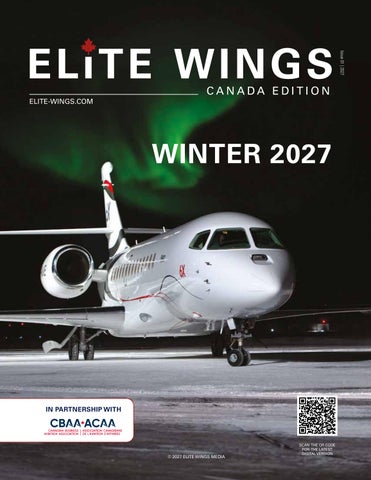
Cover Image: Cold soak trials of the Falcon 6X in Iqaluit, Canada. © Dassault Aviation V. Almansa
CONTACTS Editorial: editorial@elite-wings.com General Inquiries: info@elite-wings.com Advertising: ads@elite-wings.com
ELITE WINGS MAGAZINE (ISSN 2816-4040) IS PUBLISHED BY ELITE WINGS MEDIA INC, MONTREAL, CANADA. Any information of a technical nature contained in this document may contain inaccuracies and is subject to change and should never be relied upon for operational use.
IN PARTNERSHIP WITH
Copyright © 2027 All rights reserved. Reproduction in whole or in part without permission of Elite Wings Media is strictly prohibited.
WELCOME Welcome to the inaugural issue of the Elite Wings Canada Edition, a publication dedicated to showcasing the people, companies, innovations, and ideas shaping the future of business aviation across Canada. Canada is a nation connected not only by roads, railways, and digital networks, but also by aviation. Stretching across six time zones and encompassing some of the world’s most remote and challenging terrain, Canada relies on air connectivity in ways few countries do. In this environment, business aviation is far more than a convenience. It is a critical enabler of economic growth, regional connectivity, innovation, and resilience. From linking resources, manufacturing, technology, financial centres, and emerging economic hubs to serving Indigenous, northern, and remote communities, business aviation provides access where alternative transportation options are often limited or unavailable. Every day, aircraft connect people, businesses, and opportunities across vast distances, enabling organizations to operate efficiently, respond quickly, and compete in an increasingly global economy. The mission of the Elite Wings Canada Edition is to bring these stories to the forefront. Through thoughtful reporting, industry insight, and credible analysis, we aim to highlight the people, companies, technologies, and missions that demonstrate the value business aviation delivers to Canadians every day. We are especially proud to launch this publication in collaboration with the Canadian Business Aviation Association (CBAA), the national voice of business aviation in
Canada. Together, we are committed to providing operators, aircraft owners, and industry stakeholders with timely insights into the trends, innovations, opportunities, and challenges shaping the sector. This partnership reflects a shared commitment to delivering high-quality content that supports informed decision-making, promotes industry best practices, and showcases the organizations and individuals advancing Canadian business aviation. By combining CBAA’s industry leadership with Elite Wings’ editorial platform, we hope to foster a more connected, engaged, and informed aviation community across the country. This first edition arrives at an important moment. Canada is navigating a period of economic transformation, regional development, technological change, and increasing global competition. Through it all, business aviation continues to connect communities, enable commerce, support innovation, strengthen supply chains, and maintain Canada’s link to international markets. We hope this publication contributes to a broader understanding of an industry that quietly delivers extraordinary value every day. More importantly, we hope it celebrates the people and organizations whose expertise, dedication, and innovation keep Canada connected and moving forward. As we begin this new chapter alongside our readers, partners, and the CBAA, we invite you to join us in exploring the ideas, achievements, challenges, and opportunities shaping the future of business aviation in Canada. Welcome aboard.
© 2 0 2 7 E L IT E W I N G S M AGA Z I N E / 5
Elite Wings business aviation guides aggregate knowledge from industry leaders, shapers, and analysts to deliver relevant information about the current state of the market and its future direction in each segment of our industry. We identify the key points to consider when selecting solutions, what to ask, and who to ask. Our motivation is to enable readers to make informed decisions when selecting, acquiring, and managing their business aviation strategies and decisions.
CONTENTS INTERVIEWS
8 CHANGING THE CONVERSATION Harlan Simpkins President and CEO of the Canadian Business Aviation Association (CBAA)
34 SAFETY IN THE SKIES Bombardier
38 INSIDE NBAA-BACE 2026 Key Highlights and Announcements
14 NOW IS THE TIME Ben Boehm Chief Operating Officer of Chartright Air Group
ELITE WINGS QUICK GUIDES
20 THE BIG QUESTION TALL POPPY SYNDROME Ehsan Monfared Managing Partner at YYZ Law
24 FAST AIR: OPERATING A MIXED FLEET TO BEST SERVE CLIENTS IN WESTERN CANADA Dylan Fast Fast Air founder
28 STATE OF PRE-OWNED FINANCING Maxime Gaudreau Director of Underwriting & Portfolio Management with Echo Aviation Leasing Corporation.
66 74 76
Business Jets Connectivity Turboprops
Image courtesy of Fast Air © Fast Air
CHANGING THE CONVERSATION From Justifying Business Aviation to Showcasing Its True Impact By Abdelmajid Jlioui
2026 will be remembered as a pivotal year for Canadian business aviation. With significant policy progress in Ottawa and a renewed focus on demonstrating the industry’s economic value, the Canadian Business Aviation Association (CBAA) has strengthened its position as the sector’s leading advocate. Elite Wings spoke with CBAA President & CEO Harlan Simpkins about the industry’s recent successes, the challenges ahead, and why collaboration will be key to shaping the next chapter of business aviation in Canada.
8 / E L IT E W I N G S M AGA Z I N E © 2 0 2 7
CH A N G IN G TH E C ON VERSATION | C BA A
2026 has been a landmark year for Canadian business aviation. What do you consider CBAA’s most significant achievement, and why? I would point to our success in advancing the inclusion of business aircraft in the federal government’s Productivity Mega Deduction (100% depreciation) as our most recent significant achievement. It represents a meaningful shift in how business aviation is recognized in Canada’s economic and investment policy. This did not happen in isolation. It reflects sustained advocacy, engagement with government, and a joint effort to demonstrate that business aviation is a productive business asset, not simply a means of transportation. It also demonstrates what can be accomplished when our industry speaks with a unified voice. For me, the achievement goes beyond the tax measure itself. It establishes a stronger foundation for future discussions with government about the role business aviation plays in productivity, investment, employment, and Canada’s competitiveness.
That improves cash flow and reduces the after-tax cost of investing. It can help operators and owners evaluate fleet renewal, replacement aircraft, and expansion with greater confidence. It also strengthens the case for conducting business and making investments in Canada rather than allowing tax treatment to influence those decisions in favor of other jurisdictions. The benefits extend beyond the aircraft owner. Business aviation supports pilots, maintenance technicians, flight departments, manufacturers, service providers, airports, and communities across the country. Encouraging productive investment can support activity throughout that ecosystem. It is important to be clear that this is an investment incentive, not a government subsidy to purchase an aircraft. The deduction applies to qualifying business assets under defined tax rules, and eligibility and actual tax benefits depend on the circumstances of each taxpayer.
The CBAA represents approximately 400 member companies and organizations across a diverse industry. Our strength comes from bringing those interests together and translating them into a clear, credible message that decision makers can act on.
For the CBAA, the message is straightforward: when business aviation is treated consistently with other productive business assets, Canada becomes a more attractive place to invest, operate, and grow. We will continue working with government and our industry partners to support implementation and ensure members understand the measure.
The real milestone is demonstrating that collective advocacy can deliver tangible policy outcomes. That is the value of the CBAA, and it is something we intend to build on.
CBAA has worked hard to position business aviation as an economic enabler rather than a luxury. How do you believe perceptions of the industry are changing among government leaders and the broader public?
The inclusion of business aircraft in Canada’s Productivity Mega Deduction represents a major policy shift. What does this measure mean for operators, aircraft owners, and the overall competitiveness of Canadian business aviation? It is a significant step toward putting Canadian businesses on a more competitive footing when making major capital investment decisions.
I believe we are making progress with government, particularly when we frame business aviation in terms of productivity, investment, connectivity, and economic development. Our discussions with government are increasingly focused on practical outcomes: how businesses reach
Under the proposed Productivity Mega Deduction, eligible business aircraft acquired on or after September 15, 2026, can qualify for a 100% deduction in the year the aircraft is available for use, subject to the applicable rules. Rather than recovering the cost through capital cost allowance over several years, a qualifying business can deduct the full eligible cost in the first year. © 2 0 2 7 E L IT E W I N G S M AGA Z I N E / 9
C HAN G I N G T H E C O NV E RSAT ION | CBAA
customers, manage operations across a geographically large country, access remote communities, and remain competitive in international markets. For many organizations, it is an important tool that enables them to operate more effectively. The challenge is that public perceptions do not always reflect the scale of our industry. People tend to see the aircraft, but not necessarily the business activity, the people employed, the communities served, or the economic decisions that depend on that connectivity. We need to do a better job of telling those stories with evidence. That means credible economic analysis, real examples from Canadian businesses, and a consistent message about the legitimate business purposes these aircraft serve. We’re asking members to share their stories with us. These real-world examples will help us build a stronger, evidence-based case. It also means being transparent. We should not expect the public to accept our arguments simply because we make them. We need to demonstrate the value of the industry and acknowledge that aircraft use should be appropriate to the mission and the needs of the organization. Our objective is to ensure that Canadians understand why business aviation exists, the economic role it plays, and the value it delivers when used appropriately. Recent discussions surrounding the Ontario government’s acquisition of business aircraft have generated considerable public and media attention. What does this debate reveal about the industry’s ongoing
10 / E L IT E W I N G S M AGA Z I N E © 2 0 2 7
challenge in communicating the value of business aviation, and how can associations such as CBAA help bridge that understanding gap? The Ontario Government’s aircraft acquisition debate is a good example of how quickly the conversation can become focused on the price of an aircraft rather than the purpose it is intended to serve. The province’s proposed use of a Challenger 650 for executive travel generated significant public criticism, and the government subsequently announced that it would sell the aircraft. It illustrates the challenge our industry faces: people see the aircraft and its cost, but they may not understand the operational requirements, the purpose of the travel, or the alternatives available. Where we have an opportunity as an association is to help establish that context. We can explain the operational realities, provide evidence of the economic benefits, and demonstrate how business aircraft support time-sensitive travel, access to multiple locations, connectivity to underserved communities, and the effective use of executive time. We also need to be proactive. If the industry only responds when controversies arise, we will always be on the defensive. We should be communicating the value of business aviation long before an issue reaches the headlines. For the CBAA, that means equipping our members with credible information, developing consistent messaging, and helping government and the public understand the distinction between the perception of luxury and the practical application of an aircraft as a business tool.
CH A N G IN G TH E C ON VERSATION | C BA A
What are the biggest opportunities and challenges facing Canadian business aviation over the next five years, and where should the industry focus its energy? I see several significant opportunities, but we need to approach them collectively if we want to realize their full potential. First, there is an opportunity to build on the momentum from our recent advocacy successes. The Productivity Mega Deduction gives us a stronger foundation for encouraging investment in Canadian business aviation. We should continue working with government to ensure that the policy delivers its intended benefits and that the industry’s contribution to the economy is clearly understood. Second, we need to address the infrastructure and regulatory environment in which our members operate. Airport capacity, access to major airports, aviation charges and fees, regulatory efficiency, and the potential effects of airport privatization are all important issues. We need to ensure that business aviation remains a viable and valued part of Canada’s transportation system as those decisions are made.
Third, there is an opportunity to strengthen our industry’s economic evidence. We will be undertaking a refreshed, credible economic impact study that demonstrates the contribution of business aviation to Canadian businesses, employment, investment, and regional economies. That evidence will become a core tool in our discussions with government, airports, and the public. Environmental performance is another priority. The industry is already pursuing initiatives involving more efficient operations, sustainable aviation fuel, and other solutions. We need to bring those efforts together, communicate progress transparently, and help shape practical policy rather than simply react to new requirements. Of course, there are challenges. We face persistent public misconceptions, infrastructure pressure, regulatory complexity, workforce requirements, and uncertainty in the broader economic environment. There is also a risk that individual companies will pursue similar objectives independently, reducing our collective influence. That is why I believe the industry needs to focus on three things. Unified advocacy: Aligning our priorities and resources so that government and regulators hear a consistent, evidence-based industry position. Credible
© 2 0 2 7 E L IT E W I N G S M AGA Z I N E / 11
C HAN G I N G T H E C O NV E RSAT ION
evidence: Investing in economic research and environmental messaging that can withstand scrutiny. Stronger collaboration: Bringing operators, manufacturers, airports, service providers, and industry associations together around shared objectives. We have a relatively small industry compared with many of the sectors we compete with for government attention. But we have an important economic contribution and a strong network of expertise. The more effectively we work together, the better positioned we will be to shape the operating environment for the next five years and beyond. As you look ahead to 2027 and beyond, what is your vision for the future of business aviation in Canada, and what role do you see CBAA playing in achieving it?
with government, stakeholders.
regulators,
airports,
and
other
That is the role I see for the CBAA. We need to continue being the voice of business aviation in Canada, but we must also be a catalyst for collaboration. We should identify emerging issues early, develop credible positions, coordinate advocacy, and give our members a meaningful role in shaping the industry’s future. We also need to demonstrate value to our members continuously. Advocacy is a central part of that value, but so are education, safety initiatives, industry connections, and opportunities to share expertise. Our members should see the CBAA as an organization that represents their interests while helping the entire industry move forward.
My vision is for business aviation to be recognized as an essential part of Canada’s economic infrastructure: an industry that enables productivity, connects businesses and communities, supports highly skilled employment, and helps Canadian companies compete globally.
The progress we have made in 2026 demonstrates what is possible when we work together. The next step is to build on that momentum: strengthen our evidence, broaden our relationships, and become even more effective in influencing the decisions that affect our industry.
I want to see an environment where operators have fair and practical access to airport infrastructure, where regulation supports safety while enabling efficient operations, and where the industry’s economic and environmental contributions are understood.
My ambition is for the CBAA to be recognized not simply as an association that represents business aviation, but as an organization that helps shape its future in Canada.
Achieving that vision requires more than individual companies advocating for their own interests. It requires an association that can bring the industry together, identify common priorities, and build productive relationships
12 / E L IT E W I N G S M AGA Z I N E © 2 0 2 7
If we can achieve that, we will leave the industry in a stronger position for the next generation of operators, employees, and businesses that depend on business aviation.
© 2 0 2 7 E L IT E W I N G S M AGA Z I N E / 13
NOW IS THE TIME Why Business Aviation Has Never Been More Important to Canadian Business Growth By Jane Stanbury
As Canada looks to strengthen productivity, investment, and economic competitiveness, the federal government’s new Productivity Mega Deduction has placed business aviation firmly into the national conversation. By allowing eligible businesses to fully deduct qualifying capital investments in the year they are placed into service, the initiative aims to encourage companies to invest in assets that improve performance and drive growth. For Canada’s entrepreneurs and business leaders, however, the discussion extends far beyond tax policy. In a country where distances are vast, opportunities are dispersed, and growth increasingly depends on speed and agility, business aviation has become an important strategic tool. It enables organizations to connect people, markets, projects, and opportunities more efficiently, helping leaders maximize one of their most valuable resources: time. 14 / E L IT E W I N G S M AGA Z I N E © 2 0 2 7
N OW IS TH E TIME | C H A RTR IG HT A IR G ROU P
For entrepreneurs and growing businesses, time is often the most constrained resource. Every hour spent navigating travel schedules, airport connections, or overnight stays is time that cannot be spent developing business, serving clients, managing operations, or pursuing new opportunities. The ability to reclaim that time can have a profound impact on the effectiveness of an organization. The Productivity Mega Deduction recognizes that reality. It encourages businesses to invest in assets that can improve efficiency and competitiveness, while also helping Canada create an environment that supports growth and innovation.
In this exclusive interview with Elite Wings, Ben Boehm, Chief Operating Officer of Chartright Air Group, discusses why the new incentive arrives at a pivotal moment for Canadian businesses and how business aviation is helping organizations improve productivity, enhance competitiveness, and unlock new growth opportunities.
The Productivity Mega Deduction has generated significant attention across Canada’s business community. What does this measure mean for entrepreneurs and SMEs, and why is it important for business aviation? What’s particularly significant about this initiative is that the conversation centers on productivity. The government isn’t simply providing another tax incentive. It’s recognizing that investments that help businesses operate more efficiently ultimately contribute to economic growth. Business aviation fits naturally within that framework because an aircraft is fundamentally a productivity tool. It allows companies to move decision makers, technical teams, and specialists where they need to be, when they need to be there. It creates access to customers, facilities, projects, and opportunities that may otherwise be difficult to reach through traditional transportation options.
Business aircraft are often perceived as luxury assets. Why do you believe that perception no longer reflects today’s reality? The reality is that most business aircraft are being used as working tools by successful businesses, not as luxury items. When entrepreneurs invest in business aviation, they’re investing in access, efficiency, flexibility, and productivity. They’re looking for ways to visit multiple locations in a single day, conduct important meetings face-to-face, oversee operations more effectively, and react quickly when opportunities arise. Canada’s geography makes this particularly relevant. We have businesses operating in remote regions, companies managing facilities across multiple provinces, and organizations pursuing customers and projects throughout North America. Commercial airline schedules simply don’t align with every business need. Business aviation enables leaders to create their own schedules around business priorities rather than building business activities around airline schedules. The most successful organizations are constantly looking for ways to become more efficient. Business aviation is one of many strategic tools that can help achieve that objective. How does business aviation help Canadian businesses grow and remain competitive in an increasingly dynamic economy? We often talk about growth in terms of strategy, technology, or investment, but mobility is an equally important component. © 2 0 2 7 E L IT E W I N G S M AGA Z I N E / 15
NOW I S T H E T I M E | CHART RIGHT AIR GROUP
Growth requires people to be present. It requires executives to meet customers, visit facilities, evaluate opportunities, assess acquisitions, and engage directly with stakeholders. While virtual communication has become an important part of business, many of the most important decisions still happen face to face. Business aviation gives companies the ability to respond more quickly and pursue opportunities that might otherwise be impractical. A leadership team can visit multiple locations in a single day. An entrepreneur can explore a potential acquisition on short notice. Technical specialists can be deployed rapidly to address operational challenges at remote sites. We have seen numerous situations where the ability to move quickly created a meaningful competitive advantage. Sometimes the difference between winning and losing a business opportunity comes down to speed and responsiveness. In many ways, business aviation allows companies to think bigger geographically. It expands their reach, shortens distances, and increases the number of opportunities they can realistically pursue. Beyond the financial calculations, how should business owners evaluate the return on investment of business aviation? Too many people focus only on the cost side of the equation.
16 / E L IT E W I N G S M AGA Z I N E © 2 0 2 7
The more important question is what opportunities become available because of the aircraft. How many additional customer meetings can be conducted? How much more effectively can leadership oversee multiple operations? How much faster can critical decisions be made? What opportunities become accessible that otherwise would have been missed? The return often comes through increased productivity, improved responsiveness, stronger customer relationships, better utilization of executive time, and enhanced operational efficiency. Those benefits are not always easy to quantify on a spreadsheet, but they’re very real. We regularly hear from aircraft owners that their greatest realization wasn’t how much time they saved, but how much more they were able to accomplish with that time. That’s where the true value often emerges. As Canadian businesses look ahead, what role do you believe business aviation will play in supporting productivity and economic growth? I believe business aviation will continue to become increasingly recognized as an important economic enabler. The Productivity Mega Deduction helps reinforce an idea that many entrepreneurs already understand: investing in productivity creates growth. When businesses become more productive, they become more competitive. When
N OW IS TH E TIME | C H A RTR IG HT A IR G ROU P
they become more competitive, they create opportunities, jobs, and economic activity. Business aviation enables companies to overcome geographic barriers, strengthen relationships, explore new markets, and make better use of their most valuable resource, which is time. For Canadian entrepreneurs, the question is not whether mobility matters. The question is how effectively they can leverage it to support their growth ambitions. Those who continue to find ways to improve productivity, access opportunities more quickly, and maintain closer connections with customers and stakeholders will be the organizations best positioned to succeed in the years ahead. Chartright has evolved into one of Canada’s most comprehensive private aviation providers. How does your integrated service offering help clients maximize the value of business aviation? Business aviation is not a one-size-fits-all solution. Every client has unique travel requirements, operational priorities, and growth objectives.
What makes Chartright unique is our ability to provide a complete ecosystem of aviation solutions, including charter, JetClub memberships, aircraft management, maintenance, sales and acquisitions, and ownership support. This allows us to guide clients toward the solution that best aligns with their needs today while providing the flexibility to evolve as their business grows. Ultimately, our role extends beyond transportation. We help organizations unlock the productivity, flexibility, and competitive advantages that business aviation can deliver, while ensuring they have access to the expertise and support required to maximize that investment. Chartright recently introduced its Charter Optimization Program. How does this program help aircraft owners maximize value while maintaining the benefits of ownership? One of the questions we hear most often from prospective owners is how to balance the flexibility of ownership with the ongoing costs of operating an aircraft. That’s exactly why we developed Chartright’s Charter Optimization Program. It is designed to provide owners with greater cost predictability by offering charter reve-
© 2 0 2 7 E L IT E W I N G S M AGA Z I N E / 17
NOW I S T H E T I M E | CHART RIGHT AIR GROUP
nue credits in advance, helping reduce their forecast aircraft operating costs throughout the year. What makes the program unique is that it combines the freedom, convenience, and control of private aircraft ownership with a more predictable operating budget. Owners continue to enjoy priority access to their aircraft while benefiting from the strength of Chartright’s charter platform and four decades of market experience. Backed by more than 40 years of charter sales expertise, the Charter Optimization Program gives owners greater financial visibility and confidence, while helping maximize aircraft utilization when the aircraft is not required for their own travel needs. For many businesses, it’s an innovative way to enhance the economics of ownership without compromising the flexibility and productivity benefits that make business aviation such a valuable tool in the first place.
18 / E L IT E W I N G S M AGA Z I N E © 2 0 2 7
The discussion surrounding Canada’s Productivity Mega Deduction has highlighted an important shift in how business aviation is viewed within the broader economy. Increasingly, aircraft are being recognized not as symbols of success, but as tools that enable it. For entrepreneurs navigating a vast country, pursuing new markets, and competing in an increasingly fast-moving global environment, productivity has become a strategic imperative. Business aviation offers a unique ability to compress time, expand reach, and accelerate decision-making, allowing organizations to focus less on travel logistics and more on growth. As Ben Boehm suggests, the true value of business aviation is not measured in miles flown, but in opportunities captured, relationships strengthened, and time transformed into competitive advantage. For growth-oriented Canadian businesses, business aviation is increasingly becoming a strategic advantage that transforms time into opportunity and mobility into measurable business results.
THE BIG QUESTION Ehsan Monfared, Managing Partner at YYZ Law, on why Canada taxed its business aircraft as luxuries, what that cost, and what the Productivity Mega Deduction says about a change of mind.
Tall Poppy Syndrome and Changing Times By Ehsan Monfared
The concept of "tall poppies" originated in Roman history, in Livy’s account of Tarquin the Proud, who answered a question about a conquered city by striking the heads off the tallest poppies in his garden. The idea being that the poppies standing out above the field are always the first to be cut down. While the term was popularised in Australia and New Zealand in the 1980s as "Tall Poppy Syndrome", it has been applied to Canada’s national character, underscoring a national preference for the understated over the conspicuous, and a quiet discomfort with anyone standing too far out of the row. In my experience, affluent Canadians prefer to drive unremarkable cars and live in unremarkable houses. Our national figures are celebrated as much for their modesty as for what they achieved. This cultural approach has stood in stark contrast to that of our closest neighbor, and Canadians have therefore tended to treat it as a virtue. This culture has been changing over the years, and in my assessment, the change has now accelerated. Canadians are no longer comfortable with simply getting by and have chosen to forge their own path in an increasingly unstable world. 2 0 / E L IT E W I N G S M AGA Z I N E © 2 0 2 7
TH E B IG QU ESTION
What the instinct cost In September 2022, the Select Luxury Items Tax took effect, placing aircraft that did not meet its 90% business-use exemption in the same statutory category as yachts and sports cars. It rested on a premise — that such an aircraft is a form of consumption — and the premise was wrong. How wrong is itself disputed. Finance Canada’s own March 2023 study put the damage at CAD $14 to $29 million in lost aircraft sales a year, 0.24% to 0.51% of the market, and 10 to 20 direct jobs (20-45 economy-wide). The Parliamentary Budget Officer, costing the same measure, projected a 24% fall in sales over five years. Two arms of one government, two orders of magnitude apart. The tax also arrived at a market that was already contracting. The Canadian business aircraft fleet had fallen from approximately 1,900 aircraft in 2017 to approximately 1,500 in 2022, a loss of roughly 400 airframes, or 21%, almost all of it before the tax took effect. So, a sector that had already lost a fifth of its fleet was then taxed as though it were a symptom of excess. Canadian policy makers were advancing the tall poppy syndrome, not realising that what we were really hurting was Canada’s own productivity, efficiency, and affordability in the process. What left with these aircraft was not opulence. Business aviation in Canada supports 53,600 jobs (25,600 of them
direct) and CAD $17.9 billion in economic output, including indirect and induced effects, at average direct wages of CAD $108,100 in operations and CAD $122,500 in manufacturing, against a national average of CAD $60,600. The direct jobs are machinists, engineers, dispatchers and pilots. The category error was not a small one. What the aircraft are actually for Canada is the second-largest country on Earth, carrying roughly the population of California, and the places where Canadians do the work that pays for everything else — the mine sites, the mills, the project camps, the remote and Indigenous communities — are mostly not where scheduled airline service goes. There are more than 1,800 aerodromes here, and airlines serve a small fraction of them. In northern Canada, 182 remote communities depend on air access, and of the northern airports carrying regular service, only nine have any jet service at all. That gap is what business aviation fills. If the ambitions are to build across this country, move Canadian products into global markets quickly, and connect the people who build things with the far-flung places where the building happens, there is no practical alternative. Business aviation is not a luxury; it’s the transport layer that makes the rest of it work. Speaking at the Elite Wings Aviation Summit in Montréal this June, Paul Jebely, Partner and Vice Chair International of legal firm Sterlington, described business aviation
© 2 0 2 7 E L IT E W I N G S M AGA Z I N E / 2 1
THE B I G Q U E ST I O N
as offering "sovereignty over time and space". It is the best short definition of the asset I have heard. What the owner buys is not comfort, but control over the two variables every other form of transport takes away. Changing times Two federal decisions in eleven months have reversed the position. The luxury tax on aircraft ended on 5 November 2025 (announced in Budget 2025 on 4 November and legislated on 26 March 2026). Then, on 15 September 2026, the Canadian government announced the Productivity Mega Deduction, which would let a business write off most capital property in full in the year the asset is ready to use. That includes aircraft, new or pre-owned (subject to the used-property restrictions below), bought on or after that date, and Class 9 is not on the exclusion list. Today an aircraft (Class 9) is written off at 25% a year on a declining balance, each year’s deduction coming off what is left rather than the original price, with the reinstated Accelerated Investment Incentive (enacted in Bill C-15 on 26 March 2026) tripling the half-year-rule firstyear claim, to 37.5% of cost, for aircraft available for use before 2030. On a USD $20 million aircraft that is roughly
2 2 / E L IT E W I N G S M AGA Z I N E © 2 0 2 7
USD $7.5 million in year one (Capital Cost Allowance is computed in Canadian dollars). Immediate expensing takes all of it in year one instead. The deduction is the same size, but the buyer gets the remaining 62.5% now rather than across the next decade, and on an asset this size that timing is most of the economics. Finance Canada measures the effect with the marginal effective tax rate, the real tax burden on a new business investment. It puts Canada at 13.0% today and 6.4% under the new rule, against 16.9% in the United States and an Organisation for Economic Cooperation and Development (OECD) average (excluding Canada) of 19.0% — and the American figure already allows for full expensing. These are economy-wide figures. For transportation and storage, Finance Canada’s own sector figure falls from 13.3% to −2.3%, against 8.6% in the United States. Taken together, these are not two tax measures. They are a reclassification. Ottawa has moved the business aircraft out of the luxury column and into the productive capital column, which is where it always belonged. What the American experience predicts The United States has already run this experiment, with 100% bonus depreciation for aircraft from 27 September
TH E B IG QU ESTION
2017, extended for the first time to used aircraft (it was phased down to 80% in 2023 and 60% in 2024 before being restored in 2025). Its effect is easy to misread. The active US turbojet fleet grew 2.59% a year to 2024, no faster than in the seven years before — but a fleet cannot grow faster than factories build, and output was held down by pandemic supply-chain disruption and certification backlogs. Every measure that could move, did. Worldwide business aircraft billings rose from USD $20.6 billion in 2017 to USD $31.0 billion in 2025, up about 50% in nominal terms; business jet deliveries rose from 677 to 854, up about 26%. US business jet departures rose 28.9% between 2019 and 2025, and US charter and fractional departures by 45.2%. For-sale inventory fell to around 6.5% of the global fleet (JETNET, mid-2025) against a pre-COVID norm of 10% to 11%. That is a demand incentive meeting constrained supply: more transactions, moving faster, at higher values, against thinner inventory.
What buyers should know 15 September 2026 is the acquisition-date threshold, and the aircraft must also become available for use before anything can be claimed. Those are separate tests and they fail independently — closings near a year-end, aircraft in completion, and acquisitions among related entities all need looking at before signing. Used aircraft qualify only if neither the buyer nor a non-arm’s-length person previously owned them and the aircraft was not transferred on a tax-deferred rollover basis. Individuals, and partnerships with individual members, also face limits on creating or increasing a loss. Recapture has not gone anywhere either: a larger deduction now means larger exposure on disposition. The measure is announced, not enacted. Until legislation passes, the Accelerated Investment Incentive remains the operative law, so a buyer closing today gets the enhanced first-year claim (37.5% for Class 9), not 25%. The acquisition date is the thing to protect — the only one of these tests a purchaser cannot fix later.
What to expect We expect the Canadian business aviation market to grow at between 6% and 10% a year over the next five years — enough to take the fleet from roughly 1,500 aircraft back past its 2017 level of 1,900, and at the top of that range to about 2,400. Canada has two channels open where the United States had one. The first, the American market demonstrates: a purchase incentive lifts transaction volume, velocity, and value wherever it applies. The second the Americans never had. Their fleet is large, and their supply was capped; ours is small and refilling a hole. Ten percent a year on a base of 1,500 aircraft is roughly 150 airframes, drawn not from a constrained order book but from a secondary market of more than 17,500 registered US turbojets. Recovery rates also exceed steady-state rates. A market that has lost a fifth of its fleet has a backlog of deferred replacement to clear, and clearing a backlog is faster than growing from a high base. In our own practice we are already seeing it. Inquiries and closings are both running ahead of last year. There is no published Canadian transaction data since the luxury tax came off, so we offer that as an observation rather than a statistic.
The change worth making That sovereignty is what allows a business owner or a job creator to move at a pace the rest of the economy cannot match. It is also, precisely, the thing a tax system chooses either to enable or to penalize. Ours penalized it for three years, but that has now changed. Policy has to enable speed of execution, because the world does not stop turning while we deliberate. If Canada means to be the change it wants to see in the world, it will have to be that from a place of power and influence — not with its head down, and not by drinking from paper straws. The "tall poppies", it turns out, were showing the field the heights they could aspire to; not holding the field itself down.
© 2 0 2 7 E L IT E W I N G S M AGA Z I N E / 2 3
FAST AIR Operating a Mixed Fleet to Best Serve Clients in Western Canada by Mark Lowe
2 4 / E L IT E W I N G S M AGA Z I N E © 2 0 2 7
OPERATIN G A MIXED FL EET | FAST A IR
Please tell our readers about a typical Fast Air client and a typical mission… We work with everyone from individuals and families to corporations, sports teams and other businesses that rely on aviation to keep their people moving. What connects our clients is that they’re looking for a more efficient way to travel. A typical mission might be businesspeople travelling to a community that would otherwise require multiple connections, or a group needing to make several site visits in a single day. We also serve luxury/leisure clients travelling for personal reasons, where privacy and flexibility are paramount. For many of our clients, private aviation isn’t simply about luxury. It’s about getting people where they need to be, when they need to be there. How does extreme weather in western Canada impact Fast Air’s operations? Weather is simply part of our operations. In Manitoba, winter temperatures can fall below -30°C, while summer brings thunderstorms, wildfire smoke and rapidly changing conditions. Farther north, the environment can be even more challenging. These conditions affect everything from flight planning and aircraft performance to de-icing, runway conditions, fuel planning and ground handling. Extreme weather isn’t unusual for us. Our crews and teams have decades of experience operating in this environment, including into northern and remote airports where infrastructure may be limited. How does Fast Air distinguish itself from its competitors? I think we’ve developed the capabilities of a larger aviation company while maintaining the relationships and accessibility that have always been important to us. Over the past 30 years, we’ve grown to provide comprehensive aviation services including charter, aircraft management, FBO, maintenance and medevac. That breadth allows us to look at a client’s total needs, rather than simply selling them a charter flight. Many of our clients have been flying with us for years. They know the people answering the phone, coordinating their flights and flying the aircraft. There is a sense of familiarity, accountability and trust in those relationships. Ultimately, we combine strong aviation capabilities with a personal approach, managing the complexities behind the scenes so the client experience feels simple and reliable.
Fast Air provides charter, aircraft management, FBO, maintenance and medevac services from its bases in western Canada. The company’s headquarters in Winnipeg, Manitoba (CYWG), is strategically positioned to serve this immense territory, including northern communities. The company’s Abbotsford (CYXX) location provides convenient access to greater Vancouver, British Columbia. Today, the company operates a fleet of 17 aircraft. Nine aircraft are owned by Fast Air and eight are managed on behalf of private owners. The fleet comprises nine Beechcraft King Air B200s, two King Air 350s, two Gulfstream G150s, a Gulfstream G280, a Bombardier Challenger 350, a Cessna Citation X and a Citation CJ3. Company founder Dylan Fast became a commercial pilot in 1981 and soon specialized in flying missions in northern Manitoba. In 1995, Fast Air was founded and operations began with the management of a single Piper Cheyenne. In the late 1990s, the company acquired its first King Air. By the early 2000s, Fast Air began managing jets and medevac services were later added. In 2015, the company expanded its Winnipeg operations through the acquisition of the Esso Avitat FBO. Further expansion to Abbotsford, BC, followed in 2023. Mark Lowe sat down with Dylan to discuss his perspective on 30+ years of successful operations, the benefits of operating a mixed fleet and his "Better, not bigger" philosophy.
© 2 0 2 7 E L IT E W I N G S M AGA Z I N E / 2 5
O PER AT I N G A M I X E D F L E ET | FAST AIR
In Fast Air’s 30-year history, how have client expectations evolved? Clients have always expected safety, reliability and good service. What has changed is the speed, flexibility and information expected. Thirty years ago, charters were scheduled over the phone and much of the process was done by hand. Today, clients expect to make inquiries, receive information and communicate with us very quickly. At the same time, the human element has become even more important. Aviation is complex, particularly when operating into remote communities or navigating changing weather and schedules. Technology provides convenience, but when something changes, clients want an experienced person to solve the problem. So, while technology has transformed the experience, our business remains relationship driven. Where does Fast Air recruit its pilots and how do you manage retention? The pilot shortage has been a significant issue across the industry. We recruit pilots from across the country and our 30 years in business have helped us build a strong reputation within the aviation community. While recruitment is important, retention is equally important. One advantage we offer is variety. Our operations include charter, aircraft management and medevac flying across a diverse fleet, with missions ranging from major cities to remote northern communities. This gives pilots a breadth of expe2 6 / E L IT E W I N G S M AGA Z I N E © 2 0 2 7
rience that can be difficult to find elsewhere. Culture and quality of life also matter. Pilots want to develop professionally, feel valued and build a career. As a family-owned Canadian company, we’ve worked to maintain that sense of connection as we’ve grown. Ultimately, our people and their experience are what make Fast Air successful. You operate a mixed, majority turboprop, fleet. How does that best serve your clients’ needs? Our fleet reflects our geography and the types of missions we fly. Turboprops are incredibly practical, particularly in Canada. They give us access to smaller airports and communities, perform very well on shorter runways and can be an efficient option where a jet simply isn’t necessary. That’s particularly important when serving northern and remote communities or businesses operating outside major cities. At the same time, having a mixed fleet gives us flexibility. Not every mission calls for the same aircraft. Jets provide greater speed, range and comfort for longer-distance missions, allowing clients to travel efficiently between major centers, reduce total travel time and reach more distant destinations non-stop. Depending on the distance, number of passengers, runway, baggage requirements and schedule, we can look at the mission and recommend the aircraft that makes the most sense. That versatility is important because our goal is to put our clients on the right aircraft every flight.
OPERATIN G A MIXED FL EET | FAST A IR
Do you ever encounter clients who assume they will require a jet but are persuaded that a turboprop is really a better solution? There can be a perception, particularly among clients less familiar with western or northern Canada, that private aviation automatically means flying by jet. But depending on the mission, a turboprop can be the more practical aircraft. Once we understand client needs – destination, passenger count and baggage requirements, a turboprop can quickly become the obvious choice. Many communities and work sites are served by smaller, remote airports. An aircraft like a King Air can operate from shorter runways, access airports that may not be suitable for some jets and still carry passengers and baggage efficiently over significant distances. Ultimately, we’re not trying to put clients on the most expensive aircraft; we’re trying to put them on the right aircraft for their mission. You have expressed a ‘better, not bigger’ vision for your company. How does that apply to day-to-day operations? And has it been difficult to manage growth without sacrificing your values of customer service and relationship-building? The ‘better, not bigger’ approach is about being intentional with growth. We’re certainly interested in growing, but size by itself isn’t the measure of success. Day to day, that means asking whether the decisions we’re making actually improve the experience for our clients, our aircraft owners and our employees. Growth does make maintai-
ning that personal connection more challenging. When you’re smaller, a lot can happen naturally through individual relationships and conversations. As you grow, you need more structure and better systems—but you have to introduce those things without losing the human side of the business. That balance is something we think about a lot. The goal is to use better processes and technologies to support relationships, not replace them. Fast Air recently celebrated its 30th anniversary. Thinking back and looking forward, what is your vision for the years ahead? Thirty years has given us a really strong foundation. Fast Air has evolved considerably over that time, but many of the things that built the company—relationships, service, operational expertise and a willingness to adapt—are still very much at the center of who we are. Looking ahead, I think the opportunity is to continue modernizing and strengthening the business while protecting those qualities. We’ve expanded our presence geographically and broadened the services we provide, and we see opportunities to continue developing our charter, aircraft management and FBO services. But we want that growth to be thoughtful. Ultimately, the vision isn’t simply to have more aircraft or more locations. It’s to build a stronger aviation company— one that clients and aircraft owners trust, that great people want to work for, and that is well positioned to serve Canadian aviation for the next 30 years.
© 2 0 2 7 E L IT E W I N G S M AGA Z I N E / 2 7
MEBAA Show 2024 © MEBAA
STATE OF PRE-OWNED FINANCING W I T H E C H O AV I AT I O N L E A S I N G By Abdelmajid Jlioui As business aviation continues to mature as an asset class, the pre-owned aircraft market has become increasingly sophisticated, attracting a growing mix of lenders, lessors and private capital providers. Yet financing a business jet is about far more than evaluating a borrower’s balance sheet. Aircraft values, maintenance exposure, market liquidity and long-term asset relevance all play a critical role in determining how transactions are structured and funded. In today’s market, where inventory dynamics, shifting interest rates and evolving capital sources continue to reshape the landscape, specialized expertise has never been more important. Celebrating its tenth anniversary, Echo Aviation Leasing has navigated every stage of this evolution, from periods of abundant liquidity to more selective lending environments. Headquartered in Montreal, one of the world’s leading aerospace hubs, the company combines aviation finance with aircraft acquisition, sales and advisory services, offering clients a comprehensive perspective on ownership and financing decisions. In this interview, Maxime Gaudreau discusses the state of pre-owned aircraft financing, the factors that drive residual value, evolving funding structures, and why understanding the aircraft itself is often just as important as understanding the borrower. 2 8 / E L IT E W I N G S M AGA Z I N E © 2 0 2 7
Maxime Gaudreau Director of Underwriting & Portfolio Management with Echo Aviation Leasing Corporation.
STATE OF PRE-OWN ED FIN AN C IN G | ECHO AVIATION LEASIN G
Echo Aviation Leasing is celebrating a decade in business. How has Echo Aviation Leasing navigated the changing landscape of aircraft financing over the past decade? Over the past decade, and more, we’ve seen aircraft finance move through very different cycles, from abundant bank liquidity and relatively predictable values, through COVID-era disruption, unprecedented demand and inventory constraints, and more recently, an overall more selective credit environment. Echo’s ability to navigate those cycles has come from remaining independent and adaptable. Turbulence doesn’t scare us, and instead, creates opportunities. We are not tied to a single funding model, credit box or aircraft category. That allows us to structure transactions around the aircraft, the borrower and the underlying use case rather than trying to fit every transaction into the same box. Aircraft are highly specialized assets, and each transaction requires an equally specialized approach We’ve also deliberately built Echo beyond financing, in order to provide our customers with a one-stop-shop for their aviation needs. Our involvement in acquisitions, sales and portfolio management gives us a broader view of the asset throughout its lifecycle. After ten years, one lesson stands out: aviation finance is ultimately a combination of credit underwriting and asset expertise. Understanding the aircraft, its market and its future liquidity can be just as important as understanding your client’s balance sheet, and how they will repay your loan. Does Montreal's position as a global business aviation capital provide a competitive edge for aircraft lessors and financiers? Absolutely. Montreal, and Quebec more broadly, has more than a century of aviation history and one of the deepest aerospace ecosystems anywhere in the world. The region has played an important role in the development of aviation for generations, and today that legacy is represented by global leaders such as Bombardier, Pratt & Whitney Canada, CAE and Bell, and so many more, alongside a remarkably deep network of manufacturers, MROs, engineering firms, operators and specialized suppliers.
technical expertise to maintenance, training, operations and, increasingly, specialized aviation finance. That creates a level of connectivity and institutional knowledge that is difficult to replicate elsewhere. For Echo, being headquartered in the heart of Montreal means we are not simply financing aircraft from a distance. We operate within an ecosystem that understands them. There is also a broader geographic advantage. Montreal sits naturally between major North American and European aviation markets, while giving us immediate access to both the Canadian and U.S. business aviation communities. For a firm whose transactions frequently cross borders, that positioning has helped Echo develop relationships well beyond Quebec while remaining anchored in one of the world's most established aerospace hubs. Ultimately, I think Montreal gives firms like Echo an advantage that goes beyond geography. Aviation is part of the industrial DNA of this city. That history, combined with the concentration of talent and companies around us, creates an environment where aviation expertise, relationships and capital naturally intersect. What are the key differences between financing a preowned business jet and financing a factory-new jet? With a new aircraft, the asset is generally easier to define and approve the known specification, new warranties, predictable maintenance status and typically strong manufacturer support. Financing can also begin well before delivery through PDP financing, which introduces its own considerations around deposits, delivery risk and purchase agreements. A pre-owned aircraft requires significantly more asset-level underwriting. Two aircraft of the same model year can re-
The geographical concentration of that expertise is a significant advantage. Within a relatively small radius, we have access to virtually every discipline that touches the lifecycle of an aircraft, from manufacturing, engines and © 2 0 2 7 E L IT E W I N G S M AGA Z I N E / 2 9
STATE O F P R E - OW N E D F INANCING | E CHO AV IAT ION L E ASIN G
MEBAA Show 2024 © MEBAA
present very different credit propositions depending on total time, maintenance history, engine programs, upcoming inspections, damage history, configuration, ownership history and overall marketability. That makes due diligence particularly important. We are not simply asking, “What is this aircraft worth today?” We are asking what capital expenditures are approaching, how liquid the aircraft will be several years from now and what the lender’s exit looks like under a downside scenario. That complexity is also where specialized aviation financiers can add considerable value. Understanding the metal allows you to structure around risks that a conventional lender may simply decline, ultimately better serving all parties around the table. What are the primary sources of funding available for pre-owned aircraft transactions today, and how are they evolving in response to changing market conditions? The financing landscape has evolved considerably. Traditional banks remain an important source of capital, particularly for strong credits acquiring newer aircraft, but today they are only one part of the market. Specialized aviation lenders, leasing companies, private credit funds, family offices and other alternative capital providers have all become increasingly active. At the same time, we have seen meaningful consolidation within the North American aviation finance market. M&A activity has combined a number of established lending 3 0 / E L IT E W I N G S M AGA Z I N E © 2 0 2 7
platforms, while other institutions have reduced their exposure or exited the sector altogether. Interestingly, many of those decisions have had less to do with the performance of their aviation portfolios and more to do with broader corporate strategy, bank consolidation, balance-sheet allocation or changes in ownership. The result is that some very experienced aviation lenders and longstanding sources of capital have disappeared or changed considerably over the past decade. That evolution has created both a challenge and an opportunity. While there may be fewer traditional aviation lenders in certain segments of the market, new sources of private and institutional capital have emerged to fill that space. It has also reinforced the importance of having access to multiple funding channels rather than relying on a single source of capital. Every aircraft and every borrower presents a different credit profile, and there is no universal financing solution. A transaction involving a five-year-old large-cabin aircraft owned by a public company should not necessarily be financed the same way as a 20-year-old aircraft being acquired by a private entrepreneur. Each aircraft is a unique asset and requires a tailored approach. For Echo, our role is increasingly about providing the right transaction with the right structure. In today's market, the value is not simply having access to capital; it is understanding where that capital is available, how different sources view the asset and credit, and which structure is best suited to the transaction.
STATE OF PRE-OWN ED FIN AN C IN G | ECHO AVIATION LEASIN G
How does the funding structure of a pre-owned aircraft transaction change as an aircraft ages, and what factors influence lender appetite at different stages of an aircraft's lifecycle?
also extremely important. Airframe, engine and APU program enrollment, complete records and a well-managed inspection history can materially influence both value and marketability.
Age certainly matters, but it is only one part of the equation. As an aircraft gets older, lenders generally become more conservative on leverage and amortization because the financing term begins to extend further into the aircraft's economic life. At that point, maintenance condition, engine status, program enrollment, records, upcoming inspections and secondary-market liquidity become increasingly important.
We also pay close attention to where an aircraft sits within its product lifecycle. Is the model still in production? Is there a newer aircraft replacing it? How large is the worldwide fleet? How many aircraft are currently for sale? How quickly are they trading? Are buyers concentrated in one geography or is there a truly global market? And ultimately, why are customers buying this aircraft model?
We often say that aircraft age and aircraft quality are not necessarily the same thing. A 20-year-old aircraft with excellent records, engines enrolled on a recognized program, recent major inspections and a large global installed base can represent a very financeable asset. Conversely, a much younger aircraft with limited market acceptance, poor records or significant upcoming maintenance can present greater collateral risk. As the aircraft ages, the structure therefore tends to become more asset-driven. You may see lower loan-to-values, shorter amortization periods, larger equity requirements or structures designed around upcoming maintenance events and expected residual value. Ultimately, we look beyond what an aircraft is worth today. We want to understand what it will look like several years into the financing term and, importantly, how liquid that aircraft will be at that point. The lender has to underwrite both the client's ability to repay and the asset's ability to remain relevant in the secondary market, which is where Echo’s expertise is found. From a financier's perspective, what makes one business jet retain its value better than another in the secondary market? Liquidity is probably the most important word here. Value on paper is important, but from a lender's perspective, the ability to actually remarket an aircraft at that value is equally important. Aircraft that retain value well generally have a combination of strong market acceptance, a meaningful installed base, good OEM support, attractive operating economics and tadvanced technology and a mission proile that appeals to a broad group of buyers. Maintenance predictability is
Configuration matters as well. Cabin layout, avionics, connectivity, interior condition and modifications can either expand or significantly narrow the potential buyer pool. Beyond financing, Echo Aviation Leasing also provides advisory services. What role do these services play in helping clients navigate aircraft acquisitions, sales, and financing decisions? Our advisory business is extremely complementary to our financing activities because the best financing decision starts with making the right aircraft decision, and that’s why we encourage buyer’s to get in touch with us early on in the process. An aircraft acquisition involves considerably more than negotiating a purchase price. We help clients evaluate mission requirements, identify and source aircraft, understand market value, construct detailed P&Ls, negotiate transactions, coordinate pre-purchase inspections, assess maintenance exposure, structure financing and ultimately plan for the aircraft's eventual disposition. Because we participate in both the financing and transactional sides of the industry, we tend to look at an acquisition through several lenses simultaneously, and are fully aligned with the customers. Is this the right aircraft operationally? Is it being purchased at the right value? Is the maintenance position properly understood? Is it financeable? And what is the likely exit five or seven years from now? That last question is particularly important. The cheapest aircraft to acquire is not always the cheapest aircraft to own. An attractive purchase price can quickly be offset by major inspections, engine exposure, required upgrades or poor resale liquidity.
© 2 0 2 7 E L IT E W I N G S M AGA Z I N E / 3 1
STATE O F P R E - OW N E D F INANCING | E CHO AV IAT ION L E ASIN G
Our objective is therefore to help clients think about the complete ownership cycle, from acquisition through financing, operation and eventual sale. For many clients, particularly first-time buyers, having one team that understands how all of those pieces interact can significantly reduce both financial and execution risk. As you engage with funding partners, do you find that business aviation is viewed as a familiar asset class, or does the industry still face challenges in attracting and explaining opportunities to lenders? Business aviation is still generally viewed as a specialized asset class. While many capital providers understand aviation broadly, there can still be a tendency to group business aircraft together with commercial aviation, airlines, or even personal and recreational aircraft, despite the very different credit, operating and asset dynamics involved. There is also a lingering perception of business aircraft as luxury assets. In reality, for many owners and operators, they are business tools used to improve productivity,
MEBAA Show 2024 © MEBAA 3 2 / E L IT E W I N G S M AGA Z I N E © 2 0 2 7
connect locations that are not efficiently served by scheduled airlines, support customer and employee travel, and manage increasingly complex geographic operations. For capital providers, that makes sector expertise particularly important. Understanding aircraft values, market liquidity, maintenance status, operating profiles, documentation and remarketing dynamics can materially affect how a financing opportunity is assessed and structured. Experience through different market cycles is equally valuable. That is where Echo plays an important role. We combine aviation-specific underwriting and asset knowledge with longstanding financing experience, helping capital providers understand the underlying aircraft, the credit and the transaction structure. In many cases, our role is not simply to originate an opportunity, but to provide the specialized expertise and ongoing servicing infrastructure that allows a funding partner to participate in the asset class with greater confidence.
At Gogo, we minimize data retention and protect what’s sensitive. Our philosophy: if it’s not essential to service, it’s not our business. READ THE FULL STORY
© 2 0 2 7 E L IT E W I N G S M AGA Z I N E / 3 3
SAFETY IN THE SKIES Bombardier elevates safety stewardship with free Safety Standdown and Flight Attendant Safety Summit By Viswanath Tata
3 4 / E L IT E W I N G S M AGA Z I N E © 2 0 2 7
SAFETY IN TH E SKIES | BOM BA R D IER
The 2026 Safety Standdown attracted more than 400 in-person attendees, with hundreds more tuning in via webcast. The event theme was “Evolution Fueled by Legacy,” reminding us that progress in aviation safety doesn’t happen by chance. When we choose to evolve, guided by the strength of our legacy, the future of aviation safety becomes stronger, smarter and more resilient. For three decades, Bombardier has been a leader in aviation safety stewardship, equipping all aviation professionals with free tools to continue honing their safety acumen – no matter which aircraft they fly. Every year, Bombardier rolls out two important events designed to unite the aviation community in the pursuit of new ideas, applied learnings and shared experiences. Always free to attend, Bombardier’s annual Safety Standdown and Flight Attendant Safety Summit are can’t-miss events that deliver valuable safety-related learning and unparalleled industry networking opportunities for pilots, maintenance technicians, flight attendants, dispatchers, managers and support teams. The 30th edition of Safety Standdown took place at the Wichita Regency Hotel from Nov. 10-12, 2026. Known as the “Air Capital of the World, ” Wichita is a vibrant link in Bombardier’s global service and support network and home to Bombardier’s U.S. Headquarters, Bombardier Defense, the Bombardier Flight Testing Center, the Wichita Service Centre, and the company’s brand new state-of-the-art Learning Centre.
Originally launched by the Bombardier Learjet flight operations team in 1996, Safety Standdown rapidly attracted the interest of the wider business aviation community. In 1999, Bombardier opened the program to all pilots – regardless of what type of aircraft they fly. Safety Standdown was further expanded in 2010, morphing into a year-round human factors program offering an abundance of valuable online safety resources. In total, more than 10,000 corporate, commercial and military aviation professionals have attended Bombardier’s Safety Standdown seminars over the years, both in person and online, from countries such as Brazil, Canada, China, Mexico, Switzerland and the U.S. The overall premise of Safety Standdown is “Learn – Apply – Share.” It’s a message that encourages aviation professionals to continuously learn new concepts, apply them in their daily work, and share them with their colleagues. “For 30 years, Bombardier’s Safety Standdown has provided aviation professionals with invaluable opportunities
© 2 0 2 7 E L IT E W I N G S M AGA Z I N E / 3 5
SA F ET Y I N T H E S K I E S | BOMBARDIE R
to glean new perspectives on safety, helping them evolve and grow in every aspect of flight operations,” said Chris Milligan, Vice President, Pre-owned Aircraft Services and Flight Operations, Bombardier.
The FASS is designed to spotlight flight attendants’ crucial role in aviation safety. Seminars cover important topics such as safety leadership, hands-on evacuation training, security realities, medical emergencies, and more.
“This free-to-attend seminar provides aviation professionals with an opportunity to hone their skills by learning from sought-after industry experts, who share invaluable information about aviation safety – and we are honored to be safety stewards, leading the way for a better tomorrow.”
In an article published in the National Business Aviation Association’s Business Aviation Insider, Molly Hitch, NBAA’s director of educational development and engagement, said flight attendants are a key part of the overall safety of the aircraft.
Even as it celebrates three decades of aviation safety stewardship, Bombardier is extending its successful Safety Standdown formula to cabin safety. In 2023, the OEM launched its Flight Attendant Safety Summit (FASS) to deliver unparalleled professional development opportunities for flight attendants and cabin safety stakeholders, regardless of aircraft type. The event has grown rapidly, with the 2026 FASS extended to two days and attracting more than 150 flight attendants, managers, directors, CEOs and pilots. Like Safety Standdown, the program is delivered free of charge. “This seminar brings together flight attendants, safety professionals, and industry leaders who share a common goal: strengthening the standards, knowledge, and collaboration that keep our passengers and crews safe,” explained Bombardier’s Chris Milligan.
3 6 / E L IT E W I N G S M AGA Z I N E © 2 0 2 7
“We’ve seen how a competent and trained flight attendant can have a critical impact on the safety of operations,” she commented. “So, it’s important that flight attendants receive good training and make sure they’re up-to-date with the latest safety information in the cabin, so they can help ensure that passengers and crew are safe if there is an emergency.” Indeed, flight attendants are tasked with key safety responsibilities, including preflight checks, safety briefings, ensuring passenger safety, emergency response and risk evaluation, and security awareness. Clear communication between the flight deck and cabin crew directly influences safety outcomes in high-stress situations, and teamwork is essential during emergencies. Bombardier’s FASS aims to equip flight attendants and other cabin safety professionals with tools that empower them to grow beyond the traditional service role and excel as safety professionals.
SAFETY IN TH E SKIES | BOM BA R D IER
As a natural extension of Bombardier’s safety stewardship and in concert with the immensely successful Safety Standdown, the FASS spotlights flight attendants’ crucial contributions to ensuring flight safety. The event encourages cabin professionals to reach higher and delivers valuable tools that directly influence real-world outcomes. Looking ahead, Bombardier remains committed to fostering an aviation community dedicated to safer skies. From cockpit to cabin to ground support, the annual Safety Standdown and Flight Attendant Safety Summit are driving industry-wide improvements in training, preparedness and operational excellence. Bombardier is proud to be a pillar of aviation safety stewardship. While honouring its 30year legacy as a leader in business aviation safety, it’s also striving to maintain momentum – evolving its offerings into something stronger, safer and more resilient for the generations to come.
Safety Standdown 30th Anniversary Milestones
1996 Bombardier Safety Standdown is created by the Learjet flight operations team as a human-factors safety training exercise with only eight (8) participants.
1999 Bombardier opens its Safety Standdown seminar to all pilots following growing interest within the industry. Safety seminars and presentations are aimed at all aviation professionals: pilots, mechanical engineers, various flight team members, support teams and more. Attendance grows to 76 participants.
2006 Safety Standdown celebrates its 10th anniversary and The National Business Aviation Association (NBAA) and the Federal Aviation Administration (FAA) join as collaborators.
2010 – The Safety Standdown Advisory Council is formed. By August 2010, close to 5,000 aviation professionals have graduated from the program.
2011 - The Asian Business Aviation Association (AsBAA) joins Safety Standdown as a collaborator. Bombardier is recognized as the only civil aircraft manufacturer offering academic safety training free of charge across the aviation industry.
2012 Bombardier establishes the individual Safety Standdown Award and its Emerging Leaders Program.
2016 Bombardier celebrates the 20th anniversary of Safety Standdown.
2018 More than 10,000 corporate, commercial and military aviation professionals attend Safety Standdown seminars worldwide, from countries including Brazil, Canada, China, Mexico, Switzerland and the United States.
2023 Bombardier introduces the Flight Attendant Safety Summit (FASS), bringing together industry leaders to learn and share ideas to advance and innovate in Cabin Safety across aviation.
2024 – Safety Standdown establishes its Emerging Leaders Travel Funds. Emerging Leaders were selected for the first travel scholarship.
Nov 10-12, 2026 Bombardier celebrated 30 years of Safety Standdown.
© 2 0 2 7 E L IT E W I N G S M AGA Z I N E / 3 7
INSIDE NBAA-BACE 2026 Key Highlights and Announcements By Abdelmajid Jlioui BOMBARDIER One of the most memorable moments of NBAA-BACE 2026 was Bombardier’s exclusive “Beyond the Flight Deck” session featuring renowned actor, aviator and brand ambassador John Travolta. Held alongside the manufacturer’s static display, the event drew significant attention from attendees as Travolta shared insights from more than 50 years of flying and reflected on the experiences that shaped his aviation journey. Fresh from earning his latest type rating on the Bombardier Global Express, Travolta highlighted his passion for aviation while reinforcing the manufacturer’s commitment to pilot engagement and industry leadership. The session complemented Bombardier’s showcase of the flagship Global 8000, Global 6500 and Challenger 3500 aircraft, adding a human dimension to one of the convention’s most visited exhibits.
3 8 / E L IT E W I N G S M AGA Z I N E © 2 0 2 7
IN SID E N BAA -BAC E 2026
SYBERJET AIRCRAFT One of the most talked-about product debuts surrounding NBAA-BACE 2026 was the unveiling of the SJ36 by SyberJet Aircraft during its dedicated SyberJet World event at Henderson Executive Airport. The manufacturer announced letters of intent for more than 50 aircraft, underscoring strong early market interest from charter operators, corporate flight departments and private owners. Designed as a next-generation single-pilot light jet, the SJ36 is targeting an impressive combination of performance and efficiency, including a projected top speed of Mach 0.88, a range of up to 3,000 nautical miles and a 49,000-foot ceiling. By promising midsize-jet performance with light-jet operating economics, SyberJet positioned the SJ36 as a potentially disruptive entrant in the business aviation market.
HONDA AIRCRAFT Honda Aircraft Company sought to reassure customers about the progress of its HondaJet Echelon program following the announcement that entry into service has been delayed to 2031, three years later than originally planned. The manufacturer attributed the revised schedule to supplier-related challenges and ongoing development activities, while emphasizing that key program milestones continue to be achieved, including completion of the first wing structure and preparation for final assembly of the first test aircraft. Positioned as a transcontinental light jet with a targeted range of 2,625 nautical miles, the Echelon remains central to Honda’s strategy to expand beyond the very light jet segment, despite the program’s revised certification and delivery timeline.
© 2 0 2 7 E L IT E W I N G S M AGA Z I N E / 3 9
I NSID E N BA A - BAC E 20 2 6
TEXTRON AVIATION Textron Aviation highlighted significant progress across its next-generation Cessna Citation Gen3 light jet family, announcing that the Citation CJ4 Gen3, Citation CJ3 Gen3, and Citation M2 Gen3 programs had accumulated more than 1,220 combined flight-test hours as they advance toward FAA certification. A key feature across all three aircraft is the integration of Garmin Emergency Autoland, an innovative safety system capable of automatically landing the aircraft in the event of pilot incapacitation. The milestone underscores Textron Aviation’s commitment to enhancing safety, pilot confidence and operational efficiency, while bringing advanced avionics and next-generation capabilities to the light jet segment.
Dassault Aviation Dassault Aviation shared both program and product developments across its business aviation portfolio. The manufacturer confirmed that the highly anticipated Falcon 10X will now enter service in 2029, reflecting a revised development timeline driven largely by engine certification and testing requirements. Despite the schedule adjustment, Dassault reiterated its commitment to delivering a flagship aircraft featuring a 7,500-nautical-mile range, a top speed of Mach 0.925 and the largest cabin in its product lineup, reinforcing its ambitions in the ultra-long-range segment. In parallel, the company announced the selection of Honeywell Aerospace avionics for the Falcon 2000-EASy series, highlighting Dassault’s continued investment in advanced cockpit technologies and fleet modernization. Together, the announcements underscored the manufacturer’s dual focus on preparing its next-generation flagship for market entry while enhancing capabilities across its existing Falcon family.
4 0 / E L IT E W I N G S M AGA Z I N E © 2 0 2 7
IN SID E N BAA -BAC E 2026
GULFSTREAM Gulfstream Aerospace highlighted continued momentum for its next-generation product lineup, announcing the first flight of the fully outfitted Gulfstream G400 test aircraft and the achievement of a new city-pair speed record on the aircraft’s journey to Las Vegas using a blend of sustainable aviation fuel (SAF). The milestone marked an important step forward in the G400 certification program while underscoring Gulfstream’s commitment to both performance and sustainability. The G400 is expected to offer a range of approximately 4,200 nautical miles at Mach 0.85 and a maximum operating speed of Mach 0.90, positioning it as a highly capable entrant in the midsize-to-large-cabin business jet segment.
The manufacturer’s static display provided attendees with a comprehensive view of its future product strategy, featuring the G400 experimental test aircraft and cabin mock-up alongside the ultra-long-range Gulfstream G700 and Gulfstream G800, the award-winning Gulfstream G500 and Gulfstream G600, as well as the all-new Gulfstream G300 mock-up. Together, the aircraft showcased Gulfstream’s expanding portfolio and reinforced the company’s focus on delivering advanced performance, cabin comfort, and operational efficiency across every category of business aviation.
PILATUS | LUFTHANSA TECHNIK | F/LIST Lufthansa Technik, F/LIST, and Pilatus unveiled the “nice” intelligent cabin divider, showcasing a next-generation cabin interior concept that combines premium design with advanced digital functionality. The demonstrator integrates a 14.5-inch high-resolution OLED touchscreen directly into the divider surface using Lufthansa Technik’s award-winning Hidden Touch technology, allowing flight information, moving maps, cabin controls, lighting adjustments, and personal device screen mirroring to appear only when needed and disappear completely when inactive.
project reflects a growing trend in business aviation toward seamlessly integrating digital interfaces into cabin furnishings, giving passengers intuitive access to information and controls without compromising interior design elegance.
Designed as a potential future linefit and retrofit solution for Pilatus aircraft, the concept aims to enhance the passenger experience while preserving a clean, luxurious cabin aesthetic. During the unveiling, the three companies signed a collaboration agreement to further develop the technology toward production maturity. The © 2 0 2 7 E L IT E W I N G S M AGA Z I N E / 4 1
I NSID E N BA A - BAC E 20 2 6
Bizliners
BOEING BUSINESS JETS Boeing Business Jets (BBJ) highlighted a major milestone for its flagship narrowbody business jet platform following the FAA’s certification of the Boeing 737 MAX 7 on August 3, 2026. The certification clears the way for the BBJ MAX 7, which is based on the commercial MAX 7 platform, to advance toward VIP completion and customer deliveries. Offering a range of up to 6,600 nautical miles, the aircraft is designed to connect destinations such as London and Los Angeles or Dubai and Tokyo nonstop while providing a cabin significantly larger than traditional business jets. The certification marks the end of a lengthy development and approval process and strengthens Boeing Business Jets’ position in the
4 2 / E L IT E W I N G S M AGA Z I N E © 2 0 2 7
ultra-large-cabin and government/VIP transport market, where the BBJ MAX 7 is expected to appeal to heads of state, corporations and private customers seeking intercontinental range and airline-sized cabin space. The company also used the event to promote its BBJ Select program, a turnkey solution designed to reduce completion timelines and simplify the acquisition process for customers seeking a large-cabin VIP aircraft. Through the program, buyers can choose from a range of pre-engineered and pre-priced cabin layouts, significantly accelerating delivery compared with a fully bespoke completion while retaining a high degree of customization.
IN SID E N BAA -BAC E 2026
Turboprops DAHER AIRCRAFT Daher Aircraft highlighted the expanding role of its TBM and Kodiak turboprop families in business aviation, showcasing the flagship TBM 980 and Kodiak 900 at the Henderson Executive Airport static display. The company emphasized that both aircraft families are increasingly being used for charter, corporate travel and regional transportation missions, thanks to their combination of operational efficiency, airport accessibility and lower operating costs compared with larger business aircraft. To illustrate the trend, Daher spotlighted customers across North America and Europe. In the United States, Little Hawk Logistics has flown more than 7,000 passengers, accumulated over 8,000 flight hours and served more than 500 airports using its fleet of TBM aircraft, many of which lack scheduled airline service. In France, Calade Air continues to expand its fractional ownership model based on the TBM 960, while Mexico-based Vuelatour uses the Kodiak 100 for charter, business travel and air ambulance missions. According to Daher, the growing adoption of TBM and Kodiak aircraft demonstrates increasing demand for flexible point-to-point transportation that can access smaller and remote airports while maintaining attractive economics for operators and owners.
PRATT & WHITNEY CANADA Pratt & Whitney Canada unveiled the newly certified PT9, its first clean-sheet turboprop engine in decades and a major step forward in turboprop propulsion technology. Certified by Transport Canada on October 1, 2026, the PT9 targets the 1,700-2,300 shp segment and is designed to bridge the gap between the company’s highly successful PT6 and PW100 engine families. The new engine delivers 33% more power at altitude and 20% lower fuel consumption compared with previous-generation engines, while incorporating advanced digital capabilities and a modular architecture that is ready for future hybrid-electric applications. Developed over more than 14,000 hours of testing, the PT9 is intended for next-generation aircraft requiring higher performance, greater efficiency and improved operational flexibility. Production will take place in Lethbridge, Alberta, home to Pratt & Whitney Canada’s global turboprop center of excellence. Notably, the PT9 is being introduced as a complement to, rather than a replacement for, the widely used PT6 family. © 2 0 2 7 E L IT E W I N G S M AGA Z I N E / 4 3
I NSID E N BA A - BAC E 20 2 6
Connectivity
TEXTRON AVIATION Textron Aviation announced that it has become the first business aviation OEM to offer no-charge installation of a global Low-Earth-Orbit (LEO) connectivity solution on factory-new Cessna Citation Longitude and Cessna Citation Latitude aircraft. The move reflects the growing demand for high-speed, low-latency inflight internet and signals an accelerating shift toward LEO-based connectivity systems in business aviation. By integrating the technology at the factory, Textron aims to provide operators with immediate access to enhanced global connectivity while avoiding the cost and downtime typically associated with aftermarket installations. The announcement further highlights the industry’s focus on delivering an onboard digital experience that increasingly mirrors connectivity available in the office and at home.
4 4 / E L IT E W I N G S M AGA Z I N E © 2 0 2 7
HONEYWELL AEROSPACE Honeywell Aerospace announced that its next-generation JetWave X inflight connectivity platform has officially entered service and is now available for order. Designed to leverage the latest Viasat satellite infrastructure, including the new ViaSat-3 constellation and future GX7/8/9 satellites, JetWave X is capable of delivering download speeds of up to 200 Mbps while automatically switching between satellite networks to ensure uninterrupted global connectivity. The platform is being introduced across many leading business aircraft models, including the Bombardier Global and Challenger families, Dassault Falcon jets, Embraer Praetors, and Gulfstream’s large-cabin fleet.
IN SID E N BAA -BAC E 2026
DUNCAN AVIATION Duncan Aviation announced the purchase of multiple Gogo Galileo HDX terminals to support growing customer demand for low-Earth-orbit (LEO) satellite connectivity and to accelerate installation availability across its service network. The investment positions Duncan Aviation to reduce lead times for operators seeking next-generation broadband solutions and reflects the rapidly in-
creasing interest in LEO-based inflight internet services throughout the business aviation sector. Powered by the Eutelsat OneWeb constellation, the Galileo HDX system delivers high-speed, low-latency global connectivity and is being adopted by operators looking to support bandwidth-intensive applications such as video conferencing, streaming and real-time collaboration.
GOGO Gogo unveiled its long-term Galileo connectivity roadmap, outlining plans to support and enhance customer investments through the mid-2030s and beyond. The company emphasized that the platform’s architecture has been designed to evolve alongside advancements in the Eutelsat OneWeb low-Earth-orbit satellite network, ensuring existing customers can benefit from future improvements in network capacity, coverage and performance without requiring a complete system replacement. The announcement was intended to provide operators with greater confidence in their connectivity investments, as business aviation increasingly relies on high-speed, low-latency internet to support real-time communications, video conferencing and data-inten-
sive applications. The roadmap also reinforces Gogo’s commitment to maintaining Galileo as a scalable, future-ready solution for business aircraft operators worldwide.
Gogo Galileo Roadmap: Speed Projections Antenna
2026 (today) downlink/uplink
2028 downlink/uplink
2030 downlink/uplink
2032 downlink/uplink
HDX
60 / 10
100 / 20
200 / 50
300 / 100
FDX
195 / 32
195 / 32
600 / 90
1,500 / 350
© 2 0 2 7 E L IT E W I N G S M AGA Z I N E / 4 5
I NSID E N BA A - BAC E 20 2 6
Duffy also highlighted the administration’s ongoing Modern Skies initiative to modernize U.S. air traffic control infrastructure. Congress has already approved $12.5 billion for ATC modernization, while the Department of Transportation is seeking an additional $30 billion to continue upgrades across more than 4,600 FAA facilities. The modernization effort is critical to supporting a system that handles approximately 45,000 flights and 2.9 million passengers daily.
U.S. DEPARTMENT OF TRANSPORTATION U.S. Transportation Secretary Sean Duffy announced a major milestone for advanced air mobility (AAM): the FAA has granted BETA Technologies a special airworthiness certificate allowing its Alia 250 eVTOL aircraft to carry passengers for market research purposes, marking the first time an eVTOL manufacturer has received such approval. Duffy described the certification as a significant step toward integrating the next generation of aircraft into the U.S. aviation system. The announcement builds on recent federal initiatives, including the Department of Transportation’s Advanced Air Mobility National Strategy and the FAA’s eVTOL Integration Pilot Program, both designed to accelerate the introduction of electric air taxi operations. The development follows earlier FAA actions to establish a regulatory framework for AAM, including the release of a Special Federal Aviation Regulation (SFAR) governing the safe integration of eVTOL aircraft into the National Airspace System. NBAA welcomed the progress, emphasizing that advanced air mobility has the potential to transform transportation, support economic growth, and reinforce U.S. leadership in aviation.
4 6 / E L IT E W I N G S M AGA Z I N E © 2 0 2 7
FAA Speaking at NBAA-BACE 2026, Bryan Bedford, Administrator of the FAA, outlined the agency’s strategy to modernize the U.S. air traffic control system while improving access to the National Airspace System (NAS) for all users, including business aviation. A central focus of Bedford’s remarks was the FAA’s large-scale ATC modernization effort. While Congress has already approved $12.5 billion to replace aging radar, communications and infrastructure systems, the agency is seeking an additional $30 billion to fully implement its vision. Key priorities include accelerating air traffic controller hiring and training, redesigning congested airspace, enhancing navigation capabilities and advancing toward trajectory-based operations that can improve efficiency and reduce delays across the system. Bedford also highlighted the FAA’s SMART (Strategic Management of Airspace Routes and Trajectories) initiative, which uses advanced analytics and artificial intelligence to identify traffic conflicts and capacity constraints before flights depart. He noted that the
IN SID E N BAA -BAC E 2026
current system is often reactive and stressed, whereas SMART is intended to provide greater predictability and visibility into airspace availability. For business aviation operators, this could mean improved access to the NAS and more efficient flight planning. Another topic of discussion was the resilience of the nation’s aviation communications infrastructure. Following recent telecommunications disruptions, Bedford said the FAA is introducing multiple layers of redundancy, including fiber-optic networks, backup communication channels, mobile technologies and low-Earth-orbit satellite connectivity, to reduce the risk of future outages. The conversation also addressed the FAA’s recent decision to withdraw the Single-Pilot Exemption (SPE) for certain legacy Cessna Citation jets. Bedford explained that the move was driven by safety concerns, including accident data showing higher incident rates among SPE operators. At the same time, he expressed openness to continued discussions with industry stakeholders on potential alternatives, including enhanced training requirements and Supplemental Type Certificate (STC) pathways that could achieve an equivalent level of safety.
CAE At NBAA-BACE 2026, CAE announced the addition of four new full-flight simulators in the Americas, expanding training capacity for some of the industry’s most popular business aircraft: the Bombardier Global 6500, Embraer Praetor 600, Pilatus PC-24, and Cessna Citation CJ4. The investment is aimed at increasing access to high-quality pilot training where demand is strongest and supporting the continued growth of the business aviation sector. The expansion brings CAE’s global business aviation training network to more than 130 full-flight simulators supported by approximately 1,000 instructors, delivering over 300,000 training hours annually. The announcement comes as demand for qualified aviation personnel continues to rise, with CAE forecasting a need for 102,000 new business aviation professionals by 2034, including 33,000 pilots and 69,000 maintenance technicians worldwide.
© 2 0 2 7 E L IT E W I N G S M AGA Z I N E / 4 7
In Memoriam: Ed Bolen
The business aviation community has lost one of its greatest champions with the passing of Ed Bolen on November 11, 2026, at the age of 66. Born in Salina, Kansas, in February 1960, Bolen devoted his career to advancing aviation and ensuring that business aircraft remained recognized as essential tools for economic growth, connectivity, and productivity. Over his 22 years leading the National Business Aviation Association (NBAA), Bolen guided the industry through periods of economic uncertainty, evolving regulations, technological transformation, and unprecedented challenges. His steady leadership, thoughtful advocacy, and ability to unite stakeholders earned him widespread respect across aviation, government, and industry.
More than an executive, Bolen was a storyteller for business aviation. He consistently articulated the industry’s contribution to communities, businesses, and jobs, helping shift the conversation from defending business aviation’s existence to demonstrating its value and impact. His influence will continue to be felt in the policies he helped shape, the relationships he built, and the generations of aviation professionals he inspired. As the industry honors his memory, Ed Bolen’s legacy remains clear: a relentless advocate, a respected leader, and a passionate believer in the power of aviation to connect people, create opportunity, and drive progress. He will be deeply missed, but his impact on business aviation will endure for years to come.
ELIT E WIN G S
BUSINES S AVI AT I ON
INTERIOR DESIGN AWARDS The 2026 ELITE WINGS Business Aviation Interior Design Awards are sponsored by:
The Elite Wings Business Aviation Interior Design Awards are among the industry’s premier accolades for excellence in business aircraft cabin design, honoring innovative concepts, completed refurbishments, bespoke interiors, and exterior liveries across both private jets and VIP helicopters. Organized by Elite Wings Media, the awards celebrate creativity, craftsmanship, passenger experience, and the successful integration of luxury, functionality, and advanced design technologies. Winning projects are selected from submissions by leading design studios, completion centers, OEMs, and independent designers, highlighting the latest trends and achievements shaping the future of business aviation interiors. The awards cover categories including new concept designs, retrofit projects, VIP cabin interiors, and exterior paint schemes, providing a global platform for showcasing excellence in aircraft design and completion.
© 2 0 2 7 E L IT E W I N G S M AGA Z I N E / 4 9
Business Jets | New Concept Offering PROWESS G700 by Natalie Rodriguez In Collaboration with KiPcreating
© 2 0 2 7 E L IT E W I N G S M AGA Z I N E / 5 1
Business Jets | Retrofit Project Long Range Category Bombardier Global XRS by Shalini Misra Design In Collaboration with AeroVisto Interior Services AG
© 2 0 2 7 E L IT E W I N G S M AGA Z I N E / 5 3
Business Jets | Retrofit Project Super Large Category Embraer Legacy 650 By F/LIST
© 2 0 2 7 E L IT E W I N G S M AGA Z I N E / 5 5
Business Jets | Retrofit Project Large Category Verdant Sky Falcon 2000 By Sarah Larranaga In Collaboration with West Star Aviation
© 2 0 2 7 E L IT E W I N G S M AGA Z I N E / 5 7
Business Jets | Retrofit Project Midsize Category Clean & Modern Challenger 350 By Duncan Aviation
© 2 0 2 7 E L IT E W I N G S M AGA Z I N E / 5 9
Business Jets | Exterior Livery Paint Refurbishment G-IV Speed In Motion By Duncan Aviation
© 2 0 2 7 E L IT E W I N G S M AGA Z I N E / 6 1
Bizliners | New Concept Offering ACJ350 Private Sanctuary by PriestmanGoode
© 2 0 2 7 E L IT E W I N G S M AGA Z I N E / 6 3
Bizliners | New Concept Offering ACJ350-1000 Blue Odyssey by Thomas de Lussac
© 2 0 2 7 E L IT E W I N G S M AGA Z I N E / 6 5
2026 PURPOSE-BUILT | BUSINESS JETS GUIDE
M A N U FAC T U R E RS O F F E R I N G M A P
VERY LIGHT ENTRY LEVEL CIRRUS AIRCRAFT
HQ: Duluth, Minnesota Founded in 1984
LIGHT VLJ
LIGHT
HONDAJET ELITE II
HONDAJET ECHELON 2031 Expected
SUPER LIGHT
G3 VISION JET 2016 | 2026
HONDA AIRCRAFT HQ: Greensboro, North Carolina Founded in 2006
2015 | 2022
PILATUS AIRCRAFT
PC-24
HQ: Stans, Switzerland Founded in 1939
2018
SYBERJET AIRCRAFT
SJ36 2032 Expected
HQ: Chandler, Arizona Founded in 1959
EMBRAER
PHENOM 100EX
HQ: Sao Paulo, Brazil Founded in 1969
2008 | 2023
PHENOM 300EV 2009 | 2026
CITATION CJ3 GEN3
TEXTRON AVIATION CESSNA
CITATION M2 GEN3 1992 | 2027 Expected
HQ: Wichita, Kansas Founded in 1927
2004 | 2027 Expected
CITATION CJ4 GEN3
CITATION ASCEND 1998 | 2025
2010 | 2026 Expected
OTTO AEROSPACE
HQ: Forth Worth, Texas Founded in 2008
DASSAULT AVIATION HQ: Paris, France Founded in 1929
BOMBARDIER
HQ: Montreal, Canada Founded in 1942
GULFSTREAM
HQ: Savannah, Georgia Founded in 1958
BUSINESS JET MODEL Year 1 | Year 2 6 6 / E L IT E W I N G S M AGA Z I N E © 2 0 2 7
Year 1: Original model certification year Year 2: Latest updated model certification year
2026 PURPOSE-BUILT | BUSINESS JETS GUIDE
M A N U FAC T U R E RS O F F E R I N G M A P
MEDIUM MIDSIZE
SUPER MIDSIZE
PRAETOR 500E
PRAETOR 600E
CITATION LATITUDE
CITATION LONGITUDE
2015 | 2026
2015
LONG RANGE LARGE
5,000 nm <
6,000 nm <
7,000 nm <
FALCON 10X 2029 Expected
8,000 nm <
2015 | 2026
2019
PHANTOM 3500 2030 Expected FALCON 2000LXS
FALCON 6X
FALCON 8X
CHALLENGER 650
GLOBAL 5500 2005 | 2019
GLOBAL 6500
GLOBAL 7500
G500
G600
G700
1995 | 2013
CHALLENGER 3500 2004 | 2022
G300 2012 |
2027 Expected
1980 | 2015
G400 2027 Expected
2023
2018
2016
1999 | 2019
2019
2018
2024
GLOBAL 8000 2025
G800 2025
© 2 0 2 7 E L IT E W I N G S M AGA Z I N E / 6 7
IN-PRODUCTION BUSINESS JETS
2 0 2 5 WO R L DW I D E D E L I V E R I E S * Very Light – Entry Level
H1, 2026
106
57
SF50 Vision Jet
22
Very Light
11
14
12 5
5
HondaJet
Phenom 100EX
Citation M2
72 Light
50 35 30
31
18
15 Phenom 300E
PC-24
Citation CJ3+
Super-Light
16 8 Citation XLS Gen2 / Ascend Midsize
47
39
18 14 Praetor 500 6 8 / E L IT E W I N G S M AGA Z I N E © 2 0 2 7
Citation Latitude
10 Citation CJ4 Gen 2
IN-PRODUCTION BUSINESS JETS
2 0 2 5 WO R L DW I D E D E L I V E R I E S * 58
H1, 2026
28
25
16 Praetor 600
Super Midsize
22 19
22
Citation Longitude Challenger 3500
13
G280 Large
13 7
6 3
3
Falcon 2000LXS
0
Falcon 900LX
Challenger 650 Long Range | 5,000 nm
27 16
13
11
8
2 Falcon 6X
Global 5500
G500
31
31 Long Range | 6,000 nm
9
8
6
2 Falcon 8X 51
Global 6500
G600 Long Range | 7,000 nm
42 32 14
13
14
12 2
G700
Global 7500
G800
6
Global 8000
0 G650
* Deliveries estimate based on GAMA annual shipment report and data from Swiss aviation intelligence provider ch-aviation | www.ch-aviation.com
© 2 0 2 7 E L IT E W I N G S M AGA Z I N E / 6 9
2 0 2 6 P U R P O S E - B U I LT | B U S I N E S S J ET S G U I D E
M A N U FAC T U R E RS O F F E R I N G M A P Very Light Jets
CIRRUS AIRCRAFT | G3 VISION JET
Very Light Jets
EMBRAER | Phenom 100EX
Very Light Jets
TEXTRON CESSNA | Citation M2 Gen3
Max Range*
1,275 nm
Max Range*
1,178 nm
Max Range*
1,550 nm
Max Cruise Speed
311 KTAS
Max Cruise Speed
406 ktas
Max Cruise Speed
404 ktas
Takeoff Distance
2,036 ft
Takeoff Distance
3,190 ft
Takeoff Distance
3,210 ft
Landing Distance
1,628 ft
Landing Distance
2,430 ft
Landing Distance
2,590 ft
Max Cruise Altitude
31,000 ft
Max Cruise Altitude
41,000 ft
Max Cruise Altitude
41,000 ft
Avionics Garmin Manufacturer Engines Manufacturer Williams International
Avionics Garmin Manufacturer Engines Manufacturer Pratt & whitney
Avionics Garmin Manufacturer Engines Manufacturer Williams International
Max passengers
6 + 1 Pilot
Max passengers
7 + 1 Pilot
Max passengers
7 + 1 Pilot
Cabin Volume
163 cu.ft
Cabin Volume
212 cu.ft
Cabin Volume
199 cu.ft
* 3 Occupants, 240 ktas, NBAA IFR reserves, Single Pilot
* 4 Occupants, LRC, NBAA IFR reserves
Very Light Jets
Light Jets
*Ferry mission, LRC, NBAA IFR reserves
Light Jets
HONDA AIRCRAFT | Hondajet ELITE II
TEXTRON CESSNA | CITATION CJ3 Gen3
HONDA AIRCRAFT | Hondajet Echelon
Max Range*
1,547 nm
Max Range*
2,040 nm
Max Range*
2,625 nm
Max Cruise Speed
422 ktas
Max Cruise Speed
416 ktas
Max Cruise Speed
450 ktas
Takeoff Distance
3,639 ft
Takeoff Distance
3,180 ft
Takeoff Distance
3,300 ft
Landing Distance
2,795 ft
Landing Distance
2,770 ft
Landing Distance
2,500 ft
Max Cruise Altitude
41,000 ft
Max Cruise Altitude
45,000 ft
Max Cruise Altitude
47,000 ft
Avionics Garmin Manufacturer Engines Manufacturer GE-Honda
Avionics Garmin Manufacturer Engines Manufacturer Williams International
Avionics Garmin Manufacturer Engines Manufacturer Williams International
Max passengers
7 + 1 Pilot
Max passengers
9
Max passengers
Cabin Volume
238 cu.ft
Cabin Volume
284 cu.ft
Cabin Volume
*4 Occupants, LRC, NBAA IFR reserves
*Ferry mission, LRC, NBAA IFR reserves
Light Jets
TEXTRON CESSNA | CITATION CJ4 Gen3
*1 Crew + 4 Pax, LRC, NBAA IFR reserves
Light Jets
PILATUS AIRCRAFT | PC-24
10 + 1 Pilot
Light Jets
SYBERJET AIRCRAFT | SJ36
Max Range*
2,165 nm
Max Range*
2,040 nm
Max Range*
3,000 nm
Max Cruise Speed
451 ktas
Max Cruise Speed
440 ktas
Max Cruise Speed
M 0.88
Takeoff Distance
3,410 ft
Takeoff Distance
3,090 ft
Takeoff Distance
TBD
Landing Distance
2,940 ft
Landing Distance
2,410 ft
Landing Distance
TBD
Max Cruise Altitude
45,000 ft
Max Cruise Altitude
45,000 ft
Max Cruise Altitude
49,000 ft
Avionics Garmin Manufacturer Engines Manufacturer Williams International
Avionics Honeywell Manufacturer Engines Manufacturer Williams International
Avionics SyberJet (in-house) Manufacturer Engines Manufacturer Williams International
Max passengers
10
Max passengers
11 + 1 Pilot
Max passengers
8
Cabin Volume
313 cu.ft
Cabin Volume
498 cu.ft
Cabin Volume
~290 cu.ft
*Ferry mission, LRC, NBAA IFR reserves
7 0 / E L IT E W I N G S M AGA Z I N E © 2 0 2 7
*4 Passengers, 1 Pilot, LRC, NBAA IFR reserves
*4 Pax, LRC, NBAA IFR reserves
2 0 2 6 P U R P O S E - B U I LT | B U S I N E S S J ET S G U I D E
M A N U FAC T U R E RS O F F E R I N G M A P Super Light Jets
Light Jets
EMBRAER | Phenom 300EV
TEXTRON CESSNA | Citation Ascend
Midsize Jets
TEXTRON CESSNA | Citation Latitude
Max Range*
2,055 nm
Max Range*
1,900 nm
Max Range*
2,700 nm
Max Cruise Speed
464 ktas
Max Cruise Speed
441 ktas
Max Cruise Speed
446 ktas
Takeoff Distance
3,209 ft
Takeoff Distance
3,660 ft
Takeoff Distance
3,580 ft
Landing Distance
2,212 ft
Landing Distance
Landing Distance
2,480 ft
Max Cruise Altitude
45,000 ft
Max Cruise Altitude
Max Cruise Altitude
45,000 ft
45,000 ft
Avionics Garmin Manufacturer Engines Manufacturer Pratt & Whitney
Avionics Garmin Manufacturer Engines Manufacturer Pratt & Whitney
Avionics Garmin Manufacturer Engines Manufacturer Pratt & Whitney
Max passengers
10 + 1 Pilot
Max passengers
12
Max passengers
9
Cabin Volume
324 cu.ft
Cabin Volume
501 cu.ft
Cabin Volume
701 cu.ft
*5 Occupants, LRC, NBAA IFR reserves
Midsize Jets
EMBRAER | Praetor 500E
*4 Passengers, LRC, NBAA IFR reserves
*4 Passengers, HSC, NBAA IFR reserves
Super Midsize Jets
Super Midsize Jets
OTTO AEROSPACE | Phantom 3500
TEXTRON CESSNA | Citation Longitude
Max Range*
3,340 nm
Max Range*
3,200 nm
Max Range*
3,500 nm
Max Cruise Speed
466 ktas
Max Cruise Speed
M 0.80
Max Cruise Speed
483 ktas
Takeoff Distance
4,222 ft
Takeoff Distance
3,500 ft
Takeoff Distance
4,810 ft
Landing Distance
2,086 ft
Landing Distance
~2,500 ft
Landing Distance
3,170 ft
Max Cruise Altitude
45,000 ft
Max Cruise Altitude
51,000 ft
Max Cruise Altitude
45,000 ft
Avionics Collins Aerospace Manufacturer Engines Manufacturer Honeywell
Avionics Garmin Manufacturer Engines Manufacturer Williams International
Avionics Garmin Manufacturer Engines Manufacturer Honeywell
Max passengers
9
Max passengers
9
Max passengers
12
Cabin Volume
705 cu.ft
Cabin Volume
900 cu.ft
Cabin Volume
761 cu.ft
*4 Passengers, LRC, NBAA IFR reserves
Super Midsize Jets
EMBRAER | Praetor 600E
*4 PaX, LRC, NBAA IFR reserves
Super Midsize Jets
BOMBARDIER | Challenger 3500
*4 Passengers, M 0.80, NBAA IFR reserves
Super Midsize Jets
GULFSTREAM | G300
Max Range*
4,018 nm
Max Range*
3,400 nm
Max Range*
3,600 nm
Max Cruise Speed
466 ktas
Max Cruise Speed
M 0.83
Max Cruise Speed
M 0.85
Takeoff Distance
4,717 ft
Takeoff Distance
4,835 ft
Takeoff Distance
4,780 ft
Landing Distance
2,165 ft
Landing Distance
2,364 ft
Landing Distance
2,720 ft
Max Cruise Altitude
45,000 ft
Max Cruise Altitude
45,000 ft
Max Cruise Altitude
45,000 ft
Avionics Collins Aerospace Manufacturer Engines Manufacturer Honeywell
Avionics Collins Aerospace Manufacturer Engines Manufacturer Honeywell
Avionics Honeywell Manufacturer Engines Manufacturer Honeywell
Max passengers
12
Max passengers
10
Max passengers
10
Cabin Volume
826cu.ft
Cabin Volume
862 cu.ft
Cabin Volume
935 cu.ft
*4 Passengers, LRC, NBAA IFR reserves
*4 PaX, 2 Crew, M 0.77 , NBAA IFR reserves
*4 Passengers, 2 Crew, M 0.80 , NBAA IFR reserves
© 2 0 2 7 E L IT E W I N G S M AGA Z I N E / 7 1
2 0 2 6 P U R P O S E - B U I LT | B U S I N E S S J ET S G U I D E
M A N U FAC T U R E RS O F F E R I N G M A P Large
BOMBARDIER | Challenger 650
Large
DASSAULT AVIATION | Falcon 2000LXS
Large
GULFSTREAM | G400
Max Range*
4,000 nm
Max Range*
4,000 nm
Max Range*
4,200 nm
Max Cruise Speed
M 0.85
Max Cruise Speed
M 0.86
Max Cruise Speed
M 0.90
Takeoff Distance
5,640 ft
Takeoff Distance
4.675 ft
Takeoff Distance
5,000 ft
Landing Distance
2,402 ft
Landing Distance
2,260 ft
Landing Distance
3,000 ft
Max Cruise Altitude
41,000 ft
Max Cruise Altitude
47,000 ft
Max Cruise Altitude
51,000 ft
Avionics Collins Aerospace Manufacturer Engines Manufacturer GE Aerospace
Avionics Honeywell Manufacturer Engines Manufacturer Pratt & Whitney
Avionics Honeywell Manufacturer Engines Manufacturer Pratt & Whitney
Max passengers
12
Max passengers
10
Max passengers
12
Cabin Volume
971 cu.ft
Cabin Volume
1,024 cu.ft
Cabin Volume
1,441 cu.ft
*6 Passengers, LRC, NBAA IFR reserves
Long Range | 5,000 nm
DASSAULT AVIATION | Falcon 6X
*6 Passengers, M0.80, NBAA IFR reserves
Long Range | 5,000 nm
GULFSTREAM | G500
*8 Passengers, 3 Crew, M 0.85 , NBAA IFR reserves
Long Range | 5,000 nm
BOMBARDIER | Global 5500
Max Range*
5,500 nm
Max Range*
5,300 nm
Max Range*
5,900 nm
Max Cruise Speed
M 0.90
Max Cruise Speed
M 0.925
Max Cruise Speed
M 0.90
Takeoff Distance
5,115 ft
Takeoff Distance
5,300 ft
Takeoff Distance
5,340 ft
Landing Distance
2,440 ft
Landing Distance
3,100 ft
Landing Distance
2,207 ft
Max Cruise Altitude
51,000 ft
Max Cruise Altitude
51,000 ft
Max Cruise Altitude
51,000 ft
Avionics Honeywell Manufacturer Engines Manufacturer Pratt & Whitney
Avionics Honeywell Manufacturer Engines Manufacturer Pratt & Whitney
Avionics Collins Aerospace Manufacturer Engines Manufacturer Rolls Royce
Max passengers
16
Max passengers
19
Max passengers
16
Cabin Volume
1,843 cu.ft
Cabin Volume
1,715 cu.ft
Cabin Volume
1,589 cu.ft
*8 Passengers, 3 Crew, M 0.80 , NBAA IFR reserves
Long Range | 6,000 nm
DASSAULT AVIATION | Falcon 8X
*8 Passengers, 3 Crew, M 0.85, NBAA IFR reserves
Long Range | 6,000 nm
BOMBARDIER | Global 6500
*8 Passengers, 3 Crew, M 0.85, NBAA IFR reserves
Long Range | 6,000 nm
GULFSTREAM | G600
Max Range*
6,450 nm
Max Range*
6,600 nm
Max Range*
6,600 nm
Max Cruise Speed
M 0.90
Max Cruise Speed
M 0.90
Max Cruise Speed
M 0.925
Takeoff Distance
5,880 ft
Takeoff Distance
6,145 ft
Takeoff Distance
5,700 ft
Landing Distance
2,240 ft
Landing Distance
2,236 ft
Landing Distance
2,900 ft
Max Cruise Altitude
51,000 ft
Max Cruise Altitude
51,000 ft
Max Cruise Altitude
51,000 ft
Avionics Honeywell Manufacturer Engines Manufacturer Pratt & Whitney
Avionics Collins Aerospace Manufacturer Engines Manufacturer Rolls Royce
Avionics Honeywell Manufacturer Engines Manufacturer Pratt & Whitney
Max passengers
16
Max passengers
17
Max passengers
19
Cabin Volume
1,695 cu.ft
Cabin Volume
1,690cu.ft
Cabin Volume
1,884 cu.ft
*8 Passengers, 3 Crew, M 0.80, NBAA IFR reserves
7 2 / E L IT E W I N G S M AGA Z I N E © 2 0 2 7
*8 Passengers, 4 Crew, M 0.85, NBAA IFR reserves
*8 Passengers, 4 Crew, M 0.85, NBAA IFR reserves
2 0 2 6 P U R P O S E - B U I LT | B U S I N E S S J ET S G U I D E
M A N U FAC T U R E RS O F F E R I N G M A P Long Range | 7,000 nm
BOMBARDIER | Global 7500
Long Range | 7,000 nm
GULFSTREAM | G700
Long Range | 7,000 nm
DASSAULT AVIATION | Falcon 10X
Max Range*
7,700 nm
Max Range*
7,750 nm
Max Range*
7,500 nm
Max Cruise Speed
M 0.925
Max Cruise Speed
M 0.935
Max Cruise Speed
M 0.925
Takeoff Distance
5,760 ft
Takeoff Distance
6,250 ft
Takeoff Distance
< 6,000 ft
Landing Distance
2,237 ft
Landing Distance
3,250 ft
Landing Distance
< 2,500 ft
Max Cruise Altitude
51,000 ft
Max Cruise Altitude
51,000 ft
Max Cruise Altitude
51,000 ft
Avionics Collins Aerospace Manufacturer Engines Manufacturer GE Aerospace
Avionics Honeywell Manufacturer Engines Manufacturer Rolls Royce
Avionics Honeywell Manufacturer Engines Manufacturer Rolls Royce
Max passengers
19
Max passengers
19
Max passengers
19
Cabin Volume
2,633 cu.ft
Cabin Volume
2,603 cu.ft
Cabin Volume
2,780cu.ft
*8 Passengers, 4 Crew, M 0.85, NBAA IFR reserves
Long Range | 8,000 nm
GULFSTREAM | G800
*8 Passengers, 4 Crew, M 0.85, NBAA IFR reserves
Long Range | 8,000 nm
BOMBARDIER | Global 8000
Max Range*
8,200 nm
Max Range*
8,000 nm
Max Cruise Speed
M 0.935
Max Cruise Speed
M 0.95
Takeoff Distance
5,812 ft
Takeoff Distance
5,760 ft
Landing Distance
3,250 ft
Landing Distance
2,237 ft
Max Cruise Altitude
51,000 ft
Max Cruise Altitude
51,000 ft
Avionics Honeywell Manufacturer Engines Manufacturer Rolls Royce
Avionics Collins Aerospace Manufacturer Engines Manufacturer GE Aerospace
Max passengers
19
Max passengers
19
Cabin Volume
2,138 cu.ft
Cabin Volume
2,633 cu.ft
*8 Passengers, 4 Crew, M 0.85, NBAA IFR reserves
*8 Passengers, 4 Crew, M 0.80, NBAA IFR reserves
*8 Passengers, 4 Crew, M 0.85, NBAA IFR reserves
LATEST BUSINESS AVIATION GUIDES
Scan the QR code for the latest Business Jets guide
© 2 0 2 7 E L IT E W I N G S M AGA Z I N E / 7 3
2 0 2 6 B U S I N E S S AV I AT I O N
C O N N E C T I V IT Y G U I D E
2 0 2 4 P U R P O S E - B U I LT
B U S I N E S S J ET S G U I D E
ATG Network Offering Network
Bizav Offering Gogo Biz
Apcela ATG
Coverage
Service Launch
Speed
Service Provider
Plan Cost
2008
Up to 10 Mbps
Gogo 5G
Continental US + Canada
2026
Up to 80 Mbps
-
Apcela ATG
Continental US
2025
Up to 30 Mbps
$4,495 / $5,995
Gogo Apcela ATG
Low Earth Orbit (LEO) Satcom Network Offering Network
Bizav Offering
Coverage
Service Launch
Speed
Plan Cost
Service Provider Honeywell Forge
IRIDIUM
Iridium Certus
Fully Global
2019
GOGO
352 Kbps 1.4 Mbps (Planned)
ARINC DIRECT THALES FLYTLINK
ONEWEB
Gogo Galileo
Fully Global
2025
Up to 195 Mbps
$3.5K - $10.5K
GOGO
SPACEX Starlink
Starlink
Fully Global
2023
Up to 220 Mbps
$4K - $20K*
STARLINK
* Starlink doubled its Business Aviation monthly service fees, effective August 7, 2026
LATEST BUSINESS AVIATION GUIDES Elite Wings 2026 Connectivity Guide
74 / E L IT E W I N G S M AGA Z I N E © 2 0 2 7
2 0 2 6 B U S I N E S S AV I AT I O N
C O N N E C T I V IT Y G U I D E
2 0 2 4 P U R P O S E - B U I LT
B U S I N E S S J ET S G U I D E
Geostationary Orbit (GEO) Satcom Network Offering Frequency Band
Network Operator
Bizav Offering
L
VIASAT (ex-Inmarsat)
SwiftBroadband (SBB)
KU
SES
Coverage
Global
Service Launch
2009
Speed
Plan Cost
Up to 432 Kbps
Pay-AsYou-Go or Subscription
Service Provider Honeywell Forge ARINC DIRECT GOGO
LuxStream
Near Global
2019
25 Mbps (CONUS) 15 Mbps (Global)
$7.4K $23.5K
ARINC DIRECT
FlexExec
Global
2018
Up to 50 Mbps
Customized
GOGO Honeywell Forge
VIASAT (Including ex-Inmarsat)
KA
JetXP (including Viasat Ka & Jet ConneX)
Global
2024
Uncapped speed Subscription with Service Pricing Level Agreement
GOGO ARINC DIRECT Viasat Select
BUSINESS AVIATION CONNECTIVITY SERVICE PROVIDERS Gogo ATG
Gogo Biz
X
ATG 5G
Gogo 5G
X
Iridium Certus
X
Eutelsat OneWeb
X
SATCOM LEO
ARINCDirectSM
Honeywell Forge
X
X
Viasat Select
Starlink
X
SATCOM L-Band
Viasat SBB
X
X
X
Viasat SwiftJet
X
X
X
SATCOM Ku-Band
SES LuxStream
SATCOM Ka-Band
Starlink
X
Intelsat FlexExec
X
Viasat JetXP
X
X
X
X
LATEST BUSINESS AVIATION GUIDES Elite Wings 2026 Connectivity Guide
© 2 0 2 7 E L IT E W I N G S M AGA Z I N E / 7 5
2026 IN-PRODUCTION
T U R B O P RO P S G U I D E
2 0 2 4 P U R P O S E - B U I LT
B U S I N E S S J ET S G U I D E SINGLE ENGINE
SINGLE ENGINE
PIPER AIRCRAFT | M500
SINGLE ENGINE
PIPER AIRCRAFT | M700 FURY
DAHER AIRCRAFT | TBM 960
Max Range*
1,000 nm
Max Range*
1,424 nm
Max Range*
1,730 nm
Max Cruise Speed
260 ktas
Max Cruise Speed
301 ktas
Max Cruise Speed
330 ktas
MTOW
5,092 lbs
MTOW
6,000 lbs
MTOW
7,615 lbs
Usable Fuel
170 USG
Usable Fuel
260 USG
Usable Fuel
292 USG
PAX
5 + 1 Pilot
PAX
5 + 1 Pilot
PAX
5 + 1 Pilot
Cabin Volume
165 cu.ft
Cabin Volume
165 cu.ft
Cabin Volume
123 cu ft
Number of Engines
1
Number of Engines
1
Number of Engines
1
Engine Manufacturer
Engine Manufacturer Engine Model
Pratt & Whitney Canada PT6A-52
Engine Manufacturer
Engine Model
Pratt & Whitney Canada PT6A-42A
Engine Model
Pratt & Whitney Canada PT6A-66D
Takeoff Power
1,090 eshp
Takeoff Power
1,090 eshp
Takeoff Power
1,825 eshp
Avionics Manufacturer Avionics Model
Garmin
Avionics Manufacturer Avionics Model
Garmin
Avionics Manufacturer Avionics Model
Garmin
G1000 NXi
* 5 Occupants Range at LRC
G3000
* Range at 292 ktas with 45 min reserve
SINGLE ENGINE
SINGLE ENGINE
DAHER AIRCRAFT | TBM 980
G3000
*Range at 252 ktas cruise speed
SINGLE ENGINE
EPIC | E1000 AX
PILATUS AIRCRAFT | PC-12 PRO
Max Range*
1,730 nm
Max Range*
1,560 nm
Max Range*
1,765 nm
Max Cruise Speed
330 ktas
Max Cruise Speed
333 ktas
Max Cruise Speed
290 ktas
MTOW
7,615 lbs
MTOW
8,000 lbs
MTOW
10,450 lb
Usable Fuel
292 USG
Usable Fuel
264 USG
Usable Fuel
402 USG
PAX
5 + 1 Pilot
PAX
5 + 1 Pilot
PAX
10 + 1 Pilot
Cabin Volume
123 cu ft
Cabin Volume
184 cu.ft
Cabin Volume
330 cu.ft
Number of Engines
1
Number of Engines
1
Number of Engines
1
Engine Manufacturer
Engine Manufacturer Engine Model
Pratt & Whitney Canada PT6A-67A
Engine Manufacturer
Engine Model
Pratt & Whitney Canada PT6E-66XT
Engine Model
Pratt & Whitney Canada PT6E-67XP
Takeoff Power
1,844 shp
Takeoff Power
1,200 eshp
Takeoff Power
1,845 shp
Avionics Manufacturer Avionics Model
Garmin
Avionics Manufacturer Avionics Model
Garmin
Avionics Manufacturer Avionics Model
Garmin
G3000 PRIME
* Range at 252 ktas cruise speed
76 / E L IT E W I N G S M AGA Z I N E © 2 0 2 7
* 5 Occupants range
G1000 NXi
G3000 PRIME
* 4 Passengers (800 lb). LRC, NBAA Reserves
2026 IN-PRODUCTION
T U R B O P RO P S G U I D E
2 0 2 4 P U R P O S E - B U I LT
B U S I N E S S J ET S G U I D E
SINGLE ENGINE
2025 2024
DUAL ENGINES
Source: General Aviation Manufacturers Association (GAMA) Turboprop Airplane Shipments Report
M500
TEXTRON BEECHCRAFT | DENALI
PIAGGIO AEROSPACE | P.180 AVANTI EVO
Max Range*
1,600 nm
Max Range*
1,770 nm
Max Cruise Speed
285 ktas
Max Cruise Speed
402 ktas
MTOW
-
MTOW
12,100 lbs
Usable Fuel
-
Usable Fuel
476 USG
PAX
10 + 1 Pilot
PAX
8 + 2 pilot
Cabin Volume
334 cu.ft
Cabin Volume
486 cu.ft
Number of Engines
1
Number of Engines
2
Engine Manufacturer
GE Aerospace
Engine Manufacturer
Engine Model
Catalyst
Takeoff Power
1,300 shp
Engine Model
Pratt & Whitney Canada PT6A-66B
Avionics Manufacturer Avionics Model
GARMIN
Takeoff Power
1,844 eshp
Avionics Manufacturer Avionics Model
Collins Aerospace
G3000
* 4 Passengers at LRC, NBAA Reserves
PC-12 NGX / PRO
13
82
13
96
M700
P.180 Avanti Evo 47
3 4
46
King Air 260
TBM 960
23
51 56
20
E1000GX/AX
King Air 360 / 360 ER 23 24
28 26
Pro Line 21
* Ferry mission at LRC, NBAA reserves
DUAL ENGINES
TEXTRON BEECHCRAFT| KING AIR 260
DUAL ENGINES
TEXTRON BEECHCRAFT | KING AIR 360
DUAL ENGINES
TEXTRON BEECHCRAFT | KING AIR 360ER
Max Range*
1,720 nm
Max Range*
1,806 nm
Max Range*
2,539 nm
Max Cruise Speed
310 ktas
Max Cruise Speed
312 ktas
Max Cruise Speed
303 ktas
MTOW
12,500 lbs
MTOW
15,000 lbs
MTOW
16,500 lbs
Usable Fuel
544 USG
Usable Fuel
539 USG
Usable Fuel
775 USG
PAX
8 + 1 Pilot
PAX
9 + 1 Pilot
PAX
14 + 1 Pilot
Cabin Volume
283 cu.ft
Cabin Volume
331 cu.ft
Cabin Volume
331 cu.ft
Number of Engines
2
Number of Engines
2
Number of Engines
2
Engine Manufacturer
Engine Manufacturer Engine Model
Pratt & Whitney Canada PT6A-60A
Engine Manufacturer
Engine Model
Pratt & Whitney Canada PT6A-52
Engine Model
Pratt & Whitney Canada PT6A-60A
Takeoff Power
1,346 eshp
Takeoff Power
1,218 eshp
Takeoff Power
1,218 eshp
Avionics Manufacturer Avionics Model
Collins Aerospace
Avionics Manufacturer Avionics Model
Collins Aerospace
Avionics Manufacturer Avionics Model
Collins Aerospace
Pro Line Fusion
* Ferry mission at LRC, NBAA reserves
Pro Line Fusion
* Ferry mission at LRC, NBAA reserves
Pro Line Fusion
* Ferry mission at LRC, NBAA reserves
© 2 0 2 7 E L IT E W I N G S M AGA Z I N E / 7 7
AVAILABLE 2026 PRE-OWNED GUIDE Scan the QR code for the latest Pre-owned guide
7 8 / E L IT E W I N G S M AGA Z I N E © 2 0 2 7
© 2 0 2 7 E L IT E W I N G S M AGA Z I N E / 7 9
E L IT E W I N GS AV I AT I O N S U M M I T
MONTREAL 2027 27 - 28 APRIL 2027
Business Aviation Is Evolving Connect, Learn, and Help Shape Its Future
LEARN MORE ELITE-WINGS.COM/EWAS