FALL 2026
ELPE NEWS EXPERIENTIAL LEARNING AND PROFESSIONAL ENGAGEMENT
CO-OP/INTERNSHIP | GLOBAL | CORPORATE ENGAGEMENT
Biannual Publication of the University of Pittsburgh Swanson School of Engineering
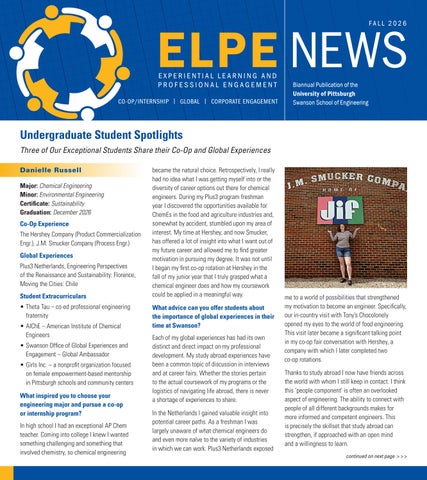
Undergraduate Student Spotlights Three of Our Exceptional Students Share their Co-Op and Global Experiences Danielle Russell Major: Chemical Engineering Minor: Environmental Engineering Certificate: Sustainability Graduation: December 2026 Co-Op Experience The Hershey Company (Product Commercialization Engr.), J.M. Smucker Company (Process Engr.) Global Experiences Plus3 Netherlands, Engineering Perspectives of the Renaissance and Sustainability: Florence, Moving the Cities: Chile Student Extracurriculars • Theta Tau – co-ed professional engineering fraternity • AIChE – American Institute of Chemical Engineers • Swanson Office of Global Experiences and Engagement – Global Ambassador • Girls Inc. – a nonprofit organization focused on female empowerment-based mentorship in Pittsburgh schools and community centers What inspired you to choose your engineering major and pursue a co-op or internship program? In high school I had an exceptional AP Chem teacher. Coming into college I knew I wanted something challenging and something that involved chemistry, so chemical engineering
became the natural choice. Retrospectively, I really had no idea what I was getting myself into or the diversity of career options out there for chemical engineers. During my Plus3 program freshman year I discovered the opportunities available for ChemEs in the food and agriculture industries and, somewhat by accident, stumbled upon my area of interest. My time at Hershey, and now Smucker, has offered a lot of insight into what I want out of my future career and allowed me to find greater motivation in pursuing my degree. It was not until I began my first co-op rotation at Hershey in the fall of my junior year that I truly grasped what a chemical engineer does and how my coursework could be applied in a meaningful way. What advice can you offer students about the importance of global experiences in their time at Swanson? Each of my global experiences has had its own distinct and direct impact on my professional development. My study abroad experiences have been a common topic of discussion in interviews and at career fairs. Whether the stories pertain to the actual coursework of my programs or the logistics of navigating life abroad, there is never a shortage of experiences to share. In the Netherlands I gained valuable insight into potential career paths. As a freshman I was largely unaware of what chemical engineers do and even more naïve to the variety of industries in which we can work. Plus3 Netherlands exposed
me to a world of possibilities that strengthened my motivation to become an engineer. Specifically, our in-country visit with Tony’s Chocolonely opened my eyes to the world of food engineering. This visit later became a significant talking point in my co-op fair conversation with Hershey, a company with which I later completed two co-op rotations. Thanks to study abroad I now have friends across the world with whom I still keep in contact. I think this ‘people component’ is often an overlooked aspect of engineering. The ability to connect with people of all different backgrounds makes for more informed and competent engineers. This is precisely the skillset that study abroad can strengthen, if approached with an open mind and a willingness to learn. continued on next page > > >
continued from page 1
The ability to connect with people of all
Can you describe one of your most memorable or challenging projects during your co-ops or internships?
different backgrounds makes for more
During my second rotation at Hershey, I had the opportunity to work on the Reese’s Oreo collab. The product has since been released but was top secret at the time. One of my favorite parts of this project was getting behind the scenes look at all the people and effort required to bring just one product to life. Often in school we work strictly with fellow engineering students, but throughout co-op I have been able to collaborate with individuals in R&D, supply chain, and marketing. This project afforded me greater appreciation for the variety of skills and teamwork required to bring such a substantial project to life.
a substantial impact, but I have found the opposite to be true. As an intern/co-op, you have the opportunity to make real, valuable contributions on your team, especially if you are returning throughout multiple rotations. Taking some real stake in your projects and demonstrating that you truly care makes for a more fulfilling learning experience and more rewarding relationships.
What were some of the biggest lessons you have learned so far that will help you transition into a permanent position? Take ownership in your projects. It is easy to think that as an intern/co-op you will not have
Matthew Ketas Major: Computer Engineering Graduation: April 2027 Co-Op or Internship Experience OwnBackup Company (Acquired by Salesforce)/ Aerotech Inc.) Global Experiences Plus3 South Korea, Exploration of Energy and Electrification: Brazil, Plus3 SSoE Upper Division: Czechia Student Extracurriculars Vice President of IEEE, Former Vice President of Recruitment of Triangle Fraternity What inspired you to choose your engineering major and pursue a co-op or internship program? I was very lucky to attend a high school that allowed me to take electrical and mechanical 2
informed and competent engineers.
Any advice for fellow Pitt students on the co-op or internship process? Prioritize making meaningful connections! As with most things I do, the people ended up being my favorite part of my co-op experiences. The people can reveal a lot about a company, its culture, and whether it’s somewhere you might be interested in working long term. Eat lunch with your coworkers, schedule 1:1s with people throughout the company, and make a genuine effort to get to
know people. Additionally, be open to relocating. Co-op is an excellent opportunity to try out a new location before you have to commit to a full-time position long term. What advice can you offer students about the importance of global experiences in their time at Swanson? Engineers are often tasked with the responsibility of creating solutions that impact people all over the world. As a result, engineering is, by nature, a truly global profession. Gaining exposure to a variety of perspectives early on in your career has the potential to positivity impact the way you approach problems and develop solutions. Experiential learning, both through co-op and study abroad, has undoubtedly shaped me as an engineer and as a person. The connections, growth, and perspective I gained through these programs have easily been some of the most valuable takeaways throughout my college experience.
engineering classes. It was an incredibly formative experience that I have continued to affirm throughout my time in college. No matter the discipline or problem, I found that the engineering mindset could be applied to break down complex problems and develop practical solutions. I ultimately chose computer engineering because I found it to be a great intersection of the engineering disciplines I was most interested in. It bridges the gap between hardware and software while still providing opportunities to work alongside mechanical and electrical systems. Through internships at multidisciplinary companies like Aerotech, I have been able to see teams of software, electrical, mechanical, and other R&D engineers constantly collaborating to deliver the best possible products to customers. That kind of environment is exactly what drew me toward internships in the first place. I wanted opportunities to apply what I was learning in school to real engineering problems and better
understand where my interests could take me. With each new experience, I have reaffirmed my interest in engineering and become more excited about continuing to learn and grow in the field.
You have done multiple global experiences, can you talk about how these experiences impacted you professionally? Each global experience has deeply broadened my perspective – not only on the areas of engineering that interest me, but also on the types of companies and industries in which I would like to work. In South Korea, I had the opportunity to visit major global technology companies, including Samsung, TK Elevator, and Hyundai. These visits offered an interesting contrast to the electric power companies and university-backed technology startups I encountered in the Czech Republic and Brazil. Paired with my previous internship rotations, these global opportunities have made me comfortable working in a variety of environments and more confident evaluating companies and organizations based on their mission and impact rather than simply their size or structure. Because of my international experiences, I connected with colleagues and mentors at Own Company and Aerotech, including those working in international offices, and I have remained in contact with many of them even after my internships ended. Beyond the connections I made through my internships, our study abroad program in the Czech Republic also gave us the opportunity to network with Pitt alumni currently working and living in Europe. Can you describe one of your most memorable or challenging projects during your co-ops or internships? One of the most difficult projects I worked on at Aerotech was helping improve an internal hardware tester used for Automation1, A3200, Ensemble, and Soloist drives. During an uplift release, I had to learn how to work closely with electrical engineers to discuss and implement improved testing methodologies while also coordinating with members of the software engineering team to make sure we were implementing reliable, maintainable code.
It was challenging to bridge the gap between higher-level software engineering and lowerlevel hardware design, especially when changes on one side could directly affect the other. At the same time, that was what made the project so rewarding. I was able to contribute to improvements in the speed and reliability of a manufacturing testing process while learning how engineers from different disciplines approach the same problem from very different perspectives. What were some of the biggest lessons you have learned so far that will help you transition into a permanent position? Some of the biggest lessons I have learned have come from understanding how to communicate with and present to other engineers. In the environments where everyone expects you to be able to contribute and more senior members of the team know far more than you do, it can initially be difficult to know when to speak up, when to ask questions, and how to navigate a professional engineering organization. Experiential learning, both through co-op and study abroad, has undoubtedly shaped me as an engineer and as a person. No matter the size of the company, I think it is important to get involved early so that you can learn how to collaborate effectively in a professional environment. During my internships and extracurricular experiences, I have had to give presentations to hundreds of people at a time, advocate for myself and my projects, ask questions when I do not know the answer, and learn how to work with engineers who have decades more experience than I do. Those are skills that are difficult to learn entirely in a classroom, but they are vitally important for advancing in an engineering career. You can do incredible technical work, but that work only truly matters if you can communicate what you did, why you did it, and why it matters.
Any advice for fellow Pitt students on the co-op or internship process? Passion comes through more than almost anything else on an application or during an interview. Use every experience you have in college to figure out what you are passionate about. Take classes outside of your comfort zone, join organizations, work on projects, talk to professors, and pursue internships that expose you to different areas of engineering. Just as importantly, if you try something and realize that you do not like it, that is still an incredibly valuable experience. You are one step closer to understanding what you actually want to do. Passion is at the center of your “why.” If you can clearly explain why you chose engineering, why a particular field interests you, and why you are excited about the opportunity in front of you, that enthusiasm will come through naturally. Technical skills are obviously important, but genuine curiosity and excitement about the work will give you the edge when pursuing an internship or career opportunity. What advice can you offer students about the importance of global experiences in their time at Swanson? There are very few times in life when you have the opportunity to truly immerse yourself in another culture. While there will always be opportunities to travel, having the chance to live, learn, and work in places you might never otherwise visit is something I believe every Pitt engineer should experience. Global experiences not only stand out on a resume; they expand your perspective in ways that are difficult to replicate anywhere else. It helps you think beyond your own experiences and design products, systems, and solutions that can serve a much wider range of people.
continued on next page > > >
3
continued from page 3
Alyssa Smeltz
I am also excited to be participating in my second global experience this fall, when I head to Brazil for a week as part of Moving the Cities. This will give me another opportunity to collaborate on a sustainable engineering project with students from across the world.
Major: Industrial Engineering Graduation: December 2026 Co-Op or Internship Experience Co-Op at Federal Express (FedEx) Corporation (September 2024-present), Internship at Pennsylvania Department of Transportation (Summer 2024)
Can you describe one of your most memorable or challenging projects during your co-ops or internships?
Global Experiences Global E3: LUT University Finland, Moving the Cities: Brazil Student Extracurriculars Semester Abroad at Lappeenranta University of Technology in Lappeenranta, Finland (Fall 2025), Theta Tau (2022-2024), PantHER Mentor (2025) What inspired you to choose your engineering major and pursue a co-op or internship program? I came to the University of Pittsburgh fully convinced that I was going to pursue bioengineering. This thought continued through most of freshman year even though at every seminar they told us to keep an open mind. It wasn't until Chemistry 2 lab that I realized the idea of working in a lab did not appeal to me. That was when I began to investigate the other majors. I looked over all the presentations given to us by the different engineering departments. I remembered that industrial engineering was the most social of all engineering and involved solving inefficiencies. At my high school job, I got a lot of pride from being able to solve small inefficiencies and being able to see the benefit in real time. I decided that industrial engineering was the only degree that truly fit my interests, and I have never regretted that decision. I especially value that industrial engineering provides students with a large variety of different roles to go into, and I can see how that will continue to be important throughout my career. Much like bioengineering, I came into the University of Pittsburgh knowing I was interested in pursuing a co-op. Unlike bioengineering, that 4
thought never changed. The co-op program is guaranteed positive. It is an opportunity to gain both invaluable professional, work experience and a monetary reward for doing so. I felt that my degree would not be complete without having the opportunity to apply the skills I learned in the classroom to real-life situations. You did a semester abroad, can you talk about how these experiences impacted you as an engineer? My global experience took place in Lappeenranta, Finland, at Lappeenranta University of Technology (LUT). LUT has a large exchange program, which allowed me to meet students from all around the world, even in a small city in Finland. The biggest educational takeaway that I brought back to Pittsburgh to finish my degree was a more developed ability to collaborate. The industrial engineering department at Pitt does a phenomenal job of incorporating collaboration into the curriculum, and my skills have developed dramatically during my time here. Collaboration is also a core part of the Finnish education system. My experience at LUT pushed that skill even further because I collaborated with people who had such diverse life experiences and perspectives. It taught me to challenge my own perspectives more than ever before and to recognize the value that different viewpoints can bring to a team.
My most memorable project during my co-op would have to be a Power BI dashboard I created to see the different packages within our network and how they moved. This dashboard has been used throughout my time with FedEx for many distinct levels of analysis. It was used for two different peak seasons to show where the highest package amounts are found throughout the country. It has also been used throughout the entire year to do ADHOC investigations into specific facilities to see what could be done to relieve some pressure on those facilities. This project was one of my first projects within Power BI. It enabled me to experiment with all the tools within the application and form a basis of knowledge about the software. Since then, I have done countless projects on PowerBI, but this one stands out as it remains extremely relevant day to day and deeply challenged me. What were some of the biggest lessons you have learned so far that will help you transition into a permanent position? I think the biggest lesson I learned from my co-op is the ability to have discussions and present to people who have more authority than myself. There will be many times in my professional career where I might have a different perspective around an idea or project than anyone else in the room. This might be because of different experiences within the company or because I am more likely to be closer to some of the data as an individual contributor. Either way, it is important to express those ideas and concerns because it might change the trajectory of the project. At other times, it might result in someone
The biggest educational takeaway that explaining why that idea would not work, which is just as important because it provides a deeper understanding of the business. Overall being able to share my thoughts around ideas has allowed me to be a part of projects and develop skills that I otherwise would have never had the opportunity to do. Any advice for fellow Pitt students on the co-op or internship process? My biggest advice to Pitt students on the co-op process is to give it your all. Apply for every co-op role that slightly interests you, because you never know what role will challenge you the most and provide you with a great team of mentors. Once
I brought back to Pittsburgh to finish my degree was a more developed ability to collaborate. you are in your co-op that is when you should ask for more projects and push yourself to learn new skills. During your co-op try to become an asset to your team, so don't be afraid to ask for additional work if you find your work beginning to dwindle. Even better, try to identity problems and present them to your team with a solution. Mostly though just try to take advance of any opportunity presented to you.
What advice can you offer students about participating in a global experience in their time at Swanson? I would tell any student who is considering studying abroad to just go for it. I know it can be scary and requires extensive planning, but it is absolutely worth it in the end. The team in the Global Experiences Office in Swanson is incredibly knowledgeable and can help guide you through the planning process. So, even if you have only thought about studying abroad once, please reach out to them. They can help you find a program that fits your schedule and academic needs while also giving you the opportunity to explore somewhere you are excited to experience.
5
COOPERATIVE EDUCATION 6
Summer of Undergraduate Co-Ops! Our students were hard at work applying their classroom education to real-world impact during their summer 2026 co-ops! From designing cutting-edge tech to solving complex industrial challenges, our future innovators are gaining hands-on experience and building the skills to shape tomorrow. Alexis Schoonover Avient
Ethan Vitale BASF
Karleigh Bubeck Cordia
Helayna Baer and Tank BASF
Mikayla Keenan Sherwin Williams Jaydon Paradis Covestro
Isabella DeNadai FedEx
Ben Runnette BASF
Sophie Lopez Zoll Cardiac Mgmt. Solutions
Danielle Russell J.M. Smucker Company
Aragya Goyal Bubble Robotics
Will Bezenas Eaton
Joel Sommers and Stephen Showalter Acutronic Arth Shah and Isabella Hassan Koppers
Dan Dalton Koppers Noah Kovachi and Lia Mironianski Alstom
7
Graduate Student Spotlights Rileigh Nowroski A current student in the MS in Civil EngineeringStructural Engineering and Mechanics Area program, Rileigh completed a summer 2026 internship at Hatch in Pittsburgh. As a Structural Engineering Intern, Rileigh provided support to multiple U.S. Steel modernization projects through the development of material take-offs for steel, concrete, and architectural elements. She also provided vendor drawing mark-ups, proofread specification sheets for a wide range of structural materials and elements, and designed a minor interior structure. Rileigh shared the following, “Hatch gave me room to find my strengths and weaknesses and figure things out by myself while still providing an abundance of support in my development as an engineer. Despite being in a Civil Engineering graduate program, my bachelor’s degree (also from the University of Pittsburgh) is in Applied Mathematics. The Swanson School of Engineering Compass Program allowed me to take the first step in changing my career path and attain an advanced degree without needing to start from scratch. Although I feared my unique background would impact my ability to work within an engineering capacity, my internship at Hatch
Hirad Alipanah Hirad Alipanah is a current PhD student in the Computational Modeling & Simulation program, whose research focuses on solving fluid dynamics partial differential equations using quantum computing and tensor network methods. He completed an internship at NVIDIA in Santa 8
allowed me to see the transferability of my mathematics background. Through my experience this summer, I received a wellrounded education in everything that goes into a project from building construction work packages and specifications sheets to the actual calculation and design of industrial structures. As my internship comes to an end, I have gained confidence both in my abilities and my choice of career. I am excited to continue growing within this field!” Upon graduation in December 2026, Rileigh intends to obtain EIT certification and begin working as a full-time structural engineer. Her goal is to one day become a licensed Professional Engineer (PE). Rileigh has the following advice for fellow master’s students considering an internship during their program, “I would highly recommend an internship to any master’s students who are interested. This experience has allowed me to apply my theoretical knowledge to real-world engineering scenarios. Seeing the difference between neat and tidy classroom engineering problems and the sometimes messy engineering problems for actual projects has been eyeopening. It has also been an incredible experience
Clara, California during the summer 2026 term. As a Quantum Computing Software Intern, Hirad was responsible for developing quantum-inspired methods for numerical simulation of electromagnetic fields. He shared the following about his internship experience: “My internship at NVIDIA gave me
to see a structure I designed grow from a rough sketch to an approved drawing that will be constructed and provide a use. Additionally, networking beyond the world of academia has opened doors and provided opportunities for me that otherwise would not have been available. For example, I have presented my research on population-based structural health monitoring and the utilization of machine learning in structural evaluations to my colleagues at Hatch, an audience I would have likely never reached out to on my own.” Wishing you all the best in your future career, Rileigh!
the opportunity to connect my academic research in quantum computing with the development of high-performance scientific software. I learned how research ideas are translated into reliable, scalable, and performance-oriented software through careful implementation, testing, benchmarking, and collaboration. Working with experienced researchers and engineers strengthened both my technical and professional skills and helped prepare me for a career at the intersection of quantum computing, high-performance computing, and scientific computing.” continued on next page > > >
continued from previous page
Upon graduation in December 2027, Hirad aspires to pursue a research scientist role where he can continue working at the intersection of quantum computing, high-performance computing, and computational science. He is interested in developing advanced computational methods for solving challenging engineering and scientific problems. Hirad has the following advice for fellow PhD students interested in pursuing a co-op or internship during their program: “I would encourage PhD students to begin preparing early and to develop skills that complement their academic research. A strong research background is valuable, but practical experience in programming, software development, debugging, and communicating technical results is equally important. Students should also apply broadly, seek feedback on their resumes, and clearly explain how their research experience can contribute to real-world technical problems. An internship is an excellent opportunity to learn how research and development operate outside academia and to identify the skills needed for future career opportunities.” We wish you continued success in your career, Hirad!
IT’S NOMINATION TIME!
Co-op Student and Employer of the Year 2026 We are now accepting nominations for both Co-op Student of the Year and Co-op Employer of the Year for 2026. We appreciate all nominations. Criteria for Co-op Student of the Year 1. Outstanding work contributions with co-op employer (students must have three rotations completed) 2. Volunteerism or contributions to co-op or University community 3. Excellent academic record Ideally, we would like to have one nominee from each engineering department, and students can be nominated by their employer or SSoE department. The winner will then represent Pitt in the National Co-op Student of the Year competition sponsored by the Cooperative Education Division through ASEE. Pitt has won nationally seven times and has had many outstanding finalists! Criteria for Co-op Employer of the Year 1. Sustained commitment to cooperative education at the University of Pittsburgh 2. Quality of projects and assignments Please direct any questions or nominations to Chris Frankovic at caf54@pitt.edu by October 14, 2026.
9
Alumni Spotlights Mary Beth Bittle Former Major: Mechanical Engineering Graduation: August 2012 Co-Op Experience Crane Energy in Houston, TX (2 rotations) Lockheed Martin in King of Prussia, PA (1 rotation) Student Extracurriculars Society of Women Engineers, Tau Beta Pi, American Society of Mechanical Engineers, Oakland Zoo and Panther Pitt enthusiast Current Position Program Manager, Lockheed Martin, King of Prussia, PA What inspired your engineering major and pursuing a co-op program? I considered both bioengineering with a mechanical focus and mechanical engineering. Mechanical engineering aligned better with how I understand physical systems – and it meant I could avoid advanced chemistry! I am from the Philadelphia area, where another school has a huge co-op program (Drexel University), so I understood the value of pursuing the co-op program. I loved that you could do three rotations and graduate only one semester behind everyone else with mechanical engineering. How did your co-op experience help you prepare for interviewing in the real-world setting? What advice can you give current students on interviewing for co-ops? My co-op experience helped me connect interview questions to real engineering and interpersonal situations, including those I encountered through student organizations. Demonstrating that I could complete work and communicate about real engineering tasks helped show that I was ready for a full-time job. As a manager, my advice to those interviewing for co-ops is to draw from group projects, student organizations, and hobbies. Think about challenges you have overcome – technical or interpersonal – then identify examples that show your ability to work on a team and 10
discuss something you are passionate about. For co-ops, the key is often to show that you are willing to learn, ready to support the team’s needs, and eager to solve hard problems. Can you describe one of your most memorable or challenging co-op projects? When I worked for Crane Energy, there was a problem with some of the valves that the company produced. I had been supporting the design and analysis team, but was afforded the opportunity to visit the Long Beach, CA office and talk with the technicians who were working with the valves every day. They offered additional insight into changes they had seen. By assessing their feedback and reviewing the design, I was able to identify the cause of the problems. It was a rewarding full circle, and it really helped me learn the value of relationships. I built a relationship with the technicians and they trusted me enough to discuss some of the problems openly. That’s stuck with me! What were some of the biggest lessons you learned about teamwork and communication in a professional setting? Teamwork is key. Talk to those around you. Ask them what they’re working on, how your work fits in with theirs, etc, but also get to know them. My biggest communication takeaway seems cliché, but not everyone communicates the same way. It sounds obvious, but it’s real! It’s never a bad idea to repeat back what you think someone wants you to work on to ensure you’re on the same page. Tell me a little more about your current role, what does a typical day look like for you? What are your favorite parts? In my current role, I manage the test efforts for large DoD program. This includes both flight tests and tests where we collect data on the ground. My favorite part is that there is no “typical” day. There are always new challenges – do we have
the right pedigree of hardware to conduct this test? Can we build our assembly on time to meet our test date? Can we collect the right information for our partner organizations with this test method? How can I help with prioritizing? My days are very dynamic and the problems are related to cost, schedule, technical, and sure ensuring personnel have what they need to be successful. What was the biggest challenge you faced when transitioning from college to full-time work? How do you think your co-op program prepared you for the transition? I have actually given two talks on this at SWE conferences! The two things that I think are most important: don’t be afraid to ask for help and be willing to do any task. Coworkers are usually happy to explain how to use a new tool or show you how a process works because then, eventually, they won’t have to do it. Show them you can learn quickly. Being open to any tasks can help you expand your skill set, meet new people, and set yourself up for future projects. I completed a task for a program that required less technical expertise than normal, but my hard work was memorable for the chief engineer and he asked me to be a part of an important program. The co-op program opens the doors to building all these skills before you move to full-time work, which puts you ahead of the curve! Anything else you’re looking forward to professionally, or advice for current students? I’d recommend that current Pitt students start to explore how to find a mentor – it can be the senior that’s in IEEE with you, a professor, a neighbor, a coworker! Once you’re working fulltime, a mentor can be so helpful when exploring career opportunities, talking through difficult conversations, and more. Learning how to find a mentor that fits well with you is a great skill to learn as a student!
Evan Poska Former Major: Industrial Engineering Graduation: December 2019 Co-Op Experience MSA Safety Global Experience Study Abroad Montevideo, Uruguay Student Extracurriculars Personal Trainer at the Pete Current Position Human Factors Engineer at Boeing Commercial Airplanes Elaborate on your co-op and study abroad experiences, the projects, the skills gained, one project or moment that stood out? I got a good breadth of experience at MSA Safety as a production supervisor co-op: improving operation efficiency, learning and presenting on ergonomics. This experience and exposure helped give me background and context to make future classroom learning more effective, and it gave me a benchmark to compare against future internships/jobs. The most meaningful part of the co-op was connecting with the production workers – improving the design of their work starts with understanding their current work and the challenges they face. I really enjoyed studying abroad in Uruguay. We did some site visits and classroom learning on supply chain in South America, but probably the most memorable experience was all the steak and ice cream I ate. Uruguay has the highest cow per capita ratio in the world (~3:1), there were many opportunities to enjoy the local customs. What inspired you to choose your engineering major and pursue the co-op global programs? I chose industrial engineering for its focus on systems, complexity, probability, and people. Industrial engineering brings a lot of abstract, non-linear, and non-deterministic thinking to real
problems. I liked that I would still take the same fundamental science and engineering courses as the other engineering majors – I think being familiar with those topics makes for a much more well-rounded and effective IE. Co-op seemed like a great way to build more depth than short, 3-month internships would allow. Gaining familiarity with a company, its processes, and how to learn and be effective there can take time. I studied abroad in Uruguay for a few reasons: to practice my Spanish, go to a place I might not otherwise travel in the future, see what different cultures and ways of thinking might exist in engineering and business there, and simply to try something new. What were some of the lessons you learned about teamwork and communication while working for Boeing and studying abroad. I work in a highly collaborative, complex, safetycritical domain where it would be unthinkable to expect success if working and deciding solo. Communicating well, technically and interpersonally, can have a massive impact on people, projects, and careers. For most roles, it’s not worth fighting against, but worth learning about. Speaking with someone in their non-native language, or on a topic they’re less familiar with, or even on a topic that you’re both familiar with, can lead to many opportunities for miscommunication. I see a lot of value in understanding formal English and the ways we can err in communication. Confusion, frustration, time, and rework can all be reduced by clear communication. What are your future career goals? How has this experience with domestic and global programs helped you grow professionally? I just want to think about interesting, impactful problems, and have a positive effect on people. Working in human factors engineering and complex systems gives the opportunity to influence the most fundamental assumptions
and principles that underly the work and methods that we use. I hope to have the leverage to effectively do this to ensure alignment with safety, performance, and dignity. My co-op and study abroad experiences exposed me to a variety of work, ways of thinking, and ways of living. In class, we’re often presented with a problem that has one right answer or a few right ways of doing something, but elsewhere, we sometimes have to figure out what the right question or problem is, and pull on many areas of expertise to help answer it; I always wanted to intuit my way through everything and find the best way myself, but that doesn’t work as much in large or complicated domains. What are you looking forward to professionally, and any advice for students? Relative to other engineering and sciences, human factors engineering is a pretty new field, and it hasn’t been fully integrated into most domains. The underlying science/knowledge continues to grow, and the opportunities for practitioners to make positive change on companies, systems, and products grow with it. I’m looking forward to seeing and being a part of this. My advice; branch out of engineering and find good mentors. You’re a person before you’re an engineer, remember that humans are also on the other side of your designs: they’re building, maintaining, using, and being affected by your work. Mentorship can be really beneficial. They can guide you to where you might want to be, even if you can’t yet imagine the paths or destinations, and they know how to make you stretch yourself to new capabilities. 11
GLOBAL
Engineering Around the World: Summer 2026 Our engineering students spent their summer around the world learning and sharing their experiences with others and building lasting relationships! Alec Fialkov, Electrical Engineering, FAME Participating in the FAME program is one of the best decisions I have ever made...I did all this while taking courses that fulfilled my major requirements and kept me on track to graduate within 4 years. This program is an absolute win-win.
Anthony Watkins, Electrical Engineering, Plus3 Greece
Being exposed to so many career paths in such a hands-on manner was very important to me professionally, as there are many directions my intended major can take me, and being more informed about the global job environment made me feel much more prepared for whichever path I choose.
Toni Wells, Industrial Engineering, Plus3 Greece
12
The ability to engage and converse with international companies that manage different steps of the supply chain left me with skills that will allow me to appropriately discuss and negotiate with global suppliers and organizations as a professional industrial engineer.
Braden Baxendell, Mechanical Engineering, Plus3 Czech Republic The combination of in-class lectures on engineering and the history of Central Europe, along with company and plant visits to organizations such as LEGO and Škoda Auto, was a perfect blend of how engineering is implemented in society.
Brooke Stane, Mechanical Engineering, Plus3 Czech Republic Between company visits to Skoda and LEGO, Charles University lectures and engagements, cultural excursions like Kutna Hora and Terezin, I was able to gain a deeper understanding of how society and engineering influence each other not only on a local level, but also on an international level.
Maddox Cohen, Bioengineering, Plus3 Netherlands Participating in the Plus3 Netherlands program was an incredible adventure that will forever be a highlight of my freshman year.
Anthony Tabak, Industrial Engineering, Plus3 Greece Learning about the diverse ways that innovation and scalability were applied across different industries helped me to understand how I can contribute as an industrial engineer going forward.
Joey George, Industrial Engineering, Renaissance (Italy) Piéce de résistance art intersected with strides in sustainability. Precise planning from all sides-Pitt, the Cea Capa partners, and our year's cohort made all these wonderful experiences possible.
Katherine Sexton, Materials Science Engineering, Renaissance (Italy) This program was truly the best decision. Studying abroad in Florence improved my communication skills and made me a more well-rounded engineer.
Grace Gilbert, Materials Science Engineering, SERIUS/NUS, research in Singapore I have gained immense experience conducting independent research in an emerging branch of materials science, along with lasting memories and friendships!
Noah Kim, Computer Engineering, Plus3 South Korea
Varnujah Rengaramanujam Kanagaraj, Bioengineering, Plus3 Korea
I really enjoyed touring companies such as Samsung and Hyundai, seeing the natural and historical beauty Korea has to offer, and making new friends.
One of the highlights of my first year at Pitt- broadened my global perspective, strengthened my adaptability, and reinforced my passion for using engineering to develop solutions that improve people's lives.
Jack Moriarty, Materials Science Engineering, SERIUS/NUS, research in Singapore I was exposed to numerous learning opportunities for both professional development (including communicating with a wider range of multidisciplinary audiences through presentations and research papers) and researchbased skillsets for laboratory experiments/studies.
Sophia Cramer, Environmental Engineering, Renaissance (Italy) The combination of history, engineering, and art within the curriculum allowed me to gain a wide range of knowledge. It also taught me how to connect the main ideas of each of those subjects through the lens of sustainability.
13
Gus Walls, Mechanical Engineering, UROP research in Germany I became more confident in my ability to complete novel research and learned more about my field while experiencing a different culture in a once-in-alifetime experience.
Garrett Deller, Computer Engineering “The German Way Study Abroad Program was a life-changing experience that broadened my perspective and strengthened my desire to pursuing global engineering opportunities. Working alongside German students and faculty increased my appreciation for international collaboration and inspired a lasting passion for working with intercultural teams.
Lauren Barber, Electrical Engineering, Exploration of Energy Brazil The Energy program to Brazil was an amazing opportunity for me grow as an engineer and as an individual. Through company visits and lectures from our partner university, I continued to learn about topics that were once just theories in the classroom and see how they are applied to the real world. My understanding of electric power has grown incredibly and something that I take into my professional life.
Kristina Heins, Bioengineering, Max Planck School Matter to Life Research Working as a research intern in Dresden, Germany, as a guest of the Dresden International Graduate School for Interdisciplinary Life Sciences (DIGS-ILS) PhD program has been an incredible opportunity to learn from a diverse community of students and faculty from around the world. Being able to combine my Pitt research experience with my systems engineering background from Bayer has allowed me to contribute to projects focused on new imaging modalities and contrast agents.
Sophia Prybyslavskyy, Environmental Engineering, Plus3 Czech Republic Learning about sustainability and renewable energy while exploring the country's rich history showed me how engineering solutions are shaped by societal needs and values. The experience also broadened my perspective, helped me become more independent, and strengthened my understanding of the role engineers play in creating a more sustainable future. 14
Ivan Zheng, Computer Engineering, Exploration of Energy Brazil Having the opportunity to visit Brazilian companies and observe the energy sector firsthand from generation to transmission to distribution was incredible. Seeing [these processes] in practice provided a much deeper understanding of the complexity required to keep the grid operating reliably.
Announcing Our New LinkedIn Page: Pitt Swanson Global Experiences The Global Experiences & Engagement team is excited to launch a new LinkedIn page dedicated to global engineering education at the Swanson School. Today's graduates need more than technical expertise; ural agility, global awareness, and the ability to innovate across borders. Our global programs prepare students for exactly that, offering opportunities to work abroad, collaborate with international peers, and study infrastructure that powers communities worldwide. This new page is a hub for connection; bringing together alumni, industry partners, and prospective students who share a commitment to global engineering. We invite you to follow the page, engage with our content, and contribute to the future of globally minded engineering at Pitt.
Follow us at https://www.linkedin.com/ company/pitt-swanson-global-experiences/ or search on LinkedIn “Pitt Swanson Global Experiences.”
Alumni Global Engagement Events
Alumni Get Involved: Support Our Global Engineers
Thursday, November 12, @ Noon
Alumni play a vital role in bringing global engineering education to life. Here's how you can help: • Offer a Global Co-op or Internship Connect students with international placement opportunities at your company or through your professional network. • Host or Support a Site Visit Welcome study abroad groups to tour your facility or share insights into engineering infrastructure in your region. • Make an Introduction Connect our program with international partners, employers, or organizations who might collaborate with Swanson Engineering.
Global Engineers Speaker Series: Alumni Careers Abroad Students will hear from alumni and industry professionals that took their careers abroad. Moderated discussion followed by Q&A about how they found made the move abroad, what skills they needed and advice on how students can build these skills now. Interested in getting involved? Reach out through our new LinkedIn page or contact our office. Alicia Olalde, Director, Global Experiences & Engagement, a.olalde@pitt.edu Nora Dougherty, Assistant Director, Global Experiences & Engagement, ncd37@pitt.edu
Swanson School Students go Global in AY 25-26! • Brazil • Chile • Czech Republic • Denmark • Ecuador
• Finland • France • Germany • Greece • Hong Kong
• Iceland • India • Ireland • Italy • Japan
• Netherlands • Portugal • Scotland • Singapore • South Korea
• Spain • Sweden • Switzerland • United Kingdom • USA
E T A D e h t SAVE ring ELPE
2027 Sp reer Fair a C ip h s n r e t In & ation Cooperative Educ
9:30 | 7 2 0 2 , 5 February ity Club
a.m.
The ELPE team had a wonderful time spending an afternoon this summer packing bags of school supplies for our local school districts at the United Way Tools for Schools event. Pictured left to right: Megan Amoroso, Nora Dougherty, Alica Olalde, Tyler Kimmel, and Valerie Kerr
rs
The Unive
SSoE ELPE office now has a LinkedIn page!
Office of Experiential Learning and Professional Engagement Staff
engineering.pitt.edu/coop engineering.pitt.edu/global The information printed in this document was accurate to the best of our knowledge at the time of printing and is subject to change at any time at the University’s sole discretion. The University of Pittsburgh is an affirmative action, equal opportunity institution. 09 /26
Chris Ann Frankovic Director, Cooperative Education and Internships caf54@pitt.edu
Tyler Kimmel Assoc. Director, Cooperative Education and Internships Tjk58@pitt.edu
Alicia Olalde Director, Global Experiences and Engagement a.olalde@pitt.edu
Valerie Kerr Assoc. Director, Graduate Professional Development, Cooperative Education and Internships vek32@pitt.edu
Dana Romano Director, Career and Industry Engagement Dar19@pitt.edu
Megan Amoroso Global Program Manager m.amoroso@pitt.edu
Nora Dougherty Asst. Director, Global Experiences and Engagement clc369@pitt.edu Kristie Frazier ELPE Administrator Kmw257@pitt.edu