ANNUAL REPORT
PRASHANT N. KUMTA Since 1991, Kumta has explored novel ways to safely pack more power into smaller batteries using nanostructures, new chemistries and new approaches for making those materials. Another line of his current research is to reduce the amounts of expensive metals needed to create hydrogen and oxygen to run fuel cells sustainably.
READ MORE “AMPED UP” ON PAGE 3
Executive Editor Paul Kovach Director, Marketing and Communications Design Leslie Karon Sweeney Senior Graphic Designer Contributing Writers Steinur Bell Corinne Dionisio Brandie Jefferson Anna Ligorio Patrick Monahan Principal Photography Tom Altany John Altdorfer
TABLE OF
CONTENTS
2................... Letter from the Dean 3................... Feature: AMPED Up 8................... Early Career Awards/Research Activity and Expenditures 9................... NAE 10.................. GRO at Pitt 12.................. Studying Energy in the Land of Fire and Ice 14.................. Cyber Energy Center
engineering.pitt.edu facebook.com/pittengineering instagram.com/pittengineering twitter.com/pittengineering youtube.com/pittengineering linkedin.com/pittengineering
16.................. INSITES: A New Sense for Infrastructure 17.................. Energy Efficiency on the Cloud via Computer Software 18.................. Student Features 22................. Distinguished Alumnus Profile 23................. Honors and Awards
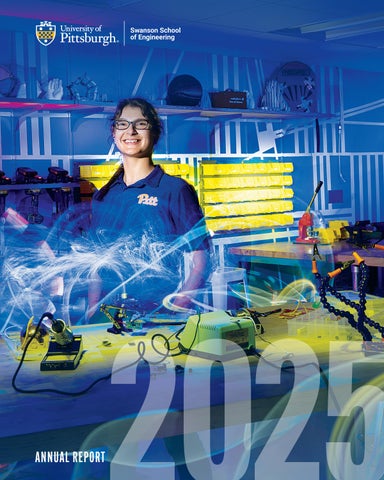
Pictured on front cover: Second-year PhD student
SABRINA HELBIG (ENGR ’20, ’23G) READ MORE “AMPED UP” ON PAGE 3
The information printed in this document was accurate to the best of our knowledge at the time of printing and is subject to change at any time at the University’s sole discretion. The University of Pittsburgh is an affirmative action, equal opportunity institution. 01/26
Dear friends and colleagues, As we approach the 180th anniversary of engineering at the University of Pittsburgh, it is inspiring to witness a renewed sense of purpose at the Swanson School of Engineering. My first year as the U. S. Steel Dean of Engineering has been engaging and transformative, as we work together to shape our new strategic plan for the 2030s and beyond and prepare students for a rapidly-changing career environment. The breadth and depth of research at the Swanson School were among the greatest draws for me, as was its reputation for academic excellence and innovation. Despite challenges across higher education, our momentum continues to build. Research activity and expenditures are at record highs, and this fall we welcomed one of our largest and most diverse first-year classes — 770 future engineers whose curiosity and drive reflect Pitt’s enduring spirit of ingenuity. They are motivated by purpose and eager to make a tangible impact on their communities and on the world. We also continue to rise in the U.S. News and World Report rankings, this past year to 43rd overall, 24th among public institutions, and 21st among AAU publics. This year reaffirmed Pittsburgh’s leadership in energy innovation. The inaugural Energy and Innovation Summit brought together global partners to explore how our region’s legacy in coal, oil, and steel is evolving toward renewable, sustainable, and cyber-secure energy systems. At Pitt, our faculty are leading that transformation — from advancing grid modernization and energy storage to developing next-generation cybersecurity for critical infrastructure. Even our curriculum, including a popular study-abroad course in Iceland, is expanding students’ global perspective on sustainable energy. We were also excited to announce this year a new bachelor’s degree program in Natural Gas, Renewables, and Oil Engineering (GRO). As we look toward the 2030s, the energy landscape is evolving dramatically. We need engineers who can balance the realities of today’s energy needs with the technologies that will drive decarbonization and sustainability. You can read more how GRO will make that possible. Among the many points of pride this year is the election of Dr. Fang Peng to the National Academy of Engineering — an honor that underscores our rising prominence in power electronics and energy research. His work exemplifies the Swanson School’s impact at the intersection of discovery, innovation, and societal need. As you read this report, I hope you will share my excitement for what lies ahead. The achievements of our students, faculty, and staff embody the energy, creativity, and collaboration that define Pitt Engineering. Together, we are building a new paradigm for engineering in the 2030s — one that bridges disciplines, empowers people, and drives meaningful change.
Michele V. Manuel, PhD U. S. Steel Dean of Engineering
2
SWANSON SCHOOL OF ENGINEERING
RESEARCH MATTERS FANG PENG
AMPED UP By Patrick Monahan • Photography by Tom Altany
THE U.S. ELECTRICAL GRID IS AGING AND FACING PRESSURES IT’S NEVER ENCOUNTERED BEFORE. PITT ENGINEERS IN THE SWANSON SCHOOL ARE LEADING THE CHARGE TO IMPROVE IT. ANNUAL REPORT 2025
3
Quick: How Charged Is Your Phone? What About Your Laptop? Your Car? One benefit of the way we live is that it’s usually not too scary if any of them are close to empty. The next charge is just around the corner It’s easy to take electricity for granted when so much of the infrastructure that brings it to us is buried behind walls and hidden in boxes, only perceptible when something fails. But peek under the surface and you’ll find a fiendishly complex assortment of aging components that’s been subject to decades of research disinvestment. We already ask a lot of our electric power grid. Soon we’ll be asking even more. Electric cars and home heaters are poised to make the way we live cleaner and more efficient. Wind and solar energy promise to further decentralize electricity production and make a dent in the fight against climate change. Artificial intelligence, if you believe tech leaders, is on the cusp of transforming how we work. It will only get harder for the grid to accommodate these innovations while staying reliable. Demand from data centers will double or triple by 2028 according to a U.S. Department of Energy report, and the U.S. Energy Information Administration recently estimated that overall energy demand may double worldwide by 2050. At Pitt, there’s a team of researchers working alongside industry to prepare for these unprecedented challenges. More powerful batteries, more efficient transformers, more effective sensors — all of these technologies have the potential to make the electric grid more flexible, efficient and resilient.
4
SWANSON SCHOOL OF ENGINEERING
This push to create the grid of the future harkens back to Pitt’s legacy as an electricity research powerhouse.
Alternating Currents “So, do you want to know the history of how we got from nothing to a program with a national reputation?” That was how Brandon Grainger started the story, and he’s perhaps positioned better than anyone to tell it. As a three-time Pitt alum (ENGR ’07, ’11G, ’14G), associate professor and Eaton Faculty Fellow in the Swanson School of Engineering, Grainger’s had a front-row seat to the growth of the electric power engineering program at the University since its re-establishment in 2008. Whether at the scale of a national power grid or a single microchip, power engineering is about making sure electricity gets where it needs to go, in the form it needs to take. That may sound straightforward, but it’s anything but. Powering our homes and devices takes an intricate system of transformers and inductors, power electronics, controllers and more that create branching flows of current in different sizes and varieties, all calibrated to prevent waste, accidents and downtime as they snake their way to their final destinations. At Pitt, power research owes its origins in part to industrialist George Westinghouse — what Andrew Carnegie was to steel, Westinghouse was to electricity. In 1893, he recruited radio pioneer Reginald Fessenden to be the first chair of Pitt’s Department of Electrical Engineering, eager to see the department train engineers who might work at Westinghouse Electric. He continued to support the department as it began to graduate students, and the electric power program at Pitt enjoyed an
enduring national reputation. But by the early 1990s, funding had dried up. Between 1980 and 1990, the U.S. Department of Energy’s spending on basic energy research was slashed roughly in half “In the ’90s, the big thing was computers, and everyone thought the electric power side was all figured out,” Grainger says. “Graduate programs might have one professor, and there were just a couple around the country.” National interest had moved elsewhere. So did attention at Pitt — for decades. In 2008, Greg Reed, then a Pitt adjunct professor and vice president at Mitsubishi Electric, saw a looming crisis in both expertise and innovation in the field as the grid continued to age. He also recognized that Pittsburgh was primed for an electric power renaissance. After recruiting Grainger, then a graduate student, to the effort, the pair began to build out labs and training programs. They found willing workforce development partners in the Richard King Mellon Foundation and Henry L. Hillman Foundation. Industry wanted a piece of the action, too, like international electric distribution manufacturer Eaton Corporation. “Eaton was the very first manufacturer that came on board and said, ‘We believe in the vision, and we need talent. What can we do to get more engineers into our system?’” Grainger says. That partnership began in 2008, and within five years, roughly a third of the undergraduates in the Department of Electrical and Computer Engineering were graduating with a concentration in electrical power — and the next stage of the program’s development was just being set into motion.
Fully Charged David Vorp wore his winter coat when he first toured the Hill District building that would become the Energy Innovation Center (EIC). The facility’s windows, vandalized during years of vacancy, were no protection against a Pittsburgh December. But as he wandered through what was once the city’s largest trade school, Vorp — the senior associate dean for research and facilities for the Swanson School — saw possibility among the piled-up desks.
BRANDON GRAINGER
Thirteen years later, that building is now a state-of-the-art facility where researchers from the Swanson School, Duquesne Light Corporation and energy-related startups all solve problems under the same roof. “Our roots run deep with energy,” says Vorp. “Having this space was the logical next step. Hopefully, our footprint here continues to grow.”
The building hosts five Pitt labs, including the crown jewel of Pitt’s electric power program: the Electric Power Technologies Laboratory, a reconfigurable medium voltage testing space with hookups to solar panels and a wind turbine to test components that assist different types of electric power products. To know how a product will perform its job in the real world, you have to test it under the conditions it’ll actually experience there. Thanks to Duquesne Light, researchers in
the lab can put new grid technologies through their paces at up to 13,800 volts of alternating current directly from the local high-voltage grid, making it one of just three with that capacity east of the Mississippi River. “Our real-world setups enable us to perform at-scale research, development, testing and validation of new grid technology to modernize today’s power and energy grids,” says lab director Fang Peng. Freshly
recruited to Pitt, Peng is a leader in the field, boasting patents like a super-fast circuit breaker and a grid component that improves power flow for high-voltage transmission. Lured by Pitt’s electric power history and unique lab capabilities — along with what he describes as a “renaissance” in power engineering research and education — Peng assumed the role of RK Mellon Endowed Chair Professor of Electrical and Computer Engineering in 2024. Just months later, he was elected to the prestigious National Academy of Engineering. By working together with industry, agency and academic partners, Peng says, the group is poised to help “rebuild and revolutionize” the electric grid.
Tomorrow’s Grid Pitt is the EIC’s largest tenant, and other parts of the space are used for workforce development training across 29 different trades. It’s a fitting return for a facility with a previous life as the Connelley Trade School. “When the school opened in 1930, they were graduating 450 students a year,” says Don Evans, CEO of Pittsburgh Gateways Corporation, the nonprofit that owns and leases the building. “Today we’re graduating over 900 entrylevel jobs every year, doubling down on putting the building back in use and teaching the jobs of the future.” At the same time, students in the Swanson School are creating the electric grid of the future. Second-year PhD student Sabrina Helbig’s (ENGR ’20, ’23G) interest in power engineering was sparked by a two-week Pitt green energy program in Scandinavia. “We went to manufacturers, utilities and an offshore wind farm,” she says. “It showed me the breadth of the field and — pun
6
SWANSON SCHOOL OF ENGINEERING
semi-intended — the power that the power grid has in our lives.” Helbig’s master’s work at Pitt had her designing tiny converters to power computers on spacecraft, and now she’s designing and testing components for the electric grid that could flip the process of how batteries are hooked into the grid. This work of replacing traditional grid components with new electronics has some real potential advantages: it could alleviate mounting supply chain pressures on transformers and other components while increasing the grid’s efficiency and controllability. Helbig hopes to carry this forward to a career in applied research to help the grid accommodate more green technologies. As vast and vital as the field is — Helbig calls it “invisibly impactful” — she says she thinks about the same questions whether aiming at the entire system, a single substation or one tiny converter. “What’s its purpose? How can we achieve that safely? And how can we make it better?”
Working to Make the Grid ...
... MORE FLEXIBLE
In 2025, batteries are big business. Even a small increase in capacity means your electric car might drive a few more miles, your phone might last a few more texts, or your solar panel might power your home a few more minutes after sunset. Those minutes add up — and they could make a substantial difference in whether green technologies get adopted. Prashant N. Kumta, distinguished professor and Edward R. Weidlein Endowed Chair Professor in the Swanson School, wants to see those minutes go up. Since 1991, Kumta has explored novel ways to safely pack more power into smaller batteries using nanostructures,
new chemistries and new approaches for making those materials. Another line of his current research is to reduce the amounts of expensive metals needed to create hydrogen and oxygen to run fuel cells sustainably. His team is also exploring a new battery chemistry that combines lithium and sulfur, which could handily beat the performance of current lithium-ion batteries. “It has the potential to give you very high energy densities, but anything good always has problems,” he says. In this case: the two elements react to form intermediates that eventually dissolve and kill the battery. Kumta and his students are researching ways to confine the two substances and prevent the formation of intermediates, all while avoiding the tendency of lithium to form branched treelike structures that short out the battery, rendering it unsafe. It’s a tough challenge. But if it works? “The opportunities are endless — because you need batteries for everything,” he says.
... MORE RESILIENT
Some engineering projects are about dreaming up the electric grid of the future. Others are about making sure the grid we have stays secure. In SHURE-Grid, the Summer Honors Undergraduate Research Experience in Electric Grid program, Pitt faculty and students research and make educational materials about cybersecurity risks to critical infrastructure like electric grids. “The idea is to incorporate security at every stage of the engineering system, from conception to deployment,” incorporating principles from the Department of Energy, says Mai Abdelhakim, an associate professor of electrical and computer engineering in the Swanson School and one of SHURE-Grid’s leaders.
PAUL OHODNICKI “The lab actually has multiple distribution transformers that can operate all the way up to the same voltage levels that they might see on the distribution grid...”
The problem of cyber threats is only intensifying: the same tech that’s making the grid more connected and controllable is also increasing the potential avenues for bad actors worldwide to interfere. “Anybody who works with technology at this point, especially in critical infrastructure, needs at least some minimum awareness of cybersecurity,” says Abdelhakim. To that end, SHURE-Grid students research and create videos about cyber threats to water dams, renewable energy projects and more that can be shown in classrooms and workplaces. The program, launched in 2023, is sponsored by the U.S. Department of Energy’s Idaho National Laboratory and led by Abdelhakim, Grainger and Robert Cunningham, Pitt’s vice chancellor for research infrastructure. Last summer, the program hosted 16 students — a few engineers, but also film and media studies, political science and neuroscience majors. SHURE-Grid’s broad
nature reflects not just the complexity of the infrastructure we rely on, but how deep it reaches into our lives. “The security of these critical systems will impact individuals, right?” says Abdelhakim. “If you have a blackout in a city, everyone is impacted.”
... MORE EFFICIENT
Historically, electricity on the grid only flowed one way: from big power plants to consumers. But with increasing use of energy storage and new types of generation like solar panels, that flow is sometimes reversed, requiring new technologies to handle it. Add efficiency regulations and supply chain issues, and grid components that were once common might quickly become hard to come by. “All of these different factors are contributing to a much more dynamic, much more challenging environment for the distribution system,” says Mechanical Engineering and Materials Science
Associate Professor and RK Mellon Faculty Fellow Paul Ohodnicki. Ohodnicki is leading a $2.5 million project funded by the Department of Energy that will let researchers in the EIC test new types of distribution transformers, which convert electricity from a form that’s efficient for long-distance travel to a safer one that won’t fry your appliances. He’s also assembling a group of academics and industry representatives who’ll ensure that the lab’s research is useful to the companies building, supplying and administering the electric grid. The work will take advantage of the high voltage capacity of the EIC. “The lab actually has multiple distribution transformers that can operate all the way up to the same voltage levels that they might see on the distribution grid,” Ohodnicki says. “That immediately provides us with a unique lab-based test facility that would otherwise be very difficult to gain access to.” ■ ANNUAL REPORT 2025
7
RESEARCH MATTERS A Celebration of Early Careers
Natasa Miskov-Zivanov
Gelsy Torres-Oviedo
National Science Foundation Faculty CAREER Award ($581,503)
Inaugural Emerging Leader Award from the American Institute for Medical and Biological Engineering (AIMBE)
Associate Professor of Electrical and Computer Engineering
Artificial Intelligence-Driven Framework for Efficient and Explainable Immunotherapy Design
Professor of Bioengineering
Meng Wang
Assistant Professor of Civil and Environmental Engineering National Science Foundation Faculty Early Career Development (CAREER) Award ($550,000) Advancing Biodegradation Through Protein NanocompartmentBased Cargo Encapsulation for Organic Contaminant Removal
Commercialization
Research and Development
Tevis Jacobs Captures First $100K Forge AI Prize
Paul Ohodnicki Wins Two R&D 100 Awards
Surface Design Solutions, co-founded by Jacobs, professor of mechanical engineering and materials science, won $100,000 and a year of free office space in Bakery Square at the inaugural AI Horizons Summit pitch competition in Pittsburgh, sponsored by BNY and Google. He uses “physics-informed” machine learning to help manufacturers determine the best surface materials and designs for their products. In its pitch, the company demonstrated that its AI-powered platform is ready for large-scale adoption. Jacobs is fast becoming an international expert in surfaces for manufacturing: his lab group launched the international Surface-Topography Challenge to produce the most comprehensive statistical description of a surface.
8
SWANSON SCHOOL OF ENGINEERING
R&D World recognized Ohodnicki, RK Mellon Faculty Fellow in Energy and associate professor of mechanical engineering and materials science, and his collaborators with 2025 R&D 100 Awards this year for two emerging technologies: VulcanAlloy and eMission Critical Sensor. The worldwide science and innovation competition celebrates “novelty, impact, and practical applications in fields like materials science, biotechnology, energy, and more.” Last year, R&D World honored Ohodnicki for Ultrasonic Photonics, a sensing technology developed in collaboration with the National Energy Technology Laboratory. The latest recognition brings his total R&D 100 Awards to seven over his career and distinguishes him as a recipient for the last four years in a row while a Pitt faculty member.
Fang Peng Elected to NAE $63.5M RESEARCH EXPENDITURES (primary faculty)
$2.4M RESEARCH
INDUSTRY-SPONSORED
142
7 AWARDS $1M+
FUNDING AWARDS
157
499
GRANTS AWARDED
PROPOSALS SUBMITTED
RESEARCH EXPENDITURES (in $millions)
$41.08
$48.18
$61.38
$63
$63.5
The National Academy of Engineering (NAE) this October inducted internationally acclaimed power electronics researcher Fang Peng to the newest cohort. The NAE recognized Peng for “contributions to the development of high-powered electronic technologies for advanced power grid and energy conversion.” Peng, the RK Mellon Endowed Chair Professor of Electrical and Computer Engineering and Director of the Energy GRID Institute at Pitt’s Swanson School of Engineering, is among the 128 new members and 22 international members who were inducted at the NAE Annual Meeting October 5 in Washington, DC. Peng joins Anna Balazs, Distinguished Professor of Chemical and Petroleum Engineering, and Michele V. Manuel, U. S. Steel Dean of Engineering, as Pitt’s NAE members, as well as Distinguished University Professor Emeritus Savio L-Y Woo (1994), and alumni Marwan A. Simaan, PhD MSEE ’70 (2000) and John A. Swanson, PhD ’66 (2009). Peng is a well-respected author in electric power research and leader in power conversion technology, with more than 400 publications in IEEE Xplore and more than 18,200 citations, with more than 73,000 citations overall and an h-index of 109. Prior to Pitt, he served as a Distinguished Professor of Engineering at Florida State University and was part of its Center for Advanced Power Systems. His research on multilevel inverters for static synchronous compensator (STATCOM) applications provided essential power electronics tools for improving power flow capability and dynamic stability of transmission and distribution networks. Many STATCOM installations are still widely used across the world and incorporate his patented innovations. Peng’s achievements span more than 30 years with his most recent being named to the National Academy of Inventors in 2022. His career in industry led him to his fruitful exploration into research. From 2000 to 2018, Peng served as a University Distinguished Professor at Michigan State University, the most prestigious ranking designated by the university’s Board of Trustees. He also led projects for the Oak Ridge National Laboratory and as the principal scientist with the Power Electronics and Electric Machinery Research Center. ■ ANNUAL REPORT 2025
9
GRO AT PITT
New GRO Program Prepares Students for the Rapidly Changing Global Energy Market The University of Pittsburgh this fall launched a groundbreaking undergraduate degree in Natural Gas, Renewables, and Oil Engineering (GRO), designed to prepare the next generation of engineers to deliver comprehensive energy solutions. By combining traditional oil and gas engineering with renewable systems across the Swanson School of Engineering’s diverse academic and research portfolios in energy, the program ensures graduates can adapt as global energy demands evolve. “Industry and society are at a pivot point as our energy portfolio adapts to a complex balance of components, whether traditional oil and natural gas to solar, wind, biomass, hydroelectric or geothermal,” explained Robert Enick, professor and vice chair of research who led the program design. “We developed a hands-on program that meets current needs while futureproofing our graduates’ careers, enabling them to move seamlessly between industries.”
A Legacy of Leadership in Energy The new, unique program will be offered through the Swanson School’s Department of Chemical and Petroleum Engineering, which created the world’s first petroleum engineering program
10
SWANSON SCHOOL OF ENGINEERING
in 1910. Pitt alumni across the energy industry also contributed to its development, highlighting the urgent need to modernize traditional approaches while expanding renewable energy education. GRO is the first undergraduate petroleum engineering degree program in the country to combine traditional natural gas and oil components with an extensive suite of courses related to renewables. The curriculum combines core courses in geology, chemistry, drilling, and production with eight required renewable energy courses – by far the most of any program worldwide. Topics include solar, wind, hydro, biofuels, energy storage (e.g. batteries), subsurface decarbonization, hydraulic fracturing, and underground CO2 disposal. “Students will benefit from Pitt’s 180-year history in energy education while also gaining real-world experience through research, study abroad, and industry internships or co-ops,” said Michele V. Manuel, U. S. Steel Dean of Engineering. “The Swanson School is the only engineering program with a legacy of leadership in energy that is ready to introduce such a novel curriculum. This blend of tradition and innovation will make graduates highly competitive in the global job market.”
Strong Career Outlook
Looking Ahead
Indeed, engineers with these qualifications continue to enjoy high job demand and earning potential, as well as the ability to make a global difference, especially as developing nations seek new energy resources. According to the U.S. Bureau of Labor Statistics (BLS), employment of engineers with these
Recruitment begins in spring 2026, with the first cohort starting fall 2026. The program will undergo ABET accreditation review for petroleum engineering in 2029 after the first GRO seniors graduate.
qualifications is projected to grow through 2034, with a median annual wage above $141,000.
Swanson School alumnus Mark Papa BS PetE ’68, founder and former chairman and CEO of EOG Resources, brought his industry experience to advise the program development. “While oil and natural gas remain central to the global energy mix, low- and zero-emission sources are expanding rapidly,” Papa said. “We also are looking at a fast-approaching demand for new talent as Boomers and GenX retire. It’s an honor to support a program that helps future Pitt engineers fill that gap and lead the transition to a new energy future.”
“I am excited that GRO builds on Pitt’s historic strength in energy-related engineering. Not only does the program reflect Pitt’s technical expertise, but also our commitment to innovation and sustainability,” noted Joseph McCarthy, Pitt Provost. “GRO will allow our students to gain a foundation in traditional energy systems while equipping them with forward-looking expertise in renewable technologies. This novel combination leverages and improves the usage of traditional resources while bridging seamlessly to the future, making it one of the few programs to offer that – and it positions Pitt graduates to lead the way in building a sustainable energy future and making an impact on a global scale.” Industry representatives interested in learning more about the program and opportunities for summer student employment should contact Dr. Robert Enick at rme@pitt.edu. ■
ANNUAL REPORT 2025
11
STUDYING ENERGY in the Land of Fire and Ice Clad in construction helmets and electric green safety vests, 22 Pitt students walked onto a snow-packed field dotted with chrome geodesic domes linked by a maze of pipes.
They arrived in the otherworldly landscape of the Hellisheidi Geothermal Power Plant just hours after their plane touched down in Keflavík, Iceland. It was day one of the University’s spring break, but these students were engaged in learning. This past spring, the Swanson School of Engineering launched Sustainable Engineering in Iceland: Culture, History and Innovation, a three-credit course taught by Matt Barry, associate professor of mechanical engineering and materials science. The study abroad course, which combined classroom lessons and a weeklong field experience, was Pitt’s first faculty-led excursion to Iceland. “Iceland’s ethos is conservation. Their technology, their commitment to carbon neutrality and their drive to make processes better is inspiring,” said Barry. “My goal was to have students gain a holistic understanding of Iceland’s engineering practices, including the influences of history and culture,” he added.
12
SWANSON SCHOOL OF ENGINEERING
Students spent spring break touring highlights of eastern and southern Iceland, including glaciers, black sand beaches and a volcanic crater — the Northern Lights even made an appearance. Daily, they reflected on their adventures in an online travelogue.
Lessons from the Ground Iceland is an island about the size of Kentucky. Still, it plays an outsize role in global geothermal ingenuity. Most simply, geothermal energy extraction taps into the Earth’s crust, bringing hot water and steam to the surface. This technology has countless applications: hot water can be diverted to homes and greenhouses for heating and channeled under sidewalks and roads to melt ice and snow. Steam is used to drive turbines and generate electricity. Geothermal sources currently account for 66% of Iceland’s primary energy use. The nation also hosts the UNESCO Geothermal Training Programme to support developing countries’ adoption of geothermal technology.
Iceland’s geological makeup makes it uniquely suited to produce geothermal energy, said Barry. The country is one of the most active volcanic regions on Earth thanks to its location over the Mid-Atlantic Ridge where North American and Eurasian tectonic plates are slowly drifting apart, making space for magma in the Earth’s interior to flow upwards — that’s a very powerful heat source warming surrounding rocks and water. On their visit to the Hellisheidi Geothermal Power Plant, one of the world’s largest producers of geothermal energy, students got an up-close look at production by touring the inside of one of the geodesic domes on site. The domes house wellheads where carbon dioxide and hydrogen sulfide, byproducts of geothermal energy production, are added to groundwater and injected below ground for carbon capture and storage, ensuring the plant’s energy production produces almost zero emissions. “Before studying in Iceland, I rarely heard geothermal energy mentioned, and I didn’t understand how it could sustain a country.
Seeing how Iceland has harnessed the Earth’s natural energy was astounding,” said Chris Ash, a sophomore mechanical engineering student.
Confidence Beyond the Classroom In 2024, 18% of Pitt engineering students graduated with a global education experience on their resume, far exceeding the national average of 5.4% reported by the Institute of International Education’s Open Door survey. The takeaways from accessing education overseas can positively impact a student’s career trajectory, said Nora Dougherty, global and engineering professional development consultant in the Swanson School. “In my experience, meeting with employers, they are looking for global experience because there are skills students learn studying abroad that they can’t learn in the classroom,” she added. “Pitt students studying abroad soon realize the skills they are learning go beyond academics; they are gaining tools that will assist in their professional life: individual sensitivity, independence and risk-taking and flexibility.” Participating in a University-sponsored global experience can be an entry point for students to travel internationally and to be open to international assignments in their careers.
Pitt engineering students have studied on every continent except Antarctica.
“Having guidance from the Swanson School on how to prepare and pack was very useful for building my confidence to go abroad in the future,” said Kalinda Wagner, a David C. Frederick Honors College student and junior in mechanical engineering. Though Sustainable Engineering in Iceland is a course taught in the Swanson School, it’s open to all Pitt students, a point that strengthens learning both for engineering students and students from other programs, Barry said. “Engineering programs can silo students, and I wanted to create a course accessible not just to engineers; it’s important to have intellectual diversity and include students from other schools,” he said. Students like Megan Duda, a junior environmental studies major in the Kenneth P. Dietrich School of Arts and Sciences, joined the class to deepen her knowledge of thermodynamics. “I aspire to enter a career in environmental economics, and a common research topic is energy and natural resources, determining how developed countries can transition to renewable energy sources to lower emissions. Traveling to Iceland was a chance to learn about renewable energy, its applications’ practicality and feasibility,” Duda said. ■
The Swanson School offers between $500 and $2,000 in scholarship funds for global experiences, depending on the program. Awards are granted based on academic merit, financial need, disciplinary record on campus, and future goals.
The Swanson School is a member of the Global Engineering Education Exchange, a consortium of more than 60 U.S. and international institutions. Students at any member institution can study at any of the 35-plus overseas member universities. ANNUAL REPORT 2025
13
Engineering Resilience by Corinne Dionisio, INL Communications, Idaho National Laboratory, U.S. Department of Energy
“The computers and devices that run our machines are a whole different class of thing. It’s more than just securing data: it’s securing physical devices and machines.”
Everyday life depends on a robust infrastructure network that provides access to running water, communications technology and electricity, among other necessities. The experts who keep our national infrastructure secure and resilient also need a strong network to share their knowledge and train the next generation of professionals capable of solving complex infrastructure challenges. This means finding ways to bring government, academia and the private sector together. One way is through sabbaticals that temporarily place professors in national labs. Daniel Cole, associate professor of mechanical engineering and materials science, partnered with the Idaho National Laboratory (INL) to study transformative approaches that increase effective and efficient security and resilience for America’s power systems and other critical infrastructure. For nearly a year, Cole worked alongside INL researchers to improve the cybersecurity of industrial control systems that manage essential services such as electricity, transportation, supply chains and water quality. Cole is also founding director of Pitt’s Cyber Energy Center.
Engineering Legacy As an acclaimed control systems engineer, he has mentored and developed the next generation of engineers. In 2023 he created the SHURE-Grid program at Pitt, a summer program that provides an opportunity for students from various fields to explore the intersection of cybersecurity and the energy grid. The program enabled students to work closely with INL experts. Over 12 weeks, participants learned about the power grid’s significance and developed recommendations to protect it from cyberattacks. SHURE-Grid’s interdisciplinary nature included meetings with cybersecurity and IT professionals, culminating in students presenting their findings to Department of Energy employees.
14
SWANSON SCHOOL OF ENGINEERING
Cole’s engineering perspective and expertise often led him to identify a recurring gap in the nation’s critical power systems infrastructure: assessing cyber vulnerabilities. He saw the benefits of an increasingly digitized world but also the need to address the increased vulnerabilities that come with the higher efficiency of digitized industrial control systems.
More Than Data Cole’s partnership with INL highlights a crucial aspect of cybersecurity that is often overlooked. When people think of cybersecurity, they tend to focus on digitized data protection. However, critical infrastructure cybersecurity, also known as operational technology cybersecurity, encompasses much more. It involves safeguarding the industrial control systems that manage critical assets like utilities, communications technology and transportation. Protecting these systems, especially their critical functions, is vital for maintaining many of the services consumers use daily and take for granted, making infrastructure cybersecurity an indispensable aspect of our modern world. “The main approach we have now is what I would call traditional information technology cybersecurity, and the fact of the matter is there’s lots of operational technology,” Cole said. “The computers and devices that run our machines are a whole different class of thing. It’s more than just securing data: it’s securing physical devices and machines.”
A Critical Role for Power Engineering Cole’s partnership with INL allowed him to collaborate with the team behind Cyber-Informed Engineering (CIE), a methodology developed at INL that integrates cybersecurity considerations into the design and operation of critical infrastructure systems. By embedding cybersecurity principles into systems from the outset, CIE aims to “engineer out” potential cyber risks, enhancing the resilience and security of essential services. This proactive
Building a Broader Cybersecurity Ecosystem approach addresses vulnerabilities inherent in digital technologies, ensuring systems remain robust against cyber threats throughout their life cycle. “I think (CIE) can have a huge impact in terms of how we can improve OT security and industrial control systems,” Cole said. CIE is particularly critical for power systems, where disruptions can lead to significant economic impact and even loss of life. With industrial control systems increasingly relying on digital technologies, cybersecurity must be integrated into the entire life cycle of critical infrastructure. One way Cole supported CIE was by expanding on INL’s formal methods research. Formal methods are techniques that use mathematical models to test complex systems. This approach enhances a system’s reliability beyond traditional testing. Formal methods are gaining traction in safetycritical systems because their rigor and precision help identify exploitable weaknesses and vulnerabilities before they can cause harm.
Future Impact Partnering with INL allowed Cole to integrate CIE cybersecurity practices into his work, enhancing his expertise and helping him teach the resilience of industrial control systems to a new generation of experts. The resulting impact will be a generation of engineers who are better equipped to defend against threats to our nation’s critical infrastructure. This impact is not lost on Cole, who expressed deep appreciation for the freedom INL provided him to explore new avenues of research. It allowed Cole to carry knowledge and ideas back to Pitt and it also enriched INL by introducing fresh perspectives. “My collaboration with INL was invaluable for two reasons,” Cole said. “It enriched INL’s research by introducing outside viewpoints to what they’re already doing, and it also allowed me to bring cutting-edge knowledge back to my institution and my students, shaping the next generation of experts in a critical field.” ■
Add cybersecurity to the list of 21st-century expertise and research happening in Pittsburgh. This summer the University of Pittsburgh Cyber Energy Center and Pitt Cyber hosted “Transforming Cybersecurity: A Multidisciplinary Approach to Risk, Technology, and Policy.” The in-person, day-long workshop brought together experts from across industries and disciplines to assess the current state of cybersecurity through a multidisciplinary lens. More than 40 participants attended the workshop held at Pitt’s University Club in Oakland. During keynote addresses, panels, and an interactive discussion, they explored emerging technologies and the intersection of technology and policy. “As the current cybersecurity landscape evolves and grows increasingly complex and costly, the need to bring together experts and stakeholders from across fields could not be greater,” said Erica Owen, associate professor in Pitt’s School of Public and International Affairs. “This workshop underscored the value of bringing those perspectives together.” Cheri Caddy, Senior Cybersecurity Fellow at the McCrary Institute for Cyber and Critical Infrastructure Security, and Greg Shannon, Chief Cybersecurity Scientist at the Idaho National Laboratory, provided the keynote addresses. Caddy, who has also served in governmental roles such as Senior Advisor for Cybersecurity for the U.S. Department of Energy and as Director of Cybersecurity Policy on the National Security Council, opened the event with her talk “Transforming Cybersecurity.” She highlighted the persistent challenges of a siloed approach to cybersecurity and espoused a more unified ecosystem that brings together parties in and outside of government. She discussed the importance of shifting cybersecurity efforts to “left of boom” (acting proactively, before an attack happens) and the need to adopt a joint private-public model for risk reallocation. Shannon, in his talk “New Horizons in Cybersecurity and Risk,” discussed current attitudes toward risk and the potential and the challenges of certified software and formal methods (a mathematical approach to verifying software) to help build more secure systems. In addressing the emerging role of artificial intelligence (AI) in developing software, he stressed its potential and risk as well as the need for both slow and fast thinking. “At the Cyber Energy Center, our work is guided by the question, ‘What if we change cybersecurity by a tall order?’” said Daniel Cole, associate professor of mechanical engineering and materials science and director of the Cyber Energy Center. “Finding that answer won’t happen overnight and, as Cheri and Greg both expressed in their keynotes, it won’t happen in a silo. That’s why this multidisciplinary approach is so essential.” ■ ANNUAL REPORT 2025
15
INSITES A thriving country and economy depend upon robust, resilient, modern infrastructure
A New Sense for Infrastructure
As infrastructure ages, technology barrels ahead and provides opportunities to transform and secure roadways, bridges, electrical grids, and other vital structures. To realize the potential of advances in machine learning (ML), artificial intelligence (AI), and digital twins, and to develop a futureready workforce, the University of Pittsburgh is establishing a new consortium of industry and government stakeholders — INfrastructure Sensing for Intelligent Transportation and Energy Systems (INSITES). Informed by the important collaborative efforts and engagement of the University of Pittsburgh Infrastructure Sensing Collaboration (UPISC) Workshop over the last few years, INSITES will comprise a diverse group of industry and government leaders who directly support research in infrastructure monitoring as well as training and education opportunities for students across disciplines to prepare for careers in the field. Pitt researchers and other academic partners will collaborate with INSITES members to develop and deploy sensing technology that harnesses advances in ML, AI, and modeling.
Since launching in 2022, UPISC has connected industry, government, and academia at annual workshops where realworld problems are presented and solutions explored. Through these stakeholder engagements and interactions, the UPISC
16
SWANSON SCHOOL OF ENGINEERING
steering committee recommended developing a formalized collaboration, and the concept for the INSITES consortium was born.
“The energy, research, and opportunities that have come out of the annual workshops have been inspiring,” said Paul Ohodnicki, PhD, RK Mellon Faculty Fellow in Energy and associate professor of mechanical engineering and materials science. “Based on stakeholder input from the workshops, we’ve identified an opportunity to formalize this new consortium as a highpriority action item to achieve impact. As the need to advance infrastructure sensing technology grows more pressing, we’re excited about the potential of INSITES.” Through research, papers, and patents, the INSITES consortium seeks to provide direct support to industry while developing and deploying new, more intelligent technology like predictive monitoring that detects failures and contamination before disasters happen. Faculty engagement with students and early-career researchers will also enable next generation workforce development to support this important area. “A thriving country and economy depend upon robust, resilient, modern infrastructure,” said Ohodnicki. “I can’t think of a better time, with technological advances creating so much transformative potential, to launch this industry consortium and guide innovation that can make a difference for generations to come.” ■
ENERGY EFFICIENCY ON THE CLOUD VIA COMPUTER SOFTWARE The rise of AI has come with a staggering increase in energy usage. A recent report from the International Energy Agency notes that a single search on ChatGPT alone uses 2.9 Watt-hours of electricity compared to the 0.3 of a traditional Google search. While efforts to reduce energy consumption in modern computing tend to focus on hardware and the energy sources powering large data centers, the University of Pittsburgh’s Amr Mahmoud hopes to increase awareness of another, less targeted source: software. Mahmoud, assistant professor of electrical and computing engineering, received an Engineering One Planet Mini-Grant (EOP-MGP) from the American Society for Engineering Education to develop and incorporate educational modules that teach sustainable programming and green electronics, and the impact they can have on the environment and in people’s lives. The grant is only awarded to any institution once over the lifetime of the program. “While researching how universities are teaching sustainable computing, I found very little about software,” noted Mahmoud. “Yet a program running on the cloud can use up a lot of energy.” Mahmoud and his department colleague, Assistant Professor Mohamed Bayoumy, will develop six two-week modules on sustainable electronics and software development. In fall 2025 they will begin using these modules in three core computer engineering courses: Electronic Circuit Design Laboratory, Algorithms for Big Data, and Senior Design. Mahmoud and Bayoumy also bring a unique perspective to the project — both earned their PhDs in electrical and computer engineering from the Swanson School in 2019. Students will encounter the modules in the second, third, and fourth year of their study, which Mahmoud believes will help reinforce sustainability principles. They will learn how to evaluate the carbon footprint of software and how to use coding to make programs as energy efficient as possible. They will develop greener electronics, creating circuits that consume less energy while maintaining functionality. ■
AMR MAHMOUD 17
STUDENT FEATURES
KAYE BARON A Triple Scholar’s Unlikely Journey to Engineering In high school, if someone had told University of Pittsburgh engineering scholar J. Kaye Baron that he would be an award-winning student after a successful career in the U.S. Coast Guard, he probably would have laughed. The Seattle native preferred playing music to studying and studied the least amount of math possible. Instead of college, Baron planned to make it as a musician. After graduating high school, though, he realized that “it could be pretty difficult for me to make a living that way.” When he turned 24, Baron sensed it was time to find another path, as he said, to “be the person I wanted to see. I wanted to give back to the world.” He began looking for a new opportunity and found the U.S. Coast Guard. After bootcamp, Baron was stationed in Astoria, Oregon, a small town on the Columbia River. There, he found himself scraping barnacles off enormous buoys and climbing inside to clean them, doing a job that Mike Rowe made famous on his TV show Dirty Jobs. Of this new situation, Baron said, “I had a great time.”
18
Baron thrived and took on new responsibilities. He began attending aviation technician school, where he finished first in his class. He moved to Coast Guard Air Station San Francisco and worked as an avionics electrical technician, fixing components on airplanes and helicopters. He loves to fly and was an aircrewman and hoist operator as well, helping to pull people out of the ocean and assisting during wildfires and hurricanes. Every day, Baron was problem solving and troubleshooting. It seemed like he was always fixing a helicopter’s servo component, so issue-prone and quick to cause problems, and he began thinking that he wanted to solve larger systemic problems. He started teaching himself math. “On the side, I taught myself college algebra up through multivariable calculus,” he said, “because I started thinking of pursuing engineering.” In 2021, Baron left the Coast Guard, where he was credited for recording 606 flight hours and saving 18 lives. Through his service he had, as he desired, given back. Now he was ready to make a difference through innovation. Baron was drawn to Pitt and how accommodating the university was to his veteran status. He liked Pittsburgh’s lower cost of living and its rich history in power and energy. With his cat Louise, he drove east, bought a house, and, 15 years after finishing high school, stepped onto a college campus. At Pitt, Baron has excelled academically, but it wasn’t until his junior year that he found his focus. In the Coast Guard, as he fixed systems, he would find himself thinking more about the power that had been harnessed so they could function. After taking the Power Fundamentals course with Robert Kerestes, associate professor and Director of Electrical Engineering Undergraduate Programs, he knew that his winding path had led
him to the right place. He took Power Conversion Theory. Then he enrolled in Power Quality. Kerestes, seeing Baron’s work ethic and success in and outside of classroom, told him about a scholarship opportunity through the Institute of Electronics and Electronics Engineers (IEEE). Baron applied for the IEEE PES Scholarship Plus. In addition to receiving this scholarship, he earned the IEEE PES John W. Estey Outstanding Scholar award and the IEEE PES G. Ray Ekenstam Memorial Award, given to veterans pursuing a degree in engineering. “He’s the first triple scholar they’ve had for the IEEE PES Scholarship Plus program,” said Kerestes, himself a veteran of the United States Navy (Active Duty and Naval Reserve), having served as Third Class Petty Officer, and who has published research on medium voltage DC architecture and infrastructure and energy storage systems. “That’s pretty historic.”
For a student who never planned to attend college, this recognition has affirmed Baron’s intentional approach. As he said, “You don’t have to be a genius. You just need to be sincere and apply yourself… you know, wake up every day and think, ‘What should I do?’ And then do that thing.” That thing, for Baron, involves electric power engineering. He has started taking master’s level courses and plans to pursue a research master’s degree at Pitt. Where that ultimately leads, he’s unsure, but he plans to use his engineering education to give back to the world. He is still driven by a desire to do, as he said, “something bigger than myself.” ■
Baron’s accomplishments continue an impressive streak for the Swanson School. “Kaye winning the John W. Estey award gives us six winners in the last eight years,” said Kerestes. “Having a top scholar six of the last eight years is amazing.”
19
STUDENT FEATURES NREL Solar Cup Pitt Students Shine Bright in NREL Solar District Cup When they enrolled in ENGR 1907: Sustainability Capstone, University of Pittsburgh engineering students Dalia Chemaitilly and John Ufer didn’t imagine they would be designing an extensive solar project for a medical complex. They had no idea that they would be learning new software and researching ordinance codes, zoning laws, tax credits, and topography. But that’s the amazing thing about a project-based class — it can push students further than they imagined. For their spring 2025 project, Chemaitilly (mechanical engineering) and Ufer (chemical engineering), with fellow students Siva Surulivel (civil engineering graduate student) and Fiorente Pampena (urban planning), entered the National Renewable Energy Laboratory (NREL) Solar District Cup. The competition challenged 81 interdisciplinary teams across six divisions to design a solar project from scratch. In its first year competing, the Pitt team placed first in its division and were runners-up for the entire competition. “To earn a Sustainability Certificate at Pitt, students must successfully complete ENGR 1907,” said Tony Kerzmann, associate professor of mechanical engineering and materials science. “At the beginning of the semester, we group students by interest and assign them a project. This spring, one of those projects was the Solar District Cup.” NREL’s Solar District Cup is an annual competition that provides college students with hands-on experience developing solar infrastructure. Teams create a comprehensive plan to introduce solar power to an actual site.
20
SWANSON SCHOOL OF ENGINEERING
For Pitt and 13 other teams in the MidAtlantic region, that site was the Penn State Health Milton S. Hershey Medical Center in Hershey, Pa. Teams were tasked with developing a system that would power most of the hospital while respecting the community and environment. To create a development plan, conceptual design, distribution approach, and financial analysis, the Pitt team had to research zoning laws, solar ordinances, permitting, and National Electric Code regulations. They had to learn new software and conduct soil, topography, and even a hail-risk analysis. “Most students don’t get these experiences in class,” said Chemaitilly. “None of us had too much experience on the financial side,” said Ufer. “I had to do a lot of research about tax credits and depreciation — I had to model net present value and break-even time.”
As they worked all semester, Pitt’s team developed a 90-page executive summary with reports and images, along with a presentation.
Thinking Big, and Creatively Essential to successful deployment of solar is community engagement — keeping people involved in the solar array. That idea guided Pitt’s team. “They did a great job incorporating solar into the environment,” said Kerzmann. “They developed agrivoltaics to promote dual-use land space and included solar picnic tables and park benches, and solar parking canopies.”
They also used as much space as possible to produce more energy. Whereas most teams proposed systems that could generate a half megawatt, Pitt’s team designed one that could generate 26.3 megawatts.
Powering Opportunities and Partnerships “We thought, why not go as creative as possible, while keeping it reasonable,” said Chemaitilly. She noted how, initially, team members each designed their own systems. “We presented our ideas and rationale. Together, we picked the best aspects of each design and synthesized them into our final plan.” “We learned how to focus on our individual strengths and interests,” added Ufer, “and I think that’s why we won our division.” ■
Associate Professor Brandon Grainger and his PhD students Todd Marzec and Sina Navaiyan, in collaboration with Pittsburgh startup CorePower Magnetics, have successfully designed and developed an H-bridge power electronics converter for magnetic core testing. Their system can be used to characterize larger, more sophisticated magnetic cores, helping to improve energy efficiency. Titled “Power Electronics Based Measurement System for Characterizing Magnetic Components,” the project was funded by a $70,000 grant, with a matching cost share, from the Pennsylvania Department of Community & Economic Development through its Manufacturing PA Innovation Award program. “This project gave them the opportunity to work with higher voltage,” said Grainger, who is also the Eaton faculty fellow in the Department of Electrical and Computer Engineering and the Director of the Electric Power Technologies Laboratory. “The hands-on experience developing, designing, and testing hardware using the latest semiconductor technology is so valuable as they head out to the workforce.” In magnetic cores, which are essential to power generation and transfer, magnetic domains change their orientation with the applied magnetic field as voltage fluctuates, resulting in energy loss. To improve efficiency, engineers develop systems to characterize, or test, these cores like those developed in this program. As magnetic cores advance and reach higher operating frequencies, so too must these converters convert electrical energy from one form to another. Grainger and his team utilized semiconductor modules that are rated for 1700 volts and capable of switching up to 100 kilohertz. “The modules in use here in Pittsburgh today are rated for 1200V. Moving up to this new class provides more range based off the newest technology,” noted Grainger. “We’ve been working on this system since last year when we received the grant, learning and designing.” “With higher voltage and higher frequency, you can test larger magnetic components, which is more realistic to what the industry uses,” said Marzec. Thanks to this successful prototype, CorePower Magnetics can stimulate their magnetic cores with high-frequency waveforms to evaluate product inefficiencies beyond what is capable at universities. “Collaborating with engineers at CorePower Magnetics was an incredible opportunity,” said Navaiyan. “The electrical engineers have so much experience developing these systems and provided valuable insights throughout the year.” “I’m always looking for industry leaders to partner with on grants like this one,” said Grainger. “It’s a great opportunity for everyone involved. PhD students gain hands-on workforce experience while Pennsylvania businesses solve problems and innovate.” ■
From left: Tony Kerzmann with Dalia Chemaitilly and John Ufer.
ANNUAL REPORT 2025
21
ROBERT P. COLWELL CELEBRATED AS A SWANSON SCHOOL DISTINGUISHED ALUMNUS “It is my great privilege to recognize Dr. Colwell with our 2025 Distinguished Alumnus Award,” said Michele Manuel, U. S. Steel Dean of Engineering. “A native Pittsburgher who followed his dream of becoming an electrical engineer, Bob has challenged the status quo and relentlessly pursued innovation – be it here at Pitt where he earned his bachelor’s degree in electrical engineering, at Bell Labs, or at Intel. Indeed, through his work as chief architect of the Pentium Pro microarchitecture as well as the Pentium II and Pentium III processors at Intel, Bob helped fundamentally transform microchip design.” “Already recognized as the 2000 Distinguished Alumnus in Electrical and Computer Engineering at the Swanson School, Bob reflects a spirit that I see throughout Pittsburgh and our university. I can’t think of a more deserving recipient of this highest honor.” Colwell is a distinguished electrical engineer known for pioneering microprocessor architecture work. A Pittsburgh native, he earned a bachelor’s degree in electrical engineering from the University
of Pittsburgh in 1977 and later obtained a master’s and doctorate degree in electrical engineering from Carnegie Mellon University. His early career included roles at Bell Telephone Laboratories, Perq Systems, and Multiflow Computer, where he worked on very long instruction word supercomputers. In 1990, Colwell joined Intel and became the chief architect of the P6 (Pentium Pro) microarchitecture, as well as the Pentium II and Pentium III processors, and initiated the Pentium 4 project. Recognized for his technical expertise, he was named an Intel Fellow in 1996. His contributions played a key role in shaping modern microprocessor design. In 2000, he received the Distinguished Alumni Award for the Department of Electrical and Computer Engineering from the University of Pittsburgh for his outstanding achievements in the field. After leaving Intel in 2001, Colwell focused on consulting and writing. He authored The Pentium Chronicles, offering insights into microprocessor development, and contributed as the “At Random” columnist for IEEE Computer Magazine. In 2005, he received the ACM Eckert-Mauchly Award, and in 2006, he was elected to the National Academy of Engineering for his transformative work in computer architecture. In 2012, he was inducted into the American Academy of Arts & Sciences. He is an inventor or co-inventor on 40 U.S. patents. Beyond engineering, Colwell has diverse interests, including restoring analog music synthesizers, woodworking, and playing guitar. His legacy continues to influence the field of microprocessor design and computer architecture. ■
Read more about Dr. Colwell
22
SWANSON SCHOOL OF ENGINEERING
HONORS & AWARDS Chancellor & Provost Awards Faculty
New Swanson School Faculty Fellows
Paul Ohodnicki
Matt Barry, MEMS Chancellor’s Distinguished Teaching Award Harvey Borovetz, BioE Chancellor’s Distinguished Public Service Award and CMU Outstanding Achievement Award Tevis Jacobs, MEMS Pitt Startup of the Year Award Bob Parker, ChemE Chancellor’s Distinguished Teaching Award David V.P. Sanchez, CEE Chancellor’s Distinguished Public Service Award David Vorp, BioE Provost’s Award for Doctoral Mentoring
Gelsy Torres-Oviedo, BioE Leighton E. Orr and Mary N. Orr Faculty Fellow Jason Shoemaker, ChemE Leighton E. Orr and Mary N. Orr Faculty Fellow Sarah Haig, CEE Bicentennial Alumni Faculty Fellow Zach Harris, MEMS RK Mellon Faculty Fellow in Energy Research William Wagner, BioE Berenfield Endowed Chair of Bioengineering Wei Xiong, MEMS William Kepler Whiteford Faculty Fellow of Energy Resources Development and Management
Two R&D 100 Awards Technical.ly 2025 RealLIST Innovator Renee Clark
Chancellor & Provost Awards Staff
Ipsita Banerjee
Brandon Barber
Bioengineering Design, Innovation, and Outreach Coordinator
Chancellor’s Award for Staff Excellence Anita Persaud Director of Retention
Provost’s Award for Excellence in Undergraduate Success: Student Success Impact
Faculty Promotions
Bioengineering Kurt Beschorner, Professor Takashi Kozai, Professor Ioannis Zervantonakis, Associate Professor Chemical and Petroleum Engineering Hseen Baled, Associate Professor Civil and Environmental Engineering John Brigham, Professor Sarah Haig, Associate Professor Electrical and Computer Engineering Mohamed Bayoumy, Associate Professor Amr Mahmoud, Associate Professor Natasa Miskov-Zivanov, Associate Professor Nathan Youngblood, Associate Professor Mechanical Engineering and Materials Science Irene Mena, Associate Professor Xiayun Sharon Zhao, Associate Professor
New Technical Society Fellows Professor of Chemical and Petroleum Engineering
AIMBE College of Fellows Bopaya Bidanda
Ernest Roth Professor of Industrial Engineering
Associate Professor of Mechanical Engineering and Materials Science
Associate Professor of Industrial Engineering
2025 Engineering Educator of the Year Kara Bocan Assistant Professor of Electrical and Computer Engineering
2025 C. Holmes MacDonald Outstanding Teacher Steven Sachs Assistant Professor of Civil and Environmental Engineering
American Society of Civil Engineers (ASCE) Pittsburgh Section 2024 Professor of the Year Susheng Tang
Associate Professor of Electrical and Computer Engineering
Fulbright Specialist Program Award to collaborate with researchers at Navoi State University of Mining and Technology in Navoi, Uzbekistan
ABET Fellow Award and Society of Manufacturing Engineers (SME) College of Fellows Rakié Cham
Staff Honors
ASB Fellow Steven R. Little
ATHENA Young Professional Award Finalist
Professor of Bioengineering
Distinguished Professor and Chair of Chemical and Petroleum Engineering
AIChE Fellow Ramakrishna Mukkamala Professor of Bioengineering
Institute of Electrical and Electronics Engineers (IEEE) Fellow Mark Redfern Professor of Bioengineering
ASB Fellow
Faculty Honors
Valerie Kerr
Associate Director, Graduate Professional Development, Co-op & Internships
Collegiate Advertising Awards Custom Pierogi Stress Ball Award: Gold, Advertising Specialty Swanson School of Engineering 2023 Annual Report Award: Silver, Annual Report ASEE First Bell Ads Award: Silver, Email Marketing HER: Hub for Endometriosis Research Award: Silver, Special Video Production - Single
Anna Balazs
Professor of Chemical and Petroleum Engineering
2025 Gutenberg Research Award Taryn Bayles Professor of Chemical and Petroleum Engineering
New Mexico State University Ingeniero Eminente Youngjae Chun
Professor of Industrial Engineering
Korean Vascular Society First Place Outstanding Abstract Award and Certificate for Invited Lecture ANNUAL REPORT 2025
23
Student Honors Association of General Contractors Student Chapter Second Place, CAWP Student Estimating Competition Championship ASCE Student Chapter 2025 ASCE Mid-Atlantic Student Symposium Steel Bridge: 3rd Place; Concrete Canoe: 3rd Place; Surveying: 4th Place IEEE Beta Delta Chapter IEEE Outstanding Chapter Award Institute of Industrial Engineers (ISEE) Student Chapter 2025 Frank F. Groseclose Gold Award Lincoln Baker (MEMS), Jake Clark (MEMS), and Stacy Bediako (ChemE) Benjamin A. Gilman International Scholarships Durwash Badr, Bioengineering National Science Foundation Graduate Research Fellowship Satyaj Bhargava, Bioengineering Goldwater Scholarship Juan Colmenares Bittar, Environmental Engineering Nordenberg Scholar Trey Blystone (CEE, Frederick Honors College) and Ramsey Smith (ChemE, Frederick Honors College) George Washington Prize
Hecheng Jin, Bioengineering First Place Poster, International MRI Conference Marisa Maisano, Civil and Environmental Engineering Stamps Scholar Todd Marzec, Electrical and Computer Engineering 6th Annual Innomotics Pete Hammond Scholarship Luke Mattar, Bioengineering NIH F32 Award Priscilla Prem, Chemical and Petroleum Engineering 2025 Big Idea Competition Grand Prize (Pittsburgh Coastal Energy, with Robert Karnavas and Carlan Grey) Technical.ly 2025 RealLIST Innovator Katelin Rahn, Bioengineering National Science Foundation Graduate Research Fellowship Phoebe Esser Katz, Mechanical Engineering and Materials Science 2025 Pitt Sustainability Award
From left: Frederick Honors College Dean Nicola Foote; daughter Alexia, wife Allison, and Michael Rees; Chancellor Joan Gabel
Pitt Is Launching a Premier Scholars Program with a $30M Gift from Alumnus Michael Rees Pitt received a $30 million gift from Michael Rees (ENGR ’97, A&S ’97) and family to create a program within its highly ranked honors college to attract outstanding first-year students and support them over the course of their undergraduate degree. The gift creates an endowed fund that will expand the number of David C. Frederick Honors College students, to be known as Rees-Chancellor’s Scholars, receiving full room, board and tuition scholarships through the existing Chancellor’s Scholars program. “My time at Pitt laid the foundation for my career, and my honors program experiences are what really shaped me into the person I am today,” said Rees, who earned bachelor’s degrees in mechanical
24
engineering and political science from the University. “I’m excited to see the next generation of students enjoy even greater benefits and to help this program reach new heights.” Throughout his undergraduate career, Rees was an active participant in the University Honors College, received a Chancellor’s Scholarship and won the prestigious Goldwater Scholarship. He received a Department of Defense Research Fellowship and earned graduate degrees in mechanical engineering and technology policy from the Massachusetts Institute of Technology. He later founded Dyal Capital, a predecessor firm to Blue Owl Capital Inc., where Rees is co-president and a member of the board of directors. ■
SWANSON SCHOOL OF ENGINEERING
Pitt FSAE along with a dozen student groups and others displayed their hands-on projects at the 2025 Robotics & AI Discovery Day, sponsored by the Pittsburgh Robotics Network, on November 5, 2025. More than 10,000 attended the day-long free event that showcased cutting-edge robotics, automation, and AI solutions driving innovation.
ANNUAL REPORT 2025
25
104 Benedum Hall 3700 O’Hara Street Pittsburgh, PA 15261
engineering.pitt.edu
Dominique Pantin BS ECE ’25, a native of Nashville, TN, is now a Firmware Engineer in the Hardware Engineering Division for Abbott, a Minnesota company that creates breakthrough products in diagnostics, medical devices, nutrition and branded generic pharmaceuticals.