
Future-Ready Implementation plan
chapter THREE
Attendance Zones & Feeder Patterns
This Chapter Serves as a Direct Response to Board Request #4: Identified attendance zones + feeder patterns with rationale
Attendance Zones & Feeder Patterns
Balancing Enrollment, Access, and Opportunity
Attendance zones and feeder patterns define how students move through Pittsburgh Public Schools (PPS). Attendance zones determine the neighborhood school a child attends based on their home address. Feeder patterns set the pathway students follow from elementary through middle and high school Together, they shape the student experience, impacting friendships, access to programs, and the overall use of District facilities
As part of the Future-Ready Facilities Plan, PPS has undertaken a comprehensive review and redesign of attendance zones and feeder patterns. This work addresses long-standing challenges, promotes equity, and ensures students move through school in clear and consistent pathways with their peers.
Why Change is Needed
Over the years, PPS attendance zones have changed gradually, often in response to shifting neighborhood populations or school program offerings However, without a districtwide review, these adjustments have led to uneven enrollment and challenges in ensuring equitable access and efficient operations
Enrollment Imbalances
Some schools are overcrowded while others operate far below capacity. This makes it difficult to deliver consistent academic and extracurricular opportunities for all students.
Geographic Barriers
Natural and built barriers like rivers, bridges, and highways can make school assignments less practical and transportation more complex
Attendance Zones & Feeder Patterns
Magnet Programs
Magnet schools and programs provide students with access to unique academic themes, specialized courses, and enrichment opportunities that strengthen the overall portfolio of PPS At the same time, they add complexity to neighborhood enrollment patterns because students from across the city may apply to and attend them instead of their assigned neighborhood school This sometimes results in uneven enrollment between neighborhood and magnet schools, complicates feeder pathways, and makes it more difficult to predict student numbers in individual buildings
Demographic Shifts
Neighborhood population changes, along with the placement of English Language Development (ELD) Centers, have concentrated enrollment pressure on certain schools At the same time, enrollment can be unpredictable, since some English Learner families may choose to attend their neighborhood school rather than an available center These dynamics create challenges in projecting and balancing enrollment across the District
These issues have left some schools with more students than they can accommodate and others with resources going underused Without action, disparities will persist and worsen
What About Pre-K?
At Pittsburgh Public Schools (PPS), the promise of tomorrow begins with our youngest learners. The District currently operates 85 Early Childhood (preschool) and six Early Head Start (infant/toddler) classrooms in 39 buildings across the District. Most of these classrooms are housed in Early Childhood Centers, which are not slated for changes under the FutureReady Facilities Plan.
While PreK students are not formally assigned to schools allowing families the flexibility to choose the program and location that best meets their needs the District is carefully considering the placement of Early Childhood classrooms to ensure continued access and equity. For Early Childhood classrooms located in elementary schools, those programs will move with their K–5 counterparts when applicable. This intentional approach preserves continuity of care and learning from PreK through grade 5
Importantly, the District’s grant funding requires that we serve a set number of children each year, meaning the total number of Early Childhood classrooms will remain consistent even if some classroom locations shift. The Operations and Facilities team is working closely with the Department of Early Childhood to ensure classroom placements align with community needs.
Attendance Zones & Feeder Patterns
How Attendance Zones and Feeder Patterns Were Developed
Initial Review with Experts
PPS began this process by engaging Education Resource Strategies (ERS), a national consultant, to provide recommendations for optimizing facilities use One of their recommendations was to hire a demographer to lead attendance zone realignment.
When proposals were solicited, however:
One lacked local knowledge and cost more than $200,000.
Another, priced above $270,000, could not fulfill the full scope of the work as outlined in the RFP
Moving In-House with Local Expertise
Instead of delaying or overspending, PPS decided to conduct this work in-house through the Data, Research, Evaluation, and Assessment (DREA) Department. This team brings:
Deep local knowledge of Pittsburgh’s neighborhoods and schools.
Historical data on enrollment patterns and school capacity.
Advanced Geographic Information System (GIS) tools that link addresses to schools and track utilization in real time
By using in-house expertise, PPS ensures that local realities guide decisions, while also being fiscally responsible.
Redesigning Attendance Zones
Redesigning attendance zones is a complex process that requires balancing student needs, school capacity, and community realities. PPS approached this work with the goal of creating stable, fair, and sustainable pathways for students while making the best use of District facilities.
DREA began the process with existing elementary attendance zones, refined with:
ERS recommendations, which highlighted areas of imbalance
Historic high school boundaries (i.e. Peabody, Schenley), to help define future neighborhood magnet schools.
Attendance Zones & Feeder Patterns
Using enrollment, building capacity, demographic, and transportation data, DREA applied advanced Geographic Information System (GIS) tools to model attendance zones. Elementary school boundaries were set first, then middle school, then high school.
Refinements were guided by five principles:
BALANCE ENROLLMENT
Aim for75–85% building utilization
Maximize facility use
Ensure efficient use of buildings
Strengthen feeder patterns
Maintain peer groups together
Correct legacy misalignments
Correct inconsistent, impractical boundaries or patterns that result in students passing one school to go to another
Respect geography
Avoid assignments requiring students to cross major barriers
Attendance Zones & Feeder Patterns
Updates Based on Data and Community Input
The redesigned attendance zones and feeder patterns are intended to ensure that all students have equitable access to high-quality academic and extracurricular opportunities including advanced coursework, arts programming, and specialized services for English Learners and students with disabilities By balancing enrollment and establishing consistent pathways, PPS can staff schools more effectively, reduce inequities in program access, and strengthen school communities
Staff and community input has been essential to shaping this work. Members of the District’s leadership team representing Operations, School Performance, Technology, and Communications conducted school walkthroughs with principals to confirm that each site can accommodate projected enrollment, including PreK, Programs for Students with Exceptionalities, and designated specialized spaces In addition, early feedback from families and community members at recent Community Conversations and Community Kickbacks has informed the following adjustments to the proposed attendance zones and feeder patterns
Lincoln/Belmar Feeder Realignment
As part of the effort to expand Pittsburgh Lincoln’s attendance zone and increase enrollment, some households in the Lincoln/Belmar area of the Westinghouse feeder pattern were initially slated to attend Arsenal 6–8 due to capacity limits at Pittsburgh Sterrett This would have required students to attend a middle school outside their designated pathway. In response to community input, the attendance zone has been realigned so that students in grades 6–8 who live in the Lincoln/Belmar area will now feed into Sterrett Middle School, ensuring a consistent and continuous pathway to Westinghouse High School.
Westwood/Langley Feeder Readjustment
A review of attendance zones for elementary students in the West End revealed that some students were passing Pittsburgh Langley to attend Westwood An initial adjustment was made to correct this issue, but it resulted in Westwood becoming significantly under-enrolled. To address this, the District reverted the attendance zones so that Westwood and Langley now reflect their historical feeder patterns, ensuring healthier enrollment at both schools.
Attendance Zones & Feeder Patterns
Garfield Neighborhood
To support balanced enrollment and sustainable attendance zones, the Garfield neighborhood boundaries have been adjusted to relieve enrollment pressures at Pittsburgh Liberty K-5 and strengthen enrollment at Pittsburgh Sunnyside PreK-5. In the initial release of the Find My School tool, all Garfield K–5 students assigned to Arsenal K-5 were slated to attend Liberty, which would have raised the school’s utilization rate to approximately 91%. As Liberty is also designated to serve as an English Language Development (ELD) Center, maintaining adequate space is essential to support a growing multilingual population
To achieve better balance, K–5 students living in the Garfield from Columbo to Black Street have been reassigned to Pittsburgh Sunnyside This adjustment increases Sunnyside’s projected enrollment from 315 students to 410 students (87% utilization) while reducing Liberty’s enrollment from 429 students to approximately 364 (77%). This targeted boundary realignment preserves program flexibility at Liberty, supports enrollment stability at Sunnyside, and ensures both schools can deliver high-quality instruction in appropriately sized learning environments.
Hill District
In response to concerns raised by families during a Community Conversation particularly about young students walking from the Upper Hill (Also known as Sugartop) neighborhood to Pittsburgh Weil and to address capacity challenges at Weil, the following attendance zone adjustments have been made:
Elementary Feeder Adjustment: The elementary feeder school for students living in the Upper Hill and North Oakland neighborhoods will now be Pittsburgh Liberty. This change affects approximately 46 students from Upper Hill and 7 students from North Oakland Notably, 15% of Upper Hill students (7) already attend Liberty, reflecting an existing community connection
ELD Programming: English Language Development (ELD) students who reside in the Upper Hill and North Oakland will also attend the ELD Center at Liberty, ensuring continuity of instruction and services.
Middle and High School Feeder Patterns: This change does not alter the existing attendance zones for Pittsburgh Science and Technology Academy (SciTech) 6–8 or SciTech 9–12. Students from the Upper Hill and North Oakland will continue to feed into SciTech 6-8 and SciTech 9-12 for Liberty will now serve as a feeder to both Arsenal 6–8 and SciTech 6–8, depending on the student’s attendance zone
Attendance Zones & Feeder Patterns
To balance enrollment and improve access to language services, the Weil ELD Center zone has been reduced to include only students who reside within Weil’s immediate feeder area Additionally, an ELD Center at Pittsburgh Dilworth has been established to serve students outside of the Weil and Liberty zones With this addition, Dilworth’s anticipated enrollment is projected at 307 students (62.4% utilization), supporting more equitable distribution of programs and services across the East End.
Faison and Lincoln Attendance Zone Adjustments
Currently, K–5 students living in the East Hills neighborhood are divided between Pittsburgh Faison and Pittsburgh Colfax. To simplify feeder patterns and reduce travel times for families, all K–5 students from the East Hills area will now attend Pittsburgh Faison.
With this change, Pittsburgh Faison’s enrollment is projected to exceed building capacity, particularly when accounting for the dedicated spaces needed to support students with exceptionalities To address this, Pittsburgh Lincoln’s attendance zone will expand north to include the area between North Lang Avenue and Murtland, adjusting a portion of Faison’s current zone.
This adjustment is expected to shift approximately 50 students to Pittsburgh Lincoln, bringing the school’s enrollment to about 88% of its total capacity. Among the students transitioning to Faison from East Hills, approximately 20 have Individualized Education Plans (IEPs) Of the students who will now attend Lincoln as part of the new boundary, 27 have IEPs
This realignment will also create a consistent feeder pattern for students in this area: Pittsburgh Lincoln → Pittsburgh Sterrett → Pittsburgh Allderdice.
West Liberty and Roosevelt Attendance Zone Adjustment
With the reconfiguration of Pittsburgh Arlington from a K-8 to 6–8 school, elementary students from the Mt Oliver Borough were initially divided between Pittsburgh Roosevelt and Pittsburgh West Liberty for grades K–5
Following a review of enrollment data and facility walkthroughs, approximately 50 K–5 students residing in the Mt. Oliver area between Brownsville Road and Hays Avenue down to South Borough Way who were previously assigned to West Liberty have been reassigned to Pittsburgh Roosevelt.
Attendance Zones & Feeder Patterns
This adjustment ensures that all K–5 students living in the Mt. Oliver and South End of Mt Oliver Borough will attend Pittsburgh Roosevelt, creating a consistent elementary assignment for the community It also supports healthy enrollment at Roosevelt while allowing Pittsburgh West Liberty, as the District’s designated English Language Development (ELD) Center for the area, to maintain sufficient space to serve a growing English Learner population, support students with exceptionalities, and alleviate overall capacity concerns.
Northside Transition- New Northview PreK-5
To relieve enrollment pressures at Pittsburgh Allegheny PreK–5 while awaiting the reopening of Pittsburgh Northview, an English Language Development (ELD) Center will be temporarily established at Pittsburgh Morrow during the transition years. The ELD Center will operate in Morrow’s primary building for the 2026–2027 and 2027–2028 school years, ensuring that students continue to receive language services in an accessible, stable environment.
During a recent PPS Kickback, families emphasized the importance of ensuring the Find My School tool includes accurate 2026–2027 and 2027–2028 information for those whose attendance zones will later shift to Northview in 2028–2029 These updates are reflected in the adjustments below
Morrow Transition
Grades 6-8 will transition to Pittsburgh Schiller relocated into the former Allegheny facility for the start of the 2026-2027 school year.
Neighborhood Assignments: Students in grades K-5 from Perry North and Summer Hill will continue to attend Morrow (primary building) until Northview reopens When that occurs, these neighborhoods will transition to Northview, while Morrow relocates to the smaller Rooney facility beginning in the 2028–2029 school year. Housing these neighborhoods at Morrow for two years minimizes the number of transitions for current students.
ELD Center Operations: The ELD Center at Morrow will serve K–5 ELD students from both the Morrow and Spring Hill attendance zones during the 2026–2027 and 2027–2028 school years, supporting approximately 38 students.
Alignment with Current Enrollment: This approach reflects existing patterns, as nearly 30 ELD families already attend Morrow
Future Transitions: If the plan proceeds as outlined, Morrow’s ELD students will transition to Northview beginning in 2028–2029, allowing for full program continuity and neighborhood alignment.
Attendance Zones & Feeder Patterns
Allegheny PreK-5 Transition
Allegheny K-5 would transition to the former King facility for the start of 20262027 school year King students in grades 6-8 would transition to Schiller (Allegheny) in 2026-2027
ELD Center Realignment: The ELD Center at Allegheny (current King PreK-8 location) will serve K–5 ELD students residing within its attendance zone, as well as ELD students from Northview (approximately 45 students total).
Community Continuity: Non-ELD Northview students currently attend Pittsburgh King. This plan allows Northview’s ELD students to join their neighborhood peers in the same building, fostering inclusion and community-building in advance of the Northview reopening
Transition to Northview: This phased approach ensures that all Northview students ELD and non-ELD transition together to the reopened facility in 2028–2029.
Projected Impact
This phased strategy will:
Reduce Allegheny’s enrollment to below 800 students during the 2026–2027 and 2027–2028 school years
Maintain program and service continuity for students and staff
Ensure ELD students transition alongside their peers when Northview reopens
Once Northview is operational, Allegheny’s enrollment is projected to decrease to approximately 519 students, restoring balance and capacity across the Northside network.
These refinements demonstrate PPS’s commitment to listening to families, reviewing feedback carefully, and making thoughtful adjustments to strengthen feeder pathways.
Attendance Zones & Feeder Patterns
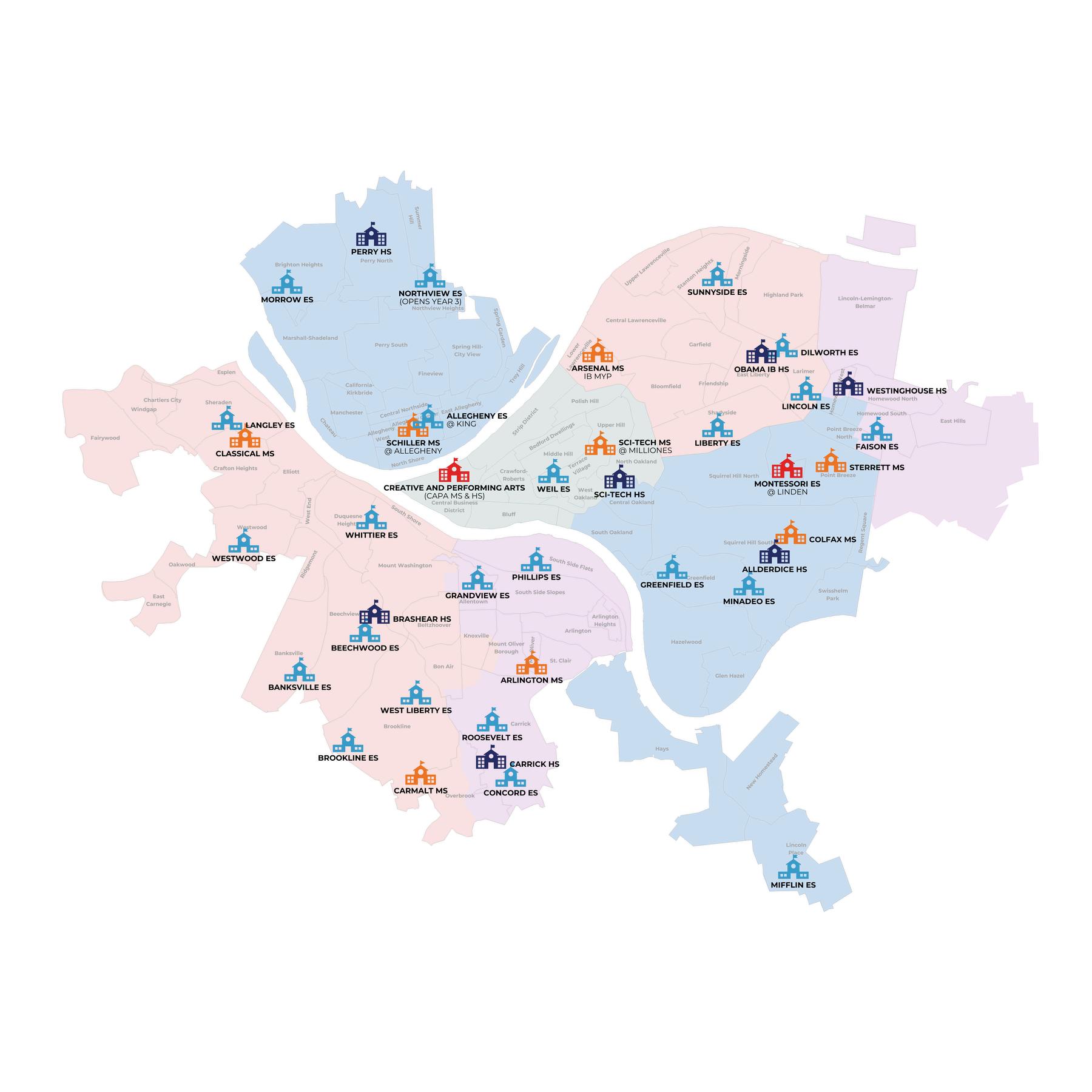
UPDATED ALL SCHOOLS
Attendance Zones & Feeder Patterns
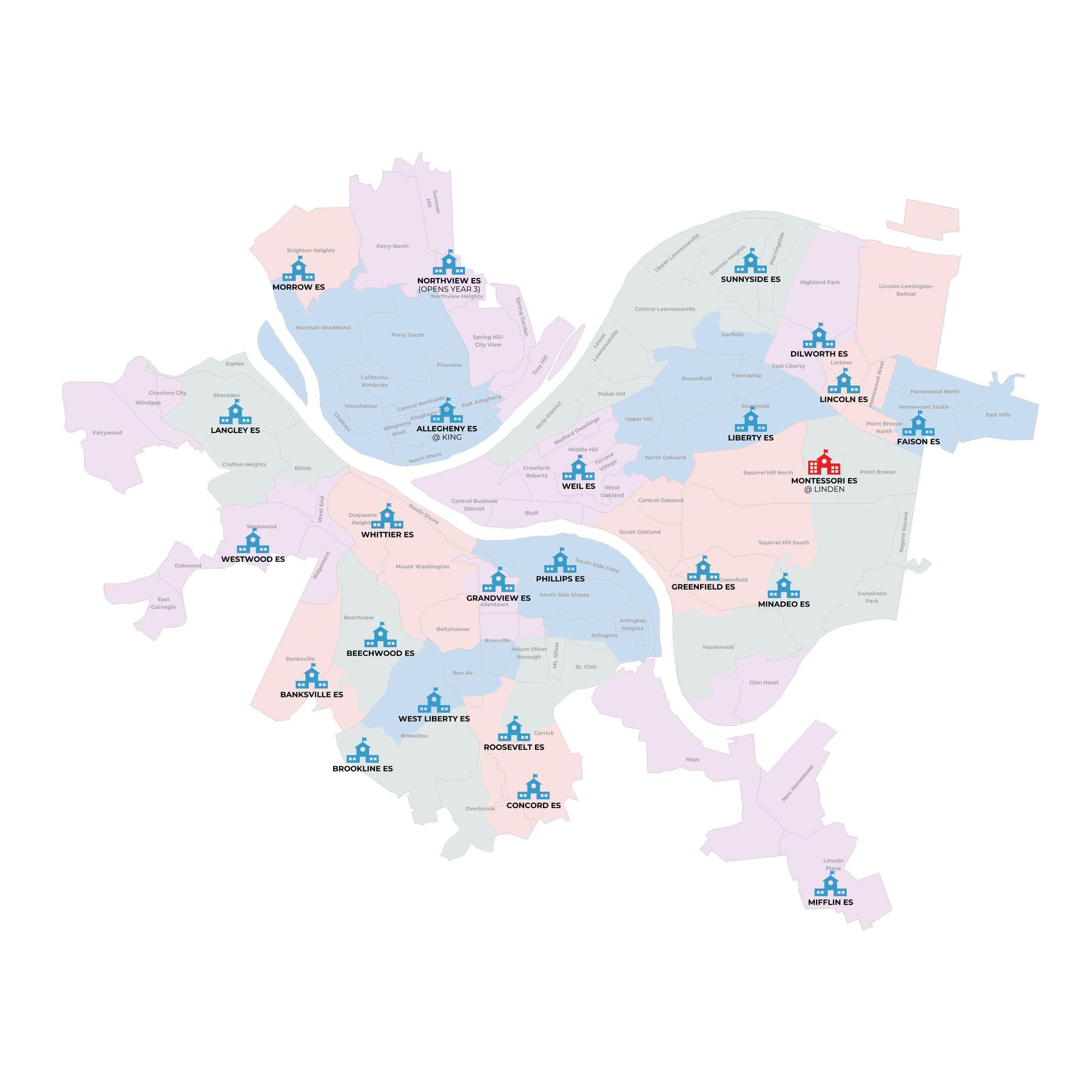
UPDATED ELEMENTARY SCHOOLS
ATTENDANCEZONE
Attendance Zones & Feeder Patterns
UPDATED MIDDLE SCHOOLS
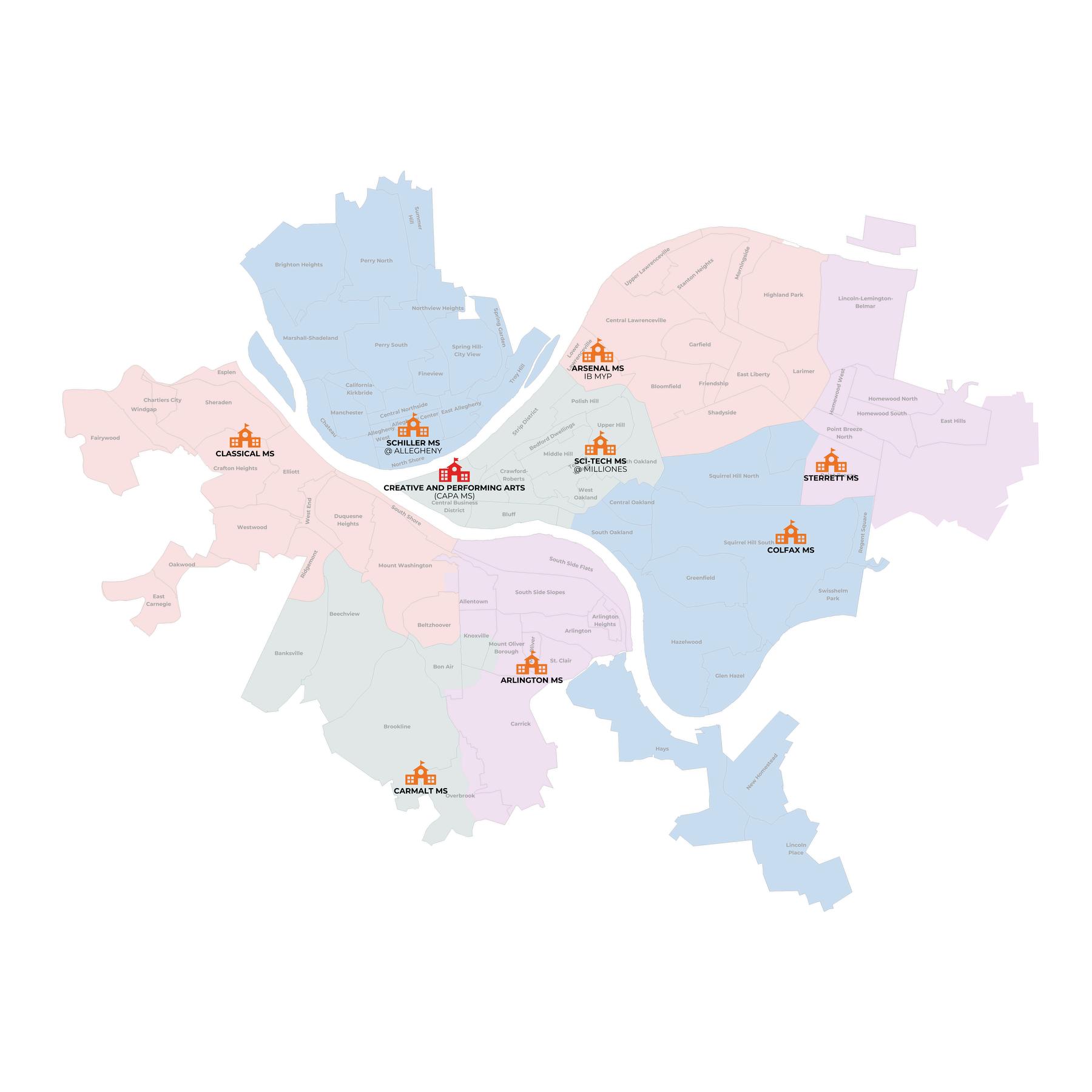

MS=MIDDLESCHOOL(6-8)

MAGNETSCHOOL
Attendance Zones & Feeder Patterns
HIGH SCHOOLS
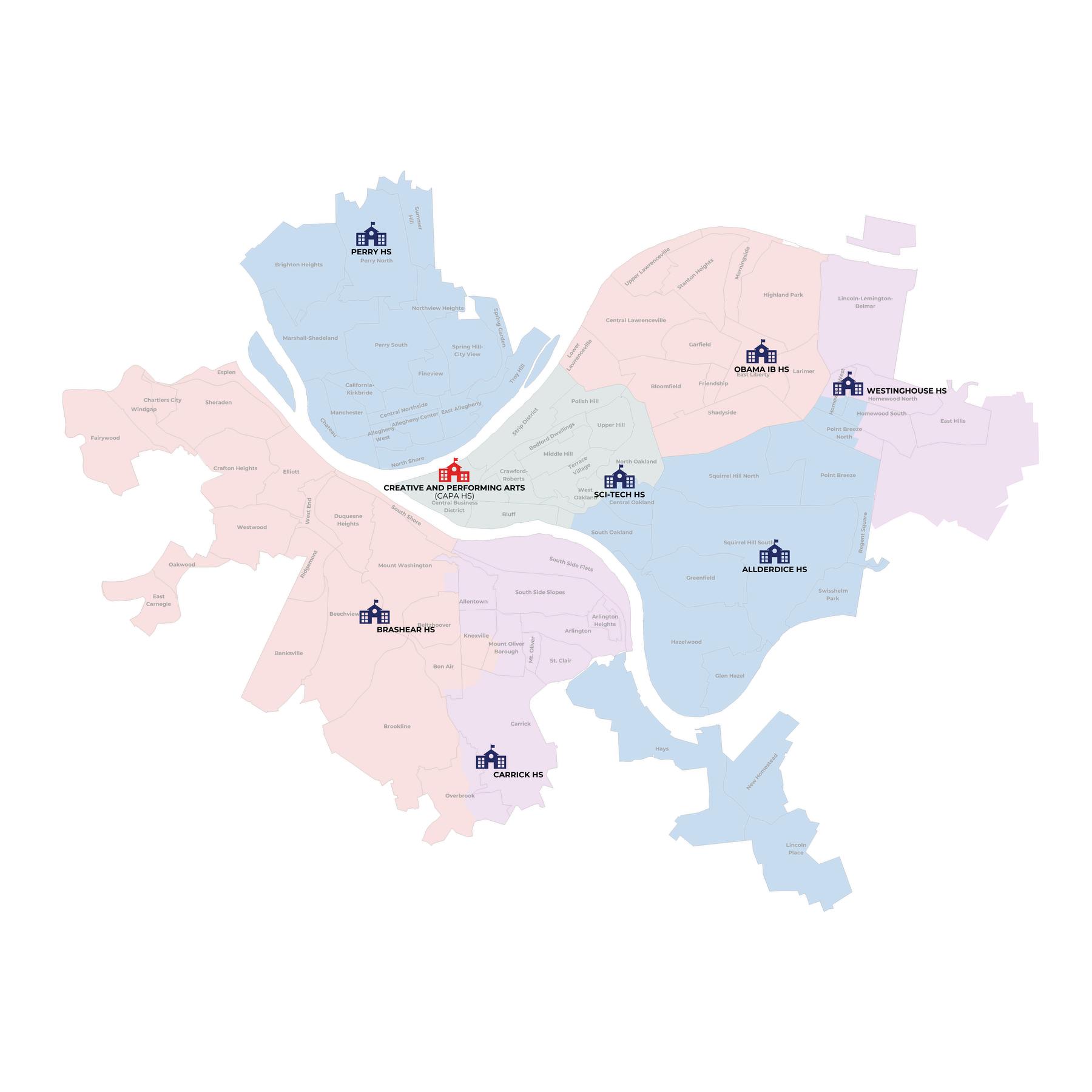

HS=HIGHSCHOOL(9-12)
MAGNETSCHOOL
How Families Can Find Their Proposed School Assignment
Understanding how proposed changes may affect students is a central priority for families. To support transparency and ensure accessibility, PPS has developed tools and resources that allow families to view proposed school assignments and feeder patterns
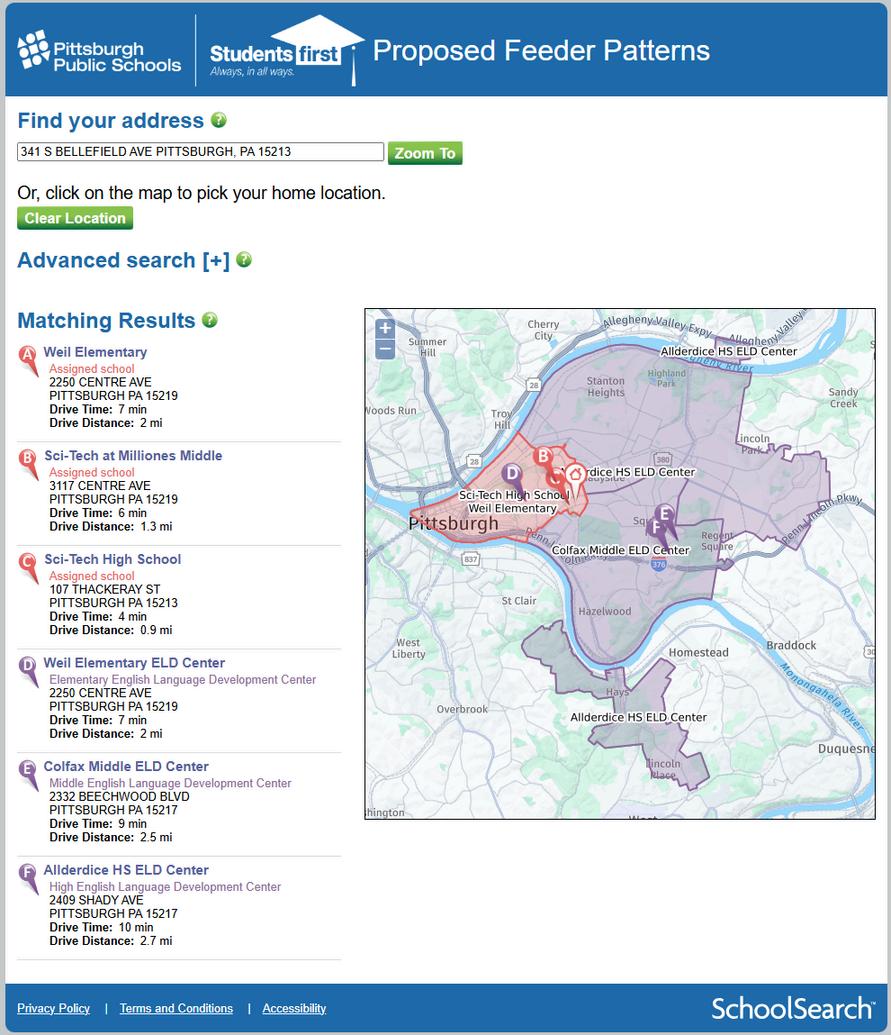
Find My School Tool
An interactive map on the PPS website allows families to enter their home address and immediately see their assigned school at each grade level. This tool highlights neighborhood schools, feeder pathways, and ELD centers

Attendance Zones & Feeder Patterns
Simplifying Enrollment for families
Online Enrollment System
When families register new or returning students for the 2026-2027 school year, the online enrollment system will use the child’s grade level and address to identify the correct school and confirm placement with a map view
Mailings and Communications
Families will receive letters confirming their child’s 2026–27 school assignment, even if their enrollment is unchanged. This ensures all families are informed.
FAQs and Translations
Instructions and resources will be available in multiple languages to make the process user-friendly and accessible
simplified
Attendance Zones & Feeder Patterns
Adjustments and Supports for Transitions
PPS recognizes that changes in school assignments can be stressful for students, families, and staff To ensure smooth transitions, the District is putting in place a series of supports that will help schools prepare and families feel confident about what comes next These supports are designed to provide timely information, minimize disruption, and keep lines of communication open as the new attendance zones and feeder patterns are phased in
To support schools and families during the transition:
Student Profiles for Schools: Receiving schools will be given profiles of incoming students by grade and subgroup, including historical academic, attendance, and behavior data This ensures principals and teachers are ready to welcome new students with the right supports in place.
System Updates: The Student Information System (SIS) will be updated with the new zones so school staff can plan enrollment, scheduling, and resources well in advance of the 2026–27 school year.
Transition Years: Clear temporary school assignments are built into the plan for the 2026–27 and 2027–28 school years, particularly for students affected by the phased opening of new schools. This prevents confusion and helps families understand what to expect throughout the transition.
Ongoing Feedback: As the plan advances, PPS will continue to monitor feedback from families and community members to inform ongoing implementation The District is committed to maintaining open communication and thoughtful consideration of stakeholder input
Attendance Zones & Feeder Patterns
Anticipated Benefits
The aligned attendance zones and feeder patterns will deliver a range of benefits for students, families, and schools. The new design primarily addresses the challenge of under-enrolled schools. By reducing the number of schools operating far below capacity, PPS can better align staff, programs, and resources with student needs. This means more schools will be able to offer the full range of experiences for students, from advanced courses to arts programs and specialized supports.
The plan also creates clearer and more consistent feeder pathways Predictable transitions mean students can move from elementary to middle to high school with their peers, which strengthens relationships and helps them feel supported during key milestones. Transportation is also simplified as new boundaries reduce assignments that require students to cross major barriers such as highways or rivers, making school travel safer and more practical.
Finally, these changes are designed to strengthen family confidence in school assignments Tools like the Find My School lookup give families a clear view of where their child will be assigned, while mailings, FAQs, and translations provide easy-tounderstand information Together, these efforts will ensure transparency and build trust as the new plan is put in place
Building Fair and Sustainable Pathways for the Future
Redesigning attendance zones and feeder patterns represents one of the most significant shifts in recent PPS history It directly affects where students enroll, how they move through the system, and what opportunities are available to them While change can bring uncertainty, this process is rooted in data, equity, and transparency PPS is committed to communicating clearly, listening to families, and supporting students and schools every step of the way.
By placing students first, the District is building attendance zones and feeder pathways that are fairer, stronger, and more sustainable for the future.