
Future-Ready Implementation Plan
chapter six
Equity in Student Support
This Chapter Serves as a Direct Response to Board Request #7: Addressing support for students facing greatest challenges (i.e. African-American, Economically Disadvantaged, students with IEP, and English Language Learners)
Equity as the Quality Bar
In Pittsburgh Public Schools (PPS), the measure of quality is equity The District’s Future-Ready Facilities Plan is about more than buildings and boundaries It is about ensuring that every child, in every neighborhood, experiences continuity, stability, and opportunity As PPS moves forward with school reconfigurations and program realignments, the District’s guiding principle remains clear: the quality bar for this work is whether it improves the daily experience of students who face the greatest barriers to success.
More than 16,000 students, over 83 percent of the District’s enrollment, identify with one or more of the groups most impacted by systemic inequities: African American and Brown students, English Learners, students with Individualized Education Programs (IEPs), and those from low-income families For these students, success will not be measured by construction timelines or enrollment charts, but by whether their new school environments are places of belonging, support, and academic growth. While all students experience change during transitions, the impact is not felt equally. History and data show that African American students continue to face disproportionate discipline, limited access to advanced courses, and too few teachers of color Students with IEPs or 504 plans are at risk of service interruptions when schools close or merge English Learners may encounter barriers when language supports are not available in new settings, and economically disadvantaged students can lose access to critical services such as afterschool care, nutrition programs, and mental health supports.
For PPS, addressing these inequities is not an add-on it is the foundation of the Future-Ready Facilities Plan. The District’s approach centers on one belief: continuity equals equity. Ensuring that students maintain consistent supports, stable relationships, and clear communication through change is the most effective way to protect their learning and well-being
Equity in Student Support
four core strategies
To help students and families experience transitions as smooth and positive, PPS is implementing four interconnected strategies that reflect national best practices and local lessons learned
Guaranteeing Service Continuity
Every student will carry their supports with them, not lose them in the move IEP, 504, and English Language Development (ELD) services will follow each student between sending and receiving schools Program officers, case managers, and principals will coordinate directly to ensure that services begin on day one at the new site.
The expansion of ELD Regional Centers plays a major role in this effort. By establishing additional Regional Centers across the city, PPS brings ELD instruction closer to home for families and ensures that certified staff are available in every region This eliminates long commutes, provides more consistent instruction, and allows families to remain active partners in their child’s learning Translation and interpretation services, both human and technology-assisted, will supplement existing tools to ensure that no family misses critical information about their child’s education.

Stabilizing Relationships
Relationships are at the heart of learning. When schools change, PPS will seek to prioritize the adults students know and trust. Whenever possible, familiar staff will move with students to maintain continuity of care.
To reinforce this support network, PPS is strengthening its partnerships with community organizations such as the Department of Human Services (DHS), Out-of-School-Time providers, and behavioral health agencies. Together, they will help meet the broader needs of students and families from socialemotional counseling to food access and mentorship.
Equity in Student Support
Intentional Communication
Families will not be left to figure things out on their own Each family will receive a translated and ADA-accessible welcome packet with information about services, programs, and key contacts. PPS will use a multi-channel communication planemail, text, postal mail, school apps, and social media - to provide regular updates.
Every school will have a designated point of contact to answer questions and address challenges quickly This approach ensures that information is accurate, accessible, and timely, particularly for families of English Learners, students with disabilities, and those new to the District.
Cultural and Symbolic Supports
Transitions can be emotional for students. To help them feel a sense of belonging, receiving schools will organize Walk-theRoute activities, open houses, and Social-Emotional Learning (SEL) activities to help students connect with their new peers and teachers. Transition days and special after school events will mark the beginning of a unified school Community
These symbolic gestures send a powerful message: students are not outsiders being moved from one building to another they are valued members of their new school family.
Equity in Student Support
Evidence-Based Foundations
PPS strategies are grounded in proven research:
Multi-Tiered Systems of Support (MTSS) Studies show that MTSS frameworks combining academic, behavioral, and social-emotional interventions significantly increase student achievement and reduce disciplinary incidents. PPS’s layered supports, including school-based counseling, sensory rooms, and BCBA collaboration, reflect MTSS principles
Culturally Responsive Practices Research by the Council for Exceptional Children emphasizes that culturally responsive teaching and behavioral planning reduce disproportionality in discipline and special education identification. Training staff in culturally responsive strategies aligns with these findings.
Family–School Partnerships According to the National Center for Parent Information and Resources, regular family engagement and two-way communication are key predictors of improved IEP outcomes PPS’s structured feedback loops, parent surveys, and advisory groups are designed to strengthen these partnerships
Stable Staffing Research in special education underscores that staff consistency supports stronger student–teacher relationships and higher IEP goal attainment. By redeploying current staff and focusing on paraprofessional recruitment and retention, the district ensures continuity that is critical for students with exceptionalities
By anchoring its strategies in these evidence-based approaches, PPS ensures that interventions are not only compliant with federal and state mandates but also proven to foster lasting academic, social, and emotional growth.
Equity in Student Support
Students with Exceptionalities – Stability and Growth
For students with disabilities, especially those who also face economic hardship, language barriers, or racial inequities, continuity and care are essential. These students often rely on school-based supports not only for academic growth but also for daily stability, communication, and social-emotional development. The FutureReady Facilities Plan acknowledges that when school buildings or programs change, students with exceptionalities must experience those changes as predictable, supported, and seamless.
Pittsburgh Public Schools’ Program for Students with Exceptionalities (PSE) is committed to protecting each student’s right to consistent, high-quality services The District’s approach focuses on preventing service gaps, strengthening inclusive practices, stabilizing staffing, and expanding behavioral and emotional supports so that every child thrives through transition
Multi-Layered Monitoring and Compliance
To ensure uninterrupted services and legal compliance, PPS will implement a multitiered monitoring system throughout the transition process. This layered system ensures that transitions never interrupt a student’s access to the individualized services they depend on
IEP Service Tracking: Program officers and school-based case managers will use centralized service logs to verify that every IEP related service, such as speech therapy, occupational therapy and counseling are delivered
Regular Progress Reviews: Schools will hold structured IEP progress meetings 30-60 days after transitioning to identify any needed, missed or delayed services and to adjust support promptly.
Central Oversight: The PSE Department will conduct ongoing audits of IEP timelines and documentation to maintain alignment with federal and state mandates, ensuring full compliance and accountability.
Data Integration: Service delivery data will be cross-referenced with attendance, climate, and achievement indicators on the Students First Dashboard to flag early concerns
Equity in Student Support
Stability Through Staffing and Relationships
Relationships are at the core of effective special education. Students with disabilities thrive when supported by adults they trust. PPS will prioritize staff stability and continuity through careful human resource planning:
Redeployment of Current Staff: Whenever possible, teachers, paraprofessionals, and related service providers will move with students to new buildings, maintaining trusted relationships and historical knowledge
Targeted Recruitment and Retention: To stabilize paraprofessional coverage, a critical role in special education classrooms, PPS is expanding ongoing recruitment and retention efforts.
Professional Development and Support: Program officers and department supervisors will provide technical support and coaching to ensure that new staff receive proper training in IEP implementation and inclusive instruction
This approach minimizes disruption and ensures that students with exceptionalities experience continuity of care and instruction even as facilities evolve
Strengthened Behavioral and Emotional Supports
Transitions can be especially challenging for students who struggle with behavior regulation or social-emotional skills. PPS will strengthen supports through proactive planning, expanded expertise, and inclusive environments:
School-Based Counseling and Social Work: Additional counseling check-ins during the first weeks of transition will help students navigate emotional adjustments and strengthen coping skills
Calming Spaces and Sensory Rooms: Each receiving school will have designated sensory or calm-down spaces to provide structured self-regulation opportunities
Expanded Board-Certified Behavior Analyst (BCBA) Services: BCBAs will collaborate with teachers to develop proactive, culturally responsive behavior plans and train staff in positive behavior supports
Equity in Student Support
Integration with MTSS and SEL Frameworks: Behavioral interventions will be aligned with the Multi-Tiered System of Supports (MTSS) and Social-Emotional Learning (SEL) practices to create a consistent, supportive environment across classrooms
Through these layered supports, PPS aims to reduce crisis responses, improve selfregulation, and build student confidence during times of change
Family Engagement and Accessibility
Family partnership is central to effective special education PPS recognizes that transitions are most successful when families are fully informed and included in planning.
Accessible Communication: All IEP-related documents and notices will be available in families’ preferred languages, with interpretation support provided for meetings.
EA-III and Interpreter Support: Educational Assistants and interpreters will ensure that English Learner families of students with disabilities can actively participate in decision-making
Family Transition Conferences: Prior to reconfiguration, families will meet with staff to review each student’s IEP goals, discuss anticipated changes, and codevelop plans for continuity.
Feedback Channels: Family surveys and advisory sessions will inform ongoing improvements to service delivery, ensuring accountability and responsiveness.
By embedding accessibility and inclusion at every step, PPS ensures that no family faces transitions alone or uninformed
Monitored class Sizes and predictable Routines
Predictability and consistency are vital for students with disabilities, especially during transitions. The District will monitor class sizes in self-contained and inclusive settings to ensure individualized attention and consistent routines. Teachers will establish structured daily schedules and use visual supports to help students navigate new environments confidently.
Centering Equity for African American Students with Disabilities
Pittsburgh Public Schools recognizes the historical disparities that have shaped access and outcomes for African American students in special education National and local data confirm a pattern of both over-identification for certain disability categories (particularly emotional support) and under-identification for enrichment and gifted services. These trends reflect broader systemic bias rather than student ability.
To confront these inequities directly, PPS will:
Monitor identification patterns by race and disability category to ensure fair and accurate evaluation practices.
Provide bias-mitigation training for evaluators and school psychologists to address disproportionality
Collaborate with the Office of Equity and the PHRC Equity Advisory Panel (EAP) to ensure compliance with the Memorandum of Understanding and align corrective actions with district-wide accountability systems
Expand access to advanced coursework and enrichment opportunities so that African American students with disabilities are positioned for acceleration as well as support.
Incorporate culturally responsive practices in specially designed instruction (SDI), classroom instruction, and behavioral interventions, affirming student identity as a source of strength.
Through these measures, PPS is building a system where African American students with disabilities are seen not through the lens of deficit, but through one of capability and promise
Equity in Student Support
Gifted Education –Advancing Equity and Opportunity
For decades, access to gifted education in PPS reflected deep inequities. African American, low-income, multilingual, and twice-exceptional (2e) students were often under-identified or excluded altogether The Future-Ready Facilities Plan and the On Track to Equity Implementation Plan position gifted education as a key driver of equity, ensuring that every child with potential has access to enrichment, challenge, and acceleration no matter their background or school assignment
Shifting from Exclusion to Inclusion
The new Districtwide school-embedded gifted model redefines gifted education as part of the core instructional program rather than a separate track. This transformation builds on lessons from the 2012 Conciliation Agreement and subsequent MOUs, aligning directly with the District’s current Equity Advisory Panel commitments.
Key Components of the New Model
Universal Screening for All 2nd Graders: Every PPS second grader takes the NNAT3, a non-verbal, culturally fair assessment Students are compared to their peers within their own schools, identifying the top 10 percent at each site This ensures that gifted identification reflects local context rather than privilege
Multiple Entry Points: Integration with the Multi-Tiered System of Support (MTSS) allows students who show emerging or domain-specific strengths to be considered later, so gifted identification is an ongoing process, not a one-time test.
School-Based Gifted Educators: Dedicated Gifted Liaisons and certified Gifted Teachers are embedded within K-8 buildings, ensuring services occur in students’ home schools. This eliminates transportation barriers and keeps gifted support connected to daily instruction.
Professional Learning for Staff: Teachers receive training on bias-free identification, culturally responsive enrichment, and strategies for differentiating instruction so advanced learning is inclusive of African American, English Learner, and 2e students.
Equity in Student Support
Family Engagement: All materials for the Gifted Individualized Education Program (GIEP) are written in plain language and translated into families’ preferred languages Bilingual staff and interpreters support GIEP meetings so families can fully participate in goal-setting and progress monitoring
Equity Audits and Data Dashboards: The Office of Data, Research, Evaluation and Assessment (DREA) will publish disaggregated data by race, income, language, and disability to monitor representation and outcomes Dashboards will track participation, achievement, and enrichment access.
Support for Twice-Exceptional (2e) Students: Coordinated planning between the Gifted and PSE teams ensures that disabilities do not mask giftedness or vice versa. Individualized supports and staff collaboration make it possible for 2e students to thrive.
Implementation Timeline
and Awareness
Continue universal NNAT3 screening in all second grades
Begin professional learning on equitable identification and instruction
Deploy Gifted Liaisons to historically under-identified schools.
Transition to schoolembedded model with Gifted Educators in every K-5 and 6-8 school.
Integrate identification into MTSS with multiple review points each year
Release the first public equity dashboard showing gifted participation by subgroup
Extend enrichment opportunities through a schoolwide enrichment model so all students experience inquiry, creativity, and challenge
Increase targeted supports for twice-exceptional students
Provide principal training on building equitable talent pipelines.
Equity in Student Support
Expansion of English Language Development (ELD) Regional Centers
PPS has experienced rapid growth in its English Learner population up 48 percent in just three years, from 1,214 to 1,798 students, reaching 1,990 as of September 2025 To meet this growth with equity, the District is establishing new ELD Regional Centers that expand access to high-quality programs across all regions of the city
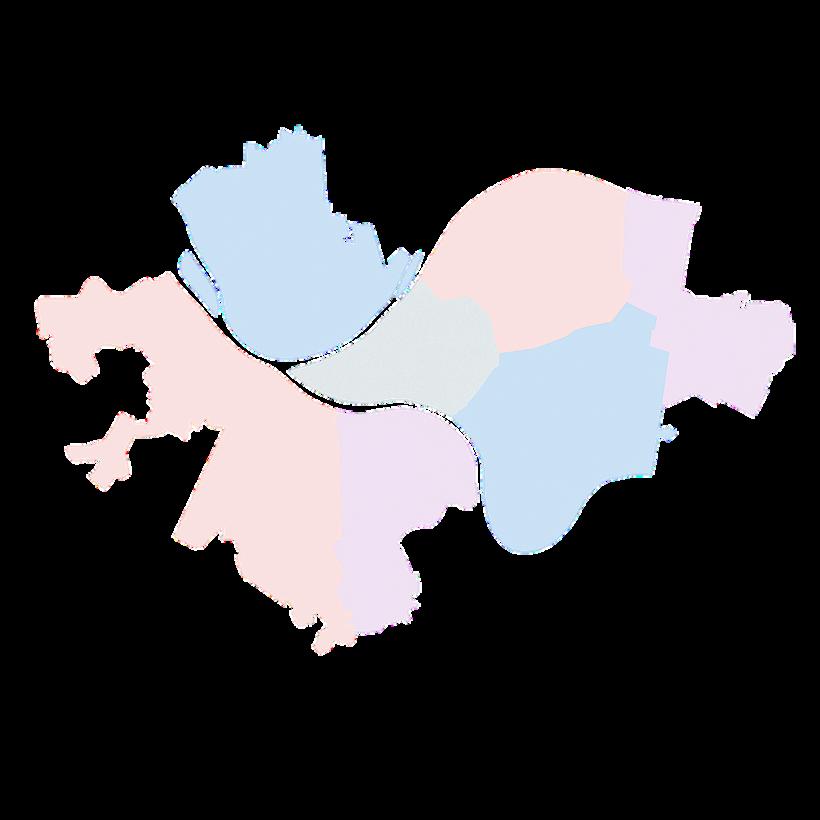


ES=ELEMENTARYSCHOOL(K-5)
MS=MIDDLESCHOOL(6-8)
Together, these centers create a citywide network that reduces transportation barriers, promotes family engagement, and guarantees access to consistent, certified language instruction close to home.
Equity in Student Support
English Learners – Next-Level Supports
Equitable access to ELD services will be ensured through a comprehensive and strategic approach
Timely screening and accurate placement for new EL students
School-based ELD content teachers to ensure access to core subjects
Lingua Pittsburgh ESL-certification pathway for interested content teachers (January 2026–May 2027).
Seven new ELD ELA positions created through content-area conversions.
Wraparound services: school tours, family nights, counseling training, and partnerships with Casa San José, Latino Community Center, JFCS Pittsburgh, ARYSE, and others to enhance belonging and cultural responsiveness.
Students who qualify for ELD services will be scheduled according to departmental guidance, with each Regional Center staffed to meet student needs under the ELD Service Delivery Model Paraprofessionals will be assigned strategically to support the linguistic and cultural diversity of each school.
To strengthen instruction in Math, Social Studies, and Science for grades 6–12, the ELD Department will move from a central allocation model to a school-based approach, ensuring that English Learners receive consistent ELD instruction in both Regional Centers and neighborhood schools.
In partnership with the Chief Academic Officer, the Office of School Performance, and school leaders, the ELD Department will identify Regional Center content teachers interested in pursuing ESL certification through the District’s Lingua Pittsburgh program. This initiative will help schools cultivate teams of ESL-certified content teachers who can either integrate support for English Learners directly into their classrooms or provide dedicated ELD content instruction. The program is scheduled to begin in January 2026 and conclude in May 2027.
To further expand capacity, several existing content positions will be converted to ELD ELA roles: two Math, one Social Studies, and one Science position at Brashear; one Math position at Allderdice; one Math position at South Hills; and one Math position at Arsenal K-5 These conversions will create seven new ELD ELA positions, strengthening support for English Learners across both Regional Centers and neighborhood schools.
Equity in Student Support
Additionally, ELA content teachers who hold ESL certification will embed targeted ELD ELA support for students who score 3.0 or higher on the WIDA ACCESS assessment
Pittsburgh Public Schools will continue to collaborate with community partners such as Casa San José, the Latino Community Center, JFCS, ARYSE, Hello Neighbor, and others to provide culturally responsive outreach, family engagement, and professional learning. These partnerships bring vital expertise and trusted relationships that help multilingual families navigate transitions with confidence.
learning
Professional Learning and Capacity Building
Supporting students who face the greatest challenges requires skilled, empathetic educators. PPS will expand professional learning on culturally relevant pedagogy, Universal Design for Learning, trauma-informed care, and inclusive practices.
The Teaching and Learning Center will serve as a hub for coaching, mentoring, and collaboration Asynchronous learning modules will provide flexibility for staff, while leadership teams will engage in targeted coaching on building inclusive school cultures and family partnerships
Professional learning will prepare staff to support diverse learners through: Culturally relevant pedagogy, Universal Design for Learning, and inclusive practices.
Asynchronous modules on IEP implementation, gifted education, and traumainformed care.
Coaching and mentoring through the Teaching and Learning Center
Focus on collaboration between general and special educators and familyengagement strategies that build trust
Office of School Performance to this list by stating: Ongoing coaching and support for school leaders from the Office of School Performance.
From Gatekeeping to Gateway: The Future of Gifted Education
The transformation of PPS’s Gifted Education model represents one of the District’s most significant equity shifts. Historically, access to gifted services was limited and inequitable. The new school-embedded model ensures that talent is recognized and nurtured in every neighborhood.
Beginning with universal NNAT3 screening in second grade, every child is evaluated using a culturally and linguistically fair assessment The top ten percent within each school are identified, increasing representation of African American, low-income, and multilingual students Gifted Liaisons and embedded educators will ensure that services are available in home schools, eliminating transportation barriers.
Equity in Student Support 2nd
Translated materials and bilingual support for Gifted IEP meetings (GIEPs) will further increase family participation. Early data already show increases in equitable identification, signaling a new chapter for access and representation in advanced learning
Equity in Student Support
Monitoring and Accountability
Transparency and data are central to accountability PPS will expand its Students First Dashboard to track new indicators tied directly to the Future-Ready Facilities Plan. These include:
Access to rigorous courses and programs, such as Algebra I in 8th grade and universal gifted screening.
Continuity of services for students with IEPs, 504 plans, and English Learners. Measures of student belonging and school climate.
The Office of Equity will lead 30-, 60-, and 90-day reviews of each receiving school to ensure that services have transferred smoothly and that students are engaged and supported Findings will be summarized in quarterly reports for the Board and shared publicly in simplified dashboards families can easily understand.
Coordination Across Departments
Equity is a shared responsibility across PPS. The Office of Equity will coordinate with:
Program for Students with Exceptionalities (PSE) and English Language Development (ELD) to ensure uninterrupted services; Curriculum and Instruction and the Office of Professional Learning to provide training on inclusive and culturally responsive instruction; Student Support Services to align counseling and SEL frameworks; Family and Community Engagement to host multilingual information sessions; and Communications to deliver clear, accessible updates. Office of School Performance to ensure a smooth transition.
This collaboration ensures that every department contributes to the goal of making transitions stable and equitable for all students
Equity in Student Support
The Equity Advisory Panel (EAP) and PHRC MOU
The Memorandum of Understanding (MOU) with the Pennsylvania Human Relations Commission provides the accountability framework for racial equity
Its commitments, reducing achievement and discipline gaps, expanding advanced coursework, and ensuring fair access, are embedded in all transition planning.
Equity metrics will focus on African American student outcomes in attendance, discipline, course access, and climate.
Professional learning will target culturally responsive pedagogy and restorative practices.
Regular reports to the EAP, PHRC, and Board will provide public transparency
Evaluation and Continuous Improvement
In Year 1, PPS will implement a continuous improvement cycle:
Regular progress reviews of IEP and ELD goals
Family feedback through surveys, advisory groups, and conferences
Data analysis to identify trends and adjust supports promptly.
Conclusion and Next Steps
The Future-Ready Facilities Plan is, at its core, a promise to rebuild not only schools, but trust. For African American students, English Learners, students with exceptionalities, and those from low-income families, the District’s goal is to make every transition a step toward a stronger, fairer, and more inclusive PPS.
By expanding regional centers, ensuring service continuity, investing in staff development, and holding itself accountable through transparent data, PPS is building a system where equity is not an aspiration but a daily practice.
In this way, change becomes more than reconfiguration—it becomes transformation. Each student will not simply adapt to a new building but thrive within it, knowing that they are seen, supported, and valued as the heart of a Future-Ready Pittsburgh Public Schools.