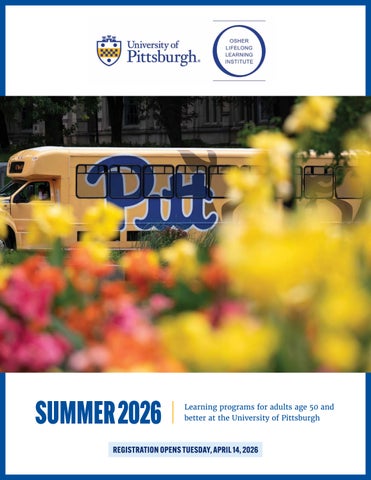
Learning programs for adults age 50 and better at the University of Pittsburgh
REGISTRATION OPENS TUESDAY, APRIL 14, 2026
Clicking on an item in the table of contents will take you to its corresponding page in the catalog.
OLLI summer term financial assistance application period MARCH 30 – JULY 1, 2026
OLLI course registration opens APRIL 14 OLLI Open House (online) APRIL 23
University summer classes begin (for audit courses) MAY 11 No OLLI membership refunds issued after MAY 14 OLLI session 1 begins MAY 22 University add/drop period ends (for audit courses) MAY 22
Memorial Day, University and OLLI closed MAY 25
Juneteenth, University and OLLI closed
OLLI session 1 ends
JUNE 19
JUNE 29 Independence Day, University and OLLI closed
OLLI session 2 begins
OLLI session 2 ends
Established in 2005 at the University of Pittsburgh, the Osher Lifelong Learning Institute (OLLI) is one of over 120 OLLI programs located on college campuses throughout the United States. OLLI at Pitt seeks to create a dedicated intellectual environment for learners aged 50 and better by offering non-credit and engaging college-level courses, providing opportunities for social interaction, and maintaining connections to the vibrant University community. OLLI at Pitt’s instructors include current and retired faculty from the University of Pittsburgh and others from the diverse and talent-filled Pittsburgh area and beyond. The OLLI at Pitt program nurtures a passion for learning and contributes to the health and engagement of the older adult community.
Phone: 412-624-7308 | Email: osher@pitt.edu | Office Hours: Monday – Friday, 8:30 a.m. – 4 p.m. 4227 Fifth Avenue, 710 Alumni Hall, Pittsburgh, PA 15260
JULY 3
JULY 6
AUG. 7
An active OLLI membership is required to register for courses.
• Unlimited access to in-person and online OLLI at Pitt courses
• Admission to in-person and online onetime lectures and special events
• Ability to join local tours, day trips, and travel opportunities
• University of Pittsburgh privileges (Wi-Fi, campus shuttles, library)
• Discount tickets to Pittsburgh cultural events through the Pitt Arts Cheap Seats program
• Ability to audit up to two undergraduate Pitt courses each term without additional costs
Term memberships cover just one term for $150.
Scholarships based on financial need are available per term.
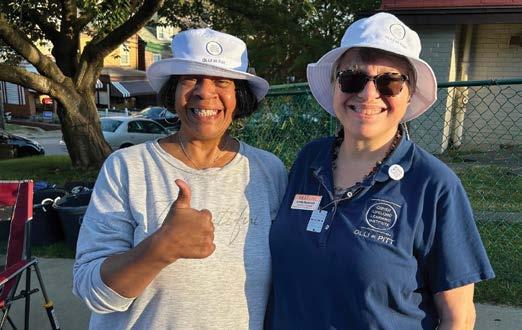
What can you expect from your OLLI at Pitt course? Our course type categories will help you understand the structure of the class and instructor expectations of participation:
LECTURE —These courses are primarily oral presentations where information, history, theories, or ideas are presented by instructors with occasional contributions from participants through questions and answers.
For more information on membership, course registration, auditing classes, and scholarships, visit the website:
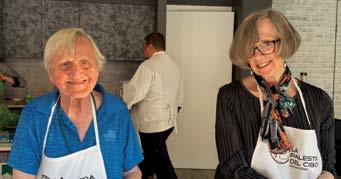
DISCUSSION —These courses can be on academic, cultural, or enrichment topics where participants are welcome to talk and contribute to class dialogue through open class discussions.
ACTIVE LEARNING —These courses require a high degree of participants' active involvement and practice (language, painting, exercise, etc.).
May 22 – June 29, 2026
The courses below are current as of March 31, 2026. For the most up-to-date course information, always consult the OLLI at Pitt website at olli.pitt.edu. Clicking on each course title will take you to its course description in the catalog.
Gentle Yoga A
Beginning Guitar, Part 1
Sustainable Food Systems
Introduction to Infectious Disease Epidemiology
Mertz and Rika Maeshiro
A Global History of Terrorism Rachel Oppenheimer
Madrid: The Heart and Soul of a Spanish Speaking City
Breath, Brush, and Meditation
Propaganda and Public Diplomacy
Mandarin Chinese for Tourists
First We Plant the Seed: From Poet’s Notebook Into Poems
Masters of the Keys: The Great Classical Pianists
TUESDAY
Cyanotype: An Alternative Printing Process
History of Food, Part 1
The Case Against Extreme Wealth
Art of the French Revolution: Baroque to Romanticism
Chair Yoga to Reset Your Nervous System
15 Most Authoritarian Countries in the World
Country Dance
Humor, Humanity, and Scientific Understanding
Fairy Tales and Greek Myths: A Comparative Study
WEDNESDAY
Yoga B
The Rom-Com, Part 2: Romantic Comedies
Palomo Fernandez
Hudson-Richards
Zoraster
Spence
Histories of Outer Space, Part 1 Robert Peckyno
Modern Grandparenting: Child Development and Care
May 22 – June 29, 2026
WEDNESDAY
Driving Destiny: James Polk and Westward Expansion
Mixed Media Mashup
Between Cultures and Selves: Wisdom from the In-Between
Architecture: Traditions and Creativity
The Music and Legacy of Stephen C. Foster
Western Pennsylvania Historic Places: A Virtual Tour, Part 1
Wines from Australia, New Zealand, and South Africa
THURSDAY
to Biochemistry and Metabolism
Mural Painters of Tuscany, Part 1
Advanced Conversational
Active Minds: Using Improv to Strengthen Your Brain
Map of the World, Part 1
FRIDAY
Intermediate Level French: Grammar
Gotta Dance the Movies, Gotta Dance Broadway
Sendek-Sapp
and Candy Caponegro
Social Media for Novices Vernard Alexander
Prelude to Civil War: 1840 to 1860 John Burt
Global Integrity: Combating International Corruption Shawn
The courses below are current as of March 31, 2026. For the most up-to-date course information, always consult the OLLI at Pitt website at olli.pitt.edu. Clicking on each course title will take you to its course description in the catalog.
Today's Technology: How Does It Work?
From Foragers to Empires: The Beginnings of Human History
Campaign
Health, Neighborhoods, and Everyday Life
People of the North: Indigenous Cultures of Canada and Alaska
Surprising Conflicts, Questions, and People of the Holocaust
Brush, and Meditation (continued)
Practical Cybersecurity for Everyday Life
TUESDAY
Pennsylvania Historic Places: A Virtual Tour, Part 2
Abraham and Isaac in Midrash, Art, Philosophy, and Poetry
Art of Glassmaking: Stained Glass Through Studio Glass
Latamore
Online course In-person course
Hybrid course (classes that meet in person and are also streamed online)
July 6 – Aug. 7, 2026
WEDNESDAY
Downtown Pittsburgh as an Open Air Art Museum
Standing on Guard for Thee: A History of Modern Canada
The Boiling Republic: The Coming of the Civil War
Meltdown Expected: Crisis at the End of the 1970s
of Romanticism
Historic Ballparks
Broadcasting Underground: Rock and the FM Radio Revolution
The Science of Vaccination
THURSDAY
Ever Wonder How Fire Works? Here’s Why It Matters
Intermediate Level (continued)
Empowering Yourself through Computer Literacy
Obscure U.S. Presidents and Why They Matter
Advanced Conversational
Mural Painters of Tuscany, Part 2
Myth in Art
Villains to Die For
Pittsburgh in The French and Indian War
FRIDAY
Intermediate Level French: Grammar (continued)
Lights! Camera! Action! Eclectic Topics on Broadway and Movies
Literary Self-Expression: Proverbs, Song Lyrics, and Fables
Artificial Intelligence (AI) in Your Healthcare
and Candy Caponegro
15 Most Authoritarian Countries in the World
Paul Macek
TUESDAYS, 1 – 2:30 P.M.
Session: 1 (5 classes)
Modality: Online
Abraham and Isaac in Midrash, Art, Philosophy, and Poetry
Sarah Rosenson
TUESDAYS, 3 – 4:30 P.M.
Session: 2 (5 classes)
Modality: Online
Sydney DuBose
THURSDAYS, 1 – 2:50 P.M.
Session: 1 (5 classes)
Modality: In-person
Thomas Edmonds
WEDNESDAYS, 1 – 2:50 P.M.
Session: 1 (5 classes)
Modality: In-person
This course explores the 15 most authoritarian regimes in the world: China, Nicaragua, Saudi Arabia, Russia, Belarus, Eritrea, Iran, Yemen, Chad, Tajikistan, Syria, Central African Republic, North Korea, Myanmar, and Afghanistan. From geography to climate, to demographics, history, politics and government, economy and culture, each country will be analyzed according to a variety of indexes. The instructor welcomes a diversity of political thought.
In a well-known Bible story, Abraham almost sacrifices his son Isaac. This course will look at this text from five different angles: midrash, which are stories about the stories in the Bible that help to explain them; paintings of the scene by different artists; the philosopher Soren Kierkegaard's Fear and Trembling; the ways modern poets have used the imagery of this story in their work; and the viewpoint of Sarah, Abraham’s wife and Isaac’s mother. Advance reading is not required; all source materials will be provided during class.
While improv is primarily a comedy form, it can benefit the mind in numerous ways. It can strengthen cognitive processes, stimulate creative expression, and promote social interaction. In this course, members will learn comedic acting techniques and participate in exercises that can keep their brain healthy and adaptable. Not a comedian? Not a problem! This course is open to all levels. All you need is an open mind and a “yes, and” attitude.
This course will explore how American architecture reflects cultural values, technological change, and artistic vision, using a rich array of images. We will begin with Indigenous earthworks and conclude with contemporary eco-designs. Key historical eras include Mississippi culture, First Period, Georgian, Federal, Greek, and Victorian revivals, as well as modern Colonial Revival, Prairie, Art Deco, and Mid-Century Modern. Landmark buildings on the National Register of Historic Places will be featured.
James McHugh
THURSDAYS, 11 A.M. – 12:30 P.M.
Session: 1 (5 classes)
Modality: Online
Eleanor Schrader
TUESDAYS, 6 – 7:30 P.M.
Session: 2 (5 classes)
Modality: Online
Katherine Zoraster
TUESDAYS, 11 A.M. – 12:30 P.M.
Session: 1 (5 classes)
Modality: Online
Rebecca King
FRIDAYS, 1 – 2:30 P.M.
Session: 2 (5 classes)
Modality: Online
Daniel Rectenwald
MONDAYS, 10 – 11:50 A.M.
Session: 1 (5 classes)
Modality: In-person
This course will explore the history of political thought that has formed the basis of the American political system. It places particular emphasis upon two traditions: Modern Republicanism, which is inspired by the ideals of Ancient Roman Republicanism, and Classic Liberalism, which is particularly associated with the writings and ideas of John Locke. These traditions continue to explain and influence important aspects of American political beliefs.
The history of decorative glassmaking goes back 3,600 years, resulting in beautiful objects of art created throughout the ages, including vases, goblets, stained glass windows, and other decorative and useful items. From palaces and houses of worship to affordable household objects, this craft has evolved from a luxury item into a ubiquitous material for art, architecture, and personal use. This course will trace the development of glass blowing technology and will discuss various historical artistic styles in glass.
In late 17th century and 18th century France, art was used as a powerful tool by the ruling class and others seeking power and change. Through beauty and propaganda, art was used to present power, sway beliefs, extol virtue, and make social commentary. This course examines how French art developed from the Baroque under Louis XIV through Neoclassicism of the Enlightenment and the French Revolution, to Romanticism emerging at the onset of the 19th century.
Artificial Intelligence (AI) is already shaping the way we receive medical care, from scheduling appointments and billing insurance, to making diagnoses and recommending treatments. But most patients never realize it is happening. This course uncovers the hidden role of AI in healthcare, helping members better understand its benefits and limitations, and to ask better questions. The class will break down the jargon, share realworld examples, and provide strategies to help regain control.
This course will teach members how to play the guitar. Session topics will include tuning the guitar, basic chords, single-note playing, and basic note-reading. Members will learn a handful of songs from the American popular tradition, as well as scales and musical notation.
Note: This will be a hands-on group session, and members should have their own guitar.
Between Cultures and Selves: Wisdom from the In-Between
Kyoungah Lee
WEDNESDAYS, 1 – 2:30 P.M.
Session: 1 (5 classes)
Modality: Online
The Boiling Republic: The Coming of the Civil War
Jared Day
WEDNESDAYS, 11 A.M. – 12:30 P.M.
Session: 2 (5 classes)
Modality: Online
Breath, Brush, and Meditation
Elaine Bergstrom
MONDAYS, 1 – 2:30 P.M.
Session: 1 and 2 (9 classes)
Modality: Online
Broadcasting Underground: Rock and the FM Radio Revolution
James Pagliasotti
WEDNESDAYS, 6 – 7:30 P.M.
Session: 2 (5 classes)
Modality: Online
Ralph Bangs
TUESDAYS, 10:30 A.M. – NOON
Session: 1 (5 classes)
Modality: Hybrid
This exploratory, discussion-based course brings philosophy, culture, identity, and the self into conversation to explore what we can learn from living at the boundaries. Over five weeks, participants will reflect on where wisdom comes from, ask how culture shapes interpretation, and explore the tension between ego and confidence. The course concludes by exploring the “in-between” as a space for insight, freedom, and deeper understanding of ourselves and others.
This course discusses the origins and buildup to the American Civil War covering the period 1848 to 1861. It examines the interaction of slavery, states’ rights, and the “free soil” movement as critical foundation stones for this conflict and explores many of the key political figures of this era. Among them are Franklin Pierce, James Buchanan, and emerging notables such as Stephen Douglas and Abraham Lincoln.
Learn how to shed your monkey mind in this virtual program. Develop a new creative practice that has the potential to help you feel more settled and relaxed as well as less anxious and muddled. Your tools are your breath, a sumi brush, and sumi ink. You will learn wet and dry brush techniques, processes for making lines, dots, and swirls, and methods of producing tonal changes.
The advent of radio broadcasting in 1920 changed the relationship between traditional media and the audience. Immediate communication with the local community, a reach that soon became national, was made possible. Radio became the dominant source of news, weather, and entertainment in popular culture for 30 years. But when television replaced radio, rock 'n' roll emerged. This is the story of how radio recaptured a listening audience, shaped a generation, and gave birth to the classic era of rock music.
Can a person be too rich? Philosopher and economist Ingrid Robeyns answers that question in Limitarianism: The Case Against Extreme Wealth, 2024. She focuses on the practical, political, and moral problems of this wealth and concludes that we should strive to create a world in which no one is super-rich. We will examine this topic through the book, other materials, and guest speakers.
Note: This course will be taught at the Community Engagement Center in Homewood (622 N. Homewood Avenue, 15208) and via Zoom.
Joanne Spence
TUESDAYS, 11 A.M. – NOON
Session: 1 and 2 (10 classes)
Modality: Online
Jill Donnette Clary
FRIDAYS, 9 – 10 A.M.
Session: 1 (5 classes)
Modality: Online
David Brumble
THURSDAYS, 1 – 3 P.M.
Session: 2 (5 classes)
Modality: Online
SpearIt Maldonado
THURSDAYS, 1 – 2:30 P.M.
Session: 1 (5 classes)
Modality: Online
Foster Krupp
THURSDAYS, 1 – 2:50 P.M.
Session: 1 (5 classes)
Modality: In-person
Simple, accessible chair yoga can help restore balance to mind and body. Led by a veteran teacher and nervous system expert, each session blends gentle movement, mindful breathing, and guided relaxation to release tension and cultivate calm. No special equipment or prior yoga experience is needed, just a chair and an open mind. Members will learn practical, repeatable techniques to shift from stress to ease, supporting resilience in daily life.
This course moves through traditional yoga poses (or asanas) that align each individual chakra, moving up the spine from the root chakra to the crown chakra. Chakras are energy centers located across different points on our spinal column. When energy becomes blocked in a chakra, it triggers imbalances that manifest in symptoms such as anxiety, lethargy, or poor digestion. This course is for members who like fluid, mindful practice that links alignment, movement, and breath. Participants should wear comfortable, loose-fitting clothing and have a yoga mat. While still accessible to a beginning student, this class is more challenging than the Gentle Yoga classes.
Artists have long painted and sculpted figures from classical myth and legend. We will be looking at a wide range of such art. We will talk about some ancient Greek and Roman art but will spend most of our time on Medieval and Renaissance art, such as Titian’s The Death of Actaeon, Veronese’s Venus and Mars, Dürer’s Hercules at the Crossroad, Botticelli’s Primavera and The Birth of Venus, and many others. Classes will concentrate on how artists interpreted the meaning of myths.
In this course, world religions including Christianity, Islam, Buddhism, Hinduism, and Sikhism, among others, will be examined through comparison. In examining the similarities and differences, this course focuses on theological beliefs and religious practices. The overarching goal of the course is to develop competence in the basic ideologies and rituals of global religious traditions and recognize the merits of interfaith study and dialogue.
Museums are in the headlines! This course is an exploration of the issues museums are facing today. Learn more about the history of museum robberies, the impact of governance on museums, the growing calls for repatriation of artifacts, and the emergence of the museum decolonization movement.
Kerry Handron
THURSDAYS, 10 – 11:50 A.M.
Session: 1 (5 classes)
Modality: In-person
Ariel Skovera
TUESDAYS, 10 – 11:50 A.M.
Session: 1 (5 classes)
Modality: In-person
Downtown Pittsburgh as an Open Air Art Museum
Howard Voigt
WEDNESDAYS, 10 – 11:50 A.M.
Session: 2 (5 classes)
Modality: In-person
Jared Day
WEDNESDAYS, 11 A.M. – 12:30 P.M.
Session: 1 (5 classes)
Modality: Online
Karen Bigrigg
THURSDAYS, 10 – 11:50 A.M.
Session: 2 (5 classes)
Modality: Hybrid
With new telescopes creating huge new databases, this is an exciting time in astronomical research. We will look at new discoveries in exoplanet research, early galaxy evolution, gravitation waves, fast radio bursts, planetary system formation, stellar evolution, the size of the universe, and will preview what we hope to soon learn about with the next generation of telescopes. Class interest will direct the course of the class.
Note: This course will be taught at the Allegheny Observatory, which is NOT on campus at the University of Pittsburgh.
Create your own vibrant blueprints using the 19th century alternative printing process known as the cyanotype. We will learn each step of the cyanotype process – from mixing the chemistry, to coating the paper, creating our design, and then exposing the images under UV light. This course will go over the history of the cyanotype process through brief lecture and then we will utilize the technique to produce our own pieces. We will make a photogram print, blueprint, and photographic print with this method.
Through hundreds of illuminating slides and graphic commentary, this course explores the Golden Triangle’s most treasured examples of public art, whether in an obvious outdoor location or in an obscure corner inside a building. This illustrated walking tour will examine statues and fountains, sculptures and reliefs, parks and plazas, stained glass windows and ornamental motifs, mosaics and murals, architectural features, and historical details.
This course examines one of America's least recognized but most consequential administrations in U.S. history. James K. Polk's single term in office (1845 – 1849) saw the Mexican-American War and America's acquisition of California and Oregon territories, setting the stage for the next phases of U.S. expansions, American Indian removal, and sectional crisis, all of which laid the groundwork for the Civil War. We will examine Polk's background and this under-explored but still critical period in American history.
This introductory course is designed to help beginners feel comfortable using a personal computer, either a desktop or laptop. The course will cover the basics of how to interact with a computer, including the differences between hardware and software, and how to exchange information with the machine. Members will learn how data is stored and used within a computer and how they can utilize basic computer productivity tools to complete specific goals.
Gaye Fifer
TUESDAYS, 1 – 2:30 P.M.
Session: 1 and 2 (10 classes)
Modality: In-person
Francis Deleonibus
THURSDAYS, 9 – 10:30 A.M.
Session: 2 (5 classes)
Modality: Online
Jennifer Fickley Baker and Andrew Peterson
TUESDAYS, 6 – 7:30 P.M.
Session: 1 (5 classes)
Modality: Online
Joseph Givvin
THURSDAYS, 1 – 2:50 P.M.
Session: 1 (5 classes)
Modality: In-person
Lynn O'Connor
MONDAYS, 1 – 2:50 P.M.
Session: 2 (5 classes)
Modality: In-person
This course, appropriate for members of any level, begins by teaching the basic figures used in English country dancing and practices them in the context of beautiful historic and modern dance compositions. Members will explore the grace, elegance, and playfulness of this dance form (think of Pride & Prejudice). No partner or experience necessary. Participants will regularly switch partners in our dance sessions. Be prepared for physical, mental, and social stimulation!
Fire is more than heat and flames; it is a chemical reaction that behaves in predictable yet complex ways. This course is an introduction to the science behind combustion, exploring how fuel, oxygen, and heat interact to create fire. Learn why understanding these principles is critical for anyone, from predicting fire behavior to staying safe in your own home and hazardous environments. This course is for members interested in fire safety, community preparedness, or simply curious about the science behind flames.
From heroes and heroines to princesses, crones, and monsters, this course will analyze iconic figures in European fairy tales and Greek myths to uncover their symbolism and cultural significance. The course will also examine how class, race, politics, and wealth shaped the creation and circulation of these stories, while highlighting lesser-known tales from underrepresented cultures. Through comparative readings and discussion, members will consider how these tales both reflect and influence culture.
This course examines issues in applying philosophical investigation techniques to questions in Judeo-Christian and Asian religious traditions. Topics include reasoning for and against God's existence, various conceptions of the Supreme Being(s), the problem of evil, the problem of truth and religious language, the question of an afterlife, an inquiry into the nature of faith and divine revelation, and the question of religious experience.
Will the United States retain birthright citizenship? The U.S. Supreme Court will hear oral arguments in the case Trump v. CASA, and hand down its decision in the summer of 2026. This class will look at the historical concept of citizenship, starting in the colonial era and continuing to modern times. The course will explore what it means to be a citizen at these critical points in the country's history, and what it will mean going forward in the 21st century in light of the Supreme Court's decision.
David Shifren
THURSDAYS, 1 – 4 P.M.
Session: 2 (5 classes)
Modality: In-person
Philip Terman
MONDAYS, 6 – 7:30 P.M.
Session: 1 (5 classes)
Modality: Online
Jon Grogan
THURSDAYS, 10 – 11:50 A.M.
Session: 2 (5 classes)
Modality: In-person
Alan Irvine
MONDAYS, 10 – 11:50 A.M.
Session: 2 (5 classes)
Modality: In-person
Jill Donnette Clary
MONDAYS, 9 – 10 A.M.
Session: 1 (5 classes)
Modality: Online
Many actors have said they prefer playing villains to heroes; portraying characters unfettered by moral inhibitions frees them up, gives them wider range, and is more fun. We will watch films with likable villains, then analyze how a talented actor can make an antisocial psychopath someone we would like to bring home to dinner. Films will include: Raising Arizona, The Sugarland Express, The Sting, Thelma and Louise, and Bonnie and Clyde
The artist Georges Braque said, “my sketchbook serves as a cookbook when I am hungry.” In this generative workshop, the notebook will be the garden where members will plant word-seeds inspired by responding to reading model poems on a specific theme each week and sketching and sharing notebook writings. Just as an artist's process of sketching can magically transform into a work of art, our daily writings, carefully nurtured through class conversation and suggestion, can magically transform into poems.
Washington, Jefferson, Jackson, Lincoln, and a handful of other U.S. presidents are household names. Their impact on American society is unquestionable. However, there are a handful of lesser-known chief executives whose decisions changed the course of American history: Martin Van Buren, James K. Polk, Rutherford B. Hayes, William McKinley, and Calvin Coolidge. This course will study their presidencies and explain why they matter.
A million years ago, early humans wandered the landscape, chasing game and creating tools. Eventually some of these people discovered agriculture and everything changed. More and stable resources brought about the growth of villages and towns, coalescing into kingdoms and then evervaster empires. This class will track the story of human civilization from earliest days to the great classical empires that spawned ideas of religion, philosophy, and political life still shaping our world today.
This course is geared for those new to yoga, those interested in a slower and more gentle practice, or those recovering from illness or injury. It includes a combination of meditation, breath work, and flowing movement intended for all abilities. Participants will move from seated on the floor (or a chair) to standing and then will return to mats. Participants will experiment with balance, strength, flexibility, and stillness while practicing mindfulness and meditation techniques.
Note: The Gentle Yoga A and B classes are companion courses. Members can register for both or just one.
Jill Donnette Clary
WEDNESDAYS, 9 – 10 A.M.
Session: 1 (5 classes)
Modality: Online
David Albert
MONDAYS, 10 – 11:50 A.M.
Session: 2 (6 classes)
Modality: In-person
Rachel Oppenheimer
MONDAYS, 11 A.M. – 12:30 P.M.
Session: 1 (5 classes)
Modality: Online
Shawn Sullivan
FRIDAYS, 1 – 2:30 P.M.
Session: 1 (5 classes)
Modality: Online
Sam and Candy Caponegro
FRIDAYS, 10 – 11:30 A.M.
Session: 1 (5 classes)
Modality: Online
See Gentle Yoga A
This course will examine the events leading up to the Battle of Gettysburg, the three-day battle itself, and the aftermath of what many consider the high-water mark of the Confederacy. The course will discuss many of the numerous controversies generated on both sides as well as the “who, what, where, when, and why” of one of the most important and studied campaigns in military history.
This course will acquaint members with the remarkably long, diverse, and widespread use of strategies of terror to advance political, economic, religious, and social agendas. Beginning with issues of defining terrorism, exploration will range from ancient societies to the present, and the class will examine terror as it occurred around the globe. Revolutionary terrorism and reactionary terrorism as well as terror by state and substate actors will be considered. The course will be thematic rather than strictly chronological.
This course explores the impact of international corruption on governance, human rights, and the global economy. Using high-profile case studies like the Panama Papers and Brazil’s “Operation Car Wash,” we will analyze how corruption is defined and measured. Members will examine national and international legal frameworks—including the U.S. Foreign Corrupt Practices Act and the UN Convention Against Corruption—and the critical role of investigative journalism. No prior legal knowledge is required.
If life’s a dance, music is the rhythm, and the choreographer is God, or the director, or both! In this course, we will explore the trademarks and styles of Gower Champion, Bob Fosse, Casey Nicholaw, Rob Ashford, Jerry Mitchell, Chris Gattelli, Josh Bergasse and many more. Join us, watch clips, and discuss from a director’s view of dance.
Colin Williams
TUESDAYS, 1 – 2:50 P.M.
Session: 2 (5 classes)
Modality: In-person
Latonya Latamore
MONDAYS, 11 A.M. – 12:30 P.M.
Session: 2 (5 classes)
Modality: Online
David Fetterman
TUESDAYS, 9 – 10:30 A.M.
Session: 2 (5 classes)
Modality: Online
Robert Peckyno
WEDNESDAYS, 10 – 11:50 A.M.
Session: 1 (5 classes)
Modality: In-person
Julia Hudson-Richards
TUESDAYS, 10 – 11:50 A.M.
Session: 1 (5 classes)
Modality: Hybrid
Stitch your way through history with this primer on the art of embroidery! From the Bayeux Tapestry to today's baseball hats, this timeless artform has shaped visual culture. This course will delve into the ways cultures have used sewing for decoration while teaching participants basic techniques. Part art history, part craft, this course will present a broad overview of sewing and its role in society from ancient times to the present day.
This course explores how where we live, policies around us, and systems shape our health and well-being. Everyday examples of health inequities and differences in outcomes across communities and groups will be explored. Each class will include a brief lecture, simple visuals, and guided discussion. Short optional readings and videos will be shared between classes. No background in health or policy is required, and the focus will be on practical understanding that connects to daily life.
This course examines the development and role of military chaplains in the United States from the Revolutionary War through the Vietnam War. We will examine how chaplains have provided spiritual care, moral guidance, and pastoral support to service members across various wars. The course will explore how chaplains have served both faith and country, ministering to soldiers in times of war, shaping military morale, and navigating complex religious and political environments.
Humans have studied the heavens since ancient times for agriculture, navigation, religion, and science. Today, humans have a full time presence in space and have sent robotic observers to every planet. But, how did we get here? This course will explore the people and events that helped drive developments in astronomy, rocketry, physics, math, robotics, communications, and more. The development of basic astronomy concepts will be discussed, but no scientific background is necessary.
This course will examine the history of food and the ways it contributes to our understanding of other areas of study, such as environmental, social, political, and economic history. We will look at the history of food in the United States within a larger global context to examine the ways in which our global trading networks are anchored by food and how food helps to define our societies, cultures, and identities.
Ralph Bangs
TUESDAYS, 10:30 A.M. – NOON
Session: 2 (5 classes)
Modality: Hybrid
French: Grammar
Cathleen Sendek-Sapp
FRIDAYS, 10 – 11:30 A.M.
Session: 1 and 2 (10 classes)
Modality: Online
Betsy Peitz
THURSDAYS, 10 – 11:50 A.M.
Session: 1 (5 classes)
Modality: In-person
Kristen Mertz and Rika Maeshiro
MONDAYS, 10 – 11:50 A.M.
Session: 1 (5 classes)
Modality: In-person
Camilo Jauregui
TUESDAYS, 9 – 10:30 A.M.
Session: 1 (5 classes)
Modality: Online
Can homelessness be solved simply with more social workers, mental health services, and housing? Or does it require addressing structural shifts in the capitalist economy, inequality, systemic racism, and neoliberal government policies? Patrick Markee answers these questions in Placeless: Homelessness in the New Gilded Age. We will examine homelessness today and possible solutions through his book, other materials, and guest speakers.
Note: This course will be taught at the Community Engagement Center in Homewood (622 N. Homewood Avenue, 15208) and via Zoom.
Each term, the focus of this course will be on studying the formation and uses of various French verb tenses. In addition to grammar-oriented textbook exercises, we will also deepen our understanding of many grammatical concepts. Participants will be encouraged to actively engage in both structured and free-form communicative activities. This course is geared to members who may still have difficulty in comfortably delivering simple sentences in French. Some prior knowledge of French is expected. Advanced speaking skills are not required.
Everyone has heard of DNA, but it makes up only about .25% of the total weight of a cell, while proteins account for 10 – 15% of a cell's weight. Starting with the structure of atoms, the periodic table, and the properties of carbon, this course will look at the structures of proteins, carbohydrates, and fats. Then we will go over the central metabolic pathways that release energy for the cell. We will finish with a discussion of some of the functions of ribonucleic acid (RNA).
What are the biggest infectious disease threats today? What diseases could be eradicated? This course will introduce members to basic concepts of infectious disease epidemiology with real life examples and interactive group activities. Members will learn about selected infectious diseases, work through an outbreak investigation, and see the potential for disease transmission in various settings. Each class will begin with a lecture to introduce terminology and concepts, followed by an individual or group work with examples.
This course offers an exciting journey through the vibrant and diverse world of Latin American music. Members will gain an introduction to the rich musical traditions of Latin America, exploring genres like cumbia, salsa, and contemporary Latin American music from 1950 to 2020. Members will learn about the cultural, historical, and social contexts that have shaped these musical styles and their influence on global music trends, particularly in the United States.
Lauren Rawson
MONDAYS, 3:30 – 5 P.M.
Session: 2 (5 classes)
Modality: Online
Angela Hindes
TUESDAYS, 10 – 11:50 A.M.
Session: 2 (5 classes)
Modality: In-person
Sam and Candy Caponegro
FRIDAYS, 10 – 11:30 A.M.
Session: 2 (5 classes)
Modality: Online
Andrew Yim
FRIDAYS, 1 – 2:30 P.M.
Session: 2 (5 classes)
Modality: Online
Marina Palomo Fernandez
MONDAYS, 11 A.M. – 12:30 P.M.
Session: 1 (5 classes)
Modality: Online
Are you curious about seeing the world in a new way or learning about what drives social change? This course explores the study of social life, ranging from social inequality to theories on the self. We will be looking at sociological ideas from past to present and discussing how the past shapes today's society. We will also be examining various fundamental institutions, including family, media, religion, education, medicine, and law.
This course is a creative workshop designed for those interested in the ways that art, symbolism, and the natural world collide. Drawing from the historical uses of floriography and our own imagined symbolism of Pennsylvania native plants, members will explore how flowers and plants communicate meaning through written and visual creative prompts. During this course, members will create a personal floriography folio— a folder documenting native plants and the meanings they hold for each individual.
Using many clips from classic and modern musicals, we will explore and discuss various aspects of musical theater. Lecture topics will include different types of villains: the con man, the lazy, the beautiful, the lovable, and the evil sinister ones. Another lecture will feature costumes that relate to the mood of a musical and the careers of several costume designers. If time allows, other subjects may include the exploration of obscure musical numbers.
This course will first examine the defining characteristics of three common literary genres: proverbs (short, wise statements); song lyrics (lyrical expressions by contemporary artists); and fables (stories that convey moral lessons). Then, writers, individually or collectively, will create their own proverbs, song lyrics, and fables. Through a collaborative writing process, writers will have opportunities to share their work and receive supportive feedback from peers and the instructor. No prior writing experience is required.
Welcome to Madrid! Dust off your Spanish and immerse yourself in a Spanish learning experience. This course has a dual focus: exploring the city of Madrid while learning and practicing vocabulary and language structures in Spanish through interactive discussion and language activities. The course focuses on developing and improving speaking and listening skills in Spanish, having members communicate effectively while learning about Madrid from different perspectives.
Yang Yang
MONDAYS, 1 –3 P.M.
Session: 1 (5 classes)
Modality: In-person
Michael Rizzi
THURSDAYS, 6 – 7:30 P.M.
Session: 1 (5 classes)
Modality: Online
Raymond Uy
MONDAYS, 6 – 7:30 P.M.
Session: 1 (5 classes)
Modality: Online
Aaron Leonard
WEDNESDAYS, 1 – 2:30 P.M.
Session: 2 (5 classes)
Modality: Online
Maggie Beeler
TUESDAYS, 11 A.M. – 12:30 P.M.
Session: 2 (5 classes)
Modality: Online
Michael Plaskett
TUESDAYS, 10 – 11:50 A.M.
Session: 2 (5 classes)
Modality: In-person
Traveling to China? Or need a refresher course on tones and customs in Mandarin Chinese? Join us for a five-week session on travel phrases commonly used if you are planning a trip or if you would like to learn the basics of a new language. This course is designed for all levels of learners.
This course introduces members to world geography, with special emphasis on issues in the news. Have you ever read about a refugee crisis in a foreign country and been unsure where that country is? This course will help you fill in the blanks on your own mental map of the world and learn something interesting about every country on the planet. Follow along as we move from region to continent to identify countries and to discuss their history, language, culture, and contemporary political issues.
This course surveys the most distinguished classical pianists in history. Members will experience masterful performances and learn about the lives, styles, and legacies of legendary pianists, such as Liszt, Rachmaninoff, Horowitz, and many more. Through the examination of musician backgrounds, audio and video recordings, and performance techniques, this course will trace how pianists have interpreted and performed major works by composers like Beethoven, Bach, Chopin, Debussy, and more.
We will analyze how the “me decade” transformed into the final phase of the Cold War. Starting in the final months of 1978 and extending through 1979, the period of torpor, malaise, and polyester was replaced by revolution in Iran, near-meltdown at Three Mile Island, tectonic shifts in China, the reworking of the intelligence authority, and the onset of a proxy war between the United States and U.S.S.R. in Afghanistan. Through the use of video, documents, music, and news of the day, this will tell the story of how the 1970s ended before the decade was over.
This course introduces ancient Mesopotamian art, exploring early cities (4000 – 3000 BCE), early dynasties, the Akkadian Empire, the Assyrian Empire, and the Persian Empire. The class will use richly illustrated lectures and guided case studies.
In anthology format, this course encompasses swing, jazz, and popular recordings from the late 1920s through the 1990s to include not only early stars, but later performers carrying on and enlivening the swinging genre. The instructor will put the records and videos in context by sharing stories about the music and showing a variety of images. He will earnestly call your attention to true works of art that are also works of joy and merriment.
Ann Rosenthal
WEDNESDAYS, 11 A.M. – 12:50 P.M.
Session: 1 (5 classes)
Modality: Online
Kimberly Krebs
WEDNESDAYS, 10 – 11:50 A.M.
Session: 1 (5 classes)
Modality: In-person
of Tuscany, Part
Nora Hamerman
THURSDAYS, 11 A.M. – 12:30 P.M.
Session: 1 (5 classes)
Modality: Online
of Tuscany, Part 2
Nora Hamerman
THURSDAYS, 11 A.M. – 12:30 P.M.
Session: 2 (5 classes)
Modality: Online
Christopher Lynch
WEDNESDAYS, 1 – 2:50 P.M.
Session: 1 (5 classes)
Modality: In-person
In this hands-on studio class, we will explore the emotive possibilities of mixed media, including printmaking, collage, water-based paint, and varied drawing tools. As inspiration, we will look at the work of artists who combine media to express a range of subjects and ideas. This will be a fun, exploratory class to enliven your summer. Get ready to raid your art stash and materials, dust off those pastels or inks, and dive in!
Led by a pediatric occupational therapist, this course will cover evidencebased information and approaches to child development across areas of function, such as feeding, movement, sleep, and play. This course is best suited for grandparents-to-be or those who have grandchildren ages 0 – 5. Through lectures and interactive discussions, participants will learn about up-to-date practices and hands-on ways they can support their grandchildren’s development and become a knowledgeable care partner.
From Giotto to Andrea del Sarto, artists evoked the stories of the Bible, the saints, and local life and heroes on the walls of buildings in central Italy between 1315 and 1515, transforming their craft into an art form that could vie with poetry and music, and launching the Italian Renaissance.
Beginning in 1430, the muralists of central Italy used the new tools of perspective, anatomical study, and the science of optics to bring Bible stories, heroes, and political ideals to life on the walls of churches and palaces.
Born in Lawrenceville on July 4, 1826, Stephen C. Foster wrote popular songs that endure today. About 30 years after his death, he began to be referred to as the “father of American music.” More recently, his music has been protested, and memorials to him have been removed. This course will explore Foster’s complicated life and legacy, focusing on how such divergent views of him emerged. The course will be discussion-based and will conclude with a visit to the University of Pittsburgh's Stephen Foster Memorial museum and archive.
George Scheper
MONDAYS, 11 A.M. – 12:30 P.M.
Session: 2 (5 classes)
Modality: Online
Spencer Pfrogner
THURSDAYS, 6 – 7:30 P.M.
Session: 2 (5 classes)
Modality: Online
Mark Fatla
WEDNESDAYS, 1 – 2:50 P.M.
Session: 2 (5 classes)
Modality: In-person
Jaclyn Joyce
MONDAYS, 1 – 2:30 P.M.
Session: 2 (5 classes)
Modality: Online
John Burt
FRIDAYS, 11 A.M. – 12:30 P.M.
Session: 1 (5 classes)
Modality: Online
With slide images and film clips, members will explore the archaeological and historical cultures of the Inuit peoples of Greenland and Arctic Canada, the Yupik of the Bering Sea, the Tlingit of Southeast Alaska, and the peoples of the Pacific Northwest Coast of British Columbia. Topics will include indigenous strategies for survival, traditional life-ways, and distinctive art forms of the cultures of the north. We will also consider the impacts of contact with traders, missionaries,and governmental officials, and the environmental impacts of global warming.
The present site of Pittsburgh, Pennsylvania was land once coveted by three nations: Britain, France, and American Indian tribes. The mid18th century conflict, the French and Indian War, would drastically alter the world. This course will explore the key figures and pivotal events in the fighting over the forks of the Ohio River. Members will gain an understanding of the important role this region played in directing Europe’s colonization of North America as well as sowing the seeds for the American Revolution.
Pittsburgh has an incredible baseball history with great players, teams, and historic moments, but few realize that Pittsburgh has often been in the lead in ballpark design and development. We will discuss the nine ballparks that hosted major league baseball in Pittsburgh between 1876 and the present, including the Negro leagues. Historic photographs illustrate design and construction phases, the major changes as parks expanded and aged, and the ballparks' eventual demolition.
This course introduces the basics of cybersecurity with a focus on practical skills for everyday life. Members will learn how common online scams work, why they are effective, and how to protect their personal accounts, devices, and information. Topics include recognizing phishing and phone scams, creating safer passwords, using multi-factor authentication, and understanding privacy tradeoffs. Course goals are to build confidence, awareness, and simple habits that help people stay safer online.
This course considers the vexing question of whether the American Civil War was inevitable. Did it have to happen? If so, at what point did it become inevitable? What issues brought the war? Were particular men responsible? Is there a date which says from here forward war is certainly coming? There are no ready answers, yet the process of careful study may help individuals to form a conclusion for themselves.
Ralph Begleiter
MONDAYS, 1 – 2:30 P.M.
Session: 1 (5 classes)
Modality: Online
Mark Macedonia
THURSDAYS, 10 – 11:50 A.M.
Session: 1 (5 classes)
Modality: In-person
Kailey Hughes Kramer
TUESDAYS, 1 – 2:50 P.M.
Session: 2 (5 classes)
Modality: In-person
Katherine Zoraster
WEDNESDAYS, 1 – 2:30 P.M.
Session: 2 (5 classes)
Modality: Online
Steven Cherry
WEDNESDAYS, 9 – 10:30 A.M.
Session: 1 (5 classes)
Modality: Online
From World War II to current times, governments have exercised their power over media to influence public opinion, at home and abroad. We will explore why propaganda is effective, who uses it, and why. We will look at how “news” media become collaborators in influence campaigns and how media sometimes resists. Topics include the origins of contemporary propaganda, and why social media, artificial intelligence, and the decline of journalism make propaganda efforts more effective than ever.
In 1517, a German Catholic priest named Martin Luther challenged the leadership of the Roman Catholic Church with his Ninety-five Theses. The confrontation would shatter the Catholic Church's dominance over Europe and result in a major split in Christianity that reverberates to this day. Within this course, we will explore the reasons for Luther's outburst and will examine the role of the main characters involved in the conflict, while assessing and understanding the significant impact of this great historical event.
Are you interested in exploring the world of public health? Do you have questions about how new drugs are tested and approved? This course will cover basic public health topics, including public health history, health literacy, research bias, and types of clinical trials. We will also cover buzzwords like vaccine effectiveness, equity, and risk.
Characterized by its emphasis on emotion and individualism, Romanticism as an artistic style emerged throughout Europe and America towards the end of the 18th century. In France, this style is dramatically and emphatically exemplified through the art of Théodore Géricault and Eugène Delacroix. Partially a reaction against the formality and strict rules of the official style of Neoclassicism and in response to the tumult of the French Revolution, Romanticism strove to express drama, action, and exoticism through extravagant effects of color and movement.
Rom-coms make up only about 7% of all movie releases, yet occupy a much larger share of our collective cinematic headspace. Why is that? It is because people want to see the stories of other people, struggling with the things people care most about. And what do we care about more than love and its attendant agonies and ecstasies? This course will look at realistic (though still sometimes fanciful) romantic comedies.
Kevin McDade
WEDNESDAYS, 6 – 7:30 P.M.
Session: 2 (5 classes)
Modality: Online
Vernard Alexander
FRIDAYS, 10 – 11:50 A.M.
Session: 1 (5 classes)
Modality: In-person
Have you ever wondered how vaccines work? There are quite a few opinions on vaccination in society, and media reports and politicians often present misinformation on the function and purpose of vaccination. In this course, we will first present the basics of immunology, then we will address different types of vaccines and how they work. Later sessions of the course will explore the consequences of vaccine misinformation.
This course is designed to help members learn the history of social media and different types of platforms. In addition, members can create their own social media accounts and will learn how to post thoughts, pictures, reels, and live videos.
Note: This course will be taught at the Community Engagement Center in Homewood (622 N. Homewood Avenue, 15208).
Because OLLI Spanish courses only meet once a week, moving from one level to the next may not always be automatic. Each course has a different focus, but all courses practice similar core skills such as speaking, listening, and vocabulary development. Repeating a course at a certain level is a normal and helpful part of learning a language as an adult. Instructor guidance may also help participants choose the course that best fits their current level and learning goals. Members may only take ONE level of Spanish at a time.
Conversational
María Franco de Gómez
THURSDAYS, 1 – 2:30 P.M.
Session: 1 (5 classes)
Modality: Online
Conversational
Silvina Orsatti
THURSDAYS, 11 A.M. – 12:30 P.M.
Session: 2 (5 classes)
Modality: Online
This course is appropriate for participants who are comfortable and successful at communicating in Spanish and want to further develop their reading and conversational skills. Participants are expected to be able to use present, past, and future tenses, and have significant vocabulary and understanding of syntax (or have successfully completed Spanish: Intermediate Level). The course is taught in Spanish and focuses on analyzing and discussing reading material. Weekly class material is provided.
Note: This summer course will be taught in two five-week sessions at different times by different instructors. You may register for just one session, or for both sessions.
Silvina Orsatti
THURSDAYS, 9 – 10:30 A.M.
Session: 1 and 2 (10 classes)
Modality: Online
Michael Young
WEDNESDAYS, 10 – 11:50 A.M.
Session: 2 (5 classes)
Modality: In-person
Meghna Bhat
TUESDAYS, 1 – 2:30 P.M.
Session: 2 (5 classes)
Modality: Online
Edward Zuckerman
TUESDAYS, 1 – 2:50 P.M.
Session: 1 (5 classes)
Modality: In-person
Howard Kerner
MONDAYS, 1 – 2:30 P.M.
Session: 2 (5 classes)
Modality: Online
This 10-week course is appropriate for participants who are comfortable with basic Spanish conversation using the present tense (or members who have successfully completed several cycles of the Spanish: Beginner Level course). Participants can expect to learn and converse about a variety of topics such as travelling, sightseeing, grocery shopping, eating out, or medical emergencies, among others. The course reviews the use of the present tense, and introduces the past and future tenses, as well as more extensive use of vocabulary, structures, and syntax. At the end of the course, members should feel comfortable with standard Spanish conversation.
Canada is on the brink of its 160th birthday and seems to be increasingly in the news. This course will explore the Dominion’s growth through the 20th and into the 21st century. Besides discussions and lectures, members will view archival film and TV footage such as sources like the CBC’s “A People’s History.”
Rooted in trauma-informed respectful practice, this course offers an engaging, hands-on space where narrative becomes a catalyst for justice, community empowerment, and collective healing. Through mini-immersive workshops, real-world case studies, and guided creative exercises, members learn to craft true, personal stories that shift mindsets, challenge dominant narratives, and inspire action. Designed for advocates, organizers, and creatives, the course emphasizes purpose-driven communication.
Stupidity, although universally applied as a pejorative and selfflagellant, can be understood with psychology and humor. Introductory and humorous examples support definitions that consider context, foreseeability intelligence, and risk. We will review theories by Adorno, Bonhoeffer, Cipolla, and others. We will review models like biases of causal attribution and automatic or avoidable overconfidence to understand bad decisions. We will examine more insights into apophenia, scams, gullibility, and when trust is stupid. Lastly, we will aim to lessen bad decisions by examining confirmation bias, what you see is all there is (WYSIATI) rules, and Razors.
While some issues about the Holocaust have been well-documented, others deserve closer examination. We will study in depth the complicated and conflicted political, social, and human issues that led to America's response to the Holocaust. We will also study a little-known event of the war years: the sinking of the “Nazi Titanic.” The course will also explore the uplifting stories of altruistic diplomats and other public officials who bravely risked their careers and lives to save thousands of people.
Corey Flynn
MONDAYS, 10 – 11:50 A.M.
Session: 1 (5 classes)
Modality: In-person
David Walton
THURSDAYS, 1 – 2:30 P.M.
Session: 1 (5 classes)
Modality: Online
Elizabeth Burnette
MONDAYS, 9 – 10:30 A.M.
Session: 2 (5 classes)
Modality: Online
Eli Vega
THURSDAYS, 9 – 10:30 A.M.
Session: 1 (5 classes)
Modality: Online
Miranda Steege
TUESDAYS, 1 – 2:50 P.M.
Session: 1 (5 classes)
Modality: In-person
Get to know Pittsburgh urban farms! Our food system is a multifaceted network of interconnected systems and relationships. In order to be able to feed ourselves well into the future, it must be sustainable. This course includes time outside meeting urban farmers. There may be opportunities to get dirty, hold a chicken, and eat fresh, organic produce right from the vine. Participants should dress ready to garden.
Note: Each week will be held at a Pittsburgh urban farm location; travel is on your own.
We will read and discuss three striking and original 1980s novels: Tefuga by Peter Dickinson, Riddley Walker by Russell Hoban, and The Book of Laughter and Forgetting by Milan Kundera. Please do not read ahead of the class.
Technology's pace continues to accelerate, sometimes leaving us in the dust. The purpose of this course is to put members in a position of general understanding of five important aspects of advanced technology: the internet and the cloud; cell phones and social media; self-driving cars and trucks; blockchain and cryptocurrency; and AI. This is an introductory course on five broad and complex subjects. No prior technical knowledge is required; however, members should come with a curious, open mind.
Although many travelers use DSLR cameras, most topics in this course are pertinent to mobile devices (cell phone cameras). In this highly interactive course, members will learn about planning and logistics, basic gear and basic photography know-how, composition, storytelling, street photography, photographing local cultures, architecture, landscapes, iconic landmarks, and more!
The Victorians had a lot of questions about the nature of humanity, culture, and morality, many of which arose from seismic changes in how their world worked. We will examine stories about ghosts, monsters, detectives, and time travel to consider how the Victorians grappled with their anxieties and hopes about these changes. This course will weave together history, literature, and philosophy, ultimately asking what stories we tell to confront the mysteries of our own rapidly changing world.
Western Pennsylvania
Historic Places: A Virtual Tour, Part 1
Ken Koncerak
WEDNESDAYS, 6 – 7:30 P.M.
Session: 1 (5 classes)
Modality: Online
Western Pennsylvania
Historic Places: A Virtual Tour, Part 2
Ken Koncerak
MONDAYS, 6 – 7:30 P.M.
Session: 2 (5 classes) Modality: Online
Ricardo Llovet
WEDNESDAYS, 6 – 7:30 P.M.
Session: 1 (5 classes)
Modality: Online
Part 1 of this course takes members on a virtual and chronological tour of historic places in Western Pennsylvania, from pre-history to the dawn of the Industrial Age. Members will virtually visit several locations, from Meadowcroft Rockshelter and Historic Village in Washington County to Old Economy Village in Beaver County. The course is designed to encourage members to explore these places on their own.
Part 2 of this course takes members on a virtual and chronological tour of historic places in Western Pennsylvania, from the Industrial Age to the modern day. Participants will virtually visit several locations, from the Drake Oil Well in Venango County to Quecreek Mine Rescue in Somerset County. Part 1 is not a prerequisite for Part 2.
Australia, New Zealand, and South Africa have geographical areas with exceptional conditions for grapevine growing. Winemakers in those countries have been able to adapt many Old World, mostly French, varietals providing new interpretations, free from tradition, and exploring possibilities. Each week we will undertake a journey of discovery by tasting and rating a wine from one of these regions while we explore its terroir. Members will need to purchase the wines and we will taste them during class. The selection will depend on what is good, available, and affordable at the store. Cheers!
Join OLLI on Monday afternoons in session 1 to meander around the city, exploring the best that Pittsburgh has to offer. For all five events, travel is on your own. Initially, these events are only for current OLLI at Pitt members. If spots remain open two weeks prior to the event, guests may be permitted to join.
MONDAY, JUNE 1, 2026
Time: 1 – 3 p.m.
Cost: Free
Participants will learn from Pitt’s award-winning Healthy Home Lab, the “living laboratory” for realworld interventions and best practices on how to adapt and equip a home to support individuals as they age. As individuals’ needs and abilities change at various stages of life, Pitt researchers explore tools and techniques to address them.

MONDAY, JUNE 8, 2026
Time: 1 – 3 p.m.
Cost: $20 per person
Participants will experience a guided tour of the aviary’s outstanding exhibits featuring 500 birds, including free-flying habitats and opportunities to hand feed birds. Following the tour, everyone will experience an immersive bird show for an up-close experience with our feathered friends.
MONDAY,
Time: 1 – 3 p.m.
Cost: $20 per person
Participants will enjoy a behind-the-scenes tour of Acrisure Stadium, including the locker rooms, the Fed Ex Great Hall, the Field Level, and culminating in an exclusive Hall of Honor Museum Tour.
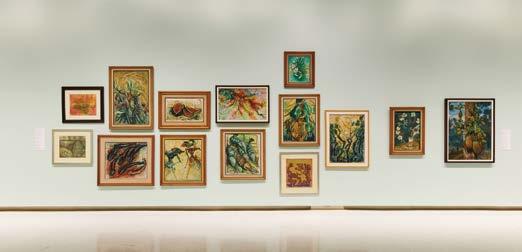
Time: 1 – 3 p.m.
Cost: $18 per person
The docent-guided tour will include exhibits in visual art, film, performance, theater, and music, underscoring the breadth of approaches shaping contemporary art and creative practice today. This year marks the 59th edition of this event.
MONDAY, JUNE 29, 2026
Time: 1 – 3 p.m.
Cost: $21 per person
The Clemente Museum is a nonprofit organization dedicated to preserving the life and legacy of Roberto Clemente. With one of the largest collections of photographs and objects related to Roberto Clemente, the museum aims to educate its audiences on not only his incredible baseball career, but his humanitarian efforts and life off the field.
OLLI at Pitt has partnered with OLLI at Dartmouth to offer a live-streamed Summer Lecture Series. These lectures will feature presentations by six experts across a wide range of fields, who will provide clarity, context, and confidence to anyone—novices and experts alike—in seeking to understand the benefits and challenges of AI.
Members will register for the entire series. Zoom links will be sent to registrants the day before each lecture.
SESSION 1
What Can the Declaration of Independence
Teach Us About Artificial Intelligence?
WEDNESDAY, JULY 8, 2026
Time: 9 – 11 a.m.
Modality: Online
Presenter: Brinnae Bent, Executive in Residence in the Engineering and Professional Programs, Pratt School of Engineering at Duke; Director, Duke TRUST Lab
SESSION 2
Can AI Think Like a Doctor?
WEDNESDAY, JULY 15, 2026
Time: 9 – 11 a.m.
Modality: Online
Presenter: Adam Rodman, Assistant Professor, Harvard Medical School; Director of AI Programs, Shapiro Center for Research and Education, Beth Israel Deaconess Medical Center
SESSION 3
AI: Too Artificial? Too Intelligent? Too Much Energy?
WEDNESDAY, JULY 22, 2026
Time: 9 – 11 a.m.
Modality: Online
Presenter: Dan W. Reicher, Senior Scholar, Stanford Doerr School of Sustainability; Senior Fellow, Dartmouth Irving Institute for Energy & Society
SESSION 4
What Will Be the Economic Impacts of AI?
WEDNESDAY, JULY 29, 2026
Time: 9 – 11 a.m.
Modality: Online
Presenter: Patrick Wheeler, Executive Director of the Center for Digital Strategies, Tuck School of Business at Dartmouth
SESSION 5
Is AI Leading Us Toward a More Dangerous World Disorder?
WEDNESDAY, AUGUST 5, 2026
Time: 9 – 11 a.m.
Modality: Online
Presenter: Michèle Flournoy, Co-Founder and Managing Partner, WestExec Advisors; Co-Founder and Chair, Center for a New American Security
SESSION 6
How Can We Build Human Morality Into AI?
WEDNESDAY, AUGUST 12, 2026
Time: 9 a.m. – Noon
Modality: Online
Presenter: Walter Sinnott-Armstrong, Chauncey Stillman Distinguished Professor of Practical Ethics, Duke University
Don Ellison
WEDNESDAY, MAY 6
Time: 10 – 11:30 a.m.
Modality: Online
Controlled nuclear fusion is presented in the press as a clean, safe, unlimited source of electricity if we can just solve the technical problems blocking its fulfillment. Nuclear fusion does power the sun, but conditions in the center of the sun are vastly different from any achievable location on Earth. This is why controlling nuclear fusion is so much harder than controlling nuclear fission, which has been producing commercial electricity since the 1950s. This lecture will describe the science that explains why fusion power has not been realized after decades of work.
Don Ellison, PhD, is professor emeritus in physics at North Carolina State University. He obtained a PhD from The Catholic University of America in Washington, D.C. He has taught physics and astrophysics at the university level, and since 2019, has taught OLLI classes at NCSU, Duke University, and the University of Pittsburgh.
Minmei Shih
WEDNESDAY, MAY 13
Time: 10 – 11 a.m.
Modality: Online
Low social participation is linked to social isolation, sedentary behavior, depression, anxiety, and chronic illness. Although returning to social participation is a top priority for stroke survivors, it is often overlooked in current neurorehabilitation. This lecture will discuss how low social participation affects health and well-being in individuals with acquired brain injury (including stroke) and aging adults. Participants will explore strategies to overcome barriers and promote social participation.
Minmei Shih, PhD, OTR/L, earned her doctorate from the University of Pittsburgh. She is currently the Assistant Director of Research Operations in the Department of Occupational Therapy at Pitt. Her current research specializes in social participation and psychological flexibility in stroke survivors.
Sarah Rosenson
WEDNESDAY, MAY 20
Time: 10 – 11 a.m.
Modality: Online
Frequent OLLI at Pitt instructor Sarah Rosenson will discuss her new book, Fan Fiction on the Book of Genesis: A Guide to Close Reading of and Creative Writing on the Bible. The book addresses the questions left open in the first book of the Bible and includes questions for the characters in the stories, which can serve as prompts for conversations or creative writing. Some chapters also describe paintings by famous artists depicting the scene, and how they seem to have answered at least one of the questions. The book is perfect for anyone interested in reading Bible stories through a new and creative lens.
Sarah Rosenson, JD, has a bachelor's degree from Georgetown University, a master's degree in Jewish studies from the Spertus Institute, and a JD from the University of Pennsylvania. She currently teaches adults both in person and online for various institutions around the country.
Chongyan Gao
TUESDAYS, APRIL 28, MAY 5, AND MAY 12
Time: 10 – 11:30 a.m.
Modality: In-person
Participants will explore Chinese textile traditions through lecture, storytelling, and hands-on creative activities. Each session introduces cultural practices and symbolism in decorative arts. Week 1 will explore Chinese women’s sewing traditions, and members will create a folded origami case. Week 2 will examine flowers, particularly the lotus, as important symbols in Chinese art and culture. Week 3 will introduce the Linglong Pillow, a traditional Chinese textile object known for creative structure and craftmanship. Participants will create a miniature version. The lectures and workshops are designed to be welcoming and beginner friendly.
Dr. Chongyan Gao is an OLLI member and an Associate Professor of Marketing at the University of International Business and Economics (UIBE) and a volunteer docent at the Ethnic Costume Museum of the Beijing Institute of Fashion Technology, where she received seven years of systematic training in traditional Chinese costume making. Her work seeks to build cross-cultural and interdisciplinary bridges among traditional costume craftsmanship, brand storytelling, and contemporary design education.
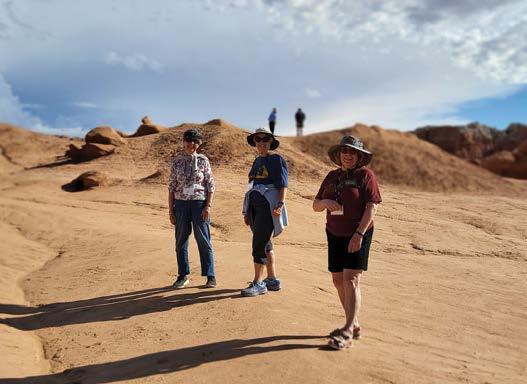
Course registration opens Tuesday, April 14, 2026. After that date, paid members can register for classes and events. After registration, members will immediately receive email confirmation of classes and whether they are registered or waitlisted.
One week before classes start, members will receive the Zoom link (for online classes) or the room location (for in-person classes). This information will be sent again the first two weeks of the course.
Waitlists are monitored and if we can create openings, members will be notified. We do our best to eliminate waitlists.
Members will receive our weekly updates via email. Newsletters include membership information, new event details, information about OLLI at Pitt benefits, and opportunities for activities at Pitt and beyond.
Visit OLLI’s website for more details on the travel opportunities below: olli.pitt.edu/events/travel-trips

California Dreamin’: Monterey, Yosemite, and Napa
SEPTEMBER 28 – OCTOBER 5, 2026
Enjoy the essence of Northern California on this journey with OLLI at Pitt. From the natural beauty of Lake Tahoe and Yosemite National Park to the dynamic cities of San Francisco, Monterey, and Sacramento, this trip has something for everyone. Low activity level and high fun level!

APRIL 30 – MAY 9, 2027
Splashes of color and the spray of the sea abound in southern France. The best way to pair them with the allure of Paris? Taking this OLLI at Pitt customized trip.
OLLI members and their guests will swing from the glitz of the Cote d’Azur to the pastoral elegance of Provence, finishing with a three-night stay in the cosmopolitan French capital. If you choose to add the post-trip extension to the storied shores of Normandy, you will step back to the not-so-distant past.
DAVID ALBERT has been a student of the Civil War for 50 years. He cotaught the Civil War elective at the U.S. Air Force Air Command and Staff College and was a Civil War docent for 12 years at the Alabama Department of Archives and History.
VERNARD ALEXANDER is the director of the Community Engagement Center in Homewood. Considered a guru of engagement, his reputation for excellence in this area has resulted in many benefitting from his expertise for their own growth. Businesses, non-profits, and politicians have expanded their reach using his tips and tricks for social media mastery.
RALPH BANGS, PhD, MPA, is the retired associate director of the Center on Race and Social Problems at the University of Pittsburgh. His most recent book is Race and Social Problems: Restructuring Inequality. He has received racial justice and leadership awards and has taught courses on race for several decades.
MAGGIE BEELER, PhD, is a teaching assistant professor in classics at the University of Pittsburgh, where she specializes in ancient Mediterranean art and archaeology. She holds a PhD in classical and near Eastern art and archaeology from Bryn Mawr College and has conducted archaeological fieldwork at several sites in Greece and the United Arab Emirates.
RALPH BEGLEITER was CNN's most widely-traveled reporter during two decades working as their world affairs correspondent. He has worked in 100 countries on all seven continents. During nearly twenty years at the University of Delaware, he was founding director of the Center for Political Communication. Since 2016, he has continued teaching adult students, focusing on media and public opinion topics.
ELAINE BERGSTROM, BA, earned her degree from the University of Illinois in design, a certification in art education from Carlow University, and a botanical illustration certification from the Morton Arboretum in Illinois. She specializes in oriental, watercolor, acrylic, pen/ink, drawing, colored pencils, and pastels.
MEGHNA BHAT, PhD, is an awardwinning storyteller, culture-change consultant, and feminist educator with over 20 years of experience using narrative to foster culture change, prevention, and intergenerational healing. She specializes in facilitation, strategic planning, and curriculum design, applying a trauma-informed, community-centered approach to her course.
KAREN BIGRIGG, MS, earned a master’s degree in education from Drexel University and a bachelor’s degree in computer science from the University of Pittsburgh. She teaches courses from basic computer skills to advanced data analysis, using hands-on methods to simplify complex concepts. Her background in education and corporate fields helps her tailor her approach to adult learners, boosting confidence and technology skills.
DAVID BRUMBLE, PhD, is professor emeritus of English at the University of Pittsburgh and a recipient of both of Pitt’s most prestigious teaching prizes. Two of his five books are on medieval and renaissance art and literature, and he has published articles on the Bible.
ELIZABETH BURNETTE, MS, earned her bachelor’s degree in engineering physics from Cornell University, then worked at NASA's jet propulsion laboratory with space shuttle experiments. She taught at a community college and taught science at a Montessori school. She earned her master’s degree in astrophysics from the University of Pittsburgh.
JOHN BURT, JD, is a retired history teacher and lawyer. He served as a featured speaker in Safe Harbor, a public television awardwinning documentary on the Underground Railroad in Western Pennsylvania. Since 1986, he has lectured on the history of American reform movements, especially the abolitionist movement, and he has conducted tours connected with Underground Railroad activities.
SAM AND CANDY CAPONEGRO have worked in all aspects of theater for over 30 years. Their goal is to keep the classic movie musicals and the golden age of Broadway alive through their lectures.
STEVEN CHERRY, MFA, is a writer and editor, now based in New York’s Hudson Valley. He has taught writing, journalism, and film at the University of Pittsburgh and previously at New York University. He has a bachelor’s degree from the State University of New York Geneseo College and a master’s degree in creative writing from the New School.
JILL DONNETTE CLARY has been practicing yoga since 2003, has completed a 200-hour yoga teacher training program, and is registered with Yoga Alliance. Her classes are a blend of different yoga styles, but all focus on a slow flow with longer holds.
JARED DAY, PhD, taught American history at Carnegie Mellon University in Pittsburgh for 16 years. His areas of specialization are U.S. political, urban, and cultural history as well as world history from the late 18th century to the present. He is the author of several books along with numerous other popular and peer-reviewed articles.
FRANCIS DELEONIBUS, EdD, is an experienced educator with a doctorate in organizational leadership and advanced degrees in fire service leadership and community services. He teaches public administration, business management, and fire science courses at Point Park University, where he was nominated for a Distinguished Teaching Award.
SYDNEY DUBOSE, BS, has over 15 years of combined theater and improv comedy experience, and is eager about the impact storytelling and the arts can have on building confidence and creating community. She minored in theater at the University of Pittsburgh and has studied at the Steel City Improv Theater, Arcade Comedy Theater, and the Upright Citizens Brigade (Pittsburgh).
THOMAS EDMONDS, MFA, worked for 35 years in historic house museums in Pennsylvania, Massachusetts, Florida, and New York. He now serves as adjunct professor at Gannon University, teaching global art history and American architecture. He holds a BFA from Ohio State University, an MFA from the School of the Art Institute of Chicago, and did post-graduate work in museum studies at New York University.
MARK FATLA has broad experience as a writer and public speaker through his career as an attorney, nonprofit executive, and freelancer. He authored feature cover stories for weekly newspapers in Pittsburgh, Baltimore, and Cleveland, and has published two books on Pittsburgh sports history.
DAVID FETTERMAN, BA, MDiv, MEd, has degrees in history, theology, and education. He has served as a pastor and spiritual counselor/chaplain in the Pittsburgh area, as director of education and community outreach in the Center for Healthy Aging at the University of Pittsburgh's Graduate School of Public Health, and as a member of the CDC Healthy Aging Research Network, focusing primarily on the brain.
JENNIFER FICKLEY BAKER, PhD, received a bachelors degree from the University of Pittsburgh, a PhD from the University of Central Florida, and an ALM from Harvard University. She spent 20 years as a writer for The Walt Disney Company. She has taught English at Valencia College since 2020, and is a 2025 International Book Awards winner.
GAYE FIFER, MA, is the current president of the Country Dance and Song Society. After receiving an undergraduate degree from Washington University in St. Louis and a master's degree in counseling from the University of Missouri, she spent 30 years teaching elementary school. She has been leading English country dance for 12 years both locally and at many dance weekends and weeklong camps across the country.
COREY FLYNN is the director of the Office of Sustainability in the Health Sciences and assistant professor in the School of Medicine at the University of Pittsburgh. Flynn's research focus is on nutrition security among college students and how it impacts their mental and physical health and their academic success.
MARÍA FRANCO DE GÓMEZ, MA, is a retired instructor of Spanish at Pennsylvania State University New Kensington, where she served as Spanish coordinator. Her career as a faculty member includes a substantial record of academic service, solid scholarly activity, and very strong evidence of outstanding teaching.
JOSEPH GIVVIN, PhD, holds his doctorate in philosophy from St. John’s University, New York, and has been teaching for over 37 years. He enjoys the opportunity to teach for OLLI at the University of Pittsburgh and engage with curious minds in thoughtful conversation about the great questions of ethics and human life.
L. JON GROGAN, PhD, has a bachelor’s degree in political science from Tufts University, a master’s degree in public history from the University of San Diego, and a PhD in American history (with a minor concentration in African colonial history) from Loyola University Chicago. He is also a retired U.S. Marine Corps officer. He teaches for OLLI programs across the country.
NORA HAMERMAN, MA, has a bachelor’s degree in art history from Michigan State University and a master’s degree in art history from New York University. She lived in Rome for three years, starting as a Fulbright scholar studying the urban design of Pope Sixtus. She has taught at Shenandoah University and the University of Virginia.
KERRY HANDRON is the outreach coordinator at the Allegheny Observatory. She brings her love of science to all audiences and especially enjoys the OLLI demographic. Having completed other courses such as Explore the Allegheny Observatory and Astronomy Before Telescopes, she is developing courses the OLLI audience requests.
ANGELA HINDES is a Pittsburgh native cartoonist, art educator, and interdisciplinary artist, creating work under the pseudonym Angela Oddling. Her work weaves the fantastic into the mundane, often using magic and myth to explore the human experience. Alongside her studio practice, she also designs and facilitates creative workshops centered around intentional, thoughtful art.
JULIA HUDSON-RICHARDS, PhD, earned her PhD in European history from the University of Arizona, conducting research in the development of the Spanish citrus industry. She has specialized in food, labor, gender, and environmental history, teaching courses in both European and world history.
KAILEY HUGHES KRAMER, PhD, MPH, is an assistant professor of medicine in the Department of Medicine, Division of Infectious Diseases at the University of Pittsburgh. She serves as the director of the Translational Research Unit and the Infectious Diseases Expanded Access (IDEA) Center, and the regulatory chair of the Pittsburgh Phage Program. For the last several semesters, she has been an adjunct professor at Duquesne University.
ALAN IRVINE, PhD, is a professional storyteller with a life-long fascination with Arthurian tales. His CD, The Red Dragon: Tales of King Arthur, won a Storytelling World Honors award. He has a doctorate degree in sociology and teaches many courses at area universities.
CAMILO JAUREGUI is a professional musician with more than 25 years of experience teaching around the world, conducting, and inspiring people to enjoy the magic of the music. He is a Carnegie Mellon University instructor, Waynesburg University teacher, South Fayette High School assistant marching band director, and an active member of many music ensembles in the Pittsburgh area.
JACLYN JOYCE, MS, holds a master’s degree in information science from the University of Pittsburgh and has more than 10 years of experience teaching as an adjunct professor at Pitt. She currently teaches in the School of Computing and Information’s graduate program and has professional experience in information security and risk management in both government and financial industries.
HOWARD KERNER, MA, was an English professor for 47 years and published over 100 scholarly articles, mostly on the Holocaust. Since retirement, he has pursued his “passion project” by researching and speaking at OLLI programs and elsewhere about the inspiring bravery and altruism of unknown rescuers during the Holocaust.
REBECCA KING, MS, serves as the staff project director for CLEAR AI at the University of Pittsburgh, where she leads work on AI accountability, patient-facing communication, and equitable access to emerging health technologies. She earned a master's degree in management of information systems from Morehead State University and is completing a master's degree in health informatics management from Pitt.
KEN KONCERAK, MA, earned his bachelor’s degree in secondary education with a history minor from Pennsylvania State University and his master’s degree in history from the California University of Pennsylvania. In addition to teaching high school U.S. history and social studies, he taught U.S. history at the Community College of Allegheny County. He also served as an award-winning high school librarian for 13 years.
KIMBERLY KREBS, OTD, is a pediatric occupational therapist and international board-certified lactation consultant. She has expertise in addressing feeding challenges and sensory processing differences among young children. She earned her bachelor’s, master’s, and doctorate degrees in occupational therapy from the University of Southern California. She is currently an assistant professor in the Department of Occupational Therapy at the University of Pittsburgh.
FOSTER KRUPP, MPA, is a graduate from West Chester University. He was a co-curator at the West Chester University Museum of Anthropology and Archaeology for three exhibitions, conducted visitor studies research at the Philadelphia Museum of Art, and has presented his research on anthropology dioramas at the American Anthropological Association annual meeting.
LATONYA LATAMORE, PhD, is a researcher/practitioner whose work focuses on health, public policy, and improving outcomes for communities that experience barriers to care. She earned a bachelor's degree in management from the University of Michigan, a master's degree in finance from Walsh College, and a PhD in public policy and administration from Walden University.
KYOUNGAH LEE, EdD, is the assistant director of international programs at the University of Pittsburgh, supporting international and AAPI students. Originally from South Korea, Lee’s education spans Korea, the Philippines, and the United States, giving her a global perspective.
AARON LEONARD, BA, is an author and historian with a particular focus on the interplay of radicalism and repression. He is the author, along with Conor Gallagher, of Heavy Radicals: The FBI's Secret War on America's Maoists and The Folk Singers and the Bureau, among others. He has a bachelor’s degree in social sciences and history from New York University. He lives in Sacramento.
RICARDO LLOVET is a biochemist who has built his wine knowledge through extensive reading, tasting, and traveling. He has harvested grapes, made wines, and visited winemakers around the world. He has conducted wine tastings for 41 years and taught 15 wine courses at OLLI programs. Recently, he earned a Certified Wine Judge status at the Annual American Wine Society Conference. He founded the American Wine Society City of Pittsburgh chapter and posts wine reviews at www.wineandfriends.net.
CHRISTOPHER LYNCH, PhD, is a music historian and head of the Theodore M. Finney Music Library in the University of Pittsburgh Library System. His book Formulating Foster: Stephen C. Foster and the Creation of a National Musical Myth (Oxford, 2025) redefines how we understand the “father of American music” and the memories we build around our cultural icons.
MARK MACEDONIA, MA, is a retired social studies teacher from the Seneca Valley School District. He holds a bachelor’s degree in communication from St. Bonaventure University, and a master’s degree in education from the University of Pittsburgh. He is also a published author of historical fiction.
PAUL MACEK, MEd, has been an educator for over 40 years. He has also worked as copy editor, translator, writer, and publisher for over 30 years. He is the author of seven books: one on education, two on literature (one a translation), and four on American history.
RIKA MAESHIRO, MD, MPH, is a University of Michigan Medical School graduate trained in internal medicine (Boston City Hospital) and preventive medicine/public health (Johns Hopkins University). Her work with government agencies and non-profit organizations included preparedness, promoting clinical prevention, and improving public health content in medical education. Her clinical practice focused on underserved communities.
SPEARIT MALDONADO, JD, is a professor of law at the University of Pittsburgh School of Law, and affiliated faculty in religious studies. He graduated with a bachelor's degree in philosophy from the University of Houston. He earned a masters degree from Harvard Divinity School, and a PhD in religious studies from the University of California.
KEVIN MCDADE, PhD, obtained his bachelor’s degree in microbiology from the University of Pittsburgh. He started his career working at the Starzl Transplantation Center as a laboratory technician and followed with a PhD in the Department of Biomedical Informatics at Pitt. He has a 20-year career in higher education, teaching microbiology at Pennsylvania State University, Chatham University, and currently at Pitt.
JAMES MCHUGH, PhD, is professor emeritus of political science and senior fellow emeritus of the University of Akron. He also has served at Roosevelt University, American University, Carleton University, and the University of Vermont. He specializes in political theory, comparative politics, and constitutional law.
KRISTEN MERTZ, MD, MPH, recently retired from her position as medical epidemiologist for the Allegheny County Health Department where she focused on infectious disease surveillance and outbreak investigations. She earned her medical degree from Yale University School of Medicine and earned her MPH from Columbia University School of Public Health.
LYNN O'CONNOR, JD, is a graduate of the University of Notre Dame and the University of Pittsburgh School of Law. She has practiced in both the private and public sectors, including as a magistrate judge in the Court of Common Pleas of Cincinnati, Ohio. She has taught law and law-related classes for almost a decade.
RACHEL OPPENHEIMER, PhD, earned her PhD in history from Carnegie Mellon University. She specializes in transnational history, comparing the way that members of the Irish Republican Army and the Black Panther Party were viewed by their respective governments, and how these groups dealt with the incarceration of significant numbers of their members.
SILVINA ORSATTI, EdD, teaches Spanish language and culture, and foreign language pedagogy at the University of Pittsburgh in Greensburg. Her research interests include digital storytelling, game-based learning, and sustainability projects in the foreign language classroom. She received the PSMLA Educator of the Year Award in 2014 and became a Pitt Green Ambassador in 2024.
JAMES PAGLIASOTTI, at age 23 became the first rock music critic and columnist for The Denver Post, where he produced a twice-weekly column and regular articles about music and the counterculture from 196874. His work appeared in Rolling Stone magazine and various other publications. He also did shows as a deejay at KRNW-FM radio in Boulder and at KFML in Denver.
MARINA PALOMO FERNÁNDEZ, MA, is a public educator and a native Spanish language instructor. She holds a master's degree in geography and history from Universidad Autónoma de Madrid and has international experience as an educator. She has taught Spanish courses to adults and has been a Spanish curriculum designer for many years.
ROBERT PECKYNO, MS, earned a master's degree in space studies from the University of North Dakota and a second master's degree in geography from Oregon State University, where he researched lava flow morphology on Earth and Mars. He was also a GIS researcher on the Cassini mission, helping to build the first geologic map of Titan.
BETSY PEITZ, PhD, earned a PhD in biology from Case Western Reserve University. She was a faculty member in the biology department of California State University at Los Angeles. Following retirement from CSULA, she joined the OLLI program at the University of Pittsburgh and has taught several courses, most recently New Perspectives on the Brain.
ANDREW PETERSON, MA, earned a bachelor’s degree and a master’s degree in creative writing and literature from Harvard University Extension School. He has taught creative writing at Haywood Community College in North Carolina, working with continuing education students in fiction and personal narrative. His short stories have appeared in Ground Fiction literary journal.
SPENCER PFROGNER is a freelance historian on a number of subjects pertaining to American history. He spent approximately a decade interpreting the French and Indian War at Fort Ligonier. Since that time, he has produced a diverse catalog of history videos for Redoubt Productions and hosts lectures and tours of historic Ligonier, Pennsylvania.
MIKE PLASKETT is a lifelong record collector, broadcaster, and performer. He produced radio's Rhythm Sweet & Hot show for 40 years and has led OLLI classes for 20 years.
LAUREN RAWSON is currently a graduate student at the University of Pittsburgh with the career goal of becoming a professor. She earned a bachelor's degree in sociology from the University of Florida in 2023.
DANIEL RECTENWALD, MM, is integrally rooted in the Pittsburgh music scene, playing guitar in various groups in the area. He earned a bachelor's degree in music from Duquesne University and a master's degree in music from the Cleveland Institute of Music. Currently, he teaches privately and is an adjunct professor at the University of Pittsburgh.
MICHAEL RIZZI, EdD, has taught international affairs at the University of Pittsburgh for over a decade. He is the author of one book and over 20 articles on history, international affairs, and education. He holds master's and doctoral degrees from Pitt and an undergraduate degree in foreign service from Georgetown University.
SARAH ROSENSON, JD, has a bachelor's degree from Georgetown University, a master's degree in Jewish studies from the Spertus Institute, and a JD from the University of Pennsylvania. She practiced law for a decade, and then taught classes on ethics, philosophy, the Bible, and world religions at a private high school. She currently teaches adults both in person and online for various institutions around the country.
ANN ROSENTHAL has more than 30 years of experience as an artist, educator, and writer. Her work has been shown locally at the Andy Warhol Museum, the Mattress Factory, and SPACE, and has been featured in exhibitions across the United States and internationally.
GEORGE SCHEPER, PhD, received his PhD in English literature from Princeton University. He has been director of the Odyssey Program and is currently senior lecturer in the Master of Liberal Arts Program, both of Johns Hopkins University. He is also emeritus professor of humanities at the Community College of Baltimore County. He is the recipient of many Excellence in Teaching Awards.
ELEANOR SCHRADER is an awardwinning educator, lecturer, and author on the history of architecture, interiors, and decorative arts. She has been named a distinguished instructor of design history at the University of California Los Angeles Extension and is professor emerita of art and architectural history at Santa Monica College. She has done graduate work at Sotheby's Institute in London and New York.
CATHLEEN SENDEK-SAPP, MFA, has her master’s degree in French language and literature. She has taught French at the University of Pittsburgh as a teaching fellow and part-time instructor as well as for noncredit lifelong learning.
DAVID SHIFREN, MFA, wrote film reviews for The Film Journal Magazine and CBS/Fox Video in New York City. He earned an MFA degree in fiction writing at the University of Pittsburgh, and has been teaching OLLI film classes for more than 20 years.
ARIEL SKOVERA, BA, is a visual artist with a focus on alternative photographic processes. She received her bachelor's degree in photography from Drexel University. She is currently a creative assistant at the Center for Creativity at the University of Pittsburgh, where she facilitates creative workshops. In the Pittsburgh area, she teaches creative and filmmaking workshops for members of the community.
JOANNE SPENCE is a yoga therapist, educator, and published author whose academic and clinical work centers on nervous system health and accessible embodied practices. A veteran teacher, she has designed and taught evidenceinformed programs for diverse populations in both professional and community contexts.
MIRANDA STEEGE, PhD, is a visiting lecturer in literature at the University of Pittsburgh. She has a PhD in English from the University of California Riverside, specializing in Victorian literature, queer theory, and fan studies. She has taught courses in detective fiction, Victorian literature, Gothic media, and women in literature.
SHAWN SULLIVAN, JD, LLM, is an instructor in the Master of Studies in Law program at the University of Pittsburgh and University of Southern California Gould School of Law. With a background in international legal frameworks and anti-money laundering policy, he makes complex global governance issues accessible to adult learners. Sullivan earned his JD from the University of Mississippi School of Law and his law degree in international business and economic law from Georgetown University Law Center.
PHILIP TERMAN, PhD, is the author of eight books of poetry. Retired from Clarion University (now PennWest University), he co-directed the recent James Wright Festival, codirects the Jewish Poetry Reading Series, and directs the Bridge Literary Arts Center, a non-profit organization for all writers in Western Pennsylvania. He earned his bachelor’s and his master’s degrees in English from Ohio University and earned his PhD in English from Ohio State University.
RAYMOND UY, DMA, is an author, performer, conductor, and awardwinning music educator. He holds a Doctor of Musical Arts degree from Boston University, a Master of Music degree from the Eastman School of Music, and a Bachelor of Music degree from Westminster Choir College.
ELI VEGA is a highly published, award-winning photographer and author. He has published two books on photography. He has taught photography for 30 years, including field workshops in Rocky Mountain National Park and classes for OLLI throughout the country. He is a certified facilitator and makes his classes and workshops casual, engaging, and fun.
HOWARD VOIGT, JD, is a retired lawyer. He earned his bachelor's degree in history from the University of Notre Dame and his JD from the University of Cincinnati College of Law. For the past 15 years he has led walking tours of downtown Pittsburgh and Oakland under the auspices of the Pittsburgh History and Landmarks Foundation, and has lectured on those same subjects at OLLI venues as well as at other sites in the Pittsburgh area.
DAVID WALTON, MFA, is retired from the English department at the University of Pittsburgh, where he taught a variety of literature and writing courses over the last 20 years. He is a regular book reviewer for several national newspapers, a recipient of a National Endowment for the Arts fellowship in literature, and the author of two collections of short stories and a novel.
COLIN WILLIAMS, MFA, is an artist, journalist, and writing instructor at the University of Pittsburgh. He holds an MFA in fiction writing from the University of Florida and has extensive experience as an arts educator. From 2015 to 2021, he was the sole proprietor of Knot to Scale Handstitched Maps and sold embroidery at markets, including Handmade Arcade.
YANG YANG is a graduate student in International Chinese Education at Beijing Normal University and a Chinese language teaching intern at the University of Pittsburgh’s Asian Studies Center. She works with students of all ages, including adult learners, to design interactive, culture-based Chinese lessons.
ANDREW YIM is a PhD candidate in composition and applied linguistics at Indiana University of Pennsylvania and is a part time instructor in the University of Pittsburgh's First-Year Engineering Composition Program. He also teaches literature and writing courses at Duquesne University and the University of California, Berkeley.
MICHAEL YOUNG, PhD, earned his PhD from the University of Cincinnati. He is an experienced teacher of both film and history and is a faculty member in the University of Pittsburgh’s English Department. He is the author of numerous articles and conference papers, several of them in Canadian studies and history, and was awarded a Faculty Enrichment Grant by the Government of Canada to study there and create curricular programming.
KATHERINE ZORASTER, MA, is a contextual art historian who has been teaching and lecturing on a wide variety of historical art topics for the past twenty years. Following her bachelor's degree with a double major in English and art history, she received her master's degree in art history with distinction from California State University Northridge.
EDWARD ZUCKERMAN, PhD, is a psychologist licensed in Pennsylvania. He has created effective practice tools for clinicians and taught undergraduate human sexuality and psychology courses at the University of Pittsburgh and Carnegie Mellon University for over 20 years. He has presented dozens of workshops to mental health professionals.
Please notify the OLLI office if you are unable to attend a course/class so that we can maintain accurate information on our programming and course evaluation efforts. Email us at osher@pitt.edu prior to the beginning of a class or at any time for courses that have multiple weeks. Let us know if you would like to enroll in an alternate course. Event refunds depend on each event and they are marked if the fees are refundable or not, and if they are, by what date.
Occasionally, courses are postponed or canceled, typically due to reasons beyond our control such as emergencies or illness of instructors, etc. If a class is postponed, you will be notified by email and informed of the rescheduled date, if it is known. If a course is canceled, you will receive email notice as soon as possible.
Course enrollment size varies for several reasons including size of physical classroom space or the nature of the course material (regardless of format). For these reasons, not all courses can be open to everyone who wishes to attend, including online courses. If a course or event is full, you will be given the opportunity to be added to the waiting list in case there are cancellations. People are added to the course or event from the waiting list in the order received.
in a Time Period
During registration, be sure to select only one course during a given time frame. If you double-book your courses by accident, we will contact you by email and ask you to select the one you want to keep, and we will remove you from the other. If you do not reply in the time frame given in the email, we will remove you from both courses.
Each catalog will indicate the date by which a membership may be refunded. There are no exceptions. Events or tours that require a fee will indicate if the fee is refundable, and if so, by what date you must request a refund.
Make sure the OLLI office has your correct email address. The OLLI office sends emails to notify members of Zoom invites and course changes, course cancellations, upcoming events, as well as for our email newsletter. Instructors may also want to contact students regarding class information. Your information is always confidential.
During the last week of your courses, you will receive an email with a link to your course evaluations. Please try to respond and share information about your experience of the course. This information helps guide future programming. If you have an issue with your course evaluation, please contact us at osher@pitt.edu Do not contact the University Office of Measurement and Evaluation of Teaching (OMET).
In all courses, lectures, and events and in all formats, OLLI members are expected to follow the OLLI Code of Conduct. This Code of Conduct is signed (either electronically or on paper) every time a member purchases a membership. OLLI members are expected to respect the learning environment, instructors, staff, and other members and embrace the concept of a civil community as well as follow all OLLI and University policies, procedures, and conduct guidelines. Please visit Member Resources on the OLLI website to read the OLLI Code of Conduct.
OLLI at Pitt members may audit undergraduate courses. Members who audit do not receive credits nor grades and generally do not participate in exams or homework. Auditors learn side-by-side with undergraduate students, but they are guests in the course and participation can be limited or restricted by instructor or department. Full information about auditing and how to register is found on our website, olli.pitt.edu
Last day to purchase any type of Summer 2026 membership: July 10, 2026
Financial assistance application period: March 30 – July 1, 2026
NO REFUNDS ISSUED FOR MEMBERSHIP PAYMENTS AFTER MAY 14, 2026.
Phone: 412-624-7308 | Email: osher@pitt.edu
Office Hours: Monday – Friday, 8:30 a.m. – 4 p.m. 4227 Fifth Avenue, 710 Alumni Hall, Pittsburgh, PA 15260